
Article

Navigating Trade–Offs and Synergies of Cultivated Land Values in China’s Poverty–Alleviated Area During Rural Transformation: A Case Study of the Liupan Mountain Area in Northwestern China

School of Geography and Planning, Ningxia University, Yinchuan 750021, China
*
Author to whom correspondence should be addressed.
Land 2026, 15(1), 19; https://doi.org/10.3390/land15010019 (registering DOI)
Submission received: 7 November 2025 / Revised: 12 December 2025 / Accepted: 19 December 2025 / Published: 21 December 2025

Abstract

Significant rural transformation has occurred in China’s formerly impoverished areas due to targeted poverty alleviation and rural revitalization strategies. In these areas, the coordinated development of the economic and ecological values of cultivated land resources is essential for rural transformation. This study focuses on the Liupan Mountain area, a typical poverty alleviation demonstration zone and Ecological and economic fragile area in Northwestern China. By collecting statistical yearbook data and raster data, it establishes a valuation system for cultivated land resources, transforming these resources into quantifiable poverty alleviation capital. This approach provides support for the long–term consolidation of targeted poverty alleviation policies. By integrating the Production Possibility Frontier (PPF) method with GIS spatial analysis, we developed a workflow to analyze value correlations and spatial patterns. The results showed the following: (1) While ecological values grew steadily from 2007 to 2022, economic value increased initially and then decreased, with both exhibiting significant spatial heterogeneity. (2) The relationship between economic value and ecological value evolved into a continuously strengthening synergy. (3) The integration of PPF curves with GIS visualization technology enabled the identification of underutilized, overutilized, and optimally utilized areas, revealing a distinct “π–shaped” overutilization zone. This study elucidates the trade–offs, synergies, and spatial characteristics of cultivated land values, providing critical insights for sustainable land resource management in post–poverty transformation areas.

1. Introduction

Strengthening cultivated land protection and improving its quality have become crucial strategies for advancing comprehensive rural revitalization and achieving sustainable development under the United Nations’ 2030 Agenda for Sustainable Development Goals (SDGs), which include poverty eradication as its primary goal [1]. As the foundation for food production, cultivated land plays a vital role in sustaining farmers’ livelihoods, promoting rural economic growth, and maintaining social stability in rural regions [2]. Cultivated land has special multifunctional value features, and the proper manifestation of these values is heavily reliant on the scientific and rational land management approaches. In the fields of land system science and natural resource management, how to rationally allocate resources based on the multifunctional characteristics of cultivated land to meet the diverse demands of human society for its products and services has emerged as a critical scientific issue that must be addressed immediately [3]. As a result, for poverty–alleviated regions undergoing rural transformation, such as China’s Liupan Mountain Area, consolidating poverty reduction achievements through scientific management of limited cultivated land resources and maximizing its utilization efficiency [4] have emerged as core strategies for implementing sustainable development in such areas, thereby promoting the synergistic enhancement of cultivated land’s economic value and ecological value. A more detailed discussion of the Liupan Mountain Area follows in study area aspection. The direct market value produced per unit of cultivated land from agricultural production operations and the economic advantages of grain production output—which are mainly determined using cash income—are what this study refers to as the economic value of cultivated land [5].
The valuation of cultivated land resources originated from the System of Environmental–Economic Accounting (SEEA), proposed by the United Nations Statistics Division [6]. Subsequently, governments worldwide incorporated forests [7], soil [8], water resources [9] and other elements into their accounting systems, establishing a comprehensive natural resource accounting framework that integrates physical measurements with monetary valuation of ecosystem services [10]. In 2019, China issued the Guiding Opinions on Coordinated Advancement of Natural Asset Property Rights System Reform, advocating for research into establishing a natural asset accounting and appraisal system. Afterward, studies on physical quantity statistics and value–based accounting steadily gained prominence in academic research [11]. With increasing system complexity and advances in interdisciplinary research, studies on trade–off/synergy relationships have evolved from basic binary interactions to multidimensional [12], multi–scenario, and multiscale networked relationships [13]. Some scholars, building on the multifunctional nature of cultivated land [14], have employed methods such as correlation analysis to reveal trade–offs/synergies among its productive, living, and ecological functions [15]. Research methodologies including Spearman correlation analysis [16], geographical autocorrelation [17], and the Production Possibility Frontier (PPF) curve [18] have established a foundation for comprehensively examining interactions among cultivated land resource values. Concurrently, spatial overlay techniques [19,20,21] and spatial regression models [22] have been widely used in value synergy analysis to identify categories and spatial patterns of trade–offs or synergies. The introduction of the PPF curve in spatial studies of cultivated land resource values aims to identify optimal combination zones and problematic areas in the spatial development of these values. Previous research primarily utilized correlation coefficient analysis combined with GIS, which could not effectively distinguish between underutilized and overutilized regions. This study combines PPF curve analysis with GIS to investigate relationships among cultivated land resource values [23], enabling accurate identification of efficiency levels and spatial distribution patterns of value combinations across counties in the study area. This methodology provides crucial innovation for developing scientific and rational regional agricultural land management policies. Current studies on the value of cultivated land resources typically use administrative units as the scale of analysis, focusing on national [24], provincial, and municipal levels [25], while also extending to townships, subdistricts [26], and field scales [27]. Furthermore, GIS has been used to define grids of different precision for establishing unit scales [13], essentially spanning studies from macro to micro perspectives. However, existing multi–scale studies have focused more on China’s key grain–producing regions [28,29,30,31], paying relatively little attention to special areas with fragile ecological and economic conditions, such as poverty–alleviated areas. Consequently, there is a lack of adequate research to elucidate the value of cultivated land resources in these locations and the synergistic linkages among them. As a result, one of the goals of this study is to fill this research gap.
The per capita cultivated land area in China is below 40% of the global average [32]. This deficiency hinders the multifunctional use of cultivated land and policy alignment [33], thus intensifying the difficulty of reconciling the values linked to cultivated land. In China’s poverty–alleviated areas, this problem is especially prominent due to the combined limitations of vulnerable ecosystems and unstable economies. To facilitate the rural transformation of these regions, China’s rural development policies in the past decade catalyzed a significant transition from the sole economic function of cultivated land to its diverse ecological and economic values [34]. Consequently, this has changed the equilibrium among the values of cultivated land. In poverty–alleviated areas, balancing the economic value and ecological value of cultivated land became a critical issue for sustainable development during the rural revitalization phase [35].
Based on the above analysis, this study takes China’s Liupan Mountain Area as a case to reveal the evolution characteristics of trade–offs/synergies between the economic value and ecological value of cultivated land resources in China’s poverty–alleviated areas, and to identify their typologies. To achieve this goal, this study (1) quantifies the economic value and ecological value of cultivated land in the Liupan Mountain Area, elucidating the evolutionary characteristics of cultivated land resource values during rural transformation and development; (2) assesses the trade–off/synergy relationship between the economic value and ecological value of cultivated land resources utilizing the PPF model and delineates its evolutionary characteristics, and (3) integrates the PPF findings with geographical spatial analysis techniques to finalize the zoning of the trade–off/synergy relationship between the economic value and ecological value of cultivated land resources. This study offers substantial assistance for cultivated land resources use and sustainable rural development in poverty–alleviated areas by addressing these problems.

2. Materials and Methods

2.1. Theoretical Framework

This study examines the trade–offs and synergistic logic of cultivated land value in the rural poverty–alleviated areas of the Liupan Mountain Area during its transitional phase (Figure 1). It constructs a theoretical mechanism encompassing “theoretical foundation—factor support—functional coupling—value manifestation—management transformation—supporting poverty alleviation,” with a core focus on the interactive relationship between the economic value and ecological value of cultivated land. The theory of land rent and prices anchors the core source of cultivated land’s economic value, while the concept of ecological civilization defines the core orientation of its ecological value [36].
The framework aligns with the ecologically fragile characteristics of the Liupan Mountain Area. Production factors provide the material foundation for realizing the functional value of cultivated land and ensure its practical implementation, serving as the prerequisite for transforming functional value from “theoretical potential” to “practical activation” [37]. Ecological and productive functions do not exist in isolation but exhibit a mutually reinforcing coupling relationship. Rational agricultural production activities can enhance output efficiency by leveraging stable soil and water conditions, while robust soil and water conservation functions mitigate erosion damage to cultivated land quality, further ensuring long–term functional stability. This functional coupling externalizes as the manifestation of cultivated land value, forming the core focus of this study’s examination of “trade–offs and synergies.” Specifically, synergy manifests as enhanced ecological value, improving soil quality, thereby boosting production efficiency and amplifying economic value. Trade–offs, conversely, emerge when the short–term pursuit of economic gains diverts ecological conservation resources, weakens soil and water conservation capacity, and undermines the long–term ecological value and sustainable productivity of cultivated land [38].
Scientific cultivated land management serves as the critical link to coordinate economic–ecological trade–offs and amplify synergistic effects [39]. Its core lies in translating the functional value of cultivated land into tangible, perceptible benefits. The outcome of this value transformation will, in turn, support sustainable development and rural transformation in the poverty–alleviated area of Liupan Mountain, forming a closed–loop mechanism. The activation of cultivated land functions, the manifestation of its value, and the implementation of management collectively point toward the dual objectives of “economic development and ecological improvement” in poverty–alleviated areas. This approach ensures the long–term sustainability of poverty alleviation outcomes through the coordinated development of cultivated land value in the Liupan Mountain Area.

2.2. Study Area

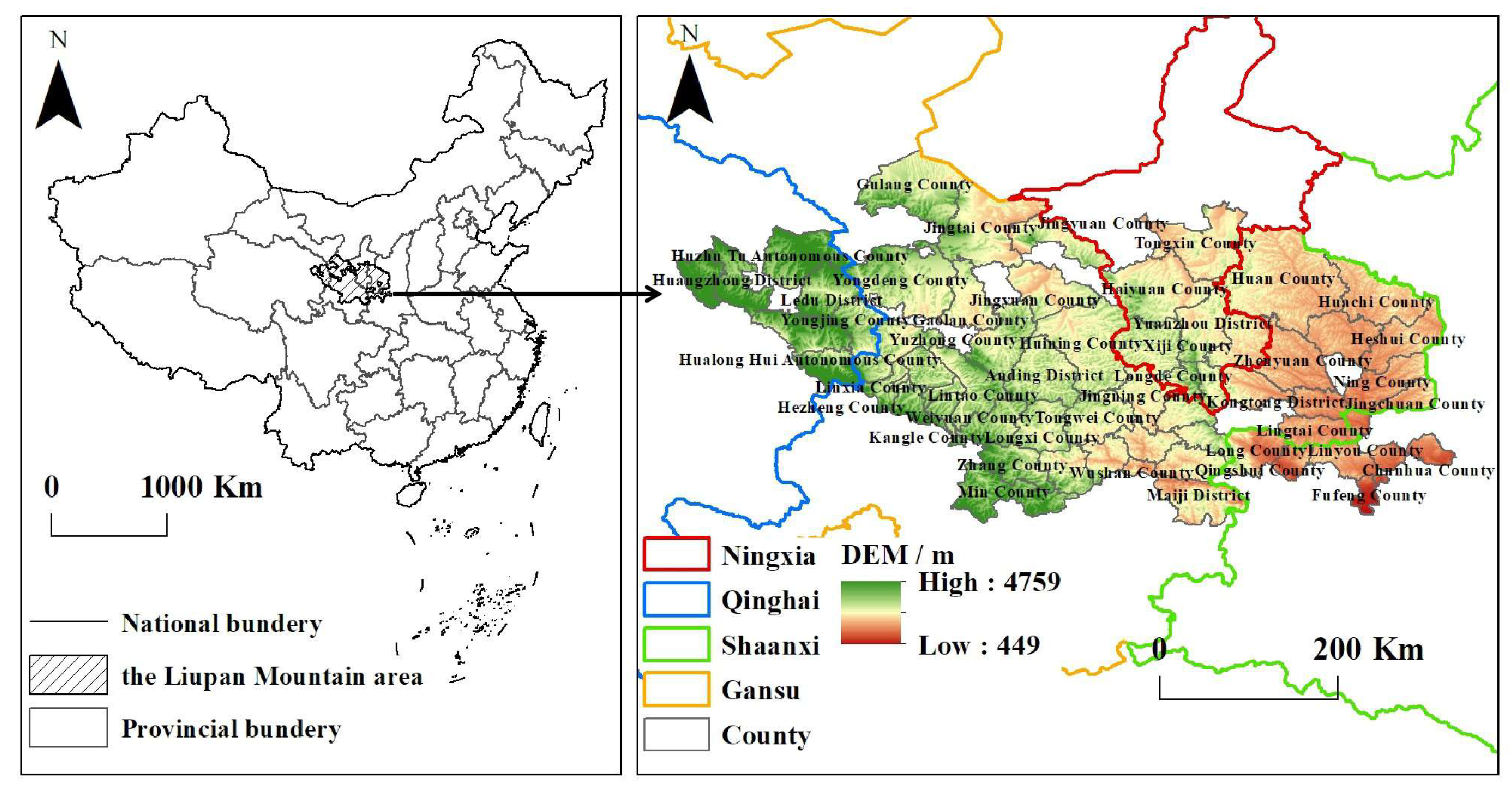
The Liupan Mountain Area is classified as one of the most deprived regions in the China Rural Poverty Alleviation and Development Outline (2011–2020), experiencing the highest levels of poverty [40]. The region is in the northwestern inland of China, encompassing 61 county–level administrative districts across 14 prefecture–level administrative units in Shaanxi Province, Gansu Province, Qinghai Province, and the Ningxia Hui Autonomous Region (Figure 2). This encompasses 40 counties and districts in Gansu Province, and 7 counties each in Ningxia Hui Autonomous Region, Shaanxi Province, and Qinghai Province. The region is located within a crucial ecological conservation zone where the Loess Plateau meets the Qinghai–Tibet Plateau, functioning as an essential ecological barrier and water conservation area in Northwest China. The region’s cultivated land, limited by its distinct geographical setting, climatic circumstances, and ecological functional position, typically displays traits such as fragmented topography, a significant amount of sloped land, irregular irrigation, and inadequate fertility. Soil degradation and fragmentation pose significant concerns for food security [40]. Poverty here is due to fragile ecosystems, which limits economic development. Under the advancement of these policies, the area has entered a period of intense rural transformation, facing pressures and challenges concerning the rational allocation and sustainable utilization of its limited cultivated land resources. Key challenges included deep–seated poverty, vulnerable farmer livelihoods, barren land, and coordinating ecological protection with economic growth.
As the primary front for consolidating and building on achievements in poverty alleviation and to promote the revitalization of rural areas, the continuous advancement of rural policies has triggered dramatic shifts in the value of cultivated land within the Liupan Mountain Area. These changes profoundly influence the trade–offs/synergies between economic value and ecological value. In general, the Liupan Mountain Area includes places inhabited by ethnic minorities, is an important ecological conservation zone, and is a critical location in the western region for successfully tying poverty alleviation initiatives with rural development. It demonstrates uniqueness, typicality, and exemplarity as a field of study. Consequently, the Liupan Mountain Area serves as a representative case study for examining the economic value and ecological value of cultivated land resources, along with their trade–offs/synergies, within the context of rural transformation and development.

2.3. Data Source

This study examines the period from 2007 to 2022, a time of intense rural transformation in China’s poverty–alleviated areas. The study selected 2007, 2015, and 2022 as key research time points. During this span, the Liupan Mountain area is represented by three distinct years: 2007, which was the first year following China’s proposal to “advance the construction of a new socialist countryside”, 2015, which was the first year after implementing “targeted poverty alleviation”, and 2022, which was the second year after China resolved regional poverty as a whole. Since 2021 saw significant pandemic restrictions, with normal production and life resuming by late 2022, data from 2022 is utilized. These years represent three distinct phases for the Liupan Mountain Area, respectively: pre–targeted poverty alleviation, during targeted poverty alleviation, and post–targeted poverty alleviation. The study reveals the characteristics of cultivated land value in this region, utilizing data primarily categorized into two major types (Table 1).
(1) Statistical data, including grain planting area, grain yield, vegetable planting area, vegetable yield, rapeseed planting area, and melon and fruit planting area, is primarily sourced from the Gansu Development Yearbook (2007–2022), the Gansu Rural Yearbook, and the statistical yearbooks or economic overview manuals of various cities within the study region. Certain data are derived from the statistical bulletins on national economic and social growth of the different counties and districts. Cash revenue per mu for agricultural products is obtained from the National Agricultural Product Cost and Revenue Data Compilation. The risk adjustment value is calculated using the geometric mean of the consumer price index (CPI) change rate over the previous decade. The ecosystem service value coefficient per unit area for the Liupan Mountain Area was updated according to biomass parameters for agricultural ecosystems throughout Chinese provinces [41]. Annual net revenue per mu of farmed area and land restoration rates were computed accordingly.
(2) Grid data, including the Digital Elevation Model (DEM), were obtained from the GEBCO survey dataset (https://www.gebco.net (accessed on 6 May 2024)). Provincial and county–level administrative boundary data, designated by review number GS (2024)0650 and sourced from the Tianditu official website, were utilized to delineate the global dataset, resulting in the generation of DEM data for the study region.

2.4. Methodology

2.4.1. Establishment of an Evaluation System for the Value of Cultivated Land Resources

The valuation of cultivated land resources represents the monetization of its multifunctional utility [42] and serves as a scientific method for calculating its diverse values. Existing research categorizes the valuation of cultivated land resources into three dimensions: economic, social, and ecological [43]. Drawing upon relevant scholarly studies and literature on calculating the value of cultivated land resources, this study constructs an evaluation index system for the value of cultivated land resources in the Liupan Mountain Area (Table 2), including two dominant types based on the specific conditions of the area. Simultaneously, evaluation formulas for economic value and ecological value indicators are developed. Different methods, such as the benefit restoration approach and the equivalent factor method, are employed to calculate the value of distinct functions.

2.4.2. Calculation of the Economic Value of Cultivated Land Resources

The economic value of cultivated land denotes the net income obtained from the economic output produced when agricultural products are marketed, subtracting the expenses incurred throughout the production process. The prevailing methodologies for assessing the economic value of cultivated land encompass the income capitalization approach, market comparison approach, soil generation potential approach, and cost approximation approach. This study utilizes the income capitalization method to assess the economic value of cultivated land. The specific formula is calculated as follows (Equation (1)):
Vp = a/r
where Vp is the economic value of cultivated land. a is the annual net income from cultivated land, obtained from per–mu cash income (net income) data for diverse agricultural products (including corn, wheat, rapeseed, and apples) in Shaanxi Province, Gansu Province, Qinghai Province, and Ningxia Hui Autonomous Region, as documented in the 2007–2022 National Agricultural Product Cost and Income Data Compilation. r is the discount rate, typically computed as the sum of the “safe interest rate” and the “risk–adjusted rate.” The secure interest rate is the one–year bank deposit rate, which is 1.5%. The risk–adjusted rate is calculated as the geometric mean of the change rates of the CPI during the last ten years.

2.4.3. Calculation of the Ecological Value of Cultivated Land Resources

The ecological value of cultivated land pertains to its functional roles in air purification, soil erosion mitigation, biodiversity preservation, and environmental conservation [44].In calculating the value of ecosystem services provided by cultivated land, the academic community primarily employs methods such as the opportunity cost approach, shadow engineering cost approach, and value equivalence approach. Many scholars cite the 2007 China Ecosystem Unit Area Ecological Service Value Equivalence Table [41] to assess the ecological worth of cultivated land. This methodology has benefits such as accessible data and uncomplicated computations. However, the table was created at a 1:1,000,000 scale, rendering it appropriate for extensive regional analyses. The direct application of findings regarding the ecological value of cultivated land in the Liupan Mountain Area may introduce certain biases. To improve the evaluation approach, this study draws on previous academic research and uses the 2005 Biomass Factors for Farmland Ecosystems Across Chinese Provinces [45] to adjust and determine the ecological value equivalent of cultivated land in the Liupan Mountain Area. Ultimately, this procedure calculates the ecological service value coefficient per unit area of cultivated land in the Liupan Mountain Area (Table 2). The economic output from cultivated land production has been incorporated into its economic valuation, therefore excluding the provision of food and raw materials in the evaluation of its ecological worth [46]. This study utilizes the equivalent factor approach to assess the ecological value of cultivated land in the Liupan Mountain Area. Here is the formula for the equivalent factor method (Equations (2) and (3)):
Ve = (Ea × F)/r
E a = 1 7 i = 1 n p i q i a i A
where Ve is the ecological value of cultivated land. Ea is the value of 1 unit of biomass factor. F is the equivalent factor per unit area. pi is the average selling price of the i–th crop. qi is the yield per unit area of the i–th crop. ai is the planted area of the i–th crop. A is the total planted area of crops.

2.4.4. Trade–Off/Synergy Analysis of Cultivable Land Resource Value Based on the PPF

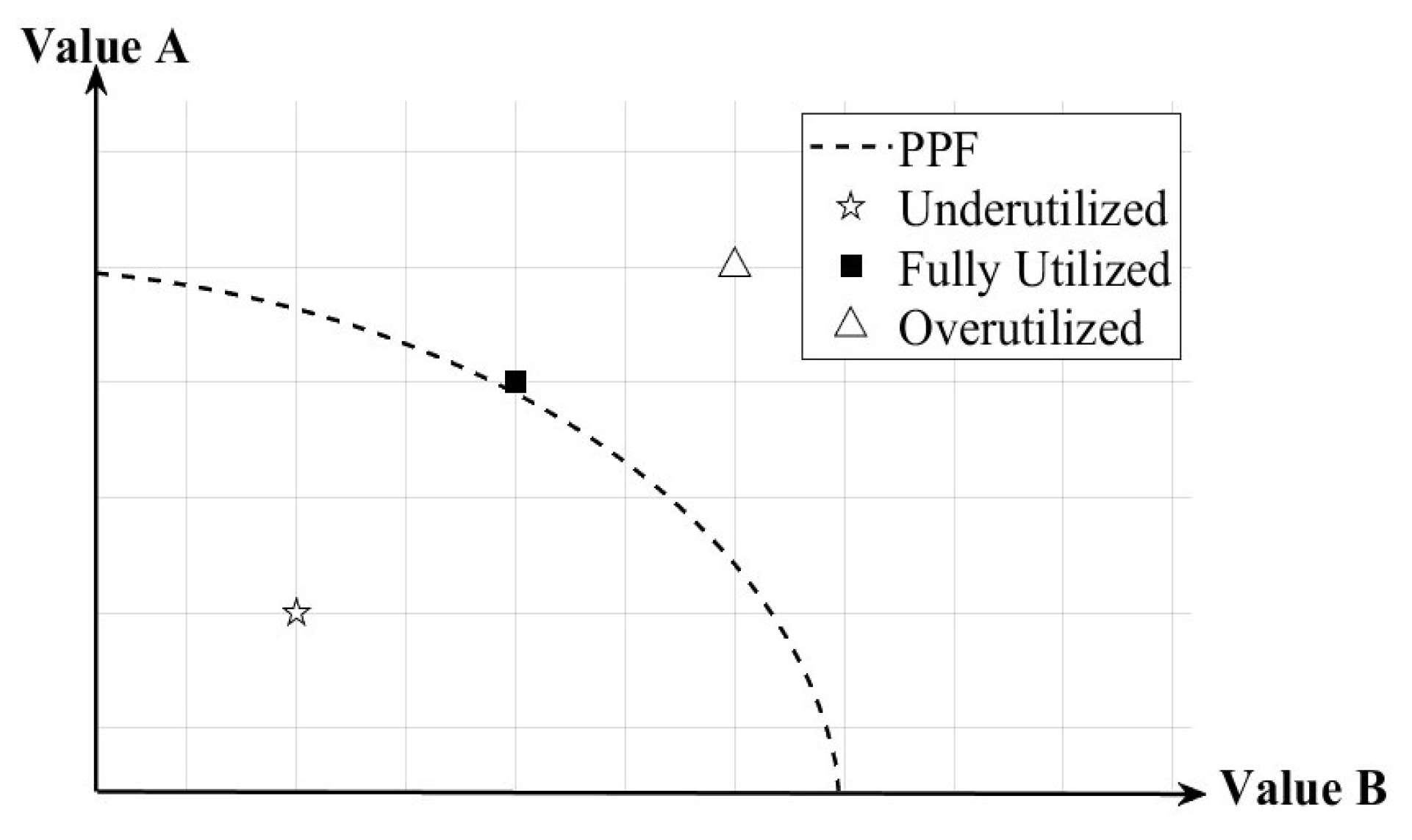
The Production Possibility Frontier (PPF) depicts the optimal combination of output and input that an economy or production unit can achieve with a fixed set of resources. This offers a quantitative and intuitive characterization of the intensity of trade–offs/synergies between two factors. This curve illustrates the potential and constraints of resource allocation, while determining if current production reflects overuse or underutilization of resources. It facilitates the identification of the optimal equilibrium point that maximizes resource value and production efficiency. The PPF has been increasingly utilized in research focused on trade–offs/synergies of cultivated land functional systems [47]. This study broadens its focus to investigate the trade–offs/synergies associated with cultivated land resource values. In accordance with the approach of pertinent researchers, the economic value and ecological value of cultivated land in the Liupan Mountain Area are standardized. Subsequently, division operations are performed between pairs of value layers. Following that, the resultant value were arranged in ascending order to identify the ideal combination that produces the highest total cultivated land resource value. Ultimately, the PPF curve is plotted using this normalized value combination, representing the optimal resource allocation state for both types of value. The slope of the PPF curve in this paper primarily reflects the trade–off and synergistic relationship between the economic and ecological value combinations of cultivated land. A positive slope indicates synergy, while a negative slope suggests a trade–off. The clustering degree of scattered points indicates the disparity between the ecological and economic values of cultivated land: the more clustered the points, the smaller the ecological–economic gap among districts and counties; conversely, when points are widely dispersed, the ecological–economic gap among districts and counties is larger. The combination of economic and ecological values for cultivated land located on the curve represents the most efficient production, with no resources left idle. The combination of economic and ecological values for cultivated land below the curve can support production, albeit at lower efficiency, as resources are not fully utilized. Conversely, the combination of economic and ecological values for cultivated land above the curve indicates overloaded production, where resource utilization is in a state of depletion (Figure 3).

2.4.5. Identification of Trade–Off/Synergistic Zoning for Cultivated Land Resource Value Based on GIS Visualization Technology

Based on GIS visualization technology, this study developed a three–stage methodology for identifying trade–offs and synergistic zoning of cultivated land resource values. First, the PPF curve was employed to analyze the trade–off/synergistic relationships between economic value and ecological value of cultivated land. This analytical framework was subsequently integrated with GIS visualization techniques to reveal spatial disparities in value realization efficiency across different counties in the Liupan Mountain Area from 2007 to 2022.
Second, after quantifying county–level economic value and ecological value, all areas were systematically classified according to their positional relationship to the PPF curve. Combined with the methods of relevant scholars [48], the paper summarizes the partitioning methods as follows. Areas adjacent to the curve were identified as fully utilized zones (Type F), representing optimal resource allocation under current conditions; those below the curve were categorized as underutilized zones (Type U), indicating suboptimal performance in both values with evident efficiency losses; areas above the curve were designated as overutilized zones (Type O), characterized by excessive pursuit of one value significant expense of the other.
Finally, through the linkage between GIS attribute tables and county–level type codes, the study completed the spatially explicit zoning framework for cultivated land resource values, establishing a foundation for differentiated land management strategies across the region.

3. Results

3.1. Characteristics of Spatiotemporal Evolution in the Values of Cultivated Land Resources

3.1.1. Temporal Evolution Characteristics of the Values of Cultivated Land Resources

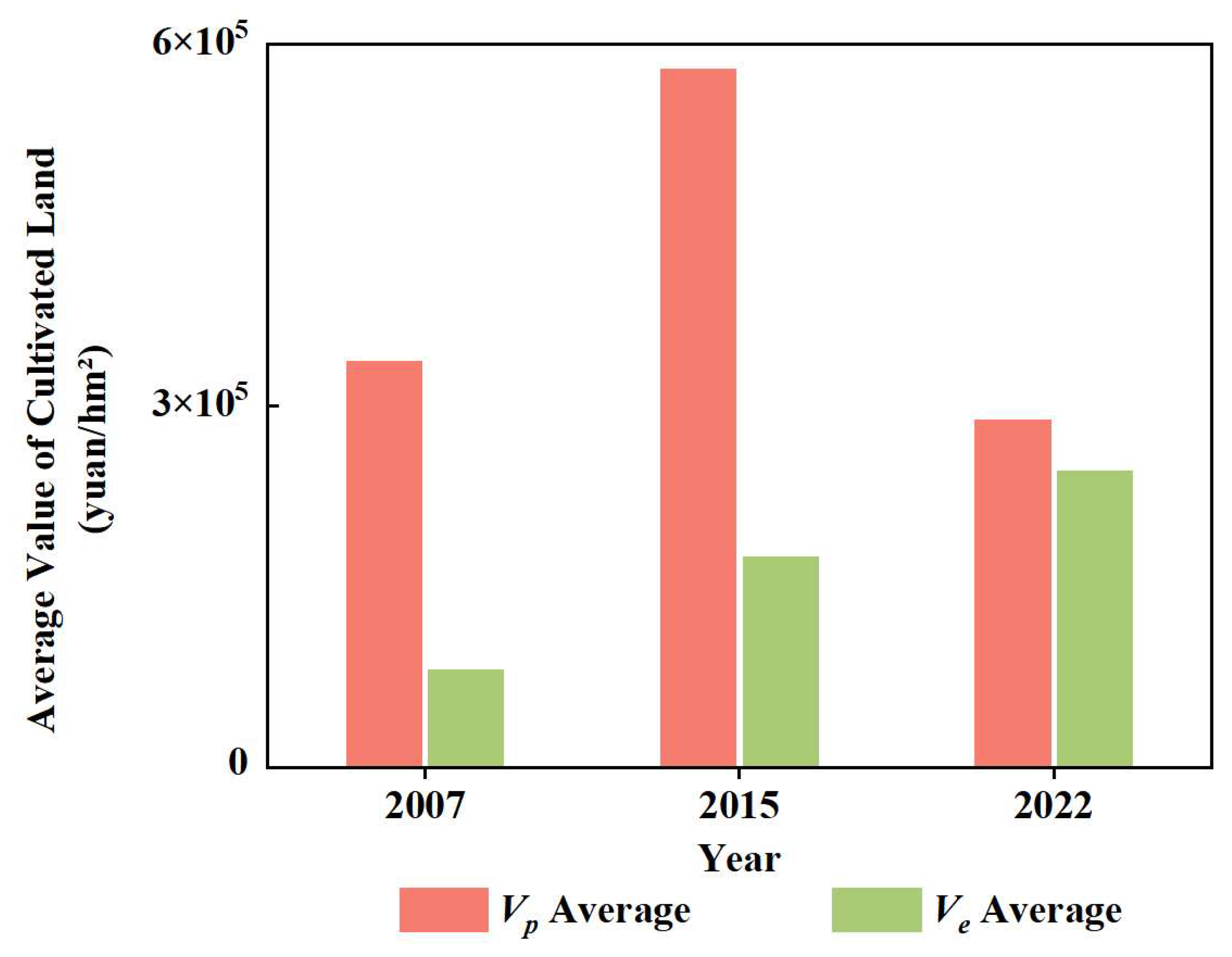
The economic value of cultivated land in the study area exhibited a distinct temporal pattern of “growth–peak–decline” from 2007 to 2022. In the initial phase (2007–2015), the mean values rose from 0.337 million yuan/hm2 to 0.579 million yuan/hm2, representing a growth rate of 71.75% (Figure 4). The peak was reached in 2015, with the maximum value recorded in southwestern counties reaching 2.726 million yuan/hm2 (Figure 4). In the second phase (2015–2022), the mean value decreased to 0.288 million yuan/hm2, reflecting a reduction of 50.22%.
In contrast, the ecological value showed a consistent upward trend throughout the study period (Figure 4), though the total increase remained modest in scale. From 2007 to 2015, it increased from 0.081 million yuan/hm2 to 0.175 million yuan/hm2, corresponding to a growth rate of 116.60% (Figure 4). By 2022, the value had reached 0.245 million yuan/hm2, representing an increase of 0.071 million yuan/hm2 since 2015 and a growth rate of 40.33% (Figure 4).
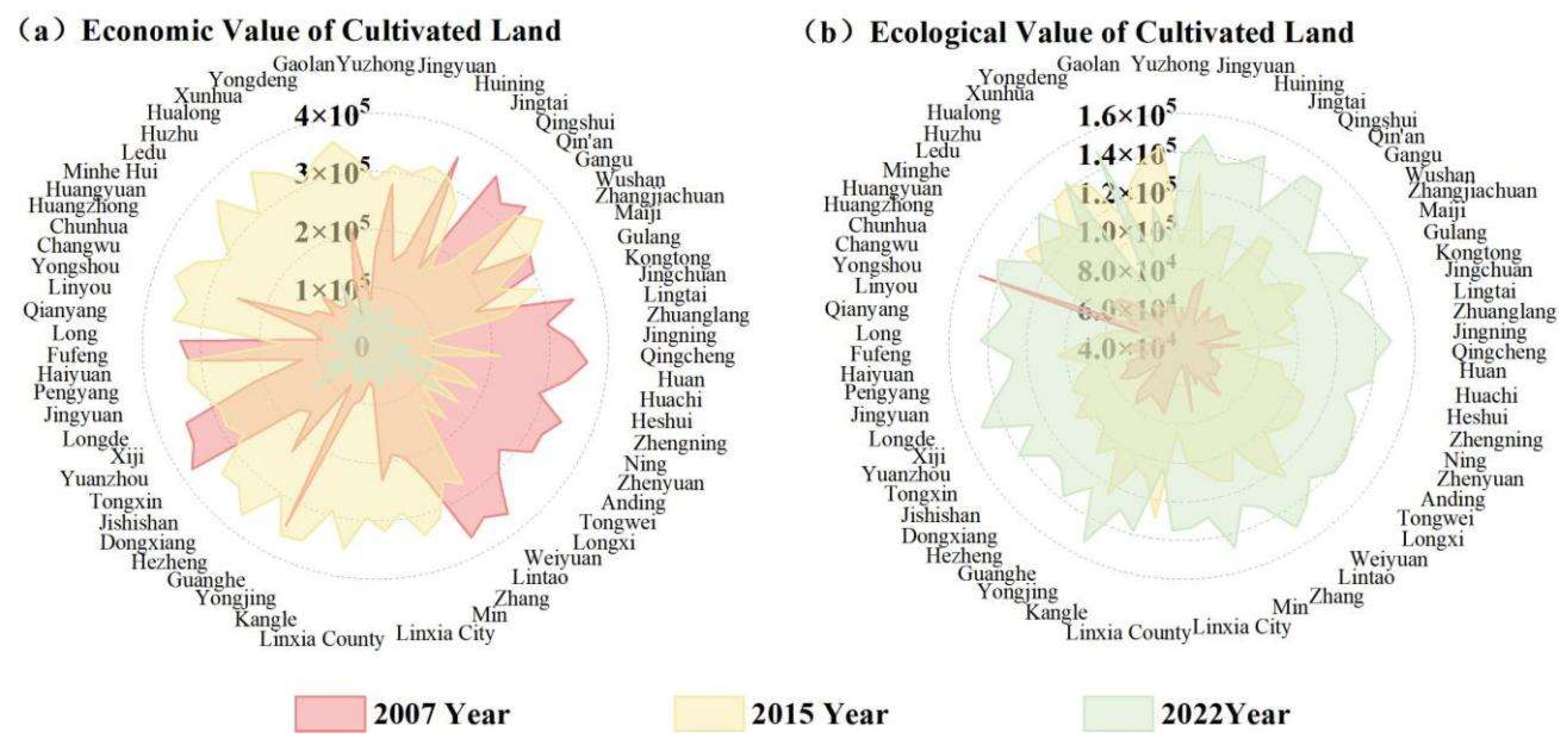
Figure 5a displays the cultivated land economic value distribution across the Liupan Mountain Area: red indicates 2007 levels, yellow 2015, and green 2022. The graph reveals that counties in the lower right quadrant maintained relatively high economic values in 2007, which gradually declined in 2015 before shifting to the left quadrant. By 2022, the total economic value of cultivated land in the Liupan Mountain Area had further shrunk, showing a stark contrast to the 2007 and 2015 levels.
Figure 5b primarily focuses on the ecological value of cultivated land in the Liupan Mountain Area. The graph clearly shows that in 2007, the ecological value of cultivated land in all districts and counties was at a relatively low level, with only a few areas demonstrating high values that formed distinct peaks. By 2015, the upper–left quadrant showed notable improvement, indicating an overall upward trend. In 2022, the value of cultivated land saw comprehensive enhancement. While there were variations among districts and counties, the overall trend reflected significantly higher ecological values.

3.1.2. Spatial Evolution Characteristics of Cultivated Land Resource Value

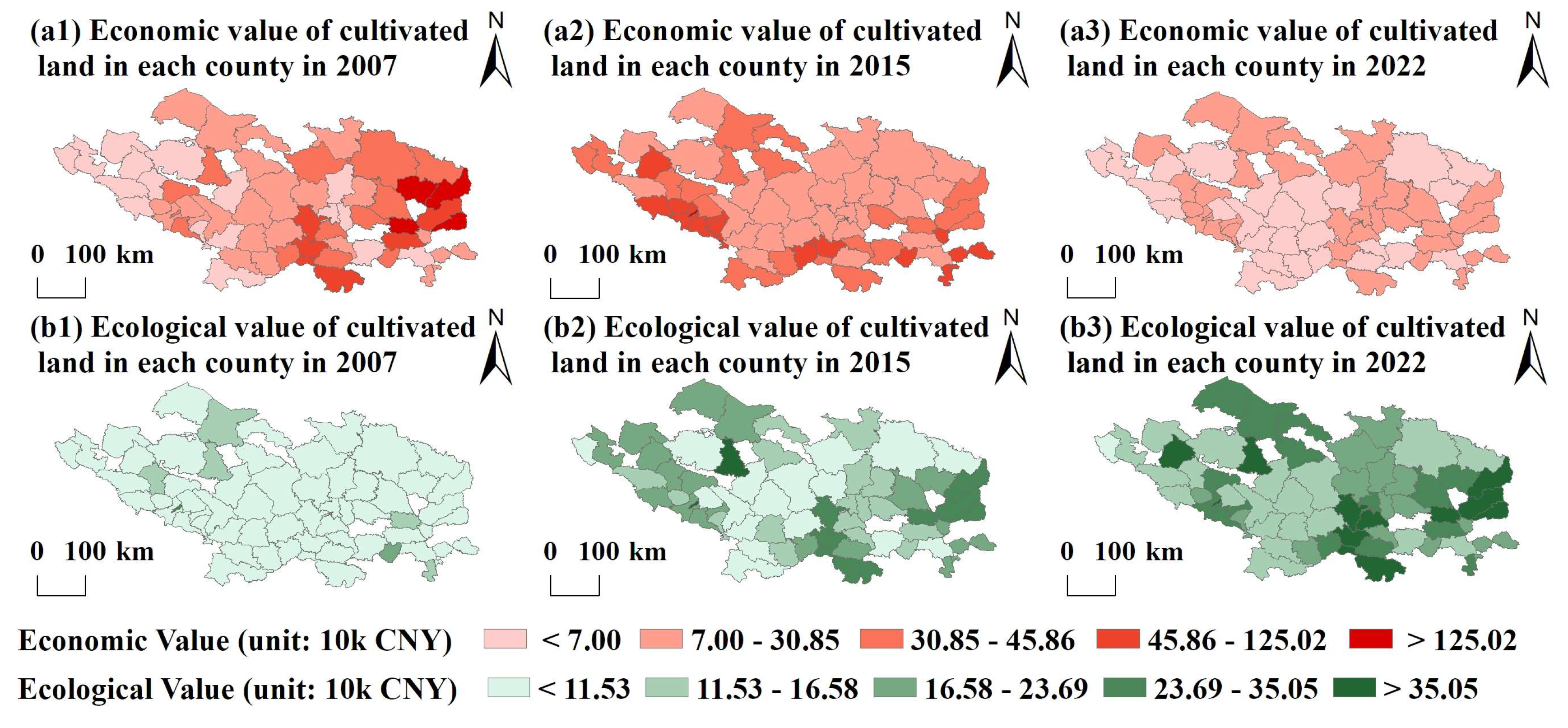
Between 2007 and 2022, the economic value of cultivated land in the Liupan Mountain Area exhibited a geographically concentrated low–value distribution pattern with diminished spatial variability (Figure 6(a1–a3)). In 2007, elevated values were predominantly located in the east, with sporadic high values observed in the west and south, though most of the western and southern regions remained characterized by low values (Figure 6(a1)). By 2015, no significant high–value areas were observed, and a continuous low–value zone in the northeast dominated the spatial pattern (Figure 6(a2)). By 2022, the low–value zone had expanded further (Figure 6(a3)).
The spatial distribution of ecological value followed a general pattern of “higher in the east and lower in the west,” with concentrated low values in the southwest and an increasing trend in spatial heterogeneity (Figure 6(b1–b3)). In 2007, values were predominantly low, with extensive low–value zones (Figure 6(b1)). In 2015, the highest values were concentrated in the northwestern part of the study area (Figure 6(b2)), reaching a maximum of 4.98 million yuan/hm2. The second–highest values in the east exhibited a clustered distribution. By 2022, elevated values were distributed in the southeastern and northwestern regions, reflecting a notable increase in spatial variability compared to 2007 (Figure 6(b3)).

3.2. Spearman Correlation Analysis

From 2007 to 2022, the Spearman correlation coefficient between the economic value and ecological value of cultivated land in the Liupan Mountain Area showed a continuous upward trend, while the significance level of the association also changed (Table 3):
In 2007, the Spearman correlation coefficient between the two was 0.319, indicating a moderately weak positive correlation between the economic value and ecological value of cultivated land during this period. By 2015, the Spearman correlation coefficient had increased to 0.496 compared to 2007, with the significance level tightening to the more stringent 0.01 threshold. This signifies that the positive correlation between the economic value and ecological value of cultivated land in 2015 had markedly strengthened compared to 2007, evolving from a moderately weak positive correlation to a moderately strong one. By 2022, the Spearman correlation coefficient between the two further climbed to 0.646. Compared to the 2015 data, the correlation coefficient value increased further, indicating that the positive correlation strength between the economic value and ecological value of cultivated land continued to intensify, reaching a moderately strong positive correlation level.

3.3. Spatio–Temporal Evolution Characteristics and Regional Identification of Trade–Offs/Synergistic Relationships in the Value of Cultivated Land Resources

3.3.1. Temporal Characteristics of Trade–Offs/Synergistic Relationships in the Values of Cultivated Land Resources

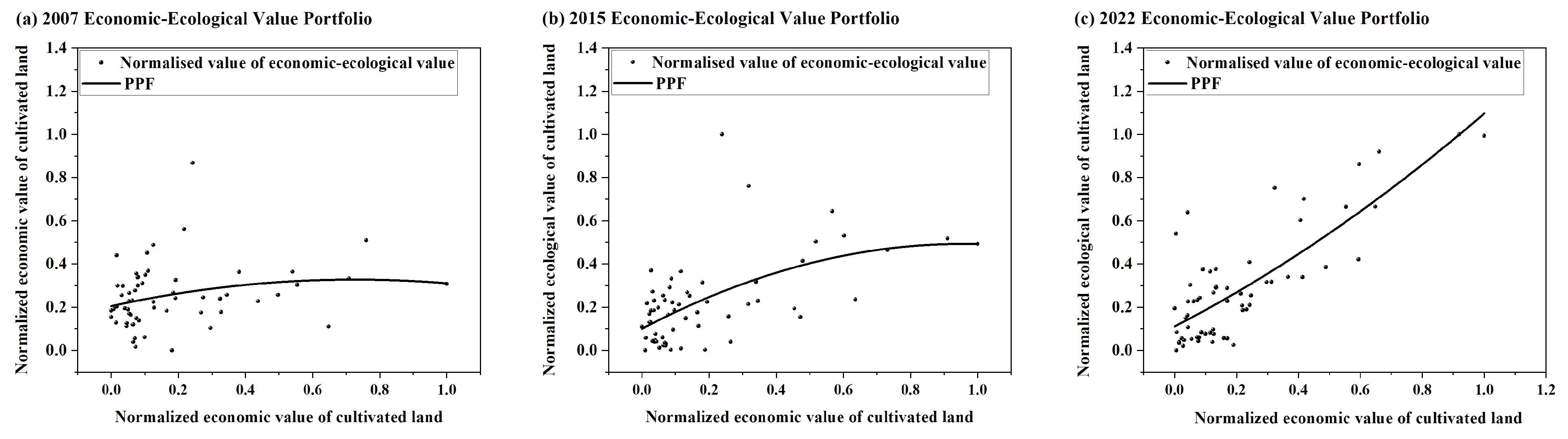
Between 2007 and 2022, the economic value and ecological value of cultivated land demonstrated a synergistic relationship that progressively intensified. At this stage, the absolute value of the slope of the PPF curve gradually increases, reflecting the progressively enhanced synergistic effects in the combination of economic value and ecological value of cultivated land, as well as the continuously improving complementarity among its multiple functions (Figure 7). This implies that the trade–off between economic value and ecological value is reduced, and the economic losses required to enhance unit ecological value are minimized. In 2007, the slope of the PPF curve between economic value and ecological value was relatively flat (Figure 7a), with many data points closely aligned with the PPF curve. This alignment suggests that the minimal disparities in resource allocation efficiency among counties. Although the current combination of economic and ecological values of cultivated land involves trade–offs, with sustained investment in ecological services, the benefits derived from this combination are approaching optimal levels. Consequently, the trade–off between economic and ecological values is showing a decreasing trend. In 2015, the PPF curve showed a more pronounced upward trend and a steeper slope (Figure 7b), reflecting a further enhancement in synergy. The varying distances of data points from the PPF curve highlighted clear inter–county differences in synergy levels during this period. In 2022, the further increased slope of the curve reflected a stronger synergy of cultivated land values (Figure 7c). Moreover, the distribution of points was more closely aligned with the PPF curve than in 2015, demonstrating a narrowing gap in the economic and ecological performance of cultivated land among counties.

3.3.2. Spatial Characteristics and Regional Identification of Trade–Offs/Synergistic Relationships in the Values of Cultivated Land Resources

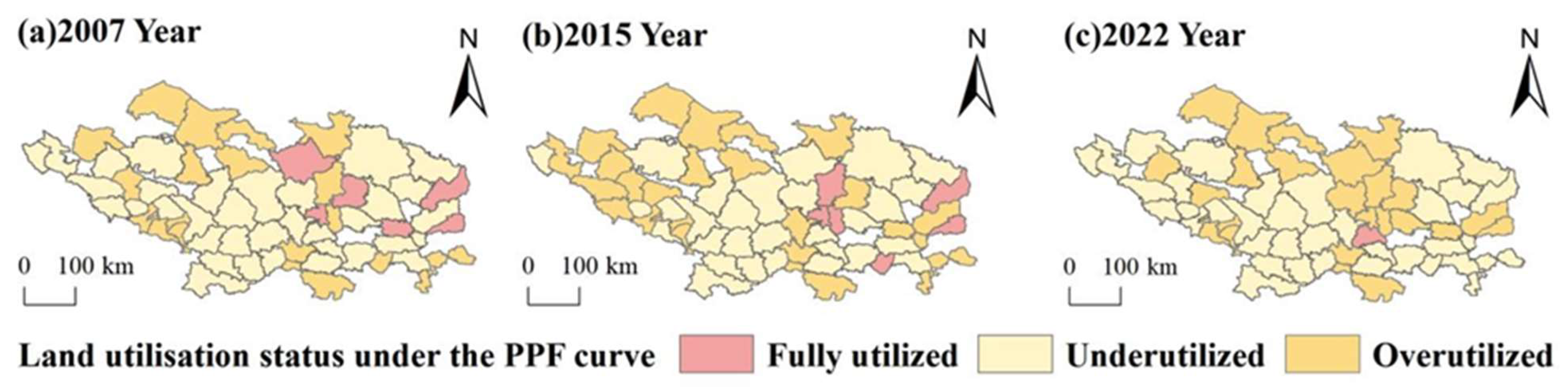
From 2007 to 2022, the trade–off/synergy between the economic value and ecological value of cultivated land in the Liupan Mountain Area was primarily characterized by underutilization, comprising 55.74% of the total area. The fully utilized areas represented only a minor fraction and progressively decreased over time. In 2007, areas of underutilization were relatively concentrated, whereas fully utilized and overutilized areas were dispersed (Figure 8a). By 2015, the number of underutilized areas had declined from 36 to 29, while that of overutilized ones increased from 19 to 26 (Figure 8b). By 2022, counties with overutilization were found to form contiguous clusters, creating a spatially distinct “π–shaped” distribution belt extending from north to south and from northwest to southeast (Figure 8c).

4. Discussion

4.1. Value Reconstruction and Collaborative Mechanisms of Cultivated Land Resources in the Liupan Mountain Area Amid Rural Transformation and Development

This research quantitatively analyzes the economic value and ecological value of cultivated land resources in the Liupan Mountain Area between 2007 and 2022, demonstrating a significant reorganization of cultivated land resource values amid the rural transformation in poverty–alleviated areas (Figure 3, Figure 4 and Figure 5) and highlighting a distinct trend of evolving trade–offs/synergistic interactions among these values (Figure 6). The findings indicate that the value system of cultivated land resources in the Liupan Mountain Area has significantly transitioned from economic dominance to a state of economic–ecological synergy. This transformation illustrates China’s strategic shift in rural development from a traditional development approach to a green development model, highlighting the intricate relationship between regional resource endowments and policy interventions.
The value of cultivated land resources exhibits distinct phased characteristics. Between 2007 and 2015, the economic value and ecological value of cultivated land in the Liupan Mountain Area underwent significant phased evolution: economic value first increased, then declined, while ecological value continued to rise (Figure 3). This trend is primarily driven by policies such as the Regional Development and Poverty Alleviation Plan for the Liupan Mountain Area. Initially, under the impetus of poverty alleviation initiatives, technological investments and scaled–up operations boosted economic value. However, 2015 marked a pivotal turning point. As the region was designated a key ecological restoration zone within the Yellow River Basin, ecological value surged by 116.55%, while economic value declined due to the large–scale conversion of cultivated land to ecological land.
The revaluation of cultivated land resources has prompted the development of trade–offs/synergies in economic value and ecological value combination [49]. During the initial research phase, the slope of the economic–ecological value PPF curve was gradual, reflecting a condition of weak synergy in which resource allocation favored economic benefits (Figure 6). After 2015, the execution of targeted poverty alleviation policies markedly improved the synergy between the ecological and economic values of cultivated land. This finding is consistent with academic research conducted in the Longdong Loess Plateau region of China [50]. Furthermore, spatial heterogeneity in the synergistic relationships among values has increased (Figure 6 and Figure 7). Based on the results of trade–off/synergy analysis, it was identified that underutilized areas still dominated the Liupan Mountain Area between 2007 and 2022, which in turn reveals that achieving coordinated values across all cultivated land resources remains challenging. Meanwhile, fully utilized zones are predominantly located in the eastern and southern regions of the area; specifically, these regions exhibit extensive, gently sloping cultivated land along with favorable soil and water conditions, and such advantages further establish a fundamental basis for value synergy. In contrast, the central and western regions have historically faced limitations due to their high percentages of steeply cultivated land and persistent water scarcity, and these constraints have ultimately led to the ongoing underutilization of cultivated land there.

4.2. Revelation for Cultivated Land Utilization Management in Poverty–Alleviated Area Based on the Values of Cultivated Land Resources and Their Trade–Offs/Synergistic Relationships

The research revealed problems related to both overutilization and underutilization of various values in certain counties within the Liupan Mountain Area (Figure 7a–c). Spatial differentiation is constrained by inherent disparities in regional resource endowments and is further influenced by the specific direction provided by targeted poverty alleviation policies. Quantitative calculation of the economic value and ecological value of cultivated land resources, along with insights on trade–offs/synergies, and typology identification, offers scientific evidence for enhancing cultivated land use and fostering sustainable rural development in poverty–alleviated areas.
The value of cultivated land and its synergistic/trade–off relationships are essential for identifying the utilization structure, dominant functions, and dynamic trade–offs among functions across various regions [14]. The identification and zoning of Cultivated Land Value Trade–off and Synergy (CLVTS) serve as the basis for regional planning and management of cultivated land resources. Recent agricultural–urban–ecological spatial zoning schemes by China’s central and local governments seek to optimize the structure and patterns of production, living, and ecological functions in rural land use [51]. Therefore, the empirical findings from the Liupan Mountain Area provide insights into the potential of the CLVTS approach to improve regional cultivated land management, especially in developing countries such as China, where rural transformation is progressing swiftly [52].
This study examines pathways for differentiated cultivated land management and rural transformation in regions that have achieved poverty elimination, building upon regional identification through the PPF. The proposed strategy consists of two steps aimed at realizing the value of regionally cultivated land and promoting coordinated development.
First, initial identification of typology. The integration of value trade–offs/synergies of cultivated land resources into regional cultivated land utilization planning, along with the application of cultivated land utilization zoning centered on the PPF curve, offers a scientific basis for targeted policy interventions aimed at promoting synergistic development of cultivated land resource values in poverty–alleviated areas. This study identifies areas of conflict in cultivated land resource utilization, helping address potential land–use conflicts or synergies and utilizing these interactions to inform policy decision–making [50]. The production possibility frontier curve zoning categorizes areas into overutilized (Type O), fully utilized (Type F), and underutilized (Type U) zones, which are aligned with the actual conditions of cultivated land in poverty–alleviated areas (Figure 6 and Figure 7).
The second step is to implement categorized management. The value of cultivated land is indicative of its level of multifunctional utilization, which refers to the integration of various functions within a single geographical unit. This serves as a useful mechanism for coordinating cultivated land use functions and improving utilization efficiency. Customized management strategies should be utilized according to the specific characteristics of each zone.
In regions where the combination of economic and ecological values of cultivated land exhibits synergistic effects, such as Type F, priority should be given to adopting technology diffusion mechanisms such as precision agriculture extension programs and equipment–sharing cooperatives. Policymakers may implement smart agriculture infrastructure aid programs complemented by digital literacy training for farmers. In regions where the combination of economic and ecological values of cultivated land exhibits trade–offs effects, such as Type O and Type U, policymakers should establish targeted ecological compensation mechanisms and green finance incentives to promote conservation agriculture practices. Concurrently, land consolidation and property rights clarification should ensure secure land tenure. Support may also include microcredit guarantees for sustainable intensive production and infrastructure development subsidies.

4.3. Limitations and Research Perspective

This research calculated the economic value and ecological value of cultivated land resources in the Liupan Mountain Area, utilizing a combination of PPF curves and GIS visualization technology for regional zoning. Nonetheless, it exhibits several limitations. Due to limitations imposed by regional crop planting structures and diverse agricultural conditions, the cash income accounting system’s focus on corn, wheat, rapeseed, and apples led to comparatively low estimated economic values for cultivated land. Methods for calculating future valuations necessitate refinement. This study established a two–dimensional PPF curve model that illustrates the relationship between economic value and ecological value. However, as cultivated land analysis differs across various contexts [53], additional research may investigate multidimensional PPF models to assess trade–offs/synergies among cultivated land resource values. The most effective development strategy should be determined through scientific scenario simulations to establish a distinct pathway for the transformation and development of poverty–alleviated areas.

5. Conclusions

How to balance the livelihood and ecological functions of cultivated land has become a key issue in optimizing regional land use. A quantitative analysis of the trade–offs and synergies between the economic value and ecological value of cultivated land can advance research in cultivated land–related land change science while also offering guidance for spatial planning and management in poverty–alleviated areas.
Taking the Liupan Mountain Area, a representative region for poverty alleviation efforts, as an example, this study integrated PPF curve analysis with GIS visualization technology: it analyzed the complex trade–offs and synergistic relationship between the values of cultivated land, and further revealed the spatial differentiation patterns of the economic value and ecological value of cultivated land. By analyzing 61 counties (cities, districts) in the Liupan Mountain Area from 2007 to 2022, the results showed that the economic value and ecological value of cultivated land exhibited a progressively intensifying synergistic relationship. The trade–off/synergy relationship between these two values manifested primarily as underutilization that occupied 55.74% of the total area. In 2007, the slope of the PPF curve between economic value and ecological value was relatively flat; since the introduction of targeted poverty alleviation policies in 2015, the synergistic relationship between the ecological and economic values of cultivated land resources has strengthened; following the initiation of the rural revitalization phase in 2022, the level of synergy increased significantly.
Existing research on cultivated land value has primarily focused on non–poverty–alleviated areas, such as major grain–producing plains and suburban cultivated land, with insufficient attention paid to the value trade–off mechanisms in poverty–alleviated areas amid the transformation of cultivated land use post–poverty alleviation. These quantitative findings help fill a theoretical data gap regarding the intensity of value trade–offs in post–poverty–alleviation cultivated land, providing micro–regional empirical support for theories on sustainable post–poverty–alleviation cultivated land utilization. In the future, two directions can be explored to advance related research: First, improve spatial resolution using raster modeling—shifting from county–level statistics to high–resolution raster data will capture the variability of agricultural value within counties, which will facilitate pixel–level management planning and targeted poverty alleviation activities at the village or field level. Second, identify potential equity issues by disaggregating county–level findings and examining the varied impacts across different farmer types, which ensures that value–enhancing initiatives actually assist the poorest populations rather than aggravating rural inequality.

Author Contributions

Formal analysis, L.S.; writing—original draft, L.S. and C.W.; writing—review and editing, L.S.; visualization, C.W.; funding acquisition, L.S.; investigation, C.W.; data curation, C.W. All authors have read and agreed to the published version of the manuscript.

Funding

This research was funded by the Humanities and Social Sciences Youth Fund Project of Ministry of Education of the PRC, grant number 23YJCZH181; Natural Science Foundation of Ningxia Hui Autonomous Region, grant number 2025AAC030173.

Data Availability Statement

The data and maps will be available upon request for the corresponding author.

Acknowledgments

We thank the anonymous reviewers for the important suggestions. DeepSeek (OpenAI) was used exclusively to assist with English language grammar check. No AI tool was used for data analysis, interpretation, or the generation of scientific content.

Conflicts of Interest

The authors declare no conflicts of interest.

Abbreviations

The following abbreviations are used in this manuscript:
PPFProduction Possibility Frontier
SEEASystem of Environmental–Economic Accounting
DEMDigital Elevation Model
CLVTSCultivated Land Value Trade–off and Synergy

References

  1. Liu, Q.; Jiang, J.X.; Yang, X.; Zhang, J.Y.; Yang, X.J. Poverty vulnerability measurement and its impact factors of farmers: Based on the empirical analysis in Qinba Mountains. Geogr. Res. 2022, 41, 307–324. [Google Scholar] [CrossRef]
  2. Lian, S.S.; Lan, A.J.; Fan, Z.M.; Feng, B.C.; Xiao, K.S. Spatiotemporal evolution trends and topographic gradient effects of cultivated land transformation in river basins of karst mountainous areas in Guizhou Province. Res. Soil Water Conserv. 2025, 32, 391–402. [Google Scholar] [CrossRef]
  3. Lv, L.G.; Han, X.; Long, H.L.; Zhou, B.B.; Zang, Y.Z.; Wang, J.X.; Fan, Y.T. Research progress and prospects on supply and demand matching of farmland multifunctions. Resour. Sci. 2023, 45, 1351–1365. [Google Scholar] [CrossRef]
  4. Li, W.; Ma, Z.B.; Luo, R.S.; Hong, Y.Y.; Wang, S.J.; Ma, X.; Bao, Q. Balancing poverty alleviation and ecosystem vulnerability reduction: Implication from China’s targeted interventions. Sustainability 2025, 17, 2490. [Google Scholar] [CrossRef]
  5. Cai, Y.L.; Huo, Y.Q. Reevaluating Cultivated Land in China: Method and Case Studies. Acta Geogr. Sin. 2006, 61, 1084–1092. [Google Scholar] [CrossRef]
  6. Smith, R. Development of the SEEA 2003 and its implementation. Ecol. Econ. 2007, 61, 592–599. [Google Scholar] [CrossRef]
  7. Inacio, M.; Baltranaite, E.; Valenca Pinto, L.M.; Akhtarieva, M.; Barcelo, D.; Pereira, P.A. Systematic literature review on the implementation of the system of environmental–economic accounting–ecosystem accounting in forests, Cities and Marine Areas. Ecosyst. Serv. 2025, 74, 101752. [Google Scholar] [CrossRef]
  8. King, S.; Agra, R.; Zolyomi, A.; Keith, H.; Nicholson, E.; de Lamo, X.; Portela, R.; Obst, C.; Alam, M.; Honzák, M.; et al. Using the system of environmental–economic accounting ecosystem accounting for policy: A case study on forest ecosystems. Environ. Sci. Policy 2024, 152, 103653. [Google Scholar] [CrossRef]
  9. Vardon, M.J.; Le, T.H.L.; Martinez–Lagunes, R.; Pule, O.B.; Schenau, S.; May, S.; Grafton, R.Q. Accounting for water: A global review and indicators of best practice for improved water governance. Ecol. Econ. 2025, 227, 108396. [Google Scholar] [CrossRef]
  10. Smith, G.S.; Stewart, S.B.; Scheufele, G.; Evans, D.; Liu, N.; Pascoe, S.; Roxburgh, S.H.; Schmidt, R.K.; Vardon, M. Accounting for ecosystem services using extended supply and use tables: A case study of the Murray–darling basin, Australia. Ecosyst. Serv. 2025, 74, 101741. [Google Scholar] [CrossRef]
  11. Yang, B.; Wang, Z.Q.; Zou, L.; Zou, L.L.; Zhang, H.W. Exploring the eco–efficiency of cultivated land utilization and its influencing factors in China’s Yangtze River Economic Belt, 2001–2018. J. Environ. Manag. 2021, 294, 112939. [Google Scholar] [CrossRef] [PubMed]
  12. Zhang, X.; Liu, Y.S.; Wang, W.; Xue, Y.X.; Li, B.Y.; Jin, S.Z. Simulation of multi–scenario land use change and its impact on escosystem services in China based on PLUS–InVEST model. Acta Ecol. Sin. 2025, 45, 9577–9593. [Google Scholar] [CrossRef]
  13. Ma, G.B.; Wu, B.; Wang, P.C.; Lu, R.C.; Jiang, K. The trade–off/synergy relationship between values of cultivated land resources assets: A case study of Guangxi, Southwestern China. J. Nat. Resour. 2025, 40, 1344–1362. [Google Scholar] [CrossRef]
  14. Liu, Y.; Wan, C.Y.; Xu, G.L.; Chen, L.T.; Yang, C. Exploring the relationship and influencing factors of cultivated land multifunction in China from the perspective of trade–off/synergy. Ecol. Indic. 2023, 149, 110171. [Google Scholar] [CrossRef]
  15. Kang, Q.; Guo, Q.X.; Ding, Y.; Zhang, Y. Tradeoffs/synergies analysis of “Production–Living–Ecological” functions in Shanxi province. J. Nat. Resour. 2021, 36, 1195–1207. [Google Scholar] [CrossRef]
  16. Tao, J.Y.; Zhang, J.H.; Dong, P.; Lu, Y.Q.; Ge, D.Z. Cropland ecosystem service trade–offs/synergies and threshold efferts: A case study of the Yangtze River Delta region. Acta Ecol. Sin. 2025, 45, 7836–7851. [Google Scholar] [CrossRef]
  17. Zhao, X.Q.; Shi, X.Q.; Li, Y.H.; Li, Y.M.; Huang, P. Spatio–temporal pattern and functional zoning of ecosystem services in the karst mountainous areas of southeastern Yunnan. Acta Geogr. Sin. 2022, 77, 736–756. [Google Scholar] [CrossRef]
  18. Liu, Y.; Gao, Y.B.; Pan, Y.C.; Tang, L.N.; Tu, M.G. Spatial differentiation characteristics and trade–off/synergy relationships of rural multi–functions based on multi–source data. Geogr. Res. 2021, 40, 2036–2050. [Google Scholar] [CrossRef]
  19. Li, Q.R.; Jia, Y.L.; Wang, H.J.; Wang, Z. Analysis of trade–off and synergy effects of ecosystem services in Hebei province from the perspective of ecological function area. Acta Geogr. Sin. 2023, 78, 2833–2849. [Google Scholar] [CrossRef]
  20. Cademus, R.; Escobedo, F.J.; McLaughlin, D.; Abd–Elrahman, A. Analyzing trade–Offs, synergies, and drivers among timber production, carbon sequestration, and water yield in Pinus elliotii Forests in southeastern USA. Forests 2014, 5, 1409–1431. [Google Scholar] [CrossRef]
  21. Zhang, J.J.; Zhu, W.B.; Zhu, L.Q.; LI, Y.H. Multi–scale analysis of trade–off/synergistic effects of forest ecosystem services in the Funiu Mountain Region, China. Acta Geogr. Sin. 2020, 32, 981–999. [Google Scholar] [CrossRef]
  22. Zhu, C.M.; Dong, B.Y.; Li, S.N.; Lin, Y.; Shahtahmassebi, A.; You, S.X.; Zhang, J.; Gan, M.Y.; Yang, L.X.; Wang, K. Identifying the trade–offs and synergies among land use functions and their influencing factors from a geospatial perspective: A case study in Hangzhou, China. J. Clean. Prod. 2021, 314, 128026. [Google Scholar] [CrossRef]
  23. Liu, Q.H.; Sun, X.; Huang, Q.X.; Qiao, J.M.; Fang, G.J.; Ren, Y.H.; Wang, C.R.; Sun, J.; Yang, P. Optimizing the landscape in grain production and identifying trade–offs between ecological benefits based on production possibility frontiers: A case study of Beijing–Tianjin–Hebei Region. J. Environ. Manag. 2025, 377, 124583. [Google Scholar] [CrossRef] [PubMed]
  24. Zhao, Z.T.; Wen, L.Y.; Li, K.Q.; Kong, X.B.; Zhang, X.L. Environmental risk and burden inequality intensified by changes in cultivated land patterns. Resources. Conserv. Recycl. 2025, 225, 108604. [Google Scholar] [CrossRef]
  25. Zhang, K.L.; Zhou, K.C.; Sun, Z.X. Relationship among trade–offs, synergies, and driving factors of multifunctional farmland values in Hunan province. J. Green Sci. Technol. 2025, 27, 198–205+10. [Google Scholar] [CrossRef]
  26. Li, Y.X.; Liu, Z.S.; Sun, L.; Li, X.; Wang, W.Y. Study on multi–fuction evaluation and consolidation zoning of cultivated land in jiutai district. J. Northeast Norm. Univ. (Nat. Sci. Ed.) 2023, 55, 132–144. [Google Scholar] [CrossRef]
  27. Sun, H.M.; Yang, Z.; Li, X.M.; Hang, Y.H.; Gao, M.; Lu, X.; Yang, Y.J.; Meng, X.F.; Zhu, L.Q. Assessment of the cultivated land quality in the black soil region of northeast China based on the field scale. Environ. Monit. Assess. 2023, 195, 1508. [Google Scholar] [CrossRef]
  28. Fan, S.P.; Cao, Y.J.; Guo, H.M.; Mi, Y.S.; Xi, X.W.; Liu, Y.Z.; Yu, B.P. Multidimensional accounting of ecological value of cultivated land resources in Anhui province and its spatiotemporal heterogeneity effects. Environ. Sci. Technol. 2024, 47, 211–224. [Google Scholar] [CrossRef]
  29. You, J.Q.; Huang, S.L. Evaluation of cultivated land ecosystem service value in the black soil region of northeast China. Sci. Rep. 2025, 15, 20373. [Google Scholar] [CrossRef]
  30. Wu, B.S.; Liu, M.F.; Wan, Y.F.; Song, Z.J. Evolution and coordination of cultivated land multifunctionality in Poyang lake ecological economic zone. Sustainability 2023, 15, 5307. [Google Scholar] [CrossRef]
  31. Wang, H.; Zhu, Y.X.; Wang, J.H.; Han, H.B.; Niu, J.Q.; Chen, X.Y. Modeling of spatial pattern and influencing factors of cultivated land quality in Henan province based on spatial big data. PLoS ONE 2022, 17, e0265613. [Google Scholar] [CrossRef] [PubMed]
  32. Liu, C.Y.; Song, C.Q.; Ye, S.J.; Cheng, F.; Zhang, L.N.; Li, C. Estimate provincial–level effectiveness of the arable land requisition–compensation balance policy in mainland China in the last 20 years. Land Use Policy 2023, 131, 106733. [Google Scholar] [CrossRef]
  33. Li, W.J.; Guo, J.Y. Coupling coordination and obstacle factors of cultivated land system resilience and new urbanization. Front. Sustain. Food Syst. 2025, 9, 1554797. [Google Scholar] [CrossRef]
  34. Long, H.L.; Li, M.; Zhang, Y.N.; Qu, L.L. Multifunctional rural development in China: Pattern, process and mechanism. Habitat Int. 2022, 121, 102530. [Google Scholar] [CrossRef]
  35. Ren, L.; Zhang, M.; Chen, R.Y. The relationship between livelihood capital, multi–functional value perception of cultivated land and farmers’ willingness to land transfer: A regional observations in the period of poverty alleviation and rural revitalization. China Land Sci. 2022, 36, 56–65. [Google Scholar] [CrossRef]
  36. Wang, K.; Lu, J.; Liu, H.; Fan, X.; Zhang, L.; Zhang, S. A Study on Accounting for Suburban Agricultural Land Rent in a Chinese Context Based on Agricultural Ecological Value and Landscape Value. Land 2023, 12, 2138. [Google Scholar] [CrossRef]
  37. Shi, W.; Liu, D.D. Does urbanization reduce the multi–functional value of cultivated land? Evidence from China. Front. Environ. Sci. 2023, 11, 1102300. [Google Scholar] [CrossRef]
  38. 38; Carrasco, L.R.; Webb, E.L.; Symes, W.S.; Koh, L.P.; Sodhi, N.S. Global economic trade-offs between wild nature and tropical agriculture. PLoS Biol. 2017, 15, e2001657. [Google Scholar] [CrossRef]
  39. Liu, Y.; Wu, K.; Li, X.; Li, X.; Cao, H. Adaptive Management of Cultivated Land Use Zoning Based on Land Types Classification: A Case Study of Henan Province. Land 2022, 11, 346. [Google Scholar] [CrossRef]
  40. Yuan, M.; Xie, B.P.; Tian, L.M.; Chen, Y.; Pei, T.T. Spatiotemporal coupling relationship between multifunctional land use and multidimensional relative poverty in the Gansu section of Liupanshan. Arid. Land Geogr. 2025, 48, 1304–1316. [Google Scholar] [CrossRef]
  41. Xie, G.D.; Zhen, L.; Lu, C.X.; Xiao, Y.; Chen, C. Expert knowledge–based valuation method of ecosystem services in China. J. Nat. Resour. 2008, 23, 911–919. [Google Scholar]
  42. Guang, H.J.; Ming, Z.W.; Yan, B.Q.; Ding, Y.Z.; Wen, Q.M. Towards cultivated land multifunction assessment in China: Applying the “influencing factors-functions-products-demands” integrated framewor. Land Use Policy 2020, 99, 104982. [Google Scholar] [CrossRef]
  43. Chen, Z.; Deng, L.; Chen, Y.; Wei, F. Research on the multidimensional valuation and spatial differentiation of cultivated land resources in the Pearl River–Xijiang Economic Belt, China. Sustainability 2025, 17, 1539. [Google Scholar] [CrossRef]
  44. LI, J.; Nan, L. Connotation and calculation methods for the cultivated land resources values—A case of Shanxi Province. J. Arid. Land Resour. Environ. 2010, 24, 10–15. [Google Scholar] [CrossRef]
  45. Xie, G.D.; Xiao, Y.; Zhen, L.; Lu, C.X. Study on ecosystem services value of food production in China. Chin. J. Eco-Agric. 2005, 13, 10–13. [Google Scholar]
  46. Wang, J.X.; Luo, X.F.; Liu, Z.Z.; Tang, L. Spatial–temporal variation and influencing factors of farmland ecological value in theYangtze River Economic Belt. Chin. J. Eco-Agric. 2024, 32, 505−517. [Google Scholar] [CrossRef]
  47. Yang, F.Y.Z.; Hu, W.Y. exploring the scale effects of trade–offs and synergies of multifunctional cultivated land—Evidence from Wuhan metropolitan area. J. Resour. Ecol. 2022, 13, 1116–1127. [Google Scholar] [CrossRef]
  48. Xue, F.; Hu, Y.N.; Hu, T.; Zhou, R.; Ma, Q.; Fang, X.N. Urbanization intensified the Trade–Off between food security and water quality security in the Yangtze river delta. Earth’s Future 2025, 13, 16. [Google Scholar] [CrossRef]
  49. Li, X.G.; Xiao, P.N.; Zhou, Y.; Xu, J.; Wu, Q. The Spatiotemporal Evolution Characteristics of Cultivated Land Multifunction and Its Trade–Off/Synergy Relationship in the Two Lake Plains. Int. J. Environ. Res. Public Health 2022, 19, 15040. [Google Scholar] [CrossRef]
  50. Lan, Y.Z.; Sun, T.S.; Li, W.W. Trade–offs and synergies of farmland ecosystem services in Loess Plateau: A case study of Longdon Region, Northwest China. Trans. Chin. Soc. Agric. Eng. 2023, 39, 236–244. [Google Scholar] [CrossRef]
  51. Li, S.N.; Zhao, X.Q.; Pu, J.W.; Miao, P.P.; Wang, Q.; Tan, K. Optimize and control territorial spatial functional areas to improve the ecological stability and total environment in karst areas of southwest China. Land Use Policy 2021, 100, 104940. [Google Scholar] [CrossRef]
  52. Chen, Y.X.; Shi, L.N.; Wen, Q. Spatiotemporal Characteristics and Obstacle Degree of Rural Resilience Coupling Coordination in Liupan Mountain Poverty Alleviation Area. J. Southwest Univ. 2025, 47, 2–14. [Google Scholar] [CrossRef]
  53. Wu, J.J.; Jin, X.R.; Feng, Z.; Chen, T.Q.; Wang, C.X.; Feng, D.; Lv, J. Relationship of ecosystem services in the Beijing–Tianjin–Hebei region based on the production possibility frontier. Land 2021, 10, 881. [Google Scholar] [CrossRef]
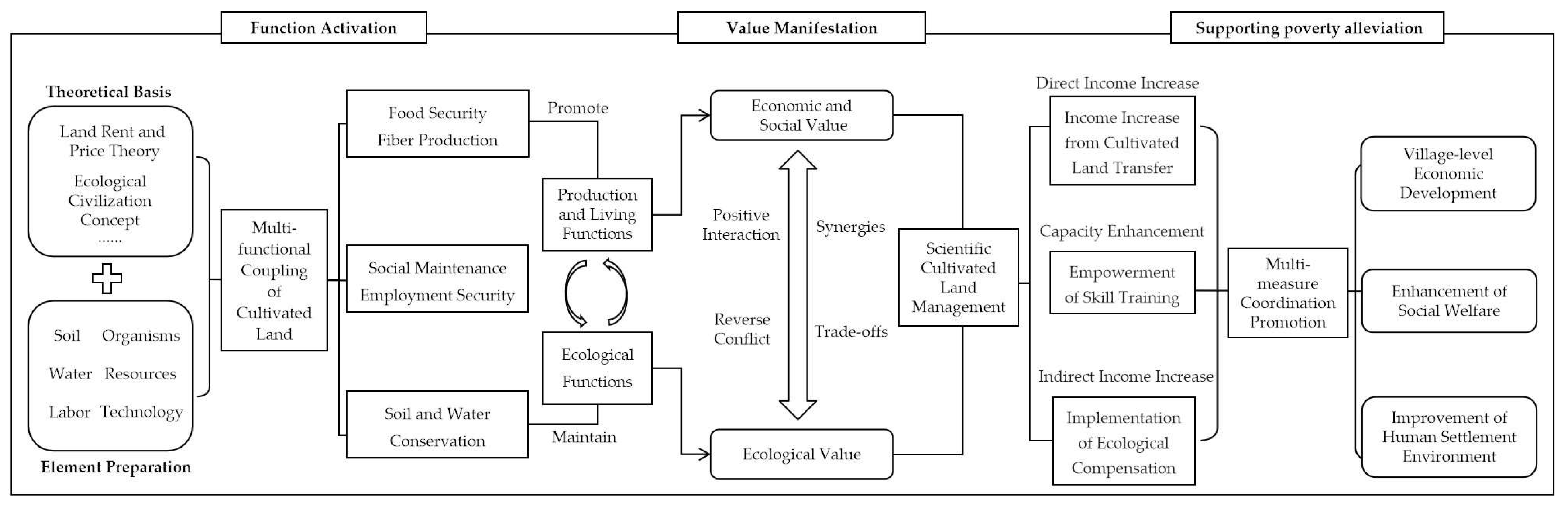
Figure 1. Schematic Representation of the Study Framework.
Land 15 00019 g001
Figure 2. Location of the Liupan Mountain Area.
Land 15 00019 g002
Figure 3. Production–possibility frontier concept.
Land 15 00019 g003
Figure 4. Average Economic Value and Ecological Value of Cultivated Land in the Liupan Mountain Area, 2007–2022.
Land 15 00019 g004
Figure 5. Trends in the Evolution of Economic Value and Ecological Value for Cultivated Land in the Liupan Mountain Area, 2007–2022.
Land 15 00019 g005
Figure 6. Spatial Evolution Patterns of Economic Value and Ecological Value for Cultivated Land in the Liupan Mountain Area, 2007–2022. (The spatial distribution maps of cultivated land value in 2007,2015, and 2022 were generated from cross–sectional data).
Land 15 00019 g006
Figure 7. The PPF curve for the economic, and ecological value trade–off/synergy of cultivated land in the Liupan Mountain Area from 2007 to 2022. (The x–axis and y–axis represent the normalized values of cultivated land ecological value and cultivated land economic value, respectively).
Land 15 00019 g007
Figure 8. Spatial Evolution Pattern of Cultivated Land Utilization in the Liupan Mountain Area from 2007 to 2022 Based on PPF.
Land 15 00019 g008
Table 1. Data sources and description in this study.
Data NameData ContentData Source
Statistical dataCrop Yield and Planting AreaStatistical Yearbook, Rural Yearbook, Handbook of Key Economic Indicators, Statistical Bulletin on National Economic and Social Development, and government websites
Average price of crops, cash income per mu of agricultural productsNational Agricultural Product Cost and Revenue Data Compilation
Terrain data500 m DEM, terrain typeThe General Bathymetric Chart of the Oceans (https://www.gebco.net (accessed on 6 May 2024))
Vector dataProvincial and county administrative boundariesNational Platform for Common GeoSpatial Information Services (https://www.tianditu.gov.cn (accessed on 17 June 2024))
Table 2. Ecological Service Value Coefficient per Unit Area of Cultivated Land in the Liupan Mountain Area.
Type 1Type 2Cultivated Land
ShaanxiGansuQinghaiNingxia
Adjustment ServicesGas Regulation0.36720.30240.28800.4392
Climate Regulation0.49470.40740.38800.5917
Hydrological Regulation0.39270.32340.30800.4697
Waste disposal0.70890.58380.55600.8479
Support Services
Cultural Services
Soil Conservation0.74970.61740.58800.8967
Biodiversity Conservation0.52020.42840.40800.6222
Provide esthetic landscapes0.08670.07140.06800.1037
Total3.32012.73422.60403.9711
Table 3. Changes in Correlation Coefficients Between Economic Value and Ecological Value of Cultivated Land in the Liupan Mountain Area, 2007–2022.
Year200720152022
Economic Value—Ecological Value0.319 *0.496 **0.646 **
* indicate significant correlation at the level of 0.05 (double tails). ** indicate significant correlation at the level of 0.01 (double tails).
Disclaimer/Publisher’s Note: The statements, opinions and data contained in all publications are solely those of the individual author(s) and contributor(s) and not of MDPI and/or the editor(s). MDPI and/or the editor(s) disclaim responsibility for any injury to people or property resulting from any ideas, methods, instructions or products referred to in the content.