Article

Democratic Processes in Urban Agriculture: A Comparative Analysis of Community Gardens and Allotments in London


The Bartlett Development Planning Unit, University College London, London WC1H 9EZ, UK
Land 2025, 14(12), 2395; https://doi.org/10.3390/land14122395
Submission received: 31 October 2025 / Revised: 4 December 2025 / Accepted: 8 December 2025 / Published: 10 December 2025

Abstract

This article compares the roles of allotments and community gardens in democratising London’s urban food system. Drawing from ethnographic and participatory action research (PAR), it reveals a recent policy shift favouring community gardens compared to allotments, which has resulted in a net reduction in long-term urban agriculture space in London. The study contrasts these two trajectories of urban agriculture across five democratic processes: (1) fostering food security, (2) expanding health benefits, (3) reclaiming the commons, (4) building spaces of interaction and representation, and (5) decoupling from dominant regimes. While community gardens tend to perform well in terms of social inclusion and environmental education of local communities and marginalised populations, allotments tend to be more successful in terms of productive capacity and developing autonomy due to their relatively more secure tenure. However, both trajectories are increasingly challenged by the dynamics of neoliberal urban development and the withdrawal of the state from its welfare responsibilities. This article argues that both trajectories do not have to be mutually exclusive and that their coexistence is in fact necessary to develop a more resilient urban food system, one that realises the principles of food sovereignty, social justice, and agroecological urbanisms at the local level.

1. Introduction

Urban agriculture (UA) now occupies an important position in contemporary food systems. It matters not just for basic food production but also for connecting people and providing numerous environmental, health, and wellbeing benefits for urban areas and communities.
In recent years, Brexit, the COVID-19 pandemic, the war in Ukraine, climate change-related droughts, persistent inflation combined with ongoing structural drivers such as welfare cuts, rising housing and energy costs, labour market precarity, and longstanding inequalities have further exacerbated food insecurity in the UK [1,2]. In 2025, 1 in 7 UK households were food insecure (14.3%) [1] (p. 32), and in 2022, this figure was even higher among London households (18.1%), with those containing children particularly affected [3]. These developments highlight the growing fragility of the UK food system, which remains heavily dependent on imports and vulnerable to external shocks [4]. In this context, urban agriculture has regained importance as a local strategy to enhance food system resilience. Community gardens have been shown to enhance food access and urban resilience, though their reach is often uneven [5]. They have proven efficient in supplementing household food supplies [6], while serving as spaces of collective empowerment for marginalised groups [7]. Allotments are also recognised for delivering ecosystem services such as biodiversity support, improved soil permeability, and carbon sequestration, since their small scale and methods of cultivation tend to better maintain soil quality compared to conventional agricultural systems [8] whilst sustaining cultural traditions of self-provisioning, even as they face pressures from urbanisation [9]. Although sharing similar aspirations for more sustainable and locally embedded food systems, they differ significantly in their historical development, organisational structures, and specific contributions to the democratisation of urban food systems.
Democratisation in this context refers to expanding citizen participation in food system governance beyond market logics, enabling direct involvement in shaping food policies, securing equitable access to land, and fostering collective responses to systemic challenges. This article therefore examines the transformative potential of UA, understood as its capacity to disrupt corporate food regime dynamics by advancing food sovereignty principles. These include recognising food in all its social, cultural, and ecological dimensions rather than reducing it to a mere commodity; strengthening local autonomy alongside agroecological practices; and building multi-scalar alliances that move beyond fragmented and isolated struggles. Central to this is the notion of food as commons, which highlights collective stewardship practices that resist both commodification and anthropocentrism. Agroecology is inseparable from this commons-based vision because the political and practical dimensions of food sovereignty are inherently linked. The cultivation methods it advances recognise the agency of nature and the interconnected, holistic character of our food system, underscoring that food sovereignty is as much about ecological relations as it is about social and political ones.
This article examines the roles played by allotments and community gardens in facilitating democratic processes within a city’s food system. Drawing on ethnographic research and participatory action methods, it explores how these differing pathways contribute to the reconfiguration of the food system while documenting both the obstacles to progress and potential avenues for resisting current neoliberal governance processes. In doing so, the analysis carries implications for distributional justice by showing how policy shifts reduce land tenure security; for recognition justice by exposing the undervaluing of allotments’ cultural and ecological roles; for participatory justice by highlighting distinct forms of democratic engagement fostered in gardens and allotments; and for environmental justice by evidencing their complementary ecological services and educational functions.

2. Materials and Methods

The research was conducted using a participatory action-research (PAR) methodology and framed under food sovereignty research praxis principles, enabling the research process itself to embody the very principles of food sovereignty, justice, and participatory democracy that the article argues these spaces must cultivate to resist neoliberal pressures and co-produce a more inclusive urban agriculture governance.
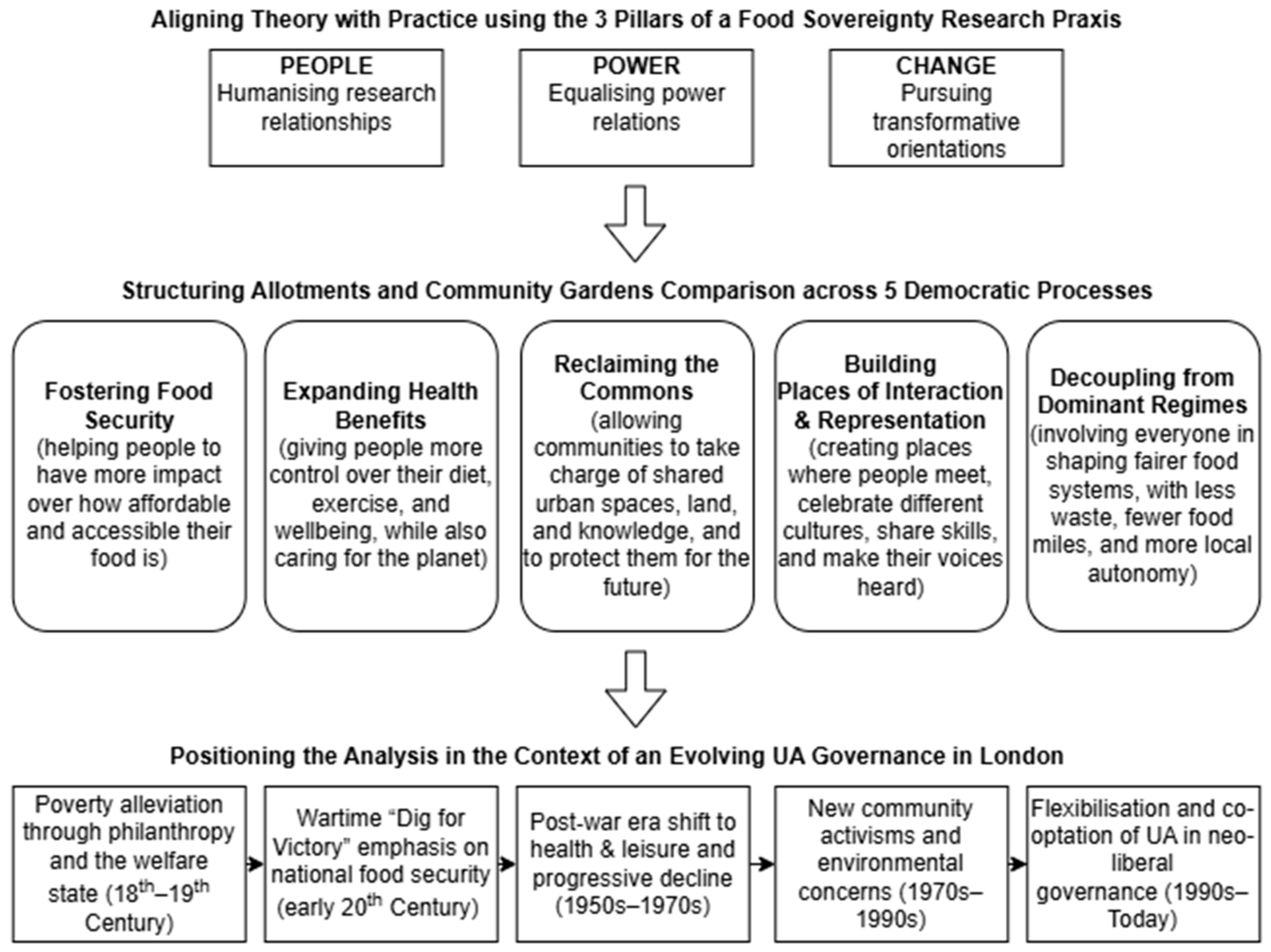
This was achieved through the three interconnected pillars developed by Levkoe, Brem-Wilson, and Anderson [10]. The first centres on the humanising of research relationships: nurturing connections founded on mutual respect between the researcher and the participants. The second revolves around balancing power relationship and involves disrupting hierarchies and oppressing methods that often define contemporary research, ensuring all people are treated with respect, and that people from all backgrounds, especially the marginalised, are given respect within the research process. The third pillar is seeking transformative outcomes, moving beyond just understanding a situation to provide knowledge that actively engages for transformative change. This was done through concrete knowledge-sharing approaches with communities involved, including documenting site histories and sharing comprehensive timelines as well as making recommendations for the improvement of tenure security. Throughout all the research, I addressed the risks of normative bias through rigorous reflexive practices, while relying on methodological triangulation and participatory approaches to put the emphasis on marginalised voices. Figure 1 provides a visual overview of the Food Sovereignty Research Praxis, outlines the five democratic processes examined in the study, and presents a brief timeline of urban agriculture governance.
Data collection relied on a variety of ethnographic methods. First, political space mapping enabled the extensive listing of the elements that make up the wider London’s UA landscape (political discourses, social and political practices, environmental events and practices, and institutional channels). This process compiled 256 elements and identified 1266 connections between them from the 17th century onwards, allowing for the identification of key shifts and tendencies that informed case study selection, interview focus, and the contextualisation of London’s UA micro-political developments within broader food regime transformations.
Second, timeline construction reviewed the past development of UA through in-depth case studies at Spa Hill Allotments and the Wenlock Barn Gardens, drawing on archival materials, meeting minutes, organisational documents, and interview transcripts to provide more depth in contextualising these micro-histories within broader socio-political and food regime dynamics.
Third, participatory action and observation allowed me to become an active member of the communities studied, engaging in gardening activities, attending meetings, and assisting with the functioning of specific initiatives over extended periods (more than 300 h at Wenlock Barn since 2017, 75 h at Spa Hill between June 2021 and October 2022, and varying durations across other sites from November 2021 to August 2023).
Coding in this research was treated as an interpretive process, with a codebook grounded in participants’ language and aligned to my research questions on urban agriculture, food justice, intersectionality, and socio ecological justice. The analysis acknowledged diverse forms of knowledge while tracing practices, discourses, and institutional channels, remaining attentive to lived realities. Reflexivity was a central interpretive lens. My dual role as grower and researcher enriched analysis but also required constant interrogation of how my own privileges as a white, educated male shaped interactions and coding. Categories were refined iteratively through site observations and conversations, ensuring marginalised voices were foregrounded and participants’ priorities emphasised. Sampling combined purposeful selection, practical considerations, and snowball techniques, but its strength lay in layered engagement. Trust was built through volunteering and informal conversations before interviews, allowing participants to guide topics. Informal exchanges and site participation were treated as data, capturing perspectives from those less comfortable with formal interviews and broadening representativity. Overall, my coding and analysis was theory-informed and reflexively oriented, while sampling was contextual and relational. Together, these elements ensured methodological rigour, ethical sensitivity, and attentiveness to the complex realities experienced by urban agriculture practitioners.
All these methods were undertaken as part of a PhD project focused on non-commercial, community-led UA sites. As mentioned, given the interest in looking at spaces often overlooked in policy and academic work, a purposeful sampling strategy was necessary to reach sites varying in scale, tenure, organisation, and degree of institutionalisation. As detailed in Table 1 below, this strategy relied on long-term engagement at some sites and concentrated fieldwork at others. Across the 11 studied sites, interviews with 40 participants (averaging one hour each), and more than 400 h of participant observation generated a multi-layered understanding of how democratic processes were developed, constrained, and transformed within London’s UA landscape.

3. Results

3.1. Policy Context & the Prioritisation of Community Gardens

Following conversations with scholars and activists in the field, and a detailed review of public policy documents referring to UA in London I hypothesised that in recent years, local policymakers could have sidelined the allotment trajectory to prioritise the community gardening trajectory in London.
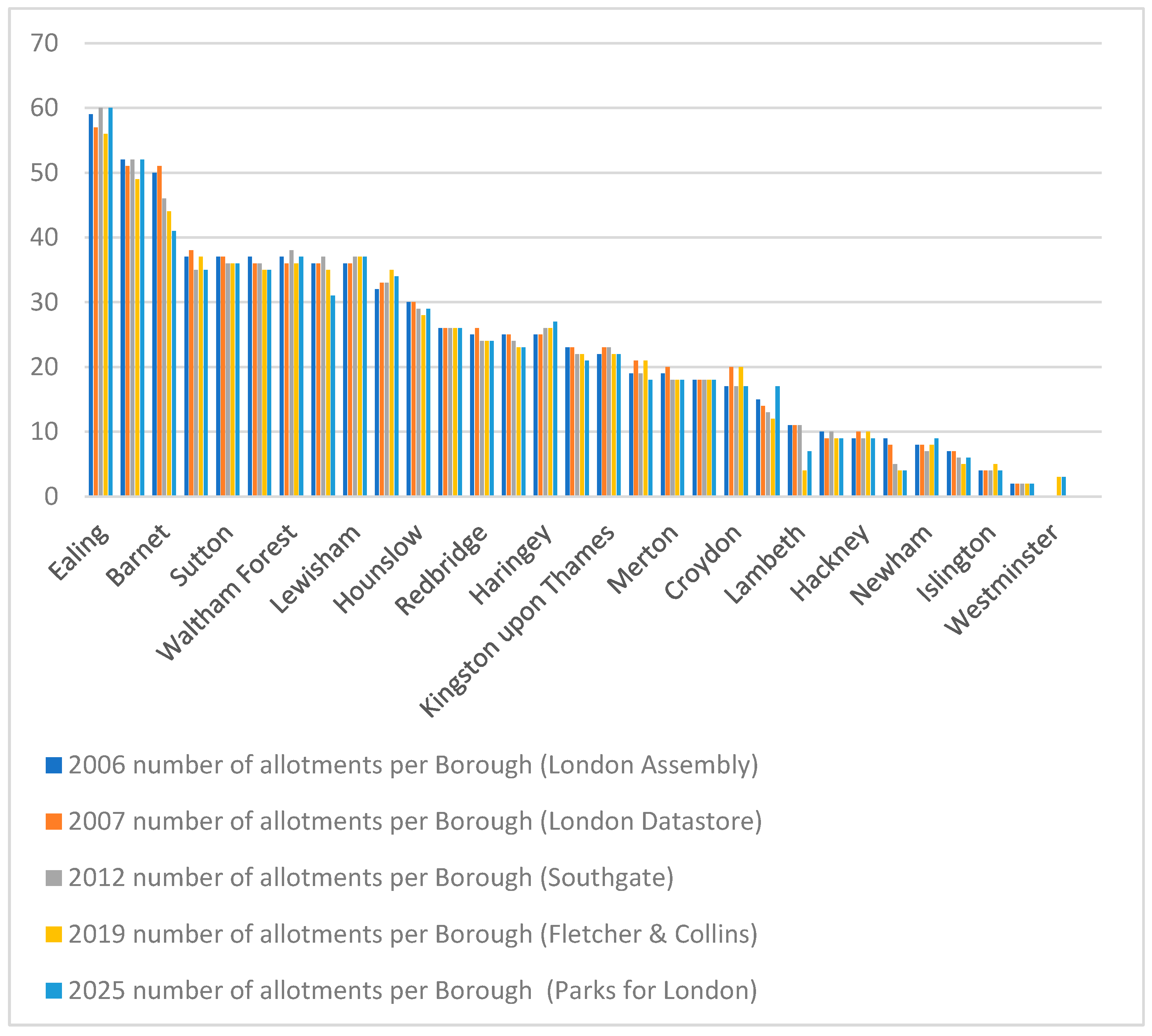
On one hand, despite their strong popularity among Londoners (evidenced by long waiting lists and average delays of four to five years before securing a plot) between 30 and 41 allotment sites were permanently closed between 2013 and 2020, depending on the source [11,12,13,14,15]. Fletcher and Collins [11] for example, argue that allotment sites are disappearing at an accelerating rate, approximately three times faster than a decade ago, and that shrinking plot sizes is now a common strategy to meet demand. In order to verify this claim, I cross-referenced their dataset with publicly available figures from the London Assembly [12], London Datastore [13] and Parks for London [14]. This revealed inconsistencies in Fletcher and Collins’s numbers, particularly their distinction between public and private sites and their count of 682 active sites in 2019.
Using sources that were more consistent with one another, notably the London Assembly Environment Committee [12] listing 737 sites in 2006, and updated data from London Datastore [13] listing 741 sites in 2007, I established a baseline that more closely aligns with the Parks for London dataset for 2025 listing 713 sites [14]. When comparing these sources, it appears there were 710 sites in 2019 rather than 682, suggesting that Fletcher and Collins may have undercounted private sites or relied on incomplete council data. Their reported loss of 41 sites between 2012 (723) and 2019 (682) [15] (p. 6); [11] (p. 4) therefore appears overstated. Based on more consistent figures, the net loss over this period may have been closer to 11 sites. This indicates that the rate of allotment loss has slowed rather than accelerated, with annual losses decreasing from 2.8 sites per year between 1996 and 2006 to approximately 0.8 site per year between 2012 and 2025. Yet, despite this slowing, allotments continue to be permanently closed. Figure 2 illustrates the number of allotment sites per borough as reported across these different sources.
Another important empirical contribution relates to the social geography of these closures. Dobson, Edmondson and Warren [16] demonstrate that in several UK cities, areas with high income deprivation have experienced around three times more allotment closures than the wealthiest areas. Their study combined allotment records with socioeconomic data to reveal a clear association between deprivation and vulnerability to loss. Applying a comparable method in London, I examined closures in relation to both income deprivation and the English Indices of Multiple Deprivation (IMD). The analysis confirmed the relationship observed by Dobson, Edmondson and Warren when income alone is considered: the ten lowest-income boroughs lost 13 sites, compared with five in the highest-income boroughs. However, when using IMD rankings, the pattern differed. The ten most deprived boroughs lost only one allotment, while the ten least deprived lost 18, indicating that income deprivation and overall IMD capture different forms of vulnerability in relation to land-use pressures.
Together, these findings refine and qualify previous claims about both the rate and distribution of allotment loss in London. While allotments are still disappearing, the pace appears slower than suggested by Fletcher and Collins [11]. Moreover, patterns of closure vary by social indicator, with income deprivation proving a stronger predictor than IMD. The analysis also shows that Labour-controlled boroughs tend to close fewer allotments on average than boroughs controlled by other political parties.
On the other hand, Capital Growth reported creating more than 2700 new community gardens between 2008 and 2018 [17] (p. 31). While these numbers indicate a certain prioritisation of community gardens over allotments, the impact of this prioritisation on community food production scale or total land available for growing remains unclear due to lack of appropriate data on land devoted to UA under each trajectory. Chang [18] (p. 103) argued there was no serious increase in food production from the Capital Growth Programme between 2008 and 2013. Others have noted that land made available for community gardening is not comparable to that of allotments in terms of size or duration of lease.
Overall, it is difficult to assess how many community growing projects benefitted financially from Capital Growth. While most community gardens in the network used the newsletter and some accessed webinars or training [19] (p. 7), it remains unclear how many accessed actual funding to create new growing spaces. Between 2008 and 2012, Capital Growth partnered with funders for London-wide grants [20], and the Wenlock Barn Estate projects exemplify this, having obtained East London Green Grid and Big Lottery’s Local Food funding. However, the new community growing spaces created ranged from new community gardens to small accessible raised beds in existing allotments, schools, or council estates, and it is unclear how many subsist today given available data. As observed with the Herb Garden in the Wenlock Barn Estate, many ceased functioning or closed once their funding cycle completed [21] (p. 63).
This policy prioritisation is reflected in official documents. There was no mention of allotments in any minutes of the London Food Board between March 2017 and September 2021. While the London Food Strategy 2018 mentions the protection of ‘existing allotment sites’ as an aspiration, it only calls for the ‘provision of space for community gardens’ [18] (p. 46). The London Plan 2021 policy G8 aims to ‘protect existing allotments and encourage the provision of space for urban agriculture’ without specifying the need for new allotments or lengthier tenures [22] (p. 331). The plan simply states that developers need to be ‘explicit over how long sites will be available to the community’ [22] (p. 331). Food board members, allotment societies, and Sustain participated in the London Plan Consultation and noted this omission. Their recommendations to rephrase objectives and include lengthier tenures were not adopted in the final document [23] (p. 2); [24] (p. 10).
This indicates a general willingness amongst policymakers to reinforce the flexibility of community growing spaces rather than provide more longevity, or at least an inability to address these questions. The relative absence of allotments from policy discussions may also be due to their isolation, as they tend to be more closed to the public compared to community gardens [15] (p. 11). This dynamic may have influenced the composition of the London Food Board, as different Mayors could more easily draw on public voices from the community gardening sector rather than allotment societies, given that the former have been more active in lobbying in recent years. Nevertheless, some London Food Board members have a strong legacy of advancing food sovereignty, agroecology, and local food production. They have consistently pushed for more land for urban agriculture sites and longer tenures, including allotments [25].
It is not surprising that Islington borough states in their policy that ‘it is both simpler and more effective to create community gardens and other food growing opportunities rather than allotment sites’ [26] (p. 7). Despite opening a new allotment in 2010, the cost remains ‘considerable’, and community gardens are said to ‘provide a better community facility than allotments’ [26] (p. 7). A widespread argument holds that community gardens benefit a wider population. Octopus Communities stated it was mostly ‘because of the lack of space […] and because only a few benefits from the allotments’ (Interview Quadrant Estate Member, 23 November 2021), adding they ‘have discouraged the Council’ from creating individualised gardens where ‘a dozen people will get a 6-foot by 4-foot […] and then the rest get nothing’ (Ibid). They noted that ‘if you use a similar space and create a community garden […] all participate in growing, even if it was just say herbs or something where they learn about it, they’re outdoors, they participate and they get a little bunch of things to take home’ (Ibid). Many argue that ‘most people don’t grow primarily to feed the family, they do it for enjoyment, so massive plots are an anachronism in many cases’ [27]. This possibility of delivering more benefit whilst using less space and fewer resources is convincing outer London boroughs facing similar land shortages.
The result is that allotments are starting to resemble community gardens through multiple mechanisms: dividing plots, creating community plots, seeking grants, and increasing site administration to ensure quicker participant turnover. An allotment officer in Croydon illustrated this: ‘We try to maximise space, like reduce it in size, multiple occupancies… We don’t give one family one full plot because we want to increase the amount of coverage. […] To increase the capacity we try to make those (uncultivated) plots available again. […] But what you need to understand is improving does not always mean opening more and more sites because that will waste a lot of our money and maybe that’s something that is not needed. So we need to be very careful in what we can deliver, and it’s better to deliver good what you have than to grow without any sustainability’ (Interview Allotment Officer Croydon, 12 November 2021).
Examining the underlying assumptions of this local authority narrative proves instructive. Opening new sites is described as a ‘waste’, suggesting either no perceived demand or that allotments lack substantial value compared to other investments. Croydon Council attempted this approach in 2019 by injecting £350,000 into sites they directly manage for repairs and amenities [28]. However, it would be false to say new sites are ‘something that’s not needed’ or ‘unsustainable’. Increasing allotment waiting lists in Croydon and elsewhere contradict this claim. New sites can also be self-administered. A private allotment recently opened in Croydon at higher prices for those who can afford them, evidencing the need for more affordable allotment plots [29]. Councils tend to minimise actual demand because of their inability to meet it, despite having a statutory duty under the Small Holdings and Allotments Act 1908 to provide ‘a sufficient number of allotments’. Outer London boroughs like Croydon face this obligation directly.
The institutional environment of London’s UA is highly fragmented, with responsibilities spread across multiple departments and agencies at both citywide and borough levels. This fragmentation makes effective needs estimation, strategic planning, and fair resource access difficult. Councils tend to consider allotment provision only within their administrative boundaries, ignoring London-wide realities. Fletcher and Collins [11] (p. 9) argue that allotment provision should no longer be considered on a case-by-case basis if we want equal opportunities across London. Instead, mapping techniques and increased inter-borough communication must guide decisions. To do this, Capital Growth has established inter-council quarterly meetings beginning in late 2021, allowing better needs assessment across the capital. The organisation is also currently organising regional events for UA practitioners across South, East, West, and North London.
Nevertheless, this fragmentation in governance largely reflects the fact that UA was not initially regarded as significant by London’s policymakers. As Parsons, Lang, & Barling [30] (p. 8) note, the placement of the mayoral food programme in the environment department meant it was not “taken seriously” at first. It gained visibility only after being moved to the economic development department, illustrating a broader tendency among some policymakers to downplay environmental efforts despite formal recognition of the climate crisis.

3.2. Comparing Democratic Processes and the Transformative Potential of UA Trajectories

With this policy context in mind, it is now important to understand fully the democratic processes at play within these two urban agriculture trajectories in London. This section will therefore give a comparative overview of five main democratic processes as they are developed within allotments and community gardens. These are: fostering food security, expanding health benefits, reclaiming the commons, building places of interaction and representation and decoupling from dominant regimes.
Both allotments and community gardens work towards improving food security and health in urban areas, but they go about it in different ways. Allotments, since their beginnings, had the objective to provide families with a degree of self-sufficiency. The original size of a state-owned full plot in 1922 was to “allow a gardener to grow enough food to feed a family of four, with enough room for crop rotation, perennials, and even chickens” [31]. Today they still engaged in significant urban food production, though for many, their primary function has now shifted to recreation and leisure. Indeed, and while it is only in rare cases that allotment holders manage to become fully self-reliant, most allotmenteers still produce important quantities of culturally relevant, sustainable, and healthier fruit and vegetables when compared to industrial agriculture, thereby contributing to food sovereignty objectives based on local autonomy, ecological stewardship, and the preservation of culturally embedded food practices.
In comparison, community gardens allocate much more space to non-cultivation purposes and place greater emphasis on social action and environmental learning than on intensive food production [32] (p. 18). Nevertheless, data from Caputo, Schoen, and Blythe [6] (p. 8) (who measured annual yields using harvested crop weights across standardised plot areas) show that productivity levels between allotments and community gardens are broadly similar (1.59 kg/m2 vs. 1.8 kg/m2 per annum). This suggests that allotments are not inherently more productive or necessarily better positioned to support food sovereignty, as shared stewardship in community gardens can enhance plot maintenance and, in turn, overall output. As one of my interviewees involved in both types of growing spaces explained, community gardens may even surpass allotments because more people tend to care for a single shared area: ‘if I had divided my space (full allotment plot) up into little community plots and that people use it, you will get far more food off it than I do.’ (Interview Quadrant Estate Member, 23 November 2021). Although my study does not directly quantify yields, triangulating published data with participant accounts indicates that productivity is influenced less by how much land is cultivated and more by the collective practices through which it is managed. What differs is essentially that food is generally seen more as a collective good in community gardens, with crops generally shared by participants, served at communal meals, or contributed to local food banks.
Importantly, both trajectories tend to re-problematise food security beyond a quantitative understanding, extending more towards a food sovereignty practice by re-linking food production to local ecologies and diverse food cultures. Both provide significant health benefits including access to fresh and nutritious food, physical exercise, and ecosystem services such as improved air quality and urban heat mitigation. Both trajectories encourage individuals to consume a more diverse and healthier diet, consisting mostly of fruits, vegetables, and herbs. The gardening activity itself is physically meaningful since it reinforces cardiovascular health, strength, and flexibility, and exposure to outdoor green spaces has also been shown to reduce stress and enhance mental health. Both trajectories have produced diverse ecosystem services and healthier environments (cleaner air, more resilient ecosystems, healthy soils, etc.) for their human and non-human communities, while also improving nutritional health for practitioners and the broader community. As such, these practices address the metabolic rift not simply by reconnecting human activity with ecological cycles, but by cultivating soil connectivity, hybrid forms of labour between humans and non-humans, and shared imaginaries that resist commodification, thereby re-embedding food within a holistic conception of health that encompasses cultural and planetary dimensions.
While community gardens tend to have more explicit linkages with health promotion activity due to their focus on outreach and access, providing space for community members to learn to eat well, participate in cooking classes, and get exercise, risks of co-optation exist when the focus turns too strongly toward health, since it tends to overshadow the broader goals of food system transformation and can reduce the autonomy of certain sites. Allotments, conversely, while not necessarily explicitly expressed as health interventions, also exert a significant influence on the health and wellbeing of their plotholders. With their longer history and larger scale, allotments are more likely to have a more holistic perspective, integrating health benefits with food security and community self-sufficiency, and better recognising the interdependence of these different dimensions of wellbeing.
Furthermore, allotments and community gardens also contribute to reclaiming the commons by resisting the commodification of urban space and nature while promoting collective, sustainable control of resources. Here ‘commons’ are understood, less as a good or common-pool resource and more as a system of ‘arrangements for a practice—commoning—in which we collaboratively organise and take responsibility for the use, maintenance and production of diverse resources’ [33] (p. 3). Unlike Ostrom’s (1990) common goods, allotments and community gardens resemble club goods, as access is relatively closed and often subject to tolls [34] (p. 44). The view thus shifts from commons as goods to commons as social processes or systems, emerging between a claiming plurality and a common good [34,35]. This reclamation takes shape in many practices witnessed in our case studies, such as seed saving and exchange, shared tools, indigenous knowledge, open-source technologies, collective governance, and mutual aid, and all activities that counter corporate control over the city and its food system.
Considering this, it is difficult to distinguish between the two as both types of urban agriculture allow for collective place-making and provide scope for socio-ecological learning, where individuals can share knowledge, skills, and experience related to food production, environmental management, and community organisation. On the one hand, long-term tenancies in allotments can potentially allow for lengthier agroecological experimentation and the development of more nuanced ecological understanding, allowing plot holders to innovate and refine sustainable farming practices over time. While longer tenancies in allotments allow for greater soil connectivity, they often require stricter cultivation standards, which affects biodiversity and water infiltration. Strict allotment regulation rules at times can also be harmful to biodiversity and limit the utilisation of innovative practices. Compulsory weeding by allotment regulations, for example, may lead to impermeable surfaces limiting potential infiltration of water, natural species distribution, and biodiversity and the development of biocentric commons [36].
Community gardens, on the other hand, despite their relatively shorter tenure in most cases, tend to be more open to adopting agroecological practices and are therefore valuable places for environmental education and community involvement. Whether or not UA projects within each trajectory can effectively reclaim the commons seems to be mostly based on the institutional channels and social-political tactics they adopt, and if they were able to secure their land while developing a wide understanding of community empowerment.
Overall, in terms of an urban agroecological dimension, the research further demonstrated the wealth of socio-ecological relationships generated by UA spaces. This was clear during COVID-19, when local food systems and urban agroecology demonstrated more resilience than global value chains. The study also demonstrated that UA spaces are addressing the metabolic rift through the generation of new aesthetics involving more common agency between human and non-humans, soil connectedness, new hybrid forms of labour, and alternative urban imaginaries opposing the commodification of nature. However, it also revealed some weaknesses in terms of developing agroecology due to some social and political difficulties in recognising plural knowledge systems.
Allotments and community gardens are also critical areas of social interaction and community building, but the ways in which these social relations manifest can differ significantly. The more established allotment sites have been shaped through various immigration waves and demographic changes over their long history, often resulting in multifaceted range of social dynamics combining tensions but most importantly solidarities. Many foreign traditional crops and farming know-how have been transported by immigrants throughout the years which contributed to shaping a more diverse and resilient urban food production. For example, allotment practices at Spa Hill evolved through different waves of immigration, created tensions among members, but importantly, also preserved and recognised solidarity building and indigenous knowledge systems.
In contrast, community gardens, which are often characterised by less formalised governance structures and an emphasis on widening participation, are especially well-suited to facilitating social inclusion and community cohesion. But, if they fail to address power and privilege, they can also perpetuate current social inequalities and exclusionary practices. As demonstrated by McClintock [37] in the case of Vancouver, Canada, and Portland, Oregon (USA), or Rigolon & Collins [38] in the case of London, the formalisation of community gardens through municipal policies and “green city” branding tends to privilege middle-class, resource-rich actors while marginalising poorer and racialised communities.
Indeed, many urban agriculture projects while attempting to be inclusive, still replicate exclusionary dynamics that intersect with class, gender, and race. Both the allotment and community garden members interviewed recalled cases of testimonial injustice, where the knowledge of some marginalised participants was unfairly discredited or ignored due to prejudice, as well as cases of hermeneutical injustice, where certain groups were excluded because they lacked the shared conceptual language or recognition necessary to articulate their experiences and expertise. Governance also reflects this as institutions tend to perpetuate privileges of specific groups through efforts that emphasise individual responsibility, “vote with your dollar” approaches, universalising narratives, and paternalist tendencies. Although the practice of UA has helped to empower ethnic minorities and women by acknowledging indigenous knowledge systems and the value of reproductive labour, opening up spaces of genuine interaction across different backgrounds, they also at times (re)produced exclusionary practices. Some of our case studies demonstrated for example, how gentrification has recently pushed original participants away and threatened the cultural diversity of their sites. Community gardens, unlike allotments, sometimes adopt ‘squatting’ and ‘guerrilla gardening’ practices. While effective strategies against the privatisation of urban nature, they can also reproduce inequalities by imposing UA on communities that never wanted it.
What is clear is that in both trajectories there often remains hermeneutical injustices as well as testimonial injustices, many of which remain unnoticed by their perpetrators, since most UA practitioners do not perceive their activities as inherently political in nature, as they “just want to grow food.” Another interesting issue concerning the ‘building of places of interaction and representation’ is the extent to which community growers themselves distinguish between radical or neoliberal UA projects. Many UA practitioners do not make this distinction or view their actions as political. Moreover, many gardens lack paid staff to engage in conversations about the food regime’s future, relying instead on volunteer champions to connect with wider networks. This often does not happen. Particularly important is recognising the community building component of spaces like Spa Hill allotments and Wenlock Barn Estate projects, which tend not to be associated with the wider local food movement yet produce affective meanings and encourage communities’ self-organisation. However, they are often overlooked in policy circles, overshadowed by entrepreneurial inner London projects that receive most policymaker recognition. This reflects a ‘subaltern urbanism’ [39] and uneven recognition. The ‘mundane’ sites therefore work harder at self-promotion and network creation than ‘trendy’ sites, since they lack the same political recognition. Mobilising local champions and well-connected experts within local projects is crucial for the survival and flourishing of these ‘mundane’ sites.
Subsequently, one of the biggest challenges for both allotments and community gardens is their ability to escape the hegemonic corporate food regimes and neoliberal modes of governance. Community gardens, who tend to rely on donor funding and short-term forms of land tenure, are particularly vulnerable to market co-optation and neoliberal governance. Such reliance on outside support can limit their transformative potential, since donor conditions can determine the type of interventions provided and limit the distribution of project management responsibilities to more privileged populations. A donor-driven approach creates deeper dependency on professionals and certain clientelist practices among community food growers. Community gardens often rely on temporary land access and external funding, where evaluation requirements shape interventions, limit transformative contributions, and create dependency on bureaucratic management. Even without evaluation requirements, donors’ organisational standards limit accessibility. This restricts community autogestion while increasing competition between communities. Funding competition raises co-optation risks, as civil society groups market their projects as best value for money and distinguish themselves by focusing on single issues or ticking more boxes.
In contrast, allotments with their statutory rights and relatively stable tenure security have more freedom from external financial control and thus more freedom of decision although they still rely on supportive councils. As explained by one of my interviewees: ‘allotments […] [food growers] tend not to have to worry about funding because they’ve got the land’ (Interview Quadrant Estate Member, 23 November 2021). By collecting a portion of rents (about 60%) or the entirety of rent, allotments and their societies remain self-reliant for funding and enjoy more autonomy in decision-making. Due to this relative independence, allotments’ relationship with the capitalist regime has always been ambiguous. Allotments were originally intended to increase food security, well-being, industriousness, and contentment whilst decreasing criminality and poverty [40] (p. 21), which is why the aristocracy supported them. Still, allotments, contrary to appeasing class tensions, also reinforced self-organisation and trade-unionism among the working class [41] (p. 23). However, rising cost of utilities and declining state funding have begun to place budgetary burdens on allotment committees, which have been forced to rely increasingly on volunteers and conditional grants, thereby undermining their long-term sustainability and autonomy. Table 2 summarizes the comparison of allotments and community gardens across the five democratic processes.

4. Discussion

Having established how allotments and community gardens differ in their democratic processes and contributions to food system resilience, it is essential to examine the structural forces that shape these differences. The following discussion explores underlying governance dynamics, particularly around labour, funding, and professionalisation, that both enable and constrain the transformative potential documented above.
To begin with, the nature of voluntary work in urban agriculture trajectories reveals fundamental distinctions with implications for its democratic promise. Under self-managed neighbourhood plots or allotments, volunteering can articulate a different, non-capitalist economic rationality that constructs care, self-governance, autonomy, and resilience above wage-labour relations, placing it on the gift economy or the economy of the commons. Under more professionalised initiatives, however, volunteering can become oppressive, actually subsidising state disengagement from welfare provision while generating cultural capital, which enhances the exchange value of land for landowners. When local residents actively contribute to building and maintaining shared spaces, it can foster representativity, long-term engagement, and a sense of belonging, whereas more professionalised, pre-defined initiatives that rely on more passive engagement can provide similar benefits but fall short in terms of consolidating a sense of shared ownership.
Additionally, the commodification of care (the process by which care is transformed into a marketable service rather than a relational or communal practice) is evident in present governance arrangements. While grassroots UA practitioners are practicing genuine care for gardens and communities as part of long-standing social relations, new conditional funding and public–private partnerships tend to recast care as exchange, so the corporate sector can “care without caring, or to care by contracting others” [42] (p. 646). Typically, care work is often “undervalued and underfunded because they ‘should be’ provided by households” [42] (p. 650), and perhaps this is a reason why UA landscape in London often comes to be dominated by women and does not get appreciation for the full value it generates.
In this context, the structuration of gardens in wider solidarity networks becomes increasingly important but faces significant challenges. While organisations like Capital Growth cannot adequately oversee gardens in all London boroughs, the creation of networks remains essential to reduce vulnerability and present clear interlocutors to governmental agencies. However, the heterogeneity between gardens complicates solidarity-building processes.
For example, in the Union of Hackney Gardens, larger professionalised gardens tend to naturally opt towards progressing on more formalised organisational structures such as Community Interest Companies or Charities which can access more funding and implement social prescribing projects. Smaller gardens tend to resist such structuration processes, either because of their ideological leanings towards alternative economic models or because they lack the time and political experience to navigate such spaces. Unfortunately, the tendency for funding bodies to favour larger, more professionalised organisations means inequalities in resources can get reproduced.
Furthermore, the professionalisation of community gardening has also created what some describe as a distinct class of workers who are dependent on continuous grant funding in the “arts and regeneration” or “vocational education” sectors. This work is typically insecure, with constant searching for renewed funding. The resulting competition between professionals of this sector can at times disenfranchise community participation, since local community members who are untrained cannot compete for paid work with more experienced persons who often come from more advantaged, less diverse backgrounds. The challenge is to balance professionalism with genuine community ownership, which tends to be best done by opening up paid work for local residents and democratising access to training.
To envision a complete replacement of community urban agriculture by professionalised and marketised forms would not make sense, because while other UA models, such as commercial vertical farms, already exist in London, community gardens and allotments remain particularly attractive. This is because, as it was seen, privately led initiatives, though resource-efficient, often fail to embody cultural diversity, practice genuine agroecology, foster environmental education and reconnection, or deliver the broader social, health, political, and civic benefits that sustain a collective right to the city.
Nonetheless, the political economy of UA in London being increasingly shaped by marketisation and commercialisation, the majority of UA projects, particularly community gardens, are embracing commercial strategies to be financially sustainable, becoming social enterprises, generating income from selling produce, providing training or social prescribing services, or seeking corporate sponsorships. Some of the bigger UA projects involve primarily food production and utilise business models such as farmers’ markets and community-supported agriculture programmes to sell products directly to consumers, while others include providing organic produce directly to restaurants and food businesses. In contrast, smaller projects rely on fundraising efforts, grants, and donations almost entirely, while others focus on service delivery, providing horticultural therapy, educational workshops, or community events to generate revenue.
This increased commercialisation of UA naturally raises fundamental questions regarding its political and social implications. UA activists worry about increased corporate financing and limited investment as they believe that this undermines the social and environmental justice principles upon which such projects were originally founded. Confronting this trend, others worry that pursuing financial sustainability would mean prioritising income-generating activities over fundamental human needs which could lead to further exclusion and the entrenchment of inequalities.
Throughout my research, it became obvious that some of these emerging forms of participatory urban governance have a tendency to legitimise depoliticisation, and the state’s disengagement from social welfare commitments by proposing temporary solutions rather than a wider systemic change. According to Coulson & Sonnino [43], these emerging form of governance should be understood as branding strategies within the broader competition among cities internationally rather than actual democratising initiatives. Indeed, new designations such as “Sustainable Food City” for example, have some advantages under this global competition of cities, as they serve to attract businesses and creative professionals and can increase real estate prices and municipal revenues in some areas.
Nonetheless, as more councils across the country divide up plots and build smaller allotment sites [44], community gardeners and allotmenteers feel the two trajectories are converging in terms of social organisation. Whether such convergence maximises democratic processes remains unclear. At present, we appear to witness replacement of one trajectory by another rather than convergence. Indeed, allotments have drawn inspiration from community gardens, particularly regarding expanded functions beyond food and growing accessibility, which reflects democratisation. Community gardens have not sufficiently engaged with the rich history of the allotment trajectory, though recent collaboration between Capital Growth and the National Society of Allotment and Leisure Gardeners (NSALG) on legal aid against eviction shows promise. Community gardens increasingly moving away from collective self-organisation toward state service provision risk compromising community ownership and food regime democratisation. Community gardens and allotments resembling community gardens often subsidise state service cutbacks by delivering more with less, consolidating neo-liberal governmentality within UA.
Beyond their immediate functions in terms of food production and community building, both allotment and community garden trajectories play a significant role in resisting hegemonic political discourses and advocating alternative conceptions of the right to the city. Clearly, when UA actors pursue values and rights that are counter-hegemonic, they engage in forms of “everyday resistance” [37] (p. 499). However, in London today, as reflected in the London Plan and London Food Strategies, urban agriculture is increasingly reduced to a ‘green amenity,’ framed as a technical fix within sustainability agendas and stripped of its political dimension, thereby situating it within the realm of post-political dimension and ultimately limiting its transformative potential.
Despite this challenge, both trajectories have continued to act towards UA becoming a right rather than a privilege or a charitable gift. For allotments, this has been achieved previously through legislative intervention, beginning with the 1908 Small Holdings and Allotment Act, which made it compulsory for local authorities to provide land whenever demand existed. Further confirmed by the 1925 Allotment Act and the 1947 Town & Country Planning Act, which allowed allotments to gain special status and legal protection against development. As a result, allotmenteers have developed a degree of spatial autogestion in the confines of their leases, particularly in self-administered plots where day-to-day management has been handed over to allotment committees.
Similarly, community gardeners also claim rights over land through a number of policies and institutional arrangements, including the National Food Strategy, local food strategies, food councils, and plans. Their rights, however, are less codified or secure than allotments and resulting in weaker tenure security. As a reaction to restrictive access to land, Incredible Edible has campaigned on the “right to grow” with the idea that local authorities will be required to compile lists of public land that is available for food growing, to which local groups can then apply. Similarly, some UA practitioners are campaigning for the “right to food,” which would be a legal right on which the state would be obligated to ensure that food is available, accessible, and adequate for everyone. Since the COVID-19 pandemic revealed food insecurity in the UK, both campaigns have gained significant momentum. Clearly, the issue of land access is still the fundamental challenge and it is clear that UA practitioners in London have to do more than just maximising participant numbers by subdividing plots, but instead have to actively reclaim more land and access rights. Perhaps innovative mechanisms like Community Land Trusts and participatory budgeting channels that challenge colonial legacies embedded in current land allocation patterns could be a way forward.
The problem of public access and enclosure is also a significant issue for both UA trajectories. While truly public and open-access urban agriculture tends to be rare, recent trends seem to be moving in the direction of even more enclosure. Indeed, community gardens, originally valued for the accessibility and low-level management compared to the more gated and bureaucratically organised allotments, are now facing increasing bureaucratic needs as they take on more roles and project delivery requirements. This has led to greater control and sometimes physical closure of space due to the presence more valuable equipment to undertake all these activities. This demonstrates that the neoliberal offloading of welfare responsibilities on community gardens without adequate support can limit their ability to realise the right to the city.
Significantly, what is meant by “enclosure” in this case is not privatisation of ownership but restriction of access and collective control. As Colding et al. [45] note, collective rights to manage land and shared experiences in space is more crucial than legal tenure rights in terms of driving self-determination. Longer tenure security supports agroecological learning, soil connectivity, community embeddedness, and empowerment, but it is really perceived tenure security, which is determined by the wider political context, market pressures, and policy provision that is of greater importance than actual ownership.
Despite these various challenges in working under neoliberal regimes of governmentality, UA practitioners devise most of these creative practices in the “grey area” of being not exactly radical, not precisely co-opted. Some examples include unofficial rechannelling of funds from more established and resourced projects to poorer ones, innovative fund-application techniques (e.g., using AI software), and even discussions about transferring protected species between sites to obtain legal protection.

5. Conclusions

This article has engaged with recent critical analysis of UA regarding food justice and food sovereignty and offered a nuanced perspective on forces limiting UA’s radical potential. It highlighted contradictions between equitable UA development in London and the advancement of the neo-liberal city, demonstrating UA’s pedagogical potential to engage marginalised communities in participatory urban governance.
When comparing the democratic processes in community gardens and allotments, the evidence presented here, drawn from a small number of case studies, indicates that both trajectories have the potential to deepen the democratisation of the food regime but through different means. Allotments in the particular site examined, being of a larger size and offering secure land tenure and more individual freedom, appeared to be better placed to imagine and develop alternative food systems that oppose the dominant paradigm and facilitate food sovereignty. Community gardens, at least within the examples included in this research, as much as they provide meaningful opportunities for community involvement, social contact, and environmental education, often tend to be limited in size and autonomy, which may restrict their potential for wider food system transformation. While these cases reflect only a small selection of London’s diverse landscape of allotments and community gardens, they were chosen for their representativeness of the two trajectories, and I therefore hope that the findings presented here can highlight broader tendencies, even as they remain grounded in a necessarily limited sample.
Building on the patterns observed in this article, the apparent public policy prioritisation of community gardens over allotments may have unintended consequences for the democratisation of the food regime. However, as Nordensvärd, Byun, & Sommar [46] suggest, these two models of UA provision do not have to be mutually exclusive. Community provision has existed since well before neoliberalism and can still complement statutory provision of UA rather than signal a shrinking welfare state. The issue is really when one model replaces the other, disrupting their complementary functions. The coexistence between state-organised and community-organised forms must exist to achieve a strong, diverse food system that benefits all members of the urban population.
Urban agricultural sites in London form a broader reflexive commoning process that co-produces new material and immaterial urban commons based on principles of justice, inclusivity, and sustainability. Through these other forms of thought, urban agriculture spaces offer the potential of creating genuine alternatives to hegemonic concepts of obligations and entitlements, hybrid forms of labour and economic structures, and alternative social relationships that may serve as the basis of a more just and sustainable society.
Several interventions could reinforce UA trajectories while addressing the challenges identified. At the national level, extending statutory protections or granting longer tenures to UA sites would strengthen their transformative potential, while establishing a national “right to grow,” supported by public land inventories as piloted in some local authorities, could provide further structural support. Some councils, however, may resist these changes due to competing demands for land for housing or infrastructure, and the need to prioritise development flexibility and short-term revenue generation under constrained budgets. Grassroots UA projects also need to connect with national and international agrarian movements and mobilise themselves around concrete political projects (to avoid the political recuperation witnessed recently), thereby answering calls by Tornaghi and Dehaene [47] and Tornaghi and Halder [48] to resource agroecological urbanism and strengthen links between urban food movements and agrarian struggles, as well as Ginn and Ascensão’s [39] call to include ‘subaltern urbanisms’ in the conversation. These insights could inform the development of better subsidy systems that support local agroecology and shift from a food security to a food sovereignty approach. Current initiatives, such as the Sustainable Farming Incentives and Countryside Stewardship schemes replacing the Common Agricultural Policy, point in this direction, yet limited national budgets and persistent lobbying by powerful agro-industrial actors continue to slow progress. Positioning this shift within the recent emphasis on defence and sovereignty, rather than solely on climate change, could perhaps generate greater momentum.
At the London level, improved borough coordination and needs assessment (building on Capital Growth’s SEWN Together meetings) could help overcome institutional fragmentation and siloed governance, while a dedicated Mayor’s office and advisory board for UA, modelled on New York City’s 2021 initiative, would provide stronger political recognition beyond the current framing of UA as a green amenity. At the borough level, providing training and support for diverse community members would empower residents to engage in UA and the sustainable food sector, while enhancing the financial autonomy of community groups. Councils could further facilitate access to land, grants, and training through food-coordinator roles, clearer legislation, or participatory budgeting, and in some cases transfer land ownership to community groups, for example, through Community Land Trusts, as suggested by Cabannes and Ming [49] and Cabannes and Ross [50]. Developing local food charters and food councils would support the establishment of food hubs and community kitchens and help leverage public procurement to strengthen local food production.
At the site level, increasing diversity in committees and prioritising access for residents without gardens could broaden participation, while strengthening financial autonomy and solidarity across sites through networks, unions, or coordinated advocacy is essential for long-term resilience.

Funding

This research received no external funding.

Data Availability Statement

The data presented in this study are available on request from the corresponding author, the data are not publicly available due to ethical restrictions.

Acknowledgments

The author gratefully acknowledges the support of the Bartlett Development Planning Unit. Especially, Adriana Allen and Zeremariam Fre and other colleagues and friends including Robert Biel, Yves Cabannes and Sabrina Beall.

Conflicts of Interest

The author declares no conflict of interest.

Abbreviations

The following abbreviations are used in this manuscript:
UAUrban Agriculture
UKUnited Kingdom

References

  1. Food Foundation. The Broken Plate 2025. The Food Foundation. 29 January 2025. Available online: https://foodfoundation.org.uk/publication/broken-plate-2025 (accessed on 27 November 2025).
  2. Trussell Trust. Hunger in the UK 2025. Trussell Trust. 10 September 2025. Available online: https://www.trussell.org.uk/news-and-research/publications/report/hunger-in-the-uk-2025 (accessed on 27 November 2025).
  3. London Assembly. Food Insecurity in London Report. 2023. Available online: https://www.london.gov.uk/sites/default/files/2023-04/Economy%20Committee%20-%20Food%20Insecurity%20report.pdf (accessed on 27 November 2025).
  4. DEFRA (Department for Environment, Food & Rural Affairs). National Food Strategy for England: Independent Review of England’s Food Chain from Field to Fork. 2021. Available online: https://www.gov.uk/government/publications/national-food-strategy-for-england (accessed on 27 November 2025).
  5. Huq, F.F.; Deacon, L. A systematic review of community gardens and their role in urban food security and resilience. Discov. Sustain. 2025, 6, 696. [Google Scholar] [CrossRef]
  6. Caputo, S.; Schoen, V.; Blythe, C. Productivity and Efficiency of Community Gardens: Case Studies from the UK. Land 2023, 12, 238. [Google Scholar] [CrossRef]
  7. Cumbers, A.; Shaw, D.; Crossan, J.; McMaster, R. The Work of Community Gardens: Reclaiming Place for Community in the City. Work. Employ. Soc. 2017, 32, 133–149. [Google Scholar] [CrossRef]
  8. Edmondson, J.L.; Davies, Z.G.; Gaston, K.J.; Leake, J.R. Urban cultivation in allotments maintains soil qualities adversely affected by conventional agriculture. J. Appl. Ecol. 2014, 51, 880–889. [Google Scholar] [CrossRef]
  9. Cabannes, Y.; Raposo, I. Peri-urban agriculture, social inclusion of migrant population and Right to the City. City 2013, 17, 235–250. [Google Scholar] [CrossRef]
  10. Levkoe, C.Z.; Brem-Wilson, J.; Anderson, C. People, power, change: Three pillars of a food sovereignty research praxis. J. Peasant. Stud. 2019, 46, 1389–1412. [Google Scholar] [CrossRef]
  11. Fletcher, E.; Collins, M. Urban agriculture: Declining opportunity and increasing demand—How observations from London, U.K., can inform effective response, strategy, and policy on a wide scale. Urban For. Urban Green. 2020, 55, 126823. [Google Scholar] [CrossRef]
  12. London Assembly Environment Committee. A Lot to Lose: London’s Disappearing Allotments. Greater London Authority Publishing. 2006. Available online: http://www.spectacle.co.uk/uploads/other%20media/allotmentslndnass.pdf (accessed on 27 November 2025).
  13. London Datastore. Allotment Locations. Greater London Authority (GLA), 2007. Available online: https://data.london.gov.uk/dataset/allotment-locations-248xz (accessed on 7 December 2025).
  14. Parks for London. Allotment Fees and Charges 2025–2026. 2025. Available online: https://parksforlondon.org.uk/wp-content/uploads/2025/11/Allotment-fees-and-charges-2025-26-V3-populated.pdf (accessed on 7 December 2025).
  15. Southgate, J. Allotments and Community Gardens in Greater London: Report for Trustees. Campaign to Protect Rural England, London Branch. 2012. Available online: https://london.cprelocalgroups.org.uk/resources/item/download/768 (accessed on 7 December 2025).
  16. Dobson, M.C.; Edmondson, J.L.; Warren, P.H. Urban food cultivation in the United Kingdom: Quantifying loss of allotment land and identifying potential for restoration. Landsc. Urban Plan. 2020, 199, 103803. [Google Scholar]
  17. Greater London Authority. The London Food Strategy. 2018. Available online: https://www.london.gov.uk/sites/default/files/london_food_strategy_2018_15.pdf (accessed on 7 December 2025).
  18. Chang, M. Growing a Commons Food Regime: Theory and Practice. Ph.D. Thesis, University College London, London, UK, 2013. [Google Scholar]
  19. Sustain. Strength in Diversity: Capital Growth Survey 2017–2018. 2019. Available online: https://www.sustainweb.org/publications/strength_in_diversity/?section=66 (accessed on 7 December 2025).
  20. Sustain. Financing Community Food: Securing Money to Help Community Food Enterprises to Grow. 2013. Available online: https://www.sustainweb.org/secure/financing_community_food_2013.pdf (accessed on 7 December 2025).
  21. Nunes, R.; Meulen, S.; Mol, G.; Bailey, A. Cities on the GROW: Pathways to Supporting the Sustainable Growth of Urban Food Enterprises in London, Reading and Almere; Final Report (Alterra Report No. 2688); Alterra: Denver, CO, USA, 2015. [Google Scholar]
  22. Mayor of London. The London Plan 2021. 2021. Available online: https://www.london.gov.uk/sites/default/files/the_london_plan_2021.pdf (accessed on 7 December 2025).
  23. Ealing Dean Allotment Society. Comments on Draft New London Plan from Ealing Dean Allotment Society. 2020. Available online: https://www.london.gov.uk/sites/default/files/Ealing%20Dean%20Allotment%20Society%20%282920%29.pdf (accessed on 7 December 2025).
  24. London Food Link, & Sustain. Comments on the Draft London Food Strategy. 2020. Available online: https://www.sustainweb.org/resources/files/responses/London_Food_Strategy_Response_publish.pdf (accessed on 7 December 2025).
  25. Woods, D. Comments on the London Plan. 2008. Available online: https://www.london.gov.uk/sites/default/files/Woods-Deidre%20%282008%29.pdf (accessed on 7 December 2025).
  26. Islington Council. Islington Council Allotment Policy. 2021. Available online: https://www.islington.gov.uk/~/media/sharepoint-lists/public-records/leisureandculture/information/adviceandinformation/20212022/20210611islingtoncouncilallotmentpolicy1.pdf (accessed on 7 December 2025).
  27. Appleby, M. Growing Demand for Smaller Allotments. Richard Jackson’s Garden. 2016. Available online: https://www.richardjacksonsgarden.co.uk/growing-demand-for-smaller-allotments/ (accessed on 7 December 2025).
  28. Inside Croydon. Council Digs Deep to find £350,000 to Improve Allotments. 17 August 2019. Available online: https://insidecroydon.com/2019/08/17/council-digs-deep-to-find-350000-to-improve-allotments/ (accessed on 7 December 2025).
  29. Roots Allotments. Meadow Hill Fields Allotments, Croydon. 2024. Available online: https://rootsallotments.com/landing/meadow-hill-fields (accessed on 7 December 2025).
  30. Parsons, K.; Lang, T.; Barling, D. London’s food policy: Leveraging the policy sub-system, programme and plan. Food Policy 2021, 103, 102037. [Google Scholar] [CrossRef]
  31. Barkham, P. Has Charlie Dimmock Lost the Plot Over Allotment Sizes? The Guardian. 18 August 2015. Available online: https://www.theguardian.com/lifeandstyle/shortcuts/2015/aug/18/allotments-big-charlie-dimmock-quartered-plots (accessed on 7 December 2025).
  32. Dorr, E.; Hawes, J.K.; Goldstein, B.; Fargue-Lelièvre, A.; Fox-Kämper, R.; Specht, K.; Fedeńczak, K.; Caputo, S.; Cohen, N.; Poniży, L.; et al. Food production and resource use of urban farms and gardens: A five-country study. Agron. Sustain. Dev. 2023, 43, 18. [Google Scholar] [CrossRef]
  33. Acksel, B.; Euler, J.; Gauditz, L.; Helfrich, S.; Kratzwald, B.; Meretz, S.; Tuschen, S. Commoning—Perspectives on Conviviality. ResearchGate. 2016. Available online: https://www.researchgate.net/profile/Johannes-Euler/publication/307607353_Commoning_-_Perspectives_on_Conviviality/links/57cd530508aedb6d6d9f0fb2/Commoning-Perspectives-on-Conviviality.pdf (accessed on 7 December 2025).
  34. De Angelis, M. Omnia Sunt Communia: On the Commons and the Transformation to Postcapitalism. Zed Books. 2017. Available online: https://www.bloomsburycollections.com/monograph?docid=b-9781350221611 (accessed on 7 December 2025).
  35. Euler, J. Conceptualizing the commons: Moving beyond the goods-based definition by introducing the social practices of commoning as vital determinant. Ecol. Econ. 2018, 143, 10–16. [Google Scholar] [CrossRef]
  36. Cabral, I.; Keim, J.; Engelmann, R.; Kraemer, R.; Siebert, J.; Bonn, A. Ecosystem services of allotment and community gardens: A Leipzig, Germany case study. Urban For. Urban Green. 2017, 23, 44–53. [Google Scholar] [CrossRef]
  37. McClintock, N.; Miewald, C.; McCann, E. Governing urban agriculture: Formalization, resistance, and re-visioning in two “green” cities. Int. J. Urban Reg. Res. 2021, 45, 498–518. [Google Scholar] [CrossRef]
  38. Rigolon, A.; Collins, T. The green gentrification cycle. Urban Stud. 2022, 60, 770–785. [Google Scholar] [CrossRef]
  39. Ginn, F.; Ascensão, E. Autonomy, erasure, and persistence in the urban gardening commons. Antipode 2018, 50, 929–952. [Google Scholar] [CrossRef]
  40. Burchardt, J. The Allotment Movement in England; The Boydell Press: Woodbridge, UK, 2002; pp. 1793–1873. [Google Scholar]
  41. Crouch, D. The allotment, landscape and locality: Ways of seeing landscape and culture. Area 1997, 29, 53–61. [Google Scholar]
  42. Green, M.; Lawson, V. Recentring care: Interrogating the commodification of care. Soc. Cult. Geogr. 2011, 12, 639–654. [Google Scholar] [CrossRef]
  43. Coulson, H.; Sonnino, R. Re-scaling the politics of food: Place-based urban food governance in the UK. Geoforum 2019, 98, 170–179. [Google Scholar] [CrossRef]
  44. Association for Public Service Excellence (APSE). Local Authority Allotment Services: State of the Market 2022. 2022. Available online: https://apse.org.uk/index.cfm/apse/members-area/briefings/2022/22-33-state-of-the-market-allotments/ (accessed on 7 December 2025).
  45. Colding, J.; Barthel, S.; Bendt, P.; Snep, R.; van der Knaap, W.; Ernstson, H. Urban green commons: Insights on urban common property systems. Glob. Environ. Change 2013, 23, 1039–1051. [Google Scholar] [CrossRef]
  46. Nordensvärd, J.; Byun, Y.; Sommar, C.J. Urban food security during COVID-19: The limits of statutory welfare and the role of community action in Sweden and Korea. Urban Gov. 2022, 2, 328–335. [Google Scholar] [CrossRef]
  47. Tornaghi, C.; Dehaene, M. (Eds.) Resourcing an Agroecological Urbanism: Political, Transformational and Territorial Dimensions, 1st ed.; Routledge: Abingdon, UK, 2021. [Google Scholar]
  48. Tornaghi, C.; Halder, S. Reconfiguring the intersection between urban food movements and agrarian struggles: Building an urban political agroecology praxis. In Handbook of Critical Agrarian Studies; Akram-Lodhi, A.H., Dietz, K., Engels, B., McKay, B.M., Eds.; Edward Elgar Publishing: Cheltenham, UK, 2021; pp. 656–665. [Google Scholar] [CrossRef]
  49. Cabannes, Y.; Ming, Z. Participatory budgeting at scale and bridging the rural–urban divide in Chengdu. Environ. Urban. 2014, 26, 257–275. [Google Scholar] [CrossRef]
  50. Cabannes, Y.; Ross, P. Food Planning in Garden Cities: The Letchworth Legacy—Pioneering Urban Agriculture and Food Integration into Urban Planning and Design; RUAF: London, UK, 2018. [Google Scholar]
Figure 1. Overview of Praxis, Democratic Processes, and UA Governance Timeline.
Land 14 02395 g001
Figure 2. Reported Allotment Sites per London Borough, 2006–2025 (Multiple Sources).
Land 14 02395 g002
Table 1. Overview of the Trajectories, Research sites and Participants.
TrajectoryCase Study & Reason for SelectionStudy Participants (40)
Allotments: Granted specific statutory protections since 1908 although some of them are temporary. Mostly owned by local authorities. The typical plot is about 250 m2. Represents a statist approach to UA combined with some local degree of autonomy.Spa Hill Allotment Society. One of the largest and oldest allotment sites in London, first recorded in the 1890s. Paradigmatic of what an allotment is, enabling me to retrace the evolution of the trajectory. Despite this long history, has not been granted statutory protection and has been under pressure from local developments, enabling me to retrace the history of collective mobilisation for the preservation of a natural commons. Core case study for the Allotment trajectory. Participant observation and interviews June 2021–October 2022.Plotholders (11), Allotment Committee Members (3), Local Authority Allotment Officer (1), CFAGS Representatives (1)
Croydon Federation of Allotments and Garden Societies (CFAGS). Founded in 1943, this federation brought together community growing spaces in Croydon to share resources and strengthen their position. Enabled me to retrace the history of solidarity building between allotments and other gardens. Visited 2 additional sites during best plot and amenities competition July 2021, allowing me to understand the different models of organisation.
Community Gardens: Practical, small-scale initiatives that can have a variety of functions but are mostly centred around food growing. Independent, most of the time non-profit organisations. Not protected by statutory law. Often on short or temporary leases. Much smaller than allotments, and in unconventional locations such as Council Estates, Parks, Derelict Land, Schools.Quadrant Estate Community Garden (Octopus Communities). Recently initiated by a multi-actor partnership, this small garden in a derelict space in the Quadrant Estate in Islington is representative of Estate Regeneration initiatives led by the council and community groups. Provided a good case study to observe the early dynamics of implementing these projects. Interviews November 2021, participatory observation February 2022.Community Gardeners (14), Council officers (2), Tenancy Management Organisation Officer (1), Garden Initiators and Staff (6), Academics (1)
Transition Highbury Christ Church. Established on a Church ground in Islington with the consent of the landowner, recently rebuilt by volunteers after construction works. Represented the difficulties related to sustaining a growing project when there is no control over the land. Interviews and participatory observations February–April 2022.
Rainbow Grow Garden. A Hackney-based, LGBTQI+-led community gardening initiative that led a variety of projects in several spaces since 2017. Representative of the difficulty for smaller community initiatives to find space to undertake their important community integration benefits towards specific groups. One interview and visit May 2022.
The Story Gardens. Located in the heart of King’s Cross, this relatively big temporary space represented the flexibilisation of community gardens and their functions. Providing a wide range of services to its local community, it was a good example of the institutionalisation of community gardens in London. Interviews and participatory observations March–November 2022.
The Growing Kitchen. Beginning in 2008, this medium-sized garden (35 1 × 2 m spaces plus some foraging and wildlife areas) in a derelict space in the Wenlock Barn Estate in Hackney is representative of Estate Regeneration initiatives led by an art collective. Provided a good case study to observe the long-term dynamics relating to the sustenance of these community-based projects. Core case study for the community gardening trajectory. Involved since May 2017–present.
The Back-Garden. In the same estate as the Growing Kitchen and initiated by the same artist collective. This medium-sized garden is also representative of the long-term dynamics relating to the sustenance of these projects. Represented a more informal structuration process because of the different demographic composition it enjoys. Core case study for the community gardening trajectory. Involved since September 2017–present.
The Union of Hackney Gardens. Based in Hackney, this group started in 2018 to link community-growing spaces in the borough. Steering group formed September 2022. Good example to study the wide range of garden types in Hackney with various levels of funding and recognition.
Table 2. Comparison of Allotments and Community Gardens by Democratic Processes.
Democratic ProcessAllotmentsCommunity Gardens
1. Fostering Food Security/Food SovereigntyOriginally designed for family self-sufficiency; still produce significant quantities of culturally relevant, sustainable food. Yields comparable to CGs but cultivation is more individualised; autonomy and long-term skill-building.Allocate more space to social uses, yet yields are broadly similar to allotments. Shared stewardship can increase productivity; food treated more as a collective good (sharing, communal meals, food banks). Better adapted to new growers.
2. Expanding Health BenefitsHealth benefits embedded holistically through long-term, autonomous food growing; reinforces physical, mental, ecological wellbeing without overt “health programming.”Stronger explicit health framing and often associated with social prescribing. But this can risk co-optation if health becomes a single-issue focus. Both trajectories address the metabolic rift and foster holistic understanding of health.
3. Reclaiming the CommonsLong tenures allow deeper agroecological experimentation and the building of soil connectivity, but strict regulations can reduce biodiversity and limit innovative or biocentric practices.Often more explicit on agroecological methods and environmental education; shorter tenures but more flexible and experimental. In both, reclaiming the commons depends mostly on land tenure security and socio-ecological tactics rather than trajectory type.
4. Building Places of Interaction & RepresentationLong histories shaped by local demographic changes; social dynamics include tensions but strong solidarities and preservation of indigenous knowledge. Some sites often marginalised in policy circles; require more self-promotion to gain recognition. Fragmented; council oversight with delegated responsibility but little power; siloed within borough boundaries.Strong emphasis on inclusion, participation, and community building, but may reproduce inequalities if power imbalances are not addressed. Risks of environmental injustices and gentrification pressures. Active networking across sites; heterogeneity makes it difficult to establish common priorities. Both trajectories rely heavily on local champions.
5. Decoupling from Dominant RegimesStatutory rights and stable tenure make them relatively autonomous; funding comes mainly from rents, reducing donor dependency. Rising utility costs and reduced state support now threaten autonomy, increasing the need for occasional external grants.Highly dependent on temporary land and external/donor funding, vulnerable to neoliberal co-optation. Donor conditions shape activities, limit accessibility, concentrate responsibility among privileged actors, and increase competition between groups which undermines transformative potential and long-term autonomy.
Disclaimer/Publisher’s Note: The statements, opinions and data contained in all publications are solely those of the individual author(s) and contributor(s) and not of MDPI and/or the editor(s). MDPI and/or the editor(s) disclaim responsibility for any injury to people or property resulting from any ideas, methods, instructions or products referred to in the content.