


Abstract
The implementation of large-scale water infrastructure projects, such as the São Francisco River Integration Project with the Northeastern Hydrographic Basins (PISF), causes territorial transformations of great proportions, constituting a new hydrosocial cycle, resulting in hydrosocial territories in which not only water but also power relations and socioeconomic and physical resources circulate. In this sense, this article aims to historically analyze the interconnection between water and land issues in the Brazilian Northeast, shedding light on the territorial dynamics produced by the new hydrosocial cycle constituted by the implementation of the largest water project in the country. To this end, we interviewed actors from different groups and in various locations, conducted on-site field research, and collected and systematically analyzed important documents from the institutional websites of the Brazilian government. The main results of the research indicate that since the implementation of the PISF, a context of deep and historical political and socioeconomic inequalities in hydrosocial territories has been impacted, which has deepened conflicts over land and water and increased socio-spatial injustices. Contrary to most available approaches, which consider water scarcity a ‘natural’ (hydrological) problem that requires technical and administrative solutions, the water problem reflects the profound asymmetry of power consolidated over time and the strength of the reactionary agrarian sectors that control the State apparatus.
1. Introduction
Water, and its interconnections with land, has become one of the biggest targets of environmental conflicts in the world, and in Brazil in particular [1], which can take a variety of forms, from growing social differentiation within the city and in the countryside. In terms of water consumption (generally, those who do not have access to it are the poorest and live on the outskirts of large cities and/or in the countryside), conflicts revolve around the prioritization of agricultural or industrial use, construction of new reservoirs or dams, sanitation, and urban supply, as well as large projects to transport water. The privatization of the São Paulo water and sewage service (SABESP) in July 2024 demonstrates how the commodification and extraction of income from nature continue to be central to political and economic disputes in contemporary Brazil [2].
Such conflicts are accentuated as large water projects, including dams, reservoirs, hydroelectric plants, etc., are undertaken in territories and their effects are distributed unequally among social groups and spatial locations [3]. The consequences are not given, nor are they neutral, but are socially produced and politically constructed, which are projected within the national and global capitalist logic. Therefore, the problems surrounding large water projects and programs are not only part of the Brazilian reality; on the contrary, “globally, mega-hydraulic projects have become deeply controversial” [4] (p. 1). This can be observed in different parts of the world, for example, in Canada [5], in Spain [6], in India [7], in Ecuador [8], in the United Kingdom [9] and in Brazil [10].
Although these various projects have different objectives and are implemented in different geographic contexts, they all involve multiple stakeholders and are designed based on a development model narrowly based on economic growth and the privatization of nature, often disregarding the life trajectories of the people affected and other alternative forms of socio-spatial organization [11]. The Brazilian experience is also highly relevant, since the national government implemented the largest water infrastructure project in the country in the Northeast region, historically marked by fierce conflicts over water and land, in addition to the concentration of water sources on large private properties [12]. It is crucial to emphasize the profound interconnections between access to water and access to land in the semi-arid inland of the Brazilian Northeast. This is a region with serious levels of poverty and political-economic exclusion, which is a process of marginalization associated with authoritarian policies and the appropriation of land and water by regional elites. The value and the ability to cultivate the land are directly associated with the availability of water, and those who control water control land and politics [13,14,15].
Our focus is on the profound interconnections between access to water and access to land in the São Francisco Valley, which is the most important river basin in the region from an economic, social, and land management perspective. It has been recently the object of an inter-basin transfers project aiming to pump water from the São Francisco River to other Northeast region catchments. The São Francisco is the fourth largest river in the country and in South America, with a length of 2863 kilometres, passing through five states and 521 municipalities. Its river basin has an area of 641,000 square kilometres and is called the river of national integration [16]. However, despite the appearance of resource availability (water and land, but also hydro-energy), there have been major disputes and conflicts within the river basin and across the Northeast.
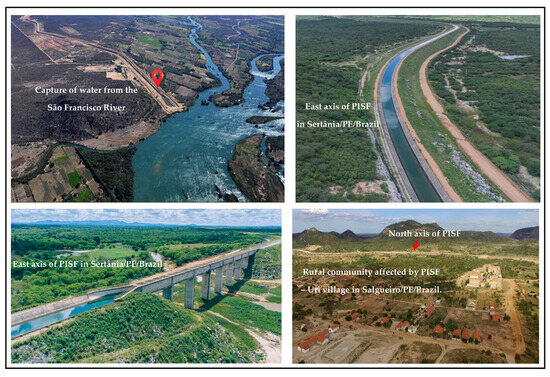
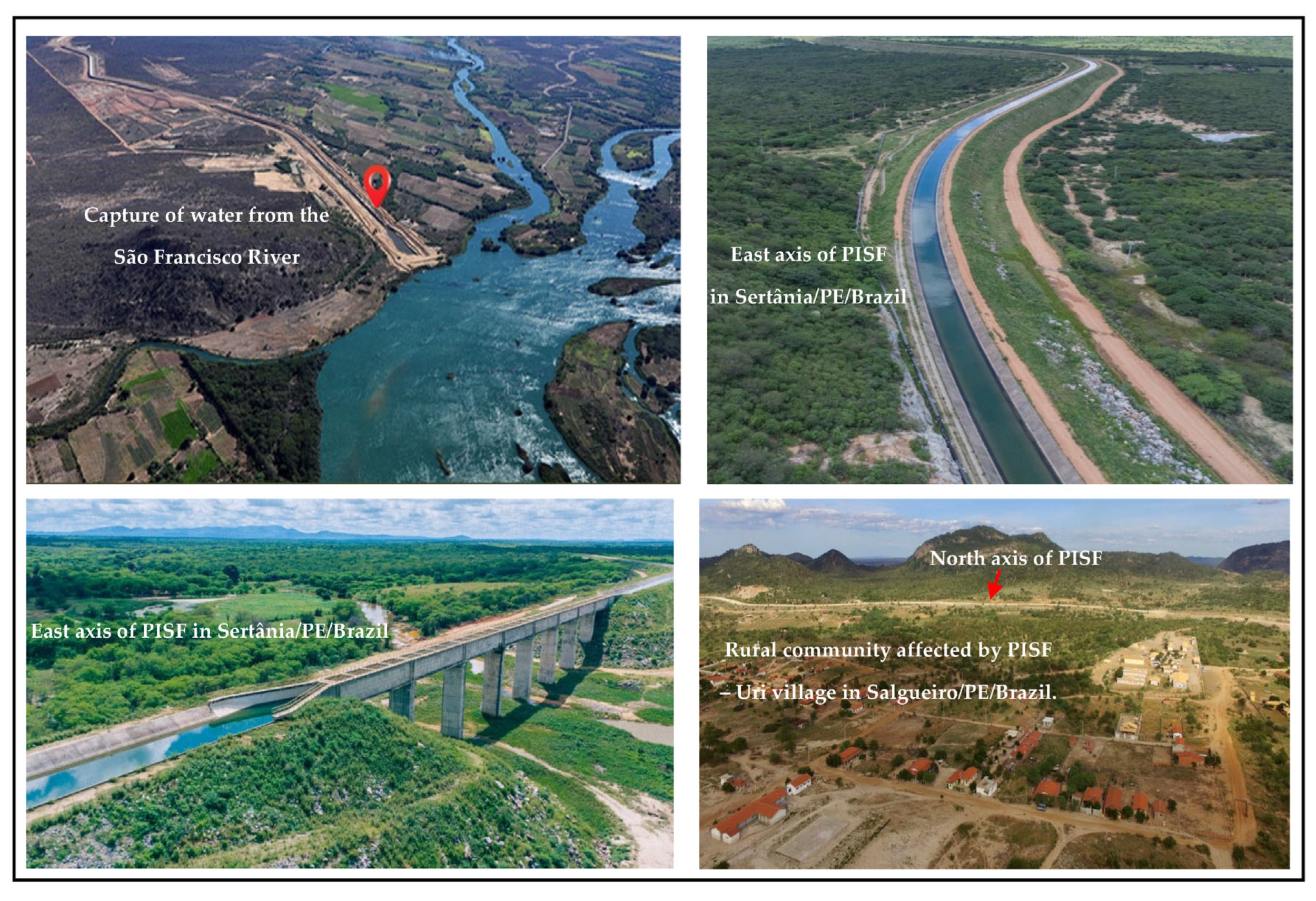
The São Francisco River Integration Project (PISF—Projeto de Integração do Rio São Francisco, in Portuguese), implemented since 2007 and currently in its final stages of construction work, aims to transfer (divert) water from the river of the same name and interconnect it with other river basins located in the northern states of Paraíba (PB), Pernambuco (PE), Rio Grande do Norte (RN), and Ceará (CE). This water project is the responsibility of the current Ministry of Regional Development (MDR), formerly the Ministry of National Integration (MIN), and its main objective is to ensure a regular water supply for approximately 12 million inhabitants in the Agreste and Sertão [backland] segments of the aforementioned states [17]. The project collects water at two points on the São Francisco River, and the water flows along two main axes, east and north, covering 477 kilometres, in addition to several associated axes (these are secondary works, the responsibility of the states), for integration with other basins in the northern Northeast.
A critical alliance was formed in recent years between social organizations, environmental activists, social movements, and peasants against the implementation of PISF [18,19]; however, it was not enough to prevent the adoption of the project. The main reason was that technological and engineering knowledge, evolving together with development narratives, power relations, and institutional arrangements, created a strong epistemological barrier that devalued or delegitimized local and ecological knowledge. Grassroots mobilization against the PISF ended up not being sufficient to prevent such a large project from being executed (as discussed by Fox and Sneddon [20]). In that context, the main contribution of this paper is to reflect on the political ecology of water and land in relation to the long legacy of socio-spatial exclusion and a critical assessment of the recent implementation of the PISF by the Brazilian government. In addition, we critically reflect on the perpetuation of conflicts over water and land for the most vulnerable people, even though the water project has been in operation since 2017.
Construction work on the project began in 2007 and its completion, which was scheduled for December 2018, has been delayed at times and is currently in the final stages. Therefore, it is observed that in territories where water projects are implemented, such as the PISF, severe transformations are caused, producing hydrosocial territories [21,22]. In these, water and territory, water flows, and biophysical and sociopolitical properties are intertwined based on socionatural interactions, composing a hydrosocial water cycle. In this sense, this research aims to analyze the territorial implications produced by the new hydrosocial cycle constituted by the implementation of the PISF in the Brazilian Northeast. The emphasis on hydrosocial territories is relevant to critically analyze the socio-spatial configurations of people, institutions, access to land and water, technological flows, and the biophysical environment that revolve around the control of resources by different social groups and the various commitments of the state apparatus.
Although justified by the possibility of water security in the region, the water project resulted in significantly negative issues, including environmental risks, forced resettlement, and disorderly management of watercourses [23]. As demonstrated below, despite an official discourse of distributing water to the entire population, the project had a technocratic conception and focused on engineering works instead of considering the specific socio-natural conditions and, in particular, the political and agrarian inequalities that have marked the region for centuries. Unfortunately, this is not only a Brazilian reality; in general, the development of large-scale water infrastructure generates profound social and environmental impacts, even more so because the burdens and benefits are distributed unequally among local population groups [4]. The research advances the understanding of how large water projects, conceived in contexts historically rooted in complex relations, end up resulting in hydrosocial territories that remove water from its sociocultural and ecological functions, instead reproducing water injustices, responsible for the emergence of environmental conflicts. Furthermore, it demonstrates how the governance of common goods, especially water, is directly related to a global geopolitics of capitalism, which defines its forms of access and allocation.
The article is structured in four sections, in addition to this introductory section. In the following section, we discuss the socio-natural and territorial implications of implementing water projects and then present the methodological procedures for conducting the research. In the fourth section, we analyze and discuss the hydrosocial territories fostered by the new hydrosocial cycle resulting from the implementation of the PISF in the Brazilian Northeast, situating the debate historically in addition to presenting characteristics of the water project and its socio-natural implications. In the last section, we present the main conclusions, in particular, the need to understand the deeply politicized basis of land and water allocation, management, and conservation, as well as the insertion of large-scale projects in complex hydrosocial networks formed between the state and the asymmetric segments of society.
3. Research Methodological Procedures
The research followed a qualitative approach and ethnographic design [49]. This research began with a literature review of the applications of the hydrosocial framework to analyze water-society relations in various sociocultural, political, and economic contexts. The literature reviewed and discussed in the previous section spanned a multitude of spatial, cultural, and political settings, providing a foundation for understanding the applications of the conceptual framework fundamental to the research.
The research was outlined in three different fields of analysis and interpretation, namely: (i) the water project itself, with a focus on observing the new hydrosocial cycle and new hydrosocial territories promoted; (ii) the rural communities directly affected by the project, which were relocated to rural villages located along the PISF; and (iii) institutional actors responsible for the design, regulation, and operation of the water project.
From this perspective, data collection was carried out in four stages. The first took place in January 2018, characterizing the exploratory phase, whose focus was to learn about the water project, starting on the eastern axis in Monteiro (Paraíba) to Custódia (Pernambuco), then the northern axis, starting in Cabrobó (Pernambuco) to Jati (Ceará). These visits were guided by technicians linked to the PISFs entrepreneurial agency, the then Ministry of National Integration. In addition, we visited some rural communities affected by the project and relocated to rural villages located in its surroundings. It is worth noting that this stage did not include any type of more specific data collection instrument, only socialization and fruitful exchanges with some stakeholders, which facilitated the approach for the next stage of the research.
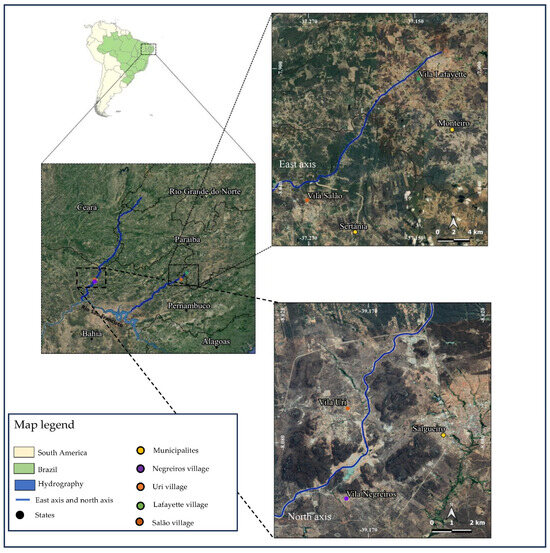
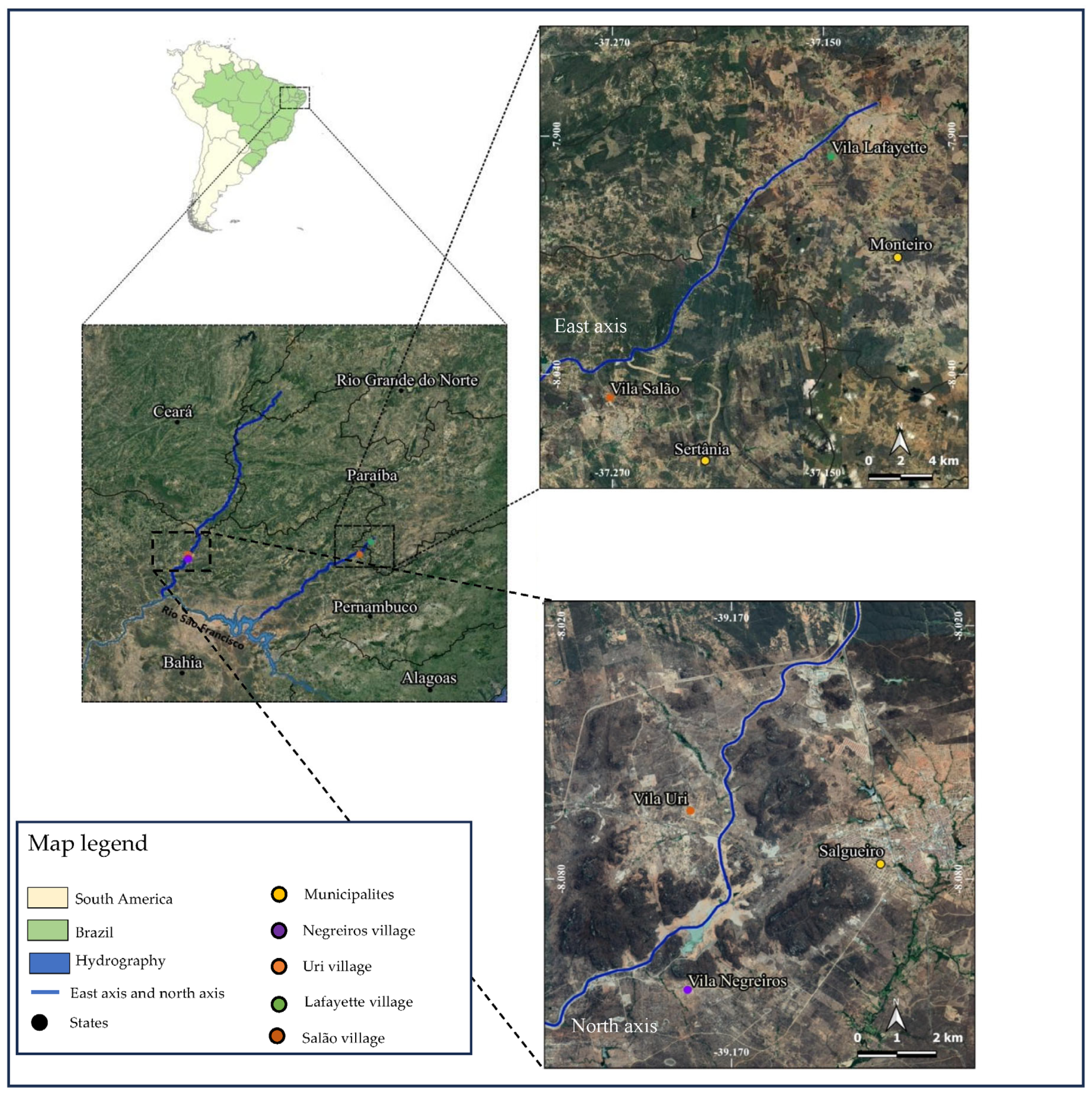
The second stage took place between January and March 2019, with the aim of getting to know and exploring the daily lives of families affected by the water project and reterritorialized in rural villages. This stage involved continuous experience in four of the total of 18 existing rural villages, one located in the municipality of Monteiro, another in Sertânia (east axis), and the other two in Salgueiro (north axis), as shown in Figure 2. This experience included staying in the homes of some families in the villages, enabling the author to participate in the daily life of the community. This allowed for continuous monitoring of the community’s daily life, characterizing the ethnographic work [49].
Figure 2.
Locations of rural communities visited in the field research. Source: Prepared based on data from the IBGE cartographic database (2020).
The fieldwork included participation in several meetings of the associations of each community, in addition to oral history interviews [50] with the families, seeking to learn about the life stories of the affected people, what their lives were like before the project, and to understand historically the process of reterritorialization in the village within the context of the lives of the affected actors, as well as their forms of access to water. In each approach to the families, after the initial greetings and authorization to participate in the research and recording of the semi-structured interview, through signing the informed consent form or recording of acceptance, the interviews began and resulted in 48 interviews conducted. All were recorded with prior authorization from the individuals and in accordance with a clear scientific ethics protocol. The respondents were selected according to location, that is, those who resided in the rural villages surveyed and agreed to participate in the research, gender, age, and income level, in an attempt to capture a diversity of perspectives and opinions.
The third stage, in turn, was carried out in April 2024 with a return to two rural communities visited in the previous stage: the rural village of Lafayette, located in the municipality of Monteiro (Paraíba), and the rural village of Salão, located in the municipality of Sertânia (Pernambuco). The focus of this stage was to socialize the results of the research as well as to update the data in order to understand whether the conflicting reality of access to water had undergone any changes. In addition to the villages mentioned, we visited some families living within a range of up to five kilometres from the PISF. This stage also included semi-structured interviews, resulting in 12 interviews.
The last stage was carried out in May 2024, with semi-structured interviews with institutional actors linked to the federal government located in Brasília (the national capital). Representatives of the Ministry of National Integration and Regional Development (PISFs entrepreneurial body), the National Water and Basic Sanitation Agency (PISFs regulatory body), and the São Francisco and Parnaíba Valleys Development Company—CODEVASF (PISFs operating body) were specifically interviewed in order to understand the nuances of the water project and the management of the new water flows that bathe the northern portion of the Northeast. The selection of these bodies was based on the competence of each one regarding the execution of the work, regulation, and operation of the project, respectively.
In addition to the interviews, several observations were made in the field diary, and, at the end of each day, the events and observations relevant to them were recorded. In addition, photographs and videos were taken in the rural communities with the prior authorization of the people, in addition to a documentary search seeking to collect data on the water project, its management, as well as histories related to the progress of the rural villages after the reterritorialization of the families. It is pertinent to mention that the last two stages of data collection are part of an ongoing research project within the scope of the universal call for proposals of the Brazilian Council for Scientific and Technological Development (CNPq).
Regarding the systematization and transcription of data, we used the NVivo® software (version 13/R1/2020), although at times we opted for manual systematization. The analysis and interpretation of data were carried out through interpretative analysis anchored in the adopted theoretical framework, seeking to identify both what was homogeneous and what differentiated the narratives, in addition to the systematic analysis of the documents and the field diary.
5. Analysis and Discussion
In this context, we consider that the PISF hydrosocial cycle was constituted by current relationships entangled in past legacies that ended up defining the paths of new water flows based on reflections of past sociopolitical relationships. Thus, we believe that the research presents important theoretical contributions to the literature on the Hydrosocial Cycle, considering that it is permeated by deep-rooted disputes and conflicts fought by actors who have their territories transformed and, in many cases, their access to water denied, to ensure that other voices matter and that there are other ways of relating to nature and resisting attempts to turn water into a commodity. Political ecology from Latin America has already shown that the processes are quite conflictive and that, despite the asymmetry of power, there is much struggle and resistance. Certainly, it is an important contribution to the literature on the hydrosocial cycle, since little attention is given to the different forms of resistance.
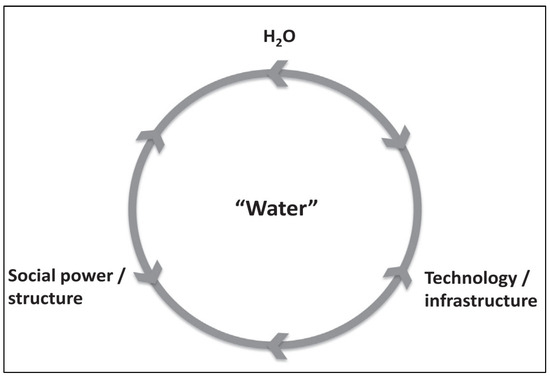
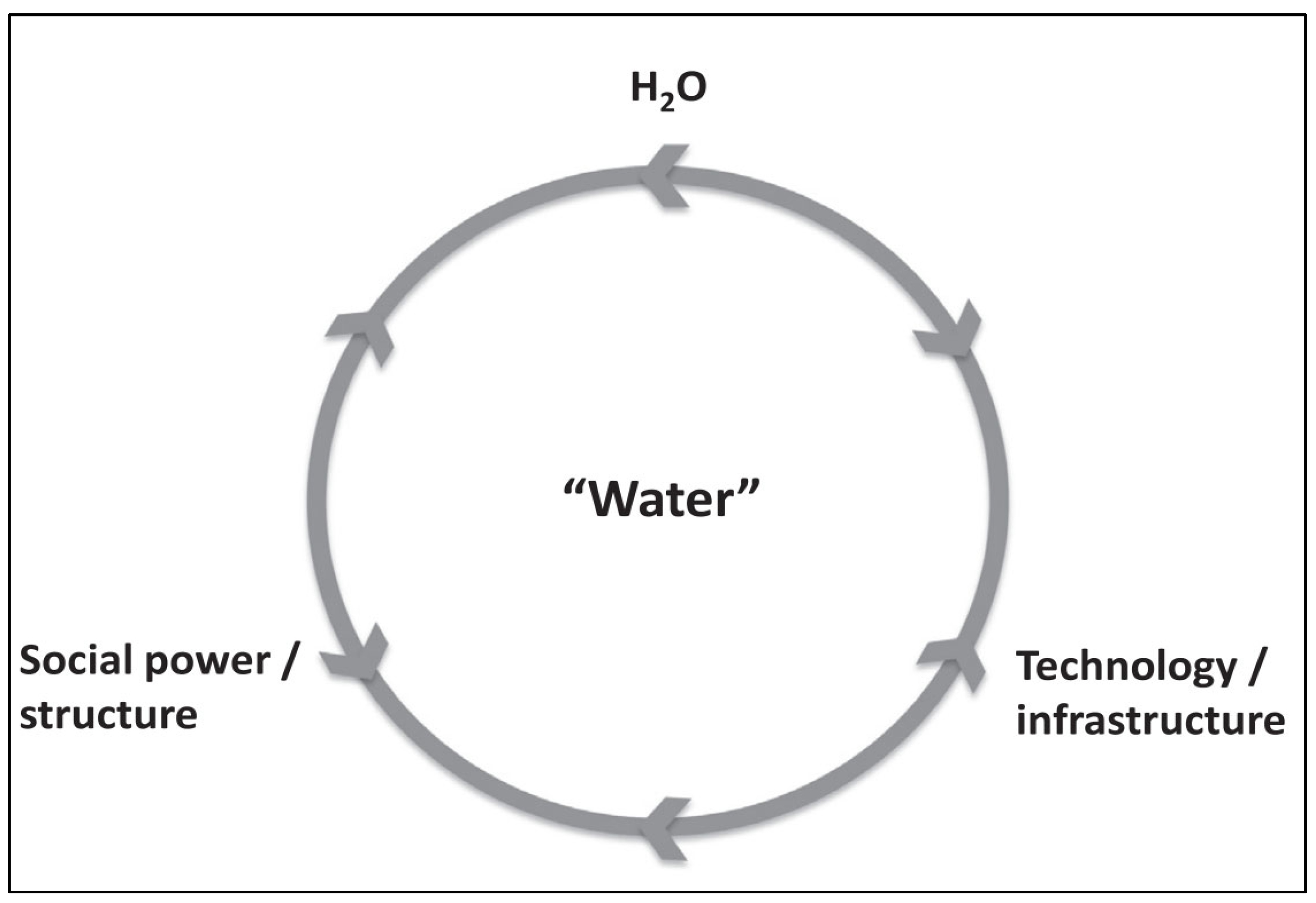
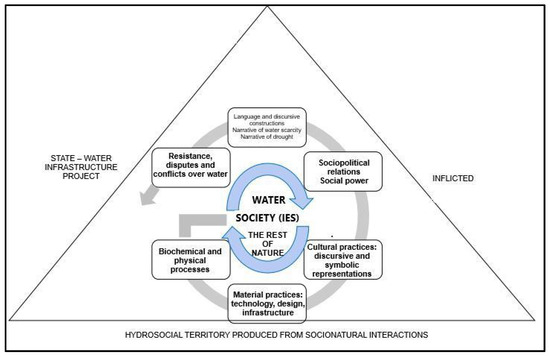
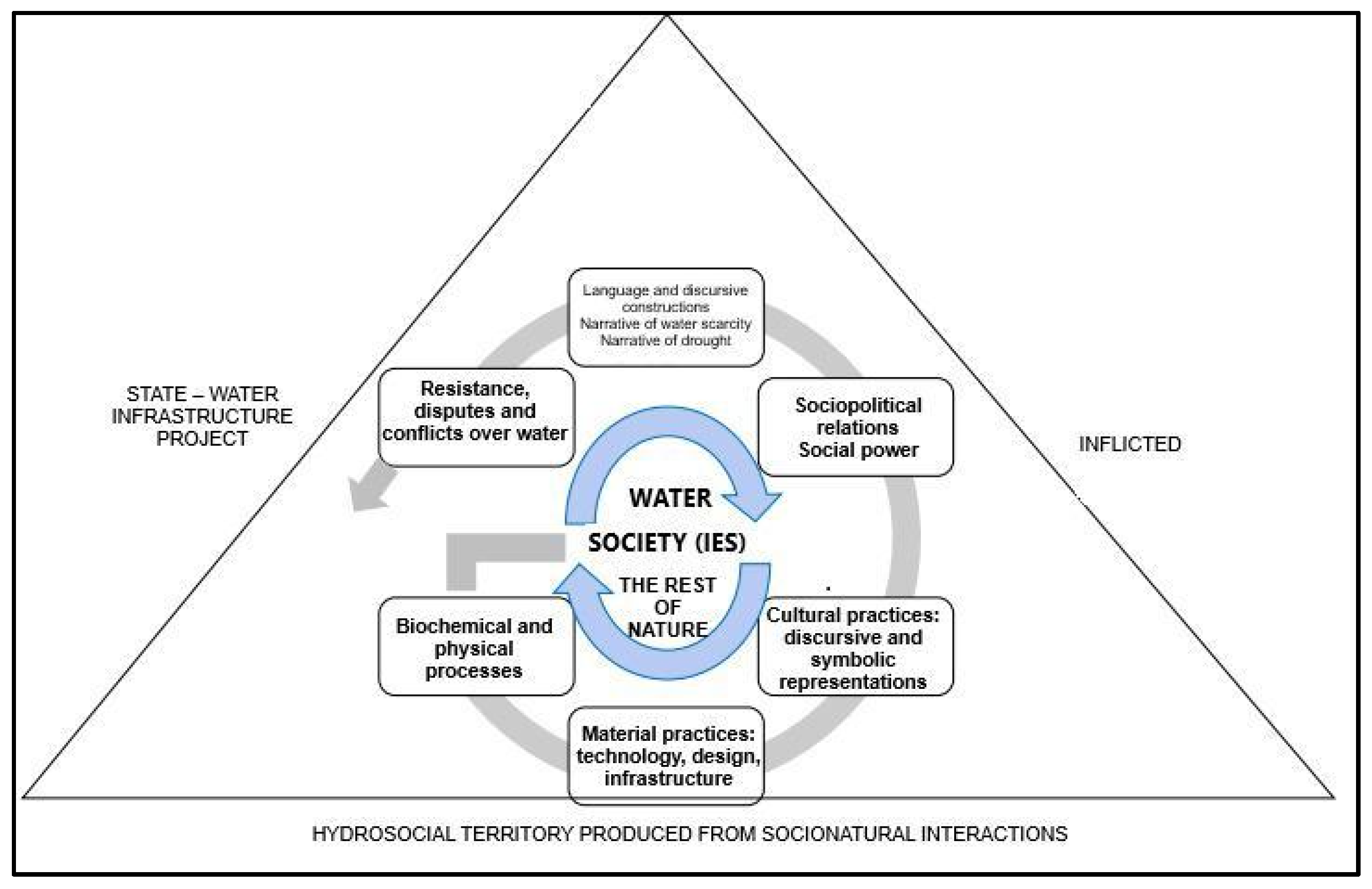
Based on these reflections, we present a new approach to the hydrosocial cycle that is the result of a hybrid socio-natural process, inspired by Swyngedouw [26] and the perspective of Linton and Budds [28]. This new approach to the hydrosocial cycle goes beyond the approaches presented so far and sheds light on other important factors, such as the agent responsible for the large water projects, in this case the State, the territorial transformations produced, hydrosocial territories, and the population affected, since, in most cases, the implementation of water projects is accompanied by profound transformations in the ways of life of the people who live there. Figure 5 illustrates the hydrosocial cycle of the proposed PISF, which is constituted by the intertwining of the biochemical and physical processes of water with material, cultural, and discursive practices, which are permeated by sociopolitical relations, disputes, and conflicts.
Figure 5.
Hydrosocial cycle and multiple relationships.
Figure 5 illustrates the metabolic cycle of water and its various correlations. It is important to note that the entire debate has water at its core, which is why it is understood here as a socio-natural relationship that mediates between society (with its different social groups with immense inequalities) and the rest of nature. We emphasize that the figure does not intend to exhaust all the possibilities of analytical relationships. This metabolic cycle is disturbed by the implementation of the PISF water project, understood here not only as a physical artifact but as a social relationship in a specific and concrete historical, spatial, geographic, and historical context, capable of transforming the territory and relationships and, in its concrete materiality, defining processes of exclusion and marginalization of the people directly affected.
Considering the affected people as one of the important aspects in the hydrosocial cycle approach becomes fundamental since they are the ones who suffer the most from changes in their ways of life and territories, and, generally, they are the ones who may have their ways of life interrupted and have access to water denied. Having an analysis in light of the affected actors emphasizes the diversity that simultaneously exists in the territories, and this is certainly a clear contribution of this article since most of the literature focuses particularly on the hegemonic structures and discourses that lead to (and result from) territorial reconfiguration (as indicated by Swyngedouw; Boelens [22]).
All transformations, in turn, produce hydrosocial territories, which integrate space and technical-physical, social, and natural relations. These are new territorial and social configurations resulting from the interaction of the hydraulic project itself, the institutions involved, the affected actors, and the new water flows. The concept of hydrosocial territories is especially suitable for the multidimensional analysis proposed here, as it integrates territorial and socio-natural transformations. Therefore, the physical landscape is represented by the hydrosocial territory constituted by the PISF, which directs water flows to large cities and ends up leaving the communities surrounding the project without access to water, thus perpetuating the historical conflicts over water in the Northeast region of Brazil.
6. Conclusions
The research shows that, although the PISF water project was implemented in the Northeast of Brazil, water allocation and access were not guaranteed for rural communities. Thus, water scarcity is not explained by water flow, but rather water allocation and access are entangled in broader sociopolitical relations, even more so in contexts historically marked by the concentration of water sources and land, such as the region. Thus, the prevailing approach to water scarcity and water supply adopted by the PISF has not changed the underlying social structure, established since the beginning of the 17th century, which is why rural families continue to have dry territories, although the hydrosocial cycle floods their territories.
The most sensitive economic sector has traditionally been subsistence agriculture, and those most affected by droughts are impoverished social groups, who suffer even during small fluctuations in rainfall. Man-made water scarcity acts as an “aggravating agent” that further depletes already marginal rural productivity [61]. The main economic adversity of developing semiarid regions, such as the São Francisco Valley, is not climate variability, drought, soil erosion, or flooding, but the vulnerability of the population to the effects of these events. Semiaridity undoubtedly poses serious difficulties for human survival, but it is not the fundamental reason for underdevelopment and poverty, as local political leaders usually claim. On the contrary, the main social and structural problem is the situation of serious concentration of wealth, particularly in rural areas.
Consequently, the vast majority of the rural population has no possibility of economic accumulation and simply struggles to survive. The difficulties of a given community to survive during periods of famine and hunger are more related to poor social organization or weak political representation than to physical reasons alone. Despite inclusive rhetoric, government initiatives implemented as part of the PISF did not aim to change the pattern of land distribution and rarely, if ever, reduced vulnerability to drought by providing water security to the majority of the population.
Applying a hydrosocial cycle perspective opens new insights into the interfaces of how large water projects are not neutral but are intertwined with broader sociopolitical issues, so that water access rights and water-related infrastructure need to be constantly contested and renegotiated as water projects fail to guarantee full access.
This article contributes to the knowledge on how large water infrastructure projects result in exclusionary territorial dynamics that result in socio-natural effects for the most vulnerable populations, providing clues for a critical analysis that adheres to SDG-6. In this sense, going beyond our research on the hydrosocial cycle, it is necessary to have a deeper understanding of the specificities and forms of political organization of rural communities in the face of difficulties in accessing water, as well as the institutional forms of governance of the project, considering that it is a project that is close to completion and the federal government is defining its management form. This will allow, on the one hand, to identify how communities develop strategies of action and struggle and, on the other, how institutional actors of governance of the PISF have been shaping and defining the forms of management of the project in order to guarantee a more sustainable management of the water project.
Author Contributions
Conceptualization, J.G.S. and A.A.R.I.; methodology, J.G.S.; validation, J.G.S. and A.A.R.I.; formal analysis, J.G.S. and A.A.R.I.; investigation, J.G.S.; writing—original draft preparation, J.G.S.; writing—review and editing, J.G.S. and A.A.R.I.; supervision, A.A.R.I.; funding acquisition, J.G.S. All authors have read and agreed to the published version of the manuscript.
Funding
This research was funded by a public notice from the Brazilian National Council for Scientific and Technological Development (under the public call CNPq/MCTI/FNDCT No. 18/2021), an entity linked to the Ministry of Science, Technology, and Innovation of the federal government to encourage research in Brazil.
Data Availability Statement
Some data presented in this study are available upon request from the corresponding author.
Acknowledgments
We would like to warmly thank the Brazilian National Council for Scientific and Technological Development (CNPq) for the financial support to carry out the research, in addition to the institutional actors and the members of rural communities who agreed to participate in the research.
Conflicts of Interest
The authors declare no conflicts of interest.
References
- Castro, J.E.; Kohan, G.A.; Poma, A.; Ruggerio, C. (Eds.) Territorialidades del Agua: Conocimiento y Acción para Construir el Futuro que Queremos; Fundación CICCUS and Waterlat-Gobacit: Buenos Aires, Argentina, 2019. [Google Scholar]
- Konchinski, V. Sabesp é Privatizada com Perda de pelo Menos R$ 4,5 bilhões para os Cofres de SP: Ações da Estatal de Saneamento Foram Vendidas Pelo Governo por Cerca de 22% a Menos do que Valem Hoje. Published on 22 July 2024. Available online: https://www.brasildefato.com.br/2024/07/22/sabesp-e-privatizada-com-perda-de-pelo-menos-r-4-5-bilhoes-para-os-cofres-de-sp (accessed on 25 July 2024).
- Ioris, A.A.R. Amazon water: The misgovernance of hydropower. In Handbook on the Governance and Politics of Water Resources; Fritsch, O., Benson, D., Eds.; Edward Elgar Publishing: Cheltenham, UK, 2024; pp. 172–185. [Google Scholar] [CrossRef] [Scilit]
- Boelens, R.; Shah, E.; Bruins, B. Contested Knowledges: Large Dams and Mega-Hydraulic Development. Water 2019, 11, 416–443. [Google Scholar] [CrossRef] [Scilit]
- Bakker, K.; Hendriks, R. Contested Knowledges in Hydroelectric Project Assessment: The Case of Canada’s Site C Project. Water 2019, 11, 406. [Google Scholar] [CrossRef] [Scilit]
- Duarte-Abadía, B.; Boelens, R.; Pre, L.D. Mobilizing Water Actors and Bodies of Knowledge: The Multi-scalar Movement against the Río Grande Dam in Málaga, Spain. Water 2019, 11, 410. [Google Scholar] [CrossRef] [Scilit]
- Dukpa, R.; Joshi, D.; Boelens, R. Contesting Hydropower Dams in the Eastern Himalaya: The Cultural Politics of Identity, Territory and Self-Governance Institutions in Sikkim, India. Water 2009, 11, 412. [Google Scholar] [CrossRef] [Scilit]
- Teräväinen, T. Negotiating Water and Technology: Competing Expectations and Confronting Knowledges in the Case of the Coca Codo Sinclair in Ecuador. Water 2019, 11, 411. [Google Scholar] [CrossRef] [Scilit]
- Monbiot, G. We Need to Talk About Water—and the Fact that the World Is Running out of It. Published on 4 March 2024. Available online: https://www.theguardian.com/commentisfree/2024/mar/04/water-world-run-out-planet-hotter-looming-crisis (accessed on 19 April 2024).
- Freire, L.M.; Lima, J.S.; Silva, E.V. Belo Monte: Fatos e Impactos Envolvidos na Implantação da Usina Hidrelétrica na Região Amazônica Paraense. Soc. Nat. 2018, 30, 18–41. [Google Scholar] [CrossRef] [Scilit]
- Kar, S.; Shiv, A.; Panwar, A.; Jha, K.N.; Singh, A. River Water Project Disputes and Their Implications. J. Leg. Aff. Disput. Resolut. Eng. Constr. 2020, 12, 05020012. [Google Scholar] [CrossRef] [Scilit]
- Santos, J.G. Entre a Seca e a Cerca: Um Olhar Histórico em Torno da Água no Nordeste Brasileiro. Desenvolvimento em Questão 2023, 21, e13092. [Google Scholar] [CrossRef] [Scilit]
- Rangel, M.J.; Marquesan, F.F.S. A Nova Relação do Sertanejo Nordestino Brasileiro com a Face Visível da Seca. Desenvolv. Em Questão 2018, 16, 269–300. [Google Scholar] [CrossRef] [Scilit]
- Empinotti, V. Re-Framing Participation: The Political Ecology of Water Management in the Lower São Francisco River Basin-Brazil. Ph.D. Thesis, The Graduate School of the University of Colorado, Boulder, CO, USA, 2007. [Google Scholar]
- Hall, A.L. Drought and irrigation in North-East Brazil. In Cambridge Latin American Studies No. 29; Cambridge University Press: Cambridge, UK, 1978. [Google Scholar]
- de Castro, C.N.; Pereira, C.N. Revitalização da Bacia Hidrográfica do Rio São Francisco: Histórico, Diagnóstico e Desafios; IPEA: Brasília, Brazil, 2019. [Google Scholar]
- Ministry of Integration and Regional Development (MDR). Projeto de Integração do Rio São Francisco. Available online: https://www.gov.br/mdr/pt-br/assuntos/seguranca-hidrica/projeto-sao-francisco (accessed on 28 May 2024).
- Nunes, P.P.L. Transposição do Rio São Francisco: A Funcionalidade do Estado Capitalista no Simulacro das Políticas de Reordenamentos Territoriais. Master’s Dissertation, Universidade Federal de Sergipe, Sergipe, Brazil, 2014. [Google Scholar]
- Conselho Indigenista Missionário. Relatório de Denúncia: Povos Indígenas do Nordeste Impactados com a Transposição do Rio São Francisco. Available online: https://cimi.org.br/wp-content/uploads/2017/11/relatorio_impactados-transposicao-sao-francisco.pdf (accessed on 24 April 2024).
- Fox, C.; Sneddon, C. Political Borders, Epistemological Boundaries, and Contested Knowledges: Constructing Dams and Narratives in the Mekong River Basin. Water 2009, 11, 413–518. [Google Scholar] [CrossRef] [Scilit]
- Boelens, R.; Hoogesteger, J.; Swyngedouw, E.; Vos, J.; Wester, P. Hydrosocial Territories: A Political Ecology Perspective. Water Int. 2016, 41, 1–14. [Google Scholar] [CrossRef] [Scilit]
- Swyngedouw, E.; Boelens, R. “… And not a single injustice remains”: Hydroterritorial colonization and techno-political transformations in Spain. In Water Justice; Boelens, R., Perreault, T., Vos, J., Eds.; Cambridge University Press: Cambridge, UK, 2018; pp. 151–168. [Google Scholar]
- Santos, J.G.; Pedrozo, E.A.; Ioris, A.A.R. The Reterritorialization and the Struggle for Water of those Affected by the Transposition of the São Francisco River in the Brazilian Northeast. Soc. Nat. 2022, 34. [Google Scholar] [CrossRef] [Scilit]
- Budds, J.; Loftus, A. Water, Neoliberalism, and Commodification. Handbook of Water and Development; Routledge: London, UK, 2023. [Google Scholar]
- Harris, L.M.; Roa-García, M.C. Recent Waves of Water Governance: Constitutional Reform and Resistance to Neoliberalization in Latin America (1990–2012). Geoforum 2013, 50, 20–30. [Google Scholar] [CrossRef] [Scilit]
- Swyngedouw, E. Social Power and the Urbanization of Water: Flows of Power; Oxford University Press: Oxford, UK, 2004. [Google Scholar]
- Mollinga, P.P. Water, Politics and Development: Framing a Political Sociology of Water Resources Management. Water Altern. 2008, 1, 7–23. [Google Scholar]
- Linton, J.; Budds, J. The Hydrosocial Cycle: Defining and Mobilizing a Relational Dialectical Approach to water. Geoforum 2014, 57, 179–180. [Google Scholar] [CrossRef] [Scilit]
- Swyngedouw, E. H2O does not exist! The political ecology of the Hydro-Social Cycle. In Approche Relationelle et Political Ecology: Enjeux Pour une Géographie de l’Environment et du Pouvoir; Laboratoire GEODE et l’Axe de Recherche Politiques Publiques Environnement et Sociétés du CUFR—Université de Toulouse, Campus d’Albi: Toulouse, France, 2014. [Google Scholar]
- Butsch, C.; Chakraborty, S.; Gomes, S.L.; Kumar, S.; Hermans, L.M. Changing Hydrosocial Cycles in Periurban India. Land 2021, 10, 263. [Google Scholar] [CrossRef] [Scilit]
- Strang, V. The Meaning of Water; Berg: Oxford, UK; New York, NY, USA, 2004. [Google Scholar]
- Strang, V. Infrastructural Relations: Water, Political Power and the Rise of a New ‘Despotic Regime’. Water Altern. 2016, 9, 292–318. [Google Scholar]
- Manosalvas, R.; Hoogesteger, J.; Boelens, R. Contractual Reciprocity and the Re-Making of Community Hydrosocial Territories: The Case of La Chimba in the Ecuadorian Páramos. Water 2021, 13, 1600. [Google Scholar] [CrossRef] [Scilit]
- Budds, J. Water, Power and the Production of Neoliberalism in Chile, 1973–2005. Environ. Plan. Soc. Space 2013, 31, 301–318. [Google Scholar] [CrossRef] [Scilit]
- Swyngedouw, E. Politicization and depoliticization of water studies. In Seminar Science and ‘Engagement’ in Water Studies; Université Paris Ouest Nanterre: Paris, France, 2014. [Google Scholar]
- Swyngedouw, E. The Political Economy and Political Ecology of the Hydrosocial Cycle. J. Contemp. Water Res. Educ. 2009, 142, 56–60. [Google Scholar] [CrossRef] [Scilit]
- Budds, J. The expansion of mining and changing waterscapes in the southern Peruvian Andes. In Negotiating Water Governance Why the Politics of Scale Matter; Norman, E.S., Cook, C., Eds.; Routledge: London, UK, 2015; pp. 264–280. [Google Scholar]
- Budds, J.; Linton, J.; Mcdonnell, R. The Hydrosocial Cycle. Geoforum 2014, 57, 167–169. [Google Scholar] [CrossRef] [Scilit]
- Budds, J.; O’Reilly, K. Reforming Water Governance in Chile: A Hydrosocial Relations Perspective. J. Lat. Am. Geogr. 2023, 22, 151–159. [Google Scholar] [CrossRef] [Scilit]
- Wilfong, M.; Pavao-Zuckerman, M. Rethinking Stormwater: Analysis Using the Hydrosocial Cycle. Water 2020, 9, 1273. [Google Scholar] [CrossRef] [Scilit]
- Santos, J.G. As Vidas Continuam Secas: As Injustiças em Torno do Projeto da Transposição do Rio São Srancisco. Ph.D. Thesis, Federal University of Rio Grande do Sul, Porto Alegre, Brazil, 2020. [Google Scholar]
- Linton, J. Modern Water and its Discontents: A History of Hydrosocial Renewal. WIREs Water 2014, 1, 111–120. [Google Scholar] [CrossRef] [Scilit]
- Zhou, C.; Chen, J.; Li, C.; Bi, B. Territorial Pluralism in China: Local Water Users’ Adaptation Strategies in the South–North Water Transfer Project. Water 2024, 16, 885. [Google Scholar] [CrossRef] [Scilit]
- Bakker, K. Water: Political, Biopolitical, Material. Soc. Stud. Sci. 2012, 42, 616–623. [Google Scholar] [CrossRef] [Scilit]
- Hommes, L.; Hoogesteger, J.; Boelens, R. (Re)making Hydrosocial Territories: Materializing and Contesting Imaginaries and Subjectivities through Hydraulic Infrastructure. Political Geogr. 2022, 97, 102698. [Google Scholar] [CrossRef] [Scilit]
- Ioris, A.A.R. Water Scarcity and the Exclusionary City: The Struggle for Water Justice in Lima, Peru. Water Int. 2016, 41, 125–139. [Google Scholar] [CrossRef] [Scilit]
- Porto-Gonçalves, C.W.A. Ecologia Política na América Latina: Reapropriação Social da Natureza e Reinvenção dos Territórios. INTERthesis Rev. Inter. Interdisc. 2012, 9, 16–50. [Google Scholar] [CrossRef] [Scilit]
- Hasbaert, R. O Mito da Desterritorialização, 11th ed.; Bertrando: Rio de Janeio, Brazil, 2019. [Google Scholar]
- Cavedon, N.R. Método etnográfico: Da etnografia clássica às pesquisas contemporâneas. In Metodologias e Analíticas Qualitativas em Pesquisa Organizacional: Uma Abordagem Teórico-Conceitual; Souza, E.M., Ed.; Edufes: Vitória, Brazil, 2014; pp. 65–90. [Google Scholar]
- Branco, S.C. História Oral: Reflexões sobre Aplicações e Implicações. Rev. Novos Rumos Sociológicos 2020, 8, 8–27. [Google Scholar] [CrossRef] [Scilit]
- Instituto Nacional do Semiárido (INSA). O Semiárido Brasileiro. Available online: https://www.gov.br/insa/pt-br/semiarido-brasileiro (accessed on 10 May 2024).
- Roman, P. The São Francisco Interbasin Water Transfer in Brazil: Tribulations of a Megaproject through Constraints and Controversy. Water Altern. 2017, 10, 395–419. [Google Scholar]
- Monteiro, J.M. Dossiê: Oligarquias do Nordeste no Brasil. Revista NEP-Núcleo de Estudos Paranaenses 2019, 5. [Google Scholar] [CrossRef]
- Villa, M.A. A Vida e Morte no Sertão: Histórias das Secas no Nordeste nos Séculos XIX e XX; Editora Ática: São Paulo, Brazil, 2006. [Google Scholar]
- Andrade, C.; de Souza, I.; da Silva, L. The Future Sustainability of the São Francisco River Basin in Brazil: A Case Study. Sustainability 2024, 16, 5521. [Google Scholar] [CrossRef] [Scilit]
- G1 Notícias. Lula Defende Projeto de Transposição do São Francisco. Available online: https://g1.globo.com/Noticias/Politica/0,,AA1301172-5601,00-LULA+DEFENDE+PROJETO+DE+TRANSPOSICAO+DO+SAO+FRANCISCO.html (accessed on 5 May 2024).
- Ribeiro, L.F. O Impacto Social da Transposição do Rio São Francisco; Editora Appris: Curitiba, Brazil, 2021. [Google Scholar]
- Oliveira, A.; Jesus, G.O.O. Acesso a Água no Semiárido: Uma Análise da Transposição do Rio São Francisco. Cad. Geociências 2023, 18. [Google Scholar]
- Ioris, A.A.R. Conflicting Demands, Urban Dilemmas and Narrow Thinking about Water: Political Necessity and the Possibilities of Change. In SAGE Handbook of Nature; Marsden, T., Ed.; SAGE: Newcastle, UK, 2018; pp. 583–602. [Google Scholar]
- Damonte, G.; Boelens, R. Hydrosocial Territories, Agro-export and Water Scarcity: Capitalist Territorial Transformations and Water Governance in Peru’s Coastal Valleys. Water Int. 2019, 44, 206–223. [Google Scholar] [CrossRef] [Scilit]
- Ioris, A.A.R. Water Resources Development in the São Francisco River Basin (Brazil): Conflicts and Management Perspectives. Water Int. 2001, 26, 24–39. [Google Scholar] [CrossRef] [Scilit]
Disclaimer/Publisher’s Note: The statements, opinions and data contained in all publications are solely those of the individual author(s) and contributor(s) and not of MDPI and/or the editor(s). MDPI and/or the editor(s) disclaim responsibility for any injury to people or property resulting from any ideas, methods, instructions or products referred to in the content. |
© 2024 by the authors. Licensee MDPI, Basel, Switzerland. This article is an open access article distributed under the terms and conditions of the Creative Commons Attribution (CC BY) license (https://creativecommons.org/licenses/by/4.0/).