Forms of Nutrients in Rivers Flowing into Lake Chaohu: A Comparison between Urban and Rural Rivers
Abstract
1. Introduction

2. Materials and Methods
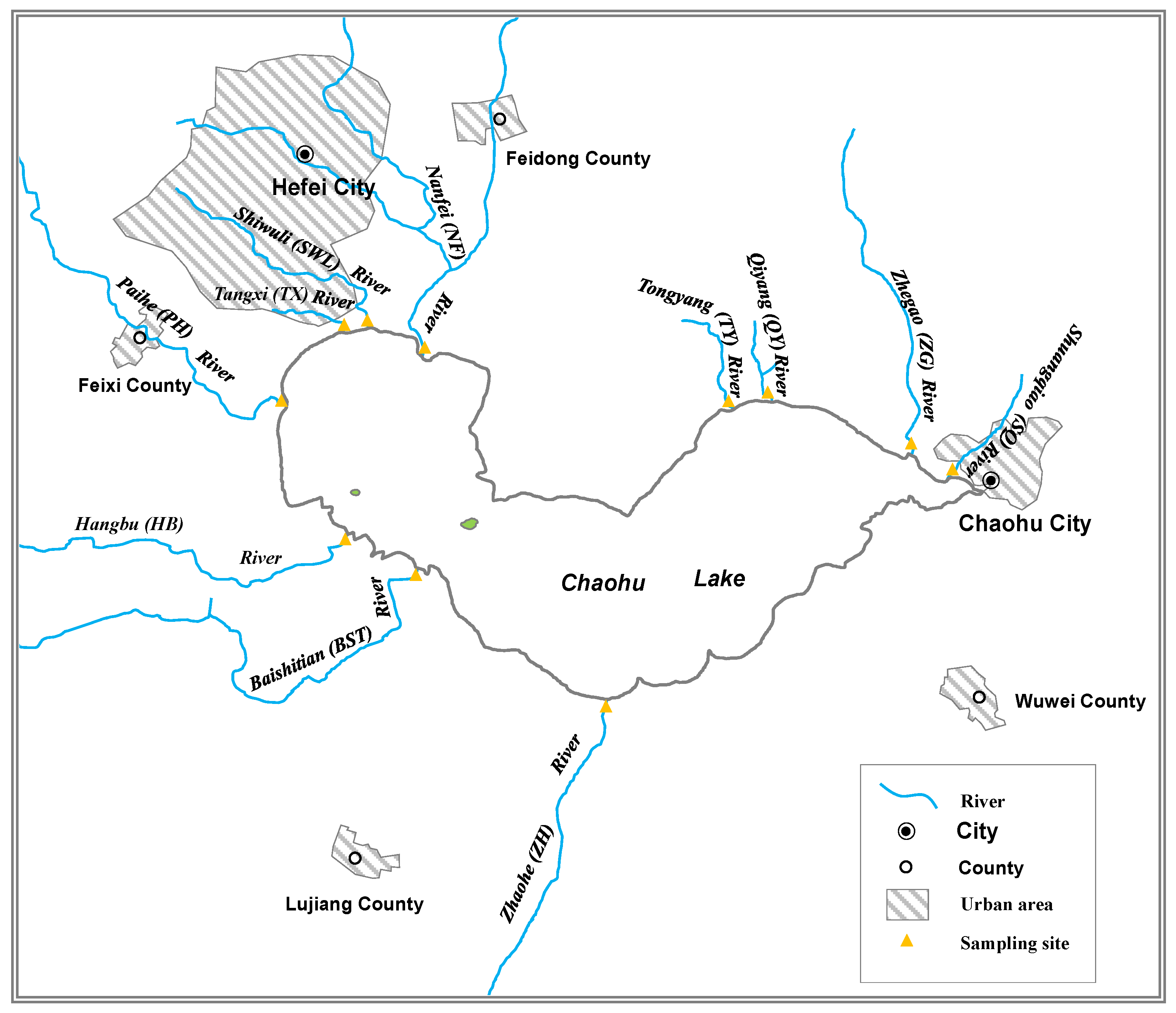
2.1. Field Sampling
2.2. Analyses of Water Samples
2.3. Analyses of Sediment Cores
2.4. Statistical Analysis
3. Results
3.1. General Results

| Group | River (Abbreviation) | Water Depth (m) | Water Temperature (°C) | DO (mg·L−1) | pH | ||||||||
| Mean | Min | Max | Mean | Min | Max | Mean | Min | Max | Mean | Min | Max | ||
| Urban | Nanfei River (NF) | 3.1 | 2.8 | 3.5 | 18.3 | 9.2 | 24.9 | 4.1 | 3.2 | 4.9 | 7.53 | 7.46 | 7.56 |
| Shiwuli River (SWL) | 2.2 | 1.9 | 2.5 | 18.1 | 9.3 | 25.0 | 1.6 | 0.8 | 2.5 | 7.61 | 7.36 | 7.75 | |
| Tangxi River (TX) | 2.2 | 2.0 | 2.3 | 17.7 | 9.3 | 24.2 | 7.4 | 6.6 | 8.7 | 7.54 | 7.28 | 7.69 | |
| Paihe River (PH) | 4.1 | 3.1 | 4.6 | 17.7 | 10.2 | 22.8 | 3.5 | 1.8 | 7.5 | 7.45 | 7.17 | 7.60 | |
| Shuangqiao River (SQ) | 2.5 | 1.7 | 3.4 | 18.3 | 10.8 | 24.2 | 2.1 | 1.5 | 2.8 | 7.55 | 7.19 | 7.97 | |
| Rural | Hangbu River (HB) | 3.7 | 3.4 | 3.9 | 18.0 | 9.7 | 23.3 | 9.1 | 7.8 | 9.9 | 7.50 | 7.22 | 7.76 |
| Baishitian River (BST) | 4.0 | 3.5 | 4.5 | 17.9 | 9.4 | 23.9 | 7.8 | 7.1 | 8.6 | 7.46 | 7.09 | 7.80 | |
| Zhaohe River (ZH) | 3.1 | 2.4 | 3.5 | 18.0 | 10.1 | 23.8 | 7.4 | 6.7 | 8.0 | 7.47 | 7.04 | 7.76 | |
| Zhegao River (ZG) | 4.3 | 4.1 | 4.5 | 18.3 | 10.8 | 24.7 | 7.5 | 6.8 | 8.5 | 7.55 | 7.30 | 7.72 | |
| Qiyang River (QY) | 1.8 | 1.6 | 2.0 | 18.3 | 10.6 | 25.1 | 7.1 | 6.4 | 8.1 | 7.60 | 7.32 | 7.88 | |
| Tongyang River (TY) | 1.8 | 1.2 | 2.2 | 18.5 | 10.4 | 25.0 | 7.3 | 5.9 | 8.1 | 7.48 | 7.31 | 7.72 | |

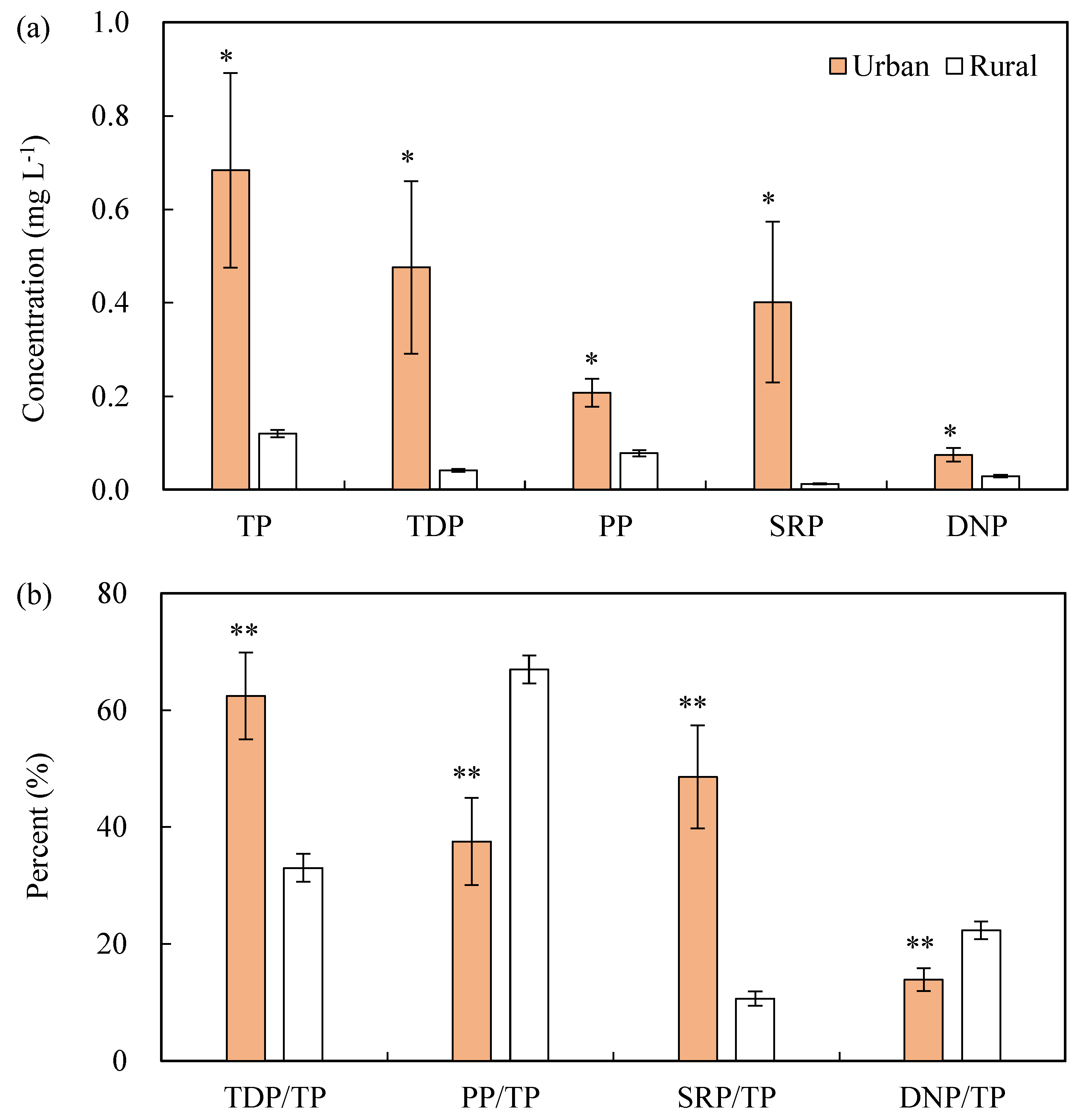
3.2. Composition of P and N in Water
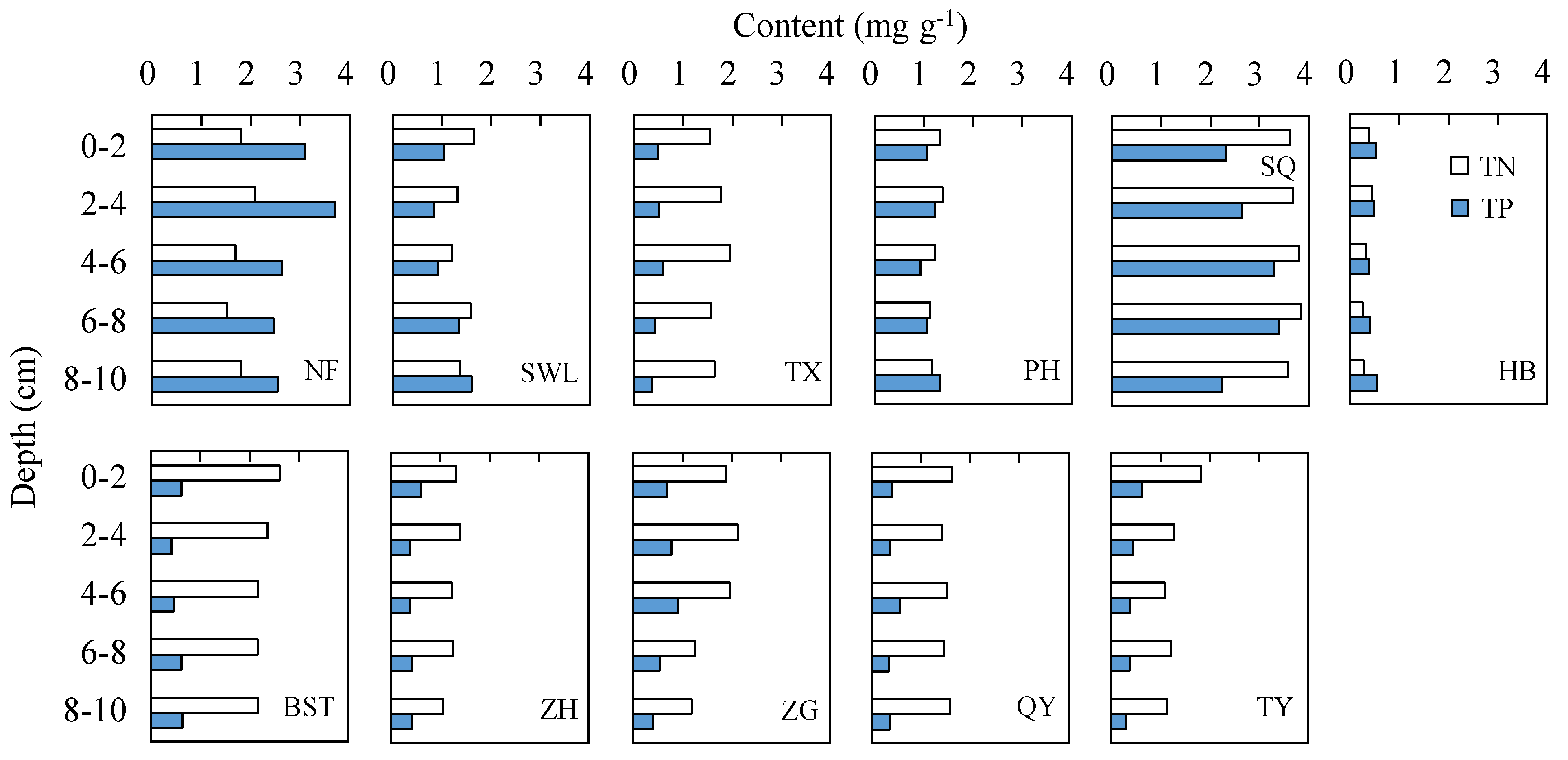
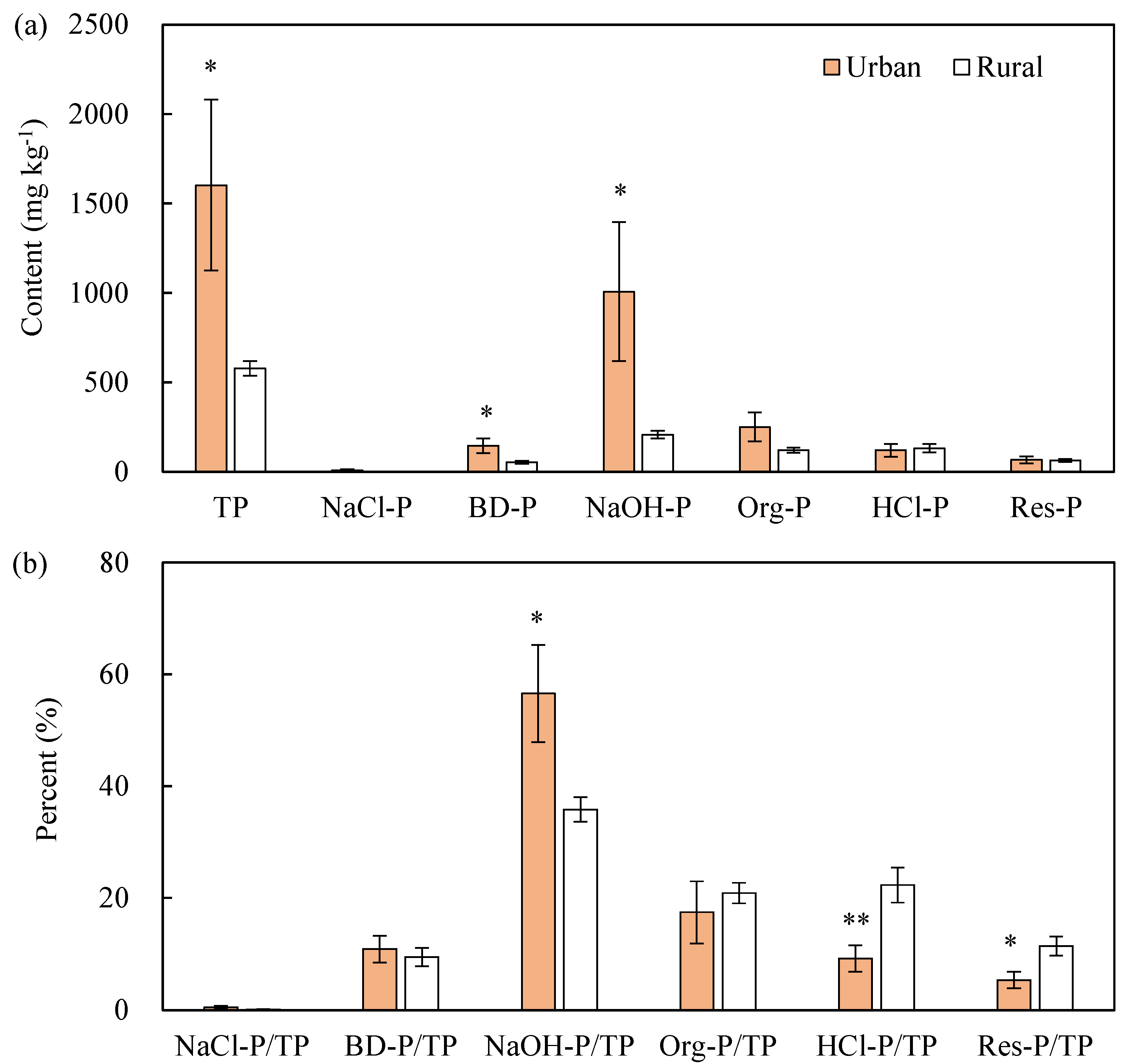
3.3. P and N in Sediments


4. Discussion
5. Conclusions
Supplementary Files
Supplementary File 1Acknowledgments
Author Contributions
Conflicts of Interest
References
- Heisler, J.; Glibert, P.; Burkholder, J.M.; Anderson, D.; Cochlan, W.; Dennison, W.; Dortch, Q.; Gobler, C.; Heil, C.; Humphries, E. Eutrophication and harmful algal blooms: A scientific consensus. Harmful Algae 2008, 8, 3–13. [Google Scholar] [CrossRef]
- Smith, V.H.; Schindler, D.W. Eutrophication science: Where do we go from here? Trends Ecol. Evol. 2009, 24, 201–207. [Google Scholar] [CrossRef] [PubMed]
- Paerl, H.W.; Fulton, R.S.; Moisander, P.H.; Dyble, J. Harmful freshwater algal blooms, with an emphasis on cyanobacteria. Sci. World J. 2001, 1, 76–113. [Google Scholar] [CrossRef] [PubMed]
- Anderson, D.M.; Cembella, A.D.; Hallegraeff, G.M. Progress in understanding harmful algal blooms: Paradigm shifts and new technologies for research, monitoring, and management. Ann. Rev. Mar. Sci. 2012, 4, 143–176. [Google Scholar] [CrossRef] [PubMed]
- Conley, D.J.; Paerl, H.W.; Howarth, R.W.; Boesch, D.F.; Seitzinger, S.P.; Havens, K.E.; Lancelot, C.; Likens, G.E. Controlling eutrophication: Nitrogen and phosphorus. Science 2009, 323, 1014–1015. [Google Scholar] [CrossRef] [PubMed]
- Qin, B.; Xu, H.; Dong, B. The Principle and Practice of Eutrophic Lake Restoration and Management; Higher Education Press: Beijing, China, 2011. [Google Scholar]
- Paerl, H.W.; Gardner, W.S.; McCarthy, M.J.; Peierls, B.L.; Wilhelm, S.W. Algal blooms: Noteworthy nitrogen. Science 2014, 346. [Google Scholar] [CrossRef] [PubMed]
- Howarth, R.; Sharpley, A.; Walker, D. Sources of nutrient pollution to coastal waters in the United States: Implications for achieving coastal water quality goals. Estuaries 2002, 25, 656–676. [Google Scholar] [CrossRef]
- Yu, Y.; Wu, J.; Wang, X.Y.; Zhang, Z.M. Degradation of inorganic nitrogen in Beiyun River of Beijing, China. Procedia Environ. Sci. 2012, 13, 1069–1075. [Google Scholar] [CrossRef]
- Mao, G.; Yang, L.; Yan, W.; Lei, K. The influence of pollutant inputs from the major tributaries on water quality of Chaohu Lake. J. Agro Environ. Sci. 2014, 33, 141–147. [Google Scholar]
- Paul, M.J.; Meyer, J.L. Streams in the Urban Landscape. In Urban Ecology; Marzluff, J.M., Shulenberger, E., Endlicher, W., Alberti, M., Bradley, G., Ryan, C., Simon, U., ZumBrunnen, C., Eds.; Springer: New York, NY, USA, 2008. [Google Scholar]
- Zhou, T. The Role of Nitrogen in Bloom Formation and Maintenance of Lake Taihu. Master’s Thesis, Nanjing University, Nanjing, China, 26 May 2013. [Google Scholar]
- Mackey, K.R.M.; Labiosa, R.G.; Calhoun, M.; Street, J.H.; Post, A.F.; Paytan, A. Phosphorus availability, phytoplankton community dynamics, and taxon-specific phosphorus status in the Gulf of Aqaba, Red Sea. Limnol. Oceanogr. 2007, 52, 873–885. [Google Scholar] [CrossRef]
- Dai, G.; Shang, J.; Qiu, B. Ammonia may play an important role in the succession of cyanobacterial blooms and the distribution of common algal species in shallow freshwater lakes. Glob. Ch. Biol. 2012, 18, 1571–1581. [Google Scholar] [CrossRef]
- McCarthy, M.J.; James, R.T.; Chen, Y.; East, T.L.; Gardner, W.S. Nutrient ratios and phytoplankton community structure in the large, shallow, eutrophic, subtropical Lakes Okeechobee (Florida, USA) and Taihu (China). Limnology 2009, 10, 215–227. [Google Scholar] [CrossRef]
- Wang, S.; Dou, H. Biography of Lakes in China; Science Press: Beijing, China, 1998. [Google Scholar]
- Xie, P. Reading about the Histories of Cyanobacteria, Eutrophication and Geological Evolution in Lake Chaohu; Science Press: Beijing, China, 2009. [Google Scholar]
- Yang, L.; Lei, K.; Meng, W.; Fu, G.; Yan, W. Temporal and spatial changes in nutrients and chlorophyll-α in a shallow lake, Lake Chaohu, China: An 11-year investigation. J. Environ. Sci. 2013, 25, 1117–1123. [Google Scholar] [CrossRef]
- Hefei Municipal Bureau of Statistics. 3–8 Urban Population of Hefei City (2013). Available online: http://tjj.hefei.gov.cn/n7216006/n9376603/n9377097/n9377118/n36794982/36834889.html (accessed on 8 August 2015). (In Chinese)
- Hefei Municipal Bureau of Statistics. 3–9 Populations of Four Counties and One County-Level City in Hefei City (2013). Available online: http://tjj.hefei.gov.cn/n7216006/n9376603/n9377097/n9377118/n36794982/36834924.html (accessed on 8 August 2015). (In Chinese)
- Wu, L. Analysis on land-use change and ecosystem function value for the Chaohu Lake basin during past 20 years. Soils 2009, 41, 986–991. [Google Scholar]
- Chinese EPA. Methods for the Examination of Water and Wastewater, 4th ed.; China Environmental Science Press: Beijing, China, 2002. [Google Scholar]
- Worsfold, P.J.; Monbet, P.; Tappin, A.D.; Fitzsimons, M.F.; Stiles, D.A.; McKelvie, I.D. Characterisation and quantification of organic phosphorus and organic nitrogen components in aquatic systems: A review. Anal. Chim. Acta 2008, 624, 37–58. [Google Scholar] [CrossRef] [PubMed]
- Lukkari, K.; Hartikainen, H.; Leivuori, M. Fractionation of sediment phosphorus revisited: I Fractionation steps and their biogeochemical basis. Limnol. Oceanogr. Meth. 2007, 5, 433–444. [Google Scholar] [CrossRef]
- Rydin, E. Potentially mobile phosphorus in Lake Erken sediment. Water Res. 2000, 34, 2037–2042. [Google Scholar] [CrossRef]
- Ruban, V.; López-Sánchez, J.; Pardo, P.; Rauret, G.; Muntau, H.; Quevauviller, P. Selection and evaluation of sequential extraction procedures for the determination of phosphorus forms in lake sediment. J. Environ. Monit. 1999, 1, 51–56. [Google Scholar] [CrossRef] [PubMed]
- Wang, S.; Jiang, X.; Jin, X. Classification and pollution characteristic analysis for inflow rivers of Chaohu Lake. Environ. Sci. 2011, 32, 2834–2839. [Google Scholar]
- Ji, L.; Li, J.; Wang, J. Research on water environmental capacity in Nanfeihe River in Hefei city. J. Anhui Univ. Nat. Sci. 2004, 28, 71–75. [Google Scholar]
- Dueñas, J.F.; Alonso, J.R.; Rey, À.F.; Ferrer, A.S. Characterisation of phosphorous forms in wastewater treatment plants. J. Hazard. Mater. 2003, 97, 193–205. [Google Scholar] [CrossRef]
- Jarvie, H.P.; Neal, C.; Withers, P.J.A. Sewage-effluent phosphorus: A greater risk to river eutrophication than agricultural phosphorus? Sci. Total Environ. 2006, 360, 246–253. [Google Scholar] [CrossRef] [PubMed]
- Neal, C.; Martin, E.; Neal, M.; Hallett, J.; Wickham, H.D.; Harman, S.A.; Armstrong, L.K.; Bowes, M.J.; Wade, A.J.; Keay, D. Sewage effluent clean-up reduces phosphorus but not phytoplankton in lowland chalk stream (River Kennet, UK) impacted by water mixing from adjacent canal. Sci. Total Environ. 2010, 408, 5305–5316. [Google Scholar] [CrossRef] [PubMed]
- Uusitalo, R.; Turtola, E.; Kauppila, T.; Lilja, T. Particulate phosphorus and sediment in surface runoff and drainflow from clayey soils. J. Environ. Qual. 2001, 30, 589–595. [Google Scholar] [CrossRef] [PubMed]
- Zhang, L.; Liao, Q.; Zeng, C.; Mo, Q.; Fan, C. Effects of pretreatment on the sequential phosphorus fractionation of anaerobic sediment. J. Limnol. 2014, 73, 274–281. [Google Scholar] [CrossRef]
- Zhu, G.; Zhang, L. Phosphorus fractions and algae availability in sediment from lakes in the middle and lower reaches of the Yangtze River. Sci. China Ser. D 2005, 35, 24–32. [Google Scholar]
- Wang, X.; Wang, X.; Feng, Y.; Xue, J. Study on content of total phosphorus and forms of inorganic phosphorus in sediments of Chaohu Lake. J. Soil Water Conserv. 2007, 21, 56–59. [Google Scholar]
- Jensen, H.S.; Thamdrup, B. Iron-bound phosphorus in marine sediments as measured by bicarbonate-dithionite extraction. Hydrobiologia 1993, 253, 47–59. [Google Scholar] [CrossRef]
- Meis, S.; Spears, B.M.; Maberly, S.C.; O’Malley, M.B.; Perkins, R.G. Sediment amendment with Phoslock® in Clatto Reservoir (Dundee, UK): Investigating changes in sediment elemental composition and phosphorus fractionation. J. Environ. Manag. 2012, 93, 185–193. [Google Scholar] [CrossRef] [PubMed]
- Liu, S.; Kong, F.; Cai, Y.; Yang, Z.; Wang, J.; Shi, X. Nitrogen stable isotope study on nitrate nitrogen pollution of four inflowing rivers of Lake Chaohu. J. Lake Sci. 2012, 24, 952–956. [Google Scholar]
- Zhao, Y.; Shan, B.; Zhang, W.; Wang, C. Forms and spatial distribution characteristics of nitrogen in Ziya River basin. Environ. Sci. 2014, 35, 143–149. [Google Scholar]
- Jiang, Y.J.; He, W.; Liu, W.X.; Qin, N.; Ouyang, H.L.; Wang, Q.M.; Kong, X.Z.; He, Q.S.; Yang, C.; Yang, B.; et al. The seasonal and spatial variations of phytoplankton community and their correlation with environmental factors in a large eutrophic Chinese lake (Lake Chaohu). Ecol. Indic. 2014, 40, 58–67. [Google Scholar] [CrossRef]
© 2015 by the authors; licensee MDPI, Basel, Switzerland. This article is an open access article distributed under the terms and conditions of the Creative Commons Attribution license (http://creativecommons.org/licenses/by/4.0/).
Share and Cite
Zhang, L.; Shao, S.; Liu, C.; Xu, T.; Fan, C. Forms of Nutrients in Rivers Flowing into Lake Chaohu: A Comparison between Urban and Rural Rivers. Water 2015, 7, 4523-4536. https://doi.org/10.3390/w7084523
Zhang L, Shao S, Liu C, Xu T, Fan C. Forms of Nutrients in Rivers Flowing into Lake Chaohu: A Comparison between Urban and Rural Rivers. Water. 2015; 7(8):4523-4536. https://doi.org/10.3390/w7084523
Chicago/Turabian StyleZhang, Lei, Shiguang Shao, Cheng Liu, Tingting Xu, and Chengxin Fan. 2015. "Forms of Nutrients in Rivers Flowing into Lake Chaohu: A Comparison between Urban and Rural Rivers" Water 7, no. 8: 4523-4536. https://doi.org/10.3390/w7084523
APA StyleZhang, L., Shao, S., Liu, C., Xu, T., & Fan, C. (2015). Forms of Nutrients in Rivers Flowing into Lake Chaohu: A Comparison between Urban and Rural Rivers. Water, 7(8), 4523-4536. https://doi.org/10.3390/w7084523