Article

Interactive Effects of Cadmium and Microplastics on Oxidative Stress and Digestive Physiology in the Male Euryhaline Species Poecilia sphenops


by
Murugan Vasanthakumaran
1,2,
Li-Chun Tseng
1,
Kadarkarai Murugan
2,
Rajapandian Rajaganesh
2,
Devakumar Dinesh
2,
Pavithra Krishanasamy
2,
Mathan Ramesh
2,
Thirunavukkarasu Muralisankar
2,
Sajna Beegum
3,
Mubarak Mammel
4,
Jishnu Panamoly Ayyappan
1,
Fajun Chen
5,
Sabin Saurav Pokharel
5,
Yan-Guo Wang
6,
Reza Khakvar Khakvar
7,
Karthi Natarajan
8 and
Jiang-Shiou Hwang
1,9,*
1
Institute of Marine Biology, National Taiwan Ocean University, Keelung 202301, Taiwan
2
Department of Zoology, School of Life Sciences, Bharathiar University, Coimbatore 641046, India
3
Government College of Education, Affiliated with Pondicherry University, Kadmat Island, Lakshadweep 682556, India
4
Department of Environmental Biology and Fisheries Science, National Taiwan Ocean University, Keelung 202301, Taiwan
5
Department of Entomology, College of Plant Protection, Nanjing Agricultural University (NAU), Nanjing 210095, China
6
Third Institute of Oceanography, Ministry of Natural Resources, Xiamen 361005, China
7
Department of Plant Protection, Faculty of Agriculture, University of Tabriz, Tabriz 15731, Iran
8
Department of Bioscience and Biotechnology, Indian Institute of Technology Kharagpur, Kharagpur 721302, India
9
Center of Excellence for the Oceans, National Taiwan Ocean University, Keelung 202301, Taiwan
*
Author to whom correspondence should be addressed.
Water 2026, 18(9), 1008; https://doi.org/10.3390/w18091008
Submission received: 17 March 2026 / Revised: 14 April 2026 / Accepted: 15 April 2026 / Published: 23 April 2026
(This article belongs to the Special Issue Aquaculture, Fisheries, Ecology and Environment)

Abstract

The estuarine and coastal regions of India and Taiwan are under increasing threat from pollutants such as microplastics (MPs) and heavy metals including cadmium (Cd). These contaminants are known to have adversely affect biodiversity and water quality. In this study, the combined toxic effects of polyethylene microplastics (PE-MPs) and Cd were evaluated using Poecilia sphenops, a euryhaline fish species, selected for its adaptability to varying salinity conditions. P. sphenops were exposed to Cd (20, 40, and 60 μg/L), MPs (8, 16, 24 mg/L), and co-exposure combinations ranging from Cd 5 μg/L + MPs 4 mg/L to Cd 20 μg/L + MPs 16 mg/L Results showed significant (p < 0.05) negative effects on growth parameters including body weight gain, specific growth rate (SGR), and survival rate. Hematological analysis revealed significant (p < 0.05) decreases in hemoglobin (Hb), red blood cells (RBCs), and white blood cells (WBCs), indicating impaired oxygen transport and compromised immune function. Elevated blood glucose levels indicated physiological stress, while reduced total protein levels suggested a compromised nutritional status. Antioxidant enzyme activities, including catalase (CAT), superoxide dismutase (SOD), and glutathione peroxidase (GPx), were significantly (p < 0.05) decreased in the toxicant-treated groups compared with the control. Digestive enzyme activities (proteases, amylases, and lipases) were also reduced, suggesting impaired digestion and nutrient assimilation. The study also included a comparative assessment of water quality between the exposed and control tanks. Water quality parameters such as turbidity, salinity, hardness, alkalinity, chloride, fluoride, and total suspended solids (TSSs) were elevated in the toxicant-treated media, accompanied by a notable decline in dissolved oxygen (DO) levels. These findings highlight the urgent need for integrated pollution control and water quality monitoring, particularly in coastal regions vulnerable to desalination discharges and plastic contamination. Sustainable management strategies must address these complex interactions between multiple pollutants to protect aquatic ecosystems.

1. Introduction

In marine ecosystems, cadmium (Cd) remains a significant ecological and toxicological threat. Although its acute toxicity is lower than that of mercury (Hg) or lead (Pb), Cd is highly persistent and bioaccumulates in aquatic organisms due to its limited excretion, often reaching concentrations in edible fish tissues that exceed established safety thresholds [1]. The primary sources of Cd contamination in aquatic environments are industrial effluents, particularly from mining operations, battery and pigment manufacturing, metal plating, and the use of phosphate-based fertilizers [2,3]. Due to its high solubility in water, Cd readily disperses and persists throughout aquatic systems [1]. Simultaneously, plastic pollution has emerged as a global environmental issue. Plastics are extensively used across industries because of their durability, water resistance, affordability, high strength, and corrosion resistance, making them both economically valuable and environmentally problematic. Their widespread production and improper disposal contribute to the growing presence of microplastics (MPs) in aquatic ecosystems [4]. MPs have been shown to adsorb heavy metals (e.g., Cd, Pb) and persistent organic pollutants, thereby increasing their bioavailability and toxicity [5,6]. The concentrations of microplastics and heavy metals can increase through trophic transfer, leading to significant contamination in top-level predators, including fish consumed by humans [7].
Polyethylene microplastics (PE-MPs) smaller than 5 mm (or more precisely 1–1000 µm) are ubiquitous contaminants in aquatic environments. Their varied shapes (fibers, fragments, films, and pellets), hues (blue, black, and white), and buoyancy properties facilitate their widespread dispersion [8]. Notably, these particles also act as vectors for heavy metals and organic pollutants including Cd, pesticides, and persistent organic pollutants (POPs) through adsorption from the surrounding water [9]. When ingested by fish, PE-MPs can cause mechanical abrasion of the gut lining and physical blockage, thereby reducing feeding efficiency and nutrient absorption [10,11]. The accumulation of MPs within tissues induces oxidative stress, immunotoxicity, and neurotoxicity [12]. In addition, as pollutant carriers, MPs can facilitate the leaching of adsorbed toxicants into biota, increasing the potential for biomagnification and ultimately affecting human consumers [7]. At the cellular level, Cd competitively inhibits calcium ion (Ca2+) and Zn2+ binding, leading to hypocalcemia, disrupted respiration, and perturbation of metalloenzymes [13,14].
Recent research highlights the combined impacts of Cd and MPs. For example, zebrafish co-exposed to PE-MPs and Cd showed markedly elevated Cd accumulation in the gills, gut, and liver compared to Cd alone, along with exacerbated oxidative stress and inflammatory markers [15]. Similar findings were reported in zebrafish embryos, where MPs themselves provoke oxidative stress, DNA damage, inflammation, and epithelial barrier disruption across multiple species [11]. Co-exposure therefore amplifies these pathologies: ROS overload, lipid peroxidation, enzyme suppression, histological damage, apoptosis, immune dysregulation, microbial dysbiosis, and developmental abnormalities exceed those observed under single exposures [16].
Maintaining optimal water quality is critical for fish health and productivity, especially in confined or managed aquatic systems such as recirculating aquaculture systems (RAS). Parameters such as dissolved oxygen (DO), pH, mineral ion concentration, and salinity directly influence physiological functions, including metabolism, immune response, growth rate, and behavior [17,18]. Deviations from optimal ranges can increase physiological stress, susceptibility to disease, and mortality. For example, even moderate hypoxia can impair mitochondrial function and elevate reactive oxygen species (ROS) levels in fish tissues [19]. Exposure to MPs and Cd may significantly disrupt water quality indicators. For example, Cd can reduce DO levels, alter pH through physiological interactions in fish [or via water chemistry changes], and increase ion leaching into the water [20]. Similarly, MPs contribute to elevated TDS and EC values due to their surface adsorption of ions and associated chemical pollutants [21]. Furthermore, MPs can serve as vectors for Cd and other heavy metals, increasing their bioavailability and toxicity [5]. Monitoring these parameters is therefore crucial, as deviations can signal environmental stress and potential toxicity, both for aquatic organisms and for sustainable water quality management [22].
The genus Poecilia, particularly Poecilia sphenops, is known for its remarkable euryhalinity, allowing it to survive in freshwater, brackish, and marine ecosystems [23,24,25]. This adaptability makes it an ideal model species for studying environmental stress responses [26]. These fish often inhabit dynamic ecosystems, such as estuaries and lagoons, where environmental conditions, including salinity, turbidity, hardness, and alkalinity can fluctuate significantly [27]. Furthermore, the combined effects of MPs and Cd on the physiological responses of Poecilia sphenops remain poorly understood. This study specifically focuses on male fish, as the presence of the gonopodium enables clear sex identification and minimizes variability associated with female reproductive cycles. Using males provides a more consistent model for evaluating toxic stress responses. Therefore, this study investigates the individual and combined effects of Cd and MPs on growth performance, hematological responses, oxidative stress, and digestive enzyme function.

2. Materials and Methods

2.1. Experimental Fish and Acclimatization

Adult male P. sphenops (average weight 2.42 ± 0.1 g and length 4.5 ± 0.2 cm) were obtained from Coimbatore Aquarium Zone, Coimbatore, Tamil Nadu, India. P. sphenops, being a euryhaline species, demonstrates a remarkable ability to adapt to a wide range of salinity conditions, including freshwater, brackish, and marine environments. This adaptability makes it an ideal model organism for assessing the physiological and biochemical impacts of environmental pollutants across different aquatic ecosystems. Fish were acclimated for 14 days in cement tanks measuring 6 × 4 × 3 ft, filled with groundwater maintained at 27.3 ± 0.6 °C, DO 7.2 ± 0.6 mg/L, pH 7.2 ± 0.1, TDS 0.68 ± 0.06 g/L, biological oxygen demand (BOD) 18.6 ± 0.4 mg/L, chemical oxygen demand (COD) 67.3 ± 5 mg/L, and ammonia 0.4 ± 0.1 mg/L. These parameters align with those recommended for optimal ornamental fish health and experimental stability [28,29]. Fish were fed a commercial diet (43% protein and 7% fat) three times daily (06:00, 12:00, and 18:00 h), with an 80% daily water renewal to maintain optimal water quality parameters [30].

2.2. Ethical Statement

Formal ethical approval was not required for this study, as experiments involving Poecilia sphenops were conducted in accordance with OECD Test No. 203 and relevant national guidelines for humane fish research. All procedures were designed to minimize animal suffering through proper acclimation, optimal water quality, and careful monitoring. Prior to tissue sampling, fish were humanely euthanized using an overdose of eugenol (150–200 mg L−1). The study fully complied with institutional and national regulations governing the ethical use of aquatic organisms in toxicological research.

2.3. Experimental Design

The present study was conducted across two institutions: The Department of Zoology, Bharathiar University (Coimbatore), and the Institute of Marine Biology, National Taiwan Ocean University (Keelung). PE-MPs with particle sizes ranging from 22 to 71 micrometers were procured from Sigma-Aldrich, St. Louis, MO, USA, consistent with particle size ranges used in previous toxicological studies [11]. A total of nine treatment groups were established, each replicated three times, with 20 P. sphenops individuals per 50 L tank. The exposure period lasted 14 days, following guidelines for short-term sublethal toxicity assessments in fish [30]. The treatment groups included:
Control (no exposure to Cd or MPs);
Cd alone at concentrations of 20, 40, and 60 µg/L;
MPs alone at 8, 16, and 24 mg/L.
Combined Cd + MPs at:
5 µg/L Cd + 4 mg/L MPs;
10 µg/L Cd + 8 mg/L MPs;
20 µg/L Cd + 16 mg/L MPs.
Both Cd and MPs were dissolved directly into the aquarium water prior to fish introduction, following protocols for combined pollutant exposure in aquatic toxicology [31]. Every 24 h, 80% of the tank water was replaced, and freshly prepared toxicants were added to maintain the desired concentrations of PE-MPs in each experimental tank.

2.4. Collection and Preparation of Samples

At the end of the 14th day, fish were collected from the control, single, and co-exposure groups of cadmium and polyethylene microplastics (PE-MPs). Fish were euthanized by immersion in an overdose of eugenol (150–200 mg L−1) until loss of equilibrium and cessation of opercular movement was observed. Fish were kept in the solution for an additional 5–10 min to ensure complete euthanasia before tissue sampling. Blood was collected from the caudal vein using heparinized syringes (26-gauge) and immediately transferred to heparinized Eppendorf vials [32]. A portion of the whole blood was used for the estimation of hematological parameters. The remaining blood sample was centrifuged at 10,000 rpm for 20 min, and plasma was separated and stored at 4°C for biochemical (protein and glucose) assays. After blood collection, livers from the control and treatment groups were dissected, homogenized with 0.25 M sucrose solution, and centrifuged at 10,000× g for 15 min to obtain supernatants for enzymatic assays (AST, ALT, SOD, CAT, and GPx).

2.5. Growth Performance

Growth parameters were evaluated as follows: Weight gain (WG, g) was calculated as the difference between final and initial body weights. Specific growth rate (SGR, % day−1) was determined using the formula: SGR = [ln(final weight) − ln(initial weight)]/number of days × 100, as described by Cho et al. (1985) [33].

2.6. Hematological Analysis

Hb concentration was measured using the cyanmethemoglobin method [34]. To 0.02 mL of blood drawn from control and toxicant-treated groups, 5 mL of hemoglobin reagent (0.6 mmol/L potassium hexacyanoferrate and 0.75 mmol/L potassium cyanide) was added, mixed well, incubated for 20 min at room temperature, and the absorbance was measured at 540 nm using a UV spectrophotometer. The Hb value was expressed as g/dL. RBC and WBC counts were conducted using a Neubauer hemocytometer after appropriate dilution with Hayem’s solution [35]. To count RBC, 10 μL of blood from control and toxicant-treated groups was diluted with 2 mL of a citrate-formaldehyde solution, counted in a Neubauer chamber, and total numbers were calculated as 106/μL. For WBC count, blood from control and toxicant-treated groups was diluted with Turk’s diluting fluid (1:20), placed in a haemocytometer, and the total number of WBCs was calculated as 103/μL.

2.7. Plasma Protein and Glucose

Plasma total protein concentration was determined by the Biuret assay [36]. A total of 2 mL of plasma from the control and treated groups was added to 2 mL of Biuret reagent, mixed well, and allowed to stand for 5 min at room temperature. The absorbance was read at 540 nm against a blank. The protein value was expressed as g/dL. Plasma glucose levels were measured using the glucose oxidase-peroxidase method [37]. A total of 10 µL of plasma and 1 mL of O-toluidine reagent were added to a test tube. The contents of the tubes were mixed well, and the absorbance of the sample and standard was read at 540 nm against a blank. Plasma glucose levels were reported as mg/dL.

2.8. Antioxidant Enzyme Assays

SOD activity was measured by the inhibition of nitroblue tetrazolium (NBT) reduction [38]. To a reaction mixture (50 mM Na-phosphate buffer (pH 7.8), 13 mM methionine, 75 μM nitroblue tetrazolium (NBT), 10 μM EDTA, 2 μM riboflavin) 100 μL of liver homogenate was added, mixed well, and incubated at 30 °C for 10 min. The absorbance was read at 560 nm. The SOD activity was expressed as U/mg protein. CAT activity was assayed by spectrophotometric measurement of hydrogen peroxide (H2O2) decomposition [39]. Briefly, a reaction mixture consisting of potassium dichromate (5%) and glacial acetic acid in a 1:3 ratio was taken and 10 mM phosphate buffer (pH 7.0) was added. To the reaction mixture, 100 μL of the liver homogenate was added, and the mixture was then heated in a water bath for 20 min. The absorbance was measured at 570 nm using a microplate reader, and the enzyme activity was expressed as μmol H2O2/min/mg protein.GPx activity was determined by monitoring NADPH oxidation in the presence of reduced glutathione and peroxide substrates [40]. To a microtiter plate, 100 µL of 50 mM potassium phosphate buffer (pH 7.0), 20 μL of 10 mM reduced glutathione, 10 μL of 20 mM sodium azide, 20 μL of 2.0 mM NADPH in 0.1% NaHCO3, and 20 μL of 10 U/mL glutathione reductase were added, followed by 20 μL of liver homogenate and 10 μL of 1.5 mM hydrogen peroxide. The absorbance was read at 340 nm. The GPx activity was expressed as μmol/min/mg protein.

2.9. Transaminases Activity

Aspartate aminotransferase (AST) and alanine aminotransferase (ALT) activities were measured using the Reitman–Frankel colorimetric method [41]. For AST estimation, 0.2 mL of the liver homogenate prepared with 0.1 M phosphate buffer (pH 7.4) was mixed with 1 mL of substrate (aspartate and α-ketoglutarate) and incubated for 1 h. A total of 1 mL of 2,4—dinitrophenyl hydrazine (DNPH) was added, mixed well, kept at room temperature for 20 min, and then 1 mL 0.4 N NaOH was added. Absorbance was recorded at 540 nm. For ALT estimation, 0.2 mL of the liver homogenate prepared with 0.1 M phosphate buffer (pH 7.4) was mixed with 1 mL of substrate (alanine and α-ketoglutarate), incubated for 30 min, and then 1 mL of 2,4—dinitrophenyl hydrazine (DNPH) was added, mixed well, and kept at room temperature for 20 min. A total of 1 mL 0.4 N NaOH was added, and absorbance recorded at 540 nm. The enzyme activity is expressed as U/L.

2.10. Digestive Enzyme Activity

Activities of protease, amylase, and lipase enzymes were assessed in the midgut following exposure to Cd, MPs, and their combination. Protease activity was measured using a modified method proposed by Anson [42], where intestinal enzyme extract (20 µL) was incubated with 0.5% hemoglobin in 0.1 M glycine–HCl buffer (pH 2.0) at 37 °C for 30 min. The reaction was terminated with 0.5 mL of 20% trichloroacetic acid (TCA), chilled, and centrifuged at 12,000 rpm for 5 min. Proteolytic activity was quantified spectrophotometrically by measuring released tyrosine at 280 nm [43]. Amylase activity was determined following Bernfeld’s method [44], involving incubation of 10 µL enzyme extract with 1% soluble starch and 0.1 M citrate–phosphate buffer (pH 7.0) at 37 °C for 30 min, followed by measurement of reducing sugars released at 600 nm with maltose as the standard. Lipase activity was assayed using the method described by Nolasco-Soria [45], in which the enzyme extract was incubated with sodium taurocholate and β-naphthylcaprylate, followed by color development with Fast Blue solution and measurement at 540 nm.

2.11. Water Quality Parameters

Water quality parameters were analyzed from aquaria containing P. sphenops exposed to both MPs and Cd. The key physicochemical properties, including pH, salinity, dissolved oxygen (DO), and total dissolved solids (TDS), were measured using a μP-based Water and Soil Analysis Kit (Model 1160) procured from Scispectrum Lab Essentials India Pvt. Ltd., Trichy, Tamil Nadu, India.

2.12. Statistical Analysis

All data are expressed as mean ± standard deviation (SD) with three replicates (n = 3). Data normality and homogeneity of variance were confirmed by the Shapiro–Wilk test and Levene’s test, respectively. One-way analysis of variance (ANOVA) was performed, followed by Duncan’s multiple range test (DMRT) for multiple comparisons using SPSS version 21.0. Differences were considered statistically significant at p < 0.05.

3. Results and Discussion

Co-exposure of P. sphenops to polyethylene MPs and Cd results in significantly greater harm compared to exposure to either pollutant alone. In the present study, a substantial reduction in growth and survival rates, accompanied by significant disruptions in hematological and antioxidant biomarkers, was observed. These results are consistent with previous reports of synergistic toxicity caused by combined exposure to MPs and heavy metals in other aquatic species [31,46,47,48].

3.1. Growth Parameters

Table 1 provides detailed information on the growth performance [weight gain (WG), length gain (LG), average daily gain (ADG), and specific growth rate (SGR)] and survival rate (SR) of Poecilia sphenops following 14 days of exposure to cadmium (Cd), microplastics (MPs), and their combination (Cd-MP).
Cadmium Exposure. Exposure to cadmium resulted in a dose-dependent reduction in survival and growth performance. At lower concentrations (Cd-20 µg/L), the fish showed a decline in survival and growth rate, with reduced WG and LG compared to the control. Higher cadmium concentrations (Cd-40 µg/L and Cd-60 µg/L) had progressively more severe effects, with significant reductions in survival, weight gain, length gain, and growth rates. The survival rate also dropped, with Cd-60 µg/L exposure leading to a notable decrease to 80%.
Microplastics Exposure. Microplastics exposure had a milder impact compared to cadmium. At lower concentrations (MPs-8 mg/L), there was no significant effect on LG and ADG, whereas survival, WG, and SGR showed a significant decline compared to the control. However, as microplastic concentrations increased (MPs-16 mg/L and MPs-32 mg/L), slight reductions in survival and growth (WG and SGR) were observed. These findings suggest that while microplastics have subtle negative effects on growth, their effects are less severe than those of cadmium.
Combined Cd and Microplastics Exposure. The combination of cadmium and microplastics produced the most detrimental effects on P. sphenops. When cadmium concentrations were combined with microplastics (Cd-5 µg/L + MP-4 mg/L), SR and growth (WG and SGR) decreased significantly compared to fish in the control and cadmium groups alone (Cd-20 µg/L). However, when the cadmium concentration increased (Cd-10 µg/L + MPs-8 mg/L and Cd-20 µg/L + MPs-16 mg/L), growth was significantly impaired, with very low weight gain, length gain, and growth rates. Additionally, survival rates dropped, particularly at higher concentrations of cadmium and microplastics, with the Cd-20 µg/L + MPs-16 mg/L group showing a survival rate of just 75%.
Heavy metals are recognized as ubiquitous pollutants in aquatic environments and are commonly released into water bodies through activities such as mining, metal processing, and industrial discharge [49]. These metals pose serious risks to aquatic organisms and ecosystems due to their non-biodegradable nature and persistence in the environment. Cd, a non-essential heavy metal, has a strong tendency to bioaccumulate in the gills, liver, spleen, and intestines of fish through various exposure routes, including respiration, ingestion, and adsorption via skin and mucous membranes [50]. Its accumulation can lead to morphological alterations in the exocrine pancreas and liver [51], and negatively affect nutrient digestibility. The presence of cadmium in the water can decrease appetite and feed intake or induce lesions, resulting in a decrease in weight, weight gain, and specific growth rate [52,53,54]. Likewise, MPs can obstruct or damage the gastrointestinal tract, resulting in reduced feeding which impairs the growth of the fish [55,56]. In the present study, impaired food consumption and a marked reduction in digestive enzyme activities were observed in fish exposed to MPs and Cd. These changes suggest that the combined presence of MPs and Cd in the gut significantly disrupts normal gastrointestinal function [13].
The toxic effects observed under combined exposure are often more severe than those resulting from either pollutant alone, and are attributed to a combination of oxidative stress, physical damage, and metabolic disruption [12,15,48]. Fish growth is closely linked to water quality and efficient oxygen uptake, both of which are critical for supporting metabolic and digestive functions. In the present study, reduced oxygen consumption was observed, likely due to gill damage. This was characterized by inflammation, apoptosis, and necrosis, as Cd accumulated in the gill epithelial cells, impairing respiratory efficiency and ion regulation [57]. The aforementioned studies have also reported that while Cd alone did not significantly affect feeding behavior in Daphnia magna, co-exposure with MPs led to reduced feeding rates and slower growth, indicating a synergistic toxic effect. Consistent with these findings, our findings showed lower feed intake and a higher FCR in exposed P. sphenops, likely due to disruption in digestive enzyme activity. Hepatopancreatic dysfunction and suppressed enzyme activity in fish following exposure to MPs have also been reported [58].

3.2. Hematological Parameters

In the present study, Hb content and WBC count significantly (p < 0.05) decreased in all the treatments (Cd, MPs, and Cd + MPs) compared to the control group (Table 2). RBC counts were found to decrease in Cd and Cd+MP exposure, whereas RBC counts increased in higher concentrations of MPs (16 and 32 mg/L). Exposure to Cd and MPs significantly reduced Hb, RBC, and WBC counts in P. sphenops, indicating impaired oxygen transport capacity and compromised immune function. Furthermore, combined exposure to Cd and MPs resulted in severe hematological disruptions, often producing synergistic or intensified toxic effects compared to exposure to either pollutant alone. Cd is known to interfere with erythropoiesis, damage RBC membranes, and inhibit hemoglobin synthesis, which can ultimately result in anemia [59]. Accumulation of MPs in the digestive system may lead to a reduction in hematological parameters [60]. In addition, MPs can act as vectors by adsorbing Cd and facilitating its entry into organisms, thereby increasing its bioavailability and enhancing its harmful impact on blood cells, the circulatory system, and hematopoietic organs. Circulating MPs may cause hemolysis and further suppress key hematological parameters and immune responses. These findings are consistent with previous studies reporting anemia and leukopenia in freshwater fish exposed to environmental contaminants [61,62]. A slight increase in RBC count in fish exposed to MPs indicates a compensatory response to increase the blood’s O2-carrying capacity through stimulation of erythropoiesis [34].

3.3. Biochemical Parameters

Changes in the biochemical parameters (such as glucose and protein levels) of fish exposed to different concentrations of Cd, MPs, and Cd + MPs are demonstrated in Table 2. Plasma, glucose levels significantly increased in all the toxicant treatments, whereas plasma protein levels decreased in the Cd and Cd + MP treatments. In MP-exposed fish, plasma protein levels increased at all concentrations. Elevated blood glucose levels observed in the present study suggest a physiological stress response induced by Cd exposure, alone or in combination with MPs. This response activates the hypothalamic–pituitary–interrenal (HPI) axis, leading to cortisol release, which in turn promotes hepatic glycogenolysis and gluconeogenesis, raising glucose levels to meet increased metabolic demands [63]. Similar findings have been reported in fish exposed to Cd, where stress-induced hyperglycemia serves as a metabolic coping mechanism [64]. On the other hand, decreased total protein levels reflect compromised nutritional and metabolic status. Accumulation of Cd in the liver and kidney induces oxidative damage and inhibits normal protein synthesis, while increased protein levels may indicate enhanced protein catabolism to meet detoxification energy demands [61].

3.4. Oxidative Stress and Metabolic Disruption

The present study showed that the activity of antioxidant enzymes (SOD, CAT, and GPx) and transaminases enzymes (GOT and GPT) significantly (p < 0.05) increased after exposure to Cd, MPs and Cd + MP exposure (Table 3). In fish, exposure to heavy metals like Cd triggers the overproduction of ROS, which damages cellular components, including lipids, proteins, and DNA [65]. To counteract ROS overproduction, fish upregulate antioxidant enzymes like SOD, which converts superoxide radicals into hydrogen peroxide, followed by CAT and GPx, which further detoxify hydrogen peroxide into water and oxygen [64]. Cd is well known for promoting ROS production and destabilizing antioxidant systems. Elevated activities of these enzymes are a typical defense response to increased ROS. An increase in SOD and CAT was reported in tilapia after polystyrene MP exposure [66], and an increase in SOD, CAT, and GST in guppies under MP stress [67]. In zebrafish larvae, co-exposure to MPs (500 µg/L) and Cd (5 µg/L) caused significant reductions in survival and weight, elevated ROS and lipid peroxidation, suppressed Mn-SOD and CAT activity, and increased apoptosis via caspase pathways [48].
The elevation in AST and ALT activity indicates hepatocellular damage, as these enzymes leak into the bloodstream following membrane disruption caused by oxidative injury [68]. Elevated AST and ALT further confirm hepatocellular injury. The increasing trends in antioxidant enzymes such as SOD, CAT, and glutathione peroxidase GPx, along with liver function enzymes like AST and ALT, observed after exposure to Cd, MPs, and their combinations, suggest a strong physiological response in P. sphenops aimed at mitigating oxidative stress. The synergistic effect of Cd and MPs enhances ROS production, resulting in higher antioxidant and hepatic enzyme activity as a protective and compensatory mechanism [61]. These responses are common stress biomarkers in fish and reflect an adaptive strategy to survive in toxic environments. The liver serves as a central detoxification organ and a major site of pollutant accumulation. Higher Cd accumulation (up to 184%) in zebrafish tissues under combined exposure, along with intensified oxidative stress, and inflammation in P. sphenops, displayed similar effects (decreased weight gain, reduced SGR, and mortality, accompanied by a linear increase in hepatic SOD, CAT, GPx, AST, and ALT, indicating increasing oxidative stress and liver burden) [48]. In this study, elevated hepatic SOD, CAT, GPx, AST, and ALT activity indicates oxidative stress and hepatic damage due to toxicant stress.

3.5. Digestive Tract Impacts

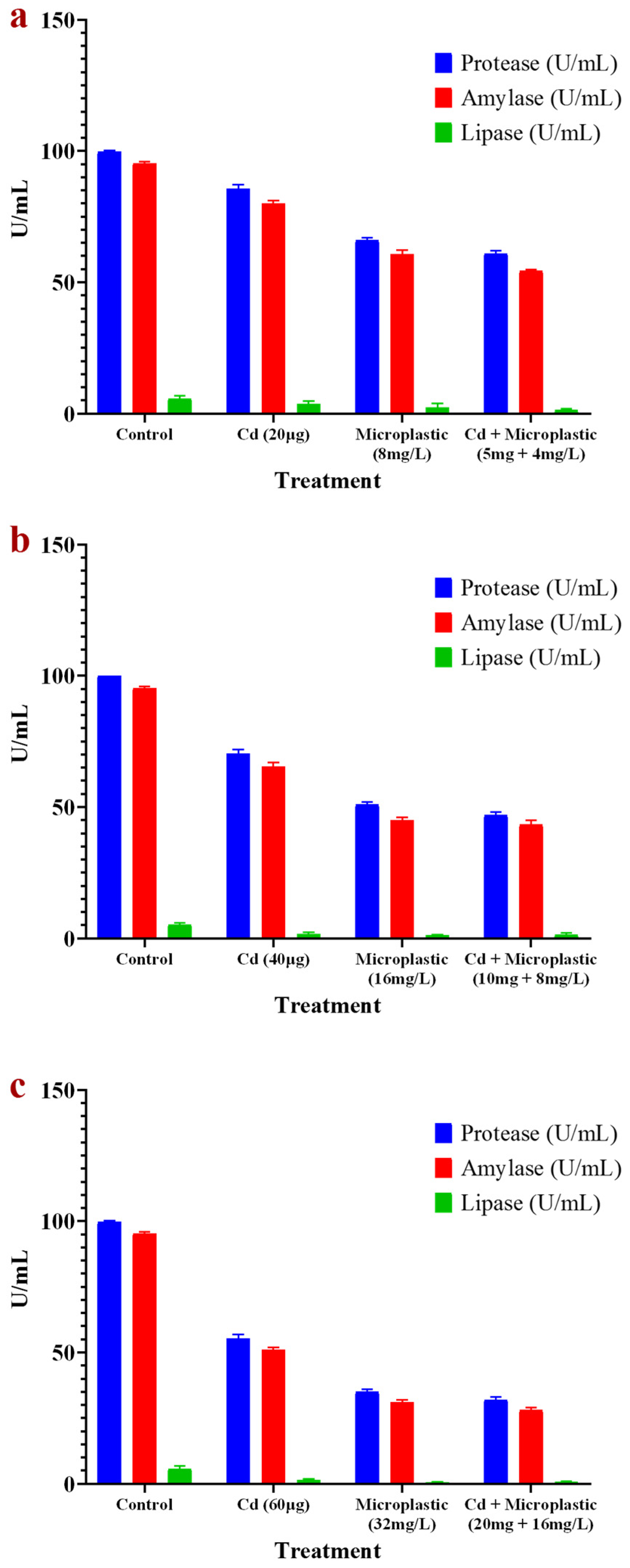
Figure 1 shows that 14-day exposure to Cd, MPs, and Cd + MPs significantly decreased midgut digestive enzyme activity in P. sphenops. The protease activity showed a marked decline under all treatments compared with the control. Under cadmium exposure alone, protease activity decreased from about 118 U/ mL in the control to nearly 90 U/mL. Exposure to microplastics alone caused a further reduction in protease activity to approximately 70 U/mL. The combined exposure to cadmium and microplastics resulted in the lowest protease activity, declining to around 43 U/mL. Amylase activity in Poecilia sphenops also decreased significantly following exposure to cadmium and microplastics. In the cadmium-treated group, amylase activity declined from about 98 U/L in the control to nearly 80 U/L. Microplastic exposure alone reduced amylase activity further to approximately 61 U/L. The combined cadmium and microplastic treatment produced the greatest reduction in amylase activity, lowering it to around 37 U/L. Lipase activity in Poecilia sphenops followed a similar decreasing pattern under the different treatments. Cadmium exposure alone reduced lipase activity from nearly 9 U/mL in the control to about 6 U/mL. Microplastic exposure alone caused the strongest inhibition of lipase activity, reducing it to approximately 3 U/mL. Under combined exposure to cadmium and microplastics, lipase activity remained suppressed at around 4 U/mL. Overall, these results indicate that cadmium and microplastics, individually and in combination, adversely affect digestive enzyme activities in Poecilia sphenops, with the combined treatment exerting the most pronounced effect on protease and amylase activities.
In the present study, after the treatment of Cd alone and in combination, digestive enzyme activities were lower than the control; this is due to Cd disrupting digestive enzyme production by impairing transcription and protein folding in gut epithelial cells, and generating ROS that cause lipid peroxidation and tissue damage [69]. Additionally, Cd alters microbiome communities by depleting beneficial taxa such as Cetobacterium, thus impairing digestive efficiency [70]. Exposure to Cd and MPs resulted in a significantly greater reduction in protease, amylase, and lipase activities than either pollutant alone [64]. This suggests a synergistic disruption of enzyme synthesis and transport in the gut [71]. In the present study, a decrease in food intake and a concomitant decline in the activities of digestive enzymes might affect the digestive tract, and MP exposure can seriously impair the fish digestive tract by damaging gut epithelial cells, triggering inflammation, and disrupting nutrient absorption, sometimes causing malnutrition [71]. Co-exposure to MPs and Cd exerts a synergistic toxic effect on fish, significantly impairing gut function and reducing digestive enzyme activities. This combined exposure is more detrimental than either pollutant alone, intensifying intestinal inflammation, oxidative stress, and gut microbiome dysbiosis, all of which disrupt normal digestive processes.
Water quality parameters were carefully monitored throughout the experiment to ensure consistency in environmental conditions (Table 4). Monitoring these water quality parameters is of paramount importance, especially in the context of water contamination by environmental pollutants, as they play a crucial role in the overall health of aquatic ecosystems. Deviations in any of these factors can significantly affect the biological responses of aquatic organisms, influencing the accuracy and reliability of the experimental results. Maintaining optimal water quality is essential not only for the well-being of the test species but also for simulating realistic environmental conditions, which are critical when assessing the toxicological impact of contaminants like cadmium and microplastics on aquatic life.
In the present study, exposure to Cd and MPs resulted in significant alterations in the physicochemical properties of the water medium and adverse effects on P. sphenops. Notably, there was an increase in salinity and turbidity following Cd and MP exposure. Although Cd does not directly alter pH through a typical acid-base reaction, it can affect water pH indirectly through changes in water chemistry and the physiological responses of the fish [72]. Cd exposure influences parameters such as carbon dioxide (CO2) levels and Ca2+ concentrations, both of which can modify pH. Additionally, Cd-induced stress in fish can disturb internal acid-base homeostasis, potentially leading to lowered pH levels. Furthermore, both Cd and MPs significantly reduced dissolved oxygen (DO) concentrations, likely due to oxidative stress responses and changes in gill physiology [73,74,75,76]. There was a marked increase in total hardness, alkalinity, chloride (Cl) concentration, fluoride levels, total suspended solids (TSSs), and other associated water quality parameters. These trends were consistently observed during the experimental exposure of P. sphenops, indicating substantial water quality deterioration [72].

4. Conclusions

The present study demonstrates the synergistic toxic effects of MPs and Cd on P. sphenops. Co-exposure to Cd and MPs resulted in multiple adverse outcomes, indicating a synergistic toxicological impact. Notably, growth performance was significantly reduced, as evidenced by lower weight gain, specific growth rate, and survival rates. Feed efficiency and nutrient absorption were also impaired, adversely affecting overall health and development. Hematological parameters, including Hb, RBCs, and WBCs, showed marked declines, suggesting compromised hematological function. In addition, metabolic and oxidative stress were elevated, as indicated by increased levels of AST and ALT, along with reduced antioxidant defenses. Digestive functions were disrupted due to decreased enzyme activity and structural damage to intestinal tissues. Furthermore, evidence of immune dysfunction underscores the biological burden imposed by Cd and MP co-exposure. This study provides novel insights into the combined toxic effects of microplastics (MPs) and cadmium (Cd) on P. sphenops, underlining the urgent need for further research on the ecological and physiological risks posed by the interaction of these pollutants in aquatic organisms. Such research is critical to understanding the long-term consequences of multi-pollutant exposure in aquatic ecosystems.

Author Contributions

M.V.—Conceptualization, Methodology, Investigation, Formal analysis, Writing—Original Draft; L.-C.T.—Validation, Resources, Data Curation, Writing—Review and Editing; K.M.—Supervision, Methodology, Validation; R.R.—Investigation, Data Curation; D.D.—Investigation, Methodology; P.K.—Resources, Formal analysis; M.R.—Visualization, Review analysis; T.M.—Data Curation, Data analysis; S.B.—Data Curation, Formal Analysis; M.M.—Software, Validation, Formal Analysis; J.P.A.—Formal analysis, Data Curation; F.C.—Resources, Formal analysis, Visualization; S.S.P.—Writing—Review and Editing, Visualization; Y.-G.W.—Methodology, Validation; R.K.K.—Review and Editing, Visualization; K.N.—Investigation, Methodology; J.-S.H.—Supervision, Project administration, Funding acquisition, Resources, Writing—Review and Editing. All authors have read and agreed to the published version of the manuscript.

Funding

This study was supported by the National Science and Technology Council of Taiwan (NSTC 112-2621-M-019-002, NSTC 113-2621-M-019-002 and NSTC 114-2621-M-019-003 to Jiang-Shiou Hwang J). The funders had no role in the study design, data collection or analysis, decision to publish, or manuscript preparation.

Institutional Review Board Statement

The animal study protocol was approved by the Sri Lakshmi Narayana Institute of medical Sciences, Puducherry, 605 502, India (Ref. No 03/SLIMS/IAEC/2025-26, dated 6 March 2025).

Data Availability Statement

The original contributions presented in this study are included in the article. Further inquiries can be directed to the corresponding author.

Conflicts of Interest

The authors declare no conflicts of interest.

References

  1. Majeed, N.; Hamid, B.; Mir, T.A.; Yatoo, A.M.; Sayyed, R.Z. Heavy Metals, Powerful Environmental Poisons, from Waste Disposal Site: Their Environmental Effects and Remediation. In Integrated Waste Management; CRC Press: Boca Raton, FL, USA, 2024; pp. 66–88. [Google Scholar]
  2. Hutton, M. Sources of cadmium in the environment. Ecotoxicol. Environ. Saf. 1983, 7, 9–24. [Google Scholar] [CrossRef]
  3. Farias, J.P.; Okeke, B.C.; Demarco, C.F.; Carlos, F.S.; da Silva, R.F.; da Silva, M.A.; Quadro, M.S.; Pieniz, S.; Andreazza, R. Cadmium contamination in aquatic environments: Detoxification mechanisms and phytoremediation approach. Sustainability 2024, 16, 10072. [Google Scholar] [CrossRef]
  4. Patrício Silva, A.L.; Prata, J.C.; Walker, T.R.; Campos, D.; Duarte, A.C.; Soares, A.M.V.M.; Barcelò, D.; Rocha-Santos, T. Rethinking and optimising plastic waste management under COVID-19 pandemic: Policy solutions based on redesign and reduction of single-use plastics and personal protective equipment. Sci. Total Environ. 2020, 742, 140565. [Google Scholar] [CrossRef] [PubMed]
  5. Holmes, L.A.; Turner, A.; Thompson, R.C. Adsorption of trace metals to plastic resin pellets in the marine environment. Environ. Pollut. 2012, 160, 42–48. [Google Scholar] [CrossRef]
  6. Jolaosho, T.L.; Rasaq, M.F.; Omotoye, E.V.; Araomo, O.V.; Adekoya, O.S.; Abolaji, O.Y.; Hungbo, J.J. Microplastics in freshwater and marine ecosystems: Occurrence, characterization, sources, distribution dynamics, fate, transport processes, potential mitigation strategies, and policy interventions. Ecotoxicol. Environ. Saf. 2025, 294, 118036. [Google Scholar] [CrossRef]
  7. Borriello, L.; Scivicco, M.; Cacciola, N.A.; Esposito, F.; Severino, L.; Cirillo, T. Microplastics, a global issue: Human exposure through environmental and dietary sources. Foods 2023, 12, 3396. [Google Scholar] [CrossRef] [PubMed]
  8. Matavos-Aramyan, S. Addressing the microplastic crisis: A multifaceted approach to removal and regulation. Environ. Adv. 2024, 17, 697100579. [Google Scholar] [CrossRef]
  9. Godoy, V.; Blázquez, G.; Calero, M.; Quesada, L.; Martín-Lara, M.A. The potential of microplastics as carriers of metals. Environ. Pollut. 2019, 255, 113363. [Google Scholar] [CrossRef]
  10. Fred-Ahmadu, O.H.; Ahmadu, F.O.; Adedapo, A.E.; Oghenovo, I.; Ogunmodede, O.T.; Benson, N.U. Microplastics and chemical contamination in aquaculture ecosystems: The role of climate change and implications for food safety—A review. Environ. Sci. Eur. 2024, 36, 181. [Google Scholar] [CrossRef]
  11. Lu, K.; Qiao, R.; An, H.; Zhang, Y. Influence of microplastics on the accumulation and chronic toxic effects of cadmium in zebrafish (Danio rerio). Chemosphere 2018, 202, 514–520. [Google Scholar] [CrossRef] [PubMed]
  12. Ghosh, T. Microplastics bioaccumulation in fish: Its potential toxic effects on hematology, immune response, neurotoxicity, oxidative stress, growth, and reproductive dysfunction. Toxicol. Rep. 2025, 14, 101854. [Google Scholar] [CrossRef]
  13. Wei, W.; Yang, Q.; Xiang, D.; Chen, X.; Wen, Z.; Wang, X.; Xu, J. Combined impacts of microplastics and cadmium on the liver function, immune response, and intestinal microbiota of crucian carp (Carassius carassius). Ecotoxicol. Environ. Saf. 2023, 261, 115104. [Google Scholar] [CrossRef]
  14. Ilyas, K.; Rehman, K.; Iqbal, H.; Hussain, A.; Akash, M.S.H.; Shahid, M.; Sadaf, B. Metabolomic Analysis and Biochemical Profiling of Cadmium-Induced Metabolic Impairment and Its Amelioration by Resveratrol. Bioengineering 2024, 11, 1141. [Google Scholar] [CrossRef]
  15. Yang, H.; Zhu, Z.; Xie, Y.; Zheng, C.; Zhou, Z.; Zhu, T.; Zhang, Y. Comparison of the combined toxicity of polystyrene microplastics and different concentrations of cadmium in zebrafish. Aquat. Toxicol. 2022, 250, 106259. [Google Scholar] [CrossRef]
  16. Wu, K.; Chen, Y.; Huang, W. Combined molecular toxicity mechanism of heavy metals mixtures. In Toxicological Assessment of Combined Chemicals in the Environment; Wiley: Hoboken, NJ, USA, 2025; pp. 125–172. [Google Scholar]
  17. Kültz, D. Physiological mechanisms used by fish to cope with salinity stress. J. Exp. Biol. 2015, 218, 1907–1914. [Google Scholar] [CrossRef] [PubMed]
  18. Boyd, C.E.; Tucker, C.S. Pond Aquaculture Water Quality Management; Springer Science & Business Media: Heidelberg, Germany, 2012. [Google Scholar]
  19. Wilhelm Filho, D. Reactive oxygen species, antioxidants and fish mitochondria. Front. Biosci. 2007, 12, 1229–1237. [Google Scholar] [CrossRef]
  20. Zhang, P.; Yang, M.; Lan, J.; Huang, Y.; Zhang, J.; Huang, S.; Yang, Y.; Ru, J. Water quality degradation due to heavy metal contamination: Health impacts and eco-friendly approaches for heavy metal remediation. Toxics 2023, 11, 828. [Google Scholar] [CrossRef] [PubMed]
  21. Kye, H.; Kim, J.; Ju, S.; Lee, J.; Lim, C.; Yoon, Y. Microplastics in water systems: A review of their impacts on the environment and their potential hazards. Heliyon 2023, 9, e14359. [Google Scholar] [CrossRef] [PubMed]
  22. Altenburger, R.; Brack, W.; Burgess, R.M.; Busch, W.; Escher, B.I.; Focks, A.; Krauss, M. Future water quality monitoring: Improving the balance between exposure and toxicity assessments of real-world pollutant mixtures. Environ. Sci. Eur. 2019, 31, 12. [Google Scholar] [CrossRef]
  23. Kinne, O. The effects of temperature and salinity on marine and brackish water animals: I. Temperature. Oceanogr. Mar. Biol. Annu. Rev. 1964, 2, 281–339. [Google Scholar]
  24. Sampaio, L.A.; Bianchini, A. Salinity effects on osmoregulation and growth of the euryhaline flounder Paralichthys adspersus. J. Exp. Mar. Bio. Ecol. 2002, 269, 187–196+718. [Google Scholar] [CrossRef]
  25. Ghanbari, M.; Kneifel, W.; Domig, K.J. A new view of the fish gut microbiome: Advances from next-generation sequencing. Aquaculture 2015, 448, 464–475. [Google Scholar] [CrossRef]
  26. Evans, D.H. Teleost fish osmoregulation: What have we learned since August Krogh, Homer Smith, and Ancel Keys. Am. J. Physiol. Regul. Integr. Comp. Physiol. 2008, 295, R704–R713. [Google Scholar] [CrossRef]
  27. Whitfield, A.K. Estuaries–how challenging are these constantly changing aquatic environments for associated fish species? Environ. Biol. Fishes 2021, 104, 517–528. [Google Scholar] [CrossRef]
  28. APHA. Standard Methods for the Examination of Water and Wastewater, 23rd ed.; American Public Health Association: Washington, DC, USA, 2017; p. 723. [Google Scholar]
  29. Boyd, C.E. Water Quality: An Introduction; Springer: Cham, Switzerland, 2015. [Google Scholar]
  30. OECD. Test No. 203: Fish, Acute Toxicity Test; Organisation for Economic Co-operation and Development: Paris, France, 2019. [Google Scholar]
  31. Zink, L.; Shearer, A.Y.; Wiseman, S.; Pyle, G.G. Effects of exposure to cadmium, microplastics, and their mixture on survival, growth, feeding, and life history of Daphnia magna. Environ. Toxicol. Chem. 2023, 42, 1401–1408. [Google Scholar] [CrossRef] [PubMed]
  32. Blaxhall, P.C.; Daisley, K.W. Routine haematological methods for use with fish blood. J. Fish Biol. 1973, 5, 771–781. [Google Scholar] [CrossRef]
  33. Cho, C.Y.; Cowey, C.B.; Watanabe, T. Finfish Nutrition in Asia: Methodological Approaches to Research and Development; International Development Research Centre: Ottawa, ON, Canada, 1985; p. 154.
  34. Shah, S.L.; Altindag, A. Hematological Parameters of Tench (Tinca tinca L.) after Acute and Chronic Exposure to Lethal and Sublethal Mercury Treatments. Bull. Environ. Contam. Toxicol. 2004, 73, 911–918. [Google Scholar] [CrossRef]
  35. Levy-Pereira, N.; Yasui, G.S.; Cardozo, M.V.; Dias Neto, J.; Farias, T.H.V.; Sakabe, R.; Pilarski, F. Immunostimulation and increase of intestinal lactic acid bacteria with dietary mannan-oligosaccharide in Nile tilapia juveniles. Rev. Bras. Zootec. 2018, 47, e20170006. [Google Scholar] [CrossRef]
  36. Gornall, A.G.; Bardawill, C.J.; David, M.M. Determination of serum proteins by means of the biuret reaction. J. Biol. Chem. 1949, 177, 751–766. [Google Scholar] [CrossRef]
  37. Trinder, P. Determination of blood glucose using an oxidase-peroxidase system with a non-carcinogenic chromogen. J. Clin. Pathol. 1969, 22, 158–161. [Google Scholar] [CrossRef] [PubMed]
  38. Beauchamp, C.; Fridovich, I. Superoxide dismutase: Improved assays and an assay applicable to acrylamide gels. Anal. Biochem. 1971, 44, 276–287. [Google Scholar] [CrossRef]
  39. Aebi, H. Catalase in vitro. In Methods in Enzymology; Academic Press: Cambridge, MA, USA, 1984; Volume 105, pp. 121–126. [Google Scholar]
  40. Flohé, L.; Günzler, W.A. Assays of glutathione peroxidase. In Methods in Enzymology; Academic Press: Cambridge, MA, USA, 1984; Volume 105, pp. 114–120. [Google Scholar]
  41. Reitman, S.; Frankel, S. A colorimetric method for the determination of serum glutamic oxalacetic and glutamic pyruvic transaminases. Am. J. Clin. Pathol. 1957, 28, 56–63. [Google Scholar] [CrossRef]
  42. Anson, M.L. The estimation of pepsin, trypsin, papain, and cathepsin with hemoglobin. J. Gen. Physiol. 1938, 22, 79. [Google Scholar] [CrossRef] [PubMed]
  43. Walter, H.E. Proteases and their inhibitors. 2. 15. 2 Method with haemoglobin, casein and azocoll as substrate. Methods Enzym. Anal. 1984, 270–277. [Google Scholar]
  44. Bernfeld, P. Amylases, α and β. In Methods in Enzymology; Colowick, S.P., Kaplan, N.O., Eds.; Academic Press: Cambridge, MA, USA, 1955; Volume 1, pp. 149–158. [Google Scholar]
  45. Nolasco-Soria, H. Fish digestive lipase quantification methods used in aquaculture studies. Front. Aquac. 2023, 2, 1225216. [Google Scholar] [CrossRef]
  46. Rashid, E.; Hussain, S.M.; Ali, S.; Al-Ghanim, K.A.; Sarker, P.K. Toxicological consequences of polystyrene microplastics on Cirrhinus mrigala: Effects on growth, body composition, nutrient digestibility, haematology and histopathology. Mar. Freshw. Res. 2024, 75, MF24055. [Google Scholar] [CrossRef]
  47. Rubio, L.; Barguilla, I.; Domenech, J.; Marcos, R.; Hernández, A. Biological effects, including oxidative stress and genotoxic damage, of polystyrene nanoparticles in different human hematopoietic cell lines. J. Hazard. Mater. 2020, 398, 122900. [Google Scholar] [CrossRef]
  48. Chen, X.; Peng, L.B.; Wang, D.; Zhu, Q.L.; Zheng, J.L. Combined effects of polystyrene microplastics and cadmium on oxidative stress, apoptosis, and GH/IGF axis in zebrafish early life stages. Sci. Total Environ. 2022, 813, 152514. [Google Scholar] [CrossRef] [PubMed]
  49. Zamora-Ledezma, C.; Negrete-Bolagay, D.; Figueroa, F.; Zamora-Ledezma, E.; Ni, M.; Alexis, F.; Guerrero, V.H. Heavy metal water pollution: A fresh look about hazards, novel and conventional remediation methods. Environ. Technol. Innov. 2021, 22, 101504. [Google Scholar] [CrossRef]
  50. Luo, W.; Wang, D.J.; Xu, Z.; Liao, G.P.; Chen, D.F.; Huang, X.L.; Wang, Y.; Yang, S.; Zhao, L.L.; Huang, H.G.; et al. Effects of cadmium pollution on the safety of rice and fish in a rice-fish coculture system. Environ. Int. 2020, 143, 105898. [Google Scholar] [CrossRef]
  51. Guardiola, F.A.; Cuesta, A.; Meseguer, J.; Martínez, S.; Martínez-Sánchez, M.J.; Pérez-Sirvent, C.; Esteban, M.A. Accumulation, histopathology and immunotoxicological effects of waterborne cadmium on gilthead seabream (Sparus aurata). Fish Shellfish Immunol. 2013, 35, 792–800. [Google Scholar] [CrossRef]
  52. Khanh, D.N.N.; Vy, N.T.T.; Phuong, T.H.; Nhi, P.T.; Thang, N.Q.; Sy, D.T.; Phuong, N.T.K. Effects of cadmium and lead on muscle and liver glycogen levels of climbing perch (Anabas testudineus). Bull. Environ. Contam. Toxicol. 2022, 168, 854–860. [Google Scholar] [CrossRef]
  53. Heydarnejad, M.S.; Khosravian-Hemamai, M.; Nematollahi, A. Effects of cadmium at sub-lethal concentration on growth and biochemical parameters in rainbow trout (Oncorhynchus mykiss). Ir. Vet. J. 2013, 66, 11. [Google Scholar] [CrossRef]
  54. Abdel-Tawwab, M.; Khalil, R.H.; Younis, N.A.; Abo Selema, T.A.; Saad, A.H.; El-Werwary, S.O.; Gouda, A.H.; Soliman, A.M.; Shady, S.H.; Monier, M.N. Saccharomyces cerevisiae supplemented diets mitigate the effects of waterborne cadmium toxicity on gilthead seabream (Sparus aurata L.): Growth performance, haemato-biochemical, stress biomarkers, and histopathological investigations. Vet. Res. Commun. 2024, 48, 69–84. [Google Scholar] [CrossRef]
  55. Multisanti, C.R.; Merola, C.; Perugini, M.; Aliko, V.; Faggio, C. Sentinel species selection for monitoring microplastic pollution: A review on one health approach. Ecol. Indic. 2022, 145, 109587. [Google Scholar] [CrossRef]
  56. Banaee, M.; Multisanti, C.R.; Impellitteri, F.; Piccione, G.; Faggio, C. Environmental toxicology of microplastic particles on fish: A review. Comp. Biochem. Physiol. Part C Toxicol. Pharmacol. 2025, 287, 110042. [Google Scholar] [CrossRef]
  57. Jerald, I.; Ravindran, J.; Babu, M.M. Fish in focus: Navigating organ damage assessment through analytical avenues—A comprehensive review. Toxicol. Rep. 2024, 13, 101841. [Google Scholar] [CrossRef] [PubMed]
  58. Shahriar, S.I.M.; Islam, N.; Emon, F.J.; Ashaf-Ud-Doulah, M.; Khan, S.; Shahjahan, M. Size dependent ingestion and effects of microplastics on survivability, hematology and intestinal histopathology of juvenile striped catfish (Pangasianodon hypophthalmus). Chemosphere 2024, 356, 141827. [Google Scholar] [CrossRef] [PubMed]
  59. Al-Asgah, N.A.; Abdel-Warith, A.W.A.; Younis, E.S.M.; Allam, H.Y. Haematological and biochemical parameters and tissue accumulations of cadmium in Oreochromis niloticus exposed to various concentrations of cadmium chloride. Saudi J. Biol. Sci. 2015, 22, 543–550. [Google Scholar] [CrossRef]
  60. Deswati, D.; Syafrizayanti, S.; Tetra, O.N.; Noval, K.P.; Putra, A. Study on the dynamics of microplastics in the biofloc system for Nile tilapia (Oreochromis niloticus) aquaculture. J. Ecol. Eng. 2025, 26, 273–287. [Google Scholar] [CrossRef]
  61. Yu, Y.B.; Lee, J.W.; Jo, A.H.; Choi, Y.J.; Choi, C.Y.; Kang, J.C.; Kim, J.H. Toxic Effects of Cadmium Exposure on Hematological and Plasma Biochemical Parameters in Fish: A Review. Toxics 2024, 12, 699. [Google Scholar] [CrossRef]
  62. Mayila, E.S.; Mzula, A.; Rumisha, C.; Kochzius, M. Effects of Cd exposure on peripheral blood cell population and functional changes in innate immunity of the African sharptooth catfish (Clarias gariepinus). Comp. Immunol. Rep. 2025, 8, 200191. [Google Scholar] [CrossRef]
  63. Davis, K.B. Management of physiological stress in finfish aquaculture. N. Am. J. Aquac. 2006, 68, 116–121. [Google Scholar] [CrossRef]
  64. Liu, Y.; Chen, Q.; Li, Y.; Bi, L.; Jin, L.; Peng, R. Toxic effects of cadmium on fish. Toxics 2022, 10, 622. [Google Scholar] [CrossRef] [PubMed]
  65. Livingstone, D.R. Contaminant-stimulated reactive oxygen species production and oxidative damage in aquatic organisms. Mar. Pollut. Bull. 2001, 42, 656–666. [Google Scholar] [CrossRef]
  66. Lee, J.Y.; Tokumoto, M.; Satoh, M. Molecular Mechanisms of Cadmium-Induced Toxicity and Its Modification. Int. J. Mol. Sci. 2025, 26, 7515. [Google Scholar] [CrossRef]
  67. Ren, L.; He, Y.; Hou, C.; Liao, C.; Chen, M. Toxicological Effects of Combined Exposure of Cadmium and Enrofloxacin on Zebrafish. Toxics 2025, 13, 378. [Google Scholar] [CrossRef]
  68. Vinodhini, R.; Narayanan, M. Heavy metal induced histopathological alterations in selected organs of the Cyprinus carpio L. (Common carp). Int. J. Environ. Res. 2009, 3, 95–100. [Google Scholar]
  69. Xie, D.; Li, Y.; Liu, Z.; Chen, Q. Inhibitory effect of cadmium exposure on digestive activity, antioxidant capacity and immune defense in the intestine of yellow catfish (Pelteobagrus fulvidraco). Comp. Biochem. Physiol. Part C Toxicol. Pharmacol. 2019, 222, 65–73. [Google Scholar] [CrossRef]
  70. Chang, X.; Li, H.; Feng, J.; Chen, Y.; Nie, G.; Zhang, J. Effects of cadmium exposure on the composition and diversity of the intestinal microbial community of common carp (Cyprinus carpio L.). Ecotoxicol. Environ. Saf. 2019, 171, 92–98. [Google Scholar] [CrossRef]
  71. Mahmood, M.; Hussain, S.M.; Sarker, P.K.; Ali, S.; Arif, M.S.; Nazish, N.; Naeem, A. Toxicological assessment of dietary exposure of polyethylene microplastics on growth, nutrient digestibility, carcass and gut histology of Nile Tilapia (Oreochromis niloticus) fingerlings. Ecotoxicology 2024, 33, 296–304+799. [Google Scholar] [CrossRef] [PubMed]
  72. Wang, S.; Xie, S.; Wang, Z.; Zhang, C.; Pan, Z.; Sun, D.; Zou, J. Single and combined effects of microplastics and cadmium on the cadmium accumulation and biochemical and immunity of Channa argus. Biol. Trace Elem. Res. 2022, 200, 3377–3387. [Google Scholar] [CrossRef] [PubMed]
  73. Verbost, P.M.; Flik, G.; Lock, R.A.C.; Wendelaar Bonga, S.E. Cadmium inhibits plasma membrane calcium transport. J. Membr. Biol. 1988, 102, 97–104. [Google Scholar] [CrossRef]
  74. Heisler, N. Acid–base regulation in fishes. In Fish Physiology; Hoar, W.S., Randall, D.J., Eds.; Academic Press: New York, NY, USA, 1984; Volume 10, pp. 315–401. [Google Scholar]
  75. Wright, S.L.; Thompson, R.C.; Galloway, T.S. The physical impacts of microplastics on marine organisms: A review. Environ. Pollut. 2013, 178, 483–492. [Google Scholar] [CrossRef] [PubMed]
  76. Lu, Y.; Zhang, Y.; Deng, Y.; Jiang, W.; Zhao, Y.; Geng, J.; Ding, L.; Ren, H. Uptake and accumulation of polystyrene microplastics in zebrafish (Danio rerio) and toxic effects in liver. Environ. Sci. Technol. 2016, 50, 4054–4060. [Google Scholar] [CrossRef]
Figure 1. (ac): Digestive enzyme activities (protease, amylase, and lipase) in P. sphenops exposed to increasing concentrations of cadmium (Cd), microplastics (MPs), and their mixtures. (a) Low-dose exposure: control, Cd (20 μg), MP (8 mg/L), and Cd+MP (5 mg + 4 mg/L). (b) Medium-dose exposure: control, Cd (40 μg), MP (16 mg/L), and Cd+MP (10 mg + 8 mg/L). (c) High-dose exposure: control, Cd (60 μg), MP (32 mg/L), and Cd+MP (20 mg + 16 mg/L). All enzyme activities are expressed in units per milliliter (U/mL). Data are presented as means ± standard deviations (n = 3).
Water 18 01008 g001
Table 1. Growth performance of P. sphenops following 14 days of dietary exposure to cadmium (Cd), microplastic (MPs), and their combination (Cd-MPs).
GroupControlCd
(20 μg/L)
Cd
(40 μg/L)
Cd
(60 μg/L)
MP
(8 mg/L)
MP
(16 mg/L)
MP
(32 mg/L)
Cd
(5 μg/L) +
MP
(4 mg/L)
Cd
(10 μg/L) +
MP
(8 mg/L)
Cd
(20 μg/L) +
MP
(16 mg/L)
IW (g)0.27 ±
0.01 a
0.23 ±
0.01 a
0.23 ±
0.01 a
0.23 ±
0.01 a
0.25 ±
0.01 a
0.25 ±
0.01 a
0.25 ±
0.01 a
0.23 ±
0.01 a
0.23 ±
0.01 a
0.23 ±
0.01 a
FW (g)0.78 ±
0.00 a
0.59 ±
0.03 c
0.58 ±
0.03 c
0.57 ±
0.00 c
0.66 ±
0.01 b
0.52 ±
0.00 c
0.53 ±
0.00 c
0.50 ±
0.00 c
0.48 ±
0.00 d
0.49 ±
0.00 d
WG (g)0.51 ±
0.01 a
0.36 ±
0.02 b
0.35 ±
0.02 b
0.34 ±
0.01 b
0.41 ±
0.01 b
0.27 ±
0.01 c
0.28 ±
0.01 c
0.27 ±
0.01 c
0.23 ±
0.01 c
0.26 ±
0.01 c
IL (cm)2.9 ±
0.21 a
2.8 ±
0.12 a
2.88 ±
0.12 a
2.73 ±
0.04 a
2.96 ±
0.18 a
2.63 ±
0.04 a
2.8 ±
0.14 a
2.8 ±
0.14 a
2.8 ±
0.13 a
2.8 ±
0.14 a
FL (cm)4.7 ±
0.08 a
4.1 ±
0.04 a
3.9 ±
0.04 b
4.03 ±
0.04 a
4.23 ±
0.20 a
4.06 ±
0.09 a
3.86 ±
0.04 b
3.93 ±
0.12 b
3.50 ±
0.34 c
3.33 ±
0.23 c
LG (cm)1.8 ±
0.13 a
1.3 ±
0.08 a
1.02 ±
0.08 a
1.3 ±
0.03 a
1.27 ±
0.02 a
1.43 ±
0.05 a
1.06 ±
0.1 a
1.13 ±
0.02 a
0.7 ±
0.21 b
0.53 ±
0.09 b
ADG (g)0.03 ±
0.00 a
0.02 ±
0.00 a
0.025 ±
0.00 a
0.024 ±
0.00 a
0.029 ±
0.01 a
0.019 ±
0.00 a
0.02 ±
0.00 a
0.019 ±
0.00 a
0.016 ±
0.00 a
0.018 ±
0.00 a
SGR (%/day)3.68 ±
0.07 a
2.57 ±
0.14 b
2.5 ±
0.14 b
2.42 ±
0.07 b
2.92 ±
0.01 b
1.92 ±
0.07 c
2 ±
0.07 b
1.92 ±
0.07 c
1.78 ±
0.07 c
1.85 ±
0.07 c
SR (%)100 ±
0.00 a
94.67 ±
2.31 b
89.33 ±
4.62 b
80.00 ±
4.00 c
97.33 ±
2.31 b
92.00 ±
4.00 b
85.33 ±
2.31 c
80 ±
4.00 c
74.67 ±
2.31 d
73.33 ±
2.31 d
Notes: Values are presented as mean ± standard deviation (n = 3). Means with different superscript letters within the same row are significantly different (p < 0.05). IW—Initial weight; FW—Final weight; WG—Weight gain; IL—Initial length; FL—Final length; LG—Length gain; ADG—Average daily gain of weight; SGR—Specific growth rate of weight; SR—Survival rate.
Table 2. Changes in the hematological and biochemical parameters of P. sphenops following 14 days of dietary exposure to cadmium (Cd), microplastics (MPs), and their combination (Cd+MPs).
ParametersControlCd
(20 μg/L)
Cd
(40 μg/L)
Cd
(60 μg/L)
MP
(8 mg/L)
MP
(16 mg/L)
MP
(32 mg/L)
Cd
(5 μg/L) +
MP
(4 mg/L)
Cd
(10 μg/L) +
MP
(8 mg/L)
Cd
(20 μg/L) +
MP
(16 mg/L)
Hb
(g/dL)
8.92 ±
0.01 a
8.41 ±
0.02 ab
6.83 ±
0.04 c
8.53 ±
0.03 ab
7.98 ±
0.00 b
6.50 ±
0.08 cd
5.86 ±
0.04 d
7.23 ±
0.04 bc
5.66 ±
0.09 de
4.83 ±
0.04 e
RBC count (106/μL)4.40 ±
0.49 b
4.06 ±
0.04 ab
3.70 ±
0.16 c
3.06 ±
0.12
4.37 ±
0.37 bc
5.09 ±
0.07 ab
5.60 ±
0.07 a
4.25 ±
0.03 bc
3.47 ±
0.13 cd
2.96 ±
0.09 d
WBC count (103/μL)40.96 ±
0.20 a
36.20 ±
0.56 b
30.30 ±
0.12 bc
26.30 ±
0.87 c
32.70 ±
0.28 bc
25.03 ±
1.03 cd
19.90 ±
0.12 d
30.20 ±
0.08 bc
23.10 ±
0.04 cd
17.10 ±
0.16 de
Glucose (mg/dL)48.10 ±
0.51 e
53.70 ±
0.30 d
60.30 ±
0.12 cd
69.80 ±
0.04 c
58.70 ±
0.04
65.90 ±
0.30 cd
71.10 ±
0.14 bc
62.70 ±
0.47 cd
77.30 ±
0.42 b
89.23 ±
0.04 a
Protein (g/dL)4.88 ±
0.20 b
4.36 ±
0.10 bc
4.12 ±
0.21 c
4.01 ±
0.15 c
4.99 ±
0.10 b
5.15 ±
0.11 ab
5.99 ±
0.21 a
4.66 ±
0.01 bc
4.25 ±
0.10 bc
4.01 ±
0.11 c
Notes: Values are presented as mean ± standard deviation (n = 3). Means in the same column with different letters indicate significant differences (p < 0.05). Statistical analysis was conducted using SPSS (version 21).
Table 3. Impact of cadmium (Cd), microplastics (MPs), and their combination (Cd-MPs) on antioxidant and transaminases activity in the liver of P. sphenops after 14 days.
ParametersControlCd
(20 μg/L)
Cd
(40 μg/L)
Cd
(60 μg/L)
MP
(8 mg/L)
MP
(16 mg/L)
MP
(32 mg/L)
Cd
(5 μg/L) +
MP
(4 mg/L)
Cd
(10 μg/L) +
MP
(8 mg/L)
Cd
(20 μg/L) +
MP
(16 mg/L)
SOD
(U/mg protein)
0.18 ±
0.001 g
0.20 ±
0.004 ef
0.33 ±
0.009 d
0.52 ±
0.02 b
0.19 ±
0.009 f
0.19 ±
0.00 f
0.23 ±
0.004 ef
0.28 ±
0.00 e
0.44 ±
0.00 c
0.62 ±
0.005 a
CAT
(µmoles/min/mg protein)
0.112 ±
0.02 g
0.245 ±
0.01 f
0.464 ±
0.010 d
0.575 ±
0.01 c
0.230 ±
0.005 f
0.422 ±
0.015 de
0.525 ±
0.00 cd
0.314 ±
0.02 e
0.667 ±
0.00 b
0.763 ±
0.01 a
GPX (µmol /min/mg protein)0.035 ±
0.01 g
0.058 ±
0.001 e
0.071 ±
0.00 cd
0.082 ±
0.00 bc
0.043 ±
0.00 f
0.055 ±
0.00 e
0.073 ±
0.00 c
0.064 ±
0.002 d
0.083 ±
0.00 b
0.094 ±
0.00 a
AST
(U/L)
24.9 ±
0.52 e
29.5 ±
0.43 d
48.8 ±
0.44 c
56.1 ±
0.86 b
28.3 ±
0.16 d
40.4 ±
0.50 cd
51.4 ±
0.44 bc
34.3 ±
0.12
55.5 ±
0.90 b
66 ±
0.21 a
ALT
(U/L)
19 ±
0.14 f
29.4 ±
0.50 e
43.2 ±
0.08 cd
50.1 ±
0.04 b
26.5 ±
0.12 ef
39.8 ±
0.09 d
48.8 ±
0.04 c
36.5 ±
0.49 de
50.8 ±
0.47 b
61.5 ±
0.51 a
Notes: Values are presented as mean ± standard deviation (n = 3). Means in the same column with different letters indicate significant differences (p < 0.05). Statistical analysis was conducted using SPSS (version 21).
Table 4. Quality parameters of water contaminated with cadmium (Cd) and microplastics (MPs).
ParametersUnitControlCadmium and Microplastic Contaminated Water
pH-7.20 ± 0.106.82 ± 0.15
TurbidityNTU1.8 ± 0.312.6 ± 1.3
Dissolved Oxygenppm7.5 ± 0.44.3 ± 0.5
Salinityppt0.12 ± 0.020.84 ± 0.06
Total dissolved solidsmg/L180 ± 15.6710 ± 25.4
Total hardnessmg/L (as CaCO3)110 ± 10.6340 ± 20.7
Alkalinitymg/L (as CaCO3)95 ± 8.3180 ± 15.2
Chloridemg/L45 ± 5.2125 + 10.8
Total suspected soilsmg/L12 ± 2.145 ± 5.3
Fluoride mg/L0.7 ± 0.11.8 ± 0.2
Note: Values are presented as mean ± standard deviation (n = 3).
Disclaimer/Publisher’s Note: The statements, opinions and data contained in all publications are solely those of the individual author(s) and contributor(s) and not of MDPI and/or the editor(s). MDPI and/or the editor(s) disclaim responsibility for any injury to people or property resulting from any ideas, methods, instructions or products referred to in the content.