Article

Partial Weir Opening Is Associated with Shifts in Benthic Diatom Diversity and Assemblage Reorganization in a Monsoonal River

1
Department of Biomedical Science, Daejin University, Pocheon-si 11159, Republic of Korea
2
Research Institute for Natural Sciences, Hanyang University, Seoul 04763, Republic of Korea
3
Department of Environmental Science, Hanyang University, Seoul 04763, Republic of Korea
4
Department of Life Science, Hanyang University, Seoul 04763, Republic of Korea
*
Author to whom correspondence should be addressed.
Water 2026, 18(8), 977; https://doi.org/10.3390/w18080977
Submission received: 18 March 2026 / Revised: 12 April 2026 / Accepted: 16 April 2026 / Published: 20 April 2026
(This article belongs to the Special Issue Diatom Biodiversity and Their Adaptation to Environment Change)

Highlights

  • Partial weir opening was associated with gradual shifts in diatom assemblages;
  • Campaign-based water-quality patterns changed after 2021;
  • β-diversity was dominated by species turnover (~72%);
  • Assemblage responses were gradual and context-dependent;
  • Benthic diatoms tracked assemblage reorganization during managed flow change.

Abstract

Using a coordinated multi-year monitoring dataset collected during the 2020–2024 partial-opening management period, we examined benthic diatom assemblages across the Sejong, Gongju, and Baekje weirs in the Geum River, Republic of Korea. Seasonal surveys at eight stations were used to evaluate spatiotemporal variation in water quality and benthic diatom community structure under this hydrological management regime. Annual basin-wide averages showed gradual interannual changes in water quality, including declines in total phosphorus, total nitrogen, chlorophyll-a, turbidity, and biochemical oxygen demand after 2021, accompanied by increased dissolved oxygen. Diatom community indices based on relative-abundance data showed corresponding temporal variation, with decreased dominance and increased Shannon diversity, evenness, and taxon richness. Ordination analyses indicated gradual differentiation between the earlier (2020–2021) and later (2022–2024) monitoring groups within the study period, whereas random forest models showed limited explanatory power and were treated as exploratory. Overall, the results support benthic diatoms as sensitive descriptors of ecological change in flow-regulated monsoonal rivers while underscoring the value of long-term monitoring where true pre-intervention biological baselines are unavailable.

1. Introduction

Weirs and dams, while historically instrumental in supporting water supply, irrigation, and flood control, have been increasingly recognized for their disruptive impacts on riverine ecosystems [1,2,3]. These structures fragment longitudinal hydrological connectivity, disrupt sediment and nutrient fluxes, and simplify habitat complexity, leading to biodiversity loss and ecological degradation [4,5,6,7,8]. In response, dam removal and weir modification are being implemented globally as strategies to restore ecological integrity and hydromorphological function [9,10,11].
Ecological responses to hydrological interventions are highly context dependent and vary with climate, flow regime, and biological assemblage composition. In temperate regions, previous studies have documented sediment redistribution, biofilm succession, and biotic recolonization following dam removal or flow restoration [12,13,14,15]. In Europe, restoration projects have reported gradual recovery of benthic communities, including macroinvertebrates and periphyton, under re-established flow heterogeneity [16,17]. In contrast, in monsoon-dominated regions such as East Asia, where seasonal hydrological variability is pronounced, empirical evidence on benthic community responses to partial weir opening remains limited, particularly for diatoms [18,19,20,21].
Diatoms are widely recognized as effective sentinels of environmental change due to their rapid responses to variations in hydrology, substrate composition, and water chemistry [22]. Because epilithic diatom assemblages have long been used in freshwater biomonitoring to diagnose hydrological alteration, eutrophication, and habitat disturbance across rivers and streams, they provide an established historical framework for interpreting ecological change rather than a newly introduced indicator group [23,24,25,26,27,28]. Their high taxonomic diversity, ecological specificity, and short generation times make them particularly suitable for tracking community-level responses to river restoration and hydrological modification [23,24,25,29,30]. Accordingly, diatom-based indices are commonly used to detect ecological change and community reorganization, rather than to provide direct measures of ecosystem “status” or restoration success. These indices form a core component of several bioassessment frameworks, including the European Water Framework Directive, and are increasingly applied in Asia and North America [26,27,28,31].
The Geum River, a major monsoonal river in the Republic of Korea, underwent large-scale hydrological alteration during the Four Major Rivers Restoration Project (2009–2011), including the construction of 16 weirs [32]. Among these, the Sejong, Gongju, and Baekje weirs substantially altered flow conditions, habitat structure, and physicochemical regimes in the mid- to lower reaches. Earlier operational adjustments had already occurred at individual weirs, particularly at Sejong Weir, before the coordinated 2020–2024 monitoring window considered here [21,33]. Accordingly, the present study does not constitute a strict before–after comparison with pre-construction or pre-opening epilithic diatom data. Instead, it evaluates assemblage trajectories during a coordinated partial-opening management period and interprets them in relation to published regional studies of Korean river diatom assemblages and previously documented hydromorphological and water-quality changes in the Geum River system [21,34,35,36,37]. This framing has broader relevance for flow-regulated rivers in monsoonal regions where management transitions are staggered and true pre-disturbance biological baselines are rarely available.
To address this knowledge gap, we conducted a multi-year, seasonally resolved biomonitoring program across multiple sites along the Geum River. Specifically, our objectives were to: (1) quantify spatiotemporal variation in benthic diatom community structure during the coordinated partial-opening management period, without assuming direct causal restoration effects; (2) examine statistical associations between diatom diversity patterns and measured environmental variables using multivariate and exploratory machine-learning approaches; and (3) identify period-specific indicator taxa as diagnostic descriptors of assemblage reorganization, while explicitly avoiding inference of full ecological recovery or deterministic restoration success.

2. Materials and Methods

2.1. Study Area and Sampling Design

The Geum River (Geumgang), located in Republic of Korea, extends approximately 400 km from its source in the Sobaek Mountains to its estuary at the Yellow Sea. The river experiences a monsoonal flow regime characterized by pronounced seasonal variability in discharge and turbidity. During the Four Major Rivers Restoration Project (2009–2011), 16 weirs were constructed along the mid- to lower reaches, including the Sejong, Gongju, and Baekje weirs, resulting in substantial hydromorphological and ecological alterations [35,38].
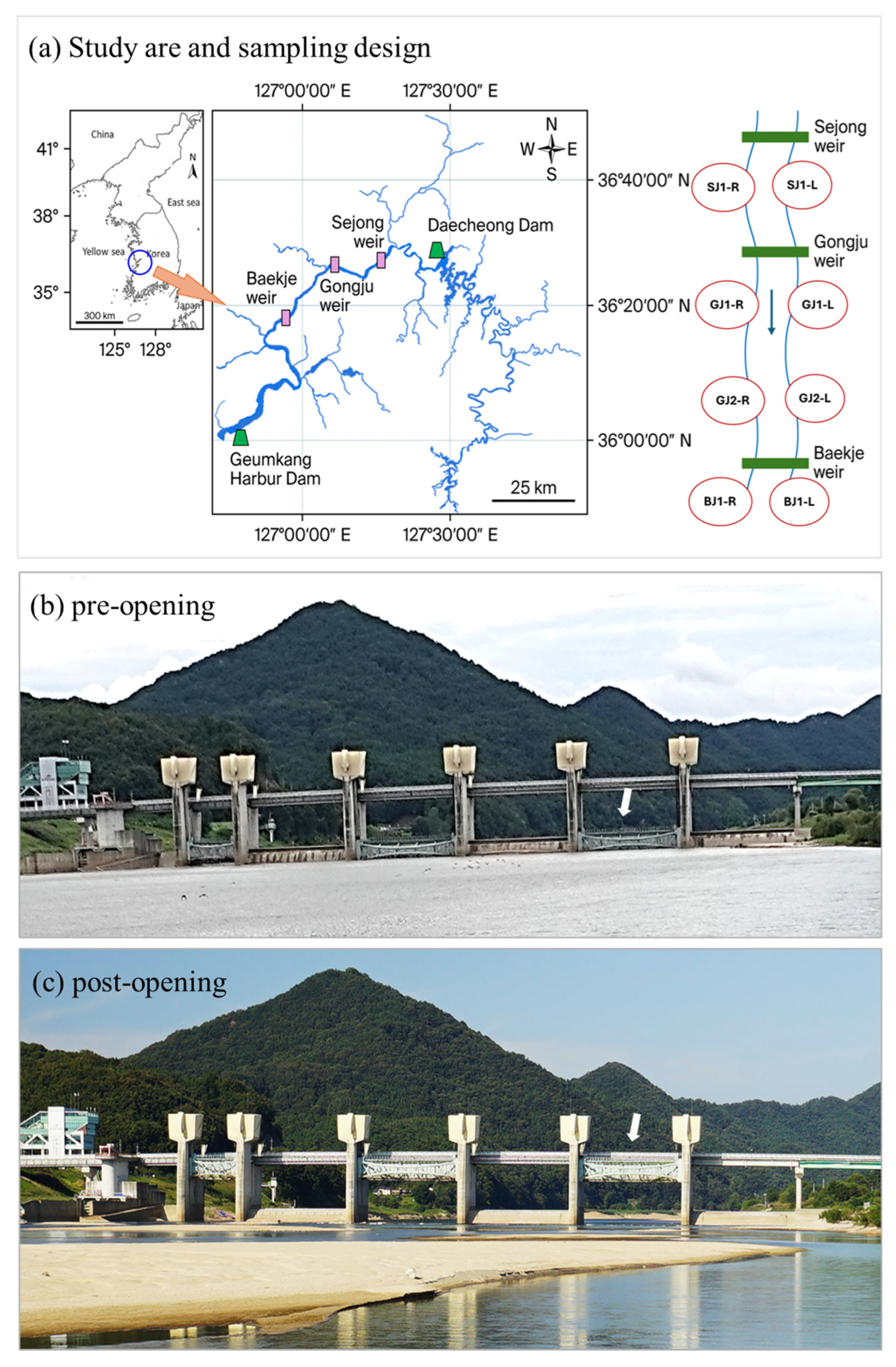
Earlier operational adjustments had already occurred at some individual weirs, particularly Sejong Weir; however, the present study evaluates benthic diatom assemblages under coordinated partial-opening and related hydrological-management conditions across the Sejong, Gongju, and Baekje weirs during the 2020–2024 monitoring period [21,33]. To assess spatiotemporal ecological responses under these conditions, four principal site positions (SJ1, GJ1, GJ2, and BJ1) were established in relation to the three weirs (Figure 1). At each site position, paired sampling locations on the left (L) and right (R) riverbanks yielded eight bank-specific biomonitoring stations in the final sampling design, with bank orientation defined consistently according to downstream flow direction. Surveys were conducted on 11 campaign dates retained in the final analytical matrix: 22 June 2020, 27 April 2021, 9 May 2021, 27 May 2021, 29 September 2022, 25 October 2022, 20 June 2023, 8 August 2023, 10 September 2023, 27 October 2023, and 14 June 2024 (Table S3). Because the final analytical matrix includes only samples retained for analysis, some campaign dates are represented by incomplete site coverage. Peak monsoon periods were mostly excluded to improve comparability and field safety, although selected summer observations were retained when conditions allowed. Current velocity and discharge were not measured at each station during each survey and are therefore acknowledged as important limitations of the present study. Field surveys followed national river bioassessment protocols [39].
To evaluate whether riverbank position influenced community composition, epilithic diatom samples were initially collected from both banks (L and R). Preliminary bank-position comparisons were conducted using Bray–Curtis dissimilarities with PERMANOVA (adonis2) and PERMDISP (betadisper). Because bank position was not treated as a focal explanatory factor in the present study, subsequent analyses focused on temporal and spatial patterns represented in the final unit-sum relative-abundance matrix (Table S2), rather than on explicit left–right bank contrasts. The bank-position test results are summarized together with β-diversity partitioning outputs in Table S1 (see Section 2.4).

2.2. Epilithic Diatom Sampling and Identification

Epilithic diatom samples were collected from cobbles in riffles and shallow runs, targeting representative periphytic communities. Biofilms were brushed from a 5 × 5 cm area using sterilized toothbrushes, suspended in distilled water, and preserved with Lugol’s iodine. Samples were stored at 4 °C until laboratory analysis. The sampled area was standardized by placing a 5 × 5 cm acrylic template directly onto cobble surfaces during each sampling to ensure consistency across sites and years.
Organic material was oxidized using potassium permanganate (KMnO4) and hydrochloric acid (HCl), and cleaned frustules were mounted on slides with Naphrax® (Brunel Microscoopes Ltd., Chippenham, UK). At least 400 valves per sample were identified to the lowest possible taxonomic level under 1000× magnification, referencing standard floras [40,41,42,43]. All diatom taxa were verified against AlgaeBase [44], and valid author citations are provided at the first mention of each species name.
For all comparative and statistical analyses, diatom composition is expressed as relative abundances (%) derived from standardized counts, following established bioassessment practices that emphasize reproducibility and comparability across sites and years. Community attributes were assessed using these relative abundance data to calculate dominance [45], Shannon diversity [46], species richness [47], and Pielou’s evenness [48]. All indices were analyzed in their original, non-transformed form. The transformations applied to species abundance matrices for multivariate analyses are described in Section 2.4.

2.3. Water Quality Measurements and Nutrient Analysis

In situ water-quality variables, including temperature (°C), pH, dissolved oxygen (DO, mg L−1), electrical conductivity (EC, µS cm−1), and turbidity (NTU), were measured using a YSI ProDSS multiparameter probe (YSI Inc., Yellow Springs, OH, USA; accuracy: ±0.1 °C for temperature, ±0.2 mg L−1 for DO, and ±1% for EC). Calibration was performed prior to each field campaign following the manufacturer’s protocols. Water samples for physicochemical and nutrient analyses were collected on the same dates and at the same bank-specific biomonitoring stations as the diatom samples during each field campaign. Water samples were collected in sterile polyethylene bottles, immediately refrigerated, and transported to the laboratory within 24 h for chemical analyses.
Nutrient concentrations were determined according to standardized methods [39] and corresponding ISO protocols to ensure comparability across sites and sampling periods: nitrate nitrogen (NO3−-N; ISO 7890-3:1988 [49]), ammonium nitrogen (NH4+-N; ISO 7150-1:1984 [50]), total nitrogen (TN; ISO 11905-1:1997 [51]), orthophosphate phosphorus (PO43−-P; ISO 6878:2004 [52]), and total phosphorus (TP; ISO 15681-2:2003 [53]). Biochemical oxygen demand (BOD5) was determined using the dilution method (ISO 5815-1:2003 [54]). Chlorophyll-a (Chl-a) was measured spectrophotometrically using a Hitachi U-2900 spectrophotometer (Hitachi, Tokyo, Japan) following acetone extraction, with an analytical precision of ±0.5 µg L−1. All analyses were performed in triplicate for quality control.
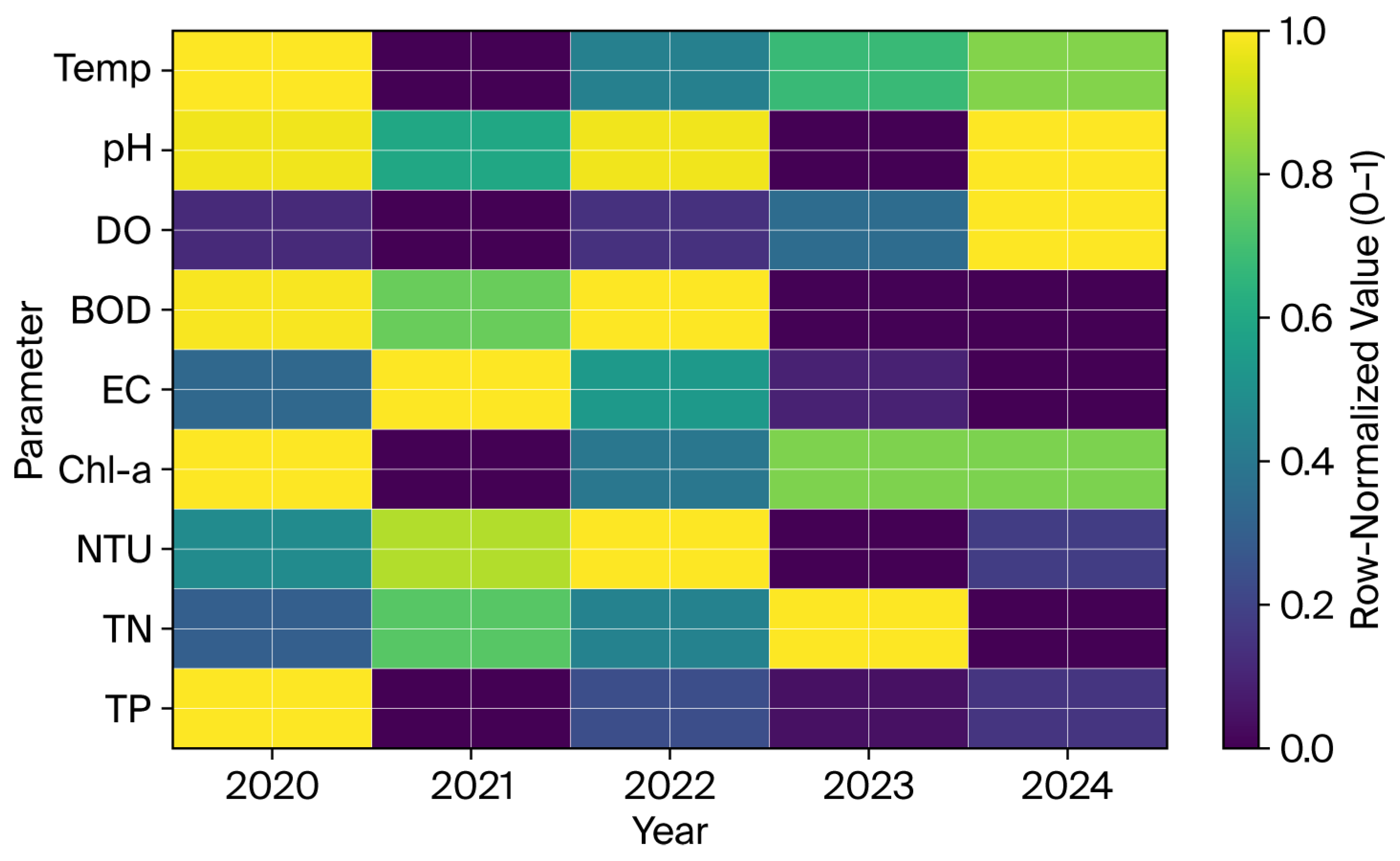
To facilitate comparison with diatom assemblage metrics based on relative abundances, nutrient and water-quality variables were treated as standardized continuous descriptors in multivariate analyses (Section 2.4). Because these measurements were campaign-based rather than high-frequency antecedent time series, they are interpreted here as contemporaneous environmental descriptors rather than exhaustive representations of short-term hydrological or nutrient dynamics. For visualization in Figure 2, annual mean values across the eight bank-specific biomonitoring stations were averaged to provide a basin-scale descriptive overview. Each parameter was normalized within its annual range (0–1) to emphasize relative interannual variability rather than absolute magnitudes. Detailed site-level spatiotemporal variability is presented in Figure S1.

2.4. Statistical Analyses and Ecological Modeling

All statistical analyses were conducted in R (v4.3.1) [55] and PAST (v4.11) [56]. All community-level analyses were based exclusively on relative-abundance data; absolute density values were not used in any statistical tests.
Raw diatom valve counts were standardized on a per-sample basis to generate a unit-sum relative-abundance matrix, in which the relative abundances of taxa within each sample sum to 1.0. This matrix (Table S2; see the Supplementary Analytical Framework) served as the sole input for all community-level analyses, thereby ensuring comparability among samples and consistency with the assumptions of distance-based and diversity analyses.
Transformations were applied only when required by the analytical framework. For ordination methods based on Euclidean geometry, including principal component analysis (PCA) and distance-based redundancy analysis (dbRDA), the relative-abundance matrix was Hellinger-transformed [57]. In contrast, Bray–Curtis-based analyses, including non-metric multidimensional scaling (NMDS), β-diversity partitioning, PERMANOVA, PERMDISP, and indicator species analysis, were conducted on non-transformed relative-abundance data. Diversity indices, including Shannon diversity, richness, evenness, and dominance, were calculated exclusively from non-transformed relative abundances. Log(x + 1) transformation was applied only for visualization and was not used as input for statistical testing.
Differences in Shannon diversity (H′), richness, evenness, and dominance between the earlier monitoring period (2020–2021) and the later monitoring period (2022–2024) were evaluated after testing for normality [58]. These temporal groupings represent analytical monitoring phases within the study window rather than true pre-intervention and post-intervention baseline states. Paired t-tests were used when parametric assumptions were satisfied; otherwise, Wilcoxon signed-rank tests were applied [59]. Effect sizes (Cohen’s d or r) were reported alongside p-values, and false discovery rate (FDR) correction [60] was applied to account for multiple comparisons.
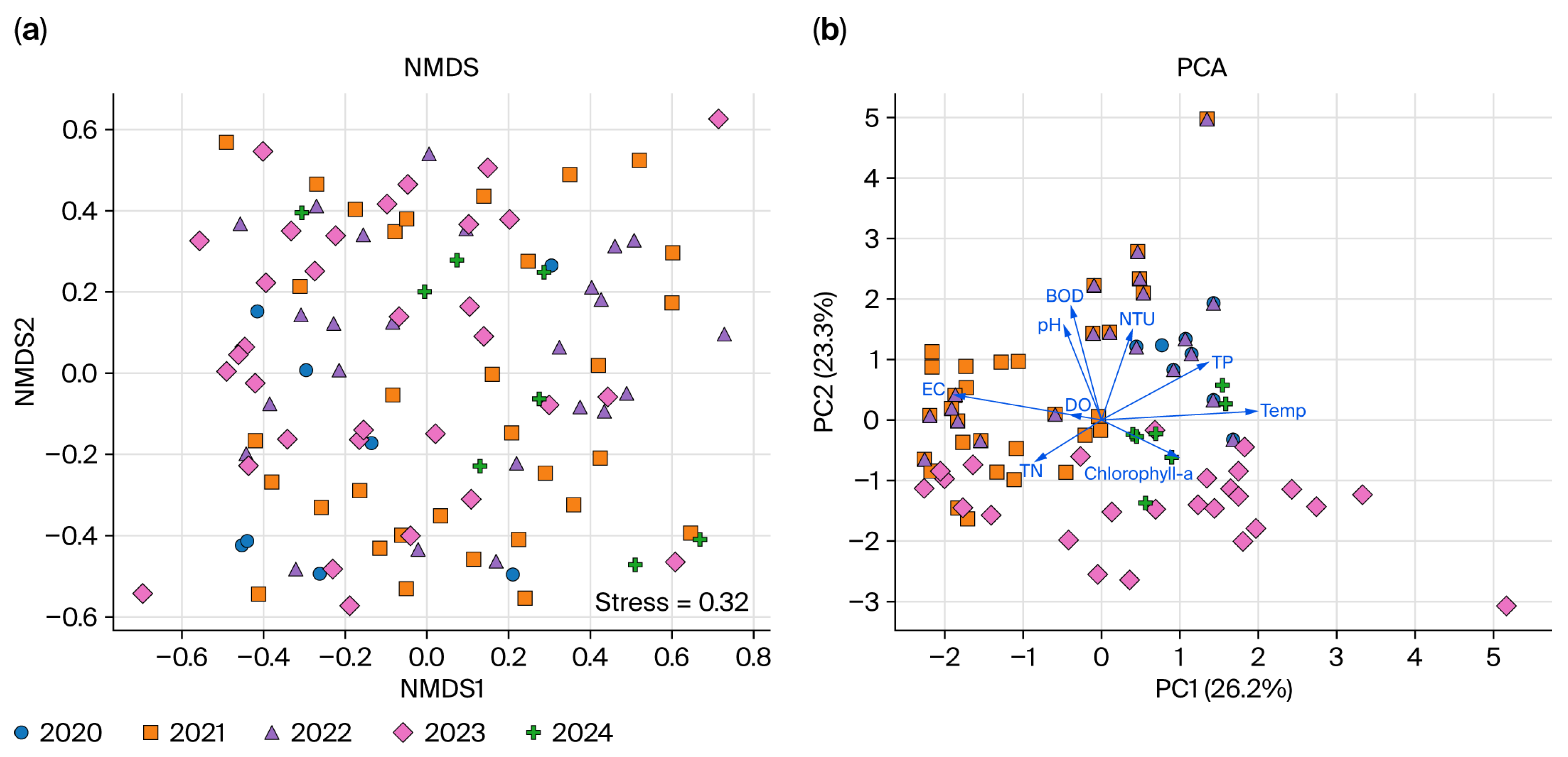
Community composition was further examined using multivariate ordination. NMDS based on Bray–Curtis dissimilarities was used to summarize compositional patterns, with stress values around 0.3 interpreted as indicating moderate fit. PCA was applied to Hellinger-transformed species data and standardized environmental variables to identify major gradients, and environmental vectors were fitted using envfit() to aid interpretation. dbRDA was used to constrain assemblage composition by measured environmental variables, and the resulting ordination is presented in Figure S1.
β-diversity was partitioned into turnover and nestedness components using the betapart package [61], thereby quantifying the relative contributions of species replacement and nested species loss or gain. Group differences in community structure were evaluated using PERMANOVA and PERMDISP [62,63]. SIMPER analysis was used to identify taxa contributing most strongly to between-group dissimilarities [64]. In addition, site-level mean Bray–Curtis dissimilarities were correlated with local Shannon diversity (H′) to assess descriptive associations between compositional uniqueness and diversity.
Indicator species analysis (ISA) was conducted using the indicspecies package [65] with 999 permutations to identify taxa significantly associated with each temporal group.
Random forest (RF) regression and generalized additive models (GAMs) were used as complementary exploratory tools. RF regression (500 trees) was applied to summarize associations between campaign-based water-quality variables and Shannon diversity, rather than to infer primary environmental drivers. Variable importance was assessed using permutation-based changes in R2, and partial dependence plots were used only to visualize non-linear patterns descriptively. GAMs with cubic regression splines (mgcv package) [66] were used to characterize non-linear temporal trends in diversity indices.

3. Results

3.1. Spatiotemporal Trends in Water Quality and Diatom Community Indices

Annual basin-wide means of water-quality parameters exhibited clear interannual variation across the eight monitoring sites during the study period (2020–2024) (Figure 2; Supplementary Figures S1 and S2). Total phosphorus (TP), total nitrogen (TN), and chlorophyll-a concentrations declined after 2021, while biochemical oxygen demand (BOD5) and turbidity (NTU) also decreased. Dissolved oxygen (DO) increased over the same period, whereas electrical conductivity (EC) showed moderate interannual fluctuations. Because the water-quality dataset was collected at campaign intervals rather than at high frequency, these patterns are interpreted as basin-scale descriptive context for the biological results rather than as direct evidence of short-term drivers of diatom change.
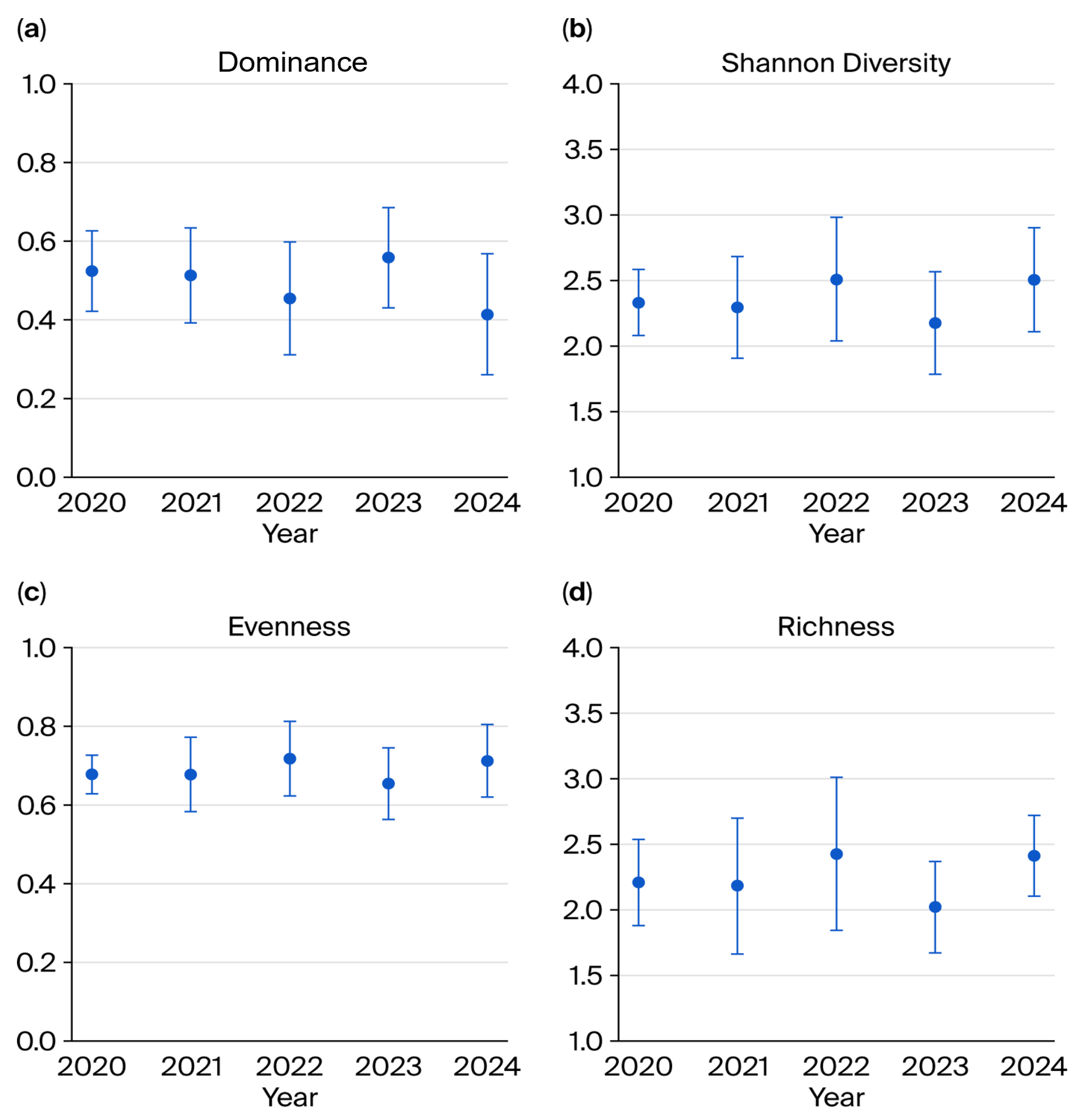
Benthic diatom community indices calculated from relative-abundance data also varied among years (Figure 3). Mean dominance values decreased after 2021, whereas Shannon diversity (H′), Pielou’s evenness (J′), and Margalef richness (e′) showed higher mean values in 2022–2024 compared with 2020–2021. Interannual variability of all indices is summarized as mean ± SD, and no ecological interpretation is included at this stage (Figure 3).

3.2. Temporal Dynamics of Diatom Diversity and Community Dissimilarit

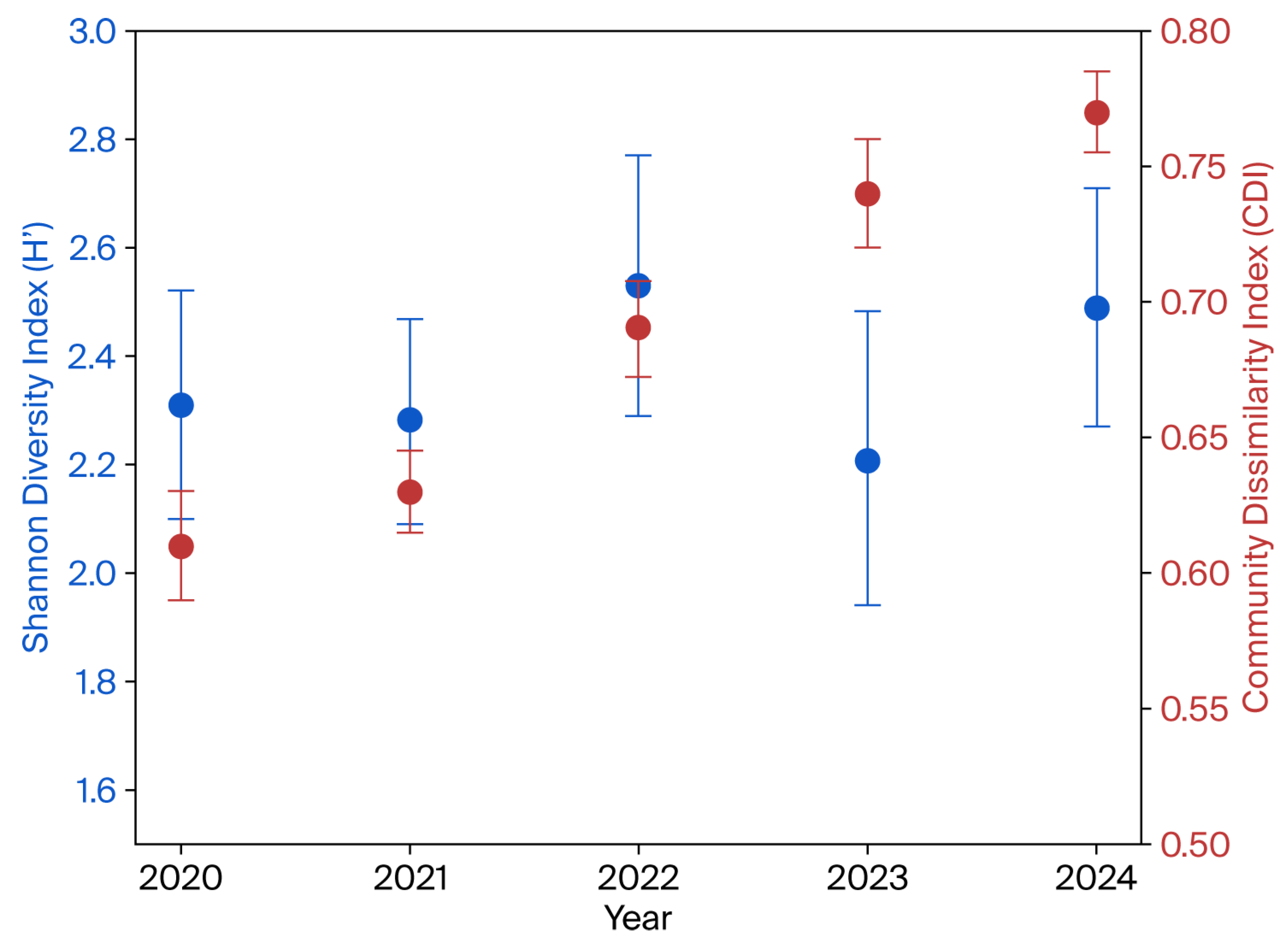
Mean Community Dissimilarity Index (CDI) values increased from 0.61 (2020) to 0.77 (2024), with the largest increase occurring between 2021 and 2022 (Figure 4). CDI values during 2022–2024 were higher than those during 2020–2021 (Wilcoxon signed-rank test, p < 0.01). Mean Shannon diversity (H′) also varied among years, with higher values observed in 2022 and 2024 (Figure 4).
β-diversity partitioning based on the Baselga framework [47] indicated that species turnover accounted for 72% of total dissimilarity, whereas nestedness accounted for 28% (Table S1). These values summarize the relative contributions of turnover and nestedness to compositional variation across the study period.

3.3. Ordination Analysis and Environmental Gradients

Non-metric multidimensional scaling (NMDS) based on Bray–Curtis dissimilarities showed partial separation between assemblages sampled during 2020–2021 and those sampled during 2022–2024 in ordination space (Figure 5a). The NMDS solution had a stress value of 0.32. Assemblages from 2022–2024 occupied a broader ordination space, consistent with greater dispersion in later years.
Principal component analysis (PCA) of environmental variables indicated that the first two axes explained 26.2% (PC1) and 23.3% (PC2) of total variance, respectively (Figure 5b). Nutrient- and turbidity-related variables (TP, TN, chlorophyll-a, NTU) exhibited high loadings along the major gradients. Distance-based redundancy analysis (dbRDA) yielded comparable gradient structures (Figure S3).

3.4. Exploratory Associations Between Diatom Diversity and Campaign-Based Water-Quality Descriptors

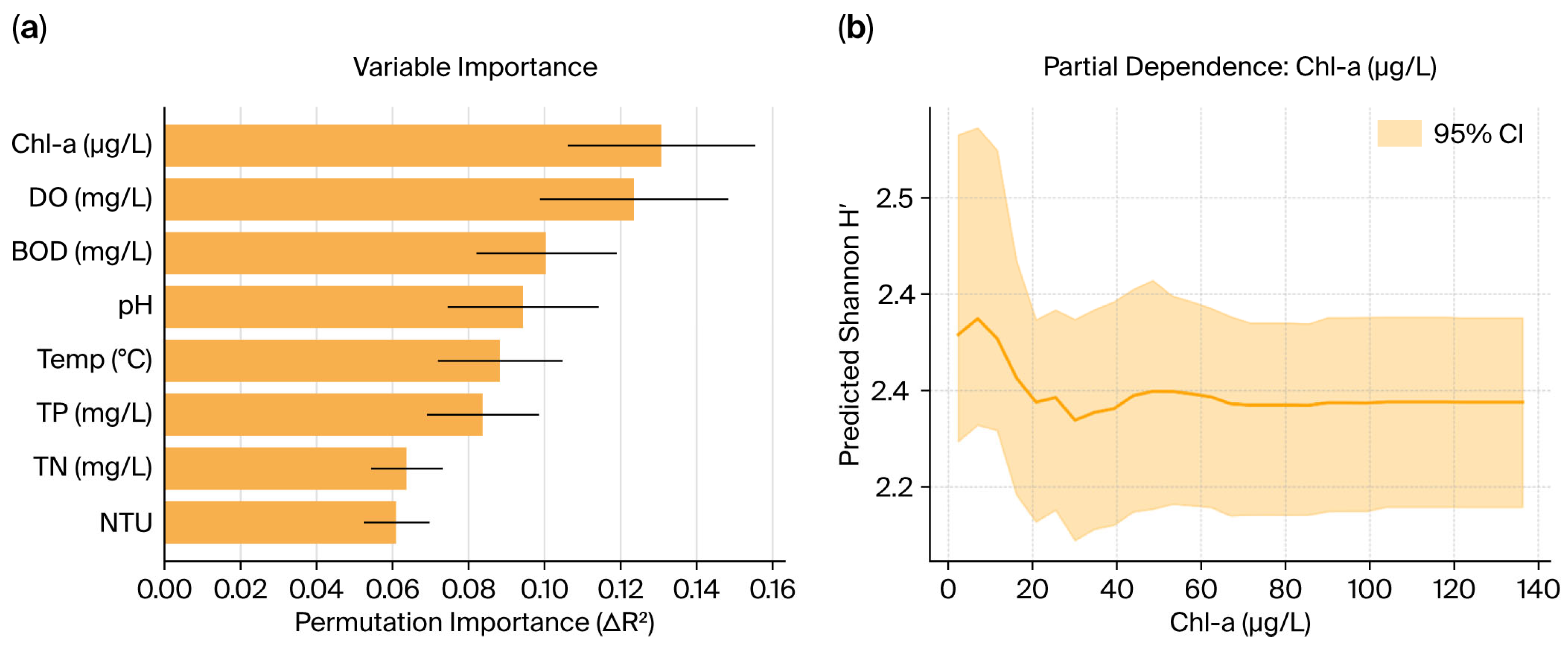
Random forest regression explained very little variation in Shannon diversity (out-of-bag R2 = −0.03; RMSE = 0.42; Figure 6a), and the resulting variable rankings should therefore be interpreted only as exploratory summaries of association. Permutation-based variable importance ranked chlorophyll-a, dissolved oxygen, biochemical oxygen demand, and pH as measured variables with relatively higher importance, whereas total nitrogen and turbidity showed lower importance. Given the low predictive performance of the model and the campaign-based frequency of the environmental dataset, these results are interpreted only as exploratory associations rather than as robust evidence for the primary environmental correlates of diatom diversity.
Partial dependence analysis indicated a weak, non-linear relationship between chlorophyll-a concentration and predicted Shannon diversity, with higher predicted values at intermediate concentrations (Figure 6b). This pattern is shown for descriptive completeness only and should not be overinterpreted mechanistically.

3.5. Indicator Taxa Associated with Earlier and Later Monitoring Periods

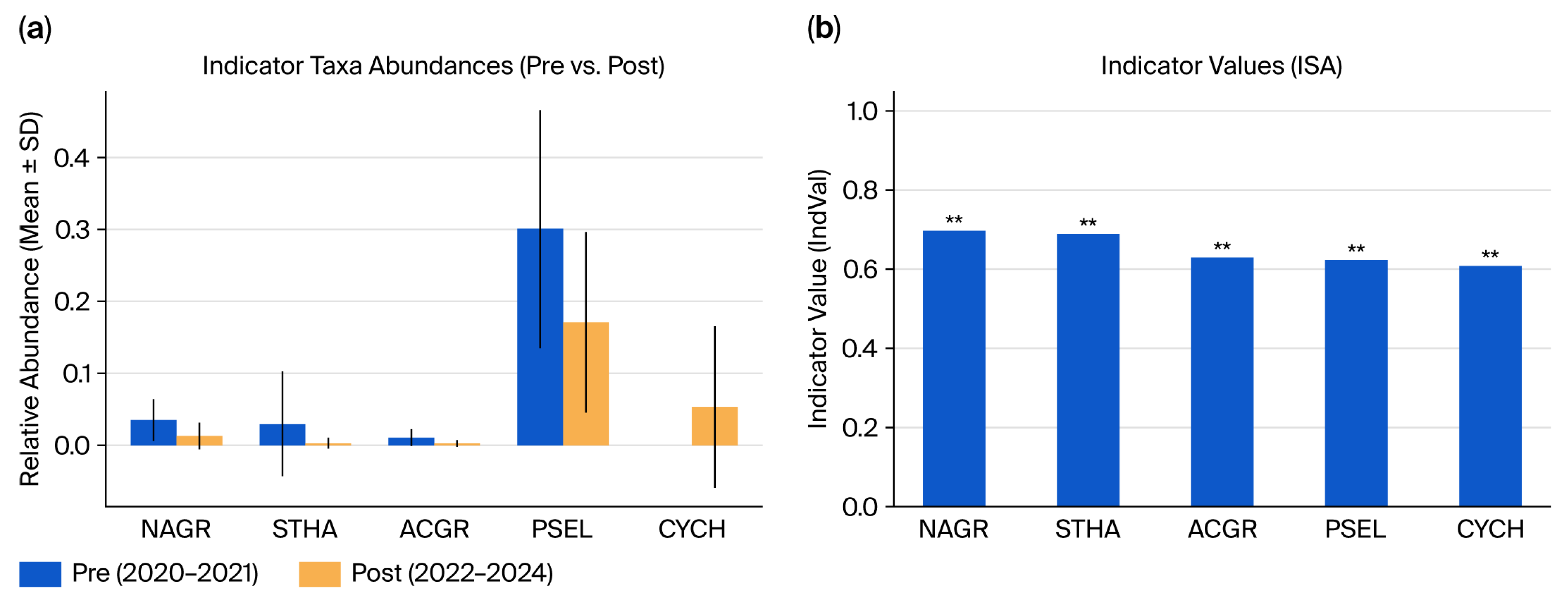
Indicator species analysis (ISA; 999 permutations) identified five taxa with indicator values > 0.6 (p < 0.01). Navicula gregaria, Stephanodiscus hantzschii, and Achnanthidium gracillimum were associated with the earlier monitoring period (2020–2021), whereas Pseudostaurosira elliptica and Cyclotella choctawhatcheeana were associated with the later monitoring period (2022–2024). The mean relative abundances (±SD) of these taxa differed between the two monitoring periods, and their corresponding indicator values are presented in Figure 7.

4. Discussion

4.1. Hydrological Change and Ecological Responses

During the coordinated partial-opening management period, benthic diatom assemblages exhibited gradual and measurable changes in community structure rather than abrupt shifts. Diversity-related indices, including Shannon diversity, richness, and evenness, tended to increase during the later monitoring period, whereas dominance declined. These temporal patterns coincided with partial re-establishment of flow connectivity; however, they do not imply direct causality. Instead, the observed responses are more appropriately interpreted as progressive community reorganization rather than immediate or complete ecological recovery, thereby avoiding overstatement of system resilience.
Similar associations between enhanced hydraulic variability and benthic community responses have been reported in other river restoration studies, where increased flow heterogeneity and substrate diversity were linked to gradual changes in periphytic and macroinvertebrate assemblages [10,16,67]. Comparable patterns have also been documented in Korean rivers influenced by weir regulation and subsequent flow modification [21,37]. Collectively, these studies indicate that hydrological interventions are often associated with slow, multi-year ecological adjustment rather than rapid system-wide recovery. The magnitude and timing of responses are known to depend strongly on local flow regimes, geomorphic context, and disturbance history [67,68].

4.2. Broader Implications, Historical Context, and Baseline Constraints

The temporal trajectories observed in this study align broadly with international river restoration literature while also highlighting an important interpretive constraint: a site-specific pre-construction or pre-opening epilithic diatom baseline is not available for the exact reaches studied here. For that reason, the present results are interpreted against two contextual benchmarks: (i) published regional work showing how benthic diatom assemblages respond to environmental gradients in Korean rivers [37], and (ii) prior studies documenting hydromorphological and physicochemical changes associated with weir operation in the Geum River system [21,34,35,36]. Viewed in that context, the observed assemblage shifts are informative not because they reconstruct a pristine historical state, but because they show how diatom communities reorganize under partially reconnected, still-managed monsoonal river conditions.
These contrasts suggest that while general restoration principles may be shared across regions, the pace and direction of community change are strongly modulated by climatic and hydrological regimes. This underscores the importance of regionally calibrated assessment frameworks that explicitly account for hydrological variability and disturbance intensity [69,70,71]. Diatom-based indices remain useful for tracking temporal ecological change, but direct cross-regional comparisons should be approached cautiously due to differences in species pools, disturbance regimes, environmental context, and baseline availability [24,27].

4.3. Exploratory Associations with Measured Environmental Variables

Random forest analyses identified chlorophyll-a, dissolved oxygen, biochemical oxygen demand, and pH as relatively influential variables; however, the very low explanatory power of the models indicates that these relationships are exploratory rather than predictive. In addition, because the water-quality data were collected only during each sampling campaign rather than as higher-frequency antecedent series, these variables should be interpreted as contemporaneous descriptors of site conditions rather than as definitive drivers of diatom diversity. Accordingly, the RF results are interpreted as descriptive associations rather than evidence for environmental control over diatom diversity.
The weak, non-linear association between chlorophyll-a concentration and Shannon diversity—characterized by higher diversity at intermediate concentrations—resembles patterns often discussed in the context of the intermediate disturbance hypothesis. However, this similarity should not be interpreted as mechanistic support for that hypothesis in the present system [72,73]. In flow-regulated rivers, hydrological variability, substrate heterogeneity, and disturbance frequency are likely to exert stronger influence on benthic diatom assemblages than water-quality variables alone [74,75,76].
Future modeling efforts would benefit from integrating physical habitat descriptors, hydrological metrics, and biological trait information to better characterize drivers of community dynamics and recovery trajectories following hydrological interventions [77,78,79].

4.4. Indicator Taxa and Ecological Trajectories

Indicator species analysis identified taxa that were statistically associated with the earlier and later monitoring periods, serving as diagnostic descriptors of assemblage composition rather than quantitative measures of species turnover. Earlier-period assemblages (2020–2021) were characterized by Navicula gregaria, Stephanodiscus hantzschii, and Achnanthidium gracillimum, whereas later-period assemblages (2022–2024) were associated with Pseudostaurosira elliptica and Cyclotella choctawhatcheeana.
These temporal shifts in characteristic taxa coincided with changes in hydrological and nutrient conditions, but they do not constitute direct evidence of deterministic species replacement or improved ecological status. Similar transitions from eutrophic- or low-flow-associated taxa toward more flow-associated diatoms have been reported in Korean rivers [37] and in European restoration contexts [16,80].

4.5. Methodological Considerations and Limitations

Several methodological limitations should be acknowledged. First, no site-specific epilithic diatom dataset was available from before weir construction or from a fully comparable pre-opening phase, which limits direct comparison with a historical “normal” community state. Second, current velocity and discharge were not measured at each station and survey, and the water-quality dataset represents campaign-based observations rather than high-frequency antecedent conditions. These constraints likely reduced our ability to resolve short-term hydraulic drivers of community change and should be kept in mind when interpreting water-quality associations.
Third, exclusion of peak monsoon periods—implemented to minimize flood-related sampling constraints—may have reduced sensitivity to the short-term disturbance and recovery dynamics characteristic of monsoonal rivers [37,81]. Finally, taxonomic diversity indices alone cannot fully capture functional, productivity-related, or ecosystem-level responses. Future restoration assessments would benefit from multi-metric approaches integrating functional traits, molecular tools, and ecosystem process indicators [78,81,82,83].

5. Conclusions

This study shows that partial weir opening was temporally associated with measurable changes in benthic diatom diversity and community composition, expressed as gradual shifts in assemblage structure over multiple years within a coordinated monitoring period. Using multivariate ordination, random forest analysis, and indicator species analysis, we identified statistically supported patterns of community variation that coincided with partial hydrological reconnection, without implying direct causal restoration effects.
Shannon diversity increased by approximately 25%, dominance declined by ~32%, and taxon richness increased by ~33% during the later monitoring period based on unit-sum relative-abundance data. These changes are most appropriately interpreted as evidence of progressive community reorganization under changing hydrological-management conditions, rather than as proof of complete ecological recovery or enhanced resilience. The observed trajectories suggest that partial re-establishment of longitudinal connectivity may be associated with gradual ecological adjustment in flow-regulated rivers, particularly where full dam removal is not feasible and true historical biological baselines are unavailable.
From a management perspective, benthic diatom assemblages provide a sensitive and cost-effective means of tracking ecological change when interpreted as descriptors of community structure rather than as direct measures of ecological status or restoration success. However, limitations include exclusion of peak monsoon periods, reliance on taxonomic and relative-abundance metrics, and the limited explanatory power of water-quality-based models.
Future restoration assessments would benefit from integrating hydrological metrics, habitat-scale descriptors, functional or trait-based indicators, and emerging molecular approaches. Overall, this study indicates that partial weir opening can be associated with measurable ecological change in monsoonal rivers, while underscoring the need for cautious interpretation and regionally calibrated, long-term monitoring frameworks.

Supplementary Materials

The following supporting information can be downloaded at: https://www.mdpi.com/article/10.3390/w18080977/s1, Table S1: Summary of β-diversity partitioning and multivariate diagnostics based on the unit-sum relative-abundance matrix, Table S2. Species-level unit-sum relative-abundance matrix, Table S3. Sampling calendar and analytical grouping, Table S4. Spatial characteristics of sampling sites relative to weirs, Figure S1. Site-level spatiotemporal heatmaps of water-quality variables across eight bank-specific biomonitoring stations (2020–2024), Figure S2. Site-level spatiotemporal heatmaps of benthic diatom ecological indices across eight bank-specific biomonitoring stations (2020–2024), Figure S3. Distance-based redundancy analysis (dbRDA) of benthic diatom assemblages constrained by environmental variables (2020–2024).

Author Contributions

Conceptualization, Y.-J.K. and B.-H.K.; Methodology, S.-O.H. and B.-H.H.; Software, S.-O.H.; Formal Analysis, S.-O.H., B.-H.H., Y.-J.K. and B.-H.K.; Investigation, Y.-J.K. and B.-H.K.; Data Curation, S.-O.H., B.-H.H., Y.-J.K. and B.-H.K.; Writing—Original Draft Preparation, S.-O.H.; Writing—Review and Editing, Y.-J.K. and B.-H.K.; Supervision, B.-H.K.; Project Administration, Y.-J.K. and B.-H.K. All authors have read and agreed to the published version of the manuscript.

Funding

This research received no external funding.

Data Availability Statement

The original contributions presented in this study (including the species-level relative-abundance matrix and associated metadata) are included in the article and its Supplementary Materials. The primary analytical dataset is provided as a separate Excel file (Table S2), and additional supporting information is available in the Supplementary Information file (Supplementary Tables S1–S4 and Figures S1–S3). R scripts used for data preprocessing and statistical analyses are available from the corresponding author upon reasonable request.

Acknowledgments

The authors sincerely thank the anonymous reviewers for their constructive comments and insightful suggestions, which significantly improved the clarity, rigor, and overall quality of this manuscript.

Conflicts of Interest

The authors declare no conflict of interest.

Abbreviations

The following abbreviations are used in this manuscript:
BDBenthic Diatoms
RA matrixUnit-sum Relative-Abundance matrix (Σp = 1.0)
CDICommunity Dissimilarity Index (Bray–Curtis-based)
β-divBeta diversity
β_turnSpecies Replacement Component of β-Diversity (Turnover)
β_nestSpecies Loss/Gain Component of β-Diversity (Nestedness)
NMDSNon-metric Multidimensional Scaling
PCAPrincipal Component Analysis
dbRDADistance-Based Redundancy Analysis
PERMANOVAPermutational Multivariate Analysis of Variance
PERMDISPPermutational Analysis of Multivariate Dispersion
SIMPERSimilarity Percentage Analysis
ISAIndicator Species Analysis
RFRandom Forest
H′Shannon Diversity Index
J′Pielou’s Evenness
e′Margalef Richness
DDominance Index
TPTotal Phosphorus
TNTotal Nitrogen
Chl-aChlorophyll-a
BOD5Biochemical Oxygen Demand (5-day)
DODissolved Oxygen
ECElectrical Conductivity
NTUTurbidity
EMPEarlier Monitoring Period (2020–2021)
LMPLater Monitoring Period (2022–2024)

References

  1. Baxter, R.M. Environmental effects of dams and impoundments. Annu. Rev. Ecol. Syst. 1977, 8, 255–283. [Google Scholar] [CrossRef]
  2. Petts, G.E.; Gurnell, A.M. Dams and geomorphology: Research progress and future directions. Geomorphology 2005, 71, 27–47. [Google Scholar] [CrossRef]
  3. Wohl, E.; Lane, S.N.; Wilcox, A.C. The science and practice of river restoration. Water Resour. Res. 2015, 51, 5974–5997. [Google Scholar] [CrossRef]
  4. Poff, N.L.; Ward, J.V. Implications of streamflow variability and predictability for lotic community structure. Can. J. Fish. Aquat. Sci. 1989, 46, 1805–1818. [Google Scholar] [CrossRef]
  5. Ward, J.V.; Stanford, J.A. Ecological connectivity in alluvial river ecosystems. Regul. Rivers 1995, 11, 105–119. [Google Scholar] [CrossRef]
  6. Nilsson, C.; Reidy, C.A.; Dynesius, M.; Revenga, C. Fragmentation of the world’s large river systems. Science 2005, 308, 405–408. [Google Scholar] [CrossRef]
  7. Vörösmarty, C.J.; McIntyre, P.B.; Gessner, M.O.; Dudgeon, D.; Prusevich, A.; Green, P.; Glidden, S.; Bunn, S.E.; Sullivan, C.A.; Liermann, C.R.; et al. Global threats to human water security and river biodiversity. Nature 2010, 467, 555–561. [Google Scholar] [CrossRef]
  8. Stendera, S.; Adrian, R.; Bonada, N.; Cañedo-Argüelles, M.; Hugueny, B.; Januschke, K.; Pletterbauer, F.; Hering, D. Drivers and stressors of freshwater biodiversity patterns across different ecosystems and scales: A review. Hydrobiologia 2012, 696, 1–28. [Google Scholar] [CrossRef]
  9. Doyle, M.W.; Stanley, E.H.; Orr, C.H.; Selle, A.R.; Sethi, S.A.; Harbor, J.M. Stream ecosystem response to small dam removal: Lessons from the Heartland. Geomorphology 2005, 71, 227–244. [Google Scholar] [CrossRef]
  10. Magilligan, F.J.; Graber, B.E.; Nislow, K.H.; Chipman, J.W.; Sneddon, C.S.; Fox, C.A. River restoration by dam removal: Enhancing connectivity at watershed scales. Elementa 2016, 4, 000108. [Google Scholar] [CrossRef]
  11. Bellmore, J.R.; Pess, G.R.; Duda, J.J.; O’Connor, J.E.; East, A.E.; Foley, M.M.; Wilcox, A.C.; Major, J.J.; Shafroth, P.B.; Morley, S.A.; et al. Conceptualizing ecological responses to dam removal: If you remove it, what’s to come? BioScience 2019, 69, 12–14. [Google Scholar] [CrossRef]
  12. Duda, J.J.; Freilich, J.E.; Schreiner, E.G. Baseline studies in the Elwha River ecosystem prior to dam removal: Introduction to the special issue. Northwest Sci. 2008, 82, 1–12. [Google Scholar] [CrossRef]
  13. Duda, J.J.; Coe, H.J.; Morley, S.A.; Kloehn, K.K. Establishing spatial trends in water chemistry and stable isotopes (δ15N and δ13C) in the Elwha River prior to dam removal and salmon recolonization. River Res. Appl. 2011, 27, 1169–1181. [Google Scholar] [CrossRef]
  14. Shafroth, P.B.; Perry, L.G.; Helfield, J.M.; Chenoweth, J.; Brown, R.L. Vegetation responses to large dam removal on the Elwha River, Washington, USA. Front. Ecol. Evol. 2024, 12, 1272921. [Google Scholar] [CrossRef]
  15. O’Hanley, J.R.; Tomberlin, D. Optimizing the removal of small fish passage barriers. Environ. Model. Assess. 2005, 10, 85–98. [Google Scholar] [CrossRef]
  16. Morandi, B.; Piégay, H.; Lamouroux, N.; Vaudor, L. How is success or failure in river restoration projects evaluated? Feedback from French restoration projects. J. Environ. Manag. 2014, 137, 178–188. [Google Scholar] [CrossRef]
  17. Bednarek, A.T. Undamming rivers: A review of the ecological impacts of dam removal. Environ. Manag. 2001, 27, 803–814. [Google Scholar] [CrossRef]
  18. Shin, Y.-J.; Midgley, G.F.; Archer, E.R.M.; Arneth, A.; Barnes, D.K.A.; Chan, L.; Hashimoto, S.; Hoegh-Guldberg, O.; Insarov, G.; Leadley, P.; et al. Actions to halt biodiversity loss generally benefit the climate. Glob. Change Biol. 2022, 28, 2846–2874. [Google Scholar] [CrossRef]
  19. Yoon, T.; Rhodes, C.; Shah, F.A. Upstream water resource management to address downstream pollution concerns: A policy framework with application to the Nakdong River basin in South Korea. Water Resour. Res. 2015, 51, 787–805. [Google Scholar] [CrossRef]
  20. Koo, J.H.; Yoon, J.Y.; Sim, K.H.; Cho, H.K. A counterfactual assessment for interagency collaboration on water quality: The case of the Geum River basin, South Korea. Water Int. 2015, 40, 664–688. [Google Scholar] [CrossRef]
  21. Kim, S.-K.; Joo, G.-J.; Choi, J.-Y. Effect of gated weir opening on the topography and zooplankton community of Geum River, South Korea. Land 2022, 11, 529. [Google Scholar] [CrossRef]
  22. Biggs, B.J.F.; Stevenson, R.J.; Lowe, R.L. A habitat matrix conceptual model for stream periphyton. Arch. Hydrobiol. 1998, 143, 21–56. [Google Scholar] [CrossRef]
  23. Rimet, F.; Bouchez, A. Life-forms, cell-sizes and ecological guilds of diatoms in European rivers. Knowl. Manag. Aquat. Ecosyst. 2012, 406, 01. [Google Scholar] [CrossRef]
  24. Stevenson, R.J.; Pan, Y.; van Dam, H. Assessing environmental conditions in rivers and streams with diatoms. In The Diatoms: Applications for the Environmental and Earth Sciences, 2nd ed.; Smol, J.P., Stoermer, E.F., Eds.; Cambridge University Press: Cambridge, UK, 2010; pp. 57–84. [Google Scholar]
  25. Bennion, H.; Kelly, M.G.; Juggins, S.; Yallop, M.L.; Burgess, A.; Jamieson, J.; Krokowski, J. Assessment of ecological status in UK lakes using benthic diatoms. Freshw. Sci. 2014, 33, 639–654. [Google Scholar] [CrossRef]
  26. Datta, A.; Marella, T.K.; Tiwari, A.; Wani, S.P. The diatoms: From eutrophic indicators to mitigators. In Application of Microalgae in Wastewater Treatment; Gupta, S.K., Bux, F., Eds.; Springer: Cham, Switzerland, 2019; pp. 19–40. [Google Scholar] [CrossRef]
  27. Jakovljević, O.S.; Popović, S.S.; Živić, I.M.; Stojanović, K.Z.; Vidaković, D.P.; Naunovic, Z.Z.; Krizmanić, J.Ž. Epilithic diatoms in environmental bioindication and trout farm’s effects on ecological quality assessment of rivers. Ecol. Indic. 2021, 128, 107847. [Google Scholar] [CrossRef]
  28. Kahlert, M.; Gottschalk, S. Differences in benthic diatom assemblages between streams and lakes in Sweden and implications for ecological assessment. Freshw. Sci. 2014, 33, 655–669. [Google Scholar] [CrossRef]
  29. Passy, S.I. Diatom ecological guilds display distinct and predictable behavior along nutrient and disturbance gradients in running waters. Aquat. Bot. 2007, 86, 171–178. [Google Scholar] [CrossRef]
  30. Passy, S.I. Continental diatom biodiversity in stream benthos declines as more nutrients become limiting. Proc. Natl. Acad. Sci. USA 2008, 105, 9663–9667. [Google Scholar] [CrossRef] [PubMed]
  31. Kelly, M.; Bennion, H.; Juggins, S.; Krokowski, A.; Jamieson, J.; Burgess, A.; Yallop, M. Assessment of ecological status in UK rivers using diatoms. Freshw. Biol. 2008, 53, 403–422. [Google Scholar] [CrossRef]
  32. Shin, J.; Chung, J. The four major rivers restoration project in South Korea. Proc. Inst. Civ. Eng. Civ. Eng. 2011, 164, 19–26. [Google Scholar] [CrossRef]
  33. Ock, G.; Choi, M.; Kim, J.-C.; Park, H.-G.; Han, J.-H. Evaluation of habitat diversity changes by weir operation of the Sejongbo Weir in Geum River using high-resolution aerial photographs. Ecol. Resil. Infrastruct. 2020, 7, 366–373. [Google Scholar] [CrossRef]
  34. Ko, D.-G.; Choi, J.-W.; An, K.-G. Preliminary ecological assessments of water chemistry, trophic compositions, and the ecosystem health on massive constructions of three weirs in Geum-River watershed. J. Ecol. Environ. 2016, 39, 61–70. [Google Scholar] [CrossRef]
  35. Ahn, J.M.; Lee, S.; Kang, T. Evaluation of dams and weirs operating for water resource management of the Geum River. Sci. Total Environ. 2014, 478, 103–115. [Google Scholar] [CrossRef]
  36. Kim, S.; Noh, H.; Jung, J.; Jun, H.; Kim, H.S. Assessment of the impacts of global climate change and regional water projects on streamflow characteristics in the Geum River Basin in Korea. Water 2016, 8, 91. [Google Scholar] [CrossRef]
  37. Hwang, S.-J.; Kim, N.-Y.; Yoon, S.A.; Kim, B.-H.; Park, M.H.; You, K.-A.; Lee, H.Y.; Kim, H.S.; Kim, Y.J.; Lee, J.; et al. Distribution of benthic diatoms in Korean rivers and streams in relation to environmental variables. Ann. Limnol. 2011, 47, S15–S33. [Google Scholar] [CrossRef]
  38. Mamun, M.; Jargal, N.; An, K.-G. Spatio-temporal characterization of nutrient and organic pollution along with nutrient–chlorophyll-a dynamics in the Geum River. J. King Saud Univ. Sci. 2022, 34, 102270. [Google Scholar] [CrossRef]
  39. American Public Health Association (APHA); American Water Works Association (AWWA); Water Environment Federation (WEF). Standard Methods for the Examination of Water and Wastewater, 23rd ed.; American Public Health Association: Washington, DC, USA; American Water Works Association: Denver, CO, USA; Water Environment Federation: Washington, DC, USA, 2017; Available online: https://www.standardmethods.org (accessed on 19 March 2026).
  40. Krammer, K.; Lange-Bertalot, H. Bacillariophyceae: Naviculaceae, Bacillariaceae, Achnanthaceae, Fragilariaceae; Vols. 2/1–2/4; Gustav Fischer Verlag: Stuttgart, Germany, 1991. [Google Scholar]
  41. Krammer, K. Bacillariophyceae, Teil 2: Bacillariaceae, Epithemiaceae, Surirellaceae; Gustav Fischer Verlag: Stuttgart, Germany, 1988. [Google Scholar]
  42. Krammer, K. Bacillariophyceae, Teil 4: Achnanthaceae. Kritische Ergänzungen zu Navicula (Lineolatae) und Gomphonema; Gustav Fischer Verlag: Stuttgart, Germany, 1991. [Google Scholar]
  43. Krammer, K. Diatoms of Europe. Vol. 3: Cymbella; Koeltz Scientific Books: Königstein, Germany, 2002. [Google Scholar]
  44. Guiry, M.D.; Guiry, G.M. AlgaeBase; National University of Ireland: Galway, Ireland, 2023; Available online: https://www.algaebase.org (accessed on 1 August 2025).
  45. McNaughton, S.J. Structure and function in California grasslands. Ecology 1968, 49, 962–972. [Google Scholar] [CrossRef]
  46. Shannon, C.E.; Weaver, W.W. The Mathematical Theory of Communication; University of Illinois Press: Urbana, IL, USA, 1963. [Google Scholar]
  47. Margalef, R. Information theory in ecology. Gen. Syst. 1958, 3, 36–71. [Google Scholar]
  48. Pielou, E.C. The measurement of diversity in different types of biological collections. J. Theor. Biol. 1966, 13, 131–144. [Google Scholar] [CrossRef]
  49. ISO 7890-3:1988; Water Quality—Determination of Nitrate—Part 3: Spectrometric Method Using Sulfosalicylic Acid. International Organization for Standardization: Geneva, Switzerland, 1988.
  50. ISO 7150-1:1984; Water Quality—Determination of Ammonium—Part 1: Manual Spectrometric Method. International Organization for Standardization: Geneva, Switzerland, 1984.
  51. ISO 11905-1:1997; Water Quality—Determination of Nitrogen—Part 1: Method Using Oxidative Digestion with Peroxodisulfate. International Organization for Standardization: Geneva, Switzerland, 1997.
  52. ISO 6878:2004; Water Quality—Determination of Phosphorus—Ammonium Molybdate Spectrometric Method. International Organization for Standardization: Geneva, Switzerland, 2004.
  53. ISO 15681-2:2003; Water Quality—Determination of Orthophosphate and Total Phosphorus by Flow Analysis (FIA and CFA)—Part 2: Method by Continuous Flow Analysis (CFA). International Organization for Standardization: Geneva, Switzerland, 2003.
  54. ISO 5815-1:2003; Water Quality—Determination of Biochemical Oxygen Demand After n Days (BODn)—Part 1: Dilution and Seeding Method with Allylthiourea Addition. International Organization for Standardization: Geneva, Switzerland, 2003.
  55. R Core Team. R: A Language and Environment for Statistical Computing; R Foundation for Statistical Computing: Vienna, Austria, 2023; Available online: https://www.r-project.org (accessed on 1 March 2026).
  56. Hammer, Ø.; Harper, D.A.T.; Ryan, P.D. PAST: Paleontological statistics software package for education and data analysis. Palaeontol. Electron. 2001, 4, 9. [Google Scholar]
  57. Legendre, P.; Gallagher, E.D. Ecologically meaningful transformations for ordination of species data. Oecologia 2001, 129, 271–280. [Google Scholar] [CrossRef] [PubMed]
  58. Shapiro, S.S.; Wilk, M.B. An analysis of variance test for normality (complete samples). Biometrika 1965, 52, 591–611. [Google Scholar] [CrossRef]
  59. Wilcoxon, F. Individual comparisons by ranking methods. Biom. Bull. 1945, 1, 80–83. [Google Scholar] [CrossRef]
  60. Benjamini, Y.; Hochberg, Y. Controlling the false discovery rate: A practical and powerful approach to multiple testing. J. R. Stat. Soc. Ser. B 1995, 57, 289–300. [Google Scholar] [CrossRef]
  61. Baselga, A.; Orme, C.D.L. betapart: An R package for the study of beta diversity. Methods Ecol. Evol. 2012, 3, 808–812. [Google Scholar] [CrossRef]
  62. Anderson, M.J. A new method for non-parametric multivariate analysis of variance. Austral Ecol. 2001, 26, 32–46. [Google Scholar] [CrossRef]
  63. Anderson, M.J. Distance-based tests for homogeneity of multivariate dispersions. Biometrics 2006, 62, 245–253. [Google Scholar] [CrossRef]
  64. Clarke, K.R. Non-parametric multivariate analyses of changes in community structure. Aust. J. Ecol. 1993, 18, 117–143. [Google Scholar] [CrossRef]
  65. De Cáceres, M.; Legendre, P.; Moretti, M. Improving indicator species analysis by combining groups of sites. Oikos 2010, 119, 1674–1684. [Google Scholar] [CrossRef]
  66. Wood, S.N. Generalized Additive Models: An Introduction with R, 2nd ed.; Chapman and Hall/CRC: Boca Raton, FL, USA, 2017. [Google Scholar] [CrossRef]
  67. Fuller, M.R.; Doyle, M.W.; Strayer, D.L. Causes and consequences of habitat fragmentation in river networks. Ann. N. Y. Acad. Sci. 2015, 1355, 31–51. [Google Scholar] [CrossRef]
  68. Bernhardt, E.S.; Palmer, M.A. River restoration: The fuzzy logic of repairing reaches to reverse catchment-scale degradation. Ecol. Appl. 2011, 21, 1926–1931. [Google Scholar] [CrossRef]
  69. Szczepocka, E.; Nowicka-Krawczyk, P.; Olszyński, R.M.; Żelazna-Wieczorek, J. Response of diatom assemblages to the disruption of the running water continuum in urban areas, and its consequences on bioassessment. PeerJ 2021, 9, e12457. [Google Scholar] [CrossRef]
  70. Taurozzi, D.; Scalici, M. Climbing the elevational gradient: Diatom diversity patterns across temporary ponds. Environ. Res. 2025, 285, 122630. [Google Scholar] [CrossRef]
  71. Gao, L.; Shangguan, Y.; Sun, Z.; Shen, Q.; Zhou, L. A novel algal bloom risk assessment framework by integrating environmental factors based on explainable machine learning. Ecol. Inform. 2025, 87, 103098. [Google Scholar] [CrossRef]
  72. Connell, J.H. Diversity in tropical rain forests and coral reefs. Science 1978, 199, 1302–1310. [Google Scholar] [CrossRef] [PubMed]
  73. Townsend, C.R.; Scarsbrook, M.R.; Dolédec, S. The intermediate disturbance hypothesis, refugia, and biodiversity in streams. Limnol. Oceanogr. 1997, 42, 938–949. [Google Scholar] [CrossRef]
  74. Bieroza, M.Z.; Hallberg, L.; Livsey, J.; Wynants, M. Climate change accelerates water and biogeochemical cycles in temperate agricultural catchments. Sci. Total Environ. 2024, 951, 175365. [Google Scholar] [CrossRef]
  75. Hughes, R.M.; Herlihy, A.T.; Comeleo, R.; Peck, D.V.; Mitchell, R.M.; Paulsen, S.G. Patterns in and predictors of stream and river macroinvertebrate genera and fish species richness across the conterminous USA. Knowl. Manag. Aquat. Ecosyst. 2023, 424, 19. [Google Scholar] [CrossRef]
  76. Ossola, A.; Hahs, A.K.; Livesley, S.J. Habitat complexity influences fine scale hydrological processes and the incidence of stormwater runoff in managed urban ecosystems. J. Environ. Manag. 2015, 159, 1–10. [Google Scholar] [CrossRef]
  77. Edwards, K.F.; Litchman, E.; Klausmeier, C.A. Functional traits explain phytoplankton community structure and seasonal dynamics in a marine ecosystem. Ecol. Lett. 2013, 16, 56–63. [Google Scholar] [CrossRef]
  78. Litchman, E.; Klausmeier, C.A.; Schofield, O.M.; Falkowski, P.G. The role of functional traits and trade-offs in structuring phytoplankton communities: Scaling from cellular to ecosystem level. Ecol. Lett. 2007, 10, 1170–1181. [Google Scholar] [CrossRef] [PubMed]
  79. Litchman, E.; Klausmeier, C.A. Trait-based community ecology of phytoplankton. Annu. Rev. Ecol. Evol. Syst. 2008, 39, 615–639. [Google Scholar] [CrossRef]
  80. Besse-Lototskaya, A.; Verdonschot, P.F.M.; Sinkeldam, J. Uncertainty in diatom assessment: Sampling, identification and counting variation. Hydrobiologia 2006, 566, 247–260. [Google Scholar] [CrossRef]
  81. Junk, W.J.; Bayley, P.B.; Sparks, R.E. The flood pulse concept in river–floodplain systems. In Proceedings of the International Large River Symposium; Dodge, D.P., Ed.; Canadian Special Publication of Fisheries and Aquatic Sciences 106: Ottawa, ON, Canada, 1989; pp. 110–127. Available online: https://www.waterboards.ca.gov/bay_delta/docs/cmnt081712/sldmwa/junketal1989.pdf (accessed on 9 March 2026).
  82. Reid, A.J.; Carlson, A.K.; Creed, I.F.; Eliason, E.J.; Gell, P.A.; Johnson, P.T.J.; Kidd, K.A.; MacCormack, T.J.; Olden, J.D.; Ormerod, S.J.; et al. Emerging threats and persistent conservation challenges for freshwater biodiversity. Biol. Rev. 2019, 94, 849–873. [Google Scholar] [CrossRef]
  83. Stubbington, R.; Chadd, R.; Cid, N.; Csabai, Z.; Miliša, M.; Morais, M.; Munné, A.; Pařil, P.; Pešić, V.; Tziortzis, I.; et al. Biomonitoring of intermittent rivers and ephemeral streams in Europe: Current practice and priorities to enhance ecological status assessments. Sci. Total Environ. 2018, 618, 1096–1113. [Google Scholar] [CrossRef] [PubMed]
Figure 1. Study area, diatom sampling design, and representative pre-opening and post-opening conditions of Gongju Weir in the Geum River (Geumgang), Republic of Korea. (a) The inset map indicates the location of the study basin within the Korean Peninsula, and the arrow highlights its geographic position in relation to the detailed basin map. The main map shows the Geum River basin, including Daecheong Dam, the Sejong, Gongju, and Baekje weirs, and the Geumgang Estuary Bank. In the schematic panel, the eight bank-specific biomonitoring stations are labeled as SJ1-R/SJ1-L, GJ1-R/GJ1-L, GJ2-R/GJ2-L, and BJ1-R/BJ1-L, consistent with the site codes used in the main text and Supplementary Information. Epilithic diatom samples were collected from both the left (L) and right (R) riverbanks, defined according to downstream flow direction, to account for potential lateral heterogeneity. (b) Representative pre-opening condition of Gongju Weir, showing impounded water prior to partial opening. (c) Representative post-opening condition of Gongju Weir after partial opening, showing increased visible flow connectivity and exposed sediment bars. White arrows indicate the representative gate sections highlighted for visual comparison. The photographic labels “pre-opening” and “post-opening” refer only to the historical visual state of Gongju Weir and should not be confused with the analytical monitoring-period groupings used elsewhere in the manuscript.
Water 18 00977 g001
Figure 2. Annual basin-wide mean values of nine water-quality parameters (2020–2024) across eight monitoring sites. Parameters include temperature, pH, dissolved oxygen (DO), biochemical oxygen demand (BOD5), electrical conductivity (EC), chlorophyll-a (Chl-a), turbidity (NTU), total nitrogen (TN), and total phosphorus (TP). Values were normalized (0–1) within each parameter to visualize relative interannual variability. This figure is provided as basin-scale descriptive context only and is not intended to identify short-term drivers of diatom change.
Water 18 00977 g002
Figure 3. Annual variation in benthic diatom community indices across the eight monitoring sites from 2020 to 2024. Mean ± SD values are shown for (a) dominance, (b) Shannon diversity (H′), (c) Pielou’s evenness (J′), and (d) Margalef richness (e′), calculated from the unit-sum relative-abundance data.
Water 18 00977 g003
Figure 4. Annual variation in Shannon diversity (H′) and Community Dissimilarity Index (CDI) from 2020 to 2024. Values represent mean ± SD calculated from unit-sum relative abundance matrices. CDI reflects Bray–Curtis-based compositional dissimilarity among sites.
Water 18 00977 g004
Figure 5. Ordination of diatom assemblages and environmental variables across the study period. (a) NMDS ordination based on Bray–Curtis dissimilarities (stress = 0.32). (b) PCA biplot of environmental variables, with PC1 and PC2 explaining 26.2% and 23.3% of total variance, respectively.
Water 18 00977 g005
Figure 6. Exploratory random-forest summaries of associations between campaign-based water-quality variables and Shannon diversity (H′). (a) Permutation-based variable importance (mean ± 95% CI). (b) Partial dependence of predicted H′ on chlorophyll-a concentration. Given the low explanatory performance of the model, these results are presented for descriptive completeness only.
Water 18 00977 g006
Figure 7. Indicator taxa distinguishing assemblages sampled during the earlier (2020–2021) and later (2022–2024) monitoring periods. (a) Mean (±SD) relative abundances of the indicator taxa. (b) Indicator values (IndVal). Asterisks indicate significance levels based on permutation tests (999 permutations; ** p < 0.01).
Water 18 00977 g007
Disclaimer/Publisher’s Note: The statements, opinions and data contained in all publications are solely those of the individual author(s) and contributor(s) and not of MDPI and/or the editor(s). MDPI and/or the editor(s) disclaim responsibility for any injury to people or property resulting from any ideas, methods, instructions or products referred to in the content.