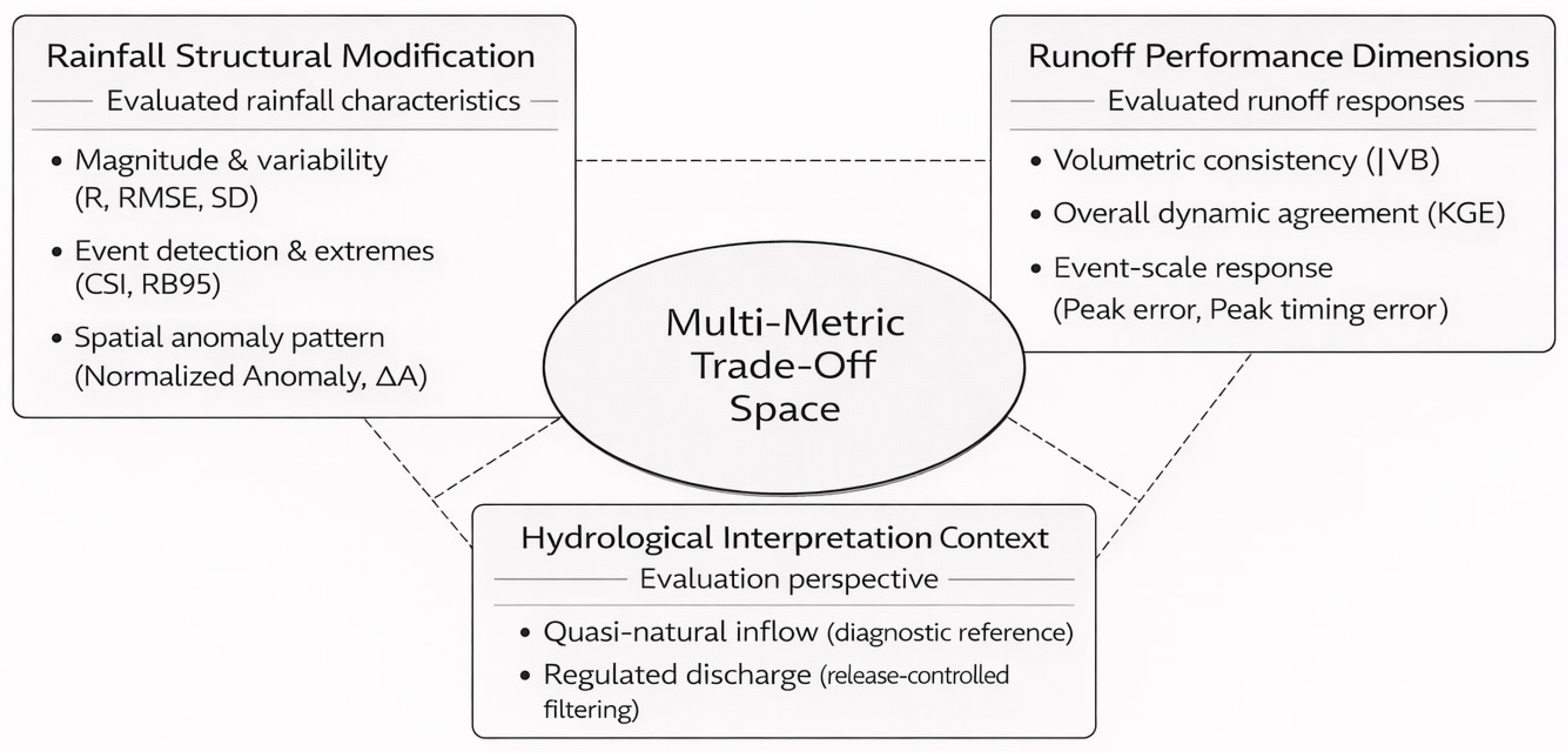
Interpreting Satellite Rainfall Bias Correction Through a Rainfall–Runoff Framework in a Monsoon-Influenced River Basin: The Phetchaburi River Basin, Thailand

 ,
,
Abstract
1. Introduction
2. Materials and Methods
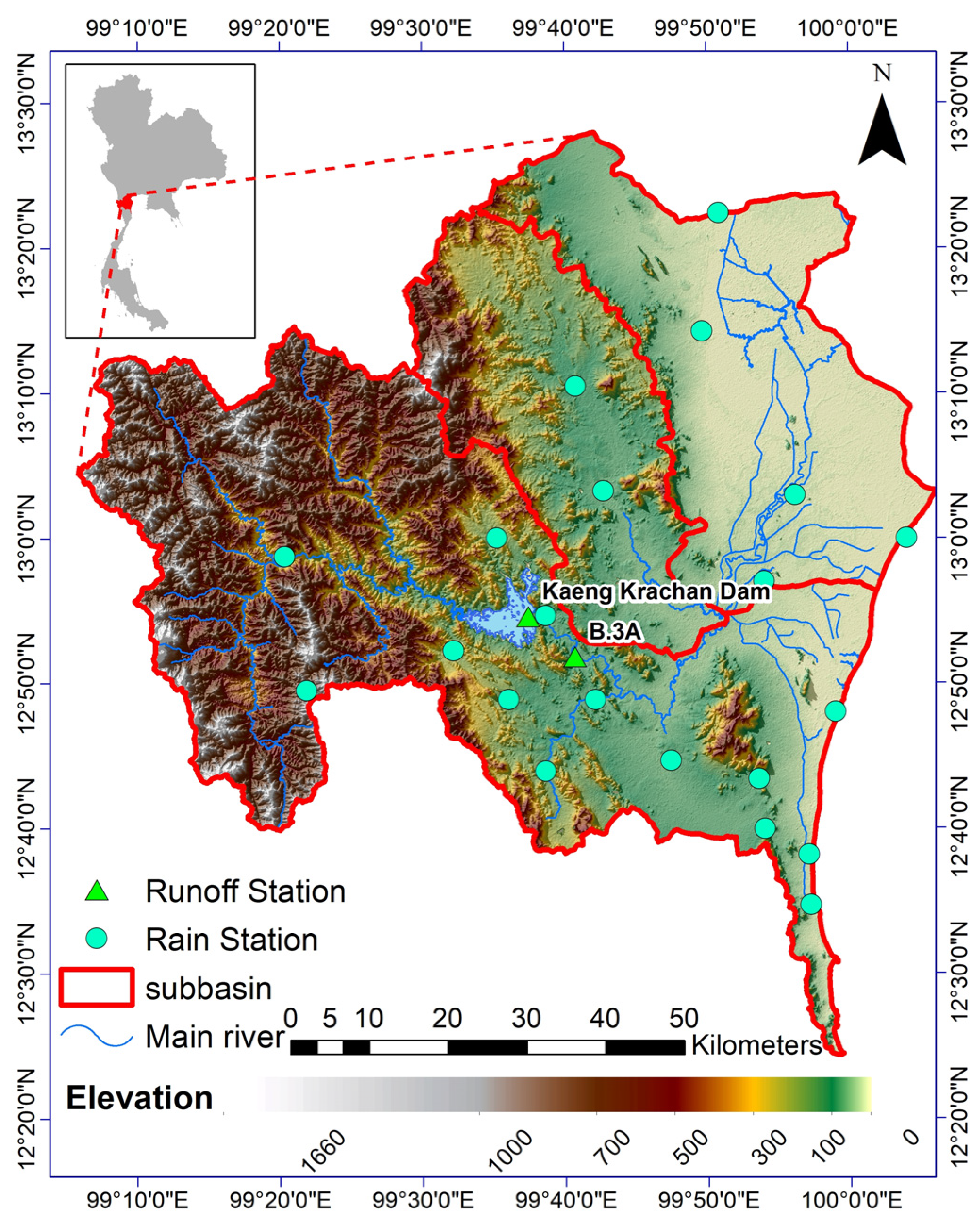
2.1. Study Area and Hydroclimatic Characteristics Subsection
2.2. Ground-Based Rainfall and Streamflow Data
2.3. Satellite Precipitation Products
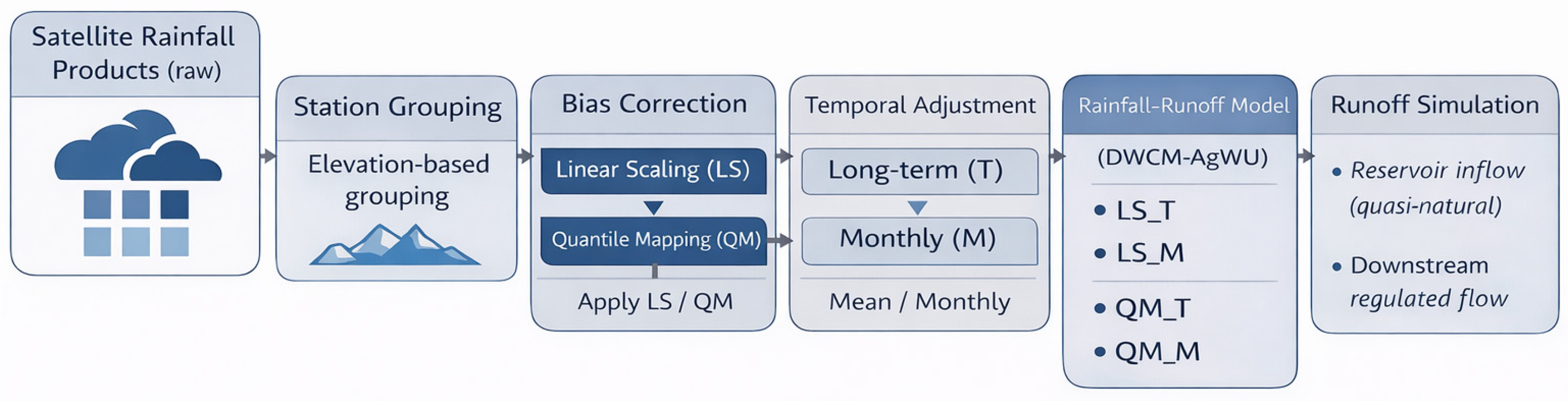
2.4. Spatially Informed Bias Correction Framework
2.4.1. Station Grouping and Spatial Representativeness
2.4.2. Linear Scaling (LS)
- (1)
- Linear Scaling using long-term mean rainfall (LS_T)
- (2)
- Linear Scaling using monthly rainfall means (LS_M)
2.4.3. Quantile Mapping (QM)
- (1)
- Quantile Mapping using long-term rainfall distributions (QM_T)
- (2)
- Quantile Mapping using monthly rainfall distributions (QM_M)
2.5. Rainfall–Runoff Model and Experimental Design
2.6. Performance Evaluation Metrics
2.6.1. Rainfall Performance Metrics
2.6.2. Runoff Simulation Performance Metrics
3. Results
3.1. Evaluation of Satellite Rainfall Performance
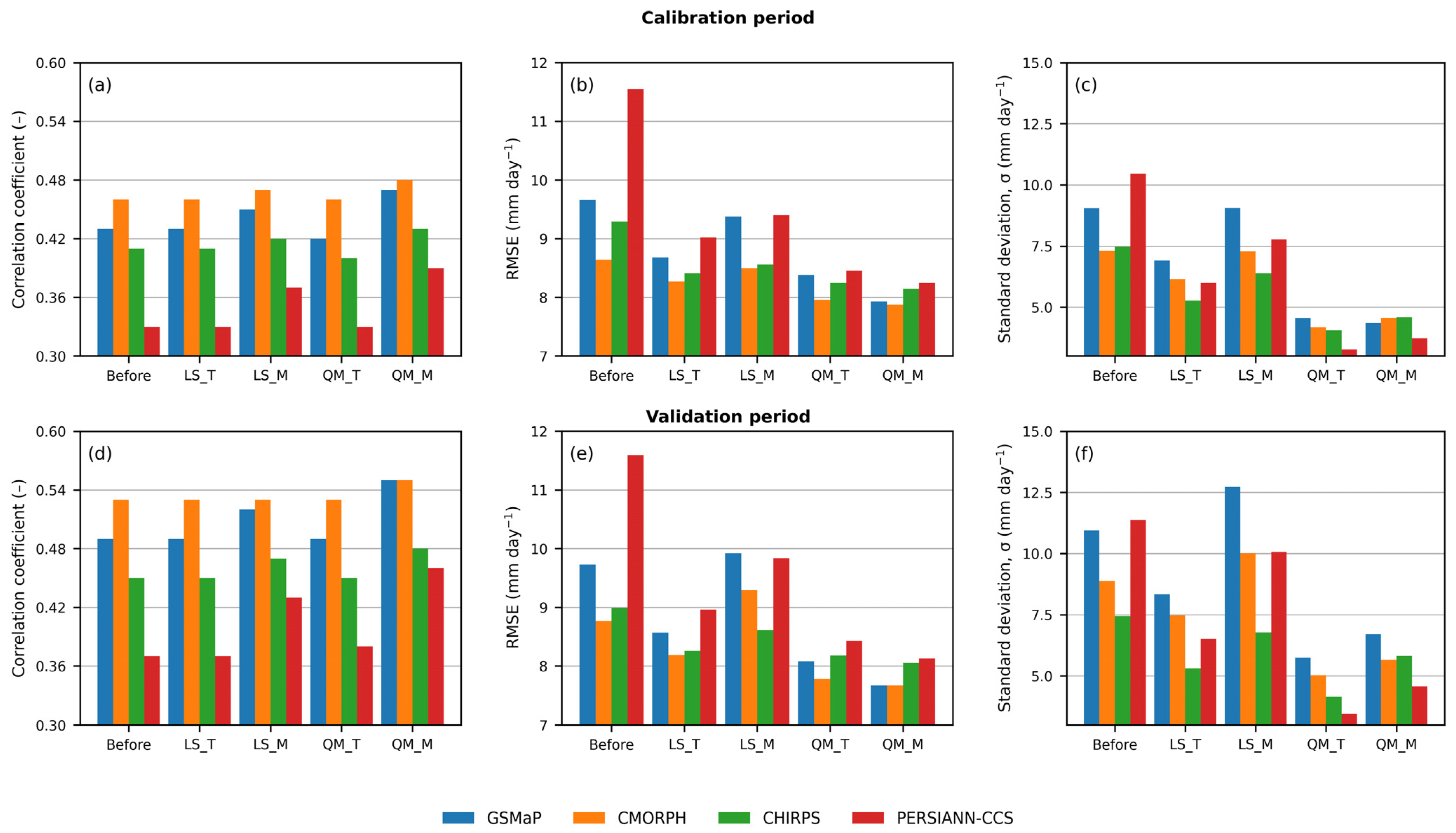
3.1.1. Performance of Bias Correction on Rainfall Magnitude
3.1.2. Rainfall Event Detection and Extreme Rainfall Performance
- (1)
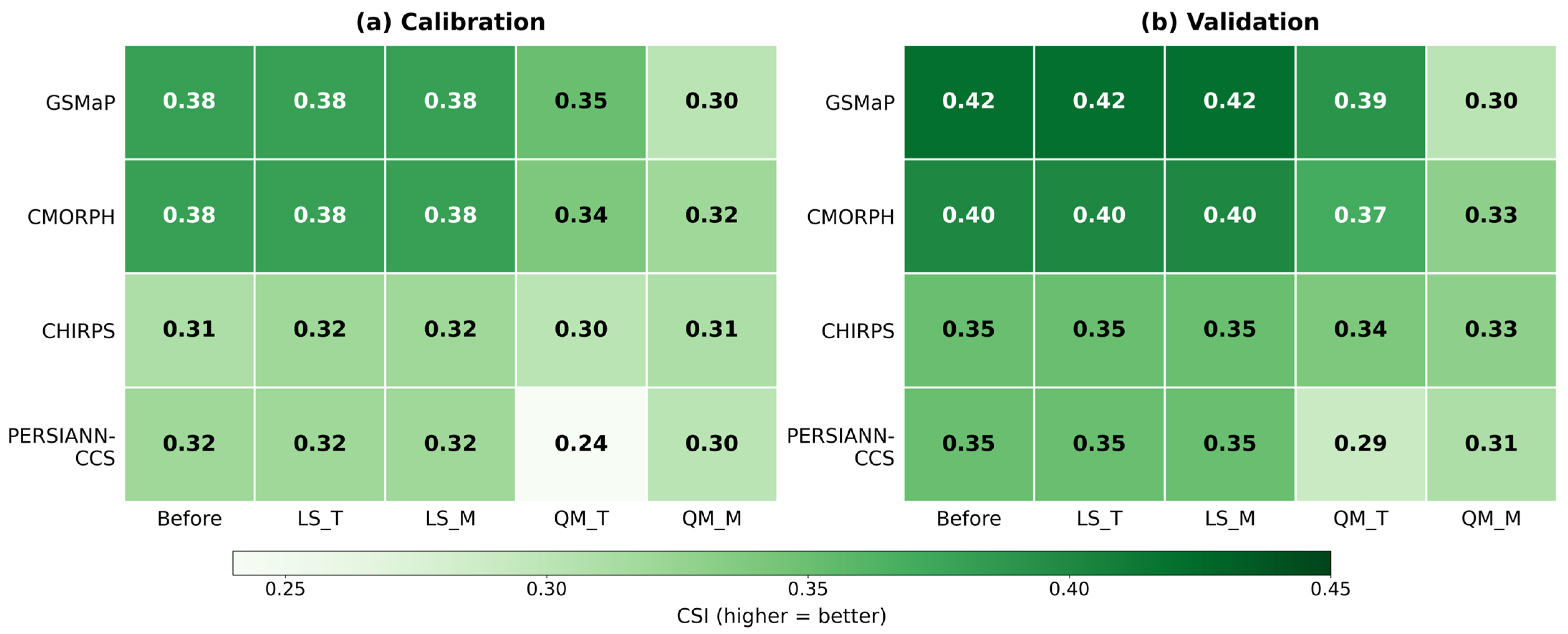
- Rainfall event detection skill (CSI)
- (2)
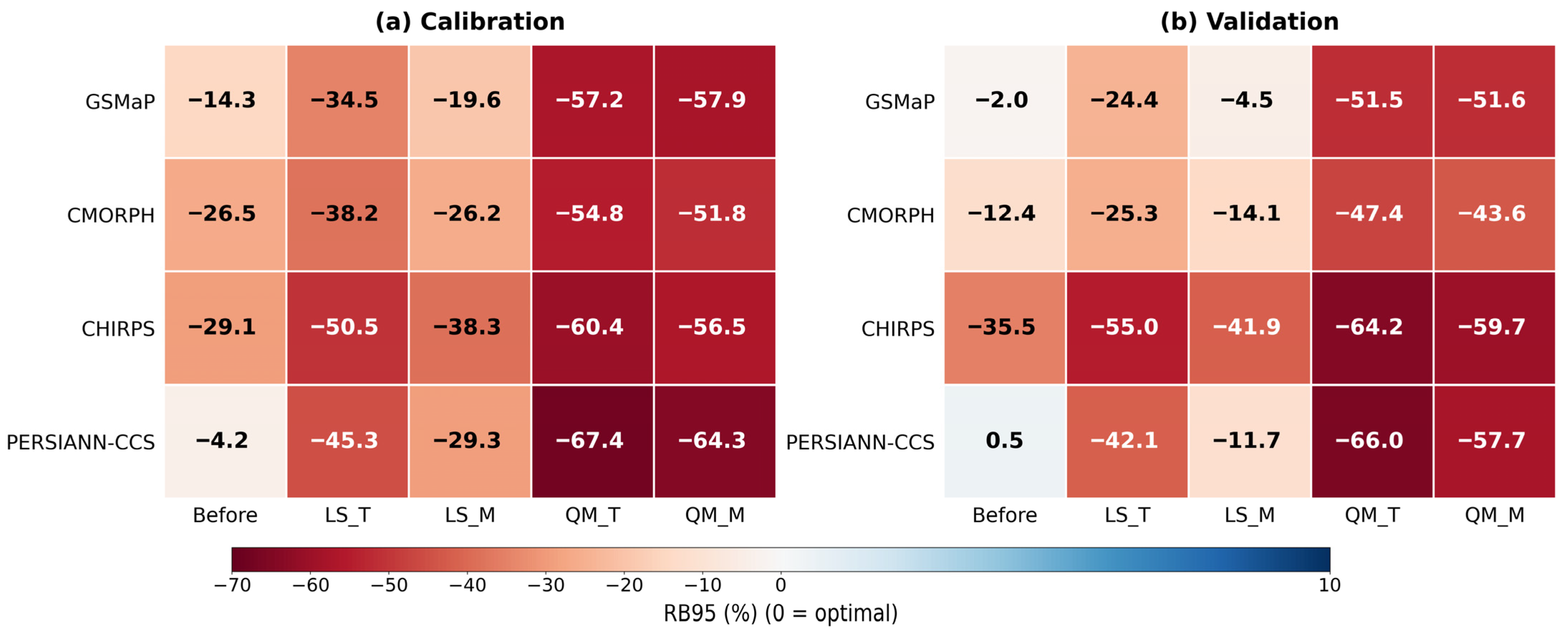
- Extreme rainfall representation (RB95)
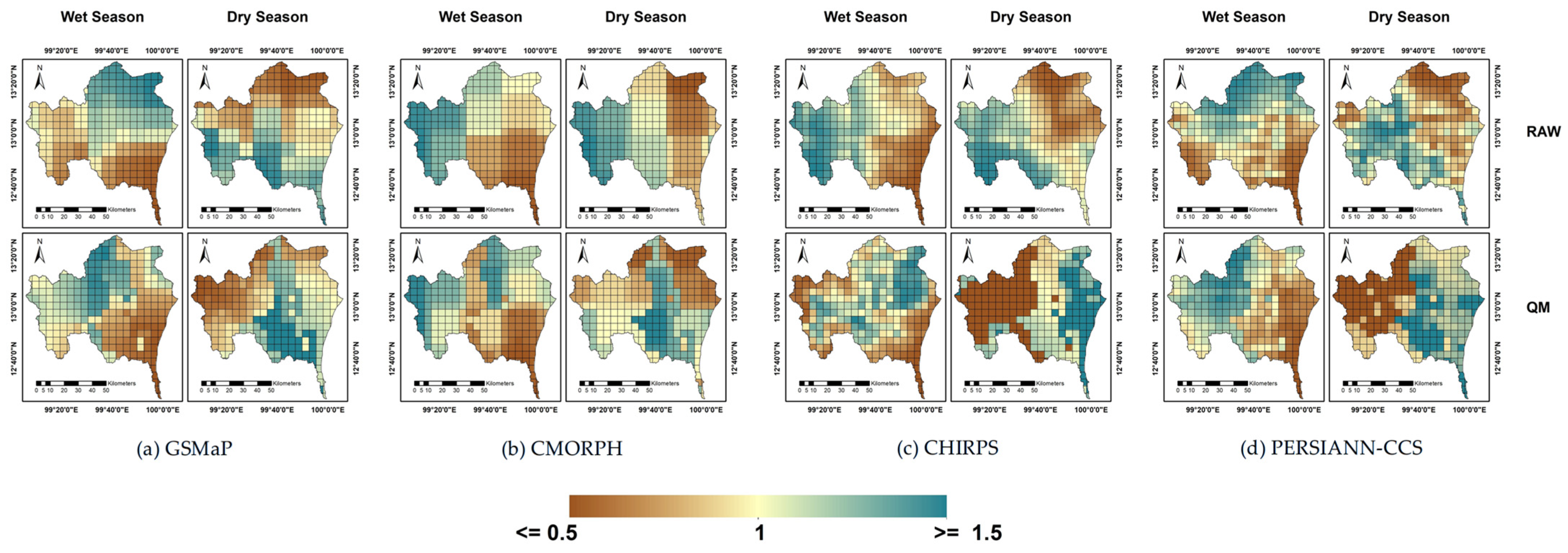
3.1.3. Spatial Rainfall Patterns and Hydrological Relevance
- (1)
- From Statistical Improvement to Spatial Organization of Rainfall
- (2)
- Baseline Spatial Rainfall Organization across Satellite Products
- (3)
- Effects of Bias Correction on Spatial Rainfall Organization
- (4)
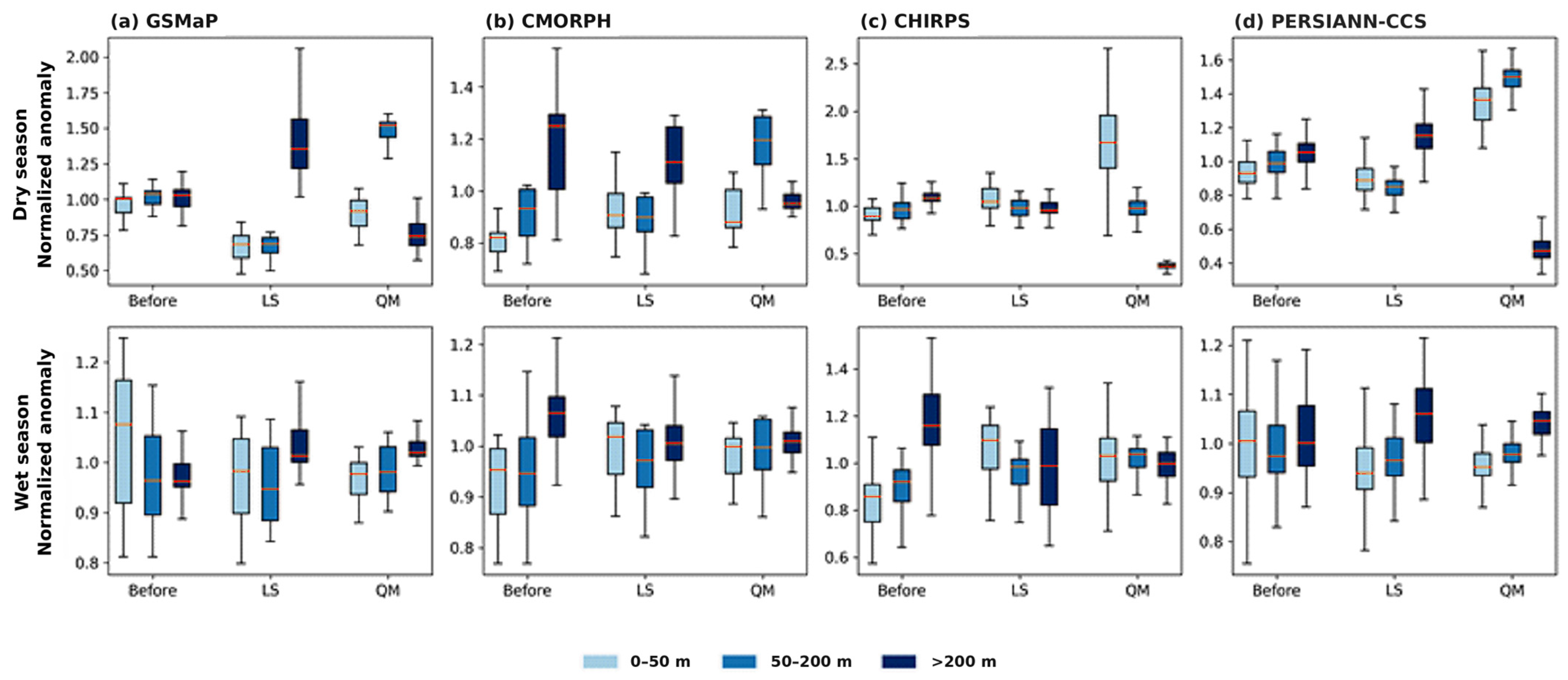
- Elevation-conditioned spatial response to bias correction
3.2. Implications for Hydrological Interpretation and Application
3.2.1. Structural Consistency of Rainfall Fields and Hydrological Relevance
3.2.2. Interpretation of Runoff Response Under Rainfall-Specific Calibration
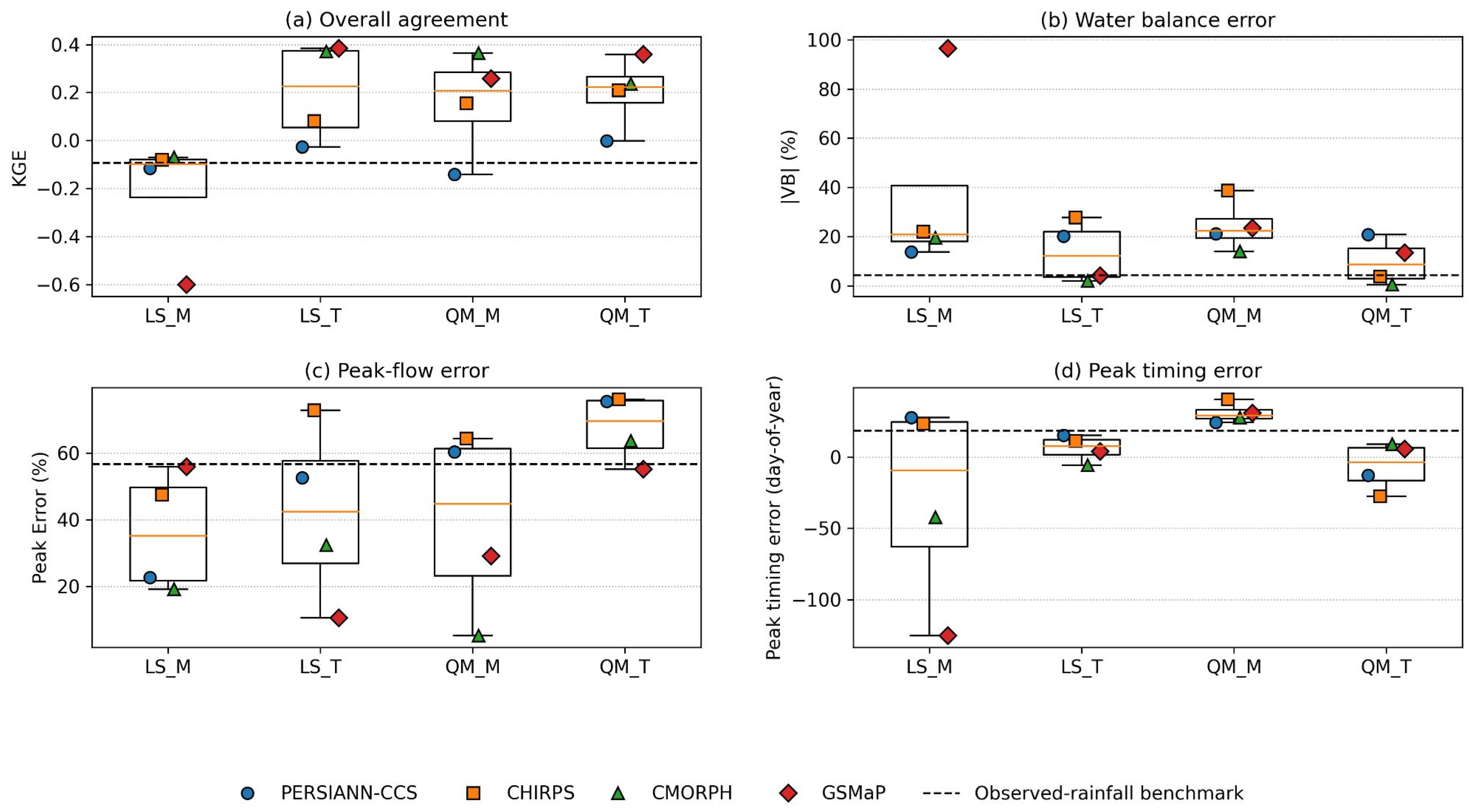
3.2.3. Multi-Metric Coherence of Quasi-Natural Inflow Response and Hydrological Implications
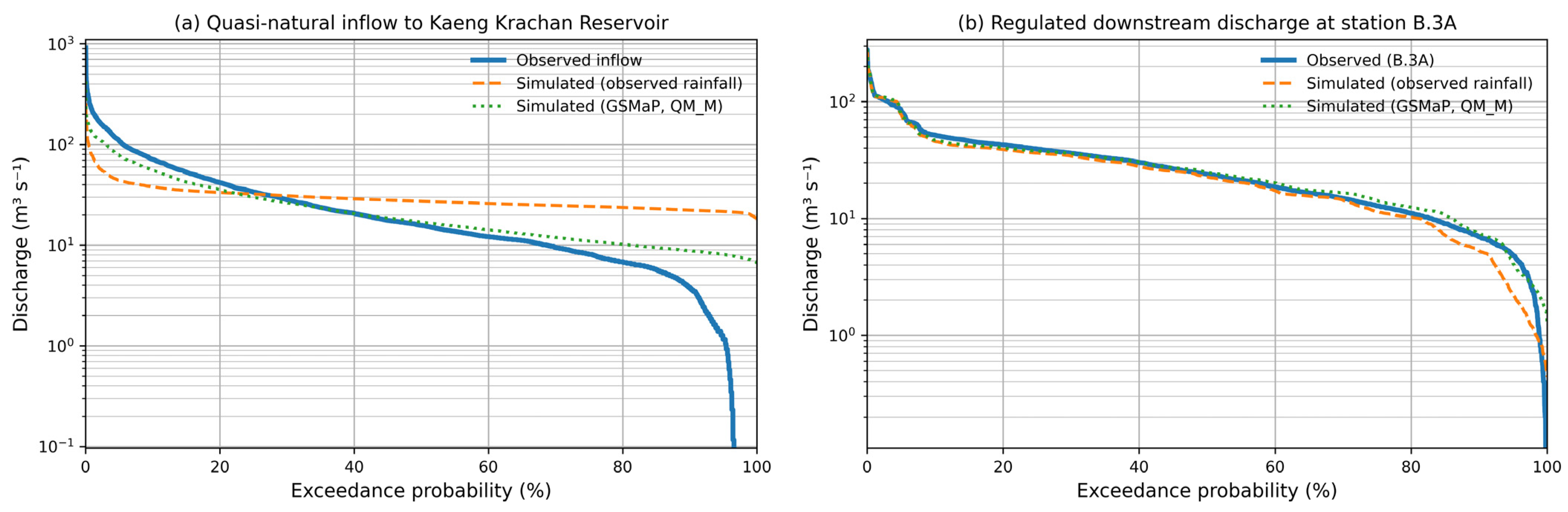
3.2.4. Effects of Regulation on Downstream Flows
4. Discussion
4.1. Structural Trade-Offs in Rainfall Correction: A Process-Based Interpretative Framework
4.2. Hydrological Process Interpretation
4.3. Role of Flow Regulation
4.4. Practical and Methodological Implications
4.5. Limitations and Uncertainty Considerations
5. Conclusions
- Bias correction modifies satellite rainfall across multiple structural dimensions. Linear Scaling primarily adjusts basin-scale rainfall magnitude while preserving spatial organization, whereas Quantile Mapping redistributes rainfall intensities and alters spatial structure in a method- and season-dependent manner.
- These contrasting rainfall adjustments propagate into runoff behavior through distinct hydrological processes. Magnitude-oriented correction is more closely associated with volumetric consistency, whereas distribution-based correction more strongly influences event-scale runoff characteristics.
- No single correction strategy consistently captures all aspects of runoff response. Instead, trade-offs emerge across different aspects of runoff behavior, highlighting the importance of multi-metric, process-informed evaluation.
- The explicit separation of quasi-natural inflow and regulated downstream discharge reveals that reservoir operation attenuates and redistributes rainfall-driven variability, leading to convergence of downstream responses. Regulated discharge should therefore be interpreted within the context of storage dynamics rather than as a direct indicator of rainfall correction performance.
- Runoff response provides a process-based lens for interpreting rainfall correction effects, demonstrating that improvements in statistical rainfall accuracy do not necessarily translate into hydrologically consistent model forcing.
6. Suggestions
Supplementary Materials
Author Contributions
Funding
Data Availability Statement
Acknowledgments
Conflicts of Interest
Abbreviations
| CDF | Cumulative Distribution Function |
| CHG | Climate Hazards Group |
| CSI | Critical Success Index |
| DEM | Digital Elevation Model |
| DWCM-AgWU | Distributed Water Circulation Model with Agricultural Water Use |
| IR | Infrared |
| JAXA | Japan Aerospace Exploration Agency |
| KGE | Kling–Gupta Efficiency |
| LS | Linear Scaling |
| LS_M | Linear Scaling with Monthly Calibration |
| LS_T | Linear Scaling with Long-Term Calibration |
| NOAA | National Oceanic and Atmospheric Administration |
| PE | Peak Flow Error |
| PMW | Passive Microwave |
| QM | Quantile Mapping |
| QM_M | Quantile Mapping with Monthly Calibration |
| QM_T | Quantile Mapping with Long-Term Calibration |
| RB95 | Relative Bias at the 95th Percentile |
| RMSE | Root Mean Square Error |
| UCSB | University of California, Santa Barbara |
| VB | Volumetric Bias |
References
- Georgakakos, K.P.; Kavvas, M.L. Precipitation analysis, modeling, and prediction in hydrology. Rev. Geophys. 1987, 25, 163–178. [Google Scholar] [CrossRef]
- Moradkhani, H.; Sorooshian, S. General review of rainfall–runoff modeling: Model calibration, data assimilation, and uncertainty analysis. In Hydrological Modelling and the Water Cycle; Springer: Berlin/Heidelberg, Germany, 2009; pp. 1–24. [Google Scholar] [CrossRef]
- Maggioni, V.; Massari, C. On the performance of satellite precipitation products in riverine flood modeling: A review. J. Hydrol. 2018, 558, 214–224. [Google Scholar] [CrossRef]
- Maggioni, V.; Sapiano, M.R.P.; Adler, R.F.; Tian, Y.; Huffman, G.J.; Bolvin, D.T. Modeling satellite precipitation errors over mountainous terrain: The influence of gauge density, seasonality, and temporal resolution. IEEE Trans. Geosci. Remote Sens. 2017, 55, 4133–4149. [Google Scholar] [CrossRef]
- Gebremichael, M.; Bitew, M.M.; Hirpa, F.A.; Tesfay, G.N. Accuracy of satellite rainfall estimates in the Blue Nile Basin: Lowland plain versus highland mountain. Water Resour. Res. 2014, 50, 8775–8790. [Google Scholar] [CrossRef]
- Tesfagiorgis, K.; Mahani, S.V.; Krakauer, A.Y.; Khanbilvardi, R.M. Bias correction of satellite rainfall estimates using a radar–gauge product: A case study in Oklahoma (USA). Hydrol. Earth Syst. Sci. 2011, 15, 2631–2647. [Google Scholar] [CrossRef]
- Katiraie-Boroujerdy, P.S.; Nasrollahi, N.; Hsu, K.; Sorooshian, S. Bias correction of satellite-based precipitation estimations using quantile mapping approach in different climate regions of Iran. Remote Sens. 2020, 12, 2102. [Google Scholar] [CrossRef]
- Gumindoga, W.; Makurira, H.; Phiri, E.; Savenije, H.H.G. Performance of bias-correction schemes for CMORPH rainfall estimates in the Zambezi River basin. Hydrol. Earth Syst. Sci. 2019, 23, 2915–2938. [Google Scholar] [CrossRef]
- Bhatti, H.A.; Rientjes, T.; Haile, A.T.; Verhoef, W.; Steenbergen, N. Evaluation of bias correction methods for satellite-based rainfall data. Sensors 2016, 16, 884. [Google Scholar] [CrossRef]
- Abera, W.; Brocca, L.; Rigon, R. Comparative evaluation of different satellite rainfall estimation products and bias correction in the Upper Blue Nile (UBN) basin. Atmos. Res. 2016, 178–179, 471–483. [Google Scholar] [CrossRef]
- Looper, J.P.; Vieux, B.E.; Moreno, M.A. Assessing the impacts of precipitation bias on distributed hydrologic model calibration and prediction accuracy. J. Hydrol. 2012, 418–419, 110–122. [Google Scholar] [CrossRef]
- Falck, A.S.; Maggioni, V.; Tomasella, J.; Vila, D.A.; Diniz, F.L.R. Propagation of satellite precipitation uncertainties through a distributed hydrologic model: A case study in the Tocantins–Araguaia basin in Brazil. J. Hydrol. 2015, 527, 943–957. [Google Scholar] [CrossRef]
- Amorim, J.d.S.; Viola, M.R.; Junqueira, R.; Oliveira, V.A.d.; Mello, C.R.d. Evaluation of Satellite Precipitation Products for Hydrological Modeling in the Brazilian Cerrado Biome. Water 2020, 12, 2571. [Google Scholar] [CrossRef]
- Nicótina, L.; Celegon, E.A.; Rinaldo, A.; Marani, M. On the impact of rainfall patterns on the hydrologic response. Water Resour. Res. 2008, 44, W12401. [Google Scholar] [CrossRef]
- Maraun, D. Bias correcting climate change simulations—A critical review. Curr. Clim. Change Rep. 2016, 2, 211–220. [Google Scholar] [CrossRef]
- Xiang, Y.; Chen, Y.; Xu, Q.; Zhang, Y.; Xiong, Y.; Li, Y. Evaluation of eight global precipitation datasets in hydrological modeling. Remote Sens. 2021, 13, 2831. [Google Scholar] [CrossRef]
- Mazzoleni, M.; Alfonso, D.; Chacon-Hurtado, A.; Solomatine, D. Evaluating precipitation datasets for large-scale distributed hydrological modelling. J. Hydrol. 2019, 578, 124076. [Google Scholar] [CrossRef]
- Ren, P.; Li, J.; Feng, P.; Guo, Y.; Ma, Q. Evaluation of multiple satellite precipitation products and their use in hydrological modelling over the Luanhe River Basin, China. Water 2018, 10, 677. [Google Scholar] [CrossRef]
- Grill, G.; Lehner, B.; Thieme, M.; Geenen, B.; Tickner, D.; Antonelli, F.; Zarfl, C. Mapping the world’s free-flowing rivers. Nature 2019, 569, 215–221. [Google Scholar] [CrossRef]
- Lehner, B.; Liermann, C.R.; Revenga, C.; Vörösmarty, C.; Fekete, B.; Crouzet, P.; Wisser, D. High-resolution mapping of the world’s reservoirs and dams for sustainable river-flow management. Front. Ecol. Environ. 2011, 9, 494–502. [Google Scholar] [CrossRef]
- Kirchner, J.W. Catchments as simple dynamical systems: Catchment characterization, rainfall–runoff modeling, and doing hydrology backward. Water Resour. Res. 2009, 45, W02429. [Google Scholar] [CrossRef]
- Heistermann, M.; Kneis, D. Benchmarking quantitative precipitation estimation by conceptual rainfall–runoff modeling. Water Resour. Res. 2011, 47, W06514. [Google Scholar] [CrossRef]
- Herrnegger, M.; Nachtnebel, H.P.; Schulz, K. From runoff to rainfall: Inverse rainfall–runoff modelling at high temporal resolution. Hydrol. Earth Syst. Sci. 2015, 19, 4619–4639. [Google Scholar] [CrossRef]
- Manoj, A.; Loritz, R.; Gupta, H.; Zehe, E. Can discharge be used to inversely correct precipitation? Hydrol. Earth Syst. Sci. 2025, 29, 6115–6135. [Google Scholar] [CrossRef]
- Bárdossy, A.; Kilsby, T.G.; Birkinshaw, A. Is precipitation responsible for the most hydrological model uncertainty? Front. Water 2022, 4, 836554. [Google Scholar] [CrossRef]
- Renard, B.; Kavetski, D.; Kuczera, G.; Thyer, M.; Franks, S.W. Understanding predictive uncertainty in hydrologic modeling: The challenge of identifying input and structural errors. Water Resour. Res. 2010, 46, W05521. [Google Scholar] [CrossRef]
- Terrier, M.; Perrin, C.; de Lavenne, A.; Andréassian, V.; Lerat, J.; Vaze, J. Streamflow naturalization methods: A review. Hydrol. Sci. J. 2021, 66, 12–36. [Google Scholar] [CrossRef]
- Ye, H.; Liu, P.; Zhang, X.; Xu, H.; Liu, W. Regarding reservoirs as switches: Deriving restored and regulated runoff with one long short-term memory model. J. Hydrol. Reg. Stud. 2024, 56, 102062. [Google Scholar] [CrossRef]
- Madolli, M.J.; Haikel, S.H.M.; Gupta, V.; Tangdamrongsub, N.; Datta, A.; Himanshu, S.K. Spatio-temporal variability of rainfall and temperature and their association with ENSO and IOD over different meteorological regions of Thailand. Water Conserv. Sci. Eng. 2025, 10, 92. [Google Scholar] [CrossRef]
- Limsakul, A.; Limjirakan, S.; Suttamanuswong, B. Asian summer monsoon and its associated rainfall variability in Thailand. Environ. Asia 2010, 3, 79–89. [Google Scholar]
- Barros, A.P. Orographic precipitation, freshwater resources, and climate vulnerabilities in mountainous regions. In Climate Vulnerability; Elsevier: Amsterdam, The Netherlands, 2013; pp. 57–78. [Google Scholar] [CrossRef]
- Wang, B.; Ding, Q.; Joseph, P.V. A numerical study of the interaction between the large-scale monsoon circulation and orographic precipitation over South and Southeast Asia. J. Clim. 2012, 25, 2937–2954. [Google Scholar] [CrossRef]
- Hirata, H.; Fujinami, H.; Kanamori, H.; Sato, Y.; Kato, M.; Kayastha, R.B.; Shrestha, M.L.; Fujita, K. Multiscale processes leading to heavy precipitation in the eastern Nepal Himalayas. J. Hydrometeorol. 2023, 24, 641–658. [Google Scholar] [CrossRef]
- Shen, C.; Li, G.; Dong, Y. Vertical structures associated with orographic precipitation during warm season in the Sichuan Basin and its surrounding areas at different altitudes from 8-year GPM DPR observations. Remote Sens. 2022, 14, 4222. [Google Scholar] [CrossRef]
- Berne, A.; Delrieu, G.; Creutin, J.-D.; Obled, C. Temporal and spatial resolution of rainfall measurements required for urban hydrology. J. Hydrol. 2004, 299, 166–179. [Google Scholar] [CrossRef]
- Liu, J.; Han, D.; Rico-Ramirez, M.A.; Srivastava, P. Impact of rainfall spatiotemporal variability and model structures on flood simulation in semi-arid regions. Stoch. Environ. Res. Risk Assess. 2022, 36, 785–809. [Google Scholar] [CrossRef]
- Paschalis, A.; Fatichi, S.; Molnar, P.; Rimkus, S.; Burlando, P. On the effects of small-scale space–time variability of rainfall on basin flood response. J. Hydrol. 2014, 514, 313–327. [Google Scholar] [CrossRef]
- Maggioni, V.; Meyers, P.C.; Robinson, M.D. A review of merged high-resolution satellite precipitation product accuracy during the Tropical Rainfall Measuring Mission (TRMM) era. J. Hydrometeorol. 2016, 17, 1101–1117. [Google Scholar] [CrossRef]
- Singhrattna, N.; Babel, M.S.; Perret, S.R. Hydroclimate variability and long-lead forecasting of rainfall over Thailand by large-scale atmospheric variables. Hydrol. Sci. J. 2012, 57, 26–41. [Google Scholar] [CrossRef]
- Garg, S.; Mishra, V. Role of extreme precipitation and initial hydrologic conditions on floods in the Godavari River basin, India. Water Resour. Res. 2019, 55, 10452–10470. [Google Scholar] [CrossRef]
- Medina, S.; Houze, R.A., Jr.; Kumar, A.; Niyogi, D. Summer monsoon convection in the Himalayan region: Terrain and land cover effects. Q. J. R. Meteorol. Soc. 2010, 136, 593–616. [Google Scholar] [CrossRef]
- Barros, A.P.; Kim, G.; Williams, E.; Nesbitt, S.W. Probing orographic controls in the Himalayas during the monsoon using satellite imagery. Nat. Hazards Earth Syst. Sci. 2004, 4, 29–51. [Google Scholar] [CrossRef]
- Cristiano, E.; ten Veldhuis, M.-C.; van de Giesen, N. Spatial and temporal variability of rainfall and their effects on hydrological response in urban areas—A review. Hydrol. Earth Syst. Sci. 2017, 21, 3859–3878. [Google Scholar] [CrossRef]
- Paz, I.; Tchiguirinskaia, I.; Schertzer, D. Rain gauge networks’ limitations and the implications to hydrological modelling highlighted with a X-band radar. J. Hydrol. 2020, 585, 124615. [Google Scholar] [CrossRef]
- Brunner, M.I.; Naveau, P. Spatial variability in Alpine reservoir regulation: Deriving reservoir operations from streamflow using generalized additive models. Hydrol. Earth Syst. Sci. 2023, 27, 673–687. [Google Scholar] [CrossRef]
- Gebremichael, M.; Hossain, F. Satellite Rainfall Applications for Surface Hydrology; Springer: Dordrecht, The Netherlands, 2010. [Google Scholar] [CrossRef]
- Kubota, T.; Shige, S.; Hashizume, H.; Aonashi, K.; Takahashi, N.; Seto, S.; Okamoto, K. Global precipitation map using satellite-borne microwave radiometers by the GSMaP project: Production and validation. IEEE Trans. Geosci. Remote Sens. 2007, 45, 2259–2275. [Google Scholar] [CrossRef]
- Joyce, R.; Xie, P. Kalman filter–based CMORPH. J. Hydrometeorol. 2011, 12, 1547–1563. [Google Scholar] [CrossRef]
- Kidd, C.; Kniveton, D.; Todd, M.C.; Bellerby, T.J. Satellite rainfall estimation using combined passive microwave and infrared algorithms. J. Hydrometeorol. 2003, 4, 1088–1104. [Google Scholar] [CrossRef]
- Funk, C.; Peterson, P.; Landsfeld, M.; Pedreros, D.; Verdin, J.; Shukla, S.; Husak, G.; Rowland, J.; Harrison, L.; Hoell, A.; et al. The Climate Hazards Infrared Precipitation with Stations—A new environmental record for monitoring extremes. Sci. Data 2015, 2, 150066. [Google Scholar] [CrossRef] [PubMed]
- Hong, Y.; Hsu, K.-L.; Sorooshian, S.; Gao, X. Precipitation estimation from remotely sensed imagery using an artificial neural network cloud classification system. J. Appl. Meteorol. 2004, 43, 1834–1853. [Google Scholar] [CrossRef]
- Maidment, R.I.; Grimes, D.; Black, E.; Tarnavsky, E.; Young, M.; Greatrex, H.; Allan, R.P.; Stein, T.; Nkonde, E.; Senkunda, S.; et al. A new, long-term daily satellite-based rainfall dataset for operational monitoring in Africa. Sci. Data 2017, 4, 170063. [Google Scholar] [CrossRef] [PubMed]
- Guo, R.; Fan, X.; Zhou, H.; Liu, Y. Multi-sensor precipitation estimation from space: Data sources, methods and validation. Remote Sens. 2024, 16, 4753. [Google Scholar] [CrossRef]
- Derin, Y.; Anagnostou, E.N.; Berne, A.; Borga, M.; Boudevillain, B.; Buytaert, W.; Chang, C.-H.; Chen, H.; Delrieu, G.; Yilmaz, K.K. Evaluation of GPM-era global satellite precipitation products over multiple complex terrain regions. Remote Sens. 2019, 11, 2936. [Google Scholar] [CrossRef]
- Teutschbein, C.; Seibert, J. Bias correction of regional climate model simulations for hydrological climate-change impact studies: Review and evaluation of different methods. J. Hydrol. 2012, 456–457, 12–29. [Google Scholar] [CrossRef]
- Themeßl, M.J.; Gobiet, A.; Leuprecht, A. Empirical-statistical downscaling and error correction of daily precipitation from regional climate models. Int. J. Climatol. 2011, 31, 1530–1544. [Google Scholar] [CrossRef]
- Cannon, A.J.; Sobie, S.R.; Murdock, T.Q. Bias correction of GCM precipitation by quantile mapping: How well do methods preserve changes in quantiles and extremes? J. Clim. 2015, 28, 6938–6959. [Google Scholar] [CrossRef]
- Vongphet, J.; Masumoto, T.; Minakawa, H.; Kudo, R. Modification of DWCM-AgWU model applied to a paddy-dominant basin with large dams. Irrig. Drain. 2016, 65, 356–369. [Google Scholar] [CrossRef]
- Buzacott, A.J.V.; Tran, B.; van Ogtrop, F.F.; Vervoort, R.W. Conceptual models and calibration performance—Investigating catchment bias. Water 2019, 11, 2424. [Google Scholar] [CrossRef]
- Generoso, T.N.; da Silva, D.D.; Rodrigues, L.N.; Silva Amorim, R.S.; de Almeida, L.T. Analysis of flow behavior as influenced by reservoir with flow regularization. Water Resour. Manag. 2022, 36, 4721–4737. [Google Scholar] [CrossRef]
- Gupta, H.V.; Kling, H.; Yilmaz, K.K.; Martinez, G.F. Decomposition of the mean squared error and NSE performance criteria: Implications for improving hydrological modelling. J. Hydrol. 2009, 377, 80–91. [Google Scholar] [CrossRef]
- Schaefer, J.T. The critical success index as an indicator of warning skill. Weather Forecast. 1990, 5, 570–575. [Google Scholar] [CrossRef]
- Serinaldi, F.; Bárdossy, A.; Kilsby, C.G. Upper tail dependence in rainfall extremes: Would we know it if we saw it? Stoch. Environ. Res. Risk Assess. 2015, 29, 1211–1233. [Google Scholar] [CrossRef]
- Troutman, B.M. Runoff prediction errors and bias in parameter estimation induced by spatial variability of precipitation. Water Resour. Res. 1983, 19, 791–800. [Google Scholar] [CrossRef]
- Huang, P.; Li, Z.; Chen, J.; Li, Q.; Yao, C. Event-based hydrological modeling for detecting dominant hydrological process and suitable model strategy for semi-arid catchments. J. Hydrol. 2016, 542, 493–508. [Google Scholar] [CrossRef]
- Sun, S.; Bertrand-Krajewski, J.-L. Separately accounting for uncertainties in rainfall and runoff: Calibration of event-based conceptual hydrological models in small urban catchments using Bayesian method. Water Resour. Res. 2013, 49, 5381–5394. [Google Scholar] [CrossRef]





| Category | Description |
|---|---|
| Geographical location | Western Thailand |
| Basin area (km2) | 6254.5 |
| Elevation range (m MSL) | 0–1660 |
| Dominant topography | Mountainous upstream areas transitioning to lowland plains downstream |
| Climate type | Tropical monsoon climate |
| Rainfall seasonality | Strongly seasonal, dominated by the southwest monsoon (May–October) |
| Mean annual rainfall (mm yr−1) | 983.4 |
| Number of rain gauge stations | 21 |
| Rain gauge data period | 2003–2022 |
| Streamflow stations | (1) Reservoir inflow to Kaeng Krachan Dam (quasi-natural) |
| (2) B.3A downstream station (regulated) | |
| Streamflow data period | 2006–2022 |
| Product | Institution | Data Source | Retrieval Type | Spatial Res. | Temp. Res. | Period | Rationale |
|---|---|---|---|---|---|---|---|
| GSMaP | JAXA | PMW + IR | Near-real-time global rainfall | ~0.1° | Daily | 2003–2022 | Microwave-based convective rainfall |
| CMORPH | NOAA | PMW → IR | Motion-based rainfall propagation | ~0.25° | Daily | 2003–2022 | Rainfall evolution and continuity |
| CHIRPS | CHG, UCSB | Satellite + gauges | Gauge-adjusted climatology | ~0.05° | Daily | 2003–2022 | Climatologically consistent rainfall |
| PERSIANN-CCS | UC Irvine | IR clouds | Convective rainfall from cloud tops | ~0.04° | Daily | 2003–2022 | Infrared-based convective systems |
Disclaimer/Publisher’s Note: The statements, opinions and data contained in all publications are solely those of the individual author(s) and contributor(s) and not of MDPI and/or the editor(s). MDPI and/or the editor(s) disclaim responsibility for any injury to people or property resulting from any ideas, methods, instructions or products referred to in the content. |
© 2026 by the authors. Licensee MDPI, Basel, Switzerland. This article is an open access article distributed under the terms and conditions of the Creative Commons Attribution (CC BY) license.
Share and Cite
Vongphet, J.; Saion, T.; Sittichok, K.; Puttrawutichai, S.; Thepprasit, C.; Samanmit, P.; Kwanyuen, B.; Khawkomol, S. Interpreting Satellite Rainfall Bias Correction Through a Rainfall–Runoff Framework in a Monsoon-Influenced River Basin: The Phetchaburi River Basin, Thailand. Water 2026, 18, 964. https://doi.org/10.3390/w18080964
Vongphet J, Saion T, Sittichok K, Puttrawutichai S, Thepprasit C, Samanmit P, Kwanyuen B, Khawkomol S. Interpreting Satellite Rainfall Bias Correction Through a Rainfall–Runoff Framework in a Monsoon-Influenced River Basin: The Phetchaburi River Basin, Thailand. Water. 2026; 18(8):964. https://doi.org/10.3390/w18080964
Chicago/Turabian StyleVongphet, Jutithep, Thirasak Saion, Ketvara Sittichok, Songsak Puttrawutichai, Chaiyapong Thepprasit, Polpech Samanmit, Bancha Kwanyuen, and Sasiwimol Khawkomol. 2026. "Interpreting Satellite Rainfall Bias Correction Through a Rainfall–Runoff Framework in a Monsoon-Influenced River Basin: The Phetchaburi River Basin, Thailand" Water 18, no. 8: 964. https://doi.org/10.3390/w18080964
APA StyleVongphet, J., Saion, T., Sittichok, K., Puttrawutichai, S., Thepprasit, C., Samanmit, P., Kwanyuen, B., & Khawkomol, S. (2026). Interpreting Satellite Rainfall Bias Correction Through a Rainfall–Runoff Framework in a Monsoon-Influenced River Basin: The Phetchaburi River Basin, Thailand. Water, 18(8), 964. https://doi.org/10.3390/w18080964