Article

Interpreting Satellite Rainfall Bias Correction Through a Rainfall–Runoff Framework in a Monsoon-Influenced River Basin: The Phetchaburi River Basin, Thailand


by
Jutithep Vongphet
,
Thirasak Saion
,
Ketvara Sittichok
,
Songsak Puttrawutichai
,
Chaiyapong Thepprasit
,
Polpech Samanmit
,
Bancha Kwanyuen
and
Sasiwimol Khawkomol
*
Department of Irrigation Engineering, Faculty of Engineering at Kamphaeng, Kasetsart University, 2 Moo 6 Kamphaeng Saen District, Nakhon Pathom 73140, Thailand
*
Author to whom correspondence should be addressed.
Water 2026, 18(8), 964; https://doi.org/10.3390/w18080964
Submission received: 17 February 2026 / Revised: 24 March 2026 / Accepted: 14 April 2026 / Published: 18 April 2026
(This article belongs to the Section Hydrology)

Abstract

Accurate rainfall information is essential for rainfall–runoff modeling in monsoon-influenced basins, where pronounced spatial variability and limited gauge coverage introduce significant uncertainty. Satellite precipitation products provide spatially continuous estimates but are affected by systematic biases, and improvements in statistical rainfall accuracy do not necessarily translate into hydrologically consistent model forcing. This study interpreted satellite rainfall bias correction through a rainfall–runoff framework in the Phetchaburi River Basin, Thailand, using the DWCM-AgWU hydrological model. Simulations were driven by gauge observations and multiple satellite-based rainfall products (GSMaP, CMORPH, CHIRPS, and PERSIANN-CCS), with bias correction applied using Linear Scaling and Quantile Mapping under rainfall-specific calibration. Results showed that bias correction significantly modified rainfall characteristics in distinct ways. Linear Scaling primarily preserved temporal and spatial structure while adjusting rainfall magnitude, whereas Quantile Mapping improved the distributional representation of rainfall intensities. These differences propagated through hydrological processes, leading to systematic variations in runoff responses across multiple metrics, including water balance consistency, peak magnitude, and timing errors. This suggests that each method performs differently depending on the aspect of system response. Rather than identifying a universally optimal method, the findings highlight trade-offs in how rainfall correction strategies influence hydrological system response. Runoff behavior is interpreted as a process-level indicator of rainfall representation, emphasizing that hydrological consistency depends not only on rainfall accuracy but also on its interaction with model structure. These results suggest a process-oriented perspective for interpreting the role of satellite rainfall products in regulated and monsoon-affected basins.

1. Introduction

Accurate rainfall information is a fundamental requirement for rainfall–runoff modeling, particularly in river basins characterized by strong rainfall variability and limited ground-based observations [1,2]. In tropical monsoon regions, satellite precipitation products are widely adopted to support hydrological analysis and runoff simulation by providing spatially continuous rainfall information, especially in areas with sparse ground-based observations [3]. However, systematic biases in satellite rainfall retrievals remain a major challenge in basins with complex topography and pronounced wet–dry seasonality [4,5].
The Phetchaburi River Basin in western Thailand represents a typical monsoon-influenced basin where rainfall variability, orographic controls, and reservoir regulation jointly shape hydrological behavior. Regulated by the Kaeng Krachan Reservoir, the basin provides a controlled yet hydrologically dynamic setting for examining how rainfall correction propagates under both quasi-natural and regulated flow conditions.
A wide range of bias correction techniques has been developed to mitigate satellite rainfall errors, including linear scaling and distribution-based approaches such as quantile mapping [6,7]. These methods are commonly evaluated based on improvements in statistical agreement between satellite rainfall and gauge observations [8,9,10]. Nevertheless, improvements in rainfall-side accuracy do not necessarily translate into hydrologically consistent model forcing [11,12,13]. Bias correction can simultaneously modify rainfall magnitude, temporal variability, and spatial organization, potentially altering runoff generation processes in ways not captured by rainfall-based evaluation alone [14,15].
Despite the widespread use of satellite rainfall products in hydrological studies, several gaps remain. Many evaluations focus on rainfall accuracy or single-metric runoff performance without explicitly examining multi-dimensional runoff behavior or the hydrological implications of altered rainfall structure [16,17,18]. In addition, runoff responses are often assessed without distinguishing between quasi-natural inflow conditions and regulated downstream flow, even though reservoir operation can substantially mediate rainfall-driven variability [19,20].
To address these gaps, this study interprets satellite rainfall bias correction through a rainfall–runoff framework that emphasizes runoff response as a diagnostic indicator of rainfall characteristics rather than as a direct measure of rainfall accuracy [21,22,23,24]. Rather than proposing a new correction algorithm, the present study advances a system-aware, process-based interpretative framework for evaluating satellite rainfall correction in regulated monsoon basins, shifting emphasis from statistical rainfall accuracy toward process-level rainfall–runoff diagnostics. In this study, the hydrological model is calibrated independently for each rainfall dataset to maintain consistency between rainfall inputs and model representation, consistent with approaches adopted in previous studies [25,26]. This approach acknowledges that rainfall-forcing effects cannot be fully isolated. In addition, quasi-natural inflow is clearly distinguished from regulated downstream discharge to separate rainfall–runoff processes from system regulation effects [27,28].
By integrating rainfall evaluation, hydrological simulation, and regulation filtering, this framework provides a structured basis for systematically diagnosing how correction strategies modify rainfall structure and how these changes propagate through hydrological processes and translate into runoff response under both quasi-natural and regulated flow regimes. The framework contributes beyond case-specific application by (i) linking rainfall structural attributes with runoff response, (ii) explicitly separating quasi-natural inflow from regulated downstream discharge, (iii) interpreting correction effects through a multi-metric diagnostic perspective focused on hydrological trade-offs rather than single-metric ranking.

2. Materials and Methods

2.1. Study Area and Hydroclimatic Characteristics Subsection

The Phetchaburi River Basin is located in western Thailand and is characterized by a tropical monsoon climate with distinct wet and dry seasons. Rainfall is strongly seasonal, with the majority occurring during the southwest monsoon, while dry-season rainfall is sparse and spatially heterogeneous [29,30]. The basin exhibits pronounced topographic contrasts, ranging from steep mountainous terrain upstream to lowland plains downstream, resulting in strong orographic control on rainfall distribution [31,32].
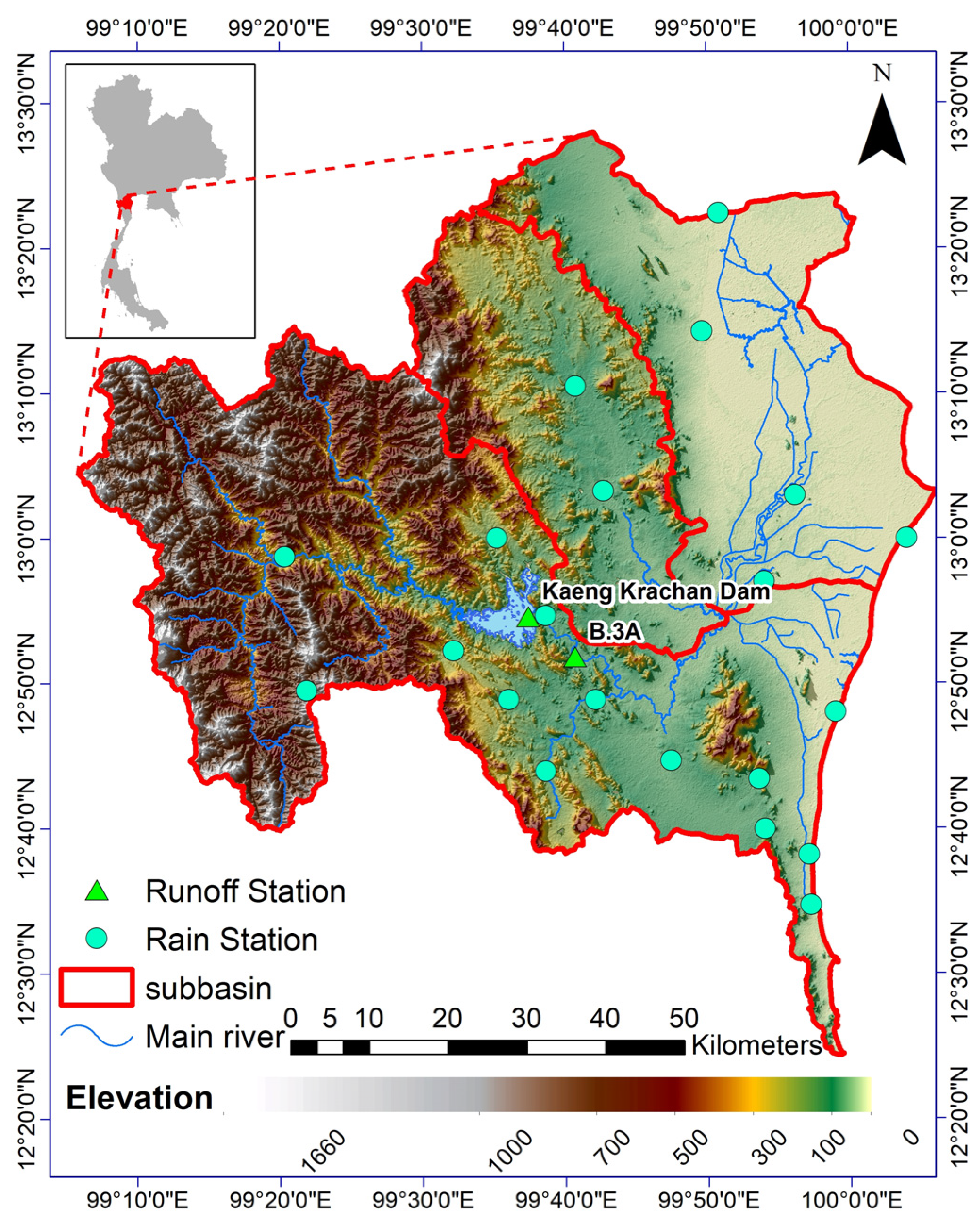
Rainfall observations are available from a relatively dense rain gauge network across the basin (Figure 1); however, rainfall exhibits substantial spatial variability associated with convective processes and terrain effects, particularly during intense monsoon events in mountainous areas [33,34]. Consequently, point-based gauge measurements alone may not fully capture the spatial organization of rainfall relevant for runoff generation [35,36,37]. Satellite precipitation products therefore provide an important complementary data source by offering spatially continuous rainfall information across the basin [38].
The basin is characterized by pronounced hydroclimatic seasonality, with mean annual rainfall of approximately 983 mm and the majority of precipitation occurring during the wet season (May–October), while average annual temperature ranges from 25 to 31 °C. In contrast, the dry season (November–April) is associated with limited rainfall. Runoff generation closely follows this seasonal pattern, with reservoir inflow increasing rapidly during the monsoon period and declining during the dry season. This seasonal alignment between rainfall and runoff reflects the strong coupling between precipitation input and basin-scale hydrological response. The seasonal relationship between rainfall and runoff is further illustrated in Figure S1 (Supplementary Materials).
Hydrological response is strongly rainfall-driven during the wet season, with rapid runoff generation in upstream mountainous sub-basins following high-intensity rainfall, whereas dry-season streamflow is largely sustained by baseflow [39]. The basin is regulated by the Kaeng Krachan Reservoir, which plays a central role in flood control and water resources management. To distinguish rainfall–runoff processes from operational effects, this study explicitly separates quasi-natural inflow to the reservoir from regulated downstream discharge. These combined hydroclimatic, topographic, and regulatory characteristics make the basin well suited for examining how satellite rainfall bias correction influences rainfall representation and runoff response under both quasi-natural and regulated conditions.

2.2. Ground-Based Rainfall and Streamflow Data

Daily rainfall observations from a network of 21 rain gauge stations distributed across the Phetchaburi River Basin were used as ground-based references. The gauge network spans a wide range of elevations and rainfall regimes, providing representative coverage of both lowland and mountainous areas. Rainfall is strongly seasonal, with most precipitation occurring during the monsoon period, and high-intensity events contributing disproportionately to runoff generation [40].
Despite the relatively dense gauge coverage, rainfall exhibits pronounced spatial heterogeneity associated with orographic effects and convective storm systems, particularly during intense monsoon events [41,42]. Consequently, gauge observations are used primarily as reference data for bias correction and evaluation, rather than as a complete representation of spatial rainfall organization across the basin [43,44].
Streamflow observations were available at two locations representing contrasting hydrological conditions. The first station measures inflow to the Kaeng Krachan Reservoir and is treated as quasi-natural, reflecting aggregated upstream rainfall–runoff response with minimal direct regulation. The second station is located immediately downstream of the reservoir and upstream of major irrigation diversions, representing regulated flow conditions dominated by reservoir release operations. The use of these two stations enables explicit separation between rainfall–runoff processes and regulation-induced flow modification [45].
All rainfall and streamflow records were screened for missing values prior to analysis. The proportion of missing observations was small relative to the full record length. Days with incomplete rainfall or streamflow data were excluded from metric calculations as well as from model calibration and validation, and no gap filling was applied. Consequently, all analyses were conducted using consistent and concurrent rainfall–streamflow observations. A summary of key basin characteristics and the datasets used in this study is provided in Table 1.

2.3. Satellite Precipitation Products

Four satellite precipitation products were selected to represent contrasting retrieval approaches and data sources commonly used in hydrological applications (Table 2) [46]. The selection captures differences in retrieval philosophy rather than performance ranking.
Global Satellite Mapping of Precipitation (GSMaP), developed by the Japan Aerospace Exploration Agency (JAXA), and Climate Prediction Center Morphing Technique (CMORPH), developed by the National Oceanic and Atmospheric Administration (NOAA), represent passive microwave-based retrievals supplemented or propagated using infrared observations (PMW + IR). GSMaP provides near-real-time global rainfall estimates, whereas CMORPH applies motion-based propagation of microwave rainfall using infrared data (PMW → IR) to enhance temporal consistency and spatial continuity. Together, these products represent commonly used PMW-based rainfall estimates in hydrological applications [47,48,49].
Climate Hazards Group InfraRed Precipitation with stations (CHIRPS), developed by the Climate Hazards Group (CHG) at the University of California, Santa Barbara, combines satellite observations with rain gauge data to produce a satellite–gauge blended dataset designed for climatologically consistent rainfall estimation over long periods [50].
In contrast, Precipitation Estimation from Remotely Sensed Information using Artificial Neural Networks–Cloud Classification System (PERSIANN-CCS), developed by the University of California, Irvine, relies on infrared cloud classification (IR) and estimates rainfall based on cloud-top properties, representing an IR-based retrieval with sensitivity to convective systems [51].
Collectively, the selected products span PMW-based, IR-based, and satellite–gauge blended retrieval types, which are expected to respond differently to bias correction and to propagate distinct signals into rainfall–runoff simulations. All datasets were aggregated to daily resolution and spatially averaged over the basin using a consistent procedure to ensure comparability with ground-based observations while preserving intrinsic differences relevant for rainfall–runoff interpretation [52].

2.4. Spatially Informed Bias Correction Framework

Satellite precipitation products are subject to systematic biases arising from retrieval algorithms, spatial resolution, and sensitivity to rainfall intensity [3,53]. In basins characterized by complex topography and strong seasonal variability, such biases are spatially and temporally heterogeneous and may affect hydrologically relevant rainfall structure [54]. To account for these characteristics, a spatially informed bias correction framework was adopted.
Rather than performing fully distributed grid-level correction, bias adjustment was implemented within elevation-conditioned spatial domains derived from station grouping (Section 2.4.1). This domain-based design represents hydrologically coherent rainfall regions shaped by dominant orographic controls, allowing structured spatial heterogeneity to be retained prior to basin-scale aggregation. By correcting rainfall at an intermediate spatial scale, the framework balances spatial representativeness and parameter stability while preserving rainfall organization relevant for runoff generation.
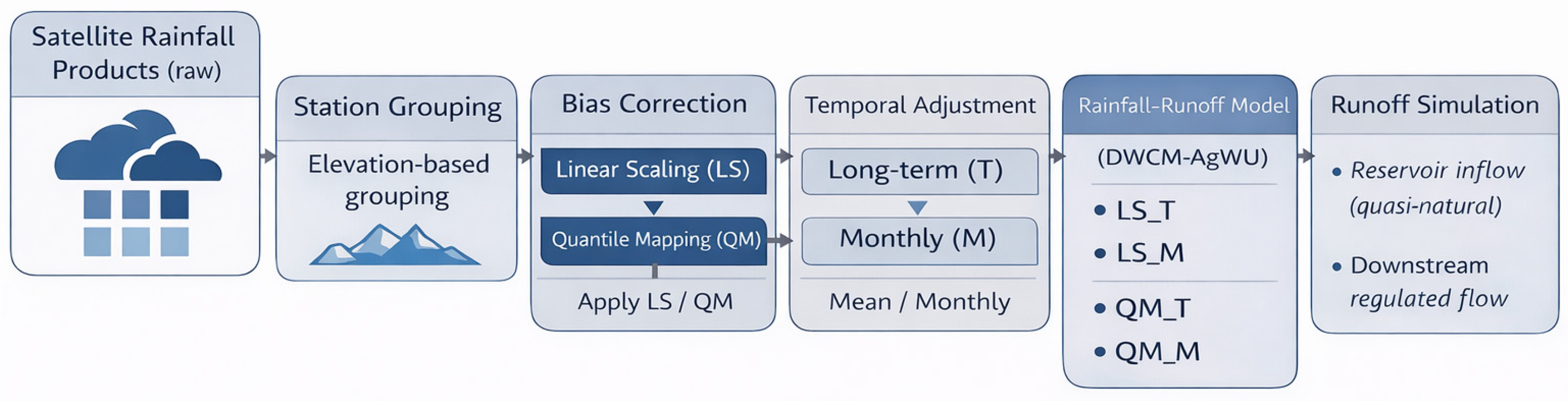
Four bias correction schemes were constructed by combining two correction methods Linear Scaling (LS) and Quantile Mapping (QM) with two temporal calibration strategies: long-term and monthly calibration. Linear Scaling adjusts rainfall magnitude using multiplicative factors derived from observed rainfall, whereas Quantile Mapping corrects the full rainfall distribution by aligning satellite-derived quantiles with those of ground observations [55,56,57]. Correction parameters were derived from the ground-based rainfall data described in Section 2.2 and were applied consistently across all satellite products and simulation periods. The inclusion of both calibration timescales allows examination of how correction timescale influences rainfall characteristics under pronounced seasonal variability.
Rather than identifying an optimal correction scheme, this framework is designed to examine how different combinations of correction method and calibration timescale modify rainfall magnitude, variability, and spatial organization, and how these modifications propagate into rainfall–runoff simulations under a consistent modeling setup. The overall workflow of the spatially informed bias correction framework and its linkage to rainfall–runoff simulations are illustrated in Figure 2.

2.4.1. Station Grouping and Spatial Representativeness

To account for spatial heterogeneity in rainfall associated with elevation gradients and regional rainfall regimes, rain gauge stations were grouped into spatially coherent clusters. Stations within each group are assumed to share broadly similar rainfall characteristics reflecting common topographic and climatic controls at the basin scale, rather than local-scale variability at individual station locations, thereby representing broad elevation- and region-based rainfall domains.
This elevation-conditioned grouping represents hydrologically coherent rainfall domains shaped by dominant orographic controls on precipitation and runoff generation. By organizing stations according to terrain-driven rainfall regimes, the framework retains spatial rainfall structures that are most relevant for basin-scale flow response prior to aggregation.
Bias correction parameters were derived independently for each station group using the corresponding ground-based rainfall observations and were subsequently applied to satellite rainfall over the same spatial domain. This grouping-based approach allows bias correction to represent sub-basin-scale rainfall characteristics while avoiding overfitting associated with station-specific adjustment.
By applying correction parameters consistently within each spatial domain, the framework preserves large-scale rainfall organization relevant for runoff generation, while allowing regional variability to be reflected in the corrected rainfall fields. This spatial representativeness is particularly important for rainfall–runoff modeling in topographically complex basins, where runoff response is sensitive to coherent rainfall patterns rather than isolated point-scale corrections.

2.4.2. Linear Scaling (LS)

Linear Scaling (LS) is a bias correction method that adjusts satellite rainfall by applying a multiplicative factor derived from the ratio between observed and satellite rainfall means [56]. The method assumes that systematic biases in satellite rainfall are primarily associated with errors in rainfall magnitude, while the temporal sequencing of rainfall variability is reasonably preserved.
In this study, two LS-based correction schemes were implemented: Linear Scaling using long-term mean rainfall (LS_T) and Linear Scaling using monthly rainfall means (LS_M). These schemes allow assessment of how the temporal scale of magnitude correction influences rainfall characteristics under strong seasonal variability.
(1)
Linear Scaling using long-term mean rainfall (LS_T)
P s , g L S _ T t = P s , g r a w t × P ¯ g o b s P ¯ s , g r a w
Equation (1) applies a single correction factor derived from long-term mean rainfall to all time steps, effectively reducing overall bias while preserving the temporal sequencing of rainfall events.
Where
P s , g L S _ T t is the bias-corrected satellite rainfall using long-term mean Linear Scaling at time t ;
P s , g r a w t is the original satellite rainfall at time t ;
P ¯ g o b s is the long-term mean observed rainfall for station group g ;
P ¯ s , g r a w is the long-term mean satellite rainfall for the same station group.
(2)
Linear Scaling using monthly rainfall means (LS_M)
To account for pronounced seasonal variability, the LS_M scheme computes correction factors separately for each calendar month by using Equation (2). This approach allows rainfall magnitude to be adjusted in a seasonally consistent manner while maintaining the original temporal sequencing of rainfall events.
For a given calendar month m :
P s , g L S _ M t = P s , g r a w t × P ¯ g , m o b s P ¯ s , g , m r a w ,   m = 1,2 , , 12
where
P s , g L S _ M t is the bias-corrected satellite rainfall using monthly Linear Scaling at time t ;
P s , g r a w t is the original satellite rainfall at time t ;
P g , m o b s is the mean observed rainfall for station group g in month m ;
P s , g , m r a w is the mean satellite rainfall for the same station group and month, and
m denotes the calendar month.

2.4.3. Quantile Mapping (QM)

Quantile Mapping (QM) is a distribution-based bias correction method that adjusts satellite rainfall by matching its cumulative distribution function (CDF) to that of ground-based observations [57]. Unlike magnitude-based correction, QM modifies biases across the entire rainfall distribution, including rainfall frequency, intensity, and extremes.
To examine the influence of temporal aggregation on distributional correction, two QM-based schemes were implemented: Quantile Mapping using long-term rainfall distributions (QM_T) and Quantile Mapping using monthly rainfall distributions (QM_M). These schemes allow assessment of how distributional correction at different temporal scales influences rainfall characteristics under strong seasonal variability.
(1)
Quantile Mapping using long-term rainfall distributions (QM_T)
P s , g Q M _ T t = F o b s , g 1 F s , g P s , g r a w t
In this scheme, satellite rainfall is mapped to observed rainfall using long-term empirical distributions for each station group by using Equation (3), correcting biases in rainfall magnitude and variability while assuming distributional stationarity across seasons.
Where
P s , g Q M _ T t is the bias-corrected satellite rainfall using long-term Quantile Mapping at time t ;
P s , g r a w t is the original satellite rainfall at time t ;
F s , g P s , g r a w t is the empirical cumulative distribution function of satellite rainfall for station group g ;
F o b s , g 1 F s , g P s , g r a w t is the inverse empirical cumulative distribution function of observed rainfall for the same station group.
(2)
Quantile Mapping using monthly rainfall distributions (QM_M)
P s , g Q M _ M t = F o b s , g , m 1 F s , g , m P s , g r a w t ,   m = 1,2 , , 12
In this formulation (Equation (4)), satellite rainfall is first transformed into its corresponding quantile within the satellite rainfall distribution for a given month and station group and is then mapped to the observed rainfall distribution at the same quantile. Monthly Quantile Mapping allows the shape of the rainfall distribution to vary seasonally, which is particularly relevant for representing monsoon-driven rainfall extremes.
Where
P s , g Q M _ M t is the bias-corrected satellite rainfall using monthly Quantile Mapping at time t ;
P s , g r a w t is the original satellite rainfall at time t ;
F s , g , m P s , g r a w t is the empirical cumulative distribution function of satellite rainfall for station group g in month m;
F o b s , g , m 1 F s , g , m P s , g r a w t is the inverse empirical cumulative distribution function of observed rainfall for the same station group and month, and m denotes the calendar month.
Bias correction parameters were derived during a calibration period of 2003–2015 and independently evaluated during 2016–2022 to assess temporal robustness of rainfall adjustment. This rainfall-side calibration–validation framework was implemented separately from the runoff model calibration (2006–2017) and validation (2018–2022), reflecting the distinct objectives of statistical rainfall adjustment and rainfall–runoff parameter estimation. Overlapping years between rainfall validation and runoff calibration do not introduce circularity, as rainfall correction parameters were fixed prior to runoff model calibration and were not optimized using runoff performance metrics.

2.5. Rainfall–Runoff Model and Experimental Design

A daily rainfall–runoff model, the Distributed Water Circulation Model with Agricultural Water Use (DWCM-AgWU), previously developed and applied in the Phetchaburi River Basin, was employed to propagate uncertainty in bias-corrected satellite and ground-based rainfall into streamflow simulations. The DWCM-AgWU model has been previously applied in several river basins in Thailand, including monsoon-influenced and regulated systems, supporting its applicability for rainfall–runoff analysis under local hydroclimatic and water-use conditions [58].
In this study, the DWCM-AgWU model was used as a diagnostic tool to examine how differences in rainfall forcing propagate into runoff responses under quasi-natural and regulated flow conditions. Rather than seeking a single optimal model configuration, model calibration was conducted separately for each rainfall input to support process-consistent interpretation of rainfall–runoff interactions [59].
This rainfall-specific calibration strategy reduces confounding effects arising from parameter incompatibility when comparing rainfall datasets with distinct magnitude, variability, and event structures. For each rainfall forcing, model parameters were calibrated to achieve internally consistent runoff simulations over the calibration period, allowing differences in simulated runoff behavior to be interpreted primarily in terms of rainfall forcing characteristics and their compatibility with the model structure.
Model calibration was performed over the period 2006–2017 for each rainfall forcing, followed by independent validation during 2018–2022 to assess the temporal robustness of rainfall-specific runoff responses. The same calibration–validation framework was applied consistently across all rainfall datasets.
Runoff simulations were evaluated at two locations representing contrasting hydrological conditions: (i) the reservoir inflow to the Kaeng Krachan Dam, treated as a quasi-natural representation of basin runoff response with minimal direct regulation; (ii) a downstream station located immediately below the dam and upstream of major irrigation diversions, representing regulated flow conditions dominated by reservoir release operations [60].
For each satellite precipitation product, three rainfall forcing scenarios were considered: ground-based rainfall observations used as a reference, satellite rainfall corrected using Linear Scaling, and satellite rainfall corrected using Quantile Mapping. Each rainfall dataset was used to drive the DWCM-AgWU model over identical simulation periods under its own calibrated parameter set, enabling a process-oriented comparison of runoff responses under different rainfall forcing conditions.
This modeling design was structured to support a process-based interpretation of rainfall–runoff interactions under different rainfall correction strategies. Rather than isolating rainfall effects under a fixed-parameter framework, the approach maintains internal consistency between rainfall inputs and model parameterization, allowing the analysis to reflect system-level responses under rainfall-consistent configurations. This design enables the examination of how structural modifications in rainfall propagate through hydrological processes and manifest in runoff behavior across multiple performance dimensions. This design is therefore consistent with the process-based interpretative framework introduced in Section 1.

2.6. Performance Evaluation Metrics

The performance of satellite rainfall products and runoff simulations was evaluated using complementary metrics designed to diagnose different aspects of rainfall representation and hydrological response. Rainfall metrics were used to examine how bias correction modifies rainfall magnitude, variability, event occurrence, and extremes, while runoff metrics were applied to interpret how rainfall-related differences propagate into streamflow behavior under quasi-natural and regulated flow conditions. No single metric was used as a basis for ranking rainfall products or correction schemes; instead, consistency across multiple metrics was emphasized [3,61].

2.6.1. Rainfall Performance Metrics

Rainfall performance was evaluated using a set of complementary metrics targeting distinct rainfall characteristics [3,54]. The correlation coefficient (R; Equation (5)) was used to assess the ability of satellite rainfall products to reproduce the temporal variability of observed rainfall, while the Root Mean Square Error (RMSE; Equation (6)) quantified discrepancies in rainfall magnitude. The standard deviation (σ; Equation (7)) was used to evaluate how well satellite rainfall reproduces the temporal variability of observed rainfall.
Rainfall occurrence and event detection skill were assessed using the Critical Success Index (CSI; Equation (8)), which jointly accounts for missed events and false alarms [62]. To diagnose the representation of extreme rainfall, the relative bias at the 95th percentile (RB95; Equation (9)) was employed, providing insight into upper-tail rainfall intensity relevant for runoff generation [63].
Correlation Coefficient (R)
R = t = 1 N P s a t t P ¯ s a t P o b s t P ¯ o b s t = 1 N P s a t t P ¯ s a t 2 t = 1 N P o b s t P ¯ o b s 2
Root Mean Square Error (RMSE)
R M S E = 1 N t = 1 N P s a t t P o b s t 2  
Standard Deviation (σ)
σ = 1 N 1 t = 1 N P t P ¯ 2
Critical Success Index (CSI)
C S I = H H + M + F
Relative Bias at the 95th Percentile (RB95)
R B 95 = P 95 s a t P 95 o b s P 95 o b s
where
P s a t t is satellite rainfall (raw or bias-corrected) at time t;
P o b s t is observed rainfall at time t;
P ¯ denotes the temporal mean;
σ denotes the standard deviation;
N is the total number of time steps;
H , M , and F denote the number of hits, misses, and false alarms for rainfall event detection;
P 95 denotes the 95th percentile rainfall intensity.
Rainfall events were defined using a threshold of P ≥ 1 mm day−1, consistent with widely adopted practice in satellite rainfall evaluation, to exclude trace precipitation and focus on hydrologically meaningful rainfall relevant for runoff generation. Higher R values reflect stronger temporal agreement, lower RMSE indicates reduced magnitude error, and σ values closer to those observed indicate improved representation of rainfall variability. CSI values approaching unity denote better event detection skill, whereas RB95 values near zero indicate reduced bias in upper-tail rainfall intensity.

2.6.2. Runoff Simulation Performance Metrics

Runoff simulation performance was evaluated using metrics that characterize overall agreement, water balance consistency, and high-flow behavior. Kling–Gupta Efficiency (KGE; Equation (10)) was used as the primary metric for overall runoff performance, as it provides a balanced assessment of correlation, bias, and variability components through its constituent terms (Equation (11)) [61]. Nash–Sutcliffe Efficiency (NSE) was not included because the Kling–Gupta Efficiency (KGE) explicitly decomposes performance into correlation, bias, and variability components, thereby providing a more diagnostically informative evaluation framework.
Volumetric bias (VB; Equation (12)) was employed to quantify systematic over- or underestimation of total runoff volume, reflecting long-term water balance consistency [64]. Event-based metrics were used to diagnose high-flow behavior, including peak flow error (PE; Equation (13)) to assess discrepancies in simulated flood magnitude and peak timing error ( Δ T p e a k ; Equation (14)) to quantify differences in the timing of peak runoff events. These event-scale metrics are particularly sensitive to rainfall forcing characteristics and are therefore informative for interpreting rainfall–runoff compatibility during high-flow conditions [65].
For runoff simulations, KGE values closer to unity indicate stronger overall agreement between simulated and observed runoff, while VB values close to zero indicate improved consistency in simulated runoff volumes. Smaller absolute values of PE indicate reduced discrepancies in simulated peak magnitudes, and Δ T p e a k values closer to zero indicate improved representation of flood timing.
Kling–Gupta Efficiency (KGE)
K G E = 1 R 1 2 + β 1 2 + γ 1 2
with
β = Q ¯ s i m Q ¯ o b s , γ = C V s i m C V o b s  
Volumetric Bias (VB)
V B = t = 1 N Q s i m t t = 1 N Q o b s t t = 1 N Q o b s t
Peak flow error (PE)
P E = Q p e a k s i m Q p e a k o b s Q p e a k o b s  
Peak timing error ( Δ T p e a k )
Δ T p e a k = T p e a k s i m T p e a k o b s
where
Q s i m t is simulated runoff at time t ;
Q o b s t is observed runoff at time t ;
Q ¯ denotes the temporal mean runoff;
C V is the coefficient of variation;
Q p e a k denotes peak runoff magnitude;
Δ T p e a k denotes the timing of peak runoff.
Because model parameters were calibrated separately for each rainfall forcing, runoff performance metrics are interpreted as indicators of rainfall–runoff compatibility after rainfall-specific calibration rather than as direct measures of intrinsic rainfall accuracy [66]. Runoff performance was evaluated across complementary metrics during both calibration (2006–2017) and validation (2018–2022) periods to assess temporal robustness.

3. Results

This section presents rainfall and runoff results before and after bias correction. Results were interpreted using complementary metrics in a process-oriented manner rather than as standalone performance indicators. Rainfall metrics characterized method- and product-dependent changes in rainfall magnitude, variability, event occurrence, and extremes, while runoff metrics examined how differences in rainfall forcing propagated into streamflow responses under a fixed model structure. Emphasis was placed on relative behavior and mechanistic consistency across correction schemes rather than on identifying a single optimal metric value.

3.1. Evaluation of Satellite Rainfall Performance

Rather than emphasizing a single “best” correction approach, the analysis adopted a process-oriented evaluation framework that examined baseline differences across satellite products and product-specific responses to different bias correction schemes. This design accounted for intrinsic differences in satellite retrieval characteristics and allowed the effects of bias correction to be interpreted in relation to each product’s inherent rainfall representation.

3.1.1. Performance of Bias Correction on Rainfall Magnitude

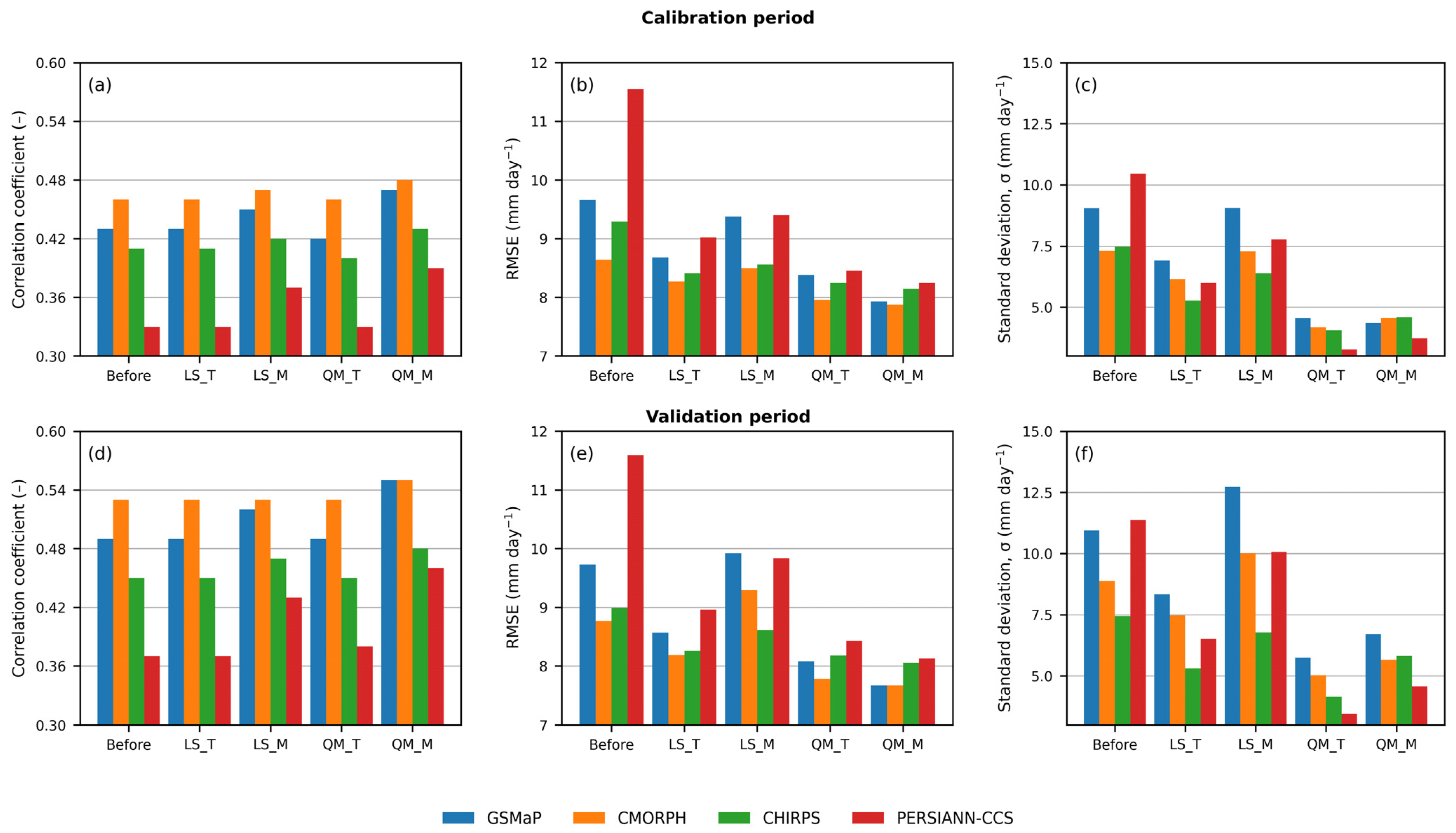
The effects of bias correction were first evaluated in terms of rainfall magnitude and temporal agreement at the basin scale. Figure 3 summarizes changes in correlation, error magnitude, and rainfall variability across the four satellite rainfall products during the calibration and validation periods, providing an integrated view of how bias correction modified basin-scale rainfall characteristics. A complementary summary of rainfall performance across satellite products and bias correction schemes is provided in Figure S2 (Supplementary Materials) using a Taylor diagram. This subsection focuses on magnitude-based characteristics, whereas rainfall occurrence and extreme behavior were examined separately in Section 3.1.2.
Across all products, raw satellite rainfall exhibited moderate temporal agreement with gauge observations during both calibration and validation periods, with only modest differences among products. Following bias correction, correlation generally changed, particularly under monthly calibration schemes, indicating changes in seasonal alignment of rainfall variability with observed intra-annual patterns. Baseline performance differed among satellite products, reflecting variations in retrieval approaches and sensor configurations. Multi-sensor products such as GSMaP and CMORPH generally demonstrated different levels of temporal consistency, whereas CHIRPS and PERSIANN-CCS showed larger discrepancies in rainfall magnitude and variability. These contrasts were also evident in the spatial distributions of annual mean rainfall (Supplementary Figures S3–S6), where raw products captured the broad climatological rainfall gradient across the basin but tended to overestimate basin-wide rainfall amounts.
Application of linear scaling led to consistent but spatially uniform adjustments in rainfall magnitude. Long-term linear scaling (LS_T) applied a single correction factor across the basin, producing nearly homogeneous changes in annual mean rainfall while largely preserving the original spatial gradients of the raw satellite products (Figure S3). As a result, relative contrasts between wetter and drier subregions remained similar to the raw patterns, although residual seasonal discrepancies persisted in areas characterized by strong intra-annual rainfall variability. Monthly linear scaling (LS_M) partially mitigated this limitation by introducing seasonally varying correction factors, yielding led to changes in alignment of rainfall magnitude between wet and dry seasons while maintaining proportional spatial structure (Figure S4).
In contrast, quantile mapping introduced spatially heterogeneous adjustments by correcting the full rainfall distribution rather than only the mean. Under long-term calibration (QM_T), annual mean rainfall exhibited non-uniform spatial changes across the basin, indicating that distributional correction affected different rainfall regimes to varying degrees (Figure S5). These changes were associated with modified magnitude bias and modified rainfall variability, although some seasonal inconsistencies remained due to the assumption of temporally stationary bias characteristics. Incorporating monthly calibration within the quantile mapping framework (QM_M) further altered the spatial distribution of rainfall magnitude, resulting in producing more gradual transitions between wetter and drier areas and modified amplification of rainfall gradients across the basin (Figure S6).
Overall, the spatial patterns of annual mean rainfall provided qualitative context for the quantitative metrics summarized in Figure 3. Linear scaling primarily adjusted rainfall magnitude in a spatially uniform manner, whereas quantile mapping introduced spatially heterogeneous changes associated with redistribution of rainfall intensities. Differences among correction schemes therefore reflected structural trade-offs between magnitude reconciliation and spatial reorganization, rather than uniform performance improvement. Subsequent sections extend this magnitude-focused analysis by examining event-scale characteristics (Section 3.1.2) and spatial rainfall anomalies (Section 3.1.3).

3.1.2. Rainfall Event Detection and Extreme Rainfall Performance

To extend the magnitude-based assessment in Section 3.1.1, rainfall event detection and extreme rainfall behavior were evaluated using the Critical Success Index (CSI) and the relative bias at the 95th percentile (RB95), respectively. These metrics characterized complementary aspects of rainfall behavior by focusing on rainfall occurrence and upper-tail intensity responses to bias correction across satellite products.
(1)
Rainfall event detection skill (CSI)
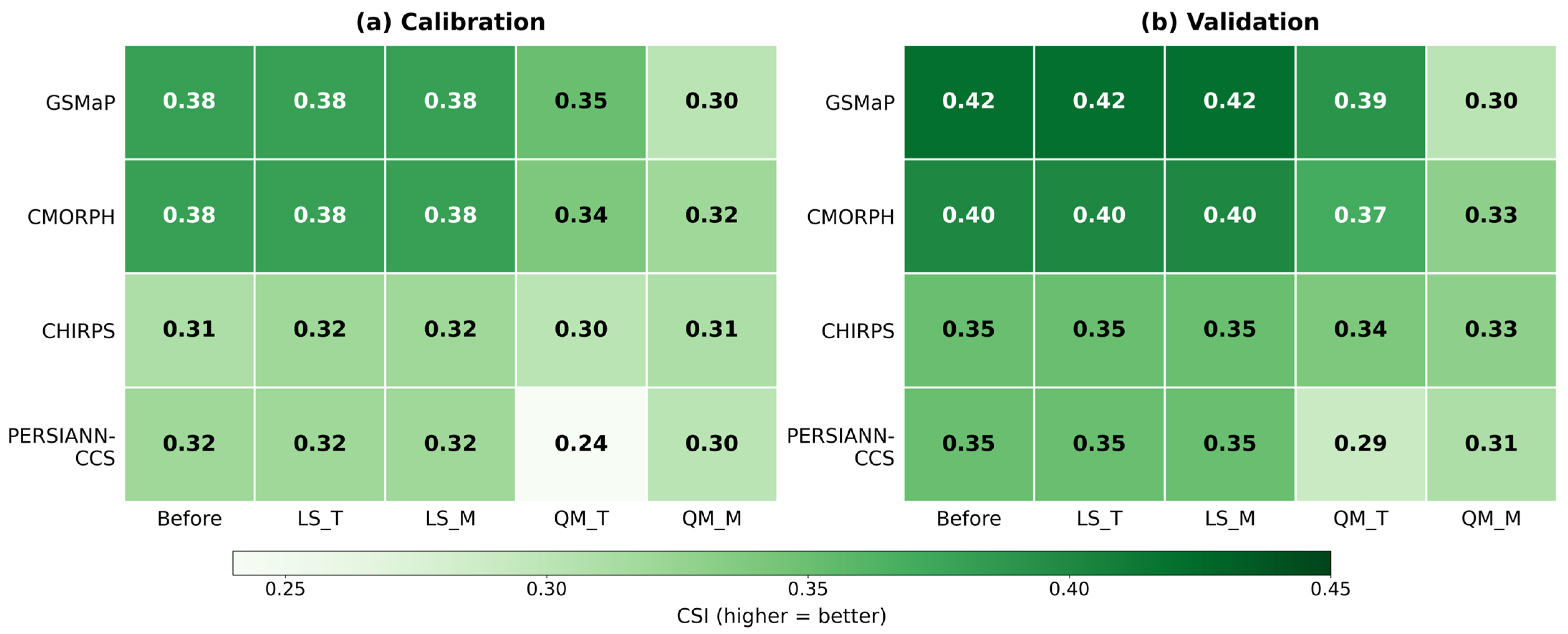
Figure 4 summarized rainfall event detection characteristics based on CSI for all satellite products under different bias correction schemes during the calibration and validation periods. Baseline CSI values revealed clear cross-product differences, with GSMaP and CMORPH exhibiting different levels of temporal correspondence with observed rainfall occurrence (approximately 0.38–0.42) than CHIRPS and PERSIANN-CCS (approximately 0.31–0.35) across both periods.
Following bias correction, rainfall event detection responded differently depending on the correction approach and satellite product. Linear Scaling (LS_T and LS_M) largely preserved CSI values across all products, with post-correction changes generally within ±0.01, indicating minimal modification of rainfall occurrence structure. In contrast, Quantile Mapping systematically altered event detection behavior. Under long-term calibration (QM_T), CSI values decreased modestly for GSMaP and CMORPH (approximately 0.03–0.05), while CHIRPS and PERSIANN-CCS exhibited smaller reductions (approximately 0.02–0.04). Monthly Quantile Mapping (QM_M) produced the largest changes in CSI, particularly for GSMaP and CMORPH during the validation period, where reductions were more pronounced.
Overall, the CSI heatmaps indicated that rainfall event detection after bias correction remained strongly product-dependent. Linear Scaling maintained rainfall occurrence characteristics across all satellite products, whereas Quantile Mapping modified detection behavior to varying degrees depending on retrieval characteristics. The consistency of these patterns between calibration and validation periods suggested stable post-correction responses rather than calibration-specific artifacts.
(2)
Extreme rainfall representation (RB95)
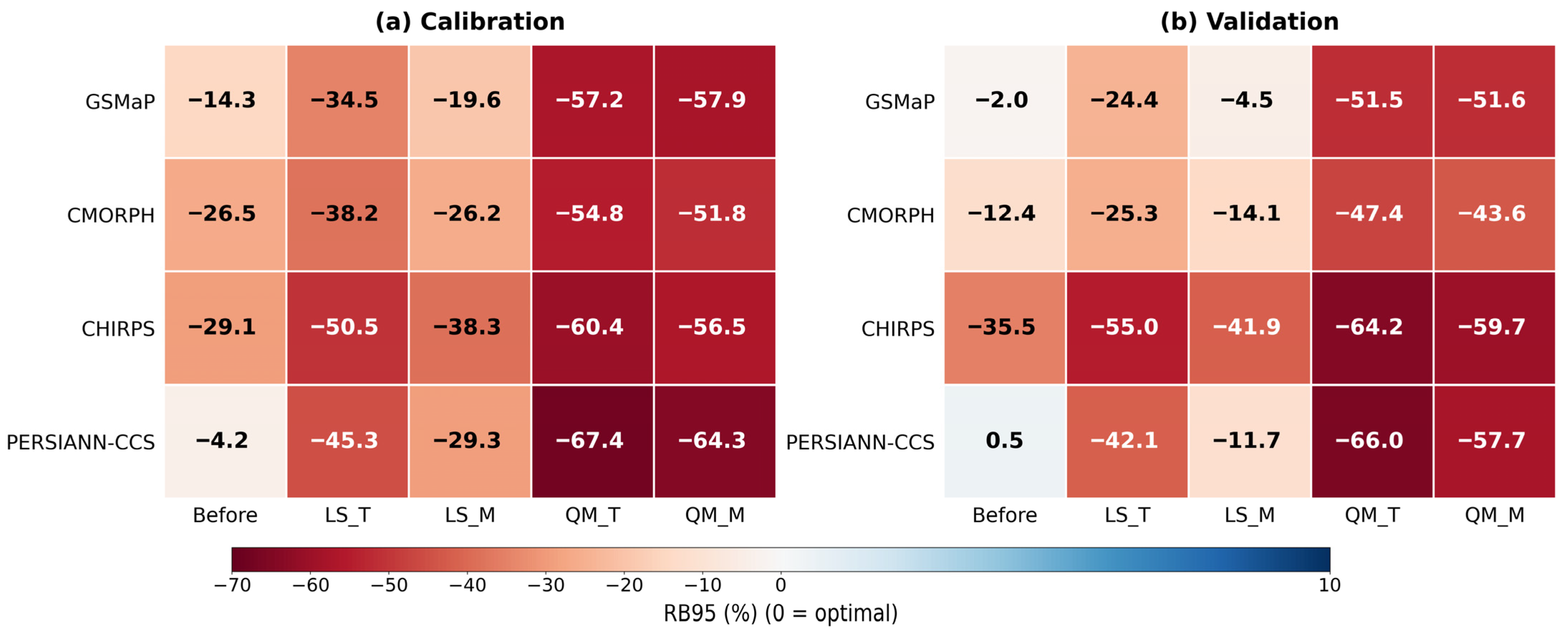
Figure 5 presented RB95 values describing relative bias in upper-tail rainfall intensity across satellite products and bias correction schemes during the calibration and validation periods. Baseline RB95 values revealed substantial cross-product variability. GSMaP and PERSIANN-CCS exhibited relatively smaller biases in extreme rainfall intensity during validation, whereas CMORPH and CHIRPS showed more pronounced underestimation, with RB95 values typically below −10% and −30%, respectively. These differences reflected intrinsic contrasts in satellite retrieval algorithms and their sensitivity to intense rainfall.
Bias correction produced contrasting effects on extreme rainfall representation. Monthly Linear Scaling (LS_M) modified the magnitude of extreme rainfall bias for selected products, particularly GSMaP and PERSIANN-CCS, while changes for CMORPH remained limited and CHIRPS continued to exhibit substantial underestimation. In contrast, Quantile Mapping (QM_T and QM_M) consistently modified upper-tail rainfall intensity across all products, resulting in increasingly negative RB95 values during both calibration and validation periods. This behavior was most evident for CHIRPS and PERSIANN-CCS, indicating strong sensitivity of extreme rainfall representation to distribution-based correction.
Overall, RB95 patterns indicated that extreme rainfall characteristics after bias correction did not converge uniformly across satellite products. Linear Scaling partially modified extreme rainfall bias for selected products, whereas Quantile Mapping systematically altered upper-tail intensity in a product-dependent manner. Together with CSI, RB95 highlighted how bias correction modified rainfall occurrence and distributional extremes, while subsequent analysis examined how these changes interacted with the spatial organization of rainfall fields and propagated into runoff generation.

3.1.3. Spatial Rainfall Patterns and Hydrological Relevance

While Section 3.1.1 focused on basin-scale rainfall magnitude and statistical characteristics, this subsection examines how bias correction altered the spatial organization of rainfall. Normalized rainfall anomalies were used to emphasize relative wet–dry patterns and spatial coherence across the basin, independent of absolute rainfall magnitude. This anomaly-based perspective provides complementary insight into the hydrological relevance of bias correction during wet and dry seasons.
(1)
From Statistical Improvement to Spatial Organization of Rainfall
Although Section 3.1.1 and Section 3.1.2 documented changes in rainfall characteristics following bias correction using basin-averaged statistics and event-based metrics, such changes did not necessarily ensure hydrologically consistent rainfall forcing. In rainfall–runoff modeling, runoff response depends not only on rainfall magnitude and timing but also on the spatial organization of rainfall, which influences flow concentration, response synchronization, and peak formation.
Bias correction schemes are primarily designed to reduce systematic errors in rainfall intensity and variability at aggregated temporal or spatial scales. Consequently, rainfall products exhibiting comparable basin-scale statistics may still differ substantially in spatial structure. These differences are particularly relevant in tropical basins, where runoff response is sensitive to localized rainfall gradients shaped by convective processes and orographic controls.
Accordingly, explicit assessment of how bias correction modifies spatial coherence and organization is required. These spatial characteristics provide essential context for interpreting event-based rainfall behavior (Section 3.1.2) and establish a mechanistic link between rainfall evaluation and the rainfall–runoff simulations presented in Section 3.2.
(2)
Baseline Spatial Rainfall Organization across Satellite Products
Prior to bias correction, satellite rainfall products exhibited distinct spatial organizations across the basin, reflecting differences in sensor configuration, retrieval algorithms, and data integration strategies. These intrinsic spatial characteristics defined the baseline context against which the spatial impacts of bias correction were interpreted.
Multi-sensor products such as GSMaP and CMORPH displayed relatively stronger spatial rainfall gradients, particularly in regions associated with persistent rainfall activity. Their spatial patterns reflected the combined influence of microwave retrievals and gauge-based adjustments, resulting in more spatially organized rainfall fields. In contrast, CHIRPS and PERSIANN-CCS exhibited comparatively smoother spatial organization with lower spatial contrast, consistent with gauge-assisted interpolation and infrared-based retrieval frameworks, respectively.
These baseline differences imply that satellite products with comparable basin-averaged statistics nonetheless impose different spatial rainfall forcing on hydrological models. Products characterized by smoother spatial organization tend to attenuate localized rainfall variability, whereas products with stronger gradients preserve localized rainfall signals more distinctly. This contrast provides a plausible mechanistic explanation for the differences in rainfall event detection and extreme rainfall behavior discussed in Section 3.1.2.
(3)
Effects of Bias Correction on Spatial Rainfall Organization
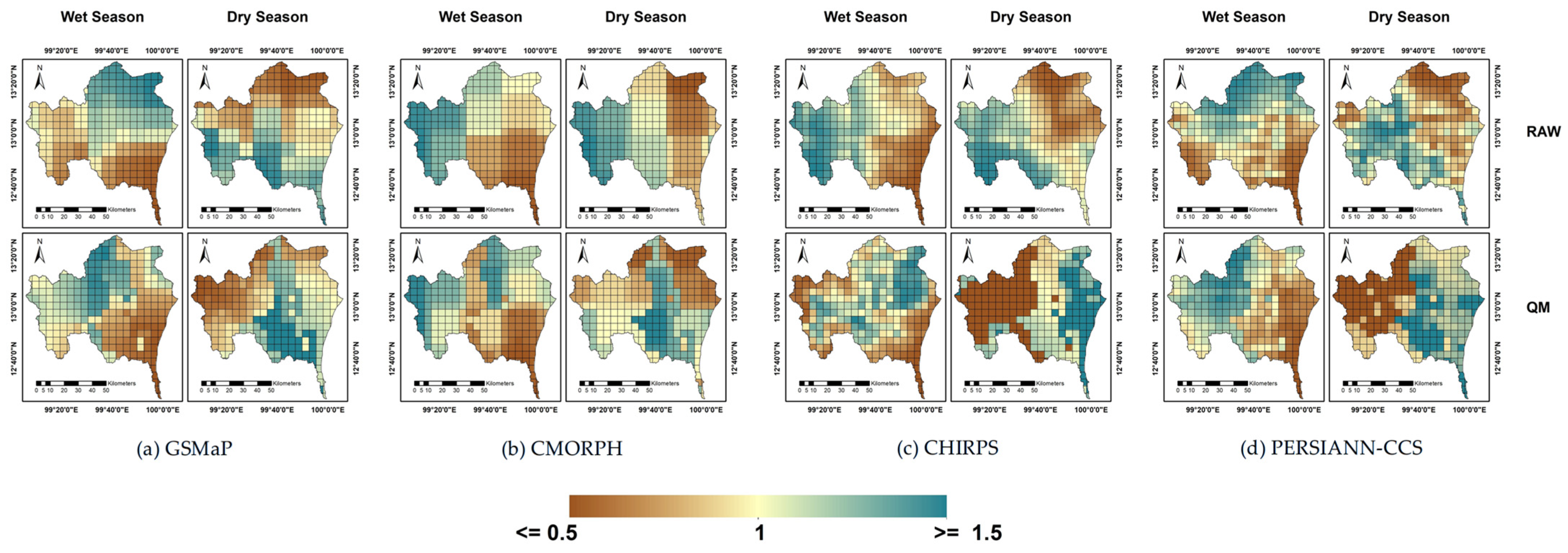
Figure 6 illustrates the effects of bias correction on spatial rainfall organization using normalized rainfall anomalies derived from Quantile Mapping with monthly calibration (QM_M), emphasizing relative wet–dry patterns rather than absolute rainfall magnitude. Detailed satellite-specific spatial distributions of mean annual rainfall before and after bias correction using Linear Scaling (LS_T and LS_M) and Quantile Mapping (QM_T and QM_M), together with station-based rainfall observations for reference, are provided in Figures S1–S4.
Linear Scaling primarily adjusted rainfall magnitude while largely preserving the original spatial gradients of the raw satellite products. Both LS_T and LS_M shifted basin-wide rainfall levels toward observed values, with LS_M introducing seasonally adaptive adjustments. However, relative wet–dry patterns across the basin remained broadly similar to the raw fields, indicating limited reorganization of spatial rainfall structure.
In contrast, Quantile Mapping induced more pronounced spatial reorganization. By redistributing rainfall intensities according to observed distributions, Quantile Mapping reduced spatial contrasts and moderated localized extreme deviations. QM_T altered basin-scale spatial biases, whereas QM_M produced stronger smoothing of spatial gradients, particularly in regions where raw satellite rainfall departed most from station observations.
Seasonal contrasts further highlighted the structural effects of bias correction. During the wet season, partially coherent spatial patterns persisted after correction, whereas during the dry season, Quantile Mapping—particularly QM_M—more noticeably reduced spatial differentiation, suggesting greater sensitivity of localized rainfall regimes to distribution-based correction under low-rainfall conditions.
Overall, evidence from Figure 6 and Figures S1–S4 indicates that bias correction modifies both rainfall magnitude and spatial organization in a method-dependent manner. Linear Scaling primarily reconciles rainfall magnitude while preserving spatial gradients, whereas Quantile Mapping alters both magnitude and spatial structure. These spatial responses provide essential context for interpreting event-scale rainfall behavior (Section 3.1.2) and subsequent runoff responses examined in Section 3.2.
(4)
Elevation-conditioned spatial response to bias correction
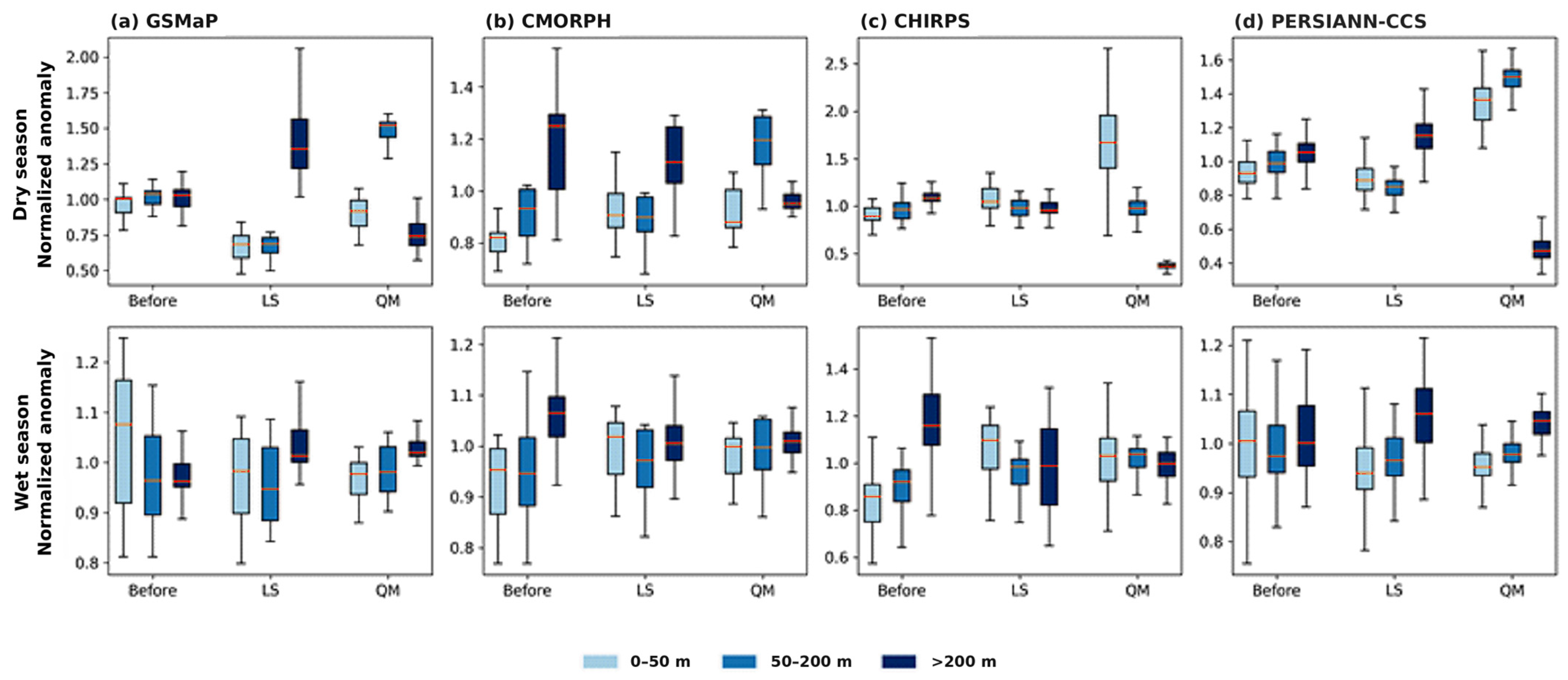
To evaluate how bias correction modified terrain-controlled rainfall organization, elevation-conditioned responses were examined using normalized rainfall anomalies. Figure 7 showed anomaly distributions across elevation bands during the dry and wet seasons, while Table S1 summarized the contrast between high- and low-elevation zones.
Under uncorrected conditions, rainfall anomalies exhibited clear elevation dependence, particularly during the dry season (Figure 7, top row). Across all satellite products, median anomalies generally increased with elevation, indicating stronger rainfall signals over higher terrain and reflecting orographic influences. This behavior was consistently captured by positive ΔA values in Table S1, indicating the presence of elevation-controlled spatial organization across products.
Monthly Linear Scaling (LS_M) largely preserved this elevation-conditioned structure. The relative ordering of anomaly distributions across elevation bands remained similar to the baseline case, with higher median anomalies generally retained at elevations above 200 m. Correspondingly, ΔA values under LS_M remained positive for most products, indicating that Linear Scaling primarily adjusted rainfall magnitude while maintaining terrain-related spatial contrasts.
In contrast, Quantile Mapping with monthly calibration (QM_M) produced a distinct elevation-conditioned response. During the dry season, anomaly distributions showed increased overlap across elevation bands, indicating reduced separation between low- and high-elevation rainfall signals. This redistribution was reflected by ΔA values approaching zero or becoming negative for some products, particularly CHIRPS and PERSIANN-CCS, suggesting a potential reduction or shift in elevation-dependent contrast, as quantified in Table S1.
Seasonal modulation further influenced these responses. During the wet season (Figure 7, bottom row), anomaly distributions exhibited weaker elevation separation for all products, and ΔA values clustered near zero regardless of the correction method. This behavior was consistent with seasonal large-scale rainfall influence, which reduced the relative impact of local topographic controls.
Overall, Figure 7 and Table S1 indicated that bias correction affected elevation-dependent rainfall organization in a method- and season-specific manner. Linear Scaling tended to preserve terrain-related spatial structure, whereas Quantile Mapping promoted spatial homogenization, particularly during dry-season conditions when orographic effects were more pronounced. These elevation-conditioned responses provided essential context for interpreting rainfall–runoff sensitivity in the subsequent analysis.

3.2. Implications for Hydrological Interpretation and Application

Results in Section 3.1 showed that bias correction modified both the statistical properties and spatial organization of satellite rainfall in a product- and method-dependent manner. Importantly, improved agreement at aggregated scales did not necessarily yield hydrologically consistent rainfall forcing. This section synthesizes the rainfall-focused findings and interprets their implications for runoff behavior in a topographically complex tropical basin. Under the rainfall-specific calibration strategy adopted here, runoff metrics are interpreted as indicators of rainfall–runoff compatibility rather than as evidence of intrinsic superiority among rainfall datasets.

3.2.1. Structural Consistency of Rainfall Fields and Hydrological Relevance

Runoff response depends not only on rainfall magnitude and timing but also on the spatial organization of rainfall across a basin. Spatial coherence influences runoff synchronization, flow concentration, and peak development, particularly in basins characterized by strong topographic gradients and convective rainfall regimes. Consequently, rainfall products with similar basin-averaged statistics can impose substantially different hydrological forcing when their spatial structures differ.
The anomaly-based analyses in Section 3.1.3 isolated relative wet–dry patterns from absolute rainfall magnitude and clarified this distinction. Linear Scaling largely preserved pre-correction spatial organization, maintaining coherent wet and dry zones associated with retrieval structure and terrain-related rainfall processes. In contrast, Quantile Mapping systematically modified spatial anomaly patterns, producing more homogeneous rainfall fields with reduced spatial contrast, particularly under monthly calibration.
From a hydrological perspective, these findings indicate that bias-correction methods yielding comparable statistical improvements differ in their capacity to retain spatial rainfall organization relevant for runoff generation. Distribution-based correction improves rainfall distributions while attenuating spatial gradients that shape runoff response, revealing a structural trade-off that cannot be diagnosed using basin-scale metrics alone.

3.2.2. Interpretation of Runoff Response Under Rainfall-Specific Calibration

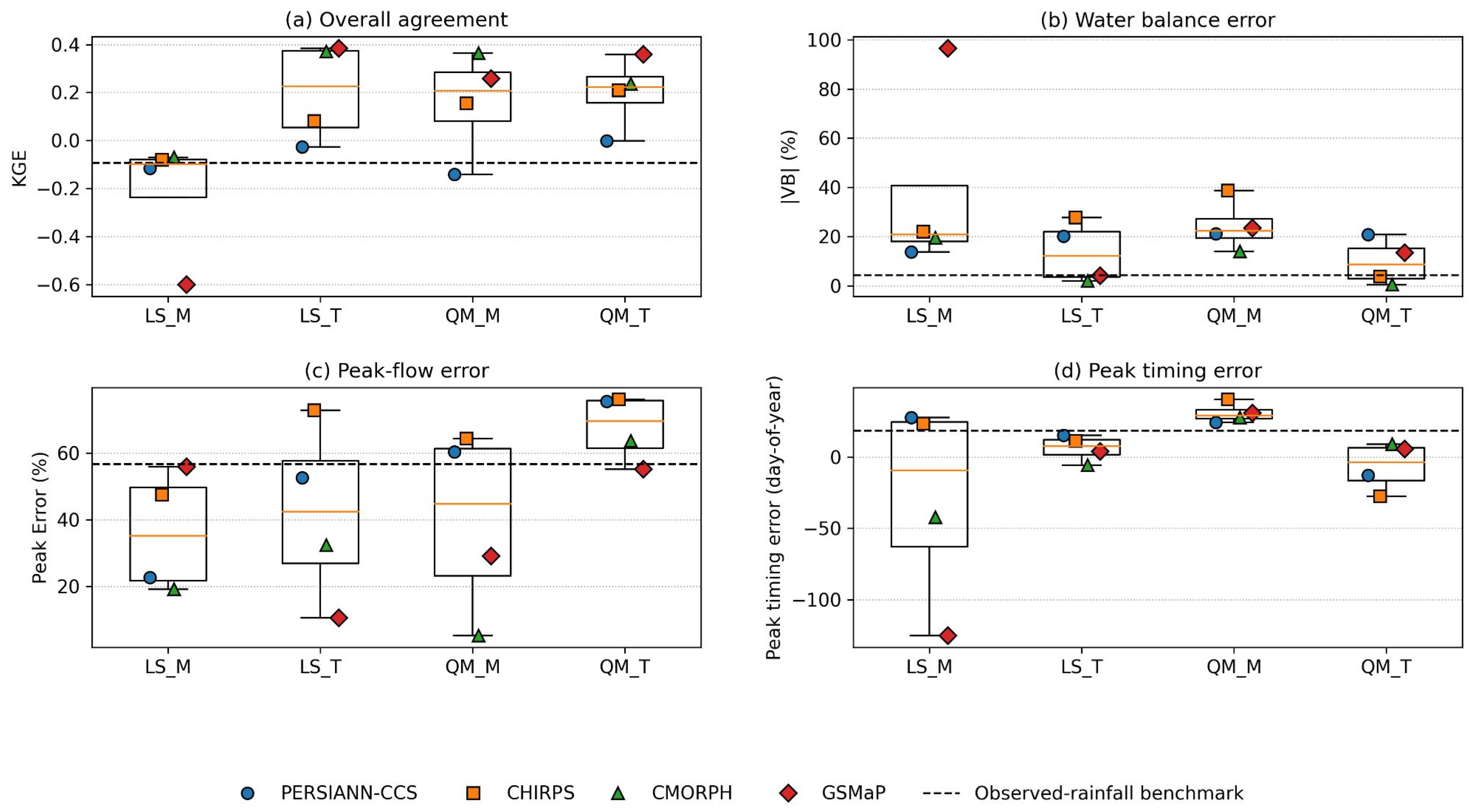
Figure 8 presents runoff responses during the validation period (2018–2022) under rainfall-specific calibration. Because model parameters were optimized independently for each rainfall forcing, the resulting metrics reflect rainfall–runoff compatibility under internally consistent configurations, rather than intrinsic rainfall accuracy.
The results reveal distinct response patterns across multiple performance dimensions, indicating that different rainfall correction strategies influence hydrological behavior through different process pathways. Rather than indicating consistent superiority of any single method, the observed differences reflect how rainfall characteristics interact with model parameterization to shape runoff responses.
Across basin-scale indicators, long-term Linear Scaling (LS_T) is associated with runoff behavior that reflects cumulative water balance conditions with relatively stable volumetric behavior, as indicated by relatively stable volumetric bias and overall agreement metrics (Figure 8a,b). In contrast, Quantile Mapping approaches (QM_M and QM_T) are associated with changes in event-scale response characteristics, including peak magnitude and timing, reflecting their influence on rainfall intensity distributions.
Event-based diagnostics further highlight these differences. Peak-flow errors remain present across all methods (Figure 8c), suggesting inherent challenges in reproducing extreme runoff events from satellite rainfall inputs. However, variations in the spread and clustering of errors indicate differences in how rainfall inputs are translated into peak responses. Similarly, peak timing errors (Figure 8d) show that some correction approaches are associated with more temporally coherent runoff responses, whereas others exhibit greater dispersion in timing deviations.
Importantly, the reference simulation based on gauge rainfall does not consistently outperform satellite-based rainfall across all performance dimensions (Figure 8). Instead, different rainfall inputs are associated with varying strengths across complementary aspects of runoff behavior, including water balance, dynamic agreement, and event-scale representation.
These findings indicate that runoff response is governed not by rainfall accuracy alone, but by the interaction between rainfall representation and model parameterization. Consequently, the observed differences should be interpreted as indicators of rainfall–runoff compatibility and process-based trade-offs across multiple dimensions, rather than as evidence of statistically dominant performance among correction strategies.
Overall, Figure 8 illustrates that no single correction approach consistently optimizes all aspects of runoff response. Instead, different methods emphasize different hydrological characteristics, reinforcing the importance of multi-metric, process-based interpretation when evaluating rainfall-driven runoff simulations.

3.2.3. Multi-Metric Coherence of Quasi-Natural Inflow Response and Hydrological Implications

This subsection synthesizes runoff simulation results under quasi-natural inflow conditions by emphasizing the coherence of hydrological behavior across multiple performance dimensions. Rather than focusing on individual metrics in isolation, the analysis examines how rainfall correction strategies influence integrated runoff responses, as jointly reflected in overall agreement, water balance behavior, and event-scale characteristics (Figure 8).
The distributional patterns in Figure 8 indicate that no single metric fully captures hydrological behavior on its own. Instead, runoff responses exhibit cross-metric interactions, where changes in one aspect of system behavior are accompanied by compensating variations in others. These patterns highlight inherent trade-offs between long-term volume representation and event-scale dynamics, underscoring the importance of interpreting hydrological response through a multi-dimensional perspective.
Under quasi-natural inflow conditions, different rainfall correction strategies are associated with distinct patterns of multi-metric coherence. In some cases, runoff responses exhibit relatively stable volumetric behavior across periods, indicating consistency in the representation of cumulative water balance. In other cases, responses show greater variability in event-scale characteristics, including peak magnitude and timing, reflecting differences in how rainfall intensity and temporal structure are translated into runoff generation.
These variations do not indicate consistent superiority of any single correction approach. Instead, they reflect differences in how rainfall inputs interact with model parameterization to produce hydrological responses across complementary dimensions. Improvements in one aspect of runoff behavior are often accompanied by deviations in others, indicating that rainfall correction modifies the balance between long-term consistency and short-term responsiveness.
Consistency between calibration and validation periods is interpreted here as a qualitative indicator of structural coherence rather than as a basis for performance ranking. The persistence of response patterns across periods suggests that the observed differences arise from systematic rainfall–runoff interactions under internally consistent model configurations, rather than from calibration artifacts alone.
Overall, the results indicate that quasi-natural inflow response is characterized by distinct multi-metric patterns shaped by rainfall representation and model structure.
These findings provide a process-based, multi-metric basis for interpreting rainfall–runoff compatibility and quasi-natural inflow variability prior to examining the effects of flow regulation. No single rainfall correction strategy is found to yield uniformly consistent runoff behavior across all metrics; instead, each is associated with a distinct hydrological response pattern shaped by how rainfall corrections propagate through runoff generation mechanisms.

3.2.4. Effects of Regulation on Downstream Flows

Once flow regulation was introduced, rainfall-driven inflow variability was no longer directly transmitted to downstream discharge. Reservoir storage and operational rules mediated inflow fluctuations, producing a regulated downstream flow regime. Accordingly, this subsection examined how variability in quasi-natural inflow was transformed under regulation, rather than comparing the relative performance of inflow simulations. The downstream analysis is therefore intended to illustrate regulation-induced filtering of rainfall-driven variability rather than to compare correction performance under regulated conditions.
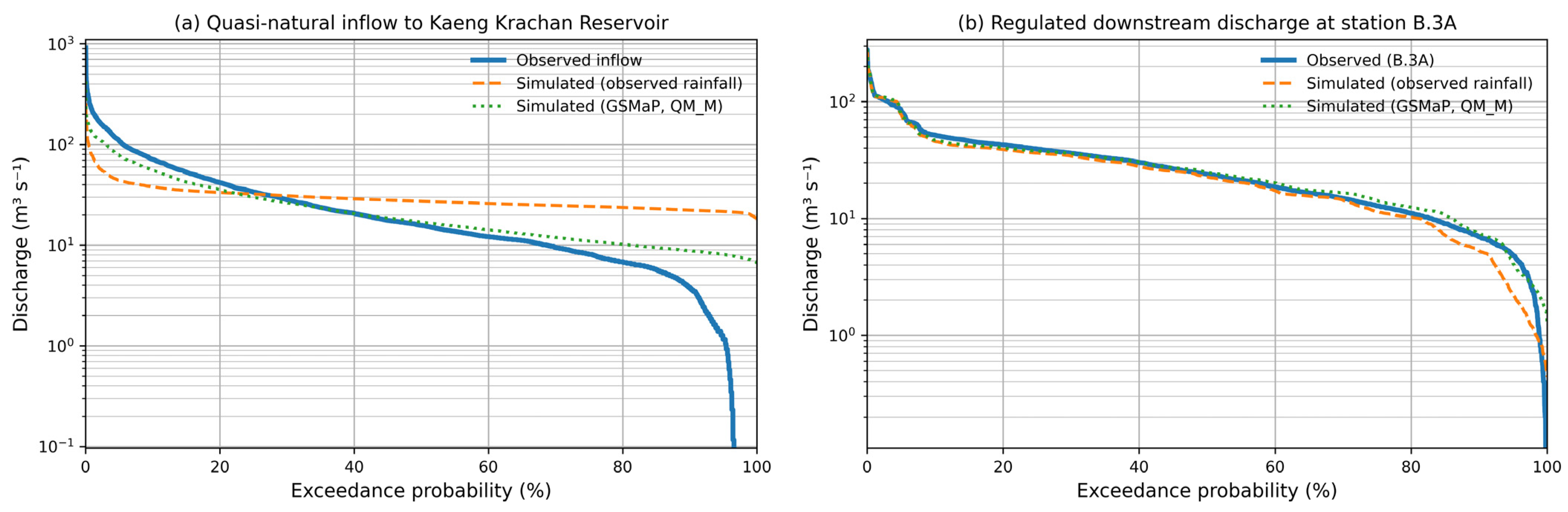
As shown in Figure 9a, quasi-natural inflow exhibited substantial dispersion along the flow duration curve, particularly at high- and low-flow extremes. These differences reflected the sensitivity of inflow distributions to rainfall forcing and bias-correction effects prior to regulation. Although simulated inflows captured general mid-range behavior, deviations increased toward the distribution tails, highlighting the influence of rainfall representation under quasi-natural conditions.
In contrast, Figure 9b shows that regulated downstream discharge at station B.3A exhibited reduced variability across exceedance probabilities. Flow duration curves converged over a broad mid-range, indicating attenuation of inflow-driven variability through reservoir storage, peak regulation, and controlled release operations. Consequently, downstream flow regimes became more constrained than their quasi-natural inflow counterparts.
Consistent with the multi-metric interpretation in Section 3.2.3, inflow simulations characterized by different rainfall–runoff trade-offs yielded broadly similar downstream flow distributions once regulation was applied. This pattern suggests that reservoir operation dampened the hydrological expression of upstream inflow variability. Nevertheless, residual differences persisted at the distributional extremes, indicating that downstream flows retained partial sensitivity to inflow characteristics during high- and low-flow conditions.
Overall, downstream discharge variability under regulation was governed primarily by storage dynamics and operational constraints, with reduced sensitivity to rainfall-induced inflow differences. This finding highlights the need to distinguish between quasi-natural and regulated flow regimes when interpreting the hydrological implications of satellite rainfall bias correction.

4. Discussion

4.1. Structural Trade-Offs in Rainfall Correction: A Process-Based Interpretative Framework

Previous studies have evaluated satellite rainfall correction primarily through improvements in rainfall statistics or aggregate runoff performance metrics, often without explicitly separating natural and regulated flow regimes. While such approaches provide useful performance comparisons, they rarely diagnose how correction methods modify the structural characteristics of rainfall fields or how these structural changes propagate through hydrological processes. In particular, limited attention has been given to distinguishing quasi-natural inflow from regulated downstream discharge or to linking spatial rainfall organization with rainfall–runoff compatibility under rainfall-specific calibration. As a result, most existing studies emphasize rainfall-statistic improvement or product ranking, whereas few establish a unified framework that integrates rainfall structure, hydrological response, and system context.
To address this gap, this study advances a process-based interpretative framework that provides a structured basis for interpreting how bias correction reshapes rainfall–runoff interactions beyond conventional performance-based evaluation. The contribution lies not in developing a new correction algorithm, but in establishing a system-aware framework that links rainfall structural modification to hydrological response through identifiable process pathways.
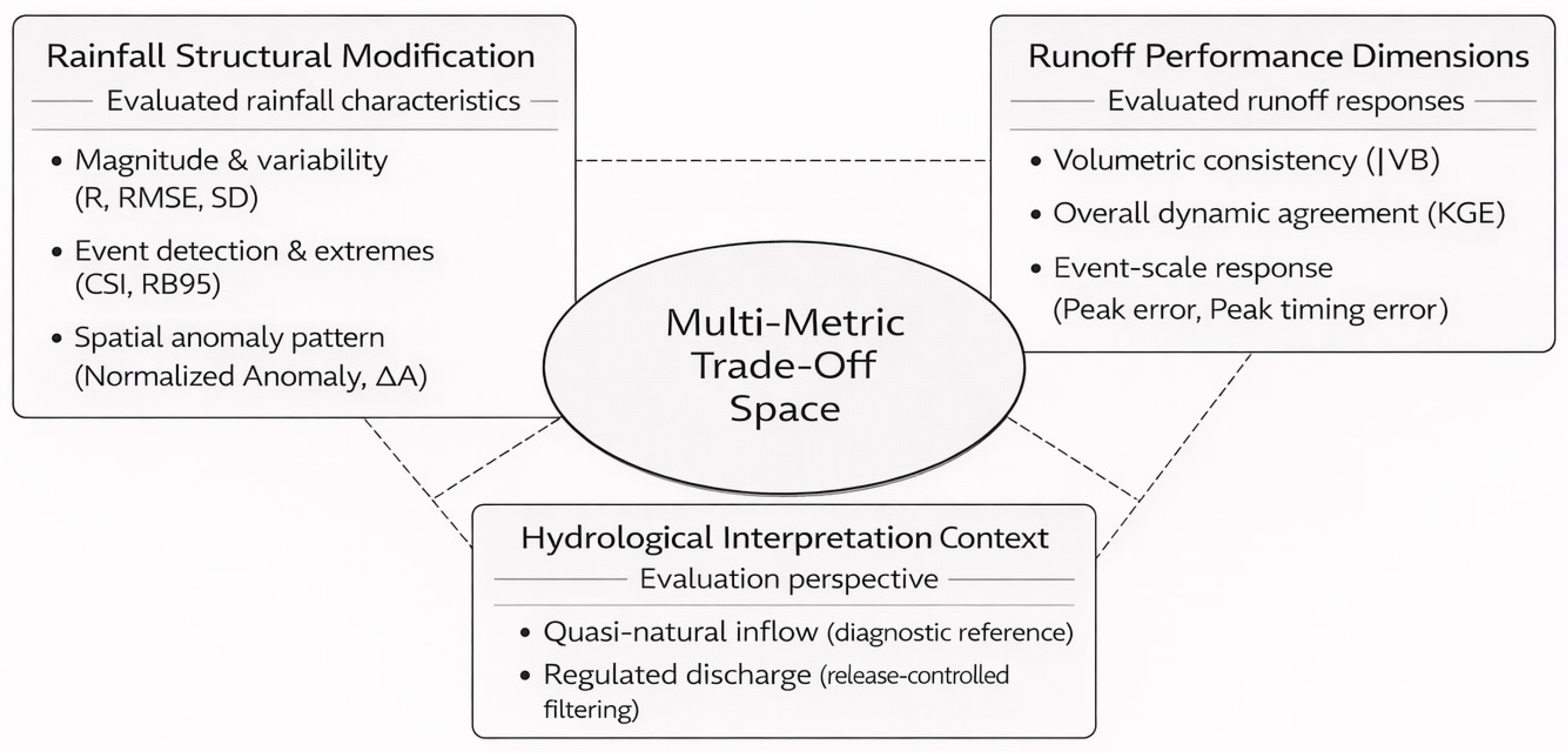
Figure 10 synthesizes this framework by organizing the analysis into three interacting components: (i) rainfall structural modification, (ii) runoff performance dimensions, (iii) hydrological interpretation context. These components are explicitly linked within a multi-metric trade-off space, which provides a coherent basis for diagnosing how different correction strategies influence hydrological behavior under varying system conditions.
The rainfall-side analyses in Section 3.1 demonstrated that bias correction reshapes satellite rainfall fields across multiple structural dimensions, extending beyond improvements in statistical agreement with station observations. By simultaneously modifying rainfall magnitude, distributional properties, and spatial organization, correction strategies alter the effective hydrological forcing imposed on runoff models. Within this framework, rainfall correction is therefore interpreted as a structural transformation of hydrological forcing, rather than a purely statistical adjustment.
These structural transformations propagate through runoff generation mechanisms and manifest as distinct patterns in runoff response across performance metrics. Linear Scaling primarily preserves spatial rainfall organization while adjusting basin-scale magnitude, whereas Quantile Mapping enhances distributional agreement but often reduces spatial coherence. These contrasting behaviors reveal a systematic structural trade-off: methods that improve rainfall distributions may simultaneously attenuate spatial gradients relevant for runoff generation, while methods that preserve spatial organization may retain distributional biases.
Importantly, improvements in rainfall statistics do not translate uniformly into hydrological consistency. The persistence of method-specific runoff response patterns across calibration and validation periods suggests that observed differences reflect systematic rainfall–runoff interactions rather than calibration artifacts. Once reservoir regulation is introduced, upstream differences in inflow variability are further dampened, highlighting the role of storage dynamics in filtering rainfall-driven signals and mediating hydrological response.
Although runoff simulations are driven by basin-averaged rainfall, spatial organization is evaluated within elevation-conditioned domains prior to aggregation. This approach preserves dominant heterogeneity associated with orographic controls and seasonal gradients, allowing structured spatial signals to influence the effective rainfall forcing. Consequently, runoff responses reflect not only aggregated rainfall magnitude but also temporally redistributed contributions from distinct elevation zones, linking spatial heterogeneity to runoff generation pathways.
The adopted domain-based correction strategy operates at an intermediate spatial scale between point-wise gauge adjustment and fully distributed grid-level correction. This design preserves structured rainfall heterogeneity while avoiding over-parameterization, ensuring that spatial organization relevant for runoff synchronization and flow concentration is retained prior to basin-scale aggregation.
Seasonal dependence further modulates these effects. During the wet season, large-scale rainfall systems dominate and spatial organization remains relatively coherent following correction. During the dry season, when rainfall variability is governed by localized convective and orographic processes, distribution-based correction exerts stronger influence on spatial rainfall structure. This seasonal sensitivity highlights the dependence of correction relevance on prevailing rainfall regimes.
Overall, rainfall correction strategies should be interpreted in relation to specific modeling objectives rather than evaluated through a single performance metric. Magnitude-oriented correction may be suitable for basin-scale or long-term water balance applications, whereas distribution-based correction may better support analyses sensitive to rainfall intensity distributions and event-scale dynamics, albeit with potential modification of spatial rainfall structure.
While the framework is developed based on the conditions of the studied basin, it provides a conceptual structure that may be applicable to similar monsoon-influenced and regulated systems, subject to further evaluation. By formalizing the links between rainfall structure, hydrological response, and system context, the framework shifts evaluation from performance ranking toward process-consistent interpretation, thereby providing a process-consistent basis for understanding the application of satellite rainfall products in complex hydrological settings.

4.2. Hydrological Process Interpretation

Within the process-based interpretative framework described in Section 4.1, this subsection examines how rainfall structural characteristics propagate into runoff response under rainfall-specific calibration. The rainfall-specific calibration strategy was intentionally adopted to examine rainfall–runoff compatibility under internally consistent model configurations. The objective was not to rank rainfall products under a fixed parameter set, but to evaluate how structural characteristics of corrected rainfall propagate into runoff behavior after parameter reconciliation. This approach is designed to examine rainfall-induced process effects while minimizing confounding influences from parameter mismatch.
The hydrological results indicate that rainfall correction effects propagate into runoff simulations through identifiable process pathways rather than producing uniform changes across performance metrics. To clarify these pathways, the analysis emphasized quasi-natural inflow conditions, under which runoff responses directly reflect rainfall–runoff interactions prior to flow regulation. While independent calibration may partially compensate for structural discrepancies in rainfall forcing, the persistence of consistent response patterns across calibration and validation periods suggests that runoff behavior reflects rainfall–runoff compatibility rather than parameter artifacts. Consequently, runoff performance is interpreted diagnostically rather than as a direct indicator of intrinsic rainfall accuracy.
No systematic drift of calibrated parameters toward physically implausible ranges was observed across rainfall-specific calibrations. Parameter sets remained within hydrologically reasonable bounds, and no consistent tendency toward compensatory parameter inflation or attenuation was detected. This stability supports the interpretation that observed differences in runoff behavior primarily reflect rainfall forcing characteristics, with limited evidence of structural compensation within the model.
Under quasi-natural conditions, correction strategies influence runoff generation through distinct mechanisms. Distribution-based correction modifies rainfall frequency and intensity distributions, primarily affecting peak flow magnitude and event timing. In contrast, magnitude-oriented correction adjusts cumulative rainfall input, strengthening volumetric consistency while exerting weaker influence on short-term runoff dynamics. These contrasting mechanisms explain the trade-offs observed among runoff performance metrics.
Runoff sensitivity further depends on the prevailing hydrological regime. Event-driven conditions amplify the influence of rainfall intensity and timing, whereas periods dominated by baseflow and storage respond more strongly to cumulative rainfall magnitude. This regime dependence clarifies why improvements in one runoff metric do not necessarily translate into consistent responses across others.
Multi-metric evaluation therefore provides a process-informed perspective on rainfall–runoff interactions by emphasizing coherence across hydrological dimensions rather than optimization of isolated indicators. Quasi-natural inflow serves as a process-based reference for interpreting rainfall correction impacts prior to the moderating effects of regulation.
This interpretation is further supported by the validation results. Importantly, the reference simulation based on gauge rainfall does not consistently outperform satellite-based rainfall across all runoff performance dimensions (Figure 8). While gauge-based forcing provides a useful reference, satellite-based simulations exhibit comparable or improved performance in certain metrics, while underperforming in others. This pattern is evident across volumetric consistency, peak magnitude, and timing metrics, where no single rainfall input yields uniformly superior performance.
This observation highlights that runoff response is not determined by rainfall accuracy alone, but by the interaction between rainfall representation and model parameterization. Differences in rainfall magnitude, temporal structure, and spatial organization interact with model parameters to produce distinct runoff behaviors across multiple dimensions.
Consequently, applying a single parameter set calibrated under gauge rainfall forcing to all rainfall datasets may not provide a physically consistent basis for comparison. The results in Figure 8 suggest that such an approach could introduce additional model–forcing mismatch, potentially obscuring the hydrological effects of rainfall correction.
Within this context, the rainfall-specific calibration strategy adopted in this study enables each rainfall input to be evaluated under internally consistent model configurations. The resulting runoff responses are therefore interpreted diagnostically as indicators of rainfall–runoff compatibility and trade-offs across performance dimensions, rather than as direct measures of rainfall-only effects.

4.3. Role of Flow Regulation

Within the framework introduced in Section 4.1, this subsection examines how flow regulation modifies the transmission of rainfall-driven runoff variability. Building on the quasi-natural inflow interpretation, flow regulation further alters the transmission of rainfall-driven runoff variability to downstream discharge. Once reservoir regulation is introduced, downstream flow behavior becomes governed primarily by storage dynamics and operational rules rather than by direct rainfall–runoff response.
Reservoir storage attenuates inflow variability and redistributes discharge over time through controlled releases, producing smoother and more constrained downstream hydrographs. Consequently, differences in upstream runoff behavior associated with rainfall correction strategies are strongly attenuated after regulation. Inflow simulations exhibiting contrasting trade-offs under quasi-natural conditions therefore tend to converge toward similar downstream flow regimes, particularly across mid-range flows.
Despite this convergence, regulation does not fully eliminate inflow influence. Residual sensitivity remains at high- and low-flow extremes, where release constraints and operational thresholds can still reflect differences in inflow magnitude and timing. These effects indicate that regulation compresses, rather than fully decouples, rainfall-driven variability in downstream discharge.
Overall, regulated downstream flow reflects an interaction between inflow variability and operational control rather than rainfall forcing alone. Interpreting regulated flows within this system context is therefore important for avoiding misleading conclusions regarding the hydrological implications of satellite rainfall correction.

4.4. Practical and Methodological Implications

The findings of this study have practical implications for the application of satellite rainfall products in hydrological modeling, particularly in regulated basins. Evaluating rainfall correction strategies solely on the basis of downstream discharge performance may be misleading, as regulated flows are strongly influenced by reservoir operation rather than direct rainfall forcing. Assessment under quasi-natural inflow conditions therefore provides a more appropriate reference for interpreting rainfall-driven hydrological responses.
The results also underscore the importance of aligning rainfall correction strategies with specific modeling objectives. Magnitude-oriented correction is more suitable for applications focused on basin-scale or long-term water balance, whereas distribution-based correction may better support event-scale analyses such as peak flow dynamics. However, because distribution-based methods can modify spatial rainfall organization, caution is warranted when localized hydrological responses are of interest.
From a methodological perspective, the trade-offs observed among water balance, peak magnitude, and timing metrics highlight the limitations of single-metric evaluation. A multi-metric framework offers a more robust basis for interpreting rainfall correction impacts when multiple structural characteristics of rainfall fields are altered simultaneously.
In regulated basins, inflow variability is filtered and reshaped by storage dynamics and operational rules, leading to convergence of downstream flow regimes. Interpreting simulation results within this system context improves the reliability of hydrological assessment and supports more informed application of corrected satellite rainfall products in operational water management.

4.5. Limitations and Uncertainty Considerations

Explicit quantification of parameter or input uncertainty through ensemble simulation, Monte Carlo analysis, or Bayesian inference was not performed. While multiple performance metrics and non-parametric statistical tests were used to assess runoff response differences, these analyses evaluate comparative behavior rather than probabilistic uncertainty bounds. The rainfall-specific calibration approach was adopted to clarify rainfall–runoff compatibility under internally consistent model configurations, rather than to characterize uncertainty distributions in model parameters or forcing inputs.
Although formal uncertainty propagation analysis would provide additional insight into parameter and forcing sensitivity, the persistence of method-dependent runoff response patterns across calibration and validation periods suggests that the identified trade-offs reflect systematic rainfall–runoff interactions rather than stochastic variability alone. Future work incorporating ensemble-based uncertainty frameworks or parameter sensitivity analysis would further strengthen inference regarding correction-induced hydrological effects, particularly in basins characterized by higher structural or climatic variability.
To provide quantitative support for performance comparisons, non-parametric Wilcoxon signed-rank tests were conducted to assess whether observed differences between long-term Linear Scaling (LS_T) and Quantile Mapping (QM_T) were statistically distinguishable across satellite products (Supplementary Table S2). Given the limited sample size (n = 4), results are interpreted primarily in terms of directional consistency rather than strict statistical dominance.
In addition, the analysis was conducted using a single conceptual rainfall–runoff model, and structural model uncertainty was not explicitly evaluated. The DWCM-AgWU model represents a parsimonious rainfall–runoff framework designed to capture dominant basin-scale hydrological processes. While alternative model structures may yield differences in absolute runoff magnitude or sensitivity, the primary objective of this study was to examine the comparative propagation of rainfall correction effects under internally consistent model configurations. The conclusions should therefore be interpreted as conditional on the adopted conceptual structure, with emphasis placed on relative forcing–response behavior rather than structural generalization across model classes.

5. Conclusions

This study investigated how satellite rainfall bias correction reshapes rainfall structure and its hydrological interpretation within a rainfall–runoff framework applied to a regulated, monsoon-influenced basin. By jointly evaluating rainfall magnitude, occurrence, extremes, and spatial organization, and by separating quasi-natural inflow from regulated downstream discharge, the analysis provides a process-based perspective on how rainfall correction propagates through hydrological systems.
The main findings are summarized as follows:
  • Bias correction modifies satellite rainfall across multiple structural dimensions. Linear Scaling primarily adjusts basin-scale rainfall magnitude while preserving spatial organization, whereas Quantile Mapping redistributes rainfall intensities and alters spatial structure in a method- and season-dependent manner.
  • These contrasting rainfall adjustments propagate into runoff behavior through distinct hydrological processes. Magnitude-oriented correction is more closely associated with volumetric consistency, whereas distribution-based correction more strongly influences event-scale runoff characteristics.
  • No single correction strategy consistently captures all aspects of runoff response. Instead, trade-offs emerge across different aspects of runoff behavior, highlighting the importance of multi-metric, process-informed evaluation.
  • The explicit separation of quasi-natural inflow and regulated downstream discharge reveals that reservoir operation attenuates and redistributes rainfall-driven variability, leading to convergence of downstream responses. Regulated discharge should therefore be interpreted within the context of storage dynamics rather than as a direct indicator of rainfall correction performance.
  • Runoff response provides a process-based lens for interpreting rainfall correction effects, demonstrating that improvements in statistical rainfall accuracy do not necessarily translate into hydrologically consistent model forcing.
Overall, the results suggest that effective application of satellite rainfall correction requires a process-based, system-aware framework that links structural rainfall modification to hydrological response in regulated monsoon basins. The proposed diagnostic framing provides a conceptual and process-based basis that may support the interpretation of rainfall correction effects in similar hydroclimatic and regulated settings. This study highlights the importance of adopting a system-aware, process-based perspective when interpreting satellite rainfall correction in regulated monsoon basins.

6. Suggestions

Based on the findings of this study, several recommendations can be made to improve the effective application of satellite rainfall products in hydrological modeling, particularly in regulated river basins.
First, evaluation of rainfall correction strategies should prioritize quasi-natural inflow conditions, where rainfall–runoff processes are most directly expressed. In regulated systems, downstream discharge reflects both inflow variability and reservoir operation. Inflow-based assessment therefore provides clearer insight into rainfall–runoff interactions, while downstream results should be interpreted within an explicit operational context.
Second, rainfall correction strategies should be aligned with modeling objectives. Magnitude-oriented correction supports long-term water balance analyses, whereas distribution-based correction adds value for event-scale applications such as peak flow assessment. For localized hydrological analyses, potential modification of spatial rainfall organization induced by distribution-based correction should be explicitly considered.
Third, adopting a multi-metric perspective strengthens hydrological interpretation by capturing complementary aspects of runoff behavior across water balance, peak magnitude, and timing. Such an approach provides a more defensible basis than reliance on single performance indicators.
Finally, system-aware interpretation is essential in regulated basins. Flow regulation mediates rainfall-driven inflow variability through attenuation and redistribution, and explicit recognition of this mediating role improves the interpretability and practical relevance of modeling outcomes for water resources applications.

Supplementary Materials

The following supporting information can be downloaded at: https://www.mdpi.com/article/10.3390/w18080964/s1. Figure S1: Seasonal relationship between basin-averaged rainfall and quasi-natural reservoir inflow to Kaeng Krachan Dam in the Phetchaburi River Basin. Monthly averages illustrate the strong coupling between monsoon rainfall and runoff response. Figure S2: Taylor diagram summarizing runoff performance across satellite rainfall products and bias correction methods during the (a) calibration and (b) validation periods. Symbols indicate correction approaches and colors denote satellite products. Figure S3: Spatial distribution of mean annual satellite rainfall before and after bias correction using Linear Scaling with long-term calibration (LS_T) for GSMaP, CMORPH, CHIRPS, and PERSIANN-CCS; Figure S4: Spatial distribution of mean annual satellite rainfall before and after bias correction using Linear Scaling with monthly calibration (LS_M) for GSMaP, CMORPH, CHIRPS, and PERSIANN-CCS; Figure S5: Spatial distribution of mean annual satellite rainfall before and after bias correction using Quantile Mapping with long-term calibration (QM_T) for GSMaP, CMORPH, CHIRPS, and PERSIANN-CCS; Figure S6: Spatial distribution of mean annual satellite rainfall before and after bias correction using Quantile Mapping with monthly calibration (QM_M) for GSMaP, CMORPH, CHIRPS, and PERSIANN-CCS; Table S1: Elevation-conditioned contrast (ΔA) of normalized rainfall anomalies for satellite products under uncorrected conditions and monthly bias correction during dry and wet seasons; Table S2: Wilcoxon signed-rank test results for validation-period runoff performance.

Author Contributions

Conceptualization, J.V., S.K. and B.K.; methodology, J.V., S.K., K.S., S.P. and C.T.; software, J.V., S.K. and T.S.; formal analysis, J.V. and S.K.; validation, J.V.; data curation, P.S.; writing—original draft preparation, J.V. and S.K.; writing—review and editing, J.V. and S.K.; visualization, J.V. and T.S.; supervision, J.V. and S.K. All authors have read and agreed to the published version of the manuscript.

Funding

This research was supported by a grant from the Faculty of Engineering at Kamphaeng Saen, Kasetsart University, Thailand.

Data Availability Statement

The original contributions presented in this study are included in the article/Supplementary Materials. Further inquiries can be directed to the corresponding author.

Acknowledgments

The authors gratefully acknowledge the Thai Meteorological Department (TMD) for providing gauge rainfall data and the Royal Irrigation Department (RID) for providing hydrological data used in this study. The authors have reviewed and edited the output and take full responsibility for the content of this publication.

Conflicts of Interest

The authors declare no conflicts of interest.

Abbreviations

The following abbreviations are used in this manuscript:
CDFCumulative Distribution Function
CHGClimate Hazards Group
CSICritical Success Index
DEMDigital Elevation Model
DWCM-AgWUDistributed Water Circulation Model with Agricultural Water Use
IRInfrared
JAXAJapan Aerospace Exploration Agency
KGEKling–Gupta Efficiency
LSLinear Scaling
LS_MLinear Scaling with Monthly Calibration
LS_TLinear Scaling with Long-Term Calibration
NOAANational Oceanic and Atmospheric Administration
PEPeak Flow Error
PMWPassive Microwave
QMQuantile Mapping
QM_MQuantile Mapping with Monthly Calibration
QM_TQuantile Mapping with Long-Term Calibration
RB95Relative Bias at the 95th Percentile
RMSERoot Mean Square Error
UCSBUniversity of California, Santa Barbara
VBVolumetric Bias

References

  1. Georgakakos, K.P.; Kavvas, M.L. Precipitation analysis, modeling, and prediction in hydrology. Rev. Geophys. 1987, 25, 163–178. [Google Scholar] [CrossRef]
  2. Moradkhani, H.; Sorooshian, S. General review of rainfall–runoff modeling: Model calibration, data assimilation, and uncertainty analysis. In Hydrological Modelling and the Water Cycle; Springer: Berlin/Heidelberg, Germany, 2009; pp. 1–24. [Google Scholar] [CrossRef]
  3. Maggioni, V.; Massari, C. On the performance of satellite precipitation products in riverine flood modeling: A review. J. Hydrol. 2018, 558, 214–224. [Google Scholar] [CrossRef]
  4. Maggioni, V.; Sapiano, M.R.P.; Adler, R.F.; Tian, Y.; Huffman, G.J.; Bolvin, D.T. Modeling satellite precipitation errors over mountainous terrain: The influence of gauge density, seasonality, and temporal resolution. IEEE Trans. Geosci. Remote Sens. 2017, 55, 4133–4149. [Google Scholar] [CrossRef]
  5. Gebremichael, M.; Bitew, M.M.; Hirpa, F.A.; Tesfay, G.N. Accuracy of satellite rainfall estimates in the Blue Nile Basin: Lowland plain versus highland mountain. Water Resour. Res. 2014, 50, 8775–8790. [Google Scholar] [CrossRef]
  6. Tesfagiorgis, K.; Mahani, S.V.; Krakauer, A.Y.; Khanbilvardi, R.M. Bias correction of satellite rainfall estimates using a radar–gauge product: A case study in Oklahoma (USA). Hydrol. Earth Syst. Sci. 2011, 15, 2631–2647. [Google Scholar] [CrossRef]
  7. Katiraie-Boroujerdy, P.S.; Nasrollahi, N.; Hsu, K.; Sorooshian, S. Bias correction of satellite-based precipitation estimations using quantile mapping approach in different climate regions of Iran. Remote Sens. 2020, 12, 2102. [Google Scholar] [CrossRef]
  8. Gumindoga, W.; Makurira, H.; Phiri, E.; Savenije, H.H.G. Performance of bias-correction schemes for CMORPH rainfall estimates in the Zambezi River basin. Hydrol. Earth Syst. Sci. 2019, 23, 2915–2938. [Google Scholar] [CrossRef]
  9. Bhatti, H.A.; Rientjes, T.; Haile, A.T.; Verhoef, W.; Steenbergen, N. Evaluation of bias correction methods for satellite-based rainfall data. Sensors 2016, 16, 884. [Google Scholar] [CrossRef]
  10. Abera, W.; Brocca, L.; Rigon, R. Comparative evaluation of different satellite rainfall estimation products and bias correction in the Upper Blue Nile (UBN) basin. Atmos. Res. 2016, 178–179, 471–483. [Google Scholar] [CrossRef]
  11. Looper, J.P.; Vieux, B.E.; Moreno, M.A. Assessing the impacts of precipitation bias on distributed hydrologic model calibration and prediction accuracy. J. Hydrol. 2012, 418–419, 110–122. [Google Scholar] [CrossRef]
  12. Falck, A.S.; Maggioni, V.; Tomasella, J.; Vila, D.A.; Diniz, F.L.R. Propagation of satellite precipitation uncertainties through a distributed hydrologic model: A case study in the Tocantins–Araguaia basin in Brazil. J. Hydrol. 2015, 527, 943–957. [Google Scholar] [CrossRef]
  13. Amorim, J.d.S.; Viola, M.R.; Junqueira, R.; Oliveira, V.A.d.; Mello, C.R.d. Evaluation of Satellite Precipitation Products for Hydrological Modeling in the Brazilian Cerrado Biome. Water 2020, 12, 2571. [Google Scholar] [CrossRef]
  14. Nicótina, L.; Celegon, E.A.; Rinaldo, A.; Marani, M. On the impact of rainfall patterns on the hydrologic response. Water Resour. Res. 2008, 44, W12401. [Google Scholar] [CrossRef]
  15. Maraun, D. Bias correcting climate change simulations—A critical review. Curr. Clim. Change Rep. 2016, 2, 211–220. [Google Scholar] [CrossRef]
  16. Xiang, Y.; Chen, Y.; Xu, Q.; Zhang, Y.; Xiong, Y.; Li, Y. Evaluation of eight global precipitation datasets in hydrological modeling. Remote Sens. 2021, 13, 2831. [Google Scholar] [CrossRef]
  17. Mazzoleni, M.; Alfonso, D.; Chacon-Hurtado, A.; Solomatine, D. Evaluating precipitation datasets for large-scale distributed hydrological modelling. J. Hydrol. 2019, 578, 124076. [Google Scholar] [CrossRef]
  18. Ren, P.; Li, J.; Feng, P.; Guo, Y.; Ma, Q. Evaluation of multiple satellite precipitation products and their use in hydrological modelling over the Luanhe River Basin, China. Water 2018, 10, 677. [Google Scholar] [CrossRef]
  19. Grill, G.; Lehner, B.; Thieme, M.; Geenen, B.; Tickner, D.; Antonelli, F.; Zarfl, C. Mapping the world’s free-flowing rivers. Nature 2019, 569, 215–221. [Google Scholar] [CrossRef]
  20. Lehner, B.; Liermann, C.R.; Revenga, C.; Vörösmarty, C.; Fekete, B.; Crouzet, P.; Wisser, D. High-resolution mapping of the world’s reservoirs and dams for sustainable river-flow management. Front. Ecol. Environ. 2011, 9, 494–502. [Google Scholar] [CrossRef]
  21. Kirchner, J.W. Catchments as simple dynamical systems: Catchment characterization, rainfall–runoff modeling, and doing hydrology backward. Water Resour. Res. 2009, 45, W02429. [Google Scholar] [CrossRef]
  22. Heistermann, M.; Kneis, D. Benchmarking quantitative precipitation estimation by conceptual rainfall–runoff modeling. Water Resour. Res. 2011, 47, W06514. [Google Scholar] [CrossRef]
  23. Herrnegger, M.; Nachtnebel, H.P.; Schulz, K. From runoff to rainfall: Inverse rainfall–runoff modelling at high temporal resolution. Hydrol. Earth Syst. Sci. 2015, 19, 4619–4639. [Google Scholar] [CrossRef]
  24. Manoj, A.; Loritz, R.; Gupta, H.; Zehe, E. Can discharge be used to inversely correct precipitation? Hydrol. Earth Syst. Sci. 2025, 29, 6115–6135. [Google Scholar] [CrossRef]
  25. Bárdossy, A.; Kilsby, T.G.; Birkinshaw, A. Is precipitation responsible for the most hydrological model uncertainty? Front. Water 2022, 4, 836554. [Google Scholar] [CrossRef]
  26. Renard, B.; Kavetski, D.; Kuczera, G.; Thyer, M.; Franks, S.W. Understanding predictive uncertainty in hydrologic modeling: The challenge of identifying input and structural errors. Water Resour. Res. 2010, 46, W05521. [Google Scholar] [CrossRef]
  27. Terrier, M.; Perrin, C.; de Lavenne, A.; Andréassian, V.; Lerat, J.; Vaze, J. Streamflow naturalization methods: A review. Hydrol. Sci. J. 2021, 66, 12–36. [Google Scholar] [CrossRef]
  28. Ye, H.; Liu, P.; Zhang, X.; Xu, H.; Liu, W. Regarding reservoirs as switches: Deriving restored and regulated runoff with one long short-term memory model. J. Hydrol. Reg. Stud. 2024, 56, 102062. [Google Scholar] [CrossRef]
  29. Madolli, M.J.; Haikel, S.H.M.; Gupta, V.; Tangdamrongsub, N.; Datta, A.; Himanshu, S.K. Spatio-temporal variability of rainfall and temperature and their association with ENSO and IOD over different meteorological regions of Thailand. Water Conserv. Sci. Eng. 2025, 10, 92. [Google Scholar] [CrossRef]
  30. Limsakul, A.; Limjirakan, S.; Suttamanuswong, B. Asian summer monsoon and its associated rainfall variability in Thailand. Environ. Asia 2010, 3, 79–89. [Google Scholar]
  31. Barros, A.P. Orographic precipitation, freshwater resources, and climate vulnerabilities in mountainous regions. In Climate Vulnerability; Elsevier: Amsterdam, The Netherlands, 2013; pp. 57–78. [Google Scholar] [CrossRef]
  32. Wang, B.; Ding, Q.; Joseph, P.V. A numerical study of the interaction between the large-scale monsoon circulation and orographic precipitation over South and Southeast Asia. J. Clim. 2012, 25, 2937–2954. [Google Scholar] [CrossRef]
  33. Hirata, H.; Fujinami, H.; Kanamori, H.; Sato, Y.; Kato, M.; Kayastha, R.B.; Shrestha, M.L.; Fujita, K. Multiscale processes leading to heavy precipitation in the eastern Nepal Himalayas. J. Hydrometeorol. 2023, 24, 641–658. [Google Scholar] [CrossRef]
  34. Shen, C.; Li, G.; Dong, Y. Vertical structures associated with orographic precipitation during warm season in the Sichuan Basin and its surrounding areas at different altitudes from 8-year GPM DPR observations. Remote Sens. 2022, 14, 4222. [Google Scholar] [CrossRef]
  35. Berne, A.; Delrieu, G.; Creutin, J.-D.; Obled, C. Temporal and spatial resolution of rainfall measurements required for urban hydrology. J. Hydrol. 2004, 299, 166–179. [Google Scholar] [CrossRef]
  36. Liu, J.; Han, D.; Rico-Ramirez, M.A.; Srivastava, P. Impact of rainfall spatiotemporal variability and model structures on flood simulation in semi-arid regions. Stoch. Environ. Res. Risk Assess. 2022, 36, 785–809. [Google Scholar] [CrossRef]
  37. Paschalis, A.; Fatichi, S.; Molnar, P.; Rimkus, S.; Burlando, P. On the effects of small-scale space–time variability of rainfall on basin flood response. J. Hydrol. 2014, 514, 313–327. [Google Scholar] [CrossRef]
  38. Maggioni, V.; Meyers, P.C.; Robinson, M.D. A review of merged high-resolution satellite precipitation product accuracy during the Tropical Rainfall Measuring Mission (TRMM) era. J. Hydrometeorol. 2016, 17, 1101–1117. [Google Scholar] [CrossRef]
  39. Singhrattna, N.; Babel, M.S.; Perret, S.R. Hydroclimate variability and long-lead forecasting of rainfall over Thailand by large-scale atmospheric variables. Hydrol. Sci. J. 2012, 57, 26–41. [Google Scholar] [CrossRef]
  40. Garg, S.; Mishra, V. Role of extreme precipitation and initial hydrologic conditions on floods in the Godavari River basin, India. Water Resour. Res. 2019, 55, 10452–10470. [Google Scholar] [CrossRef]
  41. Medina, S.; Houze, R.A., Jr.; Kumar, A.; Niyogi, D. Summer monsoon convection in the Himalayan region: Terrain and land cover effects. Q. J. R. Meteorol. Soc. 2010, 136, 593–616. [Google Scholar] [CrossRef]
  42. Barros, A.P.; Kim, G.; Williams, E.; Nesbitt, S.W. Probing orographic controls in the Himalayas during the monsoon using satellite imagery. Nat. Hazards Earth Syst. Sci. 2004, 4, 29–51. [Google Scholar] [CrossRef]
  43. Cristiano, E.; ten Veldhuis, M.-C.; van de Giesen, N. Spatial and temporal variability of rainfall and their effects on hydrological response in urban areas—A review. Hydrol. Earth Syst. Sci. 2017, 21, 3859–3878. [Google Scholar] [CrossRef]
  44. Paz, I.; Tchiguirinskaia, I.; Schertzer, D. Rain gauge networks’ limitations and the implications to hydrological modelling highlighted with a X-band radar. J. Hydrol. 2020, 585, 124615. [Google Scholar] [CrossRef]
  45. Brunner, M.I.; Naveau, P. Spatial variability in Alpine reservoir regulation: Deriving reservoir operations from streamflow using generalized additive models. Hydrol. Earth Syst. Sci. 2023, 27, 673–687. [Google Scholar] [CrossRef]
  46. Gebremichael, M.; Hossain, F. Satellite Rainfall Applications for Surface Hydrology; Springer: Dordrecht, The Netherlands, 2010. [Google Scholar] [CrossRef]
  47. Kubota, T.; Shige, S.; Hashizume, H.; Aonashi, K.; Takahashi, N.; Seto, S.; Okamoto, K. Global precipitation map using satellite-borne microwave radiometers by the GSMaP project: Production and validation. IEEE Trans. Geosci. Remote Sens. 2007, 45, 2259–2275. [Google Scholar] [CrossRef]
  48. Joyce, R.; Xie, P. Kalman filter–based CMORPH. J. Hydrometeorol. 2011, 12, 1547–1563. [Google Scholar] [CrossRef]
  49. Kidd, C.; Kniveton, D.; Todd, M.C.; Bellerby, T.J. Satellite rainfall estimation using combined passive microwave and infrared algorithms. J. Hydrometeorol. 2003, 4, 1088–1104. [Google Scholar] [CrossRef]
  50. Funk, C.; Peterson, P.; Landsfeld, M.; Pedreros, D.; Verdin, J.; Shukla, S.; Husak, G.; Rowland, J.; Harrison, L.; Hoell, A.; et al. The Climate Hazards Infrared Precipitation with Stations—A new environmental record for monitoring extremes. Sci. Data 2015, 2, 150066. [Google Scholar] [CrossRef] [PubMed]
  51. Hong, Y.; Hsu, K.-L.; Sorooshian, S.; Gao, X. Precipitation estimation from remotely sensed imagery using an artificial neural network cloud classification system. J. Appl. Meteorol. 2004, 43, 1834–1853. [Google Scholar] [CrossRef]
  52. Maidment, R.I.; Grimes, D.; Black, E.; Tarnavsky, E.; Young, M.; Greatrex, H.; Allan, R.P.; Stein, T.; Nkonde, E.; Senkunda, S.; et al. A new, long-term daily satellite-based rainfall dataset for operational monitoring in Africa. Sci. Data 2017, 4, 170063. [Google Scholar] [CrossRef] [PubMed]
  53. Guo, R.; Fan, X.; Zhou, H.; Liu, Y. Multi-sensor precipitation estimation from space: Data sources, methods and validation. Remote Sens. 2024, 16, 4753. [Google Scholar] [CrossRef]
  54. Derin, Y.; Anagnostou, E.N.; Berne, A.; Borga, M.; Boudevillain, B.; Buytaert, W.; Chang, C.-H.; Chen, H.; Delrieu, G.; Yilmaz, K.K. Evaluation of GPM-era global satellite precipitation products over multiple complex terrain regions. Remote Sens. 2019, 11, 2936. [Google Scholar] [CrossRef]
  55. Teutschbein, C.; Seibert, J. Bias correction of regional climate model simulations for hydrological climate-change impact studies: Review and evaluation of different methods. J. Hydrol. 2012, 456–457, 12–29. [Google Scholar] [CrossRef]
  56. Themeßl, M.J.; Gobiet, A.; Leuprecht, A. Empirical-statistical downscaling and error correction of daily precipitation from regional climate models. Int. J. Climatol. 2011, 31, 1530–1544. [Google Scholar] [CrossRef]
  57. Cannon, A.J.; Sobie, S.R.; Murdock, T.Q. Bias correction of GCM precipitation by quantile mapping: How well do methods preserve changes in quantiles and extremes? J. Clim. 2015, 28, 6938–6959. [Google Scholar] [CrossRef]
  58. Vongphet, J.; Masumoto, T.; Minakawa, H.; Kudo, R. Modification of DWCM-AgWU model applied to a paddy-dominant basin with large dams. Irrig. Drain. 2016, 65, 356–369. [Google Scholar] [CrossRef]
  59. Buzacott, A.J.V.; Tran, B.; van Ogtrop, F.F.; Vervoort, R.W. Conceptual models and calibration performance—Investigating catchment bias. Water 2019, 11, 2424. [Google Scholar] [CrossRef]
  60. Generoso, T.N.; da Silva, D.D.; Rodrigues, L.N.; Silva Amorim, R.S.; de Almeida, L.T. Analysis of flow behavior as influenced by reservoir with flow regularization. Water Resour. Manag. 2022, 36, 4721–4737. [Google Scholar] [CrossRef]
  61. Gupta, H.V.; Kling, H.; Yilmaz, K.K.; Martinez, G.F. Decomposition of the mean squared error and NSE performance criteria: Implications for improving hydrological modelling. J. Hydrol. 2009, 377, 80–91. [Google Scholar] [CrossRef]
  62. Schaefer, J.T. The critical success index as an indicator of warning skill. Weather Forecast. 1990, 5, 570–575. [Google Scholar] [CrossRef]
  63. Serinaldi, F.; Bárdossy, A.; Kilsby, C.G. Upper tail dependence in rainfall extremes: Would we know it if we saw it? Stoch. Environ. Res. Risk Assess. 2015, 29, 1211–1233. [Google Scholar] [CrossRef]
  64. Troutman, B.M. Runoff prediction errors and bias in parameter estimation induced by spatial variability of precipitation. Water Resour. Res. 1983, 19, 791–800. [Google Scholar] [CrossRef]
  65. Huang, P.; Li, Z.; Chen, J.; Li, Q.; Yao, C. Event-based hydrological modeling for detecting dominant hydrological process and suitable model strategy for semi-arid catchments. J. Hydrol. 2016, 542, 493–508. [Google Scholar] [CrossRef]
  66. Sun, S.; Bertrand-Krajewski, J.-L. Separately accounting for uncertainties in rainfall and runoff: Calibration of event-based conceptual hydrological models in small urban catchments using Bayesian method. Water Resour. Res. 2013, 49, 5381–5394. [Google Scholar] [CrossRef]
Figure 1. Study area of the Phetchaburi River Basin in western Thailand, showing basin boundary, topography, river network, and the locations of rain gauge stations and streamflow stations. The Kaeng Krachan Reservoir and monitoring stations representing quasi-natural inflow and regulated downstream discharge are indicated. Elevation is shown to highlight topographic controls on rainfall variability and runoff response.
Water 18 00964 g001
Figure 2. Schematic overview of the spatially informed bias correction framework and rainfall–runoff modeling approach adopted in this study. Raw satellite rainfall is first grouped to represent spatial rainfall domains and subsequently corrected using Linear Scaling (LS) and Quantile Mapping (QM) under long-term (LS_T, QM_T) and monthly (LS_M, QM_M) calibration schemes. The bias-corrected rainfall datasets are then used as alternative forcing for rainfall–runoff simulations with a consistent model structure, separately evaluated for quasi-natural reservoir inflow and regulated downstream discharge to distinguish rainfall–runoff processes from regulation effects.
Water 18 00964 g002
Figure 3. Temporal and statistical characteristics of satellite rainfall products before and after bias correction during the calibration and validation periods, evaluated using (a,d) the correlation coefficient (R), (b,e) root mean square error (RMSE), (c,f) rainfall variability (σ). The figure illustrated how different bias correction schemes modified rainfall magnitude, variability, and temporal agreement across satellite products, providing context for process-based interpretation rather than overall performance ranking.
Water 18 00964 g003
Figure 4. Heatmaps of rainfall event detection skill assessed using the Critical Success Index (CSI) for satellite rainfall products under different bias correction schemes during (a) calibration and (b) validation periods. CSI values represented the degree of temporal correspondence between satellite-derived and observed rainfall occurrence.
Water 18 00964 g004
Figure 5. Heatmaps of relative bias at the 95th percentile (RB95, %) showed product-specific responses of satellite rainfall products to different bias correction schemes during (a) calibration and (b) validation periods. Values closer to zero indicated lower bias magnitude in upper-tail rainfall intensity, whereas increasingly negative values indicated stronger underestimation.
Water 18 00964 g005
Figure 6. Spatial organization of normalized rainfall anomalies for four satellite rainfall products—(a) GSMaP, (b) CMORPH, (c) CHIRPS, (d) PERSIANN-CCS—shown for the wet and dry seasons before (RAW) and after bias correction using Quantile Mapping with monthly calibration (QM_M). Anomaly values represented relative deviations from basin-wide mean rainfall, thereby highlighting spatial wet–dry patterns rather than absolute rainfall magnitude. QM_M was shown as a representative distribution-based correction method to illustrate how bias correction redistributed rainfall intensities and modified spatial rainfall organization.
Water 18 00964 g006
Figure 7. Elevation-conditioned spatial response of normalized rainfall anomalies for GSMaP, CMORPH, CHIRPS, and PERSIANN-CCS during the dry (top row) and wet (bottom row) seasons. Anomaly distributions were grouped into three elevation bands (0–50, 50–200, and >200 m MSL) and were shown for uncorrected rainfall (Before) and monthly bias-corrected products using Linear Scaling (LS_M) and Quantile Mapping (QM_M). Boxplots summarized the median and interquartile range of anomalies, thereby highlighting method- and season-dependent variations in elevation-controlled spatial organization. The colored lines within the boxplots indicate the median values. The y-axis emphasized relative differences in central tendency and dispersion; extreme values outside the plotted range were omitted for clarity.
Water 18 00964 g007
Figure 8. Runoff simulation performance during the validation period (2018–2022) under rainfall-specific calibration. Boxplots summarized the distribution across four satellite products (PERSIANN-CCS, CHIRPS, CMORPH, and GSMaP) for each bias-correction scheme (LS_M, LS_T, QM_M, QM_T). Panels showed (a) overall agreement quantified by the Kling–Gupta Efficiency (KGE), (b) absolute volumetric bias (|VB|, %), (c) absolute peak-flow error (%, magnitude), (d) mean annual peak timing error (day-of-year). Colored symbols denoted individual satellite products. The dashed horizontal line represented the reference simulation based on gauge rainfall (runoff simulated using gauge-based rainfall). Lower |VB| and peak-flow error values indicated improved performance, whereas KGE values approaching unity indicated stronger overall agreement between simulated and observed runoff in terms of correlation, bias, and variability. Peak timing error values closer to zero indicated improved representation of flood timing.
Water 18 00964 g008
Figure 9. Flow duration (Q–exceedance) curves for (a) quasi-natural inflow to Kaeng Krachan Reservoir and (b) regulated downstream discharge at station B.3A. The comparison highlighted the large dispersion of inflow under quasi-natural conditions and the pronounced convergence of downstream flows resulting from reservoir storage and operational regulation.
Water 18 00964 g009
Figure 10. Conceptual interaction framework illustrating how structural modification of rainfall characteristics (magnitude, variability, extremes, and spatial anomaly) interacts with runoff performance dimensions (volumetric consistency, overall dynamic agreement, and event-scale response) within a multi-metric trade-off space. Hydrological interpretation is conditioned by quasi-natural inflow and regulated discharge contexts.
Water 18 00964 g010
Table 1. Summary of key basin characteristics and ground-based rainfall and streamflow datasets used in this study.
CategoryDescription
Geographical locationWestern Thailand
Basin area (km2)6254.5
Elevation range (m MSL)0–1660
Dominant topographyMountainous upstream areas transitioning to lowland plains downstream
Climate typeTropical monsoon climate
Rainfall seasonalityStrongly seasonal, dominated by the southwest monsoon (May–October)
Mean annual rainfall (mm yr−1)983.4
Number of rain gauge stations21
Rain gauge data period2003–2022
Streamflow stations(1) Reservoir inflow to Kaeng Krachan Dam (quasi-natural)
(2) B.3A downstream station (regulated)
Streamflow data period2006–2022
Notes: Basin area and elevation range were derived from DEM analysis. Mean annual rainfall represents the long-term basin average based on 21-gauge stations. The inflow station reflects quasi-natural upstream runoff conditions without direct flow regulation, whereas downstream discharge is influenced by reservoir release operations and local water use. Data periods correspond to the overlapping records used for model calibration and validation.
Table 2. Satellite precipitation products used in this study, selected to represent contrasting data sources and retrieval types relevant for rainfall–runoff modeling. Products include passive microwave-based retrievals (PMW), infrared-based retrievals (IR), and satellite–gauge blended datasets, spanning differences in rainfall estimation philosophy rather than performance ranking.
ProductInstitutionData SourceRetrieval TypeSpatial Res.Temp. Res.PeriodRationale
GSMaPJAXAPMW + IRNear-real-time global rainfall~0.1°Daily2003–2022Microwave-based convective rainfall
CMORPHNOAAPMW → IRMotion-based rainfall propagation~0.25°Daily2003–2022Rainfall evolution and continuity
CHIRPSCHG, UCSBSatellite + gaugesGauge-adjusted climatology~0.05°Daily2003–2022Climatologically consistent rainfall
PERSIANN-CCSUC IrvineIR cloudsConvective rainfall from cloud tops~0.04°Daily2003–2022Infrared-based convective systems
Notes: PMW = passive microwave; IR = infrared; PMW + IR denotes the combined use of passive microwave observations supplemented by infrared information; PMW → IR denotes motion-based propagation of microwave rainfall using infrared observations; CHG = Climate Hazards Group; UCSB = University of California, Santa Barbara; UC Irvine = University of California, Irvine.
Disclaimer/Publisher’s Note: The statements, opinions and data contained in all publications are solely those of the individual author(s) and contributor(s) and not of MDPI and/or the editor(s). MDPI and/or the editor(s) disclaim responsibility for any injury to people or property resulting from any ideas, methods, instructions or products referred to in the content.