Article

Survival and Developmental Responses of Acartia hudsonica Nauplii to Polystyrene Microplastics and Thermal Variation


1
Department of Marine Biology, Pukyong National University, 45 Yongso-ro, Nam-gu, Busan 48513, Republic of Korea
2
Graduate School of Integrated Science and Technology, Nagasaki University, 1-14 Bunkyo, Nagasaki 852-8521, Japan
*
Author to whom correspondence should be addressed.
Water 2026, 18(8), 932; https://doi.org/10.3390/w18080932
Submission received: 19 March 2026 / Revised: 8 April 2026 / Accepted: 9 April 2026 / Published: 13 April 2026

Abstract

Microplastics (MPs) are ubiquitous marine pollutants whose ecological impacts can be modulated by temperature. Temperature regulates copepod physiological responses in marine environments. Copepods can show stress responses at deviations from the optimal temperature range, particularly during early life stages. Naupliar stages are more sensitive to environmental stressors. This developmental stage can present population-level vulnerability. This study aimed to investigate the effects of MPs, temperature, and their interaction on the survival and development of Acartia hudsonica nauplii. This study investigated survival and development under nine experimental conditions via combining three MP concentrations (0, 100, and 10,000 μg/L) with three temperatures (15, 20, and 25 °C). The survival rate differed significantly among temperature treatments. The differences between MP exposure treatments were significant in terms of survival rate only at 15 °C. Stage-specific and cumulative developmental times were shortest at 20 °C. The final naupliar stage (NVI) attainment rate was significantly affected by both temperature and MP concentration. These results indicate that temperature is the dominant stressor for the naupliar stages of A. hudsonica. The effect of MPs was modulated by temperature, as the effect decreased under high-temperature conditions. Therefore, the ecological effects of MPs should be evaluated in terms of considering their interactions with temperature in aquatic environments.

1. Introduction

Microplastics (MPs, <5 mm) are widely distributed across marine environments with varying concentrations. MPs have emerged as a major concern in marine ecosystems due to their widespread presence. Zooplankton are highly susceptible to ingesting and accumulating MPs because MPs are similar in size to natural food particles [1,2,3,4]. Such ingestion interferes with their biological processes, leading to various adverse effects. MPs trigger abnormal reproduction and disturbances in developmental processes such as molting, growth, and survival at early stages [5,6]. The responses to MPs in zooplankton can vary depending on the MP concentration. No significant effects of MPs were reported in terms of reproduction, filtration rate, abundance, and community composition in zooplankton under environmentally relevant MP concentration conditions [7,8,9]. However, these results were derived from a limited concentration range and may not fully represent the overall concentration gradient of MPs. MP hotspots, where MPs accumulate at high concentrations, are present in natural environments; Northeastern Asia, including the study area, is one of these hotspots [10,11,12]. A broad MP concentration gradient should be considered to achieve a more comprehensive understanding of the biological effects of MPs, rather than focusing on a limited concentration range.
Temperature is one of the most important factors affecting biological processes in marine organisms. Increased water temperatures and prolonged duration of high temperatures can severely impact marine organisms. Survival rates and fecundity were reduced beyond the optimal temperature in Pseudodiaptomus pelagicus [13]. Both embryonic and post-embryonic development and egg production of Pseudocalanus newmani were suppressed at the highest temperature treatment [14]. The survival rate in Acartia sp., from nauplii to adult stages, was also strongly decreased at the extreme temperature treatment [15]. These findings suggest that temperature strongly affects life-history traits such as survival or reproduction in zooplankton.
The effects of thermal stress on marine organisms should be considered with an additional stressor in natural environments. The effects of multi-stressor conditions, including thermal stress, have been examined in marine organisms. Earlier studies primarily investigated chemical pollutants like heavy metals, pesticides, and POPs [16,17,18]. MPs are particulate pollutants that have begun to receive increased attention in more recent studies [19]. Marine organisms are influenced by co-exposure to thermal stress and MPs. The combined effects of thermal stress and MPs have been investigated, though only to a limited extent, in representative model organisms such as Daphnia species and rotifers, which are freshwater species [20,21,22,23]. The combined effects of thermal stress and MPs on copepods that dominate marine ecosystems need to be investigated.
Copepods are the largest group in the zooplankton community and serve as a key link between primary producers and secondary consumers. Acartia hudsonica is one of the most widely distributed species in coastal ecosystems [24,25,26]. A. hudsonica occurs over a wide thermal range from 0 to 27 °C [27,28]. This copepod typically blooms in spring at temperatures below 20 °C [26,27,29]. A. hudsonica nauplii hatched in spring may experience elevated temperatures as the season progresses or marine heatwaves that become more frequent and intense toward summer [30]. Nauplii may experience MP exposure due to high concentrations and broad distribution of MPs in coastal areas. Temperature and MP level gradients should be considered to represent dynamic temperature fluctuations and microplastic pollution that coastal species may experience. Nevertheless, studies on Acartia spp. have primarily examined the effects of MP concentration variation under a single, fixed-temperature condition [2,31,32]. Early developmental stages are key stages in recruitment and could affect population persistence and abundance, and naupliar stages are more vulnerable to environmental stress than adult stages. It is necessary to consider the effects of thermal stress and MPs on early developmental stages in order to interpret population sustainability.
With this study, we aimed to assess the effects of MPs and temperature on the survival and development of A. hudsonica species at the naupliar stage. To this end, the survival rate and developmental duration of A. hudsonica nauplii were measured across multiple combinations of MP concentrations and temperatures This approach can be used to investigate the simple combined effects of MPs and temperature, as well as research the responses depending on the concentration or levels of both environmental factors. This study also examined variations in MP effects depending on temperature conditions.

2. Materials and Methods

2.1. Sampling

The target species, Acartia hudsonica, was sampled from Togitsu Port, Nagasaki, Japan (32.932° N, 129.849° E), between February and April 2025. Samples were immediately transported to the laboratory. A. hudsonica females were identified and separated from the samples. The selected females were transferred into 200 mL screw-capped bottles containing sterilized seawater at 30 psu. The sterilized seawater was prepared via GF/C filtration (Whatman, Cytiva, Marlborough, MA, USA), followed by autoclaving at 121 °C for 20 min. During a two-day acclimation for the females, incubation temperatures were regulated at 15, 20, and 25 °C prior to the subsequent experiments. They were fed Tetraselmis tetrathele and Isochrysis galbana at a concentration of 1 × 10⁵ cells/mL each. The microalgae were cultured in modified Erd–Schreiber medium (Table 1) at 25 °C under continuous white LED light at 10,000 lx.
Fertilized eggs of A. hudsonica were collected from the females acclimated to the aforementioned experimental temperatures. The collected eggs were transferred to a 6-well plate and incubated for one day at the same temperature that the females were acclimated at. Thereafter, only naupliar stage I (NI) individuals with a yolk were selected and individually inoculated into 24-well plates. Each nauplius was treated as an independent biological replicate. One individual was maintained per well to ensure independence among the replicates. All wells were maintained under identical conditions, and analyses were conducted at the individual level.

2.2. Individual Culture

Each well of the 24-well plates was filled with sterilized seawater, and the culture conditions were maintained as follows: 30 psu and a combined diet of T. tetrathele and I. galbana at 1 × 10⁵ cells/mL each.
The experiment was designed to test the combined effects of MP exposure and temperature. The MPs used in this experiment were non-fluorescent spherical polystyrene beads (10 μm in diameter; Sigma-Aldrich, St. Louis, MO, USA; 72986), selected for standardization and to mimic natural prey to facilitate ingestion. MP beads were added at three different concentrations: 0 (control), 100, and 10,000 μg/L. The 100 µg/L concentration was selected as an exposure level that represents commonly reported contamination. The upper exposure level of 10,000 µg/L was set to represent an extreme condition and to explore potential responses across a broad concentration range. The experiment was conducted at three temperatures: 15 (control), 20, and 25 °C. These temperatures were selected to reflect the observed thermal range of the species [27,28], including conditions from optimal to potentially stressful levels. Based on reports of high abundance of A. hudsonica at around 16 °C, 15 °C was selected as the optimal temperature [33]. The occurrence of A. hudsonica was restricted to temperatures of 20 °C or below [29]. Further, 20 and 25 °C were chosen to evaluate the changes in physiological response as water temperature increased. The individuals were exposed to combined conditions of three MP concentrations and three temperatures (total of nine experimental groups; Table 2) and were observed daily within a minimized time period (10–30 min) to avoid any variation in water temperature. During the experiment, surviving individuals were transferred daily to a new well of 24-well plates containing fresh sterilized seawater to fit the experimental design. The MP stock was stirred using a vortex mixer (VTX-3000L, LMS Co., Ltd., Tokyo, Japan) prior to dilution into the culture media, and the culture media were agitated using a vortex mixer before A. hudsonica nauplii was introduced to prevent MP aggregation. The experiment was terminated at naupliar stage VI (NVI), and no further observations were made beyond this stage.

2.3. Survival and Developmental Observations

The survival and development of the inoculated individuals were monitored daily using a stereomicroscope (OLYMPUS SZX10, Olympus Corporation, Tokyo, Japan). Individuals that showed no swimming activity were further examined under a light microscope (NIKON ECLIPSE Ts2, Nikon, Tokyo, Japan) to confirm cardiac activity. Individuals were considered dead when no cardiac pulsation was observed.
The naupliar development of copepods was assessed using stage identification (NI-NVI stages) following the morphological descriptions of Okada et al. (2009) [34]. The presence of a molting carapace was used as an additional criterion alongside external morphological characteristics. Developmental time was analyzed from two perspectives: stage-specific developmental time was defined as the time required for an individual to progress from a given developmental stage to the subsequent stage, and cumulative developmental time was the total time required to develop from stage NI to stage NVI.

2.4. Data Analysis

Pielou’s evenness index (J′) [35] was calculated to analyze temporal A. hudsonica naupliar stage composition under each MP and temperature combination. The Shannon–Wiener diversity index (H′) [36] was computed for the calculation of J′. Each index was calculated according to the following equation:
J = H / ln   S
H = i = 1 S P i l n P i
where J′ is Pielou’s evenness index, H′ is the Shannon–Wiener diversity index, S is the number of naupliar stages, and Pi is the proportion of the individual component of each naupliar stage.

2.5. Statistical Analysis

The survival patterns of A. hudsonica nauplii exposed to different MP concentrations and temperatures were analyzed using Kaplan–Meier survival curves, and statistical significance was assessed via log-rank tests. Pairwise comparisons in survival patterns were conducted with Holm-adjusted p-values to identify differences between treatments. A generalized linear model (GLM) was applied to evaluate the effects of MPs, temperature, and their interaction on developmental time and the final-stage (NVI) attainment rate in A. hudsonica nauplii. Stage-specific and cumulative developmental time were modeled assuming a Gamma distribution with a log link. The Gamma distribution was selected as the most appropriate to reflect the characteristics of developmental data that have only positive values and a right-skewed pattern (Tables S1–S6; Figures S1–S6). The NVI attainment rate was analyzed using a binomial distribution and a logit link function (Table S7). For the purpose of binary modeling, a value of 1 was used for successful NVI attainment and 0 for failure. Pairwise comparisons of estimated means were performed with Tukey adjustment to compare the treatments that significantly affected developmental indicators. All statistical analyses were conducted using Jamovi (version 2.6.44.0).

3. Results

3.1. Survival Rate

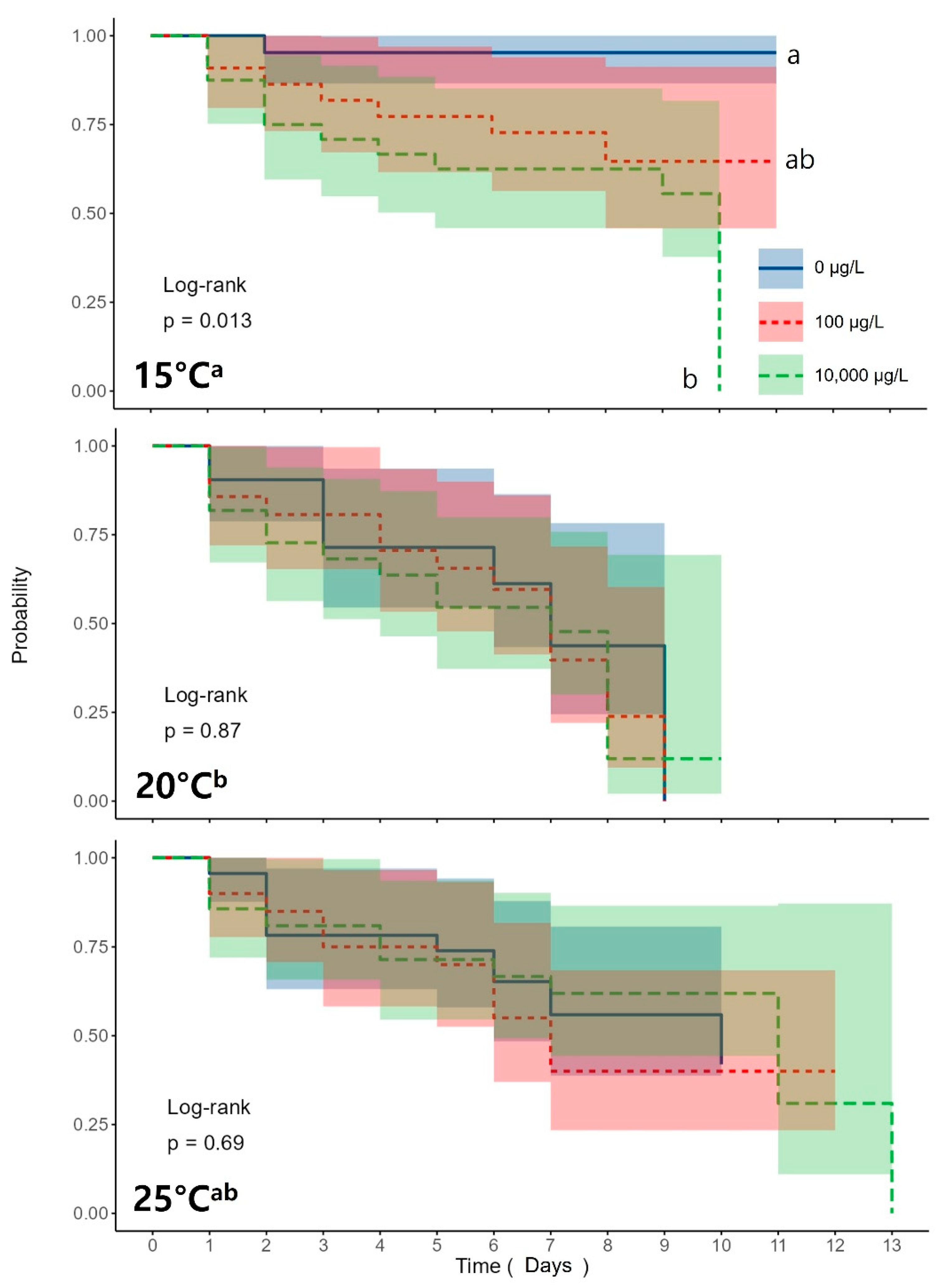
For the analysis across MP and temperature gradients, the survival rate of A. hudsonica nauplii varied only with temperature (pairwise log-rank comparisons with Holm adjustment, p < 0.001; Figure 1). The survival rate was highest at 15 °C, followed by 25 °C and 20 °C. MP-related differences were observed only under specific temperature conditions (Figure 1). The survival rate at 10,000 µg/L declined steeply compared with the MP-free control at 15 °C (pairwise log-rank comparisons with Holm adjustment, p < 0.05). No clear differences in survival rate were apparent among the MP treatment groups under high-temperature conditions (20 and 25 °C) (pairwise log-rank comparisons with Holm adjustment, p > 0.05).

3.2. Development

3.2.1. Developmental Time

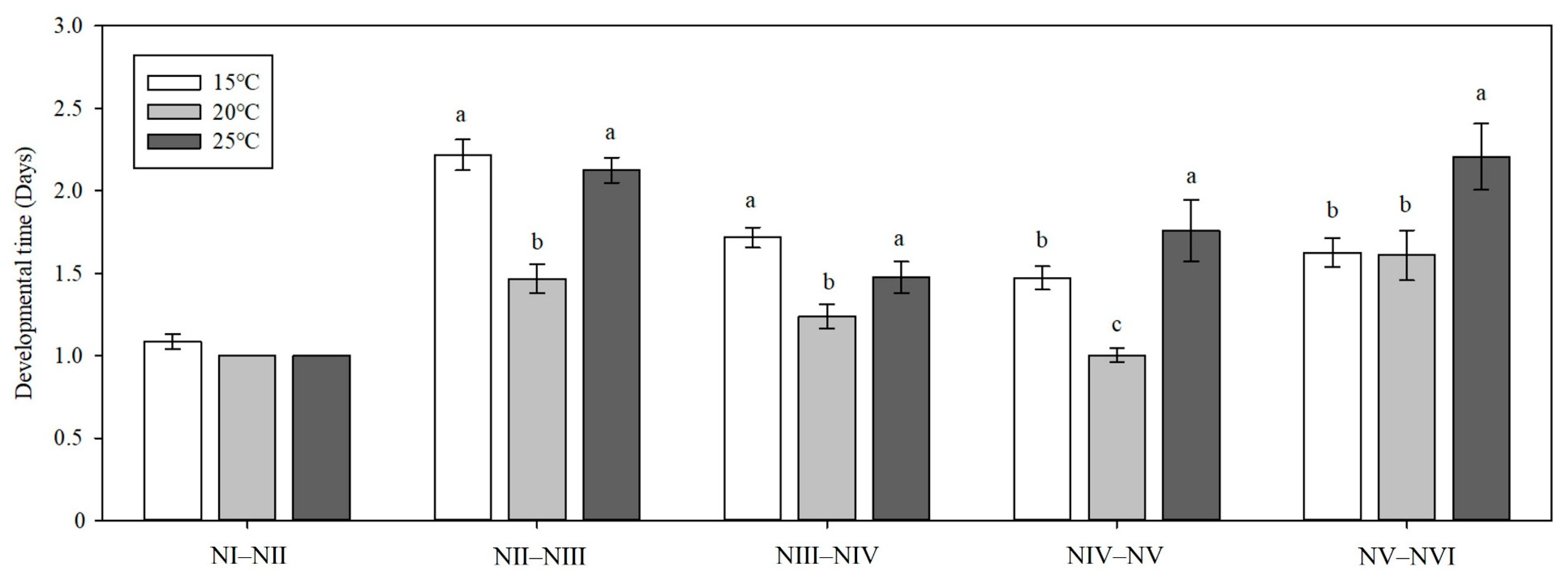
In the GLM results across MP and temperature gradients, the stage-specific developmental time of A. hudsonica nauplii was significantly affected by temperature (GLM, χ2 = 7.19–42.81, df = 2, all p < 0.05; Table 3), while no significant effect was observed for MP concentration (GLM, χ2 = 0.22–3.66, df = 2, all p > 0.05; Table 3) or its interaction with temperature (GLM, χ2 = 0.43–7.62, df = 4, all p > 0.05; Table 3). Temperature-dependent differences in developmental time varied among interstage intervals (Figure 2). For instance, during the NI–NII stage, developmental time showed minor differences across temperature treatments, with identical values observed at 20 and 25 °C (Tukey’s test, p > 0.05). Developmental time was shorter at 20 °C than at 15 °C and 25 °C at the NII–NIII and NIII–NIV stages (Tukey’s test, p < 0.05); it was also shortest at 20 °C, followed by 15 °C and 25 °C at the NIV–NV stages (Tukey’s test, p < 0.05). At the NV–NVI stages, developmental time at 25 °C was longer than at 15 °C and 20 °C (Tukey’s test, p < 0.05). No significant difference was found between developmental time at 15 °C and 20 °C (Tukey’s test, p > 0.05).
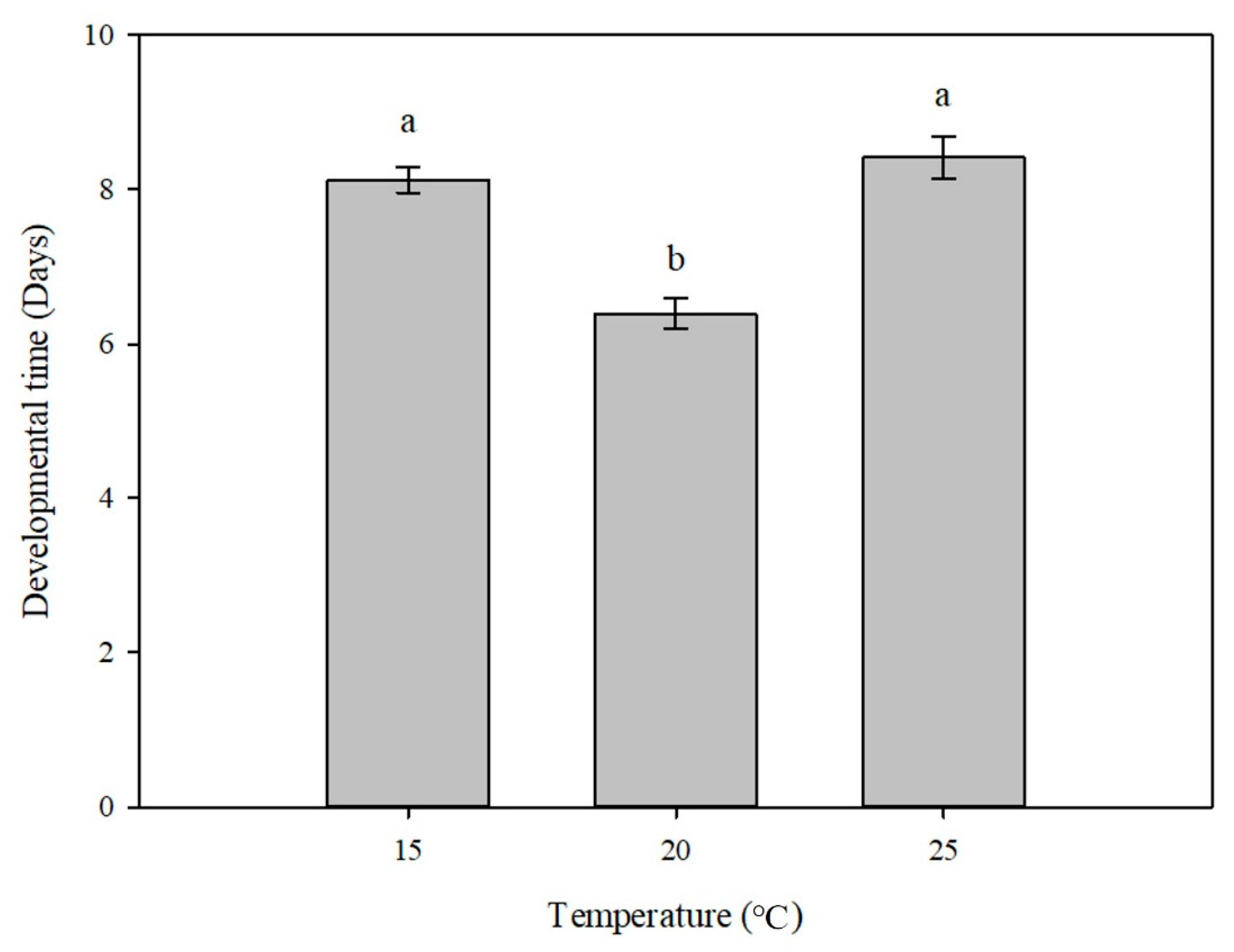
Across MP and temperature gradients, the GLM results indicated that cumulative developmental time in A. hudsonica nauplii was significantly affected by temperature (GLM, χ2 = 43.95, df = 2, p < 0.001; Table 4) but not by MP concentration (GLM, χ2 = 0.56, df = 2, p > 0.05; Table 4) or its interaction with temperature (GLM, χ2 = 1.92, df = 4, p > 0.05; Table 4). Cumulative developmental time was shortest at 20 °C (Tukey’s test, p < 0.05; Figure 3). No significant difference was detected between developmental time at 15 °C and 25 °C (Tukey’s test, p > 0.05).

3.2.2. Final-Stage (NVI) Attainment Rate

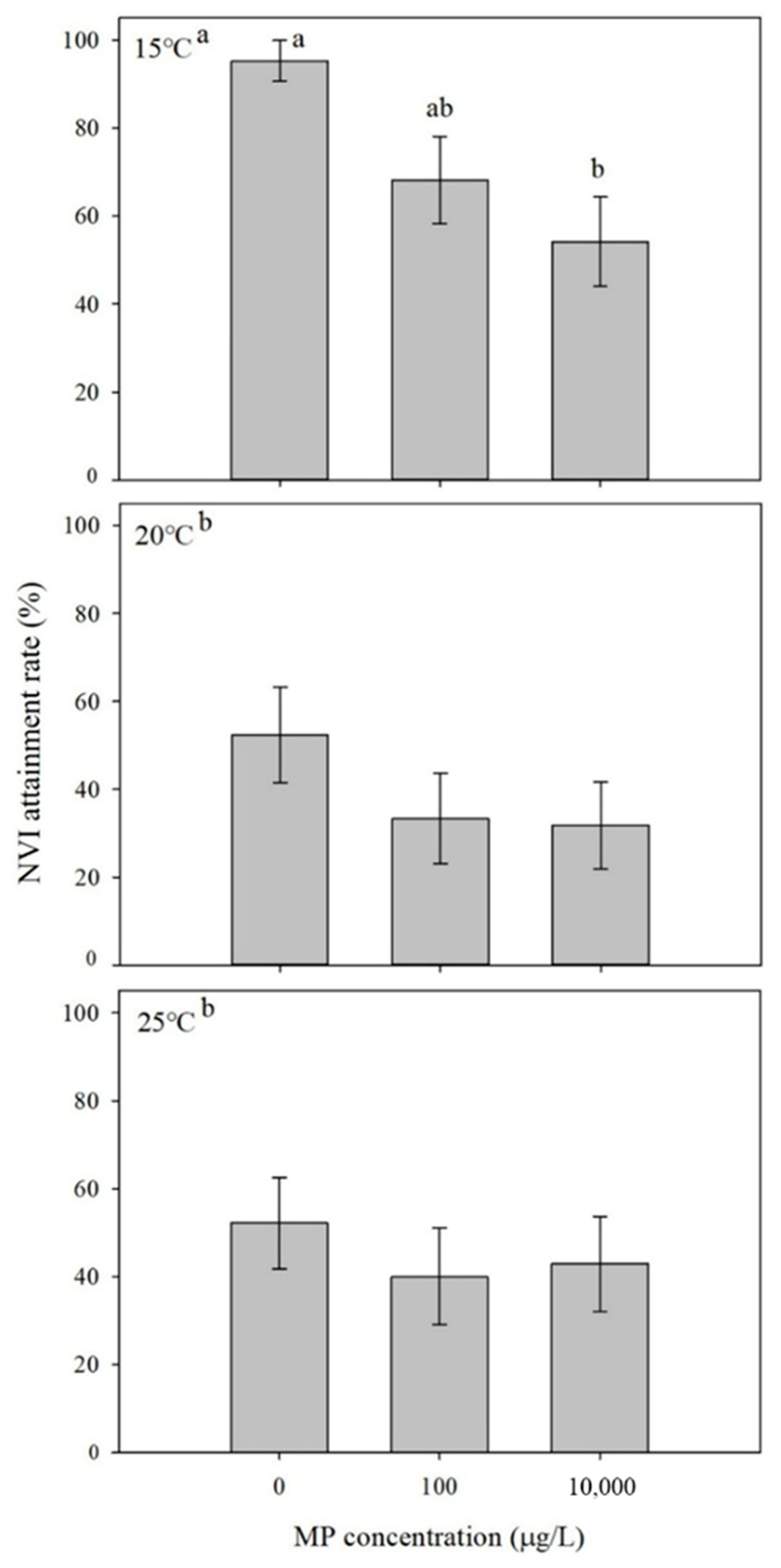
Across MP and temperature gradients, the GLM results indicated that the NVI attainment rate of A. hudsonica nauplii differed significantly depending on both temperature (GLM, χ2 = 20.49, df = 2, p < 0.001; Table 4) and MP concentration (GLM, χ2 = 11.59, df = 2, p < 0.01; Table 4). The NVI attainment rate was significantly higher at 15 °C than at 20 and 25 °C across temperature treatments (Tukey’s test, p < 0.05; Figure 4). No significant difference was detected between the two higher temperatures (Tukey’s test, p > 0.05; Figure 4). Only the comparison between 0 and 10,000 µg/L was significant across the range of MP concentrations (Tukey’s test, p < 0.05). Under each temperature condition, differences among the three MP treatments in the NVI attainment rate of A. hudsonica nauplii were most pronounced at 15 °C (Tukey’s test, p < 0.05; Figure 4). The NVI attainment rate was consistently lower in the MP-exposed groups (100 and 10,000 µg/L) than in the non-exposed group across all temperature treatments.

3.2.3. Temporal Pattern of Stage Composition

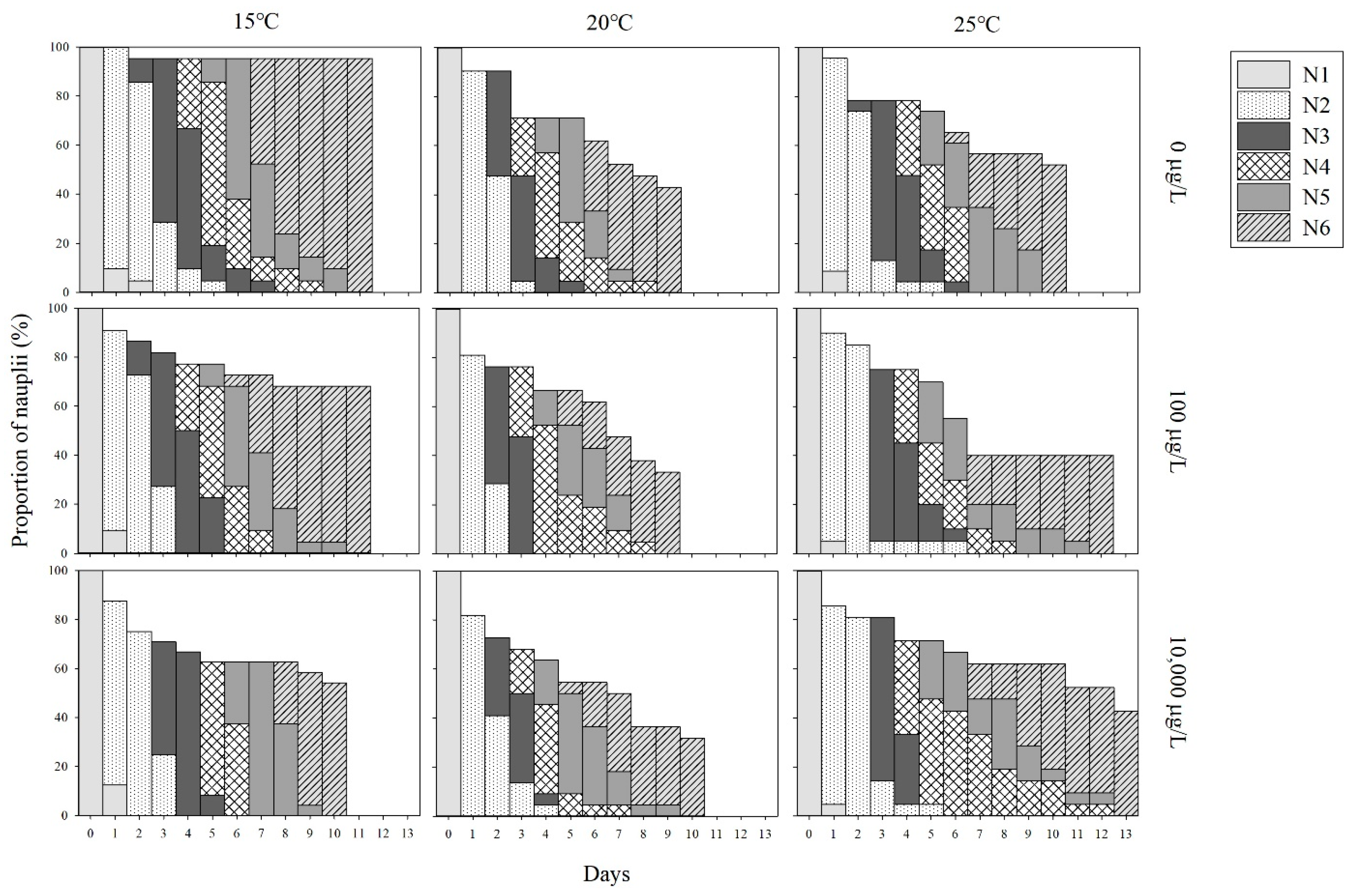
Temperature and MPs caused substantial overlap among various A. hudsonica naupliar stages. Stage proportions did not decline sufficiently after reaching their peak under MP exposure conditions; this led to delayed attainment of NVI within each treatment group.
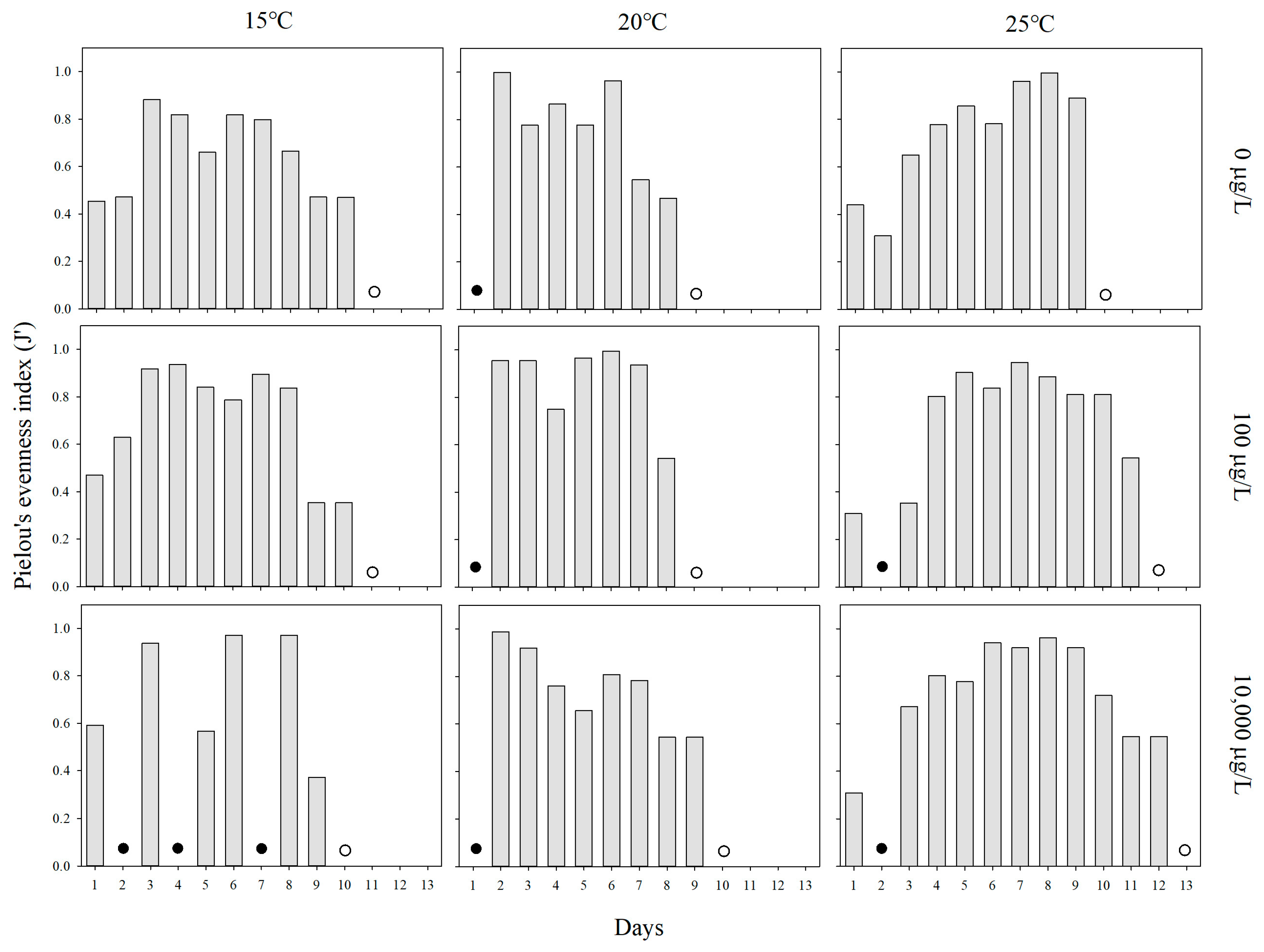
At 0 μg/L, each developmental stage reached a peak proportion at a specific time point at 15 °C. Thereafter, stage-specific proportion declined continuously and distinctly as individuals progressed to the subsequent stages (Figure 5). Temporal developmental progression led to a pronounced increase in evenness (J′) on day 3 and a subsequent gradual decrease thereafter (Figure 6). At 20 °C, the proportions of NII and NIII were similar on day 2, with J′ exceeding 0.9. After day 2, J′ showed an inconsistent pattern and sharply decreased on day 7 (Figure 5 and Figure 6). At 25 °C, NIII and NIV were present in similar proportions, leading to J′ reaching approximately 0.8 on day 4. The degree of overlap between naupliar stages remained similar or became more homogeneous, with J′ increasing progressively after day 4 (Figure 5 and Figure 6).
Figure 4. NVI attainment rate of Acartia hudsonica nauplii under different MP concentrations (0, 100, and 10,000 μg/L) across the three temperature treatments (15, 20, and 25 °C). Alphabet letters indicate significant differences among MP concentrations (b < a, Tukey’s test, p < 0.05) and among temperature treatments (b < a, Tukey’s test, p < 0.05). Error bars represent standard errors.
Water 18 00932 g004
The disturbance to the developmental rhythm across temperature conditions was further increased by MP exposure. In the 100 μg/L treatment, the timing of the decline in J′ below 0.8, associated with temporal convergence of developmental stages, was delayed across all temperature treatments compared with the corresponding MP-free treatments (Figure 6). The temporal developmental patterns differed across temperature conditions at 10,000 μg/L. At 10,000 μg/L, temporary developmental arrest and extreme desynchronization alternated at 15 °C. This caused J′ to switch between non-calculable states when only a single stage was present and extremely high values > 0.9 (Figure 6). At 20 and 25 °C, the timing of developmental stage convergence was shifted later compared with the lower MP concentration conditions (Figure 6). At 25 °C, the period with more than three naupliar stages was longer than in the lower MP concentration treatments (Figure 5).
Figure 5. Temporal stage composition of Acartia hudsonica nauplii under combined MP concentration (0, 100, and 10,000 µg/L) and temperature (15, 20, and 25 °C) treatments. Stage proportions (%) were calculated using the initial number of individuals as a fixed denominator.
Water 18 00932 g005
Figure 6. Pielou’s evenness index (J′) of the temporal stage composition in Acartia hudsonica nauplii under combined MP concentration (0, 100, and 10,000 µg/L) and temperature (15, 20, and 25 °C) treatments. Solid circles (●) indicate days when the index was not applicable because only a single developmental stage was present. Open circles (○) denote the termination point of observation where all surviving individuals reached the final naupliar stage (NVI).
Water 18 00932 g006

4. Discussion

Temperature is a key factor influencing the physiology or population dynamics of copepods [37,38,39]. The occurrence of Acartia species is closely associated with temperature fluctuations [26]. A. hudsonica is mainly dominant in spring, with the highest abundance at about 15–16 °C [26,33]. These ecological characteristics are consistent with the finding that survival rates in A. hudsonica nauplii were significantly higher at 15 °C in the present study. Developmental performance was not optimized at this temperature. This may suggest that temperature responses differ among physiological endpoints; physiological factors typically have their optimal temperature range, which may differ among factors [40]. These patterns have been reported in zooplankton groups. High temperatures reduced developmental time but increased mortality in Eurytemora affinis [41]. Growth rate became faster at warmer temperatures, whereas maximum body weight reduced in Calanus finmarchicus [42]. In this study, survival rate and developmental time in A. hudsonica nauplii responded independently to temperature variation. This may be interpreted within a hypothetical model in the context of an energy trade-off. It could arise from competition in energy allocation between basal maintenance and the energy demands of fitness-related functions such as reproduction, development, and growth under limited energy availability [43,44]. Within this context, the rapid development and low survival rate observed at 20 °C in A. hudsonica nauplii may be interpreted as indicating increased energy investment in development, accompanied by reduced energy allocation to maintenance processes. Physiological reactions driven by energy allocation may manifest as patterns that allow for long-term survival, accompanied by reduced growth and reproduction, depending on the magnitude of stress [44]. Delayed development and decreased survival rates of A. hudsonica nauplii at 25 °C could reflect such limited physiological performance. The energy trade-off framework represents one possible interpretation of the independent responses in survival and development across temperature conditions in A. hudsonica nauplii. These frameworks should be construed within a limited scope, as energy allocation and physiological costs were not measured in this study.
Coastal areas are environmentally dynamic regions due to their shallow depths and proximity to land. Temperature fluctuations are more severe in coastal areas than in the open oceans [45,46]. Anomalously high temperatures or marine heatwaves have been considered the most likely cause of copepod population collapse [47], and they have been reported to begin developing in spring [48]. A. hudsonica is highly abundant in spring, making it likely that its early developmental stages are exposed to this environment. The NVI attainment rate in A. hudsonica nauplii was significantly lower at both elevated temperature treatments than at the optimal temperature. The decreased NVI attainment rates suggest that high temperatures could disturb the recruitment of nauplii. Decreased recruitment rates may reduce population abundance or persistence, which could cause population collapse over long timescales. This suggests that temperature exposure during early life stages should be considered when attempting to understand the population fluctuations in coastal copepods.
MPs can adversely affect organisms through mechanical interference. The ingestion of large quantities of MPs can induce food dilution, pseudo-satiation, or tissue damage [49,50]. MPs accumulate within the gut, which results in direct intestinal damage in Artemia franciscana [51]. Such interference can arise both inside and outside the body. For example, MPs were found to adhere to swimming legs in Acartia tonsa [6]. Daphnia similis also exhibited MP fixation on the thoracic appendages and antennae, and this attachment subsequently altered swimming patterns [52]. The naupliar stages require substantial energy for continuous molting and structural formation. Consequently, when this stage-specific physiological vulnerability is compounded by nutritional disruption or the mechanical problem imposed by MPs, the organisms can be severely impacted. In this study, survival and NVI attainment rates in MP exposure treatments were lower than those in the MP-free control. These results may be interpreted as adverse effects arising from the mechanical action of MPs. However, this interpretation should include the consideration of multiple biological processes associated with the effects of MPs.
The biological effects of each stressor may not be consistent across different combinations or conditions. The toxicity of cadmium on the growth rate of Daphnia magna was enhanced at elevated temperatures [53]. Immobilization and internal body burden in D. magna increased significantly under exposure to dissolved pyrene with every 4 °C increase in temperature [54]. However, the effects of stressors may not increase consistently across gradients and may instead show the opposite pattern. Adverse effects on growth, development, and reproduction in D. magna were significantly ameliorated at elevated temperatures [55]. The life-history phenotypes of D. magna converged across widely varying levels of the pharmaceutical pollutant fluoxetine when exposed to higher temperatures [56]. These findings suggest that various concentrations or intensities of stressors should be considered in physiological responses, even under the same combination of stressors. The significant temperature-dependent MP effects were detected only at 15 °C on the survival rate and NVI attainment rate of A. hudsonica nauplii. These findings indicate that the detectability of MP effects may be limited under elevated temperature conditions. These limitations may result from preemptive thermal stress. Temperature is a fundamental factor for metabolism, growth, reproduction, and development in zooplankton [14,57,58,59]. However, temperatures beyond the optimal range can limit physiological processes in aquatic organisms [60,61]. Thermal stress could increase the physiological burden [62,63], which may lead to limited responses to additional stressors. A lack of significant MP effects under high-temperature conditions in A. hudsonica nauplii may be attributed to already reduced survival and development by heat stress, which may have limited the detection of additional effects. This suggests that interpreting the absence of MP effects under specific conditions as a lack of impact may limit the assessment of their actual contribution. Consideration of concentration or intensity gradients may be necessary when assessing stressor magnitude.
Developmental synchronization is important for population stability and maintenance. Synchronization in terms of the timing of adult emergence is essential for increasing adult density and thereby enhancing the encounter rates required for successful reproduction [64]. Developmental desynchronization can hinder a population’s ability to exploit food peaks efficiently [65]. Developmental imbalance can generate unnecessary competition between early and late developmental stages, potentially causing the early stages to be disadvantaged in these competitive interactions [66]. The temperature-dependent degree of overlap between naupliar stages increased in combination with MP effects in A. hudsonica nauplii. MPs delayed developmental stage convergence by preventing sufficient decline in preceding stages and by allowing each developmental stage to persist after reaching its peak proportion. This pattern increased developmental desynchronization and further diversified stage composition in A. hudsonica nauplii. MPs did not affect the developmental rate in A. hudsonica nauplii. This may suggest that MPs act as a stressor by increasing the variability in developmental timing between individuals rather than changing the developmental rate itself.
MP morphology includes fragments, fibers, films, foams, filaments, beads, granules, and spheres; the most abundant shapes are fragments and fibers in natural environments [67,68]. In many laboratory experiments, spherical MPs have been used due to their commercial accessibility [69] and experimental standardization [70]. Experimental designs that only use MP beads may create a disconnect with the problems of MPs in the natural field. Acute toxicity in both Brachionus koreanus and Diaphanosoma celebensis was higher in MP fragments than in MP beads [71]. MP fibers caused carapace and antenna deformities in Ceriodaphnia dubia, but MP beads showed no deformities [72]. MP fragments increased the expression of oxidative stress response genes in D. magna, whereas this response was not evident when exposed to MP beads [73]. These results indicate that the adverse effects of MPs on aquatic organisms may be affected by MP shape. No effects of MPs on developmental time in A. hudsonica may be caused by spherical MPs used in the present study. Therefore, this result should be interpreted in a context limited to a specific particle morphology and should be understood separately from conditions involving other forms of MPs.

5. Conclusions

In this study, we evaluated the survival rate and development of A. hudsonica nauplii under conditions of combined MP exposure and thermal stress. The results indicated the primary driver of naupliar development and demonstrated the variability in the effects of stress factors depending on their combination. Temperature significantly affected both survival rate and development in A. hudsonica. The response patterns, however, differed between the two physiological factors. This may be interpreted as a hypothetical model involving a trade-off strategy between survival and development in A. hudsonica, in which MPs decreased the survival rate and NVI attainment rate at 15 °C. These results may be attributed to nutritional disruption or the mechanical burden caused by MP beads. The effects of MPs on two factors were obscured at 20 and 25 °C, which are considered thermal stress conditions. This may be because thermal stress acted as a primary stressor that had already disturbed metabolism and developmental stability in A. hudsonica. This study suggests the importance of temperature and the temperature-regulated effects of MPs in the survival and development of species at the naupliar stage.

Supplementary Materials

The following supporting information can be downloaded at https://www.mdpi.com/article/10.3390/w18080932/s1, Figures S1–S5: Q–Q plot of deviance residuals from the Gamma GLM (log link) fitted to stage-specific developmental time of Acartia hudsonica (NI-NVI stages); Figure S6: Q–Q plot of deviance residuals from the Gamma GLM (log link) fitted to cumulative developmental time of Acartia hudsonica; Tables S1–S5: Goodness-of-fit statistics for the Gamma GLM (log link) fitted to stage-specific developmental time of Acartia hudsonica (NI-NVI stages); Table S6: Goodness-of-fit statistics for the Gamma GLM (log link) fitted to cumulative developmental time of Acartia hudsonica; Table S7: Goodness-of-fit statistics for the Binomial GLM (logit link) fitted to NVI attainment rate of Acartia hudsonica nauplii.

Author Contributions

Conceptualization, Y.L. and W.P.; methodology, Y.L. and H.-J.K.; software, Y.L.; validation, W.P. and H.-J.K.; formal analysis, Y.L.; investigation, Y.L.; resources, H.-J.K.; data curation, Y.L.; writing—original draft preparation, Y.L.; writing—review and editing, W.P.; visualization, Y.L.; supervision, W.P.; project administration, Y.L. and W.P.; funding acquisition, W.P. All authors have read and agreed to the published version of the manuscript.

Funding

This research was supported by Korea Institute of Marine Science & Technology Promotion (KIMST) funded by the Ministry of Oceans and Fisheries (Grant RS-2025-02219912).

Data Availability Statement

The datasets generated during this study are available from the corresponding author upon reasonable request.

Conflicts of Interest

The authors declare no conflicts of interest.

References

  1. Aytan, U.; Esensoy, F.B.; Senturk, Y. Microplastic ingestion and egestion by copepods in the Black Sea. Sci. Total Environ. 2022, 806, 150921. [Google Scholar] [CrossRef]
  2. Cole, M.; Lindeque, P.; Fileman, E.; Halsband, C.; Goodhead, R.; Moger, J.; Galloway, T.S. Microplastic ingestion by zooplankton. Environ. Sci. Technol. 2013, 47, 6646–6655. [Google Scholar] [CrossRef]
  3. Cole, M.; Lindeque, P.; Fileman, E.; Halsband, C.; Galloway, T.S. The impact of polystyrene microplastics on feeding, function and fecundity in the marine copepod Calanus helgolandicus. Environ. Sci. Technol. 2015, 49, 1130–1137. [Google Scholar] [CrossRef]
  4. Vroom, R.J.; Koelmans, A.A.; Besseling, E.; Halsband, C. Aging of microplastics promotes their ingestion by marine zooplankton. Environ. Pollut. 2017, 231, 987–996. [Google Scholar] [CrossRef]
  5. Cole, M.; Coppock, R.; Lindeque, P.K.; Altin, D.; Reed, S.; Pond, D.W.; Sørensen, L.; Galloway, T.S.; Booth, A.M. Effects of nylon microplastic on feeding, lipid accumulation, and moulting in a coldwater copepod. Environ. Sci. Technol. 2019, 53, 7075–7082. [Google Scholar] [CrossRef]
  6. Shore, E.A.; DeMayo, J.A.; Pespeni, M.H. Microplastics reduce net population growth and fecal pellet sinking rates for the marine copepod, Acartia tonsa. Environ. Pollut. 2021, 284, 117379. [Google Scholar] [CrossRef]
  7. Koski, M.; Søndergaard, J.; Christensen, A.M.; Nielsen, T.G. Effect of environmentally relevant concentrations of potentially toxic microplastic on coastal copepods. Aquat. Toxicol. 2021, 230, 105713. [Google Scholar] [CrossRef]
  8. Everaert, G.; Vlaeminck, K.; Vandegehuchte, M.B.; Janssen, C.R. Effects of microplastic on the population dynamics of a marine copepod: Insights from a laboratory experiment and a mechanistic model. Environ. Toxicol. Chem. 2022, 41, 1663–1674. [Google Scholar] [CrossRef]
  9. Klasios, N.; Kim, J.O.; Tseng, M. No effect of realistic concentrations of polyester microplastic fibers on freshwater zooplankton communities. Environ. Toxicol. Chem. 2024, 43, 418–428. [Google Scholar] [CrossRef]
  10. Isobe, A.; Uchida, K.; Tokai, T.; Iwasaki, S. East Asian seas: A hot spot of pelagic microplastics. Mar. Pollut. Bull. 2015, 101, 618–623. [Google Scholar] [CrossRef]
  11. Song, Y.K.; Hong, S.H.; Jang, M.; Kang, J.H.; Kwon, O.Y.; Han, G.M.; Shim, W.J. Large accumulation of micro-sized synthetic polymer particles in the sea surface microlayer. Environ. Sci. Technol. 2014, 48, 9014–9021. [Google Scholar] [CrossRef]
  12. Yu, J.; Tang, D.; Wang, S.; He, L.; Pathira Arachchilage, K.R.L. Spatial distribution and composition of surface microplastics in the southwestern South China Sea. Front. Mar. Sci. 2022, 9, 830318. [Google Scholar] [CrossRef]
  13. Rhyne, A.L.; Ohs, C.L.; Stenn, E. Effects of temperature on reproduction and survival of the calanoid copepod Pseudodiaptomus pelagicus. Aquaculture 2009, 292, 53–59. [Google Scholar] [CrossRef]
  14. Lee, H.W.; Ban, S.; Ikeda, T.; Matsuishi, T. Effect of temperature on development, growth and reproduction in the marine copepod Pseudocalanus newmani at satiating food condition. J. Plankton Res. 2003, 25, 261–271. [Google Scholar] [CrossRef]
  15. Vu, Q.D.; Pham, L.P.; Truong, O.T.; Tran, S.Q.; Bui, C.V.; Le, M.H.; Dang, B.T.; Dinh, K.V. Extreme Temperatures Reduce Copepod Performance and Change the Relative Abundance of Internal Microbiota. Ecol. Evol. 2024, 14, e70408. [Google Scholar] [CrossRef]
  16. Na, J.; Kim, Y.; Song, J.; Shim, T.; Cho, K.; Jung, J. Evaluation of the combined effect of elevated temperature and cadmium toxicity on Daphnia magna using a simplified DEBtox model. Environ. Pollut. 2021, 291, 118250. [Google Scholar] [CrossRef]
  17. Zhang, Q.; Zhang, Y.; Hu, D.; Wen, W.; Xia, X. An unexpected synergistic toxicity caused by competitive bioconcentration of perfluoroalkyl acid mixtures to Daphnia magna: Further promoted by elevated temperature. Environ. Pollut. 2022, 315, 120336. [Google Scholar] [CrossRef]
  18. García-Astillero, A.; Polazzo, F.; Rico, A. Combined effects of heat waves and pesticide pollution on zooplankton communities: Does the timing of stressor matter? Ecotoxicol. Environ. Saf. 2024, 282, 116751. [Google Scholar] [CrossRef]
  19. Ahmad, O.A.; Jamal, M.T.; Almalki, H.S.; Alzahrani, A.H.; Alatawi, A.S.; Haque, M.F. Microplastic pollution in the marine environment: Sources, impacts, and degradation. J. Adv. Vet. Anim. Res. 2025, 12, 260. [Google Scholar] [CrossRef] [PubMed]
  20. Serra, T.; Barcelona, A.; Pous, N.; Salvadó, V.; Colomer, J. Synergistic effects of water temperature, microplastics and ammonium as second and third order stressors on Daphnia magna. Environ. Pollut. 2020, 267, 115439. [Google Scholar] [CrossRef]
  21. Chang, M.; Zhang, C.; Li, M.; Dong, J.; Li, C.; Liu, J.; Verheyen, J.; Stoks, R. Warming, temperature fluctuations and thermal evolution change the effects of microplastics at an environmentally relevant concentration. Environ. Pollut. 2022, 292, 118363. [Google Scholar] [CrossRef]
  22. Klasios, N.; Birch, A.; Murillo, A.M.; Tseng, M. Warming temperatures exacerbate effects of microplastics in a widespread zooplankton species. Environ. Pollut. 2024, 349, 123918. [Google Scholar] [CrossRef]
  23. Reyes-Santillán, M.C.; Nandini, S.; Sarma, S.S.S. Combined effects of microplastics and temperature on the competition between Brachionus havanaensis and Brachionus calyciflorus (Rotifera). Hydrobiologia 2024, 851, 3199–3211. [Google Scholar] [CrossRef]
  24. Peterson, W.T.; Keister, J.E.; Feinberg, L.R. The effects of the 1997–1999 El Niño/La Niña events on hydrography and zooplankton off the central Oregon coast. Prog. Oceanogr. 2002, 54, 381–398. [Google Scholar] [CrossRef]
  25. Sullivan, B.K.; Costello, J.H.; Van Keuren, D. Seasonality of the copepods Acartia hudsonica and Acartia tonsa in Narragansett Bay, RI, USA during a period of climate change. Estuar. Coast. Shelf Sci. 2007, 73, 259–267. [Google Scholar] [CrossRef]
  26. Kang, J.H. The occurrence of Acartia species and their environmental characteristics at three ports in Korea. Ocean Sci. J. 2011, 46, 219–237. [Google Scholar] [CrossRef]
  27. Durbin, A.G.; Durbin, E.G. Seasonal changes in size frequency distribution and estimated age in the marine copepod Acartia hudsonica during a winter-spring diatom bloom in Narragansett Bay. Limnol. Oceanogr. 1992, 37, 379–392. [Google Scholar] [CrossRef]
  28. Choi, S.Y.; Seo, M.H.; Shin, K.; Jang, M.C.; Soh, H.Y. Spatial distribution of Acartia (Copepoda, Calanoida) species in the southern coastal waters of Korea during summer. Korean J. Environ. Biol. 2019, 37, 299–308. [Google Scholar] [CrossRef]
  29. Ueda, H. Temporal and spatial distribution of the two closely related Acartia species A. omorii and A. hudsonica (Copepoda, Calanoida) in a small inlet water of Japan. Estuar. Coast. Shelf Sci. 1987, 24, 691–700. [Google Scholar] [CrossRef]
  30. Perez, E.; Ryan, S.; Andres, M.; Gawarkiewicz, G.; Ummenhofer, C.C.; Bane, J.; Haines, S. Understanding physical drivers of the 2015/16 marine heatwaves in the Northwest Atlantic. Sci. Rep. 2021, 11, 17623. [Google Scholar] [CrossRef]
  31. Svetlichny, L.; Isinibilir, M.; Mykitchak, T.; Eryalçın, K.M.; Türkeri, E.E.; Yuksel, E.; Kideys, A.E. Microplastic consumption and physiological response in Acartia clausi and Centropages typicus: Possible roles of feeding mechanisms. Reg. Stud. Mar. Sci. 2021, 43, 101650. [Google Scholar] [CrossRef]
  32. Botterell, Z.L.; Coppock, R.L.; Gomiero, A.; Lindeque, P.K.; Piarulli, S.; Rees, T.; Sørensen, L.; Cole, M. Acute and partial life-cycle toxicity of a tri-polymer blend of microplastics in the copepod Acartia tonsa. Environ. Pollut. 2025, 373, 126105. [Google Scholar] [CrossRef]
  33. Sullivan, B.K.; McManus, L.T. Factors controlling seasonal succession of the copepods Acartia hudsonica and A. tonsa in Narragansett Bay, Rhode Island: Temperature and resting egg production. Mar. Ecol. Prog. Ser. 1986, 28, 121–128. [Google Scholar] [CrossRef]
  34. Okada, N.; Onoue, Y.; Othman, B.H.R.; Kikuchi, T.; Toda, T. Description of naupliar stages in Acartia steueri Smirnov (Copepoda: Calanoida). J. Crustac. Biol. 2009, 29, 70–78. [Google Scholar] [CrossRef][Green Version]
  35. Pielou, E.C. The measurements of diversity in different types of biological collections. J. Theor. Biol. 1966, 13, 131–144. [Google Scholar] [CrossRef]
  36. Shannon, C.E.; Weaver, W. The Mathematical Theory of Communication; University of Illinois Press: Urbana, IL, USA, 1949; pp. 1–125. [Google Scholar]
  37. Almeda, R.; Calbet, A.; Alcaraz, M.; Yebra, L.; Saiz, E. Effects of temperature and food concentration on the survival, development and growth rates of naupliar stages of Oithona davisae (Copepoda, Cyclopoida). Mar. Ecol. Prog. Ser. 2010, 410, 97–109. [Google Scholar] [CrossRef]
  38. Peck, N.; Peters, J.; Diekmann, R.; Laakmann, S.; Renz, J. Interactive effects of temperature and salinity on population dynamics of the calanoid copepod Acartia tonsa. J. Plankton Res. 2015, 37, 197–210. [Google Scholar] [CrossRef]
  39. Mortelmans, J.; Semmouri, I.; Perneel, M.; Lagaisse, R.; Martínez, L.A.; Rommelaere, Z.; Hablützel, P.I.; Deneudt, K. Temperature-induced copepod depletion and the associated wax of Bellerochea in Belgian coastal waters: Implications and shifts in plankton dynamics. J. Sea Res. 2024, 201, 102523. [Google Scholar] [CrossRef]
  40. Malusare, S.P.; Zilio, G.; Fronhofer, E.A. Evolution of thermal performance curves: A meta-analysis of selection experiments. J. Evol. Biol. 2022, 36, 15–28. [Google Scholar] [CrossRef] [PubMed]
  41. Karlsson, K.; Puiac, S.; Winder, M. Life-history responses to changing temperature and salinity of the Baltic Sea copepod Eurytemora affinis. Mar. Biol. 2018, 165, 30. [Google Scholar] [CrossRef]
  42. Campbell, R.G.; Wagner, M.M.; Teegarden, G.J.; Boudreau, C.A.; Durbin, E.G. Growth and development rates of the copepod Calanus finmarchicus reared in the laboratory. Mar. Ecol. Prog. Ser. 2001, 221, 161–183. [Google Scholar] [CrossRef]
  43. Sokolova, I.M.; Frederich, M.; Bagwe, R.; Lannig, G.; Sukhotin, A.A. Energy homeostasis as an integrative tool for assessing limits of environmental stress tolerance in aquatic invertebrates. Mar. Environ. Res. 2012, 79, 1–15. [Google Scholar] [CrossRef]
  44. Sokolova, I.M. Energy-limited tolerance to stress as a conceptual framework to integrate the effects of multiple stressors. Integr. Comp. Biol. 2013, 53, 597–608. [Google Scholar] [CrossRef]
  45. Lima, F.P.; Wethey, D.S. Three decades of high-resolution coastal sea surface temperatures reveal more than warming. Nat. Commun. 2012, 3, 704. [Google Scholar] [CrossRef]
  46. Bulgin, C.E.; Merchant, C.J.; Ferreira, D. Tendencies, variability and persistence of sea surface temperature anomalies. Sci. Rep. 2020, 10, 7986. [Google Scholar] [CrossRef]
  47. Semmouri, I.; De Schamphelaere, K.A.; Mortelmans, J.; Mees, J.; Asselman, J.; Janssen, C.R. Decadal decline of dominant copepod species in the North Sea is associated with ocean warming: Importance of marine heatwaves. Mar. Pollut. Bull. 2023, 193, 115159. [Google Scholar] [CrossRef]
  48. Wang, Y.; Zhou, Y. Seasonal dynamics of global marine heatwaves over the last four decades. Front. Mar. Sci. 2024, 11, 1406416. [Google Scholar] [CrossRef]
  49. Coppock, R.L.; Galloway, T.S.; Cole, M.; Fileman, E.S.; Queirós, A.M.; Lindeque, P.K. Microplastic alter feeding selectivity and faecal density in the copepod, Calanus helgolandicus. Sci. Total Environ. 2019, 687, 780–789. [Google Scholar] [CrossRef] [PubMed]
  50. Sharma, J.; Rai, M.; Guino-o, R.S. Microplastics influence the functional responses of a tropical estuarine calanoid Pseudodiaptomus annandalei. Front. Ecol. Evol. 2024, 12, 1277332. [Google Scholar] [CrossRef]
  51. Han, X.; Zheng, Y.; Dai, C.; Duan, H.; Gao, M.; Ali, M.R.; Sui, L. Effect of polystyrene microplastics and temperature on growth, intestinal histology and immune responses of brine shrimp Artemia franciscana. J. Ocean. Limnol. 2021, 39, 979–988. [Google Scholar] [CrossRef]
  52. Castro, D.G.D.; Destro, A.L.F.; Coimbra, E.C.L.; Silva, A.L.L.D.; Mounteer, A.H. Effects of PET microplastics on the freshwater crustacean Daphnia similis Claus, 1976. Acta Limnol. Bras. 2023, 35, e6. [Google Scholar] [CrossRef]
  53. Heugens, E.H.; Tokkie, L.T.; Kraak, M.H.; Hendriks, A.J.; Van Straalen, N.M.; Admiraal, W. Population growth of Daphnia magna under multiple stress conditions: Joint effects of temperature, food, and cadmium. Environ. Toxicol. Chem. 2006, 25, 1399–1407. [Google Scholar] [CrossRef]
  54. Zhang, Q.; Wang, H.; Xia, X.; Bi, S.; Lin, H.; Chen, J. Elevated temperature enhances the bioavailability of pyrene to Daphnia magna in the presence of dissolved organic matter: Implications for the effect of climate warming. Environ. Pollut. 2020, 266, 115349. [Google Scholar] [CrossRef]
  55. Im, H.; Achar, J.C.; Shim, T.; Jung, J. Elevated temperature alleviates benzophenone-3 toxicity in Daphnia magna. Aquat. Toxicol. 2022, 242, 106047. [Google Scholar] [CrossRef]
  56. Aulsebrook, L.C.; Wong, B.; Hall, M.D. Warmer temperatures limit the effects of antidepressant pollution on life-history traits. Proc. R. Soc. B Biol. Sci. 2022, 289, 20212701. [Google Scholar] [CrossRef]
  57. Holste, L.; Peck, M.A. The effects of temperature and salinity on egg production and hatching success of Baltic Acartia tonsa (Copepoda: Calanoida): A laboratory investigation. Mar. Biol. 2006, 148, 1061–1070. [Google Scholar] [CrossRef]
  58. Møller, E.F.; Maar, M.; Jónasdóttir, S.H.; Nielsen, T.G.; Tönnesson, K. The effect of changes in temperature and food on the development of Calanus finmarchicus and Calanus helgolandicus populations. Limnol. Oceanogr. 2012, 57, 211–220. [Google Scholar] [CrossRef]
  59. Heine, K.B.; Abebe, A.; Wilson, A.E.; Hood, W.R. Copepod respiration increases by 7% per C increase in temperature: A meta-analysis. Limnol. Oceanogr. Lett. 2019, 4, 53–61. [Google Scholar] [CrossRef]
  60. Pascal, L.; Chong, V.C. Does developmental temperature modulate copepods respiratory activity through adult life? J. Plankton Res. 2016, 38, 1215–1224. [Google Scholar] [CrossRef]
  61. Doan, N.X.; Vu, M.T.; Pham, H.Q.; Wisz, M.S.; Nielsen, T.G.; Dinh, K.V. Extreme temperature impairs growth and productivity in a common tropical marine copepod. Sci. Rep. 2019, 9, 4550. [Google Scholar] [CrossRef]
  62. Klumpen, E.; Hoffschröer, N.; Zeis, B.; Gigengack, U.; Dohmen, E.; Paul, R.J. Reactive oxygen species (ROS) and the heat stress response of Daphnia pulex: ROS-mediated activation of hypoxia-inducible factor 1 (HIF-1) and heat shock factor 1 (HSF-1) and the clustered expression of stress genes. Biol. Cell 2017, 109, 39–64. [Google Scholar] [CrossRef]
  63. von Weissenberg, E.; Jansson, A.; Vuori, K.A.; Engström-Öst, J. Copepod reproductive effort and oxidative status as responses to warming in the marine environment. Ecol. Evol. 2022, 12, e8594. [Google Scholar] [CrossRef]
  64. Kiørboe, T. Sex, sex-ratios, and the dynamics of pelagic copepod populations. Oecologia 2006, 148, 40–50. [Google Scholar] [CrossRef] [PubMed]
  65. Cushing, D.H. Plankton production and year-class strength in fish populations: An update of the match/mismatch hypothesis. Adv. Mar. Biol. 1990, 26, 249–293. [Google Scholar] [CrossRef]
  66. Gliwicz, Z.M.; Wursbaugh, W.A.; Szymanska, E. Absence of predation eliminates coexistence: Experience from the fish–zooplankton interface. Hydrobiologia 2010, 653, 103–117. [Google Scholar] [CrossRef]
  67. Wang, S.; Chen, H.; Zhou, X.; Tian, Y.; Lin, C.; Wang, W.; Zhou, K.; Zhang, Y.; Lin, H. Microplastic abundance, distribution and composition in the mid-west Pacific Ocean. Environ. Pollut. 2020, 264, 114125. [Google Scholar] [CrossRef]
  68. Mutuku, J.; Yanotti, M.; Tocock, M.; Hatton MacDonald, D. The abundance of microplastics in the world’s oceans: A systematic review. Oceans 2024, 5, 398–428. [Google Scholar] [CrossRef]
  69. Phuong, N.N.; Zalouk-Vergnoux, A.; Poirier, L.; Kamari, A.; Châtel, A.; Mouneyrac, C.; Lagarde, F. Is there any consistency between the microplastics found in the field and those used in laboratory experiments? Environ. Pollut. 2016, 211, 111–123. [Google Scholar] [CrossRef]
  70. Cole, M. A novel method for preparing microplastic fibers. Sci. Rep. 2016, 6, 34519. [Google Scholar] [CrossRef]
  71. Park, J.S.; Yoo, J.W.; Lee, Y.H.; Park, C.; Lee, Y.M. Size-and shape-dependent ingestion and acute toxicity of fragmented and spherical microplastics in the absence and presence of prey on two marine zooplankton. Mar. Pollut. Bull. 2024, 206, 116768. [Google Scholar] [CrossRef]
  72. Ziajahromi, S.; Kumar, A.; Neale, P.A.; Leusch, F.D. Impact of microplastic beads and fibers on waterflea (Ceriodaphnia dubia) survival, growth, and reproduction: Implications of single and mixture exposures. Environ. Sci. Technol. 2017, 51, 13397–13406. [Google Scholar] [CrossRef] [PubMed]
  73. Lee, S.A.; Esterhuizen, M.; Kim, Y.; Kim, M.; Kim, Y.J. Assessing the acute differential toxicity of polystyrene microplastic particles and comparing the impacts of bead-shaped versus fragmented particles on Daphnia magna. Appl. Biol. Chem. 2025, 68, 34. [Google Scholar] [CrossRef]
Figure 1. Kaplan–Meier survival curves of Acartia hudsonica nauplii under different MP concentrations (0, 100, and 10,000 μg/L) across three temperature treatments (15, 20, and 25 °C). Shaded areas indicate 95% confidence intervals (blue: 0 μg/L; red: 100 μg/L; green: 10,000 μg/L). Alphabet letters indicate significant differences among MP concentrations (b < a, Holm-adjusted pairwise comparisons, p < 0.05) and among temperature treatments (b < a, Holm-adjusted pairwise comparisons, p < 0.05).
Water 18 00932 g001
Figure 2. Mean stage-specific developmental time of Acartia hudsonica nauplii at three experimental temperatures (15, 20, and 25 °C). Alphabet letters indicate significant differences among temperature treatments for each interstage interval (c < b < a, Tukey’s test, p < 0.05). Error bars represent standard errors.
Water 18 00932 g002
Figure 3. Mean cumulative developmental time of Acartia hudsonica nauplii at three experimental temperatures (15, 20, and 25 °C). Alphabet letters indicate significant differences among temperature treatments (b < a, Tukey’s test, p < 0.05). Error bars represent standard errors.
Water 18 00932 g003
Table 1. Chemical composition of 1 L modified Erd–Schreiber medium (pH 7.8) used to cultivate prey organisms, Tetraselmis tetrathele, and Isochrysis galbana.
ComponentsQuantity
Diluted seawater1000 mL
NaNO31 mL
Na2HPO4·12H2O1 mL
Vitamin B121 mL
Thiamine HCl1 mL
NTA100 mg
Tris100 mg
Soil Extract50 mg
Table 2. Number of individuals under experimental conditions combining three MP concentrations (0, 100, and 10,000 μg/L) and three temperatures (15, 20, and 25 °C).
Temperature (°C)152025
MP
Concentration (μg/L)
0212123
100222120
10,000242221
Table 3. Results of GLM testing the effects of MP concentration, temperature, and their interaction on the stage-specific developmental time of Acartia hudsonica nauplii.
VariablesInterstage Intervalχ2dfp
MP concentration
(μg/L)
NI–NII0.2220.894
NII–NIII1.6220.446
NIII–NIV1.1020.578
NIV–NV3.6620.160
NV–NVI1.9720.374
Temperature
(°C)
NI–NII7.1920.027 *
NII–NIII42.812<0.001 ***
NIII–NIV19.912<0.001 ***
NIV–NV35.192<0.001 ***
NV–NVI10.1920.006 **
MP concentration (μg/L) ×
Temperature (°C)
NI–NII0.4640.977
NII–NIII0.4340.980
NIII–NIV2.5140.643
NIV–NV7.6240.107
NV–NVI2.8240.589
Note(s): * < 0.05, ** < 0.01, *** < 0.001.
Table 4. Results of GLM testing the effects of MP concentration, temperature, and their interaction on the cumulative developmental time and NVI attainment of Acartia hudsonica nauplii.
VariableCumulative
Developmental Time
NVI Attainment
χ2dfpχ2dfp
MP concentration (μg/L)0.5620.75611.5920.003 **
Temperature (°C)43.952<0.001 ***20.492<0.001 ***
MP concentration (μg/L)
× Temperature (°C)
1.9240.7505.0540.282
Note(s): ** < 0.01, *** < 0.001.
Disclaimer/Publisher’s Note: The statements, opinions and data contained in all publications are solely those of the individual author(s) and contributor(s) and not of MDPI and/or the editor(s). MDPI and/or the editor(s) disclaim responsibility for any injury to people or property resulting from any ideas, methods, instructions or products referred to in the content.