Article

Meltwater Contribution and Mass Balance of the Juncal Norte Glacier During an Extreme Drought Year in the Dry Andes of Central Chile


1
Department of Earth and Atmospheric Sciences, Metropolitan State University of Denver, Denver, CO 80204, USA
2
Department of Geography, Geology, and Environmental Science, University of Wisconsin Whitewater, Whitewater, WI 53190, USA
*
Author to whom correspondence should be addressed.
Water 2026, 18(8), 897; https://doi.org/10.3390/w18080897
Submission received: 28 February 2026 / Revised: 26 March 2026 / Accepted: 4 April 2026 / Published: 9 April 2026
(This article belongs to the Section Water and Climate Change)

Highlights

  • Glacier supplied ~30% of proglacial sub-basin discharge during extreme drought year.
  • First annual runoff estimate for the Juncal Norte Glacier under megadrought conditions.
  • Runoff highly sensitive to temperature changes.
  • Basin water balance shows sustained storage depletion during drought.
  • Glacier area loss accelerated 14-fold after 2010, losing more in 13 yrs than prior 55.

Abstract

The Juncal Norte Glacier (33°00′ S, 70°06′ W) is in the Dry Andes of central Chile within the Juncal Basin, a headwater watershed of the Aconcagua River, a semi-arid region experiencing an ongoing megadrought since 2010 and a 37% reduction in streamflow relative to pre-1990 baselines. This study provides the first glacier-specific annual melt and runoff estimate for Juncal Norte during mature megadrought conditions. Mass balance was estimated using a temperature index (positive degree day, PDD) model calibrated with automatic weather station (AWS) air temperature data and glacier hypsometry, assuming limited snow accumulation given that 2018–2019 precipitation and snow water equivalent (SWE) were extremely low relative to the long-term mean. Basin runoff was evaluated using a closure method comparing proglacial sub-basin-integrated discharge with modeled glacier melt volumes. Modeled glacier melt for 2018–2019 was equivalent to approximately 30% of observed annual discharge at the proglacial sub-basin, a disproportionate contribution given the glacier covers only 2.7% of the total basin area. The lower ablation zone (2900–4000 m), comprising 30% of glacier area, produced 90% of total melt volume. A + 1 °C temperature perturbation increased glacier-wide melt by 21.4%, confirming high climatic sensitivity. These results underscore the glacier’s critical but increasingly vulnerable buffering role for downstream water availability in the Dry Andes.

1. Introduction

The Juncal Norte Glacier (33°00′ S, 70°06′ W) is located within the Juncal Basin, a headwater catchment of the Aconcagua River watershed in central Chile. In a semi-arid environment increasingly defined by rising temperatures, shifting precipitation patterns, and intensifying water scarcity, glaciers in the Dry Andes play a key role in buffering streamflow during dry summer months and extended droughts. Glacial meltwater contributes substantially to downstream water supplies used for agriculture, mining, and urban demand, particularly in the Valparaíso Region [1]. During drought years, glacier melt can contribute up to 60–67% of summer runoff in the upper basins of the Dry Andes [2]. Snowmelt provides a seasonal pulse in spring, recharging mountain aquifers that feed alluvial systems in the Central Valley—the low-lying tectonic depression between the Andes and the Coastal Range that constitutes Chile’s main agricultural zone [3].
Historically, the glacier’s shaded north-facing orientation, steep slope, terminal confinement, and high-elevation accumulation zone have contributed to a relatively slow retreat compared to other ice masses in the central Andes. Rivera et al. [4] reported that the Juncal Norte Glacier had the lowest retreat rates in central Chile between 1955 and 1997, averaging only 4 m per year. Bown et al. [5] documented a longer-term average of 9.1 m per year between 1955 and 2006. More recently, Malmros et al. [6] found that while many glaciers in the region lost substantial portions of their area, the Juncal Norte Glacier lost only 10% of its ice area between 1955 and 2013. However, this stability narrative warrants reassessment, given an ever-changing climate.
The central Andes region has experienced profound hydroclimatic changes, with rising temperatures emerging as a primary driver of cryospheric transformation. Carrasco et al. [7] documented a ~150–200 m upward shift in the 0 °C isotherm between 1975 and 2001, reducing the accumulation zones of mid-latitude Andean glaciers. Specific regional projections suggest further warming of up to +4 °C under high-emission scenarios, particularly in the 2500–3500 m elevation range, leading to shorter snow seasons, increased rainfall fraction, and earlier snowmelt [8]. Webb et al. [3] found that mean annual temperatures in the Aconcagua watershed have increased by 0.2 °C per decade between 1965 and 2017, while Bellisario and Janke [1] reported a 2.2 °C rise in annual maximum temperatures between 1971 and 2020.
In central Chile, glacier melt plays a key role in sustaining streamflow during dry years [5,9,10,11,12]. Caro et al. [10] projected that runoff from Andean glaciers may decline by up to 37% in the Dry Andes by mid-century under high-emission scenarios. Concurrently, central Chile has experienced a significant decline in precipitation, exacerbated by persistent multi-year droughts. González-Reyes et al. [13] identified a statistically significant downward trend in precipitation across the Mediterranean Andes (30–37° S) since the early 20th century. Garreaud et al. [14] documented the 2010–2015 megadrought, noting discharge reductions of up to 90% in some basins. In the Aconcagua watershed, Bellisario and Janke [1] reported a 59% drop in average river discharge since the 1970s along with basin-wide precipitation deficits of 31% to 50% since 2010. These trends have been attributed to a semi-permanent anticyclonic anomaly over the southeastern Pacific [15].
The resulting changes in snow and ice dynamics have been documented. Saavedra et al. [16] showed widespread losses in snow cover across the Andes between 2000 and 2016, with snowlines rising by 10–30 m annually. Masiokas et al. [17] found a sustained decline in snow accumulation across the central Andes between 1951 and 2005, closely tied to ENSO cycles and regional warming. McCarthy et al. [11] demonstrated that glacier melt temporarily buffered dry-season flows during the megadrought, offsetting potential March flow losses by up to 31% in the neighboring Maipo Basin, though they emphasized this buffering was unsustainable, relying on net glacier mass loss rather than replenishment.
The Juncal Norte Glacier offers a representative case for assessing cryospheric response to climate stressors within this regional context. Interannual climate variability—particularly ENSO events—plays a significant role, with positive mass balances observed during El Niño years and negative balances during La Niña phases [5,18]. Ground-penetrating radar surveys conducted in May 2013 recorded a maximum ice thickness of 238 m and an average thickness of 164 m in the ablation zone [19]. Previous modeling studies have provided important insights into Juncal Norte’s melt dynamics. Pellicciotti et al. [20] confirmed that subsurface heat conduction is negligible in the glacier’s lower, ice-exposed zones but may matter in snow-covered accumulation areas, while Petersen and Pellicciotti [21] emphasized the importance of variable lapse rates due to katabatic wind dynamics. Ayala et al. [22] showed that sublimation accounts for more than 75% of total ablation above 5500 m, stressing the elevation-dependent complexity of melt processes. Pellicciotti et al. [23] demonstrated that shortwave radiation is the dominant energy component during ablation under dry, cloud-free conditions.
However, the existing literature still lacks glacier-specific, annually resolved estimates of melt and runoff contribution under sustained megadrought conditions. Previous modeling studies at Juncal Norte have been limited by short observational windows, incomplete meteorological records, and pre-drought timing. Pellicciotti et al. [23] and Ayala et al. [24] modeled energy and mass fluxes over ~60–70-day summer campaigns in June 2005 and September 2008—just before the onset of central Chile’s unprecedented megadrought in 2010—and therefore could not evaluate annual melt or glacier-wide hydrological contributions under sustained drought conditions. Petersen and Pellicciotti [21] analyzed temperature variability but did not extend their results to distributed melt or runoff. Similarly, studies documenting long-term glacier retreat [4,5] lack temporal coverage during the megadrought period when precipitation deficits exceeding 30% likely accelerated mass loss. No study at Juncal Norte has ever collected continuous, year-round radiation, humidity, or wind measurements required for a full energy balance model. As a result, prior work could not scale ablation processes to an annual mass balance or hydrological framework during the critical drought period. This study addresses that gap by integrating the only continuous climatic variable (temperature) available for a full hydrological year (April–March) with observed discharge to produce the first annual melt estimate for Juncal Norte during the megadrought.
The present study is part of a long-term cryospheric monitoring program in the Juncal Basin initiated by the authors in 2013. While this paper focuses specifically on glacier mass balance modeling for 2018–2019, the analysis is informed by over a decade of field observations including continuous ground temperature monitoring at rock glacier sites in the adjacent Navarro Valley, basin-wide hydroclimatic analysis, and repeated photographic documentation of glacial and periglacial change [4,5,6].
This study aims to address these gaps by:
  • Extending glacier melt modeling over full melt seasons using point-based and elevation-adjusted temperature inputs during the mature phase of the megadrought;
  • Quantifying the glacier’s contribution to basin discharge during drought and inferring basin-scale water imbalances using runoff–precipitation comparison with implications for regional water security;
  • Relating observed glacier loss to recent trends in temperature, snowline elevation, and discharge in the context of prolonged drought conditions;
  • Integrating microclimatic, glaciological, and hydrological observations into a unified process framework to better understand cryosphere–runoff interactions under sustained climate pressure;
  • Evaluating the glacier’s climatic sensitivity through perturbation experiments using a temperature index melt model.
This study applies a positive degree day (PDD) model to the Juncal Norte Glacier using elevation-adjusted AWS temperature data for the 2018–2019 hydrological year, the only complete hydrological year captured by the AWS. Modeled melt is compared with multi-year precipitation and streamflow records (2015–2023) to evaluate the glacier’s role in sustaining runoff during the megadrought.
By combining elevation-adjusted PDD melt modeling with hydroclimatic analysis and decadal-scale surface change, this study provides the first glacier-specific, annual melt estimate for Juncal Norte. This approach complements earlier short-term energy balance studies by extending melt analysis to the full hydrological year under exceptional drought conditions.

2. Study Area

The Juncal Basin (263 km2) is a high-Andean catchment and a critical headwater basin of the Aconcagua River watershed. The basin contains a dense concentration of glaciers, rock glaciers, and snow-fed tributaries that sustain summer streamflow—particularly during the dry season when precipitation is scarce and water demand peaks. Meltwater from glaciers and periglacial landforms plays an especially important buffering role under drought conditions. Isotopic analysis during the extreme 2011–2012 dry year showed that glacier melt alone contributed between 50% and 94% of streamflow in the Juncal catchment [12], while more recent multi-source mixing models highlight the combined and persistent contributions of glacier, periglacial, and groundwater sources throughout the melt season [15]. Simultaneously, annual maximum temperatures have increased by 2 °C since 1965, accelerating snowpack loss and reducing snow water equivalent by more than 60% in key accumulation zones [1]. The hydrological importance of high-Andean basins like Juncal has therefore increased, especially in the context of intensifying regional water scarcity [1].
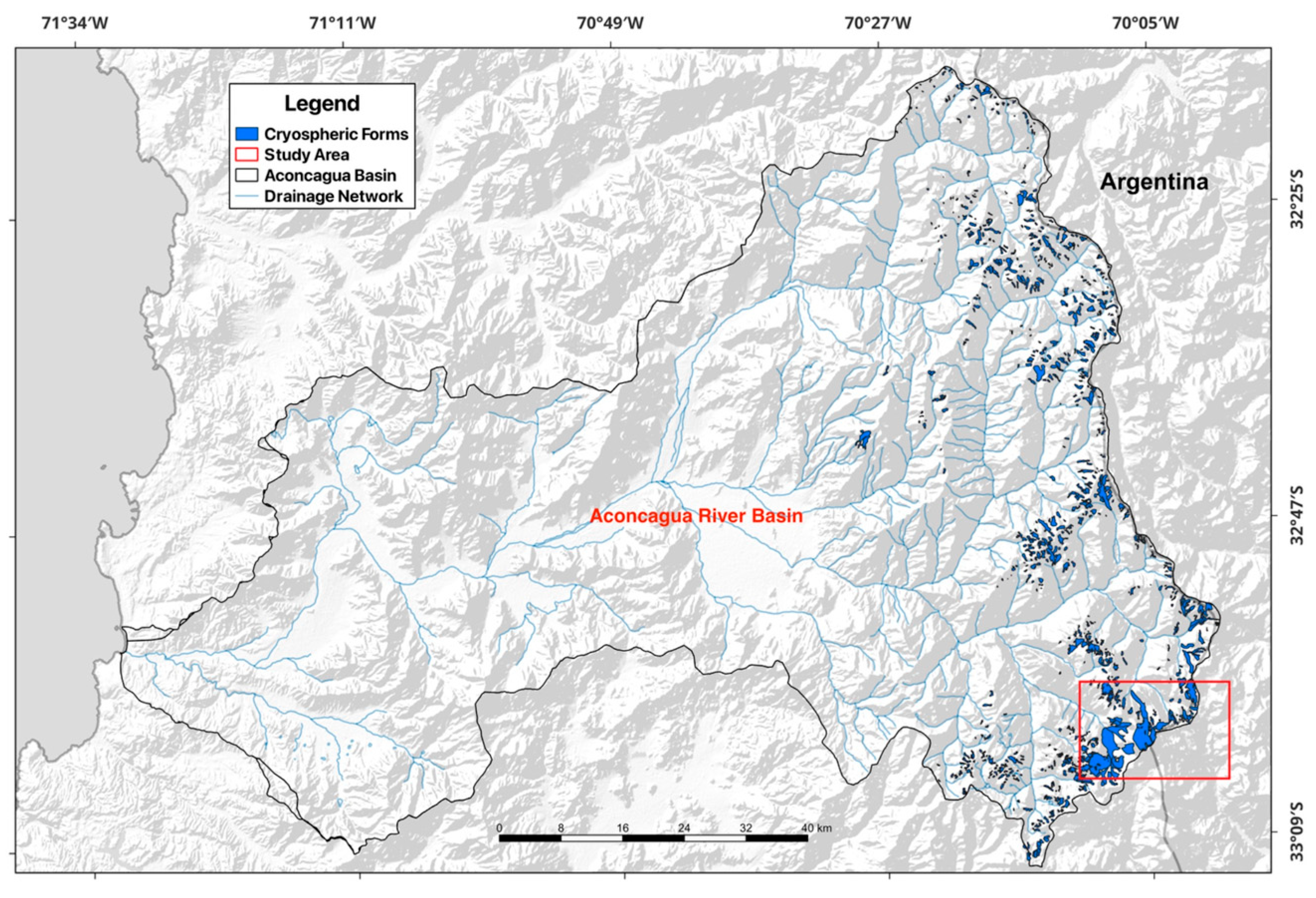
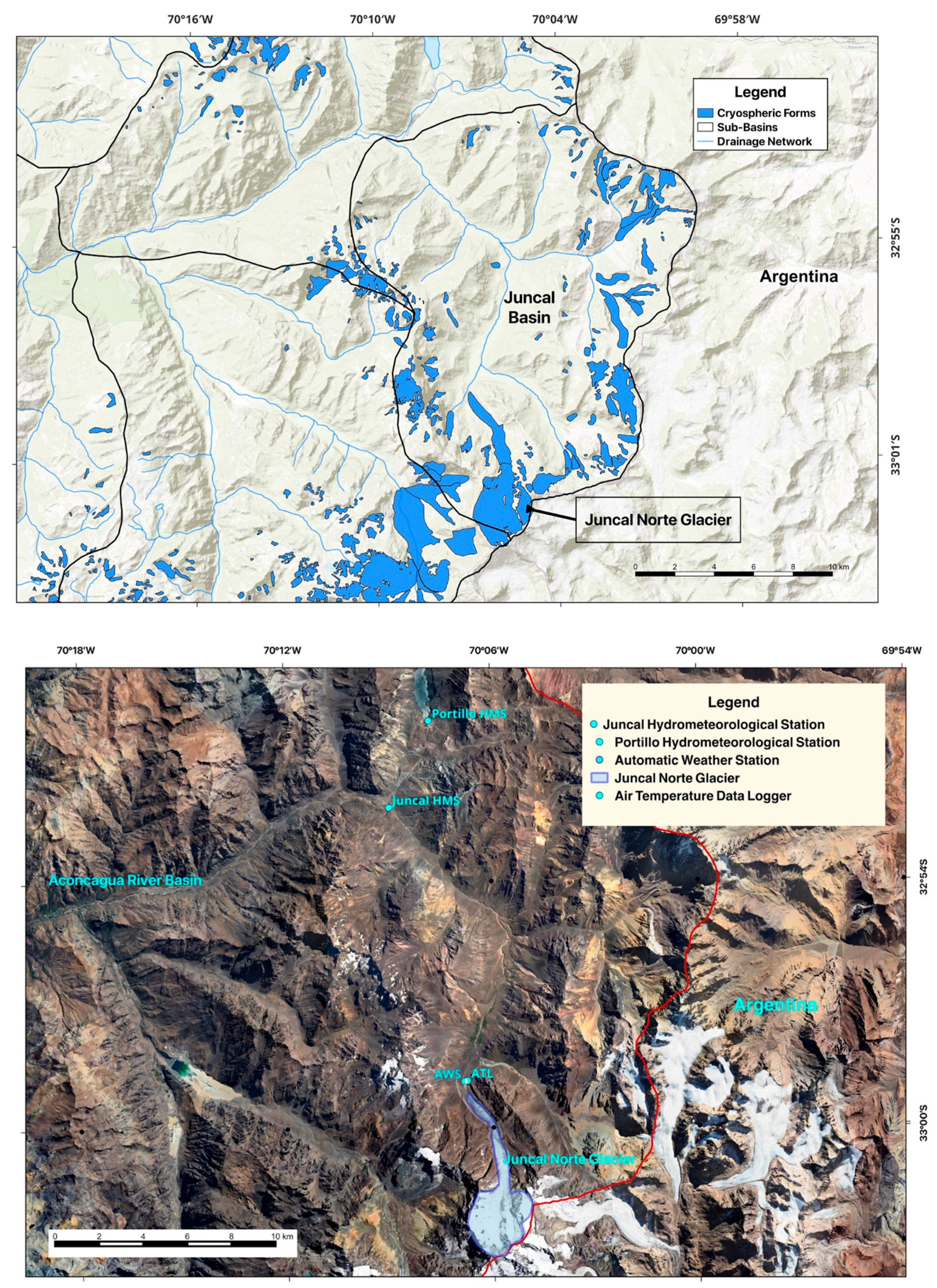
In this context, the Juncal Norte Glacier (33°01′ S, 70°06′ W) stands as a critical natural reservoir and an indicator of climate-driven changes in mountain hydrology. Juncal Norte is located in the Juncal catchment and flows northward from the summit region of Nevado del Juncal. It spans an area of approximately 7.2 km2, with an elevation range of nearly 2900 m, descending from about 5900 m to a terminus around 2900 m. The glacier flows from an upper cirque that begins near 4500 m, extending down a roughly 5 km long valley that is about 1 km wide [22]. It lies in a steep, glacially carved trough, partially shaded by the surrounding valley walls, which reduce incoming solar radiation and modulate ablation rates [4,23] (Figure 1).
Juncal Norte is one of the most extensively studied glaciers in central Chile. Bown et al. [5] documented a moderate frontal retreat of its debris-covered tongue, with a retreat rate of approximately 13 m a−1 between 1955 and 1997. In contrast, its southern neighbor, Juncal Sur, experienced a much more rapid retreat during the same period (up to 50 m a−1), a pattern first discussed by Rivera et al. [4] in their analysis of north–south contrasts across the Nevado del Juncal. Katabatic winds and complex valley topography produce strong spatial and diurnal variability in air temperatures and energy fluxes across the glacier surface [21,22]. Recent studies indicate that from 2000 to 2021, the glacier tongue of Juncal Norte (below 3500 m) has lost 0.3 km3 of its volume [19].

3. Methods

This study applies a temperature index (positive degree day, PDD) model to the Juncal Norte Glacier for the 2018–2019 hydrological year using elevation-adjusted AWS air temperature and updated glacier hypsometry derived from a 12 m resolution DEM. Melt is computed across the full glacier elevation range (2900–5900 m) and for the lower ablation zone (2900–4000 m), where runoff contributions are most direct. Model results are evaluated alongside hydroclimatic analyses of long-term temperature, precipitation, and discharge records for the Juncal Basin to provide climatic context for glacier response during the ongoing megadrought. During the preparation of this manuscript, the authors used Claude (Anthropic) to assist with editing, including reviewing for grammatical issues, evaluating narrative flow, and identifying redundant content. All AI-assisted edits were reviewed and revised by the authors, who take full responsibility for the accuracy and integrity of the reported methods and findings.
Hydrological analyses in this study consider three spatial scales: the regional Aconcagua watershed, the Juncal Andean headwater basin, and the proglacial sub-basin immediately downstream of the Juncal Norte Glacier, where glacier runoff was quantified using observed discharge.

3.1. Hydroclimatic Data Analysis Methods

The glacier mass balance model is applied to the 2018–2019 hydrological year, a very dry period within the ongoing central Chile megadrought and is the only year with complete high-elevation temperature and discharge observations available for this basin. Two independent high-elevation datasets were used: (1) an automatic weather station (AWS) located immediately downstream of the Juncal Norte Glacier (3013 m a.s.l.; 32°59′ S, 70°07′ W), which provided air temperature for melt model forcing and proglacial discharge measurements for the glacial sub-basin; and (2) a separate near-terminus temperature logger (2961 m a.s.l.; 32°58′ S, 70°07′ W) was used exclusively for hydroclimatic trend analysis.
Temperature data from this logger provided continuous sub-daily measurements from March 2017 to April 2022. Government station data (January 2014–June 2020) were excluded due to significant gaps (271 days, >11% of expected records). The logger dataset was analyzed using: (1) Seasonal-Trend decomposition using LOESS (STL) to isolate long-term temperature trends; (2) thermal threshold analysis counting days exceeding key temperatures (5 °C) or at/below 0 °C; (3) 0 °C isotherm elevation modeling using a standard atmospheric lapse rate (6.5 °C/km−1) assuming linear decrease with elevation; and (4) seasonal mean temperature analysis aggregating data by climatological seasons (DJF: December–January–February, MAM: March–April–May, JJA: June–July–August, SON: September–October–November) to assess thermal energy distribution across the hydrological year.
Precipitation data were obtained from the Juncal Hydrometeorological Station near the basin outlet (2200 m elevation) for the period 2015–2023. Standardized anomalies (Z-scores) were calculated by subtracting the 2015–2023 mean annual precipitation from each annual total and dividing by the standard deviation. Due to the short record length, a long-term baseline for anomaly classification was not available, and the series was insufficient for robust trend analysis.
Daily discharge data were compiled as hydrological-year (April–March) mean discharge values from the Juncal Hydrometeorological Station at the basin outlet for the period 1970–2023. The dataset provides continuous discharge measurements in cubic meters per second (m3/s), with three distinct periods defined for analysis: pre-decline baseline (1970–1989), decline phase (1990–2009), and megadrought period (2010–2023). A Pettitt change point test applied to hydrological-year (April–March) mean discharge identifies a statistically significant regime shift at 1989 (p ≈ 0.001). The subsequent subdivision at 2010 is introduced to distinguish the megadrought period documented in the regional literature and characterized by persistently low flows, rather than to represent an additional statistically detected change point.
Analyses included calculation of mean discharge differences between periods, trend assessment using linear regression and Mann–Kendall tests with Sen’s slope estimation, evaluation of monthly and seasonal flow patterns, anomaly calculations relative to the 1970–1989 baseline, construction of flow duration curves to evaluate flow reliability, and analysis of trends in flow quantiles (10th, 50th, 90th percentiles) to examine distributional changes. Prior to applying the Mann–Kendall test, lag-1 serial autocorrelation of the annual aggregated discharge series was evaluated; no statistically significant autocorrelation was detected, and the standard Mann–Kendall test was therefore applied.
For a runoff–precipitation balance analysis, precipitation totals were calculated from daily records at the Juncal Hydrometeorological Station and aggregated annually. Runoff volumes were derived from daily discharge data at the Juncal Hydrometeorological Station, converted to depth over the basin area of 263 km2 to enable direct comparison with precipitation inputs. The annual difference between precipitation and runoff (net balance) was used as a first-order estimate of excess water, interpreted as reflecting cryospheric contributions, storage release, or measurement error. This diagnostic does not represent a closed water balance and is used only as a first-order indicator of hydrological deficit magnitude. For glacier melt contribution analysis, discharge was obtained from the proglacial AWS at 3013 m a.s.l. immediately downstream of the Juncal Norte Glacier, providing a spatially constrained reference for the glacier sub-basin rather than the full 263 km2 catchment. The proglacial AWS recorded a mean annual discharge of 3.41 m3/s for the 2018–2019 hydrological year, lower than the long-term megadrought mean of 4.42 m3/s at the basin outlet, consistent with the smaller contributing area of the glacier sub-basin relative to the full 263 km2 Juncal catchment. These discharge values are not directly comparable because they represent different drainage areas and routing conditions.

3.2. Glacier Mass Balance Modeling Framework

This study applies a temperature index (positive degree day, PDD) model to estimate glacier mass balance for the 2018–2019 hydrological year (1 April 2018 to 31 March 2019), following established approaches [23,24,25,26]. The model simulates melt and accumulation over the full glacier surface between 2900 m and 5868 m a.s.l., covering a total glacier area of 7.21 km2.
The model was applied in two configurations: (1) a glacier-wide run covering the full elevation range (2900–5900 m, 7.21 km2), and (2) a lower-ablation-zone run restricted to 2900–4000 m (2.19 km2). Both runs use the same equations and degree day factor described below; they differ only in spatial domain. Results from both configurations are compared in Section 4.2.
All meteorological and hydrological data used in this study were obtained from a proglacial automatic weather station (AWS) owned and operated by the authors, located near the proglacial stream of the Juncal Norte Glacier at 3013 m a.s.l. (32°58′52.69″ S, 70°06′51.16″ W). The station recorded sub-daily measurements of air temperature (°C), relative humidity (%), wind speed (m/s), atmospheric pressure (mbar), alongside daily water level (m), discharge (m3/s), and rainfall (mm). Air temperature was used as the primary forcing variable for glacier melt modeling. Daily discharge and water level, linked by a stable rating curve (R2 = 0.988), provided the observational basis for runoff closure and glacier contribution estimation. Relative humidity (annual mean 41.3%) and wind speed (mean 2.22 m/s) are consistent with conditions reported by Pellicciotti et al. [23] at this site. Rainfall recorded at the proglacial AWS totaled 153.4 mm for the hydrological year, with the remaining 16.6 mm difference from the 170 mm total precipitation input representing snowfall—independently corroborating the low-accumulation assumption used in the mass balance model. Air temperature was lapse rate-corrected to each elevation band using a constant lapse rate of −6.5 °C/km−1. The glacier surface was discretized into 25 m elevation bands.
The modeling workflow consisted of the following steps: (i) daily air temperature measured at the AWS was extrapolated to each elevation band using a fixed lapse rate; (ii) positive degree days were computed for each band and day; (iii) melt was calculated by applying a degree day factor to the accumulated positive degree days; (iv) melt was multiplied by the corresponding band area; and (v) glacier-wide melt was obtained by summing contributions from all elevation bands.
Glacier melt was computed using a positive degree day formulation. For each day i, positive degree days were calculated as
P D D = i = 1 n m a x ( T i , 0 )
where T i is the mean daily air temperature (°C) and only temperatures above 0 °C contribute to melt.
Daily melt was calculated as
M = P D D × D D F
where M is melt (m w.e.) and DDF is the degree day factor. A constant value of DDF = 6 mm °C−1 day−1 (0.006 m °C−1 day−1) was adopted, consistent with published values for clean ice in the central Andes.
For each elevation band z, melt volume was calculated as
V z = M z × A z
where M z is melt in elevation band z (m w.e.) and A z is the surface area of that band (m2). Total glacier melt volume was obtained by summing the contributions of all elevation bands:
V melt = z V z
Accumulation was represented as a fixed input of 0.17 m w.e. applied uniformly across all elevation bands, based on total precipitation recorded at the Juncal Hydrometeorological Station during the 2018–2019 hydrological year (170 mm). This value is consistent with snow-water-equivalent measurements at the nearby Portillo station (~3000 m a.s.l., approximately 16 km from the glacier), which also recorded 170 mm for the same year. The uniform accumulation was adopted as a conservative estimate under the extremely dry conditions of the study year. Uncertainty in accumulation is acknowledged, as both stations are located below 3000 m and likely underestimate precipitation at higher elevations due to gauge undercatch and wind redistribution; however, given the exceptionally low accumulation during 2018–2019, this uncertainty has a limited effect on modeled net mass balance, which is dominated by ablation.
Net mass balance was converted to ice volume by multiplying net balance (m w.e.) by glacier area and applying a density correction assuming an ice density of 900 kg m−3:
V ice = A × M B w . e . × 1000 900
where A is the glacier area (m2) and M B w . e . is the net mass balance expressed in meters water equivalent.
To evaluate the hydrological relevance of modeled glacier melt, total glacier melt volume was compared with observed runoff volume. Runoff volume ( V Q ) was obtained by integrating daily discharge measured at the proglacial AWS for the Juncal Norte Glacier sub-basin over the hydrological year. Runoff closure was implemented as a sub-basin scale volume comparison between integrated observed discharge and modeled glacier melt for the same hydrological period. This closure comparison refers to the consistency between sub-basin discharge and glacier-derived melt volumes and does not represent a full water balance closure including non-glacierized snowmelt, rainfall runoff, groundwater contributions or storage changes.
Glacier-wide melt volume used for runoff comparison was obtained from the integrated elevation band calculations described above (Equation (4)), representing total melt over the hydrological year expressed in cubic meters.
The fractional contribution of glacier melt to observed runoff was calculated as
%   glacier   contribution = V melt V Q × 100
To assess the strength of the relationship between modeled glacier melt and observed discharge, a linear regression was performed between daily glacier melt volumes and daily streamflow recorded at the Juncal Hydrometeorological Station over the 2018–2019 hydrological year.
To evaluate climatic sensitivity, daily air temperatures were uniformly perturbed by ±1 °C and the model was rerun to estimate changes in glacier-wide ablation and net balance. Additional sensitivity tests were conducted using alternative ice and snow degree day factors (7.9 and 4.5 mm °C−1 day−1). The equilibrium line altitude (ELA) was defined as the elevation at which the ablation zone regression line (fitted only to elevation bands below 4000 m) crosses zero net mass balance.
Model assumptions include: (i) ice density fixed at 900 kg m−3, a standard value widely used in glaciological mass balance studies [26]; (ii) a zero-degree surface assumption with no subsurface heat flux or internal heat storage, consistent with Pellicciotti et al. [20] who confirmed that subsurface heat conduction is negligible in the lower ice-exposed zones of Juncal Norte; (iii) rainfall excluded from accumulation, given that precipitation during 2018–2019 occurred predominantly as snow at glacier elevations; (iv) melt calculated for ice only, with no separate firn or snow degree day factors, a simplification justified by the extremely low accumulation recorded during 2018–2019 (170 mm), which precluded the development of a persistent seasonal snowpack capable of modifying surface albedo or requiring a separate snow DDF; and (v) no corrections applied for debris cover, albedo evolution, or sublimation losses, although these processes may be significant, particularly in the lower glacier zone.
For the lower-ablation-zone configuration described above, the second PDD model run was performed for this zone (2900–4000 m), where melt is most concentrated. This allowed for isolated assessment of melt intensity in the glacier tongue and its contribution to total runoff under current hydroclimatic conditions. This elevation range was selected based on cumulative annual PDD values: at the 2900–3000 m band, PDDs exceeded 2000 °C·days; at the 3400–3500 m, they remained high (1195 °C·days), and the 3800–3900 m band still retained an average of 246 °C·days. PDDs dropped to zero above 3950 m. Modeling this broader 2900–4000 m range captures peak melt intensity and the transition to no temperature-driven melt above 3950 m. This dual-domain approach allows for comparison between total glacier melt and the concentrated contribution from the lower ablation zone, providing insights into the disproportionate contribution of the glacier tongue to total runoff.
To assess the sensitivity of modeled melt to transient snow cover, a snow degree day factor (DDF) of 4 mm °C−1 day−1 was applied to elevations above 4000 m in a sensitivity test, while an ice DDF of 6 mm °C−1 day−1 was retained for lower elevations. This threshold was selected based on the modeled distribution of melt, which shows minimal melt contribution from elevations above 4000 m.
To contextualize the glacier modeling approach used in this study, we compare it with two benchmark studies at the Juncal Norte Glacier [23,24]. Table 1 summarizes key methodological and contextual differences that illustrate how this study extends and complements past work, particularly through full-year modeling, higher-resolution hypsometry, and direct runoff validation under megadrought conditions.
The mass balance analysis of the Juncal Norte Glacier utilized a high-resolution Digital Elevation Model (DEM) derived from ALOS PALSAR data with a spatial resolution of 12.5 m (WGS 84/UTM zone 19S, EPSG:32719). The DEM was acquired from L-band Synthetic Aperture Radar observations collected by the DAICHI satellite between 2006 and 2011 and corrected for geoidal height differences using the global EGM2008 model to ensure elevations were referenced to mean sea level.

3.3. Glacier Area Change Analysis

To assess the changes in the extent of glacial coverage, we utilized high-resolution imagery from Google Earth, 2023 Airbus Imagery, and a 2011 image from Maxar Technologies. These visual data sources enabled us to accurately identify and digitize the glacier boundaries. Following the digitization, we calculated the total area covered by the glaciers.

4. Results: Glacier Melt and Hydrological Response

4.1. Hydroclimatological Trends and Patterns

4.1.1. Temperature Conditions

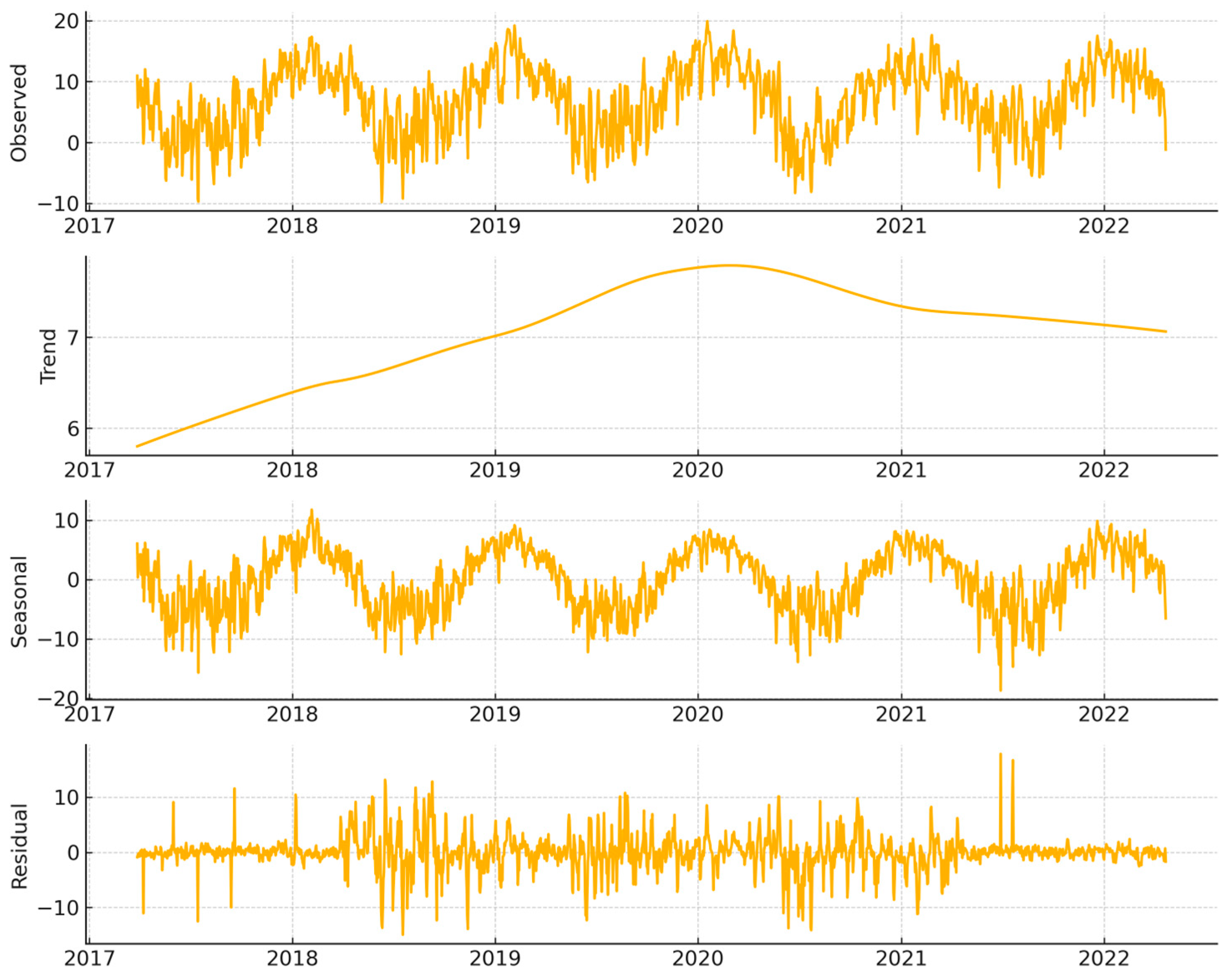
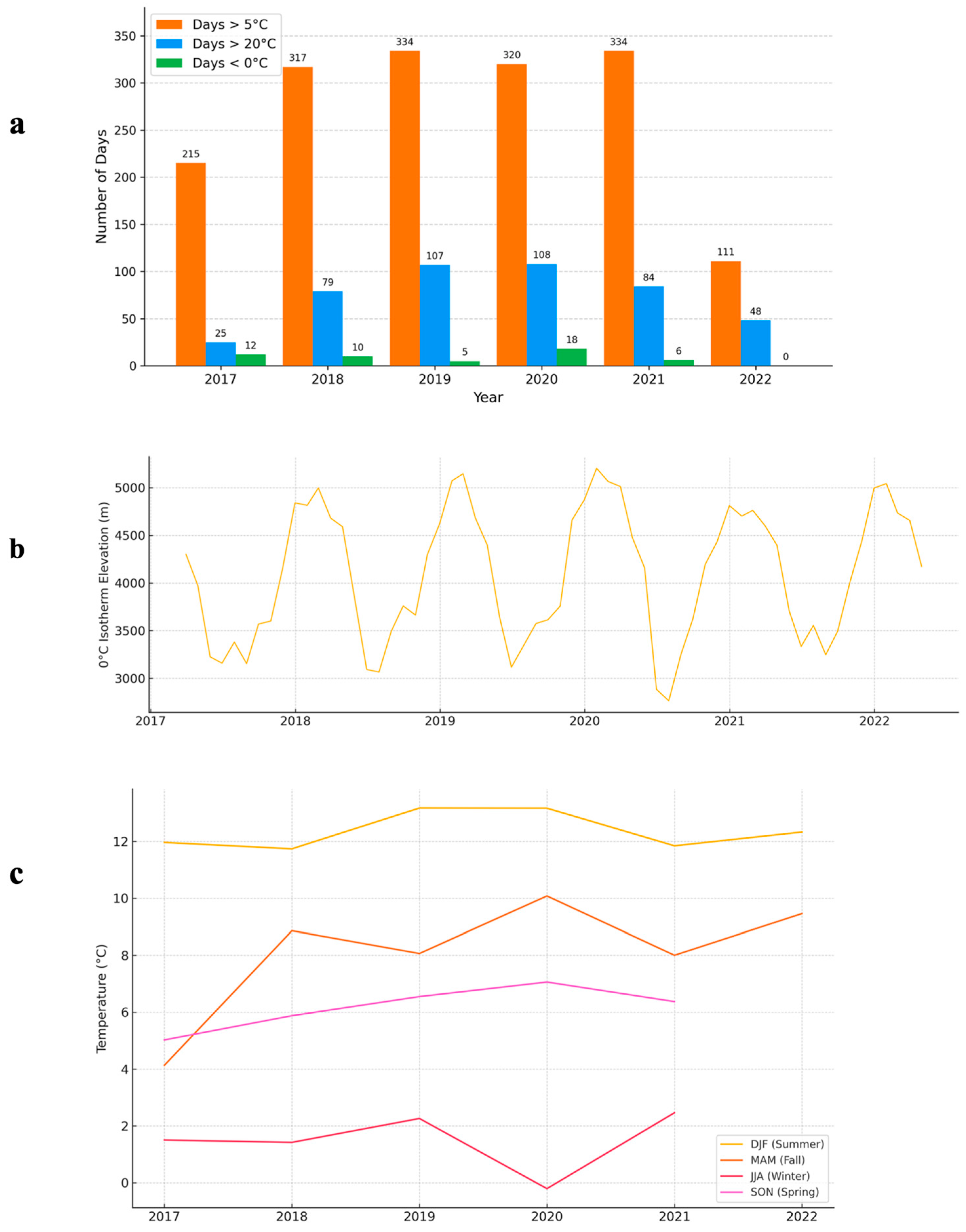
Temperature records from the Juncal Basin show anomalously elevated temperatures during 2018–2022, particularly near the glacier. The glacier-proximal logger at ≈3000 m captures conditions in the elevation band critical to glacier mass balance. The temperature anomaly during this period is visualized in Figure 2, where the STL decomposition isolates the temperature component from seasonal and residual variations. The trend component shows temperatures rising from approximately 5.5 °C in 2017 to a peak near 9 °C in 2020, remaining elevated through 2022, consistent with anomalous warming during the megadrought period.
This temperature anomaly is not uniform across seasons. Figure 2 shows the STL decomposition, which separates the observed temperature into trend, seasonal, and residual components, revealing elevated temperatures from 2017 to 2020, followed by persistently elevated temperatures through 2022. Warmer conditions are concentrated in spring (SON) and summer (DJF), as shown in Figure 3c, accelerating snowmelt and shifting the onset of the ablation season earlier in the year. Critically, modeled 0 °C isotherm elevations—derived from logger-based lapse rate adjustments—frequently exceed 3500 m during warm months (Figure 3b), shifting the glacier’s thermal regime toward greater net ablation. The increasing frequency of days above 5 °C and decreasing freeze days (Figure 3a) further contribute to this shift. Days exceeding 20 °C increased markedly from 25 in 2017 to a peak of 108 in 2020, while days below 0 °C showed no consistent trend, remaining below 20 throughout the period (Figure 3a). Since most of the Juncal Norte Glacier lies between 3000 and 5900 m, this vertical shift means that even formerly stable accumulation areas now experience routine melt.
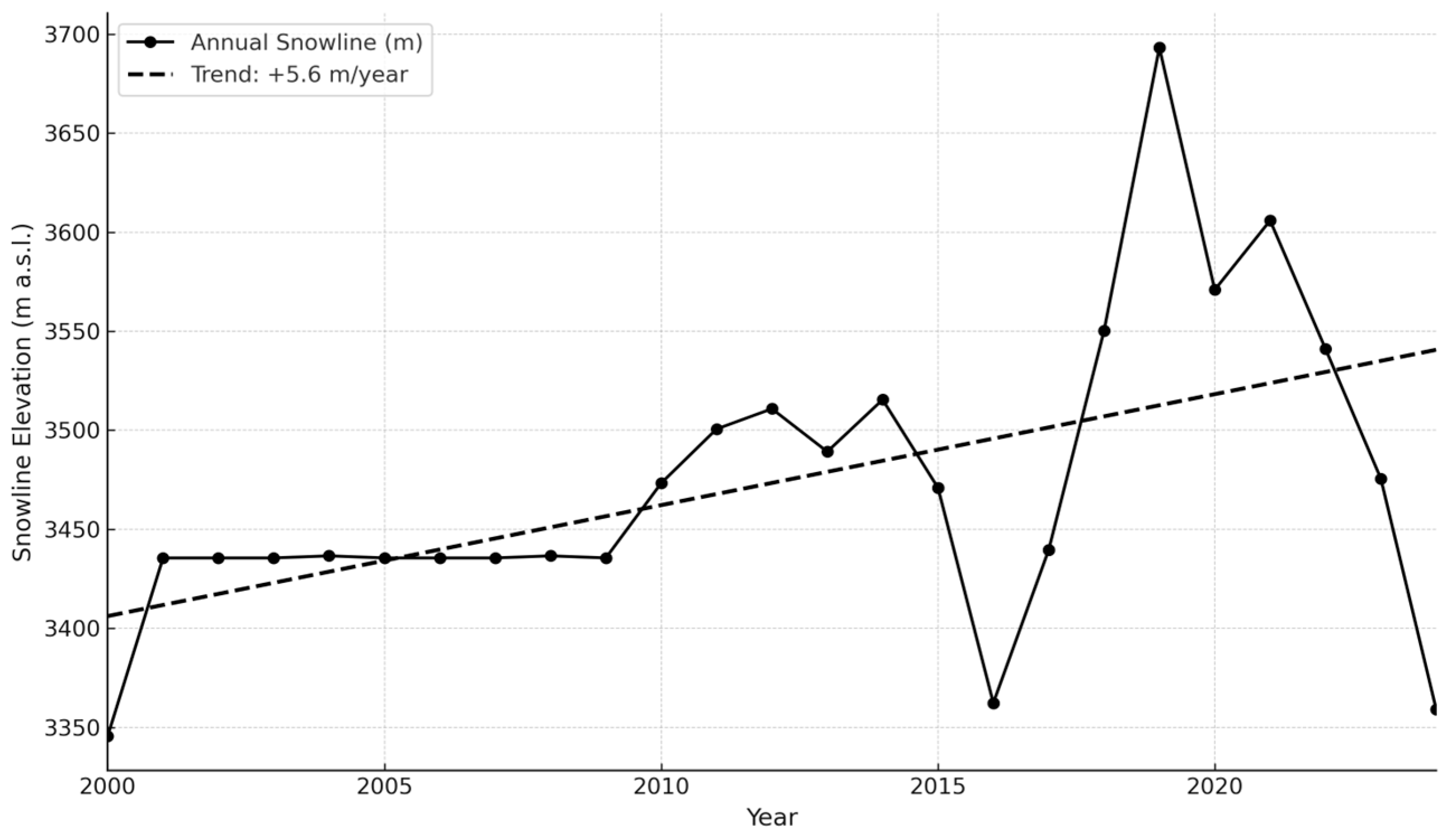
Simultaneously, regional snow water equivalent (SWE)—based on measurements from the Portillo station (17 km from the glacier)—has declined by 29.2 mm/year from 2000 to 2020 (R2 = 0.43, p = 0.0013), confirming a significant loss in cold-season water storage. Complementing this trend is a rising annual snowline elevation of +5.6 m/year from 2000 to 2024 (Figure 4, R2 = 0.21, p = 0.011), providing additional confirmation of the changing snow–ice dynamics in the region. These trends extend earlier observations by Carrasco et al. [7] who reported a ~150–200 m rise in the 0 °C isotherm during the late 20th century, and reinforce regional findings of declining snow accumulation and glacier retreat [17]. They also support the snowmelt dynamics emphasized by Ayala et al. [27], which link rising isotherm levels and reduced SWE to sustained ablation. Together, these results highlight a weakening cryospheric buffer and a transition toward a melt-dominated hydrological regime for the Juncal Norte Glacier.

4.1.2. Precipitation Trends

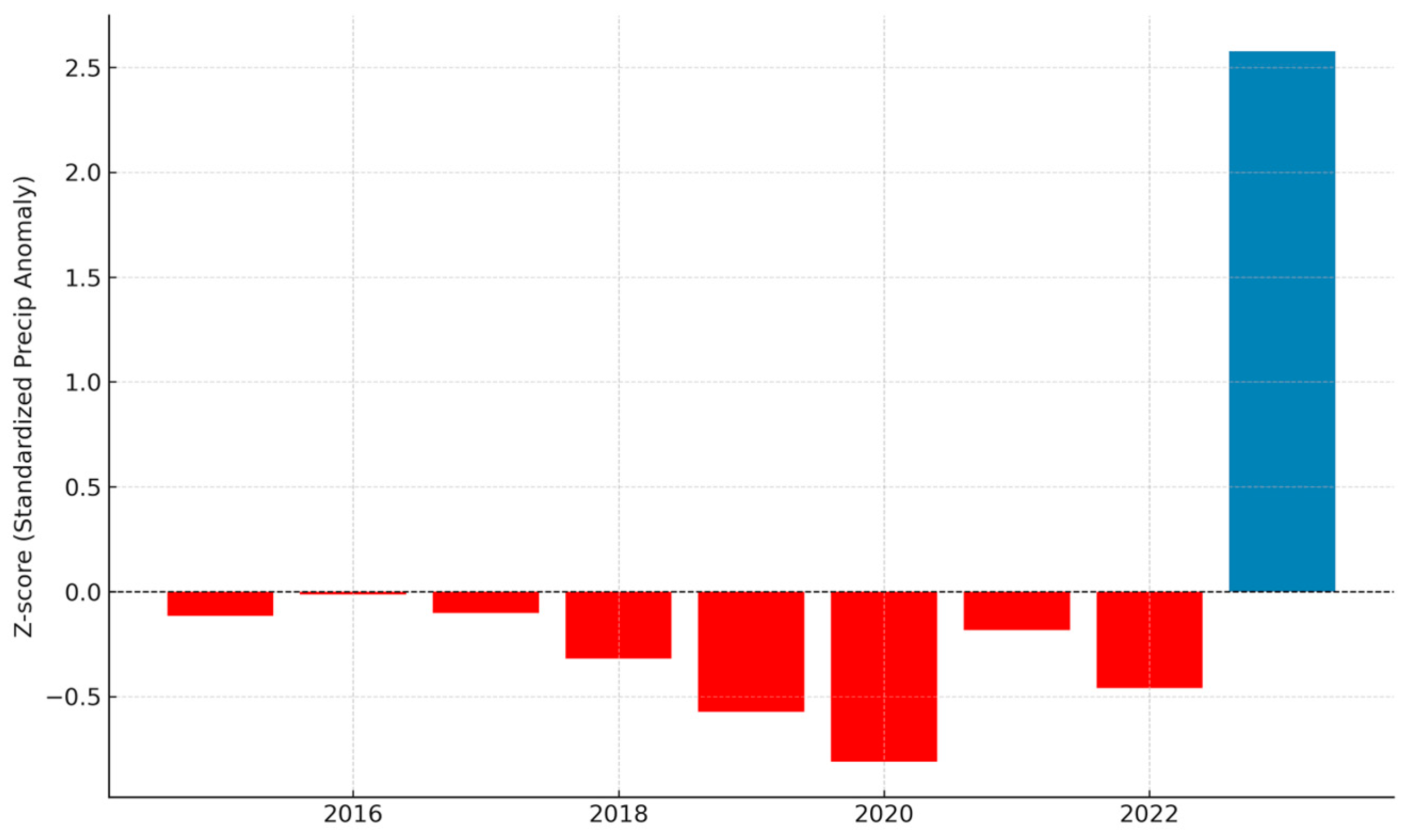
Annual precipitation ranged from 105 mm in 2019 to 1145 mm in 2023. Standardized anomalies (Z-scores) were calculated relative to the 2015–2023 mean (≈294 mm). Most years between 2018 and 2022 showed significant negative anomalies, reflecting the persistence of dry conditions during this period. The sharp recovery in 2023, marked by a strong El Niño event (ONI > 0.5), brought record precipitation levels, contributing to localized flooding in central Chile. While exceptional, this wet anomaly does not reverse the cumulative deficit of the previous drought years (Figure 5).
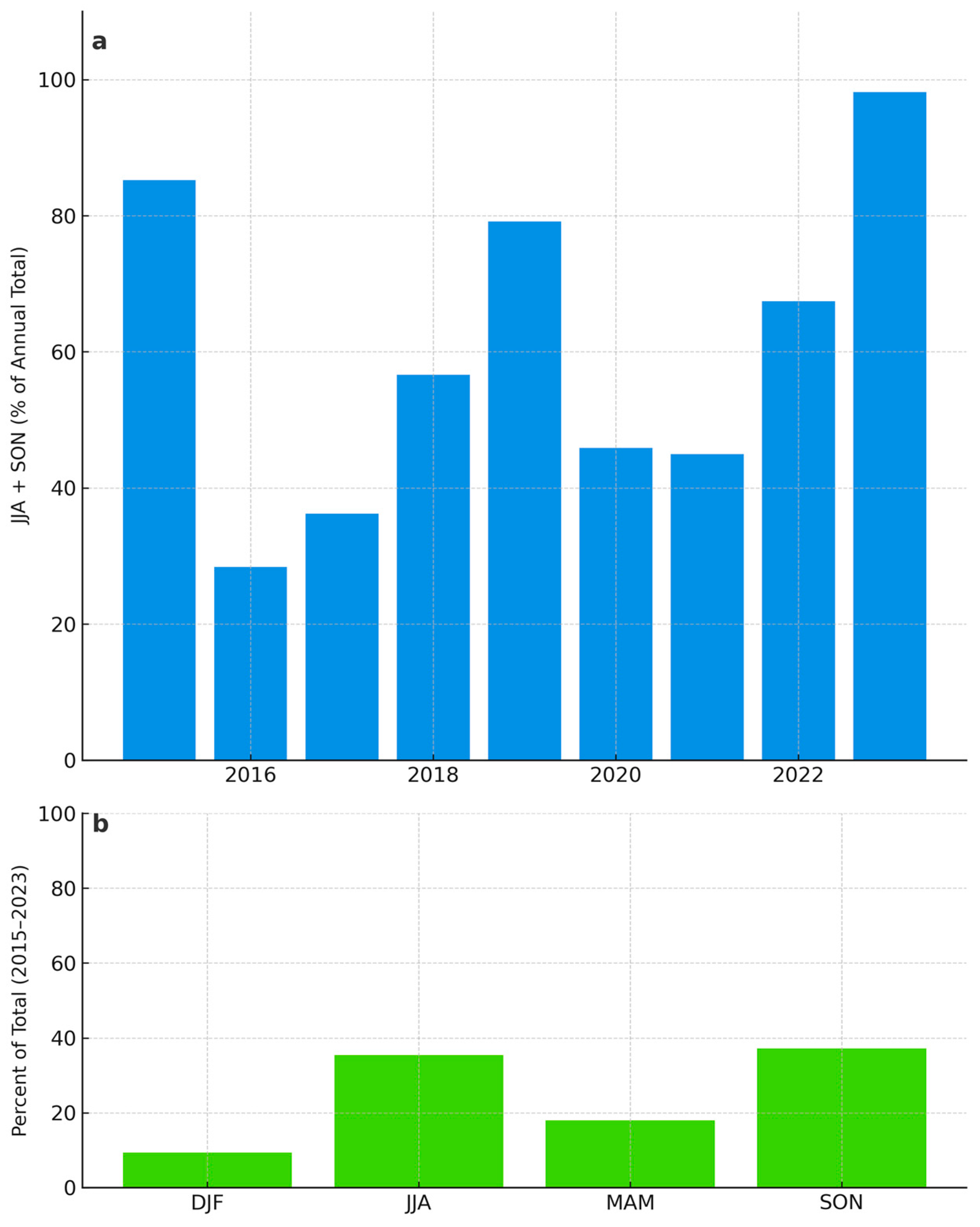
Precipitation timing in the Juncal Basin reflects a Mediterranean climate pattern, with the majority of rainfall occurring during winter (JJA) and spring (SON). These two seasons together accounted for 28% to 98% of annual precipitation from 2015 to 2023, averaging about 55% when calculated as the mean of yearly percentages (Figure 6a). The anomalously low JJA + SON fraction in 2016 reflects an unusual seasonal redistribution of precipitation, with fall (MAM) accounting for 166.4 mm—the highest MAM value in the 2015–2023 record—shifting the annual precipitation balance away from the typical winter–spring pattern. However, when considering the aggregated precipitation across all years, winter and spring together account for over 70% of total precipitation (Figure 6b). Notably, during drier years, the proportion of precipitation falling in these two seasons often increased, indicating a seasonal concentration of rainfall during drought conditions. Although short, the 2015–2023 record captures a recent period of reduced precipitation inputs, offering observational support for broader regional drought conditions. The persistent dryness from 2018 to 2022, and the exceptional wet rebound in 2023, reinforce concerns over the basin’s short-term hydrological sensitivity. Over the 2015–2023 period, cumulative precipitation anomalies totaled approximately –852 mm, with only a single positive anomaly in 2023.

4.1.3. Discharge Patterns

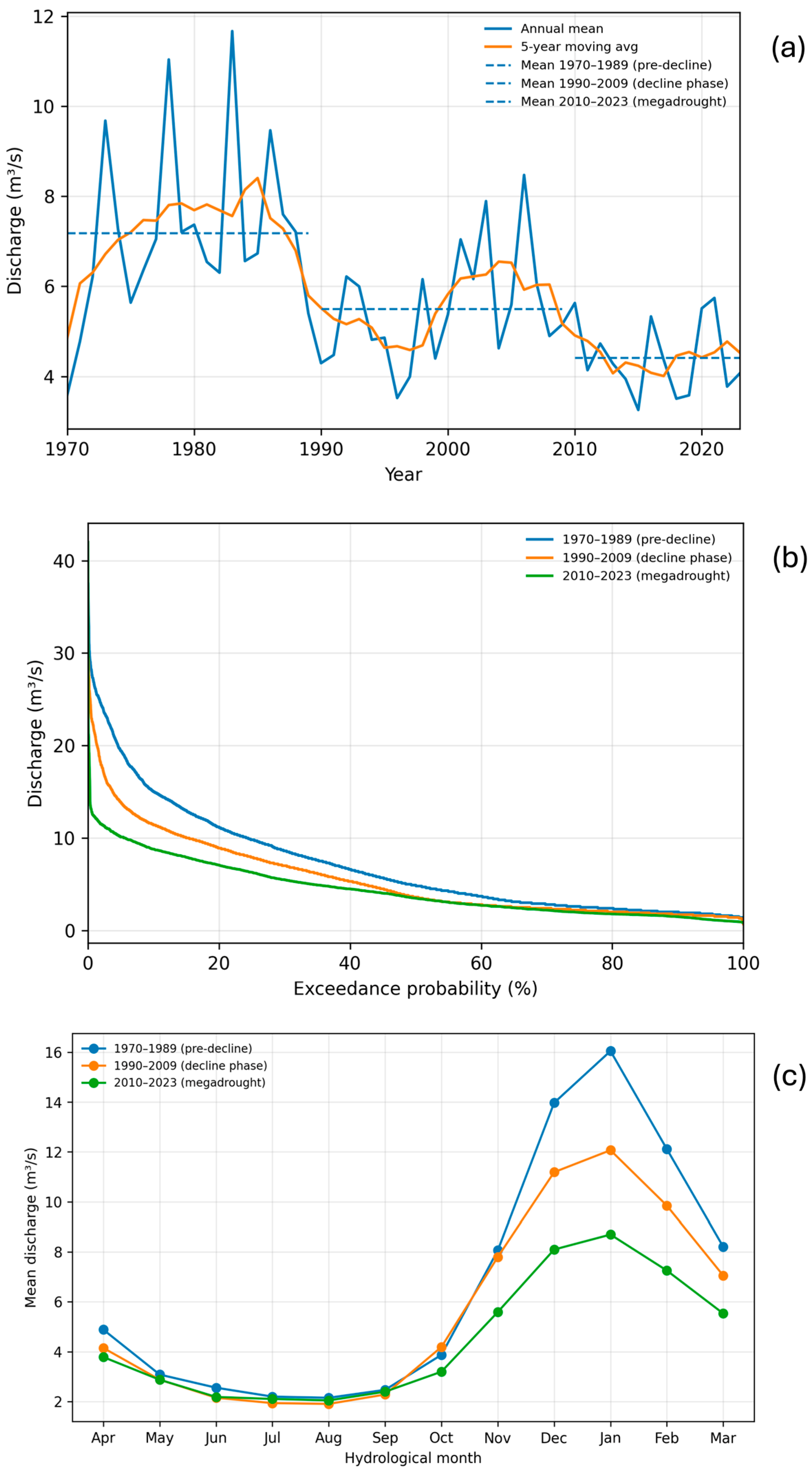
Streamflow records from the Juncal River at the basin outlet reveal a long-term decline consistent with regional drying trends and cryospheric depletion. Linear regression across the full 1970–2023 series shows a statistically significant downward trend (R2 = 0.25, p = 0.00012), an average decline of −0.059 m3/s per year, supported by the Mann–Kendall and Sen’s slope analysis applied to the hydrological-year discharge series. This trend is especially steep during the drought period (2010–2023), where regression shows a sharp negative slope and reduced interannual variability. Annual discharge averaged 7.05 m3/s during the pre-decline baseline (1970–1989), then decreased to 5.52 m3/s during the decline phase (1990–2009), before falling to 4.42 m3/s during the megadrought period (2010–2023), representing a dramatic 37.3% reduction from the baseline (Figure 7a). The 5-year moving average shows peak values of approximately 8 m3/s in the mid-1980s, followed by a progressive decline that began in the late 1980s, with values consistently remaining below 5 m3/s after 2010.
Flow duration curves (FDCs) for the baseline and drought periods show a consistent loss of high and medium flows, underscoring reduced water availability (Figure 7b).
This study initially adopted 2010 as the reference point for the onset of sustained drought, consistent with the prevailing literature on the central Chilean megadrought [1,14]. However, analysis of the Juncal River discharge record revealed that the decline in streamflow began significantly earlier. Annual discharge begins a persistent downward trend in the late 1980s (1988–1989), with most years after 1990 falling below the long-term mean. This shift coincides with a statistically significant regime change around 1989, marking the transition to a persistently lower-flow regime (Figure 7a).
To evaluate the hydrological relevance of glacier mass loss in the Juncal Basin, two streamflow baselines were used. The primary reference period for this study is 2010–2023, with an average discharge of 4.42 m3/s. It reflects the current low-flow regime under persistent climate stress and is consistent with the dominant hydrological conditions influencing both glacier dynamics and water availability. This average is equivalent to approximately 139 million cubic meters per year, and is used as the basis for expressing the hydrological significance of glacier-derived water loss in the current climate context. The cumulative discharge profile by hydrological month confirms that peak flows now occur earlier in the season, with diminished volumes during late summer months (Figure 7c). The most severe streamflow deficits during this period occurred in austral summer (DJF) and late spring (SON), with relative declines of –30% to –36%.
To contextualize recent changes, a pre-decline baseline (1970–1989) with an average discharge of 7.05 m3/s was used for comparative analysis. This period represents the historical high-flow regime prior to the sustained streamflow decline. To capture the transition between these regimes, a third reference period—1990–2009—was added. This “decline phase” reflects the onset of sustained discharge reduction and cryospheric imbalance. Average discharge during this phase was 5.52 m3/s, a −21.7% reduction relative to the pre-decline baseline (see Table 2). The inclusion of this intermediate baseline demonstrates that hydrological decline in the Juncal Basin began well before the onset of the megadrought as conventionally defined, as indicated by long-term discharge trends, offering a data-based correction to existing temporal framings.
This multi-baseline approach is consistent with strategies used in glacierized Andean basins to assess melt dynamics under contrasting climate conditions [6]. Seasonally resolved comparisons show the most pronounced reductions have occurred between September and January, consistent with earlier snowmelt and declining cryospheric input. Percent difference analysis reveals that September to November streamflow (SON) has declined by more than 40% relative to the pre-decline baseline (Table 2).

4.2. Glacier-Wide Melt, Surface Runoff Contribution, and Climate Sensitivity

Melt estimates presented in this section are derived from the positive degree day (PDD) model described in Section 3.2, and discharge refers to the proglacial sub-basin unless otherwise stated.
The modeling results yielded a total glacier melt volume of approximately 30.1 million m3 water equivalent for the 2018–2019 hydrological year (April–March). A sensitivity analysis incorporating a snow DDF at elevations above 4000 m reduces total modeled melt from 30.1 to approximately 28.6 million m3 (~7% decrease). This melt was strongly seasonal, with 51.19% occurring during summer (DJF), 28.14% during fall (MAM), 17.10% during spring (SON), and only 3.57% during winter (JJA). Combined, the primary melt season (DJF + MAM) accounted for 79.33% of the annual melt volume (Table 3). Modeled glacier melt was equivalent to approximately 30% of annual observed discharge at the proglacial AWS station for the Juncal Norte Glacier proglacial sub-basin, with seasonal contributions varying from 8.8% in winter (JJA) to 36.1% in fall (MAM).
During summer months (December–February), when seasonal snowmelt is largely depleted, glacier melt contribution reached 35.9% of observed proglacial sub-basin discharge, though potentially rising to 50% during peak melt periods—a pattern consistent with previous isotopic and hydrochemical studies that identify glacier melt as the primary summer water source in the upper Aconcagua watershed [10,15]. These results highlight the dominant role of glacier ablation in sustaining surface runoff over the glacier during high melt years. This substantial melt volume, occurring during a period with an abnormally elevated ELA, indicates a glacier system operating far from equilibrium with current climate conditions—a critical consideration for assessing future water availability as the glacier continues to decline.
Under drought conditions, isotopic and hydrological studies show that glacier melt contributes approximately 20–35% of annual streamflow in the central Andes, rising to 34% or more in summer in glacierized headwaters [15], and can surpass 50% during severe dry years [10]. The ~30% annual contribution estimated in this study falls within this dry-year range, further confirming the glacier’s critical buffering role under reduced snowpack and elevated melt conditions. While seasonal snowmelt and rainfall runoff dominate river discharge in most years, glacier melt remains an important secondary source, especially during late summer when snow reserves are exhausted.
To evaluate the glacier’s sensitivity to air temperature fluctuations, we conducted perturbation experiments applying ±1 °C shifts to the AWS temperature inputs. A simulated +1 °C warming increased glacier-wide melt by +21.4% while a corresponding −1 °C cooling reduced melt by −18.2% (Figure 8). These results demonstrate the model’s high sensitivity to interannual temperature variation and reflect a strong coupling between climate forcing and glacier mass loss.
Runoff response to glacier melt was assessed through regression analysis, which showed that for every 1 m3 of modeled glacier melt, stream discharge increased by approximately 2.13 m3/day. The correlation between melt and observed runoff was statistically significant (R2 = 0.78, p = 0.0001), supporting the model’s robustness. As an independent empirical check, the observed correlation between daily proglacial air temperature and measured discharge at the AWS station yielded R2 = 0.64 (r = 0.80), confirming a strong physical coupling between thermal forcing and streamflow at this site and supporting the physical basis of the temperature index approach. This runoff response is likely higher during late summer, when snow cover is depleted and bare ice dominates, amplifying the thermal response. The strong correlation between melt and runoff highlights how directly downstream water availability is coupled to glacier behavior, suggesting that continued glacier retreat will have immediate and proportional impacts on water resources, particularly during critical late-summer periods.
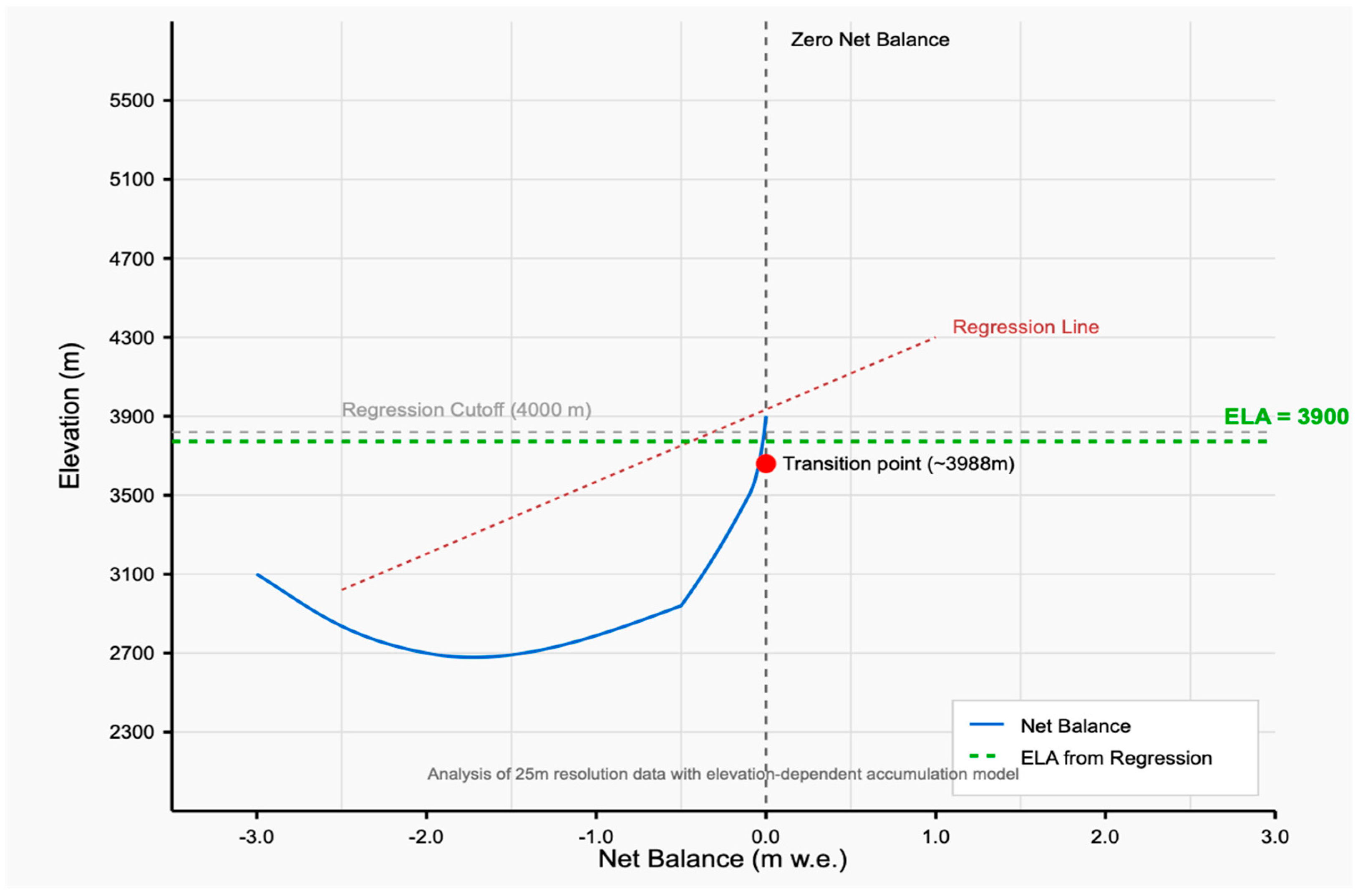
A linear regression of net mass balance versus elevation (using only elevation bands below 4000 m) places the equilibrium line altitude (ELA) at ~3900 m. Because accumulation is imposed uniformly and at very low magnitude, the modeled ELA primarily reflects the elevation at which temperature-driven ablation approaches zero rather than a fully resolved accumulation–ablation equilibrium. The net mass balance curve derived from the PDD model for 2018–2019 shows negative values across all elevation bands up to 3950–3975, with net losses reaching –19.0 m. Above this range, net balance turns slightly positive, increasing from +0.17 m at 4000 m to +0.23 m at the glacier’s upper limit (5900 m). The slight positive net balance at these elevations reflects limited melt due to low positive degree days. This pattern reflects widespread ablation and limited snow accumulation even in the upper glacier area above 4000 m, where net gain remains below 0.25 m w.e. This weak accumulation signal points to significant disequilibrium, with most of the glacier surface unable to retain substantial mass—an unsustainable condition under ongoing climatic stress.
This result is consistent with Ayala et al. [24], who estimated an ELA of ~4150–4200 m for the Juncal region under near-normal climatic conditions, based on both modeled outputs and end-of-season snowline observations. Carrasco et al. [7,28] likewise placed the regional 0 °C isotherm near 4200 m. The regression-based ELA of 3900 m represents the elevation at which modeled ablation approaches zero under the imposed temperature conditions, rather than an equilibrium ELA, and is therefore not directly comparable to observed end-of-season snowline or long-term equilibrium conditions. These comparative values are summarized as follows: Ayala et al. [24]: ~4150 m (final snowline); Carrasco et al. [7,28]: ~4200 m (0 °C isotherm); this study: 3900 m (ablation zone regression). The ELA value supports the conclusion that the glacier was in a strongly negative mass balance state during the 2018–2019 hydrological year.
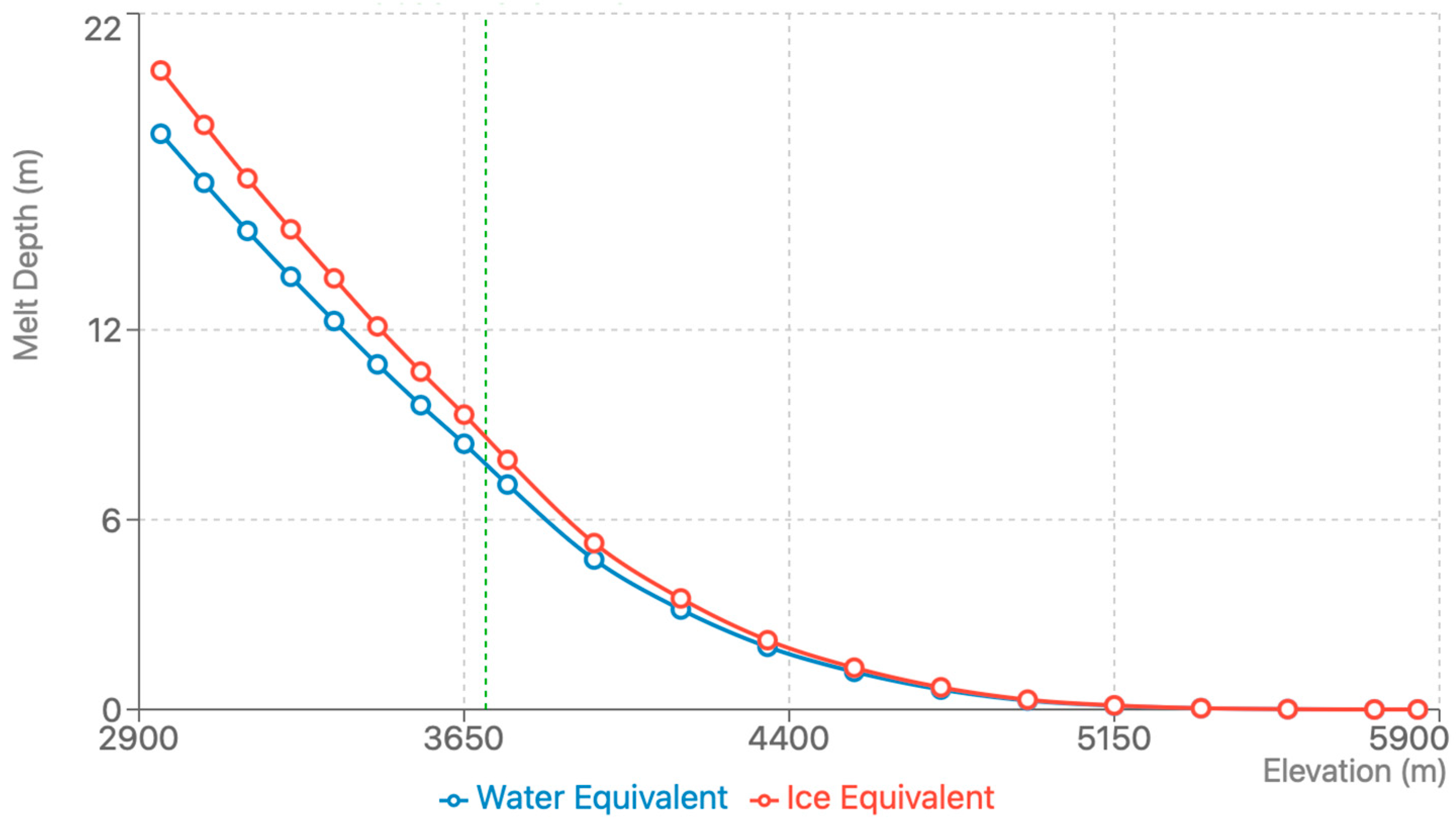
Together, these results demonstrate that the Juncal Norte Glacier played a significant hydrological role in 2018–2019, contributing meaningfully to local runoff despite clear signs of net mass loss. A secondary model focused on the 2900–4000 m ablation zone—covering just 2.19 km2 (30.43% of the total glacier area)—produced a melt volume of 0.02799 km3 w.e., which is 90.26% of the total melt volume from the entire glacier (30.1 million m3 w.e.). This disproportionate contribution is clearly visualized in Figure 9, which shows the concentration of melt volume in the lowest elevation bands.
This spatially concentrated melt pattern suggests a strong potential vulnerability in the water resource system, subject to uncertainties associated with debris-covered and highly heterogeneous melt processes in the lower glacier tongue; the lower 30.43% of glacier area currently produces 90.26% of the modeled total melt volume and is also the zone most vulnerable to near-term loss as the glacier retreats upslope. The inevitable loss of this disproportionately productive ablation zone represents an impending threshold in water availability that will occur well before total glacier disappearance.

4.3. Runoff–Precipitation Balance (2015–2023)

Long-term hydroclimatic data from the Juncal Norte Basin emphasize the critical role of glacier melt in sustaining streamflow, especially during prolonged drought. In all years examined, except 2023, annual runoff volumes exceeded precipitation inputs, particularly during dry years like 2015, 2016, 2018, 2019, 2020, and 2021. This hydrological deficit reflects a strong storage release dynamic, wherein meltwater from snow and ice reservoirs—and potentially delayed subsurface contributions—compensates for reduced precipitation inputs.
The volume change values in Table 4 represent the water deficit or surplus in the basin for each year. Negative values indicate years when runoff exceeded precipitation, creating a water deficit that must be balanced by depletion of storage components—dominated by combined cryospheric and subsurface storage release, with glacier melt representing an important but not exclusive component. The consistent negative values from 2015–2022 suggest that the basin’s water reserves were being steadily depleted during this period, with glacier melt representing an important contributor to this additional water. In contrast, 2023’s positive value represents a surplus where precipitation exceeded runoff, potentially contributing to storage recovery through groundwater recharge or increased snow accumulation.
Glacier mass balance derived independently from positive degree day (PDD) modeling for 2018–2019 and precipitation–runoff comparison for 2015–2023 show consistent negative net balances. The PDD model incorporates elevation-resolved ablation, while the runoff closure approach treats the difference between precipitation and runoff as indicative of storage depletion, dominated by combined cryospheric and subsurface storage release rather than glacier melt alone under the persistent drought conditions of this study period. However, both methods reinforce the conclusion that the glacier consistently loses mass and is a major contributor to basin runoff during drought.

4.4. Glacier Area Reduction and Field Observations

The Juncal Norte Glacier has experienced significant area loss over the past seven decades (Table 5). In 1955, its surface area was approximately 8.64 km2, but by 2023, it had declined to 6.74 km2, representing a total reduction of 1.90 km2, or 22% of its original extent. Glacier area estimates were derived using GIS-based delineation of aerial photographs and satellite imagery for the respective years. The rate of loss has notably accelerated in recent decades. Between 1955 and 2010, the glacier lost 0.44 km2 at an average rate of 0.008 km2/year. In contrast, between 2010 and 2023, it lost 1.46 km2—over three times more area in one-quarter the time—at an average rate of 0.11 km2/year.
Between November 2011 and March 2024, the front of the Juncal Norte Glacier retreated about 400 m, corresponding to an average retreat rate of approximately 32 m/year—a rapid frontal loss during a period marked by prolonged drought conditions. Previously, Bown et al. [5] reported a retreat of 13 m/year from 1955 to 1997. This accelerated retreat highlights the intensifying impact of climate warming on Andean glaciers and underscores the vulnerability of low- to mid-elevation ice masses in central Chile. It should be noted, however, that frontal retreat rates are influenced not only by climate forcing but also by terminus ice thickness and glacier response time.
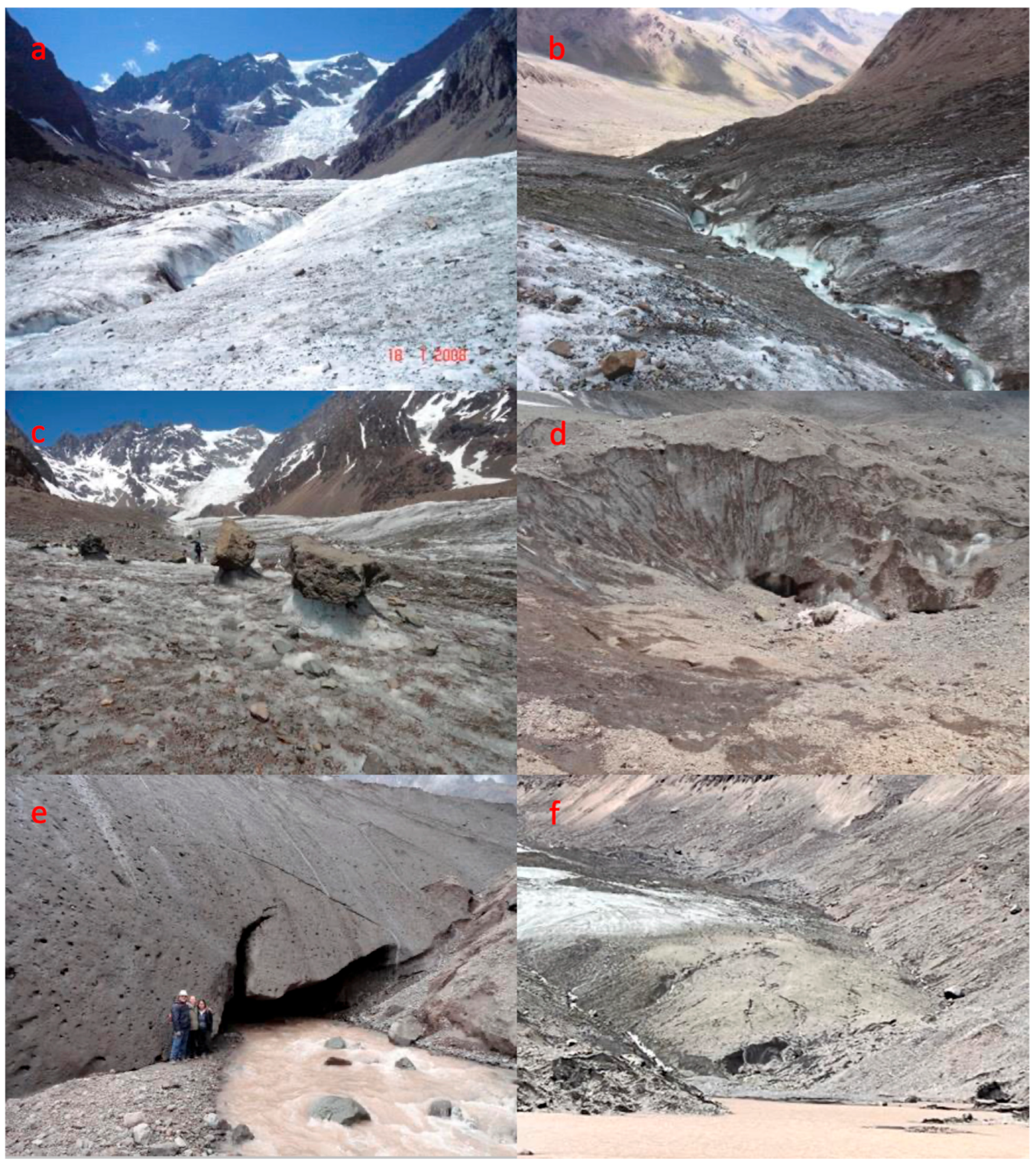
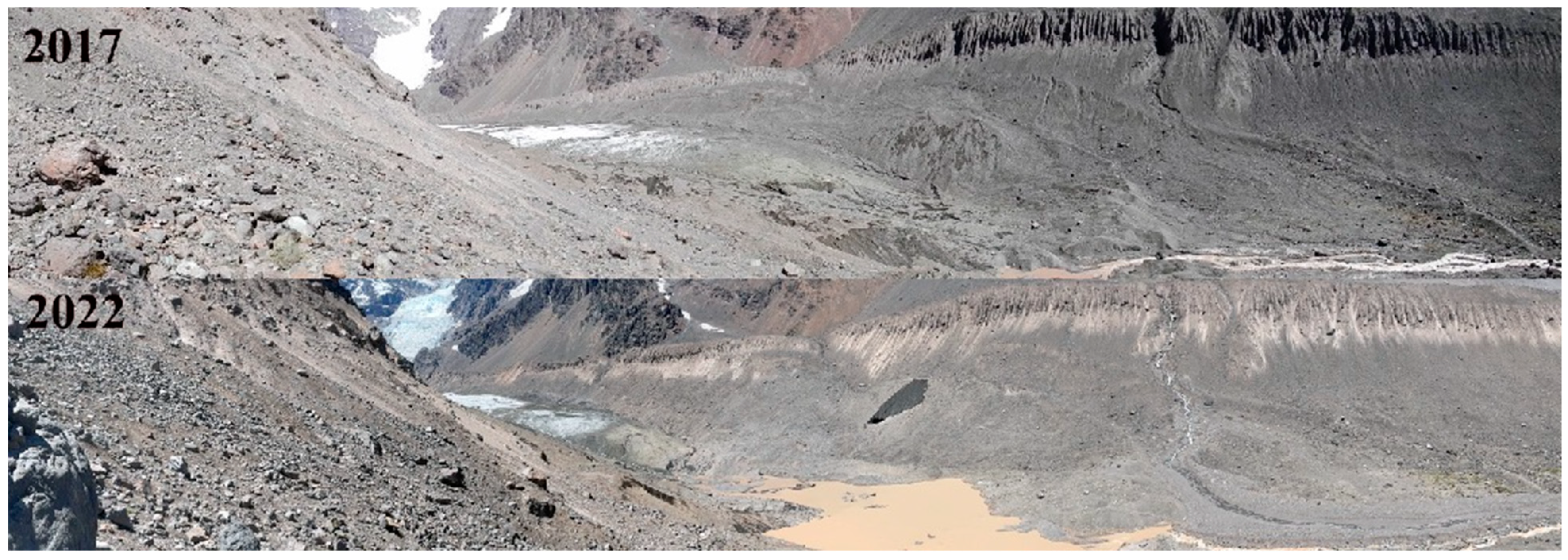
This area loss and frontal retreat have geomorphological consequences for crevassing, meltwater routing, and the onset of debris-covered zones—all signs of advanced degradation in the ablation zone below 3500 m (Figure 10). Evidence of surface thinning, meltwater ponding, and the onset of debris cover further supports observations of rapid cryospheric transformation, as shown in repeat photographs of the glacier terminus between 2017 and 2022 (Figure 11). While Juncal Norte has historically exhibited a relatively slow retreat (4–9.1 m/year) according to Rivera et al. [4] and lost only 10% of its area between 1955 and 2013 [6], the accelerated loss observed in our study suggests this historical resilience is diminishing.
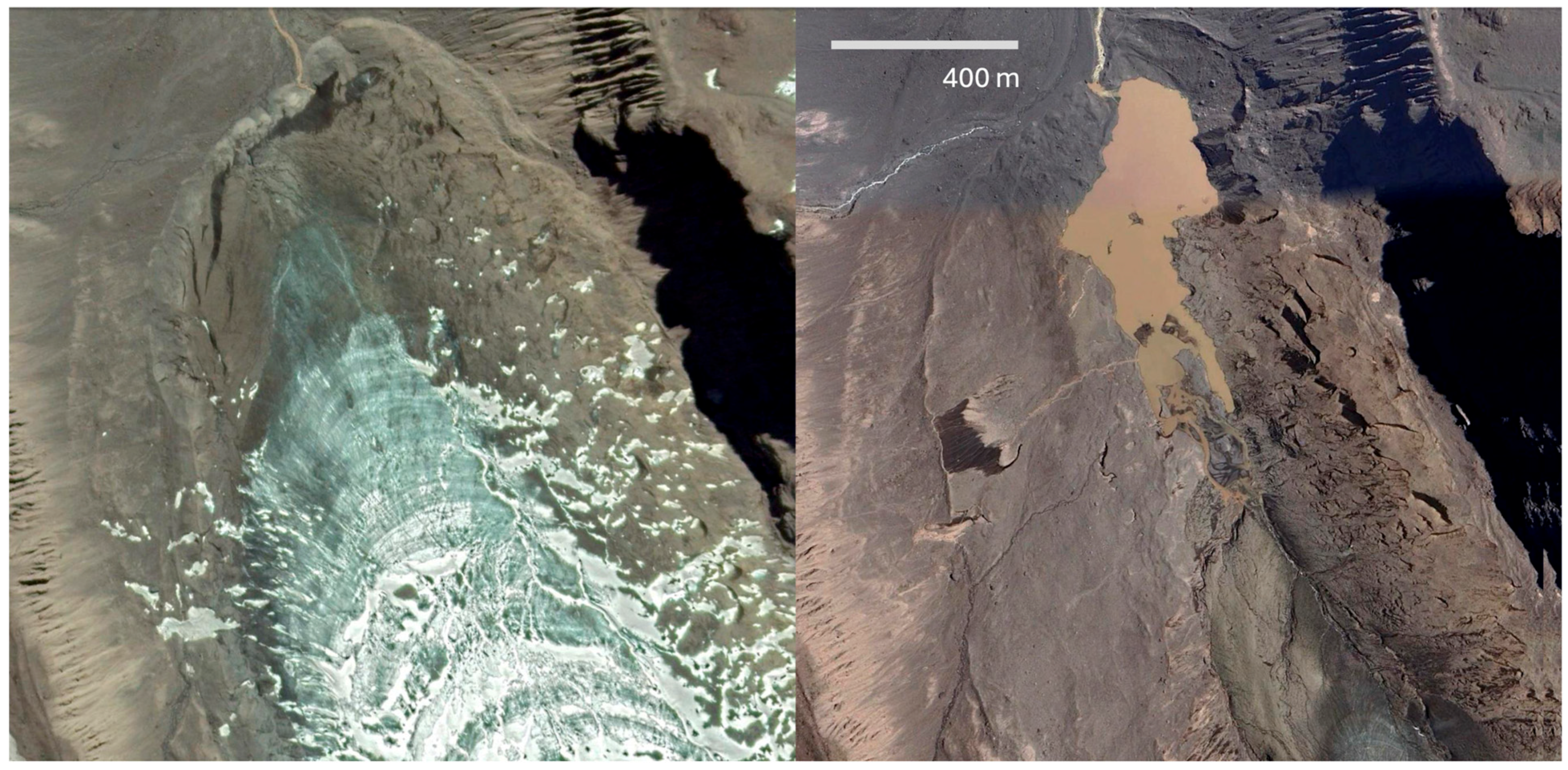
The most significant morphological changes that have resulted from intensified ablation since 2000 on the Juncal Norte lower surface are as follows. Firstly, the tongue has experienced increased vertical thinning. Recent geophysical studies identified that in 21 years (from 2000 to 2021), the glacier’s tongue lost 0.30 km3 of its volume, which corresponds to a geodetic mass balance of 19.8 m w.e., or an average annual loss of 0.94 m w.e./year [19]. This level of ice loss represents approximately 5.8% of the Juncal River’s annual streamflow [19]. Secondly, the glacier’s lower zone has undergone intensified debris cover, particularly along its margins. Thirdly, deep, ice-walled supraglacial channels have formed on the Juncal glacier tongue due to sustained surface runoff. The final morphological change is the collapse of the glacier toe and the formation of a proglacial meltwater lake between 2924 and 3005 m. Due to ice retreat and meltwater accumulation, the proglacial lake has been forming since 2018, dammed by the 1955 terminal moraine (Figure 12). The proglacial lake has been expanding; imagery from March 2024 shows that the lake covers more than 2.6 hectares.

5. Discussion

Despite its small footprint, 7.21 km2 or 2.7% of the 263 km2 Juncal Basin, the Juncal Norte Glacier contributed approximately 30% of observed discharge at the proglacial sub-basin (100.7 million m3 annual discharge) during 2018–2019, consistent with prior isotope-based estimates for the same basin [12,15]. This disproportionate contribution reflects the glacier’s critical buffering role during drought, when precipitation and snowmelt from non-glacierized areas are substantially reduced. Results should be interpreted as indicative of glacier–runoff interactions under severe drought conditions rather than as long-term average mass balance.
The modeled annual melt depth of ~4.16 m w.e. aligns with summer-season ablation rates reported by Pellicciotti et al. [23], who found ~3.7 m w.e. at the glacier tongue using energy balance modeling. The equilibrium line altitude of ~3900 m, lower than the historical norm of ~4200 m and consistent with expanded ablation zones during drought, and the mass balance gradient of 0.00444 m w.e./m are consistent with the spatial melt patterns described by Ayala et al. [22,27]. The melt–runoff correlation (R2 = 0.78; r = 0.88) further supports the dominant role of glacier melt in dry-season streamflow emphasized in both benchmark studies. These consistencies affirm that the AWS-based temperature index approach captures the key glacioclimatic dynamics of Juncal Norte despite its relative simplicity compared to full energy balance models. Bown et al. [5] and Dussaillant et al. [29] reported long-term thinning rates of −0.58 ± 0.37 m/year and −0.26 m w.e./year respectively; our single-year PDD estimate is consistent with those sustained mass loss trajectories during an anomalously warm and dry year. Similar acceleration in thinning rates after 2010 has been observed in glaciers of the adjacent Maipo River Basin, coinciding with the onset of the megadrought [30].
The mass balance analysis reveals two functionally distinct zones. The lower ablation zone (2900–4000 m), covering only 30.44% of glacier area, generates 90.26% of total melt volume with a mean net balance of −9.7 m w.e. The upper zone above 4000 m maintains a slightly positive mean net balance of +0.19 m w.e. but contributes negligibly to runoff. This structural imbalance has direct hydrological consequences: as the glacier retreats upslope, the disproportionately productive lower zone will be the first area lost, representing an impending threshold in water availability well before total glacier disappearance. If current rates persist or accelerate under continued warming and drought conditions, the glacier’s lower sections could transition progressively in the coming decades from active ice to stagnant debris-covered remnants, fundamentally altering its hydrological function long before complete disappearance occurs.
Sensitivity analysis confirms strong climatic coupling. A +1 °C perturbation increased modeled glacier-wide melt by +21.3%, with melt-season runoff scaling at approximately 38,400 m3/day per degree of warming. This sensitivity is amplified under drought conditions by low albedo and reduced accumulation, consistent with observations across the central Andes [5,8].
Approximately 90% of total modeled melt occurs below 4000 m, indicating that most melt is generated in the lower ablation zone where snow cover is limited. As a result, the influence of snow DDF on total melt estimates is constrained. The principal model uncertainties arise from the exclusion of debris cover effects, albedo evolution, sublimation, and spatial precipitation variability at high elevations. Ice density is assumed uniform at 900 kg/m3 and accumulation is zeroed above 0 °C. These simplifications primarily affect melt estimates at the highest elevations, which contribute a minor fraction of total ablation, and are consistent with limitations acknowledged in prior short-term energy balance campaigns at this site [20]. Given the absence of continuous radiation data and the regional scarcity of long-term AWS records, a more complex model would not necessarily improve annual-scale reliability.
The +21.3% melt sensitivity to +1 °C warming, combined with the concentration of productive ablation in the most vulnerable lower glacier zone, underscores the urgency of incorporating shrinking cryospheric inputs into water management planning for the Aconcagua watershed, where glacier-fed runoff during drought is increasingly irreplaceable [1,11], suggesting that even modest temperature increases will substantially accelerate melt rates and hasten the glacier’s transition from a reliable water source to an increasingly diminished one. For the Juncal Norte Glacier, which already sustains late-season runoff and has undergone significant retreat, reduced winter accumulation and seasonal compression further threaten its buffering capacity and long-term hydrological contribution.

6. Conclusions

This study provides the first glacier-wide annual mass balance and melt contribution estimate for the Juncal Norte Glacier under megadrought conditions. For the 2018–2019 hydrological year, the PDD model produced a total melt volume of approximately 30.1 million m3 w.e., accounting for roughly 30% of proglacial sub-basin discharge despite the glacier covering only 2.7% of the Juncal Basin. Summer months (December–February) dominated melt production, accounting for 51.19% of total annual melt volume, consistent with strong seasonal concentration of ablation under peak thermal forcing. These results confirm the glacier’s critical buffering role during drought, when contributions from precipitation and snowmelt in non-glacierized areas are substantially reduced.
The two-zone mass balance structure identified here has direct implications for future water availability. The lower ablation zone, covering 30.44% of glacier area, generates 90.26% of total melt volume and is the zone most exposed to near-term loss as the glacier retreats upslope. Once this disproportionately productive zone is gone, meltwater contributions will decline sharply well before total glacier disappearance. Temperature sensitivity experiments reinforce this vulnerability: a + 1 °C perturbation increased glacier-wide melt by +21.3%, with melt-season runoff scaling at approximately 38,400 m3/day per degree of warming.
Taken together, these findings demonstrate that the Juncal Norte Glacier, covering just 2.7% of the basin, supplies 30% of its discharge through a melt regime concentrated in the lower zone and highly sensitive to temperature, as evidenced by a 21.3% increase in total melt per degree of warming.

Author Contributions

A.B.: Writing—original draft—review and editing, visualization, validation, resources, methodology, formal analysis, data curation, conceptualization. J.J.: Writing—review and editing, data curation, conceptualization. S.N.: Software, data curation, resources, methodology, conceptualization. All authors have read and agreed to the published version of the manuscript.

Funding

The authors declare that no specific funds, grants, or other support were received during the preparation of this manuscript.

Data Availability Statement

The original contributions presented in this study are included in the article. Further inquiries can be directed to the corresponding author.

Conflicts of Interest

The authors declare no conflict of interests. During the preparation of this work, the authors used Claude (Anthropic) to assist with manuscript editing, including reviewing for grammatical issues, evaluating narrative flow, and identifying redundant content. After using this tool, the authors reviewed and edited the content as needed and take full responsibility for the content of the published article.

References

  1. Bellisario, A.; Janke, J. Assessing the Impacts of a Multi-Year Drought on Water Resources and Agriculture in the Aconcagua River Basin of Chile. Investig. Geogr. 2024, 67, 72–94. [Google Scholar] [CrossRef]
  2. Peña, H.; Nazarala, B. Snowmelt-runoff simulation model of a central Chile andean basin with relevant orographic effects. IAHS Publ. 1987, 166, 161–172. [Google Scholar]
  3. Webb, M.J.; Winter, J.M.; Spera, S.A.; Chipman, J.W.; Osterberg, E.C. Water, agriculture, and climate dynamics in central Chile’s Aconcagua River Basin. Phys. Geogr. 2020, 42, 395–415. [Google Scholar] [CrossRef]
  4. Rivera, A.; Casassa, G.; Acuña, C.; Lange, H. Variaciones recientes de glaciares en Chile. Investig. Geogr. 2000, 34, 29–60. [Google Scholar] [CrossRef]
  5. Bown, F.; Rivera, A.; Acuña, C. Recent glacier variations at the Aconcagua Basin, central Chilean Andes. Ann. Glaciol. 2008, 48, 43–48. [Google Scholar] [CrossRef]
  6. Malmros, J.; Mernild, S.; Wilson, R.; Yde, J.; Fensholt, R. Glacier area changes in the central Chilean and Argentinean Andes 1955-2013/14. J. Glaciol. 2016, 62, 391–401. [Google Scholar] [CrossRef]
  7. Carrasco, J.; Casassa, G.; Quintana, J. Changes of the 0 °C isotherm and the equilibrium line altitude in central Chile during the last quarter of the 20th century. Hydrol. Sci. J. 2005, 50, 933–948. [Google Scholar] [CrossRef]
  8. Bozkurt, D.; Rojas, M.; Boisier, J.P.; Valdivieso, J. Projected hydroclimate changes over Andean basins in central Chile from downscaled CMIP5 models under the low and high emission scenarios. Clim. Change 2018, 150, 131–147. [Google Scholar] [CrossRef]
  9. Bravo, C.; Loriaux, T.; Rivera, A.; Brock, B.W. Assessing glacier melt contribution to streamflow at Universidad Glacier, Central Andes of Chile. Hydrol. Earth Syst. Sci. 2017, 21, 3249–3266. [Google Scholar] [CrossRef]
  10. Caro, A.; Condom, T.; Rabatel, A.; Champollion, N.; García, N.; Saavedra, F. Hydrological response of Andean catchments to recent glacier mass loss. Cryosphere 2024, 18, 2487–2507. [Google Scholar] [CrossRef]
  11. McCarthy, M.; Meier, F.; Fatichi, S.; Stocker, B.D.; Shaw, T.E.; Miles, E.; Dussaillant, I.; Pellicciotti, F. Glacier contributions to river discharge during the current Chilean megadrought. Earth’s Future 2022, 10, e2022EF002852. [Google Scholar] [CrossRef]
  12. Ohlanders, N.; Rodriguez, M.; McPhee, J. Stable water isotope variation in a Central Andean watershed dominated by glacier and snowmelt. Hydrol. Earth Syst. Sci. 2013, 17, 1035–1050. [Google Scholar] [CrossRef]
  13. González-Reyes, Á.; McPhee, J.; Christie, D.A.; Le Quesne, C.; Szejner, P.; Masiokas, M.H.; Villalba, R.; Muñoz, A.A.; Crespo, S. Spatiotemporal Variations in Hydroclimate across the Mediterranean Andes (30–37° S) since the Early Twentieth Century. J. Hydrometeorol. 2017, 18, 1929–1942. [Google Scholar] [CrossRef]
  14. Garreaud, R.D.; Alvarez-Garreton, C.; Barichivich, J.; Boisier, J.P.; Christie, D.; Galleguillos, M.; LeQuesne, C.; McPhee, J.; Zambrano-Bigiarini, M. The 2010–2015 megadrought in central Chile: Impacts on regional hydroclimate and vegetation. Hydrol. Earth Syst. Sci. 2017, 21, 6307–6327. [Google Scholar] [CrossRef]
  15. Crespo, S.A.; Lavergne, C.; Fernandoy, F.; Muñoz, A.A.; Cara, L.; Olfos-Vargas, S. Where Does the Chilean Aconcagua River Come from? Use of Natural Tracers for Water Genesis Characterization in Glacial and Periglacial Environments. Water 2020, 12, 2630. [Google Scholar] [CrossRef]
  16. Saavedra, F.A.; Kampf, S.K.; Fassnacht, S.R.; Sibold, J.S. Changes in Andes snow cover from MODIS data, 2000–2016. Cryosphere 2018, 12, 1027–1046. [Google Scholar] [CrossRef]
  17. Masiokas, M.H.; Villalba, R.; Luckman, B.H.; Le Quesne, C.; Aravena, J.C. Snowpack Variations in the Central Andes of Argentina and Chile, 1951–2005: Large-Scale Atmospheric Influences and Implications for Water Resources in the Region. J. Clim. 2006, 19, 6334–6352. [Google Scholar] [CrossRef]
  18. Pellicciotti, F.; Burlando, P.; Van Vliet, K. Recent trends in precipitation and streamflow in the Aconcagua River Basin, central Chile. IAHS Publ. 2007, 318, 17–38. [Google Scholar]
  19. DGA (Dirección General de Aguas). Monitoreo de Detalle Del Glaciar Juncal Norte, Región de Valparaíso, Macrozona Centro, 2020–2021; Ministerio de Obras Públicas: Santiago, Chile, 2022.
  20. Pellicciotti, F.; Carenzo, M.; Helbing, J.; Rimkus, S.; Burlando, P. On the role of subsurface heat conduction in glacier energy-balance modelling. Ann. Glaciol. 2009, 50, 16–24. [Google Scholar] [CrossRef][Green Version]
  21. Petersen, L.; Pellicciotti, F. Spatial and temporal variability of air temperature on a melting glacier: Atmospheric controls, extrapolation methods and their effect on melt modeling, Juncal Norte Glacier, Chile. J. Geophys. Res. 2011, 116, D23109. [Google Scholar] [CrossRef]
  22. Ayala, Á.; Pellicciotti, F.; MacDonell, S.; McPhee, J.; Burlando, P. Patterns of glacier ablation across North-Central Chile: Identifying the limits of empirical melt models under sublimation-favorable conditions. Water Resour. Res. 2017, 53, 5601–5625. [Google Scholar] [CrossRef]
  23. Pellicciotti, F.; Helbing, J.; Rivera, A.; Favier, V.; Corripio, J.; Araos, J.; Sicart, J.E.; Carenzo, M. A study of the energy balance and melt regime on Juncal Norte Glacier, semi-arid Andes of central Chile, using melt models of different complexity. Hydrol. Process. 2008, 22, 3980–3997. [Google Scholar] [CrossRef]
  24. Ayala, A.; Pellicciotti, F.; Peleg, N.; Burlando, P. Melt and surface sublimation across a glacier in a dry environment: Distributed energy-balance modelling of Juncal Norte Glacier, Chile. J. Glaciol. 2017, 63, 803–822. [Google Scholar] [CrossRef]
  25. Braithwaite, R.J. Positive degree-day factors for ablation on the Greenland ice sheet studied by energy-balance modelling. J. Glaciol. 1995, 41, 153–160. [Google Scholar] [CrossRef]
  26. Hock, R. Temperature index melt modelling in mountain areas. J. Hydrol. 2003, 282, 104–115. [Google Scholar] [CrossRef]
  27. Ayala, Á.; Farías-Barahona, D.; Huss, M.; Pellicciotti, F.; McPhee, J.; Farinotti, D. Glacier runoff variations since 1955 in the Maipo River basin, in the semiarid Andes of central Chile. Cryosphere 2020, 14, 2005–2027. [Google Scholar] [CrossRef]
  28. Carrasco, J.; Osorio, R.; Casassa, G. Secular trend of the equilibrium-line altitude on the western side of the southern Andes, derived from radiosonde and surface observations. J. Glaciol. 2008, 54, 538–550. [Google Scholar] [CrossRef]
  29. Dussaillant, I.; Berthier, E.; Brun, F.; Masiokas, M.; Hugonnet, R.; Favier, V.; Rabatel, A.; Pitte, P.; Ruiz, L. Two decades of glacier mass loss along the Andes. Nat. Geosci. 2019, 12, 802–808. [Google Scholar] [CrossRef]
  30. Farías-Barahona, D.; Ayala, Á.; Bravo, C.; Vivero, S.; Seehaus, T.; Vijay, S.; Schaefer, M.; Buglio, F.; Casassa, G.; Braun, M.H. 60 Years of Glacier Elevation and Mass Changes in the Maipo River Basin, Central Andes of Chile. Remote Sens. 2020, 12, 1658. [Google Scholar] [CrossRef]
Figure 1. Location of the Juncal Norte Glacier and hydrometeorological stations in the Juncal Basin, central Chile.
Water 18 00897 g001aWater 18 00897 g001b
Figure 2. STL (Seasonal-Trend decomposition using LOESS) of daily air temperature recorded by a logger near the glacier (~3000 m) from 2017 to 2022. The STL decomposition separates the observed time series (top) into three components: the long-term trend (smooth underlying warming or cooling signal), the seasonal component (recurring annual temperature cycle), and the residual (short-term variability remaining after removing both trend and seasonal components, reflecting weather-scale fluctuations and measurement noise). The close resemblance between the observed and seasonal panels reflects the dominance of the annual temperature cycle at this site, while the trend component isolates the underlying variation during the observation period.
Water 18 00897 g002
Figure 3. Temperature characteristics near the glacier from 2017 to 2022 at ~3000 m elevation. (a) Annual number of days on which daily maximum temperature exceeded key thresholds (T > 20 °C, T > 5 °C, T < 0 °C). (b) Monthly 0 °C isotherm elevation estimated from logger temperature using a standard lapse rate. (c) Seasonal mean air temperature (DJF, MAM, JJA, SON).
Water 18 00897 g003
Figure 4. Annual snowline elevation in the Aconcagua watershed from 2000 to 2024 derived from MODIS observations. The dashed line shows the linear trend (+5.6 m/year (R2 = 0.21, p = 0.011)).
Water 18 00897 g004
Figure 5. Standardized annual precipitation anomalies (Z-scores) for 2015–2023 relative to the period mean. Negative values indicate below-average precipitation, while 2023 shows a positive anomaly associated with an El Niño year. Negative values (red) indicate below-average precipitation; the positive anomaly in 2023 (blue) is associated with an El Niño year.
Water 18 00897 g005
Figure 6. (a) Percentage of annual precipitation occurring during winter (JJA) and spring (SON) from 2015 to 2023 (blue bars). (b) Mean seasonal precipitation distribution for the full 2015–2023 period (green bars).
Water 18 00897 g006
Figure 7. Streamflow decline in the Juncal River Basin (1970–2023). (a) Annual discharge with 5-year moving average and regime mean for 1970–1989, 1990–2009, and 2010–2023. (b) Flow duration curves for the same periods. (c) Mean monthly discharge by hydrological month.
Water 18 00897 g007
Figure 8. Net mass balance versus elevation for Juncal Norte Glacier (2018–2019). The equilibrium line altitude (ELA) is estimated at ~3900 m from regression of elevation bands below 4000 m. The blue curve shows modeled net balance, the red point marks the zero-balance transition (~3988 m), and the dashed green line indicates the regression-based ELA.
Water 18 00897 g008
Figure 9. Melt depth as a function of elevation across Juncal Norte Glacier for the 2018–2019 hydrological year. Values are shown in water equivalent (blue) and ice equivalent (red). The vertical dashed line indicates the approximate elevation where melt intensity decreases markedly.
Water 18 00897 g009
Figure 10. Morphological indicators of glacier degradation at Juncal Norte Glacier under prolonged drought conditions. (a,b) Development of supraglacial meltwater channels on the lower tongue (2008 and 2022). (c) Glacier tables and channelized melt indicating enhanced ablation (2014). (d) Thermokarst depression formed by collapse of ice-cored moraine (2014). (e,f) Blockage of the former meltwater outlet and formation of a proglacial pond associated with increased debris cover and retreat (2014–2022).
Water 18 00897 g010
Figure 11. Repeat photographs of the Juncal Norte Glacier terminus from the same viewpoint in 2017 (top) and 2022 (bottom) showing frontal retreat, surface lowering, and development of a proglacial meltwater pond.
Water 18 00897 g011
Figure 12. Composite satellite images of the Juncal Norte Glacier terminus from November 2012 (left) and March 2024 (right), showing approximately 400 m of frontal retreat and the formation of a proglacial lake. The November 2012 image represents the earliest cloud-free imagery available for that period; a late-summer acquisition comparable to the March 2024 image was not available for 2012. Despite the seasonal difference, both images show the glacier terminus under low snow cover conditions, allowing meaningful comparison of frontal position.
Water 18 00897 g012
Table 1. Comparison of modeling approaches used in this study and in two prior investigations of the Juncal Norte Glacier.
ModelThis Study (2018–2019 Model)Ayala et al. (2017) [24]Pellicciotti et al. (2008) [23]
Time PeriodFull hydrological year (March 2018–April 2019)Summer campaign (December 2008–February 2009)Summer campaign (December 2005–February 2006)
DEM ResolutionDAICHI 12 m (corrected hypsometry)50 m interpolated ASTER(SRTM) data (30 m)
Glacier Domain2900–5900 m (full glacier) and 2900–4000 m (ablation zone)Modeled from ~3000 m to 5896 m across the entire glacierStudy area within ablation zone
Temperature InputAWS at 3013 m, lapse-corrected to 25 m bandsAWSs on the glacier tongue and T-loggersAWSs both on and off the glacier
PrecipitationJuncal and Portillo stations (used for accumulation)AWS + snow pit SWEAWS and field observations
Accumulation SchemeFixed 0.17 m w.e. across all bands (from Portillo SWE)SWE estimated from field snow pitsSnow depth measurements, simplified
Melt ModelPositive degree day (PDD)Two energy balance models of different complexityEnergy balance model (EB) and enhanced temperature index (ETI)
ValidationProglacial discharge, melt–runoff regression with R2 and p-valueAgainst ablation stakes and an ultrasonic depth gauge readingsAgainst ablation stakes and ultrasonic depth gauge readings
OutputsNet mass balance, total melt volume, runoff contribution (%), ELA, DDF and temperature sensitivityMelt and surface sublimation rates across the entire glacierShort-term melt energy balance and surface processes
Elevation Banding25 m bands using corrected DEM50 m DEM across the entire glacier with structured elevation analysisStudy specific points on the glacier tongue. No structured elevation bands
Hydroclimatic ContextPost-2010 megadroughtPre-droughtPre-drought
Table 2. Streamflow regime statistics for the Juncal River for three periods (1970–1989, 1990–2009, 2010–2023).
PeriodAverage Discharge (m3/s)Change from Pre-Decline (m3/s)Percent Change from Pre-DeclineAnnual Volume (million m3)Key Decline Season
1970–1989 (pre-decline)7.050.000.00222.5Baseline
1990–2009 (decline phase)5.52−1.53−21.7174.1SON
2010–2023 (megadrought)4.42−2.63−37.3139.2SON (>40%)
Table 3. Seasonal melt volume and contribution to runoff for Juncal Norte Glacier (2018–2019).
SeasonMelt Volume %Contribution to Runoff %
Winter (JJA)3.579.12
Spring (SON)17.1023.82
Summer (DJF)51.1929.89
Fall (MAM)28.1431.55
Melt Season (DJF + MAM)79.3330.36
Table 4. Annual runoff–precipitation balance and water volume change (2015–2023).
YearPrecipitation (mm)Runoff (mm)Net Balance (mm)Volume Change (m3)
2015256.0707.9−451.9−118,849,700
2016290.21159.6−869.4−228,652,200
2017260.6950.1−689.5−181,338,500
2018188.6762.3−573.7−150,883,100
2019105.4778.7−673.3−177,077,900
202026.61198.4−1171.8−308,183,400
2021233.71248.9−1015.2−266,997,600
2022142.6820.9−678.3−178,392,900
20231145.5884.7+260.8+68,590,400
Table 5. Area changes in Juncal Norte from 1955 to 2023.
PeriodYearsArea Change (km2)Rate (km2/year)
1955–201055−0.44−0.0080
2010–202313−1.46−0.1123
1955–202368−1.90−0.0279
Disclaimer/Publisher’s Note: The statements, opinions and data contained in all publications are solely those of the individual author(s) and contributor(s) and not of MDPI and/or the editor(s). MDPI and/or the editor(s) disclaim responsibility for any injury to people or property resulting from any ideas, methods, instructions or products referred to in the content.