Article

Hydrological Stability and Sensitivity Analysis of the Cahaba River Basin: A Combined Review and Simulation Study


1
Department of Mechanical & Civil Engineering and Construction Management, College of Engineering, Technology, and Physical Sciences, Alabama A&M University, Huntsville, AL 35811, USA
2
Massachusetts Institute of Technology Lincoln Laboratory, Massachusetts Institute of Technology, Boston, MA 02421, USA
3
Alabama Department of Economic and Community Affairs, Montgomery, AL 36104, USA
*
Author to whom correspondence should be addressed.
Water 2026, 18(8), 894; https://doi.org/10.3390/w18080894
Submission received: 3 February 2026 / Revised: 6 March 2026 / Accepted: 26 March 2026 / Published: 8 April 2026

Abstract

A continuous integration framework and methodology for hydrological modeling is proposed that integrates model sensitivity analysis with real-time sensor tasking to prioritize data collection in regions and periods of high hydrological variability and drive model refinement. The Cahaba River Watershed in central Alabama serves as a case study to develop this approach. To this end, a benchmark Soil and Water Assessment Tool (SWAT) model (30 m DEM) was refined with high-resolution spatial datasets in QGIS, including 1 m DEMs, NLCD land cover, and SSURGO soil data. The refined model significantly enhanced subbasin delineation, increasing granularity from 8 to 99 subbasins, thereby improving representation of slope, runoff, and storage variability across heterogeneous landscapes. Sensitivity analyses were performed to evaluate the influence of DEM resolution and curve number (CN) perturbations on hydrologic responses, including retention, flow partitioning, and dominant flow direction. High-resolution DEMs (≤5 m) captured microtopographic features that strongly affect infiltration and surface runoff, while coarser DEMs (≥20 m) systematically underestimated retention and smoothed hydrologic gradients. The higher-resolution DEMs can be used to selectively improve the model at certain hotspots/areas of higher sensitivity. Localized flow simulations demonstrated that fine-scale terrain data substantially improve model realism, with up to 58% greater retention captured in 10 m DEMs compared to 30 m DEMs. The results confirm that aligning sensor placement and model refinement with spatially explicit sensitivity zones enhances both predictive accuracy and computational efficiency. The proposed continuous integration approach provides a scalable pathway for coupling high-resolution modeling with adaptive sensing in watershed management and supports future integration of real-time data assimilation for continuous model improvement.

1. Introduction

Developments of land and water resources and shifts in regional climate can have a strong effect on groundwater resources [1,2,3]. As these changes become more pronounced, this will have significant economic, humanitarian and geopolitical implications, thus motivating improved understanding of the local hydrology of key resource areas [4,5,6]. Traditionally, such data have primarily been based on site surveys, but over recent decades the high cost and limited spatial extent of in situ data collection has led to increased reliance on remote sensing data in hydrological understanding [7,8,9,10,11]. As a result, current approaches to understanding surface flow and groundwater systems typically rely on indirect methods such as soil moisture content observation, which provide limited spatial and temporal resolution and rely on assumptions regarding the linked land surface and substratum. They also tend to assume a gradual rate of change in land use and other parameters that are not always valid in the resource areas of highest interest [12,13,14,15]. In particular, the link between climate variability and groundwater stress is strongly mediated by precipitation inputs and their interaction with land use, soil type, and subsurface geology, factors which are subject to significant change due to development [16,17,18,19]. Studies show that the frequency, intensity, and distribution of precipitation events increasingly determine the recharge behavior of aquifers and surface runoff [20]. Thus, a valid hydrological model requires periodic updates so as to correctly capture both shifts in precipitation regimes and changes in the various interactions that mediate the correlation between precipitation input and discharge behavior.
Remote sensing techniques such as those from MODIS, SMAP, and Landsat have become foundational for hydrologic studies, yet they often miss key subsurface processes and struggle with cloud interference, coarse resolution, and temporal gaps [21,22,23,24]. One common modeling weakness lies in treating precipitation as a spatially uniform or temporally smoothed input. However, high-resolution radar and satellite rainfall data have revealed that local rainfall intensity and distribution patterns can disproportionately influence discharge outcomes in small to mid-size watersheds [25,26,27,28]. Incorporating fine-scale rainfall variability is particularly important in agriculturally dynamic regions, where field conditions can quickly shift from infiltration-dominated to runoff-dominated states depending on surface cover and soil saturation [29,30,31,32,33,34]. These limitations of remote sensing data have led to increased emphasis on the development of integrated hydrological models [35,36,37,38,39,40]. While this approach benefits from scalability, the challenge remains of correctly validating and refining these models. Current models are insufficiently grounded in and calibrated against truth data, in part because of the difficulty in obtaining high-resolution persistent observational data [41,42,43,44,45]. Potential improvements may come not only through better performance parameters such as resolution and accuracy, but also in how directly the measured quantities tie to the quantities that are ultimately modeled. To illustrate this, direct measurement of surface flow over an extended area will have higher fidelity than an inference made from indirect measurements. While the primary source of data informing advanced hydrological models may ultimately be provided by global-scale remote sensing campaigns, local measurements will still be required to provide essential local grounding of the model. Thus, a cost-effective, resource-efficient solution is required to enable the collection of local data that can complement that obtained through remote sensing [46,47,48,49].
Given these complexities, there is a clear need to revisit and refine existing modeling documents and frameworks so that they accommodate fine-scale topographic data, high-resolution precipitation inputs, and dynamic land use scenarios. Incorporating such improvements into standard hydrological modeling protocols would allow for more accurate prediction of peak discharge and baseflow dynamics across variable subbasin configurations [50,51,52,53,54,55]. Fortunately, it is not only remote sensing and computational modeling capabilities that have improved dramatically over the past few decades; technology for autonomous systems has also seen similar advancement. Real-time adaptive sensor tasking based on quantified model uncertainty and transient inputs such as precipitation peaks offers an emerging solution to these challenges. For example, deploying in situ sensors in high-sensitivity zones during high-intensity rain events can yield data that significantly refine model predictions, particularly in basins with diverse cropping systems and land covers [56,57,58,59]. This offers an opportunity for a resurgence in local data collection campaigns [60,61]. The present work is motivated by a desire to tightly integrate local data collection into a model-based framework. The study has the following key objectives:
  • To evaluate the suitability and feasibility of a continuous integration framework for watershed modeling by combining hydrological sensitivity analysis, high-resolution spatial data, and in situ sensing strategies.
  • To investigate how variations in digital elevation model resolution influence watershed delineation, hydrological responses, and the identification of localized hydrological hotspots.
  • To analyze the impacts of land use and soil heterogeneity on hydrological processes and model refinement within the watershed.
  • To quantify the sensitivity of the hydrological models to curve number, total water retention, and surface flow under high-resolution terrain conditions.

2. Materials and Methods

Figure 1 illustrates the proposed “continuous integration” approach, in which an initial hydrological model is analyzed to identify and prioritize opportunities for improvement via local in situ measurements. This allows for the creation of sensor task plans that can utilize real-time transient events (such as rainfall) to allow for the collection of data that are of high utility in refinement of the model [62]. The present study focuses on the first three steps presented in Figure 1.
This proposed methodology aims to align the deployment of in situ measurements with the spatial heterogeneity of the resource area of interest. This requires an understanding of the dependence of the integrated hydrological model on parameter variability. The sensitivity of a hydrologic model can be highly nonuniform. One example in the literature that illustrates who performed a high-resolution time-varying sensitivity analysis for a model of the Blue River Basin in Oklahoma [63], which was enabled by a screening-based sensitivity analysis approach to reduce computational demands [64]. Herman showed a strong spatial dependence of the model’s sensitivity to sources and sinks, such as precipitation, evapotranspiration and dam gate activity. Likewise, these sources and sinks showed significant temporal variation, with dominant activity concentrated in short durations of time. Hence, there was a very high sensitivity to input time samples. In addition to the forcing inputs, Herman also looked at the spatial variability of model parameter sensitivity for internal properties of the watershed, such as percolation rates and topography.
This continuous integration concept has also gained traction in smart agriculture and real-time environmental monitoring, where spatial variability and timing are essential for optimizing data collection and predictive analytics. When used in conjunction with model sensitivity analysis, sensor placement and activation can be aligned with periods of high rainfall variability or during land use transitions [65,66,67,68]. The integration of real-time precipitation and land use data into dynamic sensor tasking holds promise for substantially enhancing the accuracy of hydrologic predictions [69,70,71,72,73,74,75,76,77].
These examples support two of the main assumptions underlying the proposed methodology, i.e., that data collection can be optimally focused on spatial and temporal extents, and that real-time tasking of in situ data collection focusing on short-term transients can provide useful data for model refinement. The remainder of the present work is directed toward exploring the suitability of the Cahaba River Watershed as a testbed for development of this proposed continuous integration approach to watershed modeling, i.e., does the Cahaba River Watershed area exhibit sufficient spatial heterogeneities and correlated localized transient responses to benefit from model-based in situ measurement tasking?

2.1. Modeling Case Study Area

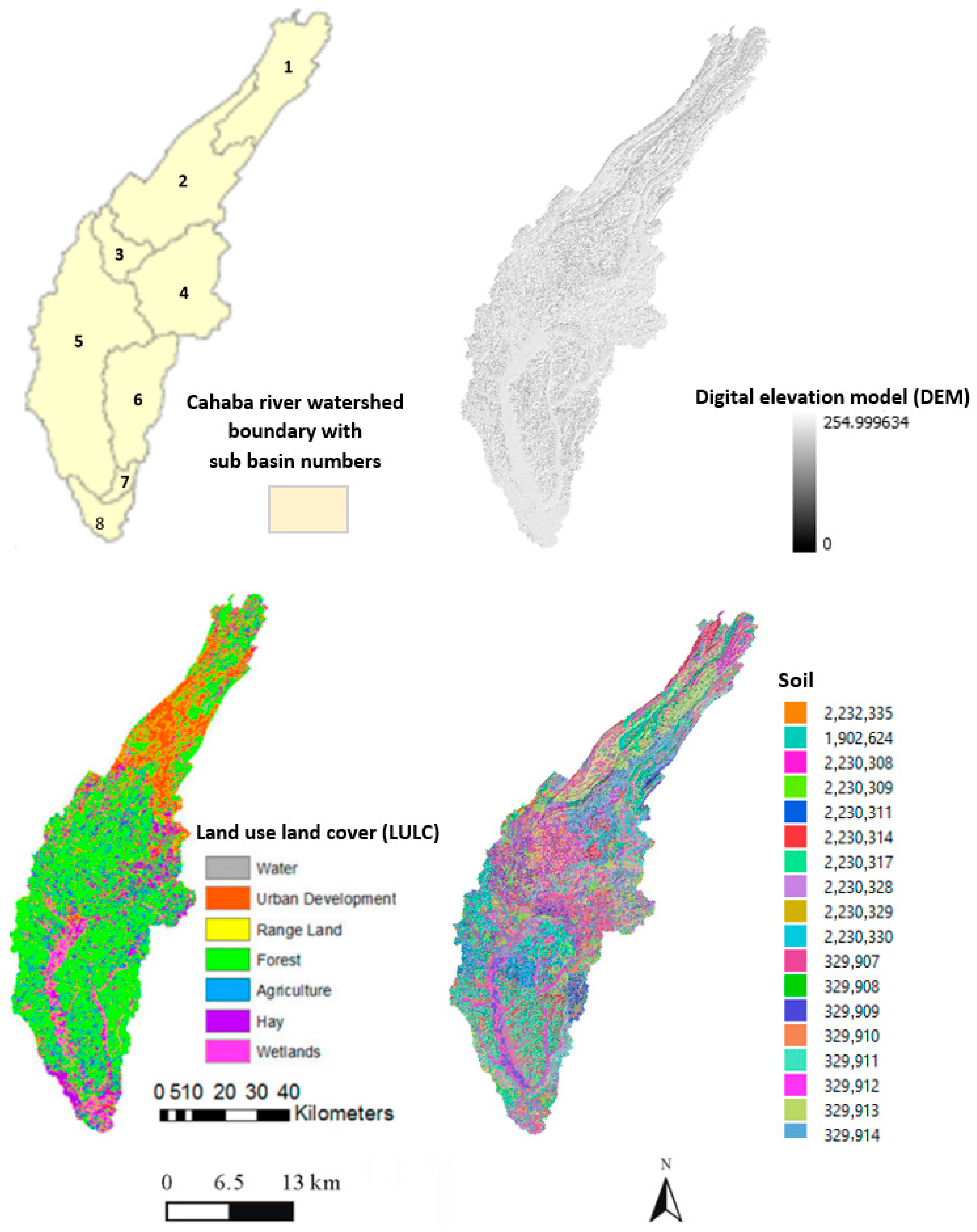
The Cahaba River Watershed, located in central Alabama, spans approximately 1870 square miles and extends 194 miles from its headwaters near Trussville to its confluence with the Alabama River (Figure 2). It traverses diverse physiographic regions, including the Appalachian Plateau, Valley and Ridge, and Coastal Plain, resulting in varied topography, soils, and hydrologic conditions [78]. The watershed experiences a humid subtropical climate with an average annual rainfall of about 55 inches, contributing to dynamic surface and subsurface water interactions [79]. Land use/land cover (LU/LC) within the watershed ranges from urban development in the upper reaches (notably around Birmingham) to agricultural and forested areas downstream, where crop rotation between cotton and soybean significantly influences runoff and infiltration. The Cahaba River is also recognized for its exceptional biodiversity, hosting numerous endemic aquatic species. These factors, combined with increasing development pressures and complex hydrological responses, make the watershed an ideal site for studying integrated surface–groundwater modeling and the effects of land use and precipitation variability on watershed dynamics [80,81]. The Cahaba River Watershed, with its mixed urban–agricultural use, frequent precipitation events, and high biodiversity, presents an excellent environment to evaluate how fine-scale topographic, crop, and rainfall inputs affect model behavior.
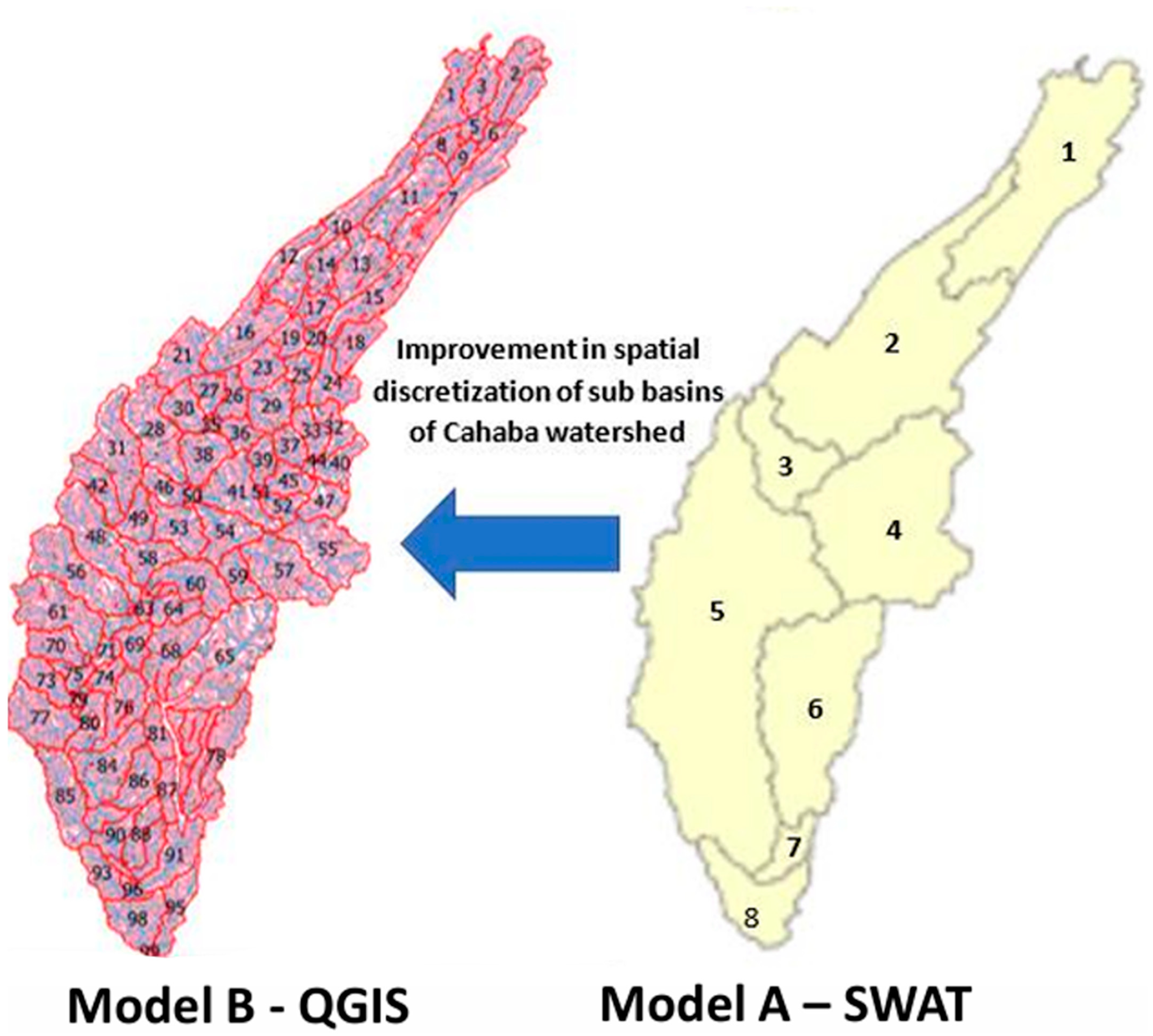
The Soil and Water Assessment Tool (SWAT) is a widely used hydrologic model designed to simulate and analyze watershed processes. In this study, the SWAT benchmark model (Model A—SWAT) was developed using the ArcSWAT interface. All input datasets were preprocessed following the standard ArcSWAT workflow, including digital elevation model (DEM) preprocessing, watershed delineation, HRU definition and overlay, weather data setup, model simulation, and calibration. This model served as the baseline for evaluating hydrological response predictions. The QSWAT model (Model B—QGIS) was developed as a modified workflow aimed at improving spatial data resolution and watershed representation. While several preprocessing steps were similar to those in ArcSWAT, Model B—QGIS incorporated enhanced GIS-based preprocessing, including the use of a finer 1 m DEM derived from a higher-resolution elevation dataset (converted from the original 30 m DEM). Using this finer DEM with a standard 1000 ha threshold for watershed delineation resulted in 99 subbasins, substantially increasing the spatial detail compared to the benchmark model. This improved delineation provided a more refined discretization of the Cahaba watershed. These additional preprocessing steps applied in the QSWAT represent a key methodological enhancement and the primary innovation of our study.
Figure 2. The delineated Cahaba River Watershed using SWAT model and QGIS tool with mapping for digital elevation model, land use land cover, and soil texture for the year 2011.
Water 18 00894 g002

2.2. Insights from Benchmark SWAT Model of Cahaba River Watershed

The benchmark SWAT model for the Cahaba River Watershed offers key insights into the hydrological dynamics across varying land uses, slopes, and spatial scales. The Cahaba River Watershed was delineated using the 30 m spatial resolution DEM from the United States Geological Survey. The National Land Cover Database (NLCD) provides land cover classification products for the conterminous United States at a consistent 30 m spatial resolution. Each pixel represents a 900 m2 area on the ground with Albers Conic Equal Area projection (EPSG: 102039/5070 for CONUS). NLCD updates approximately every 5 years, with datasets released for the years of 2001, 2006, 2011, 2016, 2019, and 2024. The delineated watershed consisted of 8 subbasins. Later, the land use land cover data from NLCD with 30 m spatial resolution and the SSURGO soil data in the SWAT model for the year 2011 were used to develop hydrological response units (HRUs), each of which offering a unique combination of a particular land use land cover, soil, and slope. This was followed by incorporating the rainfall and temperature data for the year 2011 into the model. The model was then run to simulate the water balance components of surface runoff, groundwater discharge, groundwater storage, base flow, lateral flow, percolation, and water yields. This work focuses on surface flow as an observable factor, and land use/land cover, soil and topography as parameters because these can be most directly measured using local sensors. This model serves as a foundational tool to explore real-time sensor integration and local-scale model refinement efforts. The initial subbasin delineation was performed using 2011 datasets for preliminary identification; however, the subsequent detailed simulation analyses, as discussed in later sections, were conducted using more recent and higher-resolution datasets to ensure improved accuracy and represent current watershed conditions.

2.2.1. Calibration and Validation of SWAT Model

The SWAT model for the Cahaba River Basin was set up and executed. The watershed-scale simulation was run for the period 1980–2010, using generated weather data and existing land management practices to establish long-term hydrologic behavior. For model evaluation, observed streamflow data were incorporated from the following United States Geological Survey (USGS) hydrological stations: Trussville, Mountain Brook, Caldwell Mill, Near Acton, and Near Helena [80]. These stations provided the discharge records used for calibration and validation of the model. Calibration was performed on a monthly time step for the period November 2014 to October 2017, with the first two years assigned as model warm-up (NYSKIP = 2). A skewed-normal rainfall distribution was applied during calibration. Model validation was then carried out by applying the calibrated parameters from the Trussville station to the upper Cahaba watershed (subbasins 1 and 2). The calibrated parameters include a soil evaporation compensation factor of 0.910, a curve number of 1.630, nitrogen uptake distribution of 22, phosphorus uptake distribution of 28, soil erodibility factor of 0.670, and a land cover and management practice factor of 0.025. Observed streamflow for this region was obtained from the published literature and validated for the period of January 2001 to December 2001 [80]. Streamflow observations from Mountain Brook, Caldwell Mill, Near Acton, and Near Helena fall within the domain of the validated hydrologic model. Model performance was evaluated using Nash–Sutcliffe Efficiency (NS) and the coefficient of determination (R2). The calibration and validation results yielded NS values in the range of 0.50–0.60 and R2 of 0.65–0.72, indicating acceptable model performance for monthly streamflow simulations. The validation period consisted predominantly of low-flow events with few high-flow peaks, which contributed to a moderate improvement in R2 from 0.542 during calibration to 0.591 during validation. These calibration and validation steps ensured that the hydrological predictions generated by the SWAT model provided a reasonable basis for subsequent sensitivity analyses and assessments of DEM resolution impacts.

2.2.2. Hydrological Behavior Across Land Uses

The land use classification information is provided in Table 1, and this serves as the basis for an expanded zonal analysis that we plan to integrate into the next stage of the study, focusing on the most dominant types of land use and land cover. This future extension will allow us to more comprehensively quantify how DEM resolution interacts with spatial heterogeneity in land use.
Urban development (subbasins 1 and 2): Despite their smaller spatial extent, urban regions exhibit higher surface runoff (0.75 mm) and lower evapotranspiration and groundwater storage. Subbasin 1 shows minimal groundwater retention (2.634 mm), emphasizing the impact of impervious surfaces and altered infiltration (Table 1).
Forest (subbasin 7): Forest-dominated regions demonstrate high evapotranspiration (22 mm), substantial groundwater storage (up to 39 mm), and a relatively stable water yield (peaking at 42.06 mm in subbasin 7). These areas act as critical water buffers, highlighting their importance in watershed sustainability (Table 1). Subbasin 2 was selected for further analysis because preliminary investigations showed that its heterogeneity spanning topographic variability, mixed cropping systems, and diverse soil properties makes it highly responsive to improvements introduced by high-resolution DEMs and crop-specific discharge modeling. This combination of urban influence and agricultural complexity makes subbasin 2 an ideal representative unit for evaluating the sensitivity and performance of the proposed integration framework.

2.2.3. Model Improvements and Sensitivity Analysis

Numerous opportunities exist for the improvement of model fidelity and data inputs. Each improvement carries its own cost/benefit relationship; one must carefully weigh the improvement in fidelity vs. the cost in computational complexity or in data collection. These trades may not only apply globally to the overall model, but to geographic subregions in the overall model, motivating quantification of the local cost/benefit trade space. Examples include the following:
  • Spatial resolution enhancements: The number of subbasins could be increased significantly by using a revised hydrological model or redefining the area threshold in the benchmark SWAT model for improving the model’s capacity to capture localized hydrological variations.
  • Hotspot identification: Sensitivity analysis identified subbasins with extreme slopes and dominant land cover types as key contributors to transient hydrological responses. These hotspots are prioritized for targeted sensor tasking and refined calibration (Table 1).
  • Key observables for real-time sensing: Parameters such as soil emissivity, floodplain elevation, and rainfall-induced changes are being explored for integration with real-time sensors to enhance dynamic response capabilities of the model.

2.3. Refined Modeling Using QGIS

Building on insights from the benchmark SWAT model of the Cahaba River Watershed, refined modeling was conducted using Quantum GIS (QGIS) to enhance spatial resolution, hydrological detail, and visualization capability. QGIS was used to preprocess high-resolution spatial inputs including updated DEMs with 1 m spatial resolution, NLCD land use data, and SSURGO soil layers for more granular delineation of subbasins and HRUs. The increased spatial detail of the DEM is expected to enable better identification of hydrologically sensitive zones, particularly in areas with steep slopes, urban development, or forest cover [82,83,84,85,86]. This refinement supports the integration of real-time sensor data, allowing adaptive calibration of key parameters such as infiltration, percolation, and baseflow. Furthermore, QGIS-based tools facilitated interactive mapping, spatial overlays, and slope-based zoning to guide sensor placement and scenario-based planning [87,88,89,90,91,92]. These advances support a shift from static, averaged models to more responsive, site-specific predictions, which are crucial for targeted interventions, infrastructure planning, and water resource management across heterogeneous landscapes [93,94,95,96,97,98].

DEM Transitioning

The incorporation of 1 m resolution DEM and dynamic crop rotation data can significantly enhance hydrologic model realism, offering a strong test case for continuous integration methodologies. Revising the new framework accordingly would enable the deployment of a scalable, repeatable system for future basin-scale hydrologic studies. Furthermore, the terrain representation used in hydrologic models significantly affects runoff routing, watershed delineation, and discharge estimation. Traditional models relying on 30 m resolution DEMs can miss critical microtopographic features such as small channels and artificial drainage pathways that govern flow in subbasins. Transitioning to 1 m remotely sensed data derived from DEMs in a selected area of subbasin 2 can improve model fidelity by capturing fine-scale slope changes and water flow pathways that influence discharge during storm events [99]. This is particularly relevant when attempting to capture the spatial variability of runoff responses under heterogeneous land use or variable rainfall events. There is a risk that local minima in high-resolution DEM data are already accounted for in abstractions (such as roughness, LU/LC to curve number mapping and SCS method initial abstraction calculation) [100,101,102,103].

2.4. Local Sensitivity Analysis to Inform Continuous Improvement

The continuous improvement approach assumes that hydrological heterogeneity motivates local refinement of model inputs. To demonstrate this effect, a series of sensitivity analyses were performed using a simplified Matlab-based (R2022a) implementation of the SCS curve number (CN) method, harmonized with the approach used in the SWAT. Curve number values (CN2) for given land use and soil combinations were calculated with a QGIS plugin [104,105,106,107,108], using NLCD land cover and gSSURGO soil data at 30 m resolution. For hybrid soil groups (e.g., “A/D”), the drained condition was assigned, and for missing HSG entries (urban, quarries, and pits), default assignments of “D” (or “B” for dumps) were used. All DEM inputs were derived from the USGS 3DEP 1 m DEM and were downsampled to 2–30 m resolutions utilizing a block median approach. The steps include grid cell aggregation rules, resampling window size determination, and employing of GIS spatial tools. The block median method was chosen over block mean or bilinear resampling for hydrologic terrain preservation. For each CN–DEM combination, slope-adjusted curve numbers (CN2s) and surface retention parameters (S) were calculated [109,110,111,112]. The current study primarily focuses on retention and flow direction dynamics; however, further analyses involving key hydrological components such as runoff depth, baseflow, and lateral flow will be incorporated in the next phase of this research.

Localized Flow Partitioning Simulations

Using these retention and topographic inputs, a localized surface flow model was developed to evaluate how modest DEM and CN variations affect flow partitioning. For each evaluation point, a 200 m characterization radius was defined. The radius was determined based on (i) typical scales of hillslope flow convergence observed in similar physiographic settings, and (ii) preliminary sensitivity tests showing that radii below 150 m produced unstable flow partitions, while radii above 250 m yielded no substantial improvement in delineation accuracy. Within this circle, rainfall–runoff partitioning was simulated for a single 25.4 mm precipitation event under average antecedent moisture. The procedure incorporated the following:
  • Initial abstractions (0.2S) following National Engineering Handbook (USDA NRCS, 2004) recommendations.
  • An SCS runoff equation to compute flow and retention iteratively.
  • Multiple flow direction (MFD) routing, distributing flow to adjacent pixels based on slope and geometry.
  • Iterative updates of actual retention (F) and runoff (Qflow) until convergence.
  • Circumferential output vectors of water flux at 5° intervals, smoothed for pixel overlap.
This framework captures not only total runoff but also directional flow variability, retention in microtopographic depressions, and sensitivity to DEM resolution. Metrics such as Euclidean distance, cosine similarity, and weighted average flow direction were used to quantify changes in model output across DEM scales.

3. Results

3.1. SWAT Model Experiments: Effects of DEM Transitioning

3.1.1. Spatial Hydrological Modeling Improvements

Figure 3 illustrates the effect of transitioning from a coarse DEM-based model (Model A—SWAT) to a refined, higher-resolution DEM-based model (Model B—QGIS) on the spatial discretization of subbasins in the Cahaba watershed. Model A uses a coarser DEM resolution and standard threshold value of 1000 ha for subbasin delineation through which eight subbasins are generated. It captures general watershed structure, but misses localized hydrological variability, especially in areas with complex topography or land use transitions (subbasins 2 and 7). Model B employs finer DEM and enhanced GIS-based preprocessing while using the standard threshold value of 1000 ha. It generates significantly higher number of subbasins, 99, and allows finer spatial resolution. These have implications for detecting hydrological hotspots, tailoring land use or conservation interventions, supporting sensor placement and calibration zones, and enhancing runoff, infiltration, and groundwater recharge predictions [113,114,115]. The shift to a QGIS-based model using a refined DEM increases the spatial granularity of watershed representation, enabling more precise hydrologic modeling and management decisions [116,117,118,119,120]. It sets the stage for integrating real-time sensors and supports adaptive modeling frameworks that require detailed subbasin delineation. Increasing the subbasin granularity in this way enables one to leverage any spatial heterogeneity in parametric sensitivity, allowing one to incorporate more expensive (in either collection or computation time) high-resolution input data only in the regions for which they provide the highest benefit. Identifying these regions is the motivation for the subsequent sections.

3.1.2. Computation Time Comparison

Preliminary investigations indicate that the heterogeneity within subbasin 2, including topography, cropping systems, and soil characteristics, makes it highly responsive to high-resolution DEM improvements and crop-specific discharge modeling.
The time required to run a watershed model varies significantly between using a 30 m DEM in SWAT and a 1 m DEM in QGIS due to differences in data resolution and computational demands, as described in Table 2. A 1 m DEM contains roughly 900 times more grid cells per square kilometer than a 30 m DEM, resulting in more detailed flow paths, a higher number of subbasins, and significantly more HRUs. This increased complexity places greater demands on memory and processing power, making DEM preprocessing, watershed delineation, HRU creation, and simulation substantially slower. File input and output operations also become more disk-intensive at high resolutions. To balance detail and efficiency, researchers often down sample 1 m DEMs to 5–10 m for hydrologic modeling or use high-resolution data only in targeted areas such as urban zones or wetlands. Preprocessing with tools like GRASS or SAGA in QGIS can also speed up handling large datasets before exporting to the SWAT for simulation. While a 30 m DEM offers faster processing and is well suited for regional or large-scale watershed studies, a 1 m DEM provides unmatched spatial detail for micro-watershed analysis with 4–10 times longer total preparation and simulation times, even on high-end workstations.

3.2. Sensitivity Experiments: Quantifying Local Impact of Spatial Heterogeneity

Based on our observations, the region corresponding to subbasin 2 of Model A was selected for application of the Matlab-based analysis. Sensitivity of the model to DEM resolution and CN2 variation was evaluated.

3.2.1. Sensitivity to DEM Resolution

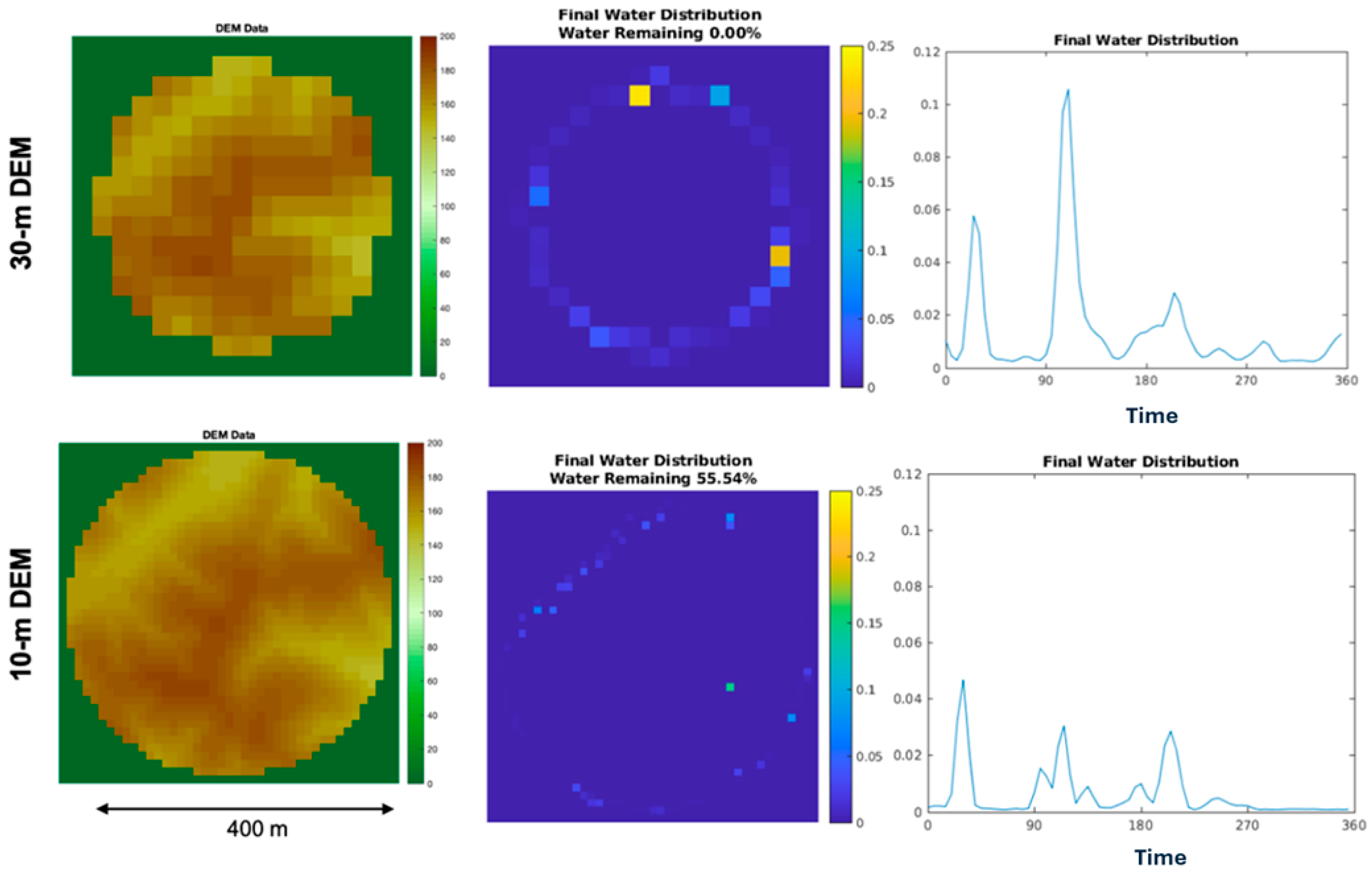
Figure 4 illustrates this localized flow characterization method applied to a single test region, highlighting the influence of DEM resolution on simulated retention and flow pathways. The first column illustrates the DEM data for the two cases. In the second column, the distribution of water in the circle at the conclusion of the flow simulation is plotted, with the indicated “water remaining” value being the sum of retained water over all interior cells not intersecting the circle defining the test region. For all cells intersecting that circle, the amount of remaining water was weighed based on the fractional partitioning of the cell by the circle to generate a plot of the amount of water reaching the edge, which is shown in the third column. For this example, a constant value of CN2 = 100 was used across the characterization region to isolate the effect of topography. Both simulations use a 200 m radius characterization circle, with the top case employing a 30 m DEM and the bottom case employing a 10 m DEM. The results demonstrate distinct hydrological behavior at different DEM resolutions. In the coarse 30 m DEM case, nearly all precipitation input is routed to the circle boundary, indicating minimal topographic trapping. Although the 30 m DEM case results in zero net retention (i.e., 100% of the applied water eventually flows out of the circular test region), the final water distribution subfigure still displays different colors due to transient ponding and routing within individual coarse-resolution cells before the water exits the region. The displayed colors represent transient final states prior to outflow and not long-term retention.
By contrast, in the finer 10 m DEM case, 57.71% of the applied water is retained in local microtopographic depressions, never reaching the edge of the circle. This highlights the capacity of high-resolution DEMs to capture small-scale retention processes that are absent in coarser terrain data. Directional flow distributions were also evaluated. The third column of Figure 4 shows the volume of water reaching the circle boundary across 72 discrete 5-degree arc segments. These distributions enable both magnitude- and direction-based comparisons of DEM-dependent model outputs. Quantitative metrics such as Euclidean distance and cosine similarity were used to measure differences in flow partitioning across DEM scales. The dominant flow direction was calculated as a weighted average flow angle by utilizing the first-moment method. The water in cells that intersect the circular boundary is apportioned by the fractional cell area falling within the boundary. The amount of water assigned to the boundary is the sum of all such partial-cell contributions. For this example, the dominant flow direction shifted slightly between resolutions: 110° for the 30 m DEM and 122° for the 10 m DEM. These scalar measures provide compact, reproducible indicators of how DEM resolution impacts both flow retention and dominant flow pathways, making them well suited for sensitivity analyses.
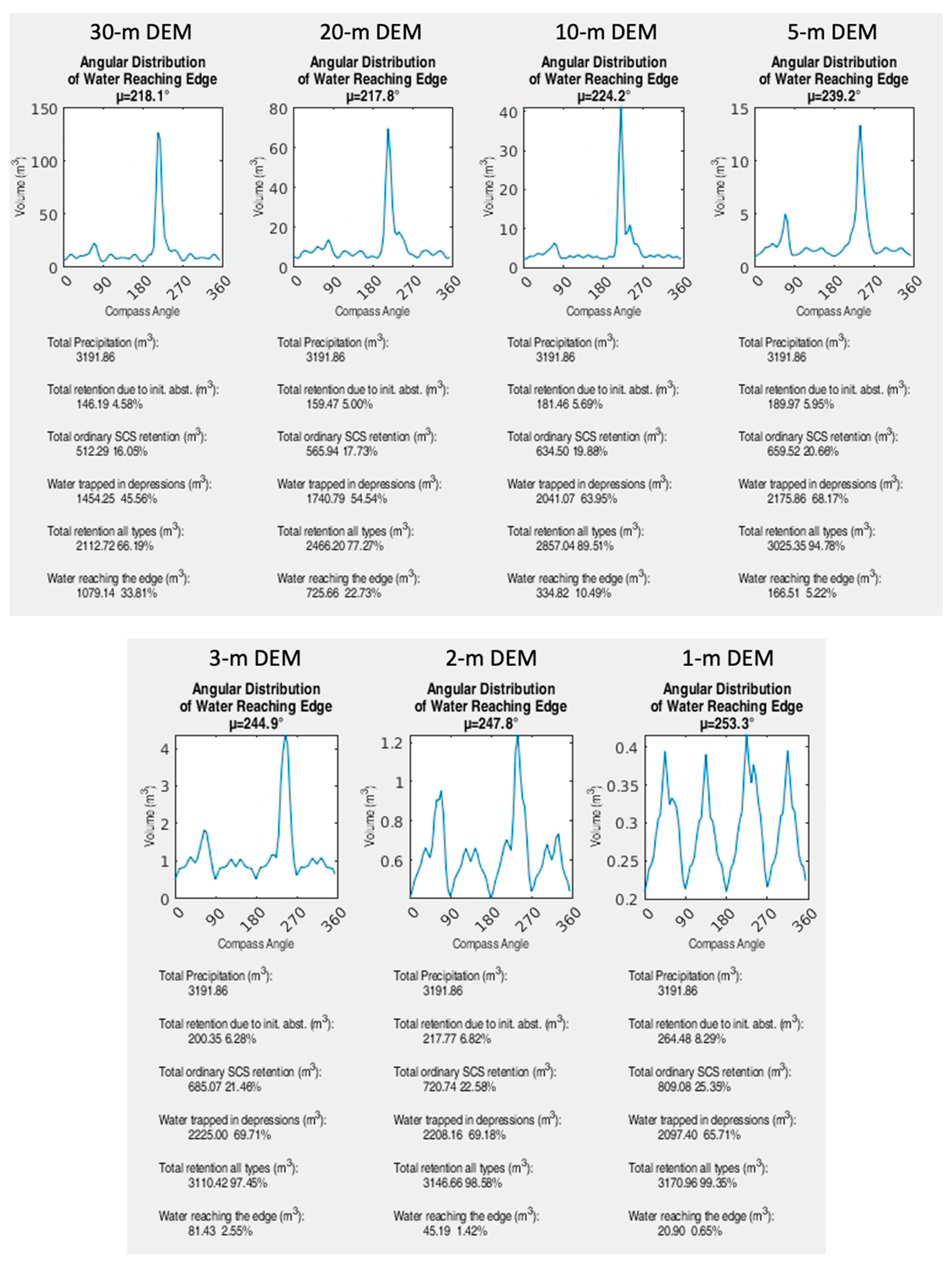
θ ~ = a n g l e 1 N k W k c o s θ k + i N k W k s i n θ k
For each test region, both the angular distribution results and the resulting quantities of water reaching the edge and retained were captured. An example of the resulting data applied to a selected example observation point utilizing actual model CN data is presented in Figure 4, which presents the angular distribution of water reaching the outlet for simulations performed under varying DEM resolutions. The DEM resolution exerts fundamental control on surface flow routing, influencing both the accuracy and spatial variability of simulated hydrologic responses. Each subplot represents a distinct test case, and the associated hydrologic metrics like total precipitation, drainage area, retention capacity, and water reaching the outlet are reported below each plot. These metrics collectively quantify how terrain representation affects the efficiency and directionality of surface runoff pathways. The results demonstrate that higher-resolution DEMs produce sharper and more focused angular distributions, indicating enhanced directional coherence of surface flow and reduced numerical dispersion. This improved flow direction fidelity arises from the finer-scale capture of topographic gradients, depressions, and micro-drainage features that govern overland flow initiation and convergence. In contrast, lower-resolution DEMs introduce smoothing effects that reduce local slope variance and suppress microtopographic features, leading to less defined flow direction peaks and greater lateral dispersion. These effects result in longer flow travel times, higher water retention, and reduced total discharge at the watershed outlet.
Several observations can be made when looking at this single-point data that are typical across the overall map. First, and as mentioned previously for the CN = 100 case, it is notable that changes in the DEM resolution can have a very strong effect on the flow angle. It is also notable that for fine-resolution DEMs, the retention predicted by the MFD flow model strongly increases as the DEM resolution is improved. This suggests that the CN tables in common use (e.g., USACE, 2000) are fit for coarser-resolution DEM data and must be revised to properly support the use of today’s higher-resolution data sources. A similar limitation exists for assumptions related to initial abstractions. It is also worth noting that as the water retention becomes closer to 100%, the accuracy of the angle measurement can degrade by artifacts of the MFD algorithm’s partitioning scheme (which needs to model radial flow using square cells).
The previously described approach was applied to observation points stepped on a 30 m grid across the entire subbasin 2 map. Because this approach requires thousands of localized simulations across large regions, high-performance computing resources were essential. The MIT Lincoln Laboratory Supercomputing Center was employed to enable parallelized evaluation of multiple DEM/CN2 combinations. The study included the number of nodes, cores per node, memory allocation, and the executable version of the parallel SWAT execution environment. These additional details allow full reproducibility of the parallel simulation workflow. The method was demonstrated in subbasin 2 of the Cahaba River Watershed, a region where hydrological response is highly sensitive to localized impermeability and land use change minima (e.g., 57.7% retention with 10 m DEM vs. near-total drainage with 30 m DEM). However, looking from the perspective of the behavior of single observation points, there is an observable coupled response between terrain detail and surface hydrological behavior.
The results indicate that higher-resolution DEMs capture finer-scale topographic variability, producing localized gradients in slope and flow direction that translate to spatially heterogeneous CN and S distributions (Figure 5). In contrast, coarser DEMs smooth terrain relief, yielding broader, homogenized CN zones and less spatial sensitivity to land use and soil variations. This smoothing effect diminishes the representation of small contributing areas, especially in upland and transition zones where runoff initiation is highly sensitive to microtopographic slope.
As this model is evaluated across the CN variation present across the map region, the DEM resolution exerts a first-order control on the magnitude and spatial distribution of CN deviations. The slope-corrected CN2s maps showed amplified sensitivity under high-resolution DEMs, suggesting that finer slope gradients enhance differentiation of infiltration and runoff potential. Similarly, the retention parameter (S) exhibited sharper contrasts at higher resolutions, indicating more accurate delineation of hydrologic boundaries and storage potential.

3.2.2. Sensitivity to CN Variation

For the 30 m DEM resolution case, sensitivity to small excursions from the nominal moderate saturation CN profile was evaluated. As in the DEM resolution sensitivity analysis, test regions of 200 m radius were evaluated. For each observation point, seven runs were performed, testing the following CN map cases:
  • The nominal moderate saturation (CN2) profile;
  • All CN2 values in the circular test region varied by ±1;
  • CN2 values less than or equal to the 1/3 quantile value varied by ±1;
  • CN2 values greater than or equal to the 2/3 quantile value varied by ±1.
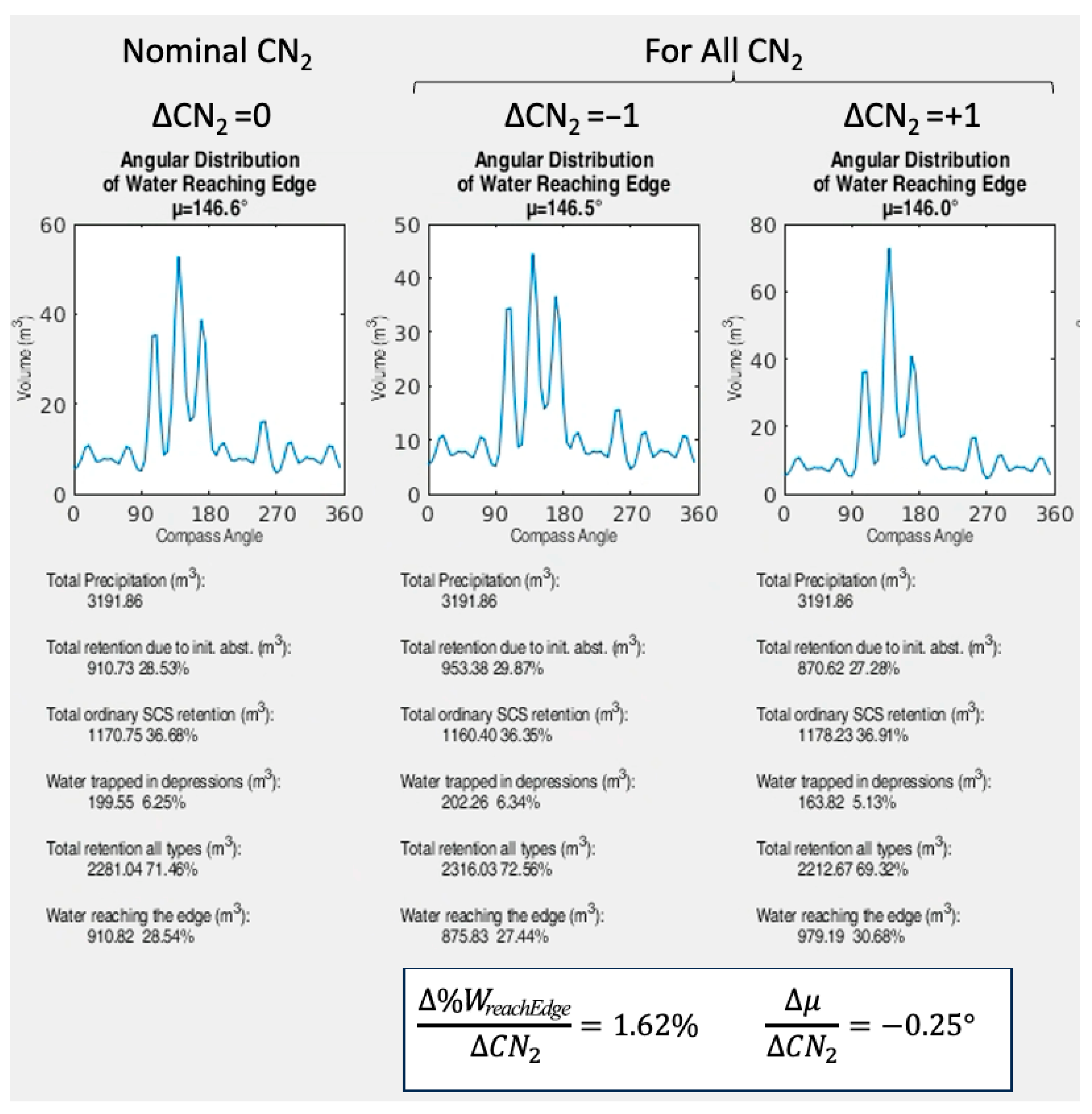
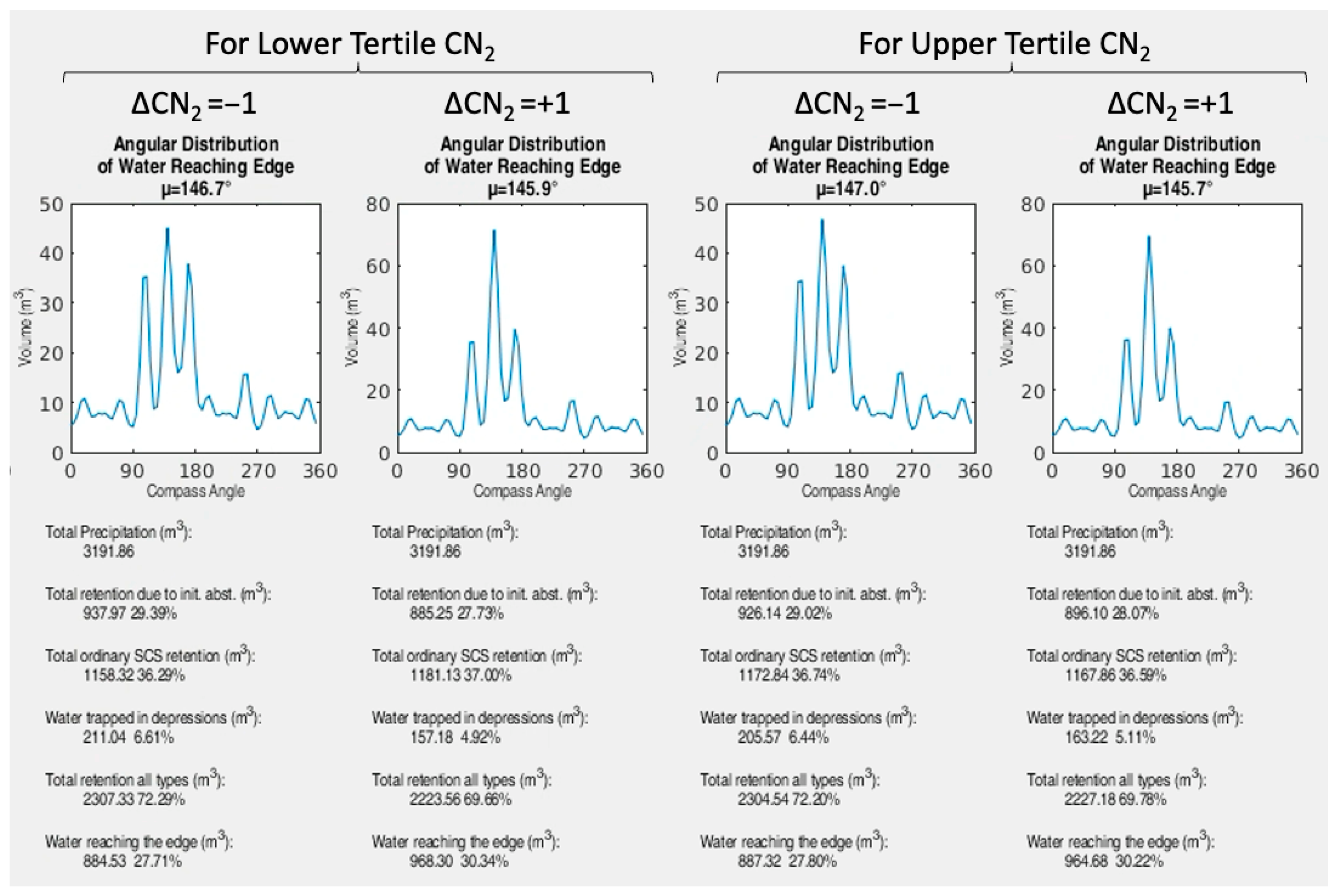
Figure 6 presents spatial comparisons across CN2 perturbation cases for one selected observation point. The perturbation applied was ±1 unit in CN, representing the interquartile range-based variability observed across the HRUs. This ±1 adjustment reflects the typical magnitude of uncertainty in CN assignments derived from land cover and soil hydraulic quantile ranges.
For the case of varied CNs, we can make several initial observations when looking at these single-point data that are similarly reflected across the overall map. The effect of small perturbations in CN on the flow angle is relatively weak on the order of a fraction of a degree but can compound as the flow distances become significantly larger than the 200 m test region diameter. There is an observable sensitivity of retention results to the CN variation.

4. Discussion

4.1. Mapping Experiments in Subbasin Scale

4.1.1. Comparing Angular First Moment of Spatially Resolute DEMs vs. 1 m DEM

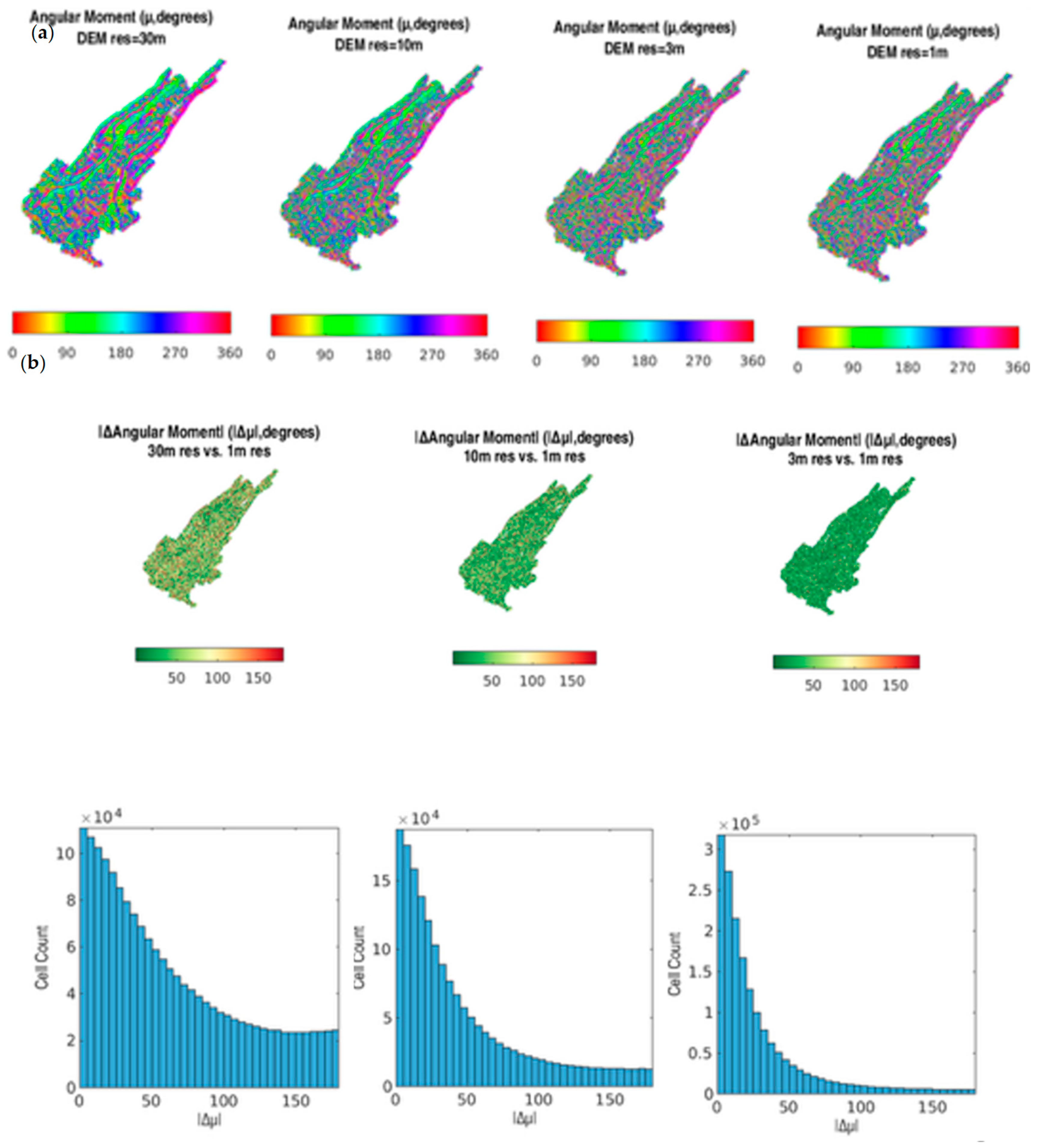
The results illustrate the spatial and statistical comparison of the angular first moment ( μ , in degrees) derived from DEMs of varying resolutions (30 m to 1 m). The first row presents the angular first-moment maps for each DEM resolution, revealing how terrain representation becomes progressively detailed as grid resolution increases (Figure 7). The coarse DEMs (30 m and 20 m) show smoother angular first-moment distributions with reduced local variability, while the finer DEMs (5 m to 1 m) capture more pronounced spatial heterogeneity and finer-scale topographic features. The second row displays the absolute differences in angular first moment ( Δ μ ) between each coarser DEM and the 1 m DEM, used here as the reference surface. The spatial distribution of Δ μ indicates that deviations are more substantial in areas of complex terrain, where coarse resolution tends to generalize slope and aspect information.
The 30 m DEM shows the largest discrepancies, whereas differences decrease systematically with finer resolutions (20 m → 2 m), suggesting that DEM refinement substantially improves angular first-moment accuracy. The third row provides histograms of Δ μ values, further quantifying these resolution-dependent differences. The frequency distributions are strongly right-skewed, with most cells exhibiting small angular deviations (<50°) and a decreasing tail toward higher values. The frequency of large Δ μ (>100°) declines rapidly with increasing DEM resolution, confirming the diminishing error magnitude. Furthermore, the geographic locations that give rise to these large Δ μ results are easily identifiable on the map as sparse but localized clusters of high sensitivity, suggesting the opportunity for use of multi-resolution DEM data. Overall, these results demonstrate a clear sensitivity of angular first-moment calculations to DEM resolution. While high-resolution DEMs (≤5 m) provide more reliable and spatially consistent angular first-moment estimates, coarser DEMs (≥20 m) introduce significant smoothing effects that may obscure localized hydrological or geomorphic patterns. This emphasizes the importance of using fine-scale topographic data for accurate subbasin scale analyses, particularly in regions with complex surface morphology.
Figure 7. Comparison of (a) angular first moment derived from DEMs of varying resolutions (30 m–1 m) and (b) angular first moment derived from DEMs of varying resolutions (30 m–1 m) relative to 1 m DEM for subbasin 2 of Cahaba River Watershed.
Water 18 00894 g007

4.1.2. Comparing Angular First-Moment Sensitivity to Perturbed CN

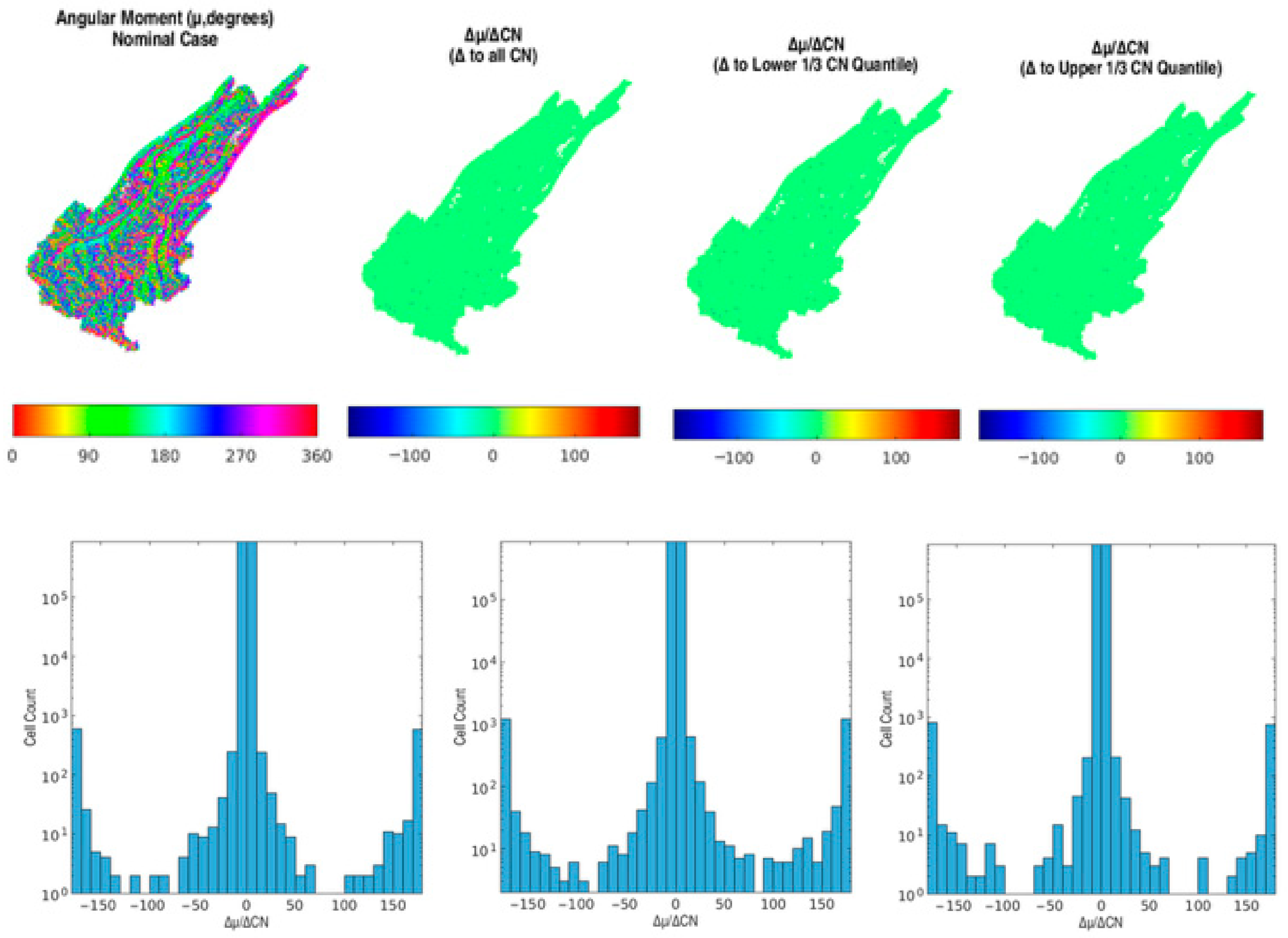
Figure 8 presents the calculated angular first-moment data for subbasin 2, using 30 m DEM data and applying a ±1 perturbation to the CN values. For the second column, the perturbation is applied to all CN values; for the third column, to the lower tertile of CN values; and for the fourth column, to the upper tertile of CN values. For most cells tested, there is a negligible effect. However, for a sparse set of cells, there is a strong sensitivity, in some cases resulting in flow direction reversal. These results are strongly dependent on the local topography at the test point, setting up the opportunity for changes in multimodal outflow. Recalling our observed sensitivity to DEM resolution, it is expected that the density of these sensitive test points will increase with increased DEM resolution, as the opportunities for multimodal flow at a test point increase.

4.1.3. Comparing Total Water Retention Based on Spatially Resolute DEMs vs. 1 m DEM

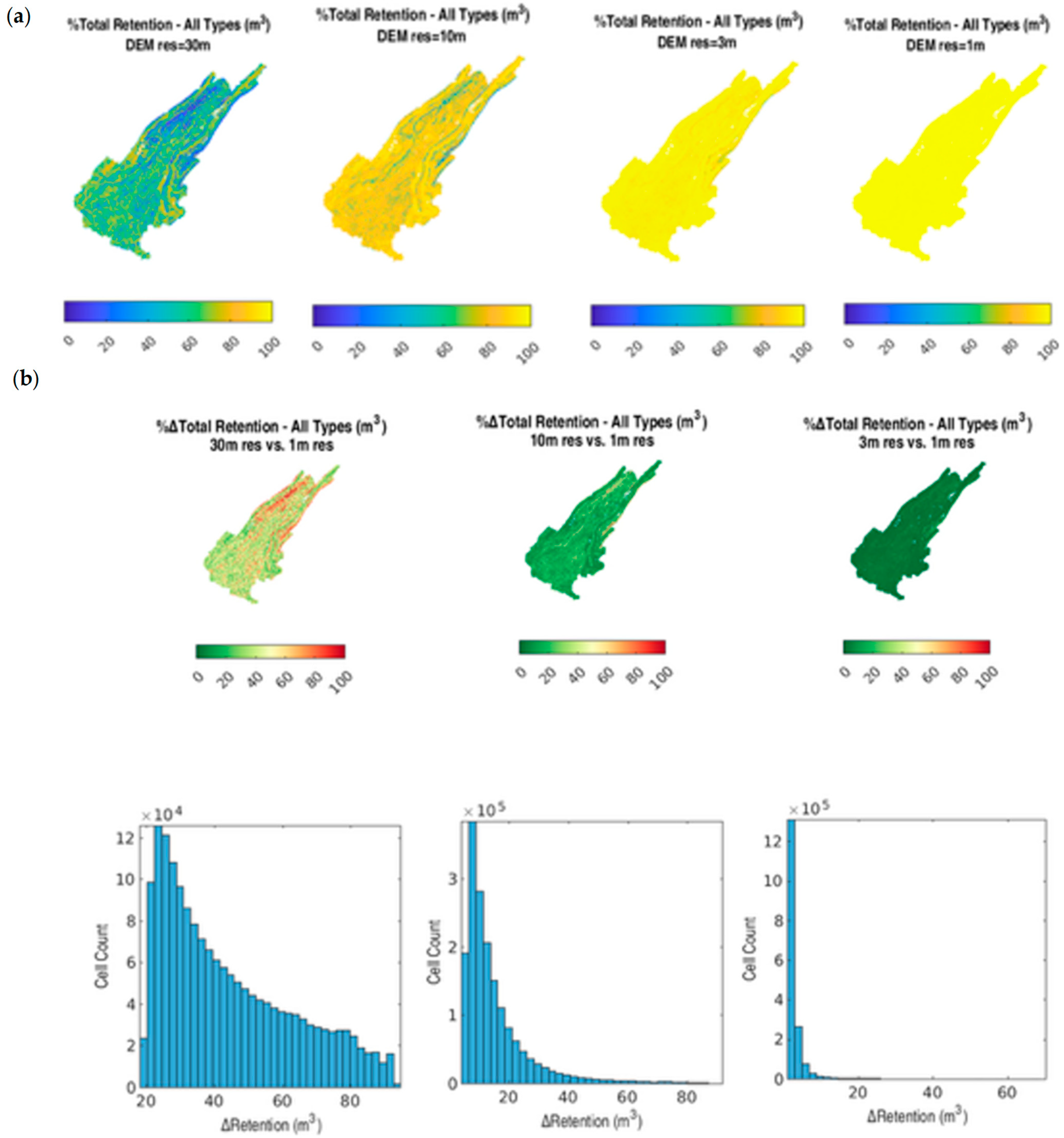
Figure 9 illustrates the spatial and statistical comparison of total water retention derived from digital elevation models (DEMs) of varying resolutions (30 m to 1 m) at the subbasin scale. The upper row displays the percentage of total water retention for each DEM resolution, while the middle and lower rows present the absolute and statistical differences with respect to the 1 m DEM, which is used as the reference. The results reveal a clear resolution-dependent effect on water retention estimates. Coarser DEMs (30 m and 20 m) exhibit significantly lower total water retention compared to the 1 m DEM. This underestimation arises because coarse-resolution DEMs tend to smooth out small-scale terrain variations such as micro-depressions, local sinks, and minor flow obstructions that act as critical water storage features. As the resolution improves (10 m to 2 m), the total retention values increasingly converge toward those obtained from the 1 m DEM, indicating better representation of the localized topographic features influencing hydrological storage. Spatially, the largest deviations in total water retention occur in regions of complex topography, such as steep slopes, valley heads, and areas with high surface roughness. The 30 m and 20 m DEMs show widespread underrepresentation of retention zones, whereas the 5 m, 3 m, and 2 m DEMs capture finer-scale hydrologic variability more accurately. The difference maps (Figure 9a) confirm this trend, showing diminishing discrepancies with increasing resolution. The histograms of Δ Retention (Figure 9b) further quantify these effects. The distributions are right-skewed across all resolutions, with most cells showing small differences (<20 m3) and a long tail representing localized areas of greater discrepancy. As DEM resolution increases, the frequency of large deviations declines sharply, demonstrating improved numerical consistency in water retention estimation. The geographic locations that give rise to these large Δ Retention results are easily identifiable on the map as contiguous regions of high sensitivity, potentially informing a multi-resolution modeling strategy.
Overall, these findings emphasize the strong sensitivity of total water retention modeling to DEM resolution. High-resolution DEMs (≤5 m) are essential for accurately characterizing hydrological storage, especially in heterogeneous or steep terrains. Coarser DEMs, while computationally efficient, systematically underestimate storage potential, which may lead to biased runoff and flood modeling outcomes at the subbasin scale. Therefore, selecting an appropriate DEM resolution is critical for reliable hydrological modeling and basin-scale water balance analysis. An important observation from these results is that a substantial volume of water is retained within local minima in the 1 m DEM. This suggests that fine-resolution topography captures numerous micro-depressions and small-scale storage features that are typically smoothed out in coarser datasets.
It is likely that the effects of such small-scale retention are implicitly incorporated within the empirical calibration of curve number (CN) values for various land surface conditions. Consequently, this finding implies that existing CN tables developed primarily using coarser-resolution terrain data may not be directly compatible with high-resolution DEMs. To fully leverage the improved spatial detail of fine-scale topography, CN relationships need to be re-evaluated or recalibrated to ensure consistency with high-resolution hydrological modeling frameworks.
These results imply that flow pathways, sediment transport directionality, and nutrient fluxes derived from such models are inherently resolution dependent [121,122]. These results suggest that in regions characterized by complex terrain or heterogeneous land cover, a finer DEM resolution (≤30 m) significantly improves hydrologic realism and predictive accuracy [123,124,125,126].
Figure 9. Comparison of (a) total water retention derived from DEMs of varying resolutions (30 m–1 m) and (b) total water retention derived from DEMs of varying resolutions (30 m–1 m) relative to 1 m DEM for subbasin 2 of Cahaba River Watershed.
Water 18 00894 g009
Conversely, in relatively flat or homogeneous basins, coarser DEMs may suffice, offering computational efficiency without significant accuracy loss. Integrating slope and roughness indices from high-resolution DEMs with land use and soil datasets can thus guide adaptive model configuration recommendations, where detailed surface data are necessary to enhance water flow and retention simulations [127,128,129,130].

4.1.4. Comparing Total Water Retention Sensitivity to Perturbed CN

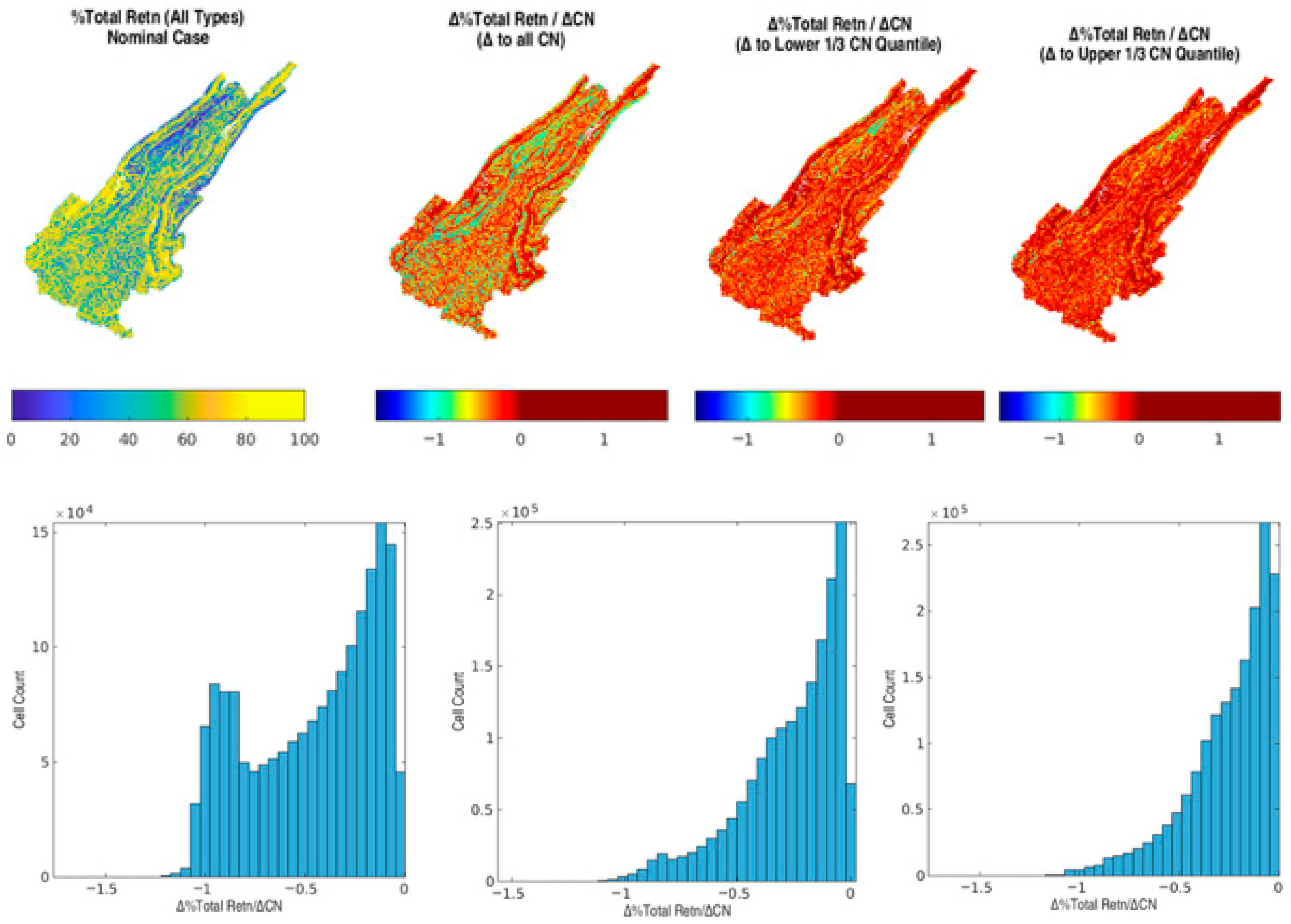
Figure 10 presents the calculated total actual retention data for subbasin 2, using the same 30 m DEM data perturbation to the CN values as previously described. Note that there is a bimodal relationship between total actual retention and CN, with some contiguous regions showing a positive value for R e t e n t i o n / C N and some showing a negative one.
This behavior suggests that retention sensitivity is not linear and may reflect interactions between subbasin topography, land cover distribution, soil characteristics, and runoff generation pathways [131,132,133]. Providing a full mechanistic explanation of this bimodal pattern along with a detailed interpretation of its hydrological significance in the Cahaba River Basin requires additional physically based analysis beyond the current scope of this work. Similarly, while the results demonstrate that existing CN tables require recalibration when coupled with higher-resolution DEM data, a complete CN parameter calibration framework (incorporating local rainfall–runoff observations, soil moisture data, or event-based CN adjustment methods) would require a separate, dedicated analysis. The future work will include investigating the following:
  • The influence of micro-topography revealed by high-resolution DEMs on initial abstraction and infiltration processes;
  • How finer spatial discretization modifies contributing areas and runoff pathways;
  • Event-scale comparisons between observed and simulated hydrographs to derive revised CN values;
  • Parameter sensitivity-based approaches to identify which CN-related factors most strongly contribute to the observed nonlinear response.

4.1.5. Comparing Surface Flow Simulations with Spatially Resolute DEMs vs. 1 m DEM

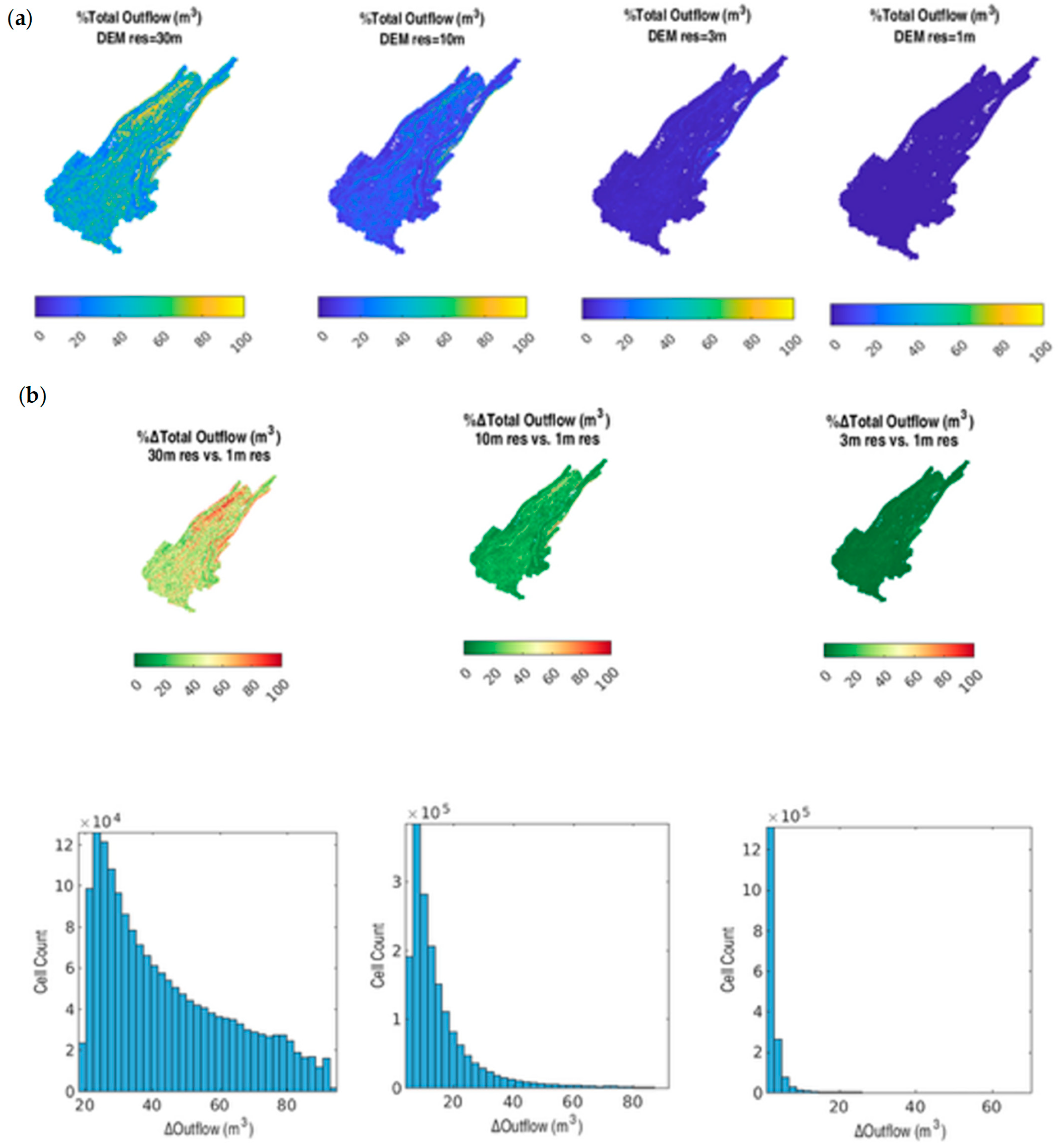
Figure 11 presents the results of surface flow simulations derived from DEMs of different spatial resolutions (30 m to 1 m) at the subbasin scale. The figure illustrates both the total simulated outflow and the corresponding deviations from the 1 m DEM reference case. The upper row shows the spatial distribution of total surface outflow for each DEM resolution. As the DEM resolution becomes finer, the spatial patterns of simulated outflow become more detailed and continuous, reflecting improved capture of micro-topographic flow paths and drainage connectivity.
Coarser DEMs (30 m and 20 m) display more generalized outflow patterns, resulting in smoothed drainage networks and an overall reduction in local flow variability. This indicates that coarse spatial representation limits the model’s ability to accurately simulate small-scale hydrological dynamics. The middle row maps the relative differences between each coarser DEM and the 1 m reference. These difference maps highlight systematic underestimation of outflow in coarse DEMs, particularly in areas of steep relief and near drainage divides. As the DEM resolution increases (from 10 m to 2 m), the magnitude and spatial extent of deviations diminish considerably, indicating a strong convergence toward the 1 m DEM simulation results.
The bottom row displays histograms of absolute differences in the outflow for each resolution comparison. The histograms exhibit right-skewed distributions, where most cells show small differences (<20 m3), and a long tail represents localized regions of higher deviation. The frequency and magnitude of large differences are most pronounced in the 30 m and 20 m DEMs, decreasing progressively with finer resolutions. These statistical patterns confirm that DEM resolution exerts a significant influence on simulated flow dynamics, particularly in terrain-controlled areas. Geographically, the regions of high sensitivity are similar to the contiguous regions in the Δ Retention results.
Overall, the results demonstrate that surface flow simulations are highly sensitive to DEM resolution. High-resolution DEMs (≤5 m) reproduce more realistic flow routing and hydrological connectivity, while coarse DEMs (≥20 m) tend to smooth topographic gradients, underestimate local flow accumulation, and distort drainage boundaries. The improved spatial precision of fine-resolution DEMs leads to enhanced modeling of overland flow processes, which is essential for accurate flood mapping, runoff estimation, and sediment transport studies at subbasin scales.
Figure 11. Comparison of (a) surface flow simulations derived from DEMs of varying resolutions (30 m–1 m) and (b) surface flow simulations derived from DEMs of varying resolutions (30 m–1 m) relative to 1 m DEM for subbasin 2 of Cahaba River Watershed.
Water 18 00894 g011

5. Limitations and Future Work

The limitations of the study include the site-specific constraints for sensor deployment. The real-world deployment of distributed sensors is limited by terrain accessibility, land use restrictions, and maintenance feasibility, which were not fully captured in the current watershed setup. Other challenges were in obtaining field data for CN recalibration. The limited availability of high-quality storm-event and runoff measurements restricts the ability to directly calibrate CN tables, highlighting a key gap in application of the watershed. Future work will include investigating micro-topographic effects from high-resolution DEMs on initial abstraction and infiltration processes, quantifying the impact of finer spatial discretization on contributing areas and runoff pathways, performing event-level comparisons between observed and simulated hydrographs to derive revised CN values that better reflect the hydrologic behavior of the study area, conducting parameter sensitivity analysis to identify which CN-related parameters most significantly contribute to the observed nonlinear response, developing a computational optimization strategy to reduce the cost of high-resolution modeling for larger catchments, and designing sensor-deployment guidelines grounded in the constraints identified in this study.

6. Conclusions

This study explored the suitability and feasibility of a continuous integration framework for watershed modeling, based on integrating hydrological sensitivity analysis, high-resolution spatial data, and in situ sensing strategies. Using the Cahaba River Watershed as a testbed, the work explored how digital elevation model resolution, land use, and soil heterogeneity influence hydrological responses and inform model refinement. The key findings include the following:
  • Continuous Integration Framework: Enables dynamic feedback between model outputs and sensor deployment, improving model fidelity through targeted, high-utility data collection.
  • Effect of DEM Resolution: Transitioning from 30 m to 1 m DEMs increased subbasin delineation granularity (from 8 to 99 units), revealing localized hydrological hotspots and enhanced prediction of runoff and retention patterns.
  • Hydrological Sensitivity to Terrain Detail: Fine-resolution DEMs (≤5 m) captured microtopographic depressions and slope-driven flow pathways, improving representation of infiltration and surface water connectivity. Coarser DEMs (≥20 m) consistently underestimated retention and smoothed flow patterns.
  • Curve Number (CN) Sensitivity: Small perturbations in CN values significantly affected retention and runoff behavior, underscoring the need to recalibrate CN relationships when integrating high-resolution terrain data.
  • Localized Flow Partitioning: High-resolution models revealed up to 58% greater water retention in fine DEMs due to better capture of local depressions and drainage structures, improving accuracy of surface flow direction and magnitude.
  • Computation Resolution Tradeoff: While 1 m DEM modeling increased processing time 4–10× relative to 30 m DEMs, it provided substantially improved hydrologic realism, justifying selective use in spatially sensitive zones.
  • Implications for Sensor Tasking: Sensitivity maps derived from local model analyses can guide adaptive sensor placement and data collection, optimizing resource allocation for real-time watershed monitoring.
  • Limitations of existing empirical models: Existing models, such as the SCS curve number method, have been fit to data based on course-resolution inputs. For use of finer resolutions, the CN tables, initial abstractions assumptions, etc., need to be revisited and updated for use with high-resolution data.
The future work will include investigating the following:
  • Assessing the influence of micro-topography revealed by high-resolution DEMs on initial abstraction and infiltration processes, which may significantly alter effective runoff thresholds.
  • Examining how finer spatial discretization reshapes contributing areas and flow pathways, thereby modifying the hydrological response represented by the CN framework.
  • Conducting event-scale comparisons between measured and simulated hydrographs to systematically derive revised CN values that better reflect the physical behavior of the study area.
  • Applying parameter sensitivity approaches to identify which CN-related factors of land cover, soil group, and initial abstraction ratio most strongly drive the nonlinear runoff response observed in the simulations.
  • Recalibration of the existing CN tables when integrated with high-resolution DEM data.
Overall, the findings demonstrate that spatial heterogeneity and high-resolution terrain data play pivotal roles in watershed modeling accuracy. The continuous integration concept offers a scalable, data-driven approach for adaptive model refinement bridging traditional hydrological modeling with real-time environmental sensing. Future work will extend this framework to automated sensor task identification, automated multi-resolution data assimilation, and coupled surface and groundwater simulations to advance predictive hydrology with increasing land development and rapidly changing climate conditions.

Author Contributions

Methodology, data curation, and writing, review, and editing—P.P. Conceptualization, data curation, review, and editing—B.T. Data curation—A.M. All authors have read and agreed to the published version of the manuscript.

Funding

This work was funded by the Advanced Sensing for Hydrological Metrology project under the MIT Lincoln Laboratory FY24 Climate Initiative. This material is based upon work supported by the Department of the Air Force under Air Force Contract No. FA8702-15-D-0001 or FA8702-25-D-B002. Any opinions, findings, conclusions or recommendations expressed in this material are those of the authors and do not necessarily reflect the views of the Department of the Air Force.

Data Availability Statement

The original contributions presented in this study are included in the article. Further inquiries can be directed to the corresponding author.

Acknowledgments

I would like to acknowledge the reviewers for enhancing the article.

Conflicts of Interest

The authors declare no conflicts of interest.

References

  1. Preetha, P.; Hasan, M. Scrutinizing the hydrological responses of Chennai, India using coupled SWAT–FEM model under land use land cover and climate change scenarios. Land 2023, 12, 938. [Google Scholar] [CrossRef]
  2. Laniak, G.F.; Olchin, G.; Goodall, J.; Voinov, A.; Hill, M.; Glynn, P.; Hughes, A. Integrated environmental modeling: A vision and roadmap for the future. Environ. Model. Softw. 2013, 39, 3–23. [Google Scholar] [CrossRef]
  3. Gosain, A.K.; Rao, S.; Basuray, D. Climate change impact assessment on hydrology of Indian river catchments. Curr. Sci. 2006, 90, 346–353. [Google Scholar]
  4. Huang, S.; Krysanova, V.; Osterle, H.; Hattermann, F.F. Simulation of spatiotemporal dynamics of water fluxes in Germany under climate change. Hydrol. Process. 2010, 24, 3289–3306. [Google Scholar] [CrossRef]
  5. Eckhardt, K.; Ulbrich, U. Potential impacts of climate change on groundwater recharge and streamflow in a central European low mountain range. J. Hydrol. 2003, 284, 244–252. [Google Scholar] [CrossRef]
  6. Kingston, D.G.; Taylor, R.G. Sources of uncertainty in climate change impacts on river discharge and groundwater in a headwater catchment of the Upper Nile Basin, Uganda. Hydrol. Earth Syst. Sci. 2010, 14, 1297–1308. [Google Scholar] [CrossRef]
  7. Schmugge, T.; Kustas, W.P.; Ritchie, J.C.; Jackson, T.J.; Rango, A. Remote sensing in hydrology. Adv. Water Resour. 2002, 25, 1367–1385. [Google Scholar] [CrossRef]
  8. Preetha, P.P.; Al-Hamdan, A.Z. Developing nitrate–nitrogen transport models using remotely sensed geospatial data of soil moisture profiles and wet depositions. J. Environ. Sci. Health A 2020, 55, 615–628. [Google Scholar] [CrossRef]
  9. Flacke, W.; Auerswald, K.; Neufang, L. Combining a modified Universal Soil Loss Equation with a digital terrain model for computing high resolution maps of soil loss resulting from rain wash. Catena 1990, 17, 383–397. [Google Scholar] [CrossRef]
  10. Xian, G.; Crane, M. Assessments of urban growth in the TBW using remote sensing data. Remote Sens. Environ. 2005, 97, 203–215. [Google Scholar] [CrossRef]
  11. Moreno-Madrinan, M.J.; Al-Hamdan, M.Z.; Rickman, D.L.; Muller-Karger, F.E. Using the surface reflectance MODIS Terra product to estimate turbidity in Tampa Bay, Florida. Remote Sens. 2010, 2, 2713–2728. [Google Scholar] [CrossRef]
  12. Gonzalez, M.O.; Preetha, P.; Kumar, M.; Clement, T.P. Comparison of data-driven groundwater recharge estimates with a process-based model for a river basin in the southeastern USA. J. Hydrol. Eng. 2023, 28, 04023019. [Google Scholar] [CrossRef]
  13. Preetha, P.; Bathi, J.R.; Kumar, M.; Kode, V.R. Predictive tools and advances in sustainable water resources through atmospheric water generation under changing climate: A review. Sustainability 2025, 17, 1462. [Google Scholar] [CrossRef]
  14. Zhang, R.; Srinivasan, F.H. Predicting hydrologic response to climate change in the Luohe River catchment using the SWAT model. Am. Soc. Agric. Biol. Eng. 2007, 50, 901–910. [Google Scholar]
  15. Takle, E.S.; Jha, M.; Lu, E.; Arritt, R.W.; Gutowski, W.J. Streamflow in the upper Mississippi River catchment as simulated by SWAT driven by global climate models and NARCCAP regional models. Meteorol. Z. 2010, 19, 341–346. [Google Scholar] [CrossRef]
  16. Lakshmanan, V.; Geethalakshmi, R.; Sekhar, S.N.U.; Annamalai, H. Climate change adaptation strategies in Bhavani Basin using SWAT model. J. Appl. Eng. Agric. 2011, 27, 887–893. [Google Scholar] [CrossRef]
  17. Nourani, V.; Rouzegari, N.; Molajou, A.; Baghanam, A.H. An integrated simulation–optimization framework to optimize reservoir operation adapted to climate change scenarios. J. Hydrol. 2020, 587, 125018. [Google Scholar] [CrossRef]
  18. Balasubramanian, R.; Saravanakumar, V.; Boomiraj, K. Ecological footprints and climate change impact on rice production in India. In The Future Rice Strategy for India; Elsevier: Amsterdam, The Netherlands, 2017; pp. 69–106. [Google Scholar]
  19. Rao, K.P.C.; Ndegwa, W.G.; Kizito, K.; Oyoo, A. Climate variability and change: Farmer perceptions in semi-arid Kenya. Exp. Agric. 2011, 47, 267–291. [Google Scholar] [CrossRef]
  20. Thomas, B.F.; Behrangi, A.; Famiglietti, J.S. Precipitation intensity effects on groundwater recharge in the southwestern United States. Water 2016, 8, 90. [Google Scholar] [CrossRef]
  21. Ibrahim, A.; Wayayok, A.; Shafri, H.Z.M.; Toridi, N.M. Remote sensing technologies for modelling groundwater storage dynamics: Comprehensive review. J. Hydrol. X 2024, 23, 100175. [Google Scholar]
  22. Kwon, H.; Park, G.; Kim, S. Estimation of soil loss changes and sediment transport path using GIS and multi-temporal RS data. J. GIS Assoc. Korea 2002, 10, 134–147. [Google Scholar]
  23. Deng, J.S.; Wang, K.; Deng, Y.H.; Qi, G.J. PCA-based land-use change detection and analysis using multitemporal and multisensor satellite data. Int. J. Remote Sens. 2008, 29, 4823–4838. [Google Scholar] [CrossRef]
  24. Sadeghi, S.H.; Zabihi, M.; Vafakhah, M.; Hazbavi, Z. Spatiotemporal mapping of rainfall erosivity index for different return periods in Iran. Nat. Hazards 2017, 87, 35–56. [Google Scholar] [CrossRef]
  25. Das, S.; Talukdar, S.; Scaringi, G. How do climate, geomorphology, and land-use control sediment yield generation in an anthropogenically modified landscape? EarthArXiv 2025. [Google Scholar] [CrossRef]
  26. Abdelkader, M. Data- and Process-Based Methods to Enhance Streamflow Estimation Across Scales. Ph.D. Thesis, Stevens Institute of Technology, Hoboken, NJ, USA, 2024. [Google Scholar]
  27. Grose, A. Assessing Catchment-Scale Ground Thaw, Runoff, and Stream Chemistry Processes Across the Thaw Season in Arctic Permafrost Catchments. Ph.D. Thesis, Michigan State University, East Lansing, MI, USA, 2025. [Google Scholar]
  28. Kim, C.; Kim, D.H. Effects of rainfall spatial distribution on the relationship between rainfall spatiotemporal resolution and runoff prediction accuracy. Water 2020, 12, 846. [Google Scholar] [CrossRef]
  29. Kamangir, H.; Hajiesmaeeli, M.; Earles, J.M. California crop yield benchmark: Combining satellite image, climate, evapotranspiration, and soil data layers for county-level yield forecasting of over 70 crops. In Proceedings of the IEEE/CVF Conference on Computer Vision and Pattern Recognition; IEEE: New York, NY, USA, 2025; pp. 5530–5539. [Google Scholar]
  30. Wu, M.; Schurgers, G.; Rummukainen, M.; Smith, B.; Samuelsson, P.; Jansson, C.; May, W. Vegetation–climate feedbacks modulate rainfall patterns in Africa under future climate change. Earth Syst. Dyn. 2016, 7, 627–647. [Google Scholar] [CrossRef]
  31. Wang, Z.; Gong, Y.; Wang, R.; Luo, K.; Xie, M.; Wu, J. Diagnosing ecosystem service imbalance: A machine learning–driven dissection of supply–demand bundle dynamics in the Dongting Lake Basin. Land Degrad. Dev. 2026. Epub ahead of printing. [Google Scholar] [CrossRef]
  32. Lambin, E.F.; Ehrlich, D. Land-cover changes in sub-Saharan Africa (1982–1991): Application of a change index based on remotely sensed surface temperature and vegetation indices. Remote Sens. Environ. 1997, 61, 181–200. [Google Scholar] [CrossRef]
  33. Dietrich, W.E.; Bellugi, D.; Real de Asua, R. Validation of the shallow landslide model SHALSTAB for forest management. In Land Use and Watersheds; AGU Publications: Washington, DC, USA, 2001; pp. 195–227. [Google Scholar]
  34. Chakrabarti, S.; Judge, J.; Rangarajan, A.; Ranka, S. Utilizing self-regularized regressive models to downscale microwave brightness temperatures for agricultural land covers. IEEE J. Sel. Top. Appl. Earth Obs. Remote Sens. 2017, 10, 478–488. [Google Scholar] [CrossRef]
  35. Lubczynski, M.; Leblanc, M.; Batelaan, O. Remote sensing and hydrogeophysics give a new impetus to integrated hydrological models: A review. J. Hydrol. 2024, 633, 130–142. [Google Scholar] [CrossRef]
  36. Schultz, G.A. Remote sensing in hydrology. J. Hydrol. 1988, 100, 239–265. [Google Scholar] [CrossRef]
  37. Engman, E.T.; Gurney, R.J. Recent advances and future implications of remote sensing for hydrologic modeling. In Recent Advances in Modeling of Hydrologic Systems; Springer: Dordrecht, The Netherlands, 1991; pp. 471–495. [Google Scholar]
  38. Farnsworth, R.K.; Barrett, E.C.; Dhanju, M.S. Application of Remote Sensing to Hydrology Including Groundwater; UNESCO: Paris, France, 1984; p. 122. [Google Scholar]
  39. Weng, Q. Modeling urban growth effects on surface runoff with integrated remote sensing and GIS. Environ. Manag. 2001, 28, 737–748. [Google Scholar] [CrossRef] [PubMed]
  40. Silvestro, F.; Gabellani, S.; Delogu, F.; Rudari, R.; Boni, G. Exploiting remote sensing land surface temperature in distributed hydrological modelling: The Continuum model. Hydrol. Earth Syst. Sci. 2013, 17, 39–62. [Google Scholar] [CrossRef]
  41. Preetha, P.P.; Al-Hamdan, A.Z. Integrating finite-element-model and remote-sensing data into SWAT to estimate transit times of nitrate in groundwater. Hydrogeol. J. 2020, 28, 2187–2205. [Google Scholar] [CrossRef]
  42. Balsamo, G.; Agusti-Parareda, A.; Albergel, C.; Arduini, G.; Beljaars, A.; Bidlot, J.; Blyth, E.; Bousserez, N.; Boussetta, S.; Brown, A.; et al. Satellite and in situ observations for advancing global Earth surface modelling: A review. Remote Sens. 2018, 10, 2038. [Google Scholar] [CrossRef]
  43. Raupach, M.R.; Rayner, P.J.; Barrett, D.J.; DeFries, R.S.; Heimann, M.; Ojima, D.S.; Quegan, S.; Schmullius, C.C. Model–data synthesis in terrestrial carbon observation: Methods, data requirements, and data uncertainty. Glob. Change Biol. 2005, 11, 378–397. [Google Scholar] [CrossRef]
  44. Gettelman, A.; Geer, A.J.; Forbes, R.M.; Carmichael, G.R.; Feingold, G.; Posselt, D.J.; Stephens, G.L.; Heever, S.C.v.D.; Varble, A.C.; Zuidema, P. The future of Earth system prediction: Advances in model–data fusion. Sci. Adv. 2022, 8, eabn3488. [Google Scholar] [CrossRef]
  45. Chen, S.; Long, G.; Jiang, J.; Liu, D.; Zhang, C. Foundation models for weather and climate data understanding: A comprehensive survey. arXiv 2023, arXiv:2312.03014. [Google Scholar] [CrossRef]
  46. Dasari, S.K.; Preetha, P.; Ghantasala, H.M. Predictive analysis of hydrological variables in the Cahaba watershed using time-series and machine learning models. Earth 2025, 6, 89. [Google Scholar] [CrossRef]
  47. Li, F.; Yigitcanlar, T.; Nepal, M.; Nguyen, K.; Dur, F. Machine learning and remote sensing integration for urban sustainability: A review. Sustain. Cities Soc. 2023, 96, 104653. [Google Scholar] [CrossRef]
  48. Petty, T.R.; Dhingra, P. Streamflow hydrology estimate using machine learning (SHEM). J. Am. Water Resour. Assoc. 2018, 54, 55–68. [Google Scholar] [CrossRef]
  49. Preetha, P.; Joseph, N. Evaluating modified soil erodibility factors using pedotransfer functions and dynamic remote-sensing data. Land 2025, 14, 657. [Google Scholar] [CrossRef]
  50. Salerno, F.; Tartari, G. A coupled approach of surface hydrological modelling and wavelet analysis for understanding baseflow components in karst environments. J. Hydrol. 2009, 376, 295–306. [Google Scholar] [CrossRef]
  51. Singh, V.P.; Woolhiser, D.A. Mathematical modeling of watershed hydrology. J. Hydrol. Eng. 2002, 7, 270–292. [Google Scholar] [CrossRef]
  52. Shope, C.L.; Maharjan, G.R.; Tenhunen, J.; Seo, B.; Kim, K.; Riley, J.; Arnhold, S.; Koellner, T.; Ok, Y.S.; Peiffer, S.; et al. Using SWAT to improve process descriptions and hydrologic partitioning in South Korea. Hydrol. Earth Syst. Sci. 2014, 18, 539–557. [Google Scholar] [CrossRef]
  53. Gassman, P.W.; Reyes, M.R.; Green, C.H.; Arnold, J.G. The SWAT tool: Historical development, applications, and research directions. Trans. ASABE 2007, 50, 1211–1250. [Google Scholar] [CrossRef]
  54. Mwangi, J.K.; Shisanya, C.A.; Gathenya, J.M.; Namirembe, S.; Moriasi, D.N. Evaluating conservation practices on water and sediment yield in Kenya. J. Soil Water Conserv. 2015, 70, 75–90. [Google Scholar] [CrossRef]
  55. Ramesh, V.; Patil, A.; Ramsankaran, R.A.A.J. Dual correction of rainfall and root zone soil moisture estimates for improving streamflow simulations. ARC Geophys. Res. 2025, 1, 15. [Google Scholar] [CrossRef]
  56. Mardian, J. Drought Monitoring and Agricultural Risk Assessment in Canadian Prairies Using Earth Observation and ML. Ph.D. Thesis, University of Guelph, Guelph, ON, Canada, 2023. [Google Scholar]
  57. Praskievicz, S.; Chang, H. Hydrological modelling of basin-scale climate change and urban development impacts. Prog. Phys. Geogr. 2009, 33, 650–671. [Google Scholar] [CrossRef]
  58. Droegemeier, K.K.; Smith, J.D.; Businger, S.; Doswell, C.; Doyle, J.; Duffy, C.; Foufoula-Georgiou, E.; Graziano, T.; James, L.D.; Krajewski, V.; et al. Hydrological aspects of weather prediction and flood warnings. Bull. Am. Meteorol. Soc. 2000, 81, 2665–2680. [Google Scholar] [CrossRef]
  59. Nunes, J.P.; Nearing, M.A. Modelling impacts of climatic change using new erosion models. In Handbook of Erosion Modelling; Blackwell Publishing Ltd.: Oxford, UK, 2010; pp. 289–312. [Google Scholar]
  60. Edwards, B.L.; Webb, N.P.; Brown, D.P.; Elias, E.; Peck, D.; Pierson, F.; Williams, C.; Herrick, J. Climate change impacts on wind and water erosion on US rangelands. J. Soil Water Conserv. 2019, 74, 405–418. [Google Scholar] [CrossRef]
  61. Leitch, C.; Harbor, J. Impacts of land use change on freshwater runoff in Barbados. J. Soil Water Conserv. 1999, 54, 584–592. [Google Scholar] [CrossRef]
  62. Tyrrell, B.; McCleery, T.; Preetha, P. Advanced sensing for hydrological metrology. In C3A Workshop; MIT Lincoln Laboratory: Lexington, MA, USA, 2024. [Google Scholar]
  63. Herman, J.D.; Kollat, J.B.; Reed, P.M.; Wagener, T. High-resolution time-varying sensitivity analysis. Hydrol. Earth Syst. Sci. 2013, 17, 5109–5125. [Google Scholar] [CrossRef]
  64. Herman, J.D.; Kollat, J.B.; Reed, R.M.; Wagener, T. Method of Morris reduces computational demands in global sensitivity analysis. Hydrol. Earth Syst. Sci. 2013, 17, 2893–2903. [Google Scholar] [CrossRef]
  65. Ratto, M.; Young, P.C.; Romanowicz, R.; Pappenberger, F.; Saltelli, A.; Pagano, A. Uncertainty and sensitivity analysis in hydrology. Hydrol. Earth Syst. Sci. 2007, 11, 1249–1266. [Google Scholar] [CrossRef]
  66. Yenni, R.; Arun, P.V. Towards explainable discriminative models for EO data analysis. In Explainable AI for EO; CRC Press: Boca Raton, FL, USA, 2025; pp. 76–85. [Google Scholar]
  67. Sidle, R.; Ochiai, H. Processes, prediction, and land use. Water Resour. Monogr. 2006, 525, 870. [Google Scholar]
  68. Babazadeh Maghsoodlo, Y. Deep Learning and Dynamical Systems Approaches to Critical Transitions in Socio–Climate Systems. Ph.D. Thesis, University of Waterloo, Waterloo, ON, Canada, 2025. [Google Scholar]
  69. Horton, P.; Schaefli, B.; Kauzlaric, M. Why do we have so many different hydrological models? A review based on the case of Switzerland. Wiley Interdiscip. Rev. Water 2022, 9, e1574. [Google Scholar] [CrossRef]
  70. Li, Y.; Grimaldi, S.; Walker, J.P.; Pauwels, V.R. Remote sensing in flood forecasting: A review. Remote Sens. 2016, 8, 456. [Google Scholar] [CrossRef]
  71. Yun, Z.; Wang, Y.; Liu, P.; Li, L.; Liu, Y.; Chen, C.; Gao, R.; Peng, Z. Satellite-gauge fusion with near-real-time gap filling for rainfall monitoring. J. Hydrol. 2025, 662, 133913. [Google Scholar] [CrossRef]
  72. Sharifi, E.; Brocca, L. Monitoring precipitation from space: Progress, challenges, opportunities. In Precipitation Science; Elsevier: Amsterdam, The Netherlands, 2022; pp. 239–255. [Google Scholar]
  73. Xu, X.; Li, J.; Tolson, B.A. Integrating remote sensing data and hydrologic modeling. Prog. Phys. Geogr. 2014, 38, 464–498. [Google Scholar] [CrossRef]
  74. Zanella, A.; Zubelzu, S.; Bennis, M. Sensor networks, data processing, and inference: The hydrology challenge. IEEE Access 2023, 11, 107823–107842. [Google Scholar] [CrossRef]
  75. Jaywant, S.A.; Arif, K.M. Remote sensing techniques for water quality monitoring: A review. Sensors 2024, 24, 8041. [Google Scholar] [CrossRef] [PubMed]
  76. Mashala, M.J.; Dube, T.; Mudereri, B.T.; Ayisi, K.K.; Ramudzuli, M.R. A systematic review on advancements in remote sensing for assessing and monitoring land use and land cover changes impacts on surface water resources in semi-arid tropical environments. Remote Sens. 2023, 15, 3926. [Google Scholar] [CrossRef]
  77. Gacu, J.G.; Monjardin, C.E.F.; Mangulabnan, R.G.T.; Mendez, J.C.F. Application of artificial intelligence in hydrological modeling for streamflow prediction in ungauged watersheds: A review. Water 2025, 17, 2722. [Google Scholar] [CrossRef]
  78. Toney, J.J.N. The Upper Cahaba River Watershed, AL: A Long-Term Assessment and Future Predictions of Water Resource Quality and Quantity. Master’s Thesis, Alabama A&M University, Huntsville, UK, 2021. [Google Scholar]
  79. Preetha, P.P.; Joseph, N.; Narasimhan, B. Quantifying surface water and groundwater interactions using a coupled SWAT–FEM model: Implications of management practices on hydrological processes in irrigated river basins. Water Resour. Manag. 2021, 35, 2781–2797. [Google Scholar] [CrossRef]
  80. Preetha, P.P.; Al-Hamdan, A.Z.; Anderson, M.D. Assessment of climate variability and short-term land use land cover change effects on water quality of Cahaba River Basin. Int. J. Hydrol. Sci. Technol. 2021, 11, 54–75. [Google Scholar] [CrossRef]
  81. Preetha, P.P.; Al-Hamdan, A.Z. Synergy of remotely sensed data in spatiotemporal dynamic modeling of the crop and cover management factor. Pedosphere 2022, 32, 381–392. [Google Scholar] [CrossRef]
  82. Park, S.; Nielsen, A.; Bailey, R.T.; Trolle, D.; Bieger, K. A QGIS-based graphical user interface for application and evaluation of SWAT-MODFLOW models. Environ. Model. Softw. 2019, 111, 493–497. [Google Scholar] [CrossRef]
  83. Buchanan, B.P.; Fleming, M.; Schneider, R.L.; Richards, B.K.; Archibald, J.; Qiu, Z.; Walter, M.T. Evaluating topographic wetness indices across central New York agricultural landscapes. Hydrol. Earth Syst. Sci. 2014, 18, 3279–3299. [Google Scholar] [CrossRef]
  84. Ferreira, V.; Albariño, R.; Larrañaga, A.; LeRoy, C.J.; Masese, F.O.; Moretti, M.S. Ecosystem services provided by small streams: An overview. Hydrobiologia 2023, 850, 2501–2535. [Google Scholar] [CrossRef]
  85. Santos, P.P.; Reis, E. Assessment of stream flood susceptibility: A cross-analysis between model results and flood losses. J. Flood Risk Manag. 2018, 11, S1038–S1050. [Google Scholar] [CrossRef]
  86. Muñoz-Villers, L.E.; Geissert, D.R.; Holwerda, F.; McDonnell, J.J. Factors influencing stream water transit times in tropical montane watersheds. Hydrol. Earth Syst. Sci. Discuss. 2015, 12, 10975–11011. [Google Scholar]
  87. Mourad, K.A.; Oele, J.; Yacoob, W.; Greenwalt, J.; Zain, M.; Al-Okaishi, A.; Aulaiah, A.; Berndtsson, R. Hydrological assessment under climatic and socioeconomic scenarios using remote sensing, QGIS, and climate models: A case study of the Tuban Delta, Yemen. Sustainability 2025, 17, 2258. [Google Scholar] [CrossRef]
  88. Șlepac, V.; Vlasenco, A. GIS application for spatial data analysis: MapInfo vs. QGIS. In Proceedings of the ConsGeoCad 2024, Chisinau, Moldova, 21–23 November 2024. [Google Scholar]
  89. Perret, J.; Jessell, M.W.; Bétend, E. GEOL-QMAPS: An open-source QGIS-based solution for digital geological mapping. Appl. Comput. Geosci. 2024, 24, 100197. [Google Scholar] [CrossRef]
  90. Sadushi, S. Using QGIS-Based Analysis to Estimate Availability and Accessibility of Urban Green Spaces in Tirana. Ph.D. Thesis, Epoka University, Tirana, Albania, 2023. [Google Scholar]
  91. Falasy, A.; Cooke, R. QGIS-based support tools to simplify complex design challenges of subsurface drainage systems. Irrig. Drain. 2025, 74, 199–215. [Google Scholar] [CrossRef]
  92. Ngamile, S.; Madonsela, S.; Kganyago, M. Trends in remote sensing of water quality parameters in inland water bodies: A systematic review. Front. Environ. Sci. 2025, 13, 1549301. [Google Scholar] [CrossRef]
  93. Sahu, I.; Prasad, A.D. Assessment of hydro potential using integrated tools in QGIS. ISPRS Ann. Photogramm. Remote Sens. Spat. Inf. Sci. 2018, 4, 115–119. [Google Scholar] [CrossRef]
  94. Thompson, S.E.; Sivapalan, M.; Harman, C.J.; Srinivasan, V.; Hipsey, M.R.; Reed, P.; Montanari, A.; Blöschl, G. Developing predictive insight into changing water systems: Hydrologic science for the Anthropocene. Hydrol. Earth Syst. Sci. 2013, 17, 5013–5039. [Google Scholar] [CrossRef]
  95. Troch, P.A.; Lahmers, T.; Meira, A.; Mukherjee, R.; Pedersen, J.W.; Roy, T.; Valdés-Pineda, R. Catchment coevolution: A useful framework for improving predictions of hydrological change. Water Resour. Res. 2015, 51, 4903–4925. [Google Scholar] [CrossRef]
  96. Kavetski, D.; Fenicia, F. Elements of a flexible approach for conceptual hydrological modeling: 2. Application and experimental insights. Water Resour. Res. 2011, 47, 1–19. [Google Scholar] [CrossRef]
  97. Kumar, R.; Samaniego, L.; Attinger, S. Implications of distributed hydrologic model parameterization on water fluxes. Water Resour. Res. 2013, 49, 360–379. [Google Scholar] [CrossRef]
  98. Chen, F.; Crow, W.T.; Starks, P.J.; Moriasi, D.N. Improving hydrologic predictions via assimilation of surface soil moisture. Adv. Water Resour. 2011, 34, 526–536. [Google Scholar] [CrossRef]
  99. Davis, N.A. Predicting Future Range Expansion of Whooping Crane Winter Habitat Using Long-Term Census and Remotely Sensed Data. Master’s Thesis, Texas State University, San Marcos, TX, USA, 2019. [Google Scholar]
  100. Claessens, L.; Heuvelink, G.B.M.; Schoorl, J.M.; Veldkamp, A. DEM resolution effects on shallow landslide hazard and soil redistribution modelling. Earth Surf. Process. Landf. 2005, 30, 461–477. [Google Scholar] [CrossRef]
  101. Vaze, J.; Teng, J.; Spencer, G. Impact of DEM accuracy and resolution on topographic indices. Environ. Model. Softw. 2010, 25, 1086–1098. [Google Scholar] [CrossRef]
  102. Samsonov, T. Granularity of DEM and optimal level of detail in small-scale cartographic relief presentation. Remote Sens. 2022, 14, 1270. [Google Scholar] [CrossRef]
  103. Lin, S.; Jing, C.; Coles, N.A.; Chaplot, V.; Moore, N.J.; Wu, J. Evaluating DEM source and resolution uncertainties in SWAT. Stoch. Environ. Res. Risk Assess. 2013, 27, 209–221. [Google Scholar] [CrossRef]
  104. Neitsch, S.L.; Arnold, J.G.; Kiniry, J.R.; Williams, J.R.; King, K.W. Soil and Water Assessment Tool (SWAT) Theoretical Documentation—Version 2009; TR-406; Texas A&M University: College Station, TX, USA, 2011. [Google Scholar]
  105. Moghadam, S.H.; Ashofteh, P.S.; Singh, V.P. Sensitivity analysis of streamflow parameters with SWAT calibrated by NCEP CFSR. Theor. Appl. Climatol. 2024, 155, 8797–8813. [Google Scholar] [CrossRef]
  106. Soomro, A.G.; Babar, M.M.; Memon, A.H.; Zaidi, A.Z.; Ashraf, A.; Lund, J. Sensitivity of direct runoff to curve number using the SCS-CN method. Civ. Eng. J. 2019, 5, 2738–2746. [Google Scholar] [CrossRef]
  107. Pang, S.; Wang, X.; Melching, C.S.; Feger, K.H. Modified SWAT model based on slope and precipitation intensity. J. Hydrol. 2020, 588, 125098. [Google Scholar] [CrossRef]
  108. Abbas, S.A.; Bailey, R.T.; White, J.T.; Arnold, J.G.; White, M.J.; Čerkasova, N.; Gao, J. Framework for parameter estimation, sensitivity, and uncertainty using SWAT+. Hydrol. Earth Syst. Sci. 2024, 28, 21–48. [Google Scholar] [CrossRef]
  109. Siddiqui, A.R. Curve Number Generator: A QGIS Plugin to Generate Curve Number Layers from Land Use and Soil. Available online: https://github.com/ar-siddiqui/curve_number_generator (accessed on 4 August 2025).
  110. Malek, S.A. Alpine Sensor Network System for High-Resolution Spatial Snow and Runoff Estimation. Ph.D. Thesis, UC Berkeley, Berkeley, CA, USA, 2019. [Google Scholar]
  111. Toews, M.W. Modelling Climate Change Impacts on Groundwater Recharge in a Semi-Arid Region. Master’s Thesis, University of British Columbia, Vancouver, BC, Canada, 2007. [Google Scholar]
  112. Johnson, J.M. The Role of Spatial Data Science in Continental-Scale Hydrology. Ph.D. Thesis, UC Santa Barbara, Santa Barbara, CA, USA, 2022. [Google Scholar]
  113. De Filippis, G.; Pouliaris, C.; Kahuda, D.; Vasile, T.A.; Manea, V.A.; Zaun, F.; Panteleit, B.; Dadaser-Celik, F.; Positano, P.; Nannucci, M.S.; et al. Demonstrating the application of QGIS-integrated FREEWAT platform for groundwater resource management. Water 2019, 12, 41. [Google Scholar] [CrossRef]
  114. Rocha, J.; Duarte, A.; Fabres, S.; Quintela, A.; Serpa, D. Influence of DEM resolution on hydrological responses in terraced catchments. Remote Sens. 2022, 15, 169. [Google Scholar] [CrossRef]
  115. Ortíz-Rodríguez, A.J.; Muñoz-Robles, C.; Rodríguez-Herrera, J.G.; Osorio-Carmona, V.; Barbosa-Briones, E. Effect of DEM resolution on assessing hydrological connectivity in tropical and semi-arid basins. J. Hydrol. 2022, 612, 128104. [Google Scholar] [CrossRef]
  116. Babaremu, K.; Taiwo, O.; Ajayi, D. Impacts of land use and land cover changes on hydrological response. TWIST 2024, 19, 256–267. [Google Scholar]
  117. Tebeje, A.K.; Hussein, M.A.; Assefa, T.T.; Mhiret, D.A.; Zimale, F.A.; Abebe, W.B.; Adem, A.A.; Tilahun, S.A.; Desta, G.; Ahmed, M.A. Detection of hydrological alteration and soil erosion in a conserved tropical ecosystem of Ethiopia. Environ. Sustain. Indic. 2024, 24, 100498. [Google Scholar] [CrossRef]
  118. Workie, M.D.; Teku, D. Assessing soil erosion hotspots and land degradation extent in Beshilo Watershed. Front. Environ. Sci. 2025, 13, 1548881. [Google Scholar] [CrossRef]
  119. Maximus, J.K. Assessing watershed vulnerability to erosion using DEM and LULC data in Guyana. HydroResearch 2025, 8, 178–193. [Google Scholar] [CrossRef]
  120. Heredia-R, M.; Torres, B.; Cabrera-Torres, F.; Torres, E.; Díaz-Ambrona, C.G.; Pappalardo, S.E. LULC changes in uncontacted indigenous areas: Deforestation hotspots in Yasuní Biosphere. Forests 2021, 12, 1539. [Google Scholar] [CrossRef]
  121. Preetha, P.; Al-Hamdan, A.A. Dynamic hydrological modeling and satellite data for sediment yield assessment. Remote Sens. 2022, 14, 400. [Google Scholar] [CrossRef]
  122. Preetha, P.P.; Maclin, K. Evaluation of hydrogeological models and big data for groundwater quantification. In Environmental Processes and Management; Springer: Cham, Switzerland, 2023; pp. 189–206. [Google Scholar]
  123. Creutzfeldt, B.N.A. Remote Sensing-Based Characterization of Land Cover and Terrain Properties for Hydrological Modelling in Semi-Arid Brazil. Ph.D. Thesis, University of Potsdam, Potsdam, Germany, 2006. [Google Scholar]
  124. Marcus, W.A.; Aspinall, R.J.; Marston, R.A. GIS and surface hydrology in mountains. In Mountain Hydrology; Springer-Praxis: Chichester, UK, 2004; pp. 343–379. [Google Scholar]
  125. Chen, J.M.; Chen, X.; Ju, W. Effects of vegetation heterogeneity and surface topography on NPP scaling. Biogeosciences 2013, 10, 4879–4896. [Google Scholar] [CrossRef]
  126. Berger, K.P. Surface Water–Groundwater Interaction Across Complex Terrain. Ph.D. Thesis, MIT, Cambridge, MA, USA, 2000. [Google Scholar]
  127. Rasheed, N.J.; Al-Khafaji, M.S.; Alwan, I.A.; Al-Suwaiyan, M.S.; Doost, Z.H.; Yaseen, Z.M. Survey on the resolution and accuracy of input data validity for SWAT-based hydrological models. Heliyon 2024, 10, 19. [Google Scholar] [CrossRef] [PubMed]
  128. Dile, Y.T.; Bayabil, H.K.; Ayana, E.K.; Worqlul, A.W.; Srinivasan, R.; Lefore, N.; Berihun, M.L. Effects of DEM and soil data resolution on streamflow and sediment yield simulation. Environ. Monit. Assess. 2024, 196, 71. [Google Scholar] [CrossRef]
  129. Aqnouy, M.; Ahmed, M.; Ayele, G.T.; Bouizrou, I.; Bouadila, A.; Stitou El Messari, J.E. Comparison of hydrological platforms in assessing rainfall–runoff behavior in a Mediterranean watershed of Northern Morocco. Water 2023, 15, 447. [Google Scholar] [CrossRef]
  130. Fan, Y.; Clark, M.; Lawrence, D.M.; Swenson, S.; Band, L.E.; Brantley, S.L.; Brooks, P.D.; Dietrich, W.E.; Flores, A.; Grant, G.; et al. Hillslope hydrology in global change research. Water Resour. Res. 2019, 55, 1737–1772. [Google Scholar] [CrossRef]
  131. Price, K. Effects of watershed topography, soils, land use, and climate on baseflow hydrology. Prog. Phys. Geogr. 2011, 35, 465–492. [Google Scholar] [CrossRef]
  132. Paniconi, C.; Wood, E.F. A detailed model for simulation of catchment-scale subsurface hydrology. Water Resour. Res. 1993, 29, 1601–1620. [Google Scholar] [CrossRef]
  133. Montenegro, A.; Ragab, R. Hydrological response of a Brazilian semi-arid catchment to different land use and climate change scenarios: A modelling study. Hydrol. Process. 2010, 24, 2705–2723. [Google Scholar] [CrossRef]
Figure 1. Methodology for continuous improvement through model-based integration of in situ measurements.
Water 18 00894 g001
Figure 3. The refined spatial classification of subbasins in Cahaba River Watershed using QGIS model (Model B) relative to benchmark SWAT model (Model A).
Water 18 00894 g003
Figure 4. Illustration of the localized flow characterization method applied to a test region with varying DEM resolution for subbasin 2 of Cahaba River Watershed.
Water 18 00894 g004
Figure 5. Flow analysis for a single test point with varied DEM resolution.
Water 18 00894 g005
Figure 6. CN sensitivity analysis for a single test point.
Water 18 00894 g006aWater 18 00894 g006b
Figure 8. Calculated angular first moment for 30 m DEM and sensitivity of angular first moment to perturbation of all, lower tertile and upper tertile CN values for subbasin 2 of Cahaba River Watershed.
Water 18 00894 g008
Figure 10. Calculated total actual retention for 30 m DEM and sensitivity of total actual retention to perturbation of all, lower tertile and upper tertile CN values for subbasin 2 of Cahaba River Watershed.
Water 18 00894 g010
Table 1. The trends of hydrological responses in the two subbasins with different land use/land covers (highlighted in yellow) and corresponding water balance components in Cahaba River Watershed.
Land Use Land Cover
Classification
% Area of
Watershed
Sub Basin Location
(Model A)
ET (mm)Surface
Runoff (mm)
Groundwater
Storage (mm)
Water
Yield (mm)
Forest57322.20.00819.38723.466
423.260.38230.16732.947
523.2550.02533.52836.898
623.1160.2432.26135.734
721.90.39839.09142.059
Urban
Development
12.25121.6510.7532.6347.424
222.2780.7811.3515.574
Table 2. Computation time benchmarking for employing 30 m DEM in SWAT vs. 1 m DEM in QGIS.
TaskSWAT (30 m DEM)QGIS (1 m DEM)
DEM preprocessing 2–10 min1–4 h
Watershed delineation & HRU creation5–30 min1–3 h
Model setup (QSWAT+/SWAT Editor)10–30 min1–2 h
Model simulation (15 years)2–10 min15–60 min
Total time (1870 sq miles watershed)30 min–1 h7–14 h
Disclaimer/Publisher’s Note: The statements, opinions and data contained in all publications are solely those of the individual author(s) and contributor(s) and not of MDPI and/or the editor(s). MDPI and/or the editor(s) disclaim responsibility for any injury to people or property resulting from any ideas, methods, instructions or products referred to in the content.