Article

Hydrogeochemical Signature of Cretaceous Geothermal Waters of the Zharkunak Zone, Eastern Ili Depression


1
Research Center for Applied Hydrogeology, Satbayev University, Almaty 050013, Kazakhstan
2
Department of Hydrogeology, Engineering and Petroleum Geology, Satbayev University, Almaty 050013, Kazakhstan
3
Institute of Geology and Oil and Gas Business Named After K. Turysov, Satbayev University, Almaty 050013, Kazakhstan
4
Laboratory of Synthetic and Natural Medicinal Compounds Chemistry, A.B. Bekturov Institute of Chemical Sciences, Almaty 050010, Kazakhstan
5
“Geoterm Production Company” LLP, Kaskelen 040904, Almaty, Kazakhstan
6
Department of Chemical and Biochemical Engineering, Satbayev University, Almaty 050013, Kazakhstan
*
Author to whom correspondence should be addressed.
Water 2026, 18(7), 870; https://doi.org/10.3390/w18070870
Submission received: 4 March 2026 / Revised: 30 March 2026 / Accepted: 1 April 2026 / Published: 4 April 2026
(This article belongs to the Section Hydrogeology)

Highlights

  • Hyperthermal Upper Cretaceous waters (89–103 °C) are alkaline and weakly mineralized (0.3–1.0 g/L).
  • Hydrochemical facies are sodium-dominant (Na–HCO3–SO4 to Na–SO4–Cl), with rock–water interaction as the main control.
  • Fluoride–silica enrichment (F up to ~10 mg/L; H2SiO3 > 50 mg/L) and radon up to 0.32 nCi/L indicate deep fault-controlled circulation and key utilization/risk implications.

Abstract

This study characterizes the hydrochemistry and geochemical signature of the Upper Cretaceous geothermal aquifer in the Zharkunak zone (Eastern Ili Depression, SE Kazakhstan) using certified analytical datasets from five deep wells (5539, 1-RT, 3-T, 1-TP, and 2-TP). The waters are hyperthermal (89–103 °C), alkaline (pH 8.1–9.0), and weakly mineralized (TDS 0.3–1.0 g/L), with sodium-dominated facies ranging from Na–HCO3–SO4 to Na–SO4–Cl. Hydrochemical analysis indicates that water–rock interaction and cation exchange are the primary controls on fluid evolution, with limited influence from evaporation or external salinity sources. Elevated fluoride (up to ~10 mg/L) and dissolved silica (H2SiO3, often >50 mg/L) reflect prolonged high-temperature interaction with silicate-rich lithologies under low Ca2+ conditions. Trace elements and radon activity (up to 0.32 nCi/L) further support deep, fault-controlled circulation pathways. PHREEQC modeling indicates near-equilibrium to slight supersaturation with respect to silica phases, suggesting a potential risk of silica scaling during cooling, while carbonate scaling remains limited. Although the dataset is based on discharge conditions from a limited number of wells, the results demonstrate that the Zharkunak system has strong geothermal utilization potential, with management considerations related to fluoride, radon, and silica scaling. Future work should focus on integrating isotopic analyses and reactive transport modeling to better constrain subsurface processes and long-term system behavior.

1. Introduction

The hydrochemical composition of Upper Cretaceous geothermal reservoirs in southeastern Kazakhstan, a key deep Cretaceous geothermal province in Central Asia, requires detailed evaluation due to expanding thermal water use for heating and balneological applications. The Zharkunak zone of the Eastern Ili Depression hosts a high-temperature artesian system within coarse quartz-rich sandstones at depths of 2700–2820 m, where upward flow is regulated by fault structures that channel deep circulating fluids. Discharge temperatures of 89–103 °C recorded in wells 5539, 1-RT, 3-T, 1-TP, and 2-TP confirm active circulation through high-permeability zones and sustained contact with the Cretaceous sedimentary and Paleozoic basement units [1]. Comparable tectonically controlled geothermal systems in Asia and Turkey show similar patterns of deep fluid ascent along major fault zones [2,3,4].
Thermal waters of the Zharkunak zone are characterized by alkaline conditions (pH 8.1–9.0) and moderate mineralization (0.3–1.0 g/L). They exhibit enrichment in fluoride, dissolved silica (H2SiO3), and measurable radon activity, reflecting silicate mineral dissolution, interaction with fluorine-bearing lithologies, and fluid circulation along fractured basement structures [5,6,7,8]. Comparable geothermal systems in Turkey and other tectonically active regions show similar hydrochemical signatures controlled by temperature-dependent mineral equilibria and structural fluid pathways [9,10,11,12,13].
Hydrochemical characterization of the Ili Depression has been addressed in several studies, including recent work by Kozhagulova et al. [1], which provides valuable regional insights into hydrogeological conditions and geothermal system evolution. Nevertheless, detailed reservoir-scale assessments that integrate major ions, trace elements, dissolved gases, and mineral equilibrium modeling for deep geothermal waters of the Zharkunak field remain comparatively limited. Recent investigations in continental geothermal provinces highlight the importance of integrated geochemical evaluation based on hydrochemical facies, multi-tracer signatures, and equilibrium modeling to reconstruct fluid sources and water–rock interaction pathways [14,15,16,17]. Geothermal fields in Western Anatolia offer valuable analogs, where structural control and lithological composition govern fluid chemistry and thermal evolution [18,19]. Recent studies also emphasize probabilistic and nonlinear approaches to fluid flow in fractured geothermal systems, highlighting the importance of structural heterogeneity and uncertainty in subsurface processes [20,21].
This study presents a comprehensive hydrochemical and geochemical assessment of geothermal waters from wells 5539, 1-RT, 3-T, 1-TP, and 2-TP in the Zharkunak field. The investigation aims to (i) quantify major and trace-element composition, (ii) identify hydrochemical facies and dominant geochemical trends, and (iii) interpret water–rock interaction processes governing fluid evolution. Special emphasis is placed on linking hydrochemical characteristics with structural controls and reservoir conditions to better understand geochemical zoning within the system. In addition, the study evaluates the environmental and balneological implications of geothermal water utilization, particularly in relation to elevated fluoride and radon concentrations.
The Zharkunak geothermal system is hosted within the eastern Ili Depression and is associated with deep circulation of thermal waters through Upper Cretaceous quartz sandstones underlain by Paleozoic basement rocks. Elevated geothermal gradients are linked to fault-controlled heat transfer, while hydrochemical characteristics reflect prolonged water–rock interaction along deep flow paths [22].

2. Materials and Methods

2.1. Research Design and Data Framework

This study adopts a structured hydrogeochemical assessment framework based on representative deep geothermal wells within the Zharkunak field. The selection of wells (5539, 1-RT, 3-T, 1-TP, and 2-TP) was guided by their spatial distribution, depth range (2700–2820 m), and operational status, ensuring coverage of the main production zones and fault-controlled flow pathways within the Upper Cretaceous reservoir. This selection enables comparison across wells that capture both lateral and vertical variability in hydrochemical conditions.
The analysis is based on certified analytical datasets obtained from project-supported investigations, which include standardized measurements of major ions, trace elements, dissolved gases, and physicochemical parameters. The use of certified datasets ensures data reliability, consistency of analytical procedures, and suitability for geochemical modeling and comparative interpretation.
A comparative analysis approach was applied to evaluate hydrochemical variability between wells using facies classification (Durov, Schoeller, and Gibbs diagrams), trace-element distribution, and saturation index modeling. This multi-method framework allows identification of dominant geochemical processes, assessment of water–rock interaction pathways, and evaluation of structural controls on fluid evolution within the geothermal system.
The integration of diagram-based interpretation and thermodynamic modeling provides a consistent basis for linking observed hydrochemical patterns with subsurface processes.

2.2. Sampling Wells and Field Program

The hydrochemical data used in this study were obtained from certified sampling campaigns conducted in 2016 during stabilized discharge conditions of deep geothermal wells, which are considered representative due to the long-term geochemical stability of confined geothermal systems [23,24].
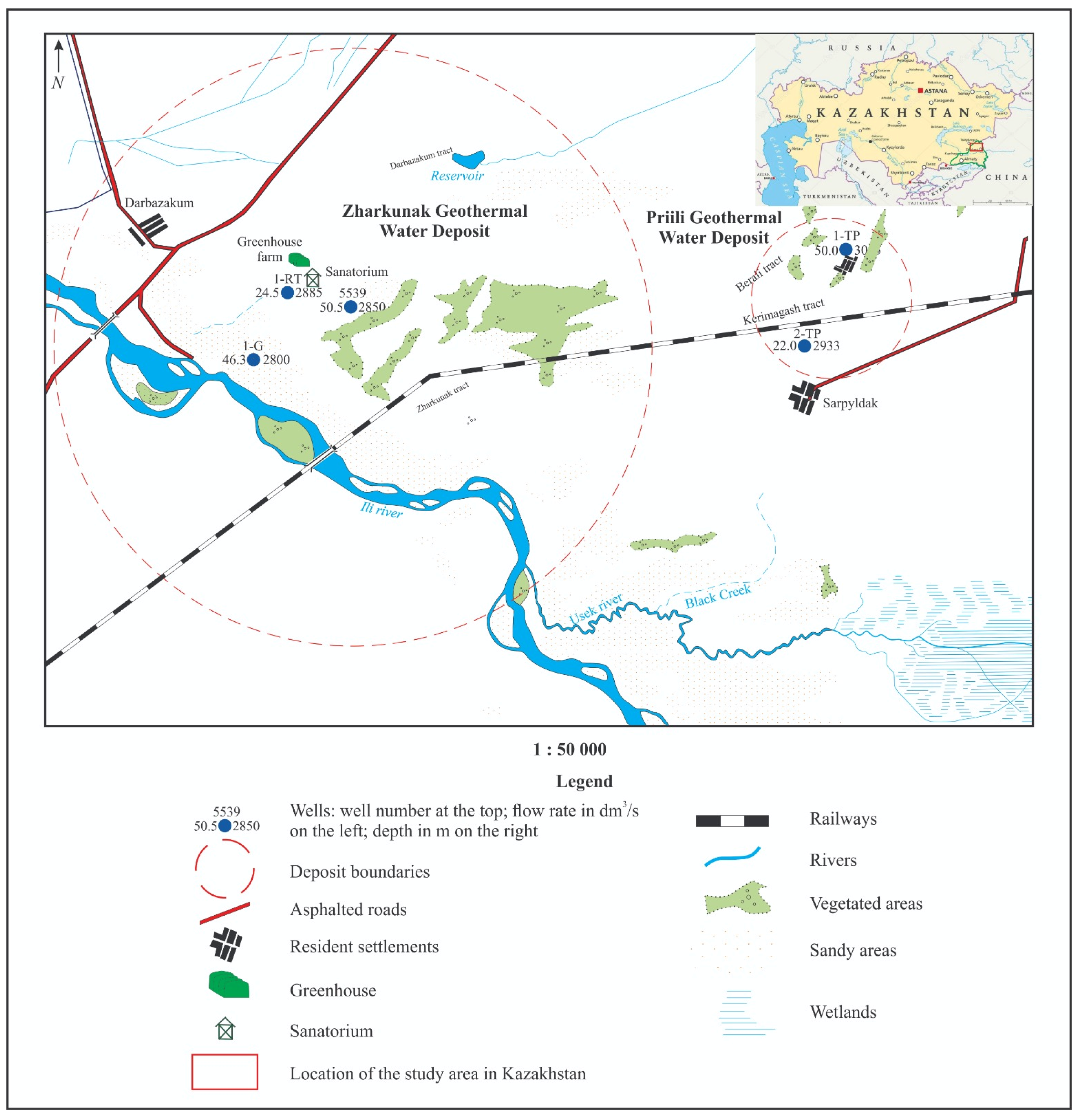
The study was conducted in the Zharkunak geothermal field within the eastern Ili Depression (southeastern Kazakhstan). The structural and hydrogeological setting and the spatial distribution of sampling sites are shown in Figure 1, and key well metadata (coordinates, screened intervals, and depth ranges) are summarized in Table 1. Sampling targeted five deep production wells tapping the Upper Cretaceous reservoir: 5539, 1-RT, 3-T, 1-TP, and 2-TP. Each well was sampled during stabilized self-flow conditions after sufficient discharge to ensure representative formation water at the wellhead. Field measurements included discharge temperature and artesian pressure recorded at the wellhead after hydraulic stabilization. In situ pH was measured immediately at the sampling point to minimize physicochemical changes during storage and transport.
To ensure comparability across the field, the same sampling logic was applied to all five wells: (i) stabilization of discharge conditions, (ii) on-site measurement of physical–chemical parameters, and (iii) collection of dedicated aliquots for major ions, trace elements, and radon activity. This design enables direct inter-well comparison of hydrochemical facies and geochemical signatures across the Zharkunak reservoir system (Figure 1; Table 1). Sampling was conducted through a cycle of five measurement events under stabilized discharge conditions to ensure reproducibility and representative characterization of formation water.

2.3. Study Area and Geological Context

The investigated geothermal system is located in the Zharkunak field within the eastern Ili Depression. The target aquifer consists of Upper Cretaceous quartz sandstones at depths of approximately 2700–2820 m, overlain by younger sedimentary units and underlain by Paleozoic basement rocks. Geological and hydrogeological characteristics, including stratigraphy, temperature distribution, and structural controls, are based on project geological reports by Kalitov [22]. This information provides the geological framework necessary for interpreting hydrochemical data obtained from deep production wells.
The Upper Cretaceous aquifer functions as a confined artesian system with significant hydraulic overpressure. In well 1-RT, the piezometric level rises about 250 m above ground level, indicating strong artesian conditions. Flow rates documented in the technical materials show 24.3 L/s for 1-RT and 50.5 L/s for 5539 under free-flow discharge. Wells 3-T, 1-TP, and 2-TP exhibit discharge temperatures between 89 and 98 °C, consistent with the ascent of deep thermal fluids along permeable structural zones [22].
Hydrodynamic testing around well 5539 included staged discharge, interference monitoring at 1-RT, and observation of piezometric recovery. These tests established reservoir transmissivity, storage parameters, and the hydraulic interconnection between wells in the field. The aquifer’s high productivity results from the coarse-grained quartz sandstones and the presence of deep conductive structures that guide thermal fluids to the surface.
The combination of high temperature, low mineralization, fluoride enrichment, silica saturation, and radon presence across wells 5539, 1-RT, 3-T, 1-TP, and 2-TP reflects the unified hydrogeochemical regime of the Zharkunak field and supports its classification as a significant hyperthermal water system.
The above geological framework provides the basis for the hydrochemical interpretation methods described in the following sections.

2.4. Sampling and Data Sources

Hydrochemical data, including dissolved constituents and radon activity used in this study were obtained exclusively from the certified project technical and analytical reports compiled during deep-well investigations in the Zharkunak geothermal field.
Well 5539 was tested in the interval 2763–2793 m, yielding thermal water at 103 °C and a hydrochemical type defined as bicarbonate–sulfate sodium with mineralization of 0.57 g/L. The recorded composition includes dissolved silica (36.4 mg/L), nitrous acid (2.0 mg/L), fluoride (1.0 mg/L), and bromine (0.2 mg/L), with a pH of 8.1. Physical measurements also document formation water density of 0.992 g/cm3 and nitrogen-dominated dissolved gases. Radon activity reported in the project technical report confirms documentation reaches up to 0.32 nCi/L [22].
Well 1-RT, screened between 2737 and 2817 m, exhibits a sodium-bicarbonate water type with total dissolved solids of approximately 1.0 g/L. Analytical tables show elevated fluoride, natural iodine, and trace-element signatures typical of Upper Cretaceous aquifers. Temperature measurements during flow testing reached 103 °C.
Well 3-T (2264–2349 m and adjacent horizons) provides representative data for the western sector of the reservoir. The water displays modest mineralization (around 0.5–0.6 g/L), with reported chloride, sulfate, and bicarbonate distributions consistent with regional hydrochemical zoning. Trace components include fluoride (1 mg/L) and bromine (0.33 mg/L).
Wells 1-TP (2800–2900 m) and 2-TP (2718–2790 m) supply additional hydrochemical and gas geochemical constraints. Well 1-TP discharges up to 50 L/s at 89 °C and contains nitrogen-rich gases (N2 = 97.47%, Ar = 2.47%). Its ionic composition includes chloride (46.1 mg/L), sulfate (19 mg/L), bicarbonate (91.3 mg/L), and sodium (231.9 mg/L), with trace fluoride (2 mg/L) and iodide (2.4 mg/L). Well 2-TP produces 22 L/s with mineralization near 0.5 g/L and a similar major-ion pattern; trace elements also include fluoride (6 mg/L) and bromine (1.2 mg/L).
Across all wells, physical parameters recorded in the exploration report indicate discharge temperatures between 89 and 103 °C, pH values from 8.1 to 9.0, and mineralization ranging from 0.3 to 1.0 g/L. All interpretations are based directly on certified analytical data documented in the project technical and analytical reports.

2.5. Chemical and Geochemical Analyses

2.5.1. Major Ions and Physical–Chemical Indicators

Chemical characterization of geothermal waters was performed using certified analytical results obtained during controlled test discharges and stabilized self-flow conditions, as described in the Sampling and Data Sources section. The hydrochemical data used in this study were obtained from previously published and archived project reports [22], which document the original field sampling and laboratory analyses of geothermal waters from the Zharkunak site. Field measurements included discharge temperature and artesian pressure recorded at the wellhead after hydraulic stabilization. Total mineralization was determined as dry residue and reported as total dissolved solids (TDS). Laboratory analyses focused on major ions (Na+, Ca2+, Mg2+, Cl, SO42−, and HCO3), determined using standardized hydrochemical procedures applied in state geological exploration practice. Bicarbonate alkalinity was measured by acid–base titration, chloride by argentometric titration, sulfate by gravimetric or turbidimetric methods, and major cations by classical wet-chemical techniques. Ionic concentrations were reported in mg/L and equivalent percentages. Data consistency was verified through comparison of summed major ions with total mineralization values, and only analyses obtained under stabilized discharge conditions were used for interpretation.
Hydrochemical facies and geochemical evolution were evaluated using graphical interpretation methods. Durov diagrams [25] were employed to classify water types and to assess dominant geochemical processes. Schoeller semi-logarithmic diagrams [26] were used to compare ionic concentration patterns among wells within the Zharkunak geothermal field. Details of the software used for diagram construction are provided in Section 2.5.3.
Instrument calibration was performed using certified reference standards prior to analysis, with multi-point calibration curves established for each parameter. Analytical precision and accuracy were assessed through duplicate samples, reagent blanks, and standard reference materials. Charge balance errors for major ions were maintained within ±5%, confirming data reliability for hydrochemical interpretation. All analyses were conducted following standardized laboratory protocols to ensure consistency and reproducibility.

2.5.2. Trace Elements, Radon Activity, pH, and Total Mineralization

Trace-element analysis was performed for bromine (Br), cobalt (Co), copper (Cu), molybdenum (Mo), nickel (Ni), lead (Pb), cadmium (Cd), and selenium (Se). Groundwater samples were collected in acid-washed polyethylene bottles (Nalgene™, Thermo Fisher Scientific, Waltham, MA, USA). Samples were filtered in the field through 0.45 µm membrane filters (MilliporeSigma, Burlington, MA, USA) to remove suspended particulates. Immediately after filtration, samples were acidified with ultrapure nitric acid (Merck KGaA, Darmstadt, Germany) to stabilize dissolved metals and prevent wall adsorption. Quantification of trace elements was conducted using inductively coupled plasma mass spectrometry (ICP-MS, Agilent 7900, Agilent Technologies, Tokyo, Japan). Instrument calibration was performed using multi-element standard solutions (High-Purity Standards, Charleston, SC, USA) prepared in an identical acid matrix. Quality control included procedural blanks, duplicate analyses, and ncertified reference materials. Internal standards were applied to correct for instrumental drift and matrix effects.
Radon activity in groundwater was determined using a liquid scintillation counting technique with a liquid scintillation counter (Quantulus 1220, PerkinElmer Inc., Waltham, MA, USA). Water samples were collected directly into airtight glass scintillation vials (PerkinElmer Inc., Waltham, MA, USA) without headspace to minimize radon loss. Sample preparation and measurements were conducted immediately after collection. The analytical protocol followed established procedures for dissolved radon determination in water [27]. Calibration was performed using radon reference standards (High-Purity Standards, Charleston, SC, USA), and background activity was measured and subtracted from all sample counts. Instrument stability and counting efficiency were verified through repeated measurements of control samples.
pH was measured in situ using a portable electrochemical pH meter equipped with automatic temperature compensation (Hanna Instruments HI98191, Hanna Instruments Inc., Woonsocket, RI, USA). The instrument was calibrated daily using standard buffer solutions (pH 4.01, 7.00, and 10.01; Hanna Instruments Inc., Woonsocket, RI, USA) prior to field measurements. Measurements were performed directly at the sampling site to avoid physicochemical changes associated with sample storage and transport. The pH meter has an accuracy of ±0.01 pH units and a resolution of 0.01 pH units, ensuring reliable field measurements.
Total dissolved mineralization was determined using a gravimetric method. Water samples were evaporated under controlled laboratory conditions using a drying oven (Memmert UN series, Memmert GmbH, Germany) until constant weight was achieved. Residues were weighed using an analytical balance (accuracy ±0.0001 g; e.g., Mettler Toledo, Switzerland). To verify analytical consistency, mineralization values were cross-checked by summation of major dissolved ionic constituents. Analytical procedures followed standard protocols for groundwater mineralization assessment.

2.5.3. Hydrochemical Classification and Interpretive Tools

Hydrochemical classification and geochemical interpretation were conducted using established graphical, numerical, and thermodynamic tools commonly applied in groundwater and geothermal water studies. All tools were applied to quality-controlled chemical datasets and were used exclusively for interpretive and classification purposes.
Major cation and anion concentrations were converted from mg/L to milliequivalents per liter (meq/L) and plotted on a Durov diagram to classify hydrochemical facies and identify dominant geochemical processes. The diagram was constructed using (Golden Software Grapher, Version 26.1.314, Golden Software LLC, Golden, CO, USA; https://www.goldensoftware.com). The diagram allows simultaneous evaluation of water type, ion exchange, and mixing trends, providing insight into groundwater evolution. It was constructed using multiple hydrochemical analyses (sampling cycles) for each well to capture compositional variability, following the classical method of Durov [25].
Schoeller diagrams were constructed using major-ion concentrations expressed in meq/L and plotted on a logarithmic scale following the classical approach of Schoeller [26]. Schoeller diagrams were constructed using OriginPro (Version 2024b; OriginLab Corporation, Northampton, MA, USA; https://www.originlab.com). These diagrams were used to compare ionic distribution patterns among samples, evaluate similarities and contrasts in hydrochemical composition, and identify systematic variations related to flow paths and lithological controls.
Gibbs diagrams were constructed by plotting total dissolved solids (TDS) against the ratios Na+/(Na+ + Ca2+) and Cl/(Cl + HCO3), following the classical approach of Gibbs [28]. The diagrams were prepared using Microsoft Excel (Microsoft Office, Version 365; Microsoft Corporation, Redmond, WA, USA; https://www.microsoft.com). These plots were used as a qualitative framework to identify dominant hydrogeochemical controls, including precipitation influence, rock–water interaction, and evaporation–crystallization processes. Although originally developed for surface waters, the Gibbs diagram is applied here for first-order interpretation of geothermal systems and is complemented by additional hydrochemical evidence, including facies analysis and major-ion relationships.
Analytical accuracy and internal consistency were assessed by calculating the ionic charge balance error (CBE), defined as the percentage difference between the sum of cation and anion equivalents. Calculation was performed using standard spreadsheet-based methods in Microsoft Excel (Microsoft Office, Version 365; Microsoft Corporation, Redmond, WA, USA; https://www.microsoft.com). Only analyses within accepted hydrochemical tolerance limits [29] were considered suitable for further interpretation.
Mineral saturation indices (SI) were calculated using the PHREEQC (Version 3.7, U.S. Geological Survey; https://www.usgs.gov/software/phreeqc-version-3) geochemical modeling code [30] based on measured major-ion chemistry, pH, and temperature reported for each well. Activities were computed using an appropriate aqueous speciation model, and SI values were obtained for quartz, chalcedony, calcite, dolomite, and fluorite to evaluate equilibrium states and potential precipitation/dissolution tendencies under reservoir and discharge conditions. These calculations were used to support the interpretation of silica and carbonate scaling potential and to compare equilibrium behavior among wells.
Radon activities measured in water samples were interpreted according to guideline values proposed by the World Health Organization [31]. Radon concentrations were categorized relative to recommended limits to support environmental and public health risk assessment. This step involved direct comparison with guidelines thresholds and did not require specialized software tools.
Together, these tools provided a coherent framework for hydrochemical classification, geochemical process interpretation, analytical quality control, and preliminary radiological safety evaluation.
The use of certified project datasets combined with strict analytical quality control ensures that the dataset is suitable for quantitative hydrogeochemical modeling and comparative interpretation.

3. Results

The Results section is organized to present hydrochemical characteristics in a structured sequence, beginning with major-ion composition, followed by trace elements, dissolved gases, and geochemical modeling. This arrangement ensures a clear linkage between measured parameters, graphical interpretation, and thermodynamic evaluation of the geothermal system.

3.1. Physical–Chemical Characteristics

Cretaceous geothermal waters from the Zharkunak field are hyperthermal and weakly mineralized. The waters are alkaline. Discharge temperature ranges from 89 to 98 °C in wells 3-T, 1-TP, 2-TP, and 1-RT. Well 5539 reaches 103 °C. Total mineralization ranges from 0.3 to 1.0 g/L. The lowest values occur in the Cretaceous interval of well 1-TP at about 0.51 g/L. Wells 5539 and 1-RT reach about 0.76–1.0 g/L. Measured pH ranges from 8.1 to 9.0. Water density in the Cretaceous interval of well 1-RT is about 0.992 g/cm3.

3.2. Major-Ion Composition and Hydrochemical Facies

Major-ion chemistry shows sodium dominance across all Cretaceous samples. Water from well 5539 has a sodium base type. The anion pattern includes bicarbonate and sulfate with subordinate chloride. National classification standards [32] place this water in the siliceous–fluoride hyperthermal class with moderate radon activity. Water from well 1-RT is chloride–hydrocarbonate sodium. Mineralization remains below 1.0 g/L. Water from the Cretaceous interval of well 1-TP is hydrocarbonate–sulfate sodium.
Major-ion concentrations are reported in mg/L. Equivalent concentrations in meq/L used for hydrochemical diagrams were calculated and provided in the Supplementary Material. Major-ion concentrations are reported in mg/L in Table 2. Equivalent concentrations in milliequivalents per liter used for hydrochemical diagrams were calculated from these data and are provided in Table S1 of the Supplementary Material. Relative ionic composition is summarized in Table S2, and the ionic charge balance assessment (ΣCations, ΣAnions, and CBE) is provided in Table S3. Electroneutrality was checked using the reported major ions (Na+, Ca2+, and Mg2+ versus Cl, SO42−, and HCO3). Based on these species, the charge balance error (CBE) spans 0.5–19.2% across the five wells, with the lowest imbalance in 1-RT (~0.5%) and higher positive imbalance in 1-TP (~19%) and 2-TP (~17%). These larger deviations likely reflect that the archival summaries do not always list the full dissolved-ion suite needed to close charge balance, but the dataset remains adequate for facies comparison and pattern-based hydrochemical diagrams.
As summarized in Table 2, total dissolved solids range from 0.3 to 1.0 g/L, while sodium remains the dominant cation across all wells. Calcium and magnesium concentrations are consistently low, supporting the interpretation of cation exchange processes and limited carbonate buffering.
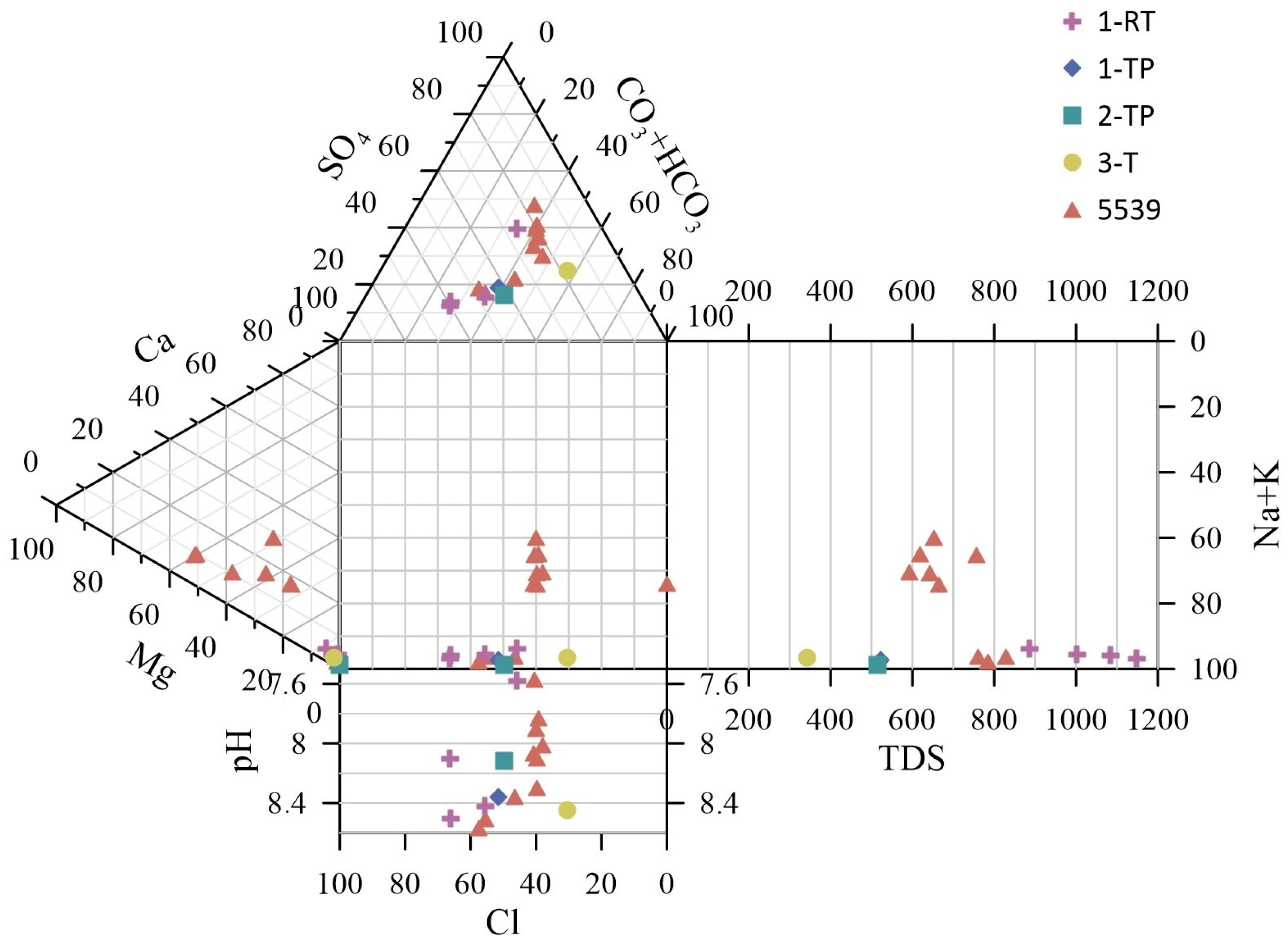
The Durov diagram (Figure 2) shows that all samples cluster within the Na–HCO3–SO4 and Na–SO4–Cl fields, confirming sodium-dominated facies and indicating strong water–rock interaction processes. The absence of samples in evaporation-controlled fields indicates that water–rock interaction, rather than evaporative concentration, governs the chemical evolution.
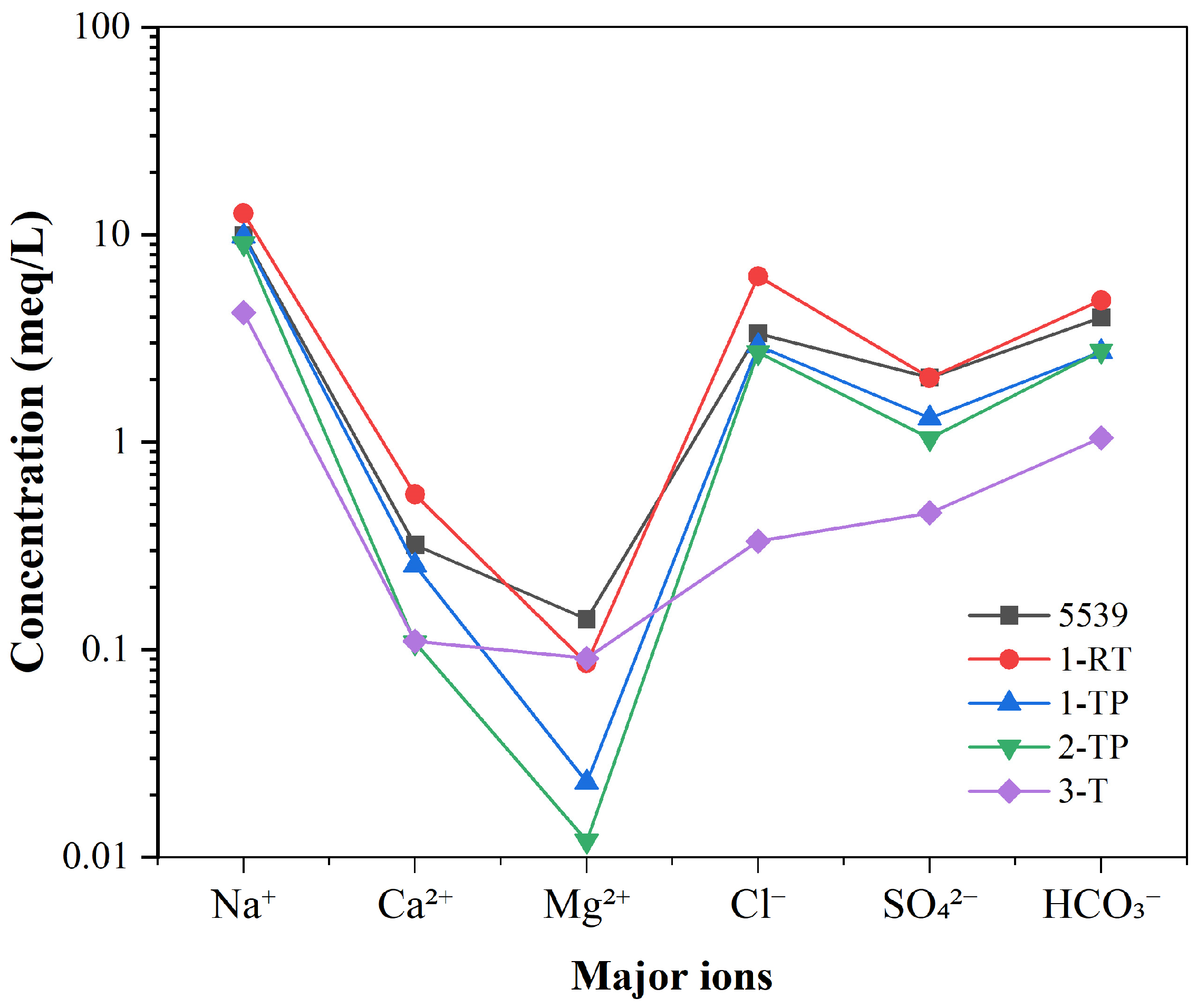
Well 5539 plots in a bicarbonate–sulfate-rich anion sector. Well 1-RT shifts toward the sulfate–chloride sector. Well 1-TP remains in the bicarbonate–sulfate sector. Plot positions align with cation exchange and progressive water–rock interaction [25]. Schoeller plots show high Na+ and low Ca2+ and Mg2+ [26]. The pattern defines hydrochemical zoning inside one confined reservoir.
Charge balance error remains within accepted hydrochemical limits for all samples. The major-ion dataset supports facies classification and ratio analysis [29].

3.3. Schoeller Hydrochemical Diagrams

To enable detailed comparison of major-ion distributions among the investigated wells, concentrations were converted from mg/L to milliequivalents per liter (meq/L) and compiled in Table S1. Schoeller diagrams constructed from these data provide a visual assessment of inter-well similarity and ionic balance relationships [26].
The Schoeller diagram (Figure 3) indicates that all waters are characterized by dominant Na+ and Ca2+ cations, whereas Mg2+ remains consistently subordinate. Potassium concentrations were negligible; therefore, sodium is presented individually instead of combined Na+ + K+. On the anion side, Cl generally exceeds SO42− and HCO3, although the relative proportions vary slightly between wells. These trends corroborate the sodium-dominated water types identified from major-ion ratios and Durov facies classification.

3.4. Geochemical Fields and Gibbs Relationships

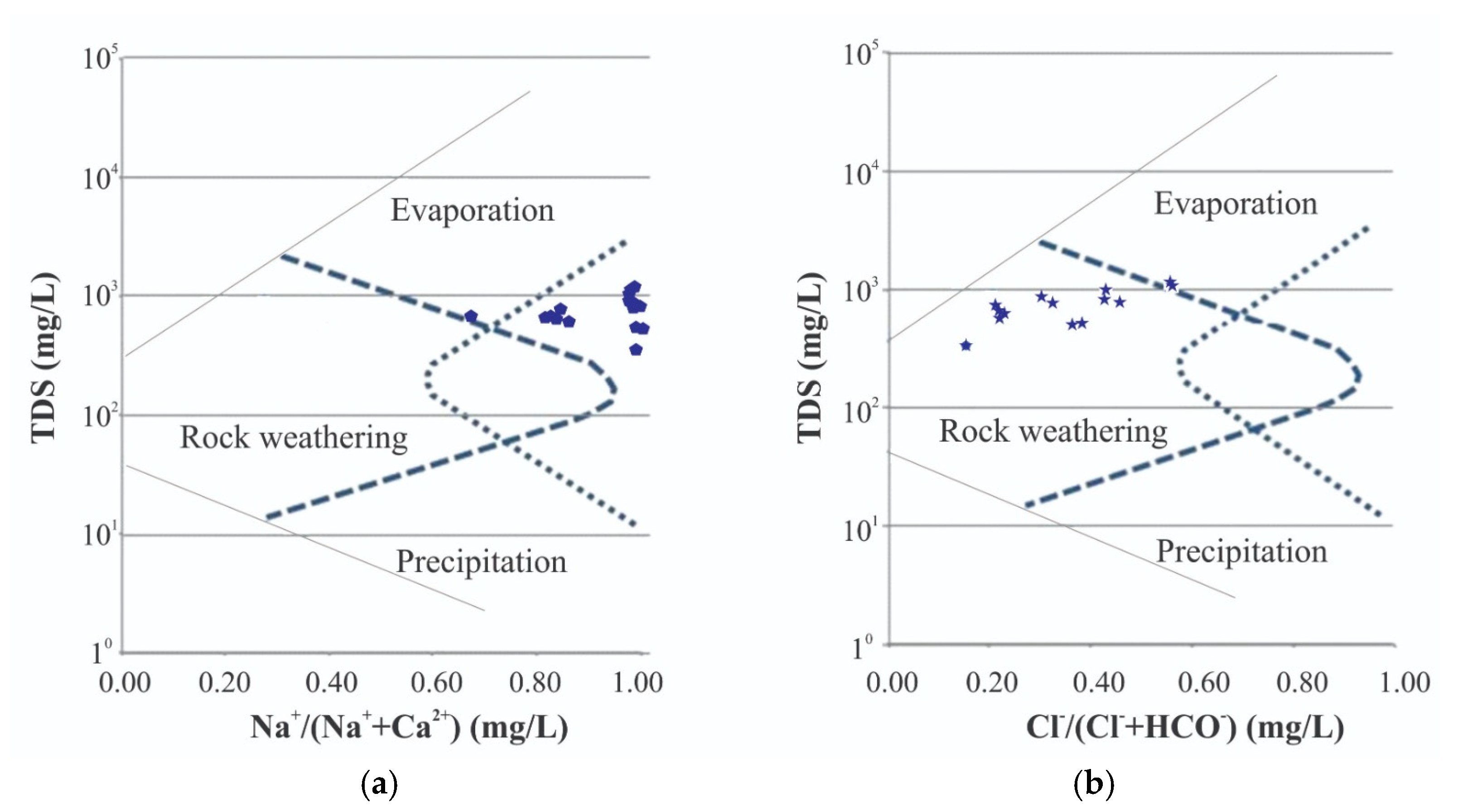
The Gibbs diagram (Figure 4a,b) suggests that the studied waters fall within a transitional domain between water–rock interaction and mixed processes. However, the overall hydrochemical characteristics indicate that water–rock interaction remains the dominant controlling mechanism [28]. The schematic fields are used as a qualitative framework and are not derived from the measured dataset. The cation relationship between TDS and Na+/(Na+ + Ca2+) (Figure 4a) indicates that dissolved constituents are acquired mainly through water–rock interaction. The anion relationship between TDS and HCO3/(HCO3 + Cl) (Figure 4b) suggests limited influence of external salinity sources. Consistent departures of Na+/Cl and Ca2+/Mg2+ from simple halite or carbonate dissolution trends, together with the separation among wells, indicate modest internal hydrochemical heterogeneity within the Cretaceous aquifer.
This interpretation is supported by elevated silica concentrations indicative of silicate dissolution, fluoride enrichment associated with interaction with basement lithologies, and relatively low total dissolved solids, which do not reflect strong evaporative concentration. In addition, the confined nature and depth of the reservoir (>2700 m) limit the influence of evaporation processes, which are typically restricted to near-surface environments. Therefore, the Gibbs diagram is interpreted in conjunction with complementary hydrochemical indicators rather than as a standalone diagnostic tool. The measured concentrations of dissolved silica (SiO2) in the studied wells are presented in Table 3. SiO2 concentrations are reported as dissolved silica (mg/L), corresponding to H2SiO3 in aqueous form. Dissolved silica (SiO2) concentrations in the studied wells range from 22.5 to 60.3 mg/L, reflecting significant silica enrichment associated with water–rock interaction under elevated temperature conditions.
The combined interpretation of Durov, Schoeller, and Gibbs diagrams collectively indicates that the Zharkunak waters are predominantly influenced by rock–water interaction, with minor contributions from mixed processes related to local hydrogeological variability.

3.5. Trace Elements and Microcomponents

Fluoride concentrations are elevated in the Cretaceous geothermal waters. In well 5539, fluoride reaches up to 7.34 mg/L (maximum reported), while the tested Cretaceous interval also reports dissolved silica 36.4 mg/L and pH 8.1. Dissolved silica exceeds 50 mg/L in well 5539, whereas other Cretaceous samples show silica in the tens of mg/L range. Where fluoride is reported for the other wells, values span 1.60 mg/L (3-T) to 2.88 mg/L (2-TP), and 1-TP reports fluoride 3.35 mg/L. Water from 1-RT includes a natural iodine ion and is described as fluoride-enriched. Trace-element and microcomponent information reported in Table 4 to document inter-well variability. Dissolved silica is elevated in the Upper Cretaceous geothermal waters, exceeding 50 mg/L in well 5539 and reaching 36.4 mg/L in the 2-TP (2718–2790 m) interval sample; therefore, cooling during discharge and surface handling may shift the waters toward silica supersaturation and promote silica precipitation [33,34].
Measured SiO2 concentrations (22.5–60.3 mg/L) exhibit a systematic increase from wells 2-TP and 3-T to wells 5539 and 1-RT, reflecting progressive silica enrichment during fluid circulation. This trend closely corresponds with the calculated quartz saturation indices (Table 3), where higher silica concentrations align with SI values approaching or exceeding equilibrium. The agreement between measured silica content and modeled saturation state confirms that silica behavior in the Zharkunak geothermal system is governed by equilibrium with silicate minerals and indicates a potential risk of silica precipitation during cooling and pressure decline.
Trace-element and microcomponent information available from certified project analytical datasets is summarized in Table 3. Although complete quantitative coverage is limited, the reported values document clear inter-well variability. Where fluoride is reported, concentrations range from approximately 1.60 mg/L in 3-T to 2.88 mg/L in 2-TP, while 1-TP reports fluoride at 3.35 mg/L. In well 1-RT, iodine is reported qualitatively, and fluoride is described as elevated, but specific concentrations are not tabulated in the dataset. The presence of bromine and iodine further supports interaction with sedimentary horizons and deep circulating fluids, as halogens commonly behave conservatively and may become enriched during prolonged geothermal circulation [35,36]. Qualitative reporting of trace metals such as strontium, molybdenum, nickel, and cobalt is also noted in the project summaries, although exact concentrations are not consistently available across all wells [35,37]. Overall, Table 3 provides a concise record of the reported microcomponent distribution across the five wells and complements the major-ion results by highlighting well-to-well differences within the Upper Cretaceous reservoir.

3.6. Radon and Dissolved Gases

Radon activity in Zharkunak geothermal waters is summarized in Table 4 and is reported in nCi/L. The highest radon activity occurs in well 5539 (2763–2793 m) and reaches 0.32 nCi/L (≈12 Bq/L; 1 nCi/L = 37 Bq/L), which is consistent with strong fault-controlled upflow and comparatively short residence time. In contrast, well 1-RT (2737–2817 m) is reported as 0 nCi/L, supporting greater residence time with partial radon decay and/or degassing along the flow path; this interpretation is consistent with the short-lived nature of 222Rn (half-life 3.82 days) and its tendency to partition from water to air under changing temperature, pressure, and flow conditions [38,39,40]. Lower but detectable radon is observed in well 3-T (2264–2349 m) at 0.054 nCi/L (≈2 Bq/L), suggesting localized fracture connectivity and mixed flow with an intermediate residence time rather than uniformly rapid upflow. Similarly, well 2-TP (2718–2790 m) shows 0.054 nCi/L (≈2 Bq/L), indicating a minor structurally controlled contribution and mixing, again consistent with intermediate residence conditions. Well 1-TP (2800–2900 m) is reported as 0 nCi/L, which is compatible with longer residence time and radon loss via decay and/or degassing, and may also reflect dilution by low-radon water (Table 5) [39,40].
Dissolved-gas composition is available only for well 1-TP and indicates a nitrogen-dominant gas phase with N2 = 97.47 vol% and Ar = 2.47 vol%. Because gas data are not reported for the other wells, this composition is used as a site-specific descriptor rather than a basis for inter-well comparison.

3.7. Saturation Indices and Scaling Potential

PHREEQC-derived saturation indices for quartz, chalcedony, calcite, dolomite, and fluorite are presented in Table 6. Quartz SI values range from 0.07 to 0.24, indicating near-equilibrium to slight supersaturation across all investigated wells, whereas chalcedony SI values remain slightly negative (−0.19 to −0.03). This pattern indicates that silica phases are thermodynamically close to equilibrium at discharge conditions and explains the elevated risk of silica scaling during cooling in pipelines and heat-exchange systems. In contrast, calcite and dolomite are undersaturated to weakly saturated, with calcite SI ranging from −0.44 to −0.09 and dolomite SI from −0.91 to −0.27, which indicates low carbonate scaling tendency under the observed alkaline but weakly mineralized conditions. Fluorite SI remains negative in all wells (−0.79 to −0.42), showing that fluorite saturation is not reached despite elevated fluoride concentrations. This supports the interpretation of fluoride enrichment as a result of water–rock interaction under low-Ca conditions rather than direct fluorite equilibrium control.
Overall, the results demonstrate a consistent hydrochemical pattern across all wells, characterized by sodium dominance, elevated silica and fluoride concentrations, and near-equilibrium conditions for silica minerals. These findings collectively indicate that the geothermal system is controlled by high-temperature water–rock interaction and structurally guided fluid circulation, with limited influence from external salinity sources.

4. Discussion

4.1. Major-Ion Chemistry and Ionic Controls

The geothermal waters exhibit a coherent major-ion composition characterized by sodium dominance and low to moderate total mineralization. As summarized in Table 2, Na+ represents the principal cation in all investigated wells, with concentrations ranging from approximately 150 to 270 mg/L. Calcium occurs at lower but significant levels, whereas magnesium remains consistently minor. Bicarbonate is the dominant anion in all samples, whereas sulfate enrichment is limited to well 3-T, with lower concentrations in other wells compared to bicarbonate and chloride. Total dissolved solids (TDS) increase with depth and reach a maximum value of about 0.76 g/L in well 5539, consistent with longer residence time and enhanced water–rock interaction within the Upper Cretaceous reservoir [36,41]. These ionic proportions define predominantly sodium–bicarbonate (Na–HCO3) water types, with local variations toward mixed Na-HCO3-Cl, compositions, indicating minor chloride enrichment in specific wells.
Charge balance assessment (Table S3) indicates a systematic excess of cationic charge across all wells, which likely reflects incomplete reporting of certain ionic species and alkalinity speciation (CO32− versus HCO3), rather than analytical error; charge balance deviation is a recognized issue in hydrochemical datasets when alkalinity/carbonate system components and minor ions are not fully constrained [42].
Despite this limitation, the internal consistency of ionic trends among wells supports the suitability of the dataset for comparative hydrochemical interpretation, especially for evaluating relative facies similarity and depth-related concentration changes across the field.

4.2. Hydrochemical Facies and Extended Durov Diagram Interpretation

Hydrochemical facies and geochemical trends are constrained using graphical methods, including the extended Durov diagram (Figure 2) together with the Schoeller plot (Figure 3) [26]. The Durov diagram [25] is a widely applied tool for the characterization of groundwater chemistry. In contrast to the Piper diagram, the extended Durov plot not only identifies hydrochemical facies but also incorporates TDS and pH within the same graphical framework, enabling simultaneous evaluation of facies, water–rock interaction, and salinity evolution [43,44,45]. All samples cluster within sodium-dominated fields, indicating Na+ as the principal cation and reflecting chemically evolved waters rather than recently recharged meteoric inputs. The anion triangle indicates bicarbonate dominance across all samples, placing the waters primarily within Na–HCO3 facies, with a localized shift toward Na–SO4 characteristics observed only in well 3-T, while other samples show mixed Na–HCO3–Cl compositions. The relative distribution of chloride indicates moderate but consistent contributions without development of distinct chloride-type facies, suggesting that deep circulation and silicate-controlled buffering are the primary controls on ionic composition, consistent with the hydrochemical patterns and saturation index results.
Projection into the central square of the Durov diagram reveals clustering in zones associated with ion-exchange processes and advanced water–rock equilibrium. The displacement toward sodium-rich fields is consistent with progressive cation exchange, where Ca2+ and Mg2+ in solution are replaced by Na+ associated with feldspar–clay mineral reactions and exchange sites [46]. The persistently low magnesium across all wells further supports equilibration at elevated temperatures, because Mg is commonly depleted in high-temperature geothermal waters hosted by felsic/silicate-rich systems [47,48]. The extended axes indicate that increasing mineralization corresponds to stronger Na+ + K+ dominance, while pH remains within a narrow alkaline range. This pattern is characteristic of confined geothermal systems with long residence times, limited dilution, and buffering by silicate dissolution reactions. The most mineralized waters plot at higher TDS without shifting toward chloride dominance, indicating progressive chemical maturation rather than mixing with a saline end-member. Overall, the Durov-based facies assignment corroborates the major-ion patterns and supports interpretation of a single, chemically coherent geothermal system, with depth-related flow-path differences producing modest concentration variability across the study area.

4.3. Trace Elements: Signatures of Water–Rock Interaction

Elevated fluoride and dissolved silica are diagnostic features of the Zharkunak Cretaceous thermal waters. Project datasets report fluoride enrichment (up to ~10 mg/L (max 9.74 mg/L) in the compiled records), while the tested Cretaceous interval in well 5539 contains fluoride of 7.34 mg/L together with dissolved silica of 36.4 mg/L at pH 8.1, indicating a fluorine–silica imprint even in the interval-resolved composition. High temperature and alkaline conditions promote silicate dissolution and enhance fluoride release from fluorine-bearing silicates and accessory phases within the sandstone–basement flow path, particularly where fluorite saturation is not achieved [37,47]. The relatively low Ca2+ concentrations limit calcium–fluoride precipitation, favoring fluoride persistence in solution, while dissolved silica levels are consistent with near-equilibrium conditions with quartz or chalcedony at reservoir temperatures, as supported by the calculated saturation indices [33]. The consistent occurrence of elevated dissolved silica (H2SiO3) and fluoride across all wells indicates a shared geochemical origin linked to prolonged interaction with silicate-rich lithologies. This relationship reinforces the interpretation that high-temperature water–rock interaction, rather than isolated mineral dissolution, governs trace-element enrichment.
Trace-element and microcomponent data (Table 3) provide additional constraints on the nature and duration of water–rock interaction within the Zharkunak Upper Cretaceous geothermal system. Although the dataset is heterogeneous and partly qualitative, consistent patterns emerge that reflect deep circulation through a stratigraphically and structurally complex reservoir, where prolonged fluid–mineral interaction governs trace-element signatures [35].
Bromine is detected in several wells at low to moderate concentrations (0.45–0.60 mg/L; Table 3), exceeding typical freshwater background levels and indicating interaction with halogen-bearing sedimentary minerals or minor contributions from connate fluids retained within the sedimentary sequence. The presence of iodide in well 1-TP and qualitative reports of natural iodine in well 1-RT further support the involvement of sedimentary horizons enriched in volatile or organically associated elements, as halogens commonly behave conservatively during deep fluid circulation but may become enriched through water–sediment interaction under confined geothermal conditions [35,36].
In well 5539, a broader suite of trace metals (Mo, Ni, Co, Cu, Pb, Cd, and Se) is reported with quantified ranges (Table 3), consistent with prolonged contact between geothermal fluids and mineralized sandstone and basement lithologies along a deep flow path. Molybdenum and selenium, commonly associated with sulfide phases and adsorption onto fine-grained or organic-rich materials, likely reflect leaching under elevated temperature and slightly alkaline conditions, whereas the low but detectable concentrations of Pb and Cd suggest slow mobilization from metal-bearing accessory minerals during progressive water–rock interaction [35,37].
Inter-well differences in trace-element signatures should be interpreted cautiously because analytical coverage varies among wells (Table 3). Nevertheless, the comparatively richer and more diverse trace-element inventory in well 5539 is consistent with its higher discharge temperature and inferred structural connection to deep fault zones, whereas wells such as 1-RT likely reflect more mixed signatures influenced by overlying Paleogene-Neogene aquifers and shorter or more heterogeneous flow pathways.
To formalize these controls, PHREEQC saturation indices (SI = log10(IAP/K)) were calculated for quartz, chalcedony, calcite, dolomite, and fluorite using measured major-ion chemistry, pH, and discharge temperature for each well. The numerical values presented in Table 5 provide quantitative support for the hydrogeochemical interpretation of the Zharkunak geothermal system. Saturation indices calculated using PHREEQC (Table 5) provide quantitative constraints on mineral equilibrium conditions, indicating near-equilibrium to slight supersaturation with respect to silica phases and undersaturation with respect to carbonate and fluorite minerals. Silica minerals exhibit near-equilibrium to slightly supersaturated conditions, indicating active water–rock interaction within silicate-rich formations and suggesting a potential for silica scaling during cooling. In contrast, carbonate minerals remain undersaturated, consistent with the low Ca–Mg content and sodium-dominated composition of the waters, reflecting limited carbonate buffering capacity. Fluorite is also undersaturated across all wells, indicating that elevated fluoride concentrations are not controlled by mineral equilibrium but instead result from prolonged circulation in alkaline environments and interaction with fluoride-bearing lithologies under conditions of limited Ca2+ availability. These results collectively indicate that the geochemical evolution of the system is governed primarily by silicate dissolution, ion exchange, and structural flow pathways. The observed saturation behavior aligns with thermodynamic expectations for high-temperature silicate-hosted geothermal systems, where decreasing silica solubility during cooling promotes scaling, while carbonate and fluorite precipitation remain secondary under the reported discharge conditions (89–103 °C) [33,37,48].

4.4. Radon, Faulting, and Geothermal Anomalies

Radon levels up to ~10 nCi/L in well 5539 provide strong evidence for fluid circulation along deep tectonic fractures, where uranium-bearing minerals in basement rocks generate and release radon during alpha decay of 226Ra within the 238U decay series. Elevated radon in geothermal and fractured-rock aquifers is commonly associated with enhanced emanation along permeable fault zones and rapid upward transport before radioactive decay (half-life 3.82 days), particularly in systems characterized by active tectonics and deep circulation [38,39,49]. The coincidence of the highest radon concentrations with maximum temperature (103 °C) and a structurally mapped deep fault suggests that fault zones are primary conduits for both heat and radiogenic gases. In contrast, the very weak radon signal in well 1-RT indicates either a more distal position from major permeable structures or more efficient radon decay and degassing along a longer subsurface flow path prior to discharge.
This pattern underlines the structural control on the geothermal anomaly of the Cretaceous aquifer and supports the use of radon as a sensitive tracer of active fluid pathways within tectonically controlled geothermal systems, where spatial radon variability reflects fracture connectivity, permeability contrasts, and groundwater residence time differences [39].

4.5. Environmental and Health Implications

Fluoride concentrations in the Zharkunak geothermal waters reach up to ~10 mg/L, which significantly exceeds the World Health Organization (WHO) guideline value of 1.5 mg/L for drinking water [50]. Long-term consumption without treatment or dilution may therefore increase the risk of dental and skeletal fluorosis. In practice, direct potable exposure is already limited by current utilization patterns. Well 1-TP is used mainly for therapeutic applications and for heating and domestic hot-water supply at the Kerimagash sanatorium. Wells 2-TP, 5539, and 1-RT are primarily used for greenhouse heating, where heat extraction is the main objective and drinking-water intake can be avoided by design.
Radon in geothermal water requires pathway-based risk management. According to WHO guidance, exposure may occur through ingestion and, more importantly, through inhalation after radon is released from water into the air [31]. This pathway is particularly relevant in enclosed environments such as spa facilities, technical rooms, and poorly ventilated bathing areas. For this reason, balneological use should incorporate engineering controls. These include adequate ventilation, minimization of turbulent aeration in confined spaces, and management of exposure duration. Where appropriate, routine radon monitoring should also be implemented in accordance with WHO recommendations [31].
An additional environmental concern is associated with well 3-T, which discharges thermal water into an open pond. Open-surface disposal enhances radon release to the atmosphere during cooling and agitation. This process may create a localized near-surface exposure zone for workers and visitors near the pond, even if indoor exposure is not affected [31,38]. Simple risk-control measures are therefore recommended. These include restricted access to the discharge area, appropriate siting away from frequently occupied zones, and periodic monitoring of air and radon levels during peak discharge conditions.
Trace constituents such as selenium and iodine may support therapeutic use when properly managed. Their presence can be beneficial in controlled balneological settings. However, such waters are not suitable for routine domestic consumption without treatment and regulatory oversight [31,50].

4.6. Implications for Geothermal Utilization and Scaling

The combination of relatively low mineralization (0.3–1.0 g/L), high temperature (up to 103 °C), low Ca2+ and Mg2+, and moderate sulfate suggests that the Zharkunak Cretaceous waters are favorable for geothermal heat extraction with moderate scaling risk. Carbonate scaling potential is limited by low Ca2+ and moderate alkalinity, while sulfate scaling is constrained by low Ca2+ and moderate SO42−. Similar hydrochemical conditions in silicate-hosted geothermal systems have been shown to reduce calcite and anhydrite precipitation risk relative to systems dominated by silica scaling [33,37].
The PHREEQC-derived saturation indices (Table 5) indicate a silica-controlled water–rock interaction and show that carbonate and fluorite minerals remain undersaturated under the observed conditions. As fluids cool through heat exchangers and pipelines, silica solubility decreases, and amorphous silica oversaturation may develop, promoting scaling. This thermodynamic behavior is well documented in high-temperature geothermal operations, where cooling-induced silica precipitation represents a major operational constraint [33,34]. Proper temperature management, pH control, and system design (e.g., minimizing excessive cooling before reinjection and reducing residence time in surface installations) are therefore critical to sustaining long-term geothermal operations.
Fluoride, while not controlling scaling because fluorite saturation is not reached under discharge conditions, may influence material selection for pipeline linings and reinjection strategies due to potential interactions with certain alloys and cementitious materials in geothermal infrastructure [37]. These modeled results, together with the observed major-ion composition, suggest that geochemical evolution is primarily governed by silicate dissolution, ion exchange, and structurally controlled fluid circulation [33,34].

4.7. Regional Context and Broader Significance

The Zharkunak Cretaceous aquifer represents a key example of deep, weakly mineralized, fluoride- and silica-rich geothermal systems in intramontane basins of Central Asia. Comparable structurally controlled geothermal systems in continental settings demonstrate that deep circulation along fault zones, interaction with silicate-rich lithologies, and prolonged residence time collectively produce low-salinity yet chemically distinctive Na-dominant thermal waters enriched in fluoride and silica [35,36]. Its hydrochemical and geochemical signatures demonstrate how structural setting, lithological composition, and deep circulation combine to generate hyperthermal waters that remain weakly mineralized but geochemically mature. The results, therefore, provide a benchmark for comparing other Cretaceous and Mesozoic geothermal systems across Central Asia and analogous tectonically active basins worldwide. Moreover, the coexistence of fluoride enrichment and measurable radon activity highlights the broader relevance of integrating hydrochemical facies analysis with gas geochemical tracers when evaluating structurally controlled geothermal reservoirs [35]. Collectively, the Zharkunak system contributes to the broader understanding of radon-bearing, fluoride-rich geothermal reservoirs and reinforces the importance of structural–hydrochemical coupling in deep continental aquifers [36].

5. Conclusions

The Zharkunak geothermal system is identified as a deep, structurally controlled hydrothermal reservoir characterized by high-temperature (89–103 °C), alkaline (pH 8.1–9.0), and low-mineralized (0.3–1.0 g/L) waters. The dominance of sodium and the predominantly Na–HCO3 hydrochemical facies, with local variations toward mixed Na–HCO3–Cl compositions, as demonstrated by hydrochemical diagrams, indicate that water–rock interaction and ion exchange are the primary controls on hydrochemical evolution. Elevated dissolved silica (22.5–60.3 mg/L as SiO2) and fluoride concentrations (up to ~10 mg/L), consistently observed across all wells, indicate prolonged interaction with quartz-rich lithologies under calcium-limited conditions. The saturation index results further show that silica phases are near equilibrium to slightly supersaturated, supporting the observed risk of silica scaling during cooling, whereas carbonate minerals remain undersaturated, consistent with low Ca–Mg concentrations. Measurable radon activity, particularly in well 5539, provides additional evidence of fault-controlled circulation pathways linking deep sources to the reservoir.
This study is subject to several limitations. The hydrogeochemical interpretation is based on a limited number of production wells and represents discharge conditions rather than in-reservoir equilibrium states. Geochemical modeling results, expressed as PHREEQC-derived saturation indices, indicate that silica phases are near equilibrium to slightly supersaturated, whereas carbonate and fluorite minerals remain undersaturated under the observed conditions. In addition, radon behavior was evaluated through concentration data without detailed transport or degassing modeling.
Future research should focus on expanding spatial and temporal monitoring, integrating isotopic and mineralogical analyses, and applying reactive transport modeling to better constrain subsurface processes. Particular attention should be given to silica scaling kinetics under operational conditions, fluoride mobility under varying geochemical regimes, and radon degassing pathways in engineered and open systems. These efforts will support more reliable resource management and enhance the safe and sustainable utilization of geothermal waters in the Zharkunak field.

Supplementary Materials

The following supporting information can be downloaded at: https://www.mdpi.com/article/10.3390/w18070870/s1. Table S1: Major-ion concentrations converted to milliequivalents per liter (meq/L) for geothermal waters of the Zharkunak field; Table S2: Relative ionic composition (meq%) of geothermal waters from the Zharkunak field used for charge balance assessment; Table S3: Ionic charge balance assessment of Zharkunak geothermal waters.

Author Contributions

Conceptualization, B.K., A.K. and D.K.; methodology, B.K., A.K., V.Z. and D.K.; validation, B.K., Y.A., R.A. and D.K.; formal analysis, B.K.; investigation, B.K., A.K. and Z.A.; resources, M.K. and Y.A.; data curation, B.K., A.K. and R.K.; writing—original draft preparation, B.K.; writing—review and editing, B.K., D.K. and R.K.; visualization, B.K., A.K., V.Z. and D.K.; supervision, D.K.; project administration, D.K.; funding acquisition, M.K. Software, Y.A. and M.K. All authors have read and agreed to the published version of the manuscript.

Funding

This research was funded by the Committee of Science of the Ministry of Science and Higher Education of the Republic of Kazakhstan (Grant No. BR28713007).

Data Availability Statement

The original contributions presented in this study are included in the article/Supplementary Materials. Further inquiries can be directed to the corresponding author.

Conflicts of Interest

Author Murat Kalitov was employed by the company “Geoterm Production Company” LLP, Almaty, Kazakhstan. The remaining authors declare that the research was conducted in the absence of any commercial or financial relationships that could be construed as a potential conflict of interest.

References

  1. Kozhagulova, A.; Yapiyev, V.; Karabayanova, L.; Dillinger, A.; Zavaley, V.; Kalitova, A.; Bayramov, E.; Holbrook, J.; Grasby, S.E.; Fustic, M. Geological controls on the geothermal system and hydrogeochemistry of the deep low-salinity Upper Cretaceous aquifers in the Zharkent (eastern Ily) Basin, south-eastern Kazakhstan. Front. Earth Sci. 2023, 11, 1212064. [Google Scholar] [CrossRef]
  2. Gökgöz, A.; Mutlu, H.; Akman, M.A. Hydrochemical characteristics and geothermometry applications of thermal waters in the Çürüksu Graben, western Turkey. Turk. J. Earth Sci. 2022, 31, 260–283. [Google Scholar] [CrossRef]
  3. Li, X.; Huang, X.; Liao, X.; Zhang, Y. Hydrogeochemical characteristics and conceptual model of the geothermal waters in the Xianshuihe fault zone, southwestern China. Int. J. Environ. Res. Public Health 2020, 17, 500. [Google Scholar] [CrossRef]
  4. Yasin, D.; Yüce, G. Isotope and hydrochemical characteristics of thermal waters along the active fault zone (Erzin-Hatay/Turkey) and their geothermal potential. Turk. J. Earth Sci. 2023, 32, 721–739. [Google Scholar] [CrossRef]
  5. Liu, L.; Zhang, S.; He, J.; Wang, L. The genetic mechanism of fluoride-enriched geothermal groundwater in southeast coastal areas in China: Hydrochemistry, isotope, and machine learning analysis. Water 2025, 17, 1498. [Google Scholar] [CrossRef]
  6. Ali, S.; Shekhar, S.; Kumar, R.; Brindha, K.; Li, P. Genesis and mobilization of fluoride in groundwater of India: Statistical evaluation, health impacts, and potential remedies. J. Hazard. Mater. Adv. 2023, 11, 100352. [Google Scholar] [CrossRef]
  7. Chae, G.T.; Yun, S.T.; Mayer, B.; Kim, K.H.; Kim, S.Y.; Kwon, J.S.; Kim, K.; Koh, Y.K. Fluorine geochemistry in bedrock groundwater of South Korea. Sci. Total Environ. 2007, 385, 272–283. [Google Scholar] [CrossRef] [PubMed]
  8. Akter, S.; Islam, A.R.M.T.; Moniruzzaman, M.; Siddique, M.A.B.; Masud, M.A.A.; Islam, A.; Pal, S.C.; Rao, N.S.; Mallick, J. Fluoride enrichment and hydrogeochemical characteristics in coastal multi-aquifers: Implications for public health and nutrition. Phys. Chem. Earth 2025, 139, 103924. [Google Scholar] [CrossRef]
  9. Gökgöz, A.; Mutlu, H.; Subay, E. Comparative assessment of chemical and isotopic composition of geothermal fluids in the eastern part of the Büyük Menderes Graben (Western Türkiye). Water 2025, 17, 961. [Google Scholar] [CrossRef]
  10. Chelnokov, G.; Lavrushin, V.; Kharitonova, N.; Pavlov, A.; Salikhov, F. Peculiarities of 222Radon and 238Uranium behavior in mineral waters of highland terrains. Water 2025, 17, 2211. [Google Scholar] [CrossRef]
  11. He, H.; Chen, Z.; Liu, Z.; Gao, Z.; Hu, L.; Lu, C.; Shao, J.; Li, Y. Geochemical features of fluid in Xiaojian fault zone, southeastern Tibetan Plateau: Implications for fault activity. Appl. Geochem. 2023, 148, 105507. [Google Scholar] [CrossRef]
  12. Banríon, M.H.; Crowley, Q.G. Geochemical fingerprinting of a radon anomaly: High-resolution PCA–ANOVA case study, Castleisland, SW Ireland. Geochem. Explor. Environ. Anal. 2025, 25, geochem2024-070. [Google Scholar] [CrossRef]
  13. Aydar, E.; Diker, C. Carcinogen soil radon enrichment in a geothermal area: Case of Güzelçamlı–Davutlar district of Aydın city, western Turkey. Ecotoxicol. Environ. Saf. 2021, 208, 111466. [Google Scholar] [CrossRef]
  14. He, P.; Zhang, H.; Li, S.; Zhou, X.; Zhou, X.; He, M.; Tian, J.; Zhang, Y.; Wu, Z.; Chen, T.; et al. Geological and hydrochemical controls on water chemistry and stable isotopes of hot springs in the Three Parallel Rivers Region, southeast Tibetan Plateau: The genesis of geothermal waters. Sci. Total Environ. 2024, 906, 167648. [Google Scholar] [CrossRef]
  15. Yu, X.; Liu, C.; Wang, C.; Zhao, J.; Wang, J. Origin of geothermal waters from the Upper Cretaceous to Lower Eocene strata of the Jiangling Basin, South China: Constraints by multi-isotopic tracers and water–rock interactions. Appl. Geochem. 2021, 124, 104810. [Google Scholar] [CrossRef]
  16. Song, Z.; Chen, C.; Duo, J.; Li, Y.; Zhang, H. Hydrochemical characteristics and evolution of geothermal waters from the Gudui–Riruo geothermal field, Southern Tibet. ACS Omega 2025, 10, 25451–25466. [Google Scholar] [CrossRef]
  17. Alçiçek, H.; Bülbül, A.; Brogi, A.; Liotta, D.; Ruggieri, G.; Capezzuoli, E.; Meccheri, M.; Yavuzer, İ.; Alçiçek, M.C. Origin, evolution and geothermometry of the thermal waters in the Gölemezli geothermal field, Denizli Basin (SW Anatolia, Turkey). J. Volcanol. Geotherm. Res. 2018, 349, 1–30. [Google Scholar] [CrossRef]
  18. Uzelli, T.; Şener, M.F.; Dölek, İ.; Baba, A.; Sözbilir, H.; Dirik, R.K. Structural controls and hydrogeochemical properties of geothermal fields in the Varto region, East Anatolia. Turk. J. Earth Sci. 2021, 30, 1076–1095. [Google Scholar] [CrossRef]
  19. Baba, A.; Şimşek, C.; Gündüz, O.; Elçi, A.; Murathan, A. Hydrogeochemical properties of geothermal fluid and its effect on the environment in Gediz Graben, Western Turkey. In Proceedings of the World Geothermal Congress 2015, Melbourne, Australia, 19–25 April 2015. [Google Scholar]
  20. Griffiths, D.V.; Fenton, G.A. Probabilistic Methods in Geotechnical Engineering; Springer: New York, NY, USA, 2007. [Google Scholar] [CrossRef]
  21. Xie, Y.; Liao, J.; Zhao, P.; Xia, K.; Li, C. Effects of fracture evolution and non-Darcy flow on the thermal performance of enhanced geothermal system in 3D complex fractured rock. Int. J. Min. Sci. Technol. 2024, 34, 443–459. [Google Scholar] [CrossRef]
  22. Kalitov, D.K. Exploration of Geothermal Groundwater at the Zharkunak Site of the Zharkent Basin in the Almaty Region in Order to Assess the Operational Reserves of Thermal Groundwater for Heat and Power Purposes; Unpublished Geological Report Submitted to Joint Stock Company “National Geological Service”: Astana, Kazakhstan, 2016; Available online: https://minerals.e-qazyna.kz/ru/guest/reestr/geological-reports (accessed on 2 February 2026). (In Russian)
  23. Arnórsson, S. Isotopic and Chemical Techniques in Geothermal Exploration, Development and Use; International Atomic Energy Agency (IAEA): Vienna, Austria, 2000. [Google Scholar]
  24. Giggenbach, W.F. Chemical techniques in geothermal exploration. In Application of Geochemistry in Geothermal Reservoir Development; D’Amore, F., Ed.; UNITAR/UNDP: Rome, Italy, 1991; pp. 119–144. [Google Scholar]
  25. Durov, S.A. Natural waters and graphic representation of their composition. Dokl. Akad. Nauk. SSSR 1948, 59, 87–90. [Google Scholar]
  26. Schoeller, H. Les Eaux Souterraines: Géochimie, Dynamique et Action Géologique; Masson: Paris, France, 1962. [Google Scholar]
  27. ISO 13164-3; Water Quality-Radon-222-Part 3: Test Method Using Liquid Scintillation Counting. International Organization for Standardization: Geneva, Switzerland, 2013.
  28. Gibbs, R.J. Mechanisms controlling world water chemistry. Science 1970, 170, 1088–1090. [Google Scholar] [CrossRef]
  29. Appelo, C.A.J.; Postma, D. Geochemistry, Groundwater and Pollution, 2nd ed.; CRC Press: Boca Raton, FL, USA, 2004. [Google Scholar] [CrossRef]
  30. Parkhurst, D.L.; Appelo, C.A.J. Description of Input and Examples for PHREEQC Version 3—A Computer Program for Speciation, Batch-Reaction, One-Dimensional Transport, and Inverse Geochemical Calculations; U.S. Geological Survey Techniques and Methods, Book 6, Chapter A43; USGS: Reston, VA, USA, 2013. [Google Scholar]
  31. World Health Organization. WHO Handbook on Indoor Radon: A Public Health Perspective; WHO: Geneva, Switzerland, 2009. [Google Scholar]
  32. ST RK 452-2002; Mineral Waters. Natural Drinking, Medicinal, Table, and Therapeutic Waters. General Specifications. National Standard of the Republic of Kazakhstan: Astana, Kazakhstan, 2002. (In Russian)
  33. van den Heuvel, D.B.; Verweij, J.M.; van Gaans, P.F.M. Understanding amorphous silica scaling under well-constrained conditions inside geothermal pipelines. Geothermics 2018, 76, 231–241. [Google Scholar] [CrossRef]
  34. Longval, R.; Pambou, E.; Zarrouk, S.J. An overview of silica scaling reduction technologies in the geothermal market. Energies 2024, 17, 4825. [Google Scholar] [CrossRef]
  35. Zheng, Y.; Nan, D.; Liu, Z.; Zhao, H.; Zhu, M.; Xing, Y.; Zeng, Q.; Zhang, L.; Hu, Z. A conceptual model of the hydrochemical evolution and hydrothermal genetics of geothermal waters. Geotherm. Energy 2025, 13, 38. [Google Scholar] [CrossRef]
  36. Wei, Z.; Huang, S.; Xu, J.; Yuan, C.; Zhang, M.; Wang, C. Geochemical evolution of geothermal waters in the Pearl River Delta region, South China: Insights from water chemistry and isotope geochemistry. J. Hydrol. Reg. Stud. 2024, 51, 101670. [Google Scholar] [CrossRef]
  37. Huang, X.; Wang, S.; Wang, S.; Xiao, Z.; Zhang, M.; Zhang, H.; Qi, S. Fluoride in geothermal water: Occurrence, origin, migration and environmental impact. J. Geochem. Explor. 2025, 270, 107640. [Google Scholar] [CrossRef]
  38. Schubert, M.; Paschke, A.; Lieberman, E.; Burnett, W.C. Air–water partitioning of 222Rn and its dependence on water temperature and salinity. Environ. Sci. Technol. 2012, 46, 3905–3911. [Google Scholar] [CrossRef]
  39. Adyasari, D.; Dimova, N.T.; Dulai, H.; Gilfedder, B.S.; Cartwright, I.; McKenzie, T.; Fuleky, P. Radon-222 as a groundwater discharge tracer to surface waters. Earth-Sci. Rev. 2023, 238, 104321. [Google Scholar] [CrossRef]
  40. Strydom, T.; Nel, J.M.; Nel, M.; Petersen, R.M.; Ramjukadh, C.L. The use of radon (Rn-222) isotopes to detect groundwater discharge in streams draining Table Mountain Group (TMG) aquifers. Water SA 2021, 47, 194–199. [Google Scholar] [CrossRef]
  41. Qiao, Y.; Li, M.; Chen, L.; Zhang, H.; Zhang, W. Exploring geochemical characteristics of composite geothermal reservoirs for sustainable utilization: A case study of the Northwestern Shandong geothermal area in China. Sustainability 2025, 17, 2252. [Google Scholar] [CrossRef]
  42. Arifullah; Changsheng, H.; Akram, W.; Rashid, A.; Ullah, Z.; Shah, M.; Alrefaei, A.F.; Kamel, M.; Aleya, L.; Abdel-Daim, M.M. Quality assessment of groundwater based on geochemical modelling and water quality index (WQI). Water 2022, 14, 3888. [Google Scholar] [CrossRef]
  43. Wang, S.; Chen, J.; Zhang, S.; Bai, Y.; Zhang, X.; Chen, D.; Hu, J. Groundwater hydrochemical signatures, nitrate sources, and potential health risks in a typical karst catchment of North China using hydrochemistry and multiple stable isotopes. Environ. Geochem. Health 2024, 46, 173. [Google Scholar] [CrossRef] [PubMed]
  44. Jalees, M.I.; Farooq, M.U.; Anis, M.; Hussain, G.; Iqbal, A.; Saleem, S. Hydrochemistry modelling: Evaluation of groundwater quality deterioration due to anthropogenic activities in Lahore, Pakistan. Environ. Dev. Sustain. 2021, 23, 3062–3076. [Google Scholar] [CrossRef]
  45. Zhao, C.; Li, X.; Wang, Z.; Hou, X.; Ma, J. Integration of self-organizing maps and entropy-weighted quality index methods to study hydrochemical processes and quality assessment in Qilian coal base of China. Environ. Earth Sci. 2024, 83, 92. [Google Scholar] [CrossRef]
  46. Capuano, R.M.; Jones, C.R. Cation exchange in groundwater-chemical evolution and prediction of Paleo-groundwater flow: A natural-system study. Water Resour. Res. 2020, 56, e2019WR026318. [Google Scholar] [CrossRef]
  47. Liu, J.; Gao, Z.; Feng, J.; Wang, M. Identification of the hydrochemical features, genesis, water quality and potential health hazards of groundwater in Dawen River Basin, North China. Ecol. Indic. 2023, 149, 110175. [Google Scholar] [CrossRef]
  48. Guo, Q.; Liu, M.; Luo, L.; Yan, K.; Guo, W.; Wu, G.; Yan, W.; Wang, Y. Geochemical controls on magnesium and its speciation in various types of geothermal waters from typical felsic-rock-hosted hydrothermal systems in China. Geothermics 2019, 81, 185–197. [Google Scholar] [CrossRef]
  49. Tanner, A.B. Radon migration in the ground: A review. In The Natural Radiation Environment; Adams, J.A.S., Lowder, W.M., Eds.; University of Chicago Press: Chicago, IL, USA, 1964; pp. 161–190. [Google Scholar]
  50. World Health Organization. Guidelines for Drinking-Water Quality, 4th ed.; WHO: Geneva, Switzerland, 2017. [Google Scholar]
Figure 1. Location of the Zharkunak geothermal field within the eastern Ili Depression (southeastern Kazakhstan). The main map shows well locations and structural features, while the inset indicates the position of the study area within Kazakhstan. A scale bar and north arrow are provided for spatial reference.
Water 18 00870 g001
Figure 2. Extended Durov diagram showing hydrochemical facies, ion-exchange trends, pH, and TDS distribution of Upper Cretaceous geothermal waters from wells 5539, 1-RT, 3-T, 1-TP, and 2-TP (Zharkunak field). The number of plotted samples varies between wells due to differences in sampling frequency; well 5539 was monitored more extensively, resulting in a greater number of data points compared to other wells.
Water 18 00870 g002
Figure 3. Schoeller semi-logarithmic diagram illustrating the comparative major-ion composition (meq/L) of Upper Cretaceous geothermal waters from wells 5539, 1-RT, 1-TP, 2-TP, and 3-T, constructed following Schoeller [26]. Major ions are arranged in the conventional order of cations followed by anions.
Water 18 00870 g003
Figure 4. Gibbs diagrams for Upper Cretaceous geothermal waters of the Zharkunak field, constructed following Gibbs [28]. (a) TDS versus N a + / ( N a + + C a 2 + ) and (b) TDS versus C l / ( C l + H C O 3 ) (mg/L).
Water 18 00870 g004
Table 1. Geographic coordinates and basic attributes of wells in the Zharkunak field.
Well IDLatitude (° N)Longitude (° E)Approx. Depth (m)Notes
553944.098280.06892850Main hyperthermal well with 103 °C discharge.
1-RT44.094780.0564~2800Artesian well with strong overpressure.
3-T44.103580.0642~2700–2800Thermal well within the same reservoir zone.
1-TP44.109680.0701~2700–2800Warm well recording 89–98 °C discharge.
2-TP44.112480.0587~2700–2800Located along the structural conduit supplying heated water.
Table 2. Major-ion composition of geothermal waters from the Zharkunak field (data sourced from Kalitov [22]).
Well IDDepth Interval (m)TDS (g/L)Na+ (mg/L)Ca2+ (mg/L)Mg2+ (mg/L)Cl (mg/L)SO42- (mg/L)HCO3 (mg/L)
3-T2278–23440.34100.62.00.617.744.5140.3
1-TP2800–29000.56223.15.110.28103.4762.71154.33
2-TP2718–27900.51207.112.160.1596.2150.23163.22
1-RT2737–28171.0283.4111.21.05223.1798.21274.33
55392763–27930.76225.66.41.7118.3798.34231.07
Table 3. Dissolved silica (SiO2) concentrations (mg/L) in geothermal waters of the Zharkunak field.
WellsSiO2, mg/L
553960.3
1-RT50.9
1-TP36.9
3-T24,6
2-TP22.5
Table 4. Trace-element concentrations reported for Upper Cretaceous geothermal waters of the Zharkunak zone (certified project analytical datasets).
WellDepth Interval (m)Fluoride (mg/L)Bromine (mg/L)Iodide/Iodine (mg/L)Other Reported Trace Elements *
55392763–27937.360.450.04Co 0.003–0.01; Cu 0.002–0.004; Mo 0.05–0.09; Ni 0.002–0.02; Pb 0.002; Cd 0.001; Se 1–5 µg/L
1-RT2737–28179.740.600.07Mo, Ni, Co, Sr (reported qualitatively)
3-T2264–23491.60Not reportedNot reportedminor metals (reported qualitatively)
1-TP2800–29003.35Not reportedNot reportedminor metals (reported qualitatively)
2-TP2718–27902.88Not reportedNot reportedminor metals (reported qualitatively)
Note: * Qualitative trace-element presence (Mo, Ni, Co, Sr) is based on project analytical summaries where exact concentrations were not tabulated.
Table 5. Radon activity (nCi/L) reported for Zharkunak geothermal wells.
WellDepth Interval (m)Radon Activity (nCi/L)Interpretation
55392763–27930.32Strong fault-controlled upflow and short residence time
1-RT2737–28170Greater residence time and partial radon decay
3-T2264–23490.054
1-TP2800–29000
2-TP2718–27900.054
Table 6. PHREEQC saturation indices (SI) of representative minerals for Upper Cretaceous geothermal waters of the Zharkunak field.
WellQuartzChalcedonyCalciteDolomiteFluorite
3-T0.07−0.19−0.44−0.91−0.79
1-TP0.14−0.12−0.29−0.63−0.61
2-TP0.11−0.15−0.34−0.72−0.66
1-RT0.18−0.08−0.16−0.39−0.42
55390.24−0.03−0.09−0.27−0.48
Notes: Positive SI values indicate supersaturation, values near zero indicate equilibrium, and negative values indicate undersaturation. Calculations were performed in PHREEQC using measured major-ion chemistry, pH, and discharge temperature for each well.
Disclaimer/Publisher’s Note: The statements, opinions and data contained in all publications are solely those of the individual author(s) and contributor(s) and not of MDPI and/or the editor(s). MDPI and/or the editor(s) disclaim responsibility for any injury to people or property resulting from any ideas, methods, instructions or products referred to in the content.