Three-Layer Model of Gas–Liquid–Solid Multiphase Transient Flow After Rock Plug Blast


Abstract
1. Introduction
1.1. State-of-the-Art Review
1.2. Aim of the Work
- (1)
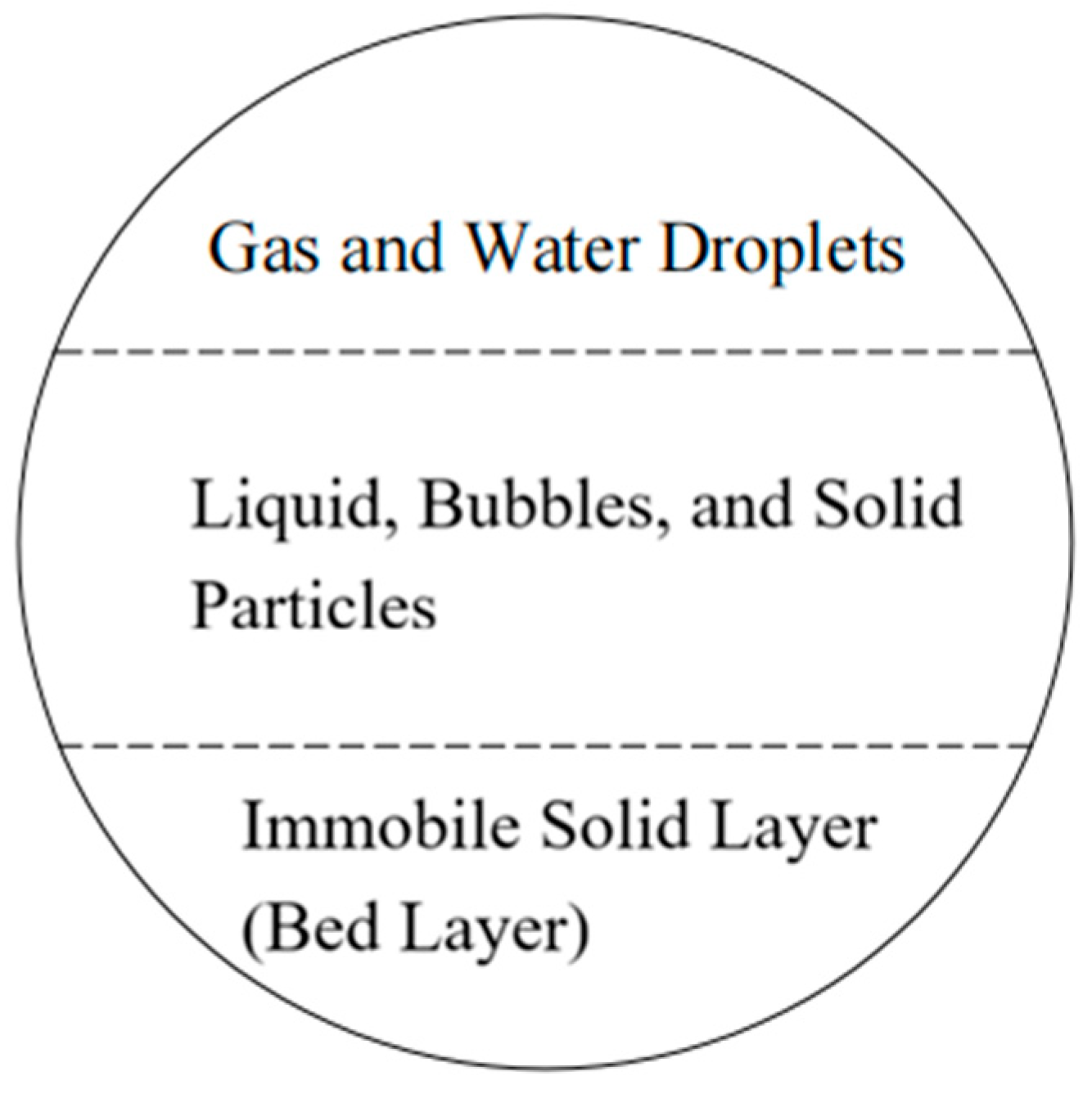
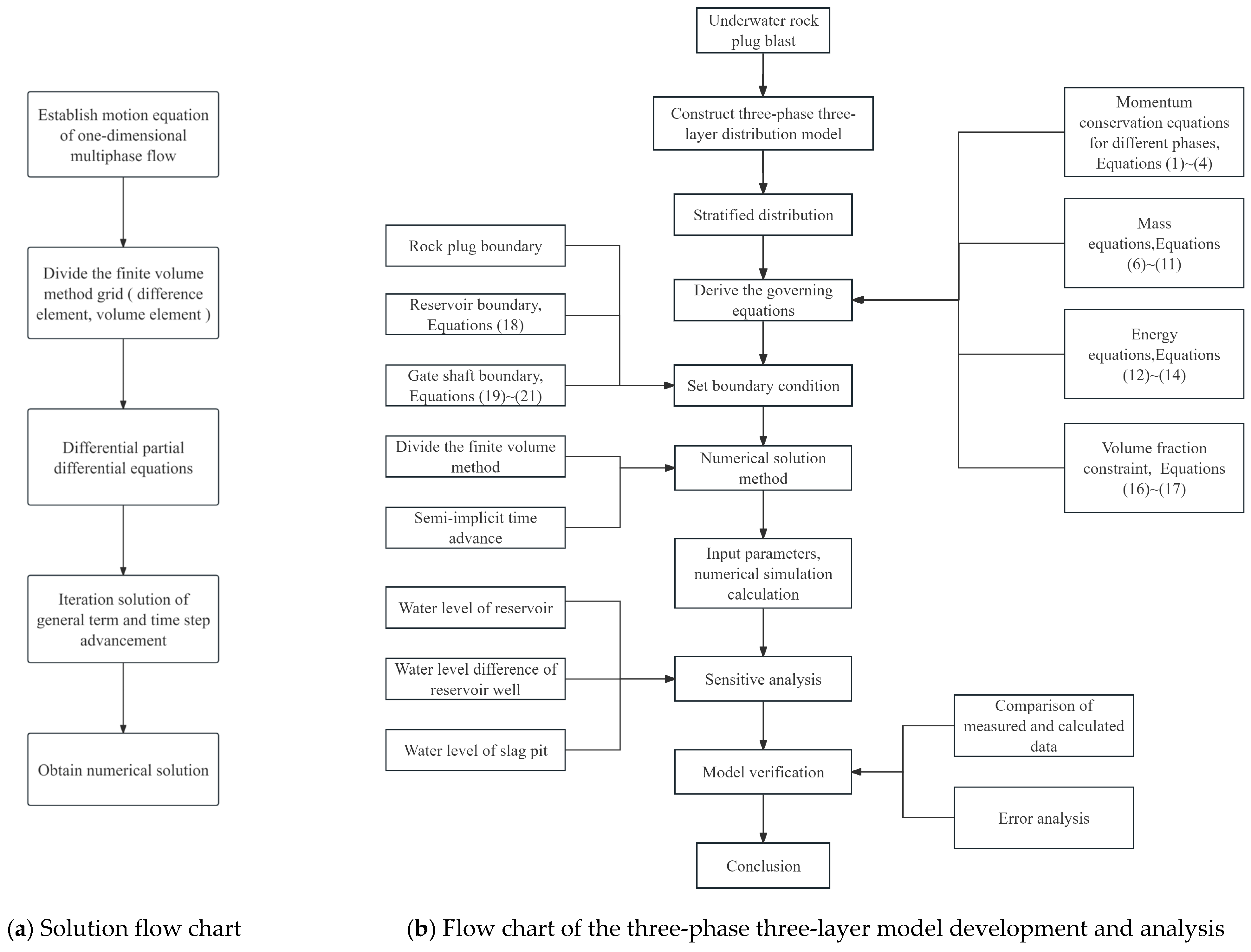
- A three-phase, three-layer model is proposed based on the stratified-flow assumption, enabling the coupled motion and interaction of the water, gas, and solid phases to be simulated simultaneously. The governing equations are derived, and the corresponding discretization scheme and solution procedure are presented.
- (2)
- The influence of reservoir water level, gate shaft water level, and initial water level of slag pit on blasting transient hydraulic load is systematically analyzed, which provides a theoretical reference for engineering safety design.
2. Mathematical Model and Numerical Solution Scheme
2.1. Governing Equations of the Three-Phase Distributed Flow Model
2.2. Boundary Conditions for Transient Events
- (1)
- Rock plug
- (2)
- Reservoir
- (3)
- Gate shaft
2.3. Numerical Solution Scheme
3. Numerical Simulation Analysis
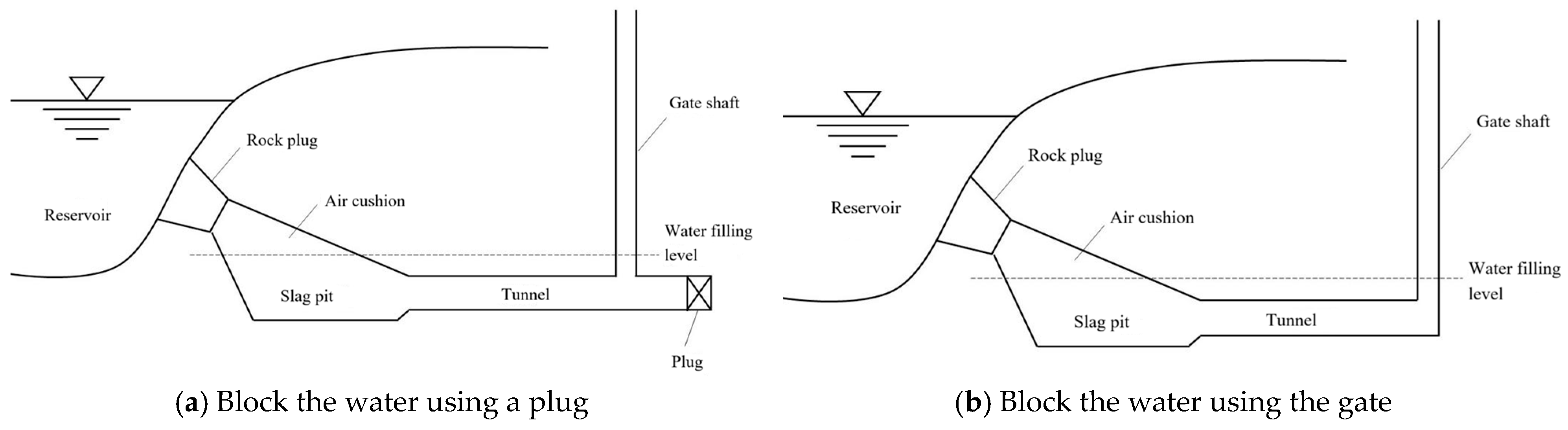
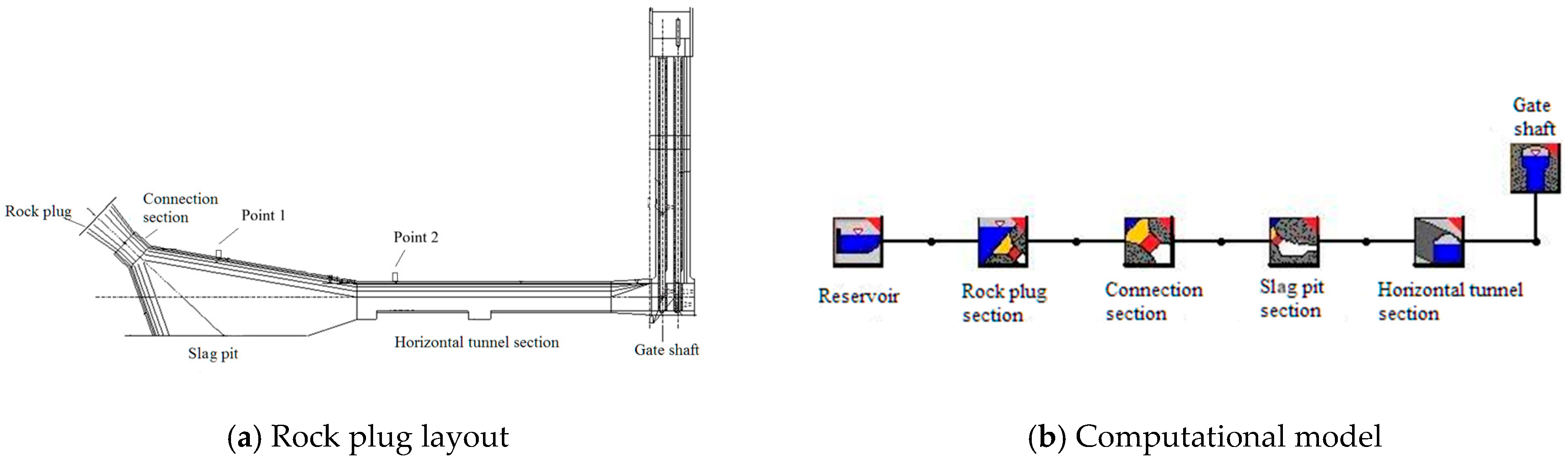
3.1. Description of the Rock Plug and Inlet System
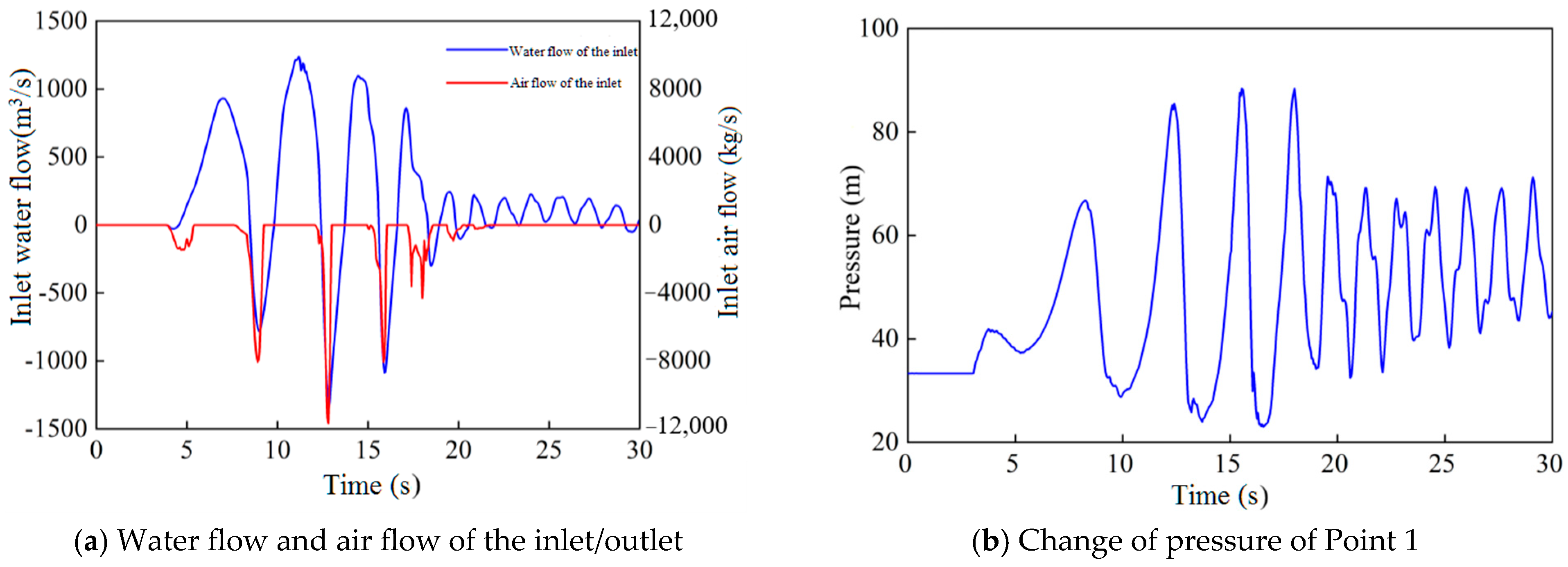
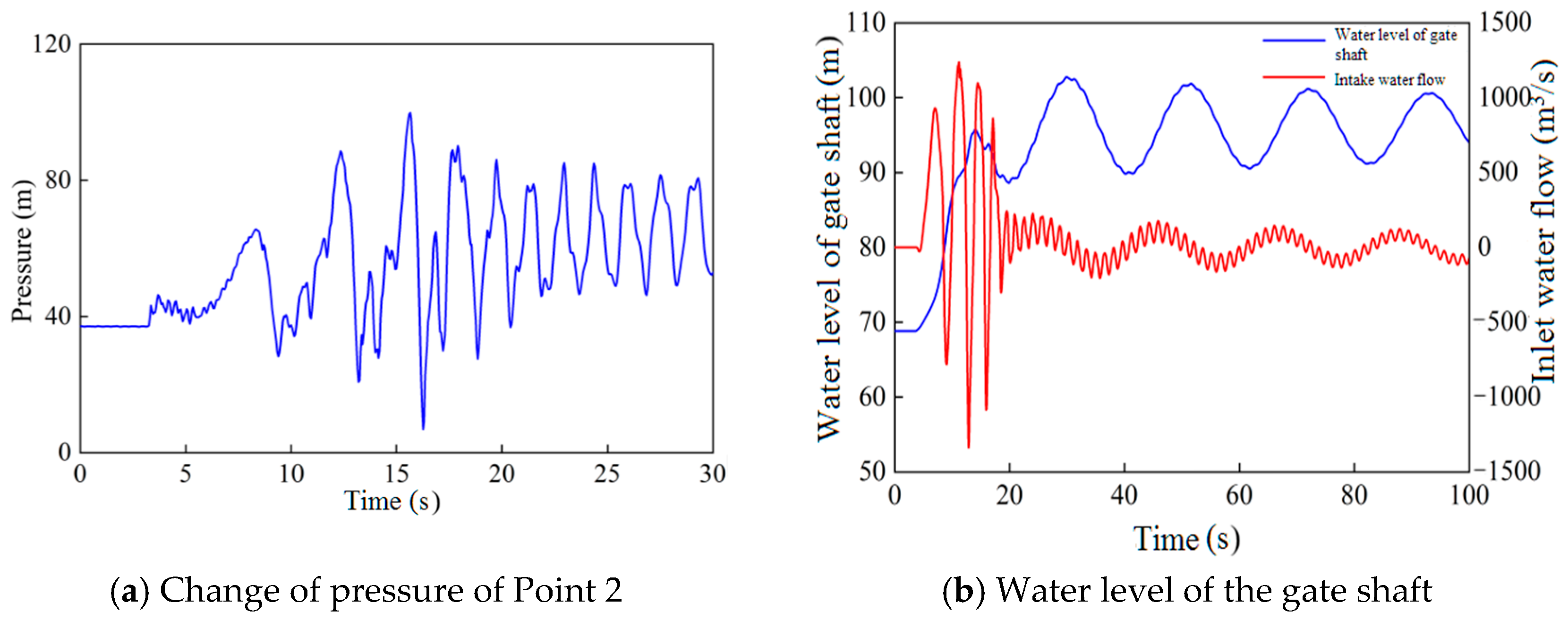
3.2. Numerical Simulation Results
- (1)
- At standard atmospheric pressure, 0.8 m3 of gas is produced per kilogram of explosive.
- (2)
- Considering that a small portion of the blasting gases may escape into the reservoir, a conservative assumption is adopted from a perspective of enhancing safety margins. It is assumed that 100% of the gases generated by the explosive enter the gas cavity and are subsequently driven into the slug plug and tunnel under the action of high external pressure.
3.3. Sensitivity Analysis of Key Blast-Related Design Parameters
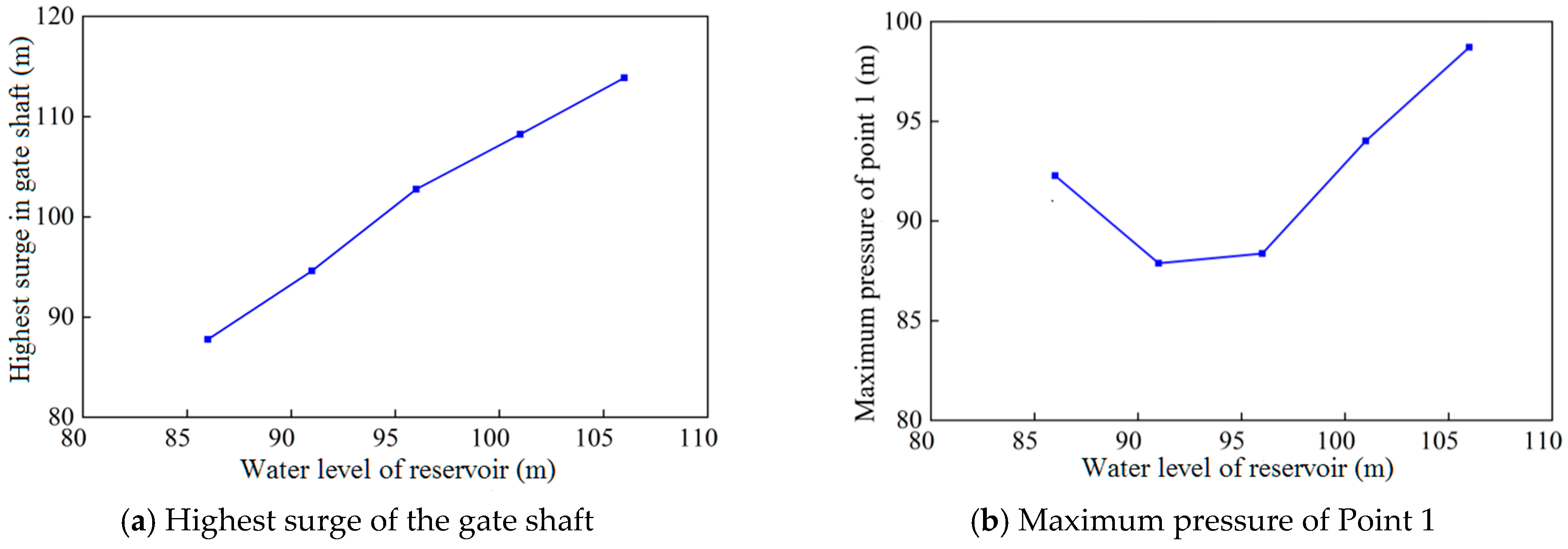
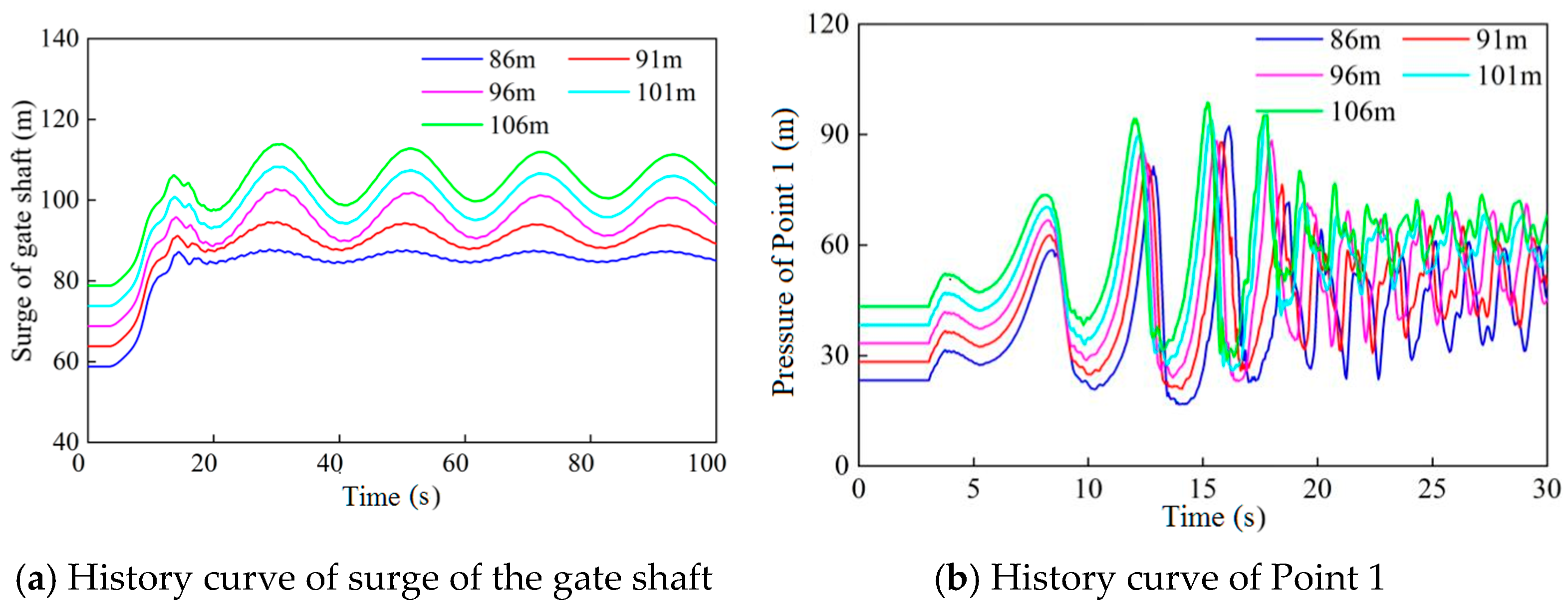
3.3.1. Water Level of Reservoir
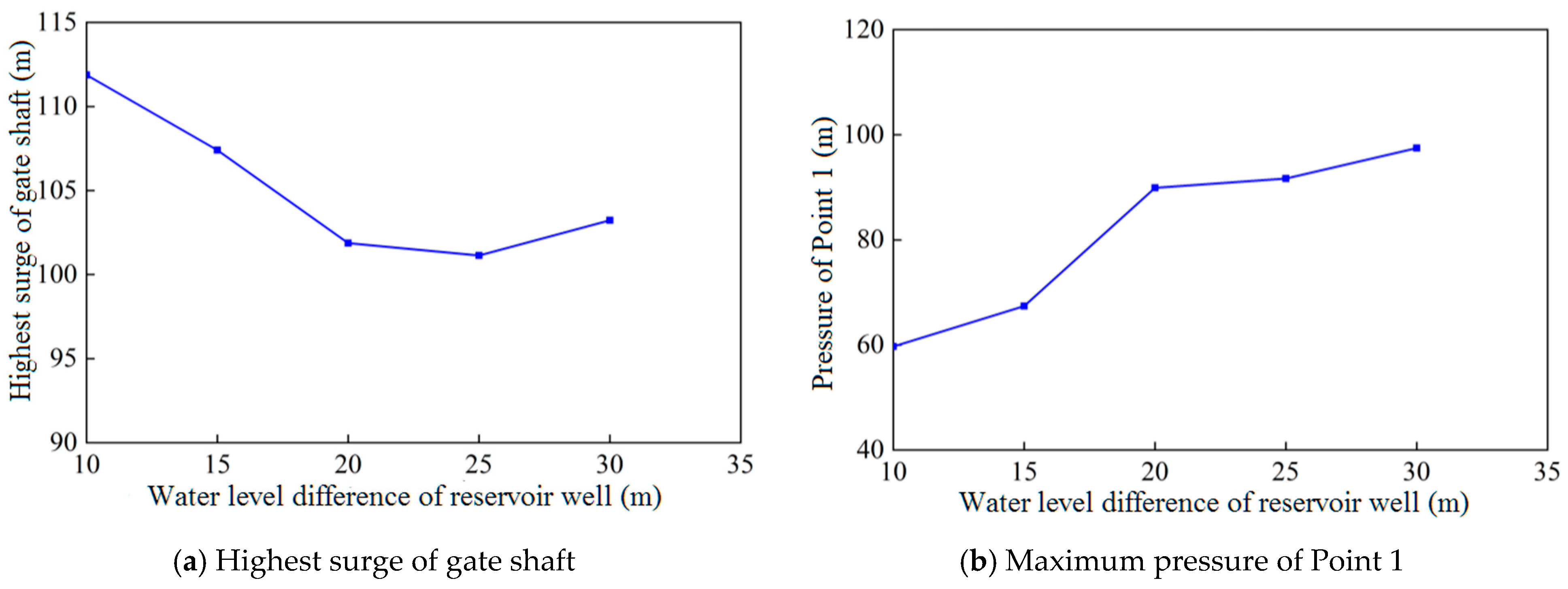
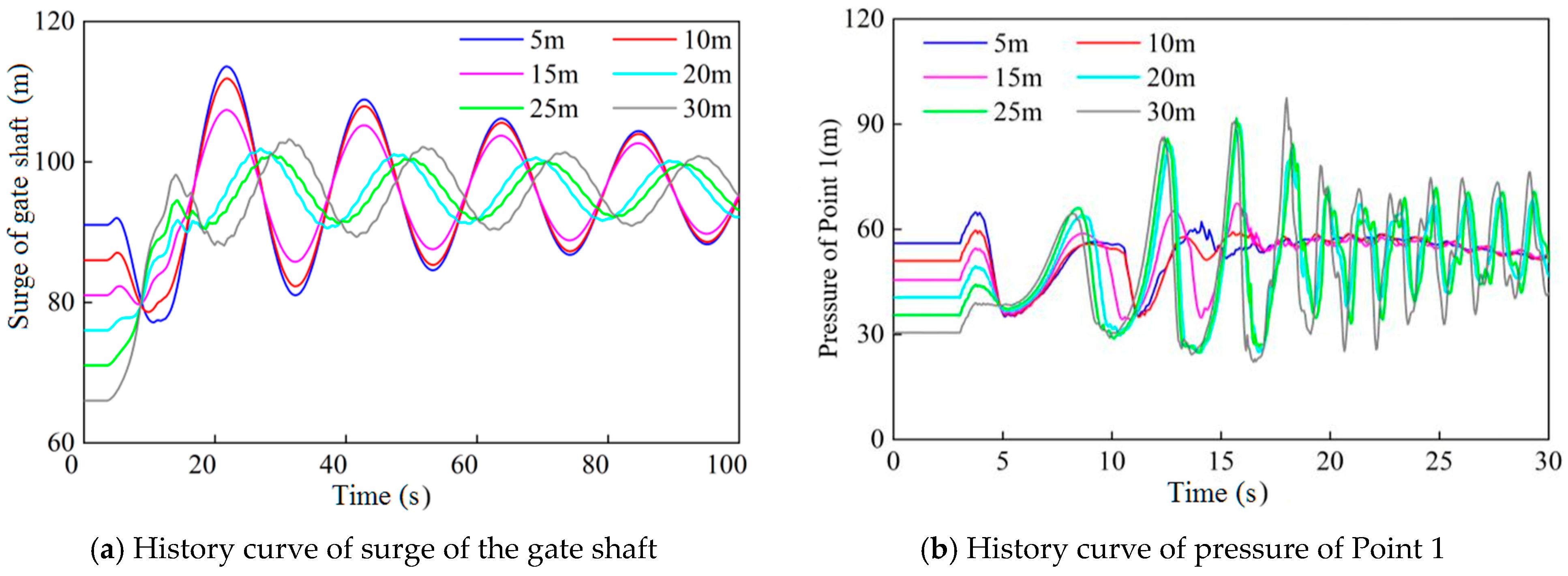
3.3.2. The Water Level Difference of Reservoir Well
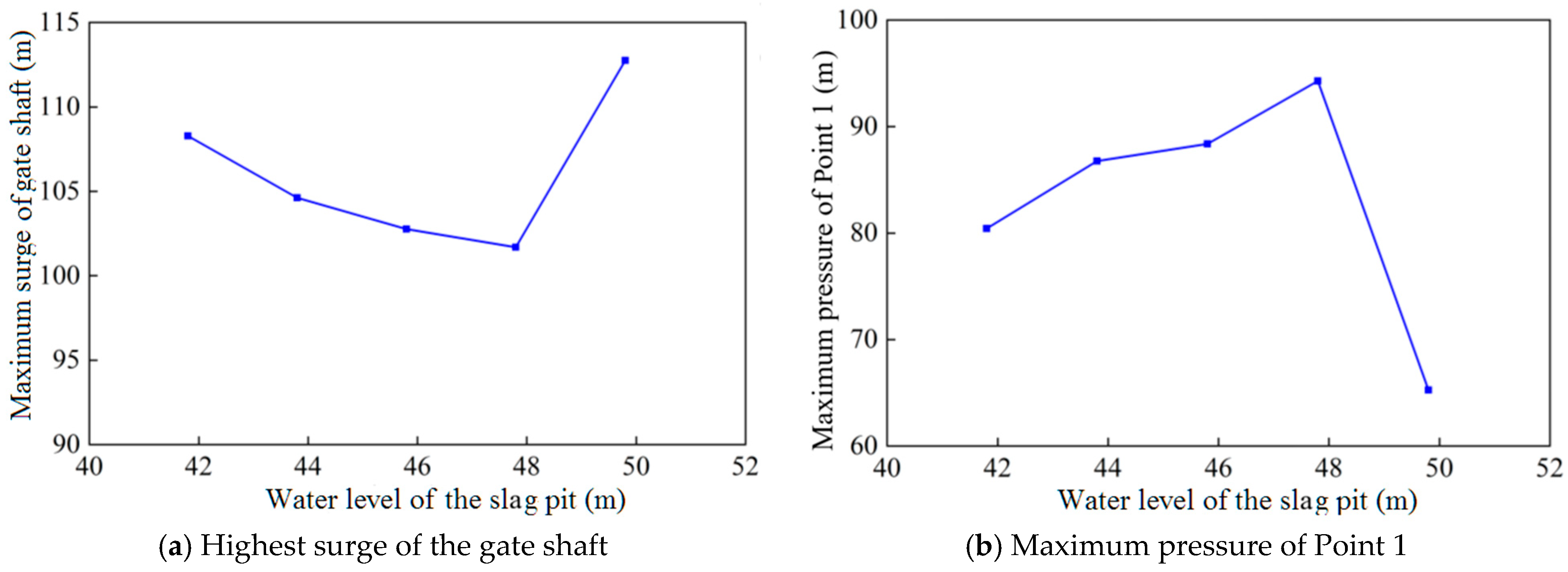
3.3.3. Water Level of Slag Pit
4. Model Validation
4.1. Grid Convergence Based on CFL Condition
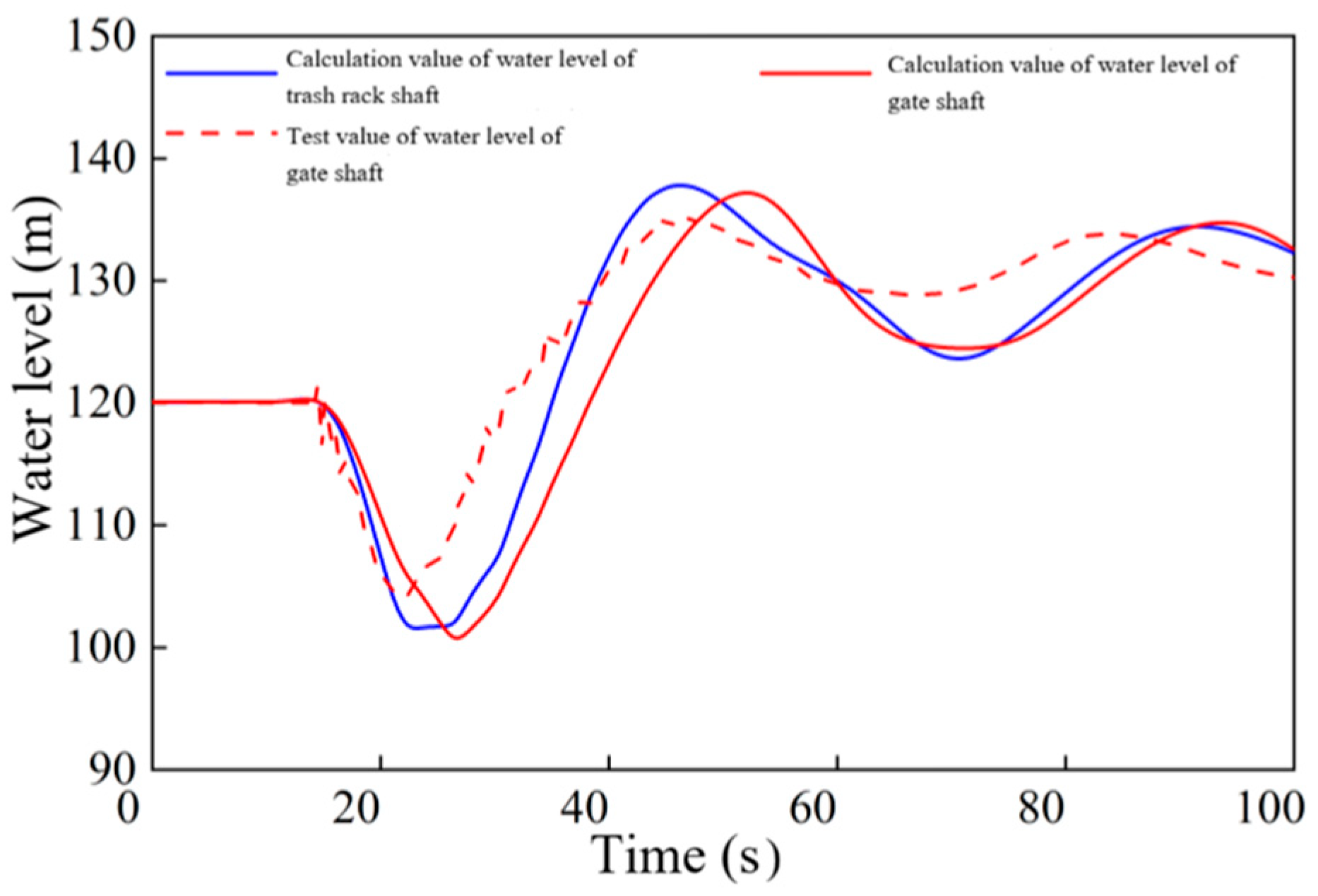
4.2. Comparison with Experimental Data
5. Conclusions
- (1)
- A one-dimensional multiphase flow model for rock plug blasting is developed based on three-phase, three-layer theory. The model accounts for interphase interactions as well as mass and energy fluctuations induced by blasting, addressing the deficiencies of conventional 1D models that oversimplify phase interactions and ignore stratified flow characteristics, and the flow domain is discretized into differential elements. A semi-implicit numerical scheme is formulated to solve the resulting governing equations.
- (2)
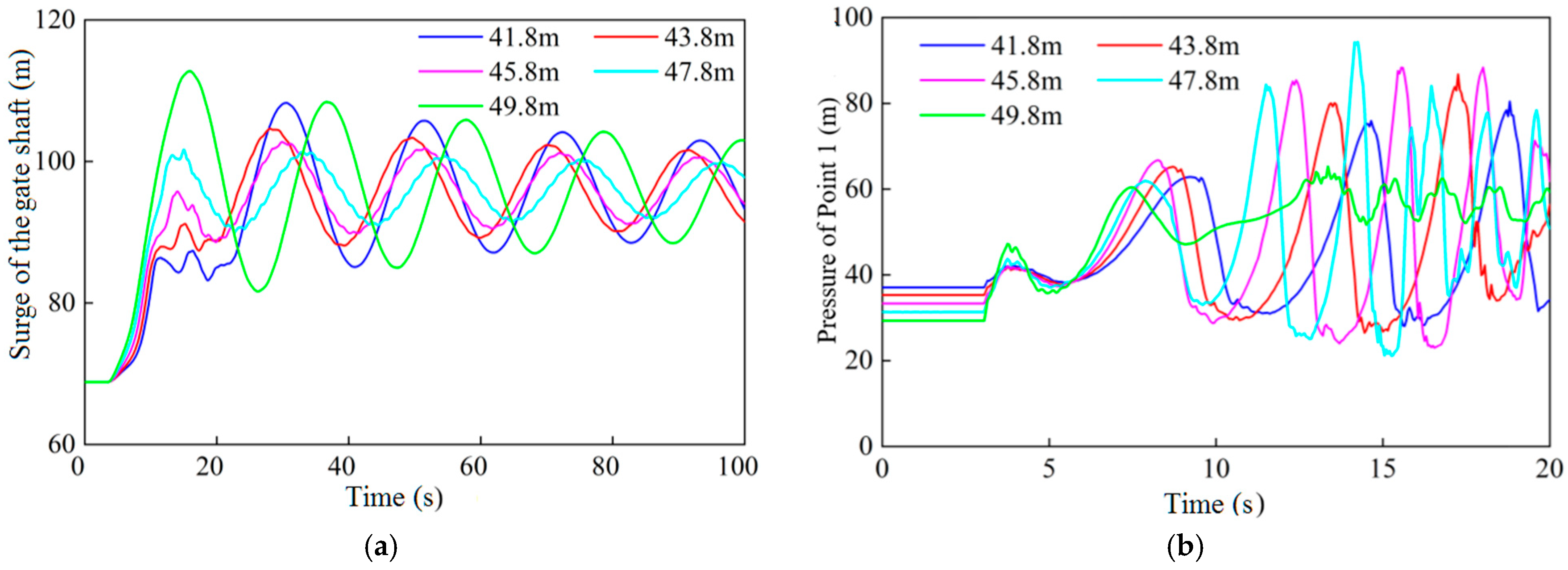
- The parametric analysis indicates that lower reservoir water levels reduce both surge height and impact pressure. A small reservoir–gate shaft water level difference increases initial cushioning pressure and amplifies surge, whereas a larger difference promotes staged air–water release, increasing impact pressure while suppressing surge height. An excessively high slag pit water level weakens the cushioning effect and lowers impact pressure, demonstrating that the proposed model enables quantitative optimization of operational parameters for hydraulic load control and offers clear replicability in similar hydropower projects.
Author Contributions
Funding
Data Availability Statement
Conflicts of Interest
Glossary
| mg | mass per unit volume of gas (kg/m3) |
| mw | mass per unit volume of water (kg/m3) |
| ms | mass per unit volume of blast slag (kg/m3) |
| ug | axial velocities of gas (m/s) |
| uw | axial velocities of water (m/s) |
| us | axial velocities of blast slag (m/s) |
| ub | axial velocities of immobile bed layer (m/s) |
| ag | area fractions occupied by gas phase |
| aw | area fractions occupied by liquid phase |
| as | area fractions occupied by solid phase |
| ρg | densities of gas phase (kg/m3) |
| ρw | densities of liquid phase (kg/m3) |
| ρs | densities of solid phase (kg/m3) |
| Fg | interfacial friction coefficients between the gas layer and wall |
| Fg-w | interfacial friction coefficients between the gas layer and liquid layer |
| Fw-w | interfacial friction coefficients between the liquid layer and liquid layer |
| Fw-s | interfacial friction coefficients between the liquid layer and solid layer |
| g | acceleration of gravity (m/s2) |
| θ | angle between flow direction of the fluid control volume and the horizontal direction (°) |
| F | phase index |
| l | layer index |
| CF,l | distribution coefficient |
| VF,l | drift velocity (m/s) |
| S | source term (kg/s) |
| E | interlayer mass transfer terms for entrainment (kg/s) |
| D | interlayer mass transfer terms for deposition (kg/s) |
| e | energy per unit mass (J/kg) |
| H | enthalpy (J/kg) |
| qg,w | heat exchange between the gas and liquid phases (W/m3) |
| qg | heat transfer from the gas to the surroundings (W/m3) |
| qw | heat transfer from liquid phases to the surroundings (W/m3) |
| Tw | temperatures of the liquid phase (°C) |
| Ts | temperatures of the solid phase (°C) |
| Hres | water level of reservoir (m) |
| Qs | flow of water flowing into the gate shaft (m3/s) |
| A | cross-sectional area of the tunnel upstream of the gate shaft (m2) |
| ps | bottom pressure of the gate shaft (kPa) |
| Z | water level of gate shaft (m) |
| Rk | resistance coefficient of the gate shaft |
| AS | cross-sectional area of the gate shaft (m2) |
| X | a conserved quantity |
| t | time (s) |
| F | flux of X |
| n | n-th time level |
| j | j-th control body |
| iteratively updated gas velocity (m/s) |
References
- Sun, L.; Niu, D.; Wang, K.; Xu, X. Sustainable development pathways of hydropower in China: Interdisciplinary qualitative analysis and scenario-based system dynamics quantitative modeling. J. Clean. Prod. 2021, 287, 125528. [Google Scholar] [CrossRef]
- Qiu, W.; Zhang, J.; Yu, X.; Chen, S.; Liu, Y.; Li, Y. Mathematical model and experimental validation of horizontal water level oscillations in surge tanks for hydraulic transient analysis of hydropower system. Energy 2025, 329, 136521. [Google Scholar] [CrossRef]
- de Souza Dias, V.; Pereira da Luz, M.; Medero, G.M.; Tarley Ferreira Nascimento, D. An overview of hydropower reservoirs in Brazil: Current situation, future perspectives and impacts of climate change. Water 2018, 10, 592. [Google Scholar] [CrossRef]
- Li, X.Z.; Chen, Z.J.; Fan, X.C.; Cheng, Z.J. Hydropower development situation and prospects in China. Renew. Sustain. Energy Rev. 2018, 82, 232–239. [Google Scholar] [CrossRef]
- IH Association. 2021 Hydropower Status Report, Sector Trends and Insights; Technical Report; Centre Sustainable Energy Studies (FME CenSES): Trondheim, Norway, 2021. [Google Scholar]
- Canton, H. International Energy Agency—IEA. In The Europa Directory of International Organizations 2021; Routledge: Abingdon, UK, 2021; pp. 684–686. [Google Scholar]
- Jiang, J.; Ming, B.; Yu, T.; Huang, Q.; Jurasz, J.; Liu, P.; Yu, M.; Cheng, L. A two-stage framework for sizing renewable capacity in a hydro–photovoltaic–wind–pumped storage hybrid system. Energy 2025, 334, 137758. [Google Scholar] [CrossRef]
- Qiu, W.; Zeng, W.; Zhang, J.; Li, G.; Yu, X.; Guo, J. Real-time online prediction of hydraulic states in pumped hydropower systems based on Kalman filter. Energy 2025, 335, 138048. [Google Scholar] [CrossRef]
- Zahedi, R.; Eskandarpanah, R.; Akbari, M.; Rezaei, N.; Mazloumin, P.; Farahani, O.N. Development of a new simulation model for the reservoir hydropower generation. Water Resour. Manag. 2022, 36, 2241–2256. [Google Scholar] [CrossRef]
- Tian, S.; Qiao, L.; Li, Q. Adopting the In-Situ Test and Numerical Simulation to the Design of Underwater Rock Plug Blasting. Electron. J. Geotech. Eng. 2016, 21, 6359–6370. [Google Scholar]
- Wu, L.; Liang, Z.; Chen, M.; Zhou, J. Experiments and fluent–engineering discrete element method-based numerical analysis of block motion in underwater rock-plug blasting. Appl. Sci. 2022, 13, 348. [Google Scholar] [CrossRef]
- Yang, S.; Wang, Y.; Zhang, T. Study on Hydraulic Characteristics of Rock Plug Inlet/Outlet Blasting Process in a Power Station. In Hydraulic Structure and Hydrodynamics; Springer Nature: Singapore, 2024; pp. 441–450. [Google Scholar]
- Zhang, X.; Wang, Y.; Xu, T.; Zhang, J. Analysis of pressure surges under various flow patterns in the tunnel of an underwater rock plug blasting system using different transition process models. AQUA Water Infrastruct. Ecosyst. Soc. 2023, 72, 1939–1955. [Google Scholar] [CrossRef]
- Ding, L. Underwater rock plug blasting and its application in hydropower engineering. Sichuan Hydropower 1998, 17, 12–16. [Google Scholar]
- Sharafat, A.; Tanoli, W.A.; Raptis, G.; Seo, J.W. Controlled blasting in underground construction: A case study of a tunnel plug demolition in the Neelum Jhelum hydroelectric project. Tunn. Undergr. Space Technol. 2019, 93, 103098. [Google Scholar] [CrossRef]
- Cooper, P.W. Explosives Engineering; John Wiley & Sons: Hoboken, NJ, USA, 2018. [Google Scholar]
- Zhang, D. Key Technologies for Safety Construction of Mined Subsea Tunnels; Springer: Singapore, 2023. [Google Scholar]
- Jiang, L.; Guo, L.B.; Yang, S.J.; Li, G.H.; Sun, H.L.; Sun, J.H. An experimental study on hydraulic characteristics of rock plug inlet/outlet of a pumped storage power station. In Advances in Urban Engineering and Management Science; CRC Press: Boca Raton, FL, USA, 2022; pp. 475–482. [Google Scholar]
- Li, X.; Liu, K.; Sha, Y.; Yang, J.; Song, R. Numerical investigation on rock fragmentation under decoupled charge blasting. Comput. Geotech. 2023, 157, 105312. [Google Scholar] [CrossRef]
- Wang, S.; Gui, Q.; Zhang, J.; Gao, Y.; Xu, J.; Jia, X. Theoretical and experimental study of bubble dynamics in underwater explosions. Phys. Fluids 2021, 33, 126113. [Google Scholar] [CrossRef]
- Hung, C.F.; Hwangfu, J.J. Experimental study of the behaviour of mini-charge underwater explosion bubbles near different boundaries. J. Fluid Mech. 2010, 651, 55–80. [Google Scholar] [CrossRef]
- Wan, W.; Zhou, Y.; Geng, C.; He, B. Numerical modeling of cavity collapse water hammer in pipeline systems: Internal mechanisms and influential factors of transient flow and secondary pressure rise dynamics. Phys. Fluids 2024, 36, 087167. [Google Scholar] [CrossRef]
- Guo, Q.; Zhou, J.; Li, Y.; Guan, X.; Liu, D.; Zhang, J. Fluid-structure interaction response of a water conveyance system with a surge chamber during water hammer. Water 2020, 12, 1025. [Google Scholar] [CrossRef]
- Lapin, A.; Lübbert, A. Numerical simulation of the dynamics of two-phase gas—Liquid flows in bubble columns. Chem. Eng. Sci. 1994, 49, 3661–3674. [Google Scholar] [CrossRef]
- Triki, A. Further investigation on water-hammer control inline strategy in water-supply systems. J. Water Supply Res. Technol. AQUA 2018, 67, 30–43. [Google Scholar] [CrossRef]
- Wylie, E.B.; Streeter, V.L.; Suo, L. Fluid Transients in Systems; Prentice Hall: Englewood Cliffs, NJ, USA, 1993. [Google Scholar]
- Guo, W.; Yang, J.; Teng, Y. Surge wave characteristics for hydropower station with upstream series double surge tanks in load rejection transient. Renew. Energy 2017, 108, 488–501. [Google Scholar] [CrossRef]
- Yang, W.; Yang, J.; Guo, W.; Norrlund, P. Frequency stability of isolated hydropower plant with surge tank under different turbine control modes. Electr. Power Compon. Syst. 2015, 43, 1707–1716. [Google Scholar] [CrossRef]
- Zhang, Z.; Wang, B.; Wang, X.; He, Y.; Wang, H.; Zhao, S. Safety-risk assessment for TBM construction of hydraulic tunnel based on fuzzy evidence reasoning. Processes 2022, 10, 2597. [Google Scholar] [CrossRef]
- Mandal, S.K.; Singh, M.M.; Dasgupta, S. Theoretical concept to understand plan and design smooth blasting pattern. Geotech. Geol. Eng. 2008, 26, 399–416. [Google Scholar] [CrossRef]
- Feng, X.T.; Jiang, Q.; Zhang, Y.J. Construction of large underground structures in China. In Rock Mechanics and Engineering; CRC Press: Boca Raton, FL, USA, 2017; pp. 181–241. [Google Scholar]
- Zhang, X.; Chen, S.; Xu, T.; Zhang, J. Experimental study on pressure characteristics of direct water hammer in the viscoelastic pipeline. AQUA Water Infrastruct. Ecosyst. Soc. 2022, 71, 563–576. [Google Scholar] [CrossRef]
- Ding, Y.; Shen, G.; Wan, W. Research on a multi-objective optimization method for transient flow oscillation in multi-stage pressurized pump stations. Water 2024, 16, 1728. [Google Scholar] [CrossRef]
- Liu, J.; Wu, J.; Zhang, Y.; Wu, X. Sensitivity analysis of hydraulic transient simulations based on the MOC in the gravity flow. Water 2021, 13, 3464. [Google Scholar] [CrossRef]
- Duan, H.F.; Che, T.C.; Lee, P.J.; Ghidaoui, M.S. Influence of nonlinear turbulent friction on the system frequency response in transient pipe flow modeling and analysis. J. Hydraul. Res. 2018, 56, 451–463. [Google Scholar] [CrossRef]
- Chen, D.; Chen, Y.; Zhou, Z.; Tu, W.; Li, L. Study on internal rise law of fracture water pressure and progressive fracture mechanism of rock mass under blasting impact. Tunn. Undergr. Space Technol. 2025, 161, 106545. [Google Scholar] [CrossRef]
- Anderson, J.D.; Wendt, J. Computational Fluid Dynamics; McGraw-Hill: New York, NY, USA, 1995. [Google Scholar]
- Yang, F.; Dong, Z.; Da, J.; Wang, J. A Comparative Performance Evaluation of Mainstream Multiphase Models for Aerated Flow on Stepped Spillways. Water 2024, 16, 3529. [Google Scholar] [CrossRef]
- Neofytou, A.; Zhang, L.T.; Kim, H.A. Level set topology optimization for fluid-structure interaction using the modified immersed finite element method. Comput. Methods Appl. Mech. Eng. 2026, 452, 118754. [Google Scholar] [CrossRef]
- Laadhari, A. Implicit finite element methodology for the numerical modeling of incompressible two-fluid flows with moving hyperelastic interface. Appl. Math. Comput. 2018, 333, 376–400. [Google Scholar] [CrossRef]
- Doyeux, V.; Guyot, Y.; Chabannes, V.; Prud’Homme, C.; Ismail, M. Simulation of two-fluid flows using a finite element/level set method. Application to bubbles and vesicle dynamics. J. Comput. Appl. Math. 2013, 246, 251–259. [Google Scholar] [CrossRef]
- Wallis, G.B. One-Dimensional Two-Phase Flow; Courier Dover Publications: Garden City, NY, USA, 2020. [Google Scholar]
- Cantero-Chinchilla, F.N.; Bergillos, R.J.; Gamero, P.; Castro-Orgaz, O.; Cea, L.; Hager, W.H. Vertically averaged and moment equations for dam-break wave modeling: Shallow water hypotheses. Water 2020, 12, 3232. [Google Scholar] [CrossRef]








| Phase | Temperature | Density |
|---|---|---|
| Gas | 19 °C | 1.255 kg/m3 |
| Water | 19 °C | 1000 kg/m3 |
| Solid | \ | 2800 kg/m3 |
| Parameters | Unit | Value |
|---|---|---|
| Total explosives | kg | 1122.51 |
| Blasting volume | m3 | 563.18 |
| Unit explosive consumption | kg/m3 | 1.99 |
| Maximum single blow blasting charge | kg | 199.66 |
| Working Condition | Calculated Value (m) | Model Test Value (m) | Relative Deviation (%) |
|---|---|---|---|
| 140–130–80 | 146.4 | 146.0 | 0.27 |
Disclaimer/Publisher’s Note: The statements, opinions and data contained in all publications are solely those of the individual author(s) and contributor(s) and not of MDPI and/or the editor(s). MDPI and/or the editor(s) disclaim responsibility for any injury to people or property resulting from any ideas, methods, instructions or products referred to in the content. |
© 2026 by the authors. Licensee MDPI, Basel, Switzerland. This article is an open access article distributed under the terms and conditions of the Creative Commons Attribution (CC BY) license.
Share and Cite
Li, G.; Jia, Y.; Zhang, J.; Pu, W.; Zhou, T.; Zhang, F. Three-Layer Model of Gas–Liquid–Solid Multiphase Transient Flow After Rock Plug Blast. Water 2026, 18, 866. https://doi.org/10.3390/w18070866
Li G, Jia Y, Zhang J, Pu W, Zhou T, Zhang F. Three-Layer Model of Gas–Liquid–Solid Multiphase Transient Flow After Rock Plug Blast. Water. 2026; 18(7):866. https://doi.org/10.3390/w18070866
Chicago/Turabian StyleLi, Gaohui, Yiheng Jia, Jian Zhang, Weiwei Pu, Tianchi Zhou, and Fulin Zhang. 2026. "Three-Layer Model of Gas–Liquid–Solid Multiphase Transient Flow After Rock Plug Blast" Water 18, no. 7: 866. https://doi.org/10.3390/w18070866
APA StyleLi, G., Jia, Y., Zhang, J., Pu, W., Zhou, T., & Zhang, F. (2026). Three-Layer Model of Gas–Liquid–Solid Multiphase Transient Flow After Rock Plug Blast. Water, 18(7), 866. https://doi.org/10.3390/w18070866