Article

The Construction and Validation of a Distributed Xin’anjiang Model for Hilly Areas Considering Non-Steady-State Evaporation


1
College of Hydrology and Water Resources, Hohai University, Nanjing 210098, China
2
Institute of Surface-Earth System Science, Tianjin University, Tianjin 300072, China
*
Author to whom correspondence should be addressed.
Water 2026, 18(7), 845; https://doi.org/10.3390/w18070845
Submission received: 11 November 2025 / Revised: 19 March 2026 / Accepted: 26 March 2026 / Published: 1 April 2026
(This article belongs to the Section Hydrology)

Highlights

  • This paper constructs a distributed Xin’anjiang model for hilly areas considering non-steady-state evaporation.
  • The new model proposed in this paper incorporates the hydrodynamic characteris-tics of the unsaturated zone, including the consideration that the saturated hydraulic conductivity decreases exponentially with increasing depth, and the use of the one-dimensional Richards equation to describe the soil water movement in the un-saturated zone.
  • The new model proposed in this paper employs a semi-analytical solution to calcu-late the vertical distribution of soil moisture content, thereby accelerating the compu-tational speed of the model.
  • Through validation in the typical watershed, it is evident that the new model pro-posed in this paper has high accuracy in simulating soil moisture content and wa-tershed outflow.
  • The method proposed in this paper for deriving the vertical distribution of soil mois-ture is applicable to various burial depths, soil types, and evaporation conditions, addressing the issue that previous methods were only valid under ideal conditions and lacked universality.

Abstract

This paper uses actual evaporation and phreatic evaporation as the upper and lower boundary fluxes, respectively. It considers the exponential change in hydraulic conductivity with depth and uses the one-dimensional Richards equation to perform vertical discretization calculations on the soil to determine soil water deficit. A semi-analytical solution method is employed to accelerate the calculation speed. Based on the relationship between groundwater depth and topographic index, the spatial distribution of soil water deficit is obtained from the spatial distribution of the topographic index. This leads to the development of a new distributed Xin’anjiang model for hilly areas that considers non-steady-state evaporation. The model is applied to simulate soil moisture content in the typical Tarrawarra catchment and compared with the storage capacity model and the DHSVM model. It is found that the new distributed Xin’anjiang model developed in this paper shows significantly better performance in simulating soil moisture content than the storage capacity model and the DHSVM model. The new distributed Xin’anjiang model developed in this paper takes into account the physical mechanisms, calculation speed, and computational accuracy. It also considers the hydrodynamic characteristics of the unsaturated zone and the impact of non-steady-state evaporation.

1. Introduction

The frequent occurrence of natural disasters such as floods and droughts has led to damage to farmland and reduced grain production, posing a threat to the stability of human society and economic development. Statistics show that globally, more than 300 billion kilograms of grain are lost annually due to these natural disasters, causing economic losses exceeding 105 billion US dollars [1,2]. Distributed hydrological models can describe the spatial and temporal variations in hydrological variables, and are therefore widely used by hydrologists for hydrological and water resource simulation and prediction. Predicting the spatial and temporal variations in hydrological variables [3,4,5,6,7,8], such as soil moisture content and runoff depth, helps people understand the patterns of runoff generation and routing in watersheds, thereby enabling proactive responses to natural disasters such as floods and droughts, mitigating or even avoiding the losses caused by flood and drought disasters, effectively managing and protecting water resources, and providing scientific basis for flood control decision-making and reservoir operation, which has significant economic value and social benefits.
The distributed hydrological model [9] is a physically based hydrological simulation method that divides the watershed into multiple computational units (such as grids, sub-basins, or hillslope units), establishes hydrological process equations for each unit respectively, and simulates the spatiotemporal variation processes of hydrological elements within the watershed through spatial discretization.
Currently, there are mainly two types of distributed hydrological models. The first type is physically based distributed hydrological models that describe partial differential equations of mass, momentum, and energy in finite difference form (such as the two-dimensional Saint-Venant equations for surface runoff [10], the one-dimensional Richards equation for soil water movement [11], the Boussinesq equation for subsurface runoff [12], etc). to simulate various water flow processes in watersheds, such as the SHE model (Système Hydrologique Européen) [13] and the DHSVM model (Distributed Hydrology Soil Vegetation Model) [14]. However, these models involve complex solutions of partial differential equations with numerous parameters, and the large amount of watershed data required for calibrating these parameters is often difficult to obtain, which, to some extent, leads to considerable uncertainty in model parameters. Moreover, in computation, high spatial resolution implies a huge number of grids, and the time step must be very small to satisfy numerical stability conditions. These factors result in enormous computational resources and lengthy computation times for solving partial differential equations, which, to some extent, limit the application of such distributed hydrological models in large watersheds [15].
The second type establishes physical functional relationships between easily obtainable terrain, soil, and vegetation information of the watershed underlying surface and hydrological variables. For example, Xiaohua Xiang, Cheng Yao, Xi Chen, Peng Shi, and others proposed the distributed Xin’anjiang model for hilly areas, deriving the physical functional relationship between storage capacity and topographic index [16,17,18,19]. The topographic index is ln (a/tanb), where a is the contributing area above the grid point, and tanb is the slope of the grid point; according to the derivation in TOPMODEL [20], there is a linear relationship between groundwater depth and topographic index, and then based on the relationship between groundwater depth and storage capacity, the relationship between storage capacity and topographic index is obtained, thereby obtaining the spatial distribution of storage capacity to endow the Xin’anjiang model with distributed functionality [21] and obtaining the spatial and temporal variations in hydrological variables, such as soil moisture content and runoff depth. However, the above methods all simplify the hydrodynamic characteristics of the unsaturated zone and ignore the influence of non-steady-state evaporation. Peng Shi assumed a logarithmic Weibull relationship between storage capacity and topographic index; Xi Chen and Cheng Yao assumed that the unsaturated zone moisture content is at wilting point moisture content; Xiaohua Xiang assumed that the soil vertical evaporation flux is zero. These simplifications weaken the physical mechanism of the model to some extent, causing certain distortions in calculating storage capacity, thereby affecting the application of the second type of distributed hydrological model. Sadeghi [22] considered the influence of evaporation when calculating soil water deficit, and used the one-dimensional Richards equation to derive the vertical distribution of soil moisture content, but Sadeghi assumed that the soil is in a steady-state condition, that is, the soil evaporation flux is equal along the vertical direction. In reality, the soil is in a non-steady-state condition, that is, the evaporation flux varies with soil depth, so Sadeghi’s calculation still has certain computational errors. Qifeng Song [23] assumed that the evaporation flux has a power-exponential functional relationship with the absolute value of matric potential, and used the one-dimensional Richards equation to derive the vertical distribution of soil moisture content under non-steady-state conditions. However, Qifeng Song did not consider the characteristic that soil saturated hydraulic conductivity decays exponentially with increasing soil depth during calculation, which greatly affects the accuracy of the vertical distribution of soil moisture content under non-steady-state evaporation conditions calculated by this method. Moreover, Qifeng Song assumed an ideal condition—that the evaporation flux has a power-exponential functional relationship with the absolute value of matric potential—while in actual natural watersheds, this assumed relationship does not always hold, which greatly affects the universality of the analytical solution method for storage capacity under non-steady-state evaporation conditions proposed by Qifeng Song.
Based on the above research, the present study considers the influence of non-steady-state evaporation, incorporates the hydrodynamic characteristics of the unsaturated zone into the calculation of soil water deficit, and establishes a new distributed Xin’anjiang model for hilly areas considering non-steady-state evaporation: using actual evaporation and phreatic evaporation as the upper and lower boundary fluxes, respectively, and considering the characteristic that soil saturated hydraulic conductivity decays exponentially with increasing depth, the one-dimensional Richards equation and semi-analytical solution method are employed to calculate the soil water deficit under certain evaporation, depth, and soil conditions. According to the functional relationship between topographic index and groundwater depth, the spatial distribution of storage capacity in hilly areas is obtained, and a new distributed Xin’anjiang model for hilly areas considering non-steady-state evaporation is constructed. The model incorporates the hydrodynamic characteristics of the unsaturated zone and considers non-steady-state evaporation to enhance the physical mechanism of the model and improve its computational accuracy. The use of a semi-analytical solution method accelerates the computational speed of the model, thereby enabling the newly constructed model to balance physical mechanism, computational speed, and accuracy. This addresses the problems of weakened physical mechanisms and computational distortion caused by simplifying the hydrodynamic characteristics of the unsaturated zone and ignoring non-steady-state evaporation in previous second-type distributed hydrological models. The typical Tarrawarra watershed is selected to simulate soil moisture content and watershed outflow using the newly constructed distributed Xin’anjiang model for hilly areas, considering non-steady-state evaporation proposed in this paper, and comparisons are made with the storage capacity model and the DHSVM model to verify the accuracy of the newly constructed distributed Xin’anjiang model for hilly areas, considering non-steady-state evaporation in calculating soil moisture content and watershed outflow.

2. Materials and Methods

2.1. Study Area

This paper selected the Tarrawarra catchment, located in a hilly region, as a typical catchment. Situated in the suburbs of Melbourne, Australia, the catchment covers an area of 10.5 hectares and has a mild climate, with a multi-year average annual precipitation of 820 mm [24]. The catchment experiences relatively wet winters and drier summers. The predominant vegetation in the Tarrawarra catchment consists of grasses. The soil in this region is primarily composed of silt and clay, with silt accounting for approximately 65% and clay for 35%. This type of soil is commonly referred to as silty clay. The soil moisture variation zone within the catchment lies within the depth range of 0–60 cm below the ground surface. Among this, the soil moisture variation in the top 30 cm accounts for 40–60% of the total variation [25].
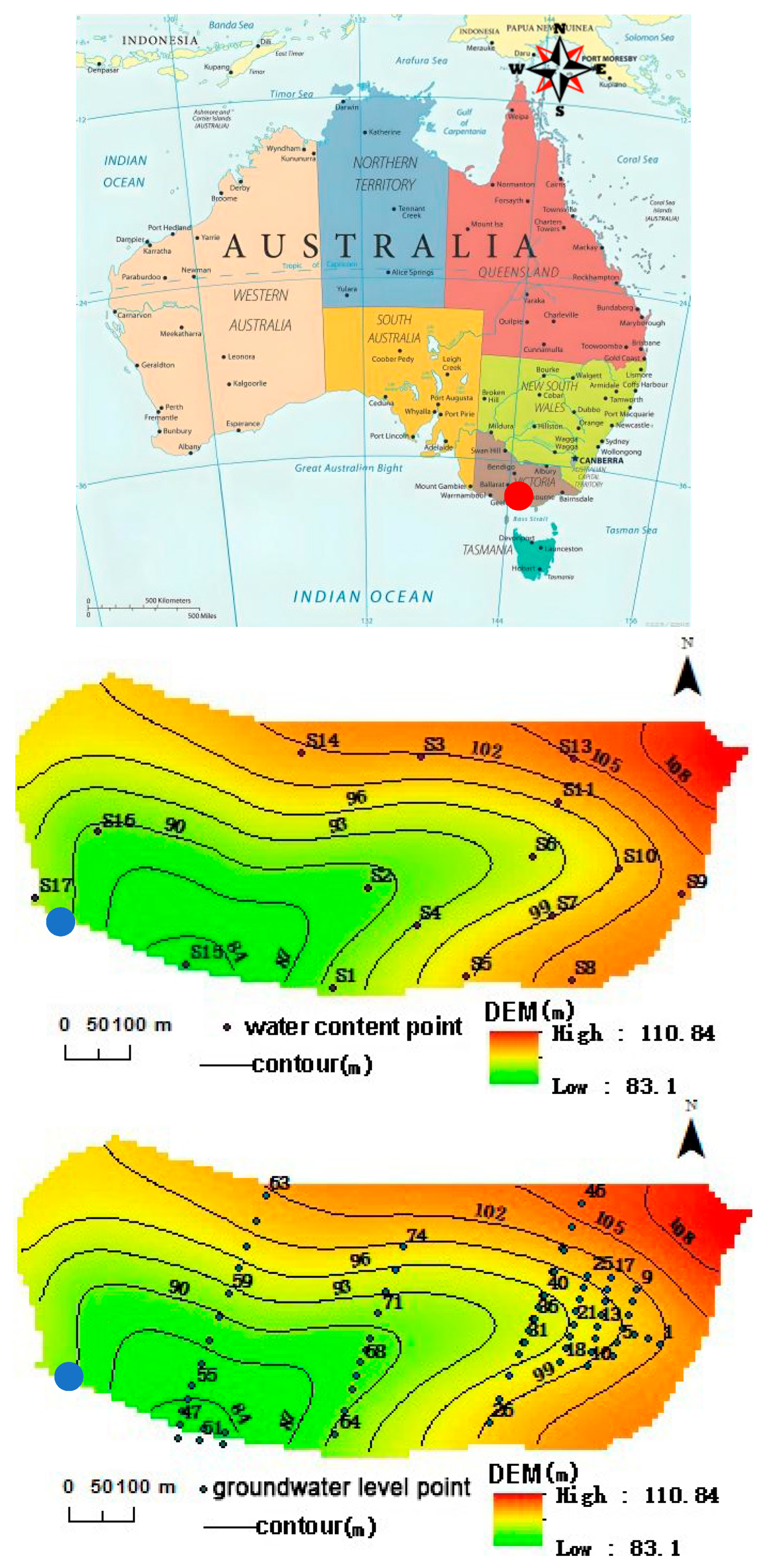
The catchment was equipped with 5 m contour line topographic data (as illustrated in Figure 1), data from one meteorological station, 17 soil moisture observation points, 74 groundwater level observation points, and flow records at the outlet cross-section of the catchment. Soil moisture was measured at six distinct depth intervals: 15 cm, 30 cm, 45 cm, 60 cm, 90 cm, and 120 cm below the ground surface. The observation interval for soil moisture was 8 days. Among the soil moisture data, the highest recorded value was 48.2%, observed at site s9, while the lowest was 21.2%, recorded at site s10.
Terrain data were acquired from remote sensing systems, while discharge, soil moisture, and groundwater depth data were collected through surface observations. Meteorological data were obtained from a combination of surface observations, meteorological satellites, radar, and automatic stations. The accuracy and representativeness of these data sets have been previously scrutinized and discussed [24,25]. Based on these prior discussions, it can be concluded that the data utilized in this study are reliable.
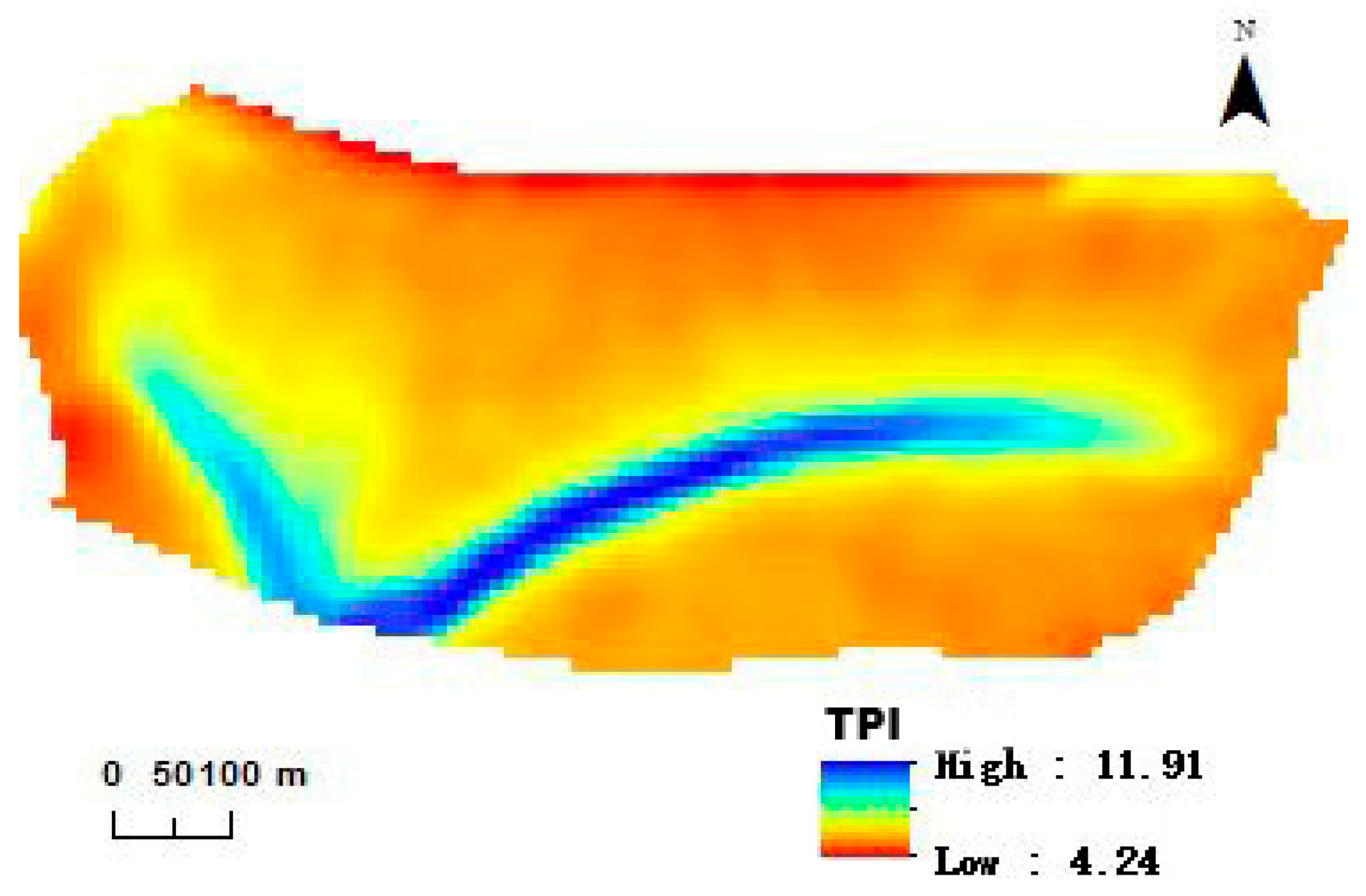
The spatial distribution of the topographic index within the catchment was derived from calculations based on the catchment’s topographic data. The analysis reveals a minimum topographic index of 4.24, a maximum of 11.91, and an average value of 6.45, as depicted in Figure 2.

2.2. Data Collection

General watersheds lack measured time-series data of soil moisture content at each grid point within the watershed. However, the Tarrawarra watershed selected in this paper possesses measured time-series data of soil moisture content at 17 grid points within the watershed over a two-year period, which can be used to verify the reliability of the simulation effect of the newly constructed distributed Xin’anjiang model proposed in this paper on the spatiotemporal variation in soil water deficit within the watershed. Moreover, the Tarrawarra watershed is a typical hilly watershed, exhibiting common typical characteristics of hilly watersheds such as large slope variation and significant interflow contribution. The experimental results validated in the Tarrawarra watershed can be transferred to other hilly watersheds. Nevertheless, the Tarrawarra watershed is a typical small experimental hilly watershed, and there are some differences in hydrological characteristics, such as concentration time, compared with some other large hilly watersheds. The application of the model proposed in this paper in some large hilly watersheds still requires support from more hydrological validation data.
The 5 m contour line data, outlet cross-section discharge data, meteorological data from the single meteorological station, soil moisture data collected from 17 observation points, and groundwater depth data gathered at 74 observation points within the Tarrawarra basin were all sourced from the designated website: http://people.eng.unimelb.edu.au/aww/tarrawarra/datapage.html URL (accessed on 25 March 2026) (The data on the website are publicly available).
The topographic index within the catchment was obtained through calculations rooted in the catchment’s 5 m contour line data (which is also denoted as the topographic data). The aforementioned datasets collectively formed the foundational inputs for model application and analysis in the hilly areas.
The topographic data used in this study were derived from 5 m contour maps. Traditional topographic data typically have a resolution of 30 m. However, given the relatively small size of the catchment under study, the use of higher-resolution topographic data is crucial to ensure the accuracy of calculations when employing these data to determine various variables. (As the Tarrawarra watershed is located in Australia, far from China, it is not feasible to create a high-resolution digital elevation model with drone assistance. Moreover, the DEM data provided on the website has a resolution of 5 m, which is already relatively high and can meet the computational accuracy requirements of the model selected in this paper). A higher resolution can more precisely represent the catchment’s topography, which is essential for accurate modeling and analysis. Therefore, we selected 5 m contour topographic data in this paper to meet these requirements.

2.3. Methods

2.3.1. The Distributed Xin’anjiang Model in the Hilly Areas

The Calculation of Phreatic Evaporation
The equation for calculating phreatic evaporation (also known as the lower boundary flux in the unsaturated zone) when the groundwater depth is d is as follows:
E g = E p ( 1 d d max ) n n
where E g signifies the phreatic evaporation (mm/day); E p signifies the evaporation capacity (mm/day); d signifies the groundwater depth of the grid point (The grid point is also known as the foundational spatial unit extracted from a grid-based Digital Elevation Model. Depth unit: m); d max denotes the extreme depth of the phreatic evaporation (m); n n denotes the coefficient of the phreatic evaporation.
The Calculation of Initial Actual Evaporation
The initial value of actual evaporation, calculated based on the assumptions of the SWAT model [26], is denoted as E s 1 , S W A T .
The Calculation of the Storage Capacity via the Richards Equation
According to the Brooks–Corey model [27], the relationships among hydraulic conductivity, matric potential, and water content are mathematically expressed as:
K ( ψ ) = K s · e f z · ( ψ ψ b ) p ,   θ θ r = ( θ s θ r ) ( ψ ψ b ) λ ,   θ f θ r θ s θ r = ψ c ψ b λ
According to Beven’s research on soil properties, the saturated hydraulic conductivity of the soil decreases exponentially with increasing depth below the ground surface, where f signifies the vertical attenuation coefficient for saturated hydraulic conductivity (1/m); K ( ψ ) signifies the hydraulic conductivity of soil (mm/day); K s signifies the saturated hydraulic conductivity of surface soil (mm/day); ψ denotes the matric potential (m); ψ b denotes the absolute value of the intake potential (m); θ denotes the soil moisture content; θ r denotes the wilting moisture content; θ f denotes the field capacity; θ s denotes the saturated water content, ( θ f θ r ) = 0.85 · ( θ s θ r ) ; ψ c denotes the absolute value of matric potential corresponding to field capacity; p represents the relationship coefficient between hydraulic conductivity and matric potential; λ represents the relationship coefficient between water content and matric potential, p = 2 + 3 λ .
The one-dimensional vertical Richards equation for hydrodynamic processes is expressed as follows:
θ t = z ( K ( ψ ) ( ψ z 1 ) )
where t signifies the time.
The soil profile is discretized into M layers. (The matric potential in the M-th layer is less than or equal to ψ b , whereas that in the (M + 1)-th layer is greater than ψ b ). The thickness of each soil layer is set as Δ z = 0.01   m . (According to the calculation examples of the Richards equation, setting the soil thickness to 0.01 m can meet the requirements for computational accuracy). The finite difference equation for the i-th soil layer is expressed as follows:
θ t = E s i Δ z + K ( ψ ) i + 0.5 t + 0.5 ( ψ i + 1 t + ψ i + 1 t + 1 2 Δ z 2 1 Δ z ) + K ( ψ ) i + 0.5 t + 0.5 · ψ b · ( θ s θ r ) 1 / λ Δ z 2 ( θ θ r ) 1 / λ
where E s i signifies the upward water flux from the i-th layer to the (i − 1)-th layer (mm/day); K ( ψ ) i + 0.5 t + 0.5 signifies the average soil hydraulic conductivity between layer i and layer i + 1 at times t and t + 1; ψ i + 1 t denotes the matric potential of the (i + 1)-th layer at time t; ψ i + 1 t + 1 denotes the matric potential of the (i + 1)-th layer at time t + 1. Assuming that the soil is in vertical equilibrium at time t, the matric potential, soil moisture content, and hydraulic conductivity of each soil layer at time t are obtained and used as known values in the equation for calculation. E s 1 , S W A T is set as the initial value of E s 1 for the first iteration, denoted as E s 1 , s i m , 0 . ψ i t is set as the initial value of ψ i t + 1 for the first iteration, denoted as ψ i , s i m , 0 t + 1 . Then the iteration is started. Based on the initial values E s 1 , s i m , k 1 and ψ i , s i m , k 1 t + 1 from the (k − 1)-th iteration, a semi-analytical solution is employed to solve layer by layer from top to bottom, obtaining the calculated values E s 1 , s i m , k and ψ i , s i m , k t + 1 after the k-th iteration. These values serve as the initial values for the (k + 1)-th iteration. After completing A iterations (where A ≥ 5), the calculated value E l i , s i m , A (with E l i , s i m , A representing the allocated evaporation capacity of the i-th layer obtained from the A-th iteration) is used to compute the vertical distribution of soil moisture content at time t.
After completing the k-th iteration, the calculated ψ i , s i m , k t + 1 is taken as the initial value of ψ i t + 1 for the (k + 1)-th iteration. The upward flux E s i , s i m , k and soil moisture content θ i , s i m , k t + 1 of each layer are used to back-calculate the evaporation capacity. The initial actual soil evaporation E s 1 , s i m , k 1 from the k-th iteration is corrected to obtain the corrected actual soil evaporation E s 1 , s i m , k , which serves as the initial value of actual soil evaporation for the (k + 1)-th iteration. The specific method is as follows:
If θ r θ i , s i m , k t + 1 θ f , then E l i , s i m , k = ( E s i , s i m , k E s i + 1 , s i m , k ) / ( a 1 + ( 1 a 1 ) · θ i , s i m , k θ r θ f θ r ) ;
Otherwise, E l i , s i m , k = E s i , s i m , k E s i + 1 , s i m , k . Additionally,
E l M , s i m , k = E s M , s i m , k
Then
E p , s i m , k = i = 1 M 1 E l i , s i m , k + E l M , s i m , k ,   E s 1 , s i m , k = E s 1 , s i m , k 1 · E p E p , s i m , k
where ψ i , s i m , k t + 1 signifies the matric potential of the i-th layer at time t + 1 obtained from the k-th iteration; θ i , s i m , k t + 1 signifies the soil moisture content of the i-th layer at time t + 1 obtained from the k-th iteration; E s i , s i m , k signifies the upward flux from the i-th layer to the (i − 1)-th layer obtained from the k-th iteration; E l i , s i m , k denotes the allocated evaporation capacity of the i-th layer obtained from the k-th iteration; a 1 denotes the soil evaporation parameter; E p , s i m , k represents the evaporation capacity obtained from the k-th iteration; and E s 1 , s i m , k represents the actual soil evaporation corrected based on the evaporation capacity obtained from the k-th iteration, which serves as the initial value of actual soil evaporation for the (k + 1)-th iteration. When performing the k-th iteration, the initial calculated E s 1 , s i m , k is E s 1 , s i m , k 1 , that is, the initial value of actual soil evaporation for the k-th iteration. After obtaining the corrected value of actual soil evaporation from the k-th iteration, the corrected value replaces the initial calculated value of the k-th iteration and serves as the initial value for the (k + 1)-th iteration. When performing the A-th iteration, no correction is made, and the initial calculated value of E s 1 , s i m , A is directly used to compute the vertical distribution of soil moisture content at time t.
After performing A iterations, the vertical distribution of soil moisture content at time t is calculated based on the allocated evaporation capacity E l i , s i m , A of each layer. Considering the phreatic evaporation flux at the lower boundary of the unsaturated zone as E g , the distribution of soil evaporation capacity needs to be adjusted. The evaporation capacity of each layer is corrected as follows:
E l i , x i a o = E l i · E p E g E p E l M ,   E l M , x i a o = E g
If θ r θ i t θ f , E h i , x i a o = E l i , x i a o · ( a 1 + ( 1 a 1 ) · θ i t θ r θ f θ r ) ; otherwise,
E h i , x i a o = E l i , x i a o
E s M , x i a o = E g ,   E s i , x i a o = E s i + 1 , x i a o + E h i , x i a o ,   E s i , x i a o = K ( ψ ) i 0.5 t · ( ψ i t ψ i 1 t Δ z 1 )
where E l i signifies the evaporation capacity of the i-th layer; E l i , x i a o signifies the corrected evaporation capacity of the i-th layer; E h i , x i a o signifies the corrected actual evaporation of the i-th layer; E s i , x i a o denotes the corrected upward flux from the i-th layer to the (i − 1)-th layer; θ i t denotes the soil moisture content of the i-th layer at time t; ψ i t represents the matric potential of the i-th layer at time t; and K ( ψ ) i 0.5 t represents the average hydraulic conductivity between the i-th and (i − 1)-th layers at time t. The calculated E s 1 , x i a o and ψ i t are used as the initial values for iterative calculation and substituted back into Equation (4) to perform iterations. After A iterations, the allocated evaporation capacity E l i , s i m , A of each layer is calculated. This process is repeated. After B cycles (where B ≥ 3), the loop is exited, and the calculated values of ψ i t , θ i t and K ( ψ ) i t for each layer at time t are obtained as the final values of the iterative calculation. Thus, the vertical distribution of soil moisture content is obtained under a certain groundwater depth D and evaporation capacity E p (where the phreatic evaporation E g is calculated based on the groundwater depth D and evaporation capacity E p ).
When t p j = max ( t p j ) , D j = ψ c —that is, when the topographic index of the grid point is the maximum topographic index of the catchment, the soil water deficit of the grid point is exactly zero, and the groundwater depth of the grid point is the absolute value of the matric potential corresponding to the field capacity—the relationship between groundwater depth and topographic index is:
D j = max ( t p j ) t p j max ( t p j ) min ( t p j ) s z + ψ c
where D j signifies the groundwater depth at the driest condition of the grid point; t p j signifies the topographic index of the grid point; max ( t p j ) and min ( t p j ) signify the maximum and minimum topographic indices of the catchment; s z + ψ c denotes the groundwater depth at the driest condition of the driest grid point; and ψ c denotes the groundwater depth at the driest condition of the wettest grid point, which is the absolute value of the matric potential corresponding to field capacity θ f , θ f θ r = 0.85 · ( θ s θ r ) .
When calculating the water storage capacity of a grid point, the evaporation capacity during the driest period of the catchment E p , d r y is taken, then:
W f , j = g ( max ( t p j ) t p j max ( t p j ) min ( t p j ) s z + ψ c , E p , d r y )
where W f , j signifies the water storage capacity of the grid point; and g ( b , c ) denotes the function of water storage capacity g with respect to the groundwater depth b at the driest condition of the grid point and the evaporation capacity c at the driest condition of the catchment. The specific solution process can be referred to in Sections The Calculation of Phreatic Evaporation to The Employment of the Semi-Analytical Solution Method to Solve the Richards Equation. Once the topographic index of the grid point is determined, based on the evaporation capacity E p , d r y at the driest condition of the catchment, the water storage capacity of the grid point can be calculated using the method proposed in this paper, which considers the hydrodynamic characteristics of the unsaturated zone and non-steady-state evaporation. Subsequently, the spatial distribution of water storage capacity can be inferred according to the spatial distribution of the topographic index.
After obtaining the spatial distribution of water storage capacity, the relationship between water storage capacity W f , j and source area a j can be statistically analyzed (where a j is the proportion of the area of grid points with water storage capacity less than or equal to W f , j , to the total area). This yields a new water storage capacity curve for hilly areas that considers non-steady-state evaporation, which can then be used for runoff generation and concentration calculations in the catchment.
The Employment of the Semi-Analytical Solution Method to Solve the Richards Equation
The semi-analytical solution process is as follows:
By setting θ d = θ θ r , Equation (4) can be simplified to the following form:
θ d t = c x + a x θ d 1 / λ
In the above equation, a x > 0
If c x = 0 , then
θ d 1 + 1 λ 1 + 1 λ θ d t θ d t + 1 = a x t + C t t + 1
Using Equation (13), the difference between soil moisture content and wilting point moisture content at time t + 1 can be calculated, denoted as θ d t + 1 .
If c x > 0 , then
h m = ( a x c x ) λ ,   y = θ d h m ,   h x = c x h m
If y 1 , then
i = 1 ( 1 ) i + 1 y i / λ d y = c x θ m d t ,   i = 1 ( 1 ) i + 1 y 1 + i λ 1 + i λ y t y t + 1 = h x t + C t t + 1
If y 1 , then
i = 0 ( 1 ) i y i / λ d y = c x θ m d t ,   i = 0 ( 1 ) i y 1 i λ 1 i λ y t y t + 1 = h x t + C t t + 1
Let
f 1 ( y ) = i = 1 ( 1 ) i + 1 y 1 + i λ 1 + i λ ,   f 2 ( y ) = i = 0 ( 1 ) i y 1 i λ 1 i λ
Considering the continuity of the equation, let f 2 ( 1 ) = f 1 ( 1 ) + C 1 , C 1 = f 2 ( 1 ) f 1 ( 1 ) .
When y 1 , f 2 ( y ) = f 1 , x i u ( y ) = f 1 ( y ) + C 1 = f 1 ( y ) + f 2 ( 1 ) f 1 ( 1 ) . After correction, f 2 ( y ) is continuous in the interval 0 , + . The value of f 2 ( y t + 1 ) can be calculated based on f 2 ( y t ) and h x Δ t ( f 2 ( y t + 1 ) = f 2 ( y t ) + h x Δ t ). When f 2 ( y t + 1 ) f 2 ( 100 ) , y t + 1 is calculated using interpolation. When f 2 ( y t + 1 ) > f 2 ( 100 ) , y t + 1 100 . Thus, y t + 1 is calculated, and then the difference between the soil moisture content and the wilting point moisture content at time t + 1 is obtained, denoted as θ d t + 1 .
If c x < 0 , then
h m = ( a x c x ) λ ,   y = θ d h m ,   h x = c x h m
If y 1 , then i = 1 y 1 + i λ 1 + i λ y t y t + 1 = h x t + C t t + 1 . If y 1 , then
i = 0 y 1 i λ 1 i λ y t y t + 1 = h x t + C t t + 1
Let f 3 ( y ) = i = 1 y 1 + i λ 1 + i λ and f 4 ( y ) = i = 0 y 1 i λ 1 i λ . When y 1 , f 3 ( y ) decreases as y increases, f 3 ( 1 ) f 3 ( y ) 0 . When y 1 , f 4 ( y ) increases as y increases, f 4 ( y ) f 4 ( 1 ) . Moreover, when y is close to 1, that is, when θ d h m is close to 1 and c x + a x θ d 1 / λ is close to 0, θ d t 0 , y = 1 no longer changes. Specifically, when y t 1 and f 3 ( y t ) + h x Δ t < f 3 ( 1 ) , y t + 1 = 1 ; when y t > 1 and f 4 ( y t ) + h x Δ t < f 4 ( 1 ) , y t + 1 = 1 .
Based on the above derivation, when y t 1 , if f 3 ( y t + 1 ) = f 3 ( y t ) + h x Δ t < f 3 ( 1 ) , then y t + 1 = 1 ; if f 3 ( y t + 1 ) = f 3 ( y t ) + h x Δ t f 3 ( 1 ) , then y t + 1 is calculated using interpolation. When y t > 1 , if f 4 ( y t + 1 ) = f 4 ( y t ) + h x Δ t < f 4 ( 1 ) , then y t + 1 = 1 ; if f 4 ( 1 ) f 4 ( y t + 1 ) = f 4 ( y t ) + h x Δ t f 4 ( 100 ) , then y t + 1 is calculated using interpolation; if f 4 ( y t + 1 ) = f 4 ( y t ) + h x Δ t > f 4 ( 100 ) , y t + 1 100 . Thus, y t + 1 is calculated, and then the difference between the soil moisture content and the wilting point moisture content at time t + 1 is obtained, denoted as θ d t + 1 .
Based on Equations (12)–(19), the soil moisture content θ i t + 1 of the i-th layer at time t + 1 is obtained using the semi-analytical solution method. Then, the matric potential ψ i t + 1 , soil hydraulic conductivity K ( ψ ) i t + 1 , and evaporation flux E s i of the i-th layer at time t + 1 are calculated using the Brooks–Corey model. The methods in Sections The Calculation of Phreatic Evaporation to The Employment of the Semi-Analytical Solution Method to Solve the Richards Equation are used for B cycles (with A iterations in each cycle) to obtain the final values of the variables for each layer at time t. Thus, the vertical distribution of soil moisture content under the groundwater depth D and evaporation capacity E p is obtained, and the corresponding water storage capacity is calculated.
When the general numerical difference method is used to calculate the hydrological variables of each layer, considering the poor stability of the method, to ensure the accuracy of the calculations of the hydrological variables and prevent the divergence of simulated numerical values, the time interval is generally taken as 1 s. A smaller time step size leads to a huge amount of computation, which in turn affects the use of this method in large basins. In contrast, the semi-analytical solution method proposed in this paper has better computational stability. When the time interval is taken as 1 day, it can still ensure high computational accuracy. Compared with the general numerical difference method, the semi-analytical solution method in this paper, while considering the hydrodynamic characteristics of the unsaturated zone—taking into account the characteristic that the soil saturated hydraulic conductivity decreases exponentially with the increase in the burial depth and using the one-dimensional Richards equation to describe the soil water movement in the unsaturated zone—and non-steady-state evaporation, can simultaneously achieve high computational accuracy and fast computational speed.
Runoff Generation and Concentration Calculations for the Distributed Xin’anjiang Model in Hilly Regions
By leveraging the storage capacity curve of the hilly region, considering non-steady-state evaporation, based on the precipitation amount during the time period P t , the evaporation capacity during the time period E p t and the water storage of the basin at the start of the time period W t , the runoff depth during the time period R t and the water storage of the basin at the end of the time period W t + 1 can be determined. After the runoff depth R t enters the free water storage reservoir, it is further partitioned into three types of runoff depths: R s t , R i t , R g t , which represent surface runoff depth, interflow depth, and groundwater runoff depth, respectively. The confluence of these three types of runoff depths results in the generation of time-specific discharges q s t , q i t , q g t , representing surface runoff discharge, interflow discharge, and groundwater runoff discharge, respectively. The three types of runoff discharges enter the river channel, combining to form the total inflow discharge into the channel, denoted as q m t = q s t + q i t + q g t . This combined discharge then undergoes river channel routing using the Muskingum method, ultimately yielding the outflow discharge q t at the basin outlet cross-section. (All parameters in the study were calibrated using the Shuffled Complex Evolution–University of Arizona (SCE-UA) algorithm [28]). When calculating runoff and routing, based on the storage capacity of each grid point, the storage capacity curve of the basin, and the average storage of the basin at each time period, the soil water deficit, runoff depth, and flow-through discharge of each grid point at each time period can be obtained, thus achieving distributed computation of hydrological variables. (Given the relatively small scale of the Tarrawarra basin, channel confluence effects are neglected in calculations, and it is assumed that three kinds of runoff directly reach the basin outlet after convergence).

2.3.2. The Simulation of the Storage Capacity

To verify the computational accuracy of the semi-analytical solution considering non-steady-state evaporation in this paper, five methods are employed to calculate the storage capacity under different conditions (i.e., soil water deficit) and comparisons are made:
  • The semi-analytical solution considering non-steady-state evaporation: Taking actual evaporation and phreatic evaporation as the upper and lower boundary fluxes, and considering the characteristic that the saturated hydraulic conductivity of soil decreases exponentially with increasing depth, the soil water deficit under certain evaporation, depth, and soil conditions is calculated using the one-dimensional Richards equation and the semi-analytical solution. The hydrodynamic characteristics of the unsaturated zone and the factor of the non-steady-state evaporation are incorporated into the calculation of soil water deficit.
  • The general numerical difference method considering non-steady-state evaporation: The truncation error of this method is related to the time step. When the time step is set to 1 s, the truncation error is almost zero, and the calculated value is close to the true value. This numerical difference method takes into account the upper and lower boundary fluxes (the lower boundary flux is phreatic evaporation, and the upper boundary flux is actual evaporation) and the hydrodynamic characteristics of the unsaturated zone (using the one-dimensional Richards equation to simulate the vertical change in soil water content and considering the characteristic that the saturated hydraulic conductivity of soil decreases exponentially with increasing depth). The time step for calculation is set to 1 s, and the calculated value of soil water deficit can be approximated as the true value.
  • Non-steady-state analytical solution: Assuming that the evaporation flux is related to the absolute value of the matric potential by a power function, the vertical distribution of soil water content under non-steady-state conditions is derived using the one-dimensional Richards equation to calculate the soil water deficit. This method takes into account the effect of non-steady-state evaporation, but it does not consider the characteristic that the saturated hydraulic conductivity of soil decreases exponentially with increasing depth. Moreover, the ideal condition that the evaporation flux is related to the absolute value of the matric potential by a power function does not always hold in actual natural basins, which affects the universality of this method to some extent.
  • Equilibrium method: Assuming that the soil is in a vertical equilibrium state, that is, the vertical evaporation flux of the soil is zero, the soil water deficit is calculated at this time.
  • Steady-state method: Assuming that the soil is in a steady-state condition in the vertical direction, that is, the vertical evaporation flux of the soil is equal everywhere and is equal to the actual evaporation of the soil, the soil water deficit is calculated under this condition.
To evaluate the accuracy of the methods presented in this paper, the non-steady-state analytical solution, the equilibrium method, and the steady-state method, the calculated values from the general numerical difference method are compared with those from these four methods. The smaller the difference between the two, the higher the computational accuracy of the method.

2.3.3. Model Parameters and Evaluation Metrics

A distributed Xin’anjiang model in hilly areas has been developed. The model incorporates a multitude of parameters to enhance its hydrologic simulation capabilities, including the following: the value obtained by subtracting the absolute value of the matric potential corresponding to field capacity from the maximum groundwater depth at the driest point (sz, unit: m); the coefficient relating soil moisture to matric potential (l, also known as λ ); the absolute value of the intake potential (fyb, also known as ψ b , unit: m); the difference between saturated and wilting moisture contents (oo); evaporation conversion coefficient (eta); the maximum storage capacity of the free water storage reservoir at a specific location within the watershed (sm, unit: mm); outflow coefficient of interflow runoff (ki); outflow coefficient of groundwater runoff (kg); receding water coefficient of interflow runoff (ei); receding water coefficient of groundwater runoff (eg); confluence coefficient for the first day of surface runoff (es1); the parameter of the evaporation (a1); the saturated hydraulic conductivity of surface soil (Ks, unit: mm/day); the vertical attenuation coefficient for saturated hydraulic conductivity (f, unit: 1/m); extreme depth of phreatic evaporation (dmax, unit: m); upper tension water capacity (wum, unit: mm); lower tension water capacity (wlm, unit: mm); deep evaporation coefficient (ccc); and phreatic evaporation parameter (nn). Considering the characteristics of the watershed, we hypothesize that surface runoff reaches the outlet section of the watershed within a two-day period. The confluence coefficient for the second day of surface runoff, denoted as es2, can be determined using the following relationship: es2 = 1 − es1. All these parameters of the newly presented model within this study for hilly terrain have been calibrated utilizing the Shuffled Complex Evolution–Uncertainty Analysis (SCE-UA) algorithm.
In practical watershed simulations, we can sample the soils within the watershed and inversely estimate the soil characteristic parameters (such as fyb, l, oo, Ks, and f) based on measured values such as soil water content, matric potential, and hydraulic conductivity. When no measured watershed data is available, the pedotransfer function method can be employed, utilizing easily measurable soil properties (texture, bulk density, and organic matter) to directly estimate the soil characteristic parameters through machine learning or regression [29,30,31,32], or optimization algorithms such as SCE-UA can be used to calibrate the soil characteristic parameters in hydrological models.
Assessing the simulation outcomes is crucial and must rely on appropriate objective functions. In this study, when evaluating the accuracy of discharge simulations, two performance metrics are utilized: the Nash–Sutcliffe Efficiency (NSE) and the Root Mean Square Error (RMSE). For assessing the precision of soil water deficit simulations, three metrics are employed: the Nash–Sutcliffe Efficiency (NSE), the Root Mean Square Error (RMSE) and the determination coefficient (R2). An elevated NSE value is indicative of greater precision in discharge simulations, while a reduced RMSE value denotes a higher degree of precision in these simulations. In addition, higher values of NSE coefficient and R2 indicate greater accuracy in simulating soil water deficit. Conversely, lower values of RMSE also signify enhanced accuracy in modeling soil water deficit.

3. Results

3.1. The Comparison of Five Methods for Calculating Water Storage Capacity

To verify the computational accuracy of the semi-analytical solution considering non-steady-state evaporation presented in this paper, five methods are employed to calculate the water storage capacity under different conditions (i.e., soil water deficit) and comparisons are made.
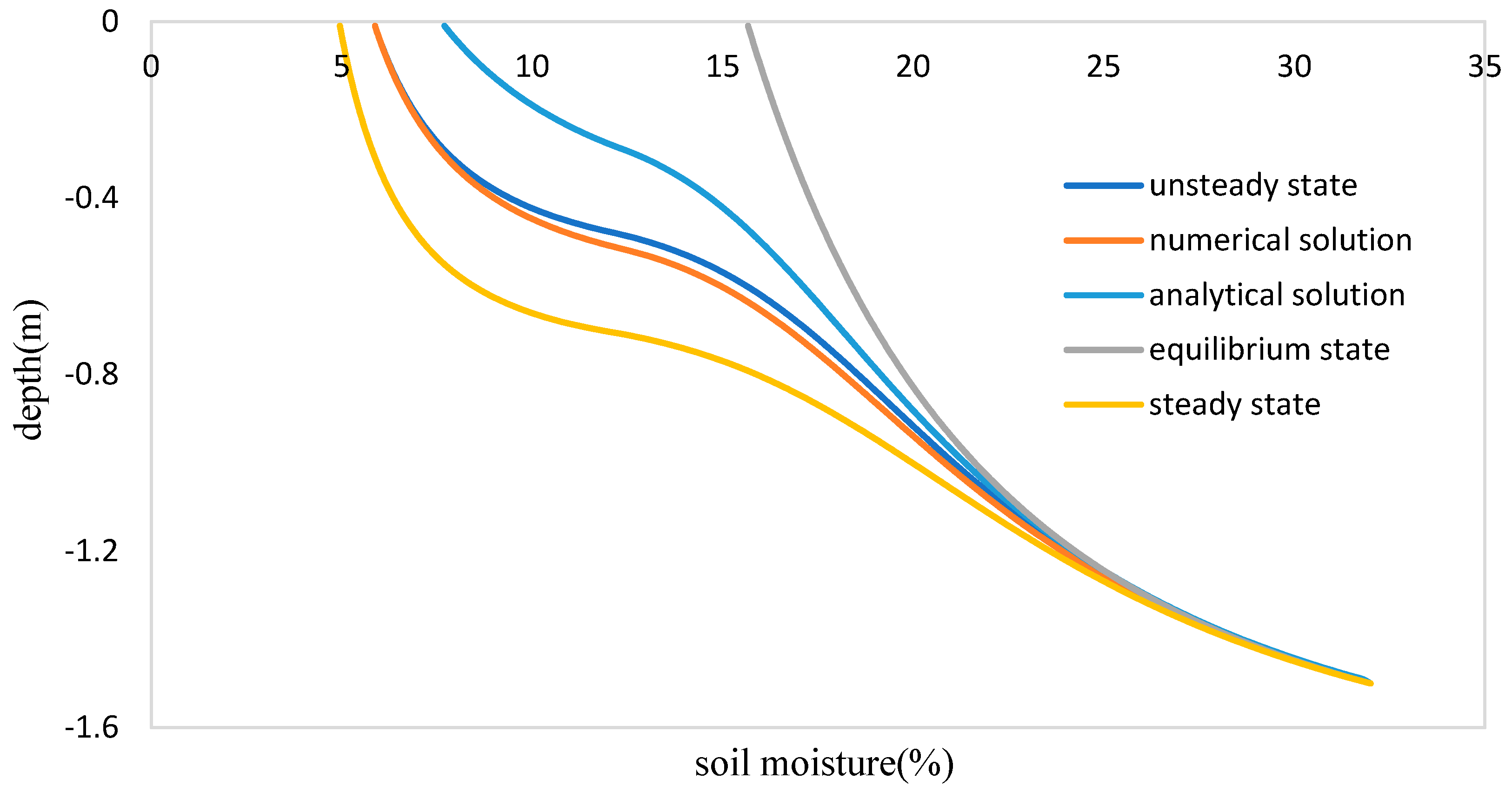
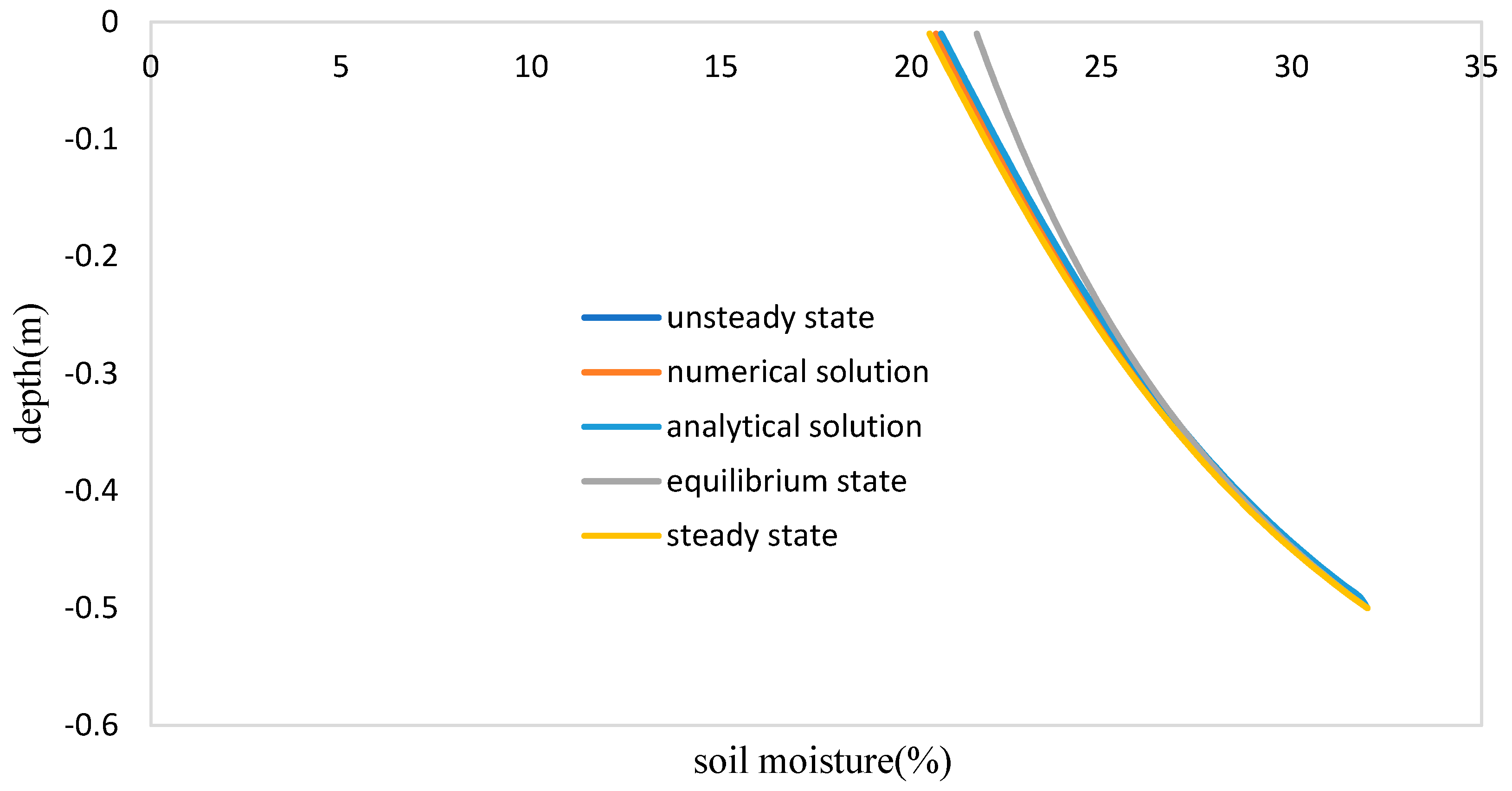
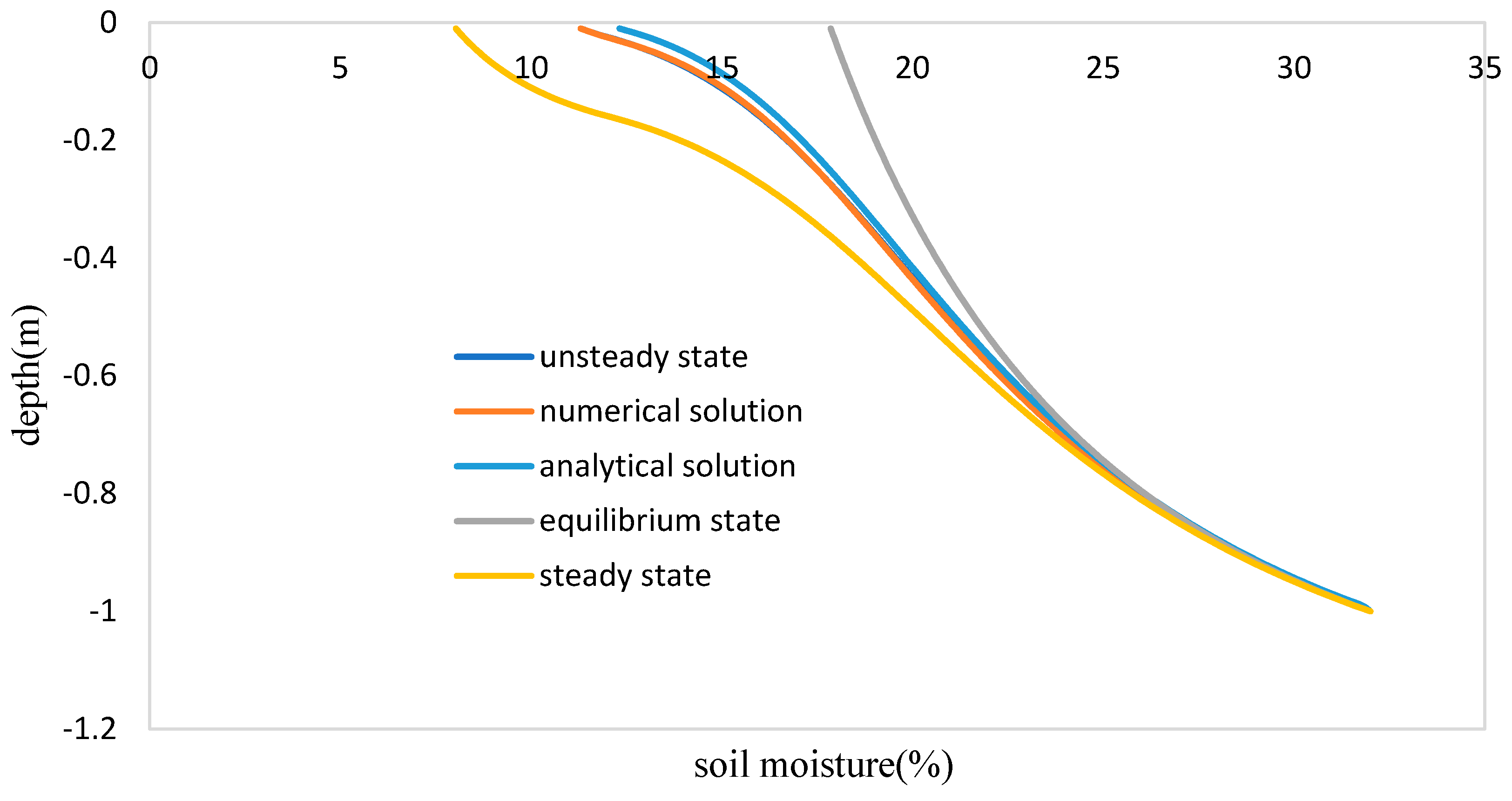
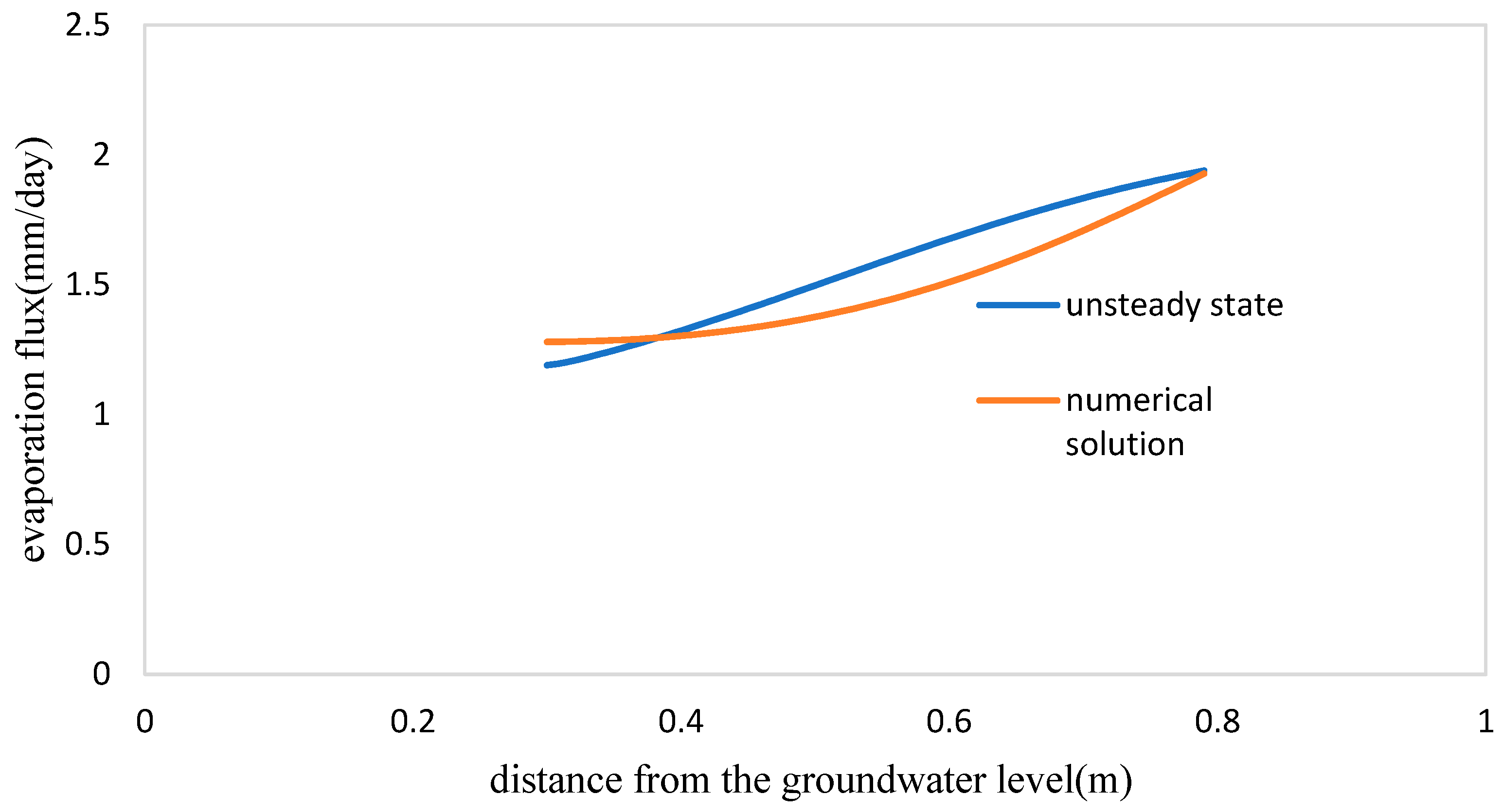
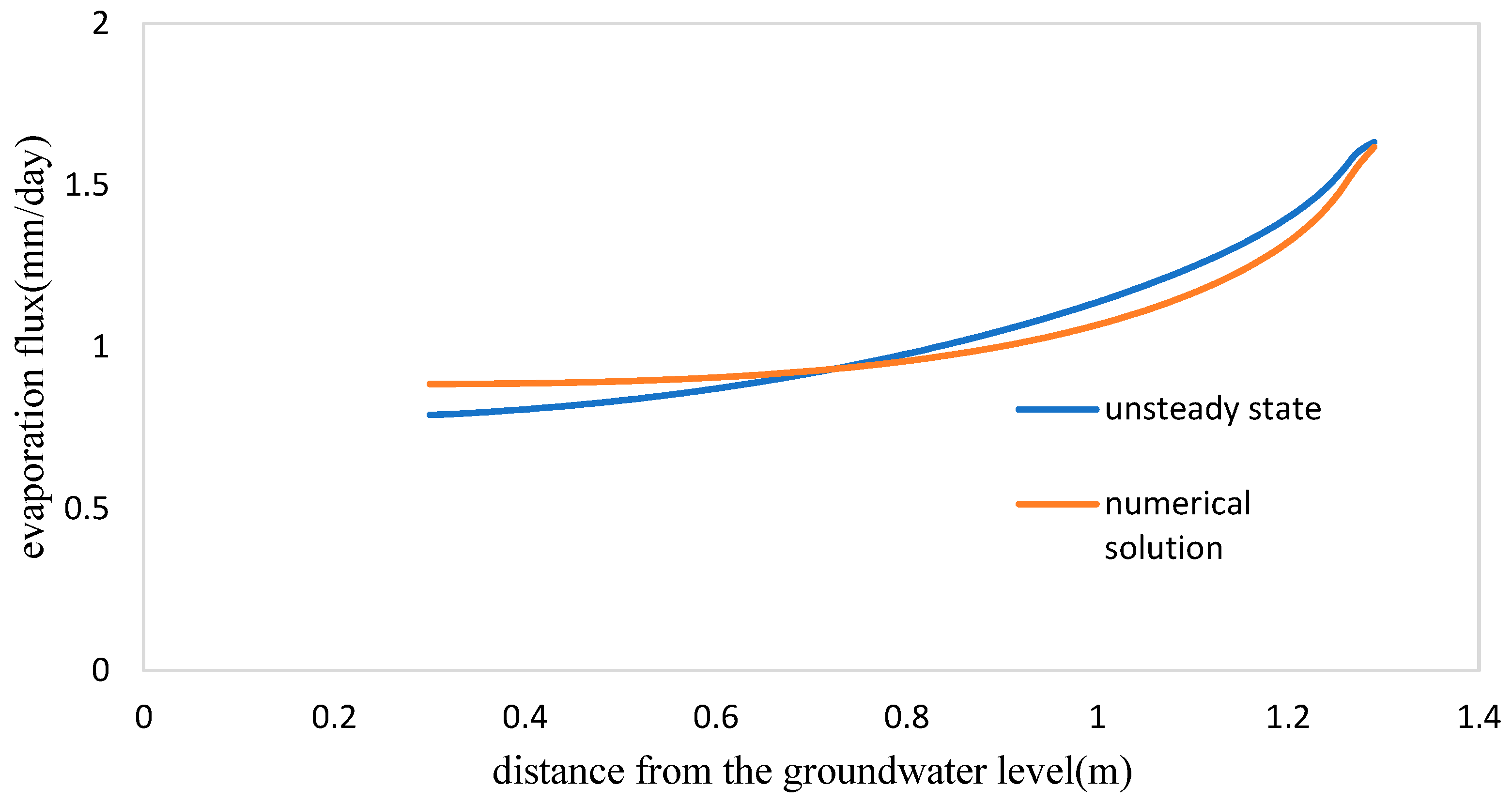
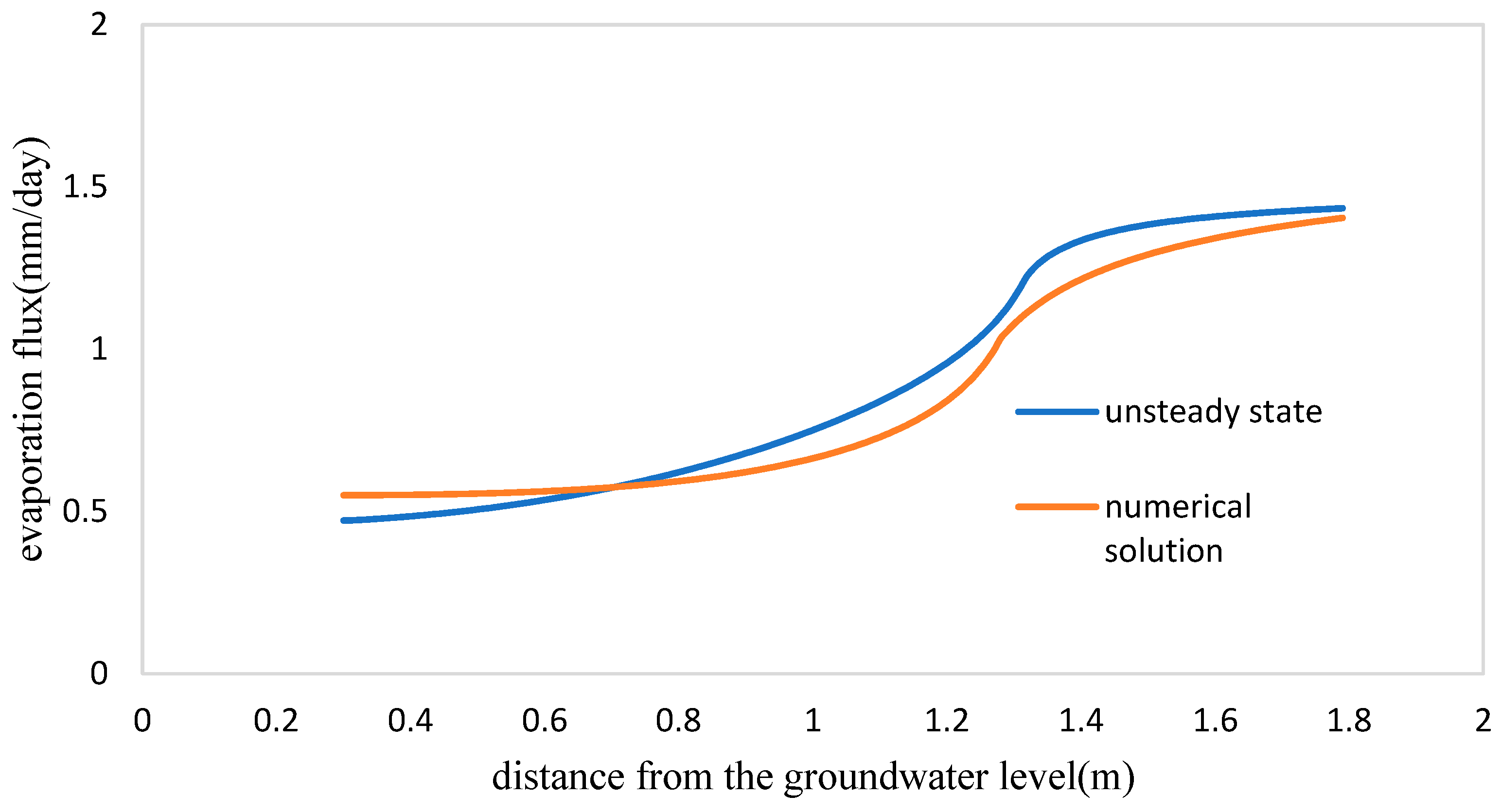
For this study, a typical soil was selected with the following parameters: θ s θ r = 0.32 , ψ b = 0.3 , λ = 0.4 , p = 3.2 , K s = 1 / 10 6   m / s , a 1 = 0.2 , f = 0.5 ( 1 / m ) . The parameters for diving evaporation were set as: E p = 2   mm / day , d max = 3.5   m , n n = 2 (These parameters are explained in Section 2.3.1). Three cases with groundwater depths of 0.8 m, 1.3 m, and 1.8 m were considered, respectively. The computational accuracy of the semi-analytical solution considering non-steady-state evaporation presented in this paper was verified by comparing the differences in water storage capacity (i.e., soil water deficit) under different groundwater depths simulated by the semi-analytical solution considering non-steady-state evaporation, the non-steady-state analytical solution, the equilibrium method, the steady-state method, and the general numerical difference method. (The general numerical difference method requires a very small time step, generally taken as 1 s, so its computational accuracy is very high. The numerical values calculated by this method are used as true values to compare the computational accuracy of other methods). The effectiveness of the proposed method in simulating actual evaporation was verified by comparing the vertical distribution of soil evaporation flux simulated by the semi-analytical solution considering non-steady-state evaporation and that simulated by the general numerical difference method. The vertical distribution of soil water content and evaporation flux under different depths simulated by different methods is shown in Figure 3, Figure 4, Figure 5, Figure 6, Figure 7 and Figure 8:
By comparison, it can be found that the semi-analytical solution considering non-steady-state evaporation presented in this paper and the general numerical difference method have very similar simulation results for the vertical distribution of soil water content. (The simulated values of the method proposed in this paper are represented by the dark blue line, while the simulated values of the general numerical difference method (approximated as true values) are represented by the red line. The two lines are very close to each other). Meanwhile, the non-steady-state analytical solution, the equilibrium method, and the steady-state method have relatively larger computational errors: When D = 0.8   m , the water storage capacities calculated by the proposed method, the general numerical difference method, the non-steady-state analytical solution, the equilibrium method, and the steady-state method are 12.56 mm, 12.60 mm, 12.08 mm, 10.78 mm, and 13.02 mm, respectively. The relative errors of the proposed method, the non-steady-state analytical solution, the equilibrium method, and the steady-state method are −0.27% (the method proposed in this paper, the same below), −4.13%, −14.41%, and 3.38%, respectively. When D = 1.3   m , the water storage capacities calculated by the five methods are 62.11 mm, 62.22 mm, 59.45 mm, 49.13 mm, and 75.94 mm, respectively. The relative errors of the four methods are −0.18%, −4.46%, −21.04%, and 22.05%, respectively. When D = 1.8   m , the water storage capacities calculated by the five methods are 157.09 mm, 159.36 mm, 131.11 mm, 101.86 mm, and 188.21 mm, respectively. The relative errors of the four methods are −1.42%, −17.73%, −36.08%, and 18.10%, respectively. It can be found that the absolute value of the relative error in calculating the water storage capacity by the proposed method can be controlled within 1.5%. Compared with the non-steady-state analytical solution, the equilibrium method and the steady-state method, the method proposed in this paper has higher computational accuracy.
By comparison, it can be found that the semi-analytical solution considering non-steady-state evaporation presented in this paper and the general numerical difference method have very similar simulation results for the vertical distribution of evaporation flux, especially for the surface evaporation flux (i.e., actual evaporation). When D = 0.8   m , the calculated value by the proposed method (the surface evaporation, the same below) is 1.939 mm/day, and that by the general numerical difference method is 1.928 mm/day, with a relative error of 0.56%. When D = 1.3   m , the calculated value by the proposed method is 1.634 mm/day, and that by the general numerical difference method is 1.619 mm/day, with a relative error of 0.95%. When D = 1.8   m , the calculated value by the proposed method is 1.424 mm/day, and that by the general numerical difference method is 1.405 mm/day, with a relative error of 1.35%. It can be found that the absolute value of the relative error in calculating actual evaporation by the proposed method can be controlled within 1.5%. The proposed method has high accuracy in calculating actual evaporation and can effectively simulate the vertical distribution of soil water content and evaporation flux.

3.2. Model Performance Evaluation

This study utilized meteorological and hydrological observations from the Tarrawarra catchment (a representative hilly watershed) in Australia, spanning 6 December 1995, to 17 November 1997. Potential evapotranspiration [33,34] was calculated using meteorological data. Three distributed hydrological models—the proposed model in this paper, DHSVM, and the storage capacity model—were applied for daily simulations and parameter calibration. The reliability of the distributed Xin’anjiang model proposed in this paper for hilly terrain in simulating the spatiotemporal distributions of hydrological variables was validated by comparing its performance against the other two models in reproducing: (1) streamflow at the catchment outlet and (2) soil water deficits across 17 grid points.
The water storage capacity model is a typical second-class distributed hydrological model that simplifies the hydrodynamic characteristics of the unsaturated zone and ignores the effects of non-steady-state evaporation. It overcomes the problems of limited data and large computational requirements, resulting in fast computation speed. However, excessive simplification to some extent weakens the physical mechanisms and reduces the computational accuracy. The DHSVM model is a typical first-class distributed hydrological model with strong physical mechanisms and computational formulas that closely approximate the complex actual conditions of a basin. However, limited data and large computational requirements affect the accuracy of the model. The distributed Xin’anjiang model for hilly areas, considering non-steady-state evaporation, which is proposed in this paper, integrates the advantages of the two models while overcoming their respective shortcomings. It achieves a certain balance between computational accuracy, speed, and physical mechanisms. Therefore, the water storage capacity model and the DHSVM model were selected. By comparing the simulation results of soil water content at grid points and basin outflow by the proposed model with those by the water storage capacity model and the DHSVM model, the high computational accuracy of the proposed model is verified.
This study calculated the soil water deficits at 17 grid points using in situ soil moisture data measured at depths of 15 cm, 30 cm, 45 cm, and 60 cm for each grid point:
W d = ( θ f θ 15 ) · 150 + ( θ f θ 30 ) · 150 + ( θ f θ 45 ) · 150 + ( θ f θ 60 ) · 150
where W d signifies the water deficit of the grid point; and θ f signifies the field capacity.
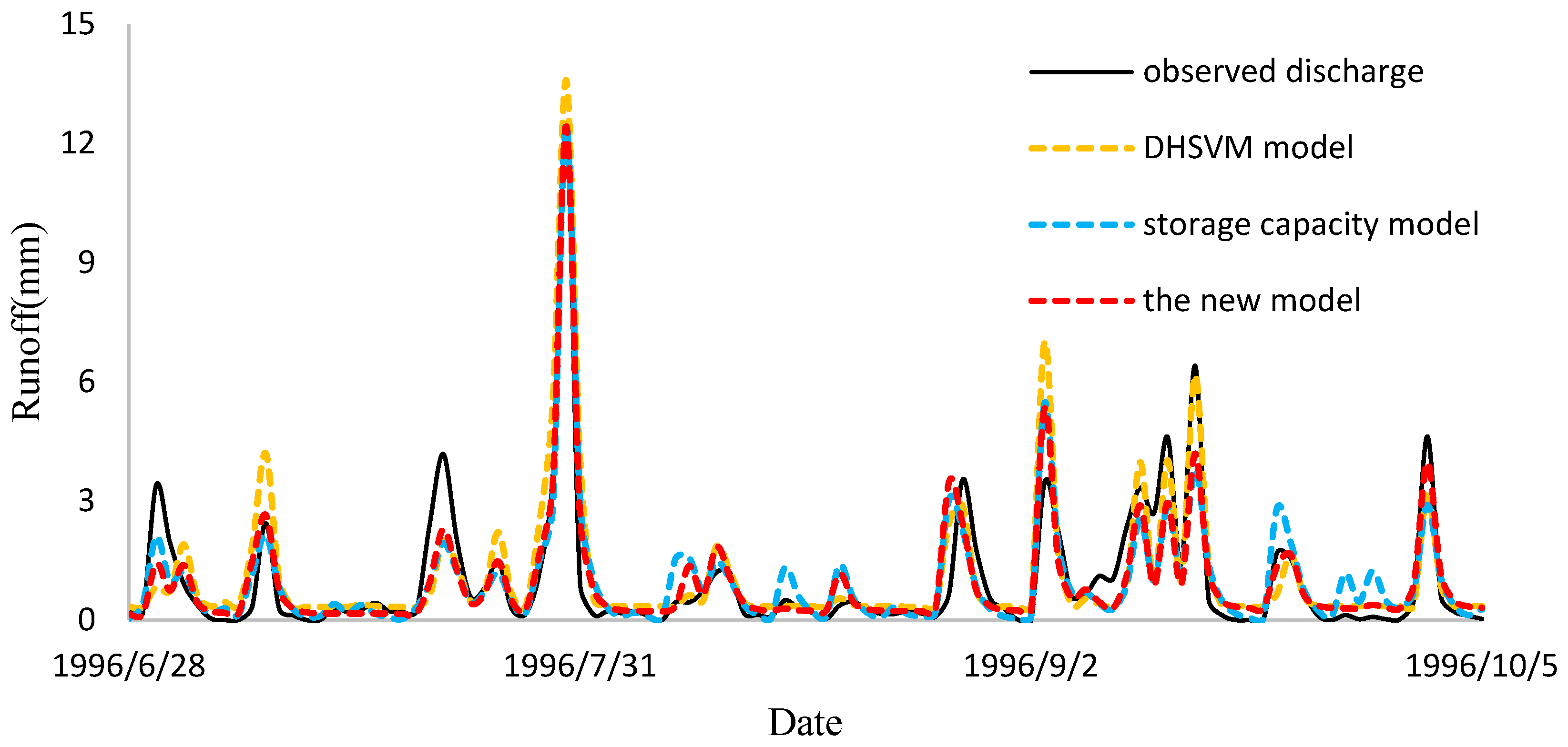
The sum of the Nash–Sutcliffe efficiency (NSE) coefficient for runoff and the NSE coefficient for soil water deficit at grid points was used as the objective function, and the parameters were calibrated using the SCE-UA algorithm. The comparison shows that, in terms of the NSE coefficient for simulated runoff, the proposed model is 0.81, the water storage capacity model is 0.77, and the DHSVM model is 0.74. In terms of the root mean square error (RMSE) for simulated runoff, the proposed model is 0.72 mm, the water storage capacity model is 0.78 mm, and the DHSVM model is 0.86 mm. Among the three models, the distributed Xin’anjiang model for hilly areas considering non-steady-state evaporation proposed in this paper has the best performance in simulating runoff. The simulated runoff processes of the three models and the measured runoff process are shown in Figure 9, and the calibrated parameters of the proposed model are listed in Table 1.
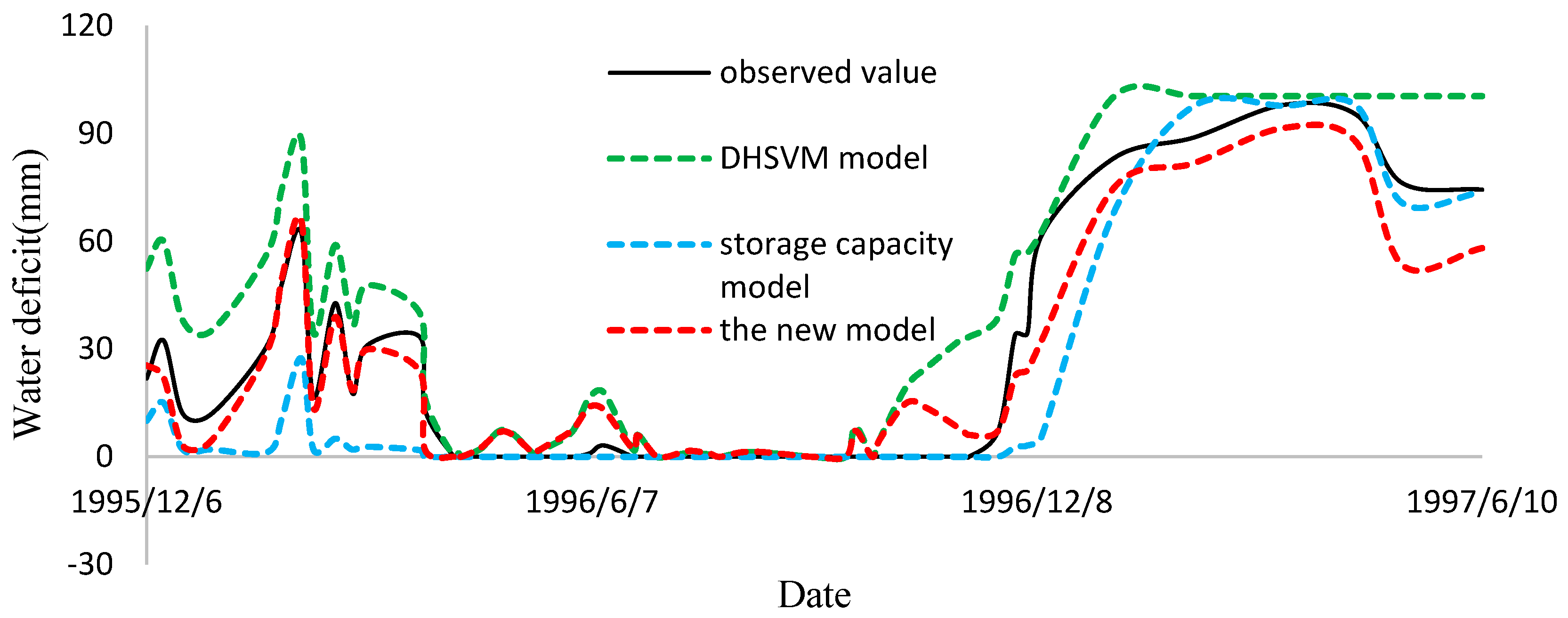
The soil water content was simulated using the calibrated parameters of the model proposed in this paper, and the results were compared with the measured values. The measured soil water deficit and the simulated values by the three methods at observation point S2 are shown in Figure 10. (It can be clearly seen that the simulation effect of the model proposed in this paper is the best). The NSE coefficient, RMSE coefficient, and R2 coefficient for the simulated soil water deficit at 17 observation points in the basin by the three methods are listed in Table 2. The comparison results show that for the soil water deficit simulated by the model proposed in this paper at the 17 observation points in the watershed, the NSE values range from 0.73 to 0.96, the RMSE values are less than 21.76 mm, and the coefficient of determination (R2) is greater than 0.90 for 94% of the sites. For the soil water deficit simulated by the water storage capacity model at the 17 observation points in the watershed, the NSE values range from 0.55 to 0.94, the RMSE values are less than 21.89 mm, and the coefficient of determination (R2) is greater than 0.90 for 71% of the sites. For the soil water deficit simulated by the DHSVM model at the 17 observation points in the watershed, the NSE values range from 0.66 to 0.92, the RMSE values are less than 22.46 mm, and the coefficient of determination (R2) is greater than 0.90 for 59% of the sites. The proposed model can effectively simulate the spatiotemporal variation in soil water content at the grid points.

4. Discussion

4.1. Advantages of the Model

In this research, we have developed a distributed Xin’anjiang model for hilly areas considering non-steady-state evaporation. The model offers several notable advantages:
By comparing the vertical distribution of soil water content under different burial depths simulated by the proposed model in this paper, the general numerical difference method considering non-steady-state evaporation, the non-steady-state analytical solution, the equilibrium method, and the steady-state method, it is found that the simulation accuracy of the proposed method (the maximum relative error of soil water deficit is −1.42%) is significantly higher than that of the non-steady-state analytical solution (the maximum relative error of soil water deficit is −17.73%), the equilibrium method (the maximum relative error of soil water deficit is −36.08%), and the steady-state method (the maximum relative error of soil water deficit is 18.10%). Incorporating the hydrodynamic characteristics of the unsaturated zone (considering the characteristic that the saturated hydraulic conductivity of soil decreases exponentially with increasing depth and using the one-dimensional Richards equation to simulate the soil water movement in the unsaturated zone) and the factor of the non-steady-state evaporation enhances the physical mechanism of the method and improves its computational accuracy.
Through the derivation in Section The Employment of the Semi-Analytical Solution Method to Solve the Richards Equation, we obtained the semi-analytical solution (used in the model proposed in this paper), which can be used to derive the vertical distribution of soil water content. It has been demonstrated that this method is stable, with a time step that can be as long as 1 day. Compared to the general numerical method, which has poor stability and requires a time step of 1 s, the proposed method has a significant advantage in terms of computational speed.
By comparing the simulation results of soil water content at grid points and basin outflow in the Tarrawarra basin using the proposed model in this paper (for basin outflow, NSE = 0.81, RMSE = 0.72 mm; for soil water deficit, NSE = 0.89, RMSE = 11.64 mm, R2 = 0.94), the water storage capacity model (or basin outflow, NSE = 0.77, RMSE = 0.78 mm; for soil water deficit, NSE = 0.82, RMSE = 13.70 mm, R2 = 0.90), and the DHSVM model (for basin outflow, NSE = 0.74, RMSE = 0.86 mm; for soil water deficit, NSE = 0.83, RMSE = 13.85 mm, R2 = 0.89), it is found that the distributed Xin’anjiang model for hilly areas proposed in this paper has higher computational accuracy in simulating soil water content and basin outflow. In summary, the proposed model not only solves the two major problems of limited data and large computational requirements in the first-class distributed hydrological models but also achieves a balance between physical mechanisms, computational speed, and computational accuracy. Moreover, through derivation, it is found that the method proposed in this paper for deriving the vertical distribution of soil moisture is applicable to various burial depths, soil types, and evaporation conditions. This addresses the issue that the assumption of the non-steady-state analytical solution—that the evaporation flux is related to the absolute value of the matric potential by a power function—does not always hold in actual natural basins, thereby affecting the universality of the non-steady-state analytical solution.
Although Xiaohua Xiang et al.’s paper includes the validation of the second-class distributed hydrological model simulating discharge at the watershed outlet cross-section, there is currently no paper on the second-class distributed hydrological model simulating the spatiotemporal variation in soil moisture content at grid points within the watershed. This paper fills this gap and verifies that the distributed Xin’anjiang model for hilly areas proposed in this paper has high accuracy in simulating soil moisture content at grid points in the Tarrawarra watershed, enabling the second-class distributed hydrological model to simultaneously possess physical mechanism, computational accuracy, and computational speed, with the capability to accurately describe the spatiotemporal variation in hydrological variables in the watershed. Additionally, the Tarrawarra watershed in this paper is a typical hilly watershed, exhibiting common typical characteristics of hilly watersheds, such as large slope variation and significant interflow contribution. The experimental results validated with the Tarrawarra watershed can be transferred to other hilly watersheds, thereby further promoting the application of the distributed Xin’anjiang model for hilly areas that considers non-steady-state evaporation, as proposed in this paper.

4.2. Limitations and Outlook

In the present study, we acknowledge several inherent limitations. For the new model applied in hilly regions, evaporation capacity is treated as a constant parameter, whereas in reality, it exhibits significant temporal and spatial variability. This assumption may undermine the simulation accuracy of soil water storage capacity. Consequently, we propose that future research should account for the dynamic nature of evaporation capacity.
Moreover, the current analysis does not incorporate the impact of vegetation on the hydrological cycle, an oversight considering the pivotal role of vegetation in watershed dynamics [35]. For a comprehensive understanding of watershed processes, it is advised that future studies focus on the significant influence of vegetation and its integration into hydrological models within the watershed, adding modules for vegetation water uptake and evaporation and canopy evaporation, and simultaneously considering the influence of plant seasonality (such as variation in LAI at grid points) to more accurately estimate watershed hydrological variables.
Additionally, the Tarrawarra watershed is a typical small experimental hilly watershed, and there are some differences in hydrological characteristics, such as concentration time, compared with some other large hilly watersheds. The application of the model proposed in this paper in some large hilly watersheds still requires support from more hydrological validation data. Therefore, future research should demonstrate the simulation effect of the model proposed in this paper in large watersheds.

5. Conclusions

Within the scope of this research, we have developed a distributed Xin’anjiang Model tailored for hilly regions.
By comparing the simulation results of single-point soil water deficit using various methods, and by comparing the simulation results of soil water deficit at each grid point and watershed outflow within the watershed using various models, it is found that the distributed Xin’anjiang model for hilly areas considering non-steady-state evaporation, which was newly constructed in this paper, strengthened the physical mechanism and improved the simulation accuracy by incorporating the hydrodynamic characteristics of the unsaturated zone—considering the characteristic that the saturated hydraulic conductivity of soil decreases exponentially with increasing depth and using the one-dimensional Richards equation to describe the soil water movement in the unsaturated zone—and the factor of the non-steady-state evaporation. As an improved second-class distributed hydrological model, the proposed model overcomes the two major problems of limited data and large computational requirements. At the same time, the proposed model uses the semi-analytical solution to calculate the vertical distribution of soil water content, which speeds up the computation. The proposed model balances the physical mechanism, computational speed, and computational accuracy. Moreover, according to the derivation, the method proposed in this paper for deriving the vertical distribution of soil moisture is applicable to various burial depths, soil types, and evaporation conditions, solving the problem of the lack of universality of previous methods. The development of the proposed model is of positive significance for improving the simulation and prediction accuracy of hydrology and water resources, helping people understand the laws of runoff generation and concentration in basins, and thus enabling proactive responses to natural disasters such as floods and droughts, thereby reducing the damage and losses they cause.
However, several questions remain for future research.
Firstly, the hilly terrain model treats evaporation capacity as a constant parameter, neglecting its known spatial and temporal variability. Future research should investigate this factor.
Secondly, the current study neglects the impact of vegetation on the hydrological cycle. To better understand basin hydrological processes, future research should incorporate the vegetation factor when conducting runoff generation and concentration simulations.
Thirdly, the model proposed in this paper has only been validated in the Tarrawarra watershed (a small hilly watershed). For the application of the model in large hilly watersheds, more watershed validation data are still needed.

Author Contributions

Q.S.: Conceptualization, Methodology, Data curation, Software, Formal analysis, Writing, Visualization. X.C. and Z.Z.: Funding acquisition, Supervision. Qifeng Song: Writing—review and editing, Writing—original draft, Formal analysis, Data curation, Conceptualization. X.C.: Funding acquisition, Supervision. Z.Z.: Funding acquisition, Supervision. All authors have read and agreed to the published version of the manuscript.

Funding

This work was funded by the Projects of National Natural Science Foundation of China, grant number (42030506).

Data Availability Statement

The original contributions presented in this study are included in the article. Further inquiries can be directed to the corresponding author.

Conflicts of Interest

The authors declare that they have no known competing financial interests or personal relationships that could have appeared to influence the work reported in this paper.

References

  1. Wu, Z. Quantitative Rainfall and Real-Time Flood Forecast. Ph.D. Thesis, Hohai University, Nanjing, China, 2008; pp. 1–3. [Google Scholar]
  2. Qiu, H.; Cao, M.; Hao, J.; Wang, Y.; Wang, Y. The analysis of the relationship between frequency and scale of the drought disaster in China from 1950 to 2010. Geoscience 2013, 33, 576–580. [Google Scholar]
  3. Xu, Y.; Yu, Q.; Liu, C.; Li, W.; Quan, L.; Niu, C.; Zhao, C.; Luo, Q.; Hu, C. Construction of a semi-distributed hydrological model considering the combination of saturation-excess and infiltration-excess runoff space under complex substratum. J. Hydrol. Reg. Stud. 2024, 51, 101642. [Google Scholar] [CrossRef]
  4. Yáñez-Morroni, G.; Suárez, F.; Muñoz, J.F.; Lagos, M.S. Hydrological modeling of the Silala River basin. 2. Validation of hydrological fluxes with contemporary data. Wiley Interdiscip. Rev. Water 2024, 11, e1696. [Google Scholar] [CrossRef]
  5. Bhanja, S.N.; Coon, E.T.; Lu, D.; Painter, S.L. Evaluation of distributed process-based hydrologic model performance using only a priori information to define model inputs. J. Hydrol. 2023, 618, 129176. [Google Scholar] [CrossRef]
  6. Gelete, G.; Nourani, V.; Gokcekus, H.; Gichamo, T. Ensemble physically based semi-distributed models for the rainfall-runoff process modeling in the data-scarce Katar catchment, Ethiopia. J. Hydroinform. 2023, 25, 567–592. [Google Scholar] [CrossRef]
  7. Rudraswamy, G.K.; Manikanta, V.; Umamahesh, N. Hydrological assessment of the Tungabhadra River Basin based on CMIP6 GCMs and multiple hydrological models. J. Water Clim. Change 2023, 14, 1371–1394. [Google Scholar] [CrossRef]
  8. Anteneh, Y.; Alamirew, T.; Zeleke, G.; Kassawmar, T. Modeling runoff-sediment influx responses to alternative BMP interventions in the Gojeb watershed, Ethiopia, using the SWAT hydrological model. Environ. Sci. Pollut. Res. 2023, 30, 22816–22834. [Google Scholar] [CrossRef]
  9. Singh, V.P.; Woolhiser, D.A. Mathematical modeling of watershed hydrology. J. Hydrol. Eng. 2002, 7, 270–292. [Google Scholar] [CrossRef]
  10. Horritt, M.S.; Bates, P.D. Evaluation of 1D and 2D numerical models for predicting river flood inundation. J. Hydrol. 2002, 268, 87–99. [Google Scholar] [CrossRef]
  11. Richards, L. A Capillary conduction of liquids through porous mediums. Physics 1931, 1, 318–333. [Google Scholar] [CrossRef]
  12. Boussinesq, J. Essai sur la thorie des eaux courantes, Mm. Acad. Sci. Inst. Fr. 1877, 23, 1–680. [Google Scholar]
  13. Abbott, M.B.; Bathurst, J.C.; Cunge, J.C.; O’Connell, P.E.; Rasmussen, J. An introduction to the European Hydrological System—Systeme Hydrologique Europeen ‘SHE’ 1: History and philosophy of a physically based distributed modelling system. J. Hydrol. 1986, 87, 45–59. [Google Scholar] [CrossRef]
  14. Wigmosta, M.S.; Lettenmaier, D.P.; Vail, L.W. A distributed hydrology vegetation model for complex terrain. Water Resour. Res. 1994, 30, 1665–1679. [Google Scholar] [CrossRef]
  15. Koren, V.; Moreda, F.; Reed, S.; Smith, M.; Zhang, Z. Evaluation of a grid-based distributed hydrological model over a large area. In Predictions in Ungauged Basins: Promise and Progress; IAHS Publ.: Oxfordshire, UK, 2006; Volume 303. [Google Scholar]
  16. Xiang, X.; Song, Q.; Chen, X.; Wu, X.; Wang, C. A storage capacity model integrating terrain and soil characteristics. Adv. Water Sci. 2013, 24, 651–657. [Google Scholar]
  17. Yao, C.; Li, Z.; Yu, Z.; Zhang, Z. A priori parameter estimates for a distributed, grid-based Xin’anjiang model using geographically based information. J. Hydrol. 2012, 468, 47–62. [Google Scholar] [CrossRef]
  18. Chen, X.; Chen, Y.D.; Xu, C. A distributed monthly hydrological model for integrating spatial variations of basin topography and rainfall. Hydrol. Process. 2007, 21, 242–252. [Google Scholar] [CrossRef]
  19. Shi, P.; Rui, X.; Qu, S.; Chen, X. Calculating storage capacity with topographic index. Adv. Water Sci. 2008, 19, 264–267. [Google Scholar]
  20. Beven, K.J.; Kirkby, M.J. A physically-based variable conmodel of basin hydrology. Hydrol. Sci. Bull. 1979, 24, 43–69. [Google Scholar] [CrossRef]
  21. Zhao, R. Hydrological Model of Basin: Xin’anjiang Model and Shanbei Model; China Water Power Press: Beijing, China, 1984; pp. 106–130. [Google Scholar]
  22. Sadeghi, M.; Shokri, N.; Jones, S.B. A novel analytical solution to steady-state evaporation from porous media. Water Resour. Res. 2012, 48, W9516. [Google Scholar]
  23. Song, Q.; Chen, X.; Zhang, Z. The distributed Xin’anjiang model incorporating the analytic solution of the storage capacity under unsteady-state conditions. Water 2024, 16, 3252. [Google Scholar] [CrossRef]
  24. Western, A.W.; Bl¨oschl, G.; Grayson, R.B. Geostatistical characterisation of soil moisture patterns in the Tarrawarra Catchment. J. Hydrol. 1998, 205, 20–37. [Google Scholar] [CrossRef]
  25. Western, A.W.; Grayson, R.B.; Blöschl, G.; Willgoose, G.R.; McMahon, T.A. Observed spatial organization of soil moisture and its relation to terrain indices. Water Resour. Res. 1999, 35, 797–810. [Google Scholar] [CrossRef]
  26. Srinivasan, R.; Arnold, J.G.; Jones, C.A. Hydrologic modeling of the United States with the soil and water assessment tool. Water Resour. Dev. 1998, 4, 315–325. [Google Scholar] [CrossRef]
  27. Brooks, R.H.; Corey, A.T. Hydraulic Properties of Porous Media. Ph.D. Thesis, Colorado State University, Fort Collins, CO, USA, 1964. [Google Scholar]
  28. Duan, Q.; Sorooshian, S.; Gupta, V. Effective and Efficient Global Optimization for Conceptual Rainfall-Runoff Models. Water Resour. Res. 1992, 28, 1015–1031. [Google Scholar] [CrossRef]
  29. Zhang, Q.; Yan, X.; Li, Z. A mathematical framework for multiphase poromechanics in multiple porosity media. Comput. Geotech. 2022, 146, 104728. [Google Scholar] [CrossRef]
  30. Bitterlich, S.; Durner, W.; Iden, S.C.; Knabner, P. Inverse estimation of the unsaturated soil hydraulic properties from column outflow experiments using free-form parameterizations. Vadose Zone J. 2004, 3, 971–981. [Google Scholar] [CrossRef]
  31. Caputo, M.C.; De Carlo, L.; Turturro, A.C. HYPROP-FIT to Model Rock Water Retention Curves Estimated by Different Methods. Water 2022, 14, 3443. [Google Scholar] [CrossRef]
  32. Šimunek, J.; Nimmo, J.R. Estimating soil hydraulic parameters from transient flow experiments in a centrifuge using parameter optimization technique. Water Resour. Res. 2005, 41, 9. [Google Scholar] [CrossRef]
  33. Penmam, H.L. Natural evaporation from open water, bare soil land grass. Proc. R. Soc. Lond. Ser. 1948, 193, 120–145. [Google Scholar]
  34. Doorenbos, J.; Pruitt, W.O. Guidelines for Predicting Crop Water Requirements, 2nd ed.; FAO Irrigation and Drainage: Rome, Italy, 1977; Paper 24. [Google Scholar]
  35. Liang, X. A Two-Layer Variable Infiltration Capacity Land Surface Representation for General Circulation Models. Ph.D. Thesis, University of Washington, Seattle, DC, USA, 1994; 208p. [Google Scholar]
Figure 1. The distribution of terrain, soil moisture observation points and groundwater observation points in the study area [23]. Note: Water 18 00845 i001 serves as a representative catchment for hilly terrain in this study, known as the Tarrawarra watershed. Water 18 00845 i002 signifies the weather station in the Tarrawarra watershed.
Water 18 00845 g001
Figure 2. The distribution of topographic indices [23].
Water 18 00845 g002
Figure 3. The vertical distribution of soil moisture when the groundwater depth is 0.8 m.
Water 18 00845 g003
Figure 4. The vertical distribution of soil moisture when the groundwater depth is 1.3 m.
Water 18 00845 g004
Figure 5. The vertical distribution of soil moisture when the groundwater depth is 1.8 m.
Water 18 00845 g005
Figure 6. The evaporation flux when the groundwater depth is 0.8 m.
Water 18 00845 g006
Figure 7. The evaporation flux when the groundwater depth is 1.3 m.
Water 18 00845 g007
Figure 8. The evaporation flux when the groundwater depth is 1.8 m.
Water 18 00845 g008
Figure 9. The simulated and observed runoff.
Water 18 00845 g009
Figure 10. The changing process of simulated and observed soil moisture deficit within 0–60 cm below the ground surface at point S2.
Water 18 00845 g010
Table 1. The calibrated parameters of the model proposed in this paper.
Parameterszlfybooetasmki
Value2.1420.3850.2540.3220.94528.370.263
Range1.0~3.00.1~0.80.1~1.00.25~0.350.7~1.215~350.1~0.5
Parameterkgeieges1a1Ksf
Value0.4420.6350.9960.9120.18455.320.562
Range0.1~0.50.5~0.90.9~0.9990.6~1.00.1~0.410~1000.1~1.0
Parameterdmaxwumwlmcccnn
Value3.17513.4244.130.1652.436
Range1.0~5.05.0~20.010.0~60.00.05~0.350.5~4.0
Table 2. The comparison results of the three models’ simulated and observed soil moisture deficit of 0~60 cm.
PointNSERMSER2
The New ModelStorage Capacity ModelDHSVMThe New ModelStorage Capacity ModelDHSVMThe New ModelStorage Capacity ModelDHSVM
S10.960.920.927.289.889.870.960.940.91
S20.890.660.689.8317.0316.470.910.740.84
S30.930.830.888.5812.9410.880.950.920.91
S40.920.830.909.3613.0510.110.940.910.93
S50.920.940.8811.389.6313.460.970.960.93
S60.910.940.8511.228.6714.290.890.960.82
S70.930.900.928.229.608.440.940.930.94
S80.900.900.8611.8711.7914.420.950.920.89
S90.730.550.6614.6918.9916.480.920.860.86
S100.800.810.7919.8619.1820.140.960.940.92
S110.950.910.918.7511.3711.120.960.900.93
S120.920.880.8411.9511.5713.620.950.930.91
S130.770.590.7113.6618.2515.370.930.870.88
S140.930.920.9110.4410.9011.810.930.910.91
S150.940.750.868.3016.5412.520.930.800.87
S160.770.760.7521.7621.8922.460.940.910.90
S170.910.890.8510.7211.5614.030.910.890.85
Disclaimer/Publisher’s Note: The statements, opinions and data contained in all publications are solely those of the individual author(s) and contributor(s) and not of MDPI and/or the editor(s). MDPI and/or the editor(s) disclaim responsibility for any injury to people or property resulting from any ideas, methods, instructions or products referred to in the content.