2. Earth Climate as Open System
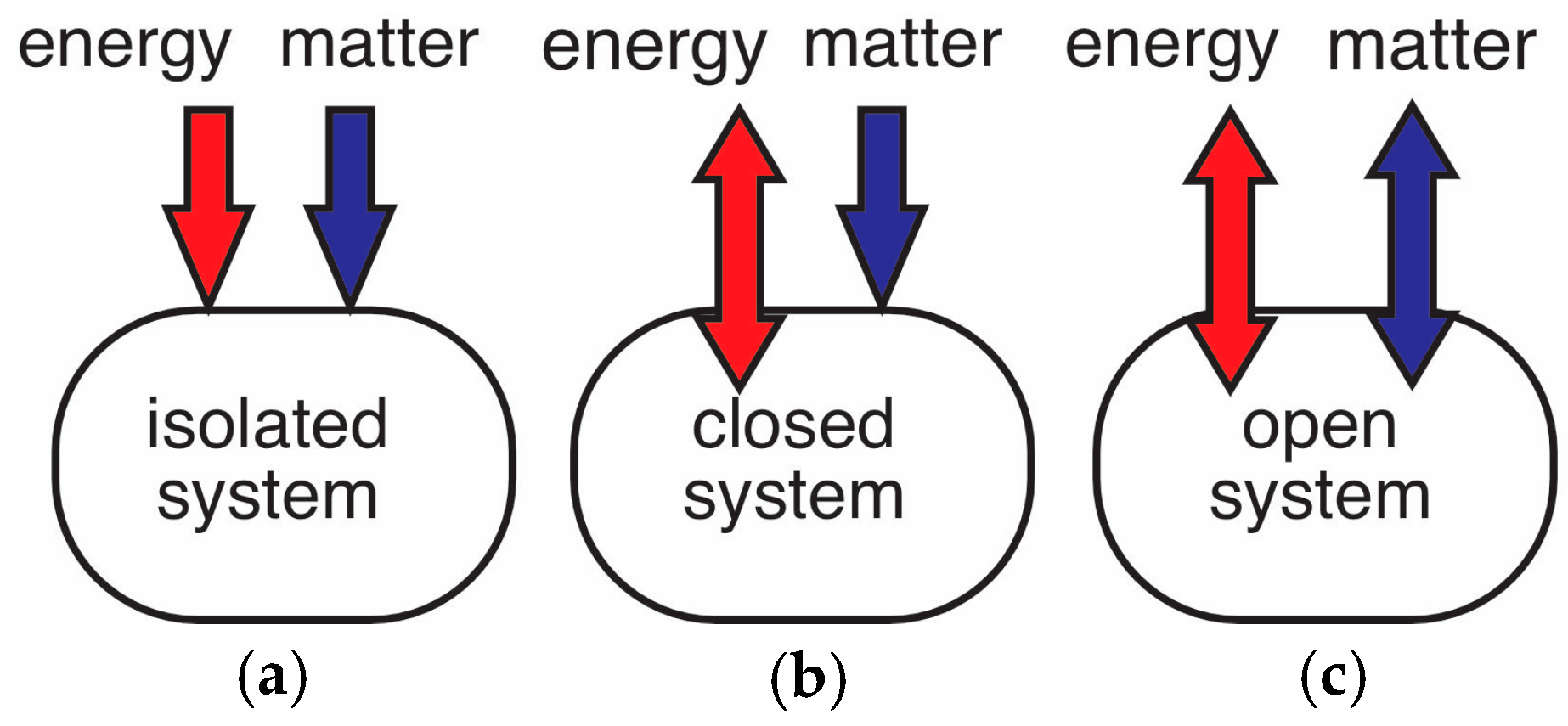
A thermodynamic system is defined as a set of material bodies, media, or fields separated from external elements by boundaries across which energy and matter can be exchanged. These external elements are referred to as the surroundings of the system. Only three types of thermodynamic systems exist in nature: isolated, closed, and open. An isolated system does not exchange energy or matter with its environment. A closed system exchanges energy with its surroundings but not matter, whereas an open system exchanges both energy and matter.
Figure 1 illustrates these distinctions, showing the three types of thermodynamic systems.
First, the entire climate system of the Earth functions as a closed system, exchanging energy in the form of heat with outer space but not matter. However, all Earth climate subsystems—the atmosphere, ocean, land, and cryosphere—are open systems exchanging both energy and matter with each other, making them ideal subjects for a self-organization approach.
Thermodynamic parameters, such as temperature, density, and entropy, are macroscopic quantities that describe the state of a system. In freely evolving systems, if these parameters remain constant over time, the system is in a stationary state but not in thermodynamic equilibrium. When macroscopic variables remain statistically steady under continuous fluxes, the system resides in a stationary nonequilibrium state rather than in a thermodynamic equilibrium. Such stationary states persist only as long as the sustaining fluxes remain active. When only parts of a system are in equilibrium, they are in a local equilibrium. The equilibrium of a system under given external conditions depends on its internal properties. The variables that uniquely describe the equilibrium state are known as independent parameters.
Next, there is a fundamental difference between reversible and irreversible processes. A reversible process transits through a continuous sequence of equilibrium states and can occur in both directions. While classical thermodynamics often simplifies real processes by considering them as reversible, nearly all natural processes are, in fact, irreversible.
Reversible processes are governed by quantitative laws. In contrast, irreversible processes are constrained by inequalities that define their direction. This limitation makes classical thermodynamics less suitable for analyzing self-organizing systems. In contrast, the nonlinear thermodynamics of nonequilibrium systems and the statistical physics of nonequilibrium processes provide the theoretical foundation for self-organization theory.
The thermodynamics of open systems forms the foundation of essential concepts governing all processes within Earth’s climate system and its subsystems, particularly in the ocean. Indeed, for the climate as defined in the Introduction, the essential interactions are between the ocean and atmosphere, as these two geospheres intensely exchange energy in the form of mechanical energy (through wind stress) and heat and matter (the latter in the form of freshwater, through evaporation and precipitation). The only element of the ocean–cryosphere exchange on decadal to millennial time scales is in the form of forming and melting sea ice and freshwater incursion into the ocean from land-based ice sheets, mostly Greenland and Antarctica, in the form of meltwater. The most significant outcome of ocean–atmosphere–cryosphere interactions is that on the selected timescale—from decades to millennia—the ocean is an open system far from equilibrium and, therefore, a self-organizing system with a strong tendency to form coherent dissipative structures (the atmosphere as an open system far from equilibrium also possesses such qualities, but on much shorter timescales).
The most crucial factor for self-organization in the ocean is that ocean currents result from nonlinear interactions between motions at multiple scales that vary in space and time. In general, nonlinearity is the most important feature of systems that can self-organize. Ocean currents are perpetually intensified by the continuous influx of energy, mechanical (wind), thermal (heating/cooling), and material (precipitation/evaporation). If energy dissipation were absent in current systems, the amplification would be limitless. This does not occur because certain coherent structures, referred to as dissipative structures, emerge and stabilize due to nonlinear interactions and energy dissipation within these systems. This significant concept is further explored in this study.
The most common examples of dissipative structures are vortices or eddies, such as cyclones and anticyclones, which occur in both oceans and the atmosphere. These structures are vital components of oceanic and atmospheric circulation and, ultimately, of the entire climate system.
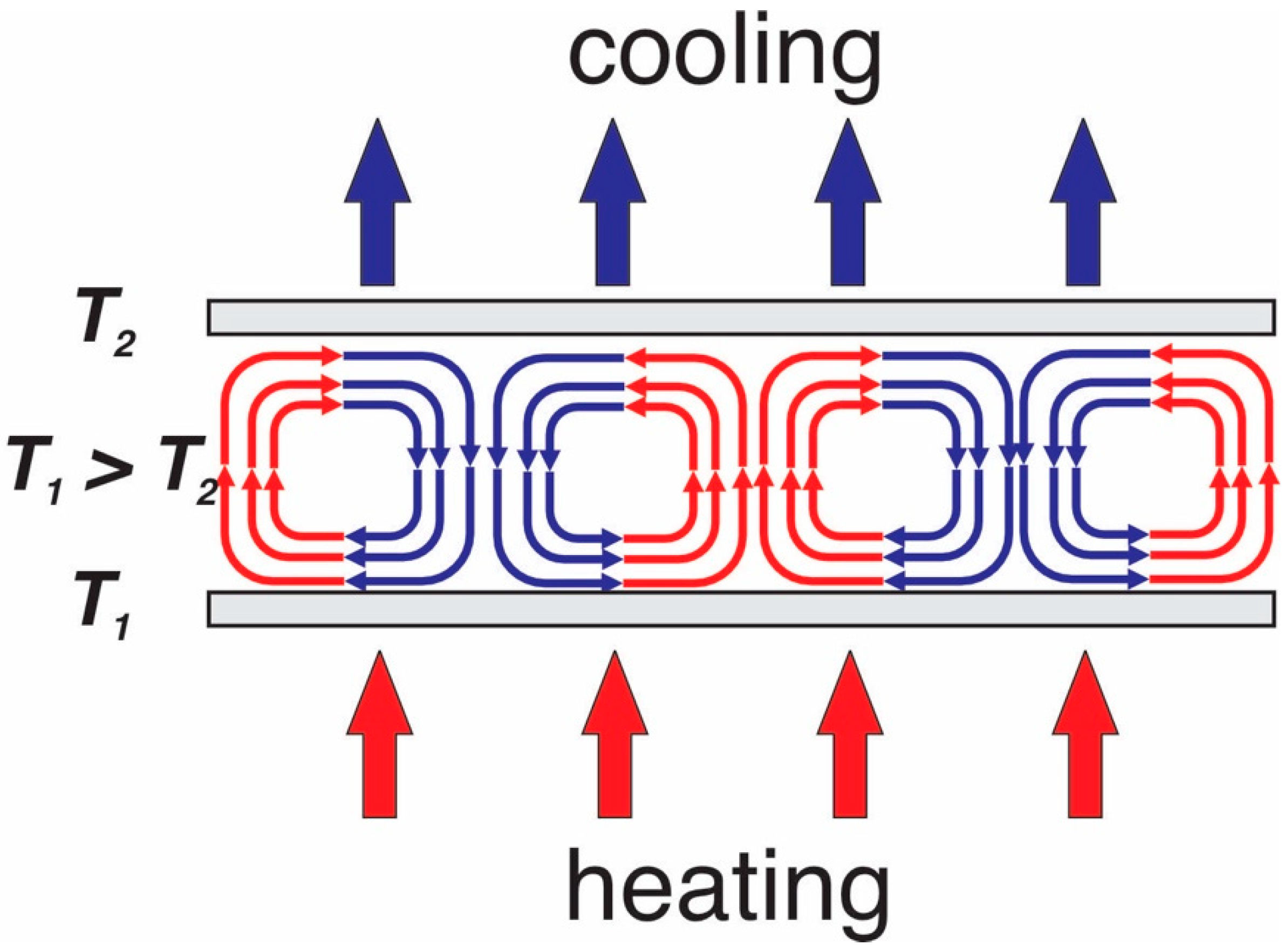
In nature, beyond the ocean and atmosphere, numerous dissipative nonlinear systems exist in which dissipative structures emerge. A classic example of such structures is convection occurring in a layer of liquid heated from below. When a constant temperature difference is maintained between the lower and upper boundaries of the layer, first small-scale pulsations occur. Subsequently, once a certain threshold of pulsation intensity is reached, organized motion in the form of convective cells is established. Convective cells are formed such that all their sides are approximately equal to the thickness of the layer heated from below. An example of such cells is shown in
Figure 2.
Convection in liquids exemplifies dissipative structures, as it emerges through self-organization in water and other liquids when energy is introduced from an external source, thereby creating a negative buoyancy gradient. This occurs when a heavier liquid, such as colder water, is positioned above a lighter liquid, such as warmer water, initiating the process of density stabilization, which is accompanied by convective circulation in the form of cells, as shown in
Figure 2. However, initially, the motion in a liquid heated from below is chaotic, with cells forming only after the system surpasses a threshold determined by a parameter known as the Rayleigh number.
In convection, as in most other processes of self-organization, the key is to form order from chaos. These processes are the subject of a relatively new branch of science founded by the prominent German physicist Herman Haken approximately 40 years ago, termed synergetics [
3]. The concept of synergetics, a branch of the general self-organization theory that emerged approximately 70 years ago [
4], has already achieved significant recognition. Synergetics is a scientific discipline that focuses on identifying common patterns in the development of structures.
Among the fundamental concepts in synergetics is the principle that certain modes of motion are dampened, while others dominate. This principle, which can also be referred to as the principle of the subordination or subjection of modes, is usually referred to as the “slaving principle” [
3]. This concept provides a vital theoretical basis for understanding self-organization processes. In general, a complex system comprises numerous variables, each requiring its own equations and initial and boundary conditions. The slaving principle reduces this complexity by transforming the problem into a smaller set of equations, allowing for solutions involving a limited number of variables referred to as “order parameters.”
The slaving principle, which is central to synergetics, states that near instability, a limited number of slow variables govern the system evolution, whereas fast variables adjust rapidly. This hierarchical structure reduces the effective dimensionality and reveals the dominant dynamical modes that emerge from mode competition. This leads to a substantial decrease in the number of equations that must be solved prognostically, whereas the other variables are derived from the time-dependent variables obtained by solving these equations.
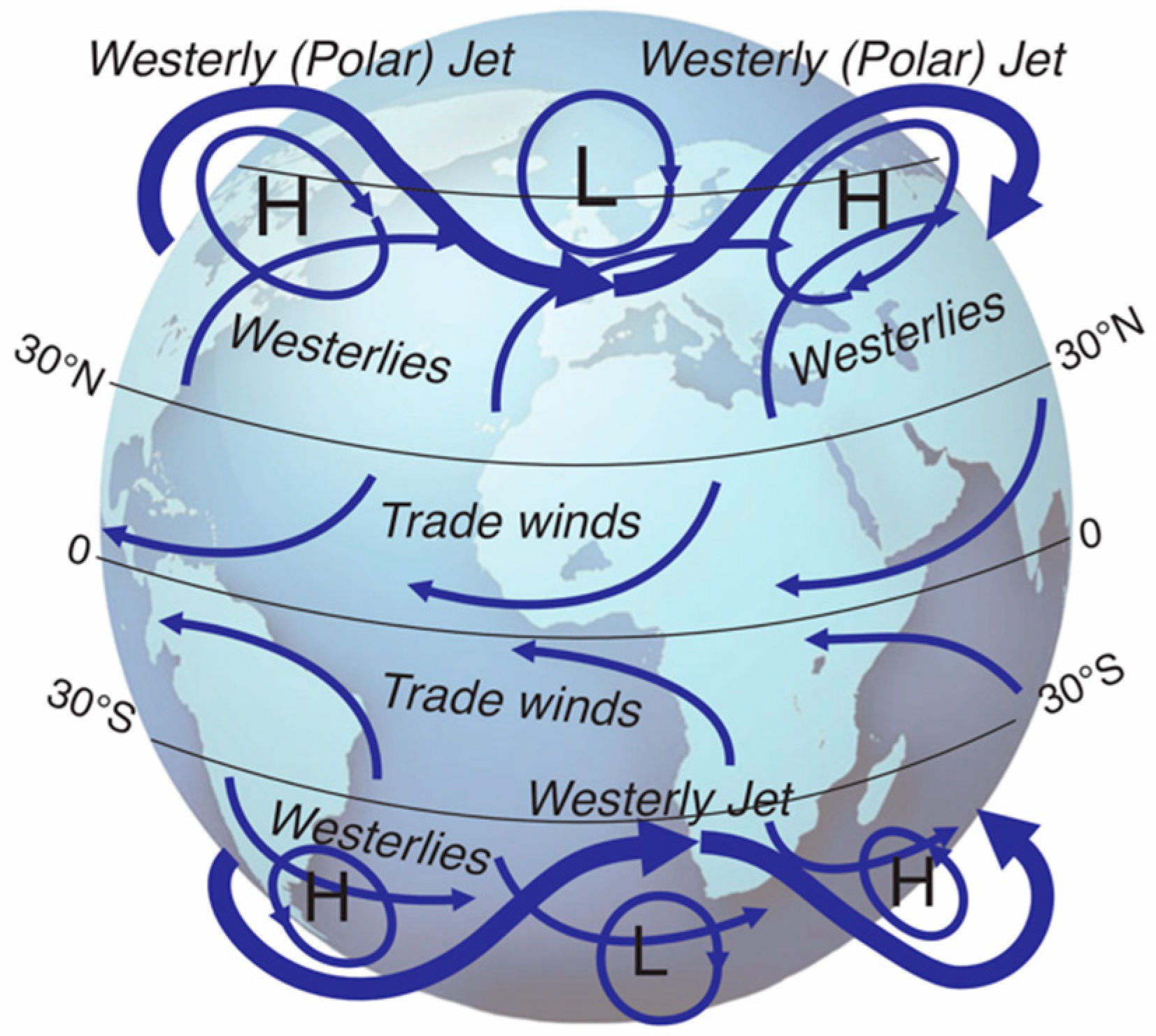
The application of order parameters leads to a significant consequence: the description of the system’s behavior becomes cohesive. Only a few variables, which are the order parameters, evolve over time according to specific laws, whereas the slaved parameters quickly adapt to these order parameters and merely follow their lead. In the ocean and atmosphere, mode competition is clearly observed in large-scale structures, such as the westerly jet in the atmosphere, which has prominent meanders and vortices thousands of kilometers in size, as schematically illustrated in
Figure 3. These large cyclones and anticyclones are universally recognized as the most common elements of atmospheric weather (e.g., [
5]). They enslave smaller-scale motions, which emerge because of the instability of large-scale flows, by transferring the fluctuation energy to the energy of large-scale motion.
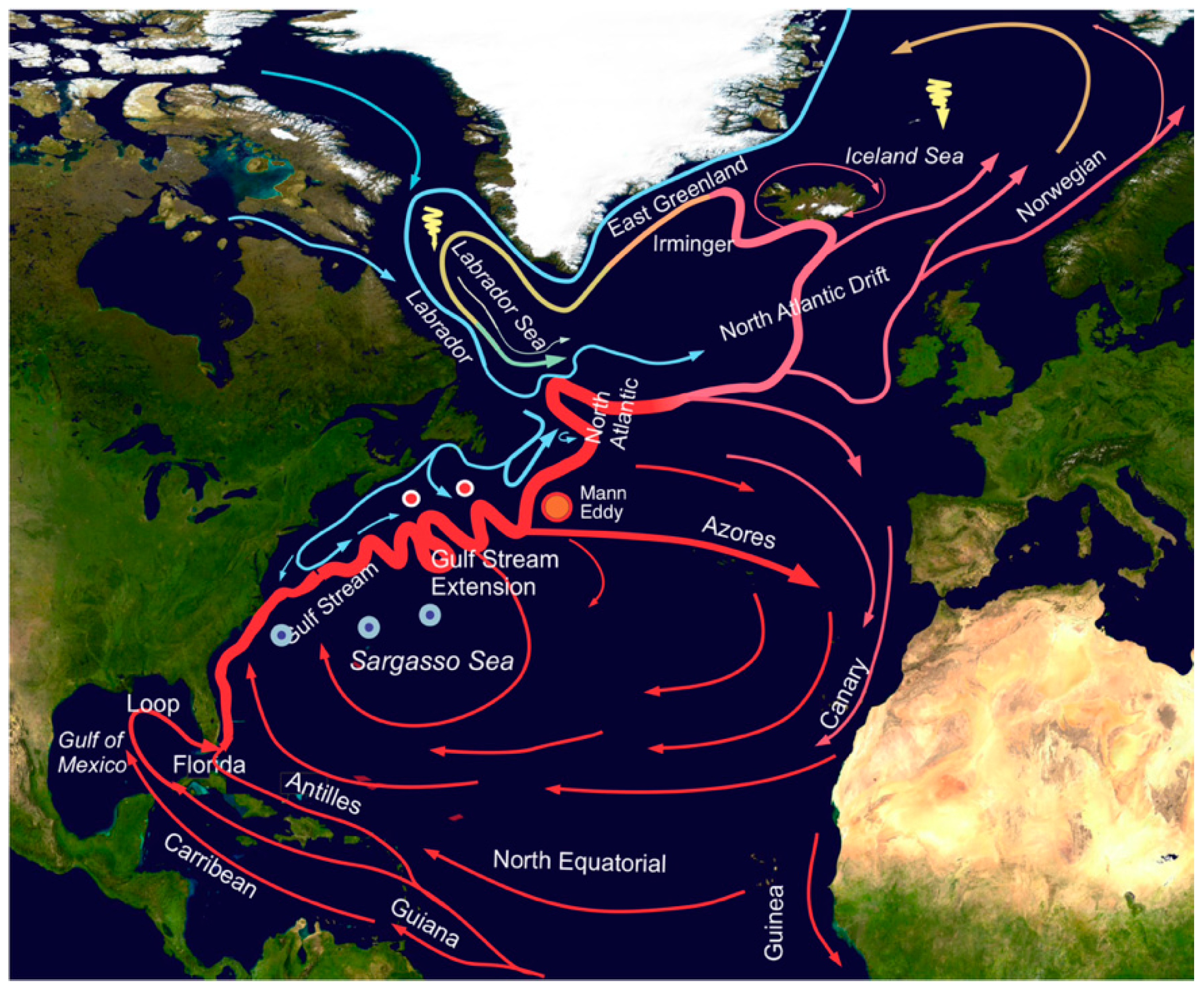
Similar to meandering atmospheric jets with highs and lows, the meanders and eddies of the Gulf Stream, as schematically depicted in
Figure 4, are integral components of oceanic weather, vividly illustrating the emergence of coherent mesoscale structures that interact with larger-scale currents. The interactions between jets and mesoscale eddies demonstrate the core principle of synergetics, which posits that fewer modes emerge owing to the competition of smaller-scale motions that constitute ocean turbulence.
The order parameter concept and the slaving principle and their applications to ocean circulation dynamics will be further explored. For now, it is important to recognize that they are essential components of self-organization processes in the ocean, which shape weather and climate.
Another important synergetic principle is the concept of mode competition, which is a subcase of the slaving principle. Generally, any motion in space can be represented as a superposition of a large (sometimes very large, formally infinite) number of normal modes or waves with different lengths and frequencies. In synergetics, the normal mode approach is highly effective. Within nonlinear systems, certain modes amplify at a much faster rate than others, whereas some either increase slowly or disappear entirely. It is crucial to recognize that among the intensifying modes, those that do so most rapidly tend to have the longest lifespan and dominate the others, including those that are unsustainable or grow at a slower pace. This leads to the development of organized behavior when coherent structures emerge with a limited number of modes in the flow. This is comparable to the dynamics observed in a free-market environment, where the most robust enterprises prevail through competition by overpowering or assimilating weaker enterprises. This analogy helps to clarify the concept of “competition of modes of motions” or simply “mode competition”.
In the ocean, both heat and freshwater exchanges between the ocean and atmosphere contribute to the creation of convection conditions. When saltier water is placed over fresher water at a constant temperature, the same type of convection occurs as in the case of colder water placed over warmer water in a freshwater environment (or salty water with constant salinity, which is formally the same). The combination of seawater salinity and temperature leads to extremely complex self-organization in the ocean at latitudes where convection conditions are present. In the ocean, convection usually occurs when warm
and salty water is cooled by the atmosphere, leading to the most intriguing process of self-organization in the ocean—the formation of a giant oceanic overturning circulation system known as the Atlantic Meridional Overturning Circulation (AMOC), which is part of an even more grandiose meridional overturning on a global scale, known as the thermohaline conveyor [
7]. The thermohaline circulation within this global overturning current system crosses all oceans (except the Arctic Ocean) and is a key element in the ocean’s impact on the atmosphere and in shaping the Earth’s climate as we see it today [
8].
3. Brusselator as a Model of Self-Organized Processes
This section reviews a simplified theoretical model of chemical reactions that demonstrates the self-organizing ability of nonlinear open systems. Historically, significant advancements in the understanding of nonlinear open systems emerged from the field of chemical kinetics during the second half of the 20th century. Certain chemical reactions illustrate nonlinear interactions and the self-organization of systems that are not in equilibrium. Ilya Prigogine, a Nobel Prize laureate and distinguished Belgian physical chemist, and his colleagues proposed investigating certain aspects of chemical kinetics using a highly idealized chemical reaction model known as the Brusselator. This name was derived from their research laboratory and the city of Brussels, where the study was conducted [
4,
9,
10,
11]. This theoretical model describes a trimolecular reaction, which is an idealized reaction with strong nonlinearity. Extensive descriptions of the Brusselator are available in numerous monographs and textbooks, for example, [
11,
12,
13]. The following reactions were considered:
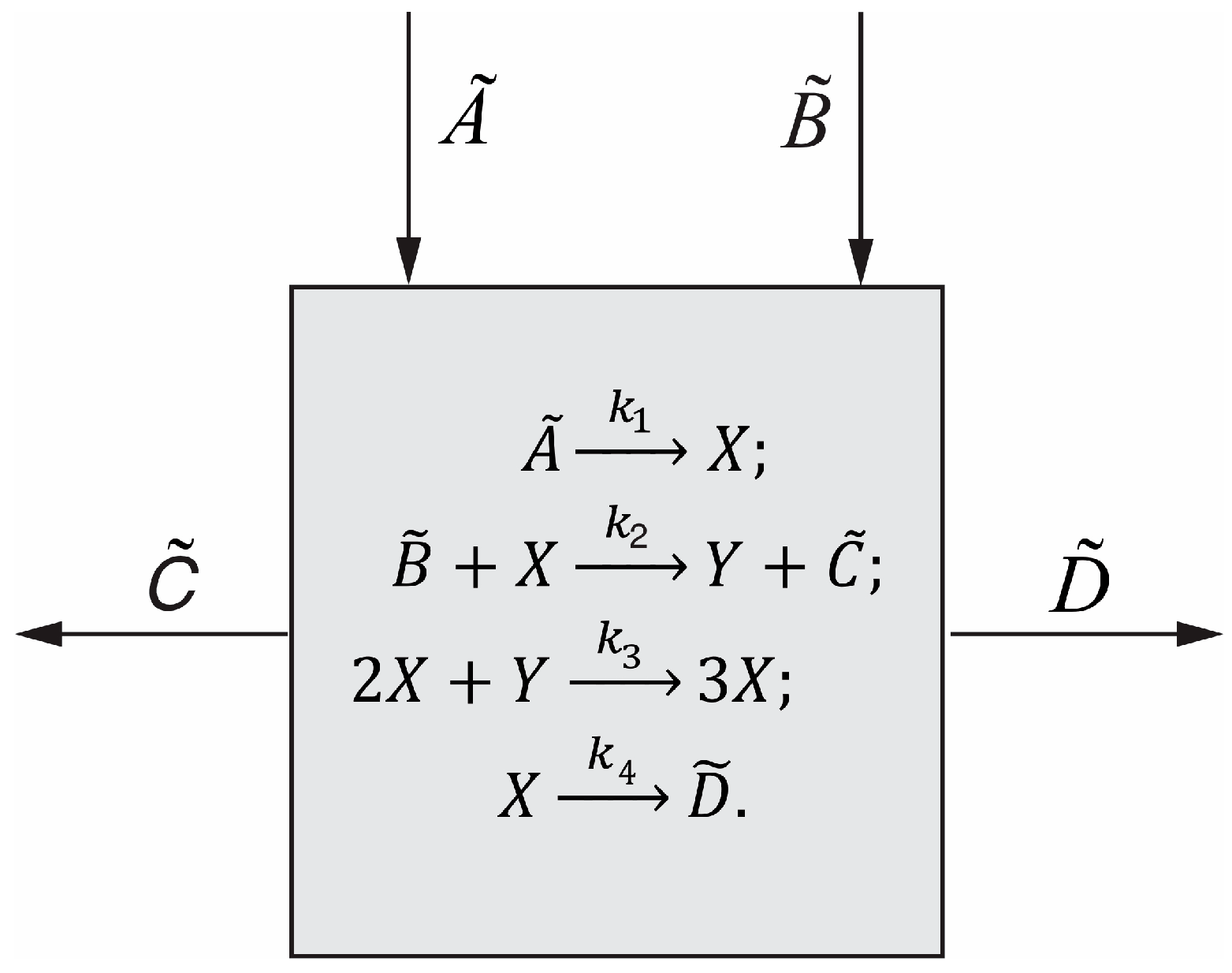
The autocatalytic tri-molecular reactions generating substances
X and
Y occur in a reactor with some reagents supplied from outside, and some by-products of the reaction are removed from the reactor, as illustrated in
Figure 5. Parameters
k1,
k2,
k3, and
k4 represent the rates of the direct reactions. In principle, double arrows in Equation (1) should be used in all formulas; however, the rates of the reverse reactions are much lower than those of the direct reactions; therefore, only the direct reactions are shown with single-sided arrows.
In Equation (1),
X and
Y are the results of the interaction between certain substances
,
,
and
The concentrations
and
are kept constant, and substances
and
are removed from the reactor. The combined reaction is
à +
→ +
, which means that there is a through-flow of substances in the reactor, as illustrated in
Figure 5.
The third reaction in Equation (1) is autocatalytic and determines the main nonlinearity of this process. Based on the law of effective masses for the concentration of intermediate substances, the following equations are obtained for substances
X and
Y:
where the rates of reactions
–
are the constants.
By introducing new variables:
one gets the equations:
A more detailed explanation is required for the transformation of Equations (2) and (3) into Equations (4) and (5). In nonlinear dynamical systems, it is common practice to transform the governing equations into a dimensionless form through normalization (scaling), thereby reducing the number of independent parameters and revealing the fundamental structure of the system. In the case of the Brusselator, the original reaction rate constants – are absorbed into the scaling of variables and time, leading to a reduced system governed by two control parameters, and , which determine the dynamical regime of the system.
Such low-dimensional reductions are widely used in the analysis of complex systems. For example, ref. [
14] demonstrated how high-dimensional nonlinear systems can be represented by reduced models that capture essential dynamical behavior, including bifurcations and attractors. A classic example is the Lorenz system [
15], in which a small set of dimensionless parameters governs the transition between stable and chaotic regimes.
The reduction in the Brusselator system is achieved by introducing dimensionless variables and a rescaled time, typically normalized by the characteristic rate of removal of substance (associated with coefficient ). This transformation leads to a dimensionless time variable and rescaled concentrations of and , relative to , and to absorbing the remaining rate constants , , and into composite parameters A and B. As a result, the original four-parameter system is reduced to a two-parameter system expressed in terms of and . In this formulation, the absolute values of the individual reaction rates no longer appear explicitly; instead, their combined effects are represented through these dimensionless control parameters, which fully determine the qualitative behavior of the system.
Equations (4) and (5) have a unique stationary solution, which is obtained by equating their right-hand sides to zero, as follows:
More detailed explanations of the Brusselator can be found elsewhere, e.g., [
3,
11,
12]. It is important to note that the system described by (4) and (5) can have nodes (stable or unstable), foci (stable or unstable), or centers. Omitting the details, we mention only that if the solution of the system of Equations (4) and (5) is solved by method of small perturbations to the stationary solution (6) in the form of
, a system of equations relative to α and
β can be derived with a characteristic equation for calculation λ:
which has two roots:
System behavior is determined by parameters
A and
B and becomes unstable when parameter
B passes through a critical value,
BCR, known as the bifurcation value (the value at which a dynamic system undergoes a sudden qualitative change in behavior).
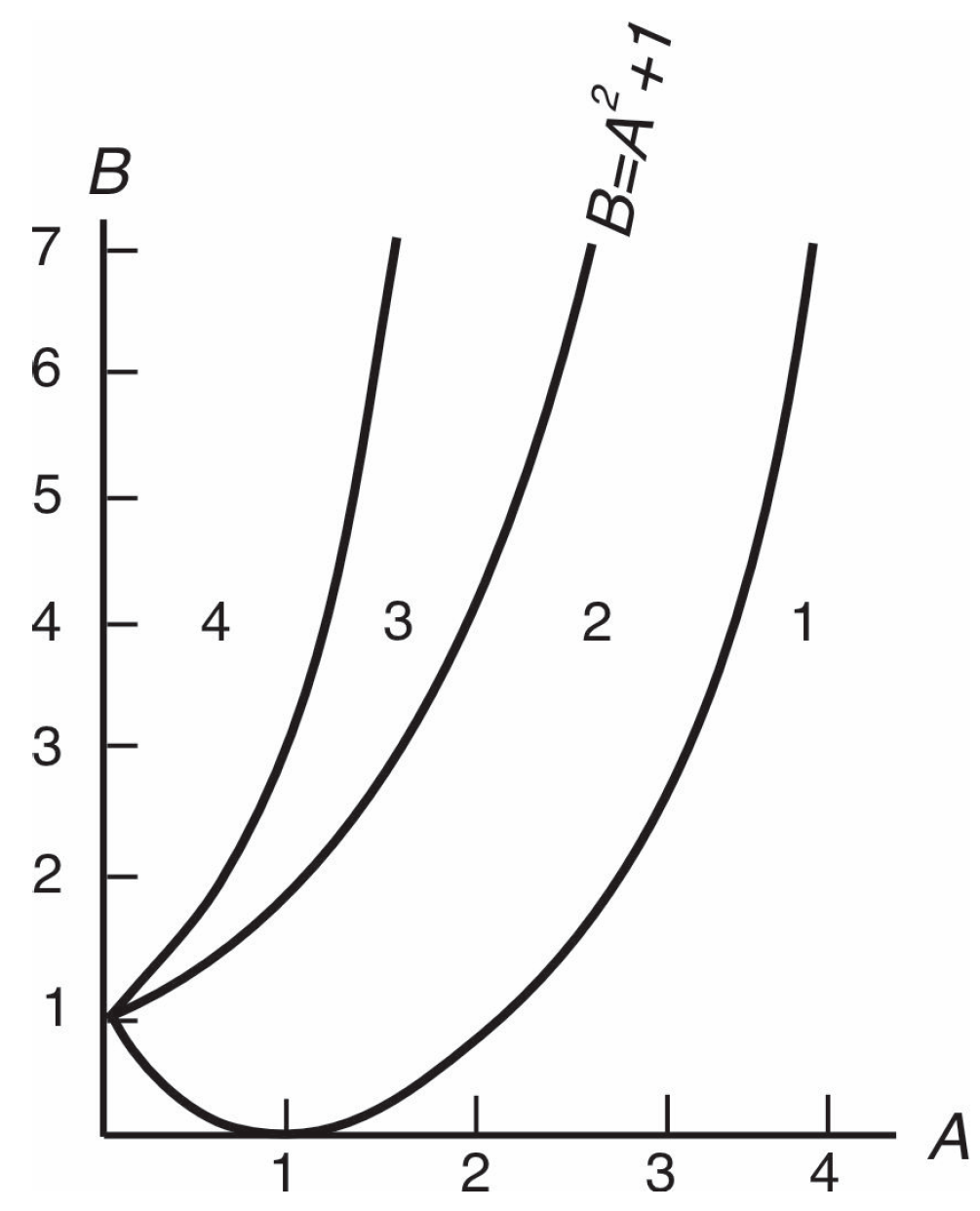
Figure 6 shows the regions to the right and left of the parabola
B =
A2 + 1, which separate the stable nodes (Region 1), stable foci (Region 2), unstable foci (Region 3), and unstable nodes (Region 4). The curve at which the real part of the roots passes through zero corresponds to purely periodic regimes, that is, centers.
As previously mentioned, unstable perturbations cannot grow indefinitely because the system is stabilized by nonlinear feedback. In Regions 3 and 4 of
Figure 6, the amplitude of the perturbations must be constrained. For example, the system in Region 3 is in a state called a limit cycle, that is, in an auto-oscillation regime.
The Brusselator model is a widely recognized simple theoretical model of auto-oscillation that illustrates the Hopf bifurcation when parameter
B surpasses its critical value of
A2 + 1. Although this model can be implemented in any programming language, Python 3 is arguably the most suitable and user-friendly option. Brusselator codes are readily accessible online and in several textbooks. For example, a code from the textbook [
16] was adapted using two sets of parameters suggested in the cited source: (1)
A = 1,
B = 1.8, and (2)
A = 1,
B = 2.02.
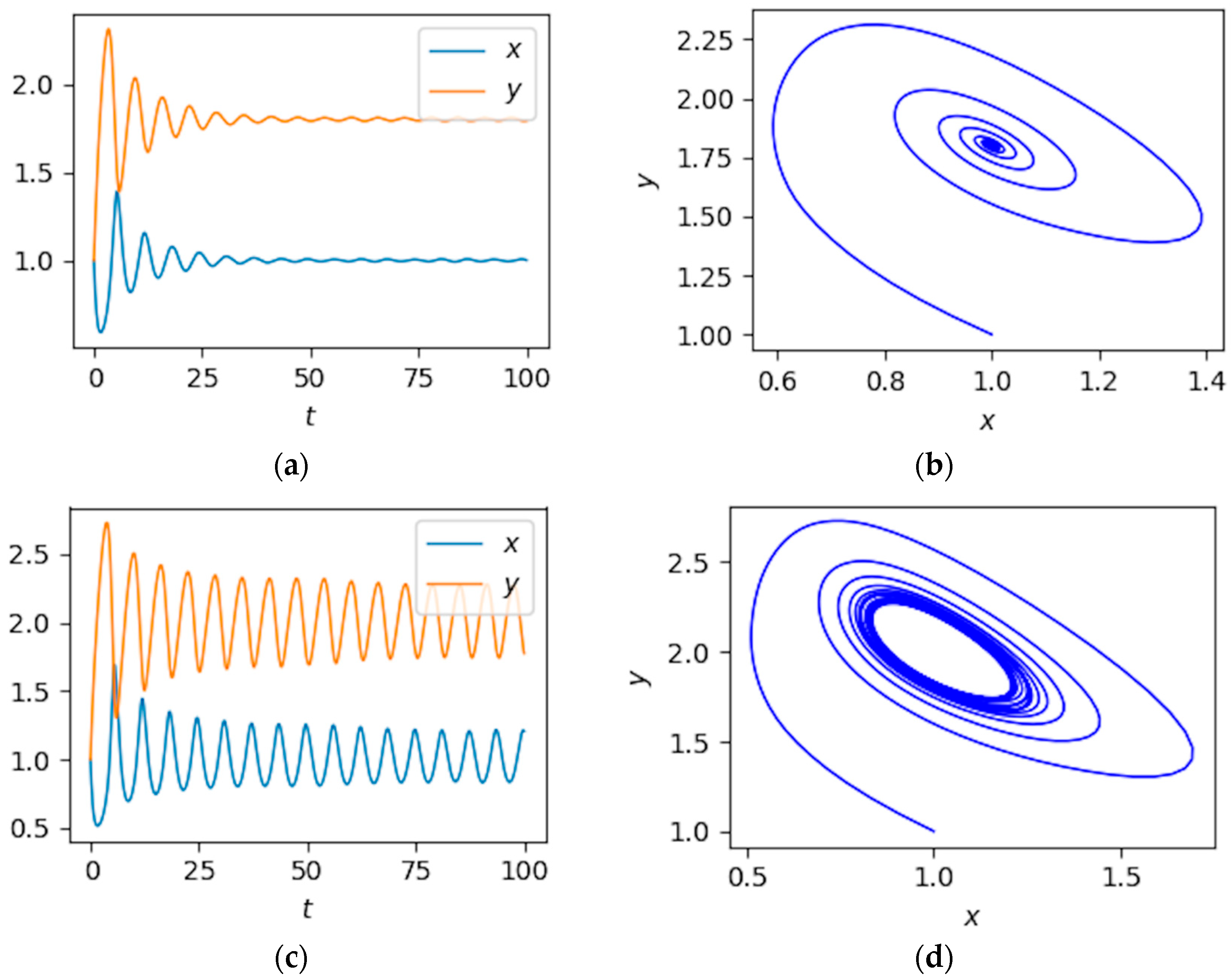
Figure 7 depicts these two scenarios, with the left panels (a) and (c) displaying the time series of the solutions
x and
y, and the right panels (b) and (d) illustrating the phase portraits of the system in phase space (
x,
y).
Clearly, the first set of parameters, where B < BCR and BCR = A2 + 1, results in a stable focus, whereas the second set, where B < BCR, yields a limit cycle. The transition of B across the line B = A2 + 1 signifies the Hopf bifurcation, which marks the shift in the system from a stable to an unstable regime with auto-oscillation.
The examples in
Figure 7 illustrate cases near the bifurcation line
BCR, as depicted in
Figure 6. The appeal of the Brusselator model, along with many other simple forced oscillator models, lies in its ability to clearly illustrate the behavior of nonlinear open systems. This is achieved with a limited set of parameters (only two), allowing for an easy understanding of the transition from near-equilibrium to far-from-equilibrium scenarios.
Figure 7a,b illustrate the behavior of the system attracted to the stable-focus regime.
Figure 7c,d demonstrate a system that has crossed the Hopf bifurcation line but remains close to a stable focus regime. If, for the same value of parameter
A, parameter
B is increased to values significantly exceeding the
BCR, the system displays highly nonlinear behavior, as shown in
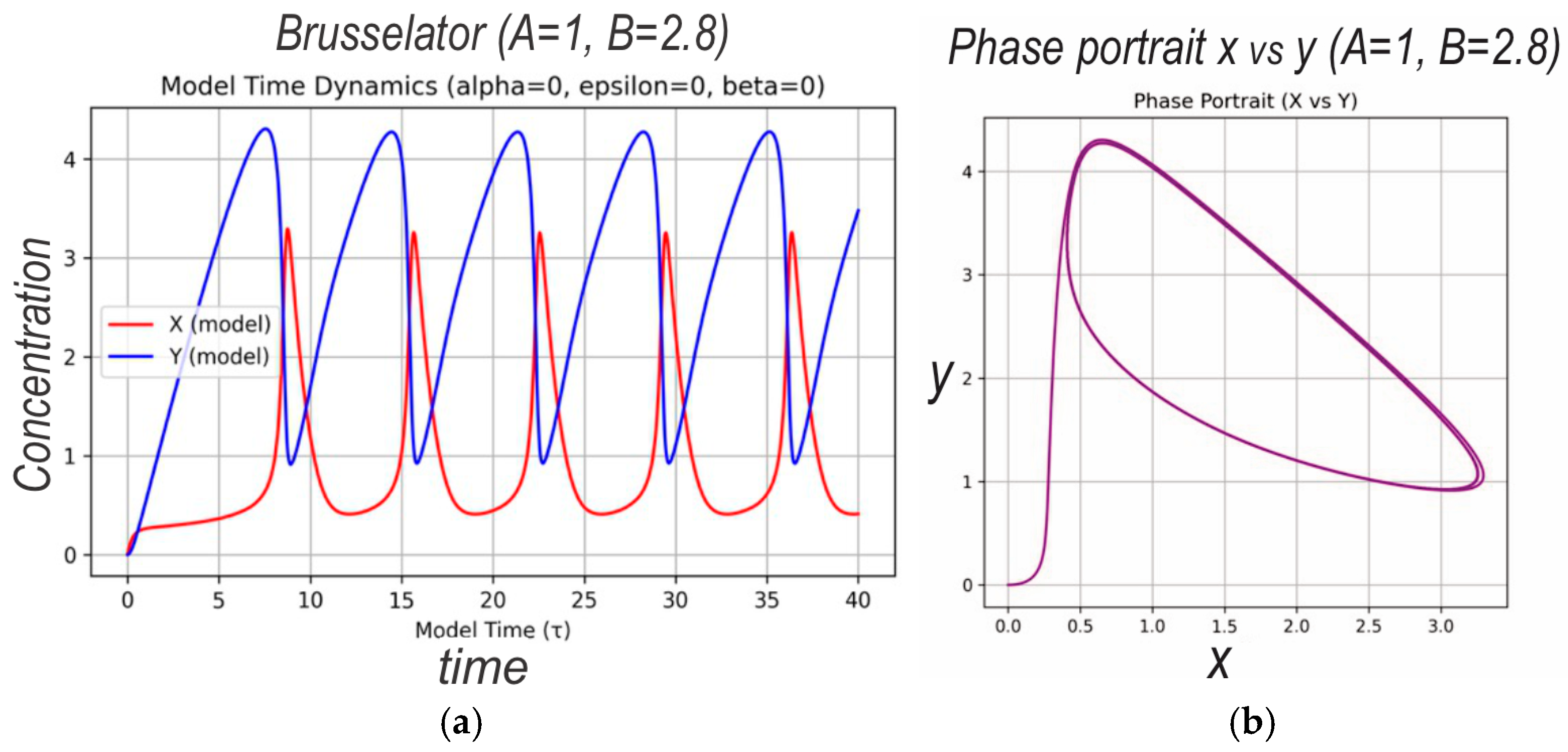
Figure 8.
Figure 8a shows plots of concentrations x and y over time for another set of parameter values (
A = 1,
B = 2.8), with all variables and parameters in the Brusselator equations being dimensionless, including time.
Figure 8b shows the phase trajectory of the Brusselator in the scenario corresponding to auto-oscillations (Region 3 in
Figure 6). The curve in
Figure 8b represents the limit cycle, indicating that the system was in an auto-oscillatory regime.
This type of auto-oscillation is characteristic of strongly nonlinear trigger-type systems. In these systems, disturbances rapidly intensify and abruptly halt when the supply of substance y, which is crucial for the growth of substance x, is exhausted. To restart the cycle, substance y must regenerate by introducing x into the reactor, where it is then converted into y, as described by Equation (5), with the conversion being proportional to The restoration of y is a slow process, whereas its release and conversion into x are extremely rapid. This is because the system crosses the Hopf bifurcation line when B surpasses BCR.
The Brusselator model is highly idealized, and its direct application to real-world problems is limited. Its primary significance as a demonstration of synergetics lies in its ability to mimic the process of self-organization and transition to an auto-oscillatory state under steady external forcing, even in the absence of oscillations in the input signal. The main advantage of this model is its capacity to enhance our understanding of how an open nonlinear system reacts internally to steady external conditions, particularly in climate subsystems. The functionality of the Brusselator model and its application to ocean circulation are further explored in the text.
4. Similarities and Dissimilarities of Ocean and Atmosphere Circulations
Although there are some similarities in their self-organizing processes, these two media are fundamentally different. A clear similarity is that both media function as heat engines, ideally represented by the ubiquitous Carnot cycle [
12]. In such engines, the system is heated at high temperatures and cooled at low temperatures, with heating occurring in low latitudes and cooling in high latitudes, respectively. Although the efficiency of these heat engines in both the atmosphere and ocean is rather low, it is sufficient to generate enough work to drive the general circulation in the atmosphere and decisively contribute to the thermohaline circulation in the ocean. Another key similarity is that the Earth’s rotation exerts major control over the circulation in both media, albeit in distinctly different ways. The Coriolis force influences currents by deflecting them to the right in the Northern Hemisphere and to the left in the Southern Hemisphere.
Here, the major similarities end, and differences emerge. In the atmosphere, the absence of meridional boundaries leads to global circulation patterns that are dominated by strong zonal components. Land orography deflects strictly zonal flows, which would otherwise occur on an aqua planet without land, similar to the impact of ocean bottom topography on ocean currents. However, unlike oceans, land cannot establish sufficient boundaries in the atmosphere to completely halt zonal flows, resulting in gyre-type ocean circulation that is fundamentally different from that found in the atmosphere.
Atmospheric dynamics has been extensively covered in numerous textbooks, such as [
17]. The following summary highlights some major features related to the self-organizing nature of atmospheric motions.
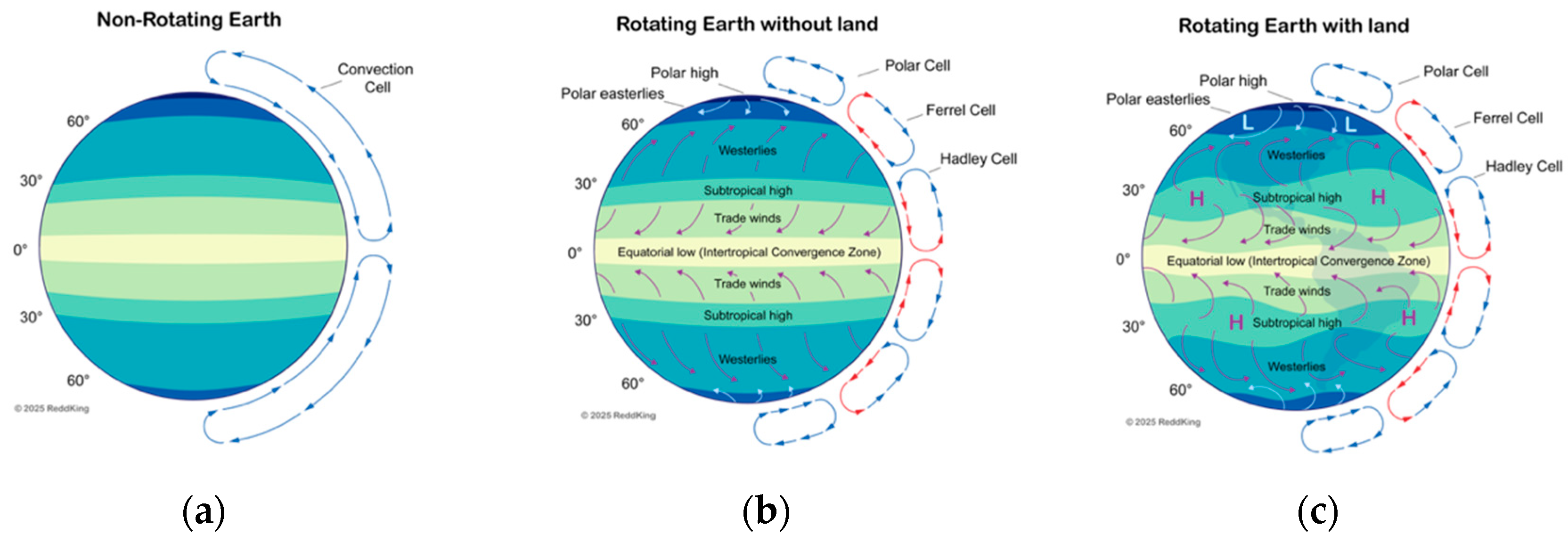
Figure 9 illustrates the self-organization of air flows under rotational control by comparing non-rotating and rotating atmospheric models. In the left panel (a), a single Hadley Cell forms owing to heating at low latitudes and cooling at high latitudes on a non-rotating aquatic (landless) planet. The central panel (b) shows the three-cell circulation pattern on a rotating aquatic planet. The right panel (c) shows a similar three-cell circulation on Earth, which rotates and has a distinct oceanic and land distribution. Notably, the rotating models with and without land showed very similar circulation patterns with dominant zonal flows.
The convection patterns were markedly different between the non-rotating and rotating models. On a non-rotating planet, a single Hadley Cell forms, gaining heat at low latitudes and releasing it at high latitudes. In contrast, a rotating planet with three cells and identical differential heating shows unexpected behavior in the mid-latitude cell, known as the Ferrel Cell. In the Hadley Cell, warm air ascends at the equator and descends at the southern boundary of the mid-latitudes, approximately 30° north and south latitudes.
The motion within the Hadley and Polar Cells is similar: warm air ascends at lower latitudes (southern in the Northern Hemisphere and northern in the Southern Hemisphere), whereas cold air descends at higher latitudes (northern in the Northern Hemisphere and southern in the Southern Hemisphere). However, the Ferrel Cell behaves differently: cold air descends at the cell’s lower latitudes and rises at higher latitudes. This is because the Ferrel Cell motion is not directly driven by heat but is generated by atmospheric eddies, such as cyclones and anticyclones. Therefore, the Ferrel Cell acts as a mechanical link between the Hadley and Polar cells within the three-cell dissipative structure of the atmosphere, as shown in
Figure 9.
The unexpected thermal mismatch between the upward and downward flows within the Ferrell Cell results in the formation of powerful and swift quasi-zonal flows in both the northern and southern hemispheres, as previously illustrated in
Figure 1. These currents emerge between the Ferrell and polar cells, where nonlinearity is particularly pronounced at approximately 60° N and 60° S. These jets meander and shed large-scale cyclones and anticyclones, thereby dictating the weather in both hemispheres (
Figure 1). The development of the three-cell structure and zonal jets in both hemispheres exemplifies the self-organization of the atmosphere. This phenomenon is driven by the continuous displacement from equilibrium due to differential heating, that is, warming at low latitudes and cooling at high latitudes, and nonlinear interactions between eddies and large-scale quasi-zonal flows.
The intensification of westerly jets exemplifies a fascinating self-organizing phenomenon known as “negative viscosity,” in which energy flows upgradient in jet currents on rotating planets [
18]. In the context of negative viscosity, energy (or heat, or any other substance involved in advection–diffusion processes) moves up its gradients, whereas “normal” turbulent viscosity transports energy down the gradients. While normal turbulent viscosity tends to flatten the gradients, negative viscosity sharpens them. Thus, two opposing processes compete: gradient sharpening and gradient smoothing. If negative viscosity prevails, the jets become increasingly sharp, leading to a very fast and unstable flow. The formation of meanders, cyclones, and anticyclones from the jet acts as a feedback mechanism to limit jet intensification. Consequently, the synergetics of the atmosphere essentially involves the creation of dissipative structures, ultimately achieving a dynamic balance between the synergetic processes of structure formation and the destructive force of turbulent fluctuations that aim to destroy and dissipate these structures.
Although the ocean and atmosphere exchange heat and freshwater, a significant difference between them lies in the nature of the freshwater exchange, which is fundamentally distinct in each medium. In the atmosphere, the gain or loss of freshwater is influenced by atmospheric temperature, as colder air holds less water than warmer air, leading to feedback mechanisms in ocean-atmosphere interactions, as seen in evaporation and precipitation patterns across the world ocean. In contrast, precipitation over the ocean is not directly dependent on ocean surface temperature. Therefore, the dissipative structures of temperature and salinity are governed by fundamentally different processes. The temperature of the ocean surface is influenced by the contrast between ocean and atmospheric temperatures. Sea surface salinity is influenced by both evaporation and precipitation, with the latter primarily dependent on air temperature. Although air temperature is influenced by ocean temperature, this dependence is much weaker than the direct effect of air temperature on the precipitation process.
The second significant difference between ocean and atmospheric dynamics is that the atmosphere exerts wind stress on the water surface, thereby generating wind-driven currents. When wind stress is spatially uneven, these currents converge or diverge, resulting in downward or upward motion, known as Ekman pumping. This process further induces gradients in temperature and salinity, ultimately leading to the bending of isopycnal surfaces and the creation of corresponding pressure gradients that drive thermohaline ocean circulation. Essentially, mechanical, thermal, and freshwater forces shape ocean circulation by integrating the effects of momentum and thermohaline components, forming what is essentially a classical dissipative structure. Ekman pumping is responsible for the heaving or shoaling of the main thermocline, thereby forming heat and salt dissipative structures known as the thermocline and halocline. These structures are characterized by rapid changes in temperature and salinity with depth. In situ ocean data analysis has revealed that this process is responsible for the highly structured heat content of the ocean [
6,
19,
20].
The third and most crucial distinction between oceans and the atmosphere is that oceans are enclosed by landmasses. Western boundary currents are formed because of the Earth’s spherical geometry and rotation, which are key features of the horizontal dissipative structure known as ocean general circulation. The Gulf Stream in the North Atlantic is a prominent example. North Atlantic circulation is shown in
Figure 4. Eddy–jet interactions generate a very strong jet that becomes unstable and, like atmospheric jet streams, meanders and sheds circular eddies, known as rings. In ocean jet dynamics, meanders and rings are much smaller than those in the atmosphere because air flows are significantly faster.
The Rossby number,
is a crucial dimensionless parameter that compares inertial forces with the Coriolis force. Here,
U represents the characteristic velocity of the flow,
is the Coriolis parameter (where
is the Earth’s angular rotation speed and
is latitude), and
L is the flow’s length scale. In the ocean, length scales typically span tens of kilometers, whereas, in the atmosphere, they extend to hundreds of kilometers in length. A small
Ro (
Ro ≪ 1) indicates the dominance of rotational forces, specifically the Coriolis force, whereas a large
Ro (
Ro ≫ 1) indicates the predominance of inertial forces [
17].
In ocean gyres, the Rossby number is generally small, , resulting in a predominance of geostrophic balance where the Coriolis force counteracts pressure gradients. However, in the vicinity of jets, where the Rossby number is much higher, , nonlinear inertial forces become comparable to the Coriolis force. This is when self-organization becomes the prevailing factor, and the negative viscosity effect is clearly manifested. The jets intensify, becoming increasingly narrow and faster until they eventually become unstable, leading to the formation of meanders and rings that mitigate and limit jet intensification.
6. Gulf Stream and AMOC
Ocean models offer a complex and multifaceted depiction of ocean circulation, revealing strong similarities across all oceans. The most prominent features of the horizontal structure of ocean circulation in every ocean basin are basin-scale gyres and western boundary currents, along with their extensions. These extensions are composed of meandering jets sustained by nonlinear jet–eddy interactions, as illustrated in the scheme of the North Atlantic surface currents in
Figure 4.
Among all oceanic jet-like currents, the Gulf Stream plays a central role in the ocean’s impact on climate. This is not only because it is the strongest oceanic current in the Northern Hemisphere but also because it constitutes the main part of the upper arm of the key oceanic climate control feature, namely, the AMOC. The AMOC is considered a crucial factor in regulating climate over decadal and longer timescales. Consequently, the entire global overturning circulation can be viewed as an extensive, self-organizing system driven by deep convection, which originates from a few locations in the northern North Atlantic and Nordic Seas, as well as a couple of sites in the Southern Ocean around Antarctica.
The North Atlantic Current (NAC) system, an extension of the Gulf Stream, also plays an important role in climate regulation. It comprises three primary branches—northern, central, and southern—that dominate the eastern and central areas of the North Atlantic Subpolar Gyre. The NAC is responsible for transporting warm and salty subtropical water, carried by the Gulf Stream, to areas where it cools sufficiently in a much colder atmosphere to form denser water over lighter layers. This process initiates deep convection that propels the AMOC and forms North Atlantic Deep Water (NADW) [
26].
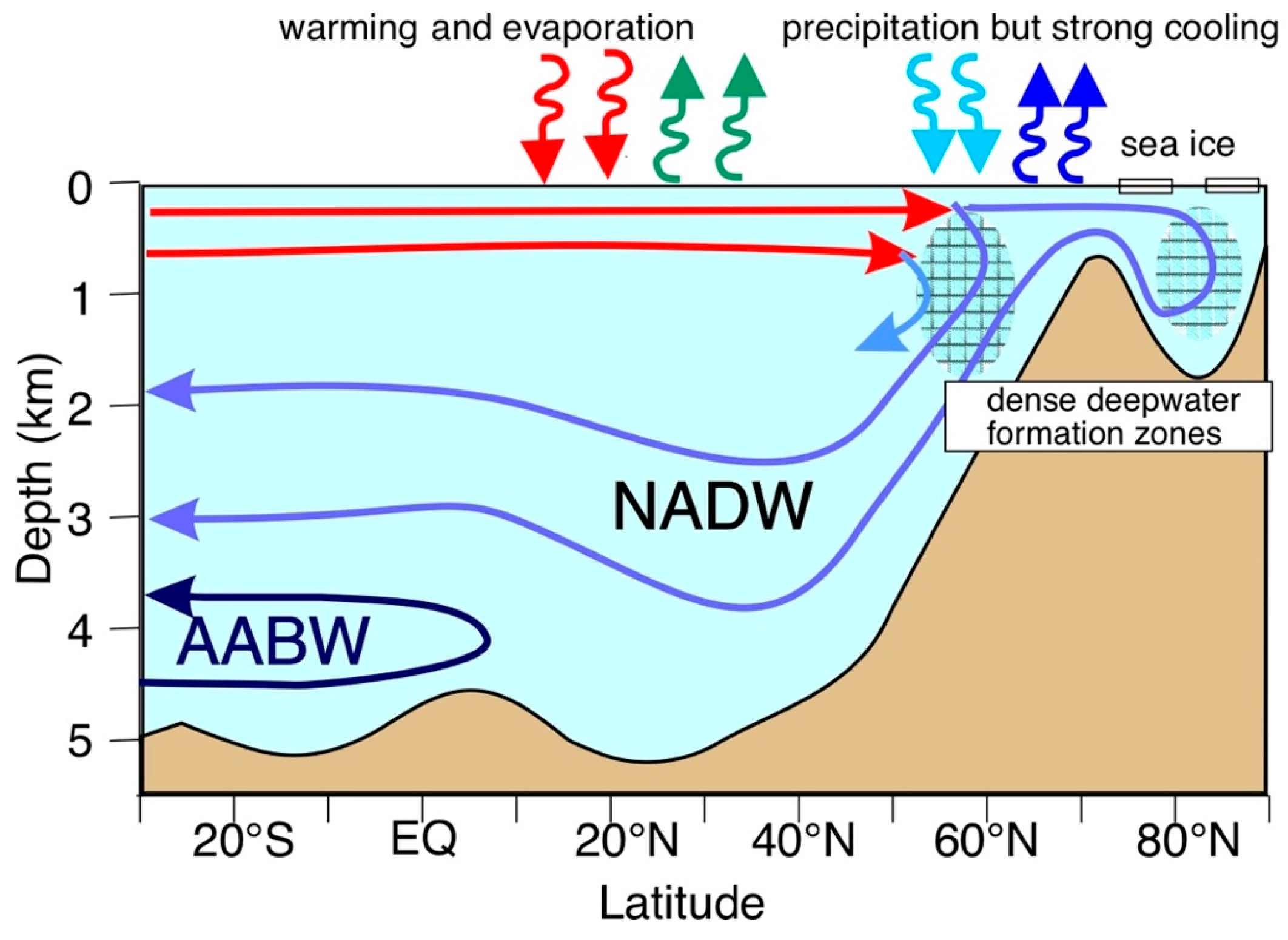
NADW is the principal component of AMOC, originating in the deep convection zones of the Labrador, Irminger, and Nordic Seas. These regions collectively constitute the origin of the deep-ocean branch of the AMOC, as shown in
Figure 10. This diagram provides a simplified depiction of meridional overturning. NADW travels southward through various complex routes, including advection in the Deep Western Boundary Current, recirculation within deep gyres, and various mixing processes. The sketch in
Figure 10 demonstrates the critical features of AMOC, including the stratification of its upper and lower branches. Antarctic Bottom Water (AABW) is formed by dense, cold water sinking around Antarctica and flowing northward. The portion of AABW from the Weddell Sea moves northward into the Atlantic Ocean below NADW. Squeezed from below, NADW occupies deep layers to approximately 4000 m, whereas AABW fills the abyssal ocean below this depth. NADW and AABW constitute arguably the most crucial components of the deep-ocean segment in global thermohaline overturning circulation.
Figure 10 illustrates why the AMOC is a vulnerable system, prone to significant changes because of relatively limited impacts both spatially and temporally in highly localized regions at the sea surface. Therefore, the AMOC is considered a potential climate tipping point [
27].
The significance of meltwater in the Nordic Seas and northeastern Subpolar North Atlantic has been extensively explored in numerous studies. This is particularly evident in studies referencing paleoceanographic data, which indicate the occurrence of meltwater episodes during the Pleistocene and Holocene epochs (see a review in [
6]). Freshwater fluxes are crucial in creating salinity differences between subtropical and subpolar gyres, and more importantly, they can significantly influence the functioning of the AMOC. Numerical climate models have concentrated on the impact of freshwater at high latitudes, particularly focusing on meltwater from melting sea ice, which is presumably associated with ongoing global warming (see, for example, [
28]).
In this presentation, the primary concern regarding AMOC dynamics is not merely its status as a remarkable example of a dissipative structure, but more importantly, its potential to bifurcate if certain critical parameters or their specific combinations exceed certain thresholds. Climate models have demonstrated that even slight alterations in surface salinity at convection sites can hinder convection, thereby disrupting the operation of the AMOC, as discussed in [
29,
30,
31,
32] (see also the recent review by [
6]).
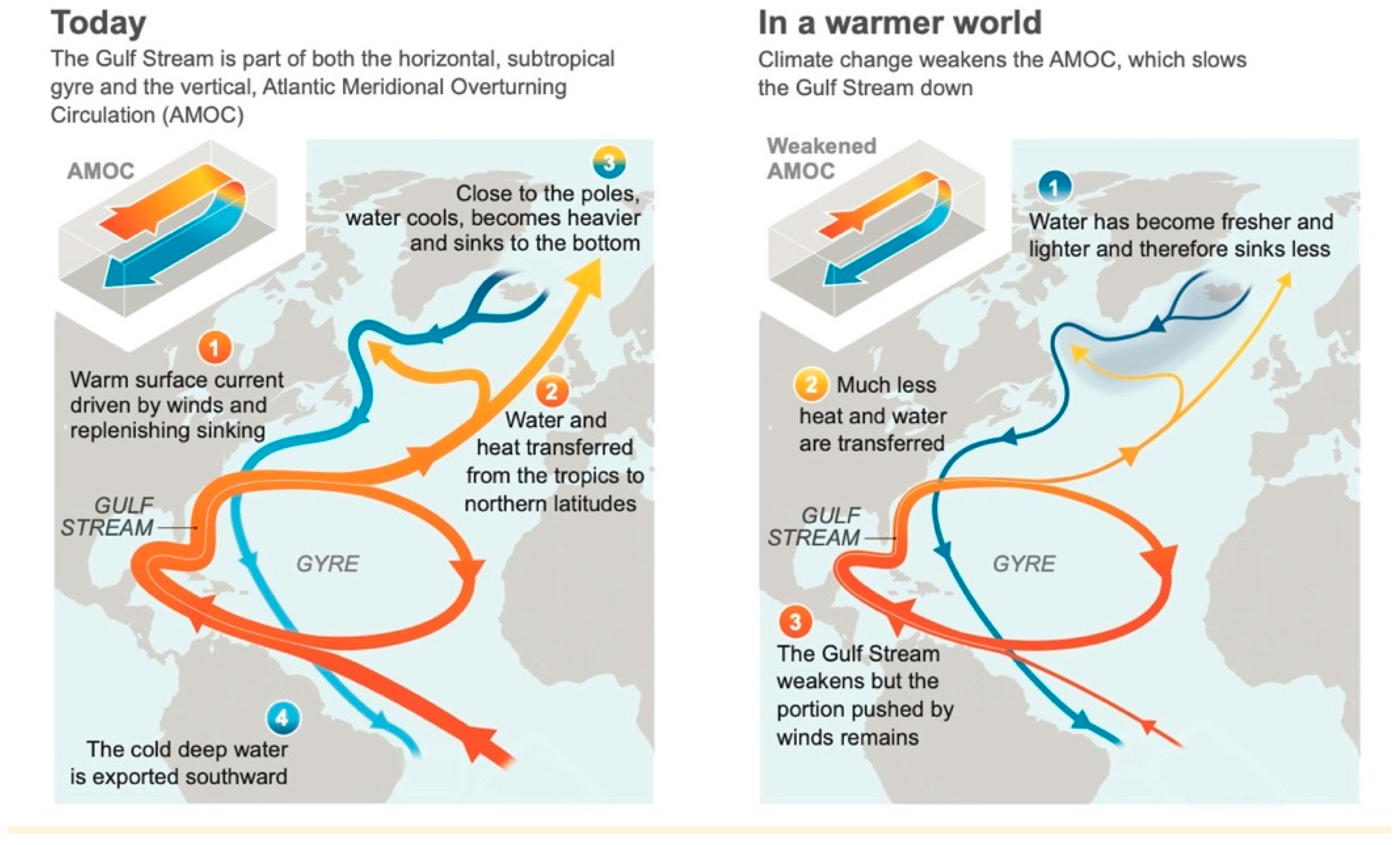
A slowdown of the AMOC, often attributed to sea surface warming and subsequent meltwater incursion from the Arctic to the Nordic Seas and further into the subpolar North Atlantic, was registered in the early 21st century [
33] and has been monitored since then [
34].
This phenomenon is believed to be partly attributed to the influence of Earth’s cryosphere on the AMOC. Over time, this impact can vary owing to changes in the rates of melting of Arctic sea ice and Greenland land ice, which may significantly reduce sea surface salinity, hinder deepwater formation, and ultimately slow the AMOC. A slowdown in the AMOC would reduce the northward transport of warm and salty water from the subtropics to the subpolar North Atlantic and Nordic Seas, further decelerating the AMOC.
Figure 11 illustrates a schematic representation of this process [
35].
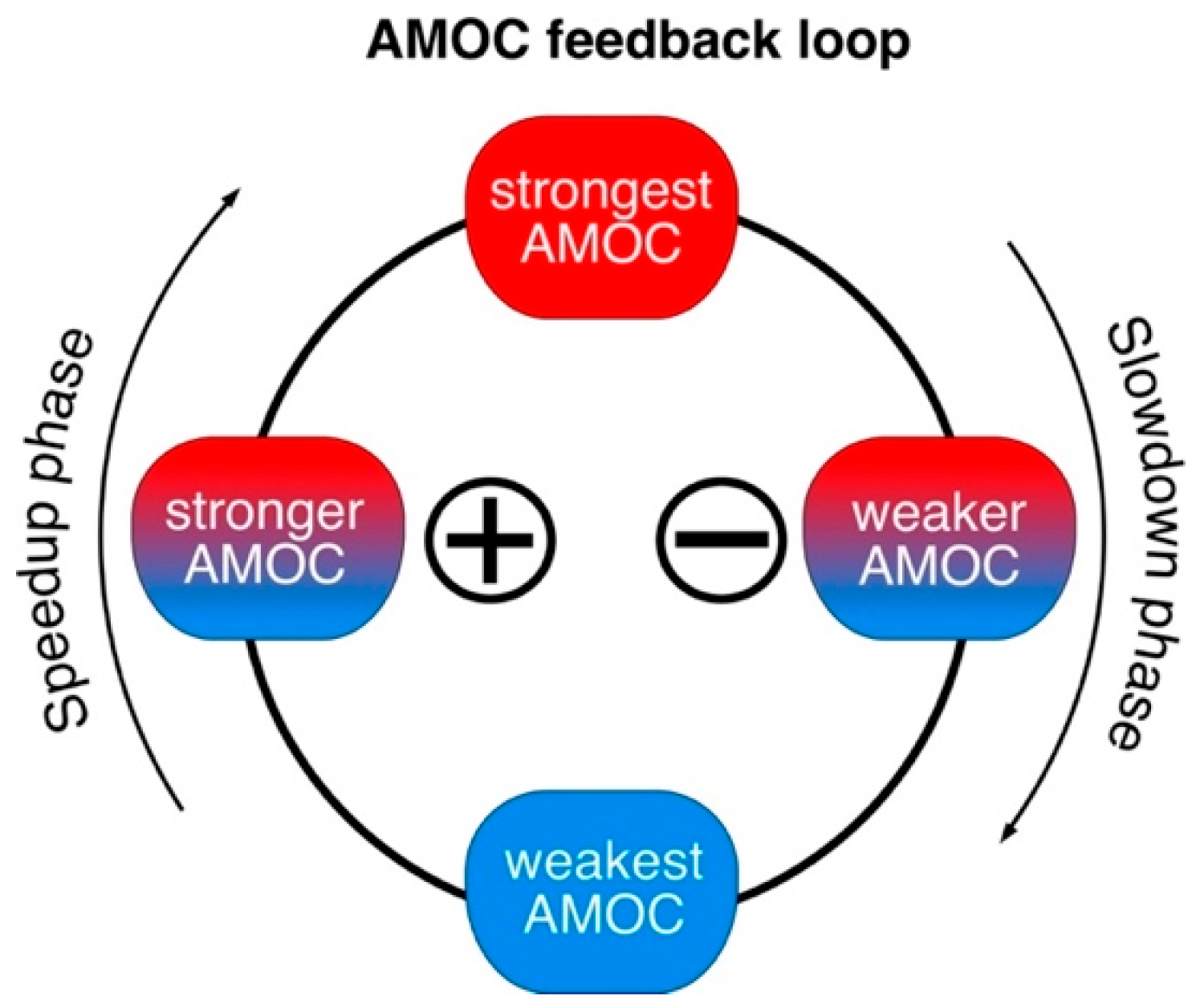
The AMOC slowdown cannot continue indefinitely because reduced northward heat transport would cause cooling of the sea surface in the northern North Atlantic and Nordic Seas, eventually increasing sea ice formation and retreating meltwater influx into these regions. Thus, a feedback loop is formed, which is key to the self-organization of the AMOC and its potential impact on climate, as illustrated in
Figure 12. This diagram presents the simplest schematic representation of the feedback loops within the AMOC system to summarize the key findings from the ocean and climate model evaluations of the AMOC operation.
The AMOC feedback loops depicted in
Figure 12 demonstrate that both negative and positive feedback mechanisms play a role in AMOC stability [
6]. The negative feedback process, shown on the right side of the diagram in
Figure 12, begins with increased heat transport to the Arctic, which accelerates sea ice melting. This event reduces the surface salinity and density of NA waters at high latitudes, thereby weakening NADW formation. Consequently, diminished NADW formation causes additional freshwater to flow from the Arctic into the Nordic Seas, further decreasing salinity and density. This chain of events inhibits deep convection in critical areas, such as the Labrador and Irminger Seas, ultimately weakening AMOC intensity and reducing poleward heat transport.
Conversely, reducing the heat transport toward the poles triggers a positive feedback loop, resulting in less ice melting in the Arctic. This leads to a decrease in the amount of freshwater flowing out of the Arctic, allowing the surface salinity and density in the subpolar NA to recover (as shown in the left half of
Figure 12). The increased surface density enhances deep convection in the Labrador, Irminger, and Nordic Seas and bolsters NADW formation in these regions. As this formation intensifies, the AMOC strengthens, restoring the poleward heat transport and further accelerating the process. This self-reinforcing mechanism contributes to the robustness of the AMOC and its capacity to maintain strong circulation under favorable conditions.
The susceptibility of AMOC to sudden and severe changes, including potential collapse, has been a focal point of extensive research and discussion (e.g., [
27]). The AMOC’s response to high-latitude freshening could be drastic, with some studies suggesting that the AMOC may be nearing its tipping point [
36], and certain models support this possibility [
37,
38,
39]. Although most studies project only a slowdown of the AMOC without an imminent collapse in the 21st century [
35], the mere possibility of the AMOC approaching a tipping point warrants careful consideration. Applying the principles of self-organization theory along with the synergetics’ set of tools might shed some additional light on this issue.
7. Energetics of the Ocean Gyres, AMOC, and Brusselator
The intensity of ocean currents and their associated nonlinearity are vital components of self-organization, making the energetics of these currents crucial for both oceanic and climate variability. The ocean model equations discussed in the previous sections allow for the precise determination of all thermohydrodynamic fields computed in the circulation models, thereby enabling the assessment of the ocean state at any given time when the initial and boundary conditions are provided. However, this alone is insufficient for a comprehensive understanding of ocean circulation physics. A deeper understanding and, possibly, simplification of the analysis of the oceanic energy budget may be required. The presentation here primarily follows [
40]. The kinetic and potential energies of ocean currents, when averaged across the entire basin without any flow through the side boundaries and bottom, or in areas where such flows can be disregarded, are symbolically expressed as follows:
where
the work of wind stress per unit of time;
is the work of buoyancy force;
is the rate of dissipation of kinetic energy. The angular brackets indicate averaging over a volume, such as the entire basin, where there is no flow across its side boundaries and bottom. This averaging can also be applied to any volume where the flows across its boundaries can be neglected or specified as a constant.
The potential energy equation in symbolic notation is as follows:
The HS describes the change in potential energy due to heat and salt fluxes (the latter are converted from the rates of precipitation or ice melting) across the sea surface, and ADJ represents the density adjustment necessary for ocean circulation modes to maintain hydrostatic stability. The core function of ADJ is to vertically redistribute temperature, salinity, and consequently density, when vertical hydrostatic instability occurs. The adjustment mechanism is crucial for sustaining the AMOC and other meridional overturning currents, as it facilitates deep convection. This occurs when severe cooling of the sea surface causes surface warm and salty water carried by the upper arm of the AMOC to cool and become denser as it arrives at the top of the slightly lighter water beneath. In total, heat and salt fluxes combined with ocean currents redistributing heat and salt and the adjustment mechanism of convection constitute the process of building potential energy.
In ocean circulation, only the portion of potential energy that can be converted into kinetic energy is significant. This convertible portion is known as available potential energy (APE), whereas the non-convertible or unavailable portion is denoted as NAPE. It is well established that in both the atmosphere and ocean, APE constitutes only a tiny fraction of the potential energy that can be transformed into motion.
Lorenz introduced the concept of available potential energy for atmospheric circulation in 1955 [
41], and it has since been used to investigate both atmospheric and oceanic phenomena. Without further delving into the specifics of calculating the components of kinetic and available potential energy in the ocean, which are readily accessible elsewhere [
42,
43,
44,
45], there is a striking similarity between these equations and Brusselator model equations. This resemblance suggests a potential analogy for interpreting the components of ocean current energetics and the balance of chemical reactions in both sets of models. The text follows [
40] in discussing these similarities.
Equations (18) and (19) can be rewritten as follows:
where
; here
is the amount of the buoyancy force work owing to combined fluxes of heat and freshwater across the sea surface and changing only the part of the potential energy, which is not available for the reverse conversion, i.e., the
NAPE. For the sake of convenience, the angular brackets in Equations (20) and (21) have been omitted.
Notably, the introduction of dimensionless variables using the characteristic rate of kinetic energy dissipation, analogous to the normalization applied to the Brusselator equations, leads to a low-parametric set of equations for ocean energetics that is structurally equivalent to the Brusselator equations, that is, Equations (4) and (5). In this formulation, the total energy KE + APE changes solely because of the influx and dissipation of kinetic energy, whereas the changes in kinetic energy caused by these two factors are distinct from the internal conversions between KE and APE.
This low-parametric representation significantly reduces the complexity of the full energy balance Equations (18) and (19). However, this simplification unavoidably results in a loss of detail inherent in comprehensive numerical models of ocean circulation. In such models, external forcing can be explicitly separated into wind-driven and thermohaline components. In contrast, within the Brusselator-type formulation, the forcing parameter represents the combined effect of all processes contributing to kinetic energy generation.
Although the system has been substantially simplified, it still preserves the critical nonlinear structure that governs regime transitions. Importantly, it identifies bifurcation behavior, such as Hopf bifurcation, and provides a conceptual framework for understanding threshold behavior, like a potential AMOC tipping point. From this perspective, the reduction in complexity offsets the loss of detail present in more advanced numerical models. Broader approaches to low-dimensional modeling of nonlinear systems, including applications to the Lorenz system, are discussed in [
14].
It was suggested that a suitable approximating system could be similar to that in the Brusselator model, that is, Equations (2) and (3) [
40]. Here the
are positive constants. In Equations (2) and (3) the terms
and
represent two different processes: an “explosive” instability process and the gain or buildup of
APE. Turning to Equations (2) and (3), this assumption says that
APE→KE is written as
, and, since
KE→APE =
, the
. It is also assumed that
can be represented by
, and
is set
Additionally, it is assumed that this term vanishes in the most interesting cases, i.e.,
.
The validity of these assumptions, or more precisely, their effectiveness in representing the oceanic energy partition, can only be confirmed by comparing the system described by Equations (2) and (3) with the interpretation of the energetic components, alongside ocean current energetics in an eddy-resolving numerical model—or, ideally, with both observational and modeling results. Such a comparison was reported by [
40], who demonstrated that these assumptions performed exceptionally well in both the modeling of idealized ocean circulation with resolved mesoscale eddies and the observation of mesoscale eddies in the open ocean. In another application of the Brusselator model to ocean circulation energetics [
46], it was shown that this model provides insightful results, aiding in a better understanding of energy partitioning and the stability of ocean currents.
The sole nonlinear term in Equations (2) and (3), when considering
KE and
APE conversion rather than chemical reaction rates, is
. This term is crucial for the instability of currents and the formation of eddies, or, more broadly, for the intensity of gyres and jet currents. According to the self-organization theory, as demonstrated, for example, in [
11], the simplest nonlinearity capable of inducing nontrivial behavior in a two-component system is a cubic nonlinearity. Given that
KE is a primary component (with the accumulation and reduction in
APE being significantly influenced by large-scale currents and density gradients), the interpretation
is favored over the alternative
(the only two possibilities of cubic nonlinearity in the
KE→APE two-component system). Essentially, the
term represents or tries to mimic the specific, complex mechanism by which the system uses stored available potential energy to nonlinearly enhance its kinetic energy, resulting in sustained, ordered flow patterns, rather than a straightforward, linear energy exchange.
It can be assumed that the dissipation of KE is proportional to KE itself, and that isopycnal bending, or the accumulation of APE, is also proportional to KE→APE conversion. This implies that the bending of isopycnals is attributed to ocean currents that redistribute heat and salt, along with the effects of Ekman pumping. Downward or upward Ekman pumping, which is responsible for isopycnal bending, is indirectly related to the conversion of KE to APE.
The use of nonlinear term in the Brusselator model’s conversion interpretation requires some additional explanations. In nature, no single oceanic process can be associated with the term but rather a combination of instabilities that convert APE to KE. The most potent instabilities are baroclinic instability, leading to mesoscale eddy generation, and hydrostatic instability, causing vertical density adjustment in the water column and facilitating deep convection. These factors cannot be separately modeled in any two-variable model of KE and APE conversion, as this conversion is more complex than a two-variable model can reproduce.
In reality, KE comprises KEM and KEED, where KEM is the kinetic energy of the mean current or large-scale flow, and KEED is the kinetic energy of mesoscale eddies. Similarly, APE consists of two members: APM and APEED. The partition of energy between these four components of energy balance is described by different highly nonlinear processes symbolically represented by ; and . In the Brusselator model, all these conversions are represented by the single term . Despite significantly simplifying the intricate energy conversion chain among the four components of the energy balance, the justification for the nonlinear term in the Brusselator model is based on the following reasoning. Although it is not possible to represent the entire energy conversion chain in a two-variable model, numerous eddy-resolving ocean current models have shown that the process occurs in bursts, characterized by a rapid release of APE and a sharp increase in KE. Simultaneously, density gradients are modified by ocean currents and eddy mixing. This process is considerably slower than the baroclinic or hydrostatic instabilities. However, the combination of these two factors appears, namely, , to yield plausible results, effectively simulating these multifaceted processes.
After the implementation and justification of all these assumptions, the derived equations precisely correspond to those of the Brusselator model, as delineated by Equations (2) and (3) [
11]. By introducing new variables, as was done to derive the nondimensional set of Equations (4) and (5), all discussions related to those equations apply to the two-component system
KE→APE, with the new notations
x = KE and
y = APE. This procedure involves mapping one set of variables to another to use the same set of equations.
The classic Brusselator model, represented by Equations (4) and (5), is deterministic and therefore lacks periodic or stochastic excitations, with parameters A and B remaining constant throughout the energy conversion process. In contrast, ocean currents vary seasonally and possess a significant stochastic component owing to external forces, such as momentum (via wind stress), heat, and freshwater fluxes, which include both periodic and stochastic elements.
To introduce stochastic noise to the primary driver, which is the influx of kinetic energy
A, a random noise function
μ(t) can be introduced, where
and
serves as the normalizing factor [
40]. Noise can represent several naturally stochastic factors, such as storms and changes in rainfall. This method can be further developed to incorporate seasonal forcing by adding
, where ω represents the frequency of oscillations and
f is a scaling factor. For seasonal oscillations, ω = 2π/
T, where
T denotes the period; in real time,
T is 365 days. Real time,
, in any unit (here in days), is calculated as
(in days) = 365·
where
is the model time in Equations (4) and (5). In summary, energy source A is represented as follows:
In this variation in the Brusselator model, stochastic and seasonal forces are integrated into the primary
KE source, which is defined by parameter A. The effects of these stochastic and periodic elements can be simulated independently and in combination.
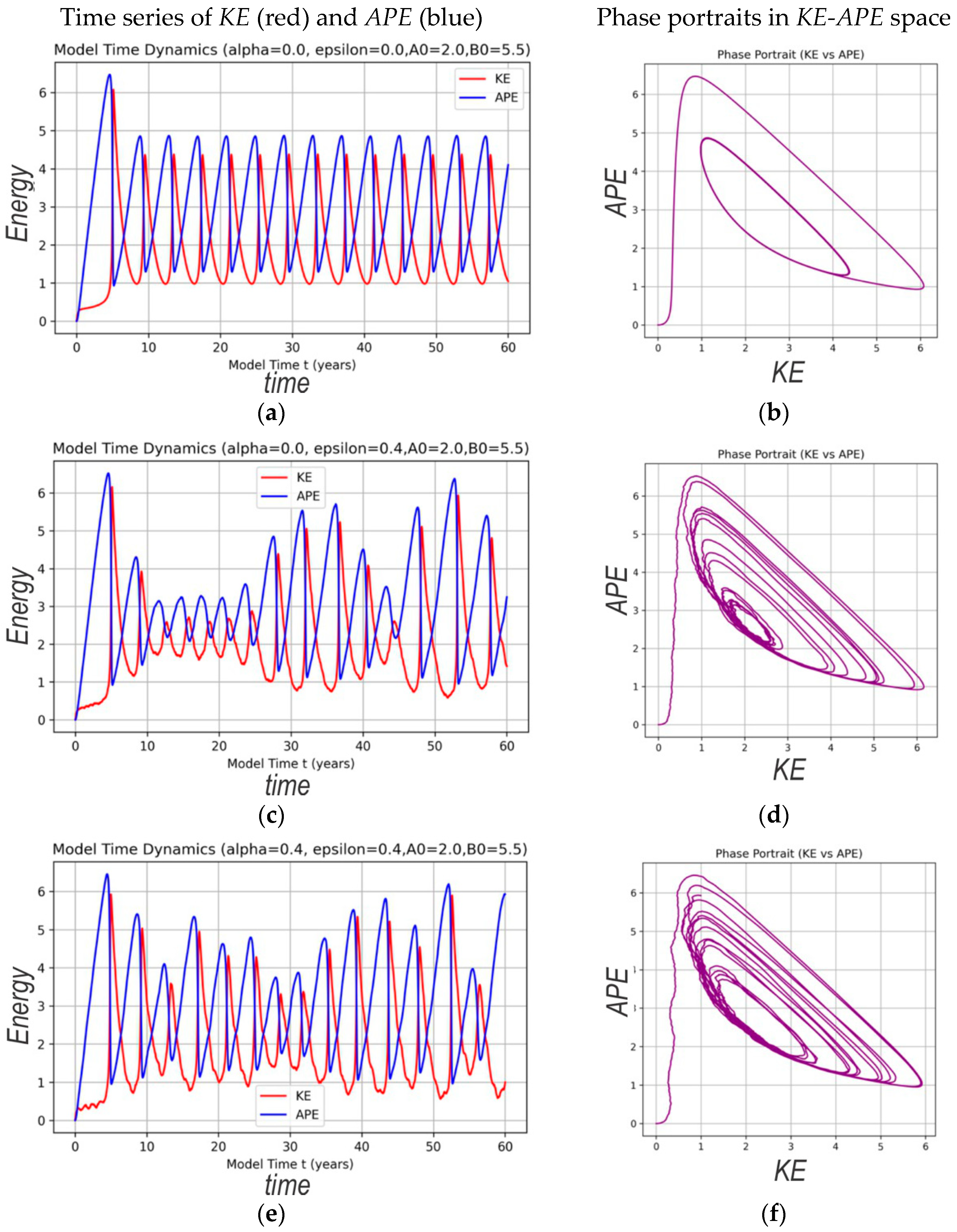
Figure 13 illustrates these effects, with the plots in the left column showing the time series of
KE and
APE, and the plots in the right column depicting the phase portraits in the
KE-APE phase space. Real time corresponds to the model time multiplied by 365 days; therefore, the model time in
Figure 13 is shown in years.
Figure 13 illustrates the outcomes of the three experiments conducted with constant
A0 = 2.0 and
B0 = 5.5. In the first experiment (
Figure 13a,b), α = 0 and
= 0, i.e., with no seasonal or stochastic components. The second experiment (
Figure 13c,d) sets
= 0.2 ∗
A0 = 0.4, representing noise amplitudes at 20% of the primary input
A0 = 2.0. The third experiment (
Figure 13e,f) uses the same stochastic forcing as the second, but with α = 0.4, introducing a seasonal forcing of
, i.e., with the amplitude also at 20% of the main force.
In these program runs, the parameter
B = 5.5 slightly surpasses the critical value
BCR = 5.0 (
BCR =
A2 + 1) for the system without stochastic or seasonal excitations. When stochastic and seasonal forcing elements were introduced, there were instances when
A reached its peak value of 2.4 or dropped to its lowest value of 1.6. Conversely, as the
BCR fluctuates—either increasing or decreasing—the system experiences multiple bifurcations, repeatedly crossing the bifurcation line, and oscillating between regions 2 and 3 in the stability diagram shown in
Figure 6.
The model without stochastic excitation exhibited a strictly deterministic limit cycle (
Figure 13a,b). When only as little as 20%
A0 noise is introduced, the model begins to vacillate quasi-periodically, displaying alternating periods of high and low
KE and, correspondingly, low and high
APE. In the phase portrait with stochastic excitation (
Figure 13d), the system appears to aim for a stable focus, characterized by small-amplitude oscillations before transitioning to a fully developed limit cycle with burst-like conversions from
APE to
KE. This behavior is typical of many eddy-resolving model experiments [
47,
48,
49].
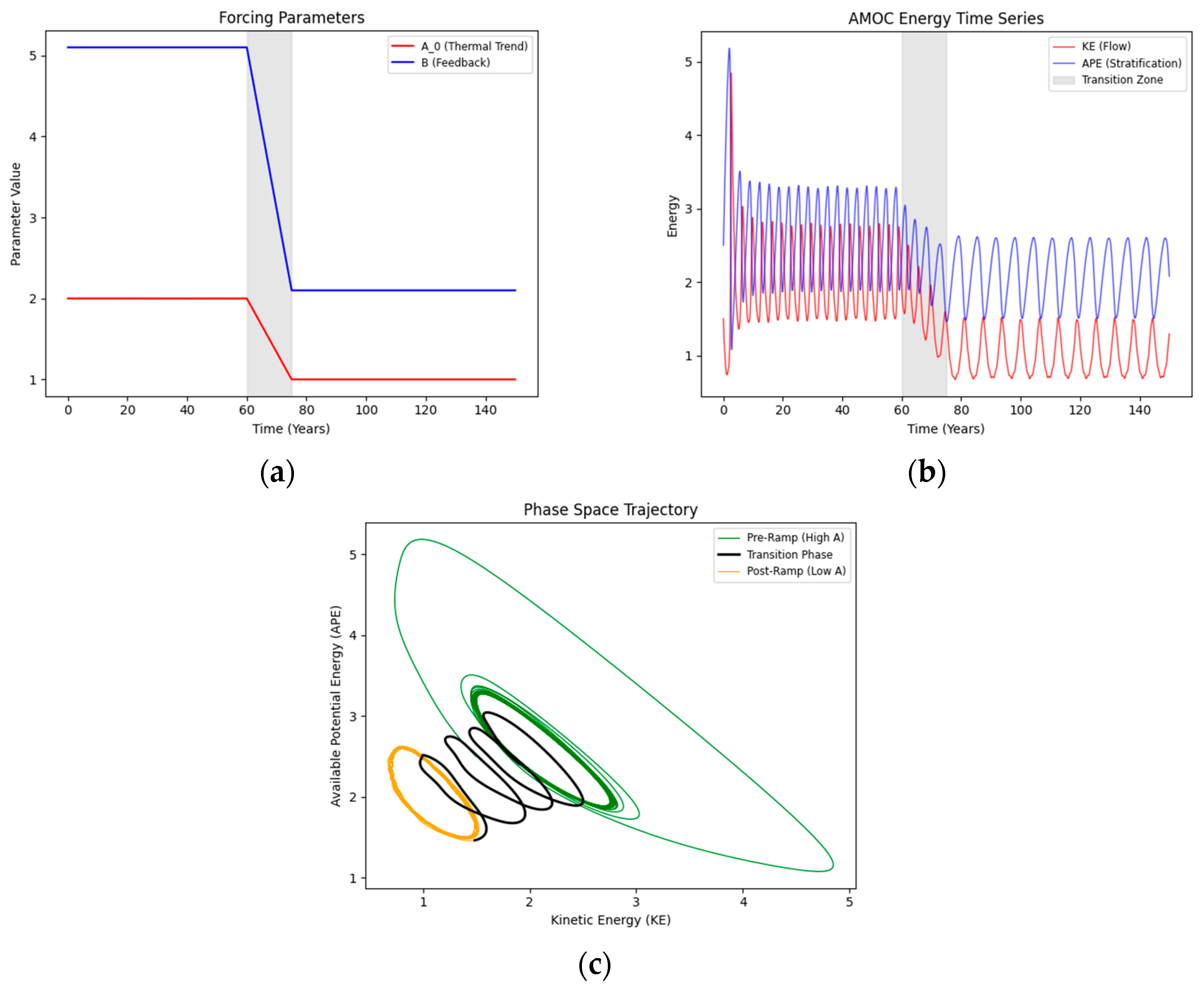
Finally, an experiment was conducted to simulate a sudden (or relatively fast) change in external forcing, which is believed to be capable of pushing the AMOC past its tipping point. In this scenario, A0 and B rapidly decreased from initially higher values to lower values, which is thought to result in increased density stratification replicated in A0 and B due to the presumed swift influx of meltwater into the convection sites, thereby disrupting convection. In reality, multiple processes may account for the reduction in A within the Brusselator model, whereas B is predominantly associated with meltwater feedback. This could include changes in wind patterns that, when combined with sea surface warming, could significantly alter density stratification, potentially triggering a meltwater event in the Nordic Seas and the subpolar North Atlantic. Such events could contribute to increased hydrostatic stability at convection sites.
Figure 14a,b,c illustrate the
KE and
APE in the scenario where neither seasonal nor stochastic excitation is present; however,
A and
B undergo rapid changes near the midpoint of the run. To better observe the dynamics, this model was run for over 150 model time units (years). Parameters
A and
B began to decrease rapidly after 60 years. Parameter
A dropped from 2.0 to 1.0, and parameter B dropped from 5.5 to 2.1 within the time interval of only 15 years. To better understand the abrupt changes, parameters
A and
B are selected to characterize the system immediately beyond the Hopf bifurcation point, that is, in the regime of limit cycles both before and after the parameters drop.
Numerous modeling and data analysis studies have addressed AMOC variability and transition behavior using a range of approaches, including conceptual models, comprehensive ocean circulation models, and analyses of present-day observations and paleoclimatic proxies. Many of these studies assumed that AMOC variability is strongly affected by changes in sea surface conditions in key regions of deep convection, serving as the primary drivers of overturning.
Within the conceptual framework presented here, such effects can be interpreted through variations in parameters A and B, which represent the energy input and accumulation of the available potential energy for conversion into kinetic energy, particularly in burst-like deep convection regimes. Several studies have emphasized that AMOC transitions arise from the combined influence of multiple factors, which in the Brusselator model can be represented through combined variations in the A and B parameters.
For example, ref. [
50] simulated transitions between weak and strong AMOC states in a three-box conceptual model constrained by observations, capturing key aspects of the observed variability. The resulting overturning time series revealed a dynamical behavior that was qualitatively consistent with that produced by a simplified Brusselator model (see
Figure 13 and
Figure 14).
In another study based on an ocean circulation model spanning the period 1958–2009 [
51], bifurcation diagrams indicated that AMOC variability is strongly influenced by buoyancy forcing. The authors interpreted the system behavior as consistent with Hopf-type bifurcation and subsequent bistable regimes. Within the conceptual framework of the present study, such behavior can be represented as transitions across the Hopf bifurcation boundary driven by combined variations in external forcing parameters analogous to
A and
B.It is important to note that the Brusselator, like any conceptual model, including the above-discussed [
50], serves as a structural interpretation of the nonlinear behavior observed in more complex models, rather than a direct predictive tool.
Here is a disclaimer. Simplified proxy models, such as the Brusselator, cannot replace comprehensive climate models or observational analyses. Their role is definitely not to be involved in studies of climate and ocean change. Accordingly, the results from such models should be interpreted with caution. These models serve different purposes: they clarify how complex systems, such as oceanic or atmospheric circulation, can be analyzed and explained from the perspectives of self-organization theory and synergetics. However, proxy models help crystallize our understanding of these change processes and shed additional light on the nature of these changes.
For example, the Brusselator model, which is used here to simulate AMOC weakening, clearly demonstrates that AMOC could reach a tipping point in the future, potentially becoming significantly weaker or even collapsing if a combination of external forces triggers such a change. Conversely, such drastic changes in external forces should be preceded by noticeable alterations in the circulation patterns caused by these forces. These significant changes are expected to manifest in wind-induced and thermohaline structures, represented by control parameters A and B, and would inevitably be observed in the trends of thermohaline fields, particularly sea surface temperature and salinity.
Salinity, which reflects freshwater fluxes, is especially critical in the high latitudes of the North Atlantic because it governs burst-like convection with rapid releases of
APE and bursts in
KE, the processes that sustain the AMOC. Despite the observed weakening of the AMOC, the thermohaline fields and wind stress curl (responsible for Ekman pumping and shaping the pycnocline) do not yet exhibit substantial changes that could lead to AMOC collapse [
6]. Nevertheless, Brusselator, as a conceptual proxy model, confirms that significant changes in external forcing are likely to severely weaken or even cause the collapse of the AMOC if the control parameters drop suddenly, and this drop cannot be anticipated purely by the current state analysis of in situ data. The proxy model discussed in this section suggests that such sudden and unexpected changes can potentially lead to unpredictable and dramatic climate change.
8. Discussion and Conclusions
Models such as the Brusselator offer the significant advantage of being quick and easy to run, enabling numerous experiments with easily adjustable model parameters. The aim of such experiments is to identify a combination of control parameters that produces results most closely aligned with observations, and more complex, costly numerical models that conceptual models attempt to replicate. However, a clear downside is that proxy models are highly simplified and cannot provide the detailed insights that numerical climate models can. The limited number of Brusselator runs presented here was not intended to explore the detailed climate changes revealed in climate models or oceanographic and climatological data analysis. Instead, the objective of the presented synthesis was to demonstrate how self-organization theory and synergetics principles can offer a broader perspective on ocean circulation and climate, viewing them as dissipative structures susceptible to bifurcation and sudden changes that may not always be evident in some model runs and data analyses.
Furthermore, the Brusselator was selected because it is arguably the simplest conceptual model that can serve as a proxy for highly nonlinear processes in open systems far from equilibrium, which are fundamental to the Earth’s climate system and all its subsystems. The Brusselator is one of the few models capable of simulating auto-oscillation under steady external forcing, and it effectively describes the Hopf bifurcation, which is a crucial process in the emergence of instabilities and auto-oscillation in natural systems. Notably, it is likely the only nonlinear model capable of replicating such processes using only two variables. Although it is highly idealized, the model effectively simulates realistic behavior in the two-variable framework that describes the conversion between kinetic energy and available potential energy in the ocean. This capability is behind its success in replicating the essential elements of ocean circulation instability, including the possibility of the AMOC reaching its critical threshold.
In this context, the Brusselator serves as an illustration of how the general self-organization approach can be applied more widely by utilizing key synergetic principles, such as order parameters, slaving principles, and self-organization through mode competition. These principles are implicitly behind many climate models, albeit in a less obvious manner. In addition to the classic Brusselator used in this study, several more sophisticated proxy or conceptual models are gaining popularity in the natural sciences, spanning fields from lasers and hydrodynamics to climate change, biology, and beyond. The family of conceptual models derived from chemical kinetics has rapidly expanded since the introduction of the Brusselator in 1968 [
4] (see also [
11], where the term was first used). Subsequently, a chemical kinetics model, known as the Oregonator [
52], was developed to simulate the Belousov–Zhabotinsky (BZ) oscillatory reaction. It not only simulates the Hopf bifurcation but also provides a more precise representation of self-sustained oscillations in chemical kinetic systems.
Building on this universal approach, Arnaut and Ibáñez created a conceptual model to simulate the evolution of the Earth’s climate system over the past five million years [
53]. They named this model Coimbrator after the city of Coimbra, Portugal, continuing the tradition of naming such conceptual models after the institutions or geographical locations of their development. This model incorporates three variables, eliminating the need for cubic nonlinearity, which is a primary limiting factor in Brusselator.
The well-known Lorenz model of atmospheric dynamics [
15], although not derived from chemical kinetics like the three aforementioned models, is also a three-variable system. It is characterized by instability and bifurcation, which lead the system to settle into one of two attractors in the phase space.
The Lotka–Volterra “prey–predator” model (see, for example, [
12]) has been adapted to investigate the self-organization of the Earth’s climate system, simulating Milankovitch–Berger astronomical cycles [
54]. The author of [
54] also considered the Lorenz and Brusselator models; however, they ultimately opted for the Lotka–Volterra model. Although this list of conceptual models can be easily expanded, the main message remains clear: self-organization principles offer a unique perspective for understanding nonlinear open systems that are maintained far from equilibrium by external energy and matter fluxes.
This study presents a few examples of atmospheric and oceanic motions, such as atmospheric convection and the formation of highly variable and nonlinear dissipative structures, such as westerly jet streams, the Gulf Stream system in the North Atlantic, and the dynamics of the AMOC, which is prone to becoming a climate tipping point. These examples were selected to illustrate how the principles of self-organization and synergetics methodology can serve as powerful tools for understanding these processes. Consequently, they may become increasingly vital for researching these and many other phenomena that shape and sustain Earth’s climate.
In this presentation, the power of self-organization theory and its instrumental branch, synergetics, has been only sketchily touched upon. Moreover, other powerful methodologies related to general self-organization theory, such as self-organized criticality (SOC), have not been considered here, although SOC can be a valuable approach to many climate-related problems. The SOC, a subfield of the broader self-organization theory, has been specifically designed to study complex systems at the edge of chaos-order transition [
55]. For example, it has the potential to advance research on climate tipping points. While self-organization theory generally focuses on how systems create order internally, often without external control, SOC particularly focuses on complex systems transitions from one state to another, including those with external controls. Therefore, SOC is regarded as having significant potential for studying Earth’s systems [
56]. A more comprehensive review may be necessary to cover the many aspects of self-organization theory, synergetics, or SOC that are beyond the scope of this presentation.
In conclusion, examining ocean circulation through the framework of self-organization and synergetics offers a coherent theoretical perspective on the emergence, stabilization, and potential bifurcation of complex ocean and climate dynamics under sustained external forces and fluxes of energy and matter. By exploring the roles of order parameters, nonlinear energy conversion, feedback-driven instability, and other aspects of the synergetics of ocean currents, this approach complements comprehensive numerical modeling and observational analyses. As climate research increasingly confronts the questions of tipping behavior and threshold responses, a synergetic perspective may serve as a conceptual bridge between nonlinear physics and Earth system science.