Article

Spatiotemporal Trends and Abrupt Changes in Annual Potential Evapotranspiration and Water Balance over Saudi Arabia


by
Saleh H. Alhathloul
Department of Civil Engineering, College of Engineering, King Saud University, P.O. Box 800, Riyadh 11421, Saudi Arabia
Water 2026, 18(6), 725; https://doi.org/10.3390/w18060725
Submission received: 19 February 2026 / Revised: 17 March 2026 / Accepted: 18 March 2026 / Published: 19 March 2026
(This article belongs to the Section Water and Climate Change)

Abstract

Potential evapotranspiration (PET) and water balance (WB) are key indicators of hydroclimatic conditions and water availability, particularly in arid and semi-arid regions. This study investigates the interannual variability, long-term trends, and abrupt regime shifts in annual PET and WB across Saudi Arabia using multi-station observational data spanning 1985–2022. PET was estimated using a temperature-based approach suitable for data-scarce arid environments, and WB was calculated as the difference between precipitation and PET. Non-parametric statistical methods were applied to assess trend magnitude and significance, while Pettitt’s change-point test was used to identify abrupt shifts at both regional and station scales. The main findings show a widespread and spatially coherent increase in atmospheric evaporative demand, with predominantly positive PET trends at both regional and station scales, accompanied by persistently negative and increasingly declining WB values, indicating a long-term intensification of water deficit across much of the country. Spatial patterns of PET and WB closely follow gradients in energy availability and temperature, confirming the dominant influence of warming-driven processes on hydroclimatic conditions in this arid environment. Change-point analysis identifies a statistically significant regional hydroclimatic regime shift during the late 1990s, characterized by an abrupt increase in PET and a concurrent deterioration of WB, marking the onset of a more water-limited climatic regime. At the station scale, the timing and significance of detected change points display pronounced spatial heterogeneity, reflecting the modulation of regional climatic forcing by local climatic and geographic factors. Overall, the results demonstrate that increasing evaporative demand, rather than precipitation variability alone, has become a primary control on water availability across Saudi Arabia, highlighting the importance of explicitly accounting for hydroclimatic non-stationarity in water resource assessment and long-term planning under continued warming conditions.

1. Introduction

Potential evapotranspiration (PET) and water balance (WB) are widely used indicators for characterizing hydroclimatic conditions and assessing water availability, particularly in arid and semi-arid regions. PET represents the atmospheric demand for moisture, whereas WB reflects the net balance between precipitation inputs and evaporative losses. Together, these variables provide an integrated description of hydroclimatic stress and its potential impacts on hydrological processes, ecosystems, and water resources systems [1,2,3].
During recent decades, global warming has led to a widespread intensification of atmospheric evaporative demand, driven primarily by rising air temperatures and changes in the surface energy balance. Numerous studies have demonstrated that increases in PET are largely controlled by warming-induced changes in radiative and aerodynamic conditions rather than by precipitation variability alone [4,5,6]. More recent assessments further confirm an acceleration of evaporative demand at the global scale and its strong linkage to observed temperature increases [7,8]. In dryland environments, such increases in PET can substantially reduce WB, thereby amplifying aridity and increasing vulnerability to drought conditions [9,10,11,12].
Recent studies emphasize that enhanced evaporative demand has become a dominant driver of drought severity and persistence under contemporary climate conditions, often exceeding the influence of precipitation deficits alone [13,14,15]. This behavior is particularly relevant in arid and semi-arid regions, where water availability is highly sensitive to relatively small changes in atmospheric demand. Consequently, understanding both gradual trends and abrupt changes in PET and WB is essential for assessing evolving hydroclimatic stress and associated risks.
While trend analyses provide valuable insight into long-term hydroclimatic changes, they may not adequately capture abrupt transitions or regime shifts in climate time series. Change-point detection methods have therefore been increasingly applied to identify sudden shifts in the mean or variability of hydroclimatic variables that may reflect nonlinear climate responses or changes in large-scale circulation patterns [16,17,18]. Applications of change-point analysis to temperature, evapotranspiration, drought indices, and streamflow have shown that hydroclimatic variables often exhibit step-like changes rather than smooth temporal evolution [8,19,20,21]. Identifying the timing of such abrupt changes in PET and WB is therefore critical for interpreting hydroclimatic regime shifts and their implications for water resources management.
Saudi Arabia represents a typical hyper-arid to arid environment, characterized by high evaporative demand, limited and highly variable rainfall, and strong sensitivity to climatic variability. Observational studies have reported significant warming trends, increasing aridity, and changes in drought characteristics across the region during recent decades [22,23,24]. Climate projections based on CMIP6 models further indicate continued warming and intensification of evaporative demand across Saudi Arabia throughout the 21st century, reinforcing concerns about increasing hydroclimatic stress [25,26]. Although several studies have examined trends in temperature, precipitation, and drought indices, comparatively fewer investigations have jointly analyzed PET and WB and the occurrence of abrupt hydroclimatic regime shifts at both regional and station scales within the country.
In this study, the main objective is to investigate the interannual variability, long-term trends, and abrupt change points in annual potential evapotranspiration (PET) and water balance (WB) across Saudi Arabia using multi-station observations covering the period 1985–2022. PET is estimated using a temperature-based approach suitable for data-scarce arid environments, while WB is derived as the difference between precipitation and PET. Non-parametric statistical methods are applied to assess trends and to detect statistically significant change points in both variables at regional and station scales. By jointly examining PET and WB through trend and change-point analyses, this study aims to provide a clearer understanding of hydroclimatic regime shifts, their spatial heterogeneity, and their implications for increasing hydroclimatic stress in arid regions.

2. Methodology

2.1. Study Area and Data

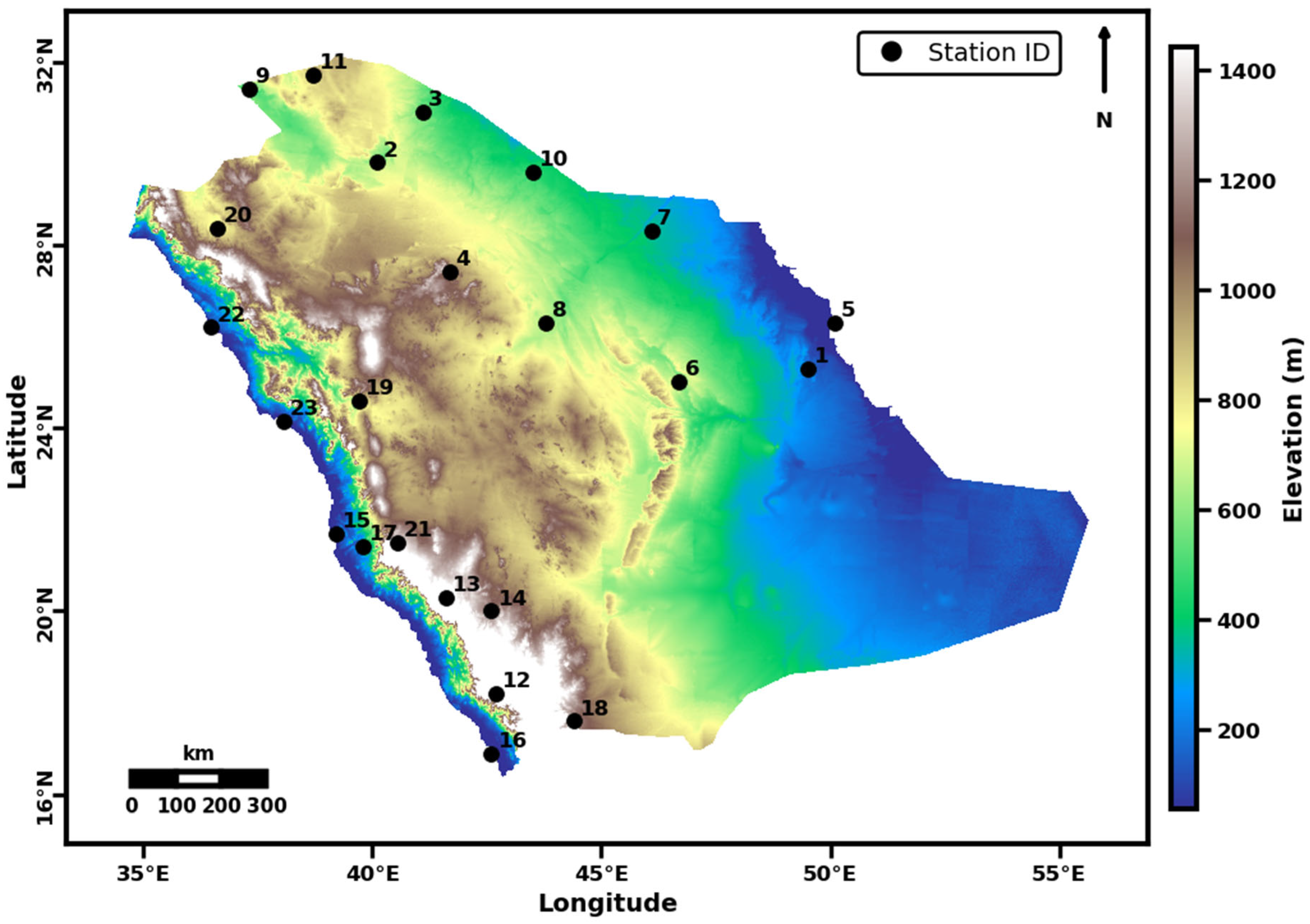
The study area encompasses the territory of Saudi Arabia, extending approximately between 16 and 32° N latitude and 34–56° E longitude (Figure 1). The country exhibits strong physiographic and climatic gradients, ranging from low-elevation coastal plains along the Red Sea and the Arabian Gulf to elevated escarpments and mountainous regions in the western and southwestern parts, where elevations locally exceed 2500 m. These highlands are mainly associated with the Hijaz Mountains and Asir Mountains, forming part of the broader Arabian Shield. Climatically, Saudi Arabia is dominated by arid to hyper-arid conditions, with mean annual rainfall generally below 100 mm across most regions, while comparatively higher precipitation occurs over the southwestern highlands due to orographic lifting and seasonal monsoonal influences. Temperature regimes display pronounced spatial variability, with milder conditions at higher elevations and extremely hot conditions over interior desert regions during summer months. These climatic characteristics and their variability have been well documented in previous regional studies [27,28,29].
Daily precipitation data were obtained from the Ministry of Environment, Water and Agriculture (MEWA), while daily maximum and minimum air temperature data were obtained from the National Oceanic and Atmospheric Administration (NOAA). The study period spans from January 1985 to December 2022, providing a continuous multi-decadal record suitable for hydroclimatic trend and variability analysis. The geographic locations and elevations of the selected meteorological stations are summarized in Table 1.
Stations were retained only when the proportion of missing observations in the temperature data obtained from NOAA did not exceed approximately four percent of the total record length to maintain sufficient temporal continuity for aggregation to monthly and annual time scales. The remaining missing values were sparse and randomly distributed, reducing the likelihood of systematic bias in the derived temperature and PET series [30,31]. For precipitation, missing rainfall observations were filled using data from nearby stations following established procedures [32]. The statistical properties of the precipitation data were evaluated using the Shapiro–Wilk test for normality and the Breusch–Pagan test for heteroscedasticity [30]. After quality control, continuous time series were constructed for each station, and a total of 23 stations with records spanning 1985–2022 were used in the analysis. Daily precipitation was aggregated to monthly totals, and daily maximum and minimum air temperatures were aggregated to monthly mean values. These monthly series were used to estimate monthly PET, which was subsequently summed to obtain annual PET values. Monthly WB was calculated as the difference between monthly precipitation and monthly PET and then aggregated to derive annual WB. Stations were selected based on data availability and record continuity to ensure robust and reliable statistical inference. Detailed descriptions of these procedures are provided in the following sections.

2.2. Potential Evapotranspiration Estimation and Water Balance

The Hargreaves–Samani formulation was adopted because it requires only air temperature and extraterrestrial radiation as input variables. In many arid and semi-arid regions, long-term observations of other meteorological variables required by physically based approaches (e.g., humidity, wind speed, and solar radiation) are often incomplete or unavailable. Since temperature records are generally the most consistently available climatic observations, the Hargreaves–Samani method has been widely applied in data-limited environments and has been shown to provide reliable PET estimates in arid climates [1,33,34]. Monthly PET is expressed by Equation (1), where P E T m is monthly PET ( m m   m o n t h 1 ), T m a x , m is the monthly mean maximum air temperature ( ° C ), T m i n , m is the monthly mean minimum air temperature ( ° C ), T m e a n , m is the monthly mean air temperature, and R a , m is the monthly mean of the extraterrestrial radiation R a values. The parameter R a , m is expressed in units of megajoules per square meter per day ( M J   m 2 d a y 1 ). The term ( T m a x , m + T m i n , m ) 0.5 represents the square root of the diurnal temperature range, reflecting atmospheric transmissivity, while ( T m e a n , m + 17.8 ) accounts for the effect of air temperature on evaporative demand. The monthly mean air temperature is computed as presented in Equation (2). The empirical coefficient in Equation (1) incorporates the required unit conversions so that PET is expressed as equivalent water depth (mm). Monthly PET was calculated by multiplying the daily estimate by the number of days in each month.
P E T m   = 0.0023 ( T m e a n , m   + 17.8 ) ( T m a x , m   T m i n , m   ) 0.5 R a , m  
T m e a n , m   = T m a x , m   + T m i n , m 2    
In this study, monthly mean air temperature was approximated as the average of monthly mean maximum and minimum temperatures, which is consistent with the input requirements of the Hargreaves–Samani PET formulation. Extraterrestrial radiation R a  ( M J   m 2 d a y 1 ) was calculated according to the FAO-56 methodology described by Allen et al. (1998) [1] and given by Equations (3)–(6), where G S C = 0.082   M J   m 2 m i n 1 is the solar constant, φ is the altitude (radians), δ is the solar declination, ω S is the sunset hour angle, d r is the inverse relative Earth–Sun distance, and J is the Julian day corresponding to the midpoint of each month. Monthly PET values were summed to obtain annual PET totals ( m m ). In Equation (3), the coefficients 24 and 60 are conversion factors used in the FAO-56 formulation to obtain daily extraterrestrial radiation. The absence of radiation during nighttime is accounted for through the sunset hour angle ( ω s ), which defines the daylight period in the radiation integration.
R a = 24 × 60 π     G s c   d r   ω s   s i n ( φ ) s i n ( δ ) + c o s ( φ ) c o s ( δ ) s i n ( ω s   )
d r   = 1 + 0.033 c o s 2 π J   365
δ = 0.409 s i n 2 π J 365 1.39
ω s   = a r c c o s t a n ( φ ) t a n ( δ )
The monthly WB was calculated as presented in Equation (7), where W B m is the monthly WB ( m m ), P m is the monthly precipitation ( m m ), and P E T m is the monthly PET ( m m ). Positive values indicate water surplus, whereas negative values represent water deficit. The annual WB ( W B a n n ) was obtained by summing the monthly values, as presented in Equation (8).
W B m   = P m   P E T m  
W B a n n   = m = 1 12 W B m  
For visualization, monthly extraterrestrial radiation ( R a , m ) was aggregated to an annual scale using a day-weighted averaging scheme to account for the unequal length of months. The annual mean ( R ¯ a ) was computed as given by Equation (9), where R a , m is the monthly mean daily extraterrestrial radiation and D m represents the number of days in month m . Unlike PET and precipitation, which are cumulative variables, extraterrestrial radiation is an energy flux and was therefore aggregated to an annual scale using a day-weighted averaging approach.
R ¯ a = m = 1 12 R a , m   D m m = 1 12 D m
Although the Hargreaves–Samani equation does not explicitly include terrain or elevation parameters, geographic influences are indirectly represented through the meteorological variables used as inputs. Air temperature reflects local climatic conditions influenced by elevation, topography, and proximity to coastal areas, while extraterrestrial radiation varies with latitude and solar geometry [1,35]. However, because the method relies primarily on temperature, it does not explicitly account for humidity, wind speed, or aerodynamic processes considered in physically based approaches such as the FAO-56 Penman–Monteith equation.

2.3. Trend Analysis

Trend magnitude in annual PET and annual WB was estimated using the Theil–Sen robust slope estimator, which computes the median of all pairwise slopes between data points [36,37] and is given by Equation (10), where X i and X j denote the values of the time series at times i and j , respectively, and β represents the rate of change per year ( m m   y r 1 ).
β = m e d i a n x j x i j i ,         j > i
Trend direction and statistical significance were evaluated using Spearman’s rank correlation coefficient [38], which measures the strength and direction of a monotonic relationship between time and the variable of interest. The coefficient ( ρ ) is given by Equation (11), where d i is the difference between the rank of observation i and the rank of its time index, and n is the total number of observations. Significance was assessed using Spearman’s rank correlation with p-values obtained from a moving-block bootstrap procedure at the 5% level ( α = 0.05 ). Prior to significance testing, lag-1 autocorrelation was examined to evaluate the presence of serial dependence in the annual series. Serial correlation can affect the statistical significance of trend tests and therefore should be assessed before applying significance tests. The lag-1 autocorrelation coefficient ( r 1 ) was calculated using Equation (12) [39], where x i represents the value of the time series at time i , x ¯ is the mean of the series, and n is the number of observations. Values of r 1 close to zero indicate weak serial dependence, whereas higher absolute values indicate stronger persistence in the time series.
ρ = 1 6   i = 1 n d i 2 n ( n 2 1 )    
r 1 = i = 1 n 1 ( x i x ¯ ) ( x i + 1 x ¯ ) i = 1 n ( x i x ¯ ) 2
Abrupt changes in annual PET and annual WB were identified using Pettitt’s non-parametric change-point test [16]. The Pettitt test is based on the Mann–Whitney statistic and is widely used to detect a single abrupt shift in the central tendency of a time series without requiring assumptions about the underlying data distribution [16]. The test statistic U t is calculated using Equation (13), where x i and x j represent observations at times i and j , respectively, n is the total number of observations, and the s g n ( . ) is the sign function defined in Equation (14),
U t   = i = 1 t j = t + 1 n s g n ( x i   x j   )  
s g n ( x ) = 1 , x > 0 0 , x = 0 1 , x < 0
The statistic U t measures the difference between two segments of the time series separated at time t . The most probable change point corresponds to the time t at which the absolute value U t reaches its maximum. Statistical significance of the detected change point is evaluated using the associated p-value of the Pettitt test.

3. Results

3.1. Spatial Distribution of Mean Annual Conditions

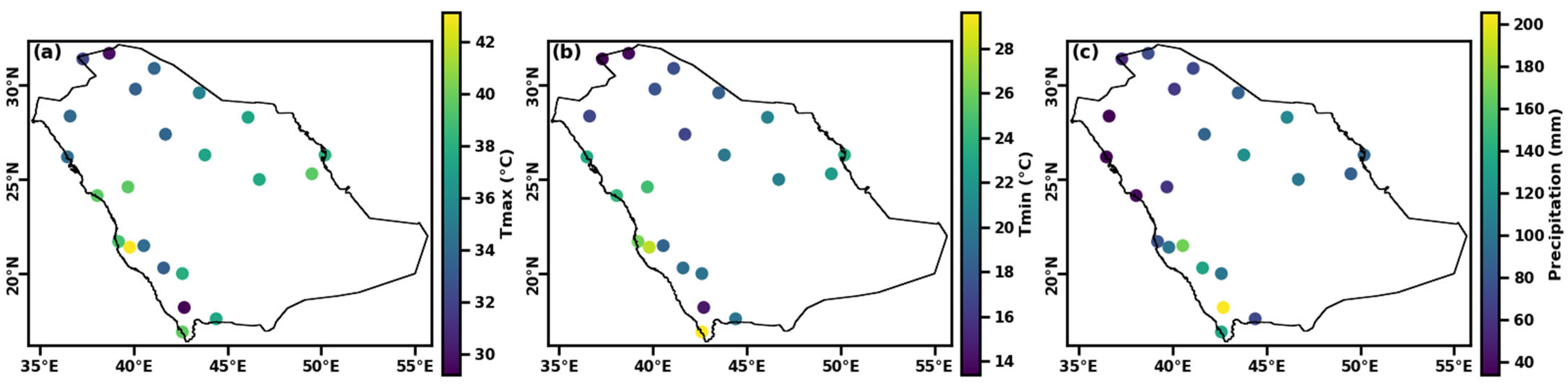
The spatial distribution of long-term mean annual maximum temperature ( T m a x ), minimum temperature ( T m i n ), and precipitation across the analyzed stations is presented in Figure 2, revealing clear regional climatic variability over Saudi Arabia. As shown in panel (a), higher T m a x values are generally observed in the southern and southwestern regions, while relatively lower values occur toward the northern stations, reflecting the influence of latitude and regional climatic conditions. A similar spatial pattern is evident for Tmin in panel (b), where higher minimum temperatures are mainly concentrated in the southern and coastal areas, whereas lower T m i n values occur in the northern and northwestern parts of the country. In contrast, precipitation exhibits a different spatial distribution, as illustrated in panel (c), with relatively higher mean annual precipitation recorded in the southwestern highlands and some central stations, while lower precipitation amounts dominate the northern and eastern regions. These spatial differences highlight the influence of geographic location and regional climate controls on the distribution of temperature and precipitation across Saudi Arabia.
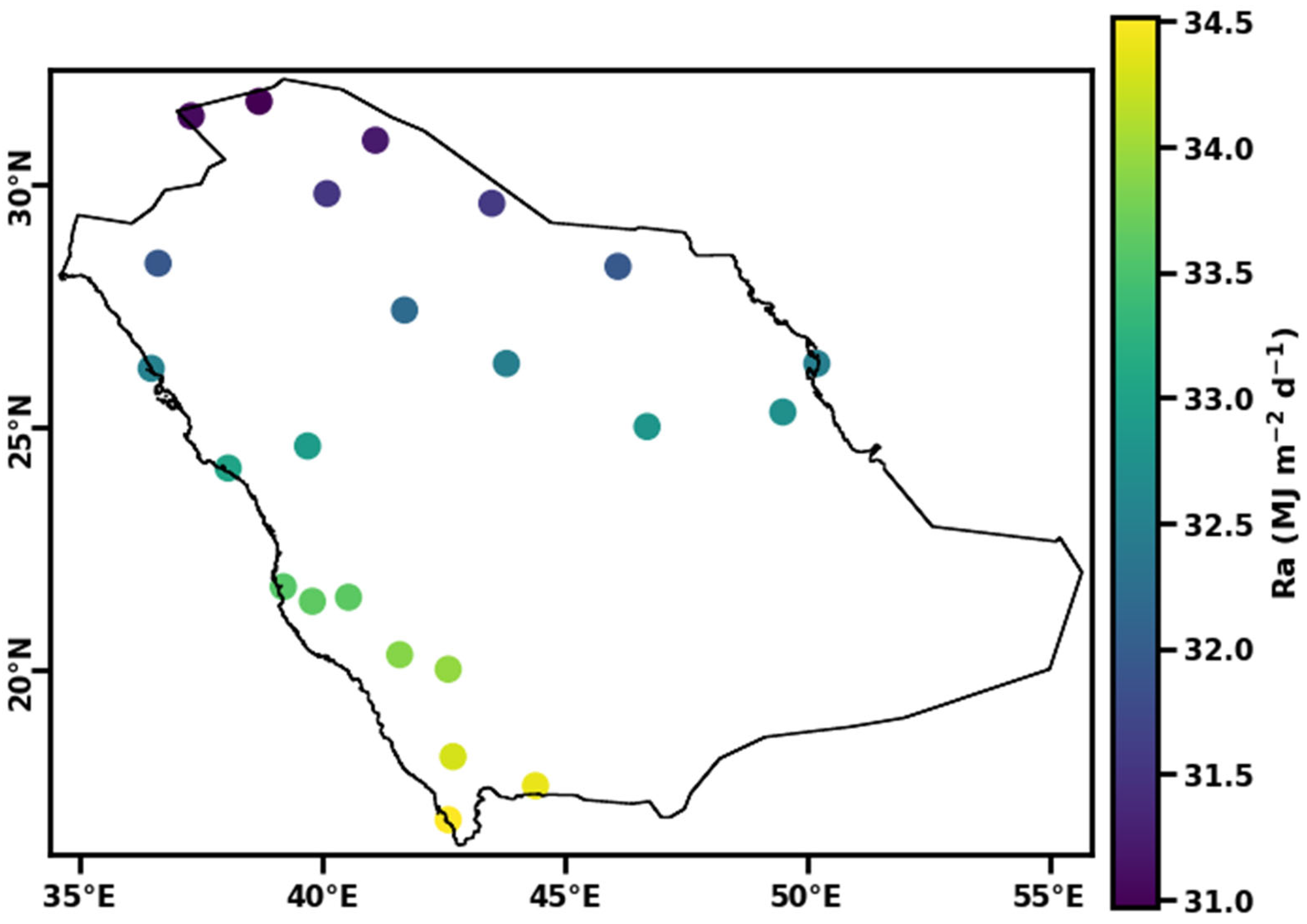
The spatial distribution of long-term mean annual extraterrestrial radiation ( R a ) across the study stations is shown in Figure 3. The annual mean R a ranges from approximately 31.0 to 34.5   M J   m 2 d 1 . The lowest values (about 31.0–31.8 M J   m 2 d 1 ) are observed at the northern stations, while the highest values (34.0–34.5 M J   m 2 d 1 ) occur at the southern stations. Stations located in the central region exhibit intermediate values between approximately 32.5 and 33.5   M J   m 2 d 1 . This clear north–south gradient reflects the influence of latitude on solar geometry, as lower-latitude locations receive greater annual extraterrestrial radiation. The gradual spatial variation indicates that R a is primarily controlled by astronomical factors. These differences in available energy provide the basis for the subsequent spatial patterns observed in PET and WB.
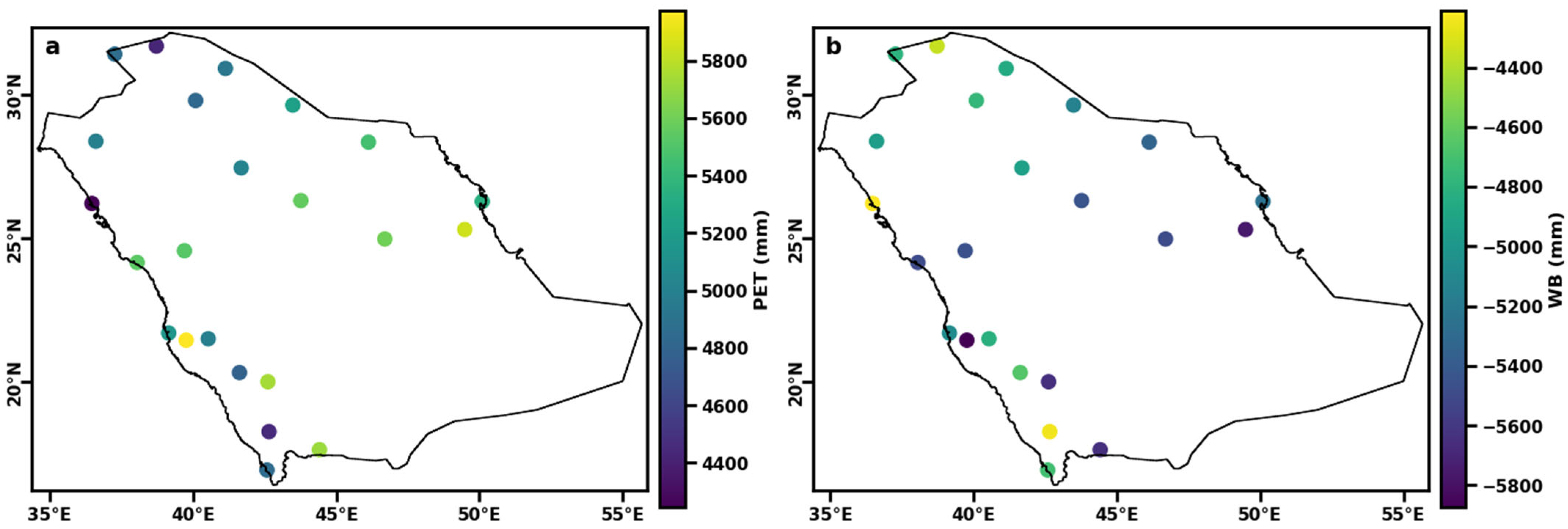
The spatial distribution of long-term mean annual PET and WB is shown in Figure 4. Figure 4a indicates that annual PET ranges from approximately 4500 to 5900   m m across the study area. Higher PET values are concentrated mainly in the central and eastern parts of Saudi Arabia, where annual totals frequently exceed about 5500   m m , reflecting strong atmospheric evaporative demand driven by high temperatures and intense solar radiation. In contrast, relatively lower PET values, generally between about 4500 and 4900   m m , are observed at several northern and southwestern stations. These lower values are associated with comparatively cooler conditions and reduced energy availability, leading to weaker evaporative demand. The observed spatial gradient highlights the influence of regional climatic controls on the magnitude of PET across the country.
Figure 4b presents the spatial pattern of long-term mean annual water balance, which varies from approximately 4500 to 5900   m m across the study area. All stations exhibit negative water balance values, indicating a persistent annual water deficit throughout Saudi Arabia. The most negative values, typically lower than 5600   m m , are generally associated with areas experiencing high potential evapotranspiration in combination with relatively low precipitation, particularly across the central and eastern regions. Less negative water balance values occur at some northern and southwestern stations, where reduced evaporative demand partially moderates the annual deficit. Overall, the spatial patterns of water balance closely mirror those of potential evapotranspiration and are consistent with the distribution of extraterrestrial radiation and temperature, emphasizing the dominant role of energy availability in controlling evaporative demand and shaping the regional water deficit. At the national scale, based on record-weighted averages across all stations, the long-term mean annual potential evapotranspiration is 5174.67   m m , while the corresponding mean annual water balance is 5082.97   m m , confirming a pronounced and persistent water deficit. The associated mean annual extraterrestrial radiation ( R a ) is 32.77   M J   m 2 d 1 , reflecting the high solar energy input that drives these hydroclimatic conditions.

3.2. Spatial Distribution of Average Trend Magnitude in PET and WB

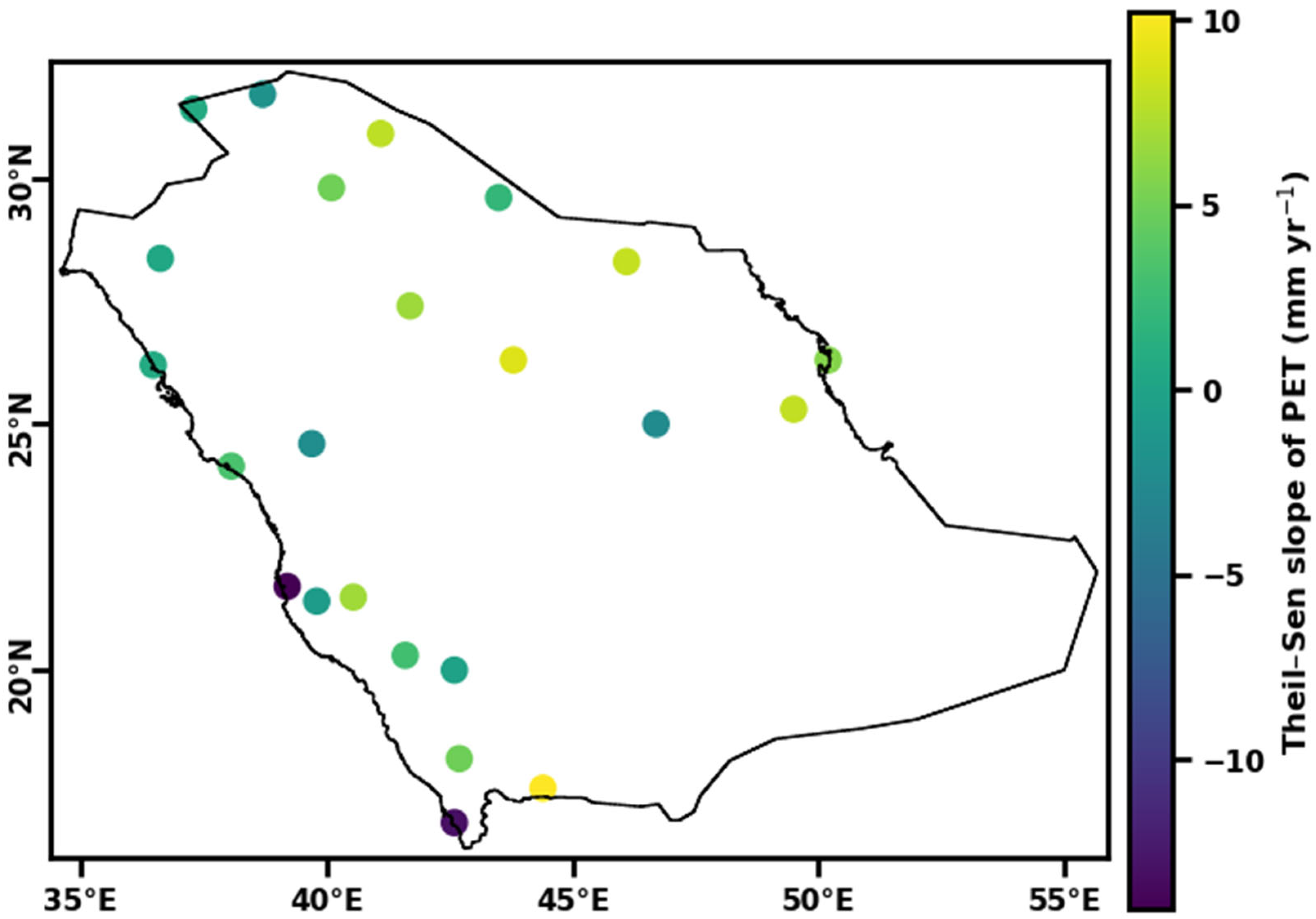
The spatial distribution of the Theil–Sen slope of annual PET is presented in Figure 5. The slope values range from approximately 10 to + 10   m m   y r 1 . Most stations show positive trends, indicating an increase in annual PET over the study period. For example, several northern and central stations exhibit slopes exceeding + 5   m m   y r 1 , reflecting a noticeable rise in evaporative demand. In contrast, Stations 15 and 16, represented by the purple color in the western coastal area, display negative trend magnitudes. These two stations show slope values below 5   m m   y r 1 , indicating a decreasing tendency in annual PET. The presence of negative trends at these locations highlights spatial variability in PET changes and suggests that the evolution of evaporative demand is not uniform across the country.
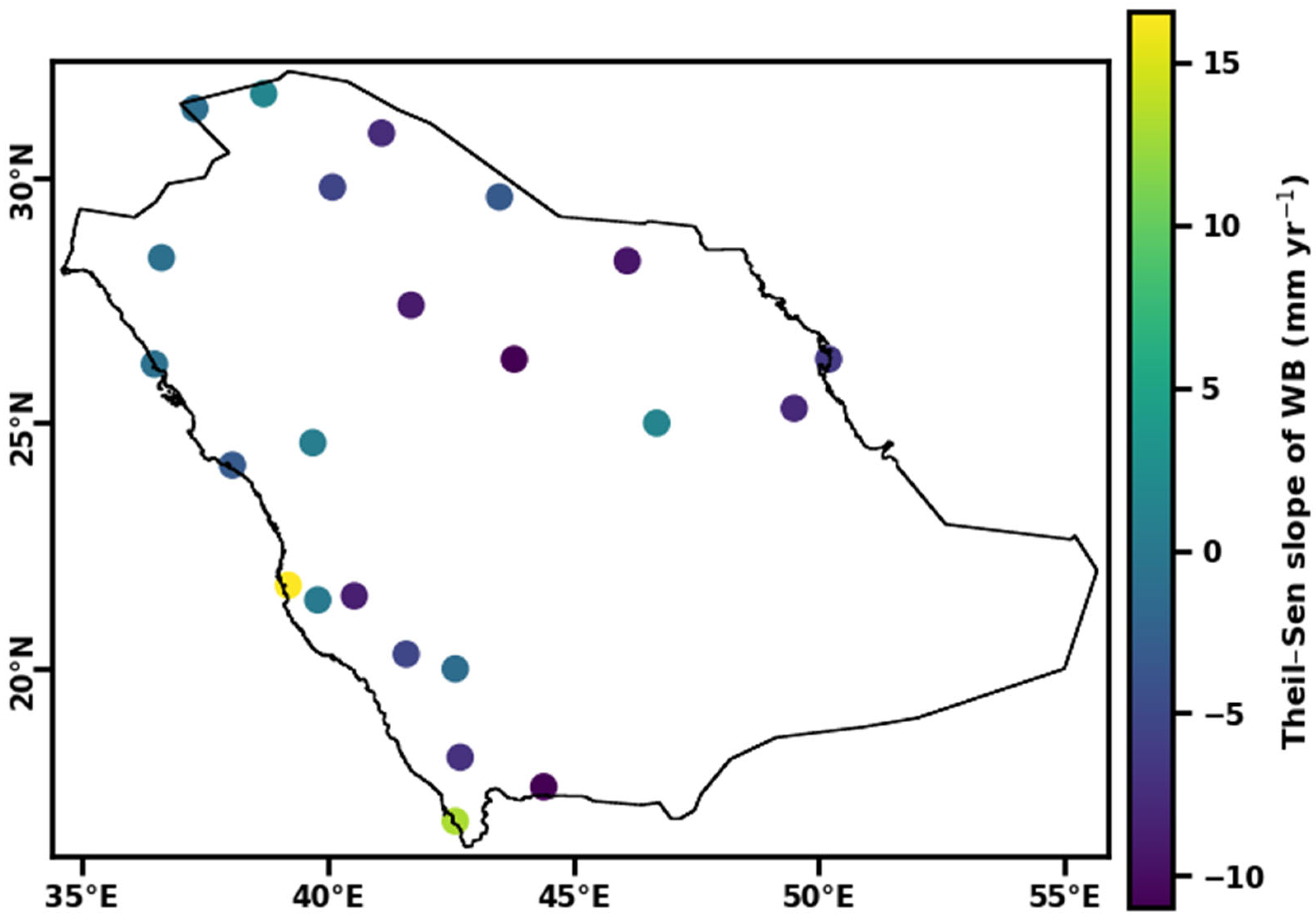
The spatial distribution of the Theil–Sen slope of annual WB is presented in Figure 6. The slope values range from approximately 10 to + 15   m m   y r 1 , indicating clear spatial variability in the evolution of annual water deficit across the country. Most central and northern stations exhibit negative trends, with slope magnitudes between about 5 and 10   m m   y r 1 , suggesting an increasing water deficit over the study period. For example, several northern stations record slope values close to 8   m m   y r 1 . In contrast, some stations along the western coastal area display positive trends. One southwestern coastal station shows a slope exceeding + 10   m m   y r 1 , while a nearby station records values around + 5   m m   y r 1 , indicating a relative improvement in annual WB at those locations. This spatial contrast highlights that changes in water availability are not uniform and reflect regional differences in precipitation and evaporative demand.
As shown in Table 2, annual PET exhibits predominantly positive slope values across the study stations, indicating an overall increase in evaporative demand over time. The Theil–Sen slope ranges from 14.06 to + 10.23   m m   y r 1 . Statistically significant increasing PET trends ( α   =   5 % ) are observed at Stations 1, 2, and 7, with slope magnitudes between approximately + 5.01 and +8.09 m m   y r 1 . In contrast, Station 16 shows a statistically significant negative PET trend ( 13.11   m m   y r 1 ), while Station 15 also records a strong negative slope ( 14.06   m m   y r 1 ), though it is not significant at the 5 % level. Several other stations, including 3, 4, 8, 12, and 18, present moderate positive slopes without statistical significance. These results indicate that increasing PET is dominant across much of the country, with localized decreases mainly in the western coastal area.
Annual WB trends display substantial spatial variability, with slope values ranging from 10.98 to + 16.59   m m   y r 1 , as summarized in Table 2. Significant negative WB trends are detected at Stations 1, 2, 7, and 12, indicating an intensification of water deficit in these regions. In contrast, Station 16 exhibits a statistically significant positive WB trend ( + 13.14   m m   y r 1 ), suggesting an improvement in annual WB. Although Station 15 records the largest positive slope ( + 16.59   m m   y r 1 ), it does not reach statistical significance. Many other stations show negative slopes that are not statistically significant, reflecting a general tendency toward increasing water deficit that is not spatially uniform across the country. Overall, the results in Table 2 confirm that increasing PET is associated with worsening WB in several regions, while localized improvements are observed along parts of the western coastal zone.
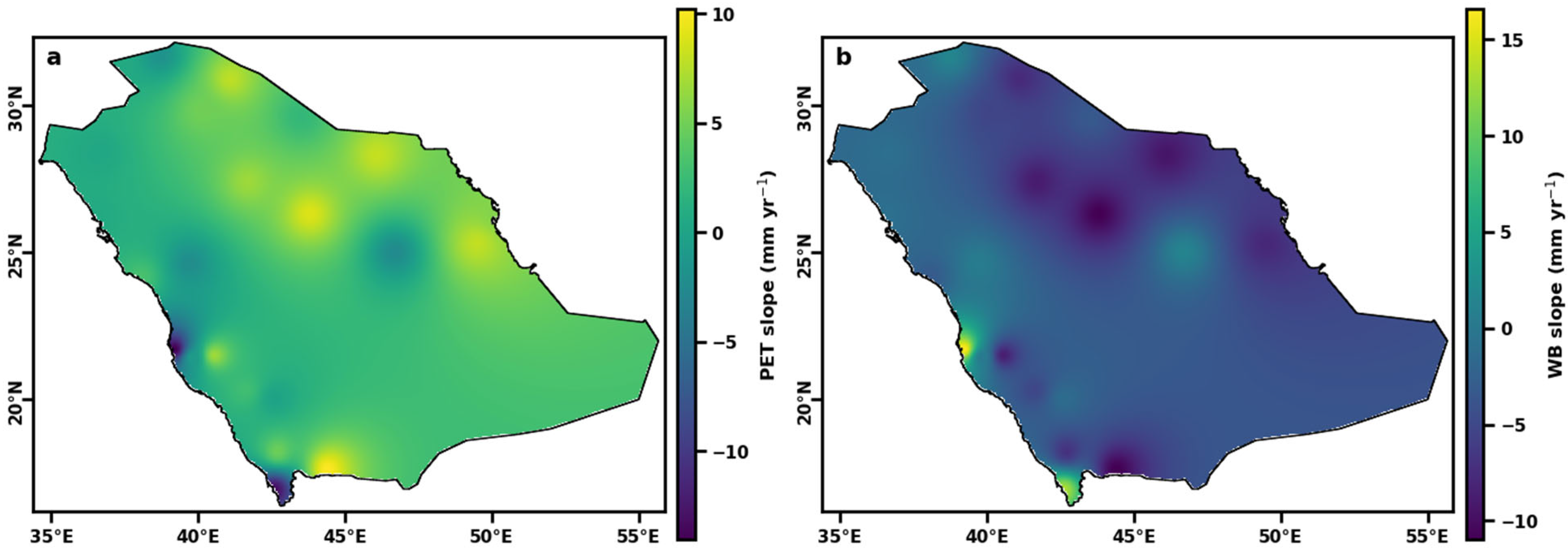
Figure 7 presents the spatially continuous distribution of long-term trend magnitudes in annual PET and WB across Saudi Arabia, obtained by interpolating station-based Theil–Sen slope estimates using the inverse distance weighting (IDW) method. IDW was selected to emphasize the influence of nearby observations while avoiding the additional assumptions on spatial stationarity and variogram structure required by geostatistical approaches. In panel (a), PET trends display marked spatial variability, with predominantly positive slopes over large portions of the country, indicating a general intensification of evaporative demand. Higher PET trend magnitudes are observed mainly in the central, northern, and eastern regions, whereas weaker or locally negative trends are confined to parts of the southwestern area. Panel (b) illustrates the spatial pattern of WB trends, which are largely negative throughout the region, reflecting a progressive strengthening of the annual water deficit. Areas exhibiting more pronounced negative WB trends generally coincide with regions of increasing PET, highlighting the dominant role of rising evaporative demand in shaping long-term water balance changes. The interpolated surfaces provide a coherent regional-scale perspective that complements the station-based analyses and facilitates interpretation of spatial hydroclimatic gradients across Saudi Arabia.

3.3. Temporal Variability and Trends of Annual PET and WB

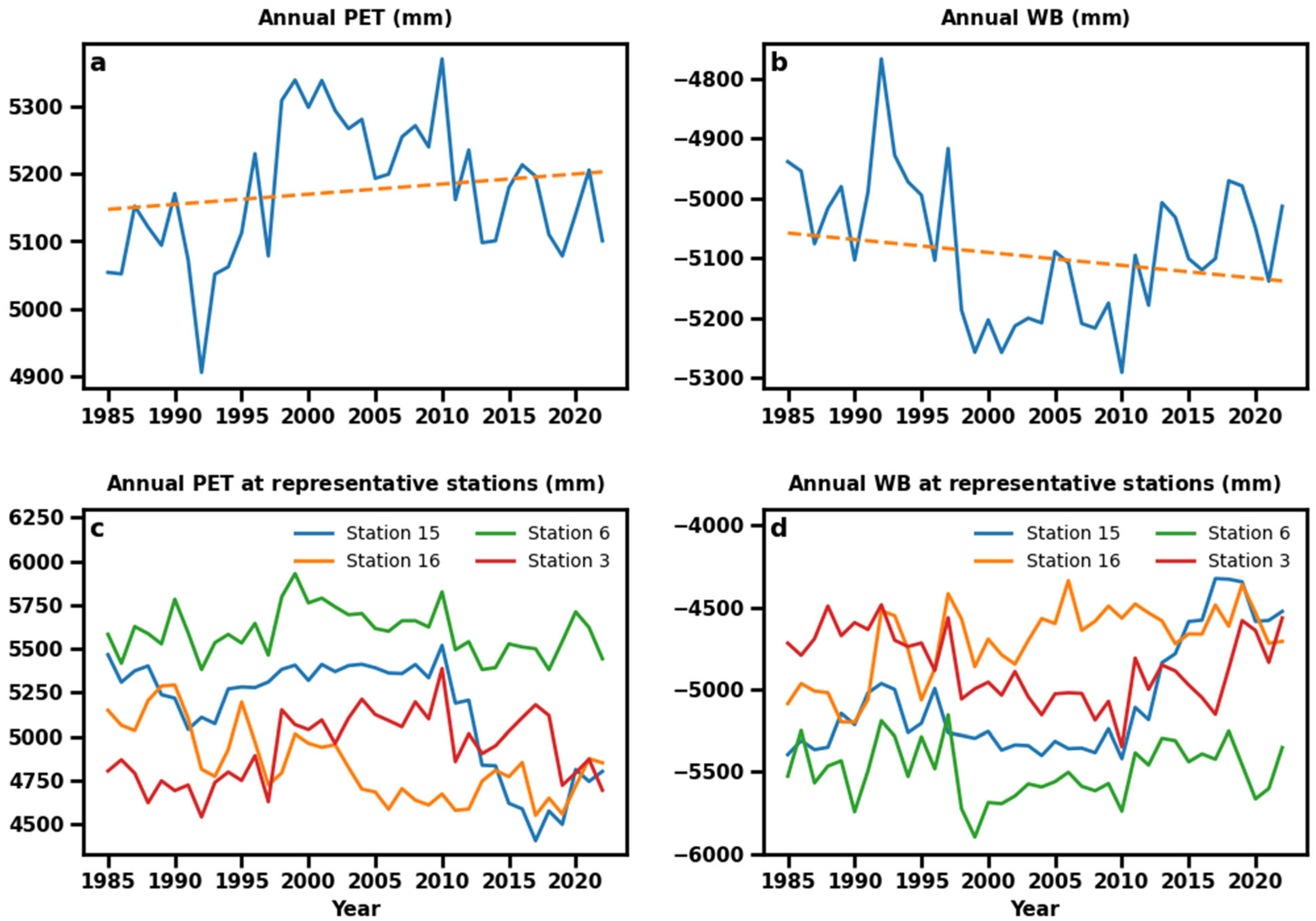
The interannual variability and long-term behavior of annual PET and WB are illustrated in Figure 8 for both the regional mean and selected representative stations. At the regional scale (panels a and b), annual PET exhibits a clear increasing tendency over the study period, with values generally ranging between about 5100 and 5300   m m , indicating a gradual intensification of atmospheric evaporative demand. In contrast, annual WB shows a decreasing trend, with increasingly negative values (from around 5000 to below 5200   m m ), reflecting a progressive worsening of water deficit at the country scale. At the station level (panels c and d), PET and WB series display pronounced interannual variability and marked differences among Stations 15, 16, 6, and 3. These stations were selected to represent contrasting hydroclimatic environments across Saudi Arabia: Station 3 reflects northern inland conditions, Station 6 characterizes the central plateau, Station 15 represents western coastal influences along the Red Sea, and Station 16 corresponds to the southwestern coastal zone where climatic conditions differ from the interior desert regions. Although PET at these stations broadly follows the regional signal, the magnitude and timing of fluctuations vary substantially. Similarly, WB exhibits strong year-to-year variability with contrasting long-term tendencies, including persistent deficits and episodic recoveries. These patterns indicate that regional averages mask considerable local variability, underscoring the importance of station-scale analysis for interpreting hydroclimatic trends.
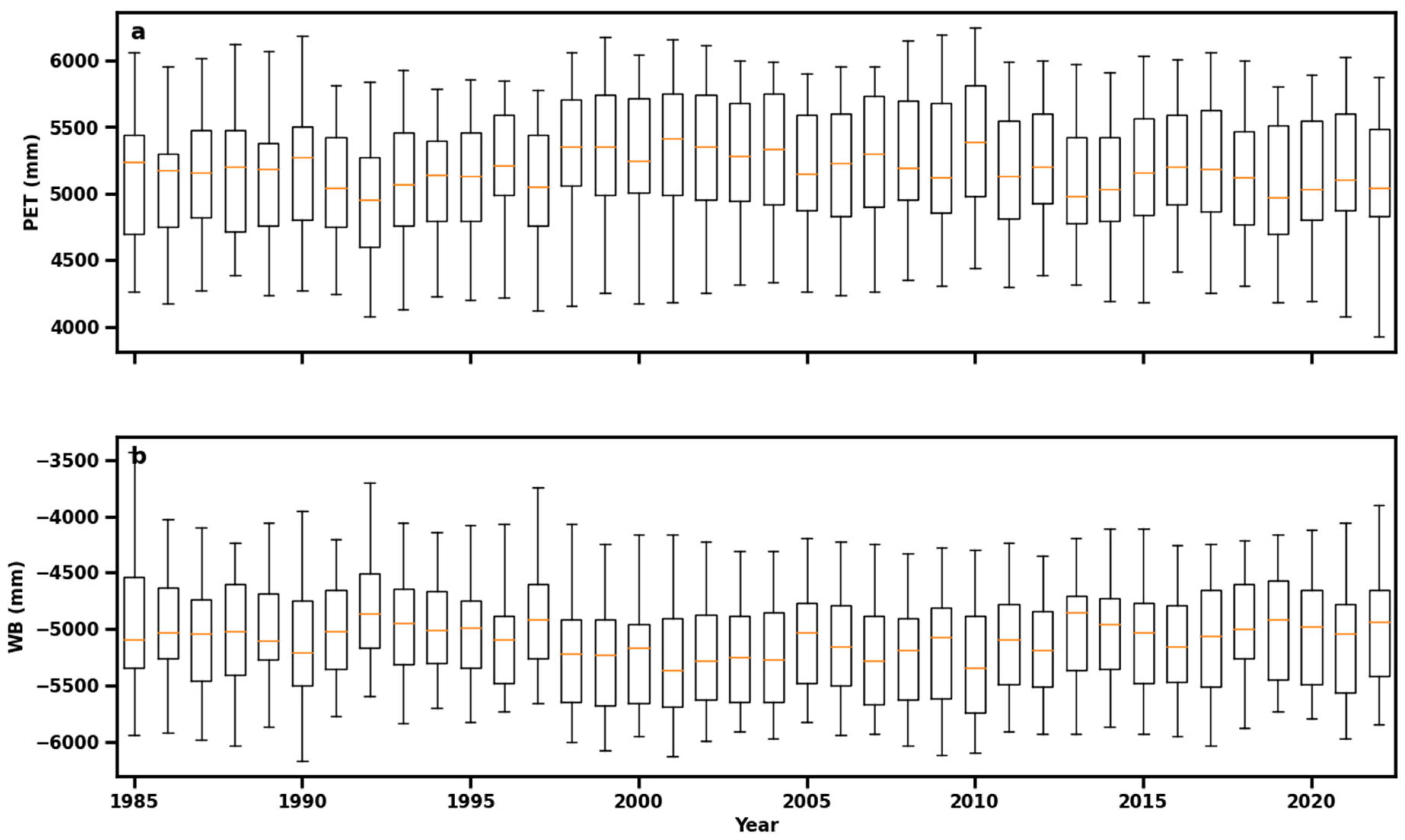
The interannual variability of annual PET and WB is illustrated using boxplots that summarize the spatial distribution of station-based values for each year (Figure 9). For a given year, the median represents the regional central tendency, while the interquartile range and whiskers reflect the degree of spatial heterogeneity among stations. The PET distributions (panel a) exhibit relatively stable median values over time, accompanied by moderate year-to-year fluctuations in spatial spread, indicating persistent evapotranspiration demand with varying regional contrasts. In contrast, the WB distributions (panel b) are consistently negative throughout the study period, highlighting the dominance of water-deficit conditions across the region. Pronounced variations in both the median and dispersion of WB reveal substantial interannual and spatial variability, with years of wider boxes indicating enhanced hydro-climatic contrasts among stations.
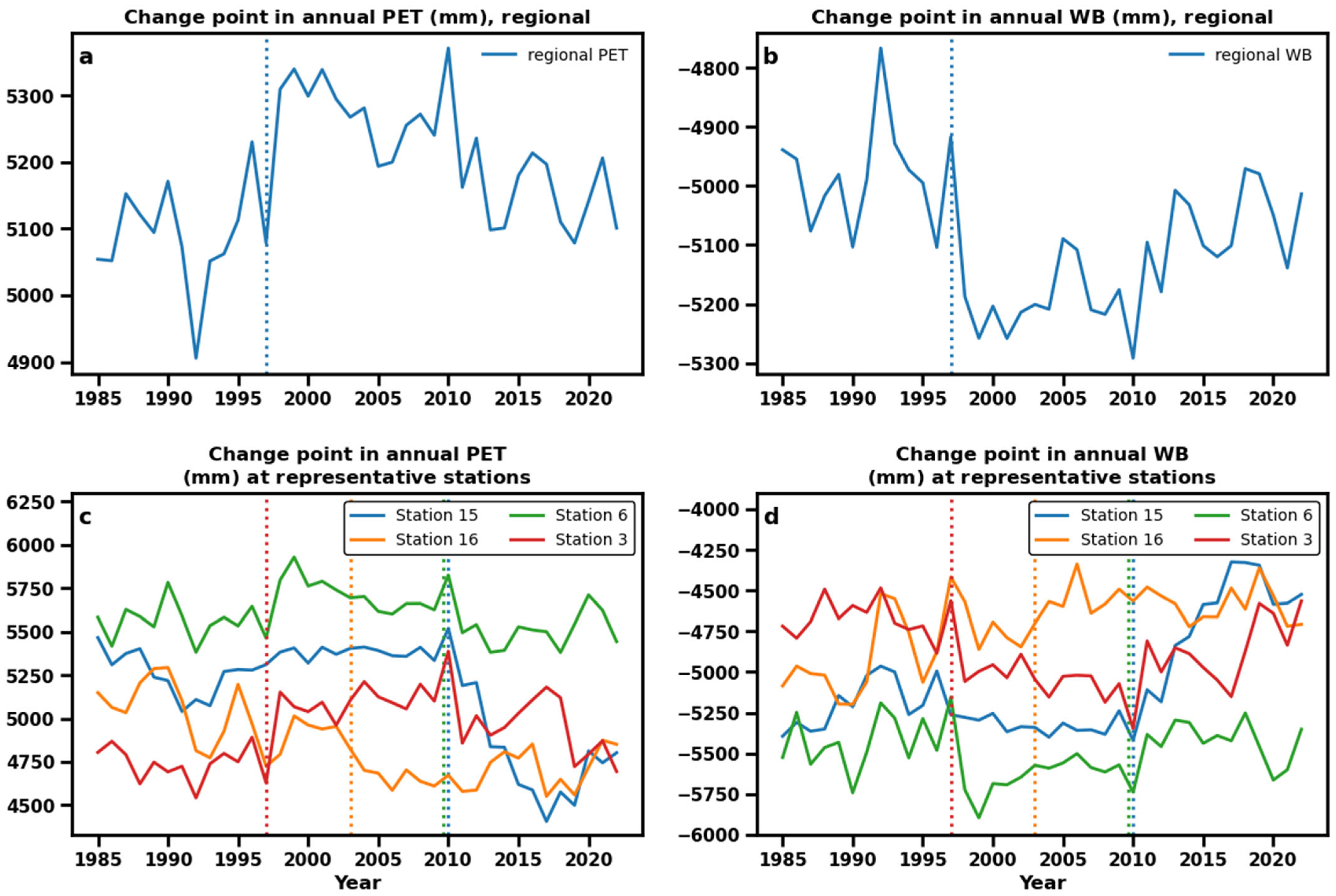
Abrupt changes in the temporal evolution of annual PET and WB are observed at both the regional and station scales. As shown in Figure 10, the regional annual PET exhibits a statistically significant upward shift occurring around 1997, after which higher PET values persist for an extended period. A corresponding change point is detected in the regional WB at approximately the same time, indicating a transition toward more negative WB values and reduced water availability. At the station scale, the timing of PET change points varies among representative stations, with abrupt shifts identified around 1997 at Station 3, around 2002 at Station 16, and around 2011 at both Stations 6 and 15, indicating a shared timing of abrupt change at these two locations. This behavior highlights pronounced spatial heterogeneity in hydroclimatic responses and suggests that some stations experience synchronous regime shifts. Similar but not identical timing is observed for WB change points at the representative stations, generally occurring between the late 1990s and early 2000s, followed by sustained negative anomalies. Overall, the concurrent increase in PET and decline in WB after the detected change points suggests a regime shift toward enhanced atmospheric evaporative demand and increased hydroclimatic stress across the study region.
The change-point years of PET and WB for all analyzed stations are summarized in Table 3. The corresponding time series together with the detected change points for PET and WB for the remaining stations are provided in the Supplementary Materials (Figures S1 and S2). At the regional scale, a statistically significant change point is detected in annual PET in 1997, accompanied by a concurrent shift in the regional WB during the same period, indicating a basin-wide transition toward higher evaporative demand and more negative WB conditions. At the station scale, the timing of change points varies among locations; for example, Station 3 exhibits a significant PET change point around 1997, Station 16 shows a later shift occurring around 2002, and Station 6 displays a change point near 2011. In contrast, no statistically significant change point is detected for either PET or WB at Station 15, suggesting a more gradual temporal evolution without an abrupt regime shift. Similar but not identical patterns are observed for WB, with significant change points generally occurring between the late 1990s and early 2000s at several stations. Overall, the examples reported in Table 3 highlight pronounced spatial heterogeneity in the timing and significance of hydroclimatic regime shifts, while confirming a regionally coherent signal of increasing atmospheric evaporative demand and declining water availability.

4. Discussion

4.1. Regional Hydroclimatic Regime Shifts in PET and WB

The regional change-point analysis indicates a coherent hydroclimatic regime shift in annual PET and WB across Saudi Arabia during the late 1990s. As shown in Figure 10 and summarized in Table 3, a statistically significant change point is detected in regional PET around 1997, followed by persistently higher values in subsequent years. A corresponding change point is identified in the regional WB during the same period, marking a transition toward more negative WB conditions. The temporal concurrence of these shifts suggests a system-level response to regional climatic forcing rather than isolated variability in individual hydroclimatic components. This interpretation is further supported by the spatially interpolated trend patterns (Figure 7), which reveal broadly coherent increases in PET trends and predominantly negative WB trends across much of the country, indicating that the detected regime shift is not confined to a limited subset of stations.
The timing of the detected regional change point is consistent with documented warming over the Arabian Peninsula since the late twentieth century [23,24,27,40]. Increasing air temperature enhances atmospheric evaporative demand by altering surface energy availability and vapor pressure gradients, leading to higher PET even in the absence of significant changes in precipitation [2,4,6]. Under such conditions, increases in PET can substantially reduce WB, thereby amplifying aridity and increasing vulnerability to drought conditions [9,10,11]. Recent studies further indicate that warming-driven increases in evaporative demand have intensified globally over recent decades, particularly in arid and semi-arid regions [5,7,8]. The spatial patterns derived from inverse distance weighting interpolation highlight that these increases in evaporative demand are spatially widespread, reinforcing the regional-scale nature of the hydroclimatic response.
The concurrent decline in regional WB following the detected change point highlights the growing dominance of evaporative demand over precipitation in controlling water availability. Similar coupled increases in PET and decreases in WB have been reported in other dryland regions and are widely interpreted as indicators of climate-driven aridification [13,14,15]. Climate projections based on CMIP6 models further suggest continued warming and intensification of evaporative demand across Saudi Arabia throughout the 21st century, reinforcing concerns regarding increasing hydroclimatic stress and long-term water scarcity [25,26]. In this context, the spatially interpolated PET and WB trend fields complement the change-point analysis by demonstrating that the post-1990s shift toward more water-limited conditions is expressed consistently across large portions of the country, marking a critical historical threshold in the evolution of Saudi Arabia’s hydroclimatic regime.

4.2. Spatial Heterogeneity of Change Points at the Station Scale

At the station scale, the detected change points in annual PET and WB display pronounced spatial heterogeneity, indicating that the regional hydroclimatic regime shift is modulated by local climatic and geographic conditions. As shown in Figure 10 and summarized in Table 3, representative stations differ in both the timing and statistical significance of detected change points, with abrupt shifts occurring at some locations during the late 1990s to early 2000s, while others exhibit delayed or non-significant responses. This spatial variability highlights the heterogeneous nature of hydroclimatic transitions across Saudi Arabia. The full set of station-level Pettitt change-point analyses is presented in the Supplementary Materials (Figures S1 and S2), which illustrate the temporal evolution of annual PET and WB for all analyzed stations. These additional results confirm that, although the exact timing of the breakpoints varies among locations, several stations exhibit clustered shifts during the late 1990s, supporting the interpretation of a broader regional hydroclimatic transition. Similar spatial variability in hydroclimatic change points has been widely documented in arid and semi-arid regions and is commonly attributed to heterogeneous local responses to large-scale climatic forcing [7,17,20]. The transition detected around the late 1990s should be interpreted as a statistically identified shift within the observational record rather than evidence of a permanent climatic state change. Within the context of the available multi-decadal dataset, the detected change point indicates a structural modification in the hydroclimatic behavior of PET and WB, characterized by persistently higher evaporative demand and increasingly negative water balance conditions in subsequent years [17,41,42].
Stations exhibiting statistically significant PET change points generally show abrupt transitions that are broadly consistent with the regional-scale regime shift, although the timing varies among locations, reflecting differences in temperature trends, land-atmosphere interactions, and rainfall intermittency [2,4,6]. In contrast, Station 15 does not exhibit a statistically significant change point in either PET or WB, indicating a more gradual temporal evolution without a distinct step-like transition. This behavior suggests localized buffering effects or smoother climatic variability that reduce the detectability of abrupt shifts using non-parametric methods, rather than an absence of long-term hydroclimatic change [8,21]. Overall, the station-scale results emphasize that regional hydroclimatic regime shifts manifest unevenly across space, underscoring the importance of station-level analyses when assessing localized drought risk and water resources vulnerability.

4.3. Implications for Hydroclimatic Stress and Water Resources Management

At the station scale, the detected change points in annual PET and WB exhibit pronounced spatial heterogeneity, indicating that the regional hydroclimatic regime shift is modulated by local climatic and geographic controls. As shown in Figure 10 and summarized in Table 3, individual stations differ in both the timing and statistical significance of detected change points, with abrupt shifts occurring at some locations during the late 1990s to early 2000s, while others show delayed or statistically non-significant responses. This spatial variability is consistent with the heterogeneous spatial patterns of PET and WB trends identified through interpolation (Figure 7), suggesting that large-scale climatic forcing interacts with local-scale factors to produce uneven hydroclimatic responses. Similar spatial heterogeneity in hydroclimatic change points has been widely reported in arid and semi-arid regions and is commonly attributed to localized modulation of regional climate signals [7,17,20].
Stations exhibiting statistically significant PET change points generally display abrupt transitions that align with the regional-scale regime shift, although the timing varies among locations, reflecting differences in temperature evolution, land-atmosphere interactions, and rainfall intermittency [2,4,6]. In contrast, Station 15 does not show a statistically significant change point in either PET or WB, indicating a more gradual temporal evolution without a distinct step-like transition. This behavior likely reflects localized buffering effects or smoother climatic variability that reduce the detectability of abrupt shifts using non-parametric change-point methods, rather than the absence of long-term hydroclimatic change [8,21]. Overall, the station-scale results highlight that regional hydroclimatic regime shifts are expressed unevenly across space, reinforcing the importance of station-level analyses for understanding localized drought dynamics and water resources vulnerability.

5. Conclusions

This study investigated the interannual variability, long-term trends, and abrupt regime shifts in annual PET and WB across Saudi Arabia during 1985–2022 using multi-station observations and robust non-parametric statistical techniques. The results provide clear evidence of a widespread increase in atmospheric evaporative demand, with predominantly positive PET trends observed at both regional and station scales. In contrast, annual WB remains persistently negative throughout the study period and exhibits a general tendency toward increasingly negative values, indicating a long-term intensification of water deficit over much of the country. The spatial coherence of PET and WB trend magnitudes indicates that these changes extend across large areas rather than being confined to isolated locations. The observed patterns are closely aligned with gradients in energy availability and temperature, underscoring the dominant role of warming-driven processes in shaping hydroclimatic conditions in this arid environment. While regional averages reveal a coherent large-scale signal, station-level results highlight substantial spatial variability, emphasizing that localized hydroclimatic responses may differ in magnitude and timing from regional tendencies.
Change-point analysis further identifies a statistically significant regional hydroclimatic regime shift during the late 1990s, marked by an abrupt increase in PET accompanied by a concurrent decline in WB. This transition represents the onset of a more water-limited climatic regime characterized by sustained hydroclimatic stress in subsequent decades. At the station scale, the timing and significance of detected change points exhibit pronounced spatial heterogeneity, reflecting the influence of local climatic and geographic factors on the regional forcing signal. Taken together, the combined evidence from trend and change-point analyses indicates that increasing evaporative demand, rather than precipitation variability alone, has become a primary control on water availability across Saudi Arabia. From a water resources perspective, these findings underscore the limitations of stationarity-based assumptions and highlight the need to explicitly account for hydroclimatic non-stationarity in future water planning and management strategies, particularly in arid and semi-arid regions facing continued warming and increasing evaporative stress.
Effective water management in arid regions such as Saudi Arabia requires greater attention to atmospheric water demand and its influence on long-term water availability. The increasing role of evaporative demand identified in this study suggests that future assessments of water resources should consider both precipitation supply and climate-driven atmospheric demand when evaluating water security. Strengthening climate monitoring networks and incorporating climate-informed indicators into national water planning frameworks will therefore be essential for enhancing resilience to future hydroclimatic variability and supporting sustainable management of limited water resources under a warming climate.

Supplementary Materials

The following supporting information can be downloaded at: https://www.mdpi.com/article/10.3390/w18060725/s1, Figure S1: Station-level Pettitt change-point analysis of annual potential evapotranspiration (PET) across Saudi Arabia for the period 1985–2022. Each panel shows the annual PET time series for an individual station, while the dotted vertical line denotes the estimated change point detected by Pettitt’s test; Figure S2: Pettitt change-point detection results for annual water balance at the analyzed meteorological stations across Saudi Arabia during the period 1985–2022. Each subplot represents an individual station, and the dotted vertical line indicates the estimated change-point year identified by Pettitt’s test.

Funding

This research received no external funding.

Data Availability Statement

The data are available from the authors upon reasonable request due to governmental privacy and data-sharing regulations imposed by the original data-providing agencies.

Conflicts of Interest

The author declares no competing interests.

References

  1. Allen, R.; Pereira, L.; Raes, D.; Smith, M. Crop Evapotranspiration Guidelines for Computing Crop Requirements. FAO Irrig. Drain. Report Modeling and Application. J. Hydrol. 1998, 285, 19–40. [Google Scholar]
  2. Hobbins, M.T.; Dai, A.; Roderick, M.L.; Farquhar, G.D. Revisiting the Parameterization of Potential Evaporation as a Driver of Long-Term Water Balance Trends. Geophys. Res. Lett. 2008, 35, L12403. [Google Scholar] [CrossRef]
  3. Thornthwaite, C.W. An Approach toward a Rational Classification of Climate. Geogr. Rev. 1948, 38, 55. [Google Scholar] [CrossRef]
  4. Greve, P.; Orlowsky, B.; Mueller, B.; Sheffield, J.; Reichstein, M.; Seneviratne, S.I. Global Assessment of Trends in Wetting and Drying over Land. Nat. Geosci. 2014, 7, 716–721. [Google Scholar] [CrossRef]
  5. Milly, P.C.D.; Dunne, K.A. Colorado River Flow Dwindles as Warming-Driven Loss of Reflective Snow Energizes Evaporation. Science 2020, 367, 1252–1255. [Google Scholar] [CrossRef] [PubMed]
  6. Sherwood, S.; Fu, Q. A Drier Future? Science 2014, 343, 737–739. [Google Scholar] [CrossRef] [PubMed]
  7. Gebrechorkos, S.H.; Sheffield, J.; Vicente-Serrano, S.M.; Funk, C.; Miralles, D.G.; Peng, J.; Dyer, E.; Talib, J.; Beck, H.E.; Singer, M.B.; et al. Warming Accelerates Global Drought Severity. Nature 2025, 642, 628–635. [Google Scholar] [CrossRef]
  8. Li, S.; Wang, G.; Zhu, C.; Lu, J.; Ullah, W.; Hagan, D.F.T.; Kattel, G.; Peng, J. Attribution of Global Evapotranspiration Trends Based on the Budyko Framework. Hydrol. Earth Syst. Sci. 2022, 26, 3691–3707. [Google Scholar] [CrossRef]
  9. Mishra, A.K.; Singh, V.P. A Review of Drought Concepts. J. Hydrol. 2010, 391, 202–216. [Google Scholar] [CrossRef]
  10. Mishra, A.K.; Singh, V.P. Drought Modeling—A Review. J. Hydrol. 2011, 403, 157–175. [Google Scholar] [CrossRef]
  11. Vicente-Serrano, S.M.; Quiring, S.M.; Peña-Gallardo, M.; Yuan, S.; Domínguez-Castro, F. A Review of Environmental Droughts: Increased Risk under Global Warming? Earth-Sci. Rev. 2020, 201, 102953. [Google Scholar] [CrossRef]
  12. Williams, A.P.; Cook, E.R.; Smerdon, J.E.; Cook, B.I.; Abatzoglou, J.T.; Bolles, K.; Baek, S.H.; Badger, A.M.; Livneh, B. Large Contribution from Anthropogenic Warming to an Emerging North American Megadrought. Science 2020, 368, 314–318. [Google Scholar] [CrossRef] [PubMed]
  13. Cook, B.I.; Smerdon, J.E.; Cook, E.R.; Williams, A.P.; Anchukaitis, K.J.; Mankin, J.S.; Allen, K.; Andreu-Hayles, L.; Ault, T.R.; Belmecheri, S.; et al. Megadroughts in the Common Era and the Anthropocene. Nat. Rev. Earth Environ. 2022, 3, 741–757. [Google Scholar] [CrossRef]
  14. Sardans, J.; Miralles, A.; Tariq, A.; Zeng, F.; Wang, R.; Peñuelas, J. Growing Aridity Poses Threats to Global Land Surface. Commun. Earth Environ. 2024, 5, 776. [Google Scholar] [CrossRef]
  15. Vicente-Serrano, S.M.; Peña-Angulo, D.; Beguería, S.; Domínguez-Castro, F.; Tomás-Burguera, M.; Noguera, I.; Gimeno-Sotelo, L.; El Kenawy, A. Global Drought Trends and Future Projections. Philos. Trans. R. Soc. Math. Phys. Eng. Sci. 2022, 380, 20210285. [Google Scholar] [CrossRef]
  16. Pettitt, A.N. A Non-Parametric Approach to the Change-Point Problem. Appl. Stat. 1979, 28, 126. [Google Scholar] [CrossRef]
  17. Reeves, J.; Chen, J.; Wang, X.L.; Lund, R.; Lu, Q.Q. A Review and Comparison of Changepoint Detection Techniques for Climate Data. J. Appl. Meteorol. Climatol. 2007, 46, 900–915. [Google Scholar] [CrossRef]
  18. Rodionov, S.N. A Sequential Algorithm for Testing Climate Regime Shifts. Geophys. Res. Lett. 2004, 31, L09204. [Google Scholar] [CrossRef]
  19. Khoshravesh, M.; Abedi-Koupai, J.; Nikzad-Tehrani, E. Detection of Trends in Hydro-Climatological Variables Using Parametric and Non-Parametric Tests in Neka Basin. J. Water Soil. Sci. 2016, 19, 1–14. [Google Scholar] [CrossRef][Green Version]
  20. Kundzewicz, Z.W.; Robson, A.J. Change Detection in Hydrological Records—A Review of the Methodology / Revue Méthodologique de La Détection de Changements Dans Les Chroniques Hydrologiques. Hydrol. Sci. J. 2004, 49, 7–19. [Google Scholar] [CrossRef]
  21. Serinaldi, F.; Kilsby, C.G.; Lombardo, F. Untenable Nonstationarity: An Assessment of the Fitness for Purpose of Trend Tests in Hydrology. Adv. Water Resour. 2018, 111, 132–155. [Google Scholar] [CrossRef]
  22. Almazroui, M. Rainfall Trends and Extremes in Saudi Arabia in Recent Decades. Atmosphere 2020, 11, 964. [Google Scholar] [CrossRef]
  23. AlSarmi, S.; Washington, R. Recent Observed Climate Change over the Arabian Peninsula. J. Geophys. Res. Atmos. 2011, 116, D11109. [Google Scholar] [CrossRef]
  24. Lelieveld, J.; Hadjinicolaou, P.; Kostopoulou, E.; Chenoweth, J.; El Maayar, M.; Giannakopoulos, C.; Hannides, C.; Lange, M.A.; Tanarhte, M.; Tyrlis, E.; et al. Climate Change and Impacts in the Eastern Mediterranean and the Middle East. Clim. Change 2012, 114, 667–687. [Google Scholar] [CrossRef]
  25. Almazroui, M.; Saeed, F.; Saeed, S.; Ismail, M.; Ehsan, M.A.; Islam, M.N.; Abid, M.A.; O’Brien, E.; Kamil, S.; Rashid, I.U.; et al. Projected Changes in Climate Extremes Using CMIP6 Simulations Over SREX Regions. Earth Syst. Environ. 2021, 5, 481–497. [Google Scholar] [CrossRef]
  26. IPCC. Climate Change 2021—The Physical Science Basis: Working Group I Contribution to the Sixth Assessment Report of the Intergovernmental Panel on Climate Change; Cambridge University Press: Cambridge, UK, 2023. [Google Scholar]
  27. Alhathloul, S.H.; Khan, A.A.; Mishra, A.K. Temporal Variability of Temperature, Precipitation, Drought, and Their Potential Influence on Horizontal Visibility over Saudi Arabia. Theor. Appl. Climatol. 2024, 155, 4621–4639. [Google Scholar] [CrossRef]
  28. Almazroui, M.; Islam, M.N.; Dambul, R.; Jones, P.D. Trends of Temperature Extremes in Saudi Arabia. Int. J. Climatol. 2014, 34, 808–826. [Google Scholar] [CrossRef]
  29. Hasanean, H.; Almazroui, M. Rainfall: Features and Variations over Saudi Arabia, A Review. Climate 2015, 3, 578–626. [Google Scholar] [CrossRef]
  30. Wilks, D. Statistical Methods in the Atmospheric Sciences; Academic Press: Cambridge, MA, USA, 2011. [Google Scholar]
  31. WMO. Updated 30-Year Reference Period Reflects Changing Climate. 2021. Available online: https://wmo.int/media/news/updated-30-year-reference-period-reflects-changing-climate (accessed on 14 December 2024).
  32. Serrano, A.; García, J.; Mateos, V.L.; Cancillo, M.L.; Garrido, J. Monthly Modes of Variation of Precipitation over the Iberian Peninsula. J. Clim. 1999, 12, 2894–2919. [Google Scholar] [CrossRef]
  33. Hargreaves, G.H.; Samani, Z.A. Reference Crop Evapotranspiration from Temperature. Appl. Eng. Agric. 1985, 1, 96–99. [Google Scholar] [CrossRef]
  34. Droogers, P.; Allen, R.G. Estimating Reference Evapotranspiration Under Inaccurate Data Conditions. Irrig. Drain. Syst. 2002, 16, 33–45. [Google Scholar] [CrossRef]
  35. McMahon, T.A.; Peel, M.C.; Lowe, L.; Srikanthan, R.; McVicar, T.R. Estimating Actual, Potential, Reference Crop and Pan Evaporation Using Standard Meteorological Data: A Pragmatic Synthesis. Hydrol. Earth Syst. Sci. 2013, 17, 1331–1363. [Google Scholar] [CrossRef]
  36. Sen, P.K. Estimates of the Regression Coefficient Based on Kendall’s Tau. J. Am. Stat. Assoc. 1968, 63, 1379–1389. [Google Scholar] [CrossRef]
  37. Theil, H. A Rank-Invariant Method of Linear and Polynomial Regression Analysis, 1–2; Confidence Regions for the Parameters of Linear Regression Equations in Two, Three and More Variables. Indag. Math. 1950, 1, 1–16. [Google Scholar]
  38. Spearman, C. The Proof and Measurement of Association between Two Things. Am. J. Psychol. 1904, 15, 72. [Google Scholar] [CrossRef]
  39. Pearson, K., VII. Note on Regression and Inheritance in the Case of Two Parents. Proc. R. Soc. Lond. 1895, 58, 240–242. [Google Scholar] [CrossRef]
  40. Almazroui, M. Changes in Temperature Trends and Extremes over Saudi Arabia for the Period 1978–2019. Adv. Meteorol. 2020, 2020, 8828421. [Google Scholar] [CrossRef]
  41. Andualem, T.G.; Hewa, G.A.; Boland, J.; Peters, S.; Myers, B.R. Multi-Method Comparative Analysis of Hydroclimatic Trends and Variability in Dry Creek Catchment, South Australia. Earth Syst. Environ. 2024, 8, 1751–1776. [Google Scholar] [CrossRef]
  42. Rocha, R.V.; de Souza Filho, F.d.A. Mapping Abrupt Streamflow Shift in an Abrupt Climate Shift through Multiple Change Point Methodologies: Brazil Case Study. Hydrol. Sci. J. 2020, 65, 2783–2796. [Google Scholar] [CrossRef]
Figure 1. Topography and spatial distribution of meteorological stations across Saudi Arabia.
Water 18 00725 g001
Figure 2. Spatial distribution of long-term mean annual climate variables across the meteorological stations in Saudi Arabia: (a) mean annual maximum temperature ( T m a x ), (b) mean annual minimum temperature ( T m i n ), and (c) mean annual precipitation.
Water 18 00725 g002
Figure 3. Spatial distribution of long-term mean annual extraterrestrial radiation ( R a ; M J   m 2 d 1 ) across the study stations.
Water 18 00725 g003
Figure 4. Annual spatial patterns across Saudi Arabia: (a) PET; (b) WB.
Water 18 00725 g004
Figure 5. Spatial distribution of trend magnitude in annual PET based on the Theil–Sen slope ( m m   y r 1 )
Water 18 00725 g005
Figure 6. Spatial distribution of trend magnitude in annual WB based on the Theil–Sen slope ( m m   y r 1 )
Water 18 00725 g006
Figure 7. Spatially interpolated distribution of PET (a) and WB (b) trend magnitudes across Saudi Arabia.
Water 18 00725 g007
Figure 8. Interannual variability and long-term trends of annual PET and WB for regional means (a,b) and representative stations (c,d). The orange dashed lines in (a,b) represent the trend lines of the time series.
Water 18 00725 g008
Figure 9. Boxplots showing spatial and interannual variability of (a) PET and (b) WB across Saudi Arabia.
Water 18 00725 g009
Figure 10. Abrupt change points of annual PET and WB for regional means (a,b) and representative stations (c,d). Vertical dotted lines indicate the timing of statistically significant change points.
Water 18 00725 g010
Table 1. Coordinates and elevation of the selected meteorological stations.
IDStation NameLat_degLon_degElevation (m)
1Alahsa25.2949.49179
2Aljouf29.7940.10689
3Arar30.9141.14553
4Hail27.4441.691015
5King Abdulaziz AB26.2750.1526
6King Khalid Int24.9646.70625
7Qaisumah28.3446.13358
8Qassim26.3043.77648
9Quriat31.4137.28510
10Rafha29.6343.49449
11Turiaf31.6938.73854
12Abha18.2442.662090
13Albaha20.3041.631672
14Bisha19.9842.621185
15King Abdulaziz Int21.6839.1615
16King Abdullah bin Abdulaziz16.9042.596
17Makkah21.4339.77240
18Nejran17.6144.421214
19Prince Mohammed bin Abdulaziz24.5539.71656
20Tabuk28.3736.62778
21Taif21.4840.541478
22Wejn26.2036.4820
23Yenbo24.1438.068
Table 2. Trend magnitude and statistical significance of annual PET and WB at the study stations based on the Theil–Sen slope and Spearman’s rank correlation.
Station IDPETWB
Slope
( m m   y r 1 )
ρ p-Value
( Significant   at   α = 5 %)
Slope
( m m   y r 1 )
ρ p-Value
( Significant   at   α = 5 %)
17.990.580.0396 (True)−7.89−0.50.0374 (True)
25.010.540.0058 (True)−5.29−0.40.0072 (True)
37.810.390.1582 (False)−7.61−0.30.2442 (False)
46.680.470.0776 (False)−8.95−0.50.053 (False)
55.690.370.2136 (False)−6.26−0.30.242 (False)
6−2.41−0.20.5404 (False)1.430.030.9152 (False)
78.090.560.0246 (True)−9.39−0.60.0198 (True)
88.970.430.15 (False)−10.96−0.50.0674 (False)
90.680.090.6602 (False)−1.14−0.10.5224 (False)
102.050.20.3556 (False)−3.3−0.20.2868 (False)
11−1.69−0.20.3256 (False)1.580.180.3216 (False)
124.840.490.0528 (False)−7.02−0.50.0338 (True)
132.850.310.3114 (False)−5.1−0.40.2378 (False)
14−0.080.010.9766 (False)−1.19−00.9394 (False)
15−14.06−0.50.1044 (False)16.590.520.088 (False)
16−13.11−0.70.0082 (True)13.140.550.0124 (True)
17−0.75−0.10.6872 (False)0.230.020.9184 (False)
18−2.19−0.180.172 (False)−10.98−0.50.1414 (False)
1910.230.360.529 (False)0.610.070.789 (False)
200.430.040.824 (False)−0.92−0.10.5626 (False)
210.710.0520.2198 (False)−8.69−0.50.1036 (False)
226.750.370.8362 (False)−0.82−0.050.845 (False)
233.220.280.2928 (False)−3.16−0.20.391 (False)
Table 3. Detected change points in annual PET and WB at regional and station scales.
Time SeriesPETWB
Change Point Yearp-Value
( Significant   at   α = 5 %)
Change Point Yearp-Value
( Significant   at   α = 5 %)
Regional19970.0018 (True)19970.0011 (True)
Station ID119970 (True)19970.0001 (True)
Station ID219950.0121 (True)19950.0294 (True)
Station ID319970.0006 (True)19970.0014 (True)
Station ID419970.0002 (True)19970.0002 (True)
Station ID519970.0008 (True)19970.003 (True)
Station ID620100.0363 (True)20100.2953 (False)
Station ID719970.0003 (True)19970.0004 (True)
Station ID819970.0003 (True)19970.0001 (True)
Station ID920150.6179 (False)19950.5906 (False)
Station ID1019970.2869 (False)19970.1447 (False)
Station ID1120040.5255 (False)20010.6746 (False)
Station ID1219970.0011 (True)19980.0005 (True)
Station ID1319950.0004 (True)19950.0007 (True)
Station ID1420120.0684 (False)20120.0587 (False)
Station ID1520100.0001 (True)20100.0002 (True)
Station ID1620030 (True)20030.0037 (True)
Station ID1719900.551 (False)19900.6601 (False)
Station ID1819970.0001 (True)19970.0001 (True)
Station ID1920120.0152 (True)20120.0795 (False)
Station ID2019940.5008 (False)19940.1496 (False)
Station ID2119940.0005 (True)19970.0001 (True)
Station ID2220010.2129 (False)20010.2264 (False)
Station ID2319950.0068 (True)19950.0145 (True)
Disclaimer/Publisher’s Note: The statements, opinions and data contained in all publications are solely those of the individual author(s) and contributor(s) and not of MDPI and/or the editor(s). MDPI and/or the editor(s) disclaim responsibility for any injury to people or property resulting from any ideas, methods, instructions or products referred to in the content.