Article

Coupling Microbial Transformation and Adsorption for Organic Phosphorus Removal in Sludge Biochar-Based Biofilter


1
School of Environment and Natural Resources, Zhejiang University of Science and Technology, 318 Liuhe Road, Xihu District, Hangzhou 310023, China
2
Zhejiang Province Key Laboratory of Recycling and Eco-Treatment of Waste Biomass, 318 Liuhe Road, Xihu District, Hangzhou 310023, China
3
Zhejiang Zhongqi Environmental Protection Technology Co., Ltd., Wanli Building, 1198 Wenyixi Road, Yuhang District, Hangzhou 311121, China
4
Zhejiang Derui Environmental Technology Co., Ltd., Building 2, Liuxia Street, Xihu District, Hangzhou 310023, China
5
Zhejiang Provincial Center for Rural Revitalization Promotion, No. 29 Fengqi East Road, Shangcheng District, Hangzhou 310020, China
*
Authors to whom correspondence should be addressed.
Water 2026, 18(6), 687; https://doi.org/10.3390/w18060687
Submission received: 4 February 2026 / Revised: 6 March 2026 / Accepted: 12 March 2026 / Published: 15 March 2026

Abstract

Organic phosphorus (OP) constitutes an important and chemically diverse fraction of total phosphorus (TP) in aquatic environments, yet its removal mechanisms in substrate-based treatment systems remain insufficiently understood. In particular, the relative contributions of adsorption and microbial transformation to OP removal and their coupling effects are still unclear. To address this issue, gravel-, sludge-, and sludge biochar-based biofilters were operated under controlled phosphorus inputs with varying OP/inorganic phosphate (IP) compositions. Phosphorus removal performance, effluent phosphorus speciation, phosphatase activity, and microbial community characteristics were systematically analyzed to distinguish physicochemical and biological pathways. Results indicated that phosphorus removal was dominated by adsorption at early operational stages, with comparable performance across substrates. As the operation progressed, sludge-based substrates exhibited more stable removal than gravel, attributable to stronger Fe/Al-associated adsorption. Biologically active sludge biochar systems consistently maintained higher TP removal efficiencies (87.1–93.3%) than abiotic systems. Phosphatase-mediated OP mineralization governed phosphorus speciation transformation, while effective removal depended on subsequent immobilization of transformation products. Overall, the results demonstrate that efficient OP removal relies on a coupled bio–physicochemical mechanism, in which microbial transformation and substrate adsorption act synergistically. This insight offers guidance on optimizing phosphorus control in biofilters and constructed wetlands (CWs), especially for robust biofilters and CWs designed to treat OP-rich wastewaters.

1. Introduction

Phosphorus (P) is a primary limiting nutrient driving eutrophication in aquatic ecosystems, and its effective removal remains a central challenge in water pollution control [1]. Meanwhile, phosphorus is a crucial element in biological macromolecules such as nucleic acids, phospholipids, and ATP, indispensable to all living organisms, and plays a pivotal role in maintaining a balanced biogeochemical cycle [2]. In natural and engineered biological systems, microbial growth and metabolic activities are tightly regulated by the stoichiometric balance of carbon (C), nitrogen (N), and phosphorus (P), typically following the Redfield ratio of approximately 100:5:1 [3]. In recent decades, increasing attention has been directed toward organic phosphorus (OP), which constitutes a substantial and growing fraction of total phosphorus (TP) in agricultural runoff, aquaculture effluents, and pesticide-contaminated wastewater [4,5]. Compared with inorganic phosphate (IP), OP exhibits greater chemical diversity, lower direct bioavailability, and weaker affinity for conventional sorbents, rendering its removal considerably more complex and less predictable [6]. As a result, OP is increasingly recognized as a critical bottleneck for achieving stable and efficient phosphorus control in decentralized and nature-based treatment systems.
Biofilters and other substrate-based treatment technologies are widely applied for phosphorus removal due to their low energy demand, ecological compatibility, and operational simplicity [7]. Phosphorus removal in these systems has traditionally been attributed to physicochemical processes, particularly adsorption and surface complexation with iron (Fe)- and aluminum (Al)-associated mineral phases [8,9]. While such mechanisms are effective for IP, their applicability to OP is inherently limited. OP compounds must first undergo transformation—most commonly mineralization into IP—before they can be effectively immobilized [10]. Notably, the transformation between OP and IP involves intricate biochemical and physicochemical oxidation mechanisms that are tightly coupled to the performance of biofilter systems. Biochemical oxidation is predominantly mediated by microbial extracellular oxidoreductases (e.g., laccase, peroxidase) and phosphatases: oxidoreductases catalyze the cleavage of C-P bonds in OP compounds via oxidative dehydrogenation, generating intermediate products that are further hydrolyzed by phosphatases into orthophosphate [11]. Physicochemically, reactive oxygen species (ROS) generated via photolysis, Fenton-like reactions, or substrate surface catalysis (e.g., Fe/Al oxides activating oxygen) can oxidize OP functional groups (e.g., phosphate esters, phosphonates) into more labile forms, facilitating subsequent mineralization [12]. However, the majority of previous studies have focused on overall removal efficiencies, with limited attention paid to phosphorus speciation dynamics and the coupling between transformation and retention processes.
Microorganisms are widely acknowledged to participate in OP degradation through the secretion of extracellular phosphatases, which hydrolyze OP compounds into orthophosphate [13]. Nevertheless, the role of microbial processes in sustaining phosphorus removal remains poorly resolved. In many CW studies, microbial activity is qualitatively described as “enhancing OP removal,” yet it remains unclear whether microorganisms directly contribute to phosphorus removal or primarily facilitate phosphorus transformation without ensuring subsequent retention. Moreover, high microbial diversity has often been assumed to correlate with improved treatment performance [14], despite increasing evidence that functional specialization rather than taxonomic richness governs biogeochemical processes [15,16]. The lack of integrated analyses linking microbial activity, enzymatic transformation, phosphorus speciation, and substrate retention capacity has hindered a mechanistic understanding of OP removal.
Sludge-derived biochar has recently emerged as a promising functional substrate for phosphorus control due to its high specific surface area, abundant Fe/Al-associated active sites, and favorable pore structure [17,18]. In addition to strong adsorption capacity, sludge biochar can serve as an effective microbial carrier, promoting biofilm formation, enzyme immobilization, and sustained metabolic activity [19]. These characteristics suggest that sludge biochar may enable a tightly coupled bio–physicochemical pathway, wherein microorganisms drive OP mineralization while the biochar matrix rapidly immobilizes the generated IP [20,21]. Such coupling could overcome the limitations of adsorption-dominated systems and stabilize phosphorus removal under high and fluctuating OP inputs. However, a key inherent limitation of sludge biochar lies in its limited adsorption capacity: once saturated with phosphorus, the material may trigger phosphorus release or reactivation under changes in environmental conditions, thereby offsetting the previous removal effect and posing a risk of secondary pollution [18]. This underscores the necessity of a systematic management strategy, including optimization of sludge raw material pretreatment, performance monitoring of biochar during use, and end-of-life recovery of adsorbed phosphorus, to achieve nutrient recycling. Only through such a comprehensive approach can the environmental and economic benefits of sludge-derived biochar be fully realized, while mitigating inherent risks.
Against this background, the key innovations of this study are threefold: (1) it quantitatively differentiates adsorption-dominated and microbially mediated phosphorus removal pathways under varying OP concentrations and compositions; (2) it demonstrates that microbial activity primarily stabilizes TP removal by regulating phosphorus speciation rather than acting as a direct removal mechanism; and (3) it elucidates a synergistic bio–physicochemical mechanism in which sludge-derived biochar simultaneously selects for functional phosphorus-transforming microorganisms and immobilizes transformation products, thereby ensuring robust phosphorus removal under high OP loading conditions.

2. Materials and Methods

2.1. Substrate Preparation and Biofilter Configuration

The sludge used in this study was collected from the sludge dewatering unit of a drinking water treatment plant in Huzhou, China. The material appeared as mud-cake-like solids and mainly consisted of raw water soil particles, organic matter, and aluminum/iron (hydr)oxides derived from coagulant residues. Detailed physicochemical characterization of this material has been reported in our previous study [22]. Sludge biochar was produced by pyrolysis in a tube furnace under a nitrogen atmosphere. The experiment employed three gradient pyrolysis temperatures, namely 300 °C, 500 °C, and 700 °C, and the correspondingly prepared sludge carbons were named Sludge Carbon-300, Sludge Carbon-500, and Sludge Carbon-700. Simultaneously, a systematic analysis was conducted on the effects of different pyrolysis temperatures on the physicochemical properties, metal (aluminum/iron) spillover risk, organic phosphorus adsorption performance, and adsorption mechanism of the sludge carbons. Ultimately, 300 °C was determined as the optimal pyrolysis temperature. The sludge biochar was subjected to autoclave sterilization at 121 °C for 20–30 min with a frequency of once a week, and the sterilization effect was indirectly verified by the high proportion of organic phosphorus in the substrate and the significantly low acid phosphatase activity. Biochar produced at 300 °C (SB-300) was selected as the primary substrate material [22], with gravel and raw sludge serving as control substrates. To prevent reactor clogging, all substrate materials were sieved to obtain particles sized 2–3 mm. The screened materials were rinsed three times with deionized water to remove surface impurities and dust, then dried for subsequent use.
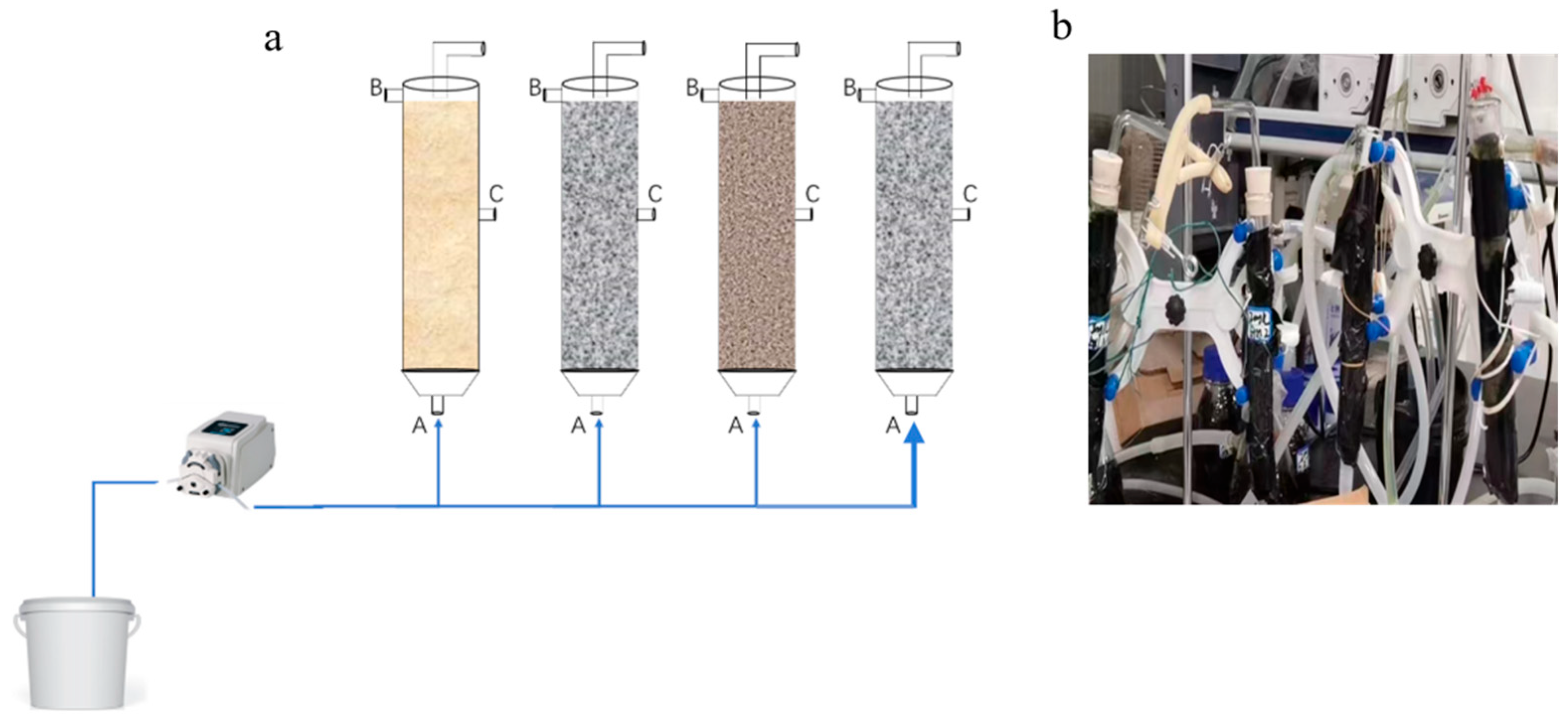
The biofilter main body was constructed of glass (Figure 1), with an effective column height of 180 mm and an inner diameter of 30 mm. The system was operated in up-flow mode, with influent introduced from the bottom port (A) and effluent discharged from the top port (B). The top was sealed with a rubber stopper. A vent port (C) was installed to periodically release gases and maintain internal pressure equilibrium. A filter screen was installed at the bottom to prevent substrate material from entering the pipeline.

2.2. Experimental Design and Operation

This experiment employed four parallel biofilters: one using gravel as substrate with microbial inoculation, another with sludge biochar as substrate with microbial inoculation, a third using sludge as substrate with microbial inoculation, and a fourth with sludge biochar as substrate without microbial inoculation, which was maintained in a microbial-free state through periodic high-temperature sterilization. All biofilters were designed with a hydraulic retention time of 24 h and a total operational cycle of 6 months (180 days), divided into five consecutive phases based on the ratio of organic phosphorus to inorganic phosphorus in the influent (Table 1). During the experiment, water samples from both the influent and effluent were tested every two days for total organic carbon (TOC), TP, OP, and pH water quality indicators.

2.3. Sequential Phosphorus Extraction

Continuous extraction of matrix phosphorus was performed using 0.1 M NaOH solution (the extracted phosphorus bound to aluminum-iron is designated as NaOH-P) [23]. A 0.1 g sample was weighed and sequentially treated with 40 mL of the aforementioned solution. The mixture was incubated at 25 °C for 24 h, followed by static incubation, centrifugation, and filtration at each extraction step. The filtrate was stored at 4 °C, and the solid sample was dried before proceeding to the next extraction cycle. The total phosphorus (TP) content was calculated by measuring the TP and inorganic phosphorus (IP) levels in the filtrate.

2.4. Microbial Analysis

Following stable operation, microbial samples were collected from the surface of sludge biochar substrates. Total DNA was extracted using the PowerSoil DNA Isolation Kit (MoBio Laboratories, Inc., Carlsbad, CA, USA). The V3-V4 hypervariable regions of the 16S rRNA gene were amplified by polymerase chain reaction (PCR) with the universal primers 341F (5′-cctacgggnggcwgcag-3′) and 805R (5′-gactachvgggtatctaatcc-3′). High-throughput sequencing was performed on the Illumina MiSeq platform (Illumina, Inc., San Diego, CA, USA) by Shanghai Tianhao Bio-Tech Co., Ltd. (Shanghai, China). Microbial community composition and diversity were analyzed using the QIIME 2 2025.4 software package.

2.5. Data Analysis

All experiments were conducted in triplicate, and data are presented as mean values. Basic data analysis used the mean value test to calculate the mean and standard deviation. The one-way ANOVA was then used to assess differences between different groups. Principal coordinate analysis (PCoA) based on Bray–Curtis dissimilarity was used to determine the β diversity of bacterial communities in different biofilters. All statistical analyses were performed using Origin 2021 and GraphPad Prism 9.5.0 (730), and graphical visualizations were generated using R (v4.3.3).

3. Results and Discussion

3.1. Overall Phosphorus Removal Performance

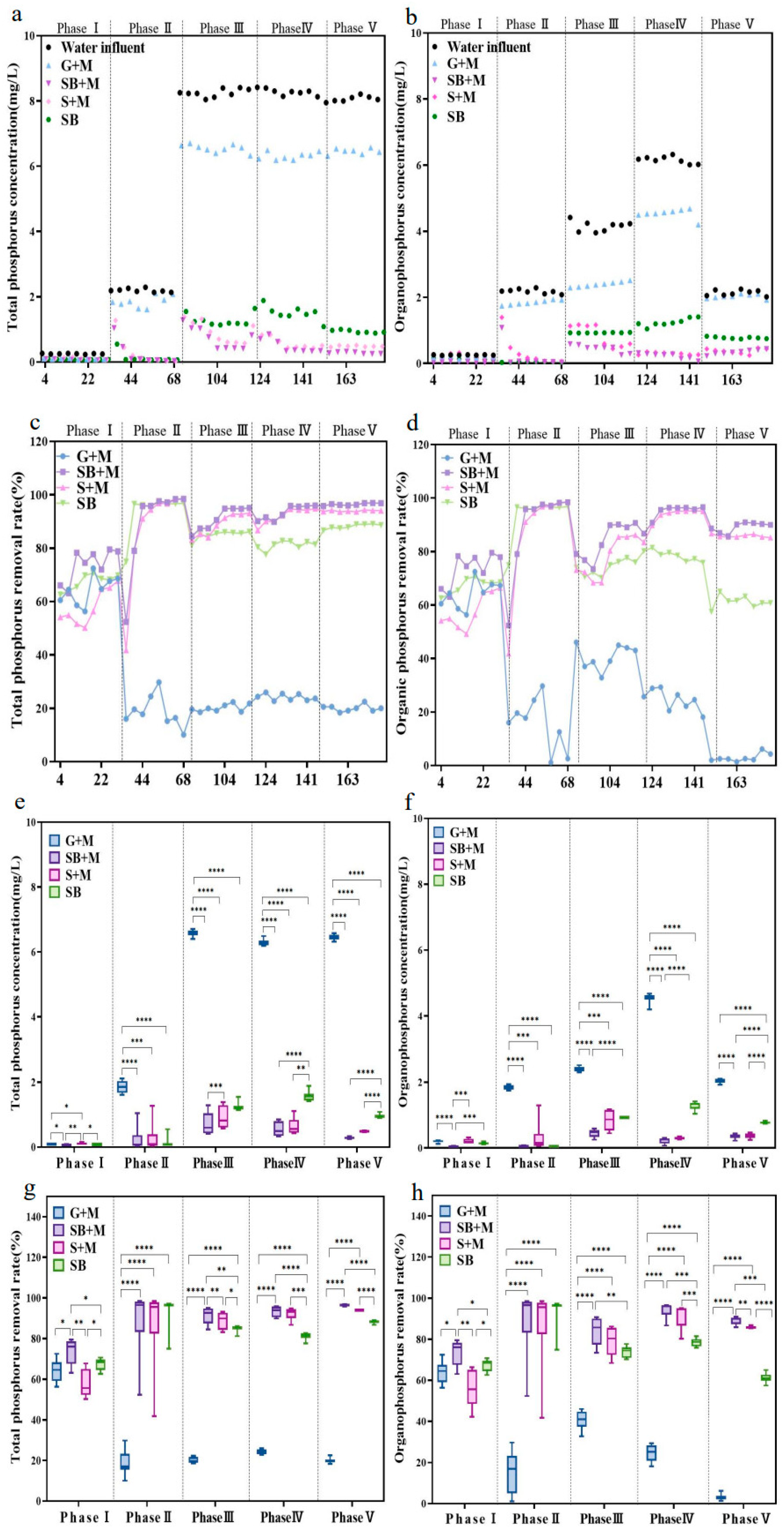
During the initial stage (Phase I), when the influent OP concentration was relatively low (0.25 mg P L−1), all treatment groups exhibited comparably high OP removal efficiencies (Figure 2a–d). The median OP removal rates exceeded 40% across all reactors (Figure 2e–h), indicating that under low phosphorus loading, both traditional (gravel) and sludge-based substrates were capable of effectively removing OP from the influent. When the influent OP concentration was increased to 2.0 mg P L−1 in Phase II, distinct differences among media types became evident. The sludge-based groups (SB + M, S + M, and SB) consistently achieved significantly higher OP removal efficiencies than the gravel-based control, with average removal rates of 52.6–95.3% compared to 35.3% for gravel. This discrepancy can be attributed to differences in surface chemistry: gravel contains only trace amounts of iron, whereas sludge is enriched with iron and aluminum species, both of which exhibit strong affinity for phosphate through ligand exchange and surface complexation mechanisms [18]. At low OP concentrations, adsorption sites on all materials were sufficient; however, as OP loading increased, the adsorption capacity of gravel rapidly approached saturation, whereas sludge-based substrates retained superior adsorption performance [22].
With further increases in OP concentration and changes in phosphorus speciation (Phases III–V), pronounced performance divergence emerged among the three sludge-based systems. Notably, the SB + M group consistently outperformed the SB group in terms of both OP and total phosphorus (TP) removal (Figure 2a–h). For example, during Phase IV, the TP removal efficiency in SB + M remained at 90%, whereas that in SB declined to 81% (Figure 2c). This result provides direct evidence that microorganisms play a critical role in sustaining phosphorus removal under high OP loading conditions.
In the abiotic sludge-based system (SB), an increased proportion of OP in the influent during Phase IV led to a marked decrease in TP removal efficiency (Figure 2c,e,g). This phenomenon can be explained by the preferential adsorption of inorganic phosphate (IP) over OP on sludge-derived sorbents; as OP became the dominant phosphorus fraction, the overall TP removal was constrained by the lower adsorption affinity of sludge biochar for OP. In contrast, in the biologically active system (SB + M), variations in OP/IP ratios had no significant impact on TP removal efficiency (Figure 2c), suggesting that microbial processes effectively mediated the interconversion between organic and inorganic phosphorus forms [24]. Specifically, microorganisms likely facilitated OP mineralization and IP assimilation, thereby maintaining stable TP removal across different phosphorus compositions [25]. The boxplots of OP and TP removal rates (Figure 2c,d,g,h) further illustrate the reduced variability and higher median performance of SB + M relative to SB, reinforcing the buffering role of microbial activity under fluctuating influent conditions.
Moreover, the SB + M system exhibited significantly higher TP removal efficiency than the S + M system throughout Phases III–V (Figure 2c,e,g), with mean values of 87.1–93.3% versus 86.7–92.2%, respectively. As summarized in Table S1, phosphorus removal efficiencies reported for biochar-based filtration systems typically range from 30% to 96%, depending on the biochar type and operating conditions. In comparison, the sludge biochar system in this study achieved stable TP removal efficiencies of 87.1–93.3%, which are comparable to or higher than those reported in many previous studies, particularly considering the relatively moderate influent phosphorus concentrations. This enhancement is likely attributable to the carbonized sludge matrix, which provides a more favorable surface structure for microbial colonization, including higher porosity, larger specific surface area, and improved electron transfer properties [26]. These characteristics promote microbial attachment and metabolic activity, thereby synergistically enhancing both biological phosphorus transformation and physicochemical retention.
Meanwhile, the effluent TOC and pH values at each stage of different reactors are presented in Table 2 and Table 3. Data indicate that the weakly acidic environment (pH 5.64–6.32 in the SB+) and stable TOC levels (15.065–15.784 mg/L) in the sludge biochar-based system form a favorable condition for the removal of OP. The weakly acidic conditions not only enhance the ligand exchange and surface complexation abilities of Fe/Al active sites in sludge biochar for phosphorus but also provide a suitable enzymatic environment for phosphatase-mediated OP mineralization [8]. And the stable TOC continuously supports the metabolic activity of phosphorus-transforming functional microorganisms, ensuring efficient conversion of OP to inorganic phosphorus (IP) [22].
Overall, these results demonstrate that while adsorption dominates phosphorus removal under low loading conditions, microbial processes become increasingly critical as OP concentration and compositional complexity increase. The integration of microorganisms with sludge-derived biochar substrate effectively overcomes adsorption limitations, ensuring stable and efficient phosphorus removal under high and variable OP inputs [27].

3.2. Transformation of Phosphorus Speciation

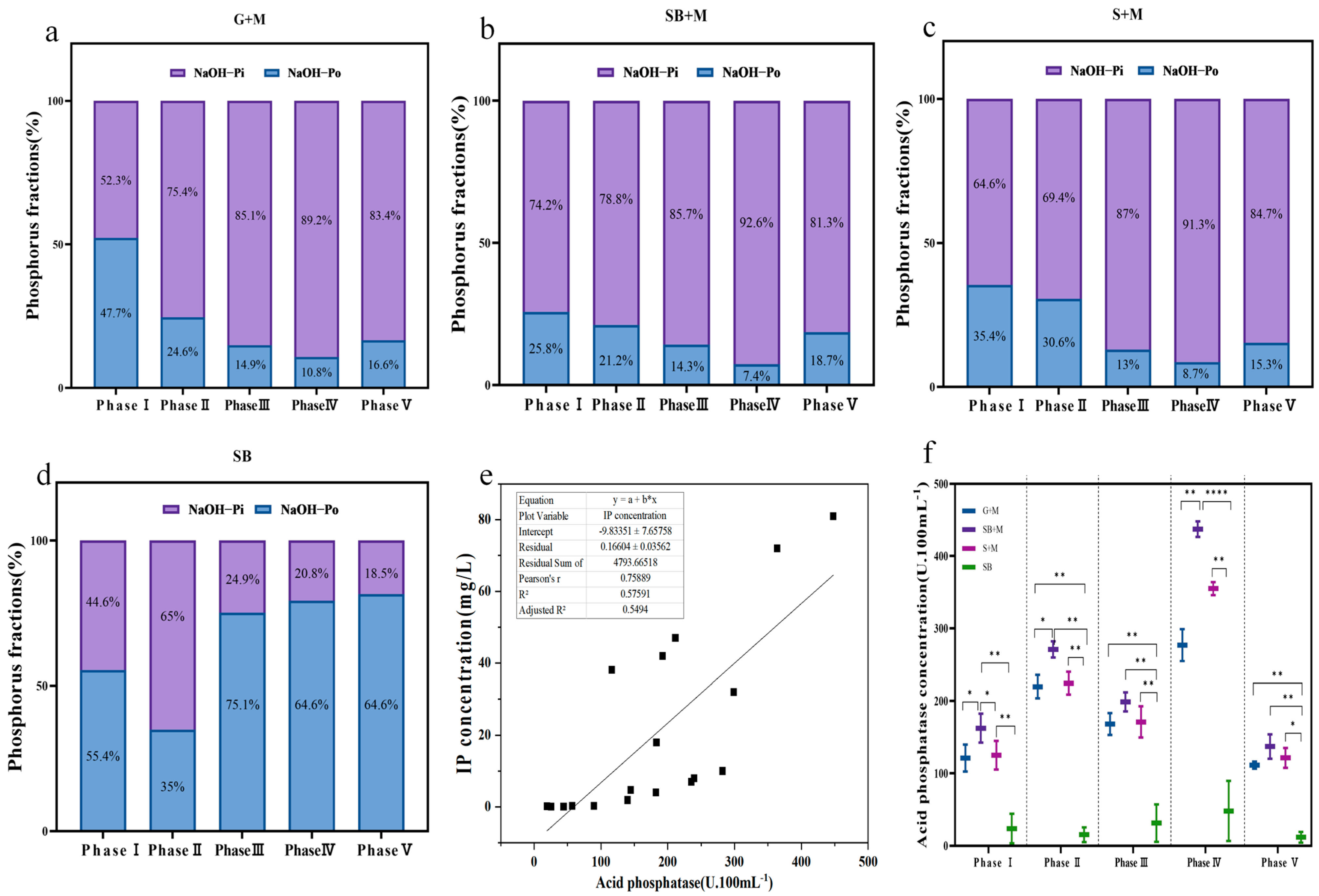
Distinct differences in effluent phosphorus speciation were observed among the different substrate systems (Figure 3a–f). Overall, effluents from sludge-based reactors were still dominated by OP, whereas in the gravel-based system, the proportion of IP increased markedly with rising influent total phosphorus concentrations (Figure 2a,b). This pattern indicates that under high phosphorus loading, OP was more prone to transformation into IP in the gravel system. However, due to the limited phosphorus retention capacity of gravel, the newly generated IP could not be effectively immobilized and therefore accumulated in the effluent [28]. These results suggest that phosphorus speciation dynamics are governed not only by influent composition but also by the ability of the substrate to regulate and retain transformation products.
Notably, even in the periodically sterilized sludge-based system (SB), a measurable fraction of IP was detected in the effluent (Figure 2a,b). Combined with the detection of residual phosphatase activity in this system, this finding implies that the observed IP was unlikely to originate solely from physicochemical desorption. Instead, it is more plausibly attributed to enzyme-mediated hydrolysis of OP. Trace microorganisms introduced with the influent, or sterilization-resistant microbial populations persisting within the system, may still secrete phosphatases capable of catalyzing OP mineralization. This observation highlights that OP-to-IP conversion in this system does not require high microbial abundance, but is highly sensitive to enzymatic activity.
A significant positive correlation was identified between phosphatase concentration and the proportion of IP within the substrate (Figure 3e), providing direct evidence that phosphatase is a key driver of OP mineralization. Phosphatases cleave ester or phosphoanhydride bonds in organic phosphorus compounds, releasing soluble orthophosphate and thereby altering phosphorus speciation within the system [29]. This relationship mechanistically confirms that OP mineralization in the present study was predominantly mediated by phosphatase activity.
Among the different microbial systems, phosphatase concentrations were significantly higher in the sludge biochar–microbe system than in the sludge-only and gravel-based systems (Figure 3f). This suggests that sludge biochar provides a more favorable microenvironment for the growth and metabolic activity of phosphatase-producing microorganisms. The high specific surface area and well-developed pore structure of sludge biochar facilitate microbial attachment and colonization, while surface functional groups and metal-associated active sites may promote enzyme immobilization and stabilization [30,31]. In addition, the slow release of labile organic carbon from sludge biochar can sustain the energy demand of enzyme-producing microbes, thereby enhancing OP mineralization [32].
However, OP-to-IP transformation does not necessarily result in higher phosphorus removal efficiency. Although phosphatase activity was also relatively high in the gravel-based microbial system, the weak adsorption capacity of gravel for both OP and IP limited the retention of transformation products, leading to low overall removal efficiencies. In contrast, even under periodic sterilization, sludge biochar exhibited strong adsorption toward both OP and IP, enabling relatively high phosphorus removal despite suppressed enzymatic activity.
Taken together, these results demonstrate that phosphatase-mediated OP mineralization is a major driver of phosphorus speciation transformation, with its intensity regulated by OP substrate availability and substrate suitability for enzyme-producing microorganisms. From an engineering perspective, however, the adsorption and immobilization capacity of the substrate for transformation products ultimately determines phosphorus removal performance, while enzymatic activity primarily serves to accelerate phosphorus transformation rather than acting as the dominant removal mechanism [33].

3.3. Role of the Microbiome in Enhanced Phosphorus Transformation

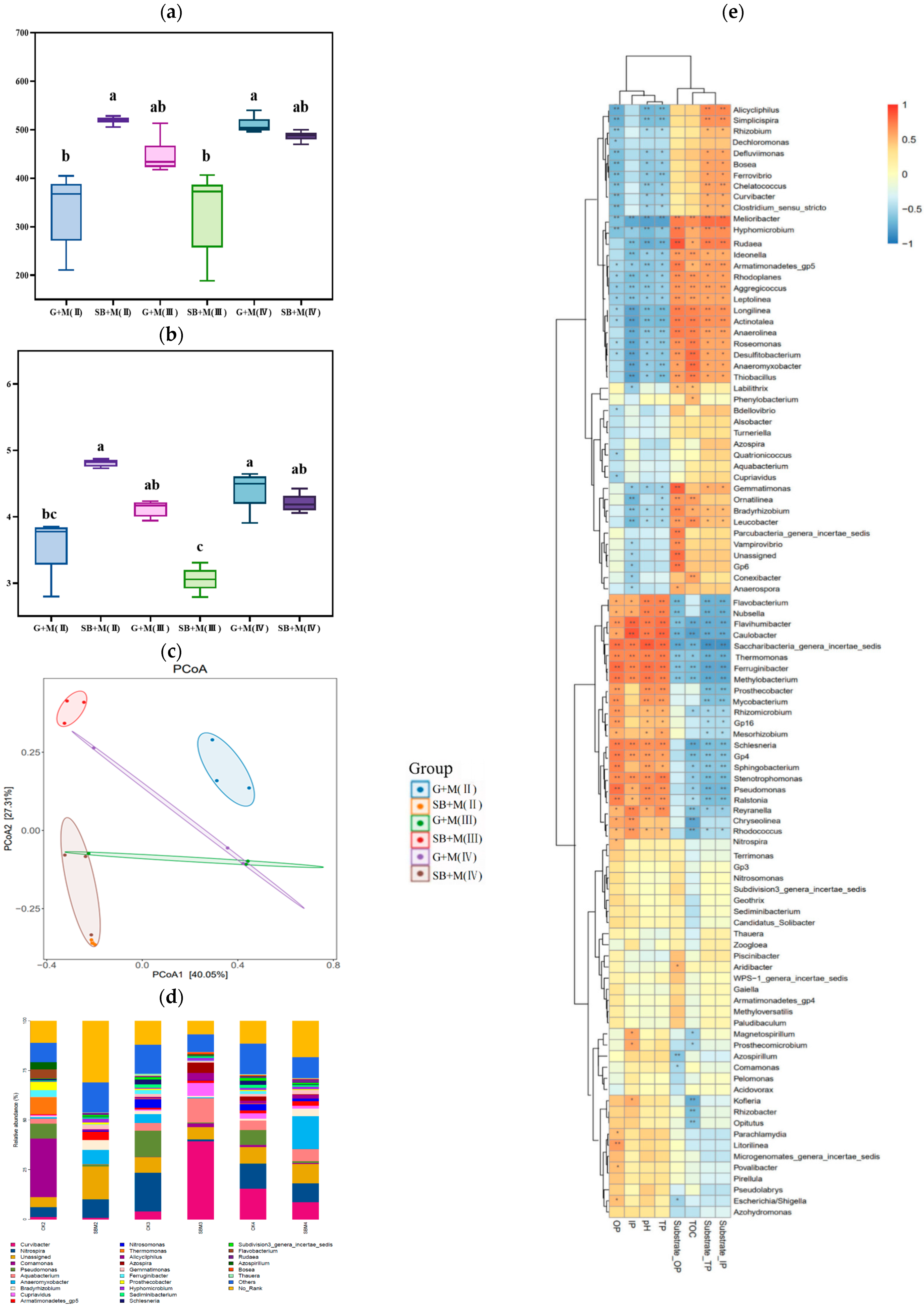
Alpha- and beta-diversity analyses jointly indicated distinct microbial assembly patterns between sludge biochar and gravel systems under increasing organic phosphorus (OP) loading (Figure 4a,b). In Phase II, higher Chao1 and Shannon indices in the sludge biochar group reflected enhanced microbial richness and evenness, likely supported by the porous structure and heterogeneous surface chemistry of biochar. As OP loading increased in Phase III, alpha diversity declined in the sludge biochar system but increased in the gravel system, while beta-diversity analysis showed a clear separation between the two communities, indicating divergent ecological selection pressures (Figure 4a–c). This shift suggests that the strong adsorption of OP pesticides by sludge biochar imposed environmental filtering, selectively enriching microorganisms tolerant to or capable of transforming organophosphorus compounds, thereby reducing overall diversity but enhancing functional specialization. In Phase IV, alpha diversity partially recovered in both systems; however, the gravel system remained more taxonomically diverse, whereas the sludge biochar system maintained a more functionally streamlined community structure. Importantly, higher microbial diversity in the gravel system did not translate into improved phosphorus removal, highlighting that efficient OP transformation and phosphorus retention were driven by substrate-mediated microbial selection rather than diversity per se [34].
Several genera that were significantly enriched in the sludge biochar systems—including Hyphomicrobium, Anaeromyxobacter, Rudaea, Bradyrhizobium, Gemmatimonas, Azospira, and Ideonella (Figure 4d,e)—have been previously associated with organic phosphorus degradation, phosphatase production, or redox-coupled phosphorus transformation [35,36,37]. Many of these taxa are capable of secreting extracellular phosphatases or participating in coupled carbon–nitrogen–phosphorus cycling, thereby facilitating OP mineralization and subsequent IP assimilation. Their higher relative abundance in the sludge biochar systems is consistent with the elevated phosphatase activity and more stable phosphorus removal observed in these reactors.
In contrast, the gravel-based system was characterized by lower microbial diversity and a community structure less enriched in phosphorus-transforming functional taxa (Figure 4d). Although OP mineralization could still occur via phosphatase activity, the limited microbial functional diversity and weak substrate retention capacity constrained the effective coupling between transformation and removal processes.
Importantly, the co-occurrence of high microbial diversity, functional phosphorus-transforming taxa, and strong physicochemical adsorption capacity in the sludge biochar systems created a synergistic removal pathway. Microorganisms actively converted OP into IP through enzymatic processes, while the biochar matrix rapidly immobilized the released IP via surface complexation and ligand exchange with iron- and aluminum-associated sites [38]. This tight coupling between biological transformation and physicochemical retention prevented IP accumulation in the effluent and sustained high overall phosphorus removal efficiency.
Collectively, these findings indicate that phosphorus removal in sludge biochar systems is not driven by microbial activity alone, but by an integrated bio–physicochemical mechanism. Enhanced microbial diversity and functional specialization accelerate phosphorus transformation, while the superior adsorption properties of sludge biochar ensure effective capture of transformation products. This synergistic interaction explains why phosphorus transformation was more active and overall removal efficiency was consistently higher in sludge biochar systems than in gravel-based systems, particularly under high OP loading conditions.

4. Conclusions

This study systematically elucidated phosphorus removal mechanisms in substrate-based systems under increasing organic phosphorus (OP) loading by integrating performance evaluation, phosphorus speciation analysis, enzymatic activity, and microbial community characterization. Under low OP loading (0.25 mg P L−1), all systems achieved comparable OP removal efficiencies, with median removal rates exceeding 40%, indicating adsorption-dominated control irrespective of substrate type. When influent OP concentration increased to 2.0 mg P L−1, sludge-based systems exhibited markedly superior performance, achieving average OP removal efficiencies of 52.6–95.3%, compared with only 35.3% in the gravel system, highlighting the limitations of adsorption-only substrates under high OP stress. With further increases in OP loading and compositional complexity, biologically active sludge biochar systems maintained consistently high TP removal efficiencies (87.1–93.3%), whereas TP removal in the abiotic sludge system declined to 81% during Phase IV, demonstrating the critical role of microbial processes in sustaining phosphorus removal. Phosphatase-mediated OP mineralization was identified as the primary driver of phosphorus speciation transformation, as evidenced by the strong positive correlation between phosphatase activity and inorganic phosphate (IP) proportion. However, effective OP-to-IP transformation alone did not guarantee high removal efficiency; only systems combining active enzymatic conversion with strong Fe/Al-associated adsorption sites successfully immobilized transformation products and prevented IP accumulation in the effluent. Overall, these results demonstrate that stable phosphorus removal under high OP loading relies on a tightly coupled bio–physicochemical mechanism, in which microbial transformation accelerates phosphorus conversion while sludge-derived biochar ensures rapid and effective retention. This integrated pathway provides a robust engineering strategy for controlling OP-rich wastewaters in constructed wetlands and related nature-based treatment systems.
Future research can be conducted in the following directions: extending the operational cycle to evaluate the long-term stability and complex wastewater treatment performance of sludge biochar-based biofilters, optimizing substrate modification and regeneration techniques to enhance the adsorption capacity of organic phosphorus and reduce the risk of phosphorus release, combining multi-omics technologies to deeply explore the molecular mechanisms of microbial-phosphorus-substrate interactions, advancing pilot-scale and engineering optimizations to clarify practical application parameters, while exploring resource recovery pathways for phosphorus in saturated substrates, and improving the theoretical system and application prospects of this technology.

Supplementary Materials

The following supporting information can be downloaded at https://www.mdpi.com/article/10.3390/w18060687/s1, Table S1: Comparison of total phosphorus removal rates under different filter types, fillers and operating conditions.

Author Contributions

Conceptualization, Z.W.; Methodology, Z.W.; Software, Z.W.; Formal analysis, Z.W. and L.S.; Investigation, Z.W. and L.S.; Resources, S.W., S.O. and H.H.; Data curation, J.Z. (Jinyong Zhu) and L.S.; Writing—original draft, Z.W.; Writing—review and editing, J.Z. (Jin Zhang) and H.H.; Visualization, Z.W. and J.Z. (Jinyong Zhu); Supervision, J.Z. (Jin Zhang) and H.H.; Project administration, J.Z. (Jin Zhang); Funding acquisition, J.Z. (Jin Zhang), S.W. and S.O. All authors have read and agreed to the published version of the manuscript.

Funding

This research was funded by the National Natural Science Foundation of China (22276174), the “Pioneer” and “Leading Goose” R&D Program of Zhejiang (2025C04017), the Graduate Course Development Project of Zhejiang University of Science and Technology (2024YJSJS06).

Data Availability Statement

The original contributions presented in this study are included in the article. Further inquiries can be directed to the corresponding author.

Conflicts of Interest

Author Shuai Wu was employed by the Zhejiang Zhongqi Environmental Protection Technology Co., Ltd. and Shengye Ou was employed by the Zhejiang Derui Environmental Technology Co., Ltd. The remaining authors declare that the research was conducted in the absence of any commercial or financial relationships that could be construed as a potential conflict of interest.

References

  1. Gray, H.E.; Powell, T.; Choi, S.; Smith, D.S.; Parker, W.J. Organic Phosphorus Removal Using an Integrated Advanced Oxidation-Ultrafiltration Process. Water Res. 2020, 182, 115968. [Google Scholar] [CrossRef]
  2. Zhang, C.; He, Y.; Wang, J.; Chen, T.; Baltar, F.; Hu, M.; Liao, J.; Xiao, X.; Li, Z.-R.; Dong, X. LucaPCycle: Illuminating Microbial Phosphorus Cycling in Deep-Sea Cold Seep Sediments Using Protein Language Models. Nat. Commun. 2025, 16, 4862. [Google Scholar] [CrossRef] [PubMed]
  3. Li, J.; Deng, L.; Peñuelas, J.; Wu, J.; Shangguan, Z.; Sardans, J.; Peng, C.; Kuzyakov, Y. C:N:P Stoichiometry of Plants, Soils, and Microorganisms: Response to Altered Precipitation. Glob. Change Biol. 2023, 29, 7051–7071. [Google Scholar] [CrossRef] [PubMed]
  4. Zhang, S.; Song, B.; Zhan, Z.; Liu, Y.; Zhao, X.; Sheng, G.-P.; Lei, Y. Efficient Treatment of Phosphonate-Laden Wastewater by CaO2 /UV: Partial Oxidation, Complexation, and Coprecipitation. ACS EST Water 2024, 4, 1647–1656. [Google Scholar] [CrossRef]
  5. Ji, N.; Wang, S.; Zhang, L. Characteristics of Dissolved Organic Phosphorus Inputs to Freshwater Lakes: A Case Study of Lake Erhai, Southwest China. Sci. Total Environ. 2017, 601–602, 1544–1555. [Google Scholar] [CrossRef] [PubMed]
  6. Ahmed, A.A.; Leinweber, P.; Kühn, O. Advances in Understanding the Phosphate Binding to Soil Constituents: A Computational Chemistry Perspective. Sci. Total Environ. 2023, 887, 163692. [Google Scholar] [CrossRef] [PubMed]
  7. Das, A.; Mishra, S. Reimagining Biofiltration for Sustainable Industrial Wastewater Treatment. Discov. Sustain. 2025, 6, 826. [Google Scholar] [CrossRef]
  8. Malk, K.; Riedel, R.; Hinz, C.; Fischer, T.; Martienssen, M. Adsorption of Phosphonates to Iron- or Aluminum-Based Flocculants in Wastewater Treatment. Water 2026, 18, 116. [Google Scholar] [CrossRef]
  9. Rosenquist, S.E.; Levy, C.L.; Sell, S.T.; Hession, W.C.; Eick, M.J.; Vaughan, D.H. Facilitated Iron Reduction as a Possible Means of Rejuvenating Phosphorus Removal Performance of Filtration Substrates. Trans. ASABE 2011, 54, 715–722. [Google Scholar] [CrossRef][Green Version]
  10. Ishida, T.; Hirota, I.; Yokoyama, S. Tracing of Fire-induced Soil Phosphorus Transformations Using Phosphate Oxygen Isotope Ratio. Eur. J. Soil Sci. 2024, 75, e13591. [Google Scholar] [CrossRef]
  11. Ruffolo, F.; Dinhof, T.; Murray, L.; Zangelmi, E.; Chin, J.P.; Pallitsch, K.; Peracchi, A. The Microbial Degradation of Natural and Anthropogenic Phosphonates. Molecules 2023, 28, 6863. [Google Scholar] [CrossRef] [PubMed]
  12. Basinski, J.J.; Bone, S.E.; Klein, A.R.; Thongsomboon, W.; Mitchell, V.; Shukle, J.T.; Druschel, G.K.; Thompson, A.; Aristilde, L. Unraveling Iron Oxides as Abiotic Catalysts of Organic Phosphorus Recycling in Soil and Sediment Matrices. Nat. Commun. 2024, 15, 5930. [Google Scholar] [CrossRef] [PubMed]
  13. Wang, X.; He, G.-H.; Wang, Z.-Y.; Xu, H.-Y.; Mou, J.-H.; Qin, Z.-H.; Lin, C.S.K.; Yang, W.-D.; Zhang, Y.; Li, H.-Y. Purple Acid Phosphatase Promoted Hydrolysis of Organophosphate Pesticides in Microalgae. Environ. Sci. Ecotechnol. 2024, 18, 100318. [Google Scholar] [CrossRef]
  14. Ore, A.; Palm, E.H.; Van Wezel, A.P.; Sutton, N.B. Higher Microbial Diversity Enhances the Extent and Rate of Organic Micropollutant Biodegradation under Aerobic and Nitrate-Reducing Conditions. Water Res. 2026, 289, 124921. [Google Scholar] [CrossRef]
  15. Sveen, T.R.; Viketoft, M.; Bengtsson, J.; Strengbom, J.; Lejoly, J.; Buegger, F.; Pritsch, K.; Fritscher, J.; Hildebrand, F.; Osburn, E.; et al. Functional Diversity of Soil Microbial Communities Increases with Ecosystem Development. Nat. Commun. 2025, 16, 10408. [Google Scholar] [CrossRef]
  16. Fuggle, R.; Matias, M.G.; Mayer-Pinto, M.; Marzinelli, E.M. Multiple Stressors Affect Function Rather than Taxonomic Structure of Freshwater Microbial Communities. npj Biofilms Microbiomes 2025, 11, 60. [Google Scholar] [CrossRef]
  17. Januševičius, T.; Mažeikienė, A.; Stepova, K.; Danila, V.; Paliulis, D. The Removal of Phosphorus from Wastewater Using a Sewage Sludge Biochar: A Column Study. Water 2024, 16, 1104. [Google Scholar] [CrossRef]
  18. Kumari, S.; Dong, Y.; Safferman, S.I. Phosphorus Adsorption and Recovery from Waste Streams Using Biochar: Review of Mechanisms, Modifications, and Agricultural Applications. Appl. Water Sci. 2025, 15, 162. [Google Scholar] [CrossRef]
  19. Manikandan, S.K.; Pallavi, P.; Shetty, K.; Bhattacharjee, D.; Giannakoudakis, D.A.; Katsoyiannis, I.A.; Nair, V. Effective Usage of Biochar and Microorganisms for the Removal of Heavy Metal Ions and Pesticides. Molecules 2023, 28, 719. [Google Scholar] [CrossRef] [PubMed]
  20. Ibrahim, M.M.; Lin, H.; Chang, Z.; Li, Z.; Riaz, A.; Hou, E. Magnesium-Doped Biochars Increase Soil Phosphorus Availability by Regulating Phosphorus Retention, Microbial Solubilization and Mineralization. Biochar 2024, 6, 68. [Google Scholar] [CrossRef]
  21. Wystalska, K.; Grosser, A. Sewage Sludge-Derived Biochar and Its Potential for Removal of Ammonium Nitrogen and Phosphorus from Filtrate Generated during Dewatering of Digested Sludge. Energies 2024, 17, 1310. [Google Scholar] [CrossRef]
  22. Shen, C.; Song, Z.; Qiu, Z.; Gao, R. Effects of Pyrolysis Temperature on Drinking Water Treatment Residual Biochar Properties and Organophosphorus Pesticides Adsorption. Chem. Pap. 2024, 78, 5289–5299. [Google Scholar] [CrossRef]
  23. Bezak-Mazur, E.; Ciopińska, J. The Application of Sequential Extraction in Phosphorus Fractionation in Environmental Samples. J. AOAC Int. 2020, 103, 337–347. [Google Scholar] [CrossRef]
  24. Chen, J.; Xu, H.; Seven, J.; Zilla, T.; Dippold, M.A.; Kuzyakov, Y. Microbial Phosphorus Recycling in Soil by Intra- and Extracellular Mechanisms. ISME Commun. 2023, 3, 135. [Google Scholar] [CrossRef]
  25. Pan, C.; Sun, C.; Qu, X.; Yu, W.; Guo, J.; Yu, Y.; Li, X. Microbial Community Interactions Determine the Mineralization of Soil Organic Phosphorus in Subtropical Forest Ecosystems. Microbiol. Spectr. 2024, 12, e01355-23. [Google Scholar] [CrossRef]
  26. Ning, X.; Sachan, D.; Bose, A.; Wall, D.M.; Murphy, J.D. Improving Microbial Electrosynthesis with Biochar Electrodes in Production of CO2 Derived Biochemicals and Biofuels within Circular Economy Systems. RSC Sustain. 2025, 3, 4435–4450. [Google Scholar] [CrossRef]
  27. Mari Selvam, S.; Behera, B.; Chauhan, A.; Madaan, A.; Rajamanickam, R.; Akshaya, K.; Selvasembian, R. Sustainable Approach of Modified Biochar Based Adsorbents towards Enhanced Phosphorus Removal from Wastewater. J. Anal. Appl. Pyrolysis 2025, 188, 107020. [Google Scholar] [CrossRef]
  28. Li, Q.; Gao, J.; Zhang, J.; Huang, Z.; Wang, S.; Song, B.; Wang, Q.; Zhou, W. Treatment of High-Phosphorus Load Wastewater by Column Packed with Non-Burning Compound Filler/Gravel/Ceramsite: Evaluation of Performance and Microorganism Community. Environ. Sci. Pollut. Res. 2023, 30, 67730–67741. [Google Scholar] [CrossRef]
  29. Saavedra, D.E.M.; González, J.M.; Klaushofer, K.; Breyer, E.; Afjehi-Sadat, L.; Bulgheresi, S.; Liao, L.; Dong, X.; Patrick, W.M.; Baltar, F. Multifunctionally Diverse Alkaline Phosphatases of Alteromonas Drive the Phosphorus Cycle in the Ocean. Nat. Commun. 2025, 16, 9789. [Google Scholar] [CrossRef]
  30. Chen, B.; Zeng, H.; Yang, F.; Yang, Y.; Qiao, Z.; Zhao, X.; Wang, L.; Wu, F. Functional Biochar as Sustainable Precursors to Boost the Anaerobic Digestion of Waste Activated Sludge from a Circular Economy Perspective: A Review. Biochar 2024, 6, 60. [Google Scholar] [CrossRef]
  31. Zhang, M.; Li, J.; Wang, Y.; Yang, C. Impacts of Different Biochar Types on the Anaerobic Digestion of Sewage Sludge. RSC Adv. 2019, 9, 42375–42386. [Google Scholar] [CrossRef] [PubMed]
  32. Barbosa, F.L.A.; Santos, J.M.R.; Mota, J.C.A.; Costa, M.C.G.; Araujo, A.S.F.; Garcia, K.G.V.; Almeida, M.S.; Nascimento, Í.V.; Medeiros, E.V.; Ferreira, O.P.; et al. Potential of Biochar to Restoration of Microbial Biomass and Enzymatic Activity in a Highly Degraded Semiarid Soil. Sci. Rep. 2024, 14, 26065. [Google Scholar] [CrossRef]
  33. Gong, W.; Tao, C.; Tian, Z.; Huang, Z.; Lin, H.; Qi, C.; Yu, Z.; Guo, L. Characterization and Mechanism of Phosphorus Adsorption from Wastewater by Lanthanum Calcium Doped Sludge/Wheat Straw Biochar. Front. Environ. Sci. 2025, 13, 1604542. [Google Scholar] [CrossRef]
  34. Qin, H.; Huan, X.; Cui, J.; Zhou, Y.; Wang, S.; Liu, S.; Xing, Y.; Yu, X. Effects of Biochar on Phosphorus Fraction, Phosphatase Activity, and Phosphorus-Solubilizing Bacterial Abundance: A Phosphorus-Depleted Biochar Design. Front. Environ. Sci. 2025, 13, 1663371. [Google Scholar] [CrossRef]
  35. Pandian, K.; Samiyappan, K.; Rangasamy, A.; Raju, I.; Chitraputhirapillai, S.; Bose, J. Bacillus megaterium-Embedded Organo Biochar Phosphorous Fertilizer Improves Soil Microbiome and Nutrient Availability to Enhance Black Gram (Vigna mungo L) Growth and Yield. J. Soil Sci. Plant Nutr. 2024, 24, 2048–2063. [Google Scholar] [CrossRef]
  36. Shao, Y.; Wang, Y.; Wang, H.; Liu, G.; Qi, L. Effect of Hydraulic Retention Time on Carbon and Phosphorus Separation in Ultra-Short Sludge Retention Time Activated Sludge System: Mechanisms and Microbial Community Dynamics. J. Environ. Chem. Eng. 2025, 13, 119032. [Google Scholar] [CrossRef]
  37. Zhuo, G.-H.; Xue, D.-X.; Huang, L.-F.; Wang, Q.; Zhu, G.; Wang, C.-Y. Adsorption of Phosphates on a Novel Eggshell Ca-Modified Anaerobic Sludge-Based Biochar: Adsorption Performance and Mechanism. PLoS ONE 2025, 20, e0337183. [Google Scholar] [CrossRef] [PubMed]
  38. Xiong, X.; Li, Y.; Zhang, C. Enhanced Phosphorus Removal from Anoxic Water Using Oxygen-Carrying Iron-Rich Biochar: Combined Roles of Adsorption and Keystone Taxa. Water Res. 2024, 266, 122433. [Google Scholar] [CrossRef] [PubMed]
Figure 1. Schematic diagram (a) and photo (b) of the biological filter.
Water 18 00687 g001
Figure 2. Concentration variations of total phosphorus and dynamic removal rates, and stage-wise in biofilters with different substrates: (a) Temporal dynamics of total phosphorus concentration, (b) Temporal dynamics of organic phosphorus concentration, (c) Temporal variation of total phosphorus removal efficiency, (d) Temporal variation of organic phosphorus removal efficiency, (e) Box plots of total phosphorus concentration across phases, (f) Box plots of organic phosphorus concentration across phases, (g) Box plots of total phosphorus removal efficiency across phases, (h) Box plots of organic phosphorus removal efficiency across phases. “*” corresponds to p < 0.05, “**” corresponds to p < 0.01, “***” corresponds to p < 0.001, “****” corresponds to p < 0.0001.
Water 18 00687 g002
Figure 3. NaOH-bound inorganic/organic phosphorus fraction distribution (ad), (e) correlation between acid phosphatase and inorganic phosphorus concentrations in different filler-microorganism combined reactors across five-phase operation, and (f) phase-specific variation in acid phosphatase concentration. “*” corresponds to p < 0.05, “**” corresponds to p < 0.01, “****” corresponds to p < 0.0001.
Water 18 00687 g003
Figure 4. Microbial community α-diversity ((a) Chao1; (b) Shannon), and (c) β-diversity characteristics, (d) community composition, and (e) species relative abundance characteristics of biofilters with different substrates. G + M (II), G + M (III), and G + M (IV) represent the samples of gravel + microorganism biofilters from Phase III, Phase I, and Phase V, respectively; SB + M (II), SB + M (III), and SB + M (IV) represent the samples of sludge biochar + microorganism biofilters from Phase III, Phase IV, and Phase V, respectively. “*” corresponds to p < 0.05, “**” corresponds to p < 0.01. Different lowercase letters (a, b, c) above the columns indicate significant differences between groups at the p < 0.05 level.
Water 18 00687 g004
Table 1. Influent characteristics under different operational phases (LOD: OP = 0.01 mg/L, IP = 0.005 mg/L, TP = 0.01 mg/L, TOC = 0.5 mg/L).
PhaseTime
(Days)
OP:IPOP
(mg/L)
IP
(mg/L)
TP
(mg/L)
TOC
(mg/L)
Phase I1–321:00.2500.2515–18
Phase II33–852:02.0002.0015–18
Phase III86–1151:14.004.008.0015–18
Phase IV116–1483:16.002.008.0015–18
Phase V149–1801:32.006.008.0015–18
Table 2. The effluent TOC concentration of different reactors in each phase.
PhaseTime (Days)G + M (mg/L)SB + M (mg/L)S + M (mg/L)SB (mg/L)
Phase I1–3221.969 ± 2.04820.929 ± 2.68527.263 ± 7.47022.573 ± 3.685
Phase II33–8517.829 ± 4.54316.056 ± 1.52915.734 ± 1.34313.99 ± 1.934
Phase III86–11510.965 ± 1.58815.638 ± 0.54715.14 ± 0.60412.124 ± 0.176
Phase IV116–14810.321 ± 0.32815.156 ± 0.27215.065 ± 0.53212.408 ± 0.460
Phase V149–18010.12 ± 0.64315.784 ± 0.37115.26 ± 0.72712.225 ± 0.620
Table 3. The effluent pH concentration of different reactors in each stage.
PhaseTime (Days)G + MSB + MS + MSB
Phase I1–326.96 ± 0.0986.32 ± 0.0846.12 ± 0.1116.39 ± 0.104
Phase II33–856.91 ± 0.0726.02 ± 0.1196.01 ± 0.0746.30 ± 0.123
Phase III86–1156.88 ± 0.0315.93 ± 0.1185.95 ± 0.0596.17 ± 0.094
Phase IV116–1486.84 ± 0.0525.77 ± 0.0515.77 ± 0.0566.17 ± 0.058
Phase V149–1806.73 ± 0.0315.64 ± 0.0425.71 ± 0.0356.04 ± 0.030
Disclaimer/Publisher’s Note: The statements, opinions and data contained in all publications are solely those of the individual author(s) and contributor(s) and not of MDPI and/or the editor(s). MDPI and/or the editor(s) disclaim responsibility for any injury to people or property resulting from any ideas, methods, instructions or products referred to in the content.