1. Introduction
Glacial lakes, as carriers of glacial meltwater, provide the triggering conditions for debris flows caused by glacial lake outburst floods (GLOFs) [
1,
2]. When influenced by factors such as abnormal climate change, the sudden overflow or outburst of glacial lakes can generate floods that as they descend, carry large amounts of loose material and evolve into debris flows [
3,
4,
5]. These events are characterized by strong unpredictability, large scale, and high destructive power [
6,
7,
8]. With global climate change and human activity development, glacial lake outburst debris flows (GLODFs) have become increasingly frequent in high mountain regions, particularly in India, Nepal, and Tibet, China, posing significant threats to downstream communities and infrastructures [
9,
10]. GLODF susceptibility mapping is the essential first step for risk management [
11,
12,
13]. It can help mitigate the damage caused by glacial lake outbursts and provide guidance for urban land planning and construction.
Susceptibility to geohazards can be assessed through heuristic, statistical, and deterministic approaches [
14,
15,
16,
17,
18,
19]. GLOFs are essential to triggering debris flows, and susceptibility to these events is typically assessed using statistical models, which involve analyses of glacial lake outbursts and flood flow paths [
20,
21]. Glacial meltwater leads to an increase in lake water volume, while glacier melting induces snow (ice) avalanches and rock avalanches that could generate impulse waves [
22]. Both the melting of ice within moraine dams and piping actions decrease the stability of dams. These complex factors increase the likelihood of glacial lake outbursts [
23,
24]. In narrow and steep terrains with large longitudinal slopes, GLOFs, as they descend, carry moraine material and loose deposits within valleys, which may transform into debris flows [
25,
26,
27]. Therefore, based on the susceptibility to GLOFs, GLODF susceptibility mapping should further incorporate watershed geomorphology and geological conditions, including valley topography and the accumulation of loose rock and soil in the valley, reflecting the spatial association between water and material sources across the entire watershed [
28,
29].
Research on GLODFs can be categorized into regional and individual scales. Regional studies focus on lake inventories, evolution trends, susceptibility indices, global risk assessments, and debris flow susceptibility mapping. To date, the complex evolutionary processes of triggering, transformation, and superposition among multiple glacial lakes have been largely ignored. However, recent work by B. Zhou et al. has begun addressing regional-scale glacial lake hazards and their downstream debris flow potential [
30,
31]. While previous studies have emphasized the importance of surrounding environments and downstream geomorphic conditions in evaluating GLOF susceptibility, research remains overly concentrated on the lakes themselves. Such approaches can identify unstable lakes but yield point-source hazard maps that fall short in disaster prevention and planning in areas with high cascading risks. Conversely, numerical simulations of individual outbursts offer detailed hazard zones but are too computationally intensive for regional applications involving many lakes, limiting their use in rapid hazard screening [
32,
33].
Generally, a basin contains multiple glacial lakes of varying sizes, and there is often significant spatial overlap between the downstream channels corresponding to these lakes [
34,
35,
36]. Several glacial lakes are connected along the main channel of the basin, and the outburst of any single glacial lake can potentially trigger debris flow in its corresponding tributary and the main channel [
28,
37,
38]. In extreme cases, when multiple glacial lakes outburst simultaneously, the probability of GLODFs in the main channel increases [
11,
15,
37,
39,
40]. Therefore, when assessing GLODF susceptibility along the channel, it is necessary to consider the superposition effects of multiple glacial lakes upstream of the channel [
41,
42].
This study systematically examines the interconnections between multiple glacial lakes within a regional-scale basin and the spatial overlap of their downstream debris flow channels. This approach represents a breakthrough in the research methodology for regional glacial lake-related hazards. Both the evaluation process and the results characterize the cascading effects of the disaster chain, offering high operational feasibility and easily interpretable results for practical applications. The series and parallel network structure of electrical circuits can effectively match the spatial relationships of such complex geohazard chains. By applying the system failure theory of electrical circuits, the comprehensive susceptibility to GLODFs can be effectively calculated. This study presents a systematic analysis and conceptual advance in regional glacial lake hazard research, with both assessment process and results capturing the cascading nature of disasters.
There are at least 9744 glacier lakes in Central Asia, with areas ranging from 0.0054 km
2 to 6.46 km
2, particularly in Nepal, India, and Tibet (China) [
2,
37,
43]. More than 298 GLOFs have been recorded in the region, with at least 1.3 incidents having occurred annually in the Central Himalayas since the 1980s [
39,
44]. The glacier lake hazard is evolving into concurrent and multiple events, characterized by hazard chains involving landslides and debris flows, driven by global climate change [
45,
46]. The Boqu River basin in the Himalayas serves as a typical example, being an area highly susceptible to GLOFs, with 50 glacier lakes [
47]. Of these, at least 12 are considered to have high exposure [
48]. Located at the outlet of the Congduipu River basin in the Boqu River basin, at the base of Shishapangma Peak, Nyalam is covered by numerous glacier lakes and gullies [
49,
50]. Nyalam County has experienced multiple GLOF events, notably in 2002, 2016, and 2020 [
30,
39]. On 1 April 2020, three glacier lakes upstream of Nyalam County outburst in a sequence similar to a string of pearls, causing severe damage to infrastructure in Nyalam and Zhangmu counties, with financial losses estimated at approximately 1.13 billion RMB [
51].
So, this study aims to propose a new susceptibility mapping approach for GLODF events based on system failure regarding debris flow hazards caused by glacier lake failure, which will characterize the spatial relationships among debris flow risk elements and recognize dangerous areas exposed under debris flow [
52]. Moreover, it is an important step in predicting glacier lakes’ relative hazards early and mitigating catastrophic effects. It will help to confirm the extent of risk management measures according to the susceptibility level and provide an evaluation guide for urban downstream development.
2. Methods
GLODF events typically have multiple trigger sources located above the main channel of the watershed, indicating the presence of multiple glacial lakes [
31,
53]. Both single-source and multi-source triggers can induce debris flows along the corresponding main channel [
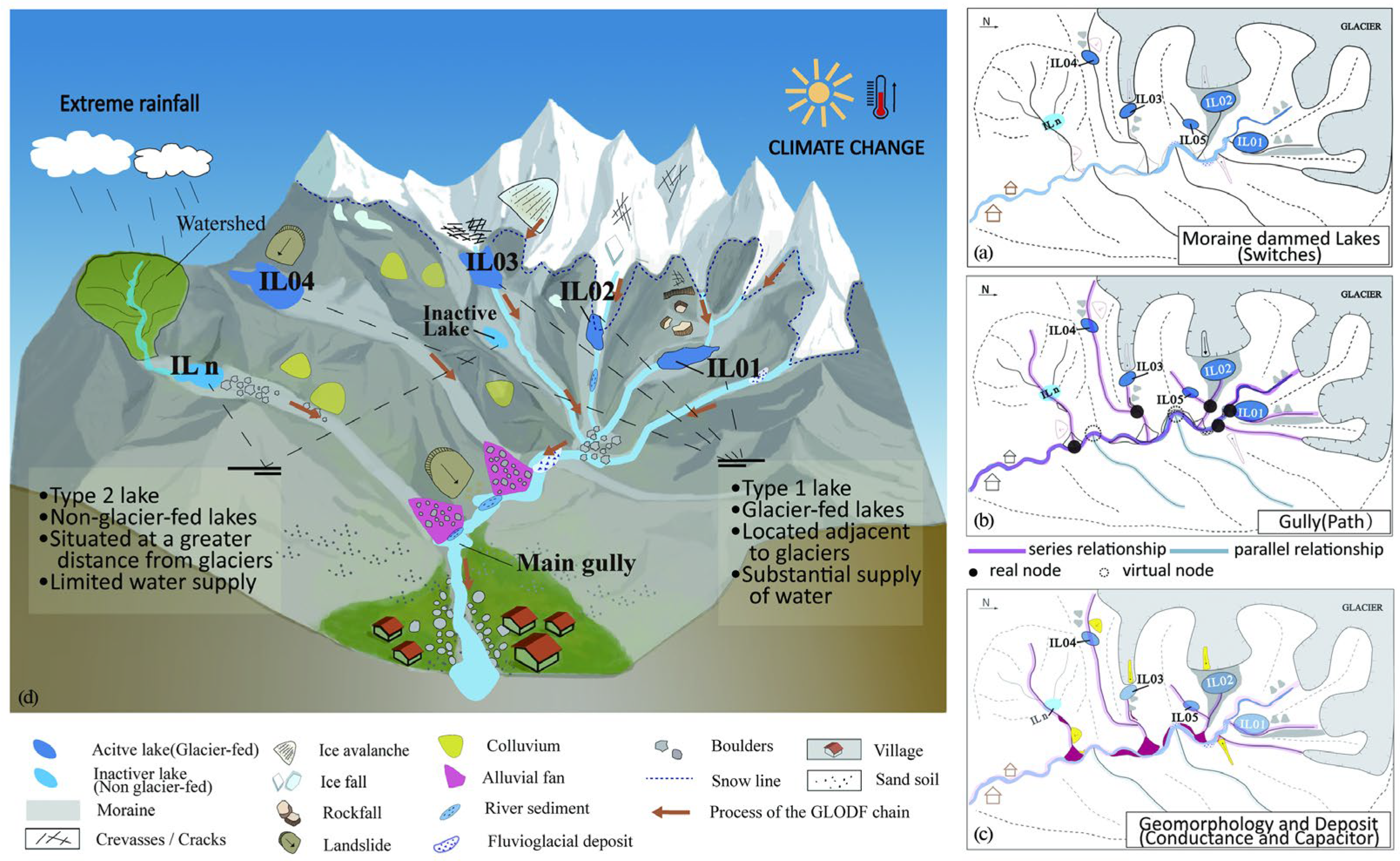
3]. The distribution of glacial lakes along the main channel and the debris flows formed in this region create a network structure analogous to an electrical circuit. Specifically, the outburst of each glacial lake corresponds to the closing of a switch in the circuit, creating a parallel connection. The different sections of the main channel act as current paths, establishing a series relationship. When one switch is opened (i.e., when a glacial lake bursts), it can complete the circuit (i.e., trigger a debris flow), leading to system failure (
Figure 1).
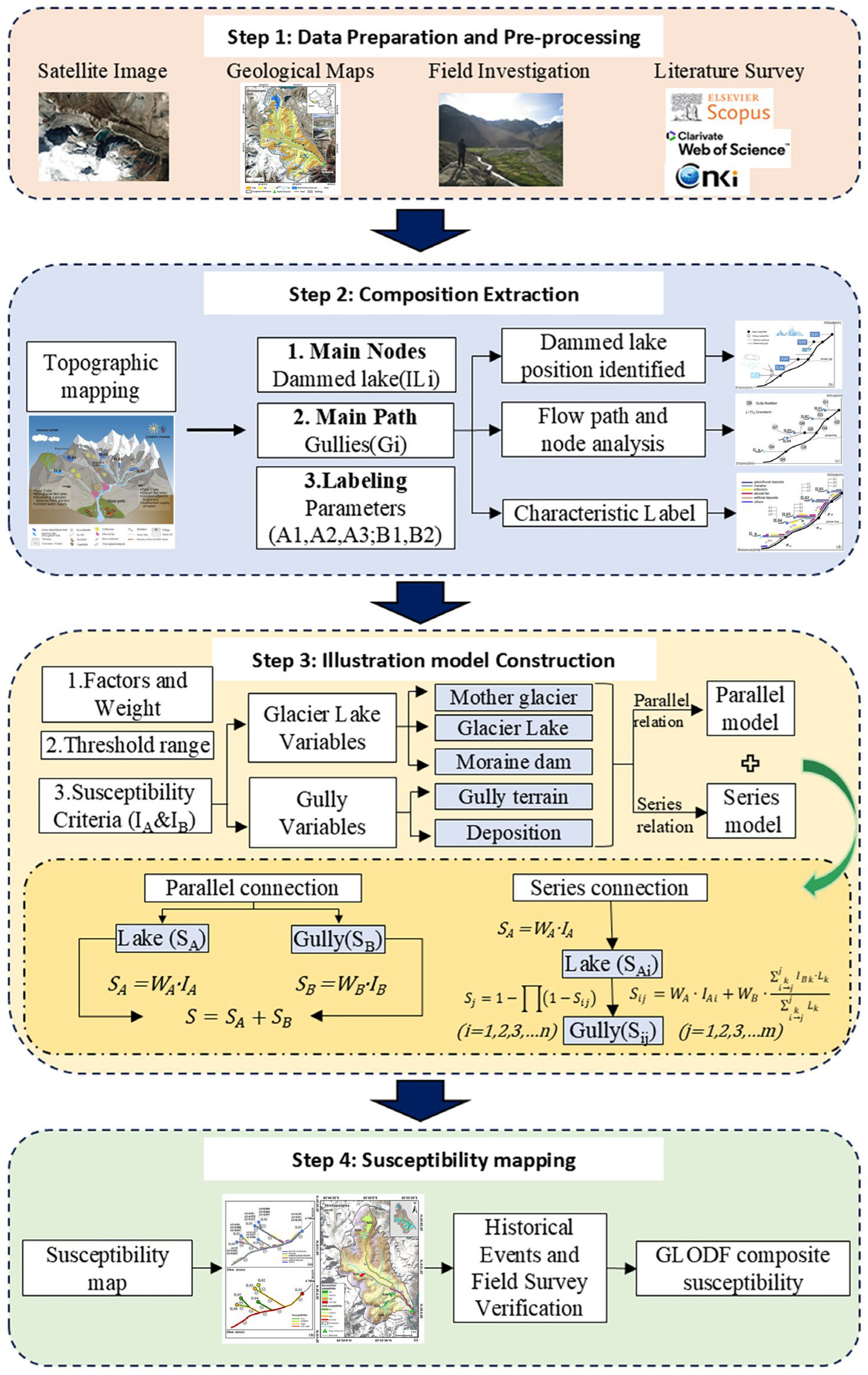
Based on this analogy, we propose a method for GLODF susceptibility mapping using a system failure-based circuit model. The process consists of four main steps. First, input data are prepared and pre-processed, including the delineation of research areas and the identification of the characteristics and mechanisms of GLODFs. Second, a spatial relationship map is created for glacial lakes and gullies, and key compositions are extracted, including the primary nodes of the lakes and the main paths of debris flows. Third, the causative factors are determined, and a series–parallel circuit model is constructed. This model extracts parameters such as electric charge and resistance based on terrain, geological conditions, and the surrounding environmental factors of the lakes and gullies. Finally, GLODF susceptibility is mapped using the system failure theory and the circuit series–parallel model. Geomorphic spatial relationship analysis was conducted using ArcGIS 10.7, and remote sensing data acquisition was conducted using ENVI 5.6.
The framework based on system failure theory for GLOFD susceptibility assessment is shown in
Figure 2.
2.1. Construction of Circuit Series–Parallel Model
The topographical network, consisting of gullies and glaciers, can be likened to circuit models. Adjacent gullies containing glacial lakes upstream are considered to exhibit a parallel relationship, while the gullies located downstream of the catchment points are characterized by series relationships. The spatial analysis of these series and parallel relationships provides valuable insights for symbolizing the spatial topography.
2.1.1. Classification of Glacier Lakes and Gullies
Classification of the glacier lakes and gullies is the first step in the construction of circuit series–parallel model. The evaluation range is the higher-level river basin in which the town or city is located, including the lowest outlet of the main gully and the highest area of the glacier. First, the Strahler method was used to order the river streams and analyze the distribution of gullies. Then, we chose the glacier lakes with areas larger than 0.1 km
2 and verified and classified the glacier lakes and gullies following refs. [
54,
55,
56].
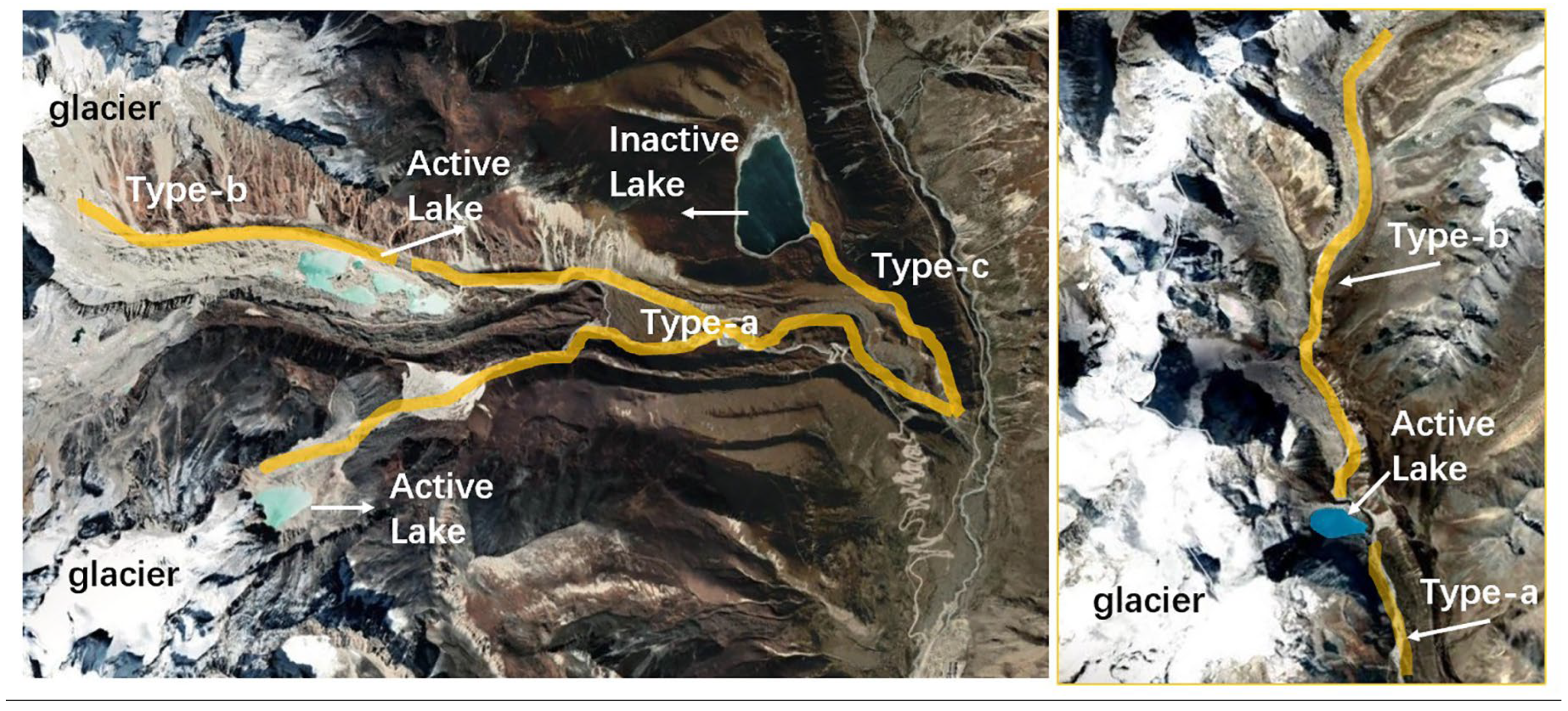
There are two types of glacier lakes: Type 1: Active lakes, usually defined as glacier-fed lakes, are located adjacent to glaciers and receive a substantial supply of water (
Figure 1 and
Figure 3). The lake water in active lakes is influenced by factors such as glacial meltwater, runoff, and evaporation. These lakes have a high risk of breach, which is contingent upon glacial activity and the stability of moraine dams. Type 2: Inactive lakes, defined as non-glacier-fed lakes, are situated at a greater distance from glaciers and receive a more limited water supply (
Figure 1 and
Figure 3). Their lake water is primarily influenced by precipitation, infiltration, and evaporation. These lakes have a lower risk of breach, which depends solely on the stability of moraine dams. In the circuit series–parallel model, glacier lakes are labeled IL and represented by blue circles. Type 1 and Type 2 are represented by dark blue and light blue circles, respectively (
Table 1 and
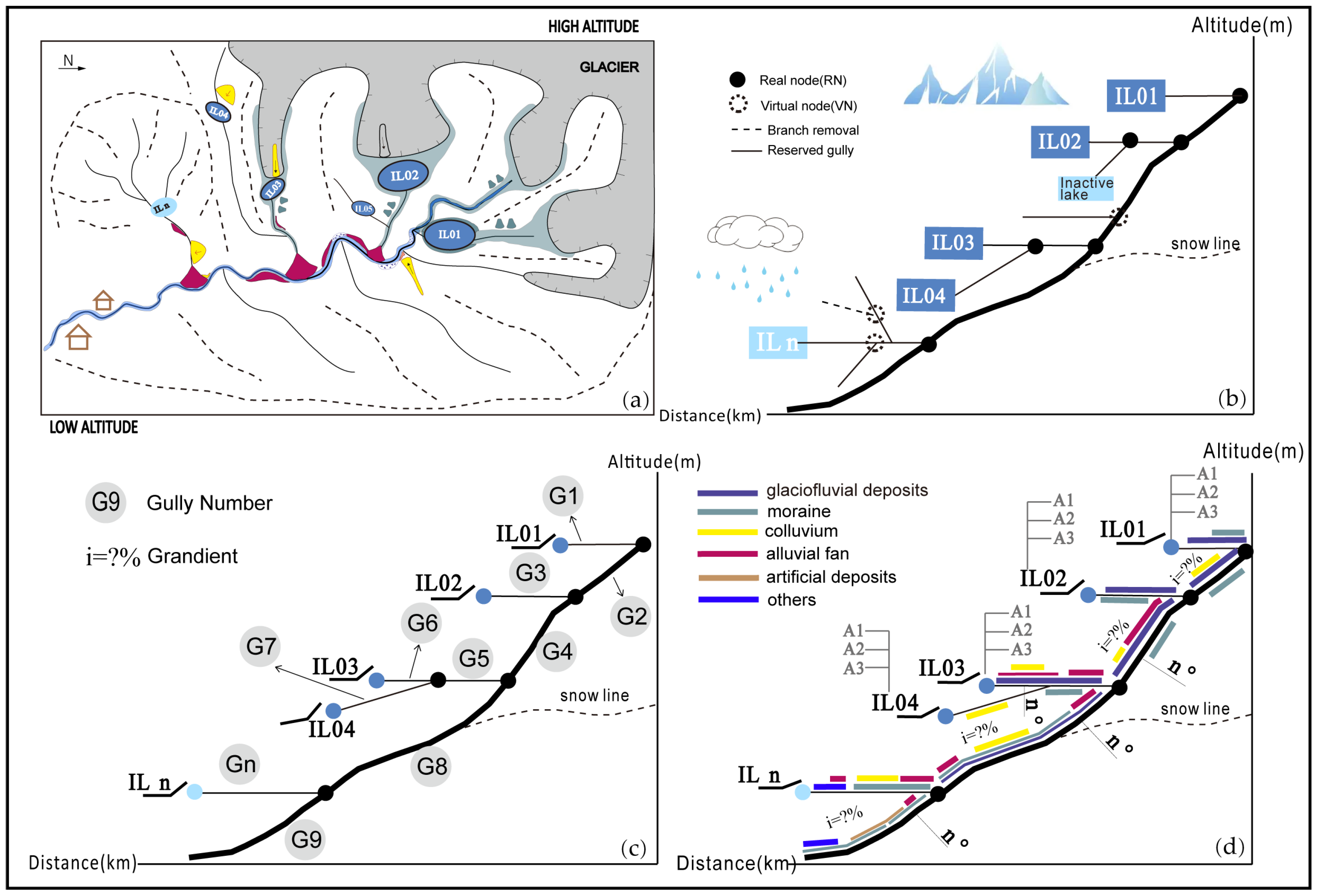
Figure 4a).
Four types of gullies are identified: Type-a, located adjacent to glaciers and glacial lakes [
57]; Type-b, where glacial lakes are present upstream but no glaciers exist; Type-c, where glaciers are present upstream but no glacial lakes exist; and Type-d, where neither glaciers nor glacial lakes are found and the area lies below the snow line. The spatial distribution of the snow line can be determined by identifying the perennially snow-covered area through field observation data or remote sensing technology. The snowline was determined from the field observations and remote sensing of perennial snow cover, with an average elevation of 4750 m and seasonal fluctuations between 4400 m and 5000 m [
58].
The analysis indicates that Type-a and Type-b gullies have a high potential for debris flow triggered by glacial lake outbursts. For Type-c and Type-d, it is necessary to evaluate whether glacier meltwater or precipitation can provide sufficient water to meet the minimum threshold required for the initiation of debris flow (
Figure 3). Typically, a 24 h cumulative rainfall threshold (in mm) or critical short-duration rainfall intensity can be used as triggering thresholds. Debris flows may be initiated either in small catchments with rapid runoff during intense short-duration rainfall or in large catchments under prolonged rainfall that leads to soil saturation. Empirical formulas can be employed to fit threshold curves: rainfall intensity–duration (I–D) [
59,
60]. Combined with the catchment area and the region above the curve, this approach allows for assessing the likelihood of rainfall-triggered debris flows.
2.1.2. Extraction of Nodes
Key-node extraction is a crucial step in the circuit series–parallel model, where it is essential to identify real and virtual nodes based on the relationship between flow paths and lakes. The junctions of glacier lakes and gullies are considered to be nodes. However, the classification of these nodes as real or virtual depends on the characteristics of the gullies and glacier lakes upstream. This paper presents the principles for determining the types of nodes (
Table 1).
2.1.3. Criteria for Node Classification
I-Real node (RN-I): The outlets of active glacier lakes are considered triggering nodes, classified as RN-I.
II-Real node (RN-II): The junctions of Type-a or Type-b gullies, along with their upstream gullies, are designated as related nodes, termed RN-II. Both RN-I and RN-II should be marked with black circles in the schematic representation of the series–parallel model.
Virtual nodes (VNs): Used to evaluate the potential for debris flow occurrence in Type-c or Type-d gullies under precipitation. The catchment area and the precipitation intensity are considered to determine a threshold that could trigger debris flow. If the threshold is exceeded, the junctions of the gullies and their upstream gullies are classified as RN-I. Otherwise, these junctions are designated as virtual nodes (VNs). VNs should also be marked in the second step of the schematic model (
Figure 4b).
2.1.4. Parameter Labeling
This step involves acquiring the parameters of the circuit model by labeling the glacial lakes, nodes, and flow paths identified in the previous steps. In this model, materials involved in debris flow are represented by moving electrons, the water source functions as an electric switch, the terrain is analogous to resistance, and the debris source is treated as capacitance. Key debris sources include landslide deposits, colluvium, moraines, alluvial sediment, fluvioglacial and river deposits, and muddy sands, all of which are critical components in evaluating debris flow susceptibility.
The quantity and distribution of debris sources can be represented by source lines of varying width and length, based on field surveys and remote sensing interpretation (
Table 1 and
Figure 4d). All I-real nodes with active glacial lakes are considered potential triggers for debris flows and are thus classified as switches, labeled with the attribute RN-I. During a debris flow moving along the gullies, there may be accumulations of solid materials or stagnation. Therefore, the source lines and gradients are used to define the parameters of the flow path.
Another procedure, referred to as ‘branch removal on virtual nodes,’ involves deleting the flow path above the virtual node (VN) (
Figure 4b,c). However, if deposition occurs along the gullies above the VN, such as landslide deposition, source lines should be drawn on the virtual nodes to account for this material.
2.2. Evaluation Criteria of Circuit Series–Parallel Model
After their extraction, these parameters are brought into the calculation model according to the relationship, series or parallel, between lakes and gullies. Based on evaluation criteria, we established a semi-quantitative method for characterizing the parameters of GLODFs.
2.2.1. Criteria of Evaluation
The evaluation criteria are built around GLODF events, viewed as a system linking upstream areas, glacial lakes, and downstream gullies. Indicators are based on prior research and are obtainable via remote sensing and field surveys, organized into a three-layer structure. The target layer includes two components: System A, which focuses on the glacier lakes and considers factors related to lake breaches, as well as the upstream lakes and glaciers, and System B, which focuses on gullies, considering the transition from flood to debris flow.
The criterion layer includes three indicators for glacier lakes: mother glacier influence (A1), lake (A2), and moraine dam (A3). For gullies, two indicators are considered: terrain (B1) and deposition (B2).
The index layer consists of sixteen indices, derived from remote sensing data and field surveys, which characterize the potential failure of the GLODF system. All indices were selected based on the previous studies [
11,
13,
53,
61] (
Table 2). The threshold range for each index is determined based on recommended thresholds derived from historical events [
22,
24,
31,
54,
62]. Each index is graded into four categories, high, medium, low, and none, with corresponding values between 0 and 1 (
Table S1).
2.2.2. Weight of Indexes
Regions prone to GLODFs, such as the Himalayan region, are often characterized by high altitudes and harsh environmental conditions, which present significant challenges to conducting detailed field surveys. Additionally, the limited number of recorded occurrences of glacial lake outburst debris flows often renders statistical and machine learning models insufficient for accurate susceptibility assessment.
The semi-quantitative evaluation method integrates geological and topographical data, hydraulics, InSAR, and historical event reconstruction. This approach allows for the assessment of glacial lake disasters at different regional scales, progressively focusing on key lakes using RS techniques, criteria, and empirical formulas. Previous studies have demonstrated its effectiveness in identifying dangerous glacial lakes [
14,
15,
61,
62,
63].
This study employs the Analytic Hierarchy Process (AHP) to assign weights to the evaluation criteria. The AHP is a multi-criterion decision-making method widely used for analyzing complex problems [
64] which derives optimal decisions by synthesizing multiple evaluation criteria.
Table 2 presents 15 indicators grouped into two main categories that influence susceptibility to GLODFs. To quantify the relative importance of these indicators, we invited 15 experts with extensive experience in glaciology, glacial lake research, and geological hazard mitigation on the Tibetan Plateau to conduct pairwise comparisons among the influencing factors. Their judgments were used to mathematically quantify the relative significance of each factor. Pairwise Comparison Matrices (PCMs) were constructed based on these expert assessments, and the weight of each factor was calculated using the geometric mean (multiplicative) method. In the PCMs, Saaty’s 1–9 scale was applied to rate the relative importance of each pair of factors: 1 indicates equal importance, 3 denotes moderate (slightly greater) importance of the first factor over the second, 5 represents strong importance, 7 signifies very strong importance, and 9 reflects extreme importance [
65]. The even numbers (2, 4, 6, and 8) represent intermediate judgments between adjacent odd-numbered levels.
To assess the consistency of the judgments, the Consistency Ratio (CR) was computed from each PCM. A CR value below 0.1 is generally considered acceptable, indicating that the judgment exhibits reasonable consistency. If the CR exceeds 0.1, the judgment is deemed inconsistent, and the resulting AHP weights may lack practical validity.
Final weights were determined using the eigenvector method. The normalized principal eigenvector of the judgment matrix—corresponding to its largest eigenvalue—yields the priority weights for elements at each level relative to their parent criterion. Thus, second-level criterion weights are taken directly from this vector, while third-level indicator weights are calculated by multiplying their local priority weights by the weight of their parent criterion. The final weighting results are presented in
Table 2 and
Table S2.
2.3. Susceptibility Assessment Based on System Failure Theory
The system failure model consists of both parallel and series components. RNs serve as the starting points for each flow path. The flow paths upstream of RNs, where large water flow converges, exhibit parallel relationships, while the flow paths downstream of RNs follow series relationships (
Figure 4).
The circuit series–parallel model is adapted, and susceptibility calculations are performed based on RNs acting as switch parameters. This approach facilitates the probability analysis of debris flow initiation under conditions such as glacier lake breaches, melting, and precipitation, with the associated parameters denoted by SA. Subsequently, susceptibility parameters SB are calculated using conductance data to evaluate the probability of debris flow movement in gullies. Finally, an analysis of the susceptibility to GLODFs across the entire river basin is conducted based on the system failure model.
S is the susceptibility of the entire watershed to GLODFs under the parallel relationship:
where W
A and I
A represent the weights and values of the parameters used in the susceptibility evaluation when a glacial lake outburst (or extreme precipitation) serves as the debris flow triggering factor. W
B and I
B are weights and values of the parameters used for gullies.
In the context of the series relationship, there are multiple triggering switches ILi. For any downstream gully j, the activation of any switch may lead to the occurrence of debris flow within the gully. Therefore, the debris flow susceptibility S
j of the gully can be expressed based on system failure theory as:
The results can be categorized into four levels of susceptibility using the natural breaks classification method [
66,
67]. The final susceptibility map provides an integrated assessment of the probability of debris flow for each gully, considering potential outbursts from multiple glacier lakes.
3. Study Area and Data
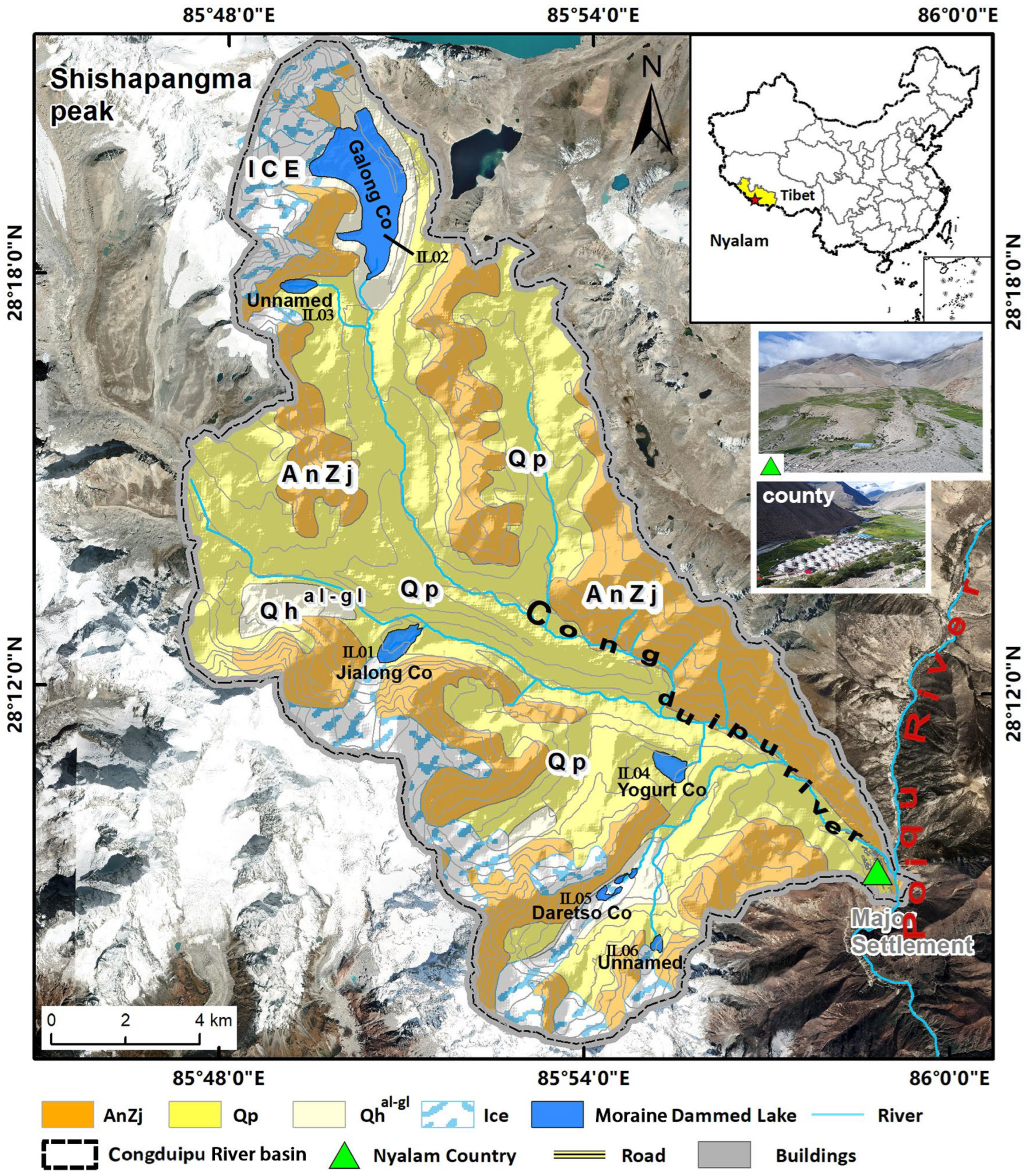
The Congduipu River basin is located in the southwest of Nyalam, Tibet, China. The basin originates from Mount Shishapangma at an elevation of 8027 m a.s.l and flows in a northwest–southeast direction before converging with the Poiqu River along the northern margin of Nyalam Town. The basin covers an area of approximately 366 km2, with an average longitudinal gradient of 240‰ in its main valley.
According to GLODF hazard studies, an area threshold of 0.1 km
2 is commonly adopted for compiling inventories of hazardous glacial lakes. Therefore, six glacial-dammed lakes (more than 0.1 km
2) are situated at elevations ranging from 4300 m to 5100 m a.s.l., with an average surface area of 1.19 km
2 [
55,
62,
68]. The largest lake has a surface area of 5.37 km
2 at an elevation of 5067 m a.s.l., while the smallest one covers 0.11 km
2 at 4867 m a.s.l. Nyalam Town, the primary settlement in the region, is located at the outlet of the basin, with an elevation of 3810 m a.s.l.
The primary exposed strata within the Congduipu River basin are pre-Simian metamorphic rocks, including granitic mylonite, biotite plagioclase granulite, and biotite plagioclase gneiss, along with layered marble. The catchment area also features extensive Pleistocene moraine deposits and sand–gravel strata, while Holocene sand–gravel assemblages are restricted to modern glacial zones and active fluvial valleys (
Figure 5). Colluvial deposits are found along the frontal slopes of the gullies, resulting from slope movement and rock weathering. These varied unconsolidated deposits within the catchment provide abundant solid material sources for potential GLODF events.
3.1. Data
The geospatial data utilized in this study include a Digital Elevation Model (DEM) derived from ALOS PALSAR products with 12.5 m raster resolution, as well as high-resolution remote sensing imagery from GF-1 (2 m) and GF-2 (0.5 m) satellites. This multi-source dataset provides sufficient spatial resolution for characterizing the geomorphological features of GLODF hazards, meeting the observational requirements of this research study. The geological map was sourced from the 1:250,000 Regional Geological Survey Report of the People’s Republic of China for Nyalam County (H45C004002). A field investigation was conducted in Nyalam County from October 1 to 6, 2019, with the following objectives and methodologies.
Field investigations verified remote sensing interpretations of glacial lakes and associated gullies, assessed bank slopes through direct measurements, and quantified morphological features such as moraine dams, lakeshores, and sediment deposits. Validated parameters were systematically recorded, and UAV imagery (Phantom 4) was collected to characterize supraglacial landforms and gully outlet configurations.
3.2. Remote Sensing Interpretation and Field Verification
Before field investigation, the parameters of glacial lakes and the deposition of gullies were obtained using RS technology combined with spectral analysis and visual interpretation. These lakes are typically located near valley glacier termini, with moraine dams. They are often tongue-shaped, semi-circular, or teardrop-shaped. In freezing periods, they appear purple with clear texture; in non-freezing periods, they look black or dark blue with sharp water–land boundaries due to strong visible light absorption [
55]. Gully deposition is lighter than surrounding vegetation (green) and undisturbed soil (dark), appearing grayish white, pale yellow, or reddish brown, and is easily seen in true-color images. These deposition has low reflectance in red and near-infrared bands and a very low NDVI, contrasting sharply with vegetated areas. These sources typically cluster at gully outlets, river bends, or piedmont zones, marking the final deposition sites of surface runoff erosion and transport [
69,
70].
Of the six glacial lakes assessed, three (IL01, IL02, and IL04) and their downstream gullies were selected for field verification based on their geohazard potential and representativeness. These lakes are located at elevations of 4371 m, 5067 m, and 4355 m a.s.l., with surface areas of 0.68 km2, 5.37 km2, and 0.49 km2, respectively.
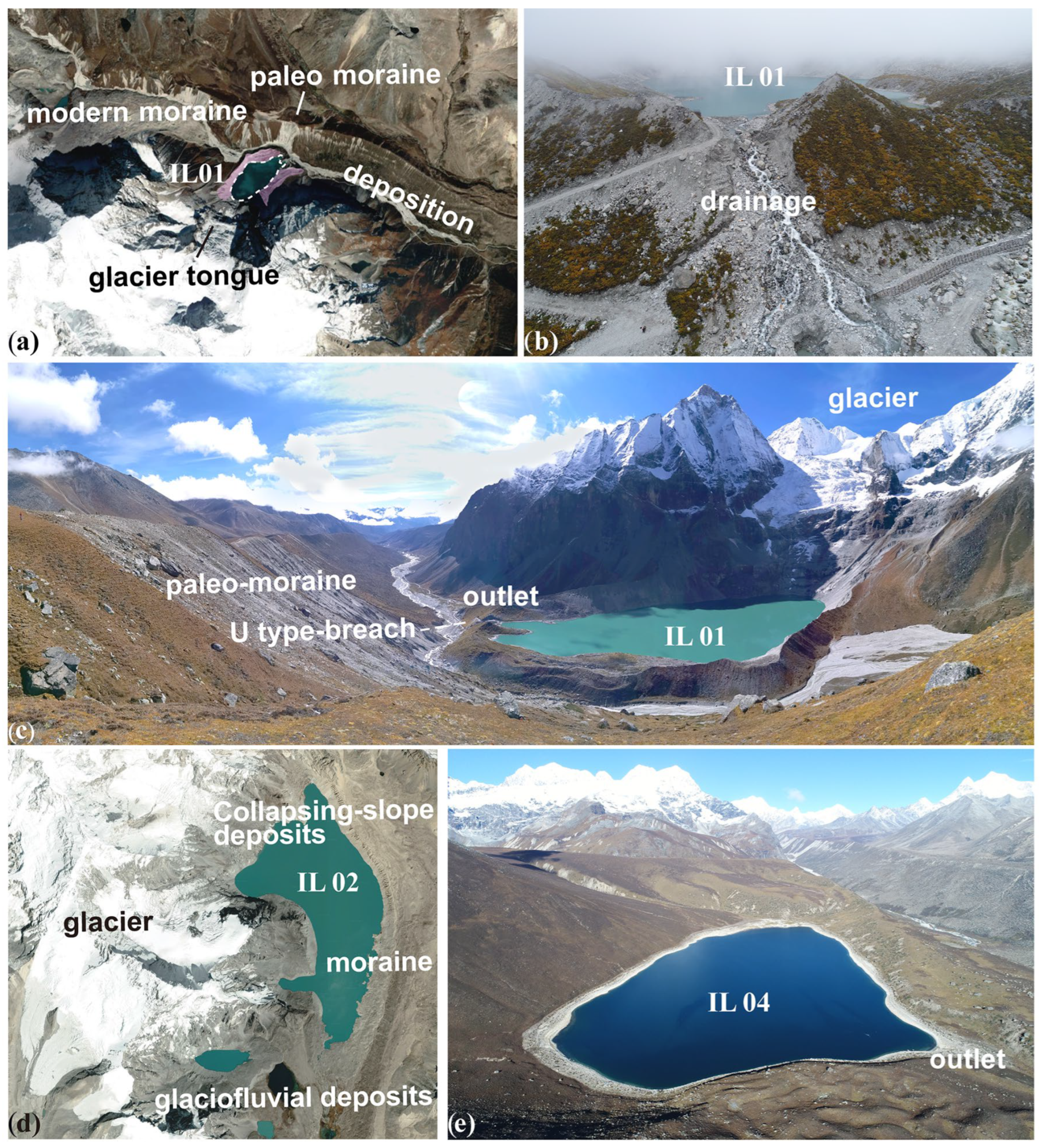
IL01, named Jialongco (28°13′34″ N, 85°50′57″ E), is a preglacial lake that is considered a potentially hazardous glacial lake in the Himalayan region, attracting significant research attention. In August 2020, a sudden breach occurred on the left bank of Jialong Lake, triggering a catastrophic flood that subsequently transformed into a debris flow. This event caused extensive damage to multiple structures, including government office buildings and residential areas in the downstream county located 17 km away, with significant agricultural land also being severely impacted. The incident resulted in substantial economic losses [
62]. Jialongco is a representative end-moraine-dammed lake formed by the retreat of its mother glacier, featuring a steep ice tongue (mean slope >31°) that extends into the lake basin. Pronounced crevasses have developed across the glacial slope and ice tongue, with fracture widths ranging from decimeters to over a decameter. The moraine dam consists of loose, silty–clayey gravelly soil with a wide particle size distribution, containing individual clasts of up to 100 m
3 in volume. Currently, a U-shaped spillway breaches the moraine dam on the northeastern lakeshore, with its flanking embankments standing 10–20 m above the lake level. This spillway exhibits seasonal drainage, discharging water along the surface that ultimately converges into gullies at the toe of the dam’s outer slope (
Figure 6a–c).
IL02, named Galongco (28°24′08″ N, 85°49′51″ E), is situated in the upper reaches of the Jipu Gully, flanked by Mount Shishapangma to the west and adjacent to active glaciers. An ice tongue extends into the lake, while terminal moraines enclose the remaining three sides. A seasonal spillway exists on the southwestern lakeshore. The western slope of the glacial lake is steep, with an average gradient exceeding 30°. Slopes at elevations between 5400 and 6300 m a.s.l. exhibit multiple sections with inclinations approaching 80°, particularly on north-facing aspects. The glacier features densely spaced crevasses, and the bedrock displays extensive fractures and pronounced joint structures (
Figure 6d).
IL04, named Yogurt Lake (28°10′54″ N, 85°55′22″ E), is a non-glacier-fed, hydrologically isolated water body. It is characterized by gentle surrounding slopes (<15°) and minimal slope movement, maintaining year-round stability. This lake can be classified as an inactive (or dead) lake (
Figure 6e).
Based on remote sensing interpretation and field survey verification, detailed data on each glacial lake and gully were meticulously recorded (
Table 3 and
Table 4).
4. Results
4.1. Susceptibility of Glacial Lakes
The comprehensive GLODF susceptibility index of glacial lakes and gullies segments in the Congduipu River basin was calculated using a system failure model. The results were classified and are presented in
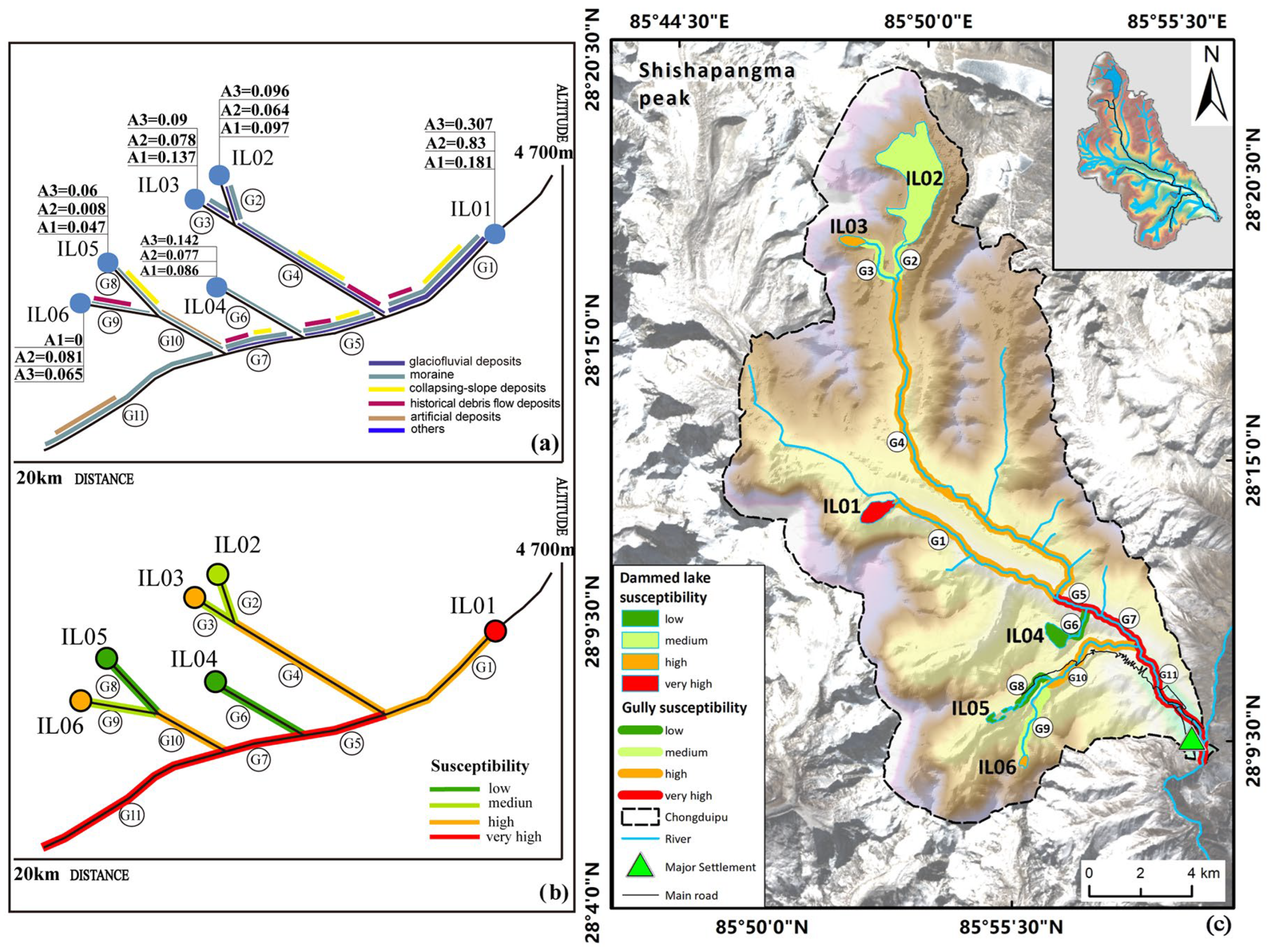
Table 5 and
Figure 7, with susceptibility levels color-coded as follows: red (very high), orange (high), light green (medium), and dark green (low). In
Table 5, the values and ranks in the third row correspond to the glacial lake susceptibility assessment (SA) results under parallel connectivity conditions. The values in the last column represent the final gully susceptibility values (Sj) calculated through comprehensive assessment under conditions of serial connectivity between glacial lakes and gullies. The blue cells indicate gully susceptibility values at parallel-connected positions, while the gray cells denote gully susceptibility values under different glacial lake triggering conditions in serial-connectivity scenarios.
The susceptibility analysis of glacial lakes in the study area reveals the following categorization: one glacial lake (IL01) exhibits very high susceptibility, and two glacial lakes (IL03 and IL06) are classified as highly susceptible. IL01, IL03, and IL06 have horizontal distances to Nyalam Town of 17 km, 28 km, and 12.8 km, respectively.
The susceptibility probability of IL01 is 0.571, significantly higher than that of other lakes in the basin. This lake is particularly vulnerable due to the extensive crevasse network on the glacier’s surface, which increases structural instability and predisposes the glacier to ice avalanches. These avalanches could lead to displacement waves when calving into the lake, potentially resulting in overtopping and subsequent moraine-dam failure. In May and June of 2002, a catastrophic outburst from Jialong Lake (IL01) triggered a large debris flow with a volume of 2.36 × 10⁷ m3. Smaller-scale GLODFs were recorded again in 2019 and 2022, continuing to pose significant risks to downstream gully systems.
4.2. Susceptibility of GLODFs
The primary gullies in the Congduipu River basin—G1, G5, G7, and G11—are characterized by high drainage discharge and steep gradients, with average longitudinal bed slopes ranging from 150‰ to 300‰. Among these, G5, G7, and G11 are classified as very highly susceptible due to their location in the distal reaches of the catchment, forming a series of connections with upstream gullies. The specific series combinations are shown in
Table 5 and
Figure 7. IL01–G1–G5, IL02–G2–G4–G5, and IL03–G3–G4–G5 are three series relationships involving G5. Consequently, G5 is susceptible to failure triggered by the collapse of any single component among IL01, IL02, IL03, G1, G2, G3, or G4. This arrangement subjects them to multi-source influences from both glacial lakes and upstream gullies, whereby a breach at any upstream node could trigger secondary debris flows that propagate downstream. The main gully system shows evidence of erosion and deposition, with channel straightening particularly evident at confluences. Loose deposits have accumulated at the gully mouths, partially burying meadow vegetation, especially in the confluence zone between G1 and G5. These three gullies also feature moderate volumes of channel deposits, while G5 and G7 have steeper bank slopes that are more prone to flood-induced erosion at their bases, thereby increasing the likelihood of debris flows.
The high-susceptibility gullies (G1 and G4) are located above 4078 m a.s.l. and are characterized by extended channel lengths and substantial sediment deposits. In contrast, G10, located further downstream, has limited sediment accumulation but a short, steep channel with an average gradient of 86‰. These gullies are hydrologically connected to multiple glacial lakes, making them vulnerable to potential GLODFs. G6 and G8, by contrast, have relatively short channel lengths and are each linked to only a single upstream water source. G6 features steep terrain, while G8 contains unconsolidated channel deposits. However, both gullies exhibit limited water availability, which restricts the formation of GLODFs. As a result, G6 and G8 are classified as having low susceptibility.
The series–parallel connectivity model effectively captures the complex relationship between triggering factors and the gully system within the catchment. Specifically, an increase in parallel-connected hydrological pathways corresponds to greater complexity in potential hazard chains, as the failure of any upstream lake could cascade downstream, triggering a chain reaction. For glacial lakes with very high and high susceptibility, it is critical to monitor water levels and dam integrity and to implement appropriate mitigation measures. Similarly, hazard mitigation structures for highly susceptible gullies should be designed based on their primary risk factors, as identified through the susceptibility calculation process (
Figure 7).
4.3. Result Validation
We conducted two field surveys in the Congduipu River basin of Nyalam in 2018 and 2019, respectively. The surveys were divided into two components: one focusing on glacial lakes and the other on gullies. The glacial lake survey primarily involved geometric measurements of the surrounding dam, stability assessment of the dam, observation of fissure development on adjacent glacier slopes, and the monitoring of the lake water level. The gully survey involved observations and documentation along both sides of the gullies, recording slope deformation characteristics, slope material composition, channel gradient characteristics, and deposit investigations. Additionally, drones were used to photograph and observe the glacial lakes and surrounding gullies, with a focus on comparing the distribution of deposits within the gullies and traces of historical debris flows.
Based on the calculation results, we selected one lake from each susceptibility category (high, medium, and low) for validation: IL01, IL06, and IL04, respectively. The gullies selected for verification were those serially connected downstream of IL01, IL05, IL04, and IL06, specifically G1, G4, G5, G6, G8, G9, G10, and G11. Comparisons between field observations and assessment data demonstrated good consistency, and the evaluation results aligned with the preliminary field judgments.
5. Discussion
5.1. Sensitivity Analysis of Series–Parallel Model
Research on GLODF disasters is constrained by the challenging high-altitude environments, where on-site data collection is difficult, especially in areas of high elevation with numerous glacial lakes. It is very challenging to conduct regional susceptibility assessments relying solely on statistical historical data. The use of semi-quantitative data remains the primary method for evaluation. Susceptibility mapping is susceptible to subjective judgments used to determine the weights of various contributing factors, which may introduce significant uncertainty into the results. Performing sensitivity analysis helps to clarify the associated uncertainties.
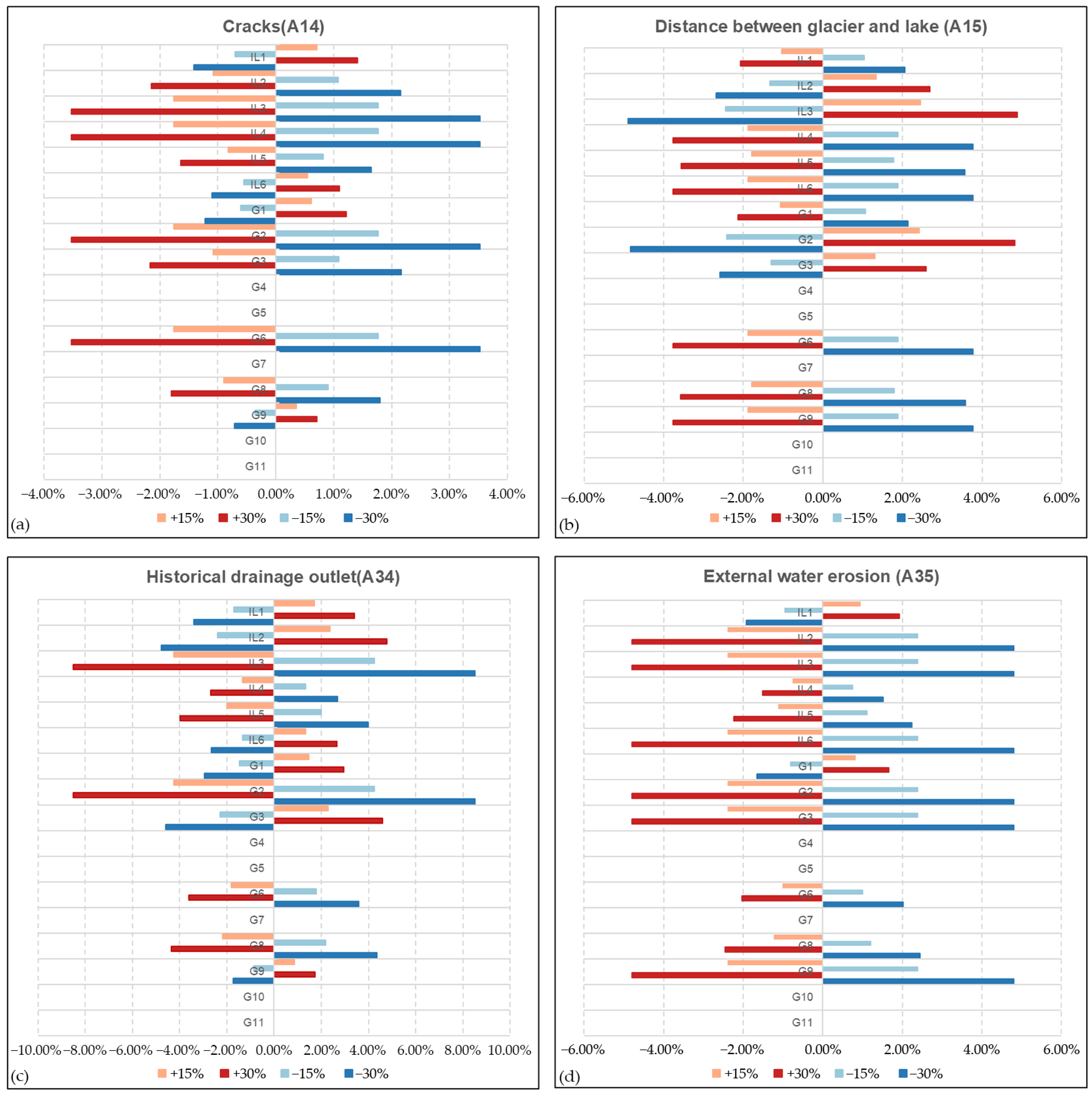
The GLODF evaluation index system comprises three layers, with 16 sub-factor indicators. Among these, four indicators, cracks (A14), distance between glacier and lake (A15), historical drainage outlet (A34), and external water erosion (A35), have a weight exceeding 10% each and thus were primarily selected for sensitivity analysis. The weight variation amplitude was set to ±15% and ±30% to observe the impact on the model’s evaluation results (
Figure 8).
The results show that the factor sensitivity order, from highest to lowest, is A34 > A15 > A35 > A14. When A34 changes by ±15%, it has the greatest impact on the output variables. Particularly for IL3 and G2, the change rate is as high as approximately ±4.26%. When the variation amplitude increases to ±30%, the change rate roughly doubles (e.g., ~±8.52% for IL3 and G2), indicating an approximately linear response. Changes in A34 also significantly affect other variables like IL2 and G3 (change rates between ±2.30% and ±2.38%) (
Figure 8c). When A15 changes by ±15%, it has a considerable impact on IL3 and G2 (change rates of ~±2.45% and ±2.41%). The change rates for other variables, like IL4, IL5, IL6, G8, and G9, range from ±1.78% to ±1.88%. When the variation increases to ±30%, the change rates increase roughly proportionally (
Figure 8b). When A35 changes by ±15%, its impact on multiple output variables (IL2, IL3, IL6, G2, G3, and G9) is relatively consistent, with a change rate of about ±2.40%. The change rates for other variables, like IL1 and G1, are smaller (<1%) (
Figure 8d). When A14 changes by ±15%, its impact on the output variables is the smallest, with the maximum change rate being only ±1.76% (observed for IL3, IL4, G2, and G6). The change rates for most other variables are below 1%, indicating a relatively weak influence of A14 changes on the system (
Figure 8a). Therefore, IL3 and G2 are the most sensitive to parameter changes, especially showing the highest change rate when A34 varies. Other variables, like IL2 and G3, also show high responsiveness to changes in A34 and A15. Variables such as IL4, IL5, IL6, G1, G6, G8, and G9 show a moderate response (change rates between ±1% and ±2.5%) to changes in A15, A34, and A35. Variables like IL1 and G1 exhibit small change rates (generally <1%) and are relatively insensitive to parameter variations. Variables G4, G5, G7, G10, and G11 show zero change rate under all parameter variations, indicating they are completely insensitive to the selected parameter changes.
Overall, for all parameters, when the variation amplitude increases from ±15% to ±30%, the change rates of the output variables increase approximately proportionally. This indicates that the system exhibits a good linear response within the tested range and demonstrates the relatively good robustness of the series–parallel model. During model calibration or optimization, priority should be given to the highly sensitive parameters A34 and A15, as minor changes in them can significantly affect the system output.
5.2. Potential At-Risk Gullies in Congduipu River Basin
Research on the Congduipu River basin in the Himalayas includes macro-spatiotemporal analyses, site-specific engineering assessments, transboundary risk evaluations, studies of hazard chains and triggers, and historical event revisions with risk reassessments [
30,
38,
39,
51,
71,
72,
73]. Among these, IL01 and IL02 have repeatedly been rated as high-risk lakes threatening Nyalam Town [
38,
51,
73]. However, other lakes in this study area have not been assessed in broader regional studies. In large-sample glacial lake hazard inventories, these lakes are often overlooked or excluded, failing to be flagged as high-risk and thus receiving insufficient attention. Yet, they still pose a potential threat to Nyalam Town through possible GLODFs, and their hazard potential should not be ignored.
This study clearly maps the spatial distribution of GLODF susceptibility in the Congduipu River basin. The model reveals that gullies with parallel hydrological connections have lower susceptibility, while those in series show much higher hazard probabilities due to cumulative upstream effects. Notably, gullies G5, G7, and G11 in the main channel of the basin have complex debris flow triggers, and their proximity to Nyalam County greatly increases the threat to nearby settlements.
As a highly susceptible area, G4 is hydrologically connected in series with upstream glacial lakes IL02 and IL03 as well as gullies G2 and G3, among which IL03 is classified as highly susceptible. Should debris flow disasters occur simultaneously in the two upstream glacial lakes and two gullies, the floodwaters would immediately initiate erosion and transport of glaciofluvial deposits and moraine accumulations within gully G4. Under conditions of sufficient water discharge, the hazard may propagate downstream with continued destructive potential. Gully G10 exhibits a similar scenario. Located downstream in a series-connected system comprising glacial lake IL05, gully G8, glacial lake IL06, and gully G9, G10 demonstrates high susceptibility despite G8 and G9 falling outside the hazardous threshold range. This elevated risk primarily originates from the presence of the highly susceptible glacial lake IL06 upstream, combined with multiple triggering factors associated with its immediate proximity to the glacier. The spatial superposition effect of these hazards ultimately results in G10’s high-susceptibility characteristics. Furthermore, situated in the middle-lower reaches of the Congduipu River basin, G10 serves as a key area for county development, scientific research, and tourism activities. Given the sudden onset and devastating potential of GLODFs, the area of G10 presents significantly greater potential hazards compared with upstream gullies.
5.3. Risk Mitigation Strategies Based on River Basin GLODF Susceptibility
Susceptibility maps inform hazard mitigation strategies. Rising temperatures and precipitation in Nyalam County over the past 30 years are the main drivers of increasing GLODF events. Climate change exerts a long-term dynamic influence on GLODFs. Consequences include destruction of international transport routes, damage to hydropower dams causing widespread power outages, constrained urban development, and disruption to ecosystems and water resources. Urban centers and critical infrastructure in very-high-susceptibility zones face high exposure and require enhanced protective measures, while remote high-altitude areas should focus primarily on monitoring.
In recent years, Nyalam County’s urban expansion has extended into the upstream catchment, with roads built connecting the town center to IL01 and IL04. IL01 has very high susceptibility, and downstream gullies are rated as high for G1 and very high for G5, G7, and G11. Therefore, it is necessary to excavate an artificial spillway at IL01, reinforce and repair its dam and spillway; implement retention structures in G5, diversion channels in G7, and bank/bed protection in G11; and clear accumulated debris from these gullies. In contrast, the susceptibility of IL05 and IL06 is low and medium, while the comprehensive susceptibility to debris flow in each gully section is as follows: G8 shows low susceptibility, G9 medium susceptibility, and G10 high susceptibility. Therefore, the monitoring of glacial lakes can be strengthened, and relevant disaster prevention measures such as terrain slowing or deposit cleaning can be taken for G10.
The mitigation strategies of GLODFs should be guided by both the lake’s outburst susceptibility and the integrated debris flow susceptibility of downstream gullies. For instance, for the very highly susceptible IL01, which is series-linked downstream to high-susceptibility gully G1 and very-high-susceptibility gullies G5, G7, and G11, priority should be given to implementing segmented mitigation measures. In contrast, IL06 demonstrates low outburst susceptibility, with downstream gullies showing low (G8) and high (G10) debris flow susceptibility, warranting enhanced monitoring protocols rather than immediate structural interventions.
5.4. Applicability and Limitations of the Susceptibility Mode
The series–parallel model improves traditional single-hazard glacial lake outburst assessment by considering the complex evolution among multiple lakes, including triggering, transformation, and superposition. It quantifies their chained or combined interactions to evaluate GLODF susceptibility. Application in the Congduipu River basin shows good agreement with previous studies and field surveys. Its results present spatial susceptibility probabilities through point-to-line relationships, supporting practical disaster mitigation planning by government agencies.
The model is conceptually and operationally transferable. The method follows four clear steps, covering field surveys, data collection, model construction, and result mapping. Field surveys primarily validate the reliability and accuracy of the assessment approach and data. Data can be acquired through remote sensing, and model indicators and thresholds are well established in existing studies, allowing for region-specific threshold functions based on local glacial lake and debris flow characteristics. The series–parallel model is a novel concept, and both comparative validation and sensitivity analysis confirm its robustness. Therefore, the method is feasible for application in other regions—especially high-altitude, fieldwork-challenged areas of the Himalayas where GLODFs frequently occur.
Moreover, the current indicator system focuses primarily on moraine-dammed lakes and does not cover all glacial lake types. Future work should develop a more comprehensive assessment framework tailored to different lake types. In weight determination, the traditional AHP method was used due to limited sample data; as research advances and datasets grow, more objective methods such as entropy weight or coefficient of variation could be adopted. The GLODF susceptibility assessment based on system failure builds on system engineering failure analysis and accounts for series–parallel configurations among lakes and gullies within a basin but emphasizes spatial rather than spatiotemporal relationships. Given ongoing global climate extremes, the method insufficiently addresses long-term dynamic influences, such as seasonal lake-level fluctuations and rates of glacial lake area change, which could enhance assessment reliability. In future applications, dynamic factors could replace certain static indicators to improve model performance.
6. Conclusions
GLODF disasters exhibit a cascading hazard chain effect. The system failure-based assessment method evaluates susceptibility triggered by glacial lake outbursts by integrating three key aspects, breach mechanisms, triggering factors and geomorphic environments. Evaluation indicators are established for glacial lakes and gullies based on their respective characteristics. The methodology innovatively applies electric circuit theory to characterize spatial relationships in debris flow hazards, constructing a susceptibility calculation model through series and parallel connectivity. This model simultaneously quantifies both the probability of glacial lake outbursts and subsequent debris flow initiation in gullies while also revealing spatial distributions of water sources, sediment sources, and hazard chain propagation paths during the modeling process. Field verification has demonstrated the successful application of this method for assessing GLODF susceptibility in the Congduipu River basin. Furthermore, with more detailed survey data of glacial lakes and gullies, specific evaluation indicators can be refined—for instance, replacing lake area estimates with precisely measured lake volumes or incorporating volume as an additional assessment parameter.
The Congduipu River basin hosts numerous glacial lakes. We conducted a susceptibility assessment for GLODFs on six glacial lakes and eleven gullies. Among the lakes, one was classified as having very high susceptibility to outburst and two as being highly susceptible. Regarding debris flow susceptibility in gullies, three gullies were rated as very highly susceptible and three as highly susceptible. The spatial analysis of the highly susceptible glacial lakes and gullies reveals that gullies connected in parallel generally exhibit lower susceptibility, whereas those arranged in series are influenced by multiple triggering factors and thus have a higher probability of debris flow occurrence. In studies of glacial lake hazards, particularly when applied to urban planning and development, it is essential not only to focus on glacial lake outburst risks but also to place greater emphasis on subsequent debris flow hazards. Our results simultaneously identify hazardous glacial lakes and gullies, enabling targeted implementation of mitigation measures for effective disaster prevention and risk reduction.
Under climate warming and infrastructure expansion, research and early warning systems for GLODF hazards have gained increasing attention. The proposed methodology enables rapid assessment of GLODF-threatened areas, featuring reproducible procedures suitable for managing moraine-dam breach-induced GLODFs. The evaluation results guide targeted monitoring and risk mitigation measures in highly susceptible areas, thereby safeguarding lives and property in downstream communities while providing risk-informed planning guidelines for future urban development.









 Glacier-fed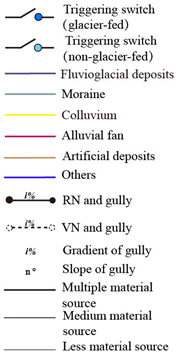
 Non-glacier-fed
 Glaciers exist upstream
 Neither glaciers nor glacial lakes upstream