
Article

Modeling Climate Change Impacts on Large and Small Lakes of the Tibetan Plateau: Responses and Drivers


1
Land-Atmosphere Interaction and its Climatic Effects Group, State Key Laboratory of Tibetan Plateau Earth System, Resources and Environment (TPESRE), Institute of Tibetan Plateau Research, Chinese Academy of Sciences, Building 3, Courtyard 16, Liucui Road, Chaoyang District, Beijing 100101, China
2
College of Earth and Planetary Sciences, University of Chinese Academy of Sciences, Beijing 100049, China
3
College of Atmospheric Science, Lanzhou University, Lanzhou 730000, China
4
National Observation and Research Station for Qomolongma Special Atmospheric Processes and Environmental Changes, Dingri 858200, China
5
Kathmandu Center of Research and Education, Chinese Academy of Sciences, Beijing 100101, China
6
China-Pakistan Joint Research Center on Earth Sciences, Chinese Academy of Sciences, Islamabad 45320, Pakistan
*
Authors to whom correspondence should be addressed.
Water 2026, 18(6), 653; https://doi.org/10.3390/w18060653
Submission received: 28 January 2026 / Revised: 1 March 2026 / Accepted: 5 March 2026 / Published: 10 March 2026

Abstract

Lakes are sensitive indicators of climate change and exhibit distinct responses to climatic variability. Using in situ eddy covariance and meteorological observations from Nam Co (“large lake”) and a small lake (“small lake”) adjacent to Nam Co, we evaluate the performance of the FLake model in simulating lake processes. The model generally reproduces the seasonal variations in mixed-layer depth and surface water temperature, although diurnal amplitudes are underestimated. Simulated sensible and latent heat fluxes agree well with observations when appropriate lake depth and light extinction coefficients are applied, with RMSEs of ~1 °C, 8 W m−2, and 22 W m−2 for lake surface temperature, sensible heat flux, and latent heat flux, respectively. For the “large lake”, latent heat flux simulations differ markedly between land-based and lake-based forcing, primarily due to differences in wind speed and air temperature. Long-term simulations (1981–2024) suggest progressive warming of lake surface waters, strengthened thermal stratification, and increasing surface heat fluxes, with downward longwave and shortwave radiation and near-surface air temperature identified as the dominant climatic drivers.

1. Introduction

Referred to as “Asia’s water tower,” the Tibetan Plateau (TP) contains the world’s largest high-elevation inland lake zone, with a mean elevation of ~4 km and approximately 32,843 lakes [1]. Under global warming, the TP has experienced pronounced hydroclimatic changes, including atmospheric warming and moistening, solar dimming, wind stilling, glacier retreat, and permafrost degradation [2,3]. Lakes, widely regarded as sensitive indicators of climate change in this region, have generally expanded across the central TP, largely in response to increased precipitation and glacier meltwater inputs [1,4,5]. Despite this broad consensus on lake expansion, modeled trends in lake temperature and evaporation remain inconsistent. For example, General Lake Model simulations indicate significant warming in Nam Co during 1979–2012 [6], whereas FLake (Fresh water Lake model) simulations over Ngoring and Gyaring in the northern TP show no clear warming trend [7]. Similarly, evaporation trends for Nam Co differ across approaches: FLake suggests increasing evaporation [8], while Complementary Relationship Lake Evaporation simulations report a decreasing trend [9]. These discrepancies highlight the necessity of rigorously evaluating model parameterizations and forcing data against in situ observations before applying lake models broadly across the TP. This need is further supported by field evidence showing that key parameters—such as constants used to parameterize the momentum roughness length—can differ substantially from values commonly adopted in ocean applications [10] and that both lake surface temperature and lake-air turbulent heat fluxes can vary markedly between large and small lakes [11,12]. Given the limited observations and the climatic importance of this high-elevation lake region, improving and rigorously validating lake-model performance remains a high priority.
Lakes differ from surrounding land surfaces by having lower albedo, smaller aerodynamic roughness, and higher thermal conductivity and heat capacity. These properties modulate local and regional climate by cooling the atmosphere in summer and warming it in winter, altering the diurnal and seasonal cycles of air temperature and changing turbulent heat fluxes [5,12,13,14]. Lakes can also influence precipitation [15,16] and redistribute surface energy budget components [13,17]. Due to their significance in catchment-scale water balance, energy budget and climatic change [12,15,16,17,18,19,20,21], enormous models have been applied and evaluated in lakes with different climatic and environmental background worldwide [22,23,24] and also on the TP [6,7,8,12,14,21,25,26]. Among these models, FLake is physically based and computationally efficient, making it suitable for coupling with numerical weather prediction systems [27]. Previous studies show that FLake can reproduce the observed seasonality of mixed-layer depth and simulate temperature structure with acceptable accuracy across a range of lake environments [6,7,8,22,24,28,29]. However, most evaluations rely on meteorological forcing from nearby land stations rather than over-lake measurements, and they largely assess model performances at daily or longer timescales by integrating satellite observations, with limited attention to in situ measurements with diurnal variability.
Here we evaluate FLake over two representative high-elevation lakes at Nam Co: Nam Co (hereafter referred to as the “large lake”) and the adjacent small lake near Nam Co (“small lake” for short). Our objectives are to: (1) assess FLake performance in simulating thermal structure, surface water temperature ( T s ), and turbulent heat fluxes at both diurnal and longer timescales; (2) quantify differences between simulations forced by “land-environment” and “lake-environment” forcing for both lakes; and (3) identify the dominant climatic drivers of long-term trends in simulated T s and turbulent heat fluxes after establishing model fidelity. To address these objectives, we combine in situ observations (including: T s , meteorological variables and eddy covariance (EC) observations in the “small lake” [10]; water temperature profiles, meteorological variables and EC observations in the “large lake” [11]; and land-environment meteorological variables in the “Nam Co Monitoring and Research Station for Multisphere Interactions, Chinese Academy of Sciences” (Nam Co station) [30], long-term China Meteorological Forcing Dataset (CMFD) forcing data during 1979–2016 [31] and the one-dimensional Flake model [27]).

2. Materials and Methods

2.1. Site Descriptions and Measurements

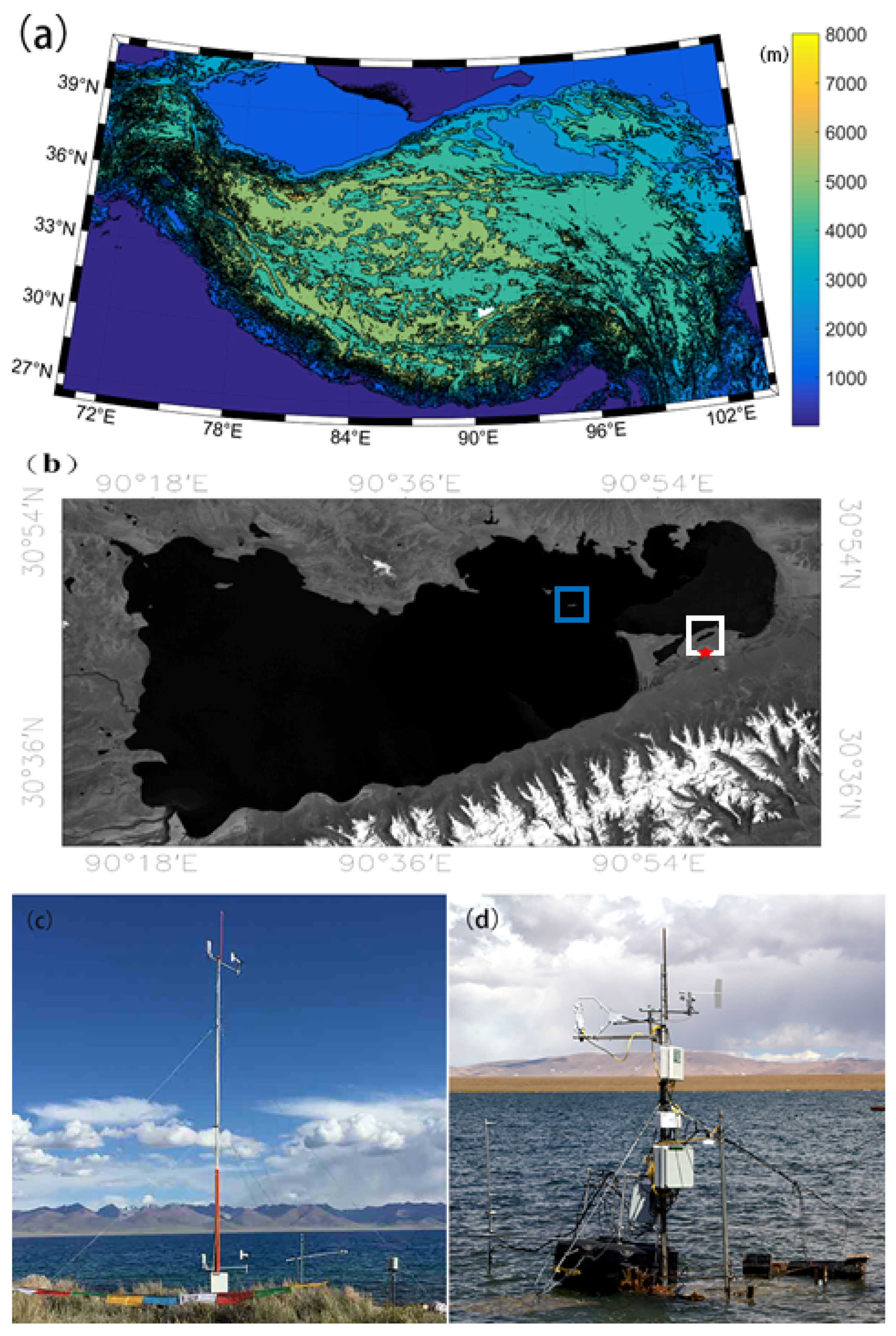
The locations and instrumentation of the two lakes are shown in Figure 1. Nam Co (90°15′–91°03′ E, 30°29′–30°56′ N; Figure 1b) and a small lake adjacent to Nam Co (90°58′10″ E, 30°46′55″ N; white box in Figure 1b) are situated in a flat region of the Nam Co basin on the TP. The “large lake” and “small lake” have maximum depths/surface areas/mean depths of approximately 90 m/2000 km2/40 m and 14 m/1.4 km2/7 m, respectively. The surrounding landscape is dominated by alpine meadow and steppe vegetation. The study area lies within a semi-humid to semi-arid climatic regime and is influenced by both the mid-latitude westerlies and the Asian summer monsoon. The mean annual air temperature is approximately 0 °C, and annual precipitation averages around 350–400 mm. The “large lake” is a closed basin without surface outflow and is primarily replenished by direct precipitation and surface inflow from a catchment area of approximately 10,680 km2. Both lakes are slightly brackish, with salinities of about 1198 m g L 1 [32].
Because of the differences in thermal capacity of the “small lake” and “large lake”, the seasonal variations in surface water temperature ( T s ), air temperature ( T a ) and turbulent heat flux are different [11]. The evaporation during the open-water period (April to November) of the “small lake” is estimated to be about 812 mm [10] while the open-water evaporation in the “large lake” is estimated to be around 980 mm during May to January. Furthermore, Secchi depth observations were performed on 15 November 2017, with measured values of 2.8 m in the “small lake” and 6.5 m in the “large lake”, respectively. Thus, following the empirical relationship between Secchi depth and extinction coefficient ( K d ), the K d (0.6 m−1) of the “small lake” is larger than that (0.3 m−1) of the “large lake”. As dark waters can produce shallower mixed-layer depth ( D m l ) and colder mean water column temperature and further result in warmer spring and colder fall temperatures compared to clear waters [33], a reported K d value of 0.1 m−1 through PAR (photosynthetically active radiation) probe observations [6] is used as the actual K d of the “large lake”.
The in situ measurements in both lakes are summarized in Table 1 and introduced briefly as follows: instruments of the radiation measurement system and turbulent flux measurement system in two lakes provide a radiation forcing, meteorological forcing and validation dataset of lake–atmosphere turbulent heat flux. Additionally, water temperature profiles to a maximum depth of 0.6 m in the “small lake” are obtained and provide a validation dataset of T s during its open-water period [34]. Similarly, lake temperature profile observations in the “large lake” were conducted from July to November in 2015 and 2016, with temperature sensors distributed at 10 depths (0.5, 1.5, 3, 6, 10, 15, 20, 25, 30 and 35 m). These observations provide validation datasets of T s and D m l in the “large lake”. To explore the long-term variations in the lake’s response to climate change in the “large lake”, the CMFD forcing from 1980 to 2024, which merges a variety of data sources including meteorological variables from in situ observations by the China Meteorological Administration, provides the most accurate meteorological variables (air temperature, air pressure, specific humidity, wind speed, downward longwave radiation and downward shortwave radiation) relative to other reanalysis datasets over the TP. The CMFD forcing has been widely used as the forcing data in climate change studies over the TP [6,9,35,36]. Additionally, meteorological variables (air temperature, air humidity, wind speed, and air pressure) by an automatic weather station (AWS) are observed on the island of the “large lake”, and a PBL (planetary boundary layer) tower observation of meteorological variables (including 5 layers of air temperature, air humidity, wind speed and wind direction at heights of 1.5, 2, 4, 10 and 20 m, as well as global solar radiation) in the Nam Co station provides an in situ forcing dataset since 2005 [30].

2.2. The Flake Model

The FLake model is a one-dimensional bulk model that represents the water column with a two-layer structure: an upper mixed layer with a vertically uniform temperature and an underlying thermocline layer that describes the stratified water extending to the lake bottom. The thermocline temperature profile is described with a self-similar formulation, where a dimensionless temperature–depth curve is controlled by a shape parameter [7,27]. Under this framework, vertical heat transport follows the water heat-budget equation, and the penetration of shortwave radiation into the water column is treated with exponential attenuation consistent with the Beer–Lambert law [23]. Mixed-layer depth is governed by both buoyancy-driven entrainment and shear-driven mixing. These contributions are computed using an entrainment-based prognostic equation for convective conditions and a diagnostic formulation for neutrally or stably stratified, wind-mixed regimes [27,37] (see Appendix A). Surface turbulent heat fluxes are computed using Monin–Obukhov similarity theory. The momentum roughness length parameterization adopts a Charnock constant of 0.031 and a roughness Reynolds number of 0.54 [10,11]. Beyond the open-water column, FLake also resolves temperature evolution in snow, lake ice, and bottom sediments using analogous self-similar profile assumptions with layer-dependent shape-factor parameterizations. A full description of the governing equations and parameter settings can be found in [27].

2.3. Preprocessing of CMFD Forcing Data and Validation Dataset

2.3.1. Preprocessing of CMFD Forcing and EC Data

Forcing data from different sources were intercompared and evaluated for consistency. First, solar radiation measured by the planetary boundary layer (PBL) tower at the Nam Co station shows diurnal variations and amplitudes very similar to those observed over the “small lake”, with a linear regression slope close to the 1:1 line. Furthermore, the CMFD forcing data are evaluated and bias-corrected using PBL tower observations. Overall, comparisons of daily accumulated values and monthly mean diurnal cycles between CMFD and PBL tower observations show reasonable agreement for most variables, with the largest biases existing in wind speed. For example, the monthly mean diurnal wind speed in the CMFD is approximately 1.5 m s−1 lower than that measured by the PBL tower. To correct these discrepancies, CMFD variables were adjusted using a two-step procedure: (1) linear regression relationships were established between CMFD and PBL tower observations for the daily sums of each variable; (2) after applying these corrections, the adjusted daily sum values were redistributed to the half-hourly scale using the original CMFD diurnal patterns. For wind speed, this correction mainly reduces systematic magnitude bias rather than altering its temporal evolution and preserves the long-term trend, particularly the wind stilling signal. Half-hourly turbulent heat fluxes were derived from high-frequency eddy covariance measurements using the widely applied Turbulence Knight 3 software package (http://zenodo.org/record/20349#; accessed on 10 November 2025 [38]), which includes all standard corrections. Following footprint analysis, flux measurements associated with wind directions originating from land surfaces were excluded and replaced with estimates derived from a bulk aerodynamic transfer method [10,34].
To examine model sensitivity to different forcing datasets for both the “small lake” and “large lake”, three long-term forcing scenarios were constructed by combining CMFD data, PBL tower measurements, and in situ observations: (1) “CMFD forcing,” consisting of CMFD data corrected using PBL tower observations; (2) “tower forcing,” in which CMFD forcing is partially replaced by PBL tower measurements at the Nam Co station; and (3) “in situ forcing,” which further replaces tower forcing with over-lake measurements from the “small lake” and “large lake”, respectively. The CMFD and tower forcing datasets are considered representative of land-dominated environments, whereas the in situ forcing represents lake-dominated conditions. Simulation results using these forcing datasets are compared for the “small lake” and “large lake” in Section 3.3.1 and Section 3.3.2, respectively.

2.3.2. Mixed-Layer Depth and Its Variations

The mixed-layer depth ( D m l ) in the “large lake” is derived from the observed temperature profiles using a threshold-based approach. Temperatures measured at ten discrete levels are first converted to a continuous vertical profile by spline interpolation from the surface to 36 m at 0.1 m vertical spacing, producing T i . To reduce the impact of short-lived warm or cool skin layers, the mixed-layer temperature ( T m l ) is defined as the average of T i over the upper 4 m for July–November. The mixed-layer base is then taken as the shallowest depth where | T m l T i | exceeds 1 °C. When this criterion is not met even at the deepest measurement level, the water column is treated as fully mixed and D m l is set to 35 m.
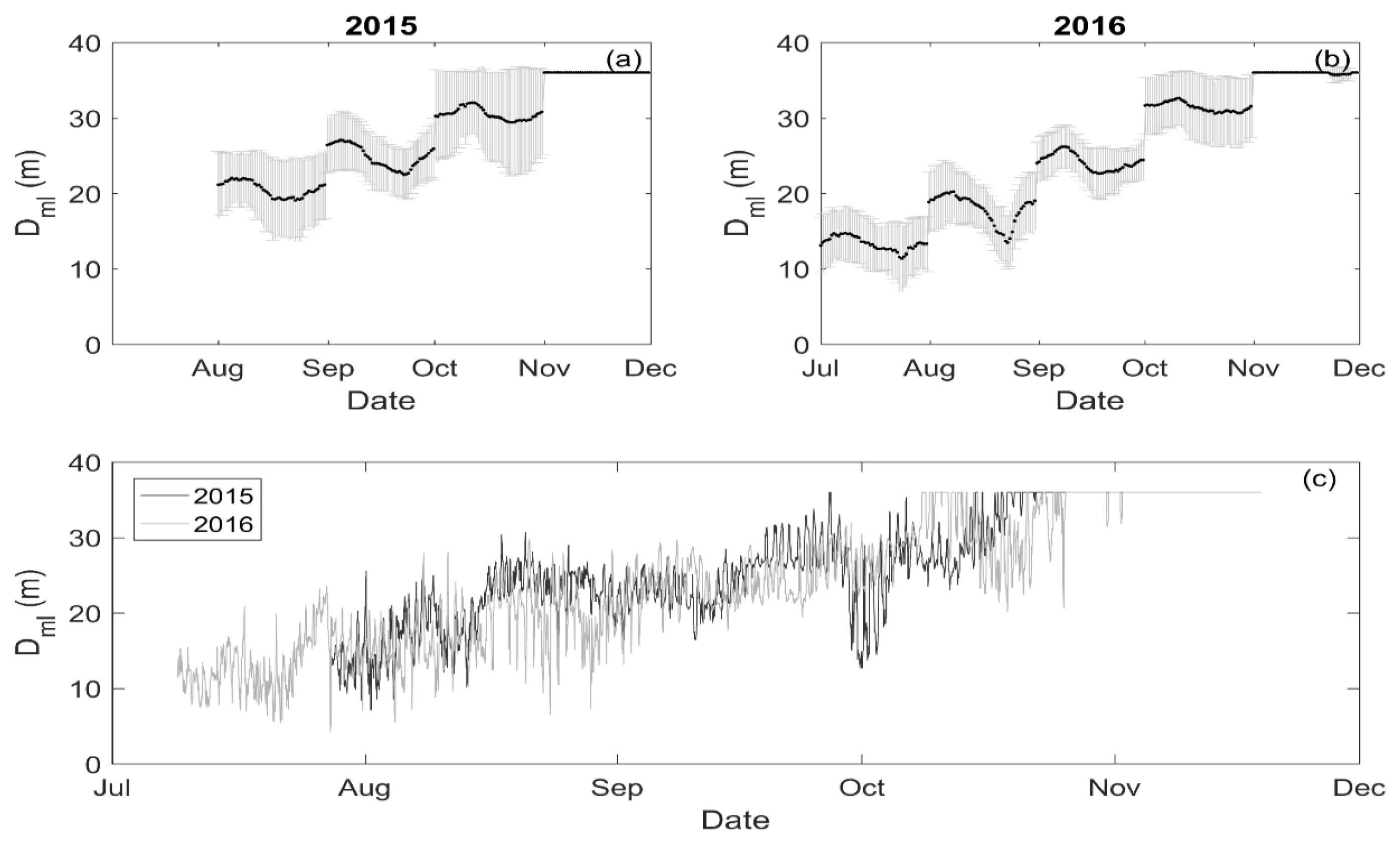
The resulting D m l estimates are compared with those derived using the Optimal Linear Fitting Method (OLFM; [39]). The two methods produce similar seasonal variations in D m l ; however, the threshold method more closely matches the observed mixed-layer structure, whereas the OLFM slightly overestimates D m l due to the coarse vertical resolution of the temperature measurements [40]. Pronounced diurnal variations in D m l occur from July through October, whereas the lake transitions to a nearly fully mixed state in November (Figure 2a,b). Typically, D m l shoals after sunrise, reaches its shallowest values in the late afternoon, and then deepens overnight. This pattern is consistent with daytime shortwave heating that strengthens near-surface stratification and nighttime surface cooling that promotes convective overturning and deepening of the mixed layer. Seasonally, D m l increases from roughly 10 m in July to the deepest observed level (~35 m) by mid-October (Figure 2c), in line with behavior reported for other high-elevation lakes [41]. The largest diurnal D m l amplitudes reach about 18 m on 2 August 2015 and 19 m on 27 July 2016. Mean diurnal amplitudes are 7.2 m in 2015 and 8.8 m in 2016. Wang et al. [23] has also found that thermal stratification in large lakes is primarily controlled by radiative forcing and turbulent fluxes, whereas in small lakes, it is jointly driven by radiation and wind speed. These pronounced diurnal and seasonal variations provide a robust observational benchmark for evaluating vertical mixing processes in the FLake model.

3. Results

3.1. Sensitivity Analysis of Lake Depth and Extinction Coefficient by Flake Modeling

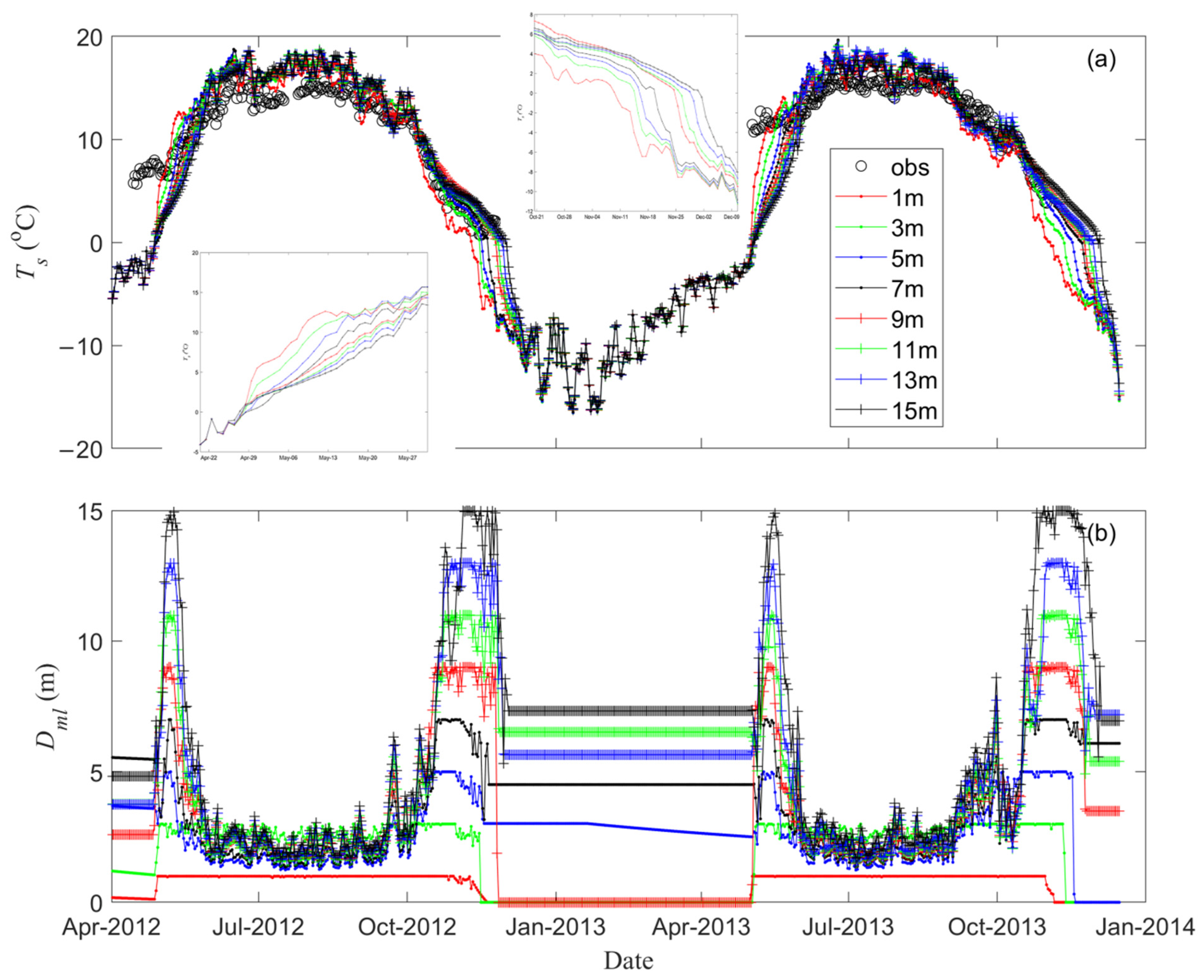
Lake depth and light extinction coefficient ( K d ) strongly affect FLake simulations [27], so we carried out sensitivity tests to quantify their impacts. For the “small lake”, we ran a set of experiments with lake depth ranging from 1 to 15 m (step = 2 m) using in situ forcing for 2012–2013 and evaluated the outputs against observed surface water temperature ( T s ) (Figure 3). Across all depth settings, the model captures the overall seasonal evolution of T s . The largest inter-experiment differences occur during transitional periods immediately after ice break-up and just before freeze-up, when simulated mixed-layer dynamics diverge most. As expected, shallower depths produce faster warming following ice melt and earlier cooling in autumn. For example, the simulated freeze-up date (defined as T s = 0 °C) occurs on 8 November for the 1 m case but shifts to 7 December for the 15 m case. Although ice-off is delayed in all simulations, the timing of freeze-up suggests that a representative mean depth of ~7 m is appropriate for FLake simulations of the “small lake”.
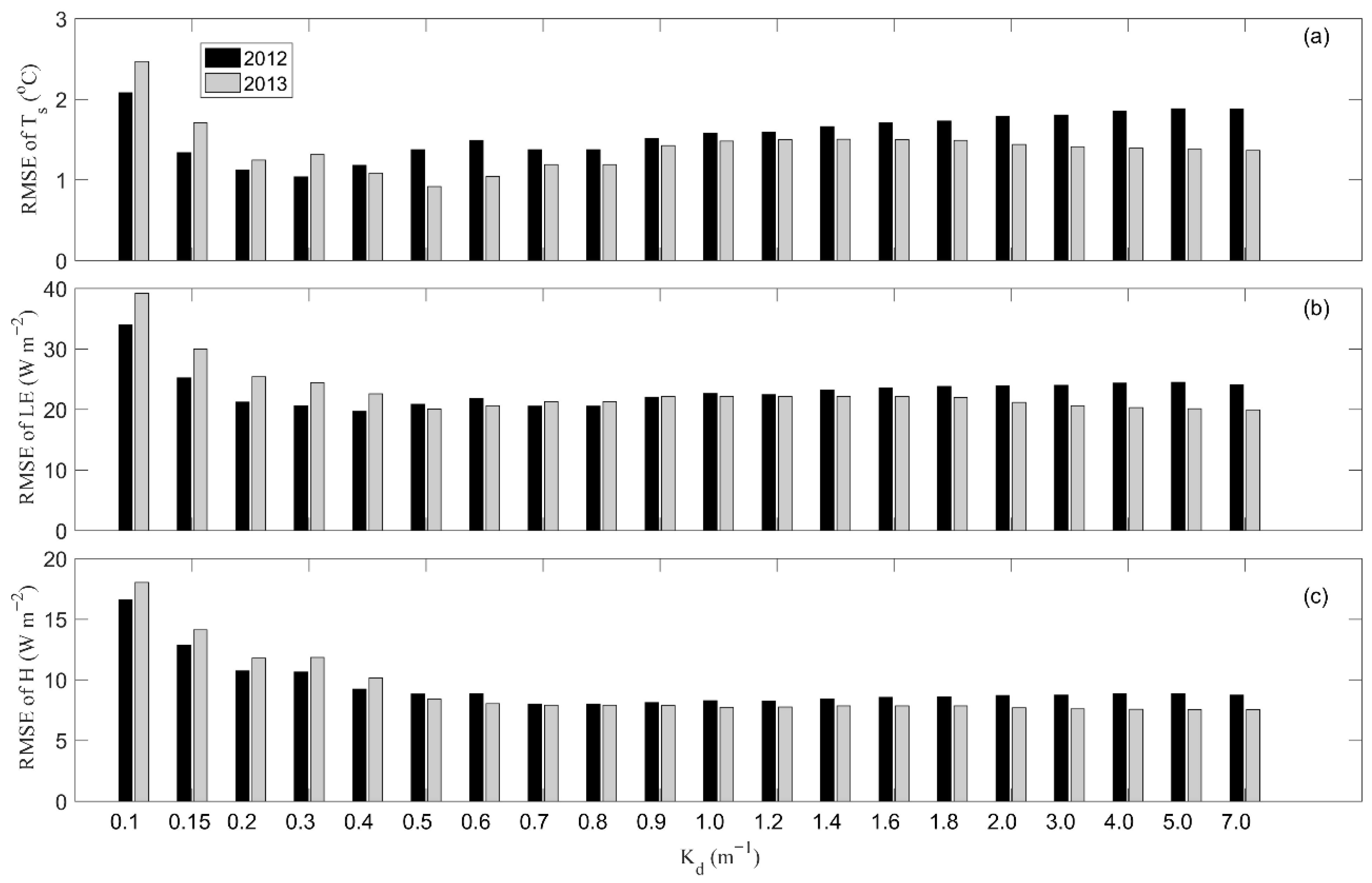
Sensitivity experiments were further conducted for K d , with values ranging from 0.1 m−1 to 7.0 m−1 across 20 simulations. Model performances were evaluated using in situ observations of T s and turbulent heat fluxes, quantified by root-mean-square error (RMSE) (Figure 4). The value of K d directly controls the vertical penetration of solar radiation, thereby influencing D m l and the amplitude of diurnal T s variations. RMSE values for T s decrease as K d increases up to approximately 0.4 m−1 and then show a slight increase for larger K d values (Figure 4a). Similar behavior is found for latent heat flux (LE; Figure 4b) and sensible heat flux (H; Figure 4c), with RMSE values decreasing toward K d ≈ 0.4 m−1 and remaining relatively stable thereafter. The physical mechanism can be explained as follows. As K d increases, shortwave radiation is attenuated more strongly and absorbed closer to the surface. For moderate K d values, concentrating solar heating in the near-surface layer enhances daytime warming and enables the model to better reproduce the observed diurnal amplitude of T s , thereby reducing RMSE. In contrast, when K d is excessively large, incoming radiation is confined to an unrealistically thin surface layer, limiting heat penetration into deeper water and weakening effective vertical mixing. This yields overly strong stratification, an underestimated mixed-layer depth, and an overestimated surface temperature, which together lead to an increase in the RMSE of T s . The minimum RMSE values for 2012 are approximately 1 °C for T s , 20 W m−2 for LE, and 8 W m−2 for H. The influence of K d on the diurnal variability of simulated T s in both the “small lake” and “large lake” is discussed in further detail in Section 3.2.

3.2. Model Performances in the Two Lakes

Daily T s has been frequently adopted as a benchmark for lake-model validation in previous studies [7,8,24,33], and parameter sets that minimize the RMSE of daily T s are commonly considered optimal [42]. Nevertheless, analyses at the diurnal scale can reveal additional deficiencies that are not evident in daily averages, providing a more stringent test of model skill [23]. In this section, we evaluate model performance for the two lakes using both daily and diurnal in situ observations of T s and turbulent heat fluxes, together with observed D m l in the “large lake”.

3.2.1. Model Performance in the “Small Lake”

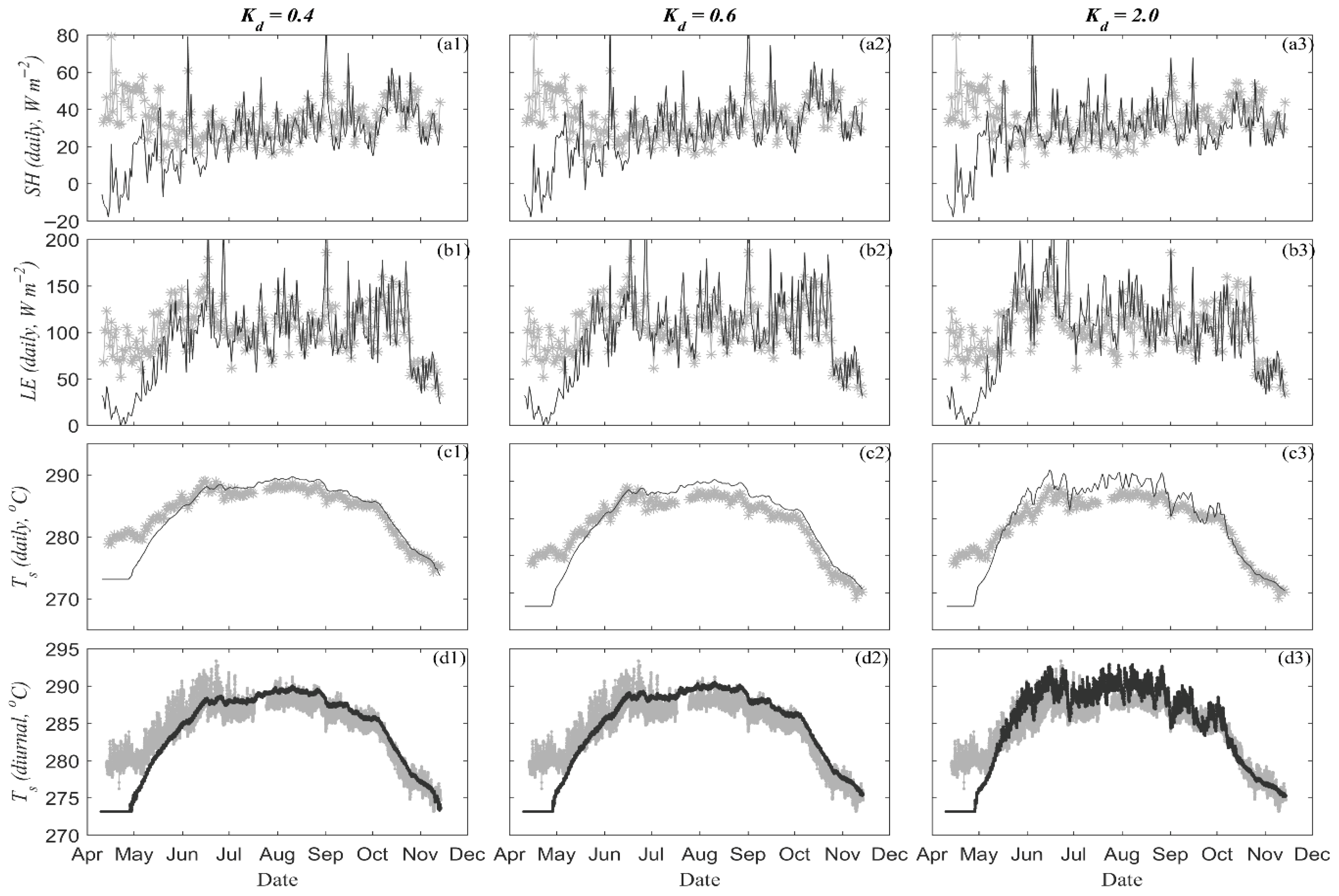
For the “small lake”, we assessed FLake against in situ measurements of sensible heat flux (H), latent heat flux (LE), and both daily T s and diurnal T s . Three representative extinction coefficients ( K d ) were selected: 0.4 m−1 (minimum RMSE for daily T s ), 0.6 m−1 (Secchi depth estimate), and 2.0 m−1 (closest to the observed diurnal T s amplitude) (Figure 5). FLake successfully reproduces the seasonal evolution of daily T s , H, and LE, but it shows clear negative biases in April–May. The underestimated T s during this period (Figure 5c1–c3) weakens the lake–atmosphere temperature and moisture gradients, which in turn leads to underestimated LE (Figure 5b1–b3) and H (Figure 5a1–a3). Because larger K d values confine solar radiation to shallower depths, producing a shallower mixed layer and amplifying diurnal T s variability, the simulation with K d = 2.0 m−1 more closely matches the observed diurnal T s amplitude than the simulations using smaller K d values. Accordingly, the K d = 2.0 m−1 case reproduces the observed diurnal T s variability more closely than the lower- K d experiments (Figure 5d1–d3).
Two primary deficiencies emerge from the FLake simulations. First, the simulated ice-melt date lags behind the observations by approximately one month, leading to substantial underestimation of T s during the early open-water period (Figure 3a and Figure 5d1–d3). This inconsistency in the ice-melt date is likely related to an inadequate representation of snowfall/snow-cover events in the model. The lack of snow observations limits constraints on simulated snow cover and its insulating effect, which may lead to biases in the modeled ice-off date (e.g., an earlier-than-observed ice melt, [43]). Second, while FLake captures the seasonal evolution of daily T s , it does not reproduce the observed magnitude of the diurnal T s variability. Furthermore, the simulated D m l remains near 2.5 m during June–September 2012 (with similar behavior in 2013; Figure 3a), when the modeled T s is slightly higher than observed (Figure 5c1,d1). This warm bias is likely related to an underestimated D m l . Despite these discrepancies, the simulated T s and turbulent heat fluxes are broadly comparable among the tested cases, suggesting that FLake is generally able to represent lake impacts on weather and climate within lake-basin environments.

3.2.2. Model Performance in the “Large Lake”

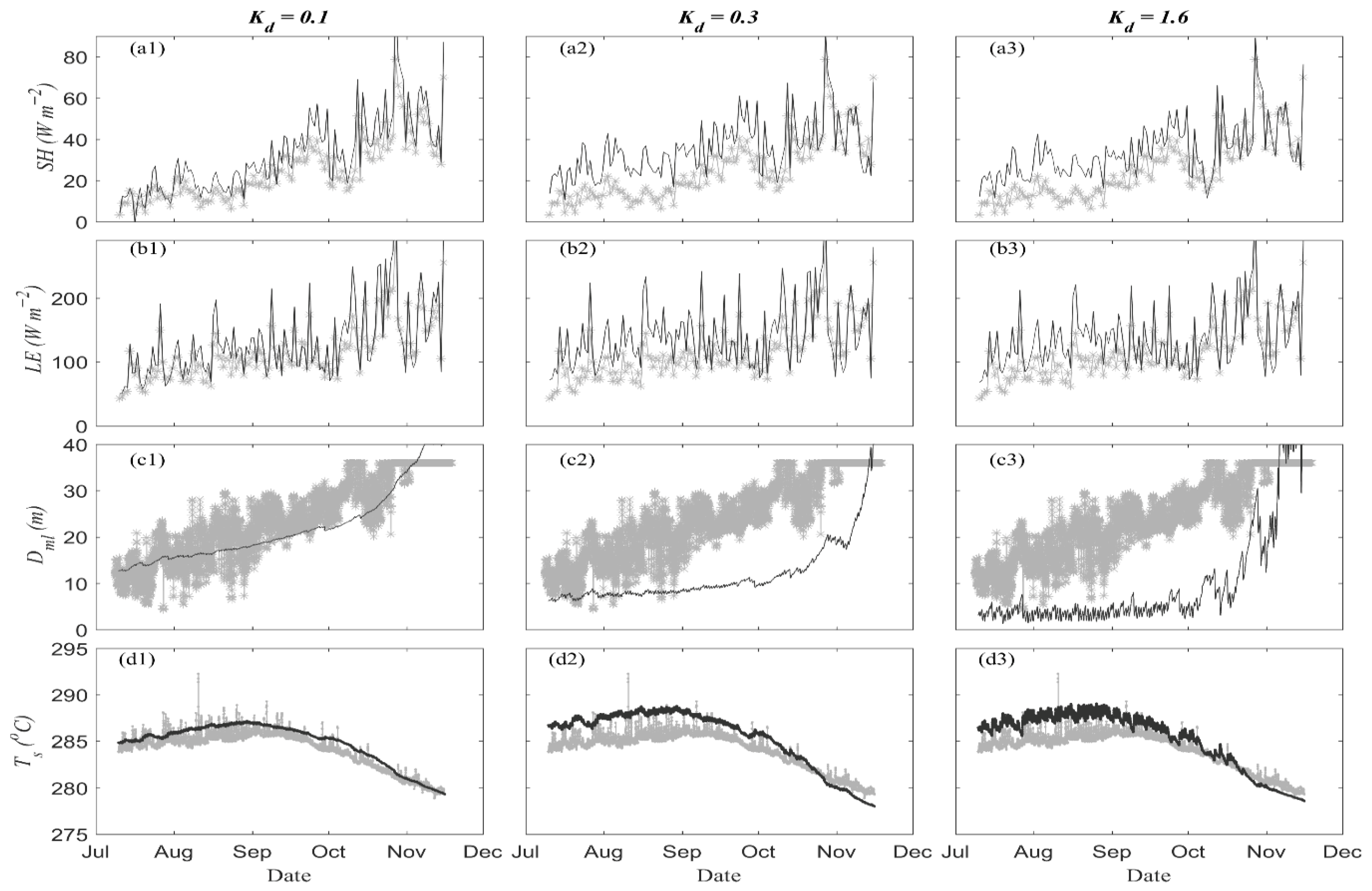
Sensitivity experiments for K d were also conducted for the “large lake”. Model simulations using K d values of 0.1 m−1 (derived from PAR probe measurements; [6]), 0.3 m−1 (estimated from Secchi depth observations in November 2016), and 1.6 m−1 (chosen to approximate the observed amplitude of diurnal T s variability) were evaluated against observations of daily H, LE, D m l , and T s (Figure 6). Among the tested values, simulations with K d = 0.1 m−1 best reproduce the seasonal evolution and increasing trends of H, LE, and D m l , as well as the seasonal variation of T s . In contrast, simulations using K d = 0.3 m−1 and 1.6 m−1 show poorer agreement with observations. Higher K d values confine solar radiation to shallower depths, resulting in a shallower mixed layer and a larger diurnal amplitude of T s (Figure 6c1,d1). Consequently, the substantial overestimation of H and LE at K d values of 0.3 m−1 and 1.6 m−1 corresponds to underestimated D m l and overestimated T s (Figure 6a2–d2,a3–d3). Moreover, an underestimated D m l amplitude can suppress the simulated diurnal variability of T s . Although the diurnal T s amplitude simulated with K d = 1.6 m−1 is closer to observations, its seasonal behavior is distorted. These results indicate that K d critically controls the vertical distribution of solar radiation, thereby regulating D m l , diurnal T s variability, and ultimately the simulated turbulent heat fluxes.
Given its superior performance in representing lake heat transfer processes, simulations using K d = 0.1 m−1 are adopted for quantitative model evaluation. The simulated H and LE exhibit increasing trends from July to November, consistent with observations, with RMSE values of approximately 9 W m−2 and 18 W m−2, respectively. Eddy covariance and radiation measurements indicate an energy budget closure of about 0.86 during this period, which may contribute to an overestimation of simulated T s (Figure 6d1). To assess the potential influence of energy imbalance on T s simulation, we conducted a sensitivity experiment assuming a closed energy budget. In this test, the 14% residual was proportionally redistributed to the net radiative input (represented here by downward shortwave radiation) to examine the response of simulated T s . Under this assumption, the agreement between simulated and observed T s improves substantially, with RMSE decreasing from 3.15 °C to 1.9 °C. It should be noted that this redistribution does not imply that the residual originates solely from shortwave radiation, but rather serves to evaluate the sensitivity of T s to uncertainties in surface energy closure. Overall, the FLake model with K d = 0.1 m−1 satisfactorily reproduces the seasonal variation of T s , captures the increasing trends of H and LE, and represents the seasonal evolution of D m l . These simulations are therefore used for the long-term trend analysis presented in Section 3.4.

3.3. Model Performance with Forcing Variables

3.3.1. Model Performance with Forcing Variables in the “Small Lake”

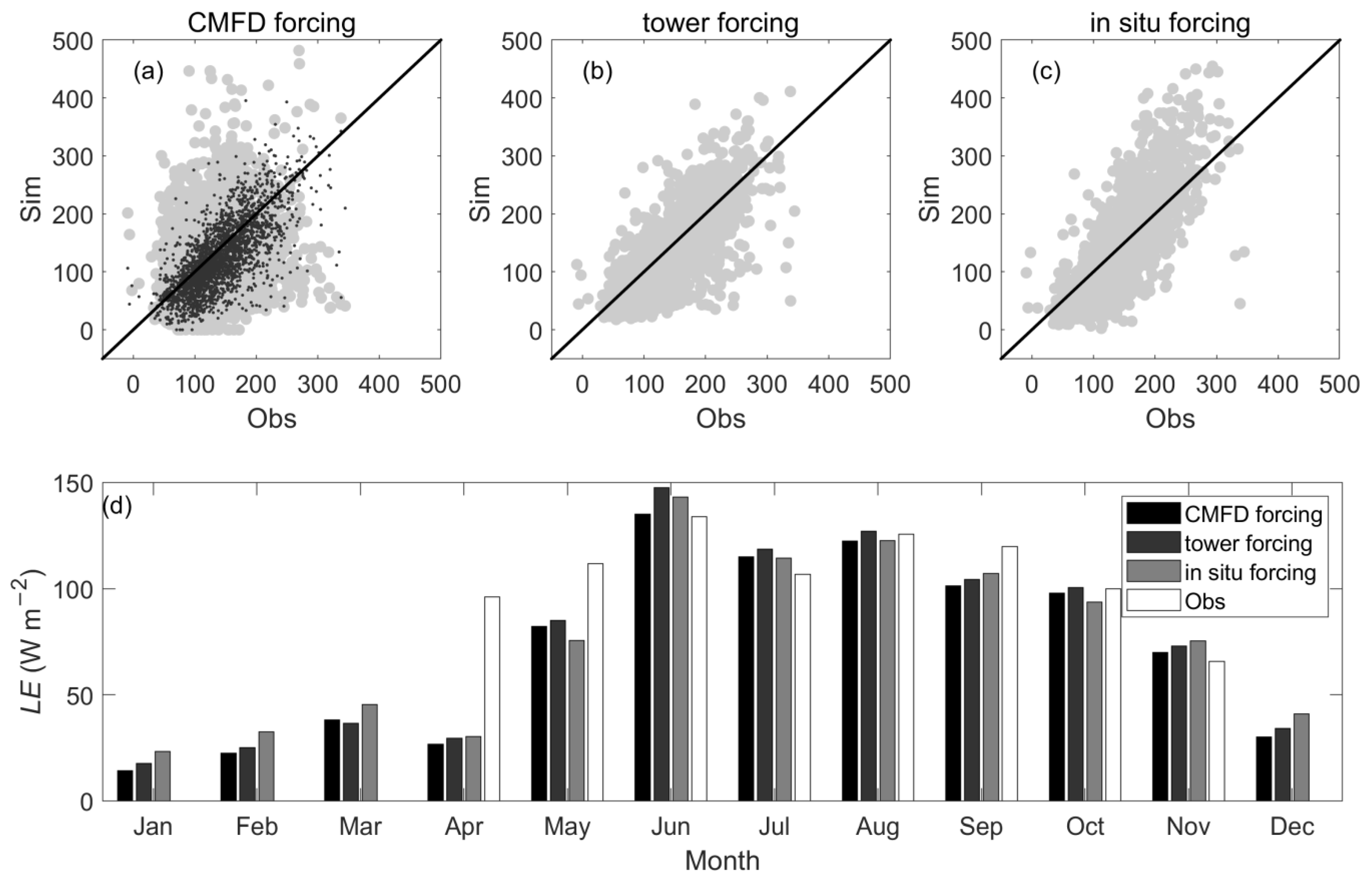
The performance of simulated latent heat flux (LE) using the three forcing datasets (“CMFD forcing,” “tower forcing,” and “in situ forcing”) is evaluated against EC observations in Figure 7. Scatter plots of half-hourly LE indicate that simulations driven by in situ and tower forcing perform similarly well, with comparable RMSE values of 46.5 W m 2 and 44.0 W m 2 , respectively (Figure 7b,c). By contrast, the experiment driven by CMFD forcing displays much larger dispersion and nearly twice the error size (RMSE = 82.5 W m 2 ), suggesting that the CMFD is not suitable for reproducing the diurnal variability of LE, even after bias correction. This deficiency is primarily linked to biases in CMFD wind speed. When CMFD wind speed is replaced with tower-based values, the agreement between simulated and observed LE improves markedly, with scatter points clustering closer to the 1:1 line and RMSE reduced to 46.0 W m 2 . Despite these differences at sub-daily scales, the monthly mean LE simulated with all three forcing datasets exhibits similar seasonal patterns, with a maximum in June. The largest biases occur in April and May, coinciding with periods when simulated T s is substantially underestimated. Overall, FLake captures the seasonal evolution of LE over the “small lake” reasonably well, with the greatest errors occurring during the early open-water period after ice-off. However, simulations driven by reanalysis-based forcing are not recommended for diurnal LE analysis, mainly because of persistent wind-speed biases.

3.3.2. Model Performance with Forcing Variables in the “Large Lake”

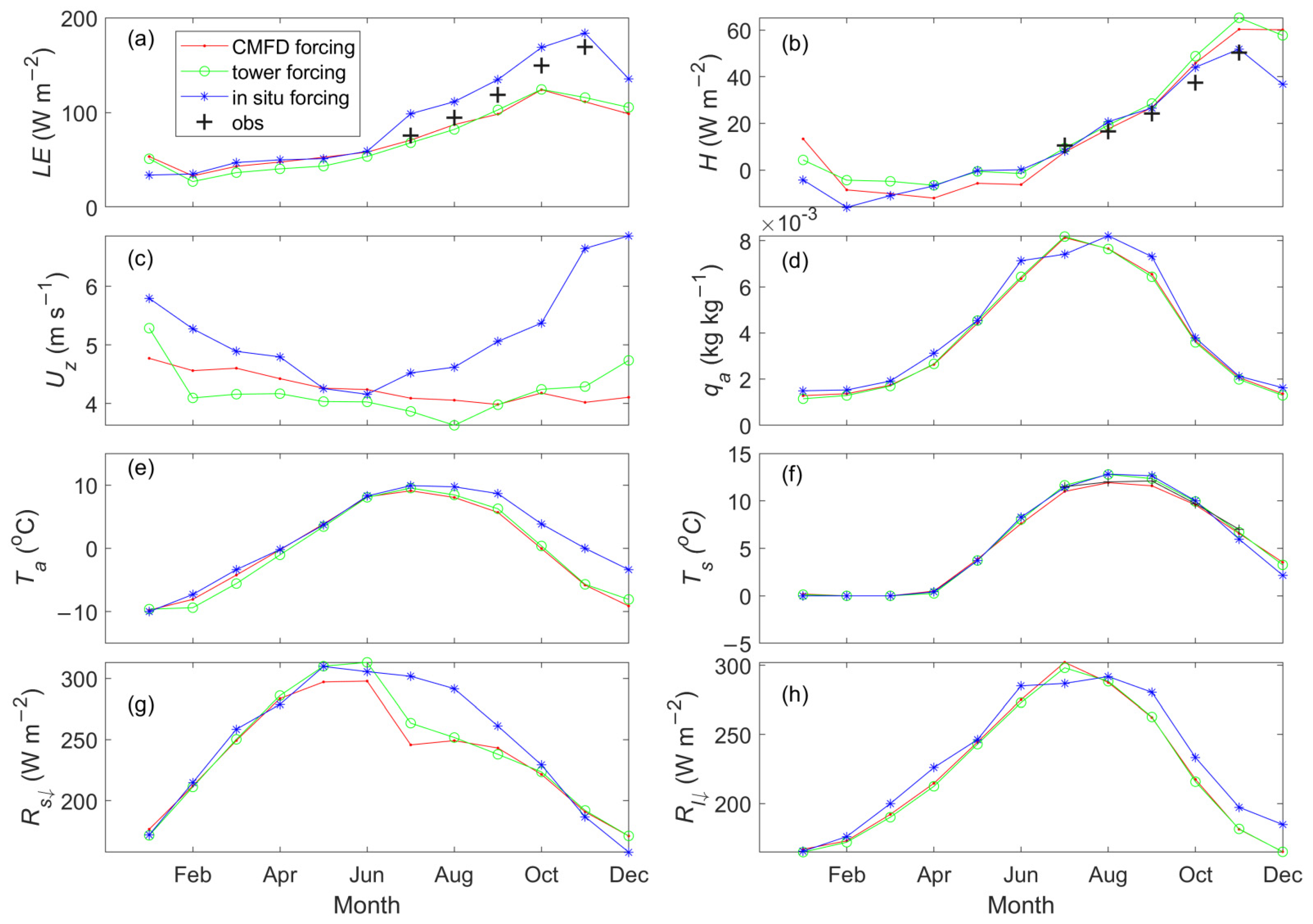
To further examine model sensitivity to forcing variables in the “large lake”, the seasonal variations in forcing data and corresponding FLake simulations driven by “CMFD forcing,” “tower forcing,” and “in situ forcing” are intercompared and evaluated against in situ observations of turbulent heat fluxes and T s (Figure 8). Marked differences exist between forcing conditions representative of lake-dominated and land-dominated environments. Wind speed in the lake-dominated environment is substantially higher than that derived from land-based observations (Figure 8c). In addition, air temperature ( T a ) and downward longwave radiation ( R l ) are higher over the lake, particularly from August to December (Figure 8e,h), reflecting the thermal influence of the warm lake surface. Downward shortwave radiation ( R l ) during the monsoon season (July–September) is also greater in the lake-dominated environment than over land (Figure 8g), likely due to differences in cloud formation over and around the lake.
Differences in simulated LE and H primarily occur during the open-water period from July to December. For LE, the two land-environment forcing datasets produce nearly the same seasonal cycle and consistently smaller values than the experiment forced by lake-environment observations (Figure 8a). Simulated H values are also similar between the two land-dominated forcings, but simulations driven by lake-dominated forcing agree more closely with observations, except during November and December. Previous studies have shown that monthly LE and H are largely controlled by wind speed multiplied by the water vapor gradient and temperature gradient, respectively [34]. Because observed specific humidity and simulated monthly T s are similar across all three forcing datasets (Figure 8d), the larger LE in the lake-environment case is mainly explained by its substantially higher wind speeds (Figure 8c). In contrast, simulated H reflects a combined influence of enhanced wind speed and reduced water–air temperature gradients in the lake-dominated environment (Figure 8e,f). Furthermore, simulations driven by lake-dominated forcing reproduce the observed November peak in LE, whereas land-dominated forcing yields an October maximum, consistent with findings by Lazhu et al. [8].

3.4. Lakes’ Response to Climate Change and Its Driving Forces

Lake warming has been widely documented across diverse regions worldwide [44,45,46] and also for Nam Co on the TP [6]. Based on the rigorous evaluations conducted for Nam Co, which demonstrate good model performance in reproducing the seasonal variability of T s , D m l , and turbulent heat fluxes, we conclude that the key processes governing lake–atmosphere interactions and internal mixing are reasonably well represented by the FLake model. Consequently, FLake simulations, together with their meteorological forcing, are used to examine long-term lake responses to climate change and to identify the dominant climatic drivers.

3.4.1. Lakes’ Response to Climate Change

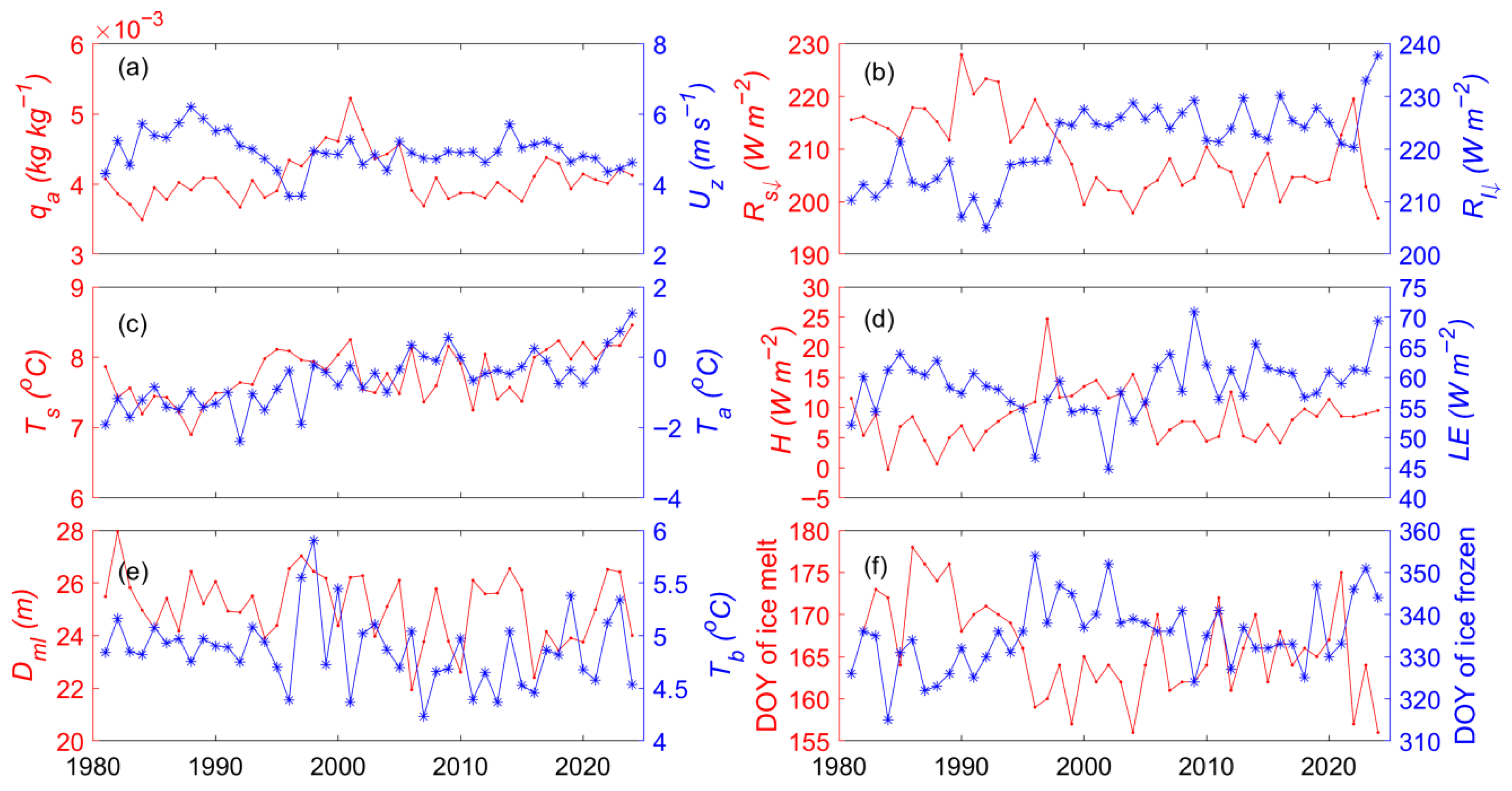
Under the climatic background of pronounced air warming and moistening, wind stilling, and solar dimming over the TP [2], clear long-term trends are evident in the bias-corrected CMFD forcing data (Figure 9a–c). Air temperature and specific humidity increase at rates of 0.51 °C decade−1 and 3.84 × 10⁻⁵ kg kg−1 decade−1, respectively, while wind speed and downward shortwave radiation decrease at rates of −0.11 m s−1 decade−1 and −3.6 W m−2 decade−1. The most pronounced trend is observed in downward longwave radiation, which increases at a rate of 4.29 W m−2 decade−1. Correspondingly, the simulated lake surface temperature exhibits a clear warming trend of 0.15 °C decade−1, whereas the simulated bottom temperature at 40 m shows only a weak and statistically insignificant decrease of −0.005 °C decade−1. This contrast between rapid surface warming and minimal bottom cooling indicates increasing thermal stability of the water column, consistent with the simulated decline in mean D m l at a rate of −0.27 m decade−1. In addition, the simulated timing of spring overturn advances, while autumn overturn is slightly delayed, resulting in a longer stratified period for Nam Co. Both simulated LE and H show increasing trends, with rates of 12.2 W m−2 decade−1 and 4.18 W m−2 decade−1, respectively, reflecting enhanced lake–atmosphere heat exchange under ongoing climatic warming.

3.4.2. Driving Forces Behind Lakes’ Variations

Lake warming is widely recognized as a response of inland water bodies to global climate warming and has been documented across diverse regions worldwide. In our study, increasing trends in T s and turbulent heat fluxes in Nam Co are also identified using FLake simulations, consistent with previous findings [6,8]. Earlier studies attribute lake warming primarily to increases in T a and R l [6], while T a , R s , and R l are considered dominant drivers of lake evaporation [8].
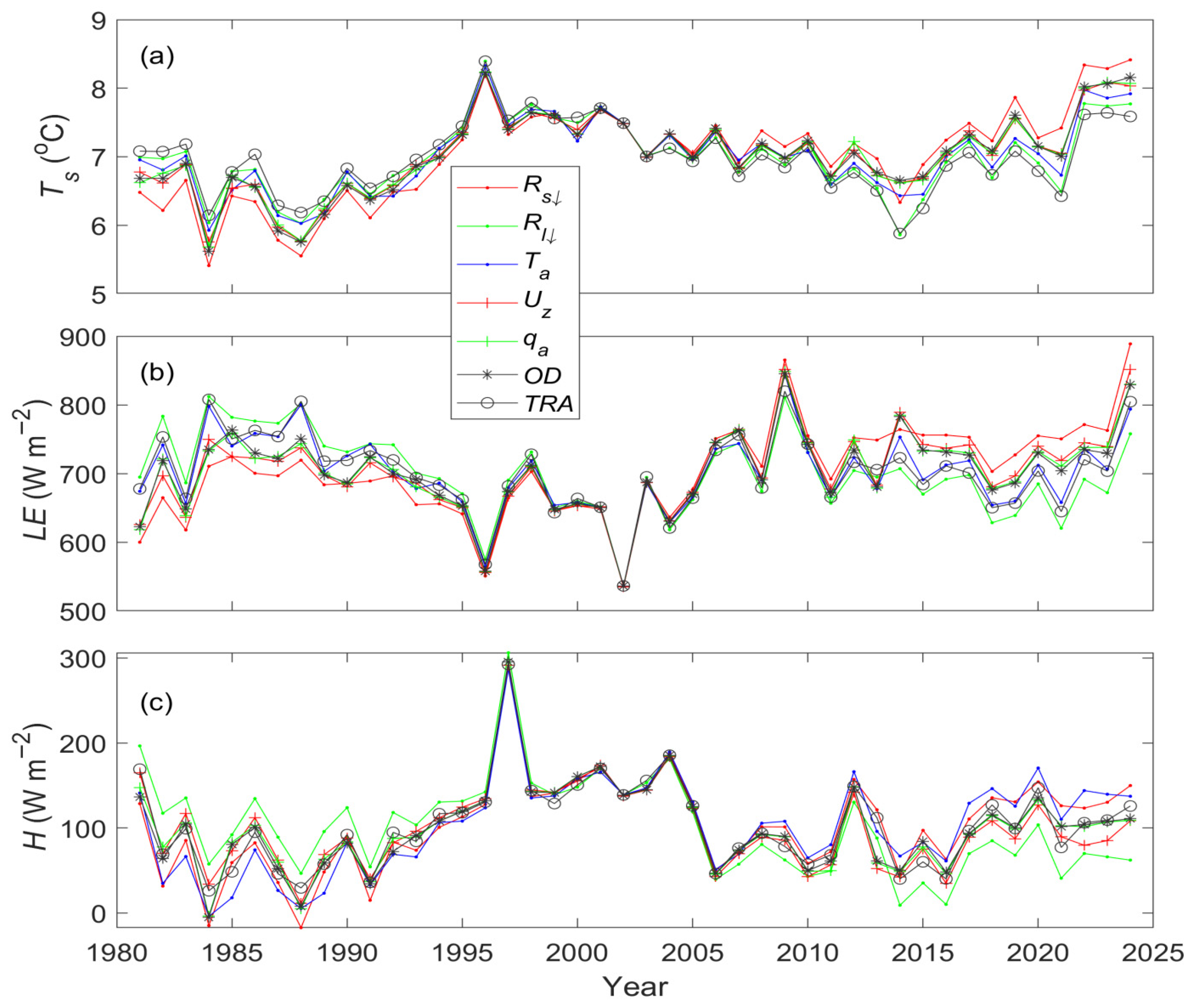
To quantify the relative contributions of individual forcing variables to trends in simulated T s and turbulent heat fluxes, a trend-removal analysis [47] is performed following three steps. First, linear trends are removed from the meteorological forcing variables ( R s , R l , T a , q a , and U z ), producing five stationary time series. Second, seven FLake simulation experiments are conducted using different combinations of original and detrended forcing data: (EXP1) detrended R s , (EXP2) detrended R l , (EXP3) detrended T a , (EXP4) detrended q a , and (EXP5) detrended U z , with all other variables retained in their original form; (EXP6)original forcing (OD); and (EXP7) detrended forcing for all variables (TRA). Third, trends in simulated T s , LE, and H are quantified using linear regression and compared across experiments.
The results of the trend-removal experiments are summarized in Table 2 and Figure 10. For T s , the baseline simulation indicates a warming rate of 0.25 °C d e c a d e 1 . Removing trends in qa (0.24 °C d e c a d e 1 ) or U z (0.24 °C d e c a d e 1 ) leads to only minor changes. In contrast, removing the decreasing trend in R s increases the T s warming rate markedly to 0.38 °C d e c a d e 1 . Detrending T a reduces the warming to 0.16 °C d e c a d e 1 , although a clear positive trend remains. Most notably, detrending R l alone substantially weakens the warming to 0.078 °C d e c a d e 1 , and removing trends in all forcing variables nearly eliminates the signal (0.02 °C d e c a d e 1 ). These results indicate that R l is the dominant driver of lake-surface warming, with R s and T a playing secondary roles.
For LE, the baseline simulation exhibits a strong increasing trend of 12.2 W m 2   d e c a d e 1 . Removing the decreasing trends in R s and U z amplifies the LE increase to 30.9 and 18.0 W m 2   d e c a d e 1 , respectively. By contrast, removing the increasing trends in R l and T a reduces the LE trends to −17.5 and −1.85 W m 2   d e c a d e 1 , respectively. Detrending q a has little impact on LE at Nam Co. When trends are removed from all forcing variables, LE shows a weak decreasing trend (−5.5 W m 2   d e c a d e 1 ). Overall, these results suggest that the increase in R l is the primary contributor to enhanced evaporation, with T a and R s exerting weaker influences.
For H, the baseline simulation shows an increasing trend of 4.18 W m 2 d e c a d e 1 . Detrending R l reverses the trend to a pronounced decrease (−18.2 W m 2 d e c a d e 1 ), whereas detrending T a and R s strengthens the positive H trend by increasing the lake–atmosphere temperature gradient. Detrending U z or q a has comparatively a small effect. Notably, even when all forcing variables are detrended, a positive trend in H remains (3.25 W m 2   d e c a d e 1 ). Taken together, changes in H appear to be governed by the combined effects of R l , R s and T a through their modulation of lake–atmosphere temperature gradients.

4. Discussions

4.1. Uncertainties Existed in D m l -Related Issues

The amplitudes of diurnal variations in simulated T s , even when using K d values close to those inferred from observations, are smaller than those observed during the summer open-water period in both the “small lake” (Figure 5d1,d2) and the “large lake” (Figure 6d1,d2). This deficiency arises primarily from limitations in the parameterization of diurnal D m l variability in the FLake model (see Appendix A). Several parameters govern the estimation of D m l in FLake. These include: (1) the dimensionless constants C n , C i and C s in Equation (A8), adopted from [38], with typical ranges of 0.1–0.5 for C n , 1.2–100 for C s , and order-of-magnitude values of ~10 for C i ; (2) the dimensionless constant C r h in Equation (A7), which controls wind-driven mixing under neutral or stable stratification and varies between 0.025 and 0.5 across studies [27]; and (3) the constants C c 1 and C c 2 in Equation (A1), which parameterize convective mixing. Sensitivity analyses indicate that variations in C n , C i , and C s have little effect on D m l estimation. In contrast, a smaller C r h produces a deeper mixed layer with a reduced diurnal amplitude, whereas a larger C r h yields a shallower mixed layer with enhanced diurnal variability. Among the convective mixing parameters, C c 1 exerts a strong influence on both the magnitude and diurnal amplitude of D m l , while C c 2 shows minimal sensitivity. Consequently, C c 1 and C r h are identified as the most influential parameters governing heat-flux-driven and wind-driven mixing, respectively. However, tuning these parameters does not simultaneously improve D m l simulations for both the “small lake” and the “large lake”.
Observations further show that the diurnal amplitude of T s is larger in the “small lake” than in the “large lake” (Figure 5d1 and Figure 6d1). This contrast can be attributed to physical differences between the two systems. Compared with the “large lake”, the “small lake” experiences weaker wind-induced mixing, larger K d , and consequently a shallower D m l , leading to stronger daytime surface warming. At night, its smaller thermal capacity and larger water–air temperature gradients promote more pronounced surface cooling. Although the seasonal evolution of D m l is reasonably captured in the “large lake”, the simulated diurnal amplitude of D m l is substantially underestimated relative to observations (Figure 6c1). Similarly, the simulated D m l of approximately 2 m in the “small lake” during June–September (Figure 3b) is likely underestimated. This underestimation of diurnal D m l variability directly leads to an underestimation of diurnal T s amplitude in both lakes (Figure 5d1 and Figure 6d1). While increasing K d can partially enhance the simulated diurnal T s amplitude in the “small lake” (Figure 5d1), it simultaneously degrades the representation of seasonal D m l and T s variations in the “large lake” (Figure 6c1,d1). These results indicate that adjusting K d alone cannot resolve the deficiencies in diurnal variability. Overall, the findings highlight the need for a more robust and physically realistic parameterization of mixed-layer dynamics in the FLake model, particularly to better represent diurnal variations in D m l and T s across lakes of different sizes and thermal regimes.

4.2. Discussions on Lakes’ Response to Climate Change

The climate over the TP is characterized by decreasing trends in R s and U z , together with increasing trends in R l , T a , and q a , consistent with previous findings [2]. The simulated lake warming during stratified periods, at a rate of 0.25 °C decade−1, is only half of the warming rate of 0.52 ± 0.25 °C decade−1 reported for July–September using the General Lake Model [6], in which increases in T a and R l were identified as the primary drivers. Our trend-removal analysis (Section 3.4.2) supports this conclusion.
Removing the trend in T a reduces the warming rate of T s through modified lake–atmosphere heat exchange, accompanied by a significant increase in H and an obvious decrease in LE. However, these results further highlight the dominant role of R l , which acts as a direct radiative energy input to the lake surface and exerts a stronger influence on lake warming than T a . Simultaneously, removing the decreasing trends in R s can also contribute to the significant increase trends in simulated T s , H and LE. Wind speed and lake–atmosphere vapor and temperature gradients are the primary controls on latent and sensible heat fluxes, respectively [34]. Removing the decreasing trend in U z or the increasing trend in q a enhances the simulated LE trend. In contrast, detrending T a reduces T s warming and thereby weakens LE by decreasing the vapor pressure gradient, while simultaneously strengthening H by increasing the lake–atmosphere temperature gradient. Both R s and R l directly influence T s through radiative forcing. Removing the decreasing trend in R s enhances T s warming, whereas removing the increasing trend in R l substantially suppresses it, leading to corresponding increases or decreases in LE and H through their effects on vapor and temperature gradients.
However, the pronounced increasing trend in downward longwave radiation ( R l ) in this study (4.29 W m−2 decade−1 over 1981–2024) is substantially larger than the ~1.3 W m−2 decade−1 reported for China during 1958–2015 [48]. Figure 9b further shows an abrupt increase in R l accompanied by a decrease in R s around 1998. Therefore, the trends in the forcing variables warrant more detailed examination before these results are extrapolated to other lakes or applied with alternative forcing datasets. Overall, as the TP transitions from a cold-dry climate toward a warmer-wetter regime, sustained increases in R l , together with rising air temperature ( T a ), contribute to continued warming of lake surface waters and enhanced lake–atmosphere turbulent heat fluxes. These changes may, in turn, reinforce regional atmospheric circulation through positive feedback over the TP.

5. Conclusions

The processes of lake–atmosphere interaction and internal mixing in the Flake model are evaluated by in situ observations of the small Nam Co lake (“small lake”) during 2012–2013 and the Nam Co lake (“large lake”) during 2015–2016, respectively. Overall, FLake successfully reproduces the seasonal variations of T s and turbulent heat fluxes in both lakes. However, the model fails to capture the observed amplitudes of diurnal T s variability in either lake, indicating deficiencies in the current parameterization of D m l . Improved D m l parameterization is therefore required to represent the pronounced diurnal mixing processes characteristic of high-elevation lakes on the TP. Lake depth and light extinction coefficient are shown to be critical parameters in FLake simulations. For small lakes, larger K d values are more appropriate to represent diurnal thermal variability, whereas for large lakes, realistic K d values are essential to reproduce correct seasonal variations in turbulent heat fluxes. Simulations driven by land-environment forcing differ substantially from those driven by lake-environment forcing in the large lake, primarily due to stronger winds and warmer air temperatures over the lake. In contrast, forcing differences have little impact on simulations for the small lake. Long-term simulations for 1980–2016 reveal consistent signals of lake warming, reduced mixed-layer depth, extended stratification duration, and increasing latent and sensible heat fluxes under ongoing climate change. Downward longwave radiation and air temperature are identified as the dominant drivers of lake warming and enhanced lake–atmosphere heat exchange in Nam Co. These findings highlight the need for further studies of high-elevation lakes across a range of sizes, depths, and climatic settings. Particular attention should be paid to differences between land-based and lake-based observations, as these distinctions have important implications for lake modeling and climate impact assessments on the TP.

Author Contributions

Conceptualization, B.W. and Y.M.; Methodology, X.L. and B.W.; Formal analysis, M.C. and W.M.; Investigation, B.W., X.L. and M.C.; Data curation, B.W., X.L., W.M. and M.C.; Writing—review and editing, B.W., Y.M., X.L., W.M. and M.C.; Supervision, Y.M.; Project administration, B.W. and Y.M.; Funding acquisition, B.W. and Y.M. All authors have read and agreed to the published version of the manuscript.

Funding

This research was jointly funded by the National Natural Science Foundation of China (Grant No. U2442213) and the Youth Innovation Promotion Association of the Chinese Academy of Sciences (2022069).

Data Availability Statement

The original contributions presented in this study are included in the article. Further inquiries can be directed to the corresponding author.

Conflicts of Interest

The authors declare that they have no conflict of interest.

Appendix A

Mixed-Layer Depth Related Equations

Mixed-layer depth ( D m l ) resulting from convection entrainment and wind-driven mixing is solved through an entrainment equation and a diagnostic equation, respectively, as in Table A1. Equation (A1) is the entrainment equation, with the second term on the l.h.s. for preventing inadequately fast growth of h when the mixed-layer is shallow. The generalized convective heat flux, as in Equation (A3), considers the vertically distributed radiation heating in the water. A diagnostic equation (Equation (A5)) is used to determine the wind-mixed layer depth in stable and neutral stratification. In order to specify h e , a multi-limit formulation for the equilibrium depth under stable and neutral stratification was used in Equation (A7). The details of the theory can be found in [27].
Table A1. The equations for mixed-layer depth estimation in conditions of convection entrainment and wind-driven mixing.
Entrainment equation A + C c 2 w d h d t = C c 1 (A1)
w = ( h β ( θ s ) Q / ( ρ w c w ) ) 1 / 3 (A2)
Q = Q s + I s + I h 2 h 1 0 h I ( z ) d z (A3)
A = Q h / Q (A4)
Diagnostic equation d h d t = h e h t r h (A5)
t r h = h e C r h u (A6)
( f h e C n u ) 2 + h e C s L + N h e C i u = 1 (A7)
Note(s): A is the entrainment ratio; C c 2 and C c 1 are dimensionless constants; w is the convective velocity scale; h is the scale of length; t is the time; β is the buoyancy parameter; Q is a generalized net flux scale; ρ w is the density of water; c w is the specific heat of water; Q h is the heat flux at the bottom of the mixed layer; h e is the equilibrium mixed-layer depth; t r h is the relaxation time scale; C r h is a dimensionless constant; u is the surface friction velocity; f is the Coriolis parameter; C n , C s and C i are dimensionless constants; L is the Obukhov length; N is the buoyancy frequency below the mixed layer; Q s is the surface heat flux; I s is the surface radiation heat flux; and I h and I ( z ) are the radiation heat flux at depth h and depth z, respectively.

References

  1. Zhang, G.; Yao, T.; Xie, H.; Zhang, K.; Zhu, F. Lakes’ state and abundance across the Tibetan Plateau. Chin. Sci. Bull. 2014, 59, 3010–3021. [Google Scholar] [CrossRef]
  2. Yang, K.; Wu, H.; Qin, J.; Lin, C.; Tang, W.; Chen, Y. Recent climate changes over the Tibetan Plateau and their impacts on energy and water cycle: A review. Glob. Planet. Change 2014, 112, 79–91. [Google Scholar] [CrossRef]
  3. Yang, M.; Nelson, F.E.; Shiklomanov, N.I.; Guo, D.; Wan, G. Permafrost degradation and its environmental effects on the Tibetan Plateau: A review of recent research. Earth-Sci. Rev. 2010, 103, 31–44. [Google Scholar] [CrossRef]
  4. Yang, K.; Lu, H.; Yue, S.; Zhang, G.; Lei, Y.; La, Z.; Wang, W. Quantifying recent precipitation change and predicting lake expansion in the Inner Tibetan Plateau. Clim. Change 2017, 147, 149–163. [Google Scholar] [CrossRef]
  5. Wang, L.; Wang, J.; Wang, L.; Zhu, L.; Li, X. Lake Evaporation and Its Effects on Basin Evapotranspiration and Lake Water Storage on the Inner Tibetan Plateau. Water Resour. Res. 2023, 59, e2022WR034030. [Google Scholar] [CrossRef]
  6. Huang, L.; Wang, J.; Zhu, L.; Ju, J.; Daut, G. The Warming of Large Lakes on the Tibetan Plateau: Evidence from a Lake Model Simulation of Nam Co, China, During 1979–2012. J. Geophys. Res. Atmos. 2017, 122, 13095–13107. [Google Scholar] [CrossRef]
  7. Kirillin, G.; Wen, L.; Shatwell, T. Seasonal thermal regime and climatic trends in lakes of the Tibetan highlands. Hydrol. Earth Syst. Sci. 2017, 21, 1895–1909. [Google Scholar] [CrossRef]
  8. Lazhu; Yang, K.; Wang, J.; Lei, Y.; Chen, Y.; Zhu, L.; Ding, B.; Qin, J. Quantifying evaporation and its decadal change for Lake Nam Co, central Tibetan Plateau. J. Geophys. Res. Atmos. 2016, 121, 7578–7591. [Google Scholar] [CrossRef]
  9. Ma, N.; Szilagyi, J.; Niu, G.-Y.; Zhang, Y.; Zhang, T.; Wang, B.; Wu, Y. Evaporation variability of Nam Co Lake in the Tibetan Plateau and its role in recent rapid lake expansion. J. Hydrol. 2016, 537, 27–35. [Google Scholar] [CrossRef]
  10. Wang, B.; Ma, Y.; Chen, X.; Ma, W.; Su, Z.; Menenti, M. Observation and simulation of lake-air heat and water transfer processes in a high-altitude shallow lake on the Tibetan Plateau. J. Geophys. Res. Atmos. 2015, 120, 12327–12344. [Google Scholar] [CrossRef]
  11. Wang, B.; Ma, Y.; Wang, Y.; Su, Z.; Ma, W. Significant differences exist in lake-atmosphere interactions and the evaporation rates of high-elevation small and large lakes. J. Hydrol. 2019, 573, 220–234. [Google Scholar] [CrossRef]
  12. Wang, B. Observation and Modeling of Vertical Heat Exchange of Lakes in Namco Basin, Tibetan Plateau. Ph.D. Thesis, University of Twente, Faculty of Geo-Information Science and Earth Observation (ITC), Enschede, The Nederlands, 2019. [Google Scholar] [CrossRef]
  13. Long, Z.; Perrie, W.; Gyakum, J.; Caya, D.; Laprise, R. Northern Lake Impacts on Local Seasonal Climate. J. Hydrometeorol. 2007, 8, 881–896. [Google Scholar] [CrossRef]
  14. Zhu, L.; Jin, J.; Liu, X.; Tian, L.; Zhang, Q. Simulations of the Impact of Lakes on Local and Regional Climate Over the Tibetan Plateau. Atmosphere-Ocean 2017, 56, 230–239. [Google Scholar] [CrossRef]
  15. Thiery, W.; Davin, E.L.; Panitz, H.-J.; Demuzere, M.; Lhermitte, S.; Lipzig, N.V. The Impact of the African Great Lakes on the Regional Climate. J. Clim. 2015, 28, 4061–4085. [Google Scholar] [CrossRef]
  16. Wen, L.; Lv, S.; Li, Z.; Zhao, L.; Nagabhatla, N. Impacts of the Two Biggest Lakes on Local Temperature and Precipitation in the Yellow River Source Region of the Tibetan Plateau. Adv. Meteorol. 2015, 2015, 248031. [Google Scholar] [CrossRef]
  17. Rouse, W.R.; Oswald, C.J.; Binyamin, J.; Spence, C.; Schertzer, W.M.; Blanken, P.D.; Bussières, N.; Duguay, C.R. The Role of Northern Lakes in a Regional Energy Balance. J. Hydrometeorol. 2005, 6, 291–305. [Google Scholar] [CrossRef]
  18. Martynov, A.; Sushama, L.; Laprise, R.; Winger, K.; Dugas, B. Interactive lakes in the Canadian Regional Climate Model. version 5: The role of lakes in the regional climate of North America. Tellus A Dyn. Meteorol. Oceanogr. 2012, 64, 16226. [Google Scholar] [CrossRef]
  19. Subin, Z.M.; Riley, W.J.; Mironov, D. An improved lake model for climate simulations: Model structure, evaluation, and sensitivity analyses in CESM1. J. Adv. Model. Earth Syst. 2012, 4, M02001. [Google Scholar] [CrossRef]
  20. Zhou, S.; Kang, S.; Chen, F.; Joswiak, D.R. Water balance observations reveal significant subsurface water seepage from Lake Nam Co, south-central Tibetan Plateau. J. Hydrol. 2013, 491, 89–99. [Google Scholar] [CrossRef]
  21. Su, D.; Wen, L.; Huang, A.; Wu, Y.; Gao, X.; Wang, M.; Kirillin, G. Simulation of the potential impacts of lakes on glacier behavior over the Tibetan Plateau in summer. Clim. Dyn. 2022, 60, 3435–3454. [Google Scholar] [CrossRef]
  22. Perroud, M.; Goyette, S.; Martynov, A.; Beniston, M.; Annevillec, O. Simulation of multiannual thermal profiles in deep Lake Geneva: A comparison of one-dimensional lake models. Limnol. Oceanogr. 2009, 54, 1574–1594. [Google Scholar] [CrossRef]
  23. Stepanenko, V.; Jöhnk, K.D.; Machulskaya, E.; Perroud, M.; Subin, Z.; Nordbo, A.; Mammarella, I.; Mironov, D. Simulation of surface energy fluxes and stratification of a small boreal lake by a set of one-dimensional models. Tellus A Dyn. Meteorol. Oceanogr. 2014, 66, 21389. [Google Scholar] [CrossRef]
  24. Thiery, W.; Stepanenko, V.; Darchambeau, F.; Joehnk, K.; Martynov, A.; Mironov, D.; Perroud, M.; van Lipzig, N. LakeMIP Kivu: Evaluating the representation of a large, deep tropical lake by a set of 1-dimensional lake models. Tellus A Dyn. Meteorol. Oceanogr. 2014, 66, 21390. [Google Scholar] [CrossRef]
  25. Wen, L.; Lyu, S.; Kirillin, G.; Li, Z.; Zhao, L. Air-lake boundary layer and performance of a simple lake parameterization scheme over the Tibetan highlands. Tellus A Dyn. Meteorol. Oceanogr. 2016, 68, 31091. [Google Scholar] [CrossRef]
  26. Wu, Y.; Huang, A.; Li, X.; Wen, L.; Li, J. Thermal Response of Large Seasonally Ice-Covered Lakes Over Tibetan Plateau to Climate Change. J. Geophys. Res. Atmos. 2024, 129, e2023JD039935. [Google Scholar] [CrossRef]
  27. Mironov, D. Parameterization of lakes in numerical weather prediction: Description of a lake model. COSMO Tech. Rep. 2008, 11, 47. [Google Scholar]
  28. Vörös, M.; Lstvánovics, V.; Weidinger, T. Applicability of the FLake model to Lake Balaton. Boreal Environ. Res. 2010, 15, 245–254. [Google Scholar]
  29. Thiery, W.; Martynov, A.; Darchambeau, F.; Descy, J.P.; Plisnier, P.D.; Sushama, L.; van Lipzig, N.P.M. Understanding the performance of the FLake model over two African Great Lakes. Geosci. Model Dev. 2014, 7, 317–337. [Google Scholar] [CrossRef]
  30. Ma, Y.; Wang, Y.; Wu, R.; Hu, Z.; Yang, K.; Li, M.; Ma, W.; Zhong, L.; Sun, F.; Chen, X.; et al. Recent advances on the study of atmosphere-land interaction observations on the Tibetan Plateau. Hydrol. Earth Syst. Sci. 2009, 13, 1103–1111. [Google Scholar] [CrossRef]
  31. He, J.; Yang, K.; Tang, W.; Lu, H.; Qin, J.; Chen, Y.; Li, X. The first high-resolution meteorological forcing dataset for land process studies over China. Sci. Data 2020, 7, 25. [Google Scholar] [CrossRef]
  32. Wang, J.; Zhu, L.; Ju, J.; Wang, Y. Water chemistry of eastern Nam Lake area and in flowing rivers in Tibet. Sci. Geogr. Sin. 2009, 29, 288–293. [Google Scholar]
  33. Zolfaghari, K.; Duguay, C.R.; Kheyrollah, H. Pour Satellite-derived light extinction coefficient and its impact on thermal structure simulations in a 1-D lake model. Hydrol. Earth Syst. Sci. 2017, 21, 377–391. [Google Scholar] [CrossRef]
  34. Wang, B.; Ma, Y.; Ma, W.; Su, Z. Physical controls on half-hourly, daily, and monthly turbulent flux and energy budget over a high-altitude small lake on the Tibetan Plateau. J. Geophys. Res. Atmos. 2017, 122, 2289–2303. [Google Scholar] [CrossRef]
  35. Wang, B.; Ma, Y.; Ma, W.; Su, B.; Dong, X. Evaluation of ten methods for estimating evaporation in a small high-elevation lake on the Tibetan Plateau. Theor. Appl. Climatol. 2018, 136, 1033–1045. [Google Scholar] [CrossRef]
  36. Wang, B.; Ma, Y.; Su, Z.; Wang, Y.; Ma, W. Quantifying the evaporation amounts of 75 high-elevation large dimictic lakes on the Tibetan Plateau. Sci. Adv. 2020, 6, eaay8558. [Google Scholar] [CrossRef] [PubMed]
  37. Zilitinkevich, S.; Mironov, D.V. A multi-limit formulation for the equilibrium depth of a stably stratified boundary layer. Bound.-Layer Meteorol. 1996, 81, 325–351. [Google Scholar] [CrossRef]
  38. Mauder, M.; Thomas, F. Eddy-Covariance Software TK3, Version v1; Zenodo: Bayreuth, Germany, 2015.
  39. Chu, P.C.; Fan, C. Determination of Ocean Mixed Layer Depth from Profile Data. In Proceedings of the 15th Symposium on Integrated Observing and Assimilation Systems for the Atmosphere, Oceans and Land Surface (IOAS-AOLS), Seattle, WA, USA, 23–27 January 2011; American Meteorological Society: Boston, MA, USA, 2011. [Google Scholar]
  40. Thomson, R.E.; Fine, I.V. Estimating Mixed Layer Depth from Oceanic Profile Data. J. Atmos. Ocean. Technol. 2003, 20, 319–329. [Google Scholar] [CrossRef]
  41. Wang, B.; Ma, Y.; Wang, Y.; Lazhu; Wang, L.; Ma, W.; Su, B. Analysis of Lake Stratification and Mixing and Its Influencing Factors over High Elevation Large and Small Lakes on the Tibetan Plateau. Water 2023, 15, 2094. [Google Scholar] [CrossRef]
  42. Dutra, E.; Stepanenko, V.M.; Balsamo, G.; Viterbo, P. An offline study of the impact of lakes on the performance of the ECMWF surface scheme. Boreal Environ. Res. 2010, 15, 100–112. [Google Scholar]
  43. Shi, X.; Wang, B.; Ma, Y.; Sun, L.; Li, W.; Lazhu; Hu, Z.; Zuo, H.; Li, X.; Chen, M. A comprehensive study on the ice freeze-thaw process in a high-elevation large lake of the Tibetan Plateau. J. Geophys. Res. Atmos. 2025, 130, e2024JD042750. [Google Scholar] [CrossRef]
  44. Coats, R.; Perez-Losada, J.; Schladow, G.; Richards, R.; Goldman, C. The Warming of Lake Tahoe. Clim. Change 2006, 76, 121–148. [Google Scholar] [CrossRef]
  45. Hampton, S.E.; Izmest’Eva, L.R.; Moore, M.V.; Katz, S.L.; Dennis, B.; Silow, E.A. Sixty years of environmental change in the world’s largest freshwater lake—Lake Baikal, Siberia. Glob. Change Biol. 2008, 14, 1947–1958. [Google Scholar] [CrossRef]
  46. O’Reilly, C.M.; Sharma, S.; Gray, D.K.; Hampton, S.E.; Read, J.S.; Rowley, R.J.; Schneider, P.; Lenters, J.D.; McIntyre, P.B.; Kraemer, B.M.; et al. Rapid and highly variable warming of lake surface waters around the globe. Geophys. Res. Lett. 2015, 42, 10773–10781. [Google Scholar] [CrossRef]
  47. Xu, C.-y.; Gong, L.; Jiang, T.; Chen, D.; Singh, V.P. Analysis of spatial distribution and temporal trend of reference evapotranspiration and pan evaporation in Changjiang (Yangtze River) catchment. J. Hydrol. 2006, 327, 81–93. [Google Scholar] [CrossRef]
  48. Wei, Y.; Zhang, X.; Li, W.; Hou, N.; Zhang, W.; Xu, J.; Feng, C.; Jia, K.; Yao, Y.; Cheng, J.; et al. Trends and variability of atmospheric downward longwave radiation over China from 1958 to 2015. Earth Space Sci. 2021, 8, e2020EA001370. [Google Scholar] [CrossRef]
Figure 1. (a) Location of Nam Co lake on the Tibetan Plateau (TP); Nam Co lake is shown as a “white blank”. (b) Locations of the in situ observation sites in the “small lake” (white box) and “large lake” (blue box), and the Nam Co station (red star). (c) Observation system installed on the island in the “large lake.” (d) Observation system deployed at the “small lake” site.
Water 18 00653 g001
Figure 2. Diurnal cycles of monthly mean mixed-layer depth ( D m l ) in (a) 2015 and (b) 2016, and (c) seasonal evolution of half-hourly D m l in 2015 and 2016.
Water 18 00653 g002
Figure 3. (a) Time series of observed and simulated daily surface water temperature ( T s ). (b) Time series of simulated mixed-layer depth ( D m l ). Simulations were conducted for lake depths of 1, 3, 5, 7, 9, 11, 13, and 15 m.
Water 18 00653 g003
Figure 4. Root-mean-square errors (RMSEs) of daily (a) surface water temperature ( T s ), (b) latent heat flux (LE), and (c) sensible heat flux (H) between observations and simulations for 2012 and 2013.
Water 18 00653 g004
Figure 5. Seasonal evolution of daily sensible heat flux (H), latent heat flux (LE), daily surface water temperature ( T s ), and diurnal T s variability in observations (grey lines) and simulations (black lines) for extinction coefficients of 0.4 m−1 (a1d1), 0.6 m−1 (a2d2), and 2.0 m−1 (a3d3), respectively, for the “small lake”.
Water 18 00653 g005
Figure 6. Seasonal evolution of daily sensible heat flux (H), latent heat flux (LE), diurnal mixed-layer depth ( D m l ), and diurnal surface water temperature ( T s ) in observations (gray lines) and simulations (black lines) for extinction coefficients of 0.1 m−1 (a1d1), 0.3 m−1 (a2d2), and 1.6 m−1 (a3d3), respectively, for the “large lake”.
Water 18 00653 g006
Figure 7. Validation of latent heat flux (LE) between observations (Obs) and simulations (Sim) using (a) CMFD forcing, where black dots denote simulations in which wind speed was replaced with PBL tower observations; (b) tower forcing; and (c) in situ forcing. (d) Comparison of monthly mean LE from simulations and observations.
Water 18 00653 g007
Figure 8. Monthly mean variations of (a) latent heat flux (LE), (b) sensible heat flux (H), (c) wind speed ( U z ), (d) specific humidity ( q a ), (e) air temperature ( T a ), (f) surface water temperature ( T s ), (g) downward shortwave radiation ( R s ), and (h) downward longwave radiation ( R l ). Symbols and line types: plus signs, in situ observations (“Obs”); dotted lines, CMFD forcing (2006–2013); circled lines, tower forcing (2006–2013); and star-marked lines, in situ forcing (2015–2016).
Water 18 00653 g008
Figure 9. Interannual variations in (a) specific humidity ( q a ) and wind speed ( U z ); (b) downward shortwave radiation ( R s ) and downward longwave radiation ( R l ); (c) simulated surface water temperature ( T s ) and air temperature ( T a ); (d) simulated sensible heat flux (H) and latent heat flux (LE); (e) simulated mixed-layer depth ( D m l ) and bottom-water temperature ( T b ); and (f) simulated day of year (DOY) of ice-off (ice melt) and ice-on (ice formation) from 1981 to 2024.
Water 18 00653 g009
Figure 10. Time series of simulated (a) surface water temperature ( T s ), (b) latent heat flux (LE), and (c) sensible heat flux (H) from seven sensitivity experiments. In each panel, one experiment removes the long-term trend from a single forcing variable— R s (red dotted line), R l (green dotted line), T a (blue dotted line), q a (red plus line), or U z (green plus line)—while all other variables retain their original forcing. The baseline simulation uses original forcing for all variables (OD; gray star line). An additional experiment removes trends from all forcing variables (TRA; gray circle line).
Water 18 00653 g010
Table 1. Summary of measurements and their corresponding observation periods at the “small lake” and “large lake” sites.
SitesInstruments and VariablesPeriods
Measurements at the “small lake”1. Turbulent flux (eddy covariance) system: 3-D ultrasonic anemometer (CSAT3, Campbell Scientific, Inc. Logan, UT, USA) and open-path CO2/H2O analyzer (Li-7500A, Li-COR Biosciences, Lincoln, NE, USA) at a height of 6 m above the water surface for measuring high-frequency three-dimensional wind components, air temperature, humidity and CO2 concentration.From April 2012 to October 2014
2. Radiation measurement system (CNR1, Kipp & Zonen, Delft, The Netherlands) above the land surface for measuring downward/upward shortwave radiation and downward/upward longwave radiation.From April 2012 to October 2014
3. Water temperature measurements at depths of 0.05, 0.1, 0.15, 0.3, and 0.6 m and water level measurements at a temporal resolution of 10 min.From April 2012 to November 2013
Measurements at the “large lake”1. Turbulent flux (eddy covariance) system: 3-D ultrasonic anemometer (CSAT3, Campbell Scientific, Inc. Logan, UT, USA) and open-path CO2/H2O analyzer (Li-7500A, Li-COR Biosciences, Logan, UT, USA) at a height of 2.7 m above water surface for measuring high-frequency three-dimensional wind components, air temperature, humidity and CO2 concentration.From July 2016 to July 2018
2. Radiation measurement system (CNR1, Kipp & Zonen, Delft, The Netherlands) at a height of 1.5 m above the land surface for measuring downward/upward shortwave radiation and downward/upward longwave radiation.From August 2015 to now
3. Water temperature measurements at depths of 0.5, 1.5, 3, 6, 10, 15, 20, 25, 30, and 35 m.From August to November 2015; from July to November 2016
4. Automatic weather station (AWS) for measuring air temperature and humidity (HMP 155A, Vaisala Oyj, Vantaa, Finland), wind speed and direction (RM Young wind Monitor, Traverse City, MI, USA) at heights of 1.52 m and 9.52 m above the land surface and rain gauge (Tipping bucket).From August 2015 to now
Table 2. Trends in simulated surface water temperature ( T s ), latent heat flux (LE), and sensible heat flux (H) for all experiments. TRA: trends removed from all forcing variables; R s , R l , T a , q a , and U z : trends removed from the indicated single forcing variable only; OD: original forcing (no detrending).
TRA R s R l T a q a U z OD
T s (°C  d e c a d e 1 )0.020.380.0780.160.240.240.25
LE ( W m 2   d e c a d e 1 )−5.530.9−17.5−1.8514.018.012.2
H ( W m 2   d e c a d e 1 )3.2515.54−18.218.02.17−2.764.18
Disclaimer/Publisher’s Note: The statements, opinions and data contained in all publications are solely those of the individual author(s) and contributor(s) and not of MDPI and/or the editor(s). MDPI and/or the editor(s) disclaim responsibility for any injury to people or property resulting from any ideas, methods, instructions or products referred to in the content.