Article

Nonlinear Large-Strain Consolidation of Vertical Drains with Coupled Radial–Vertical Flow Considering Hansbo’s Flow and Smearing Effects


1
Henan Pingyuan Expressway Co., Ltd., Zhengzhou 450001, China
2
School of Water Resources and Transportation, Zhengzhou University, Zhengzhou 450001, China
3
College of Civil Engineering, Hunan University, Changsha 410082, China
*
Authors to whom correspondence should be addressed.
Water 2026, 18(5), 645; https://doi.org/10.3390/w18050645
Submission received: 31 January 2026 / Revised: 26 February 2026 / Accepted: 3 March 2026 / Published: 9 March 2026
(This article belongs to the Section Hydrogeology)

Abstract

While early ideal consolidation theories for vertical drains focused primarily on radial flow, numerous coupled radial–vertical seepage models have since been developed to better capture complex flow behavior in practice. To overcome this limitation, a nonlinear large-strain consolidation model for vertical drains with coupled radial-vertical flow is proposed, explicitly incorporating Hansbo’s non-Darcy flow, smear effects, and soil nonlinearity. The finite difference method is then employed to obtain numerical solutions, and the reliability of the proposed numerical scheme is verified by degenerating the model to the radial consolidation case and comparing the results with the corresponding analytical solution. The results indicate that consolidation develops fastest when the permeability coefficient within the smear zone follows a parabolic distribution. Increasing the Hansbo’s flow parameter m and threshold hydraulic gradient parameter I1 markedly slows down the consolidation process, while the contribution of vertical flow is primarily confined to the early stage. In addition, larger soil nonlinearity parameters Ic and α amplify the influence of radial–vertical coupled flow. Parametric analysis further shows that when the ratio of soil layer thickness to the radius of the influence zone (H/re) exceeds 10, the effect of vertical flow becomes negligible, and the consolidation behavior can be reasonably approximated using a radial-flow-only model.

1. Introduction

Vertical drains are widely adopted to accelerate the consolidation of soft ground by shortening drainage paths. In many practical scenarios—particularly when finite drainage boundaries exist, or soil layers are relatively thin—the consolidation process becomes inherently multidimensional, involving coupled radial and vertical flow [1,2]. Recent experimental investigations have further revealed that the reduction ratio in permeability and the radial gradient within the smear zone depend strongly on the intensity of the installation disturbance and soil plasticity [3]. Meanwhile, installation-induced disturbance, nonlinear compressibility, permeability evolution, and large deformation frequently occur simultaneously in soft clays [4,5]. The combined influence of these mechanisms makes the consolidation behavior of vertically drained ground significantly more complex than that described by classical idealized theories.
Substantial progress has been made in modeling different aspects of vertical drain consolidation. Coupled radial–vertical flow formulations have been developed to account for multidimensional seepage under various loading and boundary conditions [4,6,7,8,9]. In parallel, large-strain consolidation theories have been established to capture substantial deformation and evolving soil properties [3,10,11,12,13,14,15]. In addition, nonlinear compression–permeability relationships and non-Darcy flow formulations have been incorporated into consolidation analyses to describe the consolidation behavior of highly compressible soft soils [11,15,16,17,18,19]. In particular, Li et al. [18], based on extensive experimental data, proposed double-logarithmic relationships, lg(1 + e) − lgσ′ and lg(1 + e) − lgk, which demonstrate superior applicability in describing the large-deformation nonlinear consolidation behavior of highly compressible soft soils. Li et al. [19] derived nonlinear consolidation equations and their asymptotic solutions based on this model, effectively reducing discrepancies between theoretical predictions and experimental results. Furthermore, the installation-induced smearing effect and its influence on radial consolidation have been extensively investigated under different permeability distributions and loading modes [8,20,21,22,23,24,25]. These studies have significantly advanced the theoretical understanding of consolidation in vertically drained soft ground.
However, most existing investigations address these mechanisms separately or under simplifying assumptions. Coupled radial–vertical flow models are commonly formulated within small-strain and Darcy flow frameworks [4,6,8]. Large-strain analyses often neglect multidimensional flow or adopt linear permeability relationships [3,14]. Similarly, nonlinear compression and non-Darcy flow effects are typically investigated within one-dimensional or purely radial consolidation settings [19,26]. As a result, a unified theoretical framework that simultaneously integrates large strain, coupled radial–vertical flow, smearing effects, non-Darcy seepage, and nonlinear compressibility–permeability evolution under axisymmetric conditions remains lacking.
To address this gap, the present study develops an axisymmetric large-strain nonlinear consolidation model for vertically drained soft ground. The formulation incorporates coupled radial–vertical flow, installation-induced smearing, Hansbo’s non-Darcy flow rule, and a double-logarithmic nonlinear compression–permeability relationship within a unified governing equation. The model is solved numerically to systematically evaluate the influence of key parameters on consolidation rate and settlement evolution. Comparisons with traditional small-strain radial consolidation solutions are conducted to clarify the significance of the coupled mechanisms. The proposed framework aims to provide a more comprehensive theoretical basis for the analysis and design of vertically drained soft ground under complex engineering conditions.

2. Large-Strain Nonlinear Radial-Vertical Consolidation Model

2.1. Problem Description

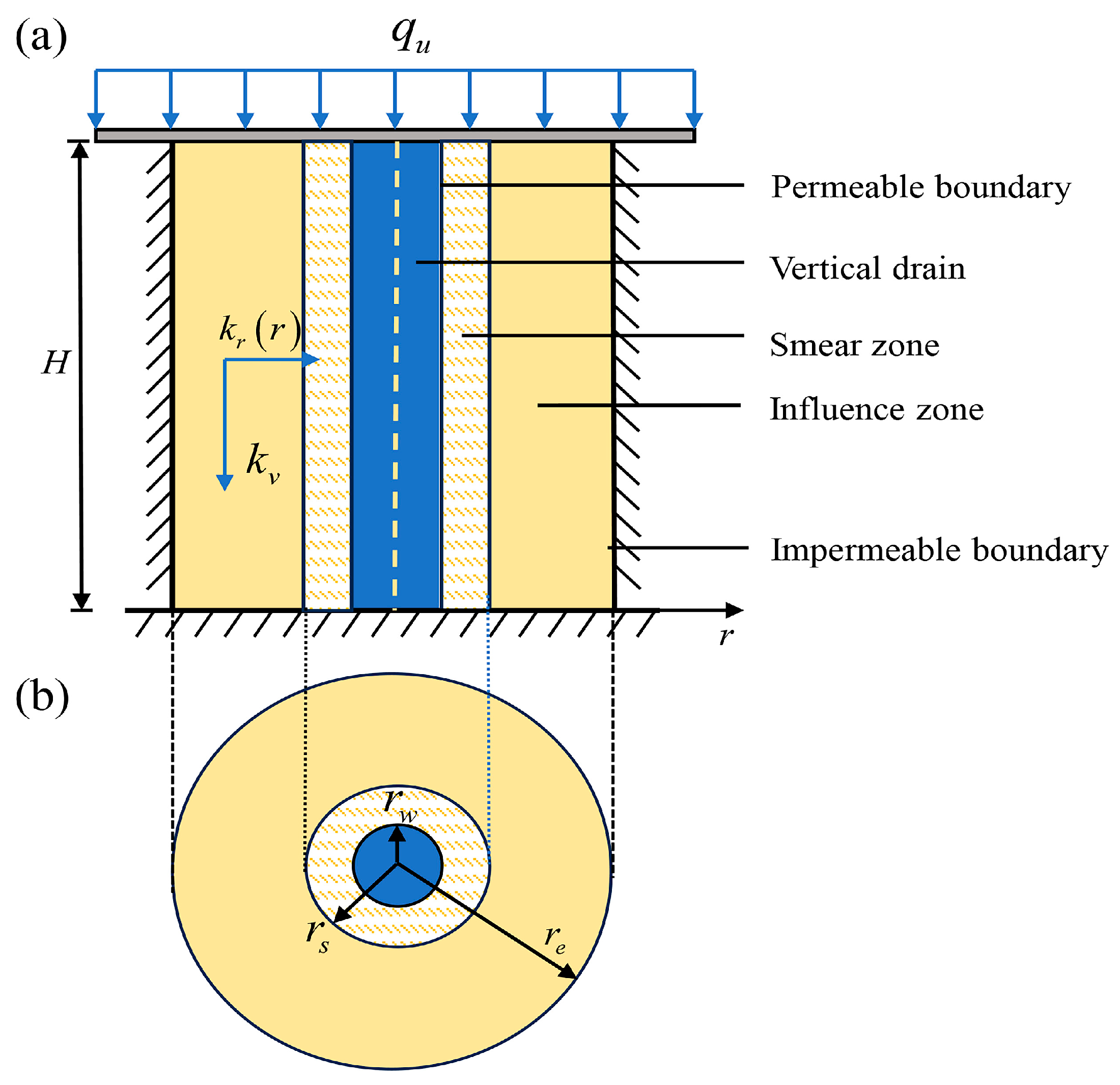
Figure 1 presents a simplified consolidation model of vertical-drain-improved soft ground, incorporating the smear effect and radial and vertical flow. In Figure 1, qu represents the instantaneous uniform load applied on the foundation surface, H is the thickness of the soil layer, and rw, rs, and re denote the radii of the vertical drain, the smeared zone, and the influence zone, respectively. The radial permeability coefficient of the soil, considering the smear effect, is denoted as kr(r), while the vertical permeability coefficient is kv. The reduction in permeability within the smear zone is primarily attributed to remolding-induced destruction of soil fabric, particle reorientation, and clogging of drainage paths during drain installation, as confirmed by laboratory and field observations [1,3,6]. The permeability modification is therefore spatially dependent and may vary from the drain boundary to the influence zone. It is assumed that the outer boundary and bottom of the drain are impermeable, and the ground surface is permeable.

2.2. Basic Assumptions

To solve the consolidation problem of the vertical drain foundation in this study, the following assumptions are made:
(1) The soil is fully saturated, and the compressibility of soil particles and pore water is neglected.
(2) The flow direction is decomposed into radial and vertical components. The flow in the soil follows the Hansbo’s flow model, with the model parameters m and i1 remaining constant during consolidation [27]. While Teh and Nie [27] considered four cases by distinguishing radial and vertical hydraulic gradients (iz and ir) with respect to the threshold gradient i1, this paper adopts the following unified expression for simplicity and to reduce classification:
v = k i m 1 m i 1 m 1 i i i 1 k [ i i 1 ( m 1 ) m i i ] i i 1
where v is the flow velocity in the radial or vertical direction, denoted as v r and v z , respectively; i is the hydraulic gradient in the radial or vertical direction, denoted as i r and i z , respectively; k is the permeability coefficient in the radial or vertical direction, denoted as k r and k z , respectively; i1 is the threshold hydraulic gradient for the onset of linear flow; and m is an experimentally determined constant, with i r = 1 γ w u r , i z = 1 γ w u z .
(3) Large-strain geometric conditions are assumed, with deformation occurring only in the vertical direction.
(4) The nonlinear behavior of the soil is described using the linear relationships lg(1 + e) − lg σ′ and lg(1 + e) − lg k, i.e.,
lg ( 1 + e ) lg ( 1 + e 0 ) = I c ( lg σ 0 lg σ )
lg ( 1 + e ) lg ( 1 + e 0 ) = 1 α ( lg k lg k 0 )
where e is the void ratio at any time, e0 is the initial void ratio, σ′ is the effective stress at any time, σ0′ is the initial effective stress, k is the permeability coefficient (radial or vertical) at any time, k0 is the initial permeability coefficient, Ic is the slope of the lg(1 + e) − lgσ′ relationship, and α is the reciprocal of the slope of the lg(1 + e) − lgk relationship. For convenience, Ic and α are hereafter referred to as the nonlinear compression parameter and nonlinear permeability parameter, respectively.
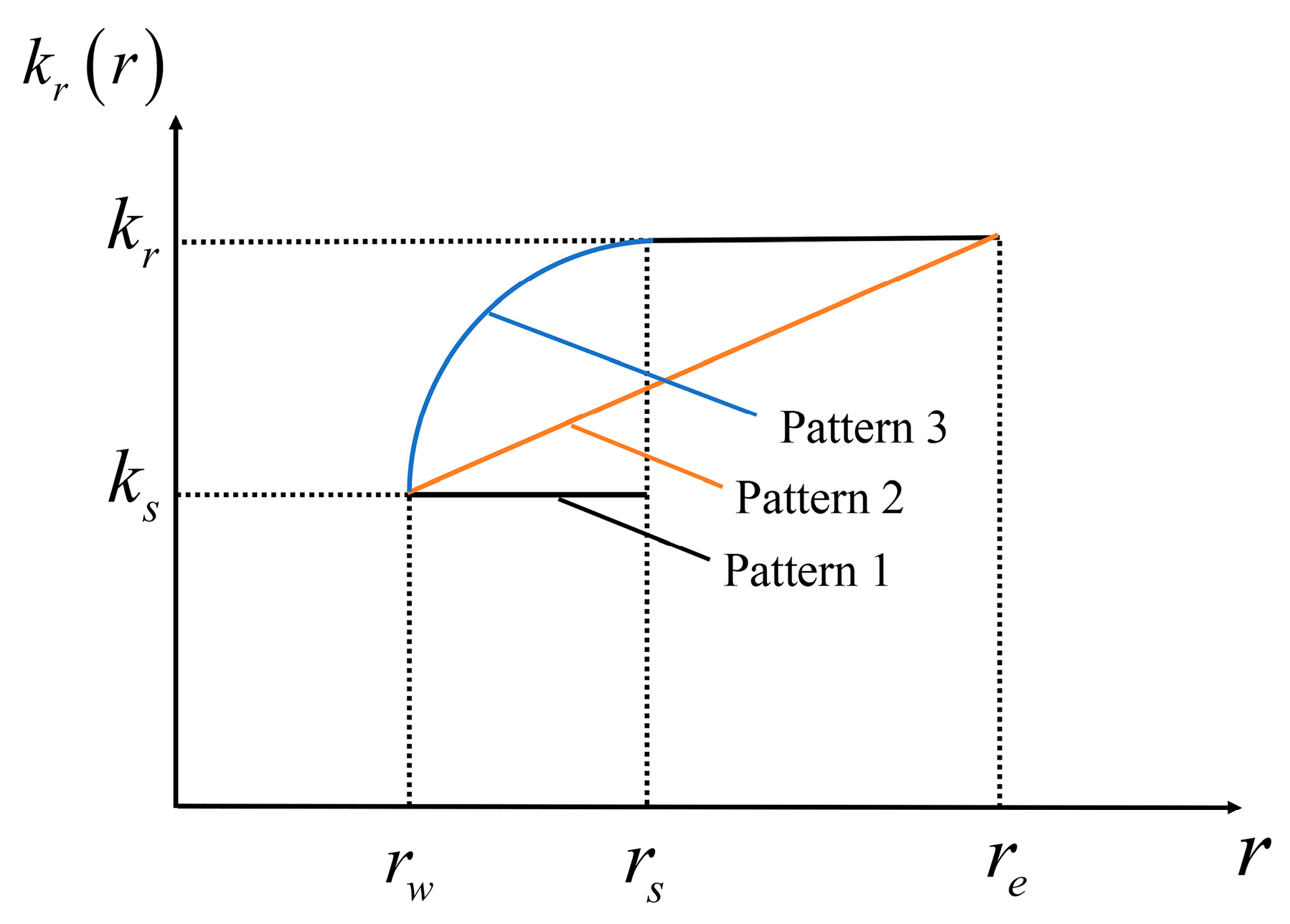
(5) The variation in the radial permeability coefficient along the radial direction, i.e., the smear effect, is considered, as expressed in Equation (4). Three smear patterns are assumed [3,4,28], as shown in Figure 2. Experimental studies have shown that permeability reduction in the smear zone may exhibit different spatial characteristics depending on installation method, soil sensitivity, and drainage disturbance [1,6,11]. To capture these potential variations, three representative permeability distribution patterns are considered in this study.
k r ( r ) = k r f ( r )
The functional relationships for patterns 1, 2, and 3 are given by Equations (5), (6), and (7), respectively:
Pattern 1: spatially uniform initial permeability in the smear and influence zones.
f ( r ) = δ , r w r r s 1 , r s < r r e
Pattern 2: linear variation across the entire zone;
f ( r ) = r r w r e r w ( 1 δ ) + δ , r w r r e
Pattern 3: parabolic variation in the smear zone and constant permeability in the influence zone.
f ( r ) = ( 1 δ ) ( a 1 b 1 + c 1 r r w ) ( a 1 + b 1 c 1 r r w ) , r w r r s 1 , r s < r r e
where a 1 = 1 / 1 δ ; b 1 = s / ( s 1 ) ; c 1 = 1 / ( s 1 ) ; s = r s / r w ; δ = ks/kr, ks being the permeability coefficient at the drain radius and kr is the permeability coefficient at the influence zone radius.
(6) It is assumed that the radial permeability coefficient at the influence zone equals the vertical permeability coefficient, i.e., kz = kr (where kr is the permeability coefficient at the radial influence zone) [15,29].

2.3. Governing Equation and Boundary Conditions

The radial hydraulic gradient i is
i r = 1 γ w u r
where u is the excess pore water pressure at a given radial point, γw is the unit weight of water, and r is the radial coordinate of that point.
The vertical hydraulic gradient i is
i ξ = 1 γ w u ξ
where u represents the excess pore water pressure at a certain point in the radial direction; γw denotes the unit weight of water; and ξ denotes the vertical coordinate of a certain point in the moving coordinate system.
The relationship between the moving coordinate and the Lagrangian coordinate is as follows:
z ξ = 1 + e 0 1 + e
where e = e (z, t), e represents the void ratio of the soil, e0 = e (z, 0) denotes the initial void ratio of the soil, z represents the coordinate of a point in the Lagrangian coordinate system, and ξ is the coordinate of a point in the moving coordinate system.
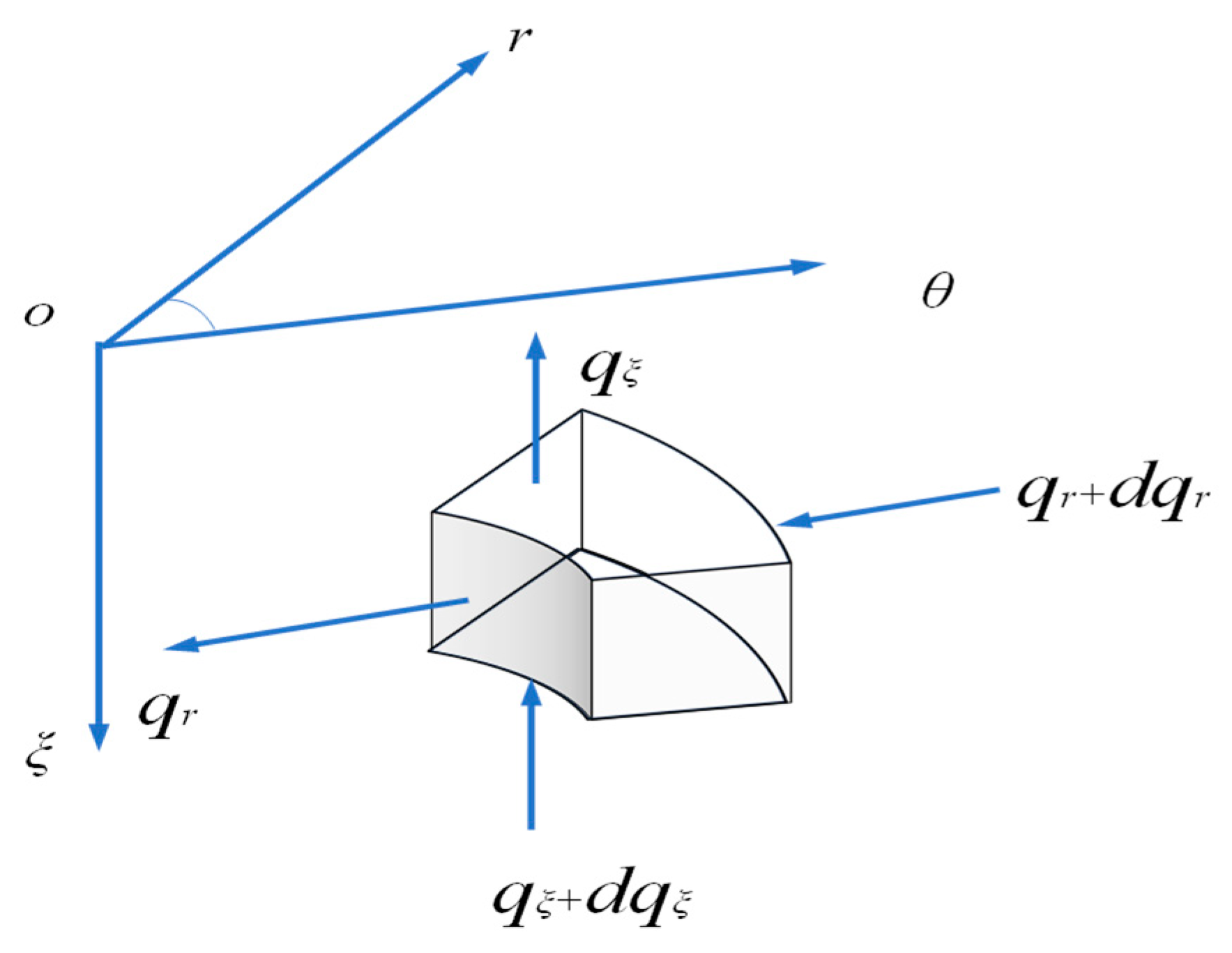
At time t, any unit cell can be selected for analysis, as shown in Figure 3. The distance from the unit cell to the center of the vertical drain is r, the vertical coordinate is z, and the pore water pressure is u. The change in the volume of the unit cell per unit time is
d V = e 1 + e e t r d r d θ d ξ
The pore water inflow from the unit in the radial and vertical directions are, respectively,
q ξ = e 1 + e ( v w ξ v s ξ ) r d θ d r
q r = e 1 + e ( v w r v s r ) r d θ d ξ
In the formula, v w ξ , v s ξ , v w r and v w r represent the actual vertical flow velocity of pore water, the actual vertical flow velocity of soil particles, the actual radial flow velocity of pore water, and the actual radial flow velocity of soil particles, respectively.
The pore water inflow rates from the unit cell in the radial and vertical directions are, respectively,
q ξ + d q ξ = e 1 + e ( v w ξ v s ξ ) + ξ e 1 + e ( v w ξ v s ξ ) d ξ r d θ d r
q r + d q r = e 1 + e ( v w r v s r ) + r e 1 + e ( v w r v s r ) d r r + d r d θ d ξ
Assuming that the radial soil particles are immobile, i.e., v s r = 0 , and the higher-order terms of dr can be neglected, the flow changes in the radial and vertical directions of the unit cell are as follows:
d q ξ = ξ e 1 + e ( v w ξ v s ξ ) r d θ d r d ξ
d q r = e 1 + e v w r + r r e 1 + e v w r d θ d r d ξ
According to the continuity condition of soil consolidation, the volume change in unit compression equals the net water outflow in both radial and vertical directions of pore water, i.e., d V = d q ξ + d q r . Substituting Equations (11), (16), and (17) into the equation, we obtain
v r r + v r r + v z ξ = 1 1 + e e t
where v ξ = v w ξ v s ξ , v r = v w r   v ξ and v r represent the vertical and radial flow velocities. Equation (2) can be transformed into
e = ( 1 + e 0 ) ( σ 0 σ ) I c 1
According to the principle of effective stress,
σ = σ 0 + q ( t ) u
Taking the partial derivative of Equation (19) with respect to t and substituting Equations (1) and (20) into Equation (18), we obtain
σ 0 I c ( σ σ 0 ) [ 1 r k r m i 1 m 1 ( 1 γ w u r ) m + r [ k r m i 1 m 1 ( 1 γ w u r ) m ] + ( σ σ 0 ) I c z [ k z m i 1 m 1 ( 1 γ w u z ) m ] ] = u t q ( t ) t ( i i 1 ) σ 0 I c ( σ σ 0 ) [ 1 r k r ( 1 γ w u r i 1 ( m 1 ) m ) + r [ k r ( 1 γ w u r i 1 ( m 1 ) m ) ] + ( σ σ 0 ) I c z [ k z ( 1 γ w u z i 1 ( m 1 ) m ) ] = u t q ( t ) t ( i i 1 )
By combining Equations (2) and (3), we obtain
k r k r 0 = ( σ 0 σ ) α I c
Taking into account the nonlinearity of soil compression and smearing effects, combining assumption (6) and substituting Equations (4) and (22) into Equation (21), we can derive the nonlinear large-strain radial consolidation equation considering Hansbo’s flow:
σ 0 I c [ 1 r ( σ σ 0 ) 1 α I c k 0 f ( r ) m i 1 m 1 ( 1 γ w u r ) m + ( σ σ 0 ) r [ ( σ σ 0 ) α I c k 0 f ( r ) m i 1 m 1 ( 1 γ w u r ) m ] + ( σ σ 0 ) 1 + I c z [ ( σ σ 0 ) α I c k 0 m i 1 m 1 ( 1 γ w u z ) m ] ] = u t q ( t ) t ( i i 1 ) σ 0 I c [ 1 r ( σ σ 0 ) 1 α I c k 0 f ( r ) ( 1 γ w u r i 1 ( m 1 ) m ) + ( σ σ 0 ) r [ ( σ σ 0 ) α I c k 0 f ( r ) ( 1 γ w u r i 1 ( m 1 ) m ) ] + ( σ σ 0 ) 1 + I c z [ ( σ σ 0 ) α I c k 0 ( 1 γ w u z i 1 ( m 1 ) m ) ] = u t q ( t ) t ( i i 1 )
The boundary conditions are as follows:
u ( r w , z , t ) = 0 u r r | r = r e = 0 u ( r , z , 0 ) = q u u z z | z = H = 0 u ( r , 0 , t ) = 0
For the case of Pattern 1, the points on both sides of the radius rs are not continuous. Considering that the discontinuity of the permeability coefficient due to smearing effects only exists in the radial direction, the established continuity condition is
v r 1 = v r 2
where v r 1 represents the flow velocity when the permeability coefficient on the left side at radius rs is ks, and v r 2 represents the flow velocity when the permeability coefficient on the right side at radius rs is kh.

2.4. Solution of Equations

2.4.1. Non-Dimensionalization

To facilitate numerical solution, the following dimensionless variables are defined: S = σ 0 σ 0 , Q = q u σ 0 , U = u σ 0 , T v = C v 0 t 4 r e 2 , C v 0 = k r 0 σ 0 γ w I c , I = i γ w r e σ 0 , I 1 = i 1 γ w r e σ 0 , I 2 = ( m 1 ) m I 1 , R = r r e , R s = r s r e , R w = r w r e , Z = z H , R h = r e 2 H 2 , T h = C v 0 t 4 r e 2 r e 2 H 2 = T v R h .
By introducing the above dimensionless variables, the control Equation (23) and boundary conditions (24) are transformed into Equations (26) and (27):
1 m I 1 m 1 [ 1 R ( S + Q U ) 1 I c α f ( R ) | U R | m 1 U R + ( S + Q U ) R ( ( S + Q U ) I c α f ( R ) | U R | m 1 U R ) + ( I I 1 ) ( S + Q U ) 1 + I c Z ( ( S + Q U ) I c α | U R | m 1 U R ) ] = U T v Q T v 1 R ( S + Q U ) 1 I c α f ( R ) ( U R I 2 ) + ( S + Q U ) R ( ( S + Q U ) I c α f ( R ) ( U R I 2 ) ) ( I I 1 ) + ( S + Q U ) 1 + I c Z ( ( S + Q U ) I c α ( U Z I 2 ) ) = U T v Q T v
The boundary condition is
U ( R w , Z , T ) = 0 U ( 1 , Z , T ) R = 0 U ( R , Z , 0 ) = Q u U ( R , 1 , T ) Z = 0 U ( R , 0 , T ) = 0

2.4.2. Difference Solution of Equation

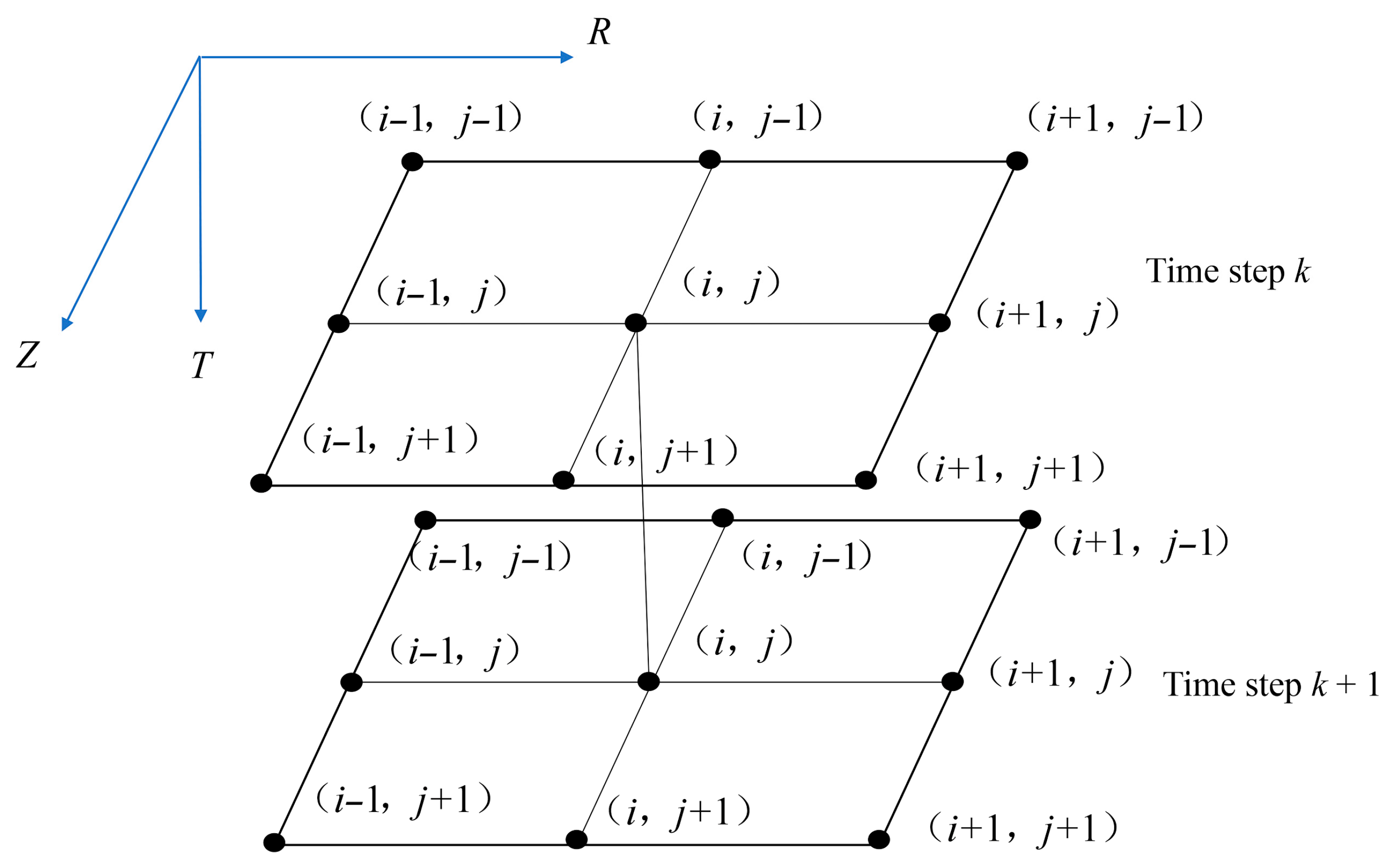
An explicit finite-difference method is employed in this study to obtain the numerical solution iteratively. Within the radial range of RwR ≤ 1, the spatial step size is ΔR, which is evenly divided into n equal parts from the inside out. In the vertical range 0 ≤ Z ≤ 1, the soil layer within the vertical drain is divided into m equal parts from the top to the bottom, with a step size of ΔZ. Time is discretized with a step size of ΔTv, as shown in Figure 4. Following Teh and Nie [27], the dimensionless hydraulic gradient I at the current time level is evaluated using the excess pore water pressure obtained at the previous time level. Since the adjacent ΔT values are small, the resulting error is not significant.
The previously employed finite-difference formulation is extended here to include the vertical dimension. To obtain the numerical solution, the governing Equation (26) is discretized using the backward difference scheme as follows:
U i , j k + 1 = U i , j k + α i , j k m I 1 m 1 ( β i + 1 / 2 , j k ϕ i + 1 / 2 , j j A i + 1 / 2 , j j β i 1 / 2 , j j ϕ i 1 / 2 , j j A i 1 / 2 , j j + γ i , j k ψ i , j + 1 / 2 k E i , j + 1 / 2 k γ i , j k ψ i , j 1 / 2 k E i , j 1 / 2 k ) + λ i , j k m I 1 m 1 B i , j k   ( I I 1 ) U i j + 1 = U i j + α i j ( β i + 1 / 2 j C i + 1 / 2 j β i 1 / 2 j C i 1 / 2 j + γ i , j k F i , j + 1 / 2 k γ i , j k F i , j 1 / 2 k ) + λ i j D i j ( I I 1 )
where i represents the number of radial spatial nodes (i = 0, 1, 2, …, n); j represents the number of vertical spatial nodes (j = 0, 1, 2, …, m); k represents the number of time nodes (k = 0, 1, 2, …); U i , j k is the dimensionless excess pore water pressure at grid point (i, j) at time level k; R i = R w + i Δ R ; α i , j k = 4 ( S + Q U i . j k ) Δ T v Δ R ; β i ± 1 / 2 , j k = ( S + Q U i ± 1 , j k + U i , j k 2 ) I c α f ( R ) ; A i + 1 / 2 , j k = U i + 1 , j k U i , j k Δ R ; A i 1 / 2 , j = U i , j k U i 1 , j k Δ R ; ψ i ± 1 / 2 j = | U i , j ± 1 k U i , j k Δ Z | m 1 ; γ i , j k = ( S + Q U i , j k ) I c R h ; ϕ i ± 1 / 2 , j k = | U i ± 1 , j k U i , j k Δ R | m 1 ; λ i , j k = 4 ( S + Q U i , j k ) I c α + 1 Δ T v R i f ( R ) ; B i , j k   = U i + 1 , j k U i 1 , j k 2 Δ R ; C i + 1 / 2 , j k = U i + 1 , j k U i , j k Δ R I 2 ; C i 1 / 2 , j k = U i , j k U i 1 , j k Δ R I 2 ; D i , j k = U i + 1 , j k U i 1 , j k 2 Δ R I 2 ; E i , j + 1 / 2 k = U i , j + 1 k U i , j k Δ Z ; E i , j 1 / 2 k = U i , j k U i , j 1 k Δ Z ; F i , j + 1 / 2 k = U i , j + 1 k U i , j k Δ Z I 2 ; F i , j 1 / 2 k = U i , j k U i , j 1 k Δ Z I 2 .
The initial conditions in Equation (27) can be discretized as follows:
U i , j 0 = Q , i = 0 , 1 , 2 ,   n ;   j = 0 , 1 , 2 , m
The drainage boundary condition in Equation (27) can be discretized as follows:
U 0 , j k = 0 ,   U i , 0 k = 0 ,   i = 0 , 1 , 2 ,   n ; j = 0 , 1 , 2 ,   m ,   k = 1 , 2
The discretization method for the undrained boundary condition in Equation (27) is the same as that for the boundary condition of the radial flow consolidation equation. A symmetrical virtual node can be assumed at i = n + 1 and j = m + 1, and the discretization can be expressed as
U n 1 , j k = U n + 1 , j k ,   U i , m 1 k = U i , m + 1 k
The boundary conditions can be obtained as
U i , 0 k = 0 U 0 , j k = 0 U i , j 0 = Q U n 1 , j k = U n + 1 , j k U i , m 1 k = U i , m + 1 k
Equations (28) and (32) constitute a closed system of equations, through which the pore water pressure at any given time and location can be obtained through iteration.
For a soil layer with a thickness of H, the formula for the settlement st at any given time t is
s t = 0 H r w r e 2 r r e 2 r w 2 ( e 0 e ) ( 1 + e 0 ) d r dz
Substitute Equation (19) into Equation (33), discretize and organize:
S t = b = 0 m 1 G ( b , T v ) + G ( b + 1 , T v ) 2
where G ( b , T v ) = i = 0 n 1 R i ( 1 ( S + Q U i , b ) I c ) + R i + 1 ( 1 ( S + Q U i + 1 , b ) I c ( 1 + R w ) n .
The ADC Up of the vertical-drained improved soft ground, defined by pore pressure, is
U p = 1 0 H r w r e 2 π r u d r d z 0 H r w r e 2 π r q u d r d z = 1 0 1 R w 1 R U d R d Z 0 1 R w 1 R Q u d R d Z = 1 b = 0 m 1 i = 0 n 1 Y i , b + i = 0 n 1 Y i , b + 1 Δ Z ( 1 R w 2 ) Q u
where Y i , b = U i , b R i + 1 U i + 1 , b R i 2 Δ R ( R i + 1 2 R i 2 ) + U i + 1 , b U i , b 3 Δ R ( R i + 1 3 R i 3 ) .

3. Parametric Analysis

3.1. Comparison with Vertical Consolidation with Radial Flow Only

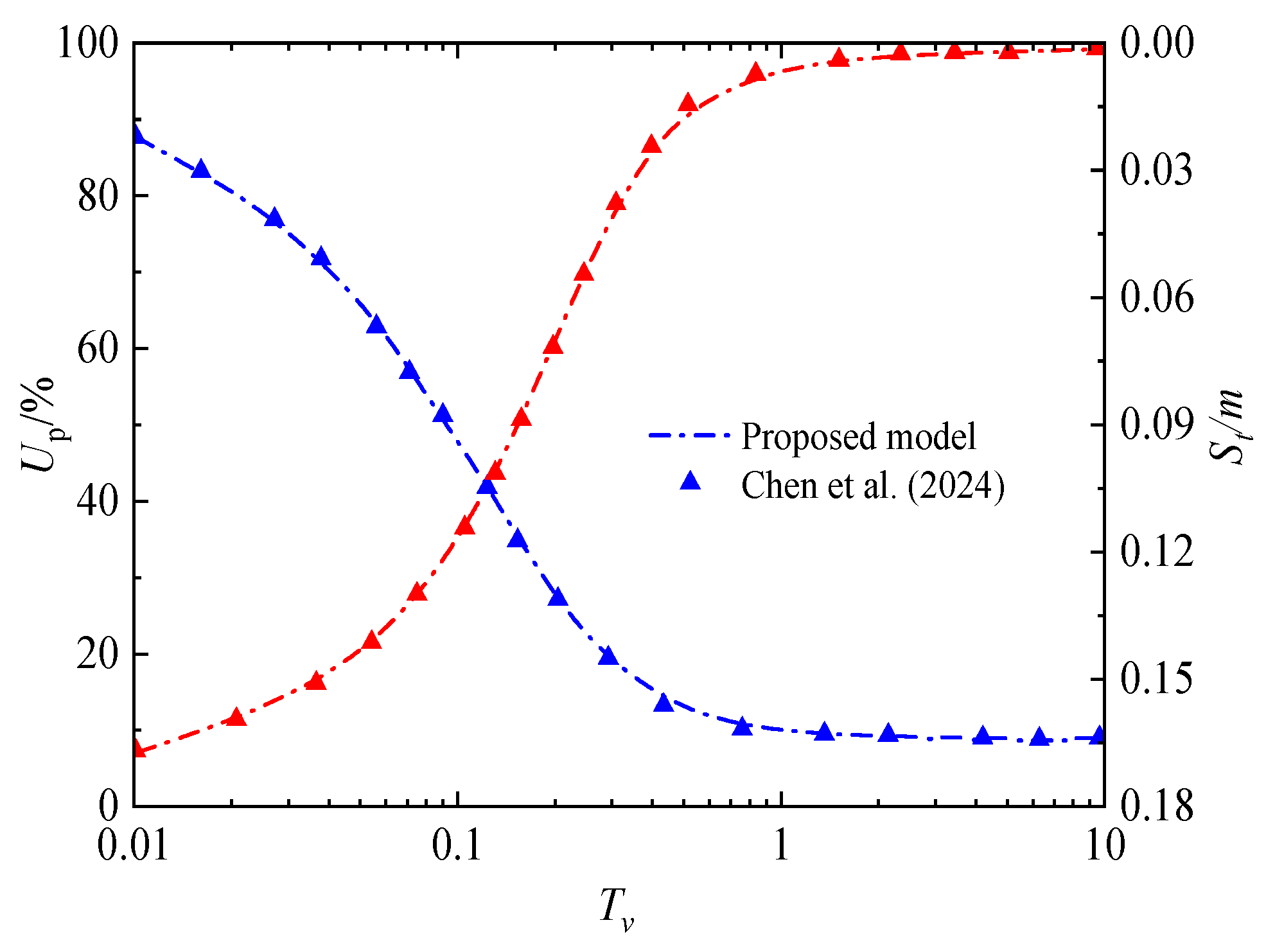
If the vertical flow component is omitted (i.e., the vertical hydraulic gradient is set to zero), the proposed governing equations reduce to the nonlinear large-strain formulation for purely radial consolidation of a vertical-drained improved soft ground. To validate the corresponding finite-difference solution, a comparative analysis was carried out against the radial consolidation model developed by Chen et al. [15]. All model conditions, including fully drained boundaries and a parabolic radial permeability variation in the smear zone, were kept consistent with those used in the reference study. As shown in Figure 5, the results from the two models exhibit excellent agreement, both in the dissipation of excess pore water pressure and in the development of ground settlement, with the numerical curves nearly overlapping. This confirms that the proposed numerical solution accurately reproduces established theoretical results under purely radial flow conditions. The close agreement validates the correctness and reliability of the present model in the degenerated case. It provides a solid basis for subsequent analysis of the coupling effects of radial–vertical flow on the consolidation behavior of vertical drain foundations.

3.2. Comparison with Equivalent Strain Analytical Solutions

To further validate the reliability of the developed finite-difference model solution, a comparative analysis was conducted with the analytical solution for radial–vertical consolidation under the equal-strain assumption, as derived by Zhang et al. [23] for vertical-drained soft ground with continuous drainage boundary. Under the equal-strain condition, the average consolidation degree considering both radial and vertical flows can be expressed as follows:
U ¯ = 1 m = 0 2 M e Y t = 1 m = 0 2 M e A ( M H ) 4 C ( M H ) 2 1 B ( M H ) 2 t
where M = 2 m + 1 2 π , m = 0 , 1 , 2 , 3 ; A = r e 2 R k w 2 ( n 2 1 ) k h c v ; B = r e 2 R k w 2 ( n 2 1 ) k h ; C = ( c v + k w k h ( n 2 1 ) c h ) ; R = n 2 n 2 1 [ ( k h k s 1 ) ln s + ln n + ( s 2 3 ) ( s 2 1 ) 4 n 2 k h k s ( s 2 3 ) ( s 2 1 ) 4 n 2 ] .
According to assumption 6, assuming cv = ch, and that well resistance is neglected (i.e., kw → ∞), it follows that
Y = c v ( M H ) 2 + 2 c v R r e 2
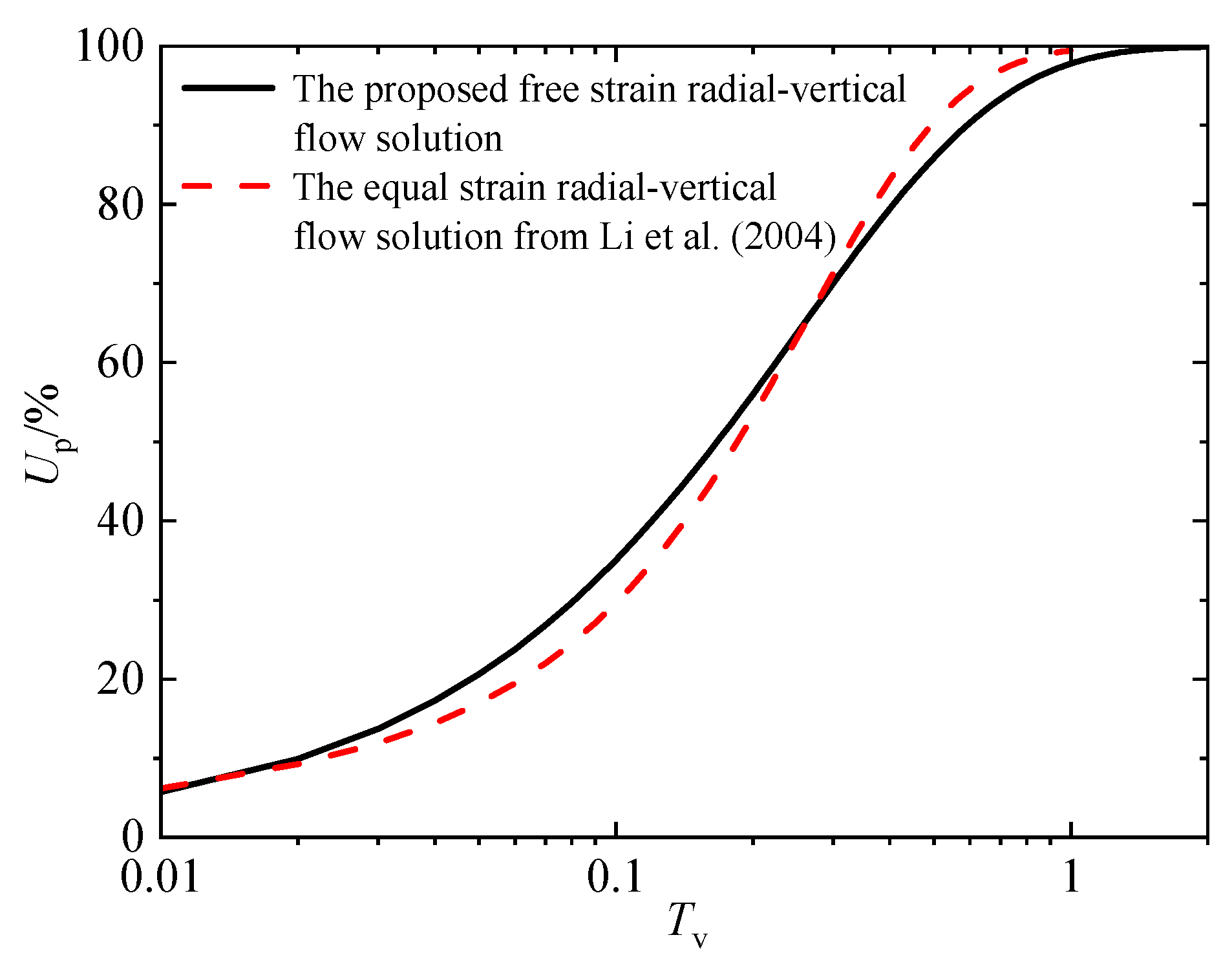
In order to make the parameter values of the numerical solution consistent with those of the analytical solution, dimensionless parameters H = 10, S = 1, Q = 5, Rw = 0.2, Ic = 0.1, α = 0, m = 1 (nonlinear compression and non-Darcy flow were not considered in the analytical solution), and ΔR = 0.01, ΔTv = 10−6 were selected to compare the results obtained from finite difference analysis with the results obtained from the equivalent strain analytical solution, as shown in Figure 6. According to the comparison of solutions under the assumptions of equal strain and free strain given by Li et al. [29], the impact of the two assumptions on vertical drain consolidation is mainly reflected in the early stage of consolidation, and the degree of consolidation obtained under the assumption of free strain is greater in the early stage, but gradually approaches over time. The comparison results shown in Figure 6 are basically consistent, further verifying the reliability of the finite difference solution in this paper.

4. Parametric Study

To investigate the nonlinear large-strain consolidation of vertical-drain improved soft ground considering Hansbo’s flow and smear effects under coupled radial–vertical flow, a parametric study is conducted based on the present solution. The analyzed factors include the pattern of radial permeability variation, the nonlinear compression parameter (Ic) and nonlinear permeability parameter (α) obtained from the double-logarithmic relationship, and the parameters m and the dimensionless threshold hydraulic gradient I1 in the Hansbo’s flow model. For computational convenience, the following baseline parameters are adopted: rw = 0.2 m, re = 1 m, rs = 0.5 m, σ0′ =10 kPa, qu = 50 kPa, ΔR = 0.01, ΔTv = 10−6, m = 2, I1 = 1, Ic = 0.1, α = 10, δ = 2/3, H = 5 m, with Pattern 1 for radial permeability variation.

4.1. Influence of Smear Zone Permeability Pattern

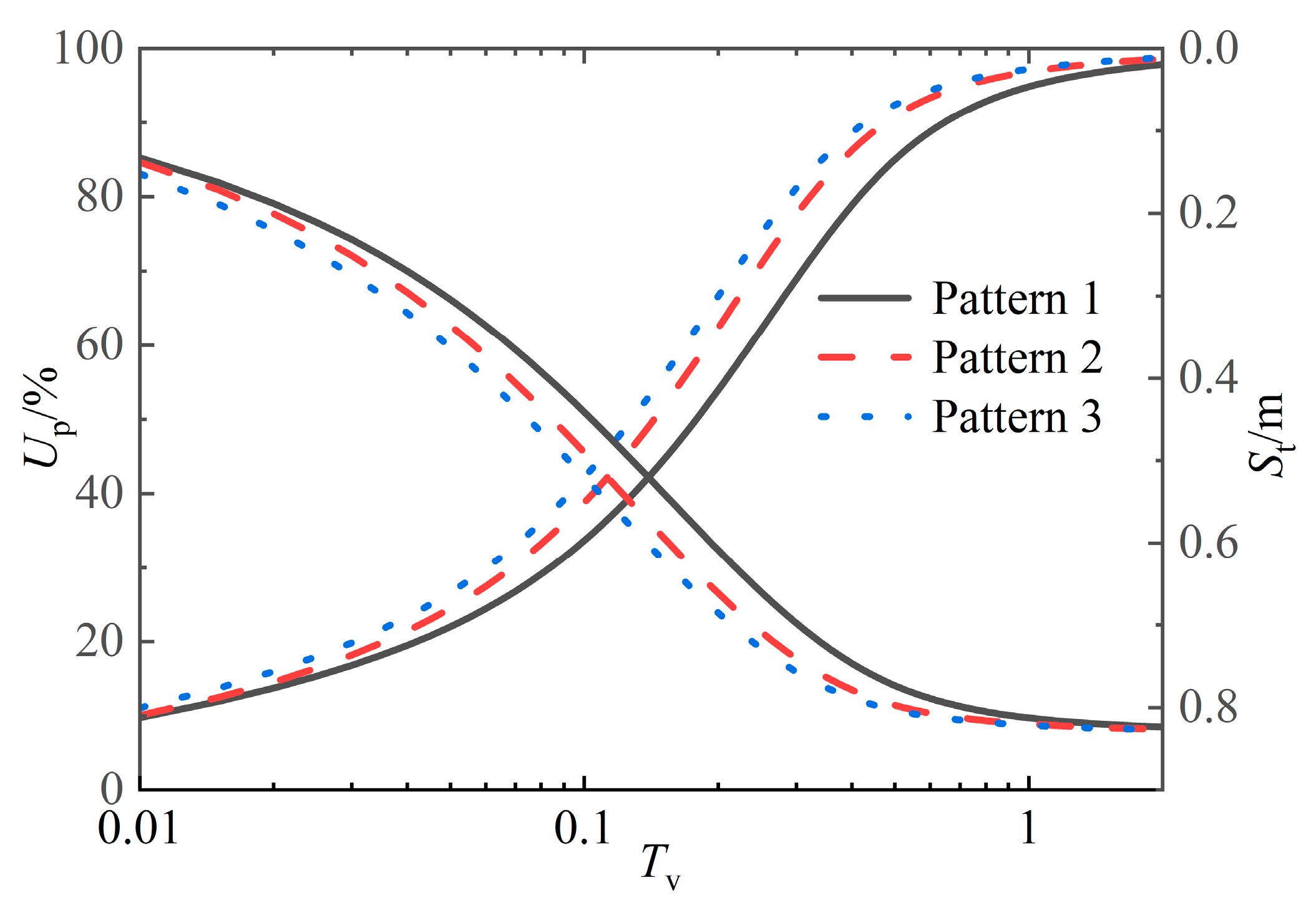
Figure 7 shows the influence of different radial permeability variation patterns on the ADC (Up) and settlement (St). It can be observed that Pattern 3 (parabolic variation within the smear zone) yields the fastest consolidation rate, followed by Pattern 2 (linear variation across the entire zone), and Pattern 1 (constant permeability in the smear zone) results in the slowest rate. Regarding settlement, Pattern 3 requires the shortest time to reach a given settlement, while Pattern 1 requires the longest. All three patterns, however, converge to the same final settlement. Compared to Pattern 1, Pattern 2 exhibits maximum relative deviations of 16.2% in the average degree of consolidation (ADC) and 11.2% in settlement. For Pattern 3, the corresponding deviations reach 25.7% and 19.2%, respectively. These results demonstrate that the spatial distribution of permeability, rather than merely its average value, plays a decisive role in governing consolidation behavior. The faster consolidation observed under Pattern 3 is primarily attributed to the relatively higher permeability in the vicinity of the drain. Since excess pore water must ultimately flow toward the drain, the hydraulic resistance near the drain exerts a dominant control on the dissipation rate. A permeability distribution that reduces resistance in this critical drainage region significantly enhances pore pressure dissipation and accelerates settlement development. In contrast, Pattern 1 maintains a uniformly reduced permeability within the smear zone, leading to greater overall hydraulic resistance and slower consolidation. Although these trends are consistent with those observed in purely radial consolidation, the influence of the permeability pattern on both ADC and settlement is more pronounced when vertical flow is incorporated. This can be attributed to the fact that variations in the overall permeability field simultaneously alter the vertical flow velocity, thereby exerting a stronger impact on the consolidation response and settlement development.

4.2. Influence of Nonlinear Compression Parameter (Ic) and Nonlinear Permeability Parameter (α)

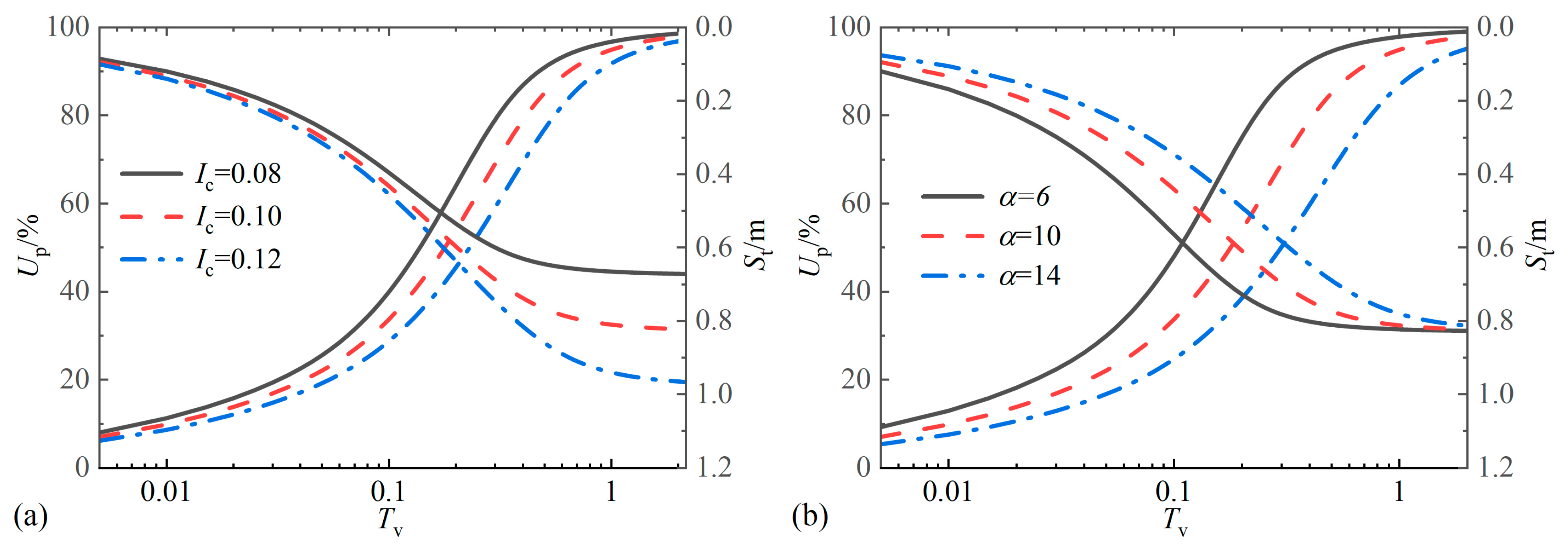
Based on the study by Li et al. [19] regarding the nonlinear compression parameter (Ic) and nonlinear permeability parameter (α) in double-logarithmic coordinates, the values of Ic are predominantly concentrated in the range of 0.08–0.12, while α typically varies between 6 and 14. Accordingly, analyses in this study are conducted using Ic values of 0.08, 0.1, and 0.12, and α values of 6, 10, and 14, respectively. Figure 8 presents the influence of Ic and α on ADC and settlement over time (Tv). As Ic increases, Up at a given Tv decreases, whereas the settlement increases, with both the rate of settlement and the final settlement also rising. An increase in α slows the progress of consolidation and settlement, though the final settlement remains unchanged. Relative to the baseline case (Ic = 0.1), the scenario with Ic = 0.08 shows a maximum deviation of 19.3% in Up and a final settlement difference of 0.151 m. For Ic = 0.12, the corresponding deviations are 15.7% in Up and 0.143 m in settlement. When compared to α = 10, the case with α = 6 yields maximum deviations of 43.5% in Up and 29.2% in settlement, while for α = 14, the deviations are 28.7% in Up and 21.8% in settlement. That is, the nonlinear compression parameter Ic primarily controls the final settlement magnitude. In contrast, the nonlinear permeability parameter α governs consolidation speed, and both factors significantly affect consolidation and settlement.
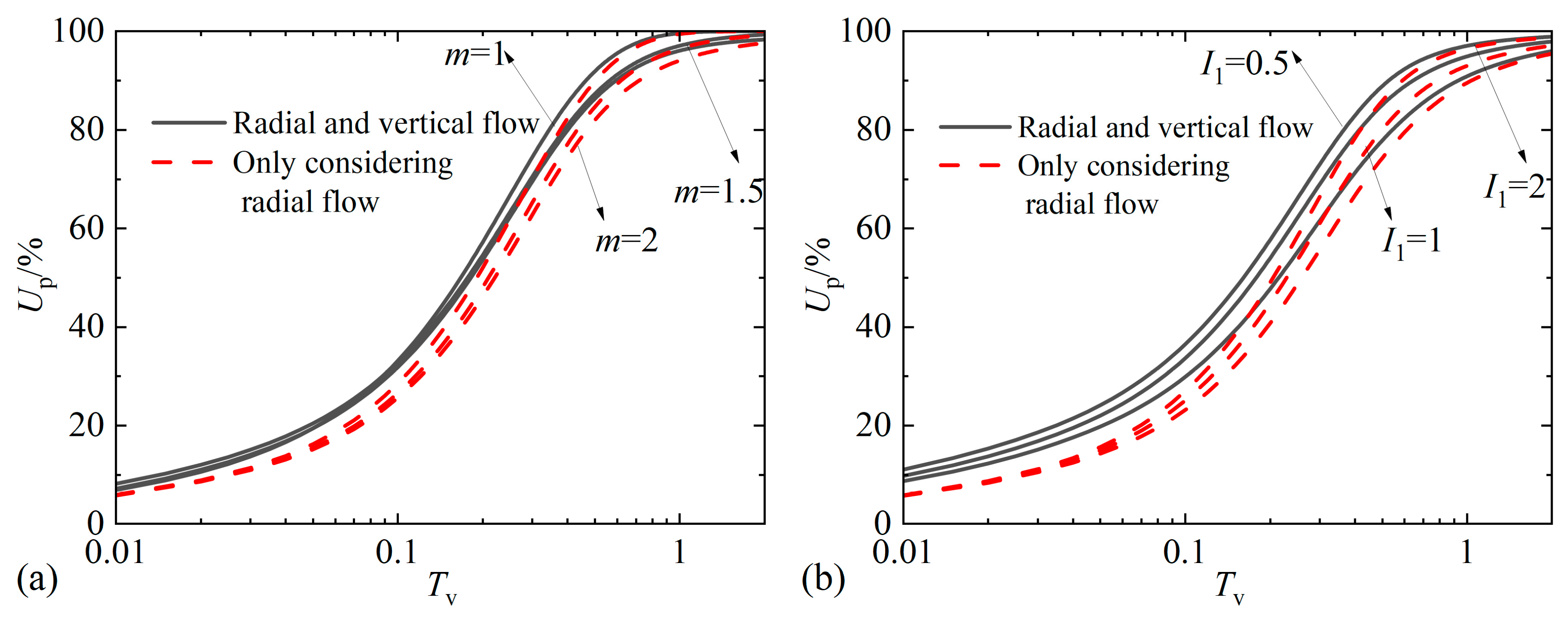
Figure 9 compares the average degree of consolidation (ADC, Up) obtained from the coupled radial–vertical flow model with that from the radial-flow-only model for different Hansbo’s flow parameters m and I1. At any given time factor Tv, the coupled model consistently predicts a higher Up than the radial-only model, because vertical seepage near the drainage boundary is non-negligible and accelerates excess pore-pressure dissipation. For all investigated values of m and I1, the coupled solution exhibits a higher consolidation rate than the radial-only solution. The relative difference between the two solutions is more pronounced at early times and decreases as consolidation proceeds. For instance, in Figure 9a, the relative difference is approximately 20% at Tv = 0.01 and reduces to about 4% at Tv = 0.5, indicating that vertical seepage mainly influences the early stage of consolidation, with a limited effect during the intermediate and late stages.

4.3. Influence of Hansbo’s Flow Parameters m and I1

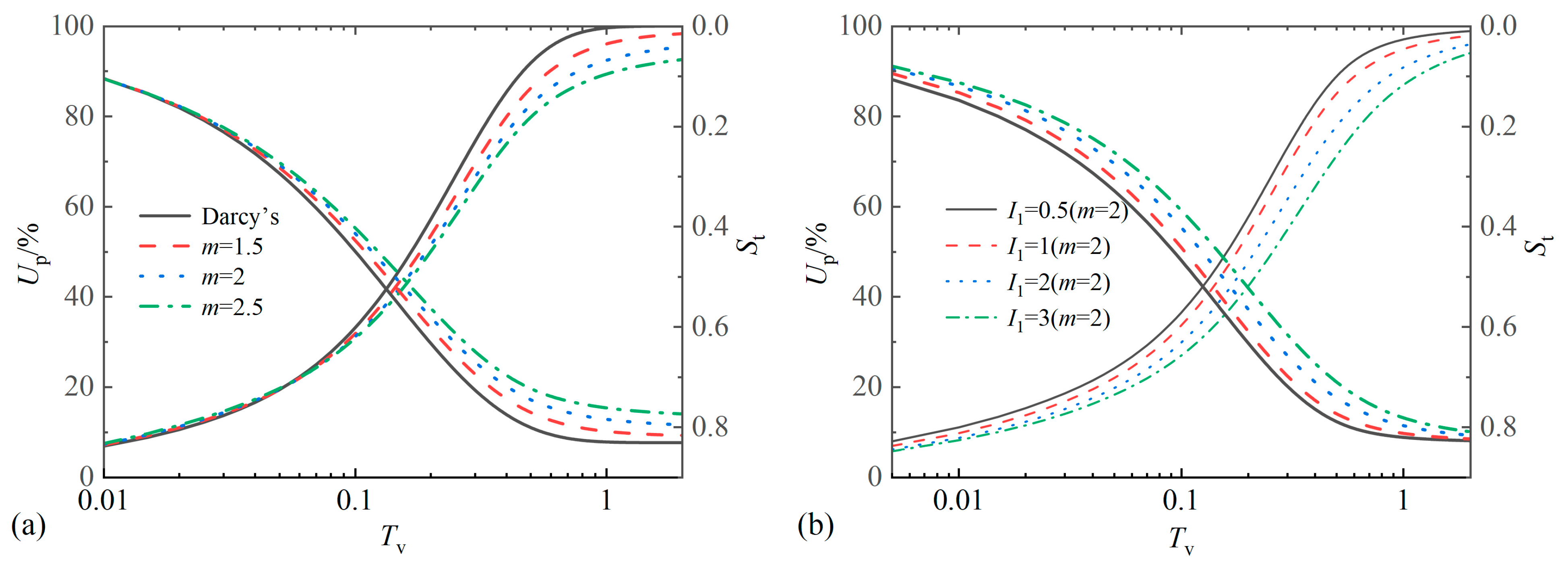
Figure 10 presents the influence of Hansbo’s flow parameter m (with values 1, 1.5, 2, 2.5) on ADC Up and settlement, respectively. As shown in Figure 10, an increase in the flow parameter m or I1 slows the overall consolidation rate; however, this effect is mainly apparent in the later stages, while the early-stage consolidation progress remains largely unaffected. Furthermore, higher values of m and I1 result in greater settlement at a given time without affecting the final settlement magnitude. Specifically, relative to Darcy’s flow (m = 1), the maximum relative deviations in the ADC for m = 1.5, 2.0, and 2.5 are 6.6%, 10.7%, and 13.6%, respectively, while the corresponding deviations in settlement are 4.9%, 8.3%, and 11.1%. Likewise, as the dimensionless threshold hydraulic gradient parameter I1 increases from 0.5 to 1, 2, and 3, the maximum relative deviations in the ADC reach 12.7%, 22.6%, and 27.6%, respectively, while the corresponding deviations in settlement are 11.2%, 20.3%, and 25.1%. Therefore, if the influence of Hansbo’s flow on the consolidation settlement rate is neglected, the consolidation settlement process of the vertically drained grounds will be significantly overestimated, leading to an unsafe prediction of the actual consolidation time in engineering.
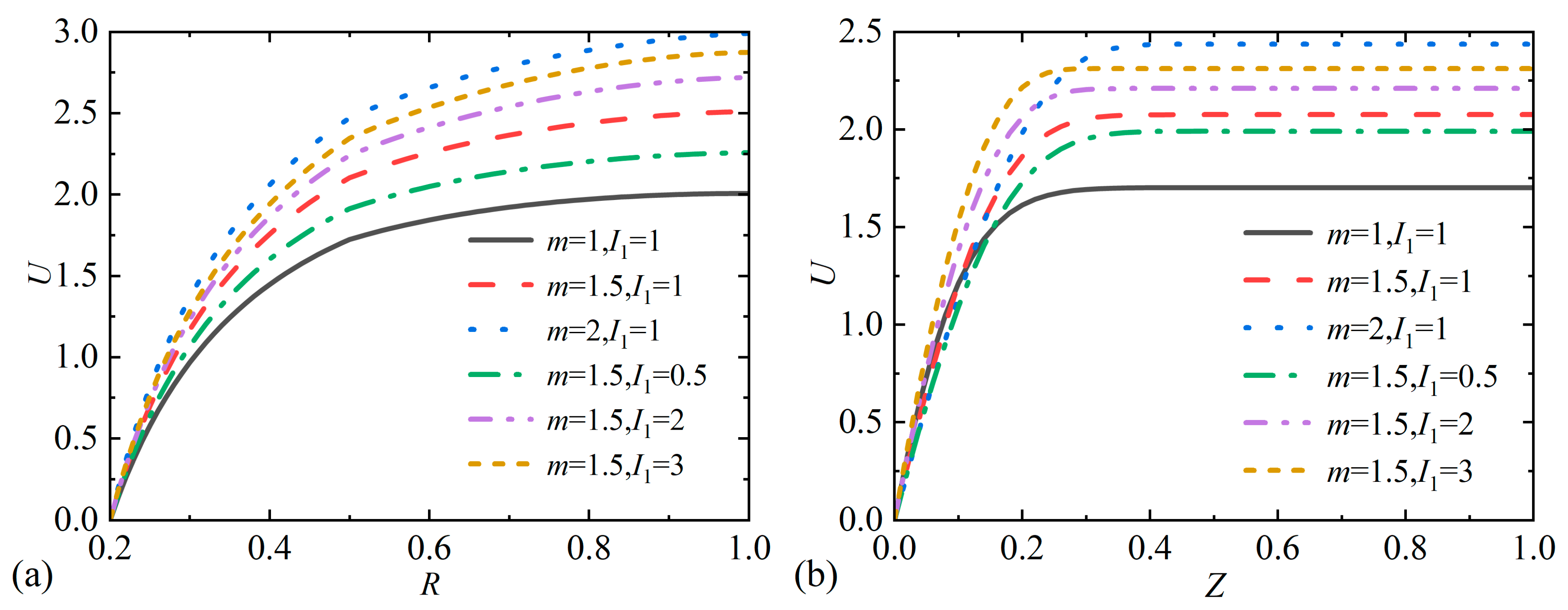
Figure 11 presents the excess pore pressure distributions along radial and vertical directions, respectively, for time factor Tv = 0.1 under different m and I1 values. As seen, the results for radial flow closely resemble those derived from the purely radial consolidation model. It can be observed that beyond a certain depth at this time instant, the variation in excess pore pressure becomes negligible, corresponding to an essentially zero vertical hydraulic gradient. Figure 11 indicates that flow in deeper regions is dominated by radial flow, whereas both radial and vertical flow components contribute significantly in shallower zones.

4.4. Influence of Soil Layer Thickness

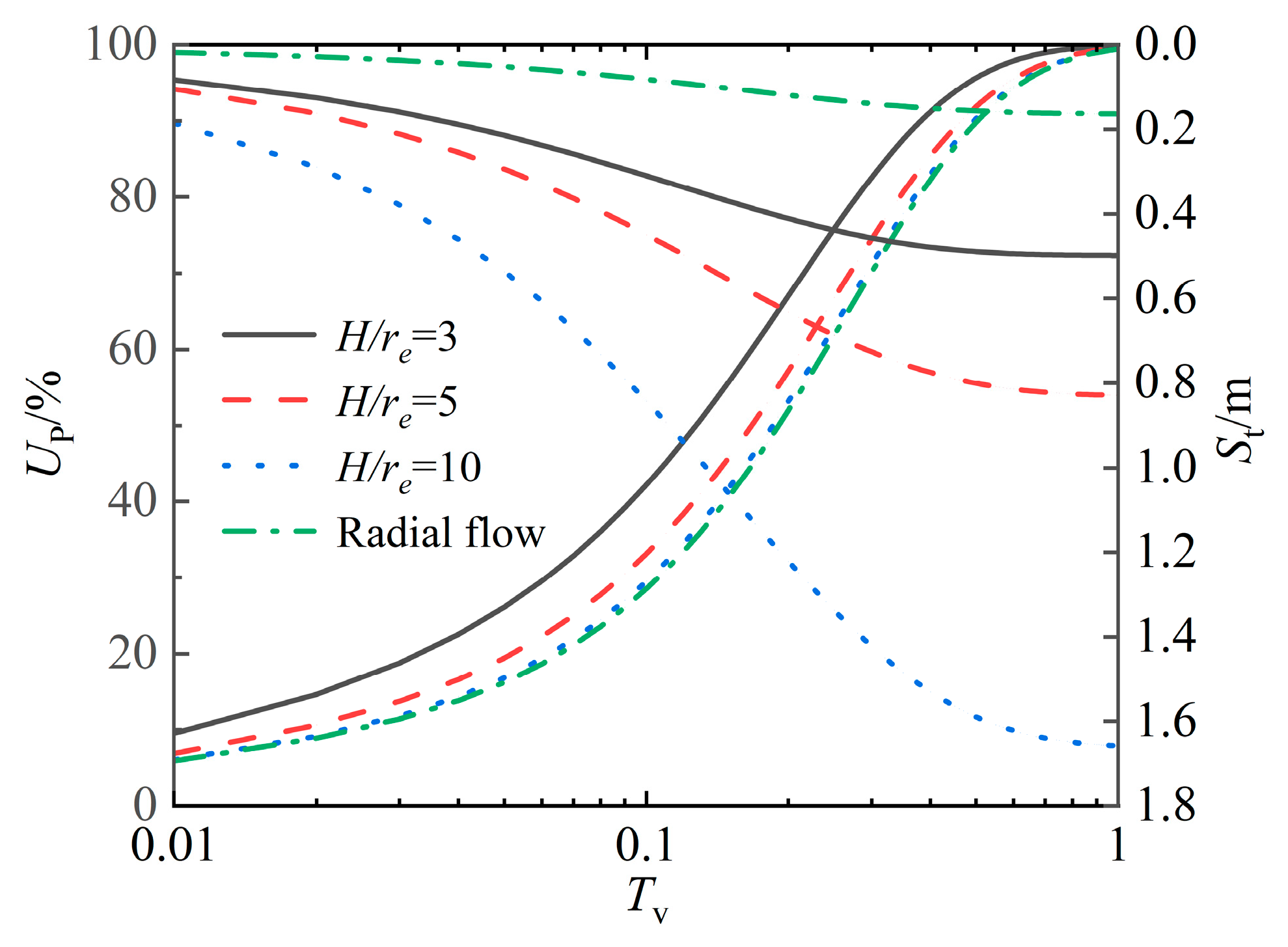
In the classical vertical drain consolidation model that considers only radial flow, the consolidation process is independent of depth H, and thus H does not affect consolidation or settlement rate. To examine the effect of incorporating vertical flow, Figure 12 illustrates the influence of the soil layer thickness H (normalized by re) on Up and settlement of vertical drains with coupled radial–vertical flow. For comparison, the responses of the radial-flow-only model have also been illustrated in Figure 12. The results indicate that when the ratio of soil layer depth to influence zone radius H/re = 5, the maximum relative deviation in ADC between the coupled model and the radial-only model is 20.2%; when H/re = 10, this deviation decreases to 3.8%. As seen, the influence of increasing H/re on the consolidation rate gradually decreases and is primarily concentrated in the intermediate stage of consolidation. Regarding settlement, the magnitude at any given time is approximately proportional to H/re times the settlement from the radial-flow-only model. Therefore, for H/re > 10, the purely radial consolidation model can provide a reasonable approximation for Up, and the settlement can be estimated by scaling the radial-flow-only settlement result.

5. Conclusions

Building on the previous study on radial consolidation using Hansbo’s flow model, this paper further incorporates vertical consolidation. A new governing equation for vertical drain foundation consolidation is derived, discretized using the finite difference method, and solved iteratively. The effects of large strain, Hansbo’s flow, layer depth, and vertical flow are analyzed. The main conclusions are as follows:
  • The spatial distribution pattern of permeability within the smear zone significantly affects consolidation behavior under coupled radial–vertical flow. Different distribution forms lead to distinct consolidation rates, indicating that not only the average permeability but also its radial variation influences the consolidation process within a multidimensional flow framework.
  • Larger values of Hansbo’s flow parameters m and I1 reduce the consolidation rate due to increased hydraulic resistance associated with non-Darcy flow. The discrepancy between coupled and purely radial consolidation is most pronounced in the early stage, with the maximum deviation in ADC exceeding 20% under certain conditions, indicating that vertical flow mainly accelerates the initial dissipation of excess pore pressure. With increasing depth and time, radial flow gradually becomes dominant and the difference between the two models diminishes.
  • Increasing the nonlinear compression and permeability parameters enhances the relative deviation between the coupled and purely radial models, indicating that soil nonlinearity amplifies the interaction between radial and vertical flow. Nevertheless, radial flow remains the primary consolidation mechanism, while vertical flow plays a supplementary yet non-negligible role under strongly nonlinear conditions.
  • At any given time, the average degree of consolidation predicted by the coupled radial–vertical model exceeds that of the purely radial model. However, as the normalized depth H/re increases, the contribution of vertical drainage progressively diminishes. When H/re > 10, the consolidation response converges to that of the purely radial model, and simplified radial solutions can provide reasonable engineering estimates. In contrast, for relatively thin soil layers, pronounced smear effects, or highly nonlinear soil behavior, neglecting vertical flow and large-strain coupling may lead to noticeable deviations in predicted consolidation rate and settlement evolution.
Overall, the present study demonstrates that the interaction among the large strain, non-Darcy flow, nonlinear compressibility––permeability relationship, and multidimensional seepage can significantly influence consolidation behavior under certain geometric and material conditions. The proposed integrated framework therefore provides a more reliable theoretical basis for analyzing vertically drained soft ground under complex engineering scenarios.
Future research may further extend the model in several directions:
(i)
Incorporating anisotropic permeability conditions to better represent natural clay deposits;
(ii)
Considering non-instantaneous or cyclic loading scenarios, particularly relevant to traffic or staged construction;
(iii)
Validating the model against field case histories or centrifuge tests to quantify predictive accuracy;
(iv)
Coupling the formulation with constitutive models that account for creep or secondary compression, enabling long-term settlement prediction.
Such extensions would enhance the applicability of the model to more complex and realistic engineering conditions.

Author Contributions

Conceptualization, G.C., P.C. and K.Z.; methodology, G.C. and P.C.; software, Y.M. and Y.L.; validation, H.X., Z.X. and L.S.; formal analysis, Y.M. and Z.X.; investigation, G.C., H.X. and L.S.; resources, P.C. and K.Z.; data curation, G.C. and Y.L.; writing—original draft preparation, G.C. and P.C.; writing—review and editing, P.C. and K.Z.; visualization, H.X. and G.C.; supervision, P.C. and K.Z.; project administration, P.C. and K.Z.; funding acquisition, P.C. and K.Z. All authors have read and agreed to the published version of the manuscript.

Funding

This research was funded by the National Key Research and Development Program of China, grant number 2022YFC3801000, and the National Natural Science Foundation of China, grant numbers 51678536, 51909242, and 52009125, and Key Research Project of Higher Education Institutions in Henan Province (26A570010).

Data Availability Statement

The original contributions presented in this study are included in the article. Further inquiries can be directed to the corresponding authors.

Conflicts of Interest

Authors Guanglei Chen, Haiyang Xie, and Yihu Ma were employed by the company Henan Pingyuan Expressway Co., Ltd. The remaining authors declare that the research was conducted in the absence of any commercial or financial relationships that could be construed as a potential conflict of interest.

References

  1. Walker, R.; Indraratna, B. Vertical drain consolidation with parabolic distribution of permeability in smear zone. J. Geotech. Geoenviron. Eng. 2006, 132, 937–941. [Google Scholar] [CrossRef]
  2. Walker, R.; Indraratna, B.; Sivakugan, N. Vertical and radial consolidation analysis of multilayered soils using the spectral method. J. Geotech. Geoenviron. Eng. 2009, 135, 657–663. [Google Scholar] [CrossRef]
  3. Nguyen, B.P.; Kim, Y.T. Radial consolidation of PVD-Installed normally consolidated soil with discharge capacity reduction using large-strain theory. Geotext. Geomembr. 2019, 47, 243–254. [Google Scholar] [CrossRef]
  4. Lu, M.; Wang, S.; Sloan, S.W.; Sheng, D.; Xie, K. Nonlinear consolidation of vertical drains with coupled radial-vertical flow considering well resistance. Geotext. Geomembr. 2015, 43, 182–189. [Google Scholar] [CrossRef]
  5. Cui, P.L.; Cao, W.G.; Xu, Z.; Wei, Y.B.; Li, H.X. One-dimensional non-linear rheological consolidation of clayey soils with Swartzendruber’s flow law. Comput. Geotech. 2023, 155, 105201. [Google Scholar] [CrossRef]
  6. Chai, J.C.; Miura, N.; Sakajo, S. A theoretical study on smear effect around vertical drain. In Proceedings of the 14th International Conference on Soil Mechanics and Foundation Engineering, Hamburg, Germany, 6–12 September 1997; pp. 1581–1584. [Google Scholar]
  7. Deng, A.; Zhou, Y.D. Modeling electroosmosis and surcharge preloading consolidation. I: Model formulation. J. Geotech. Geoenviron. Eng. 2016, 142, 04015086. [Google Scholar] [CrossRef]
  8. Walker, R.; Indraratna, B. Vertical drain consolidation with overlapping smear zones. Géotechnique 2007, 57, 463–467. [Google Scholar] [CrossRef]
  9. Wang, X.S.; Jiao, J.J. Analysis of soil consolidation by vertical drains with double porosity model. Int. J. Numer. Anal. Methods Geomech. 2004, 28, 1385–1400. [Google Scholar] [CrossRef]
  10. Geng, X.; Yu, H.S. A large-strain radial consolidation theory for soft clays improved by vertical drains. Géotechnique 2017, 67, 1020–1028. [Google Scholar] [CrossRef]
  11. Liu, S.J.; Geng, X.Y.; Sun, H.; Cai, T.Q.; Pan, X.D.; Shi, L. Nonlinear consolidation of vertical drains with coupled radial-vertical flow considering time and depth dependent vacuum pressure. Int. J. Numer. Anal. Methods Geomech. 2019, 43, 767–780. [Google Scholar] [CrossRef]
  12. Liu, Z.Y.; Zhang, J.C.; Duan, S.Q.; Xia, Y.Y.; Cui, P.L. A consolidation modelling algorithm based on the unified hardening constitutive relation and Hansbo’s flow rule. Comput. Geotech. 2020, 117, 103233. [Google Scholar] [CrossRef]
  13. Zhai, K.J.; Fang, H.Y.; Wang, N.N.; Dong, J.X.; Xue, B.H. Mechanical response of concrete pipe rehabilitated by liner under external load: Analytical solution. Int. J. Numer. Anal. Methods Geomech. 2024, 48, 911–924. [Google Scholar] [CrossRef]
  14. Wang, J.; Ding, J.; Wang, H.; Yuan, L. Large-strain consolidation model considering radial transfer attenuation of vacuum pressure. Comput. Geotech. 2020, 122, 103498. [Google Scholar] [CrossRef]
  15. Chen, M.; Cao, W.; Cui, P. Large strain nonlinear consolidation analysis of sand drain foundation considering smear effect. J. Archit. Civ. Eng. 2024, 41, 182–190. (In Chinese) [Google Scholar]
  16. Lu, M.M.; Xie, K.H.; Wang, S.Y. Consolidation of vertical drain with depth-varying stress induced by multi-stage loading. Comput. Geotech. 2011, 38, 1096–1101. [Google Scholar] [CrossRef]
  17. Lu, M.; Wang, S.; Sloan, S.W.; Indraratna, B.; Xie, K. Nonlinear radial consolidation of vertical drains under a general time-variable loading. Int. J. Numer. Anal. Methods Geomech. 2015, 39, 51–62. [Google Scholar] [CrossRef]
  18. Li, B.; Fang, Y.G.; Ou, Z.F. Asymptotic solution for the one-dimensional nonlinear consolidation equation including the pore evolution effect. Int. J. Geomech. 2018, 18, 04018125. [Google Scholar] [CrossRef]
  19. Li, C.; Qiu, C. Analytical solution of one-dimensional nonlinear large strain consolidation of highly compressible soft soil. Chin. J. Rock Mech. Eng. 2021, 40, 2344–2356. (In Chinese) [Google Scholar]
  20. Hansbo, S. Aspect of vertical drain design: Darcian or non-Darcian flow. Géotechnique 1997, 47, 983–992. [Google Scholar] [CrossRef]
  21. Cui, P.L.; Fang, H.Y.; Wang, F.M.; Cao, W.G.; Zhang, X.Y.; Peng, B.C.; Li, H.X.; Yue, S. Nonlinear creep consolidation of vertical drain-improved soft ground withtime-dependent permeable boundary under linearly construction load. Geotext. Geomembr. 2025, 53, 121–139. [Google Scholar] [CrossRef]
  22. Onoue, A.; Ting, N.H.; Germaine, J.T.; Whitman, R.V. Permeability of disturbed zone around vertical drains. In Proceedings of the ASCE Geotechnical Engineering Congress, Boulder, CO, USA, 10–12 June 1991; pp. 879–890. [Google Scholar]
  23. Indraratna, B.; Rujikiatkamjorn, C.; Sathananthan, I. Radial consolidation of clay using compressibility indices and varying horizontal permeability. Can. Geotech. J. 2005, 42, 1330–1341. [Google Scholar] [CrossRef]
  24. Liu, Z.Y.; Xia, Y.Y.; Shi, M.; Zhang, J.; Zhu, X. Numerical Simulation and Experiment Study on the Characteristics of Non-Darcian Flow and Rheological Consolidation of Saturated Clay. Water 2019, 11, 1385. [Google Scholar] [CrossRef]
  25. Zhang, Y.; Wu, W.B.; Mei, G.X.; Duan, L. Three-dimensional consolidation theory of vertical drain based on continuous drainage boundary. J. Civ. Eng. Manag. 2019, 25, 145–155. [Google Scholar] [CrossRef]
  26. Cui, P.L.; Cao, W.G.; Liu, Y.Y.; Zhang, X.Y.; Li, H.X.; Xu, Z. One-dimensional nonlinear creep consolidation of soft soils with time-dependent drainage boundary under construction load. Int. J. Numer. Anal. Methods Geomech. 2023, 47, 1612–1636. [Google Scholar] [CrossRef]
  27. Teh, C.I.; Nie, X. Coupled consolidation theory with non-Darcian flow. Comput. Geotech. 2002, 29, 169–209. [Google Scholar] [CrossRef]
  28. Xie, K.H.; Lu, M.M.; Liu, G.B. Equal strain consolidation for stone columns reinforced foundation. Int. J. Numer. Anal. Methods Geomech. 2009, 33, 1721–1735. [Google Scholar] [CrossRef]
  29. Li, G. Advanced Soil Mechanics; Tsinghua University Press: Beijing, China, 2004; pp. 75–80. (In Chinese) [Google Scholar]
Figure 1. Schematic diagram for radial–vertical consolidation of soft ground with vertical drain: (a) profile view; (b) top view.
Water 18 00645 g001
Figure 2. Three patterns of radial permeability variation in the smear zone.
Water 18 00645 g002
Figure 3. Vertical and radial seepage diagram of micro unit cell.
Water 18 00645 g003
Figure 4. Finite difference discretization scheme of vertical drain foundation in radial and vertical directions.
Water 18 00645 g004
Figure 5. Comparison with radial consolidation degree and settlement curve [15].
Water 18 00645 g005
Figure 6. Comparison between numerical solution of radial–vertical flow and analytical solution of equal strain radial–vertical flow in this paper [29].
Water 18 00645 g006
Figure 7. Influence of different permeability patterns on ADC and settlement.
Water 18 00645 g007
Figure 8. Influence of different Ic and α values on average consolidation degree and settlement: (a) average consolidation degree and settlement with different Ic; (b) average consolidation degree and settlement with different α.
Water 18 00645 g008
Figure 9. Comparison of the average degree of consolidation (ADC, Up) predicted by the radial-flow-only model and the coupled radial–vertical flow model for different Hansbo parameters: (a) flow parameter m; (b) dimensionless threshold hydraulic gradient parameter I1.
Water 18 00645 g009
Figure 10. Influence of Hansbo’s flow parameters m and I1 on ADC and settlement: (a) average consolidation degree and settlement with different m; (b) average consolidation degree and settlement with different I1.
Water 18 00645 g010
Figure 11. Distributions of excess pore water pressure at TV = 0.1: (a) along radial direction (Z = 0.5); (b) along vertical direction (R = 0.5).
Water 18 00645 g011
Figure 12. ADC and settlement of different H/re ratios.
Water 18 00645 g012
Disclaimer/Publisher’s Note: The statements, opinions and data contained in all publications are solely those of the individual author(s) and contributor(s) and not of MDPI and/or the editor(s). MDPI and/or the editor(s) disclaim responsibility for any injury to people or property resulting from any ideas, methods, instructions or products referred to in the content.