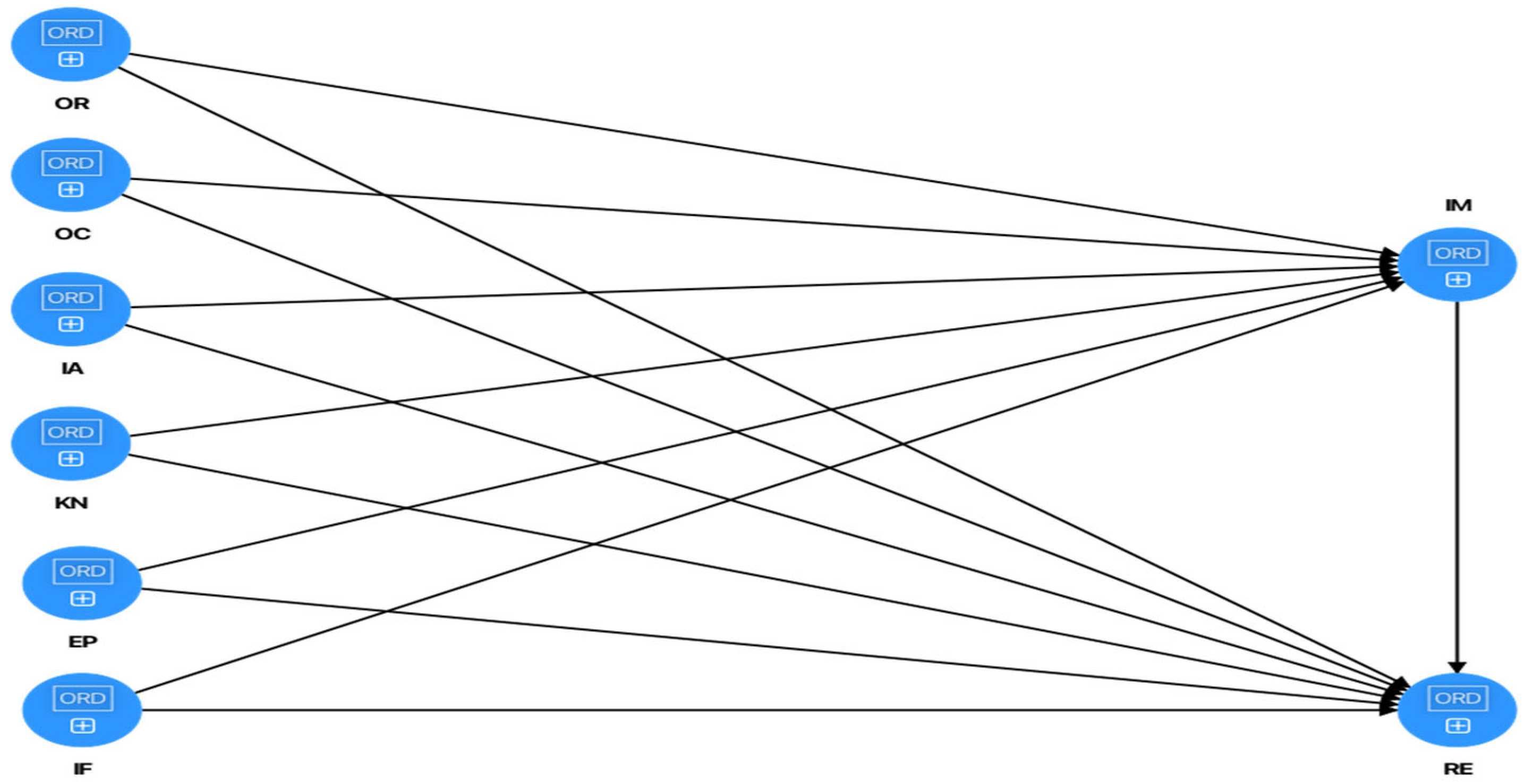
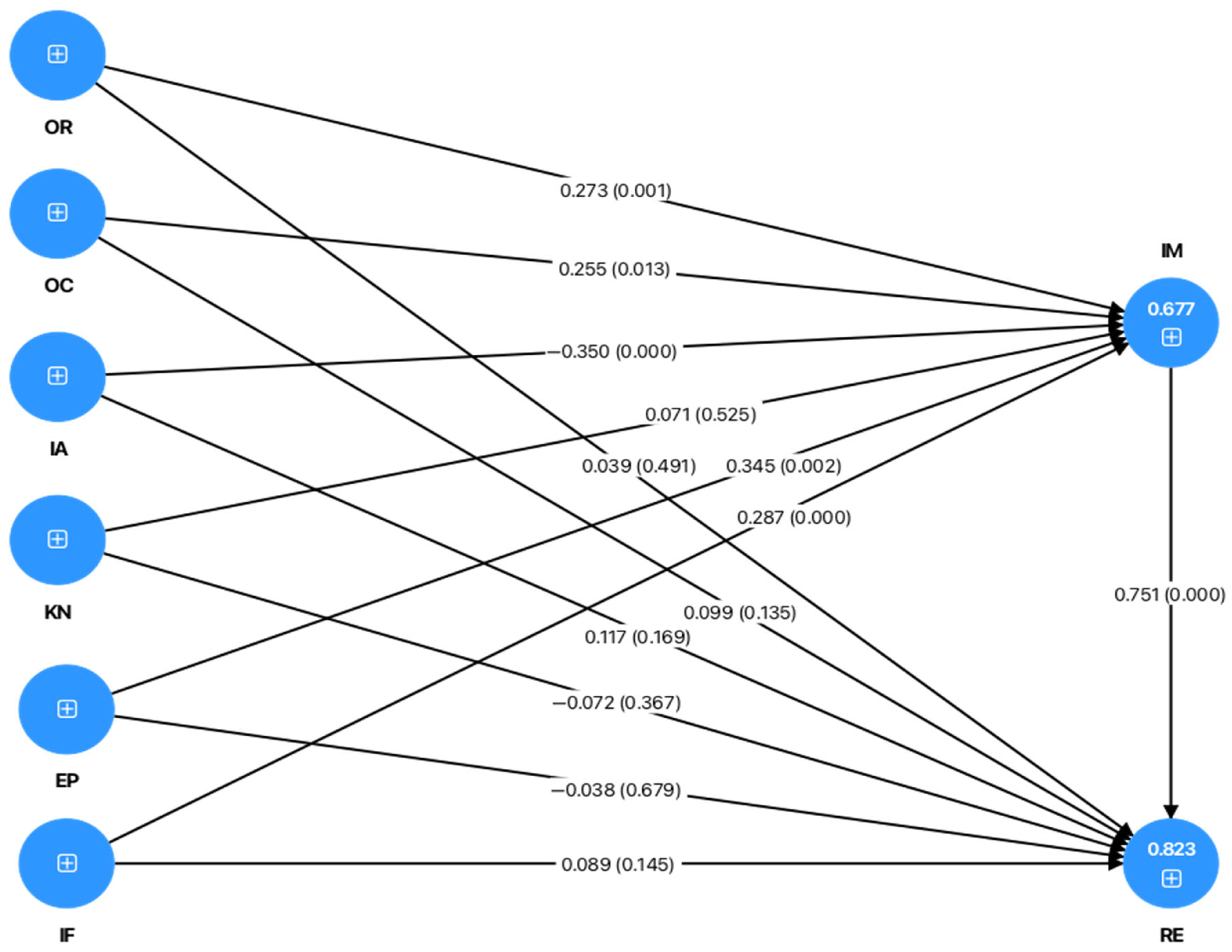
Organisational, Psychosocial and Institutional Determinants of Water Reuse Technology Adoption: A Structural Equation Modelling Approach in Peru


 ,
,  ,
,
Abstract
1. Introduction
2. Materials and Methods
2.1. Theoretical Framework
2.1.1. Circular Water Economy: Conceptual and Operational Differentiation
2.1.2. Multilevel Integrative Framework: Theoretical Foundation
2.1.3. Organisational Perspective: Strategic Resources and Dynamic Capabilities
2.1.4. Psychosocial Dimension: Cognitive and Normative Mediators
2.1.5. Institutional Framework: Coercive, Normative, and Mimetic Mechanisms
2.1.6. Contextual Specificities in Emerging Economies
2.2. Research Design and Epistemological Positioning
2.2.1. Epistemological Justification of Survey-Based Measurement
2.2.2. Research Design and Temporal Scope
2.2.3. Analytical Strategy and Workflow
2.2.4. Theoretical Integration
2.2.5. Alignment with Water Journal Scope and Contribution
2.3. Participants and Sampling
2.4. Instrument
2.5. Questionnaire Design and Theoretical Alignment
2.6. Procedure and Data Analysis
2.7. Hypotheses Development
2.8. Ethical Considerations
3. Results
3.1. Measurement Model Evaluation
3.2. Structural Model Fit Assessment
3.3. Direct Associations Analysis
3.4. Indirect Associations Analysis (Mediation Pathways)
4. Discussion
4.1. The Negative Association of Individual Attitudes with Technological Implementation
4.2. The Centrality of Implementation as a Total Mediating Variable
4.3. Hierarchy of Structural Factors and Identified Association Patterns
4.4. The Non-Significance of Technical Knowledge in Technology Adoption
4.5. Theoretical and Methodological Contributions to the Field of Circular Economy
4.6. Implications for Public Policy and Organisational Management
4.7. Specific Contextual Configuration
4.8. Theoretical Contributions: Integrating Empirical Findings with Resource-Based View, Theory of Planned Behaviour and Institutional Theory
4.9. Resource-Based View: Conditional Relevance of Organisational Capabilities
4.10. Theory of Planned Behaviour: Paradoxical Effects and Theoretical Limitations
4.11. Limitations and Directions for Future Research
5. Conclusions
Author Contributions
Funding
Data Availability Statement
Conflicts of Interest
References
- World Bank Wastewater? From Waste to Resource in a Circular Economy Context: Latin America and the Caribbean Region. Available online: https://documentos.bancomundial.org/es/publication/documents-reports/documentdetail/453201567149470699 (accessed on 12 September 2025).
- United Nations Environment Programme. Progress on Wastewater Treatment: Global Status and Acceleration Needs for SDG Indicator 6.3.1; UNEP: Nairobi, Kenya, 2021. [Google Scholar]
- Organisation for Economic Co-Operation and Development. Making Dispute Resolution More Effective—MAP Peer Review Report, Sweden (Stage 1). Available online: https://www.oecd.org/en/publications/making-dispute-resolution-more-effective-map-peer-review-report-sweden-stage-1_9789264285736-en.html (accessed on 12 September 2025).
- Chen, L.; Shen, N.; Chen, L.; Chen, L.; Wang, S. Chapter 2—Water-Stable Metal–Organic Framework–Based Nanomaterials for Removal of Heavy Metal Ions and Radionuclides. In Emerging Nanomaterials for Recovery of Toxic and Radioactive Metal Ions from Environmental Media; Wang, X., Ed.; Elsevier: Amsterdam, The Netherlands, 2022; pp. 49–126. ISBN 978-0-323-85484-9. [Google Scholar]
- Das, P.P.; Mondal, P. 14—Membrane-Assisted Potable Water Reuses Applications: Benefits and Drawbacks. In Resource Recovery in Drinking Water Treatment; Sillanpää, M., Khadir, A., Gurung, K., Eds.; Elsevier: Amsterdam, The Netherlands, 2023; pp. 289–309. ISBN 978-0-323-99344-9. [Google Scholar]
- García, F.G.; Cabrera-Sumba, J.; Valdez-Pilataxi, S.; Villalta-Chungata, J.; Valdiviezo-Gonzales, L.; Alegria-Arnedo, C. Removal of Heavy Metals in Industrial Wastewater Using Adsorption Technology: Efficiency and Influencing Factors. Clean. Eng. Technol. 2025, 24, 100879. [Google Scholar] [CrossRef]
- Mannina, G.; Pandey, A. Boosting the Transition to Circular Economy in the Water Sector: Insights from EU Demonstration Case Studies, 1st ed.; Elsevier Inc.: Amsterdam, The Netherlands, 2025; ISBN 978-0-443-30258-9. [Google Scholar]
- Hu, L.; Bentler, P.M. Cutoff Criteria for Fit Indexes in Covariance Structure Analysis: Conventional Criteria versus New Alternatives. Struct. Equ. Model. A Multidiscip. J. 1999, 6, 1–55. [Google Scholar] [CrossRef]
- Chowdhury, S.; Dey, P.K.; Rodríguez-Espíndola, O.; Parkes, G.; Tuyet, N.T.A.; Long, D.D.; Ha, T.P. Impact of Organisational Factors on the Circular Economy Practices and Sustainable Performance of Small and Medium-Sized Enterprises in Vietnam. J. Bus. Res. 2022, 147, 362–378. [Google Scholar] [CrossRef]
- Segovia-Hernández, J.G.; Hernández, S.; Cossío-Vargas, E.; Sánchez-Ramírez, E. Tackling Sustainability Challenges in Latin America and the Caribbean from the Chemical Engineering Perspective: A Literature Review in the Last 25 Years. Chem. Eng. Res. Des. 2022, 188, 483–527. [Google Scholar] [CrossRef]
- Adewuyi, S.O.; Anani, A.; Luxbacher, K. Advancing Sustainable and Circular Mining through Solid-Liquid Recovery of Mine Tailings. Process Saf. Environ. Prot. 2024, 189, 31–46. [Google Scholar] [CrossRef]
- Seles, B.M.R.P.; Lopes de Sousa Jabbour, A.B.; Latan, H.; Mascarenhas, J. ‘Breaking the Mold’: Circular Economy Success in a Challenging Institutional Context. J. Environ. Manag. 2025, 378, 124542. [Google Scholar] [CrossRef]
- Balsalobre-Lorente, D.; Radulescu, M.; Pilař, L.; Shah, S.A.R. A Holistic Approach to Sustainability: Exploring the Main and Mediating Role of Circular Economy in Net Zero Emissions. J. Environ. Manag. 2025, 382, 125319. [Google Scholar] [CrossRef]
- Yu, Y.; Xu, J.; Zhang, J.Z.; Wu, Y.; Liao, Z. Do Circular Economy Practices Matter for Financial Growth? An Empirical Study in China. J. Clean. Prod. 2022, 370, 133255. [Google Scholar] [CrossRef]
- Ayeleru, O.O.; Sadare, O.O.; Idris, A.O.; Pandey, S.; Olubambi, P.A. Chapter 1—Introduction to Smart Nanomaterials for Environmental Remediation. In Smart Nanomaterials for Environmental Applications; Ayeleru, O.O., Idris, A.O., Pandey, S., Olubambi, P.A., Eds.; Micro and Nano Technologies; Elsevier: Amsterdam, The Netherlands, 2025; pp. 3–28. ISBN 978-0-443-21794-4. [Google Scholar]
- Dutta, S.; Dixit, R.; Sharma, R.K. Chapter 7—Remediation of Heavy Metals with Nanomaterials. In Separations of Water Pollutants with Nanotechnology; Ahuja, S., Ed.; Separation Science and Technology; Academic Press: Cambridge, MA, USA, 2022; Volume 15, pp. 97–138. [Google Scholar]
- Aragaw, T.A.; Ayalew, A.A. Chapter 10—Application of Metal-Based Nanoparticles for Metal Removal for Treatments of Wastewater—A Review. In Emerging Techniques for Treatment of Toxic Metals from Wastewater; Ahmad, A., Kumar, R., Jawaid, M., Eds.; Elsevier: Amsterdam, The Netherlands, 2023; pp. 183–231. ISBN 978-0-12-822880-7. [Google Scholar]
- Ogiemwonyi, O. Determinants of Green Behaviour (Revisited): A Comparative Study. Resour. Conserv. Recycl. Adv. 2024, 22, 200214. [Google Scholar]
- Hidalgo-Crespo, J.; Amaya-Rivas, J.L. Citizens’ pro-Environmental Behaviours for Waste Reduction Using an Extended Theory of Planned Behaviour in Guayas Province. Clean. Eng. Technol. 2024, 21, 100765. [Google Scholar] [CrossRef]
- Nordin, S.M.; Zolkepli, I.A.; Ahmad Rizal, A.R.; Tariq, R.; Mannan, S.; Ramayah, T. Paving the Way to Paddy Food Security: A Multigroup Analysis of Agricultural Education on Circular Economy Adoption. J. Clean. Prod. 2022, 375, 134089. [Google Scholar] [CrossRef]
- Garg, A.; Raut, R.D.; Kumar, M.; Zhang, C.; Gokhale, R.S. Does the Circular Economy Transition Aid to Carbon Neutrality? Examining Net-Zero Policy and Stakeholder Impact from the Environmental Justice Viewpoint. J. Clean. Prod. 2025, 491, 144851. [Google Scholar] [CrossRef]
- Maione, G.; Supino, S.; Grimaldi, M.; Troisi, O. Exploring the Political-Institutional Perspective of Sustainable Consumer Behaviour within the Circular Economy: A Structural Equation Modelling Approach from Nudge Theory. Socio-Econ. Plan. Sci. 2025, 100, 102254. [Google Scholar] [CrossRef]
- Kharayat, T.S.; Gupta, H. Assessment of Circular Economy Strategies for Climate Change Mitigation: A Forecast on India’s Path to a Net Zero Future. Technol. Forecast. Soc. Change 2025, 220, 124294. [Google Scholar] [CrossRef]
- Mukherjee, S.; Panigrahi, R.R.; Sharma, R.; Shrivastava, A.K. Advancing Circular Economy Performance through Blockchain Adoption: A Study Using Institutional and Resource-Based Frameworks. Sustain. Futures 2025, 9, 100521. [Google Scholar] [CrossRef]
- Khizar, H.M.; Iqbal, M.J.; Khalid, J.; Adomako, S. Addressing the Conceptualisation and Measurement Challenges of Sustainability Orientation: A Systematic Review and Research Agenda. J. Bus. Res. 2022, 142, 718–743. [Google Scholar] [CrossRef]
- Islam, S.; Hassan, S.; Hossain, S.; Ahmed, T.; Karmaker, C.L.; Bari, A.B.M.M. Exploring the Influence of Circular Economy on Big Data Analytics and Supply Chain Resilience Nexus: A Structural Equation Modelling Approach. Green Technol. Sustain. 2025, 3, 100219. [Google Scholar] [CrossRef]
- Singh, S.; Dhir, S.; Das, V.M.; Sharma, A. Bibliometric Overview of the Technological Forecasting and Social Change Journal: Analysis from 1970 to 2018. Technol. Forecast. Soc. Change 2020, 154, 119963. [Google Scholar] [CrossRef]
- Sarstedt, M.; Ringle, C.M.; Hair, J.F. Partial Least Squares Structural Equation Modelling. In Handbook of Market Research; Springer: Cham, Switzerland, 2017; pp. 1–40. ISBN 978-3-319-05542-8. [Google Scholar]
- De Guimarães, J.C.F.; Severo, E.A.; Klein, L.L.; Dorion, E.C.H.; Lazzari, F. Antecedents of Sustainable Consumption of Remanufactured Products: A Circular Economy Experiment in the Brazilian Context. J. Clean. Prod. 2023, 385, 135571. [Google Scholar] [CrossRef]
- Vinkóczi, T.; Heimné Rácz, É.; Koltai, J.P. Exploratory Analysis of Zero Waste Theory to Examine Consumer Perceptions of Sustainability: A Covariance-Based Structural Equation Modelling (CB-SEM). Clean. Waste Syst. 2024, 8, 100146. [Google Scholar] [CrossRef]
- Ingrassia, E.B.; Fiorentini, E.F.; Dotto, G.L.; Escudero, L.B. When the Use of Derived Wastes and Effluents Treatment Is Part of a Responsible Industrial Production: A Review. Chem. Eng. Process.-Process Intensif. 2024, 201, 109826. [Google Scholar] [CrossRef]
- Kline, R.B. Principles and Practice of Structural Equation Modelling, Fourth Edition; Guilford Publications: New York, NY, USA, 2015; ISBN 978-1-4625-2335-1. [Google Scholar]
- Hair, J.F. A Primer on Partial Least Squares Structural Equation Modelling (PLS-SEM); SAGE: Newcastle upon Tyne, UK, 2014; ISBN 978-1-4522-1744-4. [Google Scholar]
- Fornell, C.; Larcker, D.F. Evaluating Structural Equation Models with Unobservable Variables and Measurement Error. J. Mark. Res. 1981, 18, 39–50. [Google Scholar] [CrossRef]
- Nunnally, J.C. Psychometric Theory 3E; Tata McGraw-Hill Education: Uttar Pradesh, India, 1994; ISBN 978-0-07-107088-1. [Google Scholar]
- Rasoolimanesh, S.M. Discriminant Validity Assessment in PLS-SEM: A Comprehensive Composite-Based Approach. Data Anal. Perspect. J. 2022, 3, 1–8. [Google Scholar]
- Hair, J.F.; Risher, J.J.; Sarstedt, M.; Ringle, C.M. When to Use and How to Report the Results of PLS-SEM. Eur. Bus. Rev. 2019, 31, 2–24. [Google Scholar] [CrossRef]
- Escobedo Portillo, M.T.; Hernández Gómez, J.A.; Estebané Ortega, V.; Martínez Moreno, G. Structural Equation Modelling: Features, Phases, Construction, Implementation and Results. Sci. Work 2016, 18, 16–22. [Google Scholar] [CrossRef]
- Etikan, I.; Musa, S.A.; Alkassim, R.S. Comparison of Convenience Sampling and Purposive Sampling. Am. J. Theor. Appl. Stat. 2015, 5, 1–4. [Google Scholar] [CrossRef]
- Sharma, G. Pros and Cons of Different Sampling Techniques. Int. J. Appl. Res. 2017, 3, 749–752. [Google Scholar]
- Kek, H.Y.; Tan, H.; Othman, M.H.D.; Lee, C.T.; Ahmad, F.B.J.; Ismail, N.D.; Nyakuma, B.B.; Lee, K.Q.; Wong, K.Y. Transforming Pollution into Solutions: A Bibliometric Analysis and Sustainable Strategies for Reducing Indoor Microplastics. Environ. Res. 2024, 252, 118928. [Google Scholar] [CrossRef]
- Balaram, V.; Santosh, M.; Satyanarayanan, M.; Srinivas, N.; Gupta, H. Lithium: A Review of Applications, Occurrence, Exploration, Extraction, Recycling, Analysis, and Environmental Impact. Geosci. Front. 2024, 15, 101868. [Google Scholar] [CrossRef]
- Russo, F.; Vigile, M.F.; Galiano, F.; Figoli, A. Chapter 2—Green Solvents for Membrane Fabrication. In Green Membrane Technologies Towards Environmental Sustainability; Dumée, L.F., Sadrzadeh, M., Shirazi, M.M.A., Eds.; Elsevier: Amsterdam, The Netherlands, 2023; pp. 9–44. ISBN 978-0-323-95165-4. [Google Scholar]
- Valencia, A.; Elías-Peñafiel, C.; Encina-Zelada, C.R.; Anticona, M.; Ramos-Escudero, F. Circular Bioeconomy for Cocoa By-Product Industry: Development of Whey Protein-Cocoa Bean Shell Concentrate Particles Obtained by Spray-Drying and Freeze-Drying for Commercial Applications. Food Bioprod. Process. 2024, 146, 38–48. [Google Scholar] [CrossRef]
- Thakur, A.; Kumar, A. 19—Functionalised Polymer Nanocomposites for Environmental Remediation. In Advances in Functionalised Polymer Nanocomposites; Patel, G., Deshmukh, K., Hussain, C.M., Eds.; Woodhead Publishing Series in Composites Science and Engineering; Woodhead Publishing: Sawston, UK, 2024; pp. 747–784. ISBN 978-0-443-18860-2. [Google Scholar]
- Jave-Chire, M.; Alvarez-Risco, A.; Guevara-Zavaleta, V. Footwear Industry’s Journey through Green Marketing Mix, Brand Value and Sustainability. Sustain. Futures 2025, 9, 134089. [Google Scholar] [CrossRef]
- Ahmad, S.; Singh, R.; Arfin, T.; Neeti, K. Fluoride Contamination, Consequences and Removal Techniques in Water: A Review. Environ. Sci. Adv. 2022, 1, 620–661. [Google Scholar] [CrossRef]
- Wakkel, M. Chapter 8—Efficient Adsorbent Based on Pomegranate Peel for Pollutants Removal from Aqueous Solution. In Sustainable Applications of Pomegranate Peels; Jeguirim, M., Khiari, B., Eds.; Academic Press: Cambridge, MA, USA, 2025; pp. 151–190. ISBN 978-0-443-22390-7. [Google Scholar]
- Holley, E.A.; Fahle, L.; Malone, A.; Zaronikola, N.; Nelson, P.P.; Erik Spiller, D. U.S. Industry Practices and Attitudes towards Reprocessing Mine Tailings for Metal Recovery. Resour. Policy 2025, 107, 105643. [Google Scholar] [CrossRef]
- Coltelli, M.-B.; Morganti, P.; Lazzeri, A. Chapter 20—Sustainability Assessment, Environmental Impact, and Recycling Strategies of Biodegradable Polymer Nanocomposites. In Biodegradable and Biocompatible Polymer Nanocomposites; Deshmukh, K., Pandey, M., Eds.; Elsevier: Amsterdam, The Netherlands, 2023; pp. 699–737. ISBN 978-0-323-91696-7. [Google Scholar]
- Leal, R.; Alves Lima Sobrinho, R.; Tramontin Souza, M. Recycling Diatomaceous Earth Waste: Assessing Its Physicochemical Features, Recovery Techniques, Applications, Viability and Market Opportunities. Clean. Waste Syst. 2025, 10, 100244. [Google Scholar] [CrossRef]
- Cusimano, G.M.; Revue, C.A.; Chiang, J.-C.; Rustad, T.; Sasidharan, A.; Dalgaard, P.; Gasco, L.; Gai, F.; Sørensen, A.-D.M.; Geremia, E.; et al. Management of Atlantic Bluefin Tuna (Thunnus Thynnus) By-Products in Malta: Logistics, Biomass Quality and Environmental Impact. J. Clean. Prod. 2025, 498, 145106. [Google Scholar] [CrossRef]
- Azriena, H.A.A.; Kaur, K.; Ilyas, R.A.; Kamaruddin, Z.H.; Neenu, K.V.; Midhun Dominic, C.D.; Wirawan, W.A.; Asrofi, M.; Dzulkifli, M.H.; Sulong, M.A.; et al. Recent Developments in Lignocellulosic Banana (Musa spp.) Fibre-Based Biocomposites and Their Potential Industrial Applications: A Comprehensive Review. Int. J. Biol. Macromol. 2025, 323, 147180. [Google Scholar] [CrossRef]
- Sarvepalli, M.; Kairamkonda, M.; Khatoon, U.T.; Ramachandravarapu, A.K.; Godishala, V.; Velidandi, A. Transforming Lignocellulosic Based Waste into Nanomaterials for Sustainable Wastewater Treatment: A Comprehensive Review of Synthesis, Environment, Techno-Economic and Regulatory Considerations. Inorg. Chem. Commun. 2025, 181, 115284. [Google Scholar] [CrossRef]
- Saunders, M.N.K.; Lewis, P.; Thornhill, A. Research Methods for Business Students; Pearson Education: London, UK, 2019; ISBN 978-1-292-20879-4. [Google Scholar]
- Kock, N. Common Method Bias in PLS-SEM: A Full Collinearity Assessment Approach. Int. J. e-Collab. 2015, 11, 1–10. [Google Scholar] [CrossRef]
- Cohen, J. Statistical Power Analysis for the Behavioral Sciences, 2nd ed.; Lawrence Erlbaum Associates: Hillsdale, NJ, USA, 1988; ISBN 978-0-8058-0283-2. [Google Scholar]
- MacKinnon, D.P.; Krull, J.L.; Lockwood, C.M. Equivalence of the Mediation, Confounding and Suppression Effect. Prev. Sci. 2000, 1, 173–181. [Google Scholar] [CrossRef]
- Cenfetelli, R.T.; Bassellier, G. Interpretation of Formative Measurement in Information Systems Research. MIS Q. 2009, 33, 689–707. [Google Scholar] [CrossRef]



| Characteristic | Category | n | % |
|---|---|---|---|
| Type of organisation | Industrial | 63 | 42.0 |
| Public services | 42 | 28.0 | |
| Construction | 28 | 18.7 | |
| Public sector | 17 | 11.3 | |
| Organisational size | Micro | 23 | 15.3 |
| Small | 38 | 25.3 | |
| Medium | 47 | 31.3 | |
| Large | 42 | 28.0 | |
| Position | Manager/Director | 58 | 38.7 |
| Sustainability coordinator | 47 | 31.3 | |
| Engineer/technician | 32 | 21.3 | |
| Public official | 13 | 8.7 | |
| Years of experience | Less than 5 years | 34 | 22.7 |
| 5–10 years | 52 | 34.7 | |
| 11–20 years | 41 | 27.3 | |
| More than 20 years | 23 | 15.3 | |
| Region | Lima | 67 | 44.7 |
| Trujillo | 48 | 32.0 | |
| Cajamarca | 35 | 23.3 |
| Construct | Item | Description | Load | STDEV | p-Value |
|---|---|---|---|---|---|
| EP | EP1 | In my sector, it is increasingly common and expected to adopt reuse technologies. | 0.840 | 0.026 | 0.000 |
| EP2 | There is a growing social expectation that we adopt circular economy practices. | 0.880 | 0.021 | 0.000 | |
| EP3 | In my sector, there is growing regulatory pressure to implement sustainable practices. | 0.787 | 0.050 | 0.000 | |
| EP4 | Industry standards are progressively demanding greater efficiency in water use. | 0.827 | 0.033 | 0.000 | |
| IA | IA1 | I believe that reuse technologies represent essential innovations for the future. | 0.864 | 0.034 | 0.000 |
| IA2 | I am genuinely motivated to lead the adoption of innovative environmental technologies. | 0.879 | 0.034 | 0.000 | |
| IA3 | The economic and environmental benefits far outweigh the potential risks. | 0.865 | 0.028 | 0.000 | |
| IA4 | I have complete confidence in the safety and effectiveness of modern reuse systems. | 0.904 | 0.018 | 0.000 | |
| IF | IF1 | Current regulations effectively facilitate the implementation of reuse technologies. | 0.820 | 0.037 | 0.000 |
| IF2 | The legal requirements for water reuse are clear, consistent and achievable. | 0.815 | 0.035 | 0.000 | |
| IF3 | There are attractive government financial incentives to adopt reuse technologies. | 0.870 | 0.022 | 0.000 | |
| IF4 | Public policies effectively and consistently promote the circular water economy. | 0.849 | 0.025 | 0.000 | |
| IF5 | Public institutions provide competent and timely technical advice. | 0.808 | 0.034 | 0.000 | |
| IM | IM1 | Our organisation has successfully implemented functional water reuse systems. | 0.892 | 0.018 | 0.000 |
| IM2 | We regularly use advanced treatment technologies for internal reuse. | 0.905 | 0.018 | 0.000 | |
| IM3 | We have concrete, funded strategic plans to expand reuse. | 0.894 | 0.018 | 0.000 | |
| IM4 | We systematically monitor and optimise our reuse systems. | 0.892 | 0.022 | 0.000 | |
| KN | KN1 | I have solid knowledge of the technologies available for water reuse. | 0.944 | 0.014 | 0.000 |
| KN2 | I clearly understand the technical and economic benefits of these technologies. | 0.943 | 0.012 | 0.000 | |
| OC | OC1 | Organisational leaders actively communicate the importance of the circular water economy. | 0.896 | 0.018 | 0.000 |
| OC2 | There is a well-established culture of environmental responsibility in our organisation. | 0.914 | 0.017 | 0.000 | |
| OC3 | Organisational values explicitly include sustainability and water conservation. | 0.898 | 0.023 | 0.000 | |
| OR | OR1 | Our organisation has adequate financial resources to invest in water reuse technologies. | 0.912 | 0.019 | 0.000 |
| OR2 | The costs of implementing reuse technologies are within our budgetary means. | 0.938 | 0.013 | 0.000 | |
| OR3 | Senior management demonstrates visible commitment to the implementation of water reuse technologies. | 0.872 | 0.025 | 0.000 | |
| RE | RE1 | The systems implemented consistently exceed performance expectations. | 0.895 | 0.017 | 0.000 |
| RE2 | We have achieved quantifiable and significant reductions in fresh water consumption. | 0.910 | 0.021 | 0.000 | |
| RE3 | The implementation has generated measurable and substantial economic savings. | 0.894 | 0.026 | 0.000 | |
| RE4 | Our stakeholders recognise and value our achievements in the circular water economy. | 0.906 | 0.019 | 0.000 |
| Construct | AVE | Interpretation |
|---|---|---|
| External Pressure (EP) | 0.696 | Valid (>0.50) |
| Individual Attitudes (IAs) | 0.771 | Valid (>0.50) |
| Institutional Framework (IF) | 0.693 | Valid (>0.50) |
| Implementation (IM) | 0.803 | Valid (>0.50) |
| Knowledge (KN) | 0.890 | Valid (>0.50) |
| Organisational Culture (OC) | 0.815 | Valid (>0.50) |
| Organisational Resources (ORs) | 0.824 | Valid (>0.50) |
| Results (REs) | 0.812 | Valid (>0.50) |
| Construct | Cronbach’s Alpha | Composite Reliability (rho_a) | Composite Reliability (rho_c) | R2 | EP | IA | IF | IM | KN | OC | OR | RE |
|---|---|---|---|---|---|---|---|---|---|---|---|---|
| EP | 0.854 | 0.860 | 0.901 | - | 0.834 | |||||||
| IA | 0.902 | 0.923 | 0.931 | - | 0.732 | 0.878 | ||||||
| IF | 0.889 | 0.891 | 0.919 | - | 0.716 | 0.657 | 0.833 | |||||
| IM | 0.918 | 0.918 | 0.942 | 0.677 | 0.643 | 0.488 | 0.764 | 0.896 | ||||
| KN | 0.877 | 0.877 | 0.942 | - | 0.543 | 0.732 | 0.710 | 0.608 | 0.943 | |||
| OC | 0.887 | 0.895 | 0.930 | - | 0.630 | 0.682 | 0.660 | 0.744 | 0.699 | 0.903 | ||
| OR | 0.893 | 0.895 | 0.933 | - | 0.616 | 0.608 | 0.675 | 0.769 | 0.625 | 0.793 | 0.908 | |
| RE | 0.923 | 0.924 | 0.945 | 0.823 | 0.623 | 0.542 | 0.757 | 0.669 | 0.603 | 0.756 | 0.754 | 0.901 |
| Criterion | Estimated Model | Threshold | Author | Decision |
|---|---|---|---|---|
| SRMR | 0.069 | <0.08 | Hu & Bentler (1999) [8] | Acceptable |
| d_ULS | 2.066 | |||
| d_G | 1.278 | |||
| χ2/df | 1.499 | Between 1 and 3 | (Escobedo Portillo et al., 2016) [38] | Acceptable |
| NFI | 0.942 | >0.90 | (Escobedo Portillo et al., 2016) [38] | Acceptable |
| Hypothesis | Path | p Values | Standard Deviation (STDEV) | Confidence Interval | ||
|---|---|---|---|---|---|---|
| 2.5 | 97.5% | |||||
| H5 | EP → IM | 0.345 | 0.002 | 0.113 | 0.127 | 0.575 |
| H3 | IA → IM | −0.350 | 0.000 | 0.087 | −0.517 | −0.172 |
| H6 | IF → IM | 0.287 | 0.000 | 0.076 | 0.157 | 0.455 |
| H7 | IM → RE | 0.751 | 0.000 | 0.073 | 0.600 | 0.888 |
| H4 | KN → IM | 0.071 | 0.525 | 0.112 | −0.163 | 0.278 |
| H2 | OC → IM | 0.255 | 0.013 | 0.103 | 0.040 | 0.438 |
| H1 | OR → IM | 0.273 | 0.001 | 0.084 | 0.102 | 0.432 |
| Hypothesis | Path | p Values | Standard Deviation (STDEV) | Confidence Interval | ||
|---|---|---|---|---|---|---|
| 2.5% | 97.5% | |||||
| H12 | EP → IM → RE | 0.259 | 0.003 | 0.087 | 0.095 | 0.438 |
| H10 | IA → IM → RE | −0.263 | 0.000 | 0.075 | −0.415 | −0.121 |
| H13 | IF → IM → RE | 0.216 | 0.000 | 0.059 | 0.116 | 0.346 |
| H11 | KN → IM → RE | 0.054 | 0.528 | 0.086 | −0.120 | 0.215 |
| H9 | OC → IM → RE | 0.191 | 0.020 | 0.082 | 0.028 | 0.351 |
| H8 | OR → IM → RE | 0.205 | 0.002 | 0.065 | 0.077 | 0.333 |
Disclaimer/Publisher’s Note: The statements, opinions and data contained in all publications are solely those of the individual author(s) and contributor(s) and not of MDPI and/or the editor(s). MDPI and/or the editor(s) disclaim responsibility for any injury to people or property resulting from any ideas, methods, instructions or products referred to in the content. |
© 2026 by the authors. Licensee MDPI, Basel, Switzerland. This article is an open access article distributed under the terms and conditions of the Creative Commons Attribution (CC BY) license.
Share and Cite
Mogollón García, F.S.; Lizarzaburu-Aguinaga, D.A.; Licapa-Redolfo, G.S.; Vera Zelada, L.A.; Vera Zelada, P.; Licapa-Redolfo, R.; Aranguri Cayetano, D.J.; Luque Luque, E.O. Organisational, Psychosocial and Institutional Determinants of Water Reuse Technology Adoption: A Structural Equation Modelling Approach in Peru. Water 2026, 18, 596. https://doi.org/10.3390/w18050596
Mogollón García FS, Lizarzaburu-Aguinaga DA, Licapa-Redolfo GS, Vera Zelada LA, Vera Zelada P, Licapa-Redolfo R, Aranguri Cayetano DJ, Luque Luque EO. Organisational, Psychosocial and Institutional Determinants of Water Reuse Technology Adoption: A Structural Equation Modelling Approach in Peru. Water. 2026; 18(5):596. https://doi.org/10.3390/w18050596
Chicago/Turabian StyleMogollón García, Francisco Segundo, Danny Alonso Lizarzaburu-Aguinaga, Gladys Sandi Licapa-Redolfo, Luis Alberto Vera Zelada, Persi Vera Zelada, Rolando Licapa-Redolfo, Denis Javier Aranguri Cayetano, and Elmer Ovidio Luque Luque. 2026. "Organisational, Psychosocial and Institutional Determinants of Water Reuse Technology Adoption: A Structural Equation Modelling Approach in Peru" Water 18, no. 5: 596. https://doi.org/10.3390/w18050596
APA StyleMogollón García, F. S., Lizarzaburu-Aguinaga, D. A., Licapa-Redolfo, G. S., Vera Zelada, L. A., Vera Zelada, P., Licapa-Redolfo, R., Aranguri Cayetano, D. J., & Luque Luque, E. O. (2026). Organisational, Psychosocial and Institutional Determinants of Water Reuse Technology Adoption: A Structural Equation Modelling Approach in Peru. Water, 18(5), 596. https://doi.org/10.3390/w18050596