Article

Comparison of Soil Detachment Characteristics Before and After Disturbance Due to Collapsing Wall Soil and Differences in the Underlying Mechanisms in Anxi County of Southeast China


1
College of Civil and Architectural Engineering, Liming Vocational University, Quanzhou 362007, China
2
College of Resources and Environment, Fujian Agriculture and Forestry University, Fuzhou 350002, China
3
College of Forestry, Fujian Agriculture and Forestry University, Fuzhou 350002, China
*
Author to whom correspondence should be addressed.
These authors contributed equally to this work.
Water 2026, 18(5), 575; https://doi.org/10.3390/w18050575
Submission received: 18 January 2026 / Revised: 25 February 2026 / Accepted: 26 February 2026 / Published: 27 February 2026
(This article belongs to the Special Issue Soil Erosion and Soil and Water Conservation, 2nd Edition)

Abstract

To clarify the differences in and mechanisms of soil detachment before and after soil collapse, five typical granite soil layers (red soil, red soil–sandy soil, sandy soil, sandy soil–debris, and debris layers) of Benggang in Anxi County, Fujian Province, were studied via laboratory runoff scouring tests, and the detachment capabilities and influencing factors of undisturbed (original) and disturbed (colluvial deposit) soils were compared. The results showed that disturbance due to soil collapse significantly increases the soil detachment capacity by an average of 1046 times, with the greatest increase occurring in the red soil–sand soil layer (3494 times) and the smallest increase occurring in the debris layer (63 times). The undisturbed soil detachment capacity increases with increasing soil depth, whereas the disturbed soil capacity first increases but then decreases, with the sand layer having the highest capacity. Hydrodynamic fitting results revealed that undisturbed red soil has a linear relationship, red soil–sandy soil and sandy soil layers have power function relationships, and sandy soil–debris and debris layers have logarithmic relationships with flow shear stress. Disturbed red soil and red soil–sandy soil layers are linearly related, whereas the other layers are logarithmically related. Correlation analysis revealed that undisturbed soil detachment is significantly negatively correlated with clay, silt, gravel, free iron oxide, and free alumina contents and positively correlated with sand content. Disturbed soil shows similar correlations, but it has a negative correlation with organic matter instead of gravel. Structural equation modelling (SEM) path analysis revealed that undisturbed soil detachment is affected mainly by negative free alumina oxide content (path coefficient of −0.87) and flow shear stress (path coefficient of 0.14), whereas disturbed soil is controlled mainly by negative shear strength (path coefficient of −0.76) and positive flow shear stress (path coefficient of 0.49). This study elucidates the mechanism by which colluvial deposit disturbance accelerates soil detachment, providing a theoretical basis for the prevention and control of Benggang erosion in the hilly regions of southern China with red soil. Moreover, the comparative research strategy adopted in this study offers a reference for related investigations in similar erosion-prone areas.

1. Introduction

Soil erosion is a major environmental problem worldwide, and it severely constrains ecological and socioeconomic development [1,2]. Hydraulic erosion is the primary type of soil erosion [3,4], and its evolution can be divided into three main stages: soil detachment, sediment transport, and deposition [5]. Among these stages, soil detachment refers to the process by which soil particles or aggregates are separated from the soil mass due to raindrop impact or runoff-induced scouring. Soil detachment is the initial stage of the soil particle or aggregate transport process [6]; it provides a material basis for sediment transport and deposition and serves as a key parameter for controlling the soil erosion process. The soil detachment capacity is generally defined as the maximum rate of soil detachment by clear water under the same slope gradient and unit discharge conditions [7]. Soil detachment is closely related to the degree of soil disturbance [8]. The stronger the disturbance is, the more easily the bonding structure between soil particles and the soil matrix is disrupted [9], leading to an increase in both the rate of detachment by raindrops or runoff [10] and in the soil detachment capacity. Previous studies have reported that the comprehensive soil erodibility index of tilled soil in a wind–water erosion crisscross region is 3.45 times that of no-tillage soil [11], and the soil detachment capacity of disturbed loess soil is 1–23 times that of undisturbed soil [12]. Therefore, a systematic comparison of the differences in soil detachment characteristics between disturbed and undisturbed soils can provide a basis for the accurate acquisition of parameters in soil erosion models.
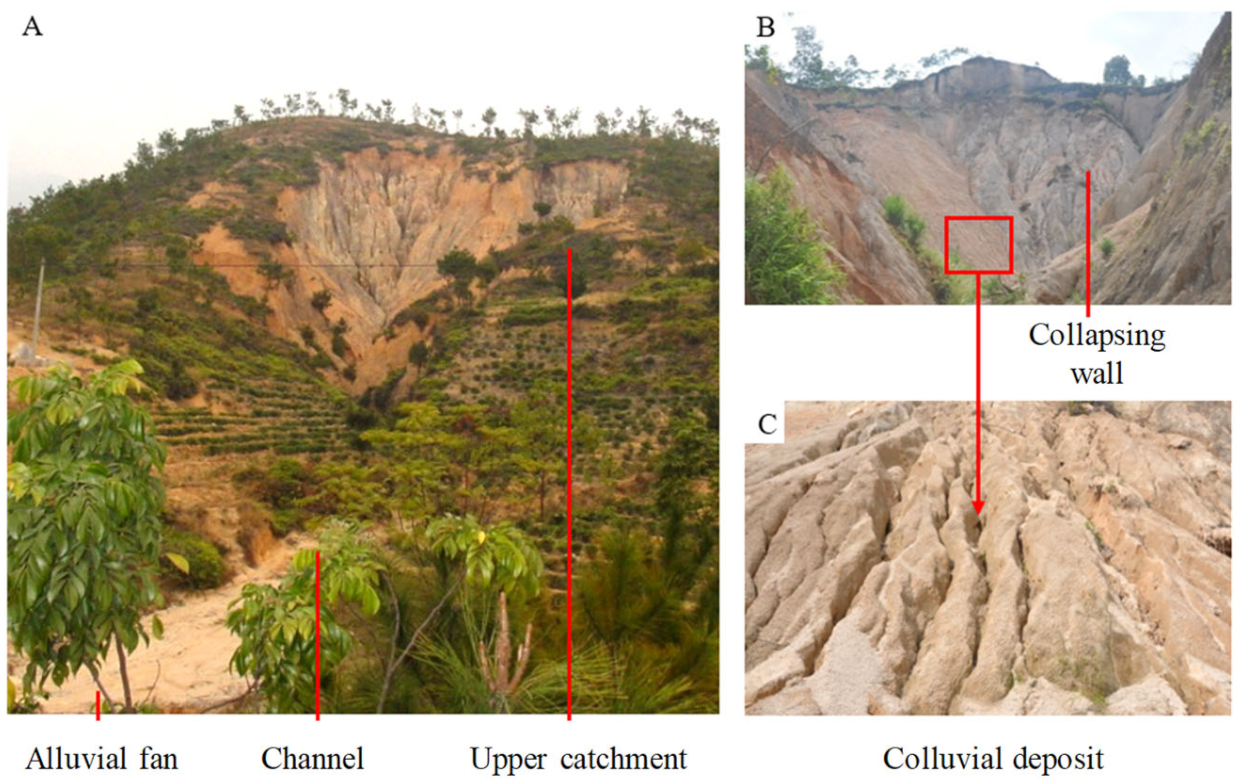
Benggang erosion is among the most severe erosion types in the red soil hilly region of southern China. Benggang gullies are chair-shaped eroded landforms formed by collapse and runoff at gully heads under the combined action of hydraulic and gravitational forces. A complete collapsing gully system consists of basic units (Figure 1), such as an upper catchment, a collapsing wall, a colluvial deposit, a channel, and an alluvial fan [13,14], with energy exchange and material cycling processes occurring close together between these units. The collapse of the collapsing wall and the re-erosion of colluvial deposits are the key processes driving the development of collapsing gullies. As the core mechanism triggering the occurrence of collapsing gullies, the failure of the collapsing wall produces loose deposits that form colluvial deposits. Compared with that of the undisturbed soil of the collapsing wall, the erosion resistance of the colluvial deposits is significantly lower; this parameter is closely related to soil strength [15,16]. Previous studies have shown that the cohesion of colluvial deposits in granite collapsing gullies is only 35% of that of the collapsing wall soil; moreover, the disintegration rate is increased by 48%, and the anti-scourability level is decreased by 90% [17], which reveals the significant impact of collapsing wall disturbance on soil erosion resistance.
Academic research on Benggang gullies has focused mainly on two areas: first, the relationship between the geotechnical properties of collapsing walls and collapse stability and, second, the laws of runoff and sediment yield on colluvial deposit slopes and their hydrodynamic mechanisms. In terms of research on the geotechnical properties of collapsing walls, deep weathering crusts have been confirmed as the material basis for the development of collapsing gullies. Differences in the degree of weathering among different layers of weathering crusts lead to significant variations in soil particle composition and mineral composition. These variations further regulate the stability of collapsing gullies by influencing geotechnical properties, such as soil structure, infiltration capacity, and shear strength [18,19]. As shear strength is a key indicator of the geotechnical properties of Benggang formations, variations in shear strength have attracted considerable attention. Studies have shown that increases in soil water content, decreases in cementing material content, and wet–dry cycle effects can all lead to a reduction in shear strength, thereby inducing wall collapse and exacerbating collapsing gully erosion [20,21]. With respect to colluvial deposits, scholars have focused mostly on runoff and sediment yields and hydrodynamic characteristics. Among them, studies on runoff and sediment yield have mostly explored the erosion processes of colluvial deposit slopes and their correlations with slope development through artificial simulated rainfall and runoff scouring experiments [22,23]. Hydrodynamic research based on rill scouring simulation experiments has revealed that the flow velocity, water depth, and resistance coefficient are mainly controlled by the unit discharge, and the unit stream power can be used as the optimal dynamic parameter to characterise the sediment transport rate of runoff on a colluvial deposit slope [24]. Although researchers have previously clarified that a collapsed wall can cause significant changes in soil structure, they are currently focusing mostly on the mechanism through which the geotechnical properties of a wall affect its collapse, as well as the erosion mechanisms of the colluvium after collapse. However, quantitative comparative studies on soil detachment characteristics between colluvium (disturbed soil) and collapsed wall soil (undisturbed soil) are still lacking, and the intrinsic causes of the differences in their detachment capacity have not been thoroughly analysed. This knowledge gap constrains the systematic understanding of the entire Benggang erosion process.
Therefore, in this study, undisturbed soil from collapsed walls and remoulded soil (simulating colluvial deposits disturbed by collapse) are taken as the research objects. Laboratory soil detachment experiments are performed to clarify the differential characteristics of the detachment capacity between undisturbed and disturbed soils and to analyse in depth the intrinsic causes underlying their differences in detachment capacity. This research overcomes the limitations of previous studies, which were focused mostly on a single research object (collapse walls or colluvial deposits) and lacked correlational comparisons and explorations of the intrinsic mechanisms. The results provide both a theoretical reference for understanding the coupling mechanisms of erosion processes in collapsed walls and colluvial deposits and a scientific basis for the comprehensive control of Benggang erosion in the hilly regions of southern China with red soil.

2. Materials and Methods

2.1. Overview of the Study Area

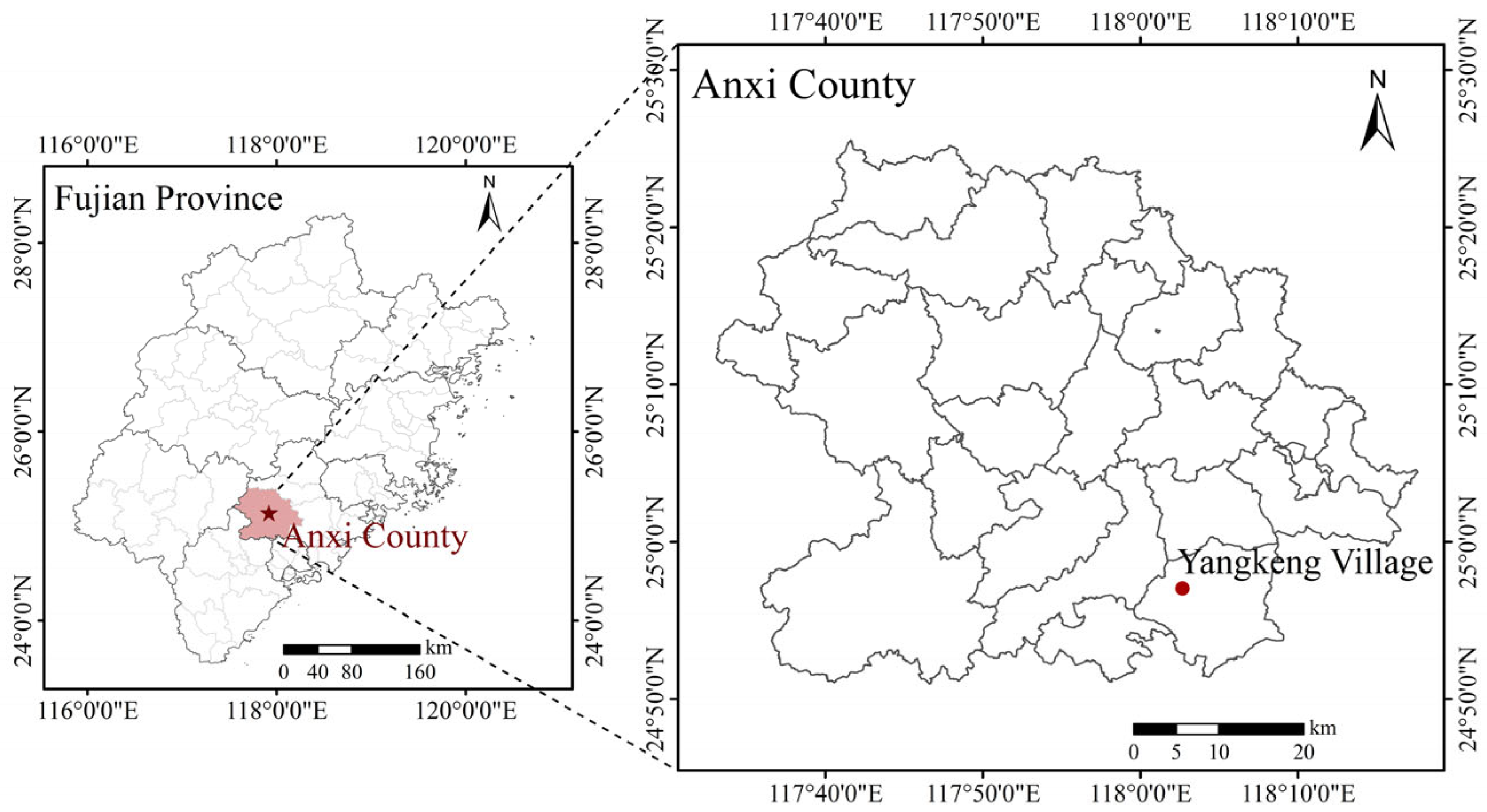
The soil samples utilised in the experiments were obtained from Yangkeng village, Longmen town, Anxi County, Fujian Province (24°57′ N, 118°05′ E) (Figure 2). The study area has a subtropical monsoon climate, an annual mean temperature of 19 °C, and an annual average rainfall amount of approximately 1800 mm. The soil in this region characterised by low hilly landforms is composed of acidic granite, which has a medium-to-coarse-grained porphyroid rock structure predominantly composed of quartz and feldspar. This structure is a typical soil–rock mixture with a high gravel content (particle size ≥2 mm). Moreover, particles with a < 2 mm are mainly composed of silt and sand with a small amount of clay, resulting in high soil erodibility and a high susceptibility to Benggang formation. Survey data reveal that Anxi County currently contains 26,024 Benggang gullies, which comprise approximately 50% of the total number of gullies in Fujian Province. In contrast, Longmen town has 1228 Benggang gullies, accounting for 10% of the total number in Anxi County. Thus, Longmen town was chosen as the study area because of its typicality and representativeness.

2.2. Collection and Preparation of Soil Samples

To determine the separation capacities of undisturbed and disturbed soil samples, two types of soil samples were used in the experiments. Undisturbed samples were collected directly using cutting rings to preserve the original soil structure. Disturbed samples were prepared by air-drying and thoroughly mixing the undisturbed soil from the corresponding soil layer. The samples were then repacked into cutting rings.

2.2.1. Collection of Undisturbed Soil Samples

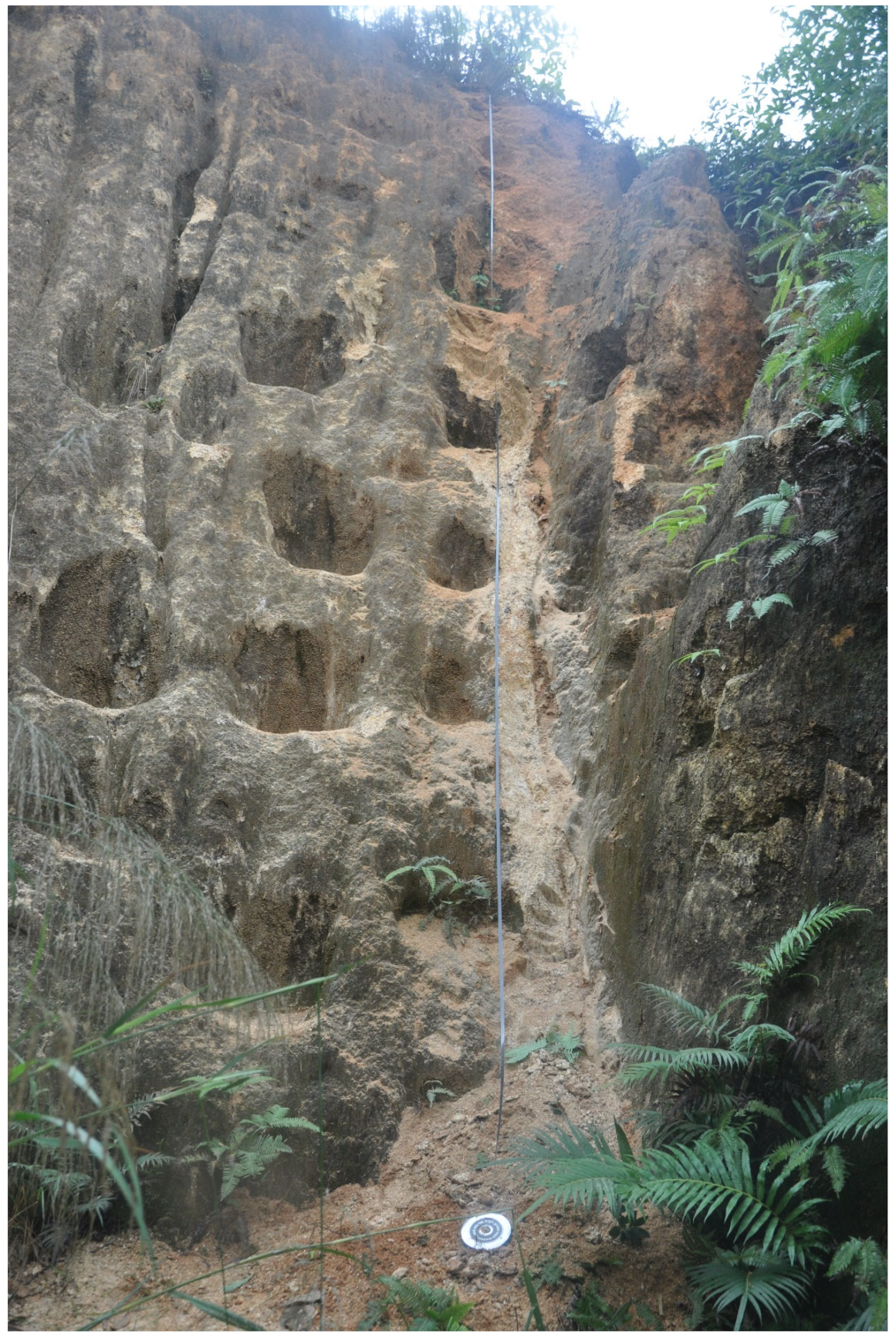
Soil samples were collected from the collapsing wall of a typical collapsing gully in the Yangkeng small watershed, Longmen Town, Anxi County. After scraping off the top 20 cm of soil from the collapsing wall surface, samples were gathered from bottom to top in accordance with the soil genetic horizons. On the basis of the exposed soil colour and surface morphology of the collapsing wall, the soil profile was divided into five distinct layers: a red soil layer (0–0.9 m), a red soil–sandy soil layer (0.9–1.1 m), a sandy soil layer (1.1–2.6 m), a sandy soil–debris layer (2.6–3.0 m), and a debris layer (3.0–6.0 m) (Figure 3, Table 1).
Sampling was conducted at flat locations on the inner surface of the collapsing wall. Stainless steel soil sampling rings with two different specifications (inner diameter 100 mm × height 63 mm and inner diameter 20 mm × height 5 mm) were vertically pressed into the soil. Once the rings were filled with soil, their upper lids were sealed. The soil surrounding the rings was excavated to a depth approximately 2 cm deeper than the sampling rings before removing the rings from the soil.
After extraction, the soil samples were inverted, and the excess soil at the bottom of the rings was carefully trimmed using a profile knife. The bottom lids were then closed, and the ring boxes were wrapped in plastic wrap to avoid soil sample damage during transportation.
The classification of soil particle size distribution was conducted in accordance with the texture classification standard formulated by the United States Department of Agriculture (USDA), and the specific distribution was measured by a laser particle size analyser (model: BT-9300ST, Bettersize Instruments Ltd., Dandong, China). The core method was adopted to determine the soil bulk density [25]. To measure soil pH, a pH metre (model: BPH-7200, BELL Analytical Instrument Co., Ltd., Dalian, China) was used, and the soil and water were mixed at a ratio of 1:2.5. The potassium dichromate external heating method was applied to analyse the content of soil organic matter (SOM) [26]. Additionally, the dithionite–citrate–bicarbonate (DCB) method was employed for the extraction and determination of free iron oxides and aluminium oxides in the soil [26]. The composition and property parameters of the soil in each horizon are summarised in Table 2 and Table 3.

2.2.2. Preparation of Disturbed Soil Samples

Soil from the collapsing wall accumulates at its base because of collapse, resulting in the formation of a colluvial deposit. Owing to the high spatial variability of field colluvial deposits and the difficulty in correlating them with the corresponding soil layers of the original collapsing wall, precise comparisons of the detachment characteristics between colluvial deposits and the undisturbed soil of the collapsing wall are not feasible. To ensure the feasibility and consistency of the experiments, soil samples from each layer of the collapsing wall were collected, air-dried, mixed thoroughly, and passed through a 2 mm sieve to separate fine soil (<2 mm) from gravel (≥2 mm). The fine soil and gravel from each layer were subsequently remixed separately. According to the average bulk density (1.35 g·cm−3) of the colluvial deposits under natural field conditions, the soil was packed into stainless-steel cutting rings with two different specifications: one with an inner diameter of 100 mm and a height of 63 mm for soil detachment measurement and another with an inner diameter of 20 mm and a height of 5 mm for soil shear strength measurement. A layered packing method was adopted during sample preparation: the soil was loaded into the cutting rings in three layers, each approximately one-third of the total height of the ring. The surface of each layer was scarified to prevent stratification, and each layer was compacted with a compaction hammer set to a predetermined number of blows to ensure uniform density within the ring. After packing, the cutting rings containing the soil samples were sealed with plastic wrap and left to cure undisturbed for 24 h before use.

2.3. Determination of Soil Physical and Mechanical Properties

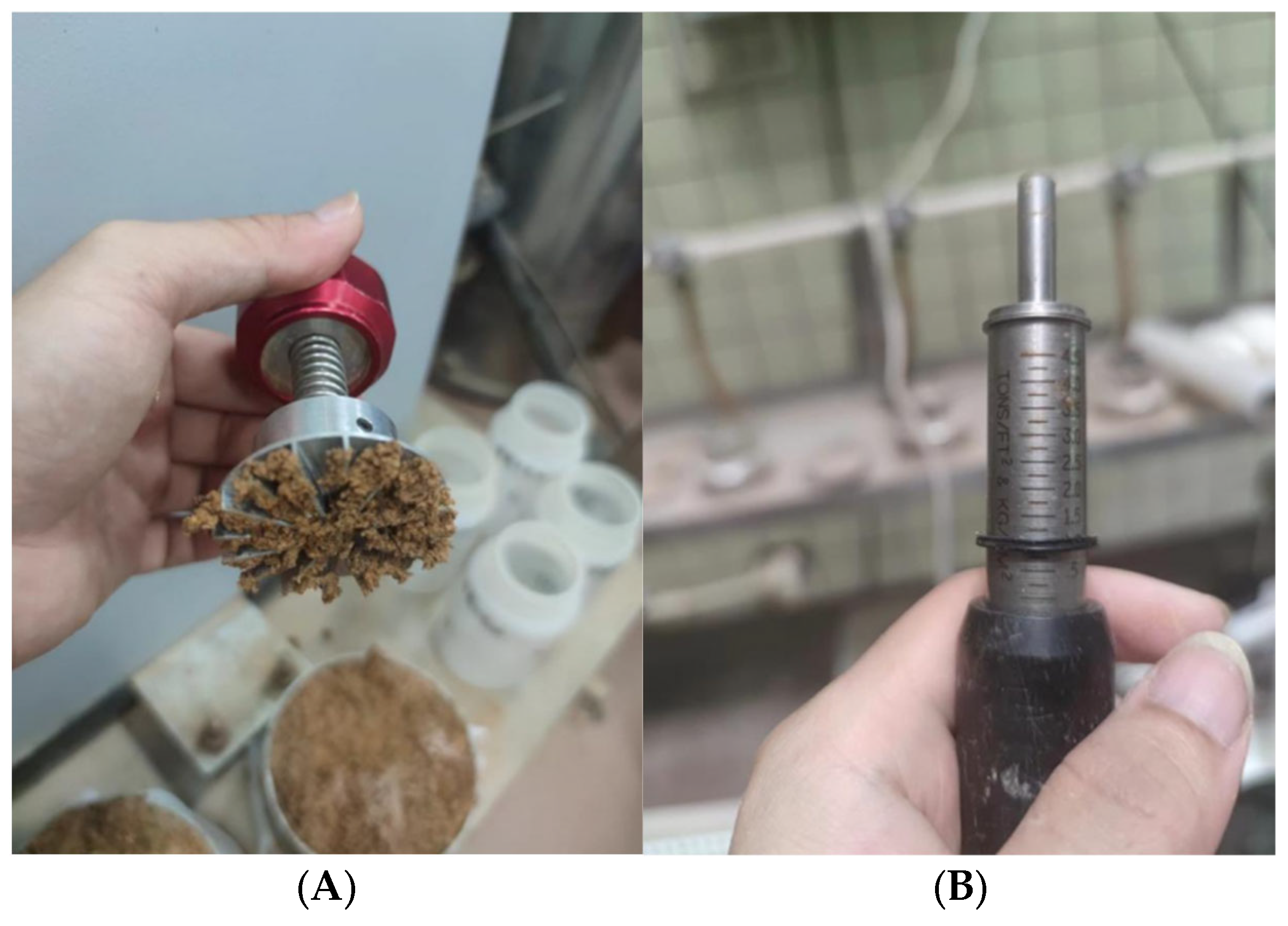
A pocket vane tester (model: 14.10 Pocket Vane Tester, Royal Eijkelkamp, Giesbeek, The Netherlands) was used to determine the shear strengths of the undisturbed and remoulded soil samples (Figure 4). The vane blade used in this experiment had a measurement range of 0–1 kg·cm−2. Although the pocket vane shear tester has a small area of stress and its measurement results do not fully represent the overall shear strength of the soil sample, it is widely used in soil mechanics-related research because of its portability and simple operability, which reflect the shear characteristics of soil to a certain extent [17]. In this study, the tested soil was developed from medium–coarse grained granite. The soil in the profile had a poor structure and low shear strength, making it suitable for measurement with this pocket vane shear tester.
Before testing, the ring knife soil samples were saturated. After saturation, the samples were removed and left to stand for 0.5 h to drain the gravitational water. The vane blade was then fully inserted into the soil, and the tester was rotated clockwise to record the dial readings. For each group, 10 measurements were taken; after the maximum and minimum values were excluded, the average of the remaining 8 measurements was used as the shear strength. The average shear strength for each soil layer is listed in Table 4.
A portable soil hardness tester (model: 06.03 Pocket Penetrometer, Royal Eijkelkamp, Giesbeek, The Netherlands) was used to determine the hardness of the undisturbed and disturbed soils. Before measurement, the soil samples in the cutting rings were saturated using the same method as for the shear strength test samples. The portable soil hardness tester was then quickly inserted into the soil surface until the scale line was parallel to the soil surface, and the reading at the black rubber ring was recorded. The black rubber ring was reset after each reading. The measurement number and data processing method were consistent with those used for evaluating the soil shear strength. The average hardness of each soil layer is presented in Table 5.

2.4. Experimental Design and Procedures

2.4.1. Test Equipment

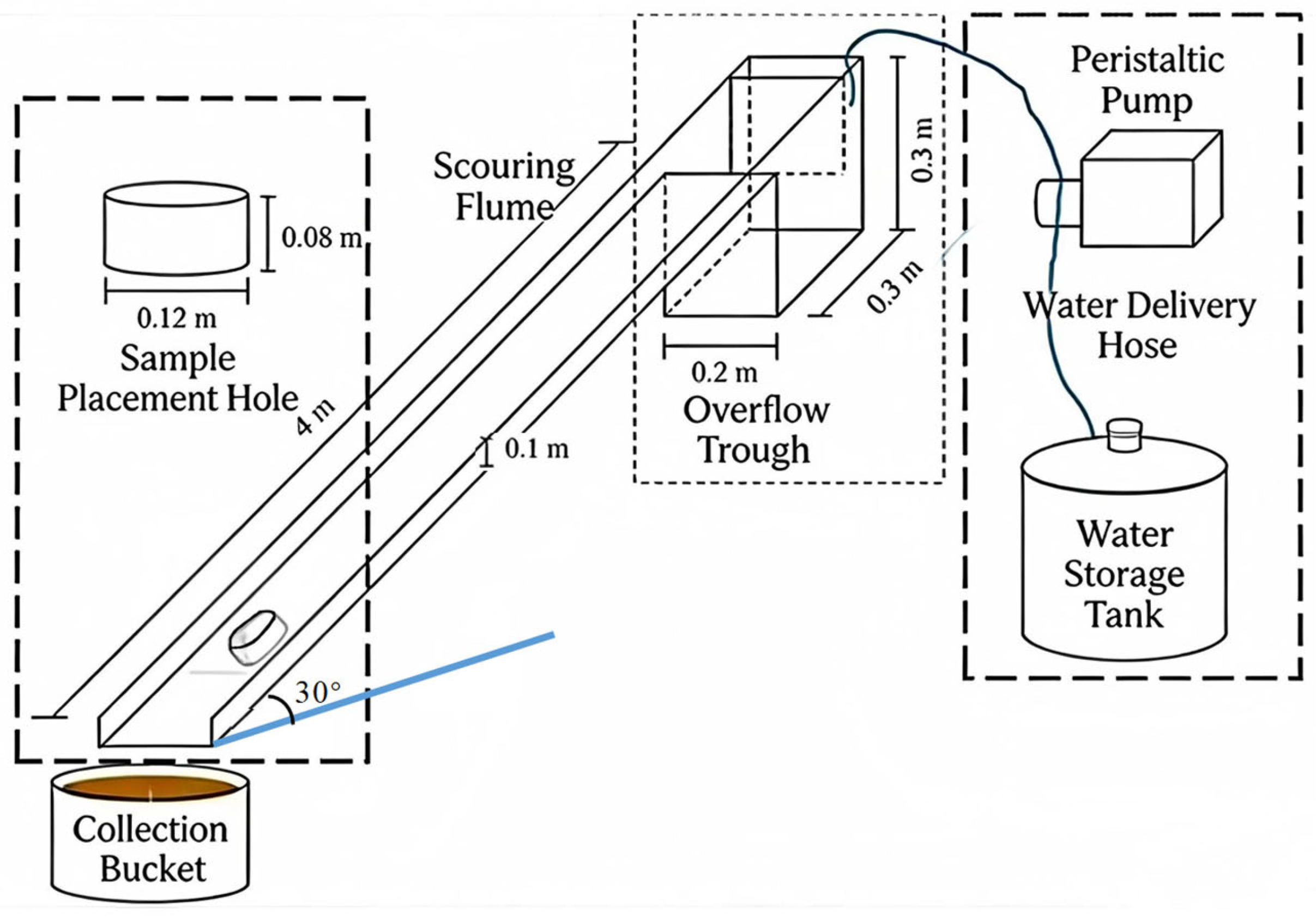
The test setup consisted of three components (Figure 5): a water supply system, a sample placement hole, and a scouring flume. A 10 m3 water storage bucket was placed near the scouring flume to serve as the water supply system, and water was supplied through a hose to ensure an adequate water volume in the bucket. Flow discharge was regulated by a dual peristaltic pump (model: WT600-4F-C, Longer Precision Pump Co., Ltd., Baoding, China). The scouring flume, which was fabricated from steel plates, measured 4 m in length, 0.2 m in width and 0.1 m in height. To approximate the roughness of natural field surfaces, the flume bed was covered with experimental soil. According to field surveys, the soil on the surface of colluvial deposit rill beds was dominated by particles smaller than 5 mm in diameter. Therefore, in this experiment, colluvial soil particles smaller than 5 mm were bonded to the bottom of the flume at a thickness of 1 cm to ensure that the flume roughness was similar to that of the field slopes. An overflow trough measuring 0.3 m × 0.2 m × 0.3 m (L × W × H) was installed at the upper end of the flume. A baffle (0.2 m wide × 0.15 m high) was embedded 0.1 m beneath the top edge of the trough, and its upper surface was aligned with the trough. This characteristic created a 0.15 m gap beneath the baffle to accommodate the sample placement hole. The hole was positioned 0.1 cm from the flume outlet and had a diameter of 0.12 m and a depth of 0.08 m; its height slightly exceeded that of the soil core sample. A layer of waterproof sealing clay was filled between the core ring and the hole wall to ensure tight fitting and no water leakage between the core ring soil sample and the placement hole during the scouring process. Several small holes were randomly drilled at the bottom of the sample placement hole to allow gravitational water to seep out freely.

2.4.2. Experimental Design

In this experiment, undisturbed and disturbed soils from collapsing walls were selected as the study objects, and laboratory-simulated runoff tests were conducted. According to the survey, the average slope of the colluvial deposit was 30°; therefore, the experimental slope was set to 30°. The analysis of rainfall data from the Yangkeng Catchment showed that the maximum 30 min rainfall intensity (I30) in the past 20 years reached 2.5 mm/min. Field investigations revealed that the upslope catchment area for rills could reach 12.5 m2 (25 m × 0.5 m). Under a slope runoff coefficient of 0.8, the corresponding upslope inflow rate was 25 L min−1. Therefore, six flow rate gradients were established: 2.5, 5, 10, 15, 20, and 25 L·min−1; these rates were converted into unit discharge rates using Equation (1), resulting in values of 0.21 × 10⁻³, 0.41 × 10⁻³, 0.83 × 10⁻³, 1.25 × 10⁻³, 1.67 × 10⁻³, and 2.08 × 10⁻³ m2·s−1, respectively. In accordance with the above experimental design, a total of 60 test groups were carried out, with 3 replicates for each group, resulting in 180 scouring tests in total.

2.4.3. Experimental Procedure

Prior to testing, the soil samples were pre-saturated. Following water absorption and saturation, the core ring samples were extracted and left undisturbed for 30 min to allow the gravitational water to drain. The samples were subsequently carefully placed into the sample holder at the base of the flume, ensuring that the soil surface was level with the flume bed. The sliding cover was then sealed to initiate the experiment.
After the water pump was activated and the flow was allowed to stabilise, the flow velocity and water temperature were recorded. Velocity measurements were conducted using the potassium permanganate tracer technique. For each scouring test, 10 replicate measurements were taken; the maximum and minimum values were discarded, and the average of the remaining 8 measurements was calculated as the surface flow velocity (vs). This value was then adjusted using correction factors specific to laminar, transitional, and turbulent flow regimes (0.67, 0.70, and 0.80, respectively). The dynamic viscosity coefficient of water was obtained by measuring the water temperature with a thermometer and by consulting the reference book Hydraulics. The water depth was calculated using the relational equation between the unit discharge and flow velocity. Dynamic parameters could be calculated by Equations (2)–(4).
Following the measurements of water depth and temperature, the sliding cover was rapidly removed to commence the colluvial deposit detachment experiment. A plastic container was positioned at the flume outlet to capture eroded sediment, and a stopwatch was used to record the sampling duration. According to Zhang et al. (2003) [12], the ideal scouring depth for soil samples was 2 cm. Therefore, once the soil sample was eroded to approximately this depth, the collection container was removed, and the water pump was deactivated. After the experiment, the collected sediment was allowed to settle, and the supernatant was subsequently decanted. The remaining sediment was then transferred to an aluminium box and dried in an oven at 105 °C to determine its dry mass. Finally, the detachment capacity (Dc) of the colluvial deposit was computed on the basis of the dried sediment weight according to Equation (5).

2.5. Indicator Calculation

(1) Calculation of Unit Discharge
q = Q × 10−3/60/b
where q is the unit discharge (m2·s−1), Q is the flow discharge (L min−1), and b is the runoff width (m).
(2) Calculation of the Hydrodynamic Parameters
The calculation equations for the hydrodynamic parameters, such as the mean flow velocity, hydraulic radius, and flow shear stress, were obtained from the literature [23]
v = k v s
R = h b 2 h + b
τ = ρ g R S
where v is the mean flow velocity (m·s−1); vs is the measured mean surface flow velocity (m·s−1); k is the correction index, with values of 0.67 (laminar flow), 0.70 (transitional flow), and 0.80 (turbulent flow); R is the hydraulic radius (m); h is the cross-sectional mean water depth (m); b is the runoff width (m); τ is the flow shear stress (Pa); g is the gravitational acceleration, with a value of 9.8 m·s−2; and S is the slope gradient (m·m−1).
(3) Calculation of the Detachment Capacity of Colluvial Soil
D c = W t × A
where Dc is the detachment capacity of the colluvial soil (kg m−2 s−1); W is the dry weight of the eroded soil from the colluvium (kg); t is the duration of scouring (s); and A is the area of the soil sample ring knife (m2).
(4) Model Error Analysis
N S E = 1 O i P i 2 O i O 2
where Oi is the measured value of the i-th sample; Pi is the calculated value of the i-th sample; and O is the mean measured value. NSE stands for the Nash-Sutcliffe model efficiency, a standardised statistic that quantifies the agreement between simulated and observed values. Specifically, the model performance was classified as follows: excellent when the Nash–Sutcliffe efficiency (NSE) was ≥0.70, moderate when 0.40 < NSE < 0.70, and poor when the NSE was < 0.40 [23].

2.6. Data Statistics and Analysis

Statistical analysis and processing of the experimental data were performed using IBM SPSS 26, and regression analysis, nonlinear fitting, and graph plotting were conducted via OriginPro 2025.

3. Results and Analysis

3.1. Comparison of the Soil Detachment Capacity Between Undisturbed Soil and Disturbed Soil

As shown in Table 6, the detachment capacity of the undisturbed soil ranged from 0.16 × 10⁻³ to 6.69 × 10⁻² kg·m−2·s−1 and increased with increasing soil depth. The order of detachment capacity from the highest layer to the lowest was as follows: debris layer > sandy soil–debris layer > sandy soil layer > red soil–sandy soil layer > red soil layer. Analysis of variance (ANOVA) results indicated that there were no significant differences in the detachment capacity of the red soil layer, red soil–sandy soil layer, or sandy soil layer. In contrast, significant differences (p < 0.05) were observed in the detachment capacity of the sandy soil–debris layer, debris layer and other soil layers.
As shown in Table 7, the detachment capacity of the disturbed soil ranged from 0.15 to 5.75 kg m−2 s−1, and it tended to first increase but then decrease with increasing soil depth. The order of detachment capacity from the highest layer to the lowest was sandy soil layer > sandy soil–debris layer > debris layer > red soil–sandy soil layer > red soil layer. Analysis of variance (ANOVA) results indicated that there were significant differences (p < 0.05) in the detachment capacity of the disturbed soil between the red soil layer and the other soil layers, whereas no significant differences were observed in the detachment capacity of the disturbed soil among the red soil–sand layers.
As shown in Table 8, the detachment capacity of the undisturbed soil tended to increase with increasing soil depth, whereas that of the disturbed soil tended to first increase but then decrease with increasing soil depth. The detachment capacity before disturbance significantly differed from that after disturbance. The soil detachment capacities of the red soil layer, red soil–sandy soil layer, sandy soil layer, sandy soil–debris layer, and debris layer increased by 615, 3494, 949, 108, and 63 times, respectively, after disturbance, and significant differences (p < 0.05) were observed.

3.2. Factors Influencing Soil Detachment

3.2.1. Relationships Between the Soil Detachment Capacity and Flow Shear Stress

Among the hydrodynamic parameters, the flow shear stress was selected as the core analytical parameter in this study. Compared with those of the other parameters, the correlation coefficients between the flow shear stress and the detachment capacity of each soil horizon exhibited better overall stability. Furthermore, as a direct dynamic indicator characterising the shear and detachment effects of water flow on soil particles, it can more accurately reflect the mechanical mechanism of the soil detachment process under hydrodynamic action.
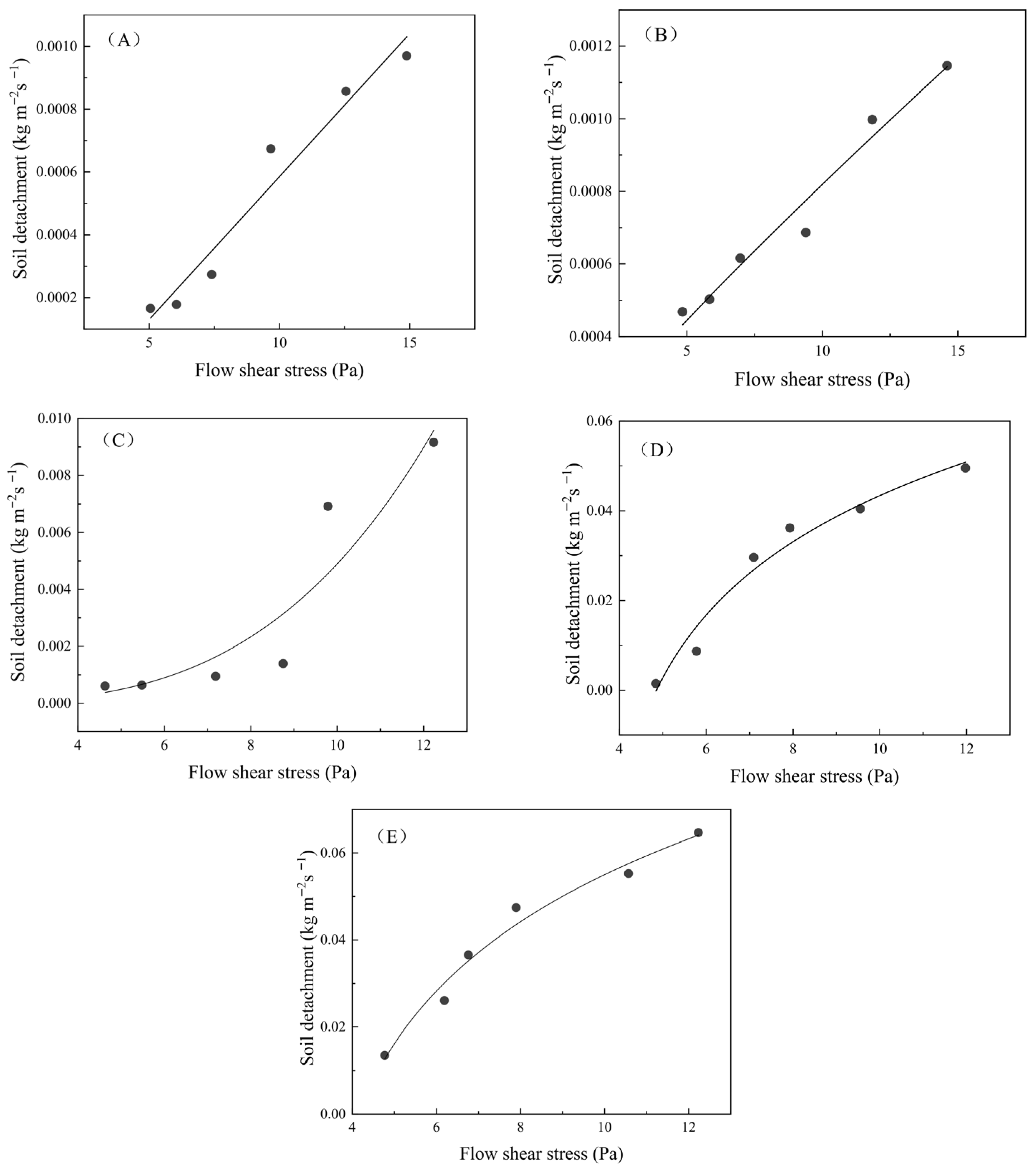
To further investigate the relationship between the soil detachment capacity and the flow shear stress, corresponding mathematical simulation equations were established. Regression analysis was conducted between the undisturbed soil detachment capacity and flow shear stress, and their relationships are depicted in Figure 6.
Regression analysis was conducted between the detachment capacity of the undisturbed soil and the flow shear stress, yielding the following results. A significant linear correlation was observed between the detachment capacity and flow shear stress in both the red soil layer and debris layer (p < 0.01) (Table 9). For the red soil–sandy soil layer and sandy soil layer, their relationships were best described by a power function (p < 0.01). In contrast, the sandy soil-debris layer and debris layer exhibited a dominant logarithmic relationship. All the equations achieved an NSE exceeding 0.81 (> 0.70), demonstrating satisfactory fitting performance.
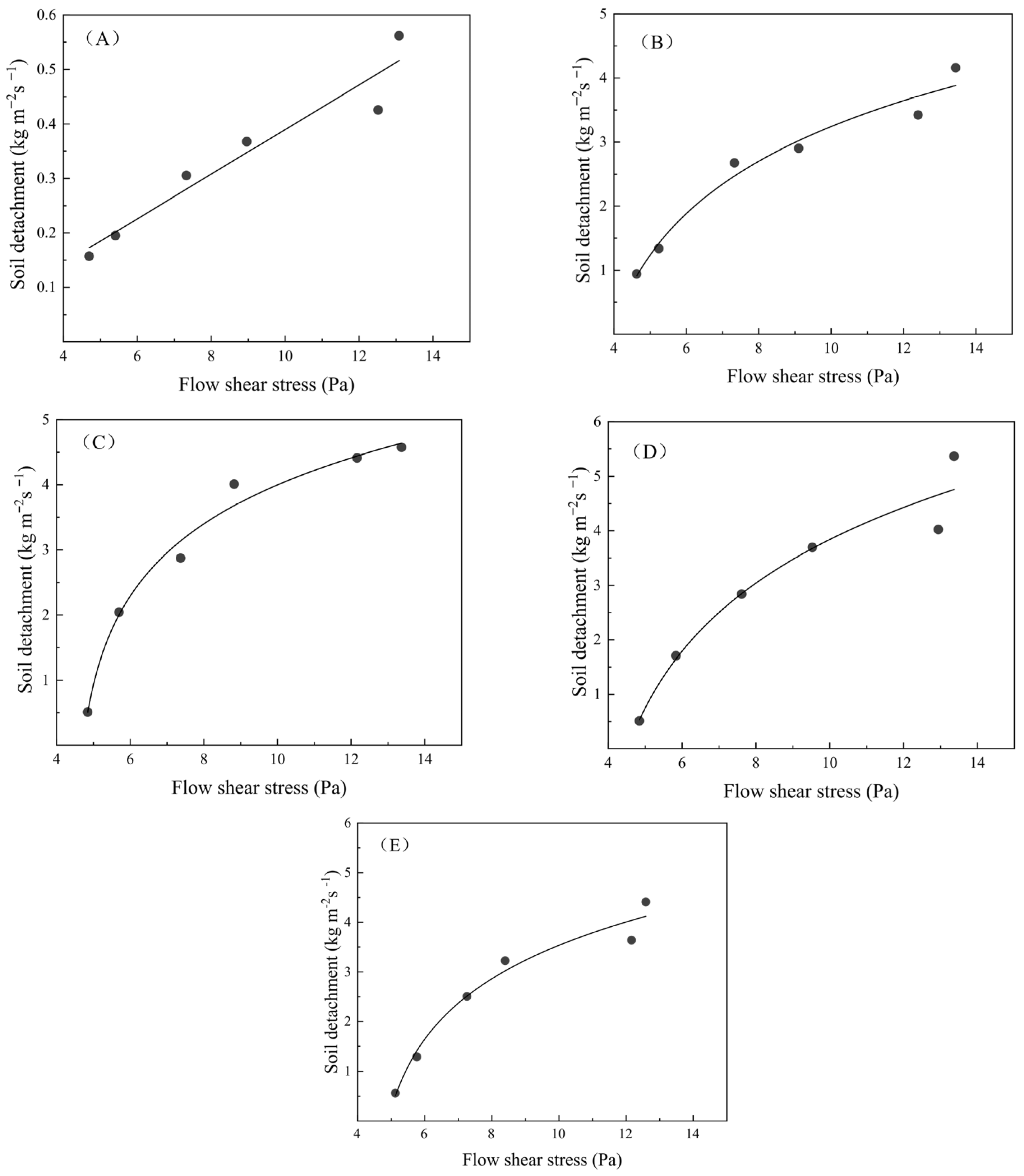
To further explore the relationship between soil detachment capacity and flow shear stress, mathematical simulation equations were developed. Regression analysis was performed between the disturbed soil detachment capacity and flow shear stress, and the relationships are shown in Figure 7.
The regression results (Table 10) revealed that the soil detachment capacity and flow shear stress were linearly correlated mainly in the red soil layer and red soil–sandy soil layer (p < 0.01), whereas logarithmic relationships dominated in the sandy soil layer, sandy soil–debris layer and debris layer (p < 0.01). All the equations achieved NSE values above 0.83 (>0.70), indicating good fitting accuracy.

3.2.2. Relationships Between the Soil Detachment Capacity and Soil Properties

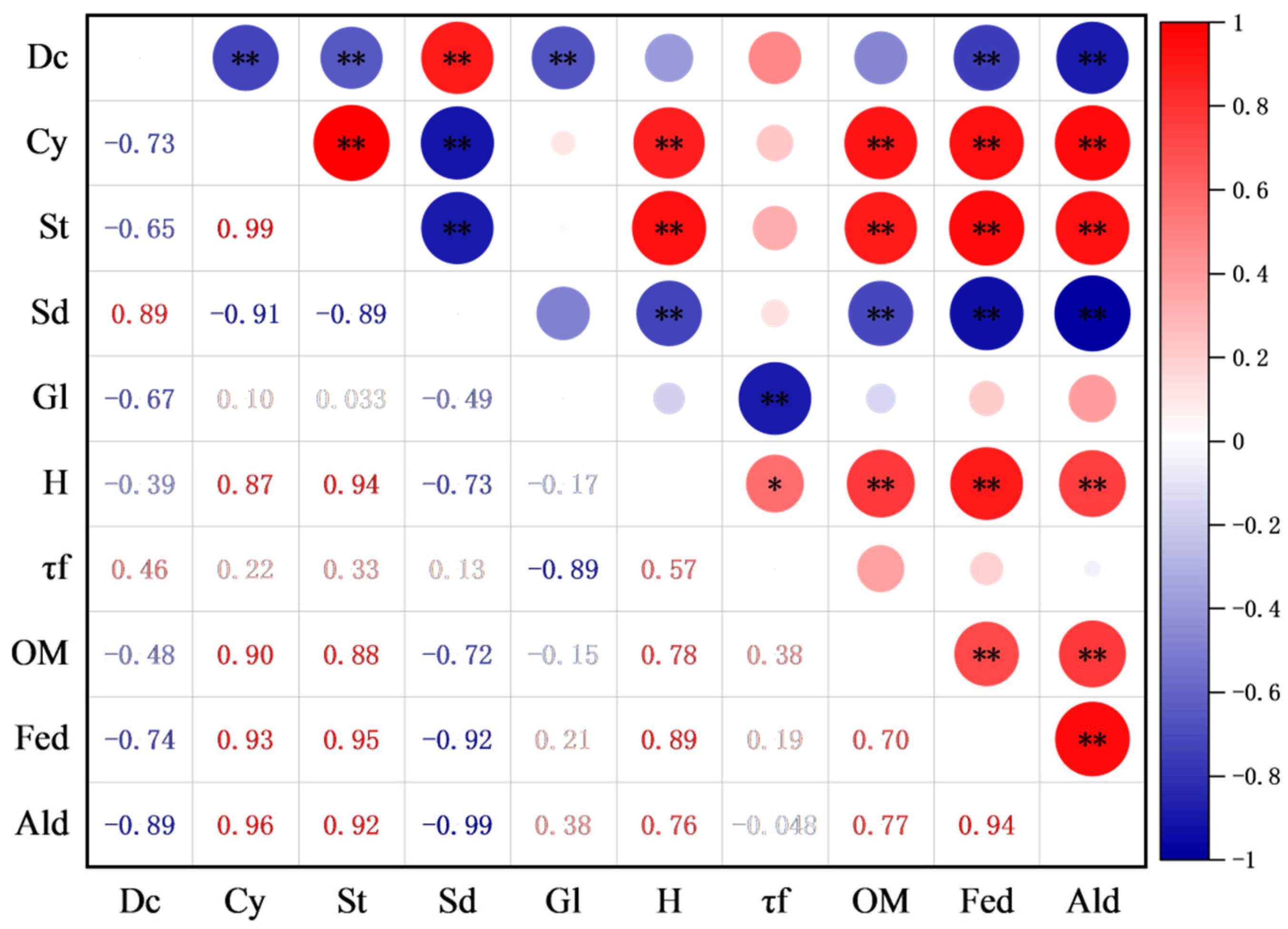
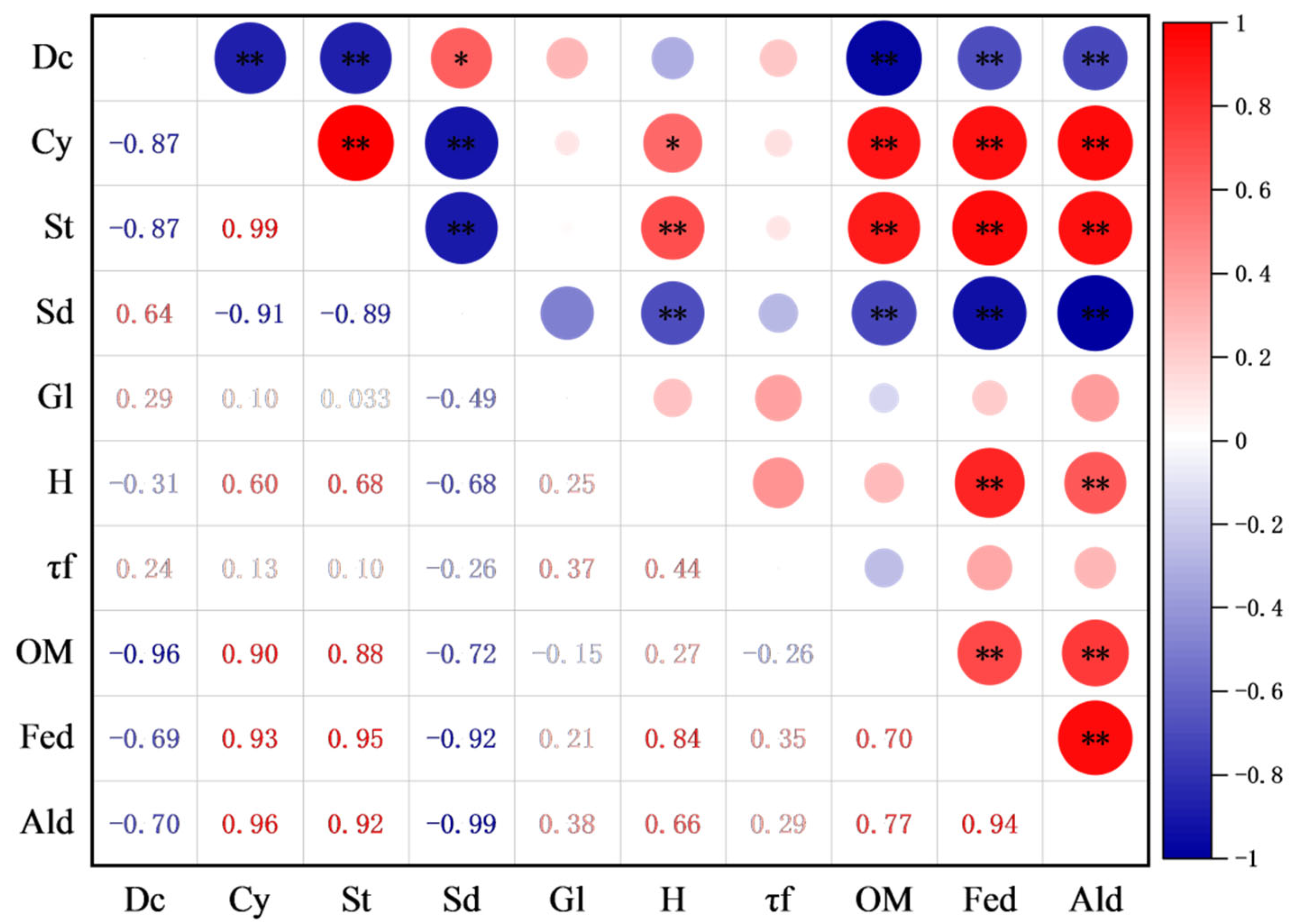
Soil particle composition (contents of clay, silt, sand, and gravel) directly affects soil structure; free iron and aluminium oxides are the main cementing substances in soil; and organic matter can increase soil structural stability, whereas shear strength and hardness are key indicators of the ability of soil to resist external damage. To systematically reveal the relationships between soil detachment capacity and its inherent properties, in this study, the above 9 indicators, namely, physical composition, chemical cementation, and mechanical properties, were selected to conduct a Pearson correlation analysis. As shown in Figure 8, the undisturbed soil detachment capacity was strongly negatively correlated with the clay content, gravel content, free iron oxide content and free aluminium oxide content (p < 0.01); significantly negatively correlated with the silt content (p < 0.05); and extremely significantly positively correlated with the sand content (p < 0.01). No significant correlations were found between the undisturbed soil detachment capacity and the soil hardness, shear strength or organic matter content (p > 0.05).
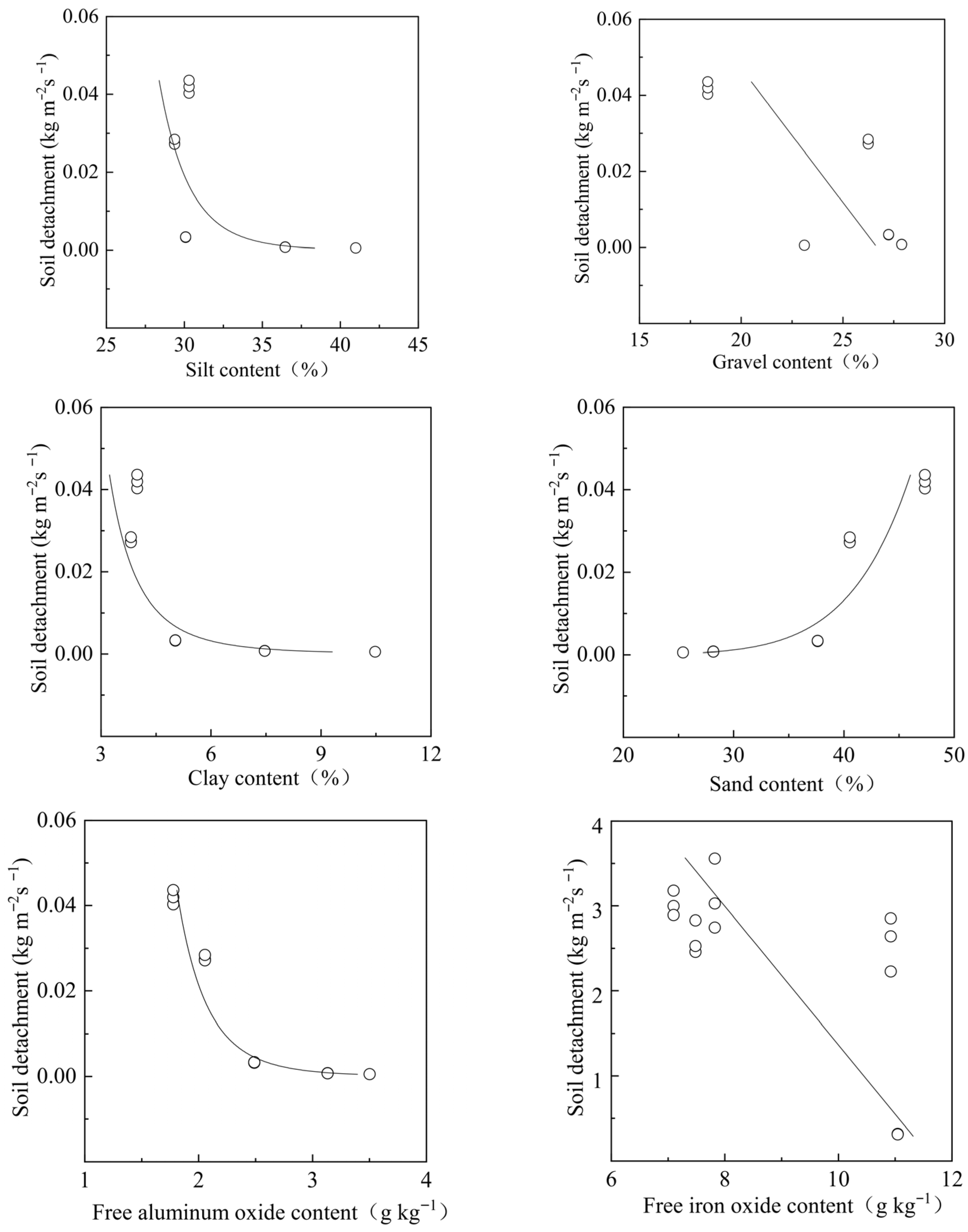
Regression analysis was performed between the undisturbed soil detachment capacity and the clay, silt, sand, gravel, free iron oxide and free aluminium oxide contents (Figure 9, Table 11). The results indicated that the undisturbed soil detachment capacity exhibited a power-function relationship with the clay, silt, sand, free iron oxide and free aluminium oxide contents and a linear relationship with the gravel content. Among these variables, the fitting performance for free aluminium oxide content and sand content was relatively satisfactory.
As shown in Figure 10, the disturbed soil detachment capacity was extremely significantly negatively correlated with the clay content, silt content, organic matter content, free iron oxide content and free aluminium oxide content (p < 0.01) and extremely significantly positively correlated with the sand content (p < 0.01). No significant correlations were found between the disturbed soil detachment capacity and the gravel content, soil hardness or shear strength (p > 0.05).
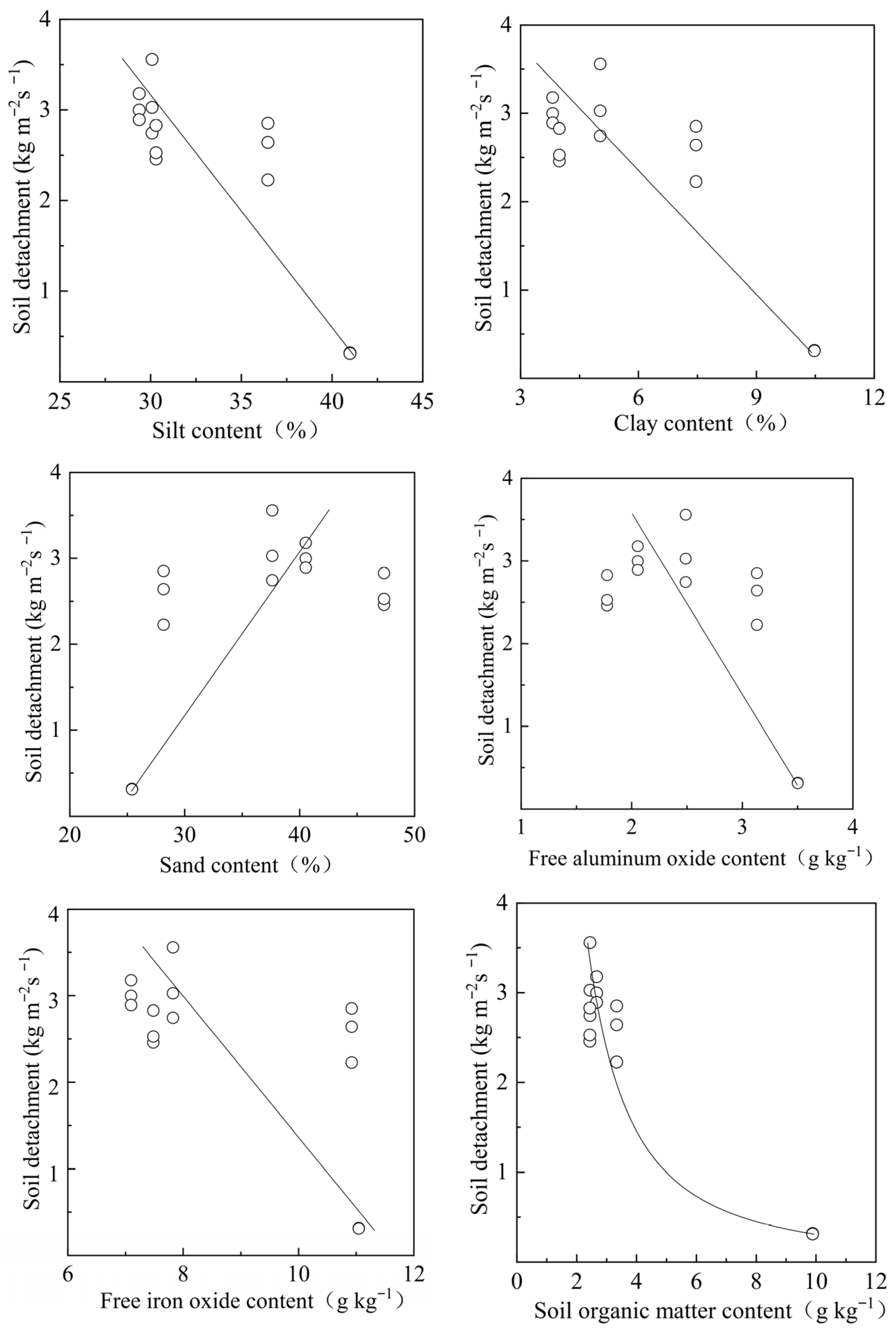
Regression analysis was conducted between the disturbed soil detachment capacity and soil properties (clay, silt, sand, gravel, free iron oxide and free aluminium oxide contents) (Figure 11, Table 12). The results revealed that the disturbance-induced soil detachment capacity was strongly related to the organic matter content and linearly related to the clay, silt, sand, free iron oxide and free aluminium oxide contents. Among these, the fitting performance for the organic matter content and silt content was relatively good.

3.3. Underlying Mechanism of Soil Detachment Capacity

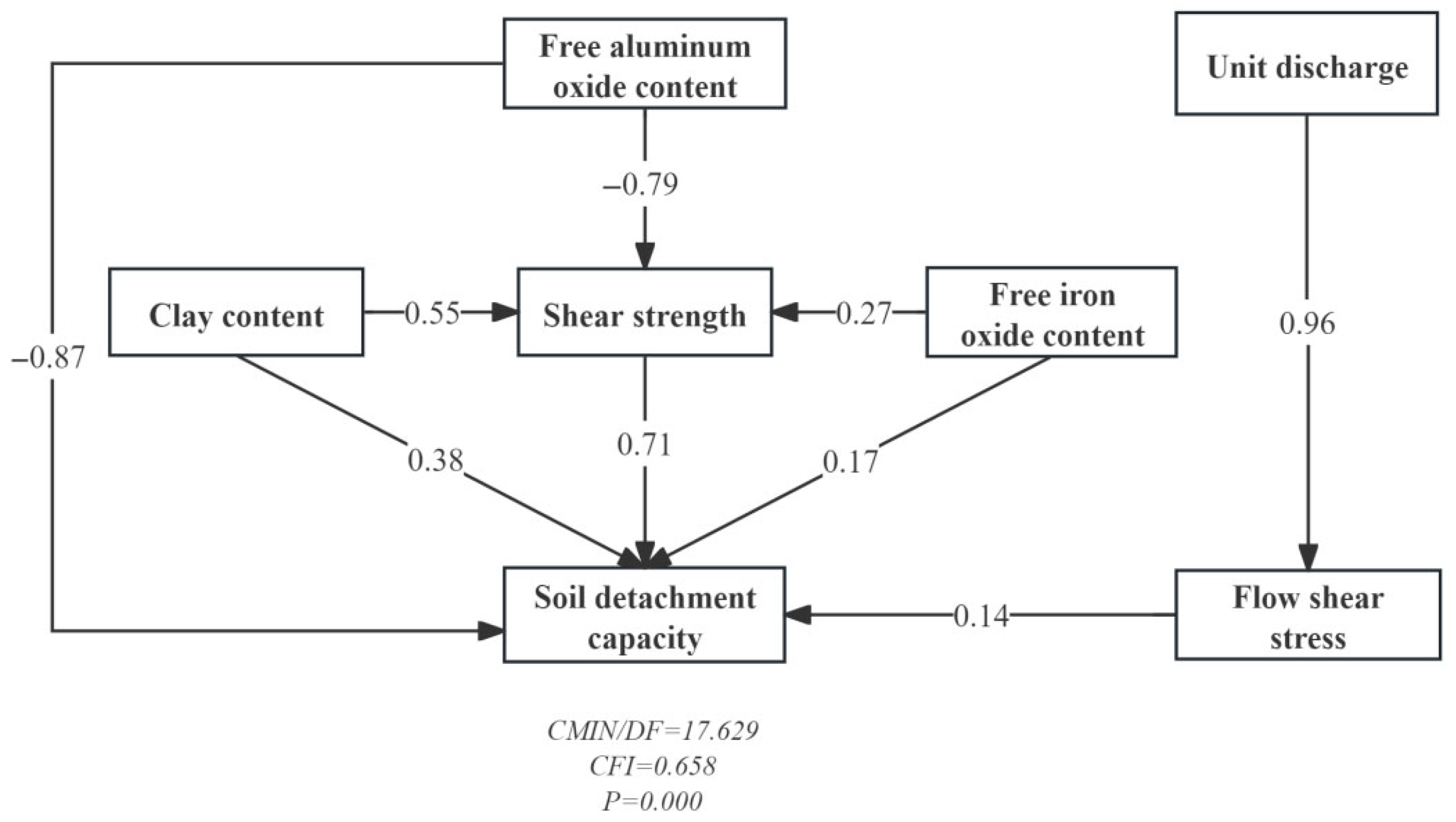
Structural equation modelling (SEM) was used to analyse the effects of undisturbed soil properties and hydraulic parameters on soil detachment capacity (Figure 12). Path analysis results showed that unit discharge affected soil detachment capacity of undisturbed soil mainly through flow shear stress, with a significantly positive effect (path coefficient = 0.14; p < 0.001). Clay content, free iron oxide content, and shear strength also exhibited significantly positive effects on soil detachment capacity of undisturbed soil, with path coefficients of 0.38, 0.17, and 0.71, respectively (all p < 0.001); whereas free aluminium oxide content showed a significantly negative effect (path coefficient = −0.87; p < 0.001). Comparison of path coefficients among the factors revealed that the effect intensity of free aluminium oxide content was greater than that of clay content, free iron oxide, and shear strength, indicating that free aluminium oxide content was the most prominent influencing factor among the selected soil property indicators on soil detachment capacity of undisturbed soil. Meanwhile, the path coefficients of the four soil property indicators were generally larger than that of flow shear stress, suggesting that soil properties contributed more strongly to the soil detachment process of undisturbed soil than flow shear stress.
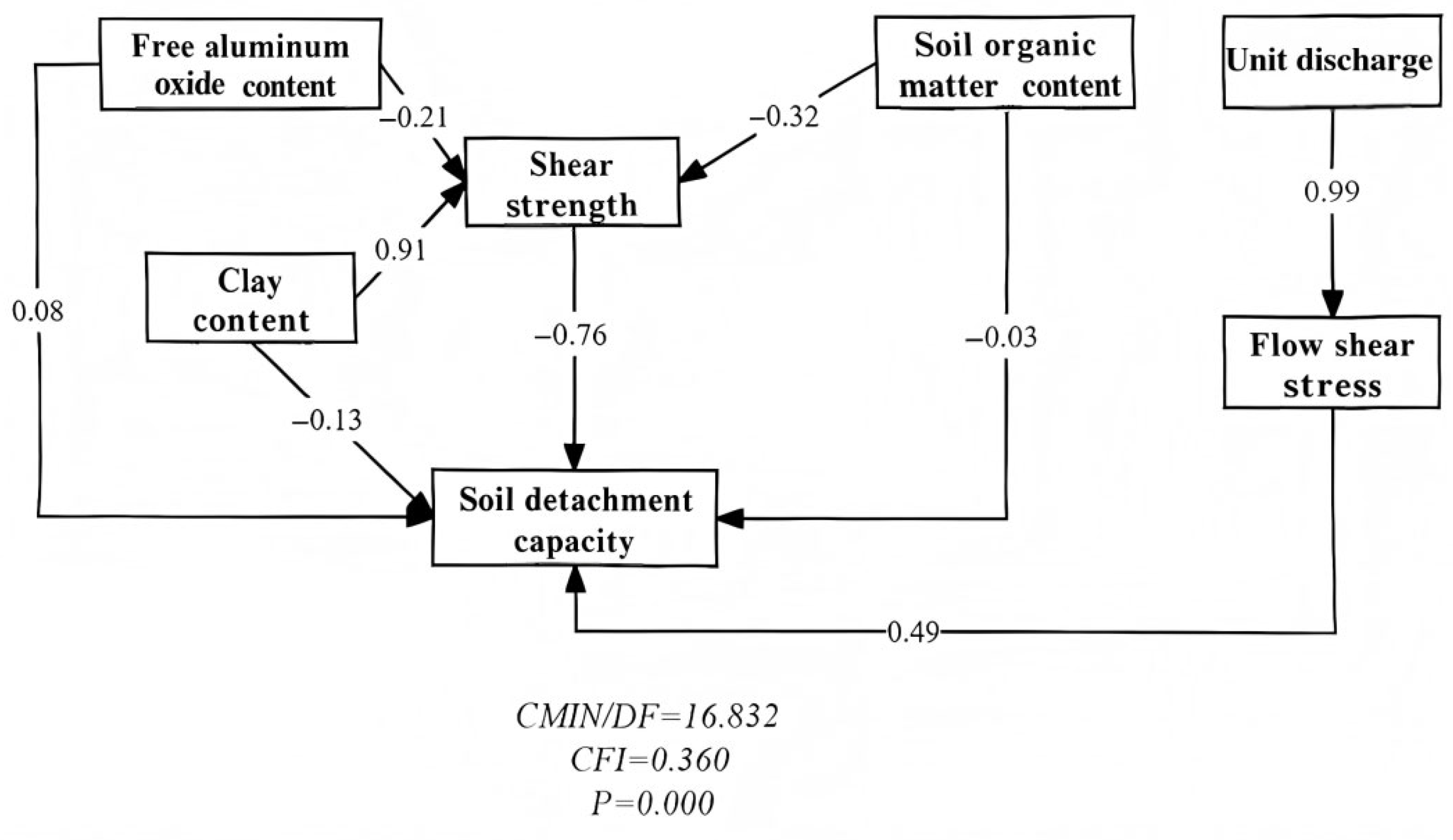
Path analysis revealed that unit discharge affected the disturbed soil detachment capacity of disturbed soil mainly through flow shear stress, with a significant positive effect (path coefficient = 0.49; p < 0.001) (Figure 13). The indirect effects of free aluminium oxide content, organic matter content and clay content on disturbed soil detachment capacity were −0.21, −0.32 and 0.91, respectively, all of which were significantly greater than their direct effects (0.08, −0.03 and −0.13, respectively). The indirect effects of the above three soil physicochemical properties on disturbed soil detachment capacity were mainly mediated by shear strength, which exhibited a significant direct negative effect on disturbed soil detachment capacity (path coefficient =−0.76; p < 0.001). As the absolute value of the path coefficient for shear strength (−0.76) was larger than that for flow shear stress (0.49), this also indicates that the detachment capacity of disturbed soil is mainly controlled by soil intrinsic properties.

4. Discussion

The detachment capacity of the undisturbed soil from the collapsing walls ranged from 0.16 × 10⁻³ to 6.69 × 10⁻² kg m−2 s−1, whereas that of the disturbed soil ranged from 0.15 to 5.75 kg m−2 s−1. Specifically, the detachment capacity of the disturbed soil was 64 to 3495 times that of the undisturbed soil. This occurred because after soil disturbance, the original bonding structure between the soil particles and the soil mass was destroyed, the particle arrangement became loose, and the soil shear strength decreased sharply (the average shear strength of the disturbed soil was 0.21 times that of the undisturbed soil), resulting in a significant decrease in stability. Such disturbance weakens soil erosion resistance [11], which in turn leads to a sharp increase in soil detachment capacity. The aforementioned analysis also indicates that the formation of colluvial deposits following the collapse of collapsing walls drastically increases the soil detachment capacity, rendering the deposits highly susceptible to generating massive amounts of sediment under rainfall and runoff. Field surveys have demonstrated that the sediment yield from the re-erosion of colluvial deposits accounts for more than 50% of the total sediment output from collapsing walls [17]. Therefore, preventing the collapse of collapsing walls and implementing effective management of colluvial deposits have become critical issues in collapsing gully control.
Previous studies have also reported that the soil detachment capacity of disturbed soil is much greater than that of undisturbed soil. For example, Wang et al. (2018), in their study on tilled red soil, reported that the soil detachment capacity under traditional downslope furrow ploughing was 1.5 times that of undisturbed covered soil [27]. Moreover, Zhang et al. (2003) reported that under the same hydrodynamic conditions, the detachment capacity of disturbed loess soil significantly differed from that of undisturbed loess, ranging from 1 to 23 times greater [12]. In contrast, the ratio of the detachment capacity between the disturbed soil and undisturbed soil in this study was significantly greater than that reported by Wang et al. (2018) [27] and Zhang et al. (2003) [12]. This discrepancy may be closely related to the soil type and structural properties of the test materials. The soil used in this study was derived from medium-to-coarse-grained granite weathering crust, which is characterised by poor structural stability and weak inter-particle bonding. Disturbance severely damaged its structure, causing a sharp reduction in the forces between medium and coarse particles, thereby increasing the susceptibility of the soil to detachment. Conversely, the red soil in Wang’s study had a high clay content and good cohesiveness and retained a certain degree of inter-particle bonding even after disturbance. Similarly, the loess in Zhang’s study was dominated by silt particles, and compared with those in the test soil in the present study, the inter-particle forces after disturbance remained stronger.
Analysis of undisturbed soil samples revealed that its soil detachment capacity increases with profile depth. This phenomenon indicates that the topsoil layer has a denser structure and stronger erosion resistance, whereas the bottom soil layer is loosely structured with weak erosion resistance. Such a profile structure featuring strong upper layers and weak lower layers poses a significant hazard, as it easily causes the bottom soil to soften and collapse first, thereby forming a suspended surface on the collapse wall, which substantially increases the risk of overall collapse [28]. As an important stable layer of the soil in this region, the red soil horizon, with its high matric suction and shear strength [29], can effectively constrain the underlying loose soil layers and inhibit the overall collapse of the soil mass [30]. However, when subjected to rainfall or groundwater infiltration, the soil moisture content increases significantly, which not only greatly increases the soil self-weight but also leads to a sharp decline in the shear strength of the red soil horizon, causing it to lose its stabilising constraint and ultimately triggering the overall collapse of the red soil horizon [31]. Therefore, it is imperative to strictly prevent anthropogenic vegetation destruction and red soil horizon erosion in the granite regions of southern China. Once the red soil horizon is eroded, it accelerates the development of Benggang landscapes and profoundly negatively affects local land use, ecological security, and sustainable development.
With the increase in flow shear stress, the dragging and detachment effects on soil particles are enhanced, and the soil detachment capacity increases synchronously. The fitting relation-ships differ significantly among soil layers. For undisturbed soil, the red soil layer shows a linear relationship, the red soil-sandy soil layer and sandy soil layer follow a power function, while the sandy soil-debris layer and debris layer exhibit a logarithmic relationship. For disturbed soil, the red soil layer and red soil-sandy soil layer are dominated by a linear relationship, and the other layers follow a logarithmic relationship. Such differences result from the inherent variations in structural strength, cementation type and particle gradation of each soil layer, leading to different effects of disturbance on the dominant anti-erosion mechanisms. The red soil layer cemented by iron and aluminium oxides shows a power function under undisturbed conditions and a linear relationship after disturbance. The sandy soil layer presents a power function in the undisturbed state and a logarithmic relationship after disturbance. The sandy soil-debris layer and debris layer are loose and un-cemented [32], and disturbance only changes particle arrangement without altering the functional relationship. The low coefficient of determination (R2 = 0.83) of the sandy soil layer is attributed to its low shear strength and intermittent heterogeneous detachment. Overall, the heterogeneous responses of soil layers to hydrodynamic forces are the main cause for the divergence of fitting relationships.
Sand content, silt content, clay content, free iron oxide content, and free aluminium oxide content were all dominant soil factors affecting the soil detachment capacity of un-disturbed and disturbed soils. The analysis indicated that the detachment capacity of the undisturbed soil exhibited a power function relationship with the contents of clay, silt, sand, free iron oxide, and free aluminium oxide, whereas that of the disturbed soil showed a linear relationship with the aforementioned soil factors. These results demonstrated that soil disturbance significantly altered the functional relationship between soil detachment capacity and physicochemical properties. Previous studies have also confirmed that the soil detachment process is significantly regulated by physicochemical proper-ties. Qu et al. (2022) studied gully slopes in sandy soil areas and reported that the soil detachment rate was extremely significantly positively correlated with the fractal dimension and sand content (p < 0.01) and extremely significantly negatively correlated with the silt content, clay content, and organic matter content (p < 0.01) [33]. Zhang et al. (2022) studied colluvial deposits and reported that the soil detachment capacity generally increased as a power function or exponential function with increasing gravel content [17]. Liu et al. (2026) studied loess and reported that soil detachment capacity is strongly correlated with clay content, soil organic matter (OM), alumina (Al2O3) content, and ferric oxide (Fe2O3) content [34]. Disturbance significantly altered the functional relationship between the soil detachment capacity and physicochemical properties.
SEM path analysis revealed that under undisturbed soil conditions, the effect of free alumina content on un-disturbed soil detachment capacity (path coefficient −0.87) was significantly higher than that of clay content, free iron oxide and shear strength, with a negative effect. This indicated that among the selected soil physical and chemical properties, free alumina content acts as the dominant factor regulating the detachment capacity of undisturbed soil. It exerts a significant cementation effect on soil particles in granite weathering crusts, promoting the formation of relatively stable aggregate structures [35]. As undisturbed soil remains intact without disturbance, its original structure and inter-particle bonding are well preserved [36], thus conferring strong resistance to runoff scouring and detachment, as reflected by the low path coefficient of flow shear stress (only 0.14). Consequently, the constraint effect of soil intrinsic properties on detachment capacity is far stronger than that of flow shear stress. Further analysis of the SEM reveals that shear strength exhibits a positive effect on the detachment capacity of undisturbed soil, which is closely related to the inherent characteristics of collapse wall soils. Collapse wall soils are generally characterised by high coarse particle content and low cohesion, with their shear strength mainly relying on frictional resistance formed by inter-particle interlocking and occlusion [16]. Under hydraulic action, soil particles are easily dispersed and destabilised by water, followed by overall transport and failure. Taking the debris layer as an example, although its shear strength of un-disturbed soil is the highest among all soil layers (Table 4), coarse particles disintegrate readily upon wetting and are easily stripped and transported integrally by runoff, ultimately resulting in extremely high soil detachment capacity (Table 6).
After disturbed, the original structure of the soil is destroyed, and particles rearrange uniformly and become looser. The bonding effects of free alumina oxide, organic matter, and other cementing substances are weakened [37], resulting in a decline in soil cohesion, which further reduces the soil shear strength [38] and makes the soil more susceptible to detachment. Therefore, SEM path analysis further confirms that the influence of soil properties on disturbed detachment capacity is mainly manifested through shear strength, with a negative effect (path coefficient −0.76). Importantly, the path coefficient of shear strength (−0.76) is larger than that of runoff shear stress (0.49), indicating that the detachment capacity of disturbed soil is still dominated by soil intrinsic properties, while external hydrodynamic conditions only play a role of initiation and amplification. Meanwhile, the reduction in shear strength caused by disturbance also significantly alters the interaction between hydrodynamics and the soil. Compared with undisturbed soil, the path coefficient of runoff shear stress in disturbed soil increases from 0.14 to 0.49. This suggests that after soil structure destruction and shear strength reduction, the threshold for the soil to resist flow shear failure decreases, and the detachment and erosion effects of the same runoff shear stress on the soil are significantly amplified [9]. This change demonstrates that disturbance not only directly weakens soil erosion resistance but also indirectly enhances the erosion efficiency of flow shear stress by altering the soil–water interaction. Together, these processes ultimately exacerbate the risk of soil detachment and erosion.
Notably, this study was based on laboratory simulation experiments with relatively controllable conditions. The slope was fixed at 30°, the bed roughness was consistent, the initial soil moisture content was set as a single value, and the rainfall splash erosion effect was not considered. Therefore, fully reflecting the complexity and variability of natural field conditions is difficult. Second, there are still deficiencies in the model fitting: some regression equations lack clear physical significance, and the ability to explain numerical dispersion and fluctuation is limited. In addition, the soil disturbance treatment was relatively simplified, adopting a uniform disturbance mode, which failed to reflect the differences in disturbance intensity and patterns during the collapse process of field collapse walls. This may lead to certain deviations between the research results and actual conditions. Consequently, the conclusions of this study need to be interpreted cautiously in light of the above limitations. Future research can further optimise the experimental design, improve the model fitting methods, and refine the soil disturbance treatment to increase the objectivity and applicability of the research conclusions, thereby providing more reliable theoretical support and a scientific basis for the prevention and control of collapse erosion.

5. Conclusions

In this study, five soil layers (red soil layer, red soil–sandy soil layer, sandy soil layer, sandy soil–debris layer, and debris layer) were selected from collapsing walls, and both undisturbed and disturbed soils were used as research materials to examine the relationships among soil detachment capacity, flow shear stress, and soil properties. The results indicated that soil disturbance from collapsing walls significantly increased the detachment capacity by 63–3494 times. The red soil–sandy soil layer exhibited the greatest increase (3493 times), whereas the debris layer showed the smallest increase (63 times). SEM path analysis revealed that under undisturbed soil conditions, soil properties primarily affect detachment capacity through free alumina oxide content, exhibiting a negative effect; while unit discharge exerts a positive effect on detachment capacity via flow shear stress. Under disturbed soil conditions, clay content indirectly influences detachment capacity through shear strength, showing a negative effect, although the role of shear strength is weakened. In contrast, the positive effect of unit-width dis-charge is significantly enhanced. On this basis, differentiated prevention and control recommendations are proposed. With respect to collapsed walls, vine plants such as Parthenocissus tricuspidata and Pueraria montana can be planted to achieve rapid greening and stabilise the soil mass of the collapsed walls; for loose colluvial deposits, a combination of sowing grass and applying curing agents such as guar gum and polyacrylamide can be adopted to improve the structure of the colluvial deposits and enhance their resistance to runoff erosion.

Author Contributions

X.X.: Investigation, Laboratory test, Data curation, Validation, Writing—original draft, Writing—review and editing. Y.C.: Investigation, Laboratory test, Data curation, Writing—original draft, Writing—review and editing. T.L.: Investigation, Laboratory test; X.L. (Xinyi Lv): Investigation, Laboratory test; X.L. (Xiaolin Li): Investigation, Laboratory test, Writing—review; X.Z.: Methodology; Y.Z.: Methodology; J.L.: Methodology; F.J.: Conceptualization, Funding acquisition, Methodology. Y.H.: Conceptualization, Supervision, Funding acquisition, Resources. All authors have read and agreed to the published version of the manuscript.

Funding

This research was funded primarily by grants from the Science and Technology Innovation Special Fund Project of Fujian Agriculture and Forestry University (KFB24122), the Water Conservancy Science and Technology Project of Fujian Province (KJG21009A), and the Significant Science and Technology Projects of the Ministry of Water Resources (SKS-2022073).

Data Availability Statement

The original contributions presented in this study are included in the article. Further inquiries can be directed to the corresponding author.

Conflicts of Interest

The authors declare no conflicts of interest.

References

  1. Zhu, X.; Gao, L.; Wei, X.; Li, T.; Shao, M. Progress and prospect of studies of Benggang erosion in southern China. Geoderma 2023, 438, 116656. [Google Scholar] [CrossRef]
  2. Poleto, C.; Lima, J.E.F.W.; de Araújo, J.C. Overview of the work in Latin America on erosion and sediment dynamics. J. Soils Sediments 2014, 14, 1213–1215. [Google Scholar] [CrossRef]
  3. Sajjadi, S.A.; Mahmoodabadi, M. Sediment concentration and hydraulic characteristics of rain-induced overland flows in arid land soils. J. Soils Sediments 2015, 15, 710–721. [Google Scholar] [CrossRef]
  4. Shen, H.; Zhu, Z.; Chen, Y.; Wu, W.; Sun, S.; Zhang, Y.; Lin, J.; Huang, Y.; Jiang, F. Influence of Gravel Coverage on Hydraulic Characteristics and Sediment Transport Capacity of Runoff on Steep Slopes. Water 2025, 17, 361. [Google Scholar] [CrossRef]
  5. Zhang, G.; Liu, B.; Nearing, M.A.; Huang, C.; Zhang, K. Soil detachment by shallow flow. Trans. Am. Soc. Agric. Eng. 2002, 45, 351–357. [Google Scholar]
  6. Li, Z.-W.; Zhang, G.-H.; Geng, R.; Wang, H.; Zhang, X.-C. Land use impacts on soil detachment capacity by overland flow in the Loess Plateau, China. Catena 2015, 124, 9–17. [Google Scholar] [CrossRef]
  7. Foster, G.R. Modeling the Erosion Process; American Society of Agricultural Engineers: St. Joseph, MI, USA, 1982; pp. 297–379. [Google Scholar]
  8. Ojo, A.O.; Nwosu, N.; Oshunsanya, S.; Ojo, V.A.; Aladele, S. Impacts of soil conservation techniques on soil erodibility on an Alfisol. Heliyon 2023, 9, e13768. [Google Scholar] [CrossRef]
  9. Knapen, A.; Poesen, J.; Govers, G.; Gyssels, G.; Nachtergaele, J. Resistance of soils to concentrated flow erosion: A review. Earth Sci. Rev. 2007, 80, 75–109. [Google Scholar] [CrossRef]
  10. Ciampalini, R.; Torri, D. Detachment of soil particles by shallow flow: Sampling methodology and observations. Catena 1998, 32, 37–53. [Google Scholar] [CrossRef]
  11. Ye, J.; Li, J.; Di, Y.; Wei, X.; Ren, Y.; Cheng, Y.; Tian, L.; Li, Z.; Chen, L.; Lu, Z. Effect of tillage practices on soil erodibility in wind-water erosion crisscross region. Catena 2026, 262, 109662. [Google Scholar] [CrossRef]
  12. Zhang, G.-H.; Liu, B.-Y.; Liu, G.B.; Zhong, Q.; Wang, H. Detachment of un-disturbed soil by shallow flow. Soil Sci. Soc. Am. J. 2003, 67, 713–719. [Google Scholar] [CrossRef]
  13. Zhang, Z.; Chen, Y.; Zhu, Z.; Meng, Y.; Wu, W.; Zhou, Y.; Zhang, Y.; Lin, J.; Huang, Y.; Jiang, F. Control Effect of a Novel Polyurethane (W-OH) on Colluvial Deposit Slope Erosion in the Benggang Area of Southern China. Water 2025, 17, 548. [Google Scholar] [CrossRef]
  14. Shen, H.; Wang, H.; Ha, F.; Zhang, Z.; Tao, C.; Zhang, Y.; Lin, J.; Huang, Y.; Jiang, F. Evaluation of the applicability of three sediment transport capacity equations on steep colluvial slopes and their modifications. Earth Surf. Process. Landf. 2024, 49, 5117–5132. [Google Scholar] [CrossRef]
  15. Lin, Z.; Liao, D.; Huang, W.; Cai, C.; Deng, Y.; Duan, X. Estimation of the soil hydraulic properties and parameter characteristics of Benggang erosion in granite in southern China. Hydrol. Process. 2023, 37, e14952. [Google Scholar] [CrossRef]
  16. Wei, Y.J.; Cai, C.F.; Guo, Z.L.; Wang, J.G. Linkage between aggregate stability of granitic soils and the permanent gully erosion in subtropical China. Soil Tillage Res. 2022, 221, 105411. [Google Scholar] [CrossRef]
  17. Zhang, L.; Shuai, F.; Chen, L.; Huang, Y.; Lin, J.; Zhang, Y.; Ge, H.; Jiang, F. Effect of gravel content on the detachment of colluvial deposits in Benggang of southeast China. J. Mt. Sci. 2022, 19, 3088–3104. [Google Scholar] [CrossRef]
  18. Chen, J.; Zhou, M.; Lin, J.; Jiang, F.; Huang, B.; Xu, T.; Wang, M.; Ge, H.; Huang, Y. Comparison of soil physicochemical properties and mineralogical compositions between noncollapsible soils and collapsed gullies. Geoderma 2018, 317, 56–66. [Google Scholar] [CrossRef]
  19. Shen, S.; Chen, J.; Cheng, D.; Liu, H.; Zhang, T. Benggang segmentation via deep exchanging of digital orthophoto map and digital surface model features. Int. Soil Water Conserv. Res. 2024, 12, 589–599. [Google Scholar] [CrossRef]
  20. Zhang, Y.; Zhao, D.; Zheng, Q.; Huang, Y.; Jiang, F.; Wang, M.-K.; Lin, J.; Huang, Y. Evaluating the effects of temperature on soil hydraulic and mechanical properties in the collapsing gully areas of south China. Catena 2022, 218, 106549. [Google Scholar] [CrossRef]
  21. Yang, M.; Cen, N.; Zhou, B.; Lv, Y.; Jiang, F.; Huang, Y.; Lin, J.; Zhang, Y. Influence of slope crest soil cracks on water dynamics and gully wall stability under varying rainfall patterns. Catena 2025, 260, 109469. [Google Scholar] [CrossRef]
  22. Liu, X.L.; Qiu, Q.A.; Zhang, D.L. Characteristics of slope runoff and soil water content in benggang colluvium under simulated rainfall. J. Soils Sediments 2018, 18, 39–48. [Google Scholar] [CrossRef]
  23. Jiang, F.; Chen, P.; Zhang, L.; Zhang, Z.; Yang, Q.; Shuai, F.; Li, H.; Lin, J.; Zhang, Y.; Huang, Y. Modeling the sediment transport capacity of rill flow using a soil-rock mixture on steep slopes. J. Hydrol. Reg. Stud. 2023, 49, 101512. [Google Scholar] [CrossRef]
  24. Lin, J.; Huang, Y.; Zhao, G.; Jiang, F.; Wang, M.-K.; Ge, H. Flow–driven soil erosion processes and the size selectivity of eroded sediment on steep slopes using colluvial deposits in a permanent gully. Catena 2017, 157, 47–57. [Google Scholar] [CrossRef]
  25. Liu, Z.W.; Wu, F.Q. Experimental Research Methods in Soil and Water Conservation; Science Press: Beijing, China, 2011. (In Chinese) [Google Scholar]
  26. Lu, R.K. Methods of Soil Agricultural Chemical Analysis; China Agricultural Science and Technology Press: Beijing, China, 2000. [Google Scholar]
  27. Wang, Y.; Fan, J.; Cao, L.; Zheng, X.; Ren, P.; Zhao, S. The influence of tillage practices on soil detachment in the red soil region of China. Catena 2018, 165, 272–278. [Google Scholar] [CrossRef]
  28. Zhang, L.; Sun, S.; Lin, M.; Feng, K.; Zhang, Y.; Lin, J.; Ge, H.; Huang, Y.; Jiang, F. Study on soil-water characteristic curves in the profiles of collapsing walls of typical granite Benggang in southeast China. PeerJ 2022, 10, e13526. [Google Scholar] [CrossRef]
  29. Lin, Z.; Huang, W.; Liao, D.; Deng, Y. Sediment production process and hydraulic characteristics of ephemeral gully erosion in granite hilly area. Catena 2024, 239, 107946. [Google Scholar] [CrossRef]
  30. Duan, X.; Deng, Y.; Tao, Y.; He, Y.; Lin, L.; Chen, J. The soil configuration on granite residuals affects Benggang erosion by altering the soil water regime on the slope. Int. Soil Water Conserv. Res. 2021, 9, 419–432. [Google Scholar] [CrossRef]
  31. Deng, Y.; Duan, X.; Ding, S.; Cai, C.; Chen, J. Suction stress characteristics in granite red soils and their relationship with the collapsing gully in south China. Catena 2018, 171, 505–522. [Google Scholar] [CrossRef]
  32. Liu, C.; Zhang, Z.; Cheng, L.; Wang, Y.; Liu, X.; Lai, R.; Lyv, Q. Effects of soil particle size on rainfall-induced erosion of near horizontal layered slopes. PLoS ONE 2025, 20, e0331153. [Google Scholar] [CrossRef]
  33. Qu, L.; Guo, H.; Li, M.; Wu, F.; Liang, Y.; Zhu, X.; Tian, Z.; Yuan, J. Soil detachment rate and its influencing factors of gully slope in the plain sandy area of Jiangsu province. Sci. Soil Water Conserv. 2022, 20, 27–34. (In Chinese) [Google Scholar]
  34. Liu, J.; Zhou, Z.; Han, W.; Yang, Y. Quantifying the effects of root, soil properties and hydraulic characteristics on soil detachment of naturally restored grassland on the Loess Plateau. Int. J. Sediment Res. 2026, in press. [Google Scholar] [CrossRef]
  35. Yu, Z.; Zhang, J.; Zhang, C.; Wu, F.; Liang, Y.; Tian, Z.; Yuan, J. The coupling effects of soil organic matter and particle interaction forces on soil aggregate stability. Soil Tillage Res. 2017, 174, 251–260. [Google Scholar] [CrossRef]
  36. Lu, Z.; Yu, C.; Liu, H.; Cheng, Y.; Li, Z.; Zhang, Y.; Wang, X. Application of New Polymer Soil Amendment in Ecological Restoration of High-Steep Rocky Slope in Seasonally Frozen Soil Areas. Polymers 2024, 16, 1821. [Google Scholar] [CrossRef]
  37. Li, G.; Zhu, Q.; Liu, J.; Liu, C.; Zhang, J. Study on the Shear Strength and Erosion Resistance of Sand Solidified by Enzyme-Induced Calcium Carbonate Precipitation (EICP). Materials 2024, 17, 3642. [Google Scholar] [CrossRef]
  38. Ketena, S.; Gebresenbet, G.; Kolhe, K.P.; Dananto, M.; Seifu, Y.; Mathwos, M. Impacts of soil physical and mechanical behaviors under different tillage depths for agrotechnical operation in Bukito, Sidama, Ethiopia. Sci. Rep. 2025, 15, 19951. [Google Scholar] [CrossRef]
Figure 1. (A) A typical gully called Benggang in the study. (B) Collapsing wall and loose colluvial deposits. (C) Loose colluvial deposits with rill erosion.
Water 18 00575 g001
Figure 2. Location of the study area.
Water 18 00575 g002
Figure 3. Sampling site at the collapsing wall.
Water 18 00575 g003
Figure 4. Soil shear strength (A) and hardness (B) testers.
Water 18 00575 g004
Figure 5. Schematic diagram of the experimental setup.
Water 18 00575 g005
Figure 6. Relationships between undisturbed soil detachment capacity and flow shear stress in different soil layers ((A) Red soil layer; (B) Red soil-sandy soil layer; (C) Sandy soil layer; (D) Sandy soil-debris layer; (E) Debris layer).
Water 18 00575 g006
Figure 7. Relationships between disturbed soil detachment capacity and flow shear stress of in different Soil Layers ((A) Red soil layer; (B) Red soil-sandy soil layer; (C) Sandy soil layer; (D) Sandy soil-debris layer; (E) Debris layer).
Water 18 00575 g007
Figure 8. Correlations between detachment capacity and soil properties of undisturbed soil. Dc denotes the soil detachment capacity, in kg m−2 s−1; Cy denotes the clay content, in %; St denotes the silt content, in %; Sd denotes the sand content; Gl denotes the gravel content, in %; H denotes the soil hardness, in MPa; τf denotes the soil shear strength, in kPa; OM denotes the organic matter content, in g kg−1; Fed denotes the free iron oxide content, in g·kg−1; Ald denotes the free aluminium oxide content, in g·kg−1; * denotes significance at the 0.05 level; and ** denotes significance at the 0.01 level.
Water 18 00575 g008
Figure 9. Relationships between undisturbed soil detachment capacity and soil properties.
Water 18 00575 g009
Figure 10. Correlations between Detachment Capacity and Soil Properties of Disturbed Soil. Dc denotes the soil detachment capacity, in kg m−2 s−1; Cy denotes the clay content, in %; St denotes the silt content, in %; Sd denotes the sand content; Gl denotes the gravel content, in %; H denotes the soil hardness, in MPa; τf denotes the soil shear strength, in kPa; OM denotes the organic matter content, in g·kg−1; Fed denotes the free iron oxide content, in g·kg−1; Ald denotes the free aluminium oxide content, in g·kg−1; * denotes significance at the 0.05 level; and ** denotes significance at the 0.01 level.
Water 18 00575 g010
Figure 11. Relationships between disturbed soil detachment capacity and soil properties.
Water 18 00575 g011
Figure 12. Influence paths of soil properties and flow shear stress on detachment capacity of undisturbed soil.
Water 18 00575 g012
Figure 13. Influence paths of soil properties and flow shear stress on the detachment capacity of disturbed Soil.
Water 18 00575 g013
Table 1. Soil layer categorization for the collapsing wall sampling sites.
Soil LayerDepth (m)Soil Layer Description
Red soil layer0.0–0.9The soil exhibits a reddish colour and is characterised by a dense, uniform soil horizon. Feldspar and mica have undergone thorough weathering, and large quartz particles are scarce. The soil layer contains a minor amount of plant roots.
Red soil–sandy soil layer0.9–1.1The soil is yellowish red, containing a small amount of white feldspar weathering products. This layer is a mixed soil layer at the interface between the bottom of the red soil layer and the top of the sandy soil layer.
Sandy soil layer1.1–2.6The soil is yellowish orange and relatively loose in texture, with a large particle size and many coarse quartz sand particles.
Sandy soil–debris layer2.6–3.0The soil appears orange–white and loose in structure, with quartz and mica serving as the dominant minerals. This layer represents a mixed zone at the interface between the bottom of the sandy soil horizon and the top of the clastic soil horizon.
Debris layer3.0–6.0The soil is beige in colour, loose in texture, and rich in quartz sand. The incompletely weathered mica minerals are heavily combined with quartz but retain the primary structure of granite.
Table 2. Characteristic parameters of the physical properties of the experimental materials.
Soil LayerClay Content
(<0.002 mm)
Silt Content
(0.002–0.05 mm)
Sand Content
(0.05–2 mm)
Gravel Content
(>2 mm)
Bulk Density
(g·cm−3)
Red soil layer10.48%41.00%25.42%23.11%1.43
Red soil–sandy soil layer7.47%36.47%28.17%27.89%1.39
Sandy soil layer5.03%30.09%37.63%27.25%1.36
Sandy soil–debris layer3.82%29.38%40.54%26.25%1.53
Debris layer3.99%30.31%47.35%18.36%1.58
Table 3. Characteristic parameters of the chemical properties of the experimental materials.
Soil LayerpHSoil Organic Matter ContentFree Iron Oxide ContentFree Aluminium Oxide Content
(g kg−1)(g kg−1)(g kg−1)
Red soil layer5.119.8911.053.50
Red soil–sandy soil layer5.393.3410.923.13
Sandy soil layer5.362.457.832.49
Sandy soil–debris layer5.292.677.102.06
Debris layer5.272.457.491.78
Table 4. Shear strengths of undisturbed and disturbed soil samples.
Soil LayerUndisturbed Soil (kPa)Disturbed Soil (kPa)Rd/u
Red soil layer19.96 ± 4.165.40 ± 0.400.27
Red soil–sandy soil layer17.55 ± 4.905.14 ± 0.230.29
Sandy soil layer15.04 ± 0.392.76 ± 0.260.18
Sandy soil–debris layer16.84 ± 2.343.04 ± 0.350.18
Debris layer21.46 ± 5.422.97 ± 0.130.14
Note: Rd/u represents the ratio of the disturbed soil shear strength to the undisturbed soil shear strength.
Table 5. Hardness of the undisturbed and disturbed soils.
Soil LayerUndisturbed Soil (kPa)Disturbed Soil (kPa)Rd/u
Red soil layer17.59 ± 1.523.30 ± 0.680.19
Red soil–sandy soil layer15.95 ± 2.032.42 ± 0.300.15
Sandy soil layer10.38 ± 2.981.65 ± 0.850.16
Sandy soil-debris layer11.69 ± 3.452.10 ± 0.430.18
Debris layer13.28 ± 1.643.22 ± 1.220.24
Note: Rd/u represents the ratio of the disturbed soil hardness to the undisturbed soil hardness.
Table 6. Variation analysis of the detachment capacity of undisturbed soil.
Soil LayerMean ± Standard Deviation
(kg m−2 s−1)
Minimum Value
(kg m−2 s−1)
Maximum Value
(kg m−2 s−1)
Red soil layer(0.52 ± 0.01) × 10−3 c0.16 × 10−30.98 × 10⁻³
Red soil–sandy soil layer(0.74 ± 0.01) × 10−3 c0.46 × 10−31.15 × 10⁻³
Sandy soil layer(3.27 ± 0.14) × 10−3 c0.49 × 10−39.70 × 10⁻³
Sandy soil–debris layer(2.76 ± 0.12) × 10−2 b1.29 × 10−35.31 × 10⁻²
Debris layer(4.06 ± 0.18) × 10−2 a1.32 × 10−26.69 × 10⁻²
Note: Different letters (a, b, c) in the same column indicate significant differences in soil detachment capacity among soil layers (p < 0.05).
Table 7. Variation analysis of the detachment capacity of disturbed soil.
Soil LayerMean ± Standard Deviation
(kg m−2 s−1)
Minimum Value
(kg m−2 s−1)
Maximum Value
(kg m−2 s−1)
Red soil layer0.31 ± 0.05 c0.150.57
Red soil–sandy soil layer2.57 ± 0.38 b0.754.68
Sandy soil layer3.11 ± 0.41 a0.365.50
Sandy soil-debris layer3.02 ± 0.26 a0.435.75
Debris layer2.60 ± 0.21 b0.554.80
Note: Different letters (a, b, c) in the same column indicate significant differences in soil detachment capacity among soil layers (p < 0.05).
Table 8. Comparison of the detachment capacity between Undisturbed Soil and Disturbed Soil.
Soil LayerMean Detachment Capacity of Undisturbed
Soil (kg m−2 s−1)
Mean Detachment Capacity of Disturbed Soil
(kg m−2 s−1)
D–U
(kg m−2 s−1)
Rd/u
Red soil layer0.52 × 10−3 b0.31 a0.31616
Red soil–sandy soil layer0.74 × 10−3 b2.57 a2.573495
Sandy soil layer3.27 × 10−3 b3.11 a3.11950
Sandy soil-debris layer2.76 × 10−2 b3.02 a2.99109
Debris layer4.06 × 10−2 b2.60 a2.5664
Note: Different letters (a, b) in the same soil layer indicate significant differences in soil detachment capacity between disturbed and undisturbed soils (p < 0.05). D–U represents the difference between the detachment capacity of disturbed soil and undisturbed soil; Rd/u represents the ratio of disturbed soil detachment capacity to undisturbed soil detachment capacity.
Table 9. Regression equations between Undisturbed Soil detachment capacity and flow Shear stress in each soil layer.
Soil LayerRegression EquationR2pNSE
Red soil layerDc = 10−4 × (−3.24 + 0.91τ)0.95<0.010.94
Red soil–sandy soil layerDc = 10−4 × (−1.08 × τ − 0.88)0.96<0.010.97
Sandy soil layerDc = 10−6 × 2.31τ3.330.83<0.010.81
Sandy soil-debris layerDc = 10−2 × (−0.99 + 2.83ln(τ − 3.43))0.94<0.010.88
Debris layerDc = 10−2 × (−1.36 + 3.43ln(τ − 2.62))0.96<0.010.89
Table 10. Regression equations between disturbed soil detachment capacity and flow shear stress in each soil layer.
Soil LayerRegression EquationR2pNSE
Red soil layerDc = −0.02 + 0.04τ0.91<0.010.92
Red soil–sandy soil layerDc = 0.10 − 1.61ln(τ − 2.98)0.96<0.010.91
Sandy soil layerDc = 1.68 − 1.35ln(τ − 4.43)0.83<0.010.83
Sandy soil-debris layerDc = 0.44 − 2.25ln(τ − 3.30)0.91<0.010.88
Debris layerDc = 0.83 − 1.56ln(τ − 4.31)0.95<0.010.87
Table 11. Regression equations between undisturbed soil detachment capacity and soil properties.
ParameterRegression EquationR2p
Clay contentDc = 1.48Cy−0.240.84<0.01
Silt contentDc = 22.93St−0.070.70<0.01
Sand contentDc = 67.10Sd0.120.89<0.01
Gravel contentDc = 26.66−151.67Gl0.46<0.01
Free iron oxideDc = 4.89Fed−0.1090.82<0.01
Free aluminium oxideDc = 1.14Ald−0.140.96<0.01
Note: Dc represents the soil detachment capacity, in kg m−2 s−1; Cy represents the clay content, in %; St represents the silt content, in %; Sd represents the sand content, in %; Gl denotes the gravel content, in %; Fed represents free iron oxide, in g kg−1; Ald represents free aluminium oxide content, in g kg−1.
Table 12. Regression equations between disturbed soil detachment capacity and soil properties.
ParameterRegression EquationR2p
Clay contentDc = 11.03 − 2.14Cy0.77<0.01
Silt contentDc = 42.33 − 3.89St0.78<0.01
Sand contentDc = 23.84 + 5.25Sd0.42<0.01
Organic matterDc = 5.04OM−0.610.98<0.01
Free iron oxideDc = 11.67 − 1.23Fed0.51<0.01
Free aluminium oxideDc = 3.63 − 0.46Ald0.51<0.01
Note: Dc represents the soil detachment capacity, in kg m−2 s−1; Cy represents the clay content, in %; St represents the silt content, in %; Sd represents the sand content, in %; OM represents organic matter, in g kg−1; Fed represents free iron oxide, in g kg−1; Ald represents free aluminium oxide content, in g kg−1; and n = 15.
Disclaimer/Publisher’s Note: The statements, opinions and data contained in all publications are solely those of the individual author(s) and contributor(s) and not of MDPI and/or the editor(s). MDPI and/or the editor(s) disclaim responsibility for any injury to people or property resulting from any ideas, methods, instructions or products referred to in the content.