Next Article in Journal
The Vertical Profile and Diversity Within the Bacterioplankton Assemblages in a Deep Freshwater Lake (Lake Biwa, Japan)
Previous Article in Journal
Comparative Screening of the Performance and Selectivity of Biochars and Zeolites as Low-Cost and Eco-Sustainable Materials for the Removal of Organic and Inorganic Contaminants from Landfill Leachate
 
 
Due to scheduled maintenance work on our servers, there may be short service disruptions on this website between 11:00 and 12:00 CEST on March 28th.
Article

Copper-Based Metal–Organic Framework (MOF) Photocatalyst Immobilized on Glass Beads for Sustainable Removal of Ciprofloxacin from Water


1
Civil Engineering Department, Indian Institute of Technology Roorkee, Roorkee 247667, India
2
Department of Geosciences, Department of Civil and Environmental Engineering, University of Rhode Island, Kingston, RI 02881, USA
*
Author to whom correspondence should be addressed.
Water 2026, 18(5), 545; https://doi.org/10.3390/w18050545
Submission received: 31 December 2025 / Revised: 3 February 2026 / Accepted: 21 February 2026 / Published: 26 February 2026
(This article belongs to the Section Water Quality and Contamination)

Abstract

One of the many applications of metal–organic frameworks (MOFs) is their use as adsorbents for removing emerging contaminants, such as ciprofloxacin (CIP), a fluoroquinolone-class antibiotic, from aqueous environments. We selected the copper-based MOF HKUST-1 and coupled it with TiO2, then immobilized the composite on glass beads (TiO2/HKUST-1@GB) to produce a reusable photocatalyst. The immobilization of the composite on glass beads improved the structural strength as well as the reusability of the photocatalyst. Together, these properties pave the way for scale-up for commercial applications in continuous-flow water treatment systems. Herein, we used XRD, FTIR, and SEM to characterize the immobilized catalyst and assess its structural, morphological, and optical properties. Photocatalytic experiments showed 98% degradation in 45 min under UV irradiation at pH 6 and a CIP concentration of 200 μgL−1. The TiO2/HKUST-1@GB composite showed higher degradation compared to pristine TiO2 and HKUST-1 due to enhanced charge–carrier separation and synergistic interfacial effects. The reusability of the composite over five cycles was observed, with high stability and negligible Cu and Ti leaching, indicating promising environmental performance. Thus, TiO2/HKUST-1@GB provides an efficient and sustainable approach for removing ciprofloxacin from aqueous solutions. The degradation performance, reusability, and ability to work simultaneously in adsorption and photocatalytic processes make TiO2/HKUST-1@GB a promising candidate for the advanced treatment of aqueous-phase antimicrobial compounds such as ciprofloxacin.

1. Introduction

The presence of antibiotics in aquatic ecosystems has emerged as a significant environmental concern. Among various antibiotics, fluoroquinolones (FQ) are the most widely used and prescribed worldwide [1,2]. Fluoroquinolones are broad-spectrum antibiotics characterized by a bicyclic quinolone core structure with a carboxyl group at position 3, a carbonyl at position 4, a nitrogen at position 1, and a fluorine atom at position 6 [3,4].
Ciprofloxacin is a fluoroquinolone and has been found in surface water, groundwater, and potable water supplies at concentrations varying from nanograms to micrograms per liter [5,6]. CIP in aquatic systems leads to the emergence of antibiotic-resistant bacteria, bioaccumulation, toxicity to marine life, and gastric, kidney, and liver issues in humans [7,8,9,10]. Chemically, CIP is a zwitterion with a solubility of 30 g L−1 and two pKa values of 6.02 and 8.62, predominantly existing as a cationic species at pH 6.02 and an anionic species at pH 8.62 [7].
Many pharmaceuticals and personal care products (PPCPs) can be considered persistent compounds because their rates of elimination from the environment are much lower than their rates of entry [11]. However, the presence of even trace concentrations (ng L−1 to μg L−1 range) of antibiotics can disrupt aquatic ecosystems and threaten human health through indirect exposure [12]. Untreated municipal sewage may contain as much as 10 μg L−1 antibiotics, while typical antibiotic concentrations in treated municipal sewage range from non-detects to approximately 1 μg L−1 [13]. Although various conventional treatments, such as membrane filtration and the activated sludge process, have been employed to remove CIP from wastewater, they are limited in their effectiveness [14]. Hence, it is essential to move towards more effective, emerging treatment strategies to remove these pollutants from water bodies.
In this regard, adsorption and advanced oxidation processes have been promising approaches for mitigating environmental pollution due to their low cost, sustainability, and eco-friendliness [15,16]. Photocatalysis driven by titanium dioxide degrades organic pollutants by generating reactive oxygen species (ROS), including hydroxyl radicals(•OH) and superoxide anions, upon exposure to UV radiation. However, the high rate of electron–hole recombination hampers the practical application of titanium dioxide. Efforts to improve the efficiency by incorporating metal–organic frameworks MOFs and TiO2 to create a composite with enhanced photocatalytic activity and organic pollutant removal are underway [17,18].
MOFs are porous crystalline materials made up of metal ions or clusters coordinated with organic ligands. They have attracted recent attention for their ability to remove antibiotics, particularly HKUST-1, which features copper ions as the metal centers and trimesic acid as the organic linker [19,20]. Dixit et al. showed that this approach is practical under environmentally relevant conditions, achieving a high adsorption capacity of 32.36 mg g−1 at these concentrations [21]. However, the adsorption process alone cannot break down the contaminant and only captures it. To address this shortcoming, researchers have explored the synergistic combination of TiO2 within the MOF structure, which not only enhances charge separation but also brings adsorbed pollutants closer to the active site for photocatalysis. By combining adsorption and photocatalysis, titanium-based MOFs improve overall degradation performance. For instance, Wang et al. established that the TiO2@MIL-101(Fe) composite shows higher degradation than either TiO2 or MIL-101(Fe) alone for the treatment of a mixed MC-LR/Cr(VI) system [22].
The relatively large size of photocatalyst clusters is seen by some as a concern. Most reported photocatalysts with high activity are generally micrometer- or even nanometer-sized [20,23,24]. The direct use of these fine aggregates may pose potential environmental risks. Moreover, most of these photocatalysts have a density greater than that of water, which means they will accumulate at the bottom of the reservoir in the absence of agitation [25,26]. To avoid sedimentation and related decrease in efficiency, one of the most promising strategies is to immobilize the active photocatalysts on fixed surfaces. Various lightweight spherical substrates, such as fly ash-based cenospheres and expanded polystyrene (EPS) beads, have been explored as photocatalyst supports [27,28]. However, polymeric foams such as EPS suffer from structural instability: heat treatment or thick oxide coatings can cause shrinkage, surface corrugation, and peeling of the catalyst layer, thereby deteriorates photocatalytic performance [28,29].
In this work, we immobilized a TiO2/HKUST-1 composite on glass beads for the selective degradation of ciprofloxacin in aqueous solution containing background ions such as chloride, phosphate, and bicarbonate at environmentally relevant concentrations via an adsorption–photocatalysis mechanism. The immobilization of glass beads combines the high surface area and selective adsorption ability of HKUST-1 with the oxidative degradation ability of TiO2, resulting in a dual-function platform for the removal of organic pollutants. Our results show that the glass bead support improves the mechanical durability and reusability of the composite and enables reactor-scale adaptability for practical applications. Hence, the findings presented herein make the immobilized TiO2/HKUST-1 composite a promising candidate for advanced wastewater treatment applications.

2. Materials and Methods

2.1. Chemicals and Materials

Copper(II) nitrate trihydrate (Cu(NO3)2·3H2O, ≥99%), benzene-1,3,5-tricarboxylic acid (trimesic acid, H3BTC, ≥98%), titanium dioxide nanoparticles (TiO2, P25, Evonik), ciprofloxacin (CIP, analytical grade), ethanol (EtOH, ≥99.5%), N, N-dimethylformamide (DMF, ≥99%), and hydrochloric acid (HCl, 35%) were purchased from Sigma-Aldrich (Darmstadt, Germany) or equivalent suppliers and used without further purification. Soda lime glass beads (diameter 3–5 mm) were used as the immobilization substrate. Deionized water (resistivity ≥ 18.2 MΩ·cm) was used throughout the experiments.

2.2. Synthesis of HKUST-1 and Preparation of TiO2/HKUST-1 Composite

HKUST-1 was synthesized via a solvothermal method [30]. 1 g of trimesic acid was dissolved in a 1:1:1 mixture of ethanol, water, and DMF. The resultant was stirred for 30 min, then transferred to a Teflon-lined stainless autoclave and heated to 120 °C for 24 h. The blue crystals obtained were centrifuged and thoroughly washed with ethanol and water several times to remove solvent residues, then dried under vacuum at 80 °C for 12 h.
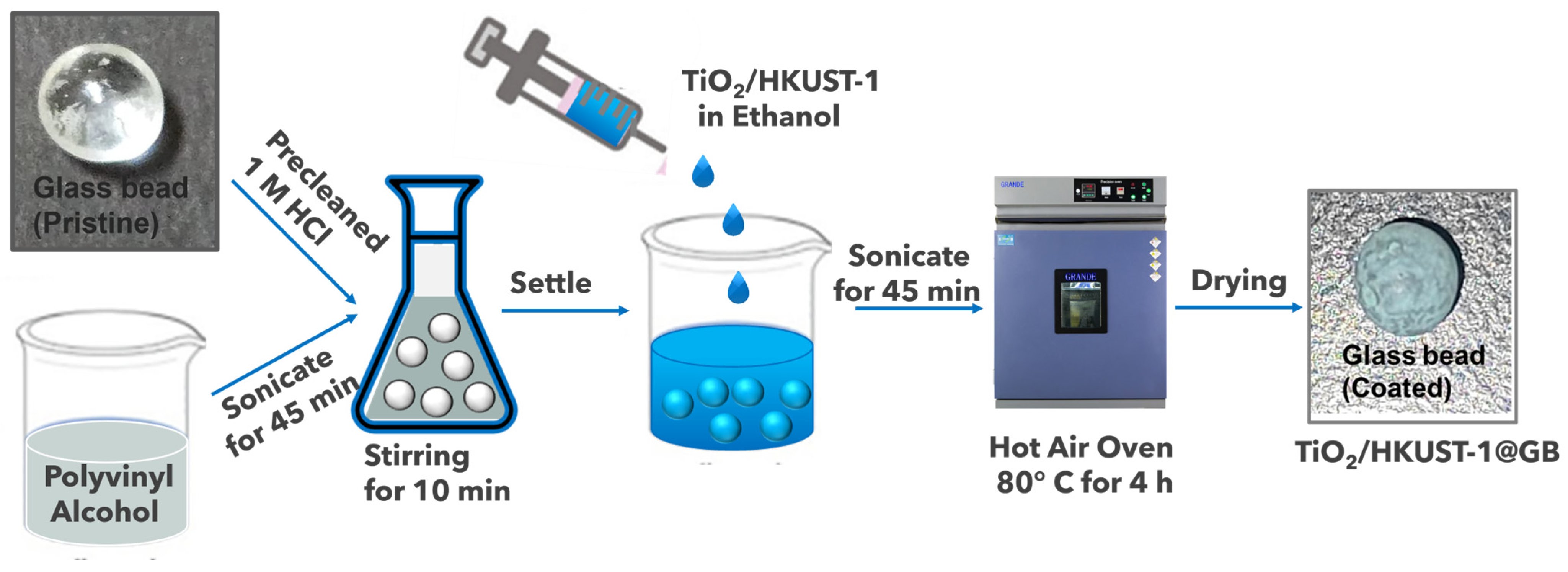
The TiO2/HKUST-1 was prepared by dispersing 1 g of previously synthesized HKUST-1 and 0.2 g of TiO2 in 50 mL of ethanol, then sonicated for 30 min to obtain a homogeneous suspension. After sonication, the solution was stirred for 12 h and then dried at 60 °C. The dried blue powder was ground and then stored in a desiccator (Figure 1).

2.3. Immobilization onto Glass Beads and Characterization

Glass beads were immersed in 1 M HCl for 12 h to induce surface roughness, then rinsed with deionized water and dried at 100 °C. The dip-coating method was used to immobilize the composite TiO2/HKUST-1 on the beads. 0.1 g of TiO2/HKUST-1 was dispersed in 20 mL of ethanol with 5% polyvinyl alcohol by weight as a binder. Precleaned glass beads were suspended in the solution, gently stirred for 10 min, and then air-dried. The process was repeated three times to strengthen the coating. The resultant beads were heated to 80 °C for 4 h to improve the binder’s adherence and stability [31]

2.4. Characterization Techniques of Materials

Analyses were performed to confirm the physical and chemical characteristics of the synthesized adsorbent. Powdered XRD (X-ray diffraction) was performed within a range of 2θ = 5–50° by Cu Kα radiation with λ = 1.54056 Å by D8 ADVANCE PTB 03/19 V StrlSchG, BRUKER Corporation, Karlsruhe, Germany. A Field Emission Scanning Electron Microscope (FE-SEM, GeminiSEM 560, Carl Zeiss Microscopy GmbH, Göttingen, Germany) and a TEM (JEM 2100) were used to capture the morphology and microscopic images of the samples. Samples were analyzed using energy-dispersive X-ray spectroscopy with the EDAX OCTANE PRIME instrument. Thermogravimetric analysis (TGA) was performed using an SII TG/DTA6300 EXSTAR (Seiko Instruments Inc., Tokyo, Japan) at a heating rate of 10 °C/min to 800 °C under a nitrogen atmosphere. FTIR spectroscopy was conducted from 400 to 4000 cm−1 with a resolution of 4 cm−1 using a Cary 630 FTIR spectrometer from Agilent, Santa Clara, CA, USA, to study the linkage between metals and organic linkers. A Q-TOF (Waters, Milford, MA, USA) instrument was used to determine the mechanism.

2.5. HPLC and Q-Tof Analysis

In all batch experiments, the concentration of CIP was measured using a Waters 1525 HPLC, Milford, MA, USA. The column used was ReliantTM C18 5 µm (4.6 × 250 mm), 186007283, Waters, Milford, MA, USA. The mobile phase used was a 1% formic acid/acetonitrile mixture in isocratic mode, at a 60:40 ratio. The FLR detector was used with an emission wavelength of 280 nm and an excitation wavelength of 465 nm. The flow rate was maintained at 0.2 mL/min−1 and the column temperature was 30 °C. 0.1 mol L−1 HCl and 0.1 mol L−1 NaOH were used to adjust the pH of the samples throughout all experiments.
The LC-QTOF-MS analysis was conducted using MassLynx software (V4.1) on an ACQUITY system from Waters Corporation (Milford, MA, USA). A 10 μL sample or standard was injected into a C18 column (Luna C18(2), 3 μm, 100 Å, 2 × 50 mm, with a 2 × 4 mm guard cartridge, Phenomenex, Torrance, CA, USA). The mobile phase consisted of solution A (1% formic acid) and solution (100% acetonitrile) in a 60:40 ratio, with a flow rate of 200 μLmin−1. The capillary voltage was set at 2.0 kV, the sample cone voltage at 20 V, and the extraction cone at 4.5 V.

2.6. Adsorption Kinetics and Isotherms

In all batch adsorption experiments, the initial concentration of CIP was 0.2 mgL−1 in Millipore water; the temperature was kept at 303 K, and the solution/mixture was agitated at 300 rpm. All experiments were conducted with a background concentration of 100 mgL−1 each of HCO3, SO42−, and Cl. Samples from the batch experiments were collected using a 0.22 μm syringe filter at regular intervals. The extent of adsorption qe (mg g−1) was determined by the equation as follows:
q e = C 0 C e V m
where C0 and Ce refer to the initial concentration and equilibrium concentration in mgL−1, respectively, v represents the volume of the solution in liters, and m denotes the adsorbent mass in grams. To explore the adsorption kinetics, the pseudo-first-order kinetic model (Equation (2)) and pseudo-second-order kinetic model (Equation (3)) were employed to fit the experimental data:
q t = q e 1 e k 1 2 . 303 x
q t = q e 2 k 2 t 1 + q e k 2 t
where adsorption time (min) is denoted as t, qe, and qt (mg g−1) represent the adsorption capacity at the equilibrium and at adsorption time t; and k1 (L min−1), k2 (g mg−1 min−1) denote the adsorption rate constant of the pseudo-first-order kinetic and pseudo-second-order kinetic, respectively. Adsorption isotherm experiments were performed by adding different concentrations of TiO2/HKUST-1@GB, varying from 0.1 to 0.5 g L−1 to the CIP solution containing background competing anions at pH 7.5, and determining the final CIP concentration in the solution.
The adsorption capacity of CIP was calculated using Equation (1). The experimental data were fitted using the Langmuir (4) and the Freundlich (5) isotherm models
q e = q m a x k L C e 1 + k L C e
q e = K F C e 1 n
where Ce (mg L−1) refers to the equilibrium concentration, qe (mg g−1) denotes the equilibrium adsorption capacity, and qmax (mg g−1) indicates the maximum adsorption capacity. KL (L mg−1) and KF (mg g−1 (mg L−1) −1/n) are the adsorption rate constants of the Langmuir and the Freundlich models, respectively. C0 represents the maximum initial CIP concentration.
The linear form of the Langmuir isotherm is as follows:
C e q e = 1 q m a x k L + C e q m a x
log q e = log K f + 1 n log C e

2.7. Photocatalytic Degradation

Equation (8) was used to calculate the photodegradation of CIP (%):
D = ( C 0 C e ) C 0 × 100
where D is the degradation percentage, C0 is the initial concentration, and Ce is the final concentration. The reaction kinetics wereinvestigated using the pseudo-first-order model equation.
k = l n ( C 0 C e ) t
where k is the apparent rate constant of the equation.

2.8. Batch Adsorption and Photocatalysis Experiments

Adsorption and photocatalysis experiments were conducted in a photochemical reactor setup. In a typical run, 250 mL of ciprofloxacin solution (200 µg/L) was added to a 500 mL borosilicate glass reactor containing 5 g of TiO2/HKUST-1-coated glass beads. The reactor was magnetically stirred at 300 rpm and maintained at room temperature (25 ± 1 °C). Adsorption equilibrium experiments were conducted in the dark for 60 min to isolate the adsorption contribution. For photocatalysis, the system was irradiated with a 230 W UV lamp (λ > 280 nm), positioned in an immersion reactor.
Aliquots (5 mL) were withdrawn at regular time intervals, filtered through a 0.22 µm syringe filter, and analyzed using HPLC. The effects of system parameters—initial CIP concentration (100–500 µg/L), solution pH (3–9), and catalyst dosage—were studied systematically. All experiments were performed in triplicate, and average values were reported.

2.9. Reusability and Stability Tests Including Degradation Pathway Analysis

To assess the reusability of the immobilized catalyst, the coated glass beads were washed with ethanol and water after each photocatalytic cycle and then dried at 80 °C. The degradation experiments were repeated for ten consecutive cycles under identical conditions. Catalyst stability was also evaluated by analyzing changes in crystal structure and morphology post-treatment, as confirmed by Fe-SEM analysis.
The intermediate degradation products of ciprofloxacin were identified using Quadrupole Time-of-Flight Mass Spectrometry (QTOF-MS, 6545, Milford, MA, USA, Waters). Samples collected after photocatalysis were diluted and directly injected for MS analysis under positive electrospray ionization (ESI+) mode. The proposed degradation pathway was constructed based on the major m/z values and known fragmentation patterns.

3. Results and Discussion

3.1. Characterization of TiO2/HKUST-1 and Immobilized Beads

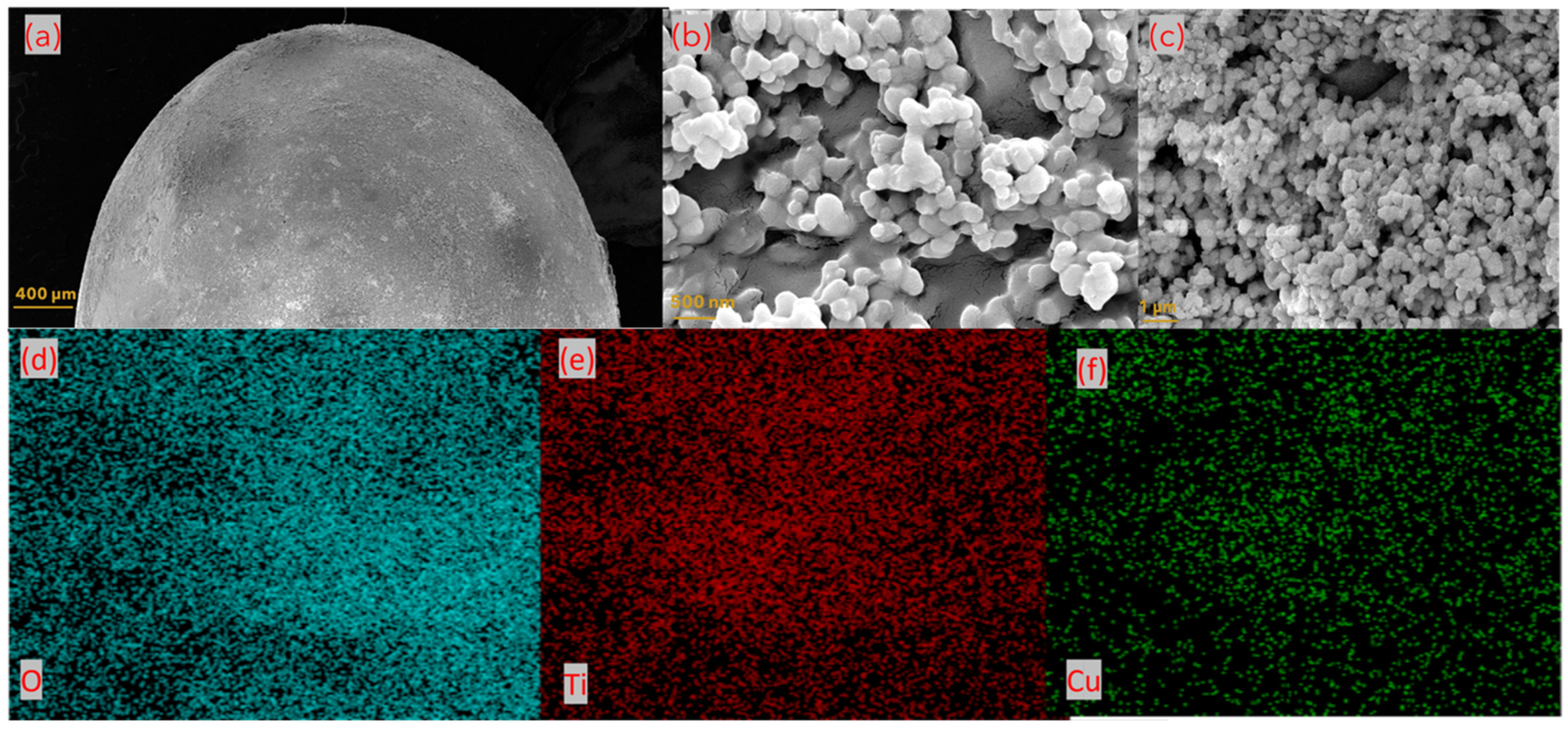
The successful synthesis of HKUST-1 and its integration with TiO2 were confirmed by XRD. The XRD pattern of the composite material showed distinct peaks at 2θ ≈ 6.7°, 9.5°, and 11.7°, characteristic of the HKUST-1 framework, along with an additional peak at 25.3° corresponding to the anatase phase of TiO2, confirming the coexistence of both phases without significant structural degradation (Figure S1). FTIR further validated the presence of carboxylate groups present on the HKUST-1 (bands at 1373 and 1717 cm−1) and presence of Ti–O–Ti stretching vibrations at ~668 cm−1 (Figure S2). The TGA–DTG–DSC results demonstrate that TiO2/HKUST-1@GB exhibits exceptional thermal stability, with negligible mass loss even at high temperatures (Figure S3). SEM images (Figure 2) revealed a uniform distribution of the TiO2/HKUST-1 composite on the glass bead surface, forming a porous, granular coating. EDX spectra confirmed the elemental presence of the elements Cu, Ti, O, and C, indicating successful immobilization. The BET surface area of the composite was measured to be close to ~675 m2/g, indicating high porosity in the composite, which is conducive to both adsorption and photocatalysis [32,33].

3.2. Adsorption of Ciprofloxacin by TiO2/HKUST-1

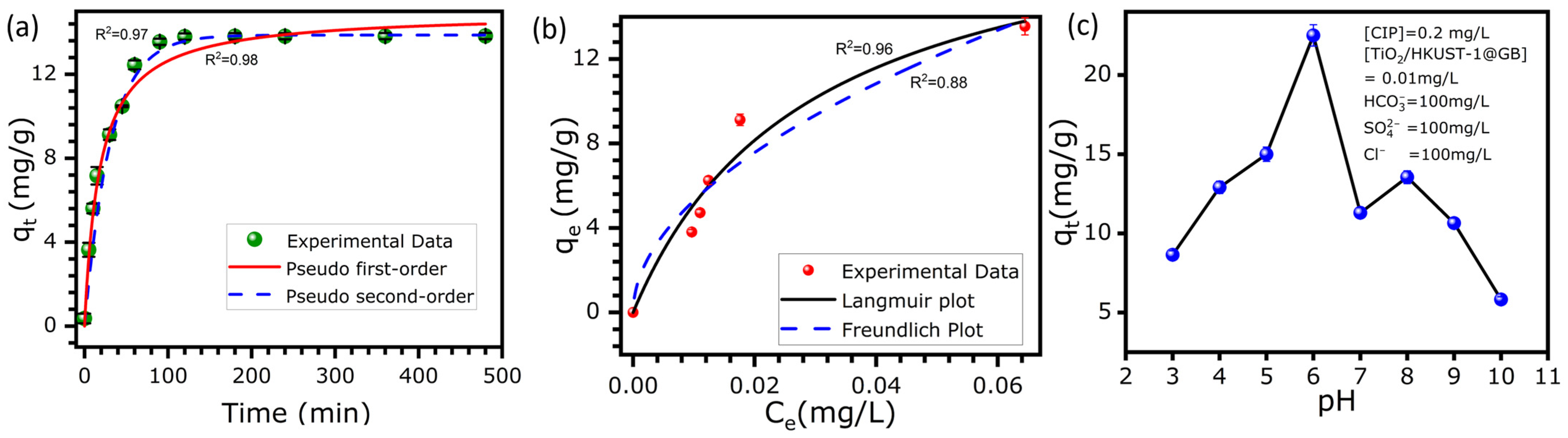
TiO2/HKUST-1 has both photocatalytic and adsorptive properties. To test its adsorption capacity, ciprofloxacin removal in the dark (=absence of photocatalytic degradation) was studied, revealing that ciprofloxacin removal was rapid in the first 30 min and reached equilibrium within 60 min. The maximum adsorption capacity (qmax) of the immobilized TiO2/HKUST-1 composite was found to be 20.6 mgg-1. The high adsorption affinity is attributed to multiple interaction mechanisms, including π–π interactions between the aromatic rings of ciprofloxacin and BTC linkers, coordination with Cu2+ sites, and hydrogen bonding [34].
Relative to the Freundlich isotherm model (R2 = 0.88; Figure 3b), the Langmuir isotherm described the equilibrium data better (R2 = 0.96), suggesting monolayer coverage of CIP molecules on the active sites of the composite (Figure 3a and Table S2). The adsorption process followed pseudo-first-order kinetics (R2 = 0.98; Figure 3a and Table S1). The photocatalytic degradation kinetics of ciprofloxacin were analyzed using the pseudo-first-order kinetic model derived from the Langmuir–Hinshelwood mechanism, which is widely applied to heterogeneous photocatalytic reactions at low pollutant concentrations. Under the studied conditions, a linear relationship between ln(C0/Ct) and irradiation time was obtained with a high correlation coefficient, indicating that the degradation process follows apparent first-order kinetics. This behavior suggests that the reaction rate is predominantly governed by photocatalytic surface reactions and radical-mediated oxidation rather than adsorption equilibrium.
The influence of pH was studied over a pH range of 3 to 10 as it affects adsorption due to changes in CIP speciation and adsorbent surface charge (Figure 3c). At acidic pH, electrostatic repulsion between the cationic CIP and the positively charged surface reduces adsorption. As shown in Figure 3c, maximum adsorption occurs near pH 6, where zwitterionic CIP interacts via π–π interactions, hydrogen bonding, and coordination with Cu(II) sites. At alkaline pH, adsorption decreases because anionic CIP experiences electrostatic repulsion and competition with hydroxyl ions for active sites.

3.3. Photocatalytic Degradation Performance

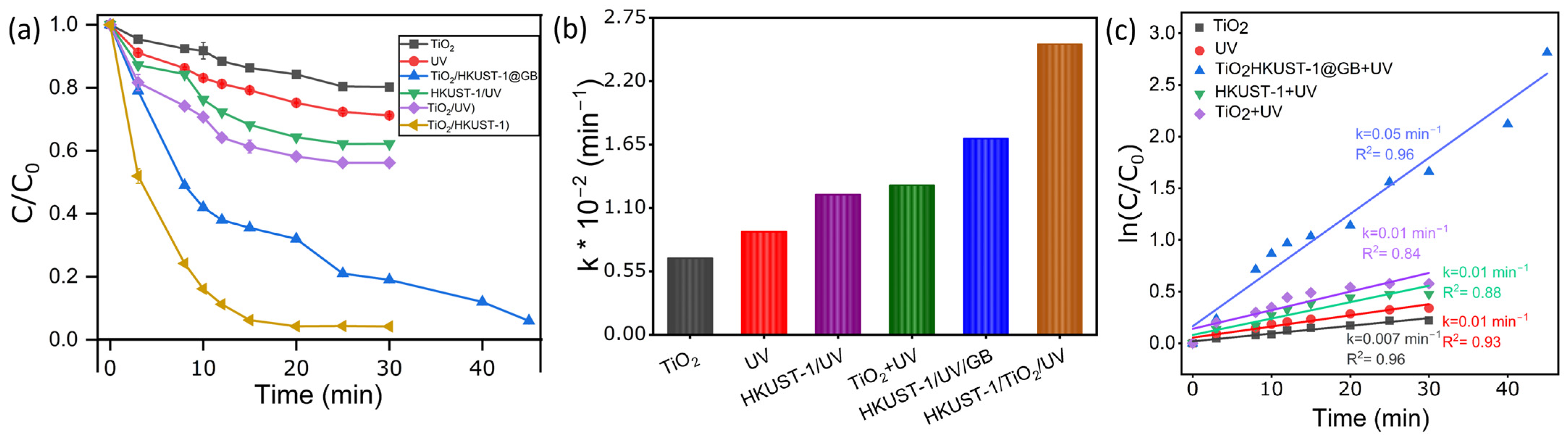
Upon UV irradiation, the immobilized TiO2/HKUST-1 system demonstrated efficient photocatalytic degradation of ciprofloxacin. Over 92% degradation was achieved within 40 min, significantly higher than that of TiO2 alone (18%) under similar conditions (Figure 4a). The enhanced photocatalytic activity is attributed to (i) improved electron–hole separation due to MOF-TiO2 interface synergy, (ii) proximity of the adsorbed pollutant to reactive sites, and (iii) increased ROS generation in the confined pore environment.
Control experiments confirmed negligible degradation in the absence of light or catalyst, validating the necessity of both components (Figure 4b). Figure 4c depicts the corresponding linear kinetic plots of ln(C0/Ct) versus time for CIP degradation under individual and combined catalytic systems. Radical scavenger studies identified hydroxyl radicals (•OH) and holes (h+) as the primary oxidative species responsible for CIP degradation [8,35,36].

3.4. Parameter Optimization

The initial CIP concentration was varied in the range of 100 to 500 µg/L, decreasing the removal efficiency from 94% to 78%. This decrease may be attributed to increased competition for active sorption sites and for ROS. Optimal degradation occurred at pH 6. Below pH 5, protonation of CIP and the surface suppressed adsorption; above pH 8, decreased hydroxyl radical formation and repulsive interactions reduced photocatalytic activity. Increasing the catalyst dosage, i.e., the amount of coating on the glass beads, improved degradation efficiency up to an optimum (5 g/250 mL), beyond which turbidity and light scattering decreased photocatalytic activity [37,38,39].

3.5. Effect of pH

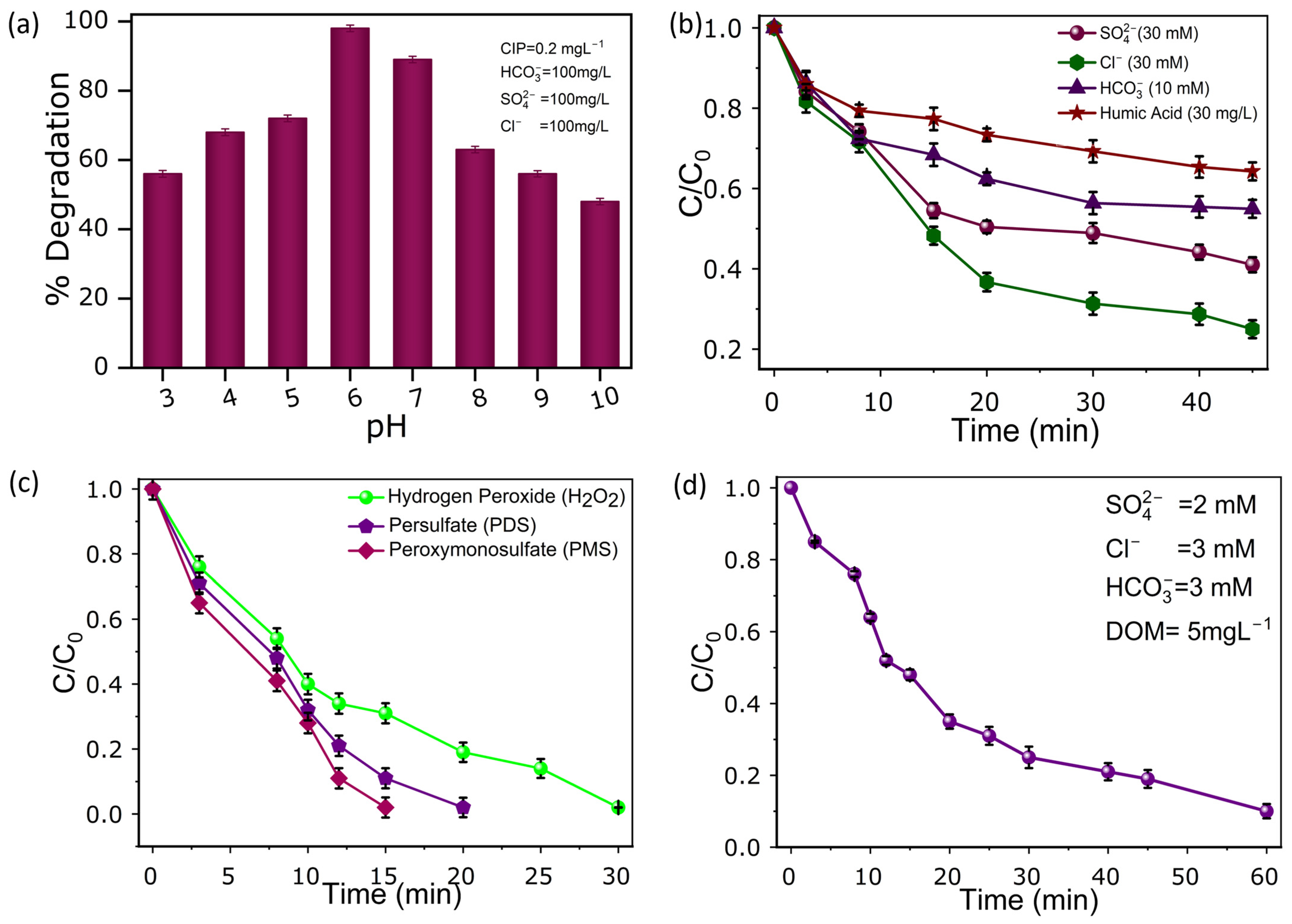
The effect of pH on the removal of CIP is shown in Figure 5a. The degradation efficiency showed an increasing trend as the pH was raised from acidic to near-neutral conditions, reaching a maximum of 98% at pH 6 at a reaction time of 60 min; thereafter, it decreased noticeably under alkaline conditions. This trend can be due to the pH-dependent speciation of CIP in aqueous solutions and to changes in the photocatalyst’s surface charge and reactivity. At acidic pH, CIP predominantly exists in a cationic form; at near-neutral pH, it exists mainly in its zwitterionic form; and at basic pH, it predominantly exists in its anionic form. The catalyst has a pHpzc of 5.4 indicating that at pH < pHpzc its surface is predominantly positively charged and at pH > pHpzc the surface is negatively charged. In acidic conditions, the interaction between CIP and the catalyst surface may be weaker, with limited access to reactive oxygen species. At near-neutral pH values, electrostatic and hydrogen-bonding interactions are prominent, thereby increasing the accessibility of photogenerated reactive species. In addition, the generation of hydroxyl radicals at this pH range accelerates photocatalytic degradation. In alkaline conditions, electrostatic repulsion between CIP and the negatively charged surface reduces the affinity of adsorption. Moreover, excess hydroxide ions at higher pH levels can act as scavengers of photogenerated holes, reducing hydroxyl radical formation and overall degradation efficiency. The observations presented here suggest that the TiO2/HKUST-1@GB exhibits optimal performance under environmentally relevant pH conditions, which is promising for practical applications in water treatment [40,41].

3.6. Effect of Ionic Strength

The natural ion composition modulates CIP degradation primarily via competitive behavior in the presence of Cl (30 mM), SO42− (30 mM), NaHCO3 (10 mM), and humic acid (HA, 30 mg L−1) in the photocatalytic system. As shown in Figure 5b, the presence of humic acid exerted the most potent inhibitory effect due to light attenuation, surface fouling of the immobilized bead, and competition with CIP for the adsorption sites as well as for the reactive oxygen species. In the presence of inorganic ions such as chloride, CIP removal was marginally decreased, indicating a limited role for Cl ions due to weak competitive adsorption and minor scavenging of hydroxyl radicals. The addition of sulfate ions resulted in more pronounced inhibition, attributed to increased ionic strength and competition for surface-active sites. The presence of bicarbonate reduced degradation efficiency by scavenging hydroxyl radicals and forming less reactive carbonate radicals. Despite these interferences, the TiO2/HKUST-1@GB maintained considerable photocatalytic activity, showing its robustness under conditions representative of natural and wastewater matrices [8].

3.7. Effect of Oxidants

The influence of the addition of oxidants such as hydrogen peroxide (H2O2), persulfate (PDS), and peroxymonosulfate (PMS) at a concentration of 2 mM on the photocatalytic degradation of CIP is shown in Figure 5c. The addition of all three scavengers increased CIP degradation compared to photochemical systems without oxidants. For H2O2, the degradation efficiency increased, and almost complete degradation was achieved in 40 min. PDS and PMS exhibited a more pronounced enhancement effect, with optimal performance and nearly complete degradation at reduced time intervals. The better performance of PDS and PMS can be due to the formation of sulfate radicals, which possess higher redox potentials and longer lifetimes than •OH radicals. In addition, all oxidants behaved as electron acceptors, thereby enhancing charge separation and reducing electron–hole recombination in the TiO2/HKUST-1@GB system. These findings demonstrate that an appropriate oxidant type and dosage are critical for maximizing photocatalytic degradation efficiency while avoiding radical inhibition and excessive chemical consumption.

3.8. Photocatalytic Degradation of CIP in Tap Water

To understand the effectiveness of the TiO2/HKUST-1@GB composite for practical applications, a photocatalytic degradation experiment was conducted under the above-optimized conditions using tap water as the reaction medium. As illustrated in Figure 5d, a measurable but limited decrease in CIP degradation efficiency was observed in tap water, with more than 90% degradation at a reaction time of 60 min. The tap water contained bicarbonate (3 mM), chloride (3 mM), sulfate (2 mM), and dissolved organic matter (TOC ≈ 5 mg L−1), which compete with CIP for adsorption sites and scavenge reactive oxygen species. Particularly, bicarbonate and carbonate ions effectively quench hydroxyl radicals, forming less reactive carbonate radicals and thereby decreasing the efficiency of oxidative degradation. Despite these matrix interferences, the immobilized beads retained high photocatalytic efficiency, deriving high CIP removal in tap water. Thus, the study demonstrates the catalyst’s adaptability to realistic water chemistry and confirms its feasibility for antibiotic removal under practical water treatment conditions [37].

3.9. Reusability and Stability of the Catalyst

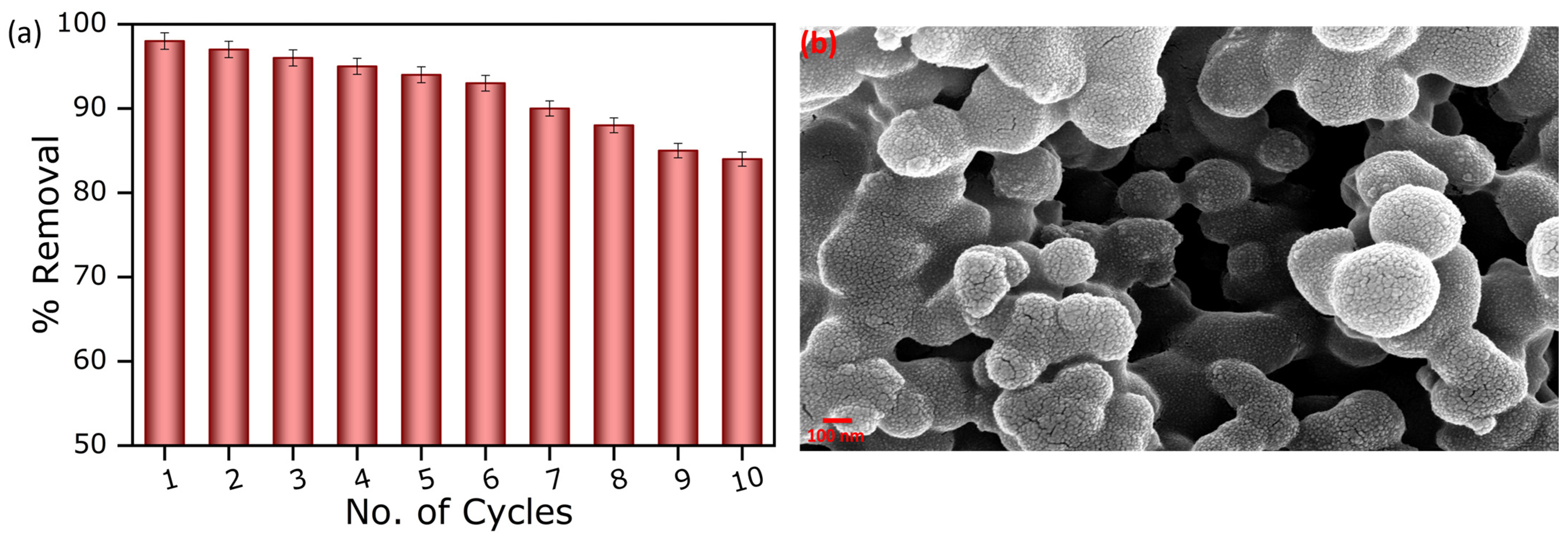
To test the structural robustness, structural integrity, and reusability of TiO2/HKUST-1@GB, multiple CIP photocatalytic cycles were carried out and evaluated. As shown in Figure 6a, the composite maintained a considerable degradation efficiency after 10 cycles, with only a slight decrease of approximately 7% after 5 cycles and around 12% over 10 cycles. This reduction can be attributed to partial surface fouling or to active-site blockage by residual intermediates, rather than catalyst deactivation. FE-SEM analysis further confirmed the morphological and compositional stability of the TiO2/HKUST-1@GB after repeated use. The micrograph obtained after the fifth cycle, shown in Figure 6b, revealed no structural collapse, surface cracking, or particle detachment from the glass bead. Moreover, no significant leaching of Ti or Cu species was detected, indicating strong interfacial adhesion and excellent chemical stability of the composite coating. These observations show the robustness and recyclability of the immobilized TiO2/HKUST-1@GB photocatalyst, highlighting its suitability for long-term and sustainable application in water treatment systems [28].

3.10. Photocatalytic Degradation Mechanism

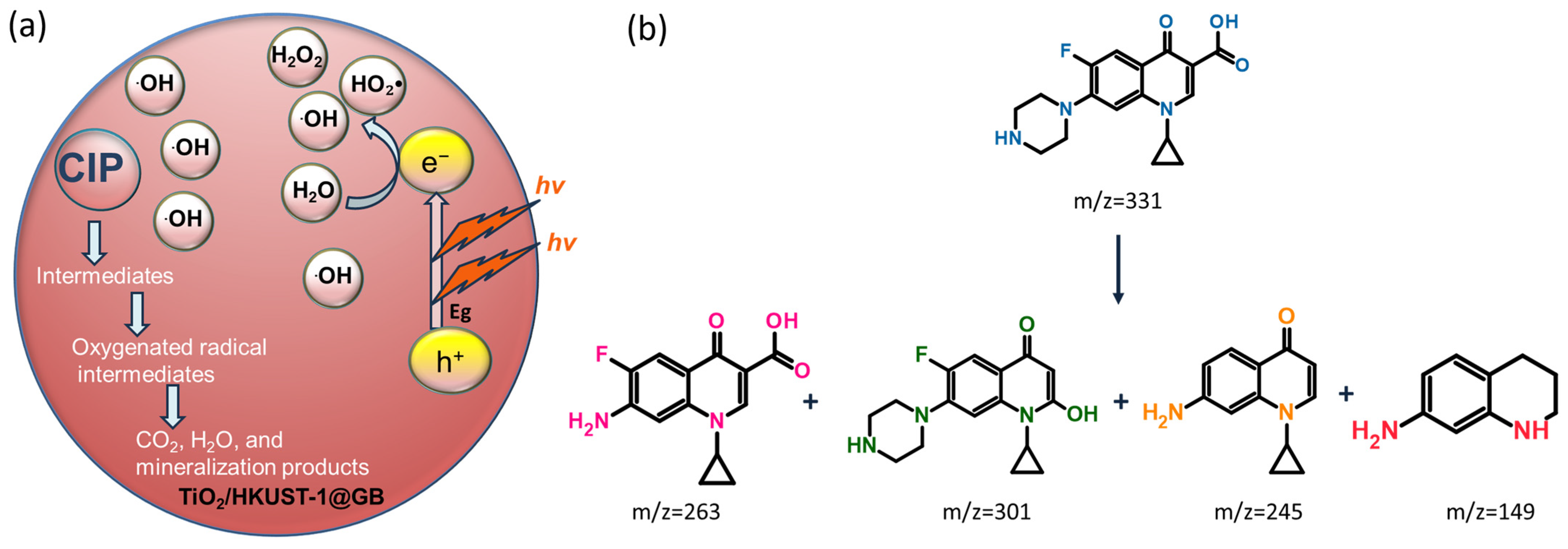
The mechanism of photocatalytic degradation of ciprofloxacin over the TiO2/HKUST-1@GB system involves a combined charge-transfer and reactive oxygen species (ROS) pathway (Figure 7a). HKUST-1 acts as an electron acceptor due to the presence of Cu2+/Cu+ redox centers, and TiO2 generates electron–hole pairs, thereby suppressing charge recombination upon light irradiation. The photogenerated electrons are transferred from the conduction band of TiO2 to the Cu sites of HKUST-1, forming hydroxyl radicals. At the same time, photogenerated holes in the TiO2 valence band oxidize surface-adsorbed water and hydroxide ions to form hydroxyl radicals (•OH). The hydroxyl radicals start oxidative attack on ciprofloxacin molecules adsorbed on the catalyst surface. The degradation process occurs in four steps: defluorination, cyclopropyl group oxidation, decarboxylation, and opening of the piperazine ring, which is particularly vulnerable to reactive oxygen species, leading to hydroxylation and subsequent cleavage. As oxidation continues, the complex quinolone structure is cleaved into smaller oxygenated compounds, ultimately producing low-molecular-weight products, indicating advanced oxidation and partial mineralization. QTOF-MS identified the intermediates, which were consistent with all four steps as illustrated in Figure 7b and Figure S4. A more detailed analysis of the pathway has been reported in an unpublished manuscript by Dixit et al. [21].
The degradation products of CIP during photocatalytic treatments, elucidated by QTOF-MS, revealed the formation of major intermediates, confirming the breakdown of the CIP molecule. An intermediate detected at m/z values of 263 can be associated with progressive alteration and cleavage of the piperazine moiety, one of the most reactive structural units of CIP under oxidative conditions. The appearance of this fragment indicates significant destabilization of the piperazine ring and its conversion into smaller molecular species. An additional intermediate detected at m/z 245 indicated a structural modification related to the carboxyl functional group attached to the core of CIP’s structure. The loss of the COO group leads to a reduction in molecular weight and indicates further breakdown of the quinolone molecule. In addition, an intermediate at m/z 301 was detected, suggesting partial removal of fluorine from the CIP structure. The identification of these defluorinated species indicates that the C–F bond is oxidatively transformed during photocatalytic treatment. The QTOF–MS spectra also revealed several intermediates associated with the modification of the cyclopropyl substituent. An intermediate detected at m/z 149 indicated successive oxidation and fragmentation of the framework. The resultant moieties further show the progressive degradation of peripheral functional groups within the quinolone structure. The presence of these intermediate products confirms advanced molecular breakdown of CIP into simpler organic species, resulting in the extensive degradation of the original molecular structure.
The immobilized configuration of the TiO2/HKUST-1@GB system ensures efficient mass transfer, structural stability, and sustained ROS generation, thereby enabling effective, reusable photocatalytic degradation of ciprofloxacin in aqueous solutions [42].

4. Conclusions

Photocatalysis has emerged as a promising advanced oxidation technology capable of degrading a broad spectrum of pharmaceuticals and personal care products present in water and wastewater. In this study, we have demonstrated the comparable performance of a simple TiO2/HKUST-1 photocatalyst coated on glass beads to that of a traditional TiO2 photocatalyst for the photoremoval of CIP from water. The catalyst, TiO2/HKUST-1@GB synergistically combined the significant and selective adsorption capacity of HKUST-1 towards CIP alone with high photocatalytic activity of TiO2, enabling a dual-action mechanism for capture and degradation of CIP. Batch experiments showed 98% ciprofloxacin removal within 45 min under UV irradiation at pH 6, and characterization results confirmed structural integrity and reusability with minimal activity loss over 10 cycles of operation, indicating promising operational stability.
QTOF-MS analysis identified key degradation intermediates and confirmed that ciprofloxacin underwent peprizine ring cleavage, defluorination, decarboxylation, and oxidative transformations, ultimately yielding smaller non-toxic end-products. This work highlights the potential of MOF-based hybrid materials immobilized on inert carriers for practical water-treatment applications, offering a scalable and sustainable strategy to mitigate antibiotic contamination in water. While the results presented herein are very encouraging, additional research is needed to optimize the treatment parameters and, more importantly, to investigate how the immobilized catalyst would perform in complex environmental matrices containing high concentrations of co-contaminants and suspended solids. In this context, the potential detrimental effect of fouling needs to be considered.

Supplementary Materials

The following supporting information can be downloaded at: https://www.mdpi.com/article/10.3390/w18050545/s1, Figure S1: X-Ray Diffraction analysis of TiO2/HKUST-1@GB. The diffraction peaks observed at low 2θ values (~6–15°) are characteristic of the crystalline HKUST-1 framework and correspond to its well-ordered porous structure. Additional peaks around ~17–20° and ~25–30° further confirm the preservation of MOF crystallinity after immobilization on glass beads. The TiO2 peaks around 26° indicate that TiO2 is dispersed. Figure S2: FTIR analysis of TiO2/HKUST-1@GB. The FTIR spectrum of TiO2/HKUST-1@GB shows a broad band around 3400 cm−1, corresponding to surface –OH groups. The band at 1717 cm−1 is assigned to C=O stretching of the carboxylate groups from the BTC linker of HKUST-1, confirming the composite’s integrity after immobilization. Peaks at 1373 and 1048 cm−1 arise from C–O and C–C vibrations, while the low-wavenumber band at ~668 cm−1 is associated with Ti–O/Ti–O–Ti vibrations, indicating the presence of TiO2 in the composite. Figure S3: Thermogravimetric analysis of TiO2/HKUST-1@GB. The TGA–DTG–DSC results demonstrate that TiO2/HKUST-1@GB exhibits exceptional thermal stability, with negligible mass loss even at high temperatures. This stability is crucial for reusability, long-term photocatalytic operation, and practical water treatment applications, where thermal and structural integrity under irradiation is required. Figure S4: Panel (a) shows a sharp chromatographic peak at a short retention time, indicating rapid elution and effective separation of ciprofloxacin degradation products. The mass spectrum in (b) confirms the formation of multiple intermediates, evidencing extensive molecular fragmentation during photocatalytic treatment. In (c), prominent m/z signals correspond to key transformation products arising from piperazine ring cleavage, decarboxylation, and oxidation reactions. Table S1. Kinetic model parameters for the adsorption of CIP on TiO2/HKUST-1@GB composite. Table S2. Adsorption isotherm model parameters.

Author Contributions

D.D.: conceptualization, investigation, methodology, data curation, formal analysis, visualization, and writing—original draft, review, and editing. S.S.: conceptualization, supervision, writing, review, editing, and resources. T.B.: conceptualization, supervision, writing, review, and editing. All authors have read and agreed to the published version of the manuscript.

Funding

This research received no external funding.

Data Availability Statement

Data is contained within the article. Other Supplementary Materials have been provided. Further inquiries can be directed to the corresponding author.

Acknowledgments

Divya Dixit gratefully acknowledges the scholarship from the Ministry of Education, Government of India, during her doctorate work related to this research.

Conflicts of Interest

The authors declare no conflicts of interest.

References

  1. Roose-Amsaleg, C.; Laverman, A.M. Do antibiotics have environmental side-effects? Impact of synthetic antibiotics on biogeochemical processes. Environ. Sci. Pollut. Res. 2016, 23, 4000–4012. [Google Scholar] [CrossRef] [PubMed]
  2. Bengtsson, B.; Greko, C. Antibiotic resistance-consequences for animal health, welfare, and food production. Ups. J. Med. Sci. 2014, 119, 96–102. [Google Scholar] [CrossRef]
  3. Thai, V.A.; Dang, V.D.; Thuy, N.T.; Pandit, B.; Vo, T.K.Q.; Khedulkar, A.P. Fluoroquinolones: Fate, effects on the environment and selected removal methods. J. Clean. Prod. 2023, 418, 137762. [Google Scholar] [CrossRef]
  4. Soldevila, S.; Boscá, F. Photoreactivity of fluoroquinolones: Nature of aryl cations generated in water. Org. Lett. 2012, 14, 3940–3943. [Google Scholar] [CrossRef] [PubMed]
  5. Li, M.; Ji, D.; Pamudji, M.S.; Lui, K.H.; Zhao, Y.; Zhao, G.; Zhou, S.-Q.; Mo, C.-H.; Han, W.; Yeung, K.L. Occurrence, risk, and treatment of ciprofloxacin and clarithromycin in drainage. Chem. Eng. J. 2023, 466, 142968. [Google Scholar] [CrossRef]
  6. Sodhi, K.K.; Singh, D.K. Insight into the fluoroquinolone resistance, sources, ecotoxicity, and degradation with special emphasis on ciprofloxacin. J. Water Process Eng. 2021, 43, 102218. [Google Scholar] [CrossRef]
  7. Antilén, M.; Bustos, O.; Ramirez, G.; Canales, C.; Faundez, M.; Escudey, M.; Pizarro, C. Electrochemical evaluation of ciprofloxacin adsorption on soil organic matter. New J. Chem. 2016, 40, 7132–7139. [Google Scholar] [CrossRef]
  8. Tantis, I.; Bousiakou, L.; Karikas, G.A.; Lianos, P. Photocatalytic and photoelectrocatalytic degradation of the antibacterial agent ciprofloxacin. Photochem. Photobiol. Sci. 2015, 14, 603–607. [Google Scholar] [CrossRef]
  9. Chang, M.X.; Zhang, J.F.; Sun, Y.H.; Li, R.S.; Lin, X.L.; Yang, L.; Webber, M.A.; Jiang, H.-X. Contribution of Different Mechanisms to Ciprofloxacin Resistance in Salmonella spp. Front. Microbiol. 2021, 12, 663731. [Google Scholar] [CrossRef]
  10. Gothwal, R.; Shashidhar, T. Proliferation of Ciprofloxacin Resistant Bacteria in Polluted Sediments of Musi River, India. Soil Sediment Contam. 2017, 26, 501–509. [Google Scholar] [CrossRef]
  11. Lupu, G.I.; Orbeci, C.; Bobirică, L.; Bobirică, C.; Pascu, L.F. Key Principles of Advanced Oxidation Processes: A Systematic Analysis of Current and Future Perspectives of the Removal of Antibiotics from Wastewater. Catalysts 2023, 13, 1280. [Google Scholar] [CrossRef]
  12. Yang, Q.; Gao, Y.; Ke, J.; Show, P.L.; Ge, Y.; Liu, Y.; Guo, R.; Chen, J. Antibiotics: An overview on the environmental occurrence, toxicity, degradation, and removal methods. Bioengineered 2021, 12, 7376–7416. [Google Scholar] [CrossRef] [PubMed]
  13. Larsson, D.G.J.; Flach, C.F. Antibiotic resistance in the environment. Nat. Rev. Microbiol. 2022, 20, 257–269. [Google Scholar] [CrossRef] [PubMed]
  14. Ebrahimi, S.M.; Reyhani, R.D.; Asghari-JafarAbadi, M.; Fathifar, Z. Diversity of antibiotics in hospital and municipal wastewaters and receiving water bodies and removal efficiency by treatment processes: A systematic review protocol. Environ. Evid. 2020, 9, 13. [Google Scholar] [CrossRef]
  15. Boving, T.; Dixit, D.; Dutta, A. Technologies for Soil and Water Pollution Remediation; Elsevier: Amsterdam, The Netherlands, 2026. [Google Scholar]
  16. Dixit, D.; Jain, S.; Dutta, A.; Sarkar, S. Recent advances in adsorptive removal of fluoroquinolones from aqueous matrices. Chem. Eng. J. Green Sustain. 2026, 1, 100008. [Google Scholar] [CrossRef]
  17. Singh, P.P.; Pandey, G.; Murti, Y.; Gairola, J.; Mahajan, S.; Kandhari, H.; Tivari, S.; Srivastava, V. Light-driven photocatalysis as an effective tool for degradation of antibiotics. RSC Adv. 2024, 14, 20492–20515. [Google Scholar] [CrossRef]
  18. Moreira, N.F.F.; Narciso-da-Rocha, C.; Polo-López, M.I.; Pastrana-Martínez, L.M.; Faria, J.L.; Manaia, C.M.; Fernández-Ibáñez, P.; Nunes, O.C.; Silva, A.M. Solar treatment (H2O2, TiO2-P25 and GO-TiO2 photocatalysis, photo-Fenton) of organic micropollutants, human pathogen indicators, antibiotic resistant bacteria and related genes in urban wastewater. Water Res. 2018, 135, 195–206. [Google Scholar] [CrossRef]
  19. Chen, Y.; Ma, J.; Yang, H.; Ji, H.; Li, W.; Pi, Y.; Pang, H. Application of modified metal-organic frameworks in water treatment. Mater. Today Chem. 2023, 30, 101577. [Google Scholar] [CrossRef]
  20. Zhang, G.; Li, X.; Liu, Y.; Du, G.; Pang, H. Metal-organic framework derived micro-/nano-materials: Precise synthesis and clean energy applications. Inorg. Chem. Front. 2024, 148, 04022074. [Google Scholar] [CrossRef]
  21. Dixit, D.; Choudhary, S.; Sarka, S.; Banerjee, S.; Boving, T. Experimental and Computational Investigation of Selective Removal of Ciprofloxacin by HKUST-1. J. Water Process Eng. in press.
  22. Wang, Y.; Yu, W.; Geng, F.; Zhao, L.; Wang, Y. TiO2@MOF photocatalyst for the synergetic oxidation of microcystin-LR and reduction of Cr(VI) in Aqueous media. Catalysts 2021, 11, 1186. [Google Scholar] [CrossRef]
  23. Yu, Y.; Liu, K.; Zhang, Y.; Xing, X.; Li, H. High Photocatalytic Activity of g-C3N4/La-N-TiO2 Composite with Nanoscale Heterojunctions for Degradation of Ciprofloxacin. Int. J. Environ. Res. Public Health 2022, 19, 4793. [Google Scholar] [CrossRef]
  24. Usman, M.R.; Prasasti, A.; Fajriyah, S.; Marita, A.W.; Islamiah, S.; Firdaus, A.N.; Noviyanti, A.R.; Eddy, D.R. Degradation of ciprofloxacin by titanium dioxide (TiO2) nanoparticles: Optimization of conditions, toxicity, and degradation pathway. Bull. Chem. React. Eng. Catal. 2021, 16, 752–762. [Google Scholar] [CrossRef]
  25. Malakootian, M.; Nasiri, A.; Amiri Gharaghani, M. Photocatalytic degradation of ciprofloxacin antibiotic by TiO2 nanoparticles immobilized on a glass plate. Chem. Eng. Commun. 2020, 207, 56–72. [Google Scholar] [CrossRef]
  26. Hassan Mohamed, N.A.; Shamma, R.N.; Elagroudy, S.; Adewuyi, A. Visible Light-Driven Photocatalytic Degradation of Ciprofloxacin, Ampicillin and Erythromycin by Zinc Ferrite Immobilized on Chitosan. Resources 2022, 11, 81. [Google Scholar] [CrossRef]
  27. Zhao, Z.; Lei, Y.; Liu, W.; Fan, J.; Xue, D.; Xue, Y.; Yin, S. Fly ash cenospheres as multifunctional supports of g-C3N4/N-TiO2 with enhanced visible-light photocatalytic activity and adsorption. Adv. Powder Technol. 2017, 28, 3233–3240. [Google Scholar] [CrossRef]
  28. Altin, I.; Sökmen, M. Preparation of TiO2-polystyrene photocatalyst from waste material and its usability for removal of various pollutants. Appl. Catal. B 2014, 144, 694–701. [Google Scholar] [CrossRef]
  29. Magalhães, F.; Lago, R.M. Floating photocatalysts based on TiO2 grafted on expanded polystyrene beads for the solar degradation of dyes. Sol. Energy 2009, 83, 1521–1526. [Google Scholar] [CrossRef]
  30. Chowdhury, P.; Bikkina, C.; Meister, D.; Dreisbach, F.; Gumma, S. Comparison of adsorption isotherms on Cu-BTC metal organic frameworks synthesized from different routes. Microporous Mesoporous Mater. 2009, 117, 406–413. [Google Scholar] [CrossRef]
  31. Hui, J.; Pestana, C.J.; Caux, M.; Gunaratne, H.Q.N.; Edwards, C.; Robertson, P.K.J.; Lawton, L.A.; Irvine, J.T. Graphitic-C3N4 coated floating glass beads for photocatalytic destruction of synthetic and natural organic compounds in water under UV light. J. Photochem. Photobiol. A Chem. 2021, 405, 112935. [Google Scholar] [CrossRef]
  32. Tsai, C.K.; Huang, C.H.; Horng, J.J.; Ong, H.L.; Doong, R.A. Enhanced Visible-Light-Responsive Photocatalytic Degradation of Ciprofloxacin by the CuxO/Metal-Organic Framework Hybrid Nanocomposite. Nanomaterials 2023, 13, 282. [Google Scholar] [CrossRef]
  33. Min, X.; Li, X.; Zhao, J.; Hu, X.; Yang, W. Heterostructured TiO2@HKUST-1 for the enhanced removal of methylene blue by integrated adsorption and photocatalytic degradation. Environ. Technol. 2021, 42, 4134–4144. [Google Scholar] [CrossRef]
  34. Yao, N.; Li, C.; Yu, J.; Xu, Q.; Wei, S.; Tian, Z.; Yang, Z.; Yang, W.; Shen, J. Insight into adsorption of combined antibiotic-heavy metal contaminants on graphene oxide in water. Sep. Purif. Technol. 2020, 236, 116278. [Google Scholar] [CrossRef]
  35. Pretali, L.; Fasani, E.; Sturini, M. Current advances on the photocatalytic degradation of fluoroquinolones: Photoreaction mechanism and environmental application. Photochem. Photobiol. Sci. 2022, 21, 899–912. [Google Scholar] [CrossRef]
  36. Klementová, Š.; Poncarová, M.; Langhansová, H.; Lieskovská, J.; Kahoun, D.; Fojtíková, P. Photodegradation of fluoroquinolones in aqueous solution under light conditions relevant to surface waters, toxicity assessment of photoproduct mixtures. Environ. Sci. Pollut. Res. 2021, 29, 13941–13962. [Google Scholar] [CrossRef] [PubMed]
  37. Paumo, H.K.; Dalhatou, S.; Katata-Seru, L.M.; Kamdem, B.P.; Tijani, J.O.; Vishwanathan, V.; Kane, A.; Bahadur, I. TiO2 assisted photocatalysts for degradation of emerging organic pollutants in water and wastewater. J. Mol. Liq. 2021, 331, 115458. [Google Scholar] [CrossRef]
  38. Ge, L.; Deng, H. Degradation of two fluoroquinolone antibiotics photoinduced by Fe(III)-microalgae suspension in an aqueous solution. Photochem. Photobiol. Sci. 2015, 14, 693–699. [Google Scholar] [CrossRef]
  39. Cuquerella, M.C.; Miranda, M.A.; Boscá, F. Generation of detectable singlet aryl cations by photodehalogenation of fluoroquinolones. J. Phys. Chem. B 2006, 110, 6441–6443. [Google Scholar] [CrossRef] [PubMed]
  40. Hu, H.; Chen, Y.; Ye, J.; Zhuang, L.; Zhang, H.; Ou, H. Degradation of ciprofloxacin by 185/254 nm vacuum ultraviolet: Kinetics, mechanism and toxicology. Environ. Sci. 2019, 5, 564–576. [Google Scholar] [CrossRef]
  41. Chatterjee, A.; Jana, A.K.; Basu, J.K. A binary MOF of iron and copper for treating ciprofloxacin-contaminated waste water by an integrated technique of adsorption and photocatalytic degradation. New J. Chem. 2021, 45, 17196–17210. [Google Scholar] [CrossRef]
  42. Hu, X.; Hu, X.; Peng, Q.; Zhou, L.; Tan, X.; Jiang, L.; Tang, C.; Wang, H.; Liu, S.; Wang, Y.; et al. Mechanisms underlying the photocatalytic degradation pathway of ciprofloxacin with heterogeneous TiO2. Chem. Eng. J. 2020, 380, 122366. [Google Scholar] [CrossRef]
Figure 1. Synthesis method for TiO2/HKUST-1-coated glass beads.
Water 18 00545 g001
Figure 2. Field-emission scanning electron microscopy (FE-SEM) images showing the morphology of (a) raw glass beads, (b) bare glass beads at higher magnification, and (c) coated glass beads after modification. (df) Energy-dispersive X-ray (EDX) elemental mapping of the coated glass beads illustrating the distribution of O, Ti, and Cu elements.
Water 18 00545 g002
Figure 3. (a) Adsorption isotherm models, (b) Adsorption kinetic model, (c) Effect of pH on adsorption of CIP.
Water 18 00545 g003
Figure 4. (a) Photocatalytic degradation of ciprofloxacin. (b) Rate constants (k) for the degradation of ciprofloxacin by the catalysts investigated herein. (c) Pseudo-first-order kinetic plots of ln(C0/Ct) versus time with corresponding k values and R2.
Water 18 00545 g004
Figure 5. (a) Effect of pH on the degradation of CIP. (b) Effect of ionic strength on the degradation of CIP. (c) Effect of the oxidants added to enhance CIP degradation, (d) Tap water degradation results.
Water 18 00545 g005
Figure 6. (a) Reusability studies extending over 10 photocatalytic cycles. (b) Fe-SEM image of used catalyst-coated glass beads after five photocatalytic cycles.
Water 18 00545 g006
Figure 7. (a) Degradation mechanism study (b) Intermediate products found after QTOF MS analysis of CIP.
Water 18 00545 g007
Disclaimer/Publisher’s Note: The statements, opinions and data contained in all publications are solely those of the individual author(s) and contributor(s) and not of MDPI and/or the editor(s). MDPI and/or the editor(s) disclaim responsibility for any injury to people or property resulting from any ideas, methods, instructions or products referred to in the content.