Article

Hydraulic Characteristics Analysis of Free-Surface-Pressurized Flow in Long Tailrace Systems Under Variable Load Conditions

1
China Yangtze Power Co., Ltd., Yichang 443000, China
2
College of Water Conservancy and Hydropower Engineering, Hohai University, Nanjing 210098, China
3
School of Electrical and Power Engineering, Hohai University, Nanjing 211100, China
*
Author to whom correspondence should be addressed.
Water 2026, 18(4), 449; https://doi.org/10.3390/w18040449
Submission received: 21 December 2025 / Revised: 30 January 2026 / Accepted: 6 February 2026 / Published: 9 February 2026

Abstract

Complex hydraulic transients induced during load adjustment of turbine units in long tailrace tunnels pose significant threats to the safety and stability of tailwater systems. In view of this, based on VOF multiphase flow and compressible water–air models, a three-dimensional full-flow-channel numerical model of long tailrace system incorporating surge shaft and downstream river channel was developed using computational fluid dynamics (CFD) software to explore the transient impact of load changes on flow rate, water level, and pressure pulsations under different flow regimes in the tailrace tunnel, including open channel flow, pressurized flow, and free-surface-pressurized flow. The results indicate that the discharge at the outlet of the tailrace tunnel exhibits attenuated oscillations in response to load variations, with the most severe fluctuations occurring due to the intense air–water interface mixing during free-surface-pressurized flow. Flow regime transitions are accompanied by air pocket phenomena, resulting in significant fluctuations in air volume fraction. Pressure pulsations show periodic variations, with energy gradually dissipating as they propagate downstream. Open channel flows predominantly feature high-frequency waves, while pressurized flows exhibit intense low-frequency pulsations. Additionally, load changes in one unit have an ultra-low-frequency impact on another unit sharing the same tailrace tunnel, with high-frequency waves being filtered out by the surge shaft.

1. Introduction

With the development of hydropower technology, most hydropower stations now employ a tailrace system that combines a diversion tunnel with a tailrace tunnel [1,2]. This configuration elevates the outlet of the tailrace tunnel, which can lead to complex free-surface-pressurized flow during transient operations, especially under low tailwater level conditions. The occurrence of this transitional flow is often accompanied by significant pressure oscillations and severe pressure fluctuations [3]. Complex unsteady flow phenomena, often triggered by hydraulic interference due to sudden load changes [4,5,6], especially the layout of the long tailrace tunnel serving two units. The interaction between the two units and the variety of complex hydraulic phenomena involved make the study of the hydraulic characteristics in such systems particularly challenging and complex [7,8].
To address the coupled transient free-surface-pressurized flow issue in water conveyance systems, scholars have conducted extensive research on model development and optimization, proposing various effective formulations and schemes. Bourdarias et al. [9] proposed a dynamic formulation for coupled transient free-surface-pressurized flows, verifying kinetic energy minimization and hydrostatic steady-state preservation via Gibbs equilibrium. Cea et al. [10] developed an enhanced 2D shallow water equation model based on a pressure bipartition method, introducing a ceiling stiffness constant to simulate shaft-constrained flow, achieving stable solutions for transient free-surface-pressurized flow processes. Huang et al. [11] addressed accuracy-efficiency trade-offs with a dynamic mesh hybrid scheme for flow transitions. Hu et al. [12] devised a semi-implicit model with a linear solver for unified mixed-flow computation, validated for large time steps. Zhou et al. [13] established a unified mathematical model for mixed flows using a characteristic implicit scheme, experimentally validating the rationality of wave speed settings for free-surface-pressurized flows.
Based on the developed models, scholars have further focused on the stability of hydraulic systems with surge tanks and tailrace tunnels, exploring stability-influencing mechanisms and deriving key evaluation criteria through theoretical analysis and modeling. Calomino et al. [14] combined experiments and RANS simulations to reveal friction factor variations in free-surface corrugated pipe flows, establishing a discharge model. Guo et al. [15] used Hopf bifurcation theory to show that upstream surge tanks and sloping-ceiling tailrace tunnels induce dual-bifurcation, affecting turbine governing stability. Yang et al. [16] derived a critical surge tank cross-sectional area formula for multi-unit systems, quantifying turbine and layout impacts. Guo et al. [17] built a nonlinear model coupling downstream surge tanks and sloping tunnels, demonstrating stability enhancement via wave attenuation and proposing optimization criteria.
Beyond system stability analysis, scholars have also carried out in-depth exploration of intrinsic flow characteristics and pressure variation rules during transient processes, combining experimental measurements and numerical simulations to reveal key mechanisms. Wolski et al. [18] refined Bernoulli equations with steady-state free-surface conditions to predict surge/suction pressures in circular pipes. Bashiri-Atrabi et al. [19] quantified air–water interface propagation via experiments and Boussinesq models, highlighting vertical acceleration effects. Zhou et al. [20] investigated shared-system load rejection disturbances, proposing guide vane schemes to mitigate oscillations.
Furthermore, targeted investigations have been conducted on hydraulic behaviors in typical special scenarios, clarifying scenario-specific coupling mechanisms and proposing practical regulation or optimization schemes. Guo et al. [21] elucidated pumped-storage plant stability differences with upstream/downstream surge tanks, tracking critical area evolution with governor parameters. Guo et al. [22] analyzed tailrace tunnel mixed flows, uncovering periodic jetting triggers and turbine zone pressure pulsation impacts. Wang et al. [23] used 1D-3D VOF coupling to simulate tailrace vent tube air–water flows, explaining pressure fluctuation mechanisms. Guo et al. [24] developed a simplified turbine model with surge tank oscillations, defining a “primary frequency regulation domain.” Park et al. [25] studied free-surface wave effects on cylinder boundary layers, noting flow suppression at low Froude numbers and separation at high values. Wang et al. [26] identified nonlinear head loss impacts on kinetic energy distribution in ultra-long headrace systems.
During the free-surface-pressurized flow transition in tailrace tunnels, existing research has primarily focused on the alternation mechanism and the effects of flow regime transitions on unit stability and water level fluctuations of the surge shaft [27,28,29]. However, the existing literature has not explicitly addressed the propagation characteristics of pressure pulsations in the long tailrace tunnel of a single-tunnel double-unit system, nor has it sufficiently examined the impact of individual unit load variations on the adjacent unit and the outlet water level. Therefore, this study establishes a refined three-dimensional model of free-surface-pressurized flow based on the VOF method to bridge this gap. The model is used to investigate the variation in the outlet water level, the evolution of flow regimes, and the propagation characteristics of pressure pulsations in the tailwater system under variable load conditions, where the tailwater tunnel exhibits various flow states such as open-channel flow, full flow, and free-surface-pressurized flow. The findings aim to provide a theoretical foundation for ensuring the safety and stability of long tailwater conveyance systems.

2. Numerical Methodology

2.1. Algorithm

2.1.1. Characteristic Implicit Format Method

The commonly used algorithms for numerical simulation of free-surface-pressurized flow primarily include the shock-capturing method, the rigid water column method, and the virtual slit method [30,31,32], among which the virtual slit method is the most widely employed. The slit method utilizes the similarity in the governing equations between open-channel unsteady flow and full unsteady flow, describing both flow regimes through the equations for open-channel unsteady flow (Saint-Venant equations). For the numerical solution of the slit method, the conventional Preissmann implicit scheme exhibits poor computational stability and cannot guarantee convergence. Therefore, this study selects a characteristic implicit scheme with superior convergence properties to simulate the dynamic characteristics of typical sections.

2.1.2. Characteristic Line Method

The characteristic line method is a widely employed numerical approach in the analysis of hydraulic transients, particularly for pressurized water conveyance systems [33,34,35]. Renowned for its computational practicality and robustness, this method effectively simulates and predicts pressure fluctuations and velocity variations during transient processes. Accordingly, this study develops an analytical model for transient processes in pressurized water conveyance systems based on the characteristic line method.

2.2. Numerical Model

2.2.1. Turbulence Model

The turbulence model is a widely used numerical approach in FLUENT2022 software for simulating transition processes. Given the applicability considerations of various turbulence models and the fact that this computational model is based on a prototype of a large-scale unit tailrace tunnel, the realizable k-ε(RKE) model is selected for this study [36]. This model demonstrates high consistency with actual turbulent flows in simulating complex phenomena, including strong adverse pressure gradients, jet diffusion, flow separation, and recirculation. By incorporating improvements to the turbulent dissipation rate equation, the model accurately captures turbulent energy dissipation processes, thereby enabling precise prediction of flow field fluctuations. It should be acknowledged that the RANS (Reynolds-Averaged Navier–Stokes) model employs a time-averaging treatment of turbulence, which may neglect certain transient fluctuations. However, given the large scale of the computational model in this study and the need for more accurate simulation results, the VOF model was incorporated. For the core objectives of this research—focusing on macroscopic pressure propagation and low-frequency surges induced by load variations—the RANS model still provides sufficient accuracy. Furthermore, the subsequent comparison between field-measured data and simulation results validates that the model meets the required computational precision.

2.2.2. VOF Model

The Volume of Fluid (VOF) model is an interface-capturing technique within a fixed Eulerian grid framework [37,38]. It is particularly suitable for capturing interfaces between one or more immiscible fluids, making it ideal for studying complex gas–liquid interactions. The VOF model can effectively adapt to evolving interface configurations under both steady-state and transient conditions. It demonstrates strong capability in simulating complex phenomena, including flow impingement, jet development, and free-surface-pressurized flow transitions, while precisely capturing flow field variations in tailrace tunnels. This makes the model particularly valuable for in-depth investigations of gas–liquid interaction mechanisms.

2.2.3. Fluid Compressible Model

To accurately capture pressure propagation characteristics, it is essential to enable the compressible fluid model, accounting for the compressibility of both water and air [39,40]. The Tait equation of state establishes a nonlinear relationship between density and pressure under isothermal conditions, which FLUENT employs to formulate its compressible fluid model. This treatment of fluid compressibility also contributes to the mitigation of non-physical pressure peaks in simulations involving moving and dynamic meshes, particularly when addressing fluid–structure interaction problems.
The Tait equation of state establishes the relationship between density and pressure, which can be mathematically expressed as follows:
p = a + b ρ n
where a and b are coefficients, assuming the bulk modulus is a linear function of pressure, can determine it. The values of coefficients a and b are based on reference state values for pressure, density, and bulk modulus. The simplified form of the Tait equation can be expressed as:
( ρ / ρ 0 ) n = K / K 0
K = K 0 + n Δ p
Δ p = p p 0
where ρ0 is the density of the reference liquid at the reference pressure; K is the bulk modulus at pressure p; K0 is the reference bulk modulus at reference pressure p0; n is the density exponent; p is the absolute pressure of the liquid; p0 is the absolute pressure of the reference liquid. The speed of sound c is calculated using the following expression:
c = K / ρ

2.3. Computational Models and Meshing Division

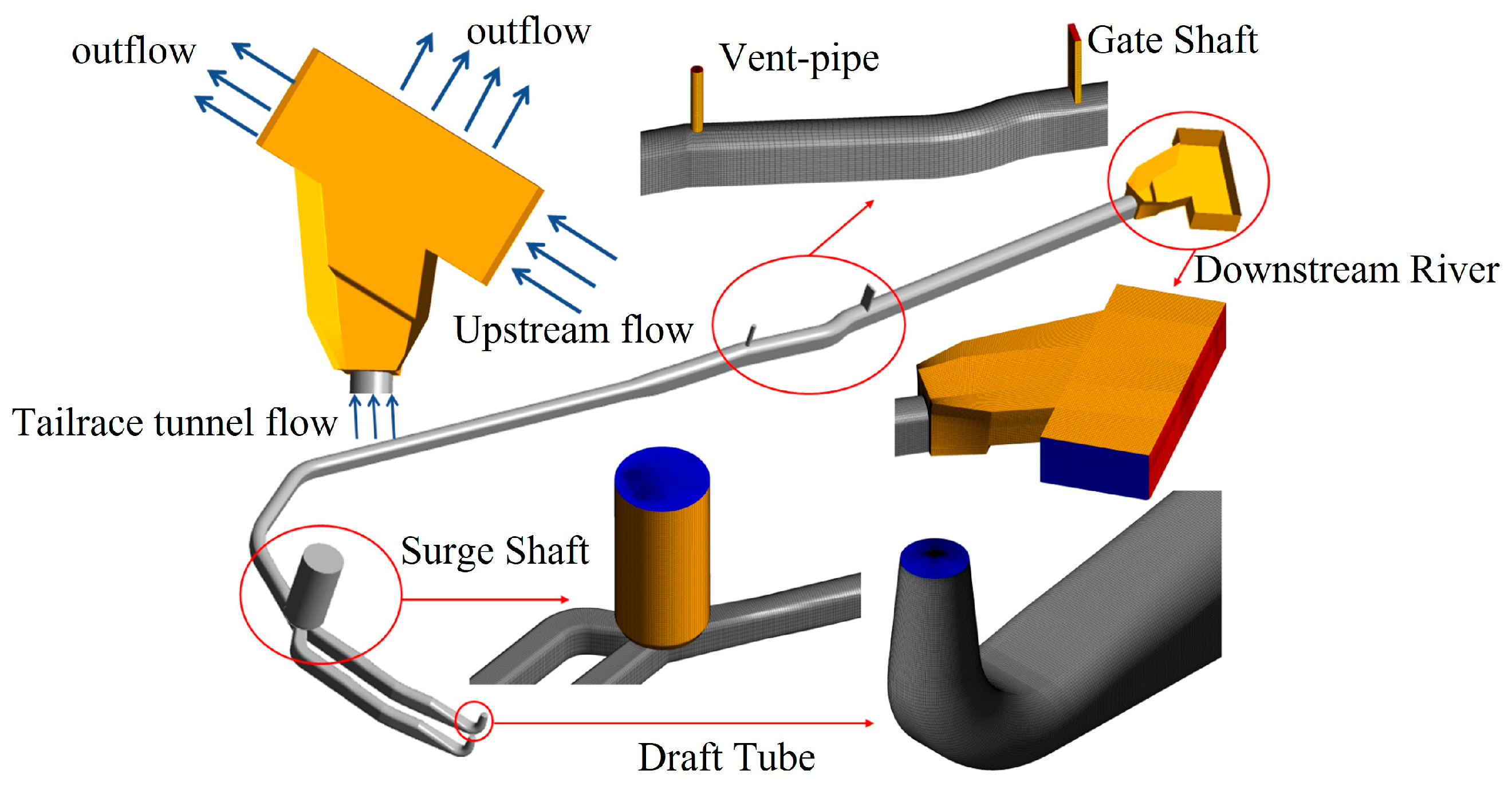
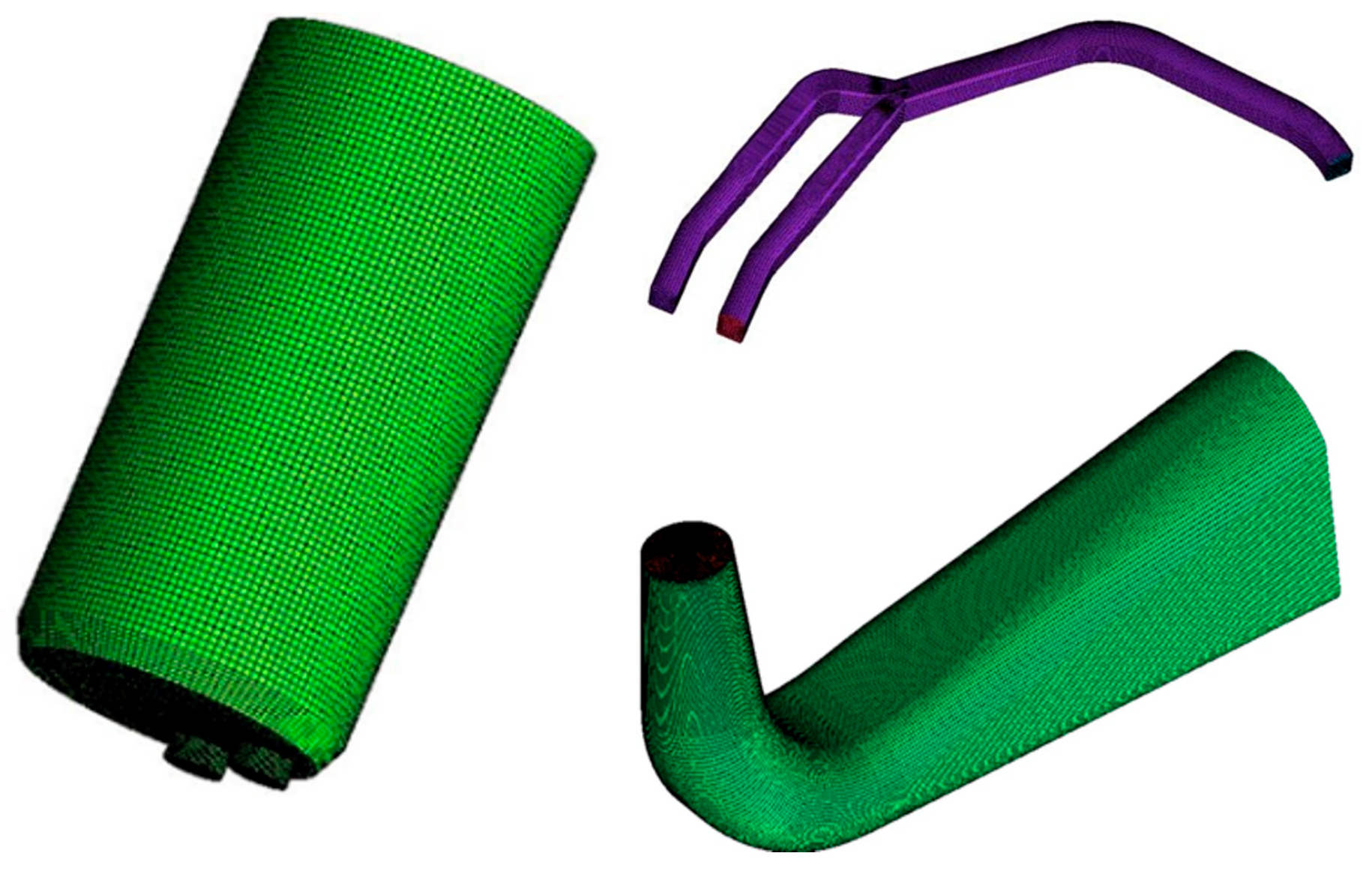
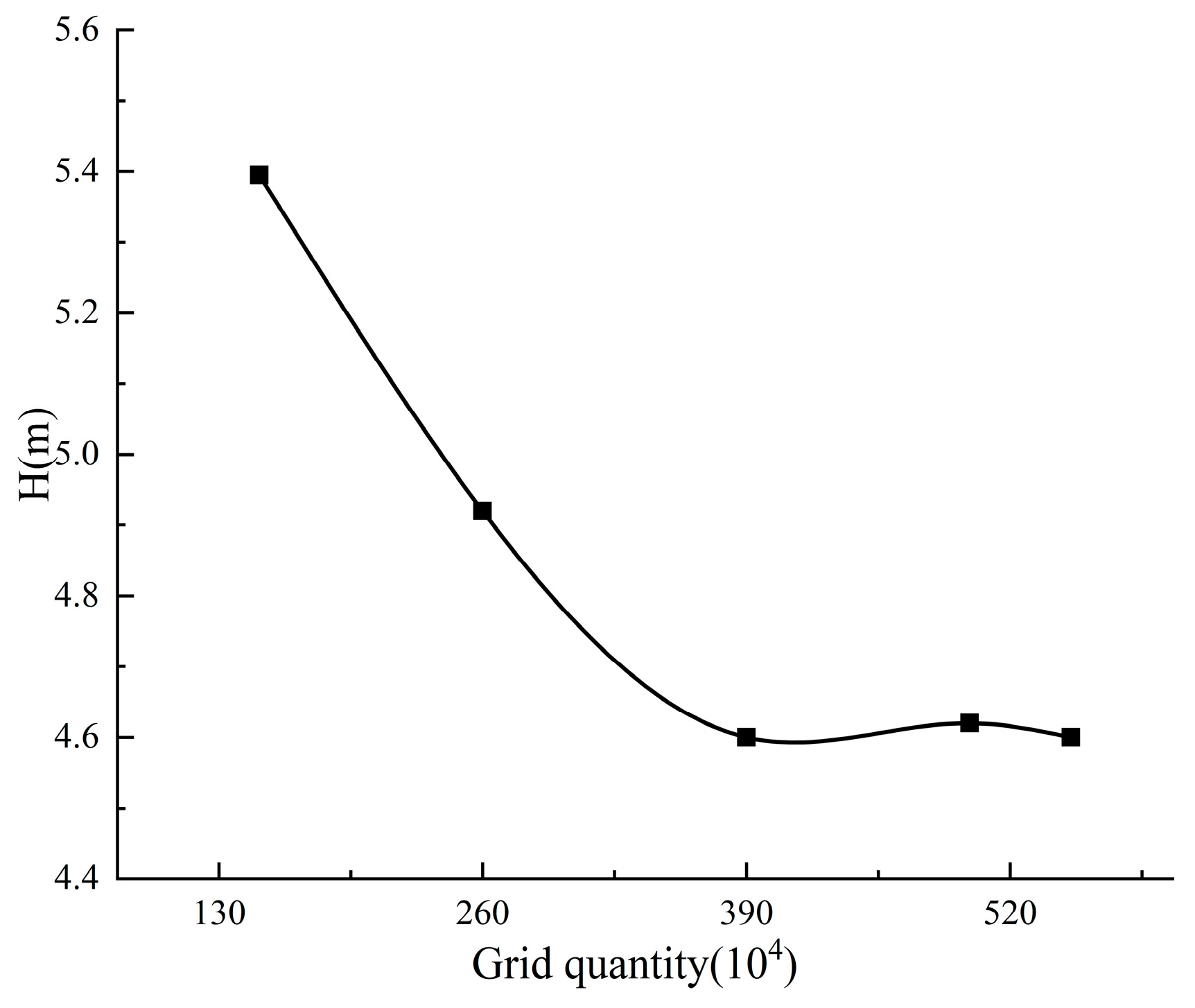
In this study, the prototype of the tailrace tunnel system for a large hydropower station unit is numerically simulated. Given the considerable length of the station’s tailrace tunnel and the identification of the flat slope section near the outlet as the region experiencing significant pressure fluctuations, the computational domain is selected to extend from the draft tube inlet to the tailrace tunnel outlet, incorporating the surge shaft, the entire tailrace pipeline, and the downstream river. The model utilizes a fully structured grid approach. Owing to the large-scale and complex nature of the computational model, the domain is partitioned into several interconnected blocks for structured grid generation, with local grid refinement applied at critical regions. Figure 1 illustrates the overall model configuration. The detailed information of the model mesh is presented in Table 1, and the mesh configurations for key parts are shown in Figure 2. A monitoring point is established near the tailrace tunnel outlet to record pressure head variations, enabling grid independence verification through analysis of this parameter. The results of this verification are presented in Figure 3. Following a comprehensive comparative analysis, the final grid count is determined to be 3.9 million elements.

2.4. Boundary Conditions and Numerical Model Validation

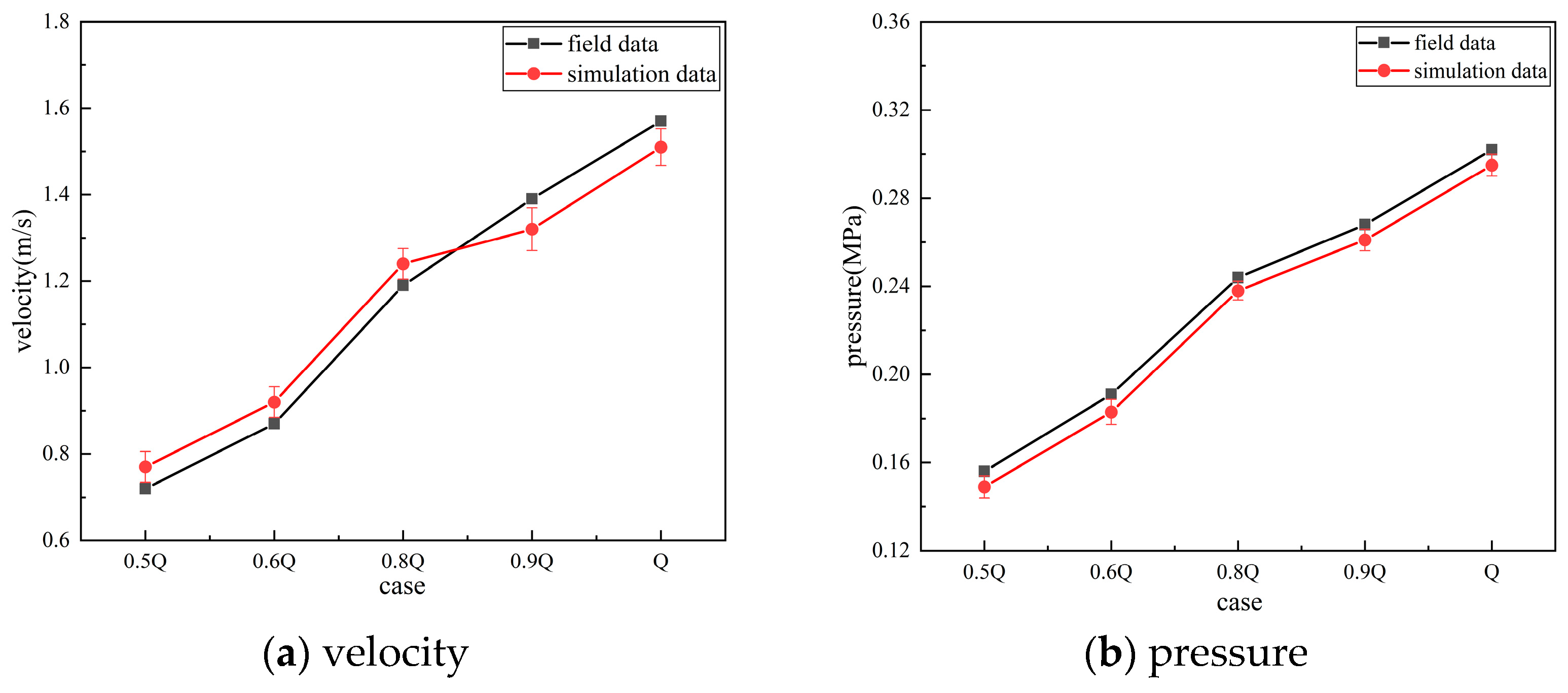
The computational domain initiates at the draft tube inlet, where a flow inlet boundary condition is applied with a rated discharge of 545.49 m3/s. Load variations are represented by corresponding adjustments to the inlet flow rate, with the draft tube inflow modified according to specific operational scenarios. A zero-pressure outlet boundary condition is implemented at the surge shaft outlet, while an open-channel boundary condition is applied to the outlet channel region. Data exchange between the tailrace tunnel and the river channel is facilitated through interface connections. The computation employs a time step of 0.04 s, with simultaneous activation of compressible models for both water and air. To validate the computational accuracy of the numerical model, ultrasonic flow velocity and pressure monitoring were conducted at the outlet section of the tailrace tunnel. Variable load conditions were simulated by adjusting the flow rate at the draft tube inlet. Five free-surface steady-state operating conditions were selected for validation. The comparison between the numerical results and field-measured data is presented in Figure 4a,b. For all five conditions, the simulated flow velocities at the tailrace tunnel outlet closely match the measured values, with discrepancies within 1%, and the error between the measured and simulated pressures is less than 1%. Therefore, the selected numerical model satisfies the accuracy requirements of this study.

3. Results

3.1. Calculation Condition

According to the possible flow patterns in the tailrace tunnel, six working conditions are selected and listed in Table 2. The load of two units of the same hydraulic unit increases or decreases, and the initial flow is the rated flow Q, while the other unit is in the shutdown state, and the flow is 0.

3.2. Flow Pattern Analysis of Tailrace Tunnel

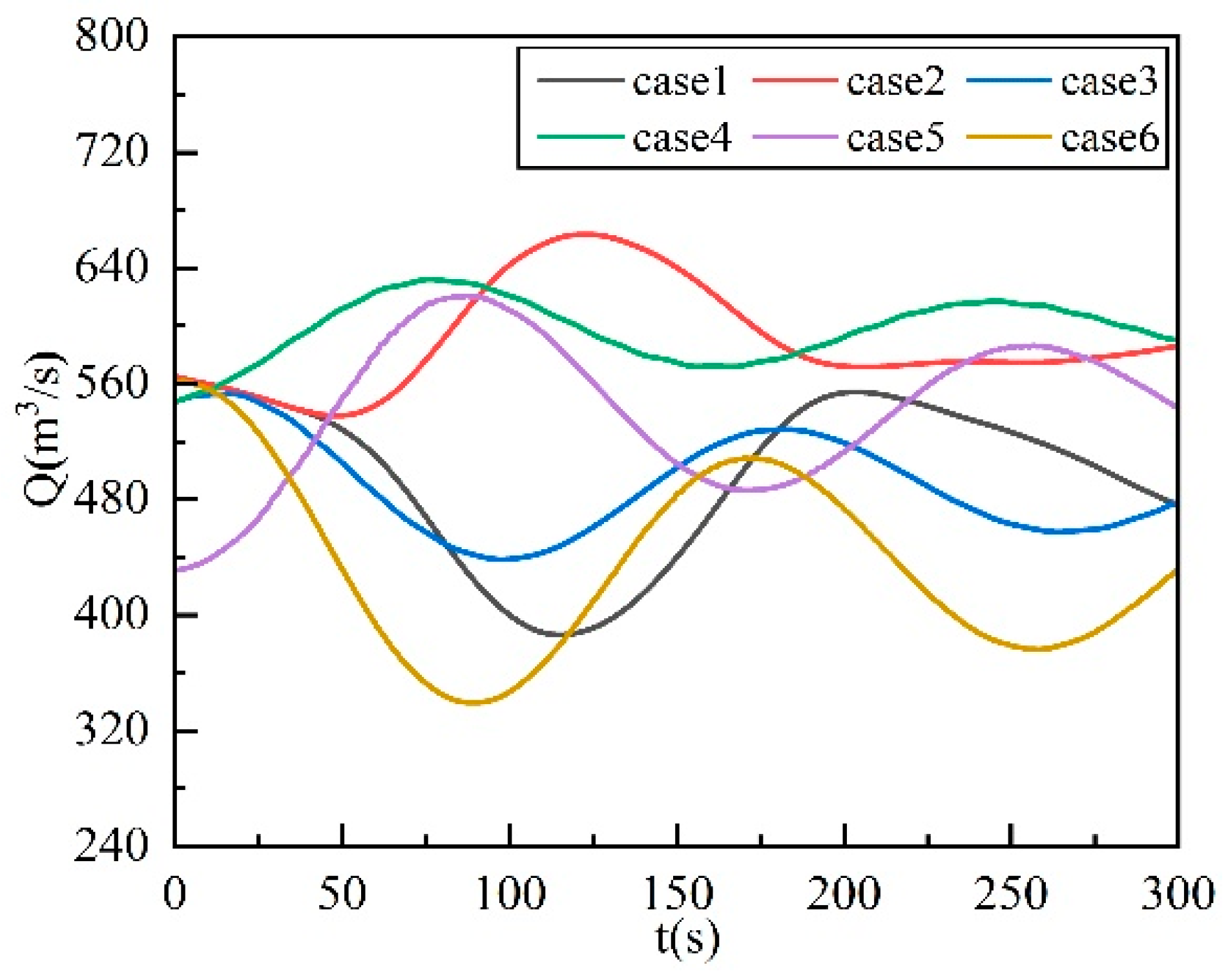
To investigate the influence of unit load variations on the water level and flow regime at the tailrace outlet while excluding flood discharge effects, the tailrace tunnel outlet section was selected for monitoring. The flow rate and air volume fraction variations over time were recorded. Under six distinct operational conditions, the working unit completed both load increase and decrease processes within 0–25 s, while the other unit maintained zero flow throughout. The flow variations at the tailrace tunnel outlet section under these conditions are presented in Figure 5.
Under the six operational conditions, the flow at the outlet section of the tailrace tunnel exhibits attenuating fluctuations and gradually stabilizes, with no reverse flow observed throughout the transition process. As the unit discharge decreases, the flow at the tailrace tunnel outlet correspondingly diminishes, accompanied by a slight reduction in the outlet water level. Conversely, with increased unit discharge, the outlet flow rises progressively, and the water level becomes elevated compared to its initial state. Load reduction induces more violent flow fluctuations in the tailrace tunnel compared to load increase, characterized by larger amplitude variations, potentially attributable to the asymmetric nature of the water hammer effect. During free-surface-pressurized flow conditions, the fluctuation amplitude ranges from approximately 15% to 36%, significantly more pronounced than observed in either open-channel flow or full flow. Under condition 2, following unit load increase, the flow at the tailrace tunnel outlet requires approximately 200 s to stabilize near a specific value, with a subsequent slight increase.
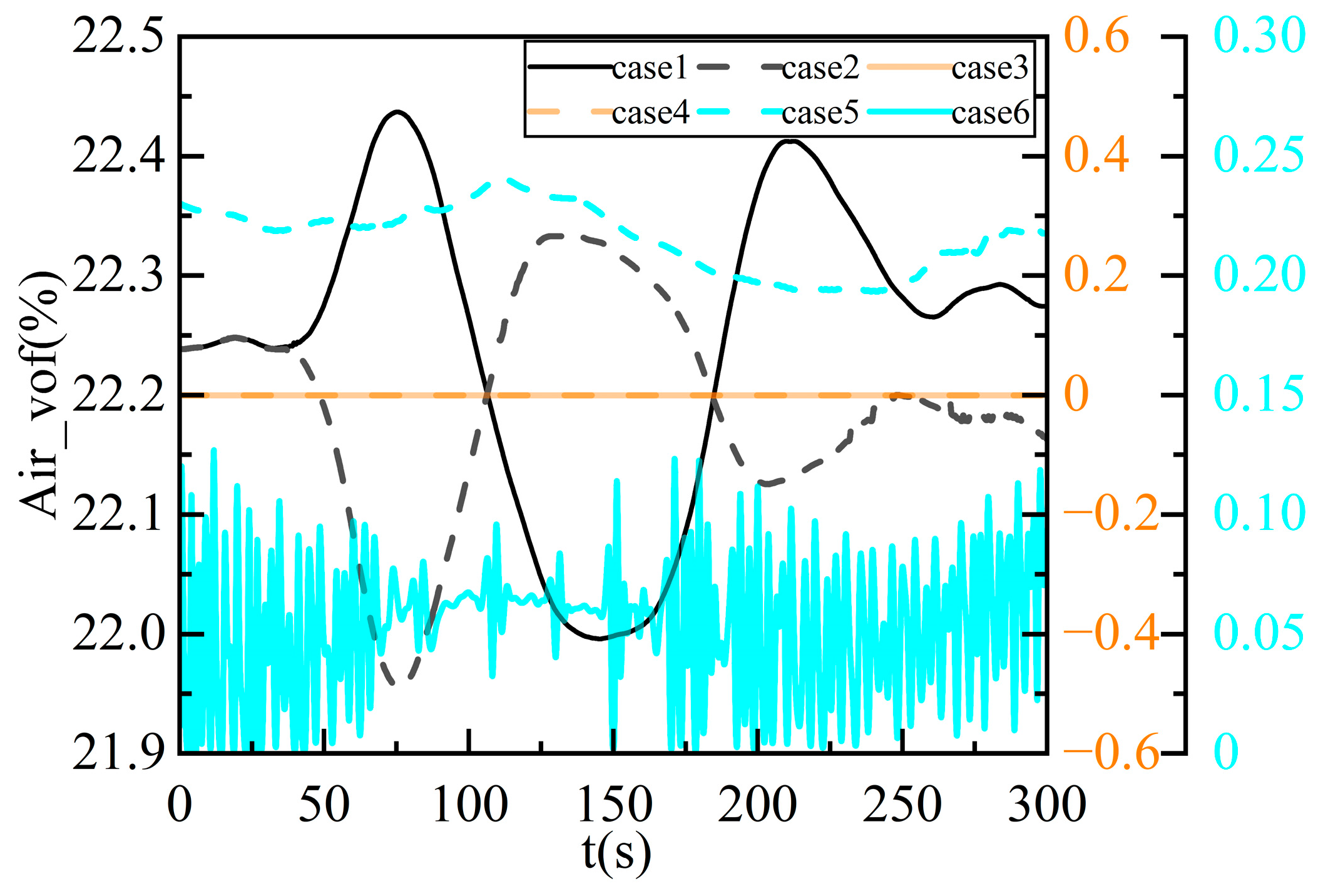
With variations in unit discharge, the flow at the tailrace tunnel outlet demonstrates fluctuating behavior to varying degrees under all six operational conditions. Conditions 1 and 2 consistently maintain open-channel flow, while Conditions 3 and 4 remain in full flow throughout. Conditions 5 and 6 exhibit flow regime transitions within the tailrace tunnel, characterized by free-surface-pressurized flow alternations. This conclusion is further corroborated by the air volume fraction variation curves at the tailrace tunnel outlet section under different conditions, as shown in Figure 6. The air volume fraction fluctuates within approximately 22.0–22.45% for Conditions 1 and 2, remains consistently at 0 for Conditions 3 and 4, and varies between 0 and 0.25% for Conditions 5 and 6.
Under Conditions 1 and 2, the air volume fraction at the tailrace tunnel outlet section exhibits varying degrees of fluctuation. It can be observed that irregular oscillations occur due to the combined effects of unit discharge variations and downstream surge influences. Although these fluctuations are vigorous, the air volume proportion remains consistently above 21.9%. Under Condition 5, following a brief increase, the air volume fraction at the tailrace tunnel outlet rapidly decreases to 0.19%, then increases again, though remaining substantially reduced compared to initial values. This indicates a transition in the tailrace tunnel’s flow regime from open-channel flow to full flow. In Condition 6, the air volume fraction demonstrates violent fluctuations at the tunnel outlet, clearly revealing significant free-surface-pressurized flow alternations. The air volume fraction periodically decreases to zero, with maximum values reaching 0.13%. This phenomenon may be attributed to the continuous gas inflow into the tunnel during the transition from full to open-channel flow during load reduction. The pressure reduction wave generated by load decrease interacts with the pressure boost wave from downstream, ultimately forming surge waves.
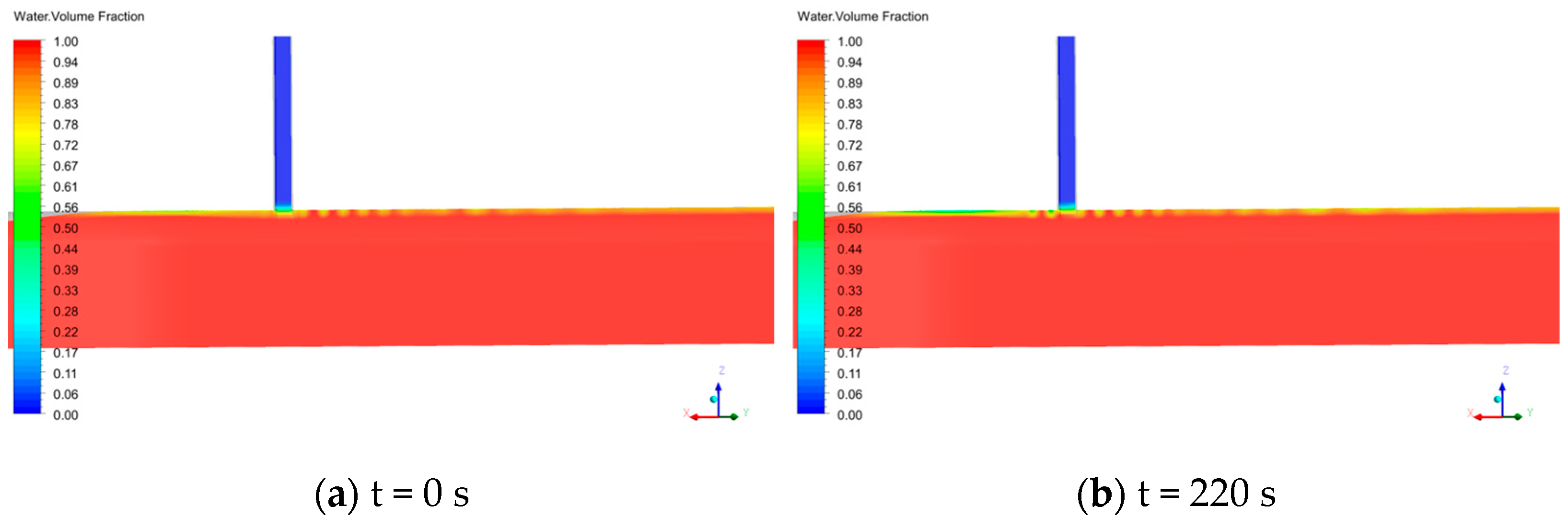
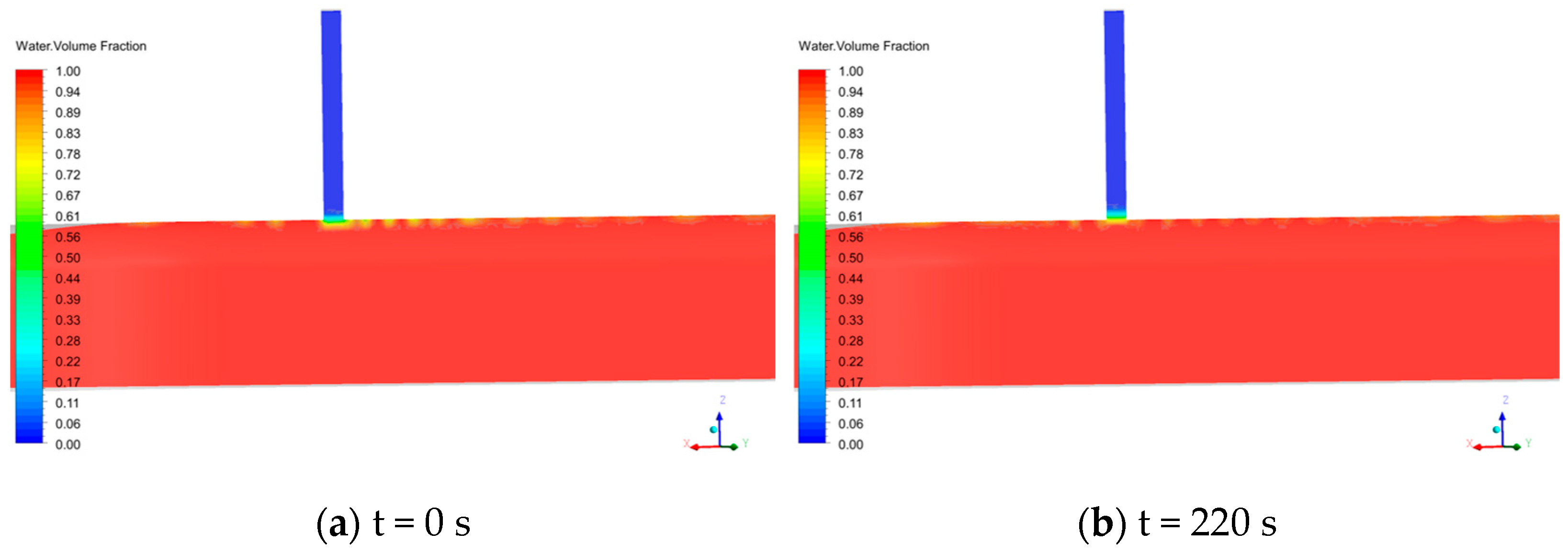
Under Conditions 5 and 6, the water vapor phase nephograms at the longitudinal section center of the free-surface-pressurized flow section in the tailrace tunnel are presented in Figure 7 and Figure 8. In Condition 5, with increasing unit load, free-surface-pressurized flow alternation occurs within the tailrace tunnel. Air pockets emerge near the top of the tunnel adjacent to the gate shaft, primarily resulting from water surface surge induced by unit load variations. Due to the elevated tailwater level, the surge impacts the tunnel crown, forming enclosed air pockets. At t = 220 s, the water level upstream of the gate shaft decreases significantly, while air pockets persist downstream of the gate shaft, though these pockets exhibit temporal generation and dissipation. Since the gate shaft maintains atmospheric connection, the downstream air pockets do not propagate toward the tailrace tunnel outlet but rather collapse near the gate shaft. In Condition 6, during unit load reduction, free-surface-pressurized flow alternation occurs downstream of the gate shaft. Air pockets form along the tunnel crown and gradually increase in number. By t=300 s, the tunnel returns to full pressurized flow, and the air pockets completely dissipate. The flow regime transitions in the free-surface-pressurized flow section affect the tailrace tunnel temporarily. However, owing to the extended distance and the mitigating effect of the surge shaft on free-surface-pressurized flow fluctuations, these flow regime changes do not impact unit operation. The simulation results regarding flow regime transitions are consistent with the findings of Guo et al. [22], who observed similar intermittent air pockets during mixed flow in tailrace tunnels. This study confirms that these air pockets are primarily induced by water surface surges interacting with the tunnel crown.

3.3. Analysis of Pressure Pulsation in Tailrace Tunnel

3.3.1. Monitoring Point Distribution

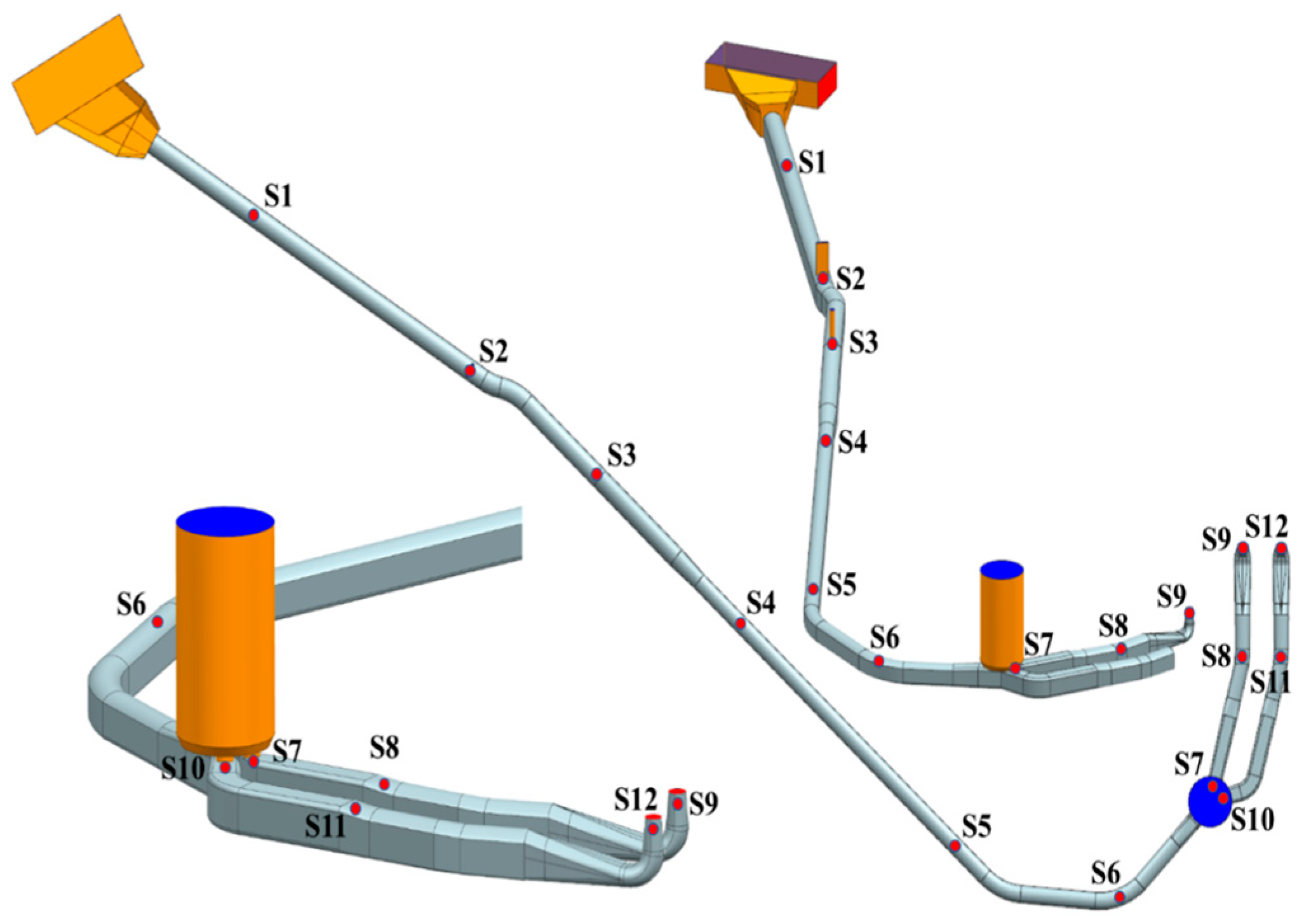
In this computational model, twelve monitoring points are strategically positioned along the system, as illustrated in Figure 9. Monitoring point S1 is positioned adjacent to the tailrace tunnel outlet, while subsequent points (S2–S12) are arranged progressively upstream toward the surge shaft. Points S9 and S12 correspond to measurement locations at the runner outlets of the operational and shutdown units, respectively. Points S7 and S10 are situated directly beneath the impedance orifices of the two surge shafts.

3.3.2. Result Analysis

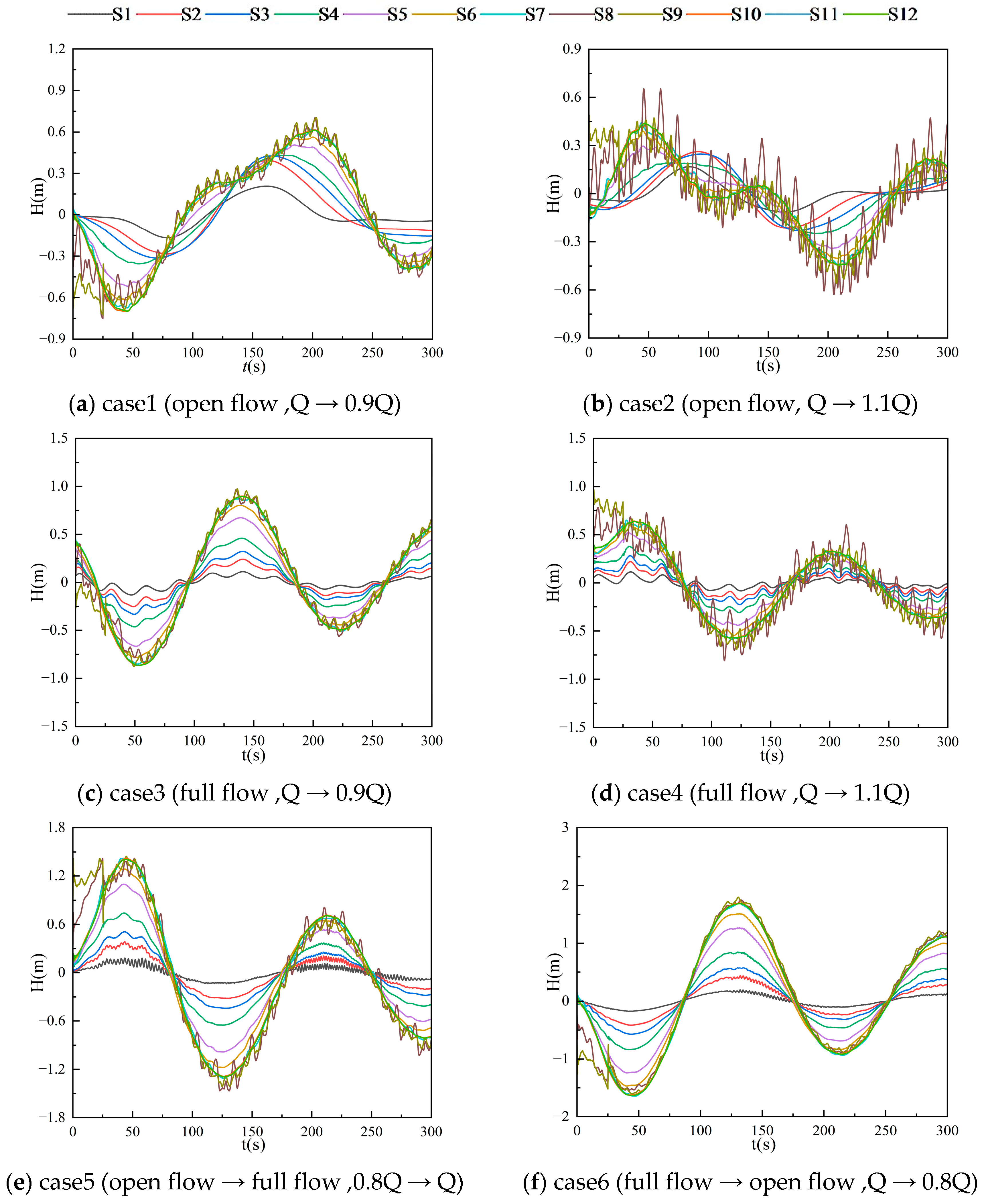
The computational conditions remain the aforementioned six scenarios. Time-domain diagrams of pressure fluctuations, zeroed at 12 measurement points within 300 s after achieving computational stability, are presented in Figure 10.
Pressure fluctuations at all 12 measurement points exhibit periodic variations across various operational conditions. The pressure fluctuation amplitude progressively decreases from points S1 to S7 along the path from the surge shaft toward the tailrace tunnel outlet. Greater variation amplitudes occur at locations farther from the outlet, while vibration periods remain similar—primarily induced by unit load variations. Pressure fluctuations at S10–S12 essentially coincide with those at S7, indicating that pressure variations in shutdown units originate from working unit load changes propagating through the dual-impedance-hole surge shaft. S8 and S9 demonstrate significant pressure fluctuations with discernible patterns. While no clear pattern emerges during 0–25 s, post-25 s trends generally align with S7, albeit with more frequent oscillations, primarily influenced by unit load changes. During 0–25 s, Conditions 1, 3, and 6 show decreasing pressure fluctuation amplitudes at S8 and S9 with reduced discharge, whereas the other three conditions exhibit minimal amplitude changes with discharge increases, maintaining higher amplitudes than other measurement points. Load increase conditions produce more frequent pressure fluctuations at S8 and S9 compared to load reduction scenarios, attributable to coupled effects of water hammer wave propagation characteristics, surge chamber frequency–domain filtering, and turbulent multi-scale effects. Given identical unit load variations, maximum pressure fluctuation amplitude reaches approximately 0.6 m during free-surface flow conditions, compared to 0.9 m during pressurized flow, indicating more intense fluctuations in pressurized conditions. Overall, load reduction generates more severe pressure fluctuations across all 12 measurement points than load increase, primarily due to (1) high-amplitude characteristics of positive water hammer waves (propagating with initial flow direction); (2) gas–liquid instability during full flow conditions; and (3) energy accumulation effects of low-frequency standing waves. Conversely, load increase conditions exhibit relatively milder fluctuations owing to rapid attenuation of negative water hammer waves (propagating against initial flow direction), stable flow conditions, and energy dispersion characteristics.
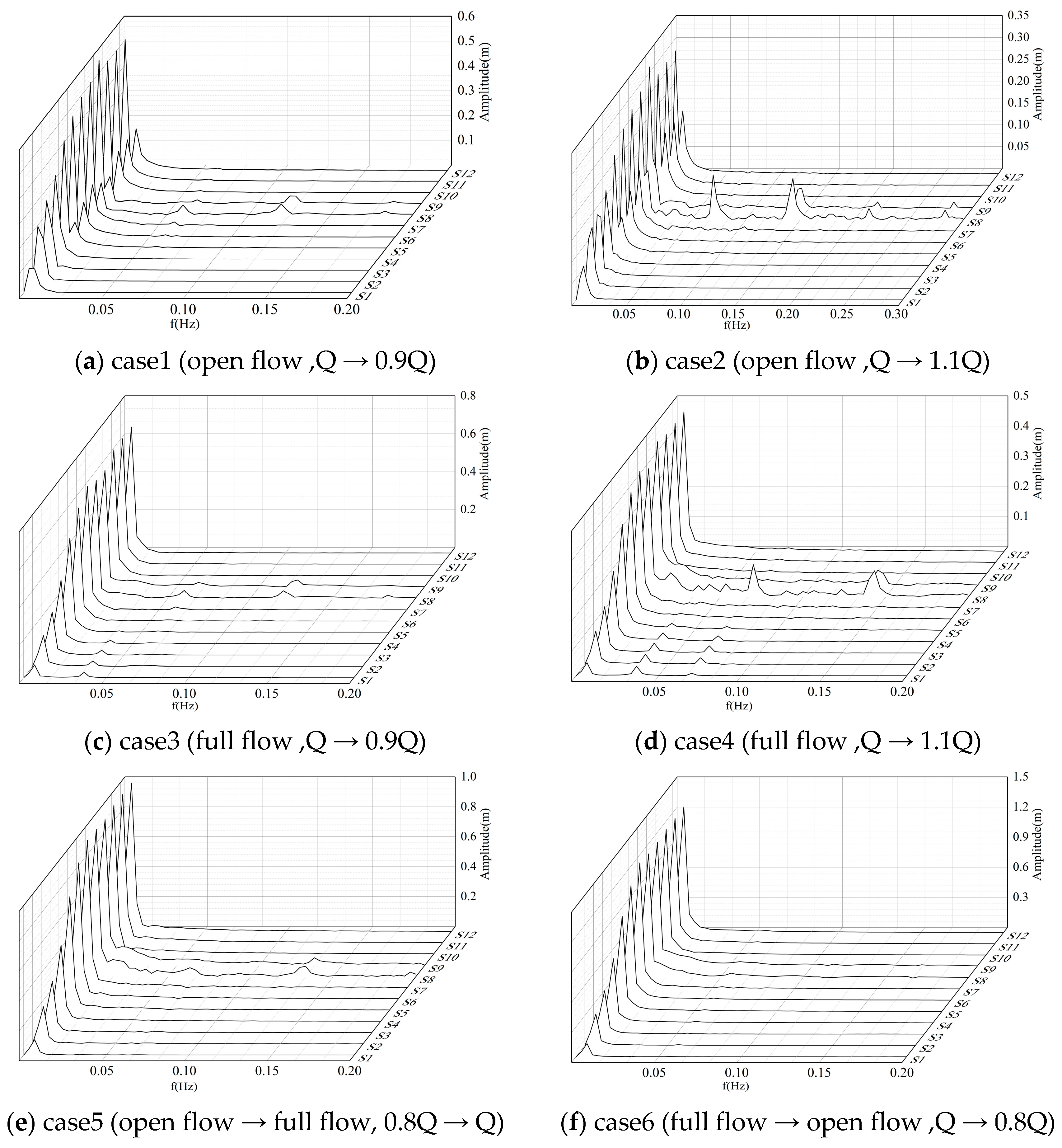
Figure 11 presents the frequency domain characteristics of pressure fluctuations under six operational conditions. Comparative analysis of the primary oscillation frequencies reveals identical vibration frequencies at points S10-S12 and S9, with consistent vibration amplitudes across these three measurement locations. The vibration amplitude gradually decreases at points progressively closer to the tailrace outlet behind the surge shaft, indicating gradual attenuation of low-frequency wave energy generated by unit load variations during downstream propagation. Under Conditions 1, 2, and 4, the maximum amplitude occurs at S9 and progressively decreases during downstream transmission. The amplitude at S12 of the non-operational unit measures smaller than at S9—for instance, in Condition 1, the amplitude measures 0.58 m at S9 compared to 0.53 m at S12, representing approximately 90% of S9’s energy transmission. Comparative analysis across these three conditions indicates that 87–97% of this frequency wave’s energy transmits to the other unit within the same tailrace system. Conversely, the other three conditions demonstrate energy amplification during transmission to the surge tank and adjacent unit, evidenced by greater vibration amplitudes at S7 and S12 compared to S9. For example, Condition 3 shows 0.62 m amplitude at S9, while S7 and S12 register 0.65 m and 0.66 m, respectively—representing a 6.5% energy increase at S12 relative to S9. Across these conditions, energy transmission to the other unit increases by 1.5–6.5%, potentially resulting from superposition effects of unit load variations, surge tank water level fluctuations, and downstream surge interactions. Notably, high-frequency wave components appear exclusively at S8 and S9 measurement points, while other points exhibit only low-frequency components. This phenomenon suggests the filtering effect of the dual-impedance-hole surge shaft, which absorbs high-frequency components while permitting the successful transmission of low-frequency waves to downstream sections and adjacent units. Overall, free-surface flow conditions generate more high-frequency wave components from unit load variations compared to pressurized and free-surface-pressurized flow conditions, particularly evident in higher-order vibration frequencies and amplitudes at S8 and S9. Pressurized flow conditions produce more high-frequency components than free-surface-pressurized flow, demonstrating distinct spectral characteristics under different flow regimes.
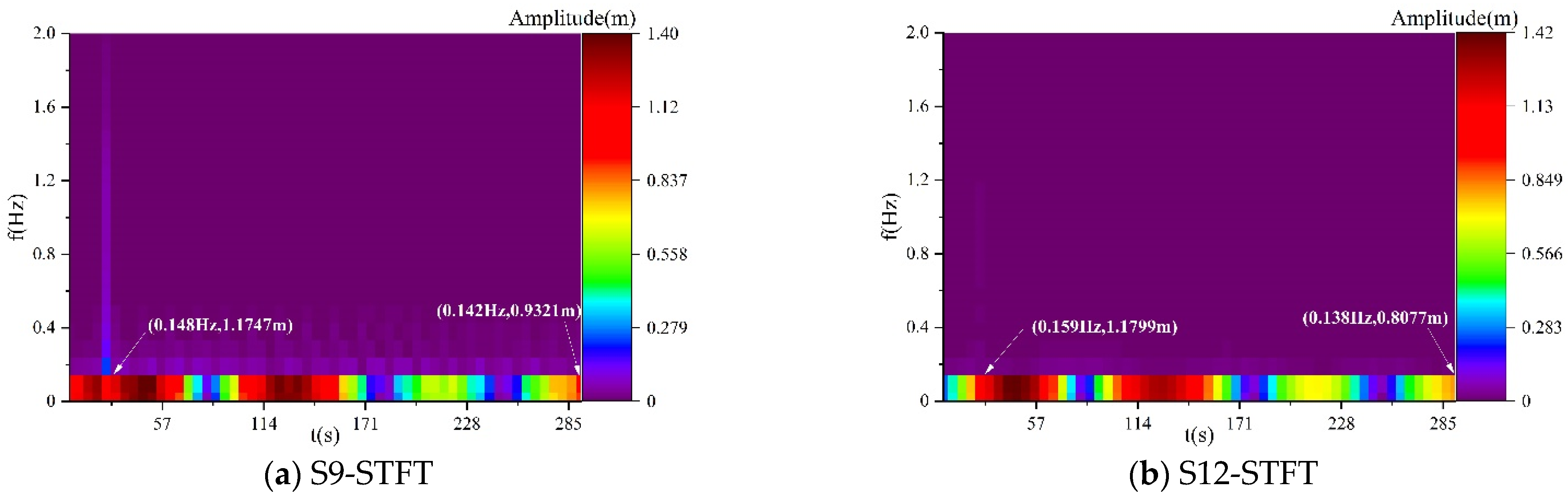
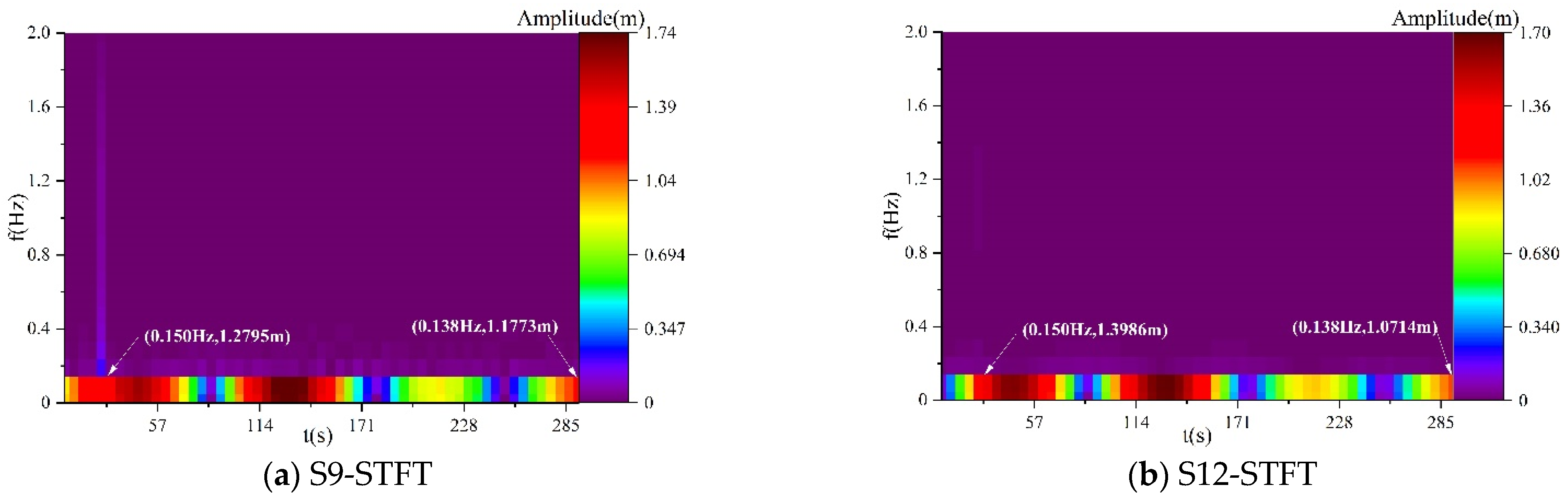
Pressure pulsation data at monitoring points S9 and S12 under Condition 5 (load increase) and Condition 6 (load reduction) were selected for Short-Time Fourier Transform (STFT) processing to obtain three-dimensional spectra illustrating frequency and amplitude variations over time, as shown in Figure 12 and Figure 13. Under load increase conditions, pressure fluctuations induced by unit load variation propagated to S12 within approximately 2.5 s. Owing to the filtering effect of the surge shaft, high-frequency waves present at S9 did not propagate to S12. The amplitude at S12 increased significantly during the 0-25 s unit load variation phase. After 25 s, when the unit load stabilized, both monitoring points exhibited ultra-low frequency vibrations. At the 30 s mark, both points demonstrated identical frequency components, with amplitudes measuring 1.1747 m at S9 and 1.1799 m at S12. The larger amplitude at S12 indicates enhanced energy transmission of low-frequency waves to this location, potentially influenced by the combined effects of surge shaft water level fluctuations and downstream surge interactions. As flow conditions in the tailrace tunnel gradually stabilized, the amplitude at S9 decreased to 0.9321 m, while at S12 it reduced to 0.8077 m. During propagation from S9 to S12, approximately 86.7% of the low-frequency wave energy was maintained. Pressure fluctuation propagation under load reduction conditions demonstrated similar characteristics to load increase conditions, with about 91% of low-frequency wave energy transferring from S9 to S12. Consequently, frequency waves generated by single-unit load variations exert significant ultra-low frequency impacts on other units within the same tailrace system, while high-frequency components are effectively filtered by the surge tank and thus do not affect other units.
Furthermore, the attenuation characteristic of pressure pulsations along the tunnel aligns with the energy conversion mechanisms described by Wang et al. [26] for ultra-long headrace systems. However, unlike previous studies that focused on single-unit stability, our results uniquely reveal the ultra-low-frequency hydraulic interference between two units sharing the same tailrace system, highlighting the specific filtering effect of the surge shaft.

4. Conclusions

This study investigates the hydraulic characteristics of a long tailrace tunnel system with one tunnel supplying two units under six typical operational conditions, encompassing pressurized flow, free-surface flow, and free-surface-pressurized flow during both load increase and decrease scenarios. The main conclusions are as follows:
(1)
The flow rate at the tailrace tunnel outlet fluctuates in response to unit load variations, with more pronounced fluctuations observed during load reduction. When the tailrace tunnel experiences free-surface-pressurized flow conditions, the flow fluctuation amplitude demonstrates significant variations, reaching up to 36%. Unit load changes induce flow regime transitions in the tailrace tunnel, accompanied by noticeable free-surface-pressurized flow phenomena.
(2)
Pressure fluctuations generated by unit load variations exhibit periodic characteristics within the tailrace tunnel, with energy gradually attenuating during downstream propagation. The variation range of pressure fluctuations increases with distance from the tailrace outlet. These fluctuations are primarily influenced by unit load changes and downstream water level variations, with unit load changes being the dominant factor.
(3)
Under free-surface flow conditions, monitoring points display substantially higher-order vibration frequencies and amplitudes, with prominent high-frequency wave components. Conversely, low-frequency waves appear more intense during pressurized flow conditions. The frequency waves generated by load variations in a single unit exert significant ultra-low frequency impacts on other units within the same tailrace system, while high-frequency components are effectively filtered out by the surge shaft’s damping effect.
This study provides a theoretical basis for optimizing the operation logic of turbine units in hydropower stations with long tailrace systems, particularly for avoiding resonance frequencies during load adjustments. Furthermore, simulation results indicate that hydropower stations cannot rely solely on surge shafts to attenuate or eliminate the impact of downstream pressure pulsations on turbine units. It is recommended that power stations, during load adjustment operations, refrain from operating under conditions where the downstream water level coincides with or closely approaches the water level at the tailrace tunnel outlet. However, it should be noted that this simulation assumes rigid boundaries and does not account for fluid–structure interaction, which may influence the damping characteristics of pressure pulsations. Additionally, while the current simulation considers only a single unit in operation, future investigations should prioritize examining the hydraulic interactions arising from the concurrent operation of both units.

Author Contributions

Y.Z.: Methodology, Validation, Software, Writing—Original Draft; X.H.: Conceptualization, Data Curation, Formal Analysis, Review and Editing, Supervision; D.Z.: Conceptualization, Formal Analysis, Writing—Review and Editing, Funding Acquisition, Validation; X.L.: Formal Analysis, Investigation, Project administration, Resources, Writing—Original Draft; A.Y.: Investigation, Resources, Software, Visualization, Writing—Original Draft; L.Z.: Data curation, Visualization, Validation, Supervision. All authors have read and agreed to the published version of the manuscript.

Funding

This research was funded by the Ningnan Baihetan Power Plant Project of China Three Gorges Corporation (No. Z532302021).

Data Availability Statement

The original contributions presented in this study are included in the article. Further inquiries can be directed to the corresponding author.

Acknowledgments

The study was supported by Hohai University, China.

Conflicts of Interest

Authors Yuguo Zhou, Xin He and Xiaoliang Li were employed by the China Yangtze Power Co., Ltd. The remaining authors declare that the research was conducted in the absence of any commercial or financial relationships that could be construed as a potential conflict of interest.

References

  1. Zhang, W.; Cai, F.; Zhou, J.; Hua, Y. Experimental Investigation on Air-Water Interaction in a Hydropower Station Combining a Diversion Tunnel with a Tailrace Tunnel. Water 2017, 9, 274. [Google Scholar] [CrossRef]
  2. Li, L.; Yang, J.; Liu, M. Study on the Disruption of Water Flow in the System of Tailrace Tunnel Combined with Diversion Tunnel. In Proceedings of the 27th IAHR Symposium on Hydraulic Machinery and Systems (IAHR 2014), Montreal, QC, Canada, 22–26 September 2014; Desy, N., Deschenes, C., Guibault, F., Page, M., Turgeon, M., Giroux, A.M., Eds.; IoP Publishing Ltd: Montreal, QC, Canada, 2014; Volume 22, pp. 1–8. [Google Scholar]
  3. Guo, W.; Zhu, D. A Review of the Transient Process and Control for a Hydropower Station with a Super Long Headrace Tunnel. Energies 2018, 11, 2994. [Google Scholar] [CrossRef]
  4. Liu, Y.; Yu, X.; Guo, X.; Zhao, W.; Chen, S. Operational Stability of Hydropower Plant with Upstream and Downstream Surge Chambers during Small Load Disturbance. Energies 2023, 16, 4517. [Google Scholar] [CrossRef]
  5. Guo, W. A Review of the Hydraulic Transient and Dynamic Behavior of Hydropower Plants with Sloping Ceiling Tailrace Tunnels. Energies 2019, 12, 3220. [Google Scholar] [CrossRef]
  6. Jiang, D.; Yang, F.; Cai, Y.; Xu, G.; Tang, F.; Jin, Y. Cross Influence of Rotational Speed and Flow Rate on Pressure Pulsation and Hydraulic Noise of an Axial-Flow Pump. Phys. Fluids 2023, 35, 95144. [Google Scholar] [CrossRef]
  7. Zhang, H.; Pang, W.; Chen, D.; Tian, Y.; Patelli, E.; Li, C.; Zhou, J. Transient Stability of a Hydro-Turbine Governing System with Different Tailrace Tunnels. J. Hydraul. Res. 2020, 58, 60–69. [Google Scholar] [CrossRef]
  8. Cheng, Y.; Li, J.; Yang, J. Free Surface-Pressurized Flow in Ceiling-Sloping Tailrace Tunnel of Hydropower Plant: Simulation by VOF Model. J. Hydraul. Res. 2007, 45, 88–99. [Google Scholar] [CrossRef]
  9. Bourdarias, C.; Gerbi, S.; Gisclon, M. A Kinetic Formulation for a Model Coupling Free Surface and Pressurised Flows in Closed Pipes. J. Comput. Appl. Math. 2008, 218, 522–531. [Google Scholar] [CrossRef]
  10. Cea, L.; López-Núñez, A. Extension of the Two-component Pressure Approach for Modeling Mixed Free-surface-pressurized Flows with the Two-dimensional Shallow Water Equations. Int. J. Numer. Methods Fluids 2021, 93, 628–652. [Google Scholar] [CrossRef]
  11. Huang, Y.; Guan, G.; Wang, K.; Mao, Z.; Yang, Z. Hybridizing FDM and FVM Scheme of High-Precision Interface Fast Capture for Mixed Free-Surface-Pressurized Flow in Large Cascade Water Delivery System. J. Hydraul. Res. 2023, 61, 502–516. [Google Scholar] [CrossRef]
  12. Hu, D.; Li, S.; Yao, S.; Jin, Z. A Simple and Unified Linear Solver for Free-Surface and Pressurized Mixed Flows in Hydraulic Systems. Water 2019, 11, 1979. [Google Scholar] [CrossRef]
  13. Zhou, J.; Li, Y. Modeling of the Free-Surface-Pressurized Flow of a Hydropower System with a Flat Ceiling Tail Tunnel. Water 2020, 12, 699. [Google Scholar] [CrossRef]
  14. Calomino, F.; Alfonsi, G.; Gaudio, R.; D’Ippolito, A.; Lauria, A.; Tafarojnoruz, A.; Artese, S. Experimental and Numerical Study of Free-Surface Flows in a Corrugated Pipe. Water 2018, 10, 638. [Google Scholar] [CrossRef]
  15. Guo, W.; Yang, J. Combined Effect of Upstream Surge Chamber and Sloping Ceiling Tailrace Tunnel on Dynamic Performance of Turbine Regulating System of Hydroelectric Power Plant. Chaos Solitons Fractals 2017, 99, 243–255. [Google Scholar] [CrossRef]
  16. Yang, X.; Lian, J.; Yu, X.; He, W. Critical Stable Cross-Sectional Area of Surge Tank in Hydropower Plant with Multiple Units Sharing Common Hydraulic System. Int. J. Electr. Power Energy Syst. 2021, 131, 107067. [Google Scholar] [CrossRef]
  17. Guo, W.; Yang, J. Dynamic Performance Analysis of Hydro-Turbine Governing System Considering Combined Effect of Downstream Surge Tank and Sloping Ceiling Tailrace Tunnel. Renew. Energy 2018, 129, 638–651. [Google Scholar] [CrossRef]
  18. Wolski, A.; Junqueira, S.L.M.; Negrão, C.O.R. A Steady-State Approach for Evaluation of Surge and Swab Pressures in Flows with Free Surface Boundary Conditions. J. Pet. Sci. Eng. 2014, 122, 208–215. [Google Scholar] [CrossRef]
  19. Bashiri-Atrabi, H.; Hosoda, T.; Shirai, H. Propagation of an Air-Water Interface from Pressurized to Free-Surface Flow in a Circular Pipe. J. Hydraul. Eng. 2016, 142, 4016055. [Google Scholar] [CrossRef]
  20. Zhou, D.; Chen, Y.; Chen, H.; Chen, S.; Yang, C. Study of Hydraulic Disturbances from Single-Unit Load Rejection in a Pumped-Storage Hydropower Station with a Shared Water Delivery System. IEEE Access 2019, 7, 153382–153390. [Google Scholar] [CrossRef]
  21. Guo, W.; Wu, F. Stability Behavior of Load Adjustment and Primary Frequency Control of Pumped Storage Power Plant with Upstream and Downstream Surge Tanks. J. Energy Storage 2023, 60, 106626. [Google Scholar] [CrossRef]
  22. Guo, J.; Zhou, D.; Wang, H. Study of Intermittent Jets and Free-Surface-Pressurized Flow in Large Hydropower Tailrace Tunnel. Phys. Fluids 2024, 36, 53342. [Google Scholar] [CrossRef]
  23. Wang, X.; Zhang, J.; Yu, X.; Chen, S. Transient Air-Water Flow Patterns in the Vent Tube in Hydropower Tailrace System Simulated by 1-D-3-D Coupling Method. J. Hydrodyn. 2018, 30, 715–721. [Google Scholar] [CrossRef]
  24. Guo, W.; Yang, J. Modeling and Dynamic Response Control for Primary Frequency Regulation of Hydro-Turbine Governing System with Surge Tank. Renew. Energy 2018, 121, 173–187. [Google Scholar] [CrossRef]
  25. Park, J.; Seo, J.; Lee, S.B.; Rhee, S.H. Turbulence Structure under the Free-Surface Wave around an Advancing Surface-Piercing Cylindrical Body. Phys. Fluids 2022, 34, 123311. [Google Scholar] [CrossRef]
  26. Wang, L.; Guo, W. Nonlinear Hydraulic Coupling Characteristics and Energy Conversion Mechanism of Pipeline—Surge Tank System of Hydropower Station with Super Long Headrace Tunnel. Renew. Energy 2022, 199, 1345–1360. [Google Scholar] [CrossRef]
  27. Altimemy, M.; Attiya, B.; Daskiran, C.; Liu, I.-H.; Oztekin, A. Mitigation of Flow-Induced Pressure Fluctuations in a Francis Turbine Using Water Injection. In Proceedings of the 2019 ASME/JSME/KSME Joint Fluids Engineering Conference, San Francisco, CA, USA, 28 July–1 August 2019; American Society of Mechanical Engineers: San Francisco, CA, USA, 2019; Volume 3B. [Google Scholar]
  28. Zhou, J.; Mao, Y.; Shen, A.; Zhang, J. Modeling and Stability Investigation on the Governor-Turbine-Hydraulic System with a Ceiling-Sloping Tail Tunnel. Renew. Energy 2023, 204, 812–822. [Google Scholar] [CrossRef]
  29. Guo, J.; Woldeyesus, K.; Zhang, J.; Ju, X. Time Evolution of Water Surface Oscillations in Surge Tanks. J. Hydraul. Res. 2017, 55, 657–667. [Google Scholar] [CrossRef]
  30. Vörtler, H.L.; Smith, W.R. Computer Simulation Studies of a Square-Well Fluid in a Slit Pore. Spreading Pressure and Vapor-Liquid Phase Equilibria Using the Virtual-Parameter-Variation Method. J. Chem. Phys. 2000, 112, 5168–5174. [Google Scholar] [CrossRef]
  31. Bourdarias, C.; Gerbi, S. A Finite Volume Scheme for a Model Coupling Free Surface and Pressurised Flows in Pipes. J. Comput. Appl. Math. 2007, 209, 109–131. [Google Scholar] [CrossRef]
  32. Li, J.; McCorquodale, A. Modeling Mixed Flow in Storm Sewers. J. Hydraul. Eng. 1999, 125, 1170–1180. [Google Scholar] [CrossRef]
  33. Xue, Z.; Zhou, L.; Karney, B.; Liu, D.; Wang, P. Primitive Form Godunov-Type Scheme for Two-Phase Homogeneous Water Hammer Flows. J. Hydraul. Eng. 2020, 146, 4020018. [Google Scholar] [CrossRef]
  34. Wan, W.; Huang, W. Water Hammer Simulation of a Series Pipe System Using the MacCormack Time Marching Scheme. Acta Mech. 2018, 229, 3143–3160. [Google Scholar] [CrossRef]
  35. He, X.; Yang, J.; Yang, J.; Hu, J.; Peng, T. Experimental Study of Cavitating Vortex Rope and Water Column Separation in a Pump Turbine. Phys. Fluids 2022, 34, 44101. [Google Scholar] [CrossRef]
  36. Sun, S.; Ma, J.; Zhang, B.; Lian, Y.; Xiao, Y.; Zhong, D. Numerical Simulation of Transient Two-Phase Flow in the Filling Process of the Vertical Shaft Section of a Water Conveyance Tunnel. Processes 2025, 13, 2832. [Google Scholar] [CrossRef]
  37. Passandideh-Fard, M.; Roohi, E. Transient Simulations of Cavitating Flows Using a Modified Volume-of-Fluid (VOF) Technique. Int. J. Comput. Fluid Dyn. 2008, 22, 97–114. [Google Scholar] [CrossRef]
  38. Li, L.; Chen, Y.C.; Li, Y.L. Volume of Fluid (VOF) Method for Curved Free Surface Water Flow in Shallow Open Channel. In Proceedings of the Hydraulics of Rivers Water Works and Machinery, Theme D, Proceedings: 21st Century: The New Era for Hydraulic Research and Its Applications; Li, G., Ed.; Tsinghua University Press/Beijing Int Convent Ctr: Beijing, China, 2001; Volume II, pp. 244–250. [Google Scholar]
  39. Chen, G.-H.; Wang, G.-Y.; Huang, B.; Hu, C.-L.; Wang, Z.-Y.; Wang, J. Numerical Investigation of Dynamics of Unsteady Sheet/Cloud Cavitating Flow Using a Compressible Fluid Model. Mod. Phys. Lett. B 2015, 29, 1450269. [Google Scholar] [CrossRef]
  40. Inna, S.; Saito, H. Local Solvability for a Compressible Fluid Model of Korteweg Type on General Domains. Mathematics 2023, 11, 2368. [Google Scholar] [CrossRef]
Figure 1. The calculation model.
Water 18 00449 g001
Figure 2. Grid display of key parts.
Water 18 00449 g002
Figure 3. Mesh independence verification curve.
Water 18 00449 g003
Figure 4. Comparison of measured and simulated flow velocity and pressure at the tailrace tunnel outlet section.
Water 18 00449 g004
Figure 5. Flow rate variation at tailrace tunnel outlet section.
Water 18 00449 g005
Figure 6. Air volume fraction variation at tailrace tunnel outlet section.
Water 18 00449 g006
Figure 7. Air–water phase contour plot for Case 5.
Water 18 00449 g007
Figure 8. Air–water phase contour plot for Case 6.
Water 18 00449 g008
Figure 9. Schematic diagram of monitoring point distribution.
Water 18 00449 g009
Figure 10. Temporal diagram of pressure pulsation.
Water 18 00449 g010
Figure 11. Spectrum diagram of pressure fluctuations.
Water 18 00449 g011
Figure 12. Three-dimensional spectrum diagram of pressure pulsations for monitoring points S9 and S12 case 5.
Water 18 00449 g012
Figure 13. Three-dimensional spectrum diagram of pressure pulsations for monitoring points S9 and S12 case 6.
Water 18 00449 g013
Table 1. Grid details.
PartMesh TypeOrthogonal QualityNumber of Mesh Elements (×104)
Draft tubeHexahedron>0.5695.7
Surge shaftHexahedron>0.5890.1
Tailrace tunnelHexahedron>0.5854.3
Downstream riverHexahedron>0.5235.8
Total//390
Table 2. Calculation of working condition parameters.
CaseDownstream Water Level/mUnit Flow Change/(m3/s)Notes
1590Q → 0.9QThe tailwater level is lower than the elevation of the top of the tunnel in the full flow section, and the tailwater tunnel is open flow
2590Q → 1.1Q
3600Q → 0.9QThe tailwater level is higher than the top elevation of the fully flowing section of the tunnel, and the tailwater tunnel is at full flow
4600Q → 1.1Q
5595.80.8Q → QThe tailwater level is slightly lower than the elevation of the top of the tunnel in the fully flowing section, resulting in alternating fully flowing sections
6596Q → 0.8QThe elevation of the top of the tunnel in the clear and full flow section of the tailwater level domain is the same, resulting in alternating open and full flow
Disclaimer/Publisher’s Note: The statements, opinions and data contained in all publications are solely those of the individual author(s) and contributor(s) and not of MDPI and/or the editor(s). MDPI and/or the editor(s) disclaim responsibility for any injury to people or property resulting from any ideas, methods, instructions or products referred to in the content.