1. Introduction
A retaining wall [
1] is a structure designed to maintain a difference in the elevations of the ground surfaces on both sides of the wall. They serve an essential function by supporting soil masses [
2] and protecting riverbanks from damage [
2]. These walls play a vital role in construction projects by providing structural support and preventing soil erosion [
3,
4]. Many types of retaining walls are available for various uses, including counterfort, semi-gravity, and gravity walls. Due to its numerous advantages over other retaining wall types, gravity retaining walls are becoming increasingly common in many building projects. They are initially relatively easy to design and construct. Gravity retaining walls are a cost-effective option because they do not need expensive machinery or specialized methods. As a result, retaining walls provide a dependable and stable method of storing soil and other water. To avoid erosion, collapse, or slide, gravity retaining walls rely on gravity and the bulk of the wall material to balance the pressure exerted by the retained soil and water from riverbanks [
5]. Gravity retaining walls are frequently constructed from brick, stone, or concrete because of their solid mass, which enhances their ability to support and retain soil on one side while maintaining stability on the other.
Such soil inclines are frequently encountered during the construction of many infrastructures [
6], and designing a retaining wall system that is both safe and cost-effective is crucial [
7]. Conversely, optimization algorithms were widely used to address challenging design issues in geotechnical engineering, including retaining walls [
8]. Metaheuristic algorithms [
9] are simply the tedious trial-and-error process used in the design of retaining walls. These algorithms improve the initial trial design until they arrive at a design that fulfills the requirements, which is the optimal or semi-optimal design [
10]. In general, artificial intelligence [
11] and its bigger umbrella, computational intelligence [
12], dominate the landscape of engineering applications. Optimization [
13] is central to this landscape, particularly in optimal design. Hydraulic constructions [
14] have utilized the power of optimization [
15], specifically in retaining walls for river embankments [
16].
Although metaheuristic optimization techniques have been widely applied to the design of gravity retaining walls, existing studies predominantly focus on objective minimization under classical stability constraints, implicitly assuming that optimized geometries are physically feasible and constructible. Consequently, numerically admissible solutions reported in the literature may exhibit non-physical configurations, such as reverse-taper stems or invalid base geometries, limiting their practical relevance. Moreover, the implications of enforcing geometric feasibility on algorithm behavior, feasibility, and economic interpretation have not been systematically examined. In this context, the present study re-examines gravity retaining wall optimization from a constraint-aware engineering perspective. Explicit geometric feasibility constraints are introduced alongside conventional stability and serviceability conditions to eliminate non-physical designs and ensure constructability. To evaluate algorithmic behavior under this refined formulation, a comparative analysis is conducted using several prominent metaheuristic algorithms, including Particle Swarm Optimization (PSO) [
17], Dynamic Differential Annealed Optimization (DDAO) [
18], Flower Fertilization Optimization (FFO) [
19], Grey Wolf Optimizer (GWO) [
20], and Adaptive Exploration Artificial Bee Colony (AEABC) [
21]. The comparative results reveal that, once geometric feasibility is enforced, optimization algorithms exhibit systematic and interpretable trade-offs: exploration-intensive algorithms such as FFO tend to achieve higher material efficiency by converging closer to the stability limits, whereas more robust search strategies such as AEABC favor conservative, reliably feasible designs with consistent convergence behavior. Rather than proposing a new optimization algorithm, this study’s contribution lies in demonstrating how a constraint-aware problem formulation fundamentally reshapes feasibility, economic outcomes, and the engineering interpretation of algorithmic performance in retaining wall optimization.
2. Adaptive Exploration Artificial Bee Colony
The Adaptive Exploration Artificial Bee Colony (AEABC) algorithm [
21] is a novel enhancement of the traditional Artificial Bee Colony (ABC) optimization technique [
22]. By incorporating a distance-based exploration mechanism, AEABC addresses a fundamental limitation in the original ABC—its neglect of proximity when generating new solutions. Inspired by bees’ natural tendency to favor nearby food sources, AEABC integrates Euclidean distance into the selection of a balance between exploration and exploitation. The algorithm demonstrated remarkable robustness on large- and small-scale, unimodal, multimodal, and constrained optimization problems. Overall, AEABC sets a new standard for reliability and effectiveness in mathematical and engineering optimization. Assume x is a solution vector:
where
j = 1…m.
The foraging behavior in the ABC algorithm utilizes the following equation to express finding new solutions in the search space [
23]:
where
,
are the solution vector and random number
, and
i is the solution index in the
n-number population.
j is the index of the solution component, and
k is a random index in the population of solutions.
The probability (
) is a function of the fitness value, and it is represented as:
where
Is the fitness value and
It is the objective function’s value.
Euclidean distance was used:
where
d is the distance between any solution in the population and a
k-th candidate in the population, the distance probability
Pd was calculated as:
If the random number
then the candidate solution can be shifted as follows
where
denotes the new
i-th solution in the
j-th dimension, and
is a uniformly distributed random number, used to introduce stochasticity into the search process.
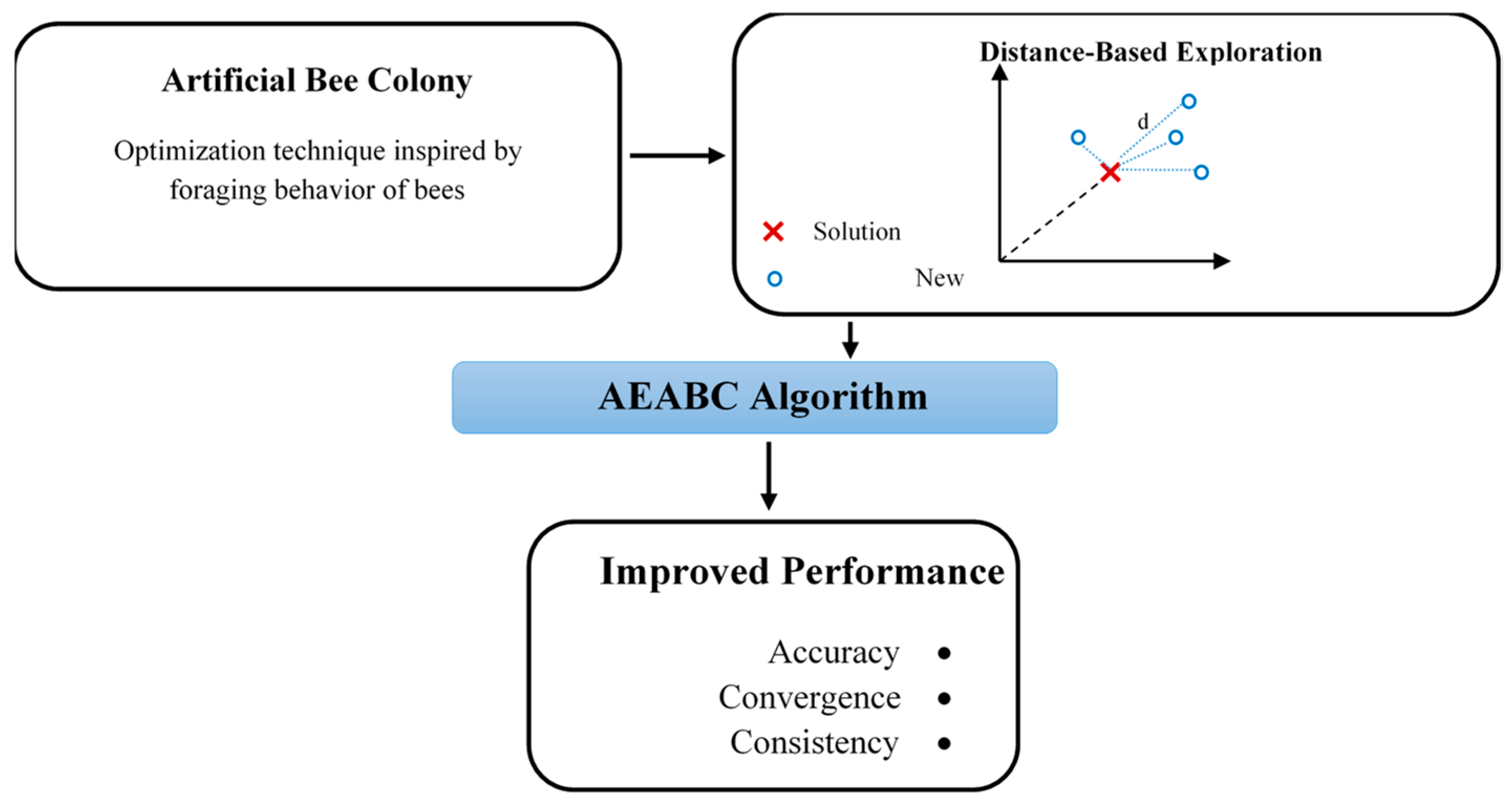
Figure 1 provides a conceptual overview of the AEABC algorithm, illustrating how introducing a distance-based exploration mechanism modifies the classical Artificial Bee Colony framework and improves convergence accuracy, stability, and consistency.
Also, the following pseudocode outlines the implementation of the AEABC and can serve as a guide for implementing it in any programming language (Algorithm 1).
| Algorithm 1 Pseudocode of the AEABC algorithm implemented within the proposed constraint-aware retaining wall optimization framework |
Input:
- Objective Function f(x)
- Population size N
- Limit for abandonment
- Max Iterations
- Dimension D
- Bounds [LB, UB]
Output:
- Best solution x_best and its fitness f_best
Initialize:
- Generate initial population Xi (i = 1 to N) randomly within [LB, UB]
- Evaluate fitness f(Xi) for each solution
- Set trial counter = 0 for all solutions
- Memorize best solution x_best
While (iteration < Max Iterations):
# Employed Bees Phase
For each Xi in population:
- Select random solution Xk ≠ Xi
- Compute distance dij = ||Xi − Xk|| (Euclidean)
- Calculate distance probability Pd using: Pd = dij/(max(dij) + ε)
- If rand() < Pd:
- Generate new solution Vi = Xi + φ * (Xi − Xk)
Else:
- Generate new solution Vi = Xi + φ * (Xk − Xi)
- Bound Vi within [LB, UB]
- If f(Vi) < f(Xi):
- Xi ← Vi
- trial_i ← 0
Else:
- trial_i += 1
# Onlooker Bees Phase
- Calculate selection probability Pi for each Xi:
Pi = f(Xi)/sum(f(Xj)) for all j
For each onlooker:
- Select Xi based on Pi
- Repeat same neighbor update with distance-aware shift as in Employed Phase
# Scout Bees Phase
For each Xi:
If trial_i > limit:
- Replace Xi with new random solution within bounds
- Reset trial_i = 0
# Memorize best solution found so far
Update x_best if better solution found
iteration += 1
Return x_best, f(x_best) |
3. Methodology
In this study, the retaining structure is modeled as a cast-in-place concrete gravity retaining wall, with stability primarily ensured by the concrete mass’s self-weight resisting lateral earth pressures. The primary concerns when analyzing a retaining structure are overturning, sliding, and bearing-stress failure modes under consistent forces [
5]. It’s essential to ensure the structure can withstand tensile failure. The force from active soil pressure, the weight of the retained soil, and any additional load counteract the overturning moment at the wall’s toe. However, when calculating the overturning moment, the passive forces acting on the front of the base and the shear key section are excluded. The sections can be altered and reassessed if the stability assessments produce unfavorable outcomes.
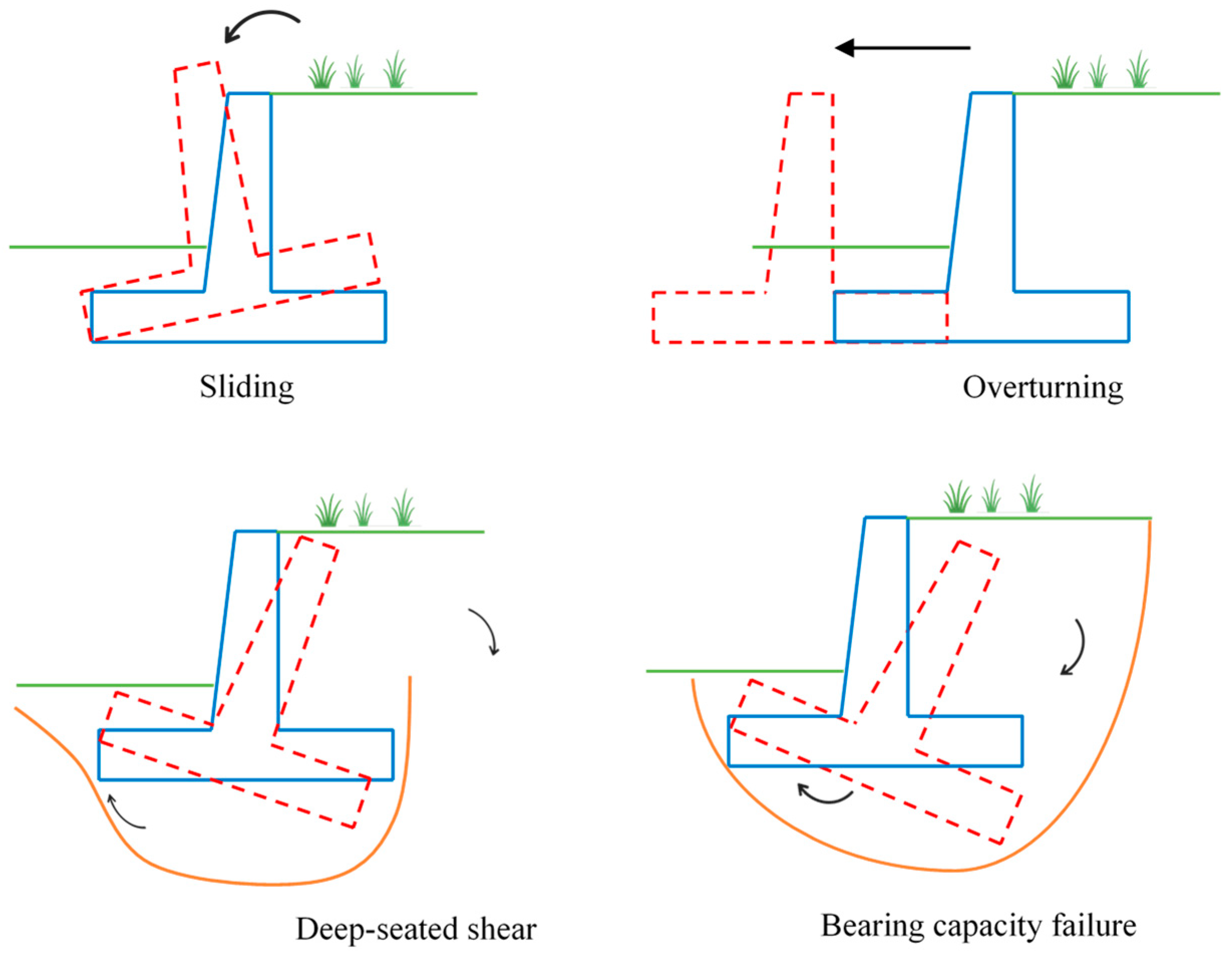
Figure 2 illustrates the principal failure mechanisms governing gravity retaining wall behavior [
24], including sliding, overturning, deep-seated shear failure, and bearing capacity failure, which form the basis for the stability constraints imposed in this study. The analytical formulations used to model these failure modes are adopted from Das and Sivakugan [
25].
Rankine’s theory states that the active and passive earth pressure coefficients (
Ka) and (
Kp), respectively, are:
where
Ø is the internal friction angle.
where
is the factor of safety against overturning at the toe, where the moments that are resisting overturning about the toe are denoted as
, and the moments that tend to perform overturning about the toe are denoted as
. In the sliding mode, the active force’s horizontal component is considered. The following is the definition of the sliding.
safety factor:
where
Is the total of the forces that are horizontally sliding and
is the total of the forces that are horizontally resisting. The minimum and maximum stresses that are induced on the base of the foundation are defined as:
where
qmin and
qmax represent the bearing stresses at the toe and heel,
B is the width of the base, and Σ
V is the vertical force due to the weight of the wall and soil above the base. Symbol
E expresses the eccentricity of the resultant force and is defined as:
Also,
FSB is the safety factor for the bearing capacity and is defined as:
where
qu is the ultimate bearing capacity of the foundation.
3.1. Formulation of the Optimal Design
The optimal design process for any structure consists of three stages: structural modeling, objective function modeling, and optimization algorithm. Structural modeling defines the problem by defining the set of design variables that meet the design objectives without violating any constraints. Optimum design modeling studies: The problem is formulated more thoroughly to define the objective function. The optimization method starts with an initial design and progressively refines its variables.
3.2. Structural Modeling
The objective of designing an optimal retaining wall is to minimize its construction cost and weight while satisfying any constraints:
Subjected to
where
It is the minimization function, which is a function of the design variables
, and the inequality constraints.
, while
and
Are lower and upper bounds constraints, respectively.
3.3. Design Variables
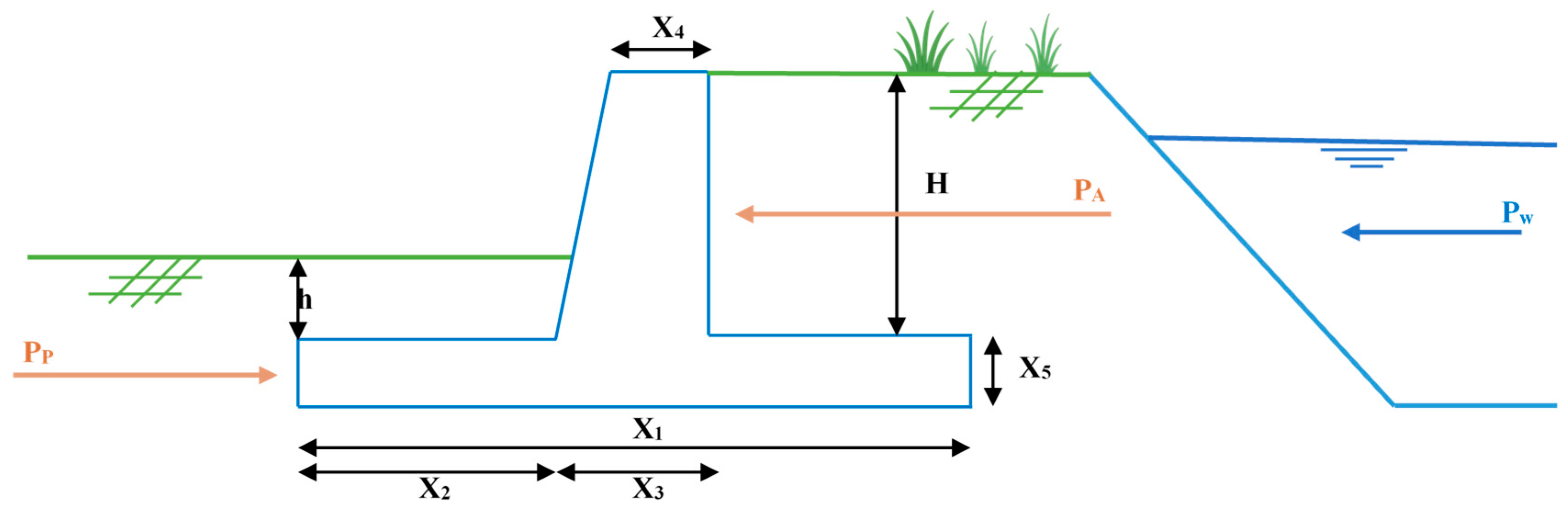
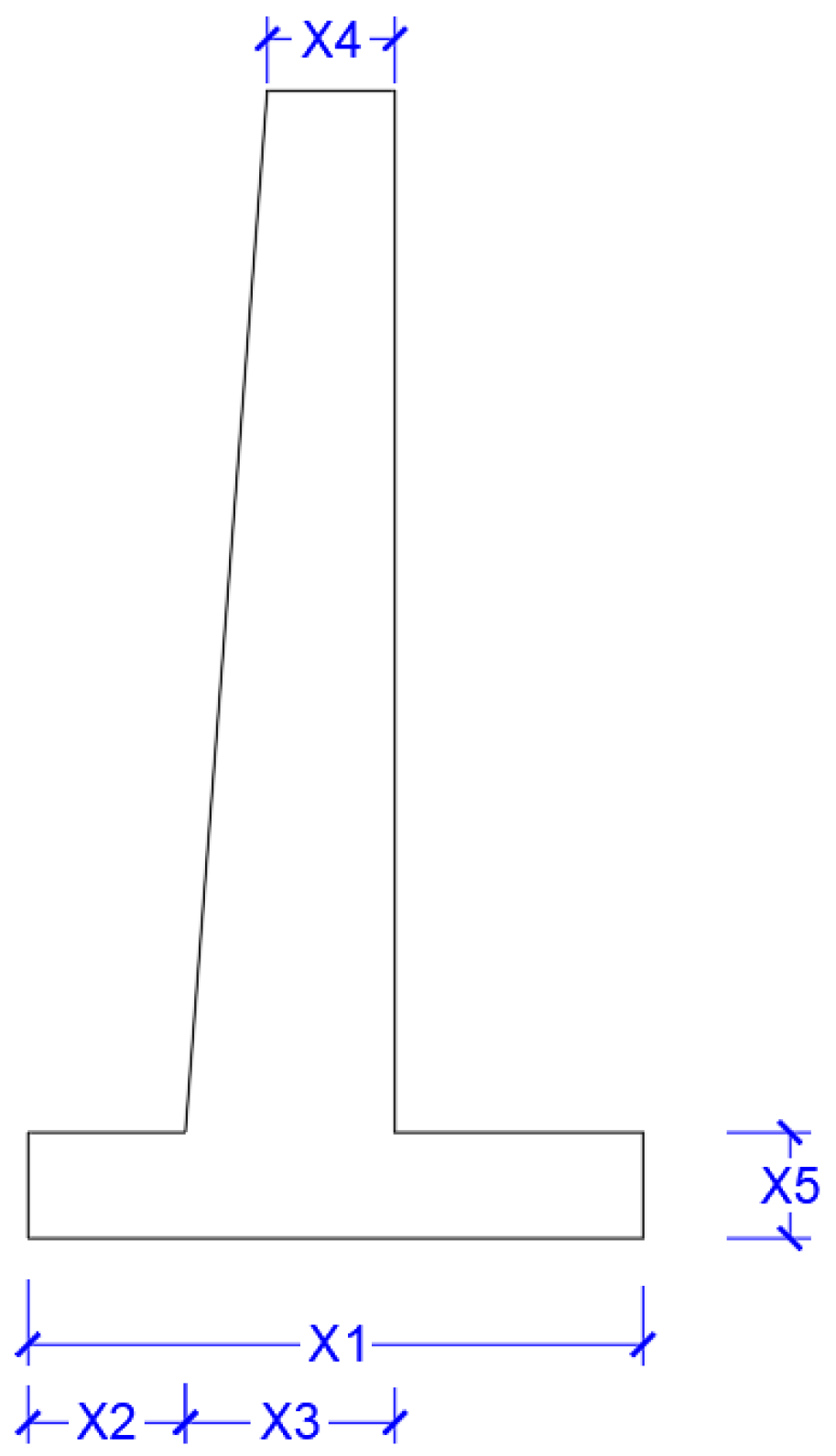
The five primary design variables used in the program formulation for the gravity retaining wall are
X1 (width of the base),
X2 (projection),
X3 (thickness at the bottom of the stem),
X4 (thickness at the top of the stem), and
X5 (thickness of the base slab), which all pertain to the various dimensions of the wall.
Figure 3 illustrates the geometric configuration of the gravity retaining wall and defines the five primary design variables (
X1–
X5) that are optimized in this study.
All geometric design variables are normalized with respect to the retaining wall stem height H to ensure scalability of the optimization formulation. The lower and upper bounds imposed on each design variable, expressed as functions of H, are summarized in
Table 1.
All geometric variables define the dimensions of a concrete gravity wall section, and the wall weight is calculated using the concrete unit weight.
3.4. Constraints in the Design
The optimal design of a gravity retaining wall is governed by a set of geotechnical, structural, and geometric constraints that ensure safety, serviceability, and constructability. The imposed constraints are grouped into stability-related constraints and geometric feasibility constraints, as detailed below.
3.4.1. Overturning Failure Mode
In the case of an overturning failure mode, the wall must be prevented from rotating around its toe by ensuring that the moments induced by vertical forces (stabilizing moments) exceed those induced by horizontal forces (overturning moments). The weight of the wall primarily generates the stabilizing moments, while the main cause of overturning moments is the earth’s pressure acting on the wall. Overturning failure occurs when the lateral earth pressures on the wall exceed the wall’s resistance, causing it to overturn.
where
Is the moment about the toe that tends to resist overturning, the
is the moment that tends to overturn and
It is the factor of safety against overturning.
3.4.2. Bearing Failure
The foundation must have sufficient bearing capacity to withstand the stresses acting on the structure’s base and prevent bearing failure.
where
SBC is the safe bearing capacity of the soil,
is the maximum contact pressure at the interface between the wall structure and the foundation soil.
where
is the minimum contact pressure between the wall and the soil.
3.4.3. Sliding Failure Mode
The sliding failure mode occurs when the horizontal forces acting on a retaining wall are insufficient to prevent it from sliding along its foundation. The primary cause of this type of failure is typically excessive lateral earth pressures on the backfill side of the wall, which can overcome the wall’s resistance and cause it to slide away from the soil it is retaining.
where the numerator of Equation (19) is the resistance to sliding, and
It is the total horizontal driving force.
F∙Ss is the factor of safety against sliding.
3.4.4. Tension Failure Mode
The tension failure mode can occur if the force acting on the foundation does not act through the middle third of the base, which is required to maintain stability.
where
is the base width of the wall, and
E is the eccentricity of the resultant force.
3.4.5. Geometric Feasibility and Constructability Constraints
In addition to the conventional geotechnical and structural safety constraints, explicit geometric feasibility constraints were incorporated to ensure that the optimized retaining wall configurations are physically constructible and consistent with engineering practice. Without such constraints, metaheuristic optimization algorithms may exploit unrealistic geometries to artificially reduce the objective function, leading to non-physical solutions. First, to enforce a constructible stem geometry, the stem thickness at the top is constrained to be less than or equal to the stem thickness at the bottom. This condition ensures a monotonically decreasing stem profile from base to top and prevents reverse-taper configurations. The corresponding constraint is expressed as:
To guarantee a positive heel width and avoid degenerate base geometries, the sum of the toe projection and the bottom stem thickness is constrained not to exceed the total base width. This constraint ensures that the heel region remains physically meaningful and that the soil backfill contributes correctly to stabilizing moments:
Finally, the classical middle-third rule is enforced using an absolute eccentricity formulation to prevent tensile stresses at the foundation–soil interface. Rather than considering eccentricity in a single direction, the absolute value of the eccentricity is constrained to remain within one-sixth of the base width:
These geometric constraints complement the traditional safety constraints on overturning, sliding, bearing capacity, and tension failure. Together, they ensure that all optimized solutions correspond to realistic gravity retaining wall geometries that are not only stable but also constructible and suitable for practical implementation.
3.4.6. Serviceability Limit State Considerations
The serviceability limit state (SLS) of the gravity retaining wall is addressed by ensuring acceptable stress distribution and deformation behavior under normal operating conditions. In this study, the SLS requirements are implicitly enforced through several design constraints commonly adopted in practical retaining wall design. The eccentricity of the resultant force is restricted using Equation (20) to remain within the middle third of the foundation base. This condition ensures uniform compression at the base, prevents tensile stresses, and limits excessive rotation or differential settlement of the wall. The maximum and minimum bearing pressures at the soil–foundation interface are constrained by Equations (12) and (18) to remain below the allowable soil bearing capacity, which controls serviceability-related settlement behavior. Minimum safety factors against sliding and overturning are enforced under service load conditions, ensuring stable performance without excessive lateral displacement or rotation. These stress and geometry-based constraints collectively ensure that the retaining wall satisfies conventional serviceability criteria used in gravity retaining wall design practice. Therefore, the optimized solutions obtained in this study are not only safe with respect to ultimate limit states but also compliant with serviceability requirements.
3.5. Constraint-Handling Strategy
All constraints in the optimization problem were handled using a static quadratic penalty approach, applied uniformly across all optimization algorithms. For a candidate solution
, the constraint violation vector
was first evaluated. The aggregated penalty term was then computed as:
The penalized objective function was defined as:
where
is the unpenalized self-weight of the retaining wall. This formulation ensures that feasible solutions.
are evaluated solely based on structural weight, while infeasible solutions incur a progressively increasing penalty proportional to the squared magnitude of constraint violations. No rejection, repair, or algorithm-specific feasibility enforcement mechanisms were employed. Infeasible solutions were allowed to remain in the population and evolve, enabling all algorithms to gradually guide the search toward feasible regions of the design space. The same penalty formulation and coefficient were used for AEABC and all competing algorithms, ensuring a fair and unbiased comparative evaluation.
4. Results and Discussion
This section presents the optimization results obtained using the gravity retaining wall model, which incorporates explicit geometric feasibility and serviceability constraints to ensure designs that are physically constructible. These constraints include non-negative heel width, a tapered stem geometry with top thickness not exceeding bottom thickness, and enforcement of the middle-third eccentricity condition. After introducing these constraints, all optimization algorithms were re-executed under identical conditions to ensure a fair comparison. Each algorithm was evaluated over 30 independent runs with a population size of 50 and a maximum of 1000 iterations. Algorithm-specific control parameters were tuned through preliminary testing and then fixed, ensuring that observed differences reflect intrinsic algorithmic behavior rather than disparities in computational budget or stopping criteria.
4.1. Overall Optimization Behavior
The optimization results obtained under geometric feasibility and serviceability constraints, shown in
Table 2, reveal a markedly different performance hierarchy compared to unconstrained formulations, underscoring the importance of constructability-aware optimization.
Table 3 shows the lowest wall weights produced by the competitive algorithms while
Table 4 shows the corresponding solutions of that minimized weights.
As reported in
Table 5, PSO produces the lowest numerical wall weight; however, this solution violates multiple fundamental stability and serviceability constraints, as shown in
Table 4, including overturning, bearing pressure, sliding resistance, and eccentricity limits.
Consequently, PSO is excluded from further engineering consideration. Among the feasible and near-feasible solutions, FFO achieves the minimum wall weight, followed by AEABC, DDAO, and GWO. The relatively narrow range of wall weights across these algorithms indicates that the feasible design space is strongly restricted once geometric and stability constraints are enforced, leading to convergence toward similar structural configurations.
4.2. Optimized Design Variables
The optimized design variables obtained from each algorithm are reported in
Table 4. All solutions correspond to a gravity retaining wall with a stem height of H = 6 m and a monotonically decreasing stem thickness from bottom to top, consistent with geometric feasibility requirements. The AEABC solution exhibits a balanced geometry, characterized by a moderate base width, a conservative toe projection, and smooth stem tapering. FFO yields a lighter structure with reduced stem thickness, while DDAO and GWO produce similar geometries with slightly thicker stems. Although PSO generates a lighter configuration, its proximity to multiple constraint violations renders it unsuitable for practical use.
4.3. Constraint Satisfaction and Feasibility Analysis
Table 5 reports the constraint values associated with each optimized design. A solution is considered strictly feasible when all constraint values are non-positive. PSO violates several critical constraints simultaneously, rendering it infeasible. Among the remaining algorithms, none achieve perfect constraint satisfaction; however, the magnitude of violations differs significantly. AEABC, DDAO, and GWO exhibit marginal violations of the sliding constraint on the order of 10
−3, which are negligible from an engineering perspective and can be attributed to numerical tolerance in penalty-based constraint handling. In contrast, FFO exhibits a more pronounced sliding constraint violation (g
4 ≈ 0.11), indicating a design closer to the stability boundary. While all near-feasible designs satisfy overturning, bearing capacity, eccentricity, and geometric constraints, FFO trades stability margin for material efficiency, whereas AEABC maintains a more conservative safety profile.
4.4. Economic Implications of Optimized Designs
An economic analysis based on concrete material cost was conducted to translate the optimization results into practical engineering terms. As shown in
Table 6, FFO yields the lowest estimated construction cost, achieving approximately 20–25% cost reduction compared to AEABC, DDAO, and GWO. The latter three algorithms produce nearly identical concrete volumes and costs, reflecting their similar geometric configurations. PSO, despite its low numerical weight, is economically irrelevant because it is infeasible. These results demonstrate that aggressive mass minimization can yield substantial economic benefits, provided that associated reductions in stability margin are acceptable.
Although concrete volume is adopted as the primary economic indicator in this study, it is acknowledged that multiple coupled factors, including material cost, formwork requirements, labor effort, excavation, transportation, and site-specific conditions, govern the actual construction cost of gravity retaining walls. In gravity-based retaining structures, these cost components scale predominantly with structural volume, which is why concrete volume is widely used as a surrogate economic objective in preliminary and comparative optimization studies. The objective of the present work is not to develop a project-specific life-cycle cost model, but to examine how constraint-aware problem formulation influences feasibility, robustness, and algorithmic behavior within a controlled, interpretable optimization setting.
4.5. Trade-Off Between Material Efficiency and Structural Robustness
A clear trade-off emerges between material efficiency and structural robustness. FFO provides the lightest and most economical design but operates closer to the stability limits. At the same time, AEABC delivers a more conservative, robust solution with minimal constraint violations at the expense of increased material usage. This trade-off highlights the need to evaluate optimization outcomes beyond a single objective value.
4.6. Engineering Significance and Practical Implications
The results confirm that explicit incorporation of geometric feasibility and serviceability constraints is essential for meaningful gravity retaining wall optimization. When such constraints are enforced, metaheuristic algorithms converge to realistic and comparable designs, enabling fair performance assessment. From an engineering standpoint, FFO is suitable for cost-driven applications with controlled risk tolerance. In contrast, AEABC is preferable for projects that prioritize robustness, numerical reliability, and conservative safety margins under uncertain conditions.
5. Algorithmic Convergence on Retaining Wall
The convergence behavior of the optimization algorithms provides additional insight into their search dynamics and robustness when applied to the retaining wall design problem.
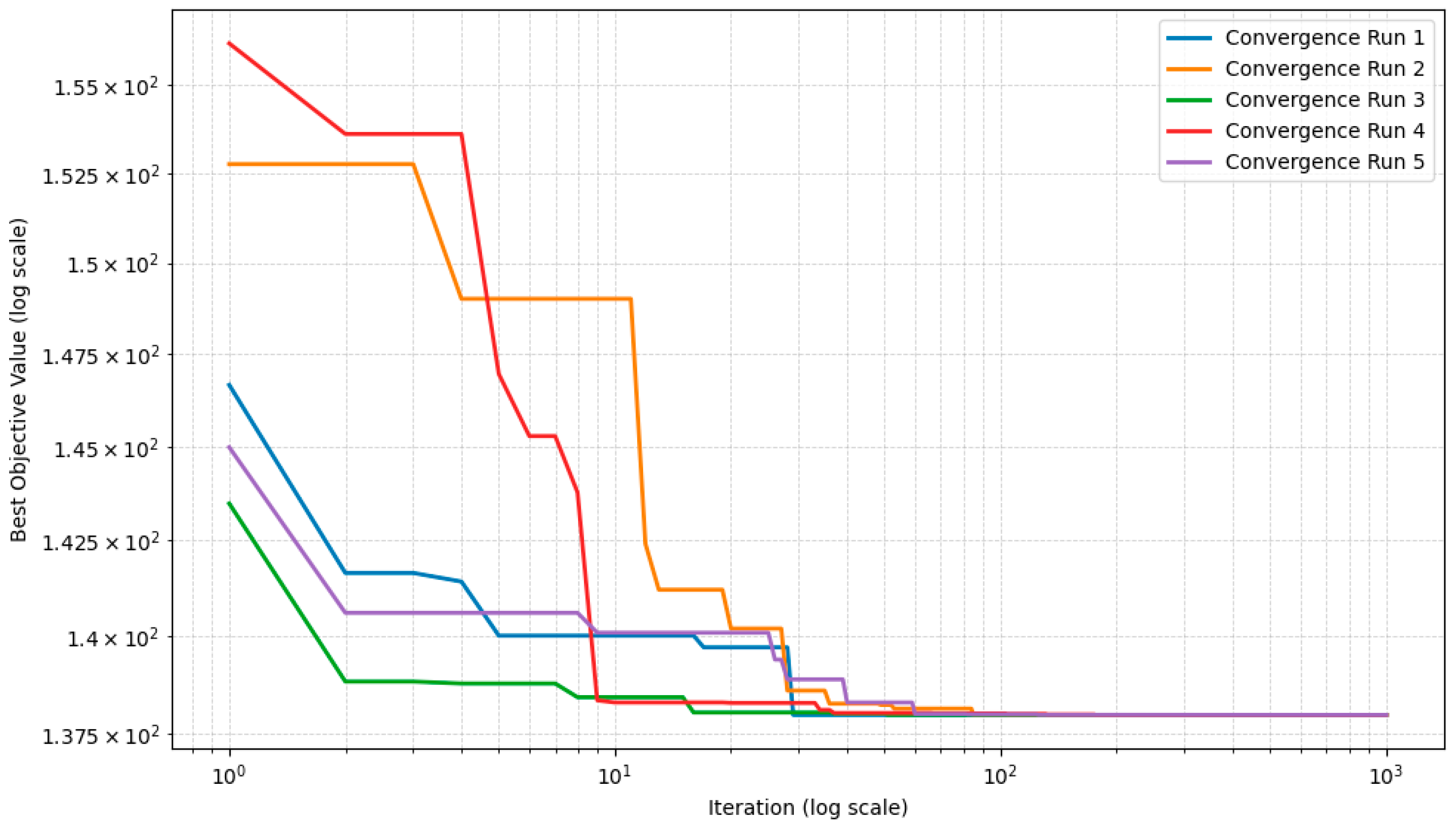
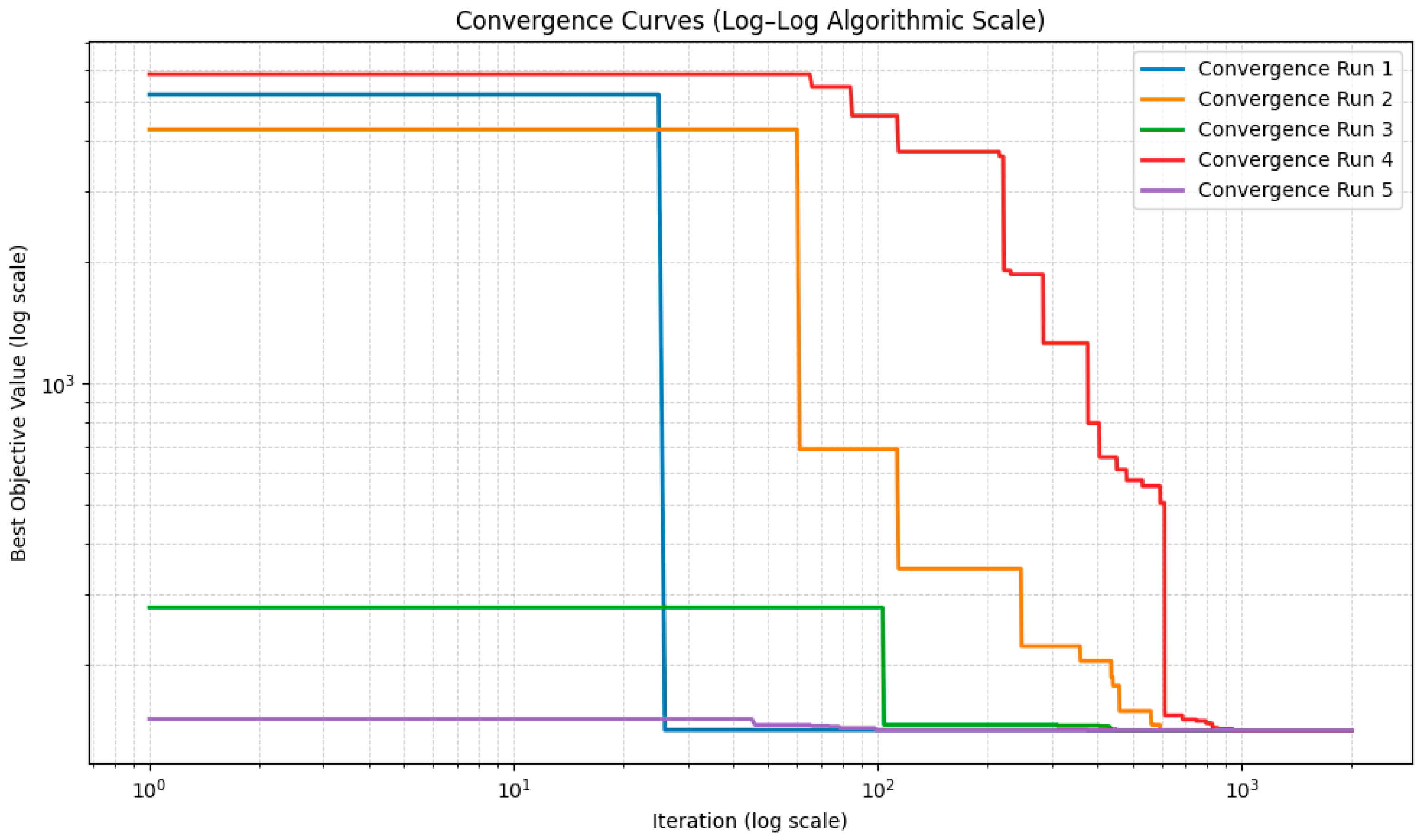
Figure 4 and
Figure 5 illustrate the convergence curves for AEABC and FFO, respectively, across the first five independent runs, plotted on a logarithmic iteration scale to highlight early-stage behavior. The AEABC algorithm exhibits smooth, consistent convergence across all runs, with rapid objective reduction during the initial iterations, followed by gradual stabilization. The close clustering of the curves indicates low sensitivity to initial population variability and reflects a balanced exploration-exploitation mechanism. This behavior explains the algorithm’s ability to consistently converge to near-feasible, conservative designs with minimal constraint violations.
In contrast, the FFO algorithm exhibits a stepwise convergence pattern, characterized by extended plateaus followed by abrupt reductions in the objective value. This behavior is attributed to the Lévy flight–based global exploration strategy inherent to FFO, which enables occasional large improvements at later stages of the optimization. While this mechanism allows FFO to reach lower-weight solutions, it also results in greater variability among runs and convergence closer to constraint boundaries. Overall, the convergence curves confirm that AEABC prioritizes stability and convergence reliability, whereas FFO emphasizes aggressive exploration and late-stage exploitation. These complementary behaviors are consistent with the observed trade-off between robustness and material efficiency identified in the optimized retaining wall designs.
Figure 4 and
Figure 5 illustrate five arbitrarily selected convergence curves for the AEABC and FFO algorithms, respectively. Although only a subset of runs is shown for clarity, the plotted curves are representative of the overall convergence behavior observed across all independent runs.
6. Effect of Geometric Constraints
Geometric feasibility is critical to the optimal design of gravity retaining walls. While classical stability and serviceability constraints (overturning, sliding, bearing capacity, and eccentricity) are necessary to ensure safety, they are not, on their own, sufficient to guarantee physically meaningful and constructible wall geometries when metaheuristic optimization algorithms are employed. This section highlights the importance of the geometric constraints introduced in Equations (21) and (22) and illustrates their effect on the optimized retaining wall configuration.
6.1. Consequences of Omitting Geometric Constraints
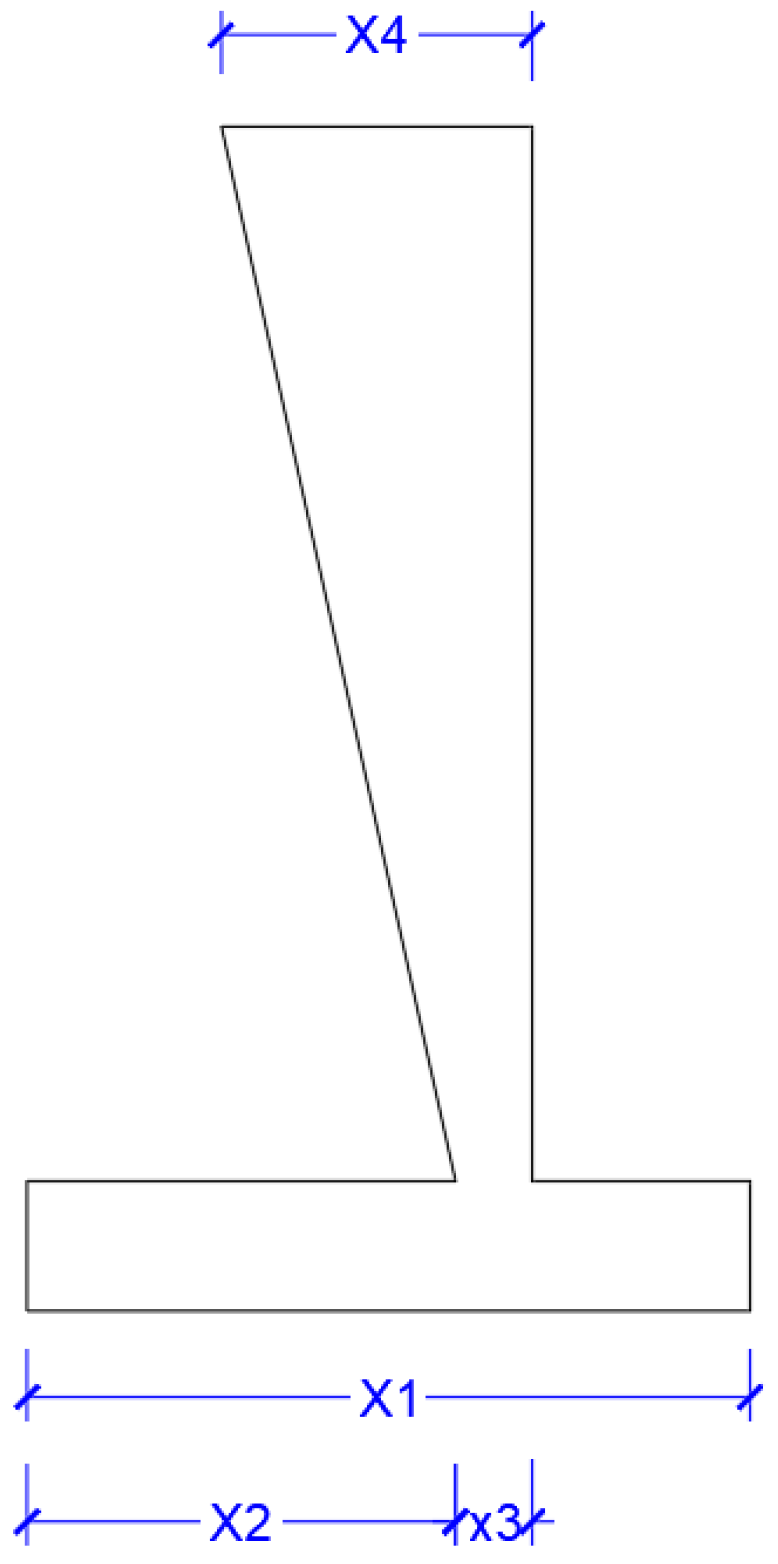
In the absence of explicit geometric feasibility constraints, the optimization process may converge to configurations that are mathematically admissible but structurally unrealistic. In particular, without enforcing a monotonic stem thickness profile, the optimizer is free to generate solutions in which the stem thickness at the top exceeds that at the base. Such a reverse-taper configuration violates basic constructability principles and contradicts conventional retaining wall design practice, which expects the stem thickness to decrease with height. Similarly, without enforcing a non-negative heel width, the optimizer may produce geometries in which the combined toe projection and stem thickness exceed the total base width. This leads to a degenerate or negative heel region, invalidating the physical interpretation of soil–structure interaction and corrupting the computation of stabilizing moments and vertical loads. These deficiencies were clearly observed in preliminary optimization results, where the absence of geometric constraints resulted in a non-physical retaining wall shape with an inverted stem profile and an ill-defined base geometry (see
Figure 6). Although such a configuration satisfied some global stability inequalities numerically, it is neither constructible nor acceptable from an engineering standpoint.
6.2. Impact on the Optimized Retaining Wall Geometry
After introducing the geometric constraints defined in Equations (21) and (22), all optimization algorithms were re-executed. The resulting optimized retaining wall exhibits a physically realistic configuration, characterized by a monotonic reduction in stem thickness with height and a well-defined base slab geometry.
Figure 7 presents the scaled optimized concrete gravity retaining wall obtained after applying the geometric feasibility constraints. In contrast to the preliminary unconstrained solution, the corrected geometry shows a clearly tapered stem, a positive heel width, and a structurally consistent load path from the retained soil to the foundation. This comparison demonstrates that the geometric constraints do not merely refine the optimization results but are essential for preventing fundamentally invalid solutions. Their inclusion ensures that the optimization outcome represents a realistic retaining wall design suitable for practical implementation.
7. Modeling Assumptions and Limitations
The present study adopts a classical gravity retaining wall model to investigate the influence of constraint-aware optimization on feasibility, economic interpretation, and algorithmic behavior. As in many computational optimization studies in geotechnical engineering, several simplifying assumptions are made to maintain a controlled, interpretable problem formulation. Specifically, the model does not explicitly account for groundwater pressure, surcharge loads, seismic actions, soil stratification, or construction staging effects. These factors are recognized as important in a detailed project-specific retaining wall design. However, the objective of this study is not to provide a comprehensive design solution for a particular site, but to examine how optimization outcomes are affected by problem formulation, especially the enforcement of geometric feasibility under a widely accepted baseline model. Introducing additional physical complexities would require site-specific parameters and substantially increase model dimensionality, potentially obscuring the study’s methodological focus. The proposed constraint-aware optimization framework is not limited to the simplified assumptions adopted herein. The geometric feasibility constraints, stability logic, and economic interpretation introduced in this work are formulation-level components that can be directly extended to incorporate groundwater effects, surcharge loading, seismic coefficients, or layered soil profiles without altering the underlying optimization structure. Consequently, the present study should be viewed as a foundational step that establishes a necessary modeling discipline before the inclusion of additional real-world complexities. The results presented in this study are obtained for a canonical gravity-retaining wall configuration selected as a controlled reference problem. While variations in wall height, soil properties, or safety factors would affect the numerical values of optimized dimensions, the methodological findings, particularly the necessity of geometric feasibility constraints and the emergence of interpretable trade-offs between material efficiency and robustness, are independent of these specific parameters. Extending the proposed constraint-aware framework to multiple configurations and parametric sensitivity analyses represents a natural direction for future work.
8. Statistical Analysis
8.1. Distribution of Final Wall Weight Across Independent Runs
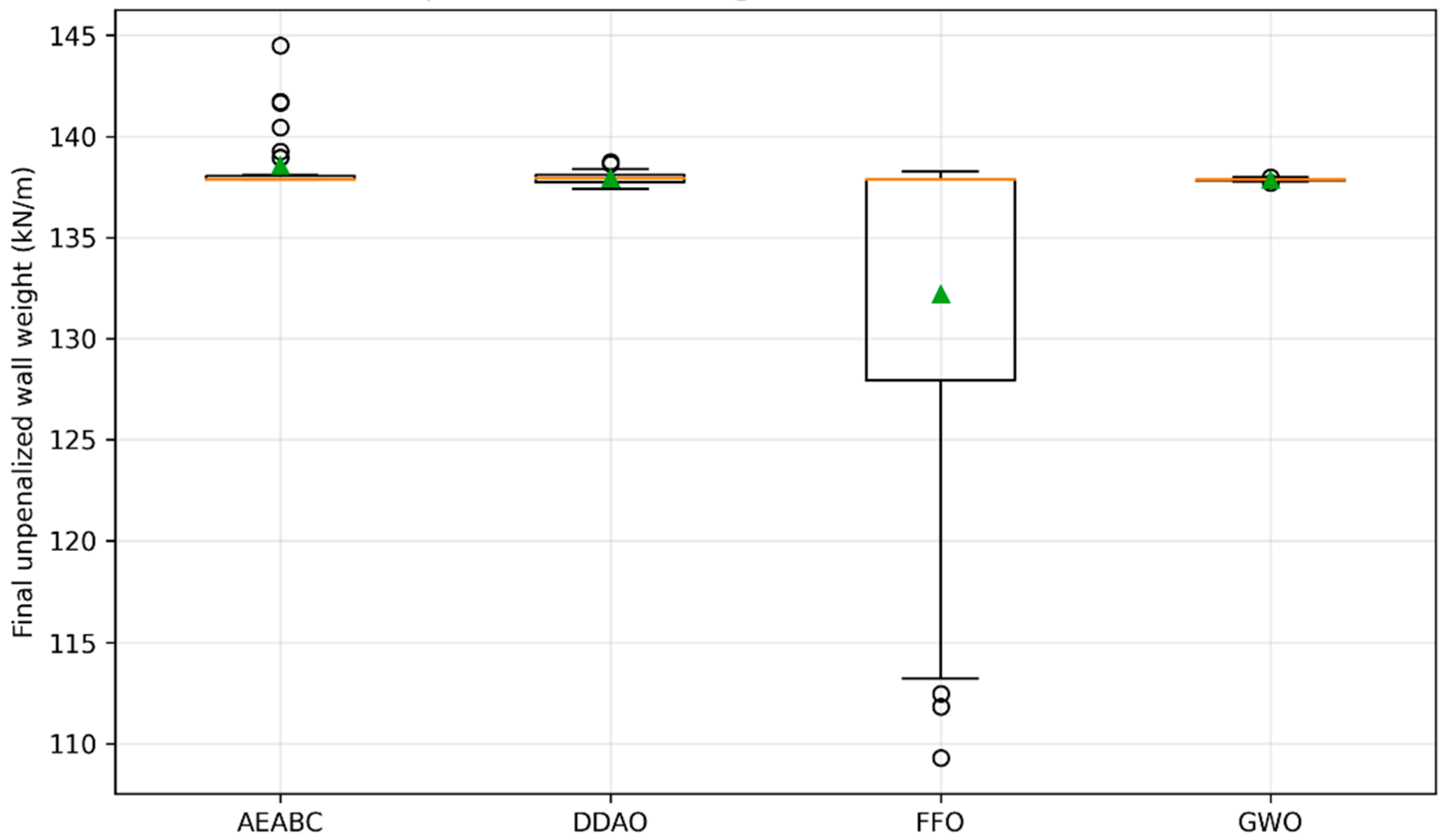
Figure 8 presents box plots of the final unpenalized wall weight obtained from 30 independent runs of each feasible optimization algorithm. The relatively narrow interquartile ranges and the close agreement between medians and means observed for AEABC, DDAO, and GWO indicate consistent convergence behavior under the adopted population size and iteration budget, suggesting limited stochastic variability for these solvers. In contrast, the FFO algorithm exhibits a noticeably wider interquartile range, extended whiskers, and several low-weight realizations, resulting in the lowest median and mean wall weights among all methods. This behavior reflects an aggressive search strategy that frequently drives solutions toward stability and feasibility boundaries, at the cost of increased variability. The AEABC algorithm produces slightly higher wall weights but demonstrates a tightly clustered distribution with reduced dispersion, indicating conservative convergence within stable feasible regions. DDAO and GWO display intermediate behavior, balancing convergence stability with moderate material efficiency. Overall, the observed distributions reveal a systematic trade-off between material efficiency and robustness under constraints, rather than the dominance of a universally superior optimization algorithm.
8.2. Non-Parametric Statistical Comparison of Feasible Solvers
To complement the distributional analysis presented in
Section 8.1, formal non-parametric statistical tests were conducted using results from 30 independent runs for each feasible solver (AEABC, DDAO, FFO, and GWO). The final unpenalized wall weight obtained in each run was adopted as the performance metric. PSO was excluded from this analysis because it failed to consistently satisfy the imposed geometric and stability constraints.
Table 7 reports the descriptive statistics for the feasible solvers, including the best, worst, mean, standard deviation, median, and interquartile range. The results indicate marked differences in dispersion and central tendency among the algorithms. In particular, FFO achieves the lowest minimum, mean, and median wall weights but exhibits substantially higher variability, as reflected by its large standard deviation and interquartile range.
In contrast, GWO and DDAO exhibit extremely low dispersion across runs, with distributions tightly clustered around slightly higher wall weights, indicating highly stable but conservative convergence behavior. AEABC shows moderate variability, lying between these two extremes. To evaluate whether statistically significant global differences exist among the feasible solvers, a Friedman non-parametric test was applied, with results summarized in
Table 8. The test yields a
p-value of 0.00034, which is well below the 5% significance threshold. This result confirms the presence of statistically significant global differences among the considered algorithms, rejecting the null hypothesis that all solvers perform equivalently. Subsequently, pairwise Wilcoxon signed-rank tests were conducted with FFO as the reference algorithm, and the results are reported in
Table 9. The analysis reveals statistically significant differences between FFO and all other feasible solvers (AEABC, DDAO, and GWO) after Holm correction (
p < 0.05 in all cases). These results confirm that the lower wall weights achieved by FFO are statistically meaningful and not attributable to random variation. However, this improved material efficiency is accompanied by substantially higher variability, as previously observed in the descriptive statistics and box-plot analysis. Overall, the statistical results indicate that FFO prioritizes aggressive material minimization over robustness. In contrast, AEABC, DDAO, and GWO favor stable, repeatable convergence toward slightly heavier, more conservative designs. These findings reinforce the interpretation that the observed performance differences arise from systematic algorithmic behavior and constraint-handling characteristics, rather than stochastic noise or the dominance of a universally superior optimization algorithm.
Figure 8 highlights a clear robustness advantage for the AEABC algorithm. Although AEABC does not achieve the minimum wall weight, it exhibits a tightly clustered distribution with a narrow interquartile range and short whiskers, indicating low variance and highly repeatable convergence across independent runs. This behavior reflects reliable performance under the imposed geometric and stability constraints, favoring robust feasible solutions over aggressive material minimization.
9. Conclusions
This study investigated the optimal design of gravity retaining walls using a constraint-aware metaheuristic optimization framework that explicitly incorporates stability, serviceability, geometric feasibility, and economic considerations. Unlike many previous studies that rely solely on classical stability constraints, the present work demonstrates that enforcing geometric feasibility is essential to obtain physically meaningful and constructible retaining wall designs when population-based optimization algorithms are employed. In the absence of explicit geometric constraints, optimization algorithms may converge to numerically admissible yet non-physical configurations. By introducing geometric feasibility conditions specifically enforcing a tapered stem geometry and a positive heel width, the feasible design space was fundamentally reshaped, leading to realistic wall geometries and altering the relative performance ranking of optimization algorithms. All algorithms were evaluated under identical computational conditions across 30 independent runs, with population sizes of 50 and 1000 and 1000 iterations, resulting in consistent convergence to stable final solutions for each method. Among the feasible solutions, the Flower Fertilization Optimization (FFO) algorithm achieved the minimum wall weight of approximately 109.3 kN/m, corresponding to a concrete volume of about 4.65 m3/m.
In contrast, the more conservative solutions obtained by AEABC, DDAO, and GWO resulted in wall weights of approximately 137–138 kN/m and concrete volumes of approximately 5.74 m3/m. This corresponds to a material reduction of approximately 19% for the most material-efficient design relative to conservative alternatives. From an economic perspective, the explicit cost assessment confirms that material efficiency directly governs construction cost. At the same time, AEABC exhibited the most robust and repeatable convergence behavior, consistently producing near-feasible solutions with minimal constraint violations and low statistical dispersion across independent runs. These results highlight a clear trade-off between material efficiency and structural robustness. Overall, the primary contribution of this study lies not in proposing a new optimization algorithm, but in demonstrating how constraint-aware problem formulation enables physically realistic, economically interpretable, and fairly comparable optimization outcomes. The insights obtained are transferable to a wide class of metaheuristic methods applied to retaining wall and other geotechnical structure optimization problems.