Change in the Intensity of Soil Erosion via Water in the Vistula River Basin in Future Climate: A Comparison of the RCP 4.5 and RCP 8.5 Scenarios (2021–2050) Using the MUSLE Model

Abstract
1. Introduction
2. Materials and Methods
2.1. Modeling Approach
2.2. Sediment and Erosion Module
2.3. Climate Scenarios
2.4. Model Calibration and Performance Assessment
2.5. Input Dataset
3. Climate Projection Scenarios
Operational Notes
4. Simulation Results for RCP 4.5 and RCP 8.5 Scenarios: 2021–2050
4.1. Analysis of the RCP 4.5 Scenario
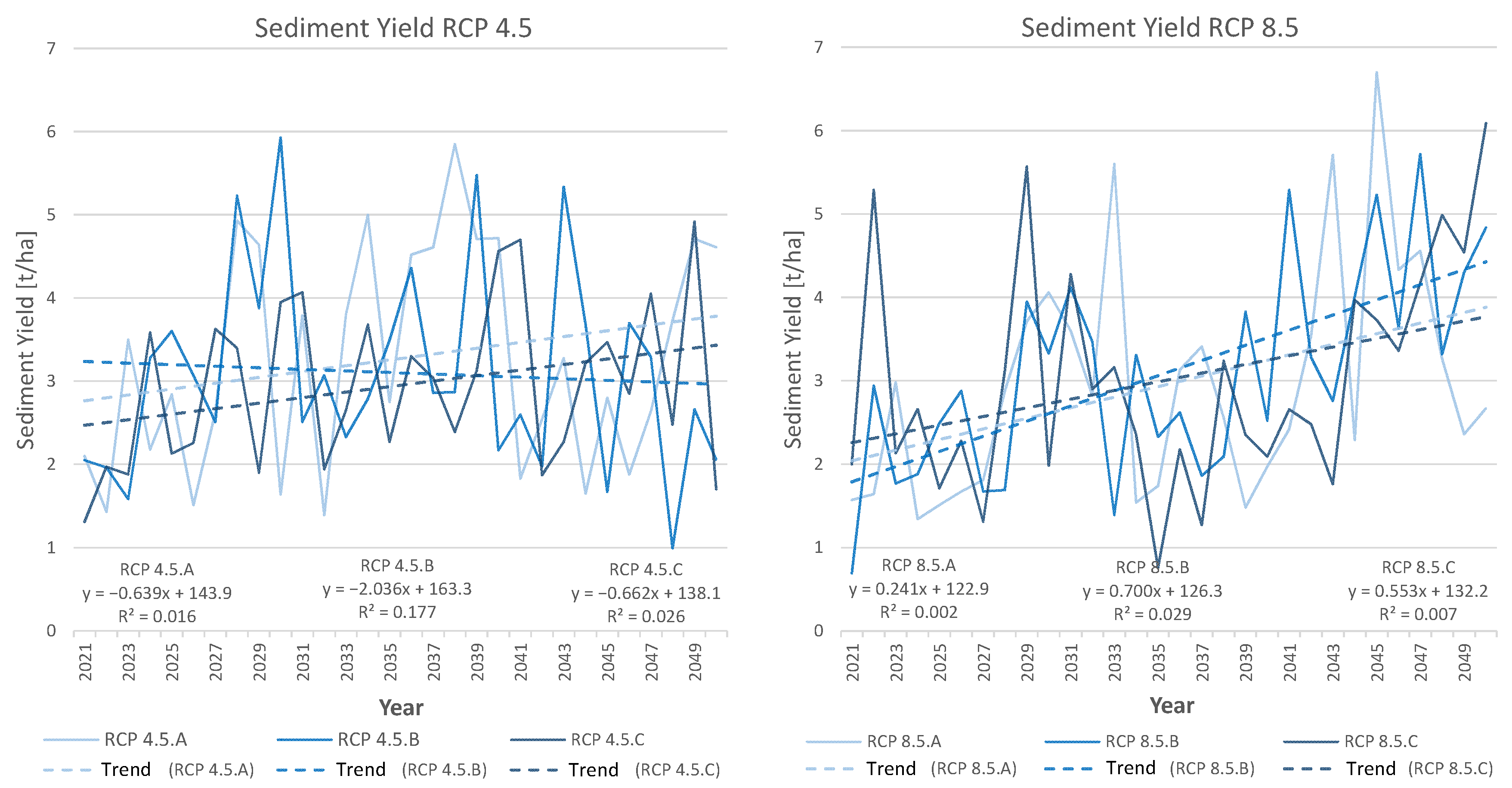
- Realizations A (RACMO22E) and C (RCA4) exhibit moderate positive trends (+0.35 and +0.33 t ha−1 per decade, respectively). Realization C projects the largest increase (+21%) in this scenario when comparing the final decade to the initial decade.
- In contrast, realization B (HIRHAM5) uniquely projects a negative trend (–0.09 t ha−1 per decade), resulting in a 15% decrease in the average SYLD by the end of the period compared to the beginning.
4.2. Analysis of the RCP 8.5 Scenario
- Realization B (HIRHAM5) exhibits the most substantial intensification, projecting the strongest trend among all models and scenarios (+0.91 t ha−1 per decade). This leads to the largest relative change: an 82% increase in the average SYLD between the initial and final decades.
- Realizations A (RACMO22E) and C (RCA4) also project robust increases (+63% and +35% changes, respectively).
4.3. Methodological Note on Uncertainty
5. Simulated Changes in Sediment Yield Across Decadal and Seasonal Scales: 2021–2050
5.1. Decadal Trajectories of Sediment Yield
5.1.1. RCP 4.5 Scenario: Mid-Horizon Peak
- The highest ensemble average annual SYLD values are attained in the 2031–2040 decade, with RCM realization A (RACMO22E) projecting a peak annual average of 4.11 t ha−1 yr−1, representing a substantial increase of +124% relative to the baseline.
- This intensification is followed by a stabilization phase in the final decade (2041–2050). The average annual SYLD values across the RCM ensemble in 2041–2050 (ranging from 2.79 to 3.16 t ha−1 yr−1) generally return to levels comparable to or slightly above those of the initial decade (2021–2030). For instance, realization A stabilizes to 2.96 t ha−1 yr−1 by the final decade, a +62% increase over the baseline.
- RCM realization C (RCA4) projects the highest average annual SYLD in the final decade for RCP 4.5, reaching 3.16 t ha−1 yr−1.
5.1.2. RCP 8.5 Scenario: Cumulative Upward Growth
- The highest projected SYLD values occur unequivocally in the final decade (2041–2050).
- During this critical interval, all three RCM realizations project average annual SYLDs exceeding 3.77 t ha−1 yr−1, correlating to relative increases ranging from +106% to +131% compared to the reference period.
- The highest annual average erosion risk is consistently attributed to RCM realization B (HIRHAM5) in the 2041–2050 decade, reaching 4.23 t ha−1 yr−1 (+131%).
- The final decade’s intensification solidifies the forecast that the highest risk of increased sediment supply will occur towards the end of the analyzed period.
5.2. Seasonal Reorganization of Erosion Intensity
5.2.1. Summer (JJA) Intensification
- The maximum recorded relative increase in the SYLD is observed in JJA under RCP 4.5 (realization A) during 2031–2040, reaching +276%.
- Similarly, under the RCP 8.5 pathway, JJA registers near-maximal intensification, peaking at +272% in the final decade (2041–2050) (realization B).
5.2.2. Autumn (SON) Transition
- In the initial decade (2021–2030), some RCM projections indicate local declines in the autumn SYLD, such as −39% (RCP 8.5, realization A) and −23% (RCP 4.5, realization C).
- However, by the final decade (2041–2050), massive increases dominate the projections. The single largest seasonal percentage increase in the entire study is found here: +176% (RCP 8.5, realization C). This convergence underscores the emergent erosion threat during the autumn season in the latter half of the projection.
5.2.3. Winter (DJF) and Spring (MAM) Changes
- By the final decade, winter (DJF) increases reach +141% (RCP 8.5, realization C).
- In spring (MAM) under RCP 8.5 (2041–2050), increases are consistent, ranging from approximately +78% to +82%.
5.3. Implications of RCM Disparity
5.4. Comparative Analysis of Sediment Yield Changes Relative to the 2013–2018 Baseline
- Region 1—Northwestern
- Region 2—Northeastern
- Region 3—Central–Western
- Region 4—Central–Eastern
- Region 5—Southern (Carpathian/upland region)
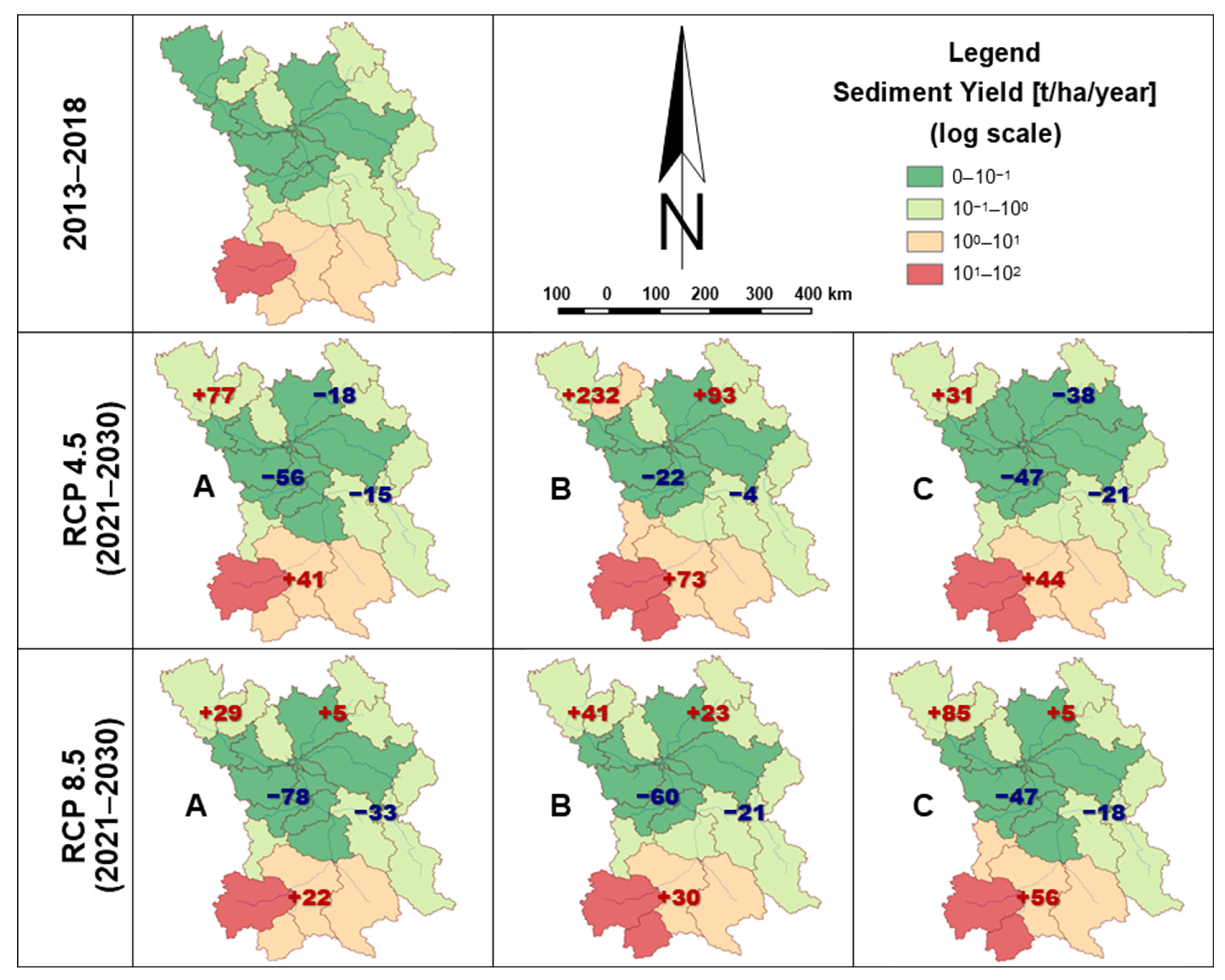
5.4.1. RCP 4.5—Short Summary (2021–2030) (Figure 4)
- Central regions (3 and 4): clear decreases in sediment yield (SY); strongest in Model A, moderate in Model C, and weakest in Model B.
- Northern regions (1 and 2): clear increases in sediment yield (SY) in Model B and both increases and decreases in sediment yield (SY) in Models A and B.
- Southern region (5): noticeable SY increase, especially in Model C.
5.4.2. RCP 8.5—Short Summary (2021–2030) (Figure 4)
- Across all models, the spatial pattern is similar: central regions: persistent decreases in SYs in all models, with the strongest in Model A.
- Northern and southern regions: increases in SYs, with the strongest in Model C.
- Erosion decreases in the central part of the Vistula basin in most models.
- Erosion increases in the northern and southern regions in most models.
- The RCP 4.5.B model shows the highest percentage increases in erosion in the north and south, followed by the RCP 8.5.C model.

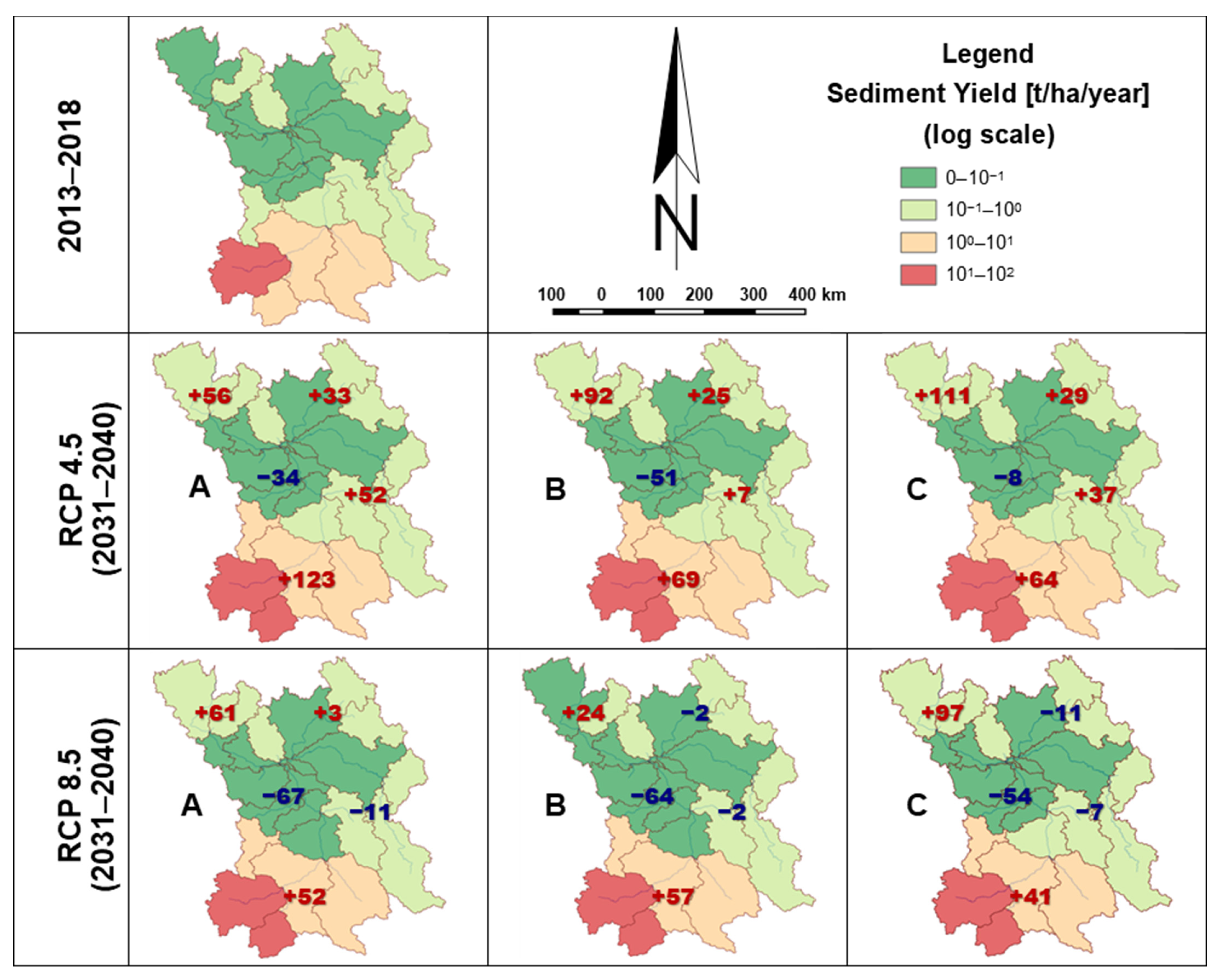
5.4.3. RCP 4.5—Short Summary (2031–2040) (Figure 5)
- Model A (RCP 4.5)
- Northwest and northeast: moderate increases (+33% to +56%).
- Central regions: decreases; strongest in the central–west (−34%).
- Southern region: very strong increase (+123%).
- Model B (RCP 4.5)
- North: strong increases (+25% to +92%).
- Central regions: decreases (−51%).
- South: substantial increase (+69%).
- Model C (RCP 4.5)
- North: highest increases among all models (+29% to +111%).
- Central regions: weak to moderate decreases (−8%).
- South: large increase (+64%).
- Summary for RCP 4.5:
- Central regions show decreases in SYs in the western part in all models.

5.4.4. RCP 8.5—Short Summary (2031–2040) (Figure 5)
- North: increases (+3% to +61%).
- Central regions: decreases (−11% to −67%).
- South: increase (+52%).
- Model B (RCP 8.5)
- North: small increases (+24%).
- Central regions: decreases (−2% to −64%).
- South: moderate increase (+57%).
- Model C (RCP 8.5)
- North: very strong increases (+97%).
- Central regions: consistent decreases (−7% to −54%).
- South: moderate increases (+41%).
- Summary for RCP 8.5:
- Central regions consistently show decreases in SYs across all models.
- North (particularly in the northwestern part) and south show increases in SYs.
- Overall conclusions for both RCP 4.5 and RCP 8.5:
- Central regions: stable decreases in erosion in most models.
- Northern and southern regions: increases in SYs, with the largest growth predicted by Model C in the northwest.
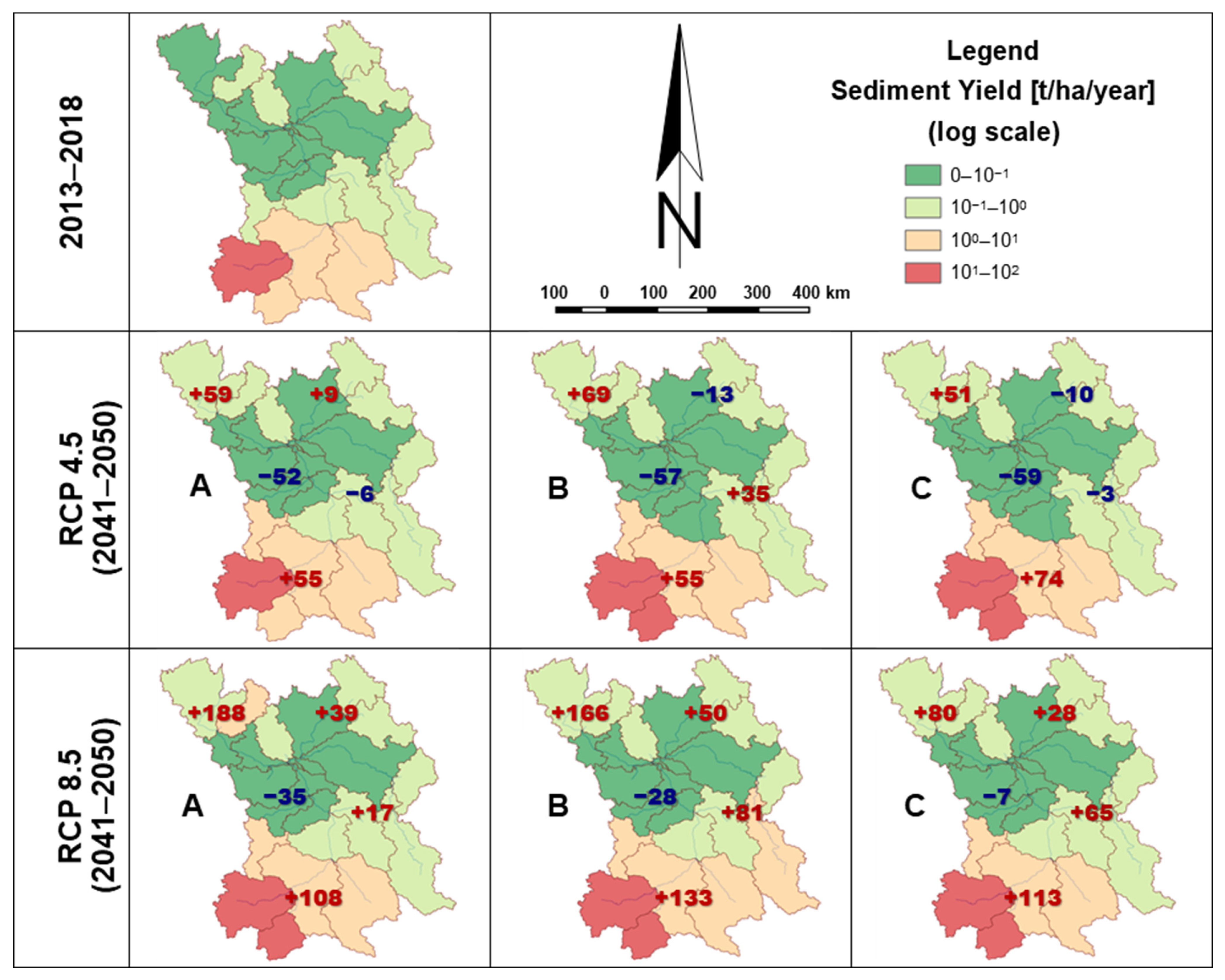
5.4.5. RCP 4.5—Short Summary (2041–2050) (Figure 6)
- Model A (RCP 4.5)
- North: moderate increases (+9% to +59%).
- Central regions: SY decreases (−6% to −52%).
- South: strong increase (+55%).
- Model B (RCP 4.5)
- North: increase in the northwest (+69%) and decrease in the northeast (−13%).
- Central regions: decrease in the central–west (−57%) and increase in the central–east (+35%).
- South: increase (+55%).
- Model C (RCP 4.5)
- North: increase in the northwest (+51%) and decrease in the northeast (−10%).
- Central regions: moderate SY decreases (−3% to −59%).
- South: strong increase (+74%).
- Summary for RCP 4.5
- Central regions continue to show decreases in SYs in most models.
- Northern–east and southern regions show clear increases.

5.4.6. RCP 8.5—Short Summary (2041–2050) (Figure 6)
- Model A (RCP 8.5)
- North: very large increases (+39% to +188%).
- Central regions: decrease in the central–west (−35%) and increase in the central–east (+17%).
- South: very strong increase (+108%).
- Model B (RCP 8.5)
- North: major increases (+50% to +166%).
- Central regions: decrease in the central–west (−28%) and high increase in the central–east (+81%).
- South: very strong increase (+133%).
- Model C (RCP 8.5)
- North: increases (+28% to +80%).
- Central regions: decrease in the central–west (−7%) and high increase in the central–east (+65%).
- South: strong increases (+113%).
- Summary for RCP 8.5
- Northern and southern regions show very large increases in SYs, often exceeding +100%.
- Central regions remain zones of decreasing SYs, though reductions weaken relative to earlier decades.
- All models show much stronger erosion intensification than under RCP 4.5.
- Overall conclusion for 2041–2050:
- RCP 8.5 produces much larger sediment yield increases than RCP 4.5, especially in northern and southern regions.
- The central basin remains a zone of decreasing SYs, but the magnitude of reductions becomes smaller over time.
5.4.7. Short Inter-Decadal Summary (2021–2030 vs. 2031–2040 vs. 2041–2050)
- General trend over timeAcross all climate scenarios (RCP 4.5 and 8.5) and models (A, B, C), the pattern becomes progressively stronger with each decade:
- 2021–2030: small to moderate changes.
- 2031–2040: clear intensification of spatial contrasts.
- 2041–2050: strongest increases, especially under RCP 8.5.
- Northern regions (Regions 1–2)
- 2021–2030: mild to moderate increases in SYs.
- 2031–2040: stronger increases, particularly under Models B and C.
- 2041–2050: very strong increases, often exceeding +100 under RCP 8.5.
- Central regions (Regions 3–4)
- 2021–2030: clear decreases in SYs (−4% to −78%); strongest in RCP 8.5.A.
- 2031–2040: reductions persist but weaken.
- 2041–2050: a decrease in erosion (from −7% to −57%) in the central–western part, while in the central–eastern part, an increase in erosion in most models.
- Southern region (Region 5—Carpathian/upland)
- 2021–2030: moderate increases.
- 2031–2040: stronger, widespread increases (often +41% to +123%).
- 2041–2050: the largest increases of all regions, consistently +100 or more under RCP 8.5.
- Differences between RCP 4.5 and RCP 8.5
- In 2021–2030, differences between scenarios are very small.
- In 2031–2040, RCP 8.5 begins to diverge, especially in northern and southern regions.
- In 2041–2050, RCP 8.5 shows dramatically larger increases than RCP 4.5 in most regions.
- Overall three-decade synthesis
- Erosion increases over time, especially in the north and south of the basin.
- Central regions continue to show reductions, but these reductions become weaker in later decades.
- RCP 8.5 amplifies changes significantly after 2040, leading to the highest erosion risk.
6. Discussion
7. Conclusions
- Erosion rates will increase across all scenarios and decades relative to the historical baseline.
- Seasonal erosion regimes will intensify, especially in summer and autumn.
- High-emission conditions will lead to sustained, long-term increases in sediment yields with limited signs of stabilization.
- Priorities for soil protection and debris control measures in sub-basins with high LS and erodible soils.
- Strengthening summer risk management (intercropping, crop residue retention, contour farming, buffer strips) and planning for the maintenance of reservoirs/ditches in view of higher loads in the final decade.
Author Contributions
Funding
Data Availability Statement
Conflicts of Interest
Abbreviations
| RCM | Regional Climate Model |
| RCP | Representative Concentration Pathway |
| SON | September, October, November |
| JJA | June, July, August |
| DJF | December, January, February |
| MAM | March, April, May |
| SYLD | Sediment Load [t ha−1 yr−1] |
| MUSLE | Modified Universal Soil Loss Equation |
| RUSLE | Revised Universal Soil Loss Equation |
References
- FAO. Soil Erosion: The Greatest Challenge to Sustainable Soil Management; FAO: Rome, Italy, 2019; p. 100. Available online: https://www.fao.org/3/ca4395en/ca4395en.pdf (accessed on 3 July 2025).
- FAO; ITPS. Status of the World’s Soil Resources (SWSR)—Main Report; Food and Agriculture Organization of the United Nations and Intergovernmental Technical Panel on Soils; FAO: Rome, Italy, 2015; p. 650. Available online: https://www.fao.org/3/i5199e/i5199e.pdf (accessed on 2 July 2025).
- Fischer, E.M.; Knutti, R. Observed heavy precipitation increase confirms theory and early models. Nat. Clim. Change 2016, 6, 986–991. [Google Scholar] [CrossRef]
- Borrelli, P.; Alewell, C.; Alvarez, P.; Anache, J.A.A.; Baartman, J.; Ballabio, C.; Bezak, N.; Biddoccu, M.; Cerdà, A.; Chalise, D.; et al. Soil Erosion Modelling: A Global Review and Statistical Analysis. Sci. Total Environ. 2021, 780, 146494. [Google Scholar] [CrossRef]
- Wischmeier, W.H.; Smith, D.D. Prediction Rainfall Erosion Losses from Cropland East of the Rocky Mountains: A Guide for Selection of Practices for Soil and Water Conservation. In Agricultural Handbook; Agricultural Research Service, US Department of Agriculture: Washington, DC, USA, 1965; Volume 282, pp. 1–47. [Google Scholar]
- Wischmeier, W.H.; Wischmeier, W.H.; Smith, D.D.; States, U.; Administration, S.E.; University, P.; Station, A.E. Predicting Rainfall Erosion Losses: A Guide to Conservation Planning; USDA: Washington, DC, USA, 1978; p. 58. Available online: https://handle.nal.usda.gov/10113/CAT79706928 (accessed on 1 July 2024).
- Renard, K.G.; Foster, G.R.; Weesies, G.A.; Mccool, D.K.; Yoder, D.C. Predicting Soil Erosion by Water: A Guide to Conservation Planning with the Revised Universal Soil Loss Equation (RUSLE); Agricultural Research Service, US Department of Agriculture: Washington, DC, USA, 1997.
- Williams, J.R.; Berndt, H.D. Sediment Yield Prediction Based on Watershed Hydrology. Trans. ASAE 1977, 20, 1100–1104. [Google Scholar] [CrossRef]
- Neitsch, S.L.; Arnold, J.G.; Kiniry, J.R.; Williams, J.R. Soil and Water Assessment Tool Theoretical Documentation; Version 2009; Texas A&M University: College Station, TX, USA, 2011; Available online: https://xueshu.baidu.com/usercenter/paper/show?paperid=13ffb51241a467670984c25be07234e6 (accessed on 5 July 2025).
- Sadeghi, S.H.; Gholami, L.; Darvishan, A.K.; Saeidi, P. A Review of the Application of the MUSLE Model Worldwide. Hydrol. Sci. J. 2014, 59, 365–375. [Google Scholar] [CrossRef]
- Józefaciuk, A.; Nowocień, E.; Wawer, R. Erozja gleb w polsce—skutki środowiskowe i gospodarcze, działania zaradcze. Monogr. I Rozpr. Nauk. IUNG-PIB 2014, 44, 264. [Google Scholar]
- Badora, D.; Wawer, R.; Król-Badziak, A.; Nieróbca, A.; Kozyra, J.; Jurga, B. Hydrological Balance in the Vistula Catchment under Future Climates. Water 2023, 15, 4168. [Google Scholar] [CrossRef]
- Brzezińska, M.; Szatten, D.; Babiński, Z. Prediction of Erosion-Prone Areas in the Catchments of Big Lowland Rivers: Implementation of Maximum Entropy Modelling—Using the Example of the Lower Vistula River (Poland). Remote Sens. 2021, 13, 4775. [Google Scholar] [CrossRef]
- Badora, D.; Wawer, R.; Nieróbca, A.; Król-Badziak, A.; Kozyra, J.; Jurga, B.; Nowocie’n, E. Simulating the Effects of Agricultural Adaptation Practices onto the Soil Water Content in Future Climate Using SWATModelonUpland Bystra River Catchment. Water 2022, 14, 2288. [Google Scholar] [CrossRef]
- Wawer, R. Digital Modelling of Grodarz Stream Watershed to Manage Water Erosion. Ph.D. Thesis, IUNG-PIB, Puławy, Poland, 2003; p. 230. [Google Scholar]
- Wawer, R.; Nowocień, E. Wind and water erosion in Poland. Erozja wodna i wietrzna w Polsce. Stud. Rap. IUNG-PIB Z. 2018, 58, 57–79. [Google Scholar]
- Panagos, P.; Borrelli, P.; Poesen, J.; Ballabio, C.; Lugato, E.; Meusburger, K.; Montanarella, L.; Alewell, C. The new assessment of soil loss by water erosion in Europe. Environ. Sci. Policy 2015, 54, 438–447. [Google Scholar] [CrossRef]
- Panagos, P.; Borrelli, P.; Meusburger, K. A New European Slope Length and Steepness Factor (LS-Factor) for Modeling Soil Erosion by Water. Geosciences 2015, 5, 117–126. [Google Scholar] [CrossRef]
- Panagos, P.; Meusburger, K.; Ballabio, C.; Borrelli, P.; Alewell, C. Soil erodibility in Europe: A high-resolution dataset based on LUCAS. Sci. Total Environ. 2014, 479–480, 189–200. [Google Scholar] [CrossRef]
- Badora, D.; Wawer, R. Evaluation of methods for determining the LS index at different resolutions for soil erosion modeling using the RUSLE method. Pol. J. Agron. 2023, 52, 110–122. Available online: https://journals.iung.pl/wydane/PJA52_12.pdf (accessed on 2 July 2025).
- Vautard, R.; Kadygrov, N.; Iles, C.; Boberg, F.; Buonomo, E.; Bülow, K.; Coppola, E.; Corre, L.; van Meijgaard, E.; Nogherotto, R.; et al. Evaluation of the Large EURO-CORDEX Regional Climate Model Ensemble. J. Geophys. Res. 2021, 126. [Google Scholar] [CrossRef]
- Szalińska, E.; Orlińska-Woźniak, P.; Wilk, P. Sediment load variability in response to climate and land use changes in a Carpathian catchment (Raba River, Poland). J. Soils Sediments 2020, 20, 2641–2652. [Google Scholar] [CrossRef]
- Orlińska-Woźniak, P.; Szalińska, W.; Wilk, P.; Jakusik, E.; Skalak, P.; Wypych, A.; Arnold, J. Assessment of sediment yield in a Carpathian catchment under climate and land-use change. Sci. Total Environ. 2020, 716, 137068. [Google Scholar]
- Dile, Y.; Srinivasan, R.; George, C. QSWAT3 Manual; Version 1.1; Texas A&M University: College Station, TX, USA, 2020; Available online: https://swat.tamu.edu/software/qswat/ (accessed on 4 July 2025).
- Abbaspour, K.C. SWAT-CUP: SWAT Calibration and Uncertainty Programs—User Manual; Eawag: Swiss Federal Institute of Aquatic Science and Technology: Zurich, Switzerland, 2015; Available online: https://swat.tamu.edu/ (accessed on 4 July 2024).
- Schmidt, J. (Ed.) Soil Erosion: Application of Physically Based Models; Springer: Berlin/Heidelberg, Germany, 2001; p. 340. [Google Scholar]
- Wawer, R.; Nowocien, E.; Podoslki, B. Real and Calculated KUSLE Erodibility Factor for Selected Polish Soils. Pol. J. Environ. Stud. 2005, 14, 655–658. [Google Scholar]
- Yang, W.; Andréasson, J.; Graham, L.P.; Olsson, J.; Rosberg, J.; Wetterhall, F. Distribution-based scaling to improve usability of RCM projections. Hydrol. Res. 2010, 41, 211–229. [Google Scholar] [CrossRef]
- Copernicus Climate Data Store (CDS): CORDEX Regional Climate Model Data on Single Levels. Available online: https://cds.climate.copernicus.eu/ (accessed on 5 July 2025).
- Jacob, D.; Petersen, J.; Eggert, B.; Alias, A.; Christensen, O.B.; Bouwer, L.M.; Braun, A.; Colette, A.; Deque, M.; Georgievski, G.; et al. EURO-CORDEX: New high-resolution climate change projections for European impact research. Reg. Environ. Change 2014, 14, 563–578. [Google Scholar] [CrossRef]
- Hennemuth, B.; Illy, T.; Jacob, D.; Keup-Thiel, E.; Katragkou, E.; Kotlarski, S.; Nikulin, G.; Otto, J.; Rechid, D.; Remke, T.; et al. Guidance for EURO-CORDEX Climate Projections Data Use; Version 1.0; EURO-CORDEX Community: Hamburg, Germany, 2017. [Google Scholar]
- Häggmark, L.; Ivarsson, K.I.; Gollvik, S.; Olofsson, P.O. MESAN—An operational mesoscale analysis system. Tellus A 2000, 52, 2–20. [Google Scholar] [CrossRef]
- Alewell, C.; Borrelli, P.; Meusburger, K.; Panagos, P. Using the USLE: Chances, challenges and limitations of soil erosion modelling. Int. Soil Water Conserv. Res. 2019, 7, 203–225. [Google Scholar] [CrossRef]
- Verheijen, F.G.A.; Jones, R.J.; Rickson, R.J.; Smith, C.J. Tolerable versus actual soil erosion rates in Europe. Earth-Sci. Rev. 2009, 94, 23–38. [Google Scholar] [CrossRef]
- Panagos, P.; Ballabio, C.; Himics, M.; Scarpa, S.; Matthews, F.; Bogonos, M.; Poesen, J.; Borrelli, P. Projections of soil loss by water erosion in Europe by 2050. Environ. Sci. Policy 2021, 124, 380–392. [Google Scholar] [CrossRef]
- Borrelli, P.; Robinson, D.A.; Panagos, P.; Ballabio, C.; Alewell, C.; Meusburger, K.; Modugno, S.; Schütt, B.; Ferro, V.; Bagarello, V.; et al. An assessment of the global impact of 21st century land use change on soil erosion. Nat. Commun. 2017, 8, 2013. [Google Scholar] [CrossRef]
- Nearing, M.A.; Pruski, F.F.; O’Neal, M.R. Expected climate change impacts on soil erosion rates: A review. J. Soil Water Conserv. 2004, 59, 43–50. [Google Scholar] [CrossRef]
- Nunes, J.P.; Jacinto, R.; Keizer, J.J.; Ferreira, A.J.D. Combining empirical rainfall–runoff–soil loss relationships with a spatially distributed hydrological model to predict the impacts of climate change on soil erosion in a Mediterranean catchment. J. Hydrol. 2013, 502, 239–252. [Google Scholar]
- Bosch, D.D.; Sheridan, J.M.; Davis, F.M. Climate change and watershed hydrology. Trans. ASABE 2010, 53, 85–94. [Google Scholar]
- Mullan, D. Soil erosion under future climate: Modelling the impact of precipitation and temperature changes in the UK and Europe. Catena 2013, 102, 73–86. [Google Scholar]
- Banasik, K.; Hejduk, L. Rainfall erosivity for East-Central Poland. Annals of Warsaw University of Life Sciences—SGGW. Land Reclam. 2012, 44, 67–77. [Google Scholar]
- Cerdan, O.; Govers, G.; Le Bissonnais, Y.; Van Oost, K.; Poesen, J.; Saby, N.; Gobin, A.; Vacca, A.; Quinton, J.; Auerswald, K.; et al. Rates and spatial variations of soil erosion in Europe: A study based on erosion plot data. Geomorphology 2010, 122, 167–177. [Google Scholar] [CrossRef]
- Kjellström, E.; Nikulin, G.; Strandberg, G.; Christensen, O.B.; Jacob, D.; Keuler, K.; Lenderink, G.; van Meijgaard, E.; Schär, C.; Somot, S.; et al. European climate change at global warming levels of 1.5 and 2 °C above preindustrial levels as simulated by the EURO-CORDEX regional climate models. Earth Syst. Dyn. 2018, 9, 459–478. [Google Scholar] [CrossRef]
- Beniston, M.; Farinotti, D.; Stoffel, M.; Andreassen, L.M.; Coppola, E.; Eckert, N.; Fantini, A.; Giacona, F.; Hauck, C.; Huss, M.; et al. The European mountain cryosphere: A review. Sci. Total Environ. 2018, 493, 1138–1151. [Google Scholar]
- Banasik, K.; Górski, D.; Popek, Z. Long-term sediment yield from a small agricultural catchment in Poland. Catena 2008, 73, 109–118. [Google Scholar]


| Models | Scenario Assumptions | Brief Description of Climate Projections for Radiative Forcing | ||||
|---|---|---|---|---|---|---|
| Variant of Model | Brief | Increase in Daily Maximum | Increase in Precipitation | RCP4.5 +4.5 Wm−2 | RCP8.5 +8.5 Wm−2 | |
| 1 | EC-EARTH_KNMI-RACMO22E | A | +1.3 °C | by 9% | RCP 4.5. A | RCP 8.5. A |
| 2 | ICHEC-EC-EARTH_DMI-HIRHAM5 | B | +0.6 °C | by 3% | RCP 4.5. B | RCP 8.5. B |
| 3 | ICHEC-EC-EARTH_SMHI-RCA4 | C | +0.9 °C | by 5% | RCP 4.5. C | RCP 8.5. C |
| Layer/Data | Source/Origin | Resolution/Scale | Time Range | Variables/Description | Application |
|---|---|---|---|---|---|
| DEM (digital elevation model) | Raster dataset covering the entire basin | 50 × 50 m | – | Topography | Watershed delineation, slope, slope length, LS factor |
| Hydrographic network | National hydrographic databases (vector shapefile) | – | – | Rivers, lakes, catchments | Definition of stream network and nodes |
| Soils (Poland) | Digital soil maps, IUNG–PIB | 1:25,000–1:500,000 | – | Soil types and properties | Soil database, erodibility (K) factor, AWSC |
| Soils (outside Poland) | Digital Soil Map of the World (HWSD) | 1:1,000,000 | – | Soil parameters | Supplementary soil information |
| Geology | Detailed geological map of Poland | – | – | Lithology | Correction of subsurface characteristics |
| Land use/land cover | CORINE CLC2018 (vector shapefile) | 1:100,000 | – | Land cover classes | MUSLE C/P factors, HRU definition |
| Meteorological data (stations) | 11 stations, daily data | Point | 2008–2018 | Precipitation, temperature, wind, humidity, radiation | Model forcing and calibration |
| Streamflow (for calibration) | Tczew gauge, monthly data | – | 2013–2018 | Q [m3 s−1] | Model calibration and validation |
| EURO-CORDEX | RCMs: RACMO22E, HIRHAM5, RCA4; GCM: EC-EARTH | ~0.11° (standard CORDEX-EUR) | 2021–2050 | Daily climatic series | Scenario simulations for RCP 4.5/8.5 |
| Label | GCM | RCM | Scenarios | Period/Time Step | Grid/Resolution | Bias Correction and Preparation |
|---|---|---|---|---|---|---|
| A | ICHEC–EC-EARTH | KNMI–RACMO22E | RCP 4.5, RCP 8.5 | 2021–2050, daily | 0.11° | DBS + MESAN; station assignment; coordinate correction (CDO) [30,31,32] |
| B | ICHEC–EC-EARTH | DMI–HIRHAM5 | RCP 4.5, RCP 8.5 | 2021–2050, daily | 0.11° | As above [30,31,32] |
| C | ICHEC–EC-EARTH | SMHI–RCA4 | RCP 4.5, RCP 8.5 | 2021–2050, daily | 0.11° | As above [30,31,32] |
| Scenario | Mean | Min–Max | Trend/Decade | Change 2041–2050 vs. 2021–2030 |
|---|---|---|---|---|
| RCP 4.5.A | 3.27 | 1.39–5.85 | +0.35 | +8% |
| RCP 4.5.B | 3.10 | 0.99–5.93 | −0.09 | −15% |
| RCP 4.5.C | 2.95 | 1.31–4.92 | +0.33 | +21% |
| RCP 4.5 (average A–C) | 3.11 | 1.79–4.52 | +0.20 | +3% |
| RCP 8.5.A | 2.96 | 1.34–6.70 | +0.63 | +63% |
| RCP 8.5.B | 3.11 | 0.69–5.72 | +0.91 | +82% |
| RCP 8.5.C | 3.01 | 0.76–6.09 | +0.52 | +35% |
| RCP 8.5 (average A–C) | 3.03 | 1.42–5.22 | +0.69 | +58% |
| Climate Scenario | RCP 4.5 | RCP 8.5 | |||||
|---|---|---|---|---|---|---|---|
| Climate Projection | Model 2013–2018 | RACMO22E (RCP 4.5.A) | HIRHAM5 (RCP 4.5.B) | RCA4 (RCP 4.5.C) | RACMO22E (RCP 8.5.A) | HIRHAM5 (RCP 8.5.B) | RCA4 (RCP 8.5.C) |
| Season | Sediment Yield [t ha−1] | ||||||
| Time interval | 2021–2030 | ||||||
| DJF | 0.38 | 0.68 | 0.65 | 0.59 | 0.55 | 0.49 | 0.59 |
| +77% | +70% | +54% | +42% | +28% | +54% | ||
| MAM | 0.75 | 0.71 | 1.15 | 1.09 | 0.85 | 0.73 | 1.31 |
| −5% | +54% | +47% | +14% | −2% | +75% | ||
| JJA | 0.36 | 0.93 | 1.05 | 0.66 | 0.71 | 0.78 | 0.55 |
| +158% | +191% | +81% | +97% | +116% | +53% | ||
| SON | 0.35 | 0.42 | 0.46 | 0.27 | 0.21 | 0.32 | 0.36 |
| +22% | +32% | −23% | −39% | −8% | +4% | ||
| Average annual | 1.84 | 2.74 | 3.31 | 2.61 | 2.32 | 2.33 | 2.81 |
| +49% | +80% | +42% | +26% | +27% | +53% | ||
| Time interval | 2031–2040 | ||||||
| DJF | 0.38 | 0.94 | 0.69 | 0.68 | 0.63 | 0.49 | 0.60 |
| +146% | +79% | +76% | +64% | +28% | +56% | ||
| MAM | 0.75 | 1.39 | 1.12 | 1.12 | 0.95 | 0.77 | 0.83 |
| +87% | +50% | +50% | +27% | +3% | +11% | ||
| JJA | 0.36 | 1.36 | 0.94 | 0.81 | 0.79 | 1.12 | 0.70 |
| +276% | +160% | +123% | +117% | +209% | +92% | ||
| SON | 0.35 | 0.42 | 0.45 | 0.50 | 0.43 | 0.38 | 0.34 |
| +20% | +30% | +46% | +24% | +11% | −3% | ||
| Average annual | 1.84 | 4.11 | 3.20 | 3.11 | 2.79 | 2.75 | 2.46 |
| +124% | +74% | +69% | +52% | +50% | +34% | ||
| Time interval | 2041–2050 | ||||||
| DJF | 0.38 | 0.69 | 0.58 | 0.78 | 0.87 | 0.76 | 0.93 |
| +80% | +52% | +102% | +126% | +98% | +141% | ||
| MAM | 0.75 | 1.10 | 0.98 | 1.09 | 1.34 | 1.35 | 1.33 |
| +48% | +32% | +46% | +79% | +82% | +78% | ||
| JJA | 0.36 | 0.79 | 0.59 | 0.90 | 0.90 | 1.35 | 0.57 |
| +118% | +63% | +148% | +148% | +272% | +57% | ||
| SON | 0.35 | 0.38 | 0.64 | 0.40 | 0.68 | 0.77 | 0.95 |
| +11% | +85% | +14% | +98% | +124% | +176% | ||
| Average annual | 1.84 | 2.96 | 2.79 | 3.16 | 3.79 | 4.23 | 3.77 |
| +62% | +52% | +72% | +106% | +131% | +106% | ||
Disclaimer/Publisher’s Note: The statements, opinions and data contained in all publications are solely those of the individual author(s) and contributor(s) and not of MDPI and/or the editor(s). MDPI and/or the editor(s) disclaim responsibility for any injury to people or property resulting from any ideas, methods, instructions or products referred to in the content. |
© 2026 by the authors. Licensee MDPI, Basel, Switzerland. This article is an open access article distributed under the terms and conditions of the Creative Commons Attribution (CC BY) license.
Share and Cite
Badora, D.; Wawer, R.; Król-Badziak, A.; Bartosiewicz, B.; Kozyra, J. Change in the Intensity of Soil Erosion via Water in the Vistula River Basin in Future Climate: A Comparison of the RCP 4.5 and RCP 8.5 Scenarios (2021–2050) Using the MUSLE Model. Water 2026, 18, 391. https://doi.org/10.3390/w18030391
Badora D, Wawer R, Król-Badziak A, Bartosiewicz B, Kozyra J. Change in the Intensity of Soil Erosion via Water in the Vistula River Basin in Future Climate: A Comparison of the RCP 4.5 and RCP 8.5 Scenarios (2021–2050) Using the MUSLE Model. Water. 2026; 18(3):391. https://doi.org/10.3390/w18030391
Chicago/Turabian StyleBadora, Damian, Rafał Wawer, Aleksandra Król-Badziak, Beata Bartosiewicz, and Jerzy Kozyra. 2026. "Change in the Intensity of Soil Erosion via Water in the Vistula River Basin in Future Climate: A Comparison of the RCP 4.5 and RCP 8.5 Scenarios (2021–2050) Using the MUSLE Model" Water 18, no. 3: 391. https://doi.org/10.3390/w18030391
APA StyleBadora, D., Wawer, R., Król-Badziak, A., Bartosiewicz, B., & Kozyra, J. (2026). Change in the Intensity of Soil Erosion via Water in the Vistula River Basin in Future Climate: A Comparison of the RCP 4.5 and RCP 8.5 Scenarios (2021–2050) Using the MUSLE Model. Water, 18(3), 391. https://doi.org/10.3390/w18030391