A Novel Weather Generator and Soil Attribute Database for SWAT to Improve the Simulation Accuracy in the Heilongjiang Region of China


Abstract
1. Introduction
2. Materials and Methods
2.1. Study Area
2.2. Data Sources
2.3. SWAT Model Software
2.4. Uncertainty Analyses
2.5. Pollution Source Data Integration
2.6. Database Reconstruction
- (1)
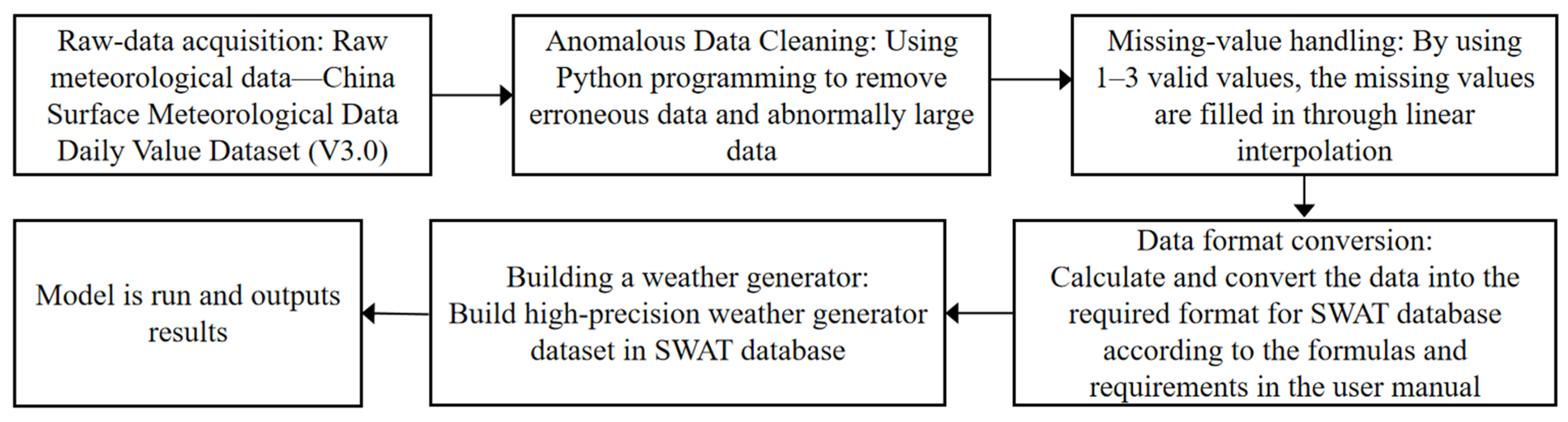
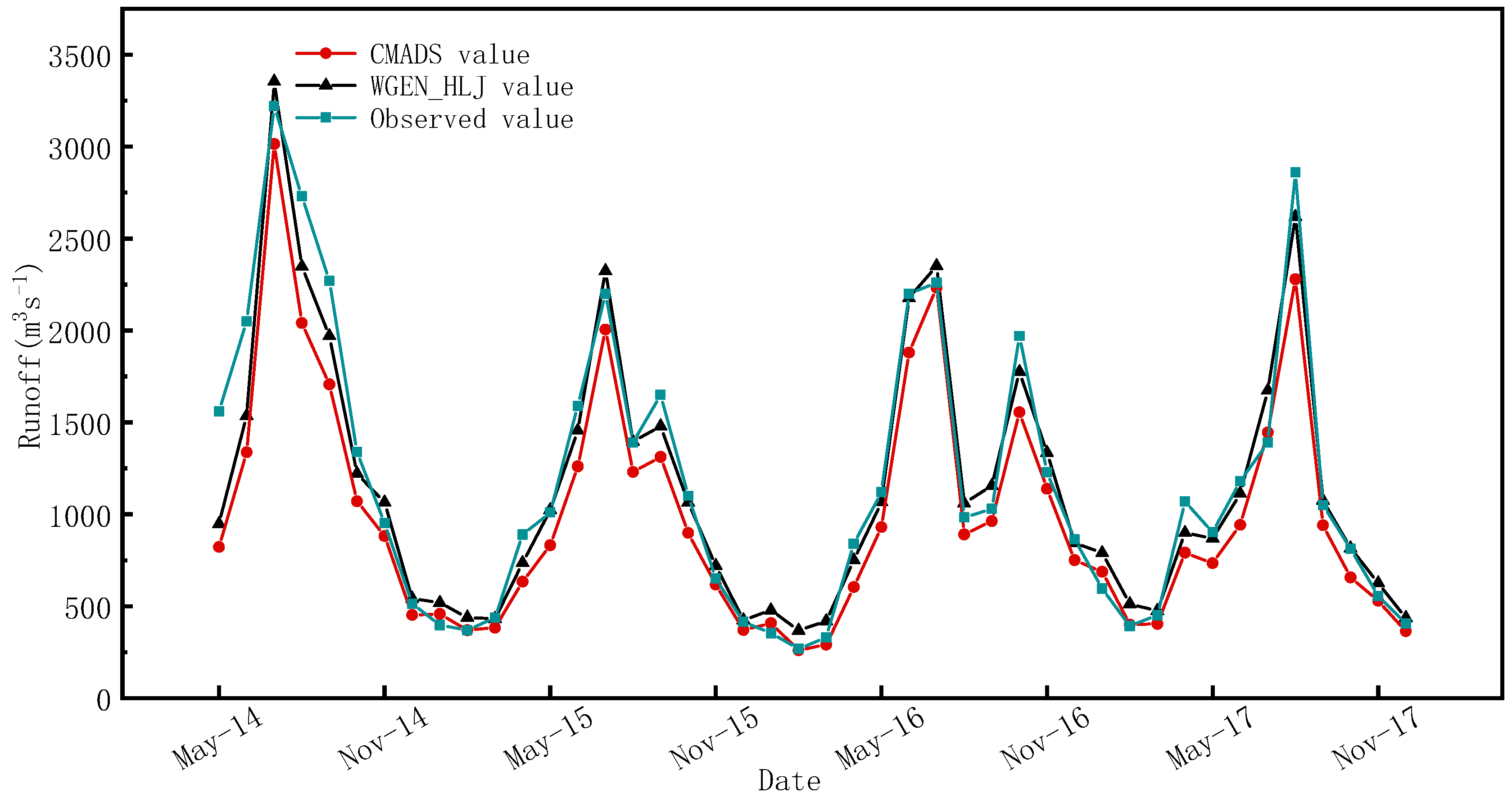
- Weather generator database: SWAT has an embedded WXGEN weather generator [37] that can generate meteorological data or supplement missing data, which can meet the simulation requirements for most areas in the United States. Currently, most scholars use the CFSR_World weather generator to create simulated meteorological data. It is based on the Climate Forecast System Reanalysis (CFSR) global meteorological dataset, which is a high-resolution meteorological reanalysis dataset provided by the National Oceanic and Atmospheric Administration (NOAA) of the United States. If constructing other weather generators, various calculation formulas must be used based on the observation data of meteorological stations to generate multi-year monthly average characteristics of various meteorological parameters. In this study, the China Surface Climate Daily Dataset, Version 3.0 (1951–2020), was used to construct a weather generator (WGEN_HLJ) suitable for the Heilongjiang region of China. The specific technical roadmap is shown in Figure 3.
- (2)
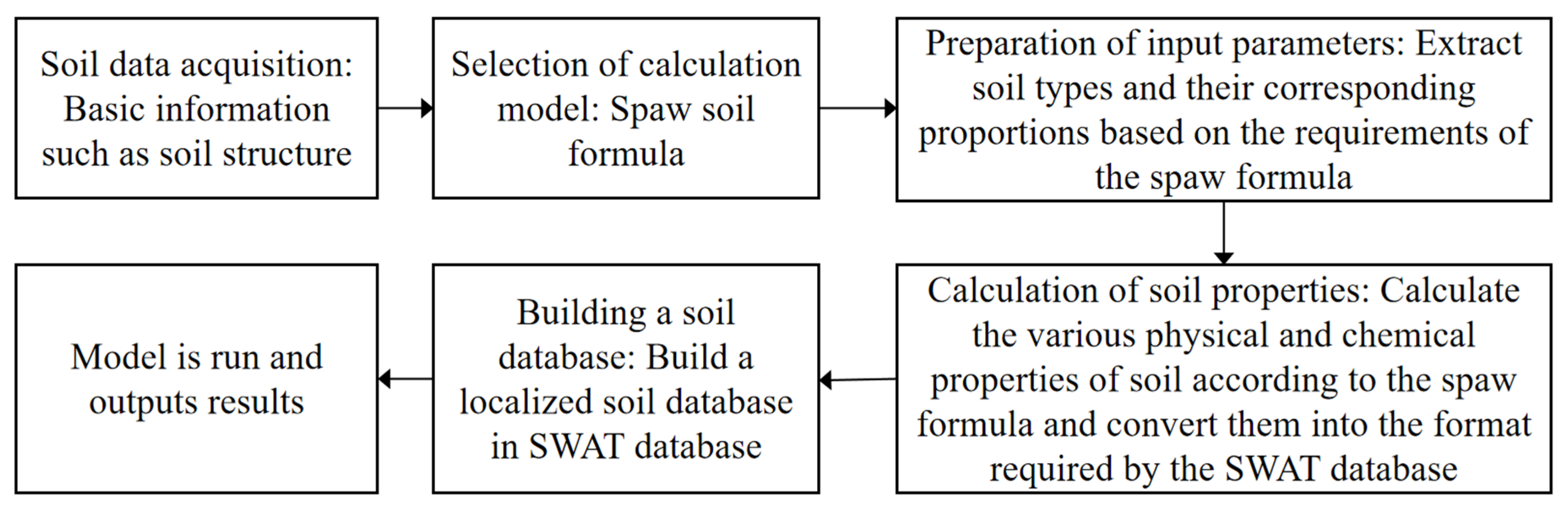
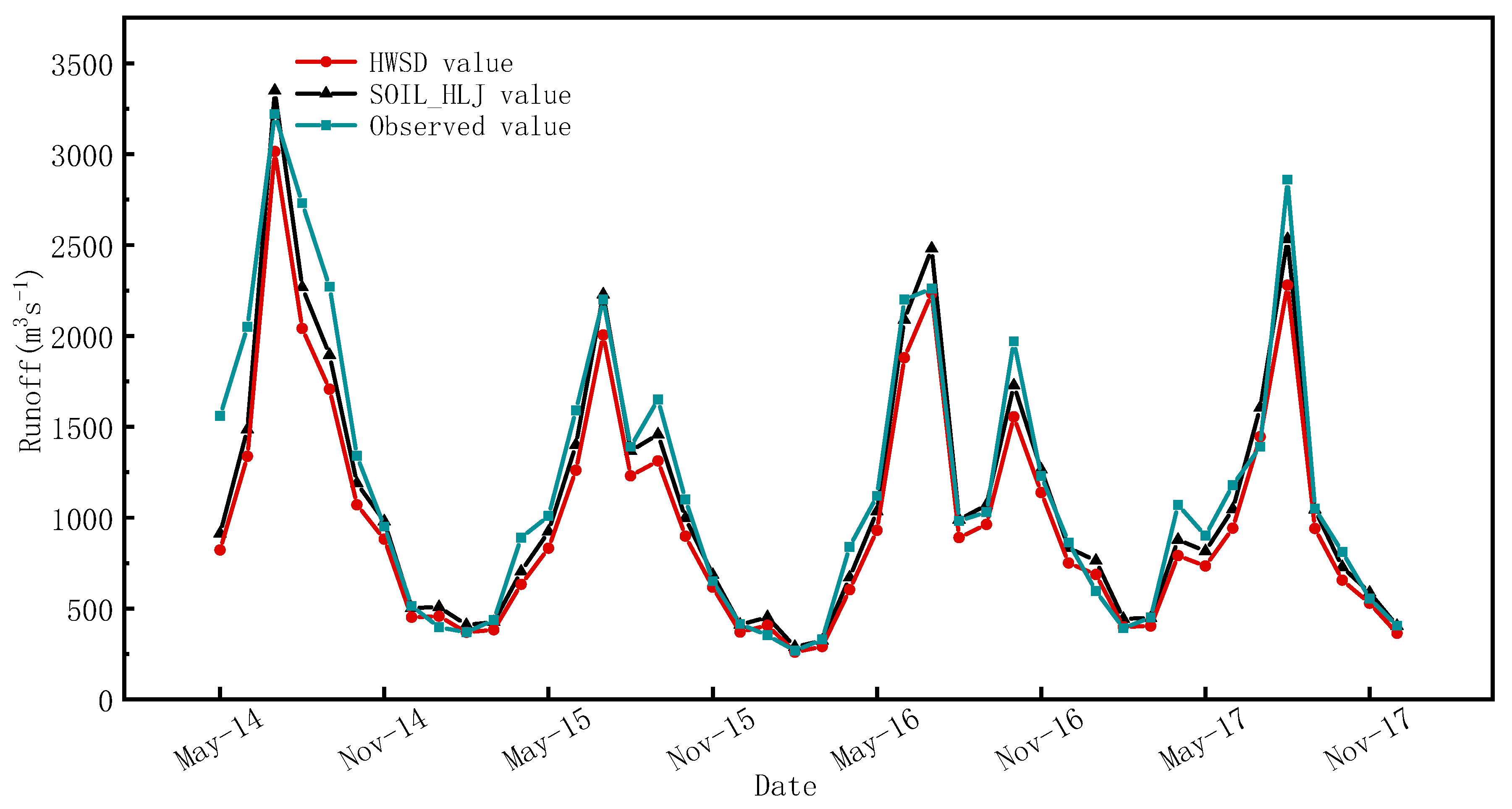
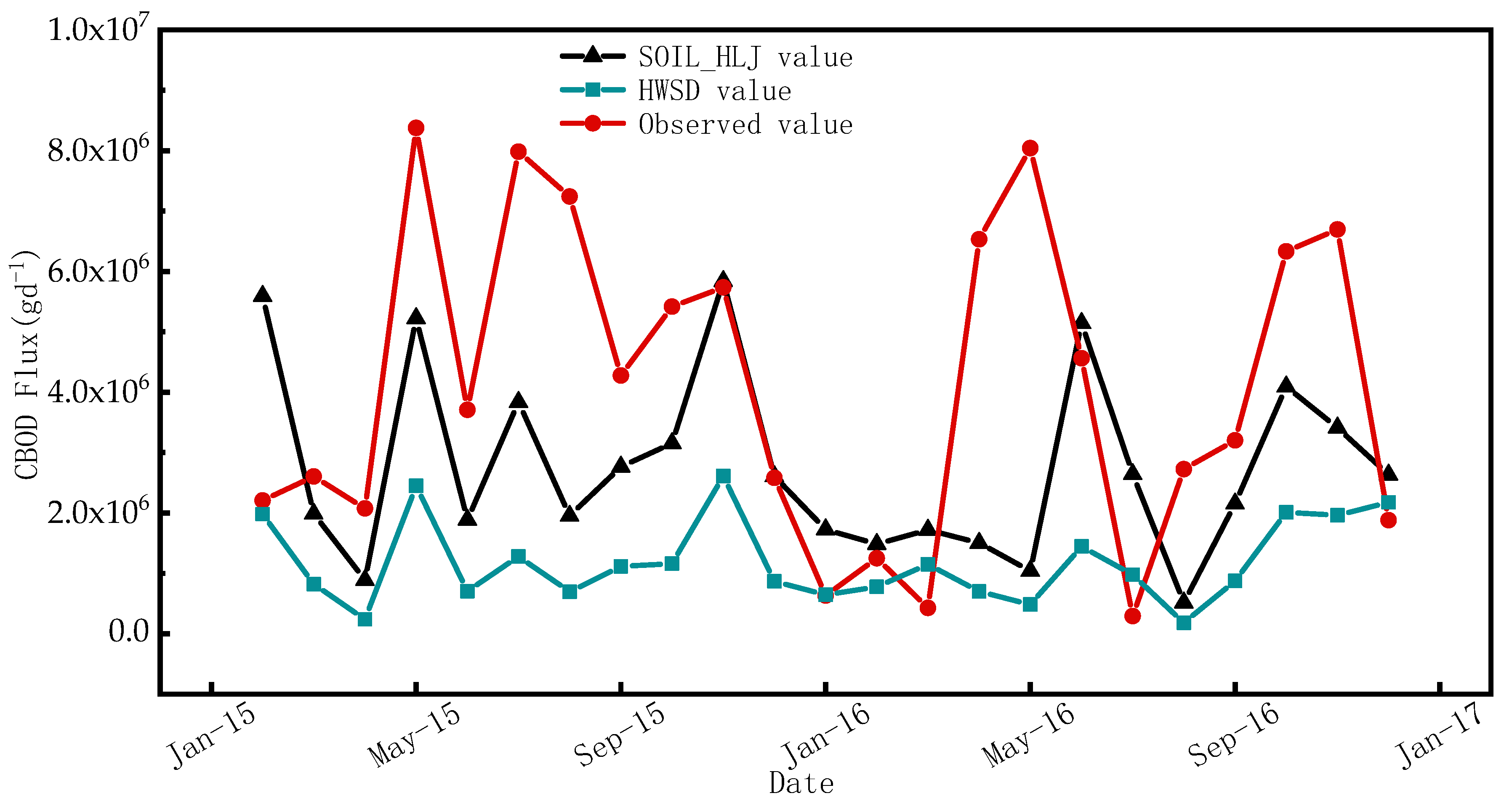
- Soil database: In calculating parameters such as soil available water capacity and saturated hydraulic conductivity, we utilized the SPAW soil characteristic calculation formula [38]. This formula, based on extensive soil science theory and abundant experimental data, can accurately calculate various soil properties and substance contents based on different soil types and environmental conditions. In this study, we used this formula to construct the soil attribute database SOIL_HLJ suitable for the Heilongjiang region of China. The specific technical roadmap for constructing the database is shown in Figure 4.
- (3)
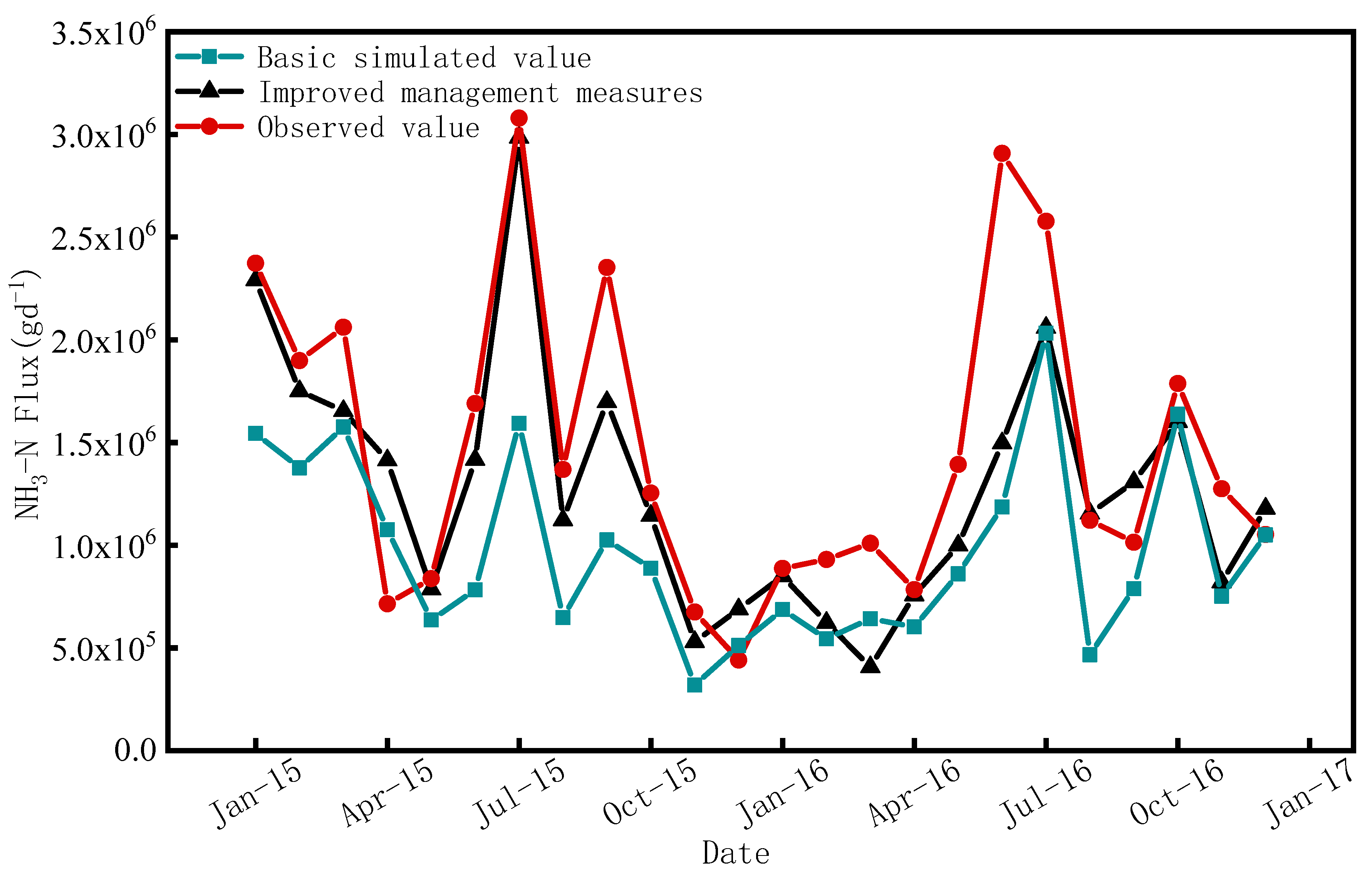
- Agricultural management measures: We reviewed historical data from the region over the past few years and actively sought opinions from relevant experts in the field and local farmers to extract the main types of crops and corresponding fertilization measures in the Heilongjiang region. Relevant collected data were incorporated into the model to calibrate it, improving its ability to simulate real-world scenarios (Table 2).
3. Results and Discussion
3.1. Hydrological Regime and Its Characteristics
3.2. Water Quality Concentration and Runoff Dynamics
3.3. Sensitivity of Runoff and Water Quality to Meteorological and Point Sources
3.3.1. Influence of Weather Generator Database on Runoff Simulation Accuracy
3.3.2. Influence of Soil Attribute Database on Runoff and Water Quality Simulation Accuracy
3.3.3. The Impact of Point-Source Completeness on the Accuracy of Water Quality Simulation
3.3.4. The Impact of Agricultural Management Measures on Water Quality
3.4. Implications for Prediction and Management
4. Conclusions
Author Contributions
Funding
Data Availability Statement
Conflicts of Interest
References
- Geissen, V.; Mol, H.; Klumpp, E.; Umlauf, G.; Nadal, M.; van der Ploeg, M.; van de Zee, S.E.A.T.; Ritsema, C.J. Emerging Pollutants in the Environment: A Challenge for Water Resource Management. Int. Soil Water Conserv. Res. 2015, 3, 57–65. [Google Scholar] [CrossRef]
- Jiang, S.; Qiu, S.; Zhou, J. Re-Examination of the Relationship between Agricultural Economic Growth and Non-Point Source Pollution in China: Evidence from the Threshold Model of Financial Development. Water 2020, 12, 2609. [Google Scholar] [CrossRef]
- Wang, S.; Rao, P.; Yang, D.; Tang, L. A Combination Model for Quantifying Non-Point Source Pollution Based on Land Use Type in a Typical Urbanized Area. Water 2020, 12, 729. [Google Scholar] [CrossRef]
- Chen, L.; Qi, X.; Zhang, X.; Li, Q.; Zhang, Y. Effect of Agricultural Land Use Changes on Soil Nutrient Use Efficiency in an Agricultural Area, Beijing, China. Chin. Geogr. Sci. 2011, 21, 392–402. [Google Scholar] [CrossRef]
- Ahmadi, M.; Ascough, J.C.; DeJonge, K.C.; Arabi, M. Multisite-Multivariable Sensitivity Analysis of Distributed Watershed Models: Enhancing the Perceptions from Computationally Frugal Methods. Ecol. Modell. 2014, 279, 54–67. [Google Scholar] [CrossRef]
- Arnold, J.G.; Srinivasan, R.; Muttiah, R.S.; Williams, J.R. Large Area Hydrologic Modeling and Assessment Part I: Model Development1. JAWRA J. Am. Water Resour. Assoc. 1998, 34, 73–89. [Google Scholar] [CrossRef]
- Arabi, M.; Frankenberger, J.R.; Engel, B.A.; Arnold, J.G. Representation of Agricultural Conservation Practices with SWAT. Hydrol. Process. 2008, 22, 3042–3055. [Google Scholar] [CrossRef]
- Neitsch, S.L.; Arnold, J.G.; Kiniry, J.R.; Williams, J.R. Soil and Water Assessment Tool: Theoretical Documentation, Version 2009; Texas Water Resources Institute Technical Report No. 406; Texas Water Resources Institute: College Station, TX, USA, 2011; pp. 1–647.
- Yalew, S.; van Griensven, A.; Ray, N.; Kokoszkiewicz, L.; Betrie, G.D. Distributed Computation of Large Scale SWAT Models on the Grid. Environ. Model. Softw. 2013, 41, 223–230. [Google Scholar] [CrossRef]
- Zhang, X.; Zhang, M. Modeling Effectiveness of Agricultural BMPs to Reduce Sediment Load and Organophosphate Pesticides in Surface Runoff. Sci. Total Environ. 2011, 409, 1949–1958. [Google Scholar] [CrossRef]
- Femeena, P.V.; Chaubey, I.; Aubeneau, A.; McMillan, S.K.; Wagner, P.D.; Fohrer, N. An Improved Process-Based Representation of Stream Solute Transport in the Soil and Water Assessment Tools. Hydrol. Process. 2020, 34, 2599–2611. [Google Scholar] [CrossRef]
- Haas, M.B.; Guse, B.; Fohrer, N. Assessing the Impacts of Best Management Practices on Nitrate Pollution in an Agricultural Dominated Lowland Catchment Considering Environmental Protection versus Economic Development. J. Environ. Manag. 2017, 196, 347–364. [Google Scholar] [CrossRef]
- Hoque, Y.M.; Raj, C.; Hantush, M.M.; Chaubey, I.; Govindaraju, R.S. How Do Land-Use and Climate Change Affect Watershed Health? A Scenario-Based Analysis. Water Qual. Expo. Health 2014, 6, 19–33. [Google Scholar] [CrossRef]
- Daniel, E.B.; Camp, J.V.; LeBoeuf, E.J.; Penrod, J.R.; Dobbins, J.P.; Abkowitz, M.D. Watershed Modeling and Its Applications; a State-of-the-Art Review. Open Hydrol. J. 2011, 5, 26–50. [Google Scholar] [CrossRef]
- Hoang, L.; Schneiderman, E.M.; Moore, K.E.B.; Mukundan, R.; Owens, E.M.; Steenhuis, T.S. Predicting Saturation-excess Runoff Distribution with a Lumped Hillslope Model: SWAT-HS. Hydrol. Process. 2017, 31, 2226–2243. [Google Scholar] [CrossRef]
- Behera, S.; Panda, R.K. Evaluation of Management Alternatives for an Agricultural Watershed in a Sub-Humid Subtropical Region Using a Physical Process Based Model. Agric. Ecosyst. Environ. 2006, 113, 62–72. [Google Scholar] [CrossRef]
- Lenhart, T.; Fohrer, N.; Frede, H.G. Effects of Land Use Changes on the Nutrient Balance in Mesoscale Catchments. Phys. Chem. Earth Parts A/B/C 2003, 28, 1301–1309. [Google Scholar] [CrossRef]
- Geza, M.; McCray, J.E. Effects of Soil Data Resolution on SWAT Model Stream Flow and Water Quality Predictions. J. Environ. Manag. 2008, 88, 393–406. [Google Scholar] [CrossRef]
- Ayana, E.K.; Dile, Y.T.; Narasimhan, B.; Srinivasan, R. Dividends in Flow Prediction Improvement Using High-Resolution Soil Database. J. Hydrol. Reg. Stud. 2019, 21, 159–175. [Google Scholar] [CrossRef]
- Kalnay, E.; Kanamitsu, M.; Kistler, R.; Collins, W.; Deaven, D.; Gandin, L.; Iredell, M.; Saha, S.; White, G.; Woollen, J.; et al. The NCEP/NCAR 40-Year Reanalysis Project. Bull. Am. Meteorol. Soc. 1996, 77, 437–471. [Google Scholar] [CrossRef]
- Yu, C.; Huang, X.; Chen, H.; Godfray, H.C.J.; Wright, J.S.; Hall, J.W.; Gong, P.; Ni, S.; Qiao, S.; Huang, G.; et al. Managing Nitrogen to Restore Water Quality in China. Nature 2019, 567, 516–520. [Google Scholar] [CrossRef]
- Gao, Y.; Tian, Y.; Zhan, W.; Li, L.; Sun, H.; Zhao, T.; Zhang, H.; Meng, Y.; Li, Y.; Liu, T.; et al. Characterizing Legacy Nitrogen-Induced Time Lags in Riverine Nitrogen Reduction for the Songhuajiang River Basin: Source Analysis, Spatio-Seasonal Patterns, and Impacts on Future Water Quality Improvement. Water Res. 2023, 242, 120292. [Google Scholar] [CrossRef]
- Guo, H.; Hu, Q.; Jiang, T. Annual and Seasonal Streamflow Responses to Climate and Land-Cover Changes in the Poyang Lake Basin, China. J. Hydrol. 2008, 355, 106–122. [Google Scholar] [CrossRef]
- Singh, A.P.; Dhadse, K.; Ahalawat, J. Managing Water Quality of a River Using an Integrated Geographically Weighted Regression Technique with Fuzzy Decision-Making Model. Environ. Monit. Assess. 2019, 191, 378. [Google Scholar] [CrossRef]
- Borah, D.; Bera, M. Watershed-Scale Hydrologic and Nonpoint-Source Pollution Models: Review of Mathematical Bases. Trans. ASAE 2003, 46, 1553–1566. [Google Scholar] [CrossRef]
- Jeyrani, F.; Morid, S.; Srinivasan, R. Assessing Basin Blue–Green Available Water Components under Different Management and Climate Scenarios Using SWAT. Agric. Water Manag. 2021, 256, 107074. [Google Scholar] [CrossRef]
- Ouyang, W.; Song, K.; Wang, X.; Hao, F. Non-Point Source Pollution Dynamics under Long-Term Agricultural Development and Relationship with Landscape Dynamics. Ecol. Indic. 2014, 45, 579–589. [Google Scholar] [CrossRef]
- Arnold, J.G.; Fohrer, N. SWAT2000: Current Capabilities and Research Opportunities in Applied Watershed Modelling. Hydrol. Process. 2005, 19, 563–572. [Google Scholar] [CrossRef]
- Afonso De Oliveira Serrão, E.; Silva, M.T.; Ferreira, T.R.; Paiva De Ataide, L.C.; Assis Dos Santos, C.; Meiguins De Lima, A.M.; de Paulo Rodrigues Da Silva, V.; de Assis Salviano De Sousa, F.; Cardoso Gomes, D.J. Impacts of Land Use and Land Cover Changes on Hydrological Processes and Sediment Yield Determined Using the SWAT Model. Int. J. Sediment Res. 2022, 37, 54–69. [Google Scholar] [CrossRef]
- Shokrana, M.S.B.; Ghane, E.; Qi, Z. Calibration and Validation of RZWQM2-P Model to Simulate Phosphorus Loss in a Clay Loam Soil in Michigan. J. ASABE 2023, 66, 1–12. [Google Scholar] [CrossRef]
- Yang, J.; Reichert, P.; Abbaspour, K.C.; Xia, J.; Yang, H. Comparing Uncertainty Analysis Techniques for a SWAT Application to the Chaohe Basin in China. J. Hydrol. 2008, 358, 1–23. [Google Scholar] [CrossRef]
- Moriasi, D.N. Model Evaluation Guidelines for Systematic Quantification of Accuracy in Watershed Simulations. Trans. ASABE 2007, 50, 885–900. [Google Scholar] [CrossRef]
- MEE; NBS; MOA Bulletin on the First National General Survey of Pollution Sources (Fiscal Year:2007) 2010, 2021. Available online: https://www.mee.gov.cn/gkml/hbb/bgg/201002/t20100210_185698.htm (accessed on 12 December 2018).
- NBS National Statistical Yearbook (2000–2019) 2020, 2021. Available online: https://www.stats.gov.cn/sj/ndsj/ (accessed on 12 December 2018).
- MEE; NBS; MOA Bulletin on the Second National General Survey of Pollution Sources (Fiscal Year: 2017) 2020, 2021. Available online: https://www.mee.gov.cn/xxgk2018/xxgk/xxgk01/202006/t20200610_783547.html (accessed on 12 December 2018).
- Xie, M.; Duan, H.; Kang, P.; Qiao, Q.; Bai, L. Toward an Ecological Civilization: China’s Progress as Documented by the Second National General Survey of Pollution Sources. Engineering 2021, 7, 1336–1341. [Google Scholar] [CrossRef]
- Williams, J.R.; Dyke, P.T.; Jones, C.A. Epic—A Model for Assessing the Effects of Erosion on Soil Productivity1 1Paper Presented at the Third International Conference on State-of-the-Art in Ecological Modelling, Colorado State University, May 24–28, 1982. In Analysis of Ecological Systems; Lauenroth, W.K., Skogerboe, G.V., Flug, M., Eds.; Developments in Environmental Modelling; Elsevier: Amsterdam, The Netherlands, 1983; Volume 5, pp. 553–572. [Google Scholar]
- Saxton, K.E.; Rawls, W.J.; Romberger, J.S.; Papendick, R.I. Estimating Generalized Soil–Water Characteristics from Texture. Soil Sci. Soc. Am. J. 1986, 50, 1031–1036. [Google Scholar] [CrossRef]
- Xu, Z.X.; Zhao, F.F.; Li, J.Y. Response of Streamflow to Climate Change in the Headwater Catchment of the Yellow River Basin. Quat. Int. 2009, 208, 62–75. [Google Scholar] [CrossRef]
- Hu, N.; Shu, K.; Zhang, Y.; Alfonso, L.; Li, C.; Zheng, T. Prediction of Natural Runoff in China Based on Multi-Scenario Climate Models with Self-Attention Neural Networks. Water Res. 2025, 282, 123768. [Google Scholar] [CrossRef]






| Dataset Name | Data Type | Data Source | Data Collection Date | Spatial Resolution |
|---|---|---|---|---|
| ASTER GDEM V2 | Digital Elevation Model | Geographic Spatial Data Cloud | 2015 | 30 m |
| Global Land30 | Land Use Data | National Geographic Information Resource Catalog Service System | 2010 | 30 m |
| HWSD_Soil | Soil Data | Food and Agriculture Organization (FAO) | 2013 | 1 km |
| Hydrological Data of Heilongjiang Basin | Hydrological Data | China Hydrological Yearbook | 2008–2016 | |
| River Network Data of Heilongjiang Province | River Network Data | Heilongjiang Province Water Resources and Hydropower Design Institute | 2017 | |
| Water Quality Monitoring Data of Heilongjiang Province | Monitoring Data | Heilongjiang Province Water Resources and Hydropower Design Institute | 2014–2018 | |
| Monitoring Sections of the 14th Five-Year Plan Rivers | Monitoring Sections | Heilongjiang Provincial Monitoring Center Station | 2019 | |
| Statistical Yearbook of Heilongjiang Province | Statistical Data | Heilongjiang Provincial Bureau of Statistics | 2018 | |
| Water Function Classification of Heilongjiang Province | Vector Data | Heilongjiang Province Water Resources and Hydropower Design Institute | 2017 | |
| Second Pollution Census Data | Census Data | Heilongjiang Provincial Department of Ecology and Environment | 2017 | |
| China Surface Meteorological Data Daily Value Dataset (V3.0) | Meteorological Data | China Meteorological Administration website | 2020 |
| Crop Types | Fertilizer | Fertilization Time | Fertilizer Depth | Fertilizer Quality of N (kg/ha) | Fertilizer Quality of P (kg/ha) | Fertilizer Quality of K (kg/ha) |
|---|---|---|---|---|---|---|
| Soybean | Base | 30 April | 5 cm | 3 | 4 | 3 |
| Non-Additional | \ | \ | \ | \ | ||
| Rice | Base | 30 April | 10 cm | 5 | 5 | 4 |
| Additional | 30 May | 3 | 0 | 0 | ||
| Corn | Base | 30 April | 5 cm | 4 | 5 | 2 |
| Additional | 10 May | 5 | 0 | 2 |
| NSE | Initial Conditions | Self-Built Weather Generator Database | Soil Physicochemical Property Database | Point Source | Agricultural Management Measures | Using All Measures |
|---|---|---|---|---|---|---|
| Runoff | 0.923 | 0.985 | 0.945 | 0.923 | 0.923 | 0.988 |
| NH3-N | 0.852 | 0.898 | 0.930 | 0.930 | 0.930 | |
| CBOD | 0.758 | 0.812 | 0.885 | 0.758 | 0.902 |
Disclaimer/Publisher’s Note: The statements, opinions and data contained in all publications are solely those of the individual author(s) and contributor(s) and not of MDPI and/or the editor(s). MDPI and/or the editor(s) disclaim responsibility for any injury to people or property resulting from any ideas, methods, instructions or products referred to in the content. |
© 2026 by the authors. Licensee MDPI, Basel, Switzerland. This article is an open access article distributed under the terms and conditions of the Creative Commons Attribution (CC BY) license.
Share and Cite
Zhang, Z.; Zhang, H.; Yu, X.; Yang, C.; Zheng, T. A Novel Weather Generator and Soil Attribute Database for SWAT to Improve the Simulation Accuracy in the Heilongjiang Region of China. Water 2026, 18, 389. https://doi.org/10.3390/w18030389
Zhang Z, Zhang H, Yu X, Yang C, Zheng T. A Novel Weather Generator and Soil Attribute Database for SWAT to Improve the Simulation Accuracy in the Heilongjiang Region of China. Water. 2026; 18(3):389. https://doi.org/10.3390/w18030389
Chicago/Turabian StyleZhang, Zhihao, Haorui Zhang, Xiaoying Yu, Chunyan Yang, and Tong Zheng. 2026. "A Novel Weather Generator and Soil Attribute Database for SWAT to Improve the Simulation Accuracy in the Heilongjiang Region of China" Water 18, no. 3: 389. https://doi.org/10.3390/w18030389
APA StyleZhang, Z., Zhang, H., Yu, X., Yang, C., & Zheng, T. (2026). A Novel Weather Generator and Soil Attribute Database for SWAT to Improve the Simulation Accuracy in the Heilongjiang Region of China. Water, 18(3), 389. https://doi.org/10.3390/w18030389