Adaptive Time-Lagged Ensemble for Short-Range Streamflow Prediction Using WRF-Hydro and LDAPS


Abstract
1. Introduction
2. Materials and Methods
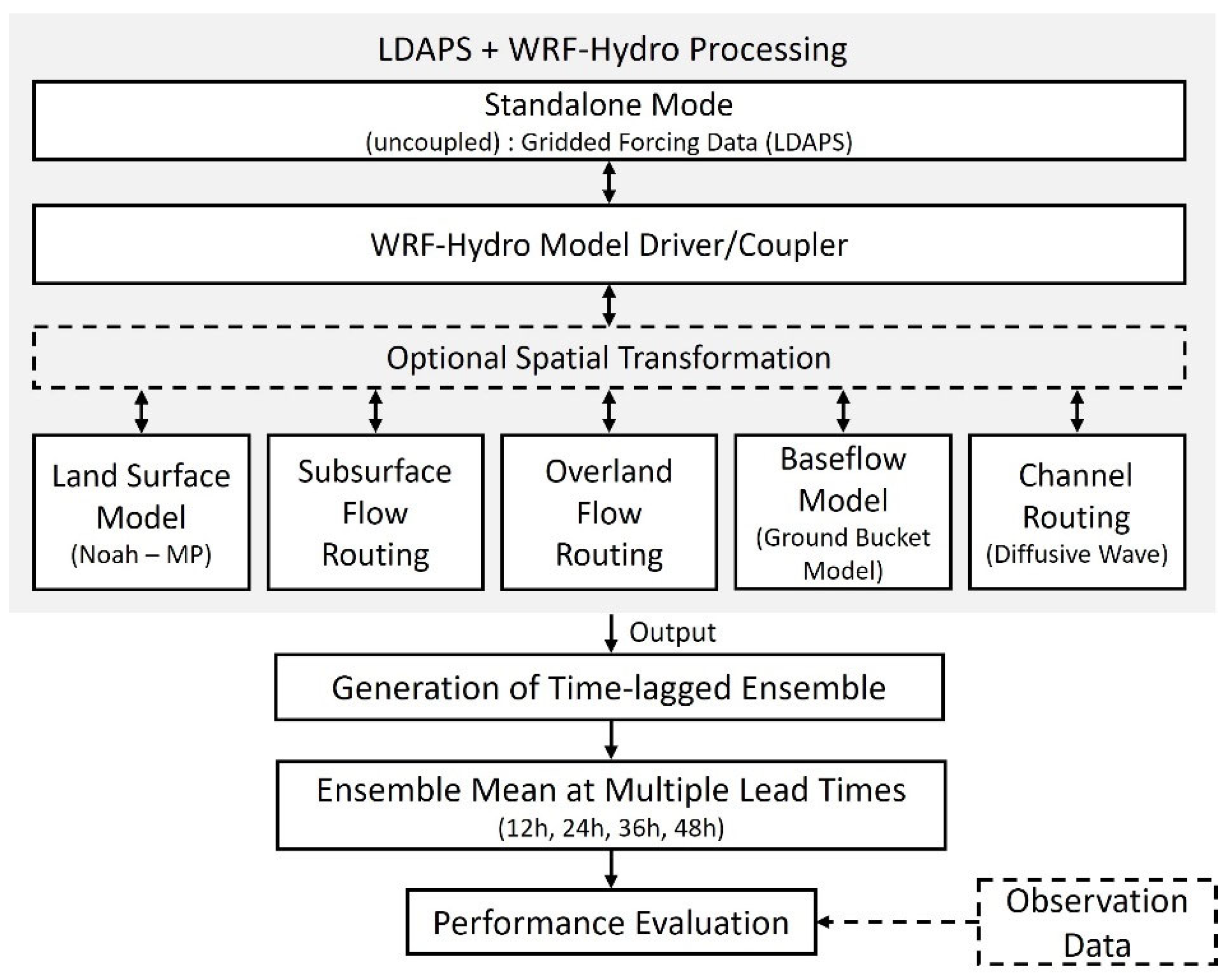
2.1. Hydrological Model
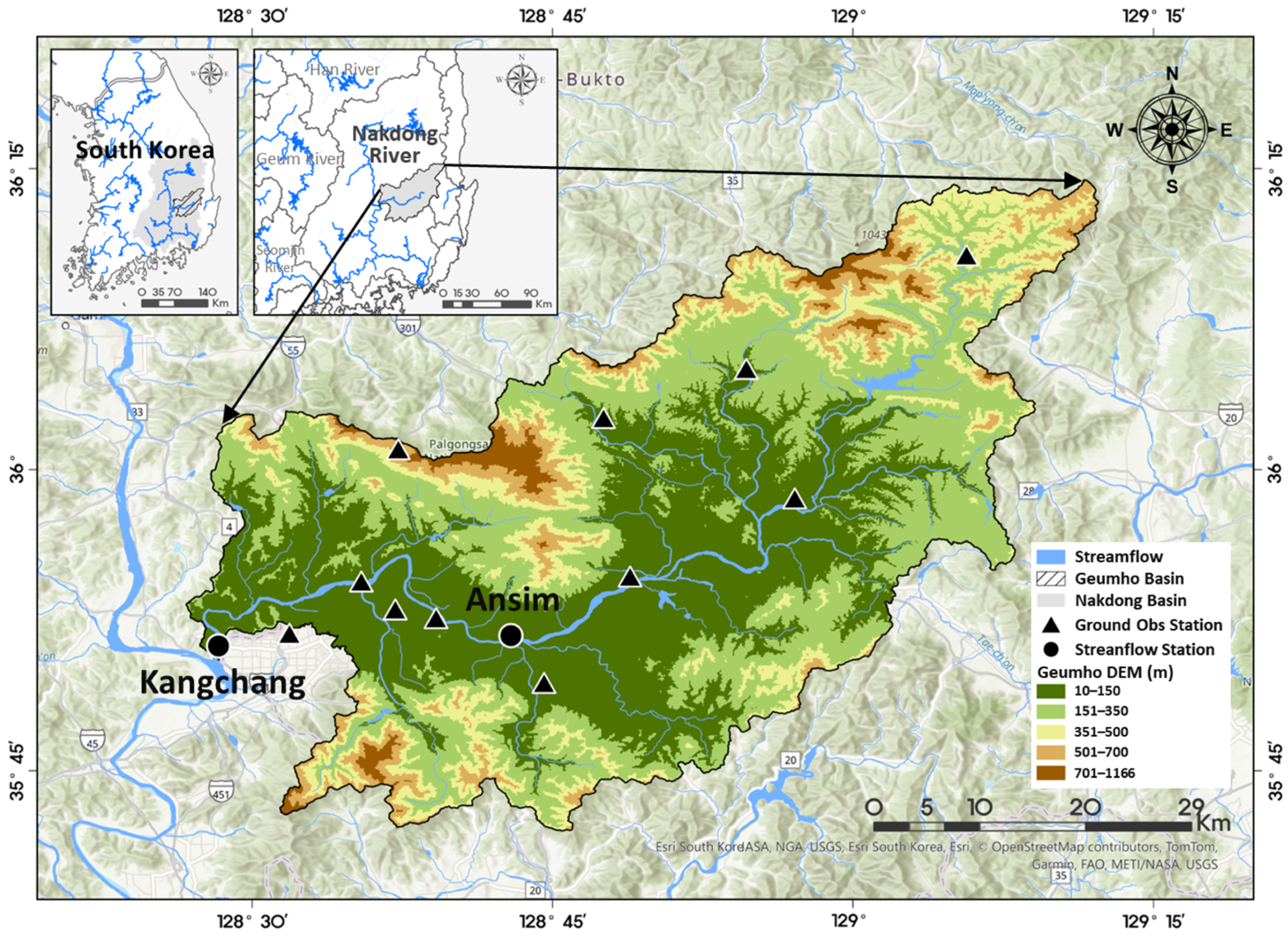
2.2. Study Area and Data
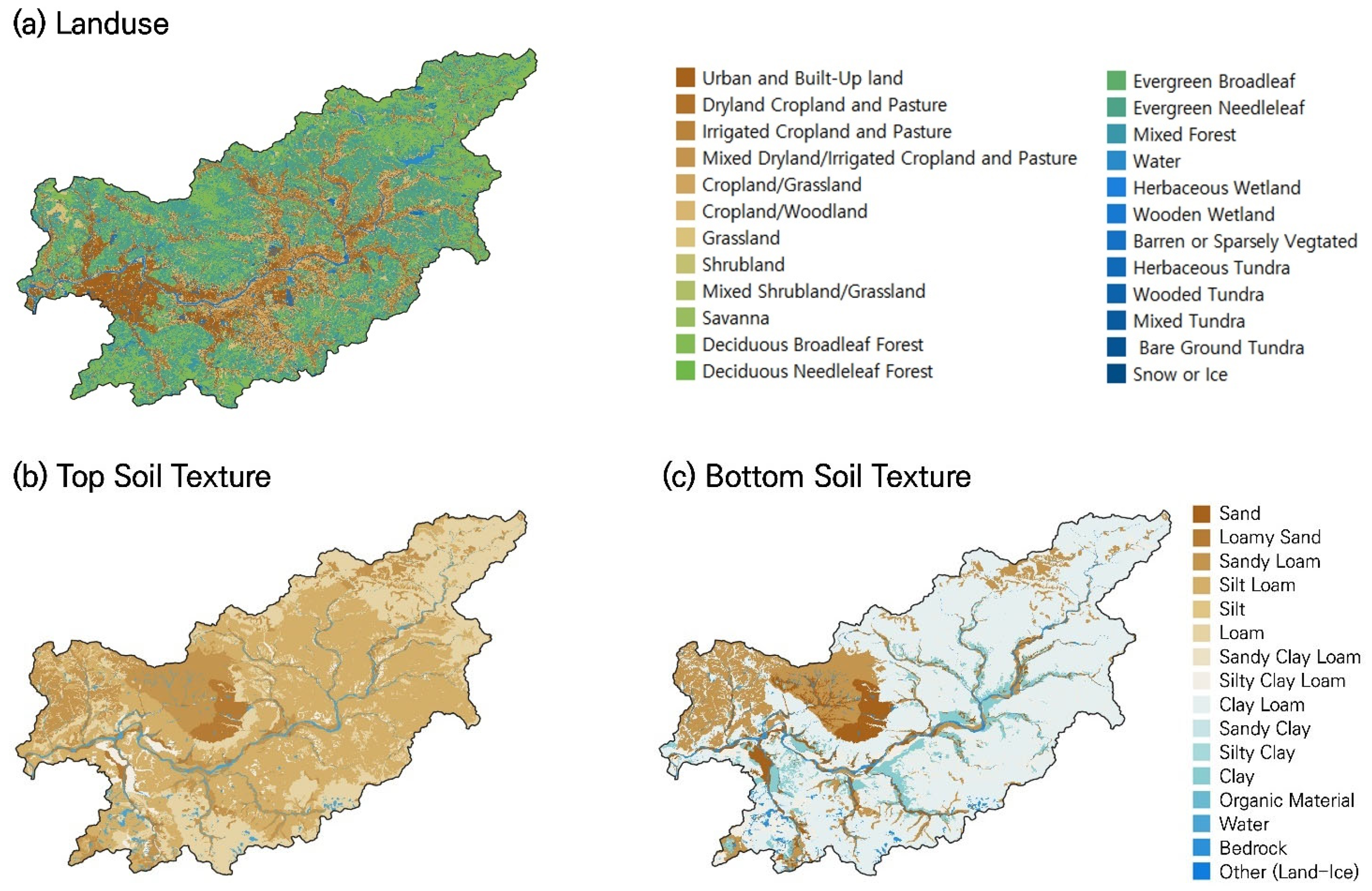
2.2.1. Topographic and Land-Use Data
2.2.2. Meteorological Data
2.3. Ensemble Forecast Configuration
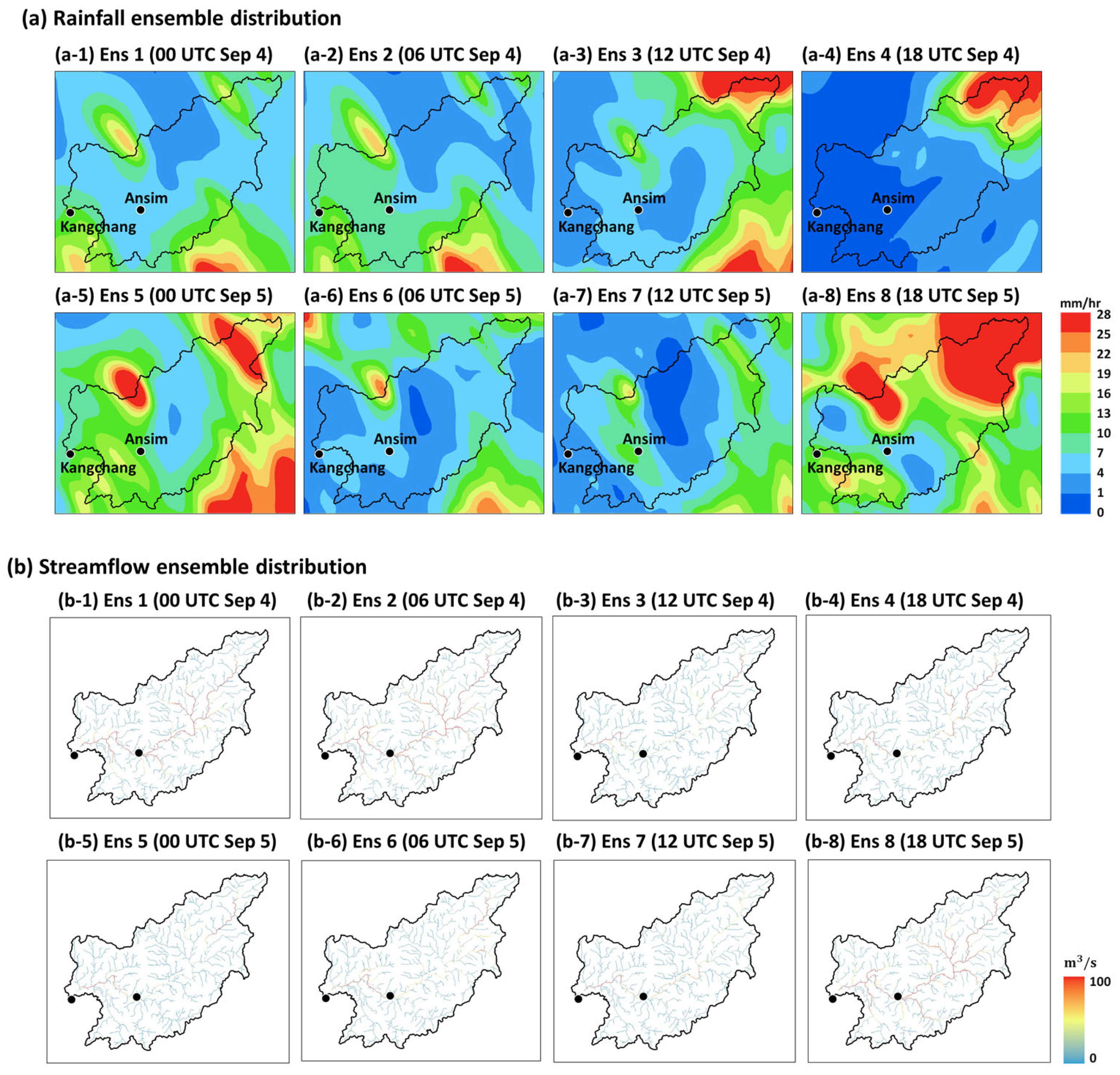
2.3.1. Time-Lagged Ensemble Methodology
2.3.2. Ensemble Configuration Across Lead Time
2.4. Prediction Evaluation Metrics
3. Results
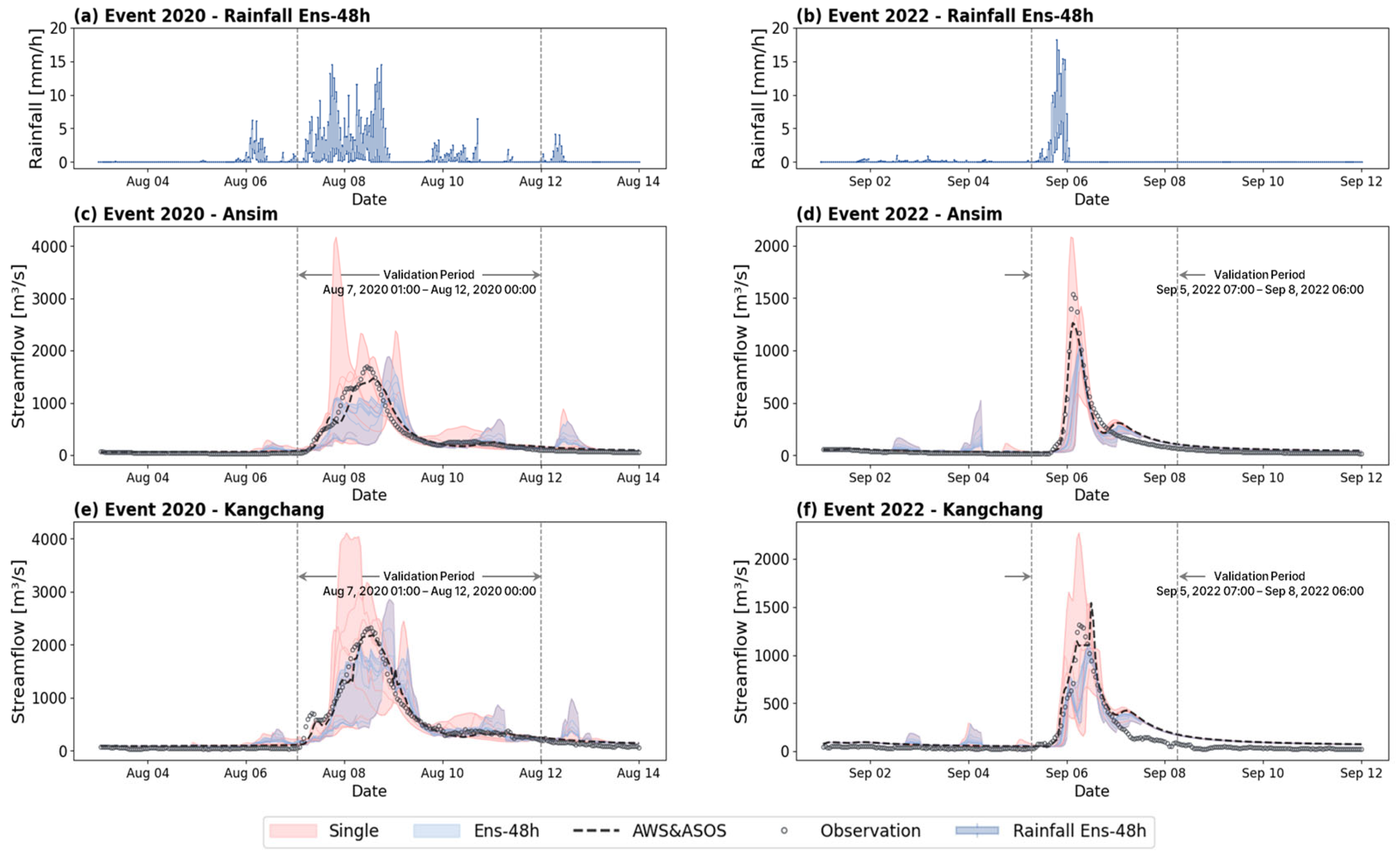
3.1. Comparison of Streamflow Prediction Time Series
3.2. Analysis of Ensemble Forecast Performance by Lead Time
3.2.1. Rainfall Prediction Analysis
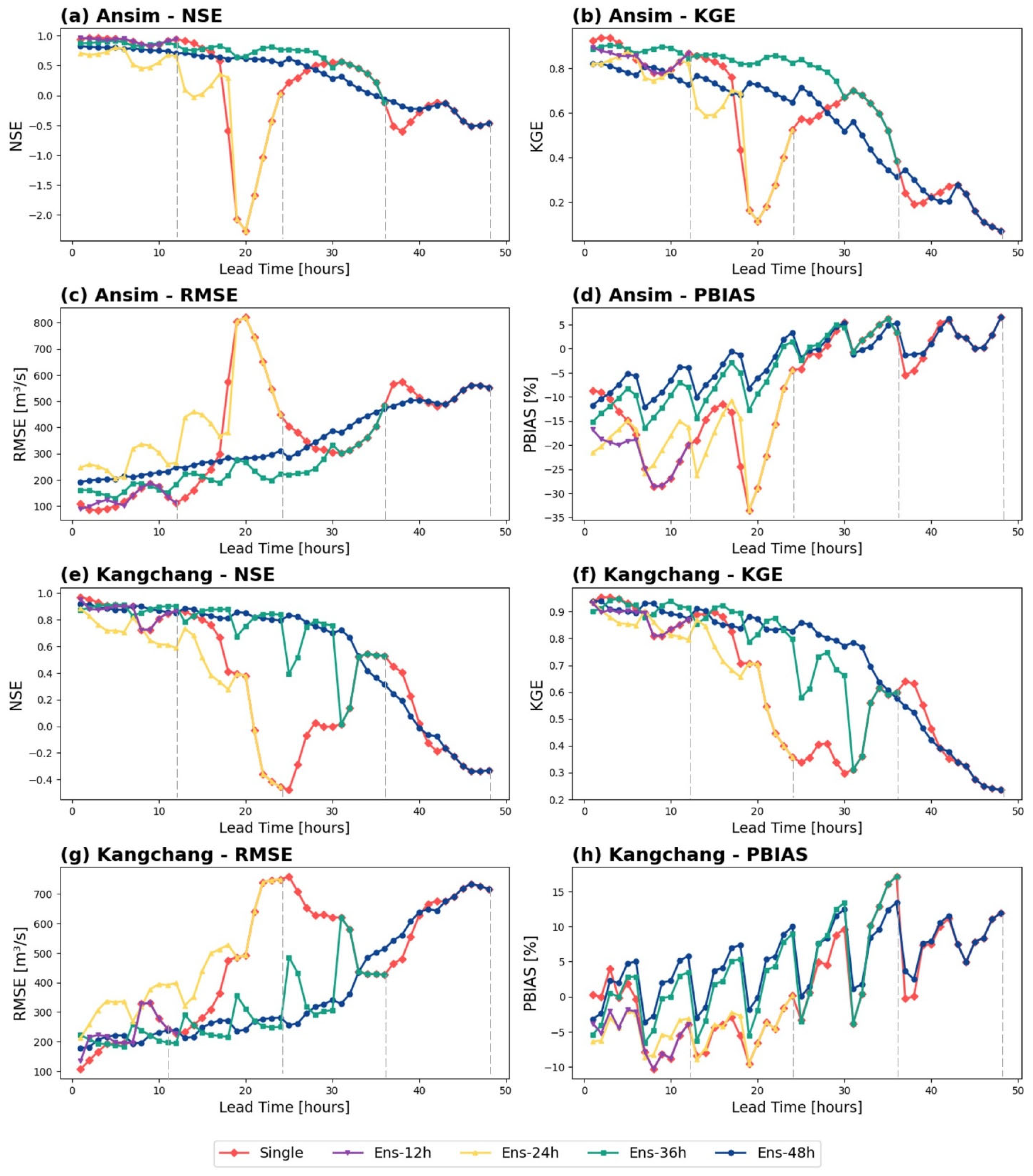
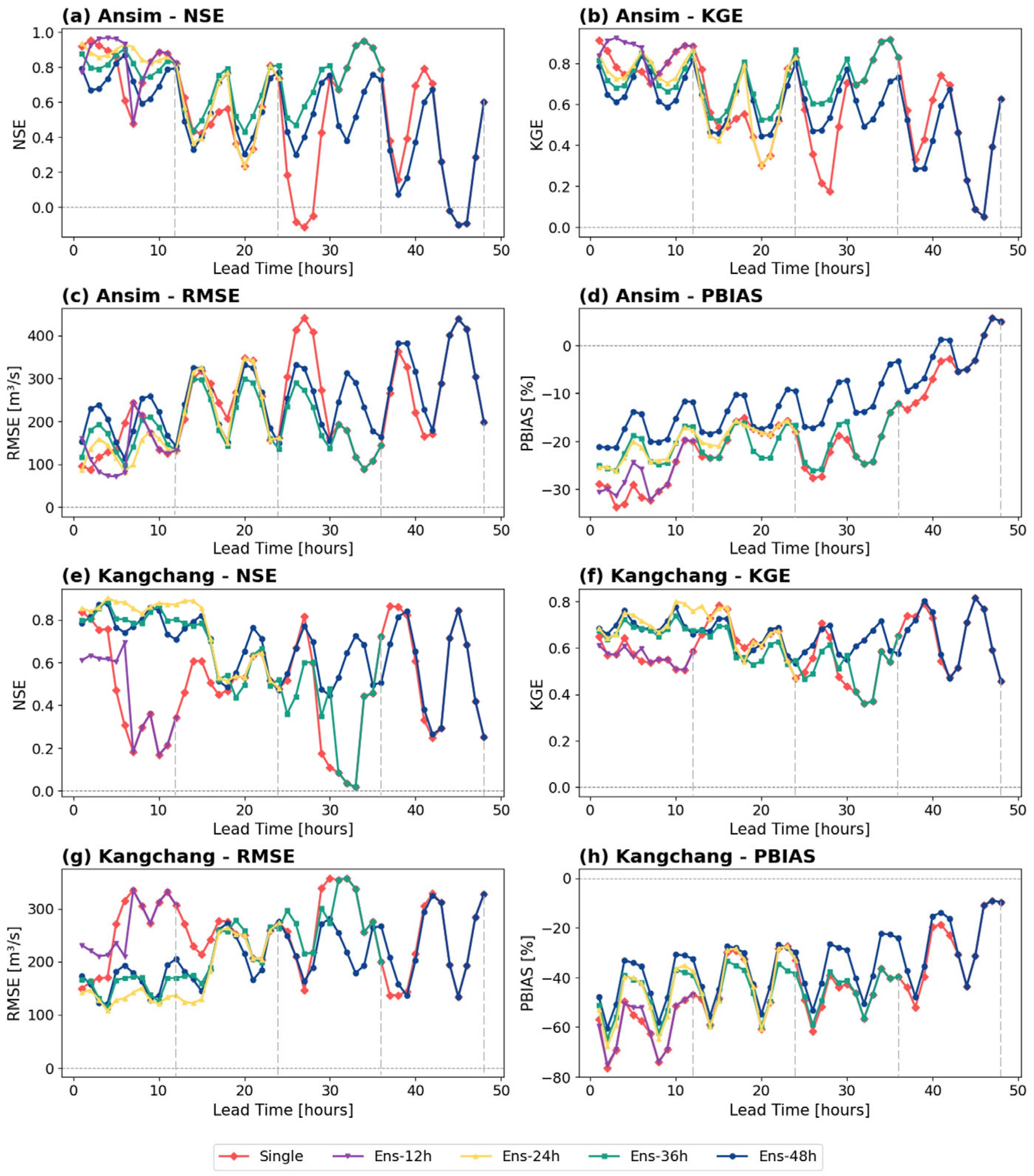
3.2.2. Adaptive Ensemble Prediction Performance Analysis
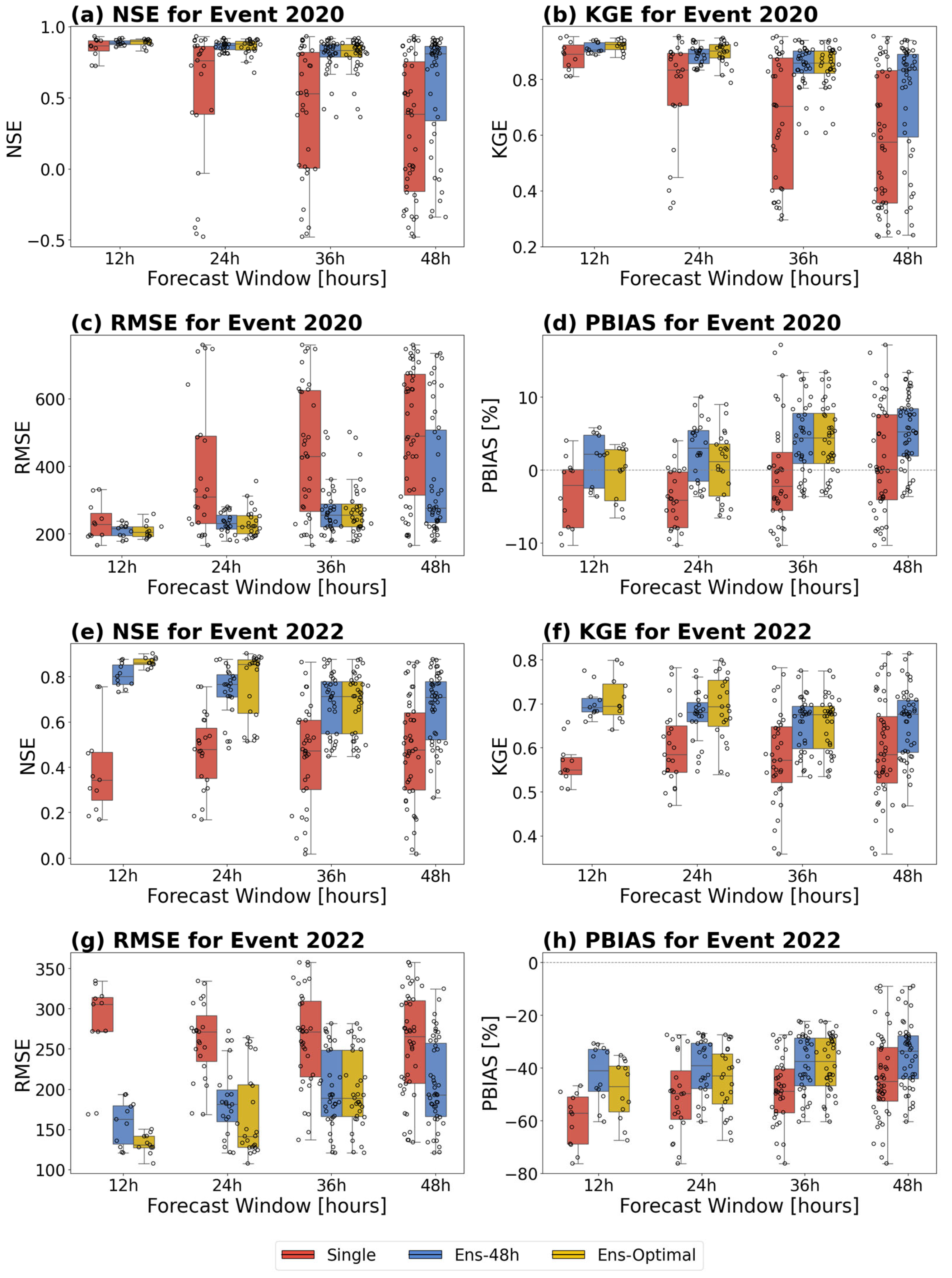
3.2.3. Statistical Analysis of Adaptive Performance
4. Discussion
5. Conclusions
- Time-lagged ensemble predictions outperformed single predictions across lead times. For Event 2020, the 48 h ensemble improved NSE from 0.39 to 0.81 (108% increase). For Event 2022, the 24 h ensemble raised NSE from 0.48 to 0.85 (77% increase). RMSE decreased by 48% from 271.32 to 141.26 m3/s for Event 2022 at optimal configurations.
- Adaptive selection of ensemble configurations further enhanced prediction accuracy beyond the general improvements achieved by ensemble averaging alone. While fixed configurations like Ens-48h already enhanced performance over single forecasts, optimally selected configurations (e.g., Ens-24h for Event 2022) improved NSE by an additional 11.8%. PBIAS also showed meaningful bias correction, from 49.8% to −43.1% for Event 2022 and approaching zero (0.00% to 1.14%) for Event 2020 under optimal conditions.
- Optimal ensemble configurations depended significantly on event characteristics; Event 2020 performed best under longer lead times (Ens-36h and Ens-48h), whereas Event 2022, influenced by rapidly changing meteorological conditions, showed optimal results at mid-range lead times (Ens-24h). These results highlight the importance of aligning ensemble strategies with the temporal dynamics of rainfall events.
Supplementary Materials
Author Contributions
Funding
Data Availability Statement
Conflicts of Interest
Abbreviations
| NWP | Numerical Weather Prediction |
| NWM | National Water Model |
| LDAPS | Local Data Assimilation and Prediction System |
| WRF | Weather Research and Forecasting model |
| WRF-Hydro | WRF-Hydrological modeling system |
| NCAR | National Center for Atmospheric Research |
| Noah-MP | Noah-Multiparameterization |
| DEM | Digital Elevation Model |
| WPS | WRF Preprocessing System |
| SRTM | Shuttle Radar Topography Mission |
| UTC | Coordinated Universal Time |
| UM | Unified Model |
| GFS | Global Forecast System |
| LSPR | Large-Scale Precipitation Rate |
| AWS | Automatic Weather System |
| ASOS | Automated Synoptic Observing System |
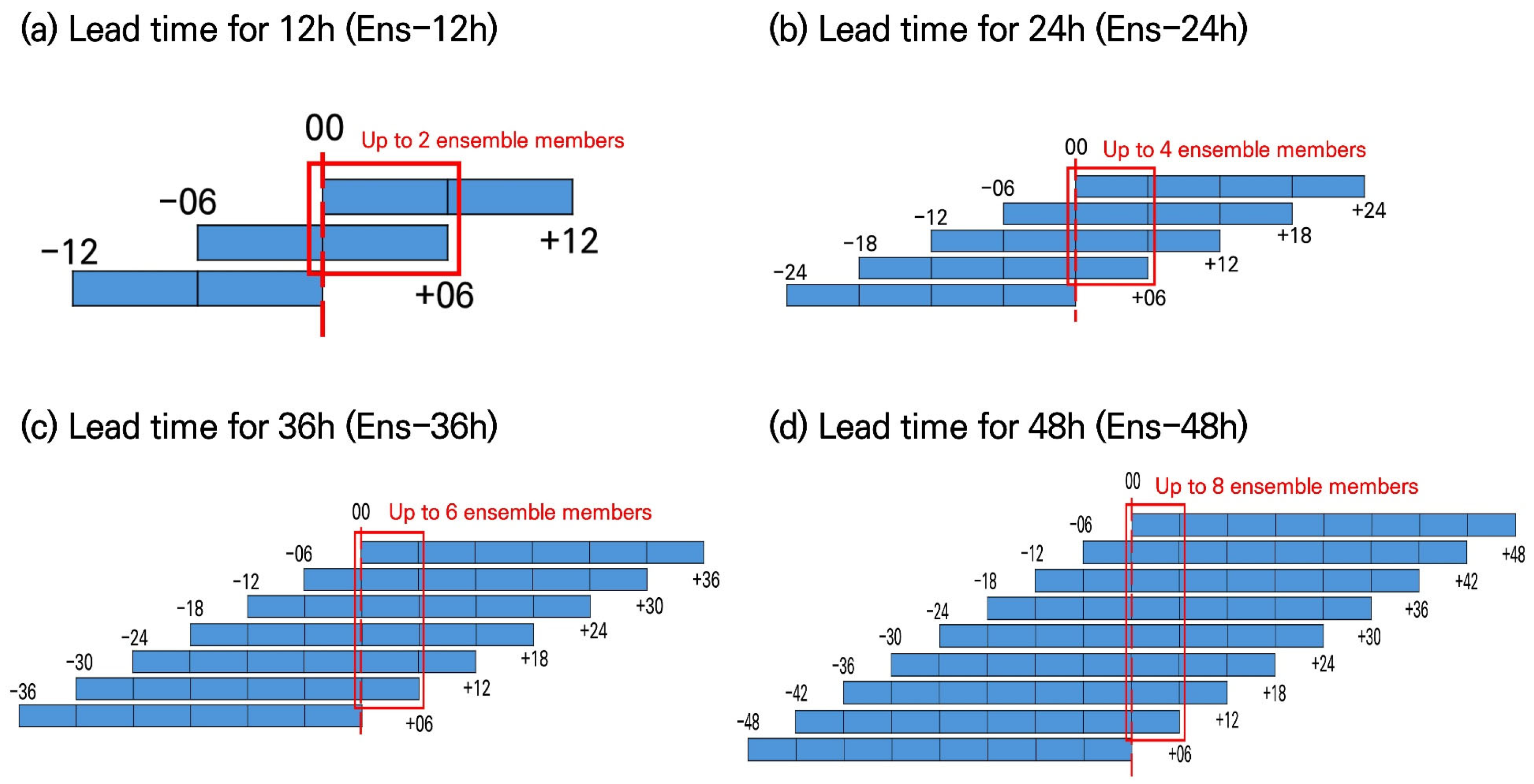
| Ens-12h | 12 h lead time interval ensemble prediction |
| Ens-24h | 24 h lead time interval ensemble prediction |
| Ens-36h | 36 h lead time interval ensemble prediction |
| Ens-48h | 48 h lead time interval ensemble prediction |
| NSE | Nash-Sutcliffe Efficiency |
| KGE | Kling-Gupta Efficiency |
| RMSE | Root Mean Square Error |
| PBIAS | Percent Bias |
References
- Cloke, H.L.; Pappenberger, F. Ensemble Flood Forecasting: A Review. J. Hydrol. 2009, 375, 613–626. [Google Scholar] [CrossRef]
- Zappa, M.; Beven, K.J.; Bruen, M.; Cofiño, A.S.; Kok, K.; Martin, E.; Nurmi, P.; Orfila, B.; Roulin, E.; Schröter, K.; et al. Propagation of Uncertainty from Observing Systems and NWP into Hydrological Models: COST-731 Working Group 2. Atmos. Sci. Lett. 2010, 11, 83–91. [Google Scholar] [CrossRef]
- Beven, K.; Binley, A. The Future of Distributed Models: Model Calibration and Uncertainty Prediction. Hydrol. Process. 1992, 6, 279–298. [Google Scholar] [CrossRef]
- Krzysztofowicz, R. Bayesian Theory of Probabilistic Forecasting via Deterministic Hydrologic Model. Water Resour. Res. 1999, 35, 2739–2750. [Google Scholar] [CrossRef]
- Gupta, H.V.; Kling, H.; Yilmaz, K.K.; Martinez, G.F. Decomposition of the Mean Squared Error and NSE Performance Criteria: Implications for Improving Hydrological Modelling. J. Hydrol. 2009, 377, 80–91. [Google Scholar] [CrossRef]
- Pappenberger, F.; Beven, K.J. Ignorance Is Bliss: Or Seven Reasons Not to Use Uncertainty Analysis. Water Resour. Res. 2006, 42, W05302. [Google Scholar] [CrossRef]
- Verkade, J.S.; Werner, M.G.F. Estimating the Benefits of Single Value and Probability Forecasting for Flood Warning. Hydrol. Earth Syst. Sci. 2011, 15, 3751–3765. [Google Scholar] [CrossRef]
- Yucel, I.; Onen, A.; Yilmaz, K.K.; Gochis, D.J. Calibration and Evaluation of a Flood Forecasting System: Utility of Numerical Weather Prediction Model, Data Assimilation and Satellite-Based Rainfall. J. Hydrol. 2015, 523, 49–66. [Google Scholar] [CrossRef]
- Cassola, F.; Ferrari, F.; Mazzino, A. Numerical Simulations of Mediterranean Heavy Precipitation Events with the WRF Model: A Verification Exercise Using Different Approaches. Atmos. Res. 2015, 164–165, 210–225. [Google Scholar] [CrossRef]
- Zappa, M.; Rotach, M.W.; Arpagaus, M.; Dorninger, M.; Hegg, C.; Montani, A.; Ranzi, R.; Ament, F.; Germann, U.; Grossi, G.; et al. MAP D-PHASE: Real-Time Demonstration of Hydrological Ensemble Prediction Systems. Atmos. Sci. Lett. 2008, 9, 80–87. [Google Scholar] [CrossRef]
- Bartholmes, J.C.; Thielen, J.; Ramos, M.H.; Gentilini, S. The European Flood Alert System EFAS—Part 2: Statistical Skill Assessment of Probabilistic and Deterministic Operational Forecasts. Hydrol. Earth Syst. Sci. 2009, 13, 141–153. [Google Scholar] [CrossRef]
- Renner, M.; Werner, M.G.F.; Rademacher, S.; Sprokkereef, E. Verification of Ensemble Flow Forecasts for the River Rhine. J. Hydrol. 2009, 376, 463–475. [Google Scholar] [CrossRef]
- Gochis, D.J.; Barlage, M.; Cabell, R.; Casali, M.; Dugger, A.; FitzGerald, K.; McAllister, M.; McCreight, J.; RafieeiNasab, A.; Read, L.; et al. The WRF-Hydro® Modeling System Technical Description, (Version 5.1.1). NCAR Technical Note. 107 Pages. 2020. Available online: https://ral.ucar.edu/sites/default/files/docs/water/wrf-hydro-v511-technical-description.pdf (accessed on 25 December 2025).
- Senatore, A.; Mendicino, G.; Gochis, D.J.; Yu, W.; Yates, D.N.; Kunstmann, H. Fully Coupled Atmosphere-Hydrology Simulations for the Central Mediterranean: Impact of Enhanced Hydrological Parameterization for Short and Long Time Scales. J. Adv. Model. Earth Syst. 2015, 7, 1693–1715. [Google Scholar] [CrossRef]
- Xiang, T.; Vivoni, E.R.; Gochis, D.J.; Mascaro, G. On the Diurnal Cycle of Surface Energy Fluxes in the North American Monsoon Region Using the WRF-Hydro Modeling System. J. Geophys. Res. Atmos. 2017, 122, 9024–9049. [Google Scholar] [CrossRef]
- Kerandi, N.; Arnault, J.; Laux, P.; Wagner, S.; Kitheka, J.; Kunstmann, H. Joint Atmospheric-Terrestrial Water Balances for East Africa: A WRF-Hydro Case Study for the Upper Tana River Basin. Theor. Appl. Climatol. 2018, 131, 1337–1355. [Google Scholar] [CrossRef]
- Duzenli, E.; Yucel, I.; Yilmaz, M.T. Evaluation of the Fully Coupled WRF and WRF-Hydro Modelling System Initiated with Satellite-Based Soil Moisture Data. Hydrol. Sci. J. 2024, 69, 691–708. [Google Scholar] [CrossRef]
- Cosgrove, B.; Gochis, D.; Flowers, T.; Dugger, A.; Ogden, F.; Graziano, T.; Clark, E.; Cabell, R.; Casiday, N.; Cui, Z.; et al. NOAA’s National Water Model: Advancing Operational Hydrology through Continental-Scale Modeling. JAWRA J. Am. Water Resour. Assoc. 2024, 60, 247–272. [Google Scholar] [CrossRef]
- Jie, W.; Wu, T.; Wang, J.; Li, W.; Liu, X. Improvement of 6–15 Day Precipitation Forecasts Using a Time-Lagged Ensemble Method. Adv. Atmos. Sci. 2014, 31, 293–304. [Google Scholar] [CrossRef]
- Kim, K.-J.; Kim, Y.-O.; Kang, T.-H. Application of Time-Lagged Ensemble Approach with Auto-Regressive Processors to Reduce Uncertainties in Peak Discharge and Timing. J. Hydrol. Reg. Stud. 2017, 9, 140–148. [Google Scholar] [CrossRef]
- Lu, C.; Yuan, H.; Schwartz, B.E.; Benjamin, S.G. Short-Range Numerical Weather Prediction Using Time-Lagged Ensembles. Weather Forecast. 2007, 22, 580–595. [Google Scholar] [CrossRef]
- Zhang, J.; Li, W.; Duan, Q. Quantifying the Contributions of Hydrological Pre-Processor, Post-Processor, and Data Assimilator to Ensemble Streamflow Prediction Skill. J. Hydrol. 2025, 651, 132611. [Google Scholar] [CrossRef]
- Pappenberger, F.; Beven, K.J.; Hunter, N.M.; Bates, P.D.; Gouweleeuw, B.T.; Thielen, J.; de Roo, A.P.J. Cascading Model Uncertainty from Medium Range Weather Forecasts (10 Days) through a Rainfall-Runoff Model to Flood Inundation Predictions within the European Flood Forecasting System (EFFS). Hydrol. Earth Syst. Sci. 2005, 9, 381–393. [Google Scholar] [CrossRef]
- Thielen, J.; Bartholmes, J.; Ramos, M.-H.; de Roo, A. The European Flood Alert System—Part 1: Concept and Development. Hydrol. Earth Syst. Sci. 2009, 13, 125–140. [Google Scholar] [CrossRef]
- Shen, Y.; Wang, S.; Zhang, B.; Zhu, J. Development of a Stochastic Hydrological Modeling System for Improving Ensemble Streamflow Prediction. J. Hydrol. 2022, 608, 127683. [Google Scholar] [CrossRef]
- Georgakakos, K.P.; Seo, D.-J.; Gupta, H.; Schaake, J.; Butts, M.B. Towards the Characterization of Streamflow Simulation Uncertainty through Multimodel Ensembles. J. Hydrol. 2004, 298, 222–241. [Google Scholar] [CrossRef]
- Cuo, L.; Pagano, T.C.; Wang, Q.J. A Review of Quantitative Precipitation Forecasts and Their Use in Short- to Medium-Range Streamflow Forecasting. J. Hydrometeorol. 2011, 12, 713–728. [Google Scholar] [CrossRef]
- Hapuarachchi, H.A.P.; Wang, Q.J.; Pagano, T.C. A Review of Advances in Flash Flood Forecasting. Hydrol. Process. 2011, 25, 2771–2784. [Google Scholar] [CrossRef]
- Emerton, R.E.; Stephens, E.M.; Pappenberger, F.; Pagano, T.C.; Weerts, A.H.; Wood, A.W.; Salamon, P.; Brown, J.D.; Hjerdt, N.; Donnelly, C.; et al. Continental and Global Scale Flood Forecasting Systems. WIREs Water 2016, 3, 391–418. [Google Scholar] [CrossRef]
- Das, J.; Manikanta, V.; Nikhil Teja, K.; Umamahesh, N.V. Two Decades of Ensemble Flood Forecasting: A State-of-the-Art on Past Developments, Present Applications and Future Opportunities. Hydrol. Sci. J. 2022, 67, 477–493. [Google Scholar] [CrossRef]
- Kim, S.; Kim, B.; Lee, G.; Lee, Y.; Noh, S.J. High-resolution medium-range streamflow prediction using distributed hydrological model WRF-Hydro and numerical weather forecast GDAPS. J. Korea Water Resour. Assoc. 2024, 57, 333–346. [Google Scholar] [CrossRef]
- Troin, M.; Arsenault, R.; Wood, A.W.; Brissette, F.; Martel, J.-L. Generating Ensemble Streamflow Forecasts: A Review of Methods and Approaches over the Past 40 Years. Water Resour. Res. 2021, 57, e2020WR028392. [Google Scholar] [CrossRef]
- Demargne, J.; Wu, L.; Regonda, S.K.; Brown, J.D.; Lee, H.; He, M.; Seo, D.-J.; Hartman, R.; Herr, H.D.; Fresch, M.; et al. The Science of NOAA’s Operational Hydrologic Ensemble Forecast Service. Bull. Am. Meteorol. Soc. 2014, 95, 79–98. [Google Scholar] [CrossRef]
- Brown, J.D.; He, M.; Regonda, S.; Wu, L.; Lee, H.; Seo, D.-J. Verification of Temperature, Precipitation, and Streamflow Forecasts from the NOAA/NWS Hydrologic Ensemble Forecast Service (HEFS): 2. Streamflow Verification. J. Hydrol. 2014, 519, 2847–2868. [Google Scholar] [CrossRef]
- Mittermaier, M.P. Improving Short-Range High-Resolution Model Precipitation Forecast Skill Using Time-Lagged Ensembles. Q. J. R. Meteorol. Soc. 2007, 133, 1487–1500. [Google Scholar] [CrossRef]
- Teutschbein, C.; Seibert, J. Bias Correction of Regional Climate Model Simulations for Hydrological Climate-Change Impact Studies: Review and Evaluation of Different Methods. J. Hydrol. 2012, 456–457, 12–29. [Google Scholar] [CrossRef]
- Maraun, D. Bias Correcting Climate Change Simulations—A Critical Review. Curr. Clim. Change Rep. 2016, 2, 211–220. [Google Scholar] [CrossRef]
- Kim, B.; Lee, G.; Lee, Y.; Kim, S.; Noh, S.J. Assessment of the Impact of Spatial Variability on Streamflow Predictions Using High-Resolution Modeling and Parameter Estimation: Case Study of Geumho River Catchment, South Korea. Water 2024, 16, 591. [Google Scholar] [CrossRef]







| WRF-Hydro Variables | LDAPS Variables | Description | Unit |
|---|---|---|---|
| SWDOWN | TDSW | Incoming shortwave radiation | |
| LWDOWN | DLSW | Incoming longwave radiation | |
| Q2D | SPFH | Specific humidity | |
| T2D | TMPR | Air temperature | |
| PSFC | PRES | Surface pressure | |
| U2D | UGRD | Near surface wind in the u-component | |
| V2D | VGRD | Near surface wind in the v-component | |
| RAINRATE | LSPR | Precipitation rate | or |
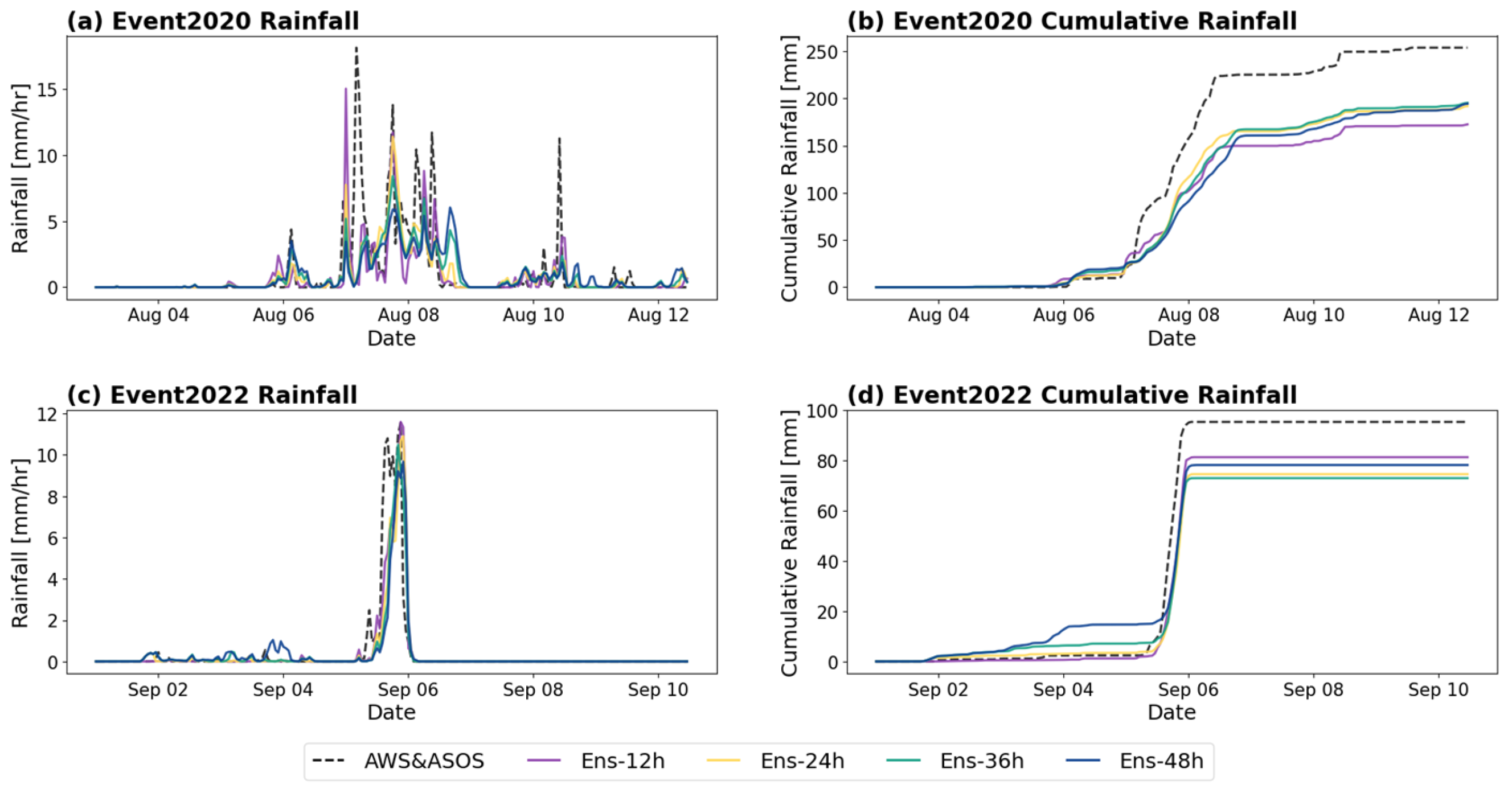
| Event | Maximum Precipitation Intensity (mm/h) | Total Precipitation Hours (h) | Mean Ensemble Spread (mm/h) | Maximum Ensemble Spread (mm/h) |
|---|---|---|---|---|
| Event 2020 | 14.6 | 121 | 0.9 | 9.1 |
| Event 2022 | 18.2 | 51 | 0.3 | 6.4 |
| Event | Ens. Configuration | Type | NSE | KGE | RMSE (m3/s) | PBIAS (%) |
|---|---|---|---|---|---|---|
| 2020 | 12 h | Single | 0.86 | 0.89 | 228.2 | −2.1 |
| Ens-48h | 0.88 | 0.91 | 216.6 | 2.1 | ||
| Ens-Optimal | 0.90 | 0.92 | 204.0 | 0.0 | ||
| 24 h | Single | 0.76 | 0.83 | 309.7 | −4.2 | |
| Ens-48h | 0.87 | 0.89 | 229.9 | 3.0 | ||
| Ens-Optimal | 0.88 | 0.90 | 221.9 | 1.1 | ||
| 36 h | Single | 0.53 | 0.70 | 428.8 | −2.3 | |
| Ens-48h | 0.83 | 0.86 | 256.0 | 4.4 | ||
| Ens-Optimal | 0.83 | 0.86 | 256.0 | 4.4 | ||
| 48 h | Single | 0.39 | 0.57 | 488.8 | 0.1 | |
| Ens-48h | 0.81 | 0.83 | 257.9 | 5.2 | ||
| 2022 | 12 h | Single | 0.34 | 0.55 | 305.6 | −57.2 |
| Ens-48h | 0.80 | 0.69 | 162.4 | −41.0 | ||
| Ens-Optimal | 0.86 | 0.70 | 130.6 | −47.1 | ||
| 24 h | Single | 0.48 | 0.58 | 271.3 | −49.8 | |
| Ens-48h | 0.76 | 0.68 | 181.0 | −39.2 | ||
| Ens-Optimal | 0.85 | 0.69 | 141.3 | −43.1 | ||
| 36 h | Single | 0.47 | 0.57 | 271.3 | −48.9 | |
| Ens-48h | 0.71 | 0.68 | 188.8 | −37.5 | ||
| Ens-Optimal | 0.71 | 0.68 | 188.8 | −37.5 | ||
| 48 h | Single | 0.48 | 0.58 | 265.3 | −45.1 | |
| Ens-48h | 0.71 | 0.68 | 192.9 | −33.7 |
Disclaimer/Publisher’s Note: The statements, opinions and data contained in all publications are solely those of the individual author(s) and contributor(s) and not of MDPI and/or the editor(s). MDPI and/or the editor(s) disclaim responsibility for any injury to people or property resulting from any ideas, methods, instructions or products referred to in the content. |
© 2026 by the authors. Licensee MDPI, Basel, Switzerland. This article is an open access article distributed under the terms and conditions of the Creative Commons Attribution (CC BY) license.
Share and Cite
Lee, Y.; Kim, B.; Kim, H.T.; Noh, S.J. Adaptive Time-Lagged Ensemble for Short-Range Streamflow Prediction Using WRF-Hydro and LDAPS. Water 2026, 18, 356. https://doi.org/10.3390/w18030356
Lee Y, Kim B, Kim HT, Noh SJ. Adaptive Time-Lagged Ensemble for Short-Range Streamflow Prediction Using WRF-Hydro and LDAPS. Water. 2026; 18(3):356. https://doi.org/10.3390/w18030356
Chicago/Turabian StyleLee, Yaewon, Bomi Kim, Hong Tae Kim, and Seong Jin Noh. 2026. "Adaptive Time-Lagged Ensemble for Short-Range Streamflow Prediction Using WRF-Hydro and LDAPS" Water 18, no. 3: 356. https://doi.org/10.3390/w18030356
APA StyleLee, Y., Kim, B., Kim, H. T., & Noh, S. J. (2026). Adaptive Time-Lagged Ensemble for Short-Range Streamflow Prediction Using WRF-Hydro and LDAPS. Water, 18(3), 356. https://doi.org/10.3390/w18030356