Article

Climate Change and Thermal Dynamics of the Lake Sevan Basin (Armenia): Observational Insights and Future Projections


1
Scientific Center of Zoology and Hydroecology, National Academy of Sciences of the Republic of Armenia, Yerevan 0014, Armenia
2
Hydrometeorology and Monitoring Center, Ministry of Environment of the Republic of Armenia, Yerevan 0025, Armenia
3
Office of Strategic Research, International Clean Water Institute, Manassas, VA 20108, USA
4
Research Institute of the University of Bucharest, 050663 Bucharest, Romania
5
Helmholtz-Centre for Environmental Research–UFZ, 39114 Magdeburg, Germany
6
Institute of Mechanics, National Academy of Sciences of the Republic of Armenia, Yerevan 0019, Armenia
7
Faculty of Biology, Yerevan State University, Yerevan 0025, Armenia
*
Authors to whom correspondence should be addressed.
Water 2026, 18(3), 352; https://doi.org/10.3390/w18030352
Submission received: 26 December 2025 / Revised: 21 January 2026 / Accepted: 28 January 2026 / Published: 30 January 2026

Abstract

The Lake Sevan basin is particularly sensitive to climate change due to its continental climate and mountainous terrain, which collectively amplify climatic impacts. This study aimed to assess the influence of climate change on the thermal dynamics of the basin by analyzing both historical and projected temperature variations. Over the past three decades, the region has experienced a marked rise in air temperatures. Seasonal variability revealed distinct contrasts between winter and summer, with winter exhibiting greater fluctuations, ranging from 1.67 to 2.41 °C, compared to the more stable summer range of 0.81 to 1.41 °C. An analysis of heat inflow and outflow patterns demonstrated a moderating effect of Lake Sevan on temperature extremes. Stations, located near the lake, recorded lower levels of heat inflow and outflow, indicating that the lake’s thermal inertia helps buffer seasonal temperature extremes. In contrast, stations situated farther from the lake exhibited more pronounced fluctuations, reflecting the absence of this stabilizing influence. These results underscore the lake’s critical role in modulating the local climate by dampening extreme thermal variations. Additionally, comparative analysis of air and water temperature trends revealed that, while both exhibit warming, air temperatures show greater interannual variability. In contrast, water temperatures remained more stable, particularly during winter, due to the lake’s thermal inertia. Future climate projections for the Lake Sevan region, based on CMIP6 (Coupled Model Intercomparison Project phase 6) ensemble outputs under four Shared Socioeconomic Pathways (SSP1–2.6, SSP2–4.5, SSP3–7.0, and SSP5–8.5), suggest a persistent warming trend throughout the 21st century. We project that the most significant increases are expected during summer months, with an anticipated mean annual temperature rise of up to 6 °C by the end of the century under the high-emission scenario (SSP5–8.5).

1. Introduction

Climate change is one of the most pressing global challenges of the 21st century, affecting ecosystems, biodiversity, and human societies worldwide [1,2,3]. According to the Intergovernmental Panel on Climate Change (IPCC) Climate Change Synthesis Reports, the global surface temperature was, on average, 1.1 °C warmer in 2011–2020 than in the preindustrial period [4,5]. Among regions most vulnerable to these changes is the Lake Sevan basin in Armenia, a critical freshwater resource that supports both ecological and economic systems. As one of the world’s largest high-altitude freshwater lakes, Lake Sevan holds immense ecological importance due to its biodiversity, role in regulating the local climate, and contributions to agriculture, energy, and tourism [6,7].
The Sevan basin is a large intermontane region bordered by the Geghama, Vardenis, Pambak, Areguni, Sevan, and Zangezur mountain ranges. More than half of the basin lies within the 2000–2600 m altitude zone, with the largest portion covering the slopes and foothills of the Geghama and Vardenis ranges [8]. The climatic conditions of Lake Sevan are strongly influenced by its high altitude, making the analysis of air temperature variability crucial for predicting seasonal changes in water temperature, ice cover, and lake stratification. The continental climate and mountainous topography further amplify Armenia’s vulnerability to climate change, especially in the Lake Sevan basin [9]. Previous studies have also highlighted elevation-dependent warming in regions such as the south-central Himalayas, the Pyrenees, and the Tibetan Plateau [10,11,12,13]. However, most of these studies emphasize mean temperature trends, while largely overlooking seasonal extremes and basin-scale spatial variability, both of which are critical for understanding high-altitude lake systems such as Lake Sevan. Studying these variations over time offers valuable insights into how climate change is reshaping seasonal cycles [14].
The unique topography of Lake Sevan, along with its large surface area and high altitude, creates microclimatic zones where temperatures can vary substantially from one location to another. Understanding this spatial variability is essential for developing effective climate adaptation strategies, as different areas around the lake may experience climate impacts to varying degrees [15].
Decadal variations in air temperature provide key indicators of long-term climate shifts in the Lake Sevan basin. Understanding these trends helps identify periods of accelerated warming or cooling, which affect ecosystems, water resources, and socioeconomic activities [16,17,18]. Analyzing these patterns also establishes a foundation for assessing future climate impacts and informs the study’s focus on how temperature extremes and heat circulation influence the lake’s thermal regime.
Annual variations in air temperature, especially the timing of monthly extremes, reveal how the Lake Sevan basin’s climate is evolving. Shifts in the hottest and coldest months, influenced by broader climate drivers, directly affect growing seasons, snowmelt, and water availability [19,20]. Understanding these patterns provides context for assessing the lake’s thermal regime and potential climate impacts.
This study analyzes how temperature extremes and heat inflow/outflow have evolved over time in the Lake Sevan basin and considers their implications for the lake and the surrounding environment. Understanding these dynamics is essential for predicting future climate scenarios, assessing impacts on the lake’s thermal regime, and informing adaptation strategies to maintain ecological balance [21,22].
Climate change may also result in less distinct transition periods between spring and autumn, leading to longer summers. Gevorgyan (2016) has reported that temperature increases in Armenia are most pronounced in summer [23]. These seasonal shifts are especially important for agriculture, as they influence the length of the growing season and the hydrological cycle, affecting snowmelt and water availability in spring and early summer.
By examining the evolution of temperature patterns over recent decades, this study offers a deeper insight into the seasonal manifestations of climate change in the Lake Sevan basin. Climate change is projected to influence not only long-term average temperatures but also the frequency and intensity of extreme weather events. Therefore, analyzing both positive and negative anomalies in monthly mean air temperatures relative to long-term averages provides a more comprehensive understanding of the region’s climatic dynamics and variability [24].
No specific studies have focused on air temperature changes and projections for the Lake Sevan basin. Although no studies have specifically examined air temperature variability or long-term climatic characteristics of the Lake Sevan basin, several existing studies are indirectly relevant to the region [15,25,26]. The absence of dedicated basin-scale climate analyses underscores a clear knowledge gap that the present study seeks to address. However, several related studies explored the impact of climate change on Lake Sevan. For instance, Shikhani et al. (2024) assessed climate change effects using a multi-lake model ensemble [27], while another key study examined the thermal dynamics of Lake Sevan and their role in regional climate processes [28]. Although these studies contributed to a broader understanding of regional climate dynamics, they primarily focus on lake thermal processes or employ multi-lake modeling approaches with relatively coarse spatial resolution. As a result, they do not provide a detailed assessment of basin-scale air temperature variability, seasonal extremes, or long-term trends specific to the Lake Sevan basin, nor do they explicitly link historical trends with future projections.
This study employed climate change projections to evaluate future temperature changes in the Lake Sevan basin under various climate scenarios. These models, which represent a spectrum of greenhouse gas emissions from low to high, provide important insights into the expected evolution of the climate under different global warming scenarios [5,29,30]. In response to the limitations of previous studies, the primary objective of this research is to provide a basin-scale, temporally detailed analysis of air temperature dynamics in the Lake Sevan basin, integrating historical trends with future climate projections and explicitly examining seasonal patterns, temperature extremes, and spatial variability. Integrating climate projections into management practices is crucial for ensuring sustainable agricultural systems and effective water resource management [31,32,33]. By comparing these projections with past temperature trends, this study provides a forward-looking assessment of potential future climate conditions in the Lake Sevan basin. The findings can inform policy decisions, adaptation strategies, and future research initiatives to mitigate the impacts of climate change.
This study presents a comprehensive analysis of air temperature dynamics in the Lake Sevan basin, incorporating both past trends and future projections. By examining decadal variations, seasonal and annual patterns, extreme temperature events, and spatial distribution, it provides a robust assessment of the region’s climate and its projected trajectory under different global warming scenarios. The findings are expected to serve as a foundational resource for developing agricultural adaptation strategies and optimizing water resource management in the Lake Sevan basin. By establishing a clear analytical framework, this research aims to enhance resilience to climate variability and support sustainable resource use, both of which are increasingly critical as climate change continues to affect agricultural productivity and water availability.

2. Data and Methods

Climate projection data for the Lake Sevan basin were obtained from the Climate Change Knowledge Portal (CCKP) and the Coupled Model Intercomparison Project Phase 6 (CMIP6), developed under the framework of the World Climate Research Program [34]. The CMIP6 dataset, provided at a spatial resolution of 0.25° × 0.25° (approximately 25 km × 25 km), represents one of the most advanced global climate modeling systems to date. It incorporates substantial improvements in physical parameterizations, including enhanced cumulus convection schemes, refined radiation calculations, and more sophisticated land surface models. Additionally, the improved representation of aerosol–cloud interactions contributes to greater accuracy in simulating climate processes and projecting future climatic conditions [35,36]. CMIP6 outputs obtained from the CCKP were first resampled to a common 1° × 1° grid and subsequently bias-corrected. This method aligns modeled climate distributions with observations while explicitly preserving the original temperature trends of the global climate models. Spatial disaggregation was performed using harmonic analysis-based scaling, with ERA5 reanalysis data at 0.25° resolution serving as the reference dataset. As a result, the downscaled products inherit fine-scale spatial patterns from the reference data, although these patterns are not fully resolved by the original global climate models. All CMIP6 data used in this study are based on these bias-corrected and downscaled CCKP products. A key advantage of the CCKP-CMIP6 framework over earlier climate models lies in its enhanced spatial and temporal resolution, which enables more precise regional climate projections. This refinement allows for better representation of localized climate dynamics, particularly in complex terrains such as the Lake Sevan basin. Moreover, advances in cloud microphysics, atmospheric convection, and radiation schemes significantly enhance the accuracy of simulated atmospheric processes and extreme weather events [37].
Unlike the earlier RCP (Representative Concentration Pathway)-based framework, CMIP6 incorporates Shared Socioeconomic Pathways (SSPs), which integrate climate projections with socioeconomic development trajectories. The SSPs, developed through Integrated Assessment Models (IAMs), represent the most recent advancements in model structures, boundary conditions, and emission trends. They form the foundation of the ScenarioMIP component within CMIP6. Rather than offering deterministic forecasts, the SSPs explore five distinct socioeconomic pathways, illustrating how different policy decisions and development strategies can influence future climate outcomes [36,38,39].
The CMIP6 reduced daily surface fields available through the CCKP provide high-resolution (0.25°) daily climate data from 30 global models spanning the period 1950–2100. These datasets undergo bias-correction spatial disaggregation (BCSD) and are calibrated against a historical baseline (1961–2014) to maintain the integrity of long-term temperature trends. Spatial refinement is further supported through the application of Fast Fourier Transform methods and the ERA5 reanalysis dataset. The outputs are delivered in a globally gridded NetCDF format and include multiple temporal resolutions, climate indices, and overlays of administrative boundaries and watershed datasets [38,40,41]. The CCKP-CMIP6 ensemble dataset integrates outputs from up to 30 climate models (Table 1), each associated with a specific SSP.
This ensemble provides a broad range of climate projections for the Lake Sevan basin, delivering essential insights for climate research, adaptation planning, and risk management. Data processing was conducted using the Enhanced Climate Risk Management Engine (CRMe), with final outputs rendered in ArcGIS (version 10.3, Esri, Redlands, CA, USA) to ensure compatibility with geospatial data standards. This facilitates the integration of climate projections into spatial analyses and supports informed decision-making in climate-sensitive sectors [35].
The SSPs represent a crucial framework for understanding climate change impacts, outlining various socioeconomic futures and their corresponding implications for climate dynamics. These scenarios project how different societal and economic trends could influence future climate outcomes. The four distinct SSPs are as follows:
  • SSP1–2.6 (Sustainability—Taking the Green Road): This pathway envisions a sustainable future with high social equity, focusing on renewable energy and reduced emissions. It requires data on economic growth, energy consumption, and land use practices.
  • SSP2–4.5 (Middle of the Road): A balanced approach with moderate economic growth, blending continued fossil fuel use with sustainability efforts. It necessitates datasets on economic trends, energy production, and demographic changes.
  • SSP3–7.0 (Regional Rivalry—A Rocky Road): A fragmented world marked by nationalism and limited international cooperation, where high fossil fuel reliance and environmental degradation prevail. It requires data on geopolitical trends and energy systems.
  • SSP5–8.5 (Fossil-Fueled Development—Taking the Highway): This pathway is characterized by rapid economic growth fueled by fossil fuel consumption, projecting severe climate impacts. It requires data on fossil fuel investments and environmental degradation.
By aligning the output from these climate models with the SSP scenarios, projections of air temperature changes in the Lake Sevan basin have been generated. These projections provide a range of potential future climate conditions, offering valuable insights for researchers and policymakers. Understanding these scenarios is crucial for climate adaptation planning and policy formulation, as it provides a structured framework for managing future climate risks. The temperature projection analysis utilized the reference period 1991–2020 as a baseline to represent current climate conditions. The 1991–2020 period was selected as the baseline to maintain consistency between the observational trend analysis and the reference period used for future climate projections. Future projections were made for the periods 2020–2039, 2040–2059, 2060–2079, and 2080–2099.
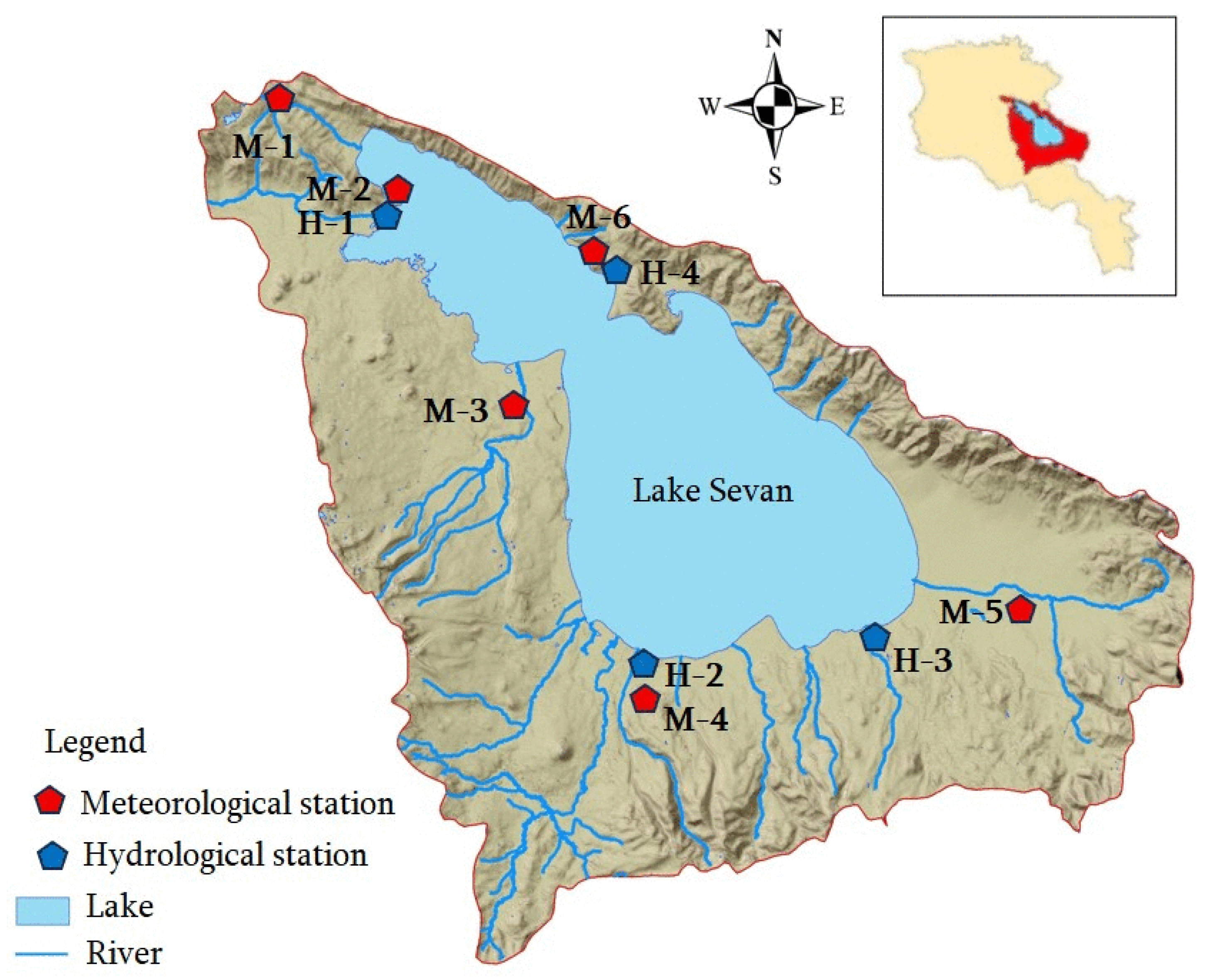
This study utilized average monthly temperature data from six meteorological stations in the Lake Sevan basin, spanning the period 1991–2020. Air temperature was measured in full shade at a height of 2 m above the ground surface. All measurements were performed in accordance with the procedures established by the World Meteorological Organization (WMO) and relevant international standards [44,45]. Observations were recorded at eight standard synoptic times: 00:00, 03:00, 06:00, 09:00, 12:00, 15:00, 18:00, and 21:00 (UTC). Subsequently, the average monthly temperature was determined as the arithmetic mean of the daily averages for each month. These stations are strategically positioned at varying distances from the lake and at different geographical elevations, providing a diverse representation of local climate conditions. The selected stations offer high-quality data with extensive temporal coverage, ensuring reliable insights for climate analysis. Some stations are located near Lake Sevan, while others are situated at varying distances, contributing to a well-distributed spatial coverage across the basin (Figure 1). Detailed information for each station is provided in Table 2.
Water temperature observations near the shore of Lake Sevan were conducted at four hydrological observation points: Sevan Peninsula, Shorzha, Martuni, and Karchaghbyur. Measurements were taken at a depth of 0.1–0.5 m below the surface layer, under ice-free conditions. Water temperature was recorded twice daily at 08:00 and 20:00. The average daily water temperature was calculated as the arithmetic mean of the two daily measurements. Subsequently, the average monthly temperature was determined as the arithmetic mean of the daily averages for each month. The final dataset presented here shows the arithmetic mean of the average monthly water temperatures recorded at all four hydrological observation points. The Hydrometeorology and Monitoring Center of the Ministry of Environment of the Republic of Armenia carried out continuous measurements of air and water temperatures.
During the period 1991–2020, monthly air temperature data were missing for certain months at the following meteorological stations: Gavar in January 2006, Martuni in October 2020, Masrik in March 1992, and Semyonovka in March, August, and December 1997, as well as in April and May 1998, and from April to December in both 2001 and 2002. For average monthly water temperature, data were unavailable for February, March, and April of both 1992 and 1993, as well as for January, February, and March of 2008. The missing average monthly air temperature values for these periods were not estimated or interpolated; instead, decadal and long-term mean values were calculated using only available monthly observations, with months containing missing data excluded from the analysis.
To analyze the climatic characteristics of the Lake Sevan basin, a comprehensive assessment of air and surface water temperature variability was conducted using observational data from 1991 to 2020. The study applied several methods to evaluate temperature trends and patterns. First, average annual air temperatures were calculated for each year and grouped into three decades (1991–2000, 2001–2010, 2011–2020), with decadal means determined by arithmetic averaging to identify long-term warming trends. Second, long-term average monthly air temperatures were computed by averaging daily temperature values over the 30-year period, serving as a baseline for characterizing climatic conditions at each station and across the basin. Third, seasonal average air temperatures were calculated for winter (December–February), spring (March–May), summer (June–August), and autumn (September–November) based on the corresponding long-term monthly values. Fourth, extreme positive and negative deviations from the 30-year monthly means were identified for each calendar month to assess the degree of anomalous warming or cooling. Fifth, long-term monthly heat inflow and outflow were inferred from variations in monthly temperatures, based on the direction and magnitude of changes between adjacent months and the seasonal cycle, reflecting heat accumulation in warmer months and loss in colder months. For this analysis, stations were classified into three categories based on their distance from Lake Sevan: (1) Lake stations, including Sevan (1 km) and Shorzha (1–2 km); (2) Coastal stations, including Gavar (6–7 km) and Martuni (3–4 km); and (3) Distant stations, including Semyonovka (8–9 km) and Masrik (10–11 km).
To ensure a robust statistical characterization of temperature variability, the analysis explicitly incorporates classical variability metrics, including standard deviation and temperature anomaly ranges, which are widely used in climatological studies to assess intra-seasonal, interannual, and spatial variability. Standard deviation was employed to quantify the dispersion of monthly and seasonal air temperature values around long-term means, thereby providing insight into the stability of temperature regimes and the magnitude of seasonal fluctuations across the Lake Sevan basin. In addition, positive and negative temperature anomalies relative to the 1991–2020 baseline were analyzed to identify extreme deviations and to evaluate the intensity of anomalous warming and cooling events. Together, these metrics allow for a clear interpretation of climate variability and long-term change, highlighting differences related to elevation, distance from the lake, and seasonal controls. The use of these well-established statistical measures ensures transparency, comparability with previous regional and global climate studies, and reliable interpretation of observed and projected temperature changes in the Lake Sevan basin.
Finally, seasonal and interannual variability of both air and water temperatures was examined to detect intra-annual patterns and interannual fluctuations across the study period. All data visualizations and graphical outputs were generated using Origin software (version 2018, OriginLab Corporation, Northampton, MA, USA). One-way statistical calculations were performed in Excel (version 2016, Microsoft Corporation, Redmond, WA, USA). Spatial data processing and map generation were conducted using ArcGIS (version 10.3, Esri, Redlands, CA, USA).
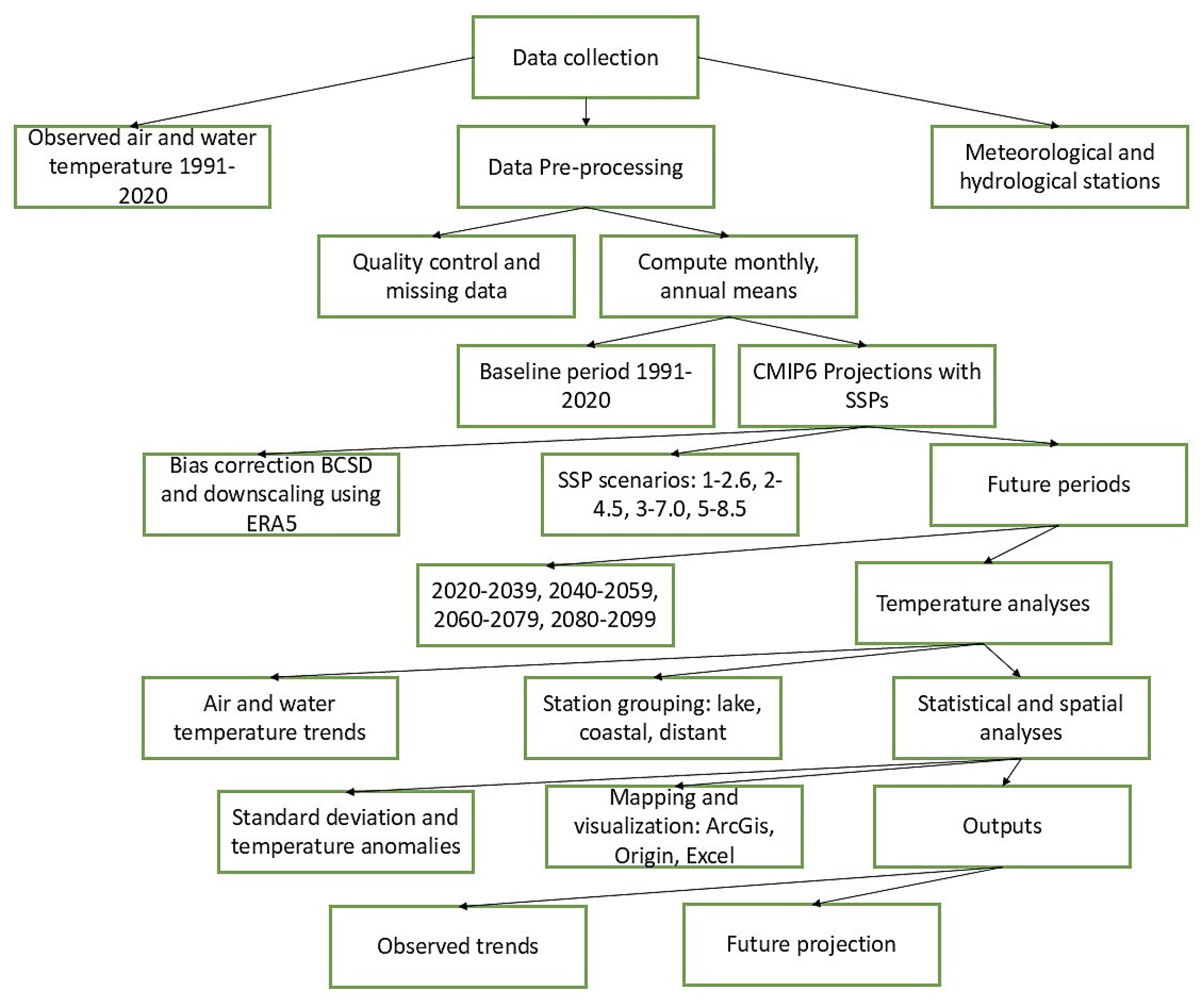
Figure 2 presents a schematic workflow illustrating the methodology used in this study. It depicts the sequential steps from observational data collection at meteorological and hydrological stations, through quality control, computation of mean values, and CMIP6-based climate projections under various SSP scenarios, to temperature analysis, statistical processing, and spatial visualization.

3. Results

3.1. Long-Term Decadal Variability of Air Temperature

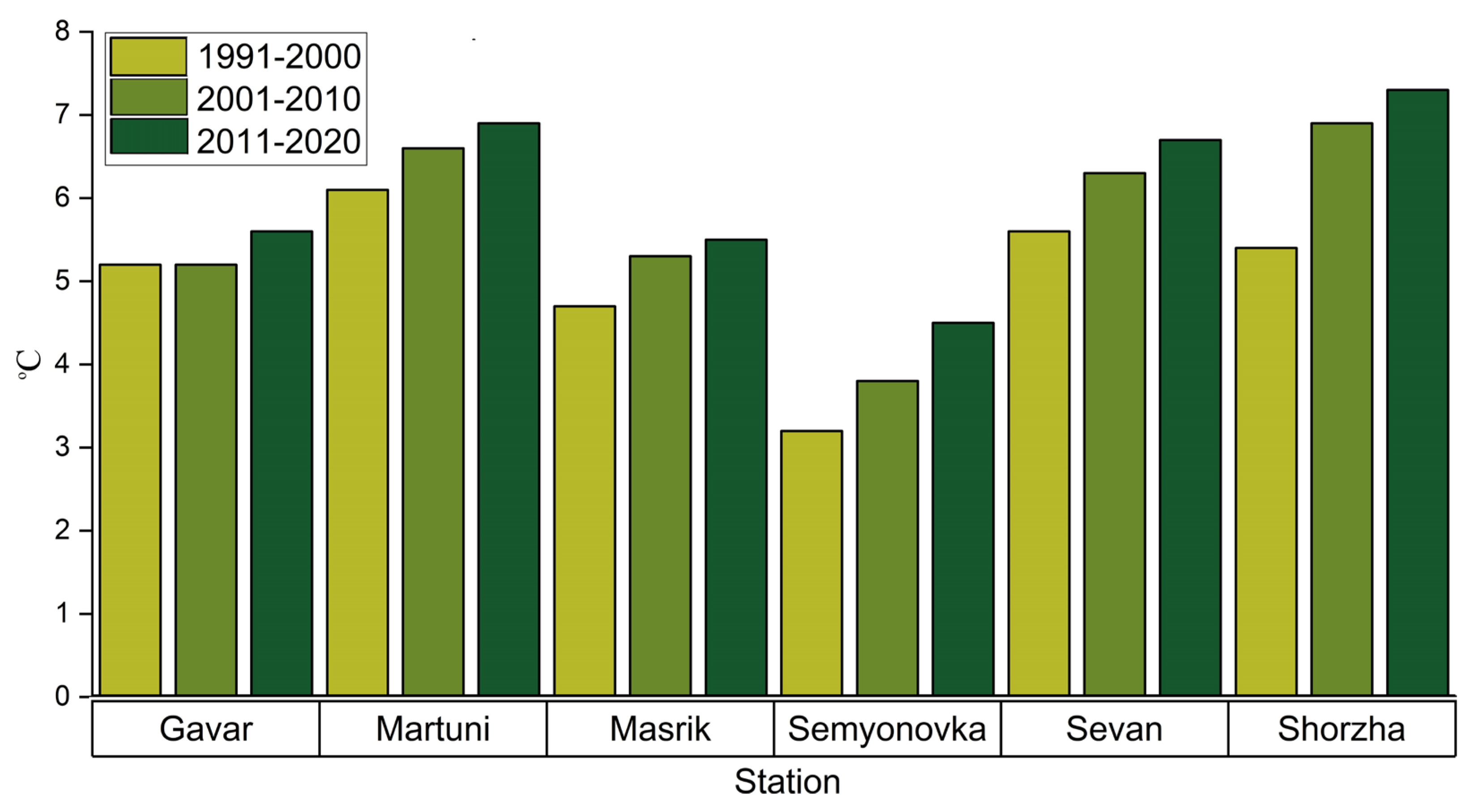
Statistical analysis of average annual temperature data from six meteorological stations in the Lake Sevan basin for the decades 1991–2000, 2001–2010, and 2011–2020 reveals a clear and consistent warming trend across the region (Figure 3).
All stations exhibited positive temperature trends over the three decades with cumulative warming ranging from 0.4 to 1.9 °C (Figure 3). Gavar station showed the smallest increase, with mean annual temperature rising by only 0.4 °C (from 5.2 to 5.6 °C). This comparatively weak warming signal may be influenced by the station’s concave topographic setting, which can promote cold-air pooling and dampen observed temperature increases. In contrast, Shorzha station experienced pronounced warming, with temperatures rising from 5.4 to 7.3 °C, a total increase of 1.9 °C, most of which occurred during the first two decades (Figure 3).
The remaining stations exhibited intermediate warming, with increases of 0.8 °C at Martuni and Masrik, 1.1 °C at Sevan, and 1.2 °C at Semyonovka. Despite being the coldest station due to its high elevation, Semyonovka showed a consistent warming rate of approximately 0.6 °C per decade, indicating that elevation does not necessarily constrain long-term regional warming trends (Figure 3).
Temperature increases generally accelerated between the first and second decades, followed by a weaker but continued rise in the third. Despite this slowdown, cumulative warming remains substantial, consistent with global and regional trends showing enhanced warming since the early 2000s, particularly in mountainous and continental interior regions [46,47]. According to the World Meteorological Organization (WMO), the decade 2011–2020 was the warmest on record globally. The WMO’s High-Level Climate Report notes that the global average temperature during this period was 1.10 ± 0.12 °C above the 1850–1900 pre-industrial baseline. Furthermore, the six warmest years on record worldwide occurred between 2015 and 2020 [48].

3.2. Monthly Air Temperature Variations

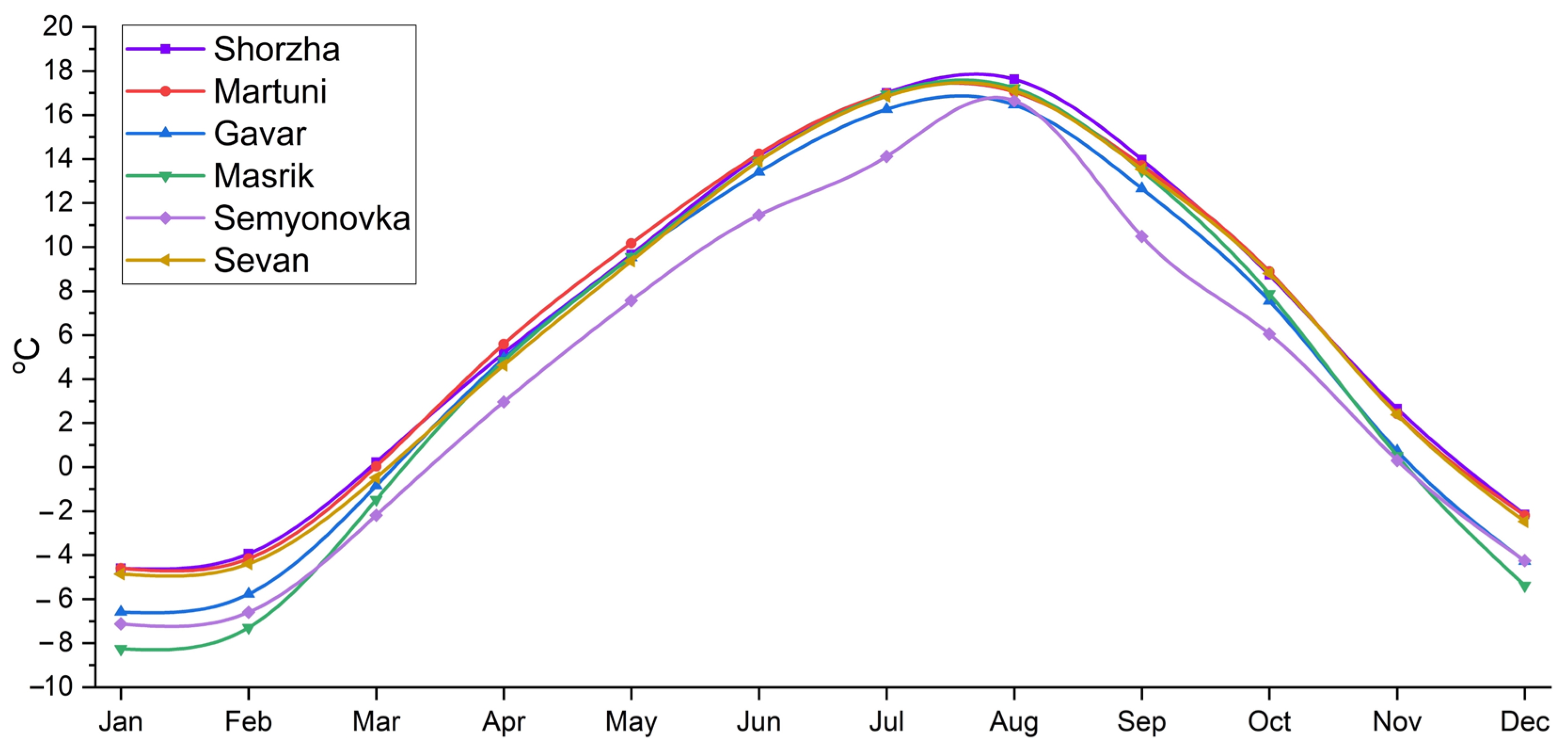
The variability of monthly temperature values, particularly their deviations from long-term averages, provides valuable insights into the stability of mean monthly temperatures and the reliability of these averages for individual months. Figure 4 presents the long-term mean monthly air temperatures (1991–2020) for the six meteorological stations in the Lake Sevan basin, while seasonal variability is quantified using standard deviation as a measure of intra-seasonal dispersion.
To quantify this, the average variability for each season was calculated and is presented in Table 3.
January consistently exhibited the lowest and August the highest mean monthly temperatures across all stations (Figure 3). In January, the warmest conditions were observed at Sevan (−4.9 °C), Shorzha (−4.6 °C), and Martuni (−4.6 °C), whereas August maxima occurred at Shorzha (17.6 °C), Masrik (17.2 °C), and Sevan (17.2 °C). Stations located near Lake Sevan (Sevan and Shorzha) consistently recorded higher winter and summer temperatures, indicating a moderating lacustrine influence (Figure 4).
Analysis of STDEV values (Table 3) shows that temperature variability was lowest in summer (±0.81–1.41 °C) and highest in winter (±1.67–2.41 °C) across all stations. This seasonal contrast reflects stronger thermal regulation by Lake Sevan during summer, while winter conditions are characterized by greater atmospheric instability and continental influences.
Spatial patterns of variability reveal a clear gradient related to both elevation and distance from the lake (Table 3; Figure 4). Stations closest to Lake Sevan (Shorzha and Sevan) exhibited the most stable temperature regimes throughout the year, particularly in summer and autumn. Moderate variability was observed at Martuni and Gavar, where the lake’s influence remains detectable but reduced. In contrast, the higher-elevation and more distant stations (Masrik and especially Semyonovka) experienced substantially greater variability, most pronounced during winter, consistent with stronger continental and altitudinal controls [49]. Overall, proximity to Lake Sevan and lower elevation act to dampen seasonal temperature fluctuations in the basin.
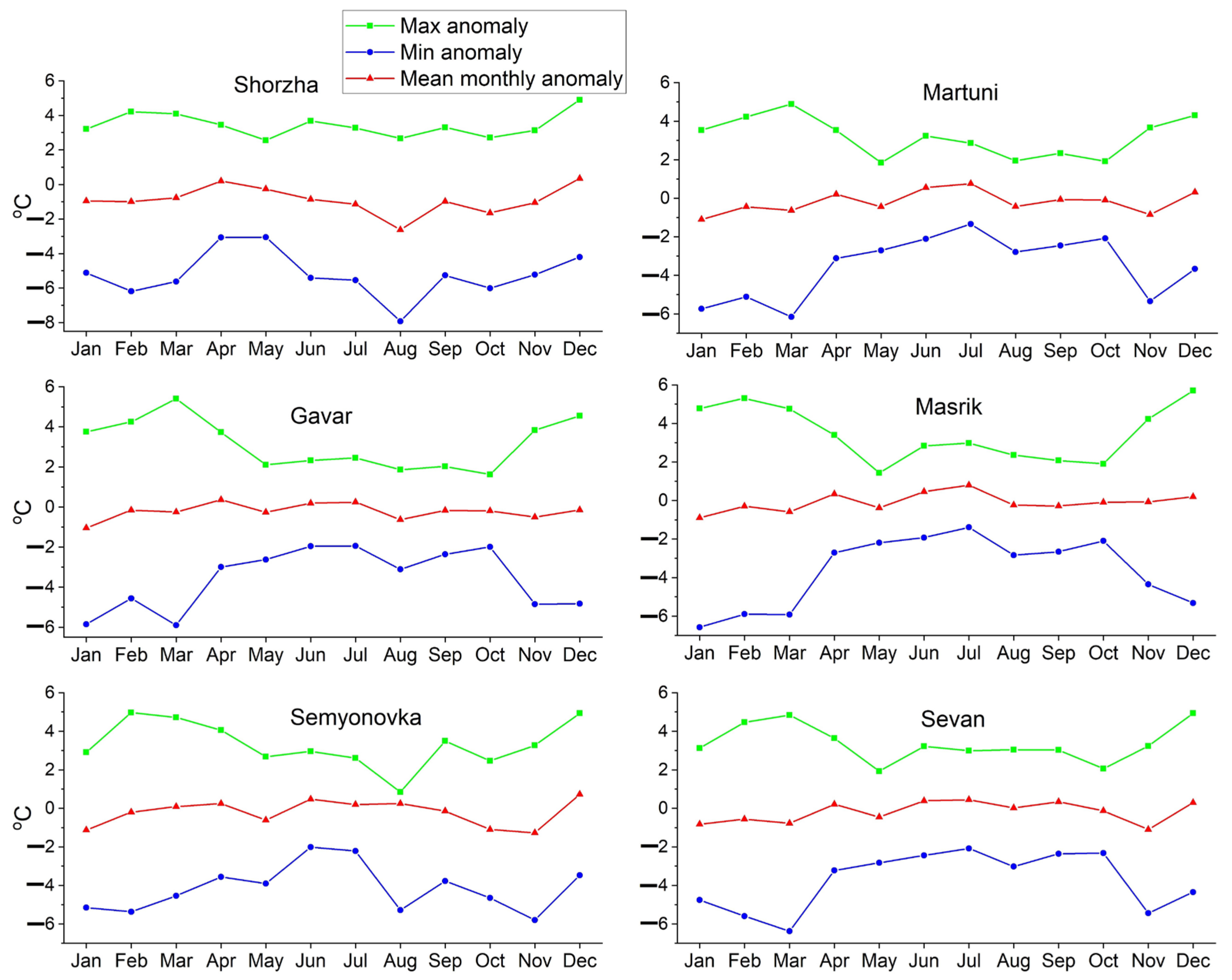
Figure 5 illustrates the largest positive and negative deviations of average monthly air temperatures from the long-term mean (1991–2020), highlighting the magnitude of thermal extremes.
These extreme anomalies provide quantitative indicators of climate variability and the occurrence of unusually warm or cold periods, serving as important indicators of climate variability and potential long-term climate change in the Lake Sevan basin. Meteorological stations in the Lake Sevan basin exhibited notable monthly variability in temperature anomalies, encompassing both maximum and minimum extremes. The spatial distribution of these stations, ranging from lower elevations near the lake to higher-altitude inland areas, played a significant role in shaping the observed differences in temperature patterns. To better understand the thermal characteristics and underlying dynamics of the regional climate, the largest positive and negative deviations from the monthly mean temperatures at each station were analyzed and compared (Figure 5).
Average monthly temperature anomalies at six meteorological stations in the Lake Sevan basin reflect a cold continental climate. The strongest negative anomalies occurred in March (Gavar, Martuni, Sevan), August (Shorzha), November (Semyonovka), and January (Masrik), with minimum deviations ranging from −5.8 °C to −7.9 °C (Figure 5). These extreme cold events, observed consistently over several decades, underscore the harsh climatic conditions in the Lake Sevan basin and carry important implications for the vulnerability of local ecosystems, water resources, and biodiversity to seasonal extremes.
The largest positive temperature anomalies occurred in March (Gavar, Martuni), December (Masrik, Shorzha, Sevan), and February (Semyonovka), with maximum deviations of 4.9 to 5.7 °C (Figure 5). These warm anomalies indicate pronounced winter warming in recent decades, consistent with global climate-change trends [50]. Overall, the results suggest a seasonal warming signal in the Lake Sevan basin influenced by regional topography, elevation, lake effects, and intra-seasonal variability.
Overall, the data indicates that the most pronounced warming in average monthly temperatures occurred during winter and early spring. This trend aligns with broader climate change patterns observed in mountainous regions, where minimum temperatures have increased more rapidly, particularly during the colder seasons [51,52]. Such seasonal warming is indicative of a shift in regional climate dynamics and underscores the heightened sensitivity of high-altitude regions to global warming.

3.3. Intensity of Heat Inflow and Outflow: Heat Circulation

The intensity of heat inflow and outflow, also referred to as heat circulation, is characterized by deviations of average monthly temperatures from the mean annual temperature. In this study, heat inflow and outflow are defined as temperature-based indicators derived from these deviations, rather than direct measurements of heat flux. Specifically, heat inflow/outflow for month i was calculated as the deviation of the monthly mean air temperature from the annual mean air temperature:
AT i   =   T month , i     T ¯ year
where A T i is the air temperature anomaly for month i, T month , i is the monthly mean temperature, and T ¯ year is the annual mean temperature. Positive deviations ( A T i > 0 ) indicate heat inflows, which can increase surface temperatures and enhance stratification, while negative deviations ( A T i < 0 ) indicate heat outflows, which cool the surface and affect mixing patterns.
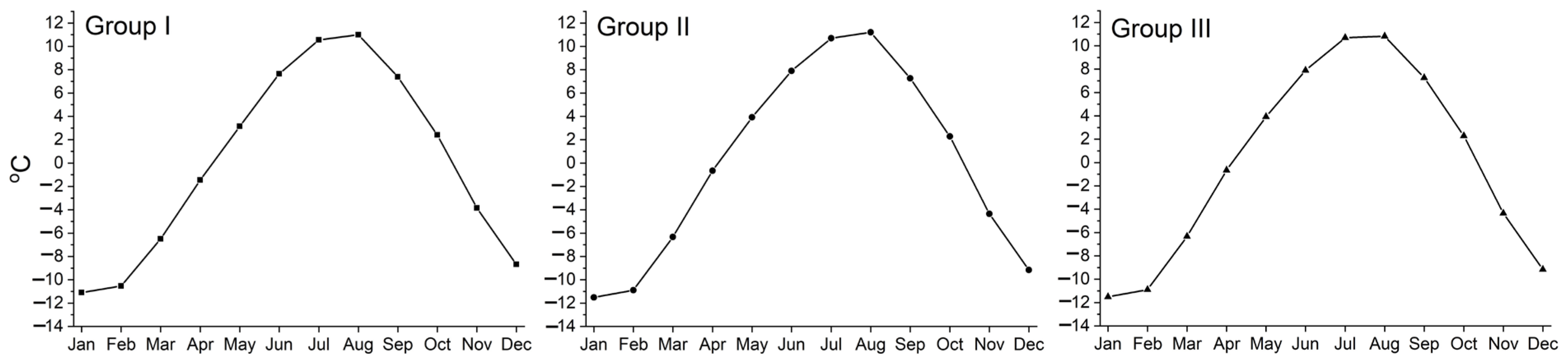
This circulation substantially impacts the lake’s ecosystem by regulating water temperatures, which are essential for the survival, growth, and reproduction of aquatic species. Additionally, heat circulation affects water quality, as warmer water holds less oxygen, potentially leading to hypoxia in deeper layers, while cooler temperatures help maintain higher oxygen levels. The heat balance also influences the lake’s hydrological processes, such as evaporation and water levels. In the context of climate change, heat circulation helps predict the lake’s response to temperature variations [53,54]. Average values of heat inflow and outflow were then calculated for each station group, as shown in Figure 6.
In the Sevan basin, negative deviations from the annual mean indicate heat outflow (loss of thermal energy), typically occurring between November and April, while positive deviations reflect heat inflow (heat accumulation), usually observed between May and October (Figure 6). The maximum heat inflow values were recorded during the summer months (June–August) (Figure 6), coinciding with increased solar radiation and higher temperatures, which contributed to surface warming and heat accumulation across all station groups. Conversely, the maximum heat outflow values were observed in the winter months (December–February), with the degree of heat outflow varying with distance from the lake (Figure 6). Group I (lake stations: Sevan and Shorzha), located closest to the lake, showed clear signs of thermal moderation due to the lake’s high heat capacity (Figure 6). The cold months were relatively mild, and the warm months less extreme (Figure 6). For instance, heat outflow in January was −11.1 °C, and heat inflow in August was +11.0 °C (Figure 6), indicating more moderate deviations. This stabilizing effect of Lake Sevan likely reduced the intensity of both heat outflow and inflow. Large bodies of water tend to retain heat in winter and provide cooling in summer, helping buffer against extreme temperature changes [55]. Group II (coastal stations: Gavar and Martuni), located relatively close to the lake, exhibited characteristics transitional between lacustrine influence and a more terrestrial climate. Compared to the lake stations, coastal stations showed slightly more pronounced summer warming and winter cooling (Figure 6), reflecting a weaker moderating influence from the lake, though it still exerted some effect. Specifically, the heat outflow in January was −11.5 °C, and the heat influx in August was +11.2 °C (Figure 6). The influence of Lake Sevan was less pronounced here, allowing for more pronounced seasonal temperature variations than at the lakeside stations. Group III (distant stations: Semyonovka and Masrik), located farthest from the lake, exhibited the highest temperature extremes (Figure 6). January heat outflow reached −12.3 °C, while the August heat inflow reached +11.3 °C (Figure 6). These stations experienced the least thermal moderation from Lake Sevan, resulting in larger seasonal temperature fluctuations. The lack of the lake’s stabilizing effect meant that temperatures in these areas were more directly influenced by atmospheric conditions, leading to a more pronounced seasonal cycle.
In summary, the analysis of long-term average monthly heat inflow and outflow confirms the significant role of Lake Sevan in regulating the basin’s thermal regime. A clear spatial gradient emerged, with thermal moderation being strongest at stations closest to the lake and gradually decreasing with increasing distance. This pattern is crucial for understanding the local microclimate, informing agricultural planning, guiding hydrological modeling, and supporting the management of ecosystem dynamics within the Lake Sevan basin.

3.4. Seasonal and Interannual Patterns of Air and Water Temperature Variability

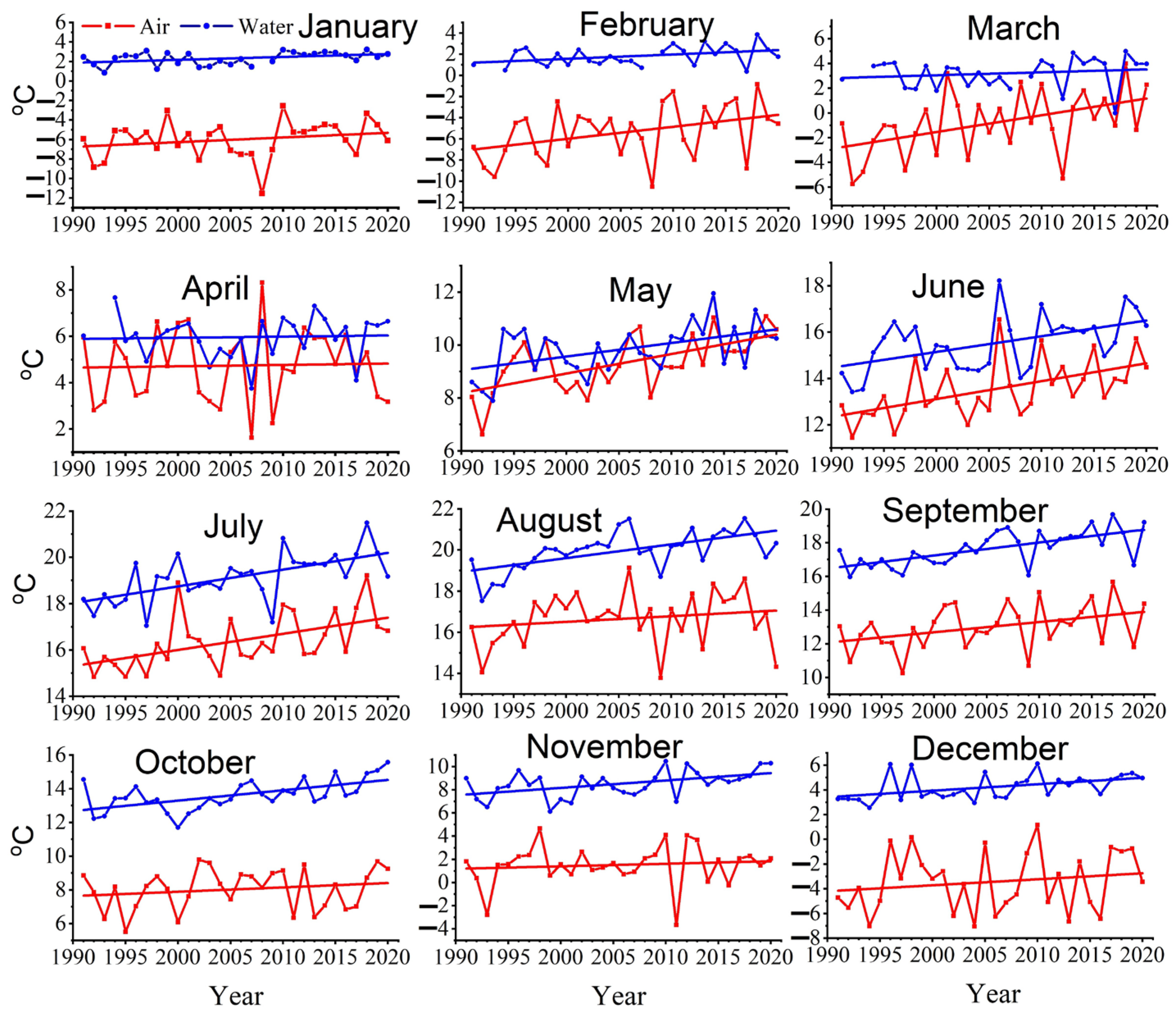
As shown in Figure 7, air temperatures in the Lake Sevan basin exhibited notable variability, while surface water temperatures in the lake followed a more stable trend. Pronounced seasonal variability was observed. In winter (December–February), water temperatures remained relatively stable (1–3 °C), whereas air temperatures showed greater variability, reaching minima of about −10 °C (Figure 7). Both air and water temperatures increased progressively throughout the year. During spring (March–May), rising air temperatures induced concurrent warming of surface waters, with the air–water temperature difference decreasing in April and May (Figure 7). Overall, both air and water temperatures showed a warming trend, with air temperatures displaying more pronounced interannual variability and water temperatures increasing more consistently, underscoring the potential impacts of climate change in the region (Figure 7).
Pronounced seasonal variability was observed. In winter (December–February), water temperatures remained relatively stable (1–3 °C), whereas air temperatures showed greater variability, reaching minima of about −10 °C (Figure 7). Both air and water temperatures increased progressively throughout the year. During spring (March–May), rising air temperatures induced concurrent warming of surface waters, with the air–water temperature difference decreasing in April and May (Figure 7).
Maximum temperatures occurred in summer (June–August), with water temperatures occasionally exceeding 20 °C and air temperatures exhibiting strong interannual variability (Figure 7). In autumn (September–November), air temperatures declined more rapidly than water temperatures, highlighting the lake’s heat retention capacity. Throughout the year, water temperature lagged behind air temperature, particularly during transitional seasons, reflecting the lake’s thermal inertia. The analysis confirmed an overall warming trend in both air and water temperatures over the past three decades (Figure 7). The lake’s thermal regime is increasingly influenced by climate change, which can have profound effects on its hydrology, biodiversity, and water quality.
Positive temperature increases were observed for both air and water throughout the entire study period (Figure 7), reflecting an overall warming trend. Lake water temperatures showed consistent increases, with the most significant rises in September (+2.31 °C) and April (+2.20 °C), while the smallest increases were recorded in winter, particularly in January (+0.82 °C) and February (+1.23 °C) (Figure 7). This suggests that warming was more pronounced in the fall and spring. These temperature changes may have significant implications for the lake’s thermal stratification, water quality, and ecosystem health.
Air temperatures also exhibited a steady rise across all months, with notable increases in March (+4.08 °C) and February (+3.39 °C) (Figure 7). The smallest increases were observed in April (+0.18 °C) and November (+0.66 °C) (Figure 7), indicating that air temperatures are more sensitive to climate change in winter and spring, while summer temperatures showed a more stable increase (Figure 7). On average, water temperature increases (+1.77 °C) were slightly higher than air temperature increases (+1.69 °C) (Figure 7), highlighting a more significant warming of the lake’s surface waters.
Overall, lake water temperature exhibited a more stable trend, ranging from +0.82 °C in January to +2.31 °C in September (Figure 7). In contrast, air temperature changes showed greater variability, ranging from +0.18 °C in November to +4.08 °C in March (Figure 7). These differences underscore the buffering role of Lake Sevan in mitigating temperature extremes. Air temperature changes were notably high, particularly in February (+3.39 °C) and March (+4.08 °C) (Figure 7), signaling significant warming trends in late winter and early spring. By contrast, water temperature increases were more moderate during this period, from +1.23 °C in February to +1.60 °C in March (Figure 7). This disparity reflects the lake’s thermal inertia, in which water warms more gradually than the surrounding atmosphere.
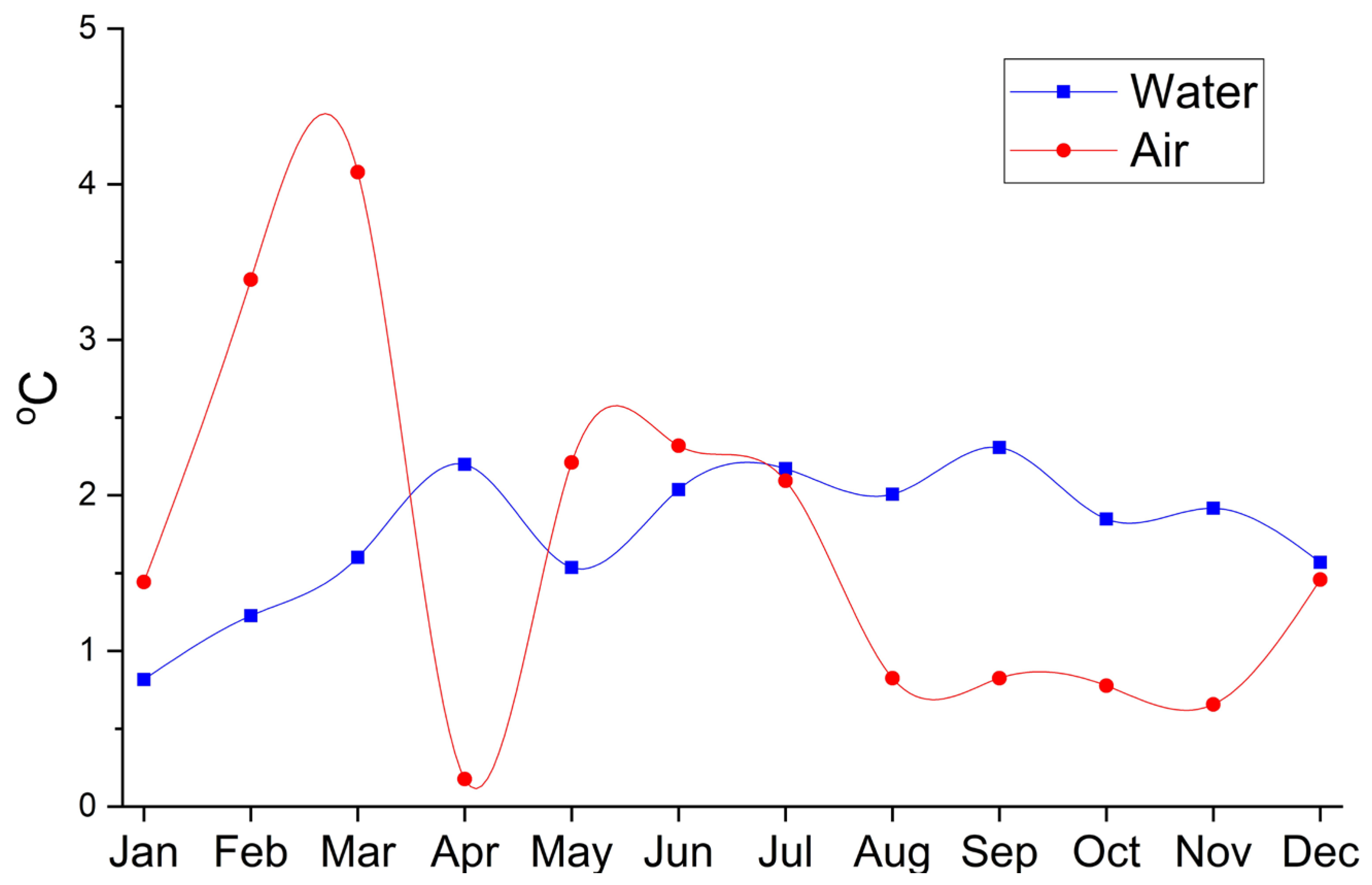
In April, the change in air temperature (+0.18 °C) was notably lower than in the preceding months (Figure 7), likely reflecting atmospheric variability or cooling trends associated with transitional weather patterns. Meanwhile, lake water temperature increased steadily, with April showing a rise of +2.20 °C, one of the highest increases for water (Figure 7), indicating that solar radiation and calm atmospheric conditions played a more significant role in warming the water than air temperature alone during this period. In June, both air and water temperature changes approached similar levels (+2.32 °C for air and +2.04 °C for water) (Figure 7), marking the onset of the summer period of thermal synchronization. From July to September, lake water temperatures remained relatively stable and high (+2.01 to +2.31 °C), while air temperature changes began to decrease, from +2.09 °C in July to +0.83 °C in September (Figure 7). This reversal demonstrates how water retains heat longer than air, thus prolonging the warm period in the aquatic environment even as atmospheric temperatures begin to cool. Figure 8 shows the estimated average monthly air and lake water temperatures in the Lake Sevan basin for the period 1991–2020.
Air temperature displayed more abrupt and pronounced fluctuations than lake water temperature, which remained relatively stable due to the lake’s thermal inertia (Figure 8). Air temperatures peak in March (+4.1 °C) and reach a minimum (+0.1 °C) in April (Figure 8), reflecting high seasonal variability, possibly influenced by the transitional conditions of spring. In contrast, water temperatures peak in September (+2.3 °C) and reach a minimum in January (+0.8 °C) (Figure 8). Notably, the water remained warmer than the air in April, July, August, September, October, November, and December (Figure 8). This pattern highlights the lake’s buffering capacity against abrupt atmospheric changes and has important implications for studies of limnological processes, aquatic ecosystems, and regional climate.

3.5. Projected Temperature Changes in the Lake Sevan Basin

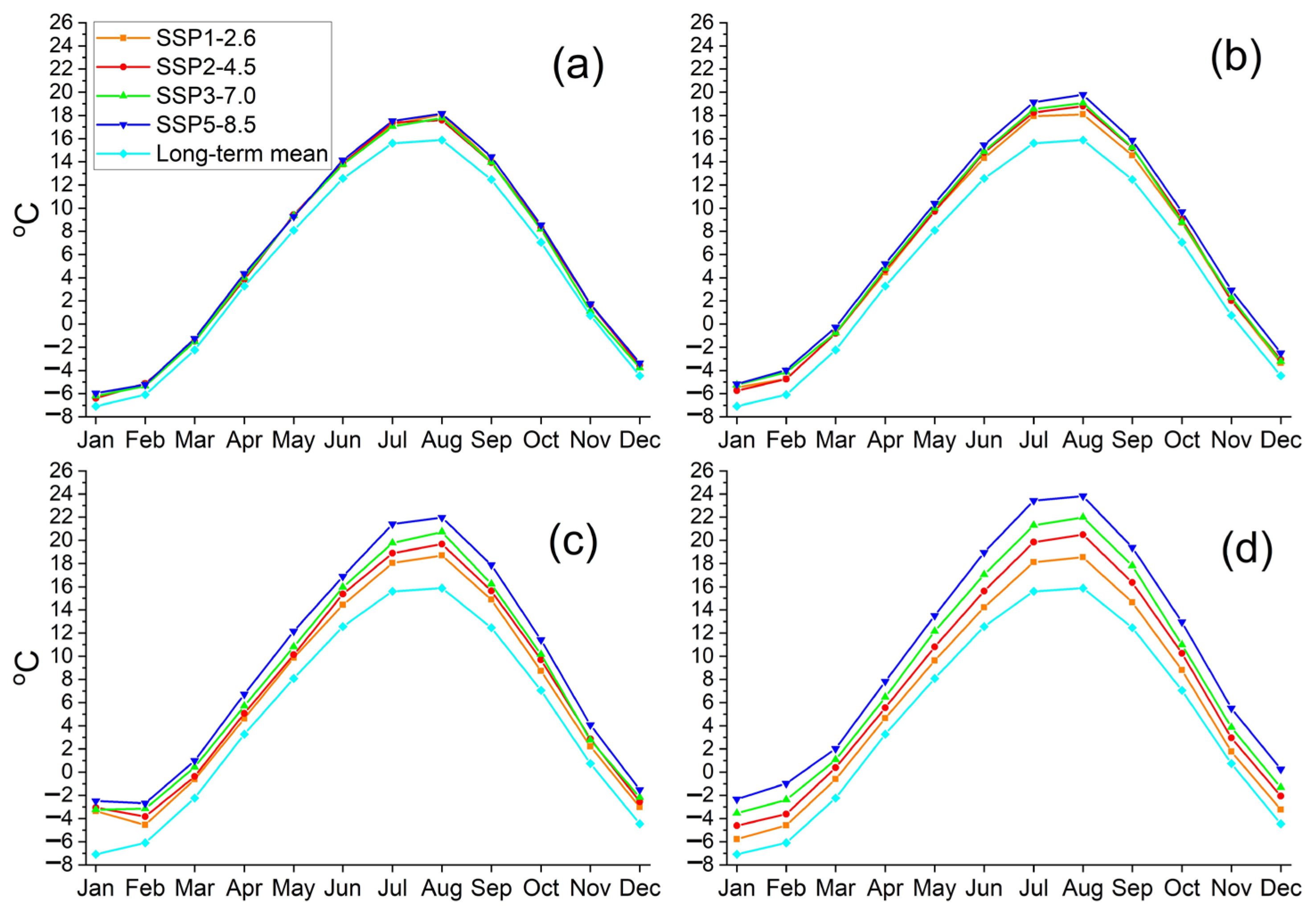
The temperature projections for the period 2020–2099, based on four SSPs (SSP1–2.6, SSP2–4.5, SSP3–7.0, and SSP5–8.5), reveal a marked departure from the long-term average for 1991–2020 (Figure 9).
The long-term average temperatures for 1991–2020 were used as a baseline for comparison, reflecting the region’s typical climate with cold winters and mild summers (e.g., January: –7.1 °C; August: 15.9 °C; Figure 9).
Deviations from these baseline values indicate potential shifts in the Lake Sevan region’s seasonal climate, with possible impacts on water resources, ecosystems, agriculture, and local communities.
Temperature projections for the Lake Sevan basin under four SSP scenarios indicate moderate warming during 2020–2039 relative to the 1991–2020 baseline, with variations depending on seasonal patterns and emission pathways (Figure 9).
Winter (December–February) temperatures in the Lake Sevan basin are projected to rise by 0.7–1.1 °C during 2020–2039, while summer months, particularly July and August, could increase by up to 2.3 °C under SSP5–8.5; lower warming is projected under SSP1–2.6 (Figure 9). Spring (April–May) and autumn (September–October) are expected to warm by 0.7–1.5 °C, contributing to an overall shift toward warmer conditions year-round and potentially impacting hydrology, ecosystems, and socioeconomic activities.
Mid-century projections (2040–2059) show more pronounced warming, with summer increases of 3.6–3.9 °C and winter rises of 1.1–2.1 °C under SSP5–8.5. Spring and autumn are projected to warm by 1.2–3.4 °C, indicating shifts in seasonal boundaries and ecological timing (Figure 9).
For 2060–2079, SSP5–8.5 projects extreme summer warming, with July and August reaching 21.4–22.0 °C (5.8–6.1 °C above baseline), while winter months warm by 1.4–4.6 °C. Transitional seasons are projected to increase by 1.3–5.5 °C (Figure 9).
By the end of the century (2080–2099), SSP5–8.5 indicates extreme annual warming, with July and August reaching 23.4–23.8 °C (≈8 °C above historical averages) and January rising from −7.1 °C to −2.3 °C. SSP3–7.0 also shows strong warming, with summer temperatures exceeding 21 °C and spring/autumn increases of 1.0–7.0 °C, highlighting significant implications for Lake Sevan’s climate, water resources, ecosystems, and agriculture (Figure 9).
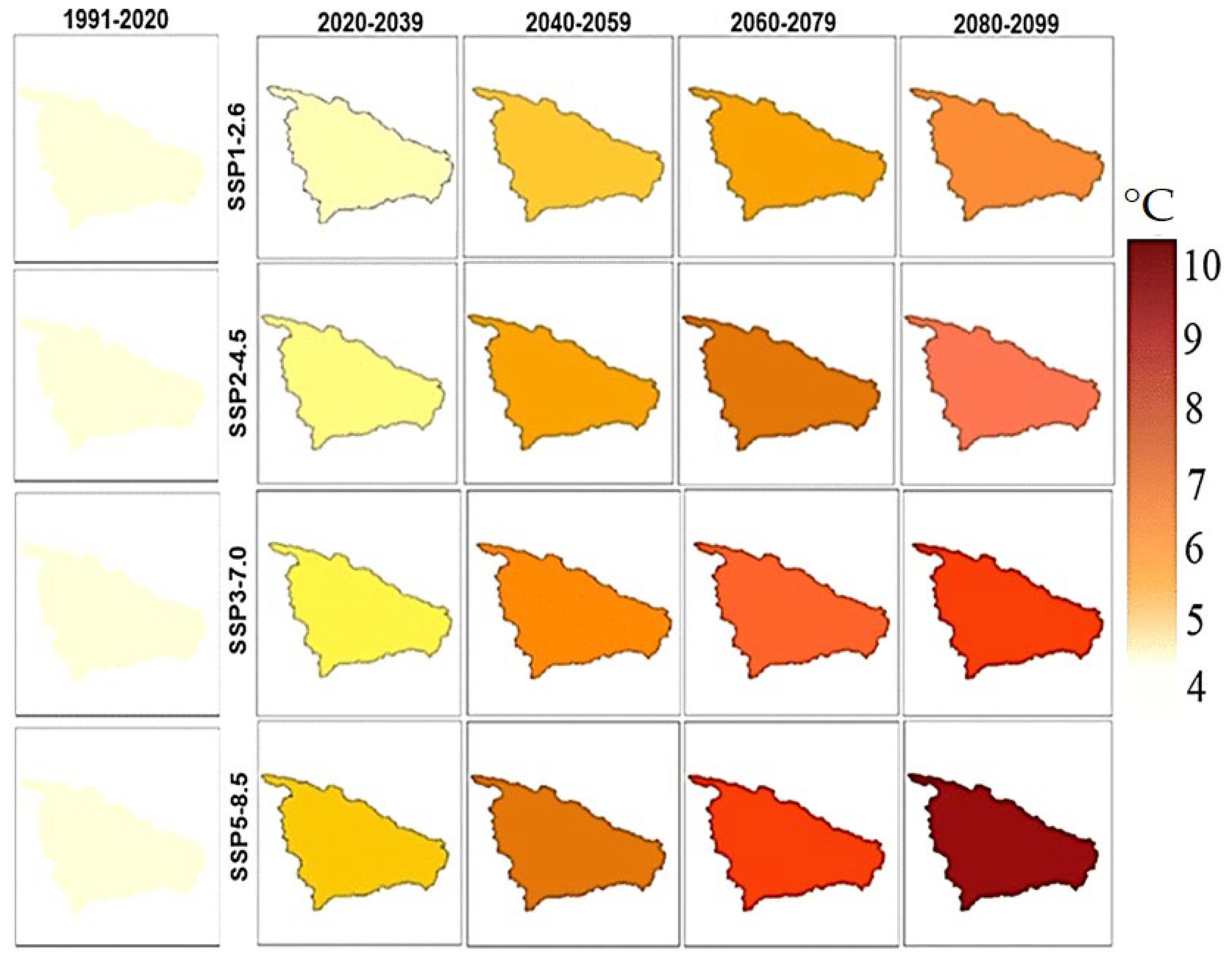
Projected temporal changes in mean annual air temperature in the Lake Sevan basin throughout the 21st century, based on CMIP6 climate model outputs under four SSPs, indicate a significant and progressive warming trend relative to the 1991–2020 baseline average of 4.7 °C (Figure 10).
Under the low-emission SSP1–2.6 scenario, mean annual temperatures in the Lake Sevan basin are projected to increase from 5.7 °C (2020–2039) to 6.7 °C (2080–2099), representing a total rise of ~2.0 °C above the historical baseline (Figure 10).
Under SSP2–4.5, mean annual temperatures are projected to rise from 5.8 °C (2020–2039) to 7.7 °C (2080–2099), an increase of ~3.0 °C above the baseline (Figure 10). For SSP3–7.0, temperatures are projected to increase from 5.9 °C to 8.8 °C over the same period, a total rise of ~4.1 °C (Figure 10).
Under SSP5–8.5, mean annual temperatures are projected to reach 10.4 °C by 2080–2099, an increase of 5.7 °C above the 1991–2020 baseline, representing the greatest warming among the scenarios and highlighting potential impacts on Lake Sevan’s hydrology, ecosystems, and water resources (Figure 10). Overall, higher emissions scenarios lead to greater warming and more pronounced ecological and hydrological impacts on the Lake Sevan basin.

4. Discussion

The analysis of long-term temperature data in the Lake Sevan basin highlights clear trends and spatial patterns in both air and water temperatures. Observed warming occurred across all meteorological stations during 1991–2020, with cumulative increases ranging from 0.4 °C (Gavar) to 1.9 °C (Shorzha). The results confirm that proximity to the lake moderates seasonal temperature extremes, as stations near Lake Sevan exhibit lower variability in heat inflow and outflow than more distant, higher-elevation stations. The methodological approach, including calculation of decadal averages, seasonal means, and heat circulation (deviation of monthly temperatures from annual means), allowed us to quantify these patterns rigorously.
The data show that air temperatures fluctuate more strongly than lake water temperatures, especially in winter and transitional seasons, illustrating the buffering capacity of Lake Sevan due to its thermal inertia. Water temperatures increased more steadily, with maximum rises observed in spring (April +2.20 °C) and autumn (September +2.31 °C), while winter increases remained moderate (January +0.82 °C). These patterns have important implications for limnological processes, aquatic ecosystems, and regional climate adaptation strategies. The observed seasonal warming signal, particularly in late winter and early spring, aligns with global trends in mountainous continental regions, where minimum temperatures have increased more rapidly.
Analysis of historical data reveals several key aspects of Lake Sevan’s role as a primary climatic regulator in the region. Notably, the rate of air temperature increase accelerated from the first to the second decade, followed by a more moderate but sustained rise in the third decade. Lake Sevan functions as a climatic buffer, moderating temperature extremes by keeping adjacent areas warmer during winter and hotter during late summer. This highlights the significant influence that large water bodies exert on local temperature regimes. Meteorological stations near Lake Sevan, such as Sevan and Shorzha, experience more stable temperatures due to the lake’s moderating effect. Stations farther away, like Semyonovka and Masrik, show greater seasonal temperature swings, especially in winter, reflecting typical inland and high-elevation variability. Long-term analysis of heat inflow and outflow highlights Lake Sevan’s key role in regulating the region’s thermal regime. Thermal moderation is strongest near the lake and gradually decreases with distance. The lake’s water temperature remains relatively stable, ranging from +0.82 °C in January to +2.31 °C in September, whereas air temperatures fluctuate more, from +0.18 °C in November to +4.08 °C in March, with notable warming in late winter and early spring.
This study analyzes long-term temperature changes, which are key climate variables, in the Lake Sevan basin through the end of the 21st century. The projections indicate a significant warming trend under all SSP scenarios, underscoring the substantial impact of cumulative greenhouse gas emissions on the regional climate. The results suggest a marked increase in temperature during the 21st century, aligning with earlier studies that also forecast substantial warming across Armenia [23]. Both historical observations and future projections based on CCSM6 model data show that the most intense warming in the Lake Sevan basin is expected during the summer months. Under the SSP5–8.5 scenario, a temperature rise of 4–6 °C is projected by mid-century and by 2100, consistent with projections for Armenia as a whole. These findings are in close agreement with previous climate assessments for both the Sevan basin and the broader region, which likewise anticipate a 4–6 °C increase by the end of the century [23,56].
Rising summer temperatures are expected to intensify evaporation from Lake Sevan, further exacerbating regional aridity. This process will reduce river inflows, which are closely tied to the lake’s water level, thereby threatening the overall availability of freshwater resources. According to Armenia’s Fourth National Communication on Climate Change, total river inflows into the Lake Sevan basin are projected to decline by approximately 34% (equivalent to 265 million m3) by 2100, relative to the baseline period of 1961–1990. Moreover, climate models consistently indicate that declining lake levels will intensify evaporation losses, creating a feedback loop that accelerates water depletion [57]. Elevated temperatures are also likely to diminish snowmelt contributions, extend dry periods, and reduce water availability for human consumption, posing significant risks to both local communities and ecosystems.
Another significant consequence of rising temperatures in the Lake Sevan region is the increased risk of harmful algal blooms, particularly those caused by cyanobacteria. Elevated temperatures create favorable conditions for the proliferation of these organisms, a process further intensified by nutrient runoff from surrounding areas. These blooms pose serious ecological threats, including oxygen depletion, toxin production, and disruption of aquatic ecosystems [58,59,60]. Notably, the highest recorded temperatures in the Lake Sevan basin occurred in 2010 and 2018, both years coinciding with cyanobacterial blooms [61]. Gevorgyan et al. (2020) reported that the 2018 bloom reached unprecedented levels, hypothesizing that rising air and water temperatures contributed to the expansion of cyanobacteria [61]. Given this relationship, it is likely that cyanobacterial blooms in Lake Sevan will become increasingly frequent and severe in the coming years, particularly during the summer months, as regional temperatures continue to rise.
Despite advances in climate modeling, considerable uncertainty remains regarding the precise patterns of temperature change projected for the Lake Sevan basin throughout the 21st century. Key uncertainties include the representation of fine-scale local climate dynamics in complex terrain and the response of extreme temperature and precipitation events to climate change. To address these uncertainties, future studies could employ high-resolution dynamical downscaling, coupled lake–atmosphere modeling, and detailed analysis of CMIP6 precipitation and extreme indices. While much attention has been given to annual and seasonal temperature trends, it is equally important to examine changes in daily precipitation variability and the frequency and intensity of extreme events. Investigating these aspects will require substantial computational resources and methodological sophistication and will form a critical focus of future climate research in the region.
The observed winter variability aligns with broader continental climate patterns, particularly those characteristic of the Eurasian region. Lee et al. (2025) noted that winter months generally exhibit higher temperature fluctuations due to the influence of unstable synoptic weather conditions, varying air masses, snow cover, and fluctuations in atmospheric pressure systems [62]. Our findings are also consistent with those of Gevorgyan et al. (2015), who reported that temperature variability in Armenia is most pronounced during winter [63]. These results reinforce the broader understanding that winter months are typically characterized by greater temperature deviations than other seasons, especially in continental and high-altitude regions such as the Lake Sevan basin. These spatial and seasonal patterns emphasize Lake Sevan’s importance in regulating local climate and impacting ecosystems, agriculture, hydrology, and sustainable water management.

5. Conclusions

Analysis of long-term temperature data in the Lake Sevan basin shows a clear warming trend at all meteorological stations between 1991 and 2020, with cumulative increases ranging from 0.4 °C to 1.9 °C. Proximity to Lake Sevan moderates seasonal temperature extremes, as stations near the lake show lower air temperature variability than those farther away or at higher elevations. Air temperatures fluctuate more strongly than water temperatures, particularly in winter, while water temperatures rise more steadily. All scenarios for the Lake Sevan basin project show significant warming over the 21st century, with summer temperatures increasing by 4–6 °C in the mid- to late-century, potentially increasing evaporation, reducing river inflows, and increasing the frequency of cyanobacterial blooms, thereby impacting water resources, aquatic ecosystems, and regional climate adaptation strategies. Despite these clear trends, there is still considerable uncertainty about local climate dynamics and responses to extreme events, highlighting the need for high-resolution modeling and detailed future analyses. Overall, Lake Sevan plays an important role in regulating local climate, mitigating temperature extremes, and supporting sustainable management of regional water and ecological resources.

Author Contributions

G.K., A.G. (Artur Gevorgyan), A.V., A.M., K.R., A.G. (Artak Gevorgyan) and G.G. Conceptualization, G.G., G.K. and A.V.; methodology, G.K., G.G., A.G. (Artur Gevorgyan) and A.G. (Artak Gevorgyan); software, G.K.; validation, G.G. and G.K.; formal analysis, G.K., A.G. (Artak Gevorgyan) and L.G.; investigation, G.K., G.G., A.G. (Artur Gevorgyan), A.M. and K.R.; resources, G.G.; data curation, G.K. and A.M.; writing—original draft preparation, G.K., G.G. and A.V.; writing—review and editing, G.G., A.G. (Artur Gevorgyan), A.V., K.R. and L.G.; visualization, G.K.; supervision, G.G.; project administration, G.G. All authors have read and agreed to the published version of the manuscript.

Funding

The study was partly supported by the Higher Education and Science Committee of the Ministry of Education, Science, Culture, and Sports (MESCS) of the Republic of Armenia under Research Project No. 23LCG-1F005.

Data Availability Statement

The original contributions presented in this study are included in the article. Further inquiries can be directed to the corresponding authors.

Conflicts of Interest

The authors declare no conflicts of interest–financial or otherwise.

Abbreviations

The following abbreviations are used in this manuscript:
ARCCSAustralian Research Council Centre of Excellence for Climate System Science
BCSDBias-correction-spatial-disaggregation
CCKPClimate Change Knowledge Portal
CMIPCoupled Model Intercomparison Project
CSIROCommonwealth Scientific and Industrial Research Organization
IAMIntegrated Assessment Models
IPCCIntergovernmental Panel on Climate Change
MESCSMinistry of Education, Science, Culture, and Sports
NERCNatural Environment Research Council
NOAANational Oceanic and Atmospheric Administration
RCPRepresentative Concentration Pathway
SSPShared Socioeconomic Pathways
WMOWorld Meteorological Organization

References

  1. Shivanna, K.R. Climate change and its impact on biodiversity and human welfare. Proc. Indian Natl. Sci. Acad. 2022, 88, 160–171. [Google Scholar] [CrossRef]
  2. Muluneh, M.G. Impact of climate change on biodiversity and food security: A global perspective—A review article. Agric. Food Secur. 2021, 10, 36. [Google Scholar] [CrossRef]
  3. Feulner, G. Global challenges: Climate change. Glob. Chall. 2015, 1, 5–6. [Google Scholar] [CrossRef] [PubMed]
  4. Pörtner, H.-O.; Roberts, D.C.; Adams, H.; Adelekan, I.; Adler, C.; Adrian, R.; Aldunce, P.; Ali, E.; Ara Begum, R.; Bednar-Friedl, B.; et al. Climate Change 2022: Impacts, Adaptation and Vulnerability; Working Group II Contribution to the Sixth Assessment Report of the Intergovernmental Panel on Climate Change; Cambridge University Press: Cambridge, UK; New York, NY, USA, 2022. [Google Scholar] [CrossRef]
  5. Méndez, C.; Simpson, N.; Johnson, F.; Birt, A. Climate Change 2023: Synthesis Report (Full Volume); Contribution of Working Groups I, II and III to the Sixth Assessment Report of the Intergovernmental Panel on Climate Change; Intergovernmental Panel on Climate Change: Geneva, Switzerland, 2023. [Google Scholar] [CrossRef]
  6. Gevorgyan, G.; Tümpling, W.; Shahnazaryan, G.; Friese, K.; Schultze, M. Lake-wide assessment of trace elements in surface sediments and water of Lake Sevan. J. Limnol. 2023, 81, 2096. [Google Scholar] [CrossRef]
  7. Hayrapetyan, A.; Gevorgyan, G.; Schultze, M.; Shikhani, M.; Khachikyan, T.; Krylov, A.; Rinke, K. Contemporary community composition, spatial distribution patterns, and biodiversity characteristics of zooplankton in large alpine Lake Sevan, Armenia. J. Limnol. 2023, 81, 2150. [Google Scholar] [CrossRef]
  8. Mkrtchyan, S.S.; Gabrielyan, A.H.; Maghakyan, H.G.; Pafengolts, K.N.; Vardanyants, L.A. (Eds.) Geology of the Armenian SSR. Volume I: Geomorphology; Academy of Sciences Press: Yerevan, Armenia, 1962. (In Russian) [Google Scholar]
  9. Climate Risk Country Profile: Armenia. The World Bank Group and the Asian Development Bank: Yerevan, Armenia. 2021. [Cited 10 December 2025]. Available online: https://www.adb.org/publications/climate-risk-country-profile-armenia (accessed on 1 December 2025).
  10. Sudeep, T.; Dahal, S.; Shrestha, D.; Guyennon, N.; Romano, E.; Colombo, N.; Salerno, F. Elevation-dependent warming of maximum air temperature in Nepal during 1976–2015. Atmos. Res. 2019, 228, 261–269. [Google Scholar] [CrossRef]
  11. Wang, Y.; Ding, Z.; Ma, Y. Spatial and temporal analysis of changes in temperature extremes in the non-monsoon region of China from 1961 to 2016. Theor. Appl. Climatol. 2019, 137, 2697–2713. [Google Scholar] [CrossRef]
  12. Gao, L.; Deng, H.; Lei, X.; Wei, J.; Chen, Y.; Li, Z.; Ma, M.; Chen, X.; Chen, Y.; Liu, M.; et al. Evidence of elevation-dependent warming from the Chinese Tian Shan. Cryosphere 2021, 15, 5765–5783. [Google Scholar] [CrossRef]
  13. Sigro, J.; Cisneros, M.; Perez-Luque, A.J.; Perez-Martinez, C.; Vegas-Vilarrubia, T. Trends in temperature and precipitation at high and low elevations in the main mountain ranges of the Iberian Peninsula (1894–2020): The Sierra Nevada and the Pyrenees. Int. J. Climatol. 2024, 44, 2897–2920. [Google Scholar] [CrossRef]
  14. Adrian, R.; O’Reilly, C.M.; Zagarese, H.; Baines, S.B.; Hessen, D.O.; Keller, W.; Livingstone, D.M.; Sommaruga, R.; Straile, D.; Van Donk, E.; et al. Lakes as sentinels of climate change. Limnol. Oceanogr. 2009, 54, 2283–2297. [Google Scholar] [CrossRef]
  15. Armenian Legal Information System (ARLIS). RA Government Resolution N. 1912-N Dated 08.12.2022, Sevan Water Basin Management Area Management Plan for 2022–2027. 2022; [Cited 10 December 2025]. Available online: http://arlis.am/DocumentView.aspx?DocID=171479 (accessed on 1 December 2025). (In Armenian)
  16. Muller, R.; Curry, J.; Groom, D.; Jacobsen, R.; Perlmutter, S.; Rohde, R.; Rosenfeld, A.; Wickham, C.; Wurtele, J. Decadal variations in the global atmospheric land temperatures. J. Geophys. Res. Atmos. 2013, 118, e50458. [Google Scholar] [CrossRef]
  17. Wang, T.; Yin, S.; Wei, H.; Wang, H.; Luo, F.; Miao, J.; Fu, Y. Decadal variability of extreme high temperature in mid- and high-latitude Asia and its associated North Atlantic air–sea interaction. Clim. Dyn. 2023, 61, 4587–4601. [Google Scholar] [CrossRef]
  18. Neukom, R.; Barboza, L.; Erb, M.; Shi, F.; Emile-Geay, J.; Evans, M.; Franke, J.; Kaufman, D.; Luecke, L.; Rehfeld, K.; et al. Consistent multi-decadal variability in global temperature reconstructions and simulations over the Common Era. Nat. Geosci. 2019, 12, 643–649. [Google Scholar] [CrossRef] [PubMed]
  19. González Hidalgo, J.C.; Beguería, S.; Peña Ángulo, D.; Sandonis, L. Variability of maximum and minimum monthly mean air temperatures over mainland Spain and their relationship with low variability atmospheric patterns for the period 1916–2015. Int. J. Climatol. 2022, 42, 1723–1741. [Google Scholar] [CrossRef]
  20. Duhan, D.; Pandey, A.; Gahalaut, K.P.S.; Pandey, R.P. Spatial and temporal variability in maximum, minimum and mean air temperatures at Madhya Pradesh in central India. Comptes Rendus Geosci. 2013, 345, 3–21. [Google Scholar] [CrossRef]
  21. Buytaert, W. Assessment of the impacts of climate change on mountain hydrology: Development of a methodology through a case study in the Andes of Peru. Mt. Res. Dev. 2012, 32, 385–386. [Google Scholar] [CrossRef]
  22. Vergara, W.; Deeb, A.; Leino, I.; Kitoh, A.; Escobar, M. Assessment of the Impacts of Climate Change on Mountain Hydrology: Development of a Methodology Through a Case Study in the Andes of Peru; World Bank Publications, No. 2278; The World Bank Group: Washington, DC, USA, 2011. [Google Scholar]
  23. Gevorgyan, A.; Melkonyan, H.; Aleksanyan, T.; Iritsyan, A.; Khalatyan, Y. An assessment of observed and projected temperature changes in Armenia. Arab. J. Geosci. 2016, 9, 27. [Google Scholar] [CrossRef]
  24. Alexander, L.; Zhang, X.; Peterson, T.C.; Caesar, J.; BA, G.; Tank, A.; Haylock, M.; Collins, D.; Trewin, B.; Rahimzadeh, F.; et al. Global observed changes in daily climate extremes of temperature and precipitation. J. Geophys. Res. 2006, 111, D05109. [Google Scholar] [CrossRef]
  25. Melkonyan, A. Climate change impact on water resources and crop production in Armenia. Agric. Water Manag. 2015, 161, 86–101. [Google Scholar] [CrossRef]
  26. Robles, M.; Peyron, O.; Brugiapaglia, E.; Ménot, G.; Dugerdil, L.; Ollivier, V.; Ansanay-Alex, S.; Develle, A.-L.; Tozalakyan, P.; Meliksetian, K.; et al. Impact of climate changes on vegetation and human societies during the Holocene in the South Caucasus (Vanevan, Armenia): A multiproxy approach including pollen, NPPs and brGDGTs. Quat. Sci. Rev. 2022, 277, 107297. [Google Scholar] [CrossRef]
  27. Shikhani, M.; Feldbauer, J.; Ladwig, R.; Mercado-Bettín, D.; Moore, T.N.; Gevorgyan, A.; Misakyan, A.; Mi, C.; Schultze, M.; Boehrer, B.; et al. Combining a multi-lake model ensemble and a multi-domain CORDEX climate data ensemble for assessing climate change impacts on Lake Sevan. Water Resour. Res. 2024, 60, e2023WR036511. [Google Scholar] [CrossRef] [PubMed]
  28. Shikhani, M.; Mi, C.; Gevorgyan, A.; Gevorgyan, G.; Misakyan, A.; Azizyan, L.; Barfus, K.; Schulze, M.; Shatwell, T.; Rinke, K. Simulating thermal dynamics of the largest lake in the Caucasus region: The mountain Lake Sevan. J. Limnol. 2021, 81, 2024. [Google Scholar] [CrossRef]
  29. Siabi, E.K.; Awafo, E.A.; Kabo-bah, A.T.; Derkyi, N.S.A.; Akpoti, K.; Mortey, E.M.; Yazdanie, M. Assessment of Shared Socioeconomic Pathway (SSP) climate scenarios and its impacts on the Greater Accra region. Urban Clim. 2023, 49, 101432. [Google Scholar] [CrossRef]
  30. Nazarenko, L.; Tausnev, N.; Russell, G.; Rind, D.; Miller, R.; Schmidt, G.; Bauer, S.; Kelley, M.; Ruedy, R.; Ackerman, A.; et al. Future climate change under SSP emission scenarios with GISS-E2.1. J. Adv. Model. Earth Syst. 2022, 14, e2021MS002871. [Google Scholar] [CrossRef]
  31. Ciampittiello, M.; Marchetto, A.; Boggero, A. Water resources management under climate change: A review. Sustainability 2024, 16, 3590. [Google Scholar] [CrossRef]
  32. Yuan, X.; Li, S.; Chen, J.; Yu, H.; Yang, T.; Wang, C.; Huang, S.; Chen, H.; Ao, X. Impacts of global climate change on agricultural production: A comprehensive review. Agronomy 2024, 14, 1360. [Google Scholar] [CrossRef]
  33. Zhao, M.; Boll, J. Adaptation of water resources management under climate change. Front. Water 2022, 4, 983228. [Google Scholar] [CrossRef]
  34. Earth System Model Evaluation Project. CMIP6—Coupled Model Intercomparison Project Phase 6. In Program for Climate Model Diagnosis and Intercomparison (PCMDI) [Internet]; Cited 10 December 2025; LLNL: Livermore, CA, USA, 2014. Available online: https://pcmdi.llnl.gov/CMIP6/ (accessed on 1 December 2025).
  35. Eyring, V.; Bony, S.; Meehl, G.; Senior, C.; Stevens, B.; Stouffer, R.; Taylor, K. Overview of the Coupled Model Intercomparison Project Phase 6 (CMIP6) experimental design and organization. Geosci. Model. Dev. 2016, 9, 1937–1958. [Google Scholar] [CrossRef]
  36. Riahi, K.; van Vuuren, D.P.; Kriegler, E.; Edmonds, J.; O’Neill, B.; Fujimori, S.; Bauer, N.; Calvin, K.; Dellink, R.; Fricko, O.; et al. The Shared Socioeconomic Pathways and their energy, land use, and greenhouse gas emissions implications: An overview. Glob. Environ. Change 2017, 42, 153–168. [Google Scholar] [CrossRef]
  37. Bock, L.; Lauer, A. Cloud properties and their projected changes in CMIP models with low to high climate sensitivity. Atmos. Chem. Phys. 2024, 24, 1587–1605. [Google Scholar] [CrossRef]
  38. O’Neill, B.; Kriegler, E.; Riahi, K.; Ebi, K.; Hallegatte, S.; Carter, T.; Mathur, R.; Vuuren, D. A new scenario framework for climate change research: The concept of Shared Socioeconomic Pathways. Climatic Change 2014, 122, 387–400. [Google Scholar] [CrossRef]
  39. Vuuren, D.; Edmonds, J.; Kainuma, M.; Riahi, K.; Thomson, A.; Hibbard, K.; Hurtt, G.; Kram, T.; Krey, V.; Lamarque, J.-F.; et al. The representative concentration pathways: An overview. Clim. Change 2011, 109, 5–31. [Google Scholar] [CrossRef]
  40. Soares, P.M.M.; Johannsen, F.; Lima, D.; Lemos, G.; Bento, V.; Bushenkova, A. High-resolution downscaling of CMIP6 Earth system and global climate models using deep learning for Iberia. Geosci. Model. Dev. 2024, 17, 229–259. [Google Scholar] [CrossRef]
  41. Grose, M.; Narsey, S.; Trancoso, R.; Mackallah, C.; Delage, F.; Dowdy, A.; Virgilio, G.; Watterson, I.; Dobrohotoff, P.; Rashid, H.; et al. A CMIP6-based multi-model downscaling ensemble to underpin climate change services in Australia. SSRN Prepr. 2022. [Google Scholar] [CrossRef]
  42. Gebrechorkos, S.; Leyland, J.; Slater, L.; Wortmann, M.; Ashworth, P.J.; Bennett, G.L.; Boothroyd, R.; Cloke, H.; Delorme, P.; Griffith, H.; et al. A high-resolution daily global dataset of statistically downscaled CMIP6 models for climate impact analyses. Sci. Data 2023, 10, 611. [Google Scholar] [CrossRef]
  43. World Bank. Climate Metadata. [Internet]. World Bank Climate Knowledge Portal. 2025. [Cited 10 December 2025]. Available online: https://climateknowledgeportal.worldbank.org/metadata (accessed on 3 December 2025).
  44. Yang, Y.Q.; Hou, Q.; Zhou, C.H.; Liu, H.L.; Wang, Y.Q.; Niu, T. Sand/dust storm processes in Northeast Asia and associated large-scale circulations. Atmos. Chem. Phys. 2008, 8, 25–33. [Google Scholar] [CrossRef]
  45. Data Buoy Cooperation Panel (DBCP). Reference Guide to the GTS Sub-System of the Argos Processing System. Rev. 1.6; DBCP Technical Document No. 2; WMO & IOC Data Buoy Cooperation Panel: Geneva, Switzerland, 2005; 102p. [Google Scholar] [CrossRef]
  46. Hegerl, G.C.; Zwiers, F.W.; Braconnot, P.; Gillet, N.P.; Luo, Y.; Marengo, J.; Nicholls, N.; Penner, J.E.; Stott, P.A. Understanding and attributing climate change. In Climate Change 2007: The Physical Science Basis; Solomon, S., Qin, D., Manning, M., Chen, Z., Marquis, M., Averyt, K.B., Tignor, M., Mille, H.L., Eds.; Contribution of Working Group I to the Fourth Assessment Report of the Intergovernmental Panel on Climate Change; Cambridge University Press: Cambridge, UK, 2007. [Google Scholar]
  47. Pepin, N.C.; Arnone, E.; Gobiet, A.; Haslinger, K.; Kotlarski, S.; Notarnicola, C.; Palazzi, E.; Seibert, P.; Serafin, S.; Schöner, W.; et al. Climate changes and their elevational patterns in the mountains of the world. Rev. Geophys. 2022, 60, e2020RG000730. [Google Scholar] [CrossRef]
  48. World Meteorological Organization (WMO). The Global Climate 2011–2020: A Decade of Accelerating Climate Change; WMO-No. 1338; World Meteorological Organization: Geneva, Switzerland, 2023.
  49. Subin, Z.M.; Murphy, L.N.; Li, F.; Bonfils, C.; Riley, W.J. Boreal lakes moderate seasonal and diurnal temperature variation and perturb atmospheric circulation: Analyses in the Community Earth System Model 1 (CESM1). Tellus A 2012, 64, 15639. [Google Scholar] [CrossRef]
  50. Jiang, Y.; Chi, Y.; Wang, W.; Li, W.; Wang, H.; Sun, J. Responses of the East Asian winter climate to global warming in CMIP6 models. Atmosphere 2025, 16, 1143. [Google Scholar] [CrossRef]
  51. Hu, S.; Hsu, P.-C. Drivers of elevation-dependent warming over the Tibetan Plateau. Atmos. Ocean. Sci. Lett. 2023, 16, 100289. [Google Scholar] [CrossRef]
  52. Wang, H.; Wang, B.-B.; Cui, P.; Ma, Y.-M.; Wang, Y.; Hao, J.-S.; Wang, Y.; Li, Y.-M.; Sun, L.-J.; Wang, J.; et al. Disaster effects of climate change in High Mountain Asia: State of art and scientific challenges. Adv. Clim. Change Res. 2024, 15, 367–389. [Google Scholar] [CrossRef]
  53. Lenters, J.; Kratz, T.; Bowser, C. Effects of climate variability on lake evaporation: Results from a long-term energy budget study of Sparkling Lake, northern Wisconsin (USA). J. Hydrol. 2005, 308, 168–195. [Google Scholar] [CrossRef]
  54. Kundzewicz, Z.; Mata, L.; Arnell, N.; Doll, P.; Jiménez, B.; Miller, K.; Oki, T.; Şen, Z.; Shiklomanov, I. The implications of projected climate change for freshwater resources and their management. Hydrol. Sci. J. 2008, 53, 3–10. [Google Scholar] [CrossRef]
  55. Verma, A.; Agrawal, S. Evaluating the natural cooling potential of waterbodies in dense urban landscape: A case study of Bengaluru, India. Urban Clim. 2024, 58, 102200. [Google Scholar] [CrossRef]
  56. Galstyan, H.; Sfîcă, L.; Ichim, P. Long-term variability of temperature in Armenia in the context of climate change. Int. J. Environ. Chem. Ecol. Geol. Geophys. Eng. 2016, 10, 19–25. [Google Scholar]
  57. UNDP Armenia. Fourth National Communication on Climate Change; UNDP Armenia: Yerevan, Armenia, 2020; 213p, Available online: http://env.am/storage/files/fnc-eng.pdf (accessed on 4 December 2025).
  58. Paerl, H.W.; Huisman, J. Climate change: A catalyst for global expansion of harmful cyanobacterial blooms. Environ. Microbiol. Rep. 2009, 1, 27–37. [Google Scholar] [CrossRef]
  59. Li, X.; Hang, X.; Zhu, S.; Sun, L.; Li, Y. Response of cyanobacterial blooms to climate warming: Evidence from satellite observations and long-term trends in Lake Taihu in China. Sci. Rep. 2025, 15, 38820. [Google Scholar] [CrossRef]
  60. Erratt, K.J.; Creed, I.F.; Lobb, D.A.; Smol, J.P.; Trick, C.G. Climate change amplifies the risk of potentially toxigenic cyanobacteria. Glob. Change Biol. 2023, 29, 5240–5249. [Google Scholar] [CrossRef]
  61. Gevorgyan, G.; Rinke, K.; Schultze, M.; Mamyan, A.; Kuzmin, A.; Belykh, O.; Sorokovikova, E.; Hayrapetyan, A.; Hovsepyan, A.; Khachikyan, T.; et al. First report about toxic cyanobacterial bloom occurrence in Lake Sevan, Armenia. Int. Rev. Hydrobiol. 2020, 105, 131–142. [Google Scholar] [CrossRef]
  62. Lee, S.; Park, H.-S.; Kim, M.-K.; Min, S.-K.; Hwang, H. Future increases in Eurasian mid-latitude winter temperature variability shaped by a weakened Atlantic Meridional Overturning Circulation. Commun. Earth Environ. 2025, 6, 22. [Google Scholar] [CrossRef]
  63. Gevorgyan, A.; Melkonyan, H.; Abrahamyan, R.; Petrosyan, Z.; Shahnazaryan, A.; Astsatryan, H.; Sahakyan, V.; Shoukouryan, Y. A persistent surface inversion event in Armenia as simulated by WRF model. In 2015 Computer Science and Information Technology (CSIT); IEEE: New York, NY, USA, 2015. [Google Scholar] [CrossRef]
Figure 1. Spatial distribution of meteorological and hydrological stations across the Lake Sevan basin, referenced by their respective codes as detailed in Table 2.
Water 18 00352 g001
Figure 2. Flowchart of data collection, processing, and climate projections.
Water 18 00352 g002
Figure 3. Average annual air temperatures recorded at six meteorological stations in the Lake Sevan basin during the decades 1991–2000, 2001–2010, and 2011–2020.
Water 18 00352 g003
Figure 4. Long-term average monthly air temperatures (1991–2020) in the Lake Sevan basin.
Water 18 00352 g004
Figure 5. Extreme positive and negative deviations of average monthly air temperatures from the long-term mean (1991–2020) at six meteorological stations in the Lake Sevan basin.
Water 18 00352 g005
Figure 6. Long-term average monthly heat inflow and outflow values (1991–2020) in the Lake Sevan basin.
Water 18 00352 g006
Figure 7. Seasonal and interannual variability of mean annual air and water temperatures in the Lake Sevan basin.
Water 18 00352 g007
Figure 8. Estimated average monthly air and lake water temperatures (1991–2020).
Water 18 00352 g008
Figure 9. Monthly temperature variability in the Lake Sevan basin: (a) 2020–2039, (b) 2040–2059, (c) 2060–2079, and (d) 2080–2099.
Water 18 00352 g009
Figure 10. Temporal changes in mean annual air temperature according to scenarios.
Water 18 00352 g010
Table 1. List of models used in CCKP CMIP6-x0.25 compilation [42,43].
Model NameModeling Center
hadgem3-gc31-llUK Met Office Hadley Centre, UK
ipsl-cm6a-lrThe Institute Pierre Simon Laplace, France
inm-cm4-8Institute for Numerical Mathematics, Russia
kiost-esmKorea Institute of Ocean Science and Technology, Republic of Korea
kace-1-0-gNational Institute of Meteorological Research, Republic of Korea
miroc6Atmosphere and Ocean Research Institute, The University of Tokyo, Japan
access-cm2CSIRO (Commonwealth Scientific and Industrial Research Organization, Australia), and ARCCS (Australian Research Council Centre of Excellence for Climate System Science, Australia
miroc-es2lAtmosphere and Ocean Research Institute, The University of Tokyo, Center for Climate System Research-National Institute for Environmental Studies, Japan
mpi-esm1-2-hrMax Planck Institute for Meteorology (MPI-M), Germany
giss-e2-1-gGoddard Institute of Space Studies, NASA, USA
access-esm1.5CSIRO (Commonwealth Scientific and Industrial Research Organization, Australia), and ARCCS (Australian Research Council Centre of Excellence for Climate System Science, Australia
gfdl-esm4Geophysical Fluid Dynamics Laboratory, NOAA, USA
cnrm-cm6-1Centre National de Recherches Meteorologiques, France
hadgem3-gc31-mmUK Met Office Hadley Centre, UK
gfdl-cm4Geophysical Fluid Dynamics Laboratory, NOAA, USA
canesm5Canadian Centre for Climate Modeling and Analysis, Canada
mpi-esm1-2-lrMax Planck Institute for Meteorology (MPI-M), Germany
bcc-csm2-mrBeijing Climate Center, China Meteorological Administration, China
mri-esm2-0Meteorological Research Institute, Japan
taiesm1Research Center for Environmental Changes, Academia Sinica, Taiwan
ec-earth3-veg-lrEC-Earth-Consortium
ukesm1-0-llUK’s Met Office and Natural Environment Research Council (NERC), UK
cmcc-esm2Euro-Mediterranean Center on Climate Change
nesm3Nanjing University of Information Science and Technology, China
noresm2-mmNorwegian Climate Centre, Norway
ec-earth2EC-Earth-Consortium
noresm2-lmNorwegian Climate Centre, Norway
inm-cm5-0Institute for Numerical Mathematics, Russia
cnrm-esm2-1Centre National de Recherches Meteorologiques/Centre Européen de Recherche et Formation Avancées en Calcul Scientifique, France
fgoals-g3China Academy of Sciences, China
Table 2. A summary of the selected meteorological and hydrological stations in the Lake Sevan basin.
NMeteorological StationStation
Code
Geographic CoordinatesAltitude Above Sea Level (m)
LatitudeLongitude
1SemyonovkaM-140.659744.89812104
2SevanM-240.565345.00831917
3GavarM-340.348645.13001961
4MartuniM-440.136945.29691943
5MasrikM-540.207545.76441940
6ShorzhaM-640.500645.27171917
Hydrological station
1Sevan PeninsulaH-140.562845.00841890
2MartuniH-240.162345.30761890
3KarchaghbyurH-340.178345.56441890
4ShorzhaH-440.497245.27001890
Table 3. Long-term mean seasonal air temperature variability (STDEV, ±°C) at six meteorological stations in Lake Sevan basin for period 1991–2020.
StationsWinter Spring SummerAutumn
Shorzha±1.77±1.67±1.41±1.51
Martuni±1.68±1.30±0.86±1.01
Gavar±1.69±1.25±0.81±0.91
Masrik±2.04±1.15±0.89±1.06
Semyonovka±2.41±1.63±1.10±1.19
Sevan±1.67±1.35±1.04±1.07
Disclaimer/Publisher’s Note: The statements, opinions and data contained in all publications are solely those of the individual author(s) and contributor(s) and not of MDPI and/or the editor(s). MDPI and/or the editor(s) disclaim responsibility for any injury to people or property resulting from any ideas, methods, instructions or products referred to in the content.