Article

Antibiotics Induce Metabolic and Physiological Responses in Daphnia magna

by
Katie O’Rourke
1,
Izabela Antepowicz
1,2,
Beatrice Engelmann
3,
Ulrike Rolle-Kampczyk
3,
Martin von Bergen
3,4,5 and
Konstantinos Grintzalis
1,2,*
1
School of Biotechnology, Dublin City University, D09 N920 Dublin, Ireland
2
Life Sciences Institute, Dublin City University, D09 N920 Dublin, Ireland
3
Department of Molecular Toxicology, Helmholtz Centre for Environmental Research—UFZ GmbH, 04318 Leipzig, Germany
4
Institute of Biochemistry, Leipzig University, 04103 Leipzig, Germany
5
German Centre for Integrative Biodiversity Research (iDiv) Halle-Jena-Leipzig, 04103 Leipzig, Germany
*
Author to whom correspondence should be addressed.
Water 2026, 18(2), 265; https://doi.org/10.3390/w18020265
Submission received: 15 December 2025 / Revised: 16 January 2026 / Accepted: 18 January 2026 / Published: 20 January 2026

Abstract

Antibiotics represent a unique and diverse group of drugs, which are known to exert deleterious effects on non-target species and contribute to the phenomenon of antimicrobial resistance. With central inclusion on the EU Surface Water Watch List, and reported known affects in multiple model organisms, the importance of the sufficient monitoring of antibiotics in the aquatic environment has been highlighted. Most studies report the impact of individual antibiotics following exposure for a single generation in animals. In this study, we assessed the impact of four antibiotics with different modes of action (amoxicillin, trimethoprim, erythromycin, and sulfamethoxazole) and their mixture on the sentinel species Daphnia magna over three generations, via biochemical markers and a targeted metabolomic analysis of central metabolic pathways. No mortality was observed at 50 mg/L of each selected antibiotic and their composite mixture. Thus, a working concentration of 1 mg/L was chosen to progress this study. Results indicated that enzyme activity was particularly sensitive to exposure to amoxicillin and the mixture, whereas trimethoprim and the mixture induced the most metabolic changes in glycolysis and the TCA cycle. Additionally, the quaternary mixture had a stronger impact on the first generation of daphnids, altering the activity of β-galactosidase, glutathione S-transferase, and acid and alkaline phosphatase, suggesting that Daphnia can adapt to stress caused by antibiotics.

1. Introduction

Pollution of the aquatic ecosystem resulting from pharmaceuticals, heavy metals, agrichemicals, and industrial waste has become of imminent concern with the increase in anthropogenic activities, which exert deleterious effects on freshwater and marine organisms [1,2]. Coupled with an aging human population, wider access to medicine, and the tendencies observed toward self-medication, there has been an undeniable increase in pharmaceutical consumption, which has resulted in their presence in the aquatic environment. Traditionally, water monitoring focuses on the identification and the quantification of chemicals such as pharmaceutical ingredients with a spot or grab sampling approach. This usually neglects to provide biological information on chemicals. Furthermore, the instrumentation employed to perform conventional methods includes chromatography coupled with mass spectrometry for water monitoring practices, which has sensitivity limitations, cannot always detect all chemicals, especially below their sensitivity limits, and does not evaluate the impact of multiple substances [3]. There has been a recent transition toward the use of new approach methodologies (NAMs) in molecular ecotoxicology and risk assessment. NAMs combine multiple tools such as multi-omic technologies and in vitro, in vivo, and in silico models in the risk assessment for chemicals present in the environment and provide a predictive aspect using these as early warning systems for pollution [4]. Underpinned by these new practices, sentinel species sensitive to pollution are used as bioindicator organisms with multiple phenotypic (fecundity, size, sex ratio) and/or molecular endpoints (enzyme activity and molecular profiles), providing a more accurate evaluation of the effects of individual chemicals and mixtures [5].
Among these sentinel species, the planktonic crustacean Daphnia magna is a keystone species with a broad geographical distribution, playing a central role in freshwater food webs [6]. Under optimal conditions, daphnids reproduce clonally, producing genetically homogeneous female populations that provide uniform and reproducible responses to xenobiotic exposure among individuals. Moreover, due to their characteristic filter feeding mechanism, daphnids are extremely sensitive to changes in their habitat, thus making them ideal for ecotoxicology research [7]. Following their genome sequencing, daphnids exhibited strong ecoresponsiveness, reinforcing their suitability as model organisms for such studies [8].
Antibiotics provide a unique threat to the environment; unlike other contaminants, they pose non-target effects even at low concentrations [9]. However, antibiotics exert selective pressure on bacteria, exacerbating the horizontal transfer of resistance genes, contributing to the antibiotic resistance phenomenon [10,11]. Resulting from their importance in human and veterinary medicine, their applications in livestock husbandry practices, and their intense prophylactic use in aquaculture, antibiotics eventuating in the freshwater environment are ubiquitously detected, reaching concentrations of 450 µg/L in some areas [12]. Global estimates forecast a rise in veterinary antibiotic consumption, reaching approximately 104,079 tonnes by 2030 [13]. Antibiotics can be classified according to their mechanism of action: inhibition of DNA replication, inhibition of protein biosynthesis, disruption of cell wall biosynthesis, and interference with the folate pathway [14].
Amoxicillin is derived from penicillin through the addition of an amino group, a modification introduced to improve efficacy against resistant bacterial strains [15,16]. Amoxicillin is classified as a β-lactam antibiotic, and binds to penicillin-binding proteins, thereby inhibiting the transpeptidation step of peptidoglycan synthesis. This prevents cross-linking, a requirement for bacterial cell wall formation, leading to structural instability. This disruption activates the endogenous autolytic enzymes, resulting in cell wall lysis and subsequent bacterial cell death [15]. Amoxicillin is the most prescribed antibiotic worldwide [17] and has been reported to induce cytotoxicity and genotoxicity in eukaryotic cells [18]. In humans, approximately 43–75% of amoxicillin is excreted without undergoing any metabolic transformation, and with a half-life of 9 days, this antibiotic has been reported in wastewater treatment plant (WWTP) effluent and even in surface waters, highlighting its persistence and widespread occurrence in aquatic environments [19]. A study by Otoo et al. (2022) documented the presence of amoxicillin at a concentration of 8.76 mg/L in hospital effluents [20].
Erythromycin is a widely used prototypical macrolide [21]. It is a bacteriostatic antibiotic that inhibits the further growth of bacteria without directly causing cell death. Its mechanism of action involves binding to the 23S ribosomal RNA molecule, thereby blocking peptide chain synthesis and consequently impending protein synthesis. It is worth noting that human ribosomes consist of 40S and 60S subunits and lack the 50S subunit; therefore, erythromycin does not interfere with protein synthesis in human cells [22]. A study by Liu et al. (2018) reported that erythromycin treatment inhibited cell proliferation while promoting apoptosis in nasal cells [23]. Erythromycin has been reported in WWTP effluent, potable water, freshwater, marine systems, groundwater, biosolids, sewage sludge, and sediments. The maximum reported concentrations of erythromycin in freshwater and WWTP effluent were 3847 and 27,000 ng/L, respectively [24].
Trimethoprim, which was historically available only in combination with sulfamethoxazole, has more recently been marketed as a monotherapy for the treatment of uncomplicated urinary tract infections. Its antimicrobial activity results from inhibition of dihydrofolate reductase, thereby preventing the conversion of dihydrofolate to tetrahydrofolate, the biologically active form of folic acid in susceptible bacteria [25]. Additionally, trimethoprim has been shown to elicit DNA-damaging and cytotoxic effects within nucleated cells [26,27]. Trimethoprim use in aquaculture results in increased residues across various matrices, including ponds, sediments, aquaculture products, and other aquatic habitats. As a result, trimethoprim was reported at a concentration of 1.04 mg/L in aquaculture facilities in Vietnam [28].
Sulfamethoxazole is regarded as a sulfonamide antimicrobial that interferes with folate biosynthesis in bacteria. It acts as a structural analog of ρ-aminobenzoic acid and competitively inhibits dihydropteroate synthase, an essential enzyme in the biosynthesis of dihydrofolic acid [29]. It is worth noting that sulfamethoxazole can induce genotoxicity and cytotoxicity in eukaryotic cells [30]. The combination of sulfamethoxazole and trimethoprim produces a synergistic antifolate effect, as tetrahydrate is essential for the synthesis of purines required for DNA and protein production. While each agent alone exerts a bacteriostatic effect, their concurrent use inhibits two sequential steps in folate metabolism, thereby disrupting the biosynthesis of nucleic acid and proteins, known as bactericidal activity [29]. Attributed to its extensive use in marine aquaculture, sulfamethoxazole ranks among the most frequently detected antibiotics in aquatic ecosystems. For instance, sulfamethoxazole has been detected at concentrations up to 16 mg/L in wastewater effluent in Pakistan [31].
In this study, we employed Daphnia magna to assess the chronic and transgenerational impact of several antibiotics, combining biochemical endpoints such as enzymatic activities and changes in the central metabolic pathways. The effects of the selected antibiotics and their composite mixture studied here on daphnid metabolism remain largely underexplored, highlighting a notable gap in the literature. Additionally, the four antibiotics (amoxicillin, erythromycin, trimethoprim, and sulfamethoxazole) used in this study were included in the EU Watch List of substances [32]. Furthermore, studying successive generations of daphnids can reveal critical insights into the long-term ecological impact of stressors [33]. Our study highlights how Daphnia may be used as new sensitive metrics for the detection of antibiotic pollution in the environment.

2. Materials and Methods

2.1. Materials

All chemicals used in this study were of the highest purity > 99.9% and quality. Amoxicillin (CAS 26787-78-0), erythromycin (CAS 114-07-8), sulfamethoxazole (CAS 723-46-6), trimethoprim (CAS 738-70-5), KCl (CAS 7447-40-7), Na2SeO3 (CAS 10102-18-8), bovine serum albumin (CAS 9048-46-8), Coomassie Brilliant Blue G (CAS 6104-58-1), p-nitrophenyl butyrate (CAS 2635-84-9), 2-nitrophenyl-B-D-galactopyranoside (CAS 369-07-3), 1-chloro-2,4-dinitrobenzene (CAS 97-00-7), L-glutathione reduced (CAS 70-18-8), sodium phosphate dibasic (CAS 7558-79-4), and L-leu-4-nitroanilide (CAS 4178-93-2) were purchased from Sigma-Aldrich (St. Louis, MO, USA). CaCl2·2H2O (CAS 10035-04-8), MgSO4·7H2O (CAS 10034-99-8), NaHCO3 (CAS 144-55-8), HCl (CAS 7647-01-0), p-nitrophenyl phosphate (CAS 4264-83-9), boric acid (CAS 10043-35-3), ammonium acetate (CAS 631-61-8), NaOH (CAS 1310-73-2), methanol (CAS 67-56-1), and DMSO (CAS 67-68-5) were purchased from ThermoFisher (Cork, Ireland).

2.2. Culturing Daphnids

Daphnids were cultured in aqueous media under a light/dark photoperiod at 21 °C similar to previous studies [34]. Cultures were fed daily with algae (of the species Chlamydomonas rheinhartii) and supplemented with an organic seaweed extract at media renewal weekly. For chronic and transgenerational exposures, forty-five neonates (<24 h) were cultured for 21 days in 1.8 L media. Final concentration of individual antibiotics was 1 mg/L for each one individually or in the mixture, and because amoxicillin, trimethoprim, and erythromycin were soluble in the aqueous media, whereas sulfamethoxazole required DMSO, DMSO was the carrier solvent, which was added at a very low concentration (0.000017% final concentration). For comparison reasons, a negative control (in the absence of any antibiotic or carrier solvent) was also included; however, each exposure condition was compared with DMSO as the solvent control. All cultures were fed daily with algae, and media were renewed every three days. Neonates from exposed animals were collected on the 21st day of exposure and exposed for another chronic generation of 21 days and for a third generation on the 21st day.

2.3. Sample Homogenization and Biochemical Assays

For biochemical assays, five 21-day-old daphnids were pooled together and homogenized immediately in 0.5 mL ice-cold buffer using an Eppendorf pestle homogenizer (provided by Sigma-Aldrich, St. Louis, MO, USA). Homogenates were cleared with centrifugation at 20,000 g at 4 °C for 10 min, and the clear supernatant was assayed for enzyme activities as previously described [35]. Alkaline and acid phosphatases were quantified by the production of p-nitrophenol using p-nitrophenyl phosphate as a substrate in boric buffer of pH 9.8 and acetic acid buffer of 4.5, respectively. Following the alkalinization of the reaction (0.66 M NaOH), the released p-nitrophenol was measured at 405 nm. Similarly, β-galactosidase activity was assessed from the concentration of o-nitrophenol released from o-nitrophenyl-β-galactosidase in pH 7.2 phosphate buffer. Lipase activity was assessed by the release of p-nitrophenol from p-nitrophenyl-butyrate in pH 7.2 phosphate buffer. Glutathione-S-transferase activity was quantified from the conjugation of reduced glutathione to 1-chloro-2,4-dinitrobenzene (CDNB) measured photometrically at 340 nm [36]. Enzyme activity was expressed as enzyme units per protein, which was quantified with a sensitive Bradford assay [37]. Statistically significant differences between exposures and their corresponding control were identified with Student’s t-test.

2.4. Targeted Metabolomic Analysis

For metabolomics, three individuals following 21 days of exposure were collected and snap-frozen in liquid nitrogen. Samples were homogenized in 0.6 mL ice-cold methanol/water (4:1; HPLC-MS grade) using an Eppendorf pestle to quench metabolic reactions. The homogenates were cleared by centrifugation at 10,000 g at 4 °C for 5 min, and 100 µL of the clear supernatant was vacuum-dried using a speedvac (ThermoFisher, Cork, Ireland) and stored at −80 °C until further analysis. Each sample was resuspended in 120 µL water, and analysis of amino acid derivatization was carried out with phenyl isothiocyanate (PITC). For the analysis of central carbon metabolites, targeted LC-MS/MS data were acquired and analyzed in a QTRAP® 6500+ system (Sciex, Framingham, MA, USA). Chromatographic separation and analysis of spectra were conducted as previously described [35]. Amino acids and central carbon metabolites were identified with specific MRM transitions, and external calibration curves were measured for linear regression. Peak integration was determined in SciexOS® software (Version 3.0.0). The metabolomic data were processed with the freeware software Multi Experiment Viewer (version 4.9.0) [38]. The values of peak area intensities were scaled and expressed as fold over the carrier solvent control.

3. Results and Discussion

The initial toxicity experiments to establish whether the antibiotics amoxicillin, trimethoprim, erythromycin, and sulfamethoxazole induced any mortality indicated that all antibiotics were non-lethal, even at high concentrations that are not considered environmentally relevant (50 mg/L). This finding is in accordance with Rowan et al. [39], who reported no observed toxic effects to Daphnia magna exposed to amoxicillin, trimethoprim, and erythromycin. Therefore, to assess transgenerational effects, a considerably lower concentration of 1 mg/L was selected for this study, which was also supported by previous studies [34,35,40]. However, another study reported that fifty-percent mortality of Daphnia occurred at 2391.6 μg/L for amoxicillin and 273.4 μg/L for ciprofloxacin [41]. Variation in tolerance to contaminants is a well-documented phenomenon, both between populations and among different clones within a single population [42].
Amoxicillin reduced the activity of alkaline phosphatase (ALP) by 26% and 25% for the first and third generations of daphnids, respectively, and additionally, a 20% increase in acid phosphatase (ACP) activity was observed in the first generation only. β-galactosidase (βGAL) activity decreased by 30% in the third generation, while glutathione-S-transferase (GST) activity increased by 20% and 29% in the first and third generations, respectively. Erythromycin reduced the activity of GST by 12% and increased the activity of ACP by 33% in the first generation, whereas an increase was observed for the activities of GST by 18% and βGAL by 20% in the third generation of exposure. Sulfamethoxazole reduced the activity of βGAL by 16% and 32% for first and third generations of exposure, respectively. Furthermore, sulfamethoxazole increased the activity of ACP by 23% in the first generation and decreased ALP activity by 17% in the third generation only. Trimethoprim reduced βGAL activity in the first and third generations by 12% and 22%, respectively, and increased ALP activity by 15% in the third generation, while it decreased activity of GST by 24% in the first generation only. Furthermore, the biggest difference in the enzyme activity was observed in the activity of ACP, which was increased by 53% after exposure to trimethoprim in the first generation. The antibiotic mixture caused statistically significant alterations in the activity of all four enzymes examined in the first generation, with decreases in ALP (by 16%), βGAL (by 20%), and GST (by 17%) and an increase in ACP activity (by 30%). In contrast, enzyme activities in the third generation were affected to a much lesser extent by the mixture, only decreasing the activities of ALP and βGAL by 21% and 34%, respectively. The results suggested that Daphnia can adapt to stress caused by antibiotics. The assessment of enzyme activities provided a foundation for advancing the study toward comprehensive metabolomic analysis.
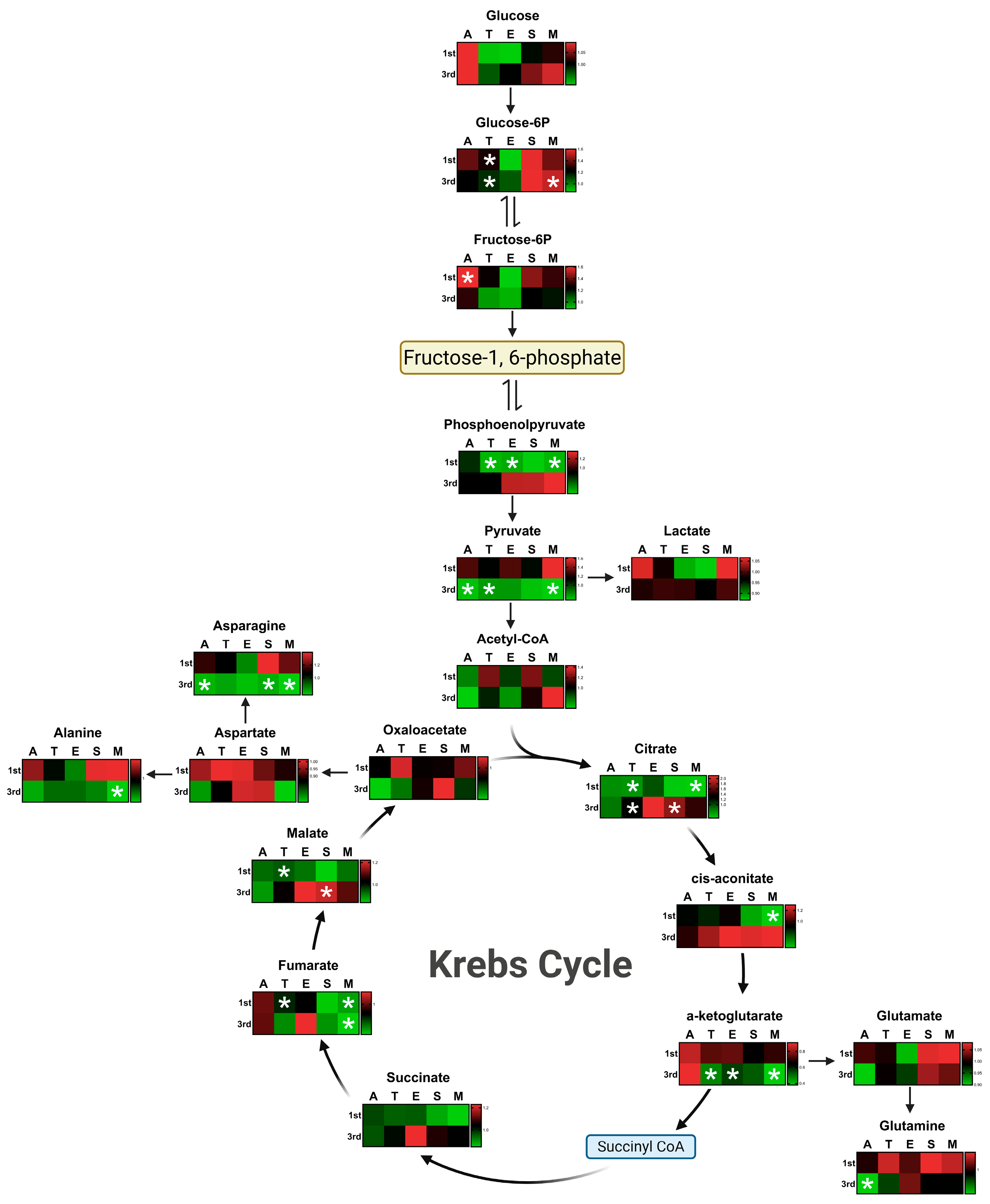
A targeted metabolomic analysis covering the central metabolic pathways of glycolysis and the TCA cycle was performed for the first and third generations of exposures (Figure 1). In glycolysis, most significant changes were recorded in glucose-6P, fructose-6P, phosphoenolpyruvate, and pyruvate, particularly induced by third-generation exposures. Amoxicillin exposure for 21 days resulted in decreases in fructose-6P and pyruvate in the third generation only. Trimethoprim induced decreases in glucose-6P, fructose-6P, and pyruvate in the third generation and phosphoenolpyruvate in the first generation, whereas glucose-6P was increased in the first-generation exposures. Erythromycin had a less significant impact, decreasing phosphoenolpyruvate in the first generation only. Sulfamethoxazole was the only antibiotic to have no observed effect on the metabolic pathway of glycolysis. In the third generation, the antibiotic mixture upregulated glucose-6P and downregulated fructose-6P and pyruvate, whereas phosphoenolpyruvate was decreased in the first-generation exposures. Glucose-6P was the only increased metabolite in glycolysis, induced by trimethoprim and the antibiotic mixture in the first and third generations of daphnids, respectively. Within the TCA cycle, the most impacted metabolites were citrate, cis-aconitate, α-ketoglutaric acid, glutamine, fumarate, malate, alanine, and asparagine, with no changes observed in acetyl CoA, glutamate, succinate, oxaloacetate, and aspartate. Most significant changes in the TCA cycle were observed as decreases, with the exemption of increases in citrate by trimethoprim and sulfamethoxazole, as well as malate by sulfamethoxazole, in the third generation.
Numerous studies have traditionally evaluated toxicity through physiological endpoints [39,43,44]. Antibiotic exposure has been associated with alterations in heart rate, feeding, and swimming behavior [34]. However, these phenotypic outcomes are ultimately governed by underlying molecular mechanisms in response to toxicant exposure [45]. Reactive oxygen species (ROS) are generated as natural by-products of cellular metabolism [46]. However, antibiotics such as amoxicillin and ciprofloxacin can induce the production of ROS [41], resulting in an imbalance between ROS generation and the organism’s detoxification capacity, a condition known as oxidative stress [47]. This imbalance disrupts cellular signaling and redox regulation, potentially causing molecular-level damage [48]. To mitigate oxidative stress induced by antibiotic exposure, Daphnia magna activates enzymes associated with detoxification processes. Notably, enzymes such as glutathione S-transferase, peroxidases [41], catalase, and reduced glutathione have been reported to exhibit altered expression in response to such stressors [49]. Moreover, oxidative stress results in the peroxidation of lipids and protein, leading to DNA damage and the inhibition of digestive enzymes such as trypsin and β-galactosidase [50]. Our findings support the latter, with inhibited β-galactosidase activity resulting from sulfamethoxazole, trimethoprim, and quaternary mixture exposures in the first generation and amoxicillin, sulfamethoxazole, trimethoprim, and antibiotic mixture exposures in the third generation of daphnids. It has been reported that xenobiotics increase lipid peroxidation and protein carbonyl content [48]. As such, lipid peroxidation exerts different effects on the various enzymes, including phosphatases, potentially altering their functionality. Furthermore, oxidative modification of proteins can affect the functionality of proteins, including β-galactosidase and phosphatases [47]. Our results corroborate the latter, with observed alterations to enzymes involved in central metabolism, including β-galactosidase and acid and alkaline phosphatases. This is particularly important in ecotoxicological risk assessment, as an organism’s metabolism constitutes its primary defense against xenobiotics [51]. The marked disruption of enzymatic activities may be linked to the activity of cytochrome P450 (CYP) enzymes present in Daphnia magna, which are pivotal in xenobiotic metabolism and detoxification [52]. It is worth noting that antibiotics like trimethoprim alter gut microbiota functionality, leading to compromised nutrition and, subsequently, growth of daphnids [53]. The host-associated microbiota is now widely regarded as an integral component of animal biology and contributes to numerous biological processes. In particular, the gut microbiota supports digestion, provides nutrients, detoxifies hazardous pollutants, and competes with pathogens. Its composition is crucial to host health and fitness, influencing traits ranging from life history to adaptation and ecological interactions. These variations are shaped by both genetic and environmental factors that modulate interactions between the host and microbiota present in the organisms [54]. Trimethoprim has been reported to impact the gut microbiome in daphnids, which led to decreased ingestion and digestion, leading to overall reduced fitness [53]. Our results are in good agreement, with a marked reduction in β-galactosidase activity observed in all successive generations in response to trimethoprim treatment. Similarly, tetracycline exposure alters bacterial populations and negatively affects reproduction, culminating in reduced fitness and survival of daphnids [54]. In a study by Cooper et al. [55], Daphnia magna was treated with sulfamethoxazole, which targeted abundant bacterial taxa and resulted in a marked reduction in host fitness. Although antibiotic exposure decreased the relative abundance of bacteria, it coincided with an increase in microbial diversity. This implies that suppression of dominant taxa allows less abundant species to proliferate. Studies on other aquatic organisms have demonstrated that antibiotics can trigger oxidative stress responses in Skeletonema costatum [56], Danio rerio [57], and Microcystis flos-aquae [58].
Within natural ecosystems, organisms are continuously exposed to complex mixtures of chemicals, often occurring at trace concentrations [59]. The mixture or cocktail effect describes how simultaneous exposure to multiple chemicals can influence a test organism in ways that differ from the effects of individual compounds. This approach provides a more ecologically relevant simulation of real-world environmental conditions, where pharmaceuticals are inevitably present alongside other contaminants. Therefore, investigating chemical mixtures provides insight into their cumulative toxicity and identifies the chemicals that are ecotoxicological drivers in pharmaceutical cocktails [60]. The combined effect of multiple stressors may exceed (synergistic interaction), match (additive interaction), or fall below (antagonistic interaction) the expected sum of their individual effects [61]. Prediction of chemical mixture effects relies on two models: Concentration Addition (CA) and Independent Action (IA). Both approaches are based on the toxicities of individual pollutants and assume no chemical interaction. CA posits that mixture components act as simple dilutions of one another, a scenario typically applicable when the chemicals share a similar mechanism of action. Conversely, IA assumes that each chemical acts independently, which is generally appropriate for mixtures of compounds with dissimilar modes of action [59]. Irrespective of the assumption of additivity with respect to exposure concentration or biological response, the Independent Action model generally provided more accurate predictions than Concentration Addition for most composite mixtures [62]. In this study, the mixture containing four antibiotics (amoxicillin, erythromycin, sulfamethoxazole, and trimethoprim) induced a greater impact on Daphnia than its constituents alone, known as synergism. This agrees with other studies, which reported that a pharmaceutical mixture elicited stronger toxic effects than the individual pharmaceutical components [63,64]. Conversely, studies on other chemical mixtures have reported contrasting results, underscoring the complexity of mixture effects [65]. Additionally, the study supports both aforementioned concepts as the total antibiotic concentration was 4 mg/L, with two of the antibiotics acting through a similar mechanism targeting the folate pathway, and the remaining two acting through distinct mechanisms. To our knowledge, no studies to date have reported on the effects of a quaternary mixture of amoxicillin, erythromycin, sulfamethoxazole, and trimethoprim on Daphnia magna. Thus, the biochemical and metabolic effect observed with the 1:1:1:1 ratio tested herein is an element of novelty. These four antibiotics have been associated with biochemical alterations and genotoxicity [34].
There are limited studies focusing on the biochemical and metabolic effect of the mentioned antibiotics on daphnids, and even fewer specifically focusing on exposures over multiple generations, as most studies report individual compound effects for single generations. Research has emphasized the importance of multigenerational exposure to accurately predict long-term effects, as transgenerational exposure generates unique and, additionally, adverse outcomes [66,67]. Most alterations in enzyme activities occurred in the first exposure generation of daphnids, with trimethoprim and the mixture inducing the most significant changes (Table 1). A substantial body of research indicates that daphnids exhibit variable sensitivity to contaminants that can vary across successive generations [68]. Organisms may adaptively program their offspring to increase resilience to environmental change, thereby enhancing fitness across successive generations [69]. These responses are contingent upon specific characteristics of the exposure, including concentration; nevertheless, our results are in good agreement with this. Conversely, research demonstrated that environmental variation could induce alterations in organismal traits during their development, a process referred to as within-generation plasticity; moreover, parental stress can produce offspring with reduced fitness, and these maladaptive effects may accumulate across generations, ultimately increasing the risk of population extinction [70]. Such effects are thought to result from processes including maternal transmission of contaminants and epigenetic alterations, for example, DNA methylation [71]. Multigenerational studies, which assessed the effect of tetracycline on Daphnia magna on the transcriptional level, revealed that tetracycline had significant effects on genes related to carbohydrate metabolism, protein metabolism, and oxidative phosphorylation (general stress), and this was independent of dose or generation of exposure. However, the study also identified genes related to molting, such as the cuticle protein, which was induced with multigenerational exposure [72]. This could explain why in this study, the central metabolism of third-generation daphnids was not significantly impaired compared to the first generation, as we identified differences in the two pathways for both generations. Moreover, it was also reported that daphnids adapted to tetracycline exposure as EC50 values increased with generational exposure, while alterations in internal energy balance via changes in protein, glycogen, and lipid metabolism were reported as well [73]. Potentially, different metabolic pathways, which were not analyzed in the present study, could be affected by transgenerational exposure, and a broader metabolomic analysis could identify them.
The impact of the antibiotics investigated herein on daphnid metabolic processes has received limited attention, highlighting a significant knowledge gap. However, exposure to sulfamethoxazole in the marine mussel Mytilus galloprovincialis led to significant changes in the nucleotides guanosine and inosine, as well as differences in the amino acids aspartate, valine, phenylalanine, and tryptophan [74]. Furthermore, these metabolic changes were not coupled with recorded oxidative stress or changes in detoxification enzymes, which is consistent with our findings. Exposure to the macrolide clarithromycin and the sulfonamide sulfamethazine in adult zebra fish resulted in significantly altered metabolism, specifically for ABC transporters, glycerophospholipid metabolism, purine metabolism, and many other pathways [75].
Considering the results presented herein, amoxicillin and quaternary mixture exposures produced the most pronounced changes in the biochemical assays. Sulfamethoxazole, which is a sulfonamide antibiotic, is one of the most ineffectively removed antibiotics from wastewater treatment plants [76]. It has been reported to increase GST activity as well as malondialdehyde activity in Danio rerio [77]. This is in contrast with our findings, which showed no significant changes in GST over the transgenerational study; however, the antibiotics amoxicillin and erythromycin did increase GST. Enzymes involved in lipid and sugar metabolism and phosphatase enzymes seemed to be more sensitive to sulfamethoxazole exposure in this study. Exposure to amoxicillin and erythromycin altered GST activity during chronic treatments, and these effects persisted across transgenerational exposures. Conversely, trimethoprim and the antibiotic mixture decreased GST activity only in the first generation, with levels returning to baseline by the third generation, indicating potential adaptive responses in daphnids. Other studies report increased GST activity in the fish species Danio rerio, as well as Oreochromis niloticus and Carassius auratus. Moreover, in Oreochromis niloticus, alkaline and acid phosphatase activities were increased following sulfamethoxazole exposure [78]. Erythromycin and amoxicillin were also reported to increase GST activities in Oncorhynchus mykiss and Danio rerio [79,80]. Several studies have reported a genotoxic effect of erythromycin [81,82]. Chronic exposure to erythromycin at 0.8 µg/L resulted in genotoxic damage and induced oxidative stress [83].
The implementation of NAMs has driven research worldwide including some recent EU projects such as the PrecisionTox initiative and other related programs to adopt holistic techniques with key species to determine the actual relationships between pollutants and their harmful effects. As highlighted in the recent ECHA workshop, the main objective is a shift to NAMs as high-throughput approaches which inform regulatory decisions and identify the mechanisms of action in these systems [84]. This “NAMazing” phasing out of animal testing with non-human-based models which are evolutionarily conserved in their toxicological responses supports that knowledge can be extrapolated [85]. When applied in real-world contexts, these innovative monitoring methods will allow for the early identification of aquatic pollution, thus enabling timely interventions with novel and more sensitive metrics [86].

4. Conclusions

Previously, we emphasized the importance of daphnids as an ecotoxicological model, and the use of metabolomics as a new sensitive metric to predict pharmaceutical pollution [35]. This study revealed that antibiotic exposure over multiple generations significantly impacted the enzyme activity of Daphnia magna. The observed change in biochemical markers alludes to a conserved toxicity of the antibiotics, independent of generational exposure. In some instances, exposure to individual antibiotics or the mixture resulted in greater changes in the first generation or vice versa; however, most pronounced alterations were observed in the first generation, suggesting that Daphnia may adapt to the antibiotic stress. In relation to enzyme activity, amoxicillin and the mixture had the greatest impact; however, with respect to metabolic responses, trimethoprim and the quaternary mixture were associated with the greatest alterations. Transgenerational exposures are useful in assessing the toxicity of pollutants and could be implemented in parallel with holistic techniques of water monitoring for timely prediction of pollution, before attaining levels that could cause harm.

Supplementary Materials

The following supporting information can be downloaded at https://www.mdpi.com/article/10.3390/w18020265/s1. Excel files: Dataset used for metabolomic analysis and heatmaps.

Author Contributions

Conceptualization, K.G.; methodology, K.G., U.R.-K. and B.E.; investigation, formal analysis, visualization, K.O., I.A. and B.E.; writing—original draft preparation, K.O., I.A. and B.E.; writing—review and editing, K.G., U.R.-K. and M.v.B.; supervision, funding acquisition, K.G., U.R.-K. and M.v.B. All authors have read and agreed to the published version of the manuscript.

Funding

This research was funded by SCIENCE FOUNDATION IRELAND under the grant number [18/SIRG/5563 Metabolomic approaches in mechanistic toxicology]. The IRISH RESEARCH COUNCIL supported Katie O’Rourke for her stipend under the grant number [GOIPG/2020/199 Integration of holistic approaches to detect pharmaceuticals in the aquatic environment]. The AL-EXANDER VON HUMBOLDT FOUNDATION supported Grintzalis with a research visit fellowship for experienced researchers to the UFZ. Beatrice Engelmann is grateful for funding by the Novo Nordisk Foundation (grant NNF21OC0066551).

Institutional Review Board Statement

Ethical review and approval were waived for this study, due to the fact that while daphnids are regarded as “animals” in terms of being members of the kingdom Animalia, they are not “animals” as defined in regulation SI543 of 2012 on the protection of animals used for scientific purposes. Therefore, the study does not require authorization from the Health Products Regulatory Authority (HPRA), which is also in line with the aim of working under the 3Rs (reduce, refine, replacement) strategy, since daphnids are commonly used in ecology and ecotoxicology as replacements for more evolutionary advanced species (i.e., fishes), posing no ethical implications.

Data Availability Statement

The original contributions presented in this study are included in the article/Supplementary Materials. Further inquiries can be directed to the corresponding author.

Conflicts of Interest

The authors declare no conflicts of interest. The funders had no role in the design of the study; in the collection, analyses, or interpretation of data; and in the writing of the manuscript.

References

  1. Bashir, I.; Lone, F.A.; Bhat, R.A.; Mir, S.A.; Dar, Z.A.; Dar, S.A. Concerns and Threats of Contamination on Aquatic Ecosystems. In Bioremediation and Biotechnology: Sustainable Approaches to Pollution Degradation; Hakeem, K.R., Bhat, R.A., Qadri, H., Eds.; Springer International Publishing: Cham, Switzerland, 2020; pp. 1–26. [Google Scholar]
  2. Häder, D.-P.; Banaszak, A.T.; Villafañe, V.E.; Narvarte, M.A.; González, R.A.; Helbling, E.W. Anthropogenic pollution of aquatic ecosystems: Emerging problems with global implications. Sci. Total Environ. 2020, 713, 136586. [Google Scholar] [CrossRef]
  3. Gustavo González, A.; Ángeles Herrador, M. A practical guide to analytical method validation, including measurement uncertainty and accuracy profiles. TrAC Trends Anal. Chem. 2007, 26, 227–238. [Google Scholar] [CrossRef]
  4. Abdullahi, M.; Li, X.; Abdallah, M.A.; Stubbings, W.; Yan, N.; Barnard, M.; Guo, L.H.; Colbourne, J.K.; Orsini, L. Daphnia as a Sentinel Species for Environmental Health Protection: A Perspective on Biomonitoring and Bioremediation of Chemical Pollution. Environ. Sci. Technol. 2022, 56, 14237–14248. [Google Scholar] [CrossRef]
  5. Brack, W.; Aissa, S.A.; Backhaus, T.; Dulio, V.; Escher, B.I.; Faust, M.; Hilscherova, K.; Hollender, J.; Hollert, H.; Müller, C.; et al. Effect-based methods are key. The European Collaborative Project SOLUTIONS recommends integrating effect-based methods for diagnosis and monitoring of water quality. Environ. Sci. Eur. 2019, 31, 10. [Google Scholar] [CrossRef]
  6. Shaw, J.R.; Pfrender, M.E.; Eads, B.D.; Klaper, R.; Callaghan, A.; Sibly, R.M.; Colson, I.; Jansen, B.; Gilbert, D.; Colbourne, J.K. Daphnia as an emerging model for toxicological genomics. In Advances in Experimental Biology; Hogstrand, C., Kille, P., Eds.; Elsevier: Amsterdam, The Netherlands, 2008; Volume 2, pp. 165–328. [Google Scholar]
  7. Ebert, D. Daphnia as a versatile model system in ecology and evolution. EvoDevo 2022, 13, 16. [Google Scholar] [CrossRef] [PubMed]
  8. Colbourne, J.K.; Pfrender, M.E.; Gilbert, D.; Thomas, W.K.; Tucker, A.; Oakley, T.H.; Tokishita, S.; Aerts, A.; Arnold, G.J.; Basu, M.K.; et al. The ecoresponsive genome of Daphnia pulex. Science 2011, 331, 555–561. [Google Scholar] [CrossRef]
  9. Kümmerer, K. Antibiotics in the aquatic environment—A review—Part I. Chemosphere 2009, 75, 417–434. [Google Scholar] [CrossRef] [PubMed]
  10. Akiba, M.; Sekizuka, T.; Yamashita, A.; Kuroda, M.; Fujii, Y.; Murata, M.; Lee, K.-i.; Joshua, D.I.; Balakrishna, K.; Bairy, I.; et al. Distribution and Relationships of Antimicrobial Resistance Determinants among Extended-Spectrum-Cephalosporin-Resistant or Carbapenem-Resistant Escherichia coli Isolates from Rivers and Sewage Treatment Plants in India. Antimicrob. Agents Chemother. 2016, 60, 2972–2980. [Google Scholar] [CrossRef] [PubMed]
  11. Tello, A.; Austin, B.; Telfer, T.C. Selective Pressure of Antibiotic Pollution on Bacteria of Importance to Public Health. Environ. Health Perspect. 2012, 120, 1100–1106. [Google Scholar] [CrossRef]
  12. Danner, M.-C.; Robertson, A.; Behrends, V.; Reiss, J. Antibiotic pollution in surface fresh waters: Occurrence and effects. Sci. Total Environ. 2019, 664, 793–804. [Google Scholar] [CrossRef]
  13. Abate, T.A.; Birhanu, A.G. Antibiotic Use in Livestock and Environmental Antibiotic Resistance: A Narrative Review. Environ. Health Insights 2025, 19, 11786302251357775. [Google Scholar] [CrossRef]
  14. Halawa, E.M.; Fadel, M.; Al-Rabia, M.W.; Behairy, A.; Nouh, N.A.; Abdo, M.; Olga, R.; Fericean, L.; Atwa, A.M.; El-Nablaway, M.; et al. Antibiotic action and resistance: Updated review of mechanisms, spread, influencing factors, and alternative approaches for combating resistance. Front. Pharmacol. 2023, 14, 1305294. [Google Scholar] [CrossRef] [PubMed]
  15. Akhavan, B.J.; Khanna, N.R.; Vijhani, P. Amoxicillin. In StatPearls; StatPearls Publishing LLC.: Treasure Island, FL, USA, 2025. [Google Scholar]
  16. Zaid, A.N.; Cortesi, R.; Kort, J.; Sweileh, W. Interchangeability of two 500 mg amoxicillin capsules with one 1000 mg amoxicillin tablet after a single oral administration. Indian J. Pharm. Sci. 2010, 72, 414–420. [Google Scholar] [CrossRef] [PubMed]
  17. Yimenu, D.K.; Emam, A.; Elemineh, E.; Atalay, W. Assessment of Antibiotic Prescribing Patterns at Outpatient Pharmacy Using World Health Organization Prescribing Indicators. J. Prim. Care Community Health 2019, 10, 2150132719886942. [Google Scholar] [CrossRef]
  18. Abou-Eisha, A.; Creus, A.; Marcos, R. Genotoxic evaluation of the antimicrobial drug, trimethoprim, in cultured human lymphocytes. Mutat. Res./Genet. Toxicol. Environ. Mutagen. 1999, 440, 157–162. [Google Scholar] [CrossRef]
  19. Bernabe, L.R.; Francisca, A. Removal of amoxicillin via different methods, emphasizing removal by biopolymers and its derivatives. An overview. J. Chil. Chem. Soc. 2022, 67, 5643–5655. [Google Scholar]
  20. Otoo, B.A.; Amoabeng, I.A.; Darko, G.; Borquaye, L.S. Antibiotic and analgesic residues in the environment—Occurrence and ecological risk study from the Sunyani municipality, Ghana. Toxicol. Rep. 2022, 9, 1491–1500. [Google Scholar] [CrossRef] [PubMed]
  21. Klein, J.O. History of macrolide use in pediatrics. Pediatr. Infect. Dis. J. 1997, 16, 427–431. [Google Scholar] [CrossRef]
  22. Farzam, K.; Nessel, T.A.; Quick, J. Erythromycin. In StatPearls; StatPearls Publishing LLC.: Treasure Island, FL, USA, 2025. [Google Scholar]
  23. Liu, X.; Wang, X.; Chen, L.; Shi, Y.; Wei, Y. Effects of Erythromycin on the Proliferation and Apoptosis of Cultured Nasal Polyp-Derived Cells and the Extracellular Signal-Regulated Kinase (ERK)/Mitogen-Activated Protein Kinase (MAPK) Signaling Pathway. Med. Sci. Monit. 2018, 24, 8048–8055. [Google Scholar] [CrossRef]
  24. Schafhauser, B.H.; Kristofco, L.A.; de Oliveira, C.M.R.; Brooks, B.W. Global review and analysis of erythromycin in the environment: Occurrence, bioaccumulation and antibiotic resistance hazards. Environ. Pollut. 2018, 238, 440–451. [Google Scholar] [CrossRef]
  25. Gleckman, R.; Blagg, N.; Joubert, D.W. Trimethoprim: Mechanisms of Action, Antimicrobial Activity, Bacterial Resistance, Pharmacokinetics, Adverse Reactions, and Therapeutic Indications. Pharmacother. J. Hum. Pharmacol. Drug Ther. 1981, 1, 14–19. [Google Scholar] [CrossRef]
  26. Güzel Bayülken, D.; Bostancıoğlu, R.B.; Koparal, A.T.; Ayaz Tüylü, B.; Dağ, A.; Benkli, K. Assessment of in vitro cytotoxic and genotoxic activities of some trimethoprim conjugates. Cytotechnology 2018, 70, 1051–1059. [Google Scholar] [CrossRef]
  27. Larsen, E.L.; Cejvanovic, V.; Kjær, L.K.; Pedersen, M.T.; Popik, S.D.; Hansen, L.K.; Andersen, J.T.; Jimenez-Solem, E.; Broedbaek, K.; Petersen, M.; et al. Clarithromycin, trimethoprim, and penicillin and oxidative nucleic acid modifications in humans: Randomised, controlled trials. Br. J. Clin. Pharmacol. 2017, 83, 1643–1653. [Google Scholar] [CrossRef]
  28. Matozzo, V.; De Notaris, C.; Finos, L.; Filippini, R.; Piovan, A. Environmentally realistic concentrations of the antibiotic Trimethoprim affect haemocyte parameters but not antioxidant enzyme activities in the clam Ruditapes philippinarum. Environ. Pollut. 2015, 206, 567–574. [Google Scholar] [CrossRef]
  29. Kemnic, T.R.; Coleman, M. Trimethoprim Sulfamethoxazole. In StatPearls; StatPearls Publishing LLC.: Treasure Island, FL, USA, 2025. [Google Scholar]
  30. Abou-Eisha, A.; Marcos, R.; Creus, A. Genotoxicity studies on the antimicrobial drug sulfamethoxazole in cultured human lymphocytes. Mutat. Res./Genet. Toxicol. Environ. Mutagen. 2004, 564, 51–56. [Google Scholar] [CrossRef]
  31. Xia, J.; Bao, Y.; Gao, Y.; Li, J. The effects of temperature and sulfamethoxazole on the growth and photosynthetic characteristics of Phaeodactylum tricornutum. Mar. Pollut. Bull. 2024, 200, 116122. [Google Scholar] [CrossRef]
  32. Rogowska, J.; Gałęzowska, G.; Zimmermann, A. Challenges and Current Trends in Preventing Antimicrobial Resistance in EU Water Law Context. Antibiotics 2025, 14, 18. [Google Scholar] [CrossRef]
  33. Nigro, L.; Binelli, A.; Herman, I.; Gazzotti, S.; Ortenzi, M.A.; Asselman, J. Transgenerational effects of water-soluble polymers on Daphnia magna at environmentally relevant concentrations: The role of multigenerational plasticity. Environ. Res. 2025, 275, 121436. [Google Scholar] [CrossRef]
  34. O’Rourke, K.; Virgiliou, C.; Theodoridis, G.; Gika, H.; Grintzalis, K. The impact of pharmaceutical pollutants on daphnids—A metabolomic approach. Environ. Toxicol. Pharmacol. 2023, 100, 104157. [Google Scholar] [CrossRef]
  35. O’Rourke, K.; Engelmann, B.; Altenburger, R.; Rolle-Kampczyk, U.; Grintzalis, K. Molecular Responses of Daphnids to Chronic Exposures to Pharmaceuticals. Int. J. Mol. Sci. 2023, 24, 4100. [Google Scholar] [CrossRef]
  36. Tang, S.S.; Chang, G.G. Kinetic mechanism of octopus hepatopancreatic glutathione transferase in reverse micelles. Biochem. J. 1996, 315, 599–606. [Google Scholar] [CrossRef]
  37. Grintzalis, K.; Georgiou, C.D.; Schneider, Y.J. An accurate and sensitive Coomassie Brilliant Blue G-250-based assay for protein determination. Anal. Biochem. 2015, 480, 28–30. [Google Scholar] [CrossRef]
  38. Saeed, A.I.; Sharov, V.; White, J.; Li, J.; Liang, W.; Bhagabati, N.; Braisted, J.; Klapa, M.; Currier, T.; Thiagarajan, M.; et al. TM4: A free, open-source system for microarray data management and analysis. Biotechniques 2003, 34, 374–378. [Google Scholar] [CrossRef]
  39. Rowan, E.; Leung, A.; Grintzalis, K. A Novel Method for the Assessment of Feeding Rate as a Phenotypic Endpoint for the Impact of Pollutants in Daphnids. Environ. Toxicol. Chem. 2024, 43, 2211–2221. [Google Scholar] [CrossRef]
  40. Rowan, E.; Leung, A.; O’Rourke, K.; Yin, X.; Brennan, L.; Grintzalis, K. New Approach Methodologies: Physiological responses of daphnids to pharmaceutical mixtures. J. Hazard. Mater. Lett. 2025, 6, 100139. [Google Scholar] [CrossRef]
  41. Yisa, A.G.; Chia, M.A.; Gadzama, I.M.K.; Oniye, S.J.; Sha’aba, R.I.; Gauje, B. Immobilization, oxidative stress and antioxidant response of Daphnia magna to Amoxicillin and Ciprofloxacin. Environ. Toxicol. Pharmacol. 2023, 98, 104078. [Google Scholar] [CrossRef]
  42. Barata, C.; Baird, D.J.; Soares, A.M.V.M. Determining Genetic Variability in the Distribution of Sensitivities to Toxic Stress among and within Field Populations of Daphnia magna. Environ. Sci. Technol. 2002, 36, 3045–3049. [Google Scholar] [CrossRef]
  43. Bownik, A. Physiological endpoints in daphnid acute toxicity tests. Sci. Total Environ. 2020, 700, 134400. [Google Scholar] [CrossRef]
  44. Bownik, A.; Ślaska, B.; Bochra, J.; Gumieniak, K.; Gałek, K. Procaine penicillin alters swimming behaviour and physiological parameters of Daphnia magna. Environ. Sci. Pollut. Res. Int. 2019, 26, 18662–18673. [Google Scholar] [CrossRef]
  45. Le, T.H.; Lim, E.S.; Lee, S.K.; Choi, Y.W.; Kim, Y.H.; Min, J. Effects of glyphosate and methidathion on the expression of the Dhb, Vtg, Arnt, CYP4 and CYP314 in Daphnia magna. Chemosphere 2010, 79, 67–71. [Google Scholar] [CrossRef]
  46. Gómez-Oliván, L.M.; Galar-Martínez, M.; Islas-Flores, H.; García-Medina, S.; SanJuan-Reyes, N. DNA damage and oxidative stress induced by acetylsalicylic acid in Daphnia magna. Comp. Biochem. Physiol. C Toxicol. Pharmacol. 2014, 164, 21–26. [Google Scholar] [CrossRef]
  47. Michalaki, A.; Grintzalis, K. Acute and Transgenerational Effects of Non-Steroidal Anti-Inflammatory Drugs on Daphnia magna. Toxics 2023, 11, 320. [Google Scholar] [CrossRef] [PubMed]
  48. Cardoso-Vera, J.D.; Islas-Flores, H.; Pérez-Alvarez, I.; Díaz-Camal, N. Evidence of Oxidative Stress as a Mechanism of Pharmaceutical-Induced Toxicity in Amphibians. Antioxidants 2024, 13, 1399. [Google Scholar] [CrossRef]
  49. Zhang, Y.; Guo, P.; Wu, Y.; Wang, M.; Deng, J.; Su, H.; Sun, Y. Evaluation of the Acute Effects and Oxidative Stress Responses of Phenicol Antibiotics and Suspended Particles in Daphnia magna. Environ. Toxicol. Chem. 2021, 40, 2463–2473. [Google Scholar] [CrossRef]
  50. Lv, X.; Huang, B.; Zhu, X.; Jiang, Y.; Chen, B.; Tao, Y.; Zhou, J.; Cai, Z. Mechanisms underlying the acute toxicity of fullerene to Daphnia magna: Energy acquisition restriction and oxidative stress. Water Res. 2017, 123, 696–703. [Google Scholar] [CrossRef] [PubMed]
  51. Reilly, K.; Ellis, L.A.; Davoudi, H.H.; Supian, S.; Maia, M.T.; Silva, G.H.; Guo, Z.; Martinez, D.S.T.; Lynch, I. Daphnia as a model organism to probe biological responses to nanomaterials-from individual to population effects via adverse outcome pathways. Front. Toxicol. 2023, 5, 1178482. [Google Scholar] [CrossRef]
  52. Kang, X.; Zhou, Y.; Liu, Q.; Liu, M.; Chen, J.; Zhang, Y.; Wei, J.; Wang, Y. Characterization and Expression of the Cytochrome P450 Genes in Daphnia magna Exposed to Cerium Oxide Nanoparticles. Int. J. Mol. Sci. 2024, 25, 10812. [Google Scholar] [CrossRef]
  53. Gorokhova, E.; Rivetti, C.; Furuhagen, S.; Edlund, A.; Ek, K.; Breitholtz, M. Bacteria-Mediated Effects of Antibiotics on Daphnia Nutrition. Environ. Sci. Technol. 2015, 49, 5779–5787. [Google Scholar] [CrossRef] [PubMed]
  54. Akbar, S.; Gu, L.; Sun, Y.; Zhou, Q.; Zhang, L.; Lyu, K.; Huang, Y.; Yang, Z. Changes in the life history traits of Daphnia magna are associated with the gut microbiota composition shaped by diet and antibiotics. Sci. Total Environ. 2020, 705, 135827. [Google Scholar] [CrossRef]
  55. Cooper, R.O.; Vavra, J.M.; Cressler, C.E. Targeted Manipulation of Abundant and Rare Taxa in the Daphnia magna Microbiota with Antibiotics Impacts Host Fitness Differentially. mSystems 2021, 6, e00916-20. [Google Scholar] [CrossRef]
  56. Lin, Y.; Li, T.; Zhang, Y. Effects of two typical quinolone antibiotics in the marine environment on Skeletonema costatum. Front. Mar. Sci. 2024, 11, 1335582. [Google Scholar] [CrossRef]
  57. Zhou, J.; Yun, X.; Wang, J.; Li, Q.; Wang, Y.; Zhang, W.; Fan, Z. Biological toxicity of sulfamethoxazole in aquatic ecosystem on adult zebrafish (Danio rerio). Sci. Rep. 2024, 14, 9401. [Google Scholar] [CrossRef]
  58. Wan, J.; Guo, P.; Peng, X.; Wen, K. Effect of erythromycin exposure on the growth, antioxidant system and photosynthesis of Microcystis flos-aquae. J. Hazard. Mater. 2015, 283, 778–786. [Google Scholar] [CrossRef]
  59. Michalaki, A.; McGivern, A.R.; Poschet, G.; Büttner, M.; Altenburger, R.; Grintzalis, K. The Effects of Single and Combined Stressors on Daphnids-Enzyme Markers of Physiology and Metabolomics Validate the Impact of Pollution. Toxics 2022, 10, 604. [Google Scholar] [CrossRef]
  60. Backhaus, T. Medicines, shaken and stirred: A critical review on the ecotoxicology of pharmaceutical mixtures. Philos. Trans. R. Soc. Lond. B Biol. Sci. 2014, 369, 20130585. [Google Scholar] [CrossRef]
  61. Houwenhuyse, S.; Bulteel, L.; Vanoverberghe, I.; Krzynowek, A.; Van de Maele, M.; Coone, M.; Van den Wyngaert, S.; Sinnesael, A.; Stoks, R.; Decaestecker, E. Natural and lab-derived microbiomes differentially shape stressor interaction patterns of Daphnia magna. ISME J. 2025, 19, wrae249. [Google Scholar] [CrossRef]
  62. Silva, A.R.R.; Gonçalves, S.F.; Pavlaki, M.D.; Morgado, R.G.; Soares, A.M.V.M.; Loureiro, S. Mixture toxicity prediction of substances from different origin sources in Daphnia magna. Chemosphere 2022, 292, 133432. [Google Scholar] [CrossRef]
  63. Backhaus, T. Environmental Risk Assessment of Pharmaceutical Mixtures: Demands, Gaps, and Possible Bridges. AAPS J. 2016, 18, 804–813. [Google Scholar] [CrossRef] [PubMed]
  64. Cleuvers, M. Mixture toxicity of the anti-inflammatory drugs diclofenac, ibuprofen, naproxen, and acetylsalicylic acid. Ecotoxicol. Environ. Saf. 2004, 59, 309–315. [Google Scholar] [CrossRef]
  65. Dietrich, S.; Ploessl, F.; Bracher, F.; Laforsch, C. Single and combined toxicity of pharmaceuticals at environmentally relevant concentrations in Daphnia magna—A multigenerational study. Chemosphere 2010, 79, 60–66. [Google Scholar] [CrossRef] [PubMed]
  66. Castro, B.B.; Freches, A.R.; Rodrigues, M.; Nunes, B.; Antunes, S.C. Transgenerational Effects of Toxicants: An Extension of the Daphnia 21-day Chronic Assay? Arch. Environ. Contam. Toxicol. 2018, 74, 616–626. [Google Scholar] [CrossRef]
  67. Ellis, L.-J.A.; Kissane, S.; Lynch, I. Maternal Responses and Adaptive Changes to Environmental Stress via Chronic Nanomaterial Exposure: Differences in Inter and Transgenerational Interclonal Broods of Daphnia magna. Int. J. Mol. Sci. 2021, 22, 15. [Google Scholar] [CrossRef]
  68. Padilla Suarez, E.G.; Pugliese, S.; Galdiero, E.; Guida, M.; Libralato, G.; Saviano, L.; Spampinato, M.; Pappalardo, C.; Siciliano, A. Multigenerational tests on Daphnia spp.: A vision and new perspectives. Environ. Pollut. 2023, 337, 122629. [Google Scholar] [CrossRef]
  69. Walsh, M.R.; Castoe, T.; Holmes, J.; Packer, M.; Biles, K.; Walsh, M.; Munch, S.B.; Post, D.M. Local adaptation in transgenerational responses to predators. Proc. R. Soc. B Biol. Sci. 2016, 283, 20152271. [Google Scholar] [CrossRef] [PubMed]
  70. Gillis, M.K.; Walsh, M.R. Individual variation in plasticity dulls transgenerational responses to stress. Funct. Ecol. 2019, 33, 1993–2002. [Google Scholar] [CrossRef]
  71. Michalaki, A.; Yin, X.; Brennan, L.; Grintzalis, K. Exposure to chemical and commercial forms of NSAIDs at environmentally relevant concentrations exert transgenerational metabolic responses in daphnids. Water Biol. Secur. 2025, 4, 100404. [Google Scholar] [CrossRef]
  72. De Coninck, D.I.M.; Asselman, J.; Glaholt, S.; Janssen, C.R.; Colbourne, J.K.; Shaw, J.R.; De Schamphelaere, K.A.C. Genome-Wide Transcription Profiles Reveal Genotype-Dependent Responses of Biological Pathways and Gene-Families in Daphnia Exposed to Single and Mixed Stressors. Environ. Sci. Technol. 2014, 48, 3513–3522. [Google Scholar] [CrossRef] [PubMed]
  73. Kim, H.Y.; Yu, S.; Jeong, T.-Y.; Kim, S.D. Relationship between trans-generational effects of tetracycline on Daphnia magna at the physiological and whole organism level. Environ. Pollut. 2014, 191, 111–118. [Google Scholar] [CrossRef] [PubMed]
  74. Serra-Compte, A.; Álvarez-Muñoz, D.; Solé, M.; Cáceres, N.; Barceló, D.; Rodríguez-Mozaz, S. Comprehensive study of sulfamethoxazole effects in marine mussels: Bioconcentration, enzymatic activities and metabolomics. Environ. Res. 2019, 173, 12–22. [Google Scholar] [CrossRef]
  75. Sotto, R.B.D.; Medriano, C.D.; Cho, Y.; Kim, H.; Chung, I.-Y.; Seok, K.-S.; Song, K.G.; Hong, S.W.; Park, Y.; Kim, S. Sub-lethal pharmaceutical hazard tracking in adult zebrafish using untargeted LC–MS environmental metabolomics. J. Hazard. Mater. 2017, 339, 63–72. [Google Scholar] [CrossRef]
  76. Sinthuchai, D.; Boontanon, S.K.; Boontanon, N.; Polprasert, C. Evaluation of removal efficiency of human antibiotics in wastewater treatment plants in Bangkok, Thailand. Water Sci. Technol. 2015, 73, 182–191. [Google Scholar] [CrossRef] [PubMed]
  77. Lin, T.; Yu, S.; Chen, Y.; Chen, W. Integrated biomarker responses in zebrafish exposed to sulfonamides. Environ. Toxicol. Pharmacol. 2014, 38, 444–452. [Google Scholar] [CrossRef] [PubMed]
  78. Limbu, S.M.; Zhou, L.; Sun, S.-X.; Zhang, M.-L.; Du, Z.-Y. Chronic exposure to low environmental concentrations and legal aquaculture doses of antibiotics cause systemic adverse effects in Nile tilapia and provoke differential human health risk. Environ. Int. 2018, 115, 205–219. [Google Scholar] [CrossRef] [PubMed]
  79. Oliveira, R.; McDonough, S.; Ladewig, J.C.L.; Soares, A.M.V.M.; Nogueira, A.J.A.; Domingues, I. Effects of oxytetracycline and amoxicillin on development and biomarkers activities of zebrafish (Danio rerio). Environ. Toxicol. Pharmacol. 2013, 36, 903–912. [Google Scholar] [CrossRef]
  80. Rodrigues, S.; Antunes, S.C.; Correia, A.T.; Nunes, B. Toxicity of erythromycin to Oncorhynchus mykiss at different biochemical levels: Detoxification metabolism, energetic balance, and neurological impairment. Environ. Sci. Pollut. Res. 2019, 26, 227–239. [Google Scholar] [CrossRef]
  81. Smith, E.M.; Iftikar, F.I.; Higgins, S.; Irshad, A.; Jandoc, R.; Lee, M.; Wilson, J.Y. In vitro inhibition of cytochrome P450-mediated reactions by gemfibrozil, erythromycin, ciprofloxacin and fluoxetine in fish liver microsomes. Aquat. Toxicol. 2012, 109, 259–266. [Google Scholar] [CrossRef]
  82. Yang, C.; Song, G.; Lim, W. A review of the toxicity in fish exposed to antibiotics. Comp. Biochem. Physiol. Part C Toxicol. Pharmacol. 2020, 237, 108840. [Google Scholar] [CrossRef]
  83. Rodrigues, S.; Antunes, S.C.; Correia, A.T.; Nunes, B. Acute and chronic effects of erythromycin exposure on oxidative stress and genotoxicity parameters of Oncorhynchus mykiss. Sci. Total Environ. 2016, 545–546, 591–600. [Google Scholar] [CrossRef]
  84. Hansell, L.; Hartung, T. NAMazing: The importance of being earnest—A 2025 cross-Atlantic turning point in phasing out animal testing. NAM J. 2025, 100071. [Google Scholar] [CrossRef]
  85. The PrecisionTox Consortium. The Precision Toxicology initiative. Toxicol. Lett. 2023, 383, 33–42. [Google Scholar] [CrossRef]
  86. Wlodkowic, D.; Karpiński, T.M. Live-Cell Systems in Real-Time Biomonitoring of Water Pollution: Practical Considerations and Future Perspectives. Sensors 2021, 21, 7028. [Google Scholar] [CrossRef] [PubMed]
Figure 1. Reconstruction of the central metabolic pathways with changes in metabolites for chronic and transgenerational exposures. The top row of boxes, each containing the initial concentration of its corresponding antibiotic (A: amoxicillin; T: trimethoprim; E: erythromycin; S: sulfamethoxazole; and M: mixture), represents the first generation. The bottom row represents the exposure in the third generation. Each condition was compared to its corresponding control group of DMSO. Heatmap data represents the average values for each metabolite over the unexposed control group in each generation. * Statistically significant changes identified by Student’s t-test with Welch’s correction between control and exposed conditions. These changes are illustrated with red for increase or green for decrease in each color scale for both generations per metabolite.
Water 18 00265 g001
Table 1. The impact of antibiotics on key enzymes. Data represent average ± SD (N = 4 replicates). Statistically significant changes were identified by Student’s t-test compared to control (*) or DMSO ($) (p < 0.05). ALP, ACP, and BGAL are expressed as units/mg protein, and GST as milliunits/mg protein.
GenerationEnzymeControlDMSOAmoxicillinErythromycinSulfamethoxazoleTrimethoprimMixture
FirstALP5.2 ± 0.255.1 ± 0.413.8 ± 0.27 $
(−26%)
5 ± 0.194.7 ± 0.295.3 ± 0.534.3 ± 0.12 $
(−16%)
ACP3.6 ± 0.343 ± 0.06 *
(−17%)
3.6 ± 0.39 $
(20%)
4 ± 0.26 $
(33%)
3.7 ± 0.19 $
(23%)
4.6 ± 0.5 $
(53%)
3.9 ± 0.41 $
(30%)
βGAL2.5 ± 0.052.5 ± 0.112.3 ± 0.182.6 ± 0.142.1 ± 0.11 $
(−16%)
2.2 ± 0.08 $
(−12%)
2 ± 0.02 $
(−20%)
GST545.5 ± 56594.2 ± 37766.2 ± 70.5 $
(29%)
523.7 ± 42 $
(−12%)
536.1 ± 39.5451.6 ± 30.5 $
(−24%)
492 ± 48 $
(−17%)
ThirdALP11.4 ± 0.7211.3 ± 1.018.5 ± 1.13 $
(−25%)
10.8 ± 0.759.4 ± 0.54 $
(−17%)
9.6 ± 0.43 $
(15%)
8.9 ± 0.25 $
(−21%)
ACP9.3 ± 0.397.7 ± 0.36 *
(−17%)
7.7 ± 0.758.4 ± 0.567.1 ± 0.758.4 ± 0.567.6 ± 0.9
βGAL6.9 ± 0.227.6 ± 0.47 *
(10%)
5.3 ± 0.58 $
(−30%)
6.1 ± 0.61 $
(20%)
5.2 ± 0.92 $
(−32%)
5.9 ± 0.57 $
(−22%)
5 ± 0.55 $
(−34%)
GST2.4 ± 0.22.2 ± 0.22.6 ± 0.3 $
(18%)
2.6 ± 0.2 $
(18%)
2.5 ± 0.22.1 ± 0.112.4 ± 0.1
Disclaimer/Publisher’s Note: The statements, opinions and data contained in all publications are solely those of the individual author(s) and contributor(s) and not of MDPI and/or the editor(s). MDPI and/or the editor(s) disclaim responsibility for any injury to people or property resulting from any ideas, methods, instructions or products referred to in the content.