Article

Geometry-Driven Hydraulic Behavior of Pressure-Compensating Emitters for Water-Saving Agricultural Irrigation Systems


1
Department of Agricultural and Biosystems Engineering, College of Agriculture and Food, Qassim University, Buraydah 51452, Saudi Arabia
2
Department of Environment and Natural Resources, College of Agriculture and Food, Qassim University, Buraydah 51452, Saudi Arabia
3
Agricultural Engineering Research Institute, Agricultural Research Center, Dokki, Giza 12619, Egypt
*
Author to whom correspondence should be addressed.
Water 2026, 18(2), 244; https://doi.org/10.3390/w18020244
Submission received: 11 December 2025 / Revised: 7 January 2026 / Accepted: 15 January 2026 / Published: 16 January 2026
(This article belongs to the Special Issue Agricultural Water-Land-Plant System Engineering, 2nd Edition)

Abstract

Water-saving agricultural irrigation systems depend heavily on the hydraulic stability of pressure-compensating (PC) emitters, whose performance is fundamentally shaped by internal flow-path geometry. This study analyzes six commercial PC emitters (E1E6) operated under pressures of 0.8–2.0 bar to quantify how key geometric descriptors influence hydraulic parameters critical for efficient water use, including actual discharge (qact), discharge coefficient (k), pressure exponent (x), emission uniformity (EU), and flow variability. All emitters had discharge deviations within ±7% of nominal values. Longer and more tortuous labyrinths enhanced compensation stability, while emitters with wider cross-sections and shorter paths produced higher throughput but weaker regulation efficiency. Linear mixed-effects modeling showed that effective flow area increased k, whereas normalized path length and tortuosity reduced both k and x. Predictive equations derived from geometric indicators closely matched measured values, with deviations below ±0.05 L/h for k and ±0.05 for x. These results establish a geometry-based hydraulic framework that supports emitter selection and design in water-saving agricultural irrigation, aligning with broader Agricultural Water–Land–Plant System Engineering objectives and contributing to more efficient and sustainable water-resource utilization.

1. Introduction

Drip irrigation has become a cornerstone technology in modern precision agriculture, offering a sustainable approach to agricultural water management by delivering water directly to plant root zones with minimal losses through evaporation or runoff. This targeted delivery significantly improves water use efficiency and supports crop productivity under varying climatic and soil conditions. In the context of water-saving irrigation strategies, a critical component of such systems is the pressure-compensating (PC) drip emitter, which maintains a consistent discharge rate over a range of operating pressures and terrain configurations [1]. Recent research has increasingly emphasized that the internal flow-path geometry particularly the design and configuration of labyrinth channels—plays a decisive role in determining the hydraulic behavior and operational reliability of emitters [2].
Advances in Computational Fluid Dynamics (CFD), microfabrication, and high-resolution imaging techniques have provided new insights into how structural features such as turning angle, channel depth, width, and tooth spacing influence both hydraulic performance indices and resistance to clogging. For example, CFD–DEM simulations have shown that a labyrinth emitter with a 65° turning angle achieves an optimal compromise between stable water flow and effective sand discharge, resulting in lower flow index values and higher anti-clogging capability [3,4]. Likewise, CFD-based analyses of perforated emitters have validated their enhanced hydraulic performance under high-pressure conditions due to optimized internal pathways [5].
The power-law relationship q = k P x remains a fundamental model for describing emitter behavior, with geometry directly influencing both the flow coefficient (k) and flow exponent (x). CFD-driven design experiments indicate that reducing channel width or extending path length can lower x values, thereby improving discharge uniformity under variable pressures. Similar trends have been observed in empirical design approaches for compact emitters, where adjustments to channel tooth patterns and depths align performance requirements with manufacturing capabilities [6]. Analytical modeling further strengthens the bridge between theoretical predictions and experimental outcomes; for example, Sokol et al. [7] developed an activation-pressure-based analytical model that achieved close agreement (within 2–9%) with laboratory flow measurements.
Operational factors can also modulate performance. Variations in inlet water temperature—particularly when affecting elastomer components in PC emitters can interact with internal flow geometry to alter discharge uniformity. Elnemer and Abo-Elatta [8] reported measurable differences in performance across a range of temperatures. Field evaluations indicate that pressure-compensating emitters may exhibit reduced uniformity under low operating pressures, especially in systems with uneven topography or extended lateral lengths. Under water-saving irrigation conditions, such challenges may amplify the influence of internal flow-path geometry on discharge consistency, underscoring the necessity of linking controlled laboratory tests with field-based validation [9].
Complementing this, laboratory studies have demonstrated that parameters such as flow-path layout (vertical, horizontal, or in–out), inlet water angle, and path length are critical to hydraulic efficiency. Findings suggest that a 180° inlet angle combined with a short path length of 20–25 mm can maximize emission uniformity and minimize variability, regardless of whether the flow path is vertical or horizontal. Conversely, longer path lengths can diminish key hydraulic performance indices, emphasizing the value of compact and well-oriented channel designs [1].
Clogging remains a persistent challenge in drip-irrigation systems, and internal channel geometry has a significant role in mitigating it. Emitters with smoother, curved flow channels have been observed to reduce particle deposition and enhance flow stability, as demonstrated by non-invasive CT imaging techniques [10]. Reviews of anti-clogging strategies—including aeration, pulsing, and biological treatments—highlight the design of optimized geometry as a primary passive defense [11]. Internal geometry also governs energy-dissipation patterns along the flow path. Designs that suppress vortex formation can sustain uniform discharge even under transient pressure surges, thereby improving operational stability and extending emitter lifespan [12]. This is supported by advanced flow simulations, where LES and RANS modeling approaches have shown that specific microchannel configurations can reduce turbulence concentrations and associated energy losses [13].
Despite substantial progress, a notable research gap persists. While numerous studies have proposed new or prototype emitter geometries, relatively few have provided direct, standardized comparisons among commercially available PC emitters tested under identical conditions [14]. De Marchis et al. [6] examined seven flat dripper types with varying channel dimensions across different operating pressures, establishing clear links between labyrinth cross-sectional area and pressure–flow responses, with important implications for optimizing the flow exponent parameter. Nevertheless, systematic empirical comparisons that focus specifically on internal flow geometry as a determinant of performance remain scarce.
Understanding the relationship between internal geometry and hydraulic output is fundamental to advancing sustainable irrigation design, improving water-resource efficiency, and guiding emitter selection. Well-controlled comparative experiments that connect design variables to performance outcomes can inform manufacturing practices, enhance field performance, and improve system resilience, particularly under resource-limited or maintenance-intensive conditions. Thus, the objective of this study is to evaluate how internal flow-path geometry influences the hydraulic performance of pressure-compensating emitters under varying operating pressures and to determine the effectiveness of predictive modeling in estimating discharge parameters within the broader framework of water-saving irrigation.

2. Materials and Methods

The objective of this study is to evaluate how internal flow path geometry affects the hydraulic performance of pressure-compensating (PC) drip emitters under varying operating pressures.

2.1. Emitter Types and Internal Configuration

Six commercially available pressure-compensating (PC) drip emitters were selected to represent a range of labyrinth geometries, nominal discharges, and structural designs. The selection of the six PC emitters was based on predefined technical and market-relevance criteria to ensure representativeness of current commercial designs. Emitters were chosen to cover the most common nominal discharge range used in agricultural drip irrigation (3.5–4.2 L/h) while exhibiting distinct labyrinth geometries, flow-path lengths, and pressure-regulation features. All tested models are mass-produced, commercially available emitters widely used in field-scale irrigation systems, thereby representing the mainstream technological level of contemporary pressure-compensating emitter design rather than experimental or prototype configurations.
For clarity and neutrality, the emitters are coded as E1E6 throughout the study.
Each emitter was carefully cut open using a precision rotary tool to expose the internal labyrinth structure without causing deformation to the flow path. The internal geometry was examined under a stereomicroscope equipped with a high-resolution digital camera, and images were captured for detailed analysis. All geometric measurements were performed on the static, non-operating emitters to avoid the effects of flow-induced deformation. The micrographs were calibrated in ImageJ software (version 1.53) to a known scale, and the effective flow area (A, mm2) of the channel cross-section was measured by manually delineating the wetted profile from the inlet to the outlet. The wetted perimeter (Pw, mm) was determined from the same images, allowing the calculation of the hydraulic diameter (Dh, mm) according to Equation (1) [12].
D h = 4 A P w
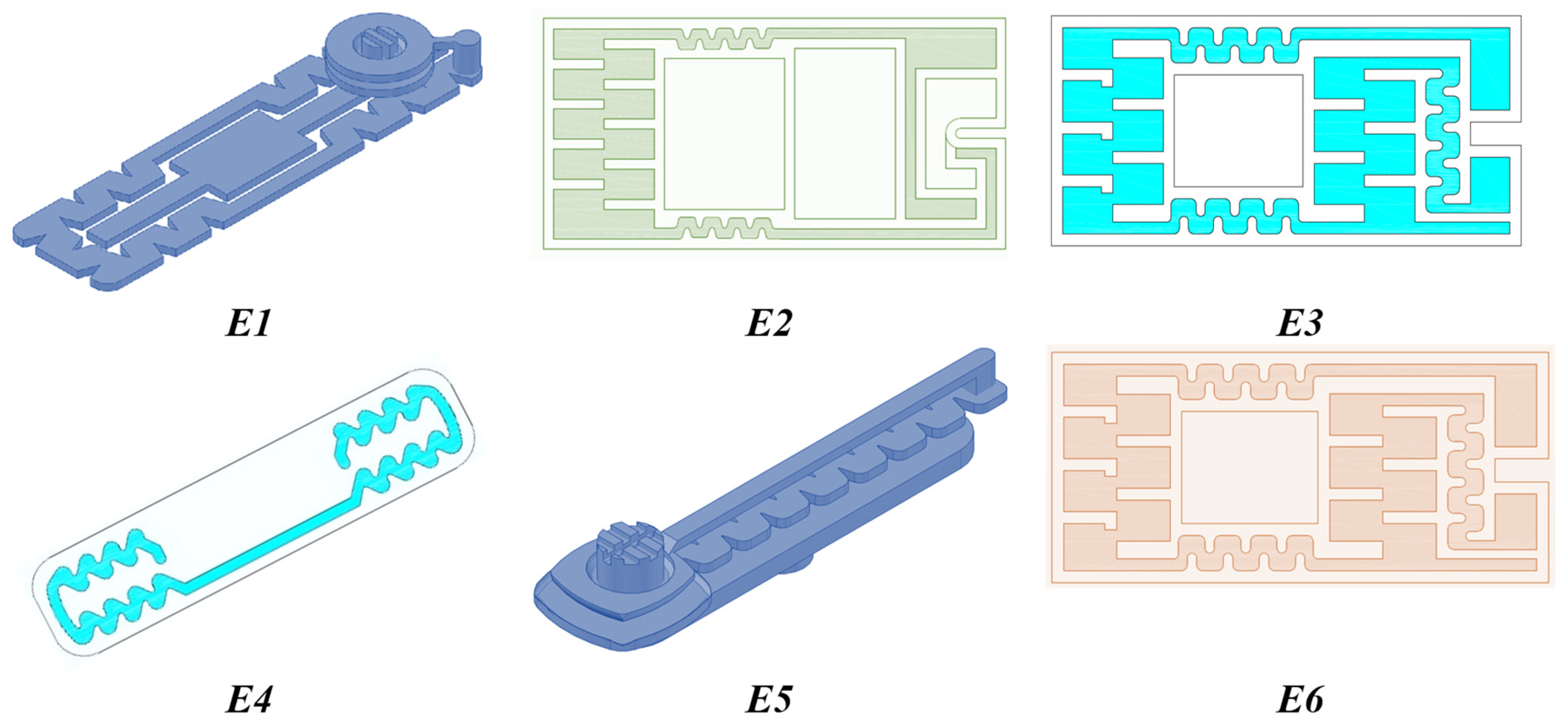
The total labyrinth path length (L, mm) was obtained by tracing the centerline of the flow path along all curves and turns using the segmented-line tool in ImageJ. The number of teeth or protrusions (n) was determined by counting each distinct obstacle in the flow path that contributed to energy dissipation. Turning angles were measured at each bend by identifying the intersection of consecutive path segments. Additional geometric descriptors were recorded to support later hydraulic correlations. The presence or absence of a non-drain (ND) mechanism was noted based on the inspection of inlet and outlet features. Tortuosity was computed as the ratio between the measured path length (L) and the straight-line distance from inlet to outlet. The inlet and outlet cross-sectional areas were measured separately to capture any asymmetry in design. Where applicable, variation in hydraulic diameter along the labyrinth was assessed by measuring Dh at three equally spaced locations and calculating the coefficient of variation. The type of inlet filtration system (e.g., radial multi-slot, cross-slot, fine mesh) was classified based on its structural configuration observed in the micrographs. Representative schematic diagrams and high-resolution photographs of each emitter’s internal labyrinth and filtration design are presented in Figure 1, and the geometric and design characteristics are presented in Table 1.

2.2. Hydraulic Test Bench and Procedure

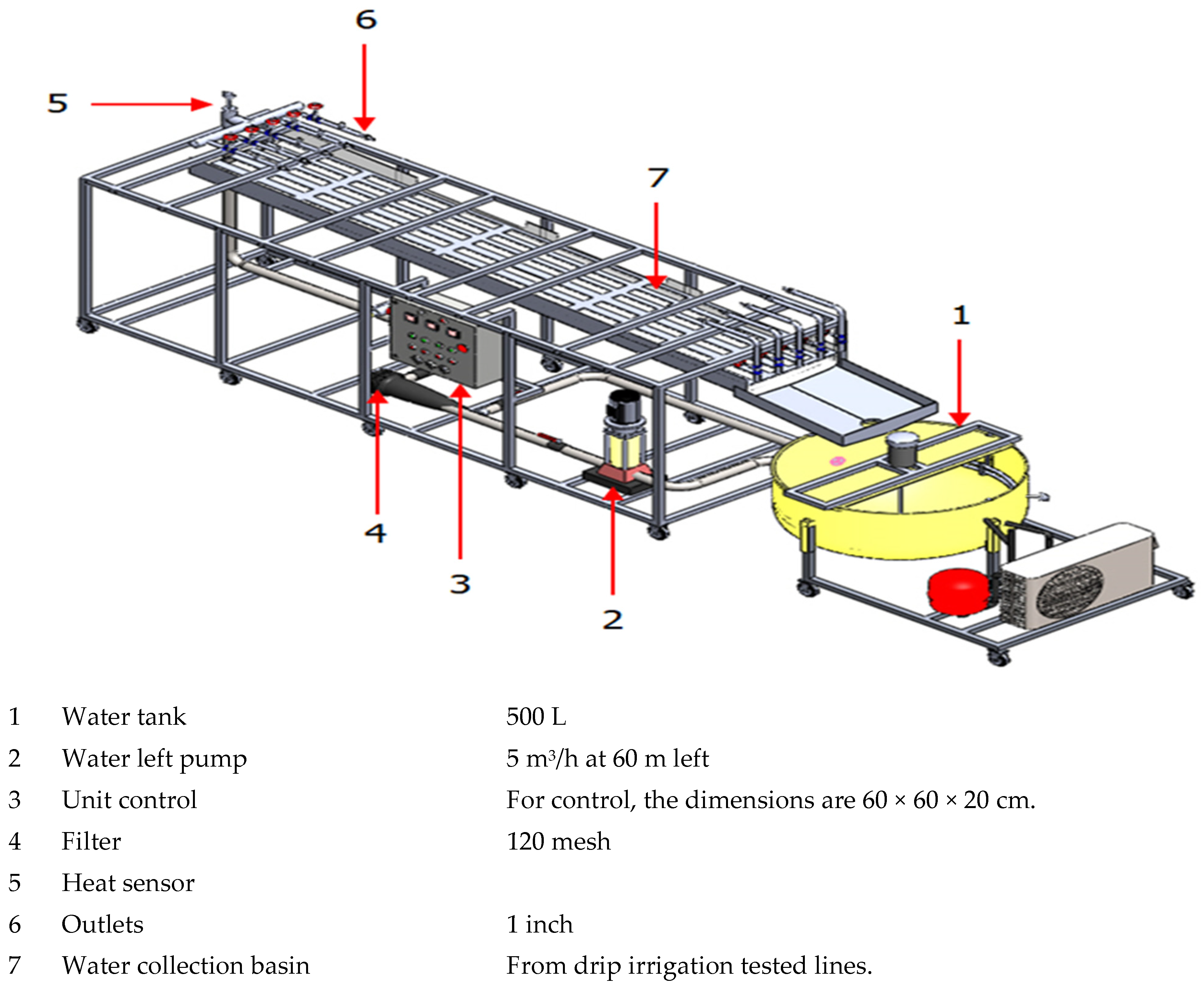
The hydraulic performance tests were conducted on a closed-loop bench assembled in accordance with ISO 9261:2004 standards [15] for micro-irrigation emitters (Figure 2). The system comprised a 500 L supply tank connected to a centrifugal pump (5 m3/h at 60 m head), a control unit (60 × 60 × 20 cm), and a screen filtration unit installed upstream of the test section. The filtration unit consisted of a stainless-steel screen filter with a nominal rating of 120 mesh, corresponding to an effective particle retention size of approximately 125 μm. The selection of this filter type and mesh size is consistent with ISO 9261:2004 [15] recommendations for laboratory testing of micro-irrigation emitters, ensuring adequate protection against particulate ingress while maintaining representative hydraulic conditions commonly encountered in field applications. The filtered water was then distributed through 1-inch outlet manifolds supplying the test laterals. Water temperature was monitored using a digital sensor and maintained at 20 ± 2 °C to minimize viscosity-related variability. Pressure was regulated by a precision valve and measured upstream of the test section using a calibrated pressure transducer (±0.01 bar). Collected water was discharged into a dedicated basin after measurement.
From each emitter model, three dripline segments of 2 m length were prepared from manufacturer-supplied coils. Emitters were tested at five operating pressures (0.8, 1.0, 1.2, 1.6, and 2.0 bar). At each pressure level, discharge was measured gravimetrically by collecting water for 60 s into pre-weighed containers, with mass determined using an analytical balance (±0.01 g). Five replicates per pressure level were recorded for each emitter type. All measurements were performed under steady flow conditions after stabilizing the system for at least 30 s at the target pressure. The experiments were conducted using tap water at ambient temperature, which was monitored and maintained at 20 ± 2 °C. While no detailed chemical analysis was performed, the water was free from visible suspended solids or turbidity. All emitters were flushed prior to testing to minimize potential clogging or sediment-related artifacts. Under these controlled conditions, water temperature and quality are not expected to have influenced the hydraulic measurements.

2.3. Hydraulic Performance Analysis

The relationship between emitter discharge and operating pressure was described by the power-law function proposed by Chen et al. [17] (Equation (2)).
q = k P x
where q is the emitter discharge (L/h), P is the operating pressure (bar), k is the flow coefficient, and x is the discharge exponent. The parameters k and x for each emitter type were determined by performing a linear regression on log–log transformed discharge–pressure data.
Hydraulic performance indicators were computed to evaluate flow consistency and uniformity. The coefficient of variation (CV) was calculated according to Equation (3).
C V = σ q ¯ × 100
where σ is the standard deviation of measured discharges and q ¯ is their meaning. Emitter performance was classified as excellent for CV < 5%, average for 5–7%, and poor for CV > 7% [18].
The emission uniformity (EU) was computed following Lamm et al. [19] (Equation (4)).
E U = C V × 1.27 n 1 × 100
where n is the number of samples. EU was classified as excellent (>90%), good (80–90%), or poor (<80%).
The emitter flow variation (qvar) was determined using Equation (5).
q v a r = q m a x q m i n q a v e × 100
where qmax qmin, and qave are the maximum, minimum, and average discharges measured among emitters of the same type. Classification thresholds were defined as follows: ≤20% (acceptable), and >20% (poor) [19]
Flow regime classification was based on the discharge exponent x [12].
  • 0 ≤ x ≤ 0.1 → Pressure-compensating;
  • 0.1 < x ≤ 0.5 → Semi-compensating;
  • x > 0.5 → Non-compensating.

2.4. Statistical Analysis

The statistical analysis was designed to quantify how internal labyrinth design variables total path length L, channel curvature, number of teeth n, turning angles θ, cross-sectional metrics, inlet filtration type, and tortuosity τ affect hydraulic performance, particularly pressure-compensation behavior and discharge uniformity. All length measures (labyrinth path length L, straight-line distance between inlet and outlet Ls, and hydraulic diameter Dh) were standardized to mm, and effective flow areas (A, Ain, Aout) to mm2. Tortuosity was computed as τ = L/Ls, and normalized path length as L/Dh. All continuous predictors, including operating pressure P (bar), effective flow area A (mm2), normalized path length L/Dh, and nominal discharge qnom (L/h), were natural-log transformed to linearize power-law relationships and stabilize variance. Statistical analyses were performed using IBM SPSS Statistics version 29 (IBM Corp., Armonk, NY, USA) and R version 4.3.2 (R Core Team, Vienna, Austria). The dependent variable was the measured discharge q (L/h) at each pressure level, while predictors included ln P, ln A, ln (L/Dh), n, τ, ND (a binary indicator of non-drain feature), and ln qnom as a covariate to separate the effect of rated discharge from purely geometric effects. To predict the pressure-dependent discharge qpr while allowing geometry to shape both the intercept (linked to the discharge coefficient k) and the pressure sensitivity (linked to the pressure exponent x), a linear mixed-effects model (LMM) with random intercepts and random pressure slopes by emitter type was fitted as: Oil and grease concentrations, measured by liquid–liquid extraction and gravimetric analysis (APHA Method 5520B), assess hydrocarbon levels that can affect plant absorption. Biochemical oxygen demand (BOD), measured using the 5-day test (APHA Method 5210B), evaluates microbial oxygen demand for organic matter degradation. TDS, measured with a digital meter (APHA Method 2540C), indicates dissolved salts for irrigation suitability. Chemical oxygen demand (COD), analyzed by the closed reflux method (APHA Method 5220D), quantifies oxygen demand for oxidation of organic/inorganic compounds. Nitrite (NO2) levels, assessed by ion chromatography (APHA Method 4500-NO2 B), reflect nitrogen concentrations, while total nitrogen (N Total), measured by TKN analysis (APHA Method 4500-N), indicates overall nitrogen content. Total Phosphorus (P Total), determined by colorimetric analysis (APHA Method 4500-P), identifies phosphorus that may cause eutrophication. Free Chlorine (Free Cl) is measured by the DPD colorimetric method (APHA Method 4500-Cl G), ensuring safe chlorine levels. Copper (Cu Total), detected by AAS or ICP-MS (APHA Method 3120B), reveals heavy metals affecting soil and plants.
ln q i j r = β 0 + β 1   ln P i j r + β 2   ln A i + β 3   ln L i D h i + β 4   n i + β 5   τ i + β 6   N D i + β 7   l n   q n o m + β 8   l n   A i n + β 9   l n   A o u t + b 0 , i + b 1 , i ln P i j r + ε i j r
where i indexes emitter type, j the pressure level, and r the replicate; β are fixed effects; b0,i and b1,i are the emitter-specific random intercept and random slope for ln P; and εijr is the residual error. The vector Gi contains the emitter-level geometric descriptors obtained from the geometric analysis, specified a priori as:
G i = C V ( D h ) i , ln A o u t , i , ln A i n , i , θ i , N D I , τ I , n i , ln L i D h i , ln A i  
where A is the effective flow area, Dh is the hydraulic diameter, L the path length, n the number of teeth/turns, τ = L/Ls is tortuosity, ND is a binary indicator for the non-drain feature, θ is the summary turning-angle metric, Ain and Aout are inlet/outlet areas, CV(Dh) is the along-path coefficient of variation in hydraulic diameter, and Filter Type represents minimal categorical dummies for inlet filtration design. To avoid over-parameterization with only six emitter types, a parsimonious baseline subset was pre-specified: [ln A, ln (L/Dh), n, τ, ND], while additional terms [θ, ln Ain, ln Aout, CV(Dh)] were included only if they improved AIC and passed multicollinearity checks. Within this framework, the geometry influences both the expected discharge coefficient ki and the pressure exponent xi, which are obtained implicitly from the fitted model as:
E ln k i = β 0 + α   T G i + β 7   l n   q n o m , i + b 0 , i
E x i = β 1 + γ T G i + b 1 , i
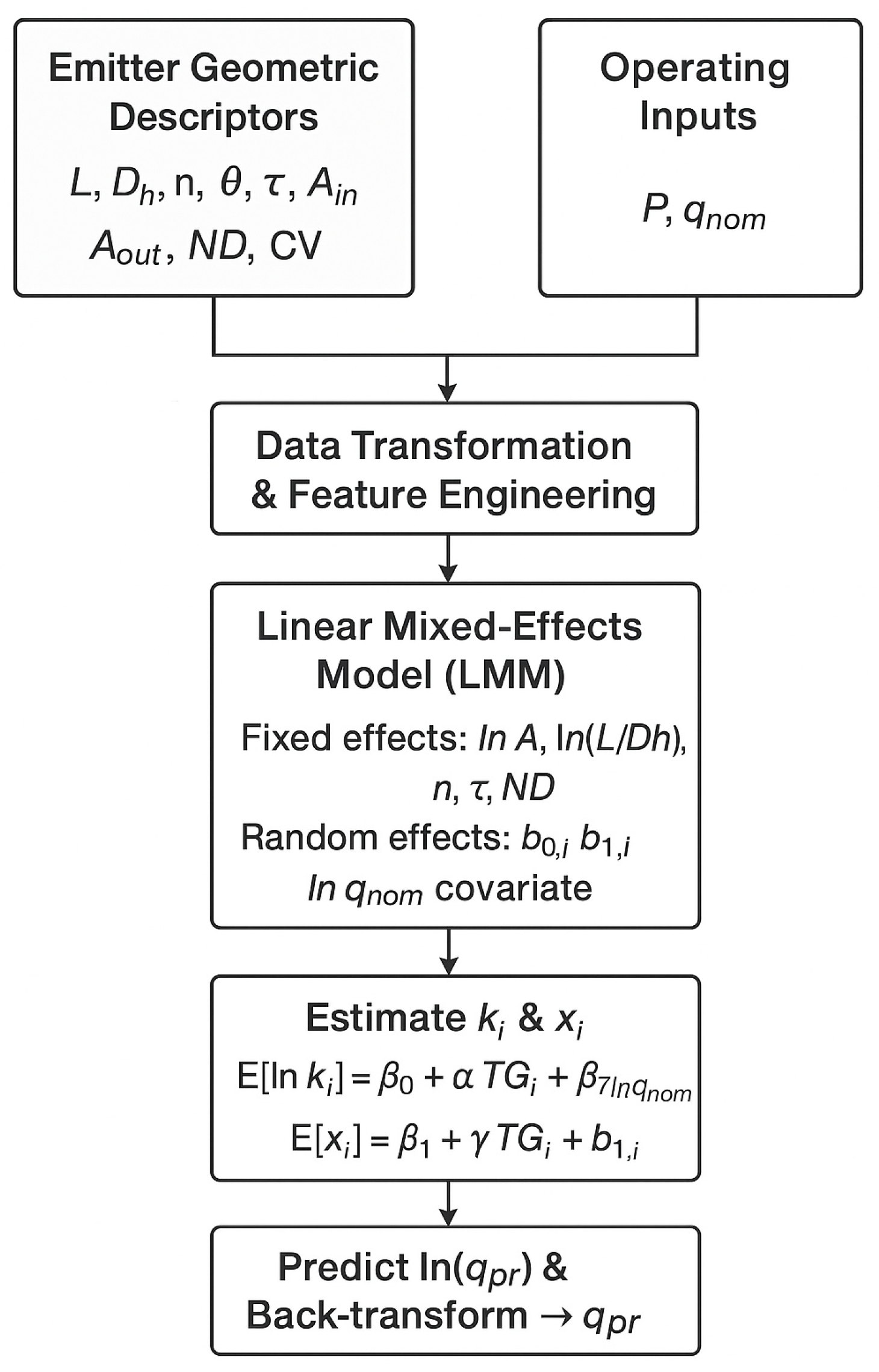
where ki is the discharge coefficient and xi is the pressure exponent, both estimated implicitly as functions of emitter geometry and nominal discharge from Equations (8) and (9). Including the nominal flow rate qnom as a covariate ensures that differences in rated discharge are properly distinguished from purely geometric effects. A schematic diagram of the predictive modeling framework linking labyrinth descriptors, nominal discharge and hydraulic parameters to predicted discharge (qpr) is presented in Figure 3. so that both ki and xi become explicit functions of internal flow-path geometry and the nominal rating. Predictions of qpr at any operating pressure are then produced from (6) and back-transformed to the original scale; model performance was summarized by marginal and conditional R2 [20] and predictive accuracy metrics (RMSE, MAE) using 10-fold cross-validation and leave-one-emitter-out validation. The model was evaluated using two validation approaches: 10-fold cross-validation and leave-one-emitter-out validation. Performance metrics, including RMSE, MAE, and marginal/conditional R2, were computed based on these validation procedures. These metrics provide a systematic assessment of the reliability and stability of the predictive model across different validation scenarios.

3. Results

3.1. Hydraulic Performance of Emitter

The hydraulic evaluation of the six pressure-compensating (PC) emitters revealed clear differences in discharge behavior and uniformity across types. Despite belonging to the same category of PC designs, variation was observed in their actual discharge relative to the nominal rating, in the flow coefficient (k), and in the discharge exponent (x), which reflects the degree of pressure compensation. Likewise, differences emerged in emission uniformity (EU) and emitter-to-emitter flow variation (qvar), highlighting the influence of labyrinth geometry and structural design. Table 2 summarizes the main hydraulic parameters and classification thresholds used to compare the performance of the tested emitters.

3.1.1. Nominal Versus Actual Discharge

Table 2 compares the nominal discharge (qnom) specified by the manufacturers with the actual mean discharge (qact) measured during the hydraulic tests. Across all six emitters, the measured discharges were in close agreement with the nominal ratings, with deviations ranging approximately from −7% to +5%. For instance, Emitter E1 exhibited a slight positive deviation (3.8 vs. 3.99 L/h, about +5%), while E3 showed a moderate negative deviation (3.6 vs. 3.44 L/h, −4.4%). E2 and E6 demonstrated the closest match between nominal and actual values, with differences of only –0.01 L/h each (−0.2% and −0.3%, respectively), confirming their high consistency. In contrast, E4 showed the largest deviation (3.6 vs. 3.35 L/h, −6.9%), which nevertheless remains within the acceptable tolerance range defined by ISO 9261:2004 [15]. E5 displayed a minor positive shift (3.5 vs. 3.59 L/h, +2.6%), also within the permissible margin.
These variations confirm that all tested emitters comply with international quality standards, and that the actual discharges remained sufficiently close to the nominal ratings to ensure reliability in irrigation system design and scheduling. A paired-sample t-test conducted to assess whether the differences between qnom and qact were statistically significant indicated no significant difference (t = 0.84, p = 0.43), suggesting that the observed deviations reflect normal product variability rather than systematic bias. This outcome validates the nominal classification provided by manufacturers and supports its use as a dependable reference for evaluating hydraulic performance under both field and laboratory conditions.

3.1.2. Flow Coefficient (k) and Pressure Exponent (x)

The flow coefficient (k) and discharge exponent (x) are the primary hydraulic parameters that characterize how pressure-compensating (PC) emitters regulate discharge in response to operating pressure. As summarized in Table 2, the estimated k values across the six types ranged from 3.35 for E4 to 4.29 for E2, whereas x varied from 0.01 for E5 to 0.12 for E2. Many emitters had x values between 0.01 and 0.09, confirming their operation within the pressure-compensating range (x ≤ 0.1), while E2 (x = 0.12) was classified as semi-pressure-compensating. This distinction highlights that although most emitters maintained strict regulation of discharge across the tested pressure interval (0.8–2.0 bar), E2 exhibited a slightly higher dependence on pressure.
A one-way ANOVA performed on the k values indicated significant variation among emitter types (p < 0.05), reflecting genuine design-based differences in effective hydraulic conductance. In contrast, statistical testing of x revealed no significant differences across most emitters (p > 0.05), except for E2, which differed from the fully compensating types (e.g., E5 with x = 0.01, and E4 with x = 0.03). The relatively high k values observed for E2 and E1 (4.29 and 4.02, respectively) suggest that their flow passages offered lower hydraulic resistance, thereby enabling larger effective conductance. Conversely, the lower k recorded for E4 (3.35) indicates greater energy dissipation within its flow path, leading to reduced discharge capacity. Such contrasts emphasize how subtle differences in labyrinth geometry and internal resistance govern hydraulic behavior. From a functional standpoint, the combination of high k with a moderately elevated x, as observed in E2, may compromise strict compensation by allowing slight increases in discharge with pressure, whereas low k coupled with near-zero x, as in E5, provides superior stability at the expense of reduced throughput. This trade-off highlights the balance between maintaining adequate discharge capacity and ensuring robust pressure compensation. Thus, the comparative analysis of k and x values (Table 2) demonstrates that the emitters fulfill their design claims, with statistically confirmed differences in hydraulic conductance (k) but broadly equivalent pressure exponents (x), apart from the borderline case of E2.

3.1.3. Discharge Variability, Emission Uniformity, and Flow Variation

Beyond discharge coefficients, the reliability of pressure-compensating emitters is determined by their ability to deliver water uniformly across a lateral. Three complementary indicators were evaluated: the coefficient of variation (CV), emission uniformity (EU), and flow variation (qvar), as summarized in Table 2. Together, these indices provide an integrated assessment of hydraulic stability, sensitivity to manufacturing deviations, and the ability of each emitter model to maintain irrigation uniformity under field conditions.
The CV values at 1 bar ranged from 2.16% for E5 to 4.33% for E3, with all emitters falling well below the 5% threshold classified as “excellent” by ASAE standards. A one-way ANOVA confirmed significant differences among types (p < 0.05), indicating that while all units are of high manufacturing precision, the E3 model exhibited slightly greater variability. This suggests that although its labyrinth geometry is effective in pressure compensation (x = 0.09), its microstructural uniformity may be less consistent compared with the other designs.
Emission uniformity (EU) values ranged from 94.4% to 97.2%, placing all emitters in the “excellent” category. Type E5 recorded the highest EU (97.2%), followed closely by E4 (96.3%), E1 (96.2%), and E6 (96.0%). The slightly lower EU of the E3 model (94.4%) is consistent with its elevated CV, highlighting that even small increments in discharge variability directly translate into reduced field uniformity. Statistical comparison of EU values indicated no significant differences at the 5% level (p > 0.05), underscoring that in practice, all tested emitters deliver water with a similarly high degree of uniformity under controlled laboratory conditions.
Flow variation (qvar) showed a wider range, from 7.08% for E1 to 12.62% for E3. While all emitters were classified as “acceptable” (qvar < 20%), the difference between the most stable (E1) and the least stable (E3) designs was notable, although not a twofold increase as sometimes implied. Pairwise comparisons revealed that the E3 had significantly higher qvar than both the E5 and E4 (p < 0.05), reflecting its greater sensitivity to minor pressure fluctuations or structural inconsistencies. Interestingly, E1, which had the lowest qvar, did not exhibit the lowest CV, suggesting that stability in response to pressure is not always aligned with manufacturing precision.
The convergence of these three indices demonstrates that while all six types meet international performance standards, meaningful differences exist. Emitters such as E5 and E4 combine low CV, high EU, and relatively low qvar, pointing to robust compensation and consistent flow delivery. Conversely, the E3 model, despite maintaining acceptable standards, displayed comparatively higher variability, which may reduce uniformity under more challenging field conditions. Thus, as highlighted in Table 2, CV and qvar provide finer discrimination between designs than EU alone, making them critical metrics for evaluating the contribution of labyrinth geometry to hydraulic stability. Notably, E1 achieved the lowest qvar, indicating strong resistance to pressure-induced variability, whereas E5 offered the best overall balance across all three indicators, confirming its superior integrated performance.

3.1.4. Overall Hydraulic Performance Assessment

The overall hydraulic performance of the six pressure-compensating emitters was evaluated based on the comprehensive assessment of key parameters: the discharge coefficient (k), pressure exponent (x), coefficient of variation (CV), emission uniformity (EU), and flow variation (qvar). Table 2 presents a consolidated summary of these indicators for each emitter, providing a clear comparison of their hydraulic efficiency and stability under varying operating pressures.
In terms of flow coefficient (k), the E2 emitter demonstrated the highest value (4.29), reflecting its larger effective flow area and more efficient conductance. This was followed by E1 (4.02) and E6 (3.82), which also exhibited relatively high k values, indicating their ability to sustain higher flow rates. Conversely, the E4 model recorded the lowest k value (3.35), suggesting greater internal resistance within its flow path, which limits discharge capacity.
Pressure compensation performance was assessed through the discharge exponent (x), which quantifies the sensitivity of emitter discharge to pressure fluctuations. Most emitters had x values below 0.1, placing them in the “fully pressure-compensating” category. However, the E2 model, with x = 0.12, was classified as semi-pressure-compensating, indicating slightly higher sensitivity to pressure changes. Despite this, all emitters exhibited low x values overall, ensuring stable discharge across the tested pressure range (0.8–2.0 bar).
Emission uniformity (EU) was uniformly excellent, ranging from 94.4% for E3 to 97.2% for E5, confirming that all emitters deliver consistent water distribution under controlled conditions. The highest EU was recorded for E5 (97.2%), followed closely by E4 (96.3%), E1 (96.2%), and E6 (96.0%). The slightly lower EU of E3 reflects its relatively higher discharge variability, consistent with its elevated CV (4.33%).
Flow variation (qvar) revealed more pronounced differences, ranging from 7.08% for E1 to 12.62% for E3. While all emitters were classified as “acceptable” (qvar < 20%), E1 demonstrated the greatest stability with the lowest qvar, followed by E5 (8.95%) and E4 (9.23%). In contrast, E3 exhibited the highest qvar, indicating reduced stability under pressure fluctuations, although still within acceptable limits.
Taken together, the results indicate that all six emitter types meet international performance standards for pressure compensation, discharge stability, and emission uniformity. However, meaningful differences in hydraulic conductance (k), pressure sensitivity (x), and flow consistency (CV, EU, qvar) underline the influence of labyrinth geometry on performance. Emitters such as E5 and E4 combined excellent emission uniformity with low variability, while E1 excelled in minimizing flow variation. Conversely, the E3 model, though compliant with standards, displayed comparatively higher variability that may reduce uniformity under demanding field conditions. Considering all indicators together, the overall hydraulic performance can be ranked as follows: E5E4 > E1E6 > E2 > E3, with E5 and E4 representing the most balanced and stable designs.

3.2. Pressure–Discharge Relationships

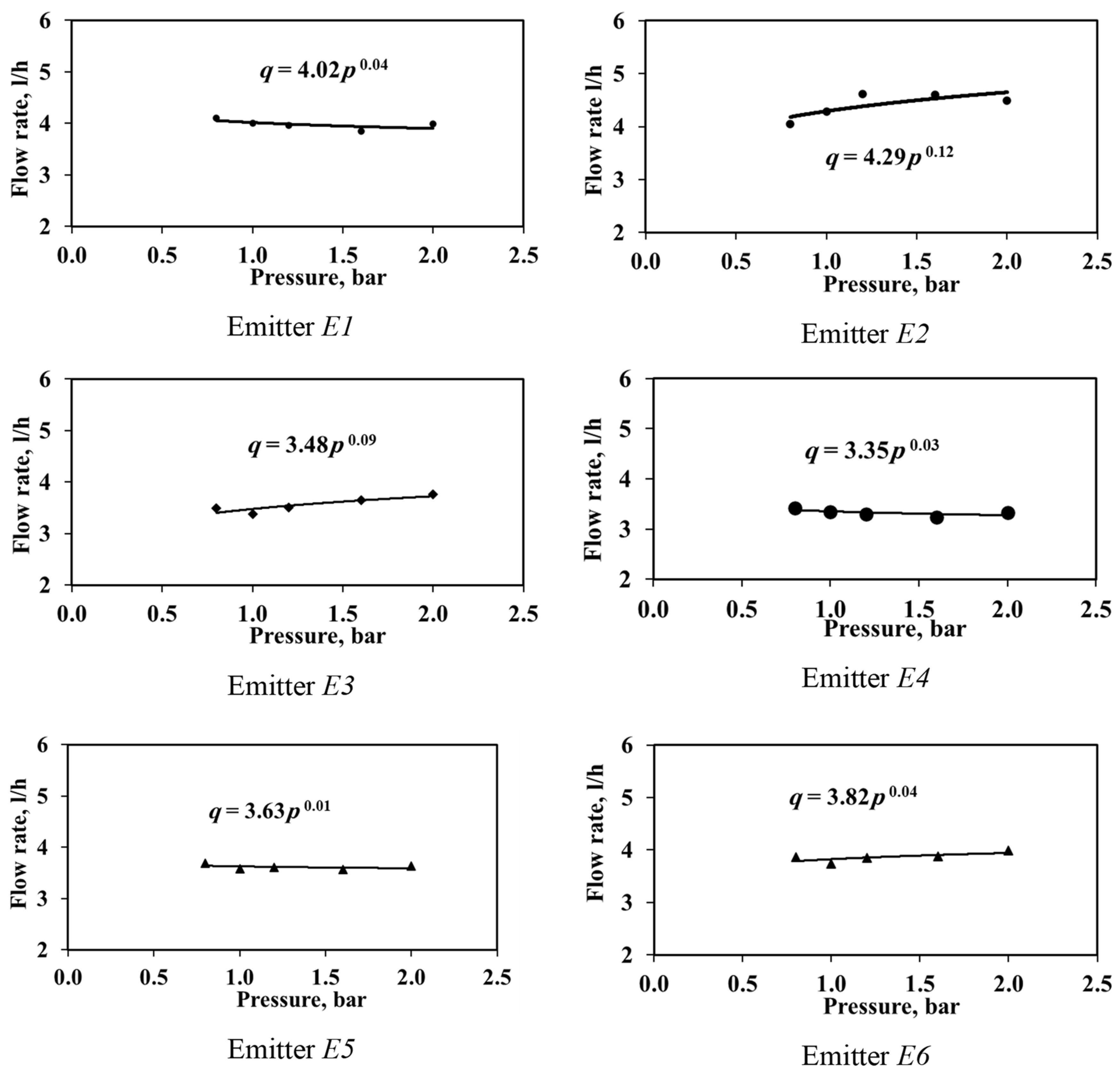
The relationship between emitter discharge and operating pressure provides a fundamental indicator of flow regulation efficiency in pressure-compensating (PC) devices. Figure 4 presents the pressure–discharge curves for the six tested emitters, overlaid with the fitted power-law functions, while the corresponding flow coefficients (k) and pressure exponents (x) are summarized in Table 2. The slope of each fitted curve in Figure 4 reflects the discharge exponent (x), which quantifies the emitter’s sensitivity to pressure variation. A perfectly pressure-compensating emitter would exhibit x = 0, indicating constant discharge regardless of pressure, whereas higher x values denote increasing dependence on pressure and hence reduce compensation efficiency. The emitters followed a distinct order in their x values: E5 (0.01) < E4 (0.03) < E1 = E6 (0.04) < E3 (0.09) < E2 (0.12).
Emitters E5 and E4 displayed nearly horizontal discharge–pressure curves across the tested range (0.8–2.0 bar), confirming their exceptional pressure-compensating ability. Their minimal x values indicate almost invariant discharge with changing pressure, representing near-ideal compensation performance. E1 and E6, both with x = 0.04, exhibited slightly steeper slopes but maintained stable flow rates within the practical operating range, thus remaining effectively pressure-compensating.
By contrast, E3 and E2 demonstrated more pronounced pressure dependence. The moderate slope for E3 (x = 0.09) suggests a transition toward semi-compensating behavior, while E2, with the highest exponent (x = 0.12), clearly exhibited semi-compensating characteristics. Despite this, none of the emitters approached the non-compensating regime (x > 0.5), confirming that all maintained adequate pressure regulation as intended by their design specifications.
Although the deviations from ideal compensation are numerically small, their practical implications are nontrivial. Even marginal increases in x can lead to cumulative discharge disparities along extended irrigation laterals, ultimately reducing emission uniformity under field conditions. The combined graphical and numerical analyses therefore substantiate that labyrinth geometry exerts a decisive influence on compensation efficiency. Emitters such as E5 and E4 achieve near-ideal hydraulic regulation, whereas E2 and E3 exhibit measurable, though acceptable, sensitivity to pressure. Collectively, these findings confirm that while all tested models meet international performance standards, their compensation precision and hence field reliability are governed primarily by internal hydraulic design.

3.3. Influence of Flow Path Geometry and Predictive Modeling

The labyrinth flow path is the core hydraulic component of a pressure-compensating emitter, and its geometry primarily determines the response of the device to variations in operating pressure. Although the nominal discharge rating reflects the manufacturer’s design target, the actual discharge–pressure behavior is governed by internal geometrical descriptors, including effective flow area (A), hydraulic diameter (Dh), total labyrinth path length (L), tortuosity (τ), number of teeth (n), mean turning angle (θ), and inlet and outlet areas (Ain and Aout). These descriptors influence the discharge coefficient (k), which scales overall flow capacity, and the pressure exponent (x), which reflects the degree of pressure compensation.
Table 3 presents the geometric descriptors of the six emitters, including Ain and Aout. The Ain and Aout values were considered in the statistical analysis to evaluate their potential influence on hydraulic performance. Prior to model construction, all geometric descriptors listed in Table 3 were evaluated as candidate predictors. To avoid over-parameterization and redundancy, variables exhibiting strong collinearity were excluded based on variance inflation factor analysis and Akaike Information Criterion (AIC) minimization. Notably, L and Dh were strongly correlated with the normalized descriptor L/Dh. Although Ain and Aout were not retained in the final model due to limited independent explanatory power once the effective flow area (A) was included, their values still provide useful insight for interpreting local flow distribution and energy dissipation within the labyrinth. However, in the parsimonious regression model, only a subset of descriptors [ln A, ln (L/Dh), n, τ, ND] were retained, as these provided the best explanatory power and passed multicollinearity checks. While Ain and Aout did not significantly improve model fit or AIC, their values remain useful for physical interpretation of flow distribution and local energy dissipation within the labyrinth.
Emitters E3 and E6 have the longest labyrinth paths (L = 210 mm) and highest tortuosity (τ = 32.3), requiring water to travel long, winding channels. E4 exhibits the lowest x (0.03) with moderate k (3.35 L/h) and Ain/Aout ratio near unity, promoting uniform energy dissipation along a relatively short path. E5 is the most compact emitter (L = 30.2 mm, τ = 4.6) with narrow Dh and a moderate Ain/Aout ratio, producing very low x (0.01) while maintaining moderate k. E2, with a long path, moderate tortuosity, and the largest effective flow area, achieves the highest k (4.29 L/h) but shows reduced pressure compensation (x = 0.12). E1 represents an intermediate configuration balancing k and x.
The discharge coefficient (k) and pressure exponent (x) were modeled using a linear mixed-effects regression framework, where ln (k) and x were expressed as functions of the retained geometric descriptors. Table 4 summarizes the regression coefficients, which quantify the effect of each descriptor on hydraulic performance.
For the pressure exponent (x), the regression coefficients show that effective flow area (A) had a significant positive effect, whereas normalized path length (L/Dh) and tortuosity (τ) both had significant negative effects. The number of teeth (n) also had a significant negative influence. Non-drain features (ND) had a non-significant negative effect, whereas turning angle (θ) had a significant negative effect, and nominal discharge (qnom) produced a significant positive increase in x.
These regression estimates provide the quantitative foundation for predictive equations. Substituting the coefficients into Equation (10) yields explicit forms for the expected discharge coefficient and pressure exponent:
ln k = 3.75 + 0.21 ln A 0.26 ln L D h 0.07 n 0.14 τ + 0.10 N D 0.02 θ + 0.04 ln q n o m   x = 0.09 + 0.04   ln A 0.06 ln L D h 0.03 n 0.05 τ 0.02 θ 0.01 ln q n o m
These equations integrate multiple aspects of labyrinth design into concise predictors of hydraulic performance. To assess their validity, the geometric descriptors from Table 3 were first adjusted to account for measurement corrections and scale consistency and then substituted into the equations to compute predicted values of the discharge coefficient (k) and the pressure exponent (x). The extended results are reported in Table 5, where both the measured and predicted values of k and x are shown together with the corresponding measured discharge (q) and predicted discharge (qpr) at 1.0 bar operating pressure.
The predicted values closely match the measured data, with deviations less than ±0.05 for k and x and less than ±3% for qpr. To statistically assess the consistency between measured and predicted values, paired t-tests were conducted for k, x, and q at the emitter level. The results showed no significant differences between measured and predicted values for any parameter (p > 0.05), confirming that the deviations reported in Table 5 fall within random experimental variability rather than systematic model bias. This statistical agreement supports the validity of the predictive equations and demonstrates that the regression-based model reliably reproduces the hydraulic behavior of the tested emitters. This confirms that the retained descriptors capture the essential physics of flow conductance and energy dissipation.
Ain and Aout, although not included in the final regression equations, provide valuable physical insight: they affect local velocity profiles, inlet/outlet losses, and uniformity of energy dissipation along the labyrinth. Emitter performance, in terms of both k and x, is thus shaped by the combination of effective flow area, path geometry, tortuosity, number of teeth, and nominal discharge, while Ain and Aout help explain subtler flow effects observed experimentally. Once k and x are known, emitter discharge at any pressure can be predicted using Equation (11):
q p r = k · P x
The analysis confirms that flow-path geometry, quantified through A, L/Dh, τ, n, θ and qnom, provides a reliable basis for predicting discharge parameters and actual flow rates. Integrating these descriptors with regression modeling enables interpretation of observed hydraulic performance and prediction of new emitter designs, establishing a robust framework for emitter design, quality control, and irrigation system optimization. The close agreement between measured and predicted discharge values (Table 5) further supports the predictive accuracy of the proposed approach.

3.4. Comparative Ranking of Emitters

The preceding analysis of flow-path geometry and predictive modeling provides a detailed understanding of how labyrinth design influences the hydraulic parameters (discharge coefficient k and pressure exponent x). For practical irrigation applications, it is essential to compare emitters to identify which types maintain stable performance under variable operating pressures, which provide high flow conductance, and which balance stability with throughput efficiency. The first criterion for comparison is the discharge coefficient k, which reflects effective flow conductance. High k values indicate lower resistance and higher flow rates at a given pressure, assuming compensation does not excessively suppress discharge. Experimental measurements (qact) from Table 2 indicate that E2 exhibits the highest flow conductance (k = 4.29 L/h), followed by E1 (k = 4.02 L/h) and E6 (k = 3.82 L/h). These emitters possess relatively wide effective flow areas (A) and adequate inlet/outlet dimensions (Ain, Aout), as shown in Table 3, which collectively reduce energy losses along the labyrinth path. E3 demonstrates lower conductance (k = 3.48 L/h) due to its long, tortuous path (L = 210 mm, τ = 32.3) that increases energy dissipation. E5, with compact geometry and narrow hydraulic diameter (Dh = 3.0 mm), achieves moderate k (3.63 L/h), whereas E4, despite having a relatively short path length (L = 94.38 mm), shows lower k (3.35 L/h) due to its high tooth density (n = 30) and smaller flow cross-section.
The second criterion is pressure exponent x, reflecting the degree of pressure compensation. Lower x values indicate more stable flow under varying pressure, whereas higher x indicates increased sensitivity. Measured data from Table 2 show that E5 provides the strongest compensation (x = 0.01), with E1 and E6 also demonstrating low x (0.04), ensuring stable discharge across pressure variations. E4 achieves x = 0.03, while E3 exhibits moderate compensation (x = 0.09), and E2 displays the weakest compensation (x = 0.12), reflecting more variable flow.
Integrating these two criteria, a nuanced evaluation emerges. Emitters with high k but higher x (E2) offer greater throughput but reduced uniformity under pressure fluctuations. Emitters with moderate k and very low x (E5) maintain exceptional stability, though at the cost of lower flow rates. The inlet and outlet areas (Ain and Aout) contribute to flow efficiency, particularly in emitters with higher k, by reducing localized head losses and supporting smoother discharge.
To summarize, the six emitters were comparatively ranked considering both stability (x) and flow capacity (k), resulting in the classification presented in Table 6. Flow conductance was categorized as High (>3.9 L/h), Moderate (3.5–3.9 L/h), or Low (<3.5 L/h). Pressure stability was categorized as High (x ≤ 0.04), Moderate (0.05–0.08), or Low (x ≥ 0.09).
This ranking highlight that no emitter excels across all criteria. E1 and E6 achieve a balanced combination of conduct and stability, making them versatile for diverse operating conditions. E5 offers the highest stability, particularly suited for systems with long laterals, steep terrain, or substantial pressure variation. E2, while providing high discharge, demonstrates insufficient compensation and is most suitable in systems with tightly regulated pressure. E4 maintains strong stability but is constrained by lower flow capacity, and E3 represents an intermediate case with moderate compensation and lower throughput.
Descriptive values from Table 2 support this interpretation. Coefficient of variation (CV) values for all emitters remain in the Excellent range (2.16–4.33%), ensuring minimal internal variability. Emission uniformity (EU) also falls in the Excellent range (94.4–97.2%), confirming reliable performance. Discharge variation (qvar) is Acceptable for all emitters (7.08–12.62%), consistent with the observed stability rankings. The relative values of Ain and Aout, particularly in E1, E2, and E6, contribute to higher k by facilitating effective entry and exit flow areas, while narrower outlets in E5 restrict conductance but support extreme stability.
In practical terms, these results inform irrigation system design. Emitters such as E5, E1, and E6 are recommended for fields with variable pressures, undulating terrain, or extended lateral lengths, ensuring consistent water delivery. High-conductance emitters like E2 are better suited for short, flat systems with well-controlled pressures. Overall, integrating geometric descriptors, hydraulic measurements, and predictive modeling allows engineers to select emitters that balance efficiency, stability, and practical field performance.

4. Discussion

Water-saving irrigation systems depend critically on pressure-compensating (PC) emitters whose hydraulic behavior is strongly influenced by labyrinth geometry, where even relatively small modifications in channel design can produce measurable differences in discharge coefficient, pressure exponent, and uniformity under water-saving irrigation conditions. The objective of this study was to evaluate how internal flow-path geometry affects the hydraulic performance of PC emitters under varying operating pressures and to assess the effectiveness of predictive modeling in estimating discharge parameters within the broader framework of water-saving irrigation. The narrow dispersion of discharge exponents across the six tested emitters (x = 0.01–0.12) demonstrates that modern designs achieve close adherence to ideal pressure compensation, although the variation is sufficient to distinguish between types when stability under variable pressure is considered. These findings are consistent with earlier laboratory and field evaluations, which showed that PC emitters rarely achieve perfectly flat pressure–discharge curves but instead operate within a near-compensation domain where even small deviations in slope have important consequences for long laterals and sloping fields [21,22]. The fact that all tested emitters remained below the semi-compensating threshold (x ≤ 0.12) reflects advances in diaphragm–labyrinth integration and manufacturing precision that have been highlighted in recent engineering reports [17,23].
The positive association observed between effective cross-sectional area and flow coefficient reflects the physical reality that wider channels reduce frictional resistance, thereby increasing conductance. Conversely, longer and more tortuous labyrinths with sharper turning angles significantly reduced both the flow coefficient and the pressure exponent, confirming that geometric complexity enhances energy dissipation and stabilizes discharge. The non-drain (ND) feature, retained in the regression model due to its marginally significant positive effect on ln (k), may contribute to local flow regulation within the labyrinth channel. While its primary role is likely to limit unintended drainage at the outlet, the ND structure could also slightly alter the internal pressure field and velocity distribution along the flow path, influencing both energy dissipation and discharge characteristics. These effects are subtle but can help explain the marginal increase in flow coefficient observed in ND-equipped emitters. These outcomes agree with computational fluid dynamics (CFD) studies showing that vortex generation and low-velocity recirculation zones in complex channels promote pressure regulation but at the expense of flow capacity [22,24]. From a fluid mechanics perspective, the influence of labyrinth geometry on the discharge coefficient (k) and pressure exponent (x) can be interpreted through the mechanisms of energy dissipation, flow separation, and vortex dynamics within confined channels. As water traverses narrow and tortuous flow paths, repeated changes in direction induce local flow separation and the formation of secondary vortices at channel bends and contractions. These vortical structures convert pressure energy into turbulent kinetic energy and heat, increasing head losses independently of inlet pressure. Consequently, longer flow paths with higher tortuosity and sharper turning angles amplify cumulative energy dissipation, reducing the sensitivity of discharge to pressure variations and thereby lowering the pressure exponent (x). In contrast, wider channels with smoother trajectories sustain higher mean velocities and reduced boundary-layer interaction, resulting in lower frictional losses and higher discharge coefficients (k), but with diminished capacity for pressure regulation. The balance between viscous friction along channel walls and inertial losses associated with vortex generation therefore governs the observed trade-off between throughput and compensation efficiency in PC emitters. This mechanistic interpretation explains why geometrically complex labyrinths stabilize discharge across a wide pressure range, while simpler geometries favor higher flow capacity at the expense of hydraulic stability. Regression models in this study quantified these effects with coefficients closely matching those reported in both CFD and empirical research, thereby reinforcing the general applicability of the geometry–hydraulics relationship [21,25].
The trade-off between throughput and stability was clearly reflected in the comparative ranking. E2, with the highest discharge coefficient (k = 4.29), exhibited the weakest compensation (x = 0.12), making it vulnerable to pressure fluctuations. In contrast, E5, with moderate conductance (k = 3.63), achieved the lowest discharge exponent (x = 0.01), essentially eliminating sensitivity to pressure changes. Such trade-offs have been observed in previous evaluations, where optimizing emitter performance requires balancing the need for adequate discharge with the requirement of uniformity under variable hydraulic conditions typical of water-saving irrigation systems [26,27]. Emitters like E1 and E6, which combine moderately high conductance with strong compensation (x ≈ 0.04), therefore provide versatile solutions across a wide range of field scenarios.
The reliability indicators (CV, EU, and qvar) support the observed trade-offs between throughput and stability. All emitters achieved CV values below 5%, meeting the “excellent” category according to ASAE standards, although differences among emitters were noticeable. E3 exhibited the highest CV (4.33%) and qvar (16.9%), resulting in relatively lower emission uniformity compared to other types. This aligns with previous studies indicating that microstructural variability in labyrinth channels can generate higher discharge fluctuations even in pressure-compensating emitters [28,29]. Conversely, E5 (x = 0.01) and E4 (x = 0.03) demonstrated both low CV and low qvar, confirming that precise manufacturing and stable geometry enhance overall hydraulic performance. These observations emphasize that EU alone is insufficient to evaluate emitter quality and should be considered alongside CV and qvar for a comprehensive assessment [30].
For practical design purposes, quantitative thresholds can be derived from the observed hydraulic behavior. Emitters intended for long laterals or sloping terrains should exhibit pressure exponents x ≤ 0.03 to ensure minimal discharge variation under pressure gradients, whereas values of x ≥ 0.10 indicate reduced compensation and are more suitable for short, flat systems with well-controlled pressures. In terms of flow capacity, emitters with discharge coefficients k ≥ 4.2 L/h are advantageous where high throughput is required and pressure uniformity can be maintained, while emitters with moderate k values (≈3.3–3.7 L/h) combined with very low x provide superior stability under variable hydraulic conditions. In long laterals or hilly terrains where pressure fluctuation is unavoidable, emitters with the lowest discharge exponents, namely E5 (x = 0.01) followed by E4 (x = 0.03), are most suitable due to their exceptional stability. In contrast, flat systems with well-regulated pressures may benefit from high-conductance emitters such as E2 (k = 4.29 L/h), provided uniformity is monitored [23,31]. Emitters E1 and E6, combining moderate-to-high discharge with strong compensation (x ≈ 0.04), offer balanced performance and flexible applicability across smallholder and large-scale systems. This aligns with agronomic results that emitter choice must be tailored to site-specific hydraulic realities rather than nominal discharge alone to achieve water-saving irrigation goals [32].
The predictive equations derived in this study further strengthen the utility of geometry-based modeling. By calibrating descriptors such as effective area, normalized path length, and tortuosity, the regression model reproduced observed k and x values across all emitters with deviations less than ±0.05. This confirms that emitter geometry, once quantified, provides sufficient information for accurate prediction of hydraulic performance. Such predictive capacity reduces reliance on repeated prototyping and supports design optimization in the manufacturing stage [33]. Moreover, predictive tools can aid quality control by flagging outliers during batch production based on expected k–x values derived from geometry [29]. Recent advances in CFD and fluid–structure interaction modeling suggest that future predictive frameworks may even integrate diaphragm deformation and material response into regression-based approaches to enhance long-term prediction accuracy [3,23].
Building upon these findings, future research should extend predictive modeling to encompass broader hydraulic and operational domains relevant to water-saving irrigation. Incorporating variable water quality, cyclic pressure loads, and temperature effects into model calibration can further improve prediction accuracy and ensure robust performance under field conditions. Previous investigations have shown that such factors can influence effective hydraulic diameter and local energy dissipation, thereby modulating compensation efficiency [24,26]. The integration of CFD-based insights with empirical regression models may also enable the development of hybrid predictive tools capable of capturing nonlinear flow phenomena within and beyond the 0.8–2.0 bar operating range [22]. Moreover, advances in fluid–structure interaction modeling can facilitate the inclusion of diaphragm elasticity and material response, enhancing long-term reliability predictions for PC emitters in water-saving applications [34]. These extensions would consolidate the role of geometry-based modeling as a design and diagnostic tool for emitter optimization across diverse irrigation environments.
Thus, this study reinforces that labyrinth geometry is the central determinant of emitter hydraulics. Wider, shorter channels with low tortuosity enhance throughput but weaken compensation, whereas long, narrow, and tortuous paths strengthen pressure regulation at the cost of discharge capacity. This fundamental trade-off, observed across multiple studies, underpins emitter design and selection in irrigation practice [17,35]. By embedding predictive modeling into this framework, manufacturers and system designers can not only evaluate existing emitters but also guide the design of future devices optimized for specific hydraulic environments. The practical outcome is a more rational basis for emitter selection that improves water-use efficiency, supports sustainable and water-saving irrigation management, and aligns global efforts to optimize agricultural water productivity [32,36].

5. Conclusions

In the context of water-saving irrigation, this study confirmed that labyrinth geometry is the dominant factor controlling the hydraulic behavior of pressure-compensating emitters, directly influencing both the discharge coefficient (k) and the pressure exponent (x). Despite all tested types (E1E6) complying with international quality standards, clear performance contrasts emerged, with E4 and E5 achieving the highest stability, E1 and E6 showing balanced performance, and E2 prioritizing flow capacity over pressure uniformity. The predictive modeling, based on detailed geometric descriptors, proved effective in accurately estimating k and x, providing a reliable tool for guiding emitter selection and supporting efficient water use in sustainable irrigation management.
Future studies are recommended to explore long-term clogging dynamics, diaphragm material degradation, emitter hydraulic stability across broader pressure ranges, and performance validation under a wider variety of commercial products and field conditions, aiming to improve the reliability of pressure-compensating emitters in water-saving irrigation applications.

Author Contributions

Conceptualization, M.G., A.A. and N.S.H.; methodology, M.G., N.S.H. and H.M.I.; investigation, A.A., N.S.H. and H.M.I.; resources, N.S.H. and H.M.I.; data curation, N.S.H. and H.M.I.; Formal analysis, M.G. and A.A.; visualization, M.G., A.A. and H.M.I.; writing—original draft preparation, M.G. and A.A.; review and editing, M.G., A.A., N.S.H. and H.M.I. All authors have read and agreed to the published version of the manuscript.

Funding

This research received no external funding.

Data Availability Statement

The data presented in this study are available on request from the corresponding author.

Acknowledgments

The Researchers would like to thank the Deanship of Graduate Studies and Scientific Research at Qassim University for financial support (QU-APC-2026).

Conflicts of Interest

The authors declare no conflicts of interest.

References

  1. Sultan, W.M.; Hussien, A.A.; Hussein, N.S. Effect of drippers geometrics map on hydraulic performance of drippers. Egypt. J. Agric. Res. 2018, 96, 1009–1018. [Google Scholar] [CrossRef]
  2. Yang, F.; Li, H.; Jiang, Y. A Review of Pressure Regulation Technologies for Irrigation Pipeline Systems. Agriculture 2025, 15, 1528. [Google Scholar] [CrossRef]
  3. Xu, T.; Bao, S.; Li, Z.; Yu, Q.; Zheng, E. The study of Structural optimization on hydraulic performance and anti-clogging performance of Labyrinth Drip Irrigation Emitters. Agronomy 2023, 13, 2496. [Google Scholar] [CrossRef]
  4. Sethi, V.P. Greenhouse Engineering: Software-Driven Design and Modelling for Optimal Microclimate Control; CRC Press: Boca Raton, FL, USA, 2025. [Google Scholar]
  5. Xing, S.; Wang, Z.; Zhang, J.; Liu, N.; Zhou, B. Simulation and verification of hydraulic performance and energy dissipation mechanism of perforated drip irrigation emitters. Water 2021, 13, 171. [Google Scholar] [CrossRef]
  6. De Marchis, M.; Bruno, F.; Saccone, D.; Napoli, E. Performance of Emitters in Drip Irrigation Systems Using Computational Fluid Dynamic Analysis. Water 2025, 17, 689. [Google Scholar] [CrossRef]
  7. Sokol, J.; Narain, J.; Costello, J.; McLaurin, T.; Kumar, D.; Winter, A.G. Analytical model for predicting activation pressure and flow rate of pressure-compensating inline drip emitters and its use in low-pressure emitter design. Irrig. Sci. 2022, 40, 217–237. [Google Scholar] [CrossRef]
  8. Elnemer, M.; Abo-Elatta, N. Effect of inlet water temperature on the uniformity parameters of drip irrigation system. Damietta J. Agric. Sci. 2024, 3, 114–123. [Google Scholar] [CrossRef]
  9. Sharu, E.H. Hydraulic performance analysis of drip irrigation system using pressure compensated dripper at low operating pressure. Adv. Agric. Food Res. J. 2022, 3, e0000225. [Google Scholar] [CrossRef]
  10. Ramachandrula, V.R.; Kasa, R.R. Non-destructive characterization of physical and chemical clogging in cylindrical drip emitters. Heliyon 2020, 6, e05327. [Google Scholar] [CrossRef]
  11. Ramachandrula, V.R.; Kasa, R.R. Prevention and treatment of drip emitter clogging: A review of various innovative methods. Water Pract. Technol. 2022, 17, 2059–2070. [Google Scholar] [CrossRef]
  12. Dallagi, H.; Ait-Mouheb, N.; Soric, A.; Boiron, O. Simulation of the flow characteristics of a labyrinth milli-channel used in drip irrigation. Biosyst. Eng. 2024, 239, 114–129. [Google Scholar] [CrossRef]
  13. Dewan, A.; Srivastava, P. A review of heat transfer enhancement through flow disruption in a microchannel. J. Therm. Sci. 2015, 24, 203–214. [Google Scholar] [CrossRef]
  14. Fresta, E.; Costa, R.D. Beyond traditional light-emitting electrochemical cells–a review of new device designs and emitters. J. Mater. Chem. C 2017, 5, 5643–5675. [Google Scholar] [CrossRef]
  15. ISO 9261:2004; Agricultural Irrigation Equipment—Emitters and Emitting Pipe—Specification and Test Methods. International Organization for Standardization: Geneva, Switzerland, 2004.
  16. Hussein, N.; Saad, S.; Refaie, K.; Sultan, W.; Ghonimy, M.; Alzoheıry, A. Air injection in Subsurface Drip Irrigation as an Efficient Method for Zucchini Production. Turk. J. Agric. Eng. Res. 2024, 5, 303–318. [Google Scholar] [CrossRef]
  17. Chen, X.; Wei, Z.; He, K. An estimation of the discharge exponent of a drip irrigation emitter by response surface methodology and machine learning. Water 2022, 14, 1034. [Google Scholar] [CrossRef]
  18. Harbuck, T.L.; Fulton, J.P.; Dougherty, M.; Taylor, S.T.; Eakes, D.J.; Sibley, J.L. In-field application uniformity evaluation of pressure-compensating subsurface-drip irrigation products. Appl. Eng. Agric. 2011, 27, 43–50. [Google Scholar] [CrossRef]
  19. Lamm, F.R.; Colaizzi, P.D.; Sorensen, R.B.; Bordovsky, J.P.; Dougherty, M.; Balkcom, K.; Zaccaria, D.; Bali, K.M.; Rudnick, D.R.; Peters, R.T. A 2020 vision of subsurface drip irrigation in the US. Trans. ASABE 2021, 64, 1319–1343. [Google Scholar] [CrossRef]
  20. Nakagawa, S.; Schielzeth, H. A general and simple method for obtaining R2 from generalized linear mixed-effects models. Methods Ecol. Evol. 2013, 4, 133–142. [Google Scholar] [CrossRef]
  21. Sharu, E.H.; Ab Razak, M.S. Hydraulic performance and modelling of pressurized drip irrigation system. Water 2020, 12, 2295. [Google Scholar] [CrossRef]
  22. Li, Y.; Feng, X.; Liu, Y.; Han, X.; Liu, H.; Sun, Y.; Li, H.; Xie, Y. Research on hydraulic properties and energy dissipation mechanism of the novel water-retaining labyrinth channel emitters. Agronomy 2022, 12, 1708. [Google Scholar] [CrossRef]
  23. Chen, X.; Wei, Z.; Ma, R.; Li, J.; Wang, Y.; Huang, L.; Dang, C.; Zhoo, J.; Li, Z. Research on the compensation mechanism of pressure compensating emitters based on numerical simulation and visualisation experiment. Biosyst. Eng. 2025, 253, 104125. [Google Scholar] [CrossRef]
  24. Du, K.; Xing, S.; Zhang, J.; Liu, N.; Zhang, J.; Li, M.; Wang, Z. Numerical simulation and structure optimization for hydraulic performance of perforated drip irrigation emitters. Water Supply 2024, 24, 1117–1130. [Google Scholar] [CrossRef]
  25. Naeeni, S.T.O.; Rahmani Firozjaei, M.; Hajebi, Z.; Akbari, H. Investigation of the performance of the response surface method to optimize the simulations of hydraulic phenomena. Innov. Infrastruct. Solut. 2023, 8, 10. [Google Scholar] [CrossRef]
  26. Zaiyu, L.; Yan, M.; Hao, G.; Shihong, G.; Yanqun, Z.; Guangyong, L.; Feng, W. The hydraulic performance and clogging characteristics of a subsurface drip irrigation system operating for five years in the North China plain. Agric. Water Manag. 2025, 307, 109217. [Google Scholar] [CrossRef]
  27. Dhoble, S.J.; Nande, A.; Kalyani, N.T.; Tiwari, A.; Arof, A.K. (Eds.) Functional Materials from Carbon, Inorganic, and Organic Sources: Methods and Advances; Woodhead Publishing: Stockton, UK, 2022. [Google Scholar]
  28. Hou, P.; Ma, C.; Wang, J.; Li, Y.; Zhang, K.; Hou, S.; Li, J.; Sun, Z.; Xiao, Y.; Li, Y. Failure behavior of pressure compensating emitter under different operation pressures in drip irrigation systems. Agric. Water Manag. 2024, 297, 108835. [Google Scholar] [CrossRef]
  29. AL-Dulaimi, B.A.; AL-Mehmdy, S.M. Effect of pipe type and Emitters discharge on performance criteria of surface drip irrigation system. In IOP Conference Series: Earth and Environmental Science, Proceedings of the Third Scientific and First International Conference of De-sert Studies-2021 (ICDS-2021), Ramadi, Iraq, 17–18 November 2021; IOP Publishing: Bristol, UK, 2021; Volume 904, p. 012013. [Google Scholar]
  30. Barua, S. Design and Analysis of a Pressure Compensated Emitter for Efficient Drip Irrigation System; Central library of Bangladesh University of Engineering and Technology: Dhaka, Bangladesh, 2019; Available online: http://lib.buet.ac.bd:8080/xmlui/handle/123456789/6215 (accessed on 22 October 2025).
  31. Buema, G.; Harja, M.; Lupu, N.; Chiriac, H.; Forminte, L.; Ciobanu, G.; Bucur, D.; Bucur, R.D. Adsorption Performance of Modified Fly Ash for Copper Ion Removal from Aqueous Solution. Water 2021, 13, 207. [Google Scholar] [CrossRef]
  32. Domínguez-Niño, J.M.; Oliver-Manera, J.; Girona, J.; Casadesús, J. Differential irrigation scheduling by an automated algorithm of water balance tuned by capacitance-type soil moisture sensors. Agric. Water Manag. 2020, 228, 105880. [Google Scholar] [CrossRef]
  33. Gao, N.; Mo, Y.; Wang, J.; Yang, L.; Gong, S. Effects of Flow Path Geometrical Parameters on the Hydraulic Performance of Variable Flow Emitters at the Conventional Water Supply Stage. Agriculture 2022, 12, 1531. [Google Scholar] [CrossRef]
  34. Chen, X.; Wei, Z.; Wei, C.; He, K. Effect of compensation chamber structure on the hydraulic performance of pressure compensating drip emitters. Biosyst. Eng. 2022, 214, 107–121. [Google Scholar] [CrossRef]
  35. Li, Y.; Feng, X.; Han, X.; Sun, Y.; Liu, Y.; Yao, M.; Liu, H.; He, Q.; Li, H. Analysis of internal flow characteristics and determination of the core structural parameters of a stellate labyrinth channel irrigation emitter. Biosyst. Eng. 2023, 231, 1–19. [Google Scholar] [CrossRef]
  36. Du, Y.; Fu, Q.; Ai, P.; Ma, Y.; Pan, Y. Modeling Comprehensive Deficit Irrigation Strategies for Drip-Irrigated Cotton Using AquaCrop. Agriculture 2024, 14, 1269. [Google Scholar] [CrossRef]
Figure 1. Internal flow path geometries of the six tested PC drip emitters, showing labyrinth configuration, inlet filtration design, and non-drain (ND) features.
Water 18 00244 g001
Figure 2. Trickle hydraulic test bench [16].
Water 18 00244 g002
Figure 3. Schematic diagram of the predictive modeling framework linking labyrinth geometric descriptors, nominal discharge, and estimated hydraulic parameters (k and x) to predicted emitter discharge (qpr).
Water 18 00244 g003
Figure 4. Pressure–discharge curves for the six tested PC emitters.
Water 18 00244 g004
Table 1. Design characteristics of the tested pressure-compensating drip emitters.
Emitter TypeNominal Flow Rate, L/hND FeatureLabyrinth TypeInlet Filtration Design
E13.8YesLong tortuous, multi-toothMulti-stage radial slots
E24.2NoMedium length, staggeredPeripheral slits
E33.6NoCompact zigzagCross-slot entry
E43.6NoLong spiral, deep channelRadial multi-slot with screen filter
E53.5YesShort compact with high tortuosityMulti-stage with fine mesh
E63.75YesMedium zigzag with energy dissipatorsLongitudinal slit entry
Table 2. Hydraulic performance characteristics of the six tested PC emitters.
Hydraulic
Performance
Emitter Type
E1E2E3E4E5E6
qnom, L/h3.84.23.63.63.53.75
qact, L/h3.99 ± 0.084.19 ± 0.083.44 ± 0.103.35 ± 0.093.59 ± 0.063.74 ± 0.11
k, L/h4.024.293.483.353.633.82
x0.040.120.090.030.010.04
Flow regimePCSemi-PCPCPCPCPC
CV, %2.833.084.332.642.162.86
Classification (CV)ExcellentExcellentExcellentExcellentExcellentExcellent
EU, %96.295.894.496.397.296
Classification (EU)ExcellentExcellentExcellentExcellentExcellentExcellent
qvar, %7.087.3012.629.238.9510.70
Classification (qvar)AcceptableAcceptableAcceptableAcceptableAcceptableAcceptable
Table 3. Geometric descriptors of the six tested pressure-compensating emitters.
EmitterA, mm2Dh, mmL, mmLs, mmnτND, 0/1θ, °Ain, mm2Aout, mm2CV(Dh), %L/Dh
E10.754.091.86.02215.31691.73.17.022.8
E21.004.0166.06.51625.507617.22 × 3.16.841.5
E31.004.1210.06.52432.30903.74 × 3.17.551.2
E41.004.094.387.53012.60523.23.18.623.6
E50.503.030.26.5154.61752.67.17.810.1
E61.004.1210.06.52432.31903.74 × 3.16.951.2
Notes: A = effective flow area; Dh = hydraulic diameter; L = labyrinth path length; Ls = straight-line distance between inlet and outlet; τ = tortuosity (L/Ls); n = number of teeth/turns; ND = binary indicator of non-drain feature; θ = mean turning angle; Ain and Aout = inlet and outlet areas; CV(Dh) = coefficient of variation in hydraulic diameter along path; L/Dh = normalized path length.
Table 4. Regression coefficients (β ± SE) from LMM linking flow-path geometry to discharge parameters.
PredictorCoefficient for ln (k) (β ± SE)p-ValueCoefficient for x (β ± SE)p-Value
ln A+0.21 ± 0.070.028+0.04 ± 0.020.021
ln (L/Dh)–0.26 ± 0.090.015–0.06 ± 0.020.024
n–0.07 ± 0.030.044–0.03 ± 0.010.041
τ–0.14 ± 0.050.021–0.05 ± 0.020.017
ND+0.10 ± 0.040.059–0.01 ± 0.010.145
θ–0.02 ± 0.010.124–0.02 ± 0.010.038
ln qnom+0.04 ± 0.010.011+0.01 ± 0.000.020
Constant3.75 ± 0.12<0.0010.09 ± 0.01<0.001
Table 5. Measured and predicted hydraulic parameters and discharge of the PC emitters.
Emitterk, L/hxq, L/h at 1 Bar
Act.Pre.Act.Pre.Act.Pre.
E14.024.000.040.054.024.00
E24.294.260.120.114.294.26
E33.483.500.090.103.483.50
E43.353.370.030.043.353.37
E53.633.610.010.023.633.61
E63.823.810.040.053.823.81
Table 6. Comparative ranking of emitters by discharge coefficient (k) and pressure stability (x).
EmitterFlow Coefficient (k)Category (k)Pressure Exponent (x)Category (x)Overall Ranking
E14.02High0.04HighBest overall (balanced)
E24.29High0.12LowHigh-flow, weakly stable
E33.48Low0.09LowLimited applicability
E43.35Low0.03HighStable but low flow
E53.63Moderate0.01HighMost stable under variation
E63.82Moderate0.04HighStrong stability, balanced
Disclaimer/Publisher’s Note: The statements, opinions and data contained in all publications are solely those of the individual author(s) and contributor(s) and not of MDPI and/or the editor(s). MDPI and/or the editor(s) disclaim responsibility for any injury to people or property resulting from any ideas, methods, instructions or products referred to in the content.