
Article

A Spatiotemporal Analysis of Heterogeneity and Non-Stationarity of Extreme Precipitation in the Ayeyarwady River Basin, Myanmar, and Their Linkages to Global Climate Variability

1
Center for Research and Application of Satellite Remote Sensing (YUCARS), Yamaguchi University, Ube 755-8611, Japan
2
New Space Intelligence, 329-22 Nishikiwa, Ube 755-0151, Japan
3
Faculty of Engineering, Assam downtown University, Panikhaiti, Guwahati 781026, India
*
Author to whom correspondence should be addressed.
Water 2026, 18(2), 227; https://doi.org/10.3390/w18020227
Submission received: 24 November 2025 / Revised: 26 December 2025 / Accepted: 12 January 2026 / Published: 15 January 2026
(This article belongs to the Special Issue Water-Related Disasters in Adaptation to Climate Change)

Abstract

Introduction: Extreme precipitation events in the Ayeyarwady River Basin, Myanmar, exhibit pronounced spatiotemporal heterogeneity and non-stationarity, yet their linkages to large-scale climate oscillations remain poorly understood. Objective: This study aimed to characterize distinct rainfall regimes, quantify non-stationary extreme event dynamics, and identify teleconnections with oceanic-atmospheric variability over 66 years (1958–2023). Materials and Methods: A hybrid analytical framework integrating K-means clustering, non-stationary Generalized Pareto Distribution modeling, and wavelet coherence analysis was applied to gridded monthly precipitation data from TerraClimate. Results: Four spatiotemporal rainfall clusters were delineated, exhibiting fundamentally different monsoonal characteristics with mean seasonal peaks ranging from 188 mm to 686 mm. Extreme precipitation behavior demonstrated substantial heterogeneity, with 100-year return periods varying from 501 mm in subdued northern zones to 983 mm in hyper-intense coastal regions. Wavelet coherence analysis revealed regime-specific teleconnections: Cluster 2 exhibited the strongest ENSO influence (0.536 coherence strength, 64-month median duration, 1960 peak), while Cluster 4 demonstrated unique IOD dominance (0.479 strength, 74-month duration) extending beyond annual timescales. Teleconnection effectiveness varied substantially across regimes (0.428–0.536 strength) with significant decadal non-stationarity. Limitations and Perspectives: Basin-wide precipitation averages obscure critical regional variations in extreme event magnitudes and climate forcing mechanisms, necessitating regime-differentiated approaches for flood risk assessment and climate-informed water resources management in Myanmar’s most vital river basin.

1. Introduction

The Ayeyarwady River Basin (Figure 1), spanning approximately 412,500 km2 across Myanmar, serves as the lifeline for over 66% of the nation’s population, supporting critical agricultural production, hydropower generation, and ecosystem services [1]. However, the basin’s monsoonal climate system exhibits strong spatiotemporal heterogeneity in precipitation patterns, rendering it increasingly vulnerable to hydroclimatic extremes under contemporary climate change [2].
Recent hydrological characterization studies have documented a baseline annual precipitation of 1578 mm with substantial spatial variability, and climate projections consistently indicate wetter monsoon seasons with precipitation increases of 13–28% and water yield increases of 42–198% under RCP4.5/8.5 scenarios, accompanied by more frequent high-flow extremes and concentrated flood risk [3,4,5]. Recent decades have witnessed intensified flood events and prolonged droughts, causing substantial socioeconomic disruptions and agricultural losses; still, the underlying mechanisms driving this variability remain inadequately understood due to limited observational infrastructure and the prevailing reliance on basin-averaged analytical approaches that obscure critical sub-regional dynamics [6]. Emerging evidence from spatiotemporal clustering studies across monsoon Asia demonstrates that regionalization using unsupervised methods reveals non-uniform lagged teleconnections and distinct regime groups that are masked by spatial aggregation [7]. Empirical orthogonal function (EOF) analyses of the Indochina Peninsula have shown that leading models explain only 30.6% of variance in May–September precipitation totals, with the residual variance reflecting substantial sub-regional heterogeneity linked to differential ENSO responses [8]. For Myanmar specifically, EOF and spectral analyses identified 2–6 year cycles and an abrupt regime shift in 1992, with post-change mean rainfall increases of 36.1 mm and rising heavy-rain day frequencies, underscoring the non-stationary nature of the basin’s precipitation climatology [9]. Tree-ring reconstructions extending to 1770 CE for north-central Myanmar have further revealed 22 extremely dry and 16 extremely wet years with dominant 2–4-year periodicities strongly correlated (R = 0.71) with summer monsoon variability and ENSO dynamics [10]. Southeast Asian monsoon systems are fundamentally governed by complex interactions between large-scale oceanic-atmospheric oscillations, particularly the El Niño-Southern Oscillation (ENSO) and the Indian Ocean Dipole (IOD), which modulate moisture transport, convective activity, and precipitation intensity across diverse temporal and spatial scales [11,12,13]. However, considerable disagreement persists regarding the relative dominance and temporal stability of these teleconnections. While some studies emphasize ENSO’s primary control over Myanmar’s monsoon rainfall through Walker circulation anomalies and report stronger correlations with the Southern Oscillation Index (SOI) than with IOD indices [14], others document clear associations between positive IOD events and suppressed rainfall in central and northern Myanmar, arguing for IOD’s predominant regional influence via Indian Ocean sea surface temperature gradients [9]. Multi-model CORDEX-SEA analyses have revealed spatially variable and model-dependent rainfall responses to Niño3.4 and IOD, with different models reproducing observed connectivity patterns with varying fidelity [15]. Furthermore, wavelet coherence analyses across Bangladesh hydrological regions have identified spatially and temporally varying correlations with both ENSO and IOD, revealing significant coherence at 1–4-year and 8–16-year bands with phase shifts occurring after the 1980s [16]. Studies of Java river flow predictability demonstrate that teleconnection strength and sign can vary substantially between epochs (1970–1989 versus 1999–2018), suggesting regime-dependent responses that challenge assumptions of temporal stationarity [17]. This divergence likely emerges from spatial aggregation biases and the failure to account for regime-specific responses within hydrologically heterogeneous basins [18]. Furthermore, conventional extreme value analyses typically assume stationarity in precipitation distributions, an assumption increasingly untenable under accelerating climate change. Recent applications of non-stationary extreme value frameworks have demonstrated significant temporal trends in extreme event parameters across Southeast Asian monsoon regions. Villafuerte and Matsumoto (2015) applied generalized extreme value (GEV) models with time-varying location parameters to gridded data (1951–2007) and found that daily precipitation extremes (RX1day) increased significantly in Indochina and east-central Philippines, with GEV parameters showing significant dependence on global mean temperature and ENSO indices [19]. Annual maximum rainfall analyses in Indonesia identified significant climate teleconnection influences at 12 of 32 stations, with sensitivity tests revealing spatially inhomogeneous responses and changes in 20-year return levels under strengthened or weakened climate indices [20]. Non-stationary GEV modeling in East Malaysia demonstrated that return values at 25-, 50-, and 100-year horizons exceed stationary estimates, with northeastern Sabah particularly affected by higher projected return values when temporal trends are incorporated [21]. While trend-based assessments have documented systematic shifts in monsoon characteristics and intensification of hydrological extremes in Southeast Asia [22], few studies in the region have adopted non-stationary frameworks that explicitly incorporate temporal trends into extreme value parameters. Additionally, traditional correlation-based approaches inadequately capture the time-varying and frequency-dependent nature of climate teleconnections, necessitating advanced time-frequency analytical methods such as wavelet coherence analysis. Cross-wavelet transform applications to seasonal precipitation in the Poyang Lake basin identified main oscillation bands (2–4 years, 4–8 years) and time-localized coherence with ENSO, demonstrating consistency between rainfall peaks and El Niño years within the 2–4 year band [23]. Wavelet coherence studies corroborate traditional correlation results at short timescales while revealing additional significant coherence at longer scales (8–16 years) and detecting phase shifts across epochs that simple correlations cannot identify [16]. Improved partial wavelet coherence methods have successfully isolated the influence of individual large-scale climate patterns (ENSO, Western Pacific Subtropical High, East Asian Monsoon Index) on extreme rainfall by removing inter-index dependencies and revealing scale-specific influences across multiple periodicities [24]. These time-frequency methods resolve non-stationary associations in both time and frequency domains, identify scale-dependent phase relationships, and enable detection of teleconnection regime shifts that traditional correlation approaches systematically miss. This study addresses these critical knowledge gaps through a novel hybrid analytical framework integrating spatiotemporal clustering, non-stationary extreme value theory, and wavelet coherence analysis applied to the Ayeyarwady River Basin over a 66-year period (1958–2023). The primary objectives were threefold: (1) to delineate and characterize distinct spatiotemporal rainfall regimes within the basin using unsupervised K-means clustering on long-term gridded precipitation data, thereby addressing the limitations of basin-averaged approaches that obscure sub-regional dynamics; (2) to quantify the magnitude, frequency, and temporal evolution of extreme rainfall events for each identified regime through non-stationary Generalized Pareto Distribution (GPD) modeling with time-varying scale parameters, explicitly accounting for climate change-induced shifts in extreme event characteristics; and (3) to investigate regime-specific teleconnections between regional precipitation extremes and large-scale climate oscillations (ENSO and IOD) using multivariate wavelet coherence analysis, resolving time-frequency relationships and identifying scale-dependent phase associations that traditional methods cannot detect. The principal findings revealed four distinct monsoonal regimes exhibiting fundamentally different extreme precipitation behaviors, with 100-year return periods ranging from 501 mm in subdued northern zones to 983 mm in hyper-intense coastal regions. Regime-specific climate sensitivities emerged clearly: Cluster 2 demonstrated the strongest ENSO influence (0.536 coherence strength, 64-month median duration, peak activity in the 1960s), while Cluster 4 exhibited unique IOD dominance with multi-year coherence persistence (0.479 strength, 74-month duration) extending beyond annual timescales. Teleconnection effectiveness varied substantially across regimes (0.428–0.536 coherence strength) with significant decadal-scale temporal evolution, carrying critical implications for differentiated flood risk assessment and climate-informed water resources management across Myanmar’s most vital river basin.

2. Materials and Methods

2.1. Precipitation Data: Source, Validation, and Preprocessing

The precipitation data for this study were sourced from TerraClimate, a high-resolution (approximately 4 km, 1/24th degree) global dataset of monthly climate and water balance [25]. This dataset was chosen because it has been extensively validated against station-based observations and has demonstrated high accuracy in capturing monthly precipitation patterns and variability across diverse climate zones. In its original validation against global station networks, TerraClimate demonstrated a strong capacity to capture interannual variability in annual precipitation (median correlation, ρ = 0.90). The reported median absolute error for annual precipitation was approximately 63 mm/year [25]. Data for the precipitation variable were acquired for the period 1958–2023. Initial preprocessing was conducted using the Google Earth Engine (GEE) platform. For each year, the collection of 12 monthly precipitation images were stacked into a single multi-band GeoTIFF file and exported. These yearly GeoTIFFs were then combined into a single NetCDF file containing a three-dimensional array of precipitation data (time, latitude, longitude). For the clustering analysis, the data were further organized by masking them to the Ayeyarwady basin boundary using the shapefile from the HydroSHEDS database. The 3D data array was then reshaped into a two-dimensional matrix where each row represented the complete monthly time series for a single grid cell (pixel) within the basin. Any remaining missing values (NaNs) within valid basin pixels, typically due to interpolation at the edges, were filled with that pixel’s long-term temporal mean to create a complete dataset for the analysis.
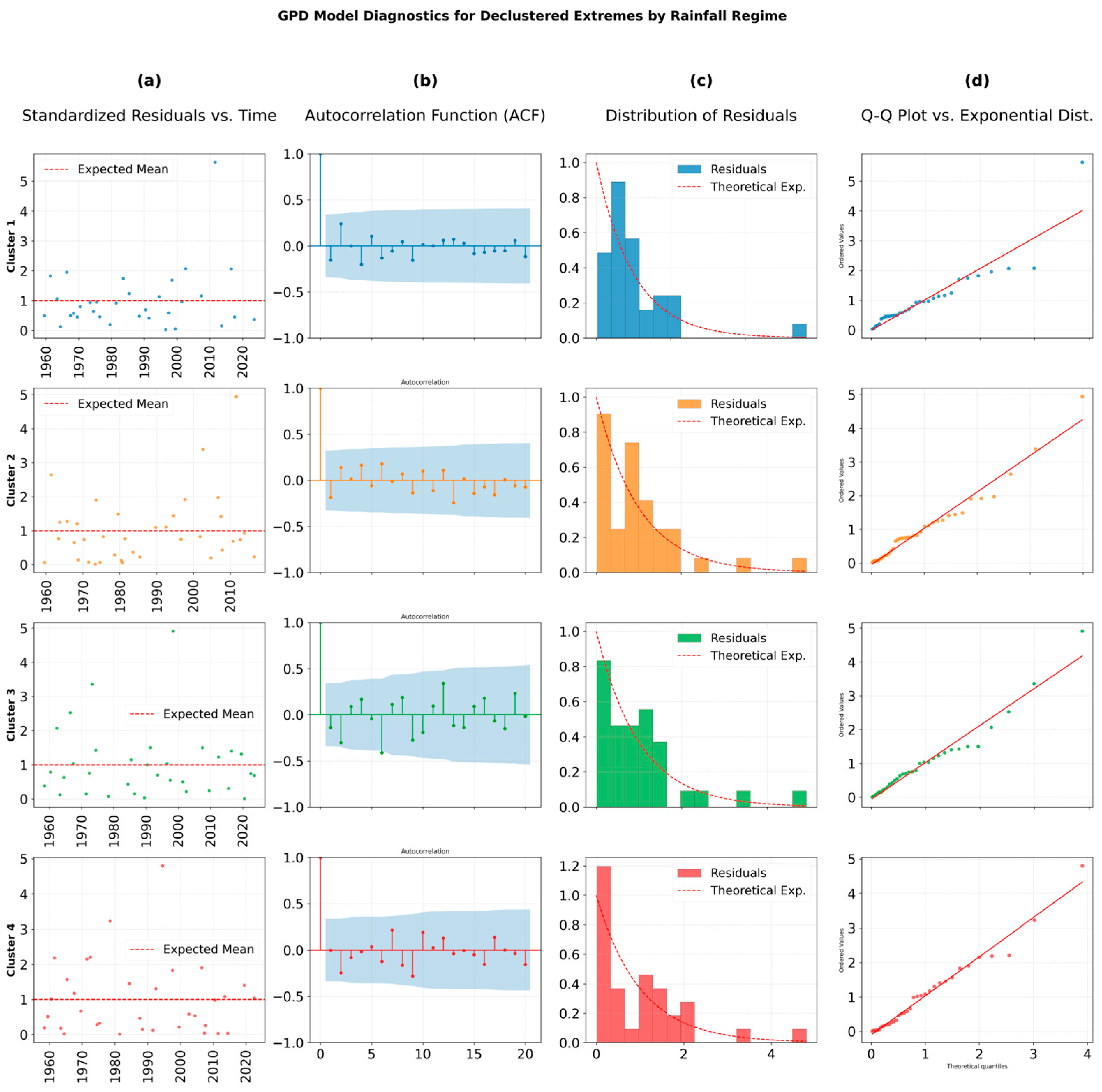
Given the use of monthly time-series data, the potential influence of temporal autocorrelation was a key consideration for both the extreme value and wavelet analyses. For the wavelet coherence analysis, the statistical significance of the coherence was tested against an AR1 red-noise background, a standard procedure that accounts for autocorrelation in the time series. For the non-stationary extreme value theory, a preliminary analysis revealed temporal clustering in the exceedances, violating the assumption of event independence. To address this, a declustering procedure was applied prior to model fitting, where extreme events separated by fewer than 90 days were considered part of the same event cluster, and only the maximum value from each cluster was retained. After fitting the Generalized Pareto Distribution (GPD) to these independent, declustered events, comprehensive diagnostic checks were performed on the model’s standardized residuals. For Clusters 1, 2, and 4, these checks, including the Ljung–Box test for autocorrelation (p > 0.26) and Kendall’s Tau test for trends (p > 0.30), confirmed that the residuals were independent and identically distributed, satisfying the core assumptions of the model. However, for the intense-core monsoon regime (Cluster 3), some residual autocorrelation remained (Ljung–Box test p < 0.05 at lags 10 and 20), suggesting this specific climate system possesses a longer temporal memory in its extreme events. The full diagnostic results are visualized in Figure 2.
To investigate the long-term precipitation characteristics of the basin, a hybrid analytical framework was adopted. This approach integrated spatiotemporal clustering, non-stationary extreme value theory, and wavelet coherence analysis to delineate rainfall clusters, quantify changes in extreme events, and identify teleconnections with large-scale climate drivers. To achieve these objectives, our methodology is structured into three sequential stages: first, the delineation of rainfall regimes using spatiotemporal clustering; second, the quantification of extreme events within each regime; and third, the investigation of their climatic drivers.

2.2. Delineation and Characterization of Distinct Spatiotemporal Rainfall Clusters (Objective 1)

The first objective was to delineate and characterize distinct spatiotemporal rainfall clusters within the basin. To achieve this, a K-Means clustering algorithm was applied to the gridded monthly precipitation dataset (1958–2023). The novelty of using a clustering-first approach to define climate zones for subsequent analysis was inspired by methodologies presented in studies by Ily’es et al. [26]. The three-dimensional precipitation data array, with dimensions of t i m e , l a t i t u d e , l o n g i t u d e , was first reshaped into a two-dimensional matrix of size n p i x e l s , n t i m e s t e p s . Each row of this matrix represented the complete monthly time series for a single grid cell (pixel). A K-Means clustering algorithm was then employed to partition the   n p i x e l s   into k = 4 distinct clusters. The algorithm iteratively minimized the within-cluster sum of squares, defined by the objective function as shown in Equation (1).
J = i = 1 k x S i x μ i 2
where
S i represents the set of all pixel time series belonging to cluster i ;
μ i are the mean time series (centroid) of that cluster.
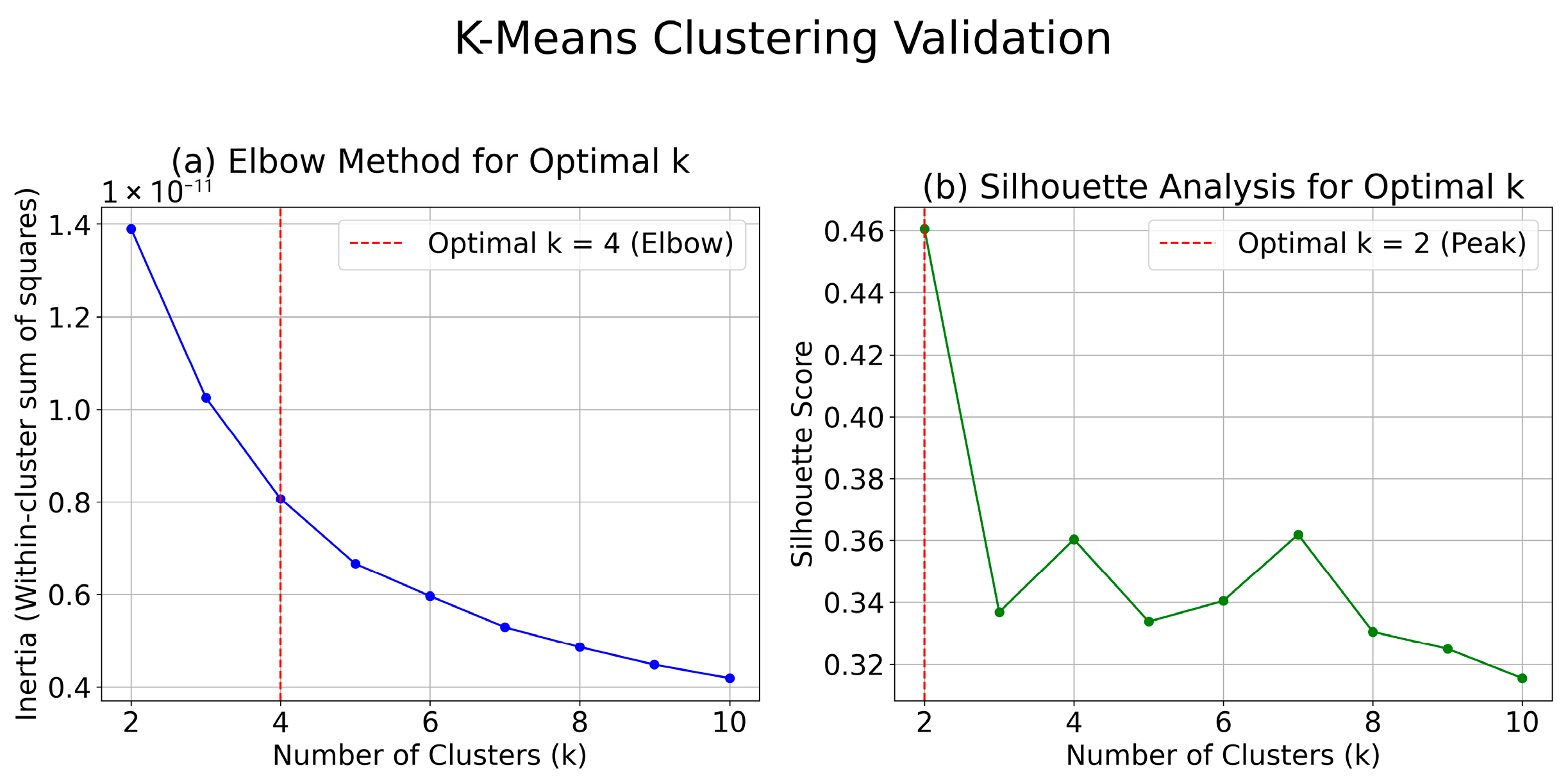
The selection of the optimal number of clusters, k = 4, was determined by balancing statistical validation metrics with physical interpretability. We employed the Elbow method and Silhouette analysis for a range of cluster numbers (from 2 to 10). The Silhouette analysis, which measured cluster separation, yielded a peak score at k = 2, indicating the data was most cleanly separable into two primary groups. However, a two-cluster solution was deemed too coarse for a meaningful hydro-climatic analysis as it failed to differentiate key known regimes within the basin. The Elbow method, which analyzed the within-cluster sum of squares, showed a distinct ‘elbow’ at k = 4, indicating the point of diminishing returns for adding more clusters. Given the strong support from the Elbow method and the need for sufficient thematic detail, k = 4 was selected as the optimal choice that provided our physically meaningful, geographically coherent, and statistically defensible rainfall regimes (Figure 3).
The resulting cluster labels for each pixel were mapped back to their geographic coordinates to produce a map of distinct spatiotemporal rainfall clusters. With these distinct rainfall regimes established, we moved to analyze and quantify the characteristics of extreme precipitation events specific to each cluster.

2.3. Quantification of Non-Stationary Extreme Rainfall Events for Each Cluster (Objective 2)

The second objective was to quantify the magnitude and frequency of extreme rainfall events for each cluster. For this, a non-stationary Extreme Value Theory (EVT) analysis was conducted. The core of this approach was adapted from the paper by Sigauke et al. (2017) titled, “Modelling non-stationary time series using a peaks over threshold distribution with time varying covariates and threshold”, which details the application of the Peaks-Over-Threshold (POT) method with non-stationary parameters [27]. For each of the k Clusters, a spatially averaged monthly precipitation time series was first generated. Extreme events were defined as values exceeding a high threshold u , which was set at the 95th percentile of the respective time series. The distribution of these exceedances ( y = x u ) was modeled using the Generalized Pareto Distribution (GPD), with the cumulative distribution function given by Equation (2).
G y ; σ , ξ = 1 1 + ξ y σ 1 ξ
For ξ 0 here, σ > 0 was the scale parameter and ξ was the shape parameter. To account for the effects of climate change and long-term variability, a non-stationary model was implemented by allowing the scale parameter σ   to vary as a linear function of time   t . This was defined by Equation (3).
σ t = σ 0 + β t t 0
where
σ 0 is the baseline scale parameter at time t 0 ;
β   is the trend parameter.
This non-stationary formulation allowed for the magnitude of extreme events to change over the study period. The analysis was performed using the pyextremes Python library, and return levels for various periods were estimated for each cluster.
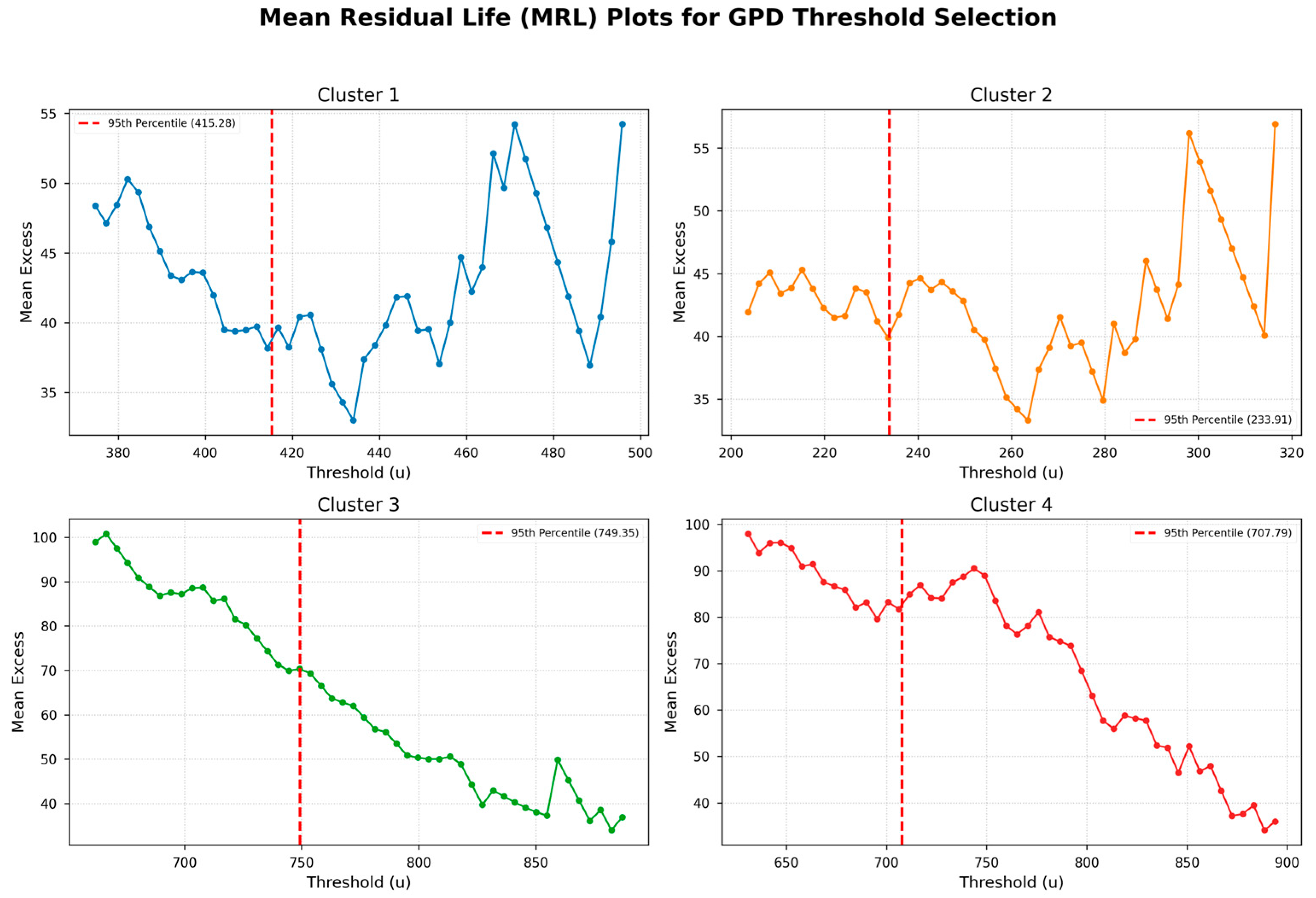
For the Peaks-Over-Threshold (POT) analysis, a threshold was chosen for each cluster’s time series to separate normal from extreme events. The selection of an appropriate threshold involved a critical trade-off between bias and variance. Following standard practice, we selected the 95th percentile as the initial threshold, as this is generally high enough to ensure the asymptotic validity of the GPD approximation while being low enough to provide a sufficient number of exceedances for stable parameter estimation. This threshold choice was further validated by inspecting Mean Residual Life (MRL) plots for each series, which confirmed approximate linearity above the chosen threshold, supporting its suitability (Figure 4).
The goodness-of-fit for the resulting GPD models was confirmed through comprehensive diagnostic checks on the standardized residuals. These included visual inspection of residual plots (Residuals vs. Time, Histograms, and Q-Q plots against a theoretical exponential distribution) and statistical tests for temporal dependence (Ljung–Box and Kendall’s Tau tests), as detailed previously. A composite figure showing these diagnostic plots for all four regimes is provided in Figure 2.
Having quantified the non-stationary behavior of extreme rainfall, the final stage of the analysis focused on identifying the large-scale climatic teleconnections that drive this variability.

2.4. Investigation of Teleconnections Between Regional Rainfall Extremes and Large-Scale Climate Oscillations (Objective 3)

The third objective was to investigate the teleconnections between regional rainfall extremes and large-scale climate oscillations. This was accomplished using Wavelet Coherence Analysis, a method adept at identifying time-frequency correlations between two time series. The analysis was performed between each cluster’s spatially averaged precipitation time series and two key climate indices, the Oceanic Niño Index (ONI) and the Indian Ocean Dipole (DMI). The wavelet coherence, R n 2 s , was defined by Equation (4).
R n 2 s = S s 1 W n X Y s 2 S s 1 W n X s 2 · S s 1 W n Y s 2
where
W n X s and W n Y s are the continuous wavelet transforms of the two series;
W n X Y s is the cross-wavelet transform;
S is a smoothing operator in both time and scale.
The Morlet wavelet was used as the mother wavelet as shown in Equation (5).
ψ 0 η = π 1 4 e i ω 0 η e η 2 2
where
ψ 0 η = t h e   m o t h e r   w a v e l e t   f u n c t i o n ;
( π   ~ 3.14159 ) ;
ω 0 = t h e   n o n d i m e n s i o n a l   f r e q u e n c y   p a r a m e t e r   ( s e t   t o   6 ) ;
e = t h e   b a s e   o f   t h e   n a t u r a l   l o g a r i t h m   ( E x p o n e n t i a l   c o n s t a n t ) ;
i = I m a g i n a r y   u n i t   ( ( 1 ) ;
η = t h e   d i m e n s i o n l e s s   t i m e   p a r a m e t e r .

3. Results

Based on the analysis of the basin-averaged precipitation data from 1958 to 2023, the Ayeyarwady River Basin exhibited significant intra-annual and inter-annual variability in rainfall (Table 1). The mean annual precipitation over the 66-year period was found to be 969.63   m m , with a standard deviation of 95.17   m m , indicating considerable fluctuations from year to year. This was further evidenced by the identification of the wettest year on record, 1973, which received a total of   1171.43   m m of rainfall, and the driest year, 2014, with only 743.91   m m . The mean monthly precipitation across the entire period was 80.80   m m .   A distinct seasonal pattern was observed, with August being the wettest month on average, receiving 188.72   m m   of rainfall, while January was the driest, with an average of just 4.51   m m .
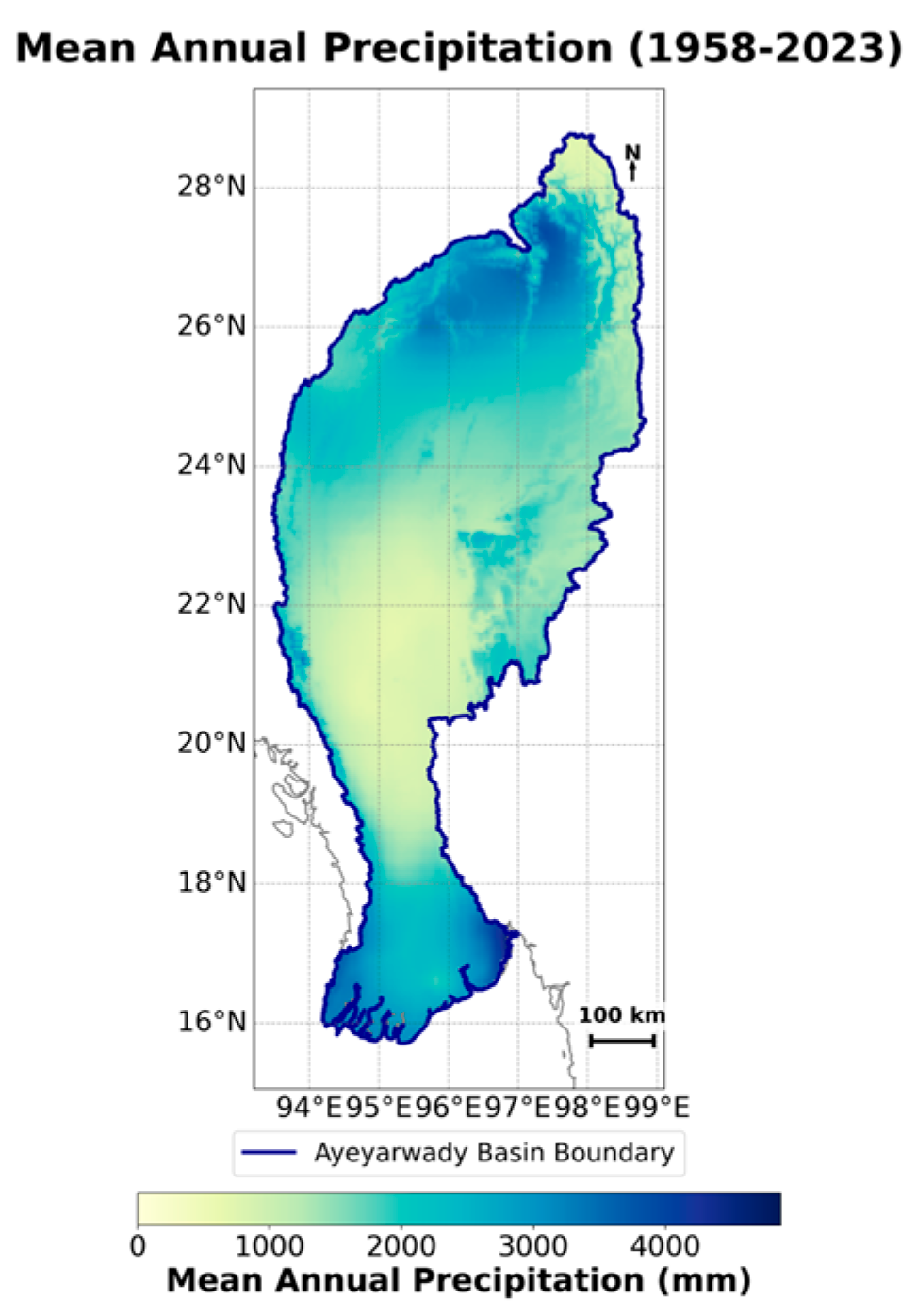
The analysis of the gridded precipitation data revealed a distinct spatial pattern in the long-term mean annual precipitation across the basin for the period as shown in (Figure 5).
A clear gradient was observed, with the highest precipitation concentrated in the northwest and southern coastal regions, and progressively drier conditions extending towards the south-central parts of the basin (Figure 5). The mean annual rainfall ranged from a low of approximately 600 mm in the driest zones to a high exceeding 2500 mm in the wettest areas.
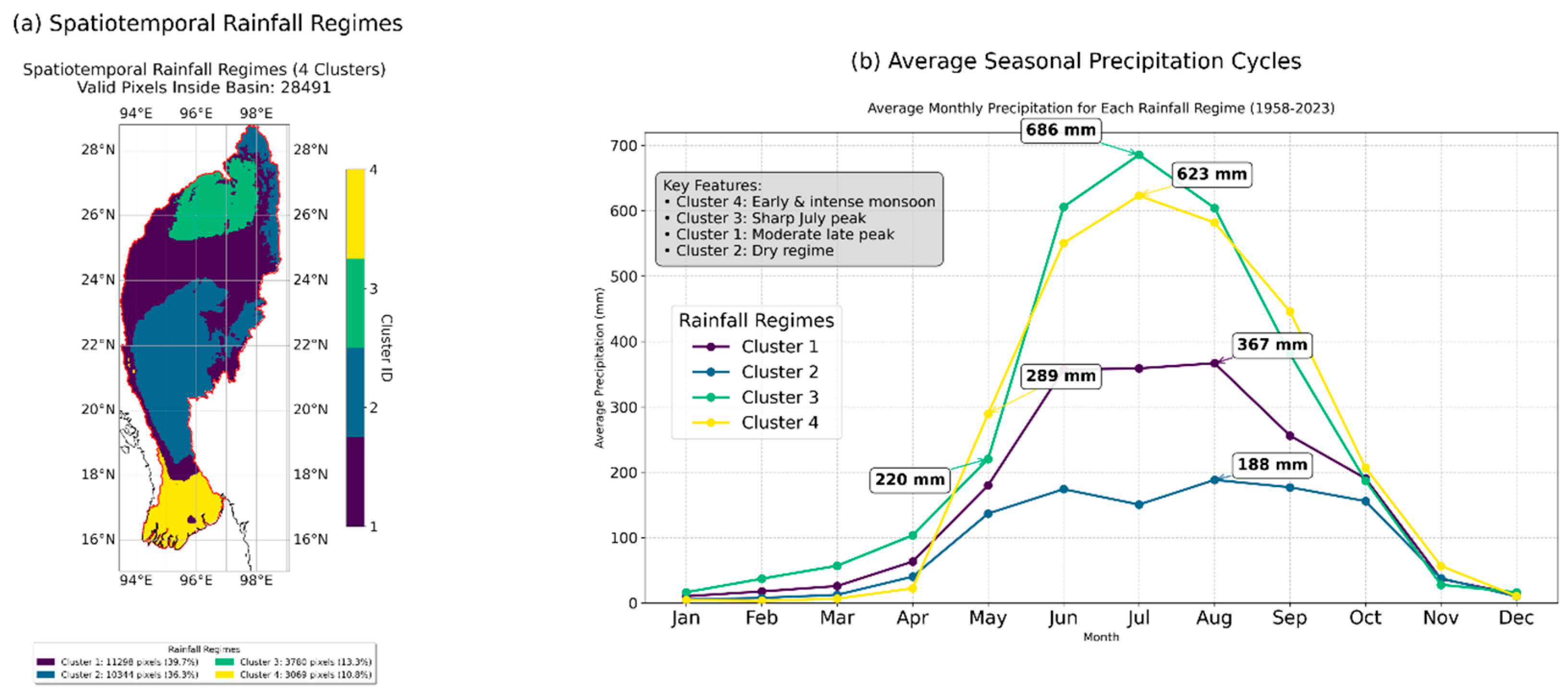
To understand the spatiotemporal heterogeneity of precipitation within the basin, an unsupervised K-means clustering algorithm was applied to the long-term (1958–2023) monthly precipitation time series of each grid cell. This effectively partitioned the basin into rainfall clusters that exhibited internally coherent and externally distinct precipitation behaviors over the annual cycle. It identified four primary spatiotemporal clusters (Figure 6a), which were fundamentally characterized by their unique seasonal precipitation signatures (Figure 6b). All four clusters were monsoonal, sharing a canonical pattern of a dry season followed by a distinct wet season. However, they diverged significantly in terms of precipitation magnitude, seasonal timing, and the sharpness of the monsoon transition.
  • Cluster 1 (Moderate-Late Peak):
This interior cluster was characterized by a moderate monsoon intensity but a distinctly delayed seasonal peak in August (~367 mm).
  • Cluster 2 (Dry-Subdued):
This cluster represented the driest, interior parts of the basin and exhibited a subdued hydrological response (~188 mm August peak).
  • Cluster 3 (Intense-Core Monsoon):
This cluster experienced an intense and focused monsoon. It demonstrated a very rapid rise from April to July, culminating in an extremely high peak of ~686 mm in July. While similarly intense to cluster 4 in peak summer, its distinguishing feature was a less noticeable pre-monsoon period in May, indicating a sharper onset of the heaviest rains. This pattern was typical of core monsoon regions that received sustained, heavy orographic or convective rainfall.
  • Cluster 4 (Hyper-Intense-Early Peak):
This cluster, representing coastal windward regions, was defined by the most vigorous and early monsoon activity.
The transition from Cluster 2 to Cluster 4 represented a gradient from arid to hyper-wet conditions within the same basin. The key differentiators were not merely the total annual rainfall but the seasonal distribution, the timing of the peak, and the intensity of the core monsoon months.

3.1. Extreme Value Analysis of Rainfall Clusters

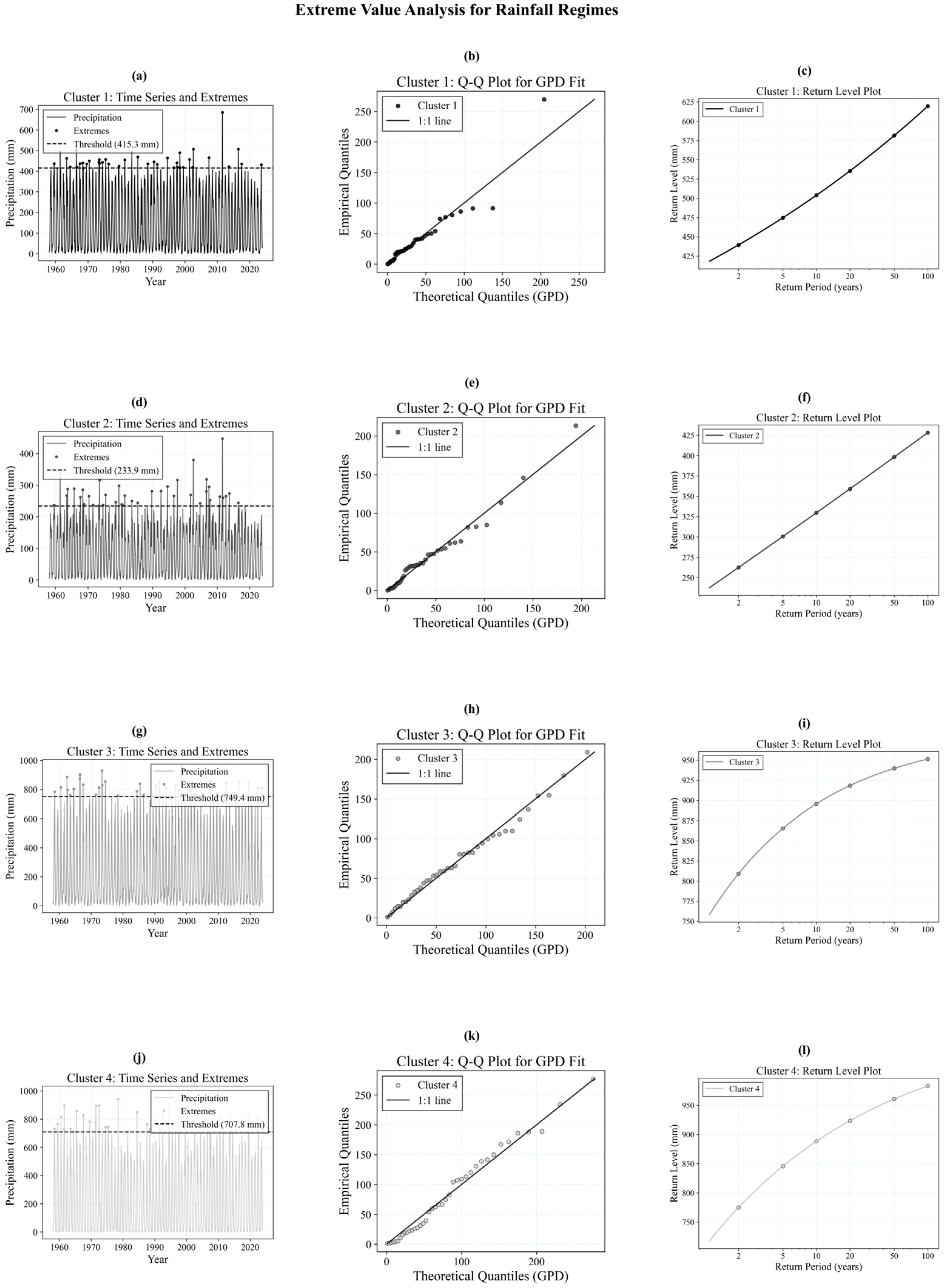
A non-stationary Peaks-Over-Threshold (POT) analysis was conducted for each of the four identified clusters to quantitatively characterize extreme monthly precipitation behavior. This extreme value theory framework employed the Generalized Pareto Distribution (GPD) to model exceedances over carefully selected thresholds, enabling reliable estimation of return period levels for rare precipitation events. The analysis utilized completed precipitation records from 1958 to 2023, with each cluster containing 792 monthly observations and 40 identified extreme events above their respective thresholds (Table 2).
The estimated return period levels revealed substantial heterogeneity in extreme precipitation characteristics across the rainfall regimes (Table 2). Cluster 4 exhibited the most severe extreme precipitation behavior with a 100-year return level of 983.23 mm, followed closely by Cluster 3 (951.27 mm). In contrast, Cluster 2 demonstrated the lowest extreme precipitation potential, with a 100-year return period of 501.18 mm. Cluster 1 showed intermediate characteristics with a 100-year return period of 660.31 mm. The shape parameters (ξ) derived from the GPD fits also varied by cluster. Clusters 3 and 4 exhibited negative shape parameters (−0.421 and −0.279, respectively), while clusters 1 and 2 showed positive shape parameters (0.100).
The diagnostic Q-Q plots (Figure 7b,e,h,k) showed strong agreement between empirical and theoretical quantiles across all regimes, validating the GPD assumptions, while the return level curves (Figure 7c,f,i,l) revealed fundamentally different extremal behaviors. Clusters 3 and 4 exhibited well found curvature and clear upper bounds consistent with their negative shape parameters, whereas Clusters 1 and 2 showed near-linear scaling indicative of heavier tailed distributions. This graphical evidence further confirmed that southern monsoon-dominated regimes (Clusters 3–4) experienced asymptotically bounded extremes despite higher overall intensities, while northern regimes (Clusters 1–2) faced proportionally greater escalation of extremes with increasing return periods.
The divergent signs of the GPD shape parameter (ξ) across the rainfall regimes carry direct and critical implications for regional water resources management and flood risk engineering. For the high-intensity regimes (Clusters 3 and 4), the negative shape parameters (ξ < 0) imply that the distribution of extreme rainfall has a theoretical upper bound. While this suggests a ‘worst-case’ maximum precipitation event that can be quantified for infrastructure design (e.g., dam spillways, urban drainage), the return levels in these regions are already exceptionally high, posing a significant existing threat. Conversely, for the drier northern regimes (Clusters 1 and 2), the positive shape parameters (ξ > 0) indicate a ‘heavy-tailed’ distribution with no theoretical upper limit. This is a critical warning for water management; it suggests that these regions are susceptible to future rainfall extremes that can substantially exceed historical records. Consequently, engineering design standards and safety factors for critical infrastructure in these ‘heavy-tailed’ regions may need to be revisited and potentially increased to account for a higher, non-stationary risk of unprecedented flood events.

3.2. Characterization of Rainfall-Climate Teleconnections

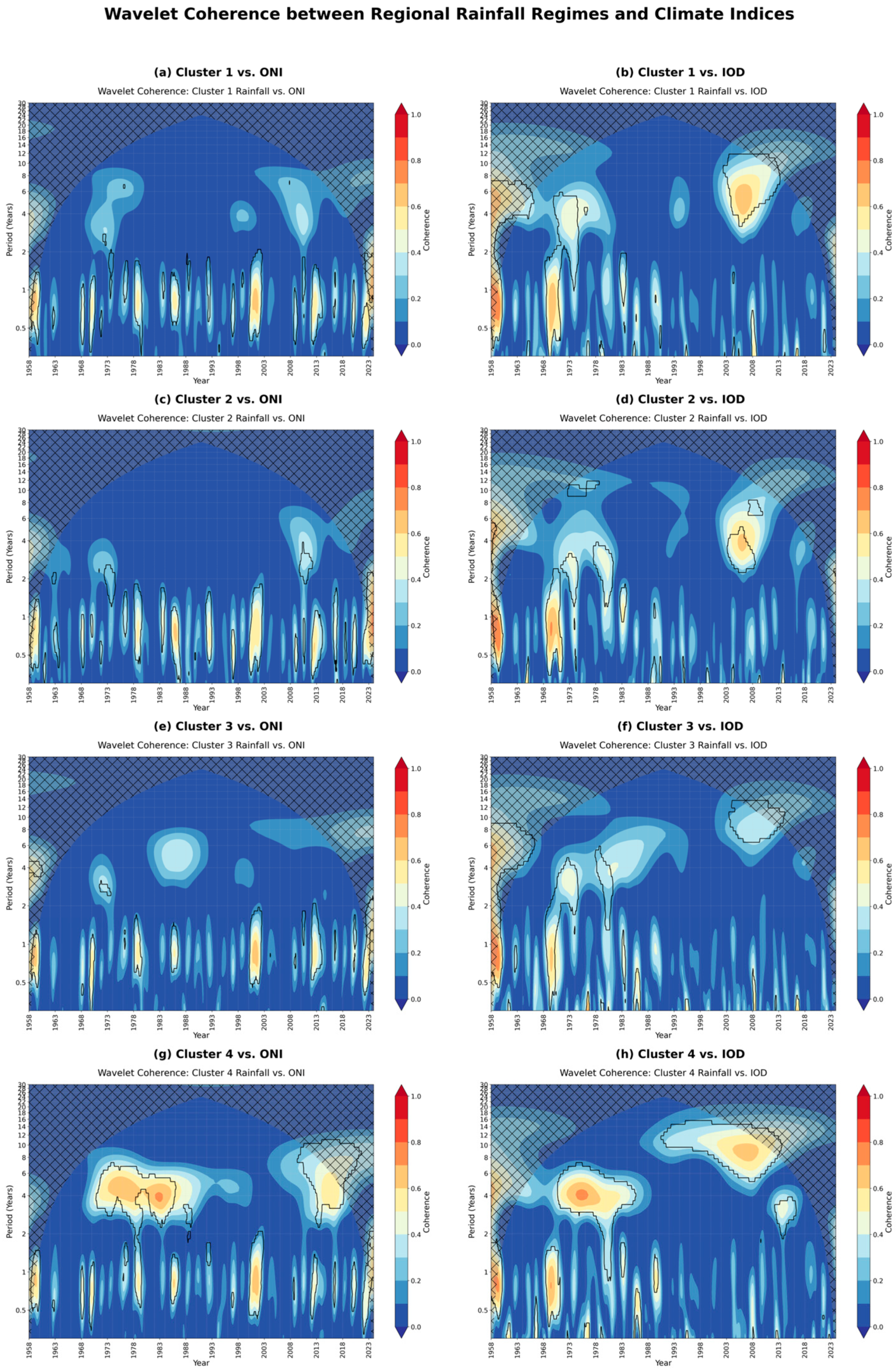
Wavelet coherence analysis was employed to systematically investigate the temporal evolution and frequency-dependent relationships between distinct rainfall regimes within the basin and major climate oscillations. The analysis considered four identified rainfall clusters (Clusters 1–4) and their interactions with both the Oceanic Niño Index (ONI), representing El Niño-Southern Oscillation (ENSO) dynamics, and the Dipole Mode Index (DMI), characterizing Indian Ocean Dipole (IOD) variability. The results revealed complex, regime-specific teleconnection patterns that illustrated the heterogeneous response of regional precipitation to large-scale climate forcing (Figure 8).

3.3. Cluster-Specific Response Patterns

Cluster 1 demonstrated a moderate ENSO teleconnection, showing statistically significant coherence (p < 0.05) with the ONI primarily in the sub-annual band (<1 year) (Figure 8a). This relationship was characterized by a moderate mean ONI strength (0.501) but notably long event durations (50 months median) (Table 3). The coherence showed peak activity during the 2000s, which aligns with the temporal distribution showing concentration in recent decades. In contrast, coherence with the IOD was similarly moderate in strength (0.473) but more frequent, with the highest IOD interval count (25) among Cluster 1 relationships, manifesting primarily in sub-annual bands with peak significance during the 1970s (Figure 8b).
Cluster 2 showed the strongest ENSO influence among all clusters, characterized by the highest mean ONI strength (0.536) and longest median durations (64 months) (Table 3). Significant coherence with ONI was detected in sub-annual frequency bands, with peak activity during the 1960s (Figure 8c). Simultaneously, Cluster 2 maintained moderate coherence with the IOD (0.472 strength) showing balanced temporal distribution with peak significance in the 2000s (Figure 8d). The statistical summary supports this dual influence pattern, showing substantial interval counts for both climate indices (7 ONI, 25 IOD) but with ONI demonstrating superior strength and persistence metrics.
Cluster 3 displayed the weakest overall teleconnections among the four regimes. Coherence with ONI was characterized by the lowest mean strength (0.428) across all clusters, with moderate event durations (22 months median) and peak activity during the 1960s (Table 4). Similarly, the IOD relationship showed weak strength (0.434) and the shortest median durations (16 months) among all cluster-index combinations. Both relationships operated primarily in sub-annual frequency bands, suggesting limited persistence of climate influences on this rainfall regime despite moderate interval counts (14 ONI, 25 IOD) (Table 3).
Cluster 4 demonstrated a distinct IOD-dominated pattern with unique temporal characteristics. While showing weak ONI coherence (0.428 strength) with recent dominance in the 2010s, this cluster exhibited the strongest IOD influence with moderate strength (0.479) and the longest median durations (74 months) across all clusters (Table 4). Notably, Cluster 4 was the only regime showing coherence extending beyond 1-year periods, particularly for IOD relationships. The temporal distribution revealed peak IOD activity during the 1990s (Figure 8h), with sustained influence throughout the observational record, suggesting this regime’s particular sensitivity to Indian Ocean dynamics operating on longer timescales.

3.4. Temporal Evolution and Regime Stability

The time-varying nature of these teleconnections revealed distinct patterns of climate regime stability and temporal evolution. Cluster 1 exhibited consistent but moderate ENSO influence throughout the record, with peak activity during the 2000s despite having the fewest significant intervals. Cluster 2 demonstrated the strongest and most persistent ENSO relationship, maintaining high coherence strength (0.536) with the longest event durations (64 months), while showing stable IOD connectivity concentrated in the 2000s. Cluster 3 displayed the weakest and most transient teleconnections, with brief coherence periods (16–22 months median duration) and low strength values (0.428–0.434) for both climate indices, suggesting limited climate influence persistence. Cluster 4 revealed a unique IOD-dominated pattern characterized by the longest event durations (74 months) and the only coherence extending beyond 1-year timescales, indicating this regime’s particular sensitivity to longer-term Indian Ocean dynamics. The concentration of significant intervals in specific decades, Cluster 1 (2000s), Cluster 2 (1960s), Cluster 3 (1960s–1970s), and Cluster 4 (1990s–2010s), reaffirms and highlights the non-stationary nature of these climate-rainfall relationships and suggests potential decadal modulation of teleconnection effectiveness.

4. Discussion

The present study’s identification of four distinct spatiotemporal rainfall clusters within the Ayeyarwady River Basin substantiated previous findings that Southeast Asian monsoon precipitation exhibits distinguished spatial heterogeneity rather than basin-wide homogeneity [28,29].
The observed gradient, from hyper-intense coastal regimes (Cluster 4: 983.23 mm 100-year return period) to subdued interior zones (Cluster 2: 501.18 mm), aligned with studies classifying extreme precipitation patterns across Southeast Asia. These patterns are known to be driven by fundamentally different atmospheric drivers and SST forcing mechanisms [30,31,32]. These distinct regional characteristics are driven by a combination of atmospheric dynamics and local physiographic controls that modulate the regional monsoon system.
Specifically, the delayed precipitation peak in interior regions (Cluster 1) is consistent with established monsoon dynamics. Interior regions depend on the sustained penetration of low-level moisture and the establishment of favorable large-scale circulation patterns, such as the tropical easterly jet, which develop later in the season than the initial coastal moisture delivery [33]. Additionally, orographic features are known to regulate upper-level anticyclones and monsoon jets, altering the meridional extent and timing of the overall monsoon progression, further explaining the delayed peak in these inland areas [33].
The subdued hydrological response in the driest interior parts of the basin (Cluster 2) is a direct result of rain-shadow effects, driven by two key processes. The mechanical height of the upstream coastal mountains induces downstream subsidence and atmospheric drying, which stabilizes the leeward troposphere and inhibits convection [34]. Furthermore, these high mountain barriers physically limit the inland penetration of moist low-level flows, creating a sharp precipitation contrast between the windward (Cluster 4) and interior (Cluster 2) zones [35].
In contrast, the exceptionally high rainfall (>623 mm peak) and early May onset (~289 mm) in the coastal windward regions (Cluster 4) are explained by several physical mechanisms. First, the perpendicular orientation of monsoon flow to coastal ranges like the Arakan Mountains induces forced orographic ascent, producing sustained, intense precipitation [36]. Second, warm coastal sea surface temperatures enhance latent heat flux, strengthening low-level moisture convergence and enabling an earlier onset [37]. Finally, studies show that when monsoon vortices encounter these topographic barriers, they can become blocked and stagnate, concentrating extreme rainfall in these first-landfall zones [38].
The application of K-means clustering to delineate these regimes before extreme value analysis represented a methodological advancement over basin-averaged approaches. This approach directly addresses observational sensitivity concerns raised by Sirisena et al. (2018) [39]. Their work demonstrated that streamflow simulations in the Irrawaddy varied substantially depending on precipitation product spatial resolution [39]. The non-stationary Generalized Pareto Distribution framework employed here extended the work of Oo et al. (2023) [40], who applied ETCCDI extreme indices to Myanmar. Our study’s detection of contrasting shape parameters—negative in high-intensity clusters (ξ = −0.421 for Cluster 3) versus positive in drier regimes (ξ = 0.100 for Cluster 1)—revealed that the proportional escalation of extremes with the return period is highly regime-dependent. This finding is critical for creating differentiated flood risk assessments [40].
The spatial distribution of the high return levels in Clusters 3 and 4 corresponded well with regions experiencing the most vigorous monsoon activity and orographic enhancement. This creates a clear gradient in extreme precipitation risk, which spans nearly a factor of two between the most and least extreme regimes, highlighting the critical importance of regional differentiation in flood risk assessment and water resources management. Furthermore, the differences in the GPD shape parameter (ξ) provided further understanding into the tail behavior of extremes. The negative shape parameters in Clusters 3 and 4 indicated finite upper bounds to extreme precipitation, whereas the positive parameters in Clusters 1 and 2 suggested heavier-tailed behavior relative to their mean precipitation levels. These results quantitatively indicated that regions experiencing higher seasonal rainfall totals were also subjected to more intense extreme precipitation events.

Physical Mechanisms of Climate Teleconnections

Our wavelet coherence analysis revealed regime-specific teleconnections; the literature provides clear physical mechanisms that explain these findings. The anti-phase ENSO relationship in Cluster 1, where El Niño (positive ONI) corresponds to precipitation deficits, is attributable to modifications of the equatorial Pacific Walker cell. During El Niño, subsidence anomalies are produced over the broader monsoon region, suppressing mean rainfall [41]. More directly, ENSO phases alter low-level moisture flux into South Asian River basins. El Niño events typically reduce the monsoon moisture supply, while La Niña and negative IOD phases enhance it [42]. This causal chain from sea surface temperature anomaly to circulation change, moisture flux alteration, and finally precipitation response provides the physical basis for our wavelet coherence results. The dominant in-phase IOD coupling in Cluster 2 is likewise explained by the strengthening of moisture advection from the western Indian Ocean during positive IOD events [43].
Finally, our finding of regime-dependent teleconnections is supported by basin-specific studies. For instance, developing El Niño phases can produce anomalous upper-tropospheric anticyclones over the Bay of Bengal and Myanmar, which can strengthen vertical motion and moisture delivery in specific sectors but not others [44], explaining why the teleconnection signals are not uniform across the basin.
Ultimately, this study highlighted a spatially diverse landscape of hydrological risk across the Ayeyarwady Basin, driven by distinct climate dynamics. The central dry zone (Cluster 2), for instance, faced a compounded risk profile; not only did it have the lowest mean rainfall, but its precipitation is also strongly and persistently influenced by ENSO, making it particularly vulnerable to drought during El Niño events. In contrast, the hyper-intense coastal region (Cluster 4) faced a different dynamic; its extreme rainfall appeared uniquely sensitive to the IOD over multi-year timescales, suggesting that the severity of its already-intense monsoon seasons can be modulated by long-term Indian Ocean variability. The remaining regimes (Clusters 1 and 3) exhibited more transient and mixed teleconnections, but their unique sensitivities such as Cluster 1’s moderate ENSO link and Cluster 3’s weak but present IOD connection still pointed to a need for regime-specific, climate-informed forecasting. Thus, by linking specific oceanic drivers to regional rainfall regimes, this framework could provide a more targeted understanding of how, where, and why hydrological risks manifest across Myanmar.
The wavelet coherence analysis uncovered regime-specific teleconnections with distinct temporal characteristics. Cluster 2 demonstrated the strongest ENSO influence (mean strength 0.536, 64-month median duration) with peak activity during the 1960s, while Cluster 4 exhibited unique IOD dominance (0.479 strength, 74-month duration) extending beyond 1-year periods, the only regime showing such long-timescale coherence. This spatial partitioning of climate influences contrasted with previous basin-scale analyses; Skliris et al. (2022) observed significant Niño index correlations during May–October, while the present study demonstrated that ENSO operated selectively, with Cluster 1 showing moderate sub-annual coherence concentrated in the 2000s (0.501 strength, 50-month duration) and Cluster 3 displaying the weakest responses (0.428 ONI strength, 22-month duration) [30]. The IOD relationships similarly varied spatially, with Cluster 1 exhibiting peak coherence in the 1970s and Cluster 2 in the 2000s, emphasizing that combined Indo-Pacific SST anomalies modulated monsoon circulation but revealing for the first time that these influences operated through temporally evolving, regime-specific pathways rather than uniformly. The decadal concentration of significant teleconnection intervals, Cluster 1 (2000s), Cluster 2 (1960s), Cluster 3 (1960–1970s), and Cluster 4 (1990s–2010s), indicated non-stationary climate-rainfall relationships, addressing critical gaps identified in recent assessments regarding the need for regime-aware extreme value frameworks and time-frequency methods to resolve temporally evolving teleconnections [13,40]. Future research may integrate the identified rainfall regimes with dynamical downscaling and bias-corrected CMIP6 projections to assess regime-specific changes under warming scenarios, extend the wavelet analysis to include additional climate modes (e.g., Madden-Julian Oscillation, Indian Ocean Basin Mode), and develop regime-conditional seasonal forecasting systems that could leverage the demonstrated decadal modulation patterns and differential teleconnection persistence, thereby translating these scientific understanding into operational early warning capabilities for Myanmar’s water resources management and disaster risk reduction sectors.

Author Contributions

Conceptualization, A.B. and M.N.; methodology, A.B. and M.N.; software, A.B.; validation, A.B.; formal analysis, A.B.; investigation, A.B.; resources, A.B. and M.N.; data curation, A.B.; writing—original draft preparation, A.B.; writing—review and editing, A.B. and M.N.; visualization, A.B.; supervision, M.N.; project administration, M.N.; funding acquisition, M.N. All authors have read and agreed to the published version of the manuscript.

Funding

This research received no external funding.

Data Availability Statement

The data presented in this study are available on request from the corresponding author due to the large size of the satellite and climate datasets (e.g., TerraClimate precipitation data). Processed datasets supporting the findings can be shared upon reasonable request for research use.

Acknowledgments

During the preparation of this manuscript, the author used ChatGPT (GPT-5, OpenAI, 2025) for language editing and refinement of text clarity. The author reviewed and edited all AI-generated content and takes full responsibility for the final version of the manuscript.

Conflicts of Interest

Author Arnob Bormudoi was employed by New Space Intelligence. The remaining author declare that the research was conducted in the absence of any commercial or financial relationships that could be construed as a potential conflict of interest.

References

  1. World Bank. Baseline Assessment Report: Introduction, Strategic Environmental Assessment of the Hydropower Sector in Myanmar; World Bank: Washington, DC, USA, 2017. [Google Scholar]
  2. Taft, L.; Evers, M. A review of current and possible future human–water dynamics in Myanmar’s river basins. Hydrol. Earth Syst. Sci. 2016, 20, 4913–4928. [Google Scholar] [CrossRef]
  3. Luo, X.; Yuan, X.; Guo, Z.; Lu, Y.; Li, C.; Peng, L. Hydrological Response of the Irrawaddy River Under Climate Change Based on CV-LSTM Model. Water 2025, 17, 479. [Google Scholar] [CrossRef]
  4. Ghimire, U.; Babel, M.S.; Shrestha, S.; Srinivasan, G. A multi-temporal analysis of streamflow using multiple CMIP5 GCMs in the Upper Ayerawaddy Basin, Myanmar. Clim. Change 2019, 155, 59–79. [Google Scholar] [CrossRef]
  5. Gurung, P.; Dhungana, S.; Kyaw, A.K.; Bharati, L. Hydrologic characterization of the Upper Ayeyarwaddy River Basin and the impact of climate change. J. Water Clim. Change 2022, 13, 2577–2596. [Google Scholar] [CrossRef]
  6. Sirisena, T.J.G.; Maskey, S.; Ranasinghe, R. Hydrological model calibration with streamflow and remote sensing based evapotranspiration data in a data poor basin. Remote Sens. 2020, 12, 3768. [Google Scholar] [CrossRef]
  7. Nagaraj, M.; Srivastav, R. Non-stationary modelling framework for regionalization of extreme precipitation using non-uniform lagged teleconnections over monsoon Asia. Stoch. Environ. Res. Risk Assess. 2022, 36, 3577–3595. [Google Scholar] [CrossRef]
  8. Ge, F.; Zhi, X.; Babar, Z.A.; Tang, W.; Chen, P. Interannual variability of summer monsoon precipitation over the Indochina Peninsula in association with ENSO. Theor. Appl. Climatol. 2017, 128, 523–531. [Google Scholar] [CrossRef]
  9. Sein, Z.M.M.; Zhi, X. Interannual variability of summer monsoon rainfall over Myanmar. Arab. J. Geosci. 2016, 9, 469. [Google Scholar] [CrossRef]
  10. Zaw, Z.; Fan, Z.X.; Bräuning, A.; Liu, W.; Gaire, N.P.; Than, K.Z.; Panthi, S. Monsoon precipitation variations in Myanmar since AD 1770: Linkage to tropical ocean-atmospheric circulations. Clim. Dyn. 2021, 56, 3337–3352. [Google Scholar] [CrossRef]
  11. Nguyen-Le, D.; Matsumoto, J.; Ngo-Duc, T. Climatological onset date of summer monsoon in Vietnam. Int. J. Climatol. 2014, 34, 3237. [Google Scholar] [CrossRef]
  12. Chang, C.-P.; Wang, Z.; McBride, J.; Liu, C.-H. Annual cycle of Southeast Asia—Maritime Continent rainfall and the asymmetric monsoon transition. J. Clim. 2005, 18, 287–301. [Google Scholar] [CrossRef]
  13. Mie Sein, Z.M.; Ullah, I.; Saleem, F.; Zhi, X.; Syed, S.; Azam, K. Interdecadal variability in Myanmar rainfall in the monsoon season (May–October) using eigen methods. Water 2021, 13, 729. [Google Scholar] [CrossRef]
  14. Sein, Z.M.M.; Ogwang, B.; Ongoma, V.; Ogou, F.K.; Batebana, K. Inter-annual variability of May-October rainfall over Myanmar in relation to IOD and ENSO. J. Environ. Agric. Sci. 2015, 4, 28–36. [Google Scholar]
  15. Aminoto, T.; Faqih, A.; Koesmaryono, Y.; Dasanto, B.D. Rainfall anomaly response to ENSO and IOD teleconnections in the CORDEX-SEA simulations. In IOP Conference Series: Earth and Environmental Science; IOP Publishing: Bristol, UK, 2024; p. 012008. Available online: https://iopscience.iop.org/article/10.1088/1755-1315/1359/1/012008/meta (accessed on 26 December 2025).
  16. Mahmud, K.; Chen, C.-J. Space- and time-varying associations between Bangladesh’s seasonal rainfall and large-scale climate oscillations. Theor. Appl. Climatol. 2021, 145, 1347–1367. [Google Scholar] [CrossRef]
  17. Nugroho, A.R.; Tamagawa, I.; Harada, M. Spatiotemporal analysis on the teleconnection of ENSO and IOD to the stream flow regimes in Java, Indonesia. Water 2022, 14, 168. [Google Scholar] [CrossRef]
  18. Sein, K.K.; Chidthaisong, A.; Oo, K.L. Observed trends and changes in temperature and precipitation extreme indices over Myanmar. Atmosphere 2018, 9, 477. [Google Scholar] [CrossRef]
  19. Villafuerte, M.Q.; Matsumoto, J. Significant influences of global mean temperature and ENSO on extreme rainfall in Southeast Asia. J. Clim. 2015, 28, 1905–1919. [Google Scholar] [CrossRef]
  20. Mubarrok, S.; Jang, C.J. Annual maximum precipitation in Indonesia and its association to climate teleconnection patterns: An extreme value analysis. SOLA 2022, 18, 187–192. [Google Scholar] [CrossRef]
  21. Ng, J.L.; Huang, Y.; Yong, S.; Lee, J.; Ali Najah Ahmed, A.-M.; Mirzaei, M. Analysing the variability of non-stationary extreme rainfall events amidst climate change in East Malaysia. AQUA-Water Infrastruct. Ecosyst. Soc. 2024, 73, 1494–1509. [Google Scholar] [CrossRef]
  22. Caesar, J.; Alexander, L.V.; Trewin, B.; Tse-Ring, K.; Sorany, L.; Vuniyayawa, V.; Keosavang, N.; Shimana, A.; Htay, M.M.; Karmacharya, J. Changes in temperature and precipitation extremes over the Indo-Pacific region from 1971 to 2005. Int. J. Climatol. 2011, 31, 791–801. [Google Scholar] [CrossRef]
  23. Shao, J.; Wang, J.; Lv, S.; Bing, J. Spatial and temporal variability of seasonal precipitation in Poyang Lake basin and possible links with climate indices. Hydrol. Res. 2016, 47, 51–68. [Google Scholar] [CrossRef]
  24. Wang, Y.; Liu, S.; Chen, J.; Zhou, Z.; Shi, H. Investigating the spatiotemporal variations of extreme rainfall and its potential driving factors with improved partial wavelet coherence. Front. Environ. Sci. 2022, 10, 951468. [Google Scholar] [CrossRef]
  25. Abatzoglou, J.T.; Dobrowski, S.Z.; Parks, S.A.; Hegewisch, K.C. TerraClimate, a high-resolution global dataset of monthly climate and climatic water balance from 1958–2015. Sci. Data 2018, 5, 170191. [Google Scholar] [CrossRef]
  26. Ilyés, C.; Mohammed, M.A.; Szabó, N.P.; Szűcs, P. A hybrid approach to exploring the Spatiotemporal patterns of precipitation in sudan: Insights from neural network clustering and Fourier-wavelet transform analysis. Water Cycle 2025, 7, 151–163. Available online: https://www.sciencedirect.com/science/article/pii/S2666445325000418 (accessed on 15 November 2025). [CrossRef]
  27. Sigauke, C.; Bere, A. Modelling non-stationary time series using a peaks over threshold distribution with time varying covariates and threshold: An application to peak electricity demand. Energy 2017, 119, 152–166. [Google Scholar] [CrossRef]
  28. Khadgarai, S.; Kumar, V.; Pradhan, P.K. The connection between extreme precipitation variability over monsoon Asia and large-scale circulation patterns. Atmosphere 2021, 12, 1492. [Google Scholar] [CrossRef]
  29. Romatschke, U.; Houze, R.A., Jr. Characteristics of precipitating convective systems in the South Asian monsoon. J. Hydrometeorol. 2011, 12, 3–26. [Google Scholar] [CrossRef]
  30. Skliris, N.; Marsh, R.; Haigh, I.D.; Wood, M.; Hirschi, J.; Darby, S.; Phu Quynh, N.; Hung, N.N. Drivers of rainfall trends in and around Mainland Southeast Asia. Front. Clim. 2022, 4, 926568. [Google Scholar] [CrossRef]
  31. An, D.; Eggeling, J.; Zhang, L.; He, H.; Sapkota, A.; Wang, Y.C.; Gao, C. Extreme precipitation patterns in the Asia–Pacific region and its correlation with El Niño-Southern Oscillation (ENSO). Sci. Rep. 2023, 13, 11068. [Google Scholar] [CrossRef]
  32. Chen, Y.; Teo, F.Y.; Wong, S.Y.; Chan, A.; Weng, C.; Falconer, R.A. Monsoonal extreme rainfall in Southeast Asia: A review. Water 2024, 17, 5. [Google Scholar] [CrossRef]
  33. Thomas, T.M.; Bala, G.; Vemavarapu, S.V.; Boos, W.R. Opposite changes in monsoon precipitation and low pressure system frequency in response to orographic forcing. J. Clim. 2023, 36, 6309–6329. [Google Scholar] [CrossRef]
  34. Roe, G.H. Orographic Precipitation. Annu. Rev. Earth Planet. Sci. 2005, 33, 645–671. [Google Scholar] [CrossRef]
  35. Houze, R.A. Orographic effects on precipitating clouds. Rev. Geophys. 2012, 50, 2011RG000365. [Google Scholar] [CrossRef]
  36. Shige, S.; Nakano, Y.; Yamamoto, M.K. Role of orography, diurnal cycle, and intraseasonal oscillation in summer monsoon rainfall over the Western Ghats and Myanmar Coast. J. Clim. 2017, 30, 9365–9381. [Google Scholar] [CrossRef]
  37. Roxy, M.K.; Ritika, K.; Terray, P.; Murtugudde, R.; Ashok, K.; Goswami, B.N. Drying of Indian subcontinent by rapid Indian Ocean warming and a weakening land-sea thermal gradient. Nat. Commun. 2015, 6, 7423. [Google Scholar] [CrossRef]
  38. Hurley, J.V.; Boos, W.R. A global climatology of monsoon low-pressure systems. Q. J. R. Meteorol. Soc. 2015, 141, 1049–1064. [Google Scholar] [CrossRef]
  39. Sirisena, T.; Maskey, S.; Ranasinghe, R.; Babel, M.S. Effects of different precipitation inputs on streamflow simulation in the Irrawaddy River Basin, Myanmar. J. Hydrol. Reg. Stud. 2018, 19, 265–278. [Google Scholar] [CrossRef]
  40. Oo, K.T.; Haishan, C.; Jonah, K. Climate Change Impact on the Trigger of Natural Disasters over South-Eastern Himalayas Foothill Region of Myanmar: Extreme Rainfall Analysis. Int. J. Geophys. 2023, 2023, 2186857. [Google Scholar] [CrossRef]
  41. Kumar, K.K.; Rajagopalan, B.; Hoerling, M.; Bates, G.; Cane, M. Unraveling the Mystery of Indian Monsoon Failure During El Niño. Science 2006, 314, 115–119. [Google Scholar] [CrossRef]
  42. Ashok, K.; Guan, Z.; Saji, N.H.; Yamagata, T. Individual and combined influences of ENSO and the Indian Ocean dipole on the Indian summer monsoon. J. Clim. 2004, 17, 3141–3155. [Google Scholar] [CrossRef]
  43. Saji, N.H.; Goswami, B.N.; Vinayachandran, P.N.; Yamagata, T. A Dipole Mode in the Tropical Indian Ocean. Nature 1999, 401, 360–363. [Google Scholar] [CrossRef]
  44. Wang, B.; Wu, R.; Li, T. Atmosphere–Warm Ocean Interaction and Its Impacts on Asian–Australian Monsoon Variation. J. Clim. 2003, 16, 1195–1211. [Google Scholar] [CrossRef]
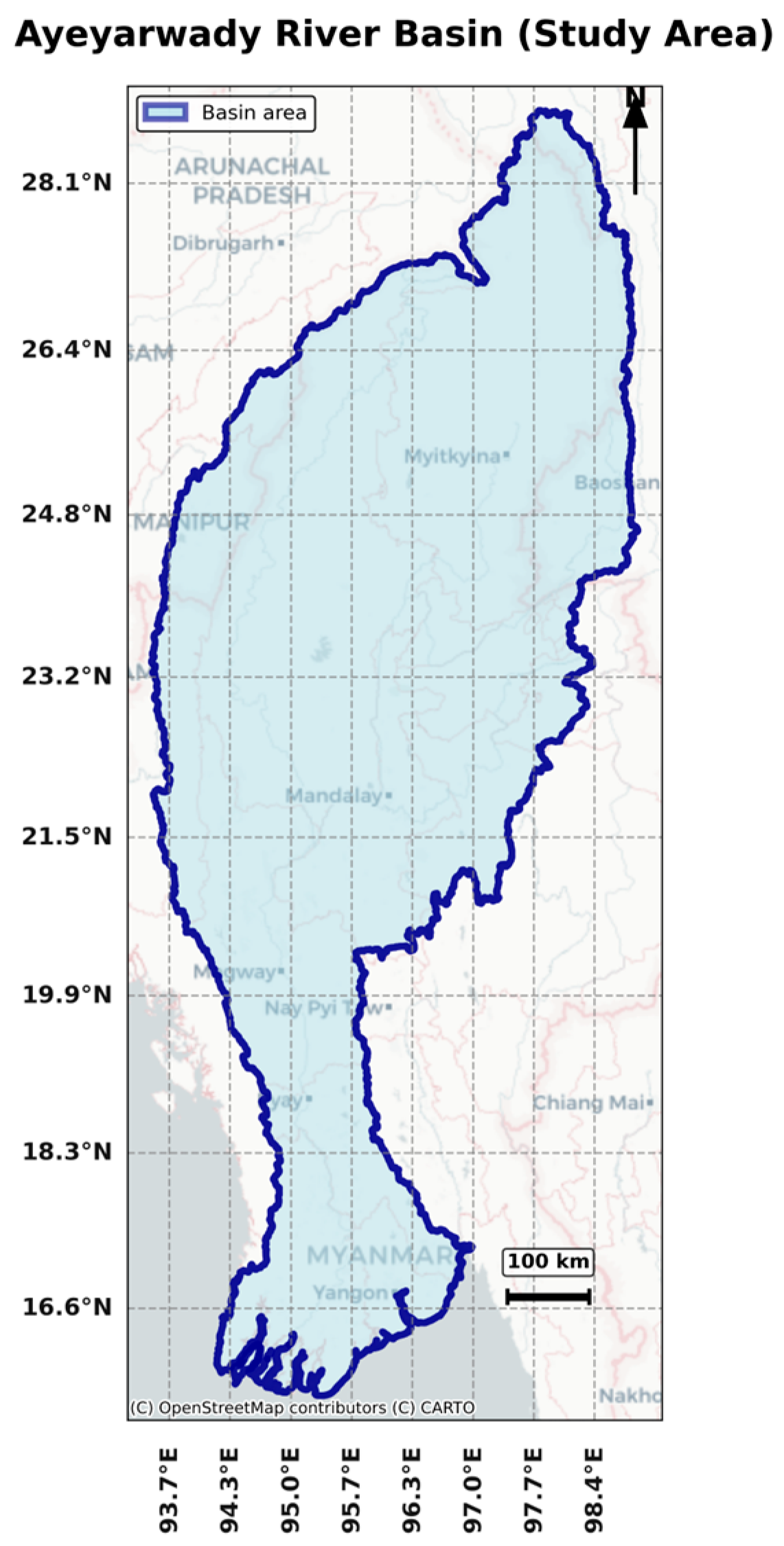
Figure 1. The Study Area.
Water 18 00227 g001
Figure 2. GPD model diagnostics for declustered extremes from Clusters 1–4. (a) Standardized residuals over time. (b) Autocorrelation Function (ACF) plot. (c) Histogram of residuals. (d) Q-Q plot of residuals against a standard exponential distribution.
Water 18 00227 g002
Figure 3. K-Means clustering validation metrics for the Ayeyarwady River Basin precipitation data: (a) Elbow Method, showing the inertia (within-cluster sum of squares) as a function of the number of clusters (k); (b) Silhouette Analysis, displaying the silhouette score for different numbers of clusters (k).
Water 18 00227 g003
Figure 4. Mean Residual Life (MRL) plots for all four rainfall regimes.
Water 18 00227 g004
Figure 5. Spatial Distribution of Mean Annual Precipitation (mm/year) in the Ayeyarwady Basin (1958–2023).
Water 18 00227 g005
Figure 6. Spatiotemporal rainfall clusters in the Ayeyarwady Basin identified through K-Means clustering. (a) Map showing the geographic distribution of the four distinct rainfall clusters. (b) The corresponding mean seasonal precipitation cycle for each cluster, averaged over the (1958–2023) period.
Water 18 00227 g006
Figure 7. Return Level Plots for each Rainfall Cluster/Regime.
Water 18 00227 g007
Figure 8. Wavelet Coherence between Regional Rainfall Regimes and Climate Indices.
Water 18 00227 g008
Table 1. Descriptive Statistics of Basin-Averaged Monthly and Annual Precipitation (1958–2023).
Parameter StatisticsValue (mm)
Monthly Precipitation—count792.00 (pixels)
Monthly Precipitation—mean80.80
Monthly Precipitation—std76.94
Monthly Precipitation—min0.03
Monthly Precipitation—25%8.62
Monthly Precipitation—50%47.27
Monthly Precipitation—75%152.07
Monthly Precipitation—max310.73
Annual Precipitation—Mean969.63
Annual Precipitation—Std Dev95.17
Annual Precipitation—Wettest Year1973 (1171.43)
Annual Precipitation—Driest Year2014 (743.91)
Monthly Avg Precipitation—Wettest MonthAugust (188.72)
Monthly Avg Precipitation—Driest MonthJanuary (4.51)
Table 2. Summary of Extreme Value Analysis for each Rainfall Cluster/Regime.
Cluster/RegimeTime Series LengthThreshold (mm)Shape ParameterScale Parameter2 yr (mm)5 yr (mm)10 yr (mm)20 yr (mm)50 yr (mm)100 yr (mm)
1792415.2820.141.892445.35488.43523.75561.6615.84660.31
2792233.910.145.696266.71313.70352.23393.52452.68501.18
3792749.354−0.42199.339809.07865.46895.77918.41939.78951.27
4792707.791−0.279106.316774.79845.60888.34923.55960.77983.23
Table 3. Summary Statistics of Climate Index Teleconnections by Cluster.
ClusterIndexMean StrengthMean Period (Days)Median Duration (Months)Interval CountPeak Decade
1ONI0.50110.55062000
IOD0.47382.647251970
2ONI0.5369.06471960
IOD0.47268.325252000
3ONI0.42842.022141960
IOD0.43486.016251970
4ONI0.42899.239252010
IOD0.479124.674231990
Table 4. Summary of Wavelet Coherence and Phase Analysis for Rainfall Clusters.
Rainfall RegimeClimate IndexTime Interval SignificanceCoherence StrengthNotes
Cluster 1ONI2000s (peak)Moderate (0.501)Fewest ONI intervals (6); Long median duration (50 months); Sub-annual coherence
IOD1970s (peak)Moderate (0.473)Most IOD intervals for Cluster 1 (25); Medium duration (47 months); Consistent sub-annual coherence
Cluster 2ONI1960s (peak)Strong (0.536)Highest ONI strength among clusters; Long duration (64 months); Sub-annual coherence
IOD2000s (peak)Moderate (0.472)Balanced distribution; Shorter durations (25 months median); Sub-annual coherence
Cluster 3ONI1960s (peak)Weak (0.428)Medium ONI count (14); Shorter durations (22 months); Weakest ONI strength
IOD1970s (peak)Weak (0.434)Shortest durations (16 months median); Consistent but weak coherence
Cluster 4ONI2010s (peak)Weak (0.428)Most ONI intervals (25); Medium duration (39 months); Recent dominance
IOD1990s (peak)Moderate (0.479)Longest durations (74 months); Only cluster with > 1 yr periods; Strong IOD influence
Disclaimer/Publisher’s Note: The statements, opinions and data contained in all publications are solely those of the individual author(s) and contributor(s) and not of MDPI and/or the editor(s). MDPI and/or the editor(s) disclaim responsibility for any injury to people or property resulting from any ideas, methods, instructions or products referred to in the content.