Review

Managing Shared Waters: The Elusive Quest for Cooperative Governance in the Nile Basin

Department of Biological and Agricultural Engineering, Texas A&M University, College Station, TX 77843, USA
*
Author to whom correspondence should be addressed.
Water 2026, 18(2), 157; https://doi.org/10.3390/w18020157
Submission received: 22 November 2025 / Revised: 23 December 2025 / Accepted: 6 January 2026 / Published: 7 January 2026
(This article belongs to the Special Issue Working Across Borders to Address Water Scarcity)

Abstract

The Nile River Basin—shared by eleven countries and supporting over 300 million people—exemplifies the complexity of managing shared waters amid asymmetrical power relations, historical legacies, and competing development priorities. To advance the understanding of transboundary water governance and guide future cooperative strategies in the Nile Basin, a synthesis linking historical governance regimes with current contemporary frameworks is essential, as the existing literature is largely episodic, and its scope rarely includes recent governance developments. This review traces over a century of governance evolution, from pre-colonial and colonial allocation treaties through post-independence bilateral agreements to current institutional innovations and basin-wide initiatives. Historical and contemporary arrangements are assessed against principles of equitable and reasonable utilization, revealing persistent gaps in fairness, enforceability, and adaptive capacity. The analysis concludes by exploring emerging cooperation mechanisms and opportunities to transform the Nile from a locus of geopolitical tension into a model of equity-driven, cooperative governance.

1. Introduction

Globally, more than 286 rivers and 600 aquifers span national boundaries, sustaining billions of people and ecosystems [1,2,3]. However, their management is frequently shaped by asymmetrical power relations, and underdeveloped legal and institutional frameworks [4,5]. These governance constraints inhibit equitable resource sharing and exacerbate the potential for conflict, particularly in politically sensitive or ecologically fragile regions. As pressures on the sustainable use of shared water resources intensify, in part driven by fragmented governance, competing and increasing water resource use demands, and climate-induced hydrological variability, the imperative for cooperative governance mechanisms become increasingly critical.
The Nile River epitomizes these complexities, with its governance and water use remaining a focal point of geopolitical contestation. Historically, governance of the Nile’s water resources has been shaped by unequal power dynamics between upstream and downstream states, due to colonial-era treaties that excluded downstream riparian territories. The absence of a basin-wide management framework has hindered cooperation, and the basin is frequently identified as a potential hotspot for violent conflict [6,7,8]. Tensions have periodically escalated into near-crisis situations, most notably in recent years surrounding Ethiopia’s construction of the Grand Ethiopian Renaissance Dam (GERD) on the Blue Nile.
Similar tensions have existed in other transboundary river basins worldwide, underscoring the broader challenges of water governance, especially under scarcity and increasing demand. For instance, in South Asia, the Indus River Basin shared between India and Pakistan and governed by the Indus Waters Treaty has, of recent, seen mounting strain [9,10]. In the Euphrates–Tigris Basin, shared by Türkiye, Syria, and Iraq, unilateral water development projects have prompted accusations of water weaponization [11,12]. The Jordan River Basin, covering Israel, Jordan, Lebanon, Syria, and the Palestinian territories, has long been a focal point of water-related conflict [13,14,15]. In the Nile River Basin, the Lake Turkana Basin shared by Kenya and Ethiopia has seen escalating tensions, in part due to upstream developments on the Omo River [16,17].
Despite these challenges, several cases underscore that institutionalized cooperation, benefit-sharing, and transparency can transform shared water resources into catalysts for peacebuilding and sustainable development. For instance, in the Mekong River Basin, the Mekong River Commission has institutionalized mechanisms enabling riparian states to jointly manage hydropower development and water allocation while promoting trust and regional integration [18,19,20,21]. Similarly, in West Africa, the Senegal River Basin Development Authority (OMVS) pioneered benefit-sharing arrangements, including joint ownership of dams and infrastructure, ensuring equitable distribution of costs and benefits among member states, and reducing regional tensions [22,23,24]. In Europe, the Danube River Protection Convention and the International Commission for the Protection of the Danube River harmonized water quality standards, coordinated flood management, and facilitated joint monitoring programs across 14 riparian countries, strengthening environmental security and regional stability [21,25]. The Nile has also seen incremental progress in technical cooperation and institutional development over the past two decades, despite persistent challenges and diplomatic confrontations.
As embodied by the Nile Basin and other global examples, shared water resources can either deepen geopolitical fault lines or foster cooperation, depending on the strength of institutional frameworks, the inclusivity of legal arrangements, and the political will of riparian states. These governance gaps, coupled with increasing pressures on transboundary water systems, highlight the need for understanding historical trajectories of water resource governance and institutional dynamics—insights that can inform more effective future policy and cooperation.
Globally, extensive interdisciplinary research has explored the governance of transboundary water systems, highlighting the nexus between hydro-politics—the ways in which water resources become embedded in power relations, sovereignty claims, and negotiation processes—and institutional management frameworks [26,27,28,29]. Foundational and review works on hydro-politics and transboundary governance show how asymmetric power and geography drive outcomes and how cooperation benefits can be mobilized through adaptive institutions [15]. In the Nile Basin, scholars have examined the enduring influence of colonial treaties and contemporary disputes over major infrastructure projects [6,30,31,32,33,34,35]. However, existing studies on the Nile remain fragmented, often focusing on isolated episodes or single dimensions of governance [6,36,37,38]. Moreover, there is limited literature addressing recent governance developments such as the contested implementation of the Cooperative Framework Agreement (CFA) within a broader governance trajectory. This review addresses this by synthesizing over a century of governance evolution—from colonial arrangements to basin-wide initiatives—highlighting how historical legacies and shifting power asymmetries continue to shape cooperative challenges. By situating recent developments within this long historical and institutional trajectory, the review offers a comprehensive lens to explain why cooperative ambitions remain elusive and what structural conditions may need to change for basin-wide governance to become effective and resilient.

2. The Nile River Basin

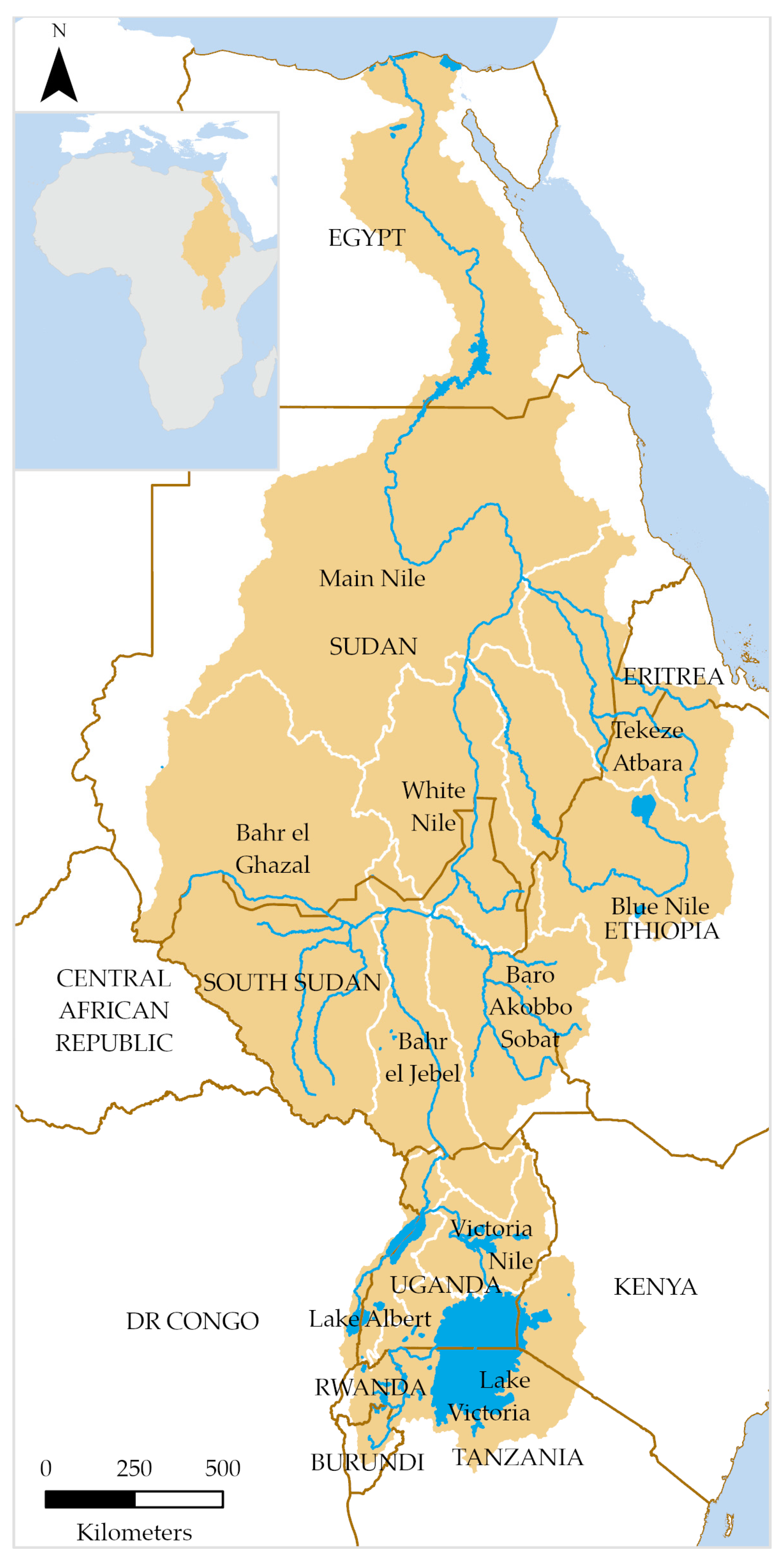
The Nile River Basin (Figure 1) is one of the world’s most significant transboundary water systems, both in geographic scale and socio-economic importance. Covering about 3.2 million km2, the basin spans eleven riparian countries—Burundi, Democratic Republic of Congo, Egypt, Eritrea, Ethiopia, Kenya, Rwanda, South Sudan, Sudan, Tanzania, and Uganda—each with distinct hydrological, ecological, and political contexts [39]. The Nile stretches around 6695 km, making it the longest river globally by most measurements [39,40]. It serves as a critical source of water, energy, and livelihoods for riparian states, whose population of about 528 million is projected to double by 2050, significantly intensifying pressure on the Nile’s water resources [41,42].
Hydrologically, the Nile consists of two major tributaries—the White Nile and Blue Nile—with contrasting flow regimes. The White Nile originates in the Great Lakes region and provides relatively stable baseflow due to equatorial sources and lake buffering. Its headwaters begin with the Kagera River, draining Burundi, Rwanda, Uganda, and Tanzania, and flows into Lake Victoria. The Nile emerges at Jinja, Uganda, as the Victoria Nile, where outflow is regulated at Nalubaale Dam under the Agreed Curve rule to approximate natural conditions [43,44]. From Jinja, the river flows through Lakes Kyoga and Albert, becoming the Albert Nile and later the Bahr el Jebel in South Sudan. It then traverses the Sudd wetlands, a major evapotranspiration zone causing significant losses, before joining the Sobat River to form the White Nile [45,46] and then flows northwards to Khartoum where it meets the Blue Nile. Over the 3700 km reach from Jinja to Khartoum, mean annual discharge declines by 21%, from 33 BCM to 26 BCM, primarily due to evaporation and seepage [39].
The Blue Nile, originating from Lake Tana in the Ethiopian Highlands, contributes most of the Nile’s annual discharge but is highly seasonal. Monsoon rains (June–September) account for ~80–85% of flow at Khartoum, while dry-season contributions decline sharply, creating pronounced seasonal variability [47]. From the White Nile-Blue Nile confluence at Khartoum, the Main Nile flows north through arid regions to the Mediterranean Sea. Long-term records indicate that discharge decreases from about 72 BCM at Dongola downstream of the confluence, to 12 BCM at the Nile’s outlet into the Mediterranean—representing a substantial reduction primarily attributed to irrigation withdrawals, reservoir regulation, and evaporative losses within Egypt [39].

3. Historical Evolution of Nile Water Governance

3.1. The Precolonial Era: Localized Governance and Imperial Strategic Contests

Prior to formal colonial rule, the governance of the Nile was shaped by a combination of indigenous hydro-political systems that reflected the interplay between water resources control to governance structures and societal organization. Ancient civilizations along the Nile developed sophisticated water use and management systems that sustained agriculture and centralized state power. In Egypt, for instance, canal networks and indigenous technologies such as the shaduf were used to harness the Nile’s seasonal flooding with state oversight dating back to the Pharaonic period [48,49]. In upstream territories, such as in Uganda, the Nile was revered as a sacred river, integral to both ecological sustenance and cultural identity. Its management was localized and often coordinated through kingdom-based governance systems, which regulated access to fishing grounds, floodplain cultivation, and riverine transport [50].
An examination of historical archives reveals that, by the mid-nineteenth century, European powers—chiefly Britain, France, Italy, and Germany—had begun to conceptualize the Nile as a strategic axis integral to the advancement of their imperial ambitions across the African continent [51,52]. Consequently, early European engagement with the Nile was marked by strategic competition and rivalry over control of its waters. Tensions over Nile control were already evident in European rivalries during the Scramble for Africa, as France and Britain maneuvered for influence in the region—a contest that would later erupt into the Fashoda Incident of 1898, but whose roots lay in earlier diplomatic and exploratory missions aimed at securing hydrological dominance [52,53]. Despite the competition, no formal water-sharing treaties were established prior to the 1890s.

3.2. The Colonial Era (1890s–1940s): Building a Downstream-First Legal Order

During the colonial period, a series of key treaties, diplomatic correspondences, and inter-imperial arrangements (Table 1) laid the foundation for a legal regime that prioritized downstream water security, particularly for Egypt, and to a lesser extent Sudan, while systematically excluding upstream riparian territories from meaningful participation in Nile governance. These instruments entrenched asymmetric water rights and institutionalized a basin-wide power imbalance, setting the stage for enduring hydro-hegemony in the Nile Basin that continues to influence negotiations and resource management in the post-independence era.
The earliest documented colonial-era agreement addressing Nile water governance is the Anglo-Italian Protocol of 1891. Although not a water treaty in the strict sense, the treaty obligated Italy not to construct irrigation works on the Atbara River that would “sensibly modify” its flow into the Nile [54,55]. This agreement marked the beginning of a pattern in which upstream development was restrained to secure downstream water availability. Subsequent colonial era treaties extended this logic, imposing restrictions on water use by upstream riparian territories. For instance, the 1902 Anglo–Ethiopian Treaty restricted the then emperor of Ethiopia from constructing any work on tributaries from Ethiopia that would arrest the flow of their waters without British or Sudanese consent [56,57,58]. The Tripartite Agreement of 1906, again, while not explicitly a water treaty, reaffirmed earlier commitments that aligned the three colonial powers in support of British interests in the Blue Nile region [59]. The Anglo-Italian Exchange of Notes of 1925 further exemplified the strategic bargaining between colonial powers for downstream water concessions. Under this arrangement, Italy sought British support for a trans-Ethiopian railway linking its colonial territories in Eritrea and Somalia, while Britain endorsed an Italian proposal to construct a dam on Lake Tana to augment Nile flows for downstream users in Egypt and Sudan [56,60].
The most consequential colonial-era instrument was the 1929 Nile Waters Agreement, signed between the United Kingdom (negotiating unilaterally on behalf of its colonies) and Egypt, following Egypt’s formal independence in 1922 [61,62]. Egypt remained under significant British influence, after formal independence, so the agreement was not concluded between equal parties [26,63]. This agreement codified Egypt’s “natural and historical rights” to the Nile and granted it veto power over upstream water projects in British-controlled territories [56,61,62]. It allocated 48 BCM annually to Egypt and 4 BCM to Sudan, with no provisions for other riparian states. The legacy of the 1929 agreement, along with the subsequent 1959 agreement, remains a central source of contention in contemporary Nile water disputes.

3.3. Early Post-Colonial Bilateralism (1950s–1990s): From Data Sharing to a Basin-Wide Forum

The early post-colonial period was characterized by infrastructure projects negotiated under colonial authority but executed during transitions to sovereignty, setting a precedent for bilateral governance (Table 2). One of the most significant undertakings was the construction of the Owen Falls Dam (now Nalubaale Dam) at the Nile’s outlet from Lake Victoria, built between 1949 and 1953 [32]. This project introduced joint regulation norms through the “Agreed Curve” regime, which aimed to replicate the pre-dam natural flow controlled by the former rock sill [32,43]. Bilateral cooperation continued during this era, most notably with the signing of the 1959 Nile Waters Agreement between Egypt and Sudan—the first treaty involving independent basin states. This agreement, a revision of the 1929 Nile Waters Agreement, allocated 55.5 BCM of Nile water annually to Egypt and 18.5 BCM to Sudan [32,64,65], with no allocation to upstream countries.
Within this bilateral framework, Egypt and Sudan also advanced the construction of the Jonglei Canal. Conceived in the early 1900s and operationalized in the 1970s under the 1959 Agreement as an effort to reclaim “lost waters”, the canal was planned to bypass the Sudd wetlands and reduce evaporation losses to increase downstream yields [28]. Construction began in 1978 but was suspended in 1984 after about two-thirds of the channel had been excavated [28,66]. Since then, its construction has become a focal point of political contestation over water rights, ecological integrity and livelihoods in the Sudd and remains unfinished [28,45,46,67]. Given geopolitical changes in the region—especially South Sudan’s independence and the shift towards basin-wide management, a unilateral revival under the old bilateral terms appears unlikely.
Despite prior exclusionary allocation practices, the period saw the emergence of technical cooperation initiatives that did not, however, alter the legal status quo. One such initiative was the joint implementation of the Hydrometeorological Survey of the Equatorial Lakes (HYDROMET project, 1967–1993) which expanded data sharing, hydro-meteorological surveys, and expert interaction among riparian states [68]. In December 1992, the Technical Cooperation Committee for the Promotion of Development and Environmental Protection of the Nile Basin (TECCONILE) was established with six member states—Egypt, Sudan, Rwanda, Uganda, Tanzania, and Zaire—while Ethiopia, Kenya, Eritrea, and Burundi participated as observers, as a direct successor of the HYDROMET Project [36]. In 1997, substantive discussions among Nile riparian states commenced, building on earlier cooperative efforts under TECCONILE [69]. These negotiations led to the formal establishment of the Nile Technical Advisory Committee (Nile-TAC), which provided the institutional foundation for the launch of the Nile Basin Initiative (NBI) in February 1999 [34,69,70,71].

3.4. The NBI and CFA Era (2000–Present): Technical Cooperation Amid Political Deadlock

The early 21st century marked a significant transition in Nile Basin governance—from fragmented bilateral arrangements toward basin-wide cooperation. This shift was catalyzed by the establishment of the NBI, following extensive preparatory dialog. Conceived as a transitional mechanism, the NBI aimed to foster trust, enhance technical capacity, and prepare investment projects while laying the foundation for a permanent legal and institutional framework [72]. Its creation brought together all riparian states. While the NBI prioritized technical cooperation and confidence-building, a parallel process sought to establish a legally binding framework for basin-wide governance [71,72]. This effort materialized in the CFA, initiated in 1997 and finalized in draft form in 2010 [73,74]. The CFA aimed to create a permanent Nile River Basin Commission (NRBC) grounded in principles of equitable and reasonable utilization and the obligation not to cause significant harm, consistent with international water law [73].
Negotiations of the CFA concluded with one unresolved provision that stipulated that states should “not significantly affect the water security of any other Nile Basin State.” Egypt and Sudan objected and instead proposed a revision that read as “not to adversely affect the water security and current uses and rights of any other Nile Basin State.” This divergence created a deadlock, preventing consensus. Despite this impasse, five states—Ethiopia, Rwanda, Tanzania, Uganda, and Burundi—had ratified the CFA by 2023 (Table 3), leaving it one ratification short of entry into force [73,74]. In 2024, South Sudan acceded to the CFA, thereby triggering its formal adoption [74]. Subsequently, on 13 October 2024, the agreement entered into force, paving the way for the establishment of the NRBC.
The NRBC is mandated to implement the CFA’s principles, provide a framework for basin-wide cooperation, foster socio-economic collaboration, and resolve water-related disputes. However, its operationalization faces significant hurdles. Most notably, Egypt and Sudan remain non-signatories due to disagreements over an unresolved article, creating a legitimacy gap and constraining compliance. Although this article was originally slated for resolution within six months, more than a year has elapsed without progress, and the formal transition from the NBI to the NRBC remains incomplete. In the meantime, negotiations continue in an effort to break the deadlock, yet no clear resolution appears to be in sight.

4. Legacy, Contestation, and Implications of Past and Present Treaties and Management Frameworks

The historical trajectory of Nile Basin governance—from colonial-era treaties to bilateral accords, and from technical cooperation under the NBI to normative aspirations embodied in the CFA—offers critical lessons for transboundary water management. These experiences underscore both the opportunities and persistent challenges inherent in governing shared waters under conditions of scarcity, asymmetrical power, and competing development priorities.
Taken together, the colonial instruments reduced uncertainty for downstream irrigation expansion and enabled coordinated planning between Britain, Italy, and Egypt, and to a lesser extent Sudan. The legacies of these treaties continue to shape negotiation strategies, legal interpretations, and power asymmetries in modern Nile Basin agreements. However, their exclusion of upstream territories entrenched asymmetrical rights that predated modern water-law principles, inviting post-independence contestation on grounds of equity and state succession. For instance, Ethiopia has consistently repudiated the 1902 Anglo–Ethiopian Treaty, arguing that colonial-era obligations cannot bind a sovereign state and objected to seeking consent, rejecting any requirement for downstream consent [69,75]. Uganda and Kenya have long rejected the 1929 Nile Waters Agreement, viewing Egypt’s veto power over upstream projects as incompatible with their sovereignty and development needs. Sudan, despite benefiting from the 1929 Agreement, later distanced itself from its provisions after independence, culminating in the 1959 Nile Waters Agreement with Egypt. Tanzania invoked the Nyerere Doctrine in the 1960s, declaring that colonial treaties, including the Nile agreements, were not binding unless expressly reaffirmed by independent states [74]. On its part, Egypt continues to invoke the doctrine of historic rights in Nile negotiations and has repeatedly framed threats to its share as existential, warning it will take all measures guaranteed by international law to protect its interests.
The emergence of initiatives such as TECCONILE, Nile-TAC, and the implementation of joint projects post-independence era reflected a gradual shift from downstream-dominated bilateralism toward more inclusive dialog among Nile riparian states. While these initiatives did not alter the entrenched allocation framework, they nonetheless provided a critical platform for basin-wide engagement.
Through different initiatives, the NBI normalized basin-wide data exchange, strengthened technical capacity, and demonstrated that functional cooperation can progress even without a finalized basin treaty. However, these achievements did not resolved core allocation disputes or established binding mechanisms for dispute settlement. Nonetheless, the NBI’s technical programs laid critical foundations for future governance, proving that shared projects and knowledge platforms can build trust and reduce unilateralism—even amid political stalemate.
In parallel with basin-wide institutional initiatives, Ethiopia advanced construction of the GERD on the Blue Nile—a project that quickly became the focal point of hydro-political negotiations in the region. Announced in 2011, GERD triggered immediate diplomatic tensions, particularly with Egypt, providing a governance stress test for existing basin management frameworks. Although negotiations among Egypt, Ethiopia, and Sudan culminated in the 2015 Declaration of Principles, they excluded other NBI member states, signaling a shift toward fragmented governance. Subsequent negotiations (2019–2021), mediated by the United States, World Bank, and African Union—and even drawing UN Security Council attention—failed to produce a binding agreement. Ethiopia ultimately proceeded with unilateral reservoir fillings in 2020 and 2021, citing sovereign rights, while Egypt and Sudan continued to demand assurances against flow disruptions. This reliance on external mediators and ad hoc trilateralism, combined with unilateral actions despite the existence of CFA’s dispute-resolution provisions, undermine the legitimacy of both the CFA and the forthcoming NRBC.
Still, although Egypt and Sudan remain outside the CFA, its adoption by a majority of riparian states creates a normative baseline aligned with international water law and provides a foundation for institutional permanence through the forthcoming NRBC. Political divisions over water allocation continue to impede universal adherence to the CFA. Moving forward, Nile governance must prioritize institutional consolidation, adaptive planning, and trust-building. The transition from the NBI to a permanent NRBC offers an opportunity to strengthen enforcement capacity, embed dispute-resolution mechanisms, and integrate climate resilience into basin planning. Regional integration should also extend beyond water to encompass energy trade, food security, and environmental sustainability, leveraging the Nile as a catalyst for cooperative development.
Lessons from other basins underscore that legal frameworks alone are insufficient; success depends on sustained political will, inclusive participation, and the alignment of national development strategies with basin-wide objectives. Comparative experiences from other transboundary basins demonstrate that even long-standing treaties experience periodic disputes, yet diplomacy often prevails. The Indus Waters Treaty between India and Pakistan, despite geopolitical tensions and multiple wars, has endured for over six decades by embedding clear allocation rules and dispute-resolution mechanisms. The Mekong River Commission has demonstrated how cooperative governance can integrate technical planning with stakeholder participation, while the Danube River Protection Convention illustrates the benefits of regional integration and environmental harmonization across diverse political systems. In West Africa, the OMVS offers a model of resilience, maintaining functionality even during armed conflict by institutionalizing joint ownership of infrastructure and equitable benefit distribution. These cases suggest that basin-wide management, anchored in legal clarity, institutional robustness—can transform shared waters from sources of tension into drivers of sustainable development. They also highlight the need for multi-level governance that couples normative principles with operational tools, ensuring that agreements are not merely aspirational but actionable.
In summary, the Nile Basin stands at a critical juncture: it can either perpetuate historical asymmetries and securitized disputes or leverage its shared waters as a foundation for peace, prosperity, and resilience. While interstate wars remain unlikely, analysts caution that hostile signaling, posturing, and unilateral actions heighten the risk of regional instability. The establishment of the NRBC does not eliminate governance challenges; rather, it offers a framework for addressing them. Constructive engagement by Egypt and Sudan within this framework is likely to be more effective than exerting pressure from outside. Whether the NRBC can succeed where previous mechanisms faltered remains uncertain. Ultimately, decisions made in the coming decade will determine whether the basin evolves into a model of cooperative governance or persists as a focal point of geopolitical contestation.

5. Conclusions

The Nile River Basin exemplifies the complexity of governing shared waters amid scarcity, power asymmetries, and competing development priorities. Its trajectory—from colonial treaties and post-independence bilateralism to the Nile Basin Initiative—shows that cooperation can advance even without binding law. The Cooperative Framework Agreement’s entry into force in 2024 marks a normative milestone, codifying principles of equitable use and water security. Yet, limited adherence and unresolved disputes reveal the difficulty of aligning legal commitments with entrenched political interests. The Grand Ethiopian Renaissance Dam negotiations further expose the gap between declaratory norms and enforceable rules, as unilateral actions and reliance on external mediators undermine basin-wide governance. Whether the forthcoming Nile River Basin Commission can reverse this trend remains uncertain. The basin stands at a crossroads: perpetuate historical asymmetries or transform shared waters into a foundation for peace and resilience. Achieving the latter demands political will, adaptive governance, and inclusive benefit-sharing.

Author Contributions

Conceptualization, D.K. and S.P.; writing—original draft preparation, D.K.; writing—review and editing, D.K. and S.P. All authors have read and agreed to the published version of the manuscript.

Funding

This research received no external funding.

Data Availability Statement

No new data were created or analyzed in this study.

Conflicts of Interest

The authors declare no conflicts of interest.

Abbreviations

The following abbreviations are used in this manuscript:
BCMBillion Cubic Meters
KmKilometer

References

  1. FAO. The State of the World’s Land and Water Resources for Food and Agriculture—Systems at Breaking Point: Synthesis Report 2021; Food and Agriculture Organization (FAO): Rome, Italy, 2021; ISBN 9789251353271. [Google Scholar]
  2. Sahana, M.; Dhali, M.K.; Lindley, S. Global Disparities in Transboundary River Research Have Implications for Sustainable Management. Commun. Earth Environ. 2024, 5, 786. [Google Scholar] [CrossRef]
  3. Sanchez, R.; Eckstein, G. Aquifers Shared Between Mexico and the United States: Management Perspectives and Their Transboundary Nature. Groundwater 2017, 55, 495–505. [Google Scholar] [CrossRef]
  4. Woodhouse, P.; Muller, M. Water Governance—An Historical Perspective on Current Debates. World Dev. 2017, 92, 225–241. [Google Scholar] [CrossRef]
  5. Hayat, S.; Gupta, J.; Vegelin, C.; Jamali, H. A Review of Hydro-Hegemony and Transboundary Water Governance. Water Policy 2022, 24, 1723–1740. [Google Scholar] [CrossRef]
  6. Paisley, R.; Henshaw, T.W. Transboundary Governance of the Nile River Basin: Past, Present and Future. Environ. Dev. 2013, 7, 59–71. [Google Scholar] [CrossRef]
  7. Getahun Ashine, S. The Post-1990s Water Diplomacy in Eastern Nile Basin: Changing the Power Asymmetry. J. Political Sci. Int. Relat. 2023, 6, 87–98. [Google Scholar] [CrossRef]
  8. Azizi, M.A.; Leandro, J. Factors Affecting Transboundary Water Disputes: Nile, Indus, and Euphrates–Tigris River Basins. Water 2025, 17, 525. [Google Scholar] [CrossRef]
  9. Mumtaz, T.; Bilal, F.; Younas, S. Indus Water Treaty and Water Scarcity in India: Implications for Pakistan. J. S. Asian Stud. 2023, 11, 11–18. [Google Scholar] [CrossRef]
  10. Yao, T.; Bolch, T.; Chen, D.; Gao, J.; Immerzeel, W.; Piao, S.; Su, F.; Thompson, L.; Wada, Y.; Wang, L.; et al. The Imbalance of the Asian Water Tower. Nat. Rev. Earth Environ. 2022, 3, 618–632. [Google Scholar] [CrossRef]
  11. Çarkoǧlu, A.; Eder, M. Domestic Concerns and the Water Conflict over the Euphrates-Tigris River Basin. Middle East Stud. 2001, 37, 41–71. [Google Scholar] [CrossRef]
  12. Bahrini, A.; Riggs, R.J.; Esmaeili, M. Social Choice Rules, Fallback Bargaining, and Related Games in Common Resource Conflicts. J. Hydrol. 2021, 602, 126663. [Google Scholar] [CrossRef]
  13. Zeitoun, M.; Cascão, A.E.; Warner, J.; Mirumachi, N.; Matthews, N.; Menga, F.; Farnum, R. Transboundary Water Interaction III: Contest and Compliance. Int. Environ. Agreem. 2017, 17, 271–294. [Google Scholar] [CrossRef]
  14. Frey, F.W.; Naff, T. Water: An Emerging Issue in the Middle East? Ann. Am. Acad. Pol. Soc. Sci. 1985, 482, 65–84. [Google Scholar] [CrossRef]
  15. Zeitoun, M.; Warner, J. Hydro-Hegemony—A Framework for Analysis of Trans-Boundary Water Conflicts. Water Policy 2006, 8, 435–460. [Google Scholar] [CrossRef]
  16. Gownaris, N.J.; Pikitch, E.K.; Aller, J.Y.; Kaufman, L.S.; Kolding, J.; Lwiza, K.M.M.; Obiero, K.O.; Ojwang, W.O.; Malala, J.O.; Rountos, K.J. Fisheries and Water Level Fluctuations in the World’s Largest Desert Lake. Ecohydrology 2017, 10, e1769. [Google Scholar] [CrossRef]
  17. Abbink, J. Dam Controversies: Contested Governance and Developmental Discourse on the Ethiopian Omo River Dam. Soc. Anthropol. 2012, 20, 125–144. [Google Scholar] [CrossRef]
  18. Kirmani, S.S. Water, Peace and Conflict Management: The Experience of the Indus and Mekong River Basins. Water Int. 1990, 15, 200–205. [Google Scholar] [CrossRef]
  19. Yun, G.; Williams, S.; Wenbin, D. Water Management of the Mekong River. Water Conserv. Manag. 2017, 1, 10–12. [Google Scholar] [CrossRef]
  20. Milman, A.; Gerlak, A.K. International River Basin Organizations, Science, and Hydrodiplomacy. Environ. Sci. Policy 2020, 107, 137–149. [Google Scholar] [CrossRef]
  21. Schmeier, S. Governing International Watercourses: River Basin Organizations and the Sustainable Governance of Internationally Shared Rivers and Lakes, 1st ed.; Routledge: London, UK, 2012; ISBN 9780203105160. [Google Scholar]
  22. Tignino, M. Joint Infrastructure and the Sharing of Benefits in the Senegal and Niger Watersheds. Water Int. 2016, 41, 835–850. [Google Scholar] [CrossRef]
  23. Alam, U.; Dione, O.; Jeffrey, P. Hydrology vs. Sovereignty: Managing the Hydrological Interdependency of International Rivers. Water Policy 2011, 13, 425–442. [Google Scholar] [CrossRef]
  24. Alam, U. Cooperating Internationally over Water: Explaining l’espace OMVS. J. Mod. Afr. Stud. 2012, 50, 175–199. [Google Scholar] [CrossRef]
  25. Sommerwerk, N.; Bloesch, J.; Paunovi, M.; Baumgartner, C.; Venohr, M.; Schneider-Jacoby, M.; Hein, T.; Tockner, K. Managing the Worlds Most International River: The Danube River Basin. Mar. Freshw. Res. 2010, 61, 736–748. [Google Scholar] [CrossRef]
  26. Waterbury, J. Hydropolitics of the Nile Valley; Taylor & Francis, Ltd.: London, UK, 1979. [Google Scholar] [CrossRef]
  27. Sneddon, C.; Fox, C. Rethinking Transboundary Waters: A Critical Hydropolitics of the Mekong Basin. Polit. Geogr. 2006, 25, 181–202. [Google Scholar] [CrossRef]
  28. Collins, R.O. The Waters of the Nile: Hydropolitics and the Jonglei Canal, 1900–1988. Afr. Aff. 1990, 89, 598–599. [Google Scholar] [CrossRef]
  29. De Stefano, L.; Edwards, P.; De Silva, L.; Wolf, A.T. Tracking Cooperation and Conflict in International Basins: Historic and Recent Trends. Water Policy 2010, 12, 871–884. [Google Scholar] [CrossRef]
  30. Turhan, Y. The Hydro-Political Dilemma in Africa Water Geopolitics: The Case of the Nile River Basin. Afr. Secur. Rev. 2021, 30, 66–85. [Google Scholar] [CrossRef]
  31. Nasr, H.; Neef, A. Ethiopia’s Challenge to Egyptian Hegemony in the Nile River Basin: The Case of the Grand Ethiopian Renaissance Dam. Geopolitics 2016, 21, 969–989. [Google Scholar] [CrossRef]
  32. Okoth-Owiro, A. The Nile Treaty: State Succession and International Treaty Commitments: A Case Study of the Nile Water Treaties; Konrad Adenauer Foundation, Law and Policy Research Foundation: Nairobi, Kenya, 2004; Volume 9. [Google Scholar]
  33. Abdullah, A.M.A.; Dyduck, C.; Ahmed, T.Y. Transboundary Water Conflicts as Postcolonial Legacy (the Case of Nile Basin). Vestn. RUDN. Int. Relat. 2020, 20, 184–196. [Google Scholar] [CrossRef]
  34. Küng, R. Addressing the Dimensions of Transboundary Water Use: The Nile Basin Initiative. Mt. Res. Dev. 2003, 23, 4–6. [Google Scholar] [CrossRef]
  35. Swain, A. The Nile River Basin Initiative: Too Many Cooks, Too Little Broth. SAIS Rev. 2002, 22, 293–308. [Google Scholar] [CrossRef]
  36. Swain, A. Challenges for Water Sharing in the Nile Basin: Changing Geo-Politics and Changing Climate. Hydrol. Sci. J. 2011, 56, 687–702. [Google Scholar] [CrossRef]
  37. Yihdego, Z.; Rieu-Clarke, A.; Cascão, A.E. How Has the Grand Ethiopian Renaissance Dam Changed the Legal, Political, Economic and Scientific Dynamics in the Nile Basin? Water Int. 2016, 41, 503–511. [Google Scholar] [CrossRef]
  38. Cascão, A.E.; Nicol, A. Sudan, ‘Kingmaker’ in a New Nile Hydropolitics: Negotiating Water and Hydraulic Infrastructure to Expand Large-Scale Irrigation. In Land and Hydropolitics in the Nile River Basin: Challenges and New Investments; Routledge: London, UK, 2016. [Google Scholar]
  39. NBI. Nile Basin Water Resources Atlas; Nile Basin Initiative (NBI): Entebbe, Uganda, 2016; ISBN 9789970444021. [Google Scholar]
  40. Fielding, L.; Najman, Y.; Millar, I.; Butterworth, P.; Garzanti, E.; Vezzoli, G.; Barfod, D.; Kneller, B. The Initiation and Evolution of the River Nile. Earth Planet. Sci. Lett. 2018, 489, 166–178. [Google Scholar] [CrossRef]
  41. Awange, J. The Nile Waters: Weighed from Space, 1st ed.; Springer: Cham, Switzerland, 2021; ISBN 9783030647544. [Google Scholar]
  42. NBI. State of the River Nile Basin: Water Security in the Nile Basin 2021; Nile Basin Initiative (NBI): Entebbe, Uganda, 2021; ISBN 9789970444052. [Google Scholar]
  43. Kikoyo, D.; Wurbs, R.; Ale, S.; Smith, P. Alternate Reservoir Operating Policies for Lake Victoria in East Africa: A Framework for Balancing Transboundary and Local Water Demands. Lakes Reserv. Sci. Policy Manag. Sustain. Use 2023, 28, e12420. [Google Scholar] [CrossRef]
  44. Sutcliffe, J. The Hydrology of the Nile Basin. In The Nile: Origin, Environments, Limnology and Human Use; Dumont, H.J., Ed.; Springer: Cham, Switzerland, 2009; Volume 89, pp. 335–366. [Google Scholar]
  45. Mohamed, Y.A.; Van Den Hurk, B.J.J.M.; Savenije, H.H.G.; Bastiaanssen, W.G.M. Impact of the Sudd Wetland on the Nile Hydroclimatology. Water Resour. Res. 2005, 41, W08420. [Google Scholar] [CrossRef]
  46. Sutcliffe, J.; Brown, E. Water Losses from the Sudd. Hydrol. Sci. J. 2018, 63, 527–541. [Google Scholar] [CrossRef]
  47. Melesse, A.M. Nile River Basin. Hydrology, Climate and Water Use; Springer: New York, NY, USA, 2011; ISBN 9789400706880. [Google Scholar]
  48. Zaghloul, E.A. Ancient Water Supply System in Tall Tanis, Archaeological Area Northeastern Nile Delta Region, Port Said, Egypt. In Handbook of Environmental Chemistry; Negm, A., Ed.; Springer: Cham, Switzerland, 2017; Volume 55, ISBN 9783319561226. [Google Scholar]
  49. Elmesery Evolution of Irrigation System, Tools and Technologies. In Technological and Modern Irrigation Environment in Egypt; Omran, E., Negm, A., Eds.; Springer: Cham, Switzerland, 2020; pp. 59–73. [Google Scholar]
  50. Mpomwenda, V.; Tómasson, T.; Pétursson, J.G.; Kristófersson, D.M. From Co-Operation to Coercion in Fisheries Management: The Effects of Military Intervention on the Nile Perch Fishery on Lake Victoria in Uganda. Fishes 2023, 8, 563. [Google Scholar] [CrossRef]
  51. Samaan, M.M. The Colonial Round: The Opening Scene of Utilizing the Nile Waters Outside Egypt. In The Nile Development Game; Samaan, M.M., Ed.; Springer: Cham, Switzerland, 2019; pp. 47–84. ISBN 978-3-030-02664-6. [Google Scholar]
  52. Sanderson, G.N., IV. England, Italy, the Nile Valley and the European Balance, 1890–1891. Hist. J. 1964, 7, 94–119. [Google Scholar] [CrossRef]
  53. Schölch, A. The ‘men on the Spot’ and the English Occupation of Egypt in 1882. Hist. J. 1976, 19, 773–785. [Google Scholar] [CrossRef]
  54. Marcus, H.G. A Background to Direct British Diplomatic Involvement in Ethiopia, 1894–1896. J Ethiop. Stud. 1963, 1, 121–132. [Google Scholar]
  55. Okidi, C.O. Review of Treaties on Consumptive Utilization of Waters of Lake Victoria and Nile Drainage System. Nat. Resour. J. 1982, 22, 161–199. [Google Scholar]
  56. Woldetsadik, T. Anglo-Ethiopian Treaty on the Nile and the Tana Dam Concessions: A Script in Legal History of Ethiopia’s Diplomatic Confront (1900–1956). Mizan Law Rev. 2015, 8, 271. [Google Scholar] [CrossRef]
  57. Kassa Woldetsadik, T. Legal Regimes Regulating Utilization of the Nile Waters: A Case Study of the Anglo-Ethiopian Treaty of 1902. In International Watercourses Law in the Nile River Basin; Kassa Woldetsadik, T., Ed.; Routledge: London, UK, 2013; p. 9. [Google Scholar]
  58. Ullendorff, E. The Anglo-Ethiopian Treaty of 1902. Bull. Sch. Orient. Afr. Stud. 1967, 30, 641–654. [Google Scholar] [CrossRef]
  59. Keefer, E.C. Great Britain, France, and the Ethiopian Tripartite Treaty of 1906. Albion 1981, 13, 364–380. [Google Scholar] [CrossRef]
  60. Iadarola, A. The Anglo-Italian Agreement of 1925: Mussolini’s “Carte Blanche” for War Against Ethiopia. Northeast. Afr. Stud. 1979, 1, 45–56. [Google Scholar]
  61. Tvedt, T. Water Systems, Water Agreements and State Sovereignty: The Case of the Nile Waters Agreement of 1929. In A History of Water, Series III, Volume 2: Sovereignty and International Water Law; I.B. Tauris: London, UK, 2015. [Google Scholar]
  62. Crabitès, P. The Nile Waters Agreement. Foreign Aff. 1929, 8, 145. [Google Scholar] [CrossRef]
  63. Abdalla, I.H. The 1959 Nile Waters Agreement in Sudanese—Egyptian Relations. Middle East. Stud. 1971, 7, 329–341. [Google Scholar] [CrossRef]
  64. Hodges, R.C. The Egypt-Sudan Permanent Joint Technical Commission for Nile Water. Can. Water Resour. J. 1979, 4, 71–83. [Google Scholar] [CrossRef]
  65. Ahmad, A.M. Post-Jonglei Planning in Southern Sudan: Combining Environment with Development. Environ. Urban 2008, 20, 575–586. [Google Scholar] [CrossRef]
  66. el Moghraby, A.I. The Jonglei Canal—Needed Development or Potential Ecodisaster? Environ. Conserv. 1982, 9, 141–148. [Google Scholar] [CrossRef]
  67. Metawie, A.F. History of Co-Operation in the Nile Basin. Int. J. Water Resour. Dev. 2004, 20, 47–63. [Google Scholar] [CrossRef]
  68. Mekonnen, D.Z. The Nile Basin Cooperative Framework Agreement Negotiations and the Adoption of a “water Security” Paradigm: Flight into Obscurity or a Logical Cul-de-Sac? Eur. J. Int. Law 2010, 21, 421–440. [Google Scholar] [CrossRef]
  69. Yeheys, N.H.; Chen, X. From Nile Basin Initiatives (NBI) to External Mediator: Challenges of the Ethiopia’s Renaissance Dam Negotiations. J. Afr. Union Stud. 2020, 9, 71–86. [Google Scholar] [CrossRef]
  70. Nile-COM. Nile-COM Minutes Establishing the NBI; Nile Basin Initiative (NBI): Dar es Salaam, Tanzania, 1999. [Google Scholar]
  71. NBI. Nile Basin Initiative Act, 2002; Nile Basin Initiative (NBI): Entebbe, Uganda, 2002; pp. 1–13. [Google Scholar]
  72. Nile-COM. Agreement on the Nile River Basin Cooperative Framework; Nile Basin Initiative (NBI): Entebbe, Uganda, 2010. [Google Scholar]
  73. NBI Cooperative Framework Agreement. Available online: https://nilebasin.org/about-us/cooperative-framework-agreement (accessed on 16 November 2025).
  74. Salman, S.M.A. The Nile Basin Cooperative Framework Agreement: A Peacefully Unfolding African Spring? Water Int. 2013, 38, 17–29. [Google Scholar] [CrossRef]
  75. Ashour, M.A.; Aly, T.E.; Abueleyon, H.M. Transboundary Water Resources “a Comparative Study”: The Lessons Learnt to Help Solve the Nile Basin Water Conflict. Limnol. Rev. 2019, 19, 3–14. [Google Scholar] [CrossRef]
Figure 1. Major subbasins of the Nile River and riparian countries.
Water 18 00157 g001
Table 1. Key colonial-era instruments shaping the Nile River regime.
YearEvent/AgreementKey Actors
1891Anglo-Italian Protocol of 1891United Kingdom, Italy
1902Anglo–Ethiopian Treaty of 1902United Kingdom, Ethiopia, Italy
1906Tripartite Agreement of 1906United Kingdom, France, Italy
1925Anglo-Italian Agreement of 1925United Kingdom, Italy
1929Nile Waters AgreementUnited Kingdom, Egypt
Table 2. Key Milestones in Nile Basin Water Agreements and Initiatives (1950–1999).
DateEvent/AgreementKey Actors
1949–1954Owen Falls Dam accordsUnited Kingdom, Egypt
1959Nile Waters AgreementEgypt, Sudan
1978–1984Jonglei Canal ConstructionEgypt, Sudan
1992Launch of TECCONILE *DRC **, Egypt, Rwanda, Sudan, Tanzania, Uganda
1997Nile basin Dialogue launchNBI States ***
1999Establishment of NBINBI States
Notes: * Technical Cooperation Committee for the Promotion of Development and Environmental Protection of the Nile Basin. ** Democratic Republic of the Congo. *** NBI Member States: Burundi, DRC, Egypt, Ethiopia, Kenya, Rwanda, Sudan, Tanzania, and Uganda. Eritrea participates in NBI as an observer.
Table 3. Timeline of CFA Ratification and Related Events.
DateEvent/AgreementKey Actors
1997–2009CFA negotiationsNBI member states
2002Nile Basin ActUganda
2010–2011Signing of the CFANBI member states *
2010Egypt withdraws from the NBIEgypt
2011South Sudan joins NBISouth Sudan
2011GERD construction announcedEgypt, Sudan, Ethiopia
2013–2023Ratification of the CFANBI member states **
2024CFA enters into forceNBI member states
? ***Transition of NBI to NRBC?
Notes: * Nile Basin Initiative (NBI) Member States: Burundi, DRC, Egypt, Ethiopia, Kenya, Rwanda, Sudan, Tanzania, and Uganda. Eritrea participates in NBI as an observer. South Sudan gained independence in 2011 and was not a member pre-2011. ** NBI member states* except Egypt and Sudan. *** The Cooperative Framework Agreement (CFA) provides for the transformation of the NBI into the Nile River Basin Commission (NRBC) upon entry into force of the Agreement, binding only on States Parties.
Disclaimer/Publisher’s Note: The statements, opinions and data contained in all publications are solely those of the individual author(s) and contributor(s) and not of MDPI and/or the editor(s). MDPI and/or the editor(s) disclaim responsibility for any injury to people or property resulting from any ideas, methods, instructions or products referred to in the content.