Article

Massive Stranding of Macroramphosus gracilis (Lowe, 1839) in the Strait of Messina (Central Mediterranean Sea): Somatic Features of Different Post-Larval Development Stages


1
Department of Chemical, Biological, Pharmaceutical and Environmental Sciences, University of Messina, 98166 Messina, Italy
2
Department of Earth and Marine Sciences, University of Palermo, 90123 Palermo, Italy
3
Institute for the Study of the Anthropic Impacts and Sustainability in the Marine Environment, National Research Council (CNR), Campobello Di Mazara, 91021 Trapani, Italy
4
Department of Environmental Sciences, Informatics and Statistics, University of Venezia, Mestre, 30170 Venezia, Italy
5
Fondazione COISPA, 70126 Bari, Italy
6
Ecosustainable Marine Biotechnology Department, Stazione Zoologica Anton Dohrn, 80133 Napoli, Italy
7
Consorzio Nazionale Interuniversitario per le Scienze del Mare (CoNISMa), 00196 Roma, Italy
*
Authors to whom correspondence should be addressed.
These authors contributed equally to this work.
Water 2026, 18(2), 156; https://doi.org/10.3390/w18020156
Submission received: 16 October 2025 / Revised: 23 December 2025 / Accepted: 3 January 2026 / Published: 7 January 2026
(This article belongs to the Section Oceans and Coastal Zones)

Abstract

The Strait of Messina (Central Mediterranean Sea) has always been known for the stranding of marine organisms, especially during the spring. We came across an extraordinary event of mass stranding in April 2025, with 453 specimens of Macroramphosus sp. found through a single night. A total of 571 post-larvae and juvenile individuals stranded between February and May 2025 were examined for this study. Clear morphological differences related to the size, especially in post-larvae, were highlighted. The relationship between Body Length (BL) and other morphometric measurements, such as Dorsal Spine Length (DSL), Snout Length (SNL), and Body Height (BH), were studied, with the aim of identifying without any doubt the species Macroramphosus gracilis. A slightly negative allometric relationship between length and weight shows that it grows faster in length and slower in weight. This study aims to improve the state of knowledge on slender snipefish M. gracilis, and particularly on the somatic features of different post-larval development stages, such as the presence of spinules in various parts of the body. All these morphological changes could give us a hint at the ecological adaptation to the habit shift, as relates to development.

1. Introduction

Both sympatric species, Macroramphosus gracilis (Lowe, 1839) (Figure 1), commonly known as slender snipefish, and Macroramphosus scolopax (Linnaeus, 1758), known as long-spined snipefish (Syngnathiformes: Centriscidae), are broadly distributed throughout all the world’s oceans [1]. The two species differ mainly in body shape [2,3,4,5], growth patterns [2,6], feeding behaviours [1,2,3,5,7,8], and morphometric characteristics [1,5,6,9,10,11]. Much of the available information on presence, geographical distribution, and depth primarily refers to Macroramphosus scolopax, as reported in fish checklists for most Mediterranean areas [12,13,14,15,16,17,18]. A study on the biometry and distribution of M. scolopax was conducted in the Adriatic Sea [19], while the presence of its larvae between the sea surface and 60 m depth was reported in the northern Ionian Sea and the southern Tyrrhenian Sea [20,21]. Neither species holds commercial value. M. scolopax is frequently caught as bycatch in commercial fishing operations in Tyrrhenian waters and is subsequently discarded [22]. Similarly, no nutritional importance as human food is known for M. gracilis in Italian waters.
Macroramphosus gracilis was for a long time mistaken for the juvenile stage of M. scolopax. So, its occurrence data are very scarce and refer mostly to the Eastern Mediterranean Sea, such as Cyprus, Israel, and the Aegean Sea [23,24,25,26]. More recently, ref. [27] confirms its presence in the Eastern Mediterranean Sea, reporting data on the biometry, taxonomy, distribution, biology, and ecology.
Due to its hydrodynamic and biological characteristics, the Strait of Messina has been considered a peculiar upwelling ecosystem in the Central Mediterranean Sea. For this reason, August David Krohn (1803–1891), a zoologist of German origin, was the first to define the Strait of Messina as “the paradise of zoologists”, referring to its high biodiversity and the ease of finding meso- and bathypelagic fish stranded in excellent conditions, often still alive. The stranding phenomenon was studied for the first time by Anastasio Cocco (1829) from Messina, who also gave the name to many new species [28]. The first systematic list of stranded meso- and bathypelagic species is due to [29], followed by [30], who updated both the biodiversity and the places and periods of stranding, relating this phenomenon to the synergy between currents and wind speed/direction. Up to more recent times, updates and in-depth studies on the role of mesopelagic fish in the deep pelagic food web followed, on larval, juvenile, and adult stages of many species, and in relation to the lunar phases, e.g., [31,32,33].
Available data on the genus Macroramphosus in our study area are quite confusing, as it is not listed by [29,30,34] among the deep-sea fishes stranded in the Strait of Messina. Then, for the first time, Refs. [34,35,36] reported massive strandings of M. gracilis along the Messina coast of Faro and Ganzirri sites, even if the same authors considered the individuals as juvenile stages of M. scolopax. As mentioned earlier, this misidentification is common in older papers, such as [37]. More recent works, such as [38], and in particular [39], reported both species stranded in the Strait of Messina between 2015 and 2016, with the macroscopic difference that only one specimen of M. scolopax was collected in October 2015, while a total of 375 specimens of M. gracilis stranded in 2016 during the months of February (3 specimens), March (30 specimens), April (137 specimens), and May (205 specimens).
This study aims to improve the state of knowledge on slender snipefish M. gracilis, particularly on the somatic features of different post-larval development stages. By highlighting the presence of spinules in different parts of the body, combined with changes in some morphometric ratios, we attempt to contribute to the knowledge about this long-neglected fish.

2. Materials and Methods

2.1. Study Area

2.1.1. Physical Features

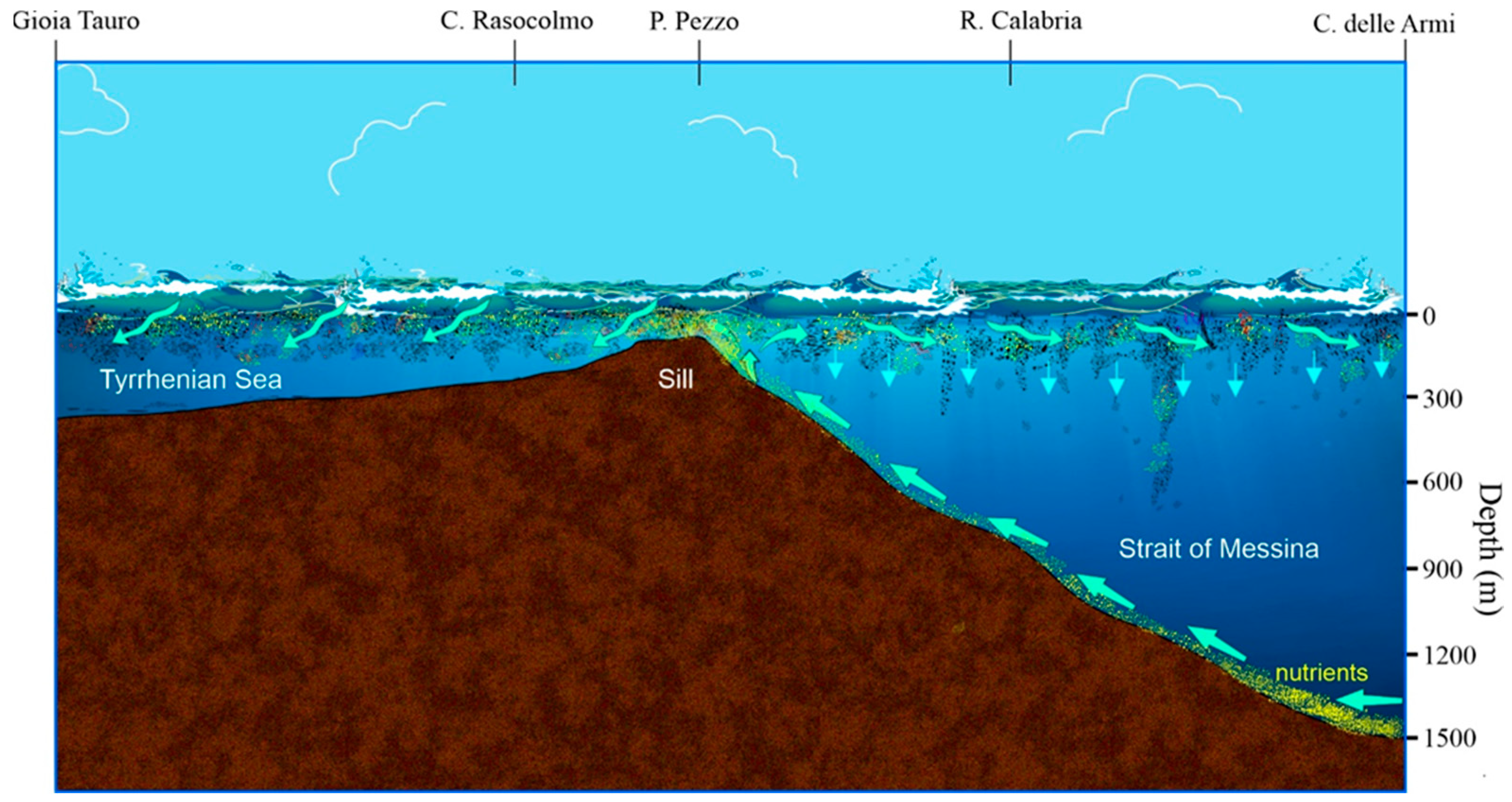
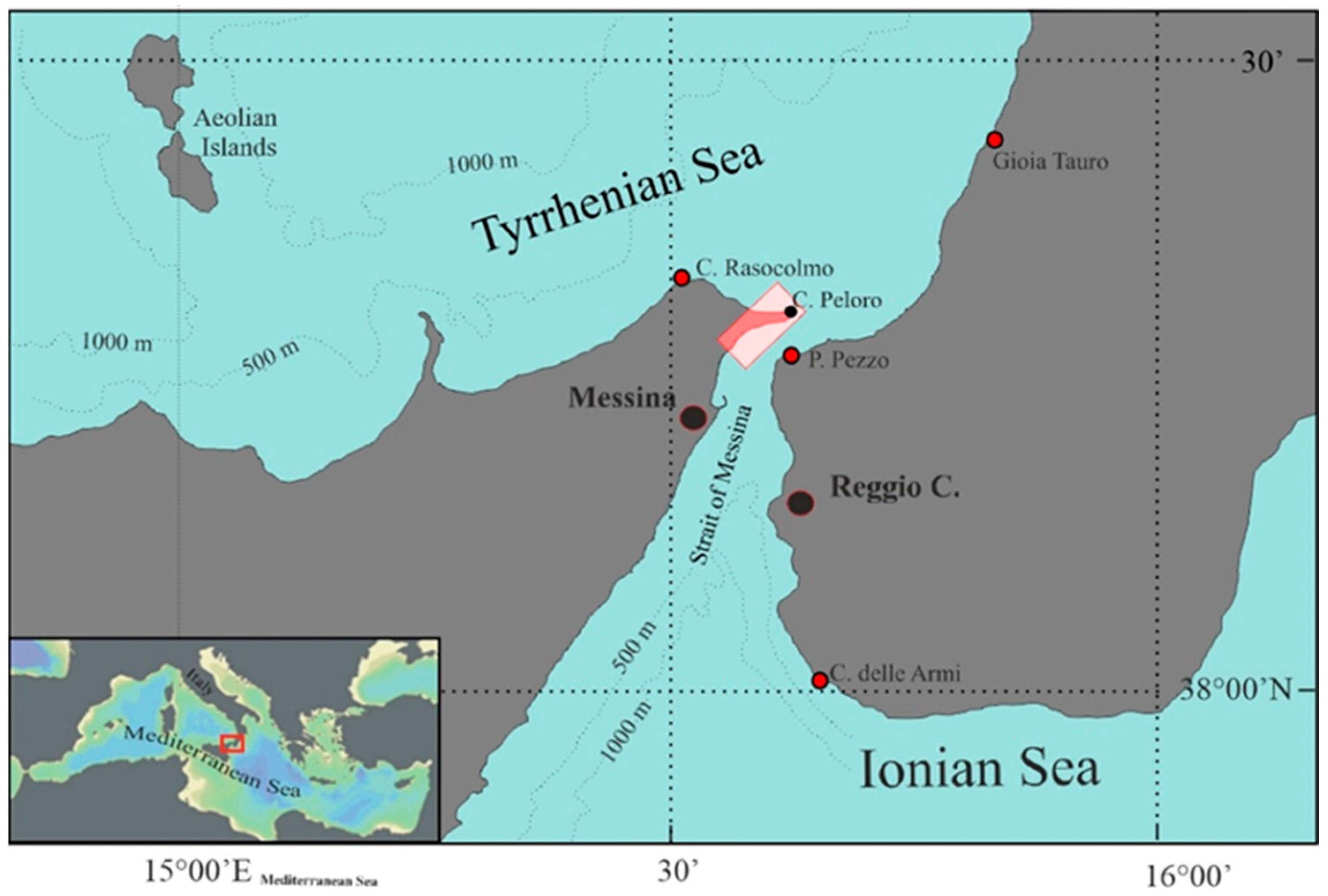
The Strait of Messina represents one of the most productive pelagic ecosystems in the Mediterranean Sea. Its unique characteristics are determined by geomorphological conformation of the seabed, the opposing tidal phases of the two neighboring seas, the northern Ionian and the southern Tyrrhenian, and the different physical and chemical characteristics of their water masses. It is funnel shaped, with the widest and deepest part facing south towards the Ionian Sea (2000 m in front of Capo d’Armi) and the narrowest and shallower part towards the northern Tyrrhenian entrance (about 3 km wide and about 75 m deep at the threshold rising between Punta Pezzo, Calabria, and Ganzirri, Sicily; Figure 2 and Figure 3). This geomorphology determines complex and turbulent hydrodynamic processes [40,41,42,43,44], characterized by the formation of advective vortices and strong horizontal current cuts, generally located close to the most prominent capes (Capo Peloro, Sicily, and Punta Pezzo, Calabria). The lunar phases influence the tidal currents, which can reach speeds of 300 cm s−1 during the new and full moon, speeds that can increase up to 500 cm s−1 in conjunction with other factors such as wind drift, meteorological waves, atmospheric pressure, and turbulence [45]. Two stationary tidal currents alternate regularly every 6 h (semi-diurnal): the “montante” (ascending current, Figure 2), which flows from the Ionian Sea to the Tyrrhenian Sea, causing an upwelling of colder and saltier Ionian deep waters, especially from the mesopelagic zone (200–1000 m), and the “scendente” (descending current), which flows superficially from the Tyrrhenian Sea towards the Ionian Sea, dragged by the surface cyclonic circulation [40,41,42,43,44,46]. The first is the most important from a biological point of view, as on the one hand it mixes the nutrient-rich Levantine Intermediate Waters (LIW) with the surface waters of the Atlantic, enriching the euphotic layer for the benefit of the entire food chain (Figure 2). Furthermore, depending on the prevailing wind, it determines the stranding of meso- and bathipelagic organisms both along the Sicilian coast of Messina (southern sirocco winds) and along the Calabrian coast (northern mistral winds).

2.1.2. Ecological Features

The continuous supply of nutrients due to upwelling currents (Figure 2) makes the Strait of Messina a highly productive ecosystem, resulting in high biodiversity at all levels of the pelagic food chain, from micro-phytoplankton to zooplankton, up to micronekton (such as euphausiids, pelagic decapods, and mesopelagic fish) [47,48]. Maximum fluorescence values have been recorded during the spring season in the southern area of the Strait [49,50]. It has also been known for a long time [48] that in some particular areas of the Strait there are “accumulations” of zooplankton organisms, many of which, considered rare in the Mediterranean Sea, reach significant concentrations of individuals [47,51,52,53,54]. Upwelling currents also cause the regular stranding of mesopelagic and bathypelagic organisms [30,32,55]. Consequently, this upwelling system attracts predators from different trophic levels [47,56], constituting feeding areas for both top predators such as tuna (Thunnus thynnus), swordfish (Xiphias gladius), albacore (Thunnus alalunga), and for many marine mammals that cross the Strait of Messina during their migrations [57].

2.2. Samples Collection

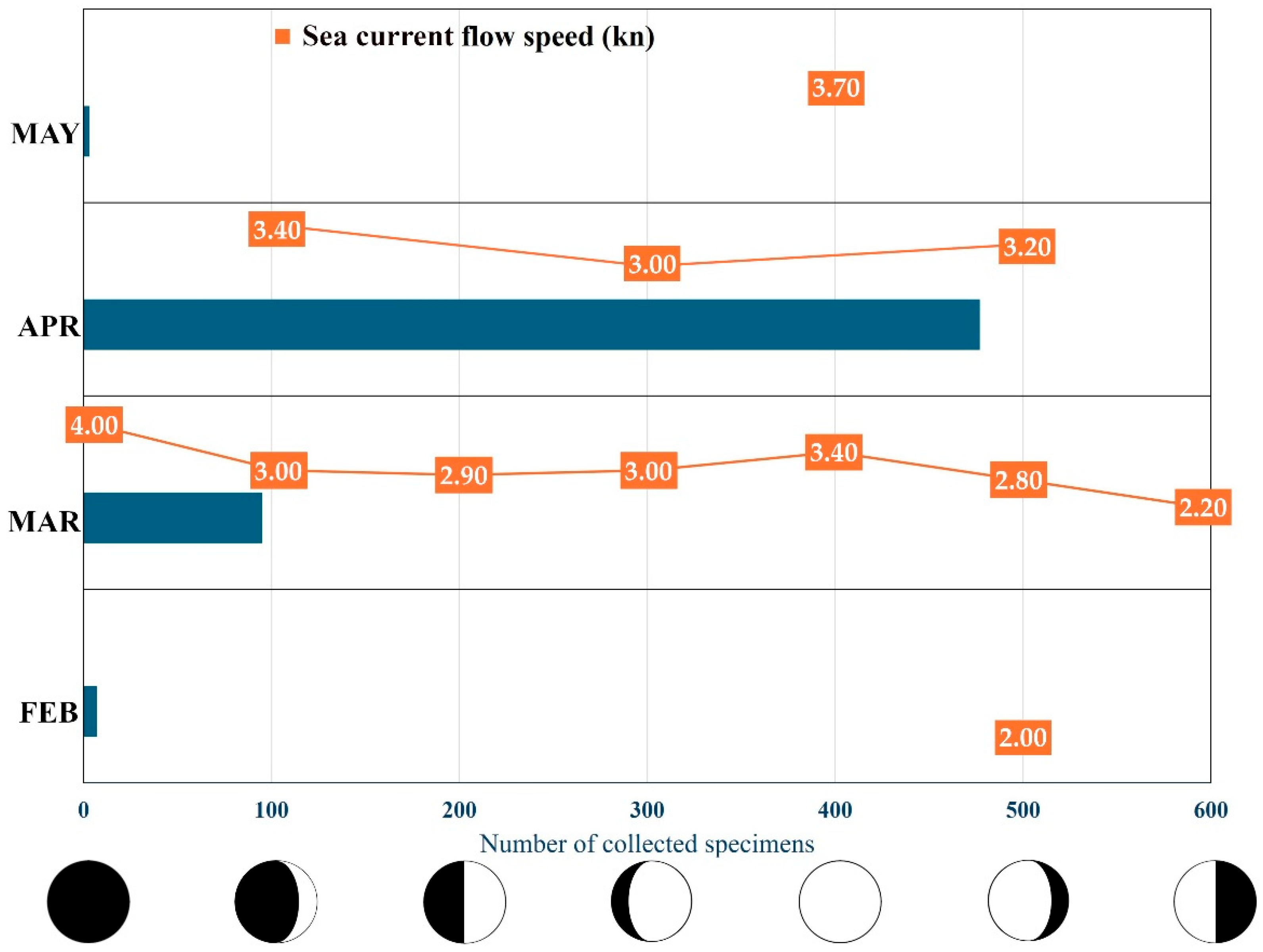
A total of 582 Macroramphosus gracilis specimens stranded from the first half of February 2025 to the first half of May 2025 were collected from the Sicilian coast of the Strait of Messina (Figure 3). Sampling was carried out by going to the beach at Capo Peloro whenever favorable conditions—namely, southerly winds and ascending currents—occurred, according to current speed and direction information available online (https://strettoindispensabile.eu/correnti/cds.html (accessed on 10 January 2025). The samples were collected stranded on the shore, temporarily stored in seawater, and carried to the laboratory. It was important to proceed with sampling before dawn to avoid both the sun’s drying effect and the competition of seabirds, ants, and wasps. Figure 4 shows the number collected of M. gracilis individuals stranded in the four months from February to May, in relation to variables such as the lunar phases and the direction and speed of the rising current (S–N). A progressive increase in stranded organisms is evident from February to April, with a maximum of 477 individuals collected in April during a current of 3.0–3.4 kn. In particular, we came across an extraordinary event of mass stranding when 453 specimens of M. gracilis were found in a single night, on 3 April 2025, during the waxing crescent lunar phase. In addition to this latter exceptional massive stranding, a fairly high number of M. gracilis (53 specimens) were collected on 18 March 2025, during a waning gibbous lunar phase and a current of 2.8 knots (at peak), while in 16 other stranding events, we collected an average of 4.9 specimens. In every case, M. gracilis strandings occurred only when the ascending current exceeded two knots at its peak. Furthermore, despite visiting the sampling site whenever the aforementioned conditions were suitable for the stranding phenomenon, we did not always find M. gracilis. Specifically, in February, M. gracilis was found in only one of five stranding events; in March, in 11 out of 13 stranding events; and in April, in all 5 stranding events, one of which involved massive numbers). Only one stranding event occurred in May, during which M. gracilis was found. M. gracilis was not found in samplings conducted in other months of the year. These data are summarized in Table 1.

2.3. Data Analysis

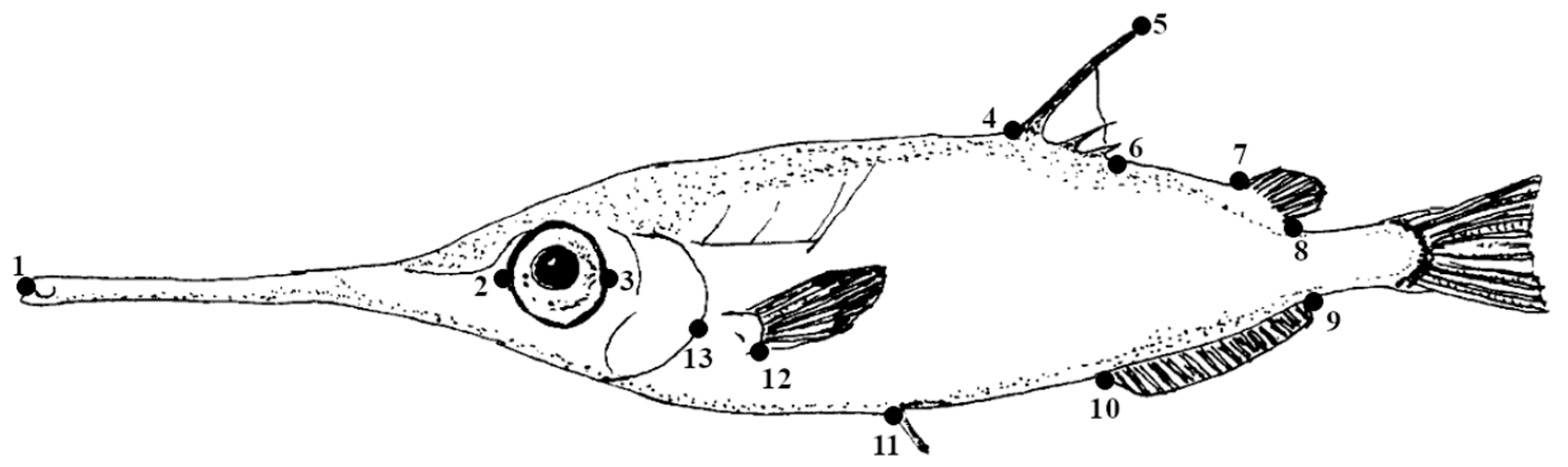
According to [1,3,5,10], a primary laboratory sorting of the specimens was performed based on characteristics such as color and body shape (Table 2). This, coupled with an assessment of morphometric ratios (see below), allowed us to assign all collected specimens to M. gracilis. Each specimen was measured to the nearest 1 mm (Standard Length, SL) using a ruler for larger individuals and graph paper for smaller ones, and weighed to the nearest 0.01 g (Wet Weight, WW). These data were then used for statistical analyses. In addition, further morphometric measurements in accordance with the methods outlined by [1,3,5,10] were taken. These measurements included SNL (Snout Length, also referred to as beak length, measured from the tip of the snout to the front edge of the eye orbit), DSL (Dorsal Spine Length, referring to the longest ray of the first dorsal fin), BH (Body Height, the maximum depth of the body), and DSFD (Dorsal Spine-Fin Distance, the distance between dorsal spine and second dorsal fin origin; see Figure 5 and Table 2).
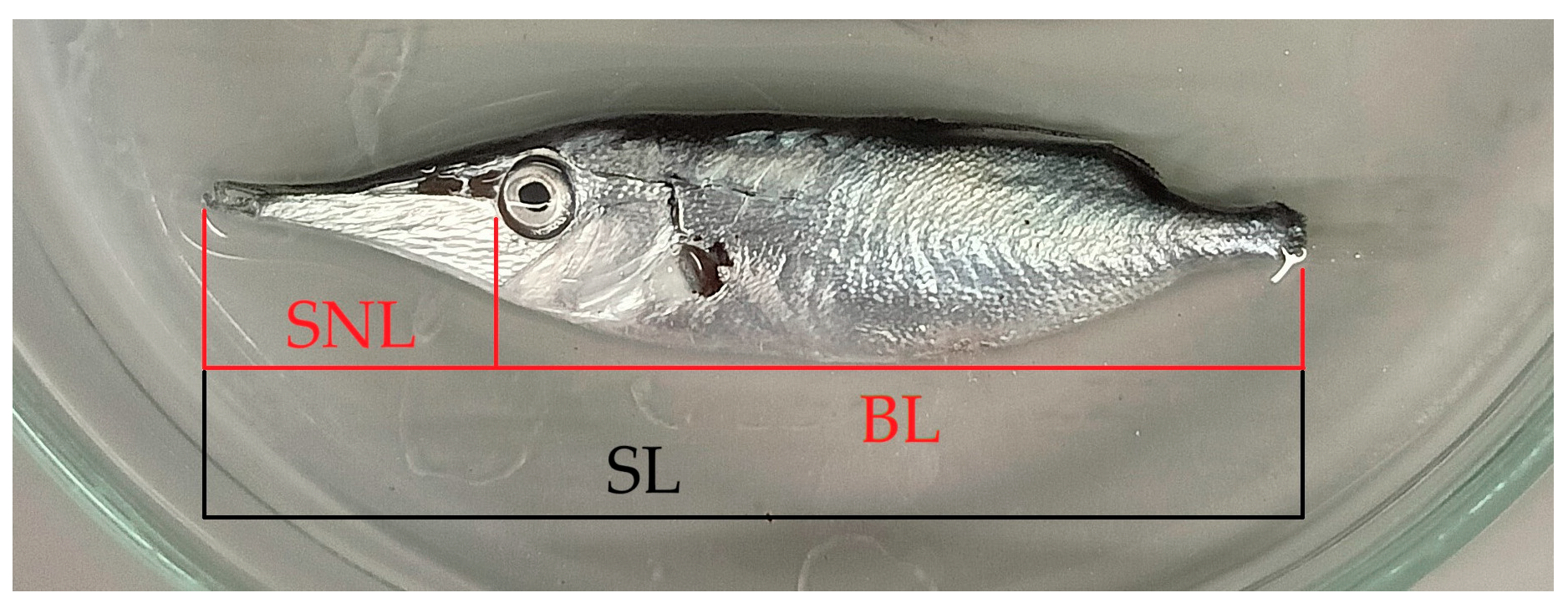
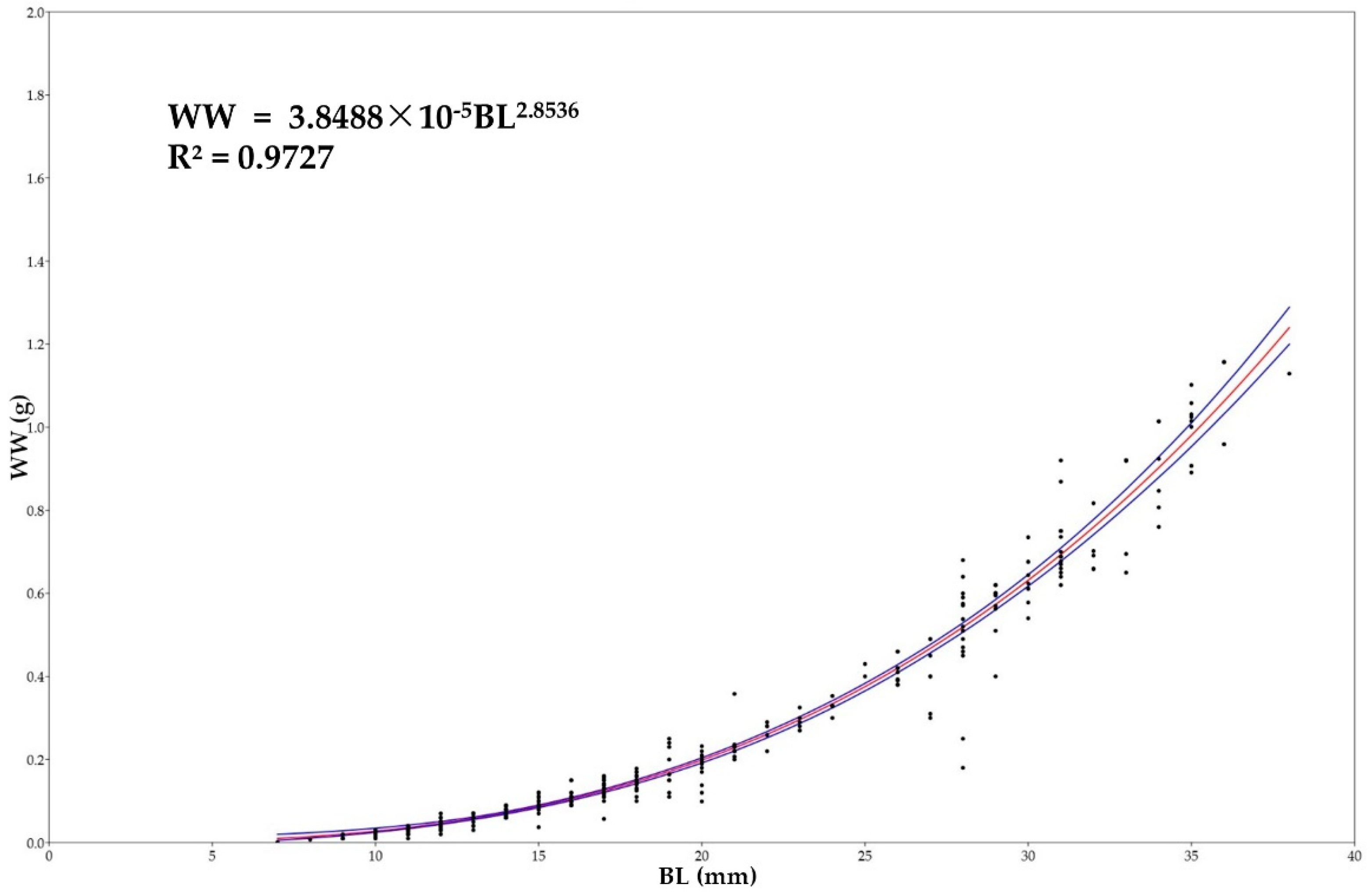
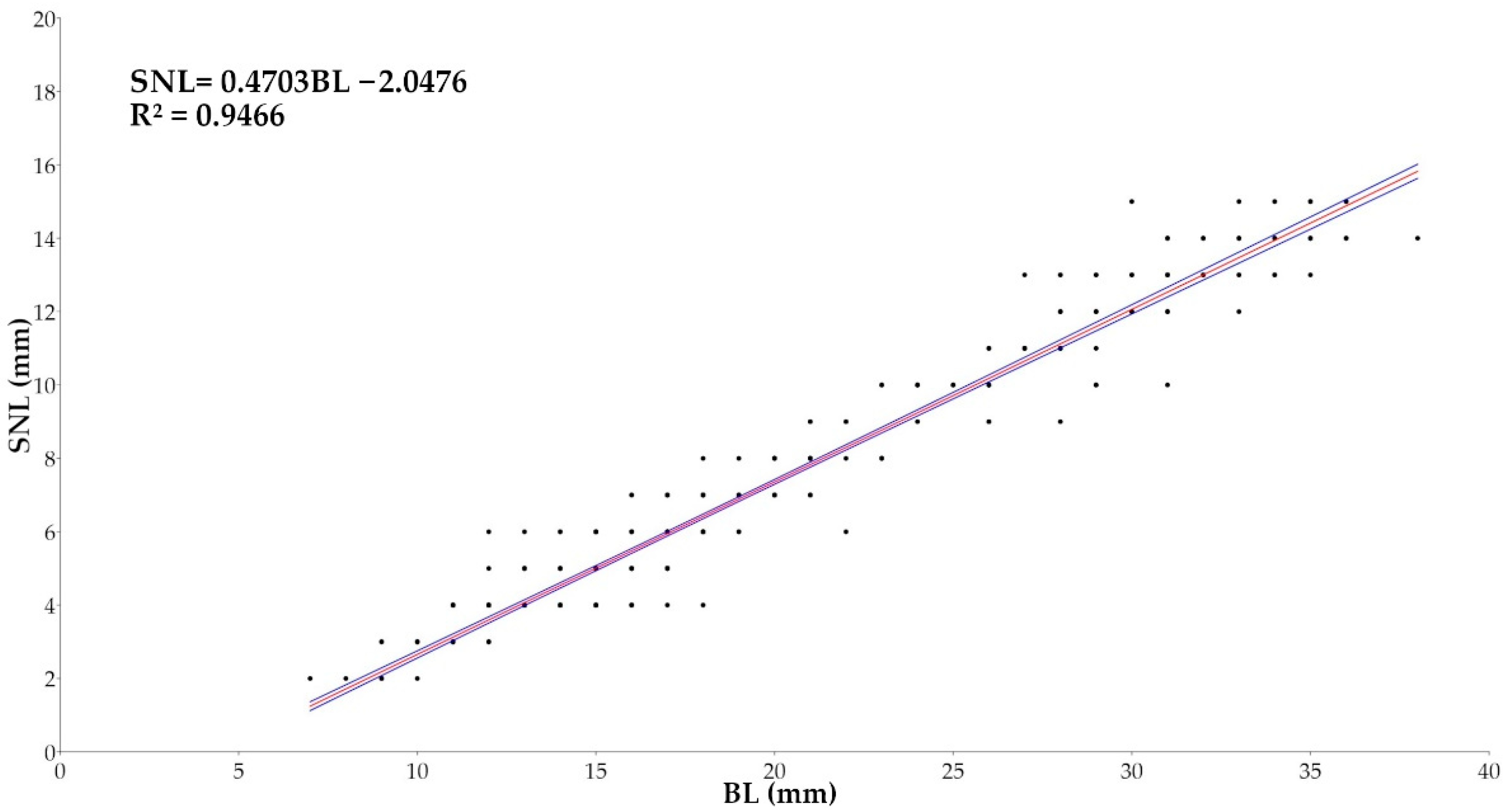
Since the length of the beak changes with size, the Body Length (BL; Figure 6), obtained by subtracting the length of the beak (Snout Length, SNL) from the Standard Length (BL = SL–SNL), is a useful morphometric measure to study the effective growth of Macroramphosus spp. [3,5]. Therefore, BL was used in place of SL in the assessment of Length–Weight relationships. The latter were calculated by the function W = aLb [58], where W is the WW measured in g, L is BL measured in mm, and a and b are constants. Instead, Length–Length relationships were calculated using the function y = ax + b, where x = BL, y = concerned, a = slope, and b = intercept. Using PAST 4.03 [59] software, obtained curve was used to interpolate weight values as a function of length. To determine whether the b-value from the Length–Weight function significantly deviates from the expected cubic value of 3, it was tested with the two-tailed Student’s t-test, as in [60].
In addition, percentage ratios between BL and other morphometric measures were used to determine without doubt the species Macroramphosus gracilis, according to the statement of [5] (see Table 2). The following ratios between the measurements were assessed:
SNL/BL = Snout Length/Body Length. Snout length should be indicative of the organism’s overall growth, considering that it is almost absent during the larval stage and longer in the adult stage;
DSL/BL = Dorsal Spine Length (the longest ray of the first dorsal fin)/Body Length. This measurement was already taken by [3], although in that paper it is indicated for Macroramphosus sp. For the present study this ratio was only used for M. gracilis;
BL/BH = Body Length/Body Height (maximum body depth). A standard measurement that was already taken by [10].
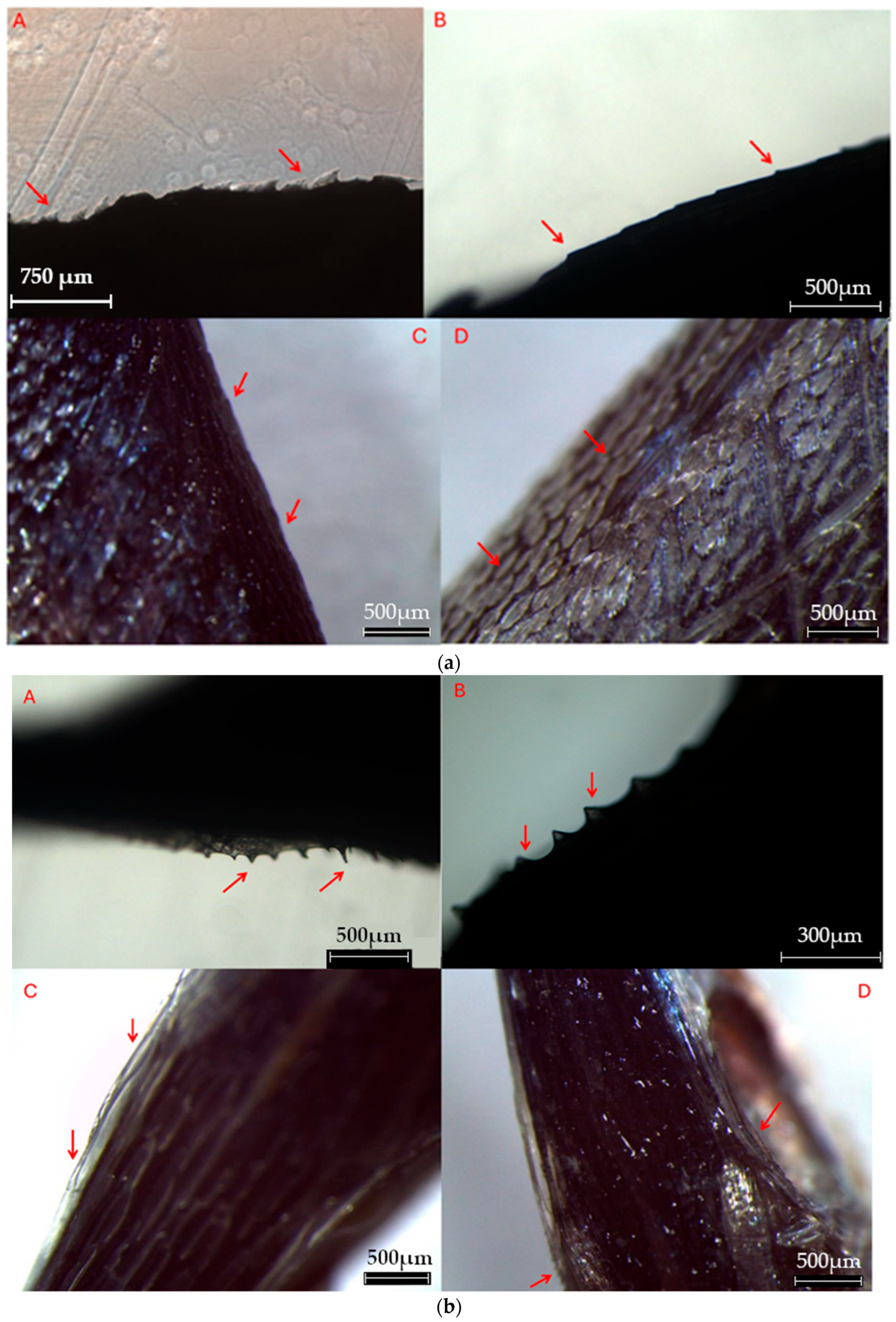
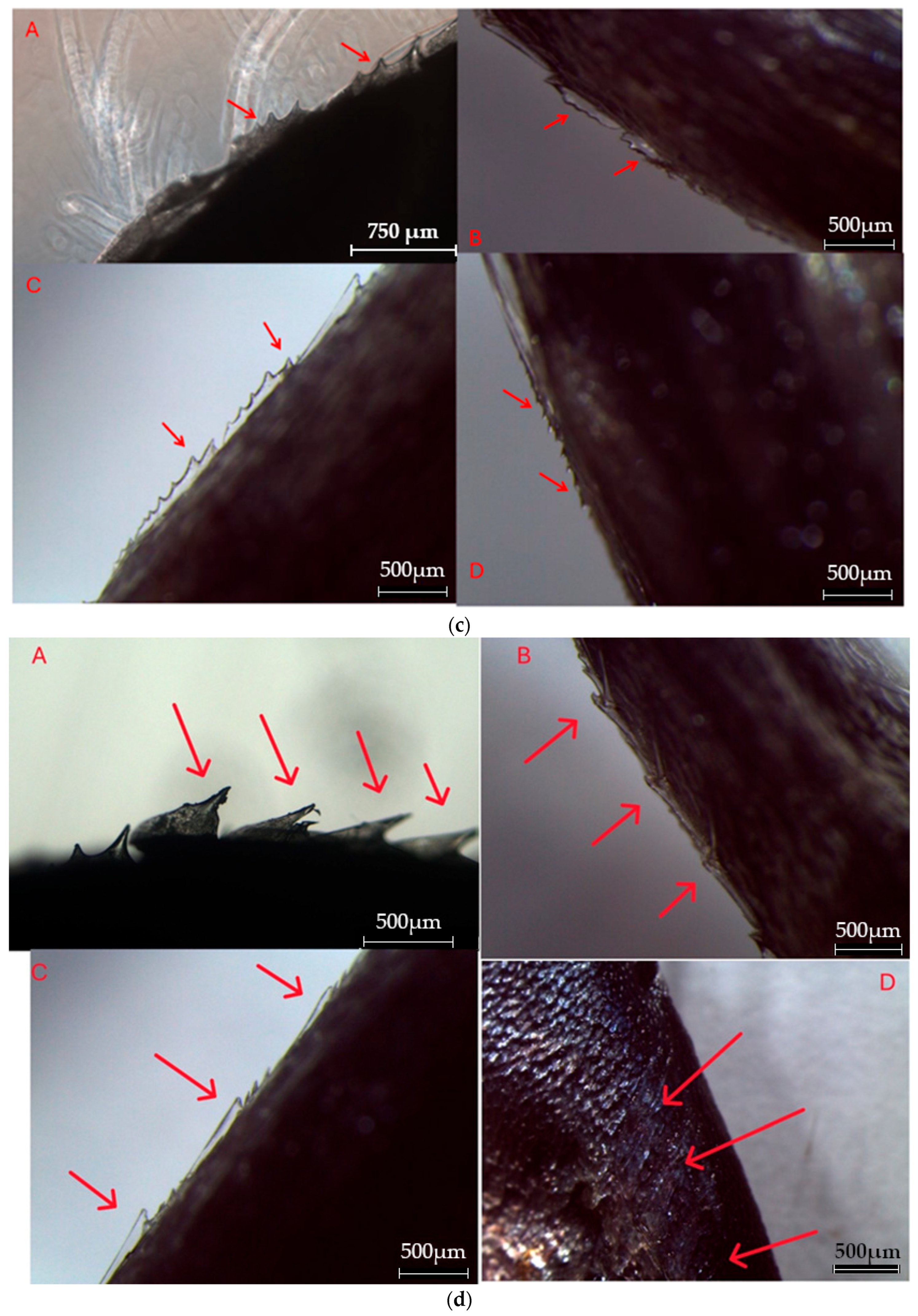
Furthermore, M. gracilis specimens were carefully observed through a LeicaWILD M10 stereomicroscope (Deer Park, IL, USA), and some morphological differences were observed between individuals. On the smallest specimens, we observed the presence of a great number of spinules, which covered almost completely the upper part of the body, from the cephalic region to the first dorsal fin and beyond (Figure 7). Details of the spinules were photographed with a Leica M0205C stereomicroscope (Deer Park, IL, USA).
Furthermore, in the smaller specimens, we observed a short and slightly upwardly curved beak, which progressively lengthens and straightens as the size increases.

3. Results

In Table 3, zooplankton, micronekton, and other deep fish stranded together with M. gracilis were listed. A total of 110 teleosts were collected: 63 in March and 47 in April. Of these, 11 species belong to mesopelagic fishes. Adult Hygophum benoiti was the species with the highest number of stranded individuals in both March and April, followed by Argyropelecus hemigymnus, Cyclothone braueri, and Vinciguerria attenuata (only in March). In order of species abundance, amphipods follow with four species and one genus (24 individuals) in March, and one species and one genus (two individuals) in April. We also found 45 individuals of the euphausiids Thysanoessa gregaria and one of Euphausia krohni (in March only). No other organisms were found stranded together with M. gracilis in May.
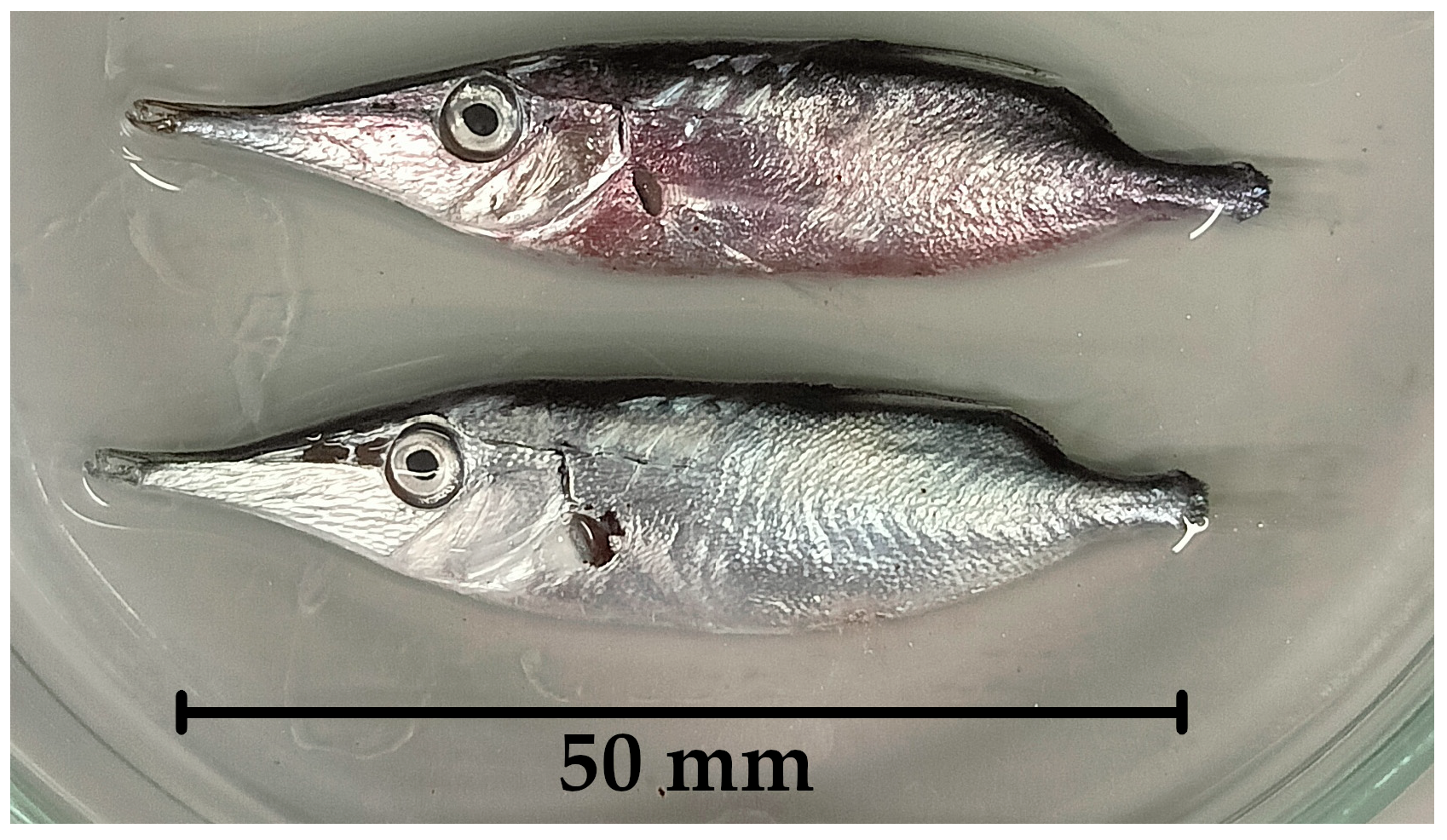
Of the 582 M. gracilis specimens found, 11 were excluded because they were damaged. From visual observation of the remaining 571 collected specimens, it was possible to notice a slender, hydrodynamic shape, a dorsally dark coloration with silver sides, and a straight ventral body profile (Figure 1 and Figure 8). In seven individuals, we observed soft shades of light red on the silver sides, slightly more evident in one of these (Figure 9). The BH/BL ratio was found in most cases to be between 20 and 30%, in accordance with what was stated by [5] for M. gracilis (Table 2), while in some of the specimens (65 out of 571) it was found to be higher, and closer to the congener M. scolopax. In seven specimens, it was found to be lower than 20% (Table 4). The remaining morphometric ratios were found in the vast majority of cases to correspond to M. gracilis [5], with very few exceptions, affecting only four individuals, in which the spine is slightly longer in relation to the body length (DSL/BL ratio = 33.3%, while the maximum for M. gracilis is 32.6% [5]).
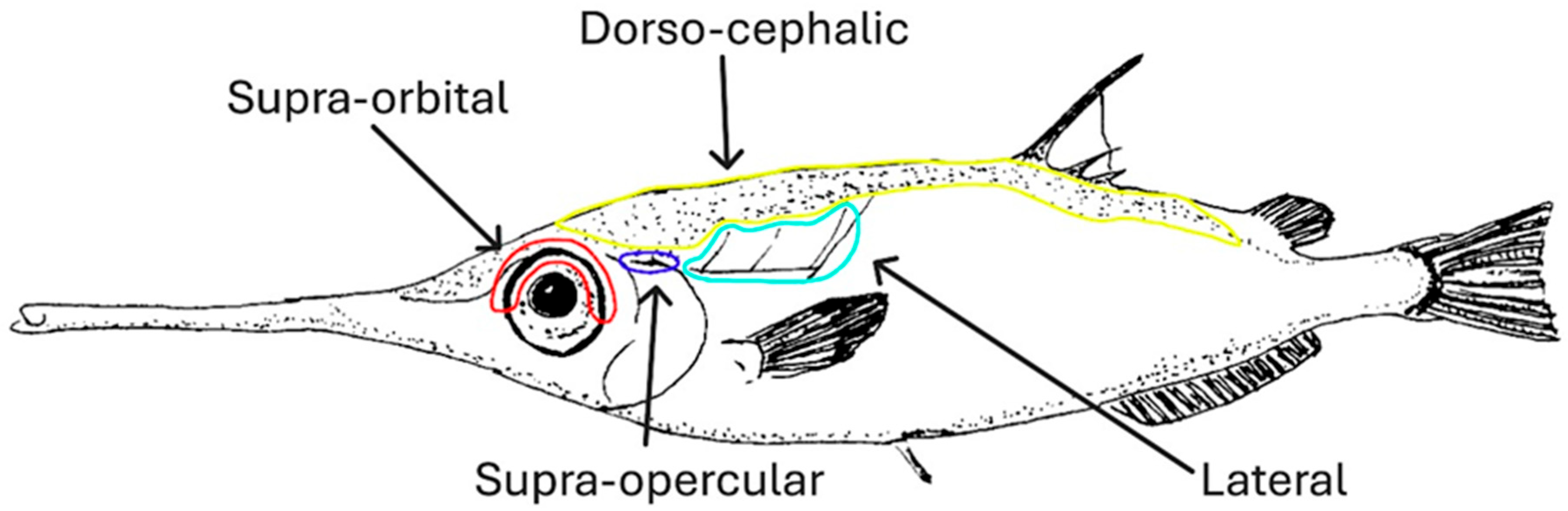
We named the spinules sets as it follows: dorso-cephalic spinules (Figure 10a), supraorbital spinules (Figure 10b), supra-opercular spinules (Figure 10c), and lateral spinules (Figure 10d). Based on the presence of different sets of spinules and their progressive disappearance related to growth in size, we have established four size classes: A, early post-larvae 9–27 mm SL (n = 432); B, mid post-larvae 28–34 mm SL (n = 31); C, late post-larvae 35–45 mm SL (n = 75); D, early juvenile stage > 46 mm SL (n = 33). We observed all the spinules sets on individuals up to 27 mm SL, which could be considered an early transition from larval to juvenile stage. The dorso-cephalic ones, well evident in the first size class, had almost completely disappeared in the range 28–34 mm, and only a supraorbital serrated pair of spinules, two supra-opercular serrated pairs of spinules, and three straight pairs of spinules on the lateral line remained. From each pair of spinules on the lateral line, a row of smaller spinules originates, and continues up on the dorsal side. On specimens from 35–45 mm SL, while we observed the absence of the supraorbital set, the other two sets were still present, with the only difference being their smaller size. Finally, for individuals larger than 46 mm SL, we observed no spinules at all, a feature that recalls the adult form.
Figure 11 shows a slightly negative allometric relationship between length and weight, in which weight increases less rapidly than length. Data are fairly well distributed around the curve, indicating an excellent quality of model fit (the coefficient of determination R2 resulted equal to 0.9727). Some points are out of trend (outliers), visible especially around BL ≈ 25 mm and BL ≈ 30 mm, which means that the remaining 2.73% of the variation can be due to other factors (biological variability, environmental conditions, etc.). The b value = 2.8536 indicates negative allometric growth, with 95% confidence intervals ranging from 2.786 to 2.917 (represented in the plot as the blue lateral curves). Student’s t-test results revealed that the b-value significantly deviated from 3 (p < 0.0002).
The relationship between BL and Snout Length (SNL) (Figure 12) showed a slope of 0.4703, with 95% confidence interval ranging from 0.46017 to 0.48012 (represented in the plot as the blue lateral lines), suggesting a negative allometric growth, which means that the Snout Length grows slower than the Body Length. The high value of R2 = 0.9466 and p-value < 0.0001 confirm the statistical robustness of the model, and suggests that 94.66% of variability in SNL is explained by BL.
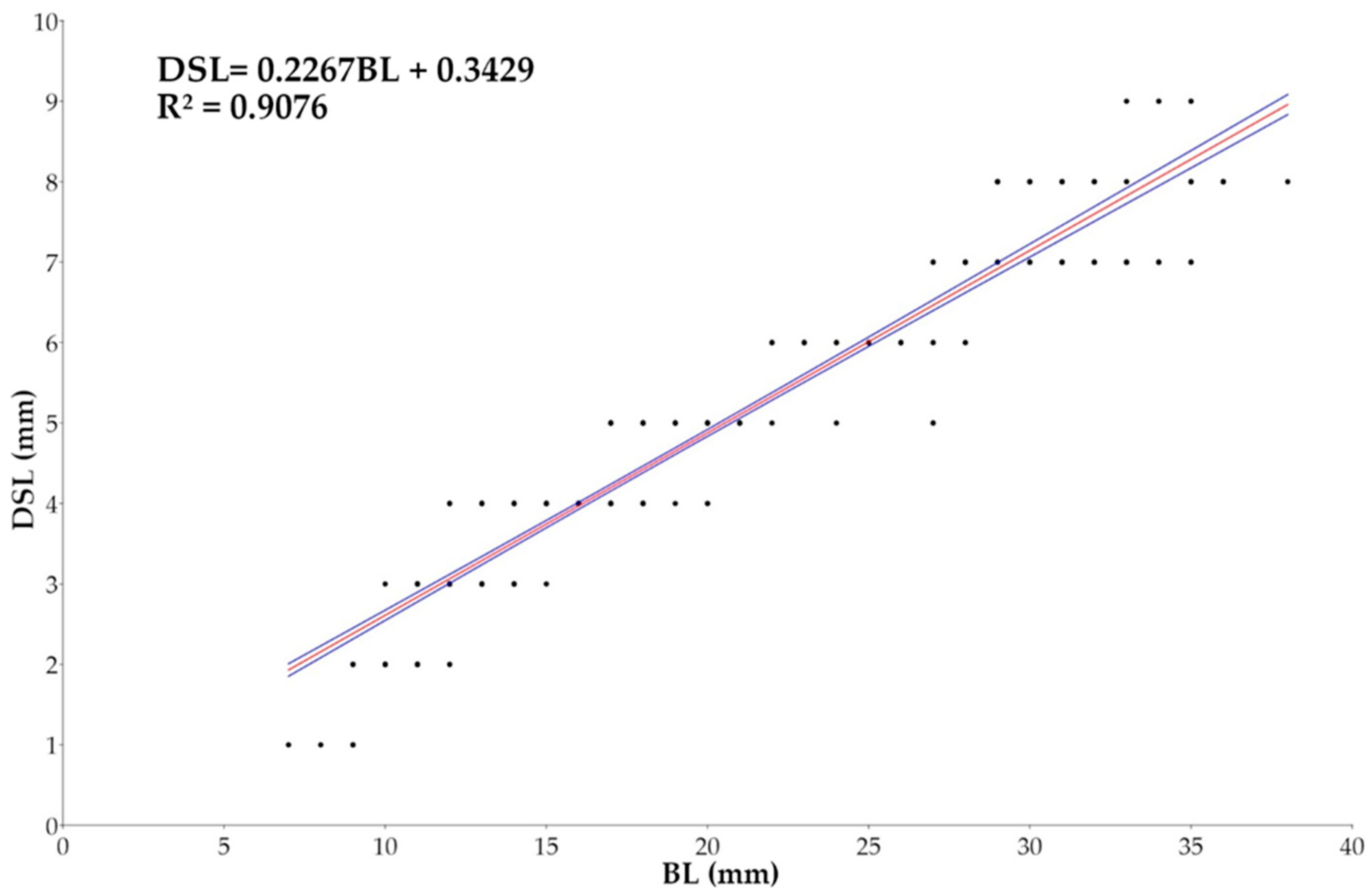
The relationship between BL and Dorsal Spine Length (DSL) (Figure 13) showed a slope of 0.2267, with 95% confidence interval ranging from 0.21859 to 0.23528, suggesting a negative allometric growth that translates in Dorsal Spine Length growing slower than BL. The high value of R2 = 0.9076 and p-value < 0.0001 suggests that 90.76% of variability in DSL is explained by BL.
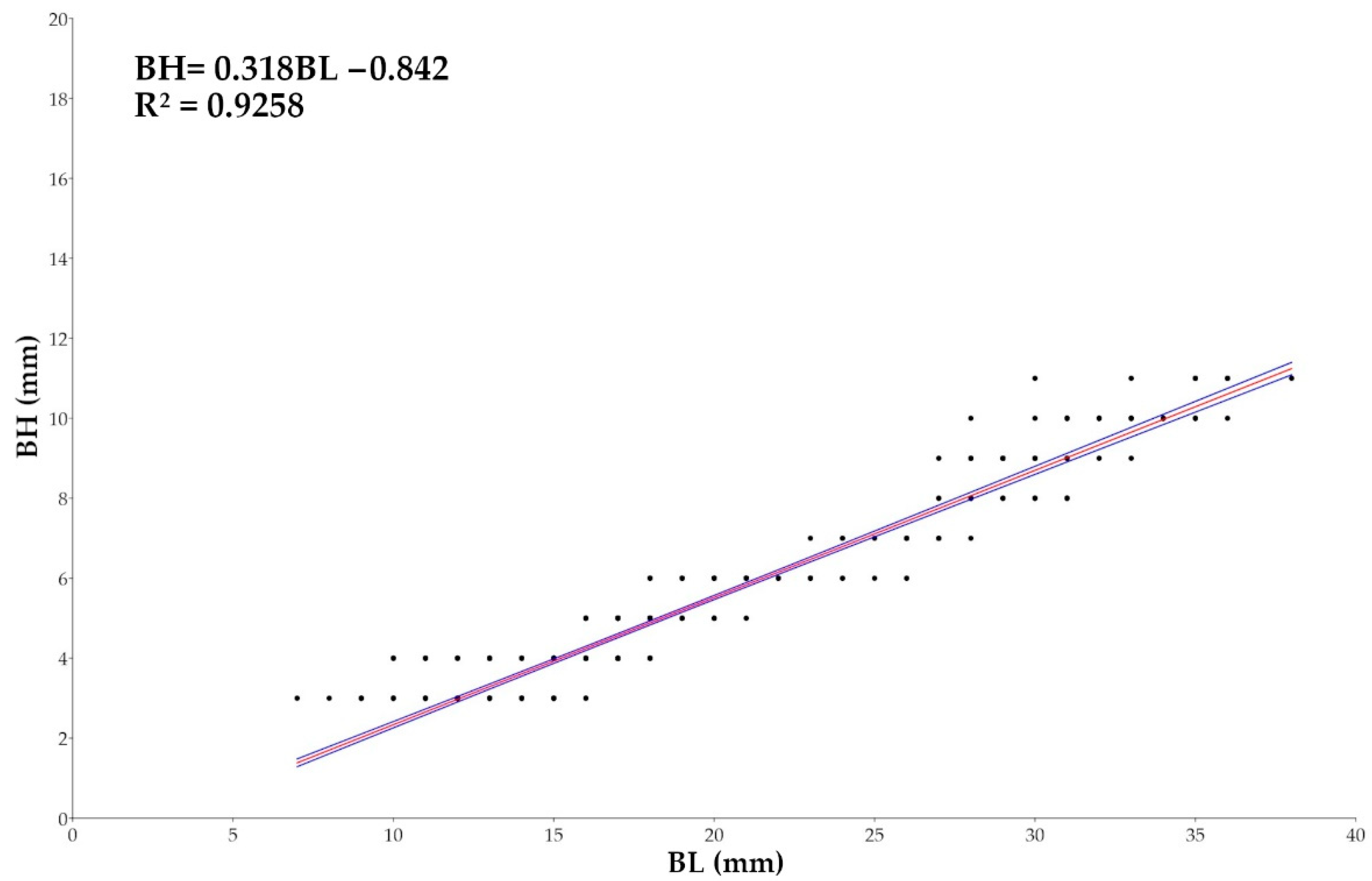
The relationship between BL and Body Height (BH) (Figure 14) showed a slope of 0.318, with 95% confidence interval ranging from 0.30981 to 0.32581, which suggests a negative allometric growth where BH grows slower than BL. A highly significant correlation (R2 = 0.9258 and p-value < 0.0001) confirms the statistical robustness of the model, suggesting that 92.58% of variability in BH is explained by BL.
Since all these intervals showed a negative allometric growth, it can be concluded that, proportionally, all the values reported as dependent variable (y axis) grow slower than the independent variable (BL). In other words, all the other morphological features remain smaller in proportion to the body length throughout all the individuals examined, even though some of the considered body parts seem to grow faster than the others, like SNL.

4. Discussion

The reported results allowed us to unequivocally assign all investigated specimens to the species Macroramphosus gracilis. Indeed, both visual observation and morphometric measurements and ratios match those reported by [1,5,8,9,10] for M. gracilis. In our opinion, some slight discrepancies may be due to possible intraspecific variability in the local population, which in turn could be due to the unique ecological characteristics of the study area [40,41,42,43,44,45,46,47,48,49,50,51,52,53,54]. In addition, the vast majority of the observed variations from the characteristics reported by [1,5,8,9,10] are very slight in their entity. Among these, the livery of some specimens is only mildly different from the typical coloration of M. gracilis. In fact, these seven individuals (Table 4) exhibited only a simple red shade on a silver background, which is very different from the peculiar red-orange color of M. scolopax [5]. Furthermore, a certain intraspecific morphological variability is also found in the congener M. scolopax [1,3,4,9,10], but this does not prevent us from clearly and unequivocally distinguishing between the two species [1,5,8,9,10].
The M. gracilis specimens we examined were classified as post-larval between 9 and 45 mm SL because, in this size range, they presented characteristics intermediate between those of larvae (presence of spinules, although these decrease with growth, short and slightly upwardly curved beak, see [5]) and those of juveniles (silvery livery similar to that of adults, progressive elongation of the beak, and similarly progressive reabsorption of the spinules). According to [61], post-larval stages begin with the first morphological and physiological changes necessary for adult life. We believe this is even more true for organisms where there is a marked change in habitat and habits between larvae and adults. In particular, the spinules could be useful to M. gracilis larvae to improve buoyancy, a particularly important ability in their typical hyponeustonic habitat [5]. In fact, planktonic organisms, which include fish larvae, improve their buoyancy by increasing hydrodynamic resistance through the development of numerous small spines [62]. The progressive reabsorption of the spinules in the post-larvae of M. gracilis (9–45 mm SL) is consistent with the change in habits, from hyponeustonic to benthopelagic, that occurs between larvae and adults [5,11].
All the plots shown in the result section display a high goodness of fit in the regression models. The length–weight relationship shows that this fish grows faster in length and slower in weight. This means that when they finally reach the adult stage, they should obtain a slenderer shape; this feature is totally reasonable given that the specimens examined in this paper were collected stranded by the upwelling strong current, typical of the Strait of Messina. In fact, this kind of shape is expected from species that live in turbulent environments where they need to be agile to swim through strong currents. A fish with a laterally compressed shape, which according to [63] exhibited negative allometric growth, is P. erythrinus, with a calculated b-value of 2.8545, very close to that found for M. gracilis in the present study (2.8536). Incidentally, P. erythrinus is known to have benthopelagic habits [64,65,66], similarly to what [11] stated for adult individuals of M. gracilis (see also [5]). Also, according to [63], pelagic fish with a hydrodynamic shape, such as Scomberomorus tritor and Etrumeus golani, showed negative allometric growth, with b values of 2.8502 and 2.4197, respectively. Conversely, a more strictly benthic fish having a stockier shape, such as Sparisoma cretense, exhibited positive allometric growth, with a value of b= 3.1203 [63].
According to [8], M. gracilis may be a better swimmer than M. scolopax due to its slender and fusiform body. This feature may increase capture success in off-bottom waters, thereby reducing hydrodynamic drag [67]. This underlines that the major body shape difference between M. gracilis and M. scolopax could be due to the different environment for which they adapted: is in fact known that M. scolopax lives mostly as a demersal species, feeding on soft seabeds using the long beak-like mouth to strike and catch prey with high speed [68], while M. gracilis is a benthopelagic species [11] and feeds mostly on prey like pelagic plankton [1,5,8]. This is probably what [1,11] were reporting in their papers, even though they only identified the fishes from the genera Macroramphosus as type-b (benthic) and type-p (pelagic) feeding, with a low frequent intermediate feeding type. This difference is observed also in [5], where they give the name of B-type and D-type to fishes that feed in a similar way respectively to type-b and type-p from [1,11]; and then finally, [8] links the feeding type to the two species, confirming that the p-type corresponds to M. gracilis.
Moreover, ref. [5] stated that larvae and post-larvae measuring 5.6–36.5 mm SL were still present at the surface in the month of April, meaning that they were probably still feeding on pelagic plankton before growing and descending to the continental slope. This could be a quite similar situation to the one presented herein; in fact, all the specimens examined in this paper were under 52 mm SL and probably not even a year in age following the length–age table from [6]. The fact that only post-larvae and juveniles were stranded on the beach could mean that no adults were present in the Strait of Messina, as they live near soft seafloors even though capable of pelagic migrations, as seemingly confirmed by [5], where they assert that some sand was found in some d-type stomachs. Given the fact that the soft seafloor is scarcely present on the Ionian side of the Strait due to hydrodynamic conditions [69], the absence of adult individuals could be due to the lack of habitat, which does not affect the juvenile population, as they only need the epipelagic zone in order to sustain themselves. Therefore, we can hypothesize that the Strait of Messina could represent a nursery area and/or a feeding area for M. gracilis larvae and juveniles, given its high productivity [49,50] that results in important trophic effects and a rapid short food chain [70] and, consequently, high concentrations of prey, making the Strait of Messina a zone of food accumulation and “insemination” of neighboring areas [47,56,71]. Once adults, M. gracilis larvae and juveniles may migrate southeastward to the eastern Mediterranean basin, where M. gracilis has been repeatedly found [23,24,25,26,27], while its presence in the western Mediterranean basin is still uncertain.
The high food availability in the Strait of Messina may cause the population of M. gracilis to present higher rates of growth in comparison to those found in the Atlantic Ocean. Borges [6] stated that M. gracilis presents an isometric growth, while we found a slightly negative allometric growth, meaning that, in the Strait, M. gracilis specimens are longer in relation to their weight. This could be a similar situation to the one described in [72], where individuals of the jellyfish Pelagia noctiluca that were feeding in this area grew at a much faster rate than normal. For M. gracilis, this could translate into reaching the first maturity size faster than in other areas of the world. A similar scenario could be happening in the coastal waters of Portugal, where fishes of the genera Macroramphosus grow faster than the same species found in Marocco Atlantic waters, an environment subject to cold upwelling events that increase the productivity of the area [6].
Therefore, it is possible that the Strait of Messina represents an exclusive and crucial zone for the reproduction and the growth for M. gracilis in the eastern basin of the Mediterranean Sea due to its peculiar characteristics, like colder and highly productive waters [50]. Indeed, ref. [6] stated that reproduction of Macroramphosus sp. occurs over a time span from late winter to early spring (January to March in the northeastern Atlantic Ocean) [2,6,73], which is consistent with our sampling of early post-larvae (n = 432) from February to May. Furthermore, the seawater temperature in the Strait of Messina is significantly lower than in the rest of the Mediterranean Sea due to its upwelling dynamics [53], which is perfectly in line with [2], which considers the temperature range of 16–24 °C optimal for the survival of this species and consequently for its reproduction.
This could be confirmed by our findings, plotting Body Length in function of the Dorsal Spine Length, the Snout Length, and the Body Height; all the ratios presented a negative allometric growth, which means that the three lengths grew slower in relation to BL, which in turn grows faster in relation to weight. As stated earlier, all these morphological changes may be an ecological adaptation to benthopelagic habits in adult individuals of M. gracilis. A shorter dorsal spine, coupled with a shorter and hydrodynamic-shaped snout and a lower body height, reduces hydrodynamic drag. This may align with a better swimming ability, useful for broader displacement through the water column, granting the adults access to both pelagic and benthic food resources [1,5,8,11,67], unlike what is stated for M. scolopax, which shows a significant preference for a benthic diet [1,5,8,22,74] and therefore needs a higher maneuverability near the seabed [75] and a longer snout for catching benthic prey [68]. Moreover, M. scolopax presents a bigger dorsal spike [5], which could highlight a predator avoiding strategy [76,77] less based on a fast escape, in contrast to M. gracilis [78]. This latter, in particular, could use schooling behavior to protect themselves from predation [79,80], taking advantage by both their good swimming ability [1,5,67] and their coloration, dark dorsally with silver sides [5], which we were able to observe in this study. This pigmentation in fact helps pelagic fish in the euphotic zone through countershading, camouflaging themselves when seen from below thanks to their pale belly. Conversely, when seen from above, thanks to the dark upper part, they appear less visible against the darker background of deeper waters. Furthermore, they exploit the reflectivity to confuse the sight of predators through the already mentioned schooling behaviors [79,80]. In comparison, the red-orange pigmentation of M. scolopax helps it to camouflage itself in the deeper water layers, close to the bottom where it lives, since unlike M. gracilis, it inhabits the epipelagic/hyponeustonic zone only at the larval stage (below 12 mm SL) [5]. In fact, the red color is among the first to fade first with increasing depth [81], as seen in red crustaceans [80].
However, we could not determine the exact depth at which the stranded specimens collected could have been living, and we can only hypothesize that they were living in the upper euphotic zone and possibly, for the larger individuals, in deeper areas. The fact that this fish was found stranded more often with non-migrant mesopelagic species such as Argyropelecus hemigymnus, Cyclothone braueri, Maurolicus muelleri, some amphipods species, and strong migrant species as Hygophum benoiti and Vinciguerria attenuata [31,82] could indicate that our post-larvae specimens of M. gracilis could occupy the upper epipelagic euphotic zone, and the juveniles instead occupy the mid-euphotic zone, respectively. The lack of stranded adult Macroramphosus specimens together with mesopelagic fish confirms that they are not present in this bathymetric range. To confirm this, more studies on the trophic ecology of this fish are required, with a particular focus on the juveniles and on the specimen stranded in the Strait of Messina. In fact, identifying prey items could reveal their feeding habits and therefore trace their movements.
From a fisheries perspective, as already mentioned, neither M. gracilis nor M. scolopax have any commercial or food importance for humans, at least in Italian waters [22]. However, M. scolopax is known to be part of the diet of several demersal fishes, such as Zeus faber [83], Pagellus bogaraveo and P. acarne [84], Scyliorhinus canicula [85], and finally of the very commercially important European hake Merluccius merluccius [86]. Nevertheless, we think the lack of knowledge about the whole ecology of Macroramphosus gracilis could be because, in the past, this species was often confused with M. scolopax, as stated previously. This may be even more true in the case of dietary studies, considering that digestive processes can make prey recognition more complicated, increasing the probability of misidentification. Moreover, otoliths of both species of Macroramphosus are very similar to each other [87], and the identification could be uncertain. Further studies will be useful to shed light on this and other aspects of the ecology of M. gracilis, including potential assessment of threats and pollution sensitivity, its role in the trophic chain, and its potential as prey of commercial fishes.

Author Contributions

Conceptualization, A.G. (Andrea Geraci), A.S., R.M., D.D.P., L.G. and A.G. (Antonia Granata); Methodology, A.G. (Andrea Geraci), A.S. and Y.G.; Software, D.D.P. and P.C.; Validation, A.G. (Andrea Geraci), A.S., R.M., S.G. and A.G. (Antonia Granata); Formal Analysis, A.G. (Andrea Geraci), A.S. and D.D.P.; Investigation, A.G. (Andrea Geraci), A.S., Y.G., R.M., D.D.P., P.C., L.G., S.G., R.F. and A.G. (Antonia Granata); Data Curation, A.G. (Andrea Geraci), A.S. and L.G.; Writing—Original Draft Preparation, A.G. (Andrea Geraci), A.S., Y.G., R.M., D.D.P., P.C., L.G., S.G., R.F. and A.G. (Antonia Granata); Writing—Review & Editing, A.G. (Andrea Geraci), A.S., R.M., L.G. and A.G. (Antonia Granata); Supervision, A.G. (Antonia Granata). All authors have read and agreed to the published version of the manuscript.

Funding

This research received no external funding.

Data Availability Statement

Data are contained within the article. Further inquiries can be directed to the corresponding authors.

Conflicts of Interest

The authors declare no conflicts of interest.

References

  1. Matthiessen, B.; Fock, H.O.; von Westernhagen, H. Evidence for two sympatric species of snipefishes Macroramphosus spp. (Syngnathiformes, Centriscidae) on Great Meteor Seamount. Helgol. Mar. Res. 2003, 57, 63–72. [Google Scholar] [CrossRef]
  2. Brêthes, J.C. Contribution à l’étude des populations de Macrorhamphosus scolopax (L., 1758) et Macrorhamphosus gracilis (Lowe, 1839) des côtes atlantiques marocaines. Bull. L’institut Pêches Marit. Maroc 1979, 24, 1–69. [Google Scholar]
  3. Clarke, T.A. Diet and morphological variation in snipefishes, presently recognized as Macrorhamphosus scolopax, from southeast Australia: Evidence for two sexually dimorphic species. Copeia 1984, 1984, 595–608. [Google Scholar] [CrossRef]
  4. Assis, C.A. On the systematics of Macrorhamphosus scolopax (Linnaeus, 1758) and Macrorhamphosus gracilis (Lowe, 1839). II—Multivariate morphometric analysis. Arq. Mus. Bocage 1993, 22, 383–402. [Google Scholar]
  5. Miyazaki, E.; Sasaki, K.; Mitani, T.; Ishida, M.; Uehara, S. The occurrence of two species of Macroramphosus (Gasterosteiformes: Macroramphosidae) in Japan: Morphological and ecological observations on larvae, juveniles, and adults. Ichthyol. Res. 2004, 51, 256–262. [Google Scholar] [CrossRef]
  6. Borges, L. Age and growth of the snipefish, Macrorhamphosus spp., in the Portuguese continental waters. J. Mar. Biol. Assoc. U. K. 2000, 80, 147–153. [Google Scholar] [CrossRef]
  7. Farah, I.H.; Kamal, M.; Mahfoud, B.; Najib, C. Snipefish (Macroramphosus spp.) abundance and trophic dynamics in response to upwelling regime in the atlantic region from cape blanc to cape boujdor (20°50 N to 26°00 N). Int. J. Prof. Bus. Rev. 2024, 9, e05136. [Google Scholar] [CrossRef]
  8. Matthiessen, B.; Fock, H.O. A null model for the analysis of dietary overlap in Macroramphosus spp. at the Great Meteor Seamount (subtropical North-east Atlantic). Arch. Fish. Mar. Res. 2004, 51, 294–304. [Google Scholar]
  9. Assis, C. On the systematics of Macrorhamphosus scolopax (Linnaeus, 1758) and Macrorhamphosus gracilis (Lowe, 1839). I. A preliminary biometrical approach. Bol. Soc. Port. Ciências Nat. 1992, 25, 5–19. [Google Scholar]
  10. Lopes, M.; Murta, A.G.; Cabral, H.N. Discrimination of snipefish Macroramphosus species and boarfish Capros aper morphotypes through multivariate analysis of body shape. Helgol. Mar. Res. 2006, 60, 18–24. [Google Scholar] [CrossRef]
  11. Christiansen, B.; Martin, B.; Hirch, S. The benthopelagic fish fauna on the summit of Seine Seamount, NE Atlantic: Composition, population structure and diets. Deep Sea Res. Part II Top. Stud. Oceanogr. 2009, 56, 2705–2712. [Google Scholar] [CrossRef]
  12. D’onghia, G.; Tursi, A.; Maiorano, P.; Matarrese, A.; Panza, M. Demersal fish assemblages from the bathyal grounds of the Ionian Sea (middle-eastern Mediterranean). Ital. J. Zool. 1998, 65, 287–292. [Google Scholar] [CrossRef]
  13. Gaertner, J.-C.; Bertrand, J.A.; Relini, G.; Papaconstantinou, C.; Mazouni, N.; De Sola, L.G.; Durbec, J.-P.; Jukic-Peladic, S.; Souplet, A. Spatial pattern in species richness of demersal fish assemblages on the continental shelf of the northern Mediterranean Sea: A multiscale analysis. Mar. Ecol. Prog. Ser. 2007, 341, 191–203. [Google Scholar] [CrossRef]
  14. Bilecenoğlu, M.; Kaya, M.; Cihangir, B.; Çiçek, E. An updated checklist of the marine fishes of Turkey. Turk. J. Zool. 2014, 38, 901–929. [Google Scholar] [CrossRef]
  15. Carpentieri, P.; Colloca, F.; Ardizzone, G. Day-night variations in the demersal nekton assemblage on the Mediterranean shelf-break. Estuar. Coast. Shelf Sci. 2005, 63, 577–588. [Google Scholar] [CrossRef]
  16. Guy-Haim, T.; Stern, N.; Sisma-Ventura, G. Trophic ecology of deep-sea megafauna in the ultra-oligotrophic Southeastern Mediterranean Sea. Front. Mar. Sci. 2022, 9, 857179. [Google Scholar] [CrossRef]
  17. Lauria, V.; Gristina, M.; Fiorentino, F.; Attrill, M.J.; Garofalo, G. Spatial management units as an ecosystem-based approach for managing bottom-towed fisheries in the Central Mediterranean Sea. Front. Mar. Sci. 2020, 7, 233. [Google Scholar] [CrossRef]
  18. Kovačić, M.; Lipej, L.; Dulčić, J.; Iglesias, S.P.; Goren, M. Evidence-based checklist of the Mediterranean Sea fishes. Zootaxa 2021, 4998, 1–115. [Google Scholar] [CrossRef] [PubMed]
  19. Zorica, B.; Vrgoč, N. Biometry and distribution of snipefish, Macroramphosus scolopax (Linnaeus, 1758), in the Adriatic Sea. Acta Adriat. 2005, 46, 99–106. [Google Scholar]
  20. Granata, A.; Cubeta, A.; Minutoli, R.; Bergamasco, A.; Guglielmo, L. Distribution and abundance of fish larvae in the northern Ionian Sea (Eastern Mediterranean). Helgol. Mar. Res. 2011, 65, 381–398. [Google Scholar] [CrossRef]
  21. Giordano, D.; Profeta, A.; Busalacchi, B.; Minutoli, R.; Guglielmo, L.; Bergamasco, A.; Granata, A. Summer larval fish assemblages in the Southern Tyrrhenian Sea (Western Mediterranean Sea). Mar. Ecol. 2015, 36, 104–117. [Google Scholar] [CrossRef]
  22. Carpentieri, P.; Serpetti, N.; Colloca, F.; Criscoli, A.; Ardizzone, G. Food preferences and rhythms of feeding activity of two co-existing demersal fish, the longspine snipefish, Macroramphosus scolopax (Linnaeus, 1758), and the boarfish Capros aper (Linnaeus, 1758), on the Mediterranean deep shelf. Mar. Ecol. 2016, 37, 106–118. [Google Scholar] [CrossRef]
  23. Ben-Tuvia, A. Revised list of the Mediterranean fishes of Israel. Isr. J. Zool. 1971, 20, 1–39. [Google Scholar]
  24. Papaconstantinou, C.; Tsimenidis, N. Some uncommon fishes from the Aegean Sea. Cybium 1979, 3, 3–14. [Google Scholar]
  25. Demetropoulos, A.; Neocleous, D. The fishes and crustaceans of Cyprus. Fish. Bull. Minist. Agric. Nat. Resour. Cyprus 1969, 1, 3–21. [Google Scholar]
  26. Ben-Tuvia, A. Collection of fishes from Cyprus. Bull. Res. Counc. Isr. 1962, 11, 132–145. [Google Scholar]
  27. Bilecenoglu, M. Status of the genus Macroramphosus (Syngnathiformes: Centriscidae) in the eastern Mediterranean Sea. Zootaxa 2006, 1273, 55–64. [Google Scholar] [CrossRef]
  28. Cocco, A. Su di alcuni nuovi pesci de’mari di Messina. G. Di Sci. Lett. E Arti Per La Sicil. 1829, 7, 138–147. [Google Scholar]
  29. Mazzarelli, G. Gli animali abissali e le correnti sottomarine dello Stretto di Messina. Riv. Mens. Di Pesca E Idrobiol. 1909, 11, 177–218. [Google Scholar]
  30. Genovese, S.; Guglielmo, L. Spiaggiamenti di fauna abissale nello Stretto di Messina. Atti Della Soc. Peloritana Sci. Fis. Mat. Nat. 1971, 17, 331–370. [Google Scholar]
  31. Di Carlo, B.S.; Costanzo, G.; Fresi, E.; Guglielmo, L. Feeding ecology and stranding mechanisms in two lanternfishes, Hygophum benoiti and Myctophum punctatum. Mar. Ecol. Prog. Ser. 1982, 9, 13–24. [Google Scholar] [CrossRef]
  32. Battaglia, P.; Ammendolia, G.; Cavallaro, M.; Consoli, P.; Esposito, V.; Malara, D.; Rao, I.; Romeo, T.; Andaloro, F. Influence of lunar phases, winds and seasonality on the stranding of mesopelagic fish in the Strait of Messina (Central Mediterranean Sea). Mar. Ecol. 2017, 38, e12459. [Google Scholar] [CrossRef]
  33. Battaglia, P.; Pedà, C.; Malara, D.; Milisenda, G.; MacKenzie, B.R.; Esposito, V.; Consoli, P.; Vicchio, T.M.; Stipa, M.G.; Pagano, L. Importance of the lunar cycle on mesopelagic foraging by Atlantic Bluefin Tuna in the upwelling area of the Strait of Messina (Central Mediterranean Sea). Animals 2022, 12, 2261. [Google Scholar] [CrossRef] [PubMed]
  34. Berdar, A.; Cavaliere, A.; Cavallaro, G.; Giuffre, G.; Potoschi, A. Lo studio degli organismi marini spiaggiati nello Stretto di Messina negli ultimi due secoli. Nat. Sicil. 1983, 7, 3–17. [Google Scholar]
  35. Berdar, A.; Cavallaro, G.; Giuffre, G.; Potoschi, A. Contributo alla conoscenza dei pesci spiaggiati lungo il litorale siciliano dello Stretto di Messina. Mem. Biol. Mar. Oceanogr. 1981, 7, 77–87. [Google Scholar]
  36. Berdar, A.; Berdar, N.; Costa, F. Diminuzione di ittiofauna meso e batipelagica spiaggiata nello Stretto di Messina. Mem. Biol. Mar. Oceanogr. 1988, 17, 43–60. [Google Scholar]
  37. Costa, F. I Pesci del Mediterraneo: Stadi Larvali e Giovanili; Grafo Editor: Brescia, Italia, 1999; p. 285. [Google Scholar]
  38. Cavallaro, M.; Villari, A.; Ammendolia, G.; Spadola, F.; Bonfiglio, L.; Mangano, G.; Panzera, M. Le collezioni di faune ittiche mesopelagiche e malacologica “A. Villari” del Museo della Fauna di Messina. In Proceedings of the Atti XXV Congresso Associazione Nazionale Musei Scientifici, Torino, Italia, 11–13 November 2015; Università degli Studi di Torino: Turin, Italy, 2015; p. 48. [Google Scholar]
  39. Cavallaro, M.; Ammendolia, G.; Rao, I.; Villari, A.; Battaglia, P. Variazioni pluriennali del fenomeno dello spiaggiamento di specie ittiche nello Stretto di Messina, con particolare attenzione alle specie mesopelagiche. Ann. Ser. Hist. Nat. 2021, 31, 69–78. [Google Scholar]
  40. Bignami, F.; Salusti, E. Tidal currents and transient phenomena in the Strait of Messina: A review. In The Physical Oceanography of Sea Straits; Pratt, L.J., Ed.; NATO ASI Series; Springer: Dordrecht, The Netherlands, 1990; Volume 318, pp. 95–124. [Google Scholar]
  41. Mosetti, R. Optimal policies in a Bioeconomic model of eutrophication. Appl. Math. Comput. 1988, 26, 257–265. [Google Scholar] [CrossRef]
  42. Hopkins, T.S.; Salusti, E.; Settimi, D. Tidal forcing of the water mass interface in the Strait of Messina. J. Geophys. Res. Ocean. 1984, 89, 2013–2024. [Google Scholar] [CrossRef]
  43. Vercelli, F. Crociere per lo Studio dei Fenomeni Nello Stretto di Messina; Office Grafiche C. Ferrari: Venezia, Italia, 1926. [Google Scholar]
  44. Vercelli, F. Il Regime Delle Correnti e Delle Maree Nello Stretto di Messina; Office Grafiche C. Ferrari: Venezia, Italia, 1925. [Google Scholar]
  45. Mosetti, F. Tidal and other currents in the Straits of Messina. In The Straits of Messina ecosystem, Proceedings of the Symposium, Messina, Italia, 4–16 April 1991; Guglielmo, L., Manganaro, A., De Domenico, E., Eds.; Università degli Studi di Messina: Messina, Italia, 1995; pp. 15–29. [Google Scholar]
  46. Povero, P.; Hopkins, T.; Fabiano, M. Oxygen and nutrient observations in the southern Tyrrhenian Sea. Oceanol. Acta 1990, 13, 299–305. [Google Scholar]
  47. Guglielmo, L.; Crescenti, N.; Costanzo, G.; Zagami, G. Zooplankton and micronekton communities in the Straits of Messina. In The Straits of Messina ecosystem, Proceedings of the Symposium, Messina, Italia, 4–16 April 1991; Guglielmo, L., Manganaro, A., De Domenico, E., Eds.; Università degli Studi di Messina: Messina, Italia, 1995; pp. 247–270. [Google Scholar]
  48. Guglielmo, L.; Marabello, F.; Vanucci, S. The role of the mesopelagic fishes in the pelagic food web of the Straits of Messina. In The Straits of Messina ecosystem, Proceedings of the Symposium, Messina, Italia, 4–16 April 1991; Guglielmo, L., Manganaro, A., De Domenico, E., Eds.; Università degli Studi di Messina: Messina, Italia, 1995; pp. 223–246. [Google Scholar]
  49. Decembrini, F.; Hopkins, T.; Azzaro, F. Variability and sustenance of the deep-chlorophyll maximum over a narrow shelf, Augusta Gulf (Sicily). Chem. Ecol. 2004, 20, 231–247. [Google Scholar] [CrossRef]
  50. Azzaro, F.; Decembrini, F.; Raffa, F.; Crisafi, E. Seasonal variability of phytoplankton fluorescence in relation to the Straits of Messina (Sicily) tidal upwelling. Ocean Sci. 2007, 3, 451–460. [Google Scholar] [CrossRef]
  51. Currieri, G. Sulle cause meccanico biologiche della formazione degli accumuli di plancton. Boll. Soc. Zool. It. I 1900, 4. [Google Scholar]
  52. Zagami, G.; Badalamenti, F.; Guglielmo, L.; Manganaro, A. Short-term variations of the zooplankton community near the Straits of Messina (North-eastern Sicily): Relationships with the hydrodynamic regime. Estuar. Coast. Shelf Sci. 1996, 42, 667–681. [Google Scholar] [CrossRef]
  53. Guglielmo, L. Distribuzione dei chetognati nell’area idrografica dello Stretto di Messina. Pubbl. Stn. Zool. Napoli 1976, 40, 34–72. [Google Scholar]
  54. Sparla, M.; Guglielmo, L. Distribuzione del microzooplancton nello Stretto di Messina (estate 1990). In Proceedings of the Atti X Congresso AIOL, Alassio, Italia, 4–6 November 1992; Aiol: Alassio, Italia, 1994; pp. 307–325. [Google Scholar]
  55. Battaglia, P.; Andaloro, F.; Esposito, V.; Granata, A.; Guglielmo, L.; Guglielmo, R.; Musolino, S.; Romeo, T.; Zagami, G. Diet and trophic ecology of the lanternfish Electrona risso (Cocco 1829) in the Strait of Messina (central Mediterranean Sea) and potential resource utilization from the Deep Scattering Layer (DSL). J. Mar. Syst. 2016, 159, 100–108. [Google Scholar] [CrossRef]
  56. Battaglia, P.; Andaloro, F.; Consoli, P.; Esposito, V.; Malara, D.; Musolino, S.; Pedà, C.; Romeo, T. Feeding habits of the Atlantic bluefin tuna, Thunnus thynnus (L. 1758), in the central Mediterranean Sea (Strait of Messina). Helgol. Mar. Res. 2013, 67, 97–107. [Google Scholar] [CrossRef]
  57. Granata, A.; Tringali, L.; Bruno, R.; Guglielmo, L.; Guglielmo, R.; Minutoli, R. Lo Stretto di Messina: Via di migrazione per pesci e mammiferi marini. In Sviluppo Sostenibile dei Trasporti Marittimi nel Mediterraneo; Pellegrino, F., Ed.; Edizioni Scientifiche Italiane (ESI): Napoli, Italia, 2013; pp. 691–755. [Google Scholar]
  58. Ricker, W.E. Computation and interpretation of biological statistics of fish populations. Fish. Res. Board Can. Bull. 1975, 191, 1–382. [Google Scholar]
  59. Hammer, Ø.; Harper, D.A.T.; Ryan, P.D. Past: Paleontological statistics software package for educaton and data anlysis. Palaeontol. Electron. 2001, 4, 1. Available online: https://palaeo-electronica.org/2001_1/past/issue1_01.htm (accessed on 10 January 2025).
  60. Zar, J.H. Biostatistical Analysis; Pearson: New Dehli, India, 2014; p. 756. [Google Scholar]
  61. Keith, P.; Hoareau, T.B.; Lord, C.; Ah-Yane, O.; Gimonneau, G.; Robinet, T.; Valade, P. Characterisation of post-larval to juvenile stages, metamorphosis and recruitment of an amphidromous goby, Sicyopterus lagocephalus (Pallas) (Teleostei: Gobiidae: Sicydiinae). Mar. Freshw. Res. 2008, 59, 876–889. [Google Scholar] [CrossRef]
  62. Molloy, P.J.; Cowling, M.J. Buoyancy mechanisms of marine organisms: Lessons from nature. Underw. Technol. 1999, 24, 41–49. [Google Scholar] [CrossRef]
  63. Ragheb, E. Length-weight relationship and well-being factors of 33 fish species caught by gillnets from the Egyptian Mediterranean waters off Alexandria. Egypt. J. Aquat. Res. 2023, 49, 361–367. [Google Scholar] [CrossRef]
  64. Bourlière, F. Fishes of the North-eastern Atlantic and the Mediterranean. Poissons de l’Atlantique du Nord-est et de la Méditerranée; Whitehead, P.J.P., Bauchot, M.L., Hureau, J.C., Nielsen, J., Tortonese, Eds.; UNESCO: Paris, France, 1984; Volume I, 1984, Revue d’Écologie (La Terre et La Vie), 40; p. 548. [Google Scholar]
  65. Angiulli, E.; Sola, L.; Ardizzone, G.; Fassatoui, C.; Rossi, A.R. Phylogeography of the common pandora Pagellus erythrinus in the central Mediterranean Sea: Sympatric mitochondrial lineages and genetic homogeneity. Mar. Biol. Res. 2016, 12, 4–15. [Google Scholar] [CrossRef]
  66. Constant, M.; Reynaud, M.; Weiss, L.; Ludwig, W.; Kerhervé, P. Ingested microplastics in 18 local fish species from the northwestern Mediterranean Sea. Microplastics 2022, 1, 186–197. [Google Scholar] [CrossRef]
  67. Schluter, D. Adaptive radiation in sticklebacks: Size, shape, and habitat use efficiency. Ecology 1993, 74, 699–709. [Google Scholar] [CrossRef]
  68. Longo, S.J.; Goodearly, T.; Wainwright, P.C. Extremely fast feeding strikes are powered by elastic recoil in a seahorse relative, the snipefish, Macroramphosus scolopax. Proc. R. Soc. B Biol. Sci. 2018, 285, 20181078. [Google Scholar] [CrossRef]
  69. Santoro, V.C.; Amore, E.; Cavallaro, L.; Cozzo, G.; Foti, E. Sand waves in the Messina strait, Italy. J. Coast. Res. 2002, 36, 640–653. [Google Scholar] [CrossRef]
  70. Fortier, L. Export production and the production of fish larvae and their prey at hydrodynamic singularities. In The Straits of Messina Ecosystem, Proceedings of the Symposium, Messina, Italia, 4–16 April 1991; Guglielmo, L., Manganaro, A., De Domenico, E., Eds.; Università degli Studi di Messina: Messina, Italia, 1995; pp. 213–225. [Google Scholar]
  71. Brancato, G.; Minutoli, R.; Granata, A.; Sidoti, O.; Guglielmo, L. Diversity and vertical migration of euphausiids across the Straits of Messina area. In Mediterranean Ecosystems: Structures and Processes; Faranda, F.M., Guglielmo, L., Spezie, G., Eds.; Springer: Milano, Italia, 2001; pp. 131–141. [Google Scholar]
  72. Bergamasco, A.; Cucco, A.; Guglielmo, L.; Minutoli, R.; Quattrocchi, G.; Guglielmo, R.; Palumbo, F.; Pansera, M.; Zagami, G.; Vodopivec, M. Observing and modeling long-term persistence of P. noctiluca in coupled complementary marine systems (Southern Tyrrhenian Sea and Messina Strait). Sci. Rep. 2022, 12, 14905. [Google Scholar] [CrossRef]
  73. Arruda, L.M. Maturation cycle in the female gonad of the snipefish, Macrorhamphosus gracilis (Lowe, 1839)(Gasterosteiformes, Macrorhamphosidae), off the western coast of Portugal. Investig. Pesq. 1988, 52, 355–374. [Google Scholar]
  74. Matallanas, J. Aspectos generales del regimen alimentario de Macroramphosus scolopax (Linnaeus 1758) (Pisces, Macroramphosidae) en las costas catalanas (Mediterrâneo occidental). Cah. De Biol. Mar. 1982, 23, 243–252. [Google Scholar]
  75. Motta, P.J.; Clifton, K.B.; Hernandez, P.; Eggold, B.T. Ecomorphological correlates in ten species of subtropical seagrass fishes: Diet and microhabitat utilization. Environ. Biol. Fishes 1995, 44, 37–60. [Google Scholar] [CrossRef]
  76. Hoogland, R.; Morris, D.; Tinbergen, N. The spines of sticklebacks (Gasterosteus and Pygosteus) as means of defence against predators (Perca and Esox). Behaviour 1956, 10, 205–236. [Google Scholar] [CrossRef]
  77. Bosher, B.T.; Newton, S.H.; Fine, M.L. The spines of the channel catfish, Ictalurus punctatus, as an anti-predator adaptation: An experimental study. Ethology 2006, 112, 188–195. [Google Scholar] [CrossRef]
  78. Domenici, P. Escape responses in fish: Kinematics, performance and behavior. In Fish Locomotion: An Eco-Ethological Perspective; Domenici, P., Ed.; CRC Press: Boca Raton, FL, USA, 2010; pp. 123–170. [Google Scholar]
  79. Magurran, A.E. The adaptive significance of schooling as an anti-predator defence in fish. Ann. Zool. Fenn. 1990, 27, 51–66. [Google Scholar]
  80. McFall-Ngai, M.J. Crypsis in the pelagic environment. Am. Zool. 1990, 30, 175–188. [Google Scholar] [CrossRef]
  81. Marshall, J. Vision and lack of vision in the ocean. Curr. Biol. 2017, 27, R494–R502. [Google Scholar] [CrossRef] [PubMed]
  82. Granata, A.; Bergamasco, A.; Battaglia, P.; Milisenda, G.; Pansera, M.; Bonanzinga, V.; Arena, G.; Andaloro, F.; Giacobbe, S.; Greco, S. Vertical distribution and diel migration of zooplankton and micronekton in Polcevera submarine canyon of the Ligurian mesopelagic zone (NW Mediterranean Sea). Prog. Oceanogr. 2020, 183, 102298. [Google Scholar] [CrossRef]
  83. Silva, A. Feeding habits of John Dory, Zeus faber, off the Portuguese continental coast. J. Mar. Biol. Assoc. U. K. 1999, 79, 333–340. [Google Scholar] [CrossRef]
  84. Morato, T.; Solà, E.; Grós, M.P.; Menezes, G. Feeding habits of two congener species of seabreams, Pagellus bogaraveo and Pagellus acarne, off the Azores (northeastern Atlantic) during spring of 1996 and 1997. Bull. Mar. Sci. 2001, 69, 1073–1087. [Google Scholar]
  85. Gravino, F.; Dimech, M.; Schembri, P.J. Feeding habits of the small-spotted catshark Scyliorhinus canicula (L., 1758) in the central Mediterranean. Rapp. Comm. Int. Mer Mediterr. 2010, 39, 538. [Google Scholar]
  86. D’Iglio, C.; Porcino, N.; Savoca, S.; Profeta, A.; Perdichizzi, A.; Armeli Minicante, E.; Salvati, D.; Soraci, F.; Rinelli, P.; Giordano, D. Ontogenetic shift and feeding habits of the European hake (Merluccius merluccius L., 1758) in Central and Southern Tyrrhenian Sea (Western Mediterranean Sea): A comparison between past and present data. Ecol. Evol. 2022, 12, e8634. [Google Scholar] [CrossRef] [PubMed]
  87. Tuset, V.M.; Lombarte, A.; Assis, C.A. Otolith atlas for the western Mediterranean, north and central eastern Atlantic. Sci. Mar. 2008, 72, 7–198. [Google Scholar] [CrossRef]
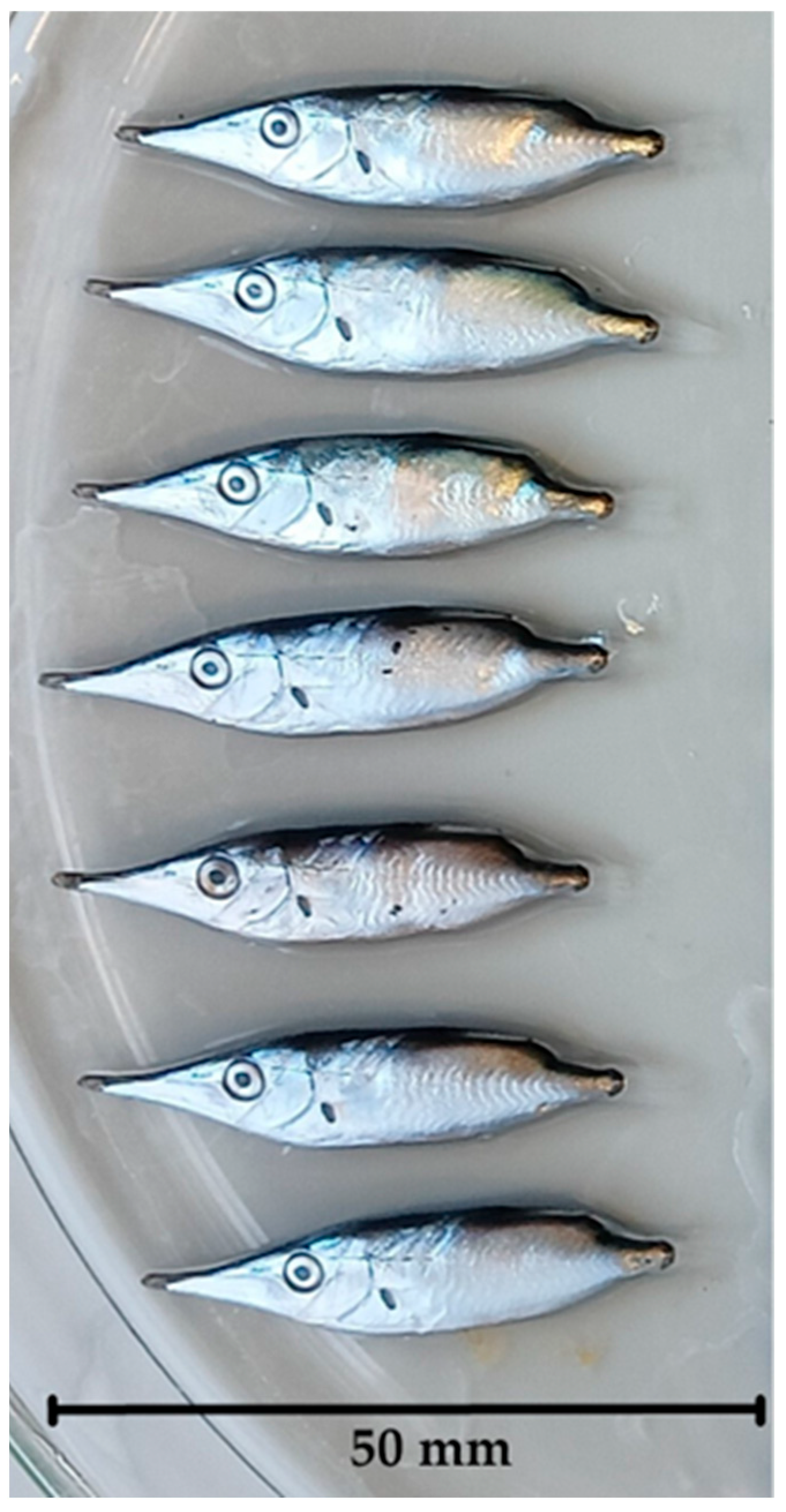
Figure 1. Seven specimens of Macroramphosus gracilis from our collection (photo by Andrea Geraci).
Water 18 00156 g001
Figure 2. Section of the Strait of Messina with upwelling current (S–N).
Water 18 00156 g002
Figure 3. Details of the area where the stranded Macroramphosus gracilis specimens were collected (red rectangle).
Water 18 00156 g003
Figure 4. Number of Macroramphosus gracilis stranded in relation to the months (blue bars). For each month, upwelling current speed (S–N) and linked lunar phase (under x axis) are shown. Each orange rectangle indicates the current speed and represents the sampling event when the highest number of specimens per lunar phase was found.
Water 18 00156 g004
Figure 5. Schematic drawing of Macroramphosus gracilis (modified from [10]) with highlighted points of morphometric measurements, as pointed out by [3,5] (see also following table). Points 1–13 are defined as: 1, snout tip; 2, anterior edge of the eye; 3, posterior edge of the eye; 4, first dorsal fin origin; 5, dorsal spine tip; 6, posterior edge of the first dorsal fin; 7, second dorsal fin origin; 8, posterior edge of the second dorsal fin; 9, posterior edge of the anal fin; 10, anal fin origin; 11, pelvic fin; 12, pectoral fin origin; 13, gill cover.
Water 18 00156 g005
Figure 6. Picture of one specimen of Macroramphosus gracilis from our collection, with highlighted SNL and BL (measured from the front edge of the eye orbit to the caudal peduncle; photo by Andrea Geraci).
Water 18 00156 g006
Figure 7. Schematic drawing of the position of the spinule series on Macroramphosus gracilis: in yellow, the dorso-cephalic series; in red, the supra-orbital series; in blue, the supra-opercular series; in turquoise, the lateral series (modified from [10]).
Water 18 00156 g007
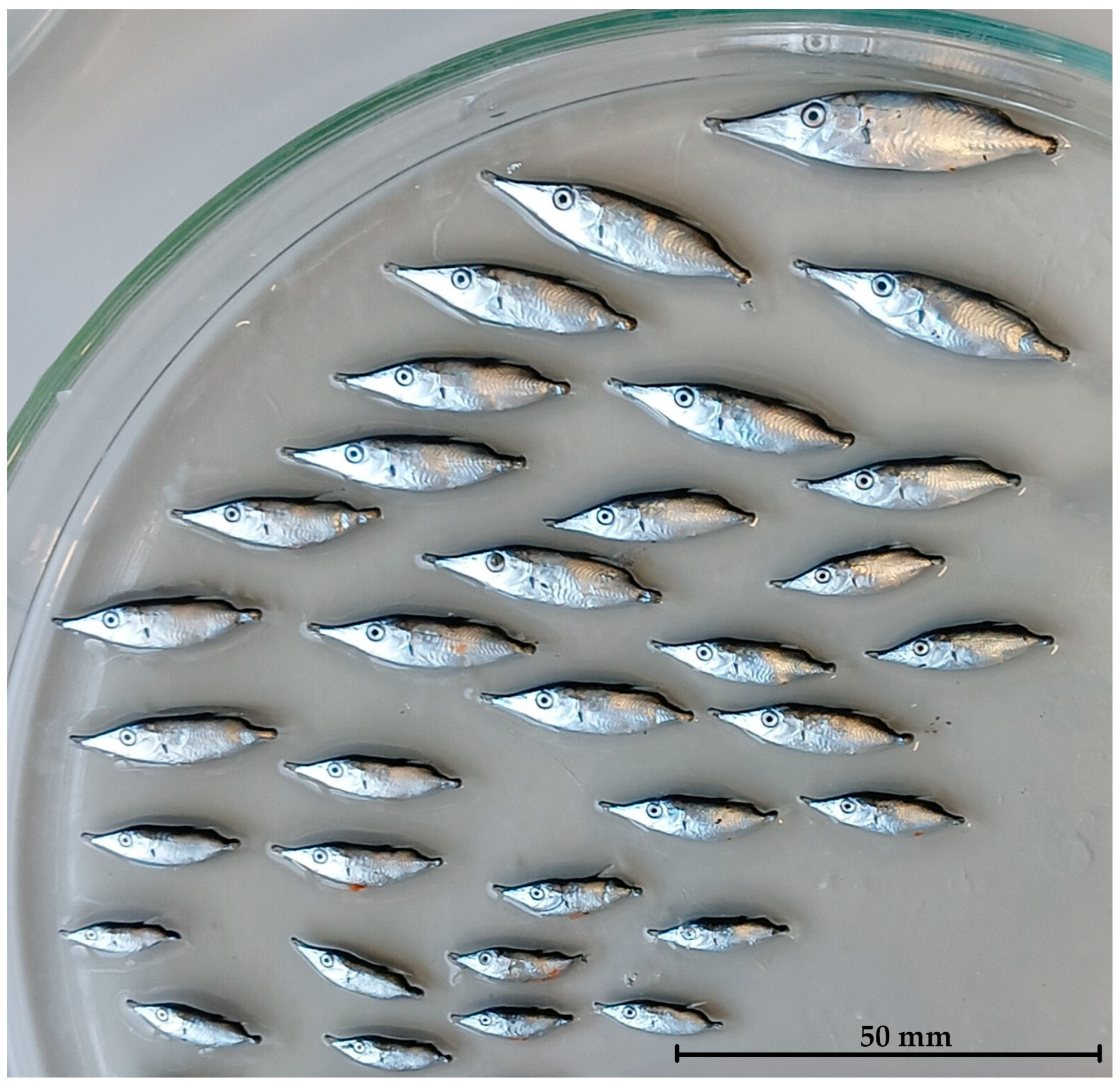
Figure 8. Some collected specimens of Macroramphosus gracilis of various sizes (photo by Andrea Geraci).
Water 18 00156 g008
Figure 9. One of the seven specimens that showed light red shades (above), compared to a standard-colored individual, dark dorsally, with silver sides (below) (photo by Andrea Geraci).
Water 18 00156 g009
Figure 10. (a). Pictures of the dorso-cephalic spinules series (red arrows). (b). Pictures of the supraorbital spinules series (red arrows) (photos by Davide Di Paola). (c). Pictures of the supra-opercular spinules series (red arrows) (photos by Davide Di Paola). (d). Pictures of the lateral spinules series. Note the small rows of spinules departing from the bigger ones on the side (red arrows) (photos by Davide Di Paola). Every sub-figure (ad) has sub-subfigure (AD) referring to size classes: (A), first size class (9–27 mm SL); (B), second size class (28–34 mm SL); (C), third size class (35–45 mm SL); (D), fourth size class (>46 mm SL).
Water 18 00156 g010aWater 18 00156 g010b
Figure 11. Plots of Length–Weight relationships for Macroramphosus gracilis post-larvae and juvenile (n = 571) as part of a standard curve-based non-linear regression analysis (p-value < 0.0002).
Water 18 00156 g011
Figure 12. Plots of Length (BL, in mm) and Snout Length (SNL, in mm) relationship for Macroramphosus gracilis post-larvae and juvenile (n = 571) as part of a standard linear regression analysis (p-value < 0.0001).
Water 18 00156 g012
Figure 13. Plots of Length (BL, in mm) and Dorsal Spine Length (DSL, in mm) relationship for Macroramphosus gracilis post-larvae and juvenile (n = 571) as part of a standard linear regression analysis (p-value < 0.0001).
Water 18 00156 g013
Figure 14. Plots of Length (BL, in mm) and Body Height (BH, in mm) relationship for Macroramphosus gracilis post-larvae and juvenile (n = 571) as part of a standard linear regression analysis (p-value < 0.0001).
Water 18 00156 g014
Table 1. Number (N) of M. gracilis specimens found for every stranding event that occurred in early 2025.
DateNDateNDateN
18 January 202505 March 2025023 March 20253
1 February 202506 March 202563 April 2025453
2 February 2025010 March 2025210 April 20251
13 February 2025011 March 2025014 April 20254
18 February 2025714 March 2025615 April 202518
20 February 2025018 March 20255317 April 20251
1 March 2025319 March 2025314 May 20253
2 March 2025120 March 20257
4 March 2025722 March 20255
Table 2. Morphometric measurements of Macroramphosus spp. [5] (see previous figure).
M. gracilisM. scolopax
Ventral body profile
in larval and juvenile
StraightNotched
Body colorDark dorsally,
with silver sides
Red-orange with few melanophores dorsally
Posterior margin of dorsal fin spine (spike) in specimens larger than 50 mm SLSmooth Serrated with spinules
Length of dorsal fin spine (DSL, Dorsal Spine Length; 4–5)Relatively short:
17.9–32.6% BL.
62.4–138% distance between dorsal spine–second dorsal fin origin (DSFD, Dorsal Spine Fin Distance; 4–7).
Long:
23.7–46.2% BL.
98.9–231% distance between dorsal spine–second dorsal fin origin (DSFD, Dorsal Spine Fin Distance; 4–7).
Body Height (BH; 4–10)Relatively slender: 20.9–30.8% BL.Relatively deep: 23.4–36.7% BL.
Table 3. The number of individuals of the species found stranded together with Macroramphosus gracilis.
SpeciesFebruaryMarchApril
TeleostsArgyropelecus hemigymnus-11-
Argyropelecus hemigymnus juv.-8-
Conger sp. juv.-1-
Cyclothone braueri-6-
Diaphus metopoclampus juv.-1-
Electrona risso juv.-2-
Engraulis encrasicolus-1-
Hygophum benoiti-2536
Hygophum hygomii juv.--2
Maurolicus muelleri--1
Myctophum punctatum--1
Microstoma microstoma-11
Microstoma microstoma juv.--4
Nansenia oblita--1
Nansenia oblita juv.-1-
Vinciguerria attenuata-6-
Vinciguerria attenuata juv.--1
AmphipodsLestrigonus schizogeneios-6-
Phronima atlantica-41
Phronima sp.-111
Phrosina semilunata-2-
Scina crassicornis-1-
EuphausiidsEuphausia krohni-1-
Thysanoessa gregaria-45-
MysidsSiriella sp.--1
PteropodsCymbulia peronii1-3
Table 4. Morphological features and morphometric ratios observed in the examined specimens, compared with the statements of [5]. The “•” symbol indicates the presence of the feature, while the “/” symbol indicates its absence.
Macroramphosus gracilis FeaturesMacroramphosus scolopax FeaturesOutlier Features
N.Straight Ventral Body ProfileSilver Body, Dorsally DarkDSL/
BL Ratio 17.9–32.6%
DSL/
DSFD Ratio 62.4–138%
BH/BL
Ratio
20.9–30.8%
Notched Ventral Body ProfileRed-Orange BodyDSL/
BL Ratio 23.7–46.2%
DSL/
DSFD Ratio 98.9–231%
BH/BL
Ratio
23.4–36.7%
Silver Body, Light Red Shaded, Dorsally DarkDSL/
DSFD
Ratio < 62.4%
BH/
BL
Ratio > 36.7%
490////////
61////////
5////////
2////////
4////////
3////////
2////////
1////////
3////////
Tot571571564567567499004065747
Disclaimer/Publisher’s Note: The statements, opinions and data contained in all publications are solely those of the individual author(s) and contributor(s) and not of MDPI and/or the editor(s). MDPI and/or the editor(s) disclaim responsibility for any injury to people or property resulting from any ideas, methods, instructions or products referred to in the content.