1. Introduction
Factors such as coastal habitat destruction, marine environmental pollution, and long-term overfishing have caused a continuous decline in global marine fishery resources, severely threatening the sustainable development of marine fisheries [
1,
2,
3,
4]. To alleviate the pressure of resource depletion and restore aquatic ecological functions, many coastal countries have increasingly adopted stock enhancement as a crucial measure for fishery resource conservation and ecological restoration. As a fishery management practice, stock enhancement involves the replenishment and recovery of natural population resources by releasing artificially propagated and reared seeds of economic or ecological species into natural waters. It is widely recognized as a key approach to achieving fishery resource recovery, improving the ecological environment, and fostering sustainable fisheries.
The concept of stock enhancement can be traced back to the practices of artificial fish hatching and resource replenishment initiated by European and American countries in the 19th century [
5]. Since the 20th century, countries such as Japan, the United States, and South Korea have progressively established relatively mature frameworks for stock enhancement and resource conservation. Japan stands as one of the pioneering nations to systematically conduct research and practice in marine stock enhancement. Beginning in the 1960s, Japan launched largescale release programs for fish, shellfish, and crustaceans, gradually developing a comprehensive technical system encompassing artificial seedling rearing, otolith marking, resource monitoring, and post-release effect evaluation [
6,
7,
8]. Through long-term development, Japan has accumulated extensive experience in artificial reef construction, seaweed bed restoration, seed releasing, and stock assessment, creating an integrated development model of “stock enhancement habitat restoration–resource management.” Conversely, the United States has placed greater emphasis on ecological restoration and habitat protection, incorporating artificial reefs, habitat rehabilitation, and marine ecosystem management into its fishery recovery practices at an early stage, while progressively fostering the synergistic development of stock enhancement with industries like recreational fisheries and ecotourism [
9,
10]. Since the 1990s, South Korea has implemented long-term marine resource recovery initiatives, focusing primarily on boosting the biomass of commercial fish species through stock enhancement and marine ranching construction, while balancing marine ecosystem protection with sustainable fishery development [
11,
12].
In China, marine fisheries have long been an integral component of national food security and coastal economic development. However, with the continuous increase in coastal fishing intensity, China’s marine fishery resources have gradually suffered from depletion, miniaturization, and younger age structures. As early as the 1960s, Chinese scholars began proposing the concept of restoring marine fishery stocks through artificial propagation and resource conservation [
13,
14,
15,
16]. Following the reform and opening up, and alongside the intensifying development and utilization of marine resources, stock enhancement steadily emerged as a vital tool in China’s marine fishery management.
Since the beginning of the 21st century, China’s stock enhancement and release activities for aquatic organisms have been primarily governed by the Fisheries Law of the People’s Republic of China and a series of supporting policies and regulations. The Action Outline for the Conservation of Aquatic Living Resources in China, issued by the State Council in 2006, established an overall framework for the conservation and restoration of aquatic living resources. The Regulations on the Management of Stock Enhancement and Release of Aquatic Organisms, promulgated in 2009, further standardized stock enhancement practices by establishing requirements for the scientific selection of released species, prohibiting the release of alien species, and implementing declaration and approval procedures.
Subsequently, the 14th Five-Year Plan for National Fisheries Development identified stock enhancement and release as an important approach for restoring aquatic ecosystems. In combination with the Regulations on the Management of Stock Enhancement and Release of Aquatic Organisms and the newly revised Fisheries Law of the People’s Republic of China, which came into effect on 1 May 2026, China’s policy framework has increasingly emphasized ecological priority, science-based release practices, and coordinated fisheries management, including basin-wide fishing restrictions. In addition, the Marine Environment Protection Law of the People’s Republic of China encourages the scientific implementation of stock enhancement and release and supports ecological restoration measures such as the deployment of artificial reefs and the restoration of seaweed beds and seagrass beds. Together, these laws and policies provide an institutional foundation for promoting the scientific, standardized, and ecologically sustainable development of stock enhancement and release activities in China.
The Action Outline for the Conservation of Aquatic Living Resources in China, Regulations on the Management of Stock Enhancement and Release of Aquatic Organisms, the 14th Five-Year Plan for National Fisheries Development, and the Marine Environment Protection Law of the People’s Republic of China explicitly mandate strengthening aquatic resource conservation, advancing the scientific management of stock enhancement, and constructing a robust marine ecological civilization system [
17,
18,
19,
20].
In recent years, the scale of stock enhancement in China has continuously expanded. The released species have gradually diversified from traditional economic fish to shellfish, crustaceans, and ecological restoration species, while the research focus has shifted from simple resource replenishment toward ecological restoration, genetic diversity conservation, and ecosystem assessment [
21,
22,
23,
24]. Concurrently, measures such as artificial reef construction, marine ranching, habitat restoration, and smart fisheries have been synergistically integrated with stock enhancement, driving its development toward ecological, precise, and intelligent directions [
25,
26]. Currently, China has preliminarily established a technical system encompassing seedling breeding, release execution, marking and tracking, effect evaluation, and resource monitoring. Consequently, the role of stock enhancement in fishery resource recovery and marine ecological protection has become increasingly prominent.
Bibliometric methods are widely recognized as important tools for analyzing disciplinary development trends and research hotspots, capable of revealing the evolutionary process of knowledge structures through the quantitative analysis of a large body of academic literature. With the advancement of visual analysis tools, bibliometric approaches have been widely applied to fields such as marine science, ecology, and fishery resource management. This methodology not only provides a macrolevel overview of the current research status, but also effectively identifies key research directions, core authors, research institutions, and hot themes during specific periods. Therefore, this study employs bibliometric methods, combining Cite Space visualization and Excel-based statistical analyses, to systematically review research on stock enhancement in China’s marine sector. The analysis focuses on studies concerning marine and coastal ecosystems and marine aquatic organisms, with particular attention to the development, research hotspots, and emerging trends of marine stock enhancement. Furthermore, by integrating relevant policy documents issued in China in recent years, this paper analyzes the historical development, hotspot evolution, and future trends of stock enhancement research, aiming to provide a reference basis for theoretical research and resource conservation practices in China [
27,
28].
2. Materials and Methods
2.1. Data Sources
As one of the largest Chinese academic resource databases, the China National Knowledge Infrastructure (CNKI) covers various disciplines including natural sciences, agricultural sciences, engineering technology, social sciences, and marine sciences, indexing a diverse range of resources such as journal articles, doctoral dissertations, master’s theses, conference proceedings, yearbooks, standards, and technological achievements. The Web of Science (WoS) Core Collection database is an internationally recognized literature retrieval platform with prominent academic authority and global influence. It aggregates data from high-level academic journals, conference proceedings, and books, constructing a comprehensive citation network. Therefore, the CNKI and WoS Core Collection databases were selected as the primary sources of information to ensure the representativeness and reliability of the research data.
In the CNKI Advanced Search mode, a literature search was conducted using “stock enhancement” as the topic term (TS = stock enhancement). To ensure high data quality, journal publications were restricted to the Chinese Science Citation Database (CSCD), the Chinese Social Sciences Citation Index (CSSCI), and Peking University Core Journals. In addition, relevant master’s theses were included in the CNKI dataset. After manual screening to exclude conference announcements, news reports, book reviews, and duplicate literature, a total of 495 valid Chinese documents published between 1987 and 2026 were obtained.
For the WoS Core Collection, a Topic Search (TS) was conducted using the following query: TS = (“Stock Enhancement” OR “Marine Stock Enhancement” OR “Release Enhancement” OR “Fishery Resource Enhancement” OR “Artificial Release”). Quotation marks were used to retrieve the exact phrases, and the five search terms were connected using the Boolean operator OR. No geographic restriction (e.g., China) was applied, as the WoS dataset was intended to represent the international development of stock enhancement research. The retrieved records were subsequently screened manually to exclude irrelevant publications and duplicates. Following this procedure, 489 English-language publications published between 1965 and 2026 were retained for analysis. After manual screening and the removal of duplicate literature, a total of 489 relevant English publications from 1965 to 2026 were obtained.
Additionally, to analyze the evolution of China’s stock enhancement policies, a systematic policy document collection was conducted. Policy documents published between 2001 and 2026 were retrieved from official government portals, including the website of the State Council of the People’s Republic of China, the Ministry of Agriculture and Rural Affairs of the People’s Republic of China, the Ministry of Ecology and Environment of the People’s Republic of China, and relevant official government information platforms. A total of 17 national-level policy documents were included in the final dataset. Documents were eligible for inclusion if they were officially issued or jointly issued by national government departments and contained substantive provisions related to at least one of the following themes: (1) stock enhancement and release; (2) conservation or restoration of aquatic biological resources; (3) marine fishery resource conservation; or (4) marine ecological restoration measures directly associated with stock enhancement, marine ranching, artificial reefs, or habitat restoration. Documents such as news reports, press releases, duplicate records, policy interpretations, meeting notices, and documents without substantive relevance to these themes were excluded. The titles, issuing authorities, publication years, principal policy contents, and representative keywords of the included documents were manually extracted and compiled for subsequent analysis of policy evolution. The complete list of policy documents included is provided in
Appendix A.
2.2. Research Methods
CiteSpace is a software tool used for scientific knowledge graph analysis and visualization research. Some analyses, including co-occurrence analysis, cocitation analysis, and cluster analysis, can reveal the knowledge structure, research hotspots, and evolutionary trends of a discipline. Based on literature cocitation theory and the Pathfinder Network Scaling algorithm, the software can identify critical literature, core authors, and major research directions within a specific research field. Through visual knowledge graphs, it can intuitively demonstrate the interrelationships among different research themes and their dynamic evolutionary processes [
29,
30].
This study utilizes CiteSpace (Version 6.4.R1 Chaomei Chen, Philadelphia, PA, USA) software to perform a visualization analysis of the literature in the field of stock enhancement, primarily including author collaboration network analysis, research institution analysis, keyword co-occurrence analysis, keyword cluster analysis, and burst detection analysis. Concurrently, Excel PivotTable statistical analysis methods are applied to compile and quantify the publication volume, research hotspots, and policy keywords, thereby enhancing the accuracy and readability of the result analysis.
Specifically, CiteSpace (Version 6.4.R1 Chaomei Chen, Philadelphia, PA, USA) was used with a time slice of 1 year, and the node types included Author, Institution, Keyword, and Reference, depending on the analytical objective. The g-index was adopted as the selection criterion for node extraction. Different scale factors were used for the two datasets because of differences in database coverage, dataset size, and network complexity. For the CNKI dataset, a scale factor of k = 25 was applied to retain a broader set of representative nodes, whereas a more restrictive threshold (k = 3) was used for the WoS dataset to control network complexity and improve the interpretability of the visualization. The purpose of using database-specific thresholds was not to directly compare absolute network metrics between the two databases, but to identify the major knowledge structures and research themes within each dataset. Pathfinder pruning was then applied to reduce redundant connections and improve the readability of the resulting networks. The Pathfinder algorithm was adopted to prune the network, thereby enhancing the clarity and interpretability of the knowledge graph structure. Through keyword clustering and temporal evolution analysis, the developmental stages, hotspot evolution, and future research trends of stock enhancement in China can be further revealed.
Before conducting the bibliometric and CiteSpace analyses, the retrieved records were screened to remove duplicate and irrelevant publications. The bibliographic data exported from CNKI and WoS were then checked for obvious inconsistencies in keyword expressions, including spelling variations and differences in singular and plural forms. Semantically similar keywords were standardized where necessary to reduce fragmentation in the subsequent knowledge network analysis. Based on the cleaned datasets, this study integrates bibliometric analysis, CiteSpace visualization, and Excel statistical analysis to systematically examine the developmental history, knowledge structure, research hotspots, and emerging trends of stock enhancement research in domestic and international contexts. Furthermore, in conjunction with the evolutionary process of China’s policies, this paper summarizes and discusses current research hotspots and future development directions, aiming to provide a reference basis for subsequent theoretical research and fishery resource conservation practices in the field of stock enhancement.
2.3. Data Cleaning and Normalization
To ensure the accuracy and reproducibility of the bibliometric analysis, a systematic data cleaning and normalization procedure was applied to both the CNKI and WoS datasets prior to analysis.
First, all retrieved records were exported and imported into EndNote X9 (Clarivate, Philadelphia, PA, USA) for preliminary management. Duplicate records were identified using the “Find Duplicates” function based on title, author, and publication year and were manually verified and removed for each database separately. Since CNKI and WoS are independent databases with different coverage and indexing criteria, cross-database deduplication was not performed, as records appearing in both databases represent different linguistic versions of the same research and serve different analytical purposes.
Second, irrelevant document types were manually excluded based on the following criteria: (1) conference announcements, news reports, book reviews, editorials, and meeting minutes; (2) documents without substantive content related to stock enhancement, resource restoration, or marine ranching; and (3) incomplete records missing key bibliographic information (e.g., title, author, or abstract).
Third, keyword normalization was performed to consolidate semantically similar or synonymous terms that could fragment the knowledge network. For example, variants such as “effect assessment” and “effect evaluation” were unified to “effect assessment”; singular and plural forms (e.g., “stock” vs. “stocks”) were standardized where appropriate; and British and American spelling variants were aligned to a consistent form. This standardization was carried out manually by reviewing the keyword lists generated from the exported data and, and the standardized terms were cross-checked by two independent researchers to minimize subjectivity.
Fourth, for the CNKI dataset, author name variants and institutional name abbreviations were manually checked and standardized to avoid fragmentation in the author and institution collaboration networks (e.g., “Chinese Academy of Sci.” and “CAS” were unified to “Chinese Academy of Sciences”).
After the above cleaning and normalization steps, a total of 495 valid CNKI records and 489 valid WoS records were retained for subsequent CiteSpace analysis and Excel statistical analysis. All cleaning procedures were documented to ensure the transparency and reproducibility of the study.
3. Results
3.1. Publication Output and Trend
The volume of academic publications in the field of aquatic stock enhancement serves as a critical indicator for evaluating development trends within this research domain, as it mirrors the evolutionary process of disciplinary knowledge. By plotting the temporal distribution of publication numbers and performing multivariate statistical analysis, we can gain a profound understanding of the research achievements and future trends in this field.
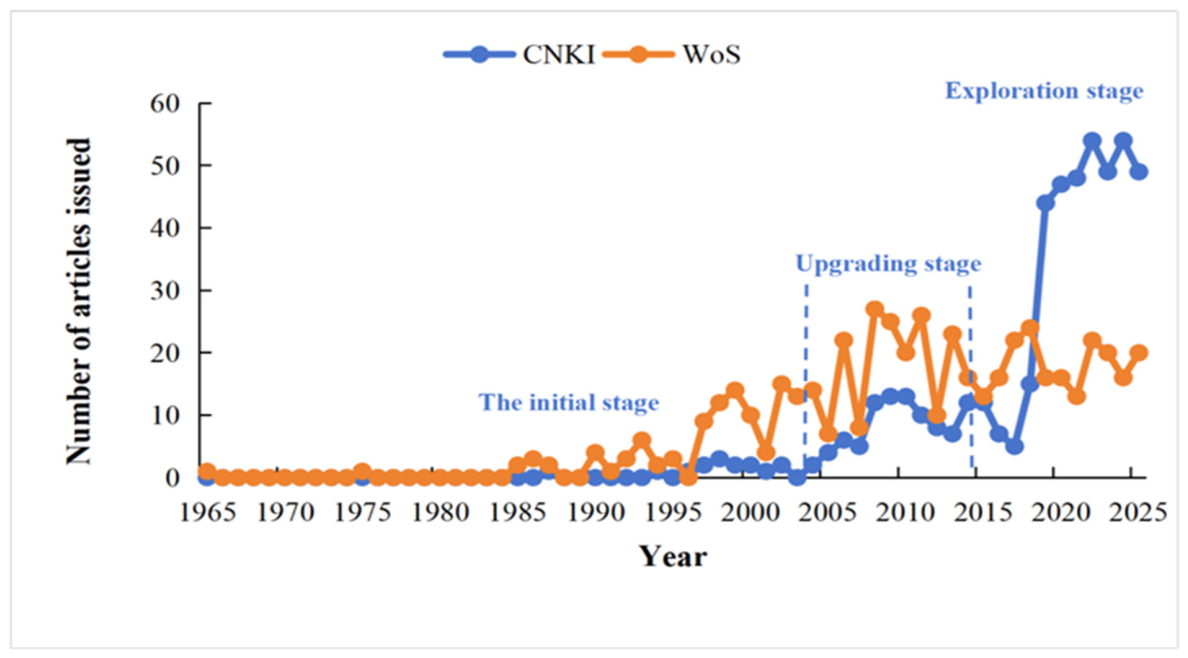
According to the literature search results from CNKI and WoS, the earliest publications in this field were published in 1987 (CNKI) and 1965 (WoS), respectively. To accurately trace the developmental history of stock enhancement, the researchers compared the volume of retrieved literature between CNKI and WoS (
Figure 1). During the period from 2002 to 2019, the overall number of journal publications in WoS was slightly higher than that in CNKI: the average annual publication volume was 17.52 articles for WoS and 15.52 articles for CNKI, indicating a certain remaining gap between the two.
In terms of the publication timeline, the relevant literature indexed in WoS can be traced back to 1965. During this period, developed countries in Europe and North America, alongside Japan, had already initiated early explorations into artificial stock enhancement and integrated fishery resource management. In contrast, China’s research in this field remained a blank slate at that time, indicating a significant lag in its overall commencement. Since 2006, however, the number of relevant papers published in CNKI has demonstrated steady, phased growth, followed by a sharp surge after 2019. This trajectory indicates a robust developmental momentum in China’s aquatic stock enhancement and resource conservation endeavors.
In 2006, the State Council officially issued the Action Plan for the Conservation of Aquatic Biological Resources in China. This milestone marked the formal elevation of stock enhancement to a national level resource conservation strategy, greatly accelerating the advancement of related domestic disciplinary research. Subsequently, the Ministry of Agriculture and Rural Affairs successively issued the Guiding Opinions on Successfully Executing Aquatic Stock Enhancement During the 14th Five-Year Plan Period and the Notice on Further Improving Aquatic Stock Enhancement Work, aiming to comprehensively optimize the structure of released species and enhance ecological quality and efficiency. The implementation of these key plans and regulations has driven historic breakthroughs in national aquatic biological resource restoration and the construction of fishery ecological civilization. Over the past 5 years, the volume of papers indexed by CNKI has significantly surpassed that of WoS, profoundly reflecting the robust vitality and soaring academic attention within this research field in China.
3.2. Knowledge Graph Analysis of Stock Enhancement Research in CNKI Academic Journals
According to Price’s Law, the minimum number of papers published by a core author is calculated as
, where
is the number of papers published by the most productive author in the field. In the CNKI dataset, the most productive author has published
papers. Therefore,
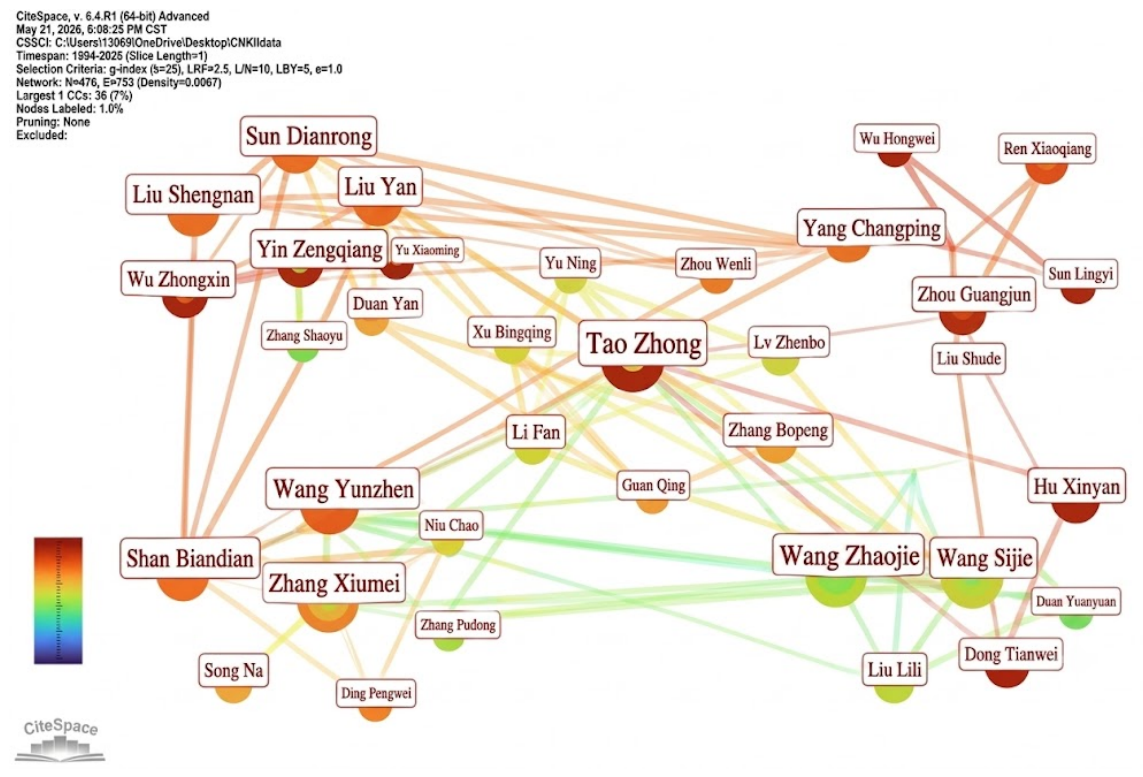
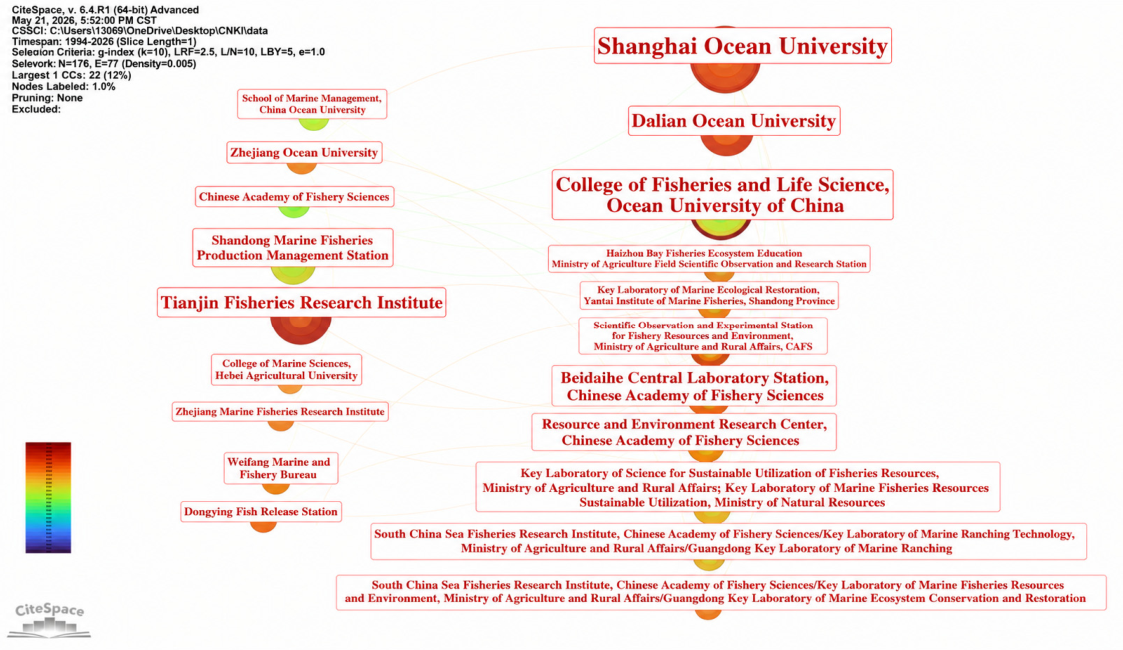
, meaning that an author must have published four or more papers to be classified as a core author. The researchers systematically organized the literature within the CNKI database and mapped the knowledge graphs showing the publication counts of authors and institutions in the field of stock enhancement in China (
Figure 2 and
Figure 3).
Figure 2 shows that there are many authors in the domestic research field of “stock enhancement,” forming several relatively distinct research directions. Different scholars have conducted in-depth studies focusing on resource restoration, ecological effects, and marine ranching. For example, scholars such as Yang Hongsheng primarily center their research on marine ranching ecological restoration and benthic resource recovery, exploring the impact of stock enhancement on the stability of marine ecosystems through methods such as artificial reef deployment, habitat restoration, and community structure analysis [
31,
32]. Scholars like Chen Yong, on the other hand, focus heavily on fishery resource conservation and marine ranching construction, systematically studying resource recovery following stock enhancement in typical sea areas via resource surveys, ecological monitoring, and release effect evaluations [
33].
Additionally, some scholars have conducted research on the genetic structure and population dynamics of released species. By utilizing techniques such as otolith marking, molecular genetic analysis, and tag-and-release, they evaluate the contribution rate, survival rate, and genetic diversity of released populations, thereby improving the scientific rigor and effectiveness of stock enhancement [
34,
35]. In recent years, with the advancement of ecological civilization construction and the maritime power strategy, an increasing number of studies have begun to focus on the synergistic relationship between stock enhancement and marine ecological restoration, driving the research in this field to gradually develop from single resource enhancement toward integrated ecological governance.
Although the number of research institution nodes in
Figure 3 is relatively small, this does not imply that the research output capability of domestic institutions is low. On the contrary, stock enhancement research in China is currently anchored primarily in universities and research institutes. Most researchers execute their scientific work through a team-based collaboration model, which has fostered relatively stable cooperative relationships among institutions. Prolific organizations chiefly include the Chinese Academy of Fishery Sciences, the Institute of Oceanology of the Chinese Academy of Sciences, Shanghai Ocean University, Dalian Ocean University, and Ocean University of China.
These research institutions have long undertaken national level projects related to marine ranching construction, fishery resource restoration, and ecological protection, accumulating a substantial body of research achievements in artificial reef construction, resource recovery evaluation, ecological monitoring, and marine ecological restoration. For example, the system of the Chinese Academy of Fishery Sciences primarily focuses on fishery resource recovery and stock enhancement technologies; Shanghai Ocean University and Ocean University of China pay closer attention to the ecological effects of marine ranching and the sustainable utilization of marine resources; while the Institute of Oceanology of the Chinese Academy of Sciences mainly centers its research on structural changes in marine ecosystems and biodiversity conservation.
Overall, the research focus of various domestic institutions in recent years has concentrated on directions such as marine ranching, artificial reefs, the resource recovery of important economic species, and the ecological restoration of typical sea areas, with investigations frequently targeting representative waters like Haizhou Bay, Xiangshan Harbor, and Liaodong Bay. As national marine ecological protection efforts continue to intensify, stock enhancement has gradually emerged as a major research hotspot for marine ecological restoration and fishery resource conservation. Various research institutions maintain continuous investments in relevant fields and have progressively achieved significant research outcomes.
Based on the statistical results of high publication volumes, the top ten authors and research institutions are detailed in
Table 1.
3.3. Knowledge Mapping Analysis of Research on Stock Enhancement in CNKI Academic Journals
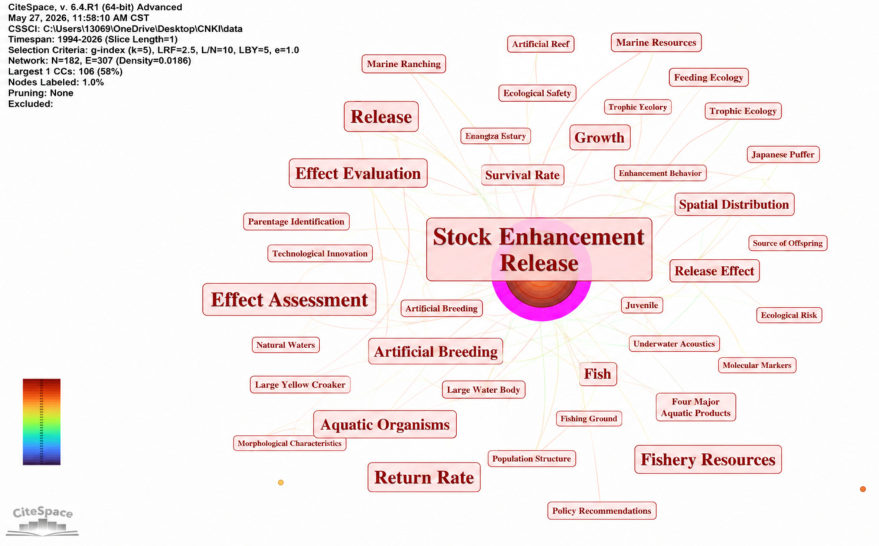
When running the CiteSpace software, the time span was set to 1987–2026, the time slice was set to 1, the network node was designated as “Keyword,” and the selection criterion was set to the g index
k = 25. According to the visualization mapping workflow, a visualization analysis was performed on the literature related to marine aquaculture in the CNKI database (
Figure 4). The Q value calculated in this study is 0.7139, and the S value is 0.9798, indicating that the plotted curve meets the requirements.
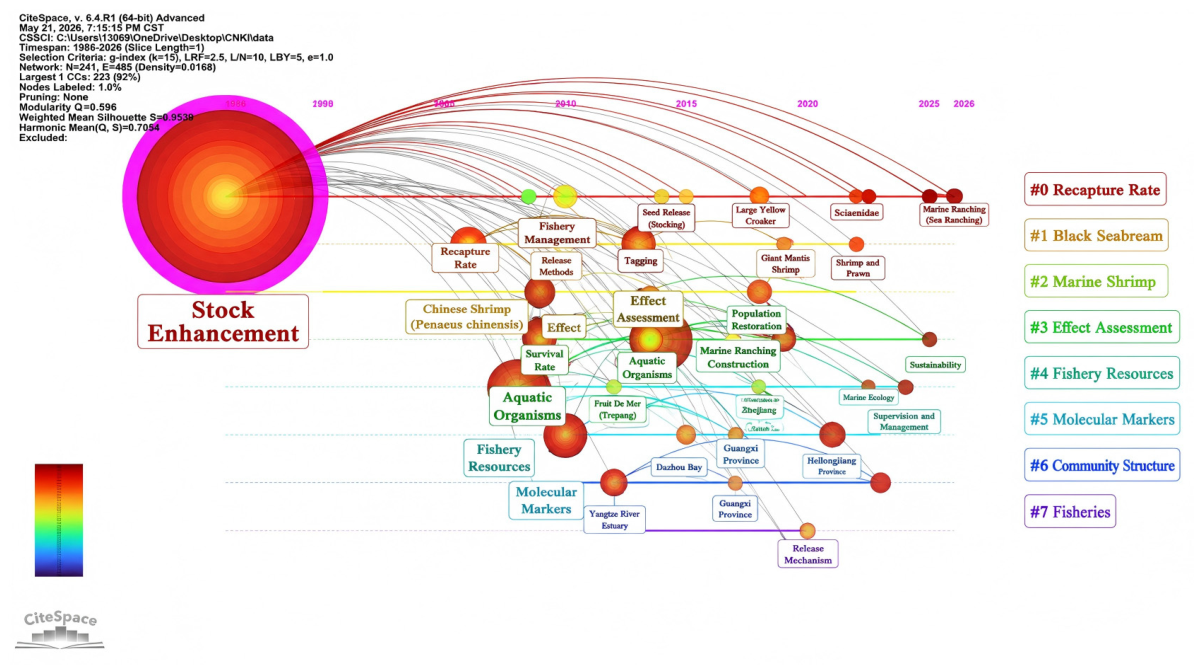
Subsequently, the keywords within the same cluster were arranged chronologically along the same horizontal line, with the maximum number of displayed clusters set to
k = 15, to generate a timeline view (
Figure 5). The software identified the following clusters: recapture rate (#0), black seabream (#1), seabass (#2), effect assessment (#3), fishery resources (#4), molecular markers (#5), community structure (#6), fisheries (#7), and Chinese giant salamander (#8). Next, the occurrence frequencies and corresponding year information of the representative keywords within each cluster were statistically summarized and compiled into
Table 2 for subsequent analysis.
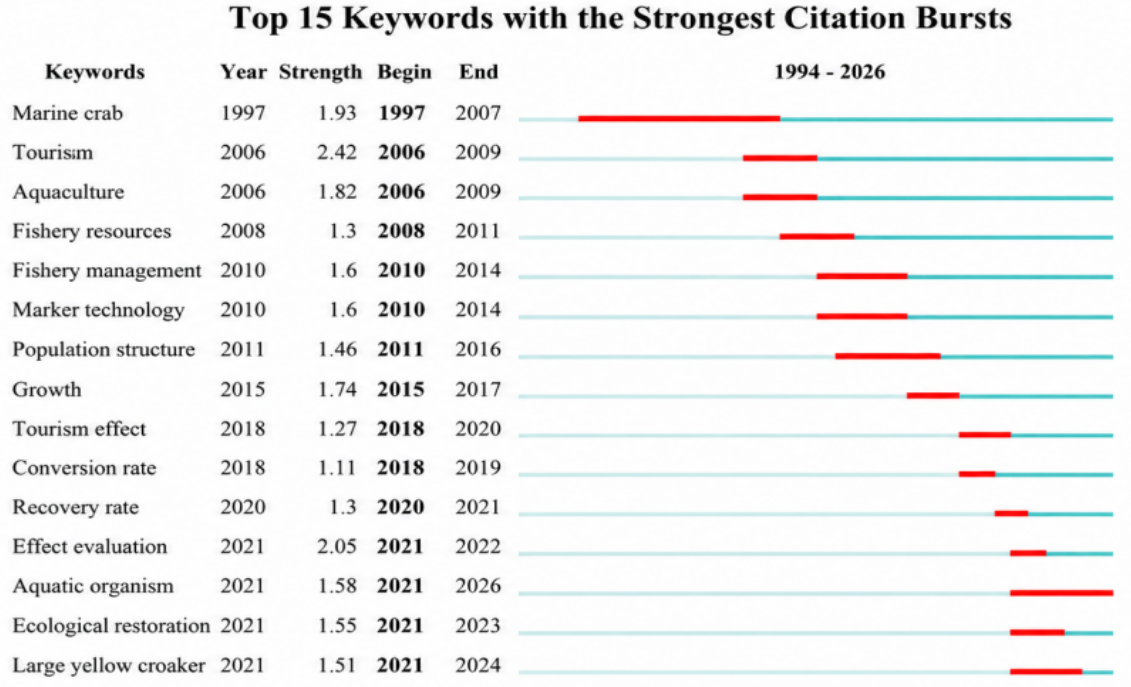
Based on the keyword co-occurrence mapping analysis, 15 of the most prominent keywords were selected to plot (
Figure 6).
To determine the developmental stages of stock enhancement research in China, we integrated multiple quantitative criteria rather than relying on subjective period division. First, we performed a piecewise linear regression (segmented regression) analysis on the annual publication counts from 1987 to 2026. The breakpoint was identified at 2006 (p < 0.01), indicating a statistically significant structural break in the publication growth rate. A second breakpoint was detected at 2016 (p < 0.05), marking another acceleration in research output. These two statistically significant breakpoints thus provide empirical justification for partitioning the development of Chinese stock enhancement research into three distinct phases.
Second, we cross-validated the stage division using keyword burst detection (
Figure 6). The dominant burst keywords in Stage 1 (1987–2005) were technical terms related to hatchery propagation and species-specific release techniques (e.g., “artificial breeding,” “seedling release”). In Stage 2 (2006–2015), burst keywords shifted to “effect assessment,” “tagging,” and “resource survey,” reflecting the growing emphasis on post-release monitoring. In Stage 3 (2016–present), the strongest bursts were observed for “ecological restoration,” “marine ranching,” and “genetic diversity,” indicating a clear thematic transition toward ecosystem-based and sustainable development frameworks.
Third, we examined the cumulative proportion of publications across the three stages: Stage 1 accounts for approximately 8.7% of total CNKI publications, Stage 2 accounts for 31.5%, and Stage 3 accounts for 59.8%. This progressive increase further supports the stage division, as it reflects the accelerating growth in research activity over time.
Accordingly, the evolutionary trajectory of aquatic stock enhancement research in China can be systematically partitioned into the following three developmental stages:
Stage 1 (1987–2005): Technical Germination and Production Exploration Stage Early research primarily focused on foundational technical aspects, such as artificial breeding technologies and release operational specifications for typical economic species. Representative keywords during this phase were mainly concentrated in clusters such as “black seabream” (#1), “seabass” (#2), and “molecular markers” (#5), specifically encompassing artificial induced spawning, nursery specifications, and post-release survival rates. Due to the sharp increase in domestic coastal fishing pressure at that time, traditional fishery resources began to exhibit signs of decline. Consequently, research largely regarded stock enhancement as an “extensive” means of boosting fishery production, with the core objective being the pursuit of short-term catches and economic outputs. During this period, because post-release ecological monitoring and resource assessment methods were still immature, the overall research was in a disciplinary exploration phase, lacking systematic studies on the wild ecological adaptability and long-term resource contribution rates of released populations.
Stage 2 (2006–2015): during the Efficacy Assessment and Tagging/Marking Technology Pioneering Stage, along with the promulgation of the Action Outline for Conservation of China’s Aquatic Biological Resources by the State Council in 2006, stock enhancement formally escalated to a national level resource conservation strategy, and related research experienced rapid growth. CNKI keyword clustering analysis shows that the core themes during this stage began to shift toward clusters such as “return rate” (#0), “effect assessment” (#3), and “molecular markers” (#6). The intervention of modern science and technology provided strong technical support for resource assessment during this period. Researchers began to widely introduce otolith marking, chemical tagging, coded wire tags (CWTs), and early molecular marker technologies, attempting to overcome the academic bottleneck of difficulties in tracking the whereabouts of released fry and quantifying resource contribution rates. Meanwhile, the research perspective began to transition from a single focus on “fishery production increase” to “resource conservation,” and many scholars began to explore the dynamic impacts of release activities on the community structures of typical coastal waters such as Haizhou Bay and Xiangshan Harbor.
Stage 3 (2016–Present): during the High-Quality Development and Full Life Cycle Ecological Governance Stage driven by the construction of ecological civilization and the concept of green development, China’s stock enhancement research has comprehensively entered a path of high-quality development characterized by all-round and multidisciplinary integration. The research foundation during this period relies highly on core clusters such as “fishery resources” (#4), “fisheries” (#7), and “return rate” (#0). High-frequency keywords include microsatellite markers, parentage identification, effective population size, inbreeding risk, and carbon sink fisheries.
The utilization and conservation of aquatic biological resources have been fully integrated into the macro framework of integrated coastal ecosystem governance. Current academic research focuses on the following three cutting-edge directions:
Genetic Risk Control: Utilizing high-throughput sequencing and molecular marker technologies to systematically evaluate the potential impacts of artificially released populations on the genetic structure of wild populations, thereby avoiding inbreeding depression [
36,
37,
38,
39].
Precision Ecological Assessment: Combining modern numerical simulation and stable isotope analysis to rigorously calculate the ecological carrying capacity of specific water bodies, scientifically guiding the site-specific optimization of stocking species, specifications, and densities.
Smart Full-Chain Stocking Management: Promoting the integration of remote sensing monitoring, big data analytics, and full-process traceability systems, guiding stock enhancement toward a modern management pathway characterized by intelligence, standardization, and precision [
40,
41,
42,
43].
In addition to the temporal evolution of research themes, the spatial distribution and target organisms of stock enhancement studies in China also exhibited distinct characteristics. Based on the statistical analysis of research regions, the Shandong, Liaoning, Guangdong, Zhejiang, and Fujian provinces represented the major research areas, with differences in target species and research priorities among regions (
Table 3). Northern coastal regions mainly focused on commercially important species such as sea cucumber and abalone, while southern coastal regions paid greater attention to fish resource restoration and ecological enhancement.
Regarding the composition of released organisms, fish species constituted the largest proportion of research objects (52.44%), followed by crustaceans (18.67%), mollusks (13.78%), and echinoderms (9.33%) (
Table 4). This distribution reflects the dominant role of economically valuable species in China’s stock enhancement practices and indicates a gradual expansion toward diversified aquatic resource conservation.
3.4. Phased Evolution of National Policies on Stock Enhancement in China
The policy keywords examined in this study are primarily derived from relevant policy documents on stock enhancement, aquatic biological resource conservation, and marine ecological restoration issued in China from 2001 to 2026. These data were compiled and analyzed in conjunction with the CNKI database, and the detailed contents are provided.
The development of China’s stock enhancement policies exhibits distinct phased characteristics. Early stock enhancement efforts primarily aimed at restoring fishery yields and replenishing commercial fish resources. Relevant policies were mostly government-led, with resource enhancement and fishery production increase serving as the core focus. During this stage, the state alleviated coastal fishing pressure mainly through measures such as fishery resource conservation, summer fishing moratoria, and fry release. Concurrently, it strengthened the protection of aquatic biological resources through laws and regulations, promoting aquatic ecological environmental governance and the sustainable utilization of fisheries. With the gradual advancement of marine ecological protection strategies during the 11th Five-Year Plan and 12th Five-Year Plan periods, stock enhancement began to transition from the traditional “quantity replenishment” model to a “resource conservation” model. Policy support continuously strengthened, and targeted investments from central government financial funds steadily increased, propelling the rapid development of China’s stock enhancement technical and management systems.
Since 2016, driven by the concepts of ecological civilization advancement, maritime power, and the green development philosophy in fisheries, China’s stock enhancement has entered a stage of standardization and high-quality development. Relevant policies place greater emphasis on the scientific rigor, ecological integrity, and long-term resource recovery efficacy of release activities, gradually establishing a full process management system that encompasses seed sourcing, species selection, release scale, efficacy assessment, and ecological monitoring. Meanwhile, measures such as artificial reef construction, marine ranching, habitat restoration, and ecological monitoring have been advanced synergistically with stock enhancement, forming an integrated governance model with ecological restoration at its core. In recent years, policy documents such as the 14th Five-Year National Fisheries Development Plan and the Guiding Opinions on Well-performing Aquatic Stock Enhancement During the 14th Five Year Period have been successively promulgated, further clarifying the vital position of stock enhancement in fishery resource recovery and marine ecological protection [
44,
45,
46,
47,
48].
Furthermore, the development of modern information technology has also driven the transformation of management paradigms in stock enhancement. In recent years, technologies such as remote sensing monitoring, otolith marking, molecular markers, acoustic telemetry, and big data analytics have been progressively applied to the efficacy evaluation and resource monitoring of stock enhancement. Concurrently, relevant policies have placed greater emphasis on the construction of digital and intelligent management systems [
49]. This indicates that China’s stock enhancement has gradually evolved from traditional empirical management toward precise, scientific, and ecological management pathways.
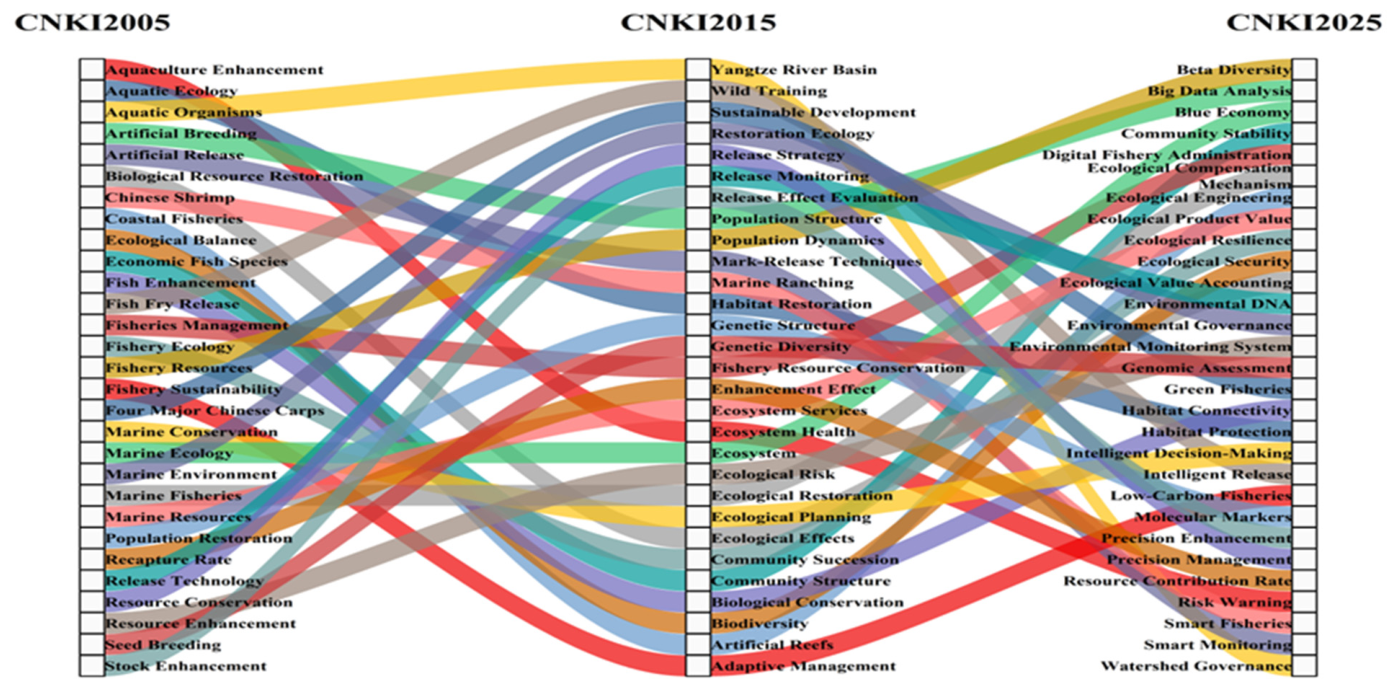
Through comparative analysis of CNKI data (
Figure 7), it can be found that current domestic and international research on stock enhancement policies primarily focuses on directions such as “resource conservation,” “stock recovery,” “artificial reefs,” “ecological restoration,” and “marine ranching.” Among these, “resource recovery” and “ecological restoration” both exhibit high correlation across different databases, indicating that stock enhancement has gradually transformed from a single means of increasing fishery production into an important component of integrated marine ecosystem governance. Concurrently, international research in recent years has progressively focused on new directions such as carbon sink fisheries, ecological compensation, smart fisheries, and marine ecological valuation. This reflects that the future development trend of stock enhancement will place greater emphasis on ecological benefits, sustainable resource utilization, and the coordinated development of the marine economy.
3.5. Knowledge Graph of Authors and Research Institutions in the Field of Stock Enhancement Research Within the WoS Database
According to Price’s Law, the minimum publication threshold for core authors is given by , where is the publication count of the most prolific author. In the WoS dataset, the most productive author has published papers. Thus, , which means that an author must have published two or more papers to be classified as a core author. The lower threshold for WoS compared to CNKI reflects the smaller maximum publication count in the international dataset, rather than an inconsistency in the application of the law. Utilizing the bibliometric visualization software CiteSpace, we mapped and analyzed the knowledge graphs of authors and research institutions for stock enhancement literature within the WoS database.
Journal publication volume reflects the scholarly trends and attention within a research domain, and the advancement of aquatic stock enhancement and resource restoration research is intimately tied to the contributing authors and institutions. Utilizing the bibliometric visualization software CiteSpace, we mapped and analyzed the knowledge graphs of authors and research institutions for stock enhancement literature within the WoS database. Data integration enables a comprehensive summary of highly prolific and influential authors and institutions, clearly delineating their collaborative networks. In these maps, each node represents an individual researcher, and the links between nodes indicate collaborative relationships.
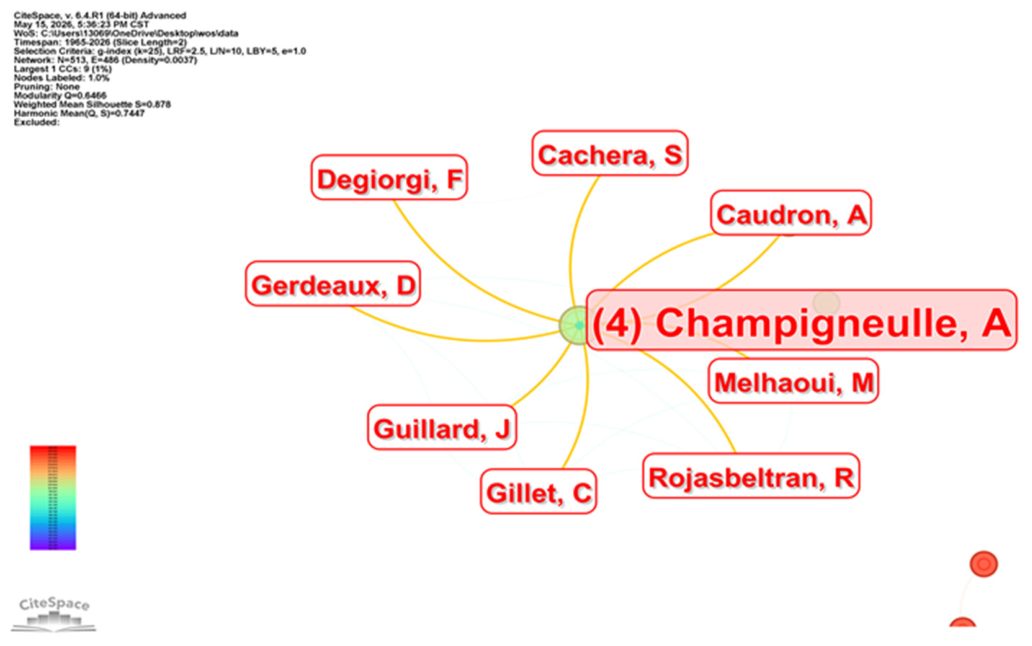
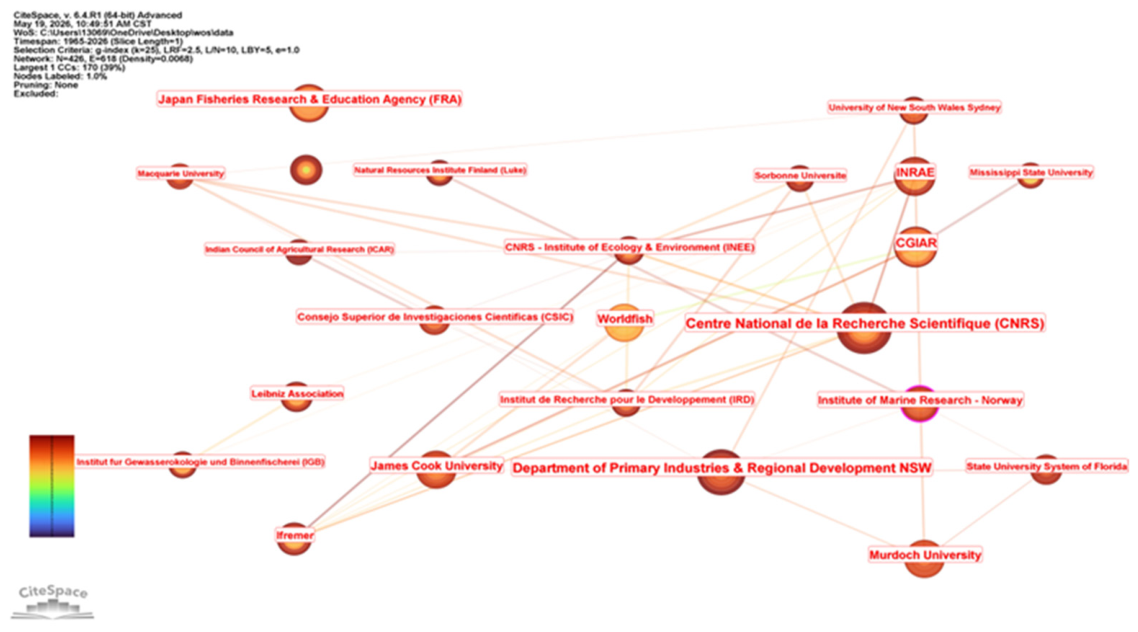
Comparing
Figure 8 and
Figure 9 reveals that, in the author publication distribution map (
Figure 8), the nodes are more dispersed, with fewer formed clusters. In contrast, the research institution distribution map (
Figure 9) exhibits a more concentrated node distribution pattern.
By aggregating the publication data, we compiled a list of authors who have published more than four papers (including Taylor, Bell, and Champigneulle, among others) along with their respective publication counts. Institutions with more than 10 publications include the French National Centre for Scientific Research (CNRS), the New South Wales Department of Primary Industries (NSW DPI), the Consultative Group on International Agricultural Research (CGIAR), the National Research Institute for Agriculture, Food and Environment (INRAE), Murdoch University, WorldFish, James Cook University, the Japan Fisheries Research and Education Agency, and the Institute of Marine Research. Among these, the most prominent institutions include CNRS, NSW DPI, CGIAR, and INRAE.
Table 5 summarizes the top ten authors and research institutions ranked by publication volume.
This conclusion is further corroborated by comparing the publication volumes of authors and institutions (except for Taylor). Individual authors exhibit lower publication counts, none of which exceed ten papers. Conversely, research institutions yield significantly more fruitful outputs due to long-term, close collaboration, with the French National Centre for Scientific Research (CNRS), the New South Wales Department of Primary Industries (DPI NSW), and the Consultative Group on International Agricultural Research (CGIAR) being particularly prominent.
Taylor, the author with the most prominent academic achievements, primarily focuses on fishery management policy research and the evaluation of various factors in the process of marine ranching development using multiple computational methods. This assists in assessing ecological security and benefits, thereby mitigating risks and enhancing planning feasibility. Research institutions in this field have carried out relevant studies along these lines. Another author, Bell, evaluated the potential for enhancing fishery productivity through numerous marine species release experiments combined with the development of bioeconomic and energy models, aiming to formulate more scientific marine stock enhancement policies. Furthermore, research institutions across multiple countries have shared research findings and drawn on successful experiences to promote these practices locally based on their specific conditions. Undoubtedly, the close cooperation among these institutions has played an important role in driving the development of the marine ranching industry.
3.6. Knowledge Graph Analysis of Stock Enhancement Research in the WoS Database
It should be noted that, although the overall WoS dataset spans from 1965 to 2026, the keyword co-occurrence and cluster analyses presented in this section are restricted to the1993–2022 period. This temporal restriction was applied for the following reasons. First, prior to 1993, the annual publication volume in the WoS database was extremely low (fewer than two papers per year on average), resulting in insufficient data density for meaningful co-occurrence analysis and stable cluster formation. Second, the period from 1993 to 2022 represents the core developmental phase of international stock enhancement research, during which publication output was both substantial and continuously growing, allowing for robust knowledge mapping. Third, this restricted timeframe ensures comparability with other analyses and avoids the distortion that would be introduced by including the most recent incomplete year (2023–2026) in the co-occurrence network. The full dataset (1965–2026) is retained for the overall publication trend analysis (
Figure 1), where sparse early records are appropriately represented as a time series.
Keyword analysis constructs a semantic map of a specific research field by utilizing keywords extracted from literature. This quantitative method is designed to scientifically reveal the interrelationships among various subfields and track their development trends. Specifically, keyword co-occurrence analysis is a method that evaluates the strength of connection between keywords by investigating their co-occurrence relationships across a large body of literature.
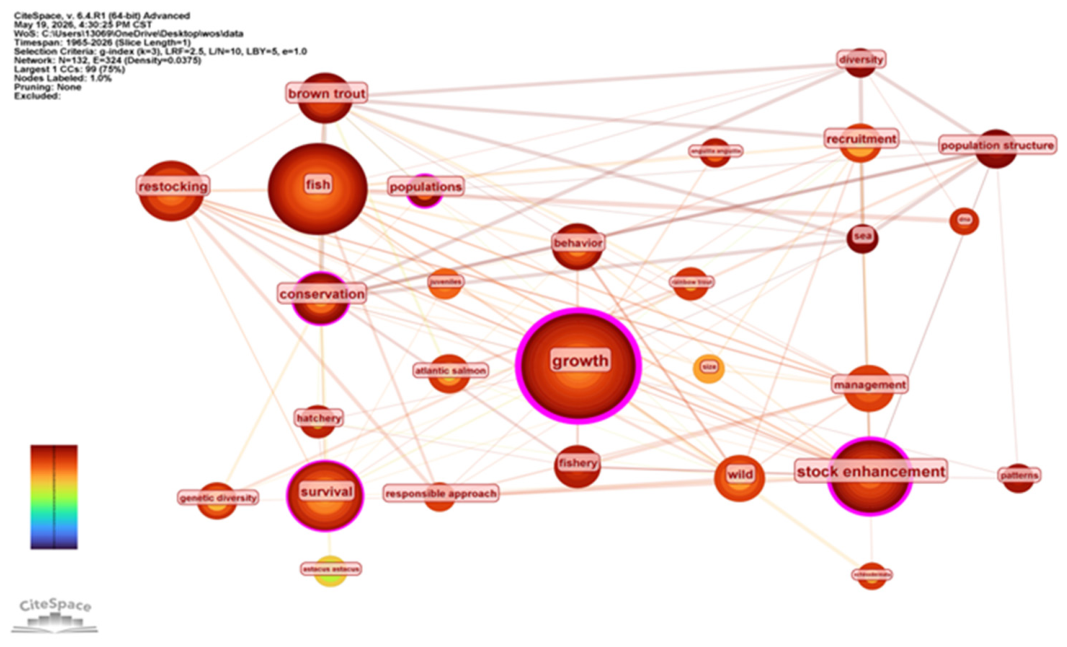
To facilitate a more effective subsequent comparison with CNKI data, CiteSpace software was operated with the time span uniformly set to 1993–2022, the time slice set to 1 year, and the network node type set to “Keyword.” The selection criterion adopted the g-index
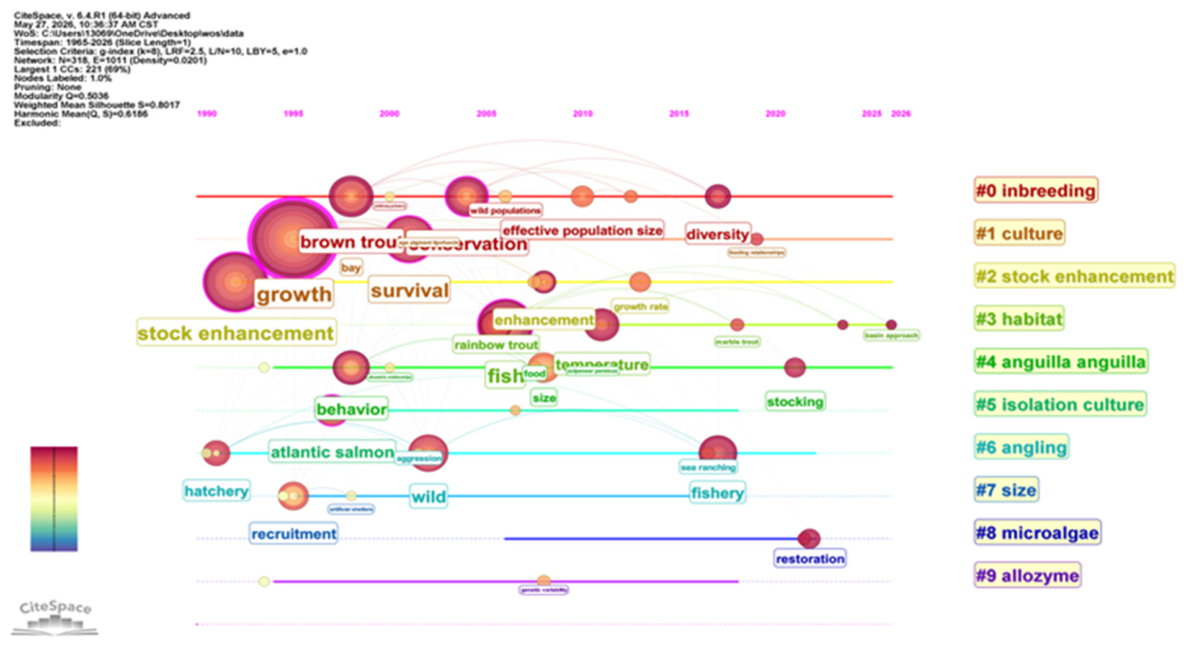
k = 3. The algorithm performed a cluster analysis on highly correlated keywords, and the results are shown in
Figure 10.
CiteSpace uses the modularity value (Q value) and the average silhouette value (S value) as metrics to evaluate the validity of cluster mapping, which are determined by the network structure and cluster clarity. Generally, a Q value greater than 0.3 indicates a significant clustering structure, while an S value greater than 0.5 suggests that the clustering partition is reasonable. The values calculated in this study are Q = 0.5842 and S = 0.8261, demonstrating that the generated map meets the required standards. In the timeline visualization of the knowledge graph, larger node circles reflect a higher volume of research accumulated around the corresponding keyword, whereas brighter colors signify that the research topic has gained more prominent attention in this field in recent years.
CiteSpace software adopts the Log Likelihood Ratio (LLR) algorithm to cluster closely associated keywords from the literature and assign cluster labels, thereby clearly presenting the structural evolution and trajectory of various research themes [
50].
Figure 10 illustrates the initial keyword mapping process: relevant clusters are first identified, and the keywords within each cluster are then arranged chronologically along the same horizontal line. By setting the maximum displayed cluster value to
k = 10, a timeline map was plotted (
Figure 11). The resulting clusters comprise inbreeding (#0), culture (#1), stock enhancement (#2), habitat (#3),
Anguilla anguilla (#4), isolation culture (#5), angling (#6), size (#7), microalgae (#8), and allozyme (#9). Subsequently, we compiled the frequency and corresponding appearance years of representative keywords within each cluster into
Table 6 for further analysis.
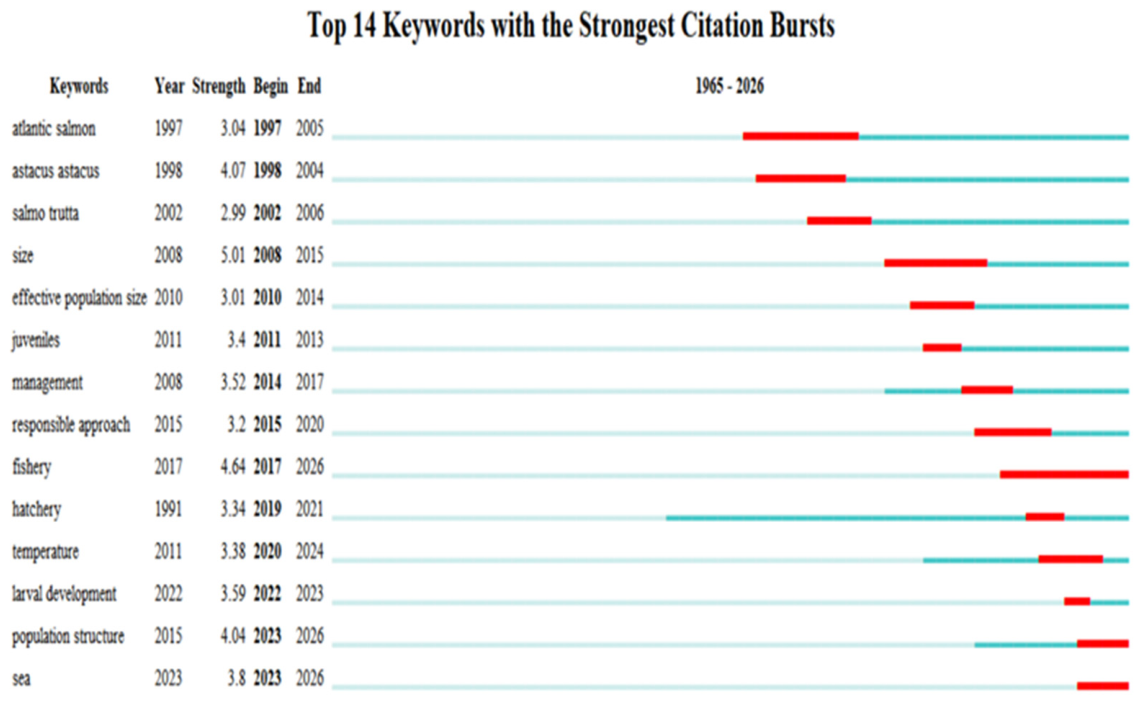
The purpose of the top high-frequency keyword list in CiteSpace is to present the overall evolution of research by plotting timeline graphs that span from the onset to the end of each keyword’s prominence. Analyzing these keywords provides insights into the shifting research hotspots within the domain across different periods. Therefore, by executing the software and conducting a keyword co-occurrence mapping analysis, we selected 14 of the most prominent keywords and plotted them chronologically in
Figure 12, where the red segments indicate the periods when each keyword served as an active research hotspot.
Stage 1: Basic Research Stage (1990–2009)—inbreeding (#0), isolation culture (#5), and allozyme (#9). Early research in this period primarily focused on the genetic divergence and inbreeding risks between cultured and wild populations [
51,
52]. Key areas of investigation included genetic variation at the allozyme and microsatellite levels between farmed and wild
salmon, as well as the subsequent impacts of inbreeding on population viability [
53,
54,
55]. For instance, allozyme analysis revealed a significant deficiency of heterozygosity in
clams and
crayfish subjected to long-term isolated cultivation, indicating that artificial propagation can trigger a decline in genetic diversity [
56,
57,
58].
Stage 2: Deep Development Stage (2010–present). The focus of this stage is primarily placed on optimizing the management strategies and ecological adaptability of stock enhancement. Keywords such as “population structure,” “fisheries,” and “responsible approach” are frequently mentioned within the clusters of stock enhancement (#2), habitat (#3), and angling (#6). Responsible enhancement and scientific management have become core development goals during this phase, utilizing effective population size and juvenile survival rate as evaluation criteria to optimize the construction of the stock enhancement system [
59,
60,
61].
Based on the keyword co-occurrence mapping, 14 of the most prominent keywords were selected and plotted chronologically (
Figure 12). The red regions indicate the periods when these keywords served as active research hotspots. In the early stage, the keywords primarily featured specific species (Atlantic salmon, crayfish, and brown trout), whereas later stage research shifted its focus toward “fisheries,” “population structure,” and “temperature” as key research directions.
3.7. Trend Analysis of Stock Enhancement Research in CNKI Academic Journals
In China, research in the field of stock enhancement exhibits distinct phased characteristics, which can generally be divided into three stages, as shown in
Figure 1.
Stage 1: The Inception Stage of Stock Enhancement Research (1987–2005). In the late 1980s, China began to gradually carry out the practice of aquatic stock enhancement, conducting trial release experiments of fish, shrimp, crab, and shellfish fry in coastal areas. In 1987, the first research literature related to stock enhancement appeared in the CNKI database. However, because hatchery rearing technologies, marine ecological monitoring systems, and resource assessment methods were immature at that time, relevant research remained in an exploratory stage. The volume of academic achievements was relatively small, with the average annual publication volume during this phase being fewer than five papers. During this period, research primarily focused on the breeding of economic fish species, artificial release techniques, and the enhancement of fishery yields. As coastal fishing intensity in China continued to increase, some traditional economic fish resources experienced declines, and stock enhancement was gradually regarded as an important measure to mitigate the depletion of fishery resources. However, research in this phase paid more attention to release quantities and economic outputs, while giving relatively insufficient consideration to ecological restoration effects, population genetic risks, and resource contribution rates. Entering the 21st century, with the advancement of the mid-summer fishing moratorium system and the conservation of aquatic biological resources, the state began to gradually attach importance to the role of stock enhancement in resource recovery. Between 2001 and 2005, the number of relevant studies increased, and directions such as the selection of released species, the control of seedling specifications, and the choice of release sea areas gradually became research hotspots.
Stage 2: Developmental Research and Technological Exploration Stage (2006–2015). In 2006, the State Council officially issued the Action Outline for Conservation of Aquatic Biological Resources in China, marking the formal elevation of stock enhancement to a national-level resource conservation strategy. Driven by this national policy, China’s stock enhancement research entered a period of rapid development. The number of relevant papers grew significantly, with annual publication volumes generally concentrating be-tween 10 and 30 papers, which was markedly higher than that of the previous stage. During this phase, domestic stock enhancement research gradually shifted from traditional “production-oriented stocking” to “resource conservation-oriented stocking.” The research scope not only covered hatchery rearing and release technologies, but also gradually expanded into multiple directions, including artificial reef construction [
62,
63,
64,
65,
66,
67], marine ranching, ecological restoration, and fishery resource assessment. Concurrently, technologies such as tag release, otolith marking, acoustic conditioning, and molecular genetics began to be widely applied to evaluate the effectiveness of stock enhancement, thereby enhancing the scientific rigor and accuracy of resource assessments [
68,
69]. Furthermore, with the advancement of the construction of National Marine Ranching Demonstration Zones, the connection between stock enhancement and marine ecological restoration was further strengthened. A substantial body of research began to focus on the impacts of release activities on marine ecosystem structures, biodiversity, and the community composition of fishery resources, gradually expanding the research perspective from single resource recovery to integrated ecosystem management.
The marine environment is closely related to the growth and reproduction of fish. Currently, global attention mainly focuses on the impacts of climate change, rising water temperatures, and habitat degradation on the effectiveness of stock enhancement. Concurrently, screening the appropriate release sizes and lineages in hatcheries, as well as enhancing the wild adaptability of juveniles after release, remains a technical challenge that urgently needs improvement. Therefore, seeking optimal solutions is one of the key pathways to promote the optimization and efficient management of stock enhancement. Some countries have formulated long-term plans to develop responsible enhancement models, transitioning from purely production-oriented stocking to ecological restoration-based enhancement since the last century. To protect fishery resources in European and American countries, stock enhancement has been deployed to alleviate fishing pressure and restore endangered populations. For example, the US government and nongovernmental organizations have established an effective collaborative mechanism, formulated conservation policies based on population genetic monitoring, and adopted an adaptive management system, achieving the coordinated development of recreational fisheries and stock enhancement.
Stage 3: High-Quality Development Stage of Stock Enhancement (2016–present). Since 2016, driven by the concepts of maritime power, ecological civilization construction, and green fishery development, China’s stock enhancement research has entered a stage of high-quality development. Especially after the promulgation of policy documents such as the 14th Five-Year National Fishery Development Plan and the Guiding Opinions on Improving Aquatic Stock Enhancement Work During the 14th Five-Year Plan Period, stock enhancement has gradually shifted from a traditional resource supplementation mode to a development mode that places equal emphasis on both ecological restoration and sustainable resource utilization. During this stage, the volume of relevant research achievements has grown rapidly, the average annual publication count has continuously risen, and clear characteristics of multidisciplinary research have emerged. The research focuses are mainly concentrated in directions such as the genetic diversity conservation of released populations, habitat restoration, ecological carrying capacity assessment, resource recovery effect evaluation, and the application of smart fishery technologies. Concurrently, modern technologies like remote sensing/monitoring, ecological modeling, numerical simulation, big data analysis, and DNA molecular markers have been widely applied in stock enhancement research, driving the field to gradually develop toward digital, precise, and intelligent directions. In recent years, keywords such as “marine ranching,” “ecological restoration,” “resource conservation,” and “carbon sink fisheries” have frequently appeared, indicating that China’s stock enhancement research has gradually transitioned from a traditional means of increasing fishery production to an important component of integrated marine ecosystem governance. In the future, with the continuous advancement of national marine ecological civilization construction, stock enhancement will continue to play an important role in fishery resource recovery, marine ecological restoration, and the sustainable development of the marine economy, remaining a long-term research hotspot of academic attention.
4. Discussion
Currently, CNKI and WoS are the most widely applied and authoritative academic databases both domestically and internationally [
25,
26]. Characterized by extensive literature coverage and reliable data sources, they can effectively reflect the current research status and developmental trends in the field of stock enhancement. Therefore, this study selects the CNKI and WoS databases as primary data sources to enhance the representativeness and reliability of the research results. Concurrently, as one of the most widely used visualization tools in bibliometric analysis, CiteSpace possesses robust capabilities in data processing, knowledge map construction, and hotspot evolution analysis. It enables the unified format conversion and synthesis of Chinese and English literature data, revealing the disciplinary knowledge structure and the evolutionary process of research hotspots from multiple dimensions. Consequently, this investigation utilizes CiteSpace software in conjunction with Excel statistical methods to systematically analyze stock enhancement literature, thereby strengthening the visual expression and knowledge linkage interpretation of the research outcomes.
A comparative cross-analysis of the literature in the CNKI and WoS databases reveals that, in terms of English-language publication output, China’s stock enhancement research appears to have lagged behind international counterparts during the 1993–2010 period (
Figure 1), with the average annual publication volume of international studies being significantly higher than that of domestic research. However, it should be noted that this apparent late commencement is partly an artifact of our search strategy. The CNKI search was primarily conducted using the English search term “stock enhancement” to ensure comparability with the WoS search. Had we used the comprehensive Chinese keywords that have been widely applied in Chinese research since the 1980s, we would have retrieved a larger volume of earlier Chinese literature. Therefore, while the WoS data reflect a genuine lead by developed marine fishing nations (such as Japan, the United States, and South Korea) in early international research, the growth trajectory of China’s domestic research—particularly since the 2006 national policy—demonstrates a substantial and accelerating increase in scientific output. Driven by the continuous advancement of China’s marine ecological civilization construction and the increasingly prominent depletion of fishery resources, stock enhancement has gradually garnered heightened attention from both domestic academia and regulatory departments. Notably, since the 12th Five-Year Plan period, the state has continuously intensified policy support for aquatic biological resource conservation and ecological restoration, propelling the rapid development of stock enhancement research. Since 2016, the annual publication volume in CNKI has grown markedly, even surpassing the WoS database in certain years, which indicates that China has progressively emerged as one of the major nations in global stock enhancement research.
From the perspective of author and research institution distribution, domestic stock enhancement research is primarily carried out relying on universities, research institutes, and national-level fishery research platforms. The collaboration networks of authors and institutions demonstrate that research activities are mainly concentrated within several core groups (
Figure 2 and
Figure 3). The major contributing authors and institutions are summarized in
Table 5. Most studies exhibit distinct team-oriented and regionalized characteristics, forming core research groups represented by institutions such as the Ocean University of China, Shanghai Ocean University, and the Chinese Academy of Fishery Sciences. In contrast, literature within the WoS database reveals that research institutions in European and American countries maintain closer collaborative ties, featuring more cross-regional and interdisciplinary cooperation. This is closely related to their long-term accumulation of scientific resources, technological foundations, and financial support.
This research results indicate that current domestic and international research hotspots in stock enhancement are mainly concentrated in directions such as resource recovery, artificial reefs, marine ranching, genetic diversity conservation, release efficacy evaluation, and ecological restoration (
Figure 4 and
Figure 5;
Table 2). Among these, early investigations primarily focused on hatchery rearing and resource replenishment, subsequently shifting toward post-release efficacy assessment, population genetic structure, and ecosystem response studies. In recent years [
31,
32], with the continuous advancement of the ecological civilization construction and the maritime power strategy, stock enhancement research has begun to pay closer attention to synergistic ecosystem restoration, habitat recovery, and long-term dynamic resource monitoring. Consequently, the research directions are gradually evolving toward ecological, precise, and intelligent pathways.
The development of China’s stock enhancement exhibits a distinct alignment with national policy orientations. Early stock enhancement initiatives primarily aimed at restoring fishery yields and replenishing commercial fish resources, with research priorities heavily focused on hatchery propagation and release technologies. With the successive promulgation of policies such as the Regulations on the Administration of Aquatic Stock Enhancement and the 14th Five-Year National Fisheries Development Plan, stock enhancement has gradually transitioned from a traditional quantity replenishment model toward an ecological restoration model. Currently, measures such as artificial reef construction, marine ranching, habitat restoration, and smart fisheries have been progressively advanced synergistically with stock enhancement, forming a comprehensive marine ecological restoration system.
From the perspective of regional development characteristics, stock enhancement research in China’s northern coastal regions is more concentrated on commercial species such as sea cucumber, abalone, and shellfish, and its developmental model leans more toward enterprise-led marine ranching construction. In contrast, the southern coastal regions place greater emphasis on nearshore ecological restoration, fish resource recovery (
Table 3), and the construction of protected areas, where the leading role of the government in resource management and ecological governance is more prominent. This regional variation is not only related to the marine environment and resource structures, but is also closely linked with local industrial models and the orientations of policy support.
The dominance of fish species among released organisms also reflects the historical emphasis on economically important species, although crustaceans, mollusks, and echinoderms have gradually become important targets in stock enhancement practices (
Table 4) Although significant progress has been made in China’s stock enhancement research, certain deficiencies remain in long-term efficacy evaluation, ecosystem response mechanisms, and dynamic resource monitoring. Currently, some studies still primarily focus on short-term resource replenishment effects, paying insufficient attention to population genetic impacts, ecological carrying capacity, and changes in food web structures. This knowledge gap is directly reflected in our bibliometric findings. In the CNKI keyword co-occurrence network (
Figure 4 and
Figure 5), keywords such as “food web,” “trophic cascade,” and “genetic bottleneck” are either entirely absent or occur with extremely low frequency. Similarly, in the WoS cluster analysis (
Figure 10 and
Figure 11), keywords related to food web dynamics and ecosystem-level trophic interactions are notably scarce. The near absence of these keywords in the knowledge maps across both databases quantitatively confirms that the research community has yet to systematically integrate these critical ecosystem-level and genetic perspectives into stock enhancement studies. Meanwhile, different regions still lack unified standards in the selection of release species, the control of release scales, and efficacy evaluation systems, resulting in weak comparability between research outcomes across different regions.
Furthermore, with the development of modern information technology, technologies such as remote sensing monitoring, otolith marking, molecular markers, acoustic telemetry, and environmental DNA (eDNA) metabarcoding have been progressively applied to stock enhancement research and resource assessment. In the future, stock enhancement research will place greater emphasis on digital monitoring, intelligent management, and big data analytics. By constructing long-term ecological monitoring systems, the scientific rigor and precision of release efficacy evaluations will be significantly improved.
This study also has certain limitations in conducting the bibliometric analysis. First, to ensure the data quality of the literature, manual screening and deduplication of the retrieval results are required, which involves a relatively high workload when the volume of literature is large. Second, CiteSpace knowledge maps still require manual adjustment during the processes of parameter configuration and map optimization to improve clustering results and visualization effects. In addition, some early policy documents and historical literature are difficult to acquire; certain materials cannot be retrieved directly from official websites and can only be supplemented and compiled through published studies or physical archives. Therefore, future research needs to further expand data sources and combine more dynamic databases and policy texts to conduct comprehensive analysis, thereby improving the completeness and accuracy of the research results.
Critical reflections on observed patterns and limitations: several key patterns warrant critical reflection. First, the pronounced regional concentration of Chinese research—centered on Shandong, Liaoning, Guangdong, and Zhejiang—reflects regional imbalances in research capacity and funding, potentially prioritizing local economic interests over broader ecological needs. Second, the dominance of short-term resource replenishment studies over ecosystem-level and genetic research (evidenced by the absence of keywords such as “food web,” “trophic cascade,” and “genetic bottleneck”) reveals a fundamental tension between applied management goals and basic ecological understanding, with direct implications for long-term sustainability. Third, the strong correlation between Chinese publication trends and major policy milestones confirms the policy-driven nature of Chinese research but raises the question of whether research directions are overly responsive to policy signals at the expense of fundamental scientific inquiry.
Key scientific questions requiring attention: several fundamental questions remain inadequately addressed in current stock enhancement research. First, although post-release survival and reproductive success are central to the effectiveness of any stock enhancement program, direct empirical evidence remains limited for most species. Studies using otolith marking and genetic parentage analysis have demonstrated that survival rates of hatchery-reared individuals are often substantially lower than those of wild conspecifics, and reproductive contribution to subsequent generations is even more difficult to quantify. Second, the economic viability of stock enhancement remains contentious. While some programs have reported positive benefit–cost ratios, systematic evaluations suggest that many projects fail to achieve net economic benefits when full costs—including hatchery operation, marking, monitoring, and ecological impact assessment—are accounted for. This economic uncertainty, combined with the long time scales required to observe fishery responses, complicates evidence-based decision-making. Third, genetic risks—particularly inbreeding depression, loss of genetic diversity, and introgression between hatchery and wild populations—have been identified as critical concerns in the literature, yet our bibliometric results indicate these issues receive disproportionately little attention in both Chinese and international research. Future studies should prioritize establishing long-term monitoring programs incorporating genetic markers to detect and mitigate unintended genetic consequences. Addressing these questions will require collaborative frameworks integrating fisheries science, ecology, genetics, and environmental economics and will be essential for moving stock enhancement from an intuitive management practice to a rigorously evidence-based one.
Several limitations should be acknowledged. First, the bibliometric analysis is limited by database coverage, which excludes non-English publications outside WoS and grey literature. Second, CiteSpace analysis is sensitive to parameter settings and may not fully capture thematic nuances. Third, the policy analysis is restricted to national-level documents, excluding provincial or local policies. Fourth, bibliometric methods cannot provide in-depth qualitative assessment of why knowledge gaps persist. Finally, cross-database comparisons between CNKI and WoS are inherently constrained by differences in coverage, indexing, and language composition, and are therefore qualitative and structural rather than quantitative.
5. Conclusions
Based on the CNKI and WoS databases, this study conducts a systematic bibliometric analysis of literature in the field of stock enhancement. Specifically, a total of 495 Chinese documents were retrieved from the CNKI database, and 489 English documents were obtained from the WoS Core Collection. Employing a methodology that integrates bibliometric analysis, CiteSpace visualization mapping, and Excel statistical analysis, this paper systematically reviews and comparatively analyzes the research status and developmental trends of stock enhancement both domestically and internationally. The analysis is presented from multiple dimensions, including publication volume, author collaboration, research institutions, keyword clustering, temporal keyword evolution, and policy trajectory development.
The research results indicate that the global publication volume in the field of stock enhancement exhibits a continuous growth trend overall, demonstrating that stock enhancement has become an important research direction for marine fishery resource conservation and ecological restoration. Compared with developed marine fishing nations such as those in Europe, the United States, and Japan, China’s stock enhancement research commenced relatively late; however, its growth rate has accelerated significantly in recent years. Particularly driven by national policies on marine ecological civilization construction and fishery resource conservation, domestic research interest has continued to rise. From the perspective of author and institutional distribution, international research institutions maintain closer collaborative ties, with a pronounced characteristic of cross-regional and interdisciplinary cooperation. In contrast, relevant research in China is primarily carried out relying on universities, research institutes, and national-level research platforms, gradually forming stable research teams and core research groups.
The results of keyword clustering and temporal evolution analysis indicate that early stock enhancement research primarily concentrated on directions such as hatchery rearing, release technologies, and the replenishment of commercial fish resources. Subsequently, the research scope gradually expanded into fields including artificial reefs, marine ranching, genetic diversity conservation, ecological restoration, and release efficacy evaluation. In recent years, with the development of modern marine fisheries and ecological restoration concepts, stock enhancement research is progressively evolving toward ecological, precise, intelligent, and systematic directions. Among these, synergistic ecosystem restoration, long-term dynamic monitoring, smart fisheries, and digital resource management have become important contemporary research hotspots.
The results of the policy evolution analysis show that the development of China’s stock enhancement has always been highly correlated with national marine fishery policies. Over the past 20 years, the state has gradually established a policy system centered on aquatic biological resource conservation, driving the transition of stock enhancement from a traditional resource replenishment model to an ecological restoration model. Currently, stock enhancement construction in China has gradually formed a comprehensive model based on the synergistic construction of artificial reefs, habitat restoration, and marine ranching. This model uses fry release and resource conservation as its primary means, while integrating the multi-industry fusion development of recreational fisheries, ecotourism, and smart fisheries. In the future, with the continuous improvement of modern information technology and marine ecological governance systems, intelligent, ecological, and sustainable development models for stock enhancement will become an important direction for China’s marine fishery resource conservation.
Overall, stock enhancement has gradually evolved from a single resource replenishment measure into an integral component of marine ecological restoration and fishery resource management. In the future, further research is still required to strengthen long-term evaluations of release efficacy, ecosystem response mechanisms, and dynamic resource monitoring. Concurrently, cross-disciplinary integration and the application of intelligent technologies should be promoted to enhance the scientific rigor and sustainability of stock enhancement resource conservation.