Article

Zero-Valent Iron-Enhanced Nitrogen and Phosphorus Removal Performance and Mechanisms in a GAO-Dominated System

1
School of Resources Environment and Life Sciences, Ningxia Normal University, Guyuan 756099, China
2
Engineering Research Center of Oil and Gas Field Chemistry, Universities of Shaanxi Province, Xi’an Shiyou University, Xi’an 710065, China
3
School of Water and Environment, Chang’an University, Xi’an 710064, China
4
Key Laboratory of Subsurface Hydrology and Ecological Effect in Arid Region of the Ministry of Education, Chang’an University, Xi’an 710054, China
5
School of Equipment Engineering, Shanxi Vocational University of Engineering Science and Technology, Jinzhong 030619, China
*
Author to whom correspondence should be addressed.
Water 2026, 18(17), 2117; https://doi.org/10.3390/w18172117
Submission received: 6 August 2026 / Revised: 22 August 2026 / Accepted: 26 August 2026 / Published: 28 August 2026
(This article belongs to the Section Wastewater Treatment and Reuse)

Abstract

Zero-valent iron (ZVI) improves nitrogen and phosphorus removal efficiency in municipal wastewater treatment systems. However, its effects on glycogen-accumulating organisms (GAOs) and the mechanisms of action are still not fully understood. This study investigated the influence of ZVI on GAOs by assessing its effect on the performance of a denitrification reactor dominated by Candidatus Competibacter sp. (with a relative abundance of 46.33%). After ZVI addition, the reactor harbored the iron-autotrophic denitrifying bacterium Ferruginibacter sp. (0.38%), the iron-reducing bacterium Pseudomonas sp. (0.26%), and the iron-oxidizing bacterium Comamonas sp. (0.26%). This effectively integrated ammonia-oxidizing bacteria (AOB) and nitrite-oxidizing bacteria (NOB) with heterotrophic denitrification alongside iron ammonium oxidation and nitrate-dependent ferrous oxidation. The integrated approach decreased aeration duration while improving the removal efficiency of PO43-P (98.01 ± 2.54%) and total inorganic nitrogen (TIN) (62.01 ± 1.45%). The combined of ZVI in systems predominantly occupied by GAOs enhanced the carbon storage capacity of the bacteria.

1. Introduction

Enhanced biological phosphorus removal (EBPR) depends on the activity of polyphosphate accumulating organisms (PAOs). In conventional EBPR systems, glycogen accumulating organisms (GAOs) are viewed as harmful competitors, depleting carbon sources during the anaerobic stage and perhaps resulting in system failure [1,2,3]. As a result, techniques to inhibit GAOs while enhancing PAOs have been rigorously investigated [4,5].
Nonetheless, recent research indicates a more complex function for GAOs in the removal of nitrogen and phosphorus, especially under a low carbon-to-nitrogen (C/N) ratio. The anaerobic carbon storage capacity of GAOs can promote endogenous denitrification, enhancing nitrogen removal efficiency [6,7,8]. Liu et al. [9] developed a combined partial nitrification, endogenous denitrification, partial denitrification, and anammox (PNEnD/A) process within an anaerobic/aerobic/anoxic (An/O/A) reactor for the treatment of low C/N wastewater, resulting in an effluent total inorganic nitrogen (TIN) concentration as low as 2.9 mg/L. Additionally, specialized denitrifying glycogen accumulating organisms (DGAOs) can collaborate with PAOs for concurrent nitrogen and phosphorus removal [10]. Research has shown that An/O/A systems executing simultaneous nitrification denitrification and phosphorus removal (SNDPR) can attain elevated removal efficiencies and in situ sludge reduction, frequently linked to a significant presence of GAOs like Candidatus Competibacter sp. [11]. These findings underscore the substantial role of GAOs in endogenous denitrification and sludge reduction.
Prior research indicates that PAOs exhibit greater competitiveness than GAOs under conditions of low dissolved oxygen (DO) levels [4,5]. This suggests that the regulation of GAOs and PAOs by DO control is a complex issue that necessitates further research to maximize the benefits of GAOs and improve the stability and efficiency of nitrogen and phosphorus removal.
Chemical phosphorus removal agents are frequently employed to enhance EBPR in municipal wastewater treatment. Nevertheless, they may impede microbial activity and compete with PAOs for phosphate. Conversely, zero-valent iron (ZVI) serves as an alternative, environmentally plentiful, and economical mineral with diverse applications in water remediation [12,13]. This transition emphasizes the potential of ZVI as an instrument for microbial community engineering and reinforces the necessity to reevaluate the functional role of GAOs in hybrid chemical–biological nitrogen and phosphorus removal systems.
This study analyzed the impact of ZVI on GAOs within a simultaneous nitrification denitrification sequencing batch reactor (SBR) enriched with GAO bacteria. The research assessed the performance of nitrogen and phosphorus removal at varying C/N ratios with the addition of ZVI and investigated the mechanisms involved in the removal processes.

2. Materials and Methods

2.1. The Composition and Operating Conditions of the An/O/A-SBR System

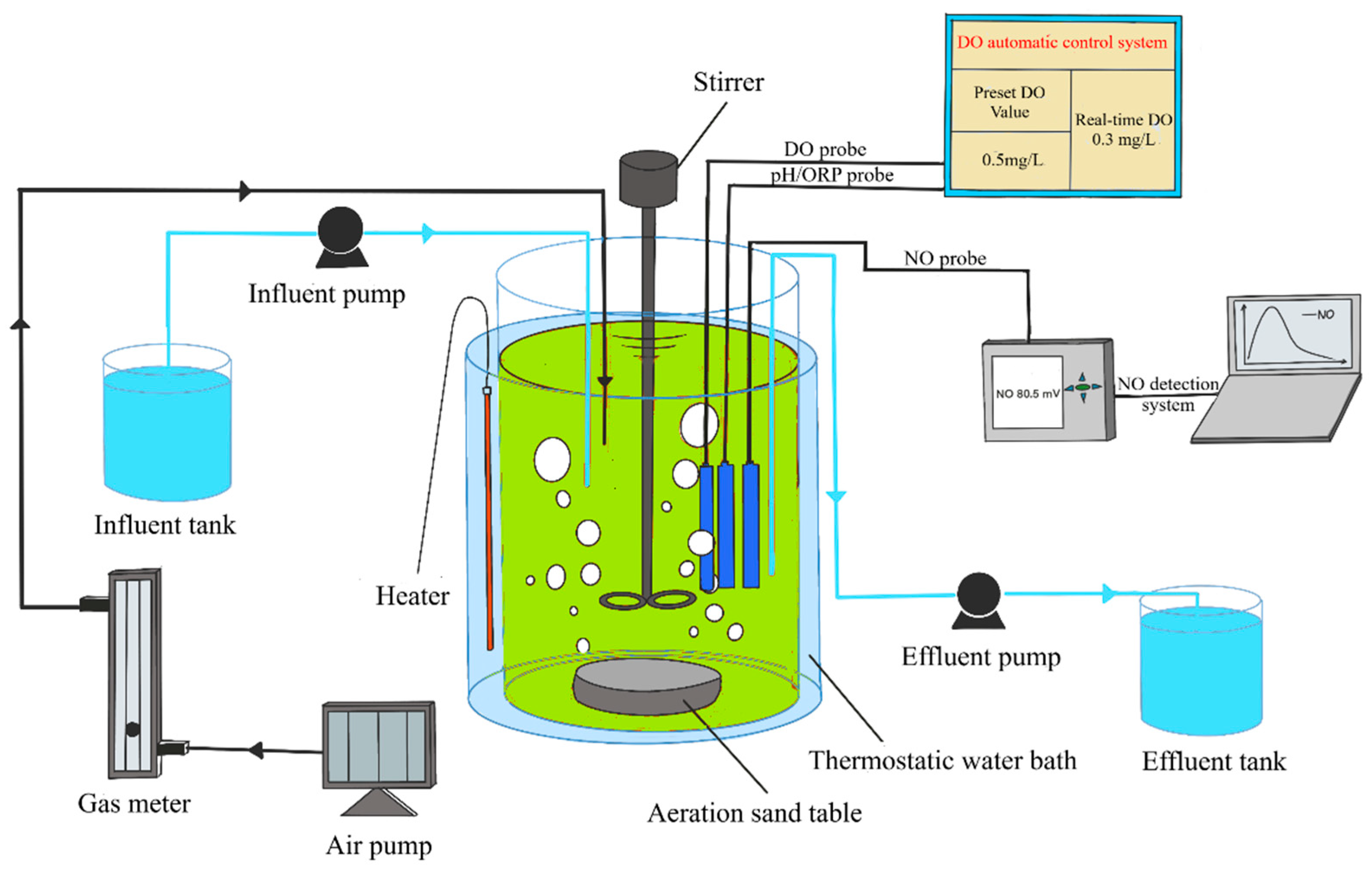
This study employed a laboratory-scale SBR reactor made of acrylic glass with an effective volume of 5 L (Figure 1), a drainage ratio of 2/5, and the hydraulic retention time (HRT) of 15 h. The reactor operated in An/O/A mode with four cycles per day, each lasting 6 h. Each cycle encompassed influent filling for 5 min, anaerobic stage for 55 min, aerobic stage for 120–240 min, anoxic stage for 30–150 min, settling for 20 min, and effluent withdrawal for 10 min. The aerobic stage was controlled by the programmed logic control (PLC)-DO real-time monitoring system, maintaining DO levels at 0.2 ± 0.1 mg/L.
Microscale zero-valent iron (mZVI) was added to the SBR intermittently. The particle size of the mZVI was 45 μm (analytical purity, Tianjin Damao Chemical Reagent Factory, Tianjin, China). A total of three additions were made (on days 38, 76, and 110, respectively). The specific quantitative indicators and operating conditions for ZVI addition are shown in Table 1.

2.2. Sludge and Sewage

The SBR reactor with simultaneous nitrification denitrification (SND) had been stable for a year. The reactor originally possessed a biological phosphorus removal function. After one month of anaerobic terminal phosphorus deprivation and phosphate-free influent operation, it became a biological nitrogen removal reactor without phosphorus removal [14]. Mixed liquor suspended solids (MLSS) and settling velocity (SV30) were kept at 4000 ± 500 mg/L and 20~30%, respectively.
The experiment used a synthetic water mixture with COD (CH3COOH) of 420 mg/L, 240 mg/L, and 360 mg/L respectively; NH4Cl of 60 mg-N/L; NaHCO3 of 650 mg/L; KH2PO4 of 5 mg-P/L; MgSO4·7H2O of 15 mg/L, CaCl2 of 11.2 mg/L, and trace elements of 1 mL/L. The trace element composition included 50 mg/L H3BO3, 30 mg/L CuCl2, 50 mg/L ZnCl2, 500 mg/L MgSO4·7H2O, 50 mg/L CoCl2·6H2O, 50 mg/L AlCl3, 50 mg/L NiCl2, and 1 mL/L concentrated hydrochloric acid.

2.3. Indicator Determination

The sludge water mixture was removed from the reactor. Samples were filtered through a 0.45 mm membrane filter prior to analysis for the determination of chemical oxygen demand (COD), NH4+-N, NO2-N, NO3-N, PO43−-P, Fe2+, total iron ions, MLSS and SV30 according to standard methods [15]. The Fe3+ concentration was calculated as the difference between total iron and Fe2+. The dissolved nitric oxide (NO) in the reactor was detected online by a NO-500 sensor (Unisense Company, Aarhus, Denmark).
The nitrogen reduction efficiency during the aerobic stage is denoted as SND efficiency and is calculated using Equation (1) [16].
SND = TIN a TIN 0 NH 4 , a + NH 4 , 0 + × 100 %
where TINa and NH 4 , a + represent the concentrations of TIN and ammonia nitrogen at the beginning of the aerobic stage, respectively, mg/L; TIN0 and NH 4 , 0 + represent the concentrations of TIN and ammonia nitrogen at the ending of the aerobic stage, respectively, mg/L.
The anaerobic organic carbon consumption (CODconsum) in the system was defined as the consumptions of influent COD during the anaerobic stage, consisting of two components. One portion represents COD consumed by exogenous denitrification of nitrates and nitrites; the other portion represents COD stored as intracellular carbon sources (referring to the activity of PAOs and GAOs). Calculated by Equations (2) and (3):
COD consum   =   COD dn   +   COD ins
COD dn = 2.86 NO 3 , a + 1.71 NO 2 , a
where CODdn was the COD consumed by denitrification in the anaerobic stage, mg/L; CODins was the COD consumed by PAOs and GAOs for storage with intracellular carbon sources, mg/L. The 2.86 and 1.71 values were the COD consumption per unit mass concentration of NO3-N and NO2-N utilized by denitrifying bacteria, respectively, mg/L; NO 3 , a and NO 2 , a were the concentrations of anaerobic initial NO3-N and NO2-N, respectively, mg/L.
The CODins could be calculated by Equation (4):
COD ins   =   Δ COD ( 2.86 Δ NO 3   +   1.71 Δ NO 2 )
where ΔCOD, ΔNO3 and ΔNO2 were the concentration values of COD, NO3-N and NO2-N during the anaerobic stage, respectively, mg/L.
The CODins rate was defined as the percentage of COD in sewage during the anaerobic stage that was stored as an internal carbon source by PAOs and GAOs, calculated by Equation (5):
COD ins ( % )   = 1 2.86 Δ NO 3 - N   +   1.71 Δ NO 2 - N Δ COD × 100 %

2.4. Microbial Community Analysis

This study employed high-throughput sequencing to analyze microbial community characteristics on days 58 and 178, with 16S rRNA high-throughput sequencing conducted by Paisenuo Biotechnology Co., Ltd. (Shanghai, China). Paired-end sequencing of sample DNA fragments was performed using the Illumina method. The resulting DNA data were compared against the 16S rDNA gene database, and gene sequences with approximately 97% similarity were grouped into operational taxonomic units (OTUs). Amplification of the V3-V4 region was performed using primers 338F and 806R, followed by taxonomic composition analysis of the samples using QIIME2 2026 software.

3. Results and Discussion

3.1. The Nitrogen and Phosphorus Removal Performance of the SBR Process

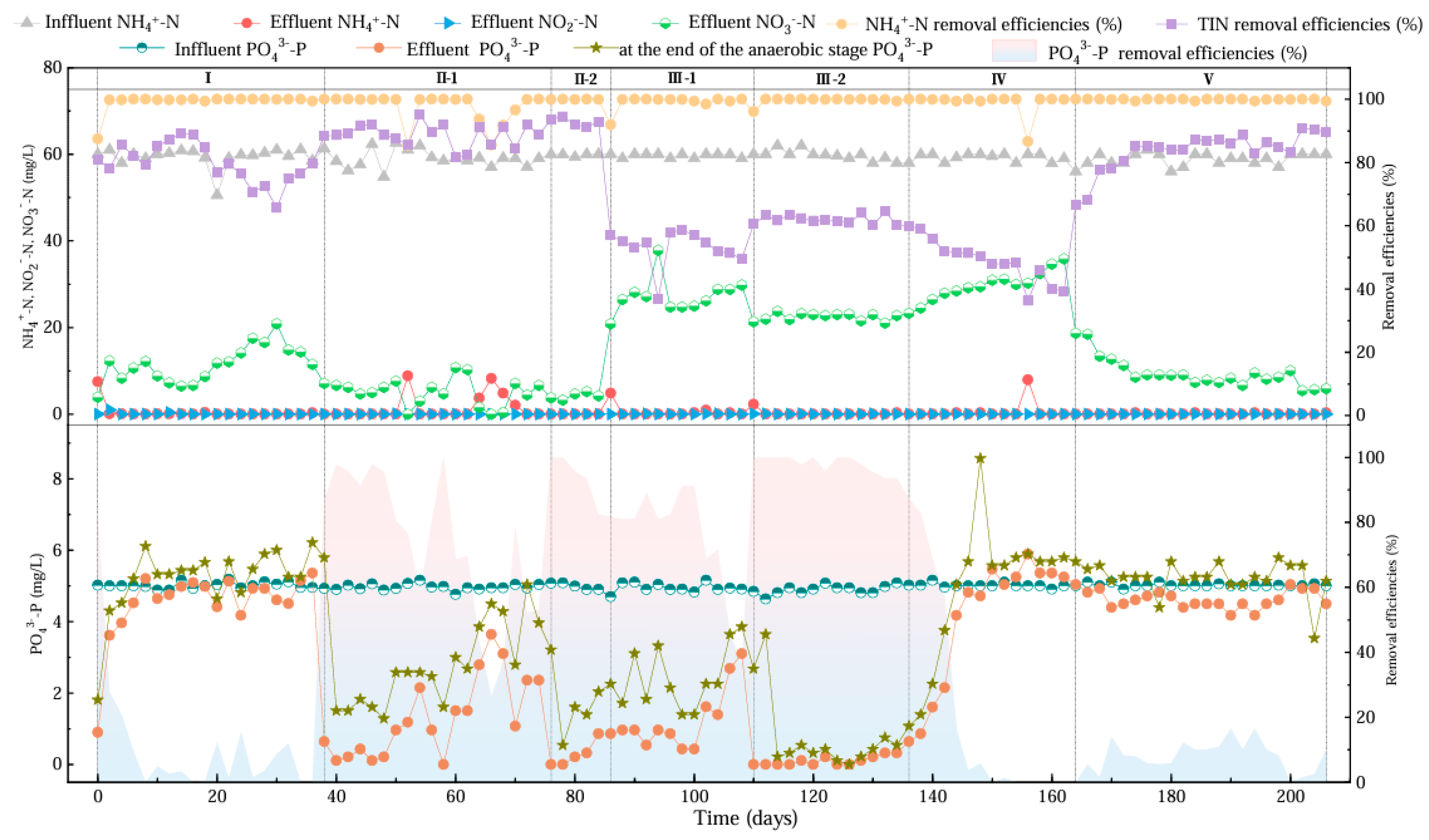
The SBR reactor was operated for 206 days to assess the impact of ZVI addition on nitrogen and phosphorus removal (Figure 2). Initial operation (Phase I, C/N = 7) showed rapid recovery of denitrification, yielding the average effluent concentrations of TIN and PO43−-P of 12.02 ± 4.03 mg/L and 4.78 ± 0.38 mg/L, respectively, but no biological phosphorus removal was observed.
A single ZVI addition (0.33 g-mZVI/g-MLSS) at the start of the anaerobic stage (Phase II-1) resulted in immediate and stable phosphate removal. During the initial period of ZVI addition, which lasted for 9 days, the effluent PO43−-P remained below 0.5 mg/L, and the effluent TIN was below 7.0 mg/L. On the 13th day of ZVI addition, the PO43−-P in the effluent gradually increased to 0.96 mg/L. The addition of ZVI was continuously monitored for 38 days, with average effluent concentrations of TIN and PO43−-P reaching 6.66 ± 2.07 mg/L and 1.33 ± 1.11 mg/L, respectively. Results demonstrated that the addition of ZVI during the initial anaerobic stage significantly reduced the effluent PO43−-P. A second identical ZVI addition confirmed this effect. During this period (Phase II-2), the average concentrations of TIN and PO43−-P in the effluent were 4.26 ± 0.77 mg/L and 0.28 ± 0.35 mg/L, respectively.
Reducing the C/N ratio from 7 to 4 (Phase III-1) caused a sharp increase in effluent nitrate, but phosphate removal remained effective. After decreasing the C/N ratio, the average concentrations of TIN and PO43−-P in the effluent were 27.96 ± 3.56 mg/L and 1.23 ± 0.85 mg/L, respectively. A subsequent third ZVI addition (Phase III-2) at this low C/N ratio immediately suppressed effluent phosphate. The average concentrations of TIN and PO43−-P in the effluent were 27.49 ± 3.40 mg/L and 0.10 ± 0.13 mg/L, respectively, confirming that ZVI’s phosphate removal efficacy was independent of the C/N ratio.
The chemical removal effect of ZVI diminished after approximately 54 days (Phase IV), leading to a rise in effluent PO43−-P (4.04 ± 1.86 mg/L). Increasing the C/N ratio from 4 to 6 in Phase V restored denitrification (the average effluent TIN of 9.63 ± 3.52 mg/L) but not biological phosphorus removal, as neither anaerobic phosphate release nor aerobic uptake was observed. This confirms that nitrogen removal was driven by GAOs, while ZVI addition effectively suppressed PAOs activity and provided chemical phosphate fixation.
At the C/N ratio of 4, the third addition of ZVI significantly improved phosphorus removal, yet the average TIN concentration in the effluent remained essentially unchanged. Performance improved as the C/N ratio was increased, implying that organic carbon limitation was the dominant factor. However, in the absence of simultaneous control experiments at a C/N ratio of 4 without ZVI, it is not possible to completely rule out the potential impact of persistent iron accumulation under low C/N conditions.

3.2. Effect of Intermittent ZVI Addition on Pollutant Removal for Typical Cyclic Systems

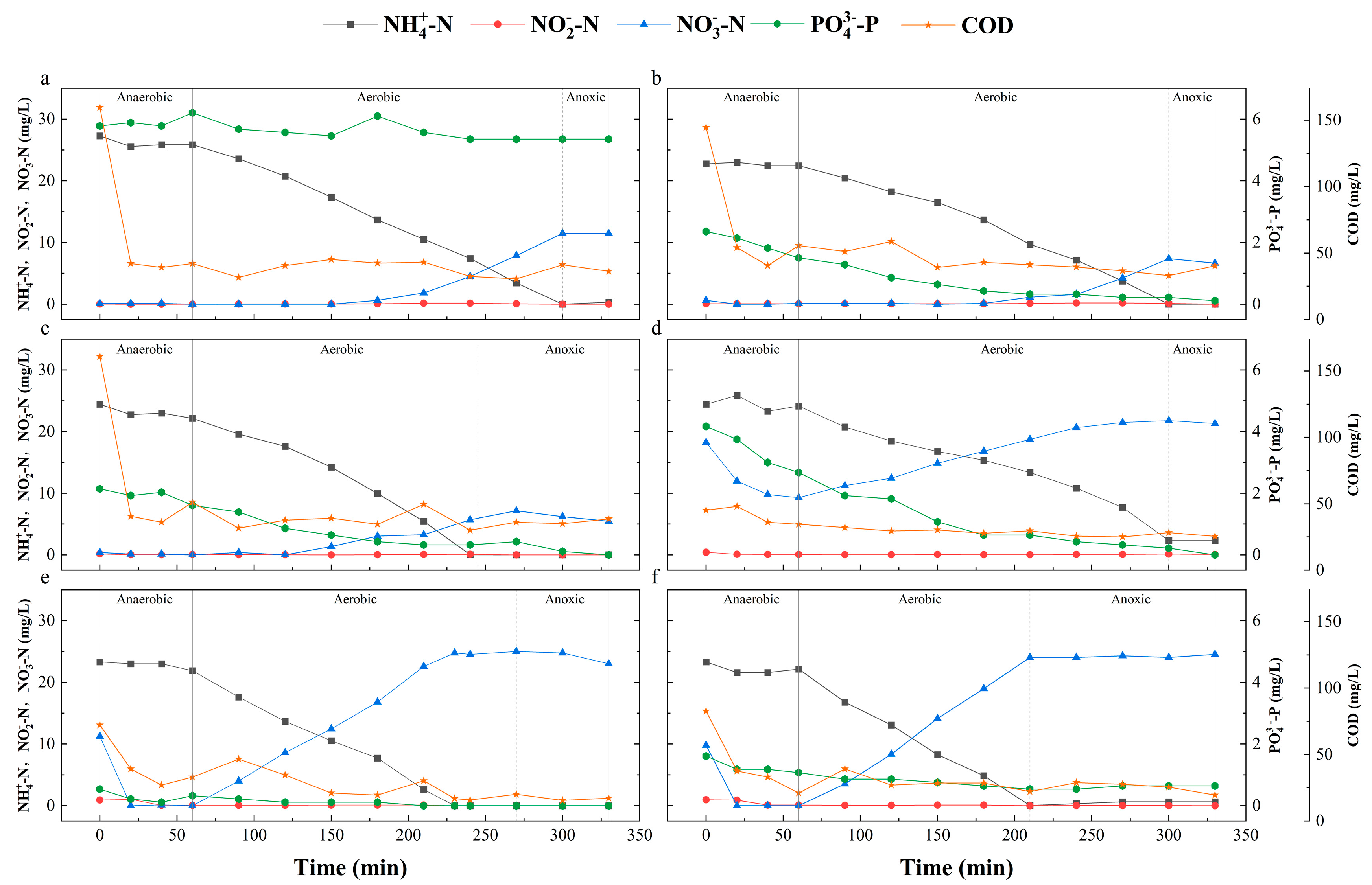
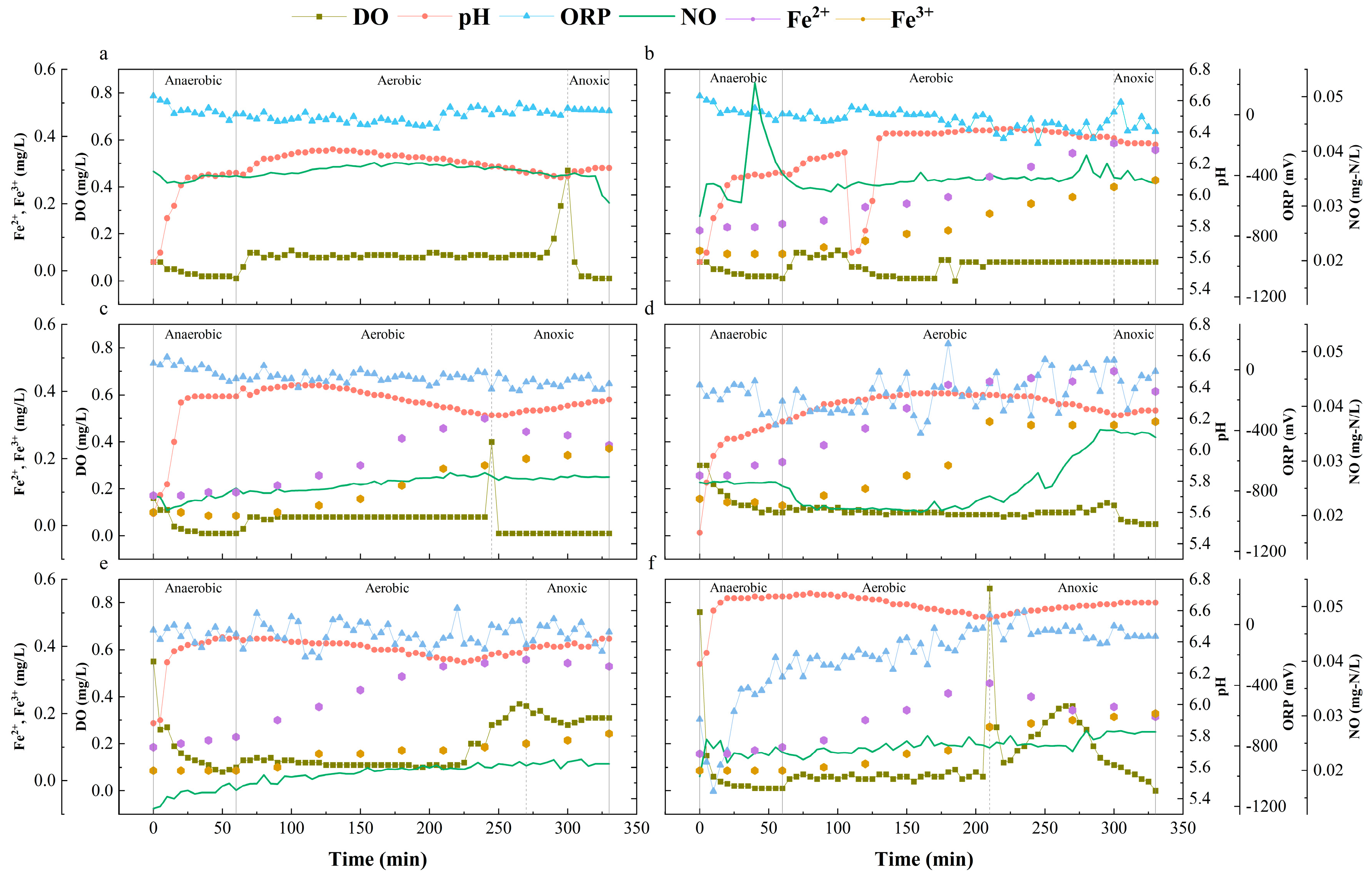
Cyclic performance was assessed on selected operational days: prior to ZVI addition (Day 36), and following ZVI dosing on Day 40 (3 days post-first addition), Day 46 (9 days post-first addition), Day 110 (1 day post-third addition), Day 120 (11 days post-third addition), and Day 135 (26 days post-third addition). Temporal profiles of nitrogen, phosphorus, DO, COD, NO, pH, ORP, Fe2+ and Fe3+ are shown in Figure 3 and Figure 4.
At a C/N ratio of 7, before the addition of ZVI (Day 36), the system demonstrated SND at a rate of 55.58%, and CODdn was 0.40 mg/L. Throughout the full cycle, no accumulation of NO2-N was observed (Figure 3a). The NO concentration showed a slight increase during the late anaerobic stage and initial aerobic stage (Figure 4a). This was likely due to the accumulation of nitrite resulting from heterotrophic denitrification of nitrate during the initial aerobic stage. The free nitrous acid (FNA) formed from nitrite entered microbial cells, and the stressed response of denitrifying microorganisms to neutralize FNA toxicity led to the production and release of NO [17,18,19]. Nonetheless, no biological phosphorus removal was detected, phosphorus release during the anaerobic stage was negligible (0.43 mg/L), and the effluent PO43−-P concentration (5.35 mg/L) corresponded with the influent level, signifying a lack of PAO activity (Figure 3a). The CODins rate (99.66%) indicated that more COD was absorbed by GAOs and common heterotrophic bacteria in the anaerobic stage. The swift pH elevation during the anaerobic stage (Figure 4a) aligns with COD storage. As carbon sources (acetic acid) enter cells via transmembrane transport, their active transport relies on the cotransport mechanism driven by the proton gradient (ΔpH). This causes extracellular H+ to migrate intracellularly, thereby reducing the proton concentration in the liquid and causing system pH to increase. The process exhibits synergistic metabolic associations with efficient COD utilization and reduction power (reduced nicotinamide adenine dinucleotide, NADH) regeneration during the Poly-β-hydroxy alkanoate (PHA) synthesis stage [20].
Phosphorus elimination was promptly and consistently accomplished following the initial ZVI addition. On Days 40 and 46 (Figure 3b,c), anaerobic phosphorus uptake transpired rather than release, yielding effluent PO43−-P of 0.11 mg/L. The SND rates rose to 67.37% and 74.16%, respectively. No buildup of NO2-N was observed. The consistently elevated CODins rates (>98%) verified that GAOs were the principal contributors to carbon source utilization. The results indicate that the addition of ZVI facilitated steady concurrent removal of nitrogen and phosphorus in a reactor that initially lacked biological phosphorus removal capabilities.
At a reduced C/N ratio of 4, after adapting the system to a lower C/N ratio and with subsequent ZVI additions, distinct patterns emerged. On Days 110 and 120 (Figure 3d,e), anaerobic phosphorus uptake persisted, culminating in complete phosphate removal (effluent PO43−-P ≈ 0 mg/L). Notably, the efficiency of chemical phosphorus removal by ZVI appeared to enhance with repeated dosing. However, nitrogen removal dynamics changed significantly: SND rates drastically declined to 42.66% and 1.18%, respectively, accompanied by elevated effluent NO3-N and higher CODdn values. This indicates a shift toward classical nitrification with limited concurrent denitrification under carbon-limited conditions. Correspondingly, the CODins rates plummeted to 0% and 14%, reflecting severely constrained internal carbon storage. On Day 135, the effluent PO43−-P concentration was 0.64 mg/L (Figure 3f). The SND rate was 3.53%, and the CODdn was 29.61 mg/L. The NO concentration in the liquid did not exhibit a distinct peak, showing a gradual upward trend with minimal variation throughout the cycle. The CODins was 32.23 mg/L and the CODins rate was 52%.
Synoptic Analysis: A comparative analysis indicates a significant impact of the C/N ratio on system functionality following the addition of ZVI. At a C/N ratio of 7, the addition of ZVI improved SND rates while sustaining elevated CODins rates, signifying effective GAO-mediated carbon storage and endogenous denitrification [21]. Conversely, at a C/N ratio of 4, nitrogen removal transitioned to mostly nitrification with inadequate SND, and carbon storage was markedly inhibited. Significantly, under all conditions, intermittent ZVI addition consistently elevated the CODins rate within the GAO-dominated community, affirming its function in augmenting the carbon source store capacity of GAOs, despite the total nitrogen removal pathway being influenced by substrate availability.

3.3. Microbial Diversity and Community Structure Analysis

Alpha diversity and relative abundance of microbial species on days 58 and 178 of reactor operation were determined.

3.3.1. Microbial Diversity Analysis

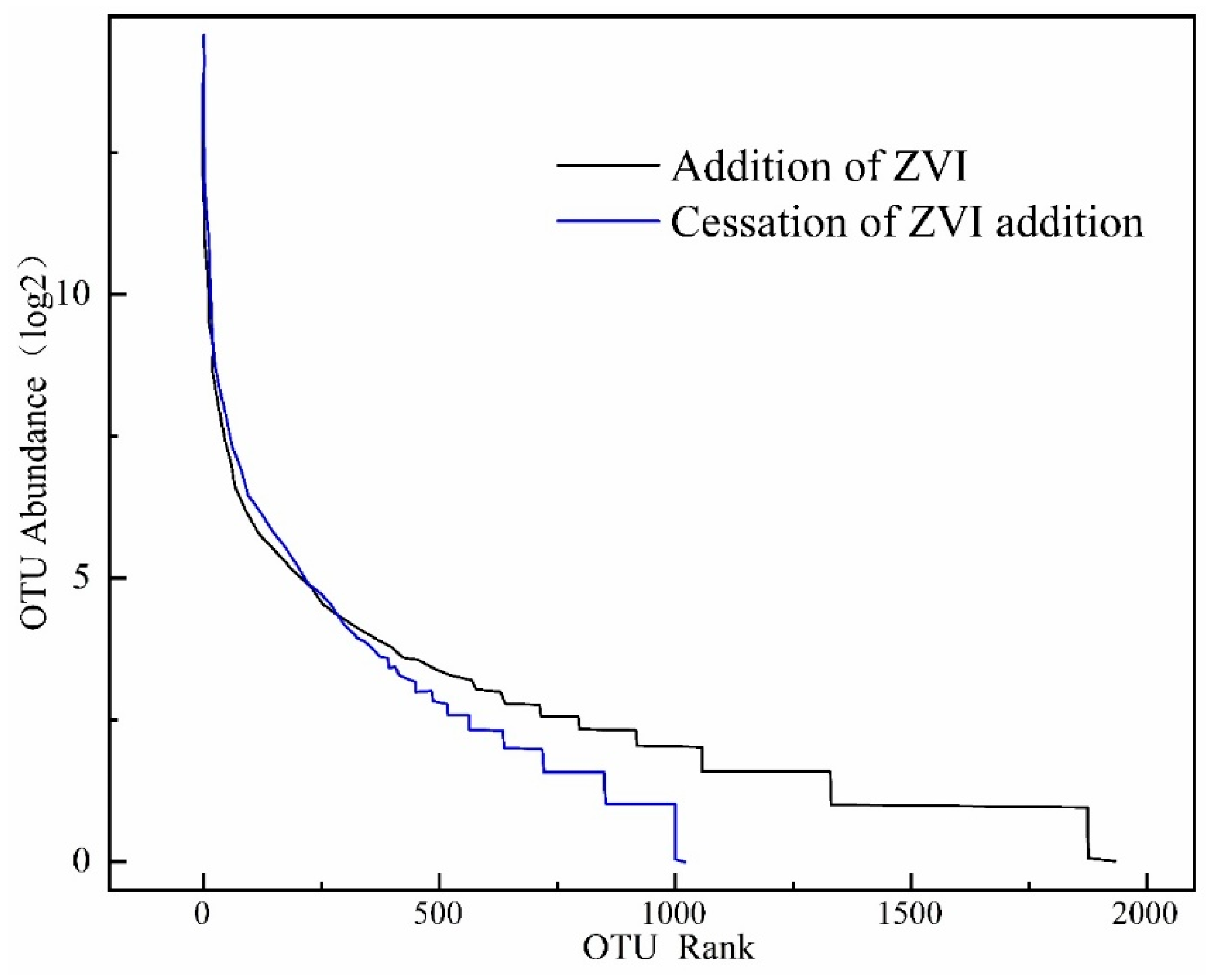
The Chao1 and Shannon indices of the microbial community under ZVI addition were higher than those after ZVI addition was discontinued, while the Simpson index showed no significant change (Table 2). This may reflect increased species richness resulting from the addition of ZVI.
The distribution range of OTUs in samples with ZVI addition was significantly broader than that in samples where ZVI addition was discontinued (Figure 5), indicating a decline in species abundance and evenness following the cessation of ZVI addition. Comparing the abundance curves revealed that the curve for samples with ZVI addition was flatter than that for samples without ZVI addition, indicating that the OTU abundance distribution within the addition group was more balanced and exhibited higher evenness. This demonstrates that ZVI addition could enhance microbial community diversity.

3.3.2. Microbial Community Structure Analysis

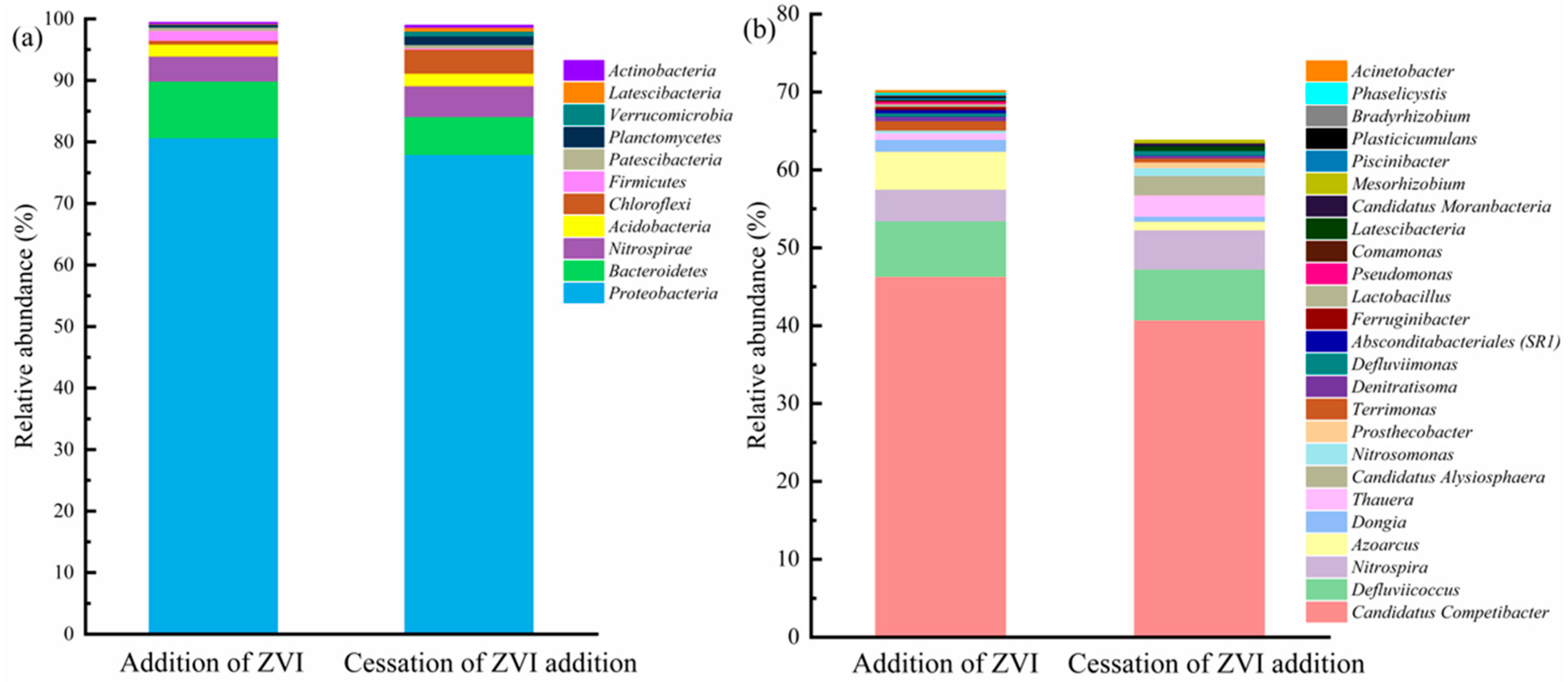
The primary bacterial phyla associated with denitrification in biological sewage treatment systems include Proteobacteria, Nitrospirae, and Firmicutes [22,23]. As shown in Figure 6a, the microbial community structures of the two sludge samples are similar at the phylum level but differ in relative abundance. On Day 58, the dominant bacterial phyla were Proteobacteria (80.70%), Bacteroidetes (9.23%), Nitrospirae (4.06%), and Acidobacteria (1.94%). On Day 178, the dominant phyla were Proteobacteria (78.00%), Bacteroidetes (6.15%), Nitrospirae (5.02%), and Chloroflexi (3.91%). The dominant bacterial phylum Proteobacteria, associated with denitrification in the system, showed no significant change before and after the addition of ZVI. The Bacteroidetes phylum, associated with phosphorus removal, decreased from 9.23% during ZVI addition to 6.15% after cessation of ZVI addition, indicating that ZVI addition in the nitrogen removal-dominated reactor could enhance the relative abundance of phosphorus-removing bacterial genera to some extent.
Candidatus Competibacter sp. is common in sewage treatment systems as a GAO. Within SNDPR systems, it does not directly participate in phosphorus removal [24]. The primary bacterial genera involved in nitrification and denitrification include Nitrospira sp., Nitrosomonas sp., Azoarcus sp., Thauera sp., and Denitratisoma sp. [25,26]. Among these, Nitrosomonas sp. and Nitrospira sp. are common AOB and NOB in wastewater treatment plants [27,28]. Azoarcus sp., Thauera sp., and Denitratisoma sp. are denitrifying bacteria responsible for reducing nitrate to N2 or nitrous oxide (N2O) [26]. On Day 58, dominant bacterial genera included Candidatus Competibacter sp. (46.33%), Defluviicoccus sp. (7.15%), Nitrospira sp. (4.06%), Azoarcus sp. (4.88%), Terrimonas sp. (1.22%), Thauera sp. (0.8%), Nitrosomonas sp. (0.36%), and Denitratisoma sp. (0.58%) (Figure 6b). On Day 178, dominant bacterial genera included Candidatus Competibacter sp. (40.75%), Defluviicoccus sp. (6.55%), Nitrospira sp. (5.02%), Azoarcus sp. (1.11%), Thauera sp. (2.7%), Candidatus Alysiosphaera sp. (2.5%), Nitrosomonas sp. (1.03%), and Denitratisoma sp. (0.39%) (Figure 6b). Based on previous studies, common bacterial genera in activated sludge systems include Candidatus Competibacter sp., Nitrospira sp., Thauera sp., Nitrosospira sp., Defluviimonas sp., and Nitrosomonas sp., which were largely consistent with the genera detected in this study. Ferruginibacter sp. is the iron-autotrophic denitrifying bacterial genus, Comamonas sp. is an iron-oxidizing bacterium, and Pseudomonas sp. is an iron-reducing bacterium [29,30,31,32,33]. On Day 58, the relative abundances were 0.38%, 0.26%, and 0.26%, respectively. However, on day 178, none of these three iron bacteria were observed.
It is worth noting that the relative abundance of Candidatus Competibacter sp. decreased from 46.33% (On Day 58) to 40.75% (On Day 178). Despite the 5.58% decline, Candidatus Competibacter sp. retained the overwhelming dominant position, and the system’s denitrification performance recovered significantly with the increase in the C/N ratio from 4 to 6 (Phase V). The functional capacity for endogenous denitrification remained intact, and denitrification performance was determined more by carbon source limitation than by the slight decrease in the relative abundance of GAOs. Furthermore, the loss of phosphate removal capacity was associated with the depletion of ZVI’s chemical phosphate removal capacity, rather than changes in the microbial community.

3.4. The Mechanism Analysis for Nitrogen and Phosphorus Removal in the An/O/A-SBR Process

The analysis of microbial communities indicated the presence of iron-dependent nitrogen transformation pathways within the GAO-dominated system (Figure 6b). In addition to the predominant Candidatus Competibacter sp. (46.33%), iron bacteria were identified, including Ferruginibacter sp. (0.38%), Pseudomonas sp. (0.26%), and Comamonas sp. (0.26%), which might imply the possible coexistence of iron oxidation and reduction processes.
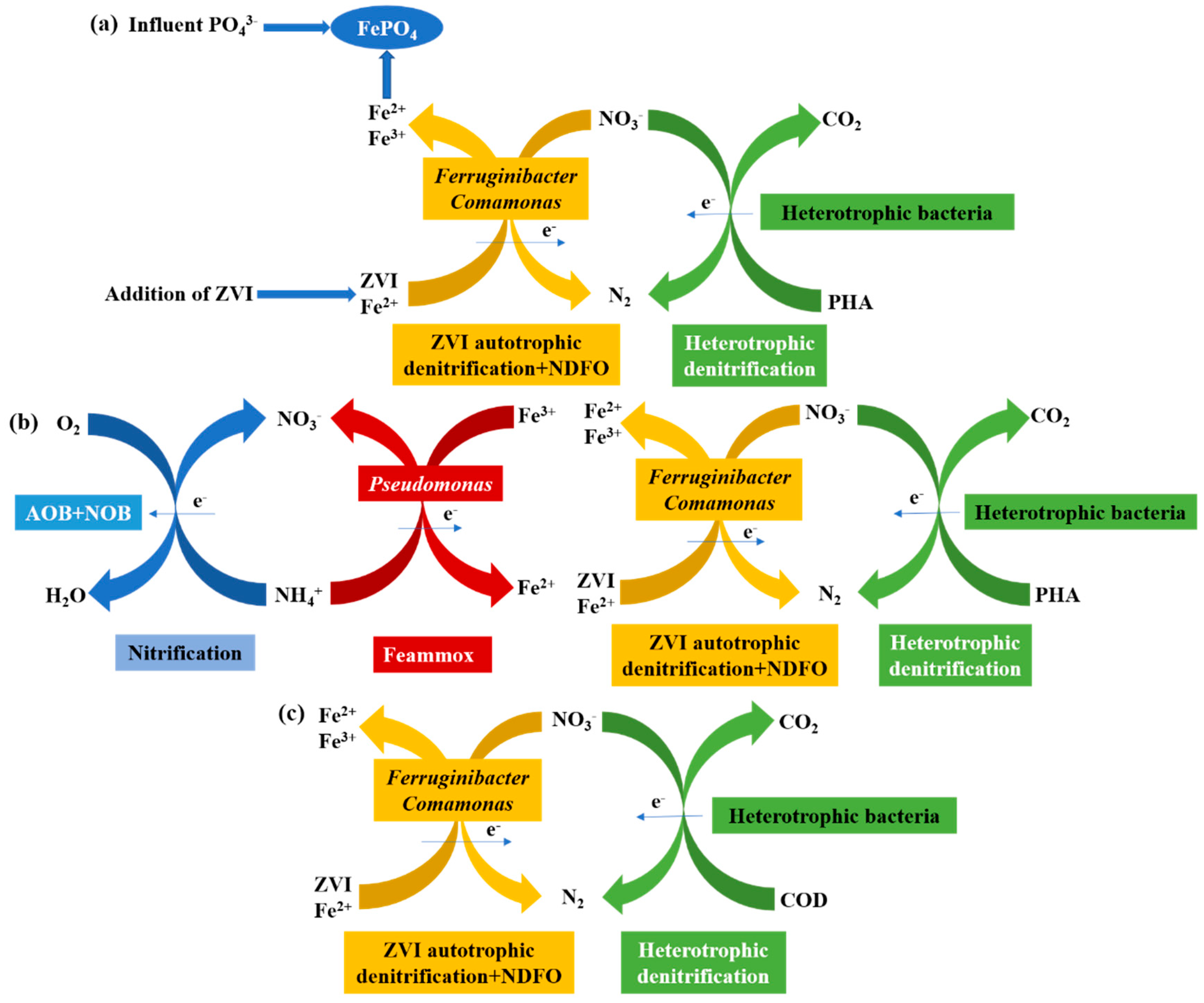
Data from the cyclic process were consistent with the putative occurrence of Feammox. Moreover, further isotope tracer experiments are required to verify this, which will form a key part of our subsequent research. Under constant aeration intensity, the reduced aeration time for complete ammonium oxidation suggests an alternative ammonia removal pathway, possibly facilitated by iron-reducing bacteria such as Pseudomonas sp., which transforms ammonia nitrogen to nitrate without the accumulation of intermediates. This was corroborated by a simultaneous decrease in Fe3+ and an increase in Fe2+ during aeration. In natural environments, the oxidation products of Feammox have been shown to be primarily nitrate, nitrite, and nitrogen gas. However, the primary product of Feammox in activated sludge for sewage treatment is nitrate [34,35]. Denitrification occurred mainly through heterotrophic pathways in GAOs and through autotrophic pathways associated with iron. The nitrate-dependent ferrous oxidation (NDFO) process was inferred to predominate during the anoxic/anaerobic stage, as suggested by the observed decrease in Fe2+ accompanying the reduction of NO3 to N2 and minimal accumulation of NO2 or NH4+. The persistently low levels of NO and inferred low levels of N2O suggest complete nitrogen conversion to N2, with biological processes predominating over abiotic reactions. Based on the above analysis, the inferred nitrogen and phosphorus removal mechanism is shown in Figure 7.
The Figure 7 indicates that during the aerobic stage, with DO maintained at 0.2 ± 0.1 mg/L, ammonia nitrogen oxidation occurs by both aerobic oxidation of ammonia nitrogen and nitrite by AOB and NOB, as well as anaerobic oxidation of ammonia nitrogen by iron-reducing bacteria Pseudomonas sp. (Feammox). The products of these processes form nitrate nitrogen. Regarding denitrification, the process involves heterotrophic denitrification with endogenous PHA as electron donor in GAOs, and autotrophic denitrification of ZVI and the NDFO process that reduces nitrate nitrogen with Fe2+ as electron donor, both yielding nitrogen gas as the final product. During the anaerobic and anoxic stages, heterotrophic denitrification occurs alongside autotrophic denitrification involving ZVI and Fe2+. Heterotrophic denitrification reduced nitrate nitrogen to nitrogen gas. Autotrophic denitrification of ZVI and Fe2+ oxidizes ZVI to Fe2+, oxidizes Fe2+ to Fe3+, and reduces nitrate to nitrogen gas.
In this study, NO concentrations remained low throughout the process, insufficient to exert inhibitory effects on microorganisms. In denitrification pathways, NO is a key intermediate that can further reduce to N2O or N2. The low dissolved NO concentrations observed in this study, coupled with nitrifying heterotrophic denitrification, Feammox, and NDFO for nitrogen and phosphorus removal, suggest a potential for reduced N2O emissions in this system. However, as N2O was not directly quantified in the present study, this remains a hypothesis that warrants direct verification in future work. The integration of nitrification–heterotrophic denitrification, Feammox, and NDFO processes improved system performance. The addition of ZVI resulted in increased nitrogen and phosphorus removal efficiencies, rising from 53.15 ± 5.85% and 75.12 ± 17.34% to 62.01 ± 1.45% and 98.01 ± 2.54%, respectively.
The biological oxidation process of ZVI is a slow process. To ensure sufficient Fe2+ in the solution, a sufficient amount of ZVI must be added at one time, allowing for it to be gradually oxidized in situ during the An/O/A cycle. This provides the Fe2+ required for nitrifying heterotrophic denitrification, and the coupled Feammox and NDFO reactions. A single adequate dose of ZVI facilitated continuous in situ generation of Fe2+, thereby promoting iron-mediated pathways and leading to the formation of highly insoluble iron-phosphate precipitates [36]. ZVI may be added as a single full dose followed by daily supplemental additions. The supplement quantity should be determined based on the amount discharged daily from the system as excess sludge (ensuring the requirements for chemical phosphorus removal and biological nitrogen removal under appropriate sludge retention time). The process of gradually eliminating PAOs from an An/O/A-SBR reactor capable of both nitrogen removal and phosphorus removal to cultivate a pure denitrifying An/O/A-SBR reactor revealed that within the mixed microbial community of PAOs and GAOs, GAOs likely occupied a subordinate position. Only after the deliberate elimination of PAOs did GAOs gradually transition to a dominant status. The reactors experiencing deteriorated phosphorus removal due to excessive GAOs growth may not be caused by reduced PAOs activity resulting from GAOs competition for carbon sources, but rather by the PAOs themselves failing to adapt to environmental changes. The increase in GAOs relative abundance may merely be a consequence of decreased PAOs relative abundance rather than its cause.
To rigorously validate the proposed Feammox and NDFO pathways and to quantitatively distinguish biotic from abiotic contributions to nitrogen conversion and N2O generation, future studies should adopt advanced mechanistic validation strategies. Ma et al. [37] developed a physically integrated multiscale framework, demonstrating how physically coupled modelling can be used to quantify coupled biogeochemical processes. This approach offers a promising pathway for quantitatively disentangling the coupled contributions of heterotrophic denitrification, iron-mediated autotrophic pathways, and chemical precipitation in the GAO-dominated system. Furthermore, Wang et al. [38] explored chemically driven pathways in water treatment. By identifying and tracking key reactive intermediates, the study established a framework for distinguishing between biocatalytic transformations and chemically driven processes. For example, by tracking the dynamic variations of NO, N2O and iron species using specific inhibitors, or by conducting isotope tracer experiments, it will be possible to clearly distinguish between biological N2O reduction and chemical denitrification.

4. Conclusions

This study identified iron-autotrophic redox bacteria in a SBR dominated by GAOs (Candidatus Competibacter sp., relative abundance 46.33%) after ZVI enhancement. Within 26 days following a single ZVI addition, the removal efficiencies of TIN and PO43−-P reached 62.01 ± 1.45% and 98.01 ± 2.54%, respectively. The relative abundance of the iron-autotrophic denitrifying genus Ferruginibacter sp. was 0.38%, the iron-reducing bacterium Pseudomonas sp. was 0.26%, and the iron-oxidizing bacterium Comamonas sp. was 0.26%. Results hinted that autotrophic oxidation and reduction processes of iron might have occurred within the reactor.

Author Contributions

Conceptualization, Writing—original draft, Writing—review and editing, Funding acquisition, J.Z. (Ju Zhang); Investigation, Funding acquisition, Project administration, J.Z. (Junkai Zhao); Supervision, Project administration, Writing—review and editing, X.Z.; Investigation, S.X.; Investigation, Methodology, J.Z. (Jing Zhao); Methodology W.Y.; Supervision, Funding acquisition, Project administration, A.C. All authors have read and agreed to the published version of the manuscript.

Funding

This work was supported by the National Natural Science Foundation of China (Grant No. 42377060), supported by Scientific Research Program Funded by Shaanxi Provincial Education Department (Grant No. 24JR132), supported by Ningxia Normal University 2026 University-level Research Projects High-Level Talent Recruitment Special Programmed Approved Projects (Grant No. NXNUG2026104).

Data Availability Statement

The data presented in this study are available on request from the corresponding author due to institutional data sharing policies.

Acknowledgments

The authors would like to express their gratitude to everyone who provided assistance with the present study.

Conflicts of Interest

The authors declare no conflicts of interest.

References

  1. Čech, J.S.; Hartman, P.; Wanner, J. Competition between PolyP and non-PolyP bacteria in an enhanced phosphate removal system. Water Environ. Res. 1993, 65, 690–692. [Google Scholar] [CrossRef] [Scilit]
  2. Lopez-Vazquez, C.M.; Oehmen, A.; Hooijmans, C.M.; Brdjanovic, D.; Gijzen, H.J.; Yuan, Z.; van Loosdrecht, M.C.M. Modeling the PAO–GAO competition: Effects of carbon source, pH and temperature. Water Res. 2009, 43, 450–462. [Google Scholar] [CrossRef] [Scilit] [PubMed]
  3. Saunders, A.M.; Oehmen, A.; Blackall, L.L.; Yuan, Z. The effect of GAOs (glycogen accumulating organisms) on anaerobic carbon requirements in full-scale Australian EBPR (enhanced biological phosphorus removal) plants. Water Sci. Technol. 2003, 47, 37–43. [Google Scholar] [CrossRef] [Scilit]
  4. Carvalheira, M.; Oehmen, A.; Carvalho, G.; Eusébio, M.; Reis, M.A.M. The impact of aeration on the competition between polyphosphate accumulating organisms and glycogen accumulating organisms. Water Res. 2014, 66, 296–307. [Google Scholar] [CrossRef] [Scilit] [PubMed]
  5. Izadi, P.; Izadi, P.; Eldyasti, A. Understanding microbial shift of Enhanced Biological Phosphorus Removal process (EBPR) under different Dissolved Oxygen (DO) concentrations and Hydraulic Retention Time (HRTs). Biochem. Eng. J. 2021, 166, 107833. [Google Scholar] [CrossRef] [Scilit]
  6. Yao, X.; Zhu, Y.; Gao, P.; Liu, T.; Zhang, X.; Liu, W.; Li, J.; Li, D.; Zhang, Y.; Zhang, Z. Limitations of endogenous denitrification in low carbon-to-nitrogen wastewater treatment: Insights into carbon allocation imbalance and metabolic adaptation. Bioresour. Technol. 2026, 456, 134915. [Google Scholar] [CrossRef] [Scilit] [PubMed]
  7. Mi, H.; Xie, Y.; Zhang, Q.; Wu, L.; Dzakpasu, M.; Wang, X. Endogenous denitrification: A sustainable strategy for residual sludge reduction and nitrogen removal. J. Environ. Manag. 2026, 398, 128507. [Google Scholar] [CrossRef] [Scilit] [PubMed]
  8. Ding, J.; Gao, X.; Peng, Y.; Peng, Y.; Zhang, Q.; Li, X.; Wang, S. Anaerobic duration optimization improves endogenous denitrification efficiency by glycogen accumulating organisms enhancement. Bioresour. Technol. 2022, 348, 126730. [Google Scholar] [CrossRef] [Scilit] [PubMed]
  9. Liu, H.; Liu, J.; Zhang, L.; Wang, H.; Li, Y.; Chen, S.; Hou, Z.; Dong, W.; Peng, Y. Advanced N removal from low C/N sewage via a plug-flow anaerobic/oxic/anoxic (AOA) process: Intensification through partial nitrification, endogenous denitrification, partial denitrification, and anammox (PNEnD/A). Water Res. 2024, 267, 122452. [Google Scholar] [CrossRef] [Scilit] [PubMed]
  10. Rubio-Rincón, F.J.; Lopez-Vazquez, C.M.; Welles, L.; van Loosdrecht, M.C.M.; Brdjanovic, D. Cooperation between Candidatus Competibacter and Candidatus Accumulibacter clade I, in denitrification and phosphate removal processes. Water Res. 2017, 120, 156–164. [Google Scholar] [CrossRef] [Scilit] [PubMed]
  11. Ma, J.; Ji, Y.; Fu, Z.; Yan, X.; Xu, P.; Li, J.; Liu, L.; Bi, P.; Zhu, L.; Xu, B.; et al. Performance of anaerobic/oxic/anoxic simultaneous nitrification, denitrification and phosphorus removal system overwhelmingly dominated by Candidatus_Competibacter: Effect of aeration time. Bioresour. Technol. 2023, 384, 129312. [Google Scholar] [CrossRef] [Scilit] [PubMed]
  12. Shahi, S.R.; Cleaves, H.J. The effects of iron on in silico simulated abiotic reaction networks. Molecules 2022, 27, 8870. [Google Scholar] [CrossRef] [Scilit] [PubMed]
  13. Im, H.S.; Kong, D.S.; Im, C.H.; Kim, C.; Song, Y.E.; Oh, S.E.; Kim, J.R. Zero-valent iron enhances acetate and butyrate production from carbon monoxide by Fonticella tunisiensis HN43. Biotechnol. Bioprocess Eng. 2023, 28, 835–841. [Google Scholar] [CrossRef] [Scilit]
  14. Xie, S. Study of Oxygen-Limited Simultaneous Nitrification Denitrification and Phosphorus Removal (SNDPR) for Low C/N Wastewater. Doctoral’s Thesis, Chang’an University, Xi’an, China, 2022. [Google Scholar]
  15. APHA. Standard Methods for the Examination of Water and Wastewater; American Public Health Association: Washington, DC, USA, 2005. [Google Scholar]
  16. Third, K.A.; Burnett, N.; Cord-Ruwisch, R. Simultaneous nitrification and denitrification using stored substrate (phb) as the electron donor in an SBR. Biotechnol. Bioeng. 2003, 83, 706–720. [Google Scholar] [CrossRef] [Scilit] [PubMed]
  17. Jiang, Y.; Poh, L.S.; Lim, C.P.; Ng, W.J. Impact of free nitrous acid shock and dissolved oxygen limitation on nitritation maintenance and nitrous oxide emission in a membrane bioreactor. Sci. Total Environ. 2019, 660, 11–17. [Google Scholar] [CrossRef] [Scilit] [PubMed]
  18. Meher, S.; Pradhan, A.K.; Philip, L. Mechanistic elucidation of free nitrous acid–derived reactive nitrogen species along with synergistic pretreatment approaches for improved volatile fatty acid production from sludge. J. Environ. Chem. Eng. 2026, 14, 122560. [Google Scholar] [CrossRef] [Scilit]
  19. Hartop, K.R.; Sullivan, M.J.; Giannopoulos, G.; Gates, A.J.; Bond, P.L.; Yuan, Z.; Clarke, T.A.; Rowley, G.; Richardson, D.J. The metabolic impact of extracellular nitrite on aerobic metabolism of Paracoccus denitrificans. Water Res. 2017, 113, 207–214. [Google Scholar] [CrossRef] [Scilit] [PubMed]
  20. Qiu, G.; Liu, X.; Saw, N.M.M.T.; Law, Y.; Zuniga-Montanez, R.; Thi, S.S.; Ngoc Nguyen, T.Q.; Nielsen, P.H.; Williams, R.B.H.; Wuertz, S. Metabolic traits of Candidatus Accumulibacter clade IIF strain SCELSE-1 using amino acids as carbon sources for enhanced biological phosphorus removal. Environ. Sci. Technol. 2019, 54, 2448–2458. [Google Scholar] [CrossRef] [Scilit] [PubMed]
  21. Zhu, G.C.; Lu, Y.Z.; Xu, L.R. Effects of the carbon/nitrogen (C/N) ratio on a system coupling simultaneous nitrification and denitrification (SND) and denitrifying phosphorus removal (DPR). Environ. Technol. 2020, 42, 3048–3054. [Google Scholar] [CrossRef] [Scilit] [PubMed]
  22. Yue, X.; Xiao, X.; Liang, J.; Lin, Y.; Xiao, K.; Che, K. Firmicutes and Bacteroidetes as the dominant microorganisms for ammonium nitrogen wastewater treatment with a low C/N ratio in BCOR. J. Water Process. Eng. 2024, 65, 105851. [Google Scholar] [CrossRef] [Scilit]
  23. Wang, F.; Li, J.; Bian, D.; Bian, W.; Zhang, L.; Nie, Z. Treatment of domestic wastewater in step-feeding anoxic/oxic activated sludge–biofilm system at low temperature: Performance, removal characteristics, and community. Desalin. Water Treat. 2018, 120, 150–157. [Google Scholar] [CrossRef] [Scilit]
  24. He, Q.; Yan, X.; Wang, H.; Ji, Y.; Li, J.; Liu, L.; Bi, P.; Xu, P.; Xu, B.; Ma, J. Towards a better understanding of the anaerobic/oxic/anoxic-aerobic granular sludge process (AOA-AGS) for simultaneous low-strength wastewater treatment and in situ sludge reduction from ambient to winter temperatures. Environ. Res. 2023, 236, 116822. [Google Scholar] [CrossRef] [Scilit] [PubMed]
  25. Zheng, T.; Xiong, R.; Li, W.; Wu, W.; Ma, Y.; Li, P.; Guo, X. An enhanced rural anoxic/oxic biological contact oxidation process with air-lift reflux technique to strengthen total nitrogen removal and reduce sludge generation. J. Clean. Prod. 2022, 348, 131371. [Google Scholar] [CrossRef] [Scilit]
  26. Sun, S.; Li, R. The superiority of citrate as denitrification carbon source in an activated sludge system: Substrate metabolism, electron transfer and microbial characteristics. J. Water Process. Eng. 2024, 61, 105285. [Google Scholar] [CrossRef] [Scilit]
  27. Lv, K.; Wang, N.; Zhang, P.; Peng, D. Spatial nitrite gatekeeping by nitrite-oxidizing bacteria in stratified biofilms: The intrinsic bottleneck of partial nitritation-anammox systems. J. Environ. Chem. Eng. 2025, 13, 118312. [Google Scholar] [CrossRef] [Scilit]
  28. Jiang, Z.; Zheng, Z.; Wu, M.; Qu, Y.; Zheng, C.; Shen, J. Full-scale operation of an integrated aerated biofilter–denitrification shallow biofilter system for simultaneous nitrogen and phosphorus removal from low-carbon domestic sewage: Influencing parameters, microbial community and mechanism. Chem. Eng. J. 2023, 471, 144427. [Google Scholar] [CrossRef] [Scilit]
  29. Liang, P.; Yang, L.; Wang, Y.C.; Lu, H.Q.; Guo, D.; Meng, H.Y.; Cui, S.; Lan, J.; Ren, Y.X. Effects of different iron compounds on the acclimation of Feammox sludge: Nitrogen-iron transformation, sludge physicochemical properties, and microbial communities. Environ. Res. 2026, 291, 123510. [Google Scholar] [CrossRef] [Scilit] [PubMed]
  30. Zhang, L.; Zhao, H. Ammonia oxidation coupled nitrate reduction driven by bio-iron sludge in low-carbon mode: Performance and mechanisms. Biochem. Eng. J. 2026, 226, 109951. [Google Scholar] [CrossRef] [Scilit]
  31. Peng, R.; Yang, R.; Liang, Y.; Sun, H.; Liu, H. Glucose promotes iron bi-directional redox transformation mediated by a single strain Comamonas sp. HJ-2. Appl. Geochem. 2026, 207, 106922. [Google Scholar] [CrossRef] [Scilit]
  32. Cun, D.; Wang, H.; Jiang, M.; Lin, R.; Deng, S.; Chang, J.; Zhao, Y.; Duan, C. Effective remediation of agricultural drainage at three influent strengths by bioaugmented constructed wetlands filled with mixture of iron-carbon and organic solid substrates: Performance and mechanisms. Sci. Total Environ. 2024, 947, 174615. [Google Scholar] [CrossRef] [Scilit] [PubMed]
  33. Xing, B.; Li, J.; Li, L.; Graham, N.J.D.; Zhao, B.; Li, X.; Yu, W. Promoting denitrification via high electron conversion ratio in the iron valence Cycle: Prospects for Pseudomonas sp. JM-7 application in environmental engineering. Chem. Eng. J. 2024, 487, 150495. [Google Scholar] [CrossRef] [Scilit]
  34. Chen, Y.; Zhao, J.; Yang, H.; Wu, J.; Jin, Y.; Prosun, T.A.; Dovom, H.A.; Sivakumar, M.; Jiang, G. Enhanced biological nitrogen removal driven by iron dosing in a membrane bioreactor wastewater treatment plant. J. Water Process. Eng. 2026, 86, 110006. [Google Scholar] [CrossRef] [Scilit]
  35. Li, J.; Zeng, W.; Zhan, M.; Miao, H.; Hao, X. Performances and mechanisms of anaerobic nitrogen removal through Fe(III)/Fe(II) cycle with sponge iron biofilm without external iron addition. J. Water Process. Eng. 2024, 66, 105913. [Google Scholar] [CrossRef] [Scilit]
  36. Li, C.; Ma, J.; Shen, J.; Wang, P. Removal of phosphate from secondary effluent with Fe2+ enhanced by H2O2 at nature pH/neutral pH. J. Hazard. Mater. 2009, 166, 891–896. [Google Scholar] [CrossRef] [Scilit] [PubMed]
  37. Ma, F.; Chen, J.; Dai, Z.; Cai, F.; Hu, Y. Autonomous inverse modeling of complex groundwater systems via a physics-integrated large language model multi-agent framework. Water Res. 2026, 299, 125886. [Google Scholar] [CrossRef] [Scilit] [PubMed]
  38. Wang, Z.; Wang, X.; Xu, S.; Zhou, R.; Zhang, M.; Li, W.; Zhang, Z.; Wang, L.; Chen, J.; Zhang, J.; et al. Off-site production of plasma-activated water for efficient disinfection: The crucial role of high valence NOx and new chemical pathways. Water Res. 2024, 267, 122541. [Google Scholar] [CrossRef] [Scilit] [PubMed]
Figure 1. Schematic representation of the SBR.
Water 18 02117 g001
Figure 2. Performance of GAO−dominated SBR reactor under ZVI dosing conditions.
Water 18 02117 g002
Figure 3. Variation profiles of nitrogen and phosphorus in typical cycles before and after ZVI dosing: (a) on day 36 (without ZVI); (b) on day 40 (day 3 of the first ZVI dosing); (c) on day 46 (day 9 of the first ZVI dosing); (d) on day 110 (day 1 of the third ZVI dosing); (e) on day 120 (day 11 of the third ZVI dosing); (f) on day 135 (day 26 of the third ZVI dosing).
Water 18 02117 g003
Figure 4. Variations in DO concentration, pH, ORP, and NO concentration in typical cycles before and after ZVI dosing: (a) on day 36 (without ZVI); (b) on day 40 (day 3 of the first ZVI dosing); (c) on day 46 (day 9 of the first ZVI dosing); (d) on day 110 (day 1 of the third ZVI dosing); (e) on day 120 (day 11 of the third ZVI dosing); (f) on day 135 (day 26 of the third ZVI dosing).
Water 18 02117 g004
Figure 5. Microbial rank abundance curve addition of ZVI (day 58) and cessation of ZVI addition (day 178).
Water 18 02117 g005
Figure 6. The abundance of microorganisms at the phylum level (a) and genus level (b) addition of ZVI (day 58) and cessation of ZVI addition (day 178).
Water 18 02117 g006
Figure 7. Mechanism diagram of An/O/A-SNDPR nitrifying heterotrophic denitrification coupled Feammox and NDFO for nitrogen and phosphorus removal: (a) anaerobic stage; (b) aerobic stage (DO of 0.2 ± 0.1 mg/L); (c) anoxic stage. Note: This diagram depicts conceptual pathways proposed based on indirect evidence.
Water 18 02117 g007
Table 1. Experimental operating conditions.
PhasesDays of OperationInfluent C/N RatioZVI Addition
Concentration 1
(g-mZVI/g-MLSS)
Add Methods
I0–3770/
II-138–7570.33Intermittent dosing: dosing was performed at the initial anaerobic stage on days 38 and 76 of a specific SBR cycle
II-276–8570.33
III-186–10940/
III-2110–13540.33Intermittent dosing: dosing was performed at the initial anaerobic stage on day 110 of a specific SBR cycle
IV136–16340/
V164–20660/
Note: 1 The ZVI per unit mass of sludge.
Table 2. Alpha diversity index analysis of microbial communities.
Sample TypesChao1ShannonSimpsonCoverage
Addition of ZVI1941.786.990.940.999115
Cessation of
ZVI addition
1023.775.530.920.99984
Disclaimer/Publisher’s Note: The statements, opinions and data contained in all publications are solely those of the individual author(s) and contributor(s) and not of MDPI and/or the editor(s). MDPI and/or the editor(s) disclaim responsibility for any injury to people or property resulting from any ideas, methods, instructions or products referred to in the content.