Numerical Study of Culvert–Weir Operating Modes Under Steady and Unsteady Hydrographs: Stage Response, Regime Transition and Ventilation State

Abstract
1. Introduction
2. Experimental Benchmark
2.1. Physical Model
2.2. Tested Flow Rates and Hydrographs
2.3. Boundary Conditions
2.4. Available Data
3. Numerical Simulation Setup
3.1. FLOW-3D Solver
3.2. Model of the Channel
3.2.1. Geometry
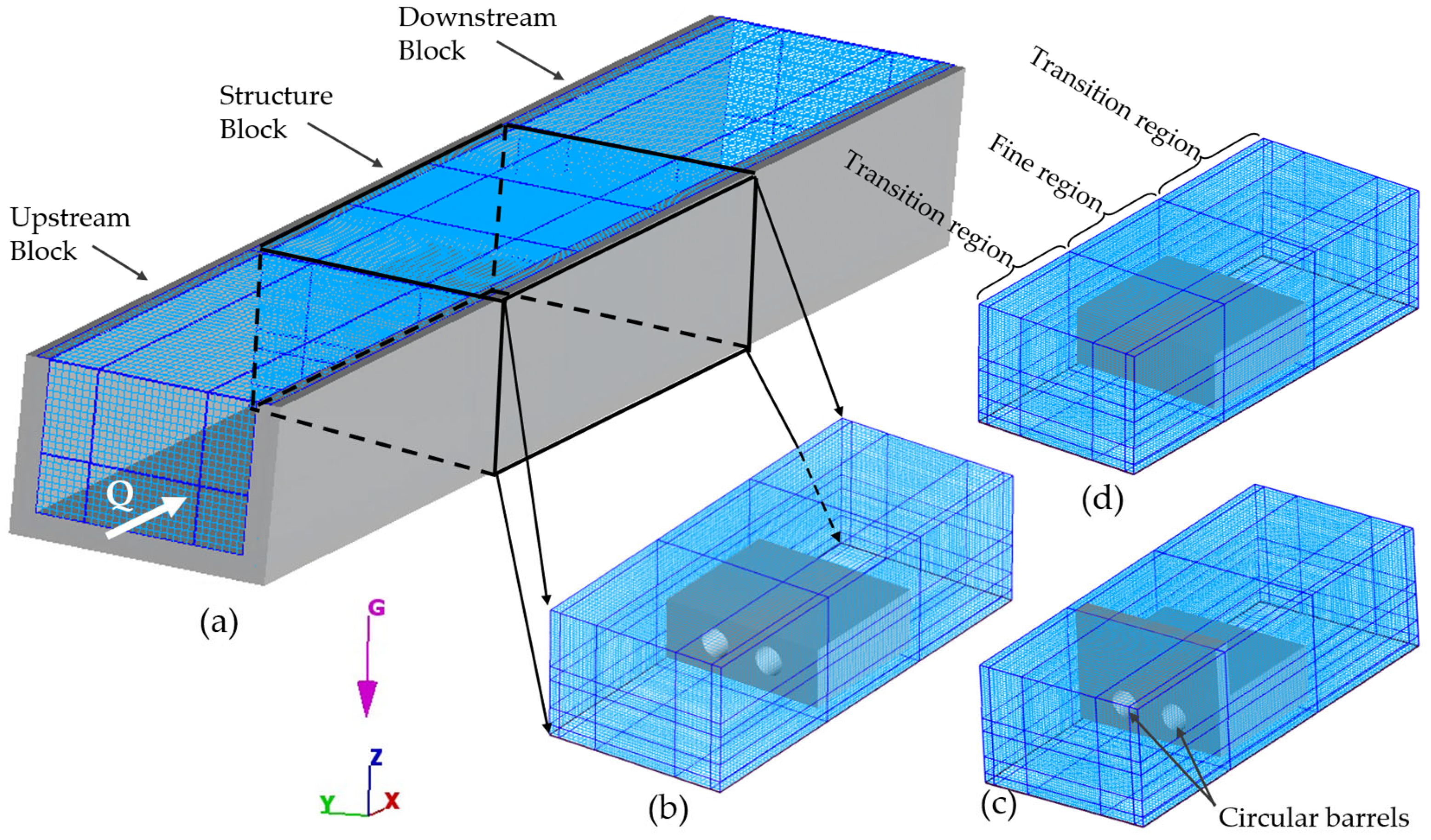
3.2.2. Mesh
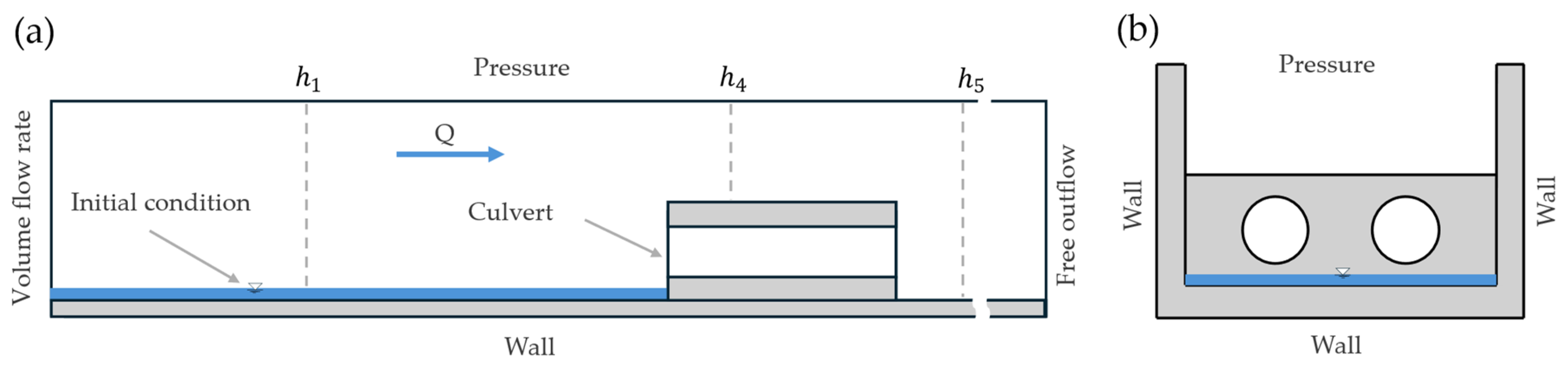
3.2.3. Boundary Conditions
3.2.4. Inflow Implementation and Hardware Characteristics
3.2.5. Evaluation Metrics
3.2.6. Dimensionless Hydraulic Parameters
4. Results
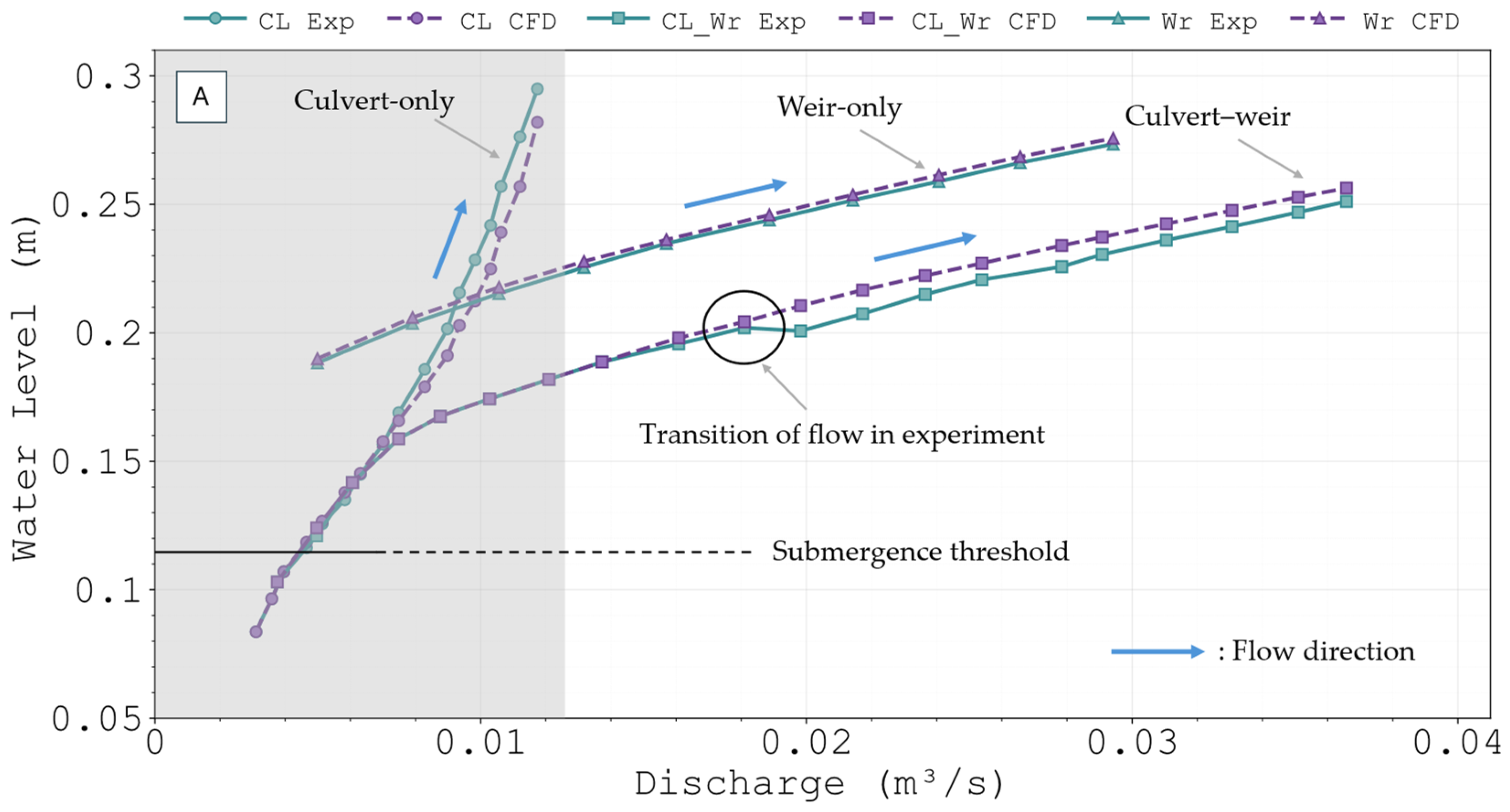
4.1. Steady State
4.2. Mesh Verification and Local Inlet Diagnostics
4.2.1. Full-Geometry Mesh Verification
4.2.2. Local Inlet Mesh Diagnostic Under Culvert-Only Flow Conditions
4.3. Additional Physics
4.4. Discrepancy Diagnosis for the Culvert–Weir Case
4.5. Sensitivity Analysis on the Turbulence Model Adopted
4.6. Statistical Comparison (RMSE, MAE, R2, MARE)
4.7. Unsteady State
4.8. Dimensionless Characterization
5. Discussion
6. Conclusions
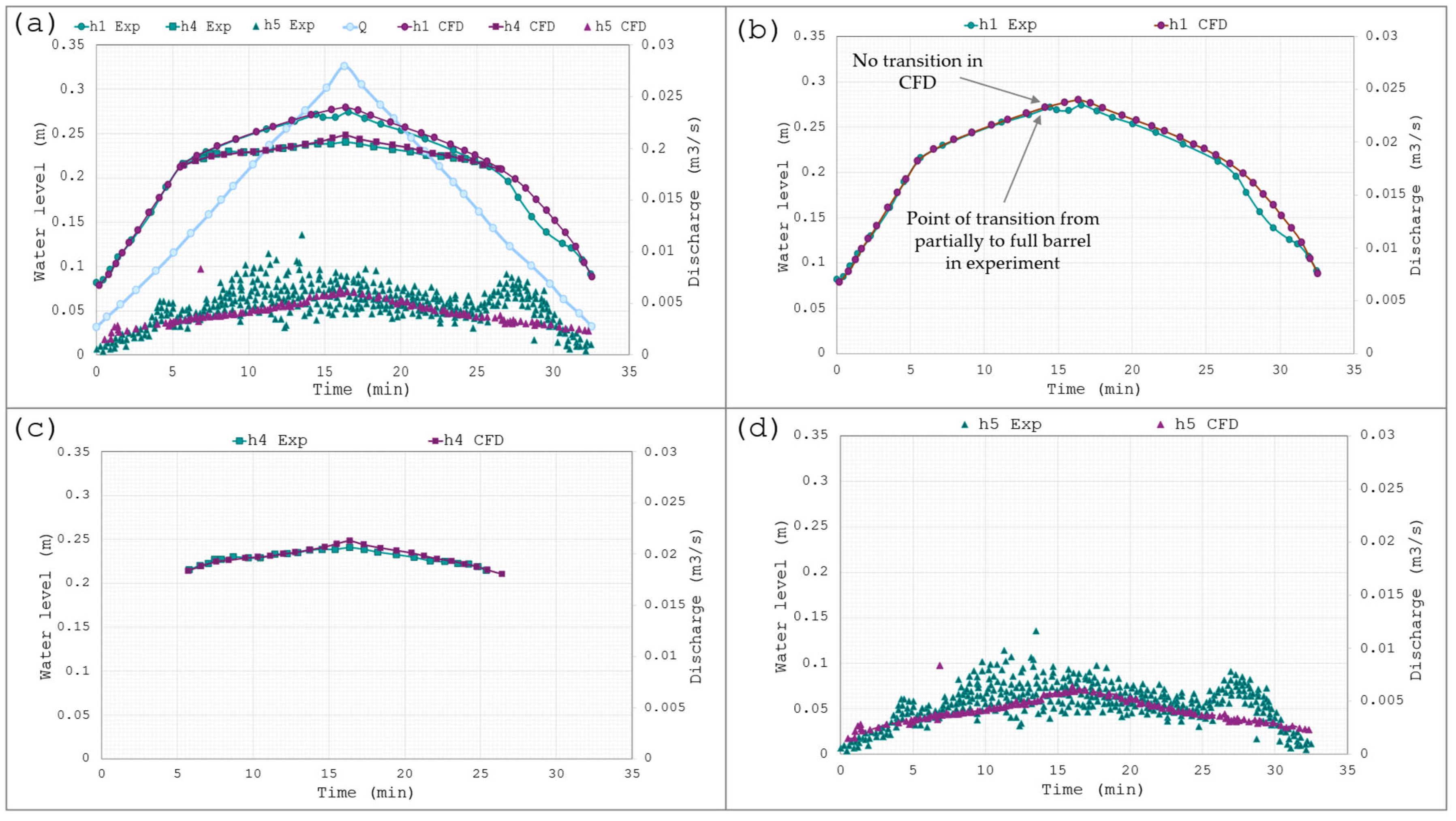
- The CFD model reproduced the main water stage response across the tested configurations. For the reported steady benchmark comparisons, MARE ranged from 0.90% to 5.42%. Under the unsteady hydrograph, yielded RMSE = 9.35 mm, MAE = 6.34 mm and = 0.9776, with peak stage and peak time errors of 5.6 mm and 12.25 s, respectively; at , the corresponding values were 3.02 mm, 2.20 mm, = 0.8135, 7.7 mm and 0.26 s. These results indicate that the principal water stage response was reproduced with generally small absolute errors.
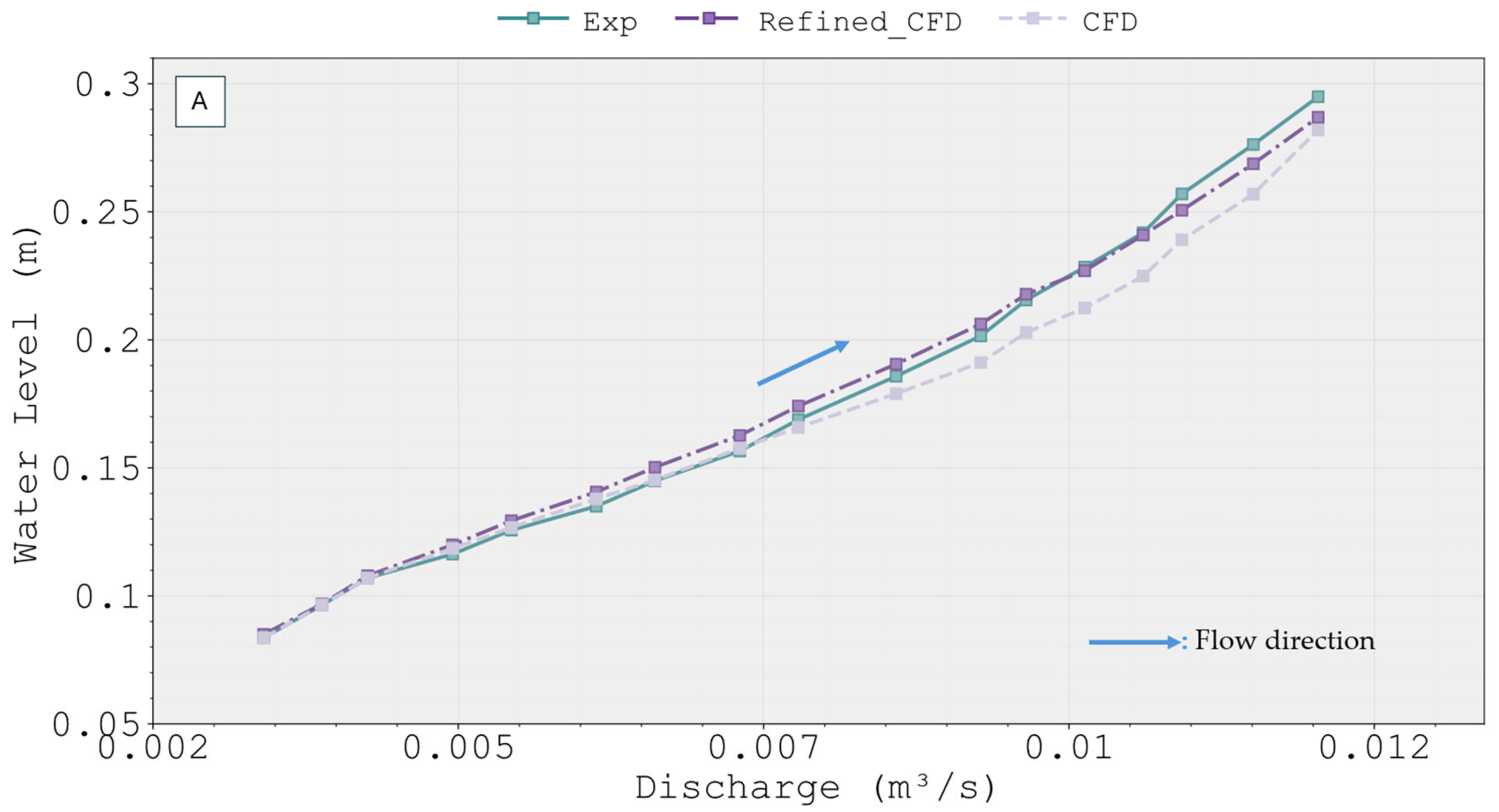
- Inlet mesh refinement was found to be a key parameter that strongly influences the representation of inlet flow contraction and separation, the associated entrance losses and the post-submergence headwater response in the culvert-only rising case. This indicates that sufficiently fine local resolution is particularly important when detailed inlet hydraulics influence the predicted headwater.
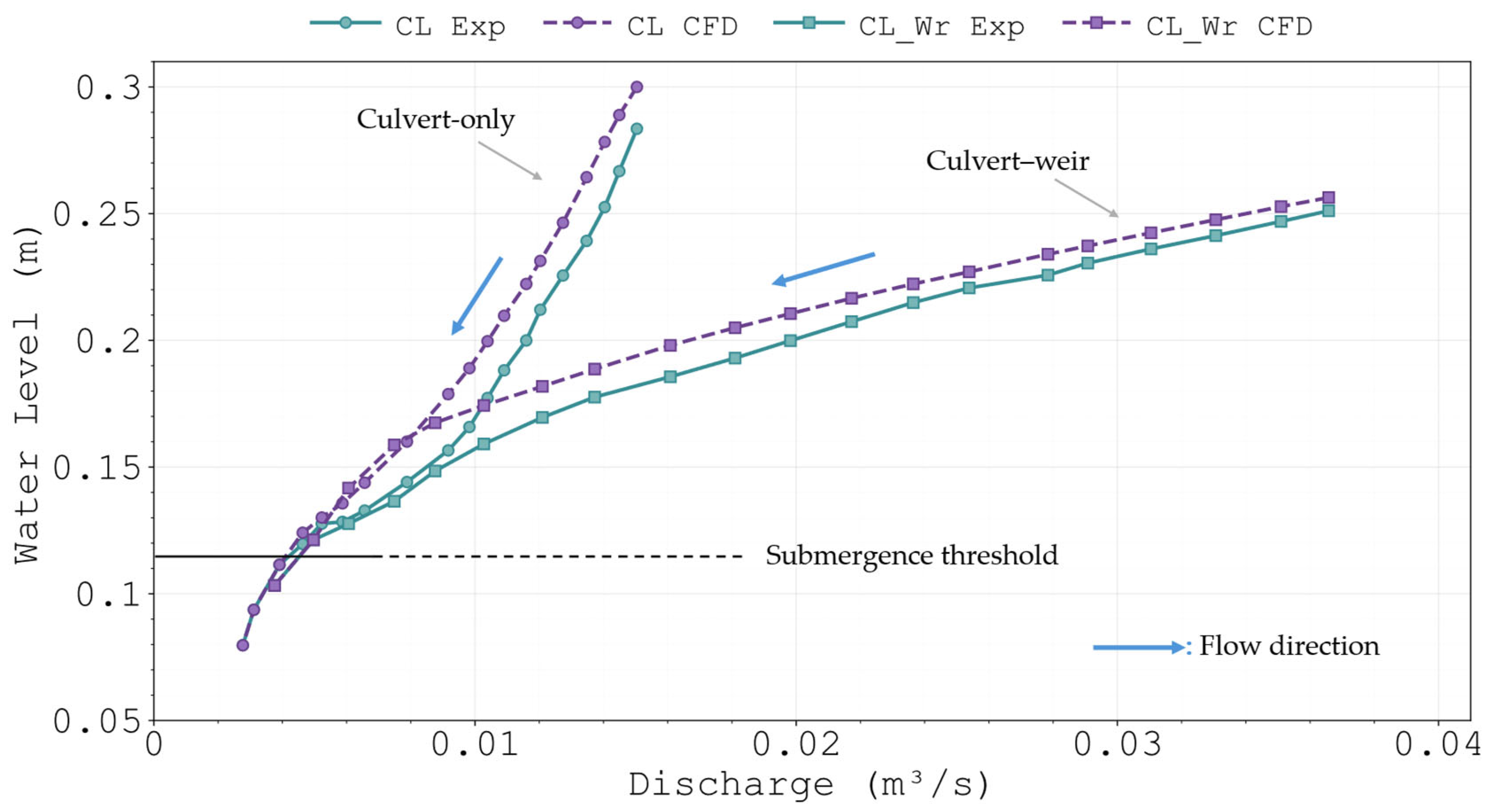
- Discrepancies in the receding limbs could usually not be reduced, suggesting that recession behavior may be influenced by history or initialization effects. From a practical flood risk assessment perspective, this may represent a comparatively limited concern when the assessment is focused on peak conditions as it mainly affects the post-peak recession after the maximum flow has passed.
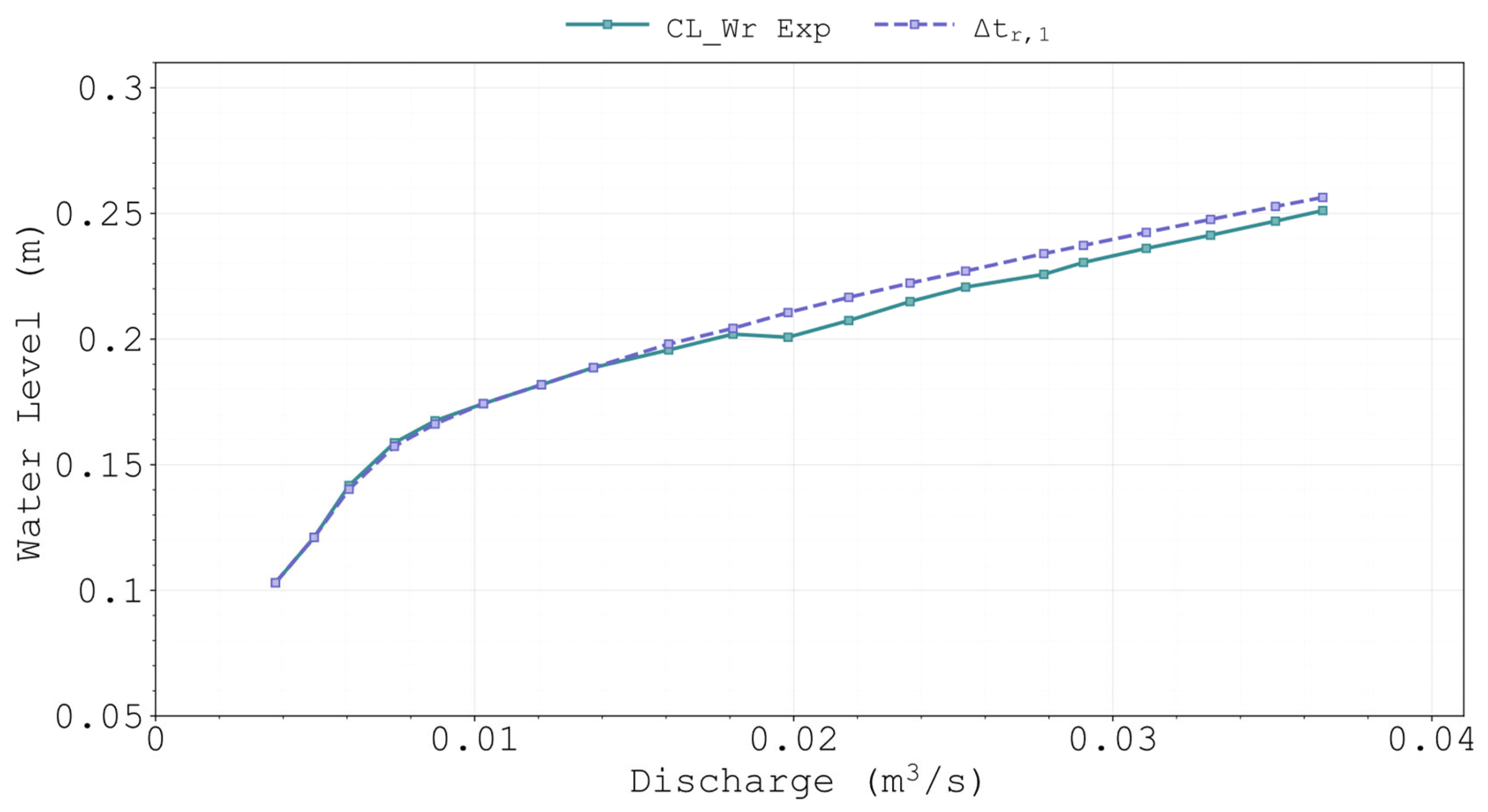
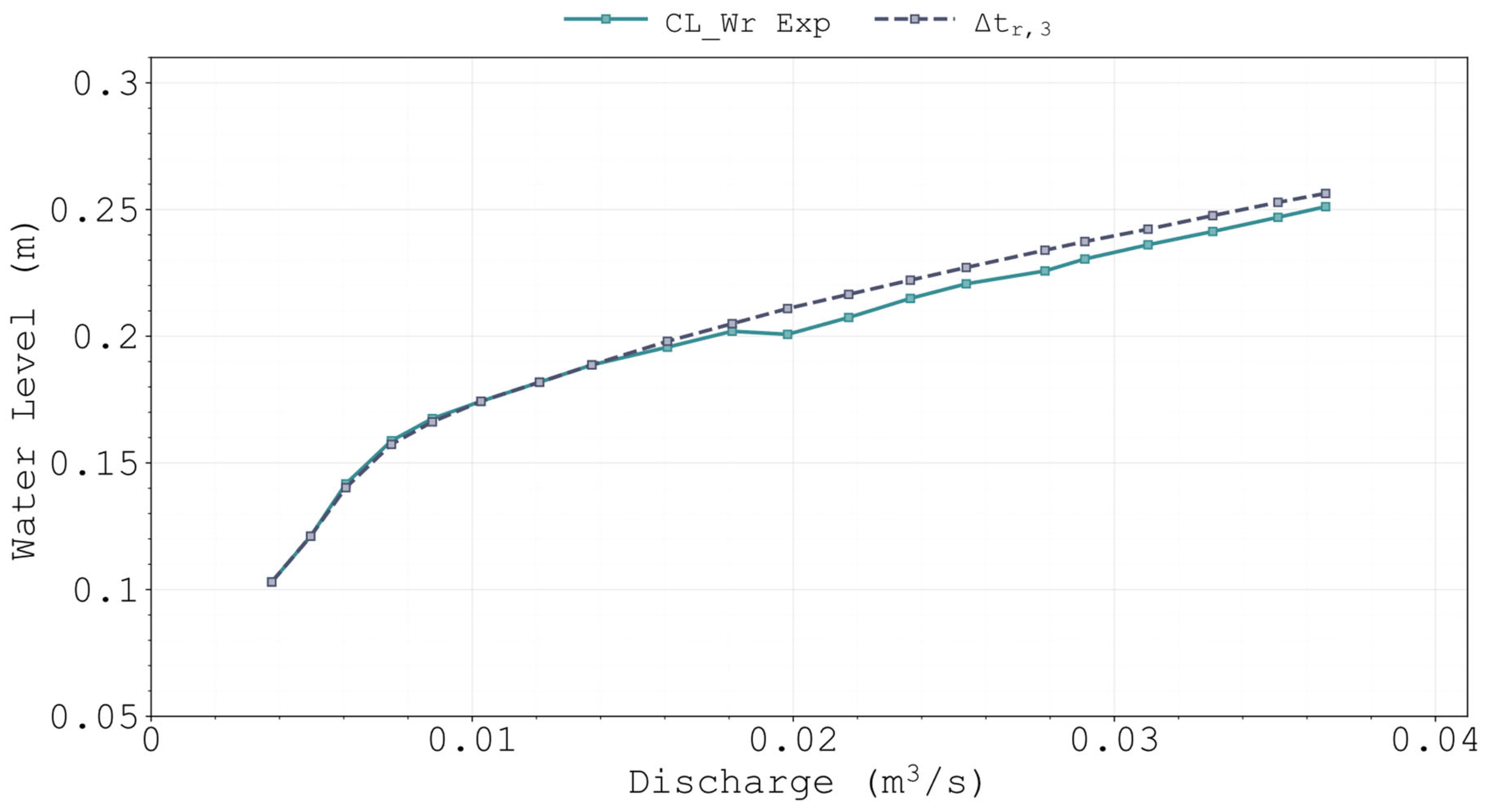
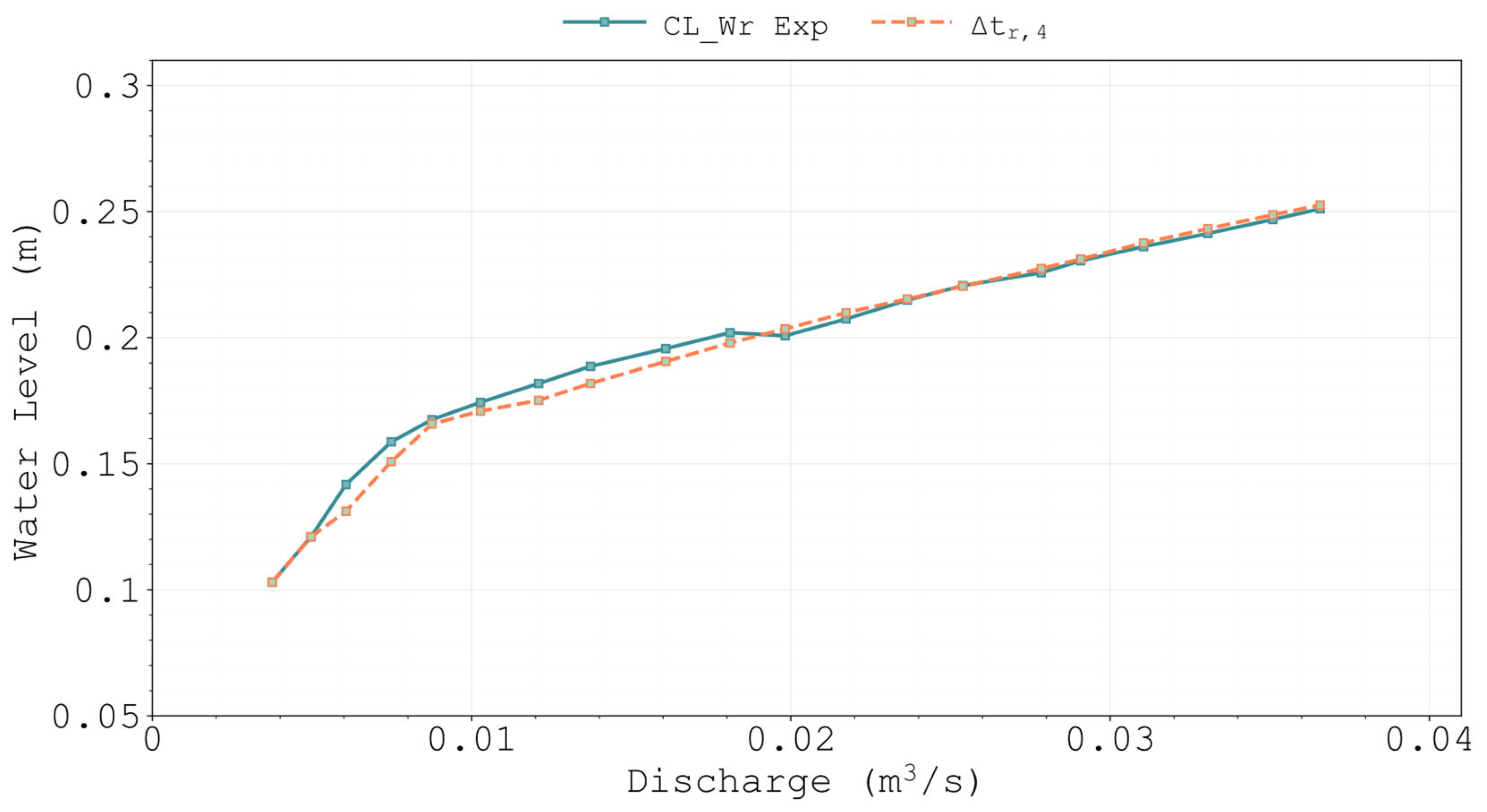
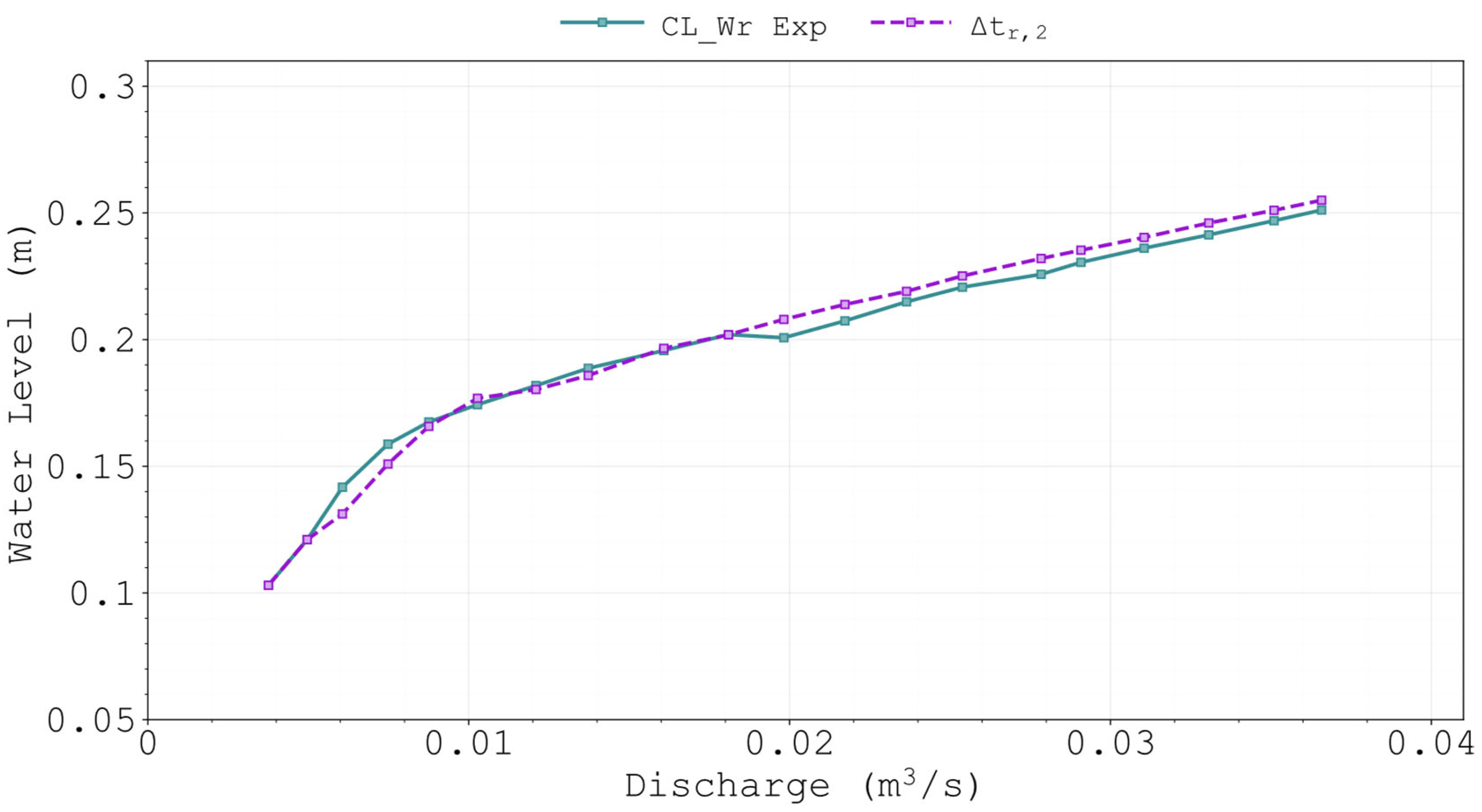
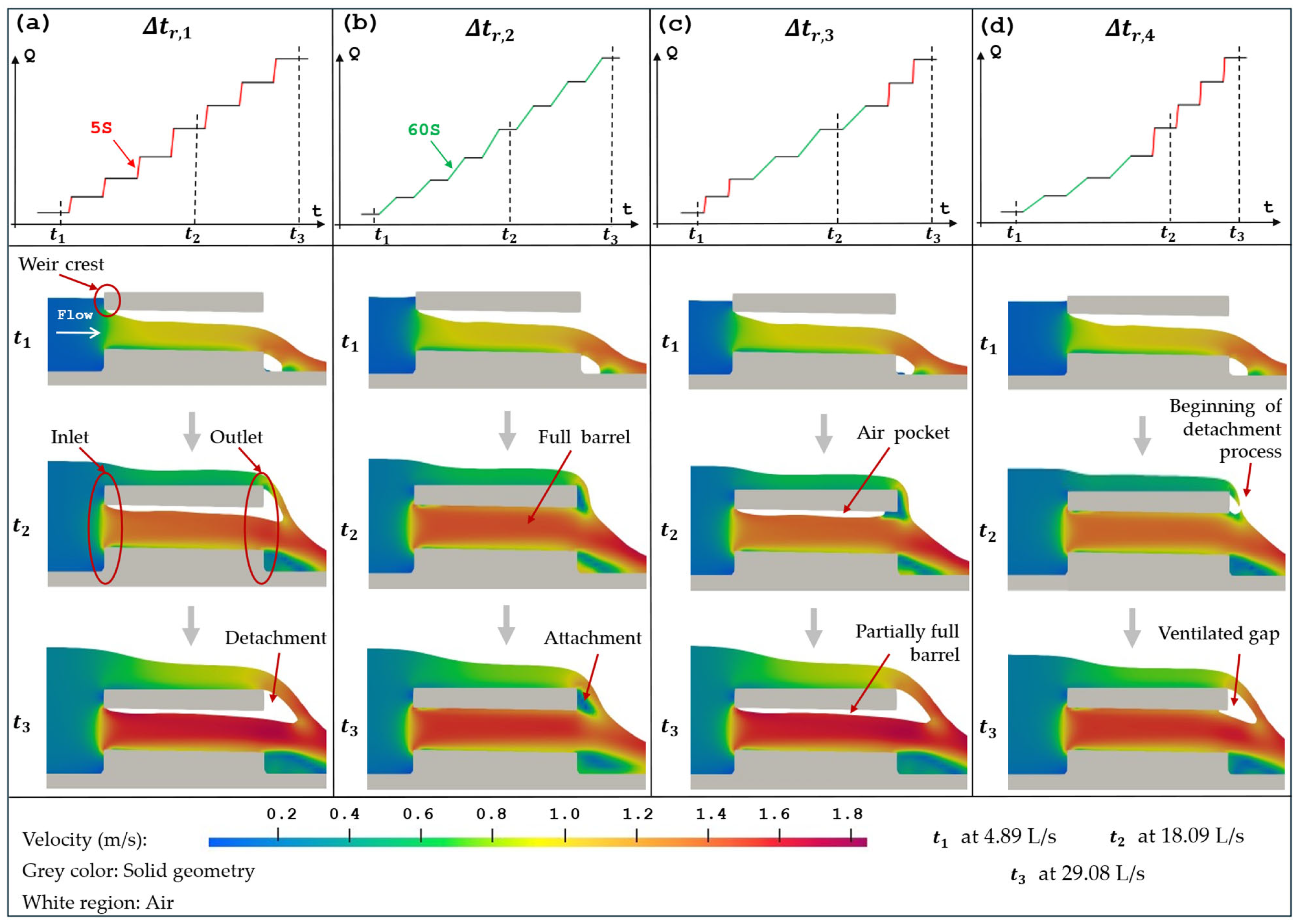
- Despite the generally good reproduction of water stage, for the culvert–weir configuration, a key issue remains the partial-to-full regime transition. The CFD model did not consistently reproduce the experimentally observed transition and remained partially full when the experiment transitioned to full flow at higher discharge. This aspect was investigated by a ramp time sensitivity analysis that showed two possible outlet modes: detached and ventilated associated with partially full flow, versus attached and sealed associated with full-barrel flow. The ramp history analysis further showed that inflow history can alter outlet attachment and detachment, ventilation state and barrel filling even over the same discharge sequence, making regime transition prediction more sensitive than water stage prediction to the preceding hydraulic state.
- Although the validation is based on one published laboratory dataset and a single benchmark geometry, the selected culvert–weir system covers a broad range of hydraulically relevant conditions, including partially full culvert flow, inlet submergence, weir overtopping, changes in outlet attachment and ventilation and the transition towards full-barrel flow. The scope nevertheless remains limited to this geometry and to free-flow/free-outfall conditions, without an independent second validation dataset. In addition, the experimental discharge ramp timing and initial hydraulic state were not fully documented, and the experimentally observed partial-to-full transition was not reproduced consistently. Further work should therefore test the identified numerical and hydraulic sensitivities using independent datasets spanning additional geometries, tailwater conditions, Froude number ranges and hydrograph shapes.
Supplementary Materials
Author Contributions
Funding
Data Availability Statement
Acknowledgments
Conflicts of Interest
Abbreviations
| CFD | Computational fluid dynamics |
| 1D, 2D, 3D | One-, two-, three-dimensional |
| VOF | Volume of fluid |
| FAVOR | Fractional area/Volume obstacle representation |
| RANS | Reynolds-averaged Navier–Stokes |
| RNG | Renormalization group |
| LES | Large eddy simulation |
| WSS | Wall shear stress |
| Headwater level | |
| Discharge | |
| Diameter | |
| Length | |
| CFD headwater level | |
| Experimental headwater level |
Appendix A
Appendix A.1. Experimental Apparatus
Appendix A.2. Experimental Boundary Conditions
Appendix A.3. Experimental Instrumentation and Measurement Procedure
Appendix B
Appendix B.1. Mesh Design Analysis

Appendix B.2. Method
Appendix B.3. Results

Appendix C



References
- Schall, J.D.; Thompson, P.L.; Zerges, S.M.; Kilgore, R.T.; Morris, J.L. Hydraulic Design of Highway Culverts, 3rd ed.; Report FHWA-HIF-12-026; Hydraulic Design Series No. 5; Federal Highway Administration: Washington, DC, USA, 2012.
- Mile High Flood District. Urban Storm Drainage Criteria Manual, Volume 2: Structures, Storage and Recreation, Chapter 11: Culverts and Bridges; The Mile High Flood District: Lakewood, CO, USA, 2025. Available online: https://mhfd.org/files/27935c050/11_Culverts-and-Bridges.pdf (accessed on 19 August 2026).
- Fallowfield, L.; Motta, D. The permanent flood risk of culverts and the impact of increasing debris blockage. J. Flood Risk Manag. 2024, 17, e13021. [Google Scholar] [CrossRef] [Scilit]
- Jaeger, R.; Tondera, K.; Pather, S.; Porter, M.; Jacobs, C.; Tindale, N. Flow control in culverts: A performance comparison between inlet and outlet control. Water 2019, 11, 1408. [Google Scholar] [CrossRef] [Scilit]
- Chin, D.A. Hydraulic analysis and design of pipe culverts: USGS versus FHWA. J. Hydraul. Eng. 2013, 139, 886–893. [Google Scholar] [CrossRef] [Scilit]
- Meselhe, E.A.; Hebert, K. Laboratory measurements of flow through culverts. J. Hydraul. Eng. 2007, 133, 973–976. [Google Scholar] [CrossRef] [Scilit]
- Wasko, C.; Nathan, R.; Stein, L.; O’Shea, D. Evidence of shorter more extreme rainfalls and increased flood variability under climate change. J. Hydrol. 2021, 603, 126994. [Google Scholar] [CrossRef] [Scilit]
- Schütte, S.; Schulze, R.E. Projected impacts of urbanisation on hydrological resource flows: A case study within the uMngeni Catchment, South Africa. J. Environ. Manag. 2017, 196, 527–543. [Google Scholar] [CrossRef] [Scilit] [PubMed]
- Cullis, J.; Alton, T.; Arndt, C.; Cartwright, A.; Chang, A.; Gabriel, S.; Gebretsadik, Y.; Hartley, F.; de Jager, G.; Makrelov, K.; et al. An Uncertainty Approach to Modelling Climate Change Risk in South Africa; WIDER Working Paper 2015/045; UNU-WIDER: Helsinki, Finland, 2015. [Google Scholar] [CrossRef] [Scilit]
- Pozos-Estrada, O. Influence of entrapped air on hydraulic transients during rapid closure of a valve located upstream and downstream of an air pocket in pressurised pipes. Water 2025, 17, 927. [Google Scholar] [CrossRef] [Scilit]
- Wright, S.J.; Determan, K.V.; Vargas, S.M. Pressure transients due to compression of trapped air in rapidly filling sewer storage tunnels. J. Water Manag. Model. 2012, 20, R245-01. [Google Scholar] [CrossRef] [Scilit]
- Bergant, A.; Tijsseling, A.; Kim, Y.; Karadžić, U.; Zhou, L.; Lambert, M.F.; Simpson, A.R. Unsteady pressures influenced by trapped air pockets in water-filled pipelines. Stroj. Vestn.–J. Mech. Eng. 2018, 64, 501–512. [Google Scholar] [CrossRef] [Scilit]
- Zhou, L.; Liu, D. Experimental investigation of entrapped air pocket in a partially full water pipe. J. Hydraul. Res. 2013, 51, 469–474. [Google Scholar] [CrossRef] [Scilit]
- Cebe, K.; Bilhan, Ö.; Sınanmış Balcı, R. Comparative analysis of HEC-RAS, SWMM, and THDH approaches in highway culvert design. Dicle Üniversitesi Mühendis. Fakültesi Mühendis. Derg. 2024, 15, 977–992. [Google Scholar] [CrossRef] [Scilit]
- Conesa-García, C.; García-Lorenzo, R. Evaluating the effectiveness of road-crossing drainage culverts in ephemeral streams. Hydrol. Process. 2013, 27, 1781–1796. [Google Scholar] [CrossRef] [Scilit]
- Chow, V.T. Open-Channel Hydraulics; McGraw-Hill: New York, NY, USA, 1959. [Google Scholar]
- Horritt, M.S.; Bates, P.D. Evaluation of 1D and 2D numerical models for predicting river flood inundation. J. Hydrol. 2002, 268, 87–99. [Google Scholar] [CrossRef] [Scilit]
- Zeyrek, O.; Wang, F.; Xu, J. Behaviors of highway culverts subjected to flooding: A comprehensive review. Water 2025, 17, 2937. [Google Scholar] [CrossRef] [Scilit]
- Mark, O.; Weesakul, S.; Apirumanekul, C.; Boonya-Aroonnet, S.; Djordjević, S. Potential and limitations of 1D modelling of urban flooding. J. Hydrol. 2004, 299, 284–299. [Google Scholar] [CrossRef] [Scilit]
- Coutu, S.; Del Giudice, D.; Rossi, L.; Barry, D.A. Parsimonious hydrological modeling of urban sewer and river catchments. J. Hydrol. 2012, 464–465, 477–484. [Google Scholar] [CrossRef] [Scilit]
- Leandro, J.; Chen, A.S.; Djordjević, S.; Savić, D.A. Comparison of 1D/1D and 1D/2D coupled (sewer/surface) hydraulic models for urban flood simulation. J. Hydraul. Eng. 2009, 135, 495–504. [Google Scholar] [CrossRef] [Scilit]
- Trajkovic, B.; Ivetic, M.; Calomino, F.; Dippolito, A. Investigation of transition from free surface to pressurized flow in a circular pipe. Water Sci. Technol. 1999, 39, 105–112. [Google Scholar] [CrossRef] [Scilit]
- An, H.; Lee, S.; Noh, S.J.; Kim, Y.; Noh, J. Hybrid numerical scheme of Preissmann slot model for transient mixed flows. Water 2018, 10, 899. [Google Scholar] [CrossRef] [Scilit]
- Schubert, J.E.; Sanders, B.F. Building treatments for urban flood inundation models and implications for predictive skill and modeling efficiency. Adv. Water Resour. 2012, 41, 49–64. [Google Scholar] [CrossRef] [Scilit]
- Teng, J.; Jakeman, A.J.; Vaze, J.; Croke, B.F.W.; Dutta, D.; Kim, S. Flood inundation modelling: A review of methods, recent advances and uncertainty analysis. Environ. Model. Softw. 2017, 90, 201–216. [Google Scholar] [CrossRef] [Scilit]
- Jarman, D.S.; Faram, M.G.; Butler, D.; Tabor, G.; Stovin, V.R.; Burt, D.; Throp, E. Computational fluid dynamics as a tool for urban drainage system analysis: A review of applications and best practice. In Proceedings of the 11th International Conference on Urban Drainage (ICUD), Edinburgh, UK, 31 August–5 September 2008. [Google Scholar]
- Olsen, N.R.B.; Kjellesvig, H.M. Three-dimensional numerical flow modeling for estimation of maximum local scour depth. J. Hydraul. Res. 1998, 36, 579–590. [Google Scholar] [CrossRef] [Scilit]
- Zeng, J.; Rakib, Z.; Ansar, M.; Hajimirzaie, S.; Chen, Z. Application of hybrid flow data and dimensional analysis to gated-culvert flow estimation. J. Irrig. Drain. Eng. 2020, 146, 04020026. [Google Scholar] [CrossRef] [Scilit]
- Zhang, R.; Jin, Y.-C.; Wu, P. Numerical simulation of culvert flow using OpenFOAM. In Proceedings of the 38th IAHR World Congress, Panama City, Panama, 1–6 September 2019. [Google Scholar] [CrossRef] [Scilit]
- van Vliet, J. Improving Culvert Performance: Reducing Energy Losses by Streamlining the Entrance and Exit of Culverts. Master’s Thesis, Delft University of Technology, Delft, The Netherlands, 2024. Available online: https://resolver.tudelft.nl/uuid:e5bebc6d-f3de-4155-959e-423f3cefbb9c (accessed on 19 August 2026).
- Le, H.T.T.; Nguyen, C.V.; Le, D.-H. Numerical study of sediment scour at meander flume outlet of boxed culvert diversion work. PLoS ONE 2022, 17, e0275347. [Google Scholar] [CrossRef] [Scilit] [PubMed]
- Mostafazadeh-Fard, S.; Samani, Z. Dissipating culvert end design for erosion control using CFD platform FLOW-3D numerical simulation modeling. J. Pipeline Syst. Eng. Pract. 2023, 14, 04022064. [Google Scholar] [CrossRef] [Scilit]
- Ahmed, K.O.; Kavianpour, M.R.; Amini, A.; Aminpour, Y. Numerical modelling of downstream scour in circular culverts: Impact of inlet blockages and variable flow conditions. PLoS ONE 2024, 19, e0312501. [Google Scholar] [CrossRef] [Scilit] [PubMed]
- Sorourian, S. Turbulent flow characteristics at the outlet of partially blocked box culverts. In Proceedings of the 36th IAHR World Congress, The Hague, The Netherlands, 28 June–3 July 2015. [Google Scholar]
- Sorourian, S.; Keshavarzi, A.; Ball, J.E. Scour at partially blocked box-culverts under steady flow. Proc. Inst. Civ. Eng. Water Manag. 2016, 169, 247–259. [Google Scholar] [CrossRef] [Scilit]
- Taha, N.; El-Feky, M.M.; El-Saiad, A.A.; Fathy, I. Numerical investigation of scour characteristics downstream of blocked culverts. Alex. Eng. J. 2020, 59, 3503–3513. [Google Scholar] [CrossRef] [Scilit]
- Crispino, G.; Dorthe, D.; Gisonni, C.; Pfister, M. Hydraulic capacity of bend manholes for supercritical flow. J. Irrig. Drain. Eng. 2023, 149, 04022048. [Google Scholar] [CrossRef] [Scilit]
- Crispino, G.; Maietta, F.; Iervolino, M.; Gisonni, C. Numerical study on a supercritical vortex drop shaft with a spiral inlet. Results Eng. 2025, 25, 104197. [Google Scholar] [CrossRef] [Scilit]
- Hirt, C.W.; Nichols, B.D. Volume of fluid (VOF) method for the dynamics of free boundaries. J. Comput. Phys. 1981, 39, 201–225. [Google Scholar] [CrossRef] [Scilit]
- Liu, X.; Chen, Q.-S.; Zeng, Z.-N.; Dong, Z. Optimisation of bridge pier winding flow numerical simulation scheme based on Delft3D. Water 2024, 16, 2079. [Google Scholar] [CrossRef] [Scilit]
- Park, J.-C.; Kim, M.-H.; Miyata, H.; Chun, H.-H. Fully nonlinear numerical wave tank (NWT) simulations and wave run-up prediction around 3-D structures. Ocean Eng. 2003, 30, 1969–1996. [Google Scholar] [CrossRef] [Scilit]
- Tang, P.; Lin, X.; Wang, W.; Zhang, H. Numerical simulation of hydrodynamic performance of an offshore oscillating water column wave energy converter device. J. Mar. Sci. Eng. 2024, 12, 2289. [Google Scholar] [CrossRef] [Scilit]
- Legendre, A.-M. Nouvelles Méthodes Pour la Détermination des Orbites des Comètes; Firmin Didot: Paris, France, 1805. [Google Scholar]
- Stigler, S.M. Gauss and the invention of least squares. Ann. Stat. 1981, 9, 465–474. [Google Scholar] [CrossRef] [Scilit]
- Boscovich, R.J. De Litteraria Expeditione per Pontificiam Ditionem. Bononiensi Sci. Artium Inst. Atque Acad. Comment. 1757, 4, 353–396. [Google Scholar]
- Koenker, R.; Bassett, G. On Boscovich’s estimator. Ann. Stat. 1985, 13, 1625–1628. [Google Scholar] [CrossRef] [Scilit]
- Wright, S. Correlation and causation. J. Agric. Res. 1921, 20, 557–585. [Google Scholar]
- Legates, D.R.; McCabe, G.J. Evaluating the use of “goodness-of-fit” measures in hydrologic and hydroclimatic model validation. Water Resour. Res. 1999, 35, 233–241. [Google Scholar] [CrossRef] [Scilit]
- Moriasi, D.N.; Arnold, J.G.; Van Liew, M.W.; Bingner, R.L.; Harmel, R.D.; Veith, T.L. Model evaluation guidelines for systematic quantification of accuracy in watershed simulations. Trans. ASABE 2007, 50, 885–900. [Google Scholar] [CrossRef] [Scilit]
- Chen, Y.; Li, P.; Fei, Z.; Wang, R.; Zhang, H.; Zhu, D.Z.; Qian, S. Air–water interactions during rapid filling of a closed horizontal pipe. Phys. Fluids 2025, 37, 043326. [Google Scholar] [CrossRef] [Scilit]
- Hu, Y.; Wang, D.; Liu, S.; Xu, Y.; Zhou, L. Experimental study of mixed flow transitions in pipes with air pocket effects. Phys. Fluids 2025, 37, 114116. [Google Scholar] [CrossRef] [Scilit]





| (a) Validation Cases | |||||
| ID | Case | Q (L/s)/Levels | Model/Mesh | Outputs | |
| V1 | Culvert–weir, steady rising | 3.758–36.581; 20 | 5 s/60 s | RNG k–ε; benchmark mesh | ; ; submergence; overtopping; barrel filling; ventilation. |
| V2 | Weir-only, steady rising | 4.991–29.418; 10 | 5 s/60 s | RNG k–ε; benchmark mesh | ; ; overtopping |
| V3 | Culvert-only, steady rising | 3.106–11.740; 17 | 5 s/60 s | RNG k–ε; benchmark mesh | ; ; submergence; barrel state. |
| V4 | Culvert–weir, steady receding | 36.581–3.758; 20 | 5 s/60 s | RNG k–ε; benchmark mesh | ; recession response; barrel state |
| V5 | Culvert-only, steady receding | 15.040–2.769; 19 | 5 s/60 s | RNG k–ε; benchmark mesh | ; ; full-to-partial transition |
| V6 | Culvert–weir, continuous unsteady hydrograph | 2 → 30 → 2/continuous hydrograph | - | RNG k–ε; benchmark mesh | , , ; Stage evolution; peak stage/time; regime transition |
| (b) Additional Numerical Analyses | |||||
| Analysis | Q (L/s)/Levels | Variants | Model/Mesh | Outputs | |
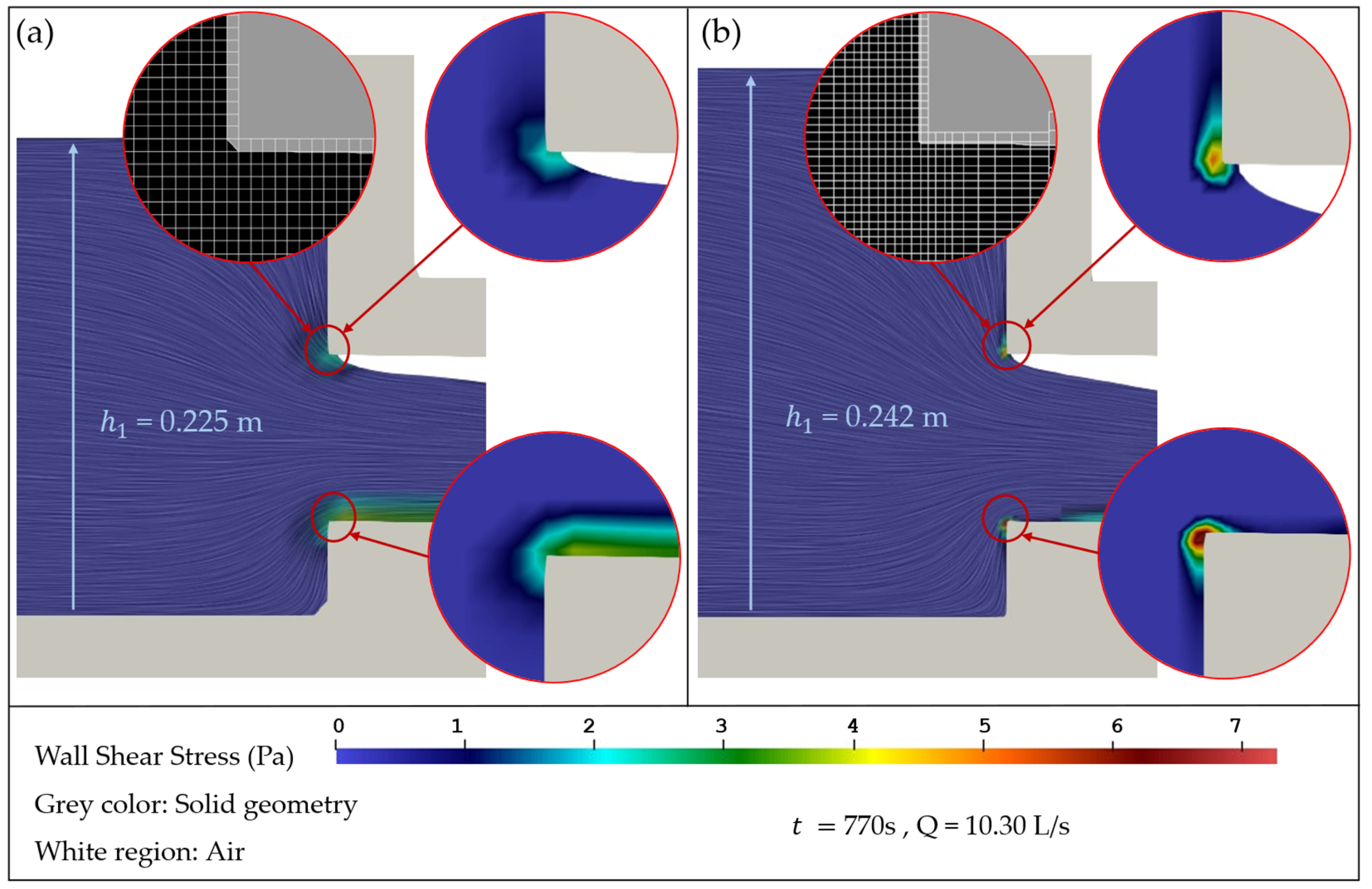
| Local inlet refinement, applied to V3 | 3.106–11.740; 17 | Benchmark; refined inlet | 5 s/60 s | RNG k–ε, 0.09D; RNG k–ε, 0.02D | ; streamlines; WSS. |
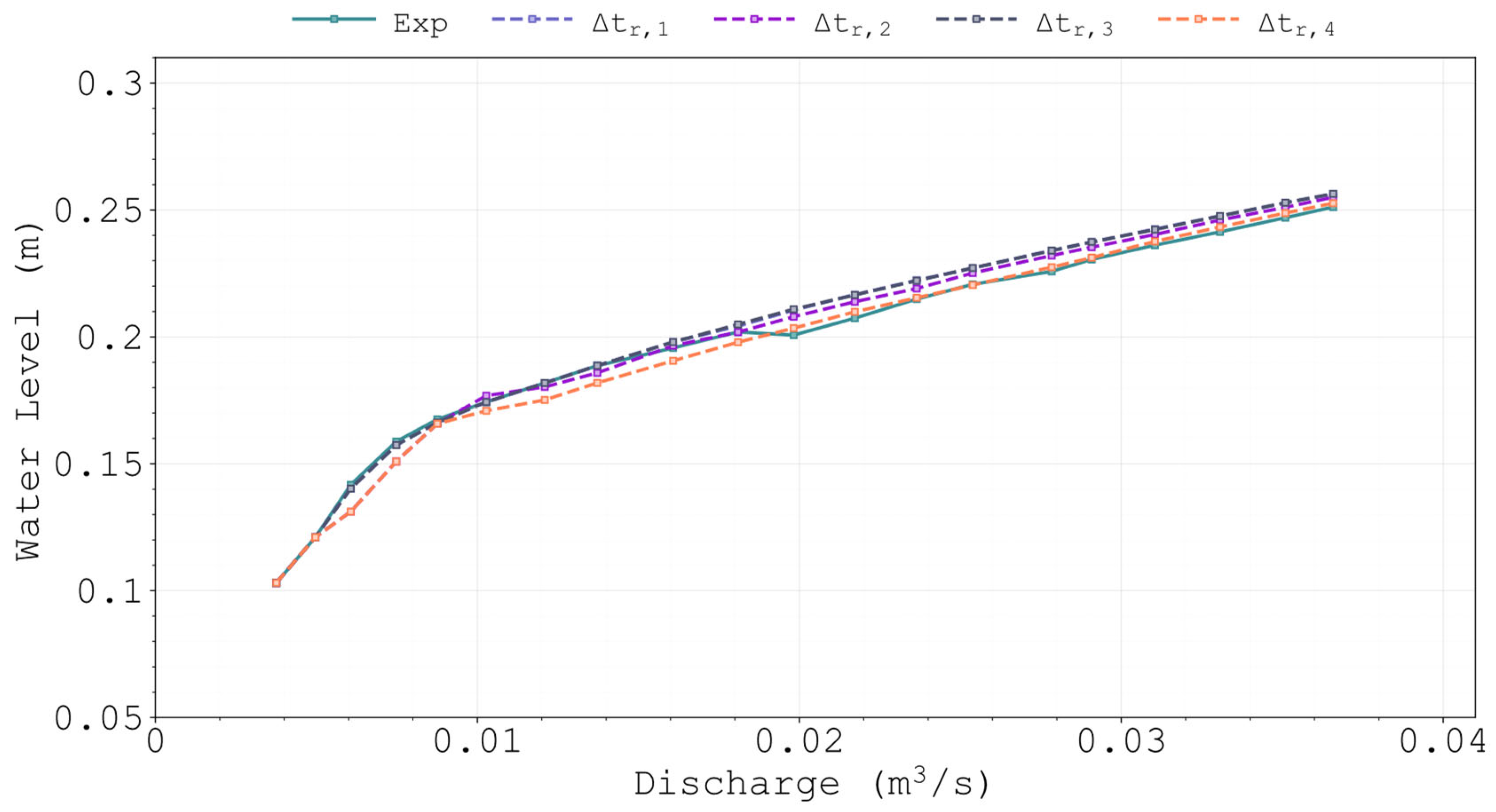
| Ramp time sensitivity, applied to V1 | 3.758–36.581; 20 | -/60 s: 5/60; 60/60; 5 → 60 → 5/60; 60 → 5/60 | RNG k–ε; benchmark mesh, | ; outlet state; ventilation; air-pocket; barrel filling | |
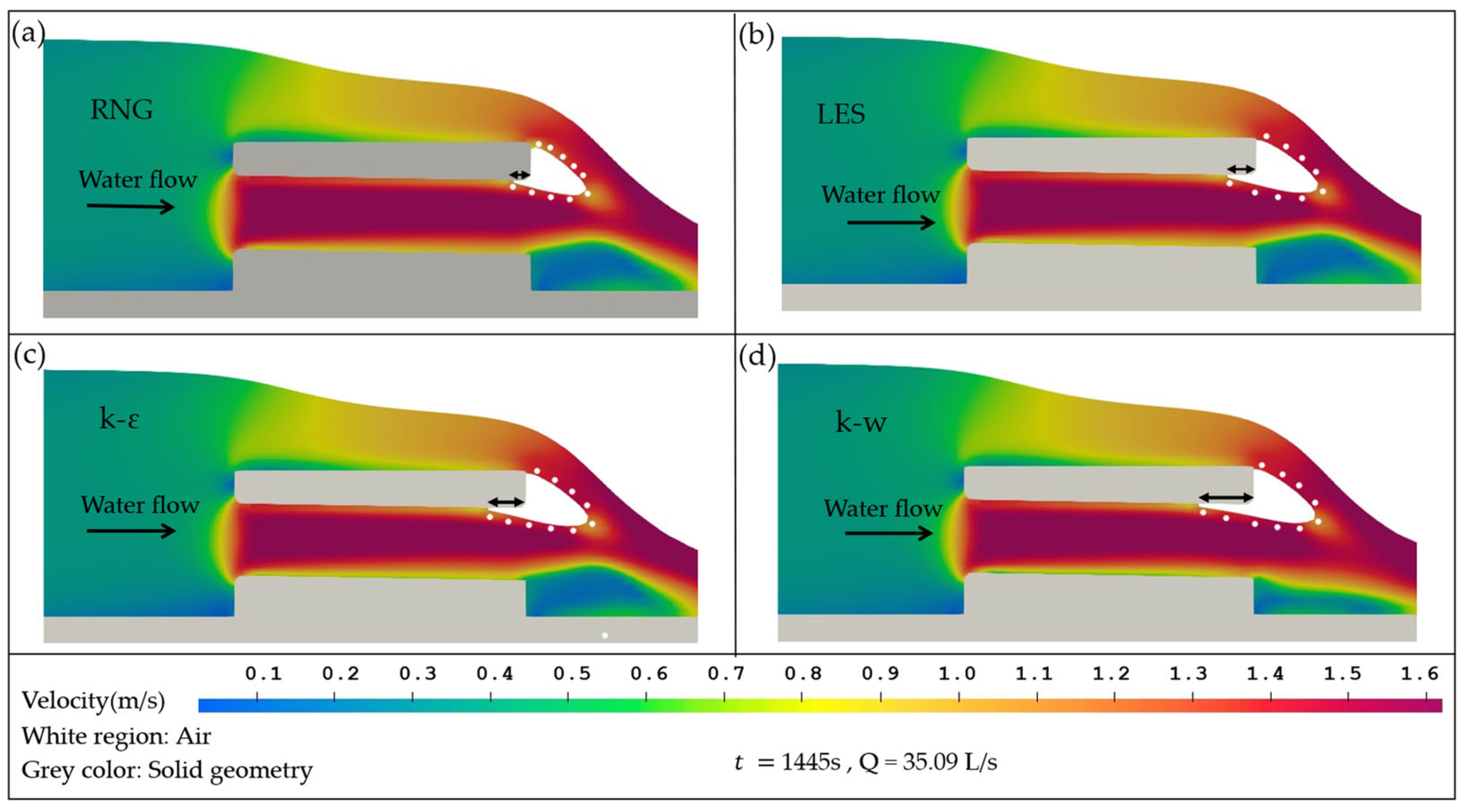
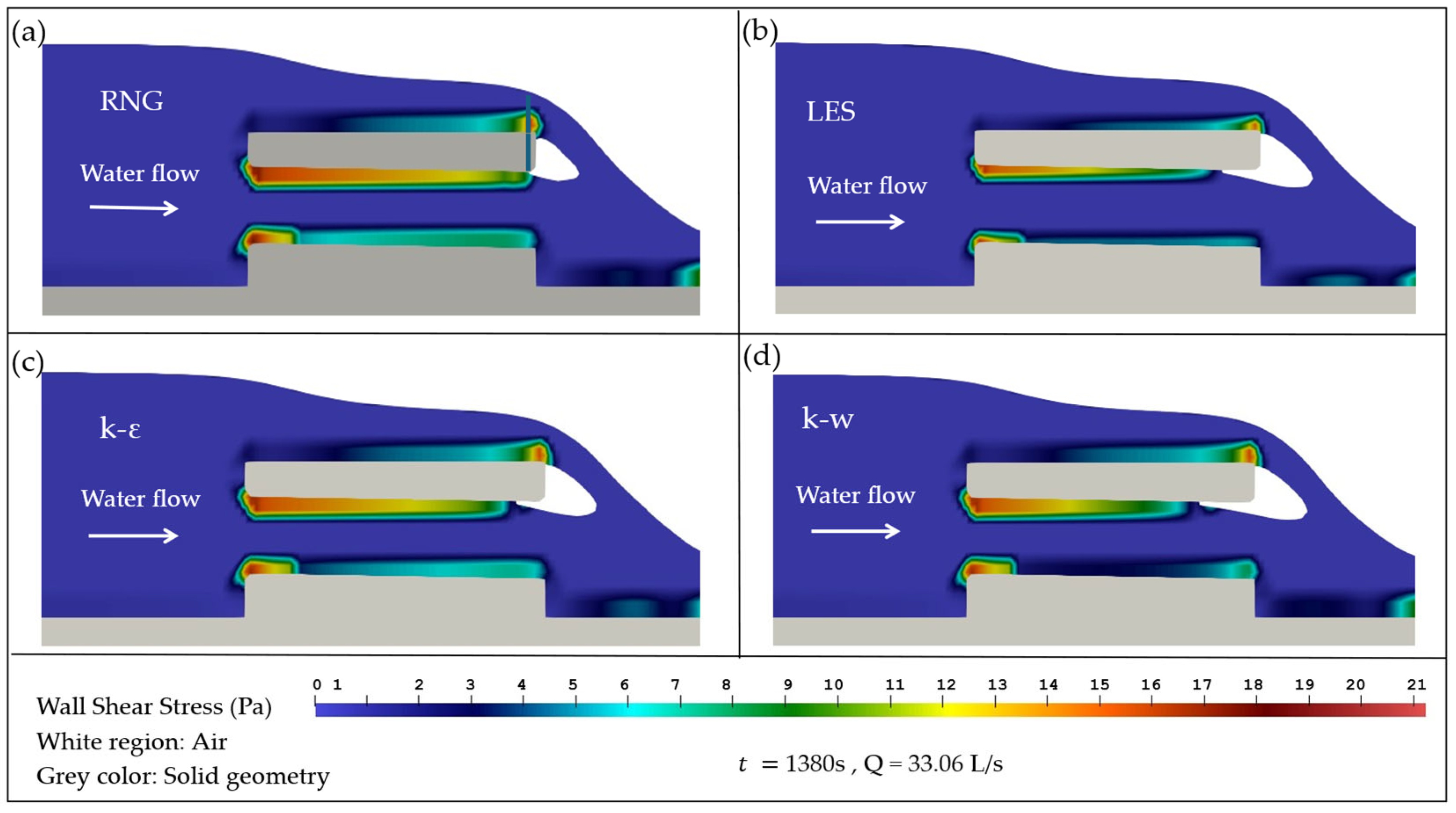
| Turbulence-model sensitivity, applied to V1 | 3.758–36.581; 20 | RNG k–ε; Standard k–ε; k–w; LES | 5 s/60 s | Benchmark mesh | ; barrel filling; air-pocket; WSS |
| Additional physics trials, applied to V1 | 3.758–36.581; 20 | Baseline; ST 1; AE 2; ST + AE | 5 s/60 s | RNG k–ε; benchmark mesh | ; |
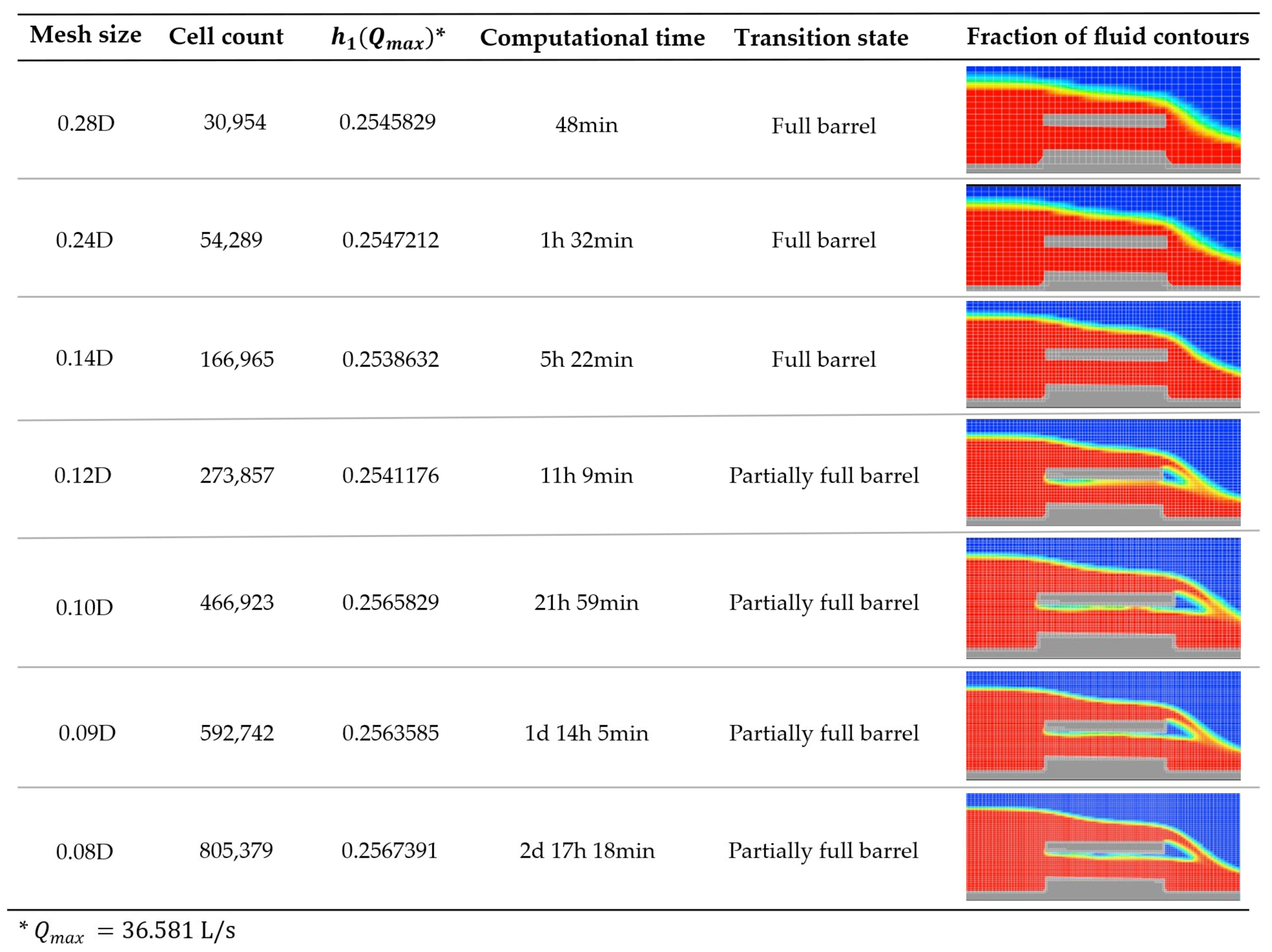
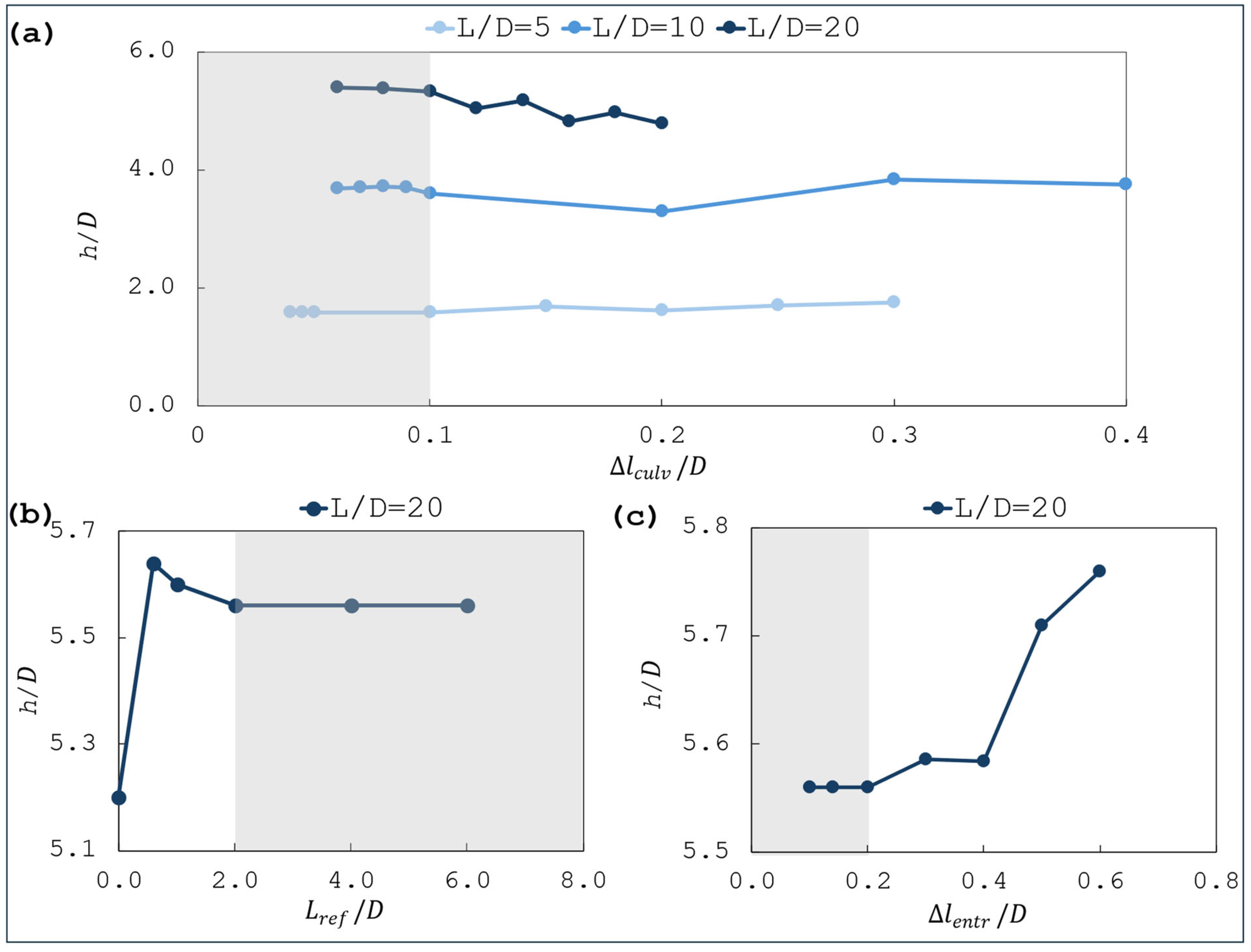
| Full-geometry mesh verification | V1; V1 | 7 meshes; 0.28D–0.08D | 5 s/60 s | RNG k–ε | ; barrel state; cells; runtime |
| Mesh Pair | Mean Rel. Diff. (%) | Max Rel. Diff. (%) | Mean || (mm) | Max || (mm) | Cost Increase |
|---|---|---|---|---|---|
| 0.10D → 0.09D | 0.47 | 2.24 | 0.78 | 3.18 | +26.9% cells; +73.2% runtime |
| 0.09D → 0.08D | 0.17 | 0.35 | 0.34 | 0.86 | +35.9% cells; +71.5% runtime |
| Case | Inlet Cell Size | WSS Effect | Headwater Response |
|---|---|---|---|
| Benchmark | 0.09 | Lower WSS | Underpredicted post-submergence headwater |
| Refined | 0.02 | Upper-edge WSS ~ 2–3 × higher | Closer post-submergence agreement |
| Case | Ramp History | Regime | Outlet State | ||
|---|---|---|---|---|---|
| Fast 5 s, all steps | 56.73 | 3.851–8.608 | No transition | Detached/Ventilated | |
| Slow 60 s, all steps | 680.78 | 0.321–0.717 | Early transition | Attached/Sealed | |
| Hybrid 5–60–5 s | 56.73–680.78 | 0.321–8.268 | No transition | Attached → ventilated | |
| Hybrid 60–5 s | 56.73–680.78 | 0.363–6.399 | Early transition | Later ventilation |
| Turbulence Model | Barrel Filling | Air-Pocket Extent | WSS | Effect on |
|---|---|---|---|---|
| RNG | Highest | Smallest | Relatively uniform | Negligible |
| LES | Lower than RNG | Moderate | Low, spatially variable | Negligible |
| Standard | Lower than LES | Larger | Relatively uniform | Negligible |
| Lowest | Largest | Sharp local inlet peaks | Negligible |
| Case | RMSE (mm) | MAE (mm) | R2 | MARE (%) |
|---|---|---|---|---|
| Weir-only (rising) | 2.15 | 2.12 | 0.9934 | 0.90 |
| Culvert-only (rising) | 10.13 | 7.27 | 0.9747 | 3.21 |
| Culvert–weir (rising) | 5.25 | 3.96 | 0.9831 | 1.84 |
| Culvert–weir (receding) | 10.96 | 9.53 | 0.9382 | 5.42 |
| Location | RMSE (mm) | MAE (mm) | Peak Stage Err. (mm) | Peak Time Err. (s) | |
|---|---|---|---|---|---|
| h1 | 9.35 | 6.34 | 0.9776 | 5.6 | 12.25 |
| h4 | 3.02 | 2.20 | 0.8135 | 7.7 | 0.26 |
| Configuration | Source | ||||
|---|---|---|---|---|---|
| Unsteady culvert–weir | Experiment | 0.501–3.028 | 0.542–5.482 | 0.074–0.142 | – |
| Unsteady culvert–weir | CFD | 0.540–3.094 | 0.563–5.475 | 0.073–0.136 | – |
| Steady culvert–weir | Experiment | 0.785–2.729 | 0.749–7.287 | 0.083–0.212 | – |
| Steady culvert–weir | CFD | 0.785–2.797 | 0.749–7.287 | 0.083–0.205 | – |
| Steady weir-only | Experiment | 1.905–3.022 | 0.994–5.860 | 0.045–0.150 | – |
| Steady weir-only | CFD | 1.926–3.051 | 0.994–5.860 | 0.044–0.148 | – |
| Steady culvert-only | Experiment | 0.531–3.304 | 0.619–2.339 | 0.053–0.094 | – |
| Steady culvert-only | CFD | 0.531–3.133 | 0.619–2.339 | 0.057–0.094 | – |
Disclaimer/Publisher’s Note: The statements, opinions and data contained in all publications are solely those of the individual author(s) and contributor(s) and not of MDPI and/or the editor(s). MDPI and/or the editor(s) disclaim responsibility for any injury to people or property resulting from any ideas, methods, instructions or products referred to in the content. |
© 2026 by the authors. Licensee MDPI, Basel, Switzerland. This article is an open access article distributed under the terms and conditions of the Creative Commons Attribution (CC BY) license.
Share and Cite
Bouyousfi, Y.; Vesipa, R.; Claps, P. Numerical Study of Culvert–Weir Operating Modes Under Steady and Unsteady Hydrographs: Stage Response, Regime Transition and Ventilation State. Water 2026, 18, 2081. https://doi.org/10.3390/w18172081
Bouyousfi Y, Vesipa R, Claps P. Numerical Study of Culvert–Weir Operating Modes Under Steady and Unsteady Hydrographs: Stage Response, Regime Transition and Ventilation State. Water. 2026; 18(17):2081. https://doi.org/10.3390/w18172081
Chicago/Turabian StyleBouyousfi, Yacine, Riccardo Vesipa, and Pierluigi Claps. 2026. "Numerical Study of Culvert–Weir Operating Modes Under Steady and Unsteady Hydrographs: Stage Response, Regime Transition and Ventilation State" Water 18, no. 17: 2081. https://doi.org/10.3390/w18172081
APA StyleBouyousfi, Y., Vesipa, R., & Claps, P. (2026). Numerical Study of Culvert–Weir Operating Modes Under Steady and Unsteady Hydrographs: Stage Response, Regime Transition and Ventilation State. Water, 18(17), 2081. https://doi.org/10.3390/w18172081