TiO2–Biochar-Based Photocatalysts for Organic Pollutants Removal: From Synthesis Parameters to Degradation Performance


 and
and
Abstract
1. Introduction
- (1)
- To systematically investigate the influence of key preparation parameters for photocatalysts (e.g., in situ synthesis methods, carbon precursors, TiO2 precursors, solvent types, preparation temperature, and time) on morphological characteristics and optical properties. This lays the groundwork for improving the performance of photocatalytic reactions.
- (2)
- To discuss the influence of morphological characteristics, surface functional groups, and the generation of reactive oxygen species on pollutant removal performance and to reveal the relationships among these factors.
- (3)
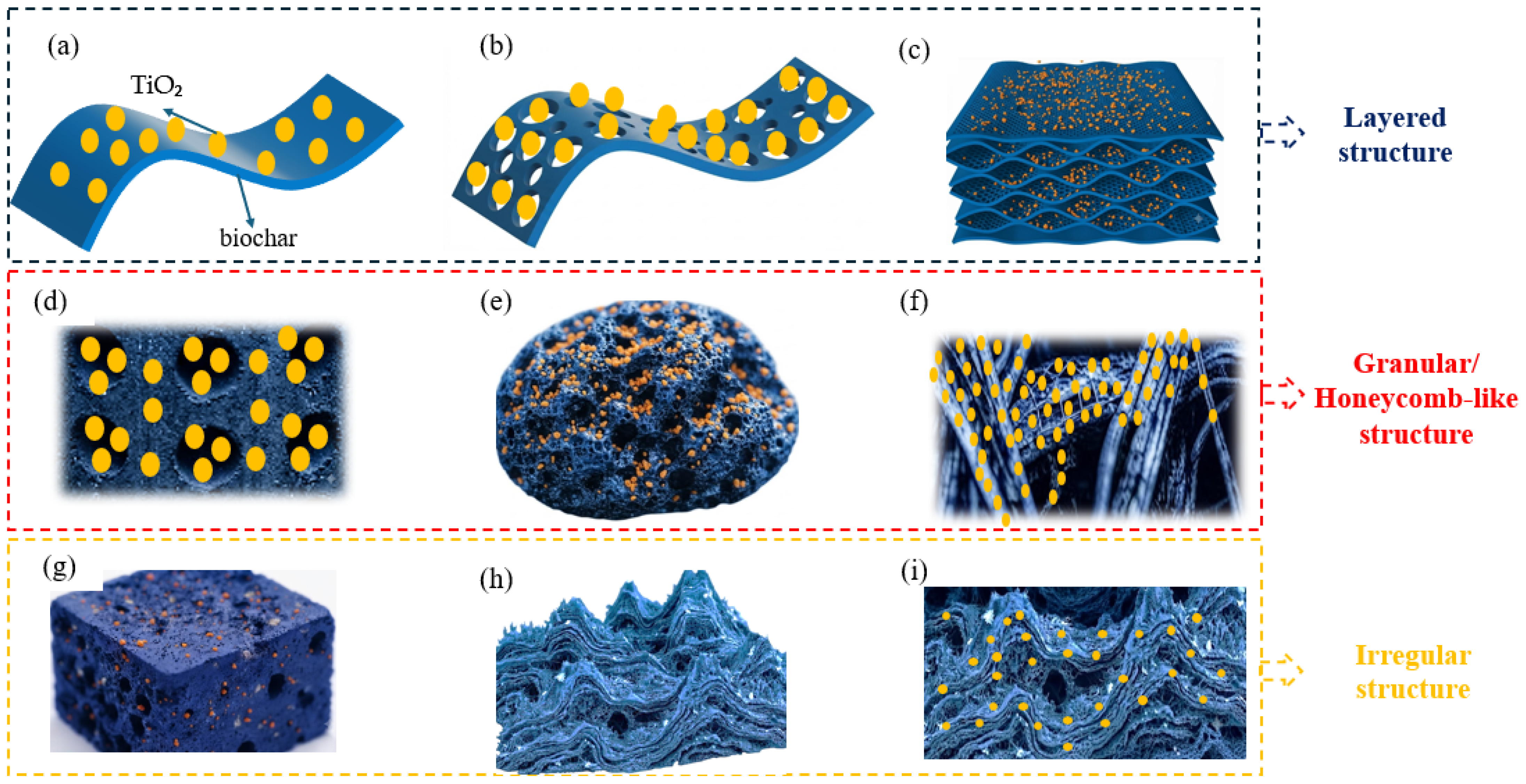
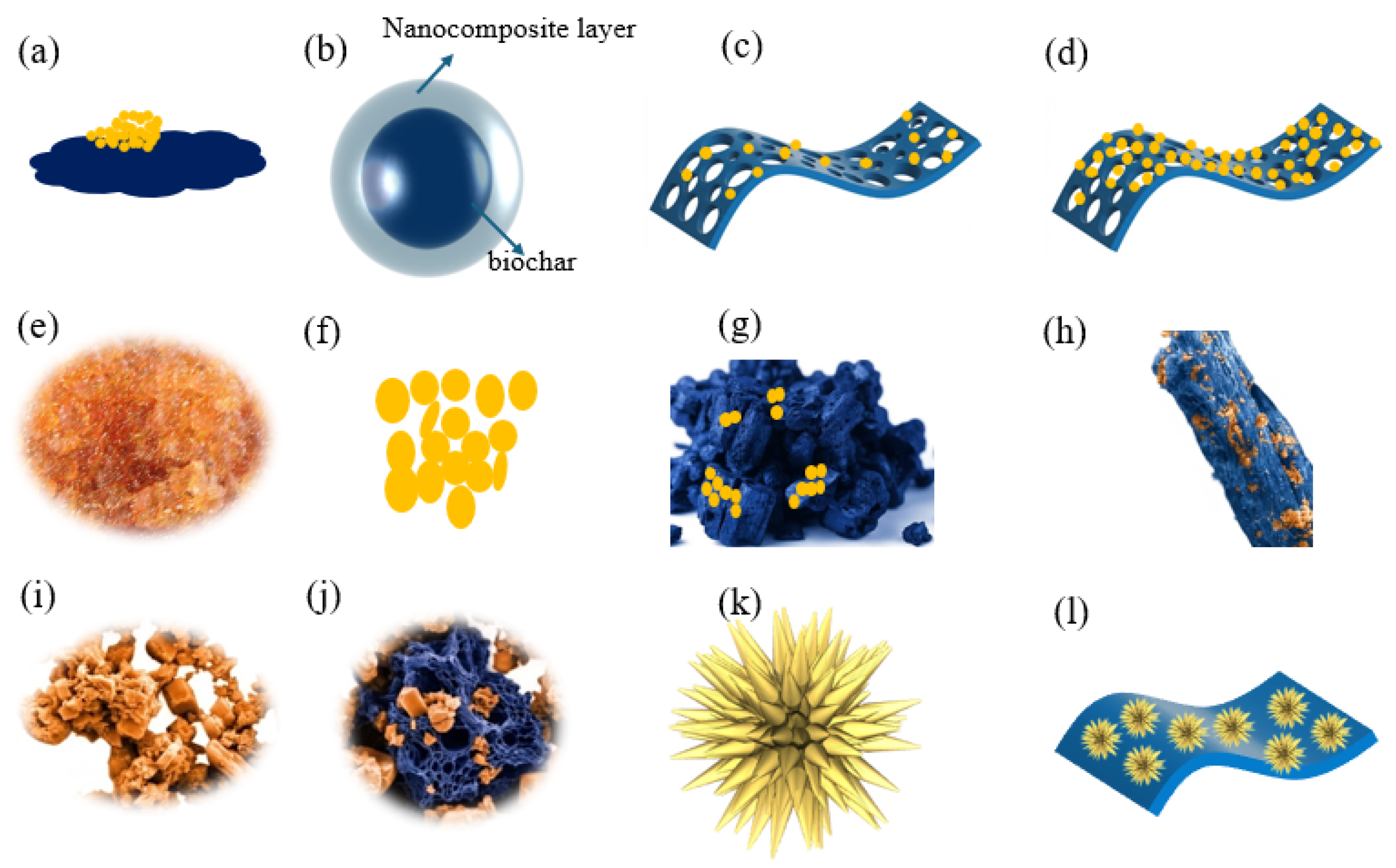
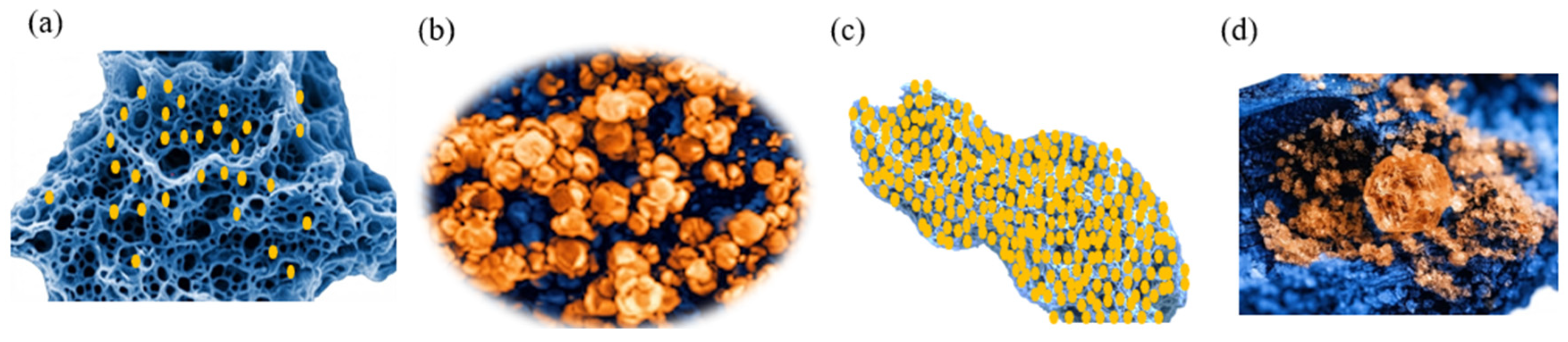
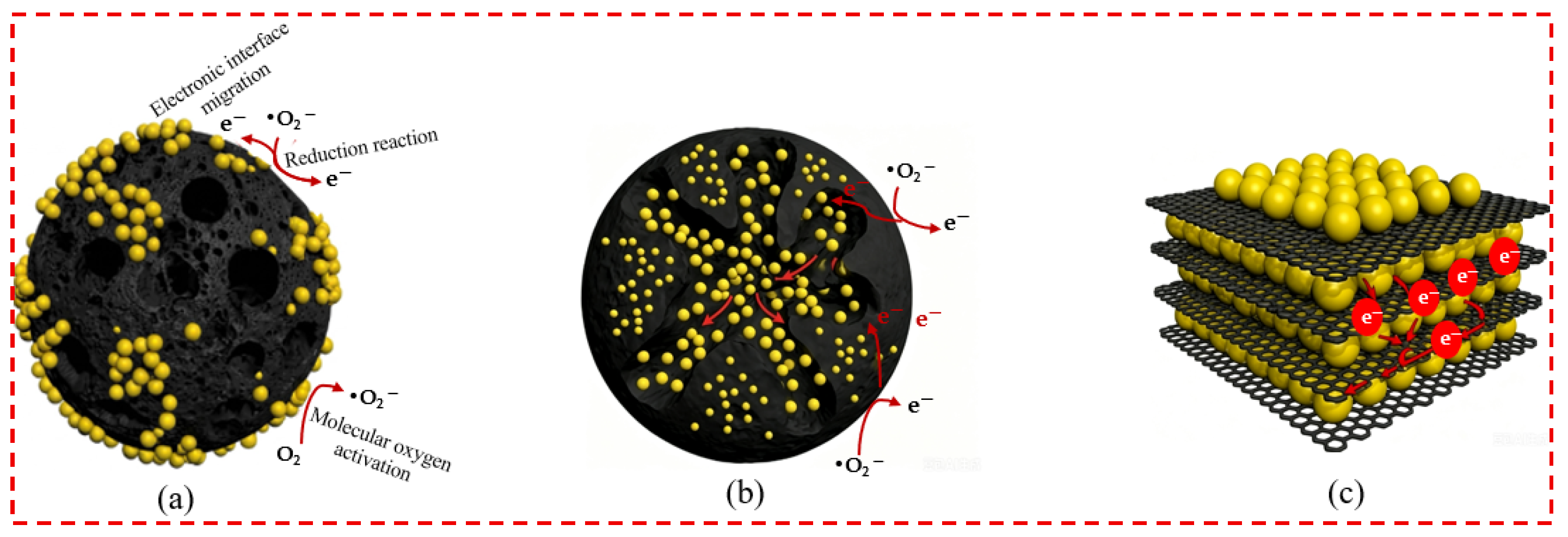
- To investigate the charge transfer mechanisms in the three typical morphologies of TiO2–BC-based photocatalysts (surface-adhered, pore-embedded, and interlayer-distributed).
2. Synthesis of TiO2–Biochar-Based Catalysts
2.1. Titanium Precursors
2.2. Biochar Precursors
2.3. Titanium–Carbon Mass Ratio
2.4. Preparation Methods and Solvents
2.5. Heat Treatment Conditions
2.6. Doping Modification
3. In Situ Synthesis of TiO2–Biochar Photocatalysts and Their Performance in Removing Organic Pollutants
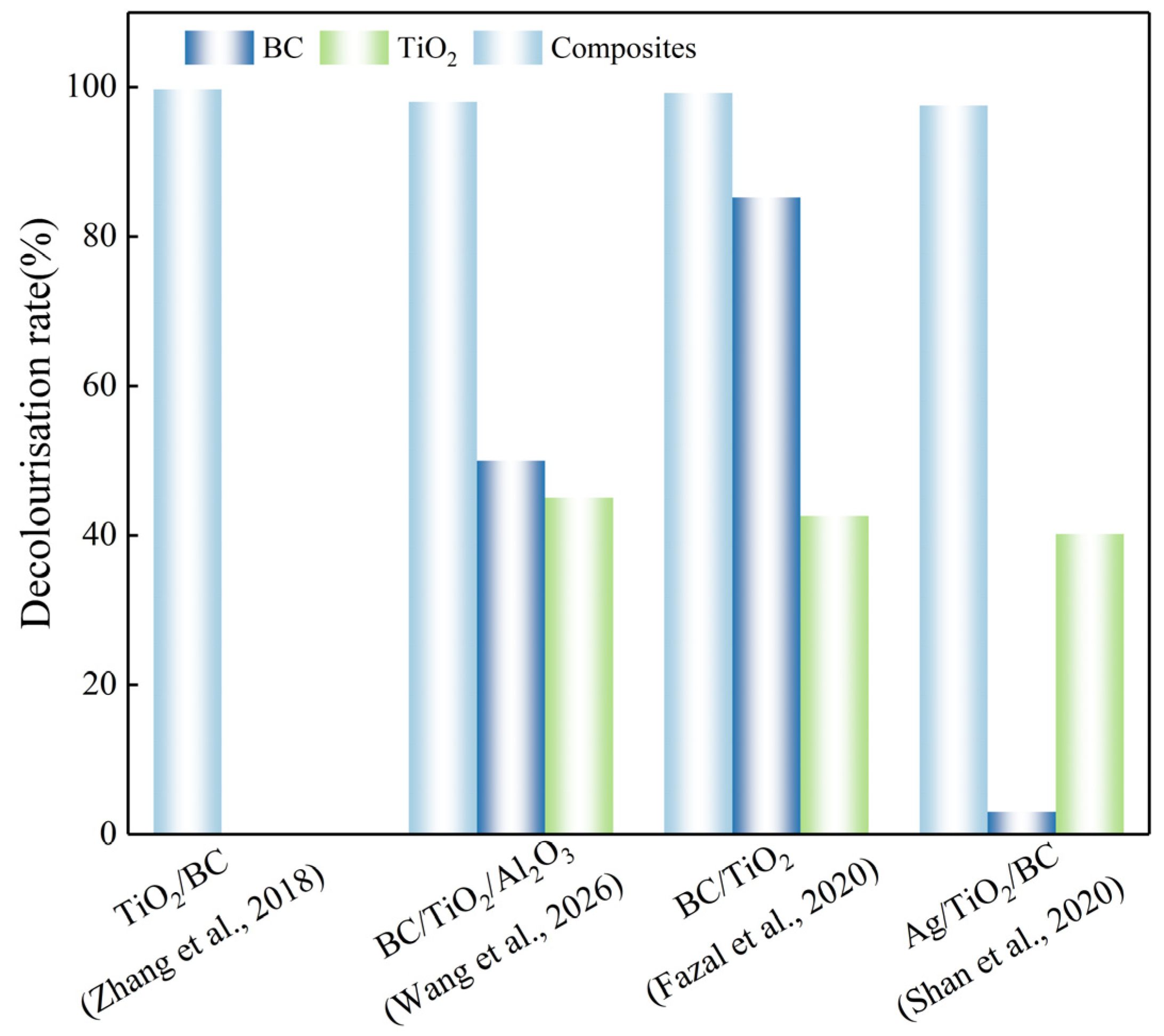
3.1. Dyes
3.2. Antibiotics
3.3. PFASs and MPs

| Catalysts | Functional Group/ Chemical Bond | Conditions | PFAS | ROS | Removal/ Defluorination | k/ min−1 | Cycles | Ref. |
|---|---|---|---|---|---|---|---|---|
| Fe/TNTs@AC | - | UV irradiation; 22 ± 1 °C; 4 h; pH = 7.0; PFOA = 100 μg/L; dosage = 100 mg; solution volume = 10 mL | PFOA | h+ | 91.3%/~60% | - | 5/ ~60 | [151] |
| In/TNTs@AC | -OH, -COOH, C=O | UV irradiation; 25 °C; 4 h; pH = 7; dosage = 100 mg; PFOA = 0.1 mg/L; solution volume = 400 mL | PFOA | h+ | 100%/60% | - | 4/ ~45% | [152] |
| TNTs@ biochar | -OH, C=O, C=C, C-O, Ti-O, C-H | a 254 nm UV source; 7 h; pH = 7.0; 23 ± 2 °C; PFOA = 100 mg/L; dosage = 1.5 g/L; solution volume = 65 mL | PFOA | h+, •OH | 99%/99% | - | - | [150] |
| MPs | Mass loss/ TOC | |||||||
| BC/CST | Ti-O, C-O-C, C-O, C=O | Four light bulbs; 40 h; PE = 50 mg; catalyst = 100 mg; solution volume = 100 mL | PE | •OH | The particle size reduced to 430 μm | - | - | [148] |
| g-C3N4/ TiO2/ WCT-AC | C=C; N=C=N; C=N=C; Ti-O | PE = 50 mg; 500 W xenon lamp; 200 h; solution volume = 50 mL; 25 °C | PE | •O2−, •OH | 67.58% | - | 5/ ~65% | [149] |
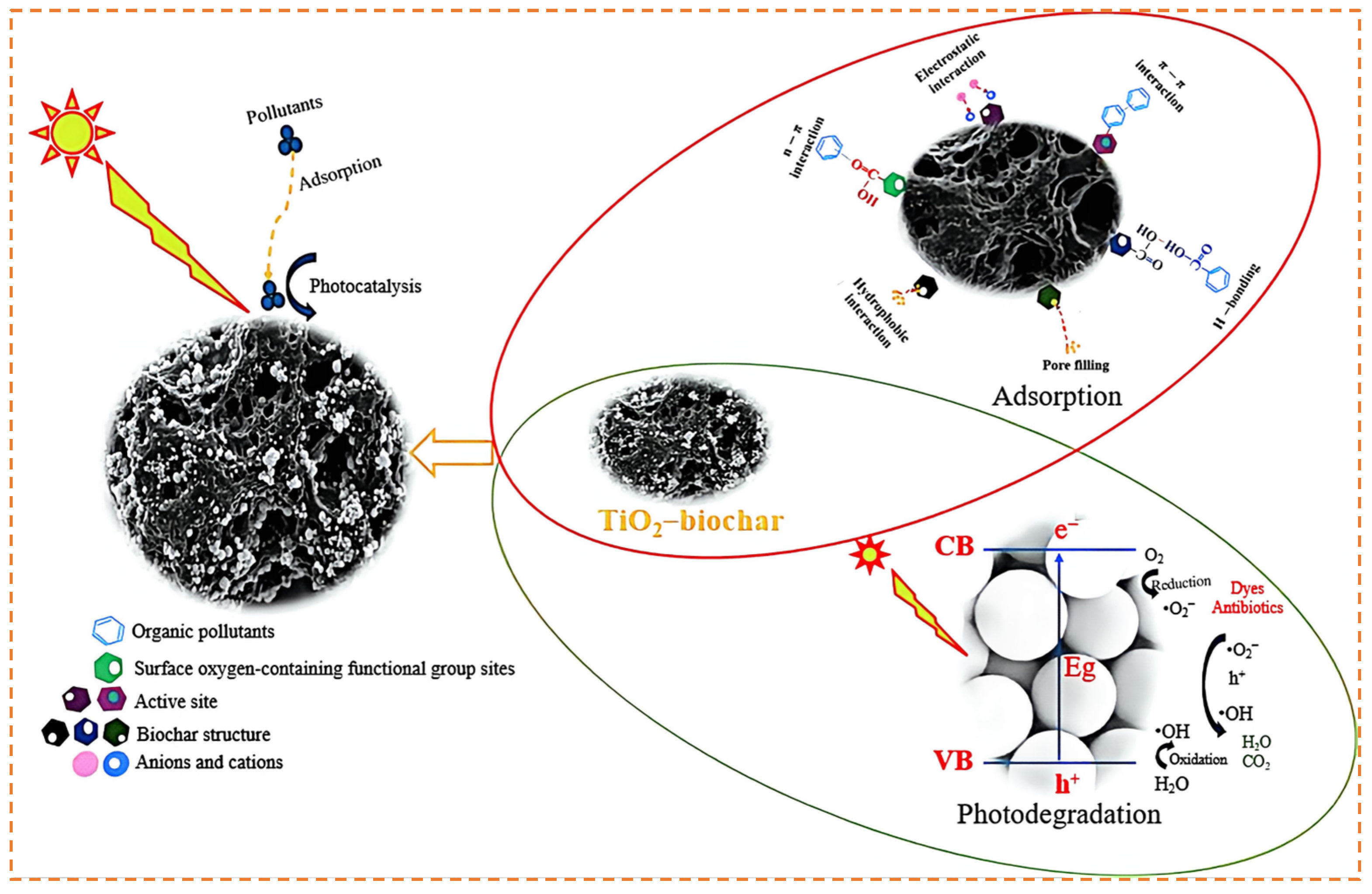
4. Synergistic Mechanism of Adsorption and Photocatalysis for TiO2–Biochar-Based Photocatalysts
5. Comparison of TiO2–Based Adsorption-Photocatalysts
6. Current Limitations and Future Research Requirements
7. Summary
Author Contributions
Funding
Data Availability Statement
Conflicts of Interest
References
- Nanda, S.; Berruti, F. Municipal Solid Waste Management and Landfilling Technologies: A Review. Environ. Chem. Lett. 2021, 19, 1433–1456. [Google Scholar] [CrossRef] [Scilit]
- Pan, D.; Su, F.; Liu, C.; Guo, Z. Research Progress for Plastic Waste Management and Manufacture of Value-Added Products. Adv. Compos. Hybrid Mater. 2020, 3, 443–461. [Google Scholar] [CrossRef] [Scilit]
- Ghamarpoor, R.; Jamshidi, M.; Fallah, A.; Neshastehgar, M. Designing a Smart Acrylic Photocatalyst Coating Loaded with N/C-Doped TiO2@SiO2 Core-Shell by Bio-Based Tarem-Rice Husk Waste for Organic Pollutant Degradation. Alex. Eng. J. 2025, 115, 131–146. [Google Scholar] [CrossRef] [Scilit]
- Yang, H.; Kunarbekova, M.; Hong, S.-H.; Seimukhanova, L.; Sapargali, I.; Azat, S.; Lee, C.-G.; Lee, J. Selective Photocatalytic Mineralization of Organic Pollutants Using Eggshell- and Seashell-Based Hydroxyapatite–TiO2 Composites. Sci. Rep. 2026. Ahead of print. [Google Scholar] [CrossRef] [Scilit] [PubMed]
- Lanjwani, M.F.; Tuzen, M.; Khuhawar, M.Y.; Saleh, T.A. Trends in Photocatalytic Degradation of Organic Dye Pollutants Using Nanoparticles: A Review. Inorg. Chem. Commun. 2024, 159, 111613. [Google Scholar] [CrossRef] [Scilit]
- Su, C.; Cui, H.; Wang, W.; Liu, Y.; Cheng, Z.; Wang, C.; Yang, M.; Qu, L.; Li, Y.; Cai, Y.; et al. Bioremediation of Complex Organic Pollutants by Engineered Vibrio Natriegens. Nature 2025, 642, 1024–1033. [Google Scholar] [CrossRef] [Scilit] [PubMed]
- Zhang, K.; Zhang, J.; He, X.; Zhao, Y.; Zada, A.; Peng, A.; Qi, K. Fe3O4@MIL-100(Fe) Modified ZnS Nanoparticles with Enhanced Sonocatalytic Degradation of Tetracycline Antibiotic in Water. Ultrason. Sonochemistry 2023, 95, 106409. [Google Scholar] [CrossRef] [Scilit] [PubMed]
- Rajput, R.B.; Jamble, S.N.; Kale, R.B. A Review on TiO2/SnO2 Heterostructures as a Photocatalyst for the Degradation of Dyes and Organic Pollutants. J. Environ. Manag. 2022, 307, 114533. [Google Scholar] [CrossRef] [Scilit] [PubMed]
- Guo, Z.; Kodikara, D.; Albi, L.S.; Hatano, Y.; Chen, G.; Yoshimura, C.; Wang, J. Photodegradation of Organic Micropollutants in Aquatic Environment: Importance, Factors and Processes. Water Res. 2023, 231, 118236. [Google Scholar] [CrossRef] [Scilit] [PubMed]
- Tao, H.; Tang, Y.; Wang, L.; Wang, X.; Lin, T. The Transport of Microplastics (MPs) in the Activated Carbon Filtration Process of Drinking Water Treatment Plants: The Influence of Surface Characteristics and Environmental Variables. J. Environ. Chem. Eng. 2026, 14, 121569. [Google Scholar] [CrossRef] [Scilit]
- Zhou, H.; Wang, H.; Yue, C.; He, L.; Li, H.; Zhang, H.; Yang, S.; Ma, T. Photocatalytic Degradation by TiO2-Conjugated/Coordination Polymer Heterojunction: Preparation, Mechanisms, and Prospects. Appl. Catal. B Environ. Energy 2024, 344, 123605. [Google Scholar] [CrossRef] [Scilit]
- Mahmoudi, F.; Saravanakumar, K.; Maheskumar, V.; Njaramba, L.K.; Yoon, Y.; Park, C.M. Application of Perovskite Oxides and Their Composites for Degrading Organic Pollutants from Wastewater Using Advanced Oxidation Processes: Review of the Recent Progress. J. Hazard. Mater. 2022, 436, 129074. [Google Scholar] [CrossRef] [Scilit] [PubMed]
- Li, H.; Wang, W.; Xu, K.; Cheng, B.; Xu, J.; Cao, S. Solar-Driven H2O2 Production by S-Scheme Heterojunction Photocatalyst. Chin. J. Catal. 2025, 72, 24–47. [Google Scholar] [CrossRef] [Scilit]
- Hisatomi, T.; Yamada, T.; Nishiyama, H.; Takata, T.; Domen, K. Materials and Systems for Large-Scale Photocatalytic Water Splitting. Nat. Rev. Mater. 2025, 10, 769–782. [Google Scholar] [CrossRef] [Scilit]
- Wang, X.; Hong, D.; Shan, L.; Wu, H.; Xu, H.; Li, X.; Liu, G.; He, X.; Dong, L. Polarization Engineering and Design Strategies of Ferroelectric Materials in Photocatalytic CO2 Reduction. Surf. Interfaces 2025, 72, 107202. [Google Scholar] [CrossRef] [Scilit]
- Qudsieh, I.Y.; Ali, M.A.; Maafa, I.M. Effect of Water Matrix on Photocatalytic Degradation of Organic Pollutants in Water: A Literature Review. Rev. Chem. Eng. 2025, 41, 539–573. [Google Scholar] [CrossRef] [Scilit]
- Sari, Y.; Gareso, P.L.; Armynah, B.; Tahir, D. A Review of TiO2 Photocatalyst for Organic Degradation and Sustainable Hydrogen Energy Production. Int. J. Hydrogen Energy 2024, 55, 984–996. [Google Scholar] [CrossRef] [Scilit]
- Li, X.; Zhang, L.; Niu, S.; Dong, Z.; Lyu, C. Quantitatively Regulating the Ketone Structure of Triazine-Based Covalent Organic Frameworks for Efficient Visible-Light Photocatalytic Degradation of Organic Pollutants: Tunable Performance and Mechanisms. J. Hazard. Mater. 2023, 444, 130366. [Google Scholar] [CrossRef] [Scilit] [PubMed]
- Yeszhan, Y.; Bexeitova, K.; Yermekbayev, S.; Toktarbay, Z.; Lee, J.; Berndtsson, R.; Azat, S. Photocatalytic Degradation of Microplastics in Aquatic Environments: Materials, Mechanisms, Practical Challenges, and Future Perspectives. Water 2025, 17, 2139. [Google Scholar] [CrossRef] [Scilit]
- Sultanov, F.; Daulbayev, C.; Azat, S.; Kuterbekov, K.; Bekmyrza, K.; Bakbolat, B.; Bigaj, M.; Mansurov, Z. Influence of Metal Oxide Particles on Bandgap of 1D Photocatalysts Based on SrTiO3/PAN Fibers. Nanomaterials 2020, 10, 1734. [Google Scholar] [CrossRef] [Scilit] [PubMed]
- Khan, M.S.; Li, Y.; Li, D.-S.; Qiu, J.; Xu, X.; Yang, H.Y. A Review of Metal–Organic Framework (MOF) Materials as an Effective Photocatalyst for Degradation of Organic Pollutants. Nanoscale Adv. 2023, 5, 6318–6348. [Google Scholar] [CrossRef] [Scilit] [PubMed]
- Chen, P.; Yan, M.; Shi, J.; Feng, M.; Li, Q.; Chen, H.; Xie, Y.; Lei, J.; Wakeel, M.; Hu, B.; et al. Applications of COFs and Their Derivatives in Photocatalysis for Energy Production and Harmful Substance Degradation. Chem. Eur. J. 2025, 31, e202500305. [Google Scholar] [CrossRef] [Scilit] [PubMed]
- Solangi, N.H.; Karri, R.R.; Mazari, S.A.; Mubarak, N.M.; Jatoi, A.S.; Malafaia, G.; Azad, A.K. MXene as Emerging Material for Photocatalytic Degradation of Environmental Pollutants. Coord. Chem. Rev. 2023, 477, 214965. [Google Scholar] [CrossRef] [Scilit]
- Alluqmani, S.M.; Loulou, M.; Ouerfelli, J.; Alshahrie, A.; Salah, N. Elaboration of TiO2/Carbon of Oil Fly Ash Nanocomposite as an Eco-Friendly Photocatalytic Thin-Film Material. Ceram. Int. 2021, 47, 13544–13551. [Google Scholar] [CrossRef] [Scilit]
- Ghamarpoor, R.; Fallah, A.; Jamshidi, M. A Review of Synthesis Methods, Modifications, and Mechanisms of ZnO/TiO2-Based Photocatalysts for Photodegradation of Contaminants. ACS Omega 2024, 9, 25457–25492. [Google Scholar] [CrossRef] [Scilit] [PubMed]
- Berdini, F.; Pecini, E.; Brigante, M. Water Remediation Induced by Anatase-TiO2 Nanoparticles: Unveiling the Selectivity of Reactive Species in Persistent Organic Pollutant Photodegradation. Int. J. Environ. Sci. Technol. 2026, 23, 211. [Google Scholar] [CrossRef] [Scilit]
- Van Thuan, D.; Ngo, H.L.; Thi, H.P.; Chu, T.T.H. Photodegradation of Hazardous Organic Pollutants Using Titanium Oxides-Based Photocatalytic: A Review. Environ. Res. 2023, 229, 116000. [Google Scholar] [CrossRef] [Scilit] [PubMed]
- Safeen, K.; Ullah, R.; Safeen, A.; Zulfiqar; Kabeer, M.; Khan, R.; Ullah, H.; Zaman, A.; Shafique Ahmad, K.; Ullah Shah, M.Z.; et al. Structure Phase-Dependent Dielectric and Photodegradation Properties of Co-Doped TiO2 Nanoparticles Synthesized via Co-Precipitation Route. J. Saudi Chem. Soc. 2023, 27, 101711. [Google Scholar] [CrossRef] [Scilit]
- Guo, X.; Yeszhan, Y.; Bexeitova, K.; Toshtay, K.; Toktarbay, Z.; Lee, J.; Azat, S. Photocatalytic Degradation of Microplastics in Aquatic System Using Metal and Non Metal-Doped TiO2 Catalyst. J. Water Process Eng. 2025, 79, 108956. [Google Scholar] [CrossRef] [Scilit]
- Wu, X.; Sayed, M.; Wang, G.; Yu, W.; Zhu, B. COF-Based S-Scheme Heterojunction Photocatalyst. Adv. Mater. 2026, 38, e11322. [Google Scholar] [CrossRef] [Scilit] [PubMed]
- Colmenares, J.C.; Varma, R.S.; Lisowski, P. Sustainable Hybrid Photocatalysts: Titania Immobilized on Carbon Materials Derived from Renewable and Biodegradable Resources. Green Chem. 2016, 18, 5736–5750. [Google Scholar] [CrossRef] [Scilit] [PubMed]
- Liu, Y.; Dai, X.; Li, J.; Cheng, S.; Zhang, J.; Ma, Y. Recent Progress in TiO2 –Biochar-Based Photocatalysts for Water Contaminants Treatment: Strategies to Improve Photocatalytic Performance. RSC Adv. 2024, 14, 478–491. [Google Scholar] [CrossRef] [Scilit] [PubMed]
- Li, X.; Li, Z. Application and Development of Biochar Adsorbents for Emerging Contaminants Removal from Wastewater: Critical Synthesis and Scientometric Perspective. J. Environ. Chem. Eng. 2026, 14, 121189. [Google Scholar] [CrossRef] [Scilit]
- Cheng, G.; Xu, F.; Xiong, J.; Tian, F.; Ding, J.; Stadler, F.J.; Chen, R. Enhanced Adsorption and Photocatalysis Capability of Generally Synthesized TiO2-Carbon Materials Hybrids. Adv. Powder Technol. 2016, 27, 1949–1962. [Google Scholar] [CrossRef] [Scilit]
- Chandra, S.; Jagdale, P.; Medha, I.; Tiwari, A.; Bartoli, M.; Nino, A.; Olivito, F. Biochar-Supported TiO2-Based Nanocomposites for the Photocatalytic Degradation of Sulfamethoxazole in Water—A Review. Toxics 2021, 9, 313. [Google Scholar] [CrossRef] [Scilit] [PubMed]
- Weidner, E.; Karbassiyazdi, E.; Altaee, A.; Jesionowski, T.; Ciesielczyk, F. Hybrid Metal Oxide/Biochar Materials for Wastewater Treatment Technology: A Review. ACS Omega 2022, 7, 27062–27078. [Google Scholar] [CrossRef] [Scilit] [PubMed]
- Lu, Y.; Cai, Y.; Zhang, S.; Zhuang, L.; Hu, B.; Wang, S.; Chen, J.; Wang, X. Application of Biochar-Based Photocatalysts for Adsorption-(Photo)Degradation/Reduction of Environmental Contaminants: Mechanism, Challenges and Perspective. Biochar 2022, 4, 45. [Google Scholar] [CrossRef] [Scilit]
- Zhang, P.; Shen, Z.; Jia, L.; Qiu, J. Biomass-Derived Carbon for Boosting Photocatalysis. Small 2026, 22, e12210. [Google Scholar] [CrossRef] [Scilit] [PubMed]
- Huang Kong, E.D.; Lai, C.W.; Juan, J.C.; Pang, Y.L.; Khe, C.S.; Badruddin, I.A.; Gapsari, F.; Anam, K. Recent Advances in Titanium Dioxide Bio-Derived Carbon Photocatalysts for Organic Pollutant Degradation in Wastewater. iScience 2025, 28, 112368. [Google Scholar] [CrossRef] [Scilit] [PubMed]
- Bratovčić, A.; Tomašić, V. Photocatalytic Composites Based on Biochar for Antibiotic and Dye Removal in Water Treatment. Processes 2024, 12, 2746. [Google Scholar] [CrossRef] [Scilit]
- Mehmood, F.; Nadeem, M.; Tursunov, O.; Sihao, R.; Fu, Y.; Dong, R.; Meliyev, B.; Ochilov, M.; Egamnazarov, G.; Zhou, Y. Engineered Biochar-Metal Oxide Nanocomposites for Targeted Dye Remediation in Textile Wastewater. J. Ecol. Eng. 2026, 27, 295–315. [Google Scholar] [CrossRef] [Scilit]
- Portela, C.I.; Brazil, T.R.; Mendonça, T.A.P.; Santos, E.B.; Domingues, R.A.; Vieira, N.C.S.; Gonçalves, M. Activated Carbon Obtained from Coffee Husk Waste Activated by CaCl2 as Support of TiO2 for the Enhanced Photocatalytic Degradation of Victoria Blue B Dye. Diam. Relat. Mater. 2023, 139, 110417. [Google Scholar] [CrossRef] [Scilit]
- Yang, C.X.; Zhu, Q.; Dong, W.P.; Fan, Y.Q.; Wang, W.L. Preparation and Characterization of Phosphoric Acid-Modified Biochar Nanomaterials with Highly Efficient Adsorption and Photodegradation Ability. Langmuir 2021, 37, 9253–9263. [Google Scholar] [CrossRef] [Scilit] [PubMed]
- Zhang, S.; Lu, X. Treatment of Wastewater Containing Reactive Brilliant Blue KN-R Using TiO2/BC Composite as Heterogeneous Photocatalyst and Adsorbent. Chemosphere 2018, 206, 777–783. [Google Scholar] [CrossRef] [Scilit] [PubMed]
- Martins, A.C.; Cazetta, A.L.; Pezoti, O.; Souza, J.R.B.; Zhang, T.; Pilau, E.J.; Asefa, T.; Almeida, V.C. Sol-Gel Synthesis of New TiO2/Activated Carbon Photocatalyst and Its Application for Degradation of Tetracycline. Ceram. Int. 2017, 43, 4411–4418. [Google Scholar] [CrossRef] [Scilit]
- Zouggari, H.; Mahir, F.-Z.; Diez, A.M.; Djellabi, R.; Sanromán, M.Á.; Albourine, A.; Pazos, M. PMS Activation via Alginate Cross-Linked TiO2 Hybridized Peanut Shells Biochar under Visible Light for Boosted Pharmaceutical Pollutants Oxidation. Chem. Eng. J. 2026, 529, 173054. [Google Scholar] [CrossRef] [Scilit]
- Kim, J.R.; Kan, E. Heterogeneous Photocatalytic Degradation of Sulfamethoxazole in Water Using a Biochar-Supported TiO2 Photocatalyst. J. Environ. Manag. 2016, 180, 94–101. [Google Scholar] [CrossRef] [Scilit] [PubMed]
- Guo, X.; Zhou, T.; Wang, G.; Liu, K.; Zhang, Y.; Wang, C.; Wu, J.; Liu, B.; Gao, H.; Hu, X.; et al. Synergistic Enhancement of Biochar in TiO2/g-C3N4 Z-Scheme Heterojunction Photocatalysts: Mechanistic Insights into the Degradation Pathways of Sulfonamide Antibiotics. Biochar 2026, 8, 36. [Google Scholar] [CrossRef] [Scilit]
- Wang, Y.; Wang, Z.; Wang, J.; Wang, C.; Tang, H.; Fan, G.; Zhang, L.; Wang, Y.; Tao, M. Biochar-Supported TiO2/Al2O3 Core-Shell Heterojunction for Synergistic Adsorption–Photocatalytic Degradation of Rhodamine B: Performance and Mechanism. J. Environ. Manag. 2026, 405, 129584. [Google Scholar] [CrossRef] [Scilit] [PubMed]
- Wu, J.; Guo, X.; Zhou, T.; Yan, D.; Gao, H.; Jiang, K.; Hu, X.; Liu, B.; Liu, K.; Zhao, W. Investigating the Potentiated Role of Biochar in Tio 2/G-C 3 N 4 Z-Scheme Heterojunction Photocatalysis: Insights into the Degradation Mechanisms of Sulfanilamide. SSRN 2025. [Google Scholar] [CrossRef] [Scilit]
- Cai, X.; Li, J.; Liu, Y.; Yan, Z.; Tan, X.; Liu, S.; Zeng, G.; Gu, Y.; Hu, X.; Jiang, L. Titanium Dioxide-coated Biochar Composites as Adsorptive and Photocatalytic Degradation Materials for the Removal of Aqueous Organic Pollutants. J. Chem. Technol. Biotechnol. 2018, 93, 783–791. [Google Scholar] [CrossRef] [Scilit]
- Zhang, H.; Wang, Z.; Li, R.; Guo, J.; Li, Y.; Zhu, J.; Xie, X. TiO2 Supported on Reed Straw Biochar as an Adsorptive and Photocatalytic Composite for the Efficient Degradation of Sulfamethoxazole in Aqueous Matrices. Chemosphere 2017, 185, 351–360. [Google Scholar] [CrossRef] [Scilit] [PubMed]
- Xie, X.; Li, S.; Zhang, H.; Wang, Z.; Huang, H. Promoting Charge Separation of Biochar-Based Zn-TiO2/pBC in the Presence of ZnO for Efficient Sulfamethoxazole Photodegradation under Visible Light Irradiation. Sci. Total Environ. 2019, 659, 529–539. [Google Scholar] [CrossRef] [Scilit] [PubMed]
- Azizah, N.; Ariyanti, D.; Lesdantina, D.; Saputra, E.; Srivastava, V. Biochar supported photocatalyst (mangrove biochar-TiO2) for organic pollutants removal via synergetic adsorption-photocatalytic process. Commun. Sci. Technol. 2025, 10, 209–217. [Google Scholar] [CrossRef] [Scilit]
- Abdu, M.; Worku, A.; Babaee, S.; Diale, P.; Msagati, T.A.; Nure, J.F. The Development of TiO2-Biochar Composite Material for Photodegradation of Basic Blue 41 and Erichrome Black T Azo Dyes from Water. Surf. Interfaces 2025, 62, 106156. [Google Scholar] [CrossRef] [Scilit]
- Ashebir, H.; Babaee, S.; Worku, A.; Diale, P.; Msagati, T.; Nure, J.F. N-Doped TiO2/Prosopis Juliflora Biochar Nanocomposites for Removal of Ciprofloxacin from Pharmaceutical Industrial Wastewater. Sci. Rep. 2025, 15, 31795. [Google Scholar] [CrossRef] [Scilit] [PubMed]
- Asha, R.C.; Yadav, M.S.P.; Kumar, M. Sulfamethoxazole Removal in Membrane-Photocatalytic Reactor System—Experimentation and Modelling. Environ. Technol. 2019, 40, 1697–1704. [Google Scholar] [CrossRef] [Scilit] [PubMed]
- Wu, Z.; Xue, Y.; Gao, Z.; Li, Y.; Zhang, L.; Yang, X.; Liu, X.; Chen, Z. Synthesis of Ni-Doped Anatase TiO2 Single Crystals Loaded on Wood-Based Activated Carbon for Enhanced Photodegradation of Triphenylmethane Dyes. Environ. Sci. Pollut. Res. 2021, 28, 6491–6503. [Google Scholar] [CrossRef] [Scilit] [PubMed]
- Silvestri, S.; Gonçalves, M.G.; Da Silva Veiga, P.A.; Matos, T.T.D.S.; Peralta-Zamora, P.; Mangrich, A.S. TiO2 Supported on Salvinia Molesta Biochar for Heterogeneous Photocatalytic Degradation of Acid Orange 7 Dye. J. Environ. Chem. Eng. 2019, 7, 102879. [Google Scholar] [CrossRef] [Scilit]
- Ao, W.; Qu, J.; Yu, H.; Liu, Y.; Liu, C.; Fu, J.; Dai, J.; Bi, X.; Yuan, Y.; Jin, Y. TiO2/Activated Carbon Synthesized by Microwave-Assisted Heating for Tetracycline Photodegradation. Environ. Res. 2022, 214, 113837. [Google Scholar] [CrossRef] [Scilit] [PubMed]
- Yang, B.; Wang, P.; Liu, H.; Wang, L.; He, S.; Rong, S.; Ma, Z.; Cheng, Y.; Feng, Y.; Xue, L. Counteracting the Trojan Horse Effect: Dual-Light-Driven Biochar/LaFeO3/TiO2 for Synchronous ARGs-Inactivation and Phosphorus-Adsorption. Chem. Eng. J. 2026, 531, 173736. [Google Scholar] [CrossRef] [Scilit]
- Hu, H. Preparation of N-Doped TiO2/Biochar Composite Catalysts and Its Application for Photoelectrochemical Degradation of Cephalosporin Antibiotics. Int. J. Electrochem. Sci. 2022, 17, 220330. [Google Scholar] [CrossRef] [Scilit]
- Bin Masud, R.; Alam, S.R.; Roy, H.; Rahman, M.J.; Islam, M.S. Bandgap-Engineered Nitrogen Plasma Functionalized Biochar-TiO2 Composite for Enhanced Antibiotic Photodegradation. RSC Adv. 2026, 16, 13147–13161. [Google Scholar] [CrossRef] [Scilit] [PubMed]
- Fazal, T.; Razzaq, A.; Javed, F.; Hafeez, A.; Rashid, N.; Amjad, U.S.; Ur Rehman, M.S.; Faisal, A.; Rehman, F. Integrating Adsorption and Photocatalysis: A Cost Effective Strategy for Textile Wastewater Treatment Using Hybrid Biochar-TiO2 Composite. J. Hazard. Mater. 2020, 390, 121623. [Google Scholar] [CrossRef] [Scilit] [PubMed]
- Parvathiraja, C.; Katheria, S.; Siddiqui, M.R.; Wabaidur, S.M.; Islam, M.A.; Lai, W.-C. Activated Carbon-Loaded Titanium Dioxide Nanoparticles and Their Photocatalytic and Antibacterial Investigations. Catalysts 2022, 12, 834. [Google Scholar] [CrossRef] [Scilit]
- Abdullah, M.; Iqbal, J.; Ur Rehman, M.S.; Khalid, U.; Mateen, F.; Arshad, S.N.; Al-Sehemi, A.G.; Algarni, H.; Al-Hartomy, O.A.; Fazal, T. Removal of Ceftriaxone Sodium Antibiotic from Pharmaceutical Wastewater Using an Activated Carbon Based TiO2 Composite: Adsorption and Photocatalytic Degradation Evaluation. Chemosphere 2023, 317, 137834. [Google Scholar] [CrossRef] [Scilit] [PubMed]
- Shan, R.; Lu, L.; Gu, J.; Zhang, Y.; Yuan, H.; Chen, Y.; Luo, B. Photocatalytic Degradation of Methyl Orange by Ag/TiO2/Biochar Composite Catalysts in Aqueous Solutions. Mater. Sci. Semicond. Process. 2020, 114, 105088. [Google Scholar] [CrossRef] [Scilit]
- Liu, Y.; Wang, L.; Dai, X.; Zhang, J.; Li, J.; Ma, Y.; Han, Q.; Dong, Y. Research on the Adsorption-Photocatalytic Synergistic Degradation of Tetracycline by Au Nanoparticles/TiO2 Nanorods/Biochar. J. Alloys Compd. 2024, 976, 172985. [Google Scholar] [CrossRef] [Scilit]
- Li, X.; Ding, Y.; Wang, J.; Feng, X. CS-Biochar/ZnO/TiO2 for Efficient Photocatalytic Removal of Rhodamine B: Performance and Mechanism Insights. Water Air Soil Pollut. 2025, 236, 7. [Google Scholar] [CrossRef] [Scilit]
- Wu, C.; Zhang, J.; Fang, B.; Cui, Y.; Xing, Z.; Li, Z.; Zhou, W. Self-Floating Biomass Charcoal Supported Flower-like Plasmon Silver/Carbon, Nitrogen Co-Doped Defective TiO2 as Robust Visible Light Photocatalysts. J. Clean. Prod. 2021, 329, 129723. [Google Scholar] [CrossRef] [Scilit]
- Naribi, Z.; Esserrar, S.; Salhi, A.; El Krati, M.; Tahiri, S. TiO2 Supported on Hydrochar Derived from Industrial Ice Cream Wastewater as a Photocatalytic Composite for Efficient Degradation of AR97 in Aqueous Media. Environ. Sci. Pollut. Res. 2026, 33, 3172–3188. [Google Scholar] [CrossRef] [Scilit] [PubMed]
- Silvestri, S.; Stefanello, N.; Sulkovski, A.A.; Foletto, E.L. Preparation of TiO2 Supported on MDF Biochar for Simultaneous Removal of Methylene Blue by Adsorption and Photocatalysis. J. Chem. Technol. Biotechnol. 2020, 95, 2723–2729. [Google Scholar] [CrossRef] [Scilit]
- Jiang, Y.; Liu, A. Cornstalk Biochar-TiO2 Composites as Alternative Photocatalyst for Degrading Methyl Orange. Environ. Sci. Pollut. Res. 2022, 30, 31923–31934. [Google Scholar] [CrossRef] [Scilit] [PubMed]
- Chen, X.; Tan, Y.; Yin, S.; Fan, G.; Han, F.; Xu, X.; Huang, Y. Synthesis of A-BC@g-C3N4/La-TiO2(A) Photocatalyst for Enhanced Photocatalytic Degradation of Tetracycline under Sunlight. Vacuum 2025, 241, 114682. [Google Scholar] [CrossRef] [Scilit]
- Chang, C.; Rad, S.; Gan, L.; Li, Z.; Dai, J.; Shahab, A. Review of the Sol–Gel Method in Preparing Nano TiO2 for Advanced Oxidation Process. Nanotechnol. Rev. 2023, 12, 20230150. [Google Scholar] [CrossRef] [Scilit]
- Zhang, J.; Sun, P.; Jiang, P.; Guo, Z.; Liu, W.; Lu, Q.; Cao, W. The Formation Mechanism of TiO2 Polymorphs under Hydrothermal Conditions Based on the Structural Evolution of [Ti(OH)h (H2 O)6−h ]4−h Monomers. J. Mater. Chem. C 2019, 7, 5764–5771. [Google Scholar] [CrossRef] [Scilit]
- Hanaor, D.A.H.; Chironi, I.; Karatchevtseva, I.; Triani, G.; Sorrell, C.C. Single and Mixed Phase TiO2 Powders Prepared by Excess Hydrolysis of Titanium Alkoxide. Adv. Appl. Ceram. 2012, 111, 149–158. [Google Scholar] [CrossRef] [Scilit]
- Charbonneau, C.; Gauvin, R.; Demopoulos, G.P. Nucleation and Growth of Self-Assembled Nanofibre-Structured Rutile (TiO2) Particles via Controlled Forced Hydrolysis of Titanium Tetrachloride Solution. J. Cryst. Growth 2009, 312, 86–94. [Google Scholar] [CrossRef] [Scilit]
- Lin, Z.; Pei, L.; Liu, S.; Jiang, X.; Xu, W.; Li, F.; Wu, X.; Wang, H.; Lu, X. Developments and Challenges on Crystal Forms and Morphologies of Nano-TiO2 Photocatalysts in Air and Wastewater Treatment. J. Water Process Eng. 2025, 70, 106909. [Google Scholar] [CrossRef] [Scilit]
- Mahlambi, M.M.; Ngila, C.J.; Mamba, B.B. Recent Developments in Environmental Photocatalytic Degradation of Organic Pollutants: The Case of Titanium Dioxide Nanoparticles—A Review. J. Nanomater. 2015, 2015, 790173. [Google Scholar] [CrossRef] [Scilit]
- Silveira, J.E.; Garcia, V.G.; Pacheco, L.T.; Paz, W.S.; Casas, J.A.; Zazo, J.A. FeTiO3: A Low-Cost and Efficient Photocatalytic Mineral for Sustainable NOx Abatement. Sep. Purif. Technol. 2025, 357, 130217. [Google Scholar] [CrossRef] [Scilit]
- Mostafa, M.; Rudayni, H.A.; Allam, A.A.; Abdel-Khalek, A.A.; Abukhadra, M.R. Upcycled Ilmenite/Glass-Derived FeTiO3–SiO2 Nanoflowers for Sustainable, Highly Effective Integrated Adsorptive–Photocatalytic Detoxification of 4-Nitrophenol and Cr(VI) in Water. Surf. Interfaces 2025, 72, 107360. [Google Scholar] [CrossRef] [Scilit]
- Chen, F.; Lv, H.; Chen, W.; Chen, R. Catalytic Wet Peroxide Oxidation of Anionic Pollutants over Fluorinated Fe3O4 Microspheres at Circumneutral pH Values. Catalysts 2022, 12, 1564. [Google Scholar] [CrossRef] [Scilit]
- Li, N.; Wang, M.-Y.; Jiao, Y.; Su, Y. Preparation of Silicon-Based TiO2 Photocatalyst from Titanium-Containing Blast Furnace Slag and Photocatalytic Degradation of Methylene Blue and Methyl Orange. React. Kinet. Mech. Catal. 2023, 136, 3227–3241. [Google Scholar] [CrossRef] [Scilit]
- Perovskiy, I.A.; Burtsev, I.N.; Ponaryadov, A.V.; Smorokov, A.A. Ammonium Fluoride Roasting and Water Leaching of Leucoxene Concentrates to Produce a High Grade Titanium Dioxide Resource (of the Yaregskoye Deposit, Timan, Russia). Hydrometallurgy 2022, 210, 105858. [Google Scholar] [CrossRef] [Scilit]
- Arsène, M.-A.; Bilba, K.; Savastano Junior, H.; Ghavami, K. Treatments of Non-Wood Plant Fibres Used as Reinforcement in Composite Materials. Mat. Res. 2013, 16, 903–923. [Google Scholar] [CrossRef] [Scilit]
- Son, B.T.; Long, N.V.; Nhat Hang, N.T. The Development of Biomass-Derived Carbon-Based Photocatalysts for the Visible-Light-Driven Photodegradation of Pollutants: A Comprehensive Review. RSC Adv. 2021, 11, 30574–30596. [Google Scholar] [CrossRef] [Scilit] [PubMed]
- Correa, C.R.; Kruse, A. Biobased Functional Carbon Materials: Production, Characterization, and Applications—A Review. Materials 2018, 11, 1568. [Google Scholar] [CrossRef] [Scilit] [PubMed]
- Xu, Q.; Li, X.; Si, Y. Preparation of Biochar-Based Photocatalytic Materials and Their Applications in Water Treatment: A Review. Catalysts 2025, 16, 5. [Google Scholar] [CrossRef] [Scilit]
- Wei, R.; Ge, Y.; Meng, H.; Huang, G.; Wu, J.; Wen, F.; Liu, H.; Shen, X. Enhanced Photocatalytic Degradation of Polycyclic Aromatic Hydrocarbons (PAHs) in Biochar Using Nano-TiO2 under Ultraviolet Light Irradiation: Effect and Mechanisms. Chem. Eng. J. 2025, 503, 158352. [Google Scholar] [CrossRef] [Scilit]
- Zhao, M.; Zou, G.; Li, Y.; Pan, B.; Wang, X.; Zhang, J.; Xu, L.; Li, C.; Chen, Y. Biodegradable Microplastics Coupled with Biochar Enhance Cd Chelation and Reduce Cd Accumulation in Chinese Cabbage. Biochar 2025, 7, 31. [Google Scholar] [CrossRef] [Scilit]
- Ye, S.; Cheng, M.; Zeng, G.; Tan, X.; Wu, H.; Liang, J.; Shen, M.; Song, B.; Liu, J.; Yang, H.; et al. Insights into Catalytic Removal and Separation of Attached Metals from Natural-Aged Microplastics by Magnetic Biochar Activating Oxidation Process. Water Res. 2020, 179, 115876. [Google Scholar] [CrossRef] [Scilit] [PubMed]
- Badawi, A.K.; Hassan, R. Optimizing Sludge Extract Reuse from Physico-Chemical Processes for Zero-Waste Discharge: A Critical Review. Desalin. Water Treat. 2024, 319, 100527. [Google Scholar] [CrossRef] [Scilit]
- Wang, G.; Feng, W.; Zeng, X.; Wang, Z.; Feng, C.; McCarthy, D.T.; Deletic, A.; Zhang, X. Highly Recoverable TiO2–GO Nanocomposites for Stormwater Disinfection. Water Res. 2016, 94, 363–370. [Google Scholar] [CrossRef] [Scilit] [PubMed]
- Xie, Y.; Liu, A.; Bandala, E.R.; Goonetilleke, A. TiO2-Biochar Composites as Alternative Photocatalyst for Stormwater Disinfection. J. Water Process Eng. 2022, 48, 102913. [Google Scholar] [CrossRef] [Scilit]
- Lu, L.; Shan, R.; Shi, Y.; Wang, S.; Yuan, H. A Novel TiO2/Biochar Composite Catalysts for Photocatalytic Degradation of Methyl Orange. Chemosphere 2019, 222, 391–398. [Google Scholar] [CrossRef] [Scilit] [PubMed]
- Wang, J.; Wang, G.; Yu, T.; Ding, N.; Wang, M.; Chen, Y. Photocatalytic Performance of Biochar-Modified TiO2 (C/TiO2) for Ammonia–Nitrogen Removal. RSC Adv. 2023, 13, 24237–24249. [Google Scholar] [CrossRef] [Scilit] [PubMed]
- Yang, H.; Yang, B.; Chen, W.; Yang, J. Preparation and Photocatalytic Activities of TiO2-Based Composite Catalysts. Catalysts 2022, 12, 1263. [Google Scholar] [CrossRef] [Scilit]
- Ullattil, S.G.; Periyat, P. Sol-Gel Synthesis of Titanium Dioxide. In Sol-Gel Materials for Energy, Environment and Electronic Applications; Pillai, S.C., Hehir, S., Eds.; Advances in Sol-Gel Derived Materials and Technologies; Springer International Publishing: Cham, Switzerland, 2017; pp. 271–283. ISBN 978-3-319-50142-0. [Google Scholar]
- Mian, M.M.; Liu, G. Recent Progress in Biochar-Supported Photocatalysts: Synthesis, Role of Biochar, and Applications. RSC Adv. 2018, 8, 14237–14248. [Google Scholar] [CrossRef] [Scilit] [PubMed]
- Shah, R.; Khan, D.; Al-Anazi, A.; Ahmad, W.; Ullah, I.; Shah, N.S.; Khan, J.A. Non-Metal Doped ZnO and TiO2 Photocatalysts for Visible Light Active Degradation of Pharmaceuticals and Hydrogen Production: A Review. Appl. Catal. O Open 2025, 204, 207043. [Google Scholar] [CrossRef] [Scilit]
- Liu, X.; Wan, C.; Li, X.; Wei, S.; Zhang, L.; Tian, W.; Yong, K.-T.; Wu, Y.; Li, J. Sustainable Wood-Based Nanotechnologies for Photocatalytic Degradation of Organic Contaminants in Aquatic Environment. Front. Environ. Sci. Eng. 2021, 15, 54. [Google Scholar] [CrossRef] [Scilit]
- Bie, C.; Yu, H.; Cheng, B.; Ho, W.; Fan, J.; Yu, J. Design, Fabrication, and Mechanism of Nitrogen-Doped Graphene-Based Photocatalyst. Adv. Mater. 2021, 33, 2003521. [Google Scholar] [CrossRef] [Scilit] [PubMed]
- Liu, X.; Zhu, S.; Li, S.; Li, L.; Zhu, X.; Tang, H.; Wang, Y. Pt Nanoparticles Supported on N-Doped TiO2/C Composite Supports for Fuel Cell Catalysis. J. Alloys Compd. 2025, 1042, 184103. [Google Scholar] [CrossRef] [Scilit]
- Yu, H.-L.; Wu, Q.-X.; Wang, J.; Liu, L.-Q.; Zheng, B.; Zhang, C.; Shen, Y.-G.; Huang, C.-L.; Zhou, B.; Jia, J.-R. Simple Fabrication of the Ag-Ag2O-TiO2 Photocatalyst Thin Films on Polyester Fabrics by Magnetron Sputtering and Its Photocatalytic Activity. Appl. Surf. Sci. 2020, 503, 144075. [Google Scholar] [CrossRef] [Scilit]
- Wang, X.; Teo, S.H.; Shamsuddin, M.R.; Wid, N. Photocatalytic Degradation of Organic Pollutants and Microplastics Using Ag/TiO2: Recent Advances in Mechanism, Synthesis and Properties. Water Air Soil Pollut. 2025, 236, 30. [Google Scholar] [CrossRef] [Scilit]
- Chakma, S.; Hasan, M.; Rakshit, S.K.; Kozinski, J.; Kang, K. Review of Recent Advances in the Design, Synthesis, and Modification of Biochar for Remediation of Heavy Metal Pollution in Water. Can. J. Chem. Eng. 2026, 104, 1769–1795. [Google Scholar] [CrossRef] [Scilit]
- Maurya, A.; Chauhan, P.; Mishra, S.K.; Srivastava, R.K. Structural, Optical and Charge Transport Study of Rutile TiO2 Nanocrystals at Two Calcination Temperatures. J. Alloys Compd. 2011, 509, 8433–8440. [Google Scholar] [CrossRef] [Scilit]
- Sun, S.; Sun, T.; Zhang, D.; Liu, J.; Ren, L.; Chen, C.; Yao, W.; Shi, Z. Enhanced Photocatalytic Degradation of Norfloxacin via SPR Effect in CuNi/TiO2-x Composite under Visible Light. J. Photochem. Photobiol. A Chem. 2026, 471, 116710. [Google Scholar] [CrossRef] [Scilit]
- Xu, Q.; Zhang, L.; Yu, J.; Wageh, S.; Al-Ghamdi, A.A.; Jaroniec, M. Direct Z-Scheme Photocatalysts: Principles, Synthesis, and Applications. Mater. Today 2018, 21, 1042–1063. [Google Scholar] [CrossRef] [Scilit]
- Ullah, S.; Shah, S.S.A.; Altaf, M.; Hossain, I.; El Sayed, M.E.; Kallel, M.; El-Bahy, Z.M.; Rehman, A.U.; Najam, T.; Nazir, M.A. Activated Carbon Derived from Biomass for Wastewater Treatment: Synthesis, Application and Future Challenges. J. Anal. Appl. Pyrolysis 2024, 179, 106480. [Google Scholar] [CrossRef] [Scilit]
- Li, P.; Chen, Y.; Lin, Y.; Chen, W.; Hu, J.; Yang, W.; Chang, C.; Pang, S. Research Progress on the Preparation of High-Value Carbon Materials by Biomass Pyrolysis. Biomass Bioenergy 2025, 193, 107520. [Google Scholar] [CrossRef] [Scilit]
- Chakraborty, A.; Samriti; Ruzimuradov, O.; Gupta, R.K.; Cho, J.; Prakash, J. TiO2 Nanoflower Photocatalysts: Synthesis, Modifications and Applications in Wastewater Treatment for Removal of Emerging Organic Pollutants. Environ. Res. 2022, 212, 113550. [Google Scholar] [CrossRef] [Scilit] [PubMed]
- Sead, F.F.; Jain, V.; Roopashree, R.; Devi, A.; Kashyap, A.; Sharma, G.C.; Bhakuni, P.N.; Kazemi, M.; Noorizadeh, H. Engineering TiO2-Based Nanostructures for Enhanced Electrocatalytic and Photocatalytic Redox Reactions. Results Chem. 2025, 17, 102544. [Google Scholar] [CrossRef] [Scilit]
- Kim, S.-W.; Hou, Y.; Madhan, K.; Senthilkumar, K.; Kim, H.-S.; Kim, W.-J. Sol-Gel Nano TiO2 Synthesis Using TTIP: Latest Trends, a Comprehensive Review of Attribute Optimization and Various Applications. Mater. Today 2025, 88, 457–478. [Google Scholar] [CrossRef] [Scilit]
- Khan, M.A.; Khan, U.U.; Khan, A.A.; Iqbal, A.; Haroon, M.; Munir, S. A Review: Factors Affecting Particle Size of TiO2 Nanoparticles Prepared by Sol-Gel Method and Their Use in Biology. Preprints 2025. [Google Scholar] [CrossRef] [Scilit]
- Eddy, D.R.; Permana, M.D.; Sakti, L.K.; Sheha, G.A.N.; Solihudin; Hidayat, S.; Takei, T.; Kumada, N.; Rahayu, I. Heterophase Polymorph of TiO2 (Anatase, Rutile, Brookite, TiO2 (B)) for Efficient Photocatalyst: Fabrication and Activity. Nanomaterials 2023, 13, 704. [Google Scholar] [CrossRef] [Scilit] [PubMed]
- Wang, J.; Ye, C.; Yang, H.; Jin, H.; Wang, X.; Zhang, J.; Dong, C.; Li, G.; Tang, Y.; Fang, X. Exploring the Effect of Different Precursor Materials on Fe-Loaded Biochar Catalysts for Toluene Removal. J. Environ. Chem. Eng. 2024, 12, 112601. [Google Scholar] [CrossRef] [Scilit]
- Badawi, A.K.; Hassan, R.; Ismail, B. Biochar-Supported Photocatalysts for Microplastics Removal: Mechanisms, Material Design, and Pathways towards Real-World Applications. RSC Adv. 2026, 16, 17039–17062. [Google Scholar] [CrossRef] [Scilit] [PubMed]
- Benamara, M.; Nassar, K.I.; Essid, M.; Frick, S.; Rugmini, R.; Sekhar, K.C.; Silva, J.P.B. Visible Light-Driven Removal of Rhodamine B Using Indium-Doped Zinc Oxide Prepared by Sol–Gel Method. J. Sol-Gel Sci. Technol. 2024, 111, 553–565. [Google Scholar] [CrossRef] [Scilit]
- Nassar, K.I.; Teixeira, S.S.; Graça, M.P.F. Sol–Gel-Synthesized Metal Oxide Nanostructures: Advancements and Prospects for Spintronic Applications—A Comprehensive Review. Gels 2025, 11, 657. [Google Scholar] [CrossRef] [Scilit] [PubMed]
- Getaneh, S.A.; Temam, A.G.; Nwanya, A.C.; Awada, C.; Alnaim, N.; Alshoaibi, A.; Akpan, P.; Ejikeme, P.M.; Zhu, C.; Ezugwu, S.; et al. Exploring the Advanced Synthesis Strategies and Photocatalytic Application of Nanostructured TiO2-Based Photocatalysts: A Comprehensive Review. JOM 2026, 78, 3457–3475. [Google Scholar] [CrossRef] [Scilit]
- Kaur, I.; Batra, V.; Bogireddy, N.K.R.; Baveja, J.; Kumar, Y.; Agarwal, V. Chemical- and Green-Precursor-Derived Carbon Dots for Photocatalytic Degradation of Dyes. iScience 2024, 27, 108920. [Google Scholar] [CrossRef] [Scilit] [PubMed]
- Yang, Y.; Piao, Y.; Wang, R.; Su, Y.; Liu, N.; Lei, Y. Nonmetal Function Groups of Biochar for Pollutants Removal: A Review. J. Hazard. Mater. Adv. 2022, 8, 100171. [Google Scholar] [CrossRef] [Scilit]
- Fahmi, A.H.; Samsuri, A.W.; Jol, H.; Singh, D. Physical Modification of Biochar to Expose the Inner Pores and Their Functional Groups to Enhance Lead Adsorption. RSC Adv. 2018, 8, 38270–38280. [Google Scholar] [CrossRef] [Scilit] [PubMed]
- Dong, S.; Xu, W.; Guo, Q.; Luo, K.; Cheng, H.; Tang, J.; Wang, D.; He, Z.; Wang, L.; Song, S.; et al. Enhanced 2, 6-Dimethylpyrazine Removal by Catalytic Ozonation with Legumes Biochar: The Roles of Oxygen- and Nitrogen-Containing Functional Groups. Sep. Purif. Technol. 2024, 334, 125991. [Google Scholar] [CrossRef] [Scilit]
- Lin, H.; Xie, J.; Dong, Y.; Liu, J.; Meng, K.; Jin, Q. A Complete Review on the Surface Functional Groups in Pyrolyzed Biochar and Its Interaction Mechanism with Heavy Metal in Water. J. Environ. Chem. Eng. 2025, 13, 116681. [Google Scholar] [CrossRef] [Scilit]
- Dai, L.; Lu, Q.; Zhou, H.; Shen, F.; Liu, Z.; Zhu, W.; Huang, H. Tuning Oxygenated Functional Groups on Biochar for Water Pollution Control: A Critical Review. J. Hazard. Mater. 2021, 420, 126547. [Google Scholar] [CrossRef] [Scilit] [PubMed]
- Luo, M.; Jiang, X.; Liu, Y.; Liu, Y.; Yu, H.; Niu, Y.; Meng, X.; Wang, L.; Niu, Y. Enhanced Adsorption Complexation of Biochar by Nitrogen-Containing Functional Groups. J. Environ. Chem. Eng. 2023, 11, 111194. [Google Scholar] [CrossRef] [Scilit]
- Rangarajan, G.; Jayaseelan, A.; Farnood, R. Photocatalytic Reactive Oxygen Species Generation and Their Mechanisms of Action in Pollutant Removal with Biochar Supported Photocatalysts: A Review. J. Clean. Prod. 2022, 346, 131155. [Google Scholar] [CrossRef] [Scilit]
- Romero-Morán, A.; Sánchez-Salas, J.L.; Molina-Reyes, J. Influence of Selected Reactive Oxygen Species on the Photocatalytic Activity of TiO2/SiO2 Composite Coatings Processed at Low Temperature. Appl. Catal. B Environ. 2021, 291, 119685. [Google Scholar] [CrossRef] [Scilit]
- Malkari Katika, R.; Boddu, S. Advanced Photocatalysis with Biochar-TiO2 Composite for Efficient Oxidation of Congo Red Dye. Environ. Monit. Assess. 2025, 197, 831. [Google Scholar] [CrossRef] [Scilit] [PubMed]
- Liang, S.; An, M.; Xia, S.; Zhang, B.; Xue, B.; Xu, G. Enhanced Photocatalytic Degradation of Methyl Orange by TiO2/Biochar Composites under Simulated Sunlight Irradiation. Opt. Mater. 2023, 142, 114105. [Google Scholar] [CrossRef] [Scilit]
- Fallah, M.; Yadollahi, B.; Omidyan, R. A Theoretical Investigation on the Photochemical Performance of Hybrid Dye-Sensitized Solar Cells Based on Keggin-Type Polyoxometalates. RSC Adv. 2025, 15, 50766–50774. [Google Scholar] [CrossRef] [Scilit] [PubMed]
- Geldasa, F.T.; Kebede, M.A.; Shura, M.W.; Hone, F.G. Experimental and Computational Study of Metal Oxide Nanoparticles for the Photocatalytic Degradation of Organic Pollutants: A Review. RSC Adv. 2023, 13, 18404–18442. [Google Scholar] [CrossRef] [Scilit] [PubMed]
- Li, X.; Wei, H.; Song, T.; Lu, H.; Wang, X. A Review of the Photocatalytic Degradation of Organic Pollutants in Water by Modified TiO2. Water Sci. Technol. 2023, 88, 1495–1507. [Google Scholar] [CrossRef] [Scilit] [PubMed]
- Qin, K.; Zhao, Q.; Yu, H.; Xia, X.; Li, J.; He, S.; Wei, L.; An, T. A Review of Bismuth-Based Photocatalysts for Antibiotic Degradation: Insight into the Photocatalytic Degradation Performance, Pathways and Relevant Mechanisms. Environ. Res. 2021, 199, 111360. [Google Scholar] [CrossRef] [Scilit] [PubMed]
- Oladipo, A.A.; Mustafa, F.S. Bismuth-Based Nanostructured Photocatalysts for the Remediation of Antibiotics and Organic Dyes. Beilstein J. Nanotechnol. 2023, 14, 291–321. [Google Scholar] [CrossRef] [Scilit] [PubMed]
- Zhao, J.; Shen, X.-J.; Domene, X.; Alcañiz, J.-M.; Liao, X.; Palet, C. Comparison of Biochars Derived from Different Types of Feedstock and Their Potential for Heavy Metal Removal in Multiple-Metal Solutions. Sci. Rep. 2019, 9, 9869. [Google Scholar] [CrossRef] [Scilit] [PubMed]
- Bhattacharjee, B.; Ahmaruzzaman, M. Photocatalytic Degradation of Pharmaceuticals: Insights into Biochar Modification and Degradation Mechanism. Next Mater. 2024, 5, 100238. [Google Scholar] [CrossRef] [Scilit]
- Liu, J.; Ruan, H.; Duan, P.; Shao, P.; Zhou, Y.; Wang, Y.; Chen, Y.; Yan, Z.; Liu, Y. Photocatalytic Degradation of Antibiotics Using Nanomaterials: Mechanisms, Applications, and Future Perspectives. Nanomaterials 2025, 16, 49. [Google Scholar] [CrossRef] [Scilit] [PubMed]
- Hu, X.; Mohamood, T.; Ma, W.; Chen, C.; Zhao, J. Oxidative Decomposition of Rhodamine B Dye in the Presence of VO2+ and/or Pt(IV) under Visible Light Irradiation: N-Deethylation, Chromophore Cleavage, and Mineralization. J. Phys. Chem. B 2006, 110, 26012–26018. [Google Scholar] [CrossRef] [Scilit] [PubMed]
- Chu, Y.; Chen, X.; Li, S.; Li, X.; Ren, N.; Ho, S.-H. Novel Insights into Revealing the Intrinsic Degradation Mechanism of Ciprofloxacin by Chlorella Sorokiniana: Removal Efficiency, Pathways and Metabolism. Chem. Eng. J. 2024, 500, 157015. [Google Scholar] [CrossRef] [Scilit]
- Puhlmann, N.; Olsson, O.; Kümmerer, K. Transformation Products of Sulfonamides in Aquatic Systems: Lessons Learned from Available Environmental Fate and Behaviour Data. Sci. Total Environ. 2022, 830, 154744. [Google Scholar] [CrossRef] [Scilit] [PubMed]
- Chen, F.; Yu, W.; Wang, Y.; Wang, S.; Liang, Y.; Wang, L.; Liang, Y.; Zhao, L.; Wang, Y. Dynamic Control of Pentachlorophenol Photodegradation Process Using P25/PDA/BiOBr through Regulation of Photo-Induced Active Substances and Chemiluminescence. Chemosphere 2022, 307, 135914. [Google Scholar] [CrossRef] [Scilit] [PubMed]
- Chen, F.; Zhao, L.; Yu, W.; Wang, Y.; Zhang, H.; Guo, L.-H. Dynamic Monitoring and Regulation of Pentachlorophenol Photodegradation Process by Chemiluminescence and TiO2/PDA. J. Hazard. Mater. 2020, 399, 123073. [Google Scholar] [CrossRef] [Scilit] [PubMed]
- Singh, A.; Soundappan, T. Multifaceted Advances in TiO2-Based Photocatalysts for PFAS Degradation: A Critical Review of Mechanisms, Modifications, and Challenges. Mater. Adv. 2026, 7, 3101–3146. [Google Scholar] [CrossRef] [Scilit]
- Li, Z.; Chen, S.; Sun, Y.; Ding, Y.; Chen, C.; He, J. Synergetic Polyethylene Microplastic Photodegradation over Core–Shell TiO2/Biochar: Unraveling the Dual Roles of Interfacial Bonding and Biochar-Derived DOM. Biochar 2026, 8, 117. [Google Scholar] [CrossRef] [Scilit]
- Zhang, C.; Huang, L.; Nekliudov, A. Construction of Loading G-C3N4/TiO2 on Waste Cotton-Based Activated Carbon S-Scheme Heterojunction for Enhanced Photocatalytic Degradation of Microplastics: Performance, DFT Calculation and Mechanism Study. Opt. Mater. 2024, 154, 115786. [Google Scholar] [CrossRef] [Scilit]
- Liu, Y.; Lin, D.; Yu, Y.; Wang, F.; Yin, W.; Liu, Y.; Ye, P.; Gong, Y. Synergistic Adsorption and Photocatalytic Degradation of Perfluorooctanoic Acid in Aqueous Solution by a Regenerable Biochar-Titania Nanotube Composite. RSC Adv. 2025, 15, 14917–14928. [Google Scholar] [CrossRef] [Scilit] [PubMed]
- Li, F.; Wei, Z.; He, K.; Blaney, L.; Cheng, X.; Xu, T.; Liu, W.; Zhao, D. A Concentrate-and-Destroy Technique for Degradation of Perfluorooctanoic Acid in Water Using a New Adsorptive Photocatalyst. Water Res. 2020, 185, 116219. [Google Scholar] [CrossRef] [Scilit] [PubMed]
- Arana Juve, J.-M.; Li, F.; Zhu, Y.; Liu, W.; Ottosen, L.D.M.; Zhao, D.; Wei, Z. Concentrate and Degrade PFOA with a Photo-Regenerable Composite of In-Doped TNTs@AC. Chemosphere 2022, 300, 134495. [Google Scholar] [CrossRef] [Scilit] [PubMed]
- Huang, Y.; Luo, Y.; Liu, Z.; Xie, X.; Xue, M.; Gao, B. Engineering Carbon Materials for Organic Pollutant Removal via Adsorption and Photodegradation: A Review. Sep. Purif. Technol. 2025, 359, 130872. [Google Scholar] [CrossRef] [Scilit]
- Mou, Z.; Wu, Y.; Sun, J.; Yang, P.; Du, Y.; Lu, C. TiO2 Nanoparticles-Functionalized N-Doped Graphene with Superior Interfacial Contact and Enhanced Charge Separation for Photocatalytic Hydrogen Generation. ACS Appl. Mater. Interfaces 2014, 6, 13798–13806. [Google Scholar] [CrossRef] [Scilit] [PubMed]
- Djellabi, R.; Yang, B.; Wang, Y.; Cui, X.; Zhao, X. Carbonaceous Biomass-Titania Composites with Ti O C Bonding Bridge for Efficient Photocatalytic Reduction of Cr(VI) under Narrow Visible Light. Chem. Eng. J. 2019, 366, 172–180. [Google Scholar] [CrossRef] [Scilit]
- Lisowski, P.; Colmenares, J.C.; Mašek, O.; Lisowski, W.; Lisovytskiy, D.; Kamińska, A.; Łomot, D. Dual Functionality of TiO2/Biochar Hybrid Materials: Photocatalytic Phenol Degradation in the Liquid Phase and Selective Oxidation of Methanol in the Gas Phase. ACS Sustain. Chem. Eng. 2017, 5, 6274–6287. [Google Scholar] [CrossRef] [Scilit]
- Stanković, H.; Krstić, A.; Rubežić, M.; Vasić, M.; Ranđelović, M.; Zarubica, A. TiO2 Modified with Carbonized Materials: Photocatalysis/Adsorption of Organic Pollutants from Aqueous Solution: A Short Review. Adv. Technol. 2019, 8, 82–91. [Google Scholar] [CrossRef] [Scilit]
- Lettieri, S.; Pavone, M.; Fioravanti, A.; Santamaria Amato, L.; Maddalena, P. Charge Carrier Processes and Optical Properties in TiO2 and TiO2-Based Heterojunction Photocatalysts: A Review. Materials 2021, 14, 1645. [Google Scholar] [CrossRef] [Scilit] [PubMed]
- Bhavani, P.; Hussain, M.; Park, Y.-K. Recent Advancements on the Sustainable Biochar Based Semiconducting Materials for Photocatalytic Applications: A State of the Art Review. J. Clean. Prod. 2022, 330, 129899. [Google Scholar] [CrossRef] [Scilit]
- Sutar, S.; Otari, S.; Jadhav, J. Biochar Based Photocatalyst for Degradation of Organic Aqueous Waste: A Review. Chemosphere 2022, 287, 132200. [Google Scholar] [CrossRef] [Scilit] [PubMed]
- Cui, J.; Zhang, F.; Li, H.; Cui, J.; Ren, Y.; Yu, X. Recent Progress in Biochar-Based Photocatalysts for Wastewater Treatment: Synthesis, Mechanisms, and Applications. Appl. Sci. 2020, 10, 1019. [Google Scholar] [CrossRef] [Scilit]
- Aziz, M.A.H.; Jalil, A.A.; Jusoh, R. Surface-Modified TiO2 Photocatalysts for Emerging Contaminants: Strategies for Band Gap Tuning, Cocatalyst Synergy, and Reactivity Enhancement. Inorg. Chem. Commun. 2025, 182, 115590. [Google Scholar] [CrossRef] [Scilit]
- Tamtaji, M.; Tyagi, A.; You, C.Y.; Galligan, P.R.; Liu, H.; Liu, Z.; Karimi, R.; Cai, Y.; Roxas, A.P.; Wong, H.; et al. Singlet Oxygen Photosensitization Using Graphene-Based Structures and Immobilized Dyes: A Review. ACS Appl. Nano Mater. 2021, 4, 7563–7586. [Google Scholar] [CrossRef] [Scilit]
- Wang, Y.; Lin, Y.; He, S.; Wu, S.; Yang, C. Singlet Oxygen: Properties, Generation, Detection, and Environmental Applications. J. Hazard. Mater. 2024, 461, 132538. [Google Scholar] [CrossRef] [Scilit] [PubMed]
- Tai, Y.; Qie, F.; Wang, W.; Hao, Z.; Lu, H.; Cui, J.; Guo, F.; Wang, W. Caragana Biochar-Confined Zero-Valent Iron Microreactor: Synergistic Iron-Carbon Catalysis for Enhanced Pollutant Degradation. J. Water Process Eng. 2025, 79, 109006. [Google Scholar] [CrossRef] [Scilit]
- Jing, H.; Zheng, D.; Du, H.; Zhu, H.; Chen, M.; Zhou, Y. Cage-like Ulva Biochar Confined Synthesis of Fe3O4/ZnO Heterojunction Nanoparticles for Synergistic Adsorption and Photocatalytic Degradation of PFOA. Biochar 2026, 8, 11. [Google Scholar] [CrossRef] [Scilit]
- Alharbi, F.F.; Hamdalla, T.A.; Al-Ghamdi, H.; Albarzan, B.; Darwish, A.A. Biochar-Modified TiO2 Composites: Enhanced Optical and Photocatalytic Properties for Sustainable Energy and Environmental Applications. Catalysts 2025, 15, 1065. [Google Scholar] [CrossRef] [Scilit]
- Chen, J.; Zhou, J.; Zheng, W.; Leng, S.; Ai, Z.; Zhang, W.; Yang, Z.; Yang, J.; Xu, Z.; Cao, J.; et al. A Complete Review on the Oxygen-Containing Functional Groups of Biochar: Formation Mechanisms, Detection Methods, Engineering, and Applications. Sci. Total Environ. 2024, 946, 174081. [Google Scholar] [CrossRef] [Scilit] [PubMed]
- Gao, Y.; Sun, Y.; Song, W.; Jia, Y.; Li, A.; Wang, S. Intrinsic Properties of Biochar for Electron Transfer. Chem. Eng. J. 2023, 475, 146356. [Google Scholar] [CrossRef] [Scilit]
- Xu, Z.; Xu, X.; Tao, X.; Yao, C.; Tsang, D.C.W.; Cao, X. Interaction with Low Molecular Weight Organic Acids Affects the Electron Shuttling of Biochar for Cr(VI) Reduction. J. Hazard. Mater. 2019, 378, 120705. [Google Scholar] [CrossRef] [Scilit] [PubMed]
- Xu, C.; Ravi Anusuyadevi, P.; Aymonier, C.; Luque, R.; Marre, S. Nanostructured Materials for Photocatalysis. Chem. Soc. Rev. 2019, 48, 3868–3902. [Google Scholar] [CrossRef] [Scilit] [PubMed]
- Pavlopoulos, N.G. Shining Light on the Role of Shape-Controlled Nanomaterials in Photocatalysis. Curr. Opin. Electrochem. 2021, 26, 100676. [Google Scholar] [CrossRef] [Scilit]
- Yang, H. A Short Review on Heterojunction Photocatalysts: Carrier Transfer Behavior and Photocatalytic Mechanisms. Mater. Res. Bull. 2021, 142, 111406. [Google Scholar] [CrossRef] [Scilit]
- Ambaye, T.G.; Vaccari, M.; Van Hullebusch, E.D.; Amrane, A.; Rtimi, S. Mechanisms and Adsorption Capacities of Biochar for the Removal of Organic and Inorganic Pollutants from Industrial Wastewater. Int. J. Environ. Sci. Technol. 2021, 18, 3273–3294. [Google Scholar] [CrossRef] [Scilit]
- Lu, H.; Zhang, W.; Yang, Y.; Huang, X.; Wang, S.; Qiu, R. Relative Distribution of Pb2+ Sorption Mechanisms by Sludge-Derived Biochar. Water Res. 2012, 46, 854–862. [Google Scholar] [CrossRef] [Scilit] [PubMed]
- Zhang, X.; Wang, H.; He, L.; Lu, K.; Sarmah, A.; Li, J.; Bolan, N.S.; Pei, J.; Huang, H. Using Biochar for Remediation of Soils Contaminated with Heavy Metals and Organic Pollutants. Environ. Sci. Pollut. Res. 2013, 20, 8472–8483. [Google Scholar] [CrossRef] [Scilit] [PubMed]
- Zhang, W.; Mao, S.; Chen, H.; Huang, L.; Qiu, R. Pb(II) and Cr(VI) Sorption by Biochars Pyrolyzed from the Municipal Wastewater Sludge under Different Heating Conditions. Bioresour. Technol. 2013, 147, 545–552. [Google Scholar] [CrossRef] [Scilit] [PubMed]
- Kataya, G.; Issa, M.; Badran, A.; Cornu, D.; Bechelany, M.; Jellali, S.; Jeguirim, M.; Hijazi, A. Dynamic Removal of Methylene Blue and Methyl Orange from Water Using Biochar Derived from Kitchen Waste. Sci. Rep. 2025, 15, 29907. [Google Scholar] [CrossRef] [Scilit] [PubMed]
- Abakari, G.; Luo, G.; Shao, L.; Abdullateef, Y.; Cobbina, S.J. Effects of Biochar on Microbial Community in Bioflocs and Gut of Oreochromis Niloticus Reared in a Biofloc System. Aquac. Int. 2021, 29, 1295–1315. [Google Scholar] [CrossRef] [Scilit]
- Tohdee, K.; Semmad, S.; Jotisankasa, A.; Jongsomjit, B.; Somsiripan, T.; Asadullah. Sustainable Adsorption of Methylene Blue onto Biochar-Based Adsorbents Derived from Oil Palm Empty Fruit Branch: Performance and Reusability Analysis. Bioresour. Technol. Rep. 2024, 25, 101755. [Google Scholar] [CrossRef] [Scilit]
- Nworie, F.; Frank, N.; Meashack, E.; Clinton, O.; Boniface, O.; Nkechi, E.; IkeAmadi, C. Hybrid Ag@Rice Leaf Biochar Nanocomposite as Photocatalyst for Efficient Degradation of Methylene Blue and Denaturation of Micro-Organisms. Andalasian Int. J. Appl. Sci. Eng. Technol. 2024, 4, 88–101. [Google Scholar] [CrossRef] [Scilit]
- Patro, A.; Dwivedi, S.; Thakur, A.; Sahoo, P.K.; Biswas, J.K. Recent Approaches and Advancement in Biochar-Based Environmental Sustainability: Is Biochar Fulfilling the Sustainable Development Goals? iScience 2024, 27, 110812. [Google Scholar] [CrossRef] [Scilit] [PubMed]
- Osman, A.I.; Fawzy, S.; Farghali, M.; El-Azazy, M.; Elgarahy, A.M.; Fahim, R.A.; Maksoud, M.I.A.A.; Ajlan, A.A.; Yousry, M.; Saleem, Y.; et al. Biochar for Agronomy, Animal Farming, Anaerobic Digestion, Composting, Water Treatment, Soil Remediation, Construction, Energy Storage, and Carbon Sequestration: A Review. Environ. Chem. Lett. 2022, 20, 2385–2485. [Google Scholar] [CrossRef] [Scilit] [PubMed]
- Acharya, S.; Liyanage, S.; Parajuli, P.; Rumi, S.S.; Shamshina, J.L.; Abidi, N. Utilization of Cellulose to Its Full Potential: A Review on Cellulose Dissolution, Regeneration, and Applications. Polymers 2021, 13, 4344. [Google Scholar] [CrossRef] [Scilit] [PubMed]
- Darmenbayeva, A.; Rajasekharan, R.; Massalimova, B.; Bektenov, N.; Taubayeva, R.; Bazarbaeva, K.; Kurmanaliev, M.; Mukazhanova, Z.; Nurlybayeva, A.; Bulekbayeva, K.; et al. Cellulose-Based Sorbents: A Comprehensive Review of Current Advances in Water Remediation and Future Prospects. Molecules 2024, 29, 5969. [Google Scholar] [CrossRef] [Scilit] [PubMed]
- Zhuang, J.; Rong, N.; Wang, X.; Chen, C.; Xu, Z. Adsorption of Small Size Microplastics Based on Cellulose Nanofiber Aerogel Modified by Quaternary Ammonium Salt in Water. Sep. Purif. Technol. 2022, 293, 121133. [Google Scholar] [CrossRef] [Scilit]
- Olorunnisola, D.; Olorunnisola, C.G.; Otitoju, O.B.; Okoli, C.P.; Rawel, H.M.; Taubert, A.; Easun, T.L.; Unuabonah, E.I. Cellulose-Based Adsorbents for Solid Phase Extraction and Recovery of Pharmaceutical Residues from Water. Carbohydr. Polym. 2023, 318, 121097. [Google Scholar] [CrossRef] [Scilit] [PubMed]
- Hong, Y.; Islam, S.R.; Liang, G.; Tang, X.; Shen, X.; Jiang, J. A Novel Structure of Cellulose-TiO2 Nanocomposite for Ultra-Fast and Recyclable Organic Dyes Degradation in Wastewater. J. Environ. Chem. Eng. 2023, 11, 111236. [Google Scholar] [CrossRef] [Scilit]
- Lee, D.-E.; Kim, M.-K.; Danish, M.; Jo, W.-K. State-of-the-Art Review on Photocatalysis for Efficient Wastewater Treatment: Attractive Approach in Photocatalyst Design and Parameters Affecting the Photocatalytic Degradation. Catal. Commun. 2023, 183, 106764. [Google Scholar] [CrossRef] [Scilit]
- Mohan, K.; Karthick Rajan, D.; Rajarajeswaran, J.; Divya, D.; Ramu Ganesan, A. Recent Trends on Chitosan Based Hybrid Materials for Wastewater Treatment: A Review. Curr. Opin. Environ. Sci. Health 2023, 33, 100473. [Google Scholar] [CrossRef] [Scilit]
- Ahmed, M.S.; Maniruzzaman, M.; Al-Mamun, M.R.; Kanok, K.K.; Rahman Badal, M.M.; Aziz, M.A.; Mazumder, M.A.J.; Ahamed, P. pH Sensitive Dual Cross-Linked Anionic and Amphoteric Interpenetrating Network Hydrogels for Adsorptive Removal of Anionic and Cationic Dyes. Asian J. Org. Chem. 2024, 13, e202400238. [Google Scholar] [CrossRef] [Scilit]
- Al-Mur, B.A.; Jamal, M.T. Eco-Friendly Dye Removal Using Chitosan: Characterization and Kinetic Modeling of Methylene Blue and Methyl Orange Adsorption. Polymers 2026, 18, 546. [Google Scholar] [CrossRef] [Scilit] [PubMed]
- Ait Said, H.; Elbaza, H.; Lahcini, M.; Barroug, A.; Noukrati, H.; Ben Youcef, H. Development of Calcium Phosphate-Chitosan Composites with Improved Removal Capacity toward Tetracycline Antibiotic: Adsorption and Electrokinetic Properties. Int. J. Biol. Macromol. 2024, 257, 128610. [Google Scholar] [CrossRef] [Scilit] [PubMed]
- Rosdiana, E.A.; Prasetya, N.B.A.; Gunawan, G. Synthesis and Characterization of TiO2-Chitosan Beads and Its Application as A Degradation Agent of Methylene Blue. Trends Sci. 2023, 20, 6670. [Google Scholar] [CrossRef] [Scilit]
- Pérez-Botella, E.; Valencia, S.; Rey, F. Zeolites in Adsorption Processes: State of the Art and Future Prospects. Chem. Rev. 2022, 122, 17647–17695. [Google Scholar] [CrossRef] [Scilit] [PubMed]
- Alsuhybani, M.; Alshehri, S.; Alquwaizany, A.; Alosime, E.; Alaeq, R.; Alrehaili, A. Effective Adsorption of Methylene Blue Using Natural Saudi Zeolite as a Low-Cost Sustainable Adsorbent. Sci. Rep. 2026, 16, 211. [Google Scholar] [CrossRef] [Scilit] [PubMed]
- Zhang, W.; Xiao, X.; Zheng, L.; Wan, C. Fabrication of TiO2/MoS2@zeolite Photocatalyst and Its Photocatalytic Activity for Degradation of Methyl Orange under Visible Light. Appl. Surf. Sci. 2015, 358, 468–478. [Google Scholar] [CrossRef] [Scilit]
- Roškarič, M.; Žerjav, G.; Zavašnik, J.; Finšgar, M.; Pintar, A. Effect of TiO2 Morphology on the Properties and Photocatalytic Activity of G-C3N4/TiO2 Nanocomposites Under Visible-Light Illumination. Molecules 2025, 30, 460. [Google Scholar] [CrossRef] [Scilit] [PubMed]
- Vijayan, M.; Manikandan, V.; Rajkumar, C.; Hatamleh, A.A.; Alnafisi, B.K.; Easwaran, G.; Liu, X.; Sivakumar, K.; Kim, H. Constructing Z-Scheme g-C3N4/TiO2 Heterostructure for Promoting Degradation of the Hazardous Dye Pollutants. Chemosphere 2023, 311, 136928. [Google Scholar] [CrossRef] [Scilit] [PubMed]
- Drdanová, A.P.; Krajčovičová, T.E.; Gál, M.; Nemčeková, K.; Imreová, Z.; Ryba, J.; Naumowicz, M.; Homola, T.; Mackuľak, T.; Svitková, V. Unveiling Versatile Applications and Toxicity Considerations of Graphitic Carbon Nitride. Int. J. Mol. Sci. 2024, 25, 7634. [Google Scholar] [CrossRef] [Scilit] [PubMed]
- Wang, W.; Ke, X. Photocatalytic Degradation of Antibiotics Using TiO2/MOFs Nanocomposites: A Review. Water Sci. Eng. 2026, 19, 250–256. [Google Scholar] [CrossRef] [Scilit]
- Yacham, A.; Patra, T.K.; Varghese, J.J.; Sharma, R. Stability by Design: Atomistic Insights into Hydrolysis-Driven MOF Degradation. Chem. Phys. Lett. 2025, 877, 142314. [Google Scholar] [CrossRef] [Scilit]
- Chakraborty, D.; Yurdusen, A.; Mouchaham, G.; Nouar, F.; Serre, C. Large-Scale Production of Metal–Organic Frameworks. Adv. Funct. Mater. 2024, 34, 2309089. [Google Scholar] [CrossRef] [Scilit]
- He, Q.; Zhan, F.; Wang, H.; Xu, W.; Wang, H.; Chen, L. Recent Progress of Industrial Preparation of Metal–Organic Frameworks: Synthesis Strategies and Outlook. Mater. Today Sustain. 2022, 17, 100104. [Google Scholar] [CrossRef] [Scilit]
- Gao, X.; Peng, W.; Tang, G.; Guo, Q.; Luo, Y. Highly Efficient and Visible-Light-Driven BiOCl for Photocatalytic Degradation of Carbamazepine. J. Alloys Compd. 2018, 757, 455–465. [Google Scholar] [CrossRef] [Scilit]
- Xu, Y.-J. Promises and Challenges in Photocatalysis. Front. Catal. 2021, 1, 708319. [Google Scholar] [CrossRef] [Scilit]
- Younis, S.; Kim, K.-H. Heterogeneous Photocatalysis Scalability for Environmental Remediation: Opportunities and Challenges. Catalysts 2020, 10, 1109. [Google Scholar] [CrossRef] [Scilit]




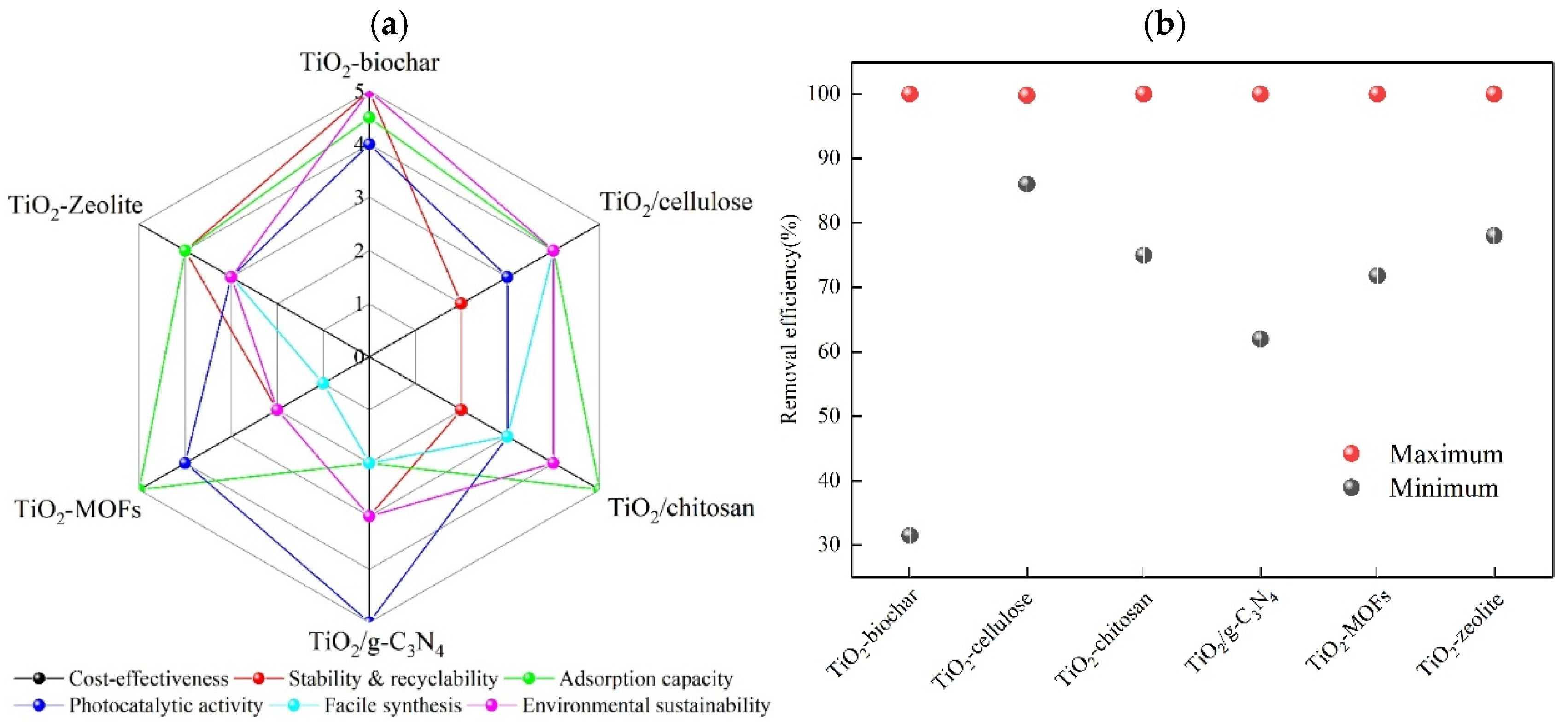
| Contents of the Review | Limitations | Contributions of the Present Review | Ref. |
|---|---|---|---|
| Summary of TiO2 preparation methods, sources of biochar, and applications of TiO2–biochar-based photocatalysts. |
| The review focuses on morphological evolution, and it systematically outlines the function of synthesis parameters in regulating the morphology of TiO2–biochar. Existing reviews have largely ignored the morphological evolution of TiO2–biochar composites. | [31] |
| Overview of the preparation methods of biochar and TiO2–biochar composites and advantages. |
| A systematic analysis is provided to examine the effects of preparation methods and conditions on the dispersion and pore structure. | [32] |
| Review of the synthesis methods, physicochemical properties, and degradation performance of biochar/TiO2. | The reviews did not investigate how various preparation parameters influence morphological characteristics, nor how morphological characteristics affect the degradation of pollutants. | A framework is established that correlates synthetic parameters with microstructural characteristics (e.g., specific surface area, pore structure and particle size), surface functional groups, ROS, and application. | [35] |
| Investigation of the properties, applications, and degradation mechanisms of TiO2, ZnO, and Fe3O4/biochar systems. | A brief analysis of the effects of pre- and post-treatment on the morphology of TiO2–biochar. However, the regulatory role of morphology in the mechanism of charge transfer at the interface has not been demonstrated. | A comparative analysis was carried out of the electronic transport pathways at the interface for three typical morphologies: surface-adhered, pore-embedded, and interlayer-distributed. | [36] |
| Application of biochar-based catalysts and activity mechanism supported by DFT calculations. | The analysis of the microstructural characteristics of composite materials and their role is still insufficient. | A sufficient explanation of the regulatory effects of three typical morphologies on surface functional groups and the generation of ROS is presented. | [37] |
| Reviews of bottom-up and top-down approaches to the preparation methods, structural characteristics, applications, and reaction mechanisms. | Only the two factors of temperature and precursor are considered. The key parameters (e.g., solvent, pH, doping, and the Ti/C ratio) and their impact on morphological evolution were not discussed. | A full analysis is provided to explore the effect of different factors on the patterns of morphological control. These factors include the titanium source, carbon source, solvent, Ti:C ratio, pyrolysis process, and doping. | [38] |
| Review of sources of pollutants, TiO2 and biochar, as well as the applications of composite materials. | The influence of the microstructure of composite materials on the mechanism of action has not been clarified. | The pollutant removal behavior under the influence of the microstructure of composite materials was discussed by category. | [39] |
| Ignoring the intrinsic link between microstructure and electronic transport at interfaces. | The relationship between morphology control, structural characteristics, and photocatalytic performance is systematically discussed. | [40] |
| Titanium Source | Carbon Source | Method | Ti:C | Type of Solvent | Heating Conditions | Modification | Morphology | Band Gap (eV) | Ref. |
|---|---|---|---|---|---|---|---|---|---|
| Titanium isopropoxide | Coffee husk | Sol–gel | 23% mTiO2/ 77% mAC | Ethyl alcohol, acetic acid, deionized water | 350 °C | CaCl2 | TiO2 nanoparticles supported on amorphous AC; 700 m2/g; Pore size = 4.80 nm | 2.8 | [42] |
| Tetrabutyl titanate | - | Sol–gel | TiO2:PMBC = 3:1 | Ethanol, HNO3, deionized water | - | H3PO4 | Ordered vessel structure and irregular particles; 62.29 m2/g | - | [43] |
| Butyl titanate | Coconut shell | Sol–gel | - | Ethanol, deionized water, acetic acid, polyethylene glycol | 450 °C | - | Porous surface | - | [44] |
| Titanium (IV) isopropoxide | Macadamia nut shells | Sol–gel | 2.87 mLTTIP:250 mg AC | Anhydrous isopropanol | 500 °C | NaOH | Clusters of particles; 129 m2/g; Pore size = 9.26 nm | 3.04 | [45] |
| Titanium isopropoxide | Peanut shells | Sol–gel | 3.4 mL Ti(OiPr)4:1 g PSB | Isopropanol, nitric acid | 400 °C | PMS activation | Compressed and wrinkled morphology; 57.69 m2/g; Pore size = 4.35 nm | 2.59 | [46] |
| Titanium isopropoxide | Corn cob | Sol–gel | 2.5 g BC: 20 mL TTIP | Ethanol, HCl | 325 °C | HNO3 | Tiny TiO2 granules were well dispersed on the biochar with little agglomeration | - | [47] |
| Tetrabutyl titanate | Corn cobs | Sol–gel | - | - | - | g-C3N4 | Layered and granular structures; 163.66 m2/g | 2.39 | [48] |
| Tetrabutyl titanate | Corn cobs and straw | Sol–gel | 2 g BC:100 mL tetrabutyl titanate | Ethanol, NH3·H2O | 550 °C | Al2O3 | Core–shell; 200.62 m2/g; Pore size = 3.43 nm | - | [49] |
| Tetrabutyl titanate | Corn cobs | Sol–gel | 1 g BC:10 mL tetrabutyl titanate | - | 500 °C | g-C3N4 | Layered and granular structures | 2.39 | [50] |
| Titanium butoxide | Ramie bars | Sol–gel | 2 g biomass | Ethanol, glacial acetic acid, and water | 500 °C | - | TiO2 nanoparticles attached to BC; 10.55 m2/g | - | [51] |
| Tetrabutyl titanate | Reed straw | Sol–gel | - | Absolute ethanol, acetic acid, ultra-pure water | 500 °C | HCl | Distributions of TiO2 on the exterior and within the internal channels of pBC; 102.16 m2/g; Pore size = 2.58 nm | - | [52] |
| Tetrabutyl titanate | Reed straw | Sol–gel | 0.1 g pBC:20 mL tetrabutyl titanate | Absolute ethanol, acetic acid, ultra-pure water | 300 °C | ZnO | Original vessels structure and cylindrical morphology | - | [53] |
| Titanium (IV) Isopropoxide | Mangrove plants (twigs and roots) | Sol–gel | 5 g BC: 20 mL TTIP | Ethanol, deionized water and acetic acid | 500 °C | - | Aggregation of TiO2 nanoparticles | - | [54] |
| Titanium (IV) tetrachloride | Giant reed | Sol–gel | 10 wt% BC | Distilled water, ethanol, ammonia solution | 600 °C | - | Rough and fractured texture | 2.69 | [55] |
| Titanium Isopropoxide | Prosopis juliflora | Sol–gel | TiO2:BC = 3:7 | Isopropanol and absolute ethanol | 600 °C | N | Porous morphology with a consistent distribution of TiO2 nanoparticles within the BC surface. | 2.23 | [56] |
| Titanium (IV) isopropoxide | Wood | Sol–gel | - | Absolute ethanol, HCl, deionized water | 500 °C | - | - | - | [57] |
| Titanium butoxide | Wood | Sol–gel | 10% AC | Anhydrous alcohol, distilled water, glacial acetic acid | 500 °C | Ni | Mesoporous structure; 222.89 m2/g; Pore size = 5.41 nm | - | [58] |
| Titanium tetraisopropoxide, Titanium oxysulfate | Salvinia molesta | Sol–gel and mechanical mixing | 1:1 | Isopropyl alcohol | 350 °C | - | Bar; 8.55 m2/g; Pore size = 32.55 nm | 3.22 ± 0.002 | [59] |
| Titanium butoxide | Furfural residue | Ultrasonic-assisted sol–gel treatment, solvothermal treatment, microwave-assisted heating | 1 g AC: 52.5 mL titanium butoxide | Ethanol, deionized water | - | KOH | Porous structure; 241.70 m2/g; Pore size = 4.43 nm | 2.3 | [60] |
| Titanium tetrakis (2-ethylhexoxide) | Wheat straw | Wet chemical precipitation–sol–gel | 5 g C:17.8 g Titanium tetrakis (2-ethylhexoxide) | Ethanol, deionized water | - | La3+, Fe3+ | grape-cluster | 2.9 | [61] |
| Butyl titanate | Wheat straw | Sol–gel–calcination synthesis | - | Ethanol, PTFE solution | 500 °C | N | Irregular, clustered morphology | - | [62] |
| Titanium isopropoxide | Textile sludge | Sol–gel and wet precipitation | 0.1 g BC:0.376 mL titanium isopropoxide | - | 450 °C | - | Denser TiO2 distributions with reduced particle sizes | 2.1 | [63] |
| Titanium (IV) Isopropoxide | Macroalgae | Wet precipitation | - | Isopropanol | 400 ± 1 °C | - | Spherical TiO2 nanoparticles uniformly distributed on the BC layer surface | 2.60–2.70 | [64] |
| Titanium tetra isopropoxide | Manilkara zapota leaf | co- precipitation | 2 g AC:1 M TTIP | Plant extract | 800 °C | - | Equal spherical shape | 2.73 | [65] |
| Titanium (IV) Isopropoxide | Corn cob | Wet precipitation | 800 mg: 4 mL TTIP | Isopropyl alcohol | 400 ± 5 °C | KOH | TiO2 distributed across rock-like AC | 3.05 | [66] |
| Tetrabutyl titanate | Walnut shell | Photodeposition | BC:Ti = 0.2:1 | Ultrapure water, AgNO3 solution | 500 °C | Ag | Small spherical particles | 3.28 | [67] |
| Titanium isopropoxide | Pepper shells | Deposition-precipitation | 0.3 mL titanium isopropoxide:0.135 g BCP | - | 400 °C | KOH, HAuCl4, urea | Nanorod-like structure; 1287.6 m2/g; Pore size = 2.08/2.60 nm | 1.79 | [68] |
| TiO2 | Chitosan | Co- precipitation/ gelation | 5 g CS:2.5 g TiO2 | Acetic acid | 600 °C | ZnCl2 | Loose mesoporous structure | 3.03 | [69] |
| Tetrabutyl titanate | Bagasse | hydrothermal, calcination and photo-deposition | - | Acetic acid | 650 °C | Ag urea | Floating flower-like | 2.73 | [70] |
| Titanium (IV) isopropoxide | Ice cream wastewater | Solvothermal | 1 g HC: 1.853 mL TTIP | Absolute ethanol, distilled water | - 500 °C | - | Irregularly shaped and exhibit a wide size distribution; 216.49 m2/g; Pore size = 7.83–10.73 nm | 2.05 | [71] |
| Titanium dioxide | Furniture | Pyrolysis | 10% w/w TiO2 | Isopropyl alcohol | 500 °C | - | TiO2 anchored on the cellulose-like surface of BC | 3.66 | [72] |
| Anatase TiO2 | Cornstalk | Pyrolysis | 0.75 Ti/1 AC | - | 500 °C | - | Particles distributed on carbon lump; 4.37 m2/g; Pore size = 35.96 nm | 2.77 | [73] |
| Tetrabutyl titanate | Sludge | Co-pyrolysis | 9 g (BC): 1 g g-C3N4/La-TiO2 | Deionized water | 500 °C | g-C3N4 La | Lamellar BC with uniformly dispersed g-C3N4/La-TiO2(A); 172.99 m2/g; Pore size = 15.53 nm | - | [74] |
| Titanium isopropoxide | Lignocellulosic biomass | Sol–gel | 1:2–1:5 | Ethanol/ Isopropanol | 450–550 °C | N, g-C3N4 | Uniformly dispersed nanoparticles with porous structure | 2.2–3.0 | General trend |
| Catalysts | Functional Group/Chemical Bond | Conditions | Dyes | ROS | Removal (%) | Activity | k/ min−1 | TOC (%) | Cycles | Ref. |
|---|---|---|---|---|---|---|---|---|---|---|
| BC-TiO2 | -OH, C-O, Ti-OH, Ti-O-C | A 500 W visible light bulb; T = 25 ± 1 °C; Time = 4 h, pH = 6.0–7.0; dosage = 100 mg; MB = 5 ppm; solution volume = 50 mL | MB | •O2− | 99.20% | 0.010 | - | - | - | [64] |
| BC/TiO2 | C=O, C-O, O=C-O | A 10 mW·m−2 of UV irradiation; 180 min; pH = 5.5; T = 298 K; dosage = 100 mg; MB = 10 ppm; solution volume = 50 mL | MB | •OH | 83.00% | 0.005 | 0.0081 | - | 3/77% | [72] |
| BSP 20 | O-Ti-O, Ti-O, C-O, C=O, C=C, -CH3, -CH2-, -OH | A Philips UV sterilizer unit (power 6 W; voltage 220 V); 150 min; dosage = 100 mg; MB = 10 ppm; solution volume = 250 mL | MB | •OH, •O2− | 100% | 0.067 | 0.021 | - | - | [54] |
| AC/TiO2 | -OH, -COOH, C-H, -NH2, -NH-CO-, C-O, C-O-Ti-O | Solar irradiation; 30 min; dosage = 100 mg; MB = 5 ppm; solution volume = 100 mL | Rh-B | h+ | 91% | 0.145 | 0.074 | - | - | [65] |
| CS-BC/ ZnO/ TiO2 | C=O, N-H, C-H, O-H, Ti-O, Zn-O | A 300 W Xenon lamp (λ > 420 nm); 25 min; dosage = 100 mg; Rh-B = 10 ppm; solution volume = 200 mL | Rh-B | - | 94.5% | 0.756 | 0.099 | - | 5/~82% | [69] |
| TA@BC | -OH, -NH, C-H, C-O-C, C=C, Al-O, Ti-O-Ti | A 350 W xenon lamp; 4 h; dosage = 100 mg; Rh-B = 10 ppm; solution volume = 100 mL | Rh-B | •OH | 98% | 0.408 | - | - | - | [49] |
| TiO2/AC_y_350 | -OH, C=O, -COOH, C-O | 4 UV lamps (18 W); 4 h; pH = 6; dosage = 100 mg; VBB = 15 ppm; solution volume = 200 mL | VBB | - | 99% | 0.124 | - | - | 4/ ~70% | [42] |
| Ni-T/AC | -OH, C-H, Ti-O, Ti-O-C | A 500 W Xe lamp (350 W/m2); 2 h; T = 25 ± 1.0 °C; dosage = 100 mg; dyes = 10 ppm; solution volume = 250 mL | CV BF MG | h+ | 99.00% 94.85% 98.89% | 0.206 0.198 0.206 | 0.060 0.029 0.048 | - | 5/ ~95% | [58] |
| TiO2- biochar | -OH, -COO−, C=O, C=C, Ti-O-Ti, Ti-O, O-Ti-C | A 19 W UV lamp; 2 h; pH = 11; dosage = 100 mg; dyes = 20 ppm; solution volume = 100 mL | BB41 EBT | •OH, h+ | 98.4% 97.4% | 0.164 1.623 | 0.067 0.018 | - | 5/ 96.14%, 77.2% | [55] |
| TiO2/ biochar | -OH, -C=O | A 500 W mercury lamp; 2.5 h; dosage = 100 mg; MO = 20 ppm; solution volume = 400 mL | MO | h+, •O2−, •OH | 96.88% | 0.817 | 0.023 | 83.23 | 5/ 92.5% | [96] |
| Ag/TiO2/ biochar | C-C, C=C, C-O, C=O, O-C=O, -OH | A 500 W long arc mercury-vapor lamp; 1 h; dosage = 100 mg; MO = 20 ppm; solution volume = 400 mL | MO | •OH | 97.48% | 1.300 | 0.063 | 85.38 | 5/ 96.10% | [67] |
| TiO2–BC | -OH, Ti-OH, Ti-O-C, Ti-O-Ti | A 500 W mercury lamp; 1 h; pH = 5; dosage = 100 mg; MO = 20 ppm; solution volume = 200 mL | MO | •O2− | 100% | 0.667 | 0.051 | 73.20 | - | [73] |
| TiO2@HC | - | 4 UVA lamps (8 W); 5 h; pH = 2; dosage = 100 mg; AR97 = 20 ppm; solution volume = 400 mL | AR97 | •OH | 98.59% | 0.263 | 0.032 | - | 5/ 88.80% | [71] |
| TiO2/BC | - | A 300 W Xenon lamp; 1 h; pH = 1; T = 25 ± 2 °C; dosage = 100 mg; dyes = 30 ppm | RBB KN-R | •OH, •O2− | 99.71% | - | - | - | 5/ 73.98% | [44] |
| TiO2/BC | O-H, C=C, C=O, SO32−, S=O | 10 mW/m2 of UV bulb (15 W); 3 h; dosage = 100 mg; AO7 = 20 ppm; solution volume = 50 mL | AO7 | •OH, •O2− | 57.6% | 0.064 | 0.009 | 6/~ 80.00% | [59] |
| Catalysts | Functional Group/ Chemical Bond | Conditions | Pollutants | ROS | Removal (%) | Activity | k/ min−1 | TOC (%) | Cycles | Ref. |
|---|---|---|---|---|---|---|---|---|---|---|
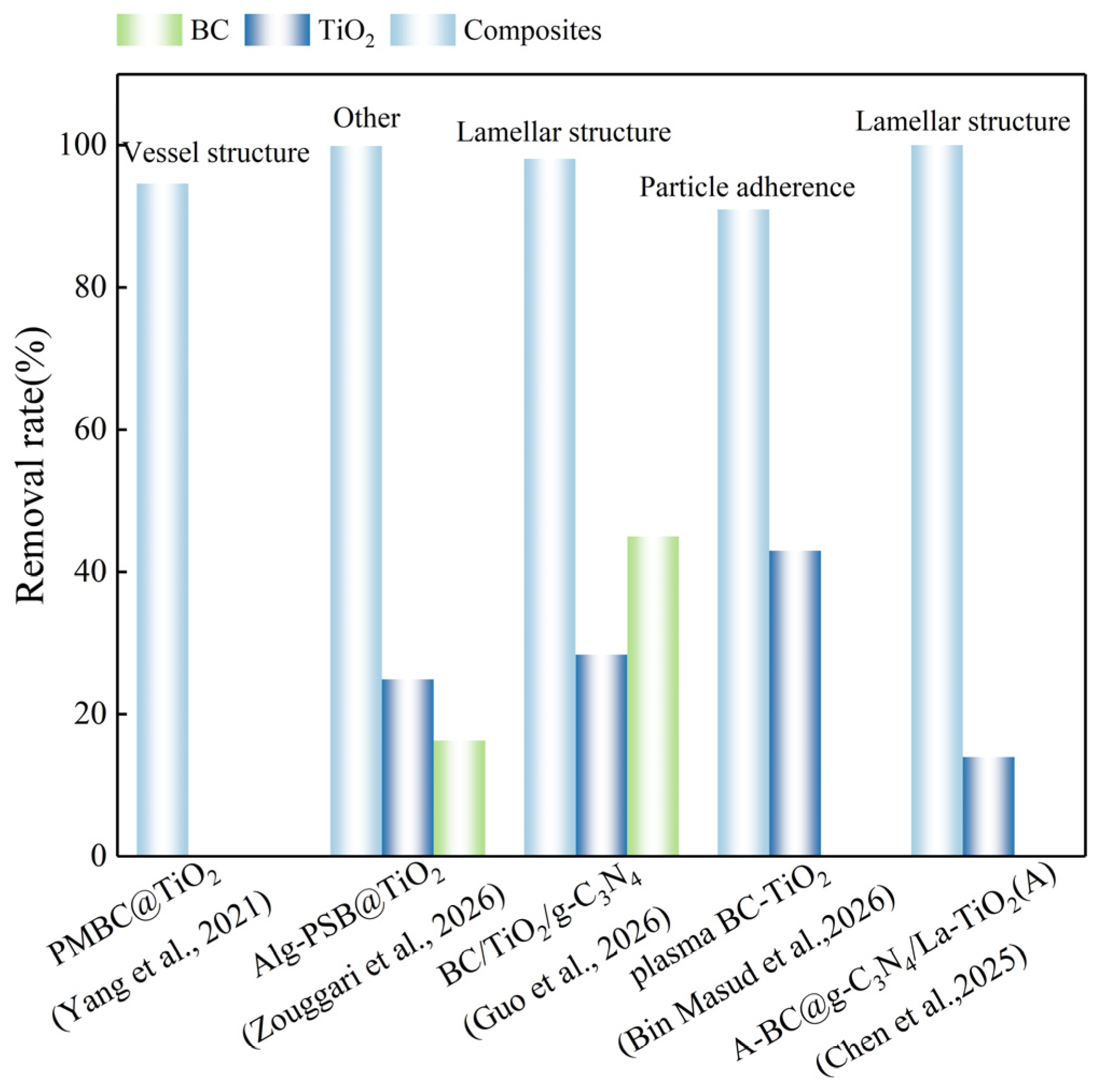
| PMBC@TiO2 | -OH, C-O, C=O, O-C=O | 25 W UV lamp; 2.5 h; pH = 6.46; dosage = 100 mg; SDZ = 20 ppm; solution volume = 50 mL | SDZ | •O2−, •OH | 94.60% | 63.070 | - | - | - | [43] |
| BC/TiO2/g-C3N4 | -OH, C=O, C-H, C-N, Ti-O/Ti-O-Ti | solar irradiation; 1 h; dosage = 100 mg; SDZ = 30 ppm; solution volume = 170 mL | SDZ | •O2−, h+, •OH | 98.13% | 0.818 | - | - | 5/ 68.85% | [48] |
| TBC-2 | C=O, C-O, O=C-O | An 8 W UV lamp; pH = 8; 2 h; dosage = 100 mg; solution volume = 50 mL | ST | •OH | 226.7 mg·g−1 | - | 0.029 | - | 6/ 167.2 mg·g−1 | [51] |
| biochar/TiO2 | - | A 15 W UV lamp; 6 h; pH = 4; t = 293 ± 2 K; dosage = 100 mg; SMX = 10 ppm; solution volume = 20 mL | SMX | •OH | 90% | 0.006 | - | - | - | [47] |
| TiO2/pBC | C=O, -COOH, C-O, -OH | A 50 W xenon lamp; 3 h; t = 25 °C; pH = 4; dosage = 100 mg; SMX = 10 ppm; solution volume = 80 mL | SMX | •OH, h+ | 91.27% | 0.041 | 0.013 | - | - | [52] |
| Zn-TiO2/pBC | - | A 50 W Xenon lamp; t = 25 °C; pH = 5.03; dosage = 100 mg; SMX = 10 ppm; solution volume = 80 mL | SMX | - | 81.21% | 0.036 | 0.009 | - | 5/ 77.41% | [53] |
| GAC-TiO2 | - | 4 submersible UV lamps; 80 min; dosage = 100 mg; SMX = 100 ppm; solution volume = 180 mL | SMX | - | 83.60% | 1.522 | - | - | 5/ ~40% | [57] |
| Alg-PSB@TiO2 | -OH, -COO−, C-O, -CH/-CH2, C-H, Ti-O, Ti-O-Ti, Ti-O-C | A 600 W solar simulator; 1.5 h; pH = 6.07; t = 25 °C; dosage = 100 mg; SMX = 15 ppm; solution volume = 100 mL | SMX | h+, SO4•−, e− | 99.9% | 0.167 | 0.050 | 73.4 | - | [46] |
| TiO2@AC-STM | -OH, C-H, C-C, C-O, Ti-O-Ti, Ti-O-C | UV light (254 nm, 35 W/cm2) pH = 6–9; 2 h; dosage = 100 mg; TC = 20 ppm; solution volume = 400 mL | TC | •O2− | 88% | 0.587 | 0.014 | - | 4/ ~55% | [60] |
| TiO2/AC | - | The 18 W germicide lamp; pH = 3; 75 min; dosage = 100 mg; TC = 50 ppm; solution volume = 20 mL | TC | - | 100% | 0.333 | 0.043 | - | - | [45] |
| Au/TiO2/BCP | -OH, C=O, O-C, C-C/C=C, C-N, C-Ti, N-Ti, N-O, π-π, Ti-O | A long-arc mercury lamp; 3 h; t = 25 °C; dosage = 100 mg; TC = 40 ppm; solution volume = 1.25 L | TC | •O2− | 98.4% | 2.733 | 0.019 | - | 4/ 90% | [68] |
| A-BC@ g-C3N4/ La-TiO2(A) | -OH, -NH, C-N, C-O, Ti-O | A 300 W xenon lamp; 1.5 h; t = 25 °C; dosage = 100 mg; TC = 30 ppm; solution volume = 200 mL | TC | •OH, •O2− | 100% | 0.333 | 0.028 | - | 4/ ~98% | [74] |
| N-doped biochar/TiO2 | - | A 150 W xenon lamp; 2 h; CEPs = 200 ppm; solution volume = 200 mL | CEPs | - | 31.5% | - | 0.021 | - | 4/ ~90% | [62] |
| AC-TiO2 | Ti-O-C, C-O, C-O-C, Ti-O, Ti-O-Ti | LED bulb (50 W); 4 h; dosage = 100 mg; CEF = 100 ppm; solution volume = 100 mL | CEF | •OH, •O2− | 99.6% | 0.415 | - | - | 5/ 81.65% | [66] |
| N-doped TiO2/BC | C-O, N-H, Ti-O-Ti, N-Ti-O, Ti-C, C=O, -OH | 19 W UV light/natural sunshine; 2 h; pH = 6.9; dosage = 100 mg; CIX = 50 ppm; solution volume = 20 mL | CIX | •OH | 98.9%/96.9% | - | 0.023 | - | 5/ ~90% | [56] |
| BC/TiO2 | - | 10 UV-C (15 mW/cm2); 110 min; dosage = 100 mg; CIP = 10 ppm; solution volume = 200 mL | CIP | - | 95% | - | 0.020 | - | - | [63] |
Disclaimer/Publisher’s Note: The statements, opinions and data contained in all publications are solely those of the individual author(s) and contributor(s) and not of MDPI and/or the editor(s). MDPI and/or the editor(s) disclaim responsibility for any injury to people or property resulting from any ideas, methods, instructions or products referred to in the content. |
© 2026 by the authors. Licensee MDPI, Basel, Switzerland. This article is an open access article distributed under the terms and conditions of the Creative Commons Attribution (CC BY) license.
Share and Cite
Guo, X.; Bexeitova, K.; Zhantikeyev, U.; Abilshaikov, N.; Lee, J.; Azat, S. TiO2–Biochar-Based Photocatalysts for Organic Pollutants Removal: From Synthesis Parameters to Degradation Performance. Water 2026, 18, 1824. https://doi.org/10.3390/w18151824
Guo X, Bexeitova K, Zhantikeyev U, Abilshaikov N, Lee J, Azat S. TiO2–Biochar-Based Photocatalysts for Organic Pollutants Removal: From Synthesis Parameters to Degradation Performance. Water. 2026; 18(15):1824. https://doi.org/10.3390/w18151824
Chicago/Turabian StyleGuo, Xiaohong, Kalampyr Bexeitova, Ulan Zhantikeyev, Nariman Abilshaikov, Jechan Lee, and Seitkhan Azat. 2026. "TiO2–Biochar-Based Photocatalysts for Organic Pollutants Removal: From Synthesis Parameters to Degradation Performance" Water 18, no. 15: 1824. https://doi.org/10.3390/w18151824
APA StyleGuo, X., Bexeitova, K., Zhantikeyev, U., Abilshaikov, N., Lee, J., & Azat, S. (2026). TiO2–Biochar-Based Photocatalysts for Organic Pollutants Removal: From Synthesis Parameters to Degradation Performance. Water, 18(15), 1824. https://doi.org/10.3390/w18151824