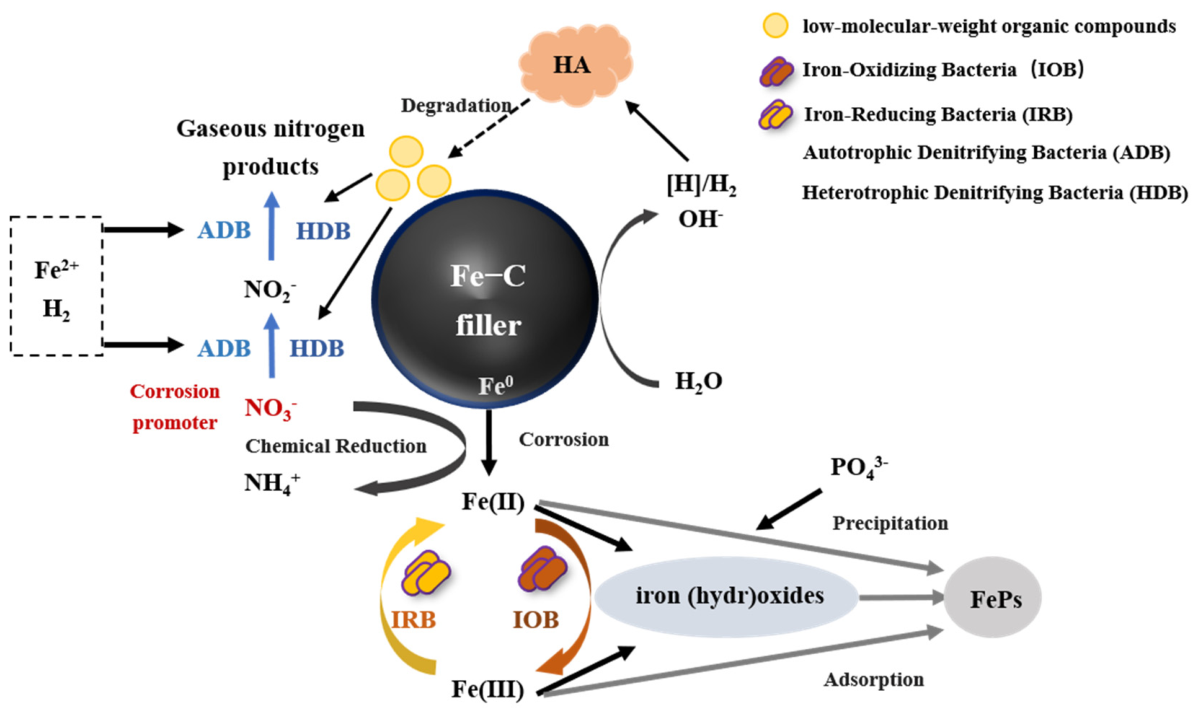
Chemical and Biological Cascade Responses Triggered by Nitrate-Driven In Situ Iron Corrosion: Mechanism of Simultaneous Nitrogen and Phosphorus Removal from Piggery Tailwater in Iron–Carbon Biofilter



Abstract
1. Introduction
2. Materials and Methods
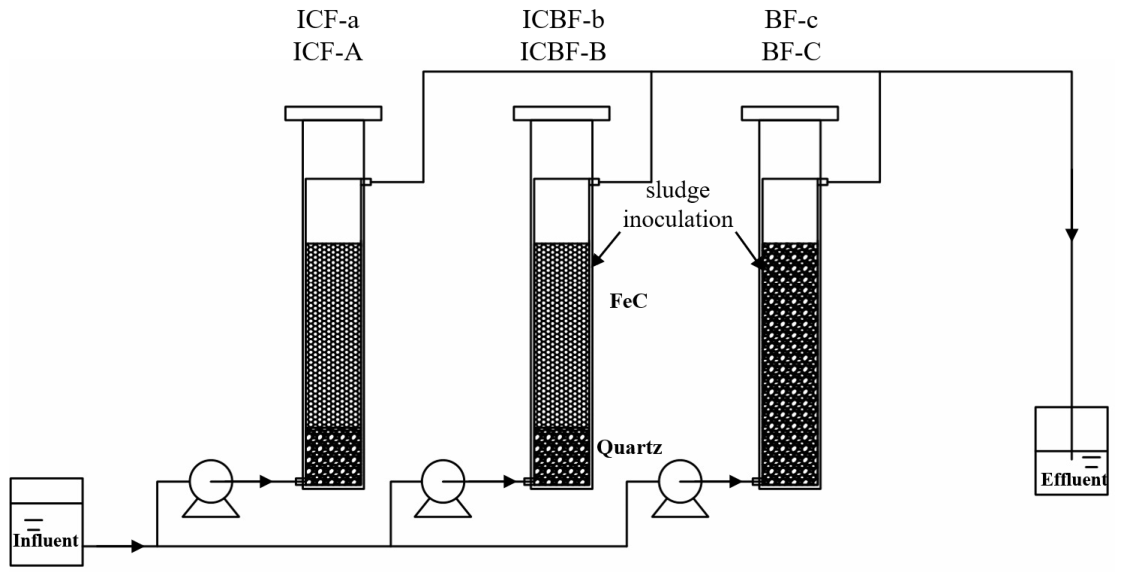
2.1. Reactor Set-Up and Operation
2.2. Materials, Sludge, and Synthetic Wastewater
2.3. Analytical Methods
2.4. Microbial Community Analysis
2.5. Data Analysis
3. Results
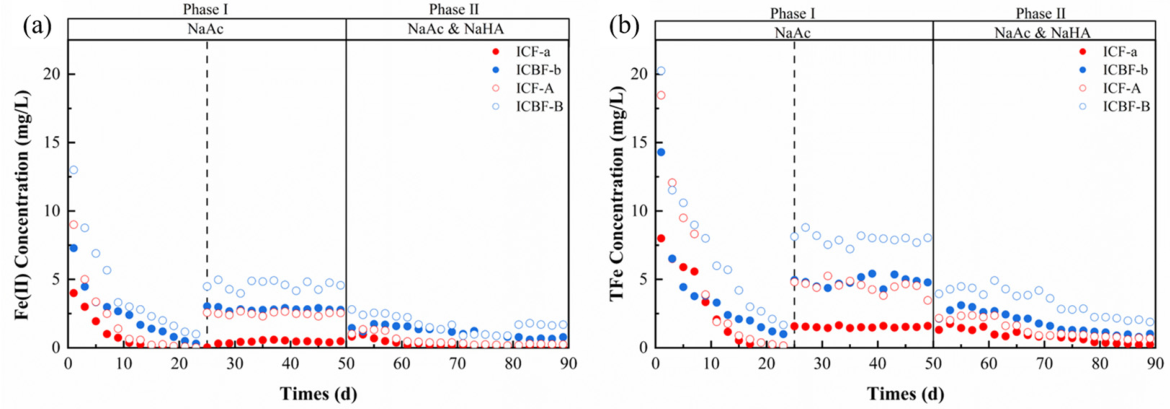
3.1. Characteristics of Iron Corrosion and Soluble Fe Dynamics
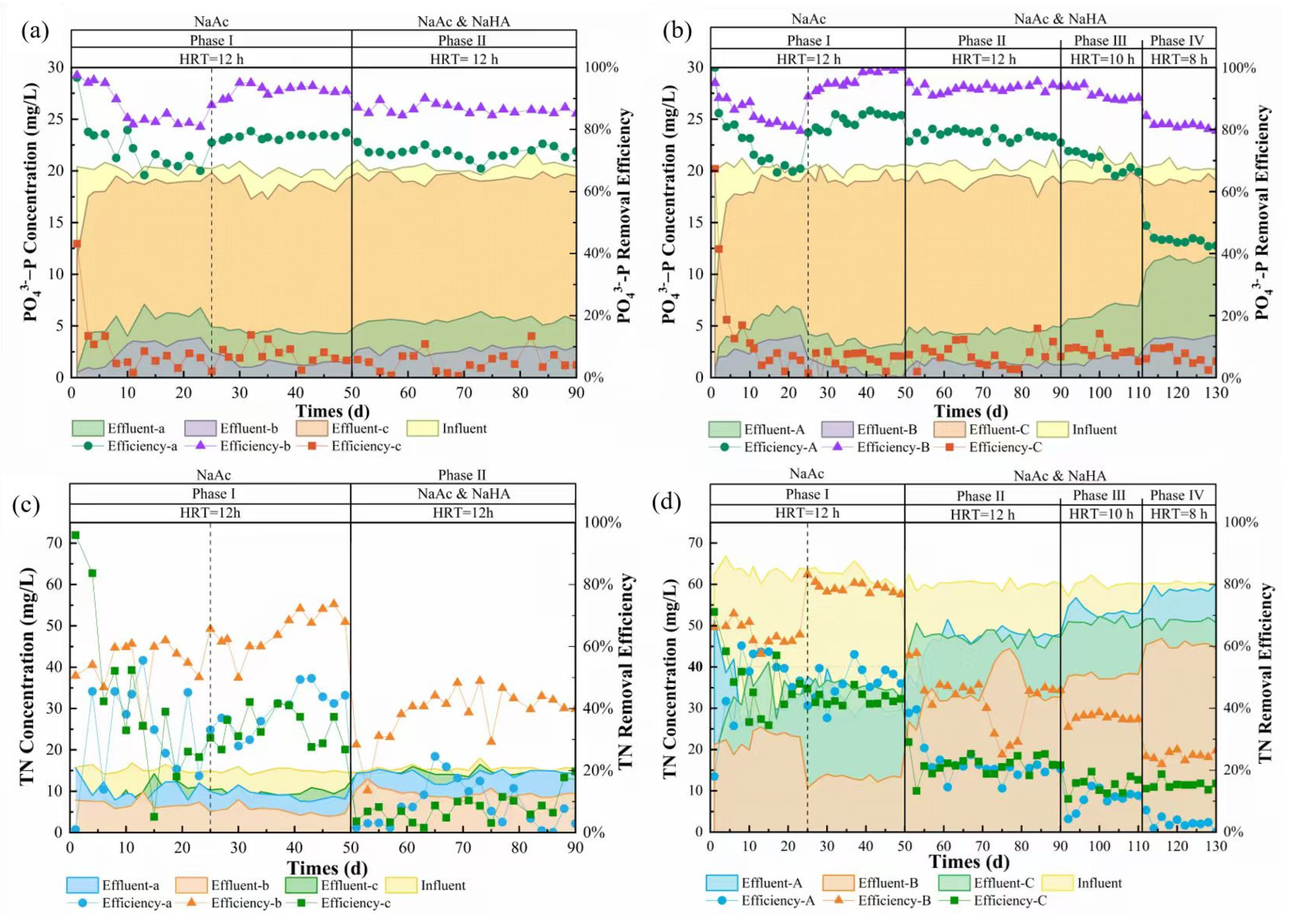
3.2. Characteristics of Pollutant Removal Under Chemical Biological Cascade Responses
3.2.1. Chemical Phosphorus Removal
3.2.2. Biological Multi-Pathway Denitrification
3.2.3. Treatment Capacity Under Increased Volumetric Loading Rates
3.3. Analysis of the Synergistic Mechanism in ICBF
3.3.1. Iron Corrosion and Mineral Transformation
3.3.2. Analysis of DOM Transformation Based on 3D-EEM
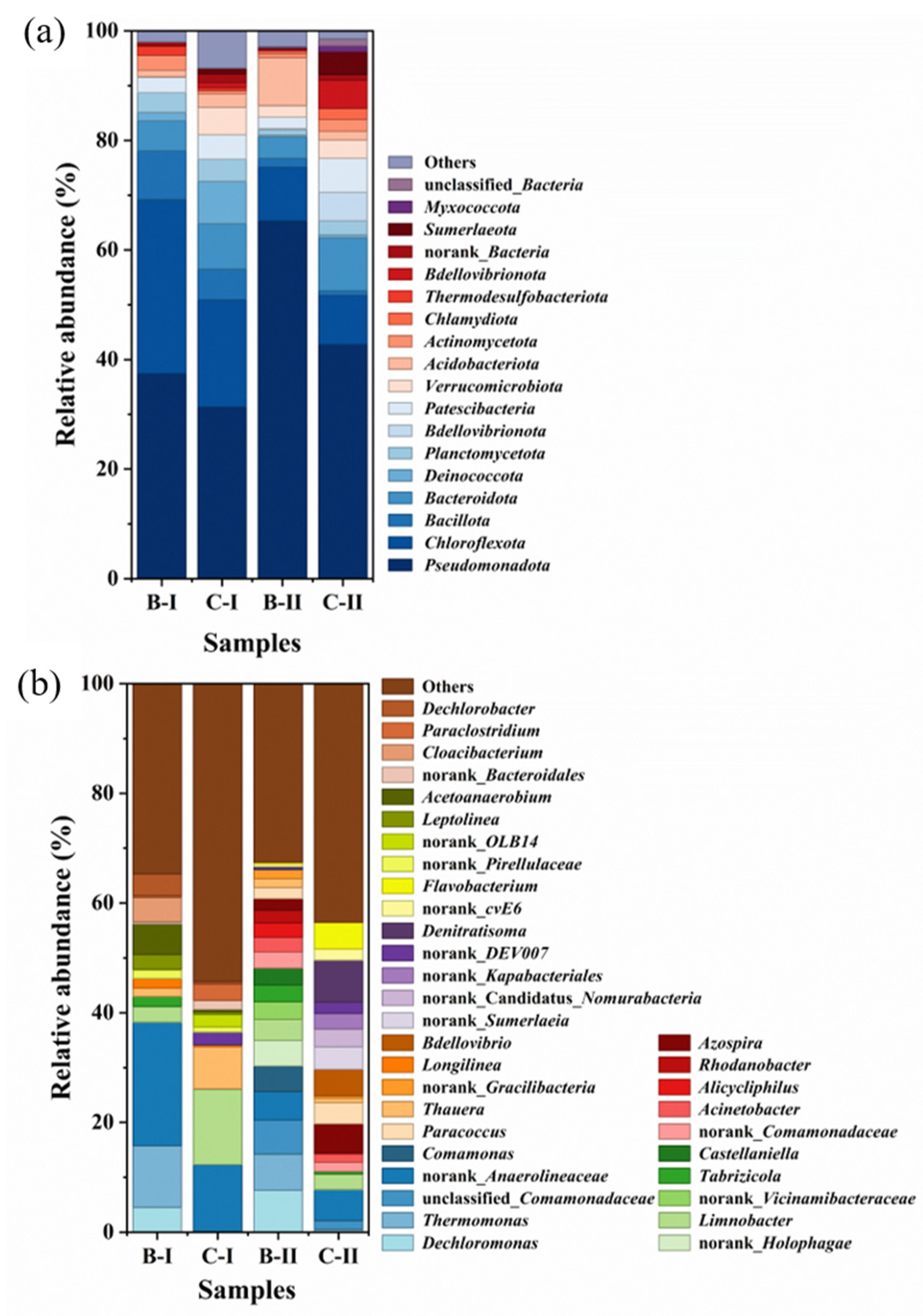
3.3.3. Analysis of Microbial Community Structure and Function
3.3.4. Potential Echanism of Simultaneous Nitrogen and Phosphorus Removal
3.4. Practical Implications and Scale-Up Considerations
4. Conclusions
Supplementary Materials
Author Contributions
Funding
Data Availability Statement
Conflicts of Interest
References
- United States Department of Agriculture; Foreign Agricultural Service. Livestock and Poultry: World Markets and Trade: 2026 Global Meat Trade: Beef and Pork Languish, Chicken Continues Rise; United States Department of Agriculture: Washington, DC, USA, 2025.
- Li, L.; Sun, N.; Peng, S.; Yang, Q.; Yang, P.; Zhou, H.; Ai, J.; He, H.; Wang, D.; Zhang, W. Molecular insights into the degradation of organic matter from secondary swine wastewater effluent: A comparative study of advanced oxidation processes. Chem. Eng. J. 2024, 500, 156761. [Google Scholar] [CrossRef]
- Liao, Q.; Jin, C.; Li, P.; Wu, J.; Zhang, C.; Hu, Z. Nitrate-mediated anaerobic microorganism-sponge iron system promoting simultaneous nitrogen and phosphate removal from piggery tail water. J. Environ. Sci. 2025, 163, 741–750. [Google Scholar] [CrossRef] [PubMed]
- Gao, R.; Ding, S.; Liu, Z.; Jiang, H.; Liu, G.; Fang, J. Recent advances and perspectives of biochar for livestock wastewater: Modification methods, applications, and resource recovery. J. Environ. Chem. Eng. 2024, 12, 113678. [Google Scholar] [CrossRef]
- Liu, J.; Gao, J.; Zhong, Z.; Cheng, Y.; Zhang, B. Tracing the variation of dissolved organic matter in the two-stage anoxic/aerobic process treating swine wastewater using fluorescence excitation-emission matrix with parallel factor analysis. Environ. Sci. Pollut. Res. 2023, 30, 58663–58673. [Google Scholar] [CrossRef] [PubMed]
- Zhong, Z.; Liu, W.; Zhu, Y.; Liu, J.; Zhang, C.; Wang, R.; Yang, N.; Long, X.; Yu, P.; Zan, F.; et al. Removal characteristics and functional bacterial community analysis of novel two-stage integrated biological reactor and two-stage anoxic–oxic systems feeding with livestock farming wastewater. J. Water Process Eng. 2026, 82, 109518. [Google Scholar] [CrossRef]
- European Commission. Commission Implementing Decision (EU) 2017/302 Establishing Best Available Techniques (BAT) Conclusions, Under Directive 2010/75/EU of the European Parliament and of the Council, for the Intensive Rearing of Poultry or Pigs; Publications Office of the European Union: Luxembourg, 2017; pp. 231–279. [Google Scholar]
- DB44/613-2024; Discharge Standard of Pollutants for Livestock and Poultry Breeding. Guangdong Administration for Market Regulation: Guangzhou, China, 2024.
- Zhang, C.; Guisasola, A.; Baeza, J.A. A critical review on the effect of different carbon sources on EBPR: Revaluation of performance and applications. Chem. Eng. J. 2025, 509, 161083. [Google Scholar] [CrossRef]
- Chen, S.; Zhou, B.; Chen, H.; Yuan, R. Iron mediated autotrophic denitrification for low C/N ratio wastewater: A review. Environ. Res. 2023, 216, 114687. [Google Scholar] [CrossRef] [PubMed]
- Takács, I.; Murthy, S.; Smith, S.; McGrath, M. Chemical phosphorus removal to extremely low levels: Experience of two plants in the Washington, DC area. Water Sci. Technol. 2006, 53, 21–28. [Google Scholar] [CrossRef] [PubMed]
- Chang, Y.; Meng, J.; Hu, Y.; Lee, P.-H.; Zhan, X. A review in Fe(0)/Fe(II) mediated autotrophic denitrification for low C/N wastewater treatment. Water Res. 2025, 282, 123925. [Google Scholar] [CrossRef] [PubMed]
- Zhu, B.; Yuan, R.; Wang, S.; Chen, H.; Zhou, B.; Cui, Z.; Zhang, C. Iron-based materials for nitrogen and phosphorus removal from wastewater: A review. J. Water Process Eng. 2024, 59, 104952. [Google Scholar] [CrossRef]
- He, Y.; Lin, H.; Dong, Y.; Li, B.; Wang, L.; Chu, S.; Luo, M.; Liu, J. Zeolite supported Fe/Ni bimetallic nanoparticles for simultaneous removal of nitrate and phosphate: Synergistic effect and mechanism. Chem. Eng. J. 2018, 347, 669–681. [Google Scholar] [CrossRef]
- Wen, Z.; Lu, J.; Zhang, Y.; Liao, X.; Cheng, G.; Chen, R. Enhanced phosphate removal from water by using nanoscale zerovalent iron/rectorite nanocomposite (nZVI/REC): Mediation role of nitrate. Sep. Purif. Technol. 2023, 307, 122803. [Google Scholar] [CrossRef]
- Deng, S.; Li, D.; Yang, X.; Zhu, S.; Li, J. Process of nitrogen transformation and microbial community structure in the Fe(0)–carbon-based bio-carrier filled in biological aerated filter. Environ. Sci. Pollut. Res. 2016, 23, 6621–6630. [Google Scholar] [CrossRef] [PubMed]
- Zhou, G.; Xing, W.; Tian, K.; Li, L.; Yao, H. Simultaneous removal of humic acid and nitrate by combining micro-electrolysis and autotrophic denitrification. Front. Environ. Sci. Eng. 2025, 19, 111. [Google Scholar] [CrossRef]
- Kim, I.; Cha, D.K. Effect of low temperature on abiotic and biotic nitrate reduction by zero-valent Iron. Sci. Total Environ. 2021, 754, 142410. [Google Scholar] [CrossRef] [PubMed]
- Hu, K.; Li, W.; Mu, H.; Ren, S.; Zhu, H.; Zeng, K.; Wang, B.; Liang, J.; Zhang, Q.; Yang, L.; et al. In-situ anaerobic treatment removes the passivation layer of sponge iron to restore the nitrogen and phosphorus removal performance of SBR. Process Saf. Environ. Prot. 2023, 174, 79–94. [Google Scholar] [CrossRef]
- Li, H.; Chen, S.; Ren, L.Y.; Zhou, L.Y.; Tan, X.J.; Zhu, Y.; Belver, C.; Bedia, J.; Yang, J. Biochar mediates activation of aged nanoscale ZVI by Shewanella putrefaciens CN32 to enhance the degradation of Pentachlorophenol. Chem. Eng. J. 2019, 368, 148–156. [Google Scholar] [CrossRef]
- Liu, Y.; Feng, L.; Liu, Y.; Zhang, L. A novel constructed wetland based on iron carbon substrates: Performance optimization and mechanisms of simultaneous removal of nitrogen and phosphorus. Environ. Sci. Pollut. Res. 2023, 30, 23035–23046. [Google Scholar] [CrossRef] [PubMed]
- Ji, B.; Jiang, M.; Yang, Y.; Deng, S.; Chen, J.; Chang, J. High treatment effectiveness for secondary effluent in Fe–C microelectrolysis constructed wetlands with electron donor supplementation. J. Clean. Prod. 2022, 342, 130934. [Google Scholar] [CrossRef]
- Zhao, Z.; Hao, Q.; Ma, R.; Chen, X.; Xiong, Y.; Hu, J.; Zhang, G.; Jiang, C. Ferric-carbon micro-electrolysis and zeolite reduce CH4 and N2O emissions from the aerated constructed wetland. J. Clean. Prod. 2022, 342, 130946. [Google Scholar] [CrossRef]
- Quan, X.; Zhang, H.; Liu, H.; Chen, L.; Li, N. Remediation of nitrogen polluted water using Fe–C microelectrolysis and biofiltration under mixotrophic conditions. Chemosphere 2020, 257, 127272. [Google Scholar] [CrossRef] [PubMed]
- Liu, X.; Huang, M.; Bao, S.; Tang, W.; Fang, T. Nitrate removal from low carbon-to-nitrogen ratio wastewater by combining iron-based chemical reduction and autotrophic denitrification. Bioresour. Technol. 2020, 301, 122731. [Google Scholar] [CrossRef] [PubMed]
- Li, J.; Zeng, W.; Miao, H.; Hao, X.; Li, S. Characteristics and pathways of nitrate removal driven by iron cycle in biofilter: Synergistic effects of chemistry and microbiology. J. Environ. Chem. Eng. 2025, 13, 118092. [Google Scholar] [CrossRef]
- Li, J.; Zeng, W.; Liu, H.; Wu, Y.; Miao, H. Performances and mechanisms of simultaneous nitrate and phosphate removal in sponge iron biofilter. Bioresour. Technol. 2021, 337, 125390. [Google Scholar] [CrossRef] [PubMed]
- Baird, R.; Bridgewater, L.; American Public Health, A. Standard Methods for the Examination of Water and Wastewater; American Public Health Association: Washington, DC, USA, 2017. [Google Scholar]
- Shen, Y.; Hu, M.; Xu, Y.; Tao, M.; Guan, L.; Kong, Y.; Cao, S.; Jing, Z. Synergistic Removal of Nitrogen and Phosphorus in Constructed Wetlands Enhanced by Sponge Iron. Water 2024, 16, 1414. [Google Scholar] [CrossRef]
- Yi, L.; Li, W.; Bu, H.; Yin, W.; Deng, H.; Wu, J. Effects of humic acid, nitrate and sulfate on hexavalent chromium removal by abiotic and biotic zero-valent iron. Int. J. Environ. Sci. Technol. 2025, 22, 2409–2420. [Google Scholar] [CrossRef]
- Lu, J.; Yang, J.; Xu, K.; Hao, J.; Li, Y.-Y. Phosphorus release from coprecipitants formed during orthophosphate removal with Fe(III) salt coagulation: Effects of pH, Eh, temperature and aging time. J. Environ. Chem. Eng. 2016, 4, 3322–3329. [Google Scholar] [CrossRef]
- Almeelbi, T.; Bezbaruah, A. Aqueous phosphate removal using nanoscale zero-valent iron. J. Nanopart. Res. 2012, 14, 900. [Google Scholar] [CrossRef]
- Cheng, X.; Feng, H.; Liang, Y.; Li, L.; Yao, Y.; Jin, M.; Li, J. Filtration columns containing waste iron shavings, loofah, and plastic shavings for further removal of nitrate and phosphate from wastewater effluent. Sci. Total Environ. 2023, 876, 162799. [Google Scholar] [CrossRef] [PubMed]
- Zheng, X.; Zhou, C.; Wu, F.; Xu, H.; Zhao, Z.; Han, Z.; Zhang, H.; Yang, S. Enhanced removal of organic, nutrients, and PFCs in the iron-carbon micro-electrolysis constructed wetlands: Mechanism and iron cycle. Chem. Eng. J. 2023, 457, 141174. [Google Scholar] [CrossRef]
- Guo, D.; Yang, L.; Lu, H.-Q.; Wang, Y.-C.; Meng, H.-Y.; Liang, P.; Cui, S.; He, Z.-W.; Lan, J.; Ren, Y.-X. Enhancing Feammox efficiency through riboflavin and humic acid: Nitrogen and iron transformation, energy metabolism, and microbial response. Bioresour. Technol. 2025, 429, 132533. [Google Scholar] [CrossRef] [PubMed]
- Gao, Y.; Huang, X.; Yang, X. Iron-carbon microelectrolysis coordinated advanced N and P removal from municipal tailwater: Unexpected N conversion and microbial characteristic. J. Water Process Eng. 2024, 64, 105586. [Google Scholar] [CrossRef]
- Loh, Z.Z.; Zaidi, N.S.; Yong, E.L.; Syafiuddin, A.; Boopathy, R.; Kadier, A. Current Status and Future Research Trends of Biofiltration in Wastewater Treatment: A Bibliometric Review. Curr. Pollut. Rep. 2022, 8, 234–248. [Google Scholar] [CrossRef]
- Zhang, B.; Wang, L.; Li, Y. Fractionation and identification of iron-phosphorus compounds in sewage sludge. Chemosphere 2019, 223, 250–256. [Google Scholar] [CrossRef] [PubMed]
- Ma, Y.; Dai, W.; Zheng, P.; Zheng, X.; He, S.; Zhao, M. Iron scraps enhance simultaneous nitrogen and phosphorus removal in subsurface flow constructed wetlands. J. Hazard. Mater. 2020, 395, 122612. [Google Scholar] [CrossRef] [PubMed]
- Xu, L.; Su, J.; Liu, S.; Wei, H.; Zhang, P.; Qi, S. Biofilter constructed of iron–carbon, ceramsite and biochar to synchronous removal of nitrate and phosphate: Treatment optimization and analysis of microbial community difference. J. Water Process Eng. 2024, 68, 106309. [Google Scholar] [CrossRef]
- Zhang, Y.; O’Loughlin, E.J.; Park, S.-Y.; Kwon, M.J. Effects of Fe(III) (hydr)oxide mineralogy on the development of microbial communities originating from soil, surface water, groundwater, and aerosols. Sci. Total Environ. 2023, 905, 166993. [Google Scholar] [CrossRef] [PubMed]
- Fortin, D.; Langley, S. Formation and occurrence of biogenic iron-rich minerals. Earth-Sci. Rev. 2005, 72, 1–19. [Google Scholar] [CrossRef]
- Zhao, Z.; Yao, L.; Li, J.; Ma, X.; Han, L.; Lin, Z.; Guan, S. Determination of interactions of ferrihydrite-humic acid-Pb (II) system. Environ. Sci. Pollut. Res. 2022, 29, 21561–21575. [Google Scholar] [CrossRef] [PubMed]
- Deng, S.; Li, D.; Yang, X.; Cai, Q.; Peng, S.; Peng, X.; Yao, H.; Xie, B. Novel characteristics on micro-electrolysis mediated Fe(0)-oxidizing autotrophic denitrification with aeration: Efficiency, iron-compounds transformation, N2O and NO2− accumulation, and microbial characteristics. Chem. Eng. J. 2020, 387, 123409. [Google Scholar] [CrossRef]
- He, C.-S.; Ding, R.-R.; Zhou, G.-N.; He, D.; Fan, P.; Guan, X.-H.; Mu, Y. Coexistence of humic acid enhances the reductive removal of diatrizoate via depassivating zero-valent iron under aerobic conditions. J. Mater. Chem. A 2020, 8, 14634–14643. [Google Scholar] [CrossRef]
- Sleiman, N.; Deluchat, V.; Wazne, M.; Courtin, A.; Saad, Z.; Kazpard, V.; Baudu, M. Role of iron oxidation byproducts in the removal of phosphate from aqueous solution. RSC Adv. 2016, 6, 1627–1636. [Google Scholar] [CrossRef]
- Wang, P.; Liu, X.F.; Líu, F.; Zhan, W.; Chen, Y.D.; Zhu, W.C.; Wang, Y.Q.; Liu, Q.Y.; Liu, C.S.; Lu, J.; et al. Enhanced phosphorus recovery via chemical precipitation coupled with microbially induced recrystallization into vivianite from sludge digestion liquor. Environ. Res. 2026, 292, 123639. [Google Scholar] [CrossRef] [PubMed]
- He, S.; Chen, S.; Zhang, L.; Tan, S.; Wen, H.; Xi, L.; Zuo, X.; Du, D. Dissolved humic substances-mediated electron shuttling unlocking nanoscale zero-valent iron reactivity in Shewanella oneidensis MR-1 systems for enhanced Cr(VI) removal. Chem. Eng. J. 2025, 520, 166048. [Google Scholar] [CrossRef]
- Wang, L.; Zhou, H.; Liu, J.; Chen, J.; Wei, S.; Jiang, Z. Effect of Humic Acid on the Nitrate Removal by Strong Base Anion Exchanger Supported Nanoscale Zero-valent Iron Composite. Water Air Soil Pollut. 2018, 229, 357. [Google Scholar] [CrossRef]
- Fredrickson, J.K.; Zachara, J.M.; Kennedy, D.W.; Dong, H.; Onstott, T.C.; Hinman, N.W.; Li, S.-m. Biogenic iron mineralization accompanying the dissimilatory reduction of hydrous ferric oxide by a groundwater bacterium. Geochim. Cosmochim. Acta 1998, 62, 3239–3257. [Google Scholar] [CrossRef]
- Chen, W.; Westerhoff, P.; Leenheer, J.A.; Booksh, K. Fluorescence Excitation–Emission Matrix Regional Integration to Quantify Spectra for Dissolved Organic Matter. Environ. Sci. Technol. 2003, 37, 5701–5710. [Google Scholar] [CrossRef] [PubMed]
- Wang, B.; Zhang, C.; Li, K.; Huang, J.; Sun, J. Induced domestication of humic reduction-denitrification coupled bacteria improved treatment of sediment: Performance, remediation effect, and metabolic mechanisms. Environ. Res. 2024, 251, 118761. [Google Scholar] [CrossRef] [PubMed]
- Kappler, A.; Benz, M.; Schink, B.; Brune, A. Electron shuttling via humic acids in microbial iron(III) reduction in a freshwater sediment. FEMS Microbiol. Ecol. 2004, 47, 85–92. [Google Scholar] [CrossRef] [PubMed]
- Guo, H.; Li, N.; Xue, S.; Zhangsun, X.; Huang, T.; Zhang, H.; Liu, T.; Wang, L.; Du, Q.; Li, N. Enhanced nitrogen removal from micro-polluted water by Fe (II)/Fe (III) cycling under intermittent aeration. Chem. Eng. J. 2023, 475, 146071. [Google Scholar] [CrossRef]
- Qian, G.; Ye, L.; Li, L.; Hu, X.; Jiang, B.; Zhao, X. Influence of electric field and iron on the denitrification process from nitrogen-rich wastewater in a periodic reversal bio-electrocoagulation system. Bioresour. Technol. 2018, 258, 177–186. [Google Scholar] [CrossRef] [PubMed]
- Zhou, Q.; Li, Y.; Wu, W.; Wang, J. Application of pilot-scale two-stage ZVI-based biofilter for advanced nitrogen and phosphorus removal from the actual secondary effluent under high DO conditions: Focusing on the effect of DO on electron transfer and Fe cycle. J. Clean. Prod. 2025, 492, 144892. [Google Scholar] [CrossRef]
- Fan, Y.; Sun, S.; Gu, X.; Zhang, M.; Peng, Y.; Yan, P.; He, S. Boosting the denitrification efficiency of iron-based constructed wetlands in-situ via plant biomass-derived biochar: Intensified iron redox cycle and microbial responses. Water Res. 2024, 253, 121285. [Google Scholar] [CrossRef] [PubMed]
- Han, Y.; Guo, J.; Liu, T.; Wang, N.; Su, Z.; Wang, S.; Ma, X.; Wang, J.; Zhao, F. Iron-carbon micro-electrolysis and anaerobic-aerobic activated sludge integrated process for treating landfill leachate: Process optimization, stability, and mechanism. J. Water Process Eng. 2025, 69, 106704. [Google Scholar] [CrossRef]
- Zhao, J.; Liu, J.; Han, Y.; Lu, C.; Li, J.; Li, W.; Xu, H.; Gao, J.; Li, A. Simultaneous Removal of Nitrate and Typical Antibiotics Using Fe/MS/C Composite: Performance, Mechanism, Ecological Impact, and Practical Application. Water Res. 2026, 288, 124525. [Google Scholar] [CrossRef] [PubMed]
- Hu, H.; Kristensen, J.M.; Herbold, C.W.; Pjevac, P.; Kitzinger, K.; Hausmann, B.; Dueholm, M.K.D.; Nielsen, P.H.; Wagner, M. Global abundance patterns, diversity, and ecology of Patescibacteria in wastewater treatment plants. Microbiome 2024, 12, 55. [Google Scholar] [CrossRef] [PubMed]
- Davis, S.C.; Cerra, J.; Williams, L.E. Comparative genomics of obligate predatory bacteria belonging to phylum Bdellovibrionota highlights distribution and predicted functions of lineage-specific protein families. mSphere 2024, 9, e00680-24. [Google Scholar] [CrossRef] [PubMed]
- Dai, T.; Wen, D.; Bates, C.T.; Wu, L.; Guo, X.; Liu, S.; Su, Y.; Lei, J.; Zhou, J.; Yang, Y. Nutrient supply controls the linkage between species abundance and ecological interactions in marine bacterial communities. Nat. Commun. 2022, 13, 175. [Google Scholar] [CrossRef] [PubMed]
- Trivedi, P.; Delgado-Baquerizo, M.; Jeffries, T.C.; Trivedi, C.; Anderson, I.C.; Lai, K.; McNee, M.; Flower, K.; Singh, B.P.; Minkey, D.; et al. Soil aggregation and associated microbial communities modify the impact of agricultural management on carbon content. Environ. Microbiol. 2017, 19, 3070–3086. [Google Scholar] [CrossRef] [PubMed]
- Tan, L.; Wang, Z.; Wang, H.; Zhang, S.; Sang, W.; Zhang, Q.; Tang, X.; Dong, Q. Gradual succession of dominant pathway from autotrophic to heterotrophic metabolism with the increment of C/N in pyrite-based biofilm-electrode reactor (PBER). Environ. Res. 2025, 285, 122651. [Google Scholar] [CrossRef] [PubMed]
- Ferreira, L.d.S.; Lima, H.S.; de Castro, A.G.; de Carvalho, K.B.; Silva, W.M.; Prado, I.G.d.O.; de Assis, I.R.; Aniceto, D.; Kasuya, M.C.M.; de Paula, S.O.; et al. Microbial community structure and nitrogen cycling in an area affected by the tailings dam collapse under a rehabilitation process. Appl. Soil Ecol. 2025, 209, 106045. [Google Scholar] [CrossRef]
- Yu, P.; Han, K.; Xuan, H.; Kang, D.; Liu, W.; Ji, Y.; Hu, Z. Low-carbon nitrogen removal from actual landfill leachate by heterotrophic-autotrophic coupled biological treatment system and its functional mechanisms. J. Clean. Prod. 2025, 525, 146610. [Google Scholar] [CrossRef]
- Guo, Y.Y.; Peng, Y.Z.; Wang, B.; Li, B.K.; Zhao, M.Y. Achieving simultaneous nitrogen removal of low C/N wastewater and external sludge reutilization in a sequencing batch reactor. Chem. Eng. J. 2016, 306, 925–932. [Google Scholar] [CrossRef]
- Cao, J.S.; Zhang, T.; Wu, Y.; Sun, Y.Q.; Zhang, Y.L.; Huang, B.; Fu, B.M.; Yang, E.; Zhang, Q.; Luo, J.Y. Correlations of nitrogen removal and core functional genera in full-scale wastewater treatment plants: Influences of different treatment processes and influent characteristics. Bioresour. Technol. 2020, 297, 122455. [Google Scholar] [CrossRef] [PubMed]
- Wang, H.; Chen, N.; Feng, C.; Deng, Y.; Gao, Y. Research on efficient denitrification system based on banana peel waste in sequencing batch reactors: Performance, microbial behavior and dissolved organic matter evolution. Chemosphere 2020, 253, 126693. [Google Scholar] [CrossRef] [PubMed]
- Li, M.; Wei, S.; Wang, R.; Zhao, X.; Yan, P.; Zhang, J.; Liu, H.; Hu, Z.; Wu, H. Enhanced nitrogen removal in constructed wetlands filled with iron-carbon substrates: Reexploring unique roles of iron-cycling and electroactive microorganisms. J. Environ. Manag. 2025, 381, 125344. [Google Scholar] [CrossRef] [PubMed]
- Ruilin, Z.; Qian, H.; Bin, Q. Synergistic autotrophic and heterotrophic nitrogen removal from liquor wastewater in a microbial electrolysis cell. J. Environ. Chem. Eng. 2025, 13, 117788. [Google Scholar] [CrossRef]
- Wang, W.; Ding, B.J.; Hu, Y.Y.; Zhang, H.; He, Y.Q.; She, Y.C.; Li, Z.K. Evidence for the occurrence of Feammox coupled with nitrate-dependent Fe (II) oxidation in natural enrichment cultures. Chemosphere 2022, 303, 134903. [Google Scholar] [CrossRef] [PubMed]
- Hao, X.J.; Zeng, W.; Li, J.M.; Zhan, M.J.; Miao, H.H.; Gong, Q.T. High-efficient nitrogen removal with low demand of Fe source and mechanism analysis driven by Fe(II)/Fe(III) cycle. Chem. Eng. J. 2024, 481, 148702. [Google Scholar] [CrossRef]
- Wang, Q.; Pan, W.T.; Tang, Z.Q.; Wang, Y.X.; Zhang, L.; Liu, H.; Chen, Y.Z.; Peng, Y.Z. Deciphering iron interactions with anaerobic ammonia oxidation: Nitrogen removal performance, iron transformation, and microbial community characterization analysis. J. Environ. Chem. Eng. 2025, 13, 116089. [Google Scholar] [CrossRef]
- Hu, K.Y.; Li, J.; Jia, X.; Liu, W.Q.; Liu, T.T.; Li, D.Y.; Yang, K.L.; Xiong, X.X.; Zhang, Z.H. Overcoming carbon scarcity: S0-Fe0 metabolic synergy enhances nitrogen and phosphorus removal in A/O/A-SBR systems for low C/N wastewater. Bioresour. Technol. 2026, 454, 134721. [Google Scholar] [CrossRef] [PubMed]
- Li, T.; Li, X.; Su, J.; Liu, S.; Bai, Y.; Lu, X.; Li, X. Tannic acid regulates electron transfer of iron-biochar composites in immobilized bioreactors for efficient removal of nitrate, nickel, and ibuprofen: Performance and potential mechanisms. Sep. Purif. Technol. 2026, 385, 136391. [Google Scholar] [CrossRef]
- Li, X.; Zhou, L.; Zhuang, L.-L.; Zhang, J.; Li, M.; Yang, Y. High-efficient nitrogen and phosphorus removal and its mechanism in a partially unsaturated constructed wetland with Fe-C micro-electrolysis substrate. Chem. Eng. J. 2022, 431, 133252. [Google Scholar] [CrossRef]
- Ni, H.; Arslan, M.; Zhang, T.; Chen, L.; Wang, Y.; Qian, J.; Cao, F.; Wu, Z.; Gamal El-Din, M. Enhancing efficiency of biological contact oxidation reactors through filaments optimization of basalt fibers bio-carriers: Insights from a pilot-scale study. J. Water Process Eng. 2023, 55, 104134. [Google Scholar] [CrossRef]
- Zeng, C.; Yu, L.; Xu, H.; Cheng, Y.; Cheng, L.; Zeng, L.; Li, S.; Long, B. Coagulation enhancing the formation of aerobic granules in low-strength wastewater. J. Water Process Eng. 2025, 79, 108887. [Google Scholar] [CrossRef]
- Deeg, C.M.; Le, T.T.; Zimmer, M.M.; Suttle, C.A. From the Inside Out: An Epibiotic Bdellovibrio Predator with an Expanded Genomic Complement. J. Bacteriol. 2020, 202, e00565-19. [Google Scholar] [CrossRef] [PubMed]
- Zhang, X.; Song, Z.; Tang, Q.; Wu, M.; Zhou, H.; Liu, L.; Qu, Y. Performance and microbial community analysis of bioaugmented activated sludge for nitrogen-containing organic pollutants removal. J. Environ. Sci. 2021, 101, 373–381. [Google Scholar] [CrossRef] [PubMed]
- Zhang, Y.; Li, P.; Jiang, Z.; Ji, C.; Han, X.; Ren, H.; Wang, J. Enhancement of N removal by electrification coupled by Feammox and Fe(II)/Fe(III) cycle in wastewater treatment. Int. Biodeterior. Biodegrad. 2023, 177, 105535. [Google Scholar] [CrossRef]
- Zhan, Y.; Yang, M.; Zhang, Y.; Yang, J.; Wang, W.; Yan, L.; Zhang, S. Iron and total organic carbon shape the spatial distribution pattern of sediment Fe(III) reducing bacteria in a volcanic lake, NE China. World J. Microbiol. Biotechnol. 2021, 37, 155. [Google Scholar] [CrossRef] [PubMed]
- Cheng, L.; Liang, H.; Yang, W.; Yang, T.; Chen, T.; Gao, D. The biochar/Fe-modified biocarrier driven simultaneous NDFO and Feammox to remove nitrogen from eutrophic water. Water Res. 2023, 243, 120280. [Google Scholar] [CrossRef] [PubMed]
- Sun, X.; Wang, C.; Zhang, J.; Chen, Z.; Yu, T.; Xu, G.; Xiao, J. Simultaneous Mixotrophic Nitrate Removal and Phosphorus Removal in a Sponge-Iron Denitrifying Filter. Water 2023, 15, 2248. [Google Scholar] [CrossRef]
- Yang, J.; Wang, D.; Luo, Z. Addition of pig manure hydrolysate as a carbon source to enhance nitrate removal from piggery wastewater under different HRTs. J. Environ. Chem. Eng. 2019, 7, 103071. [Google Scholar] [CrossRef]
- Paul, E.; Laval, M.L.; Sperandio, M. Excess Sludge Production and Costs Due to Phosphorus Removal. Environ. Technol. 2001, 22, 1363–1371. [Google Scholar] [CrossRef] [PubMed]
- De La Mora-Orozco, C.; González-Acuña, I.J.; Saucedo-Terán, R.A.; Flores-López, H.E.; Rubio-Arias, H.O.; Ochoa-Rivero, J.M. Removing Organic Matter and Nutrients from Pig Farm Wastewater with a Constructed Wetland System. Int. J. Environ. Res. Public Health 2018, 15, 1031. [Google Scholar] [CrossRef] [PubMed]
- Wang, M.; Zhang, D.Q.; Dong, J.W.; Tan, S.K. Constructed wetlands for wastewater treatment in cold climate—A review. J. Environ. Sci. 2017, 57, 293–311. [Google Scholar] [CrossRef] [PubMed]
- Zhou, Q.; Sun, H.; Jia, L.; Wu, W. Simultaneously advanced removal of nitrogen and phosphorus in a biofilter packed with ZVI/PHBV/sawdust composite: Deciphering the succession of dominant bacteria and keystone species. Bioresour. Technol. 2022, 347, 126724. [Google Scholar] [CrossRef] [PubMed]
- Liang, X.; Wang, D.; Li, M.; Liu, D.; Han, J.; Wei, Q.; Huang, Y.; Huang, H.; Feng, Q. Study on the Effect of Iron-Carbon Micro-electrolysis Process on the Removal of Nitrogen and Phosphorus from Rural Domestic Wastewater with Low Carbon to Nitrogen Ratio. Water Air Soil Pollut. 2023, 234, 113. [Google Scholar] [CrossRef]
- Lu, Q.; Li, H.; Liu, H.; Xu, Z.; Saikaly, P.E.; Zhang, W. A fast microbial nitrogen-assimilation technology enhances nitrogen migration and single-cell-protein production in high-ammonia piggery wastewater. Environ. Res. 2024, 257, 119329. [Google Scholar] [CrossRef] [PubMed]
- Xiang, Z.; Chen, X.; Li, H.; Zhu, B.; Bai, J.; Huang, X. Insight into enhanced adaptability of iron-carbon biofilter in treating low-carbon nitrogen mariculture wastewater for nitrogen removal and carbon reduction. Bioresour. Technol. 2025, 419, 132103. [Google Scholar] [CrossRef] [PubMed]





| COD | NO3−–N | TN | TP | |
|---|---|---|---|---|
| Influent 1 | 45.36 ± 0.38 | 15.29 ± 0.76 | 15.29 ± 0.76 | 20.23 ± 0.52 |
| Influent 2 | 181.21 ± 0.76 | 61.53 ± 2.07 | 61.53 ± 2.07 | 20.45 ± 0.45 |
| PTW range | 45.00~230.00 | 15.00~77.49 | 15.00~81.72 | 19.11~22.98 |
| PTW typical | 180.00 | 60.00 | 60.00 | 20.00 |
Disclaimer/Publisher’s Note: The statements, opinions and data contained in all publications are solely those of the individual author(s) and contributor(s) and not of MDPI and/or the editor(s). MDPI and/or the editor(s) disclaim responsibility for any injury to people or property resulting from any ideas, methods, instructions or products referred to in the content. |
© 2026 by the authors. Licensee MDPI, Basel, Switzerland. This article is an open access article distributed under the terms and conditions of the Creative Commons Attribution (CC BY) license.
Share and Cite
Zhang, Z.; Zhang, C.; Li, P. Chemical and Biological Cascade Responses Triggered by Nitrate-Driven In Situ Iron Corrosion: Mechanism of Simultaneous Nitrogen and Phosphorus Removal from Piggery Tailwater in Iron–Carbon Biofilter. Water 2026, 18, 1757. https://doi.org/10.3390/w18141757
Zhang Z, Zhang C, Li P. Chemical and Biological Cascade Responses Triggered by Nitrate-Driven In Situ Iron Corrosion: Mechanism of Simultaneous Nitrogen and Phosphorus Removal from Piggery Tailwater in Iron–Carbon Biofilter. Water. 2026; 18(14):1757. https://doi.org/10.3390/w18141757
Chicago/Turabian StyleZhang, Zhiyu, Chiqian Zhang, and Ping Li. 2026. "Chemical and Biological Cascade Responses Triggered by Nitrate-Driven In Situ Iron Corrosion: Mechanism of Simultaneous Nitrogen and Phosphorus Removal from Piggery Tailwater in Iron–Carbon Biofilter" Water 18, no. 14: 1757. https://doi.org/10.3390/w18141757
APA StyleZhang, Z., Zhang, C., & Li, P. (2026). Chemical and Biological Cascade Responses Triggered by Nitrate-Driven In Situ Iron Corrosion: Mechanism of Simultaneous Nitrogen and Phosphorus Removal from Piggery Tailwater in Iron–Carbon Biofilter. Water, 18(14), 1757. https://doi.org/10.3390/w18141757