Identification and Quantitative Analysis of Nitrate Sources in Strontium-Rich Mineral Water of Chengde City Based on the MixSIAR Model

 ,
,
Abstract
1. Introduction
2. Materials and Methods
2.1. Study Area
2.2. Sample Collection
2.3. Test Methods
2.4. Data Processing Methods
2.4.1. Dual Stable Isotope Tracing Method
2.4.2. Nitrification and Denitrification
2.4.3. Analysis of the MixSIAR Model
3. Results
3.1. Sample Analysis Results
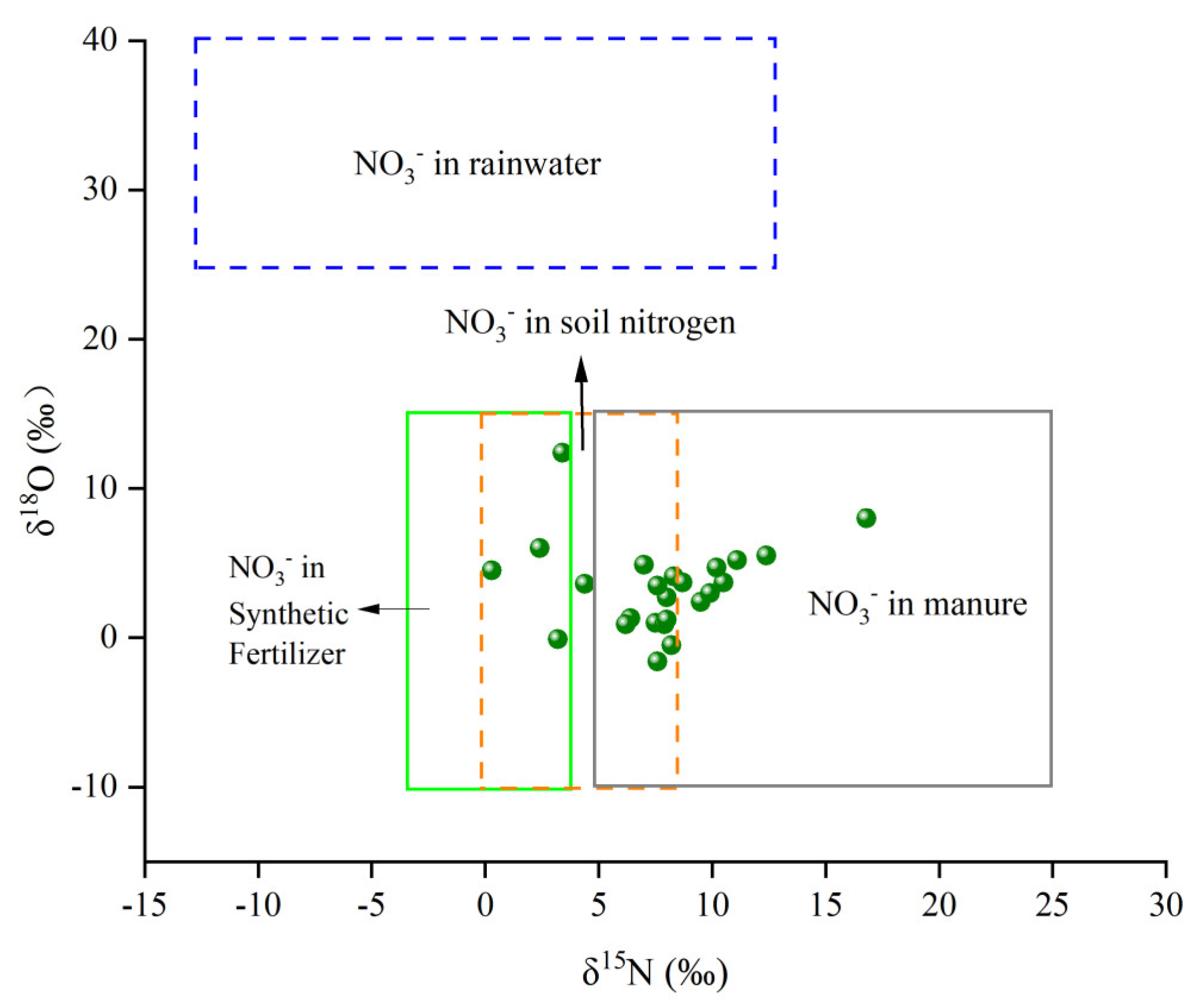
3.2. Qualitative Identification of Nitrate Sources
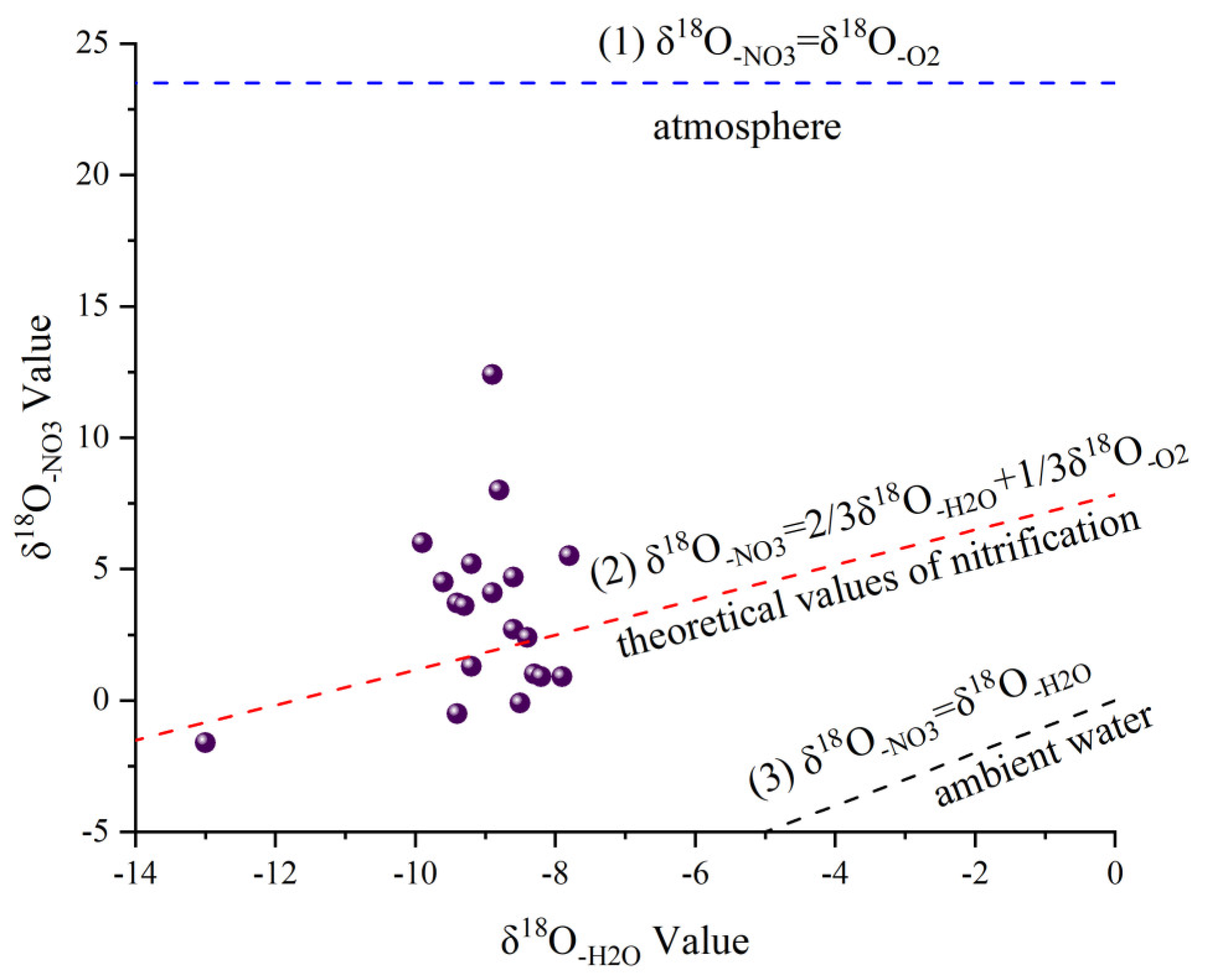
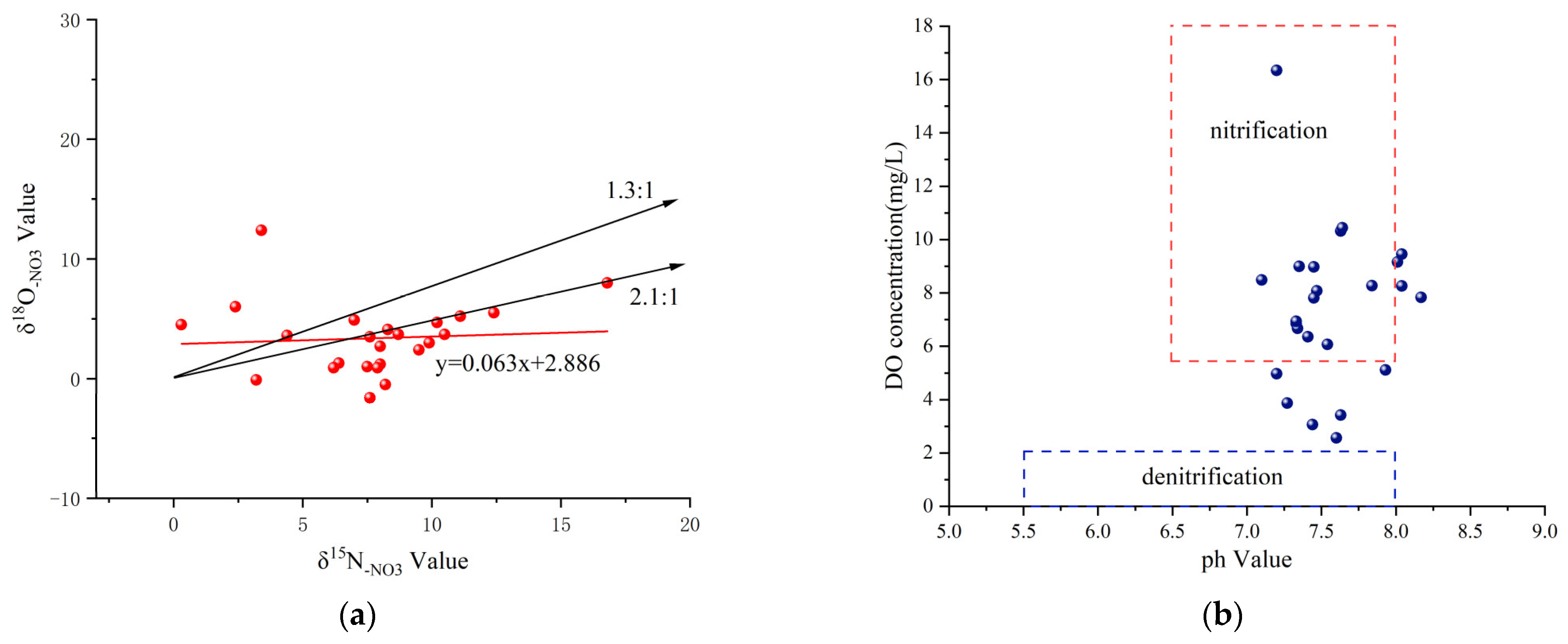
3.3. Main Biogeochemical Functions of Nitrate
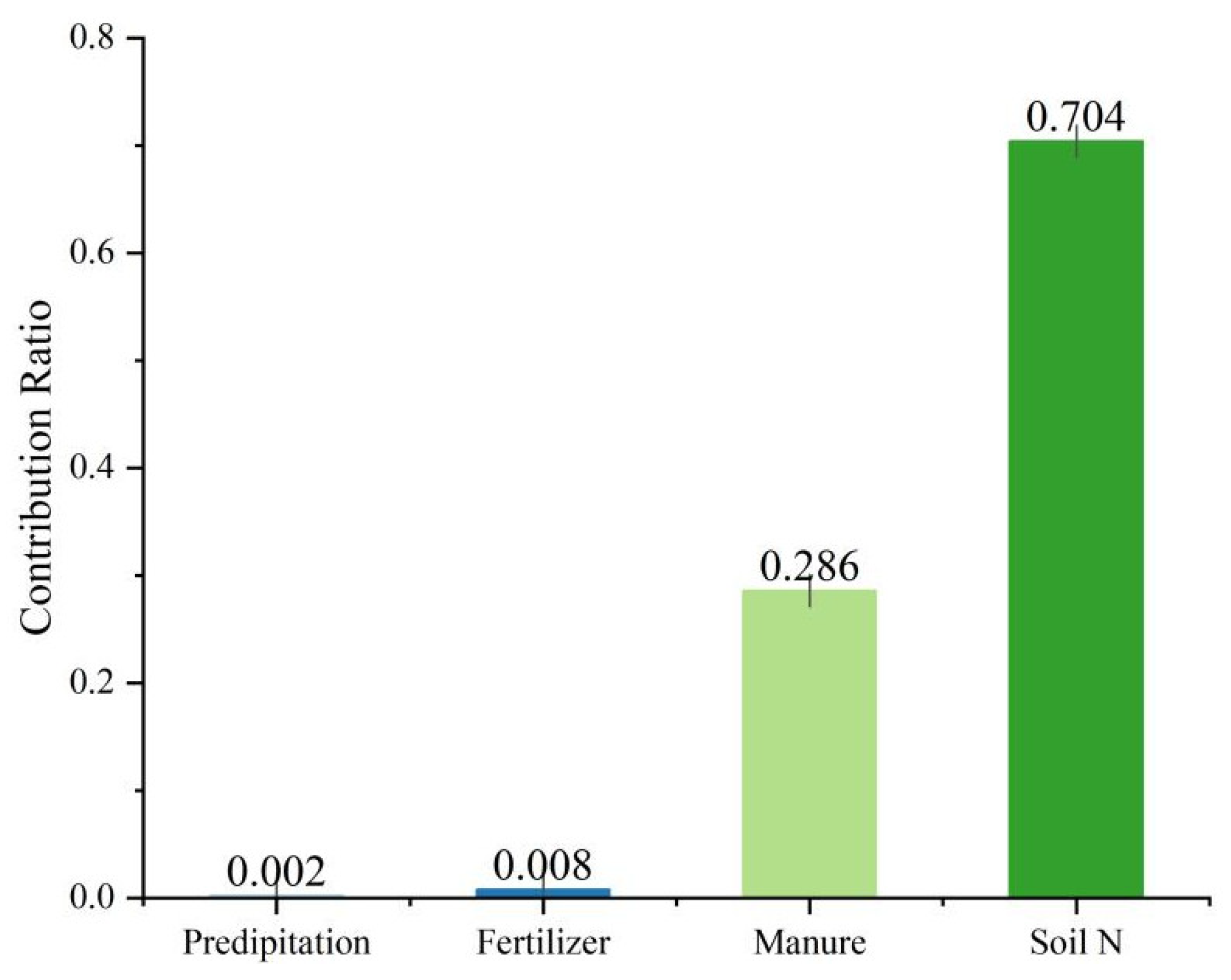
3.4. Quantitative Analysis of Nitrate Sources
4. Discussion
4.1. Uncertainty Analysis in the Quantitative Determination of Nitrate Sources
4.2. Contribution Characteristics and Environmental Significance of Nitrate Sources
4.3. Limitations and Future Work
5. Conclusions
Author Contributions
Funding
Data Availability Statement
Acknowledgments
Conflicts of Interest
Appendix A

| Number | pH | Dissolved Oxygen Content | NO3− | δ15 | δ18 |
|---|---|---|---|---|---|
| CK02 | 7.54 | 6.07 | 39.5 | 8.3 | 4.1 |
| S06 | 7.63 | 10.32 | 12.29 | 8.7 | 3.7 |
| SJ1 | 7.93 | 5.11 | 2.29 | 0.3 | 4.5 |
| QK2-7 | 7.2 | 16.34 | 43.55 | 3.4 | 12.4 |
| Q11 | 7.47 | 8.08 | 23.8 | 7 | 4.9 |
| J011 | 7.45 | 8.97 | 67.28 | 8 | 1.2 |
| CK01 | 7.41 | 6.36 | 15.7 | 4.4 | 3.6 |
| S200 | 7.45 | 7.81 | 70.2 | 9.9 | 3 |
| ZK02 | 7.44 | 3.06 | 33.91 | 10.2 | 4.7 |
| A06 | 7.33 | 6.85 | 0.117 | 2.4 | 6 |
| B02 | 8.04 | 9.45 | 0.003 | 3.2 | −0.1 |
| B06 | 8.01 | 9.16 | 0.003 | 6.2 | 0.9 |
| P055 | 7.1 | 8.49 | 0.01 | 6.4 | 1.3 |
| P069 | 7.34 | 6.67 | 0.12 | 7.5 | 1 |
| ZK01 | 7.6 | 2.57 | 17.01 | 7.6 | 3.5 |
| B05 | 8.04 | 8.26 | 0.003 | 7.9 | 0.9 |
| B04 | 8.17 | 7.83 | 0.18 | 8 | 2.7 |
| P057 | 7.84 | 8.27 | 0.004 | 8.2 | −0.5 |
| ZK1 | 7.64 | 10.44 | 39.91 | 9.5 | 2.4 |
| A07 | 7.33 | 6.94 | 0.13 | 10.5 | 3.7 |
| A01 | 7.63 | 3.42 | 0.003 | 12.4 | 5.5 |
| A08 | 7.27 | 3.87 | 0.003 | 16.8 | 8 |
| ZK03 | 7.2 | 4.97 | 26.91 | 11.1 | 5.2 |
| QS28 | 7.35 | 9 | 34.9 | 7.6 | −1.6 |
References
- Wang, G.; Gao, H.B.; Long, B.; Wu, J.F. Research progress on nitrate isotope coupled multi-tracer tracing groundwater nitrate pollution. Chin. J. Appl. Ecol. 2024, 35, 970–984. [Google Scholar] [CrossRef]
- Wick, K.; Heumesser, C.; Schmid, E. Groundwater nitrate contamination: Factors and indicators. J. Environ. Manag. 2012, 111, 178–186. [Google Scholar] [CrossRef] [PubMed]
- Guleria, A.; Mehdinejadiani, B. Groundwater quality evaluation and human health risk assessment of nitrate using deterministic and probabilistic approaches in Qorveh-Dehgolan region, Kurdistan province, Iran. Int. J. Environ. Health Res. 2025, 23, 1–23. [Google Scholar] [CrossRef] [PubMed]
- Oubeid, A.M.A.; Hilal, I.; Kebd, A.; Sadiki, M. Global applications of stable isotopes for identifying nitrate pollution sources in groundwater: A comprehensive review. Front. Water 2025, 7, 1666498. [Google Scholar] [CrossRef]
- Heaton, T.H.E. Isotopic studies of nitrogen pollution in the hydrosphere and atmosphere—A review. Chem. Geol. 1986, 59, 87–102. [Google Scholar] [CrossRef]
- Vogiatzi, G.; Liontos, M.; Kostakis, M.; Maragou, N.; Thomaidis, N.S. An updated review on nitrate exposure from drinking water and dietary sources and effects on human health. Glob. Nest. J. 2025, 27, 13. [Google Scholar] [CrossRef]
- Ward, M.H.; Jones, R.R.; Brender, J.D.; de Kok, T.M.; Weyer, P.J.; Nolan, B.T.; Villanueva, C.M.; van Breda, S.G. Drinking Water Nitrate and Human Health: An Updated Review. Int. J. Environ. Res. Public Health 2018, 15, 1557. [Google Scholar] [CrossRef] [PubMed]
- Chen, Q.F.; Chen, A.Q.; Cui, R.Y.; Ye, Y.H.; Min, J.H.; Fu, B.; Yan, H.; Zhang, D. Identification of Nitrate Source and Transformation Process in Shallow Groundwater Around Dianchi Lake. Environ. Sci. 2023, 44, 6062–6070. [Google Scholar] [CrossRef] [PubMed]
- Tu, C.L.; Chen, Q.S.; Yin, L.H.; Li, Q.; He, C.Z.; Liu, Z.N. Research Advances of Groundwater Nitrate Pollution and Source Apportionment in China. Environ. Sci. 2024, 45, 3129–3141. [Google Scholar] [CrossRef] [PubMed]
- Xi, Y.; Xu, S.S.; Chen, J.J.; Tao, L.; Jing, H.W.; Guo, J.; Tian, Y.; Shen, X.E.; Chen, Q. Identification of Nitrate Sources in Groundwater Based on Multiple Qualitative and Quantitative Statistical Analysis Methods. Environ. Sci. 2026, 47, 1105–1114. [Google Scholar] [CrossRef] [PubMed]
- Xu, S.G.; Kang, P.P.; Sun, Y. A stable isotope approach and its application for identifying nitrate source and transformation process in water. Environ. Sci. Pollut. Res. Int. 2016, 23, 1133–1148. [Google Scholar] [CrossRef] [PubMed]
- Choi, M.; Lee, C.; Kim, L.H.; Choi, S.H.; Bong, Y.S.; Lee, K.S.; Shin, W.J. Assessing sources of nutrients in small watersheds with different land-use patterns using TN, TP, and NO3−-N. J. Hydrol.-Reg. Stud. 2024, 55, 13. [Google Scholar] [CrossRef]
- Jiang, S.Y.; Rao, W.B.; Li, T.N.; Song, Z.J.; Li, Z.Y.; Li, X.H.; Rode, M. Identification of transformation and sources of nitrate in a typical agricultural river of South-Central China using hydrochemistry, multiple isotopes and Bayesian model. J. Environ. Manag. 2026, 404, 15. [Google Scholar] [CrossRef] [PubMed]
- Chen, R.D.; Hu, Q.H.; Shen, W.Q.; Guo, J.X.; Yang, L.; Yuan, Q.Q.; Lu, X.M.; Wang, L.C. Identification of nitrate sources of groundwater and rivers in complex urban environments based on isotopic and hydro-chemical evidence. Sci. Total Environ. 2023, 871, 12. [Google Scholar] [CrossRef] [PubMed]
- Dong, Z.H.; Zhang, L.; Wang, C.; Zou, Y. Hydrochemical evolution and nitrate contamination sources in Laiwu groundwater: Insights from hydrochemistry and dual-isotope analysis. Phys. Chem. Earth 2025, 141, 11. [Google Scholar] [CrossRef]
- Li, J.N.; Sun, Q.H.; Lei, K.; Cui, L.; Lv, X.B. Using dual stable isotopes method for nitrate sources identification in Cao-E River Basin, Eastern China. Front. Environ. Sci. 2023, 11, 12. [Google Scholar] [CrossRef]
- Boumaiza, L.; Chesnaux, R.; Stotler, R.L.; Zahi, F.; Mayer, B.; Leybourne, M.I.; Otero, N.; Johannesson, K.H.; Huneau, F.; Schuth, C.; et al. Multiple environmental tracers combined with a constrained Bayesian isotope mixing model to elucidate nitrate and sulfate contamination in a coastal groundwater system. Sci. Total Environ. 2025, 959, 178265. [Google Scholar] [CrossRef] [PubMed]
- Wang, S.; Li, H.; Kang, T.; Li, R.X.; Zhang, C.Z. Resolving Nitrate Sources in Rivers Through Dual Isotope Analysis of δ15N and δ18O. Water 2025, 17, 22. [Google Scholar] [CrossRef]
- Quattrini, S.; Pampaloni, B.; Brandi, M.L. Natural mineral waters: Chemical characteristics and health effects. Clin. Cases Miner. Bone Metab. 2016, 13, 173–180. [Google Scholar] [CrossRef] [PubMed]
- Neves, N.; Campos, B.B.; Almeida, I.F.; Costa, P.C.; Trigo Cabral, A.; Barbosa, M.A.; Ribeiro, C.C. Strontium-rich injectable hybrid system for bone regeneration. Mater. Sci. Eng. C 2016, 59, 818–827. [Google Scholar] [CrossRef] [PubMed]
- Tovani, C.B.; Gloter, A.; Azaïs, T.; Selmane, M.; Ramos, A.P.; Nassif, N. Formation of Stable Strontium-Rich Amorphous Calcium Phosphate: Possible Effects on Bone Mineral. Acta Biomater. 2019, 92, 315–324. [Google Scholar] [CrossRef] [PubMed]
- Li, G.; Guo, J.; Song, Y.W.; Ma, F.S. Formation Mechanisms and Hydrogeochemical Evolution of a Metasilicate-Strontium Rich Mineral Water in a Subtropical Volcanic Terrain, East China. Water 2026, 18, 1086. [Google Scholar] [CrossRef]
- Liang, C.C.; Wang, W.; Ke, X.M.; Ou, A.F.; Wang, D.H. Hydrochemical Characteristics and Formation Mechanism of Strontium-Rich Groundwater in Tianjiazhai, Fugu, China. Water 2022, 14, 1874. [Google Scholar] [CrossRef]
- Yang, N.; Su, C.L.; Liu, W.B.; Zhao, L. Occurrences and mechanisms of strontium-rich groundwater in Xinglong County, northern China: Insight from hydrogeological and hydrogeochemical evidence. Hydrogeol. J. 2022, 30, 2043–2057. [Google Scholar] [CrossRef]
- GB 2762-2025; National Food Safety Standard—Maximum Levels of Contaminants in Foods. National Health Commission of the People’s Republic of China. State Administration for Market Regulation: Beijing, China, 2025.
- GB/T 14848-2017; Standard for Groundwater Quality. General Administration of Quality Supervision, Inspection and Quarantine of the People’s Republic of China. Standardization Administration of the People’s Republic of China: Beijing, China, 2017.
- DZ/T 0064.77-2021; Methods for Analysis of Groundwater Quality—Part 77: Measurement Oxygen Isotope Composition CO2-H2O Equilibration—Isotope Ratio Mass Spectrometry. Ministry of Natural Resources: Beijing, China, 2021.
- DZ/T 0064.59-2021; Methods for Analysis of Groundwater Quality—Part 59: Determination of Nitrate—Ultraviolet Spectrophotometry. Ministry of Natural Resources: Beijing, China, 2021.
- Zhang, Y.; Shi, P.; Song, J.X.; Li, Q. Application of Nitrogen and Oxygen Isotopes for Source and Fate Identification of Nitrate Pollution in Surface Water: A Review. Appl. Sci. 2019, 9, 17. [Google Scholar] [CrossRef]
- Chen, R.K.; Wang, Y.G.; Yang, S.; Wang, Y.F.; Zhi, W.H. Source apportionment of nitrate pollution in the reservoir basins based on dual isotopes of nitrogen and oxygen. J. Contam. Hydrol. 2026, 281, 104980. [Google Scholar] [CrossRef] [PubMed]
- Zhang, J.; Li, Y.; Jiang, J.Y.; Li, H.; Min, M. Sources and Health Risks of Nitrate in Shallow and Deep Groundwater Across Different Landform Units Along a Typical Reach of the Middle Yellow River. Environ. Sci. 2026, 47, 1–20. [Google Scholar] [CrossRef]
- Zhang, H.; Xu, Y.; Cheng, S.Q.; Li, Q.L.; Yu, H.R. Application of the dual-isotope approach and Bayesian isotope mixing model to identify nitrate in groundwater of a multiple land-use area in Chengdu Plain, China. Sci. Total Environ. 2020, 717, 12. [Google Scholar] [CrossRef] [PubMed]
- Dispirito, A.A.; Hooper, A.B. Oxygen-exchange between nitrate molecules during nitrite oxidation by nitrobacter. J. Biol. Chem. 1986, 261, 534–537. [Google Scholar] [CrossRef]
- Moore, K.B.; Ekwurzel, B.; Esser, B.K.; Hudson, G.B.; Moran, J.E. Sources of groundwater nitrate revealed using residence time and isotope methods. Appl. Geochem. 2006, 21, 1016–1029. [Google Scholar] [CrossRef]
- Nikolenko, O.; Jurado, A.; Borges, A.V.; Knöller, K.; Brouyère, S. Isotopic composition of nitrogen species in groundwater under agricultural areas: A review. Sci. Total Environ. 2018, 621, 1415–1432. [Google Scholar] [CrossRef] [PubMed]
- Matiatos, I. Nitrate source identification in groundwater of multiple land-use areas by combining isotopes and multivariate statistical analysis: A case study of Asopos basin (Central Greece). Sci. Total Environ. 2016, 541, 802–814. [Google Scholar] [CrossRef] [PubMed]
- Fukada, T.; Hiscock, K.M.; Dennis, P.F.; Grischek, T. A dual isotope approach to identify denitrification in groundwater at a river-bank infiltration site. Water Res. 2003, 37, 3070–3078. [Google Scholar] [CrossRef] [PubMed]
- Aravena, R.; Robertson, W.D. Use of multiple isotope tracers to evaluate denitrification in ground water: Study of nitrate from a large-flux septic system plume. Ground Water 1998, 36, 975–982. [Google Scholar] [CrossRef]
- Chang, L.R.; Ming, X.X.; Groves, C.; Ham, B.; Wei, C.F.; Yang, P.H. Nitrate fate and decadal shift impacted by land use change in a rural karst basin as revealed by dual nitrate isotopes. Environ. Pollut. 2022, 299, 11. [Google Scholar] [CrossRef] [PubMed]
- Buss, S.R.; Herbert, A.W.; Morgan, P.; Thornton, S.F.; Smith, J.W.N. A review of ammonium attenuation in soil and groundwater. Q. J. Eng. Geol. Hydrogeol. 2004, 37, 347–359. [Google Scholar] [CrossRef]
- Feast, N.A.; Hiscock, K.M.; Dennis, P.F.; Andrews, J.N. Nitrogen isotope hydrochemistry and denitrification within the Chalk aquifer system of north Norfolk, UK. J. Hydrol. 1998, 211, 233–252. [Google Scholar] [CrossRef]
- Rust, C.M.; Aelion, C.M.; Flora, J.R.V. Control of pH during denitrification in subsurface sediment microcosms using encapsulated phosphate buffer. Water Res. 2000, 34, 1447–1454. [Google Scholar] [CrossRef]
- Luan, B.J.; Wang, A.; Huo, Z.G.; Lin, X.Q.; Zhang, M. Identification of Nitrate Sources in the Upper Reaches of Xin’an River Basin Based on the MixSIAR Model. Water 2025, 17, 18. [Google Scholar] [CrossRef]
- Torres-Martínez, J.A.; Mora, A.; Mahlknecht, J.; Daesslé, L.W.; Cervantes-Avilés, P.A.; Ledesma-Ruiz, R. Estimation of nitrate pollution sources and transformations in groundwater of an intensive livestock-agricultural area (Comarca Lagunera), combining major ions, stable isotopes and MixSIAR model. Environ. Pollut. 2020, 269, 115445. [Google Scholar] [CrossRef] [PubMed]
- Ji, X.; Xie, R.; Hao, Y.; Lu, J. Quantitative identification of nitrate pollution sources and uncertainty analysis based on dual isotope approach in an agricultural watershed. Environ. Pollut. 2017, 229, 586–594. [Google Scholar] [CrossRef] [PubMed]
- Wang, X.H.; Liu, Z.J.; Xu, Y.J.; Mao, B.Y.; Jia, S.Q.; Wang, C.; Ji, X.M.; Lv, Q.Y. Revealing nitrate sources seasonal difference between groundwater and surface water in China’s largest fresh water lake (Poyang Lake): Insights from sources proportion, dynamic evolution and driving forces. Sci. Total Environ. 2025, 958, 178134. [Google Scholar] [CrossRef] [PubMed]
- Sun, H.Y.; Wei, X.F.; Jia, F.C.; Li, D.J.; Li, J.; Li, X.; Yin, Z.Q. Source of Groundwater Nitrate in Luanping Basin Based on Multi-environment Media Nitrogen Cycle and Isotopes. Environ. Sci. 2020, 41, 4936–4947. [Google Scholar] [CrossRef] [PubMed]
- Yang, Q.; Li, F.Z.; Zhang, X.H.; Chen, K.; Ding, A.Z. Decadal Hydrochemical Monitoring Reveals Characteristics, Genetic Mechanisms and Health Risks of High-Nitrate Groundwater. Appl. Sci. 2026, 16, 19. [Google Scholar] [CrossRef]
- Li, X.L.; Yang, X.; Zhang, W.Q.; Yang, H.; Huang, X.; Hu, C.Y. Origin and Transformation of Nitrate in Karst Cave Groundwater in the Middle Reaches of the Qingjiang River. J. Earth Sci. 2026, 37, 241–250. [Google Scholar] [CrossRef]
- Zhang, H.; Du, X.Y.; Gao, F.; Zeng, Z.; Cheng, S.Q.; Xu, Y. Groundwater Pollution Source Identification by Combination of PMF Model and Stable Isotope Technology. Environ. Sci. 2022, 43, 4054–4063. [Google Scholar] [CrossRef] [PubMed]
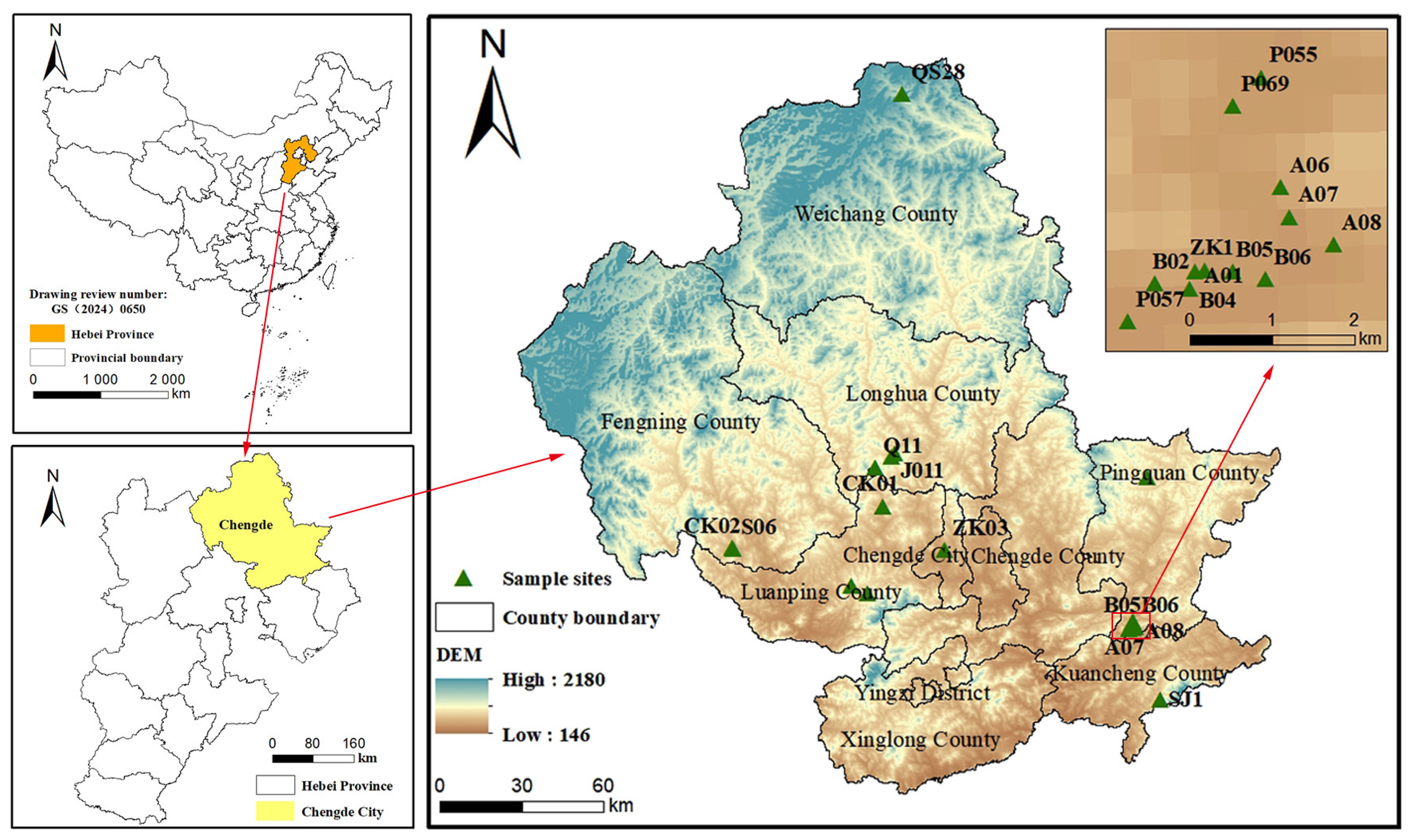


| Number | Sampling Point Locations | District/County | Number | Sampling Point Locations | District/County |
|---|---|---|---|---|---|
| CK02 | Yangjiying Village, Heishanzui Town | Fengning County | A06 | Nuanquan Village, Dangba Town | Pingquan City |
| S06 | Yangjiying Village, Heishanzui Town | Fengning County | P069 | Qianmeilingzi Village, Dangba Town | Pingquan City |
| SJ1 | Miaoling, Dongchuan | Kuancheng County | ZK01 | Jiangzhangzi Village, Liaoheyuan | Pingquan City |
| QK2-7 | Longfengshankou, Lanqi Town | Longhua County | A01 | Yong’an Village, Dangba Town | Pingquan City |
| J011 | Laopozigou, Lanqi Town | Longhua County | ZK1 | Yong’an Village, Dangba Town | Pingquan City |
| Q11 | Qiansonggou Village, Lanqi Town | Longhua County | P057 | Sishimu Di, Yong’an Village, Dangba Town | Pingquan City |
| CK01 | Tazigou Village, Xigou Township | Luanping County | B06 | Primary School, Yong’an Village, Dangba Town | Pingquan City |
| ZK02 | Changshanyu Mineral Water Well | Luanping County | B02 | Beishangen, Yong’an Village, Dangba Town | Pingquan City |
| S200 | Tieying, Changshanyu Village, Changshanyu Town | Luanping County | B05 | West of Yong’an Village, Dangba Town | Pingquan City |
| P055 | Dazhangzi Village, Dangba Town | Pingquan City | B04 | Huangjiezi, Yong’an Village, Dangba Town | Pingquan City |
| A08 | Sihedian Village, Dangba Town | Pingquan City | ZK03 | Qianying Village, Xidi Town | Shuangluan District |
| A07 | Henan Village, Dangba Town | Pingquan City | QS28 | Jiangjiadian Village, Jiangjiadian Township | Weichang County |
| Sources of Nitrate | δ15 | δ18 |
|---|---|---|
| Rainwater | −13~13 | 25~75 |
| Synthetic Fertilizer | −4~4 | −10~15 |
| Soil Nitrogen | 0~8 | −10~15 |
| Manure | 5~25 | −10~15 |
| Biogeochemical Processes | δ18 Value (‰) | Slope of δ15 and δ18 Fitting Equation | pH Value | Dissolved Oxygen Content (mg/L) |
|---|---|---|---|---|
| Nitrification | −2~6/<−5~15/−10~10 | / | 6.5~8.0 | >5.5 |
| Denitrification | / | 0.48~0.77 | 5.5~8.0 | <2 |
| Index | Minimum | Maximum | Mean | Standard Deviation | Coefficient of Variation |
|---|---|---|---|---|---|
| pH value | 7.1 | 8.2 | 7.6 | 0.3 | 0.04 |
| Dissolved oxygen content (mg/L) | 2.57 | 16.34 | 7.4 | 2.9 | 0.40 |
| NO3− (mg/L) | <0.003 | 70.2 | 17.8 | 22.1 | 1.24 |
| δ15 (‰) | 0.3 | 16.8 | 7.7 | 3.5 | 0.45 |
| δ18 (‰) | −1.6 | 12.4 | 3.4 | 3.0 | 0.88 |
Disclaimer/Publisher’s Note: The statements, opinions and data contained in all publications are solely those of the individual author(s) and contributor(s) and not of MDPI and/or the editor(s). MDPI and/or the editor(s) disclaim responsibility for any injury to people or property resulting from any ideas, methods, instructions or products referred to in the content. |
© 2026 by the authors. Licensee MDPI, Basel, Switzerland. This article is an open access article distributed under the terms and conditions of the Creative Commons Attribution (CC BY) license.
Share and Cite
Zhai, Y.; Xie, J.; Wang, R.; Yan, B.; Wang, W.; Ren, Y.; Kang, J.; Zhang, S. Identification and Quantitative Analysis of Nitrate Sources in Strontium-Rich Mineral Water of Chengde City Based on the MixSIAR Model. Water 2026, 18, 1663. https://doi.org/10.3390/w18141663
Zhai Y, Xie J, Wang R, Yan B, Wang W, Ren Y, Kang J, Zhang S. Identification and Quantitative Analysis of Nitrate Sources in Strontium-Rich Mineral Water of Chengde City Based on the MixSIAR Model. Water. 2026; 18(14):1663. https://doi.org/10.3390/w18141663
Chicago/Turabian StyleZhai, Yanliang, Jingyi Xie, Ruifeng Wang, Baizhong Yan, Wenyang Wang, Yuqing Ren, Jiashuai Kang, and Songlong Zhang. 2026. "Identification and Quantitative Analysis of Nitrate Sources in Strontium-Rich Mineral Water of Chengde City Based on the MixSIAR Model" Water 18, no. 14: 1663. https://doi.org/10.3390/w18141663
APA StyleZhai, Y., Xie, J., Wang, R., Yan, B., Wang, W., Ren, Y., Kang, J., & Zhang, S. (2026). Identification and Quantitative Analysis of Nitrate Sources in Strontium-Rich Mineral Water of Chengde City Based on the MixSIAR Model. Water, 18(14), 1663. https://doi.org/10.3390/w18141663