1. Introduction
The transboundary river management worldwide remains marred by an asymmetrical power hierarchy between upper and lower riparian states. The asymmetry lies in shifting developmental priorities, misunderstood or adaptive legal frameworks, and indeed changing politics and governance structures. Driven by increasing agricultural demands, calls for urbanization, and climate-induced hydrological variability, the pressures on shared water resources intensify, and as a result, the stability of international water treaties and agreements is increasingly tested. In major river basins like the Nile, the Mekong, and the Jordan, the negotiation and maintenance of water-sharing regimes often reflect this complex interplay marred by intense hydro-politics, institutional design, domestic pressures, and broader geopolitical rivalries. In this context of global upstream-downstream hydraulic friction, understanding why some cooperative frameworks endure while others fracture remains a central question across domains of water governance, international law, and even international relations.
Following the 1947 partition of the subcontinent, the Indus Waters Treaty (IWT) was concluded in 1960 between India and Pakistan, nearly a decade after negotiations carried out under the auspices of the World Bank. More than six decades of continuity in the operationalization of the Treaty have contributed to its reputation as one of the most durable arrangements in transboundary river governance. For such reasons, the scholarship on the IWT has frequently emphasized its institutional resilience, technical specificity, and capacity to sustain cooperation under conditions of enduring geopolitical rivalry [
1,
2]. More broadly, the Treaty has often been treated as evidence that institutionalized water-sharing arrangements can survive even where wider political relations remain deeply adversarial [
3]. Indeed, the Treaty remained operational through various conflicts between India and Pakistan, including the wars of 1965 and 1971, the militarized tensions of Kargil (1999), prolonged diplomatic breakdowns, and repeated episodes of cross-border tensions.
However, when observed closely, the coexistence of institutional continuity with expanding disagreement presents a more complicated picture that the language of resilience cannot explain comprehensively. It is because, despite the resilience argument, the Treaty has had a long history of recurring disputes over utilization, infrastructure development, procedural recourse, and treaty interpretation. Moreover, the questions surrounding storage, diversion, hydropower development, and permissible use on the western rivers increasingly became central to bilateral engagement, particularly from the 1990s onward. It is in this context that the 2025 announcement by India to put the Treaty “in abeyance” until Pakistan “credibly and irrevocably abjures its support for cross-border terrorism,” must be read and analyzed. The announcement, while not surprising to observers of South Asian politics, marked a notable shift in the political language surrounding the Treaty [
4]. Thus, the history of the IWT is illustrative of both the endurance of the Treaty and changing forms of disagreement within a formally stable legal framework.
Within this historical context and broader analytical scholarship on the IWT, a critical gap remains in the existing literature. The majority of contemporary scholarship on the subject has been predominantly centered on the IWT’s institutional design or addressing/explaining isolated episodes of conflict. However, they often assume the Treaty as static and, as such, end up overlooking the dynamism of how the operational meaning of the Treaty has evolved through domestic political pressures, or what effect the infrastructural expansion has on the IWT. Furthermore, the very institutional reliance that marks the Treaty’s uniqueness may inadvertently constrain adaptive governance. The reliance of existing literature on treating the IWT as a fixed legal settlement has allowed a notable gap in understanding how treaty performance and compliance behavior change over time, even when the formal text remains unaltered. This article addresses this gap by examining how IWT survived and how it became stalled within the broader context of developmental preferences, infrastructural needs, and political constraints of two South Asian neighbors.
As such, this article advances three interrelated arguments: first, the durability of the IWT cannot be explained solely by institutional design, but must be understood as a “performance-based equilibrium” sustained through state practice; second, the Treaty’s historical stability relied on a pattern of “compliance asymmetry,” in which India exercised restraint beyond minimal entitlement while Pakistan consolidated downstream dependence; and third, the growing juridification of dispute resolution since the 2000s has altered the political meaning of compliance and reshaped reciprocal expectations. Beyond the Indus basin, these findings are highly generalizable; conceptualizing treaty durability as a contingent, performance-based equilibrium offers a valuable framework for understanding the resilience and vulnerability of other stressed transboundary water regimes globally.
The article proceeds in five parts: mapping the hydrological context, outlining the methodology, examining the doctrinal place of “good faith,” tracing the historical evolution of utilization disputes, and concluding with the broader implications for transboundary water governance.
2. Hydrological and Historical Context
For decades, the IWT occupied a distinctive position within India–Pakistan relations precisely because it appeared insulated from the recurrent crises that disrupted most other forms of bilateral engagement. The genesis of this regime lies in the 1947 partition of the subcontinent, which abruptly severed the integrated canal administration of the Punjab region [
5]. The partition drew a political boundary across a unified hydrological system, leaving the critical upstream headworks in Indian territory while the vast network of dependent canals remained in Pakistan [
6]. The subsequent interruption of water supplies from the Indian headworks to Pakistani canals in April 1948 crystallized Pakistan’s acute perception of downstream vulnerability. This early crisis underscored the impossibility of joint, basin-wide administrative management under conditions of profound mutual mistrust [
7].
In this context of bilateral deadlock, negotiations facilitated by the World Bank during the 1950s culminated in the signing of the IWT in September 1960. Crucially, the World Bank’s intervention was indispensable not merely as a neutral diplomatic mediator, but as an institutional and financial guarantor. Because the political trust required to share the rivers dynamically was absent, the Treaty relied on physically partitioning the river system. However, for Pakistan to relinquish its historical claims to the eastern rivers, it required massive “replacement works,” specifically the construction of new dams and link canals to transfer western river waters into its eastern agricultural zones. This required an influx of international capital that neither newly independent state possessed [
8]. By mobilizing this capital through the Indus Basin Development Fund, the World Bank effectively transformed a volatile geopolitical boundary dispute into a heavily financed infrastructural settlement.
While the IWT regulates the bilateral relationship between India and Pakistan, the Indus Basin geographically extends across China, India, Pakistan, and Afghanistan. It is critical to note that the headwaters of the main Indus River, as well as the Sutlej River, originate in the Tibetan plateau under Chinese jurisdiction. Because China is absent from the IWT and lacks any formal, comprehensive water-sharing agreement with downstream riparians, the Indus regime lacks a basin-wide governance structure. This absence creates a persistent data and management blind spot regarding the uppermost riparian flows before they enter Indian and Pakistani territory, complicating long-term hydrological forecasting for the lower riparians [
9].
Within the India–Pakistan dynamic, the basin is defined by stark hydrological asymmetry. The total mean annual volume of the Indus Basin is approximately 170 million acre-feet (MAF). However, this volume is distributed highly unevenly across the tributaries. The three western rivers allocated primarily to Pakistan (Indus, Jhelum, Chenab) carry the overwhelming majority of the basin’s water, accounting for approximately 135 MAF, or nearly 80 percent of total flows. By contrast, the three eastern rivers allocated to India (Ravi, Beas, Sutlej) carry only 33 MAF [
10]. The basin’s drainage area is similarly distributed at 47 percent in Pakistan and 39 percent in India, deepening the structural interdependence between upstream geography and downstream agricultural reliance.
Compounding this geographical asymmetry are long-term declines and fluctuations in water availability. Historically, because India lacked sufficient infrastructure to immediately utilize its full eastern river allocation, Pakistan received substantial “extra” flows. Between 1976 and 1991, these unutilized eastern flows into Pakistan averaged 9.08 MAF annually; however, as India expanded its upstream infrastructure, these flows diminished to 4.90 MAF between 1991 and 2018 [
11]. This tightening of available water is exacerbated by broader climate-induced hydrological variability. Even the western rivers have exhibited long-term flow declines, dropping from an historical average of 140.40 MAF down to 136.69 MAF [
11]. Consequently, the Treaty operates in an environment where historical hydrological abundance has progressively given way to acute, basin-wide water stress [
12].
Beyond volumetric asymmetry, the Indus tributaries differ substantially in the quality and ecological condition of their waters. While political disputes frequently center on the quantity of flow, the basin is subjected to highly uneven anthropogenic interventions and urbanization pressures that alter water quality. In the upper reaches of the Indus system, the freshwater is of comparatively high quality, with total dissolved solids (TDS) ranging from 60 to 200 ppm, indicating low salinity and high suitability for irrigation, drinking, and ecological sustainability.
However, water quality deteriorates significantly as rivers flow downstream through densely populated and heavily cultivated areas. Near the Kotri Barrage in Pakistan’s Sindh province, TDS levels increase to 374 ppm. Certain tributaries in Khyber Pakhtunkhwa and Balochistan. The eastern rivers allocated to India exhibit similar disparities. The Beas River exhibits relatively low conductivity, suggesting less industrial contamination, whereas the Sutlej River shows much higher conductivity, indicating severe ecological stress, dissolved solids, and pollutant concentrations. This degradation is further exacerbated by major urban centers, such as Lahore and Karachi, which discharge substantial quantities of untreated municipal wastewater directly into the basin system, contaminating canals and contributing to systemic ecological fragility [
13].
To manage this geographical asymmetry and seasonal variability, both riparian states embarked on massive infrastructure drives. Consequently, the operational meaning of the IWT cannot be understood through its legal text alone; it is inextricably linked to the physical concrete of dams, barrages, and link canals. This infrastructure forms the material grounds upon which sovereign rights and treaty interpretations are actually contested.
In India, the Treaty became increasingly intertwined with the state’s growing energy demands, particularly the push to harness the hydropower potential of the Himalayan regions in Jammu and Kashmir, Himachal Pradesh, and Punjab. By 2025, India’s total installed power capacity reached 476 GW, making the maximization of run-of-the-river projects on the western rivers a paramount developmental priority [
14].
Table 1 outlines the major water infrastructure developed by India within the basin, illustrating the shift from early eastern river storage to complex western river hydropower development.
Conversely, Pakistan’s economic survival remains deeply reliant upon the Indus Basin Irrigation System (IBIS), one of the world’s largest contiguous irrigation networks. Following the loss of the eastern rivers, Pakistan was forced to fundamentally restructure its hydraulic geography. As detailed in
Table 2, Pakistan constructed a massive network of storage dams, barrages, and link canals designed to transfer water from the western tributaries (Indus, Jhelum, Chenab) eastward to replace the lost supplies [
15]. It constructed eight strategic inter-river link canals as part of the Indus Basin Project, which includes Rasul-Qadirabad Link, Qadirabad-Balloki Link, Balloki-Sulemanki Link No. 2, Taunsa-Panjnad Link, Chashma-Jhelum Link, Trimmu-Sidhnai Link, and Sidhnai-Mailsi-Bahawal Link.
This vast, interlocking infrastructure on both sides of the border forms the physical context of the IWT. The disputes that characterize the contemporary operation of the Treaty are therefore not abstract legal exercises; they are direct clashes over the engineering thresholds, storage capacities, and operational rhythms of these specific projects.
3. Conceptual Framework
As previously noted, the conventional explanations of the durability of the Treaty emphasize its static institutional design, focusing on strict volumetric allocation quotas, clear technical boundaries, and the formalized procedural mechanisms established for dispute resolution [
16]. From a broader perspective, studies of transboundary water governance have emphasized the capacity of institutionalized arrangements to stabilize expectations among riparian states despite wider political rivalry [
1,
3]. While these structural accounts elegantly explain why the Indus regime persisted across the two countries, they offer only a partial picture of treaty evolution and implementation. By treating the legal architecture of the Treaty as unchanging, these conventional accounts overlook how the operational meaning of legal rules is continuously reshaped through execution, physical infrastructure development, and recurring institutional interaction over time.
To capture this inherent dynamism within treaty operationalization, this article moves beyond the analysis of legal text as frozen and instead draws from international law scholarship, which views treaty obligations as living arrangements maintained through state practice. This approach finds its normative foundation in Article 31(3)(b) of the Vienna Convention on the Law of Treaties (VCLT), which establishes that “subsequent practice” in the application of a treaty provides authentic interpretive evidence of its operational meaning [
17]. To put it differently, the legal obligations are not fixed in historical abstraction but are developed and stabilized through ongoing institutional conduct and procedural reciprocity, while also being influenced by shared expectations that are generated through routine bilateral engagement [
18,
19]. This interpretivist focus also aligns closely with practice-oriented constructivist frameworks in international relations (IR) theory, with works like Friedrich V. Kratochwil, which emphasizes that rules do not possess fixed operational utility independent of their application [
20]. But rather, the legal rules acquire active political and technical significance only through continuous institutional use and interpretive, argumentative reasoning within a shared regime.
Consequently, when the analysis is situated in state practices, it reveals a major conceptual blind spot in dominant compliance literature in IR, which routinely abstracts legal frameworks from the material, geographical, and political realities of the resources they govern. In a broad sense, the traditional compliance paradigms remain fundamentally divided between (1) rationalist enforcement models that reduce treaty stability to strategic monitoring, enforcement costs, and defection penalties [
21], and (2) managerial frameworks that view compliance as a non-confrontational problem of administrative capacity, transparency, and communication [
22,
23,
24]).
Indeed, the Indus regime heavily relies on the continuous administrative communication characteristic of the managerial approach, as is notably evident in the routine operations of the Permanent Indus Commission (PIC). However, neither model adequately conceptualizes how the physical expansion of water infrastructure alters the boundaries of legal interpretation. In this sense, the conventional compliance models end up treating legal disputes merely as expressions of changing political will or enforcement failures. In doing so, they miss how contemporary frameworks in critical hydro-politics, like the “material turn” view in transboundary governance, highlight how physical realities of engineering, river flows, and technical project designs are themselves the primary terrain where sovereign entitlements are contested [
25,
26]. This becomes more critical in highly securitized basins (like Indus) where engineering parameters, be they pondage thresholds, spillway specifications, or silt-clearing gates and run-of-the-river variations, cannot be viewed merely as neutral technical configurations. Instead, they serve as active sites for the imposition of geographical realities, material power, and localized legal interpretations embedded in political discourse.
For such reasons, analyzing the trajectory of the Indus regime requires an analytical vocabulary that links legal practice directly to these material realities. For this, this article conceptualizes the treaty’s evolution through three categories that capture how cooperation, contestation, and competitive interpretation coexist within the same institutional framework [
27,
28]. First, the IWT cannot be understood as a static architectural settlement, but rather it should be viewed as a performance-based equilibrium. Such a formulation describes a condition in which treaty stability is continuously maintained and calibrated through contingent, historically situated practices of resource utilization, engineering restraint, and procedural regularity, rather than by formal text alone. Second, the historical stability of this equilibrium is closely linked to a structural pattern of compliance asymmetry. Within this relational dynamic, the upstream state (India) voluntarily exercised a high degree of technical and developmental restraint well below its maximal legal entitlements on the western rivers, while the downstream state (Pakistan) consolidated its agrarian and economic security around the long-term assumption of this continuous upstream restraint, generating deep unwritten expectations regarding future conduct.
Third, the contemporary vulnerability of the Indus regime stems from the unraveling of this performance-based equilibrium, a shift driven by an accelerating process of juridification. As engineering demands and unilateral developmental needs expanded from the 1990s onward, disputes regarding permissible project designs outgrew the flexible administrative channels of the PIC. Juridification here denotes the structural transition away from bilateral technical diplomacy and toward formal third-party adjudicatory recourse, such as Neutral Experts or the Court of Arbitration (CoA), to resolve engineering differences. The significance of this shift lies not merely in isolated legal outcomes, but in how recurring recourse to external legal adjudication narrows interpretive flexibility, replacing bilateral administrative resilience with rigid, adversarial definitions of compliance. Far from being isolated descriptive heuristics, these interlocking concepts of equilibrium, asymmetry, and juridification provide a generalizable theoretical framework for analyzing how technical friction and physical infrastructure reshape the endurance and vulnerability of transboundary water treaties globally. The sections that follow trace these developments historically through the evolving operation of the treaty and the competing understandings of restraint, entitlement, and good faith that emerged within it.
4. Methodology and Sources
This article employs a historically grounded qualitative approach to examine how the IWT was interpreted and operationalized across successive political and institutional contexts after 1960. Methodologically, the IWT is selected as a theory-building “crucial case” for transboundary water governance. Given that the Treaty has survived intense periods of geopolitical hostility and multiple wars, it provides a unique environment to test theories of institutional resilience. By isolating the IWT, the article aimed to examine how a formally static legal text is continually reinterpreted through state practice, moving the analytical focus away from structural design and toward operational performance.
Methodologically, this reconstruction is driven by qualitative process tracing, which examines sequences of institutional development across time rather than singular causal variables in isolation [
29]. The core causal mechanism investigated here is how shifting domestic developmental priorities (such as hydropower expansion) and political securitization translate into the juridification of treaty disputes. To test this mechanism, the process-tracing entailed: first, establishing the normative reference point of cooperation and “compliance asymmetry” following the Treaty’s signing. Second, article traces the chronological emergence of critical infrastructural disputes (i.e., Baglihar, Kishanganga, and Ratle) to identify critical junctures. And third, it analyzes how these specific bilateral frictions escalated into third-party adjudication, thereby altering reciprocal expectations and Treaty performance.
To this end, the source selection criteria prioritized official, institutional, and legal records spanning from 1960 to the 2025 abeyance announcement. The source base includes treaty texts and annexures, parliamentary debates, official diplomatic statements, World Bank records, and adjudicatory documents (Neutral Expert determinations and CoA awards). The primary evidentiary standard applied in this study relies on triangulation. To avoid mistaking domestic political posturing for actual state policy, the analysis cross-verifies political rhetoric (e.g., parliamentary debates regarding water weaponization) against formalized institutional conduct (e.g., actual engineering design submissions and legal arguments presented at The Hague). This ensures that claims about treaty practice are grounded in observable institutional behavior.
However, the empirical record is not perfectly symmetrical across the two states. Indian parliamentary debates and committee materials were substantially more accessible, whereas equivalent digital records from Pakistan’s National Assembly face geopolitical digital access restrictions in India. Consequently, the reconstruction of Pakistani domestic discourse relies more heavily on official diplomatic statements, Senate proceedings, adjudicatory submissions, and secondary accounts. This asymmetry means that the reconstruction of domestic political debate is necessarily more detailed for the Indian case. Furthermore, the analysis focuses primarily on interstate practice and official interpretation; it does not undertake quantitative hydrological modeling or technical assessments of infrastructure effects below the state level. Nevertheless, while the empirical data are historically specific, the theoretical framework developed here, conceptualizing treaty durability as a performance-based equilibrium, offers a highly generalizable lens for analyzing the vulnerabilities of other transboundary river regimes globally.
5. “Good Faith” as Doctrine and Practice
Tracing the evolution of the Treaty’s performance requires first establishing the normative baseline against which state conduct is measured, beginning with how both states have historically interpreted the foundational obligation of “good faith.” The obligation of the “good faith” principle occupies a central position in customary international law and the law of treaties. The principle of “good faith” emerged as particularly important in shaping how both parties interpreted the relationship between formal entitlement and practical implementation within the broader framework of the Treaty. It structures interpretation and the manner in which obligations are carried out over time. Article 26 of the VCLT codifies pacta sunt servanda, requiring that every treaty in force “must be performed by them in good faith” [
30]. This formulation links the component of binding force with performance, essentially making the mode of execution legally relevant and enforceable. The International Court of Justice (ICJ) has also repeatedly recognized “good faith” as a normative principle of international law that shapes the exercise and enforcement of rights and duties. A case in point is the Gabčíkovo-Nagymaros case concerning the 1977 treaty over the Danube Dam System, which led to a conflict between Hungary and Czechoslovakia (later Slovakia). In its decision, the ICJ underscored that cooperation in shared resource regimes presupposes mutual trust and an orientation consistent with the treaty’s object and purpose and ruled that both parties must negotiate in “good faith” [
31]. Looking at it this way, “good faith” extends beyond textual compliance to encompass patterns of behavior through which treaty commitments are understood and operationalized by states.
Interestingly, the preamble of the IWT also recognizes the need to address both parties’ rights and obligations in the spirit of “goodwill and friendship.” It notes, “The Government of India and the Government of Pakistan, being equally desirous of attaining the most complete and satisfactory utilization of the waters of the Indus system of rivers and recognizing the need, therefore, of fixing and delimiting, in a spirit of goodwill and friendship, the rights and obligations of each in relation to the other concerning the use of these waters and of making provision for the settlement, in a cooperative spirit” [
32].
However, what happens when parties interpret an agreement or treaty differently? In the case of the IWT, Pakistan considers “goodwill” an Indian duty to uphold the idea of continuous cooperation, while India interprets it as a reciprocal condition. Indeed, Pakistan has accused India of not acting in “good faith,” and by doing so, it has tacitly sought to justify its aggressive military posturing as a means of protecting its rights. The statements from officials have further reinforced such a position through rhetorical warnings that frequently linked “water” with “blood.” For example, Abdul Rehman Makki famously warned that any effort by India to obstruct Pakistan’s water flows would unleash a “river of blood” [
33,
34,
35,
36]. Hafiz Saeed, the founder of Lashkar-e-Taiba and associated with Jamaat-ud-Dawa, publicly accused India of practicing what he described as “water terrorism” and issued threats of retaliation targeting Indian dams. He also alleged that India intended to deprive Pakistan of the river waters sustaining its agriculture, thereby turning the country barren, and called on the Pakistani government to engage India seriously on the issue, cautioning that failure to address the dispute could devastate Pakistan’s agrarian economy [
37].
Meanwhile, India has frequently argued that the “spirit of goodwill and friendship” has been violated due to Pakistan’s cross-border terrorism and adversarial actions. Such concerns metastasized following the Uri attack in September 2016, as the Indian government avowed that “blood and water cannot flow together” [
38,
39,
40]. India’s Permanent Representative to the United Nations, Parvathaneni Harish, in 2025, captured the Indian position succinctly when he noted, “India entered into the Indus Water Treaty 65 years ago in good faith. The preamble of the treaty describes that the treaty was concluded in a spirit of goodwill and friendship. Throughout the six and a half decades, Pakistan has violated the spirit of the treaty by inflicting three wars and thousands of terror attacks on India. In the last four decades, more than 20,000 Indian lives have been lost in terror attacks, the most recent of which was a dastardly targeted terror attack on tourists in Pahalgam last month” [
41].
Viewed through the lens of state practice, Pakistan adheres to a territorial-integrity-based interpretation of the Treaty, protecting the historical flow of the Indus as its “vested rights.” By contrast, India has tended to advance a utilitarian-oriented reading, emphasizing that the agreement permits the fullest technically “permissible use” of the rivers.
Closely related to the “good faith” principle is the prohibition on “abuse of rights.” The latter principle constrains the exercise of treaty entitlements in cases where such exercise would defeat the agreement’s stabilizing function. Even though not codified as a separate provision in the VCLT, the doctrine is recognized in jurisprudence and academic scholarship as a ‘general principle’ limiting the manner in which rights are invoked [
42]. In transboundary water regimes, this principle notably intersects with obligations of cooperation, issuance of notification, and especially in the prevention of “significant harm” [
3]. This manifests in situations where a party chooses to remain within quantitative entitlements while deploying procedural mechanisms that shift the cooperative equilibrium. Similarly, a party may voluntarily exercise restraint beyond minimum obligations to preserve the stability of the agreement. To put it differently, the state may act within the letter but against the agreement’s object and purpose. In the Indus case, the doctrine of “abuse of rights” highlights the gap between technical compliance on the one hand and the exercise of “good faith” on the other.
Therefore, in the case of Indus, it is better to operationalize “good faith” through observable conduct for analytical purposes. Doing so, four salient dimensions emerge: first, continuity of compliance across adverse political contexts shows how performance gets insulated from episodic hostility and even confrontation. India’s adherence to the IWT during the 1965 war and after the 2001 Indian Parliament terrorist attack illustrates such continuity [
43,
44]. Second, the procedural sequencing under Article IX, which allows parties to refer technical “questions” to the PIC before escalating them to third parties, reveals the levels of commitment to the Treaty’s mature dispute-resolution structure. Third, utilization relative to entitlement demonstrates whether rights are maximized immediately or exercised incrementally within the parameters of Annexures C, D, and E [
32] (for more, see Annexure C). Fourth, forum preference in the choice between ‘bilateral engagement’ versus ‘early recourse to Neutral Expert or CoA’ reflects how parties perceive the balance between technical cooperation and juridified dispute settlement. These indicators permit an evaluation of performance by grounding analyses in patterns of a state’s actual behavior.
This divergence is useful for understanding how the two sides view the World Bank’s role. India sees the Bank as a witness to a bilateral contract, while Pakistan sees it as a guarantor or “protective overseer.” This way, the World Bank for Pakistan is not just a witness to a 1960 signature but works as a permanent referee responsible for ensuring that India’s upstream hydro-projects do not violate the technical parameters of the treaty. Interestingly, the World Bank’s statements (in 2016 and 2022) regarding its ‘limited’ role under the Treaty starkly contrast with Islamabad’s claims of the ‘guarantor’ status. This gains further salience given that, since the Simla Agreement (1972), India has consistently contended for the use of “bilateral” means to resolve issues, which is ironic for the IWT, where dispute resolution is overwhelmingly reliant on third-party mediation [
45].
Such interpretive gaps were at full display during Kishanganga proceedings, where parties clashed over the legal threshold for interim measures with competing applications of Paragraphs 28 and 29 of Annexure G [
46]. Effectively, India interpreted Pakistan’s demand to suspend construction as an unwarranted economic impediment, whereas Pakistan viewed it as a necessary safeguard against fait accompli [
47].
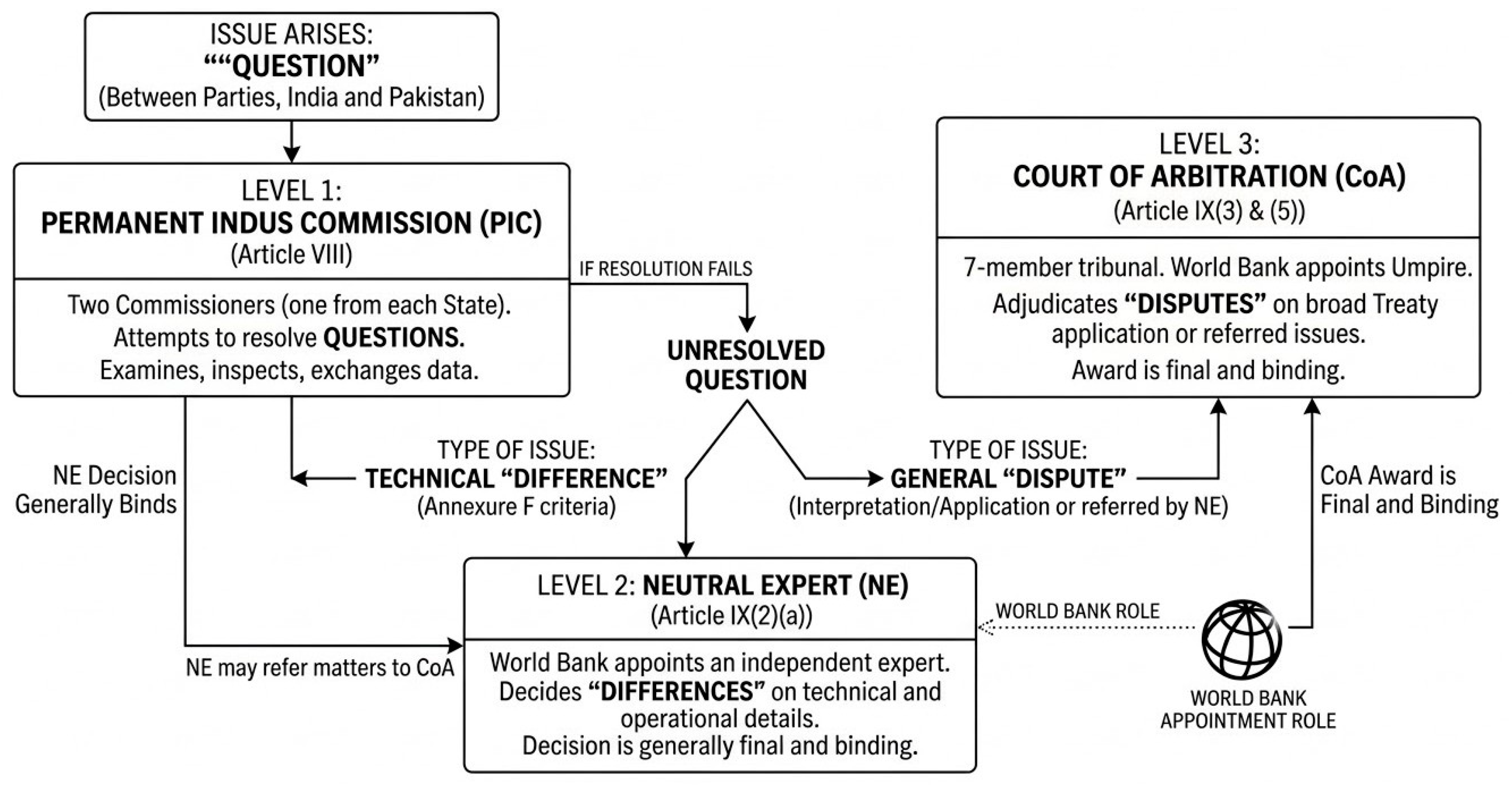
One must also observe how such performance dimensions have been embedded in a dense institutional architecture of the IWT. For example, Article VIII establishes the PIC as a standing body for data exchange, inspections, and resolution of questions to prevent immediate politicization, while Article IX differentiates between “questions,” “differences,” and “disputes,” assigning them to progressively formal mechanisms [
32] (see
Figure 1). Meanwhile, Annexures D and E are very specific in outlining technical parameters for run-of-river projects and storage, respectively. What it does effectively is translate broad allocation into specific engineering constraints. Tracing doctrinal standards of “good faith” alongside utilization patterns and dispute behavior provides a better evaluation of the resilience of the Treaty.
6. Foundational Expectations
When these competing doctrinal understandings of “good faith” were translated into state practice, they acquired operational significance by generating a distinct pattern of compliance asymmetry during the Treaty’s early decades, wherein procedural conduct became embedded within broader patterns of interstate interaction.
6.1. Divergent Interpretations
Following the partition, the Indus became one of the major flashpoints of disagreement between the two countries. The provisions agreed in the IWT (a decade later) were meant to reflect a deliberate effort to eliminate and narrow the discretionary leverage that had characterized the immediate post-partition years. The 1948 interruption of canal supplies from headworks located in Indian territory crystallized Pakistan’s perception of vulnerability to upstream control, while India regarded basin-wide joint management as administratively and politically untenable in a context of mistrust [
8].
Nonetheless, both sides had stark differences in how they perceived and interpreted the IWT. A look at the Indian parliamentary debates during IWT ratification demonstrates that the Nehru government constructed the political meaning of the Treaty through an explicit defense of legal commitment. As Prime Minister Nehru stated in Parliament, “we purchased a settlement, if you like; we purchased peace to that extent, and it is good for both countries” [
48]. However, various concerns emerged, particularly regarding financial contributions to be given to Pakistan for the replacement works. Other issues included the absence of certain contingency safeguards in the IWT, which were viewed as disproportionate burdens on India [
48,
49]. Nehru acknowledged and responded to these criticisms by reassuring the House that the agreement had undergone nearly a decade of intense negotiations and that India would retain access to the eastern rivers after the transitional period. He noted:
“we are not talking in terms of agreements but in terms of disagreements, of continuing disagreements and taking the consequences of those disagreements. In such matters, water especially and other matters, what one gains is infinitely more than a sum that we may give now or later. The decision that we get a free supply of water after that ten-year period and fairly free supply before that within certain limits is a tremendous gain. It may have been better, I do not know, and there may have been better negotiators, it is a matter on which anybody can have his opinion. But the mere fact that this has taken twelve years would at least convince the House that nothing, not a comma, not a full stop has been accepted without the longest argument and the closest attention to each detail”.
In doing so, Nehru also separated water allocation from unresolved territorial disputes as he framed adherence as consistent with India’s broader foreign policy posture toward international obligations. A closer examination of the parliamentary records and Prime Ministers’ statements indicates that compliance was defended not as an ‘act of concession’ but rather as the ‘product of structured negotiation and deliberate state policy’, which in turn helped establish a domestic narrative in which restraint was not only politically intelligible but also externally justifiable [
43,
50]. Later records also show that there is a continuity-based interpretation of the treaty, emphasizing the need to abide by it. For instance, in 1986, Gurdial Singh Dhillon, Indian Minister of Agriculture and Farmers’ Welfare, noted, “our top engineers were there to help in this matter; thus resulted in the Indus Water Treaty, and we are doing ahead with that Treaty as the basis” [
51].
On the Pakistani side, the interpretive approach centered on hydrological security and infrastructural consolidation. This security-centric logic was foundational, as recalled by Ayub Khan in his biography [
52] (for details, see chapter 10). He notes that the 1948 interruption of canal supplies from headworks located in Indian territory was crucial for Pakistani thinking on the issue. Ayub Khan captured Pakistan’s thinking when he wrote, “The only sensible thing to do [for us] was to try and get a settlement even though it might be the second-best, because if we did not, we stood to lose everything” [
52]. Later, this crystallized a perception of existential vulnerability among the leadership, and, as such, the 1960 settlement was framed not as a cooperative triumph but as a strategic necessity. This continued to be Pakistan’s domestic justification for its commitment to the IWT, despite domestic calls to abandon or renegotiate the Treaty. For example, during a 2004 National Assembly motion, the Pakistani government underscored its commitment to the Treaty by resisting internal political pressure to renegotiate the 1960 settlement [
53]. The motion advocated reclaiming the Sutlej River and addressing the question of water purchase. Amidst the domestic pressure, the federal government maintained a policy of institutional continuity. Omar Ayub Khan, the grandson of Ayub Khan, acting as the government’s spokesperson, rejected the “sold out” narrative. Later, in March 2016, the Pakistani Senate passed a resolution asking the government to “renegotiate” the Treaty with India. However, the ruling party (Pakistan Muslim League (N)) visibly avoided a clear discussion of the debates, suggesting persistent hesitation to renegotiate the Treaty [
54]. A similar position persisted in 2021, when the Indian parliamentary committee’s recommendation of “renegotiating” the Treaty. Instead of renegotiating or revising, the response was largely rhetorical, calling the Indian move “another ploy by the Indian side to resort to water terrorism in the region” [
34]. Such recurring hesitations by Pakistan illustrate a sober and realistic assessment of its position as a lower riparian state and the necessity of sustaining water flow despite the domestic pressure.
In this sense, the IWT serves as the eponymous “bird in the hand” situation for Pakistan, where the Treaty may be viewed as a flawed and even politically volatile, yet legally binding document that provides specific, quantifiable protections that might not survive a new round of bargaining. However, a closer inspection of narratives by successive Pakistani governments indicates a two-fold approach: on the one hand, adherence to the IWT follows a strategic logic of the country’s vulnerability. Meanwhile, officials have regularly turned to nationalist rhetoric to appease domestic audiences. Such thinking is further evident in Pakistan’s behavior and approach to readily resort to a Neutral Expert or the CoA, where strategic legalism is viewed as a “defensive legal shield” necessitated by “mistrust of India’s intention,” as explained by Syed Shahid Husain, a former Secretary in Pakistan’s Ministry of Water & Power [
55]. Pakistan’s perception of the Treaty shifted from a “divorce settlement” to a “guarantee of the status quo.” This led to the modern Pakistani narrative that India is building a “water bomb” or a “virtual tap” that could be used to flood or starve Pakistan during a conflict.
While both states entered the Treaty with their respective reasons and leadership used different narratives domestically, the Treaty could not escape skepticism [
6]. In Indian parliamentary discourse, members continued to question distributive outcomes and developmental implications in subsequent years, particularly in relation to Jammu and Kashmir’s hydro-power potential [
51,
56]. But such criticisms rarely translated into proposals for repudiation. Even during the 1965 war, suggestions that payments or cooperation be suspended were met with reaffirmations that treaty obligations would be honored despite hostilities. As Prime Minister of India, Lal Bahadur Shastri stated:
“There has been a good deal of discussion with regards to the question of payment of our dues under the Indus Waters Treaty…We do not wish to go back on commitments solemnly entered into by us, whether in regard to the Indus Waters Treaty, or under the Kutch Agreement. While we are always ready to meet force with strength, [but also] we shall continue to honour our pledged word”.
This pattern of skepticism almost always followed critical engagement that, in turn, followed defense for compliance. This reinforced the perception that the Treaty sat at a distinct normative space, which was insulated from short-term retaliation dynamics. The parliamentary scrutiny functioned more as a mechanism for legitimizing continued restraint as an obligation rather than destabilizing or revisiting the Treaty. During armed confrontations and diplomatic breaks, India maintained the flows and honored its financial obligations, signifying continuity of performance despite disagreements and military escalation. By and large, the initial configuration that emerged in the 1960s was tested by the 1965 War, but cooperation continued despite domestic opposition. What’s more was that the Indian government pushed for restraint in exhaustion of its permitted usage under Annexures C, D, and E. Meanwhile, Pakistan sought to utilize the Treaty provisions as it integrated the western rivers into its agricultural economy [
8,
57]. This asymmetry amidst compliance contributed to stability while procedural sequencing enabled reciprocal expectations.
6.2. Stability Through Performance-Based Equilibrium
During its first four decades, Indian compliance in the IWT remained strictly aligned with formal allocation. Annexures C, D, and E of the Treaty granted India specified rights to irrigation, run-of-river hydro-power generation, and limited storage on the western rivers, but these provisions were subject to technical parameters. Yet, for many years, India sought to exercise restraint without exhausting its permissible entitlements. The Indian Ambassador to Pakistan affirmed this in 2010, acknowledging that, against the 3.6 million acre-feet of storage permitted under the IWT, India had not constructed storage on the western rivers up to the allowable ceiling, and that irrigation usage remained below authorized limits [
57]. Later, the Jammu and Kashmir State Economic Survey (2017) confirmed that it has the potential to produce 20,000 megawatts of electricity, and by 2018, India only harnessed roughly 20 percent (3263.46 MW of the total identified 16,475 MW) of its allocated share [
58].
Such underutilization, even though pushed from the top down, indicated a strategic and normative position where India intended to reduce downstream apprehension of Pakistan. This also worked to reinforce expectations that upstream discretion would be exercised gradually so as to allow Pakistan time to adjust its economy to the future changes. By not immediately maximizing available rights under the IWT, India embedded its principled restraint into a routine administrative practice. This contributed to predictable performance, particularly in major projects’ issues like the Salah and Tulbul Navigation/Wullar Barrage Storage Project, where India halted construction of these dams after rounds of negotiations with Pakistan. In the Tublul project, when the PIC talks did not reach any outcome, during “a goodwill measure to facilitate productive dialogue” for Secretary-level negotiations, India agreed to Pakistan’s request of an indefinite suspension until an amicable settlement could be reached [
59,
60].
This pattern continued under successive governments of differing political orientations and domestic situations, ranging from single-party majority government to fragile coalitions in the 1990s. Without substantive alteration in compliance posture, India illustrated political continuity that helped further stabilize this performance pattern. For instance, the Salal Hydro-Electric Project generated technical disagreements over spillway design, but issues were resolved through bilateral negotiation. In the first non-Congress (Janata Party) government, S Kundu, Indian Minister of State in the Ministry of External Affairs (1977-79), while commenting on the Salal Hydro-Electric Plant Agreement (1978), stated, “the Agreement once again demonstrates that the Janata Government respects inherited obligations and seeks to build with greater cooperative relations with our immediate neighbours” [
61].
Parliamentary exchanges during this period further reiterated that projects were carried out through cooperative engagement while ensuring strict compliance with the Treaty provisions [
56]. This bipartisan behavior and defense of inherited obligations strengthened the understanding that the Treaty constituted a settled framework rather than a government-specific policy. In the following years, such executive continuity also worked to diminish incentives for successive governments to abruptly reinterpret IWT or provisions therein while strengthening the perception of stable upstream conduct. On the Pakistani side, support for the Tulbul hydro-power negotiations was not bipartisan. The then Chief Minister of Punjab, Nawaz Sharif, advocated referring the issue to international arbitration, while the President Ghulam Ishaq Khan advocated negotiations with India, maintaining that arbitration should remain a last resort [
62].
The overall cooperation between the two countries was also facilitated bureaucratically by the PIC, which played a central role in translating the agreed-upon allocation into enduring administrative cooperation using Article VIII and Article IX. It must be noted that Article VIII mandated regular meetings, exchange of hydrological data, and opportunities for inspection of works. Meanwhile, when it came to Article IX (dispute resolution), India and Pakistan frequently relied on resolving disagreements during the early projects. In particular, the Commission’s routine functioning created channels through which technical questions could be clarified without immediate politicization and insulated IWT from the fluctuations of diplomatic relations. This embedding of cooperation through bureaucratic practice set expectations for how disputes over technical matters would be approached first.
For Pakistan, these investments integrated the Treaty’s allocation into its agricultural and energy sectors. The security of downstream flows under Article III (2) became foundational to crop planning and rural livelihoods. Later, as irrigation networks expanded, the predictability of upstream performance became increasingly economically significant. The examination of IWT endurance during this period reflected not only legal obligation but also entrenched infrastructural interdependence.
While the sustained stability benefited both parties, the political defense of restraint exhibited asymmetry. In India, repeated calls espoused by sub-national governments reaffirmed adherence even when broader relations deteriorated. Calls to revisit the Treaty during crises were countered by references to solemn commitments and the importance of maintaining international credibility. In Pakistan, official engagement emphasized vigilance regarding upstream projects and strict adherence to design parameters, reflecting the centrality of downstream assurance [
63]. This divergence did not initially destabilize the treaty regime because incremental utilization and bilateral technical engagement maintained confidence. Stability, as a result, emerged from the interaction between India’s domestic defense of compliance and Pakistan’s infrastructural reliance on predictable flows.
The convergence of incremental utilization, bipartisan continuity, institutional routine, and infrastructural consolidation produced a performance-based equilibrium in which formal allocation and practical restraint reinforced each other. The Treaty’s architecture provided mechanisms for managing disagreement, but the political sustainability of the regime depended on the alignment between legal entitlement and restrained execution. As long as utilization remained gradual and disputes were primarily channeled through bilateral mechanisms, reciprocal expectations were preserved. The durability of the Treaty during its first decades, therefore, rested on a pattern of good-faith performance that integrated clarity of allocation with politically defended restraint, creating conditions under which cooperation could persist despite adversarial relations.
The durability of this equilibrium, however, depended upon the continued compatibility between restrained utilization, developmental priorities, and reciprocal expectations regarding future conduct. As infrastructural expansion accelerated and disputes increasingly moved into adjudicatory forums, these earlier patterns of accommodation became progressively more difficult to sustain.
7. Emergence of Contestation
As previously noted, in the initial decades, while both parties held divergent interpretations of the IWT (as is usually the case for any treaty), the stability ensured by institutional and bureaucratic procedures allowed the IWT to function without much political disruption. The framework for allocation and gradual development shaped expectations and behavior. However, over time, changes in developmental priorities, infrastructure planning, and dispute behavior introduced friction. While the framework remained intact, it affected how the Treaty was interpreted and, more importantly, how its provisions and frameworks were invoked.
In the 1990s, India introduced economic reforms that opened its economy, with multi-fold effects. The policy changes shifted economic priorities and pushed for development. After a long period of restraint, manifested in the underutilization of its provisions in Annexures C, D, and E of the IWT, India sought to utilize its allocated benefits under the IWT. This included, but was not limited to, projects such as Baglihar on the Chenab and Kishenganga on a tributary of the Jhelum.
Official responses in the mid-2000s consistently maintained that these projects complied with the Treaty “in letter and spirit” [
64]. The change emerged not in a formal reinterpretation of allocation but rather in a shift from restraint-based non-exercise of entitlement to rights-based utilization, all undertaken within the prescribed parameters of the Treaty. This recalibration altered the operational environment by narrowing the gap between potential and actual upstream use. Subnational pressures emerge as an increasingly important variable in treaty performance. For long, the members of Parliament from these Indian states had raised concerns that the allocation of the western rivers constrained hydro-power potential and economic growth [
51,
56,
65]. But as energy deficits and employment concerns intensified, calls to harness available water resources gained prominence in domestic discourse. A good example is the state of Jammu & Kashmir, where the state assembly in 2003 unanimously passed a resolution for the abrogation of the Treaty, followed by another resolution in June 2016 that demanded a revision of the IWT.
While the Indian Union government continued to emphasize adherence to Treaty provisions, parliamentary discussions reflected the perception that non-utilization has meant lost opportunity costs. The sub-national consideration introduced domestic political consideration as a key variable of treaty performance. It linked hydro-power development to questions of federal equity and economic planning. India’s expanding energy demand and the prioritization of renewable generation have increased attention to the potential of hydro-power in the Himalayan states. Notably, the parliamentary committee reports even questioned whether available entitlements were being fully utilized, while also urging acceleration of permissible projects [
66]. Therefore, such discussions reframed underutilization not as a stabilizing restraint but as a forgone developmental capacity. In this sense, what had once functioned as incremental reassurance began to appear as foregone capacity.
Thus, the disputes did not reflect a singular breakdown event in cooperation, but one sees changing priorities and national needs affecting how the two sides interpreted the treaty implementation. The two countries undertook distinct approaches and different responses that altered the meaning of compliance.
7.1. Early Infrastructure Disputes: Salal and Tulbul
Before the 2000s, there were various infrastructure-related disputes between India and Pakistan. They included (but were not limited to) the Salal Dam dispute (1968) and the Tulbul Navigation Project (1984). Later, in subsequent projects such as the Baglihar Hydroelectric Project (2005), the Kishenganga Hydro-Electric Project (2010), and the Ratle Hydroelectric Project (2013), friction between the two countries deepened. It is well-known how transboundary water policies are readily, if not inevitably, formulated within a broader political context and remain deeply shaped by evolving political dynamics [
67]. In the case of the IWT, what’s interesting to note is that the bulk of such disputes did not necessarily stem from engineering or hydrological considerations, but were part of politics.
During the discussion at the PIC, Pakistan initially took the position that India had the right to build the project, and later changed to the view that the project would actually harm Pakistan by affecting water flows [
68]. From Islamabad’s perspective, the construction violated Articles I (11) and Article III (4), which prohibit any “man-made obstruction” and the storage of water, or the construction of storage facilities, that can significantly change the flow of the river, respectively. Pakistan further argued that the lake is an essential part of the Jhelum River and not a separate water body. Under Article 1(4), India should implement the restrictions on construction. What’s more, the storage capacity of the Tulbul project violated Annexure E. India, for its part, maintained that its actions were fully consistent with Article I (11), which permits navigation-related development, and that the construction merely regulates the outflow of existing lake water rather than constituting a storage work. At a broader level, this controversy revealed how disagreements over infrastructure development could transform into disputes over the meaning of the treaty itself, even when there were no disagreements on allocation.
7.2. Design and Utilization Disputes: Baglihar and Kishenganga
For India, in the aforementioned projects, the primary emphasis was on the optimal utilization of the water resources allocated under the Treaty. According to P Saxena, former Indian Commissioner for Indus Waters (2016-22), under the Ministry of Jal Shakti, “Pakistan’s objections remain principally theoretical, based on isolated interpretations of specific Treaty provisions without consideration of broader context or practical impacts.” In contrast, the Treaty’s preamble explicitly articulates its overarching purpose as facilitating “the most complete and satisfactory utilization of the waters of the Indus system of rivers” [
59]. In Pakistan’s case, the engagement with treaty-related disputes, including concerns over Indian projects on the western rivers, appears to have been mediated mainly by the prevailing political context, leadership priorities, and bilateral dynamics rather than by treaty provisions alone [
62]. These dynamics became even more pronounced in the Baglihar and Kishenganga proceedings. This relates further to how treaty interpretation gets produced through institutional practice rather than abstract textual disagreement. Both of the mentioned disputes emerged from India’s exercise of run-of-river hydro-power rights under Annexure D, and both were framed by Pakistan as raising questions about the permissible limits of those rights in light of downstream protection under Article III (2) [
2,
46,
55,
69]. Both cases contested the technical configuration of projects situated squarely within India’s allocated sphere. The dispute redefined how Annexure-based entitlements would be operationalized, converting engineering design into a vehicle for interpretive clarification.
Pakistan objected to the Baglihar Hydroelectric Project (started by India in 1999), arguing that the project design violated Annexure D conditions and did not conform to the criteria (a), (c), (e), and (f) of paragraph 8. Such specific technical features included dam height, pondage volume, power intake levels, and gated spillways. All these were linked to Pakistan’s concern over India’s control over the river’s flow. According to Pakistan, the dam was too high (144.5 m) than what should be allowed for a simple run-of-the-river project, as it would hold more water, and the storage was too large, which could give India the ability to control the timing of the water flow.
The dispute surrounding Baglihar was not limited to technical interpretation alone. Questions concerning pondage capacity, gated spillways, and drawdown flushing carried broader implications for downstream flow predictability, irrigation timing, and perceptions of upstream regulatory control over the western rivers. At the same time, India increasingly viewed run-of-river hydropower development as important for meeting electricity demand and supporting regional development in Jammu and Kashmir. The disagreement therefore reflected both competing legal interpretations and changing material pressures surrounding permissible utilization under the Treaty framework.
The discussions within the PIC failed to resolve the Baglihar objections even after two rounds of bilateral talks. In January 2005, Pakistan followed up by approaching the World Bank to seek the appointment of neutral officials to designate a Neutral Expert [
70]. India defended its case, noting that the matter remained within the Commission’s competence, but participated in the process once the Expert was appointed. The referral itself reflected a contested interpretation of sequencing. Pakistan treated the technical objections as “differences” under Annexure F, while India characterized them as unresolved “questions” capable of bilateral resolution. Pakistan insisted on the fact that the proposed design exceeded permissible pondage and introduced control features inconsistent with the Treaty’s conception of run-of-river generation [
71]. And Indian position remained that the design complied with the Annexure’s technical criteria and that gated spillways were justified for sediment management and safety.
Through a close reading of Annexure D, the 2007 Neutral Expert Determination dissected the dispute. Regarding the pondage issue, it was concluded that India’s proposed storage exceeded the “necessary for firm power generation” threshold and required reduction to align with the Treaty’s standard. Meanwhile, on the issue of gated spillways, the Determination accepted India’s argument. It found an Indian explanation for sediment control in the Indus rivers that justified gated structures, effectively meaning the Annexure’s silence on the matter had to be understood as a reasonable engineering discretion.
Interestingly, the Determination did not adopt either party’s position wholesale. Instead, it produced a granular interpretation that integrated textual analysis with hydrological modeling. By affirming India’s right to construct the project subject to modifications, the Determination clarified that Annexure D permits engineering evolution within defined bounds. Interpretation thus emerged from the interaction between textual constraint and technical evidence. While the Indian government promised full cooperation for the technical details, it regarded Pakistan’s action to go to the Bank for Neutral Expert as “premature” [
64]. Still, in the Parliament, the Indian government defended that the Treaty is being implemented in “letter and spirit” by the government, and the project is in “strict conformity” with the provisions [
72]. Pakistan continued to insist that the disputes were primarily legal-jurisdictional issues concerning the sovereign interpretation of the Treaty’s mandate. As observers noted, Pakistan also had an issue with precedent, as India could use the design for future projects [
69]. But India viewed such disagreements as technical-engineering challenges solvable through hydro-engineering adjustments [
2]. These episodes suggest a fundamental divergence in interpretation between the two countries.
Essentially, the Baglihar process transformed interpretive disagreement into technical jurisprudence. Although formally limited to engineering “differences,” the Determination articulated principles governing future projects, including the permissibility of gated spillways and the method for calculating permissible pondage. Scholars have noted that the decision provided the first authoritative construction of Annexure D’s ambiguous provisions. By narrowing disputes to measurable criteria, the procedure insulated the allocation framework while recalibrating the operational meaning of run-of-river generation. At the same time, early recourse to third-party expertise shifted the center of interpretive authority from bilateral practice to quasi-adjudicatory Determination, embedding external clarification within routine project development.
Similar tensions emerged in the Kishenganga dispute, where questions concerning diversion, environmental flow requirements, and downstream impact acquired significance beyond formal legal interpretation alone. For Pakistan, the project raised concerns regarding downstream agricultural dependence, flow predictability, and the cumulative implications of upstream infrastructural expansion. For India, the project formed part of a broader effort to expand permissible hydropower utilization within the Treaty framework under conditions of growing developmental and energy pressure.
When it comes to the Kishenganga Hydroelectric Project, the issue centered on the diversion of water from the Kishenganga–Neelum River to a power station before it rejoins the Jhelum. Pakistan argued that diversion violated the Treaty’s scheme by reducing downstream flows available to its Neelum–Jhelum project and invoked Annexure G to request the establishment of a CoA. According to Pakistan, the project violated the Treaty’s Annexure D, specifically Articles III (3), IV (6), and III (2). Furthermore, Pakistan argued that, under the treaty, India should “let flow” and not change the river’s natural channel. While it acknowledged the permissibility of diversion, Pakistan argued that it should be limited to exceptional emergencies and must not be interpreted as a broader right for India to divert water [
73] (para. 377). India maintained that Paragraph 15 of Annexure D permitted such diversion for run-of-river generation, provided specified conditions were met. Unlike Baglihar, where disagreement centered on design details, Kishenganga raised questions about the compatibility of diversion with downstream use and environmental flow obligations.
On the diversion, Pakistan further argued that it should harm Pakistan’s “then existing” uses of water, such as Neelum–Jhelum and other future hydro-power projects [
73] (para. 419). It invoked Paragraph 15 (iii) of Annexure D, stated that suture agricultural uses should be protected, and India cannot “freeze” our future development [
73] (para. 49–52). It was also argued that the project did not properly qualify as a run-of-the-river plant.
The CoA (2013) Partial Award addressed the issue of whether India could divert water under Annexure D while still complying with obligations under Article III (2) to “let flow” the western rivers [
73]. By interpreting Annexure D as a case of lex specialis, the Court held that diversion for run-of-river generation was indeed permissible [
74]. However, the Court imposed a requirement on minimum environmental flow to protect downstream uses. The Final Award clarified limitations on drawdown flushing, prohibiting it except in defined circumstances. The CoA reasoning integrated textual interpretation, subsequent practice, and hydrological data, producing an authoritative construction of how generation rights coexist with downstream assurance. The decision thereby expanded the interpretive field from discrete engineering thresholds to systemic balancing within the Treaty’s structure.
By this stage, disputes increasingly reflected the narrowing gap between permissible entitlement and actual utilization under the Treaty. Questions concerning storage, diversion, operational flexibility, and infrastructure design acquired greater political sensitivity as developmental pressures, energy demand, and anxieties surrounding future water availability intensified across the basin. Consequently, disagreements that may previously have remained within bilateral administrative management increasingly moved into formal adjudicatory and legal forums.
7.3. Juridification and Parallel Proceedings
In 2016, Pakistan again approached the World Bank for the appointment of CoA involving three issues for the Kishenganga project, and four for the Ratle hydro-power project. The Bank appointed a Neutral Expert for the former and CoA for the latter. On the proceedings of the Neutral Expert, Pakistan changed its earlier position and argued that the issues were not only technical but “systemic,” meaning they could affect several hydroelectric projects under the Treaty. This argument was rejected by the Neutral Expert. And it was argued that though its role is plant-specific, it can still decide these questions. Furthermore, on the Treaty interpretation, it was noted that technical disputes often require interpreting treaty provisions, and for such reasons, this does not automatically take the issue out of its jurisdiction. Later, it also argued that the dispute involved broader treaty interpretation and overlapping matters before the CoA.
India objected that the treaty’s mechanism should be followed sequentially and that both processes cannot run concurrently for the same issues, and it did not participate in the CoA proceedings [
75,
76]. India contended that the technical issues raised by Pakistan should be handled by a Neutral Expert as provided under Article IX and Annexure G of the treaty [
77]. India also maintained that disputes concerning the interpretation or application of the Treaty must first be examined by the PIC, and if they are not resolved by the Commission, they may be referred by either party to a Neutral Expert. Only when both parties agree that it requires legal interpretation of the IWT or if the Neutral Expert refers the issue can the matter proceed to the CoA.
Meanwhile, in 2017, the Foreign Affairs and Water & Power committees of Pakistan’s National Assembly unanimously adopted a resolution seeking the immediate suspension of these two projects by India, and asked for the constitution of CoA to resolve the issue [
78]. India regarded the supplement award given by the CoA as “illegal and void per se” [
79], and rejected both on procedural and political grounds.
In 2016, the World Bank paused these parallel processes concerning Kishenganga and Ratle, which is to be understood as an inherent sensitivity of the proceedings. Pakistan’s readiness to invoke Annexure G signaled confidence in adjudicatory clarification, while India’s preference for a bilateral resolution reflected concern that premature escalation would alter the cooperative rhythm. Both approaches were textually authorized, yet their deployment shaped the institutional character of engagement. Barring technical distinctions, the procedural trajectories of Kishenganga and Baglihar revealed similar but recurring patterns. First, objections were triggered at the notification stage through Annexure D procedures, demonstrating that transparency mechanisms functioned as intended. Second, disagreements centered on the interpretation of technical terms, “necessary for firm power,” permissible pondage, intake levels, diversion rights, rather than on allocation itself. Third, escalation occurred relatively early, even after bilateral discussions failed to yield agreement, suggesting a reduced tolerance for protracted Commission-level negotiations. Fourth, adjudicatory outcomes affirmed India’s entitlement, but they imposed specific constraints on project construction, suggesting that the interpretation had evolved through structured contestation embedded within Treaty mechanisms.
The implication of repeated third-party resolutions led to the juridification of Treaty performance, in which interpretation increasingly took place through formal submissions, evidentiary hearings, binding determinations, and competing claims by India and Pakistan. What must be noted is that juridification itself did not imply violation. Instead, it reflected the Treaty’s resilience and capacity to resolve ambiguity on its own. But, at the same time, one can see a shift in interpretive authority from bilateral administrative practice to adjudicatory forums. Gradually, as technical clarifications become precedents, the meaning of Annexure D and Article III (2) is progressively constructed through institutional determinations rather than negotiated accommodation. Throughout the process, while the Treaty’s text remained unchanged, its operational content began to be reshaped by procedural pathways.
A closer inspection of disputes around Baglihar and Kishenganga revealed how the IWT evolved from a regime of incremental bilateral adjustment to one characterized by recurrent formal clarifications. Each dispute reaffirmed the allocation while narrowing interpretive uncertainty, yet the repeated escalation process altered reciprocal expectations regarding sequencing and restraint. As utilization approached entitlement ceilings and adjudication became a recurrent feature of project development, the political meaning of compliance shifted from voluntary incrementalism to entitlement asserted under legal scrutiny. The transformation of dispute behavior into a central mode of treaty performance thus reconfigured the equilibrium that had sustained earlier stability, bringing the reciprocity underpinning domestic political defense of restraint into sharper focus. Pakistan pursued arbitration while discussions continued at one level, whereas India questioned whether the threshold for a “dispute” had been met under Article IX [
80].
8. Transformation and Implications for Treaty Resilience
The discussion illustrates how, for several decades, the stability of the IWT rested on a performance-based equilibrium, which was characterized by incremental utilization, bilateral administrative engagement, and a political willingness on both sides to defend compliance despite broader hostility. However, over time, the conditions sustaining this equilibrium gradually changed. The transformation did not arise from a formal reinterpretation of the Treaty’s legal provisions but from shifts in the political environment within which treaty performance was evaluated and defended. The earlier equilibrium was gradually reconfigured rather than abruptly abandoned, reflecting how cumulative changes in utilization and the accelerating juridification of dispute behavior, and the security environment that altered the domestic calculus of good-faith performance see [
81,
82].
A key development was the gradual erosion of the earlier insulation between water governance and the broader security relationship between India and Pakistan. For much of the Treaty’s history, successive governments treated the regime governing the Indus basin as an exceptional domain that could remain operational even during periods of diplomatic rupture or military confrontation. This separation allowed technical cooperation to persist despite wider political conflict. However, developments since the late 2000s have increasingly brought water governance into the orbit of security discourse. Public statements in India linking water cooperation to cross-border violence reflected a growing perception that the Treaty’s normative foundations, particularly the expectation of good-faith engagement, could no longer be detached from the broader trajectory of bilateral relations [
38].
This marked another notable shift, in which domestic political legitimacy for the Treaty became a factor shaping its performance. Successive Indian governments justified restraint as part of their commitment to international law and normative claims, even though this posture can also be viewed as a case of strategic prudence. Such arguments were politically sustainable in an environment where upstream utilization remained limited, and dispute settlement mechanisms were invoked only occasionally. As hydropower development expanded and project-related disputes increasingly moved into adjudicatory forums, driving a deepening juridifcation of the regime, where domestic political costs of continued restraint became more visible. Parliamentary debates and policy discussions became increasingly framed in terms of underutilization, viewed as a forgone developmental opportunity rather than prudence.
In Pakistan, a similar pattern is visible. The political discourse continued to emphasize vigilance against upstream manipulation while the successive governments defended the Treaty as an essential constituent of the country’s water security. In such a context, frequent recourse to adjudicatory mechanisms must be understood as more than merely Pakistan’s effort to seek technical dispute settlement. Instead, it constituted a nationalistic effort to demonstrate the government’s active efforts in defending Pakistan’s water rights. This led to treaty compliance increasingly becoming embedded within domestic narratives of sovereignty and security rather than solely within technocratic cooperation.
The cumulative effect of these developments was a transformation in the political meaning of treaty performance. Earlier stability rested on a configuration in which upstream restraint and downstream infrastructural dependence generated mutually reinforcing expectations. As utilization expanded, disputes became juridified, and security considerations entered policy discourse, and this configuration gradually weakened. Compliance remained formally intact, yet its interpretation became increasingly contested within domestic political arenas.
While momentous, the 2025 events do not necessarily reflect the breakdown of the IWT’s institutional framework, but are indicative of a consequential shift in how the Treaty obligations are interpreted and defended after more than six decades of operation. When developmental pressures intensify, adjudication becomes routine, and water cooperation becomes entangled with security narratives, the political sustainability of restraint becomes more difficult to maintain. The transformation of treaty performance, therefore, illustrates how the durability of cooperative regimes depends not only on institutional design but also on the evolving alignment between legal entitlement, reciprocal practice, and domestic political legitimacy.
As such, the experience of the IWT invites a reconsideration of how treaty resilience is conceptualized in adversarial political environments. Conventional explanations emphasize institutional design, allocation clarity, and third-party facilitation as the principal sources of durability [
1,
83]. While relevant, these factors do not provide a comprehensive understanding of treaty resilience. The IWT case illustrates that an institutional or framework-centric understanding is inadequate for comprehending cooperation and compliance with a treaty over an extended period of time. Particularly in the context of tense relationships like India and Pakistan, treaty survival cannot be understood solely from the formal text of the Treaty but must also include an understanding of how the treaty’s terms are implemented and sustained in the domestic political discourse of the parties.
A more adequate explanation emerges when resilience is understood as a performance-based equilibrium. During the early decades of the Treaty, stability derived from an alignment between legal entitlements, patterns of utilization, and reciprocal procedural engagement. India exercised its upstream rights cautiously, utilizing the western rivers incrementally rather than exhausting the full scope of permitted development. At the same time, Pakistan reorganized its irrigation infrastructure around the predictable availability of those flows. This interaction produced what may be described as compliance asymmetry: a configuration in which one party’s restrained exercise of entitlement reduced downstream uncertainty while the other consolidated material dependence within the allocation framework. As long as this asymmetry remained politically sustainable and disputes were largely managed through bilateral administrative practice, the Treaty’s institutional architecture functioned as a stabilizing framework rather than a site of contestation.
Furthermore, it must be considered that resilience in such regimes is contingent rather than permanent. The relationship between entitlement and restraint evolves with changes in utilization patterns and dispute settlement behavior. In the Indus basin, expanded hydro-power development and the increasing juridification of disputes narrowed the gap between legal entitlement and actual use while simultaneously relocating interpretive authority from bilateral administrative practice toward adjudicatory forums. These developments did not undermine the Treaty’s formal rules; rather, they altered the political context in which those rules were interpreted and defended.
In this context, contestation surrounding the IWT over the last decade can be better understood as a transformation in the conditions that previously sustained cooperative performance. When the political cost of restraint rises and dispute settlement becomes increasingly juridified, the expectation of reciprocal moderation becomes more difficult to maintain. Treaty durability, therefore, depends not only on the clarity of allocation or the existence of dispute-resolution mechanisms, but also on the continued alignment between legal rights, patterns of utilization, and the domestic political legitimacy of compliance.
9. Conclusions
The article examines IWT through the intersection of state practice and infrastructural expansion and contributes to the growing literature on critical hydropolitics and the “material turn” in transboundary water governance. While existing institutional analyses tend to evaluate treaty resilience based on the static design of legal frameworks or the formal success of dispute mechanisms, the article suggests that such structural accounts offer an incomplete picture. The findings indicate that the endurance of international water agreements arguably depends less on the rigid preservation of a foundational text than on how legal rules acquire operational substance through continuous, materially grounded state practice. In doing so, the article reconceptualizes treaty resilience as a contingent, performance-based equilibrium shaped not only by legal design but also by infrastructural expansion, domestic political pressures, and bureaucratic continuity.
Through the case of the IWT, the article illustrates that the historical stability of the Indus regime was not merely a product of institutional design, but emerged from a historically contingent performance-based equilibrium. For decades, this equilibrium was sustained by a de facto compliance asymmetry, in which India’s upstream developmental restraint facilitated Pakistan’s growing downstream infrastructural dependence. During this period, the PIC successfully managed technical friction through flexible bilateral administrative engagement, while relatively stable bureaucratic routines insulated treaty implementation from episodic political crises and leadership changes. However, as the article demonstrates, treaties are not insulated from the shifting physical, developmental, and political realities of the resources they govern. As India pursued a more assertive run-of-the-river hydroelectric agenda, the material conditions underpinning this historical asymmetry gradually weakened. At the same time, domestic political pressures, subnational developmental demands, and increasingly securitized public discourse altered the political legitimacy of restraint itself. The subsequent escalation of technical disputes to third-party platforms points to an increasing juridification of the regime, a shift that has arguably replaced diplomatic accommodation with more adversarial, rigid interpretations of compliance.
As such, the contemporary contestation over the IWT, culminating in the Indian government’s 2025 decision to hold the Treaty in “abeyance,” presents a more complex narrative than a simple collapse of bilateral cooperation. While triggered primarily by India’s response to Pakistan’s state-sponsored terrorism, this political rupture also coincides with deeper material and institutional transformations within the basin. As climate-induced hydrological variability and long-term flow reductions increasingly stress the basin, the abeyance decision can be interpreted as a critical juncture. It suggests that a framework engineered during a mid-twentieth-century era of relative hydrological abundance may be struggling to contain the intersecting pressures of twenty-first-century water scarcity, domestic political imperatives, and shifting bureaucratic priorities. Thus, the evolving trajectory of the Indus regime suggests that transboundary water agreements are rarely fixed settlements. Rather, they are continuously negotiated through changing river flows, infrastructural expansion, institutional practices, domestic political calculations, and shifting political priorities. For global water governance, the Indus case suggests that evaluating the vulnerability of stressed river basins requires moving beyond legal texts to closely examine the evolving, often asymmetric, material and political practices through which treaty performance itself is sustained or contested.