This is an early access version, the complete PDF, HTML, and XML versions will be available soon.
Article

From Olive Mill Solid Waste to Engineered Biochar: An Effective Processing Approach to Trihalomethane Removal from Water

1
The Natural Resources and Environmental Research Center—NRERC, University of Haifa, Mount Carmel, Haifa 3498838, Israel
2
Shamir Research Institute, University of Haifa, P.O. Box 97, Qatzrin 1290000, Israel
3
Water Science & Biotechnology, Faculty of Sciences and Technology, Tel-Hai University of Kiryat Shmona in the Galilee, Upper Galilee 1220800, Israel
4
The Institute of Applied Research, The Galilee Society, P.O. Box 437, Shefa-Amr 2020000, Israel
5
Department of Natural Resources and Environmental Management, Faculty of Management, University of Haifa, Haifa 3498838, Israel
6
Department of Geography and Environmental Studies, University of Haifa, Mount Carmel, Haifa 3498838, Israel
*
Authors to whom correspondence should be addressed.
Water 2026, 18(13), 1554; https://doi.org/10.3390/w18131554 (registering DOI)
Submission received: 8 May 2026 / Revised: 13 June 2026 / Accepted: 22 June 2026 / Published: 25 June 2026

Abstract

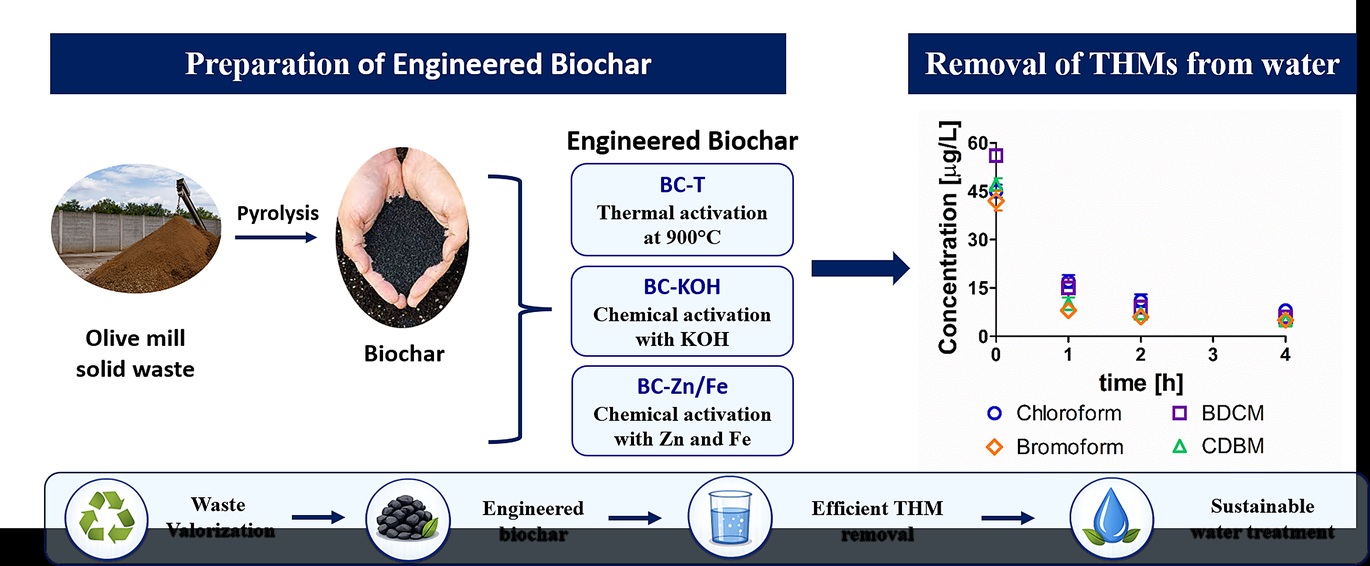
Trihalomethanes (THMs) are priority disinfection by-products in drinking water, and their effective removal remains a persistent challenge for sustainable treatment. Here, olive mill solid waste (OMSW) was valorized into biochar (BC) and evaluated as a low-cost adsorbent for chloroform, bromodichloromethane (BDCM), chlorodibromomethane (CDBM), and bromoform under environmentally relevant conditions. Among the prepared materials, thermally activated BC (BC-T) performed best, achieving equilibrium removals of 74.7 ± 6.6% for chloroform, 91.1 ± 0.8% for BDCM, 87.2 ± 1.9% for CDBM, and 93.8 ± 0.3% for bromoform at 3000 mg/L. Adsorption increased with bromine substitution, following the order of bromoform > CDBM ≈ BDCM > chloroform, consistent with rising hydrophobicity. In contrast, KOH and Zn/Fe activation increased the BET surface area but did not improve THM removal, suggesting that adsorption was controlled by surface chemistry and site accessibility rather than surface area alone. Persulfate (PSF) addition reduced THM removal, indicating that oxidant activation did not compensate for the loss of adsorption capacity. Adsorption data were well described by the Freundlich isotherm and pseudo-second-order kinetics. BC-T also maintained high removal efficiency in drinking water, demonstrating its promise as a practical polishing adsorbent for THM control and as a route for high-value valorization of an abundant agricultural residue.
Keywords: biochar; water treatment; circular economy; trihalomethanes biochar; water treatment; circular economy; trihalomethanes
Graphical Abstract