Article

Seasonal Variation Outweighs Spatial Variation in Lotic Water Mite Communities in a Mediterranean Mountain

1
CIBIO, Centro de Investigação em Biodiversidade e Recursos Genéticos, InBIO Laboratório Associado, Campus de Vairão, Universidade do Porto, 4485-661 Vairão, Portugal
2
Departamento de Biologia, Faculdade de Ciências, Universidade do Porto, 4169-007 Porto, Portugal
3
BIOPOLIS Program in Genomics, Biodiversity and Land Planning, CIBIO, Campus de Vairão, 4485-661 Vairão, Portugal
4
Department of Biology, University of Montenegro, Cetinjski put b.b., 81000 Podgorica, Montenegro
5
EBM, Estação Biológica de Mértola, Praça Luís de Camões, 7750-329 Mértola, Portugal
*
Author to whom correspondence should be addressed.
Water 2026, 18(13), 1552; https://doi.org/10.3390/w18131552 (registering DOI)
Submission received: 18 May 2026 / Revised: 16 June 2026 / Accepted: 23 June 2026 / Published: 25 June 2026
(This article belongs to the Special Issue Impact of Environmental Factors on Aquatic Ecosystem, 2nd Edition)

Abstract

Water mites (Hydrachnidia) are diverse, ecologically important arachnids that can serve as effective bioindicators; however, their communities in Mediterranean mountain rivers are scarcely documented. The present study provides a comprehensive analysis of water mite communities in mountain rivers of Serra da Estrela (Portugal), assessing how abundance, genus richness, and community composition vary across seasons, among rivers, and along an elevational gradient. Water mites were sampled in twelve sites belonging to 3 rivers across an elevational gradient and in three seasons. In total, 7296 adult water mites were collected, representing 33 genera and 17 families. Three genera were documented for the first time in Portugal: Albia, Hexaxonopsalbia, and Wettina. Abundance varied with season, being lower in spring (102 ± 35 specimens per site) than in summer (249 ± 73) and autumn (257 ± 83). Genus richness showed a similar pattern, with lower values in spring (9.8 ± 2.0) than in summer (12.2 ± 1.9). Spatial variation among rivers was comparatively minor. The multivariate analysis revealed that community-level changes between seasons, rivers and elevation were driven by only a few genera. The findings help improve the knowledge of Mediterranean mountain water mite communities, shedding light on their seasonal and spatial dynamics.

1. Introduction

Freshwater ecosystems are among the most threatened worldwide [1], yet many of their inhabitants remain poorly studied, particularly regarding their ecology [2]. With over 6000 described species, water mites occur in most freshwater habitats and are the most diverse group of aquatic arachnids [2,3]. Due to their high diversity and ubiquity, they have long been considered potential bioindicators [4]. Although there is now a consensus that water mites fulfil all the necessary requisites to be powerful bioindicators, they are still not included in most biomonitoring protocols or, when included, are grouped in a single, overly broad and uninformative category such as Hydrachnidia [4]. Further research is therefore needed to fill knowledge gaps in the understanding of water mite taxonomy and ecology, particularly regarding how water mite communities respond to spatial and temporal environmental variation. Addressing these gaps is therefore essential to support their effective use in biomonitoring frameworks.
Freshwater ecosystems are often characterized by seasonal and spatial variability in environmental conditions, including fluctuations in flow regime, temperature, and resource availability [5,6]. Variations in flow regime may arise from natural drivers, such as seasonal changes in precipitation and snowmelt, and topography, as well as from anthropogenic factors like dam operation and water extraction [7]. These variations can be quantified using discharge records from gauging stations, allowing the calculation of metrics such as hydrological variability indices. At finer spatial scales, hydrological conditions can be assessed through measurements of environmental variables such as discharge, flow velocity, and water level [7]. Alternatively, hydrological variation can be inferred from the composition of biological communities, which reflect environmental conditions over time [8]. Numerous studies have shown that freshwater communities can provide valuable information about the characteristics of river systems, including their seasonal and spatial variability. For example, macroinvertebrate assemblages track changes in the river flow regime [9], and hyporheic invertebrate communities can serve as indicators of climate change impacts in temporary rivers [10]. Regarding anthropogenic disturbance, certain bacteria can be used as indicators of river ecological status and eutrophication [11], and macroinvertebrate and phytobenthos communities have been shown to respond to flow alterations caused by dams [12].
Understanding how freshwater communities respond to seasonal and spatial variation is therefore essential for interpreting ecological patterns and processes in these ecosystems. Despite the importance of seasonal and spatial variability in shaping freshwater communities [13], its effects on water mite community dynamics remain insufficiently understood [14]. Most ecological studies have been conducted in North America and Central Europe, e.g., [15,16,17], leaving a research gap in other regions such as the Mediterranean. Another aspect of water mite ecology that remains poorly understood is the relation between water mite richness and abundance and environmental variables along altitudinal gradients. Studies published on this topic show contrasting results, with richness increasing or decreasing depending on the study [18,19]. Further research is therefore needed to better understand how water mite abundance and diversity vary seasonally and spatially, particularly in the Mediterranean. Addressing these ecological gaps is particularly important given the recognized potential of water mites as bioindicators.
The present study provides an analysis of water mite communities in the mountain rivers of Serra da Estrela, Portugal. It aims to characterize seasonal and spatial water mite community composition shifts and improve the ecological knowledge of Mediterranean mountain water mite communities. The study has the objective of assessing how water mite abundance, genus richness, and community composition vary seasonally and spatially across rivers and elevational gradients in the Serra da Estrela Mountain range. Our results indicate that seasonal variation is the main factor influencing both abundance and community composition, while spatial differences play a comparatively minor role.

2. Materials and Methods

2.1. Study Area

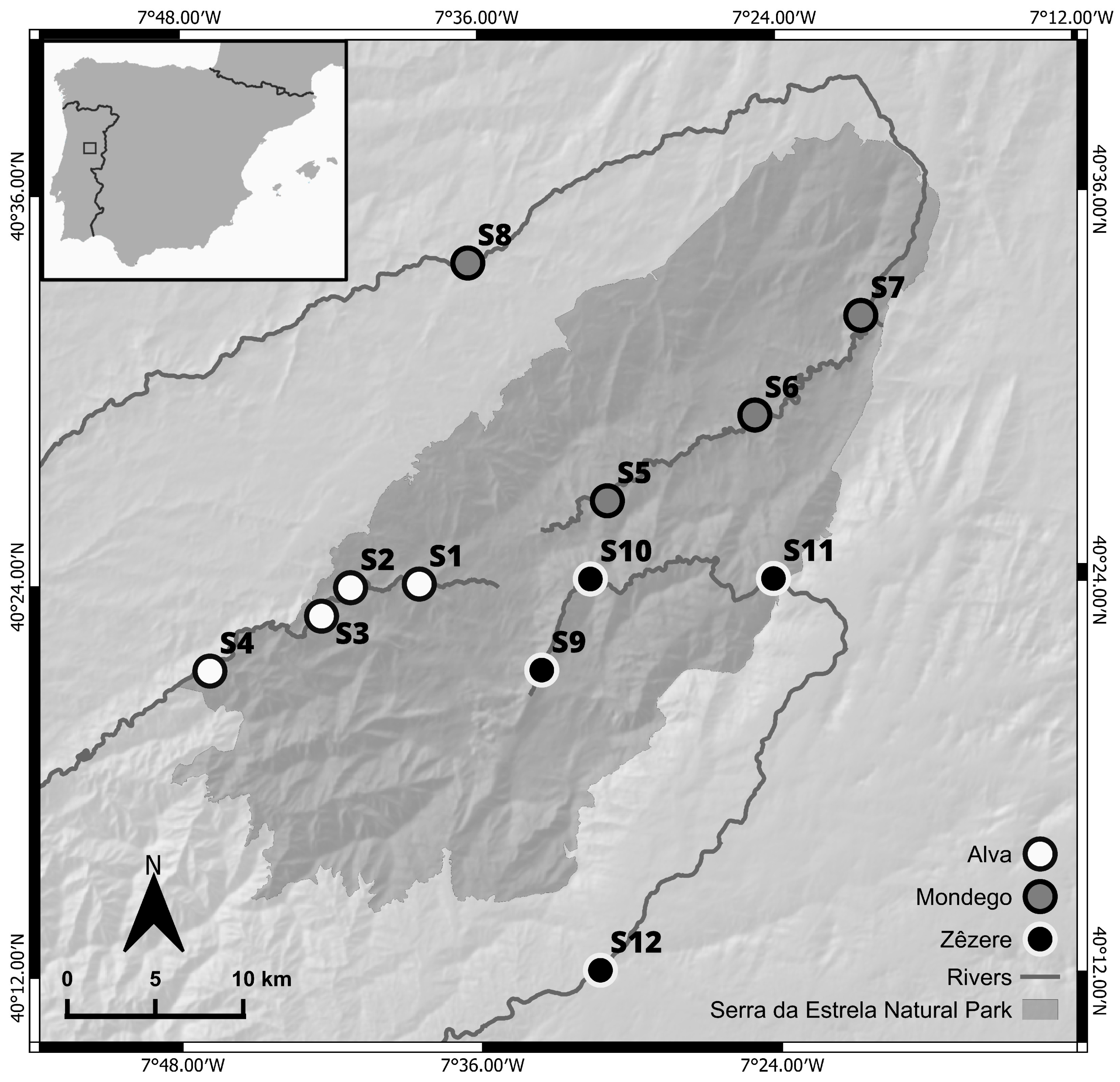
The study was conducted in three rivers in the Serra da Estrela Mountain range (central Portugal): Alva, Mondego, and Zêzere (Figure 1). The mountain range, located in the center of Portugal, is part of the western tip of the Iberian Central System. With an area of roughly 1000 km2, Serra da Estrela includes the highest point in continental Portugal, standing at 1993 m above sea level (m a.s.l.) [20]. Due to its location, it has complex climate patterns, with a stronger Atlantic climate influence on the north-western lowlands and highlands and a more marked Mediterranean climate on the south-eastern areas [21]. Rain and snowfall mainly occur during the coldest period of the year, between October and May [21]. With average annual precipitation exceeding 2500 mm at higher elevations, the Serra da Estrela range plays a key role in Portugal’s hydrology. It is the source of the country’s two largest intranational rivers, the Mondego and Zêzere, and of the river Alva, a tributary of the Mondego [20]. Due to its altitudinal gradient, the area has a large variety of habitats and is home to a wide array of fauna and flora, including some endemic species [21]. Due to its importance, the area is protected by various national and international mechanisms, namely being classified as a Natural Park (Serra da Estrela Natural Park). Water mite fauna in this area is diverse, with 47 currently known species (46 recorded for the first time since 2023), representing nearly 40% of all known species from mainland Portugal, including three, so far, considered endemic to the Serra da Estrela Mountain range [22,23,24].

2.2. Sampling and Morphological Identification

In each river, four sampling sites were selected from roughly 200 to approximately 1000 m a.s.l. (Figure 1; Table S1). Sampling sites were located within the riverbed, except one site in the river Alva, which was moved roughly 50 m upstream into a tributary due to the direct influence of a hydroelectric facility that causes drastic fluctuations in water discharge, possibly locally affecting the water mite communities.
Sampling was conducted in spring (28 April–2 May 2025), summer (23–27 June 2025), and autumn (22–25 September 2025), with each site sampled once per season. Four replicates were collected per site and per visit, each consisting of the water mites collected after a 3 min kick-net sampling followed by a visual inspection for 20 min on a white tray. A 250 μm mesh net (NHBS, Devon, UK) was used for the kick-net sampling, the standard for adult water mite sampling [3]. Water mites were collected using a pipette and preserved in 96% ethanol. Replicates were collected to represent microhabitat heterogeneity within each site. To minimize operator bias, all samples were collected by the same two people, with each processing two replicates per site.
Morphologic identification was conducted in the laboratory at Associação BIOPOLIS facilities in Vairão. Water mites were observed using an Olympus SZX16 stereomicroscope, and specimens were sorted into adults and deutonymphs (immature life stage). Afterwards, the genus of the adult specimens was identified using the identification keys from the Süßwasserfauna von Mitteleuropa series [3,25,26], and their taxonomy was followed. When needed for genus identification, adult specimens were dissected, slide-mounted, and observed under an Optika B-293 compound microscope.

2.3. Data Analysis

Data analysis was performed in R 4.4.2 [27], with significance considered at p-values ≤ 0.05, unless otherwise stated. The four replicates per site were pooled to provide a single composite sample per site, not allowing the assessment of within-site variability. Only adult specimens were considered for the analysis. Graphs were built using the “ggplot2” package 3.5.2 [28].
To assess how water mite abundance and genus richness vary per site across seasons, rivers (both categorical), and elevation (continuous), linear models (LMs) were built using the “lm” function in base R. Model assumptions were verified through residual diagnostics with the package “DHARMa” 0.4.7 [29], and significance of fixed effects was evaluated using Type II Analysis of Variance from the package “car” 3.1-3 [30]. For significant categorical effects, pairwise comparisons were performed using estimated marginal means with Tukey adjustment for multiple testing (package “emmeans” 1.11.1 [31]).
To compare genus richness and diversity across rivers and seasons, genus richness (q = 0), as well as Shannon (q = 1) and Simpson (q = 2) diversity indices were standardized by sample coverage using the “iNEXT” package 3.0.2 [32]. Sample coverage was estimated and extrapolated to twice the sampling size and standardized to the lowest coverage value [33]. Differences were based on non-overlap of 95% confidence intervals [33].
To assess how water mite community composition varied at the genus level across rivers, seasons and elevation, a multivariate generalized linear model (MGLM) was built using a negative binomial distribution, implemented in the “mvabund” package 4.2.8 [34]. Model assumptions were verified using residual plots. Significance was evaluated using Wald tests with 99,999 bootstrap resamples. Univariate tests for individual genera used adjusted p-values to account for multiple testing. To visualize patterns identified by the multivariate model, a Constrained Analysis of Principal Coordinates (CAP) based on Bray–Curtis dissimilarity was performed with the package “vegan” 2.7-1 [35].

3. Results

3.1. Water Mite Fauna Composition

Water mites were found in all 12 surveyed sites in all sampled seasons (Table S2). In total, 7877 water mites were collected, of which 7296 were adults. Throughout the sampling, 33 genera were collected, representing 17 families (Table 1). The five most abundant genera were Hygrobates Koch, 1837, Lebertia Neuman, 1880, Mideopsis Neuman, 1880, Torrenticola Piersig, 1896, and Atractides Koch, 1837, representing 78.9% of all specimens. In contrast, the combined abundance of the ten least abundant genera comprised less than 1% of specimens.

3.2. Abundance and Richness

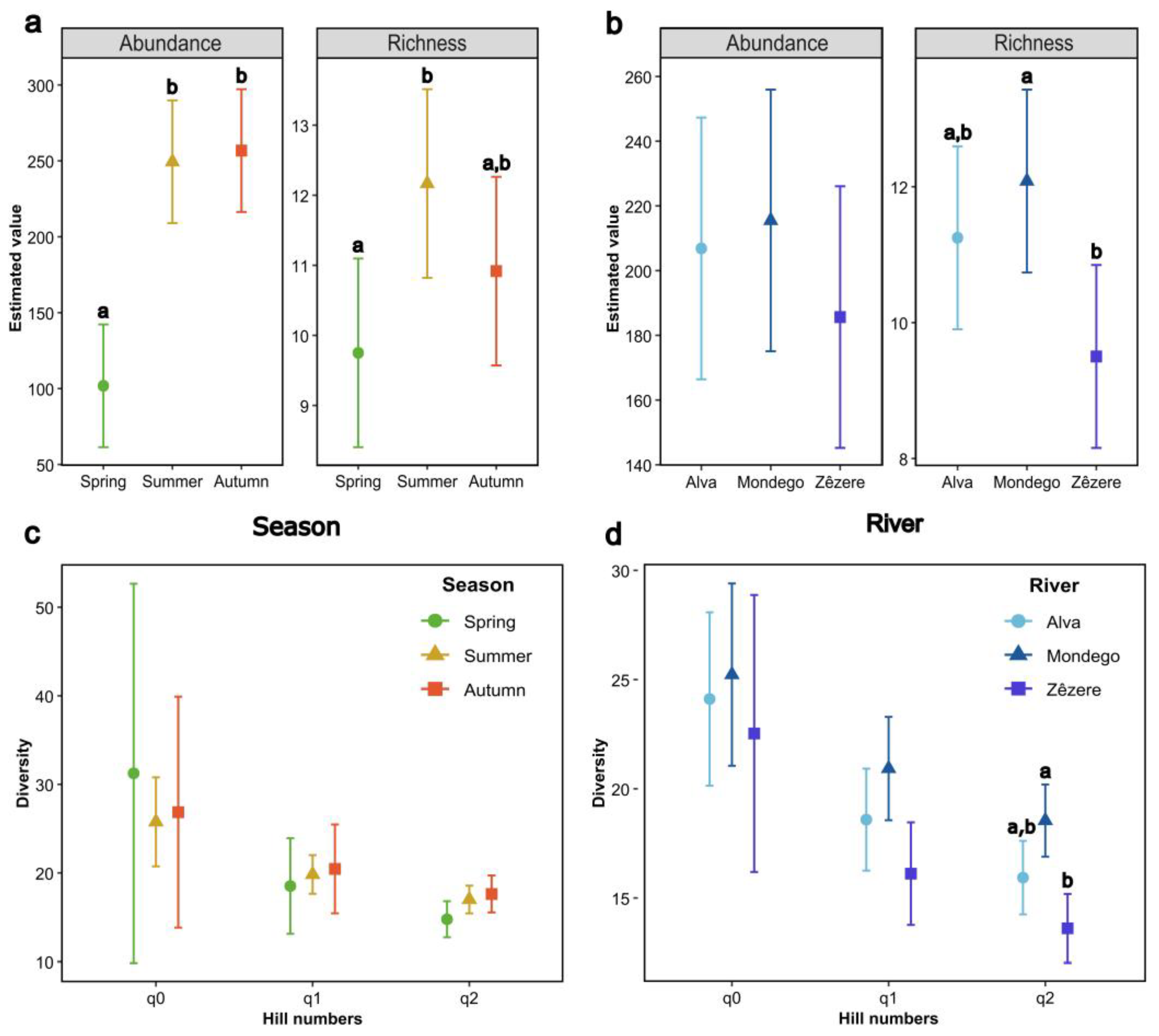
Water mite abundance varied among seasons (F-value = 19.485, p < 0.001), with lower mean abundance (± SD) in spring (102 ± 35 individuals) than summer (249 ± 73; t ratio = −5.271, p < 0.001) and fall (257 ± 83; t ratio = −5.532, p < 0.001). Summer and fall abundance did not differ (Figure 2a). Abundance did not differ among rivers (F-value = 0.602, p = 0.554, Figure 2b) or with elevation (F-value = 0.340, p = 0.564). Genus richness per site varied between rivers (F-value = 3.993, p = 0.029) and among seasons (F-value = 3.362, p = 0.048). Genus richness was higher in the river Mondego (12.1 ± 2.3) than in the Zêzere river (9.5 ± 1.9; t ratio = 2.769, p = 0.025), with intermediate values in the river Alva (11.3 ± 3.0) that did not differ from the other rivers. Genus richness was higher during summer (12.2 ± 1.9) than in spring (9.8 ± 2.0; t ratio = 2.593, p = 0.038), with fall having intermediate values (10.9 ± 3.3). Genus richness did not vary with elevation (F-value = 1.674, p = 0.206).
Total estimated genus richness per season or river, calculated using standardized sample coverage, showed no differences. No differences in diversity indices were found between seasons (Figure 2c). Differences in the Simpson diversity index were detected between the Mondego and Zêzere rivers, with higher diversity in the Mondego (Figure 2d).

3.3. Drivers of Community-Level Patterns

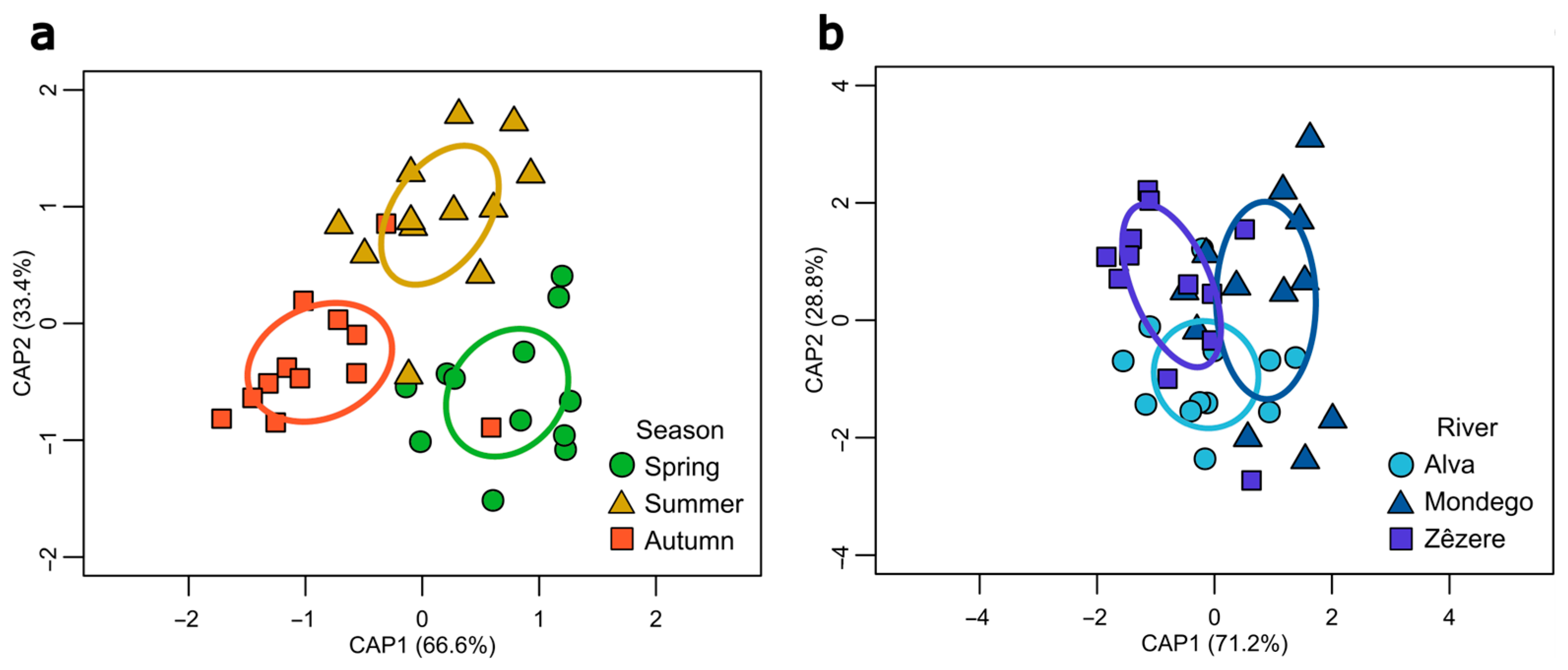
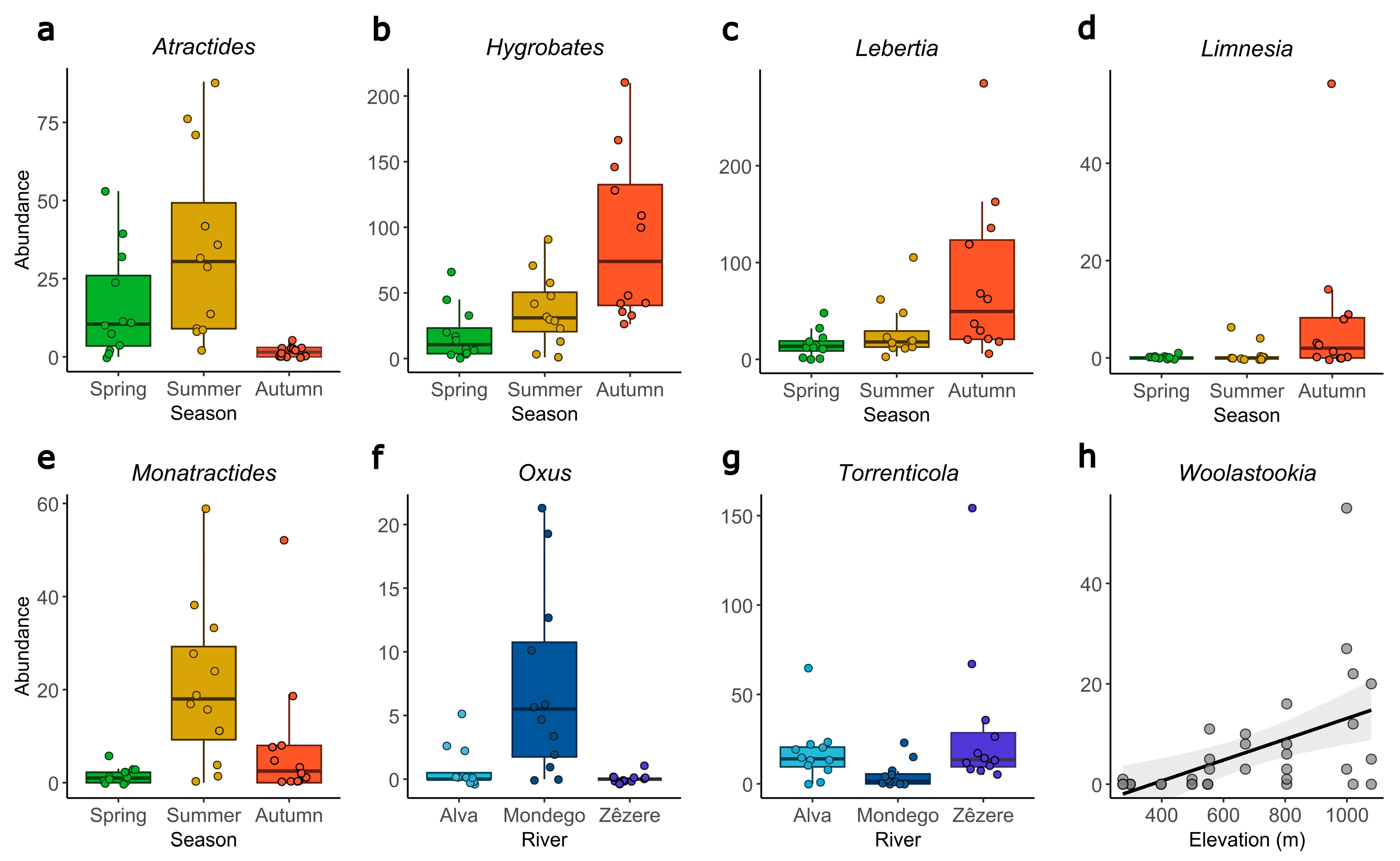
The MGLM indicated that community composition differed more among seasons (Wald = 17.40, p < 0.001) than rivers (Wald = 11.52, p = 0.002) and along the elevational gradient (Wald = 8.711, p = 0.032; Figure 3). The communities in the Zêzere and Mondego were less similar, with the river Alva being intermediate. The observed community-level patterns were driven by a limited subset of genera (Figure 4), with the abundances of Atractides (p = 0.001), Hygrobates (p = 0.021), Lebertia (p = 0.021), Limnesia Koch, 1836 (p = 0.021) and Monatractides K. Viets, 1926 (p = 0.013) varying with season. While Atractides and Monatractides peaked in abundance during summer, dropping sharply in autumn, the other three genera had the highest abundance during autumn. The genera Oxus (p = 0.006) and Torrenticola (p = 0.042) were the only ones to vary between rivers, with the genus Oxus showing a higher abundance in the Mondego, while Torrenticola had the lowest abundance in that same river. The genus Woolastookia Habeeb, 1954 (p = 0.009) was the only one to vary with elevation, showing a positive correlation between its abundance and altitude.

4. Discussion

The present study provides a comprehensive analysis of water mite (Hydrachnidia) communities in the rivers of a Mediterranean Mountain range, examining their spatial and temporal dynamics. Communities vary mostly seasonally, with less variation along spatial factors. The observed changes are mostly driven by a limited number of genera. Likewise, in the water mite communities sampled, a few genera were dominant, with most other genera being represented by a small number of specimens (Table 1). This dominance of a few genera follows the patterns observed in other studies on water mite assemblages in Central Europe [15,16] and in North America [17] and in community ecology in general, e.g., [36].
The seasonal variation in adult specimen abundance and genus richness per site in the studied Mediterranean Serra da Estrela Mountain range aligns with known seasonal patterns for water mites in other temperate climates: higher abundance and diversity during summer and early autumn, when compared to spring [16,17]. Mediterranean climate is known to have more drastic seasonal variations in flow, when compared to other temperate climates [6]. Mediterranean mountain systems, however, may exhibit less extreme variations due to the impact of snowmelt and geography [37], making communities more similar to other temperate climates. The increased abundance and richness observed in summer and autumn are likely related to the water mites’ lifecycle since they are mostly univoltine in temperate regions, with eggs generally hatching in late spring/early summer [14,38]. Additionally, the lower abundance during spring may also result from the emigration of specimens from the shallow river areas to deeper pools or even to the interstitial hyporheic zone during periods of increased flow [15,39,40]. Although previous studies generally report lower abundance during winter, with a peak during summer or early autumn [10,11], potential changes in winter and early spring community dynamics may have gone undetected. Additional sampling covering the full annual cycle would provide a more robust assessment of the seasonal patterns observed in Mediterranean mountain rivers. While seasonal patterns vary between macroinvertebrate taxonomic groups, the observed seasonal patterns match a study on Portuguese macroinvertebrates conducted in the Mondego river basin, one of the basins sampled in the present study, which analyzed 99 invertebrate taxa from over 14 orders [41]. The results of the present study show that, when faced with logistical constraints, sampling efforts in biomonitoring protocols that include water mites as bioindicators should focus on summer and early autumn to best capture peak richness and abundance.
The variation in water mite communities attributed to spatial factors was lower than the variation attributed to seasonal factors. The lower spatial variation could reflect the high connectivity within rivers, as well as the water mites’ parasitic larval stage, which often facilitates high aerial dispersal [40,42]. Furthermore, the close proximity of the studied rivers likely reduces the influence of geographical isolation and broad-scale climatic gradients on community composition. Since the compositional differences found between rivers can be mainly attributed to the genera Oxus and Torrenticola, the pattern is likely driven by the genera’s specific ecological requirements (Figure 4). While most European Oxus species are found typically in standing or slow-moving waters, the genus Torrenticola is associated with fast-flowing waters [25]. Although flow regime was not measured in the present study, the higher abundance of Oxus and the reduced number of Torrenticola specimens in the river Mondego may reflect subtle differences in flow regime in the sampled sites. Water mite community composition was also found to vary with elevation, with the abundance of the genus Woolastookia being positively correlated with elevation (Figure 4). The variation in abundance is consistent with a previous study, which reports Woolastookia from shaded low- to mid-order streams [26], habitats that are typically more common at higher elevations. Regarding the elevational gradient, previous studies on water mites reported more drastic changes in community composition [18,19], likely due to the larger elevational range studied (e.g., 10–3500 m a.s.l.).
Three genera were recorded for the first time in Portugal: Albia Thon, 1899; Hexaxonopsalbia Motaş, 1928 and Wettina Piersig, 1892. All three genera have already been reported from Europe, with Hexaxonopsalbia previously only being known from France and Spain [26]. These findings show that, despite recent studies, e.g., [22,23,24], the water mite fauna of continental Portugal is still underexplored, and the detailed identification of the specimens at the species level will unveil new species in the country or even currently undescribed species.

5. Conclusions

Overall, the results demonstrate that, in the Mediterranean mountain range sampled, water mite community composition varies mostly with seasons, with spatial factors (river and elevation) playing a secondary role. Differences in community composition between rivers and along elevational gradients were driven mainly by a limited number of genera, reflecting the distinct ecological requirements of specialist taxa. The study also contributes to the still limited knowledge of Mediterranean mountain water mite diversity. The detection of three genera previously unrecorded in Portugal further emphasizes the incomplete state of knowledge regarding the country’s water mite fauna and the need for continued taxonomic and ecological research. From a biomonitoring perspective, the results indicate that sampling during summer and early autumn should be prioritized in future water mite biomonitoring programs in Mediterranean mountain rivers, as these seasons maximize the detection of water mite abundance and diversity. Future studies should investigate water mite communities at the species level and across a broader temporal and spatial scale to better understand the abiotic and biotic drivers of community variation in Mediterranean rivers and further evaluate their potential as biomonitoring indicators.

Supplementary Materials

The following supporting information can be downloaded at https://www.mdpi.com/article/10.3390/w18131552/s1: Table S1: Sampling sites along three rivers in Serra da Estrela, Portugal, with information regarding coordinates and elevation. Coordinates are in the WGS 84 geographic coordinate system; Table S2: Abundance of water mite genera per site and season.

Author Contributions

Conceptualization, D.G. and S.F.; methodology, D.G., L.P.d.S. and S.F.; field sampling, D.G. and S.F.; sample processing, D.G. and S.F.; specimen identification, D.G. and V.P.; formal analysis, D.G., L.P.d.S. and S.F.; writing—original draft preparation, D.G., L.P.d.S. and S.F.; writing—review and editing, D.G., L.P.d.S., S.F. and V.P.; supervision, L.P.d.S. and S.F. All authors have read and agreed to the published version of the manuscript.

Funding

The research was partially funded by the the Gulbenkian Foundation “Novos Talentos” fellowship attributed to DG (Grant no. 327324), as well as the Biodiversity Genomics Europe (Grant no. 101059492) that is funded by Horizon Europe under the Biodiversity, Circular Economy and Environment call (REA.B.3); co-funded by the Swiss State Secretariat for Education, Research and Innovation (SERI) under contract number 22.00173 and 24.00054; and by the UK Research and Innovation under the Department for Business, Energy and Industrial Strategy’s Horizon Europe Guarantee Scheme. SF was funded by the FCT through the program ‘Stimulus of Scientific Employment, Individual Support—3rd Edition’ (https://doi.org/10.54499/2020.03526.CEECIND/CP1601/CP1649/CT0007).

Data Availability Statement

The original contributions presented in the study are included in the article/Supplementary Material. Further inquiries can be directed to the corresponding author.

Acknowledgments

The authors would like to acknowledge José Conde, CISE, and Seia Municipality for the logistical support during the fieldwork, and Pedro Faria for the great company during fieldwork, as well as 3 anonymous reviewers for their valuable comments, which helped improve the manuscript.

Conflicts of Interest

The authors declare no conflicts of interest.

References

  1. Reid, A.J.; Carlson, A.K.; Creed, I.F.; Eliason, E.J.; Gell, P.A.; Johnson, P.T.J.; Kidd, K.A.; MacCormack, T.J.; Olden, J.D.; Ormerod, S.J.; et al. Emerging Threats and Persistent Conservation Challenges for Freshwater Biodiversity. Biol. Rev. 2019, 94, 849–873. [Google Scholar] [CrossRef] [PubMed]
  2. Di Sabatino, A.; Smit, H.; Gerecke, R.; Goldschmidt, T.; Matsumoto, N.; Cicolani, B. Global Diversity of Water Mites (Acari, Hydrachnidia; Arachnida) in Freshwater. Hydrobiologia 2008, 595, 303–315. [Google Scholar] [CrossRef]
  3. Bartsch, I.; Davids, K.; Deichsel, R.; Di Sabatino, A.; Gabrys, G.; Gledhill, T.; Jäger, P.; Makol, J.; Smit, H.; Van Der Hammen, H.; et al. Süßwasserfauna von Mitteleuropa, Vol. 7/2-1 Chelicerata: Araneae/Acari I; Gerecke, R., Ed.; Springer: Berlin/Heidelberg, Germany, 2006. [Google Scholar]
  4. Goldschmidt, T. Water Mites (Acari, Hydrachnidia): Powerful but Widely Neglected Bioindicators—A Review. Neotrop. Biodivers. 2016, 2, 12–25. [Google Scholar] [CrossRef]
  5. Hynes, H.B.N. The Ecology of Running Waters, 4th ed.; Liverpool Univ. Press: Liverpool, UK, 1979. [Google Scholar]
  6. Cid, N.; Bonada, N.; Carlson, S.; Grantham, T.; Gasith, A.; Resh, V. High Variability Is a Defining Component of Mediterranean-Climate Rivers and Their Biota. Water 2017, 9, 52. [Google Scholar] [CrossRef]
  7. Dingman, S.L. Physical Hydrology, 3rd ed.; Waveland Press, Inc: Long Grove, IL, USA, 2015. [Google Scholar]
  8. Rosenberg, D.M.; Resh, V.H. Freshwater Biomonitoring and Benthic Macroinvertebrates; Chapman & Hall: New York, NY, USA, 1993. [Google Scholar]
  9. Monk, W.A.; Wood, P.J.; Hannah, D.M.; Wilson, D.A. Macroinvertebrate Community Response to Inter-annual and Regional River Flow Regime Dynamics. River Res. Appl. 2008, 24, 988–1001. [Google Scholar] [CrossRef]
  10. Leigh, C.; Stubbington, R.; Sheldon, F.; Boulton, A.J. Hyporheic Invertebrates as Bioindicators of Ecological Health in Temporary Rivers: A Meta-Analysis. Ecol. Indic. 2013, 32, 62–73. [Google Scholar] [CrossRef]
  11. Fontaine, L.; Pin, L.; Savio, D.; Friberg, N.; Kirschner, A.K.T.; Farnleitner, A.H.; Eiler, A. Bacterial Bioindicators Enable Biological Status Classification along the Continental Danube River. Commun. Biol. 2023, 6, 862. [Google Scholar] [CrossRef] [PubMed]
  12. Rodríguez-Pérez, H.; Pannard, A.; Gorzerino, C.; Pellan, L.; Massé, S.; Bouger, G.; Chorin, M.; Roussel, J.-M.; Piscart, C. Ecological Consequences of Consecutive River Damming for Three Groups of Bioindicators. Ecol. Indic. 2021, 131, 108103. [Google Scholar] [CrossRef]
  13. Jackson, D.A.; Peres-Neto, P.R.; Olden, J.D. What Controls Who Is Where in Freshwater Fish Communities—The Roles of Biotic, Abiotic, and Spatial Factors. Can. J. Fish. Aquat. Sci. 2001, 58, 157–170. [Google Scholar] [CrossRef]
  14. Bader, C. Some Biological and Ecological Data on Water-Mites, Mainly Some Significant Data on the Life-Duration. Int. J. Acarol. 1980, 6, 239–243. [Google Scholar] [CrossRef]
  15. Gerecke, R. The Water Mites (Acari, Hydrachnidia) of a Little Disturbed Forest Stream in Southwest Germany—A Study on Seasonality and Habitat Preference, with Remarks on Diversity Patterns in Different Geographical Areas. In Acarid Phylogeny and Evolution: Adaptation in Mites and Ticks; Springer: Dordrecht, The Netherlands, 2002; pp. 69–89. [Google Scholar]
  16. Meyer, E.I. Species Composition and Seasonal Dynamics of Water Mites (Hydracarina) in a Mountain Stream (Steina, Black Forest, Southern Germany). Hydrobiologia 1994, 288, 107–117. [Google Scholar] [CrossRef]
  17. Stenger, L.R.; Ferguson, F.M.; Skvarla, M.J. Seasonal Patterns of Lotic Water Mite Assemblages. Acarologia 2025, 65, 917–926. [Google Scholar] [CrossRef]
  18. Goldschmidt, T. The Water Mite Genus Torrenticola (Hydrachnidia: Torrenticolidae) in Costa Rica—Ecology, Diversity, and Bioindicator Potential. In Trends in Acarology; Sabelis, M.W., Bruin, J., Eds.; Springer: Dordrecht, The Netherlands, 2010; pp. 185–191. [Google Scholar]
  19. Sabatino, A.D.; Boggero, A.; Miccoli, F.P.; Cicolani, B. Diversity, Distribution and Ecology of Water Mites (Acari: Hydrachnidia and Halacaridae) in High Alpine Lakes (Central Alps, Italy). Exp. Appl. Acarol. 2004, 34, 199–210. [Google Scholar] [CrossRef] [PubMed]
  20. Conde, J.; Boieiro, M.; Soares, A.; Silva, A.; Fonseca, A.; Rego, C.; Aguiar, C.A.S.; Figueiredo, H.; Antunes, S.; Correia, T.; et al. As Lagoas da Serra da Estrela; CISE—Município de Seia: Seia, Portugal, 2025. [Google Scholar]
  21. Jansen, J. Guia Geobotânico da Serra da Estrela; Instituto da Conservação da Natureza: Lisboa, Portugal, 2002. [Google Scholar]
  22. Pešić, V.; Konopleva, E.S.; Iannucci, A.; Ferreira, S.; Stur, E. Molecular Phylogeny Reveals Three New Water Mite Species of the Genus Teutonia Koenike, 1889, from Portugal (Acari, Hydrachnidia, Teutoniidae). Syst. Appl. Acarol. 2025, 30, 381–401. [Google Scholar] [CrossRef]
  23. Pešić, V.; Zawal, A.; Ferreira, S.; Benitez-Bosco, L.; Cruz-Oliveira, A.; Girão, D.; Padilha, A.; Turaccio, P.; Rossini, S.; Ballini, L.; et al. DNA Barcode Library of Portuguese Water Mites, with the Descriptions of Two New Species (Acari, Hydrachnidia). ZooKeys 2024, 1217, 119–171. [Google Scholar] [CrossRef] [PubMed]
  24. Pešić, V.; Konopleva, E.S.; Girão, D.; Vergata, C.; Sousa, L.G.; Ferreira, S. Molecular Phylogeny Reveals a New Species of the Hygrobates longipalpis complex from Portugal (Acariformes, Hydrachnidia, Hygrobatidae). Ecol. Montenegrina 2026, 94, 84–97. [Google Scholar] [CrossRef]
  25. Di Sabatino, A.; Schwoerbel, J. Süßwasserfauna von Mitteleuropa, Bd. 7/2-2 Chelicerata: Acari II; Schwoerbel, J., Gerecke, R., Eds.; Süßwasserfauna von Mitteleuropa; Spektrum Akad. Verl: Heidelberg, Germany, 2010. [Google Scholar]
  26. Gerecke, R.; Gledhill, T.; Pešić, V.; Smit, H. Süßwasserfauna von Mitteleuropa, Bd. 7/2-3 Chelicerata: Acari III; Springer: Berlin/Heidelberg, Germany, 2016. [Google Scholar]
  27. R Core Team. R: A Language and Environment for Statistical Computing. 2024. Available online: https://www.scirp.org/reference/referencespapers?referenceid=3887298 (accessed on 14 April 2026).
  28. Wickham, H. Ggplot2: Elegant Graphics for Data Analysis 2016; Springer: Berlin/Heidelberg, Germany, 2016. [Google Scholar]
  29. Hartig, F. DHARMa: Residual Diagnostics for Hierarchical (Multi-Level/Mixed) Regression Models. 2026. Available online: https://cran.r-project.org/web/packages/DHARMa/vignettes/DHARMa.html (accessed on 14 April 2026).
  30. Fox, J.; Weisberg, S. An R Companion to Applied Regression 2019; SAGE Publications, Inc: New York, NY, USA, 2018. [Google Scholar]
  31. Lenth, R.V. Emmeans: Estimated Marginal Means, Aka Least-Squares Means. 2026. Available online: https://cran.r-project.org/web/packages/emmeans/index.html (accessed on 14 April 2026).
  32. Hsieh, T.C.; Ma, K.H.; Chao, A. iNEXT: iNterpolation and EXTrapolation for Species Diversity. 2026. Available online: https://cran.r-project.org/web/packages/iNEXT/iNEXT.pdf (accessed on 14 April 2026).
  33. Chao, A.; Gotelli, N.J.; Hsieh, T.C.; Sander, E.L.; Ma, K.H.; Colwell, R.K.; Ellison, A.M. Rarefaction and Extrapolation with Hill Numbers: A Framework for Sampling and Estimation in Species Diversity Studies. Ecol. Monogr. 2014, 84, 45–67. [Google Scholar] [CrossRef]
  34. Wang, Y.; Naumann, U.; Eddelbuettel, D.; Wilshire, J.; Warton, D. Mvabund: Statistical Methods for Analysing Multivariate Abundance Data. 2025. Available online: https://cran.r-project.org/web/packages/mvabund/index.html (accessed on 14 April 2026).
  35. Oksanen, J.; Simpson, G.; Blanchet, F.; Kindt, R.; Legendre, P.; Minchin, P.; O’Hara, R.; Solymos, P.; Stevens, M.; Szoecs, E.; et al. Vegan: Community Ecology Package. 2026. Available online: https://cran.r-project.org/web/packages/vegan/vegan.pdf (accessed on 14 April 2026).
  36. Fisher, R.A.; Corbet, A.S.; Williams, C.B. The Relation Between the Number of Species and the Number of Individuals in a Random Sample of an Animal Population. J. Anim. Ecol. 1943, 12, 42–58. [Google Scholar] [CrossRef] [PubMed]
  37. Fayad, A.; Gascoin, S.; Faour, G.; López-Moreno, J.I.; Drapeau, L.; Page, M.L.; Escadafal, R. Snow Hydrology in Mediterranean Mountain Regions: A Review. J. Hydrol. 2017, 551, 374–396. [Google Scholar] [CrossRef]
  38. Proctor, H.C.; Smith, I.M.; Cook, D.R.; Smith, B.P. Subphylum Chelicerata, Class Arachnida. In Thorp and Covich’s Freshwater Invertebrates; Elsevier: Amsterdam, The Netherlands, 2015; pp. 599–660. [Google Scholar]
  39. Williams, D.D.; Hynes, H.B.N. The Occurrence of Benthos Deep in the Substratum of a Stream. Freshw. Biol. 1974, 4, 233–256. [Google Scholar] [CrossRef]
  40. Boulton, A.J.; Harvey, M.S. Effects of a Simulated Spate on Water Mites in the Hyporheic Zone of an Australian Subtropical River. In An Acarological Tribute to David R. Cook (From Yankee Springs to Wheeny Creek): Celebrating Dave’s 80th Year and his Contributions to Over Half a Century of Advancement in Water Mite Systematics; Indira Publishing House: West Bloomfield, MI, USA, 2003; pp. 57–73. [Google Scholar]
  41. Chaves, M.L.C. Regional and Local Environmental Factors Structuring Undisturbed Benthic Macroinvertebrate Communities in the Mondego River Basin, Portugal. Arch. Hydrobiol. 2005, 163, 497–523. [Google Scholar] [CrossRef]
  42. Tonkin, J.D.; Altermatt, F.; Finn, D.S.; Heino, J.; Olden, J.D.; Pauls, S.U.; Lytle, D.A. The Role of Dispersal in River Network Metacommunities: Patterns, Processes, and Pathways. Freshw. Biol. 2018, 63, 141–163. [Google Scholar] [CrossRef]
Figure 1. Location and distribution of the 12 water mite sampling sites (circles) in Serra da Estrela Mountain range (Table S1) in Portugal. The coordinates are in the EPSG:4326–WGS 84 coordinate reference system.
Water 18 01552 g001
Figure 2. Diversity patterns across seasons and rivers. (a,b) Site-level means (± 95% CI) for genus richness and abundance estimated from linear models by season (a) and river (b). (c,d) Estimated total genus diversity (Hill numbers) standardized to sample coverage by season (c) and river (d). Hill numbers include q = 0 (species richness), q = 1 (Shannon diversity), and q = 2 (Simpson diversity). Error bars represent 95% confidence intervals and different letters (a and b) on top of each error bar indicate significant differences among groups. For panels (a,b), significance was determined by Tukey-adjusted pairwise comparisons of estimated marginal means, whereas for panels (c,d), differences were inferred from non-overlap of 95% confidence intervals.
Water 18 01552 g002
Figure 3. Constrained Analysis of Principal Coordinates (CAP) based on Bray–Curtis dissimilarity and with standard deviation ellipses to illustrate group separation. (a) Water mite community composition differed among seasons. (b) Community composition showed weaker differences among rivers.
Water 18 01552 g003
Figure 4. Genus-specific abundance patterns for the eight water mite taxa exhibiting statistically significant (p < 0.05) univariate responses to season, river or elevation in multivariate generalised linear models. (ae) Seasonal variation in Atractides, Hygrobates, Lebertia, Limnesia and Monatractides. (f,g) Variation in the genus Oxus and Torrenticola between rivers. (h) Relation between Woolastookia abundance and elevation. Boxplots show median (central line), interquartile range (box), and whiskers (±1.5 × IQR). In (h), points are observations while the line shows the linear model fit, and the shaded area represents the 95% confidence interval.
Water 18 01552 g004
Table 1. List of adult water mite genera collected in the study, with references to total and relative abundance.
FamilyGenusTotal AbundanceRelative Abundance (%)
ArrenuridaeArrenurus110.15
AturidaeAlbia *30.04
Aturus60.08
Barbaxonella40.05
Brachypodopsis10.01
Hexaxonopsalbia *20.03
Hexaxonopsis10.01
Ljania50.07
Woolastokia2203.02
HydrodromidaeHydrodroma570.78
HydryphantidaePanisus30.04
Protzia340.47
HygrobatidaeAtractides6308.63
Hygrobates174523.92
LebertiidaeLebertia149920.55
LimnesiidaeLimnesia1051.44
LimnocharidaeLimnochares70.10
MideopsidaeMideopsis124517.06
MomoniidaeMomonia480.66
OxidaeOxus971.33
PionidaeForelia360.49
Nautarachna10.01
Piona30.04
Tiphys50.07
SperchontidaeSperchon1872.56
Sperchonopsis40.05
TeutoniidaeLimnolegeria390.53
Teutonia2092.86
TorrenticolidaeMonatractides3675.03
Torrenticola6368.72
UnionicolidaeNeumania520.71
Unionicola200.27
WettinidaeWettina *140.19
Total337296100
Note: Genera marked with * are reported for the first time in Portugal.
Disclaimer/Publisher’s Note: The statements, opinions and data contained in all publications are solely those of the individual author(s) and contributor(s) and not of MDPI and/or the editor(s). MDPI and/or the editor(s) disclaim responsibility for any injury to people or property resulting from any ideas, methods, instructions or products referred to in the content.