Deposition Patterns and Sediment Reduction Strategies in a Large-Scale Water Diversion Channel: A One-Dimensional Modeling Study of the Shigu Water Source Project on the Jinsha River
Abstract
1. Introduction
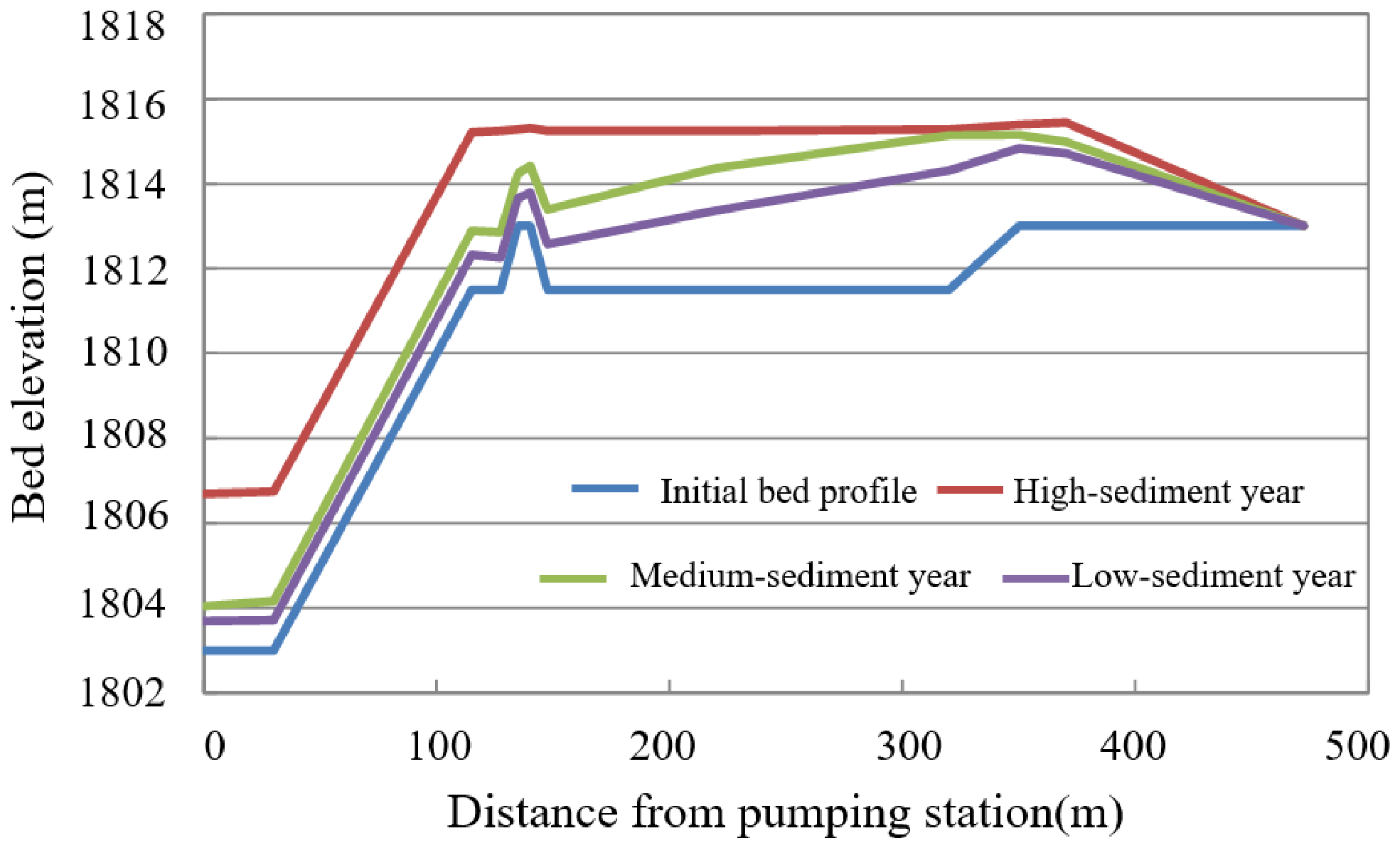
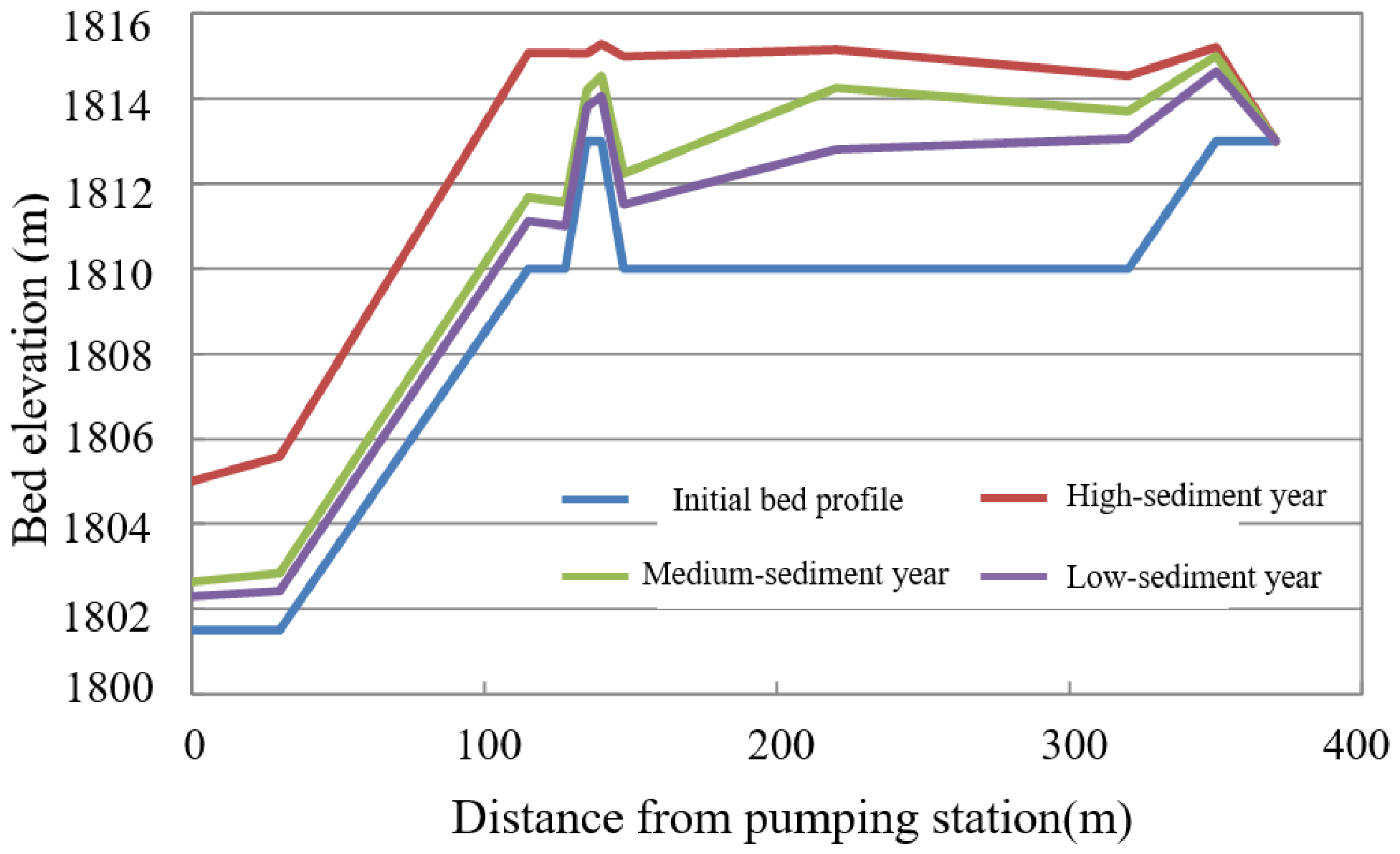
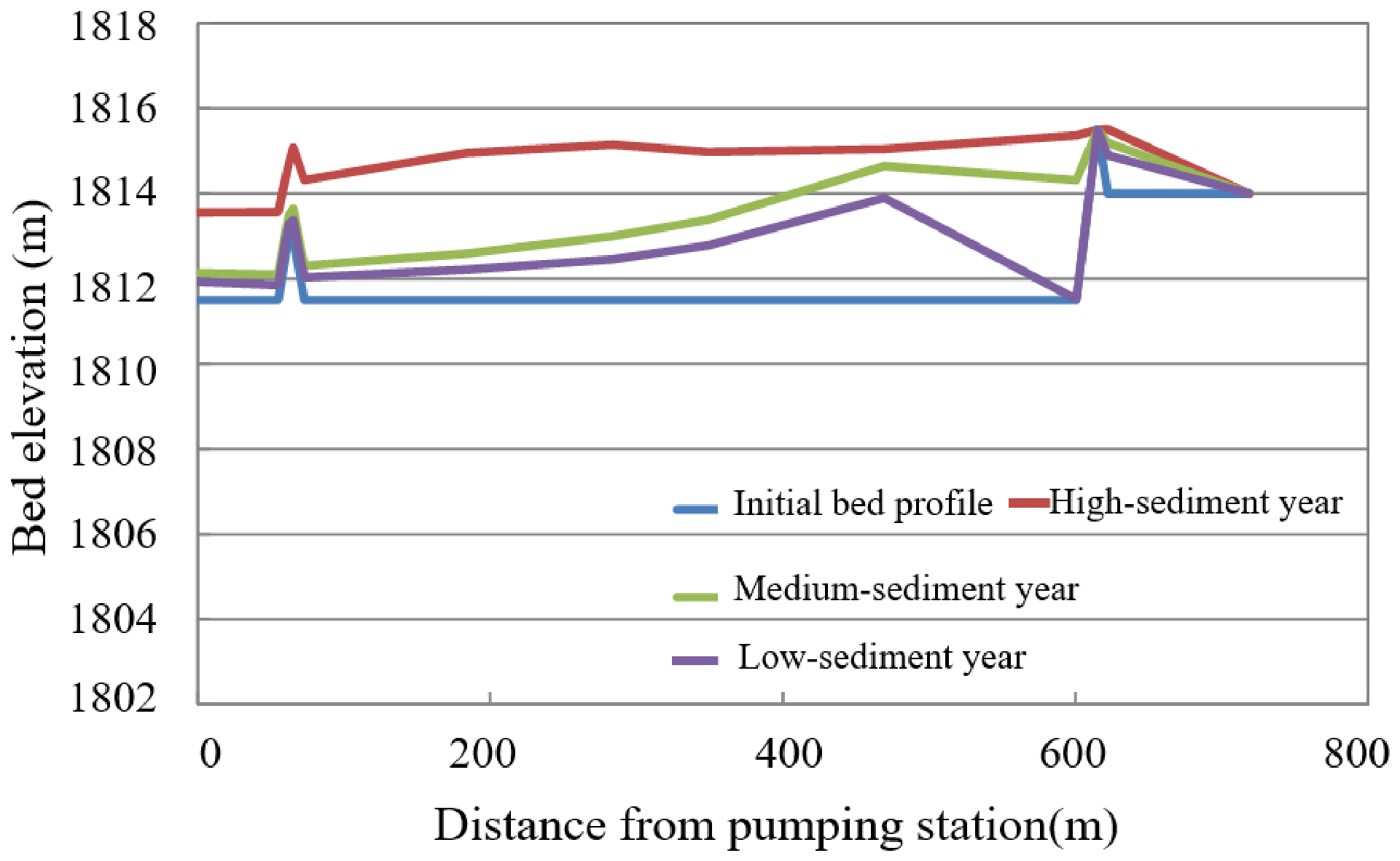
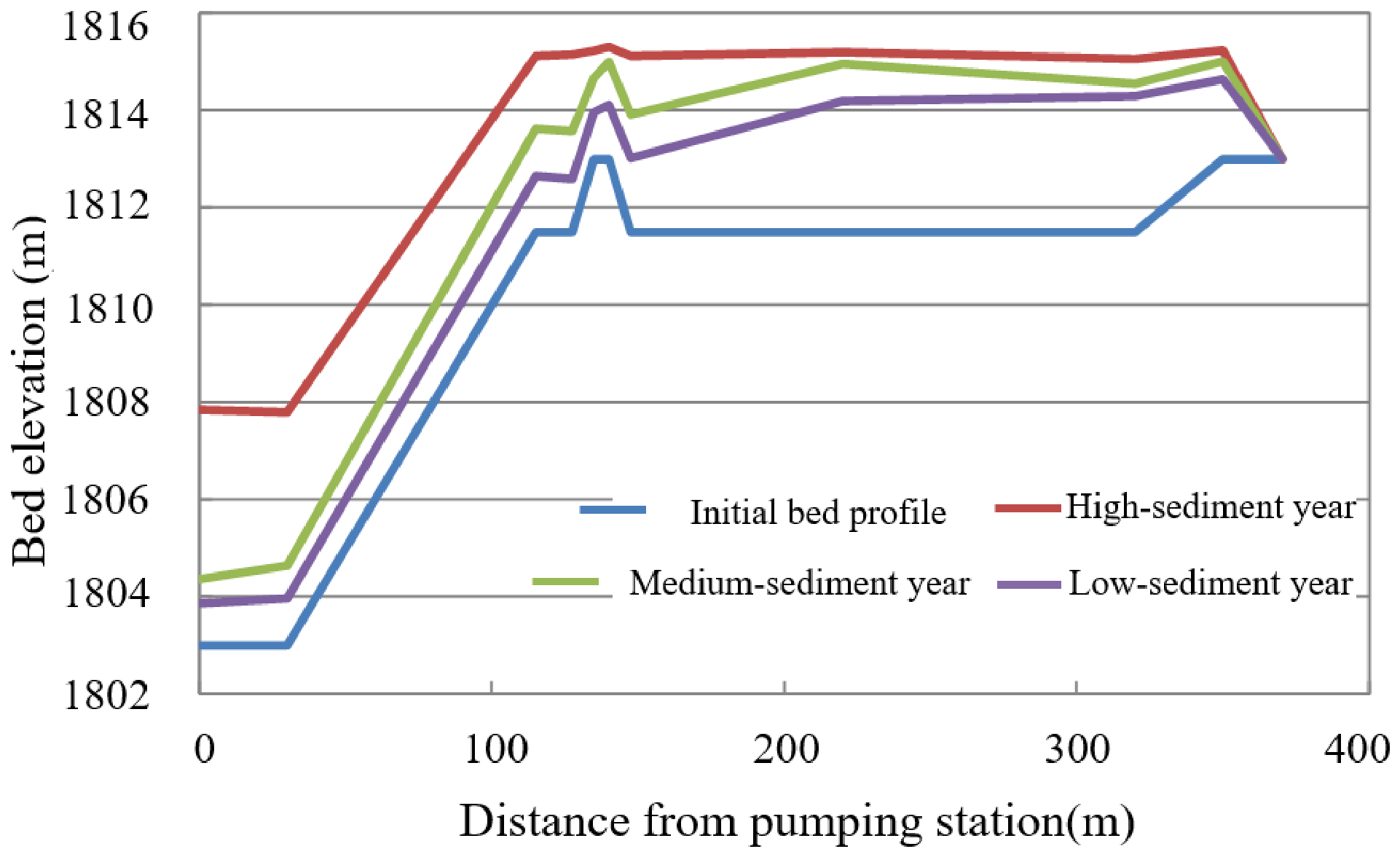
- Characterize sedimentation patterns by systematically analyzing the grain size distribution of deposited sediment under multiple scenarios, thereby identifying the dominant particle size fraction accumulating in front of the pumping station.
- Quantify the individual and combined effects of dredging and channel length optimization on sediment control, providing a scenario-based assessment of their effectiveness under contrasting hydrological conditions.
- Identify and quantify the trade-off between total sediment deposition and water quality intake, thereby offering a rational basis for optimizing channel design.
2. One-Dimensional Total-Load Mathematical Model
2.1. Model Governing Equations and Numerical Solution
- Calculate the water surface profile to determine hydraulic parameters at each cross-section.
- Compute the deposition or erosion amounts for sediment of different particle size groups within each river reach.
- Update the geometric configuration of the corresponding cross-sections based on the deposition or erosion results.
2.2. Model Calibration and Validation
3. Case Study Description


4. Calculation Conditions and Scenarios
4.1. Calculation Area and Cross-Section Configuration
4.2. Selection of Typical Years for Sediment Deposition Calculation
4.3. Calculation Schemes
5. Results
5.1. Overview of Sediment Deposition Patterns
5.2. Effect of Dredging
5.3. Effect of Channel Length on Deposition
5.4. Synthesis of Key Findings
6. Discussion
6.1. Mechanisms Controlling Fine Sediment Deposition
6.2. Hydrological Influence on Dredging Effectiveness
6.3. Understanding the Channel Length–Sedimentation Trade-Off
6.4. Implications for Sediment Management in Large-Scale Water Diversion Projects
6.5. Methodological Value of Multi-Scenario Analysis
6.6. Limitations and Future Directions
7. Conclusions
- Sediment characteristics: Sediment deposited in front of the pumping station is predominantly fine (grain size smaller than 0.05 mm), accounting for over 95% of the total deposition mass under all simulated scenarios. This finding indicates that conventional desilting basins, designed primarily for coarse particle settling, are insufficient for complete sediment removal. Complementary fine-sediment control measures (e.g., coagulant-assisted sedimentation or ecological buffer zones) are therefore necessary.
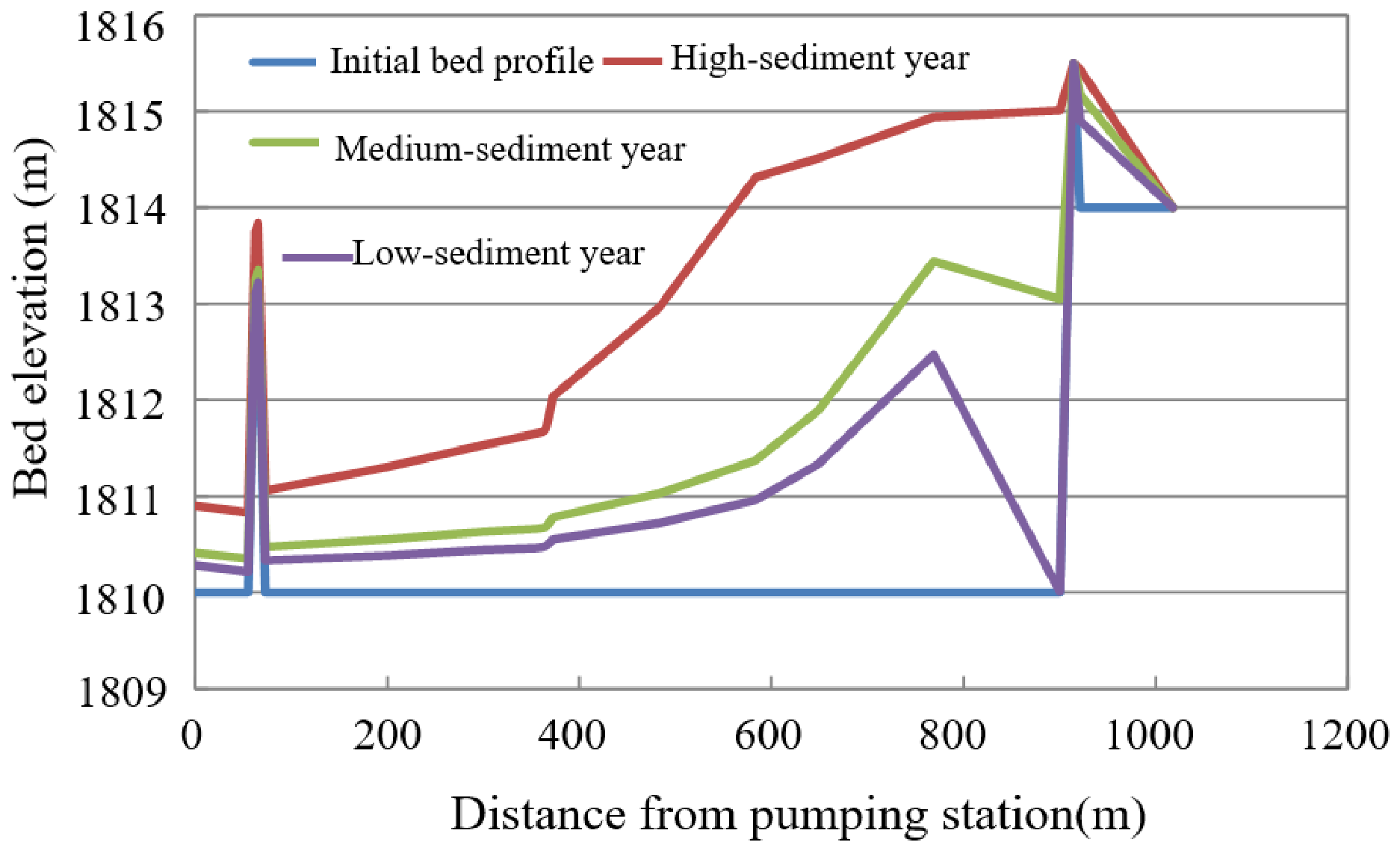
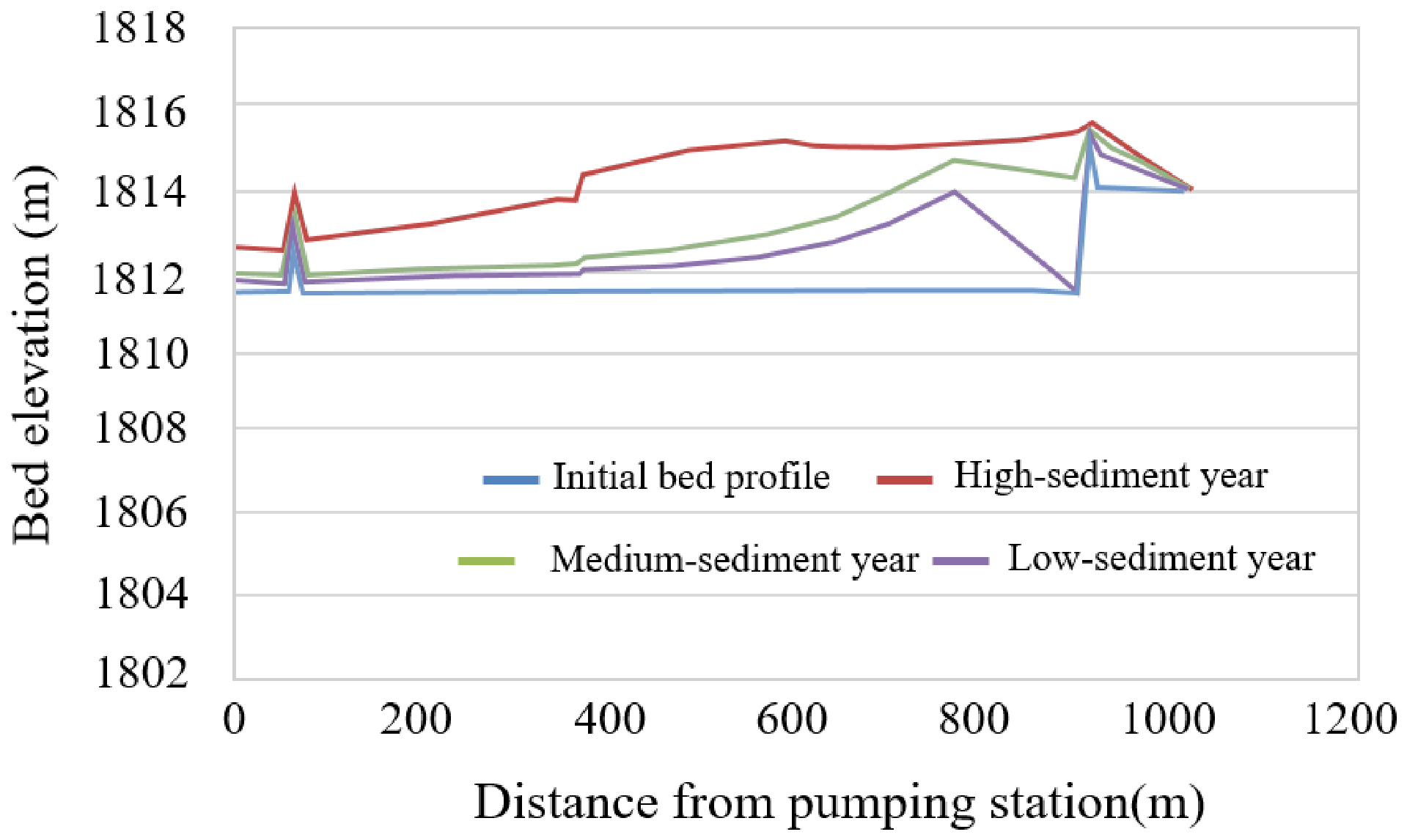
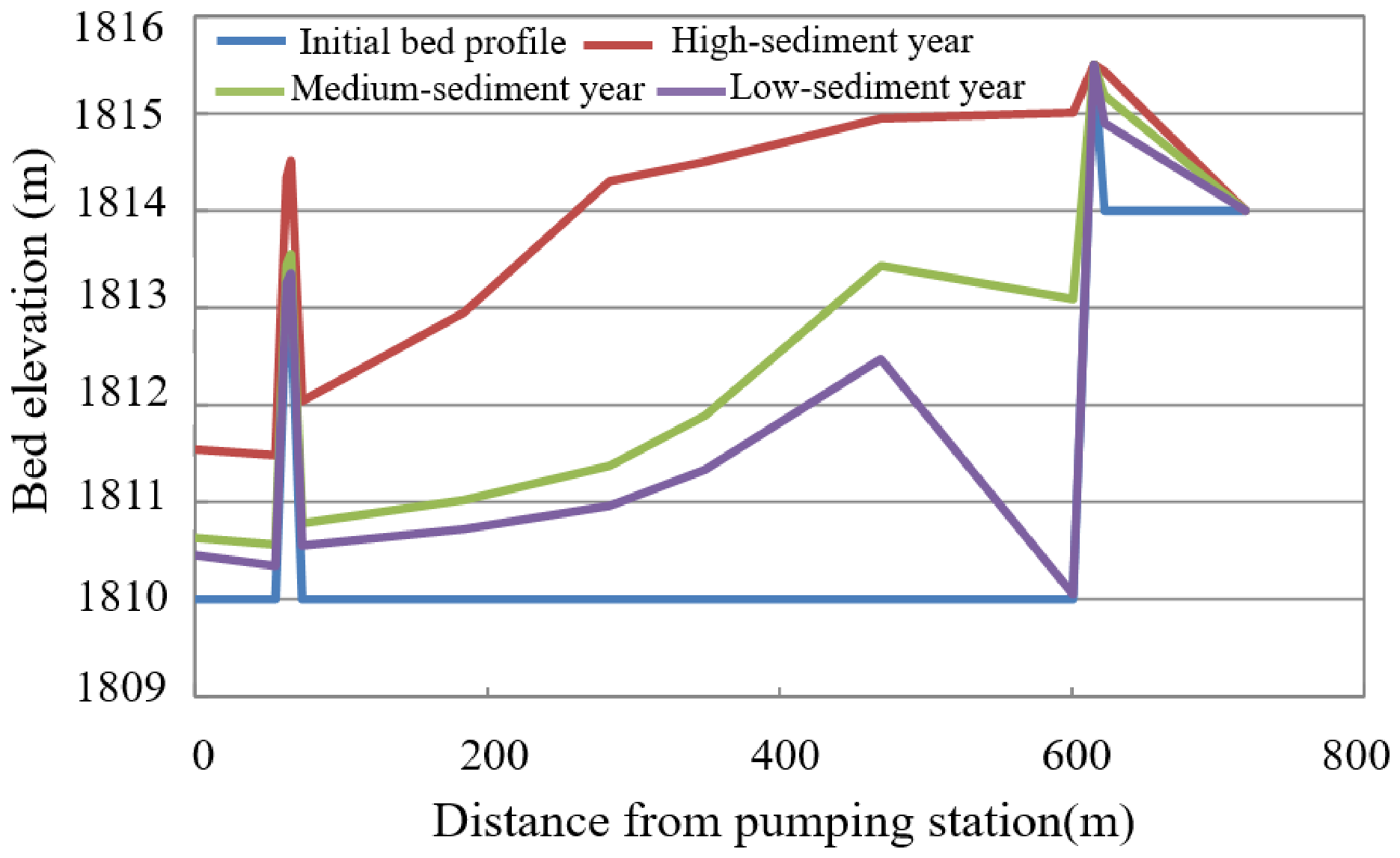
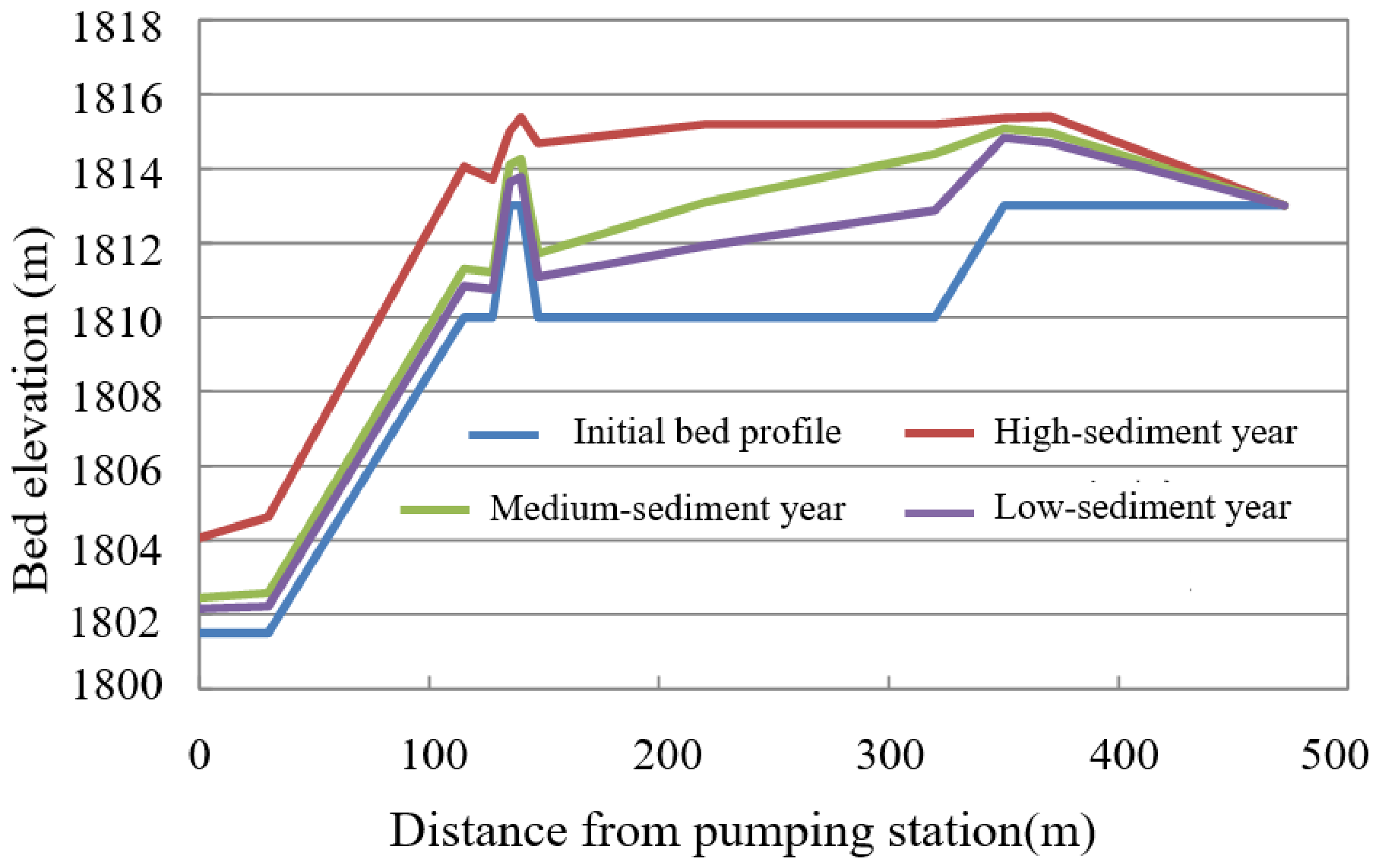
- Effectiveness of dredging: Dredging improves sediment trapping efficiency, but the magnitude of its effectiveness varies by hydrological scenario. Quantitatively, under the first-stage long-channel configuration in a high-sediment year, dredging reduced the deposition thickness at the pump intake from 1.04 m to 0.90 m (a 13.5% reduction). Under the short-channel configuration, reduction was more pronounced: from 2.06 m to 1.54 m (a 25.2% reduction). The most pronounced benefits occur in high-sediment years, while the effect in medium- and low-sediment years is relatively modest. These quantitative, scenario-specific findings provide a basis for prioritizing dredging operations following high-sediment flood events.
- Trade-off in channel length: The trade-off between channel length and sedimentation is quantified in this study. Under the first-stage desilting basin in a high-sediment year, the long channel (Scheme I) increased total deposition volume by 13.2% and reduced the mean sediment concentration at the pump intake by 5.3% (from 0.38 kg/m3 to 0.36 kg/m3) compared to the short channel (Scheme III). Notably, the short channel exhibited a 71% greater deposition thickness at the pump intake (1.54 m vs. 0.90 m). These quantitative ratios—rather than the expected direction of the trade-off—represent the main contribution, as they provide a basis for optimizing channel length based on project-specific priorities.
- Methodological contribution and transferability: The integrated modeling-assessment framework developed in this study combines a one-dimensional sediment transport model with a multi-scenario design that systematically varies channel length, dredging condition, and hydrological year. This design enables the individual effects of channel length and dredging to be isolated and quantified (Table 4a,b), revealing trade-offs that single-scenario simulations cannot capture. The framework thus provides a reference for optimizing channel design and sediment management in large-scale water diversion projects.
Author Contributions
Funding
Data Availability Statement
Conflicts of Interest
References
- Wang, Y.S.; Zhou, Z.W.; Li, Z.J.; Li, D.Z.; Jin, Z.W. Experimental study on water diversion and sediment control at water intake hub of Central Yunnan Water Diversion Project. J. Change River Sci. Res. Inst. 2025, 42, 188–197. (In Chinese) [Google Scholar]
- Garcia, M.H. Sedimentation Engineering: Processes, Measurements, Modeling, and Practice; ASCE Manuals and Reports on Engineering Practice No. 110; American Society of Civil Engineers: Reston, VA, USA, 2008. [Google Scholar]
- Julien, P.Y. Erosion and Sedimentation, 2nd ed.; Cambridge University Press: Cambridge, UK, 2010. [Google Scholar]
- Wu, W. Computational River Dynamics; Taylor & Francis: London, UK, 2007. [Google Scholar]
- Termini, D. Experimental observations of flow and bed processes in large-amplitude meandering flume. J. Hydraul. Eng. 2009, 135, 575–587. [Google Scholar] [CrossRef]
- Lin, J.T.-Y.; Lacunza, E.; Fernández, R.; García, M.H.; Rhoads, B.; Best, J.; Leroy, J.Z.; Parker, G. Hydrodynamic processes of incipient meander chute cutoffs: Laboratory experiments with implications for morphodynamics and depth-averaged modeling. Water Resour. Res. 2025, 61, e2024WR038502. [Google Scholar]
- Alomari, N.K.; Yusuf, B.; Mohammad, T.A.; Ghazali, A.H. Influence of diversion angle on water and sediment flow into diversion channel. CATENA 2020, 192, 104593. [Google Scholar]
- Wang, H.; Xu, D.; Tang, H. Numerical and experimental investigation on vortex control and sedimentation suppression in a Y-shaped diversion channel with circular inlet tanks. Eng. Appl. Comput. Fluid Mech. 2024, 18, 2380295. [Google Scholar] [CrossRef]
- Kondolf, G.M.; Gao, Y.; Annandale, G.W.; Morris, G.L.; Jiang, E.; Zhang, J.; Cao, Y.; Carling, P.; Fu, K.; Guo, Q. Sustainable sediment management in reservoirs and regulated rivers: Experiences from five continents. Earth’s Future 2014, 2, 256–280. [Google Scholar] [CrossRef]
- Vörösmarty, C.J.; Meybeck, M.; Fekete, B.; Sharma, K.; Green, P.; Syvitski, J.P.M. Anthropogenic sediment retention: Major global impact from registered river impoundments. Global Planet. Change 2003, 39, 169–190. [Google Scholar] [CrossRef]
- Yang, H.F.; Yang, S.L.; Xu, K.H.; Milliman, J.D.; Wang, H.; Yang, Z.; Chen, Z.; Zhang, C.Y. Human impacts on sediment in the Yangtze River: A review and new perspectives. Global Planet. Change 2018, 162, 8–17. [Google Scholar] [CrossRef]
- Lu, X.X.; Siew, R.Y. Water discharge and sediment flux changes over the past decades in the Lower Mekong River: Possible impacts of the Chinese dams. Hydrol. Earth Syst. Sci. 2006, 10, 181–195. [Google Scholar] [CrossRef]
- Liu, J.; Zheng, H.; Shen, Y.; Xing, B.; Wang, X. Variation in sediment sources and the response of suspended sediment grain size in the upper Changjiang River Basin following the large dam constructions. Sci. Total Environ. 2024, 904, 166869. [Google Scholar]
- Zhao, W.Z. Analysis of water-sediment evolution characteristics after adding a sediment sluice gate at the canal head of a certain project. Water Conserv. Technol. Superv. 2022, 2, 228–232. (In Chinese) [Google Scholar]
- Yuan, Y.; Cui, Z.F.; Huang, R.Y.; Ling, J.P.; Li, B.H. Numerical Simulation Study on Sediment Erosion and Deposition in Shengzhong Reservoir and Its Water Intake of the Western Chongqing Water Resources Allocation Project. Water Resour. Plan. Des. 2026, 10, 36–45. (In Chinese) [Google Scholar]
- Ma, Z.Z.; Gao, P.; Wang, C.X. Study on sediment deposition in the approach channel of Sheling Pumping Station. Northeast. Water Resour. Hydropower 2025, 1, 60–63. (In Chinese) [Google Scholar]
- Xin, H.; He, X.; Xing, J.H. Thoughts and measures on channel sedimentation in the Zhengzhou Yellow River Irrigation District. Yellow River 2022, 44, 60–63. (In Chinese) [Google Scholar]
- Chen, C.; Yang, W.; Wang, Z.; Huangfu, K.; Cai, F.; Chen, H.; Chen, Y. Study on characteristics of the water diversion ratio and impact of the diversion dyke at south and north ports of the Minjiang River during wet season. Water 2025, 17, 1183. [Google Scholar] [CrossRef]
- Xu, M.; Chen, L.; Wu, Q.; Li, D. Morph- and hydro-dynamic effects toward flood conveyance and navigation of diversion channel. Int. J. Sediment Res. 2016, 31, 169–175. [Google Scholar]
- Zhao, S.K.; Yang, L.L.; Zhou, S.; Liu, Y. Influence of multi-stage filtration settling basin on sedimentation efficiency of high-concentration fine-grained sediment. Water Sav. Irrig. 2025, 5, 34–38. (In Chinese) [Google Scholar]
- Meng, L.; Zhang, W.; Li, H. Influence of guide wall on hydraulic characteristics of forebay in irrigation pumping station junction. Water Conserv. Sci. Cold Reg. Eng. 2025, 8, 118–122. (In Chinese) [Google Scholar]
- Zhao, W.Z. Analysis on water and sediment evolution characteristics after adding sand sluicing gate at the headwork of a project. Tech. Superv. Water Resour. 2022, 2, 228–231. (In Chinese) [Google Scholar]
- Quadroni, S.; Stradiotti, G.; Servanzi, L.; Crosa, G.; Espa, P.; Pisaturo, G.R.; Imbalzano, G.; Righetti, M.; Talluto, N.; Doretto, A. An overview of controlled sediment flushing operations: Perception, issues and management strategies across the European Alps. J. Hydrol. Reg. Stud. 2025, 60, 102570. [Google Scholar] [CrossRef]
- Brandt, S.A. Classification of geomorphological effects downstream of dams. Catena 2000, 40, 375–401. [Google Scholar] [CrossRef]
- Walling, D.E. Human impact on land–ocean sediment transfer by the world’s rivers. Geomorphology 2006, 79, 192–216. [Google Scholar] [CrossRef]
- Borrelli, P.; Robinson, D.A.; Fleischer, L.R.; Lugato, E.; Ballabio, C.; Alewell, C.; Meusburger, K.; Modugno, S.; Schütt, B.; Ferro, V. An assessment of the global impact of 21st century land use change on soil erosion. Nat. Commun. 2017, 8, 2013. [Google Scholar] [CrossRef] [PubMed]
- Palermo, M.; Roy, D.; Pagliara, S. Morphological characteristics of eco-friendly protected basins downstream of block ramps in river bends. Geomorphology 2021, 377, 107587. [Google Scholar] [CrossRef]
- Meng, F.; Xiang, L.; Zhu, J.; Lv, H.; Jiang, C. Sediment-flushing equilibrium downstream of tide gates in a coastal region: Findings from a 36-day prototype water-diversion experiment. J. Hydrol. Reg. Stud. 2025, 60, 102472. [Google Scholar] [CrossRef]
- Li, P.; Li, G.; Guo, L.; Shi, D. A study on sediment avoidance diversion and the coordinated dispatch of water and sediment at an injection-water supply project on a sediment-laden river. Eng. Appl. Comput. Fluid Mech. 2021, 15, 530–548. [Google Scholar]
- Zhang, R.; Wu, B. Environmental impacts of high water turbidity of the Niulan River to Dianchi Lake Water Diversion Project. J. Environ. Eng. 2020, 146, 05019006. [Google Scholar] [CrossRef]
- Koffi, B.; Kouakou, K.E.; Brou, A.L.; Sanchez, M.; Blaise, O.G.; Coulibaly, B.W.; Akaffou, F.H.; Habel, M.; Kouassi, A.M.; Brou, D.; et al. Assessment of the sedimentation and trapping efficiency in dam reservoirs by applying the settling basin framework. J. Hydrol. Reg. Stud. 2025, 57, 102172. [Google Scholar] [CrossRef]
- Chen, Z.; Zhu, B.; Zhang, S.; Han, R.; Bai, J.; Lin, J.; Liu, Y.; Wang, B. A multiple-interdependency risk assessment model with time-varying reasoning capabilities for long-distance water diversion projects. J. Hydrol. 2026, 669, 135110. [Google Scholar]
- Xu, C.; Tian, J.; Wang, G.; Lian, H.; Wang, R.; Hu, X. Numerical analysis of water-sediment flow fields within the intake structure of pumping station under different hydraulic conditions. Water 2024, 16, 779. [Google Scholar]
- Jin, Z.; Lu, J.; Yao, S. Verification on formulas of bed-load sediment transport rate at the upstream of Yangtze River. Shuili Xuebao 2009, 40, 1299–1306. (In Chinese) [Google Scholar]
- Lu, J.Y.; Huang, Y. Comparison of sedimentation in Three Gorges Reservoir between calculated prediction and prototype measurement. J. Yangtze River Sci. Res. Inst. 2013, 30, 1–6. (In Chinese) [Google Scholar]
- Lin, Q.S.; Wan, J.R.; Huang, L. Calculation and analysis of sediment deposition in Baihetan Reservoir on Jinsha River. Yangtze River 2009, 40, 1–3+7. (In Chinese) [Google Scholar]
- Wan, J.R.; Gong, P. Study on sediment deposition of Tingzikou Reservoir on Jialing River. Yangtze River 2006, 37, 47–48+52. (In Chinese) [Google Scholar]
- SL/T269-2019; Design Specification for Desilting Basins of Water and Hydropower Projects. China Water & Power Press: Beijing, China, 2019. (In Chinese)
- Liu, J.; Zhang, W.W.; Shen, Y.; Wang, X. Dramatic sediment load changes and sedimentation characteristics upstream of the Three Gorges Dam due to the large reservoirs construction. Front. Earth Sci. 2024, 18, 565–578. [Google Scholar] [CrossRef]
- Wang, L.; Wang, D.; Cuthbertson, A.J.S.; Chen, Q.; Guan, J.; Zhang, L.; Huang, H.; Zhang, S. Experimental measurement of flocculation and settling behavior in fine sediments from the Three Gorges Reservoir, China. Int. J. Sediment Res. 2025, 40, 954–971. [Google Scholar] [CrossRef]
- Lee, F.Z.; Lai, J.S.; Guo, W.D.; Sumi, T. Scouring of replenished sediment through reservoir flood discharge affects suspended sediment concentrations at downstream river water intake. Water 2019, 11, 1998. [Google Scholar] [CrossRef]
- Bolto, B.; Gregory, J. Organic polyelectrolytes in water treatment. Water Res. 2007, 41, 2301–2324. [Google Scholar] [CrossRef] [PubMed]
- Yuan, Y.; Zhou, B.; Zhou, Z.; Jiang, L.; Wang, Y. Impacts of the Yangtze-to-Huaihe water diversion project on phytoplankton community structure in Lake Caizi: Integrated effects of hydrological connectivity, water diversion, and navigation. J. Environ. Manag. 2026, 398, 128574. [Google Scholar]
- Hu, D.C.; Chen, Z.B.; Li, Z.J.; Zhu, Y.H. An implicit 1D-2D deeply coupled hydrodynamic model for shallow water flows. J. Hydrol. 2024, 631, 130833. [Google Scholar] [CrossRef]
- Hu, D.C.; Yao, S.M.; Duan, C.K.; Li, S.P. Real-time simulation of hydrodynamic and scalar transport in large river-lake systems. J. Hydrol. 2020, 582, 124531. [Google Scholar]
- Hu, D.C.; Yao, S.M.; Qu, G.; Zhong, D.Y. Flux-Form Eulerian-Lagrangian Method for Solving Advective Transport of Scalars in Free-Surface Flows. J. Hydraul. Eng. 2019, 145, 04019004. [Google Scholar]





| Typical Year | Year | Sediment Transport at Shigu Station (104 t) | Difference from Long-Term Average |
|---|---|---|---|
| High-Sediment Year | 1989 | 4830 | +86.48% |
| Medium-Sediment Year | 1985 | 2567 | −0.89% |
| Low-Sediment Year | 1986 | 1098 | −57.62% |
| Long-term Average | 1963~2010 | 2590 |
| Scheme | Desilting Basin Stage | Diversion Channel Length | Condition |
|---|---|---|---|
| I | Datong First Stage | Long | Condition 1 |
| II | Condition 2 | ||
| III | Short | Condition 1 | |
| IV | Condition 2 | ||
| V | Datong Second Stage | Long | Condition 1 |
| VI | Condition 2 | ||
| VII | Short | Condition 1 | |
| VIII | Condition 2 |
| (a) | |||||||||
| Scheme | Channel Length | Dredging | Year | Vd (104 m3) | Cmean (kg/m3) | Cmax (kg/m3) | P0.05 (%) | S > 0.05 (%) | Td (m) |
| I | Long | Yes | High | 48.58 | 0.36 | 2.95 | 95.96% | 91.75% | 0.90 |
| Long | Yes | Med | 25.78 | 0.22 | 1.21 | 96.69% | 93.38% | 0.41 | |
| Long | Yes | Low | 17.62 | 0.13 | 1.73 | 95.92% | 91.71% | 0.28 | |
| II | Long | No | High | 46.32 | 0.37 | 2.95 | 94.94% | 89.43% | 1.04 |
| Long | No | Med | 25.28 | 0.22 | 1.21 | 96.10% | 92.12% | 0.40 | |
| Long | No | Low | 17.21 | 0.13 | 1.73 | 95.06% | 89.84% | 0.27 | |
| III | Short | Yes | High | 42.92 | 0.38 | 3.08 | 93.02% | 84.92% | 1.54 |
| Short | Yes | Med | 23.30 | 0.23 | 1.26 | 94.51% | 88.48% | 0.63 | |
| Short | Yes | Low | 15.94 | 0.13 | 1.80 | 93.74% | 86.67% | 0.45 | |
| IV | Short | No | High | 39.60 | 0.39 | 3.08 | 91.17% | 80.30% | 2.06 |
| Short | No | Med | 22.80 | 0.23 | 1.26 | 93.93% | 87.13% | 0.64 | |
| Short | No | Low | 15.58 | 0.14 | 1.80 | 93.01% | 84.97% | 0.43 | |
| (b) | |||||||||
| Scheme | Channel Length | Dredging | Year | Vd (104 m3) | Cmean (kg/m3) | Cmax (kg/m3) | P0.05 (%) | S > 0.05 (%) | Td (m) |
| V | Long | Yes | High | 36.74 | 0.41 | 3.211 | 89.41% | 75.73% | 2.56 |
| Long | Yes | Med | 20.99 | 0.24 | 1.312 | 92.25% | 83.00% | 0.95 | |
| Long | Yes | Low | 14.64 | 0.14 | 1.874 | 92.09% | 82.57% | 0.66 | |
| VI | Long | No | High | 33.10 | 0.42 | 3.211 | 87.14% | 69.51% | 3.69 |
| Long | No | Med | 20.59 | 0.24 | 1.312 | 91.81% | 81.90% | 1.04 | |
| Long | No | Low | 14.51 | 0.14 | 1.874 | 91.83% | 81.93% | 0.69 | |
| VII | Short | Yes | High | 33.71 | 0.42 | 3.325 | 87.32% | 70.09% | 3.51 |
| Short | Yes | Med | 20.23 | 0.24 | 1.358 | 91.11% | 80.21% | 1.14 | |
| Short | Yes | Low | 13.97 | 0.14 | 1.941 | 90.64% | 78.99% | 0.8 | |
| VIII | Short | No | High | 29.33 | 0.43 | 3.325 | 84.80% | 62.71% | 4.84 |
| Short | No | Med | 19.19 | 0.24 | 1.358 | 89.99% | 77.28% | 1.36 | |
| Short | No | Low | 13.70 | 0.14 | 1.941 | 90.18% | 77.80% | 0.86 | |
| (a) | ||||
| Configuration | Year | ∆Vd | ∆Cmean | ∆Td (%) |
| (%) | (%) | |||
| First-stage long channel | High | +4.9% | −2.7% | −13.5% |
| Med | +2.0% | 0% | +2.5% | |
| Low | +2.4% | 0% | +3.7% | |
| First-stage short channel | High | +8.4% | −2.6% | −25.2% |
| Med | +2.2% | 0% | −1.6% | |
| Low | +2.3% | −7.1% | +4.7% | |
| Second-stage long channel | High | +11.0% | −2.4% | −30.6% |
| Med | +1.9% | 0% | −8.7% | |
| Low | +0.9% | 0% | −4.3% | |
| Second-stage short channel | High | +14.9% | −2.3% | −27.5% |
| Med | +5.4% | 0% | −16.2% | |
| Low | +2.0% | 0% | −7.0% | |
| (b) | ||||
| Configuration | Year | Vd | Cmean | Td (%) |
| (%) | (%) | |||
| First-stage with dredging | High | +13.2% | −5.3% | −41.6% |
| Med | +10.6% | −4.3% | −34.9% | |
| Low | +10.5% | 0% | −37.8% | |
| First-stage without dredging | High | +17.0% | −5.1% | −49.5% |
| Med | +10.9% | −4.3% | −37.5% | |
| Low | +10.5% | −7.1% | −37.2% | |
| Second-stage with dredging | High | +9.0% | −2.4% | −27.1% |
| Med | +3.8% | 0% | −16.7% | |
| Low | +4.8% | 0% | −17.5% | |
| Second-stage without dredging | High | +12.8% | −2.3% | −23.7% |
| Med | +7.3% | 0% | −23.5% | |
| Low | +5.9% | 0% | −19.8% | |
Disclaimer/Publisher’s Note: The statements, opinions and data contained in all publications are solely those of the individual author(s) and contributor(s) and not of MDPI and/or the editor(s). MDPI and/or the editor(s) disclaim responsibility for any injury to people or property resulting from any ideas, methods, instructions or products referred to in the content. |
© 2026 by the authors. Licensee MDPI, Basel, Switzerland. This article is an open access article distributed under the terms and conditions of the Creative Commons Attribution (CC BY) license.
Share and Cite
Zeng, X.; Yuan, Y.; Zhao, J. Deposition Patterns and Sediment Reduction Strategies in a Large-Scale Water Diversion Channel: A One-Dimensional Modeling Study of the Shigu Water Source Project on the Jinsha River. Water 2026, 18, 1530. https://doi.org/10.3390/w18131530
Zeng X, Yuan Y, Zhao J. Deposition Patterns and Sediment Reduction Strategies in a Large-Scale Water Diversion Channel: A One-Dimensional Modeling Study of the Shigu Water Source Project on the Jinsha River. Water. 2026; 18(13):1530. https://doi.org/10.3390/w18131530
Chicago/Turabian StyleZeng, Xin, Yuan Yuan, and Jinqiong Zhao. 2026. "Deposition Patterns and Sediment Reduction Strategies in a Large-Scale Water Diversion Channel: A One-Dimensional Modeling Study of the Shigu Water Source Project on the Jinsha River" Water 18, no. 13: 1530. https://doi.org/10.3390/w18131530
APA StyleZeng, X., Yuan, Y., & Zhao, J. (2026). Deposition Patterns and Sediment Reduction Strategies in a Large-Scale Water Diversion Channel: A One-Dimensional Modeling Study of the Shigu Water Source Project on the Jinsha River. Water, 18(13), 1530. https://doi.org/10.3390/w18131530