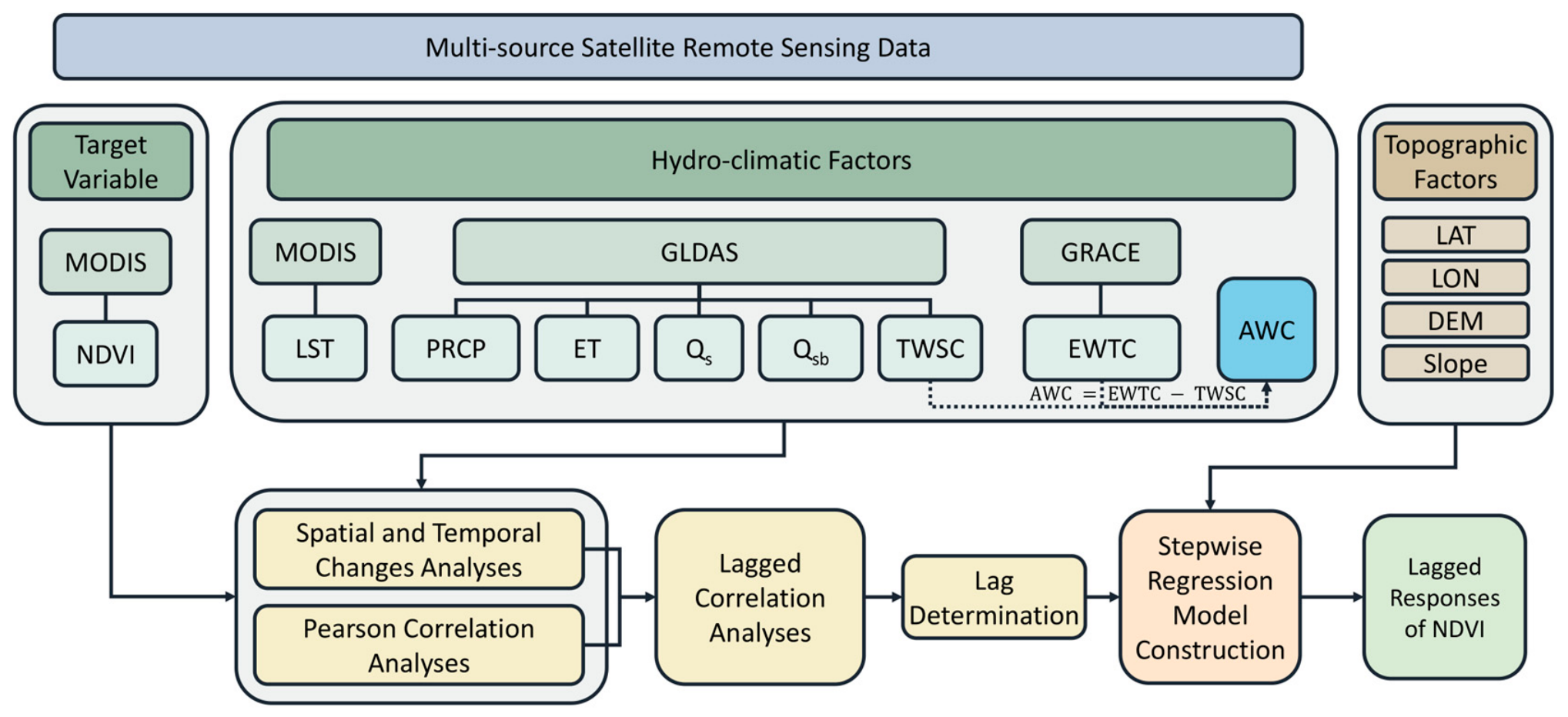
Lagged Responses of Vegetation Growth to Hydrometeorological Drivers Across Complex Terrain in Southwest China


Abstract
1. Introduction
2. Materials and Methods
2.1. Study Area
2.2. Materials
2.2.1. Moderate-Resolution Imaging Spectroradiometer
2.2.2. GRACE
2.2.3. GLDAS
2.3. Methods
2.3.1. Correlation Analysis of Hydrometeorological Factors and NDVI
2.3.2. Building a Multiple Regression Model
3. Results
3.1. Data Overview
Variations in NDVI
3.2. Relationships Between NDVI and Hydro-Climatic Factors
3.3. Influence of Hydrometeorological Factors on NDVI Under the Influence of Different Elevations
4. Discussion
4.1. The Influence of Hydrometeorological Factors on NDVI in the Complex Terrain of Southwest China
4.2. The Effects of Hydrometeorological Factors on Vegetation Growth at Different Altitudes
4.3. Limitations of the Analysis of Vegetation Changes in the Mountainous Regions of Southwest China
5. Conclusions
- (1)
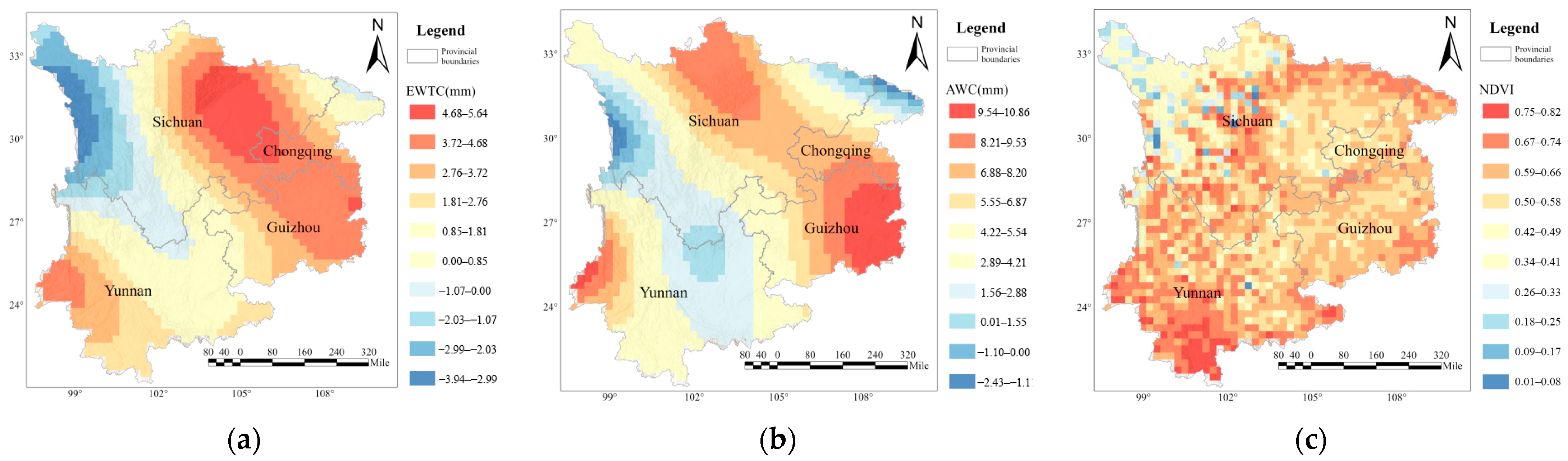
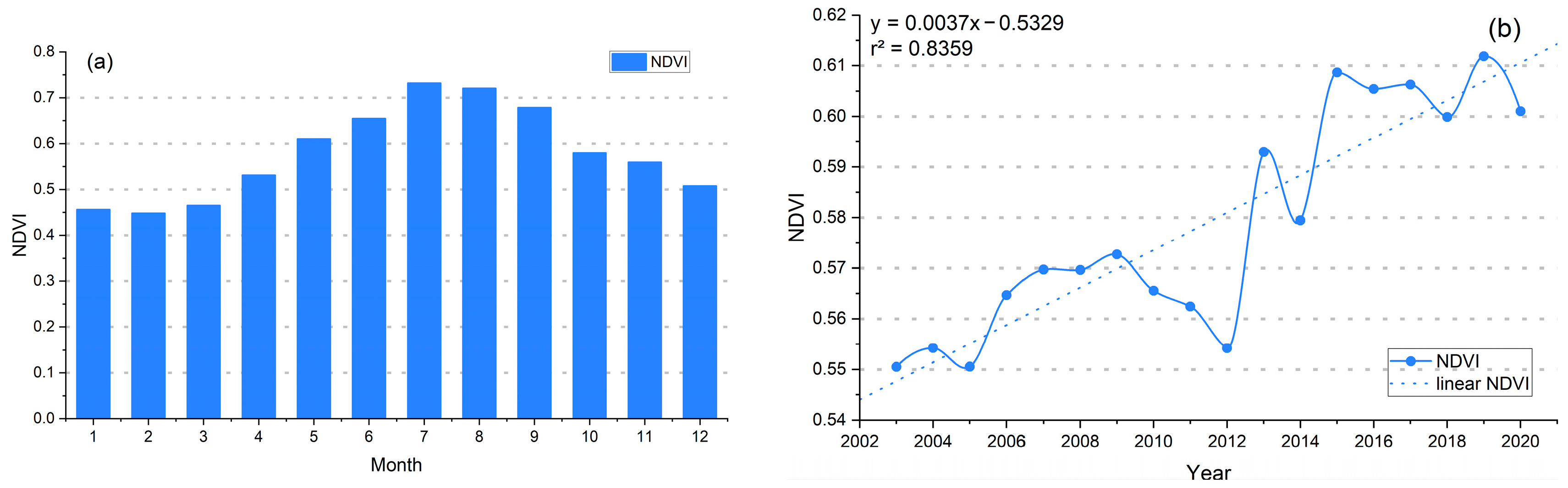
- NDVI showed an overall increasing trend from 2003 to 2020, with a notable increase after 2012. The annual variation in NDVI exhibited a single peak, with the highest value occurring in July–August and the lowest value occurring in January–March. Vegetation grew well in the southwestern part of the country, except for western Sichuan. This pattern suggests that vegetation greening is jointly driven by large-scale ecological restoration programs implemented after 2012, whereas the single-peak seasonality reflects the synchronization of photosynthetic activity with warm and wet summer conditions. Furthermore, the relatively low NDVI in western Sichuan is primarily attributable to alpine cold stress, limited soil development, and prolonged snow cover rather than water scarcity alone.
- (2)
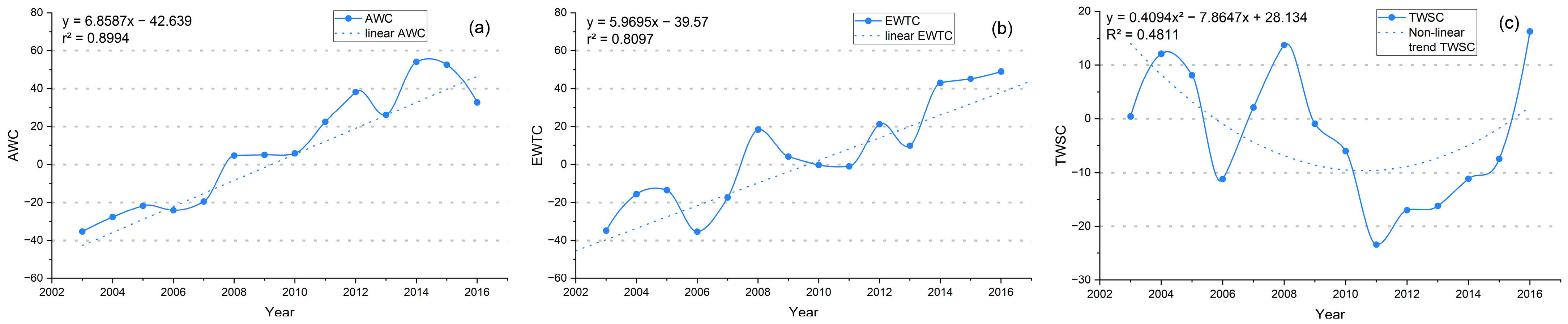
- In terms of annual changes, AWC and EWTC presented an overall fluctuating upward trend from 2003 to 2020, with a significant shift observed after 2008. TWSC exhibited minor fluctuations over the study period. Regarding monthly variations, AWC, EWTC, and TWSC showed a single peak and trough pattern, with AWC changes generally lagging behind EWTC and TWSC. The turning point around 2008 may be related to shifts in regional hydrological and climatic patterns, particularly changes in precipitation patterns and glacial snowpack dynamics. The persistent lag of AWC relative to EWTC and TWSC suggests that vegetation does not respond to instantaneous precipitation inputs but rather relies on soil moisture memory and delayed groundwater redistribution processes, which are of great significance for the stability of karst mountain ecosystems.
- (3)
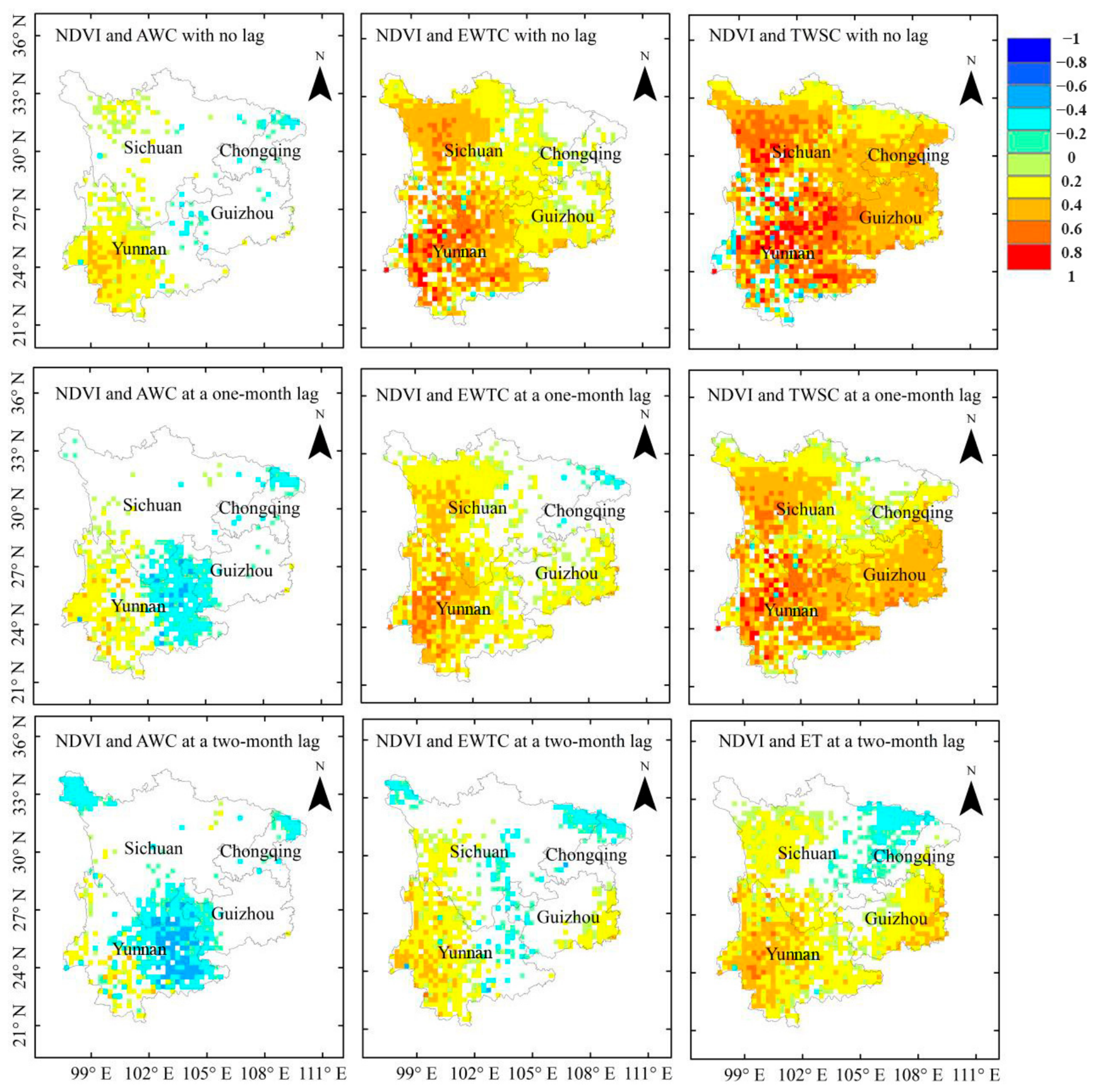
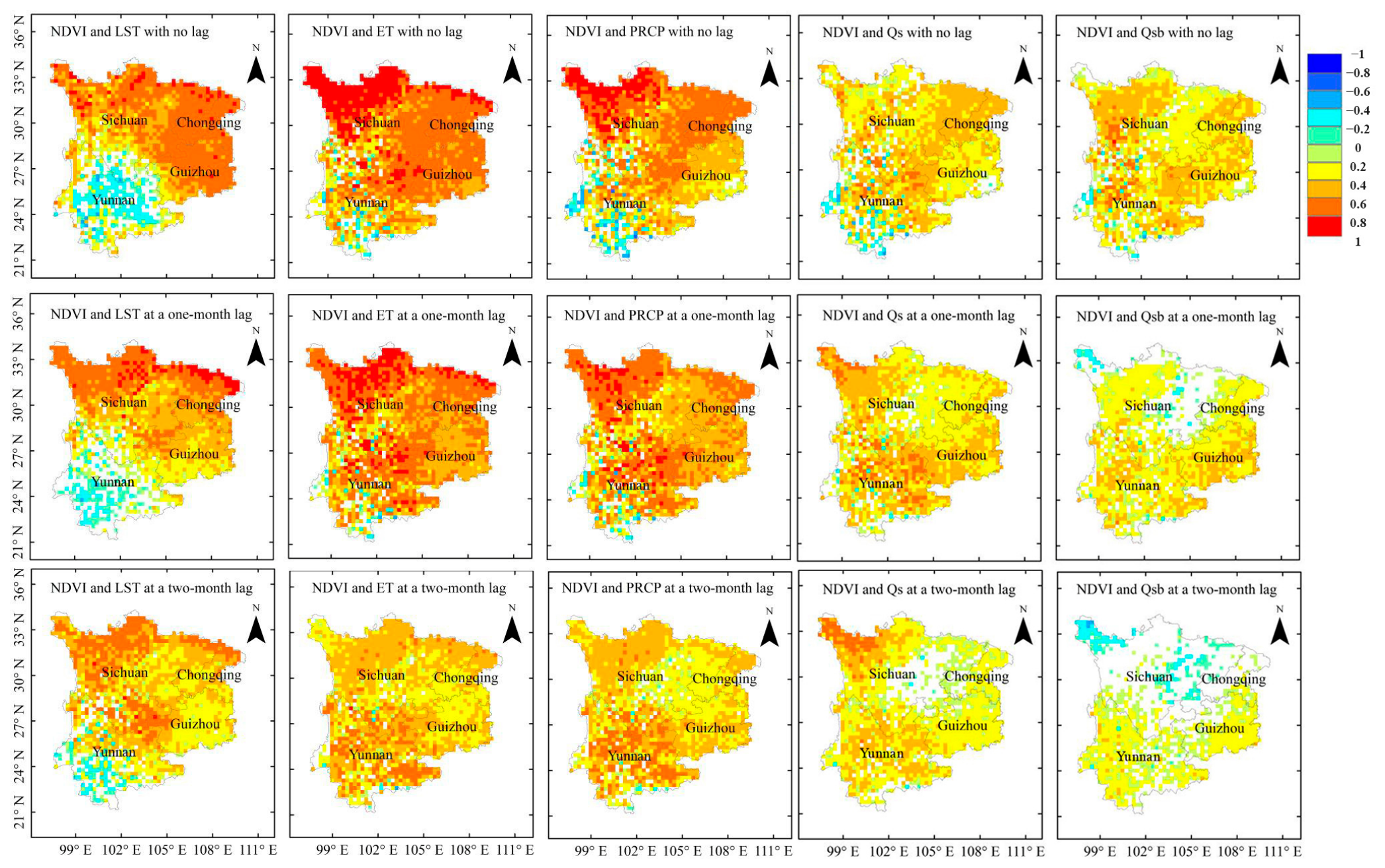
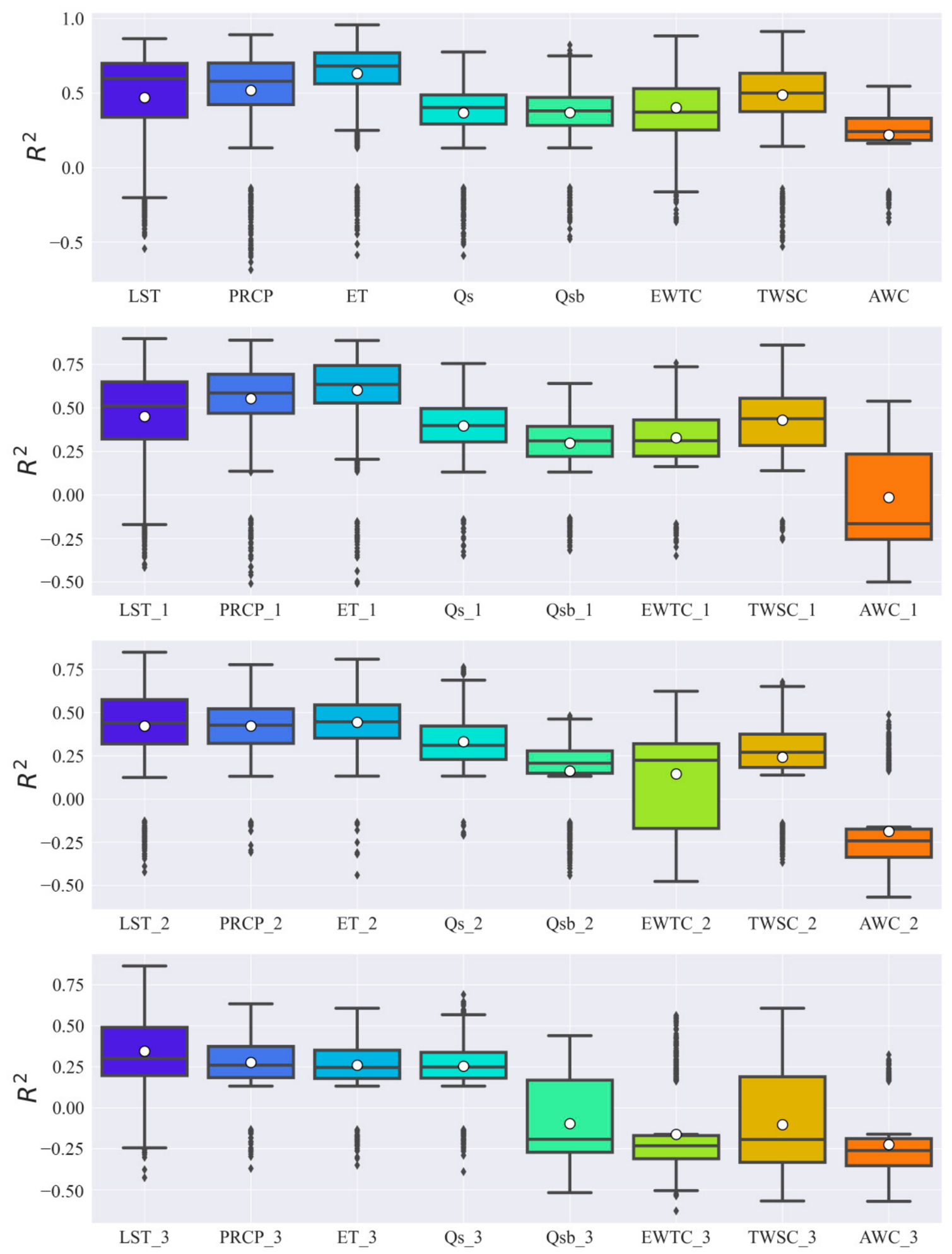
- The analysis indicates that NDVI variations are closely associated with hydrometeorological factors, particularly ET and PRCP. The study found significant time-lagged correlations between NDVI and water storage variables. EWTC and TWSC showed positive correlations with NDVI at a lag of 0–2 months. This suggests a temporal response of vegetation growth to changes in water availability. Meteorological factors such as ET, PRCP, and LST showed strong positive correlations with NDVI, with the highest correlations observed in western Sichuan and eastern Yunnan. This pattern arises because an increase in NDVI enhances transpiration, while excessive evapotranspiration accelerates soil moisture depletion, thereby limiting further vegetation growth. The significant correlation observed over the 0–2 month period indicates that vegetation primarily relies on surface water and soil water, which respond rapidly, whereas the influence of deep groundwater often becomes apparent only gradually after the short-term signals have faded. The spatial differences between western Sichuan and eastern Yunnan reveal the varying sensitivities of alpine and lowland ecosystems to hydrometeorological variability.
- (4)
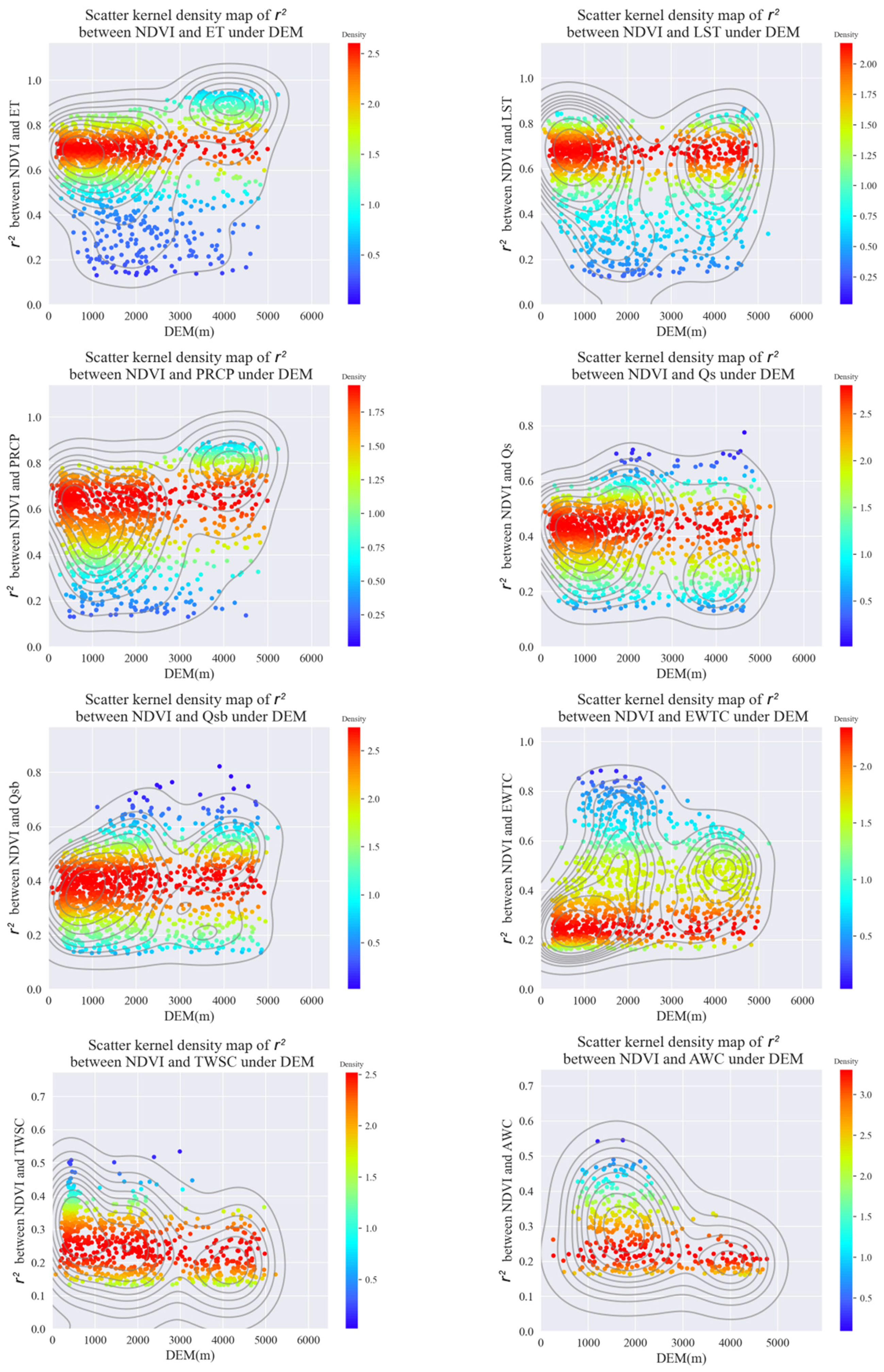
- Spatially, the influence of topography modulates these relationships. Regression models confirmed that DEM, latitude, ET, precipitation, and air temperature are key variables influencing the distribution of NDVI. The impact of these factors is not uniform. In regions above 3000 m, particularly above 4000 m, the correlation between NDVI changes and hydrometeorological factors, mainly evapotranspiration and PRCP, was more pronounced, highlighting the sensitivity of alpine vegetation to climatic variations. Altitude amplifies or attenuates vegetation responses to climate drivers by modulating the radiation balance, snowmelt timing, and soil development. The increased correlations observed at high altitudes indicate that even minor changes in water and heat conditions can trigger disproportionate ecosystem responses, thereby highlighting their vulnerability in the context of climate change.
Author Contributions
Funding
Data Availability Statement
Conflicts of Interest
References
- Roerink, G.J.; Menenti, M.; Soepboer, W.; Su, Z. Assessment of climate impact on vegetation dynamics by using remote sensing. Phys. Chem. Earth Parts A/B/C 2003, 28, 103–109. [Google Scholar] [CrossRef]
- Deng, C.; Ma, X.; Xie, M.; Bai, H. Effect of altitude and topography on vegetation phenological changes in the Niubeiliang Nature Reserve of Qinling Mountains, China. Forests 2022, 13, 1229. [Google Scholar] [CrossRef]
- Hua, T.; Wang, X.; Ci, Z.; Lang, L.; Zhang, C. Responses of vegetation activity to climate variation on the Qinghai–Tibetan Plateau (China) from 1982 to 2011. Clim. Res. 2015, 66, 65–73. [Google Scholar] [CrossRef]
- Tao, J.; Xu, T.; Dong, J.; Yu, X.; Jiang, Y.; Zhang, Y.; Liu, J.; Sun, H.; Zhang, L. Elevation-dependent effects of climate change on vegetation greenness in the high mountains of southwest China during 1982–2013. Int. J. Climatol. 2018, 38, 2029–2038. [Google Scholar] [CrossRef]
- Rudloff, V.M.; Rutllant, J.A.; Martel-Cea, A.; Maldonado, A. Hydrothermal modulation of NDVI in the high-altitude semiarid Andes of Chile (30–34°S). J. Arid Environ. 2021, 186, 104397. [Google Scholar] [CrossRef]
- Zhang, X.; Yue, Y.; Tong, X.; Wang, K.; Qi, X.; Deng, C.; Liu, B.; Li, J.; Xiao, C.; Nie, X.; et al. Eco-engineering controls vegetation trends in southwest China karst. Sci. Total Environ. 2021, 770, 145160. [Google Scholar] [CrossRef] [PubMed]
- Chen, W.; Bai, S.; Zhao, H.; Han, X.; Li, L. Spatiotemporal analysis and potential impact factors of vegetation variation in the karst region of Southwest China. Environ. Sci. Pollut. Res. 2021, 28, 61258–61273. [Google Scholar] [CrossRef] [PubMed]
- Ogou, F.K.; Ojeh, V.N.; Naabil, E.; Mbah, C.I. Hydro-climatic and water availability changes and its relationship with NDVI in northern sub-Saharan Africa. Earth Syst. Environ. 2022, 6, 681–696. [Google Scholar] [CrossRef]
- Duan, C.; Li, J.; Chen, Y.; Ding, Z.; Ma, M.; Xie, J.; Zhang, L.; Zhao, T.; Liu, Q. Spatiotemporal dynamics of terrestrial vegetation and its driver analysis over Southwest China from 1982 to 2015. Remote Sens. 2022, 14, 2497. [Google Scholar] [CrossRef]
- Yang, H.; Hu, J.; Zhang, S.; Xiong, L.; Xu, Y. Climate variations vs. human activities: Distinguishing the relative roles on vegetation dynamics in the three karst provinces of Southwest China. Front. Earth Sci. 2022, 10, 799493. [Google Scholar] [CrossRef]
- Wang, H.; He, L.; Yin, J.; Yu, Z.; Liu, S.; Yan, D. Effects of effective precipitation and accumulated temperature on the terrestrial EVI (enhanced vegetation index) in the Yellow River Basin, China. Atmosphere 2022, 13, 1555. [Google Scholar] [CrossRef]
- Sidi Almouctar, M.A.; Wu, Y.; Kumar, A.; Zhao, F.; Mambu, K.J.; Sadek, M. Spatiotemporal analysis of vegetation cover changes around surface water based on NDVI: A case study in Korama Basin, southern Zinder, Niger. Appl. Water Sci. 2021, 11, 4. [Google Scholar] [CrossRef]
- Piedallu, C.; Chéret, V.; Denux, J.P.; Perez, V.; Azcona, J.S.; Seynave, I.; Gégout, J.C. Soil and climate differently impact NDVI patterns according to the season and the stand type. Sci. Total Environ. 2019, 651, 2874–2885. [Google Scholar] [CrossRef] [PubMed]
- Lai, J.; Zhao, T.; Qi, S. Spatiotemporal variation in vegetation and its driving mechanisms in the southwest alpine canyon area of China. Forests 2023, 14, 2357. [Google Scholar] [CrossRef]
- Yang, X.; Yuan, L.; Jiang, Z.; Tang, M.; Feng, X.; Li, C. Investigating terrestrial water storage changes in Southwest China by integrating GNSS and GRACE/GRACE-FO observations. J. Hydrol. Reg. Stud. 2023, 48, 101457. [Google Scholar] [CrossRef]
- Ahmed, M.; Sultan, M.; Yan, E.; Wahr, J. Assessing and improving land surface model outputs over Africa using GRACE, field, and remote sensing data. Surv. Geophys. 2016, 37, 529–556. [Google Scholar] [CrossRef]
- Song, L.; Li, Y.; Ren, Y.; Wu, X.; Guo, B.; Tang, X.; Zhu, J.; Li, Y. Divergent vegetation responses to extreme spring and summer droughts in southwestern China. Agric. For. Meteorol. 2019, 279, 107703. [Google Scholar] [CrossRef]
- Hou, W.; Gao, J.; Wu, S.; Dai, E. Interannual variations in growing-season NDVI and its correlation with climate variables in the southwestern karst region of China. Remote Sens. 2015, 7, 11105–11124. [Google Scholar] [CrossRef]
- Li, R.; Wu, Q.; Zhang, J.; Wen, Y.; Li, Q. Effects of land use change of sloping farmland on characteristic of soil erosion resistance in typical karst mountainous areas of southwestern China. Pol. J. Environ. Stud. 2019, 28, 2707–2716. [Google Scholar] [CrossRef] [PubMed]
- Zhang, Z.; Huang, X.; Zhou, Y.; Zhang, J.; Zhang, X. Discrepancies in karst soil organic carbon in Southwest China for different land use patterns: A case study of Guizhou Province. Int. J. Environ. Res. Public Health 2019, 16, 4199. [Google Scholar] [CrossRef] [PubMed]
- Xiao, K.; Tang, J.; Chen, H.; Li, D.; Liu, Y. Impact of land use/land cover change on the topsoil selenium concentration and its potential bioavailability in a karst area of southwest China. Sci. Total Environ. 2020, 708, 135201. [Google Scholar] [CrossRef] [PubMed]
- Zhou, Y.; Li, Y.; Liu, Y. The nexus between regional eco-environmental degradation and rural impoverishment in China. Habitat Int. 2020, 96, 102086. [Google Scholar] [CrossRef]
- Yan, Y.; Dai, Q.; Wang, X.; Jin, L.; Mei, L. Response of shallow karst fissure soil quality to secondary succession in a degraded karst area of southwestern China. Geoderma 2019, 348, 76–85. [Google Scholar] [CrossRef]
- Zhao, C.; Huang, Y.; Li, Z.; Chen, M. Drought monitoring of southwestern China using insufficient GRACE data for the long-term mean reference frame under global change. J. Clim. 2018, 31, 6897–6911. [Google Scholar] [CrossRef]
- Yao, J.; Hu, W.; Chen, Y.; Huo, W.; Zhao, Y.; Mao, W.; Li, Z. Hydro-climatic changes and their impacts on vegetation in Xinjiang, Central Asia. Sci. Total Environ. 2019, 660, 724–732. [Google Scholar] [CrossRef] [PubMed]
- Feng, W.; Shum, C.; Zhong, M.; Pan, Y. Groundwater storage changes in China from satellite gravity: An overview. Remote Sens. 2018, 10, 674. [Google Scholar] [CrossRef]
- Zhang, Y.; Liu, Q.; Wang, Y.; Huang, J. Assessing the impacts of climate change and anthropogenic activities on vegetation in southwest China. J. Mt. Sci. 2022, 19, 2678–2692. [Google Scholar] [CrossRef]
- Nie, N.; Zhang, W.; Zhang, Z.; Guo, H.; Ishwaran, N. Reconstructed terrestrial water storage change (ΔTWS) from 1948 to 2012 over the Amazon Basin with the latest GRACE and GLDAS products. Water Resour. Manag. 2016, 30, 279–294. [Google Scholar] [CrossRef]
- Zeng, Z.; Wang, L.; Zhou, X.; Ciais, P.; Mao, J.; Shi, X.; Piao, S. Global evapotranspiration over the past three decades: Estimation based on the water balance equation combined with empirical models. Environ. Res. Lett. 2012, 7, 014026. [Google Scholar] [CrossRef]
- Xu, M.; Kang, S.; Chen, X.; Wu, H.; Wang, X.; Su, Z. Detection of hydrological variations and their impacts on vegetation from multiple satellite observations in the Three-River Source Region of the Tibetan Plateau. Sci. Total Environ. 2018, 639, 1220–1232. [Google Scholar] [CrossRef] [PubMed]
- Zheng, L.; Xu, J.; Tan, Z.; Xu, L.; Wang, X. Spatial distribution of soil organic matter related to microtopography and NDVI changes in Poyang Lake, China. Wetlands 2019, 39, 789–801. [Google Scholar] [CrossRef]
- Ju, H.; Zhang, Z.; Zuo, L.; Wang, J.; Zhang, S.; Wang, X.; Liu, J.; Xu, W. Driving forces and their interactions of built-up land expansion based on the geographical detector—A case study of Beijing, China. Int. J. Geogr. Inf. Sci. 2016, 30, 2188–2207. [Google Scholar] [CrossRef]
- Guo, L.; Liu, R.; Men, C.; Wang, Q.; Miao, Y.; Shoaib, M.; Wang, Y.; Jiao, L.; Zhang, Y. Multiscale spatiotemporal characteristics of landscape patterns, hotspots, and influencing factors for soil erosion. Sci. Total Environ. 2021, 779, 146474. [Google Scholar] [CrossRef] [PubMed]
- Upadhyay, K.K.; Bareh, A.; Devi, K.V.; Thomte, L.; Chanda, R.; Singh, S.S.; Ramtharmawi; Joshi, M.; Vanlalfakawma, D.C.; Tripathi, S.K. Climate Vulnerability and Adaptive Capacity of Smallholder Farmers in Jaintia Hills Region of Meghalaya, Northeast India. Environ. Sustain. Indic. 2026, 30, 101249. [Google Scholar] [CrossRef]
- Tripathi, S.K.; Chanda, R.; Ao, A.; Moirangthem, B.; Chauhan, S.; Mizo, L.; Singh, S.S.; Singh, N.S.; Upadhyay, K.K.; Vanlalfakawma, D.C.; et al. Elevation and Management-Induced Vegetation and Soil Carbon Shift in Eastern Himalayan Forests: Advancing Nature-Based Sustainability Solutions (NbS). Environ. Sustain. Indic. 2026, 29, 101082. [Google Scholar] [CrossRef]




| Source | Variable | Abbr. | Temporal Resolution | Spatial Resolution |
|---|---|---|---|---|
| Latitude | Lat | |||
| Longitude | Lon | |||
| Digital elevation model | DEM | 90 m | ||
| Slope | Slope | |||
| MODIS | Normalized Difference Vegetation Index | NDVI | 16-day | 1 km × 1 km |
| land surface temperature | LST | 8-day | 1 km × 1 km | |
| GRACE | Changes in equivalent water thickness | EWTC | Monthly | 1° × 1° |
| Changes in available water | AWC | Monthly | 1° × 1° | |
| GLDAS | Precipitation | PRCP | Monthly | 0.25° × 0.25° |
| Evapotranspiration | ET | |||
| Surface runoff | Qs | |||
| Subsurface runoff | Qsb | |||
| Changes in terrestrial water storage | TWSC |
| Model | Inputs | R2 | SEE |
|---|---|---|---|
| ML-0 | ET, DEM, Lat, EWTC | 0.41 | 0.77 |
| ML-1 | ET_1, DEM, Lat, TWSC_1 | 0.37 | 0.80 |
| ML-2 | ET_2, DEM, TWSC_2, Lat | 0.25 | 0.86 |
| ML-3 | LST_3, Lat, TWSC_3, DEM | 0.15 | 0.92 |
| Model | Inputs | R2 | SEE |
|---|---|---|---|
| ML-ET-0 | PRCP, LST, TWSC, Qsb, DEM | 0.38 | 0.79 |
| ML-ET-1 | PRCP_1, LST_1, Lat, DEM | 0.30 | 0.84 |
| ML-ET-2 | LST_2, PRCP_2, Lat, DEM | 0.23 | 0.88 |
| ML-ET-3 | LST_3, Lat, TWSC_3, DEM | 0.15 | 0.92 |
Disclaimer/Publisher’s Note: The statements, opinions and data contained in all publications are solely those of the individual author(s) and contributor(s) and not of MDPI and/or the editor(s). MDPI and/or the editor(s) disclaim responsibility for any injury to people or property resulting from any ideas, methods, instructions or products referred to in the content. |
© 2026 by the authors. Licensee MDPI, Basel, Switzerland. This article is an open access article distributed under the terms and conditions of the Creative Commons Attribution (CC BY) license.
Share and Cite
Chen, T.; Xiong, G.; Gao, Z.; Song, Z.; Zhang, J.; Dong, D.; Chen, H. Lagged Responses of Vegetation Growth to Hydrometeorological Drivers Across Complex Terrain in Southwest China. Water 2026, 18, 1522. https://doi.org/10.3390/w18121522
Chen T, Xiong G, Gao Z, Song Z, Zhang J, Dong D, Chen H. Lagged Responses of Vegetation Growth to Hydrometeorological Drivers Across Complex Terrain in Southwest China. Water. 2026; 18(12):1522. https://doi.org/10.3390/w18121522
Chicago/Turabian StyleChen, Ting, Guocai Xiong, Zhanxin Gao, Zhijie Song, Jingyi Zhang, Dandan Dong, and Hui Chen. 2026. "Lagged Responses of Vegetation Growth to Hydrometeorological Drivers Across Complex Terrain in Southwest China" Water 18, no. 12: 1522. https://doi.org/10.3390/w18121522
APA StyleChen, T., Xiong, G., Gao, Z., Song, Z., Zhang, J., Dong, D., & Chen, H. (2026). Lagged Responses of Vegetation Growth to Hydrometeorological Drivers Across Complex Terrain in Southwest China. Water, 18(12), 1522. https://doi.org/10.3390/w18121522