1. Introduction
Crayfish are a diverse group with over 600 species occurring worldwide, excluding Antarctica and mainland Africa [
1,
2]. The greatest species diversity is reached in southeastern North America, followed by Australia [
3]. Although many crayfish species are associated with lotic and lentic systems, several species are semi-terrestrial [
4]. Terrestrial crayfish inhabit wetlands and mesic habitats, often situated tens to hundreds of meters from permanent flowing water. Burrowing crayfish, while often colorful and charismatic, are poorly studied due to their secretive nature. Only 38.8% of known burrowing crayfish species have any published data related to their life history [
2].
This lack of data becomes particularly concerning as most burrowing crayfish are considered keystone species, functioning as predators, prey, detritivores, and scavengers [
2,
5,
6]. Burrowing crayfish manipulate habitats through burrow construction, which provides refugia for a host of organisms [
2,
7,
8] while also improving soil aeration [
9], increasing soil nutrient exchange [
10,
11,
12], and groundwater flow [
13].
Mountain Valley Pipeline (MVP) is a large interstate natural gas transmission pipeline first proposed in 2015. The pipeline spans from Wetzel County in north-western West Virginia, USA, running southeast to Pittsylvania County in southern Virginia, USA, near the North Carolina border. Like all large infrastructure projects in the United States of America (USA), it was subject to an initial environmental review, which included surveys for both state and federally listed species. Following a formal description of the Meadow River Mudbug (
Cambarus pauleyi, Loughman et al. 2015), the West Virginia Division of Natural Resources (WVDNR) understood that while little was known about
C. pauleyi, its narrow distribution made it a potential candidate for both state and federal listings. Given that
C. pauleyi is endemic to two counties in West Virginia [
14], WVDNR requested that
C. pauleyi be included in species survey efforts throughout the proposed project footprint that bisected
C. pauleyi’s known range. Hereafter, we present a case study of findings from the initial survey and the subsequent salvage efforts (efforts to remove the animals from their current environment prior to relocation efforts) and discuss the findings and potential implications for other threatened and endangered species.
2. Materials and Methods
The study methodology was derived from both authors’ experience working with multiple crayfish species, specifically other burrowing species. Individual methodologies for site selection, sampling, crayfish handling, transport and relocation, as well as monitoring efforts, are provided hereafter. Salvage and relocation efforts were originally only intended for a single event in the spring of 2018; however, project delays led to multiple salvage and relocation events, resulting in four separate salvage and relocation efforts as well as an associated 12 monitoring events over a six-year period. Methodology was refined over time with additional requests added with each salvage and relocation effort; however, standard methodology for all tasks conducted remained consistent.
2.1. Site Selection
Initial surveys were completed in 2016 and 2017. Two large colonies of
C. pauleyi were identified in a low-lying tile-drained field bisected by Buffalo Creek, a fourth-order stream. The largest
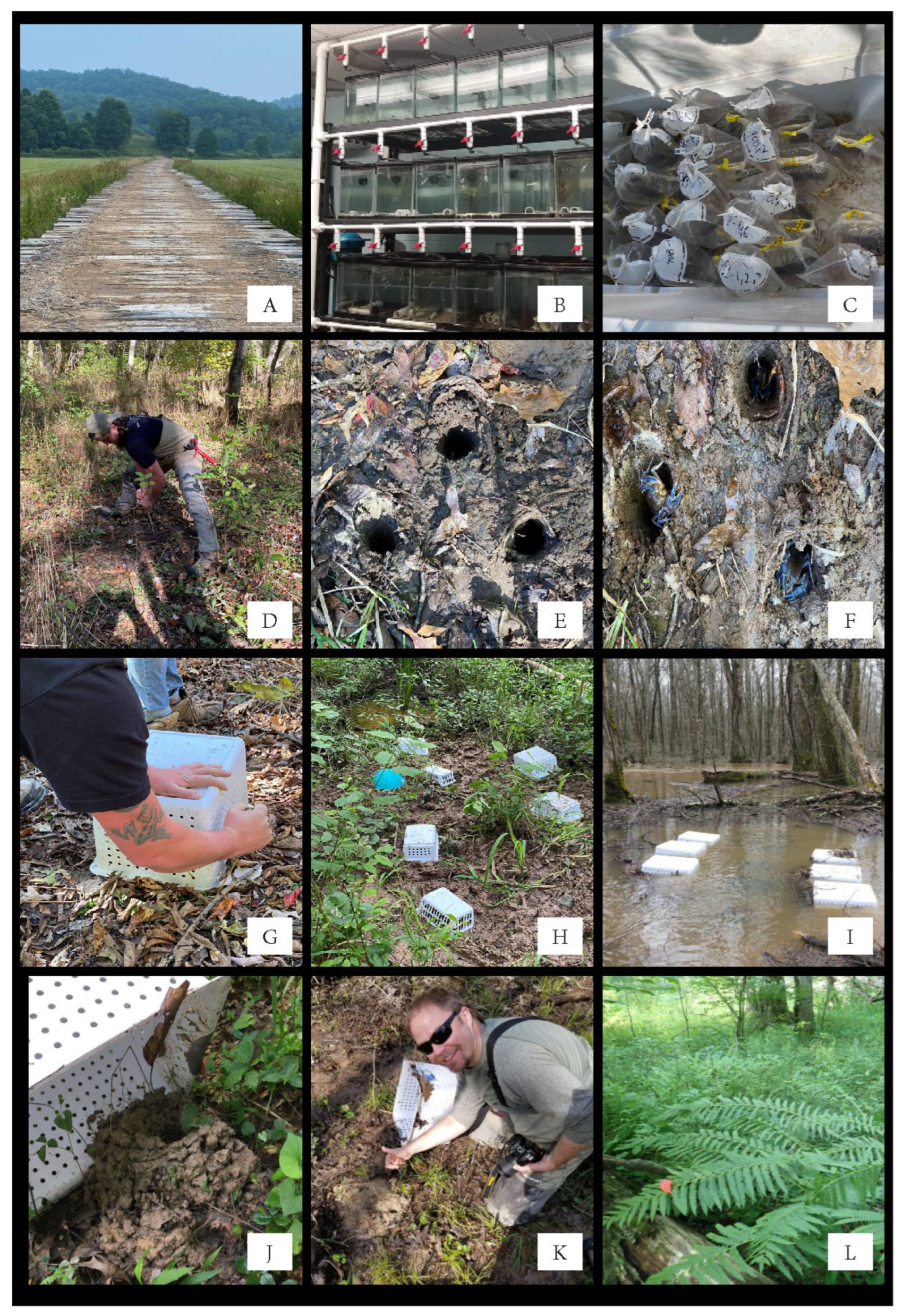
C. pauleyi colony occurred in the creek’s floodplain along the right descending bank (
Figure 1A). This floodplain was originally deforested, converted to pasture, and dewatered via tile drains; however, over time, the tile drains began to fail, creating bisecting depressional wetlands throughout the field. Following survey efforts, the WVDNR recognized
C. pauleyi as a narrow-range endemic and requested salvage and relocation efforts across approximately 1.1 hectares of land occupied by the two colonies.
We calculated the initial burrow density of the colonies by laying out a single 100 m-long by 1 m-wide transect line. Along the transect, we randomly placed 60 individual 1 m2 quadrats, counted the number of burrows, and classified burrow architecture as a portal, chimney, or plugged burrow. These quadrats contained 341 active portals comprised of 100 open portals (open burrows), 14 chimneys (open burrows with stacked mud pellets), and 227 plugged portals (burrows capped with mud pellets). The number of portals/m2 ranged from 0 to 13 (average = 5.68). The mean per quadrat (n = 6) was used during relocation efforts to ensure no more than six crayfish were placed within a 1 m2 section of relocation area.
The relocation site was proposed by WVDNR and located in the Meadow River Wildlife Management Area (WMA), where
C. pauleyi had previously been documented [
14]. Prior genetic analysis conducted by Loughman (unpublished data) indicated that both the salvaged population and the extant population at the WMA were from the same lineage, though no genomic method of population determination was employed. Relocation of
C. pauleyi to this site would allow for ease of access and monitoring with minimal potential for disruption.
2.2. Collecting Efforts
During each individual salvage effort, crayfish were salvaged by eight biologists from both colonies over three days, totaling 192 person-hours per salvage effort. Person-hours were used to determine catch per unit effort (CPUE) by dividing the number of
C. pauleyi collected by the number of collection hours expended. Salvage efforts were timed around major rainstorms (storms producing more than 2.54 cm of water in a 24 h period), which normally trigger surface activity of ecologically or phylogenetically similar burrowing crayfish species [
15]. Salvage efforts were conducted after dusk and included baited lines [
16], burrow excavation, jab sampling with dip nets (a process in which the dip net is jabbed forward in a repetitive motion to disturb crayfish and force them into the net when ditches held sufficient water), and hand collection. Efforts focused on collecting as many
C. pauleyi as possible, and successful captures were combined for all sampling methods.
Upon capture, each C. pauleyi was sexed, measured, and molt and glair state (if female) were noted. We measured the total carapace length (TCL), abdominal length (AbL), abdominal width (AbW), propodus length (PrL), chelae palm width (PaW), and chelae palm length (PaL) for all C. pauleyi. We considered any crayfish < 15 mm TCL and not displaying an obvious pair of gonapods or an annulus ventralis as juveniles. All C. pauleyi were placed in large, aerated Frabill Bait Stations (transport coolers) while on site and filled with approximately 5 cm of water from the creek and/or wetted pools or ditches in the salvage area. Aeration was provided using the included bubbler with each bait station to ensure adequate dissolved oxygen for respiration. Smaller crayfish were placed under the bait rack, while larger individuals were placed in the bait rack to prevent smaller crayfish from being crushed or consumed by larger adults. No more than 20 crayfish were placed in a single bait station in an attempt to further reduce intraspecific conflicts during holding.
2.3. Holding and Transportation
Following completion of each salvage effort,
C. pauleyi were transported offsite in the Frabill Bait Stations. All
C. pauleyi were placed in the lure slots of plastic tackle boxes, with the size of the slot adjusted for each
C. pauleyi. Water from the creek and/or wetted pools or ditches was then added to each tackle box so that all crayfish would stay moist but could still expose their gills to the air to respire. All tackle boxes were then placed in a refrigerator set to no lower than 45 °F (7.2 °C) until relocation or transportation to a holding facility. During transportation, tackle boxes were placed in a large cooler filled with a small amount of ice to maintain cool temperatures. Care was taken to keep the cooler from filling with water, as burrowing crayfish require a water/air interface during transportation. These transportation methods have been used many times by Foltz and Loughman (unpublished data) prior to this survey for this and other species and have resulted in minimal to no mortality during transportation. Increased mortality is typically a result of overfilling transport containers (personal observation). If temporary holding was required following extreme weather events, all
C. pauleyi were temporarily held at White Sulphur Springs Fish Hatchery or West Liberty University in individual tanks until relocation efforts could be completed (
Figure 1B). Transportation from holding facilities was conducted either using the previously described tackle boxes or Whirl-Pak
® bags (Teel Plastics, Baraboo, WI 53913, USA) (
Figure 1C).
2.4. Crayfish Relocation
Crayfish were relocated to the Meadow River WMA in Greenbrier County, WV. Within the WMA, four relocation sites, approximately 10 m × 20 m, were delineated. Sections of rebar with diameters equal to the circumference of crayfish cephalothorax and lengths measuring 1.5 m were pounded into the ground the day before relocation efforts to create artificial burrows (
Figure 1D). The length of the rebar ensured starter burrows reached or surpassed the water table. Artificial burrows were then checked the following day to ensure a high water table was present, allowing the crayfish to burrow. Dry artificial burrows were avoided as the water table was too shallow to allow
C. pauleyi colonization. Once an area was determined to have an appropriate water table,
C. pauleyi were selected from the cooler based on size and sex. These parameters were used to ensure limited mortality from intraspecific interactions following relocation.
To facilitate crayfish relocation, various diameter 1.5 m rebar stakes were driven in the ground to the water table in clusters of 2 or 3 (depending on the size of the containment area and crayfish size). Bars were then rotated side to side and removed to ensure an adequately sized artificial burrow for each crayfish (
Figure 1E). Burrow size was considered ideal if it allowed the crayfish to retract its legs and drop to the water table when startled, while not being so large that the crayfish was unable to crawl out of the burrow (
Figure 1F). Following the creation of artificial burrows, appropriately sized crayfish were released into the burrows. Spring water was then poured over each crayfish to ensure adequate water and moisture were present in the burrow before placing an appropriately sized pencil basket (hereafter exclusion basket) over each burrow cluster. Exclusion baskets contained the crayfish, forcing them to burrow while also providing shelter from predators. Exclusion baskets were selected based on mesh size and height to ensure that crayfish were unable to escape while still allowing for clearance of excavated mud to form chimneys. For burrows containing juveniles, plastic colanders were used. Additionally, the bottoms of the exclusion baskets were punctured six times to allow for additional rainfall to penetrate them, maintaining moisture and increasing ventilation.
Following exclusion basket placement over burrow clusters, four separate 0.15 m landscaping staples were placed at various angles to attach the exclusion baskets to the ground, ensuring crayfish could not escape, and the baskets could not be easily flipped by predators (
Figure 1G). The points of the landscaping staples were placed facing away from burrows to avoid blockage or piercing one of the relocated crayfish. Once exclusion basket placement was complete (
Figure 1H), they were numbered, and a site map detailing the number, location, and number of
C. pauleyi in each exclusion basket was created to later assist with monitoring efforts. Photographs depicting processes from salvage through relocation are provided in
Figure 1A–H.
2.5. Monitoring Efforts
Following each relocation effort, relocated
C. pauleyi were monitored three times, with the first two monitoring intervals occurring once monthly for approximately two months. As recapture and handling of crayfish would destroy the created habitats, increasing stress and survivability, burrow surface activity was used as a metric of survival. During monitoring, we removed exclusion baskets and noted the number of active and inactive burrows. We considered burrows active if they displayed new chimneys, exhumed soil, a cleared and maintained burrow portal, or if a crayfish was present at the burrow portal. Burrows were considered inactive if there were spider webs covering the portal, fungus, mold, or plants growing out of the portal, or dead crayfish present. After monitoring, we replaced the exclusion basket and landscaping staples. Following the second monitoring event, the exclusion baskets and staples were removed. The third and final monitoring event occurred five months to a year after the second event and consisted of a count of active portals at a site. Photographs depicting monitoring processes are provided in
Figure 1I–L.
2.6. Vegetative Community Analysis
We conducted a vegetative community analysis at both the salvage area and each relocation site. Due to the size of the salvage area, a representative subsample was collected alongside the 100 m transect. Every 10 m along the transect, a vegetative sample was collected, loosely following U.S. Army Corps of Engineers Guidelines for wetland sampling sites [
17]; however, all strata were collected in up to a 10 m diameter instead of the staggered stratum approach traditionally used in wetland delineations. The same methodology was conducted at each relocation site within an approximately 60 m area. We identified all vegetation to species level to provide a floral inventory found with
C. pauleyi.
2.7. Camera Traps
Prior to the third relocation event, camera traps were placed at the relocation site to document interactions between potential crayfish predators and the exclusion baskets. As the third relocation site was generally laid out as an elongated rectangle, cameras were placed on its short ends, facing inward toward the relocation site. One camera was set to 30 s photo capture upon movement, while the other was set to 30 s video capture upon movement. Cameras were left in place for the three monitoring events, and data were downloaded after completion of the third monitoring event for relocation #3.
3. Results
3.1. Collecting Efforts
Project needs necessitated four separate salvage and relocation events performed over a 5-year period. During the initial collection effort on 13–15 April 2018, we collected 186 C. pauleyi with a CPUE of 0.96 crayfish/hour. An unforecasted blizzard occurred on April 16th, which forced us to retain the C. pauleyi until we relocated them on 24 June 2018. The second collection effort occurred 17–19 September 2020 and resulted in the collection of 115 C. pauleyi with a CPUE of 0.60 crayfish/hour. Due to cold weather and drier-than-usual ground conditions, all C. pauleyi were retained until relocation on 27 May 2021. The third collection effort occurred 17–19 August 2021 and resulted in the collection of 93 C. pauleyi with a CPUE of 0.48 crayfish/hour. Due to high temperatures and hardened ground, C. pauleyi were retained until relocation on 20 October 2021. The fourth and final collection effort occurred 28–30 June 2023 and resulted in the collection of 96 C. pauleyi with a CPUE of 0.50 crayfish/hour. All C. pauleyi collected during the fourth salvage event were immediately relocated on 1 July 2023.
In total, we collected 490
C. pauleyi from the salvage area during four separate collecting events spanning a period of five years, including 64 form I males, 65 form II males, 143 females, and 218 juveniles. Of these, 34 individuals expired immediately following collection efforts due to injuries and crushing from excavation efforts, and an additional 140 individuals expired during temporary holding events. Population demographics for each collection event are provided in
Table 1. Morphometric analysis based on population demographics for all salvaged
C. pauleyi is presented in
Table 2. Associated mortality for
C. pauleyi following each step of the methodology is provided in
Table 3.
3.2. Monitoring Efforts
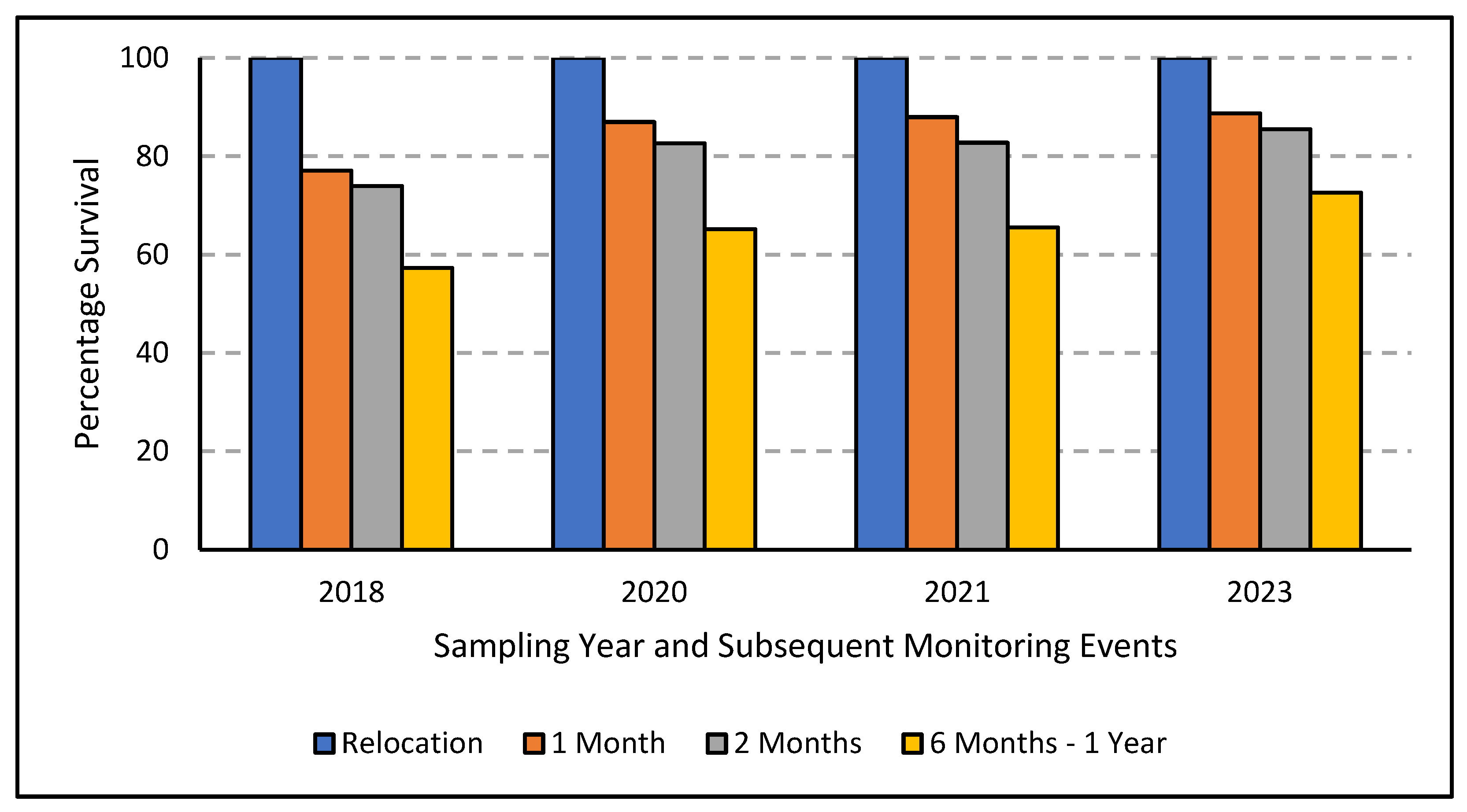
As each of the four relocations required three separate monitoring events, 12 monitoring events in total were conducted over the life of the project. Monitoring efforts for the initial relocation event conducted on 24 June 2018 were performed on 11 July 2018, 1 August 2018, and 1 May 2019. Initially, 96 C. pauleyi were relocated during the first relocation event. Monitoring efforts on 11 July 2018 recorded 74 active burrows (77.1%), and efforts on 1 August 2018 recorded 71 active burrows (74.0%). Following exclusion basket removal, monitoring events on 1 May 2019 recorded 55 active burrows (57.3%).
Monitoring events for the second relocation event conducted on 27 May 2020 were performed on 1 July 2020, 25 July 2020, and 20 October 2020. In total, 23 C. pauleyi were relocated during the second relocation event. Monitoring efforts on 1 July 2020 recorded 20 active burrows (87.0%), and efforts on 25 July 2020 recorded 19 active burrows (82.6%). Following exclusion basket removal, monitoring events on 20 October 2020 recorded 15 active burrows (65.2%).
Monitoring events for the third relocation event conducted on 20 October 2021 were performed on 21 November 2021, 13 December 2021, and 17 April 2022. In total, 58 C. pauleyi were relocated during the third relocation event. Monitoring efforts on 21 November 2021 recorded 51 active burrows (87.9%), and efforts on 13 December 2021 recorded 48 active burrows (82.8%). Following exclusion basket removal, monitoring events on 17 April 2022 recorded 38 active burrows (65.5%).
Finally, monitoring events for the fourth relocation event conducted on 1 July 2023 were performed on 9 August 2023, 7 September 2023, and 1 May 2024. In total, 62
C. pauleyi were relocated during the fourth relocation event. Monitoring efforts on 9 August 2023 recorded 55 active burrows (88.7%), and efforts on 7 September 2023 recorded 53 active burrows (85.5%). Following exclusion basket removal, monitoring events on 1 May 2024 recorded 45 active burrows (72.6%). Comparative percent survival post-salvage by relocation and monitoring events is provided in
Figure 2.
Monitoring events success rates ranged from 74.0% to 85.5% following two months’ post-relocation. During the final monitoring events, five months to a year had passed since initial relocations. Growth of understory and deposition of fresh detritus made monitoring difficult to accurately assess burrowing activity, and many of the burrows were covered or hidden. Despite this, success rates of 57% to 72% were still observed. The recorded number of active burrows for the final monitoring observation for each event was noted, but lacked the accuracy of monitoring events 1 and 2, as the exclusion baskets were removed following monitoring event 2, allowing for the growth of the understory, as well as covering of the ground by fresh detritus, making accurate counting difficult.
3.3. Vegetative Community Analysis
The vegetative community analysis in the salvage area resulted in the collection of 17 plant species (
Table 4). The site was best classified as a wet meadow with upland inclusions, with wetlands primarily occurring along old failing tile drains within the field. Vegetative community analysis for the relocation sites resulted in the collection of 38 plant species (
Table 4). The site is best classified as a secondary successional floodplain forest with upland inclusions. Of all the plants from both the salvage site, as well as the relocation sites, only five species of plants occurred at both: Common Rush (
Juncus effusus, L.), Green Bullrush (
Scirpus atrovirens, Willd.), Poison Ivy (
Toxicodendron radicans, (L.) Kuntze), White Clover (
Trifolium repens, L.), and Wingstem (
Verbesina alternifolia, (L.) Britton ex Kearney).
3.4. Camera Traps
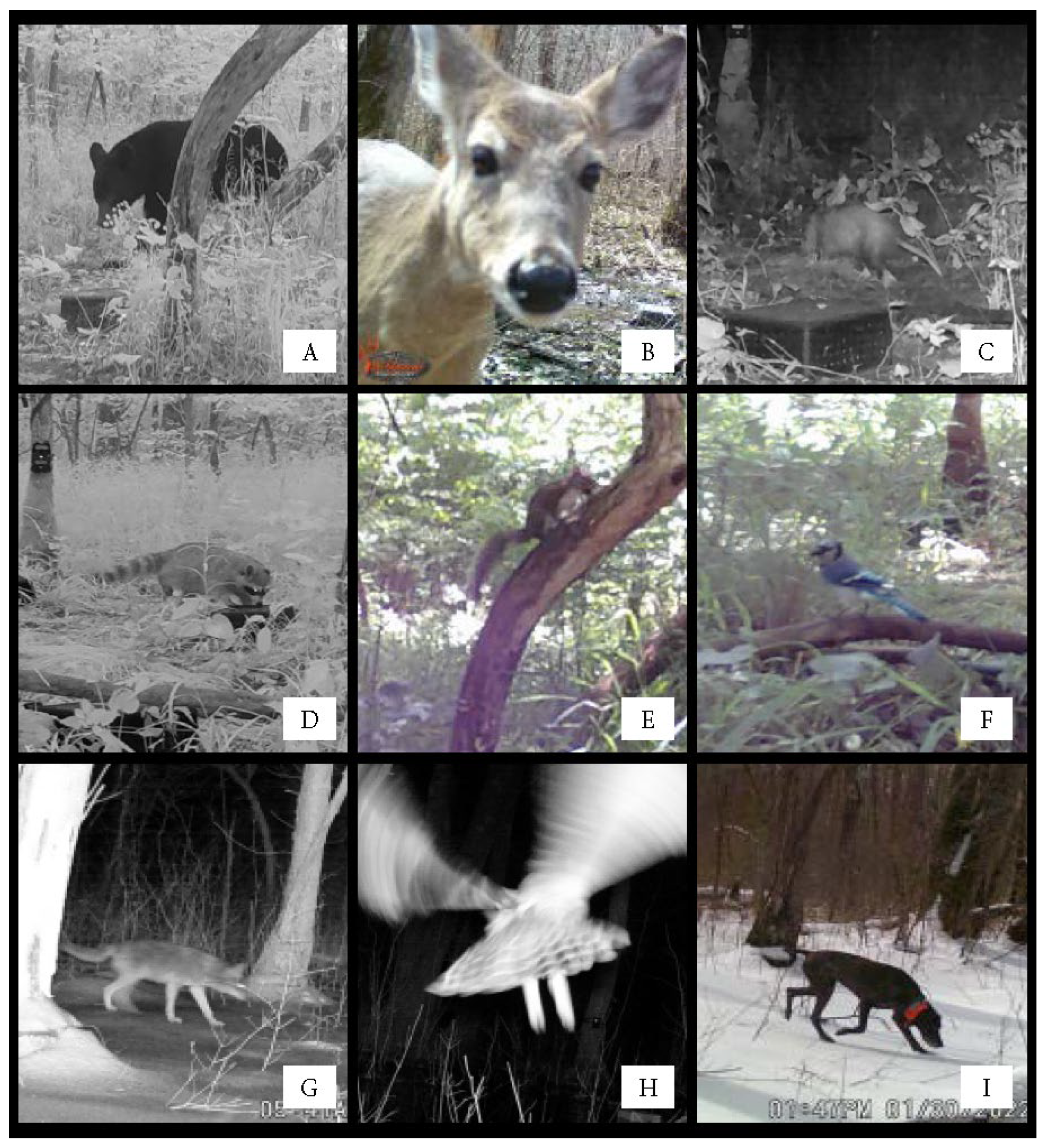
The camera traps lasted approximately 3.5 months before batteries were depleted. This resulted in the capture of 46 videos and 148 photos of interactions. From these, nine species were captured interacting with the exclusion baskets at the relocation site (
Figure 3). The camera traps also captured > 12 additional species of small birds and insects; however, these could not be fully identified to species level. Of these 194 captured interactions, 38 (19.6%) were known or potential predators of burrowing crayfish, including American Black Bear (
Ursus americana, Pallas 1780), Raccoon (
Procyon lotor, Linnaeus 1758), Opossum (
Didelphis virginiana, Linnaeus 1758), Coyote (
Canis latrans, Say 1823), and Barred Owl (
Strix varia, Barton 1799). The remaining 156 (80.4%) interactions were either nonpredatory or innocuous species, including White-tailed Deer (
Odocoileus virginianus, Zimmermann 1780), Fox Squirrel (
Sciurus niger, Linnaeus 1758), Blue Jay (
Cyanocitta cristata, Linnaeus 1758), other small unidentified songbirds, or unidentified species of insects.
4. Discussion
In total, we captured 490 C. pauleyi during the initial salvage efforts. Of that, 34 expired during capture from complications due to sampling, primarily from damage during burrow excavation. While burrow excavation is often the preferred method for burrowing crayfish collection, it is physically demanding and can require an experienced hand to achieve high success rates. The vacuum created during excavation can cause both internal and external damage to crayfish. While all collection methods were combined during salvage efforts, burrow excavations conducted at night had surprisingly high success rates compared to those conducted for the species during previous surveys in the daytime. This is likely due to a variety of factors, including increased C. pauleyi activity rate, planned timing of salvage efforts during major rain events, and cooler temperatures facilitating longer collecting times.
An additional 140 C. pauleyi expired while in captivity at holding facilities prior to relocation. Mortality was primarily caused by cannibalism (87%) between younger cohorts, or failed molting attempts or senescence in the oldest adults (13%). Mortality can be greatly decreased by reducing or eliminating holding time altogether; however, if unavoidable, juveniles should be housed separately in smaller individual enclosures rather than larger shared tanks to reduce mortality and maximize survivability. It is worth noting that no C. pauleyi expired in transport to or from human care, which supports that the transportation methods utilized worked well for this species.
All four relocation instances exhibited a success of >74% following two months of monitoring efforts, with subsequent relocations reaching 82% and later 85% success rates. Despite seasonality, increasing survival rates were likely due to refining our methodology as the study continued, with greater emphasis on both relocation site selection and ensuring that starter burrows were adequately filled with water prior to installation of exclusion baskets. While the third monitoring event showed success rates of 57.3–72.6%, it is worth noting that these events occurred five months to over a year post exclusion basket removal, and counting of active burrows was hindered by understory growth and buildup of detritus. While not quantified, all previously relocated colonies were checked during subsequent monitoring events and continue to show persistence of relocated C. pauleyi. All four relocated populations continue to show signs of not only active burrow activity, but signs of recruitment as well, following a follow-up visit on 18 May 2025.
Exclusion basket utilization appears to be the driving factor for relocation success. While, to our knowledge, no other known intentional burrowing crayfish relocation efforts had been completed in the USA prior to this project, relocations of Australian burrowing crayfish have resulted in little to no success [
18]. These efforts utilized starter burrows, but no enclosure to prevent animals from moving or being preyed upon was utilized. Many of the
C. pauleyi placed in the starter burrows immediately tried to escape, and likely would not have utilized the starter burrows without the exclusion baskets.
Additionally, it is worth noting that camera traps were deployed at the third relocation site during 2021 and documented >21 species passing through the site or interacting with the exclusion baskets. While many were innocuous, such as White-Tailed Deer or Fox Squirrels, others, such as American Black Bears, Raccoons, and Barred Owls, are known predators of burrowing crayfish and were noted investigating or trying to remove the baskets. Black Bears, Barred Owls, Coyotes, and Opossums were only observed passing through and sniffing the exclusion baskets; however, Raccoons were often observed on top of the exclusion baskets and appeared to be trying to flip the baskets. During the first of the three relocation monitoring events for the 2023 relocations, a particularly adept Raccoon (evident by pawprints at the site) succeeded in removing six of the baskets; however, these baskets were replaced and resealed, and only two crayfish were potentially preyed upon as the baskets continued to show active burrowing activity during the following monitoring event.
Since our initial relocation monitoring events in 2018, others have utilized our methods or a variation thereof and have reported similar success rates for Cocoa Crayfish (
Cambarus stockeri, Thoma 2011) [
19] and Jefferson County Crayfish (
Creaserinus gilpini, Hobbs Jr. and Robinson 1989) [
20]. Additionally, relocation and monitoring of the Greensboro Burrowing Crayfish (
Cambarus catagius, Hobbs and Perkins 1967) in North Carolina, utilizing these methods, is currently ongoing. This is encouraging as this methodology could aid in relocating and restoring not only our imperiled native burrowing crayfish species, but also species that rely on crayfish burrows for their habitat, such as Kirtland’s Snake (
Clonophis kirtlandii, Kennicott 1856), Eastern Massasauga (
Sistrurus catenatus, Rafinesque 1818), Hine’s Emerald Dragonfly (
Somatochlora hineana, Williamson 1931), and others. If native crayfish relocations/translocations are coupled with stream and wetland restoration efforts, it could enhance the recovery of these habitats decades earlier than waiting for the crayfish to recolonize and build the burrows themselves.