Review

Challenges and Development Trends of Crop–Hydro Digital Twin Technology

1
Laboratory of Subsurface Hydrology and Ecological Effect in Arid Region of the Ministry of Education, Chang’an University, Xi’an 710054, China
2
Key Laboratory of Eco-Hydrology and Water Security in Arid and Semi-Arid Regions of Ministry of Water Resources, Chang’an University, Xi’an 710054, China
3
School of Land Engineering, Chang’an University, Xi’an 710054, China
4
School of Water and Environment, Chang’an University, Xi’an 710054, China
5
Agricultural Engineering, Evaluation of Natural Resources Department, Environmental Studies and Research Institute, University of Sadat City, Sadat City 32897, Egypt
*
Author to whom correspondence should be addressed.
These authors contributed equally to this work.
Water 2026, 18(12), 1516; https://doi.org/10.3390/w18121516 (registering DOI)
Submission received: 6 May 2026 / Revised: 14 June 2026 / Accepted: 17 June 2026 / Published: 19 June 2026
(This article belongs to the Special Issue Application of Water-Saving Irrigation in Agricultural Development)

Abstract

Under the dual constraints of global food security and ecological protection, conventional agriculture is hampered by low resource efficiency and sluggish environmental response. Crop digital twin technology establishes a dynamic virtual reality system that integrates crops, environment, and water to enable real-time interaction and optimization. Based on the existing literature, this paper reviews the concept, architecture, and core modules of this technology and summarizes its applications in precision irrigation and crop monitoring. There are three major bottlenecks that persist, including limited high-frequency multi-source sensing and spatiotemporal fusion, insufficient parameter calibration and dynamic updating, and weak cross-scale integration from plant to watershed. Water is increasingly recognized as the key constraint and control variable and acting as both the central physiological driver of crop growth and the mass-flow link that connects the soil–plant–atmosphere continuum. The spatiotemporal dynamics of crop water deficit, compensatory root water uptake, evapotranspiration feedback, and the hydraulic behavior of irrigation-district canal systems constitute the core hydrological processes that must be simulated within the digital twin. Synchronizing crop water demand, soil moisture dynamics, atmospheric evapotranspiration, and irrigation scheduling within a unified spatiotemporal framework establishes a complete sensing, diagnosis, prediction and regulation technical chain. This chain offers a core pathway for alleviating agricultural water scarcity, improving irrigation efficiency, and ensuring food security.

1. Introduction

With global population growth and intensifying climate change, traditional agriculture faces multiple challenges, including resource shortages, mounting environmental pressures, and rising labor costs, necessitating a shift toward more sustainable and efficient water and production management [1]. Digital twin technology enables real-time monitoring, prediction, and optimization, offering a novel approach to address the complexities of agricultural production by creating virtual mappings of physical entities [2]. Digital twin is being adopted by a growing number of industries, driving industrial transformation and creating new opportunities. By integrating multiple technologies, digital twin enables unprecedented capability in controlling physical entities and facilitates the management of complex systems [3]. Recent reviews have identified five primary modeling approaches for digital twins in crop monitoring—physics-based, agent-based, data-driven, hybrid, and spatial models—which provide up-to-date information on environmental conditions, soil moisture, and variables affecting crop development and yield [4].
To establish the unique contribution of this review within the current state of the art, it is critical to contextualize our scope against other recent high-level review studies. Ahsen et al. (2025) provided a comprehensive foundational overview of general smart farming digital twins, focusing heavily on underlying technical enablers such as IoT sensor hardware architectures, cloud platform scalability, and blockchain data security frameworks [1]. However, their analysis treated the broader surrounding hydrological ecosystem and water allocation mechanics as external, static factors. Conversely, Melesse (2025) systematically categorized the five primary modeling typologies: physics-based, data-driven, agent-based, hybrid, and spatial models, specifically for monitoring crop canopy trajectories and optimizing final harvest yields [4]. While mathematically robust, Melesse’s review framed soil moisture and irrigation availability strictly as isolated field boundary conditions, omitting the complex hydraulic constraints of watershed water distribution systems.
A distinct literature gap remains at the intersection of these fields: how to bridge individual field crop physiology models with macro-scale hydraulic distribution networks. This review explicitly addresses this gap by focusing uniquely on the “Crop–Hydro” integration interface, providing a cross-disciplinary synthesis of multi-scale water–crop coupled digital twins. A Crop–Hydro Digital Twin (CH-DT) is defined here as an integrated, multi-scale cyber-physical system that constructs a bidirectional, real-time virtual mirror of both crop eco-physiological growth dynamics and the multi-scale hydrological processes that sustain them. It is theoretically distinct from classical smart agriculture approaches which rely on decoupled, unidirectional telemetry data (e.g., simple soil moisture threshold alerts), and from traditional engineering hydrology, which treats vegetation as a static rough surface parameter. The integration boundary of a CH-DT is explicitly located at the dynamic interface where plant physiological water demand (transpirational pull, stomatal regulation, and compensatory root water uptake) directly modulates, and is modulated by, the physical boundary conditions of soil water transport and watershed-scale canal network hydraulics. By bridging agricultural crop science with engineering hydrology within a singular, synchronized virtual–real loop, a CH-DT transforms water from a static background variable into a dynamic control vector that continuously balances regional water resource constraints with crop yield optimization.
In recent years, crop digital twin technology has moved from proof-of-concept to practical application, with frameworks evolving from specific models to comprehensive, multi-dimensional systems [5]. Emerging architectures integrating cloud-fog-edge computing and multi-agent systems enable real-time data processing and ‘what-if’ scenario simulations for open-environment crop farming, thereby addressing challenges related to connectivity and dynamic field conditions [6].
A crop digital twin (Crop Digital Twin) refers to a dynamic digital mirror of a crop constructed in virtual space, which continuously reflects the crop’s growth status, developmental stages, environmental conditions, and agronomic history through real-time data [7,8]. It is one of the core technologies of smart agriculture and serves as a key supporting technology in the era of Agriculture 4.0/5.0 [2]. Meanwhile, the crop digital twin system establishes a closed-loop system through the stages of data acquisition, transmission, model development, control, optimization and refinement, which enables real-time monitoring of microclimate and prediction of lettuce plant growth, while adaptively adjusting artificial lighting to compensate for variations in natural illumination [9].
As a new type of digital technology emerging in recent years, digital twin technology realizes real-time simulation, prediction, and optimization by digitally modeling the physical world, providing new ideas and methods for the design, operation, and management of water conservancy projects. This is of great significance for the transformation of water conservancy informatization toward intelligent water conservancy [10]. Water serves as the key constraint and control variable in the core of a crop digital twin system. This enables full-chain virtual–real mapping of crop growth processes, the soil–plant–atmosphere continuum (SPAC), and irrigation districts or watershed water systems, thereby forming closed-loop management [11].
It addresses the core bottlenecks in current technology deployment and points toward the mainstream development direction of future agricultural digital twins. While comprehensive baseline reviews, such as Peladarinos et al. (2023) (‘Enhancing Smart Agriculture by Implementing Digital Twins: A Comprehensive Review’)—have thoroughly mapped the generalized deployment of digital twins in agricultural telemetry and farm management infrastructure, they consistently treat water availability as a static, uncoupled boundary condition [12]. A profound research gap remains regarding how field-scale biological crop dynamics dynamically interact with macro-scale engineering hydrological processes. The novelty of this study lies in its explicit “Crop–Hydro” focus, establishing a cross-disciplinary synthesis that bridges individual plant eco-physiology with regional water conservancy hydraulics. Consequently, this study systematically reviews the current state of Crop–Hydro Digital Twin Technology, identifying its core technical bottlenecks and future evolutionary trends specifically at the integration interface of agricultural water-saving optimization and watershed-scale water security management.
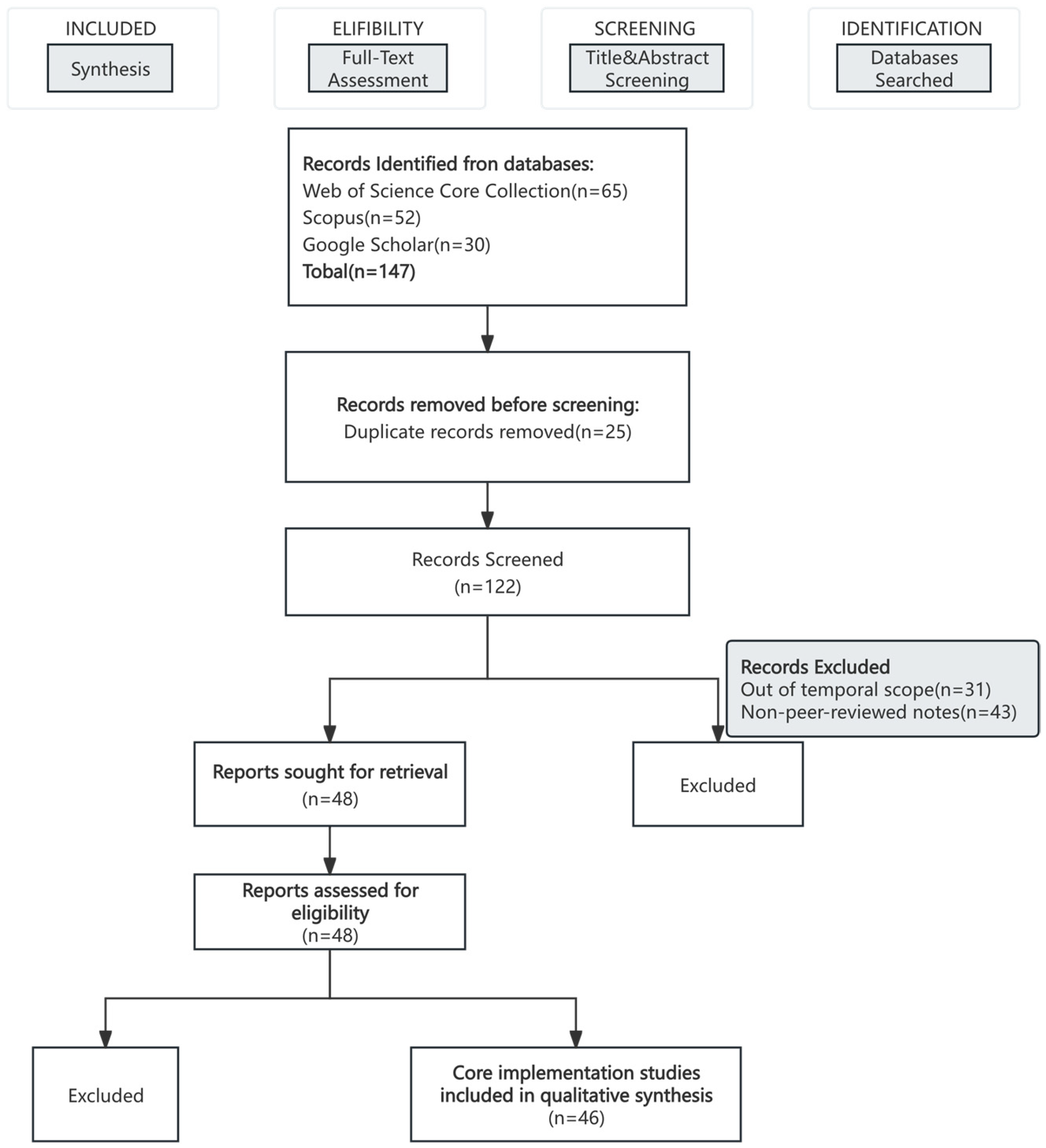
To ensure maximum transparency and reproducibility, the literature foundation of this review was compiled using a structured methodology inspired by the PRISMA (Preferred Reporting Items for Systematic Reviews and Meta-Analyses) guidelines, visually mapped out in Figure 1. Electronic database queries were systematically executed across the Web of Science Core Collection, Scopus, and Google Scholar to capture high-impact, peer-reviewed engineering and agronomic literature published between January 2018 and May 2026. These specific databases were selected due to their rigorous indexing of environmental engineering, hydrology, and computational agriculture research.
The search syntax utilized Boolean operators to link core technical dimensions: (‘digital twin’ OR ‘virtual–real mapping’ OR ‘cyber-physical system’) AND (‘smart irrigation’ OR ‘soil–plant–atmosphere continuum’ OR ‘SPAC’ OR ‘watershed hydraulics’ OR ‘canal water distribution’). Strict inclusion criteria prioritized original research, validated technical frameworks, and high-level reviews focused explicitly on the bidirectional, dynamic coupling of crop eco-physiological processes with external water systems. Publications were systematically excluded if they comprised non-peer-reviewed conference abstracts, white papers lacking an active digital framework, or purely descriptive agronomic reports devoid of a computational or predictive digital twin engine. Out of 147 initially screened records, 46 core implementation studies met all criteria and were selected to form the qualitative synthesis of this review.
It should be noted that the 147 records initially screened out represent precise retrieval targeting the specific topic of two-way crop–water coupling, rather than the broader digital twin literature in the agricultural field. The relatively small number of core studies finally identified (46 items) also confirms that this specific integrated interface is still in its infancy but characterized by rapid development.
During the preparation of this work, the authors utilized ChatGPT 4.0 to refine academic phrasing, improve English language grammatical clarity, and optimize the structural presentation of the comprehensive review matrices. Following the AI-assisted drafting and editing phases, the authors meticulously cross-examined, verified, and re-edited all technical content, architectural formulations, and literature data points. The final manuscript was fully synthesized by the human authors, who maintain absolute accountability and sole responsibility for the scientific accuracy, integrity, and originality of the research presented herein.

2. Technical Architecture of Crop Digital Twin Technology

2.1. A Five-Dimensional Framework Model

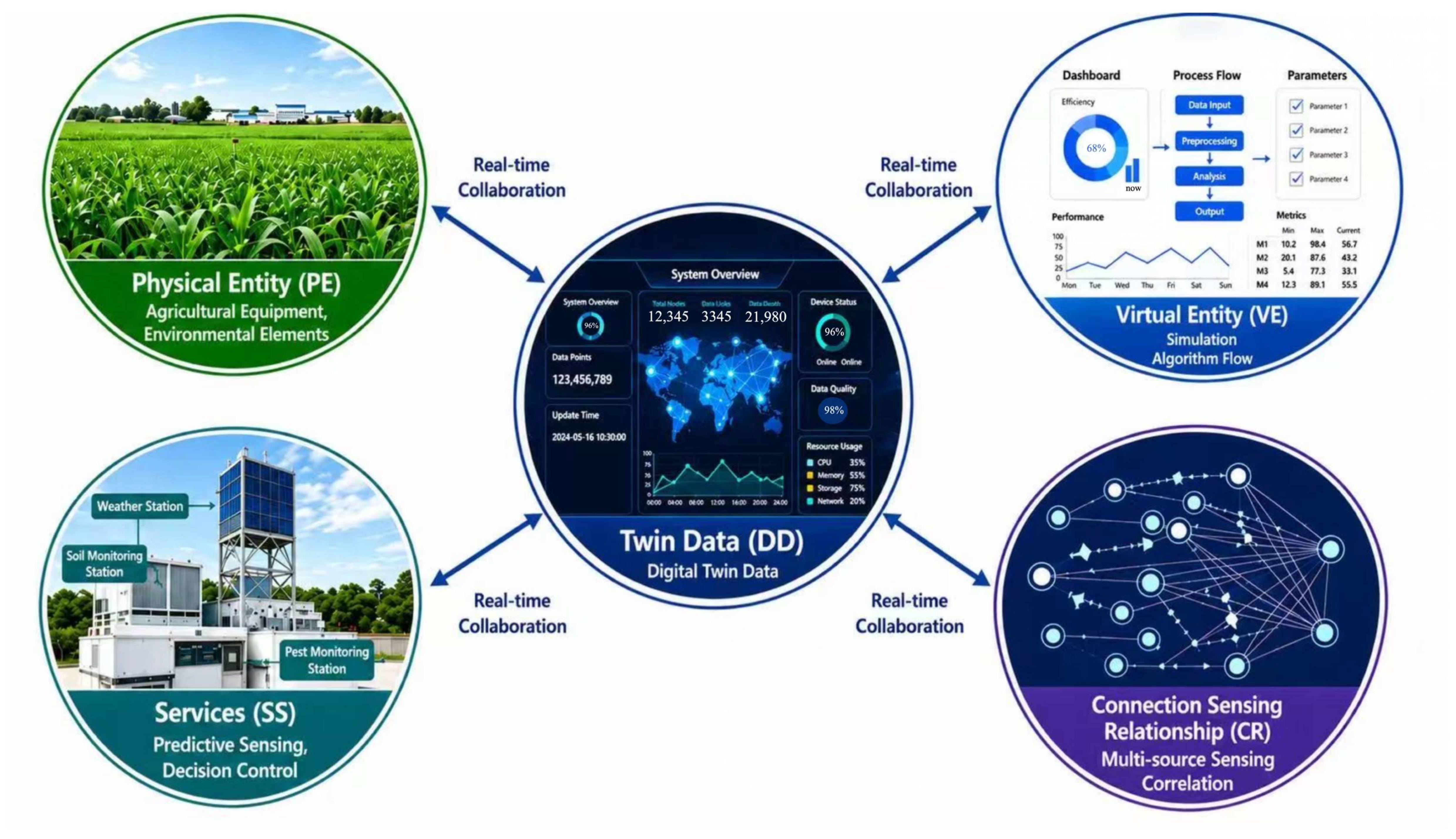
Building upon the foundational framework proposed by Tao et al. [5], they have systematically extended it by breaking through the limitations of traditional 3D virtual modeling, incorporating data cycles and service cycles as independent core architectural dimensions. As conceptualized in Figure 2, in this five-dimensional model, the physical entity (PE) encompasses the crop, agricultural equipment, and environmental elements. The virtual entity (VE) constructs a digital mirror of the crop using three-dimensional modeling and simulation algorithms. The service layer (Ss) provides functions such as monitoring, prediction, and decision-making. Twin data (DD) enable information exchange between the physical and virtual worlds. The connection relationships (CN) ensure real-time coordination among all elements.
Building on this (Figure 2), Yan et al. [13] developed a five-dimensional framework model for smart farm digital twins, which divides the agricultural ecosystem into three levels: the unit, system, and system-of-systems levels, thereby achieving hierarchical management from individual crops to the entire farm ecosystem. For intelligent irrigation, Dai et al. [14] applied the framework to structure the system into cyber-physical fusion, multi-dimensional virtual model, twin data, twin service, and practical application layers, integrating random forest-based soil moisture prediction with Unity3D-based visual simulation to achieve closed-loop irrigation control. These five interconnected dimensions comprise: (1) the Physical Entity (PE), representing the tangible open-field assets; (2) the Virtual Entity (VE), executing the physics-based simulation algorithms; (3) the Service Layer (Ss), providing application-specific optimization outputs; (4) the Twin Data (DD), which fuses multi-source heterogeneous streams; and (5) the Connection Relationships (CN), acting as the low-latency communication fabric that enables real-time virtual–real collaboration. Further extending the service layer and connection relationships, recent studies have demonstrated practical implementations of the five-dimensional framework in both irrigation management and disease detection. Millán et al. developed and validated IrriDesK, a digital twin for automated irrigation scheduling in processing tomato crops, improving fruit quality, thereby showcasing the value of the service layer in real-time decision-making under drought conditions [15]. In parallel, Vanjare et al. proposed a digital twin architecture for predictive crop disease monitoring that combines IoT sensors, a Raspberry Pi controller, and a Yolo-based convolutional neural network deployed on the Azure cloud platform. This system demonstrates the role of twin data and connection relationships in achieving real-time monitoring and alerts [16].
In the water conservancy domain, Li et al. [10] constructed a smart water conservancy five-dimensional model comprising physical water conservancy entities, water conservancy digital twins, integrated space–air–ground perception data, ubiquitous real-time interaction, and digitally empowered services, thereby enabling full-lifecycle simulation, real-time monitoring, and intelligent decision-making for water resource management, flood control, and engineering operation. These domain-specific extensions collectively demonstrate the versatility of the five-dimensional model in addressing diverse agricultural scenarios, from crop management, irrigation, and disease monitoring to water conservancy systems, with the newly added cases further highlighting its adaptability in both open-field and resource-limited environments [10,16].

2.2. System Functional Modules

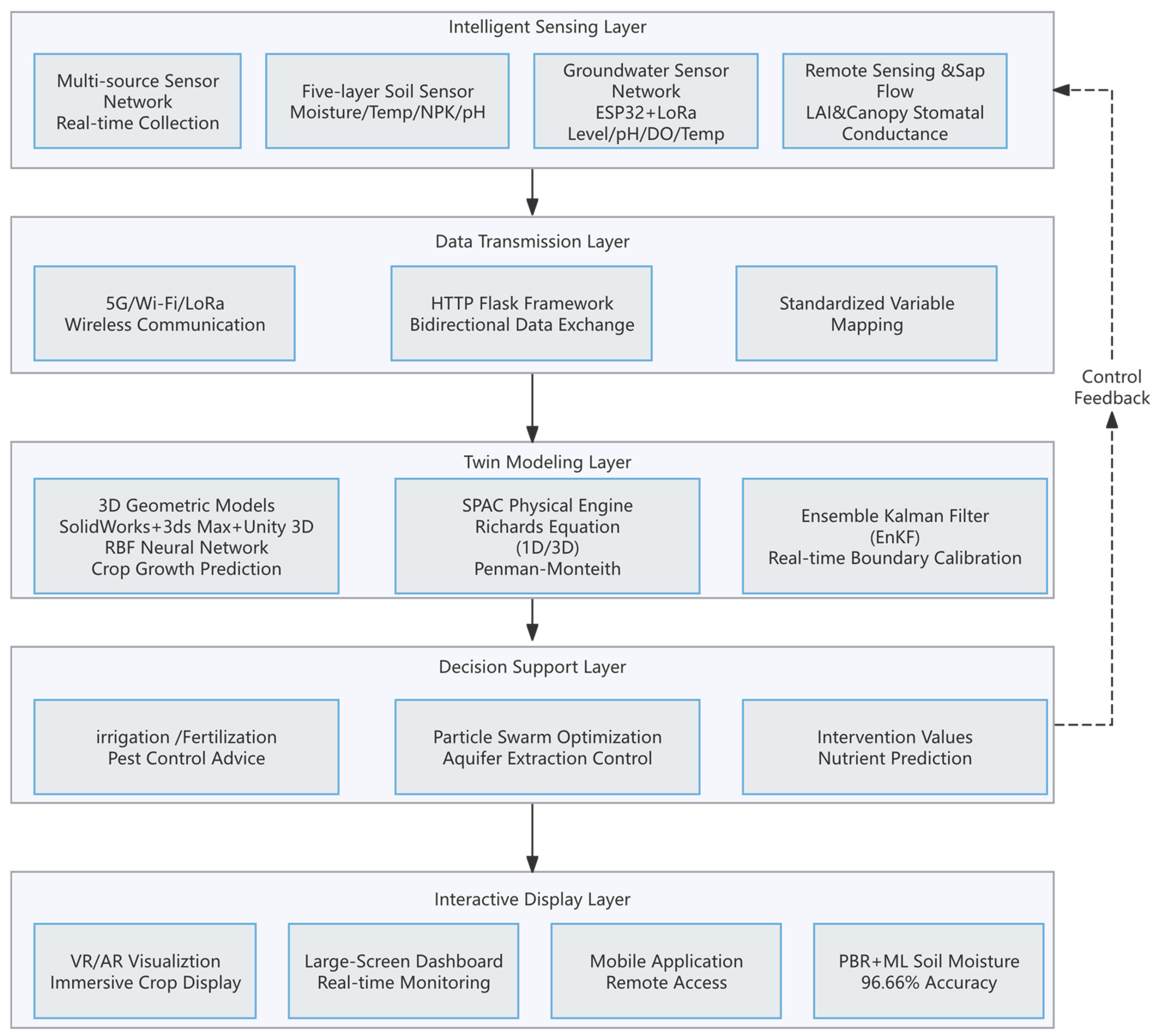
As shown in Figure 3, Crop digital twin systems typically include the following core modules:
Intelligent sensing layer: This layer collects crop growth environment parameters and crop physiological indicators in real time through a multi-source sensor network [7]. In a plant factory study, Miao et al. [17] used a five-layer soil sensor capable of measuring soil moisture, temperature, nitrogen, phosphorus, potassium, and pH at depths of 5–45 cm, with an accuracy of ±2%. For groundwater-fed agricultural systems, Cohen-Manrique et al. deployed a wireless sensor network in a confined aquifer using ESP32 microcontrollers and LoRa communication to monitor water level, pH, dissolved oxygen, and temperature, demonstrating that a well-designed sensing layer is equally critical for subsurface water resources that directly support crop irrigation [18].
Data transmission layer: Real-time data transmission is achieved using communication technologies such as 5G, Wi-Fi and LoRa. HTTP-based communication frameworks utilizing Flask have been adopted to enable bidirectional data exchange between edge devices and virtual environments [19]. A review of 147 digital twin studies in the water sector identified mismatches between P&ID labels, SCADA tags, laboratory identifiers, and model notations as a recurring source of data integrity errors, underscoring the need for standardized variable mapping across systems [20].
Twin modeling layer: This layer constructs three-dimensional geometric models and crop growth process models. Chen [7] proposed building a 3D plant factory model using tools such as SolidWorks, 3ds Max, and Unity 3D, and combining it with a radial basis function (RBF) neural network for crop growth prediction. Beyond geometric and process models, regression-based predictive models have been integrated into the twin layer to capture nutrient co-existence and composition.
The Soil–Plant–Atmosphere Continuum (SPAC) serves as the core physical engine within the Twin Modeling Layer, represented not as static variables, but as a network of coupled differential equations running in parallel within the virtual entity. The Soil node is mathematically characterized by the 1D/3D Richards [21] equation for transient unsaturated water flow, dynamically parameterized by real-time hydraulic conductivity (Kθ) inputs from multi-depth sensor arrays. The Plant node models moisture transit through the crop using a physical resistance framework, where the core parameters, such as compensatory root water uptake distribution and canopy stomatal conductance (gs), are dynamically updated via remote-sensing leaf area index (LAI) data and sap flow telemetry. The Atmosphere node computes the boundary layer evaporative demand using the Penman–Monteith formulation, driven by continuous local microclimate data streams. Rather than allowing these models to drift, the digital twin architecture dynamically calibrates these interdependent SPAC boundary parameters in real time through an Ensemble Kalman Filter (EnKF). This ensures that the virtual entity continuously mirrors the actual mass-flow rates of water moving across the physical continuum, enabling precise water deficit diagnosis.
Decision support layer: Based on data analysis and simulation, this layer provides decision recommendations for irrigation, fertilization, pest control, and other activities. The predicted nutrient concentrations from Ghazvini et al. [22] are used to calculate intervention values, and the aquifer control model of Cohen-Manrique et al. [18] uses particle swarm optimization to adjust extraction rates and maintain a target water level, demonstrating how the decision support layer can balance resource use with long-term sustainability. Meanwhile, the interactive framework supporting digital twin-based design decision-making enables digital twin developers to provide the fundamental components for decision support, and realize interconnected, highly responsive and flexible facilities [23].
Interactive display layer: Crop growth status is presented through VR/AR, large screen visualization, and mobile applications. For instance, Parewai and Koppen [24] combined physically based rendering (PBR) simulations with machine learning to classify soil moisture from multispectral images, achieving 96.66% accuracy and demonstrating that an interactive, sensor-free digital twin can directly support real-time visualization and decision-making. These technologies enable users to visualize digital information overlaid on the physical environment, while simultaneously collecting data for utilization by digital twins. Virtual reality technology can be leveraged to construct training scenarios that assist operators in improving their operational performance and collect data to further investigate the manner in which operators complete tasks [25].

3. Current Applications of Crop–Water Digital Twin Technology

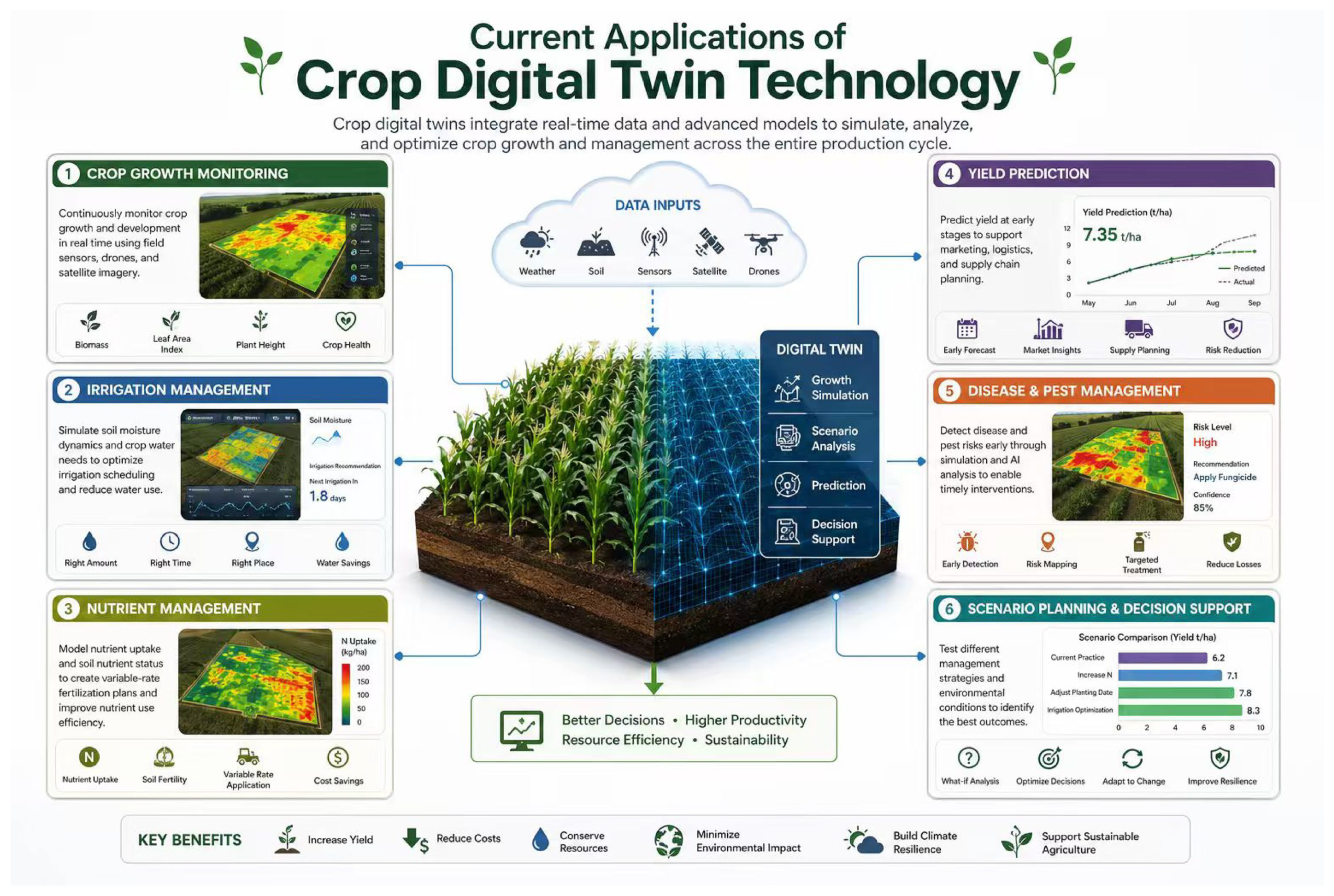
As synthesized across multi-scenario domains in Figure 4, crop water requirement prediction and irrigation scheduling represent core application fronts. For decision support, a smart irrigation system combined random-forest soil moisture prediction with Unity3D visualization, enabling closed-loop water control [19]. In water distribution networks, DT-based optimization of pressure control valves achieved up to 28% water savings while maintaining system reliability [26]. Beyond these approaches, Syed et al. [27] proposed an integrated framework that combines Digital Twin with multimodal transformer networks for water usage prediction and leakage detection. The Informer model, a long-term time-series transformer, achieved near-perfect prediction accuracy [27]. Additionally, Bonilla et al. developed a temporal graph convolutional neural network to estimate pump speeds from pressure and flow measurements, enabling the construction of a digital twin of water distribution systems. The method infers hidden control parameters and complete hydraulic state estimation [28]. While these emerging data-driven architectures demonstrate substantial algorithmic capability, such deterministic performance metrics must be interpreted with extreme scientific caution. The exceptional accuracy rates reported for certain LLM-based agricultural agents—specifically, 98% in growth trajectory prediction and 99.7% in growth-stage identification [29] were achieved strictly within highly controlled plant-factory environments or utilizing clean, heavily curated historical benchmarking datasets. Under actual open-field agronomic conditions, these deterministic models face severe performance degradation. Factors such as algorithmic overfitting to local conditions, implicit data leakage during the training phases, and poor spatial generalizability across heterogeneous soil types or highly variable microclimates present major deployment risks. Furthermore, these high accuracy claims cannot be evaluated in isolation from the vulnerabilities of the physical hardware layer. As detailed in Section 4.1, commercial field deployments are consistently subject to sensor drift, environmental noise, and catastrophic sensor failures. When sensor data gaps occur, the deterministic precision of data-driven models drops significantly. Therefore, future development must transition from deterministic metrics toward probabilistic error-propagation models that explicitly account for sensor uncertainty and input data noise. These data-driven approaches increasingly complement process-based simulators, improving prediction reliability across diverse conditions.
Precision management: A smart-farm DT system reduced CO2, CH4 and N2O emission intensities by 29.4–37.3% through real-time greenhouse-gas monitoring and optimized fertilization [13]. In orchards, multi-scale analysis of 30 mandarin orchards captured spatiotemporal fruit quality variation; hierarchical clustering then enabled tree-level “individualized agriculture,” shifting from uniform to customized management [30]. At the sensing layer, a passive, chapless RFID tag with edge machine learning achieved 96.2% temperature and 94.5% humidity classification accuracy, demonstrating a battery-free route to dense environmental perception [31]. In grazing systems, user-centered design research with Australian livestock farmers revealed that digital twin-enabled predictive grazing planners must align with farmers’ mental models [32]. Expanding the scope to urban refugee settings, Shehadeh et al. [33] employed digital twin technology for integrated water-energy-food-environment (WEFE) nexus management in Irbid Camp, Jordan. Skobelev et al. [34] developed a digital twin system for rice, which is capable of real-time collection of field data. By leveraging a distributed decision-making mechanism, this system improves the return on investment of precision agriculture and realizes the automation and precise management of the decision-making processes for farmers and service companies. While digital twin applications growing, remain concentrated in crop cultivation and water management, with significant gaps in soil quality predictive control and closed-loop regulation of fertilizers and pesticides [35].
Protected cultivation: For greenhouses, an IoT-enabled digital twin framework integrated multi-sensor data, 3D visualization and intelligent control, providing precise environmental regulation and decision-making tools [36]. A comprehensive review of digital twins in smart farming identified IoT, AI, cloud computing, and blockchain as foundational enabling technologies, while noting that most implementations remain at the telemetry or digital shadow stage rather than achieving full bidirectional DT functionality [12]. Expanding the scope to urban refugee settings, Shehadeh et al. [33] employed digital twin technology for integrated water-energy-food-environment (WEFE) nexus management in Irbid Camp, Jordan. A prototype of the intelligent digital twin system for plants was developed in Java by Skobelev et al. [37]. With this system, agronomists can build customized crop knowledge bases and digital twin models for each field and even sub-regions of a field. This system achieves spatial precision and also realizes temporal precision by determining the optimal timing for implementing agronomic operations.
Agricultural machinery collaboration: In smart agricultural systems, data collection, transmission, processing, and decision-making require coordinated operation across multiple computing layers. Cloud computing, edge computing, and device (or terminal) computing each play unique roles, collectively forming a distributed intelligent computing architecture tailored to agricultural environments. Digital twins of tractors and combine harvesters, structured with a “cloud–fog–edge–terminal” architecture, have been employed to predict tillage quality and reduce grain breakage, demonstrating the value of equipment–crop twin interaction for on-the-go optimization. Kalyani et al. [38] proposed a novel architecture for implementing digital twins of farms covering multiple fields, which integrates multi-agent, microservice, linked data and ontology technologies. The proposed architecture covers not only the farm and field levels, but also is refined to the 10 m × 10 m grid level.
Integrated water resource management at the watershed scale: The K-Twin SJ platform in Korea demonstrated how high-precision 3D geospatial digital twins integrating real-time hydrological data with AI-driven flood simulation can link dams and rivers into a unified decision-support system, enabling optimal dam discharge and proactive flood response [39]. At the national scale, the Danish HIP digital twin provided daily updated simulations of groundwater levels, soil moisture, and streamflow with 5–10-day forecasts, combining a physically based groundwater–surface water model with machine learning to downscale results from 100 m to 10 m resolution for climate change adaptation and water security management [40]. Complementing these natural-water-system twins, Rodriguez-Alonso et al. [41] developed a microservices-based Digital Twin platform for wastewater treatment plants with edge computing. It integrates real-time sensor data, a hydraulic-BIM model, an LSTM predictive maintenance module, and an ASM1 physics-based bioreactor simulation, enabling closed-loop optimization across the urban water cycle [41]. These typical cases fully verify that digital twin technology has formed mature application paradigms at watershed, national and urban water system levels, and can effectively support refined simulation, early warning prediction and whole-process optimal regulation of complex water resources systems.

4. Challenges of Crop–Water Digital Twin Technology

4.1. Challenges in Multi-Source Heterogeneous Data Acquisition and Fusion

Data serve as the core driving force of digital twin systems; however, the acquisition and processing of data face severe challenges. Dynamic changes in crop growth status, soil conditions, and other factors are difficult to capture efficiently and accurately in real time. The insufficient accumulation of high-quality datasets limits model generalization. The study by Miao et al. [17] also covered only 1–30 days of lettuce growth data, failing to span the complete growth cycle. Sensor drift under harsh environmental conditions and the spatiotemporal variation in noise characteristics as the environment changes reduce data reliability [2]. Chen [7] pointed out that current smart agriculture systems lack multi-source data fusion-driven platforms and visualization tools, which hinders full-scenario simulation and prediction. In summary, the challenges are evident in the following aspects: meteorological data, soil moisture, crop physiology, irrigation canal systems, groundwater, and remote sensing data belong to different departments or devices and lack unified protocols and consistent spatiotemporal references. Rapidly changing processes such as soil moisture dynamics, root water uptake, transpiration, infiltration, and runoff are subject to time lags in traditional sampling and transmission, causing the twin model to become “distorted.” Field-scale crop twins and irrigation district- or watershed-scale water system twins are difficult to couple in terms of grid resolution, time steps, and boundary conditions. In commercial farm environments, even well-instrumented facilities suffer from sensor failures and data gaps—over 8% of sensor data were missing in a monitored underground hydroponic farm, and critical operational variables required manual recording, complicating real-time model updates [42]. Multi-source heterogeneous data from environmental sensors, video surveillance, and farm management platforms further challenge seamless twin synchronization due to device interoperability issues, while the lack of standardized data interfaces and consistent spatiotemporal references across heterogeneous agricultural sources remains a persistent barrier to accurate virtual mapping [12,43].
Riaz et al. [44] systematically reviewed the integration of 3D city modelling, early warning systems, and digital twins for climate resilience, noting that real-time sensor data often suffer from low sampling density, poor frequency, and infrastructure gaps, which directly limit the accuracy of dynamic city-scale twins—a problem equally relevant to agricultural watersheds. Their PRISMA-based analysis of 68 articles found that most digital twin implementations remain at the conceptual stage, with bidirectional data flow between physical and virtual systems rarely achieved in practice [44].
Beyond data integration, the quality assessment and validation of high-resolution hydrological products present additional challenges. The Digital Twin Earth (DTE) Hydrology project demonstrated that satellite-based 1 km soil moisture, precipitation, evaporation, and river discharge products can be integrated into a 4D data cube for advanced hydrological modeling, yet the validation of such products at high spatial and temporal resolutions is difficult because in situ reference data at comparable scales are generally unavailable [45]. Similarly, in aquaculture systems, digital twin applications face challenges in sensor integration, data synchronization, and calibration under harsh aquatic environments, which are comparable to those encountered in field-scale water quality monitoring [46]. Syed et al. [27] further highlighted that multimodal data fusion—combining pressure sensors, flow meters, and thermal imaging—requires sophisticated transformer-based architectures to capture cross-modality dependencies, and that the lack of standardized preprocessing pipelines for heterogeneous sensor streams remains a major obstacle to real-time anomaly detection in water networks [27].

4.2. Bottlenecks in Crop Model Construction and Updating

Crop model accuracy and real-time performance are critical to digital twin systems; however, they still face multiple bottlenecks. Existing models are mostly developed for specific crops and environmental conditions, resulting in limited applicability. The model developed by Miao et al. [17] considered only four variables: light intensity, photosynthetically active photon flux density, nutrient solution, and planting time. The strategies for evaluating and updating model consistency remain underdeveloped. Balancing the model update frequency with system resource efficiency while ensuring accuracy at critical nodes remains an unresolved challenge.
Although data augmentation and transfer learning can partially alleviate this problem, issues persist, including unrealistic augmented data owing to insufficient model generalization and unsatisfactory transfer performance caused by large differences in data distributions.
Kim et al. [30] demonstrated that even for a relatively well-instrumented citrus orchard DT, AutoML-based sugar content prediction achieved an R2 of only 0.43, highlighting the inherent difficulty of capturing complex quality traits with current models. Nutrient concentration prediction using regression algorithms on self-collected rice datasets further revealed that model performance varies considerably across nutrient types; polynomial regression outperformed other methods for N, P, K, and Ca prediction, yet all models struggled with Mg, indicating that nutrient co-existence and composition introduce nonlinearities that single-model architectures cannot fully capture [22]. Recent reviews of DT applications in livestock production further confirm that most implementations remain at concept and prototype stages, with predictive capabilities for complex biological processes remaining inadequate due to limited training data and the difficulty of modeling living organisms [47].
Similarly, a systematic review of DT-enabled agricultural water management found that the majority of studies remain confined to conceptual and prototype phases, with monitoring and predictive DTs being the dominant types, and that the integration of AI with physics-based hydrological models for full-cycle water–crop coupling remains an open research gap [1]. Degeler et al. [48] proposed DiTEC, a digital twin for water distribution networks that combines semantic rule learning, graph neural network-based state estimation, and adaptive model selection to counteract model decay. Their GATRes network achieved superior pressure estimation (MAE 1.937, MAPE 0.0703), and the KEEP selection algorithm reached within 3% of the theoretical optimum, confirming that dynamic updating effectively mitigates “twin aging” [48].
In summary, existing crop models are mostly static or semi-empirical and cannot readily incorporate dynamic water regimes and field disturbances in real time. The coupling of water–nitrogen, water–salinity, and water–heat processes is complex, and model generalization is poor under small sample sizes and heterogeneous field conditions. Key variables such as groundwater dynamics, root distribution, and root-zone water potential are difficult to observe directly, rendering models “black-box” in nature and weak in terms of interpretability. Bonilla et al. [28] used a temporal graph convolutional network (T-GCN) to estimate pump speeds from sparse pressure and flow data (RMSE 0.015, r2 0.972), offering a scalable link between field–crop twins and irrigation-network hydraulics—though coupling such data-driven estimators with physics-based crop models across scales remains an open challenge. Meanwhile, Riaz et al. [44] noted that climate-resilience digital twins require integration of 3D city models, real-time sensors, and early warning systems, but most current implementations remain unidirectional, lacking the bidirectional feedback needed for true multi-scale coordination.

4.3. Challenges in Multi-Scale System Integration

Crop–water digital twins require multi-level integration spanning individual plants, fields, irrigation districts, and watershed scales. However, current research largely focuses on isolated breakthroughs and lacks systematic consideration of the full water–agriculture coupling process. Agricultural production involves multiple interconnected hydrological cycle components—soil moisture dynamics, crop water demand, canal water conveyance and distribution, and watershed hydrology—yet existing studies rarely integrate crop growth, soil water dynamics, irrigation scheduling, and watershed water systems as a unified whole, making it difficult to achieve full coupling of the water–agriculture system in both temporal and spatial dimensions. The coupled interactions among crops, soil, and hydrological processes constitute the core logic of crop–water digital twins; however, the mechanisms for data exchange and collaborative optimization among these three elements remain immature. The quality assessment and cross-scale validation of high-resolution satellite products still face bottlenecks [45], while irrigation-district-scale water distribution models and field-scale crop water demand models are difficult to connect in terms of grid resolution, time steps, and boundary conditions. The complexity of integrating multi-source data into watershed-level digital twin platforms further exacerbates this challenge [26].
They also leveraged a cloud–edge–end collaborative service platform to achieve low-latency data processing and a real-time response, providing a foundation for data fusion and coordination among the three elements. Shen et al. [49] proposed a novel cloud-edge collaborative framework for process-oriented digital twin generation. This method can minimize tracking overhead while maintaining high traceability, thereby maximizing the overall cost-effectiveness. However, the dynamic switching mechanism between autonomous regulation by intelligent control terminals and human intervention in complex field environments remains insufficiently explored. Although Mekki et al. [31] proposed an edge–cloud collaborative closed-loop control at the architectural level, their digital twin component remains primarily driven by environmental parameters for evapotranspiration modeling, without deeply coupling crop growth models with field operation models.
Beyond component-level integration, recent reviews propose a hierarchical DT architecture spanning edaphic, Phyto technologic, postharvest, and farm infrastructure levels, coordinated by a supervisory twin to enable full-lifecycle orchestration [43]; complementary implementation frameworks emphasize the systematic integration of digital twins across all stages of agricultural production and machinery life cycles [50]. Furthermore, practical deployment cases have demonstrated that site-specific DTs—such as those developed for unique controlled-environment farms—can successfully integrate monitoring, data analysis, and tailored forecasting to provide decision support, yet they also highlight the persistent challenge of combining structured sensor data with unstructured manual records to fully represent operational reality [42].

4.4. Technical Cost and Accessibility Barriers

The promotion and application of digital twin technology face constraints in terms of cost and accessibility. The system developed by Liu et al. [51] is relatively low in cost but offers limited functionality, achieving only three-stage identification for three crop types (tomato, pepper, and mushroom). Chen [7] noted that due to cost constraints, hyperspectral technology is mainly applied in laboratories and greenhouses, making its extension to open fields difficult. In the water sector, similar cost barriers prevail: high-resolution monitoring of soil moisture and evapotranspiration requires substantial investment in satellite data acquisition, ground validation networks, and cloud computing infrastructure [45]. In remote rural areas, the cost of building and maintaining communication infrastructure for real-time data transmission between field sensors, canal control points, and cloud platforms remains a persistent barrier [40].
Overall, the deployment costs of smart sluice gates, soil moisture/water level/flow sensors, and edge computing nodes are high, placing them beyond the reach of small- and medium-sized farmers. The closed-loop chain from virtual to reality is long, with insufficient reliability and robustness. Similarly, high-density monitoring combined with real-time AI inference consumes substantial electricity, and traditional power supply methods struggle to meet this demand.
However, extending such architectures to water-related field operations remains economically challenging. At the irrigation district scale, the cost-effectiveness of DT-enabled water management—balancing improved water use efficiency against the capital and operational expenditures of sensor networks and hydraulic control structures—has yet to be systematically evaluated across diverse socioeconomic contexts [26]. Canivete et al. [52] found that DT and BIM research in water systems is dominated by European institutions with limited global collaboration, warning that without inclusive partnerships and low-cost solutions, the digital divide in water management will widen. Similarly, Salawu and Glen [53] noted that only 33% of reviewed IoT-robotics studies included real-world testing—mirroring the validation gap in agricultural DT research.

4.5. Lack of Standardization and Interoperability

The large-scale application of digital twin farms requires unified standards. Differences in software platforms, modeling methods, and experimental approaches among different research teams lead to a lack of interoperability among the results. Yan et al. [13] also noted that technical standards issues, such as initial Modbus address conflicts and incompatible data formats, constrain system integration. In summary, agricultural and water conservancy digital twins lack unified interfaces and standard data. Cross-sectoral data barriers limit the input dimensionality of water–agriculture twin models. The DTE Hydrology project highlighted that consistency between satellite retrieval algorithms and hydrological models remains a challenge, and that standardized validation protocols for high-resolution water cycle products across different regions and climates are still absent [45].
The development of intelligent decision-making frameworks for agricultural management further demands standardized data governance and cross-sectoral coordination mechanisms to bridge the gap between virtual decision-making and physical execution [54,55].

4.6. Synthesis of Literature Contradictions, Strengths, and Weaknesses

A critical analysis of the selected literature reveals stark methodological contradictions and divergence among existing research tracks. The most prominent conflict lies between data-driven machine learning models and physics-based mechanistic models. As outlined in Table 1, while data-driven approaches report exceptional localized accuracy, they function as ‘black boxes’ vulnerable to catastrophic failures under open-field data gaps and sensor drift. Conversely, physics-based models offer superior generalizability across shifting climates but suffer from heavy computational latency, making real-time edge synchronization difficult.

5. Development Trends of Crop–Water Digital Twin Technology

Looking ahead, crop-focused digital twins will develop into integrated water–agriculture–ecology twins. This change will be supported by building multi-level digital models that cover watersheds/irrigation areas, fields, plants, and root zones. All water-related variables, including crop water use, soil water, irrigation water, groundwater, surface water, and evapotranspiration, will be managed in one unified spatial and temporal system.
A complete monitoring network will be formed by combining satellite data (soil moisture, crop growth, evapotranspiration), drone surveys, ground IoT sensors, and underground devices. This network supports observations from centimeter-scale field details to kilometer-scale regional maps, and from real-time minutes to daily summaries.
From an environmental security perspective, future crop–water digital twins must mature beyond basic quantity metrics by incorporating regional geochemical baseline datasets into their virtual entities. For example, the extensive evaluation of trace elements by An et al. [56] in the Tethyan–Himalayan domain demonstrates that high background levels of toxic metalloids such as arsenic and selenium are predominantly driven by natural geogenic leaching rather than immediate anthropogenic pollution. For a Crop–Hydro Digital Twin deployed in geochemically complex or arid regions, embedding these geogenic spatial maps directly into the intelligent sensing and decision support layers is critical. This integration prevents the virtual entity from generating false-positive warnings that mistake natural background fluctuations for agricultural management errors. Furthermore, it enables the closed-loop irrigation module to dynamically calculate bioaccumulation risk thresholds and adjust water-blending ratios in real time, protecting food safety at the plant level.
Chip-less RFID is a new low-cost sensor technology that does not need batteries or regular maintenance. It is very suitable for large-scale farm monitoring. The system designed by Mekki et al. [31] combines chip-less RFID with edge computing and machine learning. It measures temperature and humidity at the same time without a power supply by using special temperature- and humidity-sensitive materials. This technology provides a low-cost way to monitor field microclimate on a large scale.
Through continuous interaction and optimization within virtual simulation environments, reinforcement learning can autonomously optimize prediction and decision-making. Applications of computer vision and deep learning in crop phenotyping, growth prediction, and pest and disease diagnosis will become more mature [4]. For example, AI can dynamically determine irrigation timing, water volume, water–fertilizer ratios, and irrigation methods based on crop growth stages, soil water conditions, and meteorological data, achieving water savings of 30–50% [57,58]. It can also provide early warnings of crop drought or waterlogging risks seven to ten days in advance, enabling coordinated water diversion or drainage responses. Specifically, Liu et al. [59] analyzed the Yellow River Basin using SPI and SDI indices and found that drought duration and intensity are spatially correlated, with spring and autumn droughts being the most severe. Their work underlines the need to embed multi-scale drought indices into digital twins for proactive water allocation. Archana et al. [60] propose a Digital Twin-driven Artificial Intelligence (DTAI) framework that integrates multi-source satellite data including Sentinel-2, MODIS, ERA5 reanalysis data and GPM precipitation into a physically driven crop growth simulation environment. In tests covering four agroclimatic regions, seven crop-region combinations and five growing seasons, the proposed model achieves a mean absolute percentage error (MAPE) of 4.3%, a coefficient of determination (R2) of 0.94, and a prediction interval coverage probability of 91.2%.
Standardization is very important for the wide use of digital twins in real farms. The widely used Functional Mock-up Interface (FMI) standard can be used to share models and run joint simulations, which improves data exchange among farm machines, crops, and the environment [4]. In the future, unified standards will be built for agricultural and water digital twins, including standard data interfaces, model connection rules, and control protocols. Cross-department data sharing will also be established, connecting water, agriculture, meteorology, and ecology data to support decisions that balance food security and water security. Postolache et al. [61] presented the information regarding the data domain architecture, modules, data sources and several key technologies of digital twins for horticultural farms, and simplified the standardization of their components, thereby constructing an interoperable and scalable platform.
Crop digital twins will move toward full life cycle closed-loop management. The method proposed by Chen [7] records the whole growth process of crops and generates traceable QR codes, so the whole production chain from planting to selling can be controlled and tracked. Simultaneously, macro-scale engineering interventions directly modify the physical boundary conditions that feed downstream field-scale agricultural twins. Huo et al. [62] developed a sustainable four-stage natural gully consolidation and highland protection framework for the Loess Plateau, demonstrating that while such structural interventions reduce catchment sediment yields by 31–35% in the short term, their hydraulic erosion-control efficacy begins a natural lifecycle decay after approximately 10 years. In an integrated Crop–Hydro Digital Twin framework, these terrain-altering engineering dynamics must be actively coupled. Catchment-scale geomorphological consolidation directly impacts downstream runoff routing, local infiltration rates, and water-table configurations. By incorporating the physical lifecycle decay models of erosion-control structures, such as those analyzed by Huo et al. [62], directly into the virtual entity’s terrain-updating module, the digital twin can dynamically adapt its macro-scale hydraulic routing algorithms. This ensures that field-scale irrigation scheduling and local water allocation forecasts remain hydrologically accurate across decadal operational timelines. Additionally, linking these structural lifecycles with ecological evaluation tools, such as the InVEST habitat quality mapping applied by Huo et al. [63] in the Feng River basin and Li et al. [64] applied the InVEST model in the Danjiang River Basin to support sustainable water resources management and ecological conservation. Allows future digital twins to dynamically connect land-use transformations with long-term water quality degradation profiles.
The development of specialized large models for individual crops will become a prominent trend. Unlike general-purpose agricultural models, large vertical models can deeply integrate crop-specific physiological and ecological knowledge, cultivation management experience, and historical data, enabling more accurate predictions and decision-making. The CPO-RBF model developed by Miao et al. [17] has already demonstrated the advantages of crop-specific modeling, and this approach can be extended to major staple crops, such as rice, wheat, and maize, as well as to high-value cash crops in the future.

6. Conclusions

This systematic review has moved beyond descriptive smart-farming paradigms to isolate the precise technical mechanisms required to operationalize true Crop–Hydro Digital Twins (CH-DTs). By evaluating 46 core implementation studies, this work exposes the critical boundary interfaces where agricultural crop science and engineering hydrology must be computationally coupled.
The scientific novelty emerging from this review establishes that water must be managed not as an external boundary constraint, but as a dynamic control vector that links the microscopic Soil–Plant–Atmosphere Continuum (SPAC) directly to macroscopic watershed canal networks. Moving forward, the discipline must abandon deterministic, isolated ‘digital shadows’ in favor of probabilistic, multi-scale closed-loop systems.
The future of this technology introduces two vital requirements to the scientific community: first, the absolute necessity of embedding geogenic geochemical baseline maps (such as natural arsenic/selenium distributions) directly into sensing layers to preserve food safety, and second, the integration of physical structure lifecycle decay models (such as gully consolidation timelines) directly into terrain-updating virtual entities to maintain hydrological routing accuracy over multi-year horizons. Ultimately, CH-DT technology offers the definitive computational pathway to balance international food security with sustainable regional water resource preservation.”

Author Contributions

Conceptualization, writing—original draft, formal analysis, S.W. and J.H.; investigation, writing—review and editing, Y.L., Y.C. and S.E.; validation, supervision, A.H.; writing—review, figure preparation, J.M.I. All authors have read and agreed to the published version of the manuscript.

Funding

This research was funded by Science and Technology Projects of Xizang Autonomous Region, China (Grant No. XZ202502ZY0011); the National Natural Science Foundation of China (Grant No. 42261144749, 42377158); National Foreign Expert Individual Human Project (Category H) (H20240400); International Science and Technology Cooperation Program of Shaanxi Province (Grant No. 2024GH-ZDXM-24), and Shaanxi Province Agricultural Science and Technology 114 Public Welfare Platform to Serve Rural Revitalization Practical Technical Training (Grant No. 2024NC-XCZX-06).

Data Availability Statement

No new data were created or analyzed in this study.

Acknowledgments

The authors wish to thank the anonymous reviewers for their constructive comments and suggestions, which greatly improved the quality of this manuscript. During the preparation of this work, the authors utilized ChatGPT 4.0 to refine academic phrasing, improve English language grammatical clarity, and optimize the structural presentation of the comprehensive review matrices. The authors have reviewed and edited the output and take full responsibility for the content of this publication.

Conflicts of Interest

The authors declare no conflicts of interest. The funders had no role in the study design, analyses, manuscript writing, or the decision to publish the results.

References

  1. Ahsen, R.; Di Bitonto, P.; Novielli, P.; Magarelli, M.; Romano, D.; Diacono, D.; Monaco, A.; Amoroso, N.; Bellotti, R.; Tangaro, S. Harnessing Digital Twins for Sustainable Agricultural Water Management: A Systematic Review. Appl. Sci. 2025, 15, 4228. [Google Scholar] [CrossRef]
  2. Dawn, N.; Ghosh, S.; Saha, A.; Chatterjee, S.; Ghosh, T.; Guha, S.; Sarkar, S.; Mukherjee, P.; Sanyal, T. A Review on Digital Twins Technology: A New Frontier in Agriculture. Artif. Intell. Appl. 2023, 2, 250–262. [Google Scholar] [CrossRef]
  3. Pylianidis, C.; Osinga, S.; Athanasiadis, I.N. Introducing digital twins to agriculture. Comput. Electron. Agric. 2021, 184, 105942. [Google Scholar] [CrossRef]
  4. Melesse, T.Y. Digital twin-based applications in crop monitoring. Heliyon 2025, 11, e42137. [Google Scholar] [CrossRef] [PubMed]
  5. Tao, F.; Liu, W.R.; Zhang, M.; Hu, T.L.; Qi, Q.L.; Zhang, H.; Sui, F.Y.; Wang, T.; Xu, H.; Huang, Z.G.; et al. Five-dimensional digital twin model and its ten applications. Comput. Integr. Manuf. Syst. 2019, 25, 1–18. (In Chinese) [Google Scholar] [CrossRef]
  6. Kalyani, Y.; Vorster, L.; Whetton, R.; Collier, R. Application Scenarios of Digital Twins for Smart Crop Farming through Cloud–Fog–Edge Infrastructure. Future Internet 2024, 16, 100. [Google Scholar] [CrossRef]
  7. Chen, Y.H. Design of a Smart Agriculture System Based on Digital Twin. J. Smart Agric. 2026, 6, 21–24. (In Chinese) [Google Scholar] [CrossRef]
  8. Liu, H.; Jiang, C.; Bao, A.; Gulakhmadov, A.; Shaimuradov, F. Digital twin technology for cotton canopy development: A water-stress perspective. Smart Agric. Technol. 2025, 12, 101440. [Google Scholar] [CrossRef]
  9. Ojo, M.; Wang, Y.; Bua, C.; Sher, M.; Zahid, A. A crop digital twin system for predictive growth monitoring and adaptive light control in controlled environment agriculture. Internet Things 2026, 37, 101935. [Google Scholar] [CrossRef]
  10. Li, W.; Ma, Z.; Li, J.; Li, Q.; Li, Y.; Yang, J. Digital Twin Smart Water Conservancy: Status, Challenges, and Prospects. Water 2024, 16, 2038. [Google Scholar] [CrossRef]
  11. Zeng, Y.; Su, Z. Digital twin approach for the soil-plant-atmosphere continuum: Think big, model small. Front. Sci. 2024, 2, 1376950. [Google Scholar] [CrossRef]
  12. Peladarinos, N.; Piromalis, D.; Cheimaras, V.; Tserepas, E.; Munteanu, R.A.; Papageorgas, P. Enhancing Smart Agriculture by Implementing Digital Twins: A Comprehensive Review. Sensors 2023, 23, 7128. [Google Scholar] [CrossRef] [PubMed]
  13. Yan, H.L.; Zhang, J.Y. The Application and Realization of the Digital Twin System for Smart Farms under the “Dual Carbon” Goals. Gansu Sci. Technol. Rev. 2025, 54, 72–78. (In Chinese) [Google Scholar]
  14. Dai, M.; Shen, Y.; Li, X.; Liu, J.; Zhang, S.; Miao, H. Digital Twin System of Pest Management Driven by Data and Model Fusion. Agriculture 2024, 14, 1099. [Google Scholar] [CrossRef]
  15. Millán, S.; Casadesús, J.; Vadillo, J.M.; Campillo, C. Digital Twin Irrigation Strategies to Mitigate Drought Effects in Processing Tomatoes. Horticulturae 2025, 12, 28. [Google Scholar] [CrossRef]
  16. Vanjare, S.; Musale, J.; More, P.; Sayyad, T.; Gupta, Y.; Shikre, S. Implementation of Digital Twin Technology for predictive Crop Disease Monitoring. In Proceedings of the International Conference on Recent Advancement and Modernization in Sustainable Intelligent Technologies & Applications (RAMSITA-2025); Advances in Intelligent Systems Research; Atlantis Press: Paris, France, 2025; pp. 654–665. [Google Scholar]
  17. Miao, W.Y.; Li, J.; Chen, H.M.; Zhang, X.; Zhang, L.M. Optimization of Crop Growth Models Based on Digital Twin Plant Factories. Guizhou Agric. Sci. 2026, 54, 139–148. (In Chinese) [Google Scholar]
  18. Cohen-Manrique, C.S.; Villa-Ramírez, J.L.; Camacho-León, S.; Solano-Correa, Y.T.; Alvarez-Month, A.A.; Coronado-Hernández, O.E. Simulation and Optimisation Using a Digital Twin for Resilience-Based Management of Confined Aquifers. Water 2025, 17, 1973. [Google Scholar] [CrossRef]
  19. Dai, M.; Zhu, J.P.; Ji, X.; Miu, H. Research on Intelligent Irrigation Technology for Farmland Environment Based on Digital Twin. J. Agric. Mech. Res. 2026, 48, 293–300. (In Chinese) [Google Scholar] [CrossRef]
  20. Ghorbani Bam, P.; Rezaei, N.; Roubanis, A.; Austin, D.; Austin, E.; Tarroja, B.; Takacs, I.; Villez, K.; Rosso, D. Digital Twin Applications in the Water Sector: A Review. Water 2025, 17, 2957. [Google Scholar] [CrossRef]
  21. Richardson, L.F. Weather Prediction by Numerical Process; Cambridge University Press: Cambridge, UK, 2007. [Google Scholar]
  22. Ghazvini, A.; Sharef, N.M.; Balasundram, S.K.; Lee, L.S. A Concentration Prediction-Based Crop Digital Twin Using Nutrient Co-Existence and Composition in Regression Algorithms. Appl. Sci. 2024, 14, 3383. [Google Scholar] [CrossRef]
  23. Carlin, H.M.; Goodall, P.A.; Young, R.I.M.; West, A.A. An interactive framework to support decision-making for Digital Twin design. J. Ind. Inf. Integr. 2024, 41, 100639. [Google Scholar] [CrossRef]
  24. Parewai, I.; Köppen, M. A Digital Twin Approach for Soil Moisture Measurement with Physically Based Rendering Simulations and Machine Learning. Electronics 2025, 14, 395. [Google Scholar] [CrossRef]
  25. Martins, J.G.; Nutonen, K.; Costa, P.; Kuts, V.; Otto, T.; Sousa, A.; Petry, M.R. AR/VR Digital Twin for Simulation and Data Collection of Robotic Environments. In Proceedings of the 2025 IEEE International Conference on Autonomous Robot Systems and Competitions (ICARSC), Funchal, Portugal, 2–3 April 2025; pp. 198–203. [Google Scholar]
  26. Ramos, H.M.; Morani, M.C.; Carravetta, A.; Fecarrotta, O.; Adeyeye, K.; López-Jiménez, P.A.; Pérez-Sánchez, M. New Challenges towards Smart Systems’ Efficiency by Digital Twin in Water Distribution Networks. Water 2022, 14, 1304. [Google Scholar] [CrossRef]
  27. Syed, T.A.; Muhammad, M.A.; Alshahrani, A.A.; Hammad, M.; Naqash, M.T. Smart Water Management with Digital Twins and Multimodal Transformers: A Predictive Approach to Usage and Leakage Detection. Water 2024, 16, 3410. [Google Scholar] [CrossRef]
  28. Bonilla, C.A.; Zanfei, A.; Brentan, B.; Montalvo, I.; Izquierdo, J. A Digital Twin of a Water Distribution System by Using Graph Convolutional Networks for Pump Speed-Based State Estimation. Water 2022, 14, 514. [Google Scholar] [CrossRef]
  29. Zhao, C.; Li, J.; Wu, H.; Yang, Y. Vegetable Crop Growth Modeling in Digital Twin Platform Based on Large Language Model Inference. Smart Agric. 2024, 6, 63–71. (In Chinese) [Google Scholar] [CrossRef]
  30. Kim, S.; Heo, S. An agricultural digital twin for mandarins demonstrates the potential for individualized agriculture. Nat. Commun. 2024, 15, 1561. [Google Scholar] [CrossRef] [PubMed]
  31. Mekki, K.; Ghezaiel, N.; Slimene, M.B.; Neffati, S.; Rmili, H.; Gharsallah, A. Edge machine learning over IoT for chipless RFID environmental sensing in smart agriculture. Sci. Rep. 2026, 16. [Google Scholar] [CrossRef] [PubMed]
  32. Lee, T.; Ramp, D.; Bless, A. Unlocking digital twin planning for grazing industries with farmer centred design. Agric. Hum. Values 2025, 42, 2055–2075. [Google Scholar] [CrossRef]
  33. Shehadeh, A.; Alshboul, O.; Arar, M. Enhancing Urban Sustainability and Resilience: Employing Digital Twin Technologies for Integrated WEFE Nexus Management to Achieve SDGs. Sustainability 2024, 16, 7398. [Google Scholar] [CrossRef]
  34. Skobelev, P.; Tabachinskiy, A.; Simonova, E.; Lee, T.-R.; Zhilyaev, A.; Laryukhin, V. Digital twin of rice as a decision-making service for precise farming, based on environmental datasets from the fields. In Proceedings of the 2021 International Conference on Information Technology and Nanotechnology (ITNT), Samara, Russia, 20–24 September 2021; pp. 1–8. [Google Scholar]
  35. Silva, L.; Rodriguez-Sedano, F.; Baptista, P.; Coelho, J.P. The Digital Twin Paradigm Applied to Soil Quality Assessment: A Systematic Literature Review. Sensors 2023, 23, 1007. [Google Scholar] [CrossRef] [PubMed]
  36. Su, X.B.; Zhong, Y.L. Agricultural facility greenhouses based on Internet of Things technology. Qual. Agric. Prod. 2024, 93–95. (In Chinese) [Google Scholar]
  37. Skobelev, P.O.; Mayorov, I.V.; Simonova, E.V.; Goryanin, O.I.; Zhilyaev, A.A.; Tabachinskiy, A.S.; Yalovenko, V.V. Development of models and methods for creating a digital twin of plant within the cyber-physical system for precision farming management. J. Phys. Conf. Ser. 2020, 1703, 012022. [Google Scholar] [CrossRef]
  38. Kalyani, Y.; Bermeo, N.V.; Collier, R. Digital twin deployment for smart agriculture in Cloud-Fog-Edge infrastructure. Int. J. Parallel Emergent Distrib. Syst. 2023, 38, 461–476. [Google Scholar] [CrossRef]
  39. Park, D.; You, H. A Digital Twin Dam and Watershed Management Platform. Water 2023, 15, 2106. [Google Scholar] [CrossRef]
  40. Henriksen, H.; Schneider, R.; Koch, J.; Ondracek, M.; Troldborg, L.; Seidenfaden, I.; Kragh, S.; Bøgh, E.; Stisen, S. A New Digital Twin for Climate Change Adaptation, Water Management, and Disaster Risk Reduction (HIP Digital Twin). Water 2022, 15, 25. [Google Scholar] [CrossRef]
  41. Rodriguez-Alonso, C.; Pena-Regueiro, I.; Garcia, O. Digital Twin Platform for Water Treatment Plants Using Microservices Architecture. Sensors 2024, 24, 1568. [Google Scholar] [CrossRef] [PubMed]
  42. Jans-Singh, M.; Leeming, K.; Choudhary, R.; Girolami, M. Digital twin of an urban-integrated hydroponic farm. Data-Centric Eng. 2020, 1, e20. [Google Scholar] [CrossRef]
  43. Escriba-Gelonch, M.; Liang, S.; Van Schalkwyk, P.; Fisk, I.; Long, N.V.D.; Hessel, V. Digital Twins in Agriculture: Orchestration and Applications. J. Agric. Food Chem. 2024, 72, 10737–10752. [Google Scholar] [CrossRef] [PubMed]
  44. Riaz, K.; Mcafee, M.; Gharbia, S.S. Management of Climate Resilience: Exploring the Potential of Digital Twin Technology, 3D City Modelling, and Early Warning Systems. Sensors 2023, 23, 2659. [Google Scholar] [CrossRef] [PubMed]
  45. Brocca, L.; Barbetta, S.; Camici, S.; Ciabatta, L.; Dari, J.; Filippucci, P.; Massari, C.; Modanesi, S.; Tarpanelli, A.; Bonaccorsi, B.; et al. A Digital Twin of the terrestrial water cycle: A glimpse into the future through high-resolution Earth observations. Front. Sci. 2024, 1, 1190191. [Google Scholar] [CrossRef]
  46. Chen, J.; Xu, Y.; Li, H.; Zhao, X.; Su, Y.; Qi, C.; Qu, K.; Cui, Z. The Application of Digital Twin Technology in the Development of Intelligent Aquaculture: Status and Opportunities. Fishes 2025, 10, 363. [Google Scholar] [CrossRef]
  47. Symeonaki, E.; Maraveas, C.; Arvanitis, K.G. Recent Advances in Digital Twins for Agriculture 5.0: Applications and Open Issues in Livestock Production Systems. Appl. Sci. 2024, 14, 686. [Google Scholar] [CrossRef]
  48. Degeler, V.; Hadadian, M.; Karabulut, E.; Lazovik, A.; Van Het Loo, H.; Tello, A.; Truong, H. DiTEC: Digital Twin for Evolutionary Changes in Water Distribution Networks. In Leveraging Applications of Formal Methods, Verification and Validation; Application Areas; Lecture Notes in Computer Science; Springer: Cham, Switzerland, 2025; pp. 62–82. [Google Scholar]
  49. Shen, B.; Yu, H.; Hu, P.; Cai, H.; Guo, J.; Xu, B.; Jiang, L. A Cloud-Edge Collaboration Framework for Generating Process Digital Twin. IEEE Trans. Cloud Comput. 2024, 12, 388–404. [Google Scholar] [CrossRef]
  50. Semin, A.; Mironov, D.; Kislitskiy, M.; Zasypkin, A.; Ivanov, V. Improving the Theoretical and Methodological Framework for Implementing Digital Twin Technology in Various Sectors of Agriculture. Emerg. Sci. J. 2023, 7, 1100–1115. [Google Scholar] [CrossRef]
  51. Liu, M.H.; Zhang, Z.; Zhu, L.H.; Liu, X.Y.; Shang, Y.L.; Xiao, S.Y. Virtual Reality Farm System Based on Digital Twin. Mod. Inf. Technol. 2024, 8, 195–198. (In Chinese) [Google Scholar] [CrossRef]
  52. Canivete, C.R.C.; Chitauro, M.; Flörke, M.; Okorie, M.E. A Bibliometric and Network Analysis of Digital Twins and BIM in Water Distribution Systems. Technologies 2025, 13, 575. [Google Scholar] [CrossRef]
  53. Salawu, G.; Glen, B. Exploring the Integration of IoT and Robotics in Manufacturing: A Scoping Review of Disruptive Technologies. Technologies 2025, 13, 566. [Google Scholar] [CrossRef]
  54. Yang, L. Digital twin technology empowering the paradigm revolution of modern agricultural management decision-making. Digit. Econ. 2026, 31–33. (In Chinese) [Google Scholar] [CrossRef]
  55. Yao, Q.; Cheng, L.B. On the Value of Digital Twin Technology in the Field of Scientific and Technological Innovation. Sci. Technol. Manag. Res. 2025, 45, 231–239. (In Chinese) [Google Scholar]
  56. An, J.; Huo, A.; Tian, Y.; Liu, Q.; Zha, X. Source-oriented probabilistic health risk assessment of surface water potentially toxic elements and essential trace elements in the Tethyan-Himalayan Tectonic Domain. Water Res. 2026, 289, 124802. [Google Scholar] [CrossRef] [PubMed]
  57. Nasar, M.; Kausar, M.A.; Nayyer, M.A. Towards next-generation agriculture: An AI-driven industry 5.0 model for IoT-enabled smart farming. Next Res. 2026, 8, 101526. [Google Scholar] [CrossRef]
  58. Bayar, J.; Ali, N.; Cao, Z.; Ren, Y.; Dong, Y. Artificial intelligence of things (AIoT) for precision agriculture: Applications in smart irrigation, nutrient and disease management. Smart Agric. Technol. 2025, 12, 101629. [Google Scholar] [CrossRef]
  59. Liu, Q.; Huo, A.; Zhao, Z.; Zhao, X.; Rebouh, N.Y.; Luo, C. Spatial Differentiation and Influencing Factors Analysis of Drought Characteristics Based on the Standardized Precipitation Index: A Case Study of the Yellow River Basin. Water 2024, 16, 1337. [Google Scholar] [CrossRef]
  60. Archana, M.; Rallapalli, S.; Adudhodla, M. Digital-Twin Driven AI Framework for Climate-Adaptive Crop Yield Forecasting Using Multi-Source Satellite and Weather Data. Synth. A Multidiscip. Res. J. 2025, 3, 34–44. [Google Scholar]
  61. Postolache, S.; Sebastião, P.; Viegas, V.; Postolache, O. Digital Twin for Horticulture Farm: Data Source and Data Domain Architecture. IEEE Instrum. Meas. Mag. 2025, 28, 22–30. [Google Scholar] [CrossRef]
  62. Huo, A.; Li, P.; Zhao, Y.; Abuarab, M.E.L.S.; Elsayed, S.; Zhang, J. The Application and Development of Innovative Models in the Sustainable Management of Natural Gully Consolidation and Highland Protection Projects. Sustainability 2025, 17, 4329. [Google Scholar] [CrossRef]
  63. Huo, A.; Liu, Q.; Zhao, Z.; Elbeltagi, A.; Abuarab, M.E.L.S.; Ganjidoust, H. Habitat Quality Assessment and Driving Factor Analysis of Xiangyu in Feng River Basin Based on InVEST Model. Water 2023, 15, 4046. [Google Scholar] [CrossRef]
  64. Li, M.; Liang, D.; Xia, J.; Song, J.; Cheng, D.; Wu, J.; Cao, Y.; Sun, H.; Li, Q. Evaluation of water conservation function of Danjiang River Basin in Qinling Mountains, China based on InVEST model. J. Environ. Manag. 2021, 286, 112212. [Google Scholar] [CrossRef] [PubMed]
Figure 1. PRISMA flow diagram outlining the systematic database search (Source: Authors; Original diagram).
Water 18 01516 g001
Figure 2. Five-dimensional framework model of the crop–water digital twin (Source: Redrawn based on [5]).
Water 18 01516 g002
Figure 3. Core Module of Digital Twin Crops (Source: Authors; Original diagram).
Water 18 01516 g003
Figure 4. Current multi-scenario applications of crop digital twin technology across the production cycle (Source: Authors; Original diagram).
Water 18 01516 g004
Table 1. Methodological Comparison and Critical Evaluation of Reviewed Study Categories.
Model/System TypologyIdentified StrengthsDefined WeaknessesOpen Literature Contradictions
Data-Driven/LLM Agents [29,31]High immediate prediction accuracy; low real-time execution latency.Prone to overfitting; lacks physical interpretability; fails during sensor dropouts.Reports deterministic accuracy (>98%) that is completely unrealistic under open-field stochastic conditions.
Physics-Based/SPAC Models [4,40]High generalizability; strictly adheres to conservation laws (Richards Eq.)Extreme computational overhead; requires intense manual parameter calibration.Struggles to achieve the real-time synchronization required for true bidirectional twinning.
Hybrid Systems/Multi-Scale Networks [10,41]Successfully bridges individual plant data with watershed hydraulics.High cost; severe software interoperability and protocol blocks.Cross-scale integration bounds (connecting minute-scale crop needs to daily canal routing) remain unresolved.
Disclaimer/Publisher’s Note: The statements, opinions and data contained in all publications are solely those of the individual author(s) and contributor(s) and not of MDPI and/or the editor(s). MDPI and/or the editor(s) disclaim responsibility for any injury to people or property resulting from any ideas, methods, instructions or products referred to in the content.