Article

Identification of Suitable Managed Aquifer Recharge Sites Using GIS-AHP and Field-Based Evaluation of Aquifer Storage Capacity in Central Kazakhstan


1
Ahmedsafin Institute of Hydrogeology and Environmental Geosciences, Satbayev University, Almaty 050010, Kazakhstan
2
School of Information Technology and Engineering, Kazakh-British Technical University, Almaty 050000, Kazakhstan
*
Author to whom correspondence should be addressed.
Water 2026, 18(12), 1410; https://doi.org/10.3390/w18121410 (registering DOI)
Submission received: 20 April 2026 / Revised: 22 May 2026 / Accepted: 23 May 2026 / Published: 9 June 2026
(This article belongs to the Section Hydrogeology)

Abstract

Managed aquifer recharge (MAR) is increasingly being realized as an important approach to improve water security in arid and semi-arid environments where there is a low amount of surface water and high climatic variability. This paper introduces a unified approach to the process of locating appropriate MAR locations and estimating recharge potential in Central Kazakhstan through a multi-criteria analysis using geographic information systems (GIS) and hydrogeological field exploration, water balance modelling. Remote sensing datasets and evapotranspiration (ET) analyses were conducted for the 2014–2024 period, while field investigations, infiltration tests, and hydrochemical sampling were performed during the 2025 field campaign. The suitability testing was preliminarily performed in the Google Earth Engine (GEE; Google LLC, Mountain View, CA, USA) environment as a weighted overlay test with the combination of terrain, vegetation, hydrological, and land cover parameters. According to the suitability map obtained and patterns of activity in agricultural activities, eleven candidate sites were identified, out of which eight were found to be suitable after hydrochemical analysis. The Nesterov and Boldyrev techniques of field-based infiltration tests produced a range of 0.05 to 1.42 m/day of hydraulic conductivity. Water balance analysis shows that the total amount of water that could potentially be added to groundwater recharge is about 40.2 million m3/year and that the effective amount of water could be recharged is about 11.0 million m3/year, which is limited by the infiltration processes. This means that about 27 percent of the available water is added into ground water recharge, which is a significant boost to the original estimates. The assessment of the storage capacity of the aquifers indicates that at all locations, the pore space is much greater than the recharge volumes that have been calculated and, therefore, storage is not a limiting factor in the implementation of MAR. It is estimated that the potential MAR rates range between 174 and 5282 m3/day depending on local hydrogeological conditions. The suggested method offers a powerful and generalizable site selection and measurement framework of MAR in arid areas with limited data. The findings highlight the significance of combining remote sensing, field measurements, and process-based modeling to aid sustainable groundwater management and climate adaptation strategies.

1. Introduction

In the context of increasing water scarcity in arid and semi-arid regions of the world—driven by climate change, population growth, and intensive agricultural activities—MAR technologies are gaining strategic importance for ensuring water security. MAR represents a set of engineering and management measures aimed at enhancing groundwater reserves through the deliberate infiltration or injection of surplus surface water, treated wastewater, or desalinated water into the most reliable natural reservoir—aquifers. MAR is particularly important for agriculture in arid regions, where precipitation is unevenly distributed, surface runoff is highly seasonal, and irrigation systems are strongly dependent on surface water sources.
This literature review, based on an analysis of more than 30 scientific studies, systematizes current approaches, methodologies, results, and regional experiences in the application of MAR, with particular emphasis on arid conditions and a comparative analysis of international and post-Soviet practices. A key stage in MAR planning is the identification and suitability assessment of potential sites, for which GIS and multi-criteria decision analysis methods are widely applied.
Studies conducted in Qatar [1], India [2], China [3], and the Ganges Basin [4] demonstrate the effectiveness of integrating GIS, remote sensing, and criteria-weighting methods such as the Analytical Hierarchy Process (AHP) and its fuzzy extensions (FAHP), enabling the development of highly reliable recharge potential maps [2,3,4,5]. Hydrological and hydrogeological models are actively used for forecasting outcomes and optimizing technical schemes, as illustrated by the application of SWAT (Texas A&M University, College Station, TX, USA) in Tunisia [6] and integrated isotope and tracer modeling in karst systems in China [7].
A modern trend is the adoption of artificial intelligence methods: hybrid deep learning and remote sensing approaches improve the accuracy of identifying suitable MAR zones [8], while global neural network models with explainable AI (XAI) help reveal complex nonlinear relationships [9]. Review studies [10] highlight universal success factors for MAR implementation, including hydrogeological parameters (e.g., transmissivity and permeability), the availability and quality of recharge water, and the management of contamination risks (e.g., clogging). These studies emphasize the importance of an integrated approach incorporating continuous monitoring and adaptive management [10,11]. Global experience confirms the high potential of MAR as a tool for climate change adaptation. In the arid countries of the Persian Gulf (Qatar [1]), MAR is considered a solution to freshwater scarcity and the threat of seawater intrusion, while in North Africa [6] and South Africa [12], the focus is on the use of seasonal runoff and stormwater. In Europe (Germany [13], Switzerland [14]), localized, nature-based solutions (near-nature MAR), such as managed floodplain infiltration, are increasingly being developed due to their environmental sustainability and economic efficiency. In Turkey [15], significant historical experience has been accumulated; however, the development of MAR is constrained by institutional barriers. A common conclusion of international studies is the need to integrate MAR into national water resource management strategies [10,11,15].
In post-Soviet countries and Russia, interest in MAR is also high due to acute water scarcity in many arid regions, although the context and approaches have specific characteristics. Studies are often focused on addressing critical local challenges, such as aquifer depletion in urban areas (Derbent, Russia [16]) or ensuring water supply for agriculture under sharply continental climatic conditions (Aktobe region, Kazakhstan [17]; Eastern Orenburg region, Russia [18]). A number of works are devoted to adapting MAR methods to unique natural conditions, such as the use of takyr runoff in Uzbekistan [19] or integrated flow regulation along the Black Sea coast of Russia [20].
Russian-language publications particularly emphasize the role of the vadose zone as a natural filter and highlight the advantages of environmentally friendly infiltration methods [21,22,23], considering MAR not only as a technical solution but also as an environmental protection measure [22,23]. The need to improve hydrogeological assessment methodologies [24] and regulatory frameworks [15,25,26], as well as to account for water balance dynamics [27], is also emphasized. Unlike many international studies that focus on advanced modeling techniques and artificial intelligence, research in the Commonwealth of Independent States (CIS) more often prioritizes classical hydrogeological justification and adapted engineering solutions, although there is a growing convergence of approaches—for example, in the use of 3D modeling for Agricultural MAR (AgMAR) [28] and the incorporation of international experience [26].
Thus, the analysis of an extensive body of literature [1,2,3,4,5,6,7,8,9,10,11,12,13,14,15,16,17,18,19,20,21,22,23,24,25,26,27,28,29,30,31,32,33,34,35,36] demonstrates that MAR is widely recognized as a highly effective tool for enhancing water security in arid environments. Its successful implementation depends on the integrated consideration of hydrogeological conditions, the quality of recharge sources, and effective management. While international experience reflects a wide diversity of technological solutions, in the CIS and Russia the potential of MAR is realized primarily through addressing urgent regional challenges, with an emphasis on environmental safety and the adaptation of classical engineering approaches. This highlights the importance of integrating advanced global practices with in-depth regional analysis to ensure the sustainable development of water-scarce territories.
To achieve the objectives of this study, a sequential multi-stage framework was developed integrating remote sensing, GIS-based multi-criteria analysis, field investigations, hydrochemical assessment, and water balance modeling. In the first stage, a regional MAR suitability assessment was performed in the GEE environment using a weighted overlay approach based on terrain, vegetation, climatic, hydrological, and land cover factors. In the second stage, watersheds with the highest MAR suitability were identified and additionally filtered according to the presence of active agricultural land use, reflecting areas with the greatest practical demand for groundwater replenishment. In the third stage, digitized hydrogeological maps were analyzed to verify the presence of permeable recharge collectors and favorable geological conditions for infiltration. Subsequently, field investigations and in situ infiltration tests were conducted using the Nesterov and Boldyrev methods to quantify the filtration properties of near-surface deposits. Hydrochemical analyses were then carried out to evaluate groundwater quality and assess the geochemical suitability of the selected sites for MAR implementation. Finally, a water balance and infiltration modeling approach was applied to estimate runoff availability, evaporation losses, aquifer storage capacity, and the effective recharge potential of each selected watershed. This integrated methodology allowed the transition from regional-scale suitability screening to quantitative evaluation of MAR feasibility under the arid conditions of Central Kazakhstan.

2. Materials and Methods

2.1. Study Area

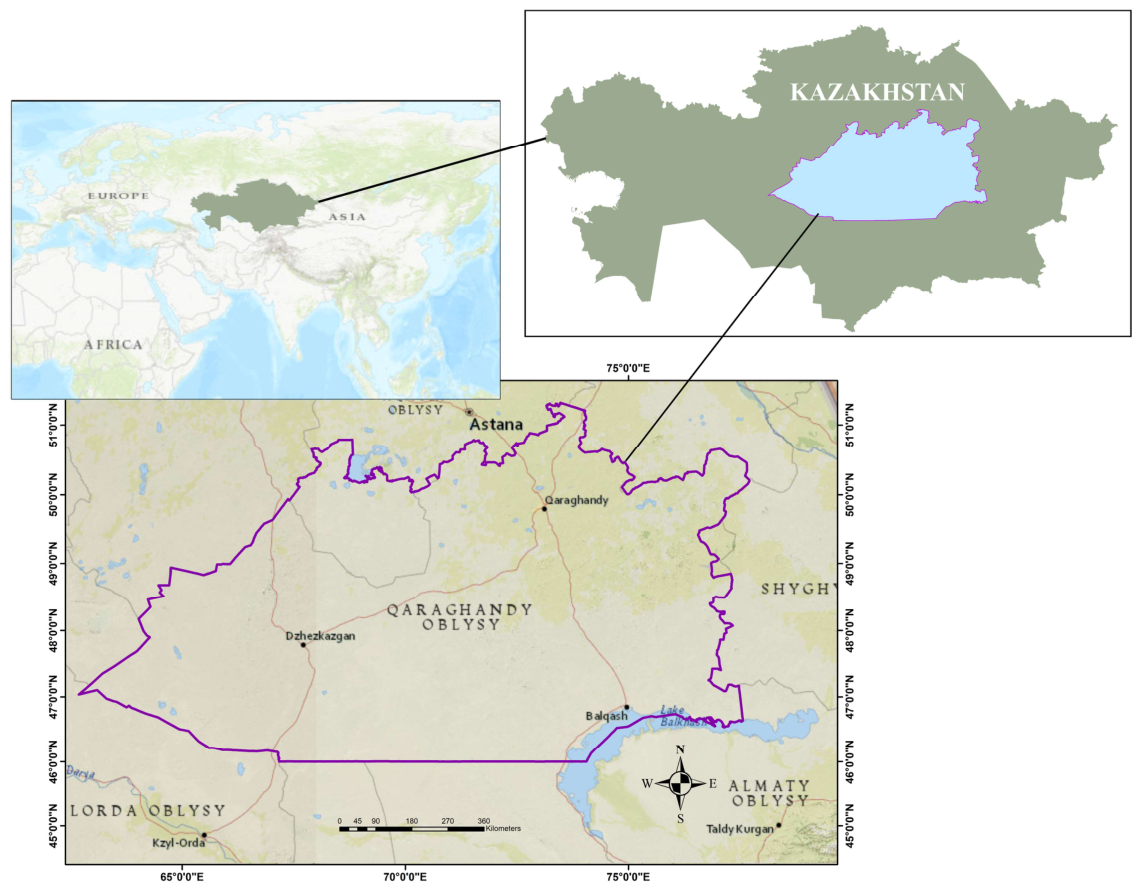
Central Kazakhstan (Figure 1) is characterized by an arid climate, pronounced seasonality of precipitation, limited surface water resources, and a complex hydrogeological structure. The region experiences water deficits affecting both rural settlements and pasture territories: the deficit of water demand for the rural population is estimated at approximately 3.94 thousand m3/day, while the water demand of pasture territories reaches about 34.8 thousand m3/day. According to the Atlas of Hydrogeological Maps of the Republic of Kazakhstan, the forecasted exploitable groundwater resources of Central Kazakhstan amount to approximately 12,970.1 thousand m3/day, whereas natural renewable groundwater resources are estimated at about 6853.7 thousand m3/day, with a groundwater runoff modulus of 0.019 L/s·km2. Under such conditions, identifying suitable sites for MAR requires comprehensive spatial analysis integrating climatic, hydrological, soil, and hydrogeological factors. For these tasks, one of the most justified and widely applied approaches is the Weighted Overlay method within GIS.
The effectiveness of this approach has been confirmed by numerous studies conducted in arid and semi-arid regions that are climatically and geologically comparable to Central Kazakhstan [1,5,6,7,10,29,33]. The scientific literature demonstrates that the use of multi-criteria decision analysis (MCDA) methods, including Weighted Overlay and the Analytic Hierarchy Process (AHP), provides robust and reproducible results in mapping groundwater recharge zones [1,2,3,5,8,33]. In several studies, modeling results were successfully validated against observed groundwater dynamics and hydrogeological observations, confirming the practical applicability of the method [2,3,5,6,7,12,14,29,30,31].
For Central Kazakhstan, this approach is particularly relevant, as it allows for the consideration of spatial heterogeneity in geological conditions, variations in rock permeability, and differences in climatic parameters. The application of the Weighted Overlay method enables the integration of large volumes of geospatial data into a unified analytical model, facilitating the well-grounded selection of suitable sites for artificial aquifer recharge and the planning of sustainable water resource management measures.

2.2. Methodology of Research

As a result of applying the Weighted Overlay method, an integrated suitability map for MAR implementation areas was generated using the GEE. To improve the readability of the manuscript, the full scripts were removed from the main text and provided as Supplementary File S1.
The selection of factors and weighting coefficients for the weighted overlay analysis was based on hydrogeological principles controlling infiltration processes, runoff accumulation, and groundwater recharge under arid and semi-arid environmental conditions. The methodology follows approaches widely applied in previous MAR and groundwater recharge suitability studies using GIS-based MCDA, including the AHP and weighted overlay methods [1,2,3,4,5,8,9].
Five main criteria were included in the analysis: terrain slope, precipitation, vegetation conditions (NDVI), drainage characteristics, and land use/land cover. These parameters were selected because they directly influence infiltration capacity, runoff concentration, ET intensity, and groundwater recharge conditions. Terrain slope controls runoff velocity and infiltration opportunity time, where moderate and gentle slopes are generally considered more favorable for MAR implementation [2,5]. Precipitation represents the primary source of recharge water in arid regions and determines the potential runoff volume available for infiltration [4,29]. Vegetation conditions, represented by NDVI, were included because vegetation density influences ET, soil stability, and infiltration processes [1,2,3]. Drainage density and river network characteristics were selected to identify areas with increased runoff accumulation and favorable hydrological connectivity [1,3]. Land use/land cover was incorporated because surface permeability and infiltration conditions strongly depend on anthropogenic disturbance and soil sealing [5,13].
To determine the weighting coefficients, an AHP-based pairwise comparison procedure was applied. The weighting strategy was defined according to the relative importance of each parameter in controlling runoff generation and infiltration processes in Central Kazakhstan. The highest weight was assigned to terrain slope (0.30), since this parameter directly controls runoff velocity and the duration of water contact with the infiltration surface. Precipitation and land use/land cover received equal weights of 0.20, reflecting their importance in water availability and surface permeability conditions. NDVI and drainage density were assigned weights of 0.15 and considered secondary controlling parameters associated with vegetation conditions, ET, soil stability, and hydrological connectivity. The weighting coefficients used in the final model were as follows: slope—0.30, precipitation—0.20, land use/land cover—0.20, NDVI—0.15, and drainage density—0.15.
The pairwise comparison matrix used for the AHP procedure is presented in Table 1.
The pairwise comparison matrix was reconstructed according to the relative ratios between normalized criterion weights. Consistency analysis demonstrated that the maximum eigenvalue was λ_max = 5.00, the Consistency Index (CI) equaled 0.00, and the Consistency Ratio (CR) equaled 0.00, which is substantially below the acceptable threshold value of 0.10. Therefore, the weighting matrix was considered fully consistent and suitable for subsequent weighted overlay analysis.
  • Input data and calculation methods
The selected analysis period (2014–2024) was chosen to capture long-term climatic and hydrological variability under the arid conditions of Central Kazakhstan and to reduce the influence of short-term anomalies in precipitation and evapotranspiration. Field investigations, infiltration tests, and hydrochemical sampling were conducted during the 2025 field campaign.
  • Terrain slope was derived from the Shuttle Radar Topography Mission (SRTM) digital elevation model (USGS/SRTMGL1_003; Reston, VA, USA and converted to percentage values for subsequent suitability assessment. A trapezoidal membership function was applied to classify slope conditions according to their favorability for runoff accumulation and infiltration processes under arid conditions. Gentle and moderate slopes were considered the most suitable for MAR implementation, whereas steep slopes were assigned lower suitability values due to increased runoff velocity and reduced infiltration opportunity time.
  • Vegetation conditions were evaluated using Sentinel-2 Surface Reflectance Harmonized imagery (COPERNICUS/S2_SR_HARMONIZED; European Space Agency (ESA, Paris, France). Cloud masking was performed using the Scene Classification Layer (SCL), after which a median composite was generated for the selected observation period. The NDVI was subsequently calculated and normalized to characterize vegetation density and associated infiltration-related environmental conditions.
  • Precipitation conditions were estimated using the CHIRPS daily precipitation dataset (UCSB-CHG/CHIRPS/DAILY; University of California, Santa Barbara, CA, USA). Mean annual precipitation values were calculated for the study period and normalized within the area of interest in order to represent the spatial variability of potential water availability for recharge processes.
  • Drainage conditions were derived from the HydroSHEDS FreeFlowingRivers dataset (WWF/HydroSHEDS/v1/FreeFlowingRivers; World Wildlife Fund, Washington, DC, USA). The river network was rasterized and analyzed using neighborhood analysis techniques to identify areas characterized by increased runoff accumulation and favorable hydrological connectivity.
  • Land use and land cover suitability were assessed using the ESA WorldCover dataset (ESA/WorldCover/v200/2021; European Space Agency, Paris, France). Different land cover classes were assigned suitability scores according to their expected influence on surface permeability, infiltration potential, and anthropogenic disturbance.
  • The final MAR suitability index was calculated using a weighted linear combination of all normalized environmental factors according to the weighting coefficients derived from the AHP-based multi-criteria analysis. The resulting suitability map was subsequently used for regional screening and identification of potential MAR candidate areas across Central Kazakhstan.
  • Detailed GEE scripts and processing workflows used for the spatial analysis are provided in the Supplementary Materials.
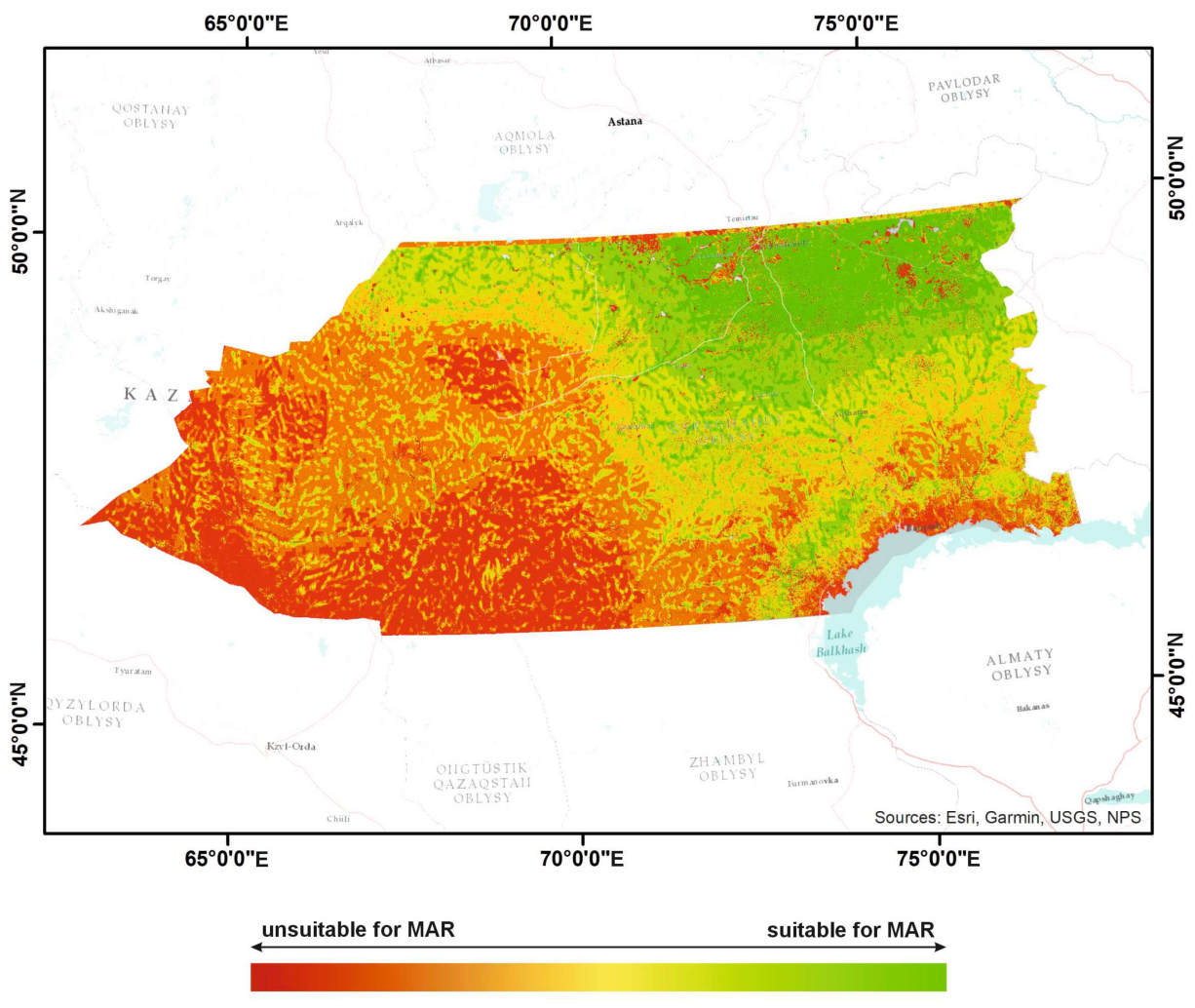
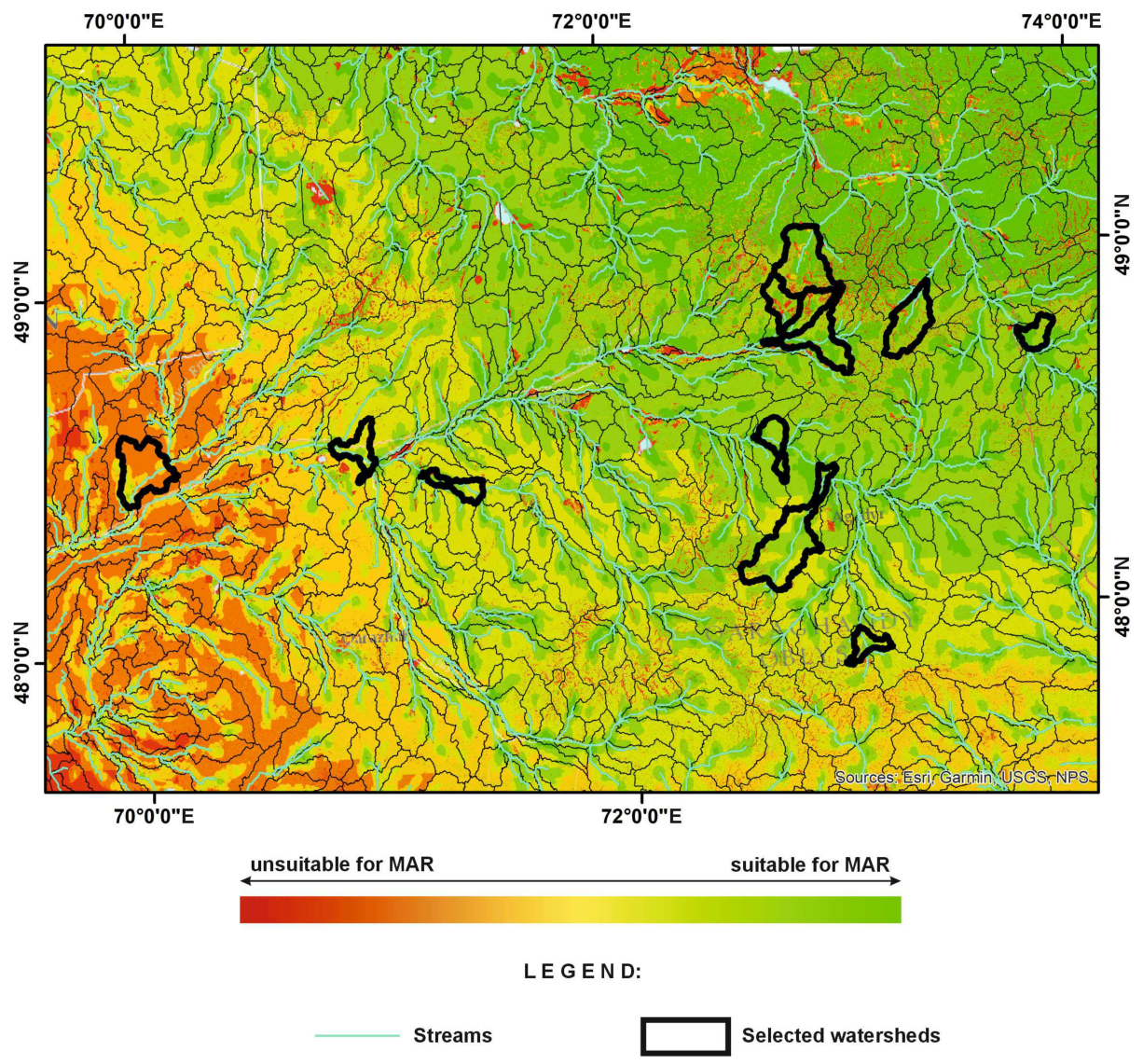
This map illustrates the spatial distribution of the potential for MAR across the territory of Central Kazakhstan (Figure 2).
The color scale ranges from red and orange shades (low suitability) to green shades (high suitability). The total area covered by the MAR suitability assessment is approximately 616,918 km2. Low-suitability areas, represented by red and orange colors, occupy about 55% of the study area, corresponding to approximately 339,305 km2. These areas are characterized by unfavorable conditions for MAR, which may be associated with steep surface slopes, limited infiltration capacity, low water availability, or unfavorable surface conditions. Moderate-suitability areas, shown in yellow shades, cover approximately 25% of the study area, or about 154,230 km2, and represent transitional zones where MAR implementation may be possible under additional favorable local hydrogeological conditions. High-suitability areas, represented by green shades, occupy about 20% of the study area, corresponding to approximately 123,384 km2. These territories are characterized by a combination of favorable factors, including relatively gentle terrain, suitable land cover conditions, higher water availability, and conditions that promote the accumulation and infiltration of surface runoff. Such zones represent the most promising areas for the placement of MAR infrastructure.
Based on Figure 2, watershed areas with the highest potential for MAR implementation were identified. Their spatial distribution indicates a concentration of promising sites in zones that combine a well-developed river network, moderate surface slopes, and favorable filtration properties of geological formations (Figure 3).
The selected MAR watersheds represent a set of spatially distributed pilot catchments located predominantly within areas characterized by moderate and high MAR suitability. A total of 11 representative watersheds were selected for detailed hydrogeological assessment and field investigations, with watershed areas ranging from 62.1 km2 to 351.6 km2 and a total cumulative area of approximately 1718.6 km2. The selected watersheds demonstrate considerable spatial variability in size and environmental conditions, reflecting the heterogeneous geomorphological and hydrological characteristics of Central Kazakhstan.
The selection of the final MAR investigation areas was based on a multi-stage approach combining regional GIS-based suitability assessment and practical field investigation constraints. The MAR suitability map generated using the weighted overlay method served as an initial regional screening tool; however, it was not used as the sole criterion for selecting the final study polygons.
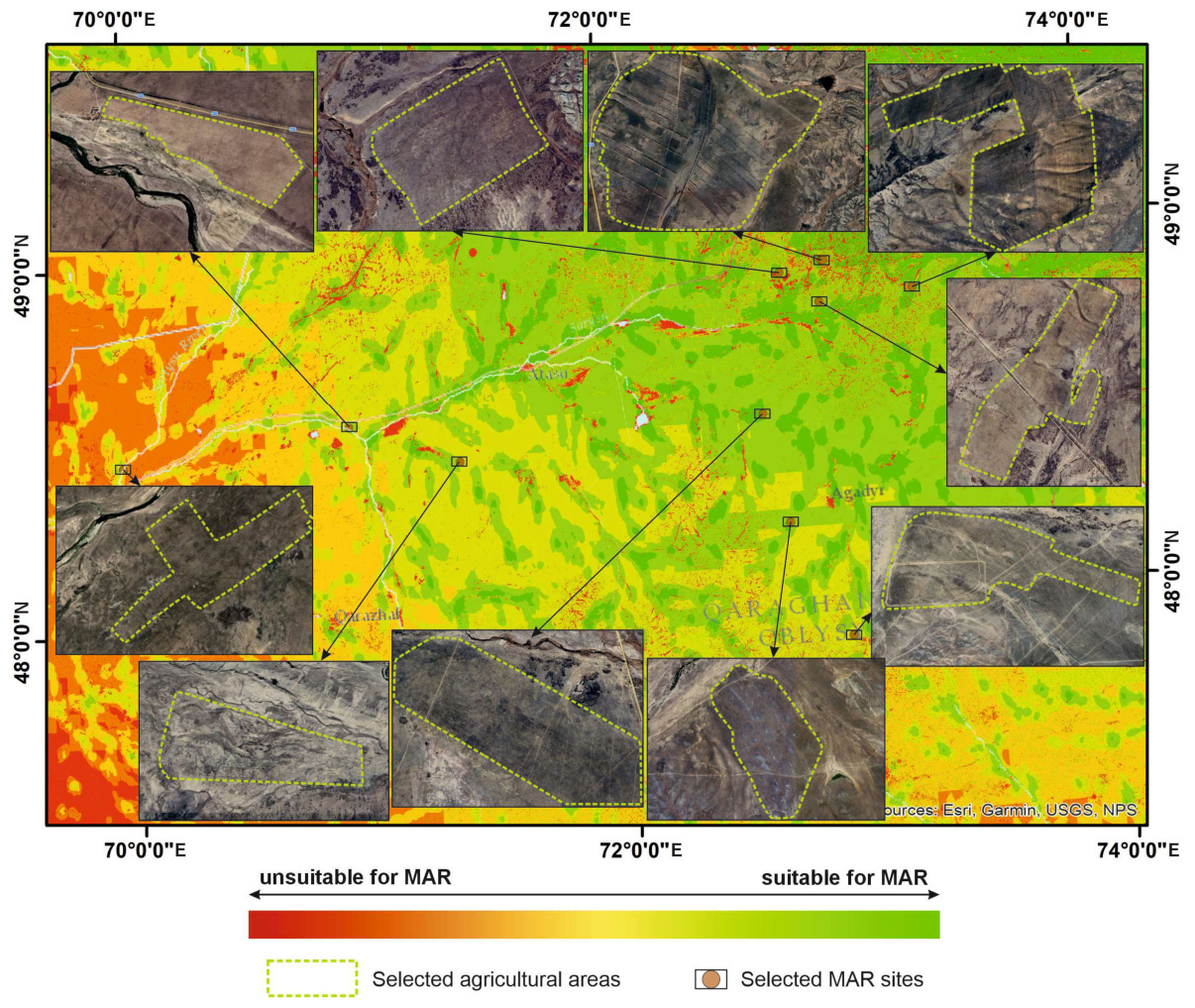
The final watersheds were selected considering several complementary factors, including: (I) MAR suitability index values, (II) active agricultural and pasture land use indicating practical groundwater demand (Figure 4), and (III) logistical accessibility and feasibility of conducting field investigations and infiltration testing.
In order to reduce spatial bias and better represent the environmental variability of Central Kazakhstan, the selected polygons were intentionally distributed across different environmental conditions and MAR suitability classes. Consequently, not all selected watersheds were located exclusively within the highest MAR suitability zones. Some areas with moderate or locally lower suitability values were intentionally retained in order to evaluate transitional and less favorable conditions and to test the applicability of the proposed methodology under contrasting environmental settings. This approach allowed a more representative regional assessment and reduced the bias associated with selecting only the most optimal sites.
The number of investigated sites was additionally constrained by available fieldwork resources, logistical limitations, and the budget of the present study. Therefore, the selected polygons should be considered representative pilot areas intended for regional-scale comparative assessment rather than an exhaustive inventory of all potentially suitable MAR locations within Central Kazakhstan.
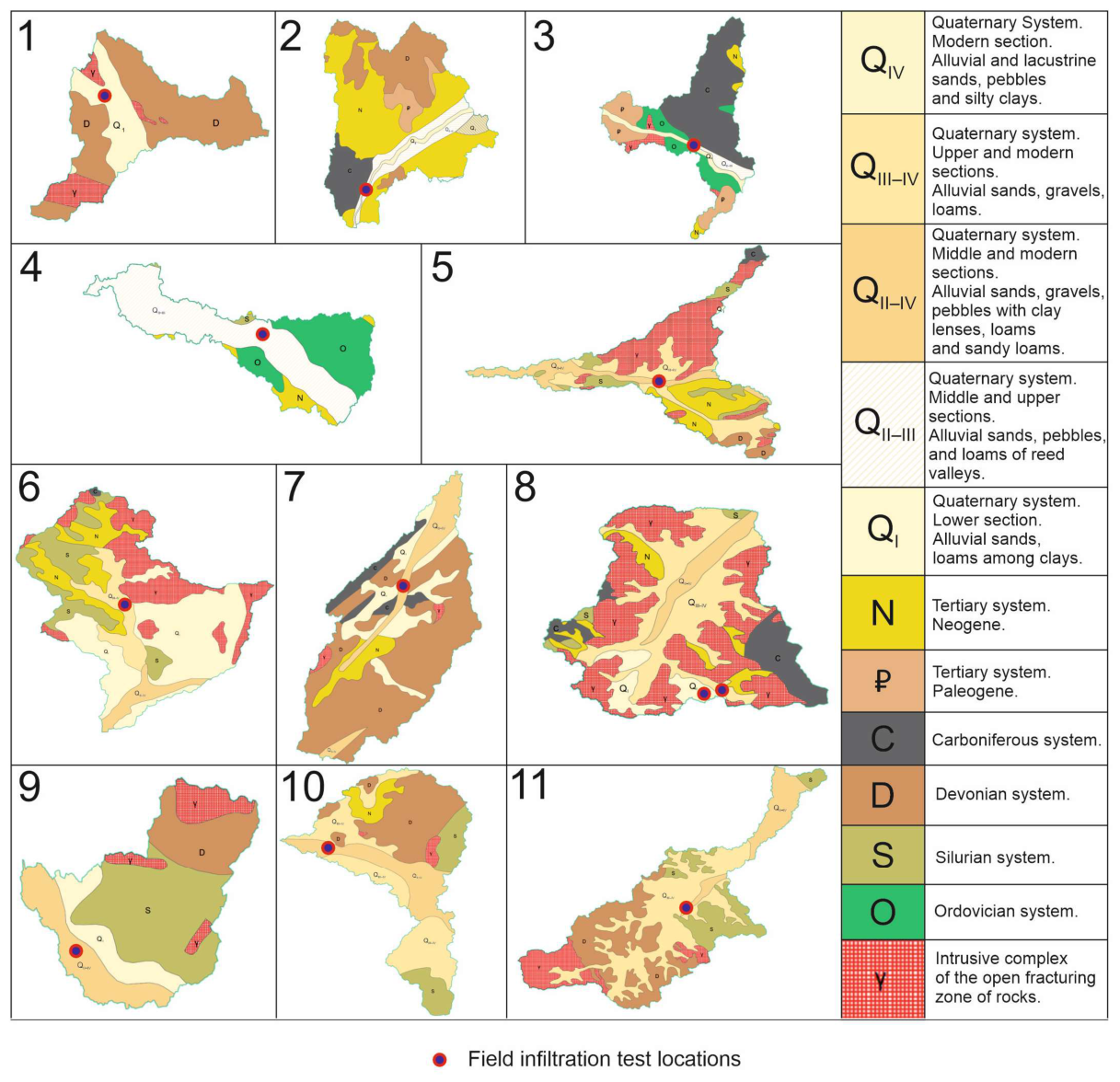
At the subsequent stage, the selected watersheds were compared with digitized hydrogeological maps in order to identify permeable aquifer collectors and favorable geological conditions for infiltration processes.
Therefore, agricultural areas represent priority zones for the implementation of MAR measures aimed at stabilizing the water balance and enhancing the sustainability of agro-landscapes (Figure 4).
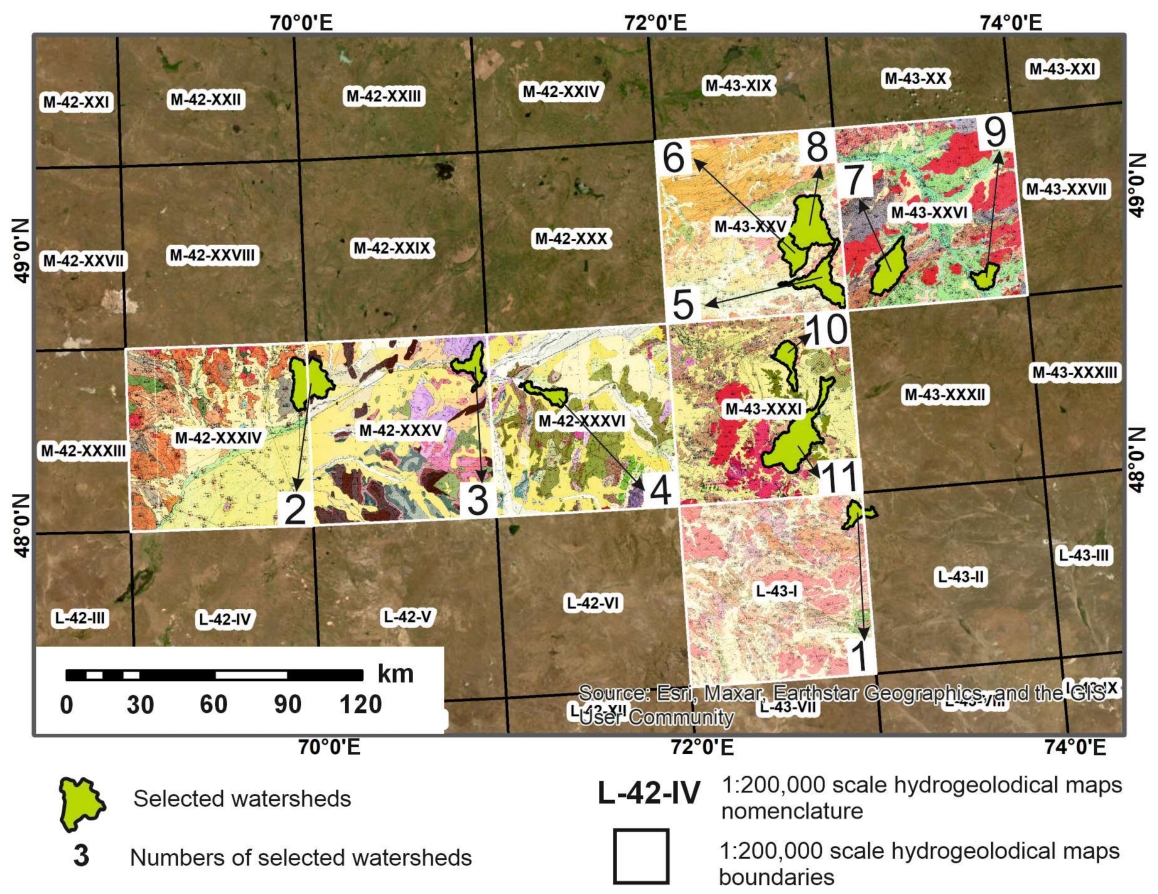
Next, hydrogeological maps at a scale of 1:200,000 (Figure 5) were digitized to identify the presence of recharge collectors. These collectors are essential for capturing and distributing directed infiltration of surface runoff to enhance groundwater storage. In this case, the collectors are represented by modern sedimentary deposits, predominantly fluvial, which—due to their filtration properties—are considered highly suitable for MAR implementation.
Overall, the maps (Figure 2, Figure 3, Figure 4 and Figure 5) demonstrate a pronounced spatial differentiation of the potential for MAR across Central Kazakhstan and serve as a basis for further detailed hydrogeological justification of MAR site placement.
Hydrogeological maps were intentionally not included as a direct input layer in the initial AHP-based weighted overlay model. The first stage of the analysis was designed as a regional environmental suitability screening aimed at identifying areas favorable for runoff accumulation and infiltration processes under arid conditions. Incorporating hydrogeological maps directly into the weighted overlay model could lead to disproportionate dominance of geological factors due to their fundamental importance for MAR feasibility, potentially masking the influence of other critical environmental parameters such as slope, precipitation, vegetation conditions, drainage characteristics, and land use.
In addition, the hydrogeological maps used in this study were available at a scale of 1:200,000 and consisted of numerous heterogeneous map sheets requiring extensive digitization and standardization prior to spatial integration. Therefore, hydrogeological information was applied during a subsequent verification stage rather than during the initial regional screening procedure.
This sequential workflow allowed the preliminary exclusion of environmentally unfavorable territories using GIS-based suitability analysis, after which the selected watersheds were additionally validated using hydrogeological maps to identify permeable aquifer collectors and favorable infiltration conditions. Such an approach reduced the probability of false-positive MAR zones and improved the overall robustness of the regional assessment framework.
Within the framework of this study, field visits and in situ infiltration tests were conducted at representative infiltration test sites in order to determine the filtration properties of the proposed recharge collectors. The locations of field infiltration tests are shown in Figure 6. All investigated test sites were situated within Quaternary deposits, which are considered the most favorable geological environments for infiltration and temporary groundwater storage under the hydrogeological conditions of Central Kazakhstan. On watershed 8, infiltration tests were conducted at two locations due to difficulties in field positioning caused by unstable GPS performance under field conditions, whereas the remaining watersheds included one representative infiltration test site each.
These properties were evaluated using the methods developed by Nesterov and Boldyrev. The determination of the filtration coefficient (kf) using these methods represents a simple and illustrative approach to assessing soil permeability directly under natural conditions. In international practice, the pit infiltration methods known in Russian literature as the Nesterov and Boldyrev methods are referred to as the single-ring (or pit) infiltration method and the double-ring infiltrometer method.
Due to their simplicity, these methods are widely used in modern hydrogeology and engineering geology and have been applied in various climatic and environmental settings, including studies conducted in China [37], European countries [38,39], Canada [40], and the Middle East [41,42].
The Nesterov method is based on observing the decline of the water level in a specially drilled borehole or pit. After filling the excavation with water, the decrease in water level is recorded over time. This decline is associated with the infiltration of water into the surrounding soil. Regular measurements of the water level depth are taken at specified time intervals (e.g., every 5–10 min at the initial stage). Based on the resulting drawdown curve, the filtration coefficient is calculated using a formula that accounts for the diameter of the excavation, the height of the water column, and the rate of water level decline. The method is simple to apply but requires careful measurements and consideration of soil homogeneity.
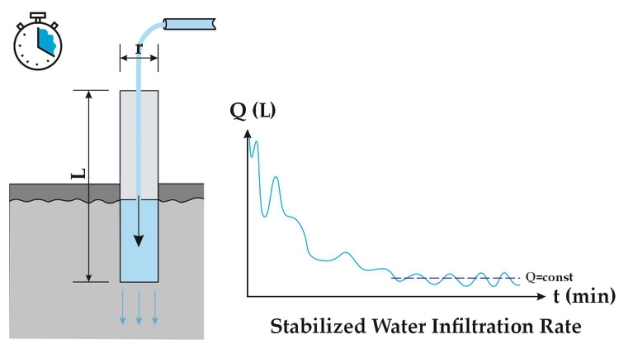
The Boldyrev method is used to determine filtration properties in shallow excavations and is based on the principle of steady-state infiltration. Water is supplied to a prepared pit while maintaining a constant water level (Figure 7). The volume of water required to sustain this constant level over a given time period is measured, i.e., the discharge infiltrating into the soil under constant head conditions is recorded. The filtration coefficient is then calculated using a formula that considers the infiltration surface area, hydraulic head, and water discharge. This method is considered more robust against random errors, as it is based on steady-state flow conditions.
Both methods provide approximate values of the filtration coefficient under natural conditions without the need for complex equipment. The Nesterov method is suitable for rapid assessments and dynamic observations, whereas the Boldyrev method provides more stable estimates under constant head conditions. The obtained values are used in calculating site infiltration capacity, designing MAR facilities, and assessing soil permeability in land reclamation and water management systems.
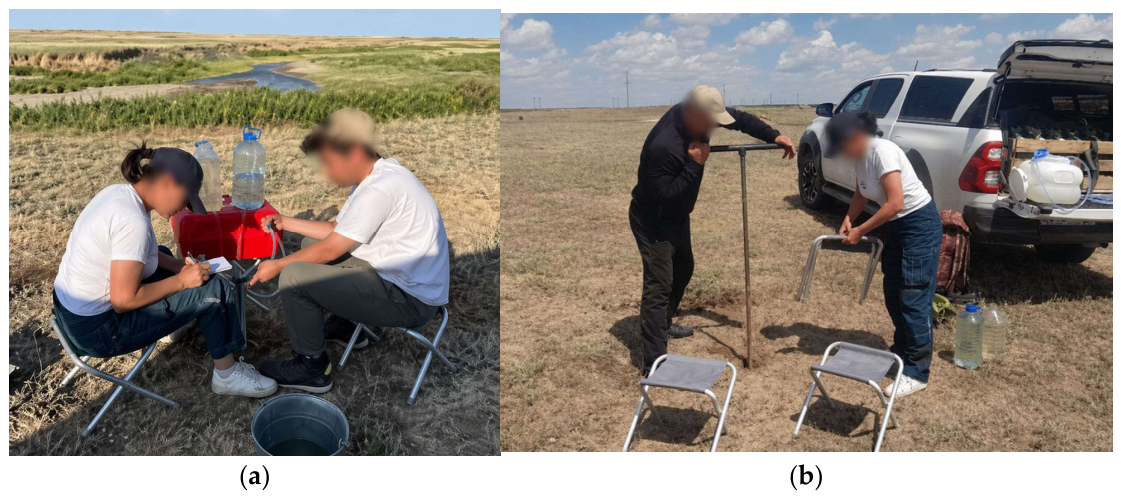
Field investigations began with the construction of test pits: using a hand auger, boreholes up to 1.4 m deep and approximately 0.3 m in diameter were drilled at the selected sites (Figure 8). These parameters ensured a sufficient infiltration surface area and allowed tests to be conducted under natural soil conditions without significant disturbance of the soil structure.
After preparation of the boreholes, infiltration tests were carried out using the Nesterov and Boldyrev methods. During the experiments, the dynamics of water level decline in the borehole and the volume of water infiltrating into the soil under specified head conditions were recorded (Figure 8). Regular measurements of time and water discharge were performed, which made it possible to obtain reliable data on the characteristics of the infiltration process.
The filtration properties of the vadose (unsaturated) zone at the selected prospective sites were determined using the pit (borehole) infiltration method in the unsaturated zone. The essence of this approach is to drill a borehole within the vadose zone and fill it with water until infiltration occurs at a constant rate. During the test, the water level is maintained constant, and the borehole parameters must satisfy the following condition:
12.5 < L r < 50.0
where L is the depth of the borehole into which water is introduced, and r is the borehole radius. In this study, a hand auger with a working radius of 3 cm was used. Since infiltration tests at all sites were conducted up to the borehole collar, the drilling depth—according to the above condition—had to range from 0.38 to 1.5 m.
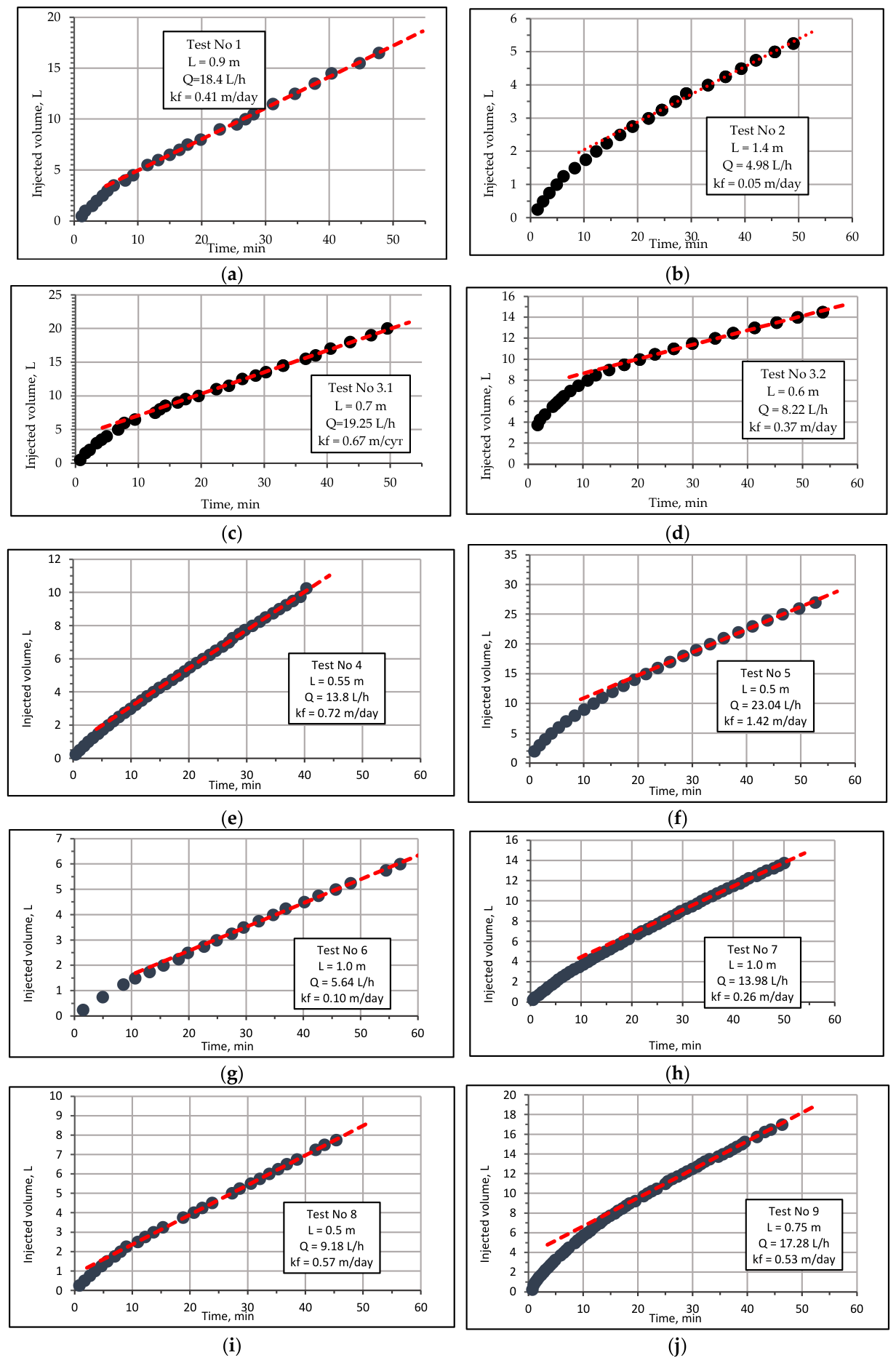
After the experiments, graphs of the relationship between the volume of absorbed water and time were constructed. If, from a certain point onward, the measured data formed a straight line, it was assumed that infiltration had stabilized, i.e., the inflow rate (Q) became constant. The obtained value of Q was then substituted into Philip’s equation [39] to calculate the filtration coefficient (kf) of the tested unsaturated deposits:
k f = 0.423 Q L 2 l g 2 L r
Well No.1 was tested using a stepwise injection method as an illustrative example. In this method, fixed water portions (500 and 1000 mL in this case) are successively delivered into the well, recording the infiltration time for each portion and the cumulative injected volume.
At the initial stage (first 2–3 L), a high infiltration rate was observed, which is attributed to the unsaturated state of the rocks and their good initial permeability. After approximately 10 min of testing, the process entered a quasi-steady-state regime: the increase in cumulative injected volume became linearly proportional to time. This indicates the formation of a stable filtration flow between the well and the surrounding aquifer.
The total test duration was 47.8 min, during which 16.5 L of water were injected. With a filter interval length of 0.9 m, the following parameters were obtained:
-
Infiltration rate Q = 18.4 L/h;
-
Hydraulic conductivity kf = 0.41 m/day.
As a result, the filtration coefficient of the near-surface sedimentary deposits was determined to range from 0.05 to 1.42 m/day, with an average value of 0.54 m/day (Table 2, Figure 9).
The obtained values made it possible to quantitatively assess the permeability of the soils and to use these results for further hydrogeological justification of the studied sites.
Well No. 1 (Figure 9a) is characterised by a rapid attainment of a steady-state filtration regime—stabilisation occurred after approximately 10–12 min. The obtained values of Q = 18.4 L/h and kf = 0.41 m/day indicate good rock permeability.
Well No. 2 (Figure 9b) showed the lowest filtration characteristics among all tests. Stabilisation was observed only after 20–25 min, and the values of Q = 4.98 L/h and kf = 0.05 m/day point to low water permeability.
Two infiltration tests were conducted at Site No. 3 (Wells No. 3.1 and 3.2). Well No. 3.1 (Figure 9c) reached a steady-state regime after about 12–15 min. The high values of Q = 19.25 L/h and kf = 0.87 m/day indicate favourable infiltration conditions. Well No. 3.2 (Figure 9d) is characterised by a very high infiltration rate (Q = 32.2 L/h). Stabilisation occurred after 15–20 min, with a hydraulic conductivity of kf =0.37 m/day.
Well No. 4 (Figure 9e) demonstrated rapid formation of a steady-state regime—within 5–7 min. The values Q = 13.8 L/h and kf = 0.72 m/day indicate good filtration properties of the rocks.
Well No. 5 (Figure 9f) showed the best results among all tests. Stabilisation occurred after 10–12 min, with maximum hydraulic conductivity values obtained: kf = 1.42 m/day and a high infiltration rate Q = 23.04 L/h.
Well No. 6 (Figure 9g) is characterised by a low infiltration rate and stabilisation of the process after 15–20 min. The parameters Q = 5.64 L/h and kf = 0.10 m/day indicate poor rock permeability.
Well No. 7 (Figure 9h) reached a steady-state regime after about 10 min. The obtained values Q = 13.98 L/h and kf = 0.26 m/day characterise average filtration properties.
Well No. 8 (Figure 9i) stabilised after 8–10 min. With a moderate infiltration rate Q = 9.18 L/h, the hydraulic conductivity was kf = 0.57 m/day, indicating fairly good infiltration conditions.
Well No. 9 (Figure 9j) is characterised by a steady-state filtration regime after 15 min of testing. The values Q = 17.28 L/h and kf = 0.53 m/day indicate good water permeability of the rocks.
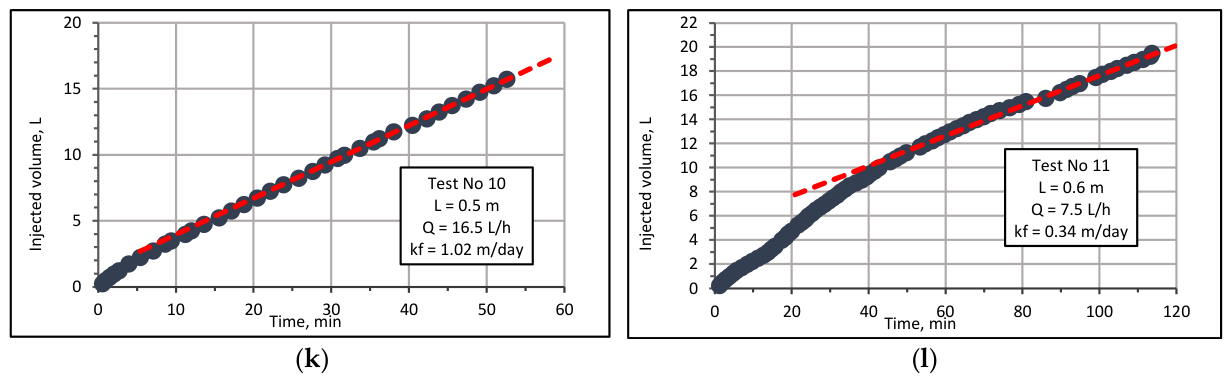
Well No. 10 (Figure 9k) demonstrated high filtration properties and rapid stabilisation within 8–10 min. The hydraulic conductivity was kf = 1.02 m/day with an infiltration rate Q = 16.5 L/h.
Well No. 11 (Figure 9l) was distinguished by the longest transient stage—stabilisation was observed only after 20–25 min. At the same time, the values Q = 7.5 L/h and kf = 0.34 m/day indicate satisfactory filtration properties.
The most favourable infiltration conditions were identified in Wells No. 5, 10, and 3.1, which are characterised by high hydraulic conductivity values, significant infiltration rates, and rapid stabilisation of the filtration regime. In contrast, Wells No. 2 and 6 demonstrated the least favourable hydrogeological conditions due to their low permeability and slow stabilisation of the infiltration process.
When calculating the water balance of the study area, one of the key missing parameters is ET. ET represents the combined process of moisture loss from the land surface to the atmosphere, including two interrelated components: the physical evaporation of water from soil surfaces, water bodies, and vegetation (evaporation), as well as transpiration—the release of water vapor from plant surfaces during their physiological activity.
This parameter is a critical component of the water balance, since in agroecosystems a significant portion of water losses is attributed to ET. Under irrigated agriculture conditions, ET is directly influenced by the biological characteristics of cultivated crops, their growth stages, temperature regime, solar radiation, wind speed, and air humidity. Neglecting this parameter may lead to significant errors in estimating infiltration recharge, drainage runoff, and groundwater replenishment.
To obtain spatially distributed ET values, the capabilities of the GEE platform were used. GEE enables the processing of large volumes of satellite data and the generation of ET maps that account for spatial heterogeneity across the study area.
Within this study, a thematic ET map was generated based on satellite data using appropriate calculation algorithms. The obtained values made it possible to assess the spatial distribution of moisture loss across the study area, refine water balance parameters, and improve the accuracy of calculations related to infiltration and MAR.
ET represents one of the main output components of the hydrological and groundwater balance, reflecting water loss from the land surface through evaporation and plant transpiration. In this study, multi-year average ET was estimated using satellite data from the MODIS ET product MOD16A2 (Collection 6.1; NASA Land Processes Distributed Active Archive Center, USGS Earth Resources Observation and Science Center, Sioux Falls, SD, USA). This dataset provides global ET estimates at a spatial resolution of 500 m and a temporal resolution of 8 days, based on the Penman–Monteith approach, which integrates satellite-derived vegetation parameters with meteorological inputs.
The analysis was conducted using the GEE cloud computing platform. To improve the readability of the manuscript, the full scripts were removed from the main text and provided as Supplementary File S2. The boundary of the study area was used as the region of interest. ET dynamics were analyzed for the period 2014–2024 in order to assess the long-term spatial variability of atmospheric water losses within the investigated territory.
The analysis was based on the MOD16A2 ET dataset, which provides ET estimates at 8-day temporal resolution. The ET band was extracted and processed for each year within the study period. Since the MOD16A2 product provides ET values in scaled units corresponding to millimeters of water depth, the appropriate scale factor was applied prior to further calculations.
Annual ET values were calculated by summing all 8-day ET observations within each hydrological year. Subsequently, multi-year average ET was derived by averaging annual ET values over the entire observation period from 2014 to 2024.
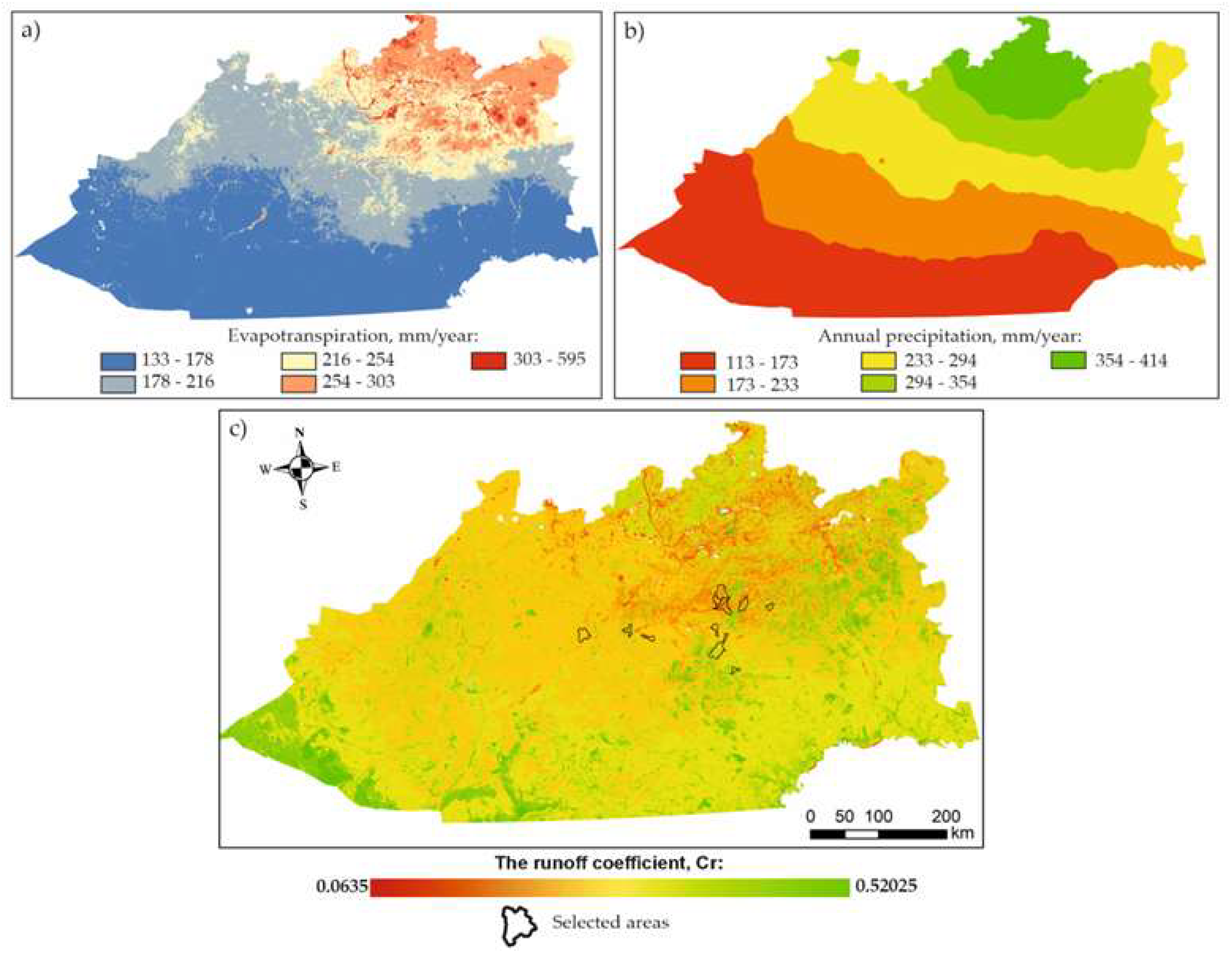
Spatial statistics of ET were calculated for the study area using spatial averaging at a resolution of 500 m. The resulting dataset represents the spatial distribution of long-term average ET expressed in mm/year and was subsequently used as one of the output components in the regional water balance assessment of the investigated watersheds (Figure 10a).
Detailed GEE scripts and processing workflows used for ET analysis are provided in the Supplementary Materials.
Mean annual precipitation used in the regional water balance assessment was derived from the CHIRPS precipitation dataset and spatially averaged for the investigated watersheds. The precipitation distribution map previously generated during the MAR suitability analysis was subsequently incorporated as one of the climatic input parameters of the water balance calculations (Figure 10b).
The runoff coefficient was estimated using a spatially distributed multi-criteria approach implemented in GEE. The boundaries of the investigated catchments were used as the areas of interest for all spatial analyses.
The estimation was based on the integration of the main environmental factors controlling surface runoff generation, including terrain slope, land use/land cover, soil properties, and vegetation conditions. Terrain slope was derived from the SRTM digital elevation model, while land use/land cover information was obtained from the ESA WorldCover dataset (2021). Vegetation conditions were characterized using the NDVI derived from MODIS (MOD13Q1) data for the growing season (April–October). Soil properties were represented by soil texture classes obtained from the OpenLandMap (OpenGeoHub Foundation, Wageningen, The Netherlands) database.
Each factor was reclassified according to its relative influence on runoff generation using a suitability scale ranging from low to high runoff potential. Slope classes reflected increasing runoff generation under steeper terrain conditions. NDVI values were interpreted inversely, where denser vegetation cover corresponded to lower runoff potential due to enhanced infiltration and reduced overland flow. Land use and land cover classes were evaluated according to surface permeability and anthropogenic disturbance, while soil texture classes were grouped based on their infiltration capacity and relative permeability.
To ensure comparability between heterogeneous datasets, all factors were normalized to a common scale and subsequently integrated using a weighted overlay approach. The weighting coefficients reflected the relative contribution of each environmental parameter to runoff generation processes under the arid and semi-arid conditions of Central Kazakhstan.
The resulting runoff potential index represents the spatial variability of runoff formation conditions across the investigated watersheds and served as the basis for subsequent estimation of the runoff coefficient. This approach allowed a more realistic representation of hydrological processes by accounting for the combined influence of terrain morphology, vegetation conditions, soil permeability, and land cover characteristics.
The obtained runoff coefficient distribution was subsequently used as one of the input parameters in the regional water balance analysis of the investigated watersheds (Figure 10c).
Detailed GEE scripts and processing workflows used for runoff coefficient estimation are provided in the Supplementary Materials.

3. Results

Groundwater quality is one of the key factors determining the effectiveness of MAR projects. Even when sufficient volumes of water are available for infiltration, the chemical composition of both the injected water and the receiving aquifer largely controls the sustainability and long-term performance of such interventions. Mismatches in hydrochemical characteristics can trigger various geochemical processes within the aquifer, including mineral dissolution or precipitation, which may alter groundwater composition and reduce the permeability of the filtering medium. In addition, the introduction of water with elevated concentrations of dissolved salts, nutrients, or trace elements may lead to gradual deterioration of groundwater quality and limit its suitability for drinking water supply, irrigation, and other uses.
Under the conditions of the study area, the implementation of MAR may serve not only to augment water resources but also to reduce the risk of soil salinization. The use of fresh water for infiltration promotes the dilution of mineralized groundwater and contributes to the establishment of a favorable hydrogeochemical regime in the vadose zone and upper aquifers. As fresh water enters the aquifer system, the concentration of dissolved salts decreases, reducing their accumulation in the soil profile and limiting the capillary rise of saline water to the surface.
Moreover, the infiltration of fresh water facilitates the gradual leaching of easily soluble salts from the upper soil horizons and unconsolidated deposits. This is particularly important in arid regions, where secondary salinization processes are often associated with shallow, mineralized groundwater. Thus, the use of fresh water for MAR creates conditions that not only enhance groundwater storage but also improve the hydrogeochemical state of soils, ultimately increasing the sustainability of agro-landscapes and the efficiency of water use.
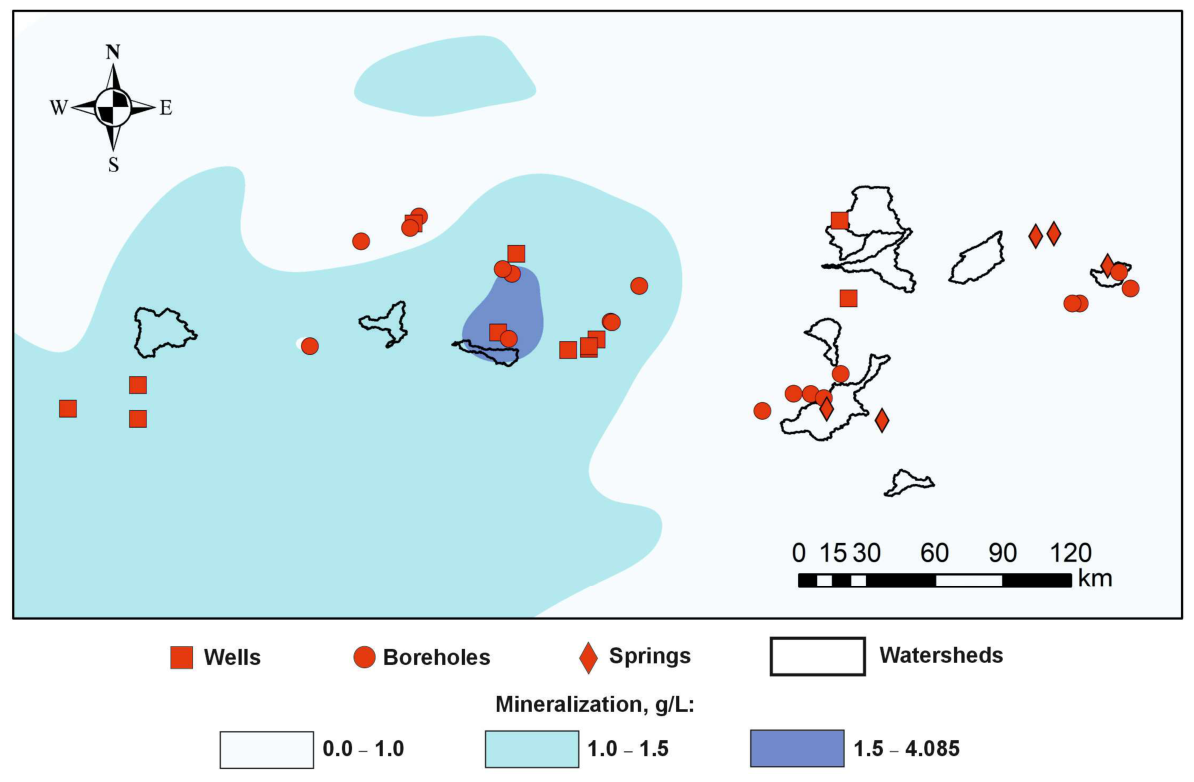
Fieldwork also included sampling for chemical analysis of all identified groundwater sources, including wells, boreholes, and springs. Based on the obtained data on groundwater chemical composition, a map of the spatial distribution of mineralization was developed, reflecting the formation of hydrogeochemical halos. The cartographic model demonstrates the gradation of mineralization: fresh waters with mineralization up to 1 g/L are shown in light blue, slightly saline waters with mineralization ranging from 1 to 1.5 g/L are shown in blue, and waters with mineralization from 1.5 to 4 g/L are represented in dark blue. The map was generated using spatial analysis methods in ArcGIS version 3.2 (Esri, Redlands, CA, USA) specifically through interpolation techniques, which made it possible to identify patterns in mineralization distribution and delineate zones of elevated values (Figure 11).
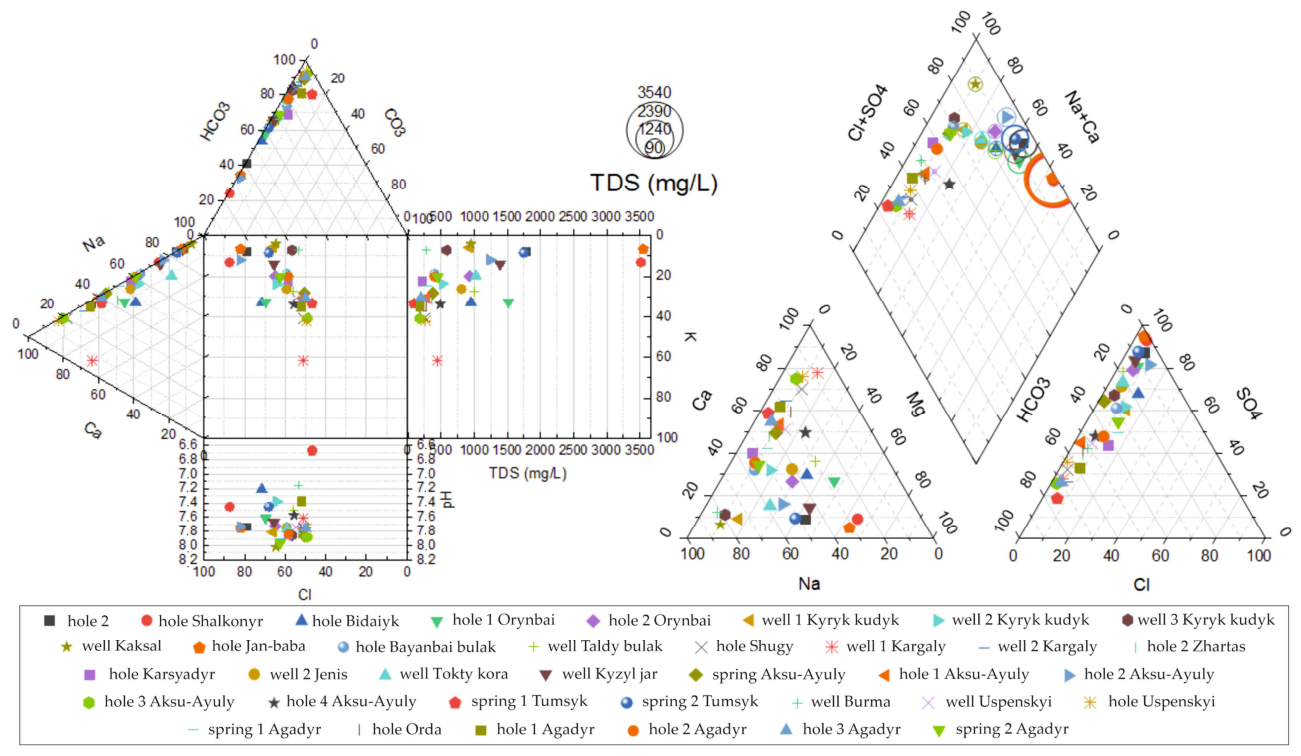
Hydrochemical facies, presented on the Piper diagram (Figure 12), shows that groundwater in the study area predominantly belongs to the Ca–HCO3 type, with a local transition to a mixed Na–Ca–HCO3 type. Such a hydrochemical composition is typical of active recharge zones and indicates the dominance of atmospheric precipitation infiltration and water–carbonate rock interactions [43].
Low concentrations of chlorides and sulfates suggest the absence of significant influence from evaporite formations and intensive evaporation processes, indicating a low degree of hydrochemical evolution of groundwater [44]. This represents a favorable condition for the implementation of MAR measures [45].
The range of total dissolved solids (TDS) shows that most samples correspond to fresh and slightly mineralized waters, meeting the requirements for aquifers suitable for MAR. These conditions indicate good hydrochemical compatibility between infiltrating water and the aquifer medium, reducing the risk of secondary geochemical processes such as mineral precipitation, salinization, or water quality deterioration.
In addition, slightly alkaline pH values (7.2–8.1) indicate stable geochemical conditions within the water–rock system and the absence of aggressive waters, which is also an important factor in MAR planning.
Thus, the results of the hydrochemical analysis confirm that the studied aquifer possesses favorable geochemical conditions for the implementation of MAR technologies, and the identified hydrochemical facies correspond to systems with active natural recharge and relatively young hydrogeochemical evolution.
The hydrochemical assessment was additionally used as a filtering criterion during the final selection of MAR sites. Based on the obtained mineralization patterns and groundwater chemistry, several initially identified candidate areas characterized by elevated groundwater mineralization were excluded from subsequent quantitative assessment. As a result, the final water balance calculations and recharge estimations were performed only for 8 hydrochemically suitable watersheds out of the initially selected 11 candidate sites.
It should also be noted that the hydrochemical data obtained within this study represent snapshot observations collected during the field campaign and therefore may not fully capture long-term seasonal variability between wet and dry hydrological periods. Consequently, the presented hydrochemical assessment should be interpreted as a regional-scale screening and compatibility evaluation rather than a long-term hydrogeochemical monitoring dataset.
To assess the potential for MAR, the following input data were used: annual precipitation, annual ET, catchment area, runoff coefficients, runoff capture efficiency coefficients, hydraulic conductivity, aquifer thickness, hydraulic gradients within the catchments, and effective porosity.
At the first stage, the volume of water that can be collected from precipitation within each catchment was estimated. The calculation was performed as:
V c a p t u r e = P 1000 A C r η c
where P is annual precipitation (mm), A is the catchment area (m2), C r is the runoff coefficient [46,47], and η c is the runoff capture efficiency coefficient. This step provided the total volume of water potentially accumulated in each storage basin. This step provided the total volume of water potentially accumulated in each storage basin. If the dam is favorably located and a first-order approximation is considered, the coefficient can be taken as ηs = 0.7–0.9 as an engineering estimate. In hydraulic engineering design practice, however, it is recommended to adopt lower values of this coefficient to account for unfavorable conditions and uncertainties in the input data, especially in the absence of detailed observations [47].
At the second stage, the water surface area corresponding to the calculated storage volume was determined using a digital elevation model (DEM) in ArcGIS. The 3D Analyst—Surface Volume tool was applied to iteratively define the water level that matches the calculated storage volume. As a result, the water surface area ( A p o n d ) was obtained for each site.
V E T = E T 1000 A p o n d
where ET is annual ET (mm), and Apond is the water surface area (m2).
At the third stage, evaporation losses from the ponded water surface were estimated as:
V a v a i l a b l e = V c a p t u r e V E T
Thus, the water balance at this stage included the collected runoff as input and ET losses as the primary output component.
At the fourth stage, the storage capacity of the receiving aquifer was evaluated to determine whether it can accommodate the infiltrated water:
V s t o r a g e = A p o n d h n e
where A p o n d is the infiltration area (assumed equal to the water surface area), h is the aquifer thickness (m) and n e is the effective porosity. This parameter was used as a verification criterion to assess whether the aquifer has sufficient available pore space.
At the fifth stage, the volume of water that can infiltrate into the aquifer was estimated based on Darcy’s law:
V i n f = k f i A p o n d t C F
where k f is the hydraulic conductivity (m/day), i is the hydraulic gradient, t is the duration of water presence (days), and C F is the clogging factor accounting for reduction in infiltration capacity. In this study, the duration t was assumed to be 365 days.
Finally, the effective recharge volume was determined as:
V r e c h a r g e = m i n ( V a v a i l a b l e , V i n f )
The aquifer storage capacity ( V s t o r a g e ) was used as a validation parameter. In cases where V s t o r a g e > V i n f , the aquifer capacity was considered sufficient, and thus did not limit the MAR process. Under these conditions, the effective recharge was controlled primarily by water availability and infiltration capacity (Table 3).
After assessing the suitability of the territory for MAR technologies and estimating the potential reservoir volumes, it is necessary to evaluate the infiltration recharge of the aquifer.
The infiltration volume was determined using the classical hydrogeological relationship:
V = kf · Finf · i · t
where Finf is infiltration area, i is hydraulic gradient, and t infiltration time. This calculation made it possible to estimate the theoretical volume of water that can enter the aquifer under given conditions.
It is well understood that under real conditions, the filtration capacity of soils decreases over time due to clogging (colmation) processes caused by pore space blockage from suspended particles, chemical precipitates, and biological activity. Experimental and modeling studies show that hydraulic conductivity may decrease by 20–40% or more, in some cases significantly limiting infiltration [47,48,49,50,51]. Therefore, in engineering calculations, reduction coefficients are commonly introduced to account for clogging effects, especially in the absence of long-term observations. In this study, an average coefficient (CF) of 0.5, typical for sands and sandy loams, was adopted, allowing for a more realistic estimation of the actual infiltration volume.
As a result, the analysis transitioned from potential system characteristics to a more realistic assessment of its performance, taking into account natural constraints and operational factors (Table 4).

4. Discussion

The new findings considerably narrow the knowledge gap on the MAR potential in the study region, and the need to include progressive infiltration modeling in recharge estimations. The recalculated values demonstrate that the overall effective recharge (approximately 11.0 million m3/year) is much greater than the estimated one (5.09 million m3/year) in the past, which means that the infiltration capacity was underestimated in the past.
Although this has increased, there is still an apparent imbalance between the water availability (~40.2 million m3/year) and the actual water recharge with the contribution of available water to groundwater recharge being only about 27%. This validates the fact that infiltration processes continue to remain the main limiting factor that regulates MAR efficiency in the area. The revised ratio, however, indicates that, given good hydrogeological circumstances, much greater amounts of surface runoff can be used productively than thought before.
The spatial diversity of recharge rates, which ranges between less than 200 m3/day to over 5000 m3/day, proves that the performance of MAR is very location-specific and heavily relies on the hydraulic conductivity, infiltration area, and local gradients. Sites with greater permeability and bigger infiltration areas contribute dis-proportionately to the overall recharge volume, and, therefore, proper site selection is essential.
Notably, the evaluation of the storage capacity in the aquifers proves that Vstorage is greater than Vinf in all the appropriate locations, meaning that subsurface storage is not a constraining element. This observation verifies that small-scale MAR systems that use retention dams can be implemented without a fear of overloading the aquifer capacity.
Compared with previous MAR studies conducted in Kazakhstan [52,53,54], the present research combines regional GIS-based MCDA with detailed hydrogeological verification using digitized 1:200,000 hydrogeological maps, hydrochemical assessment, field-based infiltration experiments, and quantitative water-balance calculations for selected watersheds under a potential MAR implementation scenario. Sallwey et al. [52] mainly relied on generalized open-access regional datasets for nationwide MAR suitability assessment, while the study conducted in Southern Kazakhstan [53] expanded the methodological framework through hydrochemical sampling and fuzzy-AHP analysis, but also highlighted the need for future field-based infiltration investigations. Ongdas et al. [54] focused primarily on hydroclimatic variability, seasonal water-balance dynamics, droughts, evapotranspiration, and potential groundwater recharge formation under Kazakhstan conditions. In contrast, the present study integrates direct field-based infiltration testing using the Nesterov and Boldyrev methods with GIS- and remote sensing-based MAR assessment and quantitative estimation of potential recharge volumes, which substantially improves the reliability of MAR suitability evaluation under the arid conditions of Central Kazakhstan. Simultaneously, there are still uncertainties related to the utilization of generalized parameters of hydraulic gradients, clogging coefficients, and climatic inputs. The lack of long-term monitoring information such as ground water level processes and on-site infiltration measures presents a possibility of variability in estimating recharge. Also, the local heterogeneity might not be fully reflected using remotely sensed precipitation and ET data.
The hydrochemical assessment conducted within this study should also be interpreted as a preliminary regional-scale evaluation rather than a long-term groundwater quality monitoring program. Although the obtained hydrochemical data allowed the exclusion of several unsuitable mineralized MAR candidate areas, the analyses were based on field sampling performed during a limited observation period and may not fully reflect seasonal hydrochemical variability. Future investigations should therefore include repeated sampling during wet and dry hydrological periods, long-term groundwater quality monitoring, and geochemical compatibility assessments under operational MAR conditions.
Although the developed GIS-based framework allowed the identification and comparative assessment of promising MAR areas across Central Kazakhstan, several limitations should be acknowledged. The number of field investigation sites and infiltration tests was limited by logistical accessibility, field campaign duration, and available research funding. As a result, not all potentially suitable MAR areas identified by the regional suitability model could be investigated in detail.
The selected watersheds therefore represent a set of representative pilot territories covering different hydrogeological and geomorphological conditions rather than a complete regional inventory of MAR-suitable areas. Future studies should expand the number of field validation sites, incorporate long-term hydrological monitoring, and include additional hydrogeological observations in order to improve spatial representativeness and reduce uncertainties associated with regional-scale remote sensing assessments.
Future research should therefore focus on the deployment of monitoring infrastructure, including piezometers and meteorological stations, as well as pilot-scale MAR experiments aimed at validating the assumptions of the proposed models and optimizing recharge parameters under real hydrogeological conditions. The robustness of the developed framework could also be improved through the incorporation of uncertainty assessment approaches, including sensitivity analysis and stochastic simulations, in order to better quantify the variability associated with climatic inputs, infiltration parameters, and spatial heterogeneity of environmental conditions.

5. Conclusions

This research indicates that multi-criteria analysis that is GIS-based, field-based hydrogeological parameters, and water balance (modeling) can be used to provide a reliable framework of identifying and assessing the potential of MAR in arid Central Kazakhstan. Hydrochemical studies have shown that 8 of the 11 chosen locations are suitable to implement MAR which is predominantly fresh to slightly mineralized groundwater with good geochemical conditions to promote penetration. Quantitative evaluation shows that the total water to be recharged per year is about 40.2 million m3 and the effective recharge is about 11.0 million m3/year. This is equal to a total recharge efficiency of about 27%, and this proves that the infiltration capacity though still limiting is much higher than previously anticipated. The aquifer storage capacity analysis has revealed that the pore volume exceeds the infiltration volumes in all locations, and storage limits are not restrictive to MAR implementation.
As a result, the processes of surface-subsurface interaction, such as hydraulic conductivity, infiltration area, and clogging dynamics, are the main factors controlling the recharge efficiency. The estimated rates of recharge between 174 to 5282 m3/day are evidence that the MAR sites identified can serve pasture-based water supply systems and enhance water availability in rural areas. In general, the outcomes validate that miniature retention dam-based MAR systems were the potential and feasible solution to improving the groundwater resources in the water-limited areas. The suggested methodology offers a regional planning tool that could be transferred to other regions and could be utilized to support decision-making processes to achieve sustainable water resource management and climate resilience.

Supplementary Materials

The following supporting information can be downloaded at: https://www.mdpi.com/article/10.3390/w18121410/s1, Supplementary_File_S1 and Supplementary_File_S2.

Author Contributions

Z.O.: conceptualization, methodology, calculations, writing—review and editing. and preparation of cartographic materials and figures; A.A. (Aigerim Alimgazina): data processing, field data analysis, and preparation of the manuscript text and figures; V.S. and A.J.: scientific consultation and expert guidance throughout the study; A.E. and D.E.: field investigations and data collection; A.A. (Aldiyar Abyshev): 3D calculations and spatial analysis in the ArcGIS environment; R.A.: text editing. All authors have read and agreed to the published version of the manuscript.

Funding

This research was funded by the Science Committee of the Ministry of Science and Higher Education of the Republic of Kazakhstan under the project “Development of Technologies for Man-aged Aquifer Recharge (MAR) for Water Supply of Settlements, Industrial Enterprises, and Pasture Watering in the Low-Hill Regions of Central Kazakhstan”, grant No. AP23490816.

Data Availability Statement

The original contributions presented in this study are included in the article. Further inquiries can be directed to the corresponding author.

Conflicts of Interest

The authors declare no conflicts of interest.

References

  1. Bilal, H.; Govindan, R.; Zekri, S.; Al-Maktoumi, A.; Rajabi, M.M.; Triki, C.; Harrathi, W. Identification of Potential Managed Aquifer Recharge Sites in Hyper-Arid Environment Using GIS and Analytical Hierarchy Process. Appl. Water Sci. 2025, 15, 99. [Google Scholar] [CrossRef]
  2. Pirasteh, S.; Samad, A.; Ahmad, R.; Thakural, L.N.; Khan, H.H.; Chauhan, P.; Khan, A.; Qamar, M.Z. Geospatial and AHP Based Identification of Potential Zones for Groundwater Recharge in Haridwar District of India. Front. Environ. Sci. 2025, 13, 1421918. [Google Scholar] [CrossRef]
  3. Song, Q.; Liu, Y.; Wang, Z.; Xu, Z. Assessing Groundwater Artificial Recharge Suitability in the Mi River Basin Using GIS, RS, and FAHP: A Comprehensive Analysis with Seasonal Variations. Appl. Water Sci. 2025, 15, 39. [Google Scholar] [CrossRef]
  4. Arya, V.; Rao, M.S. Groundwater Recharge Potential Index and Artificial Groundwater Recharge in the Alluvial Soils of the Middle Ganga Basin. Discov. Appl. Sci. 2024, 6, 367. [Google Scholar] [CrossRef]
  5. Gururani, D.M.; Kumar, Y.; Abed, S.A.; Kumar, V.; Vishwakarma, D.K.; Al-Ansari, N.; Singh, K.; Kuriqi, A.; Mattar, M.A. Mapping Prospects for Artificial Groundwater Recharge Utilizing Remote Sensing and GIS Methods. Water 2023, 15, 3904. [Google Scholar] [CrossRef]
  6. Hadded, R.; Ben Zaied, M.; Castelli, G.; Abdelli, F.; Essifi, B.; Bresci, E.; Ouessar, M. Enhancing Groundwater Resources through Managed Aquifer Recharge: A SWAT Application in Arid Southeastern Tunisia. J. Hydrol. Reg. Stud. 2026, 63, 103027. [Google Scholar] [CrossRef]
  7. Cao, H.; Qian, J.; Chen, H.; Liu, C.; Gao, S.; Lyu, M.; Dong, W.; Hu, C. Managed Aquifer Recharge and Extraction Effects on Groundwater Level and Quality Dynamics in a Typical Temperate Semi-Arid Fissured Karst System: A Multi-Method Quantitative Study. Hydrol. Earth Syst. Sci. 2025, 29, 5213–5231. [Google Scholar] [CrossRef]
  8. Al-Ruzouq, R.; Shanableh, A.; Jena, R.; Mukherjee, S.; Khalil, M.A.; Gibril, M.B.A.; Pradhan, B.; Hammouri, N.A. Hybrid Deep Learning and Remote Sensing for the Delineation of Artificial Groundwater Recharge Zones. Egypt. J. Remote Sens. Space Sci. 2024, 27, 178–191. [Google Scholar] [CrossRef]
  9. Jung, H.; Saynisch-Wagner, J.; Schulz, S. Can Explainable AI Offer a New Perspective for Groundwater Recharge Estimation?—Global-Scale Modeling Using Neural Network. Water Resour. Res. 2024, 60, e2023WR036360. [Google Scholar] [CrossRef]
  10. Al-Maktoumi, A. A Review of Factors Affecting the Performance and Impact of Managed Aquifer Recharge Projects: Insights from Arid Regions. J. Groundw. Sci. Eng. 2025, 13, 312–340. [Google Scholar] [CrossRef]
  11. Ousrhire, A.; Ghafiri, A. Artificial Aquifer Recharge: Systematic Mapping Study. Water Pract. Technol. 2022, 17, 1706–1727. [Google Scholar] [CrossRef]
  12. Mavundla, K.P.; Okedi, J.; Kalumba, D.; Armitage, N.P. Estimation of Infiltration Parameters for Groundwater Augmentation in Cape Town, South Africa. Hydrology 2025, 12, 87. [Google Scholar] [CrossRef]
  13. Stautzebach, J.; Steidl, J.; Merz, C. The Potential of Localized Near-Nature Managed Aquifer Recharge in the Context of Climate Change Adaption—An Assessment within Brandenburg’s Lower Spree Catchment. Groundw. Sustain. Dev. 2025, 31, 101549. [Google Scholar] [CrossRef]
  14. Epting, J.; Vinnå, L.R.; Piccolroaz, S.; Affolter, A.; Scheidler, S. Impacts of Climate Change on Swiss Alluvial Aquifers—A Quantitative Forecast Focused on Natural and Artificial Groundwater Recharge by Surface Water Infiltration. J. Hydrol. X 2022, 17, 100140. [Google Scholar] [CrossRef]
  15. Korkut, M.; Hartog, N.; Yavuz, V. An Overview of Historical Development, Current Situation, and Future Prospects of Managed Aquifer Recharge in Türkiye. Water 2025, 17, 439. [Google Scholar] [CrossRef]
  16. Bogomolov, Y.G.; Abdulkerimov, F.G.; Dashtiev, Z.K.; Nikolaev, A.P. On the Possibility of Artificial Recharge of Groundwater Resources in the Territory of Derbent City. Proceedings/Conference Paper n.d. pp. 166–167. Available online: https://igdficran.ru/files/source/conference/_58.pdf (accessed on 22 May 2026).
  17. Jabassov, A.M.; Tukeshova, G.E.; Ermenbay, A.M. Application of Artificial Groundwater Recharge Technologies (Based on the Example of Aktobe Region). Sci. New Technol. Innov. Kyrg. 2024, 9, 30–34. Available online: https://elibrary.ru/item.asp?id=82316649 (accessed on 22 May 2026).
  18. Petrishchev, V.P.; Leontieva, T.V.; Kudelina, I.V. Hydrogeological Technologies for Replenishing Water Bodies in the Eastern Orenburg Region. Geol. Geogr. Glob. Energy 2020, 4, 89–94. Available online: https://elibrary.ru/item.asp?id=44386537 (accessed on 22 May 2026).
  19. Dzhaksymuratov, K.M.; Agzamova, I.A.; Gulomkadirova, M.A.; Khasanov, N.M. Artificial Recharge of Groundwater Using Takyr Runoff in the Karakalpak Ustyurt Region. Sci. Innov. Ser. Geol. Tech. Sci. 2022, 3, 50–57. Available online: https://elibrary.ru/item.asp?id=67851302 (accessed on 22 May 2026).
  20. Degtyareva, O.G.; Degtyarev, V.G. Dams in the System of Regulation of Atmospheric Runoff on the Black Sea Coast of the Krasnodar Region; Monograph; KubSAU: Krasnodar, Russia, 2018; p. 164. Available online: https://elibrary.ru/item.asp?id=37020511 (accessed on 22 May 2026).
  21. Belyakova, Y.V.; Solovyova, A.V.; Dymova, T.V. Ecological Methods of Artificial Recharge of Groundwater. Geol. Geogr. Glob. Energy 2018, 2, 95–101. Available online: https://geo.asu-edu.ru/files/2%2869%29/95-103.pdf (accessed on 22 May 2026).
  22. Yakovlev, E.Y. Analysis of Conditions for Artificial Recharge of Groundwater in Chuvashia. Adv. Curr. Nat. Sci. 2013, 8, 66–67. Available online: https://natural-sciences.ru/article/view?id=32687 (accessed on 22 May 2026).
  23. Suleimanov, V.K.; Kurbanismailova, A.S. Artificial Recharge of Groundwater as a Method of Protection from Depletion. Proc. Inst. Geol. (Dagestan Sci. Cent. RAS) 2020, 41–45. Available online: https://www.elibrary.ru/item.asp?id=44457145 (accessed on 22 May 2026).
  24. Leontieva, T.V. Methodological Issues of Hydrogeological Research and Justification of Groundwater Recharge Possibilities. Proc. Univ. Kyrg. 2018, 2, 14–17. Available online: https://elibrary.ru/item.asp?id=35269009 (accessed on 22 May 2026).
  25. Zektser, I.S.; Potapova, E.Y.; Chetverikova, A.V.; Shtengelov, R.S. Prospects of Artificial Recharge of Groundwater in the South of the European Part of Russia. Water Resour. 2012, 39, 624–638. [Google Scholar] [CrossRef]
  26. Khalimov, D.P. International Experience of Artificial Recharge of Groundwater. Bull. KRSU 2016, 16, 142–143. Available online: https://vestnik.krsu.kg/archive/42/1855 (accessed on 22 May 2026).
  27. Chetverikova, A.V. Groundwater of Russia: Artificial Recharge. Priroda 2015, 10, 29–33. Available online: https://elibrary.ru/item.asp?id=25300952 (accessed on 22 May 2026).
  28. Em, T.; Amanzholova, R.; Rakhimov, T.; Musayeva, A. Alternative Solution for Aquifer Management and Application of Infiltration and Accumulation Methods in Agriculture. Geogr. Water Resour. 2025, 1, 56–68. [Google Scholar] [CrossRef]
  29. El Farchouni, A.; Hadri, A.; Fakır, Y.; Ouarani, M.; Azaroual, M.; Kchikach, A. Mapping Groundwater Recharge Potential Zones in a Semi-Arid, Anthropogenically Modified Mountainous Basin. Sci. Afr. 2025, 30, e03025. [Google Scholar] [CrossRef]
  30. Yin, G.; Xu, X.; Li, T.; Wang, T.; Yen, H.; Hua, L.; Jiao, H.; Tong, B.; Du, X.; Wen, H.; et al. Interactions between Soil Water and Groundwater Differ during Artificial Recharge and Extreme Rainfall Periods. Agric. Water Manag. 2025, 321, 109944. [Google Scholar] [CrossRef]
  31. Di Lena, F.; Berardi, M.; Masciale, R.; Portoghese, I. Network Dynamics for Modelling Artificial Groundwater Recharge by a Cluster of Infiltration Basins. Hydrol. Process. 2023, 37, e14876. [Google Scholar] [CrossRef]
  32. Zaresefat, M.; Derakhshani, R.; Nikpeyman, V.; GhasemiNejad, A.; Raoof, A. Using Artificial Intelligence to Identify Suitable Artificial Groundwater Recharge Areas for the Iranshahr Basin. Water 2023, 15, 1182. [Google Scholar] [CrossRef]
  33. Kariyawasam, T.; Basnayake, V.; Wanniarachchi, S.; Sarukkalige, R.; Rathnayake, U. Application of GIS Techniques in Identifying Artificial Groundwater Recharging Zones in Arid Regions: A Case Study in Tissamaharama, Sri Lanka. Hydrology 2022, 9, 224. [Google Scholar] [CrossRef]
  34. Akhmetov, Z.; Iskakov, N. Review of the Monograph “Artificial Recharge of Groundwater in Arid Regions of Central Kazakhstan” by Zhaparhanov S.Zh. and Zhumataev B.K. Proceedings (KazNTU). Geol. Subsoil Prot. 2012, 4, 90. Available online: https://elibrary.ru/item.asp?id=32358765 (accessed on 22 May 2026).
  35. Khusnutdinova, A.F.; Muravyeva, M.D. Technologies for Replenishment of Freshwater Resources. Alfabuild 2017, 1, 146–156. Available online: https://elibrary.ru/item.asp?id=41226237 (accessed on 22 May 2026).
  36. Tsymbalov, A.A. The dynamics of the impact of the water balance on the formation of conditions of health artificial complexes replenish groundwater in unconfined aquifers. Improv. Hydraul. Calc. Methods Water Convey. Treat. Facil. J. 2013, 1, 129–135. Available online: https://elibrary.ru/item.asp?id=21708173 (accessed on 22 May 2026).
  37. Li, M.; Liu, T.; Duan, L.; Luo, Y.; Ma, L.; Zhang, J.; Zhou, Y.; Chen, Z. The Scale Effect of Double-Ring Infiltration and Soil Infiltration Zoning in a Semi-Arid Steppe. Water 2019, 11, 1457. [Google Scholar] [CrossRef]
  38. Rönnqvist, H. Double-Ring Infiltrometer for In-Situ Permeability Determination of Dam Material. Engineering 2018, 10, 320–328. [Google Scholar] [CrossRef]
  39. Angulo-Jaramillo, R.; Bagarello, V.; Iovino, M.; Lassabatère, L. Infiltration Measurements for Soil Hydraulic Characterization. In Infiltration Measurements for Soil Hydraulic Characterization; Springer: Cham, Switzerland, 2016. [Google Scholar] [CrossRef]
  40. Reynolds, W.D. Measuring Soil Hydraulic Properties Using a Cased Borehole Permeameter: Falling-Head Analysis. Vadose Zone J. 2011, 10, 999–1015. [Google Scholar] [CrossRef]
  41. Al-Yaqout, A.F. In Situ Hydraulic Conductivity Tests for Compacted Calcareous Sands Using Sealed Double Ring Infiltrometers (SDRI). J. Eng. Res. 2016, 4, 65–83. [Google Scholar] [CrossRef]
  42. Shiraki, S.; Thu, A.K.; Matsuno, Y.; Shinogi, Y. Evaluation of infiltration models and field-saturated hydraulic conductivity in situ infiltration tests during the dry season. Paddy Water Environ. 2019, 17, 619–632. [Google Scholar] [CrossRef]
  43. Nogueira, G.E.H. Tracing the Hydrochemical Water Types and Salinization Mechanisms in the Great Maputo Area as a Function of Groundwater Recharge, Hydrogeological Properties and Human Activities. Master’s Thesis, Instituto Superior Técnico, Universidade de Lisboa, Lisbon, Portugal, 2017. Available online: https://scholar.tecnico.ulisboa.pt/records/U2J_J_GaW_4j_ZgzYha0H4LldA9-Lp5grJxQ?lang (accessed on 22 May 2026).
  44. Marzouki, H.; Nordine, N.; Azzirgue, E.M.; Silva, J.C.G.E.d.; Cherif, E.K. From Contamination to Conservation: A Hydrochemical and Isotopic Evaluation of Groundwater Quality in the Semi-Arid Guire Basin (Morocco). Water 2025, 17, 1688. [Google Scholar] [CrossRef]
  45. García-Menéndez, O.; Renau-Pruñonosa, A.; Morell, I.; Ballesteros, B.J.; Esteller, M.V. Hydrogeochemical Changes during Managed Aquifer Recharge (MAR) in a Salinised Coastal Aquifer. Appl. Geochem. 2021, 126, 104866. [Google Scholar] [CrossRef]
  46. Liu, W.; Li, Z.; Zhu, J.; Xu, C.; Xu, X. Dominant Factors Controlling Runoff Coefficients in Karst Watersheds. J. Hydrol. 2020, 590, 125486. [Google Scholar] [CrossRef]
  47. Itsukushima, R. Characteristics and Controlling Factors of the Drought Runoff Coefficient. Water 2021, 13, 1259. [Google Scholar] [CrossRef]
  48. Food and Agriculture Organization of the United Nations (FAO). Rainfall–Runoff Analysis; FAO Irrigation and Drainage Paper No. 50; FAO: Rome, Italy, 1991; Available online: https://www.fao.org/3/u3160e/u3160e05.htm (accessed on 22 May 2026).
  49. Zou, Z.; Shu, L.; Min, X.; Chifuniro Mabedi, E. Clogging of Infiltration Basin and Its Impact on Suspended Particles Transport in Unconfined Sand Aquifer: Insights from a Laboratory Study. Water 2019, 11, 1083. [Google Scholar] [CrossRef]
  50. Zhang, H.; Ye, X.; Du, X. Laws and Mechanism of the Fe (III) Clogging of Porous Media in Managed Aquifer Recharge. Water 2021, 13, 284. [Google Scholar] [CrossRef]
  51. Todisco, F.; Vergni, L.; Ceppitelli, R. Modelling the Dynamics of Seal Formation and Pore Clogging in the Soil and Its Effect on Infiltration Using Membrane Fouling Models. J. Hydrol. 2023, 618, 129208. [Google Scholar] [CrossRef]
  52. Sallwey, J.; Ongdas, N.; Al-Hosban, M.; Stefan, C. Mapping the Potential for Managed Aquifer Recharge in Kazakhstan. Cent. Asian J. Water Res. 2024, 10, 95–116. [Google Scholar] [CrossRef]
  53. Onglassynov, Z.; Berndtsson, R.; Rakhimova, V.; Rakhimov, T.; Jabassov, A.; Rakhmetov, I.; Muratova, M.; Tussupova, K. GIS-Based Multi-Criteria Assessment of Managed Aquifer Recharge (MAR) Zones Using the Analytic Hierarchy Process (AHP) Method in Southern Kazakhstan. Water 2025, 17, 2774. [Google Scholar] [CrossRef]
  54. Ongdas, N.; Sallwey, J.; Yapiyev, V.; Mukanov, Y.; Stefan, C. Analysing Seasonal Hydroclimatic Variability to Support Managed Aquifer Recharge Planning in Kazakhstan. Earth Syst. Environ. 2026. [Google Scholar] [CrossRef]
Figure 1. Study area location.
Water 18 01410 g001
Figure 2. Spatial distribution of MAR suitability potential across Central Kazakhstan.
Water 18 01410 g002
Figure 3. Detailed analysis of selected watersheds with drainage network and MAR suitability overlay.
Water 18 01410 g003
Figure 4. Spatial distribution of selected agricultural areas in relation to MAR suitability zones, with representative site examples.
Water 18 01410 g004
Figure 5. Digitized hydrogeological map (1:200,000 scale) used to identify recharge collectors suitable for MAR implementation.
Water 18 01410 g005
Figure 6. Hydrogeological units of selected MAR sites derived from digitized 1:200,000 scale maps.
Water 18 01410 g006
Figure 7. Conceptual scheme of infiltration testing and stabilization of infiltration rate over time.
Water 18 01410 g007
Figure 8. Field experiments for determining soil infiltration properties using in situ infiltration methods. (a) Process of conducting infiltration works. (b) Process of drilling a well for experiments.
Water 18 01410 g008
Figure 9. Filtration coefficients of near-surface sedimentary deposits derived from field tests.
Water 18 01410 g009aWater 18 01410 g009b
Figure 10. Integrated maps of ET, precipitation, and runoff coefficient used for water balance analysis. (a) ET map. (b) Precipitation map. (c) Runoff coefficient map.
Water 18 01410 g010
Figure 11. Map of groundwater mineralization distribution and sampling points.
Water 18 01410 g011
Figure 12. Hydrochemical facies classification based on the Piper diagram.
Water 18 01410 g012
Table 1. AHP pairwise comparison matrix and normalized weights.
CriteriaSlopePrecipitationLULCNDVIDrainage DensityWeight
Slope1.001.501.502.002.000.30
Precipitation0.671.001.001.331.330.20
LULC0.671.001.001.331.330.20
NDVI0.500.750.751.001.000.15
Drainage Density0.500.750.751.001.000.15
Table 2. Filtration Coefficients.
Observation PointSteady-State Discharge, L/hBorehole Depth, mFiltration Coefficient (kf), m/day
118.40.90.41
24.981.400.05
3.119.250.700.67
3.28.220.600.37
413.800.550.72
523.040.501.42
65.641.000.10
713.981.000.26
89.180.500.57
917.280.750.53
1016.500.501.02
117.500.600.34
Table 3. Calculations for MAR Assessment.
Polygon Numberh,
m
kf,
m/day
Vrunoff,
m3
Vcapture,
m3
VET,
m3
Vavailable,
m3
Vk,
m3
Vstorage,
m3
Vrecharge,
m3
150.412,747,4611,923,223 167,8021,755,421 18,592,904 1,308,5941,308,594
250.2610,517,4157,362,1901,343,5216,018,669 11,550,570 10,230,6576,018,669
380.724,821,0593,374,741503,3042,871,437 32,728,049 6,219,1982,871,437
440.573,246,0392,272,228423,2721,848,956 77,814,930 2,382,8571,848,956
551.029,670,3026,769,211533,9216,235,291 168,905,160 3,323,4543,323,454
690.345,3899,5543,772,688473,3313,299,356 13,754,019 4,958,1903,299,356
760.19,945,2466,961,672768,6346,193,038 61,726,922 5,402,5855,402,585
880.5314,482,31710,137,6221,091,9079,045,715 45,918,511 10,230,6579,045,715
950.673,789,2902,652,503 359,2092,293,295 161,664,682 2,400,5292,293,295
10101.424,396,6993,077,690426,6282,651,062 188,229,965 6,199,4272,651,062
1170.0516,783,53511,748,475789,20410,959,271 26,055,394 8,108,3568,108,356
Table 4. Infiltration volume calculation.
Polygon Numberkf,
m/day
iFinf,
m2
t,
day
CFVinf,
m3
Q,
m3/day
10.410.002872,3963650.5130,554357.68
20.260.00287,157,4573650.5950,9402605.31
30.720.0032,591,3333650.51,021,5032798.64
40.570.0031,985,7143650.5619,6921697.79
51.020.00272,215,6363650.51,113,5903050.93
60.340.0021,836,3673650.5227,893624.36
70.10.00213,001,4363650.5115,030315.15
80.530.00324,262,7743650.51,319,4143614.83
90.670.00181,600,36533650.5391,3661072.24
101.420.00362,066,4763650.51,927,8985281.91
110.050.00183,861,1223650.563,419173.75
Disclaimer/Publisher’s Note: The statements, opinions and data contained in all publications are solely those of the individual author(s) and contributor(s) and not of MDPI and/or the editor(s). MDPI and/or the editor(s) disclaim responsibility for any injury to people or property resulting from any ideas, methods, instructions or products referred to in the content.