Review

Ultraviolet-Based Disinfection Technologies in Water and Wastewater Treatment: Developments and Roadblocks
1
School of Civil and Transportation Engineering, Guangdong University of Technology, Guangzhou 510006, China
2
South China Institute of Environmental Sciences, Ministry of Ecology and Environment, Guangzhou 510345, China
3
School of Environmental Science and Engineering, Sun Yat-Sen University, Guangzhou 510275, China
*
Authors to whom correspondence should be addressed.
Water 2026, 18(11), 1363; https://doi.org/10.3390/w18111363
Submission received: 28 April 2026 / Revised: 25 May 2026 / Accepted: 1 June 2026 / Published: 3 June 2026
(This article belongs to the Special Issue Research on Wastewater Treatment, Recycling and Reuse)

Abstract

Ultraviolet (UV) disinfection is widely used in municipal wastewater and reuse systems, yet its full-scale outcomes depend strongly on how fluence is delivered under real-water conditions rather than on nominal lamp output. This review consolidates the photochemical basis and plant-relevant limitations of UV disinfection, with emphasis on key factors such as matrix optics (e.g., UVT254, color, and turbidity/suspended solids) and particle shielding. Building from these constraints, UV-enhanced disinfection is examined as an engineering strategy that couples UV with oxidants or catalytic/physical processes to expand inactivation pathways and improve robustness in challenging effluents. Representative configurations have been reported (e.g., UV/free chlorine, UV/monochloramine) and are compared in terms of dominant reactive species and reaction networks, matrix dependence and scavenging effects, disinfection performance trends across microbial targets, and process-specific trade-offs including transformation products/disinfection byproducts, energy and chemical demands, and materials durability. Finally, practical considerations for implementation are summarized, including monitoring and control variables, validation approaches (e.g., biodosimetry, challenge testing), and operating windows that balance inactivation with risk and resource inputs, to support more reliable selection and operation of UV and UV-hybrid disinfection for water reuse.

1. Introduction

Growing pressures on aquatic environments and the rising demand for wastewater reclamation have made disinfection an indispensable safeguard in modern water treatment [1,2]. In municipal wastewater systems, the disinfection step determines whether pathogenic microorganisms and other microbiological hazards are released into receiving waters or recycled for reuse. Beyond conventional fecal indicators, treatment plants must now address a wider range of public health risks, including opportunistic pathogens and resistance-associated determinants such as antibiotic-resistant bacteria (ARB) and antibiotic resistance genes (ARGs), which can survive biological treatment and remain detectable in secondary effluents [3,4]. Meanwhile, effluent characteristics are highly variable, with notable fluctuations in optical properties, particle loading, chemical composition, as well as disturbances from storm events and industrial discharges [5,6]. Such variability requires evaluating disinfection not by nominal capacity alone, but by its reliability under dynamic and often unfavorable field conditions.
Ultraviolet (UV) irradiation has become a widely implemented alternative to chemical disinfectants in both drinking water and wastewater applications because it achieves rapid microbial inactivation without generating a persistent residual [7]. Germicidal UV-C (200–280 nm) primarily acts through direct photochemical damage to nucleic acids, producing pyrimidine dimers and other lesions that block transcription and replication [8], while longer-wavelength or hybrid configurations can contribute indirect oxidative effects through the formation of reactive oxygen species [9]. Despite this well-established mechanism, the actual performance of UV systems at full scale is often less predictable than laboratory results suggest. In practice, disinfection efficacy depends on the fluence field, which is the spatial and temporal distribution of UV dose within the reactor, rather than on the nominal lamp output or a single target dose [10]. Reductions in UV transmittance, absorption by dissolved organic matter (DOM), and scattering by suspended solids (SS) can markedly decrease effective irradiance [7,11,12]. Microorganisms attached to or embedded within particles may be shielded, resulting in tailing behavior even when the average doses appear adequate [13]. Hydraulic non-idealities such as short-circuiting, dead zones, and broad residence-time distributions create under-dosed fractions that dominate the risk of microbial breakthrough, especially under stringent log-reduction requirements [14]. Operational factors (e.g., lamp aging, sleeve fouling, sensor drift, and inconsistent maintenance) introduce additional uncertainty. Moreover, photoreactivation and dark repair may partially offset the achieved inactivation if the treated water is subsequently exposed to light or stored before reuse [15].
To address these limitations and enhance overall robustness, recent research has focused on coupling UV with complementary physical, chemical, or electrochemical processes [16]. Such hybrid or UV-enhanced disinfection systems aim to extend microbial inactivation pathways, reduce shielding effects, and simultaneously remove co-contaminants. For example, UV/free chlorine and UV/monochloramine (NH2Cl) processes can generate reactive chlorine species; UV/ozone (O3) intensifies hydroxyl-radical chemistry; UV/peracetic acid (PAA) and UV/persulfate (PS) can produce additional reactive intermediates. Furthermore, combinations with other energy inputs such as ultrasound, electricity, and photons can enhance mass transfer or sustain in situ oxidant generation [17,18]. While these configurations often exhibit improved microbial control, they also introduce new engineering challenges. Notable issues include radical scavenging by natural matrices, oxidant demand and dosing control, higher energy use, potential material degradation, and the formation of transformation products or DBPs that may offset the intended benefits [19,20].
Although recent reviews have reported encouraging results, they have mainly focused on individual UV-AOP chemistries or contaminant degradation, while a reliable framework for guiding full-scale implementation remains lacking. Reported performances are commonly based on average UV doses, whereas the actual dose distribution (influenced by reactor hydraulics, optical conditions, and fouling) remains insufficiently characterized. Matrix effects are often treated qualitatively, rather than quantified through UV transmittance loss, particle shielding, or radical scavenging capacity, which limits the ability to predict performance across seasons and sites [21,22]. Because of inconsistencies in metrics and experimental conditions, comparative data among different UV-hybrid systems are difficult to reconcile, making the enhanced performance claims context-dependent. Moreover, byproduct formation and toxicity are rarely evaluated alongside disinfection efficiency, and operational monitoring or validation practices that determine long-term reliability remain unevenly documented.
Against this background, the present review does not aim to repeat those summaries; rather, it aims to connect UV-based process chemistry with full-scale disinfection reliability by linking fundamental photochemical mechanisms to the operational realities that ultimately determine UV performance in full-scale water treatment. In this review, UV-enhanced disinfection is used as a broad term for UV-centered processes that improve microbial control; UV-based AOPs refer more specifically to UV-activated oxidant systems that generate reactive species; and hybrid oxidation systems include wider UV-coupled physical, chemical, catalytic, or electrochemical configurations. We summarize the major factors that constrain dose delivery, including matrix-induced optical losses, particle shielding, hydraulic non-idealities, and equipment-related variability, and discuss how these constraints shape inactivation behavior, tailing, and post-UV repair or regrowth. On this basis, we critically evaluate representative UV-enhanced disinfection strategies. Throughout, emphasis is placed on mechanistic pathways, matrix dependence, performance evidence under realistic conditions, and potential trade-offs associated with transformation products and disinfection byproducts. This engineering-oriented perspective is intended to clarify when UV-hybrid processes provide practical value and which constraints should be checked before full-scale implementation, rather than simply re-listing available UV-AOP configurations.
Literature search strategy: A targeted literature search was conducted using Web of Science, Scopus, and Google Scholar, with keywords including UV disinfection, UV-based AOPs, UV/chlorine, UV/NH2Cl, UV/O3, UV/PAA, UV/persulfate, UV/ultrasound, UV-electrochemical disinfection, wastewater reuse, dose delivery, DBPs, and full-scale validation. Priority was given to peer-reviewed studies and reviews related to water and wastewater disinfection, real-water matrices, operational conditions, and engineering implementation. Studies focusing only on unrelated photochemical synthesis or non-aqueous systems were excluded.

2. Impactors for UV Disinfection in Full-Scale Water Treatment

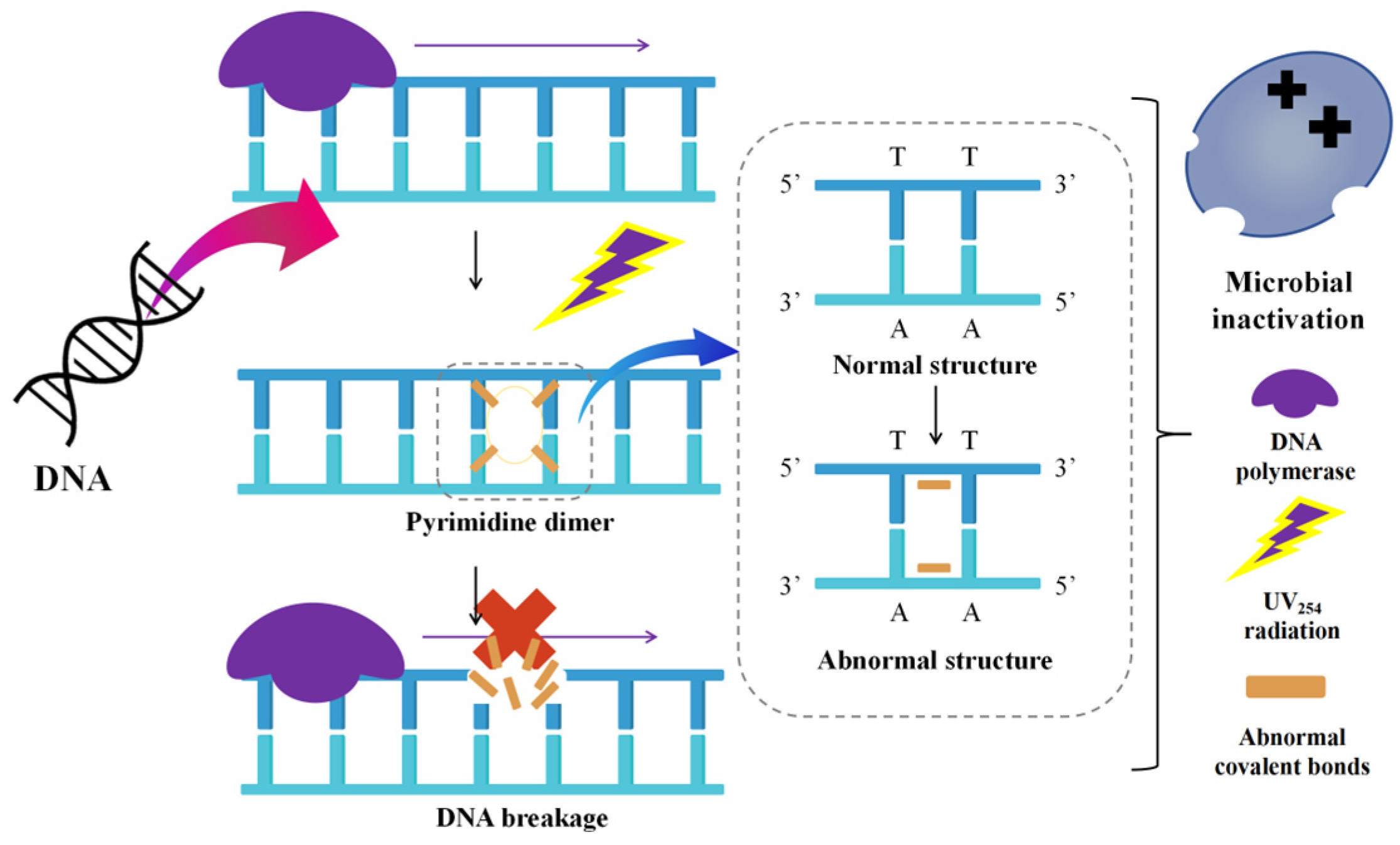
UV disinfection inactivates microorganisms mainly through photochemical damage to nucleic acids rather than through a persistent chemical action [23]. Absorption of germicidal UV, particularly within the UVC range, induces lesions in DNA and RNA, including pyrimidine dimers, which inhibit replication and transcription and thereby prevent microorganisms from remaining infectious [24] (Figure 1). In full-scale applications, UV disinfection is valued for rapid, broad-spectrum inactivation with typically fewer regulated DBPs than chlorination-based approaches and without maintaining a chemical residual in the treated stream [25,26]. Its performance, however, is governed less by nominal lamp power than by effective dose delivery, which depends on the fluence field established in the reactor and the extent to which the water matrix attenuates or shields UV irradiation [27]. Conventional low- and medium-pressure mercury lamps remain common in municipal plants due to established reactor designs, while UV-LEDs are increasingly explored for their compact form factor and wavelength tunability [28,29,30]. Regardless of the source, plant-scale reliability is often limited by optical losses, hydraulic under-dosing, and gradual output decline associated with lamp aging, sleeve fouling, and imperfect monitoring/maintenance [15]. Mechanistically, UV-induced damage includes cyclobutane pyrimidine dimers, 6-4 photoproducts, and possible strand lesions, which suppress genome replication and transcription and may be partly repaired through photoreactivation or dark-repair pathways if post-UV conditions are favorable.

2.1. Water Matrix and Optical Constraints

In full-scale systems, the water matrix often sets the upper bound for UV performance by controlling photon delivery to microorganisms. UV transmittance at 254 nm (UVT254) is widely used as an operational surrogate, but it reflects multiple mechanisms, including absorption by chromophoric dissolved organic matter (CDOM), scattering by SS and colloids, and particle-associated shielding [31]. Elevated SS can cause shadowing and reduce effective exposure; under low UV doses, SS reduced E. coli inactivation by 0.4–0.8 log [7]. Increased turbidity further enhances scattering and decreases penetration depth, which is particularly problematic in reactors with low-irradiance zones [11]. Dissolved organics can impair UV disinfection through both light screening and reactive intermediate consumption in UV-hybrid systems. Humic substances attenuate UV directly and can compete for oxidizing species. For example, Deng et al. reported that humic acids decreased naproxen degradation in a UV/chlorine system by 10–15% and reduced E. coli inactivation by 38.3% through competition for reactive oxygen species, with additional evidence of diminished hydroxyl radical stability [12,32,33]. Similar scavenging effects were reported for dissolved black carbon (DBC); DBC suppressed UV/H2O2 and UV/PDS performance during carbamazepine degradation, with inhibition increasing with DBC concentration and reaching 72% and 76% reductions, respectively [34]. These observations indicate that low UVT254 may signify not only optical attenuation but also high radical demand when UV is coupled with oxidants. Inorganic constituents can further exacerbate optical losses and performance variability. Iron/manganese-related color and persistent colloids sustain attenuation and scattering, while bicarbonate/carbonate alkalinity scavenges radicals and can weaken oxidation-driven contributions in UV-hybrid processes [35]. Overall, matrix-dependent absorption, scattering, and shielding narrow the effective operating window and help explain why identical nominal doses can yield different log removals across plants and seasons. Routine characterization of UVT254, turbidity/SS, and indicators of particle association and oxidant/radical demand is therefore essential for both design and stable operation.

2.2. Hydraulics and Dose Distribution

UV performance at full scale is often constrained by hydraulics because microorganisms experience a dose distribution rather than a single uniform dose [36]. Non-ideal residence time distributions (RTDs), short-circuiting, dead zones, and heterogeneous velocity fields create under-dosed fractions that dominate breakthrough risk [14], so the average or nominal target dose may correlate poorly with observed log-removal under changing flow conditions. Flow effects reflect competing mechanisms. Higher velocities reduce retention time and thus delivered dose per pass, yet enhanced mixing can partially improve exposure uniformity by redistributing particles and weakening local shielding [37]. Shen et al. [14] reported that during UV treatment of milk, the sterilization efficiency first decreased and then increased with increasing flow velocity, but remained below the initial level, indicating that mixing-induced gains did not fully compensate for the loss in residence time. Similar trade-offs are expected in wastewater UV reactors, where hydrodynamics may mitigate low-dose tails, but cannot eliminate them entirely. Practically, performance improvement relies on limiting under-dosed pathways within the specific reactor geometry. Reactor configuration (open-channel vs. closed-vessel), lamp layout, baffles, and inlet/outlet design govern RTD and the fluence-rate field. CFD- and RTD-based validation are therefore valuable for diagnosing “same set dose, different log-removal” behavior and for targeting short-circuiting and dead zones rather than simply increasing lamp power. In this context, CFD coupled with RTD testing or biodosimetry can be used to identify low-fluence zones, optimize baffle and lamp arrangements, and balance turbulence-enhanced mixing against reduced hydraulic residence time.

2.3. Reactor and Operation: Lamp, Sleeve, Monitoring, Validation

Stable UV disinfection depends on maintaining delivered irradiance over time. UV sources (low-pressure, medium-pressure, and UV-LED) differ in emission spectra and energy efficiency, but all exhibit output decline with aging and operational drift [38], which directly affects dose delivery. Quartz sleeve fouling represents another common limiting factor in wastewater treatment. Both inorganic scaling and biofouling reduce sleeve transmittance and lower effective irradiance. Scaling is promoted by thermal gradients near the lamp and by deposition/precipitation of trace metals and inorganic species during operation [38,39,40]. Given the low UV transmittance of most deposits, even thin fouling layers can cause appreciable dose loss and reduce inactivation performance [41]. Reliable operation therefore requires measurement and control strategies that track dose rather than lamp age alone. Sensor drift and fouling can bias intensity readings, and dose pacing without UVT254 compensation can misrepresent delivered dose under fluctuating water quality [31]. Routine calibration, sleeve cleaning, and setpoints linked to flow and UVT254 could improve operational stability. Performance validation using biodosimetry or challenge testing remains important, as it integrates optical and hydraulic effects into outcome-based metrics [38]. Furthermore, microbial photoreactivation, dark repair, and regrowth may affect apparent efficacy [23], so sampling and assay conditions should be standardized for meaningful evaluation. For UV-LEDs, wavelength selectivity may allow better matching with microbial action spectra or oxidant absorption bands; however, current applications are still constrained by wall-plug efficiency, thermal management, array-scale uniformity, lifetime under continuous operation, and scale-up cost.

3. Development of UV-Based AOPs

The limitations of UV disinfection in municipal effluents have spurred UV-enhanced approaches that couple UV with oxidants or catalytic/physical processes to improve robustness under complex water matrices [3]. In UV-based AOPs, UV activation of free chlorine/NH2Cl [17], O3 [35], PAA [42], or PS generates highly reactive species (e.g., •OH) [18], thereby complementing direct photodamage with radical-mediated oxidation. Numerous studies have reported high disinfection efficiency for these configurations, supporting their continued development for challenging treatment scenarios [3].
Across these UV-enhanced systems, the radical chemistry differs substantially. UV/free chlorine and UV/NH2Cl generate both hydroxyl radicals and reactive chlorine or nitrogen-centered species, whereas UV/O3 is mainly associated with hydroxyl-radical chemistry. UV/PAA can produce hydroxyl and organic acyl/peroxy radicals, while UV/PS introduces sulfate radicals with a stronger dependence on pH and halide composition. Therefore, process performance should be interpreted not only by log inactivation, but also by radical selectivity, scavenging by the water matrix, and byproduct-forming potential (Table 1).

3.1. UV/Free Chlorine and UV/NH2Cl

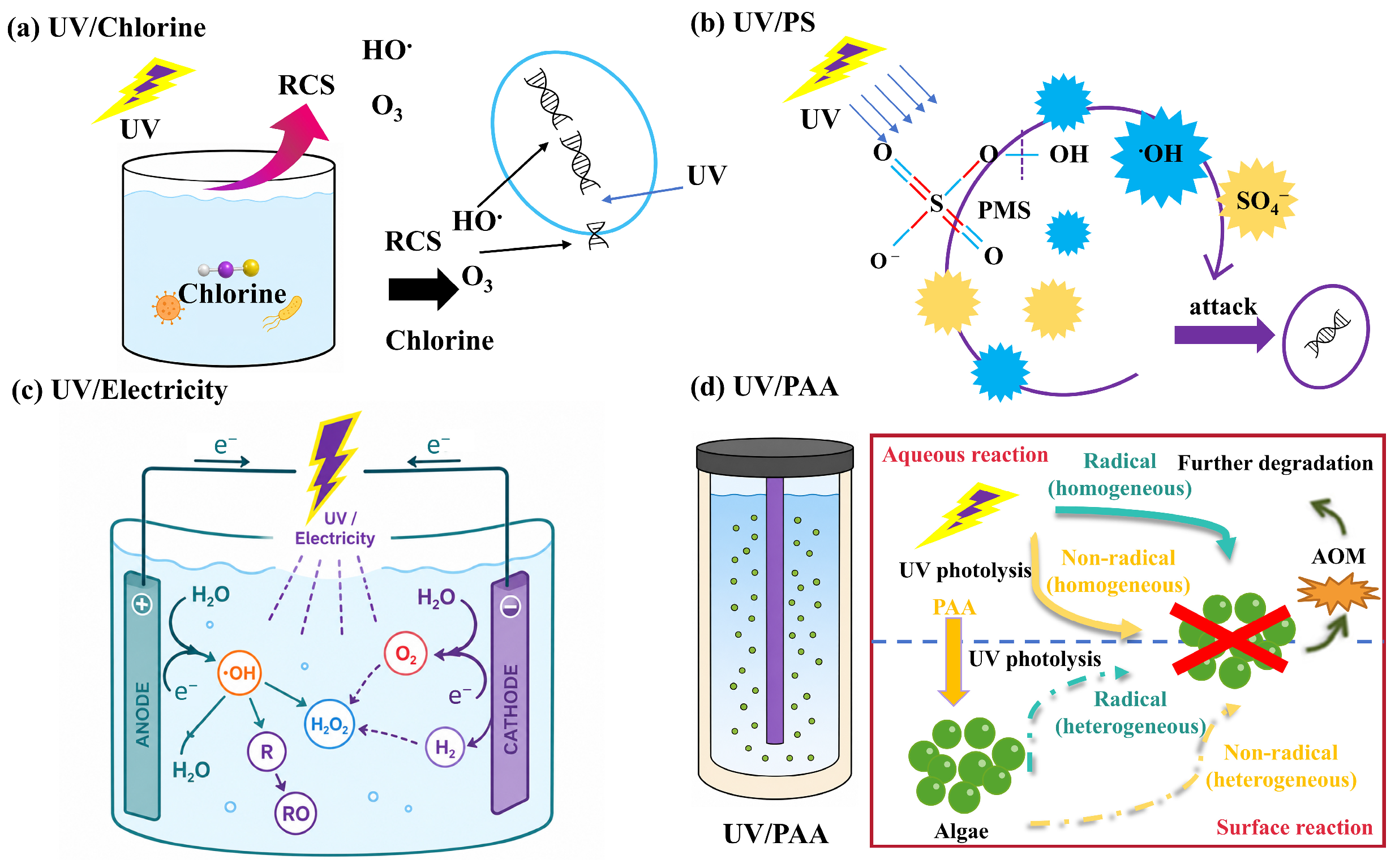
UV/free chlorine and UV/NH2Cl are attractive for engineering practice because they combine a conventional disinfectant with UV activation and can be implemented with relatively simple retrofits [17] (Figure 2a). In municipal wastewater, chlorine-resistant microorganisms may reduce the apparent efficacy of chlorination, whereas UV can inactivate chlorine-tolerant populations and thereby strengthen the overall disinfection barrier [4]. Mechanistically, chlorination exerts its biocidal effect primarily through oxidative damage to key cellular functions (e.g., enzyme systems) [45]. Under UV irradiation, free chlorine species (HOCl/ClO) undergo photolysis to produce reactive intermediates, including reactive chlorine species and OH, thereby introducing additional oxidative pathways [46,47,48]. UV exposure can also increase cell envelope susceptibility, facilitating subsequent oxidant attack on membrane-associated structures [49,50]. For NH2Cl, UV photolysis proceeds through nitrogen-containing radical pathways, generating a more complex reactive network than that of free chlorine [51]. Overall, the process is best viewed as a coupled disinfection and oxidation system, in which improved robustness and broader reactivity are gained at the cost of increased reaction complexity and potentially altered byproduct chemistry [52].
Beyond reporting higher log removal, performance should be interpreted in terms of target microorganisms (bacteria/viruses/protozoa), potential effects on ARB/ARGs (if assessed), and whether observed outcomes exceed the additive expectation of UV and oxidant alone (synergy) [52]. A common example is MS2 inactivation; compared with chlorination alone, UV/chlorine achieved 1.3-fold higher disinfection efficiency, consistent with synergistic action between UV damage and chlorine-derived reactivity [52]. Similarly, for P. aeruginosa, the disinfection efficiency of UV/chloramine increased by 11.34 times relative to chlorination alone and 2.28 times relative to UV alone [56]. Other studies have reported a 7.7-fold increase in bactericidal efficacy against E. coli [45] (Table 2).
The synergy and altered reactivity of UV/chlorine also influence disinfection byproduct (DBP) profiles, by transforming chlorine-containing precursors and chlorinated intermediates. UV activation of chlorine/chloramine has been reported to generate photolysis radicals and reduce the concentration of organic chloramines (OCs), which are associated with DBP formation risk [66]. For instance, Xu et al.’s [67] study found that UV promoted OC degradation, reaching 96.6% after 60 min. Consistently, compared with chlorination alone, UV/chlorine reduced the formation of several DBPs, including trichloromethane (THMs), haloacetic acids (HAAs), dichloroacetioc acid (DCAA), and trichloroacetioc acid (TCAA). At a UV dose exceeding 300 mJ/cm2, THMs, HAAs, DCAA, and TCAA decreased by 42.25%, 13.75%, 70.70%, and 90.40%, respectively [68,69]. At the same time, however, UV activation of chlorine/chloramine can introduce additional transformation pathways, such as the formation of inorganic oxychlorine species or halogenated oxidation byproducts under specific conditions. This dual effect warrants matrix-dependent assessment and control [52]. In addition, UV/chlorine or UV/chloramine processes may promote chlorate/perchlorate formation and nitrogenous DBPs such as haloacetonitriles, halonitromethanes, haloacetamides, and N-nitrosamines, particularly in waters containing ammonia, organic nitrogen, or high halide levels.

3.2. UV/O3

UV/O3 is a representative UV-AOP route in which UV photolysis of O3 and subsequent chain reactions increase OH formation [19,35]. When OH becomes dominant, performance is strongly controlled by radical scavenging (e.g., NOM and carbonate/bicarbonate). Thus, the same UV/O3 inputs can yield different outcomes across different water matrices [70]. Ozonation may also modify effluent optics, for example, reducing color and some UV-absorbing constituents, which can indirectly improve UV penetration. Ozone-driven improvements related to turbidity have also been reported [71], though the magnitude is site- and matrix-dependent [10]. UV/O3 can be valuable when high virus inactivation or control of disinfectant-tolerant microorganisms is required [72]. Albert et al. [73] reported that at an ozone concentration of 0.75 mg/L, inactivation of SARS-CoV-2 reached 82–91.5%. Beyond disinfection, UV/O3 enhances the oxidation of dissolved organic pollutants. For example, during treatment of six polychlorinated biphenyls (PCBs), O3 alone achieved 95% removal, whereas UV/O3 reached 97% [57,74], indicating an incremental benefit from UV activation [74] (Table 2).
Ozone-based systems may reduce DBP precursors. For instance, ozone-induced DOC conversion decreased THM formation potential by 47% [75]. Chen et al.’s [76] study showed that, compared with O3 alone, UV/O3 reduced the formation of absorbable organic bromine (AOBr) by 81.4%. However, in bromide-containing waters, bromate risk becomes a central constraint, and additional oxidation byproducts (e.g., aldehydes/ketones) may require attention [76]. For practical application, bromate control in bromide-containing waters and ozone mass-transfer efficiency are two key constraints; insufficient gas–liquid transfer can reduce dissolved ozone availability, increase off-gas management requirements, and weaken the expected benefit of UV/O3 treatment.

3.3. UV/PAA

UV/PAA combines the intrinsic disinfecting capability of peracetic acid with UV irradiation and is often discussed as a low-halogen, DBP-conscious option for complex waters [42]. PAA has been reported to be effective against bacteria [77], viruses [78], parasites [79], and fungi [80]. Under UV irradiation, cleavage of the O–O bond in PAA yields radicals such as OH and acetoxy radicals (CH3C(O)O), creating an oxidative system that can complement UV photodamage and strengthen overall inactivation [81,82] (Figure 2d). Conceptually, UV/PAA provides a dual pathway of chemical inactivation by PAA combined with photochemical/radical-driven damage under UV [42]. UV/PAA has demonstrated strong performance across multiple wastewater types, particularly when short contact time and broad-spectrum inactivation are required [83]. In toilet blackwater treatment, the UV/PAA system (70 mg/L PAA) achieved 5.95-log reduction within 10 min, outperforming UV alone (1.36 log) and PAA alone (4.59 log) [58]. In combined sewer overflows, UV/PAA achieved 4.58-log inactivation of E. coli, significantly higher than that of UV or PAA alone [59] (Table 2). Similar enhancement was observed in agricultural wastewater [82]. PAA is often described as producing fewer chlorinated DBPs because it does not rely on free chlorine chemistry [84]. However, low DBP should be interpreted as a different byproduct spectrum rather than an absence of transformation products [85]. In practice, residual PAA management and matrix-dependent side reactions, especially in mixed-halide waters, should be taken into consideration [83].

3.4. UV/PS

To maintain rigor, persulfate should be distinguished as peroxydisulfate (PDS, S2O82−) and peroxymonosulfate (PMS, HSO5) [86]. Under UV irradiation, persulfates are activated to produce sulfate radicals (SO4•−) and, via interconversion reactions, OH; the SO4•−/OH balance depends on pH and matrix chemistry [87] (Figure 2b). Although persulfates can be activated thermally [88], by metal catalysts [89], or via ultrasonication [90], UV activation is often considered operationally straightforward, requiring mild conditions and simple equipment [3]. In waters containing chloride/bromide, secondary halogen-radical chemistry can emerge, affecting both performance and byproduct formation [91]. UV/PS has been explored for waters containing recalcitrant organics and resistant microorganisms [87]. In UV/PMS treatment, simultaneous enhancement of microbial inactivation and oxidation of cyanotoxins/microcystins has been reported [92]. For saccharin (SAC) removal, UV or persulfate alone showed limited effect, whereas UV/PS increased SAC removal to 85.39% [60]. For quinoline, PS alone provided negligible removal, but UV/PS achieved 77.2% removal [61]. UV/PS also achieved up to 95.73% removal of tetracycline in wastewater [62] (Table 2). More specifically, PDS mainly yields sulfate radicals through S2O82− bond cleavage, whereas PMS can generate both sulfate and hydroxyl radicals through HSO5− activation; the relative contribution of these pathways depends on UV wavelength, pH, alkalinity, halides, and background organic matter.
Compared with chlorine-based disinfection, UV/PS avoids formation of traditional chlorinated DBPs in many cases. However, sulfate-based oxidation can generate distinct transformation products, and halide-containing matrices may shift pathways toward halogenated byproducts [87]. For NOM removal, UV or persulfate alone showed limited effect, whereas UV/PS increased NOM removal to 19.29%, attributed to ROS formation upon UV activation of persulfate [60]. Residual oxidant control and matrix-dependent scavenging (by NOM and carbonate) represent practical constraints [70]. Although UV/PS is effective for disinfection, it can also generate a greater amount of DBPs under certain conditions. For instance, when treating solutions containing SAC, the production of DBPs such as TCAA and DCAA increases significantly, an issue that should be taken into account in practical applications [88].

3.5. UV/Other Energy

UV/US leverages ultrasound cavitation to assist UV disinfection. At 20 kHz, ultrasound has been reported to inactivate 93% of mycobacteria [93]. The collapse of cavitation bubbles generates strong shear forces and localized microenvironments with high temperature and pressure, which can disrupt cell envelopes and produce oxidative radicals that accelerate the leakage of intracellular components [94]. From a UV perspective, ultrasound can reduce particle/floc shielding by fragmentation and improve mass transfer near irradiated zones, thereby indirectly narrowing dose tails [64]. Because ultrasound is energy-intensive, it is typically treated as an auxiliary step rather than a stand-alone disinfection method [64]. When integrated with UV, the mechanical disruption from ultrasound can increase UV accessibility to cellular targets and shorten the required exposure time. UV/US inactivation of E. coli was reported to be 1.2-fold more effective than UV alone, achieving in 3 min what required 5 min under UV-only conditions [64]. Another study by Li et al. [63] reported 95% inactivation within a short period using UV/US (Table 2). A practical advantage of UV/US is the absence of intentional chemical oxidant addition, which generally limits classical DBP concerns [63]. However, treatment outcomes remain matrix-dependent, and ultrasonic operation may promote the release of intracellular organic matter, which can alter downstream oxidation demand [93].
UV–electrochemical systems integrate photochemistry with electrochemical oxidant generation or photoelectron-catalytic ROS production [95] (Figure 2c). In electrocatalytic disinfection, reactive species (e.g., active chlorine and OH) can be generated at electrodes and oxidize bacteria, while direct electrical effects (e.g., electroporation) can also disrupt cell integrity [96]. In electro-Fenton systems, H2O2 generated at the cathode reacts with Fe2+ to produce OH, enabling oxidative inactivation [97]. Conventional Fenton-type systems face constraints including high cost, dependence on electrode/catalyst selection, and sensitivity to operating conditions [98]. Consequently, UV/electro-Fenton has been proposed to improve radical generation and process efficiency [95]. UVA (315–400 nm) can be absorbed by iron complexes and facilitate Fe2+ regeneration, reducing reliance on continuous catalyst addition [99,100]. Regarding the reported inactivation mechanisms for E. coli, UVA alone provides limited direct lethality, whereas electro-peroxidation and ROS generation compromise cell membranes, enabling deeper penetration of UVA and oxidants. Moreover, UVA can promote ROS formation [101,102].
UV/electrocatalytic disinfection has been reported with broad applicability and high efficiency [65], but energy demand and electrode cost remain major barriers. In Chen et al.’s [99] study for E. coli, UVA alone required 140 min and electro-peroxidation required 160 min, whereas the combined UVA/electro-peroxidation achieved maximal inactivation in 50 min, indicating their synergetic effects. A similar study by Clematis et al. [65] showed that for the dissolution of Erythrosine B dye, electro-peroxidation alone took 50 min to achieve the desired result, whereas UVA/electro-peroxidation took only 20 min (Table 2). Cathode material and long-term stability are critical cost drivers [103]. For example, incorporating Cu into cathodes via sol–gel methods was reported to reduce excessive PTFE accumulation and lower energy consumption, consuming 21.34 kWh/kg COD to treat one ton of wastewater [104]. Byproduct profiles depend strongly on electrolyte composition (especially chloride) and electrode reactions. Previous research has reported that active chlorine formation could introduce chlorinated transformation products under certain conditions [103]. Additionally, electrode fouling, catalyst loss, and performance decay are constraints for long-term operation [98].

4. Implications and Challenges

4.1. Engineering Windows for UV-Based AOPs

Across UV-based disinfection trains, the main engineering variables can be grouped into matrix conditions (e.g., UVT, turbidity/SS, NOM, and pH), process inputs (UV dose, oxidant dose, and contact time), and control requirements (mixing, residual control, and validation). These grouped factors jointly determine photon delivery, radical production, scavenging intensity, and byproduct risk. Beyond these shared requirements, the practical distinctions among processes are better understood from the standpoint of implementation context. To make the comparison more quantitative while keeping the review concise, Table 3 summarizes representative reported reaction conditions, including oxidant dose, UV fluence or intensity where available, pH, reaction/contact time, and observed inactivation or removal performance.
The values summarized in Table 3 should therefore be interpreted as evidence of process-specific operating windows rather than as a direct ranking of UV-AOPs, because the reported studies differ in water matrix, target organism, reaction time, UV/oxidant dose, and energy-related input.
UV/chlorine and UV/NH2Cl are often the most immediately deployable options under variable-transmittance or otherwise challenging matrices where UV-alone performance is unstable [66]. Their engineering appeal lies in the relative accessibility of chemical addition and residual-based process control. When treatment goals extend beyond microbial inactivation to concurrent micropollutant abatement, UV/O3 becomes particularly attractive because it couples disinfection with substantial oxidation capacity. However, its broader application is constrained by ozone mass-transfer efficiency, dissolved ozone control, safety requirements, and energy demand [72]. Therefore, it is most defensible in contexts where ozone generation and control are already feasible at the plant scale. Where such ozone infrastructure is difficult to justify [75], UV/PS provides a more practical route to combine disinfection with oxidation of persistent organics, although its use still must be evaluated against scavenger sensitivity and dose–cost–byproduct trade-offs. If a simpler oxidant-handling framework is preferred [86], UV/PAA offers a more operationally straightforward alternative, especially where stable oxidant feeding, appropriate dosing location and residual PAA management can be maintained within the intended operating window [31], making online residual control especially important.
Taken together, Table 3 shows that adding UV does not uniformly reduce byproduct risk; instead, DBP control depends on the oxidant used, halide content, precursor composition, and residual management.
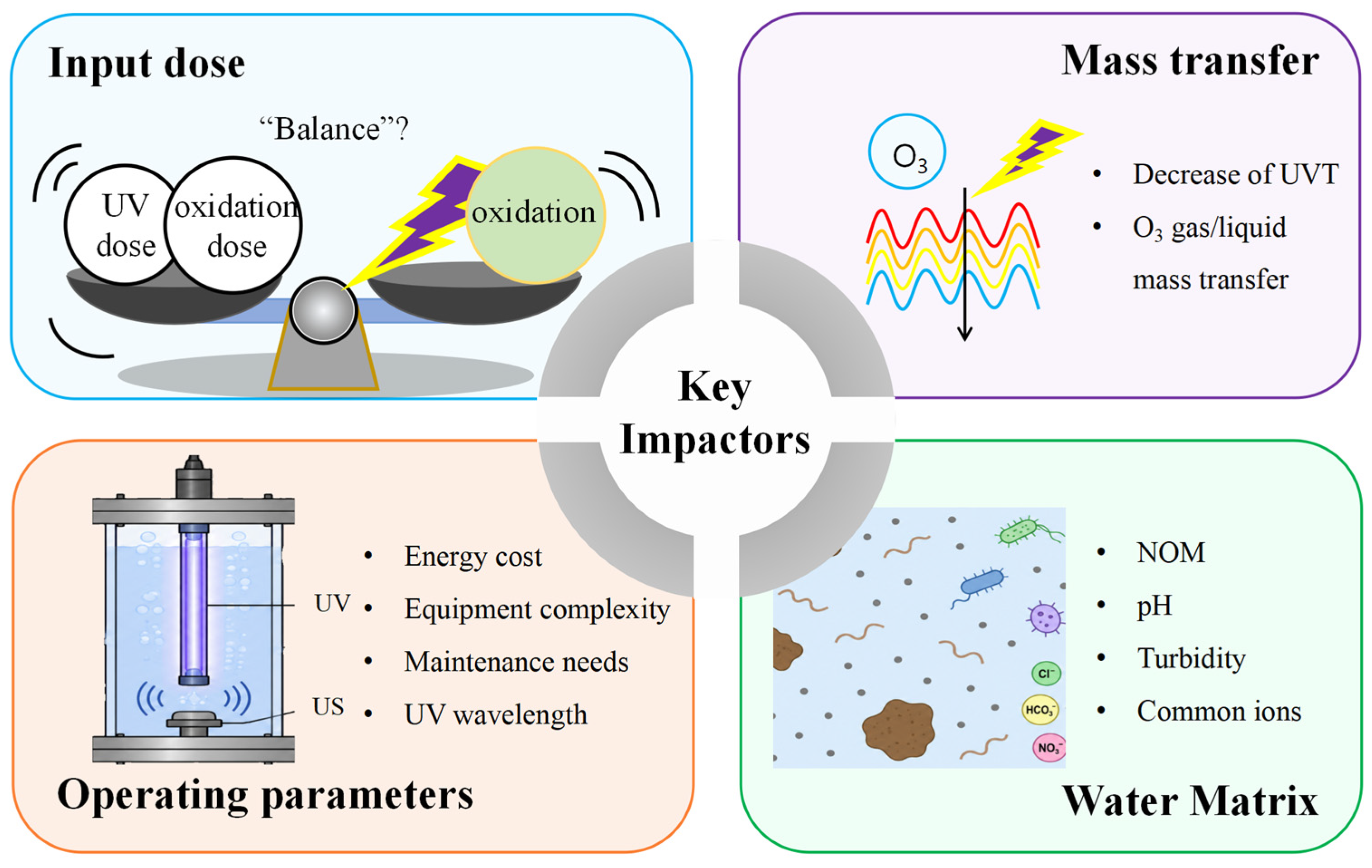
A different scenario arises when the dominant limitation is not oxidant selection but particle-associated shielding, particularly in high-turbidity waters or systems with strong floc association. Under those conditions, UV/US is more defensible because ultrasound can be applied (including intermittently) to disrupt shielding and recover UV effectiveness [11], albeit with penalties in energy use, equipment complexity, and maintenance [105]. Finally, UV-assisted electrochemical and photo-electrocatalytic routes are most relevant in treatment settings that can support tighter process control and greater operational sophistication. Their practical value depends less on basic UV exposure alone than on managing current density, electrode material, electrolyte composition, UV irradiation conditions [99], and hydraulic configuration, while balancing disinfection benefit against energy and cost, electrode durability, and monitoring complexity (Figure 3) [3].

4.2. Key Constraints of UV-Based Hybrid Disinfection

For scale-up, the central question is not whether UV-based systems can inactivate microorganisms, but whether the delivered dose and process control remain reliable under changing matrix, hydraulic, and maintenance conditions. Therefore, the following discussion summarizes these issues from the perspective of implementation barriers, rather than repeating the mechanism-level constraints described above.
Although UV-based hybrid disinfection and UV-AOPs can improve microbial control in complex municipal effluents, their wider use is still constrained by energy demand, matrix-specific robustness, long-term operational stability, and byproduct/risk management. These barriers require comparable reporting of energy per treated volume or per log inactivation, validation under representative real waters, and monitoring strategies that link UVT-compensated dose control with residual and byproduct management. In addition, future scale-up studies should therefore report comparable techno-economic indicators, including kWh m−3, energy per log inactivation, electrical energy per order (EEO), oxidant cost, maintenance frequency, and residual/byproduct monitoring costs, rather than relying only on laboratory inactivation efficiency.

5. Conclusions

In summary, UV-based hybrid disinfection represents a viable and increasingly mature approach to enhance microbial control in complex municipal effluents, provided that its advantages are assessed against process-specific trade-offs in a context-aware manner. These trade-offs include: (i) matrix-dependent performance due to radical scavenging by NOM and carbonate/bicarbonate; (ii) distinct byproduct profiles, ranging from halogenated DBPs and bromate in chlorine-/ozone-based systems to sulfate-driven transformation products in persulfate processes; (iii) elevated energy demand, which must be justified using metrics such as kWh·m−3 or EEO; and (iv) operational reliability challenges, including lamp aging, sleeve fouling, sensor drift, and the need for regular calibration and cleaning. This review aims to provide a structured framework for process selection, operation, and validation, encompassing UVT-compensated control, biodosimetry or challenge testing, and the establishment of operating windows that balance log-removal targets against byproduct risk and resource inputs, thereby supporting more reliable and sustainable UV disinfection for water reuse. Thus, no single UV-hybrid process can be regarded as universally superior: chlorine- or chloramine-assisted systems are more readily integrated into existing disinfection trains, UV/O3 and UV/PS provide stronger oxidation capacity but require stricter control of energy input and byproducts, whereas UV/PAA, UV/US, and UV–electrochemical routes are more application-dependent.
The contribution of this review lies in linking UV-based process chemistry with full-scale disinfection reliability, providing a practical complement to previous process-specific UV-AOP or UV-LED reviews. Future studies should standardize dose, matrix, energy, and DBP reporting and should give greater attention to pilot- and full-scale validation, long-term fouling control, and operation under variable real-water conditions.

Author Contributions

Conceptualization, Z.Z. (Zhiwei Zhao); methodology, L.D.; validation, L.D., S.Z. and K.L.; formal analysis, L.D. and Y.L.; investigation, L.D. and S.Z.; data curation, L.D. and Y.L.; writing—original draft preparation, L.D.; writing—review and editing, H.Z. and Z.Z. (Zhiwei Zhao); visualization, X.Y. and Z.Z. (Ziwen Zhao); supervision, Z.Z. (Zhiwei Zhao) and Z.Z. (Ziwen Zhao); funding acquisition, Z.Z. (Zhiwei Zhao) and Z.Z. (Ziwen Zhao). All authors have read and agreed to the published version of the manuscript.

Funding

This research was funded by the National Key Research and Development Program of China (No. 2023YFB3408200) and the Guangdong Basic and Applied Basic Research Foundation (2023A1515111143).

Data Availability Statement

No new data were created or analyzed in this study.

Conflicts of Interest

The authors declare no conflicts of interest.

Abbreviations

The following abbreviations are used in this manuscript:
UVUltraviolet
UVCUltraviolet C
UV-LEDUltraviolet light-emitting diode
AOPsAdvanced oxidation processes
DBPsDisinfection byproducts
DOMDissolved organic matter
NOMNatural organic matter
CDOMChromophoric dissolved organic matter
SSSuspended solids
UVTUltraviolet transmittance
UVT254Ultraviolet transmittance at 254 nm
RTDResidence time distribution
CFDComputational fluid dynamics
ROSReactive oxygen species
DOCDissolved organic carbon
ORPOxidation–reduction potential
EEOElectrical energy per order
ARBAntibiotic-resistant bacteria
ARGsAntibiotic resistance genes
PAAPeracetic acid
PSPersulfate
PDSPersulfate
PMSPeroxymonosulfate
NH2CLMonochloramine
O3Ozone
USUltrasound
PECPhoto-electrocatalysis
UV/CLUV/free chlorine
UV/O3UV/ozone
UV/PAAUV/peracetic acid
UV/PSUV/persulfate
UV/USUV/ultrasound
UV/PECUV-assisted photo-electrocatalytic process
THMsTrihalomethanes
HAAsHaloacetic acids
TCAATrichloroacetic acid
DCAADichloroacetic acid
AOBrAdsorbable organic bromine
DBCDissolved black carbon
PCBsPolychlorinated biphenyls
SACSaccharin
CODChemical oxygen demand
BMAAβ-N-methylamino-L-alanine
MS2MS2 bacteriophage

References

  1. Shi, Q.; Chen, Z.; Cao, K.-F.; Huang, B.-H.; Lu, Y.; Hu, H.-Y. Automated Ozone Disinfection Control in Reclaimed Water: The Surrogate Parameters-and Spectral Characteristics-Based Real-Time Feedback System for Microbial Inactivation Monitoring. ACS ES&T Eng. 2025, 5, 2269–2280. [Google Scholar]
  2. Zeng, L.W.; Sun, D.Z. Accurate calculation method for urban domestic sewage centralized collection rate based on water quality and quantity variations. J. Clean. Prod. 2025, 516, 18. [Google Scholar] [CrossRef]
  3. Ghosh, S.; Chen, Y.; Hu, J. Application of UVC and UVC based advanced disinfection technologies for the inactivation of antibiotic resistance genes and elimination of horizontal gene transfer activities: Opportunities and challenges. Chem. Eng. J. 2022, 450, 138234. [Google Scholar] [CrossRef]
  4. Barancheshme, F.; Munir, M. Strategies to Combat Antibiotic Resistance in the Wastewater Treatment Plants. Front. Microbiol. 2018, 8, 12. [Google Scholar] [CrossRef]
  5. Liu, W.; Hou, Q.; Yang, B.; Yuan, W.; Zhao, J.; Zhang, R.; Liu, J. Effluent characteristics and pulp properties changes with the partially substituting MgO for NaOH in the high-consistency retention stage of triploid poplar P-RC APMP. Ind. Eng. Chem. Res. 2011, 50, 1860–1865. [Google Scholar] [CrossRef]
  6. Azimi, Y.; Allen, D.G.; Seto, P.; Farnood, R. Effect of activated sludge retention time, operating temperature, and influent phosphorus deficiency on floc physicochemical characteristics and UV disinfection. Ind. Eng. Chem. Res. 2014, 53, 12485–12493. [Google Scholar] [CrossRef]
  7. Li, Y.-Q.; Sun, R.; Zhang, C.-M.; Liu, Z.-X.; Chen, R.-t.; Zhao, J.; Gu, H.-d.; Yin, H.-C. Inactivation of pathogenic microorganisms in water by electron beam excitation multi-wavelength ultraviolet irradiation: Efficiency, influence factors and mechanism. J. Environ. Manag. 2024, 350, 119597. [Google Scholar] [CrossRef]
  8. Gandhi, J.; Prakash, H. Photo-disinfection processes for bacterial inactivation and underlying principles for water constituents’ impact: A review. Chem. Eng. J. Adv. 2023, 14, 12. [Google Scholar] [CrossRef]
  9. Li, X.L.; Cai, M.; Wang, L.; Niu, F.F.; Yang, D.G.; Zhang, G.Q. Evaluation survey of microbial disinfection methods in UV-LED water treatment systems. Sci. Total Environ. 2019, 659, 1415–1427. [Google Scholar] [CrossRef]
  10. Gandhi, V.N.; Roberts, P.J.; Kim, J.-H. Visualizing and quantifying dose distribution in a UV reactor using three-dimensional laser-induced fluorescence. Environ. Sci. Technol. 2012, 46, 13220–13226. [Google Scholar] [CrossRef]
  11. García-Gil, Á.; Valverde, R.; García-Muñoz, R.A.; McGuigan, K.G.; Marugán, J. Solar water disinfection in high-volume containers: Are naturally occurring substances attenuating factors of radiation? Chem. Eng. J. 2020, 399, 125852. [Google Scholar] [CrossRef]
  12. Deng, J.; Chen, L.; Huang, J.; Hu, J.; Shao, B.; Xu, M.; Cai, A.; Zhou, S. Impact of humic acid on naproxen degradation and DBPs formation during UV/chlorine and UV-LED/chlorine oxidation processes: A comparative study. Sep. Purif. Technol. 2025, 378, 134718. [Google Scholar] [CrossRef]
  13. Younis, B.A.; Mahoney, L.; Schweigkofler, W.; Suslow, K. Inactivation of plant pathogens in irrigation water runoff using a novel UV disinfection system. Eur. J. Plant Pathol. 2019, 153, 907–914. [Google Scholar] [CrossRef]
  14. Shen, S.; Deng, L.; Ke, Y.; Dai, T.; Mei, L.; Chen, J. Impact of tube configuration on UV-C sterilization efficacy in continuous-flow milk treatment: Numerical simulation of flow field, inactivation kinetics and energy consumption analysis. Food Control 2025, 181, 111767. [Google Scholar] [CrossRef]
  15. Salehi, A.; Hassanpour, A.; Jalali, A. Characterization of cylindrical UV-LED water disinfection photoreactors with reflective surfaces: Model development and validation. J. Water Process Eng. 2025, 73, 107676. [Google Scholar] [CrossRef]
  16. Han, J.; Li, W.; Yang, Y.; Zhang, X.; Bao, S.; Zhang, X.; Zhang, T.; Leung, K.M.Y. UV-based advanced oxidation processes for antibiotic resistance control: Efficiency, influencing factors, and energy consumption. Engineering 2024, 37, 27–39. [Google Scholar] [CrossRef]
  17. Guo, K.; Wu, Z.; Chen, C.; Fang, J. UV/chlorine process: An efficient advanced oxidation process with multiple radicals and functions in water treatment. Acc. Chem. Res. 2022, 55, 286–297. [Google Scholar] [CrossRef]
  18. Zhang, Y.; Xiao, Y.; Zhong, Y.; Lim, T.-T. Comparison of amoxicillin photodegradation in the UV/H2O2 and UV/persulfate systems: Reaction kinetics, degradation pathways, and antibacterial activity. Chem. Eng. J. 2019, 372, 420–428. [Google Scholar] [CrossRef]
  19. Samadi, M.T.; Rezaie, A.; Ebrahimi, A.A.; Hossein Panahi, A.; Kargarian, K.; Abdipour, H. The utility of ultraviolet beam in advanced oxidation-reduction processes: A review on the mechanism of processes and possible production free radicals. Environ. Sci. Pollut. Res. 2024, 31, 6628–6648. [Google Scholar] [CrossRef] [PubMed]
  20. Wols, B.; Hofman-Caris, C. Review of photochemical reaction constants of organic micropollutants required for UV advanced oxidation processes in water. Water Res. 2012, 46, 2815–2827. [Google Scholar] [CrossRef]
  21. Meng, T.; Sun, W.; Su, X.; Sun, P. The optimal dose of oxidants in UV-based advanced oxidation processes with respect to primary radical concentrations. Water Res. 2021, 206, 117738. [Google Scholar] [CrossRef]
  22. Wang, L.; Zhang, Q.; Chen, B.; Bu, Y.; Chen, Y.; Ma, J.; Rosario-Ortiz, F.L.; Zhu, R. Some issues limiting photo(cata)lysis application in water pollutant control: A critical review from chemistry perspectives. Water Res. 2020, 174, 115605. [Google Scholar] [CrossRef]
  23. Martín-Sómer, M.; Pablos, C.; Adán, C.; van Grieken, R.; Marugán, J. A review on LED technology in water photodisinfection. Sci. Total Environ. 2023, 885, 163963. [Google Scholar] [CrossRef]
  24. Lu, Y.; Shi, X.; Li, W.; Lai, A. Wavelength-specific inactivation mechanisms and efficacies of germicidal UVC for airborne human coronavirus. J. Hazard. Mater. 2025, 484, 136666. [Google Scholar] [CrossRef] [PubMed]
  25. Hijnen, W.A.M.; Beerendonk, E.F.; Medema, G.J. Inactivation credit of UV radiation for viruses, bacteria and protozoan (oo)cysts in water: A review. Water Res. 2006, 40, 3–22. [Google Scholar] [CrossRef] [PubMed]
  26. Mori, M.; Hamamoto, A.; Takahashi, A.; Nakano, M.; Wakikawa, N.; Tachibana, S.; Ikehara, T.; Nakaya, Y.; Akutagawa, M.; Kinouchi, Y. Development of a new water sterilization device with a 365 nm UV-LED. Med. Biol. Eng. Comput. 2007, 45, 1237–1241. [Google Scholar] [CrossRef]
  27. Nihemaiti, M.; Yoon, Y.; He, H.; Dodd, M.C.; Croué, J.-P.; Lee, Y. Degradation and deactivation of a plasmid-encoded extracellular antibiotic resistance gene during separate and combined exposures to UV254 and radicals. Water Res. 2020, 182, 115921. [Google Scholar] [CrossRef]
  28. Akasaki, I.; Amano, H.; Nakamura, S. Blue LEDs-Filling the world with new light. In The Nobel Prize in Physics 2014; Royal Swedish Academy of Sciences: Stockholm, Sweden, 2014. [Google Scholar]
  29. Taniyasu, Y.; Kasu, M.; Makimoto, T. Aluminum nitride deep-ultraviolet light-emitting diodes. NTT Tech. Rev. 2006, 4, 54–58. [Google Scholar]
  30. Yoshitaka, T.; Makoto, K. Improved emission efficiency of 210-nm deep-ultraviolet aluminum nitride light-emitting diode. NTT Tech. Rev. 2010, 8, 7–11. [Google Scholar]
  31. Bilger, W.; Veit, M.; Schreiber, L.; Schreiber, U. Measurement of leaf epidermal transmittance of UV radiation by chlorophyll fluorescence. Physiol. Plant. 1997, 101, 754–763. [Google Scholar] [CrossRef]
  32. Liu, L.; Li, L.; Wang, P.; Cui, J.; Chong, G.; Zhang, Y.; Hao, H.; Duan, N.; Li, X.; Li, C. Highly efficient disinfection of antibiotic-resistant bacteria in water using a novel UV-LED/periodate combined process: Mechanisms and performance evaluation. J. Water Process Eng. 2025, 79, 108833. [Google Scholar] [CrossRef]
  33. Yue, J.; Guo, W.; Zhu, Y.; Li, D.; Liang, S.; Cao, R.; Wang, A.; Li, J. Insights on the degradation mechanism of neotame using UV/periodate: Roles of reactive species, kinetics, and pathways. Chem. Eng. J. 2024, 495, 153059. [Google Scholar] [CrossRef]
  34. Lu, Q.; Liu, Y.; Li, B.; Feng, L.; Du, Z.; Zhang, L. Reaction kinetics of dissolved black carbon with hydroxyl radical, sulfate radical and reactive chlorine radicals. Sci. Total Environ. 2022, 828, 153984. [Google Scholar] [CrossRef] [PubMed]
  35. Malvestiti, J.A.; Dantas, R.F. Disinfection of secondary effluents by O3, O3/H2O2 and UV/H2O2: Influence of carbonate, nitrate, industrial contaminants and regrowth. J. Environ. Chem. Eng. 2018, 6, 560–567. [Google Scholar] [CrossRef]
  36. Hübner, U.; Spahr, S.; Lutze, H.; Wieland, A.; Rüting, S.; Gernjak, W.; Wenk, J. Advanced oxidation processes for water and wastewater treatment–Guidance for systematic future research. Heliyon 2024, 10, e30402. [Google Scholar] [CrossRef]
  37. Li, W.; Li, M.; Qiang, Z. Improvement of UV disinfection reactor performance by ring baffles: The matching between the hydrodynamics and UV radiation. Chem. Eng. J. 2020, 379, 122381. [Google Scholar] [CrossRef]
  38. Montazeri, M.M.; Taghipour, F. Operation of a high-flow UV-LED water treatment reactor with secondary effluent for stress testing. Chem. Eng. J. 2023, 457, 141295. [Google Scholar] [CrossRef]
  39. Bolton, J.R.; Cotton, C.A. The Ultraviolet Disinfection Handbook; American Water Works Association: Denver, CO, USA, 2008. [Google Scholar]
  40. Wait, I.W.; Blatchley, I.; Ernest, R. Fouling of quartz surfaces in a low-pressure high-output (LPHO) ultraviolet disinfection reactor treating a groundwater source: Foulant characterization, distribution, and phosphate effects. In Impacts of Global Climate Change; American Society of Civil Engineers (ASCE): Reston, VA, USA, 2005; pp. 1–12. [Google Scholar]
  41. Petri, B.; Shen, C.; Scheible, O.K.; Tang, S. Updating the Approaches in the NWRI/AwwaRF UV Guidelines: The Impacts of Water Quality and Recirculation Mode Testing on UV Validation. In Proceedings of the WEFTEC 2010; Water Environment Federation (WEF): Alexandria, VA, USA, 2010; pp. 1736–1739. [Google Scholar]
  42. Zhou, S.; Huang, J.; Bu, L.; Li, G.; Zhu, S. Degradation of β-N-methylamino-l-alanine (BMAA) by UV/peracetic acid system: Influencing factors, degradation mechanism and DBP formation. Chemosphere 2022, 307, 136083. [Google Scholar] [CrossRef] [PubMed]
  43. Yan, Y.; Wei, Z.; Duan, X.; Long, M.; Spinney, R.; Dionysiou, D.D.; Xiao, R.; Alvarez, P.J. Merits and limitations of radical vs. nonradical pathways in persulfate-based advanced oxidation processes. Environ. Sci. Technol. 2023, 57, 12153–12179. [Google Scholar] [CrossRef]
  44. Yang, S.; Sun, S.; Xie, Z.; Dong, Y.; Zhou, P.; Zhang, J.; Xiong, Z.; He, C.-S.; Mu, Y.; Lai, B. Comprehensive insight into the common organic radicals in advanced oxidation processes for water decontamination. Environ. Sci. Technol. 2024, 58, 19571–19583. [Google Scholar] [CrossRef]
  45. Wang, J.; Bu, L.; Wu, Y.; Sun, J.; Li, G.; Zhou, S. Disinfection profiles and mechanisms of E. coli, S. aureus, and B. subtilis in UV365/chlorine process: Inactivation, reactivation, and DBP formation. Sep. Purif. Technol. 2022, 287, 120584. [Google Scholar] [CrossRef]
  46. Watts, M.J.; Linden, K.G. Chlorine photolysis and subsequent OH radical production during UV treatment of chlorinated water. Water Res. 2007, 41, 2871–2878. [Google Scholar] [CrossRef]
  47. Feng, Y.; Smith, D.W.; Bolton, J.R. Photolysis of aqueous free chlorine species (HOCl and OCl) with 254 nm ultraviolet light. J. Environ. Eng. Sci. 2007, 6, 277–284. [Google Scholar] [CrossRef]
  48. Nowell, L.H.; Hoigné, J. Photolysis of aqueous chlorine at sunlight and ultraviolet wavelengths—II. Hydroxyl radical production. Water Res. 1992, 26, 599–605. [Google Scholar] [CrossRef]
  49. Peng, J.; Yin, R.; Yang, X.; Shang, C. A novel UVA/ClO2 advanced oxidation process for the degradation of micropollutants in water. Environ. Sci. Technol. 2022, 56, 1257–1266. [Google Scholar] [CrossRef] [PubMed]
  50. Pattison, D.I.; Davies, M.J. Absolute rate constants for the reaction of hypochlorous acid with protein side chains and peptide bonds. Chem. Res. Toxicol. 2001, 14, 1453–1464. [Google Scholar] [CrossRef]
  51. Bu, L.; Zhou, S.; Zhu, S.; Wu, Y.; Duan, X.; Shi, Z.; Dionysiou, D.D. Insight into carbamazepine degradation by UV/monochloramine: Reaction mechanism, oxidation products, and DBPs formation. Water Res. 2018, 146, 288–297. [Google Scholar] [CrossRef] [PubMed]
  52. Gao, Y.; Sun, Z.; Guo, Y.; Qiang, Z.; Ben, W. Virus inactivation by sequential ultraviolet-chlorine disinfection: Synergistic effect and mechanism. Chemosphere 2023, 314, 137632. [Google Scholar] [CrossRef]
  53. Shen, Q.; Song, X.; Fan, J.; Chen, C.; Guo, Z. Degradation of humic acid by UV/PMS: Process comparison, influencing factors, and degradation mechanism. RSC Adv. 2024, 14, 22988–23003. [Google Scholar] [CrossRef]
  54. Medel, A.; Treviño-Reséndez, J.; Brillas, E.; Meas, Y.; Sirés, I. Contribution of cathodic hydroxyl radical generation to the enhancement of electro-oxidation process for water decontamination. Electrochim. Acta 2020, 331, 135382. [Google Scholar] [CrossRef]
  55. Cao, L.; Wang, J.; Wang, Z.; Yu, S.; Cheng, Y.; Ma, J.; Xie, P. Inactivation of Microcystis Aeruginosa by peracetic acid combined with ultraviolet: Performance and characteristics. Water Res. 2022, 208, 117847. [Google Scholar] [CrossRef]
  56. Wang, J.; Qu, D.; Bu, L.; Zhu, S. Inactivation efficiency of P. Aeruginosa and ARGs removal in UV/NH2Cl process: Comparisons with UV and NH2Cl. Sep. Purif. Technol. 2023, 305, 122473. [Google Scholar] [CrossRef]
  57. Kim, J.; Khan, I.A.; Lee, J.W.; Kim, Y.; Jeon, S.; Chae, S.; Kim, J.-O. Simultaneous degradation of pharmaceuticals and personal care products in hospital wastewater using ozone under ultraviolet irradiation. J. Water Process Eng. 2024, 68, 106366. [Google Scholar] [CrossRef]
  58. Yin, W.; Chen, J.; Xu, Y.; Yu, C.; Zhou, X.; Zhang, Y. Efficient disinfection of real toilet blackwater by ultraviolet/peracetic acid process: Selective intracellular biomolecular oxidation. J. Hazard. Mater. 2025, 492, 138099. [Google Scholar] [CrossRef]
  59. Chen, J.; Cao, L.; Cheng, Y.; Chen, Z.; Wang, Z.; Chen, Y.; Liu, Z.; Ma, J.; Xie, P. Efficient disinfection of combined sewer overflows by ultraviolet/peracetic acid through intracellular oxidation with preserving cell integrity. Water Res. 2024, 260, 121959. [Google Scholar] [CrossRef] [PubMed]
  60. Ye, C.; Ma, X.Y.; Deng, J.; Li, X.Y.; Li, Q.S.; Dietrich, A.M. Degradation of saccharin by UV/H2O2 and UV/PS processes: A comparative study. Chemosphere 2022, 288, 12. [Google Scholar] [CrossRef]
  61. Li, X.Y.; Li, Y.; Wang, Z.; Xu, T.; Hong, M.Q.; Zhao, X.B.; Mao, X.H. UV/peroxysulfate/ozone (UV/PS/O3) oxidation system for efficient degradation of organic matters in nanofilter membrane concentrates. J. Water Process Eng. 2024, 65, 10. [Google Scholar] [CrossRef]
  62. Zhang, Y.A.; Zhao, Y.G.; Hu, Y.B.; Gao, M.C.; Guo, L.; Ji, J.Y. Insight in degradation of tetracycline in mariculture wastewater by ultraviolet/persulfate advanced oxidation process. Environ. Res. 2022, 212, 9. [Google Scholar] [CrossRef]
  63. Li, C.; Yan, H.; Feng, W.; Yue, M.N.; Cao, H.; Ji, X.J.; Tu, Z.; Yang, Z.T. Sterilization effect of power airborn ultrasound combined with ultraviolet radiation on bacteria. Ultrason. Sonochem. 2025, 122, 11. [Google Scholar] [CrossRef]
  64. Wang, J.Y.; Ma, S.; Zhou, N.; Yang, X.F.; Xing, J.; Hong, J.Y. Using ultrasonic washing combined with UV-LEDs as a novel chemical-free method to disinfect fresh ready-to-eat produce. Ultrason. Sonochem. 2024, 107, 7. [Google Scholar] [CrossRef]
  65. Clematis, D.; Panizza, M. Electro-Fenton, solar photoelectro-Fenton and UVA photoelectro-Fenton: Degradation of Erythrosine B dye solution. Chemosphere 2021, 270, 129480. [Google Scholar] [CrossRef]
  66. Zhang, T.-Y.; Lin, Y.-L.; Xu, B.; Xia, S.-J.; Tian, F.-X.; Gao, N.-Y. Effect of UV irradiation on the proportion of organic chloramines in total chlorine in subsequent chlorination. Chemosphere 2016, 144, 940–947. [Google Scholar] [CrossRef]
  67. Xu, M.-Y.; Lin, Y.-L.; Zhang, T.-Y.; Liu, Z.; Li, M.-Y.; Hu, C.-Y.; Xu, B. Organic chloramines attenuation and disinfection by-product formation during UV, chlorination and UV/chlorine processes. Chemosphere 2022, 303, 135025. [Google Scholar] [CrossRef]
  68. Du, J.; Liu, D.; Zhang, Z.; Ai, H.; Fu, M.-L.; Sun, W.; Yuan, B. Comparative effectiveness of sequential and synergistic (VUV/) UV and chlorine disinfection on DBPs and humic acid reduction. Sep. Purif. Technol. 2024, 335, 126083. [Google Scholar] [CrossRef]
  69. Zhao, Z.; Ray, M.B.; Mao, T.; Sun, W. Impact of UV irradiation on disinfection by-product formation and speciation from post-chlorination of dissolved organic matter. AQUA Water Infrastruct. Ecosyst. Soc. 2021, 70, 1181–1191. [Google Scholar] [CrossRef]
  70. Gong, J.; Liu, Y.; Sun, X. O3 and UV/O3 oxidation of organic constituents of biotreated municipal wastewater. Water Res. 2008, 42, 1238–1244. [Google Scholar] [CrossRef]
  71. Setareh, P.; Khezri, S.M.; Hossaini, H.; Pirsaheb, M. Coupling effect of ozone/ultrasound with coagulation for improving NOM and turbidity removal from surface water. J. Water Process Eng. 2020, 37, 101340. [Google Scholar] [CrossRef]
  72. Yang, S.; Song, Y.; Chang, F.; Wang, K. Evaluation of chemistry and key reactor parameters for industrial water treatment applications of the UV/O3 process. Environ. Res. 2020, 188, 109660. [Google Scholar] [CrossRef] [PubMed]
  73. Carcereny, A.; Garcia-Pedemonte, D.; Martínez-Velázquez, A.; Quer, J.; Garcia-Cehic, D.; Gregori, J.; Antón, A.; Andrés, C.; Pumarola, T.; Chacón-Villanueva, C. Dynamics of SARS-CoV-2 Alpha (B. 1.1. 7) variant spread: The wastewater surveillance approach. Environ. Res. 2022, 208, 112720. [Google Scholar] [CrossRef] [PubMed]
  74. Dong, G.; Chen, B.; Liu, B.; Cao, Y.; de Jourdan, B.; Stoyanov, S.R.; Ling, J.; Ye, X.; Lee, K.; Zhang, B. Comparison of O3, UV/O3, and UV/O3/PS processes for marine oily wastewater treatment: Degradation performance, toxicity evaluation, and flocs analysis. Water Res. 2022, 226, 119234. [Google Scholar] [CrossRef] [PubMed]
  75. Sadrnourmohamadi, M.; Gorczyca, B. Effects of ozone as a stand-alone and coagulation-aid treatment on the reduction of trihalomethanes precursors from high DOC and hardness water. Water Res. 2015, 73, 171–180. [Google Scholar] [CrossRef]
  76. Chen, Y.; Yuan, C.-J.; Xu, B.-J.; Cao, J.-Y.; Lee, M.-Y.; Liu, M.; Wu, Q.; Du, Y. Suppressing organic bromine but promoting bromate: Is the ultraviolet/ozone process a double-edged sword for the toxicity of wastewater to mammalian cells? Environ. Sci. Technol. 2024, 58, 11649–11660. [Google Scholar] [CrossRef]
  77. Yin, W.; Liu, T.; Chen, J.; Zhang, L.; Ji, R.; Xu, Y.; Xu, J.; Li, N.; Zhou, X.; Zhang, Y. Using UV/peracetic acid as pretreatment for subsequent bio-treatment of antibiotic-containing wastewater treatment: Mitigating microbial inhibition and antibiotic resistance genes proliferation. J. Hazard. Mater. 2024, 470, 134166. [Google Scholar] [CrossRef]
  78. Weng, S.; Dunkin, N.; Schwab, K.J.; McQuarrie, J.; Bell, K.; Jacangelo, J.G. Infectivity reduction efficacy of UV irradiation and peracetic acid-UV combined treatment on MS2 bacteriophage and murine norovirus in secondary wastewater effluent. J. Environ. Manag. 2018, 221, 1–9. [Google Scholar] [CrossRef] [PubMed]
  79. Sudhaus, N.; Nagengast, H.; Pina-Pérez, M.C.; Martínez, A.; Klein, G. Effectiveness of a peracetic acid-based disinfectant against spores of Bacillus cereus under different environmental conditions. Food Control 2014, 39, 1–7. [Google Scholar] [CrossRef]
  80. Luukkonen, T.; Pehkonen, S.O. Peracids in water treatment: A critical review. Crit. Rev. Environ. Sci. Technol. 2017, 47, 1–39. [Google Scholar] [CrossRef]
  81. Lubello, C.; Caretti, C.; Gori, R. Comparison between PAA/UV and H2O2/UV disinfection for wastewater reuse. Water Sci. Technol. Water Supply 2002, 2, 205–212. [Google Scholar] [CrossRef]
  82. Caretti, C.; Lubello, C. Wastewater disinfection with PAA and UV combined treatment: A pilot plant study. Water Res. 2003, 37, 2365–2371. [Google Scholar] [CrossRef]
  83. Zuo, J.; Xu, X.; Wan, Q.; Cao, R.; Liang, Z.; Xu, H.; Li, K.; Huang, T.; Wen, G.; Ma, J. Inactivation of fungal spores in water with peracetic acid: Efficiency and mechanism. Chem. Eng. J. 2022, 427, 131753. [Google Scholar] [CrossRef]
  84. Kim, J.; Huang, C.-H. Reactivity of peracetic acid with organic compounds: A critical review. ACS ES&T Water 2020, 1, 15–33. [Google Scholar] [CrossRef]
  85. Richardson, S.D. Disinfection by-products and other emerging contaminants in drinking water. TrAC Trends Anal. Chem. 2003, 22, 666–684. [Google Scholar] [CrossRef]
  86. Lu, C.; Yao, J.; Knudsen, T.Š.; Amde, M.; Gu, J.; Liu, J.; Li, H.; Zhang, J. Degradation of α-nitroso-β-naphthol by UVA-B activated peroxide, persulfate and monopersulfate oxidants in water. J. Clean. Prod. 2019, 238, 117942. [Google Scholar] [CrossRef]
  87. Chen, S.; Deng, J.; Ye, C.; Xu, C.; Huai, L.; Li, J.; Li, X. Simultaneous removal of para-arsanilic acid and the released inorganic arsenic species by CuFe2O4 activated peroxymonosulfate process. Sci. Total Environ. 2020, 742, 140587. [Google Scholar] [CrossRef] [PubMed]
  88. Ma, X.; Tang, L.; Deng, J.; Liu, Z.; Li, X.; Wang, P.; Li, Q. Removal of saccharin by UV/persulfate process: Degradation kinetics, mechanism and DBPs formation. J. Photochem. Photobiol. A Chem. 2021, 420, 113482. [Google Scholar] [CrossRef]
  89. Ghauch, A.; Ayoub, G.; Naim, S. Degradation of sulfamethoxazole by persulfate assisted micrometric Fe0 in aqueous solution. Chem. Eng. J. 2013, 228, 1168–1181. [Google Scholar] [CrossRef]
  90. Hori, H.; Nagano, Y.; Murayama, M.; Koike, K.; Kutsuna, S. Efficient decomposition of perfluoroether carboxylic acids in water with a combination of persulfate oxidant and ultrasonic irradiation. J. Fluor. Chem. 2012, 141, 5–10. [Google Scholar] [CrossRef]
  91. Zhang, Y.-X.; Xiang, J.-L.; Wang, J.-J.; Du, H.-S.; Wang, T.-T.; Huo, Z.-Y.; Wang, W.-L.; Liu, M.; Du, Y. Ultraviolet-based synergistic processes for wastewater disinfection: A review. J. Hazard. Mater. 2023, 453, 131393. [Google Scholar] [CrossRef]
  92. Shah, N.S.; He, X.X.; Khan, H.M.; Khan, J.A.; O’Shea, K.E.; Boccelli, D.L.; Dionysiou, D.D. Efficient removal of endosulfan from aqueous solution by UV-C/peroxides: A comparative study. J. Hazard. Mater. 2013, 263, 584–592. [Google Scholar] [CrossRef]
  93. Al Bsoul, A.; Magnin, J.P.; Commenges-Bernole, N.; Gondrexon, N.; Willison, J.; Petrier, C. Effectiveness of ultrasound for the destruction of Mycobacterium sp. strain (6PY1). Ultrason. Sonochem. 2010, 17, 106–110. [Google Scholar] [CrossRef]
  94. Ashokkumar, M. The characterization of acoustic cavitation bubbles—An overview. Ultrason. Sonochem. 2011, 18, 864–872. [Google Scholar] [CrossRef]
  95. Tang, H.; Xiang, Q.; Lei, M.; Yan, J.; Zhu, L.; Zou, J. Efficient degradation of perfluorooctanoic acid by UV–Fenton process. Chem. Eng. J. 2012, 184, 156–162. [Google Scholar] [CrossRef]
  96. Huo, Z.Y.; Kim, Y.J.; Suh, I.Y.; Lee, D.M.; Lee, J.H.; Du, Y.; Wang, S.; Yoon, H.J.; Kim, S.W. Triboelectrification induced self-powered microbial disinfection using nanowire-enhanced localized electric field. Nat. Commun. 2021, 12, 11. [Google Scholar] [CrossRef]
  97. Feng, C.H.; Li, F.B.; Mai, H.J.; Li, X.Z. Bio-Electro-Fenton Process Driven by Microbial Fuel Cell for Wastewater Treatment. Environ. Sci. Technol. 2010, 44, 1875–1880. [Google Scholar] [CrossRef]
  98. Zhang, Y.F.; Wang, Y.; Angelidaki, I. Alternate switching between microbial fuel cell and microbial electrolysis cell operation as a new method to control H2O2 level in Bioelectro-Fenton system. J. Power Sources 2015, 291, 108–116. [Google Scholar] [CrossRef]
  99. Chen, X.J.; Chen, Z.Y.; Lin, C.Y.; Chen, R.Y.; Huang, P.W.; Jin, Y.C. Water disinfection by the UVA/electro-Fenton process under near neutral conditions: Performance and mechanisms. Chemosphere 2022, 308, 8. [Google Scholar] [CrossRef]
  100. Qi, W.H.; Zhu, S.M.; Shitu, A.; Ye, Z.Y.; Liu, D.Z. Low concentration peroxymonosulfate and UVA-LED combination for E. coli inactivation and wastewater disinfection from recirculating aquaculture systems. J. Water Process Eng. 2020, 36, 9. [Google Scholar] [CrossRef]
  101. Zeng, Y.Y.; Yu, Q.; Cheng, S.J. Antibacterial Mechanism of Liangguoan against Staphylococcus aureus and Escherichia coli. Arch. Microbiol. 2021, 203, 4025–4032. [Google Scholar] [CrossRef]
  102. Dutta, V.; Singh, P.; Shandilya, P.; Sharma, S.; Raizada, P.; Saini, A.K.; Gupta, V.K.; Hosseini-Bandegharaei, A.; Agarwal, S.; Rahmani-Sani, A. Review on advances in photocatalytic water disinfection utilizing graphene and graphene derivatives-based nanocomposites. J. Environ. Chem. Eng. 2019, 7, 18. [Google Scholar] [CrossRef]
  103. Moreira, F.C.; Boaventura, R.A.R.; Brillas, E.; Vilar, V.J.P. Electrochemical advanced oxidation processes: A review on their application to synthetic and real wastewaters. Appl. Catal. B Environ. 2017, 202, 217–261. [Google Scholar] [CrossRef]
  104. Li, X.Y.; Wang, Z.Y.; Qin, X.; Xu, C.C.; Zhang, F.B. High-efficiency and low-energy hydrophilic cathode for heterogeneous electro-Fenton wastewater purification. J. Environ. Chem. Eng. 2025, 13, 12. [Google Scholar] [CrossRef]
  105. Mahamuni, N.N.; Adewuyi, Y.G. Advanced oxidation processes (AOPs) involving ultrasound for waste water treatment: A review with emphasis on cost estimation. Ultrason. Sonochem. 2010, 17, 990–1003. [Google Scholar]
Figure 1. The mechanism of UV irradiation in microbial inactivation.
Water 18 01363 g001
Figure 2. Comparative mechanisms of enhanced microbial inactivation by representative UV-based AOPs, including UV activation routes and dominant reactive species. (a) UV/Chlorine [45]; (b) UV/PS [53]; (c) UV/Electricity [54]; (d) UV/PAA [55].
Water 18 01363 g002
Figure 3. Key engineering considerations for selecting and operating UV-based AOPs under real-water conditions, linking matrix characteristics, process controls, performance–risk–cost balance, and validation requirements.
Water 18 01363 g003
Table 1. Comparison of redox potential (V, vs. normal hydrogen electrode), lifetime (s), pKa, and diffusion coefficient (cm2 s−1) for radical species.
Reactive SpeciesRedox PotentialLifetimepKaDiffusion CoefficientRef.
SO4•−E0 = 2.5–3.1(3–4) × 10−5<01.49 × 10⁻⁵[43]
OHE0 = 1.8–2.71.0 × 10−911.92.30 × 10−5
ClE0 = 2.2–2.6N/AN/A2.42 × 10−5
Cl2•−E0 = 2.1–2.3N/AN/A1.70 × 10−5
HOCl•−E0 = 1.9N/A−4.71.54 × 10−5
(CH3C(O)O)E0 = 2.24N/AN/AN/A[44]
(CH3C(O)OO)E0 = 1.6N/AN/AN/A
Table 2. Summary of UV-based AOPs for microbial inactivation. Representative operating conditions are retained as reported in the cited studies.
UV-AOPsTargetsReaction ConditionsPerformanceRef.
UV/ClMS2[UV] = 20 mJ/cm2; [Cl] = 5~10 mg/L
[contact time] ≤ 120 s
1.5-fold higher than Cl alone[52]
P. aeruginosa[UV] = 50 μM/cm2; [react time] = 5 min
[NH2Cl] = 5 mg/L; pH = 7.0
2.28-fold/11.34-fold higher than UV alone/NH2Cl alone[56]
E. coli[UV] = 13 mM/cm2;
[Cl] = 5 mg/L; pH = 7.0
[react time] = 10 min
7.7-fold/10.8-fold higher than UV alone/Cl alone[45]
UV/O3Six PCBs[O3] = 1 mg/L; pH = 8.08.8-fold higher than UV alone[57]
UV/PAAFecal coliform[PAA] = 70.0 mg/L
[UV] = 4.76 × 10⁻⁷ Einstein·L−1·s−1;
pH = 7.3; [react time] = 10 min
4.17-fold/1.27-fold higher than UV alone/PAA alone[58]
E. coli[UV] = 2.25 × 10⁻⁷ Einstein·L−1·s−1
[PAA] = 60–120 mM; pH = 7.5
[react time] = 3–4 min
2.90-log total bacteria inactivation in actual raw CSOs after 4 min[59]
UV/PSSAC[PS] = 0.42–2.52 mM
[SAC] = 0.055–0.220 mM; pH = 7.5
[react time] = 60 min
29.6-fold higher than UV alone[60]
quinoline[UV] = 0.15 μE·s−1;
[quinoline] = 200 mg/L
[PS] = 4.68 mM; pH = 3, 5, 7, 8
[react time] = 60 min
Quinoline near completely degraded within 40 min[61]
tetracycline[tetracycline] = 5 mg/L
[PDS] = 30 mg/L
[react time] = 30 min
4.23-fold higher than UV alone[62]
UV/USE. coli[US] = 20–30 kHz; [US] = 40 W
[Electrical power per LED] = 0.6 W
[Optical power per LED] = 12 mW
[react time] = 15–120 s
>95% inactivation[63]
E. coli[UV] = 2.1 ± 0.1 mW/cm2
[US] = 40 kHz; [US] = 180 W
[react time] = 1–5 min
1.2-fold higher than UV alone[64]
UV/PECErythrosine B dye[dye] = 100 mg/L; [Na2SO4] = 0.05 M
[current density] = 20 mA/cm2
pH = 3.0; [react time] = 90–120 min
Faster 60.00% than PEC alone[65]
Table 3. Summary of reported DBPs in UV-based AOPs.
UV-AOPsDBPsReaction ConditionsChange AmountRef.
UV/ClTHMs[UV] = 40–300 mJ/cm242.25% lower than chlorination alone[69]
HAAs[UV] = 40–300 mJ/cm213.75% lower than chlorination alone[69]
TCAA[UV] = 40 mJ/cm2; [Cl] = 3 mg/L79.40% lower than chlorination alone[68]
DCAA[UV] = 40 mJ/cm2; [Cl] = 3 mg/L70.70% lower than chlorination alone[68]
UV/O3THMFP[DOC] = 13.8 mg/L;
[O3] = 0–0.8 mg O3/mg DOC
47.0% lower than O3 alone[75]
AOBr[UV] = 100 mJ/cm2;
[O3] = 1 mg-O3/mg-DOC; pH = 7.0
79.4% lower than O3 alone[76]
UV/PAAAlmost none//[84]
UV/PSTCAA[SAC]0 = 0.11 mM; [PS]0 = 1.05 mM; UV = 11 W (254 nm); pH = 7.091.48% higher than the blank experiment[88]
DCAA[SAC]0 = 0.11 mM; [PS]0 = 1.05 mM; UV = 11 W (254 nm); pH = 7.01234.96% higher than the blank experiment[88]
UV/USAlmost none//[63]
UV/PECDepends on electrolyte composition[103]
Disclaimer/Publisher’s Note: The statements, opinions and data contained in all publications are solely those of the individual author(s) and contributor(s) and not of MDPI and/or the editor(s). MDPI and/or the editor(s) disclaim responsibility for any injury to people or property resulting from any ideas, methods, instructions or products referred to in the content.