Article

Investigations of Phosphorus Removal Using an Eco-Friendly Modified Biochar: Batch and Continuous Stirred Reactor Studies


1
Centre for Environmental Studies and Research, Sultan Qaboos University, Al-Khoudh, Muscat PC 123, Oman
2
Economie Circulaire et Valorization des Ressources (ECLORE), UniLaSalle, ULR 7519, Campus de Ker Lann, 35170 Bruz, France
3
Higher Institute of the Sciences and Techniques of Waters, University of Gabes, Gabes 6033, Tunisia
4
Central Instrumentation Laboratory, College of Agricultural and Marine Sciences, Sultan Qaboos University, Al-Khoudh, Muscat PC 123, Oman
5
The Institute of Materials Science of Mulhouse (IS2M), University of Haute Alsace, CNRS, UMR 7361, F-68100 Mulhouse, France
*
Author to whom correspondence should be addressed.
Water 2026, 18(11), 1348; https://doi.org/10.3390/w18111348
Submission received: 25 April 2026 / Revised: 29 May 2026 / Accepted: 31 May 2026 / Published: 2 June 2026

Abstract

In this study, a sustainable calcium-rich biochar was synthesized via co-pyrolysis at 800 °C of marble waste, animal manure, and lignocellulosic biomass. This biochar (MWM–B) was comprehensively characterized and then valorized for phosphorus (P) removal from real effluent and synthetic solutions in both batch and continuous stirred tank reactor (CSTR) modes. Characterization results confirm the formation and deposition of significant amounts of calcium oxides and calcium hydroxides on the biochar surface, which enhance the biochar’s surface chemistry and textural properties. In batch mode, MWM–B efficiently removes P with a removal capacity (108.4 mg g−1) that is 5.3 times higher than that observed in the CSTR system. This efficiency drop is due to the limited contact time between phosphate species and the biochar particles. Interestingly, the presence of calcium and magnesium in the continuously renewed real effluent in the CSTR system increases P removal efficiency by approximately 136% compared with synthetic solutions. A detailed analysis of MWM–B before and after P removal suggests that this process occurs mainly through precipitation as hydroxyapatite, complexation with hydroxyl functional groups, electrostatic interactions, and hydrogen bonding. This work confirms that MWM–B generated at 800 °C is an attractive material for P removal from effluents.

1. Introduction

The discharge of phosphorus-rich wastewater poses a serious threat to surface water quality and biodiversity. Excessive levels of P and nitrogen can significantly trigger the eutrophication of these water bodies, leading to oxygen depletion and biodiversity loss [1]. To address this issue, stringent regulations on P concentrations in discharged wastewater have been imposed in various countries. For example, in the European Union, the revised Urban Wastewater Treatment Directive (EU) 2024/3019 sets a maximum P concentration of 0.5 to 0.7 mg L−1 [2]. The USA imposes a more stringent standard of 0.05 mg L−1 for streams entering natural lakes [3]. Despite these stringent regulations, the total amount of P discharged globally is estimated at 3.7 million tons, representing about 20% of global phosphorous-based fertilizer demand [4]. Concurrently, P is a vital and irreplaceable element for all forms of life and is largely sourced from finite, non-renewable phosphate rock deposits [5]. These natural reserves have been substantially depleted over the last few decades, with remaining stocks estimated at 319 million tons in 2023 [6]. Estimates of the remaining lifespan of global phosphate rock reserves vary widely depending on the model used and assumptions about future demand and ore quality, ranging from 100 to more than 400 years [7,8]. One proposed solution to reduce this depletion rate is to remove P discharged in wastewater. Different technologies have been tested for P removal from effluents. They primarily involve P precipitation as struvite [9], enhanced biological phosphorus removal (EBPR) [10], and P adsorption onto low-cost materials. The latter method has several advantages, such as lower cost, higher effectiveness, and practicality [11]. Several conventional materials have been tested for P removal from aqueous solutions, including clays, resins, and activated carbons [12]. In the past decade, considerable attention has been paid to the use of biochar as a key driver of the circular economy and sustainable development [13].
Biochar, a carbonaceous product of biomass pyrolysis, typically exhibits notable structural, textural, and surface chemical properties [14]. In its pristine form, biochar can efficiently remove numerous organic contaminants (e.g., pharmaceuticals, dyes, pesticides) and some inorganic pollutants, such as heavy metals [15]. However, pristine biochar typically has limited capacity to remove phosphate anions from wastewater [16]. For instance, P removal capacities of 9.6, 5.5, 1.6, and 0.4 mg g−1 were reported for pristine biochar derived from the gasification of sewage sludge [17], the pyrolysis of sewage sludge [18], wheat straw [19], and wetland plants [20]. To address this limitation, various modifications have been tested, including acid, alkaline, and metal–salt treatments [15]. The latter is the most effective for removing P from aqueous solutions via various physical and chemical mechanisms [21]. This method typically uses FeCl3, AlCl3, MnCl2, LaCl3, MgCl2, CaCl2, or Ca(OH)2 [22]. Among these chemical reagents, biochar modification with Ca-based reagents is of particular interest because of their effectiveness in removing pollutants [22], low toxicity, and beneficial effects on crop growth [23]. Despite their effectiveness, Ca-based chemical modifications may raise concerns regarding cost-effectiveness and environmental sustainability.
For this reason, in recent years, various Ca-rich wastes have been evaluated as substitutes for these chemicals. These wastes include eggshells [24], oyster shells [25], mussel shells [26], and dolomite [27]. P removal by these Ca-rich biochars was found to depend primarily on the pyrolysis temperature and the mass ratio of the calcium-rich byproduct to organic biomass [28,29]. Typically, temperatures above 700 °C and mass ratios higher than 1:1 enable the formation and deposition of sufficient Ca-based nanoparticles (CaO and Ca (OH)2) on the biochar surface, leading to significant improvements in biochar’s physicochemical characteristics and its capacity to remove P from aqueous solutions [25,30]. For example, at a fixed peanut shell waste-to-eggshell mass ratio of 1:1, XRD analyses have shown that raising the temperature from 600 °C to 800 °C results in better transformation of CaCO3 into CaO and Ca(OH)2 and, consequently, a net increase in P removal capacity (from 12 mg g−1 to 172 mg g−1) [29]. This same study indicated that a further increase in temperature up to 900 °C did not significantly increase P removal (by approximately 5%). Although Ca-rich biochar has shown a promising capacity for removing P from aqueous solutions, its safe handling and reuse pose significant challenges due to its highly alkaline pH and the potential release of toxic pollutants such as heavy metals from certain Ca-rich waste feedstocks [31]. Marble waste is a calcium-rich material produced in large quantities worldwide. Depending on the type of marble and the technologies used, 50% to 70% of marble may be lost and wasted during quarrying and processing [32]. This non-biodegradable mineral waste is often released into the environment, posing risks to soil and water resources. To date, few studies have exploited this abundant waste to synthesize calcium-rich biochar and subsequently recover P [27,33]. For instance, Deng et al. [27] co-pyrolyzed sugar bagasse with marble waste at a 1:1 mass ratio and at 800 °C. They showed that the resulting biochar efficiently removes P from synthetic aqueous solutions (adsorption capacity of 263.2 mg g−1) through multiple mechanisms, including precipitation as calcium phosphate phases such as hydroxyapatite. In addition, a Ca-rich biochar was produced via the co-pyrolysis of marble waste with a mixture of date palm waste and poultry manure at 900 °C and was applied to remove P and amoxicillin from aqueous solutions [33,34]. The preliminary results demonstrated selective P removal, with particularly high efficiency observed under dynamic flow conditions.
In addition, most studies on P removal with Ca-rich biochar were conducted under static (batch) conditions using synthetic solutions [22]. Although these batch experiments are essential for determining fundamental adsorption parameters, combining them with experiments conducted under dynamic settings (i.e., fixed-bed columns or continuous stirred tank reactors (CSTRs)) and with real effluents is crucial for enabling upscaling to real-world situations [35,36]. Moreover, P removal by calcium-rich biochar is a complex process that can involve both physical (e.g., electrostatic adsorption, physisorption) and chemical (e.g., surface complexation, ligand exchange, and precipitation) mechanisms [37]. To better understand the importance of these mechanisms, it is essential to characterize the biochar before and after P removal using several analytical techniques, including X-ray diffraction (XRD), Fourier transform infrared spectroscopy (FTIR), and X-ray photoelectron spectroscopy (XPS).
Therefore, based on the aforementioned research gaps, the novelty of this study lies in (i) the synthesis of a calcium-rich biochar from the mixture of three feedstocks: date palm wastes (as a source of carbon), poultry manure (source of potassium), and marble waste (source of calcium-based nanoparticles); (ii) the assessment of this biochar’s ability to remove P from both synthetic solutions and real wastewater under static and dynamic experimental conditions; and (iii) the exploration of the mechanisms involved in P removal by the marble waste-modified biochar (MWM–B) using analytical techniques such as scanning electron microscopy coupled with energy dispersive spectroscopy (SEM/EDS), Brunauer–Emmett–Teller (BET) N2 adsorption analysis, and XRD, FTIR, and XPS analyses. To the best of our knowledge, this is the first study addressing these complementary objectives for waste marble-modified biochar.

2. Materials and Methods

2.1. Feedstocks, Wastewater, and Chemical Reagents

The feedstocks used in the synthesis of the biochar consisted of (i) air-dried poultry manure collected from a private company in Muscat, Oman; (ii) air-dried date palm waste supplied by the agriculture experiment station at Sultan Qaboos University (SQU); and (iii) air-dried marble waste powder collected from a marble processing company in Muscat, Oman. The first two feedstocks were ground with a mechanical grinder, and particles smaller than 1 mm were used to prepare MWM–B. Preliminary thermogravimetric analysis (Figure S1) indicated that the moisture contents of date palm waste, poultry manure, and marble waste were 9.2%, 12.7%, and only 0.5%, respectively. In addition, at 950 °C, the total mass losses of these feedstocks were 87.1%, 85.2%, and 45.2%, respectively. This is consistent with the high organic matter content of the date palm waste and poultry manure, and with the high mineral content of marble waste. In addition, the particle size distribution analysis showed that both date palm waste and poultry manure are medium to coarse materials with mean particle diameters of 0.59 and 0.86 mm, respectively. Conversely, marble waste is a finer material with an average diameter of 0.24 mm. Furthermore, XRF analyses indicated that the marble waste was mainly composed of Ca and O at percentages of 28.6% and 69.8%, respectively. These elements were followed by Si, Al, Cl, and S with smaller contents of 0.67%, 0.53%, 0.24%, and 0.11%, respectively. This is consistent with marble waste material predominantly composed of CaCO3.
The actual effluent used for the P removal tests was a tertiary-treated urban wastewater. It was collected from an urban wastewater treatment plant (WWTP) in Muscat, Oman.
The reagents used in this study are of analytical grade and were purchased from Sigma Aldrich (St. Louis, MO, USA), including (i) disodium hydrogen phosphate (Na2HPO4) for preparing synthetic P solutions of known concentrations; (ii) ammonium vanadate, nitric acid, and ammonium molybdate for determining P concentrations by the Fleury method; and (iii) nitric acid and sodium hydroxide for adjusting the pH of the aqueous solution.

2.2. Preparation of the Biochar

MWM–B was synthesized as follows: First, a homogeneous mixture was prepared by mixing date palm waste, poultry manure, and marble waste at mass ratios of 10%, 45%, and 45%, respectively. This ratio was optimized in our previous work based on practical considerations [33]. The mixture was then co-pyrolyzed in an electric tubular furnace (Carbolite, TF1-1200, Neuhausen, Germany) under an N2 atmosphere at a constant flow rate of 100 mL min−1. The pyrolysis was conducted at 800 °C with a heating rate of 5 °C min−1 and a residence time of 2 h. This temperature was selected as it promotes Ca-rich biochar with effective P removal capacity while minimizing energy consumption relative to higher pyrolysis temperatures [27,29]. Finally, the furnace was cooled to room temperature, and the resulting biochar was stored in airtight plastic containers. This material was used directly without post-treatment for the in-depth characterization and P removal from aqueous solutions studies.

2.3. Analytical Methods

MWM–B was comprehensively characterized using a set of techniques, including ultimate analysis, SEM/EDS, XRD, BET, FTIR, and XPS. The point of zero charge (pHpzc) of the biochar was determined using the pH drift method with initial pH values ranging from 5 to 13.5. The pH of the solutions was measured using a laboratory pH meter (Mettler Toledo, Columbus, OH, USA). The phosphorus (P) concentration in the aqueous phase was determined using the Fleury method with a UV–visible spectrometer at 430 nm. The results were expressed as the concentration of P-PO43−. The chemical composition of the real effluent was determined using an inductively coupled plasma optical emission spectrometer (ICP-OES). The instruments specifications are provided in the Supplementary Materials (Text S1).

2.4. Phosphorus Removal Study

P removal from synthetic solutions or real effluent was conducted under static (batch) and dynamic (CSTR) conditions, as described below.

2.4.1. Static Mode

P removal in batch mode was performed by agitating a predetermined mass of MWM–B at 600 rpm in 100 mL Erlenmeyer flasks using a laboratory magnetic stirrer (IKA, RO15, Staufen im Breisgau, Germany). The effects of various parameters were investigated, including contact times, initial solution pH, biochar doses, and initial P concentrations (Table 1).
At a given time “t”, the P removed quantity in static mode (qStatic,t (mg g−1)) and the corresponding yield (YStatic,t (%)) by MWM–B are calculated using the following equations:
q S t a t i c , t = C 0 C t V m
R S t a t i c , t % = C 0 C t C 0 × 100
where C0 and Ct (mg L−1) are the initial and at a given time “t” concentrations of P, respectively. The m and V are the mass of the biochar (g) and the aqueous solution volume in the conical flask (L), respectively.
The experimental P removal kinetic data were modeled widely using kinetic models: pseudo-first-order (PFO), pseudo-second-order (PSO), and diffusion models (DM). The equations of these models are given in Table S1 (Equations (S1)–(S4)). Additionally, the equilibrium isotherm data were fitted to well-known models, namely the Langmuir, Freundlich, and Dubinin–Radushkevich (D–R) models (Equations (S5)–(S7) in Table S1). The agreement between the experimental data and model predictions was assessed using the calculated correlation coefficients (R2) and the mean absolute percentage errors (MAPEKIN and MAPEISO) (Equations (S8) and (S9) in Table S2). All batch experiments were performed in triplicate. Mean values are reported in the related figures displayed in Section 3. The relative standard deviation did not exceed 3%.

2.4.2. CSTR Mode

The schematic of the CSTR setup used to study P removal by MWM–B is shown in Figure 1. This system consists of (i) a 15 L feeding tank filled with either the synthetic P solution or the real effluent, (ii) a 1.3 L glass reactor where MWM–B particles are kept in continuous contact with phosphate through continuous agitation with a magnetic stirrer at 200 rpm (Gallenkamp; Leicestershire, UK), (iii) a 0.25 L settling device that allows for decantation of the biochar leaving the main reactor or any calcium–phosphate (Ca–P) precipitate that may form, and (iv) a peristaltic pump (Masterflex; Barrington, IL, USA) that delivers the P solution from the feeding tank to the glass reactor. Prior to starting the experiment, both the reactor and the settling device were pre-filled with the feed solution at an initial concentration (C0). Subsequently, a predetermined mass of MWM–B was added to the reactor, and the magnetic stirrer and the peristaltic pump were immediately activated to ensure continuous stirring in the reactor and a constant feed of the P solution from the tank, respectively.
The P removal performance was quantified through periodic water sampling at the outlet of the settling device (Figure 1). The P breakthrough curves (BTCs) at the outlet of the system, showing the variation of the relative concentration (Ct/C0) as a function of time or collected volume, were derived from the analysis of the effluent samples. These dynamic experiments were stopped when the measured P concentration at the outlet of the CSTR system reached that of the feeding solution (Ct/C0 = 1). This approach enables the determination of the full P removal capacity in CSTR mode and comparison with the experimentally determined capacity in batch mode, with reported values in the scientific literature for other engineered biochars.
In this study, the P removal efficiency of MWM–B was studied under various experimental conditions, including initial P concentration (C0), biochar dosage (D), flow rate (Q), and solution type (synthetic vs. real effluent) (Table 2).
The amount of P removed by MWM–B in dynamic mode (qDynamic,e) is assessed by integrating the P breakthrough curves using the trapezoidal method as follows:
q D y n a m i c , e   =   0 V t o t C 0   d v     0 V t o t C t d v     M M W M B   = 1 M M W M B   C 0   V t o t     i = 0 i = n C i   +   C i + 1 2   V i + 1   V i
where C0 is the P concentration in the feeding tank and Ct, Ci, and Ci+1 are the measured concentrations at the exit of the CSTR system at given times “t”, “i”, and “i + 1”. Similarly, ”Vi” and “Vi+1” are the water volume collected at the outlet of the system at times “i” and “i + 1”, respectively. Vtot is the total volume injected by the peristaltic pump into the CSTR system at the end of the assay.
To prevent the premature loss of biochar particles or the injected effluent from the reactor, the following three precautions were taken: (i) the reactor outlet was covered with four superposed layers of fine mesh screen, (ii) the solution was fed at a controlled depth within the reactor (11 cm below the water surface and 6 cm above the reactor bottom), and (iii) the reactor solution was slowly agitated by a magnetic stirrer at 200 rpm.
Preliminary experiments indicated that biochar loss from the reactor is a slow process, taking more than 8.5 h under standard operating conditions (a biochar dosage of 0.72 g L−1 and a flow rate of 8 mL min−1). The average biochar loss rate was estimated at approximately 0.068 g per hour and did not significantly affect the overall P removal efficiency of the CSTR system.
Moreover, to assess the actual contact times between the biochar particles and the injected solution, tracer experiments using 5 g L−1 NaCl (electrical conductivity (EC0) = 3.64 mS cm−1) were conducted at flow rates of 4, 8, and 10 mL min−1. For an ideal CSTR, the residence time can be determined from the breakthrough curve of ECt/EC0 vs. time. This corresponds to the time required to reach ECt/EC0 = 0.632 [38].
All dynamic experiments were conducted in duplicate, and the average values are shown in the corresponding figures.

2.5. Heavy Metal Leaching Study

Heavy metal leaching from the P-loaded MWM–B biochar was investigated in batch mode in triplicate. In practice, 1 g of this material was stirred in a 1 L Erlenmeyer flask containing distilled water for 24 h. The resulting suspensions were filtered through 0.22 µm polyvinylidene fluoride (PVDF) filters and then analyzed by ICP-OES for the assessment of their heavy metal contents.

2.6. Statistical Analysis

In this work, Excel 2016 was used for the regression analysis of the experimental curves and for plotting the batch and CSTR results.

3. Results and Discussions

3.1. Biochar Production Yield and Properties

The biochar production yield was determined to be 57.5%. This relatively high value is attributed to the high proportion of marble in the feedstock mixture (45%). Indeed, even at high temperatures, marble waste is usually slightly carbonized due to its mineral nature [39].
The SEM micrographs of MWM–B show a markedly heterogeneous, rough surface composed of compact agglomerates, angular particles, granular deposits, and irregular cavities, indicating moderate apparent porosity (Figure S2). These observations are consistent with the N2 adsorption–desorption analysis of MWM–B, which revealed a relatively low specific surface area but a well-developed mesoporous texture (Figure S3 and Table 3). Specifically, the BET surface area was determined to be 16.92 m2 g−1, with approximately 41% of mesoporous surface area (Table 3). Additionally, the total pore volume was estimated at 0.0243 cm3 g−1, with a microporous fraction of approximately of 21% (Table 3). The average pore diameter was estimated at 15.1 nm (consistent with the IUPAC definition of mesopores: 2–50 nm), which confirms the predominance of mesopores. These modest textural properties suggest that adsorption contributes less to overall P removal than other mechanisms, particularly precipitation as calcium–phosphates. Comparable textural properties were reported for other calcium-rich biochar [40,41].
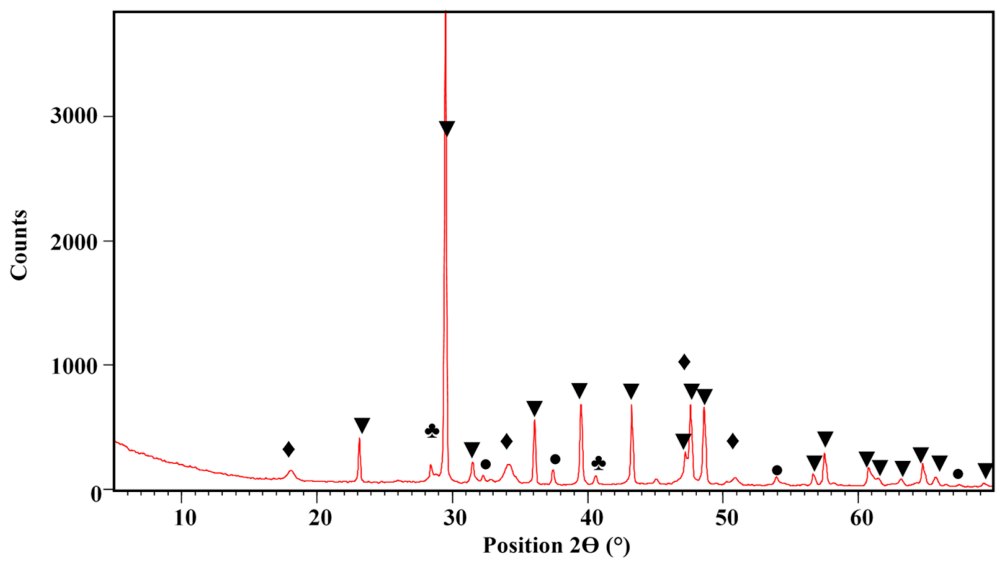
The elemental composition of MWM–B (Table 3) shows that nitrogen was below the detection limit. The analysis also reveals a relatively low carbon content (18.5%) and a high oxygen content (80.6%). This is attributed to (i) oxygenated organic structures remaining after the volatile matter decomposition during pyrolysis and (ii) the thermal transformation at 800 °C of marble waste into Ca-based particles (CaO and Ca(OH)2) [39]. This observation is confirmed by the following: (1) the XRF analysis, which indicates that due to the thermal decomposition of both the marble waste and the poultry manure, the Ca, K, P, Si, and Cl contents are present at 24.50%, 1.14%, 0.94%, 0.94%, and 0.72%, respectively (Table S3). Advantageously, most of heavy metals exist at relatively low contents or are not detected by the ICP-OES device (Table S3), suggesting that their release in the aqueous phase might not be problematic. (2) The XRD analysis shows the presence of several peaks of CaO at 2θ of 32.30°, 37.43°, 53.94°, and 67.48°, and also of Ca(OH)2 at 2θ of 18.13°, 34.09°, 47.59°, and 50.88° (Figure 2). (3) The FTIR analysis reveals the appearance of Ca–O functional groups at 713, 876, and 2512 cm−1 and also a narrow –OH group at 3644 cm−1 (Figure S4). Comparable findings were observed during the co-pyrolysis at 800 °C of spent coffee grounds with mussel shells [26], peanut shells with oyster shells [42], and peanut shells with eggshells [29].
Moreover, the pHpzc of MWM–B was determined to be 13.3 from the extrapolation of the pH drift curve (Figure S4). This relatively high value suggests (i) an important degradation of the organic matter contained in poultry manure and date palm waste into alkaline ash residues and (ii) a high conversion of marble wastes into Ca-based alkaline phases (Ca(OH)2 and CaO), as confirmed by XRD analysis (see Figure 2). This finding indicates that the surface charge of MWM–B is positive over a wide pH range (<pHpzc) and, consequently, favors the removal of phosphates anions. In addition, the cation exchange capacity (CEC) of MWM–B was evaluated to 19.2 cmolc kg−1, which is slightly higher than those reported for biochar derived from different lignocellulosic biomasses at temperatures varying between 500 °C and 900 °C [43]. This may be attributed to MWM–B surface enrichment with a calcium-based mineral phase that favors surface charge development and promotes interactions with ions in solution [37,44].

3.2. Phosphorus Removal in Batch Mode

3.2.1. Impact of Contact Time: Kinetic Investigation

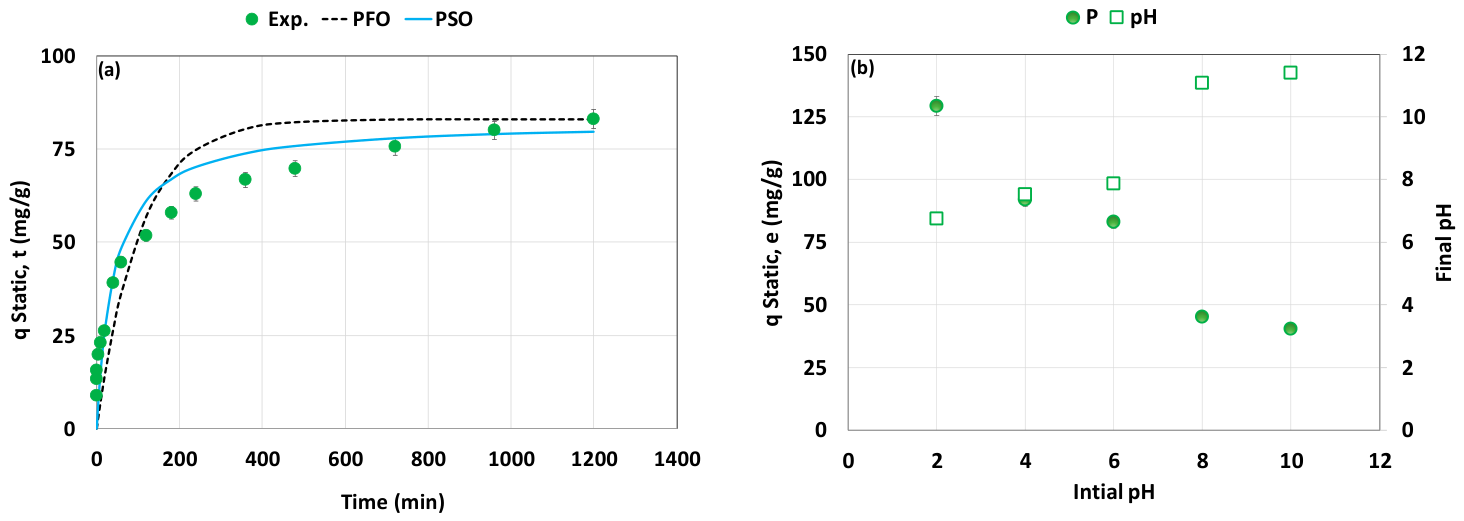
The contact time between the P anions in the aqueous solution and the biochar particles significantly affects the P removal rate and extent (Figure 3a). Indeed, a rapid removal rate was observed during the initial phase of P removal (0–60 min). During this phase, the mass of P removed accounted for about 54% of the total removed mass at equilibrium. During this initial phase, P anions diffuse through the water film covering the biochar particles [45]. Subsequently, the P anions continue to be removed with a slower slope (Figure 3a). This second stage is usually due to the diffusion of P anions inside the biochar particles. The slower kinetics of this stage are confirmed by the lower intraparticle diffusion coefficient (1.697 × 10⁻¹³ m2 s−1) in comparison with the film diffusion coefficient (1.759 × 10⁻¹³ m2 s−1) (Table S4). Therefore, the P removal process seems to be rate limited by the intraparticle diffusion mechanism. This is in agreement with the SEM and BET analyses, which showed the limited microporosity of MWM–B. An equilibrium state was reached after around 20 h where the removed P amount reaches a quasi-plateau with an average value of 83.0 mg g−1. This duration is comparable to that reported for a Mg-modified macro-algae-derived biochar [46]. It is shorter than those reported for P removal by a CaCO3-modified digestate-derived biochar (72 h) [47] and a crab shell-modified biochar (30 h) [48]. Materials with shorter contact times are more attractive because they consume less energy during agitation. Therefore, in this present study, a contact time of only 4 h may be used instead of 20 h since it permits the removal of more than 75% of the total amount at equilibrium. This approach will significantly reduce energy consumption at a relatively low and acceptable cost in P removal performance.
Moreover, experimental kinetic data were better described by the PSO model. Indeed, compared with the PFO model, the PSO model exhibits a higher correlation coefficient between the experimental and theoretical curves (0.967) and a lower MAPEKIN (28.0%) (Figure 3a and Table S4). These results suggest that the P removal may involve chemical mechanisms [49]. A detailed study of the involved mechanism is presented in Section 3.4. A comparable trend was reported for P removal by a marble-modified biochar [27] and a Ca(OH)2-modified dairy manure-derived biochar [50].

3.2.2. Effect of Initial Aqueous pH

The initial solution pH considerably affected the P removal performance of the marble-modified biochar (Figure 3b). Indeed, the amount of P removed gradually decreased with an increasing initial pH from 129.3 mg g−1 (at an initial pH of 2) to as low as 40.4 mg g−1 at an initial pH of 10. This behavior is attributed to the P charge intensity vs. initial pH and to the relatively large pHpzc of MWM–B, which was determined to be 13.30 (see Table 3). Indeed, at initial pH values significantly lower than the pHpzc, the material is predominantly positively charged, which favors the adsorption of P anions through electrostatic attraction. The increase of the initial aqueous pH decreases the positive charge intensity of the material, which explains the decrease of the removed P amount (Figure 3b). Moreover, under acidic conditions, the dissolution of Ca2+ and OH should be important and may subsequently contribute to the precipitation of P as Ca–P precipitate. The final pH values increased with an increasing initial pH (Figure 3b), reaching 6.75 and more than 11.0 for initial pH values of 2 and 8, respectively. This confirmed the alkaline character of MWM–B, proven by its pH drift curve (see Figure S5). A similar trend was observed for P removal with numerous Ca-rich biochars [47,48,49]. For example, Liu and Lv [49] showed that raising the initial pH from 2 to 10 reduced the amount of P removed by an eggshell-modified peanut shell-derived biochar by approximately 37%. Some studies, by contrast, reported that P removal increased with an increasing initial pH [50,51]. This specific behavior is typically due to the dominance of precipitation induced by the dissolution of high Ca2+ ions from the biochar into the aqueous phase [24]. Another recent study using a pristine biochar derived from the gasification of sewage sludge showed a negligible effect of the initial aqueous pH variation (between 3 and 7) on P removal performance [17].

3.2.3. Impact of Biochar Dose

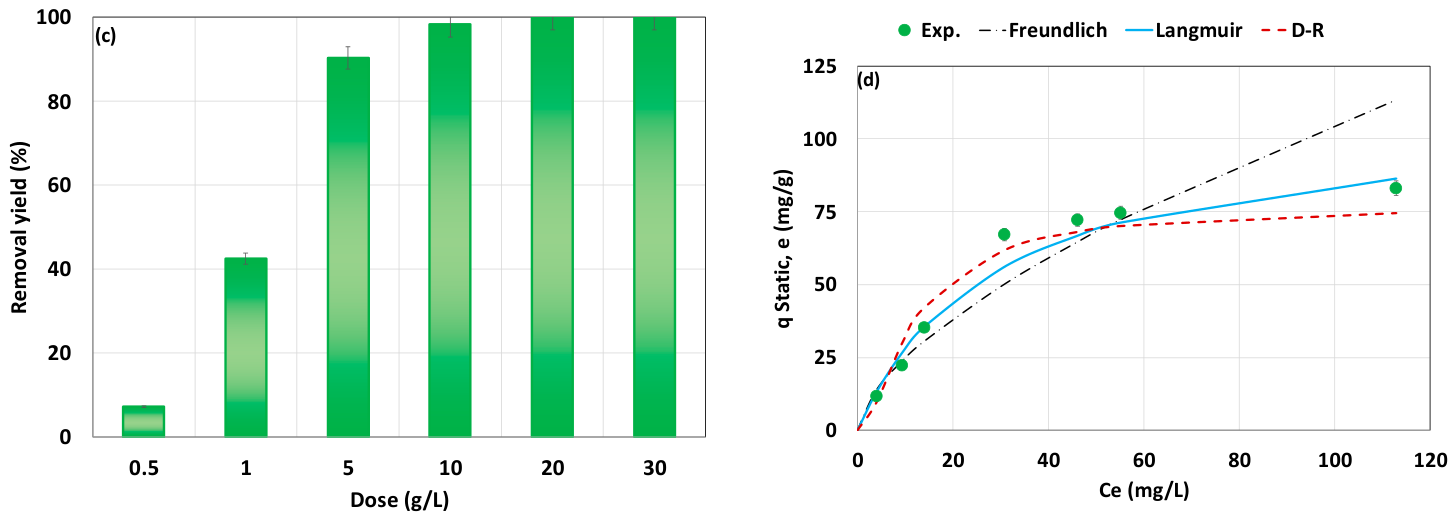
The effect of MWM–B dosage on P removal yield was investigated for an initial P concentration of 200 mg L−1 and a contact time of 20 h, without pH adjustment. The results showed that P removal performance is strongly affected by the dose used (Figure 3c). For instance, the P removal yield was measured at only 7.3% at a low biochar dose of 0.5 g L−1. This yield increased markedly with biochar dose, reaching approximately 90% at 5 g L−1. A quasi–full removal of P was observed for biochar doses exceeding 10 g L−1 (Figure 3c). This finding is attributed to (i) the availability of more sorption sites and (ii) greater dissolution in the aqueous solution of the Ca-based nanoparticles that are deposited on the biochar surface (as confirmed by the XRD analyses), favoring the development of Ca–P precipitates. Notably MWM–B proved to be a promising material, as it requires much lower doses for full P removal than other engineered biochars, such as a calcium–alginate biochar composite [52] and a CaCl2-modified macadamia husk-derived biochar [53].

3.2.4. Effect of Initial Phosphorus Concentration: Isotherm Investigation

The P removal isotherm experiments were conducted under the experimental conditions listed in Table 1. The results (Figure 3d) showed that P removal capacity increased significantly with increasing P initial concentration. For instance, raising the initial P concentration (C0) from 15 mg L−1 to 100 mg L−1 and then to 200 mg L−1 increased the adsorbed P amount from 11.8 to 67.1 mg g−1 and to 83.0 mg g−1, respectively. This behavior is primarily due to the greater P concentration gradient between the aqueous phase and the biochar particles. The isotherm experimental data fitting the three used models indicated that the Langmuir model matches the best with the experimental data (Figure 3d and Table S5). Indeed, this model exhibited the largest correlation coefficient (0.969) and the lowest MAPEISO (9.8%) between the experimental and predicted curves (Table S5). This result is usually interpreted as a homogeneous and monolayer adsorption of P on the biochar surface [30]. However, given the possible important contribution of precipitation in P removal by Ca-rich biochars, model fitting alone is insufficient, and a detailed investigation into all the mechanisms involved is necessary (see Section 3.4). The Langmuir model was found to be the most suitable for fitting experimental isotherm data for P removal by pristine sewage sludge-derived biochar [17], CaCO3-modified digestate-derived biochar [47], eggshell-modified sewage sludge-derived biochar [30], and sepiolite-modified bagasse waste-derived biochar [27]. Additionally, the Freundlich exponent “n” was greater than 1 (Table S5), suggesting that P removal by MWM–B is favorable. The estimated free energy by the D–R model is lower than 8.0 kJ mol−1 (2.598 kJ mol−1), signifying that P removal by MWM–B also involves physical mechanisms [54].
To benchmark the P removal performance of MWM–B against other calcium-rich biochars, a comparison was made based on their Langmuir maximum adsorption capacities (Table S6). This comparison showed that MWM–B can be considered a promising material for P removal from aqueous solutions. For instance, Langmuir’s adsorption capacity was substantially higher than that of various pristine biochars such as those derived from the gasification of sewage sludge and the pyrolysis of a wetland plant or wheat straw (Table S6). It was also higher than those reported for several engineered biochars, such as those derived from Ca(OH)2-modified poultry manure, eggshell-modified rice husk, CaCl2-modified spent coffee grounds, and CaCl2-modified buckwheat hulls (Table S6). However, it was lower than the biomass modified with a mixture of CaCl2 and MgCl2 or with high eggshell:biomass mass ratios (Table S6).

3.3. Phosphorus Removal in CSTR Mode

The P removal performance of MWM–B was studied in a CSTR configuration following the experimental protocol described in Section 2.4.2 and conditions listed in Table 2. As P removal by engineered biochars has rarely been studied in a CSTR configuration, the discussion was extended to include a comparison with published laboratory column studies.

3.3.1. Effect of Phosphorus Initial Concentration

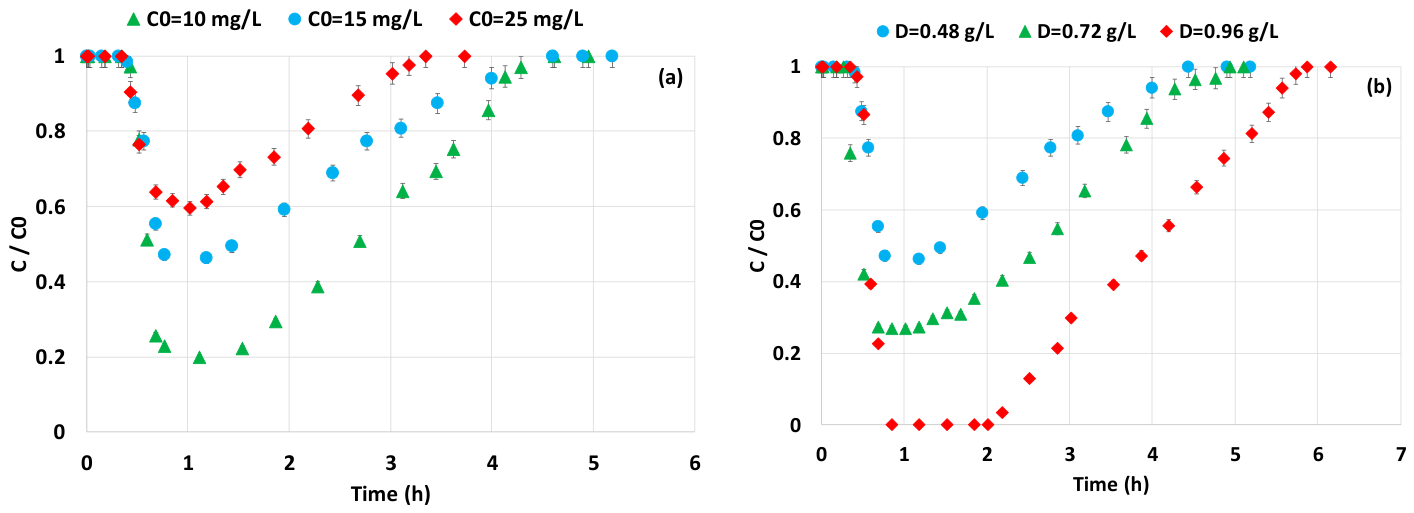
The influence of the initial P concentration (from 10 to 25 mg L−1) was assessed at a constant MWM–B dosage of 0.48 g L−1 and flow rate of 8 mL min−1. The results (Figure 4a) indicated that P removal varied with time. In fact, for all tested C0 values, the P concentrations at the CSTR outlet decreased progressively and reached a quasi-plateau within 0.7–0.8 h (Figure 4a). This was primarily ascribed to the rapid diffusion of P through the water film covering the biochar particles [34]. Furthermore, the lower the initial P concentration, the lower the relative concentration plateau (C/C0), and consequently, the higher the P removal efficiency. Indeed, the lowest C/C0 plateau values were estimated to be around 0.6 for a C0 of 25 mg L−1 and reached an average value of less than 0.22 when the C0 decreased to 10 mg L−1 (Figure 4a). After this quasi-plateau, the P continued to be removed by MWM–B, but with a gentler rate until achieving a full saturation of all biochar particles (corresponding to C/C0 = 1) after a time duration of 3.4 h, 4.4, and 4.6 h for C0 of 25, 15, and 10 mg L−1, respectively (Figure 4a). During this period, P anions diffused into the biochar particles and interacted with the active sites of the biochar [55]. At C/C0 = 1, the P concentration at the outlet of the system became equal to the feeding one and no further P removal occurred.
The removed P amounts (qDynamic,e) calculated using Equation (3) were found to increase from 13.6 to 16.8 mg g−1 as C0 increased from 10 to 25 mg L−1. This is consistent with the greater driving force for P mass transfer from the aqueous phase to the biochar. A similar trend was also observed in batch mode (see Section 3.2) and was attributed primarily to the greater P concentration gradient between the effluent and the biochar particles. Similar trends were also previously reported in fixed-bed column studies for P removal using a Fe/Mn oxide-modified mulberry branche-derived biochar [56] and by a Mg/Al-modified date palm waste-derived biochar [36]. For example, Fu et al. [57] showed that the P removal capacity of a MgCl2-modified Hydrocotyle vulgaris-derived biochar doubled (from 3.0 to 6.0 mg g−1) when the P concentration was augmented from 5 to 15 mg L−1.

3.3.2. Impact of Biochar Dosage

The effect of the MWM–B dose on P removal in CSTR mode was tested at a constant C0 of 15 mg L−1 and a flow rate of 8 mL min−1. Three doses were tested: 0.48, 0.72, and 0.96 g L−1 (Figure 4b). This figure demonstrated that the higher the MWM–B dose, the lower the C/C0 plateau, and, consequently, the higher the P removal efficiency. Indeed, at the lowest dose (0.48 L−1), the C/C0 plateau was 0.46. It decreased to 0.27 at a dose of 0.72 g L−1 and approached zero when the MWM–B dosage was doubled (0.96 g L−1) (Figure 4b). The removed P mass was estimated at 8.8 mg for an MWM–B dose of 0.48 g L−1 and increased by approximately 55% (13.6 mg) and 178% (24.5 mg) when the biochar dose was increased to 0.72 g L−1 and then to 0.96 g L−1, respectively. This result was mainly ascribed to a greater number of active surface sites available for P adsorption and precipitation, continuously supplied by the influent to the CSTR. This is supported by the XRD analysis, which identified CaO and Ca(OH)2 peaks on the surface of MWM–B. A similar trend was previously reported for P removal from aqueous solutions in CSTR mode [34,55,58] and laboratory-scale fixed-bed column systems [36,59,60]. For example, in CSTR mode, Wahab et al. [55] reported that for a constant C0 and flow rate of 15 mg L−1 and 20 mL min−1, respectively, the P removal yield increased from 40% to 80% as the Posidonia oceanica biomass dose was increased from 2 to 10 g L−1. Similarly, in fixed-bed column mode with a constant C0 of 20 mg L−1 and a constant flow rate of 2 mL min−1, an increase of 66.4% in the mass of the P removed was reported when the adsorbent mass was doubled from 1 g to 2 g [56].

3.3.3. Impact of the Feeding Flow Rate

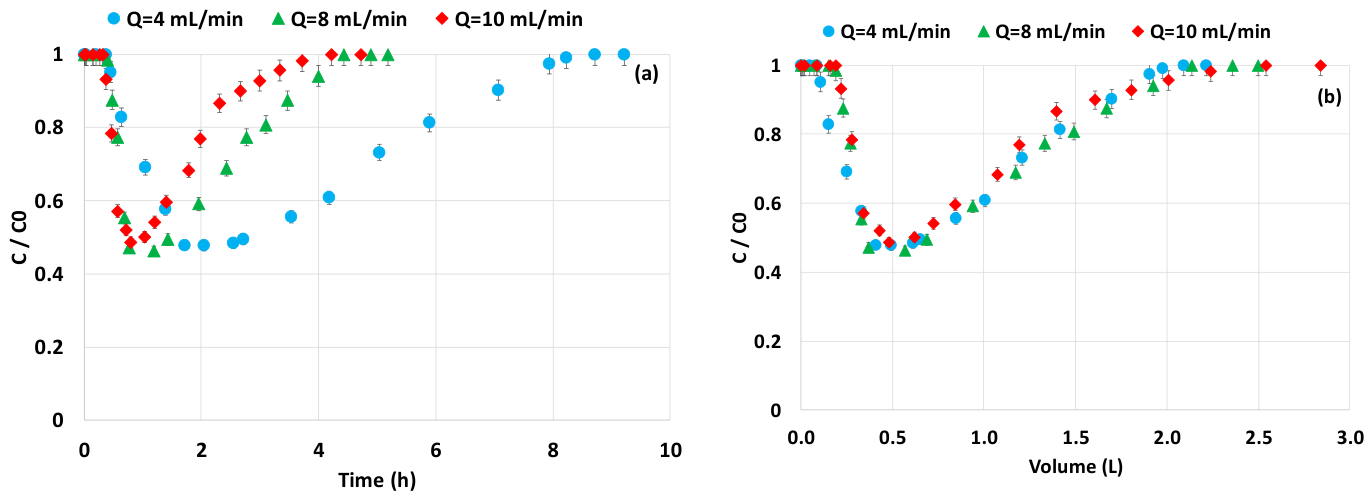
The effects of flow rate on the P removal performance of MWM–B was assessed at flow rates of 4, 8, and 10 mL min−1. The corresponding residence times were determined using tracer tests according to the protocol described in Section 2.4.2. The tracer test results (Figure S6) showed that the lower the flow rate, the later the apparition of the BTCs and the reaching of the equilibrium state (ECt/EC0≈1). The mean residence times were determined to be 1.7, 2.3, and 4.4 h for flow rates of 10, 8, and 4 mL min−1, respectively. The variation of the corresponding P relative concentration C/C0) vs. time and vs. injected volume is given in Figure 5a and Figure 5b, respectively. As expected, the lower the flow rate, the slower the reaching of the C/C0 plateau (Figure 5a). Indeed, these durations were estimated at 0.7 h, 0.8 h, and 1.7 h for flow rates of 10, 8, and 4 mL min−1, respectively (Figure 5a). Moreover, the C/C0 plateau was comparable across all tested flow rates, with measured values ranging from 0.46 to 0.49 (Figure 5a). The longest duration of this plateau (1 h) was observed at the lowest flow rate (4 mL min−1). This duration decreased to less than 0.7 h for a flow rate of 10 mL min−1, primarily due to the shorter contact time between the P anions and the biochar particles. After these pseudo-equilibrium plateaus, the measured P concentrations at the system exit began to increase due to the progressive saturation of biochar sorption sites and the depletion of dissolved Ca2+ and OH concentrations in the reactor over time [34]. As anticipated, this P increase slope was the gentlest for the lowest flow rate (Figure 5a). Indeed, the C/C0 = 1 (plateau where no further P removal by MWM–B is possible) was reached after only 4.2 h for 10 mL min−1 (the highest flow rate) and exceeded 8.7 h for the flow rate of 4 mL min−1. An equivalent result was reported for P removal by a lanthanum-modified natural magnetite in CSTR mode [61].
Figure 5b shows the phosphorus BTCs vs. the collected effluent volume at the outlet of the dynamic system. It showed that P-decline concentration increased more rapidly at 4 mL min−1 (the lowest flow rate). Indeed, at this flow rate, the P concentration started to decrease after a collected volume of 0.11 L. More than double this volume was required for the largest flow rate (10 mL min−1). After the lowest plateau in C/C0, there was no significant difference between the BTCs at 4 and 8 mL min−1. For this reason, the related P-calculated adsorbed masses were comparable and evaluated at 14.6 and 14.1 mg g−1, respectively. An equivalent result was reported for flow rates ranging from 4.5–11 mL min−1 and 20–40 mL min−1 when studying P removal by a calcium-rich biochar produced at 900 °C [34] and a pristine marine algae waste [55]. However, the BTC at the highest flow rate (10 mL min−1) exhibited distinct behavior. Indeed, it started decreasing a bit later and began the increase phase earlier than the other tested flow rates (Figure 5b). The related removed P quantity was evaluated at 12.8 mg g−1, which was approximately 14.1%, and 10.5% less than those determined for 4 and 8 mL min−1, respectively. A P removal improvement was also reported when the feeding flow rate was decreased in column mode [36,56,60]. For example, for a Fe/Mn-modified biochar, Meina et al. [56] reported that the P removal increased by more than 86% when the flow rate was decreased from 3 to 1 mL min−1.
It is worth mentioning that MWM–B more efficiently removed P under dynamic conditions than various engineered biochar (Table S7). Indeed, the removed P quantity by our MWM–B was 6.8, 2.9, and 1.8 times more than MgCl2-modified hydrocotyle vulgaris waste [57], Mg/Al-modified date palm waste [36], and MgCl2 Thalia dealbata waste [62]. However, it was lower than modified biomasses with concentrated iron and/or MgCl2 solutions (Table S7).
Furthermore, under real conditions, the operational costs related to MWM–B synthesis and application are expected to be relatively low owing to the wide availability of marble waste from stone-processing industries and easy transformation into powder. In contrast, producing efficient biochars such as alkali-activated, Fe-loaded, or nano-engineered biochars may require the use of costly and potentially environmentally hazardous chemical reagents as well as energy-intensive processing steps [63]. Moreover, marble waste management has been considered a serious environmental burden in many regions encompassing the Mediterranean, Middle East, China, and India. Using marble waste for the production of calcium-rich biochars offers significant potential for industrial upscaling as it would promote environmental sustainability and support the circular economy [34]. Finally, in comparison with chemically-activated or modified biochars, the presence of calcium-based nanoparticles in MWM–B is expected to enhance its long-term mineral stability and pH buffering, and may reduce the release of numerous pollutants (i.e., heavy metals).

3.3.4. Impact of Using Real Wastewater

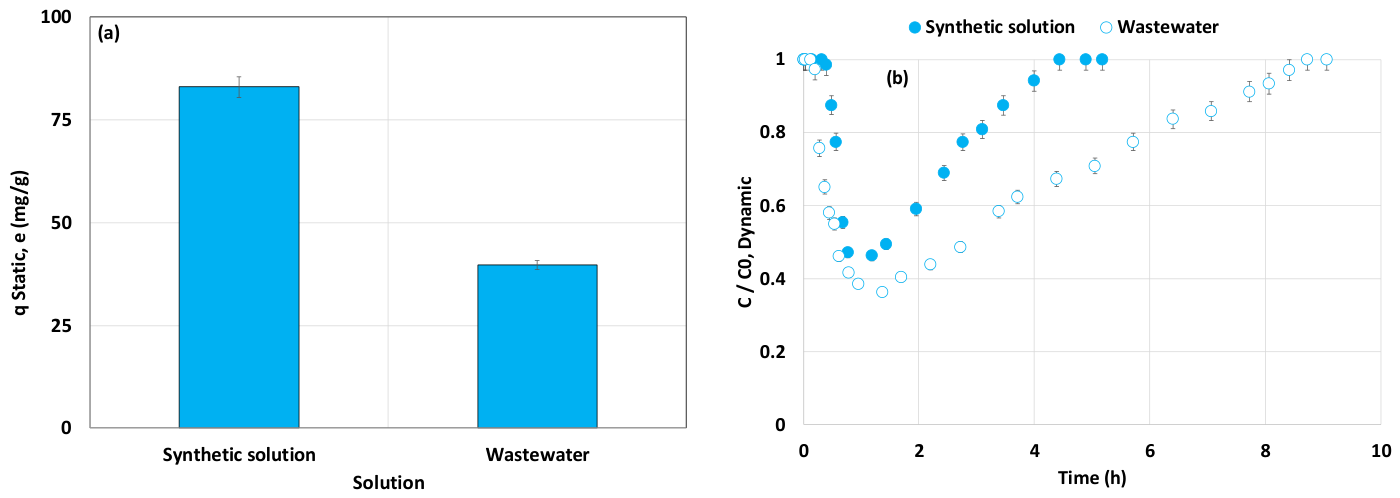
The physicochemical characteristics of wastewater are reported in Table S8. All measured parameters comply with the Omani effluent discharge standard. Indeed, this wastewater had a slightly alkaline pH and a low level of salinity and suspended solids. Moreover, the main toxic heavy metals (i.e., arsenic, lead, cadmium, nickel, chromium, etc.) were not detected (Table S8). However, the concentrations of anions likely to compete with P were relatively modest and measured at 365.0, 141.0, and 5.1 mg L−1 for chloride, sulfate, and nitrate ions, respectively (Table S8). In batch mode, the results (Figure 6a) indicated that the removed P amount from the wastewater is 52.2% lower than that measured for the synthetic solution. This was most likely attributable to competition for adsorption with the anions existing in the wastewater. A similar trend was registered for P removal from synthetic solutions containing doped anions or real wastewater using various Ca-rich biochars [50,51,52]. For example, Choi et al. [50] reported a P decrease efficiency by a Ca(OH)2-modifed dairy manure-derived biochar of approximately 57% when a real lagoon-treated effluent was used instead of a synthetic P solution.
In CSTR mode, the results (Figure 6b) demonstrated that unlike in batch mode, the use of real wastewater significantly improved the P removal performance of MWM–B. Indeed, the use of real wastewater positively affected the following three phases (Figure 6b): (i) the C/C0 characterized by a significantly steeper slope than that observed for the synthetic solution, (ii) the C/C0 lowest plateau value estimated at approximately 0.39 for wastewater and approximately 0.47 for the synthetic solution, and (iii) the time required to reach the full saturation of the biochar (C/C0 = 1) estimated at 4.4 h for the synthetic solution and approximately double for real wastewater (8.7 h). The calculated P-removed mass from wastewater was evaluated at 34.5 mg g−1, which is 2.4 times more than that estimated for the synthetic solution. The higher effectiveness of biochar in removing P from real wastewater compared to a synthetic solution is likely attributable to the presence of elevated Ca2+ and Mg2+ concentrations in the wastewater (Table S8). Previous studies have demonstrated that such ions contribute to enhanced P removal from real wastewater through the formation of additional Ca and/or Mg–P precipitates [64,65].
Notably, the removed P capacities determined for the synthetic solutions in CSTR mode (between 12.8 and 20.4 mg g−1) were substantially lower than the Langmuir maximum adsorption capacity in batch mode (108.4 mg g−1). This result is mainly ascribed to (i) the shorter contact time in CSTR mode (between 1.7 and 4.4 h) in comparison with the batch experiments (20 h) and (ii) the loss of Ca2+ and OH from the CSTR system outlet, which may significantly reduce P removal through the precipitation mechanism. A similar trend is usually reported in the scientific literature. For instance, calculated ratios of batch-on-column adsorption capacities of 5.9 and 3.4 were reported for a MgCl2-modified bamboo-derived biochar [66] and an Mg-modified mildewed corn-derived biochar [67], respectively.

3.4. Involved Mechanisms Exploration

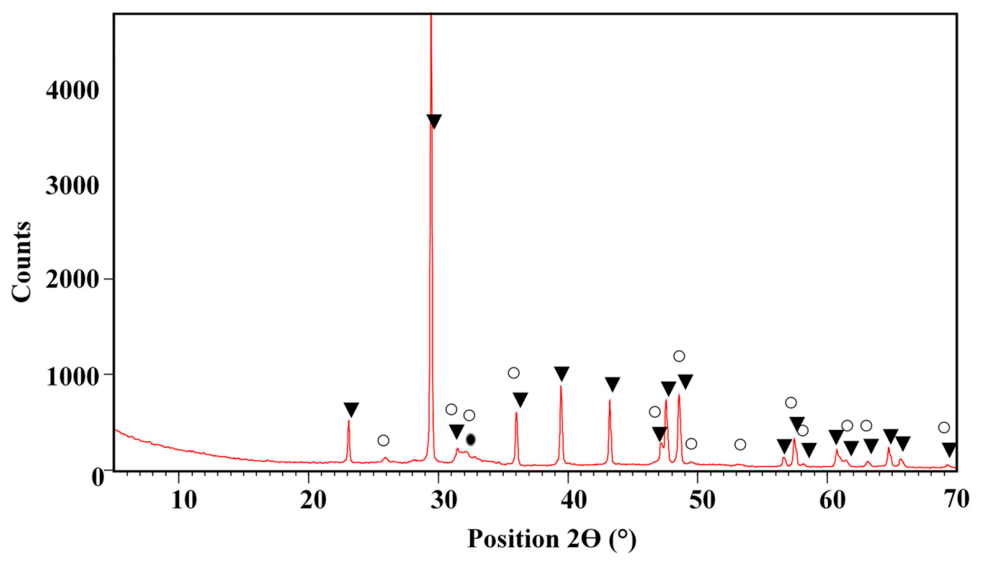
Kinetic and isotherm modeling together with pH effect analysis suggest that P removal by MWM–B involves both physical and chemical mechanisms (see Section 3.2.1, Section 3.2.2 and Section 3.2.4). To confirm the role of precipitation and complexation mechanisms in the P removal process, XRD, FTIR, and XPS analyses of MWM–B before and after P removal were conducted. The FTIR results show that after P removal (Figure S4): (i) the Ca–O peak intensities significantly decreased, (ii) the sharp –OH peak initially detected at 3644 cm−1 disappeared, and (iii) the intensity of the P–O peak at 1057 cm−1 significantly increased while new P–O peaks at 986 and 527 cm−1 appeared. Therefore, these observations suggest that P removal by MWM–B involves both surface complexation with –OH functional groups and precipitation as calcium phosphates. This mechanism was previously reported in studies on P removal by Ca(OH)2-modified wood biochar [68], oyster shell-modified peanut shell-derived biochar [42], and mussel shell-modified spent coffee grounds [26]. Moreover, in comparison with the XRD pattern of the raw biochar (see Figure 2), after P removal, all Ca(OH)2 peaks disappeared and only a single peak of CaO remained (Figure 7). Furthermore, new peaks corresponding to hydroxyapatite (HAP) were detected at 2θ of 25.9°, 31.5°, 32.3°, 36.0°, 47.1°, 48.5°, 49.5°, 53.2°, 57.4°, 58.1°, 61.4°, 63.1°, and 69.2°.
This suggests that Ca(OH)2 and CaO were dissolved in the aqueous phase as Ca2+ and OH and then contributed to P removal through a precipitation mechanism, as follows [27]:
CaO + H2O → Ca(OH)2
Ca(OH)2 → Ca2+ + 2 OH
5 Ca2+ + 3 PO43− + OH → Ca5(PO4)3OH
5 Ca2+ + 3 HPO42− + 4 OH → Ca5(PO4)3OH + 3 H2O
5 Ca2+ + 3 H2PO4 + 7 OH → Ca5(PO4)3OH + 6 H2O.
The formation of HAP precipitate was reported in several investigations on P removal by Ca-rich biochars at temperatures equal to or above 800 °C [24,33,69]. Other Ca–P precipitates (i.e., brushite) may be formed at lower pyrolysis temperatures due to incomplete transformation of Ca-rich precursors into CaO and Ca(OH)2 [41].
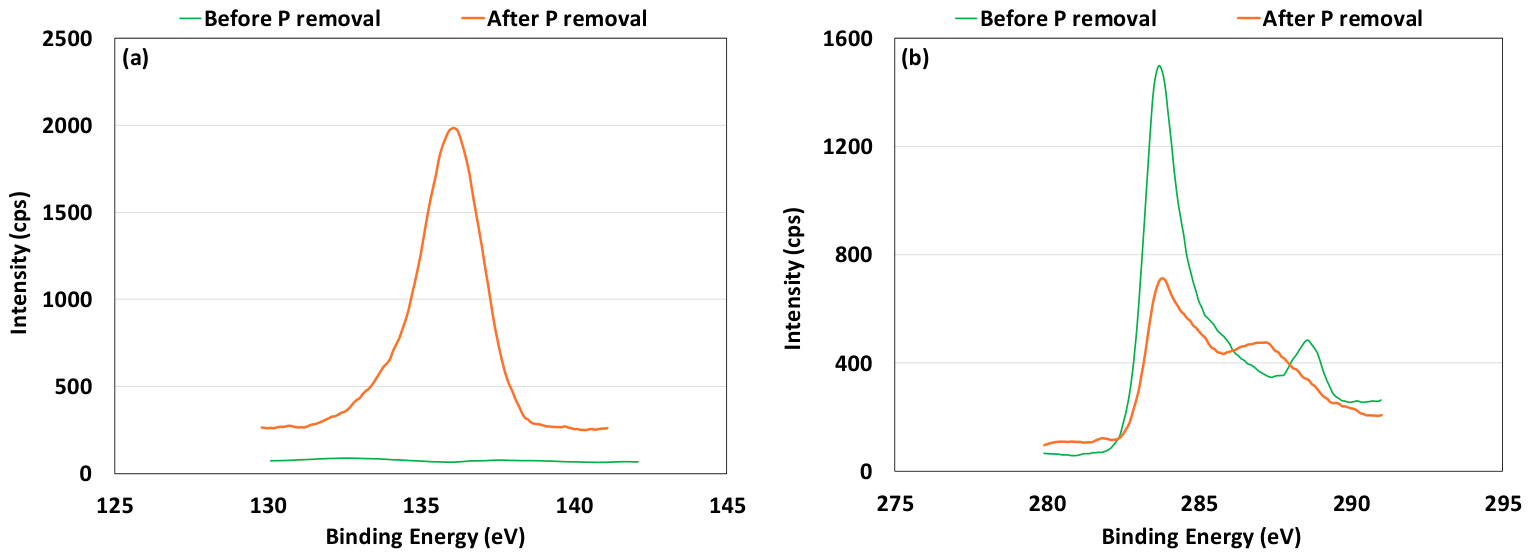
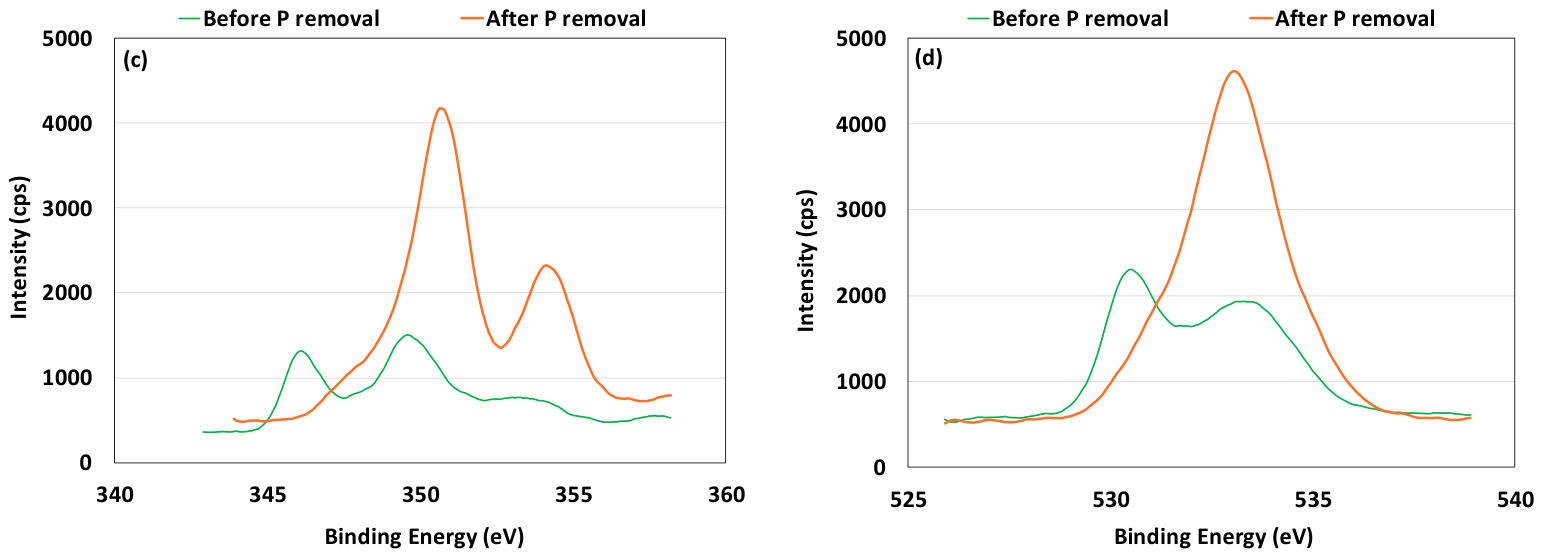
The XPS high-resolution spectra (Figure 8) show that the surface of the raw MWM–B is mainly composed of oxygen and calcium-containing species and confirm the results of the elemental and XRF analyses (see Table 3 and Table S3). Specifically, after P removal, the C 1s maximum signal remained centered at 283.8–284.0 eV, although the envelope became broader and less intense (Figure 8b). This suggests that the carbonaceous matrix in MWM–B primarily serves as structural support, whereas the dominant chemically reactive sites are associated with the mineral fraction [70]. In contrast to the C 1s region, after P removal, the Ca 2p envelope became markedly more intense and shifted from binding energies of 346.0 and 349.9 eV to dominant maxima at 350.6 and 354.4 eV (Figure 8c). This shift suggests the transformation of reactive CaO/Ca(OH)2/CaCO3-derived surface species into P-bearing calcium environments [44]. In addition, the O 1s spectrum in the raw MWM–B displayed a broad envelope with two main contributions centered at about 530.4 and 533.2 eV, indicating the coexistence of oxygen associated with calcium oxides/hydroxides and with carbonates. After P removal, the O 1s region was dominated by a broad and intense maximum centered near 533.0 eV (Figure 8d). This redistribution of the O 1s envelope suggests that oxygen atoms initially associated with Ca–O, Ca–OH, and Ca–CO3 environments were incorporated into new phosphate-bearing coordination structures after removal [71,72]. This resulted in the appearance of a P signal at a binding energy of 136.0 eV, confirming its removal from the aqueous solution (Figure 8a).
The XPS results indicate that P removal by MWM–B is mainly governed by the calcium-rich mineral fraction, while the carbon matrix provides structural support and access to the reactive surface domains. This is consistent with the textural analyses and the results of the FTIR (see Figure S4) and XRD (see Figure 7), which show the low BET surface area and limited microporosity, the involvement of O–H and Ca–O functional groups, and the formation of hydroxyapatite in the P removal process, respectively. Similar findings have been reported for various Ca-rich biochars [73,74]. In summary, the P removal by MWM–B occurs through combined physicochemical mechanisms encompassing hydrogen bonding, electrostatic interactions, complexation with O–H and Ca–O functional groups, and precipitation as HAP. Quantifying the relative contribution of each single mechanism remains a perspective for future work, especially in view of the system upscaling for full-scale application.

3.5. Heavy Metal Release Evaluation

The leaching of the P-loaded MWM–B was investigated in batch mode following the protocol described in Section 2.5. The results (Table S9) indicate that most of heavy metals, including As, Zn, Pb, Cd, Ni, Fe, Co, and Cu, were below the detection limit. In addition, the concentrations of Mn, Cr, and Al were determined to be 0.007, 0.002, and 0.018 mg L−1, respectively, well below the national discharging standards (see Table S8). A notable potassium concentration (15.4 mg L−1) was also measured, suggesting the valorization of MWM–B in agriculture as a slow-release fertilizer.

3.6. Challenges for Application in Real Conditions

This present study demonstrated that abundant organic waste feedstocks (lignocellulosic biomass and animal manure) can be converted into a high-value-added material via co-pyrolysis with marble waste. The calcium-rich biochar exhibited promising physicochemical properties and demonstrated high P removal capacity from real wastewater under both batch or dynamic conditions. Further research work is required to support the upscaling of this process from laboratory to pilot and, ultimately, full-scale systems. Particular attention should be paid to optimizing operating parameters, especially the biochar dose and the feed flow rate. The design of the full-scale systems should be carried out using well-established approaches [35]. The economic feasibility of this system has to be carefully evaluated through a detailed cost–benefit analysis. The potential agronomic use of the P-loaded biochar as a slow-release fertilizer should first be assessed at laboratory and greenhouse scales, and then under controlled field conditions prior to full-scale application. Such use requires prior confirmation through controlled experiments that the P-loaded biochar positively affects plant growth without compromising soil quality or groundwater resources. The release kinetics of P and other nutrients (i.e., K, Ca), as well as the interactions of biochar with soil–plant systems, should be systematically investigated. Importantly, the long-term ecological impacts and associated environmental risks should be assessed through full life-cycle analysis. Furthermore, scientists, stakeholders, civil society, and policy makers should collaborate to implement policies that ensure human health and resource conservation while promoting the circular economy and environmental sustainability [22]. Finally, the synthesis, pilot, and full-scale application of dual-functionalized biochar that simultaneously recovers nutrients (N, P, and K) and removes toxic organics represents a promising research avenue [75,76]. These steps are essential to ensuring the safe transition from laboratory findings to full- scale field applications.

4. Conclusions

This present study demonstrated that using marble waste to modify typical biochars yields calcium-rich materials with distinctive textural and chemical characteristics, resulting from the successful transformation of marble into calcium-based nanoparticles on the biochar surface. In batch mode, this calcium-rich biochar exhibited a high phosphorus uptake capacity, as reflected by a Langmuir maximum adsorption capacity of 108 mg g−1. Even under a wide range of dynamic experimental conditions, this material continued to remove phosphorus from synthetic solutions, with P removal ranging from 12.8 mg g−1 at the highest flow rate (10 mL min−1) to 20.4 mg g−1 at the highest biochar dose (0.96 g L−1). In addition, owing to the presence of additional calcium and magnesium in real wastewater (spiked with phosphorus), the marble-modified biochar removed phosphorus 2.4 times more than from synthetic solutions at an initial P concentration of 15 mg L−1, a biochar dose of 0.48 g L−1, and a flow rate of 8 mL min−1. The P removal process was predominantly governed by precipitation as hydroxyapatite, complexation with hydroxyl groups, electrostatic attraction, and hydrogen bonding. The potential use of P-loaded biochar in agriculture applications as a slow-release fertilizer is planned for future investigation.

Supplementary Materials

The following supporting information can be downloaded at https://www.mdpi.com/article/10.3390/w18111348/s1: Text S1: Analytical methods used for the characterization of MWM–B and aqueous solutions; Table S1: Equations of the used kinetic and isotherm models; Table S2: Agreement between experimental and calculated kinetic and isotherm data; Table S3: XRF analysis of MWM–B; Table S4: Kinetic models parameters of P removal by the marble-modified biochar; Table S5: Isotherm models parameters for phosphorus removal by MWM–B in batch mode; Table S6: Comparison of MWM–B removal ability in batch mode with engineered biochars; Table S7: Comparison of MWM–B removal ability in CSTR mode with engineered biochars; Table S8: Main physicochemical characteristics of the real wastewater; Table S9: Heavy metals leaching from the P-loaded biochar; Figure S1: Thermogravimetric analysis of the used feedstocks; Figure S2: SEM images of MWM–B; Figure S3: N2 adsorption–desorption isotherm of MWM–B for the evaluation of BET surface area and pore structure (at 77 K); Figure S4: FTIR spectra of MWM–B before and after P removal; Figure S5: pH drift curve of MWM–B; Figure S6: BTCs of the tracer tests for the different used flow rates. References [17,18,19,20,24,29,35,36,41,42,50,57,60,62,66,70,71,77,78,79,80,81,82,83] are cited in Supplementary Materials.

Author Contributions

Conceptualization, S.J., M.A.-B., A.A.-R., J.A.-S., and M.A.-W.; methodology, S.J., A.A.A., W.H., M.A.-B., J.A.-S. and M.J.; data Curation, S.J., A.A.A., W.H., M.A.-B. and M.J.; validation, S.J., M.A.-B., A.A.-R., A.A.H., H.A.-N. and J.A.-S.; formal analysis, S.J., A.A.A. and A.A.H.; investigation, M.A.-B., A.A.-R. and H.A.-N.; resources, H.A.-N., J.A.-S. and M.A.-W.; writing—original draft preparation, S.J., A.A.A. and W.H.; writing—review and editing, A.A.H., H.A.-N., J.A.-S., M.A.-W. and M.J.; visualization, S.J., A.A.A., W.H., A.A.H. and H.A.-N.; supervision, S.J., J.A.-S. and M.A.-W.; project administration, S.J.; funding acquisition, S.J., A.A.H., H.A.-N., J.A.-S. and M.A.-W. All authors have read and agreed to the published version of the manuscript.

Funding

This research was funded by the Ministry of Education of Oman (TRC project: RC/RG/DVC/CES/24/184).

Data Availability Statement

The raw data supporting the conclusions of this article will be made available by the authors on request.

Acknowledgments

The authors would like to thank CAARU technicians for processing the biochar analytical characterization.

Conflicts of Interest

The authors declare no conflicts of interest.

References

  1. Garcia-Avila, F.; García-Pizarro, E.; Malla-aguilar, G.; Sanchez-Cabrera, C.; Cadme-Galabay, M.; Valdiviezo-Gonzales, L.; Cabello-torres, R. Influence of Nutrients on Aquatic Vegetation and Trophic Status of Lakes: Analysis of Eutrophication and Mitigation. Results Eng. 2025, 27, 106381. [Google Scholar] [CrossRef]
  2. EU Directive (EU) 2024/3019 Concerning Urban Wastewater Treatment (Recast). Official Journal of the European Union, L 2024/3019, 12 December 2024. Available online: https://eur-lex.europa.eu/eli/dir/2024/3019/oj (accessed on 22 May 2026).
  3. Litke, D.W. Review of Phosphorus Control Measures in the United States and Their Effects on Water Quality; U.S. Geological Survey: Denver, CO, USA, 1999.
  4. Kok, D.D.; Pande, S.; Van Lier, J.B.; Ortigara, A.R.C.; Savenije, H. Global Phosphorus Recovery from Wastewater for Agricultural Reuse. Hydrol. Earth Syst. Sci. 2018, 22, 5781–5799. [Google Scholar] [CrossRef]
  5. Bourazza, A.; Hassane Sidikou, A.A.; Fenta, B.A.; Hirich, A. Restoration of Phosphate Mined Lands: Literature Review with Insights from Morocco. Front. Environ. Sci. 2025, 13, 1519868. [Google Scholar] [CrossRef]
  6. Scholz, R.W.; Wellmer, F.; Mew, M.; Steiner, G. Resources, Conservation & Recycling The Dynamics of Increasing Mineral Resources and Improving Resource Efficiency: Prospects for Mid- and Long-Term Security of Phosphorus Supply. Resour. Conserv. Recycl. 2025, 213, 107993. [Google Scholar] [CrossRef]
  7. Illakwahhi, D.T.; Vegi, M.R.; Srivastava, B.B.L. Phosphorus’ Future Insecurity, the Horror of Depletion, and Sustainability Measures. Int. J. Environ. Res. Public Health 2024, 21, 9265–9280. [Google Scholar] [CrossRef]
  8. Cordell, D.; White, S. Peak Phosphorus: Clarifying the Key Issues of a Vigorous Debate about Long-Term Phosphorus Security. Sustainability 2011, 3, 2027–2049. [Google Scholar] [CrossRef]
  9. Yan, Y.; Kallikazarou, N.I.; Nisiforou, O.; Shang, Q.; Fu, D.; Antoniou, M.G.; Fotidis, I.A. Phosphorus Recovery through Struvite Crystallization from Real Wastewater: Bridging Gaps from Lab to Market. Bioresour. Technol. 2025, 427, 132408. [Google Scholar] [CrossRef]
  10. Zhang, Y.; Qiu, X.; Luo, J.; Li, H.; How, S.; Wu, D.; He, J.; Cheng, Z.; Gao, Y.; Lu, H. A Review of the Phosphorus Removal of Polyphosphate-Accumulating Organisms in Natural and Engineered Systems. Sci. Total Environ. 2024, 912, 169103. [Google Scholar] [CrossRef]
  11. Hayat, S.; Li, P.; Menhas, S.; Liu, W.; Hayat, K. Exploring the Nutrient Nexus in Environmental Systems: Nitrogen and Phosphorus Cycling, Removal, Recovery, and Management. Environ. Res. 2025, 284, 122162. [Google Scholar] [CrossRef]
  12. Lim, J.J.; Sethupathi, S.; Ismail, N.I.M.; Munusamy, Y. Recovery of Nitrogen and Phosphorus as Nutrients From Wastewater Using Sorbents and Its Potential Reutilization as a Soil Conditioner: A Review. Water Environ. Res. 2025, 97, e70104. [Google Scholar] [CrossRef] [PubMed]
  13. El Ouahabi, H.; Bayessi, O.; Mouaky, A.; Hirt, A.; Rachidi, S. Biochar Revolution: Harnessing Pyrolysis for Climate Resilience and Circular Environmental Solutions. Carbon Trends 2026, 23, 100628. [Google Scholar] [CrossRef]
  14. Zaidi, S.; Arif, Y.; Mir, A.R.; Hayat, S.; Kaya, C. Advancing Environmental Sustainability: Biochar Production, Properties, Applications, and the Emerging Potential of Nano-Biochar. J. Soil Sci. Plant Nutr. 2025, 25, 10364–10392. [Google Scholar] [CrossRef]
  15. Tadesse, A.W.; Huang, M.; Zhou, T. Biochar for Wastewater Treatment: Preparation, Modification, Characterization, and Its Applications. Molecules 2025, 30, 4288. [Google Scholar] [CrossRef] [PubMed]
  16. Almanassra, I.W.; Mckay, G.; Kochkodan, V.; Ali Atieh, M.; Al-Ansari, T. A State of the Art Review on Phosphate Removal from Water by Biochars. Chem. Eng. J. 2021, 409, 128211. [Google Scholar] [CrossRef]
  17. Nakic, D.; Licht, K.; Posavcic, H.; Halkijevic, I. Biochar from Experimental Sewage Sludge Gasification as an Adsorbent for Phosphate Removal. Results Eng. 2025, 27, 106077. [Google Scholar] [CrossRef]
  18. Liang, J.; Ye, J.; Shi, C.; Zhang, P.; Guo, J.; Zubair, M.; Chang, J.; Zhang, L. Pyrolysis Temperature Regulates Sludge-Derived Biochar Production, Phosphate Adsorption and Phosphate Retention in Soil. J. Environ. Chem. Eng. 2022, 10, 107744. [Google Scholar] [CrossRef]
  19. Zheng, Q.; Yang, L.; Song, D.; Zhang, S.; Wu, H.; Li, S.; Wang, X. High Adsorption Capacity of Mg–Al-Modified Biochar for Phosphate and Its Potential for Phosphate Interception in Soil. Chemosphere 2020, 259, 127469. [Google Scholar] [CrossRef]
  20. Zhao, Y.; Yang, H.; Xia, S.; Wu, Z. Removal of Ammonia Nitrogen, Nitrate, and Phosphate from Aqueous Solution Using Biochar Derived from Thalia Dealbata Fraser: Effect of Carbonization Temperature. Environ. Sci. Pollut. Res. 2022, 29, 57773–57789. [Google Scholar] [CrossRef]
  21. Jin, X.; Guo, J.; Hossain, M.F.; Lu, J.; Lu, Q.; Zhou, Y.; Zhou, Y. Recent Advances in the Removal and Recovery of Phosphorus from Aqueous Solution by Metal-Based Adsorbents: A Review. Resour. Conserv. Recycl. 2024, 204, 107464. [Google Scholar] [CrossRef]
  22. Jellali, S.; Hadroug, S.; Al-Wardy, M.; Al-Nadabi, H.; Nassr, N.; Jeguirim, M. Recent Developments in Metallic-Nanoparticles-Loaded Biochars Synthesis and Use for Phosphorus Recovery from Aqueous Solutions. A Critical Review. J. Environ. Manag. 2023, 342, 118307. [Google Scholar] [CrossRef] [PubMed]
  23. Mitrogiannis, D.; Psychoyou, M.; Baziotis, I.; Inglezakis, V.J.; Koukouzas, N.; Tsoukalas, N.; Palles, D.; Kamitsos, E.; Oikonomou, G.; Markou, G. Removal of Phosphate from Aqueous Solutions by Adsorption onto Ca(OH)2 Treated Natural Clinoptilolite. Chem. Eng. J. 2017, 320, 510–522. [Google Scholar] [CrossRef]
  24. Chen, Y.; Zhang, R.; Gao, J.; Han, M.; Qin, S.; Liu, K.; Shu, Y.; Zhang, R.; Shi, C.; Zheng, Y. The Role of Silica in Biomass for Calcium-Modified Biochar: Phosphorus Removal Mechanism and Potential as a Phosphate Fertilizer Application. J. Environ. Sci. 2025, 158, 242–253. [Google Scholar] [CrossRef] [PubMed]
  25. Xu, C.; Liu, R.; Chen, L. Removal of Phosphorus from Domestic Sewage in Rural Areas Using Oyster Shell-Modified Agricultural Waste–Rice Husk Biochar. Processes 2023, 11, 2577. [Google Scholar] [CrossRef]
  26. Eraliev, J.; Ghosh, A.; Paul, T.; Yee, J.; Park, H. Valorization of Waste Mussel Shells and Spent Coffee Grounds into Calcium-Rich Biochar for Sustainable Phosphate Recovery for Soil Amendment. Environ. Technol. Innov. 2025, 40, 104634. [Google Scholar] [CrossRef]
  27. Deng, W.; Zhang, D.; Zheng, X.; Ye, X.; Niu, X.; Lin, Z.; Fu, M.; Zhou, S. Adsorption Recovery of Phosphate from Waste Streams by Ca/Mg-Biochar Synthesis from Marble Waste, Calcium-Rich Sepiolite and Bagasse. J. Clean. Prod. 2021, 288, 125638. [Google Scholar] [CrossRef]
  28. Sun, C.; Cao, H.; Huang, C.; Wang, P.; Yin, J.; Liu, H.; Tian, H.; Xu, H.; Zhu, J.; Liu, Z. Eggshell Based Biochar for Highly Efficient Adsorption and Recovery of Phosphorus from Aqueous Solution: Kinetics, Mechanism and Potential as Phosphorus Fertilizer. Bioresour. Technol. 2022, 362, 127851. [Google Scholar] [CrossRef]
  29. Qin, Y.; Yuan, R.; Li, H.; Huang, H. Efficient Recovery of Phosphorus from Wastewater Using Calcium-Based Modified Biochar: Removal Performance, Adsorption Mechanism, and Resource Utilization. Toxics 2025, 13, 808. [Google Scholar] [CrossRef]
  30. Yang, J.; Zhang, M.; Wang, H.; Xue, J.; Lv, Q.; Pang, G. Efficient Recovery of Phosphate from Aqueous Solution Using Biochar Derived from Co-Pyrolysis of Sewage Sludge with Eggshell. J. Environ. Chem. Eng. 2021, 9, 105354. [Google Scholar] [CrossRef]
  31. Qu, J.; Peng, W.; Wang, M.; Cui, K.; Zhang, J.; Bi, F.; Zhang, G.; Hu, Q.; Wang, Y.; Zhang, Y. Metal-Doped Biochar for Selective Recovery and Reuse of Phosphate from Water: Modification Design, Removal Mechanism, and Reutilization Strategy. Bioresour. Technol. 2024, 407, 131075. [Google Scholar] [CrossRef]
  32. Tazzini, A.; Gambino, F.; Casale, M.; Dino, G.A. Managing Marble Quarry Waste: Opportunities and Challenges for Circular Economy Implementation. Sustainability 2024, 16, 3056. [Google Scholar] [CrossRef]
  33. Jellali, S.; Khiari, B.; Al-balushi, M.; Al-harrasi, M.; Al-sabahi, J.; Charabi, Y.; Al-Raeesi, A.; Al-Reasi, H.; Al-Habsi, N.; Jeguirim, M. Novel Calcium-Rich Biochar Synthesis and Application for Phosphorus and Amoxicillin Removal from Synthetic and Urban Wastewater: Batch, Columns, and Continuous Stirring Tank Reactors Investigations. J. Water Process Eng. 2024, 58, 104818. [Google Scholar] [CrossRef]
  34. Jellali, S.; Khiari, B.; Al-Balushi, M.; Al-Sabahi, J.; Hamdi, H.; Bengharez, Z.; Al-Abri, M.; Al-Nadabi, H.; Jeguirim, M. Use of Waste Marble Powder for the Synthesis of Novel Calcium-Rich Biochar: Characterization and Application for Phosphorus Recovery in Continuous Stirring Tank Reactors. J. Environ. Manag. 2024, 351, 119926. [Google Scholar] [CrossRef]
  35. Bian, H.; Wang, M.; Huang, J.; Liang, R.; Du, J.; Fang, C.; Shen, C.; Man, Y.B.; Wong, M.H.; Shan, S.; et al. Large Particle Size Boosting the Engineering Application Potential of Functional Biochar in Ammonia Nitrogen and Phosphorus Removal from Biogas Slurry. J. Water Process Eng. 2024, 57, 104640. [Google Scholar] [CrossRef]
  36. Jellali, S.; Hadroug, S.; Al-Wardy, M.; Hamdi, H.; Al-Sabahi, J.; Zorpas, A.; Hamdi, W.; Al-Raeesi, A.; Jeguirim, M. Phosphorus Recovery from Aqueous Solutions by a Mg/Al-Modified Biochar from Date Palm Wastes in Column Mode: Adsorption Characteristics and Scale-up Design Parameters Assessment. Biomass Convers. Biorefin. 2025, 15, 27437–27452. [Google Scholar] [CrossRef]
  37. Wang, N.; Tang, L.; Zhang, X.; Yao, D.; Sun, X.; Mollier, A.; Lin, X.; Jiang, X. Different Adsorption of Organic Phosphorus on Calcium Modified Biochar: Comprehensive Insights from Molecular Levels. Biochar 2026, 8, 47. [Google Scholar] [CrossRef]
  38. Levenspiel, O. Chemical Reaction Engineering, 3rd ed.; John Wiley & Son: New York, NY, USA, 1999. [Google Scholar]
  39. Nawar, A.; Ghaedi, H.; Ali, M.; Zhao, M.; Iqbal, N.; Khan, R. Recycling Waste-Derived Marble Powder for CO2 Capture. Process Saf. Environ. Prot. 2019, 132, 214–225. [Google Scholar] [CrossRef]
  40. Luo, D.; Nan, H.; Zhang, Y.; Sher, F.; Wang, C. Phosphorus Recovery from Wastewater by Ca-Al Layered Double Hydroxide / Biochar as Potential Agricultural Phosphorus for Closed-Loop Phosphorus Recycling. Process Saf. Environ. Prot. 2025, 194, 1538–1548. [Google Scholar] [CrossRef]
  41. Pan, F.; Wei, H.; Huang, Y.; Song, J.; Gao, M.; Zhang, Z.; Teng, R. Phosphorus Adsorption by Calcium Chloride-Modified Buckwheat Hulls Biochar and the Potential Application as a Fertilizer. J. Clean. Prod. 2024, 444, 141233. [Google Scholar] [CrossRef]
  42. Xu, Y.; Liao, H.; Zhang, J.; Lu, H.; He, X.; Zhang, Y.; Wu, Z.; Wang, H.; Lu, M. A Novel Ca-Modified Biochar for Efficient Recovery of Phosphorus from Aqueous Solution and Its Application as a Phosphorus Biofertilizer. Nanomaterials 2022, 12, 2755. [Google Scholar] [CrossRef]
  43. Nguyen, L.X.; Do, P.T.M.; Nguyen, C.H.; Kose, R.; Pham, T.N.; Nguyen, P.D.; Miyanishi, T. Properties of Biochars Prepared from Local Biomass in the Mekong Delta, Vietnam. BioResources 2018, 13, 7325–7344. [Google Scholar] [CrossRef]
  44. Varkolu, M.; Gundekari, S.O.; Palla, V.C.S.; Kumar, P.; Bhattacharjee, S.; Vinodkumar, T. Recent Advances in Biochar Production, Characterization, and Environmental Applications. Catalysts 2025, 15, 243. [Google Scholar] [CrossRef]
  45. Hadroug, S.; Jellali, S.; Issaoui, M.; Kwapinska, M.; Jeguirim, M.; Leahy, J.J. Poultry Manure Conversion into Eco—Friendly Materials: Synthesis of Mg-/Al-Based Biochars, Characterization and Application for Phosphorus Recovery from Aqueous Solutions. Biomass Convers. Biorefin. 2023, 14, 25379–25393. [Google Scholar] [CrossRef]
  46. Lee, Y.E.; Jeong, Y.; Shin, D.C.; Ahn, K.H.; Jung, J.H.; Kim, I.T. Fabrication of Mg-Doped Sargassum Biochar for Phosphate and Ammonium Recovery. Sustainability 2021, 13, 12752. [Google Scholar] [CrossRef]
  47. Lin, Y.; Chen, Q.; Fong, S.; Li, Y.; Huang, K.; Wang, Q.; Wu, H. Calcium Modification in Food Waste Digestate Derived Granular Biochar: Unveiling Synergistic Mechanisms for Phosphorus Recovery. Sep. Purif. Technol. 2026, 380, 135513. [Google Scholar] [CrossRef]
  48. Cao, L.; Ouyang, Z.; Chen, T.; Huang, H.; Zhang, M.; Tai, Z.; Long, K.; Sun, C.; Wang, B. Phosphate Removal from Aqueous Solution Using Calcium-Rich Biochar Prepared by the Pyrolysis of Crab Shells. Environ. Sci. Pollut. Res. 2022, 29, 89570–89584. [Google Scholar] [CrossRef]
  49. Liu, X.; Lv, J. Efficient Phosphate Removal from Wastewater by Ca-Laden Biochar Composites Prepared from Eggshell and Peanut Shells: A Comparison of Methods. Sustainability 2023, 15, 1778. [Google Scholar] [CrossRef]
  50. Choi, Y.-K.; Jang, H.M.; Kan, E.; Wallace, A.R.; Sun, W. Adsorption of Phosphate in Water on a Novel Calcium Hydroxide-Coated Dairy Manure-Derived Biochar. Environ. Eng. Res. 2018, 24, 434–442. [Google Scholar] [CrossRef]
  51. Zhang, Q.; Li, J.; Chen, D.; Xiao, W.; Zhao, S.; Ye, X.; Li, H. In Situ Formation of Ca(OH)2 Coating Shell to Extend the Longevity of Zero-Valent Iron Biochar Composite Derived from Fe-Rich Sludge for Aqueous Phosphorus Removal. Sci. Total Environ. 2023, 854, 158794. [Google Scholar] [CrossRef]
  52. Feng, Q.; Chen, M.; Wu, P.; Zhang, X.; Wang, S.; Yu, Z.; Wang, B. Simultaneous Reclaiming Phosphate and Ammonium from Aqueous Solutions by Calcium Alginate-Biochar Composite: Sorption Performance and Governing Mechanisms. Chem. Eng. J. 2022, 429, 132166. [Google Scholar] [CrossRef]
  53. Nguyen, P. Van Phosphorus Adsorption Mechanism from Water by Magnesium/Calcium Salt Impregnated Biochar. J. Ecol. Eng. 2026, 27, 401–411. [Google Scholar] [CrossRef] [PubMed]
  54. Girish, C.R. Determination of Thermodynamic Parameters in Adsorption Studies: A Review. Chem. Pap. 2025, 79, 5687–5706. [Google Scholar] [CrossRef]
  55. Wahab, M.A.; Hassine, R.B.; Jellali, S. Removal of Phosphorus from Aqueous Solution by Posidonia Oceanica Fibers Using Continuous Stirring Tank Reactor. J. Hazard. Mater. 2011, 189, 577–585. [Google Scholar] [CrossRef] [PubMed]
  56. Meina, L.; Qiao, M.; Zhang, Q.; Xu, S.; Wang, D. Study on the Dynamic Adsorption and Recycling of Phosphorus by Fe–Mn Oxide/Mulberry Branch Biochar Composite Adsorbent. Sci. Rep. 2024, 14, 1235. [Google Scholar] [CrossRef]
  57. Fu, X.; Wang, P.; Wu, J.; Zheng, P.; Wang, T.; Li, X.; Ren, M. Hydrocotyle Vulgaris Derived Novel Biochar Beads for Phosphorus Removal: Static and Dynamic Adsorption Assessment. J. Environ. Chem. Eng. 2022, 10, 108177. [Google Scholar] [CrossRef]
  58. Wei, X.; Viadero, R.C.; Bhojappa, S. Phosphorus Removal by Acid Mine Drainage Sludge from Secondary Effluents of Municipal Wastewater Treatment Plants. Water Res. 2008, 42, 3275–3284. [Google Scholar] [CrossRef]
  59. Jia, Z.; Zeng, W.; Xu, H.; Li, S.; Peng, Y. Adsorption Removal and Reuse of Phosphate from Wastewater Using a Novel Adsorbent of Lanthanum-Modified Platanus Biochar. Process Saf. Environ. Prot. 2020, 140, 221–232. [Google Scholar] [CrossRef]
  60. Fseha, Y.H.; Sizirici, B.; Yildiz, I. The Potential of Date Palm Waste Biochar for Single and Simultaneous Removal of Ammonium and Phosphate from Aqueous Solutions. J. Environ. Chem. Eng. 2021, 9, 106598. [Google Scholar] [CrossRef]
  61. Al-Nadabi, H.; Jellali, S.; Hamdi, W.; Al-Raeesi, A.; Al-Muqaimi, F.; Al-Tamimi, A.; Al-Sidairi, A.; Al-Hanai, A.; Al-Busaidi, W.; Al-Zeidi, K.; et al. Valorization of a Lanthanum-Modified Natural Feedstock for Phosphorus Recovery from Aqueous Solutions: Static and Dynamic Investigations. Materials 2025, 18, 3383. [Google Scholar] [CrossRef]
  62. Cui, X.; Dai, X.; Khan, K.Y.; Li, T.; Yang, X.; He, Z. Removal of Phosphate from Aqueous Solution Using Magnesium-Alginate/Chitosan Modified Biochar Microspheres Derived from Thalia Dealbata. Bioresour. Technol. 2016, 218, 1123–1132. [Google Scholar] [CrossRef]
  63. Abdelrhman, F.; Ram, S.; Zhou, J.; Ahmed, Z.; Altaf, N.H.; Mostafa, E.; Zhang, Y. Chemically Modified Biochar for Enhanced Heavy Metals Adsorption in Aqueous Solutions. Resour. Chem. Mater. 2026, 100205. [Google Scholar] [CrossRef]
  64. Haddad, K.; Jellali, S.; Jaouadi, S.; Benltifa, M.; Mlayah, A.; Hamzaoui, A.H. Raw and Treated Marble Wastes Reuse as Low Cost Materials for Phosphorus Removal from Aqueous Solutions: Efficiencies and Mechanisms. Comptes Rendus Chim. 2015, 18, 75–87. [Google Scholar] [CrossRef]
  65. Koilraj, P.; Sasaki, K. Selective Removal of Phosphate Using La-Porous Carbon Composites from Aqueous Solutions: Batch and Column Studies. Chem. Eng. J. 2017, 317, 1059–1068. [Google Scholar] [CrossRef]
  66. Jiang, D.; Chu, B.; Amano, Y.; Machida, M. Removal and Recovery of Phosphate from Water by Mg-Laden Biochar: Batch and Column Studies. Colloids Surf. A Physicochem. Eng. Asp. 2018, 558, 429–437. [Google Scholar] [CrossRef]
  67. Peng, Y.; Luo, Y.; Li, Y.; Azeem, M.; Li, R.; Feng, C.; Qu, G.; Ali, E.F.; Hamouda, M.A.; Hooda, P.S.; et al. Effect of Corn Pre-Puffing on the Efficiency of MgO-Engineered Biochar for Phosphorus Recovery from Livestock Wastewater: Mechanistic Investigations and Cost Benefit Analyses. Biochar 2023, 5, 26. [Google Scholar] [CrossRef]
  68. Zeng, S.; Kan, E. Sustainable Use of Ca(OH)2 Modified Biochar for Phosphorus Recovery and Tetracycline Removal from Water. Sci. Total Environ. 2022, 839, 156159. [Google Scholar] [CrossRef]
  69. Zhou, Z.; Luo, D.; Zhang, X.; Wang, C. Sustainable Phosphorus Recovery from Wastewater by Layered Double Hydroxide/Biochar Composites for Potential Agricultural Application. Ind. Crops Prod. 2025, 224, 120422. [Google Scholar] [CrossRef]
  70. Chen, M.; Liu, Y.; Pan, J.; Jiang, Y.; Zou, X.; Wang, Y. Low-Cost Ca/Mg Co-Modified Biochar for Effective Phosphorus Recovery: Adsorption Mechanisms, Resourceful Utilization, and Life Cycle Assessment. Chem. Eng. J. 2024, 502, 157993. [Google Scholar] [CrossRef]
  71. Liu, Y.; Wang, S.; Huo, J.; Zhang, X.; Wen, H.; Zhang, D. Adsorption Recovery of Phosphorus in Contaminated Water by Calcium Modified Biochar Derived from Spent Coffee Grounds. Sci. Total Environ. 2024, 909, 168426. [Google Scholar] [CrossRef]
  72. Chen, M.; Wu, X.; Wang, Y.; Wang, J.; Li, C.; Yu, T.; Wang, A. Ca(OH)2-Modified Camellia Oleifera Shell Biochar: Preparation, Characterization, and Adsorption of NH4+ and PO43−. Biochar X 2026, 2, e005. [Google Scholar] [CrossRef]
  73. Han, J.; Lee, S.; Hyun, S.; Kim, M. Phosphate Sorption Mechanisms in Biochar: Insights from Depth Profiling of Porous Structure across PH and Pyrolysis Conditions. Bioresour. Technol. 2025, 418, 131953. [Google Scholar] [CrossRef]
  74. Abushawish, A.; Almanassra, I.W.; Ali, M.; Awayssa, O. Tailored Olive Pomace Biochar Anchored with CaAl Layered Double Oxides for Phosphate Remediation from Food Industry Wastewater: Role of Pyrolysis and Mechanistic Insights. J. Water Process Eng. 2026, 81, 109368. [Google Scholar] [CrossRef]
  75. Wu, Q.; Fan, M.; Zheng, X.; Zeng, M.; Ru, S.; Sun, C. Dual-Functional Eggshell-Derived System for Comprehensive Phosphorus Recovery from Agricultural Wastewater: From Laboratory Validation to Pilot-Scale Implementation. Bioresour. Technol. 2026, 446, 134192. [Google Scholar] [CrossRef]
  76. Yang, S.; Zhao, F.; Wang, Y.; Yuan, J.; Wang, G.; He, Y.; Zeng, Q.; Xu, X.; Fan, J.; An, X. Engineering Bifunctional Biochar Nanocomposites for Enhanced Phosphorus Removal in Wastewater Treatment: Simultaneous Organophosphorus Pesticide Degradation and Targeted Phosphate Recovery through Crystallization. J. Colloid Interface Sci. 2025, 698, 138015. [Google Scholar] [CrossRef]
  77. Antunes, E.; Jacob, M.V.; Brodie, G.; Schneider, P.A. Isotherms, Kinetics and Mechanism Analysis of Phosphorus Recovery from Aqueous Solution by Calcium-Rich Biochar Produced from Biosolids via Microwave Pyrolysis. J. Environ. Chem. Eng. 2018, 6, 395–403. [Google Scholar] [CrossRef]
  78. Cao, H.; Wu, X.; Syed-Hassan, S.S.A.; Zhang, S.; Mood, S.H.; Milan, Y.J.; Garcia-Perez, M. Characteristics and Mechanisms of Phosphorous Adsorption by Rape Straw-Derived Biochar Functionalized with Calcium from Eggshell. Bioresour. Technol. 2020, 318, 124063. [Google Scholar] [CrossRef]
  79. Xu, Z.C.; Zhang, B.; Wang, T.; Liu, J.; Mei, M.; Chen, S.; Li, J. Environmentally Friendly Crab Shell Waste Preparation of Magnetic Biochar for Selective Phosphate Adsorption: Mechanisms and Characterization. J. Mol. Liq. 2023, 385, 122436. [Google Scholar] [CrossRef]
  80. Wang, L.; Wang, J.; Wei, Y. Facile Synthesis of Eggshell Biochar Beads for Superior Aqueous Phosphate Adsorption with Potential Urine P-Recovery. Colloids Surf. A Physicochem. Eng. Asp. 2021, 622, 126589. [Google Scholar] [CrossRef]
  81. Tran, T.C.P.; Nguyen, T.P.; Nguyen, X.C.; Nguyen, X.H.; Nguyen, T.A.H.; Nguyen, T.T.N.; Vo, T.Y.B.; Nguyen, T.H.G.; Nguyen, T.T.H.; Vo, T.D.H.; et al. Adsorptive Removal of Phosphate from Aqueous Solutions Using Low-Cost Modified Biochar-Packed Column: Effect of Operational Parameters and Kinetic Study. Chemosphere 2022, 309, 136628. [Google Scholar] [CrossRef]
  82. Liang, Q.; Fu, X.; Wang, P.; Li, X.; Zheng, P. Dynamic Adsorption Characteristics of Phosphorus Using MBCQ. Water 2022, 14, 508. [Google Scholar] [CrossRef]
  83. Huang, X.; Li, Q.; Liu, P. Preparation of Magnetic MgO-Biochar for Efficient Phosphorus Removal from Municipal Wastewater and Its Potential Application after Use. J. Environ. Chem. Eng. 2025, 13, 118906. [Google Scholar] [CrossRef]
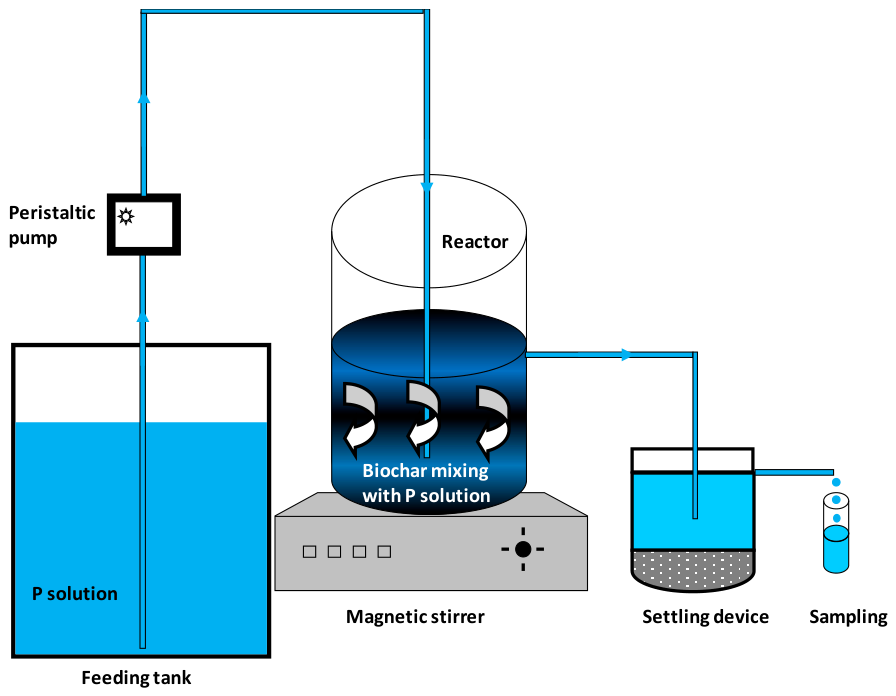
Figure 1. Graphical representation of the CSTR system used to investigate MWM–B’s P removal efficiency under dynamic conditions.
Water 18 01348 g001
Figure 2. XRD spectrum of the raw MWM–B (Water 18 01348 i001: CaCO3; Water 18 01348 i002: Ca(OH)2; Water 18 01348 i003: CaO; Water 18 01348 i004: KCl).
Water 18 01348 g002
Figure 3. P removal efficiency by MWM–B in batch mode: Effect of contact time and kinetic data modeling with PFO and PSO models (a), effect of initial aqueous pH values (b), effect of biochar dose (c), and effect of initial P concentration and isotherm data modeling with, Langmuir, D–R and Freundlich models (d).
Water 18 01348 g003aWater 18 01348 g003b
Figure 4. P removal efficiency by MWM–B in CSTR mode: Effect of initial P concentration (a) and the biochar dosage (b).
Water 18 01348 g004
Figure 5. Effect of flow rate on P removal efficiency by MWM–B in CSTR mode: Breakthrough curves vs. time (a) and vs. collected volume (b).
Water 18 01348 g005
Figure 6. Effect of using synthetic and real wastewater on P removal performance in batch (a) and CSTR (b) modes.
Water 18 01348 g006
Figure 7. XRD spectrum of MWM–B after P removal (Water 18 01348 i001: CaCO3; Water 18 01348 i003: CaO; Water 18 01348 i005: HAP).
Water 18 01348 g007
Figure 8. XPS spectra of MWM–B before and after P adsorption: High resolution of P 2p (a), C 1s (b), Ca 2p (c), and O 1s (d).
Water 18 01348 g008aWater 18 01348 g008b
Table 1. Experimental conditions for P removal by MWM–B in batch mode (t: contact time, D: biochar dose, C0: initial P concentration, NA: not adjusted, SS: synthetic solution, WW: wastewater).
Set Numbert (min)Initial pHD (g L−1)C0 (mg L−1)Solution
10.25–1200NA (6.8)1200SS
21200NA115–200SS
312002–101200SS
41200NA0.5–30200SS
51200NA1200WW
Table 2. Experimental conditions for P removal by MWM–B in CSTR mode (C0: initial P concentration, M: biochar mass, Q: flow rate, SS: synthetic solution, WW: wastewater).
Set NumberC0 (mg L−1)D (g L−1)Q (mL min−1)Solution
110, 15, and 250.68SS
2150.48, 0.72, and 0.96 8SS
3150.484, 8, and 10SS
4150.488WW
Table 3. Textural, elemental, pHpzc, and CEC analyses of MWM–B (BET SSA: BET specific surface area, Mic-SA: Microporous area, Ext-SA: External surface area, Mic-V: Microporous volume, TPV: Total pore volume, APS: Average pore size, *: O (%) calculated as 100%-C(%)-H(%)-N(%), ND: not detected).
Textural PropertiesElemental AnalysisSurface Chemical Analysis
BET SSA (m2 g−1)Mic-SA (m2 g−1)Ext-SA (m2 g−1)Mic-V (cm3 g−1)TPV (cm3 g−1)APS (nm)C (wt.%)H (wt.%)O * (wt.%)N (wt.%)CEC (cmolc kg−1)pHpzc
16.929.986.940.00510.024315.118.540.9180.55ND19.213.3
Disclaimer/Publisher’s Note: The statements, opinions and data contained in all publications are solely those of the individual author(s) and contributor(s) and not of MDPI and/or the editor(s). MDPI and/or the editor(s) disclaim responsibility for any injury to people or property resulting from any ideas, methods, instructions or products referred to in the content.